Sports

Hip-hop heroes

3

I’m rolling with the big timers: the executive director and founder of a community circus arts program, an after-school program b-boy teacher, the most beautiful family in Bay Area hip-hop, and my boyfriend, who is snapping photos on his Nikon of the rest of us. We’re standing under the high ceiling of Acrosports, in a room filled with trapezes, a balancing beam, an over-sized trampoline, and the contorting, jack-knifing bodies of young, aspiring circus professionals. The people assembled (minus me and my man) are using the power of hip-hop to bring a cultural skill swap to underprivileged youth in Zanzibar.

It’s a feel good moment, particularly because it comes during a week that hosted some of the darkest days in the past century of the labor movement, the start of unimaginable hardship in Japan, and disheartening scenes from our nation’s leaders’ announced Muslim witch hunt. But enough of that for now, Zumbi’s talking:

“This is the first time we’ve done a tour that benefited charities, which is cool… but it’s like, why has this taken so long to do? Why don’t more people do this?”

The emcee from Zion I is makes uplifting Bay Area hip-hop without major label representation, and now it’s been announced that his, DJ Amp Live, and the Grouch’s upcoming tour will be benefiting local community organizations at each of its 36 gigs on its “Healing of the Nation” tour — which is named after the artists’ second collaboration album, Heroes in the Healing of the Nation.

In the Acrosport’s basement, breakdancing students get their new skills battle-ready. Photo by Erik Anderson

“This album, it’s more focused, it’s about communities, families, self. It’s needed! These days, you’ve got Charlie Sheen occupying more time onscreen than the Middle East. Everybody’s all caught up on tiger blood,” Zumbi tells me. It’s positive music, much like the first Zion I-grouch collab, 2006’s Heroes in the City of Dope, but it’s far from Public Enemy-style protest rap. 

Track eight on the new album is entitled “Be A Father To Your Child,” in the chorus of track two the Grouch asserts “I’m a leader/I don’t want to be a follower,” pledging allegiance to self-motivation. There’s a song called “I Used to Be Vegan” on the album that I find particularly resonant given my own struggles with evading cheese. The message is: be a positive force, don’t get swept up in the forces that try to disempower you and make you sad. It’s conscious music, but conscious music meant to have a good time to.

Today we also meet Zumbi’s beautiful partner Tiffany and their three-month old prince, Kodi Shaddai. They pose prettily by the catapulting acrobats behind them and Zumbi tells me that Kodi may well make a cameo appearance in the album’s upcoming music video. He tells me he used to do capoeira himself and jokes about his bad knees with B-Boy Black, a.k.a. Ed Johnson, Acrosports’ outreach director and breakdance teacher who will be one of the leaders on the Zanzibar trip.

Acrosports’ professional track performers practice across the street from Kezar Stadium. Photo by Erik Anderson

Is Zion I’s hip-hop philanthropy new? Certainly not, but what is novel is the group’s maturing image. Zumbi says that Heroes in the City of Dope was “more commentary, more getting fresh.” Heroes in the Healing of the Nation focuses more on creating positive space — reflective of the three men’s new roles as fathers and, gulp, role models. Looking into the future (though he’s far from hanging up his touring hat), Zion I’s emcee tells me that he sees his role in hip-hop as that of mentor to youngsters coming up in the ranks. 

My star-struckedness aside, I should probably be spending more of this article talking about Acrosports and its planned trip to Africa. You wanna see bringing uplift to the people? The place is pretty incredible, offering classes in breakdancing, capoeira, tumbling, and parkour to community members from 10 months of age and up. They run after-school programs in over 20 school, YMCAs, and Boys & Girls Clubs whose philosophy is to empower kids through positive motivation and access to non-traditional sports. 

Community activist Dorrie Huntington founded the place 20 years ago when she realized the building she lived next door to was sitting empty after years as a high school, and then a homeless shelter. Some unemployed members of the Moscow Circus proposed that they start teaching tumbling classes. Soon the team was repurposing sleeping mats from the homeless shelter and donated paint to create the center, all with very little resources. “It took a lot of sweat equity,” Huntington smiles. But that was 20 years ago and the perspiration paid off – now the city has a place where people of all ages and levels of fitness can come to learn how to move their bodies in joyous, creative ways. 

In 2009, Huntington went to Africa to volunteer in a Tanzanian orphanage, and on a vacation ran into some kids flipping out on a beach in Zanzibar. “Their skills were so amazing. They had this truck tire wedged in the sand and they were doing flips off of it.” She struck up a friendship with the amateur acrobats and vowed to return with teachers that could help the kids develop their performance skills. 

It’s a mission that resonates with her staff. “Growing up in a black community,” says Johnson, “going to Africa was seen as learning about your roots. I want to go out there and meet these amazing artists.” I ask him how he felt when he learned that Zion I and the Grouch were dipping into ticket sales to help him and his team realize the dream and he gets a little bashful. “I had to keep my composure,” he tells the group, and turns to Zumbi. “I have the vinyl record of The Bay! I don’t even have a record player, I was just like, I got to have that album!”

Inspiring people creating space for each other to make great things happen. Like a little feedback loop of positivity, it was. And a real good break from the heartache of the news channels.


Zion I and the Grouch

Sat/19 9 p.m., $25

The Fillmore 

1805 Geary, SF

www.zioniandthegrouch.com


Film Listings

0

SAN FRANCISCO INTERNATIONAL ASIAN AMERICAN FILM FESTIVAL

The 29th SFIAAFF runs through Sun/20 at the Camera 12, 201 S. Second St., San Jose; Pacific Film Archive, 2776 Bancroft, Berk.; Sundance Kabuki, 1881 Post; and Viz Cinema, New People, 1746 Post, SF. For tickets (most shows $12) and additional program information, visit www.caamedia.org. All times pm.

WED/16

Kabuki “Futurestates” (shorts program) 4. One Voice 4:45. Made in India 6:45. Anna May Wong: In Her Own Words with “Slaying the Dragon Reloaded” 7:15. Dance Town 9:15. Affliction 9:30.

PFA M/F Remix 7. Sampaguita, National Flower 9.

Viz “Living Life Large” (shorts program) 4. Dog Sweat 6:45. Peace 9:15.

THURS/17

Kabuki Living in Seduced Circumstances 4:20. “Tainted Love” (shorts program) 5:15. “Silent Rituals and Hovering Proxies” (shorts program) 6:45. Surrogate Valentine 7. Bi, Don’t Be Afraid! 7:30.

PFA Dance Town 7. Nang Nak 9:20.

Viz “Life Interrupted” (shorts program) 5. “Futurestates” (shorts program) 7:30.

FRI/18

PFA Passion 7. The Taqwacores 8:45.

SAT/19

Camera Amin 12:15. Piano in a Factory 1. Saigon Electric 3:15. “Life, Interrupted” (shorts program) 3:30. Almost Perfect 6. Made in India 6. Emir 8:30. When Love Comes 9.

PFA Bend It Like Beckham 4. The Imperialists Are Still Alive! 6:10. Histeria 8.

SUN/20

Camera “3rd I South Asian International Shorts” noon. The Fourth Portrait 1. One Voice 2:15. Surrogate Valentine 3:30. Abraxas 4:45. Bi, Don’t Be Afraid! 6. It’s a Wonderful Afterlife 7:30. Break Up Club 8.


OPENING

Certified Copy See “Looking Glass Love.” (1:46) Clay, Shattuck, Smith Rafael.

*Heartbeats See “Xavier University.” (1:35) Lumiere.

*The Human Resources Manager What happens when a nameless, faceless “human resource” begin to resolve into a palpably real being with hopes, fears, loved ones, a hometown, a past? The harried Human Resources Manager of a big Jerusalem bakery finds out when one of his employer’s foreign workers is killed in a suicide bombing. After her body remains unclaimed in a city morgue, his employer is tagged with callous indifference, and it’s up to the beleaguered HR Manager (Mark Ivanir) — already suffering from something of an existential crisis — to undertake damage control. That task turns out to be absurdly above and beyond the ordinary when he retraces his late charge’s footsteps and tracks down her family in Romania, dogged by a meddling reporter (Guri Alfi). Back in the bleak old country, “neither east nor west,” as he’s constantly reminded, the HR Manager encounters a suitably salty, strange array of characters — the earthy Consul (Rozina Cambos) and the deceased’s divorced husband (Reymond Amsalem) and her feral son (Noah Silver) — though who can actually claim the lady’s remains? The troublesome chore turns into a journey about reconnecting with the people the HR Manager stopped seeing as full-fledged, complicated beings. Working from A.B. Yehoshua’s 2006 novel, A Woman in Jerusalem, director Eran Riklis deigns to give his characters names, apart from the dead, and instead focuses on crafting a carefully balanced, altogether enjoyable and accessible black comedy, rendering it all with a delicate touch that Anton Chekhov might have approved of. (1:43) Opera Plaza, Shattuck. (Chun)

*Jane Eyre Do we really need another adaptation of Jane Eyre? As long as they’re all as good as Cary Fukunaga’s stirring take on the gothic romance, keep ’em coming. Mia Wasikowska stars in the titular role, with the dreamy Michael Fassbender stepping into the high pants of Edward Rochester. The cast is rounded out by familiar faces like Judi Dench, Jamie Bell, and Sally Hawkins — all of whom breathe new life into the material. It helps that Fukunaga’s sensibilities are perfectly suited to the story: he stays true to the novel while maintaining an aesthetic certain to appeal to a modern audience. Even if you know Jane Eyre’s story — Mr. Rochester’s dark secret, the fate of their romance, etc. — there are still surprises to be had. Everyone tells the classics differently, and this adaptation is a thoroughly unique experience. And here’s hoping it pushes the engaging Wasikowska further in her ascent to stardom. (2:00) Embarcadero. (Peitzman)

*Limitless An open letter to the makers of Limitless: please fire your marketing team because they are making your movie look terrible. The story of a deadbeat writer (Bradley Cooper) who acquires an unregulated drug that allows him to take advantage of 100 percent of his previously under-utilized brain, Limitless is silly, improbable and features a number of distracting comic-book-esque stylistic tics. But consumed with the comic book in mind, Limitless is also unpredictable, thrilling, and darkly funny. The aforementioned style, which includes many instances of the infinite regression effect that you get when you point two mirrors at each other, and a heavy blur to distort depth-of-field, only solidifies the film’s cartoonish intentions. Cooper learns foreign languages in hours, impresses women with his keen attention to detail, and sets his sights on Wall Street, a move that gets him noticed by businessman Carl Van Loon (Robert DeNiro in a glorified cameo) as well as some rather nasty drug dealers and hired guns looking to cash in on the drug. Limitless is regrettably titled and masquerades in TV spots as a Wall Street series spin-off, but in truth it sports the speedy pacing and tongue-in-cheek humor required of a good popcorn flick. (1:37) (Galvin)

The Lincoln Lawyer Matthew McConaughey stars as an unconventional lawyer who takes on a controversial client (Ryan Phillippe). (1:59)

The Music Never Stopped Based on a Dr. Oliver Sacks case history, this neurological wild-ride focuses on the generation gap in extremis: after a ’60s teenage son rebels against his parents, staying incommunicado in the interim, he resurfaces over two decades later as a disoriented, possibly homeless patient they’re called to identify at a hospital. He’s had a benign brain tumor removed — yet it had grown so large before surgery that it damaged gray-matter areas including those handling recent memory. As a result, Gabriel (Lou Taylor Pucci) relates to Mr. (J.K. Simmons) and Mrs. Sawyer (a terrific but underutilized Cara Seymour) as if they were still his upstate NY domestic keepers. A radiant Julia Ormond plays the music therapist who convinces them Gabe might respond to music, which had helped serially glue and sever the father-son bond decades earlier. This is an inherently fascinating psychological study. But director Jim Kohlberg and his scenarists render it placidly inspirational, with too little character nuance, scant period atmosphere (somewhat due to budgetary limitations), and weak homage to the Grateful Dead (ditto) rendering an unusual narrative oddly formulaic. (1:45) Shattuck. (Harvey)

Paul Across the aisle from the alien-shoot-em-up Battle: Los Angeles is its amiable, nerdy opposite: Paul, with its sweet geeks Graeme (Simon Pegg) and Clive (Nick Frost), off on a post-Comic-Con pilgrimage to all the US sites of alien visitation. Naturally the buddies get a close encounter of their very own, with a very down-to-earth every-dude of a schwa named Paul (voiced by Seth Rogen), given to scratching his balls, spreading galactic wisdom, utilizing Christ-like healing powers, and cracking wise when the situation calls for it (as when fear of anal probes escalates). Despite a Pegg-and-Frost-penned script riddled with allusions to Hollywood’s biggest extraterrestrial flicks and much 12-year-old-level humor concerning testicles and farts, the humor onslaught usually attached to the two lead actors — considered Lewis and Martin for pop-smart Anglophiles — seems to have lost some of its steam, and teeth, with the absence of former director and co-writer Edgar Wright (who took last year’s Scott Pilgrim vs. the World to the next level instead). Call it a “soft R” for language and an alien sans pants. (1:44) California. (Chun)

*Phil Ochs: There But For Fortune When Phil Ochs was at his peak, he was one of the finest polemical folksingers to come out of the ’60s, and when he tumbled from those heights, the fall was terrible: he lost more than friends and fame — he appeared to completely lose himself, to substance abuse and mental illness. Director Kenneth Bowser does the singer-songwriter justice with this documentary, threading to-the-ramparts tunes like “Hazard, Kentucky,” questioning numbers a la “Love Me, I’m a Liberal,” and achingly beautiful songs such as “Jim Dean of Indiana” throughout political events of the day, scenes from a protest movement that were inextricably entangled with Ochs’ oeuvre. Along with the many clips of Ochs in performance are interviews with the artist’s many friends, cohorts, and fans including Van Dyke Parks (who is becoming a Thurston Moore-like go-to for a generation’s damaged voices), brother (and music archivist) Michael Ochs, Joan Baez, Tom Hayden, Peter Yarrow, Billy Bragg, daughter Meegan Ochs, and Ed Sanders. Expect an education in Ochs’ art, but also, perhaps more importantly (to the singer-songwriter), a glimpse into a time and place that both fed, fueled and bestowed meaning on his songs. Bowser succeeds in paints the portrait of a performer that was both idealistic and careerist, driven to fight injustice yet also propelled to explore new creative avenues (like recording with local musicians in Africa). Did Ochs fall — by way of drink, drugs, and mental illness — or was he pushed, as the artist claimed when he accused CIA thugs of destroying his vocal chords? The filmmaker steps back respectfully, allowing us to draw our own conclusion about this life lived fully. (1:38) Smith Rafael. (Chun)

You Won’t Miss Me Look at this fucking hipster: dour, aimless Shelly (Stella Schnabel, daughter of Julian) has her own New York City apartment (plus access to a country home, the ability to travel to Atlantic City on a whim, etc.) despite having no apparent source of income. Shelly drifts, going on auditions to further her as-yet unsuccessful acting career; leaving monotone voice mails for her mother; visiting her therapist; hooking up with assorted unwashed dudes; and hanging out with her insipid friends, one of whom helps our hapless 21st century protagonist set up her very first email account. That Shelly is depressed is a given; why anyone would choose to watch this drag of a film is a mystery. Director Ry Russo-Young aims to break up the angst by deploying an array of formats — from Super 8 to Flip — but no amount of artsy quirks (or cameos recognizable only to mumblecore enthusiasts) can make up for You Won’t Miss Me‘s uninvolving plot and unsympathetic characters. For a less painful (though by no means pain-free) experience, seek out last year’s similar Tiny Furniture instead. (1:21) Roxie. (Eddy)

ONGOING

The Adjustment Bureau As far as sci-fi romantic thrillers go, The Adjustment Bureau is pretty standard. But since that’s not an altogether common genre mash-up, I guess the film deserves some points for creativity. Based on a short story by Philip K. Dick, The Adjustment Bureau takes place in a world where all of our fates are predetermined. Political hotshot David Norris (Matt Damon) is destined for greatness — but not if he lets a romantic dalliance with dancer Elise (Emily Blunt) take precedence. And in order to make sure he stays on track, the titular Adjustment Bureau (including Anthony Mackie and Mad Men‘s John Slattery) are there to push him in the right direction. While the film’s concept is intriguing, the execution is sloppy. The Adjustment Bureau suffers from flaws in internal logic, allowing the story to skip over crucial plot points with heavy exposition and a deus ex machina you’ve got to see to believe. Couldn’t the screenwriter have planned ahead? (1:39) 1000 Van Ness, Piedmont, SF Center, Shattuck, Sundance Kabuki. (Peitzman)

*Battle: Los Angeles Michael Bay is likely writhing with envy over Battle: Los Angeles; his Transformers flicks take a more, erm, nuanced view of alien-on-human violence. But they’re not all such bad guys after all; these days, as District 9 (2009) demonstrated, alien invasions are more hazardous to the brothers and sisters from another planet than those trigger-happy humanoids ready to defend terra firma. So Battle arrives like an anomaly — a war-is-good action movie aimed at faceless space invaders who resemble the Alien (1979) mother more than the wide-eyed lost souls of District 9. Still reeling from his last tour of duty, Staff Sergeant Nantz (Aaron Eckhart) is ready to retire, until he’s pulled back in by a world invasion, staged by thirsty aliens. In approximating D-Day off the beach of Santa Monica, director Jonathan Liebesman manages to combine the visceral force of Saving Private Ryan (1998) with the what-the-fuck hand-held verite rush of Cloverfield (2008) while crafting tiny portraits of all his Marines, including Michelle Rodriguez, Ne-Yo, and True Blood‘s Jim Parrack. A few moments of requisite flag-waving are your only distractions from the almost nonstop white-knuckle tension fueling Battle: Los Angeles. (1:57) California, 1000 Van Ness. (Chun)

Beastly The problem with a title like Beastly is that it’s difficult to avoid the obvious line: the movie lives up to its name. But indeed, this modernized take on the Beauty and the Beast tale is wretched on all fronts — a laughable script, endless plot holes, and the kind of wooden acting that makes you long for the glory days of Twilight (2008). New “It Boy” Alex Pettyfer stars as Kyle, a vapid popular kid who is cursed to look like a slightly less attractive version of himself by a vengeful witch (Mary-Kate Olsen). Only the love of kind-hearted Lindy (Vanessa Hudgens) can cure him of his fate. There is so much wrong with Beastly, it’s hard to zone in on its individual faults: this is a film in which the opening scene has Kyle telling his ugly classmates to “embrace the suck”—and then getting elected to student government anyway. Embrace Beastly‘s suck if you can’t live without Pettyfer’s washboard abs, but you’re far better off rewatching the Disney or Cocteau versions. (1:35) 1000 Van Ness. (Peitzman)

Biutiful Uxbal (Javier Bardem) has problems. To name but a few: he is raising two young children alone in a poor, crime-beset Barcelona hood. He is making occasional attempts to rope back in their bipolar, substance-abusive mother (Maricel Álvarez), a mission without much hope. He is trying to stay afloat by various not-quite legal means while hopefully doing the right thing by the illegals — African street drug dealers and Chinese sweatshop workers — he acts as middleman to, standing between them and much less sympathetically-inclined bossmen. He’s got a ne’er-do-well brother (Eduard Fernandez) to cope with. Needless to say, with all this going on (and more), he isn’t getting much rest. But when he wearily checks in with a doc, the proverbial last straw is stacked on his camelback: surprise, you have terminal cancer. With umpteen odds already stacked against him in everyday life, Uxbal must now put all affairs in order before he is no longer part of the equation. This is Alejandro González Iñárritu’s first feature since an acrimonious creative split with scenarist Guillermo Arriaga. Their films together (2006’s Babel, 2003’s 21 Grams, 2000’s Amores Perros) have been criticized for arbitrarily slamming together separate baleful storylines in an attempt at universal profundity. But they worked better than Biutiful, which takes the opposite tact of trying to fit several stand-alone stories’ worth of hardship into one continuous narrative — worse, onto the bowed shoulders of one character. Bardem is excellent as usual, but for all their assured craftsmanship and intense moments, these two and a half hours collapse from the weight of so much contrived suffering. Rather than making a universal statement about humanity in crisis, Iñárritu has made a high-end soap opera teetering on the verge of empathy porn. (2:18) Shattuck. (Harvey)

*Black Swan “Lose yourself,” ballet company head Thomas (Vincent Cassel) whispers to his leading lady, Nina (Natalie Portman), moments before she takes the stage. But Nina is already consumed with trying to find herself, and rarely has a journey of self-discovery been so unsettling. Set in New York City’s catty, competitive ballet world, Black Swan samples from earlier dance films (notably 1948’s The Red Shoes, but also 1977’s Suspiria, with a smidgen of 1995’s Showgirls), though director Darren Aronofsky is nothing if not his own visionary. Black Swan resembles his 2008 The Wrestler somewhat thematically, with its focus on the anguish of an athlete under ten tons of pressure, but it’s a stylistic 180. Gone is the gritty, stripped-down aesthetic used to depict a sad-sack strongman. Like Dario Argento’s 1977 horror fantasy, the gory, elegantly choreographed Black Swan is set in a hyper-constructed world, with stabbingly obvious color palettes (literally, white = good; black = evil) and dozens of mirrors emphasizing (over and over again) the film’s doppelgänger obsession. As Nina, Portman gives her most dynamic performance to date. In addition to the thespian fireworks required while playing a goin’-batshit character, she also nails the role’s considerable athletic demands. (1:50) Shattuck, Sundance Kabuki. (Eddy)

*Cedar Rapids What if The 40 Year Old Virgin (2005) got so Parks and Rec‘d at The Office party that he ended up with a killer Hangover (2009)? Just maybe the morning-after baby would be Cedar Rapids. Director Miguel Arteta (2009’s Youth in Revolt) wrings sweet-natured chuckles from his banal, intensely beige wall-to-wall convention center biosphere, spurring such ponderings as, should John C. Reilly snatch comedy’s real-guy MVP tiara away from Seth Rogen? Consider Tim Lippe (Ed Helms of The Hangover), the polar opposite of George Clooney’s ultracompetent, complacent ax-wielder in Up in the Air (2009). He’s the naive manchild-cum-corporate wannabe who never quite graduated from Timmyville into adulthood. But it’s up to Lippe to hold onto his firm’s coveted two-star rating at an annual convention in Cedar Rapids. Life conspires against him, however, and despite his heartfelt belief in insurance as a heroic profession, Lippe immediately gets sucked into the oh-so-distracting drama, stirred up by the dangerously subversive “Deanzie” Ziegler (John C. Reilly), whom our naif is warned against as a no-good poacher. Temptations lie around every PowerPoint and potato skin; as Deanzie warns Lippe’s Candide, “I’ve got tiger scratches all over my back. If you want to survive in this business, you gotta daaance with the tiger.” How do you do that? Cue lewd, boozy undulations — a potbelly lightly bouncing in the air-conditioned breeze. “You’ve got to show him a little teat.” Fortunately Arteta shows us plenty of that, equipped with a script by Wisconsin native Phil Johnston, written for Helms — and the latter does not disappoint. (1:26) California, Empire, Piedmont, Sundance Kabuki. (Chun)

Even the Rain It feels wrong to criticize an “issues movie” — particularly when the issues addressed are long overdue for discussion. Even the Rain takes on the privatization of water in Bolivia, but it does so in such an obvious, artless way that the ultimate message is muddled. The film follows a crew shooting an on-location movie about Christopher Columbus. The film-within-a-film is a less-than-flattering portrait of the explorer: if you’ve guessed that the exploitation of the native people will play a role in both narratives, you’d be right. The problem here is that Even the Rain rests on our collective outrage, doing little to explain the situation or even develop the characters. Case in point: Sebastian (Gael García Bernal), who shifts allegiances at will throughout the film. There’s an interesting link to be made between the time of Columbus and current injustice, but it’s not properly drawn here, and in the end, the few poignant moments get lost in the shuffle. (1:44) Lumiere, Shattuck. (Peitzman)

The Fighter Once enough of a contenda to have fought Sugar Ray Leonard — and won, though there are lingering questions about that verdict’s justice — Dicky (Christian Bale) is now a washed-up, crack-addicted mess whose hopes for a comeback seem just another expression of empty braggadocio. Ergo it has fallen to the younger brother he’s supposedly “training,” Micky (Mark Wahlberg), to endure the “managerial” expertise of their smothering-bullying ma (Melissa Leo) and float their large girl gang family of trigger-tempered sisters. That’s made even worse by the fact that they’ve gotten him nothing but chump fights in which he’s matched someone above his weight and skill class in order to boost the other boxer’s ranking. When Micky meets Charlene (Amy Adams), an ambitious type despite her current job as a bartender, this hardboiled new girlfriend insists the only way he can really get ahead is by ditching bad influences — meaning mom and Dicky, who take this shutout as a declaration of war. The fact-based script and David O. Russell’s direction do a good job lending grit and humor to what’s essentially a 1930s Warner Brothers melodrama — the kind that might have had Pat O’Brien as the “good” brother and James Cagney as the ne’er-do-well one who redeems himself by fadeout. Even if things do get increasingly formulaic (less 1980’s Raging Bull and more 1976’s Rocky), the memorable performances by Bale (going skeletal once again), Wahlberg (a limited actor ideally cast) and Leo (excellent as usual in an atypically brassy role) make this more than worthwhile. As for Adams, she’s just fine — but by now it’s hard to forget the too many cutesy parts she’s been typecast in since 2005’s Junebug. (1:54) 1000 Van Ness, SF Center. (Harvey)

Gnomeo and Juliet If you willingly see a movie titled Gnomeo and Juliet, you probably have a keen sense of what you’re in for. And as long as that’s the case, it’s hard not to get sucked into the film’s 3D gnome-infested world. Believe it or not, this is actually a serviceable adaptation of Shakespeare’s classic — minus the whole double-suicide downer ending. But at least the movie is conscious of its source material, throwing in several references to other Shakespeare plays and even having the Bard himself (or, OK, a bronze statue) comment on the proceedings. It helps that the cast is populated by actors who could hold their own in a more traditional Shakespearean context: James McAvoy, Emily Blunt, Maggie Smith, and Michael Caine. But Gnomeo and Juliet isn’t perfect — not because of its outlandish concept, but due to a serious overabundance of Elton John. The film’s songwriter and producer couldn’t resist inserting himself into every other scene. Aside from the final “Crocodile Rock” dance number, it’s actually pretty distracting. (1:24) 1000 Van Ness. (Peitzman)

Hall Pass There are some constants when it comes to a Farrelly Brothers movie: lewd humor, full-frontal male nudity, and at least one shot of explosive diarrhea. Hall Pass does not disappoint on the gross-out front, but it’s a letdown in almost every other way. Rick (Owen Wilson) and Fred (Jason Sudeikis) are married men obsessed with the idea of reliving their glory days. Lucky for them, wives Maggie (Jenna Fischer) and Grace (Christina Applegate) decide to give them a week-long “hall pass” from marriage. Of course, once Rick and Fred are able to go out and snag any women they want, they realize most women aren’t interested in being snagged by dopey fortysomethings. On paper, Hall Pass has the potential to be a sharp, anti-bro comedy. Instead, it wallows in recycled toilet humor that’s no longer edgy enough to make us squirm. At least there are still moments of misogyny to provide that familiar feeling of discomfort. (1:38) 1000 Van Ness. (Peitzman)

Happythankyoumoreplease Director, writer, and star Josh Radnor gets the prize for most unwieldy, hard-to-remember title in a while — and a tiny gold star for revealing the most heart within one so-called hipster. In this indie feel-gooder, writer Sam (Radnor) is lost at sea, completely adrift at the close of his twenties and unable to sell his novel. The aimlessness is beginning to seem less than cute to the random ladies that pass in the night and chums like Annie (Malin Akerman), who happens to have Alopecia and whose merry outlook is battling with her lack of self-confidence, and Mary Catherine (Zoe Kazan), who is puzzling whether to follow her boyfriend Charlie (Pablo Schreiber) to LA or to retain her life as a an artist in NYC. It takes a lost little boy, Rasheen (Michael Algieri), to bring out the selfless nurturer in Sam’s self-conscious man-child, giving him the courage to approach the local hottie-slash-waitress-slash-cabaret-singer Mississippi (Kate Mara). Radnor — who resembles a likable, every-guy Ben Affleck, though he’s hindered with an expressiveness that ranges from bemused to bemused — himself points to the similarities between Woody Allen’s hymns to Manhattan intelligentsia-bohemia and his own aria to NYC singles on the brink of hooking up with adulthood. Waxing cute rather than critical, Happythankyoumoreplease lacks Allen’s early bite, but its guileless sweetness just might do the trick and satisfy some. (1:40) Lumiere. (Chun)

I Am File in the dusty back drawer of An Inconvenient Truth (2006) wannabes. The cringe-inducing, pretentious title is a giveaway — though the good intentions are in full effect — in this documentary by and about director Tom Shadyac’s search for answers to life’s big questions. After a catastrophic bike accident, the filmmaker finds his lavish lifestyle as a successful Hollywood director of such opuses as Bruce Almighty (2003) somewhat wanting. Thinkers and spiritual leaders such as Desmond Tutu, Howard Zinn, UC Berkeley psychology professor Dacher Keltner, and scientist David Suzuki provide some thought-provoking answers, although Shadyac’s thinking behind seeking out this specific collection of academics, writers, and activists remains somewhat unclear. I Am‘s shambling structure and perpetual return to its true subject — Shadyac, who resembles a wide-eyed Weird Al Yankovic — doesn’t help matters, leaving a viewer with mixed feelings, less about whether one man can work out his quest for meaning on film, than whether Shadyac complements his subjects and their ideas by framing them in such a random, if well-meaning, manner. And sorry, this film doesn’t make up for Ace Ventura: Pet Detective (1994). (1:16) Opera Plaza, Shattuck. (Chun)

I Am Number Four Do you like Twilight? Do you think aliens are just as sexy — if not sexier! — than vampires? I Am Number Four isn’t a rip-off of Stephenie Meyer’s supernatural saga, but the YA novel turned film is similar enough to draw in that coveted tween audience. John (Alex Pettyfer) is a teenage alien with extraordinary powers who falls in love with a human girl Sarah (Dianna Agron). But they’re from two different worlds! To be fair, star-crossed romance isn’t the issue here: the real problem is I Am Number Four‘s “first in a series” status. Rather than working to establish itself as a film in its own right, the movie sets the stage for what’s to come next, a bold presumption for something this mediocre. It lazily drops some exposition, then launches into big, loud battles without pausing to catch its breath. I Am Number Four only really works if it gets a sequel, and we all know how well that turned out for The Golden Compass (2007). (1:44) 1000 Van Ness. (Peitzman)

I Saw the Devil This latest by South Korean wunderkind Kim Ji-woon (2008’s The Good, The Bad, The Weird; 2003’s A Tale of Two Sisters) aims to push serial-killer thriller conventions to new extremes in intensity, violent set-piece bravado, and sheer length. Intelligence agent Joo-yeong (Lee Byung-hun) is inconsolably horrified when his fiancée — a police chief’s daughter — is abducted, tortured and murdered by giddily remorseless Kyung-chul (Choi Min-sik). The latter is a rural schoolbus driver who stalks his prey on and off the job, hauling them to a rigged-up shack where he enjoys their protracted final writhings. Once our hero tracks down this grotesque villain, he demonstrates a perverse, obsessive side by letting the “devil” loose again — each time after serious physical punishment — so that he can live in terror of his avenger. The trouble with that concept is that our upright, fanatical hero thus allows remorseless Kyung-chul to abuse new victims every time he’s let loose, which simply doesn’t make psychological sense. I Saw the Devil has some dazzling action set-pieces and outre content. But the dependency on slasher genre-style harm toward pretty young women sounds a sour, conventional note. And while it reserves a delicious irony or two for the end, this glorified horror flick simply goes on way too long. (2:21) Opera Plaza. (Harvey)

*The Illusionist Now you see Jacques Tati and now you don’t. With The Illusionist, aficionados yearning for another gem from Tati will get a sweet, satisfying taste of the maestro’s sensibility, inextricably blended with the distinctively hand-drawn animation of Sylvain Chomet (2004’s The Triplets of Belleville). Tati wrote the script between 1956 and 1959 — a loving sendoff from a father to a daughter heading toward selfhood — and after reading it in 2003 Chomet decided to adapt it, bringing the essentially silent film to life with 2D animation that’s as old school as Tati’s ambivalent longing for bygone days. The title character should be familiar to fans of Monsieur Hulot: the illusionist is a bemused artifact of another age, soon to be phased out with the rise of rock ‘n’ rollers. He drags his ornery rabbit and worn bag of tricks from one ragged hall to another, each more far-flung than the last, until he meets a little cleaning girl on a remote Scottish island. Enthralled by his tricks and grateful for his kindness, she follows him to Edinburgh and keeps house while the magician works the local theater and takes on odd jobs in an attempt to keep her in pretty clothes, until she discovers life beyond their small circle of fading vaudevillians. Chomet hews closely to bittersweet tone of Tati’s films — and though some controversy has dogged the production (Tati’s illegitimate, estranged daughter Helga Marie-Jeanne Schiel claimed to be the true inspiration for The Illusionist, rather than daughter and cinematic collaborator Sophie Tatischeff) and Chomet neglects to fully detail a few plot turns, the dialogue-free script does add an intriguing ambiguity to the illusionist and his charge’s relationship — are they playing at being father and daughter or husband and wife? — and an otherwise straightforward, albeit poignant tale. (1:20) Opera Plaza, Smith Rafael. (Chun)

Inside Job Inside Job is director Charles Ferguson’s second investigative documentary after his 2007 analysis of the Iraq War, No End in Sight, but it feels more like the follow-up to Alex Gibney’s Enron: The Smartest Guys in the Room (2005). Keeping with the law of sequels, more shit blows up the second time around. As with No End in Sight, Ferguson adeptly packages a broad overview of complex events in two hours, respecting the audience’s intelligence while making sure to explain securities exchanges, derivatives, and leveraging laws in clear English (doubly important when so many Wall Street executives hide behind the intricacy of markets). The revolving door between banks, government, and academia is the key to Inside Job‘s account of financial deregulation. At times borrowing heist-film conventions (it is called Inside Job, after all), Ferguson keeps the primary players in view throughout his history so that the eventual meltdown seems anything but an accident. The filmmaker’s relentless focus on the insiders isn’t foolproof; tarring Ben Bernanke, Henry Paulson, and Timothy Geithner as “made” guys, for example, isn’t a substitute for evaluating their varied performances over the last two years. Inside Job makes it seem that the entire crisis was caused by the financial sector’s bad behavior, and this too is reductive. Furthermore, Ferguson does not come to terms with the politicized nature of the economic fallout. In Inside Job, there are only two kinds of people: those who get it and those who refuse to. The political reality is considerably more contentious. (2:00) Bridge. (Goldberg)

The King’s Speech Films like The King’s Speech have filled a certain notion of “prestige” cinema since the 1910s: historical themes, fully-clothed romance, high dramatics, star turns, a little political intrigue, sumptuous dress, and a vicarious taste of how the fabulously rich, famous, and powerful once lived. At its best, this so-called Masterpiece Theatre moviemaking can transcend formula — at its less-than-best, however, these movies sell complacency, in both style and content. In The King’s Speech, Colin Firth plays King George VI, forced onto the throne his favored older brother Edward abandoned. This was especially traumatic because George’s severe stammer made public address tortuous. Enter matey Australian émigré Lionel Logue (Geoffrey Rush, mercifully controlled), a speech therapist whose unconventional methods include insisting his royal client treat him as an equal. This ultimately frees not only the king’s tongue, but his heart — you see, he’s never had anyone before to confide in that daddy (Michael Gambon as George V) didn’t love him enough. Aww. David Seidler’s conventionally inspirational script and BBC miniseries veteran Tom Hooper’s direction deliver the expected goods — dignity on wry, wee orgasms of aesthetic tastefulness, much stiff-upper-lippage — at a stately promenade pace. Firth, so good in the uneven A Single Man last year, is perfect in this rock-steadier vehicle. Yet he never surprises us; role, actor, and movie are on a leash tight enough to limit airflow. (1:58) Albany, Embarcadero, Empire, 1000 Van Ness, Piedmont, Sundance Kabuki. (Harvey)

*Last Lions It’s hard being a single mom. Particularly when you are a lioness in the Botswana wetlands, your territory invaded and mate killed by an invading pride forced out of their own by encroaching humanity. Add buffalo herds (tasty yes, but with sharp horns they’re not afraid to use) and crocodiles (no upside there), and our heroine is hard-pressed to keep herself alive, let alone her three small cubs. Derek Joubert’s spectacular nature documentary, narrated by Jeremy Irons (in plummiest Lion King vocal form) manages a mind-boggling intimacy observing all these predators. Shot over several years, while seeming to depict just a few weeks or months’ events, it no doubt fudges facts a bit to achieve a stronger narrative, but you’ll be too gripped to care. Warning: those kitties sure are cute, but this sometimes harsh depiction of life (and death) in the wild is not suitable for younger children. (1:28) Embarcadero, Shattuck. (Harvey)

Mars Needs Moms (1:28) 1000 Van Ness, SF Center.

Nora’s Will There’s certainly something to be said for the uniqueness of Nora’s Will: I can’t think of any other Mexican-Jewish movies that cover suicide, Passover, and cooking with equal attention. But while it sounds like the film is overloaded, Nora’s Will is actually too subtle for its own good. It meanders along, telling the story of the depressed Nora, her conflicted ex-husband, and the family she left behind. When the movie focuses on the clash between Judaism and Mexican culture, the results are dynamic, but more often that not, it simply crawls along. It’s not that Nora’s Will is boring: it’s just easily forgettable, which is surprising given its subject matter. Meanwhile, it walks that fine line between comedy and drama, never bringing the laughs or the emotional catharsis it wants to offer. The only real reaction it inspires is hunger, particularly if the idea of a Mexican-Jewish feast sounds appealing. Turns out “gefilte fish” is the same in every language. (1:32) Opera Plaza, Shattuck. (Peitzman)

*Of Gods and Men It’s the mid-1990s, and we’re in Tibhirine, a small Algerian village based around a Trappist monastery. There, eight French-born monks pray and work alongside their Muslim neighbors, tending to the sick and tilling the land. An emboldened Islamist rebel movement threatens this delicate peace, and the monks must decide whether to risk the danger of becoming pawns in the Algerian Civil War. On paper, Of Gods and Men sounds like the sort of high-minded exploitation picture the Academy swoons over: based on a true story, with high marks for timeliness and authenticity. What a pleasant surprise then that Xavier Beauvois’s Cannes Grand Prix winner turns out to be such a tightly focused moral drama. Significantly, the film is more concerned with the power vacuum left by colonialism than a “clash of civilizations.” When Brother Christian (Lambert Wilson) turns away an Islamist commander by appealing to their overlapping scriptures, it’s at the cost of the Algerian army’s suspicion. Etienne Comar’s perceptive script does not rush to assign meaning to the monks’ decision to stay in Tibhirine, but rather works to imagine the foundation and struggle for their eventual consensus. Beauvois occasionally lapses into telegraphing the monks’ grave dilemma — there are far too many shots of Christian looking up to the heavens — but at other points he’s brilliant in staging the living complexity of Tibrihine’s collective structure of responsibility. The actors do a fine job too: it’s primarily thanks to them that by the end of the film each of the monks seems a sharply defined conscience. (2:00) Albany, Embarcadero. (Goldberg)

Rango (1:47) Empire, 1000 Van Ness, Sundance Kabuki.

Red Riding Hood In order to appreciate a movie like Red Riding Hood, you have to be familiar with the teen supernatural romance genre. Catherine Hardwicke’s sexy reinterpretation of the fairy tale is not high art: the script is often laughable, the acting flat, and the werewolf CGI embarrassing. But there’s something undeniably enjoyable about Red Riding Hood, especially in the wake of the duller, more sexually repressed Twilight series. Amanda Seyfried stars as Valerie, a young woman living in a village of werewolf cannon fodder. She’s torn between love and duty — or, more accurately, Peter (Shiloh Fernandez) and Henry (Max Irons). Meanwhile, a vicious werewolf hunter (Gary Oldman) has arrived to overact his way into killing the beast. It’s a silly story with plenty of hamfisted references to the original fairy tale, but if you can embrace the camp factor and the striking visuals, Red Riding Hood is actually quite fun. Though, to be fair, it might help if you suffer through Beastly first. (1:38) 1000 Van Ness, Shattuck, SF Center. (Peitzman)

Take Me Home Tonight Just because lame teen comedies existed in the ’80s doesn’t mean that they need to be updated for the ’10s. Nary an Eddie Money song disgraces the soundtrack of this unselfconscious puerile, pining sex farce — the type one assumes moviemakers have grown out of with the advent of smarty-pants a la Apatow and Farrell. Take Me Home Tonight would rather find its feeble kicks in major hair, big bags of coke, polo shirts with upturned collars, and “greed is good” affluenza. Matt (Topher Grace) is an MIT grad who’s refused to embrace the engineer within and is instead biding his time as a clerk at the local Suncoast video store when he stumbles on his old high school crush Tori (Teresa Palmer), a budding banker. In an effort to impress, he tells her he works for Goldman Sachs and trails after her to the rip-roaring last-hooray-before adulthood bash. Pal Barry (Dan Fogler) gets to play the Belushi-like buffoon when he swipes a Mercedes from the dealership he just got fired from, and ends up with a face full of powder in the arms of a kinky ex-supermodel (Angie Everhart). Despite cameos by comedians like Demetri Martin and a trailer and poster that make it all seem a bit cooler than it really is, Take Me Home Tonight doesn’t really touch the coattails of Jonathan Demme or even Cameron Crowe — in the hands of director Michael Dowse, it feels nowhere near as heartfelt, rock ‘n’ roll, or at the very least, cinematically competent. (1:37) 1000 Van Ness. (Chun)

*True Grit Jeff Bridges fans, resist the urge to see your Dude in computer-trippy 3D and make True Grit your holiday movie of choice. Directors Ethan and Joel Coen revisit (with characteristic oddball touches) the 1968 Charles Portis novel that already spawned a now-classic 1969 film, which earned John Wayne an Oscar for his turn as gruff U.S. Marshall Rooster Cogburn. (The all-star cast also included Dennis Hopper, Glen Campbell, Robert Duvall, and Strother Martin.) Into Wayne’s ten-gallon shoes steps an exceptionally crusty Bridges, whose banter with rival bounty hunter La Boeuf (a spot-on Matt Damon) and relationship with young Mattie Ross (poised newcomer Hailee Steinfeld) — who hires him to find the man who killed her father — likely won’t win the recently Oscar’d actor another statuette, but that doesn’t mean True Grit isn’t thoroughly entertaining. Josh Brolin and a barely-recognizable Barry Pepper round out a cast that’s fully committed to honoring two timeless American genres: Western and Coen. (1:50) SF Center. (Eddy)

“2011 Academy Award-Nominated Short Films, Live-Action and Animated” (Live-action, 1:50; animated, 1:25) Red Vic.

Unknown Everything is blue skies as Dr. Martin Harris (Liam Neeson) flies to Germany for a biotech conference, accompanied by lovely wife Elizabeth (January Jones in full Betty Draper mode). Landing in Berlin things quickly become grey, as he’s separated from his wife and ends up in a coma. Waking in a hospital room, Harris experiences memory loss, but like Harrison Ford he’s getting frantic with an urgent need to find his wife. Luckily she’s at the hotel. Unluckily, so is another man, who she and everyone else claims is the real Dr. Harris. What follows is a by-the-numbers thriller, with car chases and fist fights, that manages to entertain as long as the existential question is unanswered. Once it’s revealed to be a knock-off of a successful franchise, the details of Unknown‘s dated Cold War plot don’t quite make sense. On the heels of 2008’s Taken, Neeson again proves capable in action-star mode. Bruno Ganz amuses briefly as an ex-Stasi detective, but the vacant parsing by bad actress Jones, appropriate for her role on Mad Men, only frustrates here. (1:49) 1000 Van Ness, SF Center. (Ryan Prendiville)

*William S. Burroughs: A Man Within William S. Burroughs, as director John Waters puts it in this long-overdue documentary, became famous before any of his peers, “for all the things you were supposed to hide: he was gay; he was a junkie; he shot his wife.” Of course, that isn’t the entire story. Examining the cultural forces and tragic biographical events that shaped The Naked Lunch author, director Yony Lesler attempts with varying degrees of success to separate the intensely private man from the countercultural raconteur in the gray flannel suit Burroughs would become later in his life. Combining interviews with a who’s who of famous associates, friends, and admirers, rare and never-before seen archival footage, and clips from Burroughs’ own experimental films and later home movies, Lesler makes a convincing case for Burroughs as a perennial outsider, even to himself. His Harvard education and wealthy pedigree set him apart from his crunchier Beat compatriots and he openly disdained the label of “gay revolutionary” even as his writing boldly envisioned same-sex desire as something truly queer. And although his dour mien and conservative dress would later become personal trademarks, he in fact privately mourned the death of his wife, Joan Vollmer, who he shot in Mexico playing a drunken round of William Tell (he was never tried), and his estranged son, Bill Burroughs Jr., who died attempting to approximate his father’s former junkie lifestyle. The film’s talking heads variously credit Burroughs with everything from punk rock to performance art, but the sad, all-too-human story behind the hagiography is what’s most compelling here. (1:38) Roxie. (Sussman)

REP PICK

*In the Dust of the Stars This goofy 1976 science-fiction opus would certainly have some cult cache in the West if it hadn’t been an East Germany-Romania coproduction whose exposure was pretty well limited to nations behind the Iron Curtain. A spaceship from planet Cynro captained by Akala (Jana Brejchova) arrives on Tem 4, having answered a call asking for help. It is disconcerting when the Temians try to make them crash during landing, then incongruously welcome them with open arms and cocktails — well, actually, flavored inhalers — while claiming no distress signal was sent. When our protagonists remain skeptical, they are further plied with a lavish party involving much interpretive dancing, snakes slithering among the smorgasbord (which no one seems to mind, or notice), screaming women bouncing on circus nets, and a game in which men and women alike catch little balls with their cleavage. The guests are brainwashed by these vaguely orgiastic goings-on, but one who’d stayed behind on the ship suspects something amiss, soon discovering Tem 4’s big secret: its ruling class are invaders who have enslaved the actual natives, who toil in the mines or serve as frequently slapped waiters. Its supreme leader, apparently named “Boss,” likes to get his hair painted different colors and wear a bathrobe at all times. Things bog down at times as we wait for the proletariat to achieve nonviolent revolutionary overthrow of their capitalist oppressors, but how can you dislike any movie in which people wear futuristic pastel disco track suits and red leather jumpsuits? Let alone one that alternately recalls everything from 1930s Flash Gordon and 1950s mega-kitsch like Queen of Outer Space (1958) to Barbarella (1968) and Space: 1999. This is part of Goethe Institut’s “From the Wild West to Outer Space: East German Genre Films” series, which concludes March 31 with the 1968 youth pop musical Hot Summer. (1:35) Thurs/17, 7 p.m., $7, Goethe-Institut, 530 Bush, SF; www.goethe.de. (Harvey)


Film listings are edited by Cheryl Eddy. Reviewers are Kimberly Chun, Michelle Devereaux, Peter Galvin, Max Goldberg, Dennis Harvey, Johnny Ray Huston, Louis Peitzman, Lynn Rapoport, Ben Richardson, and Matt Sussman. For rep house showtimes, see Rep Clock. For first-run showtimes, see Movie Guide.

Looky-loos and show ponies: A day in the life at the BNP Paribas Open

0

On one side of the main stadium at the Indian Wells Tennis Garden, white picket fences separate the players, their entourages, and assorted tour types from the fans. There’s a small plot of green grass near the practice courts, where the athletes jog after matches, or – like Scotland’s Andy and Jamie Murray – kick a soccer ball around to pass the time. The setup has a looky-loo and show pony quality, like a human version of horses being led around before a race, though in truth, the BNP Paribas Open presents one of the most free and easy atmospheres in terms of player-fan interaction, with many of the pros walking through the complex amongst the general public.

In the cafeteria, a young Belgian female player and a French former doubles and current serve-and-volley specialist wait for pressed sandwiches from a discombobulated culinary institute intern. At tables, the players fraternize with one another, sometimes across national lines, while an older women’s champion and a famous trainer sit alone. The one moment that even some pros dispassionately turn to stare is when Rafael Nadal ducks in to grab a quick bite before his first-round singles match, dropping his ID card as his transaction is rung up by a girl with Snooki- or Adele-like mascara.

Out in the practice area, some members of the Spanish Armada – Tommy Robredo, David Ferrer, and Ferrer’s coach, Javier Piles – hang out in the sole shady corner of a court in the early afternoon, then Robredo gets up and hits serves. To sunscreen or not to sunscreen? The question is moot these days for health reasons, yet there’s still a contrast between the hordes, mostly players, who look healthily tanned, and the smaller contingent, primarily older male coaches, who have taken on a leathery appearance. For the latter, this facet conveys experience and a certain kind of hardened masculinity, like that of a war admiral’s.

The French players Richard Gasquet and Gilles Simon rally and volley in the piercing sun, their styles a study in contrasts. Gasquet, once heralded as Federer’s heir apparent, has compact, classical strokes and a bullish physique, while the gangly Simon, who has outperformed expectations, is all looping limbs in comparison.

The largest crowd is gathered for Roger Federer’s practice session with compatriot and doubles partner Stanislas Wawrinka. A giant Swiss flag with ‘Rogelio’ and a jeweled crown on it is unfurled on the fence of one side of the court. Federer’s posture and gestures are of a different sort than the other athletes here, if not kingly then debonair and large, like an old-time matinee idol, whether he’s sitting with legs crossed or outstretching an arm near Wawrinka’s chair.

At night, as two junior players make up for their short stature with loud grunts on the next court, Croatia’s Marin Cilic gets in a practice session under the eye of his coach, Bob Brett. After a promising beginning, Cilic’s 2010 was a bit of a disaster, but he’s gradually been regaining confidence, and is assured on court, winning almost all of the practice points he plays.

A lithe Ana Ivanovic, fit and focused in a way that should prove interesting in the coming months – particularly clay season — has a playful warm up with ESPN’s and Adidas’s Darren Cahill overseeing on one of the main practice courts. Her round of hitting begins with an amazingly long rally, and a few minutes later, she chases down a lob and hits a ‘tweener shot to the crowd’s approval. Her opponent that night, Kimiko Date-Krumm, practices on the furthest corner court to a much smaller gathering of onlookers, one day after an earthquake and tsunami have wreaked devastation in her home country. Date-Krumm is the oldest player on the WTA tour, and her flat-hitting technique, catching the ball early on the rise, is of an entirely different era.

At the end of the evening, the rising young ATP player Adrian Mannarino has a clowning session with a hitting partner on an another obscure side court. The pair begin each rally by placing the ball atop the net, then they gently nudge it back and forth within the service lines in a manner that combines slapstick physicality with characteristic French finesse. Next to no one is watching them, they’re simply enjoying the game.

>>MORE: The net: Young victory and top-ranked tennis musings at the BNP Paribas Open

Looney AutoTunes: KMEL on a Saturday morning, and when urban radio was urban radio

0

When I made the promise to listen to 106 KMEL for this piece, I fantasized about a weekend afternoon listening to hip-hop from the golden era of the mid-’90s. I expected a few aggravating commercials, maybe an abrasive deejay or two. Nothing I couldn’t handle, right? Wrong. Dead fucking wrong.

On a Saturday morning, I faced the ad-nauseum assault of urban contemporary on its own battleground. At 10 a.m., I tuned into the AutoTune onslaught. A little ditty from Diddy-Dirty Money called “Loving You No More” gave way to the entrepeneur formerly known as Puff Daddy’s “All About The Benjamins,” which in turn was blended into Dru Down’s “Mack of the Year.” The chain continued with 50 Cent’s “Just A Lil Bit,” and then Twista featuring Chris Brown’s “Let’s Make a Movie,” before finally settling into Lloyd Banks featuring Jeremih’s “I Don’t Deserve You,” another “slapper.”

Somewhere between the third or fifth time I heard Nicki Minaj featuring Drake’s sports-drink-commercial- disguised-as-a-pop-song “Moment 4 Life” (but, unfortunately, not before a Waka Flocka Flame/Rick Ross mashup), I turned it off. Less than two hours had passed, but I checked the mirror for a long gray beard anyway. There were two reasons for this: first, listening to the radio seemed to extend time beyond my conceptions of seconds, hours, and years; secondly, well, I felt old. I found myself reminiscing like old-timers are wont to do. “I remember when urban radio was urban radio,” we might say.

J-Boogie’s Dubtronic Science featuring Lunar Heights, “Inferno”:

I remember when urban radio was urban radio. When I met DJ Wisdom (then known as Winnie B) at a house party in the early ’90s and told him that I was teaching creative writing to “under-served” youth in Hunter’s Point, and then met J-Boogie at another party a few days later, they invited me onto their new KUSF radio show, BeatSauce, to promote my program. I came through a few more times over the years, and it was a pleasure just to watch the fellas sift through the stacks of LPs and EPs, trying to create the best soundtrack for the evening. Sometimes the songs would relate to a topic that came up during the totally-ill call-ins. At other times, the challenge seemed to be to have the one record that answered some obscure, esoteric request. You never knew what to expect, and that was the fun and danger of it. Being one of those Methuselahs who remembers the thrice-dubbed 90-minute cassettes of Mr. Magic‘s Rap Attack, I had an appreciation for how far the music of my generation had come.

San Antonio-based Clear Channel Radio, the owners of both 106 KMEL and its competitor for the urban market, WILD 94.9, programs these stations from afar based on global market appeal and point systems, a process that results in indescribable, nay, perverse musical setbacks. The pre-recorded radio personalities don’t answer phones or jockey discs, and the only solid beats I heard were on the public service announcements telling kids to get tested. Unlike listeners who find fault with the powerless deejays, local programmers, and the indies who pay them, I found myself feeling sorry for the whole lot. They gotta listen to this shit every day knowing they’re playing themselves…right out of a job.

Pony up, kids

0

le.chicken.farmer@gmail.com

CHEAP EATS From Crawdad’s house in Berkeley, you can see Golden Gate Fields racetrack. I take her kids to the soccer pitch next door, to watch and run, and I walk their dog along the water behind the track.

When I was little, I used to circle my favorite-named horses in the sports section, then check back the next day to see how much I’d won. My uncles and aunts played the ponies. Punker and Gatorgator, they play the ponies. I have been invited. And invited.

I associate three of my favorite writers with horse racing, but have never been, not even once, to the track. Until last Saturday.

Damon Runyon, Charles Bukowski, Mike DeCapite, and now me. Finally, finally I can say with authority that I pulled a kazoo out of the septic in the sixth at Fair Grounds to show and he did! He seconded, paying 51-1.

Now, Hedgehog had a Li’l Loveable visiting from her hometown and this ‘un was marking her daughter’s 21st birthday by redefining herself, running a half marathon, eating weird things, and just getting a tattoo. Loveable was the only one of us with prior track experience, except, I think, that Hedgehog might have been once or twice too. A succincter way of saying this might be that I was the only one without track experience.

And therefore the only winner. Yep, after dropping tacos in the fourth and fifth on a couple of popular pinstripes who failed to impress, let alone deliver, I thought I would change majors — which was good timing because a can-do named Mayo was odds-on incumbent just then, and … yuck!

Hedgehog head-cheesed Mayo, and I — being a world renowned mayophobe — looked for the oppositest entrée, which was the horse called Crispy. Crispy was 20-1 when I placed my taco, but by gate was 51-1. Or, more than twice as losery in the imagination of the wagering public.

But the hard part was I couldn’t even scream as my quantum leap long-shotted across the finish line because we watched that inning from the field announcer’s booth, Hedgehog being the wig that she is. Our host was on mic, and that meant we had to be perfectly quiet, for the sake of the sport, while the unthinkable dreamed itself before my very blinkers. I bit my tongue real hard.

The integrity of horse racing thus preserved, I windowed up to collect my Cheerios. Come to think of it, I’m surprised more of my San Francisco friends didn’t come visit me in New Orleans once they got wind of the kind of column inches I was ethering home to this rag. Just Kayday, and I don’t even think she reads me.

Anyway, she was waiting at her hotel piano bar, so I nut-jobbed my winnings, kissed Hedgehog, high-fived her townie, and went. We had a two-dinner, three-bar date with Frenchmen Street, whereas Hedgehog and the Loveable were updressing for some gala or something. Oh, I was invited, but didn’t have anything to wear. Since Kayday ain’t my fairy godmother, the Cinderella story ends right there.

Things we ate that night included grilled oysters wrapped in bacon, fried crawfish, fried pickles, mac ‘n’ cheese with meatballs, and gumbo. So probably the ball-goers didn’t have anything on us, save maybe a higher dry-cleaning bill.

The next night I cooked for everybody, and the day after that, Kayday’s last, we thought we would go up to Riverbend, get a bucket of crawfish, and sit on the levee, which, my little master’s mama assured us, would be “the right thing to do.”

Except they didn’t have boiled crawfish at Cooter Brown’s, so we got raw oysters and pecan pie and that was when I blew my New Orleans food fuse. “I’m done. Tell me about home, Kayday,” I said, sitting on the grass, on the levee, watching barges on the Mississippi.

She said she had the best burger ($10.50) she ever had at Chez Maman in Potrero Hill. She said the waiter said everything in French, then English. She said the frites … the burger! she said.

“Was there peanut butter on it?”

“No,” she said.

Next week I write you from France.

CHEZ MAMAN

Mon.–Fri. 11:30 a.m.–11 p.m.;

Sat.–Sun. 10:30 a.m.–11 p.m.

1453 18th St., SF

(415) 824-7166

MC/V

Beer and wine

Gum-choux seduction

0

le.chicken.farmer@gmail.com

CHEAP EATS She made me a gumbo-reduction taco, then took my hand and led me to her bedroom. At the time, jazz did not exist yet. There was something on TV, but the sound was off. Hedgehog was wearing a Saints jersey, No. 73 — Someone Evans, who made the Pro Bowl and came from her home town. I already had a picture of her in her Saints shirt, but there was something else in the world where jazz would be. Maybe some dishes, or a paper bag full of paper bags. Holding the spot.

In bed, I licked taco juice off my fingers. I mean gumbo-reduction. I mean, Appalachian moux-choux gumbo, or for short, gumb-choux, pronounced gumshoe, like a detective. I licked the detective, I guess, would be the least sexy way to say this.

It wasn’t the first time we went to bed together, and it wouldn’t be the last, but it is the one makes the paper, because never before in my life has anyone reduced a gumbo for me by way of foreplay.

And I have to say, from the smell alone, while I was waiting on her tiny couch, New Orleans, I was ready to be led to bed. Dang, I’d of followed that lesbian into the snake pit of hell, or Houston, on the wings of the smell I was smelling.

One bite and I was butter. So the next night, over Korean, when one of her friends asked me what was the best meal I had eaten here so far, I said the right thing and didn’t even have to think about it, let alone lie.

“A gumbo-reduction taco,” I said, high-fiving Hedgehog, who was sitting next to me and blushing out of either culinary pride, horrified embarrassment, or civic duty. “It’s true,” I said. “What can I say?”

I started saying a lot of other things … about all the other meals we’d eaten. Like that very morning, at Slim Goodie’s Diner, where I had the Jewish Coonass, potato latkes with spinach and fried eggs on top, smothered in crawfish etouffe.

And that wasn’t even all that great compared to the boiled crawfish and raw oysters and hot roast beef with ham sandwich we shared the afternoon before at a sports bar called Cooter Brown’s. Where we brought our laptops to write but instead of being productive got grease and hot sauce all over them.

And that was nothing compared to the fancy pants hanger steak and pork chops we overwhelmed on our first date date night at Patois.

In other words, it’s going to be really hard for me right now to say anything at all very exciting about the soup I ate in Berkeley a few weeks ago, or the other soup I ate in Berkeley a few weeks ago. Hmm. Let’s try my new favorite Indian restaurant in Albany.

Remember? I went there one night with the Maze when we were both working up the hill, but I forgot to ever say anything. But I still remember it, even though the rest of my brain has been erased, because Indian food is something that does not happen so well in New Orleans.

Ah, but if you head up San Pablo Avenue into Albany, you will find a gem of a new, nice, friendly, cheap, and awesome Indo-Nepalese joint called Hamro Aangan, where the chicken tikka masala is out of this world. And the naan is top o’ the line.

We loved it, me and Maze. “Tell your friends,” the hosterperson guy suggested. And I assured him I would.

OK, so I got that out of the way.

Now I can devote myself to the Story of Last Night at the Spotted Cat, where the Jazz Vipers, a great old-guy front-lined brass band, inexplicably imploded midshow. The sax and the trumpet, both aged enough to know better, times four, start arguing right in front of everyone. The young guys in the band, and the trombonist, act casual. Some people leave. The bartender’s getting pissed. And Sax is berating Trumpet, off-mic but on-volume, just generally being a big baby, when Trumpet turns to what’s left of the bewildered audience and shrugs. Apropos of I-don’t-know-what, he says, “And that’s how jazz was born.”

I don’t know. I just thought I would take his word for it.

HAMRO AANGAN

Daily: 11 a.m.–9 p.m.

856 San Pablo., Albany

(510) 524-2220

MC/V

Beer and wine

Hot sexy events: February 9-15

1

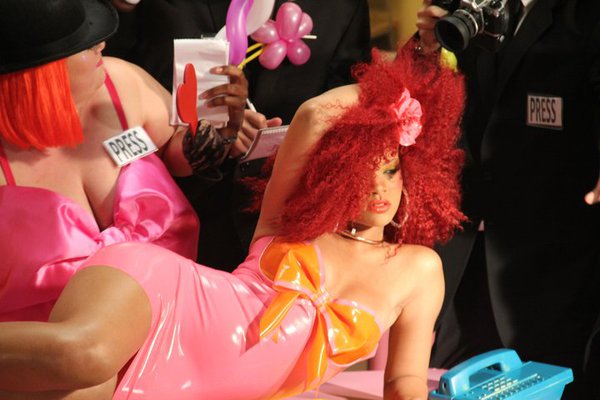
So Rihanna made an S&M video. No really, it’s called “S&M.” And yes, it does feature her walking Perez Hilton – not the sexiest choice – on a leash, while wearing a latex dress and a killer day-at-the-races hat-thing, plus her singing while hanging from the ceiling, men in restraints and gags, and creative use of duct tape. Yep, yet another celebrity discovers BDSM. While the video itself is not thrilling and not all that arousing (for my money, Rihanna’s made hotter), the girl’s got a way with outfits – she has a penchant for performing in latex, and sports a pretty incredible hood and stockings latex ‘fit in the new video, which already has 9.3 million views on YouTube, fyi. Perhaps she could be convinced to share the wealth at one of SF’s two kinky costume swaps this Sun/13 — at Kinky Salon and the SF Citadel respectively. Even if RiRi’s not in attendance, the event should be a good opportunity to re-up on some gear to wear to the next wild-and-wacky costumed sex party. Or nearly any of this weeks’ sex events, for that matter…


Bawdy Storytelling: “Slut or Whore?”

Four years of Bawdy Storytelling already? And it doesn’t look a day over “once upon a time”! At any rate, four years of exhibitionist show-and-tell deserves a little contemplation, so this month’s theme makes perfect sense. Sexologist Carol Queen and fowl-about-town Chicken John will be sharing scenes from their crazy line-toeing lives – maybe we can all sit back and think on what it means to get paid for it, whatever our career may be.

Weds/9 8 p.m., $10

The Blue Macaw

2656 Mission, SF

www.bawdystorytelling.com


Lyon-Martin Beer Bust

You’ve heard by now, no doubt, about how trans and woman-friendly Lyon-Martin Health Services is being threatened by these toughie economic times. Things are looking good for the clinic though, if one is to judge by the magnum-sized avalanche of fundraising events that have come down the chute from organizations and businesses all over the city. You can find a list of them here, by the way. And here’s a fabulous option: the Eagle will be busting beers out all afternoon in honor of safe, respectful, and effective reproductive health care – go drain a bottle, donate some cash to the cause, and buy some raffle tickets while you’re at it – your community will thank you.

Sat/12 3-6 p.m., free

The Eagle Tavern

398 12th St., SF

(415) 626-0880

www.lyon-martin.org


Valentino’s Casablanca

Here’s looking at you kid – you and your valentine(s, not trying to be limiting here) are welcome to get fuzzy at Stefanos invocation of Bogart’s bar. Sip on noir-style cocktails and look sultry while you check out violinists and sky-suspended roped beauties. Plus, there’s that big old dungeon to frolic in. Trust, this could be the beginning of a beautiful friendship(s, again, not tryin’ to hold you back here).

Sat/12 8-10 p.m., $30 singles, $60 couples, $90 trios

SF Citadel

1277 Mission, SF

(415) 626-2746

www.brownpapertickets.com


Kinky Salon Costume Swap

It can get rough attending themed swingers’ parties week in and week out – there’s only so many times you can wear those pink cat ears before their frisky fun seems a little worn out. Luckily, Kinky Salon’s got your back – show up at this naked person party (when you’re changing outfits people, game faces please) with an armload of the fetish funwear you’ve grown luke-warm on, and pick up another armload of your kinky peers’ cast-offs. Remember to clean everything before you bring it down.

Sun/13 4-6 p.m., $10 with costumes to swap, $20 without

Mission Control 

www.missioncontrolsf.org


Swap it Out!

Just like the one above, only the Citadel’s swap is a true naked lady party – only women and the female-identifying are allowed at this trade. Bring your threads (street clothes welcome at this swap) – the ones that no one picks up will be shipped off to charity at the end of the three hours. 

Sun/13 2-5 p.m., free

SF Citadel

1277 Mission, SF

(415) 626-2746

www.sfcitadel.org


Pop-Up Dildo Shop and Icecream Social

Now this will be all kinds of fun: an event at Fifty 24’s pop-up store with a little something for everyone. To whit, raunchy comedy by Will Franken, free organic icecream from Three Twins, a class on how to choose the perfect sex toy with Carol Queen, giveaways from Good Vibes, even free PBR! My goodness, and hot ’60s pop act Female Trouble to soundtrack the whole thing? Can you wait til Sunday, even? 

Sun/13 3-5 p.m., free

Fifty 24 SF Gallery

252 Fillmore, SF

Facebook: Good Vibrations’ Pop-Up Dildo Shop and Ice Cream Social


Club Neon Underwear Party

Now let’s not get ahead of ourselves here, folks. This is an underwear party – which does not mean that you’re guaranteed nookie (when are you, really), but the talent will be much easier to scope than in your typical nightclub scene. That stud over there seem awfully full in the boxer brief? Sweaty sweetie by the bathrooms shaking that demi-bra with the skills to pay the bills? Play your cards right and you may have found your valentine. 

Mon/14 9 p.m.-2 a.m., $5, free before 11 p.m. with no pants

The Knockout 

3223 Mission, SF

(415) 550-6994

Facebook: Club Neon Underwear Party


Why it has to be Green Bay

1

I mean, not if the 49ers were playing. And I have this ancient loyalty to my old hometown Jets, who won Super Bowl III against Baltimore when I was 11 years old. (I still remember Joe Namath sitting by the pool the day before, sipping a drink and proclaiming that his 21-point underdog team was so certain of victory he could “guarantee it.” And Joe was cool. A jerk, but cool. And Emerson Boozer was a great name for a running back.)

I was a bit of a Steelers fan, too, during the days of Terry Bradshaw and Franco Harris and Mean Joe Green (before the Coca Cola ad, barf).

But in the end, you have to root for the Packers. And not just because Aaron Rodgers went to Cal and got picked 24th (when the Niners could have had him but took Alex Smith instead, look how well that worked out) and had to wait patiently for Brett Favre to move on. I’ve always supported Green Bay because it’s the only publicly owned team in professional sports.

Okay, not exactly publicly owned: The city of Green Bay doesn’t hold the title deed. But it’s pretty close — there are 112,158 shareholders, most of them part of the Green Bay community in one way or another. There’s no majority owner — and it’s a functioning nonprofit. None of the shareholders get dividends; all the money is put back into the team. The Packers can’t leave town and can’t be sold.

The model so freaks out the NFL that the league passed a rule a few years ago barring any more teams from using it; now, there can be no more than 30 shareholders of any team and one must hold 30 percent of more and be the principal owner.

If all the teams were like Green Bay, there’d be no lockout, no Baltimore Colts splitting town in the middle of the night, no Al Davis jacking up Oakland. Go Packers.


Aerial revolution

0

Consider the rise of the extreme athlete: generations of youngsters (and increasingly, brave older folks) competing to see who could pull the sweetest stunts and survive. Ever wonder how is it that a person can make the transition from earthbound and bipedal to gravity-be-damned dare-devilry? When exactly is the moment that a skater, skier, or snowboarder just lets go and trusts their body to take them up, over, around, and (hopefully) gracefully down to the ground?

Last Tuesday, I attended a press event at House of Air – the newest member of Crissy Field’s collection of renovated airplane hangars in San Francisco’s historic Presidio – where I was treated to a glimpse of how such a transformation might become reality. Not to mention a new way that a public sports facility can play with its community.

Given the Presidio’s military history, you may have been tempted to think the newly opened space at 926 Mason is home to helicopters and jets. But the pilots in House of Air aren’t crew-cutted cadets, and the only high-tech equipment in the corrugated steel hangar is an impressive array of custom-made trampolines. Every day in this house-of-bounce, tomorrow’s extreme sportsters are earning their wings – and there isn’t a major commander in sight.

House of Air is the brainchild of Dave Schaeffer and Paul McGeehan, two extreme sports aficionados who trained together on the Lake Tahoe snowboarding circuit. Their concept was helped off the ground (so to speak) by former Olympic skier Jonny Moseley. All three use trampolines to perfect their aerial artistry, and could commiserate over the difficulty of finding a facility where they could train with their respective equipment. According to Moseley, who raised eyebrows as a youth by flipping over his skis in a gymnastics studio, trampolines were few and far-between and most were used for coaching gymnasts and tumblers.

Large-scale trampolines provide the air time necessary for an athlete to teach his body to do tricks like corkscrews and 360s, serving as crucial incubators before a pro takes to the water, pavement, or snow with a new trick. But until House of Air, the idea of a dedicated facility for extreme athletes was unheard of. Now, the studio fills the void with over 2,000 square feet of trampoline space where serious athletes can perfect their skills in a safe (and soft) environment – and where, I was thrilled to find, even the not-so-extreme can have a blast.

House of Air provides lessons to beginners and more serious students of all ages. Instructors with backgrounds in everything from professional snowboarding to circus acrobatics use a specially designed high-performance trampoline deck to teach techniques to budding athletes. The center’s growing team also supervises two segmented jumping arenas, each about the size of a regulation basketball court, complete with angled trampoline enclosures that extend the bounce factor right up the walls. The facility also includes a kiddy bounce house for the younger set, special event rooms, lockers, and showers.

An average person arriving on the scene would begin their foray into the art of flight by checking out a pair of special House of Air shoes – modified wrestling shoes that provide ankle support. They would then have the option of renting some basic bounce time, participating in an organized game (think P.E. classics gone crazy: dodgeball or volleyball are both served up with a side of spring), or taking a class on the foundations of flying, which is where I wound up bouncing on my visit.

I was a bit apprehensive (read: terrified) as Moseley ushered me up to the trampoline deck and demonstrated a few tricks. He flopped through some sick twists, turns, and flips without missing a beat in our conversation. Then it was my turn.


Our intrepid reporter takes to the air at SF’s bounce palace. Photo courtesy of Jonny Moseley

I started with the aptly named “butt-drop”: a move in which the trampolinist replaces a single bounce with a fall on their bum and then – this is the crucial part – returns to her feet without missing a beat. After that, I moved onto “swivel-hips,” wherein the butt-drop is supplemented by a 180 degree revolution on the up-swing. For my final trick, I tried my hand at the sequence that leads up to a front flip: a jump, a fall to all fours, and then a forward rotation that landed me flat on my back. All in all, I wasn’t quite ready for the X Games, but it was killer on the knees and had my quads burning. I had new respect for the little groms busting board-grabs and aerials — and for the brave adults who come to House of Air for the “air conditioning” classes and company team-building sessions. Trampoline dodgeball: a fantastic way to build office camaraderie, or at the very least a good excuse to pummel that passive-aggressive co-worker with a deluge of flying foam rubber.  

Final impressions from the House of Air? Besides the sore thighs, of course? The center seems to be re-thinking the role of the public sports facility, from its boardrooms for the business set to its specially-manufactured props that emulate sports equipment for practicing athletes, like lightweight foam snowboards and a tow rope akin to what a wakeboarder would utilize on the waves. Even the layout of the building itself, which makes use of those large hangar doors to provide jumpers with such an excellent view of the bay one gets the feeling that with one wild leap one might land in the waves, helps to make House of Air a unique resource for the SF community.  

Given the chance to train in a facility like this one as a child, Moseley says he would have been thrilled – and possibly less banged-up in the bargain. “This is the way kids learn to be professionals — without getting hurt.”


House of Air, 926 Mason, SF. (415) 345-9675, www.houseofairsf.com


BART removes anti-Palestinian ad

39

Offensive advertisements promoting a right-wing Zionist viewpoint of the Israeli-Palestinian conflict were removed from all BART stations this week. “They could be commonly interpreted as disparaging or demeaning to Palestinians as a whole,” according to BART spokesperson Jim Allison told us, saying the violated the district’s advertising standards.

The ad featured the words “Stop Palestinian Terrorism” above a picture of a face covered with a traditional Arab scarf, known as a keffiyeh, and the words “Teach Peace” above the picture of children playing soccer. The keffiyeh has evolved into a symbol of Palestinian resistance to occupation after former PLO leader Yasser Arafat began regularly wearing one. StandWithUs, a self-purported pro-Israel advocacy organization, produced and paid for the ad.

Per BART policy, StandWithUs was informed about the decision to remove the ads and asked to provide substitutes, which it did. The organization’s CEO, Roz Rothstein, told us she felt BART’s evaluation of the ad was “unfair…It would only be disparaging if you don’t look at it properly… the Palestinians deserve a future too, that was the message of the ad. Just as it is not disparaging for an Iranian to point a finger at a [Iranian President Mamhoud] Ahmadinejad, it is not disparaging to point a finger at Hamas.”

However, three individual who did find the ad offensive enough that they complained to BART, initiating the reevaluation of the ad’s content, according to Allison. One Palestinian American who thought they were offensive was Miriam Zouzounias who is the membership coordinator for San Francisco’s Arab Resource and Organizing Center.

She said the ad made her feel “sick to her stomach.” The keffiyeh is a common cultural and political item of clothing, she said, and she happened to be wearing one on her backpack when she noticed the ad. “I hate that [the keffiyeh] is being targeted, portrayed as what terrorists wear.” According to Zouzounias’s interpretation, the ad’s message was that Palestinians do not but should start to invest in productive and peaceful activities for their children, a message that was markedly untrue to her. “Kids playing sports…and doing art are the kind of outlets…Palestinian civil society works really hard for,” she said.

In responding to claims the ad might be offensive, San Francisco’s StandWithUs lay leader Mike Harris told us, “I don’t think that claiming [the keffiyeh] is cultural in that instance is really justified…You don’t see many people in their routine, everyday lives, even if they are Arab American, wearing scarves covering their faces.” He agreed the keffiyeh could be considered a cultural symbol if was adorned on someone’s head rather than covering a face because that it is how the scarf is normally worn.

The StandWithUs ad was response to a previous ad by a group with an opposing view of the conflict. That ad by Friends of Sabeel-North America, a organization that supports the Palestinian Christian liberation theology movement, advocated that “peace and justice” requires an “end to U.S. military aid to Israel,” referring to decades-long aid which has transferred more than $100 billion from the United States treasury to the state of Israel.

Harris said, however, that the ad was “very misleading. The website connected to it promoted BDS (Boycott, Divestment, and Sanctions against Israel) and [mentioned] groups that cannot be considered as promoting peace and justice.” Harris said true peace is “peace between Israelis and Palestinians” and not “peace without Israel.”

FOSNA administrative officer Sister Elaine Kelley said the problem with the StandWithUs ad is that it “turns the focus away from the topic of the occupation and toward the unfortunate violence of some Palestinians.”

Now and then

0

arts@sfbg.com

VISUAL ART “My ideal world [while making art] is to be on a comfortable chair by a sunny window listening to a baseball game,” says Lauren DiCioccio. For DiCioccio, such a setting is possible, because sewing is an integral part of her work, whether she’s hand embroidering The New York Times, creating cotton facsimiles of 35mm film slides and currency, or making organza replicas of plastic bags and bottles.

The new exhibition “Remember the Times” moves DiCioccio’s unique collection of handmade-readymade hybrids from the “wundercabinet” (to use DiCioccio’s term) of Jack Fischer Gallery to Yerba Buena Center for the Arts. On the second floor, she’s arranged a variety of objects on three shelves, adapting the acute vision and evocative perception of still-life painting, vanitas, and memento mori to today’s flurries of consumption and erasure. “Remember the Times” is the only current show at YBCA that can be photographed by visitors, and to be sure, adopting a photographer’s point is an ideal way of appreciating the individuality and interaction of DiCioccio’s pieces, and — especially — her attention to detail. I recently met with her at the museum.

SFBG What drew you to newspaper as a material? The ways in which you use it are unconventional — what are the challenges of working with it?

Lauren DiCioccio All of the work I’m making right now began with the newspaper. For about two years before I was showing my work or thought I could be an artist, I was making paintings. I began painting on newspaper as a material I felt comfortable about using, and that transformed into making sculptures with newspaper. At a certain point with the paintings, I realized I was more interested in the materials.

It hit me after college, when I traveled in Australia, and for six months lived in a town in the outback. It was 12 hours down a dirt road, with a 360-degree view of nothing, and 250 people, mostly aboriginal, lived there. It was a secluded world. We would get our mail twice a week, on Tuesday and Thursday, so we were one step up from the horse and buggy. The days the mail came, they would bring the newspapers, and even though they were two days old, people would just gather around and pore over them.

I became interested in the material as this trusted resource and definition of time and physical embodiment of a day. When I came home and unpacked all my paintings, I realized I was more interested in the way the newspaper itself located me in time and place.

When I moved to the Bay Area in 2004, I began working as the resident manager for the Djerassi Resident Artists Program in Woodside. I lived on site there, on a cattle ranch, pretty much isolated, and getting the newspaper delivered every day. Again, it was a situation where the newspaper was connected to how people would socialize and gather in the morning. People would really welcome it: “A newspaper! Let’s read that!”

I decided that painting wasn’t doing it for me — I wanted to do something more tactile and physical and also approachable. I set out this challenge to make a sculpture out of one newspaper every day for as long as I could. Then I made a quilt out of the newspaper, and that triggered my interest in the craft medium, which has always been a part of my life. It made me realize that craft and the newspaper have the same language, and I started to explore that more through sewing.

SFBG How did you come to select The New York Times as one subject? Also, the tactile emphasis you’re mentioning extends to the “Thank You” bags you’ve made.

LDC They are definitely specific materials — the plastic of a shopping bag, the soft paper of the newspaper are so unique to those objects, and are familiar feels and sounds and experiences for us. They’re disposable in nature, but they’re engrained in our human memory.

SFBG The “Thank You” bags are so commonplace, but they carry a lot of connotations.

LDC When I began making them, it started a divergent path in my work that I think I’m still in the fork of — I’m making these very loving recreations of both types of objects, and they both have disposable or waste aspects. The newspaper is more of a renewable resource, so the work is also about the loss of the form itself. But with the “Thank You” bags, in making them to talk about their obsolescence, I kind of think of them as ghosts of the actual object — I’m hoping for that.

I use bridal organza for the “Thank You” bag sculptures. When I first bought some, I expected it would fray and fall apart and be too delicate to embroider, but it actually stands up well. I just overlay the organza on the beg and draw with a waterproof pen on the surface before I embroider.

With the newspaper, the main series of works actually has a day’s newspaper in it. That introduces a sense of history or time. It’s important to me that the actual paper is in those pieces. It creates all these issues about conservation, and the newspaper not being acid-free, God forbid. The question would be asked, “What if 100 years the newspaper is just crumbly dust inside a bag?” — as if it that were a problem in terms of presenting it as art. But I actually think that it’s the most interesting thing about those pieces, how they’ll age and evolve.

SFBG Artists who work with paper today face those kinds of problems when dealing with those who view art primarily in economic terms.

LDC It’s so hard as an artist when you’re broached with that problem. When someone buys my work, that’s so special to me — I want them to have it as long as they want to have it, looking exactly like how they want it to look. But at the same time, conceptually, anyone who looks at [one of the newspaper pieces] should understand that it’s about decay and the life cycle and the way we all age — though now with plastic surgery, everyone wants to look as scary as possible [laughs].

SFBG How do you choose a particular page to spotlight? Is it the stories, the images, or both?

LDC It’s a combination. It’s an instinctive decision. I look for something that leaps off the page and speaks to me. At first I was only doing people who were communicating — politicians gesturing, or caught mid-speech. But I’ve loosened up the reins on that. I like sports images because they lend themselves to the way trailing thread can show the blur of time.

With all of my work I try to ride this line between precious and pathetic. There’s something somewhat pathetic about even creating these objects in such an obsessive way. It’s excessive, almost an overly tender act to sew this detailed work through functionless media.

SFBG It creates odd keepsakes.

LDC They’re happy and sad. I’m interested in the bittersweet, and nostalgia contains feelings of joy and sadness. With the images, I try to finish them up to the point where it looks like you could pull one of the threads and the whole thing would unravel.

LAUREN DICIOCCIO: REMEMBER THE TIMES

Through March 27, $5–$7

701 Mission, SF

(415) 978-2787

www.ybca.org

Not your guru’s asana

1

Why put 12 year-old aged balsamic vinegar from Modena, Italy into a chocolate truffle?  Well, because it tastes surprisingly great, for one thing. But also, according to Dave Romanelli, one of the presenters at last weekend’s flexibly diverse San Francisco Yoga Journal Conference, because it can heighten your yoga practice. Enlightenment through chocolate? We’ll take it.

New York-based Romanelli taught a class called “Yoga  and Chocolate,” and like many of the conference’s fifty presenters, he brought a yogic flavor to the conference influenced as much by his personal path to the mat as ancient teachings. In other words, fundamentalist ayurveda this was not.

Referred to as “Yeah Dave” by his friends (as in, “yeah, Dave, whatever…”), Romanelli has penchant for stoner-esque musings that eventually left him with the radical idea that to flourish in today’s fast-paced society, yoga should be made accessible to a broad audience. 

In the ’90s, Romanelli and a partner started At One, a chain of trendy yoga studios in Phoenix that Romanelli says in an interview with SFBG were meant to “bust through the stereotypes” that yoga is pretentious and unconnected to daily life. In 2009 he published a book called Yeah Dave’s Guide to Livin’ in the Moment, an irreverent manual to enjoying life in the here and now. These days, he travels the country leading workshops that seek to initiate people into a yogic lifestyle through careful attention to the senses – which he engages with the help of wine and exotically-flavored chocolate provided by Yoga and Chocolate co-founder and master chocolatier Katrina Markoff.  

“Yoga and Chocolate” was one of over a hundred classes, guest lectures, all-day intensive workshops, and special events that filled the San Francisco Hyatt over the MLK Day weekend, ranging from fiery asana practices to contemplative journeys through yogic philosophy.  The scads of famous yogis in attendance included teachers like Ana Forrest, creator of the healing-based Forrest Yoga approach, Seane Corn, an internationally celebrated yoga teacher, activist and humanitarian, and San Francisco’s own Baron Baptiste, whose parents opened the city’s first yoga center in 1955 and who has shared his empowering vinyasa yoga with classes around the world.

With so many presenters — and with nearly half of conference attendees yoga teachers in their own right — the expo left the downtown hotel rife with pairs of groovy tie-dyed pants and hundreds of bare feet riding up and down the Hyatt’s escalators. In a city like San Francisco, it’s not surprising that the traditional Indian practice could draw such a huge audience – but the sight of so many modernized classes begged the question: Patanjali compiled the yoga sutras no later than 150 BC, and we’ve been mulling them over ever since. How much is really left to learn?

The answer is “a lot” if this year’s offerings were to be believed. Joining “Yoga and Chocolate” was MC Yogi’s “Ganesh is Fresh,” a hip-hop inspired retelling of the story of the elephant-headed deity Ganesh, remover of obstacles. (Fyi, if you’re a harmonious hip-hop head, it’s also the name of a track on MC Yogi’s 2008 album “Elephant Power.”) Another high-energy choice was “Bollywood Vinyasa,” a cardio-heavy yogic workout set to bright rhythms of bhangra and Bollywood music. 

“I never intended to be a yoga teacher,” said Hemalayaa, the class’ teacher and the Canadian-born daughter of Indian parents. “I started practicing as a way to guide myself, be a leader for myself,” she announced to the students before her. The seed of “Bollywood Vinyasa” was planted during darker days in Hemalayaa’s 20s, when she would come home and blast Bollywood music as a way of shaking out her troubles. After having grown to the lively beats, she was able to incorporate them into her study of yoga. “Now I teach as a way to continue my study. Being a leader to others helps me stay true to myself.”

Romanelli agrees on the importance of applying traditional yogic teachings in a way that’s applicable to our own life stories. He has no problem using his own life experiences – like having man-boobs and wearing too much cologne on prom night in pursuit of after-party action – to draw laughs and convince his students that self-reflection can be fun.  

His style is a definite departure from traditional yogic teaching (ashtanga yogis advocate pratyahara, withdrawal of the senses from external objects, as a means of attending to the inner self). But, in Yeah Dave’s opinion, sensual experience can be the first step toward getting people to pay attention and eventually journey inward.  

“In today’s society, how realistic is closing off the senses?” he asks. “People are afraid to be alone with themselves on a three by six mat.” He admits that people often need help to make the first step. “And if it has to be chocolate, then so be it,” he grins.

For information on next year’s Yoga Journal Conference stretch out to www.yjevents.com/sf

Appetite: 3 new coffee havens

1

CAFFE PASCUCCI, SoMa – I feel like I’m back in Italy at brand new Caffe Pascucci, the first outpost of a popular Italian chain. The crisp, white space is chic and soothing, even as the place buzzes with the Italian families and individuals already frequenting the place within merely days of opening. It’s not just because the menu is loaded with dozens of types of espresso, cappuccinos and iced coffees topped with banana or doused with amaretto. It’s because the majority Italian staff and clientele exude convivial Italian spirit, throwing out “ciaos” and “pregos” liberally. I like the robust Gold Espresso, though dark hot chocolate was a little too pudding-like in consistency, even if thankfully dark (my favorites in Italy or France are syrupy rich, but not stiff). Chad Newton, formerly of Fish & Farm, executes a simple but pleasing menu of salads and sandwiches – even an ultra-basic Tri-Color Salad is three types of greens (including bits of endive), gentle shavings of Parmesan, and a perky lemon dressing. 170 King, SF.

CONTRABAND COFFEE, Nob Hill – Yet another in the endless flow of Third Wave coffee houses,  brand new Contraband Coffee Bar occupies a less coffee-driven corner of Nob Hill (the Mission and SoMa don’t need any more… spread the wealth!) The space is clean, white, with modern art, and baristas I’ve seen working at other coffee havens around town. It sports a shiny Synesso Hydra espresso machine and also offer V60 pour-over and Chemex preparations for its own roasted beans. Additional kudos for getting the snacks right: Dynamo Donuts and Peasant Pies. 1415 Larkin, SF.

BAR AGRICOLE, SoMa – The simplicity is appealing. Bar Agricole, previously open for dinner and bar only, shares its soothing garden patio and forward-thinking, urban interior for a Four Barrel coffee and one food item: a pretzel bun, aka Laugenbrötchen, from Mountain View’s German baker par excellence, Esther’s Bakery (http://www.esthersbakery.com). Order the pretzel roll with a side of apple butter, jam or cream cheese. Oh, they also have free WiFi and are open all day (from 8am on) until the dinner switchover at 5pm. There are fewer cooler spaces you could linger in. 355 11th Street, SF.

–Subscribe to Virgina’s twice monthly newsletter, The Perfect Spot

Expert opinion: how best to love your Oregon Ducks

1

There are sports fans who watch every game, know all the stats, own all the gear, take it upon themselves to achieve championship-level drunk status upon every win and loss their team achieves — and then there are real sports fans. Those are the guys that cobble together high-quality parodic hip-hop videos with their buddies that become their football team’s anthem and Youtube blockbusters, getting them flown around the country to perform — and getting star-struck coeds to swoon at the tailgate.

That’d be Jamie Slade, Brian McAndrew, and Michael Bishop, whose Supwitchugirl team starred in and edited the Eugene, Oregon party anthems “I Love My Ducks” and “I Love My Ducks (Return of the Quack),” as well as a host of other tunes dedicated to frat juicin’ brobots and bathroom water conservation — even at the price of party foul.  Lucky us, SFBG had the inside line on these young bucks and got Jamie Slade, the group’s tallest member with its curliest hair, to email with us about ways you can be the ultimate Ducks fan at the team’s championship title run on Mon/10 against Auburn University — or front like you are, at least.


San Francisco Bay Guardian: What’s the most important thing that someone unacquainted with them should know about the Oregon Ducks’ season this year?

Jamie Slade: This is Oregon’s very first run at the national title and last year was the first year since 1995 we went to the Rose Bowl so both this year and last year are monumental years for Duck football history. That’s why Oregon has been getting so much hype lately on TV — that and head coach Chip Kelly has only lost three games in his whole career — which has only been two years, but it’s still very impressive.


SFBG: An all-purpose line to make yourself sound like a real fan?

JS: I LOVE MY DUCKS


SFBG: The season highlight? Lowlight?

JS: The season highlight was beating Tennessee. They’re in the SEC conference, which is known for being the best conference, historically, in college football. Also, beating Oregon State and solidifying our spot in the national championship game. Also the Stanford game, they’re now the best one-loss team in the nation and WE beat them. They just won their bowl game which makes us look GOOD. Lowlight? I guess the Cal game where we only won by two points when we were favored to win by 30-plus.


SFBG: How can you tell who the Ducks fans are?

JS: We have the loudest stadium in college football — literally, the decibels in Autzen Stadium have been recorded as louder than a fighter jet taking off and that isn’t because of how the stadium is engineered and built, it’s because we yell our asses off. Duck fans are loud and will be happy to yell in your face if you’re an opposing fan.


SFBG: Have you met the team? Which player made the biggest impression on you and why?

JS: Yeah we’ve met the team, well most of the players at least. Two players that have been really nice to us has been DJ Davis, our wide receiver and defensive end Kenny Rowe. DJ Davis is just an all-around nice guy with a really sincere personality and Kenny Rowe is a really funny dude. Every time I see him he always says “Man, I wanna be just like you” even though he leads the Pac-10 in sacks and is a menace on the field.


SFBG: How’d Supwitchu Girl get together? What was the first video you guys made?

JS: We met in the dorms. Michael and Brian have been longtime friends and I met them when I was on the Oregon track team my freshmen year. Because of Saturday practices I would stay in the dorms on Friday nights and Michael and Brian coincidentally stayed in as well and our personalities just clicked. Our first video is called “Just Don’t Flush It” and it’s a music video about water conservation. It was an inside joke at first about how Brian would never flush the toilet in our tiny apartment during our senior year. 


SFBG: Are you super stars in Eugene at this point? 

JS: We’re more sex symbols if anything, Caitlin. Just kidding haha. I wouldn’t say we are super stars at all — we get recognized just because the video is so popular but we don’t get star treatment or anything, we still had to go to school and do everything else every other student has to go through. Sometimes people say “Hey are you that “I Love My Ducks” guy?” and I say yes…but we are so much more than JUST the “I Love My Ducks” guys.


SFBG: Do you have plans to extend your reign of terror to other college towns?

JS: NO. We are die-hard Duck fans. That’s where we find inspiration for these songs…out of true emotion and love for this team.


SFBG: Future video plans? Or are you done with the UO scene now that you’re graduating?

JS: Yep we have a video coming out after the BCS game called “Pogs” and it is about that childhood fad of throwing Pogs and slammers etc. Should be funny. But we all plan on travelling for a few months and reconvening afterwards to figure out what our next step will be.


SFBG: What line from your songs do you hear people repeat the most?

JS: From the first song: “Holy Moly, is that my boy Masoli?” From the second song: “Eatin chips ‘n’ dip with the brain Chip Kelly!”


You can yell your ass off (or get yelled at in your face) with the rest of the Oregon fans at The Independent (628 Divisadero, SF. www.theindependentsf.com), which will be playing the national championship game on their pull-down movie screen.


BCS National College Football Championship Game: University of Oregon vs. Auburn University

Mon/10 5:30 PST, FOX Sports


Eat your slumgolian

0

le.chicken.farmer@gmail.com

CHEAP EATS Tell you, I loved making chili with Coach’s mom. Her refrigerator was broke, so everything we needed was downstairs in Grandma’s fridge. Except in most cases it wasn’t there either.

Coach is of course a vegetarian. Grandma didn’t want beans, or spicy. Neither refrigerator had any peppers of any kind. Nor could I find chili powder.

Now, as you may know, I pride myself on my sense of show-must-go-onmanpersonship. I didn’t panic, sulk, or give up. No. At every twist, turn, and sheer drop-off, I shrugged, I laughed, I chopped onward. And stirred and opened cans and stirred and tasted until at a certain point I found myself standing over this colorful pot of simmering something-or-other and decided to make an announcement.

“It’s not chili,” I announced.

Coach and Coach’s mom, who had been situating Grandma at the dining room table, soothing her with promises of chili and chili and chili, came running into the kitchen, stood beside me, and looked into the pot. Grandma doesn’t get around so easily, or I’m sure she’d have looked too.

“That’s all right,” they said.

And I knew that it was, but had no idea what to call it, until they told me about slumgolian. Slumgolian, in the Coach family, was a surreal meal probably somewhat akin to what I call refrigerator soup. Other people have other names for it.

The point is that I learned a new word for a new thing I’d never seen before, and in truth it didn’t taste all that half bad, over tortillas.

Thanks to Kayday and her little red car, I got to git me to Joshua Tree, my favorite place on the planet, for Christmas. We sat on some rocks in the middle of the desert and ate Turkey Jerky, Wheat Thins, walnuts, and raisins, by way of marking the spot, and it was my favorite Christmas in many years.

But not my favorite meal. Neither was slumgolian.

No, for that we have to wind back the clock to Papa’s birthday, which falls a couple days shy of Christ’s. We gathered that evening at the Taco Shop @ Underdogs, in the Sunset. It was Papa, Pappy, Cola, Mikey Bike, Fiver, Flavor, a bunch of people I didn’t know, and Kentucky Fried Woman, whom I did know but had lost track of.

Coach was in San Diego already by then, lining scrimmage fields and setting up blocking dummies and car tires for our training camp/New Year’s Eve brouhaha, reportage/repercussions of which will dominate the next couple weeks if not months of Cheap Eats. Just to warn you.

As her coaching staff, I’d be next to arrive in the land of sun, slumgolian, and tacos. In fact, Kayday dumped me there after Joshua Tree, on her way back up to San Fran.

And I would like to point out up front and out of order, that nothing I have eaten in SoCal, so far, has even come close to the Taco Shop for all-around Mexcellence.

I can’t remember if I ever wrote about Nick’s Crispy Tacos or not, but in any case, the deal is: same thing. “Nick’s way,” as they say, is two corn tortillas — one crispy, one soft — with cheese, beans, salsa, guac, and whatever else you like.

I like carnitas. I like fish. The fish is fried and therefore juicy, tender, and oh-so satisfying. Really, honestly, you only need one.

Plus maybe another, plus chips.

In any case, whether it’s Nick Crispy or the Taco Shop, the pico de gallo is great, the guac is great, the meat is juicy, and the combination of soft and crispy tacos … well, go figure: it works.

Underdogs, I guess, is the name of the bar the Taco Shop is in. Sports on TV. In the back corner they have one of those basketball things where you see how many hoops you can make in a certain number of seconds. And while I was catching up with KFW on one side of me, and talking writing and music shop with Mikey Bike on the other, I also watched, out of the corner of my eye, several of my friends “step up to the line,” so to speak.

All I will say is that I am glad our football team is not going to be a basketball team. Although … well, never mind. We will see.

THE TACO SHOP @ UNDERDOGS

Sun.–Wed. 11 a.m.–10 p.m.;

Thurs.–Sat. 11 a.m.– midnight

1824 Irving, SF

(415) 566-8700

MC/V

Full bar


Goal difference

0

cheryl@sfbg.com

YEAR IN FILM Making a mistake on the playing field can haunt an athlete for the rest of his or her career. For Colombian soccer star Andrés Escobar, a particularly heartbreaking blunder — an own goal during the 1994 World Cup — proved fatal. Just two weeks after Colombia’s first-round defeat in the tournament they’d been favored to win, team captain Escobar was shot after leaving a nightclub in his hometown of Medellín. There were rumors the killer yelled “Goal!” as he unloaded.

Presented merely as a sports-history anecdote, Escobar’s demise is sad and senseless. But his murder wasn’t an isolated incident, just a particularly high-profile one; it was part of an unimaginable tide of violence that swept Colombia in the 1980s and ’90s. If you watched the 2010 World Cup on ESPN, you probably saw commercials for The Two Escobars, presented as part of the channel’s “30 for 30” documentary series. Participants included genre pioneer Albert Maysles, whose film was about Muhammed Ali; Ice Cube, who used his own South Central childhood to reflect on the Raiders’ 1982 move from Oakland to Los Angeles; and brothers Jeff and Michael Zimbalist, whose longer entry The Two Escobars sifted through years of Colombian history to trace the corresponding lives of Andrés “The Gentleman of Football” Escobar and drug kingpin Pablo Escobar.

At 32, Jeff, who lives in San Francisco, is the older brother by 17 months. In 2005, he codirected the award-winning Brazilian music doc Favela Rising. Michael, an actor and writer who ran a theater company in Mexico for several years, lives in New York City. Though they’re Americans, the Zimbalists feel a strong connection to Colombian culture. They were researching another film in the country (previous endeavors included a project with Colombian superstar Shakira) when ESPN asked them to pitch an idea for “30 for 30.” Though the shared last name of the unrelated Andrés and Pablo makes for a memorable title, the brothers didn’t use the coincidence as a starting point.

“We didn’t choose the title until really late, actually, because it felt like it was more of a portrait of a time period. It was about the hopes and dreams of the Colombian people as told through the vehicle of these two characters,” Jeff says. “The choice to use the two characters came about more organically than that, too. Initially we had the assignment to go find story ideas for the ESPN series that were about the impact of sports on society, and vice versa.”

After learning more about Andrés, they knew they’d found a captivating subject. They also realized that they would need to contextualize his story in order to tell it properly.

“We didn’t want to make a whodunnit about who pulled the trigger,” Jeff says. “It was a lot more interesting to ask the question of how an athlete gets killed for making a mistake. But in order to understand that, you need to understand what narco-soccer is. We quickly realized that hadn’t been covered before. And that meant that people were very reluctant to talk about it for a number of reasons: out of fear, shame, or they didn’t want to revisit a traumatic time period.”

The idea of “narco-soccer” led the filmmakers directly to their other subject. “You can’t really explain the whole context of narco without understanding Pablo Escobar. And it also felt unwieldy to not tie the societal story to a subject, or to a personal narrative,” Jeff explains. “So using Pablo as the tool through which we could explain society, and Andres as the tool through which we could understand sports, the next challenge was finding their overlaps. They only literally overlap a number of times in their lives. So how does the story justifies the use of these two characters? It has to be thematic — and there was tons of great, thematic overlap, and parallel and contrast, between the two Escobars.”

If you weren’t among the millions who watched The Two Escobars‘ repeat showings on ESPN (or caught it at the Sundance Kabuki as part of the San Francisco Film Society’s “SFFS Screen” programming), here’s a crash course in narco-soccer, as explained by the movie: during the ’80s and ’90s, Colombian drug lords invested in soccer teams as a way to launder their ill-gotten gains. As teams’ coffers grew, so did their ability to hire top-notch players. Sides flush with dirty cash racked up victories and corruption behind the scenes grew to outlandish proportions. Referees could easily be bought — or eliminated. A huge soccer fan who’d risen from poverty, then used his wealth to build fields in the slums, Pablo was one of these investors. Andrés, of course, was one of the league’s stars.

Using no narrator, The Two Escobars instead weaves its account with contemporary interviews (the exhaustive list of talking heads includes soccer legends, jailed gangsters, coaches, cops, and the sisters of both Escobars) and expertly edited archival footage that enables the viewer to witness just about everything discussed: the might of Colombia’s national team in the run-up to the 1994 World Cup; the sight of Pablo enjoying soccer on both his palatial estate and, incredibly, while incarcerated; the horrific violence that became an everyday occurrence during Pablo’s war on Colombia’s government.

Obtaining these hours of interviews and footage — only a fraction of which made it into the final cut — posed various challenges. “[Subjects] were reluctant to talk for many reasons: it’s taboo; it’s often felt to be dangerous still,” Jeff says. “So there is fear. And also, it is traumatic to go back and visit those emotions. A lot of people would rather bottle that up. I’m not one to judge because I didn’t live during the reign of Pablo Escobar and [anti-Escobar vigilante group] Los Pepes in Colombia. But I do believe that expressing that stuff and getting it out can be cathartic.”

Culling the archival footage used in The Two Escobars took months of plowing through broadcast vaults, the private archives of both Escobars, and films shot by military police and amateur videographers. “We knew it wasn’t gonna be as powerful a film, as accessible a film, if we just rooted it in present-day talking head interviews,” Jeff says. “We needed to transport the viewer back into that time period. A lot of our decision to tell both the narratives of Pablo and Andrés, and make it bigger than just the ESPN assignment, to make it a theatrical movie, was hanging on whether or not we were able to find enough compelling visuals to create real scenes. We had myself, my brother, and a team of people just going through tapes.”

Editing was a monumental task, proving both labor-intensive and emotionally trying. “It was very difficult to whittle down the story,” Michael says. “At one point, we had a film that was sort of focused on being the first exposé of this secret world of narco-soccer. We had hours of anecdotes that really blew our minds. We ended up reducing that whole part of the story to what you could call act one of the movie, and that was certainly difficult. You’re just sorry to see things go.”

Though The Two Escobars screened worldwide, not just on ESPN but at the Tribeca and Cannes film festivals, one place it hasn’t been seen is, ironically, Colombia. Due to the sensitive subject matter, and objections to the final product by Andrés Escobar’s family — who didn’t appreciate being associated with Pablo Escobar — “it’s been completely censored,” Jeff says, noting that he and his brother did not intend to mislead anyone during the filming.

“We always knew it was going to be extremely controversial,” Michael says. “I was nervous in terms of what the reactions from Colombians would be, because obviously it’s very delicate, very loaded subject matter. There’s so much visceral emotion for any Colombian who went through that period of time. Virtually everyone who lived there in the ’80s and ’90s was touched by that violence.”

Though the brothers are disappointed the film hasn’t been shown in Colombia, that doesn’t mean no Colombians have seen it.

“Everywhere we’ve shown the film and done a Q&A, there have been Colombians present,” Michael says. “That’s been a really rewarding experience.”

“For Colombians, it’s not an easy 100 minutes to sit through,” adds Jeff. “But by the end, [the Colombians we’ve met] do feel that it’s an accurate portrayal, that it’s balanced journalism, and that the message is an important one about Colombia moving forward. It presents a lot of hope through Andrés’ family. That was our goal, to create a portrayal of Andrés that was heroic. We made sure the voice of his family is the takeaway from the movie. I think it couldn’t be more clear once you see the film how opposite Pablo and Andrés are in terms of who they are and what they stand for. I hope that Colombians get a chance to see the film because they’ll realize that.” 

www.the2escobars.com

Year in Film: 2010

0

YEAR IN FILM To recap: 2010 was the year Oscar started dipping his golden fingers into the previous year’s pot of (mostly forgettable) big releases and fishing out 10 Best Picture nominees. Blue Pandora people were defeated at the podium, though they did leave a cultural stain behind — it’s safe to say, for example, that nobody’s been styling weddings after The Hurt Locker.

Predicting the next Academy Awards class requires looking past 2010’s top earners (Toy Story 3 and Inception aside) and focusing on films that pleased both critics and audiences (The Social Network, Winter’s Bone, Black Swan) — though if you’re in a betting mood, the carefully calibrated The King’s Speech seems exactly like the kind of movie the Academy will reward over anything achingly contemporary, staunchly gritty, or knowingly out-there. But as any true film fan knows, it’s usually not the movies that make the most money, or even win the most awards, that resonate and beg revisiting in the months and years that follow.

The Guardian’s annual Year in Film issue takes a look at some of 2010’s more notable trends, starring films you liked (The Kids Are All Right) and hated (I’m Still Here) — and films you wanted to see but forgot about and are now rushing to put on your Netflix queue (Splice). (Note: the “you” in the previous sentence is, uh, me.) And since I’m talking in the first person now, let me steer you toward my favorite documentary of the year (and 2010 boasted some great ones, including my second-favorite, The Tillman Story), made-for-ESPN tale The Two Escobars. I was lured in by heavy advertising during the World Cup — apologies to the Giants, but Landon Donovan’s ridiculous game-winner in USA versus Algeria is my pick for sports highlight of the year — and was unexpectedly mesmerized by its tragic story; only later did I learn of the film’s San Francisco connection. Read on, and pass the popcorn.

>>Babes in bondage

Or, 2010’s perfection-pursuing fatal femmes

>>Get “real”

The Social Network, Catfish, and I’m Still Here push the boundaries of truth and fiction

>>Past imperfect

Digging through the year in archival footage

>>Rate irate

Confidential to the Motion Picture Association of America: F-U

>>Baby daddy drama

Parsing 2010’s bumper crop of sperm donor comedies

>>Goal difference

Top 2010 doc The Two Escobars examines two sides of Colombian narco-soccer

>>Guardian critics pick their best movies of the year