Sheriff

Backroom meetings precede today’s mayoral succession vote

12

There’s been a flurry of political speculation and backroom discussions leading up to today’s final meeting of the current Board of Supervisors, which is scheduled to consider appointment of a successor mayor to Gavin Newsom starting at 3 p.m., despite Newsom’s refusal to vacate the office and assume the duties of lieutenant governor as he was supposed to yesterday.

After Kamala Harris took her oath of office as attorney general yesterday, Newsom now has the power to appoint a new district attorney, which he’s likely to wrap into his efforts to thwart progressive supervisors from appointing an interim mayor of their liking. So all eyes are on Newsom, as well as Board President David Chiu, and sources tell the Guardian that the two men met this morning behind closed doors.

Could Newsom appoint Chiu as the new DA in exchange for his support on naming a moderate as caretaker mayor? That possibility has progressives bristling with anger and privately threatening to aggressively go after Chiu if he cuts that kind of deal. The other way that Chiu might earn the progressive wrath is if he cuts a deal to become interim mayor that involves lots of support from the moderates.

But it’s also possible that most board progressives would back Chiu for interim mayor, although Sup. David Campos has so far been the most reluctant among progressives to support Chiu, who generally votes with progressives but who has cut a few high-profile deals with Newsom. Sup. Chris Daly told us that he will nominate Aaron Peskin for interim mayor today and Sup. Ross Mirkarimi is backing Art Agnos, who appears to have five votes but probably not six. The moderates are likely to push for Sheriff Michael Hennessey, although Newsom’s stated hope that the board consider his Chief of Staff Steve Kawa is a fantasy that only Newsom is seriously entertaining.

So far, Chiu and his people have been playing their cards fairly close to their vests, so it will be high drama going into today’s meeting. But what happens today is anyone’s guess, with the possibilities ranging from a deal to name a new mayor and DA to another anticlimactic punt of the decision on to the next board, which will be sworn in this Saturday.

Stay tuned.

Alerts

0

steve@sfbg.com

FRIDAY, DEC. 31


Critical Mass

Pedal your way toward a strong finish of 2010 by taking part in Critical Mass, a monthly San Francisco tradition for more than 15 years. As always, this leaderless group bicycle ride follows no set route and obeys no traffic laws or authorities, except yielding to pedestrians and emergency vehicles. This month, a group of anarchists (marked with black flags or other variations on that theme) plans to end up in the Mission District liberating a public space for a DIY New Year’s Eve celebration, so look out for that if that’s your bag.

6 p.m., free

departs from Justin Herman Plaza

Market and Embarcadero, SF

www.sfcriticalmass.org

MONDAY, JAN. 3


The next mayor?

In order to finally facilitate a public discussion of who San Francisco’s next mayor should be and how the prospective nominees would run the city, the Harvey Milk LGBT Democratic Club is sponsoring a forum for mayoral hopefuls. Club members have been concerned about the lack of public process for replacing Mayor Gavin Newsom (see “Mayoral dynamics,” Dec. 22), so they’ve invited the top candidates — including former Mayor Art Agnos, Sheriff Michael Hennessey, SFPUC head Ed Harrington, and others — to share their vision for 2011 and beyond. The event is cosponsored by SEIU Local 1021 and moderated by Guardian Executive Editor Tim Redmond.

6 p.m., free

SF LGBT Center

1800 Market, SF

www.milkclub.org

TUESDAY, JAN. 4


Newsom’s last stand

Join the outgoing San Francisco Board of Supervisors for its final scheduled meeting — and the final opportunity for the current board to select Mayor Gavin Newsom’s successor before the newly elected board takes over Jan. 8. At press time, Newsom was still threatening to delay his Jan. 3 swearing-in as California’s new lieutenant governor to prevent the current board from replacing him, so come see how that drama plays out and weigh in with your thoughts.

2 p.m., free

Room 250, City Hall

1 Dr. Carlton B. Goodlett Dr., SF

www.sfbos.org

WED. JAN. 5


Chris Daly Roast

We don’t usually list events for the following week’s paper, but this is one that lovers and haters of outgoing Sup. Chris Daly — which pretty much describes most San Franciscans — will want to mark on their calendars. The classic roast features John Burton, Aaron Peskin, Carolyn Tyler, and Dan Noyes, with Mistresses of Ceremonies Melissa Griffin and Beth Spotswood.

8 p.m., $20 (benefits St. James Infirmary ), or $5 after 10 p.m.

The Independent

628 Divisadero, SF.

Mail items for Alerts to the Guardian Building, 135 Mississippi St., SF, CA 94107; fax to (415) 437-3658; or e-mail alert@sfbg.com. Please include a contact telephone number. Items must be received at least one week prior to the publication date.


Get out of the way, Mr. Mayor

4

EDITORIAL Let us begin with the obvious: Mayor Gavin Newsom has absolutely no business deciding who should replace him. His petulant statements suggesting that he will delay taking office as lieutenant governor until the supervisors pick a candidate he likes are an embarrassment to the city. If he actually refuses to take the oath of office Jan. 3, when his term in Sacramento begins, it will damage his reputation and political career.

Newsom knew when he decided to seek higher office that he’d be leaving the city early if he won. He knew that under the City Charter, the Board of Supervisors would choose a new mayor. He knew that a progressive majority on the board was likely to elect someone whose political views differ from his. If he didn’t want that to happen, he should have stayed in town and finished his term.

Instead, his ambition and ego drove him to Sacramento, and he needs to accept that he is now out of the process. He should publicly agree to follow the state Constitution and join Governor-elect Jerry Brown for a timely swearing-in ceremony. Meanwhile, the supervisors need to make it very clear that they won’t accept this sort of political blackmail and will choose the next mayor on their own terms.

There’s only one more regularly scheduled meeting of the current board, on Tuesday, Jan. 4, the day after Newsom’s term as lieutenant governor begins. It’s unfortunate that the progressive majority on the board hasn’t been able to find a consensus candidate, and it’s appearing more and more likely that the next mayor will be a short-termer, a caretaker who agrees to fill out Newsom’s term. We’ve consistently argued that Newsom’s successor ought to be someone who can run for a full term in November, but there’s certainly a case to be made for the right person to take on the job for just 11 months. A progressive caretaker could fire all the failed managers left over (at high salaries) from Newsom’s tenure and make cuts to sacred cows like the police and fire departments without worrying about reelection. We’d still rather see a candidate with the courage and skill to make the tough choices and run in November on that record. But if that’s not possible, it’s important that an interim mayor be chosen carefully.

It’s also important that the progressive supervisors consider the long-term implications of their choice: If the next mayor only serves out Newsom’s remaining time, who’s going to run in November — and what will the interim mayor do to promote the prospects of a progressive candidate?

A number of names are floating around as possible caretakers, and several would do at least an adequate and perhaps an exceptional job. Former Board President Aaron Peskin has brilliant political instincts and knows how to run the city; he’s let us down on a few votes, but would work well with the progressive board majority. Sheriff Mike Hennessey is popular with the voters and has good progressive credentials (other than the move to privatize jail health services, which makes him somewhat unpalatable to labor), but he’s never faced anything resembling the political nightmare of the city’s current fiscal crisis. Sup. Ross Mirkarimi has a great legislative record and has hinted that he’d consider the job, but he still has two years to go as supervisor and would have to give up his seat and put his political career on hold. Former Mayor Art Agnos is the only one on the list who’s actually run the city at a time of crisis and would certainly be willing to make the tough decisions. If he could run an open office and listen to a diverse constituency, he might make up for the mistakes he made his first time in the job.

None of these candidates could do the job alone — and if they want to serve a short term as mayor, they need to start talking openly about it, explaining what their plans would be and give San Franciscans (and not just six supervisors) a reason to support them.

EDITORIAL: Get out of the way, Mr. Mayor

36

 Let us begin with the obvious: Mayor Gavin Newsom has absolutely no business deciding who should replace him. His petulant statements suggesting that he will delay taking office as lieutenant governor until the supervisors pick a candidate he likes are an embarrassment to the city. If he actually refuses to take the oath of office Jan. 3, when his term in Sacramento begins, it will damage his reputation and political career.

Newsom knew when he decided to seek higher office that he’d be leaving the city early if he won. He knew that under the City Charter, the Board of Supervisors would choose a new mayor. He knew that a progressive majority on the board was likely to elect someone whose political views differ from his. If he didn’t want that to happen, he should have stayed in town and finished his term.

Instead, his ambition and ego drove him to Sacramento, and he needs to accept that he is now out of the process. He should publicly agree to follow the state Constitution and join Governor-elect Jerry Brown for a timely swearing-in ceremony. Meanwhile, the supervisors need to make it very clear that they won’t accept this sort of political blackmail and will choose the next mayor on their own terms.

There’s only one more regularly scheduled meeting of the current board, on Tuesday, Jan. 4, the day after Newsom’s term as lieutenant governor begins. It’s unfortunate that the progressive majority on the board hasn’t been able to find a consensus candidate, and it’s appearing more and more likely that the next mayor will be a short-termer, a caretaker who agrees to fill out Newsom’s term. We’ve consistently argued that Newsom’s successor ought to be someone who can run for a full term in November, but there’s certainly a case to be made for the right person to take on the job for just 11 months. A progressive caretaker could fire all the failed managers left over (at high salaries) from Newsom’s tenure and make cuts to sacred cows like the police and fire departments without worrying about reelection. We’d still rather see a candidate with the courage and skill to make the tough choices and run in November on that record. But if that’s not possible, it’s important that an interim mayor be chosen carefully.

It’s also important that the progressive supervisors consider the long-term implications of their choice: If the next mayor only serves out Newsom’s remaining time, who’s going to run in November and what will the interim mayor do to promote the prospects of a progressive candidate?

A number of names are floating around as possible caretakers, and several would do at least an adequate and perhaps an exceptional job. Former Board President Aaron Peskin has brilliant political instincts and knows how to run the city; he’s let us down on a few votes, but would work well with the progressive board majority. Sheriff Mike Hennessey is popular with the voters and has good progressive credentials (other than the move to privatize jail health services, which makes him somewhat unpalatable to labor), but he’s never faced anything resembling the political nightmare of the city’s current fiscal crisis. Sup. Ross Mirkarimi has a great legislative record and has hinted that he’d consider the job, but he still has two years to go as supervisor and would have to give up his seat and put his political career on hold. Former Mayor Art Agnos is the only one on the list who’s actually run the city at a time of crisis and would certainly be willing to make the tough decisions. If he could run an open office and listen to a diverse constituency, he might make up for the mistakes he made his first time in the job.

None of these candidates could do the job alone and if they want to serve a short term as mayor, they need to start talking openly about it, explaining what their plans would be and give San Franciscans (and not just six supervisors) a reason to support them. 


Mayoral dynamics

5

steve@sfbg.com

Despite the best efforts of Sup. Chris Daly and some of his progressive colleagues to create an orderly transfer of authority in the city’s most powerful office, the selection of a successor to Mayor Gavin Newsom will come down to a frantic, unpredictable, last-minute drama starting a few days into the new year.

The board has convened to hear public testimony and consider choosing a new mayor three times, each time delaying the decision with little discussion by any supervisor except Daly, who pleaded with his colleagues on Dec. 14 to “Say something, the people deserve it,” and asking, “Are we going to take our charge?”

The current board will get one more crack at making the decision Jan. 4, a day after the California Constitution calls for Newsom to assume his duties as lieutenant governor — although Newsom has threatened to delay his swearing-in so Daly and company don’t get to the make the decision.

“I can’t just walk away and see everything blow up. And there are a few politicians in this town that want to serve an ideological agenda,” Newsom told KCBS radio reporter Barbara Taylor on Dec. 16, two days after praising the board for its “leadership and stewardship” in revising and unanimously approving the city’s bid to host the America’s Cup.

Newsom and his fiscally conservative political base fear that the board’s progressive majority will nominate one of its own as mayor, whereas Newsom told Taylor, “The board should pick a caretaker and not a politician — that’s my criteria.”

Some board members strongly disagree. “It’s not his to decide. Besides, what’s not ideological? That doesn’t make sense. Everyone’s ideological,” Sup. John Avalos told the Guardian, a point echoed by other progressives on the board and even many political moderates in town, who privately complain that Newsom’s stand is hypocritical, petty, and not in the city’s best interests.

The Guardian has interviewed a majority of members of the Board of Supervisors about the mayoral succession question, and all expect the board to finally start discussing mayoral succession and making nominations on Jan. 4.

But whether the current board, or the newly elected board that is sworn in on Jan. 8, ultimately chooses the new mayor is anyone’s guess. And at Guardian press time, who that new mayor will be (and what conditions that person will agree to) was still a matter of wild speculation, elaborate conspiracy theories, and backroom deal making.


GETTING TO SIX

A majority of supervisors say there’s a simple reason why the board hasn’t seriously discussed mayoral succession since it unanimously approved the procedures for doing so Nov. 23 (see “The process begins,” Nov. 30). Everyone seems to know that nobody has the required six votes.

Avalos said he thinks the current board is better situated to choose the new mayor because of its experience, even though he voted for the delay on Dec. 14 (in an 8-3 vote, with Daly and Sups. Ross Mirkarimi and David Campos in dissent). “I supported the delay because we were not closer to having a real discussion about it than we were the week before,” Avalos told us, noting that those who were pushing for Campos “didn’t do enough to broaden the coalition to support David Campos.”

For his part, Campos agreed that “the progressive majority has not figured out what it wants to do yet,” a point echoed by Mirkarimi: “I don’t think there’s a plan.” Sup. Sophie Maxwell, who made both the successful motions to delay the vote, told us, “There’s a lot more thinking that people need to do.”

“We do not yet have consensus,” Chiu said of his reasons for supporting the delay, noting that state conflict-of-interest and open government laws also make it difficult for the board to have a frank discussion about who the new mayor should be.

For example, Chiu is barred from even declaring publicly that he wants the job and describing how he might lead, although he is widely known to be in the running.

The board can’t officially name a new mayor until the office is vacant. Sup. Bevan Dufty, who is already running for mayor, told us the board should wait for Newsom to act. “I felt the resignation should be in effect before the board makes a move,” Dufty said.

Sups. Sean Elsbernd, Carmen Chu, Michela Alioto-Pier, and Eric Mar did not return the Guardian’s calls for comment.


PIECES OF THE PUZZLE

Adding to the drama of the mayoral succession decision will be the new Board of Supervisors’ inaugural meeting on Jan. 8, when the first order of business will be the vote for a new board president, who will also immediately become acting mayor if the office has been vacated by then and the previous board hasn’t chosen a new mayor.

While Newsom and his downtown allies are clearly banking on the hope that the new board will select a politically moderate caretaker mayor, something that three of the four new supervisors say they want (see “Class of 2010,” Dec. 8), the reality is that the new board will have the same basic ideological breakdown as the current board and some personal relationships that could benefit progressives Chiu and Avalos.

Daly said downtown is probably correct that the current board is more likely than the new one to directly elect a progressive mayor who might run for the office in the fall, such as Campos or former board President Aaron Peskin. But he thinks the new board is likely to elect a progressive as president, probably Campos, Chiu, or Avalos, and that person could end up lingering as acting mayor indefinitely.

“They really haven’t thought through Jan. 8. Downtown doesn’t like to gamble, and I think it’s a gamble,” Daly said. “There’s a decent chance that we’ll get a more progressive mayor out of the leadership vote for board president.”

Avalos said it “would be a disaster” for the board president to linger as acting mayor for a long time, complicating the balance of power at City Hall. But he wouldn’t mind holding the board gavel. “I think I would do a good job as board president, but I’m not going to scratch and claw my way to be board president,” Avalos said. “I’d be just as happy to be chair of the Budget Committee again.”

Avalos said he thinks it’s important to have a mayor who is willing to work closely with board progressives and to support new revenues as part of the budget solution, which is why he would be willing to support Chiu, Campos, or Mirkarimi for mayor, saying “All of them could do a good job.”

Given the progressive majority on the board, it’s also possible that there will be a lingering standoff between supporters for Chiu, a swing vote in budget and other battles who has yet to win the full confidence of all the progressive supervisors, and former Mayor Art Agnos, who has offered to serve as a caretaker. Some see Agnos as more progressive than the other alternatives pushed by moderates, including Sheriff Michael Hennessey and San Francisco Public Utilities Commission head Ed Harrington.

Moderates like Dufty are hopeful that a couple of progressives might break off to support Hennessey (“From the first minute, he knows everything you’d need to know in an emergency situation,” Dufty said) or Harrington (“I could see him stepping in and closing the budget deficit and finding a good compromise on pension reform,” Dufty said) after a few rounds of voting.

Mirkarimi is openly backing Agnos. “He has evolved, as I’ve known him, in the days since being mayor,” Mirkarimi said. “I think we’ve spent too much time on finding the progressive guy to be mayor than on setting up what a progressive caretaker administration would look like.” And then there are the wild cards, like state Sen. Mark Leno and City Attorney Dennis Herrera. Herrera’s a declared candidate and Leno has made it clear that he’d take the job if it were offered to him.

Given the fact that supervisors can’t vote for themselves, it’s difficult for any of them to win. “I don’t think it’s likely that a member of the Board of Supervisors will get enough votes to be mayor,” Avalos told us, although he said that Chiu is the one possible exception.

But to get to six votes, Chiu would have to have most of the progressive supervisors supporting him and some moderates, such as D10 Supervisor-elect Malia Cohen (whom Chiu endorsed), D8’s Scott Wiener, and/or Chu (who might be persuaded to help elect the city’s first Chinese American mayor).

That would be a delicate dance, although it’s as likely as any of the other foreseeable scenarios.

The mayoral roulette

23

At the San Francisco Tomorrow holiday party Dec. 8th, David Chiu, Dennis Herrera, John Rizzo, Jake McGoldrick and a host of others who I’ve seen at these events for at least the past few years were doing their usual schmoozing — when Ross Mirkarimi, a former SFT board member, showed up with …. Art Agnos. I haven’t seen the former mayor at an SFT event since … I don’t know. Since a long long time ago.


Agnos made a short speech and talked about all of the rising stars in the San Francisco progressive movement — Mirkarimi, Chiu, Rizzo, David Campos, Eric Mar, John Avalos … and it was all very nice and low key. But there was a message in his appearance, in his connection with Mirkarimi, and even in the overall tone of his remarks, which amounts to this:


If the supervisors have trouble finding a progressive who can get six votes — and if they want an old hand, someone who has been through a brutal recession as mayor of San Francisco and dealt with awful budgets and nasty politics, someone who will serve for a year and then walk away — Agnos is open to being asked.


Well, maybe a little more than open to being asked. I wouldn’t say he’s actively, publicly campaiging for the job, but he has met with most of the supervisors, and dropped them all a 13-page memo listing all of his accomplishments, and his supporters (maybe his emissaries) are making the rounds and making the case for Agnos. Which amounts to this:


None of the progressives now more-or-less openly in the mix (Campos, Chiu, Mirkarimi, even Aaron Peskin) can realistically take on all the sacred cows (esp. police and fire), make a bunch of other cuts, and push for all sorts of revenue increases — and at the same time try to run for re-election in November (when the tax hikes would be on the ballot). The only way to do “what needs to be done” is to put in a progressive caretaker who can then take the political heat for the tough decisions — and help set up a campaign for another progressive in November.


I’m not sure I entirely agree — the right person, with the right leadership and agenda, could set up a five-year plan for fiscal stability, launch year one immediately and tell the public that he/she needs a full term to finish the job. But it’s true that it will be tough — and it’s also true that none of the obvious alternatives have ever run citywide.


If Tom Ammiano were interested, we wouldn’t be having this discussion. Tom has run citywide numerous times (for School Board, pre-district elections supervisor and mayor), has been elected by half the city (to the Assembly), and has the credibility to deal with the budget crisis and still win in November. But he’s not, and we have to respect that.


Right now, the progressives can’t seem to unite on a candidate. None of the current board members has six votes today. And Campos, Chiu, Mirkarimi and everyone else in the game knows full well how hard it will be to win in November, particularly against State Sen. Leland Yee, who will be a formidable candidate, and possibly City Attorney Dennis Herrera (who has won citywide), State Sen. Mark Leno (who is popular all over town) and others.


So if a couple rounds pass and there’s no winner, the “progressive caretaker” concept will be in play. It’s possible Mirkarimi would give up his seat two years early and take that job; it’s likely Peskin would agree to serve one year and then step down. But it’s also possible that neither scenario works out — at which point Sheriff Mike Hennessey and Agnos will be in play.


(I hear through the grapevine that Willie Brown is nosing around, too — and let’s remember that he became Assembly speaker by cutting a deal with the Republicans.)


Hennessey’s got a strong progressive record, but has never had to deal with anything remotely as awful as what the next mayor will face. So Agnos backers will make the case that their guy has the experience and gravitas to pull it off.


Given all of that, let me say a couple of things about Agnos, since I was around and watching City Hall when he was mayor (and some of the people who will be voting on this weren’t.)


Art’s a mixture. He was a great progressive member of the state Assembly. When he ran for mayor, we backed him strongly; he seemed to be the great progressive hope. Then his long list of wonderful promises ran into the buzz saw of a deep recession — and made things much worse with his arrogant, imperious style. His first major act in office was to sign a set of contracts that gave away the store to PG&E. He never lifted a finger for public power. And it quickly became clear that he wasn’t a fan of open government or public process. We were all supposed to “Trust in Art” and shut up if we didn’t like it.


That’s why — despite what was at the time and is in retrospect a pretty darn progressive record, a lot of solid accomplishments and absolutly no hint of corruption or scandal — the progressives just weren’t all that excited about his re-election. So he lost to Frank Jordan, who was way worse.


The thing is, Agnos these days is a lot more mellow. He’s 72, knows he’s not going anywhere else in politics, and has essentially admitted to me that he made a lot of mistakes, and his arrogance and closed-door attitude were top on the list. A reformed Agnos — willing to serve with a degree of humility and an acceptance that progressive politics in this town demands inclusiveness, and that even though he’s a former mayor, he’s not by definition the most important person in any room he walks into — would present an interesting option.


Of course, we still don’t know exactly where he would be on the issues, since, like Chiu, he hasn’t even publicly called himself a candidate for the job. I still think anyone who is a serious contender ought to be willing to appear before the supervisors and answer questions.


We all know where to start: What’s your plan for raising a quarter billion dollars in new revenue in 2011?    

Caretaker mayor concept blasted by Daly

18

There’s been much talk about naming a “caretaker mayor” to replace Mayor Gavin Newsom in January – most of it coming from downtown-oriented politicians, advocates, and publications, who are in the minority on the Board of Supervisors – but Sup. Chris Daly offered a full-throated denunciation of the idea this week.

At the end of Tuesday’s long debate on adopting a procedure for choosing a successor mayor, Daly appealed to his colleagues, “Can we please spend a minute talking about what we’d like to see in the new mayor of San Francisco?” And in his remarks that followed, he focused on shooting down the notion that a caretaker mayor is what this troubled city needs.

The idea behind a caretaker would be to choose a technocrat who would pledge not to run for reelection in the fall, thus keeping any prospective candidate from gaining an advantage from incumbency. Names most frequently cited by moderate politicians and media voices are SFPUC head Ed Harrington, Sheriff Michael Hennessey, and City Administrator Ed Lee. Some more progressive caretaker names that get dropped include former Mayor Art Agnos and SF Democratic Party chair Aaron Peskin.

But Daly – publicly sounding a perspective that’s been widely discussed in progressive circles, who question why the board’s progressive majority would purposefully punt away the chance to lead – said the idea is fundamentally flawed: “You would be putting someone in office who is necessarily weak and hamstrung.”

While Daly acknowledges that he’d like to see a progressive in Room 200 and that “the political divide is real” between progressives and moderates, he said the flaws in installing a caretaker mayor should be apparent to everyone. To deal with a $400 million deficit and other structural budget issues, the new mayor is going to have to show leadership and have a base of support, which a caretaker mayor wouldn’t.

Although the Hearst-owned Chronicle has been promoting the idea of a caretaker mayor now, Daly noted that the Hearst-owned Examiner editorialized against the idea last time the city was in this position, in 1978 after Mayor George Moscone was assassinated and the board picked Dianne Feinstein to become mayor. “The City should not have to accept a “caretaker” mayor invested with only a thin veneer of authority,” editorialized the Examiner.

“It would be a colossal mistake,” Daly said of choosing a caretaker mayor. “We need to do better than just someone who knows the inner workings of city government.”

But the fear that the board’s progressive majority would put a progressive in office – or even a moderate politician with some progressive inclinations and connections – seems to be downtown’s greatest fear right now. The fun begins Dec. 7 when the board resumes its discussion of the issue and could start taking nominations.

War on drugs rages on

0

By Pamela A. MacLean

news@sfbg.com

The two Norton brothers thought someone was breaking into their Oakland apartment to kill them one pre-dawn day in October 2007. Instead, a couple dozen well-armed and screaming federal drug agents stormed the place, rousted the pair, and dragged them around the apartment before arresting them.

Winslow and Abraham Norton operated one of the most successful medical marijuana dispensaries in the Bay Area, the Compassionate Patients’ Cooperative of California, in Hayward. In just the first six months of 2007, the operation grossed $26 million.

But if they thought facing a federal indictment on charges of conspiracy to possess and distribute more than 1,000 kilos of marijuana and money laundering was their worst nightmare, the Norton brothers just weren’t dreaming big enough.

The pair — with all-American good looks, close-cropped beards, and infectious smiles — finish each other’s sentences when they describe their run-in with the federal justice system.

“We were 11 and 14 when medical marijuana was legalized, and we grew up in Berkeley,” Abraham said “It may be naïve, but we didn’t understand the legality. Now we know federal law a lot better.”

Abraham, 26, and Winslow, 29, played by the rules in California’s fledgling medical marijuana law. In 2005 they got an Alameda County permit to operate from the former Sheriff Charles Plummer, a seller’s permit from the state, paid taxes, and had random inspections by local police.

They even hired security guards to patrol the place to make sure patients felt safe. After abandoning a couple of security companies as “no good,” they hired a tough bunch that had former Navy SEALS, Marines, and cops in their ranks, SEAL-Mar Security. They rotated a crew of 44 different guards who patrolled outside and carried Glocks, Smith & Wessons, Sig Sauers, and Rugers to make sure no one caused trouble.

“We are very proud we were squeaky clean and examined under a microscope,” Winslow said. “We never did a deal out the back door,” Abraham insisted. They sold so much marijuana to legitimate patients “it never made sense and it would have hurt the company” to do any illegal side deals, Winslow said.

But selling marijuana is still a federal crime, and in negotiations the prosecutor insisted the brothers accept five-year minimum prison terms. They refused, offering to plead guilty to conspiracy and let U.S. District Judge D. Lowell Jensen set the sentence. Assistant U.S. Attorney Steve Corrigan balked. Then, according to the Nortons and their lawyers, Corrigan upped the ante, threatening to indict their mother, who helped out in the co-op by opening up for the early shift.

“We had to tell her over a Thanksgiving,” Winslow said. “It was pretty miserable. We didn’t know what to do.”

Then, in February 2009, the government indicted their father instead, along with a coworker, and added a far more serious charge: aiding in the carrying of a firearm to further a drug crime. That charge alone carries up to life in prison, but no less than five years.

The Nortons had no guns. It was the gun-toting security team that was “aiding” in a drug conspiracy.

“It is plain and simple coercion, nothing less than that,” said Harold Rosenthal, Abraham’s attorney.

“When we heard the charge, we said ‘you must be kidding,'” says Doron Weinberg, the high-profile defense lawyer who defended record producer Phil Spector in his 2007 murder trial. “I have never before heard of a person charged with violation of a gun law because they hired a security guard.”

Although there is a new U.S. attorney, Melinda Haag, she isn’t talking. “It is an ongoing case so we have no comment,” said her spokesman Jack Gillund.

Sheriff Plummer, who retired in 2007 after 50 years in law enforcement, said of the weapons charges: “It’s bullshit.”

“While I don’t favor their type of business, it was legal. I wanted to make damn sure they were protected, people were protected, and the building was protected. I told them to hire a security crew,” he said.

Abraham says Plummer assured them during a county Board of Supervisors meeting that if they did everything he required, the feds would leave them alone. “I could have said that,” Plummer said when asked about that assurance.

Although the new charge is “aiding” use of weapons, the security crew was not charged with a crime. It had no effect on the guards or the company, according to Tom Turner, one of SEAL-Mar’s owners.

The indictment of their father, Michael, was no accident. Michael is a patient of the dispensary, but the brothers and his lawyer, Bill Osterhoudt, say Michael had no ownership interest in the co-op.

What Michael Norton does have is a criminal record. In the 1980s, he went to prison for two years in what was known as the Kona coffee caper. He bought low-cost Guatemalan coffee beans and sold them as pricey Hawaiian Kona coffee.

Piled on to the Norton brothers’ legal problems is a tax bill that went unpaid when the federal agents raided their apartment and the business. When the federal agents swept in three years ago, they seized the brothers’ two cars, a house they just bought, more than 300 pounds of marijuana, and an electronic deposit of nearly $340,000 in sales tax sent to the state Board of Equalization, according to Winslow.

“We thought the wire transfer cleared. We had confirmation, but the government still seized it,” Abraham said. “They stole the money,” Winslow said. That debt, with penalties and interest, is now close to $1 million, according to Abraham.

“The feds snatched the sales tax money and left the Nortons liable for it, and now they have liens against them for the money,” Rosenthal said.

The irony for the brothers is that they believe they were the first dispensary to voluntarily pay sales taxes. “We collected them for six months and took a check for $1 million to the BOE,” Abraham said. “They didn’t want to take money from medical marijuana sales and told us to call it something else,” Winslow said. “We refused. They wanted us to lie and say the bags cost $300 and the contents were free. But that would have screwed up our accounting.”

After accepting the initial payment, within a week the board issued letters to all the dispensaries in the state asking for sales tax, according to the brothers.

Judge Jensen rejected defense efforts to get the gun charges thrown out in September. But Jensen, a Republican former prosecutor, signaled he is not happy and ordered both sides to sit down Dec. 9 for formal talks before a magistrate to see if they can resolve the case.

“It’s not enough to say we want the case dropped,” Abraham said. “Our credit is destroyed. We can’t work.”

“Three years later we are still fighting it,” Winslow said. “We’ve been fighting this almost as long as the dispensary existed.”

As for the brothers’ chances to negotiate a resolution with the feds, Rosenthal said, “I’m somehow hoping the clouds are going to part and sanity is going to set in.”

A word from the sheriff on the mayoral mix

0

One of the names that’s getting thrown around a lot in the discussions of the interim mayor is Sheriff Mike Hennessey, who’s been in his job longer than I’ve been in mine, and that’s a good while. The idea is that Hennessey — generally a good progressive, and lately very outspoken on Sanctuary City — would serve for the rest of Newsom’s term, but not run for re-election; he wold be the classic “caretaker” mayor.


I’m dubious about the caretaker idea. A short-termer would have to deal with massive budget problems — but without any real power to make long-term decisions. But as far as I can tell, nobody in the local press has bothered to call Hennessey and ask what he thinks, so I gave him a jingle today. As always, he called me right back and was friendly and spoke off the cuff with his usual sense of humor.


The bottom line: He’s fine with the job he has now. He’s never really wanted to be mayor. But if the supes wanted him, he wouldn’t say no.


“It’s realy not something I’m lusting after,” Hnnessey said. “But if the supervisors decide they need a steady hand, someone who has been before the voters, I’d be willing to do it.”


He would also be utterly uninterested in running for re-election. In fact, he’s not even sure he’s going to run for sheriff again; he’s still relatively young (early 60s) but has 32 years in the job and is probably looking forward to a nice semi-retirement. Serving out Newsom’s term would make that decision easy.


On the other hand, he was quick to point out that a caretaker mayor couldn’t do a lot. “The first five months you’d be working on the budget, then the election cycle would start up and you’d just have to try to stay out of the way,” he told me. “You can’t municipalize PG&E in one year.”


Which I think is about right. There are some key pieces of legislation that Newsom has vetoed that a short-termer like Hennessey might be willing to sign, but all the real major decisions would be put off for a year. And the progressives would be giving up the chance to put someone in the mayor’s office would could run for re-election on a progressive platform.


Mike’s not to fond of my bright idea of asking all the potential mayoral candidates to show up and answer questions at a public board hearing, either. “I think that’s a really bad idea,” he said with a laugh. “Because I wouldn’t want to do it.”


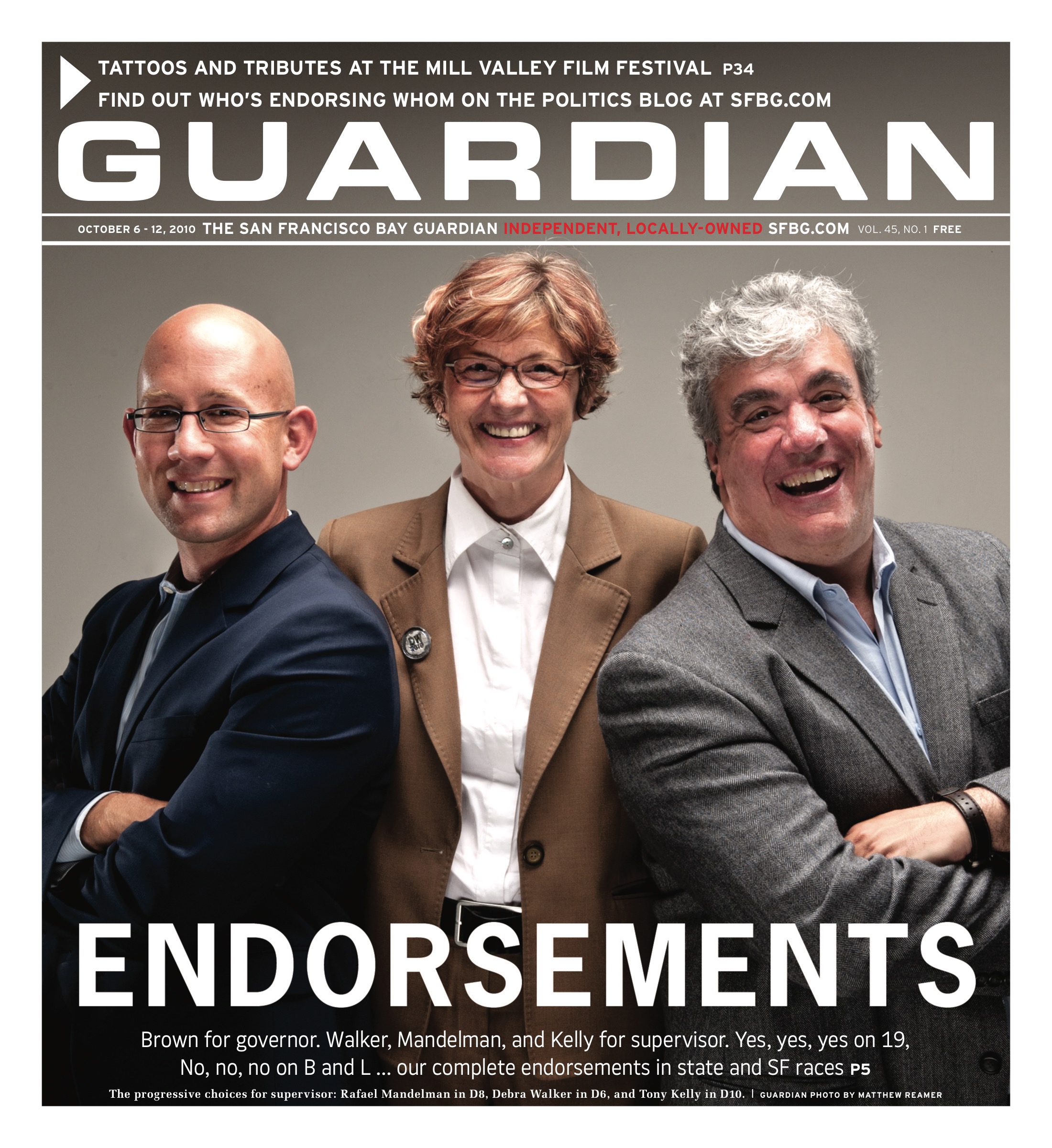
Endorsements 2010: San Francisco candidates

53

SUPERVISOR, DISTRICT 2


JANET REILLY


Frankly, we were a little surprised by the Janet Reilly who came in to give us her pitch as a District 2 supervisorial candidate. The last time we met with her, she was a strong progressive running for state Assembly as an advocate of single-payer health care. She was challenging Fiona Ma from the left, and easily won our endorsement.


Now she’s become a fiscal conservative — somewhat more in synch with her district, perhaps, but not an encouraging sign. Reilly seems to realize that there’s a $500 million budget deficit looming, but she won’t support any of the tax measures on the ballot. She’s against the hotel tax. She’s against the real estate transfer tax on high-end properties. She’s against the local car tax. She opposed Sup. David Chiu’s business tax plan that would have shifted the burden from small to larger businesses (even though it was clear from our interview that she didn’t understand it).


She talked about merging some of the nonprofits that get city money, about consolidating departments, and better management — solutions that might stem a tiny fraction of the red ink. But she wouldn’t even admit that the limited tax burden on the very rich was part of San Francisco’s budget problem.


Her main proposal for creating jobs is more tax credits for biotech, life sciences, and digital media and more public-private partnerships.


It’s too bad, because Reilly’s smart, and she’s far, far better than Mark Farrell, the candidate that the current incumbent, Michela Alioto-Pier, is backing. We wish she’d be realistic about the fiscal nightmare she would inherit as a supervisor.


On the positive side, she’s a strong supporter of public power and she has good connections to the progressive community. Unlike Alioto-Pier, she’d be accessible, open-minded, and willing to work with the progressive majority on the board. That would be a dramatic change, so we’ll give her the nod.


We were also impressed with Abraham Simmons, a federal prosecutor who has spent time researching city finance on the Civil Grand Jury. But he supports sit-lie, Prop. B and Prop. S, and opposes most new tax proposals and needs more political seasoning.


DISTRICT 4


NO ENDORSEMENT


We’ve always wanted to like Carmen Chu. She’s friendly, personable, intelligent, and well-spoken. But on the issues, she’s just awful. Indeed, we can’t think of a single significant vote on which she’s been anything but a call-up loyalist for Mayor Newsom. She even opposed the public power measure, Prop. H, that had the support of just about everyone in town except hardcore PG&E allies.


She’s running unopposed, and will be reelected. But we can’t endorse her.


DISTRICT 6


1. DEBRA WALKER


2. JANE KIM


3. GLENDON “ANNA CONDA” HYDE


CORRECTION: In our original version of this endorsement, we said that Jim Meko supports the sit-lie ordinance. That was an error, and it’s corrected below.


A year ago, this race was artist and activist Debra Walker’s to lose. Most of the progressive community was united behind her candidacy; she’d been working on district issues for a couple of decades, fighting the loft developers during the dot-com boom years and serving on the Building Inspection Commission. Then School Board member Jane Kim decided to enter the race, leaving the left divided, splitting resources that might have gone to other critical district races — and potentially helping to put the most pro-business downtown candidate, Theresa Sparks, in a better position to win.


Now we’ve got something of a mess — a fragmented and sometimes needlessly divisive progressive base in a district that’s key to holding progressive control of the board. And while neither of the two top progressive candidates is actively pursuing a credible ranked-choice voting strategy (Kim has, unbelievably, endorsed James Keys instead of Walker, and Walker has declined to endorse anyone else), we’re setting aside our concern over Kim’s ill-advised move and suggesting a strategy that is most likely to keep the seat Chris Daly has held for the past 10 years from falling to downtown control.


Walker is far and away our first choice. She understands land use and housing — the clear central issues in the district — and has well thought-out positions and proposals. She says that the current system of inclusionary housing — pressing market-rate developers to include a few units of below-market-rate housing with their high-end condos — simply doesn’t work. She supports an immediate affordable housing bond act and a long-term real estate transfer tax high enough to fund a steady supply of housing for the city’s workforce. She told us the city ought to be looking at planning issues from the perspective of what San Francisco needs, not what developers want to build. She’s in favor of progressive taxes and a push for local hiring. We’re happy to give her our first-place ranking.


Jane Kim has been a great SF School Board member and has always been part of the progressive community. But she only moved into District 6 a year and a half ago — about when she started talking about running for supervisor (and she told us in her endorsement interview that “D6 is a district you can run in without having lived there a long time.”) She still hasn’t been able to explain why she parachuted in to challenge an experienced progressive leader she has no substantive policy disagreements with.


That said, on the issues, Kim is consistently good. She is in favor of indexing affordable housing to market-rate housing and halting new condo development if the mix gets out of line. She’s for an affordable housing bond. She supports all the tax measures on this ballot. She’s a little softer on congestion pricing and extending parking-meter hours, but she’s open to the ideas. She supports police foot patrols not just as a law-enforcement strategy, but to encourage small businesses. She’d be a fine vote on the board. And while we’re sympathetic to the Walker supporters who would prefer that we not give Kim the credibility and exposure of an endorsement, the reality is that she’s one of two leading progressives and would be better on the board than the remaining candidates.


Hyde, a dynamic young drag queen performer, isn’t going to win. But he’s offered some great ideas and injected some fun and energy into the race. Hyde talks about creating safe injection sites for IV drug users to reduce the risk of overdoses and the spread of disease. He points out that a lot of young people age out of the foster-care system and wind up on the streets, and he’s for continuum housing that would let these young people transition to jobs or higher education. He talks about starting a co-op grocery in the Tenderloin. He proposes bus-only lanes throughout the district and wants to charge large vehicles a fee to come into the city. He’s a big advocate of nightlife and the arts. He lacks experience and needs more political seasoning, but we’re giving him the third-place nod to encourage his future involvement.


Progressives are concerned about Theresa Sparks, a transgender activist and former business executive who now runs the city’s Human Rights Commission. She did a (mostly) good job on the Police Commission. She’s experienced in city government and has good financial sense. But she’s just too conservative for what remains a very progressive district. Sparks isn’t a big fan of seeking new revenue for the city telling us that “I disagree that we’ve made all the cuts that we can” — even after four years of brutal, bloody, all-cuts budgets. She doesn’t support the hotel tax and said she couldn’t support Sup. David Chiu’s progressive business tax because it would lead to “replacing private sector jobs with public sector jobs” — even though the city’s own economic analysis shows that’s just not true. She supports Newsom’s sit-lie law.


Sparks is the candidate of the mayor and downtown, and would substantially shift the balance of power on the board. She’s also going to have huge amounts of money behind her. It’s important she be defeated.


Jim Meko, a longtime neighborhood and community activist, has good credentials and some solid ideas. He was a key player in the western SoMa planning project and helped come up with a truly progressive land-use program for the neighborhood. But he supports Prop. B and is awfully cranky about local bars and nightlife.


James Keys, who has the support of Sup. Chris Daly and was an intern in Daly’s office, has some intriguing (if not terribly practical) ideas, like combining the Sheriff’s Department and the Police Department and making Muni free). But in his interview, he demonstrated a lack of understanding of the issues facing the district and the city.


So we’re going with a ranked-choice strategy: Walker first, Kim second, Hyde third. And we hope Kim’s supporters ignore their candidate’s endorsement of Keys, put Walker as their second choice, and ensure that they don’t help elect Sparks.


DISTRICT 8


RAFAEL MANDELMAN


This is by far the clearest and most obvious choice on the local ballot. And it’s a critical one, a chance for progressives to reclaim the seat that once belonged to Harvey Milk and Harry Britt.


Mandelman, a former president of the Milk Club, is running as more than a queer candidate. He’s a supporter of tenants rights, immigrants’ rights, and economic and social justice. He also told us he believes “local government matters” — and that there are a lot of problems San Francisco can (and has to) solve on its own, without simply ducking and blaming Sacramento and Washington.


Mandelman argues that the public sector has been starved for years and needs more money. He agrees that there’s still a fair amount of bloat in the city budget — particularly management positions — but that even after cleaning out the waste, the city will still be far short of the money it needs to continue providing pubic services. He’s calling for a top-to-bottom review of how the city gets revenue, with the idea of creating a more progressive tax structure.


He’s an opponent of sit-lie and a supporter of the sanctuary city ordinance. He supports tenants rights and eviction protection. He’s had considerable experience (as a member of the Building Inspection Commission and Board of Appeals and as a lawyer who advises local government agencies) and would make an excellent supervisor.


Neither of the other two contenders make our endorsement cut. Rebecca Prozan is a deputy city attorney who told us she would be able to bring the warring factions on the board together. She has some interesting ideas — she’d like to see the city take over foreclosed properties and turn them into housing for teachers, cops, and firefighters — and she’s opposed to sit-lie. But she’s weak on tenant issues (she told us there’s nothing anyone can do to stop the conversion of rental housing into tenancies-in-common), doesn’t seem to grasp the need for substantial new revenues to prevent service cuts, and doesn’t support splitting the appointments to key commissions between the mayor and the supervisors.


Scott Wiener, a deputy city attorney, is a personable guy who always takes our phone calls and is honest and responsive. He’s done a lot of good work in the district. But he’s on the wrong side of many issues, and on some things would be to the right of the incumbent, Sup. Bevan Dufty.


He doesn’t support public power (which Dufty does). He says that a lot of the city’s budget problems can’t be solved until the state gets its own house in order (“we can’t tax our way out of this”) and favors a budget balanced largely by further cuts. In direct contrast to Mandelman, Wiener said San Franciscans “need to lower our expectations for government.” He wants broad-based reductions in almost all city agencies except Muni, “core” public health services, and public safety. He doesn’t support any further restrictions on condo conversions or TICs. And he has the support of the Small Property Owners Association — perhaps the most virulently anti-tenant and anti-rent control group in town.


This district once gave rise to queer political leaders who saw themselves and their struggles as part of a larger progressive movement. That’s drifted away of late — and with Mandelman, there’s a chance to bring it back.


DISTRICT 10


1. TONY KELLY


2. DEWITT LACY


3. CHRIS JACKSON


District 10 is the epicenter of new development in San Francisco, the place where city planners want to site as many as 40,000 new housing units, most of them high-end condos, at a cost of thousands of blue-collar jobs. The developers are salivating at the land-rush opportunities here — and the next supervisor not only needs to be an expert in land-use and development politics, but someone with the background and experience to thwart the bad ideas and direct and encourage the good ones.


There’s no shortage of candidates — 22 people are on the ballot, and at least half a dozen are serious contenders. Two — Steve Moss and Lynette Sweet — are very bad news. And one of the key priorities for progressives is defeating the big-money effort that downtown, the police, and the forces behind the Van Ness Avenue megahospital proposal are dumping into the district to elect Moss.


Our first choice is Tony Kelly, who operates Thick Description Theater and who for more than a decade has been directly involved in all the major neighborhood issues. He has a deep understanding of what the district is facing: 4,100 of the 5,300 acres in D10 have been rezoned or put under the Redevelopment Agency in the past 10 years. Planners envision as many as 100,000 new residents in the next 10 years. And the fees paid by developers will not even begin to cover the cost of the infrastructure and services needed to handle that growth.


And Kelly has solutions: The public sector will have to play a huge role in affordable housing and infrastructure, and that money should come from higher development fees — and from places like the University of California, which has a huge operation in the district and pays no property taxes. Kelly wants to set up a trigger so that if goals for affordable housing aren’t met by a set date, the market-rate development stops. He supports the revenue measures on the ballot but thinks we should go further. He opposes the pension-reform measure, Prop. B, but notes that 75 percent of the city’s pension problems come from police, fire, and management employees. He wants the supervisors to take over the Redevelopment Agency. He’s calling for a major expansion of open space and parkland in the district. And he thinks the city should direct some of the $3 billion in short-term accounts (now all with the Bank of America) to local credit unions or new municipal bank that could invest in affordable housing and small business. He’s a perfect fit for the job.


DeWitt Lacy is a civil-rights lawyer and a relative newcomer to neighborhood politics. He speaks passionately about the need for D10 to get its fair share of the city’s services and about a commitment to working-class people.


Lacy is calling for an immediate pilot program with police foot patrols in the high-crime areas of the district. He’s for increasing the requirements for developers to build affordable housing and wants to cut the payroll tax for local businesses that hire district residents.


Lacy’s vision for the future includes development that has mixed-use commuter hubs with shopping and grocery stores as well as housing. He supports the tax measures on the ballot and would be willing to extend parking meter hours — but not parking fines, which he calls an undue burden on low-income people.


He’s an outspoken foe of sit-lie and of gang injunctions, and with his background handling police abuse lawsuits, he would have a clear understanding of how to approach better law-enforcement without intimidating the community. He lacks Kelly’s history, experience, and knowledge in neighborhood issues, but he’s eminently qualified and would make a fine supervisor.


Chris Jackson, who worked at the San Francisco Labor Council and serves on the Community College Board, is our third choice. While it’s a bit unfortunate that Jackson is running for higher office only two years after getting elected to the college board, he’s got a track record and good positions on the issues. He talks of making sure that blue-collar jobs don’t get pushed out by housing, and suggested that the shipyard be used for ship repair. He wants to see the city mandate that landlords rent to people with Section 8 housing vouchers. He supports the tax measures on the ballot, but also argues that the city has 60 percent more managers than it had in 2000 and wants to bring that number down. He thinks the supervisors should take over Redevelopment, which should become “just a financing agency for affordable housing.” He wants to relocate the stinky sewage treatment plant near Third Street and Evans Avenue onto one of the piers and use the area for a transit hub. He’s still relatively unseasoned, but he has a bright political future.


Eric Smith, a biodiesel activist, is an impressive candidate too. But while his environmental credentials are good, he lacks the breadth of knowledge that our top three choices offer. But we’re glad he’s in the race and hope he stays active in community politics.


Malia Cohen has raised a lot of money and (to our astonishment) was endorsed No. 2 by the Democratic Party, but she’s by no means a progressive, particularly on tenant issues — she told us that limiting condo conversions is an infringement of property rights. And she’s way too vague on other issues.


Moss is the candidate of the big developers and the landlords, and the Chamber of Commerce is dumping tens of thousands of dollars into getting him elected. He’s got some good environmental and energy ideas — he argues that all major new developments should have their own energy distribution systems — but on the major issues, he’s either on the wrong side or (more often) can’t seem to take a stand. He said he is “still mulling over” his stand on sit-lie. He supports Sanctuary City in theory, but not the actual measure Sup. David Campos was pushing to make the policy work. He’s not sure if he likes gang injunctions or not. He only moved back to the district when he decided to run for supervisor. He’s way too conservative for the district and would be terrible on the board.


Lynette Sweet, a BART Board member, has tax problems (and problems explaining them) and wouldn’t even come to our office for an endorsement interview. The last thing D10 needs is a supervisor who’s not accountable and unwilling to talk to constituents and the press.


So we’re going with Kelly, Lacy, and Jackson as the best hope to keep D10 from becoming a district represented by a downtown landlord candidate.


SAN FRANCISCO BOARD OF EDUCATION


MARGARET BRODKIN


KIM-SHREE MAUFAS


HYDRA MENDOZA


Three seats are up on the School Board, and three people will get elected. And it’s a contested race, and in situations like that, we always try to endorse a full slate.


This fall, it was, to put it mildly, a challenge.


It’s disturbing that we don’t have three strong progressive candidates with experience and qualifications to oversee the San Francisco Unified School District. But it seems to be increasingly difficult to find people who want to — and can afford to — devote the time to what’s really a 40-hour-a-week position that pays $500 a month. The part-time school board is an anachronism, a creature of a very different economic and social era. With the future of the next generation of San Franciscans at stake, it’s time to make the School Board a full-time job and pay the members a decent salary so that more parents and progressive education advocates can get involved in one of the most important political jobs in the city.


That said, we’ve chosen the best of the available candidates. It’s a mixed group, made up of people who don’t support each other and aren’t part of anyone’s slate. But on balance, they offer the best choices for the job.


This is not a time when the board needs radical change. Under Superintendent Carlos Garcia, the local public schools are making huge strides. Test scores are up, enrollment is increasing, and San Francisco is, by any rational measure, the best big-city public school district in California. We give considerable credit for that to the progressives on the board who got rid of the irascible, secretive, and hostile former Superintendent Arlene Ackerman and replaced her with Garcia. He’s brought stability and improvement to the district, and is implementing a long-term plan to bring all the schools up to the highest levels and go after the stubborn achievement gap.


Yet any superintendent and any public agency needs effective oversight. One of the problems with the district under Ackerman was the blind support she got from school board members who hired her; it was almost as if her allies on the board were unable to see the damage she was doing and unable to hold her accountable.


Our choices reflect the need for stability — and independence. We are under no illusions — none of our candidates are perfect. But as a group, we believe they can work to preserve what the district is doing right and improve on policies that aren’t working.


Kim-Shree Maufas has been a staunch progressive on the board. She got into a little trouble last year when the San Francisco Chronicle reported that she’d been using a school district credit card for personal expenses. That’s not a great move, but she never actually took public money since she paid back the district. Maufas said she thought she could use the card as long as she reimbursed the district for her own expenses; the rules are now clear and she’s had no problems since. We don’t consider this a significant enough failure in judgment to prevent her from continuing to do what she’s been doing: serving as an advocate on the board for low-income kids and teachers.


Maufas is a big supporter of restorative justice and is working for ways to reduce suspensions and expulsions. She wants to make sure advanced placement and honors classes are open to anyone who can handle the coursework. She supports the new school assignment process (as do all the major candidates), although she acknowledges that there are some potential problems. She told us she thinks the district should go back to the voters for a parcel tax to supplement existing funding for the schools.


Margaret Brodkin is a lightening rod. In fact, much of the discussion around this election seems to focus on Brodkin. Since she entered the race, she’s eclipsed all the other issues, and there’s been a nasty whisper campaign designed to keep her off the board.


We’ve had our issues with Brodkin. When she worked for Mayor Newsom, she was part of a project that brought private nonprofits into city recreation centers to provide services — at a time when unionized public employees of the Recreation and Parks Department were losing their jobs. It struck us as a clear privatization effort by the Newsom administration, and it raised a flag that’s going to become increasingly important in the school district: there’s a coming clash between people who think private nonprofits can provide more services to the schools and union leaders who fear that low-paid nonprofit workers will wind up doing jobs now performed by unionized district staff. And Brodkin’s role in the Newsom administration — and her background in the nonprofit world — is certainly ground for some concern.


But Brodkin is also by far the most qualified person to run for San Francisco school board in years, maybe decades. She’s a political legend in the city, the person who is most responsible for making issues of children and youth a centerpiece of the progressive agenda. In her years as director of Coleman Advocates for Children and Youth, she tirelessly worked to make sure children weren’t overlooked in the budget process and was one of the authors of the initiative that created the Children’s Fund. She’s run a nonprofit, run a city department, and is now working on education issues.


She’s a feisty person who can be brusque and isn’t always conciliatory — but those characteristics aren’t always bad. Sup. Chris Daly used his anger and passion to push for social justice on the Board of Supervisors and, despite some drawbacks, he’s been an effective public official.


And Brodkin is full of good ideas. She talks about framing what a 21st century education looks like, about creating community schools, about aligning after-school and summer programs with the academic curriculum. She wants the next school bond act to include a central kitchen, so local kids can get locally produced meals (the current lunch fare is shipped in frozen from out of state).


Brodkin needs to remember that there’s a difference between being a bare-knuckles advocate and a member of a functioning school board. But given her skills, experience, and lifetime in progressive causes, we’re willing to give her a chance.


We also struggled over endorsing Hydra Mendoza. She works for Mayor Newsom as an education advisor — and that’s an out-front conflict of interest. She’s a fan of Obama’s Education Secretary, Arne Duncan, whose policies are regressive and dangerous.


On the other hand, she cares deeply about kids and public education. She’s not a big supporter of charter schools (“I’ve yet to see a charter school that offers anything we can’t do ourselves,” she told us) and while she was on the wrong side of a lot of issues (like JROTC) early in her tenure, over the past two years she’s been a good School Board member.


There are several other candidates worth mentioning. Bill Barnes, an aide to Michela Alioto-Pier, is a good guy, a decent progressive — but has no experience in or direct connection to the public schools. Natasha Hoehn is in the education nonprofit world and speaks with all the jargon of the educrat, but her proposals and her stands on issues are vague. Emily Murase is a strong parent advocate with some good ideas, but she struck us as a bit too conservative (particularly on JROTC and charter schools.) Jamie Wolfe teaches at a private school but lacks any real constituency or experience in local politics and the education community.


So given a weak field with limited alternatives, we’re going with Maufas, Brodkin and Mendoza.


SAN FRANCISCO COMMUNITY COLLEGE BOARD


JOHN RIZZO


The San Francisco Community College District has been a mess for years, and it’s only now starting to get back on track. That’s the result of the election of a few progressive reformers — Milton Marks, Chris Jackson, and John Rizzo, who now have enough clout on the seven-member board to drag along a fourth vote when they need it.


But the litany of disasters they’ve had to clean up is almost endless. A chancellor (who other incumbent board members supported until the end) is now under indictment. Public money that was supposed to go to the district wound up in a political campaign. An out-of-control semiprivate college foundation has been hiding its finances from the public. The college shifted bond money earmarked for an arts center into a gigantic, expensive gym with a pool that the college can’t even pay to operate, so it’s leased out to a private high school across the street.


And the tragedy is that all three incumbents — two of whom should have stepped down years ago — are running unopposed.


With all the attention on the School Board and district elections, not one progressive — in fact, not one candidate of any sort — has stepped forward to challenge Anita Grier and Lawrence Wong. So they’ll get another term, and the reformers will have to continue to struggle.


We’re endorsing only Rizzo, a Sierra Club staffer who has been in the lead in the reform bloc. He needs to end up as the top vote-getter, which would put him in position to be the board president. Rizzo has worked to get the district’s finances and foundation under control and he richly deserves reelection.


BART BOARD OF DIRECTORS, DISTRICT 8


BERT HILL


It’s about time somebody mounted a serious challenge to James Fang, the only elected Republican in San Francisco and a member of one of the most dysfunctional public agencies in California. The BART Board is a mess, spending a fortune on lines that are hardly ever used and unable to work effectively with other transit agencies or control a police force that has a history of brutality and senseless killing.


Fang supports the suburban extensions and Oakland Airport connector, which make no fiscal or transportation sense. He’s ignored problems with the BART Police for 20 years. It’s time for him to leave office.


Bert Hill is a strong challenger. A professional cost-management executive, he understands that BART is operating on an old paradigm of carrying people from the suburbs into the city. “Before we go on building any more extensions,” he told us, “we should take care of San Francisco.” He wants the agency to work closely with Muni and agrees there’s a need for a BART sunshine policy to make the notoriously secretive agency more open to public scrutiny. We strongly endorse him.


ASSESSOR-RECORDER


PHIL TING


San Francisco needs an aggressive assessor who looks for every last penny that big corporations are trying to duck paying — but this is also a job that presents an opportunity for challenging the current property tax laws. Phil Ting’s doing pretty well with the first part — and unlike past assessors, is actually stepping up to the plate on the second. He’s been pushing a statewide coalition to reform Prop. 13 — and while it’s an uphill battle, it’s good to see a tax assessor taking it on. Ting has little opposition and will be reelected easily.


PUBLIC DEFENDER


JEFF ADACHI


Adachi’s done a great job of running the office that represents indigent criminal defendants. He’s been outspoken on criminal justice issues. Until this year, he was often mentioned as a potential progressive candidate for mayor.


That’s over now. Because Adachi decided (for reasons we still can’t comprehend) to join the national attack on public employees and put Prop. B on the ballot, he’s lost any hope of getting support for higher office from the left. And since the moderate and conservative forces will never be comfortable with a public defender moving up in the political world, Adachi’s not going anywhere anytime soon.


Which is fine. He’s doing well at his day job. We wish he’d stuck to it and not taken on a divisive, expensive, and ill-conceived crusade to cut health care benefits for city employees.


SAN FRANCISCO SUPERIOR COURT


SEAT 15


MICHAEL NAVA


To hear some of the brahmins of the local bench and bar tell it, the stakes in this election are immense — the independence of the judiciary hangs in the balance. If a sitting judge who is considered eminently qualified for the job and has committed no ethical or legal breaches can be challenged by an outsider who is seeking more diversity on the bench, it will open the floodgates to partisan hacks taking on good judges — and force judicial candidates to raise money from lawyers and special interests, thus undermining the credibility of the judiciary.


We are well aware of the problems of judicial elections around the country. In some states, big corporations that want to influence judges raise and spend vast sums on trial and appellate court races — and typically get their way. In Iowa, three judges who were willing to stand on principle and Constitutional law and declare same-sex marriage legal are facing what amounts to a well-funded recall effort. California is not immune — in more conservative counties, liberal judges face getting knocked off the bench by law-and-order types.


It’s a serious issue. It’s worth a series of hearings in the state Legislature, and it might be worth Constitutional change. Maybe trial-court elections should be eliminated. Maybe all judicial elections should have public campaign financing. But right now, it’s an elected office — at least in theory.


In practice, the vast majority of the judicial slots in California are filled by appointment. Judges serve for four-year terms but tend to retire or step down in midterm, allowing the governor to fill the vacancy. Unless someone files specifically to challenge an incumbent, typically appointed judge, that race never even appears on the ballot.


The electoral process is messy and political, and raising money is unseemly for a judicial officer. But the appointment process is hardly pure, either — and governors in California have, over the past 30 years, appointed the vast majority of the judges from the ranks of big corporate law firms and district attorney’s offices.


There are, of course, exceptions, and Gov. Arnold Schwarzenegger has been better than his predecessor, Democrat Gray Davis. But overall, public interest lawyers, public defenders, and people with small community practices (and, of course, people who have no political strings to pull in Sacramento) have been frustrated. And it’s no surprise that some have sought to run against incumbents.


That’s what’s happening here. Michael Nava, a gay Latino who has been working as a research attorney for California Supreme Court Justice Carlos Moreno, was going to run for a rare open seat this year, but the field quickly got crowded. So Nava challenged Richard Ulmer, a corporate lawyer appointed by Schwarzenegger who has been on the bench a little more than a year.


We will stipulate, as the lawyers say: Ulmer has done nothing wrong. From all accounts, he’s a fine judge (and before taking the bench, he did some stellar pro bono work fighting for reforms in the juvenile detention system). So there are two questions here: Should Nava have even filed to run against Ulmer? And since he did, who is the better candidate?


It’s important to understand this isn’t a case of special interests and that big money wanting to oust a judge because of his politics or rulings. Nava isn’t backed by any wealthy interest. There’s no clear parallel to the situations in other areas and other states where the judiciary is being compromised by electoral politics. Nava had every right to run — and has mounted an honest campaign that discusses the need for diversity on the bench.


Ulmer’s supporters note — correctly — that the San Francisco courts have more ethnic and gender diversity than any county in the state. And we’re not going to try to come to a conclusion here about how much diversity is enough.


But we will say that life experience matters, and judges bring to the bench what they’ve lived. Nava, who is the grandson of Mexican immigrants and the first person in his family to go to college, may have a different perspective on how low-income people of color are treated in the courts than a former Republican who spent his professional career in big law firms.


We were impressed by Nava’s background and knowledge — and by his interest in opening up the courts. He supports cameras in the courtrooms and allowing reporters to record court proceedings. He told us the meetings judges hold on court administration should be open to the public.


We’re willing to discuss whether judicial elections make sense. Meanwhile, judges who don’t like the idea of challenges should encourage their colleagues not to retire in midterm. If all the judges left at the end of a four-year term, there would be plenty of open seats and fewer challenges. But for now, there’s nothing in this particular election that makes us fear for the independence of the courts. Vote for Nava.


>>BACK TO ENDORSEMENTS 2010

Getting out the in-jail vote

1

Sheriff’s Department spokesperson Eileen Hirst reminded me today that 75-80 percent of the people behind bars at the San Francisco County Jail are still in the pre-trial stage. Hirst first shared that stastic with me earlier this year, when the jail got dumped from the list of buildings that will be earthquake retrofitted, if voters approve Proposition A this fall.

And today the percentage resurfaced in the context of efforts to get out the vote. Because if your case is pre-trial, this means that you have not yet been found guilty and so are still eligible to vote—provided that you are not on parole for a felony conviction. And with several races and measures still in play on the ballot, this means that in-jail voters could be of pivotal importance this November. 

Either way, Hirst tells me that the Department of Elections and the Sheriff’s Department are  working hard to educate inmates about their voting rights.

“We have an office called Prisoners Legal Services, where they do voter education and facilitate applications for absentee ballots,” Hirst said. “We work closely with the Department of Elections to make sure prisoners are aware of their rights, and we carry applications and absentee ballots back and forth, between Elections and the jail.”

According to the Department of Elections’ Voting Guide for Ex-Offenders, a person who has been convicted of a felony can still register and vote if they have completed their prison term for a felony, including any period of parole or supervised release.

are on federal or state probation; and/or are incarcerated in county jail as a condition of felony probation or as a result of a misdemeanor sentence.

“If you have been convicted of a misdemeanor, you can register and vote, even while on probation, supervised release, or incarcerated in county jail,” the Elections Department brochure states.

“To restore your right to vote if you have been convicted of a felony, you only need to complete and return a voter registration form,” the brochure continues. “No other documentation is required.”

Hirst estimated that on any given day, there are 1800-1825 prisoners at the county jail, but she did not have up-to-date information on which districts these prisoners are from.

“Years and years ago, we did a pin map by hand, and we found that they came from every district in town, but were concentrated in the Bayview, the Western Addition and the Mission,” Hirst recalled.

She noted that the county jail population is 50-55 percent African American, 25-30 percent Latino, and the remainder is “white, Asians and other”—statistics that suggest that the D10 and D6 races will likely be the most impacted by the in-prison vote.

She also noted that C.L.A.E.R. executive director Sharen Hewitt has been one of the leading figures in San Francisco in terms of getting out the in-jail vote.

“Sharen really made it a priority and educated a lot of prisoners,” Hirst said.


Arlington & Santa Clara join SF in requesting S-Comm opt-out

1

The County Board in Arlington, Virginia and the Santa Clara Board of Supervisors both voted unanimously September 28 to opt out of S-Comm, a controversial Immigration and Customs Enforcement (ICE) data-sharing program also known as Secure Communities.

This means San Francisco is no longer the only municipality requesting to opt out of ICE’s S-Comm program. (Washington, D.C’s metropolitan Police Department is the only jurisdiction to date to successfully terminate its S-Comm Memorandum of Agreement with ICE.) The program automatically shares fingerprints with ICE that are taken by local law enforcement immediately after individuals are arrested, even if criminal charges are eventually dismissed or were the result of an unlawful arrest.

The opt-out resolutions in Santa Clara and Arlington came a day before 578 national and local organizations delivered a letter to President Barack Obama condemning the merger of criminal justice and immigration systems and demanding an end to practices that harm diverse communities throughout the country.

S-Comm has already met with opposition from civil rights organizations, law enforcement, and city officials from Washington, D.C. to San Francisco, over concerns it is being forced on hundreds of counties without oversight or accountability.

As a result of this opposition, ICE issued a statement in August that confirmed that local jurisdictions have a right to opt out by sending a written request.

And recently, Homeland Security Secretary Janet Napolitano and U.S. Attorney General Eric Holder also confirmed in writing that local jurisdictions can opt of S-Comm by requesting to do so in writing.

San Francisco Sheriff Mike Hennessey has already submitted this request in writing on at least two occasions, most recently on August 31st. And on May 18, San Francisco’s Board of Supervisors passed a resolution to opt out of S-Comm.

And Angela Chan, staff attorney at the Asian Law Caucus in San Francisco, repeated her request that ICE comply with its own opt-out procedure for all requesting counties.

“SF has done everything required of us to opt out,” Chan said in a press release. “Sheriff Hennessey and our Board of Supervisors have voiced our request to opt out of S-Comm loud and clear. It’s now ICE’s turn to follow through on their word and allow counties to do what has been within our right all along. Only then will we be able to focus our local resources back on local law enforcement. S-Comm has no place in our counties because it makes immigrant victims and witnesses afraid to come forward and cooperate with local law enforcement.”

In response to Santa Clara’s opt-out request, ICE’s Assistant Director David Venturella sent a letter to Santa Clara’s legal counsel Miguel Marquez in which he sought to clarify how S-Comm works:

“Secure Communities is ICE’s comprehensive strategy to improve and modernize the identification and removal of criminal aliens from the United States,” Venturella wrote. “As part of this strategy, ICE uses a federal biometric information sharing capability to more quickly and accurately identify aliens when they are booked into local law enforcement custody.”

“ICE uses a risk-based approach that prioritizes immigration enforcement actions against criminal aliens based on the severity of their crimes, focusing first on criminal aliens convicted of serious crimes like murder, rape, drug trafficking, national security crimes, and other “aggravated felonies,” Venturella continued.

But critics of S-Comm have noted that the majority of folks identified by this program are not criminal aliens at all. These critics argue that the program is undermining community policing efforts, since a person who has not committed a serious crime can now be referred to ICE simply because they were arrested (perhaps falsely) of a crime—and ICE can initiative deportation proceedings before that person can prove that they aren’t a felon.

And as Venturella acknowledges in his letter to Santa Clara, “Under this strategy, ICE maintains the authority to enforce immigration law.”

But Venturella confirmed that local municipalities have the right to request that their jurisdictions S-Comm program not be activated. And he clarified that ICE won’t be requiring local jurisdictions to sign statements of intent, or any other document to participate in S-Comm.

He also explained that ICE defers to the California State Attorney General on how state, county and local law enforcement agencies within California will share biometric data.

Venturella clarified that the purpose of local law enforcement receiving a fingerprint “match message” is to provide any additional identity information about the subject, including aliases, from the Department of Homeland Security’s biometric database. This database stores over 100 million records that, according to Venturella’s letter, “may not have been available based only on a criminal history check.”

But he noted that “receiving a ‘match message’ does not authorize or require any action by local law enforcement.”

“ICE views an immigration detainer as a request that a local law enforcement agency maintain custody of an alien, who may otherwise be released, for up to 48 hours (excluding Saturdays, Sundays and holidays),” Venturella explained. “This provides ICE time to assume custody of the alien.”

Venturella noted that ICE is not responsible for the incarceration costs of such individuals and does not reimburse localities for detaining any individual until ICE assumes custody.

But he points out that there is no statutory requirement that localities notify ICE if a subject is to be released 30 days in advance of any release or transfer.
‘The notification of ICE of inmate transfer or release within 30 days is pursuant to ICE’s request for such information,” Venturella stated.

Venturella clarifies that there is a legal basis for requiring ICE officers to conduct inmate interviews “to determine alienage and any possibilities for relief or protection from removal.”

But he also points out that local officials are not required to assist the feds in acquiring information about detainees.
“Assisting ICE in acquiring detainee information is not a legal requirement,” Venturella states.

Endorsement interviews: James Keys

10

James Keys, a former legislative intern in Sup. Chris Daly’s office now running for supervisor in D6, is making economic and social justice the centerpiece of his campaign. He talks, for example, about using city resources to make sure that SRO residents have a chance to move on to more traditional apartments. “We have a lot of housing in the pipeline,” he told us. “But I’m not sure if people are really moving in.”

Keys wants to see the city figure out some want to take over empty apartment buildings to use for housing for SRO residents. “Entities ought to be moving people through SROs and out,” he noted.

He’s a fan of community policing (“there are no cops on the beat in the neighborhood”) and wants to put unemployed people to work doing graffiti removal and cleaning the streets.

He also taked about offering free Muni service (although he had a little trouble explaining how the city would pay for that) and wants to combine the Sheriff’s Office and the Police Department.

You can listen to our interview here:

keyes by endorsements2010

ICE suggests SF Secure-Comm opt-out possible

1

U.S. Immigration and Customs Enforcement (ICE) spokesperson Lori K. Haley sent the Guardian a statement today that suggests that ICE might change the city’s Secure-Communities activation status, after all.
“Once ICE receives the correspondence from the San Francisco County Sheriff, we will review the request and convene a meeting with the other agencies involved, including the California Department of Justice, to discuss the Sheriff’s specific issues and concerns.  Based upon those discussions, ICE and its partners will examine the options and seek a feasible resolution, which may include changing the jurisdiction’s activation status,” ICE stated.

ICE’s statement came in the wake of a conference call from SF Sheriff Mike Hennessey and SF Police Commissioner Angela Chan, who have been leading the charge to opt-out of a program that is supposed to be voluntary.

“Secure-Comm is not a federal law, it’s a program and it’s voluntary,” Chan told the Guardian.

Chan says she considers ICE’s statement a positive sign, but she insists that San Francisco be at the negotiating table, moving forward.
 “I think it’s important that ICE does not simply meet again with Attorney General Jerry Brown and not include San Francisco. Sheriff Mike Hennessey needs to be at the table,” Chan said.

ICE notes that since Secure-Comm’s activation in San Francisco in early June, the program has resulted in ICE taking custody of “89 potentially removable aliens, including 25 individuals with prior convictions for serious or violent offenses.”

“Secure Communities continues to be a vital tool for identifying potentially removable criminal aliens who’ve come into local law enforcement custody and expediting their removal from the United States,” ICE stated. “It’s a major step forward in ICE’s ongoing efforts to work with local law enforcement to prevent potentially dangerous criminal aliens from being released to our streets.”

But Chan points to an article in Bay City News, in which Hennessey clarifies that he does not have a problem with cooperating with ICE around serious criminal offenders.
“I am not unwilling to cooperate with ICE with regard to serious [offenders] charged with felonies,” Hennessey reportedly said  during today’s conference call with ICE. He also clarified that he had reported felony suspects believed to be in the country without paperwork before Secure-Comm was implemented and will continue to do so under SF’s sanctuary ordinance.

SecureComm is currently in effect in 35 California counties, including all nine Bay Area counties, Los Angeles and San Diego. Under the program, California Attorney General Jerry Brown’s Justice Department shares fingerprints of anyone booked into jail after an arrest, be it for felony or misdemeanor charges, with ICE’s databases to determine if that person is here legally.

In May, when Brown rejected Hennessey’s initial opt-out request, San Francisco Mayor Gavin Newsom backed Brown up, but police Chief George Gascon has reportedly indicated that he would like to see those arrested for minor crimes be exempted.

Today, Hennessey reminded reporters that he has already taken all the steps that ICE is recommending today to try to opt out, but that he was told in that previous go-around–by phone, no less–that opting-out was not an option.
“No meeting was held, no meeting was called, and they did not give me the courtesy of a written response,” Hennessey said.

ICE statistics’ also show that of the ten people already deported from San Francisco under Secure-Comm, only one had been convicted of a serious crime, and six had non-criminal backgrounds.
ICE’s Virginia Kice reportedly told BCN those with non-criminal histories may have had “extensive” histories of immigration-related arrests, which are typically handled administratively.

But Chan says that ICE’s latest statistics seem to prove that the program should be renamed Insecure Communities.
“This actually hurts public safety,” Chan said


Hennessey to Brown and ICE (again): SF wants out of Secure-Comm

7

Sheriff Mike Hennessey has sent a letter to California Attorney General Jerry Brown and Department of Homeland Security officials David Venturella and Marc A. Rapp, reaffirming San Francisco’s desire to opt out of Secure-Communities, a program U.S. Immigration and Customs Enforcement (ICE) activated in San Francisco in June.

In his August 31 letter, Hennessey observes that on August 17, ICE issued a communication that suggests there is now a procedure to address opt-out requests.

‘The ICE communication, Secure Communities: Setting the Record Straight, specifies that, ‘If a jurisdiction does not wish to activate on its scheduled date in the Secure Communities deployment plan, it must formally notify its state identification and ICE in writing (email, letter of facsimile),” Hennessey states. “Upon receipt of that information, ICE will request a meeting with federal partners, the jurisdiction, and the state to discuss any issues and come to a resolution, which may include adjusting the jurisdiction’s activation date in, or removing the jurisdiction from, the deployment plan.”

Hennessey acknowledges that San Francisco County has already been activated in accordance with ICE’s Secure-Comm deployment plan.

“However, as you know, I sought to opt out, in writing, to both the California Department of Justice and Secure Communities,” Hennessey wrote. “I was told at that time in a telephone conversation with Mr. Rapp that there was no provision for a local jurisdiction to opt out. The information provided in Secure Communities: Setting the Record Straight would suggest that there is now a procedure in place to address such requests.”

Hennessey ends his letter by saying he is looking forward to meeting all parties and “coming to a mutually agreeable resolution.”

So, stay tuned….

ICE says Secure Communities opt-out is possible

5

On Aug. 10, national civil rights groups released documents on the Department of Homeland Security’s Secure Communities program.

These groups’ findings–based on information gleaned from materials obtained through a Freedom of Information Act request–included the startling statistic that the vast majority (79 percent) of people detained due to S-Comm are non-criminals, up for lower level offenses, such as traffic offenses or petty juvenile mischief. 

U.S. Immigration and Customs Enforcement (ICE) has since responded to claims made at that press conference, saying, among other things, that local jurisdictions can, in fact, opt out of the program–though the process sounds somewhat convoluted.
 

“Widespread confusion persists about how jurisdictions can choose not to participate in [Secure Communities] due to concern about how the program will impact community policing initiatives and public safety,” ICE’s statement notes.

“As part of the Secure Communities activation process, ICE conducts outreach to local jurisdictions, including providing information about the biometric information sharing capability, explaining the benefits of this capability, when they are scheduled for activation, and addressing any concerns they may have,” ICE continued.

“If a jurisdiction does not wish to activate on its scheduled date in the Secure Communities deployment plan, it must formally notify its state identification bureau and ICE in writing (email, letter or facsimile),” ICE concluded. “Upon receipt of that information, ICE will request a meeting with federal partners, the jurisdiction, and the state to discuss any issues and come to a resolution, which may include adjusting the jurisdiction’s activation date in or removing the jurisdiction from the deployment plan.”

Local immigrant rights groups are taking ICE’s statement as a hopeful sign that San Francisco could yet opt out of the program, even though attempts to do so earlier this year–initiated at the request of San Francisco Sheriff Mike Hennessey–fell apart at the state level. But maybe the winds have changed. Stay tuned…

Immigrant advocates accuse ICE of “pattern of dishonesty”

13

A coalition of national civil rights organizations held a August 10 press conference to discuss recently released internal government documents that they say reveal “a pattern of dishonesty” regarding Immigration and Customs Enforcement (ICE)  “Secure Communities” (S-Comm) program.

Representatives with the National Day Laborer Organization Network (NDLON), the Center for Constitutional Rights (CCR), and the Kathryn O. Greenberg Immigration Justice Clinic of the Benjamin N. Cardozo School of Law noted that though ICE officials have declared their intention to expand S-Comm into every jurisdiction in the country by 2013, information about the program has been scarce, and development of its operational details has been shrouded in secrecy.

The coalition also pointed to a July 27 letter that U.S. Congresswoman Zoe Lofgren recently wrote to Secretary Janet Napolitano and Attorney General Eric Holder as evidence that ICE led Congress to believe that SecureComm is a voluntary, and not a mandatory, program.

In her letter, Lofgren, who is chair of the House of Representatives’ subcommittee on Immigration, Citizenship, Refugees, Border Security and International Law,  asks for “a clear opt-out procedure for municipalities that do not wish to participate in the S-Comm program.”

“As we discussed, Secure Communities is a voluntary program that relies upon the resources of both of your agencies [referring to DHS and DOJ] in order to provide State, local, and federal law enforcement agencies with information related to the immigration status of persons booked into our nation’s jails and prisons,” Lofgren wrote.

“I am aware that some local law enforcement agencies have expressed concern that participating in Secure Communities will present a barrier to their community policing efforts and will make it more difficult for them to implement a law enforcement strategy that meets their community’s public safety needs,” Lofgren observed.

“There appears to be significant confusion about how local law enforcement agencies may ‘opt out’ of participating in Secure Communities,” Lofgren continued.

Lofgren notes that staff from her House subcommittee were briefed on this program by ICE and were informed that localities could opt out simply by making such a request to ICE, while subsequent conversations with ICE and FBI CJIS added  to the confusion by suggesting that this might not be so.

“Please provide me with a clear explanation of how local law enforcement agencies may pot out of Secure Communities by having the fingerprints they collect and submit to the SIBs checked against criminal, not immigration, databases,” Lofgren concludes.

To date, Lofgren has not received a reply, a press spokesperson in her office confirmed.

Immigration rights advocates charge that S-Comm, which is operative in 544 jurisdictions in 27 states, functions like the controversial 287(g) program and Arizona’s SB1070, making state and local police central to the enforcement of federal immigration law.

They say the program, which automatically runs fingerprints through immigration databases for all people arrested, targets them for detention and deportation even if their criminal charges are minor, eventually dismissed, or the result of an unlawful arrest.

After reviewing the recently released ICE documents and other information, advocates for NDLON said they found evidence supporting their claim that ICE has been dishonest with the public and with local law enforcement regarding S-Comm’s true mission and impact.

“While ICE markets S-Comm as an efficient, narrowly tailored tool that targets ‘high threat’ immigrants, it actually functions as a dragnet for funneling people into the mismanaged ICE detention and removal system,” stated a NDLON press release. “ICE’s own records show that the vast majority (79 percent) of people deported due to S-Comm are not criminals or were picked up for lower level offenses.”

They also charge that the program serves as a smokescreen for racial profiling, allowing police officers to stop people based solely on their appearance and arrest non-citizens, knowing that they will be deported, even if they were wrongfully arrested and are never convicted.

“Preliminary data confirms that some jurisdictions, such as Maricopa County Arizona, have abnormally high rates of non-criminal S-Comm deportations,” NDLON continued.

 “Lastly, the impression ICE fosters that S-Comm is not mandatory and jurisdictions can opt out is riddled with questions,” they conclude.

 “These records reveal a dangerous trend,” said NDLON Executive Director Pablo Alvarado. “This program creates an explosion of Arizona-like enforcement at a time when the results have proven disastrous. Thanks to S-Comm, we face the potential proliferation of racial profiling, distrust of local police, fear, and xenophobia to every zip code in America.”

 “S-Comm co-opts local police departments to do ICE’s dirty work at significant cost to community relations and police objectives,” said CCR attorney Sunita Patel. “Without full and truthful information about the program’s actual mission and impact, police are operating in the dark. The bottom line is that thrusting police into the business of federal immigration enforcement isn’t good for anyone.”

 “ICE is racing forward imposing its S-Comm program on new states and localities every day, without any meaningful dialog or public debate,” warned Bridget Kessler, a teaching fellow at the Immigration Justice Clinic of the Benjamin N. Cardozo School of Law.

The three organizations vow to litigate for the release of more data and records “to uncover the truth behind S-Comm and other ICE efforts to draft local police into immigration enforcement.”

Also speaking at the Aug. 10 press conference was San Francisco Sheriff Mike Hennessey. Earlier this summer, Hennessey blew the whistle on S-COmm, after attending a meeting in May at which ICE revealed it was going to switch the program on in San Francisco in June.

But despite Hennessey’s efforts to opt San Francisco out of the program, S-Comm went live June 8 in San Francisco.

“We were told we could opt out through the State Attorney General’s Office,” Hennessey said, recalling how AG Jerry Brown’s office told him that San Francisco could only opt out through the feds.

“We were given the run around,” Hennessey said.“It’s a program forced upon individual local law enforcement agencies, no matter what the local community wants,” Hennessey said.

Henessey worries that the program is having a chilling effect on community policy efforts.

“Witnesses and victims of crime won’t come forward for fear they will be deported,” he said.

Henessey notes that ICE has detained folks who were arrested for minor traffic violations, and whose charges were subsequently dropped, as well as folks with no criminal records.

“My Board of Supervisors, my Police Commission and my mayor have said they would rather not participate in deportations at that level,” Hennessey noted.

He worries that the program could be expanded to include employment record checks.

“They say the program won’t be used for civil purposes, but it’s already being used for federal employment checks,” Hennessey said. “This further isolates minority communities from the mainstream.”

Immigrant advocates protest AZ law and Jerry Brown’s SecureComm support

0

SF Pride’s Gabriel Haaland reports that the California Highway Patrol made them take down their “No One is Illegal” drop banner at 9.a.m.
 
The SF Pride action came on the heels of yesterday’s protest in which over a hundred people gathered in front of the federal building to rally for comprehensive immigration reform, oppose AZ’s SB 1070 law and to oppose the fingerprinting program that was imposed on SF known as S-Comm (i.e., Secure Communities), effectively undermining the city’s sanctuary ordinance. Nineteen people were arrested for engaging in civil disobediance and blocking Seventh Street.

Today, several more immigrant rights rallies are taking place, including one outside the San Francisco office of gubernatorial candidate and Attorney General Jerry Brown. The protest, which was organized by the SF Day Labor Program and the Women’s Collective, targets Brown for not supporting San Francisco Sheriff Mike Hennessey’s request to opt San Francisco out of the  S-Comm program. 

Meanwhile, over at City Hall, San Francisco Mayor Gavin Newsom said he doesn’t see any problem with the SecureComm program.
“There is no reason to opt out,”Newsom told reporters at a budget signing press conference.

Naked fun in the sun!

9

Entertainer Wavy Gravy and Pentagon Papers leaker Daniel Ellsberg like Red Rock Beach; Marin Superior Court Commissioner Roy Chernus favors Bass Lake, and Marin County Sup. Steve Kinsey says he’s been naked at Red Rock, Bolinas, Hagmier Pond, and Mount Vision Pond.

“I’ve probably hit every nude beach in Marin,” says Kinsey, who has described his visits as “exhilarating and normal.” “My last dip was at Bass Lake last fall. It has beautiful, fresh water, and the swimming environment is wonderful. I look forward to the next opportunity.”

But on their next trips to the nude section of beautiful Muir Beach, visitors may notice something new: a warning sign is being erected by the county this summer to urge users to be “respectful” of each other and to notify authorities if there’s trouble.

The sign is the result of a compromise worked out by nudists, law enforcers, county officials, and local homeowners, some of whom wanted nudity stopped. Under the agreement, cops are making a few more visits than before. But through July 1, 2010, only four complaints about nudity and one citation for improper sexual conduct have occurred since January 1, 2009, and none since August 13, 2009, according to marin county sheriff’s office crime analyst Susan Medina. “We keep responding to complaints, but I can’t recall any recent citations,” says Lt. Cheryl Fisher, commander of the Marin County Sheriff’s Office’s West Marin Station. Fisher says the subjects are usually suited up by the time deputies arrive. “A deputy showed up on a very hot Sunday,” says regular visitor Michael Velkoff of Scotts Valley. “As soon as he left, everybody was naked again.”

“Of course, guys in spiked penis rings not parading themselves around also have helped,” says Sup. Kinsey, who, for now, has spiked his previous threat to fight back by starting an effort to make Muir and other beaches clothing-optional under a 1975 law giving Marin County the power to exempt areas from its anti-nudity provisions. “Sometimes the best thing we can do in government is to stay out of the way.”

Homeowners remain wary. One, who wants to remain anonymous, tells the Guardian: “We are optimistic” about being able to “coexist” with the naturists, “but we also remain very clear about what is legal and what will and won’t be tolerated.” And a former advocate of the ban told me that instead of not going to Muir Beach “a person wanting to use the beach nude might do it in a manner that doesn’t draw a lot of attention.”

As if the Marin mashup wasn’t enough, nervous naturists also got ready to do battle with state authorities, who they feared would eventually ban nudity at Devil’s Slide in San Mateo County and at Bonny Doon Beach near Santa Cruz, both of which are state beaches.

The jitters came in the wake of an October 2009 California high court ruling allowing a crackdown on nude sunbathing on state beaches, even in areas traditionally used for such activity. “All it takes now is an individual ranger with the desire to issue a citation,” warns R. Allen Baylis, a Huntington Beach attorney representing the Naturist Action Committee, the country’s biggest nudist lobbying group. “It could have a chilling effect [on nudity] on any state beach.”

“Our thin line of security has been overturned,” says Rich Pasco, head of the Bay Area Naturists, based in San Jose. “So let’s hope that in today’s economy, the thin level of state park staff has better things to do with their time than dealing with naturists.”

At press time, the NAC, along with BAN and 14 other nudist groups, were preparing, for the first time, to officially petition California to “designate clothing-optional areas” on one or more state beaches. Other efforts have, says Baylis, been “less formal.” “Do they really expect us to pack up and leave?” Baylis asks. “We’re going to fight back. This is our freedom they’re messing with!”

What’s the good news? Just like at Muir Beach, it doesn’t look like naturists have anything to worry about for now in Northern California. “In the short term, things at Bonny Doon are destined to continue the way they are,” says Kirk Lingenfelter, sector superintendent for Bonny Doon. He wants a better trail, stairs, and parking, but says the cash-starved state doesn’t have the budget to make even a preliminary plan or increase ranger visits. He said his staff have not issued any citations or warnings at the nude cove, which he calls one of the spots that “really give you the feeling of rugged, untouched majesty. It’s a very important feeling. Going to places like Bonny Doon helps you get recharged.”

And the Devil’s Slide police source, who wants to remain anonymous, told us: “Rangers aren’t going to be pursuing enforcement against nudity per se. Nothing’s changed.” Rangers will continue responding to complaints, he explained, but it usually means they arrive too late to do anything about them because cell phones don’t work on the beach. “We hear about it after the fact,” says another Devil’s Slide enforcer, Supervising State Park Ranger Michael Grant.

Want to contribute to the glad tidings? There’s still time for plenty of fun in the sun. You can donate your body to the record books, at least temporarily, by showing up Saturday, July 10 at the Sequoians Clothes Free Club (www.sequoians.com) in Castro Valley, when its annual attempt at setting a world skinny-dipping record, with 138 other nude locations, will be held. And if you’ve ever been dying to do a little light cleaning in the nude (no window-washing needed), here’s your chance: Your butt can be bare if you stop by Bonny Doon Sept. 18 to help fans pick up cigarette butts and other litter on the beach.

Speaking of good things, would you like to help improve our report? Please send brainstorms, your new beach “finds,” improved directions (especially road milepost numbers), and trip reports to garhan@aol.com or by snail mail to Gary Hanauer, c/o San Francisco Guardian, 135 Mississippi St., San Francisco CA 94107. Please include your phone number so we can verify that you’re not just another mirage in the nude beach sand.

>>BELOW ARE CAPSULE GUIDES TO POPULAR NUDE BEACHES. CLICK HERE FOR OUR COMPLETE GUIDE, INCLUDING MANY MORE

NORTH BAKER BEACH, SAN FRANCISCO

Things are really cooking at San Francisco’s long, narrow North Baker, which is in good shape this year, with plenty of sand and an influx of young people and more women than five years ago, even though the beach is still heavily male. “If you want to see naked chicks and guys, it’s the place to go,” says aficionado Paul Jung. Although beach regulars like himself welcome all the new nude volleyball players, “some of them seem to make up rules as they go along,” he laughs. Fun activities: Look for dolphins that occasionally surface in the water off shore. And in low tide only, walk around the big rocks at the north end of the beach to check out Baker’s “secret” tide pools.

Directions: Take the 29 Sunset bus or go north on 25th Avenue to Lincoln Boulevard. Turn right and take the second left onto Bowley Street. Follow Bowley to Gibson Road, turn right, and follow Gibson to the east parking lot. Head right on the beach to the nude area, which starts at the brown and yellow “Hazardous surf, undertow, swim at your own risk” sign. Some motorcycles in the lot have been vandalized, possibly by car owners angered by bikers parking in car spaces; to avoid trouble, motorcyclists should park in the motorcycle area near the cyclone fence.


LAND’S END BEACH, SAN FRANCISCO

Land’s End is just the beginning: it’s not just the ground that seems to “disappear” into the sunset at this little slice of paradise off Geary Boulevard. So do your clothes, if you want to be magically transported to another dimension, away from the cares of everyday constraints. Shorts, swimsuit, even work clothes during a quick lunch break — they all can be removed at this delightful cove, which features a mix of sand and rocks plus some of San Francisco’s best views. Better still, only a handful of people are usually present. Bring a windbreak for protection in case the weather changes.

Directions: Follow Geary Boulevard to the end, then park in the dirt lot up the road from the Cliff House. Take the trail at the far end of the lot. About 100 yards past a bench and some trash cans, the path narrows and bends, then rises and falls, eventually becoming the width of a road. Don’t take the road to the right, which leads to a golf course. Just past another bench, as the trail turns right, go left toward a group of dead trees where you will see a stairway and a “Dogs must be leashed” sign. Descend and head left to another stairway, which leads to a 100-foot walk to the cove. Or, instead, take the service road below the El Camino del Mar parking lot 1/4 mile until you reach a bench, then follow the trail there.

GOLDEN GATE BRIDGE BEACH, SAN FRANCISCO

Don’t come to Golden Gate Bridge Beach, also called Nasty Boy Beach, if you want privacy: dozens to hundreds of visitors show up on the hottest days at the site that some have likened to a “gay meat market.” Along with the guys, a smattering of women, straight couples, children and fishermen are spread out on the three adjoining rocky coves that make up the beach, whose stunning views of the Bridge will make you feel like you’re the star of your own postcard. “It’s really nice to walk in the water,” says a woman. “In low tide, you can sometimes go out 150 feet.”

Directions: Directions: from the toll booth area of Highway 101/1, take Lincoln Boulevard west about a half mile to Langdon Court. Turn right (west) on Langdon and look for space in the parking lots, across Lincoln from Fort Winfield Scott. Park and then take the new, improved beach trail, starting just west of the end of Langdon, down its more than 200 steps to Golden Gate Bridge Beach, also known as Marshall’s Beach.


FORT FUNSTON BEACH, SAN FRANCISCO

If you try to be naked here on weekends, you’ll be barking up the wrong tree. The main creatures who go nude at Fort Funston, south of Ocean Beach, are dogs, but that hasn’t stopped a small band of stark naked sunbathers from hiding away in some sand dunes when rangers aren’t in the area. Authorities usually issue several citations a year here. But if you don’t make a fuss and visit on a weekday, you probably won’t be busted. If anyone complains, put on your beach gear right away. Two more fun activities at “Fort Fun”: watching hang-gliders take off from the cliffs and checking out a seemingly endless passing parade of people and their pets.

Directions: From San Francisco, head west to Ocean Beach, then go south on the Great Highway. After Sloat Boulevard, the road goes uphill. From there, curve right onto Skyline Boulevard, go past one stoplight, and look for signs for Funston on the right. Turn into the public lot and find a space near the west side. At the southwest end, take the sandy steps to the beach, turn right, and walk to the dunes. Find a spot as far as possible from the parking lot. Do not go nude here on the weekends. And if you don’t like dogs, go elsewhere.


LAS TRAMPAS REGIONAL WILDERNESS, CASTRO VALLEY

Nudity’s banned in the East Bay Regional Park District, but if you tell that to the nude hikers who will be once again walking across park land July 23 and Aug. 22 — at night — they may moon you en masse. On America’s only naked “Full Moon Hikes,” participants leave the grounds of the Sequoians Naturist Club in Castro Valley fully clothed at dusk and walk through meadows and up hills until the moon rises, before heading back down the slopes with their clothes folded neatly into their backpacks. Says Dave Smith, of San Leandro: “It’s truly wonderful. Except for deer, we’re usually the only ones on the path.” Agrees James, of Fremont: “It’s one of the best experiences I’ve ever had. You’re walking in this silvery light. The moonlight is flooding everything. You feel like you’re in the middle of a beautiful dream.”

Directions: Contact the Sequoians Naturist Club (www.sequoians.com) or the Bay Area Naturists (www.bayareanaturists.org) for details on how to join a walk. Participants usually meet at and return to the Sequoians Club. To get there, take Highway 580 east to the Crow Canyon Road exit. Or follow 580 west to the first Castro Valley off-ramp. Take Crow Canyon Road toward San Ramon 0.75 mile to Cull Canyon Road. Then follow Cull Canyon Road around 6.5 miles to the end of the paved road. Take the dirt road on the right until the “Y” in the road and keep left. Shortly after, you’ll see the Sequoians sign. Proceed ahead for about another 0.75 mile to the Sequoians front gate.


DEVIL’S SLIDE, MONTARA

Will they be having a devil of a time in paradise? For the first time, rangers say they’ll begin enforcing state anti-nudity regulations if offended beachgoers complain about the nudists who visit Gray Whale Cove, which is commonly called Devil’s Slide. The good news: It’s a nonissue because cell phones (used to summon rangers) don’t work on the beach, so by the time cops arrive, the offenders have long since suited up or left. And the beach’s top enforcer told us he won’t be telling rangers to bust nudists they see. Most visitors love the long sandy shore, where nudies, about 20 percent of visitors, hang out on the north end.

Directions: Driving from San Francisco, take Highway 1 south through Pacifica. Three miles south of the Denny’s restaurant in Linda Mar, turn left (inland or east) on an unmarked road, which takes you to the beach’s parking lot and to a 146-step staircase leads to the sand. “The steps are in good shape,” Ron says. Coming from the south on Highway 1, look for a road on the right (east), 1.2 miles north of the Chart House restaurant in Montara.


SAN GREGORIO NUDE BEACH, SAN GREGORIO

America’s oldest nude beach, near Half Moon Bay, offers two miles of soft sand and tide pools to explore, as well as a lagoon, lava tube, and, if you look closely enough on the cliffs, the remains of an old railroad line. Pets are allowed on weekdays. Up to 200 visitors may be present, but they’re usually so spread out, you may not even notice them. Gay men tend to hang out on the north side and in “sex condos” made of driftwood by visitors — a major annoyance to those who are easily offended. On the south end of the beach, there are sometimes dozens of straight couples and families, naked and clothed. For weather information, call (415) 765-7697.

Directions: Head south on Highway 1 past Half Moon Bay. Between mileposts 18 and 19, look on the right side of the road for telephone call box number SM 001 0195, at the intersection of Highway 1 and Stage Road and near an iron gate with trees on either side. From there, expect a drive of 1.1 miles to the entrance. At the Junction 84 highway sign, the beach’s driveway is just 0.1 mile away. Turn into a gravel driveway, passing through the iron gate mentioned above, which says 119429 on the gatepost. Drive past a grassy field to the parking lot, where you’ll be asked to pay an entrance fee. Take the long path from the lot to the sand; everything north of the trail’s end is clothing-optional.


BONNY DOON NUDE BEACH, BONNY DOON

Bonny Doon isn’t doomed. To the contrary, because the state has no plans to develop it or send rangers out to make anti-nudity patrols, it looks like it will remain Santa Cruz County’s prettiest nude beach, which should please the nudists who were on the edge of their towels wondering what would happen. Says Kirk Lingenfelter, sector superintendent for Bonny Doon and nearby state beaches: “Going to places like Bonny Doon helps you get recharged.” Naturists usually use the cove on the north end of the beach, which attracts more women and couples than most clothing-optional enclaves.

Directions: Head south on Highway 1 to the Bonny Doon parking lot at milepost 27.6 on the west side of the road, 2.4 miles north of Red, White, and Blue Beach, and some 11 miles north of Santa Cruz. From Santa Cruz, head north on Highway 1 until you see Bonny Doon Road, which veers sharply to the right just south of Davenport. The beach is right off the intersection. Park in the paved lot to the west of Highway 1; don’t park on Bonny Doon Road or the shoulder of Highway 1. If the lot is full, drive north on Highway 1, park at the next beach lot and walk back to the first lot. To get to the beach, climb the berm next to the railroad tracks adjacent to the Bonny Doon lot, cross the tracks, descend, and take the trail to the sand. Walk north past most of the beach to the cove on the north end.


2222, SANTA CRUZ

Size matters at 2222, which is the smallest nude beach in the U.S. — and probably smaller than your backyard. Not many people can fit into it and not many have heard about it, so not many are there, which is just fine with its mostly young crowd of local college students. Located across from 2222 West Cliff Drive, it’s a great place to sunbathe, read, relax, or even watch Neal the Juggler practice tossing balls, pins, and beanbags on the sand. But don’t attempt the very steep climb up and down the cliff unless you’re in good shape.

Directions: The beach is a few blocks west of Natural Bridges State Beach and about 2.5 miles north of the Santa Cruz Boardwalk. From either north or south of Santa Cruz, take Highway 1 to Swift Street. Drive 0.8 miles to the sea, then turn right on West Cliff Drive. 2222 is five blocks away. Past Auburn Avenue, look for 2222 West Cliff on the inland side of the street. Park in the nine-car lot next to the cliff. If it’s full, continue straight and park along Chico Avenue. Bay Area Naturists leader Rich Pasco suggests visitors use care and then follow the path on the side of the beach closest to downtown Santa Cruz and the Municipal Wharf.


PRIVATES BEACH, SANTA CRUZ

Privates Beach, at 4524 Opal Cliff Drive, north of the Capitola Pier, is so private that it has a locked gate, security guards, and, unless you’re too cheap to pay and want to try another option, a $100 per year fee (cash only). The two coves are exceptionally clean and you’re likely to see families, kids, and dogs on the shore.

Directions: 1) Some visitors walk north from Capitola Pier in low tide (not a good idea since at least four people have needed to be rescued after being trapped by rising water). 2) Others reach it in low tide via the stairs at the end of 41st Avenue, which lead to a surf spot called the Hook at the south end of a rocky shoreline known as Pleasure Point. 3) Surfers paddle on boards for a few minutes to Privates from Capitola or the Hook. 4) Most visitors buy a key to the beach gate at Freeline Design Surfboards (821 41st Ave., Santa Cruz, 831-476-2950) 1.5 blocks west of the beach. Others go with someone with a key or wait outside the gate until someone with a key goes in. “Most people will gladly hold the gate open for someone behind them whose hands are full,” says Bay Area Naturists leader Rich Pasco. The nude area is to the left of the bottom of the stairs.


MUIR NUDE BEACH, MUIR BEACH

The mellowness of marvelous Muir Beach was marred last year when some homeowners verbally clashed with nudists over use of the sand. After a few meetings, it was decided that while bare buns on the beach wouldn’t be banned, a warning sign stressing “respect” for everyone and listing a phone number for complaints will be erected, most likely in July, near the border of the nude and clothed sections of the shore. The nude spot is pretty and curved and usually has excellent swimming conditions and access. Instead of a trail, you just walk along the water from the public beach and go around and over some easy-to-cross rocks.

Directions: From San Francisco, take Highway 1 north to Muir Beach, to milepost 5.7. Turn left on Pacific Way and park in the Muir lot (to avoid tickets, don’t park on Pacific). Or park on the long street off Highway 1 across from Pacific and about 100 yards north. From the Muir lot, follow a path and boardwalk to the sand, and then walk north to a pile of rocks between the cliffs and the sea. You’ll need good hiking or walking shoes to cross; in very low tide, try to cross closer to the water. The nude area starts north of it.


RED ROCK BEACH, STINSON BEACH

Bay Area fan favorite Red Rock is still rocking with an improved trail, more sand than last summer, Ultimate Frisbee games that last as long as three hours, a shower where you can cool down on a hot day, and up to 75 people a day. “More rock climbers than ever are coming to the beach,” says the Rock’s “ambassador,” Fred Jaggi. “You can get more privacy there.” Three nude women who were perched on a terrace overlooking the cove in June were recently anointed as the Cheerleaders by members of the fun, highly social crowd below.

Directions: The easiest way to find the beach is to go north on Highway 1 from Mill Valley, following the signs to Stinson Beach. At the long line of mailboxes next to the Muir Beach cutoff point, start checking your odometer. Look for a dirt lot full of cars to the left (west) of the highway exactly 5.6 miles north of Muir and a smaller one on the right (east) side of the road. The lots are at milepost 11.3, one mile south of Stinson Beach. Limited parking is also available 150 yards to the south on the west side of Highway 1. Take the path to the beach that starts near the Dumpster next to the main parking lot. The trail’s doable but moderately long, steep, and slippery, so don’t wear flip-flops.


BASS LAKE, BOLINAS

If you’re sleepless in San Anselmo, a cure might be to bare your bottom at Bass in Bolinas. “If you want to visit an enchanted lake, Bass is it,” says Ryan, of the East Bay. “Tree branches reach over the water, forming a magical canopy, and huge bunches of calla lilies bloom on the shore.” Even walking to Bass, 45-60 minutes from the lot over 2.8 relatively easy miles, can be an adventure like none other. You may see people with backpacks but no pants on the trail. Rangers once stopped and cited a clad man who had an unleashed dog but let the nudists continue. Says Dave Smith, of San Leandro, who unusually walks naked: “I came around a corner and there was a mountain lion sitting like Egypt’s Great Sphinx of Giza 50 yards down the path.” Bring a heavy towel or tarp for sitting on a somewhat prickly meadow near the water.

Directions: From Stinson Beach, go north on Highway 1. Just north of Bolinas Lagoon, turn left on the often-unmarked exit to Bolinas. Follow the road as it curves along the lagoon and eventually ends at Olema-Bolinas Road; continue along Olema-Bolinas Road to the stop sign at Mesa Road. Turn right on Mesa and drive four miles until it becomes a dirt road and ends at a parking lot. On hot days the lot fills quickly. A sign at the trailhead next to the lot will guide you down scenic Palomarin Trail to the lake.


RCA BEACH, BOLINAS

Couples love RCA Beach near Bolinas, and so do singles who long for a ruggedly isolated shoreline that doesn’t take long to reach. This summer, there’s even more to enjoy: the beach is reported to be about four to six feet wider than last year. But it has more gravel this season. “A downside is that it’s very exposed to the wind,” says regular visitor Michael Velkoff. “There’s so much driftwood on the sand that many people build windbreaks or even whole forts. The last time I went, somebody built a 30-foot-tall dragon.” The breathtakingly beautiful beach seems even bigger than its one mile length because, Velkoff says, “you might only see eight people spread out on the sand. Everybody’s like 100 feet apart. It’s great.”

Directions: From Stinson Beach, take Highway 1 (Shoreline Highway) north toward Calle Del Mar for 4.5 miles. Turn left onto Olema Bolinas Road and follow it 1.8 miles to Mesa Road in Bolinas. Turn right and stay on Mesa until you see cars parked past some old transmission towers. Park and walk a 0.25 to the end of the pavement. Go left through the gap in the fence. The trail leads to a gravel road. Follow it until you see a path on your right, leading through a gate. Take it along the cliff top until it veers down to the beach. Or continue along Mesa until you come to a grove of eucalyptus trees. Enter through the gate here, then hike a 0.5 mile through a cow pasture on a path that will also bring you through thick brush. The second route is slippery and eroding, but less steep.


LIMANTOUR BEACH, OLEMA

You can tour long, lovely Limantour in Point Reyes National Seashore while wearing only your smile and some suntan lotion. Few visitors realize the narrow spit of sand is clothing-optional. But unless there are complaints or if you beach your bare body too close to a parking lot or the main entrance, you shouldn’t be hassled. The site is so big — about 2.5 miles long — you can wander for hours, checking out ducks and other waterfowl, shorebirds such as endangered snowy plovers, gray whales in the spring, and playful harbor seals (offshore and on the north side). Dogs are allowed on six-foot leashes on the south end. Directions: Follow Highway 101 north to the Sir Francis Drake Boulevard exit, then follow Sir Francis through San Anselmo and Lagunitas to Olema. At the intersection with Highway 1, turn right onto the highway. Just north of Olema, go left on Bear Valley Road. A mile after the turnoff for the Bear Valley Visitor Center, turn left (at the Limantour Beach sign) on Limantour Road and follow it 11 miles to the parking lot at the end. Walk north a 0.5 mile until you see some dunes about 50 yards east of the shore. Nudists usually prefer the valleys between the dunes for sunbathing. “One Sunday we had 200 yards to ourselves,” says a nudist. But lately, the dunes have been more crowded.

On the cheap listings

0

On the Cheap listings are compiled by Paula Connelly. Submit items for the listings at listings@sfbg.com.

WEDNESDAY 7

“Misspelled” Robert Berman/E6 Gallery, 1632 Market, SF; (415) 558-9975. 7pm, free. Attend the opening reception for Victor Reyes’ public art installation turned gallery exhibition that explores Reyes’ unique approach to graffiti, by dissecting individual letters and exposing the anatomy and architecture found in the symbols we use to communicate. Inspired by San Francisco’s streets, these alphabets recontextualize abandoned city surfaces to raise questions about how we interpret these spaces and the content within them.

FRIDAY 9

Japanese Superheroes Viz Cinema, New People, 1746 Post, SF; (415) 525-8600. 7pm, $10. Join hosts Patrick Macias, August Ragone, and Tomohiro Machiyama for a new talk in the TokyoScope Talk Series about the fascinating history and origins of Japanese superheroes featuring rare film clips and images from numerous tokusatsu, sentai, and henshin hero productions including Ultra Seven, Kikaida, Space Sheriff Gavan, and more.

BAY AREA

Juggling and Unicycling Festival Berkeley High School, Jacket Gym, 1980 Allston, Berk.; www.berkeleyjuggling.org/festival. Fri. 3pm-Midnight, Sat. 9am-Midnight, Sun. 9am-5pm; free. Vaudeville style variety show Sat. 7:30pm, $15. Meet and watch some of the best jugglers and unicyclists on the West Coast and learn some tricks of the trade for all skill levels at juggling, unicycle, and circus arts workshops.

SATURDAY 10

Art Riot Space Gallery, 1141 Polk, SF; www.hyphenmagazine.com. 7pm; $5, or $15 including a one year subscription to Hyphen Magazine. Featuring an exhibit by illustrators and painters from across the country, live painting, music by DJs B-Haul and Gordon Gartrell, and vegan cupcakes by Black Orchid Bakery. Featured artists include Danny Neece, Eve Skyler, Jon Stich, Jorge Mascarenhas, and more.

“Borders” Root Division, 3175 17th St., SF; (415) 863-7668?. 7pm, free. This exhibit about lines and how we cross them will feature work by artists from 9 different states, representing 9 different ethnicities, that explores how we define and interact with the borders that surround us. Mediums to include interactive sculpture, video, photography, installation, performance, and new media.

Hayes Valley Community Picnic Patricia’s Green Park, Hayes at Octavia, SF; RSVP at (415) 240-2433. 1pm, free. Join members of your community for a picnic brought to you by the Dean Clark Store, where revelers will share food, soft drinks, play games, and exchange gifts.

Strike Reenactment Hyde Street Pier, Jefferson at Hyde, SF; www.laborfest.net. Noon and 3pm, free. See a live reenactment of the 1901 San Francisco Waterfront strike, when sailors, teamsters, and longshoremen went on strike for better pay and working conditions. Hear speeches and join the march to implore ships’ crews to join the ranks. Part of the 2010 LaborFest.

Summer Freedom School St. Francis Lutheran Church, 152 Church, SF; (415) 703-0465. Saturdays through Aug. 14; 10am, free. This six week seminar on the Civil Rights Movement (aka the Southern Freedom Movement) serves as a case study for how social movements happen and a tool for getting ready for the next one. Mornings will feature guest speakers, short films and discussions, followed by a pot luck lunch, and an afternoon portion of discussions and activities. For more information visit www.educationanddemocracy.org.

A Voice for Justice in Honduras Mission Cultural Center for Latino Arts Theater, 2868 Mission, SF; 415-643-5001. 7pm, donations encouraged. Hear Karla Lara sing from the classic “Nueva Trova” repertoire with added themes of love, motherhood, and human rights. Lara and other musicians formed Artists in Resistance, a group that performs to maintain an open public opposition to the de facto governments of Roberto Micheletti and Porfirio Lobo, which repress media and democracy. Proceeds benefit Artists in Resistencia in Honduras.

BAY AREA

Treasure Island Triathlon 533 California, Treasure Island, San Francisco Bay; www.tricalifornia.com. 5k-10k Run Race, Sat. 7am-Noon; Olympic Distance Triathlon, Sat. 7:30am-5pm; Sprint Distance Triathlon, Sun. 7am-Noon; Sports Expo, Sat. 7am-3pm, Sun. 7am-Noon. All events free for spectators. Enjoy views from the scenic looped course as you watch athletes compete, including 50 contestants from past seasons of the TV series The Biggest Losers. A Sports Expo will be going on all weekend featuring the latest triathlon gear, athlete services and food vendors.

SUNDAY 11

Big Umbrella Open Studios Big Umbrella Studios, 906.5 Divisadero, SF; (415) 359-9211. 3:30pm; free, suggested donation for use of supplies. Join Big Umbrella artists in art making, art being, or art gazing at this participatory workshop for adults and children. Bring supplies, found objects, and works in progress. Art making supplies will also be available. Collaboration encouraged.

Jewish Music Festival Party Yerba Buena Gardens, Mission at 3rd. St., SF; (510) 848-0237 ext. 119. Noon, free. Celebrate the 25th Anniversary of the Jewish Music Festival at this picnic and party featuring performances, instrumental jams, a parade, and an instrument petting zoo for all ages. Instruments encouraged. Artists to include Eprhyme, Glenn Hartman and the Klezmer Playboys, Peter Jacques, Elana Jagoda, and more.

World Cup Finals Civic Center Plaza, Polk between McAllister and Grove, SF; (415) 831-2782. 11:30 a.m., free. Join fellow San Francisco soccer fans for a big screen broadcast of the World Cup finals featuring soccer-related activities for youth, food vendors, and valet bike parking. No glass bottles or alcohol permitted.

MONDAY 12

“What’s Cookin’ with Josh Kornbluth” Contemporary Jewish Museum Café, 736 Mission, SF; (415) 655-7800. Noon, free. Liven up your Mondays with an interactive improvised lunch performance by monologist Josh Kornbluth, who will entertain and engage you with lively lunchtime banter all summer long. Every Monday through August 30.


Film listings

0

Film listings are edited by Cheryl Eddy. Reviewers are Kimberly Chun, Michelle Devereaux, Max Goldberg, Dennis Harvey, Johnny Ray Huston, Erik Morse, Louis Peitzman, Lynn Rapoport, Ben Richardson, and Matt Sussman. For rep house showtimes, see Rep Clock. For first-run showtimes, see Movie Guide. Due to the July 4 holiday, theater information was incomplete at presstime.

ANOTHER HOLE IN THE HEAD

The seventh Another Hole in the Head Film Festival runs July 8-29 at the Roxie, 3117 16th St, SF; and Viz Cinema, New People, 1746 Post, SF. For tickets (most shows $11), visit www.sfindie.com. For commentary, see Trash and http://www.sfbg.com/pixel_vision

THURS/8

Roxie Death Kappa 5. Mutant Girls Squad 7. A Serbian Film 9.

FRI/9

Roxie Samurai Princess 5. Symbol 7. RoboGeisha 9. Tucker and Dale vs. Evil 11.

SAT/10

Roxie Satan Hates You 5. A Serbian Film 7. Vampire Girl vs. Frankenstein Girl 9. The Exterminator 11.

SUN/11

Roxie Nightmares in Red, White, and Blue 5. The Violent Kind 7. Yatterman 9.

MON/12

Roxie Sexy Time Trip Ninjas 5. Samurai Princess 7. Nightmares in Red, White, and Blue 9.

TUES/13

Roxie Satan Hates You 5. Silent Night, Zombie Night 7. Yatterman 9.

OPENING

Beetle Queen Conquers Tokyo Opening with the humid buzz of crickets and the probings of bug aficionados in the thick of a forest, first-time documentarian Jessica Oreck puts Japan’s fascination with insects under the microscope. Preferring to let the images and interview subjects speak for themselves, she turns a lens to young children who clamor to buy sleek, shiny, obsidian beetles, as well as the giant big city gatherings of insect collectors — events that likely are less than familiar to western audiences. Oreck’s intent is to get at the ineffable attraction behind such astonishing sales as that of a single beetle for $90,000 not so long ago, and to that end, she weaves in looks at insect literature and art, visits to Buddhist temples, and historical factoids about, for instance, the first cricket-selling business in the early 1800s. (1:30) Elmwood, Sundance Kabuki. (Chun)

*Daddy Longlegs Purportedly based on their own growing-up experiences, Ben and Joshua Safdie’s feature does for the terminally immature Manhattan reluctant father what Roger Dodger (2002) did for the terminally predatory heterosexual Manhattan bachelor: provide gruesome shaky-cam dissection of a dad dreadful by any common moral standard, yet who is more pathetic and oddly ingratiating than loathsome. The two weeks Lenny (Ronald Bronstein) is charged with caring for his two unruly young sons (Sage Ranaldo, Frey Ranaldo) by a pointedly estranged, vacationing ex-spouse provide enough evidence for a hundred angry divorce proceedings. While a friend is behaving inappropriately with the kids, Lenny goes into the bathroom to smoke a doob; when he’s got a babysitting work conflict, he sedates them into a near-coma. Yet at the same time he’s also a really fun, loving dad — just one lacking all conventional instincts for appropriate behavior. On the one hand this is a parental horror film, on the other a touching and delicate portrait of someone who would very much like to be a good dad but is congenitally doomed as fuckup. Both hands say: this is rather wonderful, ultimately very poignant movie. (1:40) Roxie. (Harvey)

Despicable Me The ad campaign for this film is completely impenetrable, is it not? Apparently it’s a 3-D animated comedy about a guy plotting to steal the moon, with some sentimental stuff thrown as a bonus. (1:35)

*The Girl Who Played With Fire Lisbeth Salander is cooler than you are. The heroine of Stieg Larsson’s bestselling book series is fierce, mysterious, and utterly captivating: in the movie adaptations, she’s perfectly realized by Noomi Rapace, who has the power to transform Lisbeth from literary hero to film icon. Rapace first impressed audiences in The Girl With the Dragon Tattoo (2009), a faithful adaptation of Larsson’s premiere novel, and she returns as Lisbeth in The Girl Who Played With Fire. The sequel, as is often the case, isn’t quite on par with the original, but it’s still a page-to-screen success. And while the first film spent equal time on journalist Mikael Blomkvist (Michael Nyqvist), The Girl Who Played With Fire is almost entirely Lisbeth’s story. Sure, there’s more to the movie than the hacker-turned-sleuth — and the actor who plays her — but she carries the film. Rapace is Lisbeth; Lisbeth is Rapace. I’d watch both in anything. (2:09) Smith Rafael. (Peitzman)

Grease Sing-A-Long Snore. Where’s the sing-a-long love for Grease 2 (1982)? “Cool Rider” forever! (1:50)

John Rabe John Rabe (Ulrich Tukur) was the Oskar Schindler of Nanking: A man who, under discreetly opportunist pretenses, attempted to keep the Chinese in a safety zone from the Japanese in the late 30s. Steve Buscemi plays Robert Wilson, a surly American doctor. He’s to Tukur as Ben Kingsley was to Liam Neeson in 1993’s Schindler’s List, but without the nuance or iconic chemistry. Tukur is understated, bordering on uninteresting, and Buscemi is just over-the-top. Unlike Spielberg’s film, John Rabe grants us little access to the stories of civilians. The film is so preoccupied with people of power and those like Rabe, couched in a world of privilege, that the film lacks an emotional, human center. It’s impossible to feel much of anything because we’re never asked to feel, nor are we ever asked to endure any especially difficult scenes. Even the occasional rain of hellfire isn’t as wallop-packing as it ought to be. (2:14) Elmwood, Presidio. (Ryan Lattanzio)

*The Kids Are All Right See “We Are Family.” (1:47) SF Center.

Predators The hunt-happy creatures take a break from fighting the Aliens to terrorize a surprisingly highbrow cast, including Adrien Brody and Laurence Fishburne (but not, alas, Chris Hansen). (runtime not available)

*Stonewall Uprising See “Riot Awakening.” (1:22)

*Wild Grass The premise of Wild Grass, Alain Resnais’ loopy new film, could have come straight from Nancy Meyers: an older married man finds a single, middle-aged woman’s wallet. He returns it but can’t stop thinking about her. She, in turn, is intrigued by his attentions. Both are surprised by the connection they feel growing between them, one which they nevertheless have difficulty articulating. When they finally meet, sparks fly. That purloined wallet, along with the romcom set-up, aren’t the only MacGuffins in Resnais’ Wild ride, which uses Christian Gailly’s novel L’ Incindent as a rough guide for its careening tour of the irrational courses that desire can lead us down. The man and woman in question are Georges, an embittered writer with a possibly dark past, and flame-haired Marguerite, a dentist and part-time aviatrix, both played to neurotic perfection by longtime Resnais regulars André Dussollier and Sabine Azéma. Resnais’ attempt to translate what he has called the “musicality” of Gailly’s prose has resulted in a frenetic everything-but-the-kitchen-sink approach that tries to visually approximate Georges and Marguerites’ every internal monologue, fantasy, and increasingly risky instance of impulsive behavior, throwing in some knowing winks to classic Hollywood cinema for good measure. It’s a mess, to be sure (there are even two endings!). But like Mr. Magoo, the 87-year-old Resnais, as if by some unseen hand, steers clear of complete disaster. There hasn’t been a Gallic car crash this delightful to watch since Godard’s famous pile-up in 1967’s Week End. (1:44) Clay, Shattuck. (Sussman)

ONGOING

The A-Team Why was the original A-Team the most popular band of mercenaries on TV? The estimable chemistry and comedic skills of Mr. T; legit Breakfast at Tiffany‘s star George Peppard; conservative commentator Dwight Schultz; and Dirk Benedict, fresh from his role as the original Starbuck on Battlestar Galactica, played a major part, as did the quasi-anti-authoritarian, boyish, blow-’em-up-real-good tone, making it more of a cartoonishly violent kin to MASH than First Blood (1982). The cheeky humor and snappy writing were the real key to The A-Team‘s popularity — the reason impressionable protein units like yours truly tuned in. Director Joe Carnahan (2006’s Smokin’ Aces) and cast seem to have sussed out a bit of that magic, especially when the sun-roasted Bradley Cooper as Faceman and Sharlto Copley as Murdock roll with the what-the-hell non-sequiturs (less sure is the star of last year’s District 9‘s grip on exactly what accent he’s been charged with). But the cinematic version won’t be rehabbing the public’s view of guns-for-hire like Blackwater anytime soon. Liam Neeson lacks the cigar-chomping paternal bravado of Peppard, Quinton “Rampage” Jackson is tasked with the unenviable job of following T time, and the script, complete with the ludicrously elaborate plans and a spark-challenged romance between Cooper and Jessica Biel, is just a rough excuse to watch boys and their toys. (1:57) (Chun)

*Babies Thomas Balmes’ camera records the first year in the lives of four infants in vastly different circumstances. They’re respectively born to hip young couple in Tokyo’s high-tech clutter; familiar moderately alterna-types (the father is director Frazer Bradshaw of last year’s excellent indie drama Everything Strange and New) in SF’s Mission District; a yurt-dwelling family isolated in the vast Mongolian tundra; and a Namibian village so maternally focused that adult menfolk seem to have been banished. Yes, on one level this is the cutest li’l documentary you ever saw. But if you were planning to avoid thinking that is all (or most) of what Babies would be like, you will miss out big time. Void of explanatory titles, voice-over narration, or subtitle translations, this is a purely observatory piece that reveals just how fascinating the business of being a baby is. There’s very little predictable pooping, wailing, or coddling. Instead, Balmes’ wonderful eye captures absorbing moments of sussing things out, decision-making, and skill learning. While the First World tykes firstborns both — are hauled off to (way) pre-school classes, the much less day planned Third Worlders have more complex, unmediated dealings with community. Those range from fending off devilish older siblings to Mongol Bayarjargal’s startlingly casual consorting with large furry livestock. (Imagine the horror of parents you know were their baby found surrounded by massive cows — a situation that here causes no concern whatsoever for adults, children, or bovines.) So accustomed to the camera that it doesn’t influence their behavior, the subjects here are viewed with an intimacy that continually surprises. Babies is getting a wider-than-usual release for a documentary, one cannily timed to coincide with Mother’s Day. But don’t be fooled: this movie is actually very cool. (1:19) Smith Rafael. (Harvey)

*Coco Chanel and Igor Stravinsky Revered for the innovative fashion house that set the bar for style and was always knocked off but never cut prices for the real deal (and still sniffs at online clothing sales), Gabrielle “Coco” Chanel gets her second biopic, as an artist on par with composer Igor Stravinsky in this rhapsodically sensuous love letter to an unlikely romance. It opens with the designer and future branding legend (depicted with burning eyes and pantherine mystery by Anna Mouglalis) attending the controversial, riot-starting 1913 premiere of Stravinsky’s The Rite of Spring in Paris. Recognizing Stravinsky (a viral avant-garde stud-muffin in the hands of Mads Mikkelsen, last in deadlocks and warrior face in Clash of the Titans) as a simpatico radical spirit, Chanel lends her house to the composer. He comes with considerable baggage: a slew of children and a consumptive wife, Katarina (Elena Morozova). Morozova’s performance as the angel-faced earth mother scorned, so blatantly disrespected by the rad lovers madly getting down on the music-room carpet, almost steals the show, but then the house-porn fabulosity of the recreated Chanel villa in Garches — a symbol of their hermetic attraction and shot like a seductive, claustrophobic, black-and-white deco womb — takes over, and we’re back in the thick of CoGor’s somewhat inexplicable affair once again. (1:55) (Chun)

Cyrus It’s tempting to label Mark and Jay Duplass’ Cyrus as “mumblecore goes mainstream.” Yes, the mumblecore elements are all there: plentiful moments of awkward humiliation, characters fumbling verbally and sometimes physically in desperate attempts to establish emotional connections, and a meandering, character-driven plot, in the sense that the characters themselves possess precious little drive. The addition of bona fide indie movie stars John C. Reilly, Catherine Keener, and Marisa Tomei — not to mention Hollywood’s chubby-funny guy du jour, Jonah Hill — could lead some to believe that the DIY-loving Duplass brothers (2005’s The Puffy Chair, 2008’s Baghead) have gone from slacker disciples of John Cassavetes (informally known as “Slackavetes”) to worshippers at the slickly profane (with a heart) altar of Judd Apatow. But despite the presence of Apatow protégé Hill (2007’s Superbad) in the title role, Cyrus steers clear of crowd-pleasing bombast, instead favoring small, relatively naturalistic moments. That is to say, not much actually happens. Mumblecore? More or less. Mainstream? Not exactly. Despite playing a character with some serious psychological issues, Hill comes off as likeable. Unfortunately the movie is neither as broadly comic nor as emotionally poignant as it needs to be — the two opposing forces seem to cancel each other out like acids and bases. (1:32) (Devereaux)

8: The Mormon Proposition (1:30)

*Everyone Else Maren Ade’s Everyone Else is a distinctly modernist romantic comedy — one without air. Gitti (Birgit Minichmayr) and Chris (Lars Eidinger) are on vacation, and failing miserably at basic communication. Everyone Else figures holiday as a stage, in which the principles grasp for their roles in relationship to the other. They are a young, bourgeoisie German couple staying at his parents’ villa in Sardinia. He is a disappointed architect, she a music publicist. Already, though, this capsule betrays the film’s methodical mode of exposition, whereby facts like “his parents’ villa” and “in Sardinia” are realized in conversation, later than we expect. Before then, we’re privy to inner jokes, private nonsense, and gestural rapport. Rather than using such minutiae to ingratiate us into Chris and Gitti’s quirks, Ade is embedding us in the relationship’s interior. We realize how deeply during the course of two dinners with an architect acquaintance and his wife, the first at the new couple’s house and the second at the villa. The other pair stands in for the “everybody else” of the title, and, in their outsized performance as a couple, acts as a convenient cipher for Chris and Gitti’s bottomless insecurities. Chris and Gitti are not cold fish — their passion is intense, if swollen by doubt — but the fact that their relationship’s obstacles are self-imposed leads to a certain captive mentality, in which staying together means being marooned from the outside world. (1:59) (Goldberg)

*Exit Through the Gift Shop Exit Through the Gift Shop is not a film about the elusive graffiti-cum-conceptual artist and merry prankster known as Banksy, even though he takes up a good chunk of this sly and by-no-means impartial documentary and is listed as its director. Rather, as he informs us — voice electronically altered, face hidden in shadow — in the film’s opening minutes, the film’s real subject is one Thierry Guetta, a French expat living in LA whose hangdog eyes, squat stature, and propensity for mutton chops and polyester could pass him off as Ron Jeremy’s long lost twin. Unlike Jeremy, Guetta is not blessed with any prodigious natural talent to propel him to stardom, save for a compulsion to videotape every waking minute of his life (roughly 80 percent of the footage in Exit is Guetta’s) and a knack for being in the right place at the right time. When Guetta is introduced by his tagger cousin to a pre-Obamatized Shepard Fairey in 2007, he realizes his true calling: to make a documentary about the street art scene that was then only starting to get mainstream attention. Enter Banksy, who, at first, is Guetta’s ultimate quarry. Eventually, the two become chummy, with Guetta acting as lookout and documenter for the artist just as the art market starts clambering for its piece of, “the Scarlet Pimpernel of street art,” as one headline dubs him. When, at about three quarters of the way in, Guetta, following Banksy’s casual suggestion, drops his camcorder and tries his hand at making street art, Exit becomes a very different beast. Guetta’s flashy debut as Mr. Brainwash is as obscenely successful as his “art” is terribly unimaginative — much to the chagrin of his former documentary subjects. But Guetta is no Eve Harrington and Banksy, who has the last laugh here, gives him plenty of rope with which to truss himself. Is Mr. Brainwash really the ridiculous and inevitable terminus of street art’s runaway mainstream success (which, it must be said, Banksy has handsomely profited from)? That question begs another: with friends like Banksy, who needs enemies? (1:27) (Sussman)

Get Him to the Greek At this point movie execs can throw producer Judd Apatow’s name on the marquee of a film and it’s a guaranteed blockbuster. It’s hard to say whether this Forgetting Sarah Marshall (2008) spin-off benefits from the Apatow sign of approval or if it would be better off standing on its own, but it definitely doesn’t benefit from comparisons to its predecessor. Russell Brand returns as the British rock star Aldous Snow, and Jonah Hill, playing a different character this time, is given the task of chaperoning the uncooperative Snow from London to LA in 48 hours. Despite a great cast, including a surprisingly animated P. Diddy, the story is pretty bland and can’t match the blend of drama and comedy that Marshall achieved. Of course, none of that matters because the movie execs are right: if you like Apatow’s brand of humor, you’re going to have a good time anyway. (1:49) (Peter Galvin)

*The Girl With the Dragon Tattoo By the time the first of Stieg Larsson’s so-called “Millennium” books had been published anywhere, the series already had an unhappy ending: he died (in 2004). The following year, The Girl With the Dragon Tattoo became a Swedish, then eventually international sensation, its sequels following suit. The books are addicting, to say the least; despite their essential crime-mystery-thriller nature, they don’t require putting your ear for writing of some literary value on sleep mode. Now the first of three adaptive features shot back-to-back has reached U.S. screens. (Sorry to say, yes, a Hollywood remake is already in the works — but let’s hope that’s years away.) Even at two-and-a-half hours, this Girl With the Dragon Tattoo by necessity must do some major truncating to pack in the essentials of a very long, very plotty novel. Still, all but the nitpickingest fans will be fairly satisfied, while virgins will have the benefit of not knowing what’s going to happen and getting scared accordingly. Soon facing jail after losing a libel suit brought against him by a shady corporate tycoon, leftie journalist Mikael Blomkvist (Michael Nyqvist) gets a curious private offer to probe the disappearance 40 years earlier of a teenage girl. This entangles him with an eccentric wealthy family and their many closet skeletons (including Nazi sympathies) — as well as dragon-tattooed Lisbeth Salander (Noomi Rapace), androgynous loner, 24-year-old court ward, investigative researcher, and skillful hacker. Director Niels Arden Oplev and his scenarists do a workmanlike job — one more organizational than interpretive, a faithful transcription without much style or personality all its own. Nonetheless, Larsson’s narrative engine kicks in early and hauls you right along to the depot. (2:32) Smith Rafael. (Harvey)

Grown Ups In order of star power, Grown Ups casts Adam Sandler, Kevin James, Chris Rock, Rob Schneider, and David Spade as five fortysomething friends who reunite to attend the funeral of their high school basketball coach, and play catch-up over a long weekend together at a cabin by the lake. If you’re expecting five of America’s biggest comedy stars to form like Voltron and make the most hilarious movie of the year, you’ve got a sad day coming. Grown Ups is never the sum of its parts, it’s about on par with Sandler’s other producing/starring affairs, and probably features a lot of the same jokes. People fall in poop and little kids say cute things designed to make audiences awww, but history has shown that’s exactly what a popcorn viewer is looking for. By these standards, Grown Ups is a perfectly summer-y movie. (1:42) (Galvin)

*I Am Love I Am Love opens in a chilly, Christmastime Milan and deliberately warms in tandem with its characters. Members of the blue-blood Recchi family are content hosting lavish parties and gossiping about one another, none more than the matriarch Emma (Tilda Swinton). But when prodigal son Edoardo befriends a local chef, Emma finds herself taken by both the chef’s food and his everyman personality, and is reminded of her poor Soviet upbringing. The courtship that follows is familiar on paper, but director Luca Guadagnino lenses with a strong style and small scenes acquire a distinct energy through careful editing and John Adams’ unpredictable score. Swinton portrays Emma’s unraveling with the same gritty gusto she brought to Julia (2008), and her commitment to the role recognizes few boundaries. You’ve probably seen this story before, but it has rarely been this powerful. (2:00) (Galvin)

*Iron Man 2 Tony Stark (Robert Downey Jr.) returns, just as rich and self-involved as before, though his ego his inflated to unimaginable heights due to his superheroic fame. Pretty much, he’s put the whole “with great power comes great responsibility” thing on the back burner, exasperating everyone from Girl Friday Pepper Potts (Gwyneth Paltrow); to BFF military man Rhodey (Don Cheadle, replacing the first installment’s Terrence Howard); to certain mysterious Marvels played by Samuel L. Jackson and Scarlett Johansson; to a doofus-y rival defense contractor (Sam Rockwell); to a sanctimonius Senator (Garry Shandling). Frankly, the fact that a vengeful Russian scientist (Mickey Rourke) is plotting Tony’s imminent death is a secondary threat here — for much of the film, Tony’s biggest enemy is himself. Fortunately, this is conveyed with enjoyable action (props to director Jon Favreau, who also has a small role), a witty script (actor Justin Theroux — who knew? He also co-wrote 2008’s Tropic Thunder, by the way), and gusto-going performances by everyone, from Downey on down. Stay for the whole credits or miss out on the geek-gasm. (2:05) (Eddy)

Jonah Hex Based on DC’s dark western comics, Jonah Hex is a jumbled mess of mishandled superhero tropes and obligatory attempts at badass-ery. The title character, a grizzled gunfighter with a distinctive facial scar, could be an engaging outsider antihero, but as portrayed by Josh Brolin, he feels neither as cool nor as tortured as we’re clearly expected to believe. The film has a decidedly ’90s feel to it — think overbudgeted, underthought masterpieces like Wild Wild West (1999) — with its farcically fantastical take on post-Civil War supervillainy. Its ridiculous cast of character actors is almost completely squandered, including archvillain John Malkovich, Aidan Quinn as Ulysses S. Grant, and Will Arnett in an inexplicably serious role. Megan Fox is trying the hardest out of the whole cast, but in a rather sleazy move, her character always seems to appear in soft focus. Oh, and there are a few explosions. (1:81) (Sam Stander)

The Karate Kid The most baffling thing about The Karate Kid is its title: little Dre Parker (Jaden Smith) never actually learns karate. He practices kung-fu, an entirely different form of martial arts — you know, from a different country. There’s something obnoxious and absurd about the misnomer: the film seems to suggest that if you’ve seen one Asian culture, you’ve seen them all. That aside, it’s not a bad movie. Smith is mostly pretty likeable, and there’s a definite satisfaction to seeing him grow from bullied weakling to kung-fu star. And Jackie Chan gets to exercise his dramatic chops — he even gets a crying scene! But Karate Kid is a “reboot,” the preferred term for the endless stream of unnecessary remakes Hollywood keeps churning out. You can’t help but think about the superior 1984 version. Jaden Smith is no Ralph Macchio, Jackie Chan is no Pat Morita, and kung-fu is no karate. Don’t even get me started on the “jacket on, jacket off” crap. Which, if you say it quickly, sounds a little adult for a PG movie. (2:20) (Peitzman)

*The Killer Inside Me This January a Sundance controversy broke. The movie in question was eclectic English director Michael Winterbottom’s The Killer Inside Me, the latest screen version of a beloved and spectacularly nasty noir tale by literary pulp hero Jim Thompson. The protest was that the onscreen violence against women was viciously excessive. The accusation is true: in Winterbottom’s film, violence is horribly immediate, sadistic yet matter-of-fact, almost unendurable — everything movie violence almost never is. There’s nothing remotely comfortable about the highly personal, unnecessary cruelty our antihero wreaks. Sheriff Lou Ford (Casey Affleck), a good ol’ boy in his dusty, back-slappy west Texas hometown of the late 1950s, is a world-class sociopath who depends on lazy small-town gullibility and rote suspicion toward outsiders to literally get away with murder. Lou is shagging local Amy (Kate Hudson) — but gets distracted by Joyce (Jessica Alba), a probable prostitute he’s asked to bum rush outta town. Leading ladies Alba and Hudson are widely perceived as spoiled hotties of little talent — hence perfect battering-rams for pulp-machismo movie violence. What’s cool about Winterbottom’s Killer is that it refuses to let you enjoy the abuse they endure, which is viscerally unpleasant as a fist to the gut. It’s abrupt, grueling, and horrific. At once folksy-nostalgic and vicious, The Killer Inside Me is unabashedly about men who hate women. It successfully translates Thompson’s gambit of insinuating us into the seemingly pleasant, reasonable viewpoint of a protagonist we are then surprised to discover is psychotic and without a conscience. Offended Sundance attendees should’ve gotten a clue: deliberately misleading in its pulp-nostalgia trappings, this is one movie that upsets not gratuitously, but exactly as it should. (1:48) (Harvey)

Killers (1:40)

*Knight and Day A Bourne-again Vanilla Sky (2001)? Considerably better than that embarrassingly silly stateside remake, though not quite as fulfilling as director James Mangold’s 3:10 to Yuma (2007) rework, this action caper played for yuks still isn’t the most original article in the cineplex. But coasting on the dazzling Cheshire grins of its stars, Tom Cruise and Cameron Diaz, reunited for the first time since Sky, you can just make out the birth of a beautiful new franchise. Everygirl June Havens (Diaz) is on her way to her sister’s wedding when she collides-cute at the airport with Roy Miller (Cruise). After killing the passengers and pilots on their plane, he literally sweeps her off her feet — thanks to some potent drugs. Picture a would-be Bond girl dragged against a spy-vs.-spy thriller semi-against-her-will — grappling with the subtextual anxiety rushing beneath all brief romantic encounters as well as some very justifiable survival fears. Can June overcome her trust issues? Is Roy the man of her dreams — or nightmares? Mangold and company miss a few opportunities to have more fun with those barely teased out ideas, and the polished, adult-yet-far-from-knowing charisma of the leads doesn’t quite live up to sophisticated interplay of Cary Grant and Grace Kelly, or even the down-home fun of Burt Reynolds and Sally Field, but it’s substantial enough for Knight and Day to coast on, for about 90 minutes tops. (2:10) (Chun)

The Last Airbender There must be some M. Night Shyamalan fans out there. How else does one explain the fact that he keeps making movies? And yet, most of his post-Sixth Sense (1999) work has ranged from forgettable to downright reviled. His latest disaster is sure to fall into the latter category: in The Last Airbender, he takes a much-loved Nickelodeon cartoon and transforms it into an awkwardly paced, poorly acted mess. Woefully miscast Noah Ringer stars as Aang, the avatar with the power to end the Fire Nation’s dominion. Along with his friends, siblings Sokka (Jackson Rathbone) and Katara (Nicola Peltz), Aang must — oh, just watch the damn show. For newcomers, the film is as confusing as Shyamalan’s equally self-indulgent Lady in the Water (2006). For fans of the TV show, The Last Airbender is nearly unbearable, condensing the entire first season into one film by removing the humor, the heart, and the complexity of the characters. There’s no twist here — we expect Shyamalan to disappoint, and he does. (1:34) (Peitzman)

Love Ranch “Who do you think you are, the queen of fucking England?” That’s Joe Pesci to Helen Mirren in Love Ranch, a film that takes Mirren about as far as possible from her titular role in 2006’s The Queen. She stars as Grace Botempo, co-owner of Nevada’s first legal brothel alongside her husband, Pesci’s Charlie. The fact that the regal British dame is entirely convincing as an American madam speaks to her impressive versatility. While the movie as a whole is engaging — insofar as it’s a 1970s period piece about legalized prostitution — the plot is mostly predictable. Grace finds herself drawn to the Argentinean prize fighter her husband forces her to manage. In Bruza (Sergio Peris-Mencheta), she gets the attention and appreciation Charlie can no longer offer. In Grace, Bruza gets a woman who looks damn good at 64. Above all else, it’s enjoyable watching Mirren in this context; she gets ravaged by a much younger man, breaks up girl-on-girl fights, and says things like “I’ve got 25 psychotic whores to manage. That’s a full dance card.” Though it has its charmingly trashy moments, it’s doubtful Love Ranch would be worthwhile without her performance. (1:57) (Peitzman)

Micmacs An urge to baby-talk at the screen underlines what is wrong with Jean-Pierre Jeunet’s new film: it is like a precocious child all too aware how to work a room, reprising adorable past behaviors with pushy determination and no remaining spontaneity whatsoever. There will be cooing. There will be clucking. But there will also a few viewers rolling their eyes, thinking “This kid rides my last nerve.” It’s easy to understand why Jeunet’s movies (including 2001’s Amélie) are so beloved, doubtless by many previously allergic to subtitles. (Of course, few filmmakers need dialogue less.) They are eye-candy, and brain-candy too: fantastical, hyper, exotic, appealing to the child within but with dark streaks, byzantine of plot yet requiring no close narrative attention at all. The artistry and craftsmanship are unmissable, no ingenious design or whimsical detail left unemphasized. In Micmacs, hero Bazil (Dany Boon) is a lovable misfit who lost his father to an Algerian landmine, then loses his own job and home when he’s brain-injured by a stray bullet. He falls in with a crazy coterie of lovable misfits who live underground, make wacky contraptions from junk, and each have their own special, not-quite-super “power.” They help him wreak elaborate, fanciful revenge on the greedy arms manufacturers (André Dussollier, Nicolas Marié) behind his misfortunes, as well as various human rights-y global ones. So there’s a message here, couched in fun. But the effect is rather like a birthday clown begging funds for Darfur — or Robert Benigni’s dreaded Life is Beautiful (1997), good intentions coming off a bit hubristic, even distasteful. (1:44) Smith Rafael. (Harvey)

*Ondine You want to believe in mermaids, leprechauns, tooth fairies, and Father Christmas — and director Neil Jordan plays with those hopes, and fears, in this unabashedly romantic fable set in a Irish fishing village. Mullet-ed fisherman Syracuse (Colin Farrell), dubbed “Circus,” thanks to his days as a drinking fool, is the butt of everyone’s jokes till he happens to catch a mysterious girl (Alicja Bachleda) in his net. She calls herself Ondine, shies away from people, and sings in an unknown tongue to the sea, drawing salmon, lobster, and fortune to the fisherman otherwise down on his luck. His precocious daughter, Annie (Alison Barry), is in need of a kidney transplant — and a measure of hope — and she grows convinced that her father’s hidden-away water baby is a selkie, a mythical Celtic sea creature that can shed its seal skin, bond with humans, and make wishes come true. Unfortunately believing in magic doesn’t always make it so, though Ondine gracefully limns that space between belief and reality, squeezing small moments of pleasure and humor from its rough, albeit attractive, characters and absolutely stunning landscapes in scenes beautifully lensed by onetime Wong Kar Wai cinematographer Christopher Doyle. (1:43) (Chun)

*Please Give Manhattan couple Kate (Catherine Keener) and Alex (Oliver Platt) are the proprietors of an up-market vintage furniture store — they troll the apartments of the recently deceased, redistributing the contents at an astonishing markup — and they’ve purchased the entire apartment of their elderly next-door neighbor (Ann Guilbert). As they wait for her to expire so they can knock down a wall, they try not to loom in anticipation in front of her granddaughters, the softly melancholic Rebecca (Rebecca Hall) and the brittle pragmatist Mary (Amanda Peet). Filmmaker Nicole Holofcener has entered this territory before, examining the interpersonal pressures that a sizable income gap can exert in 2006’s Friends with Money. Here she turns to the pangs and blunderings of the liberal existence burdened with the discomforts of being comfortable and the desire to do some good in the world. The film capably explores the unexamined impulses of liberal guilt, though the conclusion it reaches is unsatisfying. Like Holofcener’s other work, Please Give is constructed from the episodic material of mundane, intimate encounters between characters whose complexity forces us to take them seriously, whether or not we like them. Here, though, it offers these private connections as the best one can hope for, a sort of domestic grace accrued by doing right, authentically, instinctively, by the people in your immediate orbit, leaving the larger world to muddle along on its axis as best it can. (1:30) (Rapoport)

*Restrepo Starting mid-’07, journalists-filmmakers Tim Hetherington and Sebastian Junger spent some 15 months off and on embedded with a U.S. Army platoon in Afghanistan’s Korengal Valley, a Taliban stronghold with steep, mountainous terrain that could hardly be more advantageous for snipers. Particularly once a second, even more isolated outpost is built, the soldiers’ days are fraught with tension, whether they’re ordered out into the open on a mission or staying put under frequent fire. Strictly vérité, with no political commentary overt or otherwise, the documentary could be (and has been) faulted for not having enough of a “narrative arc” — as if life often does, particularly under such extreme circumstances. But it’s harrowingly immediate (the filmmakers themselves often have to dive for cover) and revelatory as a glimpse not just of active warfare, but of the near-impossible challenges particular to foreign armed forces trying to make any kind of “progress” in Afghanistan. (1:33) (Harvey)

The Secret in Their Eyes (2:07)

Sex and the City 2 Sex and the City 2 couldn’t be anymore brazenly shameless, dizzyingly shallow, or patently offensive if it tried. This is aspiration porn, pure and simple, kitted out in the Orientalist trappings of a Vogue spread and with all the emotional intelligence of a 12 year-old brat. As the first SATC film nearly made short work of any shred of nuance or humanity that Carrie, Samantha, Charlotte, and Miranda carried over from their televised selves, SATC 2 fully embraces the bad pun-spewing, couture-clad clichés the girls have hardened into. Sure they have kids, husbands, career changes, and menopause to deal with, but who cares about those tired signposts of middle age when there is more shit to buy, more champagne to swill, private airlines to fly on, $22,000-a-night luxury suites to inhabit, Helen Reddy songs to butcher, and whole other peoples — specifically, the people of Abu Dhabi, who speak funny, dress funnier, and have craaazy notions about what it means to be “one of the girls” — to alternately boss around, offend, and pity? (Fun SATC2 fact: did you know that in the “new Middle East” women secretly wear designer duds underneath their abayas?) Oh, that one tiny pang of sympathy you feel during the tipsy confessional between Charlotte and Miranda in which they bond over how being a mother and giving up one’s life ambition is difficult? A mirage. Because really, the greater concern is flying back to JFK first class or bust. And let’s not even get into the few bones the film tosses to the homos, such as the opening set piece: a gay wedding only a straight man could’ve thought up, replete with a shopworn Liza Minnelli having her Gene Kelly-in-Xanadu moment. But seriously, Michael Patrick King, don’t get it twisted: Stanford may call it such, but it’s not “cheating” if you’re already in an open relationship. Then again, if being a foil for your straight BFF’s insecurities about the luxe confines of monogamy gets you a gift registry at Bergdorf’s, why not? The laughs are cheaper this time around, but SATC 2‘s fuckery is strictly price-upon-request. (2:24) (Sussman)

Solitary Man Consider this another chapter in a larger recession-era cinematic narrative: a kind of corollary to Up in the Air and another dispatch from the flip side of the American dream — namely, American failure. Wheeling, dealing, disgusting, and charming in turns, Michael Douglas manages the dubious achievement of making a hungry and lecherous BMW dealership honcho compelling, even as we roll our eyeballs in disgust. His Ben Kalmen was once at the top of the world, a fairy-tale self-made star whose luxury auto commercials were all over TV, a sharp-tongued wife (Susan Sarandon) and tenderly tolerant daughter (Jenna Fischer) by his side. After his career lands in the crapper, Ben begins a long climb up, trading favors with his girlfriend Jordan (Mary-Louise Parker) and taking her daughter Allyson (Imogen Poots) to his alma mater for her college interview. During this trip down memory lane he renews his ties with old pal Jimmy (Danny DeVito) and befriends budding schlub Daniel (Jesse Eisenberg), all while making some very bad, reflexively womanizing choices. If you can stomach its morally bereft, perpetually backsliding yet endearingly honest protagonist, you’ll be rewarded with on-point dialogue and a clear-eyed yet empathetic character study concerning the free fall of a self-sabotaging, old-enough-to-know-better prick, individualistic to the core and even more. Is Ben as worthy of a bailout, or a second chance, as the American auto industry? The answer remains up in the air. (1:30) (Chun)

*Splice “If we don’t use human DNA now, someone else will,” declares Elsa (Sarah Polley), the brash young genetic scientist bent on defying the orders of her benign corporate benefactors in Vincenzo Natali’s pseudo-cautionary hybrid love child, Splice. From that moment on, it’s pretty clear that any ethical conundrums the movie raises aren’t really worthy of debate: what Elsa wants to do in the name of scientific progress — splice human DNA into gooey muscle masses to provide said corporation with proteins for gene therapy — is, you know, deranged. Elsa bucks both corporate policy and sound moral judgment and does it anyway, much to the horror of her husband and fellow hotshot research scientist, Clive (Adrien Brody). Her genetic tinkering soon results in the dramatic birth of something akin to a homicidal fetal chick crossed with a skinned bunny. It grows at an alarming rate, and when human characteristics become apparent, Elsa clings to it with the instinctual vigor of a tigress protecting her cub. When Elsa and Clive are forced to hide their creation at Elsa’s abandoned family farmhouse to escape detection from prying corporate eyes, Splice evolves into another kind of hybrid: a genetically engineered Scenes from a Marriage (1973) crossed with the DNA of The Omen (1976) and grafted onto the most very special My So-Called Life episode ever. Not that there’s anything wrong with that. Splice may be a ludicrous, cut-rate exercise in Brood-era David Cronenberg — but it’s a damned entertaining one. (1:45) (Devereaux)

Touching Home Hometown boys (Logan and Noah Miller) make good in this based-on-a-true-story tale of identical twins who must divide their time at home between training for major league baseball and looking after their alcoholic father. The brothers, who also wrote and directed the film, aim for David Gordon Green by way of Marin, but fall short of mastering that director’s knack for natural dialogue. Ed Harris is, unsurprisingly, compelling as the alcoholic father, but the actors in the film who are not named Ed Harris tend to contribute to the script’s distracting histrionics. Touching Home has some amazing NorCal cinematography, and I could see how family audiences might enjoy its “feel bad, then feel good” style of melodrama. But while it’s awkward to say that someone’s real-life experiences come off as trite, there are moments here that feel as clichéd as a Lifetime movie. (1:48) Smith Rafael. (Galvin)

*Toy Story 3 You’ve got a friend in Pixar. We all do. The animation studio just can’t seem to make a bad movie — even at its relative worst, a Pixar film is still worlds better than most of what Hollywood churns out. Luckily, Toy Story 3 is far from the worst: it’s actually one of Pixar’s most enjoyable and poignant films yet. Waiting 11 years after the release of Toy Story 2 was, in fact, a stroke of genius, in that it amplifies the nostalgia that runs through so many of the studio’s releases. The kids who were raised on Toy Story and its first sequel have now grown up, gone to college, and, presumably, abandoned their toys. For these twentysomethings, myself included, Toy Story 3 is a uniquely satisfying and heartbreaking experience. While the film itself may not be the instant classic that WALL-E (2008) was, it’s near flawless regardless of a viewer’s age. Warm, funny, and emotionally devastating—it’s Pixar as it should be. (1:49) (Peitzman)

The Twilight Saga: Eclipse The only person more bored by the Twilight franchise than I am is Kristen Stewart. In Eclipse, the third installment of the film series, she mopes her way through further adventures with creepily obsessive vampire Edward (Robert Pattinson). Look, you’re either sold on this star-crossed love story or you’re not, and it’s clear which camp I fall into. Besides, Eclipse is at least better than New Moon, the dreadful Twilight film that preceded it last year. But the story is still ponderous and predictable — Eclipse sets up a conflict and then quickly resolves it, just so it can spend more time on the Bella-Edward-Jacob love triangle. (As if we don’t know how that ends.) Then there’s the unfortunate anti-sex subtext: carnal relations are cast as dirty, wrong, and soul-destroying. I’m not saying we should be encouraging all teenagers to have sex, but that doesn’t mean we should make them feel ashamed of their desires. And what parent would approve of Eclipse‘s conclusion? Marrying your first boyfriend at 18—not always the best move. (2:04) (Peitzman)

*Winter’s Bone Winter’s Bone has already won awards at the Berlin International Film Festival and the Sundance Film Festival, but it’s the kind of downbeat, low-key, quiet film that may elude larger audiences (and, as these things go, Oscar voters). Like Andrea Arnold’s recent Fish Tank, it tells the story of a teenage girl who draws on unlikely reserves of toughness to navigate an unstable family life amid less-than-ideal economic circumstances. And it’s also directed by a woman: Debra Granik, whose previous feature, 2004’s Down to the Bone, starred Vera Farmiga (2009’s Up in the Air) as a checkout clerk trying to balance two kids and a secret coke habit.

Drugs also figure into the plot of the harrowing Winter’s Bone, though its protagonist, Ree Dolly (Jennifer Lawrence), is faced with a different set of circumstances: her meth head father has jumped bail, leaving the family’s humble mountain home as collateral; the two kids at stake are her younger siblings. With no resources other than her own tenacity, Ree strikes out into her rural Missouri community, seeking information from relatives who clearly know where her father is — but ain’t sayin’ a word. It’s a journey fraught with menace, shot with an eye for near-documentary realism and an appreciation for slow-burn suspense; Lawrence anchors a solid cast with her own powerful performance. Who says American independent film is dead? (1:40) (Eddy)


 

Film listings

0

Film listings are edited by Cheryl Eddy. Reviewers are Kimberly Chun, Michelle Devereaux, Max Goldberg, Dennis Harvey, Johnny Ray Huston, Erik Morse, Louis Peitzman, Lynn Rapoport, Ben Richardson, and Matt Sussman. For rep house showtimes, see Rep Clock. For first-run showtimes, see Movie Guide.

OPENING

*Everyone Else See "Nobody But You." (1:59) Lumiere, Shattuck.

The Last Airbender Millions of people out of work, and M. Night Shyamalan is still making movies. (1:34) Presidio.

Love Ranch See "Madam Majesty." (1:57) Embarcadero.

*Restrepo Starting mid-’07, journalists-filmmakers Tim Hetherington and Sebastian Junger spent some 15 months off and on embedded with a U.S. Army platoon in Afghanistan’s Korengal Valley, a Taliban stronghold with steep, mountainous terrain that could hardly be more advantageous for snipers. Particularly once a second, even more isolated outpost is built, the soldiers’ days are fraught with tension, whether they’re ordered out into the open on a mission or staying put under frequent fire. Strictly vérité, with no political commentary overt or otherwise, the documentary could be (and has been) faulted for not having enough of a "narrative arc" — as if life often does, particularly under such extreme circumstances. But it’s harrowingly immediate (the filmmakers themselves often have to dive for cover) and revelatory as a glimpse not just of active warfare, but of the near-impossible challenges particular to foreign armed forces trying to make any kind of "progress" in Afghanistan. (1:33) Bridge. (Harvey)

The Twilight Saga: Eclipse Another one already? Jeez. (2:04) California, Shattuck, Sundance Kabuki.

ONGOING

The A-Team Why was the original A-Team the most popular band of mercenaries on TV? The estimable chemistry and comedic skills of Mr. T; legit Breakfast at Tiffany‘s star George Peppard; conservative commentator Dwight Schultz; and Dirk Benedict, fresh from his role as the original Starbuck on Battlestar Galactica, played a major part, as did the quasi-anti-authoritarian, boyish, blow-’em-up-real-good tone, making it more of a cartoonishly violent kin to MASH than First Blood (1982). The cheeky humor and snappy writing were the real key to The A-Team‘s popularity — the reason impressionable protein units like yours truly tuned in. Director Joe Carnahan (2006’s Smokin’ Aces) and cast seem to have sussed out a bit of that magic, especially when the sun-roasted Bradley Cooper as Faceman and Sharlto Copley as Murdock roll with the what-the-hell non-sequiturs (less sure is the star of last year’s District 9‘s grip on exactly what accent he’s been charged with). But the cinematic version won’t be rehabbing the public’s view of guns-for-hire like Blackwater anytime soon. Liam Neeson lacks the cigar-chomping paternal bravado of Peppard, Quinton "Rampage" Jackson is tasked with the unenviable job of following T time, and the script, complete with the ludicrously elaborate plans and a spark-challenged romance between Cooper and Jessica Biel, is just a rough excuse to watch boys and their toys. (1:57) 1000 Van Ness, SF Center. (Chun)

*Babies Thomas Balmes’ camera records the first year in the lives of four infants in vastly different circumstances. They’re respectively born to hip young couple in Tokyo’s high-tech clutter; familiar moderately alterna-types (the father is director Frazer Bradshaw of last year’s excellent indie drama Everything Strange and New) in SF’s Mission District; a yurt-dwelling family isolated in the vast Mongolian tundra; and a Namibian village so maternally focused that adult menfolk seem to have been banished. Yes, on one level this is the cutest li’l documentary you ever saw. But if you were planning to avoid thinking that is all (or most) of what Babies would be like, you will miss out big time. Void of explanatory titles, voice-over narration, or subtitle translations, this is a purely observatory piece that reveals just how fascinating the business of being a baby is. There’s very little predictable pooping, wailing, or coddling. Instead, Balmes’ wonderful eye captures absorbing moments of sussing things out, decision-making, and skill learning. While the First World tykes firstborns both — are hauled off to (way) pre-school classes, the much less day planned Third Worlders have more complex, unmediated dealings with community. Those range from fending off devilish older siblings to Mongol Bayarjargal’s startlingly casual consorting with large furry livestock. (Imagine the horror of parents you know were their baby found surrounded by massive cows — a situation that here causes no concern whatsoever for adults, children, or bovines.) So accustomed to the camera that it doesn’t influence their behavior, the subjects here are viewed with an intimacy that continually surprises. Babies is getting a wider-than-usual release for a documentary, one cannily timed to coincide with Mother’s Day. But don’t be fooled: this movie is actually very cool. (1:19) Shattuck, Smith Rafael. (Harvey)

*Coco Chanel and Igor Stravinsky Revered for the innovative fashion house that set the bar for style and was always knocked off but never cut prices for the real deal (and still sniffs at online clothing sales), Gabrielle "Coco" Chanel gets her second biopic, as an artist on par with composer Igor Stravinsky in this rhapsodically sensuous love letter to an unlikely romance. It opens with the designer and future branding legend (depicted with burning eyes and pantherine mystery by Anna Mouglalis) attending the controversial, riot-starting 1913 premiere of Stravinsky’s The Rite of Spring in Paris. Recognizing Stravinsky (a viral avant-garde stud-muffin in the hands of Mads Mikkelsen, last in deadlocks and warrior face in Clash of the Titans) as a simpatico radical spirit, Chanel lends her house to the composer. He comes with considerable baggage: a slew of children and a consumptive wife, Katarina (Elena Morozova). Morozova’s performance as the angel-faced earth mother scorned, so blatantly disrespected by the rad lovers madly getting down on the music-room carpet, almost steals the show, but then the house-porn fabulosity of the recreated Chanel villa in Garches — a symbol of their hermetic attraction and shot like a seductive, claustrophobic, black-and-white deco womb — takes over, and we’re back in the thick of CoGor’s somewhat inexplicable affair once again. (1:55) Shattuck, Sundance Kabuki. (Chun)

Cyrus It’s tempting to label Mark and Jay Duplass’ Cyrus as "mumblecore goes mainstream." Yes, the mumblecore elements are all there: plentiful moments of awkward humiliation, characters fumbling verbally and sometimes physically in desperate attempts to establish emotional connections, and a meandering, character-driven plot, in the sense that the characters themselves possess precious little drive. The addition of bona fide indie movie stars John C. Reilly, Catherine Keener, and Marisa Tomei — not to mention Hollywood’s chubby-funny guy du jour, Jonah Hill — could lead some to believe that the DIY-loving Duplass brothers (2005’s The Puffy Chair, 2008’s Baghead) have gone from slacker disciples of John Cassavetes (informally known as "Slackavetes") to worshippers at the slickly profane (with a heart) altar of Judd Apatow. But despite the presence of Apatow protégé Hill (2007’s Superbad) in the title role, Cyrus steers clear of crowd-pleasing bombast, instead favoring small, relatively naturalistic moments. That is to say, not much actually happens. Mumblecore? More or less. Mainstream? Not exactly. Despite playing a character with some serious psychological issues, Hill comes off as likeable. Unfortunately the movie is neither as broadly comic nor as emotionally poignant as it needs to be — the two opposing forces seem to cancel each other out like acids and bases. (1:32) California, Metreon. (Devereaux)

8: The Mormon Proposition (1:30) Elmwood, Sundance Kabuki.

*Exit Through the Gift Shop Exit Through the Gift Shop is not a film about the elusive graffiti-cum-conceptual artist and merry prankster known as Banksy, even though he takes up a good chunk of this sly and by-no-means impartial documentary and is listed as its director. Rather, as he informs us — voice electronically altered, face hidden in shadow — in the film’s opening minutes, the film’s real subject is one Thierry Guetta, a French expat living in LA whose hangdog eyes, squat stature, and propensity for mutton chops and polyester could pass him off as Ron Jeremy’s long lost twin. Unlike Jeremy, Guetta is not blessed with any prodigious natural talent to propel him to stardom, save for a compulsion to videotape every waking minute of his life (roughly 80 percent of the footage in Exit is Guetta’s) and a knack for being in the right place at the right time. When Guetta is introduced by his tagger cousin to a pre-Obamatized Shepard Fairey in 2007, he realizes his true calling: to make a documentary about the street art scene that was then only starting to get mainstream attention. Enter Banksy, who, at first, is Guetta’s ultimate quarry. Eventually, the two become chummy, with Guetta acting as lookout and documenter for the artist just as the art market starts clambering for its piece of, "the Scarlet Pimpernel of street art," as one headline dubs him. When, at about three quarters of the way in, Guetta, following Banksy’s casual suggestion, drops his camcorder and tries his hand at making street art, Exit becomes a very different beast. Guetta’s flashy debut as Mr. Brainwash is as obscenely successful as his "art" is terribly unimaginative — much to the chagrin of his former documentary subjects. But Guetta is no Eve Harrington and Banksy, who has the last laugh here, gives him plenty of rope with which to truss himself. Is Mr. Brainwash really the ridiculous and inevitable terminus of street art’s runaway mainstream success (which, it must be said, Banksy has handsomely profited from)? That question begs another: with friends like Banksy, who needs enemies? (1:27) Lumiere. (Sussman)

Get Him to the Greek At this point movie execs can throw producer Judd Apatow’s name on the marquee of a film and it’s a guaranteed blockbuster. It’s hard to say whether this Forgetting Sarah Marshall (2008) spin-off benefits from the Apatow sign of approval or if it would be better off standing on its own, but it definitely doesn’t benefit from comparisons to its predecessor. Russell Brand returns as the British rock star Aldous Snow, and Jonah Hill, playing a different character this time, is given the task of chaperoning the uncooperative Snow from London to LA in 48 hours. Despite a great cast, including a surprisingly animated P. Diddy, the story is pretty bland and can’t match the blend of drama and comedy that Marshall achieved. Of course, none of that matters because the movie execs are right: if you like Apatow’s brand of humor, you’re going to have a good time anyway. (1:49) Empire, Four Star, 1000 Van Ness, Presidio, SF Center, Shattuck, Sundance Kabuki. (Peter Galvin)

*The Girl With the Dragon Tattoo By the time the first of Stieg Larsson’s so-called "Millennium" books had been published anywhere, the series already had an unhappy ending: he died (in 2004). The following year, The Girl With the Dragon Tattoo became a Swedish, then eventually international sensation, its sequels following suit. The books are addicting, to say the least; despite their essential crime-mystery-thriller nature, they don’t require putting your ear for writing of some literary value on sleep mode. Now the first of three adaptive features shot back-to-back has reached U.S. screens. (Sorry to say, yes, a Hollywood remake is already in the works — but let’s hope that’s years away.) Even at two-and-a-half hours, this Girl With the Dragon Tattoo by necessity must do some major truncating to pack in the essentials of a very long, very plotty novel. Still, all but the nitpickingest fans will be fairly satisfied, while virgins will have the benefit of not knowing what’s going to happen and getting scared accordingly. Soon facing jail after losing a libel suit brought against him by a shady corporate tycoon, leftie journalist Mikael Blomkvist (Michael Nyqvist) gets a curious private offer to probe the disappearance 40 years earlier of a teenage girl. This entangles him with an eccentric wealthy family and their many closet skeletons (including Nazi sympathies) — as well as dragon-tattooed Lisbeth Salander (Noomi Rapace), androgynous loner, 24-year-old court ward, investigative researcher, and skillful hacker. Director Niels Arden Oplev and his scenarists do a workmanlike job — one more organizational than interpretive, a faithful transcription without much style or personality all its own. Nonetheless, Larsson’s narrative engine kicks in early and hauls you right along to the depot. (2:32) Clay, Four Star, Piedmont, Shattuck, Smith Rafael. (Harvey)

Grown Ups In order of star power, Grown Ups casts Adam Sandler, Kevin James, Chris Rock, Rob Schneider, and David Spade as five fortysomething friends who reunite to attend the funeral of their high school basketball coach, and play catch-up over a long weekend together at a cabin by the lake. If you’re expecting five of America’s biggest comedy stars to form like Voltron and make the most hilarious movie of the year, you’ve got a sad day coming. Grown Ups is never the sum of its parts, it’s about on par with Sandler’s other producing/starring affairs, and probably features a lot of the same jokes. People fall in poop and little kids say cute things designed to make audiences awww, but history has shown that’s exactly what a popcorn viewer is looking for. By these standards, Grown Ups is a perfectly summer-y movie. (1:42) Empire, Marina, 1000 Van Ness, Shattuck. (Peter Galvin)

Have You Heard from Johannesburg? The best word to describe Connie Field’s Have You Heard From Johannesburg? is "impressive." At eight-and-a-half hours, the seven-part documentary series spans nearly five decades of the South African anti-apartheid movement. The individual films are well-researched and thought-provoking. The stories are compelling — that is, until you put them all together. The complete series is just too long for those without a strong, vested interest in South African history. It’s simply not approachable for the mainstream, and the approximately three-hour chunks it’s meant to be consumed in are daunting. These films are better suited to a televised series, where viewers could appreciate hearing about anti-apartheid pioneers like Oliver Tambo and Desmond Tutu in smaller, digestible bites. As it stands, Field’s documentary is not likely to find a wide audience — a real pity, given the 10 years of effort she put into it, and the importance of sharing the South African struggle for equality with the rest of the world. (8:30) Roxie, Smith Rafael. (Peitzman)

*I Am Love I Am Love opens in a chilly, Christmastime Milan and deliberately warms in tandem with its characters. Members of the blue-blood Recchi family are content hosting lavish parties and gossiping about one another, none more than the matriarch Emma (Tilda Swinton). But when prodigal son Edoardo befriends a local chef, Emma finds herself taken by both the chef’s food and his everyman personality, and is reminded of her poor Soviet upbringing. The courtship that follows is familiar on paper, but director Luca Guadagnino lenses with a strong style and small scenes acquire a distinct energy through careful editing and John Adams’ unpredictable score. Swinton portrays Emma’s unraveling with the same gritty gusto she brought to Julia (2008), and her commitment to the role recognizes few boundaries. You’ve probably seen this story before, but it has rarely been this powerful. (2:00) Albany, Embarcadero, Sundance Kabuki. (Galvin)

*Iron Man 2 Tony Stark (Robert Downey Jr.) returns, just as rich and self-involved as before, though his ego his inflated to unimaginable heights due to his superheroic fame. Pretty much, he’s put the whole "with great power comes great responsibility" thing on the back burner, exasperating everyone from Girl Friday Pepper Potts (Gwyneth Paltrow); to BFF military man Rhodey (Don Cheadle, replacing the first installment’s Terrence Howard); to certain mysterious Marvels played by Samuel L. Jackson and Scarlett Johansson; to a doofus-y rival defense contractor (Sam Rockwell); to a sanctimonius Senator (Garry Shandling). Frankly, the fact that a vengeful Russian scientist (Mickey Rourke) is plotting Tony’s imminent death is a secondary threat here — for much of the film, Tony’s biggest enemy is himself. Fortunately, this is conveyed with enjoyable action (props to director Jon Favreau, who also has a small role), a witty script (actor Justin Theroux — who knew? He also co-wrote 2008’s Tropic Thunder, by the way), and gusto-going performances by everyone, from Downey on down. Stay for the whole credits or miss out on the geek-gasm. (2:05) 1000 Van Ness. (Eddy)

*Joan Rivers: A Piece of Work Whether you’re a fan of its subject or not, Ricki Stern and Annie Sundberg’s documentary is an absorbing look at the business of entertainment, a demanding treadmill that fame doesn’t really make any easier. At 75, comedian Rivers has four decades in the spotlight behind her. Yet despite a high Q rating she finds it difficult to get the top-ranked gigs, no matter that as a workaholic who’ll take anything she could scarcely be more available. Funny onstage (and a lot ruder than on TV), she’s very, very focused off-, dismissive of being called a "trailblazer" when she’s still actively competing with those whose women comics trail she blazed for today’s hot TV guest spot or whatever. Anyone seeking a thorough career overview will have to look elsewhere; this vérité year-in-the-life portrait is, like the lady herself, entertainingly and quite fiercely focused on the here-and-now. (1:24) Embarcadero, Piedmont, Shattuck, Smith Rafael. (Harvey)

Jonah Hex Based on DC’s dark western comics, Jonah Hex is a jumbled mess of mishandled superhero tropes and obligatory attempts at badass-ery. The title character, a grizzled gunfighter with a distinctive facial scar, could be an engaging outsider antihero, but as portrayed by Josh Brolin, he feels neither as cool nor as tortured as we’re clearly expected to believe. The film has a decidedly ’90s feel to it — think overbudgeted, underthought masterpieces like Wild Wild West (1999) — with its farcically fantastical take on post-Civil War supervillainy. Its ridiculous cast of character actors is almost completely squandered, including archvillain John Malkovich, Aidan Quinn as Ulysses S. Grant, and Will Arnett in an inexplicably serious role. Megan Fox is trying the hardest out of the whole cast, but in a rather sleazy move, her character always seems to appear in soft focus. Oh, and there are a few explosions. (1:81) 1000 Van Ness. (Sam Stander)

The Karate Kid The most baffling thing about The Karate Kid is its title: little Dre Parker (Jaden Smith) never actually learns karate. He practices kung-fu, an entirely different form of martial arts — you know, from a different country. There’s something obnoxious and absurd about the misnomer: the film seems to suggest that if you’ve seen one Asian culture, you’ve seen them all. That aside, it’s not a bad movie. Smith is mostly pretty likeable, and there’s a definite satisfaction to seeing him grow from bullied weakling to kung-fu star. And Jackie Chan gets to exercise his dramatic chops — he even gets a crying scene! But Karate Kid is a "reboot," the preferred term for the endless stream of unnecessary remakes Hollywood keeps churning out. You can’t help but think about the superior 1984 version. Jaden Smith is no Ralph Macchio, Jackie Chan is no Pat Morita, and kung-fu is no karate. Don’t even get me started on the "jacket on, jacket off" crap. Which, if you say it quickly, sounds a little adult for a PG movie. (2:20) 1000 Van Ness, SF Center. (Peitzman)

*The Killer Inside Me This January a Sundance controversy broke. The movie in question was eclectic English director Michael Winterbottom’s The Killer Inside Me, the latest screen version of a beloved and spectacularly nasty noir tale by literary pulp hero Jim Thompson. The protest was that the onscreen violence against women was viciously excessive. The accusation is true: in Winterbottom’s film, violence is horribly immediate, sadistic yet matter-of-fact, almost unendurable — everything movie violence almost never is. There’s nothing remotely comfortable about the highly personal, unnecessary cruelty our antihero wreaks. Sheriff Lou Ford (Casey Affleck), a good ol’ boy in his dusty, back-slappy west Texas hometown of the late 1950s, is a world-class sociopath who depends on lazy small-town gullibility and rote suspicion toward outsiders to literally get away with murder. Lou is shagging local Amy (Kate Hudson) — but gets distracted by Joyce (Jessica Alba), a probable prostitute he’s asked to bum rush outta town. Leading ladies Alba and Hudson are widely perceived as spoiled hotties of little talent — hence perfect battering-rams for pulp-machismo movie violence. What’s cool about Winterbottom’s Killer is that it refuses to let you enjoy the abuse they endure, which is viscerally unpleasant as a fist to the gut. It’s abrupt, grueling, and horrific. At once folksy-nostalgic and vicious, The Killer Inside Me is unabashedly about men who hate women. It successfully translates Thompson’s gambit of insinuating us into the seemingly pleasant, reasonable viewpoint of a protagonist we are then surprised to discover is psychotic and without a conscience. Offended Sundance attendees should’ve gotten a clue: deliberately misleading in its pulp-nostalgia trappings, this is one movie that upsets not gratuitously, but exactly as it should. (1:48) Shattuck, Sundance Kabuki. (Harvey)

Killers (1:40) 1000 Van Ness.

*Knight and Day A Bourne-again Vanilla Sky (2001)? Considerably better than that embarrassingly silly stateside remake, though not quite as fulfilling as director James Mangold’s 3:10 to Yuma (2007) rework, this action caper played for yuks still isn’t the most original article in the cineplex. But coasting on the dazzling Cheshire grins of its stars, Tom Cruise and Cameron Diaz, reunited for the first time since Sky, you can just make out the birth of a beautiful new franchise. Everygirl June Havens (Diaz) is on her way to her sister’s wedding when she collides-cute at the airport with Roy Miller (Cruise). After killing the passengers and pilots on their plane, he literally sweeps her off her feet — thanks to some potent drugs. Picture a would-be Bond girl dragged against a spy-vs.-spy thriller semi-against-her-will — grappling with the subtextual anxiety rushing beneath all brief romantic encounters as well as some very justifiable survival fears. Can June overcome her trust issues? Is Roy the man of her dreams — or nightmares? Mangold and company miss a few opportunities to have more fun with those barely teased out ideas, and the polished, adult-yet-far-from-knowing charisma of the leads doesn’t quite live up to sophisticated interplay of Cary Grant and Grace Kelly, or even the down-home fun of Burt Reynolds and Sally Field, but it’s substantial enough for Knight and Day to coast on, for about 90 minutes tops. (2:10) Four Star, 1000 Van Ness, Presidio. (Chun)

Lovers of Hate Living out of his car after being dumped by Diana (Heather Kafka), perpetually dour Rudy (Chris Doubek) can hardly find a place to take a shower. In stark contrast to his desperate situation, Rudy’s brother Paul (Alex Karpovsky) is a successful children’s fantasy writer, holed up in a borrowed mansion in Utah to work on his next book. Rudy decides to pay his bro an unwelcome surprise visit, but he arrives just behind Diana, who has come to have a serious chat (and also some sex) with Paul. Still in love with Diana, Rudy skulks unnoticed through the tremendous house, playing vengeful voyeur to the new couple’s already rather weird relationship. Lovers of Hate‘s central trinity are not especially nice people, but neither are any of them evil; writer-director Bryan Poyser balances pity and disgust at their painfully human actions, without necessarily making a case for why we care. (1:33) Roxie. (Stander)

Micmacs An urge to baby-talk at the screen underlines what is wrong with Jean-Pierre Jeunet’s new film: it is like a precocious child all too aware how to work a room, reprising adorable past behaviors with pushy determination and no remaining spontaneity whatsoever. There will be cooing. There will be clucking. But there will also a few viewers rolling their eyes, thinking "This kid rides my last nerve." It’s easy to understand why Jeunet’s movies (including 2001’s Amélie) are so beloved, doubtless by many previously allergic to subtitles. (Of course, few filmmakers need dialogue less.) They are eye-candy, and brain-candy too: fantastical, hyper, exotic, appealing to the child within but with dark streaks, byzantine of plot yet requiring no close narrative attention at all. The artistry and craftsmanship are unmissable, no ingenious design or whimsical detail left unemphasized. In Micmacs, hero Bazil (Dany Boon) is a lovable misfit who lost his father to an Algerian landmine, then loses his own job and home when he’s brain-injured by a stray bullet. He falls in with a crazy coterie of lovable misfits who live underground, make wacky contraptions from junk, and each have their own special, not-quite-super "power." They help him wreak elaborate, fanciful revenge on the greedy arms manufacturers (André Dussollier, Nicolas Marié) behind his misfortunes, as well as various human rights-y global ones. So there’s a message here, couched in fun. But the effect is rather like a birthday clown begging funds for Darfur — or Robert Benigni’s dreaded Life is Beautiful (1997), good intentions coming off a bit hubristic, even distasteful. (1:44) Embarcadero, Shattuck, Smith Rafael. (Harvey)

La Mission A veteran S.F. vato turned responsible — if still muy macho — widower, father, and Muni driver, fortysomething Che (Benjamin Bratt) isn’t the type for mushy displays of sentiment. But it’s clear his pride and joy is son Jess (Jeremy Ray Valdez), a straight-A high school grad bound for UCLA. That filial bond, however, sustains some serious damage when Che discovers Jes has a secret life — with a boyfriend, in the Castro, just a few blocks away from their Mission walkup but might as well be light-years away as far as old-school dad is concerned. This Bratt family project (Benjamin’s brother Peter writes-directs, his wife Talisa Soto Bratt has a supporting role) has a bit of a predictable TV-movie feel, but its warm heart is very much in the right place. (1:57) Opera Plaza, Roxie. (Harvey)

*Ondine You want to believe in mermaids, leprechauns, tooth fairies, and Father Christmas — and director Neil Jordan plays with those hopes, and fears, in this unabashedly romantic fable set in a Irish fishing village. Mullet-ed fisherman Syracuse (Colin Farrell), dubbed "Circus," thanks to his days as a drinking fool, is the butt of everyone’s jokes till he happens to catch a mysterious girl (Alicja Bachleda) in his net. She calls herself Ondine, shies away from people, and sings in an unknown tongue to the sea, drawing salmon, lobster, and fortune to the fisherman otherwise down on his luck. His precocious daughter, Annie (Alison Barry), is in need of a kidney transplant — and a measure of hope — and she grows convinced that her father’s hidden-away water baby is a selkie, a mythical Celtic sea creature that can shed its seal skin, bond with humans, and make wishes come true. Unfortunately believing in magic doesn’t always make it so, though Ondine gracefully limns that space between belief and reality, squeezing small moments of pleasure and humor from its rough, albeit attractive, characters and absolutely stunning landscapes in scenes beautifully lensed by onetime Wong Kar Wai cinematographer Christopher Doyle. (1:43) Opera Plaza. (Chun)

*Please Give Manhattan couple Kate (Catherine Keener) and Alex (Oliver Platt) are the proprietors of an up-market vintage furniture store — they troll the apartments of the recently deceased, redistributing the contents at an astonishing markup — and they’ve purchased the entire apartment of their elderly next-door neighbor (Ann Guilbert). As they wait for her to expire so they can knock down a wall, they try not to loom in anticipation in front of her granddaughters, the softly melancholic Rebecca (Rebecca Hall) and the brittle pragmatist Mary (Amanda Peet). Filmmaker Nicole Holofcener has entered this territory before, examining the interpersonal pressures that a sizable income gap can exert in 2006’s Friends with Money. Here she turns to the pangs and blunderings of the liberal existence burdened with the discomforts of being comfortable and the desire to do some good in the world. The film capably explores the unexamined impulses of liberal guilt, though the conclusion it reaches is unsatisfying. Like Holofcener’s other work, Please Give is constructed from the episodic material of mundane, intimate encounters between characters whose complexity forces us to take them seriously, whether or not we like them. Here, though, it offers these private connections as the best one can hope for, a sort of domestic grace accrued by doing right, authentically, instinctively, by the people in your immediate orbit, leaving the larger world to muddle along on its axis as best it can. (1:30) Elmwood. (Rapoport)

The Secret in Their Eyes (2:07) Albany, Lumiere.

Sex and the City 2 Sex and the City 2 couldn’t be anymore brazenly shameless, dizzyingly shallow, or patently offensive if it tried. This is aspiration porn, pure and simple, kitted out in the Orientalist trappings of a Vogue spread and with all the emotional intelligence of a 12 year-old brat. As the first SATC film nearly made short work of any shred of nuance or humanity that Carrie, Samantha, Charlotte, and Miranda carried over from their televised selves, SATC 2 fully embraces the bad pun-spewing, couture-clad clichés the girls have hardened into. Sure they have kids, husbands, career changes, and menopause to deal with, but who cares about those tired signposts of middle age when there is more shit to buy, more champagne to swill, private airlines to fly on, $22,000-a-night luxury suites to inhabit, Helen Reddy songs to butcher, and whole other peoples — specifically, the people of Abu Dhabi, who speak funny, dress funnier, and have craaazy notions about what it means to be "one of the girls" — to alternately boss around, offend, and pity? (Fun SATC2 fact: did you know that in the "new Middle East" women secretly wear designer duds underneath their abayas?) Oh, that one tiny pang of sympathy you feel during the tipsy confessional between Charlotte and Miranda in which they bond over how being a mother and giving up one’s life ambition is difficult? A mirage. Because really, the greater concern is flying back to JFK first class or bust. And let’s not even get into the few bones the film tosses to the homos, such as the opening set piece: a gay wedding only a straight man could’ve thought up, replete with a shopworn Liza Minnelli having her Gene Kelly-in-Xanadu moment. But seriously, Michael Patrick King, don’t get it twisted: Stanford may call it such, but it’s not "cheating" if you’re already in an open relationship. Then again, if being a foil for your straight BFF’s insecurities about the luxe confines of monogamy gets you a gift registry at Bergdorf’s, why not? The laughs are cheaper this time around, but SATC 2‘s fuckery is strictly price-upon-request. (2:24) 1000 Van Ness, Presidio, SF Center. (Sussman)

Solitary Man Consider this another chapter in a larger recession-era cinematic narrative: a kind of corollary to Up in the Air and another dispatch from the flip side of the American dream — namely, American failure. Wheeling, dealing, disgusting, and charming in turns, Michael Douglas manages the dubious achievement of making a hungry and lecherous BMW dealership honcho compelling, even as we roll our eyeballs in disgust. His Ben Kalmen was once at the top of the world, a fairy-tale self-made star whose luxury auto commercials were all over TV, a sharp-tongued wife (Susan Sarandon) and tenderly tolerant daughter (Jenna Fischer) by his side. After his career lands in the crapper, Ben begins a long climb up, trading favors with his girlfriend Jordan (Mary-Louise Parker) and taking her daughter Allyson (Imogen Poots) to his alma mater for her college interview. During this trip down memory lane he renews his ties with old pal Jimmy (Danny DeVito) and befriends budding schlub Daniel (Jesse Eisenberg), all while making some very bad, reflexively womanizing choices. If you can stomach its morally bereft, perpetually backsliding yet endearingly honest protagonist, you’ll be rewarded with on-point dialogue and a clear-eyed yet empathetic character study concerning the free fall of a self-sabotaging, old-enough-to-know-better prick, individualistic to the core and even more. Is Ben as worthy of a bailout, or a second chance, as the American auto industry? The answer remains up in the air. (1:30) Elmwood, Opera Plaza, Piedmont. (Chun)

*Splice "If we don’t use human DNA now, someone else will," declares Elsa (Sarah Polley), the brash young genetic scientist bent on defying the orders of her benign corporate benefactors in Vincenzo Natali’s pseudo-cautionary hybrid love child, Splice. From that moment on, it’s pretty clear that any ethical conundrums the movie raises aren’t really worthy of debate: what Elsa wants to do in the name of scientific progress — splice human DNA into gooey muscle masses to provide said corporation with proteins for gene therapy — is, you know, deranged. Elsa bucks both corporate policy and sound moral judgment and does it anyway, much to the horror of her husband and fellow hotshot research scientist, Clive (Adrien Brody). Her genetic tinkering soon results in the dramatic birth of something akin to a homicidal fetal chick crossed with a skinned bunny. It grows at an alarming rate, and when human characteristics become apparent, Elsa clings to it with the instinctual vigor of a tigress protecting her cub. When Elsa and Clive are forced to hide their creation at Elsa’s abandoned family farmhouse to escape detection from prying corporate eyes, Splice evolves into another kind of hybrid: a genetically engineered Scenes from a Marriage (1973) crossed with the DNA of The Omen (1976) and grafted onto the most very special My So-Called Life episode ever. Not that there’s anything wrong with that. Splice may be a ludicrous, cut-rate exercise in Brood-era David Cronenberg — but it’s a damned entertaining one. (1:45) SF Center. (Devereaux)

Touching Home Hometown boys (Logan and Noah Miller) make good in this based-on-a-true-story tale of identical twins who must divide their time at home between training for major league baseball and looking after their alcoholic father. The brothers, who also wrote and directed the film, aim for David Gordon Green by way of Marin, but fall short of mastering that director’s knack for natural dialogue. Ed Harris is, unsurprisingly, compelling as the alcoholic father, but the actors in the film who are not named Ed Harris tend to contribute to the script’s distracting histrionics. Touching Home has some amazing NorCal cinematography, and I could see how family audiences might enjoy its "feel bad, then feel good" style of melodrama. But while it’s awkward to say that someone’s real-life experiences come off as trite, there are moments here that feel as clichéd as a Lifetime movie. (1:48) Smith Rafael. (Galvin)

*Toy Story 3 You’ve got a friend in Pixar. We all do. The animation studio just can’t seem to make a bad movie — even at its relative worst, a Pixar film is still worlds better than most of what Hollywood churns out. Luckily, Toy Story 3 is far from the worst: it’s actually one of Pixar’s most enjoyable and poignant films yet. Waiting 11 years after the release of Toy Story 2 was, in fact, a stroke of genius, in that it amplifies the nostalgia that runs through so many of the studio’s releases. The kids who were raised on Toy Story and its first sequel have now grown up, gone to college, and, presumably, abandoned their toys. For these twentysomethings, myself included, Toy Story 3 is a uniquely satisfying and heartbreaking experience. While the film itself may not be the instant classic that WALL-E (2008) was, it’s near flawless regardless of a viewer’s age. Warm, funny, and emotionally devastating—it’s Pixar as it should be. (1:49) Empire, Marina, 1000 Van Ness, Sundance Kabuki. (Peitzman)

*Winter’s Bone Winter’s Bone has already won awards at the Berlin International Film Festival and the Sundance Film Festival, but it’s the kind of downbeat, low-key, quiet film that may elude larger audiences (and, as these things go, Oscar voters). Like Andrea Arnold’s recent Fish Tank, it tells the story of a teenage girl who draws on unlikely reserves of toughness to navigate an unstable family life amid less-than-ideal economic circumstances. And it’s also directed by a woman: Debra Granik, whose previous feature, 2004’s Down to the Bone, starred Vera Farmiga (2009’s Up in the Air) as a checkout clerk trying to balance two kids and a secret coke habit.

Drugs also figure into the plot of the harrowing Winter’s Bone, though its protagonist, Ree Dolly (Jennifer Lawrence), is faced with a different set of circumstances: her meth head father has jumped bail, leaving the family’s humble mountain home as collateral; the two kids at stake are her younger siblings. With no resources other than her own tenacity, Ree strikes out into her rural Missouri community, seeking information from relatives who clearly know where her father is — but ain’t sayin’ a word. It’s a journey fraught with menace, shot with an eye for near-documentary realism and an appreciation for slow-burn suspense; Lawrence anchors a solid cast with her own powerful performance. Who says American independent film is dead? (1:40) Embarcadero, Shattuck. (Eddy)

Pulp vicious

0

arts@sfbg.com

FILM An entirely fake controversy brewed at the Sundance Film Festival three years ago in anticipation of the "Dakota Fanning rape movie," otherwise known as Hounddog. Fanning was then a cloyingly cute, frequently tearful actor known for family-friendly films — ergo, her appearance as a victim of child abuse in a 1950s rural drama got fanned by hysterical pundits and popular media into terrible child actor abuse. Before anyone actually saw the film, of course.

Once they had, however, the scandal quickly slunk into a corner and died. Hounddog was barely released many months later — and not because it was an exploitative shocker. Rather, it turned out to be a ludicrous gumbo of Southern gothic clichés and clumsy good intentions that violated no standards beyond those of intelligence and art.

This January another Sundance controversy broke. It was, coincidentally, over another Deep South period piece, and also wrong-headed. The movie was eclectic English director Michael Winterbottom’s The Killer Inside Me, the latest screen version of a beloved and spectacularly nasty noir tale by literary pulp hero Jim Thompson. The protest, aired in audience walkouts and complaints, was that the onscreen violence against women was viciously excessive.

In this case, the accusation is as true as the ones against Hounddog were false. But that’s just one reason that Killer is good art while Hounddog is fraudulently bad. In Winterbottom’s film, violence is horribly immediate, sadistic yet matter-of-fact, almost unendurable — everything movie violence almost never is. There’s nothing remotely comfortable about the highly personal, unnecessary cruelty our antihero wreaks. And there’s real deliberateness about the way that brutality escalates when he’s putting down female, as opposed to male, obstacles. S’called misogyny, folks.

The Killer Inside Me is about Sheriff Lou Ford (Casey Affleck), a good ol’ boy (if not yet so old) in his dusty, back-slappy west Texas hometown of the late 1950s. Lou plays the part so well no one in this sleepily, routinely corrupt berg would ever suspect him of being … complicated. Indeed, he is a world-class sociopath who depends on their lazy small-town gullibility and rote suspicion toward outsiders to literally) get away with murder.

Affleck is oddly cast in that he lacks the innate bully heft or lunacy that made Stacey Keach an ideal embodiment of Thompson’s ultimate unreliable-narrator concept in Burt Kennedy’s 1976 screen version. This Affleck can’t possibly be mistaken for John Wayne 4.0. But could the Duke have played the game-changing weenie in 2007’s The Assassination of Jesse James By the Coward Robert Ford?

Winterbottom’s Killer Inside Me is all about antiheroic nightmares hidden beneath blinding Texan skies. Outwardly placid, inwardly paranoid, Lou is shagging local Amy (Kate Hudson) — secretly, because she’s a "nice girl" — but gets distracted by Joyce (Jessica Alba), a probable prostitute he’s asked to bum rush outta town. They discover an S–M bond he’s reluctant to sever. Unless, that is, imminent exposures of a criminal, monetary, or moral kind direct otherwise. Which they rapidly do.

Leading ladies Alba and Hudson are widely perceived as spoiled hotties of little talent — hence perfect battering-rams for pulp-machismo movie violence. What’s cool about Winterbottom’s Killer is that it refuses to let you enjoy the abuse they endure, which is viscerally unpleasant as a fist to the gut. Escapist air sucks from the room every time these long-term starlets (both actually pretty good here) get battered. It’s not slasher-flick funny, entertaining, or otherwise easily dismissed. It’s abrupt, grueling, and horrific.

At once folksy-nostalgic and vicious, The Killer Inside Me is unabashedly about men who hate women. It successfully translates Thompson’s gambit of insinuating us into the seemingly pleasant, reasonable viewpoint of a protagonist we are then surprised to discover is psychotic and without a conscience. Offended Sundance attendees should’ve gotten a clue: deliberately misleading in its pulp-nostalgia trappings, this is one movie that upsets not gratuitously, but exactly as it should.
THE KILLER INSIDE ME opens Fri/25 at the Sundance Kabuki.

Danger zone

0

rebeccab@sfbg.com

Rita Connolly, a registered nurse who has worked with inmates in San Francisco jails since 1985, says she’ll never forget the time she had to act fast to save a prisoner’s life.

The man had just arrived from a different jail and was waiting to go through intake. He was slumped over and looking ill, too weak to voice a complaint. Several worried inmates beckoned Connolly over, and once she examined him, she realized he was in the midst of a heart attack. He was rushed to the emergency room. He lived — but sustained irreversible heart damage.

“He could have been someone who didn’t live,” Connolly told the Guardian, but he also could have had a better outcome. The inmate had alerted someone that he was having chest pains earlier in the day, she later learned, as he was boarding a bus from an Alameda County Jail. A medical services worker examined him just before the bus left, but allowed him to proceed. By the time he arrived in San Francisco, the warning signals had progressed to a full-blown heart attack.

The story highlights an extreme example of a trend Connolly said she observes regularly — inmates from counties that use privatized jail health services aren’t receiving the same standard of care that San Francisco provides. Sometimes, there are obvious signs that the care is inadequate, placing inmates’ health at risk.

Alameda’s jail health services contractor, Tennessee-based Prison Health Services Inc. (PHS), has made headlines before for a track record marred by inmate deaths and lawsuits alleging negligence. PHS has expressed interest in contracting with San Francisco if the city opened the door to privatization, which Mayor Gavin Newsom has once again proposed in his latest budget.

That budget also calls for cuts to community-based health and human service programs that threaten to erode the safety net for those battling mental health issues, drug addiction, and chronic health problems, all proposals now being weighed by the Board of Supervisors Budget and Finance Committee.

But it is the debate over whether to make a $11 million cut to jail health services that raises the most thorny and telling questions about what sacrifices are considered acceptable — and what populations can be the most easily targeted — in the quest to balance a budget without the tax increases that Newsom opposes.


OPEN WOUNDS

In San Francisco, the city’s Department of Public Health contracts with the Sheriff’s Department to address inmates’ medical needs. Privatized jail health care would be cheaper, though by how much is a moving target. But nobody is arguing that the care would be better.

Newsom’s budget proposes switching to a private firm as early as January 2011 to help solve a daunting budget deficit. The proposal originated with the Mayor’s Office, and Sheriff Mike Hennessey — whose department would realize the potential savings — went along by including the item in his departmental budget.

In years past, the Board of Supervisors has repeatedly resisted the proposal and is likely to do so again — but rejecting it would mean finding up to $11 million in savings elsewhere.

“The fear is that when you bring privatization into the picture, there is a financial pressure to cut corners. And even though that may end up saving some money … the price that comes with it is too high,” Sup. David Campos said at a recent budget hearing. Referencing stories about inmates who died needlessly in jail under the care of for-profit firms, Campos said he isn’t willing to risk a similar tragedy occurring in San Francisco.

The proposal has been floated repeatedly since as far back as the early 1990s, according to healthcare workers whose jobs have been jeopardized by privatization before. Newsom proposed the cut last year, and the year before.

“In absence of the budget problem, [Hennessey] probably would not have proposed this, nor would we have proposed this,” Newsom’s budget director, Greg Wagner, told members of the Budget and Finance Committee at a May 26 hearing, adding that the mayor shares concerns about prisoner safety. Newsom’s office did not return multiple calls requesting comment for this story.

The U.S. Supreme Court recently agreed to a hear an appeal by the state of California to the federal court ruling that substandard medical care in California prisons constitutes cruel and unusual punishment and necessitates the early release of about 40,000 prisoners. At the May 26 hearing, healthcare workers familiar with the interiors of county jails and state penitentiaries came forward with horror stories.

“Every week I receive at least one inmate who has an open gunshot wound. They have not seen medical care in the county jails,” Dr. Elena Tootell, chief medical officer at San Quentin state prison, told committee members. “It’s quite surprising to me that they send inmates with gunshot wounds to prison. They just walk off the bus. They often have paper towels stuck to their bodies, seeping the blood. And then we are obligated to take care of them. This does not happen from San Francisco County, I’m going to tell you that right now.”

Tootell said she’d observed a significant difference between those counties using private firms and those using public health care. “They will have a fracture — they’ve never been splinted, they’ve never seen a doctor. They’re on anticoagulation [medication], but haven’t had their blood checked in weeks and have bruises all over their body.”

Connolly echoed similar concerns. For example, she told the Guardian, she’s found herself asking questions like, “You were on AIDS medication before you got arrested and now you’re not?”

Susanne Paradis, a healthcare research contractor with SEIU Local 1021, rejects the premise that the same services could be provided at a lower price. Under a private model, she says, the priority is to keep costs low — and that means doing less.

A key issue, Paradis said, is that private firms tend to rely more heavily on licensed vocational nurses (LVNs) — lower-paid medical staffers who aren’t trained to assess patient’s medical needs and cannot administer the same care that registered nurses (RNs) can. Using PHS data, Paradis found that in Alameda, there is one RN for every 92 inmates, compared with one RN per 32 inmates in San Francisco.

“An RN has the ability to assess, observe, and determine if there’s emergency care needed,” Paradis explained. “An LVN does not have the ability to do that.”

John Poh, a nurse practitioner stationed at a jail in San Francisco’s Hall of Justice, explained the difference this way: “The more RNs you have working for you, the fewer deaths you have.”

PHS, an obvious point of comparison with San Francisco since it serves Alameda, declined to answer questions about its services. Instead, media spokesperson Pat Nolan e-mailed a brief statement. “We are excited to hear that San Francisco is considering the contracting of correctional health care,” he wrote. “Should the city choose to go through an RFP process, we would look forward to participating. We think it is the right thing to do for the city and its taxpayers.”


LINES OF DEFENSE

While those incarcerated in San Francisco jails can be thought of by some as criminals, nuisances, or miscreants, those requiring medical attention are patients in the eyes of the jail healthcare workers.

Inmates routinely enter the system with diabetes, HIV/AIDS, hepatitis C, heart problems, liver disease, and substance abuse issues, Connolly said. On occasion, a woman will arrive in jail only to learn that she is pregnant. Mental health problems are common, and some battle psychiatric issues in combination with physical ailments.

“Overall, our patient population has had little access to health care. For many people, we’re the only show in town,” Connolly noted.

Poh said some problems could spiral out of control if jail health staff didn’t nip them in the bud. If an inmate is exhibiting signs of tuberculosis, for instance, they’ll immediately get a mask and be sent to the hospital for screening. Sexually transmitted diseases are also a priority for treatment. “You don’t want that person going out infected,” Poh explained.

The city takes a proactive stance when it comes to treating inmates, Poh said, because at the end of the day, county jail is a revolving door. “Everybody leaves county jail. They’re either going home, to a program, or to prison.” If people are released back into the community with contagious, untreated health problems, the risk of exposure can spread beyond jailhouse walls.

San Francisco’s current system is considered a first line of defense, in which inmates are “seen as members of the community who happen to be in jail right now,” Paradis said.

Privatizing jail-health services would constitute a blow to a wider public health safety net in San Francisco that is already weathering painful cuts. At a June 15 Beilenson Hearing, a state-mandated opportunity for community members to explain the impacts of proposed health and human services cuts to the Board of Supervisors, people came out in droves to protest cuts to programs serving vulnerable residents.

Kristie Miller, executive assistant of the Standing Against Global Exploitation (SAGE) Project, told the Guardian that her organization serves 350 clients a year who are victims of human trafficking and commercial sexual exploitation. The organization stands to lose its mental health funding, so Miller had come out to speak against the cut. “It provides trauma-focused psychotherapy for survivors who’ve experienced a lot of abuse, violence, and exploitation,” she said.

Jeff Schindler, chief development officer for the Haight Ashbury Free Clinics, said he was there protesting a 79 percent funding cut to his organization’s 108-bed residential program on Treasure Island. “We won’t have a place for people to actually go into residential treatment for their mental health and substance abuse issues,” he said. “These are individuals who are going to get their needs met somehow, somewhere, and generally that’s going to be at San Francisco General Hospital.”

It’s in this context that the proposal to contract out for jail health services is being proposed. “It’s easy to dismiss prisoners as probably the least valued sector of our society,” Deirdre Wilson, of the California Coalition for Women Prisoners, noted at a May 26 hearing. “But the right to health care is a human right.”


FOR THE RECORD

According to an estimate prepared by the Sheriff’s Department, the city could save anywhere from $11 million to $14 million by contracting out for jail health services, and Newsom’s budget assumes a savings of “over $11 million per year.”

However, the Controller’s Office continues to revise that figure as the debate shifts and concerns are raised about the skill mix that a private firm would use. “We don’t really know what it would cost to contract out, unless there was an RFP and a response to the proposal and some discussion about what the staffing requirements would be,” Deputy City Controller Monique Zmuda explained at a June 17 hearing. She added that the potential range of savings spanned from $3 million to $11 million annually, depending on decisions that would have to be made about acceptable staffing levels.

San Francisco’s inmate population has shrunk in the wake of the crime lab scandal, and a city-owned facility in San Bruno has been temporarily shuttered. Sheriff Hennessey told the Guardian he believed medical care in the jails could be provided either by city workers or a private firm, but added that he’s “quite happy” with the status quo. Noting that 25 of the 58 counties in California already use private firms, he added, “It’s not an unusual or unique thing.” Hennessey also said the decision was linked to a broader philosophical and political question, and that he doubted there was support on the board for the proposal to go forward.

Mitch Katz, director of the city’s Department of Public Health, did not directly say whether he supported Newsom’s proposal. “I think our Jail Health Services does a great job, but I do understand that the city is facing an extremely difficult budget year and that ultimately the budget must be balanced,” Katz wrote in an e-mail.

Gabriel Haaland, who represents SEIU Local 1021 union members whose jobs would be affected by the proposal, voiced strong opposition at a June 17 Budget and Finance Committee meeting. “‘We don’t care about these people because they’re poor and they’re in jail.’ That’s the message” in the decision to contract out, Haaland charged. The item was continued and will be revisited as budget deliberations unfold.