SFPD

SFPD allows OccupySF to grow into a tent city

14

Photos by Steven T. Jones, who also contributed to this report.

It seems the San Francisco Police Department is laying off the OccupySF encampment, at least for now. After top city officials sent mixed messages to the occupiers during a pair of high-profile hearings in City Hall this week, a full-blown tent city with working kitchen and medical tent has now been erected in Justin Herman Plaza.

During the Board of Supervisors meeting on Tuesday, Mayor Ed Lee voiced support for the movement’s message, but said that tents, tarps, and cooking in the plaza or in OccupySF’s presence on the sidewalk in front of the Federal Reserve wouldn’t be tolerated.

A string of protesters testified against the policy and the two recent police crackdowns, which was also criticized by John Avalos and other progressive supervisors who are working on a legislative solution to the standoff. But at the Police Commission hearing the next night, Police Chief Greg Suhr seemed to announce that police would stand  down and allow the encampment to continue.

Protesters packed the meeting and disrupted the proceedings with chants of “SFPD where is your humanity” and accusations of police brutality at several recent raids of their camp. Many representatives made public comments condemning police brutality and repression of the protests, and many speakers also connected it with a broader problem of police harassment, notably in Bayview-Hunters Point.

Said OccupySF protester Christopher Ray: “Obama himself does not have the right to come tell us to stop, to tell us to take down our tarps, to tell us we can’t eat, to cook food, to sleep there. Period. You would have change the Constitution of the United States in order to do that. We’re not leaving.”

By the end of the long meeting, Suhr expressed support in what seemed like a promise to OccupySF: “We have no future plans to go into the demonstration. We know that it’s for the long haul. We did work, or, I’m told that we were trying to work all day Sunday to take down the tarps and the structures. We did meet last week and I did provide a written notice that’s been provided wholesale since down there. We realize that this movement could go on indefinitely, and as such, I’m actually working with the Mayor’s Office personally to put the port-o-potties and the handwashing stations down there to provide sanitation. I don’t know that anybody’s doing that. And in other towns where this movement has grown and is very large, they’re already experiencing things like dogs that have bitten people, rats, sanitation issues, the lack of running water so I can assure you that our efforts are to keep it safe and to facilitate the First Amendment demonstration.”

His statement was meant with a cry of “Now that’s what I’m talking about!” and thunderous applause from the chamber, and the OccupySF movement has interpreted the remarks as permission for the encampment to continue without further police harassment. Guardian calls to the SFPD Public Affairs Office to clarify the policy have not yet been returned.

By last night, the encampment’s numbers and infrastructure had grown — with a kitchen producing group dinners and new tents being added throughout the evening — and there seemed to be only a cursory police presence. Many protesters were essentially declaring victory, telling the Guardian that the numbers only grew after each police raid, expressing hope that the city has now had a change of heart. 

This comes after a rocky history of SFPD relations with the protest. On October 5, police issued a notice requiring all tents at the encampment to be removed. Protesters complied, but police still moved in, confiscated all the protest’s materials, and ended up making one arrest in the ensuing altercation. Since, OccupySF has mostly refrained from erecting any structures; instead, the growing numbers, now an average of 200 per night, sleep on the sidewalk. When they put up two tarps when weather turned rainy on Sunday the 16th, the result was another nighttime police raid, this time with five arrests and several injuries to demonstrators.

Yet the next morning, protesters had strung up more tarps.  And in the past few days, many have pitched tents. Now, tents number over 40, and the police are yet to raid.

On Thursday, California Nurses Association and the National Nurses Association worked with OccupySF’s medic team to set up a medical tent. The tent has been sorely needed for a while, but it is only recently that supporters of the protest felt safe creating it.

When the tent was put up, police came and circulated a notice that had been issued on Oct. 1 stating, “Tents, overhead tarps, and/or wooden pallets are not to be within the demonstration area unless appropriate permits are obtained because of the potential hazard they present.” But police exited without attempting to enforce this notice, and as of now the medical tent, complete with a cot and a growing stock of supplies, is still in place.

Said Pilar Schiavo, an organizer with CNA who has been working with OccupySF: “We were able to provide treatment to a bunch of occupiers today.” She says there are many at OccupySF with no other access to health care besides the new tent. “It’s just basic first aid so far, but a little goes a long way here. One had a broken finger from Sunday’s raid.”

Schiavo says when they set up the tent early Thursday morning, protesters Tweeted, Facebooked, and otherwise put out calls for needed medical supplies. Shiavo was proud to report that “supplies started showing up an hour later.”

Just a short BART ride away, city officials in Oakland have accommodated Occupy Oakland and it has grown into a large tent city with ever-improving infrastructure and organization. Perhaps OccupySF is now headed down the same path.

SFPD raids OccupySF again, using more force this time (PHOTOS AND VIDEO)

10

2:10 pm UPDATE: OccupySF plans to march on City Hall today (Mon/17) starting at 5 pm at Justin Herman Plaza.

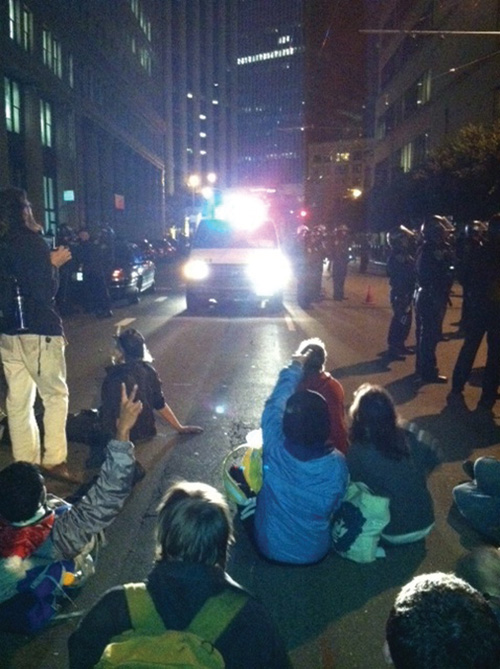
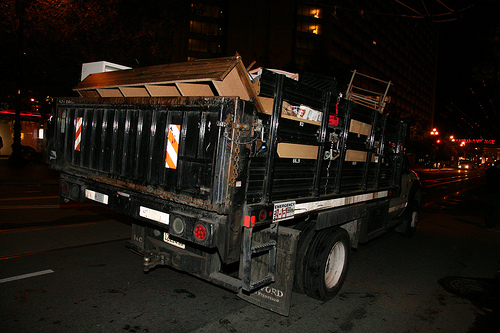
Police raided the OccupySF encampment for the second time last night. The events were similar to the Oct. 5 incident, where police stood in riot gear while the protesters’ materials were loaded into Department of Public Works trucks, then protesters sat, lay, and stood on the street around the trucks in an attempt to prevent them from leaving. In both cases, a kitchen and medical tent that had been set up by protesters were dismantled.

Police were by many accounts more aggressive than in the previous raid, which was the first direct police attack on an Occupy encampment in a major U.S. city. Last night, protesters were dragged, kicked, and struck by police officers, prompting the dispatch of an ambulance to take an injured protester to the hospital. There were at least five arrests.

Journalist Josh Wolf shot some excellent footage of the raid:

San Francisco Police Department spokespersons didn’t answer calls from the Guardian. Police Chief Greg Suhr told us after the last raid (which was also approved by Mayor Ed Lee) that they were only removing public safety hazards and “we will surgically and as best as possible and with as much restraint as possible try to deal with the hazards while protecting people’s First Amendment rights.” Yet last night’s raid shows the city is actually dealing more harshly with the Occupy movement than most cities. 

Around 10:15 pm, the group received a warning that police planned to enforce 10 pm curfew in Justin Herman Plaza. The camp had moved there on Saturday to accommodate growing numbers. Police informed protesters that they could not sleep in the park and that they would need to take down a few tarps that had been propped up, providing a roof for the kitchen and communications area in camp. They claimed that there would be no trouble if the camp moved back to their previous location at nearby 101 Market Street, on the sidewalk in front of the Federal Reserve Building.

Protester Katt Hobin served as a liaison with police throughout the night. She was skeptical of police claims that 101 Market Street was an “agreed upon spot.” Hobin told us, “We were encouraged to relocate. We were never told we could be at 101, or that we could be here.”

There were about 100 protesters gathered. In response to warnings of arrest for those who stayed at Justin Herman Plaza, about 30 moved to 101 Market Street. Protesters began texting, calling and tweeting supporters to come join, and by 11:30 pm there were about 200 protesters at camp.

At first, when asked, police could not provide any written statement detailing reasons for disturbing the camp or arresting participants. An officer whose nametag read G. Tom said they were there based on grievances from the Recreation and Parks Department, but that he could not name a specific individual who had complained. After some deliberation, police produced a copy of San Francisco Park Code Section 3.13, which prohibits sleeping in public parks during certain hours.

Sup. John Avalos, the mayoral candidate who has been most actively engaged with the OccupySF movement, negotiated with officers and protester representatives on speakerphone. Avalos suggested that the police come back during the day; Officer Tom replied, “It works better for us to do this in the middle of the night.”

After some negotiations, officers warned that if the tarps that had been erected were not taken down, they would have to proceed with the raid.

Around 11:30 pm, protesters met briefly and agreed not to comply with that order. Said one protester, “We took down the tents last time, and they still took our stuff and arrested people. We can’t trust them. We need to stand our ground.”

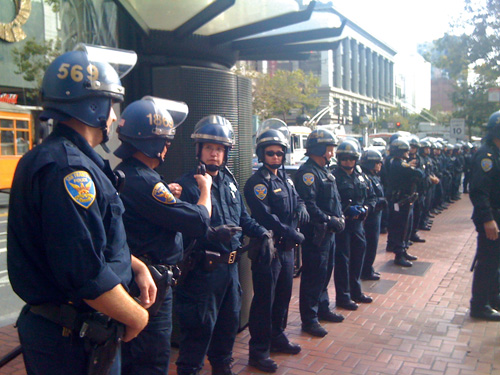
At 11:47, about 70 police in riot gear marched on to the scene. They surrounded the camp and began dismantling structures. At 11:53, Department of Public Works trucks pulled in and police began loading them with items from the camp. This included food, tarps, signs, and personal and communal items.

One protester had duct taped himself to a poll within the camp structure. Police ripped him off the poll, threw him to the ground and struck him in the head and ribs. When he left by ambulance a few hours later, he appeared to be convulsing or seizing.

As they had on Oct. 5, protesters poured into the street in an attempt to block trucks from leaving with their possessions. But the street next to Justin Herman Plaza, the southbound side of Embarcadero, separated from the northbound side by a large concrete platform, is quite narrow compared to Market Street where a similar confrontation happened last Wednesday.

Protesters were much more successful last night in blocking the trucks from leaving, and it took about an hour before the four DPW trucks were able to exit. Protesters sat, lay, and stood in the way of trucks, chanting “the people united shall never be divided” and “we shall not be moved.”

Between about midnight and 1:30 am, police tactics escalated. At first, they attempted to back the trucks out, but protesters ran to block all paths. Then one truck lurched forward onto the sidewalk dividing area, where protesters ran to block it as well as talk with the driver about why he was participating in confiscating their belongings.

Soon, police began dragging and pulling protesters who were in their way and the way of the trucks, throwing them from the street to the sidewalk. They also arrested four of those sitting in on the street.

Protester Ryan Hadar, 19, told us: “They bent back my thumbs, trying to pry me away from the people I was locking arms with. When I asked if they were trying to break my thumbs [one officer] replied, ‘only if I have to.’ Then they dragged me to the sidewalk by my index finger. I asked if they were trying to break my finger, and this time they replied, ‘Yes.’”

This level of activity continued about an hour. Protesters sprinted and zoomed back and forth on skateboards, blocking trucks from leaving in all directions. Police pushed protesters out of their path as they marched back and forth, trying to maintain hold of the situation.

At 1 am, the last truck successfully left. Police who had been behind the truck, pushing protesters away from it, were suddenly alone in a sea of OccupySF particpants. They quickly formed into a block, batons poised, as protesters encircled them. A tense moment passed before protesters broke out in cries of “the whole world is watching!”

There were reportedly 2,100 people viewing the live video stream of the events.

The altercation ended in a bizarre fashion, as police marched across Justin Herman Plaza, stopped in the tracks, then seemingly changed their minds and marched back towards the Embarcadero. A smaller contingent then reappeared at the corner of Mission and Steuart streets. Protesters formed a line confronting them and demanding that they release those arrested; a man who had been arrested at the previous week’s altercation had been held 10 days before he was released on bail funds raised by OccupySF.

One officer said that police would continue standing there until protesters left; many protesters were determined to stand until the police left. Eventually, around 1:40 am, police did decide to exit first. A chorus burst out, singing “Na na na na, hey hey hey, goodbye” as they left.

Ten minutes after the incident ended, about four tarps had been restrung and the camp had begun to rebuild its food and water supply. Protesters surveyed the aftermath, including loads of fresh vegetables and other food strewn on the ground near the former kitchen. Many picked up brooms and began cleaning, while others got to work compiling media information.

Those arrested were released around 3 am and arrived back at camp at 3:30. Xander, a protester who had been sleeping at the camp since its first night on Sept. 17, was one of those arrested. He recounted, “They hit me a couple of times on my shoulders and put me in the truck. We weren’t able to leave because our brothers and sisters had surrounded the truck. We were singing and banging on the walls.”

Those arrested were charged with resisting arrest and impeding traffic.


OccupySF protesters shut down Wells Fargo HQ

30

At 7 a.m. this morning (Wed/12), protesters against corporate greed were poised for one of the most impactful actions since OccupySF began.

About 50 people associated with the Foreclose Wall Street coalition were seated in front of all the entrances to the Wells Fargo corporate headquarters on California and Montgomery streets. Back at the site of the OccupySF camp in front of the Federal Reserve Bank on Market Street, protesters gathered. They held a rally there that included a speech from Sup. John Avalos, the only mayoral candidate to actively support the movement.

When the march started off to join those blockading Wells Fargo, there were about 1,000 protesters present, according to estimates of those present. They stopped off at the Hyatt across the street from the Fed to support Unite Here Local 2 hotel workers who are involved in a boycott against the Hyatt before continuing in the march. Protesters chanted, “make banks pay” and “we are the 99 percent.”

The march reached the Wells Fargo building and began rallying there. The sit-ins in front of entrances were still going strong. There, activist and author Naomi Klein addressed the crowd.

When Wells Fargo employees began to arrive at work. According to Max Bell Alper, one of those involved in the blockade, “a number of bankers were trying to get in and yelling at us.” Then they called the police.

When the police arrived, Alper says, “at first, the people from the march were physically blocking them from arresting us.”

Around 8:30 a.m., 11 were arrested. They were brought to the North Beach/Chinatown police station, were they were cited for trespassing, held for about an hour and then released. When I spoke to Alper, he was back from the police station, chanting and marching with the crowd.

He told me that when his parents’ home was foreclosed this year, they moved in with his uncle, whose home was then foreclosed. Currently his grandmother is facing foreclosure. He listed Chase, Wells Fargo, and Bank of America as the banks involved in his family members’ foreclosures.

“Enough is enough. Banks need to recognize that they need to pay,” said Alper.

Protesters continued to block every entrance besides the employee entrance on Leidesdorff Street with sit-ins, as well as march in picket lines, chant “banks got bailed out, we got sold out”, and cheer as organizers spoke. The bank was unable to open until they chose to leave around noon.

SFPD Lt. Troy Dangerfield said that no more arrests were made because Wells Fargo did not request them- apparently, they preferred to wait it out. Said Dangerfield, “It would make it worse if they had to remove them. It doesn’t look good.”

Dangerfield insisted that he “had no stake whatsoever” in what will result from the Occupy movement throughout the country. He has noticed, “it seems like it’s growing nationwide.”

Activist Lucia Kimble sat helping to block the bank’s California entrance from 7:15 to noon. She says protesters voluntarily left at noon because, “We’ve been out here five hours. We successfully shut down the bank. I think our message has been heard.”

Kimble, 27, is a Bay Area resident and housing counselor with Causa Justa :: Just Cause, a group that works to advocate for housing and tenants rights for low income and African American and Latino communities in San Francisco and Oakland. Kimble said that her group was part of the coalition that put on this event “to give a voice to those most affected by our economic crisis.”

Kimble listed the Foreclose Wall Street West coalition’s demands with this action: an immediate moratorium on foreclosures, fixed annual interest rates, an end to Wells Fargo’s financing of high-interest Pay Day Loans, and that they “pay their fair share – pay taxes and give them to the community.”

Shaw San Liu of the Chinese Progressive Association – which just voted to endorse OccupySF and today joined the movement – was an energetic and inspiring speaker throughout the event. Said Liu: “A lot of folks have been saying there’s no diversity in the Occupy movement…In San Francisco it’s becoming clear the diversity of groups that support this movement. Youth, community groups, anti-war, we’re all coming together”

Liu maintained that the problems she was fighting did not start with the financial collapse in 2008. “In my work in Chinese immigrant communities, I know that even before the recession, we were already suffering from unemployment, low wages, and poor housing. I’m excited to see how the country is waking up to oppose a system that allows 1 percent of the people to control 42 percent of the wealth.”

The California Nurses Association, one of the many labor organizations that have showed support for OccupySF, was present at the protest. Said Pilar Schiavo, 36, a CNA organizer from Oakland, “I’m fed up with social inequity. I’m tired of corporate America buying politicians and passing laws to benefit the rich.”

“Patients are foregoing treatment and losing their healthcare. The nurses are here fighting for everyone,” she said.

Schiavo’s father, Bill, drove from Sonora to be at the protest today. A 65-year-old retired electrician, he says that the medical benefits he felt fortunate to have after retiring from a secure job have become unaffordable. “My medical benefits went up $300 a month this year. Who can afford that? Does anyone get a $300 raise? But Wall Street has benefits galore.”

Schiavo made his opinion clear about the Wall Street crisis and bailouts: “It was unbridled theft. We’re angry.”


Crackdown came from the top

8

steve@sfbg.com

The decision to raid the OccupySF protest camp in the middle of the night Oct. 5 was approved by Mayor Ed Lee and Police Chief Greg Suhr — and involved a more aggressive approach to limiting protest activities than authorities in any other major city have undertaken.

Both Lee and Suhr insist that they support the protesters right to free speech. But the raid was more than a modest effort to get a propane stove turned off or to bring food preparation up to health codes.

The move only served to galvanize the movement and increase its numbers. And both police and protesters say they expect this occupation to continue for a long time.

Suhr told the Guardian that the decision to move into the encampment and seize its supplies was made after consultation with the Fire Department, Department of Public Health, and the Mayor’s Office. While DPH expressed concerns about food preparation on the site, Suhr said health officials never asked the police to shut the kitchen down. The Fire Department was another story.

“There was open flame, propane, and tons of fuel, near plywood. The Fire Department told us there as a fire danger,” Suhr told us. “Deputy Chief Cashman made the call that we would go move the people away from the fuel.”

Suhr said Mayor Ed Lee gave the okay to remove public safety hazards, but said the protest itself shouldn’t be interfered with. “In San Francisco, protesters are acting within their First Amendment right to free speech and freedom to assemble. While allowing for peaceful protests, we also must ensure that our streets and sidewalks remain safe and accessible for everyone,” Lee said in a public statement, although his office has not responded to a list of questions about the decision and its implications.

After all, the tents and other shelters were hardly a hazard to anyone; leaving the activists out in the rain with no tents was, strictly speaking, more of a health issue.

A movement that calls for the indefinite occupation of public spaces to protest corporate greed is bound to continue to cause conflicts with local ordinances and property interests, something that Suhr acknowledged. “We will surgically and as best as possible and with as much restraint as possible try to deal with the hazards while protecting people’s First Amendment rights, Suhr said.

He objected to the notion that there was a police crackdown on the protest. “They’re occupying it now, and they’re probably going to be there was a long time,” Suhr said. “We haven’t arrested one demonstrator. The only person arrested punched a cop and then threatened to kill him afterward.”

But Sup. John Avalos, the one major mayoral candidate to show up during the raid and try to mediate the conflict, said he’s disappointed with the city’s stance. “This is not the San Francisco that I know. This is not the San Francisco I love. This City has served as a sanctuary for free speech and assembly for generations, and we must protect that legacy,” Avalos said in prepared statement that he closed with, “This should be a city for the rest of us — for the 99 percent. I stand with Occupy SF.”

Even Suhr said that the SFPD has no intention of removing the protesters from their perch in front of the Federal Reserve, and will continue safeguarding regular OccupySF marches, telling us, “We will continue to facilitate this.”

“They got everything out of there so we could start over,” Suhr said the encampment’s kitchen and other hazards. “This demonstration isn’t going away. I think people are justifiably upset by this issue nationally.”

Lee backs crackdown; Avalos: “I stand with Occupy SF”

136

Mayor Ed Lee has just released a statement on last night’s police raid of the Occupy San Francisco encampment – claiming to basically support the movement but also support the harsh police crackdown and seizure of tents, food, and other personal property – that offers a sharp contrast to the position of his mayoral rival, John Avalos, who is condemning the SFPD’s actions.

Once again, as Lee also did this week in defending businesses that seize money set aside for employee health care costs, our “consensus and civility” mayor is showing that if you try to stand for everything, you end up standing for nothing. Yet Avalos understands that there are times when one side is simply wrong and that supporting the people means being willing to fight for them.

On both issues, Lee mouthed the meaningless “jobs” defense, claiming that he was trying to help working people by letting their employers raid their health care funds, allowing restaurants to fraudulently jack up their bills, or directing the police to seize their tents and food. That’s not just pandering, it’s insulting.

I’ve tried unsuccessfully to get Lee’s office to offer more detailed explanations of his positions, but they’re so far sticking to prepared statements that are riddled with contradictions. So we’re just going to run the full statements by Lee and Avalos and let you decide who makes more sense and best reflects San Francisco values.

Lee wrote:

“I understand and sympathize with the anxiety and frustration felt by so many in our country caused by a lingering recession and joblessness. That’s why I am doing everything I can to create jobs, get people back to work and make our families stronger here in San Francisco. I support the spirit of the Occupy Wall Street movement that calls for peacefully assembling to protest and bring national attention to disparity issues in our country.
“In San Francisco, protesters are acting within their First Amendment right to free speech and freedom to assemble. While allowing for peaceful protests, we also must ensure that our streets and sidewalks remain safe and accessible for everyone. I will continue to work closely with our Police Chief to ensure San Francisco responds appropriately to these demonstrations.  
“San Francisco is a city that embraces free speech and freedom to assemble like no other city.”

Indeed, no other city among the 60 or so that have followed the Occupy Wall Street example of occupying public spaces has sent police and trucks in to raid encampments in the middle of night, so San Francisco is indeed alone in its treatment of the movement that Lee shamelessly claims to support.

And now Avalos:

“Last night I gathered in solidarity with the protesters Occupying San Francisco. Like many people all over the country, I have been watching this protest gather strength and grow as more and more of us, more of the 99 percent, demand accountability from the corporations and people who are responsible for the destruction of our economy and devastation of our families.

“I came to down to observe the protest last night in response to summons from protesters and a notice from the police accusing their encampment of a number of minor infractions, ranging from open flames on a city street or sidewalk to serving food without a permit. I observed and negotiated with police in good faith to keep the peace and allow the encampment to remain, only to hear of a crackdown shortly after I left.

“This is not the San Francisco that I know. This is not the San Francisco I love. This City has served as a sanctuary for free speech and assembly for generations, and we must protect that legacy. With our unemployment rate nearing 10 percent, we have a responsibility to be a sanctuary for the 99 percent.

“Instead, last night we witnessed that 99 percent being detained, arrested, and intimidated with force.

“My vision is of a true sanctuary city – one that protects our right to free speech and assembly, and one that holds real criminals accountable. This should be a city for the rest of us – for the 99 percent. I stand with Occupy SF.”

BREAKING: SFPD threatening to break up Occupy S.F. encampment

San Francisco city government is cracking down on the Occupy S.F. movement, with public officials waiting until around 11 p.m. on Oct. 5 to move in and try to clear out the camp.

Police appeared on the scene in front of the Federal Reserve at the foot of Market Street in downtown San Francisco where roughly 200 protesters were camped out as part of the Occupy SF movement, and threatened to make arrests if protesters did not clear out completely within 30 minutes. The protest was a peaceful affair and the encampment had been in place since Sept. 29. The protest was called to mirror the growing Occupy Wall Street movement to oppose corporate greed and highlight the role of financial institutions in an economic decline resulting in a rising wave of foreclosures, unemployment, and cuts to public services.

Yael Chanoff, who was at the encampment on behalf of the San Francisco Bay Guardian, phoned in to report that police officers had issued notices telling people that they had to clear out because they were in violation of local city ordinances such as public nuisance laws, rules requiring permits for temporary structures, and the newly adopted sit/lie ordinance. Officers were taking photographs of the camp, presumably for evidence. Trucks from the city’s Department of Public Works had lined up on the street, she said.

Roughly 50 police officers in standard uniform were there, carrying “stacks of zip ties,” she added. Alexandra List, a protester, said that a commanding officer on the scene had told her no one would be arrested if the structures were removed completely within 30 minutes. Chanoff estimated that there were about 20 structures.

Chanoff said protesters were meeting to try and find out how to proceed, but some had decided to begin taking down the tents.

UPDATE: The Guardian spoke with SFPD public information officer Albie Esparza, who told us, “the sidewalks are being cleared of debris,” and mentioned that protesters had been in violation of certain codes, such as a fire code prohibiting open flames that applied to outdoor cooking setups. “They have the right to protest as individuals, obviously,” he said. Asked why it was so urgent that these codes be enforced at 11 p.m. when the streets are virtually empty, Esparza said, “I don’t know what the reason was for the timing.”


Yael Chanoff contributed to this report.


On the streets with Occupy San Francisco

31

The messages sounded yesterday on the streets of San Francisco – delivered in speeches, chants, signs, songs, interviews, and the petition handed to Chase Bank officials by a half-dozen protesters before their arrest – should resonate with most Americans. After all, while rich corporations and individuals have been accruing ever more wealth, the vast majority of us have been falling behind.

“Banks get bailed out, we get sold out,” was one of those chants by the several hundred people who marched through the Financial District – our OccupySF effort building off the two-week Occupy Wall Street events – targeting some of the villains of the economic meltdown: JPMorgan Chase, Bank of America, Citibank, Charles Schwab, the Federal Reserve, and Goldman Sachs.

They may be relatively small and easy to ignore, these “occupations” of Wall Street and San Francisco and other cities that are entering their third week, but they’re being driven by a palpable anger and stirring critiques of economic and political systems that exploit the powerless. But as the foreclosures, layoffs, and other hardships continue, this nascent movement could have some staying power.

“I think it’s starting to wake people up out of their complacent distraction,” Robin Kralique, a 26-year-old SF resident holding a sign that read “Let’s have the GDP measure happiness,” told the Guardian. “We’re planting the seeds for a better future, and I’m hoping it wakes some people up.”

Like many of the young protesters gathered outside the corporate office building at 555 California at the start of the march, she was inspired by Occupy Wall Street. They’re angry watching their economic opportunities evaporate as more and more of the country’s wealth accumulates in fewer and fewer hands.

“There’s an insane amount of greed in this country,” 24-year-old Erin Kramer, a dancer and performance artist stuck in a corporate job she needs to get by, told me. Her sign read, “Don’t be afraid to say revolution!”

And many weren’t, with calls for revolution on the tips of many lips, albeit tempered with healthy doses of realism. “Even if it isn’t at critical mass yet, it sets the stage for the next revolution,” Kralique said when I asked her what she hoped this moment would accomplish.

Sup. John Avalos, a progressive mayoral candidate who spoke at the rally, is pushing legislation to create a municipal bank in San Francisco, one that would invest far more money in local projects and small businesses than Bank of America, which manages most of the city’s money.

“We have to figure out new ways to use our local dollars to help our economy,” Avalos told us. “The message here is we’re pulling our dollars out of these banks unless they help us.”

Before Avalos spoke – asking the boisterous crowd, “Have you ever felt like you’ve been had?” – activist Bobbi Lopez was on the microphone decrying the “lack of accountability for the people responsible for this decline.”

And then, the march was off – flanked by dozens of San Francisco Police officers on motorcycles, riding bicycles, and in cars – to deliver creative forms of protest around the Financial District, including a funny song and dance routine by Fresh Juice Party in front of the Schwab office, singing, “Land of the free, home of the brave, this is the street our labor paved.”

In fact, that was almost literally true at the San Francisco march, which was shepherded by off-duty city workers from SEIU Local 1021.

“This Wall Street thing is really spreading. The message of a small group of people in New York has really spread…Wall Street is a symbol of all this corruption, cronyism, and greed,” Gabriel Haaland, an organizer with SEIU Local 1021, told me at the start of the march. “It’s really resonated with our members…It’s been picking up steam as things have been unraveling over the last year.”

An hour or so later, Haaland was one of six people who staged an occupation of the Chase branch at Market and 2nd streets, along with two women in his union who have been unsuccessfully battling bank foreclosures on their homes – Brenda Reed and Tanya Dennis – and three other activists: William Chorneau, Manny S. Tucker, and Claire Haas.

Tipped off by Haaland, I was inside the bank lobby as the march approached and a police officer on a bicycle came inside to warn bank officials, “The protest is headed your way, you may want to secure the premises.”

He and another officer helped prevent protesters from getting inside, but the six protesters had already infiltrated the building. They began chanting and pulled blankets out of a suitcase, laying them out and placing them on the ground.

Reed spoke for the group, demanding to meet with JPMorgan Chase & Co. CEO Jamie Dimond to present a petition calling for a halt to the bank’s foreclosures. Through tears, she told the story of her long struggle to protect her home from foreclosure by Chase, which had taken her loan over from another lender.

SFPD Lt. M.E. Mahoney told the group, “You’re not going to be able to camp out here and wait for the CEO to come talk to you,” asking store managers whether they wanted to make a citizen’s arrest. They did, but Mahoney also told Reed that he would watch as she handed the petition to store managers.

“I’m here today because for two and a half years, I have desperately tried to get Chase to work with me,” Reed told a bank employee as hundreds of protesters outside looked on and chanted their support. “You have put me through hell. You’ve destroyed my health, you’ve destroyed my business, and it’s not fair what you’ve done.”

After she was finished, another bank manager (who refused to give his name) told Reed, “Just to let you know, we are compassionate to your cause,” drawing from the protesters the frustrated retort, “No you aren’t!” Through the day, protesters noted that the banks have been profitable and don’t need to be foreclosing on so many homes, sitting on so much capital, and funneling their profits out of desperate communities and into the accounts of wealthy investors – particularly after being bailed out by taxpayers in 2008.

Outside, the crowd chanted “Go, Brenda, go!” and “Let those people go, arrest the CEO!”

The crowd remained outside for more than an hour as police tried to wait them out, finally arresting the occupiers on trespassing charges and quickly citing and releasing them, apparently in the hope it would clear the people out of congested Market Street. “That was my quickest arrest ever,” Haaland, a veteran of many labor actions and progressive protests over the years, told me afterward.

Reed addressed the crowd on a bullhorn, explaining that she refinanced her home in 2007 with a shady “pretender lender” who misrepresented what her monthly payments would be. They ballooned to a level she was unable to cover and she sought a loan modification from Chase, which had taken over the loan from the now defunct Washington Mutual.

“Chase Bank is trying to steal my home of 38 years,” she told the crowd. “Jamie Dimond, come out from under your rock and let me talk to you.”

She decried how government bailed out the banks and then allowed them to aggressively foreclose on homes whose mortgages they didn’t originate, but who acquired the title out of the complex financial derivatives that has sliced and diced mortgages into complex financial instruments.

“It’s government-sanctioned fraud,” she said. Despite what she said were Chase’s plans to auction her home in Oakland next month, she pledged, “You will not get my home. You will not get what belongs to me.”

But whether that kind of fierce resolve – voiced over and over again, by hundreds of activists fed up with economic injustice – translates into any kind of real change is yet to be determined.

Gascon justifies secrecy in Guardian interview

2

Three top candidates for district attorney held a joint press conference this morning calling out District Attorney George Gascon for refusing to release a controversial memo by a consultant hired by the DA’s office outlining problems with DNA analysis in the city’s crime lab, which was overseen at the time by then-Police Chief Gascon.

Instead of obeying a judge’s order that he release the document, Gascon is clinging to a thin legal interpretation that it is a work product that he can withhold, choosing instead to spend city resources appealing the ruling. Journalist Peter Jamison has repeatedly written about the memo and the crime lab in the SF Weekly, but it was the Bay Guardian who got Gascon’s most extensive comments to date on it during his endorsement interview with us last week.

Starting just after the 23 minute mark when I asked about the memo and continuing for more than 10 minutes, Gascon – who earlier presented himself as one of the state’s most progressive law enforcement officials – takes credit for exposing problems with the crime lab but offers a fairly tortured rationale for hiding a document that might prove embarrassing during election season.

The California Public Records Act allows limited disclosure exceptions for what’s called “work product,” or drafts of internal documents meant to be works in progress, but it doesn’t require those documents to remain secret (as with personnel records, for example). Gascon admits that he could release the document but that he chooses not to.

“There are several concerns here. This is a memo that is largely the opinions of an individual that is a work product, it is within the office of the District Attorney’s Office, and there is good public policy as to why you have work product. You want to have robust discussions and honest self assessment of what works and what doesn’t work,” he said.

We noted that the consultant, Rockne Harmon, was brought in to bring problems with the crime lab to light so they could be addressed (not attorneys discussing the strengths and weaknesses of a case, the example Gascon cited), that Harmon actually wants to memo to be released, and that no possible public harm could come from this.

Gascon even agreed with that last point, telling us, “This document is quite harmless, but it’s the concept of the ability of people to have honest self-assessment and self-critical discussions.” He said they were reviewing the judge’s ruling and “we’ll comply with the court.” Then, the very next day, he announced that he would appeal the ruling.

Clearly – as DA candidaes David Onek, Sharmin Bock, and Bill Fazio noted this morning – Gascon is hiding the document because he’s worried it will make him look bad. And as our discussion with Gascon illustrates, he is not someone who places a high value on transparency, which is a real problem given the history of damaging secrecy in both the SFPD and the DA’s office.

So give a listen to a candid discussion about a breaking news story on an important issue and weigh in with your thoughts. BTW, as an added bonus, keep listening to the interview to hear the perspective of an unlikely supporter that Gascon brought with him: attorney Matt Gonzalez, who galvanized the progressive movement with his 2003 mayoral run.

Endorsement Interviews: George Gascon

16

George Gascon is, as far as we can determine, the only police chief in the country ever to become a district attorney. It’s put him in an odd position, particularly given the recent problems in the SFPD: He has to monitor and possibly prosecute people who used to work for him. That conflict has been a big part of the campaigns against him.

Gascon discussed the situation at length, telling us that he’s proud to be “a progressive chief of police who became district attorney.” He said that he was the one who brought some of the department’s problems (the crime lab, the lack of a Brady policy) to light. “I have taken on police corruption aggressively,” he said.

You can listen to the full interview (and see the video) after the jump.

Gascon by endorsements2011


On Guard!

0

news@sfbg.com

BART’S CRACKDOWN

For weeks now, protesters have descended on Bay Area Rapid Transit (BART) stations to denounce the fatal July 3 shooting of homeless passenger Charles Hill by a BART Police officer, and to call for the agency’s long-controversial police force to be disbanded. Commuters have had to contend with service disruptions and delays, and costs to the transit agency have exceeded $300,000. Yet it isn’t just bullhorn-wielding protesters who’ve been thrust into the spotlight — BART’s police force is also facing scrutiny for its conduct under pressure.

BART drew the ire of numerous media outlets after a Sept. 8 protest when transit cops detained members of the press along with protesters on suspected violation of California Penal Code Section 369i, which prohibits interfering with the operations of a railroad. Most journalists were eventually released, but the protest resulted in 24 arrests.

Although BART police later contended that they issued dispersal orders prior to closing in, many who were encircled and detained (including me) insisted they’d heard no such announcement. BART police also instructed San Francisco Police Department (SFPD) officers who were on hand to assist to seize reporters’ SFPD-issued press passes — a move that SFPD spokesperson Troy Dangerfield later told the Guardian was an error that went against normal SFPD protocol.

In a Sept. 10 editorial, the San Francisco Chronicle blasted BART police for placing Chronicle reporter Vivian Ho in handcuffs despite being informed that she was there as a journalist. Ho’s experience was mild compared with that of Indybay reporter David Morse (aka Dave Id), who told the Guardian he was singled out for arrest by BART Deputy Police Chief Daniel Hartwig and isolated from the scene — even though Hartwig is familiar with Morse and knows he’s been covering protests and BART board meetings for the free online publication. Asked why Morse was arrested when other journalists detained for the same violation were released, BART spokesperson Jim Allison told us, “The courts will answer that, won’t they?”

No Justice, No BART — a group that was instrumental in organizing the Sept. 8 protest — telegraphed to media and police at the outset that they intended to test BART’s assertions that people’s constitutionally guaranteed rights to free speech would be upheld as long as they remained outside the paid areas of the station, in what was dubbed a “free speech zone.” (Rebecca Bowe)


CHRON VS. WIENER(S)

Scott Wiener tried to do something eminently reasonable, and ask the naked guys in the Castro to put down a towel before they sit on public benches. Although the Department of Public Health hasn’t made any statements about the issue (and people put their naked butts on public toilet seats without creating major social problems), it’s pretty much an ick factor thing — and using a towel is an unwritten (sometimes written) rule at almost every nudist resort in the country.

The whole thing is a bit ironic, since it’s already illegal for fully clothed poor people to sit on the street — but so far, it’s not illegal for naked people to sit on benches. So far.

Wiener’s move set off an anti-nudity campaign at the San Francisco Chronicle, starting with columnist C.W. Nevius suggesting that the nudies are all perverts: “If these guys were opening a trench coat and exposing themselves to bystanders in a supermarket parking lot we’d call them creeps.” A Chron editorial called for a new law banning nudity in the city (an excellent use of time for a police department that already says it can’t afford community policing). The national (right-wing) press is having a field day. The commenters on sfbg.com are arguing about whether the pantsless men are shedding scrotal hair, or whether they’re mostly shaved. For the record, we haven’t checked.

And for the record, in a couple of months it’s going to get way too cold and rainy for this sort of thing anyway. (Tim Redmond)


HERRERA’S SMACKDOWNS

City Attorney Dennis Herrera has always been limited by his office’s neutral role in criticizing city policies and officials. But as a mayoral candidate, he seems to have really discovered his political voice, offering more full-throated criticisms of Mayor Ed Lee and his policies than any of the other top-tier candidates.

“I think it’s kind of liberating for him that he can talk policy instead of just about legal issues,” Herrera’s longtime spokesperson Matt Dorsey, who recently took a leave from his city job to work on the campaign full-time, told the Guardian.

Perhaps not surprisingly, Herrera’s shift began a little more than a month ago when Lee bowed to pressure from Willie Brown, Rose Pak, and other top power brokers to get into mayor’s race, prompting Herrera’s biting analysis that, “Ed Lee’s biggest problem isn’t that he’s a dishonest man — it’s that he’s not his own man. The fact is, if Ed Lee is elected mayor, powerful people will continue to insist on things. And I don’t think San Franciscans can be blamed for having serious doubts about whether Ed Lee would have the courage to say no.”

Herrera followed up last week by providing an example of something Lee and most other mayoral candidates don’t have the courage to say no to: the Central Subway project, with its runaway price tag and growing number of critics that say it’s a wasteful and inefficient boondoggle that will worsen Muni’s operating budget deficit.

“Fiascos aren’t born that way. They typically grow from the seeds of worthy idea, and their laudable promise is betrayed in subtle increments over time,” was how Herrera began a paper he released Sept. 8 called “It’s time to rethink the Central Subway,” in which he calls for a reevaluation of a project that he and the entire Board of Supervisors once supported.

He notes that the project’s costs have tripled and its design flaws have been criticized by the Civil Grand Jury and numerous transit experts. “Let’s look at this thing and see if it still makes sense,” Herrera told us, a stand that was greeted as blasphemy from the project’s supporters in Chinatown, who called at least two press conferences to decry that they called a “cheap political stunt.”

While the stand does indeed help distinguish Herrera from a crowded mayoral field, he insists that it was the grand jury report and other critiques that prompted him to raise the issue. “Good policy is good politics, so let’s have a debate on it and let the validity of the project stand or fall on its merits,” he said.

Herrera and fellow candidate John Avalos were also the ones who called out Lee on Sept. 2 for praising Pacific Gas & Electric Co. as “a great company that get it” for contributing $250,000 to a literacy program, despite PG&E’s deadly negligence in the San Bruno pipeline explosion and its spending of tens of millions of dollars to sabotage public power efforts and otherwise corrupt the political process.

“It shows insensitivity to victims’ families, and poor judgment for allowing his office to be used as a corporate PR tool. No less troubling, it ignores the serious work my office and others have done to protect San Franciscans from PG&E’s negligence,” Herrera said in a prepared statement.

Now, his rhetoric isn’t quite up to that of Green Party mayoral candidate Terry Baum, who last week called for PG&E executives to be jailed for their negligence, but it’s not bad for a lawyerly type. Herrera insists that he’s always wielded a big stick, expressed through filing public interest lawsuits rather than campaign missives, “but the motivation in how I do either is not really different.” (Steven T. Jones)


JACK IS BACK

The mayor’s race just got a new player, someone who is guaranteed to liven things up. His name is Jack Davis — and he’s already gone on the attack.

Davis, the infamous bad boy of political consulting who is so feared that Gavin Newsom paid him handsomely just to stay out of the 2003 mayor’s race, has been keeping a low profile of late. But he’s come out of semi-retirement to work for Jeff Adachi, the public defender who is both running for mayor and promoting Prop. D, his pension-reform plan.

Davis and Adachi first bonded when Adachi ran against appointed incumbent Kim Burton in 2002. Now, Davis has begun firing away at Mayor Ed Lee, with a new mailer that calls the competing Lee pension plan a “backroom deal.” The piece features a shadowy figure (who looks nothing like Ed Lee) slipping through a closing door, a fancy ashtray full of cigars and an allegation that Lee gave the cops a sweet pension deal in exchange for the police union endorsement.

Trust us, that’s just the start. (tr)


PENSION PALS

Meanwhile, Adachi sent Lee a letter on Sept. 8 challenging him to debate the merits of their rival pension measures — Lee spearheaded the creation of Prop. C, with input from labor unions and other stakeholders — sometime in the next month.

“I believe there is a vital need — if not an obligation — for us to ensure that the voters of San Francisco understand both the severity of our pension crisis as well as the significant differences between our two proposals,” Adachi wrote, later adding, “As the two principals behind the competing ballot measures, I hope that we can work together to increase awareness of this important issue and work toward a better future for our city.”

Lee’s campaign didn’t respond directly to Adachi, but Lee’s ever-caustic campaign spokesperson Tony Winnicker told the Guardian that the request was “the oldest political trick in book” and one they were rejecting, going on to say, “Voters deserve to hear from all the candidates on pension reform, not just two of them.”

Perhaps, but given the mind-numbing minutiae that differentiates the two measures, some kind of public airing of their differences might be good for all of us. Or I suppose we can just trust all those dueling mailers headed our way, right? (stj)

For more, visit our Politics blog at www.sfbg.com.

Cops go after the press

1

EDITORIAL The BART Board and the new general manager, Grace Crunican, have become so clueless it’s almost mind-boggling. For weeks, demonstrators have been taking to the BART stations to complain about a policy that never should have been in place (the shutoff of cell phone service during an earlier demonstration). The response of the BART Police (and, unfortunately, the San Francisco Police Department) has been so heavy handed and out of scale that it’s just making the situation worse.

For starters, BART could have easily avoided most of the trouble if the agency had simply apologized for cutting off phone service and instituted a policy to ensure that it would never happen again. And the new civilian police auditor can go a long way to establishing public credibility by expediting review of the shooting of Charles Hill and releasing a report quickly.

But BART is doing nothing but further agitating the protesters — and the events of Sept. 8 were a case in point.

The BART Police, with the help of the SFPD, began arresting people who were doing nothing but protesting in an area that BART had previously said would be open for demonstrations. The activists were peaceful — loud at times, but peaceful. And the police had nothing to charge them with except an old state statute that bars interference with the operation of a railroad.

The arrests came without warning — as Rebecca Bowe reported on sfbg.com, the police never declared an unlawful assembly, never warned protesters that they would be arrested if they didn’t leave and never followed normal, proper, legal procedures.

Then the cops went after the press. Reporters who were wearing passes issued by the SFPD were told to line up and present their credentials — at which point the San Francisco cops confiscated the press passes. That left reporters in a bind — if they stayed around to continue to cover the events, they would be subject to arrest. If they left, they’d miss the story — which may have been exactly what BART had in mind.

The episode is just the latest evidence that the BART police lack the training and experience to handle difficult situations. Crunican needs to get a handle on this immediately — and the BART Board, which has been far too hands-off when it comes to police abuse, needs to demand tighter procedures and more direct and effective discipline for the subway system cops.

The SFPD brass knows better than this — and while some officers privately say that detaining the press was a mistake, Chief Greg Suhr has been silent on the issue. He needs to speak out, now — apologize to the reporters and announce a policy change that strictly limits the ability of officers to arrest or detail credentialed journalists (and that bars the confiscation of press passes in all but the most unusual circumstances).

Meanwhile, the incident raises again a question the Society of Professional Journalists, and San Francisco officials, ought to be taking up: Why are the cops the ones who issue credentials for reporters?

Editorial: The BART and SFPD cops go after the press!

3

The BART Board and the new general manager, Grace Crunican, have become so clueless it’s almost mind-boggling. For weeks, demonstrators have been taking to the BART stations to complain about a policy that never should have been in place (the shutoff of cell phone service during an earlier demonstration). The response of the BART Police (and, unfortunately, the San Francisco Police Department) has been so heavy handed and out of scale that it’s just making the situation worse.

For starters, BART could have easily avoided most of the trouble if the agency had simply apologized for cutting off phone service and instituted a policy to ensure that it would never happen again. And the new civilian police auditor can go a long way to establishing public credibility by expediting review of the shooting of Charles Hill and releasing a report quickly.

But BART is doing nothing but further agitating the protesters — and the events of Sept. 8 were a case in point.

The BART Police, with the help of the SFPD, began arresting people who were doing nothing but protesting in an area that BART had previously said would be open for demonstrations. The activists were peaceful — loud at times, but peaceful. And the police had nothing to charge them with except an old state statute that bars interference with the operation of a railroad.

The arrests came without warning — as Guardian reporter  Rebecca Bowe reported on sfbg.com, the police never declared an unlawful assembly, never warned protesters that they would be arrested if they didn’t leave and never followed normal, proper, legal procedures.

Then the cops went after the press. Reporters who were wearing passes issued by the SFPD were told to line up and present their credentials — at which point the San Francisco cops confiscated the press passes. That left reporters in a bind — if they stayed around to continue to cover the events, they would be subject to arrest. If they left, they’d miss the story — which may have been exactly what BART had in mind.

The episode is just the latest evidence that the BART police lack the training and experience to handle difficult situations. Crunican needs to get a handle on this immediately — and the BART Board, which has been far too hands-off when it comes to police abuse, needs to demand tighter procedures and more direct and effective discipline for the subway system cops.

The SFPD brass knows better than this — and while some officers privately say that detaining the press was a mistake, Chief Greg Suhr has been silent on the issue. He needs to speak out, now — apologize to the reporters and announce a policy change that strictly limits the ability of officers to arrest or detail credentialed journalists (and that bars the confiscation of press passes in all but the most unusual circumstances).

Meanwhile, the incident raises again a question the Society of Professional Journalists, and San Francisco officials, ought to be taking up: Why are the cops the ones who issue credentials for reporters?


Powell station shut down by BART protest

A Sept. 8 protest called to test the limits of the Bay Area Rapid Transit (BART) agency’s policies on freedom of speech inside BART stations ended in a cluster of protesters and journalists being coralled by nightstick-wielding BART officers, detained, and in some cases, arrested. The station was shut down at around 6 p.m. when police surrounded a group of demonstrators who had marched around the unpaid area of the transit station, as well as a group of media who were following them with cameras and voice recorders.

It was unclear at press time just how many arrests were made, but it is clear that things did not go as planned from the perspective of either the protesters or the transit agency. As the demonstration got underway, one of the No Justice No BART protest organizers, Christopher Cantor, told reporters, “We are here to test free speech limitations at BART, but more importantly, we’re here to say we don’t trust BART, we don’t trust BART to protect us, we don’t trust BART to interpret the constitution.” He also said that none of them were there to get arrested.

Before the banners and bullhorns came out, BART spokesperson Jim Allison told the Guardian that if BART police deemed a gathering inside the unpaid area of the station to be dangerous, “we would ask people to disperse.” If they didn’t disperse, “we would declare an unlawful assembly.” Allison said protesters were free to exercise their first amendment rights to protest inside the areas of the station that don’t require a ticket to enter. He said people could do that as long as they were not “interrupting or interfering” with regular service. When the Guardian caught up with Allison after the protest by phone to find out why his statements about the dispersal order were contradicted by police activity, he refused to answer our questions, directing us instead to watch a press conference on the BART website.

“I’m going off duty,” he said after calling the Guardian in response to a page, after being asked several times why BART police had not issued a dispersal order before surrounding people and arresting them. “I simply cannot devote the rest of my night to answering your questions.”

Here’s what Cantor said just before the march around the station got underway:

Before police closed in, the protest featured some 60 protesters chanting things like, “How can they protect and serve us? The BART police just make me nervous.” One banner, from a group called Feminists Against Cops, read, “Disarm BART, Arm Feminists.”

Things heated up when the protest got closer to the fare gates, at which point police may have determined that protesters were interfering with service. At one point, police tackled a masked demonstrator to the ground. However, when people were detained, they were not standing directly in front of the fare gates.

Police did not make any public statements indicating that the situation had been deemed unlawful before surrounding the group of detainees, nor did they issue a dispersal order. We were told that we were not free to leave.

While I was detained along with Luke Thomas, a reporter from the popular political Fog City Journal, and freelance reporter Josh Wolf, an officer told us that we were being detained on suspected violation of California Penal Code 369-i, which prohibits interfering with the operations of a railroad.

Thomas phoned Matt Gonzalez, former president of the Board of Supervisors and now a chief attorney with the Public Defender’s office, to ask about that law. Gonzalez looked it up and told him that there was an exception to that law which “does not prohibit picketing in the adjacent area of any property” belonging to a railroad. So it would seem that the protesters, along with more than a dozen journalists, were being unlawfully detained. When we put this question to one of the officers who stood holding a nightstick and blocking us in, he refused to address the issue directly, repeating that we weren’t free to leave.

Members of the press with San Francisco Police Department issued credentials were made to line up and present their press passes to San Francisco police officers, who had been called in to assist. The police officers took away media’s press passes, saying it was SFPD property and could be retrieved later — which meant that if journalists had opted to stay and cover any further police activity, we would have had no way of presenting credentials to avoid arrest. We were issued Certificates of Release and ushered outside of the station, where it was impossible to see what was happening, and therefore, impossible to do our jobs as reporters.

Just outside, San Francisco State lecturer Justin Beck was very concerned that several of his journalism students, whom he’d sent on assignment to cover the protest, were being detained. They did not have SFPD issued press passes and at that time were not being allowed to exit the station.


BART protests continue (VIDEO)

27

Protesters returned to downtown San Francisco train stations on August 29, vowing to keep up their schedule of Monday evening rush hour protests until the  BART police are disarmed and retrained, or disbanded. This time, howevef, stations remained open and trains ran on schedule in a protest where both BART police and demonstrators took pains to reach out to commuters angered by recent train service disruptions.

A crowd of 200 people gathered outside of Civic Center station, the location of the July 3 fatal shooting of a 45 year old Charles Hill by BART police.

Hill’s physician, Dr. Rupa Marya, joined the protest a day after releasing an open letter on the shooing calling for BART police to re-examine its use of force policies and training.

“Charles was a member of the invisible class of people in SF–mentally ill, homeless and not reliably connected to the help he needed,” read Marya’s letter. “We often have to deal with agitated–sometimes even violent–patients in the hospital. Through teamwork, tools and training, we have not had to fatally wound our patients in order to subdue them.”

The protest made its way down Market Street entering each station briefly but remaining outside the fare gates. BART police have made it clear recently that their policies only allow freedom of expression outside the paid areas of the station. Previous protests on the train platforms have lead to station closures and train delays – delays that protesters and police have accused each other of causing.

Video taken by Josh Wolf, which includes protesters and counterprotesters, including a debate between Dr. Marya and a supporter of the cops.

As the protesters moved down the Market Street corridor they were shadowed by a small army of BART and San Francisco Police Department officers intent on preventing further station closures.

At Montgomery station Deputy BART Police Chief Daniel Hartwig told the Guardian, “Protesters appear to be following BART’s free speech rules and regulations and at this point we are happy they are. We support their right to protest.”

Behind him the station lobby filled protesters chanting, “How can they protect and serve us? BART police just make us nervous.”

At Embarcadero station an organizer with No Justice No BART challenged BART’s free speech rules.

“Right here you can say what you want. The moment you enter that fare gate you can’t say what you want,” he announced over a megaphone before crossing through the fair gates under heavy police presence.

After speaking out briefly in the paid area of the station, he exited of his own accord and was promptly arrested by BART police along with another protester in a Guy Fawkes mask who also had been using a megaphone.

Muni, which shares several downtown train stations with BART, has shifted in recent years away from police patrols to a “community ambassador” program, largely removing armed SFPD officers from those train and bus lines in favor of unarmed fare enforcement personal. The program has been praised from all sides as an appropriate balance of community safety, and fare enforcement on public transportation.

Robin, a young San Francisco native who said it was her first time participating in the police misconduct protests, characterized the gathering as a success. When asked if she found the presence of so many police intimidating she said “It was meant to be intimidating. That they would bring everyone out to police a small protest shows they fell they have something to be ashamed of.”

While the protesters focused on BART’s use of lethal force, civil liberties groups filed a petition Monday with the Federal Communications Commission, as the national fallout continues over BART’s decision to cut cellphone service to thwart a protest that never developed on August 11.

The coalition including Center for Democracy and Technology, Center for Media Justice, and Electronic Frontier Foundation argues that regardless of First Amendment augments for or against the disruption of cell service in the paid areas of BART’s stations, BART exceeded its authority under federal law. The complaint notes that the Communications Act, which governs cell phone service providers, clearly states the no carrier shall discontinue service without authorization from the FCC.

“It has been settled law for decades that law enforcement agencies have no authority to order discontinuation of phone service on mere suspicion of illegal activity without due process,” the complaint states.

The coalition urged the FCC to address the issue immediately in light of BART’s statements attempting to justify the cell service disruption, and the risk that other government agency may consider similar policies if the FCC does not assert its authority in the matter.

BART’s board of directors held an emergency meeting (Wed/25) to begin crafting a policy outlining to what future instances could lead further shutoffs.

BART has staff defended its disruption of service that took place August 11, saying their intent was to protect public safety.

Caught in a RAT trap

2

rebeccab@sfbg.com

Things are not always as they seem. That’s a lesson Matthew Martinez and Thad Conley learned the hard way — each of them after becoming unwitting targets of San Francisco Police Department (SFPD) sting operations that landed them in San Francisco County Jail, bewildered.

It was early October of 2010, and Martinez had just finished his shift as a chef at a San Francisco restaurant and was headed home when he encountered a man who seemed very intoxicated, near Eighth and Mission streets. The man asked him for a cigarette, so Martinez handed him one.

But then the man gestured to his chest, a move Martinez later explained he interpreted as an invitation to take one of the crumpled dollar bills that was spilling out of the disheveled drunk’s pocket, as payment for the cigarette. Martinez testified in court that he took one dollar, but tucked the other bills safely back into the hapless individual’s pocket.

As soon as Martinez had the bill in his hand, he was surrounded. Not only was the man who’d wanted a cigarette not drunk, he was a police officer. One of eight police officers. The undercover officer gave an arrest signal, and seven cops who had quietly been standing ready closed in, placing the 28-year-old chef under arrest.


TAKING THE BAIT

The cops had been staked out on the street for a sting operation as part of SFPD’s Robbery Abatement Team (RAT), a controversial unit that has drawn criticism from the San Francisco Public Defender’s Office for targeting some of the city’s poorest neighborhoods for busts, using cash as bait and sometimes snagging people with no prior criminal records.

Some of the same officers engaged in RAT stings have come under investigation for alleged misconduct in connection with a string of incidents at single room occupancy (SRO) hotels, publicized in a series of surveillance videos aired at press conferences earlier this year by San Francisco Public Defender Jeff Adachi.

“RAT … is used citywide as an effective tool to prevent robberies of innocent victims,” SFPD spokesperson Albie Esparza told the Guardian. “The Police Department uses this operation to catch people that are preying on the vulnerable. The theory is, you catch these people and get them off the street to prevent more robberies or more serious crimes from occurring, thus providing a safer neighborhood. Over 50 percent of the suspects arrested in RAT operations have a history of robbery or theft and a majority are on parole or probation.”

Esparza confirmed that some of the officers have been pulled from RAT duties. “Some of the officers that participated in the RAT operations are not actively working in that capacity due to the SRO/Henry Hotel investigations,” he said, referring to the alleged misconduct cases.

A couple months before Martinez’s ill-fated encounter with the man who he thought wanted to buy a cigarette, Conley was visiting San Francisco from Cincinnati to see friends and attend the Outside Lands music festival when he noticed something strange. Some women had made a show of leaving a car parked, with the doors open and engine still running, in the bus zone near the McDonald’s at Haight and Stanyan streets.

As they climbed into a cab, they spoke as if they were pulling a stunt to get back at a guy. According to Corey Farris, a public defender who represented Conley, he took it upon himself to move the car to a safe place. He first pulled it into the McDonald’s lot, but after someone informed him it would only get towed if he left it there, Farris says, Conley drove the car to a nearby police station.

The car had been placed there by SFPD and KKI Productions, which produces a television show called Bait Car. The whole thing was taped, and in footage obtained by the Guardian that was shot inside a stakeout vehicle where a cop and television producer were monitoring the scene, they can be heard laughing about sexually explicit comments one of them makes about a woman who walks in front of the camera.

At one point, the unidentified undercover officer wonders out loud who would take the bait, saying, “I was kinda hoping the Latin guy would do it.” Later in the video, when Conley comes into view after being apprehended by uniformed officers outside the police station where he’d parked the car, he’s heard explaining to officers that he moved the car because he didn’t want to see it towed.

“I read the police report,” Farris said. “And the police report doesn’t reference any of my client’s statements whatsoever. He says, ‘I’m taking it to the police station.’ That just seems like a big fact to leave out when you’re charging them for stealing the car.”


TELLING IT TO THE JUDGE

That dollar Martinez said he thought was meant as payment for a smoke snowballed into an expensive and time-consuming legal problem. He was held in jail for several days, according to his attorney, Prithika Balakrishnan, a public defender.

When Martinez, who is epileptic, asked to retrieve from his backpack the medication he takes to prevent seizures, his request was denied, Balakrishnan said. Unable to access his meds, he asked if he could sleep on a lower bunk in his jail cell in case he had a seizure, and Balakrishnan says that request was denied, too. The San Francisco Sheriff’s Department had not responded to a request for comment by press time.

Martinez’s trial was held in December 2010 and lasted several days. The officer who had been in plainclothes posing as a drunk denied ever motioning to his chest. At the end of the whole fiasco, it took a jury less than 20 minutes to find Martinez not guilty of grand theft. Disgusted, he left San Francisco soon after.

Conley, meanwhile, flew in from Cincinnati almost a year later for his trial date — only to be told upon arrival that his case had been dismissed.

Their cases were particularly bizarre, but Martinez and Conley aren’t the only ones to be targeted by undercover robbery abatement operations. A similar formula is employed in many cases, according to Deputy Public Defender Bob Dunlap, who heads up the office’s Felony Unit. An average of nine officers are staked out along the street, with a decoy officer posing as an easy target.

“He’ll have money crumpled up into balls in his shirt pocket,” Dunlap explains. “He’ll adopt the persona of someone who’s extremely intoxicated.” When someone tries to swipe the loose bills, the offender is immediately arrested. It’s easy to prove that the suspects are guilty. The offenders will have “marked city funds” in their possession — bills that have been photocopied in advance so serial numbers can be matched for evidence.

According to a tally of cases from the Public Defender’s Office, the average amount of money stolen in a RAT sting is $28, and there have been 118 cases filed with the Public Defender’s Office in connection with these undercover operations since 2007. Around 46 percent of all RAT stings take place in the Tenderloin, and 68 percent of the arrestees are black, according to Public Defender statistics. Officers are sometimes paid overtime while conducting RAT operations, and they earn extra pay for court appearances as well.

Just 35 percent of the cases were charged as misdemeanors, and the rest as felonies, according to the tally. “If it’s charged as a robbery, it counts as a strike offense,” points out Matt Gonzalez, chief attorney of the Public Defender’s Office. He’d like to know whether the program will continue under the direction of newly installed Police Chief Greg Suhr, particularly since some of the officers have been pulled from RAT operations in the wake of the SRO scandal, but SFPD has not made any indications that it will reevaluate the practice.

While the busts may be catching criminals who would be taking advantage of vulnerable residents, Gonzalez and Dunlap question the tactic of manufacturing crime, saying it’s an expensive operation that isn’t the best use of public resources. Dunlap likens it to a fishing expedition with an incredibly shallow reach. “They’re creating a different situation than they’re trying to abate,” he says. “There’s something distasteful about going into the poorest neighborhoods and fishing with money.”

Threats or payback?

1

news@sfbg.com

Officers from the San Francisco Police Department arrested a 21-year-old activist from Hunters Point less than 24 hours after he appeared on a public access television show where he indicted the police for a recent shooting and named officers he says have personally harassed him.

Around 4 p.m. on Saturday, July 23, Debray Carpenter, who is also known as Fly Benzo, was arrested near the intersection of Oakdale Avenue and Lane Street and booked on charges of threatening a police officer and resisting arrest. After spending almost four days in jail, the District Attorney’s Office declined to file any charges and Carpenter was released.

“If they feel like they can charge me, they would’ve,” Carpenter said after his release. “SFPD lies and that’s a fact. I just want the people to see how they lie. Just like they are lying about me, they could be lying about Kenneth Harding. Anything they say needs to be taken with a grain of salt.”

On July 16, police shot and killed Kenneth Harding Jr. while he was running from police. When officers stopped Harding at the 3rd and Oakdale Muni platform and asked him to produce a transfer, he bolted. The official story is that while he was running away, Harding pulled out a gun and fired at least one shot at police before they returned fire. Police later said the shot that killed him pierced his neck on the right side and was fired from his own gun, but some witnesses say that Harding didn’t have a gun, and many people in the community still have doubts about what happened.

Carpenter has spoken out against Harding’s death on the TV news, and he has participated in and organized protests calling for greater police accountability in the weeks following the shooting. On July 22, Carpenter appeared as the only guest on the public access program “CLAER Da Corner,” a 90-minute show hosted by Sharen Hewitt, the executive director of Community Leadership Academy & Emergency Response Project (CLAER), an anti-violence nonprofit.

During his appearance on the program, Carpenter named several SFPD officers who he claimed had harassed him in the past. He also recounted an exchange that took place a few days earlier on July 19. It was during this encounter that police say Carpenter made the criminal threat for which he was later arrested.

The police version of the incident differs significantly from the story that Carpenter shared with Hewitt on her show before his arrest.

According to Carpenter, he was with a group of people having a casual conversation with an SFPD officer as two other officers drove up and aggressively pursued a teenager for no apparent reason. When the group asked the officers about their behavior, one of the officers explained that she’s from New York, said Carpenter.

This prompted Carpenter to bring up Sean Bell, a young man who was gunned down by the NYPD, and the officer replied, “I haven’t shot anyone, yet,” according to Carpenter.

“Ya’ll bleed too. Just how we bleed, ya’ll bleed,” Carpenter shot back.

He told the host that the officer then responded by asking, “Is that a threat?”

“No, that’s a fact,” replied Carpenter. The police then drove away, he said.

But the police say that Carpenter threatened to kill one of the officers and was aggressive from the moment they arrived.

“Carpenter started yelling at them and he said, ‘White pig bitch I’m gonna put one in you,'” SFPD spokesman Lt. Troy Dangerfield told us.

“You bleed like I do. I’m gonna put one in you and show you,” Carpenter allegedly told police after being asked if his previous statement had been a threat, according to Dangerfield.

“There was a large crowd of people that began circling around the officers and they determined it was unsafe to make an arrest at the time,” Dangerfield said. “One of our rules is if you know somebody you don’t have to make an arrest right there and cause a big scene.”

The police arrested Carpenter four days later and booked him for allegedly making terrorizing threats and resisting arrest. While in jail Carpenter told his lawyer, John Hamasaki, that he didn’t know why he had been arrested and Hamasaki said at the time he wasn’t sure either.

“The arrest stinks,” Hamasaki told us. “Just an exercise of power by the police letting folks know if they speak up, they can be locked up.”

The District Attorney’s Office said that it declined to file charges because there was insufficient evidence to secure a conviction but declined to go into further detail.

“It is not uncommon for the District Attorney to drop charges that are against the police,” said Dangerfield, the police spokesman. “Unless there’s injuries, photos and things like that, they rarely want to prosecute a lot of threats against police officers, and even more resisting arrest, because they think that’s the type of business we’re in.”

“That’s bullshit,” said Hamasaki. “(Crimes against police are) the hardest things for us to negotiate to get them to come down. … The DA doesn’t want to upset the rank and file.”

Erica Derryck, a spokeswoman for the District Attorney’s Office, also disagreed with Dangerfield’s assessment.

“We take seriously any threats against San Franciscans whether they are uniformed sworn officers or members of the general public,” Derryck said. “We review every case on a case-by-case basis.”

Carpenter says he isn’t the only one being targeted for his activism in Hunters Point. Police arrested Henry Taylor, 54, as he was on his way to speak up at the July 20 town hall meeting at the Bayview Opera House in which Chief Greg Suhr’s appearance ignited pandemonium (see “Anger erupts over police shootings,” July 27).

Dangerfield said that police arrested Taylor for violating a stay-away order, but Taylor says that he isn’t under a stay-away order for that area and that police arrested him to prevent him from testifying at the town hall meeting.

No recordings are known to exist between Carpenter and the officer, just as no video recordings have revealed exactly what happened between Harding and the police on the 3rd Street Muni platform. There are several videos of the immediate aftermath, including footage of Harding writhing on the ground while police raised their weapons and denied him first aid, but apparently no video of the shooting itself. In Oakland, all officers are now issued small cameras to wear on their uniforms that record every interaction an officer has with the public. In the case of both Carpenter and Harding, such equipment would likely provide answers to what actually transpired, but Dangerfield said the SFPD has no plans to follow Oakland’s lead. “I know the chief of police has said he is looking into cameras for officers who do plain clothes assignments, and warrant arrests, and things like that. For the general patrol force, at this point, that’s not the case,” Dangerfield said. “There are some officers who do carry their own. … There’s no rule that says that can’t be done.”

Pointless waste at SFPD

1

EDITORIAL So you’re sitting in a doorway, filling a bowl from the dregs of what was once an eighth of (perhaps nonmedical) bud, and some guy comes up an offers you $20 for what’s left in the little plastic bag. Maybe you’re unemployed, or maybe just a bit short of cash, but either way, it’s a no-brainer: For $20, you can some more pot. If the guy’s that desperate, and he’s waving the cash in front of you, what are you going to do?

So you take his money and give him the bag — and next thing you know, a half-dozen cops are surrounding you. You’re knocked to the sidewalk, cuffed and arrested — for selling drugs. And although the amount may be miniscule, the charges aren’t; selling drugs, any amount of drugs, can land you in the county jail.

As Rebecca Bowe reported June 21, this is how a sizable number of San Francisco police officers are spending their time these days. The so-called buy-bust operations involve an average of eight officers, working in teams. One poses as a desperate buyer, approaching not just people who are clearly dealers but anyone who might be in possession of illegal narcotics. He offers cash — often far more than the street value of the drugs — to entice a sale. Then after a pre-arranged signal, the team charges in, arresting the seller.

The bills carried by the decoys are photocopied in advance to make it easier to prove that the money in the seller’s pocket came from the supposed drug buyer.

Bowe reports in this issue that another team of cops has been using another similar scheme: A hapless-looking undercover officer, often appearing drunk, will wander around a low-income neighborhood with cash hanging out of his pockets, enticing someone to try to rob him. The Robbery Abatement Team (RAT) sometimes nabs people with no prior criminal records.

Police Chief Greg Suhr supports the programs, saying that the buy-bust teams discourage open-air drug dealing. But the Public Defender’s Office is dubious: Most of the people who wind up snared in these nets are not big-time drug dealers or hard-core criminals. And while many of the cases are dismissed (and some of the suspects wind up winning in court), the practice is using substantial amounts of police time and public resources — at a time when the police department claims it lacks the cash for more effective neighborhood foot patrols.

Both schemes are very, very close to entrapment — and even if the courts have allowed the undercover operations to continue, they make little sense as public policy. As Deputy Public Defender Bob Dunlap notes, “There’s something distasteful about going into the poorest neighborhoods and fishing with money.” And it’s expensive — as many as 14 officers can be involved in a single buy-bust or RAT patrol. Some of the officers are working overtime, collecting money the department doesn’t have. Since most of the people who get arrested are too poor to afford lawyers, the public defender has to put resources into defending the cases. The courts — which are so strapped for cash that civil cases aren’t even getting heard these days — have to take the time to sort out the charges. And the taxpayers have to fork over money to keep people who in many cases aren’t a threat to public safety in jail.

Suhr ought to shut down the two programs — and if he doesn’t, the supervisors should hold hearings, demand an audit of the cost of the undercover operations and make that a factor in the next police department budget.

Police say they’ve recovered gun used by Harding

The San Francisco Police Department issued a statement this afternoon announcing that the gun that fired the fatal shot at Kenneth Wade Harding Jr. has been found.

“After a weeklong community effort, a neighborhood resident led officers from Bayview Police Station to the gun used by Kenneth Harding,” the SFPD statement says. “The gun, an AMT .380 caliber semi-automatic pistol, was matched through ballistic tests conducted by the San Francisco Police Department Crime Lab,” the official announcement goes on. “These tests confirmed that this was the same gun that fired the fatal .380 caliber bullet.” 

The police describe the weapon as a “small silver and black handgun,” and notes that it was “seen on the widely viewed cell phone video of the incident” and “picked up from the crime scene by an individual during the chaotic aftermath of the shooting.” 

One YouTube video showing the scene of the aftermath is titled, “Aftermath of Bayview gun battle in San Francisco,” and it has had 96,897 views so far.

At around 1 minute and 23 seconds into that video, an individual in a gray hooded sweatshirt reaches down and picks up an object off the sidewalk (which doesn’t look like a gun), but at another point in the clip, a gun-shaped object can be seen lying on the ground.

Lt. Troy Dangerfield, of the SFPD’s media relations unit, would not say whether the man in the hooded sweatshirt had anything to do with recovering the gun. Nor would he say whether an arrest had been made when the gun was turned over to police. “I can’t get into who turned over the gun, or whether that’s where we got the gun from,” he said, but asserted that ballistics testing had confirmed that it was the gun that fired the shot.

“We’re not speaking as to whether fingerprints are on it,” he added when asked if Harding’s fingerprints had been detected on the firearm. He said he did not know whether Harding’s cell phone had been recovered.

There are four separate investigations relating to the officer-involved shooting that occurred in connection with Harding’s death, Dangerfield said. They are being carried out by the District Attorney, the Office of Citizen Complaints, SFPD Homicide Unit and SFPD Internal Affairs.

Asked why SFPD officers did not move in quickly to snap up an unsecured weapon lying on the ground if a suspect had just fired and a crowd of alarmed bystanders was forming around them, Dangerfield said that the police had to prioritize officer safety — and in this case, he asserted, that meant keeping their weapons trained on a suspect who could still potentially pull out a gun and shoot at them. According to training protocol, “crime scene preservation” is a lower priority, he said. Asked if officers were trained to shoot to kill, he said, “we don’t shoot to kill, we shoot to stop the threat.”

Dangerfield went on to say that the video in which Harding is shown to still be moving while police stand with weapons trained on him would make a great police training video. “You do not remove yourself from the target until the target is no longer a threat to you,” he said, indicating that a suspect who is still moving is still perceived as a threat.

However, it was this aspect of the widely viewed video — that police continued to stand with weapons trained on Harding rather than calling for medical assistance after he’d been shot — that seemed to most inflame residents and protesters who’ve condemned the police response in the aftermath.

Dangerfield confirmed that data from SpotShotter revealed that a single bullet was fired, and then multiple rounds fired in succession 1.9 seconds later. The explanation that police have given for this, he confirmed, was that Harding fired a single shot and then police opened fire.

Assuming it’s true that Harding shot himself, as police have said, this suggests that the two police officers on the scene responded to a suspect shooting himself by firing eight rounds, just one of which entered through the leg. Asked why officers would respond to a self-inflicted shot in that way, Dangerfield said, “If you are a police officer and you’re running and chasing … and then shots are fired, what do you think?” He emphasized, “They’re trained to return fire.”

Anger erupts over police shootings

11

rebeccab@sfbg.com

As the murky details of two recent police shootings emerge, a palpable anger surging through targeted communities points to a deeper issue than the particular circumstances surrounding each of these deaths. Simply put, many Bay Area communities are fed up with police violence.

For many activists who descended on transit stations to protest the fatal BART police shooting of Oscar Grant III, the 20-year-old unarmed Hayward man who was killed on New Year’s Day 2009, an upwelling of rage was rekindled after BART cops shot and killed a homeless man named Charles Blair Hill on July 3 in Civic Center Station.

Then, on July 16, San Francisco police officers in the Bayview shot 19-year-old Kenneth Wade Harding Jr. multiple times after he ran from the T-Third train platform because he’d been stopped for fare evasion, leaving him dead on the sidewalk.

The recent officer-involved shootings occurred under two different law enforcement bodies, and both incidents remain under police investigation with many questions still unanswered. BART police say Hill was brandishing a knife; the San Francisco Police Department (SFPD) said its response was justified because Harding fired at officers first. The investigation in Harding’s case took a bizarre twist July 21 when SFPD issued a press release based on a medical examiner’s report stating that Harding had died not from rounds fired by police, but a self-inflicted gunshot wound.

But among communities distrustful of the police, the particulars of each case seemed to matter less than the perception that officers are too quick to escalate conflicts into deadly standoffs. Both incidents provoked intense anger because they resulted in marginalized transit passengers suffering sudden, violent deaths following interactions that were initiated by police. The shootings sparked angry protests, prompting standoffs at Civic Center BART Station, along the T-Third line in the Bayview, on Valencia Street, in Dolores Park, inside the Castro Muni Station, and at the cable car turnaround on Powell Street.

A group of activists staged protests in the Mission following the Bayview police shooting, snaking through the streets as they disrupted traffic and public transit service. “The march began at Dolores Park where nearly 200 of us departed,” an anonymous post on the anticapitalist Bay of Rage website recounted, describing the events of a July 19 protest that resulted in 43 arrests. “Upon reaching the Castro Muni Station, all hell broke loose…. What had now become a mob moved effortlessly past the bewildered cops … Trash was set alight and thrown down onto the tracks below … ticket machines, the fare checkpoints, and the agent booth were all smashed with hammers and flags — totally ruined. Smoke bombs and fireworks were thrown throughout the station.”

This display occurred just eight days after protesters shut down BART stations in downtown San Francisco during rush hour to condemn the fatal shooting of Hill, the homeless BART passenger.

The message from outraged Bayview residents at a chaotic and emotionally charged community forum staged July 20 at the Bayview Opera House was not that people were upset that this had happened to Harding, a Washington state resident, in particular. Instead, people expressed outrage that police had gunned down yet another African American youth, and that unless some complicated and long-standing issues were addressed, it could happen again, to anyone. The forum was organized in partnership with the SFPD and clergy members from the Bayview. Police had prepared a PowerPoint presentation, but never managed to get that far.

At the meeting, Police Chief Greg Suhr tried to provide an explanation for the July 16 shooting. “During this foot pursuit, at some point in time, the suspect … fired at the officers, and the officers returned fire. This is the account that we have so far,” he said. “I cannot tell you how badly that I feel … as captain of this station for two years,” Suhr continued, as an angry crowd shouted him down.

Police escorted Suhr out of the meeting before everyone who had signed up to speak had a chance to be heard. Once outside, the police chief told reporters that he planned to return.

After Suhr and other city officials departed from the meeting, District 10 Supervisor Malia Cohen stayed at the Bayview Opera House and addressed the crowd that remained, she later told the Guardian, and engaged in discussion with Bayview homeowners, merchants, and other community stakeholders.

“We had a very thoughtful conversation,” she said. “People had questions about [Municipal Transportation Agency] policy over the SFPD riding the bus. We talked about the importance of attending Board of Supervisors meetings, Police Commission meetings, and giving public comment. And there will be future conversations, without obstruction.”

Many who attended the meeting voiced concerns that went well beyond the July 16 incident. Several said they believed youth were unduly harassed by law enforcement over Muni fares on a regular basis. Elvira Pollard spoke about how her son was shot 36 times by police and killed seven years ago. Another woman complained that police had used abusive language when she was arrested in the Bayview four years ago.

Mayor Ed Lee told the Guardian that a bigger police presence at the Oakdale/Palou stop on the T-Third line was part of the city’s strategy to prevent violence in that area. “I actually asked the chief to pay more attention to areas that had a history of gun violence and shootings and other kinds of violence … and it just so happens that this particular area, Third and Palou, is a place where there’s a lot of violence,” Lee said. “So we had more uniformed officers on that specifically at not only my request, but with the understanding of the police chief, too.”

Responding to acts of violence by sending in more police sounds simple enough, yet it seems a toxic environment has arisen out of a heightened police presence in a community where tensions between police and residents already run high, fueled by anxiety and bad past experiences. Add to this dynamic a trend of youth who lack other transportation alternatives riding public transit even if they don’t have enough money to pay the fare, and the situation feeds ongoing strife, particularly when fare evaders are asked for identification and searched by police.

Lee, in partnership with Cohen, called a meeting in City Hall July 19 with leaders of the Bayview community. The press was not allowed to attend, but participants said later that officials gave a presentation about the shooting and played an audio of gunfire from the SFPD’s SpotShotter program to offer evidence that Harding had fired first. Later that day, the SFPD reported that gunshot residue had been detected on Harding’s hand, supporting the police account of what happened. Yet the July 21 press release, suggesting that Harding had shot himself because a .380-caliber bullet that police said could not have come from SFPD firearms had entered the right side of Harding’s neck, made it even less clear what really happened.

By July 22, confusion was still swirling over why a gun hadn’t immediately been recovered from the scene of the shooting, and there still wasn’t any clarity on whether an online video of a passerby removing a silvery object from the sidewalk showed a person who retrieved Harding’s firearm after the shooting, as police have claimed. Police recovered a gun that was initially believed to be Harding’s, but later reported that the gun could not have been the same weapon that discharged a .380 caliber round into the victim’s head.

Chris Jackson, a Bayview resident who sits on the board of City College of San Francisco and ran for District 10 supervisor in 2010, said after the City Hall meeting that he felt it had amounted to little more than a lecture from the city’s top officials. Jackson said he perceived a need for a policy shift in terms of how to deal with fare evasion and violence prevention. “We need a better approach,” he said. “We cannot address this with more cops on the T line.”

After Harding’s death, it came to light that the 19-year-old Washington state man had served time for attempting to promote prostitution, and had been named as a person of interest in connection with the fatal shooting of a 19-year-old Seattle woman. Yet a widely circulated online video showing him writhing on the sidewalk in a pool of blood after being shot, while a handful of officers continued to stand around with weapons drawn, sparked outrage. Once the forum at the Bayview Opera House had broken up, LaDonna Callaway condemned the police response, saying, “They didn’t have to shoot him as many times as they did.”

Angelique Mayhem, a Bayview resident who stood nearby, told the Guardian that she didn’t think the meeting had solved anything. “A boy gets gunned down. We don’t know if there was a gun there, but we do know that for 40 damn years, people have been getting gunned down in this community,” Mayhem said. “People are angrier now than when they were when they walked in the door. We’re a community that’s truly in pain, that’s truly frustrated, and really needs some respect.”

A skate day for creative community

0

At last, a weekend with weather resembling an actual summer vacation. With Saturday’s moderate temperature, a soothing breeze, and clear skies I was in a great mood to head to Tha Hood Games at the African American Art and Culture Complex (AAACC) on July 23 (click here to see our event preview). The vast majority of my experience with skateboarding has been watching the X Games religiously every year, so you could say that the bar was set high for day’s skating.

I didn’t have a problem finding the Western Addition venue; all I had to do was follow the heart-pounding, bass-pumping beats coming from the event’s speakers. Mistakingly anticipating a small crowd as I rounded the corner of Buchanan Street, it turned out the party had already started. A crowd stretched out in front of the AAACC for a lock down Fulton Street: skaters, parents, fans, everyone excited to check out the fun that was visible through the parking lot fence.

Not to be deterred by the onlooking SFPD police vehicle, the energy in the parking lot turned skate park was infectious. It appeared that every skateboarder in the city had turned out for the Games. 

Tha Hood Games was the kickoff event for an exhibit that will be on display in the AAACC’s Sargent Johnson Gallery through next year. Eye-grabbing smaller paintings and murals on helmets, car hoods, and other surfaces, all highlighting the past works of Tha Hood Games, which was created to give Bay Area youth a chance to showcase artistic talent in a positive skating environment. Saturday’s opening reception and fashion show were held following the parking lot open skate, which was held in tandem with music performances and a live mural painting.

But the skating was what caught my eye. The downhill orientation of the Complex’s parking lot acted as a natural drop-in for boarders who’d use it in their descent towards the various obstacles and quarter pipes that awaited them at the bottom. Boarders could grab a drink from vitamin water sponsors when thirsty, a bite from Gussie’s Chicken and Waffles booth when hungry, and if their board took a hit, visit the deck doctors stationed at, yes, another booth.

The crowd snapped to attention when the emcee and founder of Tha Hood Games, Keith “K-Dub” Williams announced that pro skater Nyjah Huston had arrived at the AAACC parking lot. Huston was the youngest-ever competitor in the X Games when he made his debut during the 2006 X Games at age eleven. Now, he was being ambushed by a group of skaters that ranged from youngsters to people twice his age. 

For a high-schooler like myself, to see a ‘5”7 17-year old admired on a ten-foot scale was really gratifying. For the skaters in attendance, Huston was the person to be: they were standing in front of a skateboarding prodigy. 

But the most the most rewarding part of the day was the sight of people of all ages coming together to enjoy a day of skateboarding. Literally, I took an informal poll. Whether it came out of the mouth of Williams or I overheard it from other attendees, the catch phrase of the day was clear: “this is just a beautiful sight.” 

More questions in Bayview shooting

After receiving a San Francisco Police Department (SFPD) press release issued July 21 stating that the man who died July 16 following an officer-involved shooting in the Bayview had been killed by a self-inflicted gunshot wound, I phoned the city’s Chief Medical Examiner, Dr. Amy Hart.
 
I asked Hart to walk me through how the conclusion that the gunshot wound was self-inflicted had been reached. But Hart responded that the Medical Examiner has not reached any conclusion so far about the cause of Harding’s death.

“That’s not a component of the press release that we issued,” Hart said. “Maybe it’s a question that would be best addressed to the San Francisco Police Department, probably their homicide division. For us, the cause and manner of death are pending. So, we are going to complete our investigation before we discuss the manner of death. The question that you’re asking is something that came from the police press release, so you have to ask them the nature of why they said that.”

I called the SFPD and left a message, and I’ll be sure to provide an update once they call back.

The SFPD release stated that the Medical Examiner had detected two gunshot wounds in the body of Kenneth Wade Harding, Jr., the 19-year-old from Washington state who died after being shot on a crowded sidewalk in San Francisco’s Bayview neighborhood. One gunshot wound entered and exited Harding’s left leg, the statement said. A second gunshot wound entered the right side of Harding’s neck, and the bullet remained in his head. The round that was lodged in his head was of .380 caliber, police said, so it could not have come from a .40 caliber SFPD-issued firearm.

A .380 caliber round was discovered in the pocket of the jacket Harding was wearing, the press release added. “Based upon evidence known at this time including: officer and witness statements that Harding shot at the police officers, Shot Spotter data, video tape evidence that depicts a firearm at the scene that was subsequently taken and the location of gunshot residue on Harding’s right hand, it appears that Mr. Harding’s head wound was self inflicted,” the press release stated.

The Medical Examiner’s office hasn’t issued a death certificate yet, Hart said, and it generally takes several weeks to determine the cause of death.

I asked Hart if the Medical Examiner’s office had any way to determine which bullet had entered Harding’s body first.

“I wouldn’t say there’s a good way, except for eyewitness accounts,” she responded, adding that the Medical Examiner’s Office doesn’t have information to determine which bullet entered the body first.

While the Medical Examiner determined that the .380 caliber bullet entered through the right side of the neck, it is the ballistics section of SFPD’s crime lab that determines the caliber of the rounds, Hart explained.

When I asked Hart what process the Medical Examiner’s office would follow to determine the cause of death, she said, “It’s a completion of our investigation that will need to happen here at the Medical Examiner’s office. We’re going to make a final determination, and what goes into an investigation depends on a case, there’s no set thing that has to happen.” Eventually, she said, the various components of the investigation, such as witness accounts, the ballistics analysis, and the examination of the body will be merged.

Meanwhile, Mayor Ed Lee offered brief comments to the media today in response to the most recent findings released by the SFPD. The mayor attended a groundbreaking ceremony for the new Bayview Branch Library at Third and Revere streets, which is expected to open in December of 2012. Here’s a video of Lee’s response to the latest evidence released by SFPD:

http://www.youtube.com/watch?v=-YSz1l4mOHQ

Video by Rebecca Bowe

Lee was joined by District 10 Supervisor Malia Cohen as well as Sen. Mark Leno, Sen. Leland Yee, Sup. Scott Weiner, newly installed Municipal Transportation Agency Director Ed Reiskin, City Librarian Luis Herrera, and other prominent San Franciscans. City officials emphasized the positive at the press conference, stressing that the new library would be a center for learning that could serve the youth of the Bayview and offered hope for the future of a neighborhood in transition. “It’s not all doom and gloom here,” Cohen told reporters.

I asked Cohen if she had a comment about the police deparment’s latest findings, but she declined to say anything about it.

At this point, there are still a lot of unanswered questions surrounding Harding’s death. So far, the gun that discharged the .380 caliber bullet into Harding’s head has not been recovered by police. Police believe an unidentified man in a hooded sweatshirt who can be seen in a YouTube video picking up a silvery object off the sidewalk removed Harding’s weapon from the scene, and they say they are searching for the man and the gun. But if the object shown in the video is a gun, and it was Harding’s gun, it’s still not clear how it wound up some 10 yards away from the body after he shot himself.

Outrage at the Bayview Opera House (VIDEO)

A community meeting July 20 at the Bayview Opera House dissolved into chaotic shouting when Police Chief Greg Suhr attempted to present the San Francisco Police Department’s version of what transpired July 16 when a 19-year-old African American man was shot nine times by police and killed just blocks from where the meeting was held.

“On Saturday afternoon, two officers at the Bayview station … contacted a fare evader whose name ended up being Kenneth Wade Harding, Jr. of Seattle, Washington,” Suhr began. “After asking him for his identification, he became a little bit anxious, and at one point in time he jumped off the platform and ran across the street, and ran through crowded Mendell Plaza. I cannot tell you how badly that I feel … as captain of this station for two years. I love the Bayview community.”

At that point, angry shouts rose up and Suhr started getting booed, but he continued. “During this foot pursuit, at some point in time, the suspect … fired at the officers, and the officers returned fire. This is the account that we have so far.”

Kilo Perry began shouting back at the chief, saying, “You are not a friend of ours. You are the enemy,” before bystanders tried to calm him down. The SFPD had planned on showing a power point presentation about the incident, but that didn’t happen. Instead, Suhr was drowned out, and the microphone was passed to various community representatives and members of the clergy, who’d helped organize the meeting, as they tried to regain control. Lifelong Bayview resident Charlie Walker asked people to sit down and relax.

Several hundred people had gathered at the Bayview Opera House to get answers about the shooting, and most remained seated as people continued to swarm around the police chief. After some time had passed, community leaders managed to set up a question-and-answer session with Suhr.

From this brief exchange and venting session, it became clear that people had come to the meeting with broader concerns than just what transpired Saturday. Elvira Pollard stood to recount how, seven years ago, her son had been shot by police 36 times, and that police had claimed that he’d shot first. She said it took more than nine months to get an autopsy report. “It’s the same scenario!” she charged. “Do you really think they aren’t going to lie about this one?” Suhr said that he couldn’t comment on that case specifically since he didn’t know the details, but offered to meet with her.

As people spoke, police violence against youth emerged as a theme. Harding was not a resident of the Bayview, and it came to light after his death that he had served time for attempting to promote prostitution and was a person of interest in connection with the fatal shooting of a 19-year-old woman. But to many who expressed outrage at the meeting, his death was linked to past instances in which youth had been gunned down by law enforcement. One woman showed up wearing a T-shirt, earrings, and a handbag displaying images of Oscar Grant, the 20-year-old unarmed Hayward man who was shot and killed by BART officer Johannes Mehserle on January 1, 2009.

A concern that was voiced again and again was that people felt the police routinely harrassed youth on the T-Third line. Grilled about why police were constantly stopping young people over MUNI transfers, Suhr responded that police had recovered weapons from T-line passengers while conducting fare inspections in the past.

The meeting broke apart when Suhr was escorted out, surrounded by uniformed officers, news cameras, and angry residents who continued to demand that he release the names of the officers who shot Harding. One simply yelled, “stop shooting black people in the back!” Once outside, with beads of sweat rolling down his face, Suhr told reporters, “I’ll be back.”

Here’s a video of the tense exchanges that took place at the July 20 meeting. 

http://www.youtube.com/watch?v=l3cQwtKMsXM

Video by Rebecca Bowe