SF

Nite Trax: That Icee Hot sensation

0

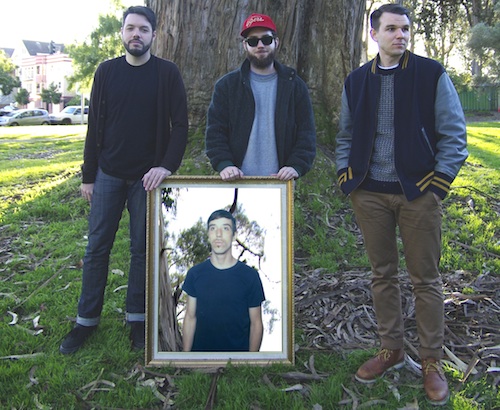
The stimulating and excellently-eared Icee Hot crew is blasting a two-part third anniversary party at Public Works: this Sat/19 sees dreamy R&B chopper Jacques Greene (yes, the guy with the glasses from the Azaelia Banks video, but also one of my favorite producers ever) and Dutch hyperdubber Martyn on deck. Part two on Sat/26 brings in alien techno soundscapist Space Dimension Controller and astral floor-pounder Basic Soul Unit. You will find me face down on the floor in sonic worship for both. (And you may be able to score a pass to both parties for a mere $15 here.)

I’ve been following the oft-roving party pretty much since its inception.

Usually I abhor parties that just throw a big name guest up and then give partygoers no other vibe-guidance: no decorations or look or neon Easter eggs of any kind. But the Icee Hot foursome — Shawn Reynaldo, Rollie Fingers, Ghosts on Tape, and Low Limit, all fantastic DJ/musicmakers in their own right — take an expressionist approach to gigs that transcends the bare-boned, and fends off any cynical charges of money-grubbing (the parties are hella cheap). Their excellent curatorial sense brings disparate, original sounds together to create something more stimulating than the sum of sonic parts.

I traded emails with the Icees on the eve of their blowout to talk about the party’s evolution and the SF scene right now.

SFBG Every time you guys throw a party, I trip over myself trying to describe the music with anything more substantial than “awesome” and then I overuse the word “bass.” How would you describe the music you look for when considering guest artists? 

GHOSTS ON TAPE We have a hard time describing it too. I think that’s part of the fun. But since you asked, I’d say we go for weirdo house, outsider artists, and underground pioneers. It’s hard to put a finger on what exactly we look for in a guest, they just have to do music that excites us. We also like to book people that are doing things that no one else is really doing, and it’s important for us to bring acts that have never played in SF before. That’s not always possible, but we try. We don’t really wanna bring artists based solely on internet hype, we have to genuinely like their music.  

ROLLIE FINGERS I think we just book people we like and people who influence people we like. The overarching theme is house and techno. It’s fine to just call it that. (Ed. Note: Mr. Fingers does not have to write exciting things about nightlife every week.)

SFBG What inspired you to start Icee Hot, and what are some of your favorite memories from the past three years?

SHAWN REYNALDO Icee Hot sort of grew out of Tormenta Tropical, another monthly party that I still throw here in San Francisco. That night is based around cumbia and other Latin/tropical styles, but back in 2009, I was mixing in a bunch of UK funky and other new house/bass/grime sounds. Some of those records were vaguely “tropical,” but I gradually realized that they didn’t properly fit the vibe of the party. Still, in November of that year, I booked L-Vis 1990 and Bok Bok at Tormenta Tropical for their first SF show, simply because I was so enthusiastic about the music they were making. This was right around the time that they were launching the Night Slugs label, and they hung out here in San Francisco for several days, during which time Rollie Fingers and I got really inspired, just by talking with them about music and realizing that there was something interesting happening with all these new hybrid sounds coming out of the UK. We also realized that this music melded really well with a lot of great classic house, garage and techno that wasn’t really being celebrated in the SF club scene at the time. Anyways, within a few weeks of that show, we enlisted Ghosts on Tape and Low Limit, booked our first party at 222 Hyde, and began planning ICEE HOT.

In terms of highlights, there are just too many to mention. Hosting Todd Edwards for his first-ever SF show was something special, and it was even better when we brought him back a year later and paired him with MK, one of his musical heroes. Beyond that, there was Robert Hood and Anthony “Shake” Shakir showing us what being a Detroit legend is all about. Ben UFO and Oneman going back-to-back, which was a real landmark for the party. Cedaa literally kicking off his 21st birthday with a midnight set. MikeQ turning the dancefloor out with drag queens doing bicycle kicks on stage. New Years 2011 with Bok Bok and Ramadanman. Girl Unit making his SF debut in the sweaty basement at 222 Hyde. John Talabot, both his DJ set and phenomenal live set a few months later. Our second anniversary last year with Mosca and Altered Natives. I could go on forever. It’s been fun.

ROLLIE FINGERS Hieroglyphic Being is an amazing DJ. He played a delayed vocal sample of “I Feel Love” for like 20 minutes when he played. If anyone else did that, it would be messy, but with him, it was bliss. I also have a very distinct memory of DJ Stingray getting out of the cab at Public Works wearing his ski mask. It was deep.

SFBG It seems like the number of parties has grown exponentially in the past few years. What are some of the challenges and rewards to throwing a party in the current SF nightlife landscape? Has it become more a matter of branding, rather than a distinct music or crowd profile? And do you feel that the party scene is being overdetermined by artist booking agencies?

SHAWN REYNALDO ICEE HOT is the product of a lot of hard work. Between talking to artists, negotiating with booking agents, locking down venues, purchasing flights, picking people up at the airport, fulfilling riders, and doing all the other behind-the-scenes tasks, it can be a little daunting, especially when we’re operating on a zero-profit basis. I don’t know if people always realize this, but ICEE HOT makes a point to keep our door prices as low as possible. Sure, we could charge $20, $25, $30 for a lot of our parties, but we don’t, because charging exorbitant door prices is lame. We’re not doing this to make money. We’re doing this to throw good events, and we don’t want anyone not to come because it’s too expensive.

http://www.youtube.com/watch?v=kwyxmrMSOUM

ROLLIE FINGERS We don’t mind branding our party at all. Every flyer for the past three years has said ICEE HOT really big on top. I think it’s nice for parties to have a distinct look and feel to them. ICEE HOT always feels like ICEE HOT, no matter what artist we are booking. I like that.

SHAWN REYNALDO And sure, dealing with nightlife landscape in San Francisco can be tricky. Even though the city attracts top-level talent, it’s still a relatively small place, so most promoters know one another. Sometimes you wind up competing with other parties to book the same talent, or dealing with booking agents who are trying to pit us against one another. Thankfully, we can usually avoid all of that mess. When booking agents are being unreasonable or don’t understand what we’re about, we usually just bow out of the proceedings. After three years, ICEE HOT has built up a good reputation, so the artists we’re trying to bring out have often already heard of the party and want to come play. Don’t get me wrong, it can all be frustrating sometimes, but we’re proud of what we’re doing and hopefully the parties and the label speak for themselves. Plus, it’s hard to really complain too much. Every month, we’re throwing parties exactly the way we want to throw them with guests we’re personally really excited about. Things are going well, and we want to just keep building on that.

SFBG Why’d you decide on a two-part blowout? It’s almost too-too good. Although I know you haven’t shot your wad yet — any hints on who might be coming in 2013 (or who your fantasy artists would be).

GHOSTS ON TAPE The kind folks at Public Works were nice enough to let us use their club two weeks in a row, and since our anniversary is something of a milestone, we wanted to book artists that are in line with our vision of what we like to do at ICEE HOT. I think Martyn, Jacques Greene, Space Dimension Controller and Basic Soul Unit are going to help us celebrate our three-year anniversary in fine form. As far as future bookings, I can’t give anything away, but we’re going to continue on the same path and keep on booking freakishly talented individuals. In the past, whenever we thought of a fantasy artist that we’d like to book, it always ended up coming true eventually, so I don’t want to say anything to ruin any future surprises.

Overturning Citizens United

25

Sen. Al Franken, who is wonderful, has moved beyond seeking more disclosure (which the Republicans won’t accept) and is now moving toward a Constitutional amendment to overturn Citizens United. He’s moving his petition everywhere, and it will get a lot of traction.

But as I’ve mentioned, overturning Citizens United isn’t that easy. It’s fine to say we want to do it, and an entirely different task to write the legislation and deal with all of the First Amendment ramifications. And it still won’t stop rich people from spending their own money in unlimited ways.

I don’t know; maybe we have to figure out some more creative solutions. Mandate that all candidates for president and US Senate accept only public financing and match all independent expenditure spending with more public money. And then go back to the “original intent” of the US Constitution: In 1800, each member of Congress represented about 12,000 people. That would work fine today — expand the size of the House of Representatives to guarantee that at no point does any member have to seek election from a district with more than, say, 50,000 people. That’s a number you can reach without big money (see: SF district elections). Do the same for every state Legislature. Yes, more money on government — but less money in politics. I’ll take the tradeoff.

LAnce Armstrong and the SF financier

1

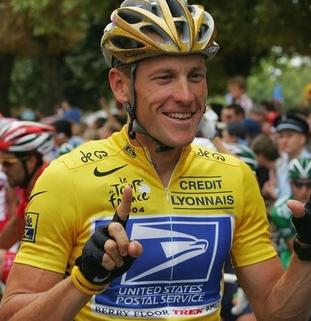
According to the Chron, the owner of the bicycle team that employed Lance Armstrong has been subpoenaed as part of the federal investigation into Lance Armstrong’s alleged doping. (Why is this a federal issue? Um, because some US Attorney wants to make headlines. And because the US Postal Service, which sponsored the team, was involved.)

Thomas Weisel, a legend of Silicon Valley, hasn’t said much publicly about the whole situation, although the Center for Investigative Reporting cites a lawsuit suggesting that he knew at least something nasty:

According to the Center for Investigative Reporting, testimony in an earlier arbitration case involving a dispute over Armstrong’s bonuses suggest Weisel was made aware by team members and doctors of doping concerns on three occasions, beginning in 1996 (before Armstrong joined the USPS team), all to no avail. After publicly expressing concerns about Armstrong in 2001, former team member Greg LeMond said he was told by Weisel, according to the arbitration documents, “What you’re saying about Lance isn’t good for you. You be careful.”

But Weisel was happy to talk to the San Francisco Business Times, which just posted a summary or an earlier interview. You have to be a subscriber to read the whole thing (and you know what? I pay for a subscription every year because there’s stuff in the BT that you never see anywhere else, particularly if you’re watching development issues). Here the gist:

Wiesel denies everything.

“I never had one discussion with one coach or one rider about doping,” he said. “And to my knowledge, the guys that were running my program – Mark Gorski (Postal general manager) and (operations director) Dan Osipow – they did not either. People say ‘Jesus, you had to know this was going on because everyone was doing it,’” Weisel said. “That’s not true. I never thought it was. I don’t think many cycling teams were deploying that practice. And we certainly had part of our rider contract where if a person tested positive, they were off the team. We were very explicit there.”

Okay then.

Bicycling is a lot more harsh than baseball — Barry Bonds might not get into the Hall of Fame (although if he does, so should Pete Rose), but he hasn’t been stripped of any of his batting titles and nobody’s talking about changing his stats. It all reminds me of a friend who played for the University of Miami back in the 1980s, when Suntan U won national football titles. “Everyone juiced,” he told me. “Everyone. You want to play, you juice. You want to get the the NFL, you juice.”

Cheating — except that everyone was doing it. Horribly unhealthy, but so is playing football at that level. When the rewards are so high, and the competition so intense, and winning is all that matters, people cheat. (See: Wall Street, where Weisel plays. See: Corporate America.)

Lance Armstrong is reportedly worth about $100 million. Bonds, about the same. Would they do it the same way again — or retire in a more relative obscurity with a lot less money?

And why are those the choices?


Going down

0

le.chicken.farmer@gmail.com

CHEAP EATS As we were walking to the car we decided: it was not only the best pozole, it was the best thing either of us had ever ate. I should have gone back and told her so, but when we’d left Sal the Pork Chop’s penthouse sweet it was almost midnight and she was in her pajamas. She’d already fallen asleep in the middle of the season premier of “Downton Abbey,” and we’d had to clear our throats and knock on her head after, just to say goodbye. It was a knockout pozole, really and truly.

I love my Secret Agent Lady for a lot of reasons, and now this: We were halfway down the hall when she called us back. “I forgot to give you the leftovers,” she said.

I pinched myself. Hedgehog swooned.

“Steady,” I whispered, hooking her arm and holding on while our hostess and best friend ever was filling up a yogurt container. “We don’t need two faller-overs in the fambly.”

Sal the Pork Chop, everybody . . . New. Favorite. Person. Ever. And (not entirely coincidentally) maker of the pozole that changes everything.

True, she is not technically a restaurant. But then, I am not exactly all-the-way not on strike, either. I mean, agreement was reached, I am thrilled to say, over salt-and-pepper prawns and clay pot chicken at my new favorite restaurant in Chinatown.

Agreement = check’s in the mail. It is not, however, in my hands. So let’s just say that relatively real restaurant reviews are in the mail . . . and keep talking about Sal the Pork Chop’s pozole.

Or let’s hear from Hedgehog first: Dear Sir or Madam or etc. etc.:

Youse’re going to miss me when I’m gone. Like, by the time you read this, you will already be missing me. The long strike of twelve dash thirteen will be over! And right on time, too. I just contacted the accountant, in preparation for the annual clenching of the jaw and wrenching of the wallet and found out that, due to our domesticational partnership status, and additionally due to our residing in the state of happy cows, I get half of what Chicken Farmer doesn’t make, whether I write half of her column or not. It’s called “community property.”

Meaning, conversely, that she communally appropriates half of what I make, as well. I’m trying to train her to become an Emmy-winning sound editor, but I suspect she won’t be kicking in as much labor on my job as I have been on her’s when the time comes so … so long, suckas. It’s been swell, but the swelling’s gone down now.

Most sincerely, etc. etc.,

Hedgehog

P.S. VIVA LA EL CHEAPO SPORTOS!

Yeah but mine has not! Swelling, that is, and gone down, that is, respectively. We decided we liked my face better like this, and I did not let the nose doctor “set” my nose. He showed me how to rub it so the swelling would go down, but I don’t.

I just …

So the pozole: she made it mostly in a blender, she said. The saucy part, which had about eighty cloves of garlic in it and I forget what she said else. This she then fried in a pan, as I understand it, and that she poured into some chicken broth and other things, in which were then simmered legs and thighs until heaven happened, and was garnished at the table with cilantro, radish, cabbage, avocado, and a squeeze of lime.

There. Now you know how to make, more or less, the best thing I ever ate. But I forgot to mention she roasted some poblanos in her broiler and then threw them in at the end. Christ, I wish I’d been paying better attention.

It was my first meal back from the three-day dead I was in. My second was the melty juicy crunchy salt-and-pepper prawns I savored with jalapeno slices in the company of my favorite living Bee Gee, at a big round table in the small, square second-floor Chinatown Cheap Eats gem:

HONG KONG CLAY POT CITY RESTAURANT

Lunch: Thu-Tue 11am-3pm; Dinner: Thu-Sun 5-9pm; Closed Wed

960 Grant Ave., SF

(415) 989-2638

MC/V

Beer & wine

Banchan, ramen, and squid innards

0

virginia@sfbg.com

APPETITE Authentic Asian cuisine of every category is one of California and the Bay Area’s strengths, with constant new openings, including Richmond’s mellow Daigo Sushi (www.daigosushi.com) and Szechuan outpost Chili House (www.chilihousesf.com). These three spots stand out for one (or a few) reasons.


MUGUBOKA

Passing Muguboka many a time over the years, I meant to visit but never did until recently. What I found: a humble, all-day respite serving an impressive array of free and abundant banchan (mini-dishes accompanying a Korean meal), like myeolchi bokkeum (crispy mini-anchovies), and bottomless tea — making even upper teens-priced entrees a deal. Dining alone, I attempted to finish the banchan… and fail.

There’s a plentiful selection of soups and stews featuring tofu or Korean sausage, and dishes like go dung uh gui (broiled salted mackerel), or hae-mool pajeon, those ever-fabulous seafood and green onion Korean pancakes. I finished with a complimentary, cool pour of sujeonggwa, a sweet Korean punch alive with cinnamon, ginger, peppercorns, and dried persimmon.

Best dish: Muguboka serves a mean hae-mool (seafood) dolsot (stone pot) bibimbop ($16.95), the scorching stone pot arrives with sizzling rice, egg, squid, shrimp, mussels, and veggies, with nori on top. Best suited for: A mellow setting with copious amounts of Korean food. Expect two meals for the price of one.

401 Balboa, (415) 668-6007


RAMEN SHOP

Here’s my early word on Rockridge hotspot Ramen Shop, opened at the beginning of the year and packed since day one with long waits (no reservations). A short, ever-changing menu offers three types of ramen, one dessert, and a handful of appetizers so it’s possible to try the entire menu in one visit.

Chez Panisse alums Sam White, Jerry Jaksich and Rayneil De Guzman already have a hit on their hands, if crowds are any indication. Although early online comments have been trending towards the “frustrated to spend $16 on a bowl of ramen” kind, this is quality ramen — house-made noodles, salt-cured eggs, ultra-fresh ingredients. Meyer lemon infuses shoyu ramen ($15) with bright dimension, while spit-roasted chashu (literally pork roast, often known as char siu) adds heft to particularly flavorful spicy miso ramen ($15).

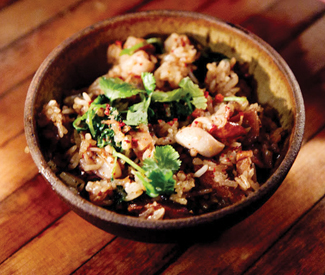
But my favorites aren’t of the ramen variety. Meyer lemon shows up again in a unique kimchi of house-pickled Napa cabbage ($5) to winning effect, a spirited contrast to chili. Then, wild nettle fried rice steals the show (see “best dish” below). Another surprising winner? Liquor. It’s a rarity to see cocktails with ramen. Straightforward, refreshing mezcal, and rye-based punches ($10) make fine ramen companions, as does a classic hi-ball ($12) of Hibiki 12-year Japanese whiskey with soda. A nutty-tasting black sesame ice cream sandwich ($5) with brown sugar cookies is the right finish.

Best dish: Easy… wild nettle fried rice ($9) interlaced with Monterey Bay squid and Llano Seco pork is as comforting as it is gourmet. Best suited for: The joyous convergence of ramen and Japanese whiskey — and for those with time on their hands.

5812 College Ave., Oakl. (510) 788-6370, www.ramenshop.com


ROKU

Since JapaCurry’s Jay Hamada opened Roku in October at the busy Market and Octavia intersection, it’s been imilarly bustling inside. Groups of friends down Japanese beer and fried chicken in the form of karaage ($7) or chicken nan ban ($8), the latter a specialty of Kyushu, Hamada’s Southern Japanese hometown island. Unframed vintage Japanese posters hanging on wood walls impart a warm atmosphere, as do hearty house-made noodles and dishes like mochi bacon yakitori.

During opening weeks, I went straight for dishes I’ve never tried, including shio-kara ($4): room temperature, fermented squid swimming in its own innards. Salty and gummy, it is, as the menu states,”an acquired taste.” Likewise, hotate butter ($12) topped with vivid orange tobiko (fish roe) is unexpected. Scallops are sautéed in butter, but unlike most of our Westernized experiences with the succulent bivalve, the stomach and membrane skirt are left around the scallop flesh. Call it umami, call it funky, the taste is more accurately both. Look elsewhere for better well-known izakaya favorites — Roku’s rare dishes with bold flavor make it interesting.

Best dish: a surprisingly good seafood salad ($13) in an izakaya, laden with red king crab and smoked salmon, tobiko, boiled eggs, yellow bell pepper, and tomatoes over romaine, bright in a yuzu wasabi dressing. Best suited for: The hardcore who want authentic dishes they won’t find on typical menus. Also for groups of friends.

1819 Market, SF. (415) 861-6500, www.rokusf.com

Subscribe to Virgina’s twice-monthly newsletter, The Perfect Spot, www.theperfectspotsf.com


Denim legends and stained glass socks

0

caitlin@sfbg.com

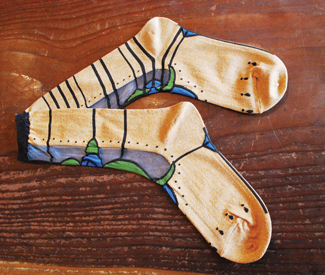
STREET SEEN First, I saw the socks. Half sheer, half solid, the pair’s blue rose design made me flash on stained glass cathedral. Like a sock-crazed zombie, I turned on my heels and entered the most unassuming, unmarked shop on Hayes Valley’s row of quirky boutiques and designer collections.

The pair was wildly expensive, and not being a swanky sock kind of lady, that threw me. But Japanese import shop Cotton Sheep is not for those unacquainted with the transformative power of superlative readywear. A few weeks later I was back for a tour, and to talk style philosophy with owner Eiko Critchfield’s son Rue, who credits his mother with awakening his own sense of personal flair.

“You can appreciate this story with your eyes closed,” Rue tells me, holding out an impossibly soft cotton scarf from his favorite of the shop’s handful of imported Japanese brands. The piece is by Kapital, a vaunted label that hails from Okayama, a town traditionally known for its indigo dye and denim. The true, deep blue of Kapital’s jeans, in particular, make them denim head cult items.

After Eiko impressed the company’s higher-ups with the fastidiousness with which she examined pieces in Kapital’s Japanese showroom, Cotton Sheep became the first American store to stock the brand, and the biggest US selection can still be found there — denim, hand-woven scarves, quirky button-down shirts, and of course, my wonder socks. The shop’s other brands include Merveille H, FITH, and Nuno. Each piece is handpicked for sale by Eiko.

“When you walk out the house with these pieces you know you are the only person in the country wearing them,” Rue says. He’s wearing Kapital khakis with an exposed, intricate button fly, and eye-catching strap along the backside waistband. Rue was a self-described jock before joining the family business (“sweatpants and white T-shirts,” he says ruefully), but got hooked on the line after Mom told him he needed a more fashionable dress code if wanted to work in the store.

Eiko certainly brought him up to appreciate a good outfit. She and husband Victor became pickers when they moved to San Francisco in the 1990s from Osaka, joining the hardy ranks of those who troll thrift stores for treasure, hustling to flip quality pieces to vintage stores for profit.

When they’d exhausted the Bay Area’s bins to their satisfaction, Eiko packed up the family into a Chevy Astro and took to the road, sending shipments of Americana (used Levi’s, Raggedy Ann dolls — Japan was nuts for anything that screamed “United States” at that time) to her boutique friends in Osaka whenever the van was too packed to fit more finds. “My parents relied on their sense of style to survive,” Rue says.

“I wanted to show people of San Francisco what I see in Japan that I know they would never find,” Eiko wrote me in an email when I asked her about her idea to open a shop across the street from the site from Victor’s now-defunct music store, BPM Records. “Our store is about an idea: to care for fabrics, to appreciate them, and to teach people that great fabrics will last you forever if you treat it with the care that I do.”

And please, do have care: Eiko’s a stickler for boutique etiquette, chiding those that enter with icecream cones from the Smitten kiosk down the block and cautioning careless types that don’t show the proper respect when handling her precious textiles. Check her Yelp reviews if you don’t believe me.

But the family’s about inspiring a different kind of relationship between us and our wardrobe, one with an emphasis on craftsmanship often lacking in the era of mega-brands and micro-trends. Who knows, maybe Rue will even talk me into those socks one day. “It might be a little scary to walk out of the store like that [with an expensive clothing item],” he laughs. “That’s my job, to help people be less scared.”

Cotton Sheep 572 Hayes, SF. (415) 621-5546, www.cottonsheep.com

Rep Clock

0

Schedules are for Wed/16-Tue/22 except where noted. Director and year are given when available. Double and triple features marked with a •. All times pm unless otherwise specified.

ARTISTS’ TELEVISION ACCESS 992 Valencia, SF; www.atasite.org. $5-10. "The Best of Periwinkle Cinema 2012: The Year in Review," Wed, 8. "OpenScreening," Thu, 8. For participation info, contact programming@atasite.org. Heritage (Giordano), plus shorts, Fri, 8. "A Benefit for Jay Korber," with films and live performances, Sat, 8.

BALBOA 3630 Balboa, SF; cinemasf.com/balboa. $7.50-10. Let Fury Have the Hour (D’Ambrosio, 2012), Jan 18-24, 3, 5, 7:15 (also Fri-Sat, 9:40).

CASTRO 429 Castro, SF; (415) 621-6120, www.castrotheatre.com. $8.50-11. •Holy Motors (Carax, 2012), Wed, 2:30, 7, and Being John Malkovich (Jonze, 1999), Wed-Thu, 4:45, 9:10. •Taxi Driver (Scorsese, 1976), Thu, 7, and Drive (Winding Refn, 2011), Thu, 9:10. •Thunderbirds Are Go (Lane, 1966), Fri, 7, and Team America: World Police (Parker, 2004), Fri, 8:50. Django (Corbucci, 1966), Fri, 11. "Pam Ann: Cockpit Live," Sat, 7:30. Tickets ($30-45) at www.biggaycomedy.com. •Tess (Polanski, 1979), Sun, 5, and Rosemary’s Baby (Polanski, 1968), Sun, 2:30, 8:15. •Wattstax (Stuart, 1973), Mon, 3, 7, and Something From Nothing: The Art of Rap (Ice-T and Baybutt, 2012), Mon, 4:55, 8:55. •Chasing Mavericks (Hanson and Apted, 2012), Tue, 7, and Bones Brigade (Peralta, 2012), Tue, 9:15.

CHRISTOPHER B. SMITH RAFAEL FILM CENTER 1118 Fourth St, San Rafael; (415) 454-1222, www.cafilm.org. $6.75-$10.25. My Worst Nightmare (Fontaine, 2012), call for dates and times. "For Your Consideration: A Selection of Oscar Submissions from Around the World:" Clandestine Childhood (Ávila, 2011), Wed, 6:30; Thu, 8:15; The Deep (Kormákur, 2012), Wed, 8:30; Kauwboy (Koole, 2012), Thu, 6:30. Amour (Haneke, 2012), Jan 18-24, call for times. The Rabbi’s Cat (Sfar and Delesvaux, 2011), Jan 18-24, call for times.

CLAY 2261 Fillmore, SF; www.landmarktheatres.com. $9-10. "Midnight Movies:" The Princess Bride (Reiner, 1987), Fri-Sat, midnight.

FIRST UNITED METHODIST CHURCH Nine Ross Valley, San Rafael; www.mitfamericas.org. $10-20. •Precious Knowledge (Palos, 2011), Sat, 5:15; Sin Pais (Rigby, 2010), Sat, 7; and Which Way Home (Cammisa, 2009), Sat, 8.

MECHANICS’ INSTITUTE 57 Post, SF; www.milibrary.org. $10. "Cinemalit: New Years Revolution Redux 3:" V for Vendetta (McTeigue, 2006), Fri, 6.

NEW PARKWAY 474 24th St, Oakl; www.thenewparkway.com. $6. "Documentary Film Series:" Chasing Ice (Orlowski, 2012), Tue, 7.

PACIFIC FILM ARCHIVE 2575 Bancroft, Berk; (510) 642-5249, bampfa.berkeley.edu. $5.50-9.50. "Alfred Hitchcock: The Shape of Suspense:" Rebecca (1940), Wed, 7; Young and Innocent (1937), Fri, 7; The Lady Vanishes (1938), Fri, 8:40. "The Hills Run Red: Italian Westerns, Leone, and Beyond:" A Bullet for the General (Damiani, 1966), Thu, 7; China 9, Liberty 37 (Hellman, 1978), Sat, 8:45. "Werner Schroeter: Magnificent Obsessions:" The Death of Maria Malibran (1972), Sat, 6:30; Willow Springs (1973), Tue, 7.

ROXIE 3117 and 3125 16th St, SF; (415) 863-1087, www.roxie.com. $6.50-11. Only the Young (Mims and Tippet, 2012), Wed-Thu, call for times. The Law in These Parts (Alexandrowicz, 2012), Jan 18-24, call for times.

VOGUE 3290 Sacramento, SF; www.mostlybritish.org. $12.50-35 (festival pass, $99). Mostly British Film Festival, new and classic films from the UK, Ireland, Australia, and South Africa, Jan 17-24.

YERBA BUENA CENTER FOR THE ARTS 701 Mission, SF; www.ybca.org. $8-10. Hellbound? (Miller, 2012), Thu-Sat, 7:30 (also Sat, 4); Sun, 2 and 4. Director in person at Thu/17 screenings.

Alerts

0

THURSDAY 17

Refugee Hotel

Contemporary Jewish Museum, 736 Mission, SF. 6:30-8pm. Join photographer Jim Goldberg, photographer Gabriele Stabile, and journalist Juliet Linderman for a discussion about Refugee Hotel, a collection of photography and interviews documenting the arrival of refugees to the United States. Hosted by Voice of Witness, a nonprofit book series published by McSweeney’s Books that illuminates contemporary human rights issues. Free before 5pm; admission is $5 after. Advance tickets encouraged. info@thecjm.org; 415.655.7881. If you can’t make the Thursday event, consider dropping by Gallery Carte Blanche (973 Valencia St, SF) Friday/18 at 6 pm, when Voice of Witness will host a talk and book signing for Refugee Hotel, followed by a reception.


SATURDAY 19

Protest Citizens United at Chevron Refinery

March departs Richmond BART station at noon; rally at Chevron Gate 14 (corner of Castro and Chevron Way), 1pm, Richmond. Chevron is widely known in these parts for letting loose a toxic plume of smoke that blackened skies last year when the refinery caught fire. What you may not have heard is that the oil behemoth also bears the distinction of being the single-largest contributor to a so-called Super PAC (for the GOP, naturally) since the Citizens United decision. On the third anniversary of the Supreme Court’s notorious ruling, which opened the floodgates to skyrocketing corporate contributions to political campaigns, activists are planning a march and rally outside the Chevron Oil Refinery. Live music from the Brass Liberation Orchestra will accompany the 2.5-mile walk, local activists and community leaders will speak at the rally.


MONDAY 21

Fracking in California

Gazebo Room, CPMC Davies Campus, 45 Castro Street, SF. 7-9 p.m. Fracking, or hydraulic fracturing, is an environmentally damaging oil and gas–drilling technique that involves injecting high volumes of pressurized water, sand and toxic chemicals deep into the earth. It’s already taking place in nine California counties, according the Center for Biological Diversity. TransitionSF will host a free presentation on fracking with speakers Rose Braz, Climate Campaign Director of the Center for Biological Diversity; and Adam Scow, California Campaigns Director for Food & Water Watch. The talk will cover the environmental effects of fracking and offer ideas on how environmentalists can take action against it. Free.


Music Listings

0

Since club life is unpredictable, it’s a good idea to call ahead or check the venue’s website to confirm bookings and hours. Prices are listed when provided to us. Visit www.sfbg.com/venue-guide for venue information. Submit items for the listings at listings@sfbg.com. For further information on how to submit items for the listings, see Picks.

WEDNESDAY 16

ROCK/BLUES/HIP-HOP

Blues Organ Party with Big Bones and Chris Siebert Royal Cuckoo, 3202 Mission, SF; www.royalcuckoo.com. 7:30pm, free.

Gunshy Johnny Foley’s. 9pm, free.

Lee Huff vs Nathan Temby Johnny Foley’s Dueling Pianos. 9pm, free.

Michael Hurley, Cass McCombs, Jessica Pratt Great American Music Hall. 8pm, $15.

Jerry Joseph, Shelley Doty, Fred Torphy, Marc Friedman Brick and Mortar Music Hall. 8pm, free.

Keith Crossan Blues Showcase with Terry Hanck Biscuits and Blues. 11:30pm, $15.

Parquet Courts Hemlock Tavern. 8:30pm, $8.

Paulie Rhyme, Sweet Hayah, Aisha Fukushima, Bottom Hammer Elbo Room. 9pm, $7.

Todd Sickafoose’s Tiny Resistors, Erik Deutsch Band, Adam Levy Cafe Du Nord. 8pm, $10-$12.

JAZZ/NEW MUSIC

Dink Dink Dink, Gaucho, Eric Garland’s Jazz Session Amnesia. 7pm, free.

Latin Jazz All-Stars feat. Steve Turre, Chembo Corniel, Arturo O’Farrill, Nestor Torres Yoshi’s SF. 8pm, $25.

Reuben Rye Rite Spot. 9pm, free.

Ricardo Scales Top of the Mark, 999 California, SF; www.topofthemark.com. 6:30pm, $5.

FOLK/WORLD/COUNTRY

Timba Dance Party Bissap Baobab, 3372 19th St, SF; www.bissapbaobab.com. 10pm, $5. Timba and salsa cubana with DJ Walt Diggz.

DANCE CLUBS

Booty Call Q-Bar, 456 Castro, SF; www.bootycallwednesdays.com. 9pm. Juanita MORE! and Joshua J host this dance party.

Coo-Yah! Slate Bar, 2925 16th St, SF; www.slate-sf.com. 10pm, free. With Vinyl Ambassador, DJ Silverback, DJs Green B and Daneekah.

Hardcore Humpday Happy Hour RKRL, 52 Sixth St, SF; (415) 658-5506. 6pm, $3.

Martini Lounge John Colins, 138 Minna, SF; www.johncolins.com. 7pm. With DJ Mark Divita.

THURSDAY 17

ROCK/BLUES/HIP-HOP.

Adios Amigo, City Tribe, Ghost Tiger Cafe Du Nord. 9pm, $10.

Big Tree, Strange Vine, Bonnie and the Bang Bang, Owl Paws Bottom of the Hill. 8:30pm, $10. "Songs for Sandy: Hurricane Relief Show."

Broadway Calls, Silver Snakes, Civil War Rust Thee Parkside. 9pm, $10.

Eskmo Independent. 9pm, $20.

Hammond Organ Soulful Blues Party with Chris Siebert Royal Cuckoo, 3202 Mission, SF; www.royalcuckoo.com. 7:30pm, free.

John Lawton Trio Johnny Foley’s. 9pm, free.

Knocks, Gemini Club, popscene DJs Rickshaw Stop. 9:30pm, $13-$15.

Mark Matos and Os Beaches, Van Allen Belt, Sasha Bell, Crushed Out, DJ Neil Martinson Brick and Mortar Music Hall. 9pm, $6-$10.

Run Amok, Parae, Scarlet Stoic Sub-Mission. 8:15pm, $8.

Eric Sardinas Biscuits and Blues. 8 and 10pm, $20.

Nathan Temby vs Lee Huff Johnny Foley’s Dueling Pianos. 9pm, free.

Trampled By Turtles Fillmore. 8pm, $25.

JAZZ/NEW MUSIC

Latin Jazz All-Stars feat. Steve Turre, Chembo Corniel, Arturo O’Farrill, Nestor Torres Yoshi’s SF. 8pm, $25.

Midnight Flyte Rite Spot. 9pm, free.

SF Jazz Hotplate Series Amnesia. 9pm.

Stompy Jones Top of the Mark, 999 California, SF; www.topofthemark.com. 7:30pm, $10.

FOLK/WORLD/COUNTRY

Get Down Boys Atlas Cafe, 3049 20 St, SF; www.atlascafe.net. 8-10pm.

Twang! Honky Tonk Fiddler’s Green, 1330 Columbus, SF; www.twanghonkytonk.com. 5pm. Live country music.

DANCE CLUBS

Afrolicious Elbo Room. 9:30pm, $5-$7. With DJ-host Pleasuremaker and Senor Oz spin Afrobeat, Tropicália, electro, samba, and funk.

All 80s Thursday Cat Club. 9pm, $6 (free before 9:30pm). The best of ’80s mainstream and underground.

Base: Pan-Pot, Alex Sibley Vessel, 85 Campton Place, SF; www.vesselsf.com. 10pm, $10.

Ritual Dubstep Temple. 10pm-3am, $5. Trap and bass.

Tropicana Madrone Art Bar. 9pm, free. Salsa, cumbia, reggaeton, and more with DJs Don Bustamante, Apocolypto, Sr. Saen, Santero, and Mr. E.

FRIDAY 18

ROCK/BLUES/HIP-HOP

Asesino, Verbal Abuse, Embryonic Devourment, Psychosomatic DNA Lounge. 7pm, $16.

Back Pages Johnny Foley’s. 9pm, free.

"Bands4Bands Showcase" Slim’s. 8pm, $13. With Kaos, Potential Threat, Mystic Rage, Star Destroyer.

Black Cobra, Glitter Wizard, Lecherous Gaze Brick and Mortar Music Hall. 9pm, $10-$13.

Jake Bugg, Valerie June, popscene DJs Rickshaw Stop. 9pm, $15-$17.

Commissure, Let Fall the Sprarrow, Skyscraper Mori Hemlock Tavern. 9:30pm, $7.

Fidlar Amoeba Music, 1855 Haight, SF; www.amoeba.com. 6pm, free.

Fidlar, Pangea, Meat Market Bottom of the Hill. 9pm, $10.

Hammond Organ Soul Blues Party Royal Cuckoo, 3202 Mission, SF; www.royalcuckoo.com. 7:30pm, free.

Lee Huff, Jeff V., Rags Tuttle Johnny Foley’s Dueling Pianos. 9pm, free.

Native Elements, Jah Yzer Elbo Room. 10pm, $10.

Johnny Rawls Biscuits and Blues. 8 and 10pm, $20.

Ty Segall Fillmore. 9pm, $22.50.

Tell River, Anju’s Pale Blue Eyes, Hang Jones, Gayle Lynn and the Hired Hands Cafe Du Nord. 9pm, $8.

JAZZ/NEW MUSIC

Audium 1616 Bush, SF; www.audium.org. 8:30pm, $20. Theater of sound-sculptured space.

Black Market Jazz Orchestra Top of the Mark, 999 California, SF; www.topofthemark.com. 9Pm, $10.

George Duke Yoshi’s SF. 8pm, $32; 10pm, $24.

Lee Vilenski Rite Spot. 9pm, free.

FOLK/WORLD/COUNTRY

Alex Pinto Trio Red Poppy Art House. 8pm, $8.

Queer Cumbia Bissap Baobab, 3372 19th St, SF; www.bissapbaobab.com. 8pm, $3-$7. Musica tropical, cumbia, merengue.

DANCE CLUBS

DJ What’s His Fuck Riptide Tavern. 9pm, free.

Hella Tight Amnesia. 10pm, $5.

Sebastien Drums, Justin Milla Vessel, 85 Campton Place, SF; www.vesselsf.com. 10pm, $20-$30.

Joe Lookout, 3600 16th St.,SF; www.lookoutsf.com. 9pm. Eight rotating DJs.

Old School JAMZ El Rio. 9pm. Fruit Stand DJs spinning old school funk, hip-hop, and R&B.

Paris to Dakar Little Baobab, 3388 19th St, SF; (415) 643-3558. 10pm, $5. Afro and world music with rotating DJs including Stepwise, Steve, Claude, Santero, and Elembe.

"Save KUSF Benefit" Bender’s, 806 S. Van Ness, SF; www.bendersbar.com. 9pm, $5. With KUSF in Exile DJs Zoe, Stoo Odom, Brian Springer.

SATURDAY 19

ROCK/BLUES/HIP-HOP

Chris A., Jeff V., Lee Huff Johnny Foley’s Dueling Pianos. 9pm, free.

Bay Area Heat Johnny Foley’s. 9pm, free.

Buttercream Gang, Youth of the Beast, Apopka, Darkroom Thee Parkside. 9pm, $7.

Hammond Organ Soul Blues Party Royal Cuckoo, 3202 Mission, SF; www.royalcuckoo.com. 7:30pm, free.

Kowloon Walled City Hemlock Tavern. 9:30pm, $7.

Femi Kuti and the Positive Force Fillmore. 9pm, $35.

London Souls, Major Powers and the Lo-Fi Symphony, Wake Up Lucid Bottom of the Hill. 9:30pm, $12.

Maria Muldaur Biscuits and Blues. 8 and 10pm, $20.

Mustache Harbor Slim’s. 9pm, $20.

Paperplanes Riptide Tavern. 9:30pm, free.

Pinback, Judgement Day Bimbo’s. 9pm, $25.

Trails and Ways, Tremor Low, My Satellite Cafe Du Nord. 9pm, $10.

Turtle Rising Thee Parkside. 3pm, free.

Wayne Wonder, Joshua, Selecta Dans-One, DJ Rob Roots Brick and Mortar Music Hall. 9pm, $20-$25.

Yo La Tengo Amoeba Music, 1855 Haight, SF; www.amoeba.com. 3pm, free.

JAZZ/NEW MUSIC

Audium 1616 Bush, SF; www.audium.org. 8:30pm, $20. Theater of sound-sculptured space.

George Duke Yoshi’s SF. 8 and 10pm, $32.

Project Pimento Rite Spot. 9pm, free.

FOLK/WORLD/COUNTRY

Steph Macpherson Brainwash Cafe. 8pm.

Razteria a.k.a Renee Asteria Neck of the Woods. 9pm, $10-$15.

Craig Ventresco and Meredith Axelrod Atlas Cafe, 3049 20 St, SF; www.atlascafe.net. 4-6pm.

DANCE CLUBS

Bootie SF: SF vs LA vs NYC DNA Lounge. 9pm, $10-$15. With Mykill, Faroff, Billy Jam, and more.

Fringe Madrone Art Bar. 9pm, $5. Indie music video dance party with DJ Blondie K and subOctave.

Oakland Faders dance party Rickshaw Stop. 9pm, $5.

OK Hole Amnesia. 9pm.

Paris to Dakar Little Baobab, 3388 19th St, SF; (415) 643-3558. 10pm, $5. Afro and world music with rotating DJs.

Radio Franco Bissap, 3372 19th St, SF; (415) 826 9287. 6 pm. Rock, Chanson Francaise, Blues. Senegalese food and live music.

Scotty Boy Vessel, 85 Campton Place, SF; www.vesselsf.com. 10pm, $20-$30.

Saturday Night Soul Party Elbo Room. 10pm, $5-$10. With DJs Lucky, Paul Paul, Phengren Oswald.

Smiths Party Slate Bar, 2925 16th St, SF; www.slate-sf.com. 10pm, $5. Sounds of the Smiths, Morrissey, the Cure, and New Order.

Wild Nights Kok BarSF, 1225 Folsom, SF; www.kokbarsf.com. 9pm, $3. With DJ Frank Wild.

SUNDAY 20

ROCK/BLUES/HIP-HOP

Beso Negro, Sage, Steakhouse Cafe Du Nord. 8:30pm, $10.

Down, Warbeast Regency Ballroom. 8pm, $25.

Easway, King Pin, Ellie Cope Slim’s. 8pm, $15.

Giggle Party, Bella Novela, Spider Heart Bottom of the Hill. 9pm, $8.

Hammond Organ Blues Party with Lavay Smith and Chris Siebert Royal Cuckoo, 3202 Mission, SF; www.royalcuckoo.com. 7:30pm, free.

John Lawton Trio Johnny Foley’s. 9pm, free.

Harvey Mandel and the Snake Crew Biscuits and Blues. 7 and 9pm, $20.

Mike Giant and DJ Dougernaut Hemlock Tavern. 10pm, free.

JAZZ/NEW MUSIC

Collaboration feat. Dee Lucas, Joel Del Rosario, Sure Will Yoshi’s SF. 8pm, $32; 10pm, $24.

Linda Kosut, Benn Bacot Bliss Bar, 4026 24 St. SF; www.blissbarsf.com. 7pm, $22.

FOLK/WORLD/COUNTRY

Brazil and Beyond with Sandy Cressman Trio Bissap Baobab, 3372 19th St, SF; www.bissapbaobab.com. 6:30pm, free.

Paula Frazer, Rusty Miller, New Family Band Rite Spot. 9pm, free.

Hillbilly Swing with B Stars Amnesia. 9pm, $7.

Twang Sunday Thee Parkside. 4pm, free. With Nobody From Nashville.

DANCE CLUBS

Beats for Brunch Thee Parkside. 11am, free. With Chef Josie and DJ Motion Potion.

Dub Mission Elbo Room. 9pm, $8-$11. With Nickodemus, Spy from Cairo, DJ Sep.

Jock Lookout, 3600 16th St, SF; www.lookoutsf.com. 3pm, $2.

MONDAY 21

ROCK/BLUES/HIP-HOP

Damir Johnny Foley’s. 9pm, free.

White Cloud, Tears Club, Spectre, Grill Cloth Elbo Room. 9pm, $5.

Quicksand, Title Fight Regency Ballroom. 8pm, $28.

JAZZ/NEW MUSIC

Craig and Meredith Rite Spot. 8:30pm, free.

Mike Olmos Jazz Biscuits and Blues. 7:30pm, $12.

DANCE CLUBS

Crazy Mondays Beauty Bar, 2299 Mission, SF; www.thebeautybar.com. 10pm, free. Hip-hop and other stuff.

Death Guild DNA Lounge. 9:30pm, $3-$5. With Decay, Joe Radion, Melting Girl.

M.O.M. Madrone Art Bar. 6pm, free. DJs Timoteo Gigante, Gordo Cabeza, and Chris Phlek playing all Motown every Monday.

Soul Cafe John Colins Lounge, 138 Minna, SF; www.johncolins.com. 9pm. R&B, Hip-Hop, Neosoul, reggae, dancehall, and more with DJ Jerry Ross.

Vibes’N’Stuff El Amigo Bar, 3355 Mission, SF; (415) 852-0092. 10pm, free. Conscious jazz and hip-hop with DJs Luce Lucy, Vinnie Esparza, and more.

TUESDAY 22

ROCK/BLUES/HIP-HOP

Dubious Ranger, Sunrunners, Grahame Lesh, Midnight Snackers Elbo Room. 9pm, $8.

Fat Tuesday Band Biscuits and Blues. 8 and 10pm, $15.

God Module, Mordacious, Flesh Industry DNA Lounge. 9pm, $12.

Hot Fog, Buffalo Tooth, Wild Eyes, DJ D’Sasster Riptide Tavern. 9:30pm, $6.

Li Xi, Former Friends of Young Americans, Ash Reiter Amnesia. 9pm, $7.

Stan Erhart Band Johnny Foley’s. 9pm, free.

JAZZ/NEW MUSIC

Muriel Anderson with Tierra Negra Yoshi’s SF. 8pm, $20.

FOLK/WORLD/COUNTRY

Brazilian Zouk Bissap Baobab, 3372 19th St, SF; www.bissapbaobab.com. 8:30pm, $5.

DANCE CLUBS

KPT F8, 1192 Folsom, SF; www.feightsf.com. 9pm, $5.

Stylus John Colins Lounge, 138 Minna, SF; www.johncolins.com. 9pm. Hip-hop, dancehall, and Bay slaps with DJ Left Lane.

Takin’ Back Tuesdays Double Dutch, 3192 16th St,SF; www.thedoubledutch.com. 10pm. Hip-hop from the 1990s.

Film Listings

0

Film listings are edited by Cheryl Eddy. Reviewers are Kimberly Chun, Dennis Harvey, Lynn Rapoport, and Sara Maria Vizcarrondo. For rep house showtimes, see Rep Clock.

OPENING

Broken City It’s a tough guy-off when an ex-cop (Mark Wahlberg) dares to take on New York’s corrupt mayor (Russell Crowe). (1:49)

Hellbound? See "Damnation Investigation." (1:25) Yerba Buena Center for the Arts.

The Last Stand In Arnold Schwarzenegger’s first leading role since that whole Governator business, he plays a small-town sheriff doing battle with an escaped drug kingpin. (1:47) Shattuck.

The Law in These Parts Ra’anan Alexandrowicz’s documentary is a rather extraordinary historical record: he interviews numerous retired Israeli judges and lawyers who shaped and enforced the country’s legal positions as occupiers of Palestinian land and "temporary guardians" of a Palestinian populace living under foreign occupation. The key word there is "temporary" — in using here a different (military rather than civil) justice from the one Israeli citizens experience, Israel has been able to exert the extraordinary powers of an invading force in wartime. But what is "temporary" about an occupation that’s now lasted nearly 45 years? How can the state justify (under Geneva Convention rules, for one thing) building permanent Jewish settlements that now house about half a million Israelis on land that is as yet not legally Israel’s? By constantly changing the terms and laws of occupation, they do just that. If many policies have been perhaps necessary to control terrorist attacks, one can argue that they and other policies have created the climate in which oppositional fervor and terroristic acts were bound to flourish. That, of course, is a political-ethical judgement far beyond the public purview of the judges and others here, whose dry legalese admits no personal culpability — and indeed sometimes seems almost absurdly divorced from real-world ethics and consequence, which of course serves an increasingly rigid governmental stance just fine. Without preaching, The Law in These Parts raises a number of discomfiting questions about bending law to suit an agenda that in any other context would seem frankly unlawful. (1:40) Roxie. (Harvey)

Let Fury Have the Hour Though its message — that creative expression is a powerful, meaningful way to fight oppression — is a valuable one, Antonino D’Ambrosio’s Let Fury Have the Hour covers turf well-trod for anyone who has ever seen a documentary about punk rock and social justice. (Especially when it contains usual suspects like Ian MacKaye, Shepard Fairey, and Billy Bragg waxing nostalgic about how nonconformist they were in the 1980s.) In truth, Fury is more collage than doc, pasting together talking-head interviews (also here: Chuck D, John Sayles, Van Jones, Tom Morello, Boots Riley, and Wayne Kramer, plus a few token women, chiefly Eve Ensler) with a mish-mash of sepia-toned stock footage that more or less thematically compliments what’s being discussed at the time. A more focused examination of D’Ambrosio’s thesis might have resulted in a more effective film — like, say, an in-depth look at how Sayles’ politically-themed films (here, he reads from the script for 1987’s Matewan in a frustratingly brief segment) are echoed in works by contemporary artists and citizen journalists, particularly now that the internet has opened up a global platform for protest films. Listen: I admire what the film is trying to do. I am OK with watching yet another doc that contains the phrase "Punk rock politicized me." But with too much lip service and precious little depth, Fury‘s fury ends up feeling a bit diluted. (1:40) Balboa. (Eddy)

LUV Baltimore native Sheldon Candis drew from his own childhood for this coming-of-age tale, which takes place in a single day as 11-year-old "little man" Woody (Michael Rainey Jr.) tags along with his uncle, Vincent (Common), recently out of jail and rapidly heading back down the criminal path. With both parents out of the picture, Woody’s been raised by his grandmother (Lonette McKee), so he idolizes Vincent even though it’s soon clear the short-tempered man is no hero. Of course, things go horribly awry, bloody lessons are learned, tears are shed, etc. Despite the story’s autobiographical origins, the passable LUV suffers greatly by inviting comparisons to The Wire — the definitive docudrama examining drug crime in Baltimore. Most blatantly, sprinkled into an all-star cast (Dennis Haysbert, Danny Glover, Charles S. Dutton) are supporting characters played by Wire icons Michael K. "Omar" Williams (as a cop) and Anwan "Slim Charles" Glover (as a meaner Slim Charles, basically). Perhaps if you’ve never seen the show this wouldn’t be distracting — but if that’s the case, you should really be watching The Wire instead of LUV anyway. (1:34) (Eddy)
Mama Two long-lost children bring something supernatural home with them in this horror flick starring Jessica Chastain and Nikolaj "Jaime Lannister" Coster-Waldau. (1:40) California.

The Rabbi’s Cat A rabbi, a Muslim musician, two Russians (a Jew and a boozy Christian), and two talking animals hop into an antique Citroën for a road trip across Africa. No, it’s not the set-up for a joke; it’s the premise for this charming animated film, adapted from Joann Sfar’s graphic novel (the author co-directs with Antoine Delesvaux). In 1930s Algiers, a rabbi’s pet cat suddenly develops the ability to talk — and read and write, by the way — and wastes no time in sharing opinions, particularly when it comes to religion ("God is just a comforting invention!") When a crate full of Russian prayer books — and one handsome artist — arrives at the rabbi’s house, man and cat are drawn into the refugee’s search for an Ethiopian city populated by African Jews. Though it’s not suitable for younger kids (there’s kitty mating, and a few bursts of surprising violence) or diehard Tintin fans (thanks to a randomly cranky spoof of the character), The Rabbi’s Cat is a lushly illustrated, witty tale of cross-cultural clashes and connections. Rockin’ soundtrack, too. (1:29) Smith Rafael. (Eddy)

ONGOING

Amour Arriving in local theaters atop a tidal wave of critical hosannas, Amour now seeks to tempt popular acclaim — though actually liking this perfectly crafted, intensely depressing film (from Austrian director Michael Haneke) may be nigh impossible for most audience members. Eightysomething former music teachers Georges and Anne (the flawless Jean-Louis Trintignant and Emmanuelle Riva) are living out their days in their spacious Paris apartment, going to classical concerts and enjoying the comfort of their relationship. Early in the film, someone tries to break into their flat — and the rest of Amour unfolds with a series of invasions, with Anne’s declining health the most distressing, though there are also unwanted visits from the couple’s only daughter (an appropriately self-involved Isabelle Huppert), an inept nurse who disrespects Anne and curses out Georges, and even a rogue pigeon that wanders in more than once. As Anne fades into a hollow, twisted, babbling version of her former self, Georges also becomes hollow and twisted, taking care of her while grimly awaiting the inevitable. Of course, the movie’s called Amour, so there’s some tenderness involved. But if you seek heartwarming hope and last-act uplift, look anywhere but here. (2:07) Albany, Clay, Smith Rafael. (Eddy)

Anna Karenina Joe Wright broke out of British TV with the 9,000th filmed Pride and Prejudice (2005), unnecessary but quite good. Too bad it immediately went to his head. His increasing showiness as director enlivened the silly teenage-superspy avenger fantasy Hanna (2011), but it started to get in the way of Atonement (2007), a fine book didn’t need camera gymnastics to make a great movie. Now it’s completely sunk a certified literary masterpiece still waiting for a worthy film adaptation. Keira Knightley plays the titular 19th century St. Petersburg aristocrat whose staid, happy-enough existence as a doting mother and dutiful wife (to deglammed Jude Law’s honorable but neglectful Karenin) is upended when she enters a mutually passionate affair with dashing military officer Count Vronsky (Aaron Taylor-Johnson, miscast). Scandal and tragedy ensue. There’s nothing wrong with the screenplay, by Tom Stoppard no less. What’s wrong is Wright’s bright idea of staging the whole shebang as if it were indeed staged — a theatrical production in which nearly everything (even a crucial horse race) takes place on a proscenium stage, in the auditorium, or "backstage" among riggings. Whenever we move into a "real" location, the director makes sure that transition draws attention to its own cleverness as possible. What, you might ask, is the point? That the public social mores and society Anna lives in are a sort of "acting"? Like wow. Add to that another brittle, mannered performance by Wright’s muse Knightley, and there’s no hope of involvement here, let alone empathy — in love with its empty (but very prettily designed) layers of artifice, this movie ends up suffocating all emotion in gilded horseshit. The reversed-fortune romance between Levin (Domhall Gleeson) and Kitty (Alicia Vikander) does work quite well — though since Tolstoy called his novel Anna Karenina, it’s a pretty bad sign when the subsidiary storyline ends up vastly more engaging than hers. (2:10) Embarcadero, Opera Plaza, Shattuck. (Harvey)

Argo If you didn’t know the particulars of the 1979 Iranian Revolution, you won’t be an expert after Argo, but the film does a good job of capturing America’s fearful reaction to the events that followed it — particularly the hostage crisis at the US embassy in Tehran. Argo zeroes in on the fate of six embassy staffers who managed to escape the building and flee to the home of the sympathetic Canadian ambassador (Victor Garber). Back in Washington, short-tempered CIA agents (including a top-notch Bryan Cranston) cast about for ways to rescue them. Enter Tony Mendez (Ben Affleck, who also directs), exfil specialist and father to a youngster wrapped up in the era’s sci-fi craze. While watching 1973’s Battle for the Planet of the Apes, Tony comes up with what Cranston’s character calls "the best bad idea we have:" the CIA will fund a phony Canadian movie production (corny, intergalactic, and titled Argo) and pretend the six are part of the crew, visiting Iran for a few days on a location shoot. Tony will sneak in, deliver the necessary fake-ID documents, and escort them out. Neither his superiors, nor the six in hiding, have much faith in the idea. ("Is this the part where we say, ‘It’s so crazy it just might work?’" someone asks, beating the cliché to the punch.) Argo never lets you forget that lives are at stake; every painstakingly forged form, every bluff past a checkpoint official increases the anxiety (to the point of being laid on a bit thick by the end). But though Affleck builds the needed suspense with gusto, Argo comes alive in its Hollywood scenes. As the show-biz veterans who mull over Tony’s plan with a mix of Tinseltown cynicism and patiotic duty, John Goodman and Alan Arkin practically burst with in-joke brio. I could have watched an entire movie just about those two. (2:00) Embarcadero, Castro, 1000 Van Ness, Piedmont, Sundance Kabuki. (Eddy)

Cirque du Soleil: Worlds Away (1:31) Metreon, Shattuck.

Cloud Atlas Cramming the six busy storylines of David Mitchell’s wildly ambitious novel into just three hours — the average reader might have thought at least 12 would be required — this impressive adaptation directed (in separate parts) by Tom Twyker (1998’s Run Lola Run) and Matrix siblings Lana and Andy Wachowski has a whole lot of narrative to get through, stretching around the globe and over centuries. In the mid 19th century, Jim Sturgess’ sickly American notory endures a long sea voyage as reluctant protector of a runaway-slave stowaway from the Chatham Islands (David Gyasi). In 1931 Belgium, a talented but criminally minded British musician (Ben Whishaw) wheedles his way into the household of a famous but long-inactive composer (Jim Broadbent). A chance encounter sets 1970s San Francisco journalist Luisa (Halle Berry) on the path of a massive cover-up conspiracy, swiftly putting her life in danger. Circa now, a reprobate London publisher’s (Broadbent) huge windfall turns into bad luck that gets even worse when he seeks help from his brother (Hugh Grant). In the not-so-distant future, a disposable "fabricant" server to the "consumer" classes (Doona Bae) finds herself plucked from her cog-like life for a rebellious higher purpose. Finally, in an indeterminately distant future after "the Fall," an island tribesman (Tom Hanks) forms a highly ambivalent relationship toward a visitor (Berry) from a more advanced but dying civilization. Mitchell’s book was divided into huge novella-sized blocks, with each thread split in two; the film wastes very little time establishing its individual stories before beginning to rapidly intercut between them. That may result in a sense of information (and eventually action) overload, particularly for non-readers, even as it clarifies the connective tissues running throughout. Compression robs some episodes of the cumulative impact they had on the page; the starry multicasting (which in addition to the above mentioned finds many uses for Hugo Weaving, Keith David, James D’Arcy, and Susan Sarandon) can be a distraction; and there’s too much uplift forced on the six tales’ summation. Simply put, not everything here works; like the very different Watchmen, this is a rather brilliant "impossible adaptation" screenplay (by the directors) than nonetheless can’t help but be a bit too much. But so much does work — in alternating currents of satire, melodrama, pulp thriller, dystopian sci-fi, adventure, and so on — that Cloud Atlas must be forgiven for being imperfect. If it were perfect, it couldn’t possibly sprawl as imaginatively and challengingly as it does, and as mainstream movies very seldom do. (2:52) Castro. (Harvey)

Django Unchained Quentin Tarantino’s spaghetti western homage features a cameo by the original Django (Franco Nero, star of the 1966 film), and solid performances by a meticulously assembled cast, including Jamie Foxx as the titular former slave who becomes a badass bounty hunter under the tutelage of Dr. Schultz (Christoph Waltz). Waltz, who won an Oscar for playing the evil yet befuddlingly delightful Nazi Hans Landa in Tarantino’s 2009 Inglourious Basterds, is just as memorable (and here, you can feel good about liking him) as a quick-witted, quick-drawing wayward German dentist. There are no Nazis in Django, of course, but Tarantino’s taboo du jour (slavery) more than supplies motivation for the filmmaker’s favorite theme (revenge). Once Django joins forces with Schultz, the natural-born partners hatch a scheme to rescue Django’s still-enslaved wife, Broomhilda (Kerry Washington), whose German-language skills are as unlikely as they are convenient. Along the way (and it’s a long way; the movie runs 165 minutes), they encounter a cruel plantation owner (Leonardo DiCaprio), whose main passion is the offensive, shocking "sport" of "Mandingo fighting," and his right-hand man, played by Tarantino muse Samuel L. Jackson in a transcendently scandalous performance. And amid all the violence and racist language and Foxx vengeance-making, there are many moments of screaming hilarity, as when a character with the Old South 101 name of Big Daddy (Don Johnson) argues with the posse he’s rounded up over the proper construction of vigilante hoods. It’s a classic Tarantino moment: pausing the action so characters can blather on about something trivial before an epic scene of violence. Mr. Pink would approve. (2:45) Four Star, Metreon, 1000 Van Ness, Presidio, Sundance Kabuki. (Eddy)

Gangster Squad It’s 1949, and somewhere in the Hollywood hills, a man has been tied hand and foot to a pair of automobiles with the engines running. Coyotes pace in the background like patrons queuing up for a table at Flour + Water, and when dinner is served, the presentation isn’t very pretty. We’re barely five minutes into Ruben Fleischer’s Gangster Squad, and fair warning has been given of the bloodletting to come. None of it’s quite as visceral as the opening scene, but Fleischer (2009’s Zombieland) packs his tale of urban warfare with plenty of stylized slaughter to go along with the glamour shots of mob-run nightclubs, leggy pin-curled dames, and Ryan Gosling lounging at the bar cracking wise. At the center of all the gunplay and firebombing is what’s framed as a battle for the soul of Los Angeles, waged between transplanted Chicago mobster Mickey Cohen (Sean Penn) — who wields terms like "progress" and "manifest destiny" as a rationale for a continental turf war — and a police sergeant named John O’Mara (Josh Brolin), tasked with bringing down Cohen’s empire. The assignment requires working under cover so deep that only the police chief (Nick Nolte) and the handpicked members of O’Mara’s "gangster squad" — ncluding Gosling, a half-jaded charmer who poaches Cohen’s arm candy (Emma Stone) — know of its existence. This leaves plenty of room for improvisation, and the film pauses now and again to wonder about what happens when you pit brutal amorality against brutal morality, but it’s a rhetorical question, and no one shows much interest in it. Dragged down by talking points that someone clearly wanted wedged in (as well as by O’Mara’s ponderous voice-overs), the film does better when it abandons gravitas and refocuses on spinning its mythic tale of wilder times in the Golden State. (1:53) Metreon, 1000 Van Ness. (Rapoport)

The Guilt Trip (1:35) Metreon.

A Haunted House (1:25) Metreon, 1000 Van Ness.

Hitchcock On the heels of last year’s My Week With Marilyn comes another biopic about an instantly recognizable celebrity viewed through the lens of a specific film shoot. Here, we have Anthony Hopkins (padded and prosthetic’d) playing the Master of Suspense, mulling over which project to pursue after the success of 1959’s North by Northwest. Even if you’re not a Hitch buff, it’s clear from the first scene that Psycho, based on Robert Bloch’s true crime-inspired pulpy thriller, is looming. We open on "Ed Gein’s Farmhouse, 1944;" Gein (Michael Wincott) is seen in his yard, his various heinous crimes — murder, grave-robbing, body-part hoarding, human-skin-mask crafting, etc. — as yet undiscovered. Hitchcock, portrayed by the guy who also played the Gein-inspired Hannibal Lecter, steps into the frame with that familiar droll greeting: "Guhhd eevvveeeening." And we’re off, following the veteran director as he muses "What if somebody really good made a horror picture?" Though his wife and collaborator, Alma (Helen Mirren), cautions him against doing something simply because everyone tells him not to, he plows ahead; the filmmaking scenes are peppered with behind-the-scenes moments detailed in Stephen Rebello’s Alfred Hitchcock and the Making of Psycho, the source material for John J. McLaughlin’s script. But as the film’s tagline — "Behind every Psycho is a great woman" — suggests, the relationship between Alma and Hitch is, stubbornly, Hitchcock‘s main focus. While Mirren is effective (and I’m all for seeing a lady who works hard behind the scenes get recognition), the Hitch-at-home subplot exists only to shoehorn more conflict into a tale that’s got plenty already. Elsewhere, however, Hitchcock director Sacha Gervasi — making his narrative debut after hit 2008 doc Anvil: The Story of Anvil — shows stylistic flair, working Hitchcock references into the mise-en-scène. (1:32) Embarcadero, New Parkway. (Eddy)

The Hobbit: An Unexpected Journey Make no mistake: the Lord of the Rings trilogy represented an incredible filmmaking achievement, with well-deserved Oscars handed down after the third installment in 2003. If director Peter Jackson wanted to go one more round with J.R.R. Tolkien’s beloved characters for a Hobbit movie, who was gonna stop him? Not so fast. This return to Middle-earth (in 3D this time) represents not one but three films — which would be self-indulgent enough even if part one didn’t unspool at just under three hours, and even if Jackson hadn’t decided to shoot at 48 frames per second. (I can’t even begin to explain what that means from a technical standpoint, but suffice to say there’s a certain amount of cinematic lushness lost when everything is rendered in insanely crystal-clear hi-def.) Journey begins as Bilbo Baggins (a game, funny Martin Freeman) reluctantly joins Gandalf (a weary-seeming Ian McKellan) and a gang of dwarves on their quest to reclaim their stolen homeland and treasure, batting Orcs, goblins, Gollum (Andy Serkis), and other beasties along the way. Fan-pandering happens (with characters like Cate Blanchett’s icy Galadriel popping in to remind you how much you loved LOTR), and the story moves at a brisk enough pace, but Journey never transcends what came before — or in the chronology of the story, what comes after. I’m not quite ready to declare this Jackson’s Phantom Menace (1999), but it’s not an unfair comparison to make, either. (2:50) California, Metreon, 1000 Van Ness, Sundance Kabuki. (Eddy)

Hyde Park on Hudson Weeks after the release of Lincoln, Hyde Park on Hudson arrives with a lighthearted (-ish) take on Franklin D. Roosevelt’s 1939 meeting with King George VI (of stuttering fame) and Queen Elizabeth at FDR’s rural New York estate. Casting Bill Murray as FDR is Hyde Park‘s main attraction, though Olivia Williams makes for a surprisingly effective Eleanor. But the thrust of the film concerns FDR’s relationship with his cousin, Daisy — played by Laura Linney, who’s relegated to a series of dowdy outfits, pouting reaction shots, and far too many voice-overs. The affair has zero heat, and the film is disappointingly shallow — how many times can one be urged to giggle at someone saying "Hot dogs!" in an English accent? — not to mention a waste of a perfectly fine Bill Murray performance. As that sideburned Democrat bellows in Lincoln, "Howwww dare you!" (1:35) Albany, Embarcadero. (Eddy)

The Impossible Spanish director Juan Antonio Bayona (2007’s The Orphanage) directs The Impossible, a relatively modestly-budgeted take on the 2004 Indian Ocean tsunami, based on the real story of a Spanish family who experienced the disaster. Here, the family (Naomi Watts, Ewan McGregor, three young sons) is British, on a Christmas vacation from dad’s high-stress job in Japan. Beachy bliss is soon ruined by that terrible series of waves; they hit early in the film, and Bayona offers a devastatingly realistic depiction of what being caught in a tsunami must feel like: roaring, debris-filled water threatening death by drowning, impalement, or skull-crushing. And then, the anguish of surfacing, alive but injured, stranded, and miles from the nearest doctor, not knowing if your family members have perished. Without giving anything away (no more than the film’s suggestive title, anyway), once the survivors are established (and the film’s strongest performer, Watts, is relegated to hospital-bed scenes) The Impossible finds its way inevitably to melodrama, and triumph-of-the-human-spirit theatrics. As the family’s oldest son, 16-year-old Tom Holland is effective as a kid who reacts exactly right to crisis, morphing from sulky teen to thoughtful hero — but the film is too narrowly focused on its tourist characters, with native Thais mostly relegated to background action. It’s a disconnect that’s not quite offensive, but is still off-putting. (1:54) California, Piedmont, SF Center, Sundance Kabuki. (Eddy)

Jack Reacher (2:10) Metreon, 1000 Van Ness.

Life of Pi Several filmmakers including Alfonso Cuarón, Jean-Pierre Jeunet, and M. Night Shyamalan had a crack at Yann Martel’s "unfilmable" novel over the last decade, without success. That turns out to have been a very good thing, since Ang Lee and scenarist David Magee have made probably the best movie possible from the material — arguably even an improvement on it. Framed as the adult protagonist’s (Irrfan Khan) lengthy reminiscence to an interested writer (Rafe Spall) it chronicles his youthful experience accompanying his family and animals from their just shuttered zoo on a cargo ship voyage from India to Canada. But a storm capsizes the vessel, stranding teenaged Pi (Suraj Sharma) on a lifeboat with a mini menagerie — albeit one swiftly reduced by the food chain in action to one Richard Parker, a whimsically named Bengal tiger. This uneasy forced cohabitation between Hindu vegetarian and instinctual carnivore is an object lesson in survival as well as a fable about the existence of God, among other things. Shot in 3D, the movie has plenty of enchanted, original imagery, though its outstanding technical accomplishment may lie more in the application of CGI (rather than stereoscopic photography) to something reasonably intelligent for a change. First-time actor Sharma is a natural, while his costar gives the most remarkable performance by a wild animal this side of Joaquin Phoenix in The Master. It’s not a perfect film, but it’s a charmed, lovely experience. (2:00) New Parkway, 1000 Van Ness, Presidio, SF Center. (Harvey)

Lincoln Distinguished subject matter and an A+ production team (Steven Spielberg directing, Daniel Day-Lewis starring, Tony Kushner adapting Doris Kearns Goodwin, John Williams scoring every emotion juuust so) mean Lincoln delivers about what you’d expect: a compelling (if verbose), emotionally resonant (and somehow suspenseful) dramatization of President Lincoln’s push to get the 13th amendment passed before the start of his second term. America’s neck-deep in the Civil War, and Congress, though now without Southern representation, is profoundly divided on the issue of abolition. Spielberg recreates 1865 Washington as a vibrant, exciting place, albeit one filled with so many recognizable stars it’s almost distracting wondering who’ll pop up in the next scene: Jared Harris as Ulysses S. Grant! Joseph Gordon-Levitt as Robert Lincoln! Lena Dunham’s shirtless boyfriend on Girls (Adam Driver) as a soldier! Most notable among the huge cast are John Hawkes, Tim Blake Nelson, and a daffy James Spader as a trio of lobbyists; Sally Field as the troubled First Lady; and likely Oscar contenders Tommy Lee Jones (as winningly cranky Rep. Thaddeus Stevens) and Day-Lewis, who does a reliably great job of disappearing into his iconic role. (2:30) 1000 Van Ness, Presidio, SF Center, Shattuck, Sundance Kabuki. (Eddy)

Les Misérables There is a not-insignificant portion of the population who already knows all the words to all the songs of this musical-theater warhorse, around since the 1980s and honored here with a lavish production by Tom Hooper (2010’s The King’s Speech). As other reviews have pointed out, this version only tangentially concerns Victor Hugo’s French Revolution tale; its true raison d’être is swooning over the sight of its big-name cast crooning those famous tunes. Vocals were recorded live on-set, with microphones digitally removed in post-production — but despite this technical achievement, there’s a certain inorganic quality to the proceedings. Like The King’s Speech, the whole affair feels spliced together in the Oscar-creation lab. The hardworking Hugh Jackman deserves the nomination he’ll inevitably get; jury’s still out on Anne Hathaway’s blubbery, "I cut my hair for real, I am so brave!" performance. (2:37) Marina, 1000 Van Ness, SF Center, Shattuck, Sundance Kabuki. (Eddy)

Monsters, Inc. 3D (1:35) Metreon.

My Worst Nightmare First seen locally in the San Francisco Film Society’s 2012 "French Cinema Now" series, My Worst Nightmare follows icy art curator Agathe (Isabelle Huppert) as her airless, tightly-controlled world begins to crumble — thanks in no small part to an exuberantly uncouth, down-on-his-luck Belgian contractor named Patrick (Benoît Poelvoorde). (His obnoxious, freewheeling presence in Agathe’s precision-mapped orbit gives rise to the film’s title.) Director and co-writer Anne Fontaine (2009’s Coco Before Chanel) injects plenty of offbeat, occasionally raunchy humor into what could’ve been a predictable personal-liberation tale — the sight of classy dame Huppert driving through a bikini car wash, for instance. (1:43) Smith Rafael. (Eddy)

Not Fade Away How to explain why the Beatles have been tossed so many cinematic bon mots and not the Stones? The group’s relatively short lifespan — and even the tragic, unexpectedly dramatic passing of John Lennon — seem to have all played into the band’s nostalgia-marinated legend, while the Stones’ profitable tour rotation and shocking physical resilience have lessened their romantic charge. So it reads as a counterintuitive, and a bit random, that Sopranos creator David Chase would open his first feature film with a black and white re-creation of the Mick Jagger and Keith Richards meet-up, before switching to the ’60s coming-of-age of New Jersey teen geek Douglas (John Magaro), trapped in an oppressively whiny nuclear family headed up by his Pep Boy grouch of a dad (James Gandolfini) — at least until rock ‘n’ roll saves his soul and he starts beating the skins. Graduating to better-than-average singer after his band’s frontman Eugene (Boardwalk Empire‘s Jack Huston) inhales a joint, Douglas not only finds his voice, but also wins over dream girl Grace (Bella Heathcote). Sure, Not Fade Away is about sex, drugs, and rock ‘n’ roll — and much attention is dutifully squandered on basement shows, band practice, and politics, and posturing with wacky new haircuts and funny cigarettes, thanks to Chase’s own background in garage bands and executive producer, music supervisor, and true believer Steve Van Zandt’s considerable passion. Yet despite the amount screen time devoted to rock’s rites, those familiar gestures never rise above the clichéd, and Not Fade Away only finds its authentic emotional footing when Gandolfini’s imposing yet trapped patriarch and the rest of Douglas’s beaten-down yet still kicking family enters the picture — they’re the force that refuses to fade away, even after they disappear in the rear view. (1:52) Shattuck. (Chun)

Only the Young First seen locally at the 2012 San Francisco International Film Festival, this documentary from Elizabeth Mims and Jason Tippet is styled like a narrative and often shot like a fine art photograph (or at least a particularly bitchin’ Instagram), with an unexpectedly groovy soundtrack. It follows a pair of high schoolers with ever-changing hairstyles in dried-up Santa Clarita, Calif. — a burg of abandoned mini-golf courses and squatter’s houses, and a place where the owner of the local skate shop seems equally obsessed with tacos and Jesus. It’s never clear where Garrison and Kevin fall on the religious spectrum — though "the church" has a looming importance, influencing relationships if not wardrobe choices — but one gets the feeling all they really care about is skateboarding, with their own friendship a close second. Less certain are Garrison’s feelings about punky, tough-yet-sweet gal pal Skye — especially when they begin spending time with new flames. Only the Young‘s seemingly random choice of subjects works to its advantage, capturing the kids’ unaffected, surprisingly honest point of view on subjects as varied as cars, dating, college, the economy, and Gandalf Halloween costumes. (1:10) Roxie. (Eddy)

Parental Guidance (1:36) Metreon.

The Perks of Being a Wallflower Move over, Diary of a Wimpy Kid series — there’s a new shrinking-violet social outcast in town. These days, life might not suck quite so hard for 90-pound weaklings in every age category, what with so many films and TV shows exposing, and sometimes even celebrating, the many miseries of childhood and adolescence for all to see. In this case, Perks author Stephen Chbosky takes on the directorial duties — both a good and bad thing, much like the teen years. Smart, shy Charlie is starting high school with a host of issues: he’s painfully awkward and very alone in the brutal throng, his only friend just committed suicide, and his only simpatico family member was killed in a car accident. Charlie’s English teacher Mr. Andersen (Paul Rudd) appears to be his only connection, until the freshman strikes up a conversation with feline, charismatic, shop-class jester Patrick (Ezra Miller) and his magnetic, music- and fun-loving stepsister Sam (Emma Watson). Who needs the popular kids? The witty duo head up their gang of coolly uncool outcasts their own, the Wallflowers (not to be confused with the deeply uncool Jakob Dylan combo), and with them, Charlie appears to have found his tribe. Only a few small secrets put a damper on matters: Patrick happens to be gay and involved with football player Brad (Johnny Simmons), who’s saddled with a violently conservative father, and Charlie is in love with the already-hooked-up Sam and is frightened that his fragile equilibrium will be destroyed when his new besties graduate and slip out of his life. Displaying empathy and a devotion to emotional truth, Chbosky takes good care of his characters, preserving the complexity and ungainly quirks of their not-so-cartoonish suburbia, though his limitations as a director come to the fore in the murkiness and choppily handled climax that reveals how damaged Charlie truly is. (1:43) Opera Plaza.. (Chun)

Promised Land Gus Van Sant’s fracking fable — co-written by stars Matt Damon and John Krasinski, from a story by Dave Eggers — offers a didactic lesson in environmental politics, capped off by the earth-shattering revelation that billion-dollar corporations are sleazy and evil. You don’t say! Formulated like a Capra movie, Promised Land follows company man Steve Butler (Matt Damon) as he and sales partner Sue (Frances McDormand) travel to a small Pennsylvania town to convince its (they hope) gullible residents to allow drilling on their land. But things don’t go as smoothly as hoped, when the pair faces opposition from a science teacher with a brainiac past (Hal Holbrook), and an irritatingly upbeat green activist (Krasinski) breezes into town to further monkey-wrench their scheme. That Damon is such a likeable actor actually works against him here; his character arc from soulless salesman to emotional-creature-with-a-conscience couldn’t be more predictable or obvious. McDormand’s wonderfully biting supporting performance is the best (and only) reason to see this ponderous, faux-folksy tale, which targets an audience that likely already shares its point of view. (1:46) 1000 Van Ness, SF Center. (Eddy)

Rise of the Guardians There’s nothing so camp as "Heat Miser" from The Year Without a Santa Claus (1974) in Rise of the Guardians,, but there’s plenty here to charm all ages. The mystery at its center: we open on Jack Frost (voiced by Chris Pine) being born, pulled from the depths of a frozen pond by the Man on the Moon and destined to spread ice and cold everywhere he goes, invisible to all living creatures. It’s an individualistic yet lonely lot for Jack, who’s styled as an impish snowboarder in a hoodie and armed with an icy scepter, until the Guardians — spirits like North/Santa Claus (Alec Baldwin), the Tooth Fairy (Isla Fisher), and the Easter Bunny (Hugh Jackman) — call on him to join them. Pitch the Boogeyman (Jude Law) is threatening to snuff out all children’s hopes and dreams with fears and nightmares, and it’s up to the Guardians must keep belief in magic alive. But what’s in it for Jack, except the most important thing: namely who is he and what is his origin story? Director Peter Ramsey keeps those fragile dreams aloft with scenes awash with motion and animation that evokes the chubby figures and cozy warm tones of ’70s European storybooks. And though Pine verges on blandness with his vocal performance, Baldwin, Jackman, and Fisher winningly deliver the jokes. (1:38) Metreon. (Chun)

Rust and Bone Unlike her Dark Knight Rises co-star Anne Hathaway, Rust and Bone star Marion Cotillard never seems like she’s trying too hard to be sexy, or edgy, or whatever (plus, she already has an Oscar, so the pressure’s off). Here, she’s a whale trainer at a SeaWorld-type park who loses her legs in an accident, which complicates (but ultimately strengthens) her relationship with Ali (Belgian actor Matthias Schoenaerts, so tremendous in 2011’s Bullhead), a single dad trying to make a name for himself as a boxer. Jacques Audiard’s follow-up to 2009’s A Prophet gets a bit overwrought by its last act, but there’s an emotional authenticity in the performances that makes even a ridiculous twist (like, the kind that’ll make you exclaim "Are you fucking kidding me?") feel almost well-earned. (2:00) Embarcadero, Shattuck. (Eddy)

Searching for Sugar Man The tale of the lost, and increasingly found, artist known as Rodriguez seems to have it all: the mystery and drama of myth, beginning with the singer-songwriter’s stunning 1970 debut, Cold Fact, a neglected folk rock-psychedelic masterwork. (The record never sold in the states, but somehow became a beloved, canonical LP in South Africa.) The story goes on to parse the cold, hard facts of vanished hopes and unpaid royalties, all too familiar in pop tragedies. In Searching for Sugar Man, Swedish documentarian Malik Bendjelloul lays out the ballad of Rodriguez as a rock’n’roll detective story, with two South African music lovers in hot pursuit of the elusive musician — long-rumored to have died onstage by either self-immolation or gunshot, and whose music spoke to a generation of white activists struggling to overturn apartheid. By the time Rodriguez himself enters the narrative, the film has taken on a fairy-tale trajectory; the end result speaks volumes about the power and longevity of great songwriting. (1:25) Opera Plaza. (Chun)

The Sessions Polio has long since paralyzed the body of Berkeley poet Mark O’Brien (John Hawkes) from the neck down. Of course his mind is free to roam — but it often roams south of the personal equator, where he hasn’t had the same opportunities as able-bodied people. Thus he enlists the services of Cheryl (Helen Hunt), a professional sex surrogate, to lose his virginity at last. Based on the real-life figures’ experiences, this drama by Australian polio survivor Ben Lewin was a big hit at Sundance this year (then titled The Surrogate), and it’s not hard to see why: this is one of those rare inspirational feel-good stories that doesn’t pander and earns its tears with honest emotional toil. Hawkes is always arresting, but Hunt hasn’t been this good in a long time, and William H. Macy is pure pleasure as a sympathetic priest put in numerous awkward positions with the Lord by Mark’s very down-to-earth questions and confessions. (1:35) New Parkway, Opera Plaza. (Harvey)

Silver Linings Playbook After guiding two actors to Best Supporting Oscars in 2010’s The Fighter, director David O. Russell returns (adapting his script from Matthew Quick’s novel) with another darkly comedic film about a complicated family that will probably earn some gold of its own. Though he’s obviously not ready to face the outside world, Pat (Bradley Cooper) checks out of the state institution he’s been court-ordered to spend eight months in after displaying some serious anger-management issues. He moves home with his football-obsessed father (Robert De Niro) and worrywart mother (Jacki Weaver of 2010’s Animal Kingdom), where he plunges into a plan to win back his estranged wife. Cooper plays Pat as a man vibrating with troubled energy — always in danger of flying into a rage, even as he pursues his forced-upbeat "silver linings" philosophy. But the movie belongs to Jennifer Lawrence, who proves the chops she showcased (pre-Hunger Games megafame) in 2010’s Winter’s Bone were no fluke. As the damaged-but-determined Tiffany, she’s the left-field element that jolts Pat out of his crazytown funk; she’s also the only reason Playbook‘s dance-competition subplot doesn’t feel eye-rollingly clichéd. The film’s not perfect, but Lawrence’s layered performance — emotional, demanding, bitchy, tough-yet-secretly-tender — damn near is. (2:01) Four Star, Piedmont, Presidio, SF Center, Shattuck. (Eddy)

Skyfall Top marks to Adele, who delivers a magnificent title song to cap off Skyfall‘s thrilling pre-credits chase scene. Unfortunate, then, that the film that follows squanders its initial promise. After a bomb attack on MI6, the clock is running out for Bond (Daniel Craig) and M (Judi Dench), accused of Cold War irrelevancy in a 21st century full of malevolent, stateless computer hackers. The audience, too, will yearn for a return to simpler times; dialogue about "firewalls" and "obfuscated code" never fails to sound faintly ridiculous, despite the efforts Ben Whishaw as the youthful new head of Q branch. Javier Bardem is creative and creepy as keyboard-tapping villain Raoul Silva, but would have done better with a megalomaniac scheme to take over the world. Instead, a small-potatoes revenge plot limps to a dull conclusion in the middle of nowhere. Skyfall never decides whether it prefers action, bon mots, and in-jokes to ponderous mythologizing and ripped-from-the-headlines speechifying — the result is a unsatisfying, uneven mixture. (2:23) Metreon, Shattuck, Sundance Kabuki. (Ben Richardson)

Texas Chainsaw 3D (1:32) Metreon, 1000 Van Ness.

This is 40 A spin-off of sorts from 2007’s Knocked Up, Judd Apatow’s This is 40 continues the story of two characters nobody cared about from that earlier film: Debbie (Leslie Mann, Apatow’s wife) and Pete (Paul Rudd), plus their two kids (played by Mann and Apatow’s kids). Pete and Debbie have accumulated all the trappings of comfortable Los Angeles livin’: luxury cars, a huge house, a private personal trainer, the means to throw catered parties and take weekend trips to fancy hotels (and to whimsically decide to go gluten-free), and more Apple products than have ever before been shoehorned into a single film. But! This was crap they got used to having before Pete’s record label went into the shitter, and Debbie’s dress-shop employee (Charlene Yi, another Knocked Up returnee who is one of two people of color in the film; the other is an Indian doctor who exists so Pete can mock his accent) started stealing thousands from the register. How will this couple and their whiny offspring deal with their financial reality? By arguing! About bullshit! In every scene! For nearly two and a half hours! By the time Melissa McCarthy, as a fellow parent, shows up to command the film’s only satisfying scene — ripping Pete and Debbie a new one, which they sorely deserve — you’re torn between cheering for her and wishing she’d never appeared. Seeing McCarthy go at it is a reminder that most comedies don’t make you feel like stabbing yourself in the face. I’m honestly perplexed as to who this movie’s audience is supposed to be. Self-loathing yuppies? Masochists? Apatow’s immediate family, most of whom are already in the film? (2:14) Metreon, 1000 Van Ness, Shattuck, Vogue. (Eddy)

Wreck-It Ralph Wreck-It Ralph cribs directly from the Toy Story series: when the lights go off in the arcade, video game characters gather to eat, drink, and endure existential crises. John C. Reilly is likable and idiosyncratic as Ralph, the hulking, ham-fisted villain of a game called Fix-It-Felix. Fed up with being the bad guy, Ralph sneaks into gritty combat sim Hero’s Duty under the nose of Sergeant Calhoun (Jane Lynch), a blond space marine who mixes Mass Effect‘s Commander Shepard with a PG-rated R. Lee Ermey. Things go quickly awry, and soon Ralph is marooned in cart-racing candyland Sugar Rush, helping Vanellope Von Schweetz (a manic Sarah Silverman), with Calhoun and opposite number Felix (Jack McBrayer) hot on his heels. Though often aggressively childish, the humor will amuse kids, parents, and occasionally gamers, and the Disney-approved message about acceptance is moving without being maudlin. The animation, limber enough to portray 30 years of changing video game graphics, deserves special praise. (1:34) Metreon, Shattuck. (Ben Richardson)

Zero Dark Thirty The extent to which torture was actually used in the hunt for Osama Bin Ladin may never be known, though popular opinion will surely be shaped by this film, as it’s produced with the same kind of "realness" that made Kathryn Bigelow’s previous film, the Oscar-winning The Hurt Locker (2008), so potent. Zero Dark Thirty incorporates torture early in its chronology — which begins in 2003, after a brief opening that captures the terror of September 11, 2001 using only 911 phone calls — but the practice is discarded after 2008, a sea-change year marked by the sight of Obama on TV insisting that "America does not torture." (The "any more" goes unspoken.) Most of Zero Dark Thirty is set in Pakistan and/or "CIA black sites" in undisclosed locations; it’s a suspenseful procedural that manages to make well-documented events (the July 2005 London bombings; the September 2008 Islamabad Marriott Hotel bombing) seem shocking and unexpected. Even the raid on Bin Ladin’s HQ is nail-bitingly intense. The film immerses the viewer in the clandestine world, tossing out abbreviations ("KSM" for al-Qaeda bigwig Khalid Sheikh Mohammed) and jargon ("tradecraft") without pausing for a breath. It is thrilling, emotional, engrossing — the smartest, most tightly-constructed action film of the year. At the center of it all: a character allegedly based on a real person whose actual identity is kept top-secret by necessity. She’s interpreted here in the form of a steely CIA operative named Maya, played to likely Oscar-winning perfection by Jessica Chastain. No matter the film’s divisive subject matter, there’s no denying that this is a powerful performance. "Washington says she’s a killer," a character remarks after meeting this seemingly delicate creature, and he’s proven right long before Bin Ladin goes down. Some critics have argued that character is underdeveloped, but anyone who says that isn’t watching closely enough. Maya may not be given a traditional backstory, but there’s plenty of interior life there, and it comes through in quick, vulnerable flashes — leading up to the payoff of the film’s devastating final shot. (2:39) Balboa, Marina, 1000 Van Ness, SF Center, Sundance Kabuki. (Eddy)


On the Cheap Listings

0

On the Cheap listings by Caitlin Donohue. Submit items for the listings at listings@sfbg.com. For further information on how to submit items for the listings, see Picks.

WEDNESDAY 16

Lyrics and Dirges reading series Pegasus Books, 2349 Shattuck, Berk. www.pegasusbookstore.com. 7:30pm, free. A monthly reading series that mixes the talents of established and emerging writers, this edition of Lyrics and Dirges features Gulf War vet Sean McIain Brown, Stanford Ph.D. candidate Cam Awkward-Rich, creator of Sit Next to a Black Person Month Kwan Booth, and more.

THURSDAY 17

“Putting the Science of Emotion Into Ocean Conservation” Bay Model Visitor Center, 2100 Bridgeway, Sausalito. 7pm, $5 suggested donation. Wallace J. Nichols is of the mind that preserving our oceans is all in our heads. Really – his theory is that cognitive science (the human brain’s neurological response to the sea) could be the ticket to saving our waterscapes. Today, he’ll explain in this lecture.

Tilt: The Battle to Save Pinball lecture and movie Pacific Pinball Museum, 1510 Webster, Alameda. www.pacificpinball.org. Also Sun/20. 6pm, free. For pinball play, $15/adults, $7.50/kids. No one is in favor of less pinball machines, surely. But what is the reason for their gradual disappearance? Find out with filmmaker Jeff M. Giordano’s movie on the subject. After the showing, Giordano will lead a group discussion on the matter.

Mission Community Market returns Bartlett between 21st and 22nd Sts., SF. www.missioncommunitymarket.org. 4-8pm, free. “Small but mighty” is how the MCM planners characterize the newly-returned winter version of this Mission farmers market. Yummy treats from Blue House Farm produce to Coastside Farms smoked fish will be for sale, and Uni and her Ukelele will pluck from 6-8pm.

Third and 22nd Streets Microhood Event Third and 22nd Sts and surrounding neighborhood, SF. www.bolditalic.com. 6-8pm, free. The Bold Italic continues in its grand tradition of highlighting tiny slices of San Francisco where commercial activity is growing. Today, head to the Dogpatch for chocolate samples from Alter Eco, a photobooth at Orange Photography, wholesale prices on framed works at Oberon Design, wine tasting at Spicy Vine Wine, and new-to-the-area La Fromagerie’s cheese tasting.


SATURDAY 19

Thien Pham talks Sumo Cartoon Art Museum, 655 Mission, SF. www.cartoonart.org. 1-3pm, free. Bay Area comic book artist Thien Pham pens compulsively-readable odes to the Asian American experience. His newest release Sumo tells the story of a depressed football player cum sumo wrestling trainee – hear the inspiration behind the tale at this signing-discussion.

“Small Gems” print show Crown Point Press, 20 Hawthorne, SF. www.crownpoint.com. Small-scale prints by a host of artists including Dorothy Napangardi, Sol LeWitt, and William Bailey.

“Living the Dream: Status, Luxury, and America” Studio 17 Gallery, 3265 17th St., SF. www.studio17sf.com. 6-9pm, free. Artist Angie Crabtree and her 13-year-old daughter Jessie Rai join forces for this visual exhibit of their version of the American dream. Jessie sketched luxury foods, Angie finished portraits of USA icons like President Obama and Steve Jobs, in moss, sugar, and wood veneer.

“Periodic Calendar” Electric Works, 1360 Mission, SF. www.sfelectricworks.com. 2-3pm, free. Joey Sellers and art collective Ape Con Myth open up this exhibit featuring their take on the periodic table. Dates and time, remixed, are promised.

Fine Print Fair Fort Mason Conference Center, SF. www.ifpda.org. 10am-6pm, free. Also Sun/20 11am-5pm, free. 15 art dealers have brought prints ready to be collected, images created by artists near and far, beginning and long dead – one of the fair’s major draws is work by 16th to 19th century European masters.

SUNDAY 20

“Coffee and Sustainability” Port Authority Building, Ferry Building, 1 Sausalito, SF. www.bookpassage.com. 6pm, $5. Is our cumulative caffeine addiction getting in the way of our planet’s health? It doesn’t have to! Jitter over to the Ferry Building for this panel discussion, which features the founder of Blue Bottle, an environmental professor who specializes in coffee agricultural systems, and the author of Left Coast Roast, a West Coast guide to roasters and brewers.

MONDAY 21

Yerba Buena Gardens Martin Luther King Jr. Day celebration and parade March starts at CalTrain station at 11am, ends at Yerba Buena Gardens, Third St. and Mission, SF. www.norcalmlkfoundation.org. Health festival starts at 10:30am, music festival at 1:15pm. Every year, Yerba Buena Gardens is filled with the spirit of Dr. King. Freedom trains from all over the Bay Area will bring attendees to CalTrain for the start of a triumphant parade to the Yerba Buena Gardens, where the Richard Howell Quintet and the Latin Jazz Youth Ensemble will play, and health information and testing will be available all day. Area museums are free today, so there’s plenty of learning to be done and good times to be had in honor of the great man.

MLK Jr. Day Oakland celebration McClymonds High School, 2607 Myrtle, Oakl. (510) 652-5530, www.ahc-oakland.org. 10am-noon, donations welcome. Community violence prevention group Attitudinal Healing Connection is putting on this MLK Day program, which celebrates people who’ve made a difference in their neighborhoods. San Francisco State University Africana studies professor Wade Nobles provides the keynote address, and local choral and dance groups will perform.

Sacred space

5

emilysavage@sfbg.com

MUSIC There will be no bad seats at the new SFJazz Center in Hayes Valley; or at least, that’s the goal.

The brand new jazz venue in the heart of town, a three-story, glass-encased structure with a circular concrete stadium bowl of an auditorium, educational components, rehearsal spaces, a cafe run by the Slanted Door’s Charles Phan, and multiple bars opens Mon/21. It’s a $63 million, 35,000-square-foot addition to Performing Arts Row, near Van Ness-adjacent locations such as the Davies Symphony Hall, and the War Memorial Opera House. It’s the birth of a nonprofit jazz institution.

In the auditorium, 700 seats encircle and hover above a central stage — chairs behind the stage, up in the balcony, and practically up in the artists’ faces on the ground level. Because the room so surrounds the stage, there’s a direct sight line for every instrument being played, every hand grasping a horn, tickling keys, or plucking strings. There are platforms that can accordion and retract, making that enviable space near the stage open up into a temporary dance floor.

And all the seats have cup-holders. We’re a long way from the smoke-filled, underground jazz clubs of the past.


EXCITING AS ALL HELL

And from those seats in the Robert N. Miner auditorium, patrons will see an impressive first season of SF Jazz at its new home. Fans already have high expectations, given SF Jazz’s 30 years of hosting concerts and festivals at other venues like the Paramount in Oakland, and smaller clubs like Amnesia. Now with its own multi-use facility, the nonprofit has taken eclectic routes with its programming and contributions.

“This first season, when you look at some of the things we’re doing here, it’s just exciting as all hell,” says founder and executive artistic director Randall Kline, barely able to contain that excitement, clad in a hardhat and reflective vest on the first level of the still-under-construction building. “[These events] fully take advantage of what we can do with the theater — something we couldn’t do when we didn’t have our own place.”

For starters, there’s a sold-out opening night celebration Jan. 23, hosted by Bill Cosby, along with a grand opening week of shows spotlighting McCoy Tyner, the SFJazz Collective, and more, followed by a week of big band with the Realistic Orchestra (Jan. 31), and swing with Lavay Smith and Her Red Hot Skillet Lickets (Feb. 3).

In March, virtuoso Indian percussionist Zakir Hussain will perform four nights, and in April there will be a Weimar Germany themed weekend with Ute Lemper, Max Raabe and the Palast Orchester, and a screening of the classic Metropolis (1927), with live music by the Clubfoot Orchestra.

But even more to Kline’s point: there will be five resident artistic directors for the 2013 through ’14 season (along with Kline’s overall vision). The five — Jason Moran, Regina Carter, Bill Frisell, John Santos, and Miguel Zenon — are musicians with distinctive backgrounds and viewpoints, programming four days of thematic events.


ENCOMPASSING GEOGRAPHIES

For his days, Santos hand-picked colleagues and artists working and performing in the Caribbean style. He chose De Akokan, a duo made up of Cuban singer-songwriter-composer Pavel Urkiza and Puerto Rican saxophonist-composer Ricardo Pons, because “they’re phenomenal artists…and they rarely come here.” He also invited cutting edge trombonist-composer Papo Vazquez, who lives in New York but is steeped in the Afro-Puerto Rican tradition.

During a phone call a few hours before my hard-hatted venue walk-through with Kline, architect Mark Cavagnero, and Marshall Lamm, who does public relations for the center, Santos discusses his anticipation and interest in the upcoming schedule.

The Bay Area bred percussionist will also be premiering his own Filosofia Caribena II, which refers to Caribbean philosophies and traditions — those that have informed his entire body of work. “[It] blends all the experiences of Black American music with Caribbean traditions, and it goes into the whole socio-political aspect of how the music really represents resistance and the identity of a whole group of people that identify culturally, even though we don’t live in Cuba or Puerto Rico, but we certainly grew up in and maintained those traditions.”

Adding, “Jazz was born in that environment, in New Orleans, in the Caribbean community. We’re making those connections between jazz and the Caribbean roots.”

Frisell’s batch of shows, beginning April 18, will include multimedia pieces with projections and orchestras, readings of Allen Ginsber’s Kaddish, and Hunter S. Thompson’s The Kentucky Derby is Decadent and Depraved (the latter of which is rumored to be narrated by Tim Robbins).

Moran’s residency likely represents the scope of the auditorium’s versatility best: he’ll open with a solo acoustic piano night (May 2), followed by a “Fats Waller Dance Party” with Meshell Ndegeocello that utilizes the dance-floor, then break out the inspired, possibly nutty, concept of a skateboarding jazz piece. There will be an actual half-pipe on the lower level of the room — seats pushed back — with professional skateboarders riding back and forth in the curved structure to Moran’s musical accompaniment.


FOCAL POINT

It’ll be one of many configurations for that striking room. The specifics of the auditorium were big challenges for architect Cavagnero — the acoustics, the balance of sound (such as making sure solo piano and thundering skateboarding dips both fill the space equally), isolating street noise, creating those excellent sight lines from every angle.

“The idea of the building was to make the big concrete room the sacred space for music, the focus space,” says Cavagnero, walking up the stairs in the building’s glass-encased entryway. “That was going to be the closed, sacred space, [and] everything else would wrap around it and be as open and public as we could make it.”

To that end, the rest of the building has floor-to-ceiling glass, and the staircase has no columns supporting it, just thin titanium rods that double as the guardrail. The second floor has bars on either ends and terraces with glass doors that fully open, along with tiled murals representing the history of jazz in the city, with long-gone clubs painted throughout.

It’s clear that this building is meant to be more than a standard music venue, the goal is to be an institution.

“So, if the paradigm is: clubs are harder to run and have live music, well, if we could have the same kind of vibrant music in an institution that supported that kind of thing, to build up a community of people that cared about that kind of thing — which is the gamble I guess we’re making here in this building — we can build it for the jazz community,” says Kline. “[The goal is to have] a great place to hang out and hear live music, where new artists can grow and premiere, and be nurtured.”

And it is hard to run live jazz venues in the city. Nearing the end of 2012, the owners of Oakland’s Yoshi’s filed for involuntary bankruptcy to put its San Francisco location in Chapter 11 if it couldn’t meet an agreement with its partners, the Rrazz Room switched venues under a cloud of controversy stemming from an allegedly racist former manager of its then-location, and Savanna Jazz had to fight off foreclosure.

“We have not seen an increased interest for the art form [recently] primarily because the economy is down significantly and the arts are usually the first to suffer,” says Savanna Jazz co-owner Pascal Bokar.

Because of this, I ask Bokar if other jazz club owners in the city see the center as a contentious new rival. He categorically denies that assertion.

“Jazz is an art form and it has no competition, every club and club owner adds to the fabric of our community and SFJazz is the big brother. I know how hard it is to promote jazz and [Kline] has been working at it for several decades,” he says. “He deserves tremendous credit for bringing this to San Francisco. SFJazz is a very powerful organization and I think that there is an opportunity for [it] to partner with the smaller venues like Savanna Jazz. The smaller venues are the incubators of local talent and I think that they would benefit from a closer relationship, which in turn would solidify community commitment.”

It may be the older sibling to smaller clubs, but given the economy, and the tough climate for all music venues in San Francisco really, the SF Jazz Center does also feel like a gamble itself. But to extend and belabor the metaphor, Kline’s got a good hand.

Santos describes the center to me as a “bold experiment.”

“The amount of money that it has taken to build that place and keep the doors open is phenomenal, and in a lot of ways, it’s a step out into the darkness,” he says. “But I see the potential of it as just limitless. It can be such an incredible thing, if the community supports it. That’s what I’m hoping will happen.”


NATIONAL ART FORM

Santos points out that the jazz center is unique in its fans and patrons differing from the typical performing arts donor, and will have specific obstacles because of that.

“In a way, it’s abstract, when you think of it like, OK, there it is, next door to the symphony hall, to the ballet, to the opera, within one block of those institutions. It’s wonderful to have jazz there, and standing toe-to-toe with those institutions, and getting the respect it deserves. Getting public support from the city and the country and the state, as it should be, because jazz is our national art form. The symphony and the ballet and the opera are not.”

“The difficult part is that the opera and the symphony and the ballet have traditional well-heeled audiences of supporters. Jazz does not. Jazz is grassroots; it’s working class. The audience for jazz and the community from where jazz comes out of is not a deep-pocket kind of community. And that’s where the challenge lies.”

If anyone can face that, it’s Kline. It’s part of his whole bootstrapping essence, how he’s kept SFJazz up, running, and prominent for the better part of three decades. From its humble beginnings as the three-day Jazz in the City festival, promoted solely by Kline, to the Summerfest, the SFJazz High School All-Stars group, the monthly Hotplate series, and finally, the SFJazz Center.

Leaning against the guardrail on the second floor of the building, gazing out through the wall of glass to the greater Hayes Valley neighborhood, Kline smiles as he talks of the city’s history with jazz, his own life mirroring it for quite some time. “I’ve been here since 1976, and I’ve seen a lot of patterns in the scene; it ebbs and flows, the economy changes. This building is a reflection of the sociology; we’re trying to be relevant, so we’ve chosen a different model, we’ve chosen institution.”

It’s one of a few times that will come up in my conversations with those involved with the center.

“Could we apply that older model for culture to a younger, vibrant art form that’s relevant to the city?” he asks, rhetorically. “That’s the aim here, to try something that’s of our time.”

Jazz hands: Some SFJazz season highlights


MCCOY TYNER

A rare old school jazz legend in the center’s inaugural season — stunning and dapper pianist Tyner will “consecrate” the space by performing with the SFJazz house band.

Jan. 24, 7:30pm, $50–$150


MONTCLAIR WOMEN’S BIG BAND

Swing is still huge in SF, and this celebration of the classic big band sound pairs the 17-member Montclair Women with the 20-member Realistic Orchestra (who’ve big-banded Bjork) for a wall of swingin’ sound. The SFJazz High School All-Stars Orchestra opens.

Jan. 31, 7:30pm, $25


AFRO-CUBAN ALL STARS

Oh heck yes.

Feb. 22-24, 7:30pm, $25–$65


MARIZA

The gorgeous longing of Portuguese fado washes over the Bay in the form of the wonderfully voiced Mariza, a spellbinding star whose repertoire spotlights acoustic melancholy melodies from Brazil, Cape Verde, North Africa, and beyond.

Mar. 14-17, 7:30pm, $25–$65


“JOHN SANTOS: FILOSOFÍA CARIBEÑA II”

Beloved Bay Area bandleader and jazz evangelist digs deep in his knowledge of Cuban, Latin, and indigenous Caribbean styles to deliver a heady trip through ancient Iberian influences and contemporary island expressions.

Mar. 23, 7:30pm, $25–$65


METROPOLIS

San Francisco’s Club Foot Orchestra performs its renowned futuristic soundtrack to Fritz Lang’s silent sci-fi masterpiece.

Apr. 14, 7:30pm, $20–$40


“ALLEN GINSBERG’S KADDISH” AND “HUNTER S. THOMPSON’S THE KENTUCKY DERBY

Überhip guitarist Bill Frissell, an SFJazz resident artistic director, applies his downtown cool pedigree to two überhip literary iconoclasts. He’ll be conducting an ace team of musicians for multimedia presentations of Ginsberg’s epic poem of mourning and Thompson’s notorious, uproarious 1970 article about the grand horse race. With visual design by Ralph Steadman for both programs, classic counterculture will be out in force.

Ginsberg: Apr. 18, 7pm and 9:30pm, $35–$80

Thompson: Apr. 20, 7:30pm and Apr. 21, 4pm and 7pm, $35–$80


BANDWAGON AND LIVE SKATEBOARDING

“Jazz wild card” and MacArthur Genius pianist Jason Moran gets contemporary with new trio Bandwagon, performing a rolicking set as a who’s-who of SF skateboarders shows off the flexibility of the new center.

May 4, 7:30pm, $20–$40


Bizarro mainstream SF sweeps Grindr’s “Best of 2012” — pukes us in the mouth a little

14

Dear gay hookup app Grindr,

Maybe it’s just an indication of the type of homosexual who uses your service, and who deigns to participate in surveys like your new “Best of 2012” attempt to broaden your reach into hyperlocalism (soooo 2k9, btw). Or maybe its merely very telling of how you’ve lost any edginess to rivals like Scruff — which, judging from a Scruff glance, is very sad indeed.

But thanks for the violent retch and terrified giggle yesterday when you unveiled the reader-selected wieners  winners of your besties awards. You somehow managed to record every crap gay mainstream stereotype of San Francisco you could, sorry. Also, craaaazy. Scott Wiener as “best community advocate”? Is Pottery Barn a community? 

Anyway, San Francisco itself won every local category of the national survey. Also telling! What uncruisable gym queen with expensive hair is sitting in Badlands right now, possibly Scott Wiener’s best friend, refreshing Grindr and voting wildly? Can someone call their alcoholic Rihanna fan roommate in embroidered jeans and wraparound Gucci shades and find out?

Below is the list of top vote-getters, with commentary

National winners   

    Gay icon of the year: Anderson Cooper
    Straight ally of the year: Barack Obama
     Best TV show: “Modern Family”
    Best TV host: Ellen DeGeneres
    Best source for gossip: TMZ
    TIE for best comedian: Kathy Griffin and Margaret Cho
    Best athlete: Orlando Cruz
    Movie of the year: “Magic Mike”
    Song of the year: “Call Me Maybe” by Carly Rae Jepsen
    Gadget of the year: iPhone 5

Every one of these things is the exact color of water, but somehow boringer.


Grindr users picked these local landmarks to come out on top:

Gym with the hottest guys:

    Fitness SF (San Francisco)

It’s not the winner per se that horrifies — FitnessSF came into being when it cast off the shackles of its homophobic Gold’s Gym franchise early last year. It’s the category itself. Claim that shallowness!

Best place to get a haircut:

    Salon Baobao (San Francisco)

Waxing available!

Best place to take a first date:

    Castro (San Francisco)

… to steal their wallet and leave them there.

Best Sunday funday:

    Jock Sundays at the Lookout (San Francisco)

Cute but meh.

Favorite gay bar/club:

    Badlands (San Francisco)

Fuck noooooo.

Favorite bartender:

     Mike at Lookout (San Francisco)

If they mean our cute and dear friend Michael — we wholeheartedly agree with Grindr on this point. He’s a great argument for why you should just stick to bars for your pickups, maybe.  

Best gay night/party:

    Beatbox (San Francisco)

This is neither a night nor a party.

Best DJ:

    Haute Toddy (San Francisco)

OK they could have done a lot worse than this completely inoffensive fingerful of vanilla frosting.

Fiercest drag queen/nightlife personality:

    Pollo Del Mar (San Francisco)

If anyone deserves the incredibly contemporary gay slang term “fiercest,” it is Pollo for sure.

Local hero/community advocate of the year:

    Scott Wiener (San Francisco)

According to our new sister paper SF Weekly, Wiener said this win finally “put to rest the issue of whether the nudity ban was a gay thing.” That was never the issue. But Scott is the mayor of Grindr!

Best local gay news outlet:

    The Bay Area Reporter (San Francisco)

I am so surprised that GLOSS Magazine did not win this!!!


Eh, maybe we’re not so surprised by this list after all

Discord at City College as accreditation cliff nears

48

More than 300 City College of San Francisco (CCSF) faculty and supporters protested their chancellor’s “state of the school” address at CCSF’s Diego Rivera Theater on Friday (Jan.11) morning as the clock continues to tick down to March 15 — when the community college accrediting commission will decide the future of City College.

Teachers and administrators are now battling over the right way to meet the challenge of staying accredited. The administrators are trying desperately to “cut the fat,” and the teachers contend the baby is being thrown out with the bathwater.

As we’ve reported previously, CCSF’s new divide is over the use of the $14 million a year generated by the parcel tax voters created through Proposition A in November. The school’s administration still wants faculty to take an 8.8 percent pay cut, and already has over 70 faculty and staff “not being rehired” next semester. The school plans to use the money to shore up their fiscal reserves, one of the many sticking points the accrediting commission wanted them to adhere to in order to stay accredited and open.

The teachers see it differently. They volunteered and worked long hours, rallying and passing out flyers about Prop. A for months leading up to the election, with little to no financial support from administrators and the college’s Board of Trustees. They contend that Prop A’s language, which you can read online, specifically outlines that the money should be used to prevent layoffs — which the school has decided to do anyway.

The teachers, understandably, are upset.

“A lot of our teachers work really hard, and this is a slap in the face, frankly,” Greg Keech, the English as Second Language Department chair, said to faculty the day of the rally, outside the college’s Diego Rivera Theater.

The theater houses a giant, elaborate fresco, Diego Rivera’s World War II era mural “Pan-American Unity,” which depicts the 1940s working class laboring toward a common goal, a stark contrast to the college’s divisions. As the cries of the marchers echoed from just outside the door, CCSF’s chancellor Thelma Scott-Skillman stood at the theater’s main stage defending City College’s faculty pay cuts and recent layoffs.

“Over the years, CCSF has managed to serve far more students than they had resources available, a very laudable goal,” Scott-Skillman said to her audience of mostly faculty and staff. “However, harsher austerity measures unfortunately are being implemented to address this imbalance.”

The San Francisco Chronicle seems to think Scott-Skillman has a point, writing an editorial siding with the administration. If the Chronicle and the college’s leadership had their way, the teachers would just shut-up and take their medicine.

“I think the protest today was an unproductive response to a house that’s burning down,” Steve Ngo, the newly re-elected college trustee, told us. “We’re trying to put out the fire, and [faculty] are arguing about the drapes.”

But teachers have good reason to be worried. When a commission with the power to close your school holds a gun to your head and essentially says, “You have one year to implement drastic reforms at your college that will last years, or we’ll close you down,” yeah, of course teachers are going to be worried about the lasting affects on their careers and their students.

Some of those changes are happening already, teachers told us.

“People without academic expertise, who don’t know the field, will lead the departments,” said Kristina Whalen, the director of the speech department at CCSF. “Academic reorganization will have automotive and child development under the same dean — those fields aren’t related.”

The previous model had teachers elected from within their own departments who represented those departments, leading to at least 60 department chairs at CCSF. The college has since consolidated those positions, and is moving to hire a smaller number of deans to handle the same jobs. Faculty who have worked under deans at other colleges didn’t have many kind things to say about the experience.

“I’ve worked at other schools where you reported to a dean,” art teacher Andrew Leone told us as rally-goers marched and yelled behind around him. He’s worked at San Francisco State University, and USF, among other schools, he said.  “The dean has so many responsibilities, there’s no way they can deal with them all.”

The chairpersons at City College were more efficient at taking care of teachers’ needs, he said. Now, “they’re giving us a top down corporate model. They’re turning us into Wal-mart.”

Meanwhile, the tally of concessions made to keep the college open keeps piling up. More than 160 teachers have left the school due to retirement and attrition without being replaced, and more than 50 faculty members and 30 staff have been reported as being let go so far, according to data from the teacher’s union, AFT 2121. The union won’t know the full number of faculty not rehired until early March, and the total amount of “not rehired teachers,” can be hard to track. Additionally, three school sites, Castro, Presidio and Fort Mason, will close soon.

Despite the drastic measures being taken, Interim-Chancellor Scott-Skillman made the case that arguing about them is a moot point.

“This college represents a promise to the surrounding communities that this is a place of quality and opportunity to acquire higher education, “Scott-Skillman said. “Reality check:  unfortunately, we can no longer keep that promise for everyone.”

Trustee Ngo took it a step further, saying that the protest could hurt the school’s chances at keeping its accreditation, especially in light of CCSF asking the state for an extension to the March 15 deadline for accreditation.

“These protests are hurting our chance for an extension,” Ngo said. “If [the accrediting commission] sees protests of our interim chancellor, they’ll think that, chances are, these people aren’t ready for change.”

Ngo could be right. Notably, the accreditation commission’s evaluation report of the college, which is the guiding document of what the college has to fix, called out the school’s divisions: “Despite the unified commitment to the college mission, there exists a veil of distrust among the governance groups that manifests itself as an indirect resistance to board and administrative decision-making authority.”

Beyond just the teachers, at least one person was happy to see the protest. CCSF student Kitty Lui , 26, is a a few units shy of transferring to San Francisco State, and sees the cuts at City College as a threat to her education, she said.

“We need good jobs, especially here in SF, so we’re not living paycheck to paycheck,” Lui said. “It’s inspiring to see so many teachers here — it gives me hope.”

The Haight Street Banksy rat is looking for a good home

1

Kerfuffle attended the publication of my Street Seen column on the reappropriated Banksy street art that popped up at Context art fair during Art Basel week in Miami last month.

Hamptons gallerist Stephen Keszler wrote to tell me that my account of him taking two of the pieces from Palestine and affixing $400,000 price tags to the them was so boring that it made him fall asleep in the bathtub (probably just part of growing old, darling.)

But I also received an interesting communique from a man who claimed responsibility for getting the Banksy rat originally painted on Haight Street’s Red Victorian hotel and cafe to Miami. He says it needs a home.

Brian Greif wanted to clarify that the San Francisco rat was not under control of Keszler or Robin Barton of London’s Bankrobber gallery, Keszler’s partner in the Banksy scheme (Keszler and his staff had neglected to mention this fact in our back-and-forths.) Greif actually wants to donate the rat to a museum, but the process is proving a little complicated.

“I hate to see something important, beautfiul, something I think should be preserved painted over a day later, a month later, a year later,” Greif told me in a phone interview. Greif, who is general manager at KRON and self-described artist active in the SF creative community, had been considering making a documentary on street art when Banksy came to town in April 2010 for his spree of SF stencil art. (Now largely removed by thieving art merchants or painted over, the trip’s sole remaining piece is the bird and tree design on Public Works. The nightclub’s integrated the design into a multi-artist collage mural.)

Greif decided that the process of saving a Banksy piece from obliteration would make for the perfect documentary plot. But it took months to get clearance to remove the rat from the Red Vic. Owner Sami Sunchild was incensed when Banksy “vandalised” her building, as she described it to me when I contacted her to find out how the rat wound up in Miami. (She declined to comment about the rat’s fate.) Greif says the rat was scheduled to be painted over when he finally got permission to remove it intact in December 2010.

But then he couldn’t figure out what to do with the thing. Museums, you see, require authentication from the artist or estate to display a work, and Banksy won’t authenticate street pieces past sporadically putting them on his website for as long as they exist IRL.

A deal with SFMOMA fell through, Greif says. Enter Keszler, who Greif and his documentary team originally interviewed in the role of “bad guy” after the gallerist relocated pieces that the artist had completed on his trip to the West Bank. When Keszler found out about Greif’s rat, he asked to show it alongside his own Banksys at Context. 

“At first I wasn’t sure about that,” says Greif. Banksy’s representative agency Pest Control has condemned Keszler for his reappropriation of the Bethlehem murals. “My partner in the documentary and I discussed. We thought it could be a good part for the documentary.” He consulted street artist friends about the morality of the situation and they told him to go for it as long as he intended the piece to wind up in a museum and not a private collection. Last month, the rat was reassembled for the first time since being removed from its original wall in Miami. Conde Nast named the rat one of the hottest draws of the Art Basel season.

Though he hoped to find a museum interested in displaying the piece through the Miami exposure, Greif was instead deluged with private buyers untroubled by the lack of authentication. The highest offer he received, he says, was $500,000.

But financial gain from once-public art wasn’t the goal when he fought to safely remove the rat. “I think street art is one of the most important movements ever,” Greif told me. He wants the piece to be seen. And now he’s saddled with an incredibly valuable piece of wall. 

Anyone know of a worthy venue for the rodent? Contact Greif at bjgreif@gmail.com. 

SFBOS grab bag: Diva Breed, Yee’s jig, delayed Chiu, and more

10

Now that the dust has settled from this week’s San Francisco Board of Supervisors inauguration and presidential vote, I thought I’d return to a few random gems that were still stuck in my notebook, waiting to see the light of day.

Under the heading of There’s a New Diva under the Dome, new D5 Sup. London Breed didn’t wait for the official noon inauguration prescribed by the City Charter to take her oath of office, instead holding a packed event at 10am in the North Light Court, where her oath was administered by a key supporter, Attorney General Kamala Harris.

“I held a swearing in earlier to be able to have a large crowd of supporters,” was how Breed explained it to her colleagues later, and it’s certainly true that attendance at the official event was limited by the size of the room. But it’s equally true that gathering a who’s who list of local power brokers to applaud Breed’s ascendance as a key swing vote sends the signal that she expects to be at the table when the big deals get cut.

President David Chiu, who is also no stranger to political power plays, sounded a tone of humble leadership after maneuvering himself with closed-door negotiations into an unprecedented third consecutive term as president, noting that there is still much more work to do.

In fact, Chiu said he was almost late for Breed’s event because, “my bike light got stolen, the Muni bus was late, and then I had a hard time catching a cab.”

Sup. Eric Mar revisited his reelection race last year with a huge understatement – “In my campaign, I had to do a little more work than my colleagues did.” – noting that he and his supporters overcame an unprecedented $1 million in spending against them: “We sent a strong message that the Richmond District is not for sale and never will be.”

Sup. John Avalos gave credit for his surprisingly easy reelection campaign to a unlikely but deserving source: journalist Chris Roberts, who uncovered evidence that Avalos challenger Leon Chow didn’t really live in the district, which he reported in SF Appeal, forcing Chow to withdraw from the race. Avalos called Roberts “an honorary member of our campaign.”

Meetings like this are often just dripping in sanctimony, and this one was no exception, so it was nice to see a moment of genuine child-like exuberance from new D7 Sup. Norman Yee, who at 63 is about twice as old as most of his colleagues. As he thanked supporters and laid out his goals, Yee suddenly seemed overcome by this opportunity, smiling broadly, doing a little jig, and declaring, “Darn, I’m excited!”

I was less impressed by the rambling mini-lecture that Cohen gave on the topic of leadership before she withdrew her nomination as president. “That’s what leadership is about, stepping forward, outside your comfort zone, and doing things,” said the supervisor with a scant legislative record as she quit the race for president before her colleagues were even given the chance to vote on what she said was the importance of having a women of color in charge. “Every person here has that leadership quality within them.”

From both supervisors and the general public, there were also a number of statements made about the history of the board presidency that were not quite right, particularly as it pertained to Cohen and Jane Kim nominating one another for president and the issue women of color being nominated for that slot.

So, for the record, the last time a woman of color (former D10 Sup. Sophie Maxwell) was nominated for board president was 10 years ago. The last time a woman served as president was Barbara Kaufman (1997-99). And the last time there was a woman of color serving as president was Doris Ward, who served from 1991 to mid-1992 when she left to become Assessor. Also, the last three-term president was John Molinari, who served from 1979-83 and ’85-’87.

The most colorful moment in public comment was when nudism activist Gypsy Taub came clad in homemade hat that urged people to oppose and recall Sup. Scott Wiener. But because Wiener had already said he wouldn’t accept a nomination as president, she turned her criticism on Chiu, who was also slammed by another leftist speaker who told supervisors, “If you can’t prevent David Chiu from being president, we deserve to be slaves.”

Finally, the meeting included an unremarkable speech by Mayor Ed Lee, who pledged to work with each supervisor and offered this unsupported claim, “We continue to make sure this city is successful for everyone.”

Nite Trax: Roasting SF club legend Timmy Spence

0

If you think you’re cool (or merely interesting) — please drop everything and watch this clubkid-packed 1981 video masterpiece by scene terror Timmy Spence. He’s being shamelessly and publicly roasted on the occasion of his 60th(!) birthday this Saturday, courtesy of some might big drag queens. After the jump, Trannyshack’s Heklina dishes the dirt and gives the deets.

Well, there’s a few things I thought would never happen!

First of all, I never thought we would be celebrating Timmy Spence’s 60th Birthday…if there was ever someone with nine (or more lives), it’s The Tammers. We’ve been through a lot together; thrown in jail together in Mexico, a cross country road trip where I got so mad at him we didn’t speak all the way through Texas, a near death experience while hiking in Nevada, cruising the Christopher St. Piers in drag in NYC together back when that was fun, the list goes on and on. And she’s still kicking. Even after countless trips to the hospital, she’s still here, shocking and offending everyone and really serving as an inspiration to countless young queens. Like an Auntie Mame from hell, every fiber in her body screams, live….LIVE!

Won’t you join me in honoring this queen of queens this Saturday?

Timmy Spence’s 60th Birthday Bash!


Saturday January 12- Join us as we pay tribute to this legendary drag fossil! Who would have thought she would live this long?

With your hosts Peaches Christ & Heklina, and appearances by Arturo Galster, Ethel Merman, Matthew Martin, Miss X, Laurie Bushman, Darlin’, Pippi Lovestocking, D’Arcy Drollinger, Deena Davenport, Sexitude, and more! With DJ’s Chicken and Dank. 

Rebel, 1760 Market St. @ Octavia. 8pm. No cover, RSVP here

The Guardian, the Examiner, and the Weekly

115

As you can all imagine, I’m getting calls and emails, so let me clear it up: Yes, San Francisco Newspaper Co. has bought SF Weekly.

Yes, Todd Vogt is the co-owner of the Examiner, Guardian and now Weekly, but for the record, I am the editor and publisher of the Guardian.

No, there are no plans to merge the two weeklies or consolidate them or combine the editorial staffs. We will continue to do our best to be the progressive voice of San Francisco; the Weekly, I assume, will continue to do its own different thing.

And no, this doesn’t mean that I’m going to suddenly be BFFs with Joe Eskenazi. We have our view of things; he has his. I fervently believe that we will continue to disagree, and the city will be served by the ongoing debate. (Unless Joe comes to his senses and realizes that I’m always right.)