


A little bit of a break from our usual political ranting: Johnny talks about telling his kids about death and we discuss why it’s so easy to sugarcoat it (and talk about God and an afterlife) but in a secular household, it’s better to tell your kids the truth about everything, from death to sex and drugs. Agree? No? Listen and argue with us after the jump.
sfbgradio222011 by endorsements2010sex
Saving Lyon-Martin
rebeccab@sfbg.com
When word got out that the Lyon-Martin Health Services clinic faced imminent closure, Luette Chavez’s cell phone started ringing off the hook. Her friends were going into panic mode.
“It’s shocking to think that something that’s so important to so many people could just be lost so easily,” Chavez told us. The clinic serves nearly 2,500 patients, regardless of their ability to pay for health care. It offers specialized services for queer women and transgender people, providing everything from primary care to mental health services to hormone treatment. A Hurricane Katrina survivor, medical school student, and part-time sex worker, Chavez volunteers at the clinic and relies on it for health care. Her dream is to someday start a free clinic in New Orleans that is cast in the mold of Lyon-Martin. But for now, all of her energy is consumed with the widespread effort to raise enough money to keep the clinic afloat. To survive, Lyon-Martin must pay off a $250,000 debt immediately.
CASH FLOW PROBLEM
As one volunteer among many, Chavez has adopted the mindset that failure is not an option. “I have absolutely every confidence that we will be able to save it ourselves because we’re running ourselves into the ground doing it,” she said.
Lyon-Martin’s board of directors initially voted to shut down the clinic at the close of business Jan. 27, citing insurmountable financial problems. That decision was rescinded, however, following an emergency meeting held at the LGBT Center shortly after news of its pending closure went viral. By Jan. 28, an emergency fund drive had netted close to $100,000 in pledges and cash donations. A fundraiser held Jan. 30 at El Rio drew nearly 700 supporters and roped in another $28,000.
Despite the outpouring of support, the long-term future of the 30-year-old clinic remains uncertain. Lyon-Martin can restructure and avoid shutdown if it manages to clear the $250,000 urgently owed, but it must find $500,000 to continue operating in the same capacity as it has. It has stopped accepting new patients, but will likely be able to serve current patients until at least the end of February.
“Without Lyon-Martin, a community that is historically marginalized won’t have anywhere to turn,” stated an open letter to supporters from Board Chair Lauren Winter, who was unavailable for comment.
A combination of state funding cuts, increased demand, and poor financial management created a perfect storm for Lyon-Martin. A key source of the trouble was that the clinic had not been keeping up with its billing, and after a certain amount of time, it could no longer claim reimbursements from Medi-Cal. Yet external factors such as state and local budget cuts contributed to the problem, too, and Lyon-Martin is not alone in that respect.
All across San Francisco, community clinics that serve low-income and uninsured people are struggling to do more with less. Jim Illig, president of the San Francisco Health Commission, told us that he knows of several other clinics in dire financial straits.
“There are a lot of clinics on the edge because they have dedicated their mission to serving the uninsured,” he said. “Any nonprofit clinic that you see — they’re struggling.” The Haight Ashbury Free Clinics, another nonprofit healthcare organization serving the uninsured, recently announced a merger with Walden House, a substance-abuse treatment center. The merger allowed the venerable health-care nonprofit to continue offering services after its budget was slashed by 50 percent due to reduced support from the city’s General Fund. Even as the cuts took effect, demand for the free clinic’s services rose 10 percent from 2009 to 2010.
“Every time I look into the waiting room, it’s full,” said Jeff Schindler, chief development officer.
If Lyon-Martin closes, its patients will have to be transferred to other clinics, but there’s high demand everywhere. Such an outcome might evoke a sense of dèjá vu for some. Last fall, when an LGBT-focused clinic called New Leaf shut down due to crippling financial problems, many of its clients were transferred to Lyon-Martin.
COMMUNITY SURPRISED, UPSET
The front office manager at Lyon-Martin, who wished to be identified only as Braz, said she’d had no warning that closure was imminent. “Just closing down like that seemed impossible. We couldn’t ethically do that,” she said. “Our patients are freaking out right now.”
Once people became aware that the clinic was on the brink of closure, some aired the criticism that the board should have been more forthright about financial troubles. The Bay Area Reporter, a San Francisco publication covering LGBT issues, published an editorial calling for the resignation of the six-member board, and several sources told the Guardian they expected the board members to step down.
Meanwhile, health officials and elected representatives have stepped into the mix, but no promises of governmental financial assistance had been secured by the time the Guardian went to press.
Department of Public Health Director Barbara Garcia was unavailable for comment, but released a prepared statement: “The Department of Public Health has been in close discussions with Lyon-Martin and the pressing need to make immediate changes to the way they conduct their financial affairs. We value the important health care services they deliver and will continue to work with them to find the best long-term outcome for the clinic and the patients.”
Sup. Scott Wiener told the Guardian that he’d been in discussions about Lyon-Martin with Garcia and Sup. David Campos. Sups. Ross Mirkarimi and Jane Kim also attended the emergency meeting, and California Sen. Mark Leno was said to be attempting to secure some state funding for the clinic. As the push to save the clinic continues, a parallel effort is moving forward to craft a contingency plan for how Lyon-Martin’s nearly 2,500 patients can access care in the event that it doesn’t survive.
COMPETENT CARE
Lyon-Martin patients and others familiar with its services stressed that the women’s clinic is a critical resource for lesbians and the transgender population, because medical staff are trained in that specialized area of care.
“The service there is incredible,” noted Cheryl Simas, who has been a patient there for three years. “They explain everything to you, you’re listened to, and you’re treated with care and respect.” Simas said it was a dramatic difference from an experience she’d had in the mid-1990s, when her healthcare provider was barely comfortable pronouncing the word “lesbian.”
Lyon-Martin medical staffers receive training on transgender patient care, and it even offers training in that realm for medical professionals from cities throughout the United States. “They are internationally renowned as a model for what it means to offer transgender care,” noted labor organizer Gabriel Haaland, who said he was once denied health care due to his transgender identity. “The healthcare system is a fairly traumatic experience for most transgender people,” he added.
If Lyon-Martin closed, “it’d be pretty tragic,” noted Carlina Hansen, executive director of the Women’s Community Clinic, which works closely with Lyon-Martin. When it comes to health care, “We live in an unusual city, in that there is a lot of need among low-income people, due in part to a high cost of living. “Every clinic in San Francisco provides an integral part of that network,” and each clinic fills a specific need, Hansen noted. “The diversity of the clinics matches the diversity of our community.”
alt.sex.column: Flash dance
Dear Readers:
In the high and far off times, there were these smeary newsprint tabloid “lifestyle” papers that had a few columns in the front and then the rest was nothing but tiny, poorly-printed personals ads looking, for kinky sex, right now, very few questions asked. Most were illustrated with what might have been part of a cartoon of an elephant, shot head on, but were actually close-ups of the advertiser’s no longer private private parts.
No matter how ready and eager to go RIGHT NOW you might be feeling some particular evening, would you pick a sex partner based entirely upon a blurry photo of his junk? No? I mean, even while looking for, say, a penis, don’t you need more than a picture of a penis on which to base your decision?
Let’s say you’re not looking for a penis. I mean, you are, but you’re hoping it arrives attached to a person. So you place or answer an ad (online this time) and eagerly open the e-mail that arrives in response and — SURPRISE — out jumps … the weenus. You shriek and hit, appropriately, the “junk” button and remove the person from your list of possible persons of interest, and maybe are a little less keen to open the next one.
This may have been the right response — if what they’re looking for is the same reaction your old-fashioned dark-alley flasher is usually after: shock and fear. Most purveyors of nonconsensual exhibition are seeking a sense of power over their startled (almost invariably female)witnesses. It’s an act of (small, pathetic) aggression, penis mightier than the sword, that sort of thing. If it happens to you, remember to laugh.
But what of those who are not hoping to frighten, but to woo? On the odd chance that anyone’s reading this who actually has sent out an unsolicited dick-shot while trying to get girl to like him, I offer a friend’s description of how she reacts when she would like to be your friend and then you go do something stupid like send her a big unsolicited picture of your wang: “I was chatting with someone from OKCupid and he asked if I wanted a more recent picture and I said sure and bam! full-frontal nudity.
My feeling when this first happened was gross-out. Other feelings I’ve had other times: anger, jadedness, shame-on-me-they-got-me-again-ness, and finally, “Hey, well, maybe that turns them on to send nakey pics to a stranger, so I hope they got something out of it because I certainly didn’t. I don’t walk up to someone in a pub and introduce myself just so he can whip his cock out right there and then, and so that same thing turns me off when it happens online.”
This has been a public service announcement.
Love,
Andrea
Got a sex question? Email Andrea at andrea@mail.altsexcolumn.com
Love, Gainsbarre
FILM/INDIEFEST “Oh, it’s a problem with women,” Serge Gainsbourg says in an interview clip only a few seconds into Pascal Forneri’s entertaining and energetic made-for-TV documentary Gainsbourg, The Man Who Loved Women. For Gainsbourg, the problem was a rewarding one — women were the vehicle by which he moved from a brooding writer of chanson into a national and international provocateur and icon. On an artistic front, Gainsbourg arranged and delivered one musical bouquet after another for a multitude of female singers, to a degree that Forneri’s movie has to adopt a breakneck pace just to include some of his best songs. As time goes on, his accomplishment seems equal to, if not greater than, that of the Beatles, Stones, Beach Boys, and other English-language rock icons.
Opening with over-the-top Gallic narration and arranged into a series of commercial-ready chapters, Gainsbourg, The Man Who Loved Women isn’t pretentious, and it takes care to deliver some of Gainsbourg’s most infamous televised moments, such as a talk show where he — by that time fully and fatalistically given over to his messy, dissolute evil “Gainsbarre” mode — informed a young and imperial Whitney Houston he’d like to fuck her. We also get to enjoy young France Gall naively telling an amused and appreciative Gainsbourg that his latest hit song for her, “Les sucettes,” is about “a young girl named Annie who loves lollipops.”
But Forneri’s movie also reveals the sensitivity beneath Gainsbourg the provocative “women’s tailor” of French songwriting. After all, it was Gainsbourg who had Gall sing of herself as “a lonely singing doll.” In one interview excerpt, Gainsbourg says that he prefers writing songs for actresses because they are “more spontaneous than your typical moron,” then criticizes a market that celebrates and throws away young starlets as inherently “fucked.” “It’s very hard to find work, and they don’t do it for the money,” he says bluntly.
Aside from the bombastic narration, Gainsbourg, The Man Who Loved Women‘s primary commentary comes from the women who worked with and knew Gainsbourg, an illustrious group that includes Brigitte Bardot, Jane Birkin, Juliette Greco, Francoise Hardy, and Vanessa Paradis. One of Forneri’s chief stylistic gambits is to leave these interviews off-screen — aside from appearances within archival footage, Gainsbourg’s women are present only as voices. In one sense this sharpens a critical view of Gainsbourg the man, but it also masks the individuality of the women’s perspectives, turning them all into a single femme.
Nonetheless, there are numerous moments where the likes of Birkin assert their personality. Hardy states that writing for women allowed Gainsbourg to express his “sensitivity” and “sentimentality,” an idea that might not be as true when applied to the partnership of Christopher Wallace and Lil’ Kim half a decade after Gainsbourg’s death. Hip-hop’s Bonnie and Clyde duos only follow in the footsteps of Gainsbourg and Bardot, even if Bardot would rather think of herself as George Sand to his Chopin.
Gainsbourg, The Man Who Loved Women is a story that tells itself. There’s an epic’s worth of turbulent romanticism in the still photos of a blissful and radiant Gainsbourg and Bardot recording the original, suppressed version of “Je t’aime … moi non plus,” and the television footage of a cynical Gainsbourg and a brash, irrepressibly coltish Birkin discussing their version of the song. The man himself says that he came up with both “Je t’aime” and “Bonnie and Clyde” in a single night after Bardot said (commanded?), “Write me the most beautiful song you can imagine.” Thanks to “Je t’aime,” Gainsbourg’s name is irrevocably associated with sex. But as anecdotes from Greco and Birkin make clear, he’d just as soon stay up all night talking and drinking with a woman. Instead of orgiastic pleasures, Gainsbourg and Birkin’s first night in a hotel concluded with her gifting a 45 of Ohio Express’ “Yummy Yummy Yummy” (as in “I got love in my tummy”) to Gainsbourg as he slept.
In focusing on Gainsbourg’s relationships with female singers, Gainsbourg, The Man Who Loved Women ignores his musical partnerships with men, most notably Jean-Claude Vannier, with whom he composed and arranged many of his greatest works. But Forneri’s movie arrives at a time when another wave of interest in Gainsbourg is growing in the U.S. and other countries outside France. The past few years have seen Light in the Attic reissue some of Gainsbourg’s greatest recordings, such as 1971’s Histoire de Melody Nelson, the 1969 album version of Je t’aime (which contains Birkin’s “Jane B,” the model for vocals by Blonde Redhead, Deerhoof, and countless others), and Birkin’s 1973 solo debut, Di Doo Dah. This month, a new compilation of Gainsbourg’s pre-starlet compositions, Discograph’s Le claquer de mots, shines light on the big-eared outsider right before he hit the pop jackpot. If the 1990s saw a surface-level revival of Gainsbourg the cult icon, today, his eternal return runs deeper.
GAINSBOURG, THE MAN WHO LOVED WOMEN
Sat/5, 2:30 p.m., Roxie;
Sun/6, 9:15 p.m., Roxie
Short takes on Indiefest ’11
So much to see, independently! Below are some quick reviews of flicks that caught our attention …
SAN FRANCISCO INDEPENDENT FILM FESTIVAL Feb 3–17, most shows $11. Roxie Theater, 3117 16th St., SF. 1-800-838-3006, www.sfindie.com
Bloodied but Unbowed (Susanne Tabata, Canada, 2010) “Nobody tells you that by the time you’re 25 half your friends will be gone” is just one of the memorable lines in Bloodied but Unbowed, director-writer Susanne Tabata’s affectionate and probing doc on the Vancouver punk-hardcore scene. It could have been any scene from around the U.S. in the early 1980s — except most weren’t as politicized and didn’t birth bands like the perpetually touring D.O.A., with speed-demon-in-the-pocket drummer Chuck Biscuits, who the Clash called the best, and the Subhumans, who made an impact with such songs as “Slave to My Dick” and whose vocalist Gerry “Useless” Hannah ended up serving five years in the pen for his involvement in the anarchist group Direct Action. Culling telling quotes from the musicians, managers, and knowledgeable onlookers like Jello Biafra, Henry Rollins, and Duff McKagen, Tabata contextualizes the scene up north, while also capturing the moment with the still-vital music, genuine-article photos and footage from Dennis Hopper’s Out of the Blue (1980), and those ironclad anecdotes, ending with the images of a road-worn D.O.A. and an encounter with the vanquished hope of the punk scene, Art Bergmann. What came after hardcore? Heroin is the bittersweet, inevitable punch line. But as narrator Billy Hopeless of the Black Halos offers at Bloodied but Unbowed‘s close, the memories and the music survive — and continue to inspire others to write their own chapters. Feb. 11 and 14, 7 p.m. (Kimberly Chun)
We Are What We Are (Jorge Michel Grau, Mexico, 2010) Hewn from the same downbeat, horror-in-the-cruddy-apartment-next-door fabric as 2008’s Let the Right One In, Mexican import We Are What We Are is a disturbing, well-crafted peek into the grubby goings-on of a family of urban cannibals. In the opening minutes, the patriarch collapses and dies in a shopping center; the rest of writer-director Jorge Michel Grau’s film follows the frantic actions of his widow and three kids, notably oldest son and apparent heir-to-the-hunt Alfredo (Francisco Barreiro), who seems way to timid to become the resident Leatherface. With Lady MacBeth-ish sis Sabina (Paulina Gaitán) urging him on — and volatile younger brother Julián (Alan Chávez) doing his best to blow the family’s tenuously-held cover — Alfredo grapples with the gory task at hand. (And I do mean gory.) If you miss this must-see at IndieFest (it’s sure to be a hot ticket), stay tuned for a theatrical release later in 2011. Fri/4, 7 p.m. (Eddy)
The Drummond Will (Alan Butterworth, U.K., 2010) For a quirky, fast-paced comedy, The Drummond Will has a high body count. It’s a mystery in the vein of Edgar Wright’s Hot Fuzz (2007), but it’s a much more subtle enterprise overall. Straight-laced Marcus (Mark Oosterveen) and charming Danny (Phillip James) travel from the city to the country for their father’s funeral. They soon learn that they stand to inherit his house, which — as it turns out — comes with a set of bizarre complications. Shot in black-and-white, The Drummond Will transitions seamlessly from fish-out-of-water comedy to bloody whodunit. As the deaths escalate, so do the laughs. Because, yes, sometimes it’s funny when people keep dying. I don’t know why the English seem to have a particular talent for gallows humor — the aforementioned Hot Fuzz, 2008’s In Bruges, the original Death at a Funeral (2007) — but let’s be glad they do. And here’s hoping first-time director Alan Butterworth (who co-wrote the film with Sam Forster) has more farce up his sleeve. Fri/4, 7 p.m.; Sun/6, 2:30 p.m. (Louis Peitzman)
Food Stamped (Shira Potash and Yoav Potash, U.S., 2010) Indeed, this is a doc by and about a Berkeley couple who temporarily set aside their Whole Foods-y ways and take the “food stamp challenge,” spending no more than $50 on a week’s worth of groceries (roughly $1 per meal, they figure). And they’re gonna eat only healthy meals, dammit, if they have to dumpster-dive to do it. But Food Stamped is, thankfully, not a self-righteous yuppie safari into po’ town — the Potashs’ experiment provides the framework for an investigation into ways diets could be improved among lower-income families, including visits to farmers’ markets and a farm in Maryland where food is grown for an entire school system. At a slim 60 minutes, Food Stamped is the ideal length to make its point succinctly, without getting preachy — though (and the filmmakers acknowledge this) their food-stamp project is merely a temporary stunt designed to open the eyes of those who’ve never actually needed food stamps to survive. These IndieFest screenings are copresented by the San Francisco Food Bank, which will be accepting donations on-site. Feb. 13, 4:45 p.m.; Feb. 15, 7 p.m. (Cheryl Eddy)
Free Radicals (Pip Chodorov, France, 2010) There’s a paradox at the core of Pip Chodorov’s feature, in that it employs perhaps the most commonplace and programmatic form of contemporary commercial moviemaking — documentary — to explore perhaps the most unique and expressive manifestation of film: experimental cinema. Free Radicals takes its title from a film by Len Lye, and one of the best aspects of Chodorov’s approach is that it doesn’t mercilessly chop up avant-garde works in the service of generic contemporary montage. He’s willing to show a work such as Lye’s film in its entirety, without intrusive voice-over. Chodorov is the son of filmmaker Stephan Chodorov, and his familiar and familial “home movie” approach to presentation is both an asset and a liability. It’s helpful in terms of firsthand and sometimes casual access to his subjects — he largely draws from and focuses on a formidable, if orthodox male, canon: Stan Brakhage, Robert Breer, Peter Kubelka. But it also opens the door for a folksy first-person approach to narration that can err on the side of too-cute. It’s subtitle — A History of Experimental Cinema — to the contrary, Free Radicals functions best as a celebration or appreciation of some notable and vanguard filmmakers and their efforts, rather than as an overview of experimental film. Feb. 13, 8:30 p.m.; Feb. 17, 7 p.m. (Johnny Ray Huston)
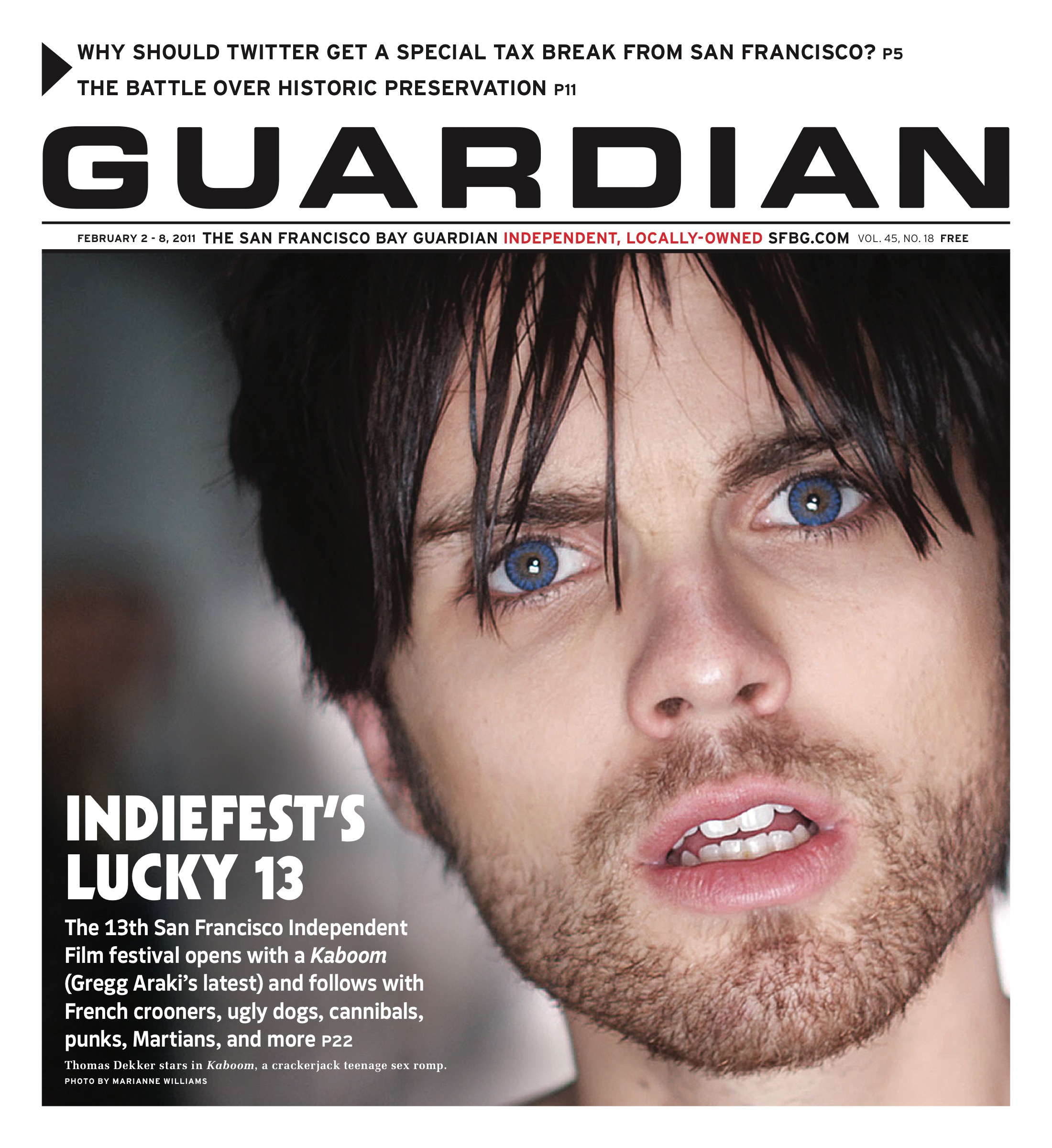
Kaboom (Gregg Araki, U.S.-France, 2010) Gregg Araki’s crackerjack teen sex romp is pure verve — a return to devil-may-care form for fans of The Doom Generation (1995) and Nowhere (1997). Kaboom is right: besides sneaking under the blue velvet rope for a classical mindfuck death trip (there’s even a good part for Jennifer Lynch), Araki and his winning cast let loose a fusillade of dorm-room chatter that runs metaphorical language to its limits. The cult-bidden mystery is too squarely accounted for, but then Kaboom is really as much The Palm Beach Story (1942) as Twin Peaks. Our coed heroes are Stella (Haley Bennett) and Smith (Thomas Dekker), and they’re the only platonic thing in the movie. Taken with Araki’s lasting affection for 1990s culture jamming, this rock-solid friendship is actually quite touching, but Kaboom works best when sliding up and down the Kinsey scale, huffing comic book paranoia for the fun of it. Thurs/3, 7 p.m. (Max Goldberg)
Mars (Geoff Marslett, U.S., 2010) Thanks to Mars, the question “Can mumblecore survive in outer space?” has been answered. (And it’s actually less annoying out there than it is on Earth!) Austin, Texas, writer-director Geoff Marslett’s rotoscope-animated tale follows three astronauts (including m-core heavy Mark Duplass) on a Mars mission, two of whom(Duplass and Zoe Simpson) spark romantically en route. Meanwhile, a solo robot delegation lands ahead of them, discovering new life forms and new emotions, as it sparks romantically, á la Wall-E (2008), with a Mars explorer thought lost a decade before. All the squee gets a little dippy toward the end, but the contrast between slacker and sci-fi genres mostly works. Added points for casting Texas hero Kinky Friedman as the POTUS; Giant Sand’s Howe Gelb did the film’s music and plays the sarcastic head of mission control. Fri/4, 9:15 p.m.; Mon/7, 7 p.m. (Eddy)
Special Treatment (Jeanne Labrune, France, 2010) Let’s get this out of the way first: Isabelle Huppert can do no wrong. That’s not to say she doesn’t occasionally pick terrible projects — she’s just never the thing that’s wrong with them. Special Treatment isn’t so much terrible as it is terribly misguided, contrasting the worlds of psychiatry and prostitution with broad, cartoonish strokes. Huppert plays Alice, a lady of the night who’s thinking about giving up the trade. I don’t blame her; the clients Special Treatment presents her with are the dullest of perverts. One wants her to dress up like a Japanese schoolgirl with a teddy bear and a giant lolly. Another goes the collar and dog bowl route. It’s 2011 — can’t we be a bit more creative with our fetishes? On the opposite end, there’s disenchanted therapist Xavier (Bouli Lanners). And wouldn’t you know it? His patients are photocopies from psychiatry textbooks. There’s a point to be made about the link between paying for sex and paying for someone to listen, but Special Treatment lacks the depth to drive it home. Sat/5 and Feb. 9, 7 p.m. (Peitzman)
Superstonic Sound: The Rebel Dread (Raphael Erichsen, U.K., 2010) “Everything I am came out of music,” says Don Letts — the second-generation Jamaican British DJ, director, and entrepreneur credited with turning punks on to reggae in the late 1970s — in this documentary about his life and work. Much like his contemporary, the late Malcolm McLaren, Letts was a cultural cross-pollinator, working in different mediums while encouraging subcultures to feedback into and off of each other to create something explosive and new. While this serviceable doc lets Letts himself retrace ground that’s been extensively covered elsewhere (it’s worth noting, though, that nearly all the archival footage used was shot by Letts himself), the scenes with his formerly estranged son, who’s also a DJ, are tender and unexpected. Feb. 12, 7 p.m.; Feb. 16, 9:15 p.m. (Matt Sussman)
Transformation: The Life and Legacy of Werner Erhard (Robyn Symon, U.S., 2010) The last thank you in the end credits of this documentary, in bold, is for Werner Erhard. The exiled former est leader and “personal growth” preacher or pioneer should thank director Robyn Symon — I think? – for Transformation, since it’s a 77-minute advertisement for him. Certainly, Erhard is a potentially rich choice in terms of subject matter, but very early on, it’s clear that Symon is out to paint a romantic, positive portrait: testimonials on his behalf are coupled with a low-volume acoustic guitar musical backdrop, and Erhard is even interviewed on the beach. Every once in a while an offhand moment — such as a brief mention of Scientology figurehead L. Ron Hubbard’s predatory view of Erhard — disrupts the soothing flow and opens the possibility of a broader, critical look at the “personal growth” phenomenon. (For the most part, it’s only been dramatized, usually through parody, in films such as 1999’s Magnolia and 1995’s Safe.) As a cultural and even historical figure, Erhard is worthy of an appraisal that’s neither enraptured nor utterly damning. This isn’t it. Thurs/3, 9:15 p.m.; Sat/5, 7 p.m.; Tues/8, 9:15 p.m. (Huston)
Worst in Show (Don Lewis, U.S., 2010) All films about animals in the competitive arena must acknowledge the fundamental truth that the animals themselves are nowhere near as entertaining as their owners. A dog just wants to play, eat, crap, sleep, and maybe have its belly rubbed. The dog’s owner, on the other hand, wants other things — titles, media attention, perhaps an endorsement deal — because they have convinced themselves (as they must convince the judges, and to some degree, the public) that their dog does not just want to play, eat, crap, sleep, and maybe have its belly rubbed. No! Their dog is special. Doc Worst in Show understands this basic drama and finds plenty of eager players in the canine and bipedal contenders, both new and returning, at Petaluma’s annual Ugliest Dog in the World Competition. Amid all the patchy fur, bad eyes, underbites, and malformed legs, it’s the big hearts and outsized egos that truly stand out in this portrait of pageant motherhood at its most extreme. Feb. 9, 9:15 p.m.; Feb. 13, 2:30 p.m. (Sussman)
Je T’aime, I Love You Terminal (Dani Mankin, Israel, 2010) It’s unfair to judge a film by its title, but Je t’aime, I Love You Terminal lets you know exactly what you’re in for. This twee indie romance is Before Sunrise (1995) meets Once (2006) meets every other twee indie romance you’ve ever seen. The film is more mediocre than it is bad, exploring the single-day love affair between two strangers stranded in Prague. Ben is moving from Israel to New York to marry the one that got away. Naturally, he also sings and plays guitar. Emily, an impulsive free spirit, teaches Ben a valuable lesson about living in the moment. Saying this story has been done before is an understatement: Je t’aime packs on indie cliché after indie cliché, without really bothering to develop Ben or Emily into interesting characters on their own. This is a retread without anything to distinguish it from the rest, dragging it down from shrug-worthy to eye-rolling. Feb. 12, 4:45 p.m.; Feb. 14, 9:15 p.m. (Louis Peitzman)
Film Listings
Film listings are edited by Cheryl Eddy. Reviewers are Kimberly Chun, Michelle Devereaux, Peter Galvin, Max Goldberg, Dennis Harvey, Johnny Ray Huston, Louis Peitzman, Lynn Rapoport, Ben Richardson, and Matt Sussman. For rep house showtimes, see Rep Clock. For first-run showtimes, see Movie Guide.
SF INDIEFEST
The 13th SF Independent Film Festival runs Feb 3-17 at the Roxie Theater, 3117 16th St, SF, and the Victoria, 2961 16th St, SF. Tickets (most shows $11) available at www.sfindie.com or by calling 1-800-838-3006.
WED/9
Roxie Special Treatment 7. The Evangelist 7. Worst in Show 9:15. Machete Maidens Unleashed! 9:15.
THURS/10
Roxie RU There 7. The Happy Poet 7. “The Sight of Music” (shorts program) 9:15. Gabi On the Roof 9:15.
FRI/11
Roxie Bloodied But Unbowed 7. The Singularity is Near 7. Machotraildrop 9:15. The Beast Pageant 9:15. Machotaildrop 11:30. The Trashmaster 11:30.
SAT/12
Roxie Toumast: Guitars and Kalashnikovs 2:30. The Beast Pageant 2:30. Corpusse: Surrender to the Passion 4:45. Je T’aime I Love You Terminal 4:45. RU There 7. Superstonic: The Rebel Dread 7. Fuerteventura 9:15. “The End of Love As We Know It” (shorts program) 9:15. Nude Nuns With Big Guns 11:30.
Victoria “When Peaches Met Chucky:” Seed of Chucky 8.
SUN/13
Roxie Worst in Show 2:30. The Singularity is Near 2:30. Food Stamped 4:45. The Trashmaster 4:45. The Sentinel 7. Engine Slayer 7. “Not Your Average Kids’ Show” (shorts program) 7. The Last Circus 9:15. Free Radicals 9:15.
MON/14
Roxie “The End of Love As We Know It” (shorts program) 7. Bloodied But Unbowed 7. “Love Bites: Power Ballad Sing-a-long” 9:15. Je T’aime I Love You Terminal 9:15.
TUES/15
Roxie Food Stamped 7. “Not Your Average Kids’ Show” (shorts program) 7. Fuerteventura 9:15. Corpusse: Surrender to the Passion 9:15.
OPENING
*Cedar Rapids See “Beige to the Bone.” (1:26) Metreon.
Come Undone SFFS Screen presents this Italian import about marital strife in Milan. (2:04) Sundance Kabuki.
The Eagle The mysterious fate of Rome’s Ninth Legion is all the rage lately — well, so sayeth the wee handful of people who caught Neil Marshall’s Centurion last year. For all who missed that flawed if worthy release, The Eagle arrives with a bigger budget and a bigger-name cast to puzzle out exactly what happened when thousands of Roman soldiers marched into what’s now Scotland, circa 120 AD, and never returned. The Eagle‘s Kevin Macdonald (2006’s The Last King of Scotland) bases his film on Rosemary Sutcliff’s popular children’s book, The Eagle of the Ninth, but the theory advanced here resembles Centurion‘s: the army was wiped out by hostile (and occasionally body-painted) natives. Much of The Eagle takes place decades after the disappearance, with the son of a Roman commander (Channing Tatum) scuttling past Hadrian’s Wall to seek truth, clear his family name, and reclaim a highly symbolic bronze eagle. Providing muscle and street smarts (or whatever the equivalent — backwoods smarts?) is slave Jamie Bell. The Eagle is handsomely shot, with some semi-thrilling PG-13 battle scenes, and any spin on Unsolved Mysteries: The Ninth Legion can’t really suck outright. But while Tatum has clearly clocked in the gym time to embody a Roman soldier, he doesn’t possess nearly enough depth (or any interesting qualities whatsoever) to play a character who supposedly has a lot of big emotions to work through. Bell does what he can with his sidekick role, short of performing CPR on his pulse-free costar, but it ain’t enough. Was Vin Diesel unavailable, or what? (1:54) (Eddy)
Gnomeo and Juliet If you willingly see a movie titled Gnomeo and Juliet, you probably have a keen sense of what you’re in for. And as long as that’s the case, it’s hard not to get sucked into the film’s 3D gnome-infested world. Believe it or not, this is actually a serviceable adaptation of Shakespeare’s classic — minus the whole double-suicide downer ending. But at least the movie is conscious of its source material, throwing in several references to other Shakespeare plays and even having the Bard himself (or, OK, a bronze statue) comment on the proceedings. It helps that the cast is populated by actors who could hold their own in a more traditional Shakespearean context: James McAvoy, Emily Blunt, Maggie Smith, and Michael Caine. But Gnomeo and Juliet isn’t perfect — not because of its outlandish concept, but due to a serious overabundance of Elton John. The film’s songwriter and producer couldn’t resist inserting himself into every other scene. Aside from the final “Crocodile Rock” dance number, it’s actually pretty distracting. (1:24) Presidio. (Peitzman)
Just Go With It Adam Sandler, Jennifer Aniston, and Sports Illustrated model Brooklyn Decker’s bikini body star in this rom-com. (1:56) Marina.
Justin Bieber: Never Say Never 3D Blame Canada. (1:45)
Outside the Law Three brothers fight for Algeria’s independence from France in this drama, recently nominated for Best Foreign Language Film. (2:18) Embarcadero.
“2011 Academy Award-Nominated Short Films, Live-Action and Animated” Increase your chances of winning the Oscar pool by sussing out the competition in the short-film categories, presented in two separate-admission engagements. (Live-action, 1:50; animated, 1:25). Lumiere, Opera Plaza.
ONGOING
All’s Well Ends Well 2011 and I Love Hong Kong (1:40) Four Star.
*Another Year Mike Leigh’s latest represents a particularly affecting entry among his many improv-based, lives-of-everyday-Brits films. More loosely structured than 2008’s Happy-Go-Lucky, which featured a clear lead character with a well-defined storyline, the aptly-titled Another Year follows a year in the life of a group of friends and acquaintances, anchored by married couple Tom (Jim Broadbent) and Gerri (Ruth Sheen). Tom and Gerri are happily settled into middle-class middle age, with a grown son (Oliver Maltman) who adores them. So far, doesn’t really sound like there’ll be much Leigh-style heightened emotion spewing off the screen, traumatizing all in attendance, right? Well, you haven’t met the rest of the ensemble: there’s a sad-sack small-town widower, a sad-sack overweight drunk, a near-suicidal wife and mother (embodied in one perfect, bitter scene by Imelda Staunton), and Gerri’s work colleague Mary, played with a breathtaking lack of vanity by Lesley Manville. At first Mary seems to be a particularly shrill take on the clichéd unlucky-in-love fiftysomething woman — think an unglamorous Sex in the City gal, except with a few more years and far less disposable income. But Manville adds layers of depth to the pitiful, fragile, blundering Mary; she seems real, which makes her hard to watch at times. That said, anyone would be hard-pressed to look away from Manville’s wrenching performance. (2:09) Albany, Embarcadero. (Eddy)
Barney’s Version The charm of this shambling take on Mordecai Richler’s 1997 novel lies almost completely in the hang-dog peepers of star Paul Giamatti. Where would Barney’s Version be without him and his warts-and-all portrayal of lovable, fallible striver Barney Panofsky — son of a cop (Dustin Hoffman), cheesy TV man, romantic prone to falling in love on his wedding day, curmudgeon given to tying on a few at a bar appropriately named Grumpy’s, and friend and benefactor to the hard-partying and pseudo-talented Boogie (Scott Speedman). So much depends on the many nuances of feeling flickering across Giamatti’s pale, moon-like visage. Otherwise Barney’s Version sprawls, carries on, and stumbles over the many cute characters we don’t give a damn about — from Minnie Driver’s borderline-offensive JAP of a Panofsky second wife to Bruce Greenwood’s romantic rival for Barney’s third wife Miriam (Rosamund Pike). A mini-who’s who of Canadian directors surface in cameos — including Denys Arcand, David Cronenberg, and Atom Egoyan — as a testament to the respect Richler commands. Too bad director Richard J. Lewis didn’t get a few tips on dramatic rigor from Cronenberg or intelligent editing from Egoyan — as hard as it tries, Barney’s Version never rises from a mawkish middle ground. (2:12) Embarcadero, Shattuck, Sundance Kabuki. (Chun)
Biutiful Uxbal (Javier Bardem) has problems. To name but a few: he is raising two young children alone in a poor, crime-beset Barcelona hood. He is making occasional attempts to rope back in their bipolar, substance-abusive mother (Maricel Álvarez), a mission without much hope. He is trying to stay afloat by various not-quite legal means while hopefully doing the right thing by the illegals — African street drug dealers and Chinese sweatshop workers — he acts as middleman to, standing between them and much less sympathetically-inclined bossmen. He’s got a ne’er-do-well brother (Eduard Fernandez) to cope with. Needless to say, with all this going on (and more), he isn’t getting much rest. But when he wearily checks in with a doc, the proverbial last straw is stacked on his camelback: surprise, you have terminal cancer. With umpteen odds already stacked against him in everyday life, Uxbal must now put all affairs in order before he is no longer part of the equation. This is Alejandro González Iñárritu’s first feature since an acrimonious creative split with scenarist Guillermo Arriaga. Their films together (2006’s Babel, 2003’s 21 Grams, 2000’s Amores Perros) have been criticized for arbitrarily slamming together separate baleful storylines in an attempt at universal profundity. But they worked better than Biutiful, which takes the opposite tact of trying to fit several stand-alone stories’ worth of hardship into one continuous narrative — worse, onto the bowed shoulders of one character. Bardem is excellent as usual, but for all their assured craftsmanship and intense moments, these two and a half hours collapse from the weight of so much contrived suffering. Rather than making a universal statement about humanity in crisis, Iñárritu has made a high-end soap opera teetering on the verge of empathy porn. (2:18) California, SF Center, Sundance Kabuki. (Harvey)
*Black Swan “Lose yourself,” ballet company head Thomas (Vincent Cassel) whispers to his leading lady, Nina (Natalie Portman), moments before she takes the stage. But Nina is already consumed with trying to find herself, and rarely has a journey of self-discovery been so unsettling. Set in New York City’s catty, competitive ballet world, Black Swan samples from earlier dance films (notably 1948’s The Red Shoes, but also 1977’s Suspiria, with a smidgen of 1995’s Showgirls), though director Darren Aronofsky is nothing if not his own visionary. Black Swan resembles his 2008 The Wrestler somewhat thematically, with its focus on the anguish of an athlete under ten tons of pressure, but it’s a stylistic 180. Gone is the gritty, stripped-down aesthetic used to depict a sad-sack strongman. Like Dario Argento’s 1977 horror fantasy, the gory, elegantly choreographed Black Swan is set in a hyper-constructed world, with stabbingly obvious color palettes (literally, white = good; black = evil) and dozens of mirrors emphasizing (over and over again) the film’s doppelgänger obsession. As Nina, Portman gives her most dynamic performance to date. In addition to the thespian fireworks required while playing a goin’-batshit character, she also nails the role’s considerable athletic demands. (1:50) California, Empire, 1000 Van Ness, Piedmont, Presidio, Sundance Kabuki. (Eddy)
*Blue Valentine Sometimes a performance stands out and grabs attention for embodying a particular personality type or emotional state that’s instantly familiar yet infrequently explored in much depth at the movies. What’s most striking about Derek Cianfrance’s Blue Valentine is the primary focus it lends Michelle Williams’ role as the more disgruntled half of a marriage that’s on its last legs whether the other half knows that or not. Ryan Gosling has the showier part — his Dean is mercurial, childish, more prone to both anger and delight, a babbler who tries to control situations by motor-mouthing or goofing through them. But Williams’ Cindy has reached the point where all his sound and fury can no longer pass as anything but static that must be tuned out as much as possible so that things get done. Things like parenting, going to work, getting the bills paid, and so forth. It’s taken a few years for Cindy to realize that she’s losing ground in her lifelong battle for self-improvement with every exasperating minute she continues to tolerate him. Williams’ bile-swallowing silences and the involuntary recoil that greets Dean’s attempts to touch Cindy are the film’s central emotional color: that state in which the loyalty, obligation, fear, pity, or whatever has kept you tied to a failing relationship is being whittled away by growing revulsion. Gosling’s excellent stab at an underwritten part is at a disadvantage compared to Williams, who just about burns a hole through the screen. (1:53) 1000 Van Ness, SF Center, Shattuck, Sundance Kabuki. (Harvey)
*The Company Men Globalization, recession, and the stockholder-driven bottom line are wreaking havoc on business as usual at GTX, a Boston-based veteran manufacturer of shipping containers. CEO James Salinger (Craig T. Nelson) is coolly unconcerned about deep workforce cuts that preserve his fabulous wealth. But co-founder Gene (Tommy Lee Jones), who was not born with the proverbial silver spoon, is appalled by this willingness to sacrifice jobs for high-end investor wealth. (Nonetheless this doesn’t stop Gene from having as his mistress GTX fiscal hatchet-woman Maria Bello, whose part is the script’s weakest element.) His protests do nothing to halt the grim progression of layoffs — which next strike cocky young sales whiz Bobby (Ben Affleck), who’s furiously unable to cope with this blow to his inflated ego despite the levelheaded support of wife Maggie (Rosemarie DeWitt). Even worse equipped for change is 30-year company drone Phil (Chris Cooper), who’s too old to start again in a market where ruthless downsizing allows considerable ageism. With mortgages, college educations, country club memberships (ya gotta network somewhere), and so forth on the line, the protagonists here run the gamut of distressed emotions in coping with their suddenly reduced economic circumstances. TV-famed producer (ER, The West Wing) John Wells’ debut as feature writer director is a white-collar Arthur Miller update, earnest, meaty, and intelligent if unfashionably literal-minded about middle-to-upper-class angst. It’s engrossing for the most part, affording excellent dramatic opportunities to the estimable Jones, Cooper, and yes Ben Affleck — now that the latter is a respected director himself, you are officially granted permission to allow that he can act. If only this solid albeit unremarkable effort didn’t compromise itself with an ending phoned in by the Make A-Wish Foundation after nearly two hours of sober real-world credence. (1:53) 1000 Van Ness, Opera Plaza. (Harvey)
The Dilemma A dilemma: being stuck with two terrible options, say, having to watch a Vince Vaughn movie (that isn’t 1996’s Swingers) or an episode of the King of Queens, starring Kevin James. With Ron Howard’s The Dilemma, you don’t have to choose. Middle American dreams come true by pairing two actors who define undeserving success. The film plays like an extended episode of a CBS sitcom, complete with the timeless trope of average-looking guys coupled with stunning women. However, like James, some things don’t make the transition to the big screen very well, as Howard illustrates perfectly in an intimate scene by contrasting the faces of Vaughn and actress Jennifer Connelly via extreme close-up. The plot? Ronny (Vaughn) catches Geneva (Winona Ryder) cheating on his BFF (James), but can’t tell because they are working on an important project: developing an electric car that’s not “gay.” (Seriously.) Not quite a dilemma, cheap complications prolong the film to the point that you’ll scream for Vaughn to confess and start the credits. (1:58) 1000 Van Ness, SF Center. (Ryan Prendiville)
The Fighter Once enough of a contenda to have fought Sugar Ray Leonard — and won, though there are lingering questions about that verdict’s justice — Dicky (Christian Bale) is now a washed-up, crack-addicted mess whose hopes for a comeback seem just another expression of empty braggadocio. Ergo it has fallen to the younger brother he’s supposedly “training,” Micky (Mark Wahlberg), to endure the “managerial” expertise of their smothering-bullying ma (Melissa Leo) and float their large girl gang family of trigger-tempered sisters. That’s made even worse by the fact that they’ve gotten him nothing but chump fights in which he’s matched someone above his weight and skill class in order to boost the other boxer’s ranking. When Micky meets Charlene (Amy Adams), an ambitious type despite her current job as a bartender, this hardboiled new girlfriend insists the only way he can really get ahead is by ditching bad influences — meaning mom and Dicky, who take this shutout as a declaration of war. The fact-based script and David O. Russell’s direction do a good job lending grit and humor to what’s essentially a 1930s Warner Brothers melodrama — the kind that might have had Pat O’Brien as the “good” brother and James Cagney as the ne’er-do-well one who redeems himself by fadeout. Even if things do get increasingly formulaic (less 1980’s Raging Bull and more 1976’s Rocky), the memorable performances by Bale (going skeletal once again), Wahlberg (a limited actor ideally cast) and Leo (excellent as usual in an atypically brassy role) make this more than worthwhile. As for Adams, she’s just fine — but by now it’s hard to forget the too many cutesy parts she’s been typecast in since 2005’s Junebug. (1:54) Presidio, 1000 Van Ness, SF Center, Sundance Kabuki. (Harvey)
*The Green Hornet I still don’t understand why this movie had to be in 3D, or what Cameron Diaz’s character has to do with anything, but I liked The Green Hornet in spite of myself. Only in Hollywood could artsy director Michel Gondry hook up with self-satisfied comedian Seth Rogen, who stars in and co-wrote this surprisingly amusing (if knowingly lightweight) superhero entry. After the death of his father (a megarich newspaper owner — how retro!), Rogen’s party boy Britt Reid decides, either out of boredom or misdirected rebellion, to become an anti-crime vigilante only pretending to be a criminal. (And that’s about as complicated as this movie gets.) Helping him, which is to say creating all of the cool cars and gadgets and single-handedly winning all of the fist fights, is Kato (Taiwanese actor Jay Chou, taking over the role Bruce Lee made famous). As himself, Reid is so obnoxious he pisses off newspaper editor Axford (Edward James Olmos); as the Hornet, he’s so obnoxious he pisses off actual crime boss Chudnofsky, played by movie highlight Christoph Waltz — more or less doing a Eurotrash twist on his Oscar-winning Inglourious Basterds (2009) Nazi. (1:29) 1000 Van Ness, SF Center. (Eddy)
*Housemaid One of the most famous Korean films of its era — and notorious for its near-horror catalog of shocking behaviors — Kim Ki-young’s original 1960 The Housemaid took a caustic view of the new middle class emerging in a nation still crawling out from under the wreckage of war. Im Sang-soo’s extremely loose new remake — more of a complete rethink — focuses on titular figure Eun-yi (Jeon Do-yeon) , a simple soul who can’t believe her luck at first in finding a job cleaning what might easily be mistaken for a royal palace. But all this changes when Eun-yi lets herself be seduced by her employer and gets pregnant, to the fury of his wife. This triggers a series of acts that grow to encompass near-fatal “accidents,” poisonings, and lines like “How could that bastard do this to me? With the bitch who washes my underwear?!?” Even farther from genre horror that its predecessor, this Housemaid is a glacially reserved black comedy that regards its characters as figures in a gorgeously expensive Architectural Digest landscape. As such it’s witty and entertaining until the very end, when the urge to go overboard can no longer be resisted (apparently), and an unconvincing final atrocity is followed by some sort of dream sequence that simply, ham-fistedly underlines what we already knew: the filthy rich are, well, in need of a moral wash. (1:46) Lumiere, Shattuck. (Harvey)
*The Illusionist Now you see Jacques Tati and now you don’t. With The Illusionist, aficionados yearning for another gem from Tati will get a sweet, satisfying taste of the maestro’s sensibility, inextricably blended with the distinctively hand-drawn animation of Sylvain Chomet (2004’s The Triplets of Belleville). Tati wrote the script between 1956 and 1959 — a loving sendoff from a father to a daughter heading toward selfhood — and after reading it in 2003 Chomet decided to adapt it, bringing the essentially silent film to life with 2D animation that’s as old school as Tati’s ambivalent longing for bygone days. The title character should be familiar to fans of Monsieur Hulot: the illusionist is a bemused artifact of another age, soon to be phased out with the rise of rock ‘n’ rollers. He drags his ornery rabbit and worn bag of tricks from one ragged hall to another, each more far-flung than the last, until he meets a little cleaning girl on a remote Scottish island. Enthralled by his tricks and grateful for his kindness, she follows him to Edinburgh and keeps house while the magician works the local theater and takes on odd jobs in an attempt to keep her in pretty clothes, until she discovers life beyond their small circle of fading vaudevillians. Chomet hews closely to bittersweet tone of Tati’s films — and though some controversy has dogged the production (Tati’s illegitimate, estranged daughter Helga Marie-Jeanne Schiel claimed to be the true inspiration for The Illusionist, rather than daughter and cinematic collaborator Sophie Tatischeff) and Chomet neglects to fully detail a few plot turns, the dialogue-free script does add an intriguing ambiguity to the illusionist and his charge’s relationship — are they playing at being father and daughter or husband and wife? — and an otherwise straightforward, albeit poignant tale. (1:20) Clay, Shattuck, Smith Rafael. (Chun)
Inside Job Inside Job is director Charles Ferguson’s second investigative documentary after his 2007 analysis of the Iraq War, No End in Sight, but it feels more like the follow-up to Alex Gibney’s Enron: The Smartest Guys in the Room (2005). Keeping with the law of sequels, more shit blows up the second time around. As with No End in Sight, Ferguson adeptly packages a broad overview of complex events in two hours, respecting the audience’s intelligence while making sure to explain securities exchanges, derivatives, and leveraging laws in clear English (doubly important when so many Wall Street executives hide behind the intricacy of markets). The revolving door between banks, government, and academia is the key to Inside Job‘s account of financial deregulation. At times borrowing heist-film conventions (it is called Inside Job, after all), Ferguson keeps the primary players in view throughout his history so that the eventual meltdown seems anything but an accident. The filmmaker’s relentless focus on the insiders isn’t foolproof; tarring Ben Bernanke, Henry Paulson, and Timothy Geithner as “made” guys, for example, isn’t a substitute for evaluating their varied performances over the last two years. Inside Job makes it seem that the entire crisis was caused by the financial sector’s bad behavior, and this too is reductive. Furthermore, Ferguson does not come to terms with the politicized nature of the economic fallout. In Inside Job, there are only two kinds of people: those who get it and those who refuse to. The political reality is considerably more contentious. (2:00) Lumiere, Shattuck. (Goldberg)
*Ip Man 2: Legend of the Grandmaster There’s an ounce of irony that the Wing Chun master who ended up popularizing martial arts throughout the world by way of his most famous pupil, Bruce Lee, would still be the subject of contention (see dueling biopics like Wong Kar-wai’s forthcoming The Grandmasters) and the center of passionate nationalism. In 2008’s Ip Man, the modest master (Donnie Yen) pit his considerable skills against the karate of the invading Japanese army, and here, in ’50s Hong Kong, he tests his skills against the British colonists’ boxing champion. Imperial villainy is painted in broad strokes, but that’s the only predictable stumble in this otherwise step-above effort, with its handsome, sepia-toned art direction and its martial arts choreography by Sammo Hung. As 2 opens, the noble Ip Man has survived the tribulations of WWII only to find himself tussling with rival martial arts groups in rough-and-tumble HK in his efforts to start a Wing Chun school. His most formidable opponent is the powerful master Hung Chun-nam (Hung, who threatens to steal scenes from an earnest if adept Yen), until the two are finally brought together by shared Chinese family values in the ugly face of colonial injustice. The focus of this sequel, once pegged to Ip Man and Lee’s relationship, shifted when director Wilson Yip and company failed to finalize film rights with the star’s descendants, yet much like its near-saintly subject, Ip Man 2 succeeds despite all obstacles. (1:48) Shattuck. (Chun)
The King’s Speech Films like The King’s Speech have filled a certain notion of “prestige” cinema since the 1910s: historical themes, fully-clothed romance, high dramatics, star turns, a little political intrigue, sumptuous dress, and a vicarious taste of how the fabulously rich, famous, and powerful once lived. At its best, this so-called Masterpiece Theatre moviemaking can transcend formula — at its less-than-best, however, these movies sell complacency, in both style and content. In The King’s Speech, Colin Firth plays King George VI, forced onto the throne his favored older brother Edward abandoned. This was especially traumatic because George’s severe stammer made public address tortuous. Enter matey Australian émigré Lionel Logue (Geoffrey Rush, mercifully controlled), a speech therapist whose unconventional methods include insisting his royal client treat him as an equal. This ultimately frees not only the king’s tongue, but his heart — you see, he’s never had anyone before to confide in that daddy (Michael Gambon as George V) didn’t love him enough. Aww. David Seidler’s conventionally inspirational script and BBC miniseries veteran Tom Hooper’s direction deliver the expected goods — dignity on wry, wee orgasms of aesthetic tastefulness, much stiff-upper-lippage — at a stately promenade pace. Firth, so good in the uneven A Single Man last year, is perfect in this rock-steadier vehicle. Yet he never surprises us; role, actor, and movie are on a leash tight enough to limit airflow. (1:58) Albany, Embarcadero, Empire, Marina, 1000 Van Ness, Piedmont, Sundance Kabuki. (Harvey)
The Mechanic Apparently The Mechanic is a remake of 1972 film starring Charles Bronson, but that’s kind of beside the point. This is simply another vehicle for Jason Statham to shoot people, set off big explosions, and make straight men feel sexually confused. And there’s really nothing wrong with that, as long as you know what you’re in for. Statham plays expert assassin Arthur Bishop, who is forced to train Steve McKenna (Ben Foster) in the fine art of killing. There’s really not much more to it than that. The Mechanic does exactly what it needs to, getting louder and bloodier with each passing minute. Statham is really just playing himself at this point — and he’s damn good at it. Foster isn’t bad at stepping into action flick shoes, although he never quite reaches Statham’s testosterone-drenched heights. If you’re looking for any modicum of complexity, The Mechanic is not your best bet. Otherwise, sit back, shut off your brain, and enjoy. (1:40) 1000 Van Ness, SF Center. (Peitzman)
No Strings Attached The worst thing about No Strings Attached is its advertising campaign. An eyeroll-worthy tagline — “Can sex friends stay best friends?” distracts from the fact that this is a sharp and satisfying romantic comedy. Perhaps it’s not the most likely follow-up to Black Swan (2010), but Natalie Portman is predictably charming, and Ashton Kutcher proves he’s leading man material after all. They’re aided by an exceptional supporting cast, including indie darlings Greta Gerwig and Olivia Thirlby, and underrated comic actors Lake Bell and Mindy Kaling. No Strings Attached is a welcome return to form from director Ivan Reitman, who gave us classics like Ghostbusters (1984) before tainting his image with Six Days Seven Nights (1998) and My Super Ex-Girlfriend (2006). There are likely going to be many who will dismiss Reitman’s latest out of hand — and with those misleading trailers and posters, it’s hard to blame them. But I advise you to give No Strings Attached a chance: at the very least, it’ll counter the image of Portman tearing at a stubborn hangnail. (1:50) 1000 Van Ness, Presidio. (Peitzman)
*Nuremberg: Its Lesson For Today “We will show you their films&ldots;” So said Justice Robert Jackson during his opening remarks at Nuremberg, setting the stage not only for the historic prosecution but also for film history. After so much subsequent repackaging, it’s bracing being returned to this initial use of the Nazi archive as hard evidence in Nuremberg: Its Lessons for Today, the documentary produced by Pare Lorentz and the Schulberg brothers for the Office of Strategic Services in 1948. Though it screened widely in postwar Germany, Nuremberg never made it to American screens — one wonders whether the film’s vision of US-USSR cooperation wasn’t as much a stumbling block as its images of atrocities. While Nuremberg won’t soon replace Eichmann in Jerusalem as a probing account of the war tribunals, this crisp restoration remains a fascinating document of the moral condemnation of Nazi Germany in formation. Modern viewers may be surprised, for instance, by how long it takes before the Holocaust (still not called by that name, of course) is invoked. History casts a withering eye on Russian and American prosecutors denouncing military aggressions and needless civilian deaths, but one is nonetheless struck and even moved by what Nuremberg represents — specifically, the need to give a rational account of the terms of the peace, and to begin remembering. As with all the films produced by Lorenz, Nuremberg benefits from great rhetorical economy and fluid pacing. Now one only wishes that John Huston’s 1946 Let There Be Light — a harrowing postwar document of mentally disturbed veterans also produced for (and then suppressed by) the Army — would receive the same treatment. (1:18) Shattuck. (Goldberg)
127 Hours After the large-scale, Oscar-draped triumph of 2008’s Slumdog Millionaire, 127 Hours might seem starkly minimalist — if director Danny Boyle weren’t allergic to such terms. Based on Aron Ralston’s memoir Between a Rock and a Hard Place, it’s a tale defined by tight quarters, minimal “action,” and maximum peril: man gets pinned by rock in the middle of nowhere, must somehow free himself or die. More precisely, in 2003 experienced trekker Ralston biked and hiked into Utah’s Blue John Canyon, falling into a crevasse when a boulder gave way under his feet. He landed unharmed … save a right arm pinioned by a rock too securely wedged, solid, and heavy to budge. He’d told no one where he’d gone for the weekend; dehydration death was far more likely than being found. For those few who haven’t heard how he escaped this predicament, suffice it to say the solution was uniquely unpleasant enough to make the national news (and launch a motivational-speaking career). Opinions vary about the book. It’s well written, an undeniably amazing story, but some folks just don’t like him. Still, subject and interpreter match up better than one might expect, mostly because there are lengthy periods when the film simply has to let James Franco, as Ralston, command our full attention. This actor, who has reached the verge of major stardom as a chameleon rather than a personality, has no trouble making Ralston’s plight sympathetic, alarming, poignant, and funny by turns. His protagonist is good-natured, self-deprecating, not tangibly deep but incredibly resourceful. Probably just like the real-life Ralston, only a tad more appealing, less legend-in-his-own-mind — a typical movie cheat to be grateful for here. (1:30) Four Star. (Harvey)
*Rabbit Hole If Rabbit Hole doesn’t sound like the kind of movie you’d want to watch, I don’t blame you. Following the lives of a married couple dealing with the loss of their young son, the film sounds a lot like the kind of Lifetime movie you accidentally spend a hung over Sunday sniffling through. But Rabbit Hole is a smart, complex addition to the genre, with exceptional performances from leads Nicole Kidman (Becca) and Aaron Eckhart (Howie), and a script by David Lindsay-Abaire, adapting his Pulitzer Prize-winning play. Director John Cameron Mitchell infuses Rabbit Hole with his trademark dark humor, creating a film that understands the serious toll grief takes but isn’t afraid to step back and laugh at life, too. Special attention must also be paid to the supporting cast, including Dianne Wiest as Becca’s mother, and newcomer Miles Teller as Jason. Explaining Jason’s role would be giving away too much — it’s enough to say that his presence is part of what elevates Rabbit Hole from grief porn to one of this year’s best. (1:32) Lumiere. (Peitzman)
The Rite There are times when The Rite crosses the threshold from bad-bad to good-bad — bits of overacting and absurdity that almost launch the film into potential cult classic territory. Sadly, those moments only occur after an hour of the bad kind of boring: by the time you get to Anthony Hopkins’ most ludicrous performance to date, you’re kind of just wishing The Rite would exorcise itself. The story is a near carbon copy of The Exorcist (1973), though as is the case with many films in the genre, The Rite feels that by acknowledging the clichés, it can continue to use them. Colin O’Donaghue plays Michael Kovak, a soon-to-be-priest dabbling in atheism. Hopkins is Father Lucas, the seasoned exorcism expert who takes Michael under his wing. You can figure out the rest. The Rite could have been a fun movie — the moment in which Father Lucas answers his cell phone during an exorcism gave me some hope — but ultimately the film takes itself too seriously. It is inspired by true events, after all. (1:47) 1000 Van Ness, Shattuck. (Peitzman)
The Roommate (1:33) 1000 Van Ness.
Sanctum An underwater thriller bankrolled by James Cameron, filmed using techniques developed for Avatar (2009), Sanctum is 3D like that blockbuster, and thoroughly two-dimensional. As a storm approaches, explorers are deep inside Papua New Guinea’s geological anus. Before you can say “What could possible go wrong, diving in caves?” (which a character actually does, in full Cameron-esque wank mode), everything floods and the fight for survival starts. A secondary plot concerns tension between a young diver (Rhys Wakefield) and his overbearing, tough-as-nails pro-explorer father (Richard Roxburgh), but this is a movie to watch to see who lives rather than reconciles. To its credit, the danger is mostly handled with a face smashing, drowning brutality rather than drawn-out melodrama (although Ioan Gruffudd gives a characteristically cheesy performance as a clichéd tycoon). Sanctum is at it’s best when submerged (and no one’s talking) but the atmosphere is generally robbed by David Hirschfelder’s unnecessary orchestra score. (1:43) 1000 Van Ness. (Prendiville)
*The Social Network David Fincher’s The Social Network is a gripping and entertaining account of how Facebook came to take over the known social-networking universe. In this version of events — scripted by Aaron Sorkin and based on Ben Mezrich’s book The Accidental Billionaires, in turn based substantially on interviews with FB cofounder Eduardo Saverin, with input from Mark Zuckerberg icily absent — a girlfriend’s dumping of Zuckerberg (Jesse Eisenberg) on a crisp evening in 2003 is the impetus in his headlong quest for a “big idea.” The film is structured around the conference-room depositions for two separate lawsuits, brought against Zuckerberg by Saverin (Andrew Garfield) and by fellow Harvard entrepreneurs Tyler and Cameron Winklevoss (Armie Hammer) and Divya Narendra (Max Minghella) for crimes involving intellectual property and vast scads of retributive money. Unless Zuckerberg decides to post it on Facebook (which he probably shouldn’t, given the nondisclosure vows that capped off the first round of lawsuits), we’ll never know what truly motivated him and how badly he screwed over his friends and fellow students. But Fincher and Sorkin have crafted a compelling, absorbing, and occasionally poignant tale of how it could have happened. (2:00) Bridge, Piedmont, Shattuck. (Rapoport)
Somewhere A lonely Ferrari zooms around a deserted track, over and over and over again. The opening scene of Sofia Coppola’s latest, Somewhere, is such an obvious metaphor that at first I thought the director was joking. Actually, she’s not: Somewhere is indeed a repetitous movie about a very boring, very ennui-laden individual, who happens to be a movie star with the marquee-ready name of Johnny Marco (Stephen Dorff). Now that you’ve been smacked over the head with metaphor, feel free to play spot the subtext: Johnny lives at Sunset Boulevard haunt the Chateau Marmont, legendary for its often-behaving-badly celebrity clientele. His life is an endless progression of blah (wake up, smoke, pop a Propecia, eyefuck and fuck random female admirers), broken up by job obligations — the tedium of a press conference here, the drudgery of a visit to the special-effects make-up studio there. Sigh. Would any director not as privileged as Coppola dare to focus on a character whose massive wealth can’t at all assuage his existential crisis? Money may not buy happiness, but it’s kind of hard to feel sorry for a guy whose depression plays out as he floats the day away at a luxury hotel. Fortunately, there is a bright spot in all this: mostly-absentee dad Johnny has a kid, Cleo, a tween sprite played by the charming Elle Fanning. Cleo is the only meaningful thing in Johnny’s life, and the only interesting thing that happens in this glacially-paced, bellybutton-obsessed movie. (1:38) SF Center. (Eddy)
*The Time That Remains Filmmaker Elia Suleiman has achieved the seemingly unimaginable: an impish, insightful comedy about the everyday life of a Palestinian family and its Nazareth neighborhood, from 1948, and the creation of Israel, through today. Borrowing some of the elegant, eloquent long-shot compositions of Jacques Tati, as well as the French legend’s bemused, ever-amused long-view perspective on modern life, Suleiman doesn’t shy away from the injustices suffered by the Palestinians. The forbidding shadows cast by Israeli tanks and patrolling soldiers loom over everything undertaken by the Suleiman clan and their community — a family meal, a dance party, nighttime fishing, a work errand that ends with an act of life-saving courage. In their at-times-zenlike, at-times-unpredictable responses to their understandably untenable situation, the Suleimans start to seem like the unlikely, impassive distant relatives of the zany, exploding familia in Pedro Almodóvar’s What Have I Done to Deserve This? (1984). As Suleiman’s decent, resistant father is tortured and harassed and his mother pens letters to relatives in exile, it’s easy to picture this family, much like Almodóvar’s post-Franco clan, as one on the verge of a perpetual nervous breakdown. Instead, they rise above, getting a black-humored bird’s eye view of, say, a man taking out the garbage in the sights of a tank gun, with Suleiman bringing a very real, extraordinary poetry to each vignette about life under pressure. (1:49) Sundance Kabuki. (Chun)
Tron: Legacy A rare sequel among remakes, Tron: Legacy remains true to the 1982 nerd cult classic: it’s essentially a silly movie about being transported into a computer world where everyone dresses in rave couture. Jeff Bridges returns, now in opposing roles. On one side he’s computer genius Kevin Flynn, bearded zen master, and across the uncanny valley he’s CLU, an ageless software lord. Flynn’s been stuck in the Matri…er…Grid for decades, as CLU followed his programming to its logical conclusion: genocide. This is a bit too heavy of a theme for a film where almost every character gets blown to bytes upon introduction (cough, Michael Sheen, cough) but the light cycles and death pong are really cool in 3D. The plot, when it’s not setting up Disney’s inevitable sequels (hello, pointless Cillian Murphy) is Star Wars (1977), except Obi-wan Lebowski is the father. The son is Sam (Garrett Hedlund), whose good looks, penchant for extreme sports, and vacuous personality are the perfect avatar for our geek fantasy, where women strip us bare and are sexy guard dogs (Olivia Wilde.) While not passing the Bechdel Test, the film may be worth admission to hear the Dude’s Jedi utter “It’s biodigital jazz, man!” Look out for a special cameo by Daft Punk, playing hits from its score, which sounds like Kraftwerk mixing Vangelis and Danny Elfman. They’ll be the ones wearing helmets. No, the other ones. (2:05) 1000 Van Ness. (Prendiville)
*True Grit Jeff Bridges fans, resist the urge to see your Dude in computer-trippy 3D and make True Grit your holiday movie of choice. Directors Ethan and Joel Coen revisit (with characteristic oddball touches) the 1968 Charles Portis novel that already spawned a now-classic 1969 film, which earned John Wayne an Oscar for his turn as gruff U.S. Marshall Rooster Cogburn. (The all-star cast also included Dennis Hopper, Glen Campbell, Robert Duvall, and Strother Martin.) Into Wayne’s ten-gallon shoes steps an exceptionally crusty Bridges, whose banter with rival bounty hunter La Boeuf (a spot-on Matt Damon) and relationship with young Mattie Ross (poised newcomer Hailee Steinfeld) — who hires him to find the man who killed her father — likely won’t win the recently Oscar’d actor another statuette, but that doesn’t mean True Grit isn’t thoroughly entertaining. Josh Brolin and a barely-recognizable Barry Pepper round out a cast that’s fully committed to honoring two timeless American genres: Western and Coen. (1:50) California, Empire, Four Star, 1000 Van Ness, Presidio, SF Center, Sundance Kabuki. (Eddy)
The Way Back Master director Peter Weir returns to the man-versus-nature-and-each-other canvas of his previous film, 2003’s Master and Commander: The Far Side of the World, for this truth-based tale about a multinational crew of gulag escapees during the early days of World War II. Figuring he’d rather take his chances battling the elements (bitter cold, extreme heat, wolves, bounty-hunting natives, would-be cannibals) than face certain death doing back-breaking work in Siberia, Polish prisoner Janusz (Jim Sturgess from 2007’s Across the Universe) organizes a breakout. Joining him are a ragtag group, most of whom have been incarcerated for minor offenses that nonetheless rankled the ruling Communists. (One exception: Colin Farrell’s heavily tattooed, knife-wielding career criminal.) As the men, including taciturn American Mr. Smith (Ed Harris), slog across treacherous terrain, they lose some of their own numbers, and pick up another fugitive, fragile teenager Irina (Saoirse Ronin). The Way Back is a high-quality production, and certainly one of recent years’ most successful attempts at this kind of survivalist epic. But it throws exactly no curveballs (see: Werner Herzog’s 2006 Rescue Dawn, similar but far less predictable), and like its characters trudges toward a dutifully noble finish. (2:13) Opera Plaza, Shattuck. (Eddy)
*Winter’s Bone Winter’s Bone has already won awards at the Berlin International Film Festival and the Sundance Film Festival, but it’s the kind of downbeat, low-key, quiet film that may elude larger audiences (and, as these things go, Oscar voters). Like Andrea Arnold’s recent Fish Tank, it tells the story of a teenage girl who draws on unlikely reserves of toughness to navigate an unstable family life amid less-than-ideal economic circumstances. And it’s also directed by a woman: Debra Granik, whose previous feature, 2004’s Down to the Bone, starred Vera Farmiga (2009’s Up in the Air) as a checkout clerk trying to balance two kids and a secret coke habit. Drugs also figure into the plot of the harrowing Winter’s Bone, though its protagonist, Ree Dolly (Jennifer Lawrence), is faced with a different set of circumstances: her meth head father has jumped bail, leaving the family’s humble mountain home as collateral; the two kids at stake are her younger siblings. With no resources other than her own tenacity, Ree strikes out into her rural Missouri community, seeking information from relatives who clearly know where her father is — but ain’t sayin’ a word. It’s a journey fraught with menace, shot with an eye for near-documentary realism and an appreciation for slow-burn suspense; Lawrence anchors a solid cast with her own powerful performance. Who says American independent film is dead? (1:40) Opera Plaza. (Eddy)
REP PICKS
*Rope Alfred Hitchcock is known for an unparalleled attention to film form and, well, being a twisted son of a gun. In 1948’s Rope, two well-to-do young Leopold and Loeb types, John Dall (1950’s Gun Crazy) and Farley Granger (1951’s Strangers on a Train), stare too far into Nietzsche’s abyss and decide it would be a fine idea to commit murder and then throw a dinner party. It’s ripped from the headlines and cribbed from The Tell-Tale Heart, as Jimmy Stewart is tasked with uncovering their deed. On the other side of Hitchcock, it’s an extreme exercise in film form, choreographed to appear as one continuous shot. Some of the hidden cuts are as hard to spot as the director’s signature cameo. (1:20) Pacific Film Archive. (Prendiville)
5 things you didn’t know about cable cars
Get it out of the way now: roll those eyes. The cable cars are something no native San Franciscan would ever bring up in polite (that is, local) company, let alone write about in a blog post. But fact is, there’s a reason why these things are iconic. Those cars have as speckled and quirky a history as the City by the Bay.
San Franciscans steeped in facts and figures about the tourist-movers probably know that ours is the last operating cable car system in the world and that its design hasn’t changed much since Andrew Hallidie devised it upon seeing an overloaded horse-car slip down a hill in the rain. Perhaps you’ve heard that the four remaining lines each rely on a continuous loop of cable running under your feet at a constant 9.5 miles per hour, powered by electrical motors and a system of pulleys and huge wheels. If you’ve ever visited the Cable Car Museum (c’mon folks, it’s free) you’ve seen the sheaves pulling the cable along, and you’ve learned that the cars operate by grabbing the cable with giant pliers that reach through the floor and into a slot in the street where the cable runs.
Bored yet? Stifle that yawn, we’re just getting started. Read on for five things you haven’t heard about those postcard pretties.
I know why the caged bird . . . rings?
The famous author, poet, and social activist Maya Angelou dropped out of Mission High School at 15 to work the cable cars. “The thought of sailing up and down the hills of San Francisco in a dark-blue uniform, with a money changer at my belt, caught my fancy,” she later recalled in 1969’s I Know Why the Caged Bird Sings. Angelou won the job as San Francisco’s first African American (and female) cable car conductor by heckling reluctant company managers until they caved and she was hired to ring the cars’ bells and swing “on the back of the rackety trolley, smiling sweetly and persuading [her] charges to ‘step forward in the car, please.’”
Smokin’ tracks
Ever noticed a certain funk riding in a cable car? It wasn’t the guy next to you. It’s caused by two materials that play a critical role in starting and stopping the car: the pine resin that greases the cable and the wooden brake shoes, made from Douglas fir, that press against the tracks to stop the car. Friction causes the wooden brakes to smoke, meaning they must be replaced every three days with new ones milled locally at a shop on 22nd Street and Indiana. Friction from the pliers-like grip grabbing the cable likewise melts and then vaporizes the pine tar. This results in a smooth, lubricated start-up, but is also responsible for the burning and odor. (And if that sounds a bit too familiar, perhaps you should call your doctor…) Like the wooden brakes, the grip that grabs the cable must be replaced every three days for wear.

The cable car: the Imelda Marcos of public transportation. (Stack of brake shoes at the Cable Car Museum). Photo by Emily Appelbaum
Move over, men
Working as a grip operator requires incredible dexterity and also the nuanced ability to feel the cable, picking it up slowly to ease the car to full speed. Though well over half of trainees drop from the teaching program each year, the required combination of subtlety and strength make gripping the perfect job for powerful women like Fannie Mae Barnes, who became the city’s first female grip in 1997.
“A lot of guys will try to muscle the grip, but it’s really more a finesse thing – you have to leverage it with your body weight,” Barnes told the Guardian in an interview last fall. Barnes retired in 2007, but when San Francisco’s second female grip, Willa Johnson, took the post last April, Barnes presented her with a pair of custom-made pink leather grip gloves, emblazoned with her name.
Beyond the bells
The Slot Blades, named for the cars’ emergency braking system, is a band composed entirely of SF Muni workers who conduct and grip the city’s cable cars. Their moniker is a tongue of metal that, when deployed, wedges itself so tightly against the tracks it must be removed with a torch. The cable-proud band gets together for practices and jam sessions in addition to playing at Muni and cable car-related events like the annual Cable Car Bell Ringing Contest – now in its 49th year.
Falling cars and free love
Forget stranded cables and smashed cars: San Francisco’s most infamous cable car victim may be Gloria Sykes, who claimed that a 1964 accident left her with a black eye, bruises, and an unquenchable sex drive.
When a mechanical failure caused the car she was riding to slide backwards down a hill, Sykes – later dubbed the “cable car nymphomaniac” by the daily newspapers — sued the City of San Francisco for a half million dollars. Her lawyers argued that the sexual abuse she suffered as a child combined with the stress of the accident caused her to seek the company of up to 50 sexual partners a week. After listening to 44 taped transcripts of an electrically hypnotized Sykes, the jury awarded the insatiable (ha) plaintiff $50,000 in damages. Sykes’ case is cited as one of the earliest court-recognized examples of post-traumatic stress disorder.
San Francisco Cable Car Wheelhouse from Emily Appelbaum on Vimeo.
Check out the inner wheelings and dealings of the SF Cable Car Museum. Here, the whirling electric motors that power the cars. Video by Emily Appelbaum
Century-old smut hits the Red Vic

Sex education, y’all. Despite the fact that today’s parents outsource math lessons to Blue’s Clues, play time to iPhones, and secret homosexual programming to Gabba Gabba Hey!, the continuing furor over sex education in schools just refuses to quit talking, finish its drink, and go home. But, as a reclaimed 1900s reel of French brothel movies showing at the Red Vic Movie House this weekend (Fri/28 – Mon/31) proves, sex ed has always been around – it just used to happen in whorehouses.
The Good Old Naughty Days is a 69 (ha! Really!)-minute collection of silent shorts that were found in a well-to-do French family’s attic nearly a century after they were filmed. Most likely, according to the film’s producer Michel Reilhac, they were shot by conventional film crews on their day off. They’re low-budget affairs whose most salient expense was the fees of the prostitutes who starred in them — men and women whose bodies are un-siliconed and unaware of the histrionic boinking that would some day pass for erotic film. The movies were co-opted by brothels, who would play them in their waiting rooms as young gentleman killed time before their whoring.
Which was, of course, where young cats learned about sex back in those days. When they showed up as virgins to the bordello, berets and handlebar mustaches a-twitchin’, these were the films to at least prevent them from shouting “qu’est-ce que c’est!” when their lady of the evening shuffled off her chemise (or their gentleman of the night his breeches, lest we forget). There’s gay and lesbian couplings, even priests and nuns — these last having a good time with candles.
Judging from The Good Old Naughty Days, them last century folk even got down in ways that we cultured cyborgs might find a wee bit mutt-like – apparently there’s a scene with a pooch unconcerned with which species recieves his Rover. In an interview with the UK Guardian (our namesake, holler), Reilhac says a few women took offense at this inter-mammal consorting at an early screening, to which he had this to offer: “thank God I took out the duck scene.”
But do not mourn the loss of this duck scene, San Francisco. Go out and be ever so naughty at the Red Vic – the two and four p.m. showings on Saturday and Sunday might make for a tasty post-brunch educational session. Just remember there is no sex-for-money waiting for you by the popcorn machine. Just wooden bowls, probably.
The Good Old Naughty Days
Fri/28 – Mon/31 7:15 and 9:15 p.m. (also Sat/29 – Sun/30 2 and 4 p.m.), $8
Red Vic Movie House
1727 Haight, SF
(415) 668-3994
Hot sexy events January 26 – February 1

Glory be OneTaste. This SF-based company is devoted to the singular pursuit of female pleasure, offering lessons in their “slow sex” technique, detailed re-programming of one’s touch-stroke-lick that all but guarantees that at-times elusive female orgasm. Believe it. Fitness-business guru-crazy Tim Ferriss describes a class with OneTaste in his new book The 4-Hour Body as being highly informative and bewilderingly hands-on. He also likens the female genitalia to an Imperial Guard from Star Wars, but that is besides the point (kind of). At any rate, OneTaste is conducting a one-off course at the Polk Street Good Vibrations this week on discovering your deepest desires (Mon/31), making it but one of the can’t-miss sex events on offer out there in pervertlandia. Enjoy, kids!
Bare Chest Calendar semi-finals
For 28 years, iron-chested menfolk have bravely paraded their bulging pectorals about for a good cause – the Bare Chest Calendar, which raises money for the AIDS Emergency Fund and Positive Resources Center. You can nobly help in the effort, just attend the semi-final and final rounds of the contest that will determine next year’s calendar boys and cheer your ass off. By the looks of the contenders, that shouldn’t be too difficult.
Thurs/27 9:30 p.m.,
Powerhouse
1347 Folsom, SF
Transgender HIV/STI testing
Sure, it happens every week, but that’s no reason not to give St. James’ Infirmary a shout-out over their excellent, sensitive testing and trans-hormone-knowledgeable services that are available each Thursday afternoon. With all the scary cuts in the area as of late (see event Sun/30), it’s good to know that there are still safe, friendly places to go to stay healthy, happy, and sexy.
Thurs/27 1 – 4 p.m., free
St. James’ Infirmary
1372 Mission, SF
(415) 554-9634
email sjimedical@yahoo.com for appointment
Boots
Chaps is putting the call out for boot pigs, so oink oink Wilbur – grease up your city Stompers and cruise to Folsom Street. There’s nothing sexier for a leatherman than the threat of getting crushed under the stampede of hairy-chested hotties that will be thrusting out their steel toes for a buff by bootblack Miss V. The Stompers gang hosts and who’s that behind the bar? The sexy David, that’s who.
Sat/29 9 p.m. – 2 a.m., free
Chaps
1225 Folsom, SF
(415) 255-2427
Hotties 4 H0m0 Health Care: A Fundraiser for Lyon-Martin Health Services
Not cool. There’s not enough clinics in this city-state-universe that cater to queer women and transgendered folk, and one of the finest, Lyon-Martin Health Services, is facing closure due to serious financial problems. How much do they need to keep their doors open? Try $250,000 – which sounds like a lot, but given all the hullabaloo the community is raising to keep the place afloat, it’s totally doable. Here’s one way to support the clinic: shaking your ass to DJ Bootie Klap and wriggling in time to performances by burlesque star Dottie Lux and friends. (Here’s some other ways, too!)
Sun/30 7-10 p.m., $5-20 sliding scale
El Rio
3158 Mission, SF
(415) 282-3325
Facebook: Hotties for H0m0 Health Care
Eclipse
Hey ladies, Ms. Cat (leather community stalwart and 2010 Ms. Leather runner-up) is celebrating her birthday and she needs you to reel back that hand and give her a good day-of-birth spanking. The Citadel’s female-only BDSM party, Eclipse, is back in action, which means you should pack up your toys, friends, or just come solo and open to this dungeon time-party time.
Sat/29 8 p.m. – 1 a.m., $25 members only
SF Citadel
1277 Mission, SF
(415) 626-2746
The Depths of Desire
Secret longings are all well and good, as long as the longers themselves know what they are. Local sex education group OneTaste (famed for the dissection of the female orgasm) breaks down what one can do to get at one’s deepest longings and sassiest salaciousness.
Mon/31 6 – 8 p.m., $20-25
Good Vibrations
1620 Polk, SF
(415) 345-0500
alt.sex.column: Get fit

Dear Readers:
The subject of size-discordant couples is a perennial favorite and will only get more so until such time as we Americans fulfill our apparent destiny and become a nation of like-size giants in height and girth. Until then, though, making a couple’s ends meet will continue to be an issue and a puzzlement. Pillows, ramps, and wedges sold expensively as sex pillows and less appealingly but more affordably at medical-device emporia will do but many couples would rather eschew such artifice and stick with the basics. First, short woman, tall man.
The woman can kneel on the bed, crouching forward a bit and stabilizing herself with her arms, ass toward the edge. Unless the guy is the Jolly Green Giant, he should be able to steer into her with just a little doing. She will be more comfortably positioned on the bed than if bending over while standing up, too.
Now, heavy woman, thin man. For this, I took the discussion to one of the invisible rooms full of invisible friends I frequent out on the interwebs. Here is what my favorite invisifriend said, in all her surprising, not to say shocking, candor. Say thank you!
I am very fat. My husband and I are both about the same height, and he’s slender. We both have joint problems. We also have awesome sex. Here are some things that work for us.
The best all-around position is what we call scissors. I lie on my left side, knees slightly bent, and raise my right leg. He kneels and enters me, and we roll over, me pushing off with my left leg so that he winds up lying on his side and I have my right leg over him. My left leg is between his two legs. I am almost, but not quite, lying on my back, and we’re at an angle to each other. This is great because it’s completely comfortable, he can reach to touch me, and we both have good access to me for hands or vibrator.
If you have the right furniture, cowgirl can be very easy. This position blows his mind. We line up a rectangular ottoman perpendicular to the sofa, and he lies back — propped up on big pillows — with his butt on the ottoman. He’s lying near one end of the sofa so that I can use the arm to help take my weight. All I do is straddle the ottoman and him (they’re almost the same width) and lower myself. Once down, I can rest my arms on the sofa, lean forward, or sit upright. He has a fantastic view and it’s perfect for kissing. Only drawback for me is that I can’t really get to my clit.
Three or four pillows also helps for doggy-style, so I don’t have to rest my entire weight on my arms. The sofa and ottoman are also handy for this. I put one knee on the sofa, one on the ottoman, and he stands behind me while I rest against the sofa arm, piled with cushions.
So get on that, readers, won’t you?
Love, Andrea
Got a question? Email Andrea at andrea@mail.altsexcolumn.com
Film Listings
Film listings are edited by Cheryl Eddy. Reviewers are Kimberly Chun, Michelle Devereaux, Peter Galvin, Max Goldberg, Dennis Harvey, Johnny Ray Huston, Louis Peitzman, Lynn Rapoport, Ben Richardson, and Matt Sussman. For rep house showtimes, see Rep Clock. For first-run showtimes, see Movie Guide at www.sfbg.com. For complete film listings, see www.sfbg.com.
OPENING
Biutiful See “Que Tristeza.” (2:18) California.
*Ip Man 2: Legend of the Grandmaster There’s an ounce of irony that the Wing Chun master who ended up popularizing martial arts throughout the world by way of his most famous pupil, Bruce Lee, would still be the subject of contention (see dueling biopics like Wong Kar-wai’s forthcoming The Grandmasters) and the center of passionate nationalism. In 2008’s Ip Man, the modest master (Donnie Yen) pit his considerable skills against the karate of the invading Japanese army, and here, in ’50s Hong Kong, he tests his skills against the British colonists’ boxing champion. Imperial villainy is painted in broad strokes, but that’s the only predictable stumble in this otherwise step-above effort, with its handsome, sepia-toned art direction and its martial arts choreography by Sammo Hung. As 2 opens, the noble Ip Man has survived the tribulations of WWII only to find himself tussling with rival martial arts groups in rough-and-tumble HK in his efforts to start a Wing Chun school. His most formidable opponent is the powerful master Hung Chun-nam (Hung, who threatens to steal scenes from an earnest if adept Yen), until the two are finally brought together by shared Chinese family values in the ugly face of colonial injustice. The focus of this sequel, once pegged to Ip Man and Lee’s relationship, shifted when director Wilson Yip and company failed to finalize film rights with the star’s descendants, yet much like its near-saintly subject, Ip Man 2 succeeds despite all obstacles. (1:48) Four Star, Shattuck. (Chun)
*Lemmy: 49% Motherfucker, 51% Son Of A Bitch One thing is certain: Motorhead’s Lemmy Kilmister is a total badass. Greg Olliver and Wes Orshoski’s adoring portrait is strongest when it captures the legend going about his everyday business: rocking out onstage before thousands; obsessing over a video game at his favorite Sunset Strip hangout, the Rainbow; kicking it at his humble, jam-packed, rent-controlled apartment. The seemingly ageless Lemmy (he’s 65!) is a fascinating character, a complete original who does whatever he likes (gambles, collects Nazi memorabilia as an offshoot of his military-history fascination, speed) and doesn’t particularly give a fuck what anyone thinks. This lifestyle works only because he is such an inherently cool cat, with a mystifying ability to put away endless amounts of booze and drugs. As such, he’s worshiped not just by average-human Motorhead fans, but also a huge array of celebrities, many of whom were apparently lining up to appear in this film. Some participants make sense (Ozzy Osbourne), others (Billy Bob Thornton?) just pad the doc’s already overlong running time. Still, despite quite a bit of unnecessary fawning, Lemmy offers an entertaining look at the man behind the myth — and pretty leads one to believe that the myth is, indeed, 100 percent real. (1:57) Roxie. (Eddy)
The Mechanic B-movie bros Jason Statham and Ben Foster play assassins with revenge on the brain. (1:40)
Nenette Veteran French documentarian Nicolas Philibert’s latest spends just over an hour gazing into the infinitely weary visage of its title figure, a Bornean orangutan who’s spent nearly all of her 40 years as a star resident at the zoo within Paris’ Jardin des Plantes. Now very old by the species’ standards, she’s “had three husbands and wore them all out” — as her longest-running attendant says — along with four babies, one of whom still lives with her. As Nenette can’t speak for herself, the director lets humans try to do so while revealing much about themselves, from the institution’s multinational visitors (one child regards the doughy, pendulant-breasted subject and says “She’s almost as big as Mum!”) as well as her professional keepers, who reveal some surprising insights into Nenette’s personality. One of the latter waxes philosophic about the “life in captivity” that has left Nenette so inert and seemingly depressed: “she spends her whole life doing nothing. Everything comes to her. She doesn’t have to fight or resist or come up with ways to deal with things. She’s like a kept woman, a hairy one. A victim of her rarity.” In its wry and modest way, Philibert’s film ponders the relationship between keepers and kept, wondering if in response to an endless parade of spectator curiosity Nenette might simply be thinking “When are they going to leave me alone?” It is preceded by the director’s 11-minute Night Falls on the Menagerie. (1:17) Lumiere, Shattuck. (Harvey)
The Rite Anthony Hopkins plays a priest whose exorcism-y past comes back to haunt him. (1:47) Shattuck.
ONGOING
*Another Year (2:09) Albany, Embarcadero.
Barney’s Version (2:12) Embarcadero, Shattuck, Sundance Kabuki.
Bhutto (1:51) Opera Plaza.
*Black Swan (1:50) California, Empire, 1000 Van Ness, Piedmont, Presidio, Sundance Kabuki.
*Blue Valentine Sometimes a performance stands out and grabs attention for embodying a particular personality type or emotional state that’s instantly familiar yet infrequently explored in much depth at the movies. What’s most striking about Derek Cianfrance’s Blue Valentine is the primary focus it lends Michelle Williams’ role as the more disgruntled half of a marriage that’s on its last legs whether the other half knows that or not. Ryan Gosling has the showier part — his Dean is mercurial, childish, more prone to both anger and delight, a babbler who tries to control situations by motor-mouthing or goofing through them. But Williams’ Cindy has reached the point where all his sound and fury can no longer pass as anything but static that must be tuned out as much as possible so that things get done. Things like parenting, going to work, getting the bills paid, and so forth. It’s taken a few years for Cindy to realize that she’s losing ground in her lifelong battle for self-improvement with every exasperating minute she continues to tolerate him. Williams’ bile-swallowing silences and the involuntary recoil that greets Dean’s attempts to touch Cindy are the film’s central emotional color: that state in which the loyalty, obligation, fear, pity, or whatever has kept you tied to a failing relationship is being whittled away by growing revulsion. Gosling’s excellent stab at an underwritten part is at a disadvantage compared to Williams, who just about burns a hole through the screen. (1:53) 1000 Van Ness, SF Center, Shattuck, Sundance Kabuki. (Harvey)
Casino Jack (1:48) Opera Plaza.
Country Strong (1:51) 1000 Van Ness.
The Dilemma (1:58) 1000 Van Ness, SF Center.
Evangelion 2.0: You Can (Not) Advance (1:52) Viz Cinema.
The Fighter (1:54) Marina, 1000 Van Ness, SF Center, Sundance Kabuki.
*The Girl Who Kicked the Hornet’s Nest (2:28) Opera Plaza.
*The Green Hornet (1:29) 1000 Van Ness, SF Center, Sundance Kabuki.
*I Love You Phillip Morris (1:38) Lumiere.
*The Illusionist (1:20) Clay, Shattuck, Smith Rafael.
Inside Job (2:00) Lumiere, Shattuck.
The King’s Speech (1:58) Albany, Embarcadero, Empire, Marina, 1000 Van Ness, Piedmont, Sundance Kabuki.
No Strings Attached The worst thing about No Strings Attached is its advertising campaign. An eyeroll-worthy tagline — “Can sex friends stay best friends?” distracts from the fact that this is a sharp and satisfying romantic comedy. Perhaps it’s not the most likely follow-up to Black Swan (2010), but Natalie Portman is predictably charming, and Ashton Kutcher proves he’s leading man material after all. They’re aided by an exceptional supporting cast, including indie darlings Greta Gerwig and Olivia Thirlby, and underrated comic actors Lake Bell and Mindy Kaling. No Strings Attached is a welcome return to form from director Ivan Reitman, who gave us classics like Ghostbusters (1984) before tainting his image with Six Days Seven Nights (1998) and My Super Ex-Girlfriend (2006). There are likely going to be many who will dismiss Reitman’s latest out of hand — and with those misleading trailers and posters, it’s hard to blame them. But I advise you to give No Strings Attached a chance: at the very least, it’ll counter the image of Portman tearing at a stubborn hangnail. (1:50) 1000 Van Ness, Presidio. (Peitzman)
*Nuremberg: Its Lesson For Today (1:18) Opera Plaza, Shattuck, Smith Rafael.
127 Hours (1:30) Presidio.
*Rabbit Hole (1:32) Embarcadero.
Season of the Witch (1:38) 1000 Van Ness.
*The Social Network (2:00) Four Star, Shattuck.
Somewhere (1:38) SF Center, Shattuck.
Tangled (1:32) 1000 Van Ness.
Tron: Legacy (2:05) 1000 Van Ness.
*True Grit (1:50) California, Empire, Four Star, 1000 Van Ness, Presidio, SF Center, Sundance Kabuki.
*Two in the Wave Emmanuel Laurent chronicles the hugely influential French nouvelle vague through the lives of its flagship auteurs in Two in the Wave. Raised in hardscrabble poverty, Francois Truffaut made films that reflected an increasingly sentimental yearning for the middle class. Jean-Luc Godard was raised in Swiss bourgeois comfort — yet he gravitated toward a Marxist proletarianism perversely avant-garde in the extreme. Both shared (and fought over) onscreen muse Jean-Pierre Léaud, plucked from Parisian streets to star in Truffaut’s 1959 The 400 Blows. One might reasonably conclude from evidence here that Truffaut, dead from a brain tumor in 1984, was the greater artist — or at least humanitarian. Yet coldly intellectual, ever-more-bilious Godard continues into his 80s, last year’s abstract Film Socialisme restoring him to rarefied critical if not popular favor. This dual portrait reaches an ingratiating zenith toward its end, when we see surviving interviewee Léaud growing up onscreen, anxious to please twin mentors. The Roxie’s weeklong showcase is double-billed with all five films in which the actor played Truffaut alter ego Antoine Doinel, from Blows to 1979’s Love on the Run. (1:33) Roxie. (Harvey)
The Way Back Master director Peter Weir returns to the man-versus-nature-and-each-other canvas of his previous film, 2003’s Master and Commander: The Far Side of the World, for this truth-based tale about a multinational crew of gulag escapees during the early days of World War II. Figuring he’d rather take his chances battling the elements (bitter cold, extreme heat, wolves, bounty-hunting natives, would-be cannibals) than face certain death doing back-breaking work in Siberia, Polish prisoner Janusz (Jim Sturgess from 2007’s Across the Universe) organizes a breakout. Joining him are a ragtag group, most of whom have been incarcerated for minor offenses that nonetheless rankled the ruling Communists. (One exception: Colin Farrell’s heavily tattooed, knife-wielding career criminal.) As the men, including taciturn American Mr. Smith (Ed Harris), slog across treacherous terrain, they lose some of their own numbers, and pick up another fugitive, fragile teenager Irina (Saoirse Ronin). The Way Back is a high-quality production, and certainly one of recent years’ most successful attempts at this kind of survivalist epic. But it throws exactly no curveballs (see: Werner Herzog’s 2006 Rescue Dawn, similar but far less predictable), and like its characters trudges toward a dutifully noble finish. (2:13) Bridge, Shattuck. (Eddy)<\!s>
Lyon Martin clinic facing closure

Lyon Martin Health Services — a legendary health clinic that specializes in women’s and LGBT health, celebrating its 30th anniversary last year — is having serious financial problems and could close down as soon as Thursday.
Rumors of the closure have been circulating all day, with Sup. Scott Wiener telling the SF Appeal that a source told him the clinic was closing. And the Guardian has now learned that at least one patient, health educator Catie Magee, had an appointment for Monday canceled by the clinic and was told, “We have to cancel your appointment because Lyon Martin is closing.”
The clinic is the only free-standing community clinic in California that serves to women and transgender people in a place sensitive to sexual and gender identity. The non-profit closure of the clinic would be a great loss to the community since it also provides healthcare regardless of one’s ability to pay.
“If you’re uninsured and your trans or a lesbian, you’ve probably been to Lyon Martin,” transgender labor organizer Gabriel Haaland, who used the clinic for his transition in 1997, told us. Unlike most medical providers, he said Lyon Martin offered hormone shots and other services to anyone who sought them “without making you jump through a whole bunch of hoops.”
Haaland and other supporters of the center plan to gathered tonight at 7 pm in Room 301 of the LGBT Center (1800 Market) to discuss the center and what can be done to save it.
The clinic’s namesakes, pioneering lesbian and feminist activists Del Martin and Phyllis Lyon, were the first same-sex couple to be issued a marriage license by the city back in 2004, and they were married by then-Mayor Gavin Newsom on Feb. 16, 2004,
In the past year, the clinic served 2,500 patients. Elizabeth Sekera, the clinic director told us that the clinic even sees patients outside the county of San Francisco and unfortunately if the clinic closes, those patients won’t even be covered under the city’s health access program, Healthy San Francisco, since they do not live here.
Sekera said she was unable to comment on why and when the clinic will be closed. She also did not give any information on where patients would be referred to but did say that the staff at Lyon Martin has opposed the closure of the clinic because there isn’t a transition of care plan and the abandonment of patients is unethical.
It is uncertain whether the clinic, which is funded solely by donations, is closing due to funds. The clinic is run by about 23 staff members, interns, and lots of volunteers. The support section in its website pleads, “We need your help! We need it now.”
Magee said the loss of Lyon Martin would be huge blow to the city, particularly after New Leaf, which also served an LGBT clientele, closed last year. “It’s a shame,” Magee said, noting Lyon Martin’s excellent “reputation as a place for women’s and LGBT healthcare.”
Charlene Hawek, who has been a patient at the clinic for two years, expressed concern for where she will go if the clinic does close. When asked if there is any other option she responded, “There’s the Tom Waddell center but it’s not the same.”
Sekera hopes to see the clinic “remain open, possibly under a different name, or a full institution to exist in the same state, live for another 30 years.”
Hot sexy events January 19-25
We’re normally asses up here at the weekly sex events column, but for the purpose of January 19-26, we’re asking you to lift another body part altogether: your pinky. That’s because tonight (Weds/19) you’ll get the chance to learn about an entirely refined BDSM social function, that being the tea party. Ms. Margaret, who used to coordinate educational services for the smOdyssey website as well as the Folsom Fringe conference, runs the classy “Tea With a Twist” affair with long-time slave Erich. Rumor has it she never takes her tea the same way twice, for which you will learn the reason at this lace tablecloth-leather dress how-to affair.
Tea With a Twist
Why must all BDSM parties take place in a dungeon? What of the mistress that requires some amount of refinement and grace – not to mention finger food? These classy souls are invited to this primer on dom-sub tea time, sculpted by Ms. Margaret’s “velvet glove over steel hand” mentality.
Weds/19 8 – 10 p.m., $15
Center for Sex and Culture
1519 Mission, SF
(415) 552-7399
Pits
Raise your hand if you’re an armpit man. (See how that works?) Chaps has got the jock-tastic bash for you this week. Pits is part of their fetish night series, so no longer will you be wondering if that hottie with the body holding the Jager bomb will mind if you want to grab him by the under-bicep. He’s here too, ya know – just be prepared to give as you get, gentlemen.
Weds/19
Chaps
1225 Folsom, SF
(415) 255-2427
Radical Love Workshop
At some point in our lives, we’ve all wished we had this line on our resume: “revolutionary activist of the heart.” Sure you deserve it, sweets – but Wendy-O-Matic can say it with a straight face. Ms. O-Matic has spent years standing strong and educating on behalf of the polyamorous community, and now she’s presenting this workshop at Mission Control on the ins-and-outs of loving whoever you damn well please, and sharing them with whomsoever you see fit — with a basis on love and intimacy, not picking the right music for the orgy.
Thurs/20 7-9 p.m., $25 members only
Mission Control
2519 Mission, SF
Community Porn Forum
Skin flick performers get together to discuss the upcoming Cal OSHA meeting (the next is Feb/8) regarding occupational safety measures in the industry. The perfect chance, you XXXers, to learn about how you can tell the regulating body what you need to feel safe on the job – particularly regarding condom usage, a hot topic at recent meetings on the subject. MSM (male on male) performers especially encouraged to attend.
Fri/21 3 – 5 p.m., free
St. James’ Infirmary
1372 Mission, SF
(415) 554-8494
10th Annual Butch-Femme Holiday Party
Get all festive and feisty at this sexy winter ball. Of course, this being an all-lesbo affair, all manners of dress are welcome for the dancing and drinking – festive wear would be appropriate, but so too would be whatever ‘fits you wanna rock for the evening. Event organizers would be thrilled to death if volunteers want to bring finger food, refreshments, ice, or wood for the outdoor fire. Outdoor fire? Now we’re talking.
Sat/22 6 p.m. – midnight
Humanist Hall
411 28th St., Oakl.
email: butchfemmesocials@yahoogroups.com
Lip Service
Smack, suck, caress – and that’s just before the tongue gets activated. Kissing is one of those arts that can get passed over in pursuit of the all-powerful O, but it’s one of the most important (and public spaces friendly) weapon in your arsenal of sexual equanimity. Let sex educator Tracy Bartlett show you the ropes course to a good make-out sesh – grab your partner and get to mashin’.
Mon/24 6 – 8 p.m., $40-45/pair
Good Vibrations
1620 Polk, SF
(415) 345-0400
Film Listings
P>Film listings are edited by Cheryl Eddy. Reviewers are Kimberly Chun, Michelle Devereaux, Peter Galvin, Max Goldberg, Dennis Harvey, Johnny Ray Huston, Louis Peitzman, Lynn Rapoport, Ben Richardson, and Matt Sussman. For rep house showtimes, see Rep Clock. For first-run showtimes, see Movie Guide. Due to the Dr. Martin Luther King, Jr. Day holiday, theater information was incomplete at presstime.
OPENING
Barney’s Version The charm of this shambling take on Mordecai Richler’s 1997 novel lies almost completely in the hang-dog peepers of star Paul Giamatti. Where would Barney’s Version be without him and his warts-and-all portrayal of lovable, fallible striver Barney Panofsky — son of a cop (Dustin Hoffman), cheesy TV man, romantic prone to falling in love on his wedding day, curmudgeon given to tying on a few at a bar appropriately named Grumpy’s, and friend and benefactor to the hard-partying and pseudo-talented Boogie (Scott Speedman). So much depends on the many nuances of feeling flickering across Giamatti’s pale, moon-like visage. Otherwise Barney’s Version sprawls, carries on, and stumbles over the many cute characters we don’t give a damn about — from Minnie Driver’s borderline-offensive JAP of a Panofsky second wife to Bruce Greenwood’s romantic rival for Barney’s third wife Miriam (Rosamund Pike). A mini-who’s who of Canadian directors surface in cameos — including Denys Arcand, David Cronenberg, and Atom Egoyan — as a testament to the respect Richler commands. Too bad director Richard J. Lewis didn’t get a few tips on dramatic rigor from Cronenberg or intelligent editing from Egoyan — as hard as it tries, Barney’s Version never rises from a mawkish middle ground. (2:12) (Chun)
*The Company Men Globalization, recession, and the stockholder-driven bottom line are wreaking havoc on business as usual at GTX, a Boston-based veteran manufacturer of shipping containers. CEO James Salinger (Craig T. Nelson) is coolly unconcerned about deep workforce cuts that preserve his fabulous wealth. But co-founder Gene (Tommy Lee Jones), who was not born with the proverbial silver spoon, is appalled by this willingness to sacrifice jobs for high-end investor wealth. (Nonetheless this doesn’t stop Gene from having as his mistress GTX fiscal hatchet-woman Maria Bello, whose part is the script’s weakest element.) His protests do nothing to halt the grim progression of layoffs — which next strike cocky young sales whiz Bobby (Ben Affleck), who’s furiously unable to cope with this blow to his inflated ego despite the levelheaded support of wife Maggie (Rosemarie DeWitt). Even worse equipped for change is 30-year company drone Phil (Chris Cooper), who’s too old to start again in a market where ruthless downsizing allows considerable ageism. With mortgages, college educations, country club memberships (ya gotta network somewhere), and so forth on the line, the protagonists here run the gamut of distressed emotions in coping with their suddenly reduced economic circumstances. TV-famed producer (ER, The West Wing) John Wells’ debut as feature writer director is a white-collar Arthur Miller update, earnest, meaty, and intelligent if unfashionably literal-minded about middle-to-upper-class angst. It’s engrossing for the most part, affording excellent dramatic opportunities to the estimable Jones, Cooper, and yes Ben Affleck — now that the latter is a respected director himself, you are officially granted permission to allow that he can act. If only this solid albeit unremarkable effort didn’t compromise itself with an ending phoned in by the Make A-Wish Foundation after nearly two hours of sober real-world credence. (1:53) (Harvey)
Evangelion 2.0: You Can (Not) Advance For certain anime fans, the stateside release of Hideaki Anno’s 2009 sci-fi action-adventure entry is a landmark event (see: YouTuber “OtakuCraveTV,” who posted a frame-by-frame analysis of an early Evangelion 2.0 trailer: “The next screen shot shows Eva Unit Two having some kind of jet propeller or jet pack … another cool feature that’s not in the original TV series.”) For the average moviegoer, though, the film might as well not have bothered to include English subtitles — there’s limited exposition and if you don’t know anything about the Evangelion phenomenon, you’ll be lost within minutes. In brief: the TV show was called Neon Genesis Evangelion, and it was a huge hit in Japan in the mid-1990s. This is the second film; 2008’s Evangelion 1.0: You Are (Not) Alone, won a Japanese Academy Prize for Best Animation. The plot involves human race-saving efforts by brave young pilots operating giant, armed robots. (Likely I made multiple factual mistakes in the above paragraph; otakus, please don’t keel-haul me.) Interested parties can read an extremely detailed plot description on the film’s Wikipedia entry — or go check out the movie itself when it opens at Japantown’s Viz Cinema. (1:52) Viz Cinema. (Eddy)
*Ne change rien See “Bye Bye Blackbird.” (1:43) Yerba Buena Center for the Arts.
No Strings Attached Natalie Portman and Ashton Kutcher star as fuck buddies in Ivan Reitman’s rom-com. (1:50)
*Nuremberg: Its Lesson For Today “We will show you their films&ldots;” So said Justice Robert Jackson during his opening remarks at Nuremberg, setting the stage not only for the historic prosecution but also for film history. After so much subsequent repackaging, it’s bracing being returned to this initial use of the Nazi archive as hard evidence in Nuremberg: Its Lessons for Today, the documentary produced by Pare Lorentz and the Schulberg brothers for the Office of Strategic Services in 1948. Though it screened widely in postwar Germany, Nuremberg never made it to American screens — one wonders whether the film’s vision of US-USSR cooperation wasn’t as much a stumbling block as its images of atrocities. While Nuremberg won’t soon replace Eichmann in Jerusalem as a probing account of the war tribunals, this crisp restoration remains a fascinating document of the moral condemnation of Nazi Germany in formation. Modern viewers may be surprised, for instance, by how long it takes before the Holocaust (still not called by that name, of course) is invoked. History casts a withering eye on Russian and American prosecutors denouncing military aggressions and needless civilian deaths, but one is nonetheless struck and even moved by what Nuremberg represents — specifically, the need to give a rational account of the terms of the peace, and to begin remembering. As with all the films produced by Lorenz, Nuremberg benefits from great rhetorical economy and fluid pacing. Now one only wishes that John Huston’s 1946 Let There Be Light — a harrowing postwar document of mentally disturbed veterans also produced for (and then suppressed by) the Army — would receive the same treatment. (1:18) (Goldberg)
*Two in the Wave See Picks. (1:33) Roxie.
The Way Back Master director Peter Weir returns to the man-versus-nature-and-each-other canvas of his previous film, 2003’s Master and Commander: The Far Side of the World, for this truth-based tale about a multinational crew of gulag escapees during the early days of World War II. Figuring he’d rather take his chances battling the elements (bitter cold, extreme heat, wolves, bounty-hunting natives, would-be cannibals) than face certain death doing back-breaking work in Siberia, Polish prisoner Janusz (Jim Sturgess from 2007’s Across the Universe) organizes a breakout. Joining him are a ragtag group, most of whom have been incarcerated for minor offenses that nonetheless rankled the ruling Communists. (One exception: Colin Farrell’s heavily tattooed, knife-wielding career criminal.) As the men, including taciturn American Mr. Smith (Ed Harris), slog across treacherous terrain, they lose some of their own numbers, and pick up another fugitive, fragile teenager Irina (Saoirse Ronin). The Way Back is a high-quality production, and certainly one of recent years’ most successful attempts at this kind of survivalist epic. But it throws exactly no curveballs (see: Werner Herzog’s 2006 Rescue Dawn, similar but far less predictable), and like its characters trudges toward a dutifully noble finish. (2:13) (Eddy)
ONGOING
*Animal Kingdom More renowned for its gold rush history and Victorian terrace homes than its criminal communities, Melbourne, Australia gets put on the same gritty map as Martin Scorsese’s ’70s-era New York City and Quentin Tarantino’s ’90s Los Angeles with the advent of director-writer David Michôd’s masterful debut feature. The metropolis’ sun-blasted suburban homes, wood-paneled bedrooms, and bleached-bone streets acquire a chilling, slowly building power, as Michôd follows the life and death of the Cody clan through the eyes of its newest member, an unformed, ungainly teenager nicknamed J (James Frecheville). When J’s mother ODs, he’s tossed into the twisted arms of her family: the Kewpie doll-faced, too-close-for-comfort matriarch Smurf (Jacki Weaver), dead-eyed armed robber Pope (Ben Mendelsohn), Pope’s best friend Baz (Joel Edgerton), volatile younger brother and dealer Craig (Sullivan Stapleton), and baby bro Darren (Luke Ford). Learning to hide his responses to the escalating insanity surrounding the Codys’ war against the police — and the rest of the world — and finding respite with his girlfriend, Nicky (Laura Wheelwright), J becomes the focus of a cop (Guy Pearce) determined to take the Codys down — and discovers he’s going to have use all his cunning to survive in the jungle called home. Stunning performances abound — from Frecheville, who beautifully hides a growing awareness behind his character’s monolithic passivity, to the adorably scarifying Weaver — in this carefully, brilliantly detailed crime-family drama bound to land at the top of aficionados’ favored lineups, right alongside 1972’s The Godfather and 1986’s At Close Range and cult raves 1970’s Bloody Mama and 1974’s Big Bad Mama. (2:02) (Chun)
*Another Year Mike Leigh’s latest represents a particularly affecting entry among his many improv-based, lives-of-everyday-Brits films. More loosely structured than 2008’s Happy-Go-Lucky, which featured a clear lead character with a well-defined storyline, the aptly-titled Another Year follows a year in the life of a group of friends and acquaintances, anchored by married couple Tom (Jim Broadbent) and Gerri (Ruth Sheen). Tom and Gerri are happily settled into middle-class middle age, with a grown son (Oliver Maltman) who adores them. So far, doesn’t really sound like there’ll be much Leigh-style heightened emotion spewing off the screen, traumatizing all in attendance, right? Well, you haven’t met the rest of the ensemble: there’s a sad-sack small-town widower, a sad-sack overweight drunk, a near-suicidal wife and mother (embodied in one perfect, bitter scene by Imelda Staunton), and Gerri’s work colleague Mary, played with a breathtaking lack of vanity by Lesley Manville. At first Mary seems to be a particularly shrill take on the clichéd unlucky-in-love fiftysomething woman — think an unglamorous Sex in the City gal, except with a few more years and far less disposable income. But Manville adds layers of depth to the pitiful, fragile, blundering Mary; she seems real, which makes her hard to watch at times. That said, anyone would be hard-pressed to look away from Manville’s wrenching performance. (2:09) (Eddy)
Bhutto The glamorous leading late force for progressivism in Pakistan lived a high-profile, highly dramatic life that — along with her nation’s never-ending sociopolitical tumult since World War II — is granted a solid overview in Duane Baughman and Johnny O’Hara’s new documentary. Benazir Bhutto was remarkable on so many grounds, as a female Prime Minister in an overwhelmingly male-centric culture (though she was perhaps too careful not to push a “feminist agenda” with regard to improving fellow countrywomen’s rights), a pro-democracy reformist (albeit one with a very mixed success record), a courageous figure of resistance despite imprisonment, death threats and, finally, assassination. Packed with information, interviews, and archival footage, arguably overpackaged with flashy editing and the kind of incessant music supervision that won’t quit when you really wish it would, this celluloid bio is as flawed as it is valuable. The main problem is that it presents itself so strongly as a definitive portrait. But too often Bhutto feels “authorized” to a fault (one of its producers even co-wrote the subject’s posthumously published tome Reconciliation: Islam, Democracy and the West), skimming over points of controversy and potential criticism. Commentators run a narrow gamut from appreciative allies (e.g. Condi Rice) to tearful surviving intimates (like her daughters). Admittedly, even almost two full hours isn’t enough to do this very complex global figure justice. Still, there’s plenty of space here for a more balanced perspective that the film doesn’t even try to attain. (1:51) (Harvey)
*Black Swan “Lose yourself,” ballet company head Thomas (Vincent Cassel) whispers to his leading lady, Nina (Natalie Portman), moments before she takes the stage. But Nina is already consumed with trying to find herself, and rarely has a journey of self-discovery been so unsettling. Set in New York City’s catty, competitive ballet world, Black Swan samples from earlier dance films (notably 1948’s The Red Shoes, but also 1977’s Suspiria, with a smidgen of 1995’s Showgirls), though director Darren Aronofsky is nothing if not his own visionary. Black Swan resembles his 2008 The Wrestler somewhat thematically, with its focus on the anguish of an athlete under ten tons of pressure, but it’s a stylistic 180. Gone is the gritty, stripped-down aesthetic used to depict a sad-sack strongman. Like Dario Argento’s 1977 horror fantasy, the gory, elegantly choreographed Black Swan is set in a hyper-constructed world, with stabbingly obvious color palettes (literally, white = good; black = evil) and dozens of mirrors emphasizing (over and over again) the film’s doppelgänger obsession. As Nina, Portman gives her most dynamic performance to date. In addition to the thespian fireworks required while playing a goin’-batshit character, she also nails the role’s considerable athletic demands. (1:50) (Eddy)
*Blue Valentine Sometimes a performance stands out and grabs attention for embodying a particular personality type or emotional state that’s instantly familiar yet infrequently explored in much depth at the movies. What’s most striking about Derek Cianfrance’s Blue Valentine is the primary focus it lends Michelle Williams’ role as the more disgruntled half of a marriage that’s on its last legs whether the other half knows that or not. Ryan Gosling has the showier part — his Dean is mercurial, childish, more prone to both anger and delight, a babbler who tries to control situations by motor-mouthing or goofing through them. But Williams’ Cindy has reached the point where all his sound and fury can no longer pass as anything but static that must be tuned out as much as possible so that things get done. Things like parenting, going to work, getting the bills paid, and so forth. It’s taken a few years for Cindy to realize that she’s losing ground in her lifelong battle for self-improvement with every exasperating minute she continues to tolerate him. Williams’ bile-swallowing silences and the involuntary recoil that greets Dean’s attempts to touch Cindy are the film’s central emotional color: that state in which the loyalty, obligation, fear, pity, or whatever has kept you tied to a failing relationship is being whittled away by growing revulsion. Gosling’s excellent stab at an underwritten part is at a disadvantage compared to Williams, who just about burns a hole through the screen. (1:53) (Harvey)
Budrus A stirring political documentary that benefits immensely from its you-are-there footage, Budrus details the unarmed protests held by the residents of a tiny Palestinian village that happened to be smack-dab in the middle of a planned stretch of Israel’s Separation Barrier. Like, literally: the placement of the fence would necessitate the uprooting of thousands of olive trees, as well as bisect the local cemetery. As the community — including a soft-spoken organizer and his remarkably poised teenage daughter — unites for the cause, they earn support from other villages and nations, as well as (kind of) respect from the Israeli soldiers who’ve been told to guard the building site. Avoiding heavy-handedness, director Julia Bacha (who co-directed 2006’s Encounter Point) highlights the hopeful aspects of this inspiring tale. (1:21) (Eddy)
Casino Jack An unfortunate curtain call for director George Hickenlooper, who died two months ago, this biopic about infamous Washington lobbyist Jack Abramoff — sprung from federal prison just in time for Xmas ’10 — is no more successful than his prior stab at Edie Sedgwick, 2006’s Factory Girl. He chooses to portray the real-life protagonist’s wild ride through the Bush years — buying politicians (notably Tom DeLay, who’s about to start his own prison term), screwing the “little guys” (like casino-owning Native tribes), furthering the conservative “values” agenda while pocketing a whole lotta $$$ — as a farcical Horatio Alger success story run amuck, not unlike recent The Informant! (2009) or Catch Me If You Can (2002). But neither script or handling are deft enough to pull that off, resulting in an irksomely broad cartoon of recent events that isn’t tough enough on the crimes and corruption at hand. Worse, the film — and in particular star Kevin Spacey (representing a rare occasion on which Hollywood’s substitute is less handsome than the figure portrayed) — at times seem to actually admire Abramoff as a ballsy, spunky, big swingin’-dick example of all-American go-getter-ness. Sure he’s got flaws, but ya gotta love a guy with such brass cojones, right? Wrong. Spacey is very showy here, misjudging his target such that he comes off an egomaniacal jerk playing an egomaniacal jerk. The film’s stylistic gambits (like its perky 60s vocal-ensemble score) are likewise smug ‘n’ snarky in ways more grating than clever. The one standout in a too-hardworking cast is Jon Lovitz as the sleaziest of all Abramoff’s sleazy-operator cronies; he knows how to go way over the top while maintaining precise, hilarious control. You’re better off seeing Alex Gibney’s recent doc Casino Jack and the United States of Money, which far more skillfully weighs this subject with commingled awe, sarcasm, and revulsion. (1:48) (Harvey)
The Chronicles of Narnia: The Voyage of the Dawn Treader It’s no secret that C.S. Lewis’ Narnia saga is a big ol’ Christian allegory. And hey, that doesn’t mean it’s not entertaining. The film adaptations of his novels have been decent, in that they’ve worked to please both mainstream audiences and religious zealots who want to see the Jesus lion die for our sins. But while The Lion, The Witch and the Wardrobe (2005) and Prince Caspian (2008) were essentially passable, The Voyage of the Dawn Treader is an overwhelming failure. It’s lazy, the plotting is uneven, the CGI is cringe-worthy, and the 3D is the kind of sloppy post-production mess that makes the actors’ faces look concave. Add to that the moral message, which is more hamfisted than ever. In his lengthy climactic sermon, Aslan — he’s known by a different name in our world — tells Lucy (Georgie Henley) and Edmund (Skandar Keynes) that all their adventures have been about bringing them closer to him. Suck it, atheists. (1:52) (Peitzman)
Country Strong We meet country superstar Kelly Canter (Gwyneth Paltrow) as she’s being prematurely checked out of yet another rehab stint by her ambitious husband manager James (Tim McGraw), who’s already booked a concert tour she’s not ready for. While there, however, she’s acquired a friend in staffperson Beau (Garrett Hedlund), an aspiring country singer himself who ends up nabbing the tour’s opening slot alongside ex-beauty queen and fellow unknown Chiles (Leighton Meester). Kelly and Beau are maybe sorta in love, Beau and Chiles might be headed in that direction, Kelly and James are kinda falling out of love, and James might or might not be putting the make on Chiles — which makes four relationships we spend nearly two hours here not caring about. The most one can say for Shana Feste’s drama is that it underplays its many clichés. But even that turns out to be a mistake, since her script is so sketchy that the clichés are all it has going for it. Yes, Paltrow, Hedlund, and Meester can sing (oddly, actual country music star McGraw has a non-singing role), but the songs here are unmemorable and dully staged, albeit invariably greeted by wildly cheering on-screen audiences whose enthusiasm isn’t infectious. Acting-wise, nobody disgraces themselves, but Country Strong feels like a movie pushed into production when its screenplay was still in the development stage — it lacks narrative spine, and the usual factors that might compensate (colorful supporting roles, authentic atmosphere, music-industry insight etc.) are MIA. (1:51) (Harvey)
The Dilemma A dilemma: being stuck with two terrible options, say, having to watch a Vince Vaughn movie (that isn’t 1996’s Swingers) or an episode of the King of Queens, starring Kevin James. With Ron Howard’s The Dilemma, you don’t have to choose. Middle American dreams come true by pairing two actors who define undeserving success. The film plays like an extended episode of a CBS sitcom, complete with the timeless trope of average-looking guys coupled with stunning women. However, like James, some things don’t make the transition to the big screen very well, as Howard illustrates perfectly in an intimate scene by contrasting the faces of Vaughn and actress Jennifer Connelly via extreme close-up. The plot? Ronny (Vaughn) catches Geneva (Winona Ryder) cheating on his BFF (James), but can’t tell because they are working on an important project: developing an electric car that’s not “gay.” (Seriously.) Not quite a dilemma, cheap complications prolong the film to the point that you’ll scream for Vaughn to confess and start the credits. (1:58) (Ryan Prendiville)
*Fair Game Doug Liman’s film effectively dramatizes yet another disgraceful chapter from the last Presidential administration: how CIA agent Valerie Plame (Naomi Watts), who’d headed the Joint Task Force on Iraq investigating whether Saddam Hussein had WMDs, was identified by name in the Washington Post as a covert agent — thus ending her intelligence career and placing many of her subordinates and sources around the world in danger. This info was leaked to the press, it turned out, by highest-level White House officials as “punishment” for the New York Times editorial former ambassador Joe Wilson (Sean Penn) — Plame’s husband — wrote condemning their insistence on those WMDs to justify the Iraq invasion by then already well in progress. (The CIA task force had also found zero evidence of mass-destruction weapons, but Bush and co. chose to come up with their own bogus “facts” to sway US public opinion.) Purportedly, Karl Rove clucked to CNN’s Chris Matthews that Wilson’s awkwardly-timed dose of sobering truth rendered his spouse “fair game” for exposure. Unfortunately opening here several days after it might theoretically have done some election-day good — not that many Republican voters would likely be queuing up — Fair Game may be a familiar story to many. But its gist and details remain quite enough to make the blood boil. While the political aspects are expertly handled in thriller terms, the personal ones are a tad less successful. That’s partly because we never quite glimpse what brought these two very busy, business-first people together; but largely, alas, because so many of Wilson’s diatribes come off all too much as things that might be said by Sean Penn, Rabble-Rouser and Humanitarian. This is perhaps a case of casting so perfect it becomes a distracting fault. (1:46) (Harvey)
The Fighter Once enough of a contenda to have fought Sugar Ray Leonard — and won, though there are lingering questions about that verdict’s justice — Dicky (Christian Bale) is now a washed-up, crack-addicted mess whose hopes for a comeback seem just another expression of empty braggadocio. Ergo it has fallen to the younger brother he’s supposedly “training,” Micky (Mark Wahlberg), to endure the “managerial” expertise of their smothering-bullying ma (Melissa Leo) and float their large girl gang family of trigger-tempered sisters. That’s made even worse by the fact that they’ve gotten him nothing but chump fights in which he’s matched someone above his weight and skill class in order to boost the other boxer’s ranking. When Micky meets Charlene (Amy Adams), an ambitious type despite her current job as a bartender, this hardboiled new girlfriend insists the only way he can really get ahead is by ditching bad influences — meaning mom and Dicky, who take this shutout as a declaration of war. The fact-based script and David O. Russell’s direction do a good job lending grit and humor to what’s essentially a 1930s Warner Brothers melodrama — the kind that might have had Pat O’Brien as the “good” brother and James Cagney as the ne’er-do-well one who redeems himself by fadeout. Even if things do get increasingly formulaic (less 1980’s Raging Bull and more 1976’s Rocky), the memorable performances by Bale (going skeletal once again), Wahlberg (a limited actor ideally cast) and Leo (excellent as usual in an atypically brassy role) make this more than worthwhile. As for Adams, she’s just fine — but by now it’s hard to forget the too many cutesy parts she’s been typecast in since 2005’s Junebug. (1:54) (Harvey)
*The Girl Who Kicked the Hornet’s Nest If you enjoyed the first two films in the Millennium trilogy — 2009’sThe Girl With the Dragon Tattoo and The Girl Who Played With Fire — there’s a good chance you’ll also like The Girl Who Kicked the Hornet’s Nest. Based on the final book in Stieg Larsson’s series, the film begins shortly after the violent events at the conclusion of the second movie. There are brief flashes of what happened — the cinematic equivalent of TV’s “previously on&ldots;” — but it’s likely an indecipherable jumble to Girl first-timers. Hornet’s Nest presents the trial of Lisbeth Salander (Noomi Rapace), the much-abused, much-misunderstood, entirely kick-ass protagonist of the series. With the help of journalist Mikael Blomkvist (Michael Nyqvist) and his sister Annika (Annika Hallin) as her lawyer, Lisbeth finally gets her day in court. The conspiracy that drives the story is somewhat convoluted, and while it all comes together in the end, Hornet’s Nest isn’t an easy film to digest. Still, it’s a well-made and satisfying conclusion to the trilogy — as long as you caught the beginning and middle, too. (2:28) (Peitzman)
*The Green Hornet I still don’t understand why this movie had to be in 3D, or what Cameron Diaz’s character has to do with anything, but I liked The Green Hornet in spite of myself. Only in Hollywood could artsy director Michel Gondry hook up with self-satisfied comedian Seth Rogen, who stars in and co-wrote this surprisingly amusing (if knowingly lightweight) superhero entry. After the death of his father (a megarich newspaper owner — how retro!), Rogen’s party boy Britt Reid decides, either out of boredom or misdirected rebellion, to become an anti-crime vigilante only pretending to be a criminal. (And that’s about as complicated as this movie gets.) Helping him, which is to say creating all of the cool cars and gadgets and single-handedly winning all of the fist fights, is Kato (Taiwanese actor Jay Chou, taking over the role Bruce Lee made famous). As himself, Reid is so obnoxious he pisses off newspaper editor Axford (Edward James Olmos); as the Hornet, he’s so obnoxious he pisses off actual crime boss Chudnofsky, played by movie highlight Christoph Waltz — more or less doing a Eurotrash twist on his Oscar-winning Inglourious Basterds (2009) Nazi. (1:29) (Eddy)
*I Love You Phillip Morris Given typically imitation-crazed Hollywood’s failure to built on the success of 2005’s Brokeback Mountain success — or see it as anything more than a fluke — the case of I Love You Phillip Morris is interesting for what it is and isn’t. It is, somewhat by default, the biggest onscreen gay romance (not including foreign and indie productions, which are always ahead of the curve) since that earlier film. What Phillip Morris is not, however, is a Hollywood or even American film, all appearances to the contrary. Its financing was primarily French — presumably because there wasn’t enough willing coin on this side of the Atlantic. We meet Steven Jay Russell as an uber-perky all-American lad — a nascent Jim Carrey. A near-fatal accident, however, induces him to merrily chuck it all and live life to the fullest by moving from Georgia to South Beach and becoming a “big fag.” He soon discovers that “being gay is really expensive,” or at least his chosen A-lister lifestyle is, so he turns to crime as a means of support. During one hoosegow stay, he meets the non-tobacco-related Phillip Morris (McGregor), a sweet Southern sissy. Directors Glenn Ficarra and John Requa approach their fascinating material with brashness and some skill, but without the control to balance its steep tonal shifts. Surprisingly, it’s in the “love” part that they often succeed best. While their comic aspects sometimes tip into shrill, destabilizing caricature — the excess that brilliant but barely-manageable Carrey will always drift toward unless tightly leashed — this movie’s link to Brokeback is that it never makes the love between two men look inherently ridiculous, as nearly all mainstream comedies now do to get a cheap throwaway laugh or three. (1:38) (Harvey)
*The Illusionist Now you see Jacques Tati and now you don’t. With The Illusionist, aficionados yearning for another gem from Tati will get a sweet, satisfying taste of the maestro’s sensibility, inextricably blended with the distinctively hand-drawn animation of Sylvain Chomet (2004’s The Triplets of Belleville). Tati wrote the script between 1956 and 1959 — a loving sendoff from a father to a daughter heading toward selfhood — and after reading it in 2003 Chomet decided to adapt it, bringing the essentially silent film to life with 2D animation that’s as old school as Tati’s ambivalent longing for bygone days. The title character should be familiar to fans of Monsieur Hulot: the illusionist is a bemused artifact of another age, soon to be phased out with the rise of rock ‘n’ rollers. He drags his ornery rabbit and worn bag of tricks from one ragged hall to another, each more far-flung than the last, until he meets a little cleaning girl on a remote Scottish island. Enthralled by his tricks and grateful for his kindness, she follows him to Edinburgh and keeps house while the magician works the local theater and takes on odd jobs in an attempt to keep her in pretty clothes, until she discovers life beyond their small circle of fading vaudevillians. Chomet hews closely to bittersweet tone of Tati’s films — and though some controversy has dogged the production (Tati’s illegitimate, estranged daughter Helga Marie-Jeanne Schiel claimed to be the true inspiration for The Illusionist, rather than daughter and cinematic collaborator Sophie Tatischeff) and Chomet neglects to fully detail a few plot turns, the dialogue-free script does add an intriguing ambiguity to the illusionist and his charge’s relationship — are they playing at being father and daughter or husband and wife? — and an otherwise straightforward, albeit poignant tale. (1:20) Smith Rafael. (Chun)
Inside Job Inside Job is director Charles Ferguson’s second investigative documentary after his 2007 analysis of the Iraq War, No End in Sight, but it feels more like the follow-up to Alex Gibney’s Enron: The Smartest Guys in the Room (2005). Keeping with the law of sequels, more shit blows up the second time around. As with No End in Sight, Ferguson adeptly packages a broad overview of complex events in two hours, respecting the audience’s intelligence while making sure to explain securities exchanges, derivatives, and leveraging laws in clear English (doubly important when so many Wall Street executives hide behind the intricacy of markets). The revolving door between banks, government, and academia is the key to Inside Job‘s account of financial deregulation. At times borrowing heist-film conventions (it is called Inside Job, after all), Ferguson keeps the primary players in view throughout his history so that the eventual meltdown seems anything but an accident. The filmmaker’s relentless focus on the insiders isn’t foolproof; tarring Ben Bernanke, Henry Paulson, and Timothy Geithner as “made” guys, for example, isn’t a substitute for evaluating their varied performances over the last two years. Inside Job makes it seem that the entire crisis was caused by the financial sector’s bad behavior, and this too is reductive. Furthermore, Ferguson does not come to terms with the politicized nature of the economic fallout. In Inside Job, there are only two kinds of people: those who get it and those who refuse to. The political reality is considerably more contentious. (2:00) (Goldberg)
The King’s Speech Films like The King’s Speech have filled a certain notion of “prestige” cinema since the 1910s: historical themes, fully-clothed romance, high dramatics, star turns, a little political intrigue, sumptuous dress, and a vicarious taste of how the fabulously rich, famous, and powerful once lived. At its best, this so-called Masterpiece Theatre moviemaking can transcend formula — at its less-than-best, however, these movies sell complacency, in both style and content. In The King’s Speech, Colin Firth plays King George VI, forced onto the throne his favored older brother Edward abandoned. This was especially traumatic because George’s severe stammer made public address tortuous. Enter matey Australian émigré Lionel Logue (Geoffrey Rush, mercifully controlled), a speech therapist whose unconventional methods include insisting his royal client treat him as an equal. This ultimately frees not only the king’s tongue, but his heart — you see, he’s never had anyone before to confide in that daddy (Michael Gambon as George V) didn’t love him enough. Aww. David Seidler’s conventionally inspirational script and BBC miniseries veteran Tom Hooper’s direction deliver the expected goods — dignity on wry, wee orgasms of aesthetic tastefulness, much stiff-upper-lippage — at a stately promenade pace. Firth, so good in the uneven A Single Man last year, is perfect in this rock-steadier vehicle. Yet he never surprises us; role, actor, and movie are on a leash tight enough to limit airflow. (1:58) (Harvey)
Little Fockers (1:50)
*Made in Dagenham I hesitate to use the word “spunky,” lest I sound condescending, but indeed that’s what we have here: the spunky tale, drawn from real life, of women who worked sewing seats at a British Ford factory in the late 60s — and fought for equal pay, despite the tide of sexism that desperately tried to hold them down. Heading the charge is Rita (Sally Hawkins from 2008’s Happy-Go-Lucky), a married mom who becomes a feminist icon (and a labor hero) without really meaning to; she’s the most developed character in a script that mostly calls forth types (Bob Hoskins as the encouraging union man; Rosamund Pike as the frustrated intellectual-turned-housewife; Rita’s slutty factory co-worker with the enormous beehive; steely-eyed Ford execs). Adding spark is Miranda Richardson as Britain’s no-nonsense Secretary of State Barbara Castle, a legendary Labour party politician. Though it’s packaged a bit too neatly — from frame one, the film’s peppy tone all but guarantees a happy ending — Made in Dagenham‘s message is uplifting and worthy, and a reminder that it wasn’t so long ago that women were fighting for the seemingly most obvious of rights. (1:53) (Eddy)
*On the Bowery The Roxie offers a re-release showcase of On the Bowery, a 1956 piece of early U.S. independent cinema that won major prizes. But many observers at the time wanted it dragged into some dark alley under cover of darkness, then quietly removed, lest polite society sift through the unflattering mess. The 65-minute feature echoed Italian neo-realism’s influence, as it mixed documentary footage with dramatic elements using nonprofessional actors basically playing themselves. It also provided a filmmaking “school” for debuting director Lionel Rogosin. Interviewed just before his turn-of-millenium death for 2009’s The Perfect Team: The Making of On the Bowery, which the Roxie is also showing, Rogosin recalls approaching this endeavor (initially planned as a short) with characteristic immersive fervency. Having decided to focus on New York’s Skid Row district — the onetime flourishing heart of Manhattan whose slow degeneration began when an overground rail built in the 1870s bypassed stopping there — he spent a full six months befriending and bar-crawling with “Bowery bums.” In the saloons and flops he found his cast, and even his crew. On the Bowery won great acclaim in Europe and an eventual Oscar nomination as Best Documentary. Yet Eisenhower America preferred the less seemly aspects of its domestic life be kept hidden from view. The film’s shocking vistas of bruised, broken, passed-out “forgotten men” littering already decrepit city sidewalks at dawn seemed not just an ugly truth but an unallowable one. (1:15) Roxie. (Harvey)
127 Hours After the large-scale, Oscar-draped triumph of 2008’s Slumdog Millionaire, 127 Hours might seem starkly minimalist — if director Danny Boyle weren’t allergic to such terms. Based on Aron Ralston’s memoir Between a Rock and a Hard Place, it’s a tale defined by tight quarters, minimal “action,” and maximum peril: man gets pinned by rock in the middle of nowhere, must somehow free himself or die. More precisely, in 2003 experienced trekker Ralston biked and hiked into Utah’s Blue John Canyon, falling into a crevasse when a boulder gave way under his feet. He landed unharmed … save a right arm pinioned by a rock too securely wedged, solid, and heavy to budge. He’d told no one where he’d gone for the weekend; dehydration death was far more likely than being found. For those few who haven’t heard how he escaped this predicament, suffice it to say the solution was uniquely unpleasant enough to make the national news (and launch a motivational-speaking career). Opinions vary about the book. It’s well written, an undeniably amazing story, but some folks just don’t like him. Still, subject and interpreter match up better than one might expect, mostly because there are lengthy periods when the film simply has to let James Franco, as Ralston, command our full attention. This actor, who has reached the verge of major stardom as a chameleon rather than a personality, has no trouble making Ralston’s plight sympathetic, alarming, poignant, and funny by turns. His protagonist is good-natured, self-deprecating, not tangibly deep but incredibly resourceful. Probably just like the real-life Ralston, only a tad more appealing, less legend-in-his-own-mind — a typical movie cheat to be grateful for here. (1:30) (Harvey)
*Rabbit Hole If Rabbit Hole doesn’t sound like the kind of movie you’d want to watch, I don’t blame you. Following the lives of a married couple dealing with the loss of their young son, the film sounds a lot like the kind of Lifetime movie you accidentally spend a hung over Sunday sniffling through. But Rabbit Hole is a smart, complex addition to the genre, with exceptional performances from leads Nicole Kidman (Becca) and Aaron Eckhart (Howie), and a script by David Lindsay-Abaire, adapting his Pulitzer Prize-winning play. Director John Cameron Mitchell infuses Rabbit Hole with his trademark dark humor, creating a film that understands the serious toll grief takes but isn’t afraid to step back and laugh at life, too. Special attention must also be paid to the supporting cast, including Dianne Wiest as Becca’s mother, and newcomer Miles Teller as Jason. Explaining Jason’s role would be giving away too much — it’s enough to say that his presence is part of what elevates Rabbit Hole from grief porn to one of this year’s best. (1:32) (Peitzman)
Season of the Witch Donovan’s song surely deserves a more worthy cinematic outing as its namesake. In any case the vague miasma of suspicion and paranoia propelling the tune has little to do with the Dominic Sena’s Season of the Witch: the only mystery here is how Nicolas Cage manages to carry off the many ratty mullets he must wear in his fantasy epics — and how Cage and company manage to stomach the quasi-misogynistic supernatural fantasy-horror proceedings. Sure, there’s a certain wan, mouth-breathing Kristen Stewart-like charm to Claire Foy’s performance as the sorcerer accused of bringing the bubonic plague to an undefined set of hapless villagers. And there’s a kind of all-too-contemporary buddy film chemistry between Cage, as contentious-crusader-on-the-run Behmen, and Ron Perlman, as his knightly wingman Felson — you almost expect first pumps, knuckle bumps and cries of “Dude!” as they charge the infidels. But that’s not enough to save the movie — not certain if it’s a horror film, up-with-Catholicism exorcism outing, or weak, remote appeal to the Harry Potter legion — or make the cheers emitting from the audience when onscreen women get hit any more palatable. Amid all the feisty girls in the movie houses these days — from True Grit‘s Mattie Ross to Winter’s Bone‘s Ree Dolly (both films 2010) — the fear of women pervading Season of the Witch feels downright, er, medieval. (1:38) (Chun)
*The Social Network David Fincher’s The Social Network is a gripping and entertaining account of how Facebook came to take over the known social-networking universe. In this version of events — scripted by Aaron Sorkin and based on Ben Mezrich’s book The Accidental Billionaires, in turn based substantially on interviews with FB cofounder Eduardo Saverin, with input from Mark Zuckerberg icily absent — a girlfriend’s dumping of Zuckerberg (Jesse Eisenberg) on a crisp evening in 2003 is the impetus in his headlong quest for a “big idea.” The film is structured around the conference-room depositions for two separate lawsuits, brought against Zuckerberg by Saverin (Andrew Garfield) and by fellow Harvard entrepreneurs Tyler and Cameron Winklevoss (Armie Hammer) and Divya Narendra (Max Minghella) for crimes involving intellectual property and vast scads of retributive money. Unless Zuckerberg decides to post it on Facebook (which he probably shouldn’t, given the nondisclosure vows that capped off the first round of lawsuits), we’ll never know what truly motivated him and how badly he screwed over his friends and fellow students. But Fincher and Sorkin have crafted a compelling, absorbing, and occasionally poignant tale of how it could have happened. (2:00) Castro. (Rapoport)
Somewhere A lonely Ferrari zooms around a deserted track, over and over and over again. The opening scene of Sofia Coppola’s latest, Somewhere, is such an obvious metaphor that at first I thought the director was joking. Actually, she’s not: Somewhere is indeed a repetitous movie about a very boring, very ennui-laden individual, who happens to be a movie star with the marquee-ready name of Johnny Marco (Stephen Dorff). Now that you’ve been smacked over the head with metaphor, feel free to play spot the subtext: Johnny lives at Sunset Boulevard haunt the Chateau Marmont, legendary for its often-behaving-badly celebrity clientele. His life is an endless progression of blah (wake up, smoke, pop a Propecia, eyefuck and fuck random female admirers), broken up by job obligations — the tedium of a press conference here, the drudgery of a visit to the special-effects make-up studio there. Sigh. Would any director not as privileged as Coppola dare to focus on a character whose massive wealth can’t at all assuage his existential crisis? Money may not buy happiness, but it’s kind of hard to feel sorry for a guy whose depression plays out as he floats the day away at a luxury hotel. Fortunately, there is a bright spot in all this: mostly-absentee dad Johnny has a kid, Cleo, a tween sprite played by the charming Elle Fanning. Cleo is the only meaningful thing in Johnny’s life, and the only interesting thing that happens in this glacially-paced, bellybutton-obsessed movie. (1:38) (Eddy)
Tangled In its original form, Rapunzel‘s a pretty brutal fairy tale: barely pubescent girl gets knocked up by a prince — who’s then blinded by her evil witch guardian — leaving Rapunzel to fend for herself as she’s exiled into the desert and bears twins. Relax, that isn’t the story Tangled tells. The new Disney film is a complete revamping of the tale: Rapunzel (Mandy Moore) escapes the clutches of Mother Gothel (Donna Murphy) with the help of ne’er-do-well Flynn Ryder (Zachary Levi). Along the way, there are songs and slapstick moments and, yes, anthropomorphic animals. But unlike the classic feel of last year’s The Princess and the Frog, Tangled comes across as recycled. It’s just not as fresh and sharp as it should be, especially given recent Disney accomplishments like Toy Story 3. Kids will enjoy it and adults won’t be bored, but it’s a step backward for the House of Mouse. And don’t expect to be humming any of the songs after you exit the theater. (1:32) (Peitzman)
The Tourist Ah, all the champagne wishes and caviar dreams and daydreams of bouncing truffles off Angelina Jolie’s pillowy pout couldn’t quite stop The Tourist from going very much astray. How many ways can a movie go wrong? There’s the by-the-numbers yet somehow directionless direction from filmmaker Florian Henckel von Donnersmarck, who made one of the most absorbing film about surveillance to date with The Lives of Others (2006), only to completely miss the mark with this tone-deaf attempt at a Charade-like romantic escapade. The musty, fussy bodice-swelling score by James Newton Howard. A glassy-eyed Jolie somehow mistaking stony inexpressiveness for Garbo-esque mystique? The list goes on — at core, the casting is perhaps the sole compelling reason to see this waxy, museum-piece remake of the French film Anthony Zimmer (2005) — though the chemistry is negligible between the film’ attractive stars, with Jolie in particular waltzing through like a beautiful Euro-zombie, seemingly intent on sleepwalking through Venice and saving her better efforts for a more socially conscious film. Her disdain for the material sucks the air from this entire enterprise. The only bit of un-snuffable charm here lies in Johnny Depp’s naifish delivery and the murky, ironic humor he unobtrusively layers into his bemused performance. But then he’s just a tourist, passing through and providing the only scrap of pleasure in an otherwise dull outing. (1:44) (Chun)
Tron: Legacy A rare sequel among remakes, Tron: Legacy remains true to the 1982 nerd cult classic: it’s essentially a silly movie about being transported into a computer world where everyone dresses in rave couture. Jeff Bridges returns, now in opposing roles. On one side he’s computer genius Kevin Flynn, bearded zen master, and across the uncanny valley he’s CLU, an ageless software lord. Flynn’s been stuck in the Matri…er…Grid for decades, as CLU followed his programming to its logical conclusion: genocide. This is a bit too heavy of a theme for a film where almost every character gets blown to bytes upon introduction (cough, Michael Sheen, cough) but the light cycles and death pong are really cool in 3D. The plot, when it’s not setting up Disney’s inevitable sequels (hello, pointless Cillian Murphy) is Star Wars (1977), except Obi-wan Lebowski is the father. The son is Sam (Garrett Hedlund), whose good looks, penchant for extreme sports, and vacuous personality are the perfect avatar for our geek fantasy, where women strip us bare and are sexy guard dogs (Olivia Wilde.) While not passing the Bechdel Test, the film may be worth admission to hear the Dude’s Jedi utter “It’s biodigital jazz, man!” Look out for a special cameo by Daft Punk, playing hits from its score, which sounds like Kraftwerk mixing Vangelis and Danny Elfman (available in stores now.) They’ll be the ones wearing helmets. No, the other ones. (2:05) (Prendiville)
*True Grit Jeff Bridges fans, resist the urge to see your Dude in computer-trippy 3D and make True Grit your holiday movie of choice. Directors Ethan and Joel Coen revisit (with characteristic oddball touches) the 1968 Charles Portis novel that already spawned a now-classic 1969 film, which earned John Wayne an Oscar for his turn as gruff U.S. Marshall Rooster Cogburn. (The all-star cast also included Dennis Hopper, Glen Campbell, Robert Duvall, and Strother Martin.) Into Wayne’s ten-gallon shoes steps an exceptionally crusty Bridges, whose banter with rival bounty hunter La Boeuf (a spot-on Matt Damon) and relationship with young Mattie Ross (poised newcomer Hailee Steinfeld) — who hires him to find the man who killed her father — likely won’t win the recently Oscar’d actor another statuette, but that doesn’t mean True Grit isn’t thoroughly entertaining. Josh Brolin and a barely-recognizable Barry Pepper round out a cast that’s fully committed to honoring two timeless American genres: Western and Coen. (1:50) (Eddy)
alt.sex.column: Resolved

Dear Readers:
I’m pretty sure last year’s New Year’s resolution was to get a New Year’s resolution column in on time. So that one’s out, but there is still time for me, and, more important, you, to do a sex-and-love-life audit and figure out what’s wanting and what you could do about it in the coming year. Here are some ideas.
1) No faking it. Have you been faking it? Quit that. If it’s going on and on and you know it’s heading nowhere, say that. Conversely, if it’s a nice relationship and generally good sex but just not going to go that way for you this particular time, just offer to get partner off and it’s your turn next time. No harm done, and no faking.
2) Try something new. Obvious, I know, but honestly, do this. I’m not going to tell you what the “this” ought to be. But just because you haven’t noticed the rut, doesn’t mean you’re not in one. Maybe it’s just so deep you can’t see the way out. Or maybe things could be even better.
3) Read up on other stuff. You don’t have to try the new stuff, just find out about it. But maybe if you investigate X thing, you’ll be inspired to try it. Maybe knowing some new weird stuff will just make you fun to talk to at parties.
4) Buy something new. Sex toy stores like Good Vibrations, Blowfish, and Babeland make it easy and not even embarrassing. If you’ve been there, done that and yawn, maybe you could go to Etsy or one of the other handicrafts marketplaces and find something a little different, like the tentacle dildos. Or if you’re already over one-of-a-kind handmade blah blah, make your own!
5) Rummage. Find something that makes you feel irresistible and/or invincible. The usual suggestion is fancy lingerie but if you’re not the girly type (none of this requires you to be an actual girl) maybe it’s boots or a corset. Actually, those are mine, find your own.
6) Do something nice to (not just in) your bedroom. Clean it, declutter it, maybe paint it. Buy it new sheets. Cracker crumbs and a dirty ashtray do not a sensual oasis make,
7)Stop waiting for people to notice you and ask someone. You can do it. Hide behind technology if you like, but do it.
8) (Big One) Figure out what you want. Read around, look at porn, read the nice catalogs, pay attention to what crosses your mind just before you decide you’re in the mood, or while you’re doing it. Reflect on episodes that really worked for you. Don’t just do what you’ve been doing or what you think you ought to be doing, put some serious work into figuring out what you want to be doing.
9) Tell your partner. And this brings us back to 1), don’t fake it.
Happy New Year.
Love,
Andrea
Gor a question? Email Andrea at andrea@mail.altsexcolumn.com
Here, kitty kitty
VINTAGE SEXY CINEMA “Ooh-la-la!” For decades this nonsense phrase personified “Continental” knowingness of a nature heavily suggestive to Yanks and yoinks raised under the buzz-kill shadow of a nation founded by Puritans. Just what did it mean? Oral knowledge unbeknownst to Oral Roberts? Sneaky-Pete glimpses of furry minx? Houses of ill repute and burgundy upholstery? Whatever: for long decades, Americans figured Old Europe knew sensual pleasures we were too nouveau to grasp, let alone grapple with.
Hollywood evinced salacious interest in exotic European sirens from early days — seminal silent vamp Theda Bara was credited with all kinds of exotic origin, though her actual city of birth was not-so-decadent Cincinnati. Soulful exported sensuality spanned subsequent decades from Garbo and Dietrich to “heady” Hedy Lamarr and driven-snow Scandinavian (till she got pregnant and left her husband for Rossellini) Ingrid Bergman.
These celluloid goddesses were afforded regal glamour and mystique, as if the Atlantic crossing kept foreign emotions remote. But after World War II, something happened. For one thing, Silvana Mangano exposed substantial melons in the florid post-neorealist melodrama of 1949’s agricultural potboiler Bitter Rice. She ignited a craze for voluptuous Euro-babes that lasted at least two decades, until censorship’s downfall rendered merely-hinted nudity as chaste as Mary Poppins.
Those glory days of international starlet innuendo are commemorated in “Love Kittens,” a new First Run Features DVD box comprising four vintage features of maximum retro spiciness. Two-star Agnès Laurent, which the sage L.A. Times then proclaimed had “a better figure than Mademoiselle Bardot!” Form-fitting duds notwithstanding, she now seems as merely cute as squeaky-clean contemporary Sandra Dee. Her first exported sensation was 1957’s The Nude Set, a.k.a. Mademoiselle Striptease, in which she’s a provincial student pressed to impress her fiancé by practicing the ecdysiast art form in a Parisian basement jazz club. Fear not: this delicious dunce is soon ushered safe back to bourgeois complacency by her stalwart if questionably faithful betrothed.
That same year, she guest-starred in Les Collegiennes, released in the U.S. as The Twilight Girls. The real star is Chanel model and Life magazine cover girl Marie-Hélène Arnaud, playing a newly arrived teacher at a girls academy. One of her charges is Catherine Deneuve — a barely recognizable 13-year-old making her screen debut in scenes restored from their originally cut U.S. release. Laurent is the high-born adolescent whose arrival at the school triggers scandalous entanglements.
Defined by another girl’s line “Please stop crying … whatever it is you’re thinking of now!” this melodramatic curio is like 1969’s The Prime of Miss Jean Brodie meets 1931’s Mädchen in Uniform meets you-name-it. (Lesbian sentiments are signaled by theremin noodling. Why? Because they’re weird!) Yet it’s largely a smart, sophisticated, just-sporadically-lurid tale that might’ve been better appreciated had it not been billed as “sexy, secretive, seductive” exploitation. It probably didn’t help that scenes crudely inserted after principal photography added two dormitory dwellers much inclined to shed bras and bounce a lot.
Laurent’s vogue was brief — she retired from the screen a half-century ago, dying just last year at age 74 — in contrast to “Teutonic temptress” Elke Sommer, who still occasionally acts in one of her purported seven language fluencies. She had planned, in fact, on becoming a diplomatic translator when modeling called instead. Winning a pageant on vacation in Italy, she got discovered by neorealist pioneer Vittorio De Sica and was soon hopping around the continent as the latest blonde bombshell dropped in Bardot’s wake. By 1963 she’d hit Hollywood, prettying up increasingly dismal mainstream dreck like Boy, Did I Get a Wrong Number! (1966) and Deadlier Than the Male (1967).
But first she impersonated a Frenchwoman in her two “Love Kittens” opuses, both directed by semi-forgotten Gallic sexploitation expert Max Pecas. She was just 21 — though already very worldly, not to mention curvy — in 1961’s Daniella by Night, playing a model whose work travel sinks her in a Roman potboiler of espionage, blackmail, and murder. (This intrigue’s gist is summed up by one character’s great line: “Apparently, everyone’s jealous of everyone else.”) Our heroine’s virtue is mortally endangered in several circumstances that threaten to separate her from clothing. It would take too long here to explain the pretzel logic by which Danielle must strip before a nightclub audience, then exit with horny American sailors, in order to escape assassination.
In Pecas’ 1963 Sommer vehicle Sweet Ecstasy — one should note certain territories saw it as Sweet Violence — she’s a crass seductress willing to play free-trade merchandise amid a yachtload of quasi-beatnik spoiled rich kids. Eventually she’s redeemed by caring enough to discourage a boy from participating in the craziest variation ever on a chicken contest, involving blindfolded leaps from construction-site cranes.
The difference between these European “sex” flicks and those coming just a few years later is remarkable. There’s so much plot, so many name actors (at least ones familiar to arthouse audiences at the time), and so much production gloss floating the tame exploitation elements, with their ludicrous excuses for toplessness. When heavily painted Sommer was steaming up screens as still import-only Eurobabe (“Nudest Elke Sommer is filmdom’s friskiest frisk!” Playboy exhaled), her movies weren’t exactly classy, but they weren’t Z-grade trash, either.
Her Pecas films remain treasure troves for Francopop enthusiasts: the first was co-scored by Charles Anzavour, the second featured songs by Johnny Halladay. By 1968 — still well before hardcore’s advent — collapsing censorship standards meant racy stuff could predominate, with only a slender g-string of narrative coverage required. Sommer might have been cheesecake — but she was too famous to give it up that freely.
Hot sexy events: January 12-18

Historically speaking, it’s good to be a geek. Think about it – has any era in history more readily rewarded those whose aptitudes shine in the areas of minutiae and social awkwardness? Thanks to the Internet, every geek has an audience – and thanks to the Internet there’s the Internet, a land where technological know-how gets you feature film bio-flicks and material fortune beyond your wildest science fiction fantasies. Basically, geeks get laid these days. Definitely prime time for Bawdy Storytelling to hold an evening of live show-and-tell entitled “Sex Wonk,” (Weds/12) wherein those who are super gungho about the old in-and-out can revel in their geekiness – and that Star Trek hand sign takes on new levels of perversion.
“A Penis Show”
Jack Davis crochets penis. Neither more nor less – the artist has whipped up hundreds, if not thousands of the little fellers since his first show upon graduating college. Thanks to his work, you can surround yourself with colorful, crochet cock and balls at Magnet, the free sexual health center in the Castro – take one home to make your apartment walls stand a little more erect. It’ll look great with your ’70s porn pillows!
Through Jan. 31
Magnet
4122 18th St., SF
(415) 581-1600
Bawdy Storytelling: Sex Wonk
The featured guests at this month’s sharing-is-caring story series include Sarah Dopp, eminent webmaster for the transgendered community, engineers, sex educators, and the good people from SF Sex Information, who will be on hand to answer all your pleasantly nerdy queries on boning in between the witty, touching, and downright blush-inducing stories from all the speakers.
Weds/12 8 p.m., $10
The Blue Macaw
2565 Mission, SF
Invasion: A Queer Takeover of the Citadel
The Citadel sheds all signs of straightness for a night: hosts Asher and Char preside over an evening of gay, lesbian, bisexual, pansexual, fag, dyke, leatherman, leatherwoman, butch, femme, transgender, transsexual, and genderqueer-styled BDSM debauchery. Added bonus: for all you cheap queers, members are invited to volunteer for an hour at the event and get in gratis.
Fri/14 8 p.m.-1 a.m., $25 members only
SF Citadel
1277 Mission, SF
(415) 626-2746
SF Spanking Society Munch
Do you ever attend BDSM munches and feel, well, a little soft core? Is all you really want a good spank (or ass to spank)? This is the get-together for you then, cause all that’ll be on the table are the possibility of red cheeks and the probability of kinky conversation.
Sat/15 noon-2 p.m., free
The Thirsty Bear
661 Howard, SF
Heavy Petting Zoo
Surely this month’s Kinky Salon dress-up swinger’s ball has a theme that most SF weirdos can get down on: the furry, feathery, bescaled kingdom of animalia. Everyone has some kitty cat ears or frog-hued face paint lying around the house, don’t they? And even if you don’t, you can still get your bootie on: swipe your buddy’s denim overalls and viola! You, sir, are a farm hand. Now get to milking that cow.
Sat/15 10 p.m.-late, $30-35 members only
Mission Control
2519 Mission, SF
Bedroom Body Moves
Y’know all those classes that are the rage with your racy Aunt Carol in Modesto, the pole dance for exercise courses? Those things are all over the place. But what the hell, why strip for the caloric exodus? Seems silly when you could instead take it all off to get your partner off, amiright? Leaving aside all questions of “staying in shape,” then, we present to you this course, which focuses on the simple act of clothes removal and its seductive powers (especially when you’re sitting on someone’s lap).
Tues/18 6-8 p.m., $20-25
Good Vibrations
1620 Polk, SF
(415) 345-0500
Film Listings
Film listings are edited by Cheryl Eddy. Reviewers are Kimberly Chun, Michelle Devereaux, Peter Galvin, Max Goldberg, Dennis Harvey, Johnny Ray Huston, Louis Peitzman, Lynn Rapoport, Ben Richardson, and Matt Sussman. The film intern is Ryan Prendiville. For rep house showtimes, see Rep Clock. For first-run showtimes, see Movie Guide.
OPENING
*Another Year Mike Leigh’s latest represents a particularly affecting entry among his many improv-based, lives-of-everyday-Brits films. More loosely structured than 2008’s Happy-Go-Lucky, which featured a clear lead character with a well-defined storyline, the aptly-titled Another Year follows a year in the life of a group of friends and acquaintances, anchored by married couple Tom (Jim Broadbent) and Gerri (Ruth Sheen). Tom and Gerri are happily settled into middle-class middle age, with a grown son (Oliver Maltman) who adores them. So far, doesn’t really sound like there’ll be much Leigh-style heightened emotion spewing off the screen, traumatizing all in attendance, right? Well, you haven’t met the rest of the ensemble: there’s a sad-sack small-town widower, a sad-sack overweight drunk, a near-suicidal wife and mother (embodied in one perfect, bitter scene by Imelda Staunton), and Gerri’s work colleague Mary, played with a breathtaking lack of vanity by Lesley Manville. At first Mary seems to be a particularly shrill take on the clichéd unlucky-in-love fiftysomething woman — think an unglamorous Sex in the City gal, except with a few more years and far less disposable income. But Manville adds layers of depth to the pitiful, fragile, blundering Mary; she seems real, which makes her hard to watch at times. That said, anyone would be hard-pressed to look away from Manville’s wrenching performance. (2:09) Embarcadero. (Eddy)
Budrus A stirring political documentary that benefits immensely from its you-are-there footage, Budrus details the unarmed protests held by the residents of a tiny Palestinian village that happened to be smack-dab in the middle of a planned stretch of Israel’s Separation Barrier. Like, literally: the placement of the fence would necessitate the uprooting of thousands of olive trees, as well as bisect the local cemetery. As the community — including a soft-spoken organizer and his remarkably poised teenage daughter — unites for the cause, they earn support from other villages and nations, as well as (kind of) respect from the Israeli soldiers who’ve been told to guard the building site. Avoiding heavy-handedness, director Julia Bacha (who co-directed 2006’s Encounter Point) highlights the hopeful aspects of this inspiring tale. (1:21) Lumiere, Shattuck. (Eddy)
The Dilemma Ron Howard directs this comedy about a man (Vince Vaughn) who agonizes about whether to tell his best friend (Kevin James) that his wife (Winona Ryder) is cheatin’. (1:58) Presidio.
The Green Hornet Seth Rogen, superhero? (1:29) Sundance Kabuki.
*The Illusionist Now you see Jacques Tati and now you don’t. With The Illusionist, aficionados yearning for another gem from Tati will get a sweet, satisfying taste of the maestro’s sensibility, inextricably blended with the distinctively hand-drawn animation of Sylvain Chomet (2004’s The Triplets of Belleville). Tati wrote the script between 1956 and 1959 — a loving sendoff from a father to a daughter heading toward selfhood — and after reading it in 2003 Chomet decided to adapt it, bringing the essentially silent film to life with 2D animation that’s as old school as Tati’s ambivalent longing for bygone days. The title character should be familiar to fans of Monsieur Hulot: the illusionist is a bemused artifact of another age, soon to be phased out with the rise of rock ‘n’ rollers. He drags his ornery rabbit and worn bag of tricks from one ragged hall to another, each more far-flung than the last, until he meets a little cleaning girl on a remote Scottish island. Enthralled by his tricks and grateful for his kindness, she follows him to Edinburgh and keeps house while the magician works the local theater and takes on odd jobs in an attempt to keep her in pretty clothes, until she discovers life beyond their small circle of fading vaudevillians. Chomet hews closely to bittersweet tone of Tati’s films — and though some controversy has dogged the production (Tati’s illegitimate, estranged daughter Helga Marie-Jeanne Schiel claimed to be the true inspiration for The Illusionist, rather than daughter and cinematic collaborator Sophie Tatischeff) and Chomet neglects to fully detail a few plot turns, the dialogue-free script does add an intriguing ambiguity to the illusionist and his charge’s relationship — are they playing at being father and daughter or husband and wife? — and an otherwise straightforward, albeit poignant tale. (1:20) Clay. (Chun)
*On the Bowery See Trash. (1:15) Roxie.
ONGOING
*Animal Kingdom More renowned for its gold rush history and Victorian terrace homes than its criminal communities, Melbourne, Australia gets put on the same gritty map as Martin Scorsese’s ’70s-era New York City and Quentin Tarantino’s ’90s Los Angeles with the advent of director-writer David Michôd’s masterful debut feature. The metropolis’ sun-blasted suburban homes, wood-paneled bedrooms, and bleached-bone streets acquire a chilling, slowly building power, as Michôd follows the life and death of the Cody clan through the eyes of its newest member, an unformed, ungainly teenager nicknamed J (James Frecheville). When J’s mother ODs, he’s tossed into the twisted arms of her family: the Kewpie doll-faced, too-close-for-comfort matriarch Smurf (Jacki Weaver), dead-eyed armed robber Pope (Ben Mendelsohn), Pope’s best friend Baz (Joel Edgerton), volatile younger brother and dealer Craig (Sullivan Stapleton), and baby bro Darren (Luke Ford). Learning to hide his responses to the escalating insanity surrounding the Codys’ war against the police — and the rest of the world — and finding respite with his girlfriend, Nicky (Laura Wheelwright), J becomes the focus of a cop (Guy Pearce) determined to take the Codys down — and discovers he’s going to have use all his cunning to survive in the jungle called home. Stunning performances abound — from Frecheville, who beautifully hides a growing awareness behind his character’s monolithic passivity, to the adorably scarifying Weaver — in this carefully, brilliantly detailed crime-family drama bound to land at the top of aficionados’ favored lineups, right alongside 1972’s The Godfather and 1986’s At Close Range and cult raves 1970’s Bloody Mama and 1974’s Big Bad Mama. (2:02) Opera Plaza. (Chun)
Bhutto The glamorous leading late force for progressivism in Pakistan lived a high-profile, highly dramatic life that — along with her nation’s never-ending sociopolitical tumult since World War II — is granted a solid overview in Duane Baughman and Johnny O’Hara’s new documentary. Benazir Bhutto was remarkable on so many grounds, as a female Prime Minister in an overwhelmingly male-centric culture (though she was perhaps too careful not to push a “feminist agenda” with regard to improving fellow countrywomen’s rights), a pro-democracy reformist (albeit one with a very mixed success record), a courageous figure of resistance despite imprisonment, death threats and, finally, assassination. Packed with information, interviews, and archival footage, arguably overpackaged with flashy editing and the kind of incessant music supervision that won’t quit when you really wish it would, this celluloid bio is as flawed as it is valuable. The main problem is that it presents itself so strongly as a definitive portrait. But too often Bhutto feels “authorized” to a fault (one of its producers even co-wrote the subject’s posthumously published tome Reconciliation: Islam, Democracy and the West), skimming over points of controversy and potential criticism. Commentators run a narrow gamut from appreciative allies (e.g. Condi Rice) to tearful surviving intimates (like her daughters). Admittedly, even almost two full hours isn’t enough to do this very complex global figure justice. Still, there’s plenty of space here for a more balanced perspective that the film doesn’t even try to attain. (1:51) Opera Plaza, Shattuck, Smith Rafael. (Harvey)
*Black Swan “Lose yourself,” ballet company head Thomas (Vincent Cassel) whispers to his leading lady, Nina (Natalie Portman), moments before she takes the stage. But Nina is already consumed with trying to find herself, and rarely has a journey of self-discovery been so unsettling. Set in New York City’s catty, competitive ballet world, Black Swan samples from earlier dance films (notably 1948’s The Red Shoes, but also 1977’s Suspiria, with a smidgen of 1995’s Showgirls), though director Darren Aronofsky is nothing if not his own visionary. Black Swan resembles his 2008 The Wrestler somewhat thematically, with its focus on the anguish of an athlete under ten tons of pressure, but it’s a stylistic 180. Gone is the gritty, stripped-down aesthetic used to depict a sad-sack strongman. Like Dario Argento’s 1977 horror fantasy, the gory, elegantly choreographed Black Swan is set in a hyper-constructed world, with stabbingly obvious color palettes (literally, white = good; black = evil) and dozens of mirrors emphasizing (over and over again) the film’s doppelgänger obsession. As Nina, Portman gives her most dynamic performance to date. In addition to the thespian fireworks required while playing a goin’-batshit character, she also nails the role’s considerable athletic demands. (1:50) California, Empire, 1000 Van Ness, Piedmont, Presidio, Sundance Kabuki. (Eddy)
*Blue Valentine Sometimes a performance stands out and grabs attention for embodying a particular personality type or emotional state that’s instantly familiar yet infrequently explored in much depth at the movies. What’s most striking about Derek Cianfrance’s Blue Valentine is the primary focus it lends Michelle Williams’ role as the more disgruntled half of a marriage that’s on its last legs whether the other half knows that or not. Ryan Gosling has the showier part — his Dean is mercurial, childish, more prone to both anger and delight, a babbler who tries to control situations by motor-mouthing or goofing through them. But Williams’ Cindy has reached the point where all his sound and fury can no longer pass as anything but static that must be tuned out as much as possible so that things get done. Things like parenting, going to work, getting the bills paid, and so forth. It’s taken a few years for Cindy to realize that she’s losing ground in her lifelong battle for self-improvement with every exasperating minute she continues to tolerate him. Williams’ bile-swallowing silences and the involuntary recoil that greets Dean’s attempts to touch Cindy are the film’s central emotional color: that state in which the loyalty, obligation, fear, pity, or whatever has kept you tied to a failing relationship is being whittled away by growing revulsion. Gosling’s excellent stab at an underwritten part is at a disadvantage compared to Williams, who just about burns a hole through the screen. (1:53) SF Center, Shattuck, Sundance Kabuki. (Harvey)
Casino Jack An unfortunate curtain call for director George Hickenlooper, who died two months ago, this biopic about infamous Washington lobbyist Jack Abramoff — sprung from federal prison just in time for Xmas ’10 — is no more successful than his prior stab at Edie Sedgwick, 2006’s Factory Girl. He chooses to portray the real-life protagonist’s wild ride through the Bush years — buying politicians (notably Tom DeLay, who’s about to start his own prison term), screwing the “little guys” (like casino-owning Native tribes), furthering the conservative “values” agenda while pocketing a whole lotta $$$ — as a farcical Horatio Alger success story run amuck, not unlike recent The Informant! (2009) or Catch Me If You Can (2002). But neither script or handling are deft enough to pull that off, resulting in an irksomely broad cartoon of recent events that isn’t tough enough on the crimes and corruption at hand. Worse, the film — and in particular star Kevin Spacey (representing a rare occasion on which Hollywood’s substitute is less handsome than the figure portrayed) — at times seem to actually admire Abramoff as a ballsy, spunky, big swingin’-dick example of all-American go-getter-ness. Sure he’s got flaws, but ya gotta love a guy with such brass cojones, right? Wrong. Spacey is very showy here, misjudging his target such that he comes off an egomaniacal jerk playing an egomaniacal jerk. The film’s stylistic gambits (like its perky 60s vocal-ensemble score) are likewise smug ‘n’ snarky in ways more grating than clever. The one standout in a too-hardworking cast is Jon Lovitz as the sleaziest of all Abramoff’s sleazy-operator cronies; he knows how to go way over the top while maintaining precise, hilarious control. You’re better off seeing Alex Gibney’s recent doc Casino Jack and the United States of Money, which far more skillfully weighs this subject with commingled awe, sarcasm, and revulsion. (1:48) Embarcadero, Shattuck. (Harvey)
The Chronicles of Narnia: The Voyage of the Dawn Treader It’s no secret that C.S. Lewis’ Narnia saga is a big ol’ Christian allegory. And hey, that doesn’t mean it’s not entertaining. The film adaptations of his novels have been decent, in that they’ve worked to please both mainstream audiences and religious zealots who want to see the Jesus lion die for our sins. But while The Lion, The Witch and the Wardrobe (2005) and Prince Caspian (2008) were essentially passable, The Voyage of the Dawn Treader is an overwhelming failure. It’s lazy, the plotting is uneven, the CGI is cringe-worthy, and the 3D is the kind of sloppy post-production mess that makes the actors’ faces look concave. Add to that the moral message, which is more hamfisted than ever. In his lengthy climactic sermon, Aslan — he’s known by a different name in our world — tells Lucy (Georgie Henley) and Edmund (Skandar Keynes) that all their adventures have been about bringing them closer to him. Suck it, atheists. (1:52) 1000 Van Ness, SF Center. (Peitzman)
Country Strong We meet country superstar Kelly Canter (Gwyneth Paltrow) as she’s being prematurely checked out of yet another rehab stint by her ambitious husband manager James (Tim McGraw), who’s already booked a concert tour she’s not ready for. While there, however, she’s acquired a friend in staffperson Beau (Garrett Hedlund), an aspiring country singer himself who ends up nabbing the tour’s opening slot alongside ex-beauty queen and fellow unknown Chiles (Leighton Meester). Kelly and Beau are maybe sorta in love, Beau and Chiles might be headed in that direction, Kelly and James are kinda falling out of love, and James might or might not be putting the make on Chiles — which makes four relationships we spend nearly two hours here not caring about. The most one can say for Shana Feste’s drama is that it underplays its many clichés. But even that turns out to be a mistake, since her script is so sketchy that the clichés are all it has going for it. Yes, Paltrow, Hedlund, and Meester can sing (oddly, actual country music star McGraw has a non-singing role), but the songs here are unmemorable and dully staged, albeit invariably greeted by wildly cheering on-screen audiences whose enthusiasm isn’t infectious. Acting-wise, nobody disgraces themselves, but Country Strong feels like a movie pushed into production when its screenplay was still in the development stage — it lacks narrative spine, and the usual factors that might compensate (colorful supporting roles, authentic atmosphere, music-industry insight etc.) are MIA. (1:51) 1000 Van Ness. (Harvey)
*Fair Game Doug Liman’s film effectively dramatizes yet another disgraceful chapter from the last Presidential administration: how CIA agent Valerie Plame (Naomi Watts), who’d headed the Joint Task Force on Iraq investigating whether Saddam Hussein had WMDs, was identified by name in the Washington Post as a covert agent — thus ending her intelligence career and placing many of her subordinates and sources around the world in danger. This info was leaked to the press, it turned out, by highest-level White House officials as “punishment” for the New York Times editorial former ambassador Joe Wilson (Sean Penn) — Plame’s husband — wrote condemning their insistence on those WMDs to justify the Iraq invasion by then already well in progress. (The CIA task force had also found zero evidence of mass-destruction weapons, but Bush and co. chose to come up with their own bogus “facts” to sway US public opinion.) Purportedly, Karl Rove clucked to CNN’s Chris Matthews that Wilson’s awkwardly-timed dose of sobering truth rendered his spouse “fair game” for exposure. Unfortunately opening here several days after it might theoretically have done some election-day good — not that many Republican voters would likely be queuing up — Fair Game may be a familiar story to many. But its gist and details remain quite enough to make the blood boil. While the political aspects are expertly handled in thriller terms, the personal ones are a tad less successful. That’s partly because we never quite glimpse what brought these two very busy, business-first people together; but largely, alas, because so many of Wilson’s diatribes come off all too much as things that might be said by Sean Penn, Rabble-Rouser and Humanitarian. This is perhaps a case of casting so perfect it becomes a distracting fault. (1:46) Opera Plaza. (Harvey)
The Fighter Once enough of a contenda to have fought Sugar Ray Leonard — and won, though there are lingering questions about that verdict’s justice — Dicky (Christian Bale) is now a washed-up, crack-addicted mess whose hopes for a comeback seem just another expression of empty braggadocio. Ergo it has fallen to the younger brother he’s supposedly “training,” Micky (Mark Wahlberg), to endure the “managerial” expertise of their smothering-bullying ma (Melissa Leo) and float their large girl gang family of trigger-tempered sisters. That’s made even worse by the fact that they’ve gotten him nothing but chump fights in which he’s matched someone above his weight and skill class in order to boost the other boxer’s ranking. When Micky meets Charlene (Amy Adams), an ambitious type despite her current job as a bartender, this hardboiled new girlfriend insists the only way he can really get ahead is by ditching bad influences — meaning mom and Dicky, who take this shutout as a declaration of war. The fact-based script and David O. Russell’s direction do a good job lending grit and humor to what’s essentially a 1930s Warner Brothers melodrama — the kind that might have had Pat O’Brien as the “good” brother and James Cagney as the ne’er-do-well one who redeems himself by fadeout. Even if things do get increasingly formulaic (less 1980’s Raging Bull and more 1976’s Rocky), the memorable performances by Bale (going skeletal once again), Wahlberg (a limited actor ideally cast) and Leo (excellent as usual in an atypically brassy role) make this more than worthwhile. As for Adams, she’s just fine — but by now it’s hard to forget the too many cutesy parts she’s been typecast in since 2005’s Junebug. (1:54) Marina, 1000 Van Ness, SF Center, Sundance Kabuki. (Harvey)
*The Girl Who Kicked the Hornet’s Nest If you enjoyed the first two films in the Millennium trilogy — 2009’sThe Girl With the Dragon Tattoo and The Girl Who Played With Fire — there’s a good chance you’ll also like The Girl Who Kicked the Hornet’s Nest. Based on the final book in Stieg Larsson’s series, the film begins shortly after the violent events at the conclusion of the second movie. There are brief flashes of what happened — the cinematic equivalent of TV’s “previously on&ldots;” — but it’s likely an indecipherable jumble to Girl first-timers. Hornet’s Nest presents the trial of Lisbeth Salander (Noomi Rapace), the much-abused, much-misunderstood, entirely kick-ass protagonist of the series. With the help of journalist Mikael Blomkvist (Michael Nyqvist) and his sister Annika (Annika Hallin) as her lawyer, Lisbeth finally gets her day in court. The conspiracy that drives the story is somewhat convoluted, and while it all comes together in the end, Hornet’s Nest isn’t an easy film to digest. Still, it’s a well-made and satisfying conclusion to the trilogy — as long as you caught the beginning and middle, too. (2:28) Four Star, Opera Plaza, Red Vic. (Peitzman)
Gulliver’s Travels Here are some things that happen in Gulliver’s Travels, the modernized 3D adaptation of Jonathan Swift’s classic tale. Lowly mailroom clerk Lemuel Gulliver (Jack Black) plagiarizes a bunch of travel guides and somehow manages to fool his travel editor crush Darcy (Amanda Peet), who immediately gives him a big on-location assignment. Gulliver ends up in the land of Lilliput, where one of the tiny inhabitants soon gets lost in Gulliver’s giant ass-crack. But he can do a lot of good for these people, like when he pees all over a burning building — in glorious yellow detail! — or teaches Princess Mary (Emily Blunt) to say, “boosh!” Of course, it’s not all fun and games! While Gulliver has the Lilliputians reenacting Guitar Hero, his enemy General Edward (Chris O’ Dowd) is building a giant robot to take the beast down. There is war on the horizon, but — spoiler alert — it’s nothing a group sing-a-long can’t solve. Look, if you still want to see Gulliver’s Travels, more power to you, but I assure you this review is no lazier than the film. (1:25) 1000 Van Ness. (Peitzman)
Harry Potter and the Deathly Hallows — Part 1 As enjoyable as the Harry Potter films are for fans, they never really hold their own. And that’s OK. They’re not Oscar bait the way the Lord of the Rings movies were, but they’re competent adaptations of a much beloved book series. While Harry Potter and the Deathly Hallows — Part 1 may not be a perfect film, it’s a solid translation of the source material, sure to appease the loyal readers who still can’t quite cope with the fact that the saga is nearly over. I count myself among them, and I’ll admit that it’s difficult to look at any Harry Potter movie with a critical eye. But even for an outsider, part one of Harry’s final chapter is likely to entertain, with plenty of action and a streamlined pace that helps the film move faster than past entries in the series. For devotees, the effect is greater, and the emotional wallop Deathly Hallows packs should not be underestimated. (2:26) 1000 Van Ness. (Peitzman)
How Do You Know With a title like How Do You Know, it’s amazing James L. Brooks’ latest romcom isn’t a total disaster. Don’t get me wrong, it’s bad — but there are one or two redeeming scenes that might justify a late-night cable viewing. Reese Witherspoon stars as Lisa, a professional softball player who gets cut from the Olympic team and has to figure out how to live life not as an athlete, but as a woman. If that sounds offensive, good: the most perplexing thing about How Do You Know is the way it reduces an otherwise strong female lead to traditional rom-com angst — will she choose cocky baseball star Matty (Owen Wilson) or the doting, hapless George (Paul Rudd)? Even when Lisa admits that she doesn’t think about settling down with a guy or having a baby, the film shoves her in that direction. Adding insult to injury, Jack Nicholson plays George’s dad Charles, padding out a corporate corruption side plot that stretches the movie to a plodding two hours. (1:53) 1000 Van Ness. (Peitzman)
*I Love You Phillip Morris Given typically imitation-crazed Hollywood’s failure to built on the success of 2005’s Brokeback Mountain success — or see it as anything more than a fluke — the case of I Love You Phillip Morris is interesting for what it is and isn’t. It is, somewhat by default, the biggest onscreen gay romance (not including foreign and indie productions, which are always ahead of the curve) since that earlier film. What Phillip Morris is not, however, is a Hollywood or even American film, all appearances to the contrary. Its financing was primarily French — presumably because there wasn’t enough willing coin on this side of the Atlantic. We meet Steven Jay Russell as an uber-perky all-American lad — a nascent Jim Carrey. A near-fatal accident, however, induces him to merrily chuck it all and live life to the fullest by moving from Georgia to South Beach and becoming a “big fag.” He soon discovers that “being gay is really expensive,” or at least his chosen A-lister lifestyle is, so he turns to crime as a means of support. During one hoosegow stay, he meets the non-tobacco-related Phillip Morris (McGregor), a sweet Southern sissy. Directors Glenn Ficarra and John Requa approach their fascinating material with brashness and some skill, but without the control to balance its steep tonal shifts. Surprisingly, it’s in the “love” part that they often succeed best. While their comic aspects sometimes tip into shrill, destabilizing caricature — the excess that brilliant but barely-manageable Carrey will always drift toward unless tightly leashed — this movie’s link to Brokeback is that it never makes the love between two men look inherently ridiculous, as nearly all mainstream comedies now do to get a cheap throwaway laugh or three. (1:38) Lumiere. (Harvey)
Inside Job Inside Job is director Charles Ferguson’s second investigative documentary after his 2007 analysis of the Iraq War, No End in Sight, but it feels more like the follow-up to Alex Gibney’s Enron: The Smartest Guys in the Room (2005). Keeping with the law of sequels, more shit blows up the second time around. As with No End in Sight, Ferguson adeptly packages a broad overview of complex events in two hours, respecting the audience’s intelligence while making sure to explain securities exchanges, derivatives, and leveraging laws in clear English (doubly important when so many Wall Street executives hide behind the intricacy of markets). The revolving door between banks, government, and academia is the key to Inside Job‘s account of financial deregulation. At times borrowing heist-film conventions (it is called Inside Job, after all), Ferguson keeps the primary players in view throughout his history so that the eventual meltdown seems anything but an accident. The filmmaker’s relentless focus on the insiders isn’t foolproof; tarring Ben Bernanke, Henry Paulson, and Timothy Geithner as “made” guys, for example, isn’t a substitute for evaluating their varied performances over the last two years. Inside Job makes it seem that the entire crisis was caused by the financial sector’s bad behavior, and this too is reductive. Furthermore, Ferguson does not come to terms with the politicized nature of the economic fallout. In Inside Job, there are only two kinds of people: those who get it and those who refuse to. The political reality is considerably more contentious. (2:00) Bridge, Shattuck. (Goldberg)
The King’s Speech Films like The King’s Speech have filled a certain notion of “prestige” cinema since the 1910s: historical themes, fully-clothed romance, high dramatics, star turns, a little political intrigue, sumptuous dress, and a vicarious taste of how the fabulously rich, famous, and powerful once lived. At its best, this so-called Masterpiece Theatre moviemaking can transcend formula — at its less-than-best, however, these movies sell complacency, in both style and content. In The King’s Speech, Colin Firth plays King George VI, forced onto the throne his favored older brother Edward abandoned. This was especially traumatic because George’s severe stammer made public address tortuous. Enter matey Australian émigré Lionel Logue (Geoffrey Rush, mercifully controlled), a speech therapist whose unconventional methods include insisting his royal client treat him as an equal. This ultimately frees not only the king’s tongue, but his heart — you see, he’s never had anyone before to confide in that daddy (Michael Gambon as George V) didn’t love him enough. Aww. David Seidler’s conventionally inspirational script and BBC miniseries veteran Tom Hooper’s direction deliver the expected goods — dignity on wry, wee orgasms of aesthetic tastefulness, much stiff-upper-lippage — at a stately promenade pace. Firth, so good in the uneven A Single Man last year, is perfect in this rock-steadier vehicle. Yet he never surprises us; role, actor, and movie are on a leash tight enough to limit airflow. (1:58) Albany, Embarcadero, Empire, 1000 Van Ness, Piedmont, Sundance Kabuki. (Harvey)
Little Fockers (1:50) 1000 Van Ness, Shattuck.
*Made in Dagenham I hesitate to use the word “spunky,” lest I sound condescending, but indeed that’s what we have here: the spunky tale, drawn from real life, of women who worked sewing seats at a British Ford factory in the late 60s — and fought for equal pay, despite the tide of sexism that desperately tried to hold them down. Heading the charge is Rita (Sally Hawkins from 2008’s Happy-Go-Lucky), a married mom who becomes a feminist icon (and a labor hero) without really meaning to; she’s the most developed character in a script that mostly calls forth types (Bob Hoskins as the encouraging union man; Rosamund Pike as the frustrated intellectual-turned-housewife; Rita’s slutty factory co-worker with the enormous beehive; steely-eyed Ford execs). Adding spark is Miranda Richardson as Britain’s no-nonsense Secretary of State Barbara Castle, a legendary Labour party politician. Though it’s packaged a bit too neatly — from frame one, the film’s peppy tone all but guarantees a happy ending — Made in Dagenham‘s message is uplifting and worthy, and a reminder that it wasn’t so long ago that women were fighting for the seemingly most obvious of rights. (1:53) Opera Plaza, Shattuck. (Eddy)
127 Hours After the large-scale, Oscar-draped triumph of 2008’s Slumdog Millionaire, 127 Hours might seem starkly minimalist — if director Danny Boyle weren’t allergic to such terms. Based on Aron Ralston’s memoir Between a Rock and a Hard Place, it’s a tale defined by tight quarters, minimal “action,” and maximum peril: man gets pinned by rock in the middle of nowhere, must somehow free himself or die. More precisely, in 2003 experienced trekker Ralston biked and hiked into Utah’s Blue John Canyon, falling into a crevasse when a boulder gave way under his feet. He landed unharmed … save a right arm pinioned by a rock too securely wedged, solid, and heavy to budge. He’d told no one where he’d gone for the weekend; dehydration death was far more likely than being found. For those few who haven’t heard how he escaped this predicament, suffice it to say the solution was uniquely unpleasant enough to make the national news (and launch a motivational-speaking career). Opinions vary about the book. It’s well written, an undeniably amazing story, but some folks just don’t like him. Still, subject and interpreter match up better than one might expect, mostly because there are lengthy periods when the film simply has to let James Franco, as Ralston, command our full attention. This actor, who has reached the verge of major stardom as a chameleon rather than a personality, has no trouble making Ralston’s plight sympathetic, alarming, poignant, and funny by turns. His protagonist is good-natured, self-deprecating, not tangibly deep but incredibly resourceful. Probably just like the real-life Ralston, only a tad more appealing, less legend-in-his-own-mind — a typical movie cheat to be grateful for here. (1:30) Lumiere. (Harvey)
*Rabbit Hole If Rabbit Hole doesn’t sound like the kind of movie you’d want to watch, I don’t blame you. Following the lives of a married couple dealing with the loss of their young son, the film sounds a lot like the kind of Lifetime movie you accidentally spend a hung over Sunday sniffling through. But Rabbit Hole is a smart, complex addition to the genre, with exceptional performances from leads Nicole Kidman (Becca) and Aaron Eckhart (Howie), and a script by David Lindsay-Abaire, adapting his Pulitzer Prize-winning play. Director John Cameron Mitchell infuses Rabbit Hole with his trademark dark humor, creating a film that understands the serious toll grief takes but isn’t afraid to step back and laugh at life, too. Special attention must also be paid to the supporting cast, including Dianne Wiest as Becca’s mother, and newcomer Miles Teller as Jason. Explaining Jason’s role would be giving away too much — it’s enough to say that his presence is part of what elevates Rabbit Hole from grief porn to one of this year’s best. (1:32) Embarcadero, Shattuck. (Peitzman)
Season of the Witch Donovan’s song surely deserves a more worthy cinematic outing as its namesake. In any case the vague miasma of suspicion and paranoia propelling the tune has little to do with the Dominic Sena’s Season of the Witch: the only mystery here is how Nicolas Cage manages to carry off the many ratty mullets he must wear in his fantasy epics — and how Cage and company manage to stomach the quasi-misogynistic supernatural fantasy-horror proceedings. Sure, there’s a certain wan, mouth-breathing Kristen Stewart-like charm to Claire Foy’s performance as the sorcerer accused of bringing the bubonic plague to an undefined set of hapless villagers. And there’s a kind of all-too-contemporary buddy film chemistry between Cage, as contentious-crusader-on-the-run Behmen, and Ron Perlman, as his knightly wingman Felson — you almost expect first pumps, knuckle bumps and cries of “Dude!” as they charge the infidels. But that’s not enough to save the movie — not certain if it’s a horror film, up-with-Catholicism exorcism outing, or weak, remote appeal to the Harry Potter legion — or make the cheers emitting from the audience when onscreen women get hit any more palatable. Amid all the feisty girls in the movie houses these days — from True Grit‘s Mattie Ross to Winter’s Bone‘s Ree Dolly (both films 2010) — the fear of women pervading Season of the Witch feels downright, er, medieval. (1:38) 1000 Van Ness. (Chun)
*The Social Network David Fincher’s The Social Network is a gripping and entertaining account of how Facebook came to take over the known social-networking universe. In this version of events — scripted by Aaron Sorkin and based on Ben Mezrich’s book The Accidental Billionaires, in turn based substantially on interviews with FB cofounder Eduardo Saverin, with input from Mark Zuckerberg icily absent — a girlfriend’s dumping of Zuckerberg (Jesse Eisenberg) on a crisp evening in 2003 is the impetus in his headlong quest for a “big idea.” The film is structured around the conference-room depositions for two separate lawsuits, brought against Zuckerberg by Saverin (Andrew Garfield) and by fellow Harvard entrepreneurs Tyler and Cameron Winklevoss (Armie Hammer) and Divya Narendra (Max Minghella) for crimes involving intellectual property and vast scads of retributive money. Unless Zuckerberg decides to post it on Facebook (which he probably shouldn’t, given the nondisclosure vows that capped off the first round of lawsuits), we’ll never know what truly motivated him and how badly he screwed over his friends and fellow students. But Fincher and Sorkin have crafted a compelling, absorbing, and occasionally poignant tale of how it could have happened. (2:00) Four Star, Presidio, Shattuck. (Rapoport)
Somewhere A lonely Ferrari zooms around a deserted track, over and over and over again. The opening scene of Sofia Coppola’s latest, Somewhere, is such an obvious metaphor that at first I thought the director was joking. Actually, she’s not: Somewhere is indeed a repetitous movie about a very boring, very ennui-laden individual, who happens to be a movie star with the marquee-ready name of Johnny Marco (Stephen Dorff). Now that you’ve been smacked over the head with metaphor, feel free to play spot the subtext: Johnny lives at Sunset Boulevard haunt the Chateau Marmont, legendary for its often-behaving-badly celebrity clientele. His life is an endless progression of blah (wake up, smoke, pop a Propecia, eyefuck and fuck random female admirers), broken up by job obligations — the tedium of a press conference here, the drudgery of a visit to the special-effects make-up studio there. Sigh. Would any director not as privileged as Coppola dare to focus on a character whose massive wealth can’t at all assuage his existential crisis? Money may not buy happiness, but it’s kind of hard to feel sorry for a guy whose depression plays out as he floats the day away at a luxury hotel. Fortunately, there is a bright spot in all this: mostly-absentee dad Johnny has a kid, Cleo, a tween sprite played by the charming Elle Fanning. Cleo is the only meaningful thing in Johnny’s life, and the only interesting thing that happens in this glacially-paced, bellybutton-obsessed movie. (1:38) California, SF Center. (Eddy)
The Strange Case of Angelica (1:35) Roxie.
Tangled In its original form, Rapunzel‘s a pretty brutal fairy tale: barely pubescent girl gets knocked up by a prince — who’s then blinded by her evil witch guardian — leaving Rapunzel to fend for herself as she’s exiled into the desert and bears twins. Relax, that isn’t the story Tangled tells. The new Disney film is a complete revamping of the tale: Rapunzel (Mandy Moore) escapes the clutches of Mother Gothel (Donna Murphy) with the help of ne’er-do-well Flynn Ryder (Zachary Levi). Along the way, there are songs and slapstick moments and, yes, anthropomorphic animals. But unlike the classic feel of last year’s The Princess and the Frog, Tangled comes across as recycled. It’s just not as fresh and sharp as it should be, especially given recent Disney accomplishments like Toy Story 3. Kids will enjoy it and adults won’t be bored, but it’s a step backward for the House of Mouse. And don’t expect to be humming any of the songs after you exit the theater. (1:32) 1000 Van Ness, SF Center. (Peitzman)
The Tourist Ah, all the champagne wishes and caviar dreams and daydreams of bouncing truffles off Angelina Jolie’s pillowy pout couldn’t quite stop The Tourist from going very much astray. How many ways can a movie go wrong? There’s the by-the-numbers yet somehow directionless direction from filmmaker Florian Henckel von Donnersmarck, who made one of the most absorbing film about surveillance to date with The Lives of Others (2006), only to completely miss the mark with this tone-deaf attempt at a Charade-like romantic escapade. The musty, fussy bodice-swelling score by James Newton Howard. A glassy-eyed Jolie somehow mistaking stony inexpressiveness for Garbo-esque mystique? The list goes on — at core, the casting is perhaps the sole compelling reason to see this waxy, museum-piece remake of the French film Anthony Zimmer (2005) — though the chemistry is negligible between the film’ attractive stars, with Jolie in particular waltzing through like a beautiful Euro-zombie, seemingly intent on sleepwalking through Venice and saving her better efforts for a more socially conscious film. Her disdain for the material sucks the air from this entire enterprise. The only bit of un-snuffable charm here lies in Johnny Depp’s naifish delivery and the murky, ironic humor he unobtrusively layers into his bemused performance. But then he’s just a tourist, passing through and providing the only scrap of pleasure in an otherwise dull outing. (1:44) 1000 Van Ness, Shattuck. (Chun)
Tron: Legacy A rare sequel among remakes, Tron: Legacy remains true to the 1982 nerd cult classic: it’s essentially a silly movie about being transported into a computer world where everyone dresses in rave couture. Jeff Bridges returns, now in opposing roles. On one side he’s computer genius Kevin Flynn, bearded zen master, and across the uncanny valley he’s CLU, an ageless software lord. Flynn’s been stuck in the Matri…er…Grid for decades, as CLU followed his programming to its logical conclusion: genocide. This is a bit too heavy of a theme for a film where almost every character gets blown to bytes upon introduction (cough, Michael Sheen, cough) but the light cycles and death pong are really cool in 3D. The plot, when it’s not setting up Disney’s inevitable sequels (hello, pointless Cillian Murphy) is Star Wars (1977), except Obi-wan Lebowski is the father. The son is Sam (Garrett Hedlund), whose good looks, penchant for extreme sports, and vacuous personality are the perfect avatar for our geek fantasy, where women strip us bare and are sexy guard dogs (Olivia Wilde.) While not passing the Bechdel Test, the film may be worth admission to hear the Dude’s Jedi utter “It’s biodigital jazz, man!” Look out for a special cameo by Daft Punk, playing hits from its score, which sounds like Kraftwerk mixing Vangelis and Danny Elfman (available in stores now.) They’ll be the ones wearing helmets. No, the other ones. (2:05) Castro, 1000 Van Ness. (Prendiville)
*True Grit Jeff Bridges fans, resist the urge to see your Dude in computer-trippy 3D and make True Grit your holiday movie of choice. Directors Ethan and Joel Coen revisit (with characteristic oddball touches) the 1968 Charles Portis novel that already spawned a now-classic 1969 film, which earned John Wayne an Oscar for his turn as gruff U.S. Marshall Rooster Cogburn. (The all-star cast also included Dennis Hopper, Glen Campbell, Robert Duvall, and Strother Martin.) Into Wayne’s ten-gallon shoes steps an exceptionally crusty Bridges, whose banter with rival bounty hunter La Boeuf (a spot-on Matt Damon) and relationship with young Mattie Ross (poised newcomer Hailee Steinfeld) — who hires him to find the man who killed her father — likely won’t win the recently Oscar’d actor another statuette, but that doesn’t mean True Grit isn’t thoroughly entertaining. Josh Brolin and a barely-recognizable Barry Pepper round out a cast that’s fully committed to honoring two timeless American genres: Western and Coen. (1:50) California, Empire, Four Star, 1000 Van Ness, Presidio, SF Center, Sundance Kabuki. (Eddy)
Yogi Bear (1:19) 1000 Van Ness.
Editor’s Notes
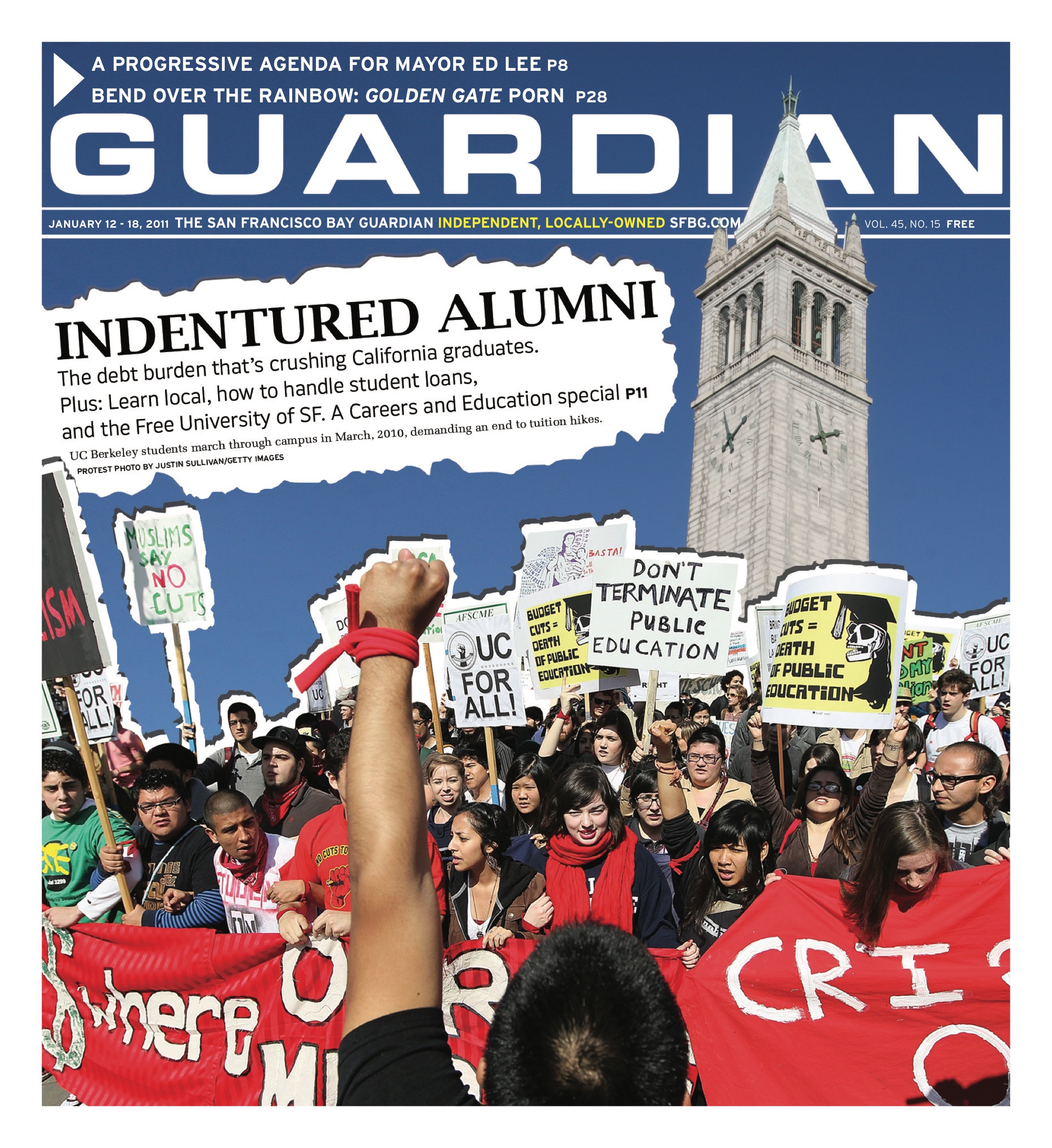
tredmond@sfbg.com
Former Mayor Willie Brown says that choosing a person of color for a leadership position should be a progressive value. Board of Supervisors President David Chiu says the new mayor, Ed Lee, is a progressive. Several supervisors and other political observers say the six-vote progressive majority on the board is gone.
And nobody really talks about what that word means.
Progressive is a term with a long political vintage, but it’s changed (as has the political context) since the 1920s. (Progressives these days aren’t into Prohibition.) So I’m going to take a few minutes to try to sort this out.
I used to tell John Burton, the former state senator, that a progressive was a liberal who didn’t like real estate developers. But that was in the 1980s, when the Democratic Party in town was funded by Walter Shorenstein and other developers who were happy to be part of the party of Dianne Feinstein, happy to be liberals on some social issues (Shorenstein insisted that the Chamber of Commerce hire and promote more women), and happy to promote liberal candidates like John and Phil Burton for state and national office — as long as they didn’t mess with the gargantuan money machine that was high-rise office development in San Francisco.
But these days it’s not all about real estate; it’s that the level of economic inequality in the United States has risen to levels unseen since the late 1920s. So I sat down on a Saturday night when the kids went to bed(yeah, this is my social life) and made a list of what I think represent the core values of a modern American progressive. It’s a short list, and I’m sure there’s stuff I’ve left off, but it seems like a place to start.
This isn’t a litmus test list (we’ve endorsed plenty of people who don’t agree with everything on it). It’s not a purity test, it’s not a dogma, it’s not the rules of entry into any political party … it’s just a definition. My personal definition.
Because words don’t mean anything if they don’t mean anything, and progressive has become so much of a part of the San Francisco political dialogue that it’s starting to mean nothing.
For the record: when I use the word "progressive," I’m talking about people who believe:
1. That civil rights and civil liberties need to be protected for everyone, even the most unpopular people in the world. We’re for same-sex marriage, of course, and for sanctuary city and protections for immigrants who may not have documentation. We’re also in favor of basic rights for prisoners, we’re against the death penalty, and we think that even suspected terrorists should have the right to due process of law.
2. That essential public services — water, electricity, health care, broadband — should be controlled by the public, not by private corporations. That means public power and single-payer government run health insurance.
3. That the most central problem facing the city, the state, and the nation today is the dramatic upward shift of wealth and income and the resulting economic inequality. We believe that government at every level — including local government right here in San Francisco — should do everything possible to reduce that inequality. That means taxing high incomes, redistributing wealth, and using that money for public services (education, for example) that tend to help people achieve a stable middle-class lifestyle. We believe that San Francisco is a rich city, with a lot of rich people, and that if the state and federal government won’t try to tax them to pay for local services, the city should.
4. That private money has no place in elections or public policy. We support a total ban on private campaign contributions, for politicians and ballot measures, and support public financing for all elections. Corruption — even the appearance of corruption — taints the entire public sector and helps the fans of privatization, and progressives especially need to understand that.
5. That the right to private property needs to be tempered by the needs of society. That means you can’t just put up a highrise building anywhere you want in San Francisco, of course, but it also means that the rights of tenants to have stable places for themselves and their families to live is more important than the rights of landlords to maximize return on their property. That’s why we support strict environmental protections, even when they hurt private interests, and why be believe in rent control, including rent control on vacant property, and eviction protections and restrictions on condo conversions. We think community matters more than wealth, and that poor people have a place in San Francisco too — and if the wealthier classes have to have less so the city can have socioeconomic diversity, that’s a small price to pay. We believe that public space belongs to the public and shouldn’t be handed over to private interests. We believe that everyone, including homeless people, has the right to use public space.
6. That there are almost no circumstances where the government should do anything in secret.
7. That progressive elected officials should use their resources and political capital to help elect other progressives — and should recognize that sometimes the movement is more important that personal ambitions.
I don’t know if Ed Lee fits my definition of a progressive. He hasn’t taken a public position on any major issues in 20 years. We won’t know until we see his budget plans and learn whether he thinks the city should follow Gavin Newsom’s approach of avoiding tax increases and simply cutting services again. We won’t know until he decides what to tell the new police chief about enforcing the sit-lie law. We won’t know until we see whether he keeps Newsom’s staff in place or brings in some senior people with progressive values.
I agree that having an Asian mayor in San Francisco is a very big deal, a historic moment — and as Lee takes over, I will be waiting, and hoping, to be surprised.
50 years in exile
arts@sfbg.com
VISUAL ART In 1988, Jeff Koons unveiled Michael Jackson and Bubbles, three ceramic sculptures of the pop icon and his pet chimpanzee. Koons’ sculptures, syncing his kitsch with Jackson’s gaudy tastes, were the conclusion of a series titled “Banality.”
In “Universal Remote,” Bay Area artist Jaime Cortez reintroduces Michael Jackson as an art subject. But Cortez is after something other than Koons’ surface banality. His exhibition’s variety of media — including a globular sculptural centerpiece that’s a counterpoint to Michael Jackson and Bubbles — form a mythic narrative. By turns revelatory and enigmatic, “Universal Remote”‘s look at history and human nature (to employ two Jackson keywords) is akin to Adam Curtis’ recent documentary It Felt Like a Kiss, which uses Phil Spector’s music to score the insidious maneuverings of the 1960s. If, as Cortez notes, the U.S. tends to sanitize the violence and viciousness of fairy tales, that clean-up work is trumped by a return-of-the-repressed within pop culture. I recently visited Cortez at Southern Exposure as he assembled the show, which includes a Jan. 29 program of readings and performances.
SFBG When did you decide to tell a Michael Jackson story?
JAIME CORTEZ It started a year ago. I was struck by how much Michael Jackson’s music was a part of my personal history. I’m at just the right age so that by the time I could be conscious of pop music, he was there. I realized that he did something that hardly anyone had done — he’d been a part of my life for decades. I started thinking about him more, and became fascinated with the aftermath of his death.
SFBG The degree of public scrutiny he received was akin to passing through the looking glass — you could say that he passed through the looking glass more often and intensely than anyone.
JC That’s a beautiful way of putting it. He was a creature of media. It was completely symbiotic — media tapped him, and he tapped media. My friend Ignacio [Valero] compares him to the frog put into boiling water that enjoys the heat until it’s too late.
He was consumed by this obsession with his own stardom. It’s almost as if he was making his face into a graphic brand. Everything was being flattened out: hot red lips, extremely pale face, shiny black eyebrows and hair.
SFBG His nose is central to your photo-collages. To me, it has fatal connotations. He marred or restricted a part of his body that is central to breathing and respiration.
JC I would look closely at photos of him and try to see him. There’s such a haze of media static and lies and mythologizing around him that it’s hard to get a bead on him. I feel that he was either in a deep state of constant denial, or a liar. He was constantly giving contradictory statements.
It actually made my eyes tear up when I took a good look at his face, his nose in particular — it was beyond repair. He had all the money in the world to change his face, but something went terribly wrong, and he was deformed.
SFBG Your show has many different forms: drawings, rotating scrolls, photo-collage, and sculpture. Why did you create more than one series of works?
JC There are theories about the five steps in the grieving process, and I was thinking about the different ways people deal with the passing of a person. The drawings of the animals represent a clean mourning. Michael Jackson was surrounded by so many parasitic people — those dependent on him for their financial well-being and sense of fabulousness — that his pets might have been the only place where he could get real love, besides maybe children. The pets are a stand-in for everyone’s grief.
The [show’s] lamps relate to the process of mythologizing from the record companies and the media — after a while, you couldn’t tell if the National Enquirer was more reliable than People or Newsweek. And then on top it all was his self-mythologizing. He alternated between extreme humility and grandiose egotism. The unadulterated rotating lamps that you buy for children’s rooms present a little story, one that illuminates a child’s space. I felt they were the proper form for exploring a very adult fairy tale about Faustian tradeoffs.
SFBG How did the text accompanying the lamps come about?
JC I was having dinner with Gary [Gregerson] and Jill Reiter, and Gary joked, “Michael Jackson was a castrato.” When he said that, I had this Tetris moment where all the blocks fell into place. When I began studying the castrati, it really got interesting. The most famous of them were basically rock stars. Women would faint or go gaga when they saw them. Women wanted to have sex with them. They looked different from other people because they developed differently from being castrated. And they had these gifts — the best of them had the lung power of a grown man coupled with a high, boyish or womanly voice.
SFBG How did you create the elaborate encasement that is the show’s centerpiece?
JC It’s built from a bunch of vases attached to each other with industrial adhesive. The statue is polymer modeling compound with wires for an Afro. The bubble on top is an acrylic globe I ordered from a street lamp company. On one hand, it makes him look like a specimen under a bell jar. Overall, it has a feeling of grandiosity and loneliness.
SFBG The mirror at the base adds another dimension.
JC Yes, it make the sense of space ambiguous. But most of all, I wanted to make something that looked precarious. For me, the piece is a visual analog for all the unbelievable machinery behind making a kid into a star. There’s an amazing amount of publicity and technology and image management, in addition to training and performing — this amazing apparatus, all of it built around a little 70-pound kid.
JAIME CORTEZ: UNIVERSAL REMOTE
Through Feb. 19, free
Southern Exposure
3030 20th St., SF
(415) 863-2141
alt.sex.column: N-O
Dear Readers:
For weeks I’ve been trying to say something about Julian Assange and certain people’s eagerness to believe him yet somehow even eagerer eagerness to believe horrible things about his accusers, but I keep not having the heart. The whole story is just so discouraging — have we really come no further in our understanding of what constitutes nonconsensual sex? Is it really still necessary to vilify the accusers? Are we really still wondering if in fact no really does mean no? Apparently so. And are there really very many people smart enough to read a blog but stupid enough to believe that sex without a condom is prosecuted as rape in Sweden? Again, yes! No wonder everything about this story depresses me.
The main thing keeping me from commenting on the story, though, isn’t the fact that watching progressives happily dismiss serious allegations against one of their heroes as long as they come from women throws me into a funk. It’s the other, less convenient one that this is a rape case and ought to be treated as such (provided, of course, that he did it). I can’t say what I keep wanting to say: “It is perfectly obvious when something is rape and when it isn’t, so why are we even arguing about it?”
Let’s first be sure that we understand that Miss A’s allegation is that she said, “Stop, not without a condom,” and he held her down and did it anyway, without a condom and without her consent, IOW, rape.
This brings us to this utterly creepy other category that rarely gets discussed: quasi-nonconsensual or barely-consensual sex. I wish it didn’t exist. It muddies the waters and gives ammunition to the would-be dismissers of sex crimes and lionizers of sex-criminals. But sadly, not all of what we usually end up labeling “bad sex” and filing under “Did that, don’t do it again” is as simple as anorgasmia, raw spots, premature ejaculation, or cases of beer goggles in action.
Everyone had had an experience, sometimes many, where they consented to sex they had no question they didn’t want, often in hopes the pursuer would fall asleep so they could go home. Most did it because trying to convince somebody probably drunk and maybe a bit belligerent that sex wasn’t going to happen was going to take much longer and be more emotionally taxing than just getting it over with.
Did anyone consider these experiences to be rape? Nope. People who have been raped, however, have no trouble determining the difference. For themselves.
It’s when you try to apply your own standards or your own experiences or your own sense of how things should be to other people’s realities that you run into trouble. As most of us know, there is another category, that of consent given grudgingly to avoid a situation perceived at the moment as potentially even ickier than giving in to what you have no desire to give. But it’s because there are such gray areas, not despite them, that it’s a good idea to actually listen to someone who tells you s/he was raped.
Love,
Andrea
Got a question? Email andrea at andrea@mail.altsexcolumn.com
Bend over the rainbow
marke@sfbg.com
SEX/TV “We get to shoot all over San Francisco,” Jack Shamama of NakedSword.com tells me over the phone, a wicked lilt tiptoeing into his voice. “How great is that?”
Double entendres! He’s referring to Golden Gate, the spunky episodic porn Web series he wrote with Michael Stabile, which just wrapped up its first season and will begin a second season in February. The weekly series runs on the Naked Sword site, with a new episode debuting every week to a substantial viewership that values glossy production and polished presentation.
Although there’s no grand soap opera-like family tree of intersecting characters and storylines, each episode does feature quite a bit of plot, at least by wank-flick standards, and solid back stories for the various players. (Sample: “Robert is an unemployed writer who spends his days at cafes. He’s got a real interest in humanity, and is garrulous and friendly. He’s almost always dressed casually. Robert lives in the grittier Castro-adjacent neighborhood of the Lower Haight.” Robert gets crammed full of a two-foot-long cone-shaped black dildo. But I digress.)
GOLDEN GATE TRAILER (er, NSFW)
Pornisodic series have been done before — the sprawling Wet Palms comes to mind — but this is the first that really focuses on San Francisco. Shamama and Stabile being our perennial enfants terribles of porn, there’s some fun with San Francisco archetypes in each episode as well, bringing together, say, a high-powered downtown investor with a struggling Mission District artist who pimps himself out online for rent money. And while there are a few problems with verisimilitude (that struggling artist has waxed eyebrows and an all-over tan), there are plenty of spot-on in-jokes. In one episode, a couple of almost-hipster rockers get approached by a groupie for sex — but first they hand him a flyer for their band’s show at Bottom of the Hill.
After we dished a bit about the scheduling woes of porn stars in the Internet Age and the purported whereabouts of 1990s bear porn pioneer Steve “Titpig” Hurley, I asked Shamama a few questions about Golden Gate.
SFBG What pricked you into Golden Gate action?
Jack Shamama In the past, Naked Sword has teamed up with partners to produce hardcore content, behind-the-scenes specials, porn event coverage, and our regular talk show, “The Tim and Roma Show.” But for our first completely in-house production, we knew we had to come up with something big that wouldn’t run out of steam, since we wanted it to be a weekly series. The concept that kept coming up was the city itself.
Gay porn was pretty much invented in San Francisco and even today maybe as much as 75 percent of it is still filmed here, but you really wouldn’t know it since most of it’s filmed on sets. Those movies that do spotlight San Francisco generally end up giving people a dumbed-down CliffsNotes “gay Disneyland” version of SF, with an opening shot of the Golden Gate Bridge and credits rolling over a shot of the giant rainbow flag in the Castro.
We figured we owed San Francisco a bit more than that. Our tagline is “Enter the land of impulse and desire.” The city ends up being sort of like the main character. For each episode, we bring together two opposing types of San Francisco men to show the different sides of the city.
SFBG Everyone talks about how major porn studios are being killed by amateur websites. But you guys are going in the opposite direction, with glossy production values, old-fashioned plot-oriented scenes, big name stars, and timed release dates …
JS Golden Gate is definitely an anomaly in the porn marketplace — but I think that at this point, its uniqueness is a plus. There’s still a huge audience out there that wants this type of meticulously produced, quality product, and I don’t think they should be ignored just because there are other types of porn being made.
Many people automatically equate “amateur” with “plotless” — but really it’s the same plot over and over again. “Straight guy sucks his first dick” could describe seven-eighths of amateur porn. That can be hot but yeah, we get it. We want to explore other kinds of fantasy. And, along with our executive producer Tim Valenti, we want to do it in a quality way. Even though our actors get down and dirty, we’re not ashamed of having a little class.
SFBG How difficult is it to produce a weekly porn series?
JS It can get tough to write episodes at that pace and to keep everything straight — scouting locations, shooting stills, scheduling stars. One challenging aspect to production I didn’t anticipate was finding filming locations. Since each episode takes places in a different neighborhood, it’s taking us out of our comfort zone. There are lots of guys who live in the Castro who want to have a gay porn shot in their apartment, but some other neighborhoods can be tricky. We’ve lucked out and been able to shoot in some amazing apartments so far, though. I really didn’t expect it to become real estate porn, but I don’t think anyone’s complaining.
Another thing is making sure our script is malleable enough to adapt to the actors and direction. We shoot the sex part before the scripted part, so the actors won’t get too bored. And even though in our scripts Mike and I try to go beyond just clichéd “fuck me harders” during the sex parts, when it comes down to it, we want our actors to have hot sex, not worry about delivering their lines. And we want our director, Chris Ward, to be free to match his sexual vision to our scripted intentions. He’s one of the biggest names in porn — no one tells Chris Ward how to film a sex scene. He’s incredible.
SFBG Any hot scenarios you can share from the upcoming season?
JS A pair of Mormon missionaries don’t quite know what they’re getting into when they knock on the door of a certain fetishy Alamo Square leather daddy. That one ought to be fun.
Beyond Berlin and Beyond
arts@sfbg.com
FILM In 1996 Ingrid Eggers cofounded Berlin and Beyond, that annual Castro Theatre showcase for all things celluloid (or digital) and German-language. Fourteen years later she retired from the San Francisco Goethe-Institut after two decades of service. B and B soldiers on without her, but Eggers now has her own weekend-long independent festival at that same art-deco movie palace.
Why a second S.F. German language film festival? “Because I think that German films are not really well-represented in the various film festivals in the Bay Area, especially not in the [San Francisco] International [Film Festival],” she says. “There was always a focus on French films, particularly under [ex-SFIFF chief] Peter Scarlet. We had French and Italian film weeks, but nothing German. The other thing is that with Berlin and Beyond having a [current] director who is, I guess, going into a more international direction with lots of coproductions, I think there are enough films that come from Germany that deserve an audience here.”
German Gems part zwei is hella heavy on debuts — six out of 10 features — which Eggers says “wasn’t intentional, but came about because lots of the bigger productions are very expensive [to book] these days. It’s not unusual to pay 1,000 euros for a single screening.” Plus, Germany is admirably generous when it comes to funding not just film production, but film schools and graduation feature projects.
One such gem showing this weekend, Philipp J. Pamer’s two-hour-plus Mountain Blood, is the sort of thing even veteran commercial talents might have a hard time getting bankrolled. It’s a 19th-century epic shot high in the Tyrolean Alps, involving romantic and military intrigue between sophisticated Bavarians and rough-edged Tyrols during a period of attempted French occupation. Eggers allows that kind of budgetary challenge would be “unheard of here for a first feature, but in Germany you can pull it off.”
Opening the festival is a movie by one far-from-new director. A quarter-century ago Percy Adlon (another Bavarian) ruled the arthouse circuit with Zuckerbaby (1985) and Bagdad Café (1987). There followed a gradual slide into obscurity suggesting Adlon wasn’t a maturing talent so much as a permanently immature one who got lucky a couple times early on.
Yet his Gems-launching historical fantasia Mahler on the Couch is wise, antic, over-the-top, and controlled. It portrays last-great-musical-Romantic Gustav Mahler (Johannes Silberschneider) as a neurotic egomaniac driven to the upholstery of Sigmund Freud (Karl Markovics) by worry over the professed infidelity of spouse Alma Mahler (Barbara Romaner).
This Freud is sometimes harshly insightful, to Gustav’s frequent distress. Yet this very trickily structured, farcically winking, incongruously picturesque film is less concerned with either of them than horny, tempestuous Alma — “the most beautiful girl in Vienna, from a good family, and very rich.” How disappointing, then, that she spends most of her adult life as wedded servant to a cultural behemoth. She, too, wanted to make music. But even had she turned out something well short of a genius in that regard, Adlon (cowriting and codirecting with son Felix) sympathizes with the fact that she was never allowed to discover that for herself.
Other German Gems highlights include Ina Weisse’s black comedy The Architect, in which a jaded, dysfunctional nuclear unit travels to an ancestral hamlet for a matriarch’s funeral and promptly falls apart in all kinds of unpredictable ways. Another bad dad is the subject of Lara Juliette Sanders’ documentary Celebration of Flight, about a 78-year-old ex-pilot and amateur airplane builder living on a Caribbean isle — though the film is too shy about probing the estranged family he’s basically exiled from. David Sieveking’s non-aerial nonfiction David Wants to Fly finds the incessantly onscreen director seeking an artistic father-mentor in David Lynch, though this patriarchal worship is soon torpedoed by the director’s skepticism toward his idol’s favorite cause, Transcendental Meditation.
Elsewhere, Thomas Stiller’s She Deserved It offers lurid teenage-bullying moral instruction à la Larry Clark, without the graphic sex. Andreas Pieper’s Disenchantments interweaves four stories about variously unhappy Berliners coping with “the dialectics of enlightenment.” (Now that is German.) For some welcome absurdism, there’s Björn Richie Lob’s Keep Surfing, which is Cali fragi-licious: its real-life subjects ride stationary river waves in the middle of Munich, which is like “water skiing in a wind tunnel.” Cowabunga, freunde!
GERMAN GEMS
Jan. 14–16, $11–$20
429 Castro, SF (415) 695-0864 www.germangems.com