Scott Wiener

The slate controversy at the DCCC

30

There’s nothing like a combination of insider politics, a struggle for control of the local Democratic Party and the ongoing discussion about the need for progressives and moderates to get along better to make for a complicated political story.

Which is exactly what’s going on with Alix Rosenthal’s effort to put together a Women’s Slate for the Democratic County Central Committee.

I’ve spend way too much time trying to figure it all out, but it raises enough interesting issues to make it worth discussion in the progressive community.

The background: For four years, the progressives have controlled the DCCC – and thus the powerful local endorsements for the local Democratic Party. That’s taken considerable organizing – and it’s worked to a great extent because of a remarkable degree of unity among a famously fractious bunch.
In the past two elections, every progressive group, the Harvey Milk Club, the Tenants Union, the teacher’s union, the nurses, the Sierra Club — and the Bay Guardian – has endorsed essentially the slate of candidates. There are problems with that approach – it’s easy for some people or some groups to get excluded, and you get complaints of machine politics – but in reality, there weren’t a lot of people who identified as progressive getting left out. Quite the opposite – the slate organizers were working hard to recruit people to run. Serving on the DCCC isn’t glamorous and it’s a lot of work. (It’s also at times unpleasant — the arguments are harsh, sometimes more so than necessary.)

In 2012, we have a different problem: The people who are called moderates have convinced a lot of high-profile canidates (former Sup. Bevan Dufty, Sup. Malia Cohen, School Board member Hydra Mendoza) – people who will win on name-recognition alone – to run. Combined with the retirement of Aaron Peskin, and the all-but certain re-election of incumbents like Scott Wiener and Leslie Katz (who remains to this day the only member of the DCCC who refuses ever to take my phone calls) and you have the makings of a conservative victory.

Let me take a second on this “moderate” tag. Moderates in San Francisco are people who are liberal on social issues – like, frankly, 80 or 90 percent of the city – but conservative on economic issues. Conservative is the right word here: The moderates don’t typically support higher taxes on the rich and big business, don’t support development controls, are weak on tenant issues, don’t think that housing should be a right of all people and pretty much buy into what in the Clinton era we called neo-liberalism.

The progressives (who have economic policies more like the Democratic Party of FDR and Lyndon Johnson) and the moderates (who have economic policies more like the Democratic Party of  Walter Shorenstein, Dianne Feinstein and Bill Clinton) have been fighting for decades over the future of a city where there aren’t a whole lot of Republicans.

So when I say conservative I’m not talking about Reagan or Santorum — but I’m talking about a very different economic vision than mine.

And while I’m all in favor of being civil and polite to everyone and respecting friends and colleagues who disagree with you, I guess I’m enough of an old commie (with a lower case “c”) to believe deeply in class struggle and the idea that the rich and powerful don’t give up without a fight.

And having a good working relationship with the conservative Democrats (hey, I’m on great terms with Scott Wiener – we talk all the time and I respect him and like him personally) doesn’t mean I’m ready to give up the notion that in the United States and California and San Francisco, 2012, there’s a class war going on. We didn’t start the war, but we have to fight it to survive — and to keep the city from becoming an ossified playground of the very wealthy.

Okay, enough background and rhetoric. On March 29, Rosenthal – who is also my friend and I respect and often support – sent out an email that announced that all of the women running for DCCC were going to work together on a slate:

“The female candidates for the San Francisco Democratic County Central Committee (DCCC) have banded together to form a slate of our own. It’s called Elect Women 2012, and it includes all women running this June in both Assembly districts in San Francisco, moderates and progressives alike. The slate is intended to provide a support network for both new and seasoned candidates, to develop an amicable working relationship between moderate and progressive candidates, and above all to get more women elected to public office.”

 
That’s all good. More women in politics is good. Supporting new candidates is good. A working relationship between progressives and moderates is good.
But here’s the question, and it’s not a new one in San Francisco: Is it a good idea, both politically and as a matter of strategy, to promote the interests of people who largely disagree with you on issues? If a slate of women helps knock off a progressive man in favor of a conservative woman, is that a positive change?

Rosenthal doesn’t think that’s going to happen. We’ve had a couple of long discussions about this, and she’s looked at the math and the current list of candidates, and she thinks her slate is more likely to help a couple of progressive women (Petra DeJesus, for example) who might not otherwise win.
“You need to touch the voters three or four times before they know who you are,” she told me. “The winners will be people who are on several slates, and the progressives have more slates than the moderates.”

The guys who she agrees should really be on the DCCC and might have a close call (Matt Dorsey, for example, a gay man, or Dr. Justin Morgan, an African American man) won’t win or lose on the basis of a competing women’s slate.

Rosenthal ran for office on a pledge to bring more women into the DCCC and into public office, and that’s an important goal – right now, there’s not a single woman among the citywide elected officials in San Francisco. (That hasn’t always been the case — the mayor for 10 (awful) years was Dianne Feinstein, and in the past decade or so we’ve had a female treasurer, assessor, district attorney, city attorney and public defender. But right now: All guys.

The Board of Supes is a bit lopsided, too – seven men, four women.

And for the same reason that putting people of color into office almost by definition changes the perspective of politics, electing women is a progressive value. No matter how sympathetic the straight white men are, there are things we never had to experience and will never really understand.

That said, I would much rather have (mostly progressive) white guy Aaron Peskin run the Democratic Party than (mostly conservative) Asian woman Mary Jung – and so would Rosenthal. “No question, no doubt about it,” she told me.

Now that Jung has all but announced that she wants to be the next party chair, and since a number of the women on the slate will support her over a progressive (and would support her over Rosenthal) – is this doing the movement any good?

Gabriel Haaland, a transgender man and former president of the Harvey Milk Club, points out that “the Milk Club could simply endorse all LGBT candidates for our slate, and there are some who have argued for that over the years. But we don’t — because we work in coalitions, and that kind of slate undermines the whole concept of coalition politics.”

Hene Kelly, who is on the women’s slate but has insisted that the mailings make it clear she isn’t supporting some of the other candidates who will be connected with her, thinks the Rosenthal plan is a bad idea.

“There are people on this slate I could not and would not support because they don’t share my beliefs,” Kelly told me. “These are nice people, but they don’t see San Francisco the way that I do. Mary Jung and I don’t believe in the same things.”

Rosenthal says that the very fact that so many people who disagree on issues can work together on a slate shows that women can get along and end some of the divisiveness on the DCCC. Kelly – who is a passionate and often fierce fighter – disagrees: “I’m not that easy to get along with.”

Kelly is part of what will be a progressive coalition slate – including women and yes, men – and Latinos, African Americans, LGBT people, young people, older people … a mix. An imperfect but generally San Francisco mix. And all of them share the same political values.

Some of the people who don’t like the women’s slate are, indeed, men – and Rosenthal is at least a little proud of that. In another email talking about a Chronicle story, she notes:

“I have already received panicked calls from some male candidates and leaders, it seems there is quite a buzz about us and about Heather’s article. Which is great.  I hear that Malia said some good things, as did Supervisor Wiener.”

Wait — Scott Wiener and Malia Cohen are happy about the slate? This is supposed to be good news? I like Scott and we’ve worked together on issues we agree on, but I didn’t endorse him for office; on the most critical things, we don’t agree at all. And interestingly, there is not one progressive woman quoted as opposing the idea in the Heather Knight piece in the Chron.

I think the panic is not, alas, about men fearing the power of women. There isn’t a progressive man I know who would be unhappy with Hene Kelly running the party.

The question is about whether this effort might help shift the balance of  power away from the progressives – and, frankly, whether all this talk about getting along together is an excuse for watering down what we want to do and what we believe in.

Maybe Alix Rosenthal is right, and her slate — which will spend about $25,000 in what amounts to co-op advertising — will help bump a couple of progressive women to the top and help the left hold on (narrowly, because it will be close) to the DCCC. Maybe the moderate/conservative crew will win a majority, and some of the moderate women will be impressed by the help Rosenthal gave them and elect her chair (which would be a lot better than some of the alternatives).

Maybe politics should be less rancorous and we should all get along better – except that, in my 30 years of experience, getting along with the moderates has always, always, always, led to a watering down of the progressive program and agenda. 

Maybe I’m just a straight white guy who doesn’t get it – and I’m happy to cop to that possibility.

I agree that there aren’t enough women in local political office, that we need to encourage and promote progressive women candidates, that much of the leadership (such as it is) on the left is male — and that needs to change.

But I’m not sure that working to help elect people who disagree with you on the key economic and political issues is good for the values that I think Alix Rosenthal and I share.

It’s tricky, but at least we should be thinking and talking about it. Nicely. I promise.

A new food-truck map

2

Sup. Scott Wiener wants to compromise on the food-truck limits, and is working with the folks at SFUSD and the food advocates.

Dana Woldow, who is working with Nancy Waymack, director of policy and planning for SFUSD, Chris Armentrout, the district’s director of development and government relations, and School Board member Jill Wynns, told me that the advocates are open to the idea of allowing more trucks in the Mission:

As I have said, I (and other parent advocates wanting to maintain a viable school meal program which can afford to offer healthy food to all students) do understand the dilemma of gourmet food trucks; that’s why we are willing to reduce the zone around all middle schools in the City to 500 feet from the current 1500 feet. Additionally, we would consider looking at drawing a custom boundary, which could possibly be smaller than the current 1500 feet, around each of the high schools in the Mission district. That way, we could free up some prime parking for trucks while still maintaining a wide enough truck-free area to discourage students from leaving school at lunchtime.

She’s got a new map for me that shows where trucks would be banned under the compromise proposal — one that includes only public middle schools and high schools. Check it out here. (pdf) And compare it to the old map here.

This all seems eminently reasonable, and maybe we can have healthy school food and burrito trucks, too.

The food (truck) fight heats up

13

Sup. Scott Wiener and public-school parent and advocate Dana Woldow are flinging dueling opinion pieces back and forth over the food-truck issue — and it’s getting hot.

Here’s the background: San Francisco currently bans food trucks within 1,500 feet of a public middle school or high school. That was almost encoded in state law, but the sponsor backed down. Now Wiener wants to modify the local law to allow trucks within maybe 500 feet or maybe a city block (of varying size) from a middle or high school.

Woldow thinks that’s way too lax — that, as she told me in an email, “a one block distance is not an obstacle at all for a long legged 15 year old. They can cover that distance and back in 5 minutes flat. And if a school is even partially open campus, (ie – seniors with 2.0 GPA can leave, or seniors and juniors, or whatever), then the kids who leave bring back food for the kids who stay.”

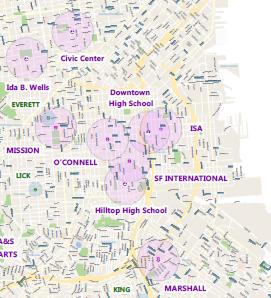
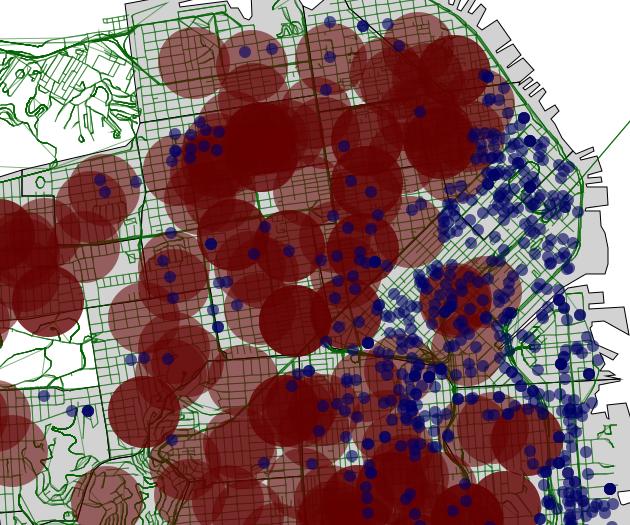
The thing is, this is a crowded, dense city, and there are schools all over, and in some places, like the Mission, a 1,500-foot limit means no food trucks at all, since there’s no place that exists that isn’t 1,500 feet from one school or another. Here’s a nifty map that shows the problem.

Woldow is ferocious when she gets into this stuff, and she decries the low-end food trucks as “roach coaches” and compares the industry to Big Soda (which we all know is evil.) Wiener’s hitting back, saying that Woldow (who he doesn’t name) is specious and that her comparisons to the sugar-mongers is nothing more than a quack conspiracy theory.

There are lots of elements to this — it’s not just about the unhealthy food that kids will (and yes, they will, I can speak from parental experience) buy and consume if they have the slightest opportunity. It’s also about how San Francisco provides lunch for students.

The school lunch program is subsidized — but also lives, to a certain extent, off the money that the schools charge for non-subsidized lunches. That is, if the kids who can afford to pay cough up for school lunches, there’s more money around to make the food better for everyone, including the kids who don’t pay. (It’s the same way at hospitals — if people who have insurance and can pay only go to a few high-end clinics, then the public hospitals and the ones in poor neighborhoods get only the charity cases, and don’t have the cash to improve services.)

As Caroline Grannan points out in a letter she sent me:

Let’s say there’s a restaurateur who feeds low-income diners free, subsidizing their meals by charging full price (albeit a modest full price) to non-low-income customers. Tempting food trucks pull up outside, luring away all the paying customers who can afford the food trucks. The restaurateur is no longer able to feed low-income diners free.
 
That simplified analogy conveys the basic situation, though it leaves out both the labyrinthine regulations governing school meals and the inadequate government subsidy for low-income students’ meals. The SFUSD meal program will, of course, continue to feed low-income children even if it suffers economic setbacks. It will just feed them a little less and a little worse, in both nutrition and overall quality. (And when the school meal program runs a deficit, classroom resources take the hit, another blow that inflicts the most harm on low-income kids.)

There’s a big difference between middle schools and high schools. Nobody’s allowed out of middle school during the day — you eat what the cafeteria offers or you bring your own lunch in a bag. Some high school campuses allow some kids to leave at lunch time; if there are food trucks nearby, and they sell cheap junk food, they’ll get plenty of patrons.

So Woldow and the nutrition folks at SFUSD want a compromise — they’ll allow the trucks to come within 500 feet of middle schools, but they want the 1,500-foot limit for all public high schools. Since there aren’t as many high schools, that’s less of a burden and cuts out less of the city. But you’d still lose about five blocks in every direction around Mission High on 18th near Dolores Park (including the space where the city wants to have a food truck in the park, but Rec-Park property is exempt, so the kids can go there anyway), and the same around John O’Connell at 19th and Folsom and International at 23rd and York.

I don’t think there’s another neighborhood where food trucks are popular that would take as much of a hit as the Mission.

I wonder: Can you regulate what food trucks near schools sell? Could you, for example, license two types of trucks — ones that are allowed to sell soda and chips, and ones that have to meet certain nutritional standards, and allow the ones with higher standards near the schools? There are plenty of trucks in the city that sell more gourmet, high-end stuff anyway. Then you could let the trucks park within, say, 750 feet (or whatever) of Mission high schools, but keep the real crap at a greater distance.

I know: More bureacracy. More regulations. But food trucks are already regulated and licensed, and if the choice was between staying away from the (hungry, captive) audience near high schools and letting Dana Woldow and the SFUSD nutritionists have some say in what you sold, I bet some of the truckers would take the good-food deal.

But that still leave the problem Grannan was talking about: If the cool kids with money all run out to eat at the (moderately) healthy food trucks, the district loses a lot of money from the lunch program. That’s a real concern, even if it goes beyond the food-truck fight. And it goes back to something some of us have been pushing for a while: If SF had a central kitchen for the schools, there might be better, fresher food for the kids in the cafeteria — maybe even food that could compete with the trucks.

I called Wiener to talk about what compromises he’s open to, but I haven’t heard back yet. I’ll update when I do.


Supervisors ban illegal SFPD spying, but veto threat looms

15

The Board of Supervisors today gave initial approval to legislation that would prevent the San Francisco Police Department from working with the FBI to spy on law-abiding citizens, but the 6-5 vote wouldn’t be enough to overcome a possible veto by Mayor Ed Lee, which would take eight votes.

SFPD officials have said the measure is unnecessary because Police Chief Greg Suhr and the Police Commission last year approved a Department General Order requiring officers to obey state and local privacy laws, which they say supercedes the MOU that the SFPD secretly signed with the FBI in 2007 placing local officers under federal control. That secret document was unearthed last year by the ACLU, causing a local furor.

But supervisors who support the measure and the broad coalition that is supporting it, ranging from the Asian Law Caucus to groups representing Muslims who have been targeted with federal surveillance since 9/11, say it is important to enshrine these protections in city law and they don’t understand the SFPD resistance to doing so.

“If this is that important to us, if we believe in these values, then it deserves to be codified in our laws,” said Sup. Jane Kim, the measure’s main sponsor. “I was shocked to discover our city entered into a secret agreement with the FBI,” said President David Chiu, adding that while he trusts Suhr to oppose illegal spying, this legislation was about ensuring successive chiefs and members of the Police Commission uphold that standard.

Sups. Scott Wiener, Malia Cohen, Sean Elsbernd, Mark Farrell, and Carmen Chu voted against the measure, but Wiener was the only one who tried to explain his vote, much to the disappointment of the large coalition that showed up to support the legislation.

“This has been a tough issue for me and I’ve struggled with it,” Wiener said, sharing Chiu’s outrage over the secret memo and his position on the government spying on citizens who aren’t suspected of a crime. “We have our own local policies that SFPD officers are required to comply with,” Wiener said. “The question for me is whether this needs to be legislated.”

The legislation is set to receive final approval at next week’s board meeting, after which Mayor Lee will have 10 days to sign it or issue the second veto of his run as mayor (the first, also controversial, was over legislation to close a loophole in the Health Care Security Ordinance that allows businesses to at the end of the year raid employee health savings accounts they set up to comply with city law requiring employee health coverage).

Before the vote, as he was leaving his monthly Question Time session with the board, I asked Lee about his position on the SFPD spying measure and he said, “I’ll be getting an update. The chief who I appointed has been working directly with the supervisor on this and he’ll be reporting to me all his efforts soon so I can make a determination. I’d like to have input for our Police Commission as well before announcing what we’re going to do about it.”

After the vote, I asked Kim about the threat of a veto and she said, “It’s definitely a concern and we as a community need to think about what our next steps are.” Activists said they plan to lobby supervisors who opposed the measure and the Mayor’s Office. “Talk to your communities, let them know the supervisors who supported it and the supervisors who didn’t support it,” Fairuz Abdullah, former president of the Bay Area Association of Muslim Lawyers, told the group of about two dozen. “This is a great showing, but it needs to continue.”

The future of the DCCC

26

Now that Aaron Peskin is retiring as chair of the Democratic County Central Committee, and is not even seeking re-election, the future of a realtively obscure but political important agency is very much up in the air.

Peskin had his share of critics, and he would be the fist to say it was time for him to move on, but he orchestrated the progressive takeover of the DCCC four years ago and turned it into an operation that helped get progressives elected to local office. He raised money for the party and kept the often (ahem) fractious progressive committee members going in the same direction. He was a leader — and without him, the left wing of the local Democratic Party is struggling.

Nobody has been able at this point to take Peskin’s place — and in the meantime, the moderate-to-conservative folks are moving agressively to take the DCCC back.

It’s going to be a fascinating race — Gov. Jerry Brown just signed a bill that changes the makeup of the committee, giving the east side of town more members. That’s because more than 60 percent of the Democrats in the city live in what is now Tom Ammiano’s Assembly district. (The east side district of Fiona Ma now includes more of the Peninsula.)

So 14 of the members will be elected from Ammiano’s district, and only 10 from Ma’s (more conservative) district.

But Peskin won’t be on the ballot, and incumbent Debra Walker has stepped down and won’t run (she’s been replaced by Police Commission member Petra DeJesus).

Meanwhile, among the more centrist people who have filed to run: Former Supervisor Bevan Dufty. Sup. Malia Cohen, School Board Member Hydra Mendoza, and former Redevelopment Commission member London Breed. Sup. Scott Wiener, a longtime incumbent, is running for re-election.

The left starts with a vote deficit, since all of the statewide and federal elected officials who are Democrats and live in or represent part of SF are automatically members. That means Sen. Dianne Feinstein, Rep. Nancy Pelosi, Rep. Jackie Speier, Attorney General Kamala Harris, state Sen. Leland Yee, State Sen. Mark Leno, Ma and Ammiano all have votes — and while they never show up, the elected officials send proxies, and other than Ammiano and sometimes Yee and Leno, they can’t be counted on to support progressive candidates and causes.

So progressives need to win more than a simple majority of the contested 24 seats, and while that’s entirely possible, it’s hard to see a full slate in both districts. At best, most progressive groups will probably endorse 12 candidates on the east side and eight on the west — and since the most conservative incumbents will likely win, as will Dufty, probably Cohen and quite possibly Breed, it’s entirely possible that the moderate wing will regain control.

There’s been some tension among progressives in the past few weeks, some arguments about who would best replace Peskin as chair. Animosity over those discussions was one reason Walker resiged. And while there are legit questions about which of the progressives would best run the committee, I fear the candidates were getting ahead of themselves. Because you can’t fight over leadership until you have a majority. And that’s going to be a bigger struggle than it’s been in quite a while.

Olague explains her support for RCV repeal measure

52

  Sup. Christina Olague has drawn ire from progressive circles over her pivotal co-sponsorship of a proposed charter amendment that aims to eliminate Ranked Choice Voting in all citywide races. It takes six members of the Board of Supervisors to place the repeal measure on the November ballot and she is the sixth co-sponsor.

Olague has long ties to the progressive community and was appointed by Mayor Ed Lee to the District 5 seat, one of the city’s most progressive, in January after Ross Mirkarimi was elected Sheriff. This week, she joined Sean Elsbernd, Carmen Chu, Scott Wiener, and Malia Cohen – all considered moderate/conservative supervisors – in supporting Sup. Mark Farrell’s proposal to replace RCV with runoff elections for the mayor’s race and other citywide offices.

“To me, this isn’t a progressive or moderate issue. This is a democratic one here in San Francisco,” Farrell said during Tuesday’s Board of Supervisors meeting, where he introduced the measure, which will have a hearing next month. “Ranked Choice Voting has continued to confuse and disenfranchise voters here for over a decade and, in my opinion, it’s time to restore our voting system to the one person, one vote rule.”

Farrell’s sentiments mirror a similar line trumpeted by the San Francisco Chamber of Commerce, a supporter of runoff elections and longtime opponent of RCV. A recent poll commissioned by the Chamber, which claims 58 percent of respondents prefer runoff elections, has been discounted as biased and based on misleading statements. Farrell, who was elected to the District 2 seat in November using RCV, said he would have prefers to eliminate RCV altogether in San Francisco but said, “This is a significant step in the right direction.” A proposed ballot measure by Farrell and Elsbernd to eliminate RCV was rejected by the Board of Supervisors last month.

Steven Hill, who helped crafted the city’s voter-approved RCV system, criticized the move to repeal it: “Critics of RCV have long maintained that voters are confused and even disenfranchised and yet they have offered no credible evidence to support these claims. In fact, the evidence shows just the opposite, that voters understand what they have to do with RCV, which is to rank their ballots, 1, 2, 3, and they are using their ranked ballots effectively.”

In an interview conducted as she was departing the Westbay Community Center on Thursday, Olague initially rebuffed our request to discuss her support for Farrell’s amendment (just as she had an earlier request by the Guardian), but she ultimately relented.

Here’s what she had to say:

Olague: “What it is is that it begins a conversation.  There was talk of eliminating RCV altogether, which I certainly don’t support.  There was talk from a lot of different corners, not just moderate circles, but progressive circles as well, that maybe we need to examine it and see how has it or has it not really been – has it really helped us reach our goals in the way that we had originally intended that it would.”

SFBG: What were those goals?

Olague: “I think it was to try to make sure that more progressives were elected… and make it easier for people who had lesser means to prevail… So I think maybe it is time to reflect on that a little bit.”

SFBG: What parts of RCV don’t you like or don’t support?

Olague: “Well, I think it’s just time to have a conversation about it.  I’m not even sure that I’m against it, per se. When I signed on to it, I believed it was looking at keeping some of the citywide races, where there are fewer numbers of candidates engaged, to reverting back to a runoff, and keeping the races where we have a diversity of candidates and numerous candidates, which are the district races, as they are – which is ranked choice voting.”

“Now there’s some people who say what we need to do is, well, maybe revisit that and maybe just, rather than have it apply to all citywide races, maybe it should just apply to the mayor’s race.”

“So I think there needs to be a conversation and there needs to be a reflection on its effectiveness.  I think that’s what [Sup. John] Avalos and even [Sup. David] Campos were thinking that there needs to be more education – and I do think there needs to be more education as it relates to RCV.”

SFBG: Voters don’t seem to be confused about filling out an RCV ballot, but maybe there’s confusion about how votes are tallied and candidates are eliminated.  It would appear that there’s a myth being spread that voters are confused about filling in a RCV ballot, but that doesn’t appear to be the case…

Olague: “Do you know that?  I think when you talk to people out there on either side of spectrum, politically, I think there’s still a lot of – I don’t think that people have necessarily concluded that this is the most effective way of achieving certain goals.  But, you know, I think it starts a conversation and it may end up that the voters decide, you know, let’s just leave it the way it is, we’re happy with it.”

SFBG: And how would you feel if RCV is completely eliminated?

Olague: “Well it’s not going to be eliminated because there’s nothing in the charter amendment asking that RCV be eliminated.  What I was concerned about was that there was a push to eliminate it altogether, which I don’t support.  What this does, I figured I’ll meet them halfway because I can’t support a complete repeal of RCV and currently the way this charter amendment is drafted, what is does is it keeps RCV in the District elections.  That stays the same, and the citywide elections would be reverting back to a runoff, so it goes to a more citywide for a runoff, ranked choice voting for District [elections]. There is an argument to be made for why that should be the case.”

SFBG: Wouldn’t this eliminate a diversity of candidates if there were a repeal of RCV in citywide races?

Olague: “So let’s have the debate and people may decide, you know, if it’s not a good idea. People may decide they want to push to amend the charter amendment as it is before us.  Some people are thinking it should just apply to the mayor’s race and not other citywide races like public defender and others. So maybe there’ll be amendments to the charter amendment before it even hits the ballot.”

SFBG: Why do you think some people are up in arms over your support on this?

Olague: “I guess, you know, I mean – I just think that everyone is going to sit around and wait for something, right?  They’re, sort of, laying in wait, right? So it’s just what it is, you know – it’s like people are going to agree with me sometimes, they’re not going to agree with me other times.  There are some things that I am doing that is progressive, there are some things people will perceive as not being progressive.”

SFBG: Did you come to this decision by yourself, or was there any influence or pressure from others to vote the way you did on this?

Olague: “No.  I just think it’s funny because it’s like I don’t really succumb to pressure.  I’m willing to start the conversation at some kind of a compromise.  To me, this is as close to a compromise as we’re going to get and then it can start the conversation. So I think the conversation will start and people can assume all kinds of things, and they will.”

SFBG: So you voted in good conscience?  You didn’t have any doubts about your vote?

Olague: “I vote in good conscience, but sometimes you have to go with a compromise.  It’s not completely what you want and it might not be completely what you don’t want, but the alternative might be something that is completely unacceptable, which could be the complete elimination of RCV.”


A version of this story also appears on Fog City Journal, which is run by Luke Thomas.

SFPD-FBI spying restrictions could face mayoral veto

8

If the San Francisco Police Department isn’t working with the FBI to secretly spy on law-abiding local residents – as a secret document released last year indicated they had the authority to do – then why are Police Chief Greg Suhr, Mayor Ed Lee, and others opposing legislation that would ban such surveillance?

That’s the question that longtime police policy expert John Crew of the American Civil Liberties Union of Northern California is asking as he tries to get two more members of the Board of Supervisors to join the six current co-sponsors of the legislation, which the board will consider on Tuesday, in anticipation of having to override a mayoral veto.

“What’s the harm?” Crew told us. “There’s something that doesn’t add up here.”

As we reported at the time, the ACLU last year obtained a 2007 memorandum-of-understanding between the SFPD and the FBI establishing procedures for the Joint Terrorism Task Force, in which SFPD personnel would be under the command of the FBI, circumventing local and state restrictions on domestic surveillance of people who haven’t committed any crimes.

After the ensuring controversy and under pressure from members of the Police Commission, Police Chief Greg Suhr issued Bureau Order #2011-07 to clarify that SFPD personnel are bound by local and state privacy protections. “With this Bureau Order, the language of the 2007 Memorandum of Understanding no longer applies and SFPD personnel are bound by the provisions of the 2011 Order,” SFPD Public Information Officer Albie Esparza told us last month.

Suhr and Lee have each made public statements indicating that the new legislation – developed by the ACLU and carried by Sup. Jane Kim with five progressive supervisors as co-sponsors – is redundant and unnecessary. But Crew and the ACLU made a Sunshine Ordinance request for any modifications to the MOU or communications with the FBI indicating that SFPD’s contractual obligations no longer apply, and there were no such documents.

“When you talk about civil rights, you put it in writing,” Crew said. “This really doesn’t add up. We’re getting conflicting explanations. And the bottom line is this problem has been solved in Portland.”

When a similar issue arose in Portland, Oregon, civil libertarians pressured the city to withdraw from its MOU with the FBI and create a new one that includes restrictions on the surveillance of people who were not suspected of any crimes, but who may have been subjected to FBI attention because they were Muslims or because of their political beliefs. And Crew said it didn’t harm the relationship of the two policing agencies.

At an emotional hearing last week before the Public Safety Committee, a long string of representatives from groups that have been singled out for FBI surveillance that violated protections under the California Constitution – Muslims, anarchists, anti-war activists, Occupy demonstrators, immigrant groups, environmentalists, animal rights activists, etc. – urged supervisors to stand up for them. The legislation has a long and diverse list of organizational supporters.

Sup. Scott Wiener – one of two supervisors that Crew is hoping to win over – told us, “I agree that local surveillance rules should govern. But I’m not convinced that we need this legislation.”

Wiener said he still hasn’t made up his mind, and he plans to speak with Portland’s mayor before Tuesday’s hearing.

So why wouldn’t he support legislation that simply made his position official city policy? Wiener said he’s wary of telling SFPD how to do law enforcement and with “reducing the ability of the department to be flexible in the future.”

Crew said representatives of the Mayor’s Office, which did not respond to our calls for comment, have told him that Lee would defer to the SFPD’s determination of whether to sign the legislation. “That’s a pretty stunning claim,” Crew said, “which does not bode well in terms of reasonable civilian control of the SFPD for the next few years. I sure hope they back off that.”

Kim, who has a good relationship with the Mayor’s Office, also did not return calls for comment. But Crew was incredulous about why anyone who believes in civil liberties would oppose this legislation, telling us, “This is not a radical stand here.”

SF allows bikes indoors, but its cycling goal is elusive

63

When the Board of Supervisors this week voted 9-2 to require commercial building owners to allow employees to bring their bicycles indoors while they work, ordinance sponsor Sup. John Avalos hailed the legislation as an important step toward meeting the city goal of having 20 percent of all vehicle trips in the city be by bike by the year 2020.

“We are removing a barrier to people getting around the city by bicycle,” Avalos said at the March 6 hearing, noting that the measure addresses cyclists’ concern about bike theft and helps keep sidewalks uncluttered and racks and poles free for other cyclists to use.

While it’s true this may help make cycling a bit more attractive, San Francisco would have to take far bolder actions to get anywhere near meeting its 20 percent by 2020 goal, a target it set in 2010 with legislation sponsored by Board President David Chiu and one regularly touted in speeches by Mayor Ed Lee.

Just last month, the San Francisco Municipal Transportation Agency released its latest bike count survey, which showed that about 3.5 percent of vehicle trips in the city are taken by bike, a 71 percent increase in the last five years, gains the San Francisco Bicycle Coalition lauded as “impressive.” Yet to reach the city’s goal would require a 571 percent increase in the next seven years – one that would seem unattainable at this pace.

“It’s a very ambitious but realistic goal,” SFBC director Leah Shahum told us, although she acknowledged it would require a drastic change in the city’s approach. “I’ve been impressed by how much Mayor Lee has touted the 20 percent by 2020 goal, but our city agencies need to step up their sense of urgency and commitment to meet that goal.”

The SFMTA is now finalizing a report on how to hit that 2020 target, which is scheduled for release next month. But agency spokesperson Paul Rose acknowledged the difficulty in meeting that goal: “It would take funding resources which at this point we don’t have.” He can’t yet say would it would take to meet the goal, which the report will outline, but he said, “We’re exploring what can be achieved with our available funding.”

Shahum said all studies by SFBC and other groups show concerns about safety is the biggest barrier to substantially increasing cycling in the city, and that most people need bike lanes – particularly paths physically separated from cars, known as cycle tracks – to feel safe. She praised the SFMTA for installing 20 miles of new bike lanes in the last two years, its fastest pace ever, “but that pace needs to double or triple to meet that goal.”

Instead, Mayor Lee has backed off a pledge he made last year to fast-track a short segment of bike lanes on dangerous sections of Oak and Fell streets that would connect two popular east-west bikeways: the Panhandle and the Wiggle. That project was delayed by a year for more meetings and work after motorists objected to the loss of street parking spots.

“We’re talking about three blocks. It’s relatively small in scope but huge in impacts,” Shahum said of the project. “If the pace of change on these three blocks is replicated through the city, it’ll take hundreds of years to meet the goal.”

In his run for mayor last year, Chiu regularly touted the 20 percent goal he set in 2010 after returning from a fact-finding trip to the Netherlands – where about 38 percent of vehicle trips are by bike – that he took with SFMTA Director Ed Reiskin, SFBC members, and officials from other cities. Chiu says that San Francisco might be further along than the SFMTA figures show, citing an SFBC poll showing that 5 percent of San Franciscans say they ride a bike daily and another 12 percent ride more than once a week.

“Whatever the current percentage is, we have a long way to go. We have to be bolder about specific projects and strategies,” Chiu told us. He said there is a growing recognition that promoting cycling is an important way to address traffic congestion and greenhouse gas reduction and that “segregated bikes lanes are the most efficient way to move the most people through areas of urban density.”

Chiu also said that San Francisco could be poised for rapid progress on the creation of new bikes lanes, citing early opposition to replacing parking spaces with parklets and the car-free Sunday Streets (which kicks off its new season this Sunday along the Embarcadero) events, with the business community and many neighborhood groups fearing that restrictions on motorists would hurt businesses.

“The experience has turned out to be exactly the opposite,” Chiu said, noting the explosion in demand for parklets and new Sunday Streets events in the last couple years, saying that a widening embrace of more cycle tracks and other biking infrastructure could be next.

Mayoral Press Secretary Christine Falvey told us, “The mayor is very much committed to the aggressive goals set to get to 20 percent by 2020 and the city is moving in the right direction. He has also always supported the Oak Fell project and we’re seeing progress. It will be complete in 2013 and he has been talking to the SFMTA about the project to keep up to date. San Francisco is on its way to becoming the most bicycle friendly city in the U.S. and in this era of limited public funding, the mayor is working with the SFMTA to explore what ways we can increase trips taken by bicycle with available funding and increased public awareness.”

She cited the Avalos legislation and the current installation of cycle tracks on JFK Drive in Golden Gate Park as examples of the city’s commitment to “move us toward the goal of 20 percent,” but many in the cycling community consider these efforts to be low-hanging fruit – easy, cheap, and non-controversial improvements – that won’t get the city anywhere near its stated goal.

Bike activist Marc Salomon is critical of the incremental approaches taken by SFBC and the city, saying that to make significant progress the city needs to address enforcement and the culture on the roadways, protecting cyclists from aggressive or impatient motorists and recognizing that many traffic laws don’t make sense for cyclists.

“We need to change the culture of the cops to make sure every street is a safe street,” he said. Shahum said that’s an issue SFBC is trying to address: “We are talking to them about how police could better enforce dangerous behaviors.”

Yet any efforts to promote cycling will likely be met with a backlash by motorists who resent losing space to cyclists and the fact that many cyclists routinely run stop signs and lights. Sups. Sean Elsbernd and Carmen Chu voted against the Avalos legislation, with Chu objecting to city staff evaluating businesses that seek waivers based on limited space or other factors, calling it a waste of precious resources.

But Avalos noted that his ordinance – which will be up for final approval on its second reading this Tuesday – has no enforcement mechanisms and “overall, this is a cost effective way to promote bicycling in the city. The costs are minimal.”

He also thanked the conservative Building Owners and Managers Association for supporting the legislation. Shahum said BOMA strongly opposed similar legislation almost 10 years ago and its embrace of it now shows how attitudes toward cyclists have changed. “There are so many more people biking now and the business community recognizes the benefits of having more of their employees biking,” she said.

Even politically moderate supervisors have been supportive of promoting cycling, with Sup. Scott Wiener saying at this week’s hearing, “It’s very important to make it as easy as possible to bike, and bike theft is a big issue in this city as well.”

Food-truck battle at the board of supes

14

The supervisors are weighing in on a state bill that would ban food truck from parking within 1500 feet of schools — and it’s really tricky.

Let’s start with a bit of reality: My kids go to public schools, my son’s in middle school, he rides Muni home — and there’s ample opportunity for him to buy some really nasty stuff. There’s a 7-Eleven a couple of blocks from his school, and kids walk over there all the time and buy those disgusting 32-ounce sugar bombs. If a truck selling chips and soda and greasy tacos showed up at 3:30 p.m., the kids would be lined up to spend the money their parents though was going for a nice healthy lunch.

And the trucks would go there, if they could, the same way the ice cream trucks used to cruise through my suburban neighborhood in the 1960s (yeah, I’m old, old, old) in the late afternoon, when they could guarantee America’s children would be hungry and ready to spoil their supper.

But they can’t, see, because San Francisco already bans food trucks from within 1,500 feet of a public middle school or high school — which is a pretty broad zone.

Now Assemblymember Bill Monning has introduced a bill that would make that ban statewide — and would include middle schools and private schools. Sounds good, and some healthy-food advocates love it. But San Francisco’s a little different than, say, Hayward or Fresno — this is such a dense city that there are schools almost everywhere. If you ban food trucks from within 1,500 feet of all schools, then you ban them from about 80 percent of the city. Burrito Justice has a great set of maps that give you the picture (burritohibition!)

The maps also suggest the problems with banning anything from within 1,500 feet of a school in San Francisco. Pot clubs, liquor stores, sex clubs … there are all sorts of places where you really don’t want your kids hanging out, but if you make those broad exclusions, you force them all into a very few small areas (including northern Soma, the waterfront and Bayview) and that’s not exactly fair, either. Should all the food trucks in the city be congregated in those crowded places that fit the 1,500 foot rule?

My 10-year-old daughter walks through the heart of the Castro, which is probably within 1,500 feet of her school, and there’s some stuff in the storefronts that isn’t exactly age appropriate, and we deal. She asked me once why people were walking around naked, and I said “because they like to,” and she shrugged and that was that.My 12-year-old son knows that people smoke pot and that it’s legal for adults to use as medicine; I don’t think the notion of him walking past a well-regulated dispensary is going to make him any more (or less, god help me) likely to try some for himself some day.

So I’m kind of with Sup. Scott Wiener, who wants the city to oppose the Monning bill — not because I want trucks selling Doritos out in front of Aptos in the afternoon, but because I think San Francisco already prevents that, and 1,500 feet is way too much for a city this size. Maybe amend the bill to allow cities to make their own rules, but have the state rules apply if they don’t. Maybe allow cities beyond a certain density to change the distance to 500 feet.

Maybe think a little more about what it really means to ban things because they’re close to schools. It doesn’t always make sense.

PS: Actually, I’m thinking maybe we should ban all multimillion-dollar condos from anywhere within 5,000 feet of a school. Exposing the impressionable minds of small children to such graphic, disgusting, ostentatious displays of wealth has to be bad for them. Worse than seeing a sex club, anyway.


Mayor Lee praises the importance of nightlife to SF

3

Addressing a gathering of nightlife advocates at a California Music and Culture Association event last night, Mayor Ed Lee praised the economic and cultural role that the entertainment industry plays in San Francisco, announced plans to add a “nightlife unit” in the Mayor’s Office of Economic and Workforce Development, and even hinted that Halloween in the Castro might be returning after being shut down during the city’s so-called “war on fun.”

“If I’m going to be about jobs,” he said, referring to his near-constant emphasis on economic development, “it should be both for the day and for the night…I do recognize this as a business, as a serious contributor to the economic engine of city.”

Lee referenced the new Controller’s Office report that was requested by Sup. Scott Wiener, which concludes that the nightlife industry generates about $4.2 billion in annual economic activity in the city (that report will be the subject of a rally and hearing on Monday at City Hall starting on the steps at noon). And he said that the benefits of a vibrant nightlife scene also help make San Francisco an appealing city for other businesses, an indirect economic benefit.

“You’re all part of a great part of the city that keeps everyone refreshed,” Lee said, later adding, “I think we can do more at night. The young people who work gobs of hours need to have an entertaining evening.”

As he announced plans to add a nightlife unit to OEWD, the office that works with private companies looking to locate or expand here, he said, “We, as government, need to fast-track things that are successful.” Yet he also said that public safety is still a challenge and called for the industry to work closely with police to keep everyone safe.

Yet Lee spoke positively about Halloween in the Castro, a once-popular event that was canceled because Mayor Gavin Newsom and then-Sup. Bevan Dufty (who Lee recently hired as his new homeless czar) feared the city couldn’t control it, and Lee alluded to plans being developed to revive it in some form. “I hate to see any event that brought so many people to the city gone,” he said.

The event was held at The Grand, a club owned by CMAC board member and new Entertainment Commissioner Steven Lee. CMAC was formed two years ago in response to crackdowns on SF nightlife by city and state officials.

Death penalty could go before California voters in November

12

It appears that California voters will get a chance to abolish the death penalty this November, and that supporters of the proposed ballot measure will use mostly fiscal and public safety arguments to pick away at the majority of state residents that polls have shown still support capital punishment.

The group SAFE (which stands for Savings, Accountability, Full Enforcement) California this morning held press conferences in San Francisco and three other cities to announce that it is turning in more than 800,000 voter signatures (504,764 are needed) to qualify a measure that would make life in prison without the possibility of parole the maxiumum sentence in California. It would also spare the 720 inmates now on death row in San Quentin Prison, converting their sentences to life in prison.

“We make history today. This is the first time that voters in California will have the opportunity to replace the death penalty with life in prison without the possibility of parole,” LaDoris Cordell, a retired Santa Clara County Superior Court judge, said at San Francisco City Hall.

She was flanked by Sups. Scott Wiener and Christina Olague and other supporters of the measure, as well to two visuals showing a county-by-county breakdown of the unsolved homicides and rapes in California. San Francisco ranks near the top in both categories, with 58 percent of murders (450) and 70 percent of reported rapes (1,236) going unsolved between 2000 and 2009.

“The money to catch these murderers and rapists is not there because it is on death row,” Cordell said, noting that the state wastes an estimated $184 million per year on capital punishment, a figure that represents the roughly $100,000 more per year it costs to house someone on death row versus in the normal prison population and the cost of lifetime legal representation and appeals to which condemned prisoners are entitled.

They argue that in a cash-strapped state, that money could be put to better use solving crimes and supplementing police budgets, with Wiener calling for state residents “to be rational in our approach to public safety and end the death penalty in California.”

Most studies on capital punishment have shown that it does not act as a crime deterrent and that it does not save money, so most arguments supporting it have been emotional ones offered by grieving families or law enforcement officials describing the heinous details of crimes. 

SAFE California seemed to be trying to preempt those appeals with speeches in San Francisco by three other supporters of the measure: Jeanne Woodford, the former San Quentin warden who now runs Death Penalty Focus; Obie Anthony, who was wrongfully accused of murder and exonerated last year after serving 17 years in prison; and Deldelp Medina, whose aunt was murdered by her cousin during a psychotic breakdown and faced capital punishment.

Woodford oversaw four executions at San Quentin and said she and other corrections workers were plagued by the questions of whether the person they were executing was innocent and whether state-sanctioned killing was really making the world safer: “No public employee should ever carry that burden, because I can tell you the system is flawed.”

Many studies have shown the criminal justice system is often biased against African Americans like Anthony. “At the age of 19, I was charged and faced with a murder I did not commit,” said Anthony, who was convicted based on eyewitness testimony of a pimp who later admitted that he was lying to get leniency in his own criminal charges, a deal with police that jurors never learned about.

“I’m living proof that terrible mistakes can happen and there is no perfect system,” Anthony said.

Medina told another story common to California’s flawed justice system, that of overzealous prosecutors seeking to appear tough, often for political reasons, being matched against overburdened public defenders who often lack the resources to properly defend poor people accused of serious crimes.

She noted how the death penalty gets “trotted out as a show pony in every election cycle” by politicians using the families of crime victims. But the reality is that vengeance isn’t a healthy emotion, and she said that capital punishment does little to heal a family’s pain: “The death penalty is an empty promise to the families of victims.”

Cordell said that capital punishment, which often takes 25 years to occur once all the appeals are exhausted, simply prolongs the survivors’ pain. “A quarter of a century is not justice for these families,” she said. And with the high cost of capital punishment exacerbating government funding shortfalls and inherent flaws in the court system, she said, “Justice in our criminal justice system is in grave peril.”   

The war is over. Fun won.

1

steve@sfbg.com

>>Read Sup. Scott Weiner’s op-ed on SF nightlife here

Two years ago, the war on fun that the Bay Guardian had been chronicling and decrying since 2006 — involving overzealous cops, NIMBY neighbors complaining about noise, escalating fees on outdoor events, and politicians scapegoating nightclubs for urban violence –- seemed to be reaching a peak of official intolerance.

The San Francisco Police Department and California Department of Alcoholic Beverage Control were running amok, with an especially troublesome pair of enforcers harassing disfavored club owners and guests, getting rough with patrons at private parties, and seizing laptop computers from DJs and cameras from those who documented the abuses (see “The new War on Fun,” 3/23/10). Then-Mayor Gavin Newsom and then-Police Chief Heather Fong and their underlings only fed the conflict with brash statements and by refusing to support the nightlife industry.

But today, all involved say the situation has turned completely around, with the nightlife industry asserting its importance to San Francisco’s culture and economy and getting key support from a new generation of political leaders. It may be too early to say the war on fun is over, but everyone is certainly enjoying a welcome cease-fire.

Police Chief Greg Suhr has longstanding relationships with many leaders in the nightlife community -– and he’s someone who says that he goes out regularly and has a son who plays drums for a local band.

“I consider many of the people in the entertainment community to be personal friends,” Suhr told us. “And if there’s a problem, I don’t think anyone has been shy about approaching me personally.”

At the same time, the industry has taken on a higher political profile in town since forming the California Music and Culture Association two years ago during the height of the conflicts with the city and the ABC. The group now has monthly meetings with a nightlife liaison that Suhr has assigned to work through issues.

“The lines of communication are open. Despite some differences in opinion, there is a growing sense of trust and respect that is developing in these meetings,” CMAC co-chair Alix Rosenthal told us.

Rather than bashing the nightclubs as a source of trouble, political officials have been openly courting CMAC, which holds regular public events and forums on nightlife issues, including an “Industry Cocktail Hour with Mayor Ed Lee” on the evening Feb. 29 from 5-7 p.m. at The Grand, a club owned by the newest Entertainment Commission member, Steven Lee.

Sup. Scott Wiener has also been a strong advocate for nightlife issues, and has commissioned a city study on the economic benefits of the nightlife industry, which he discusses in this week’s Guardian Op-ed and which will be the subject of March 5 rally and hearing at City Hall.

Preliminary results in the study, with was conducted by City Economist Ted Egan, show that the nightlife industry generates $4.2 billion in annual spending, $55 million in taxes, and employs 48,000 people. And those figures don’t include outdoor events such as street fairs or the Outside Lands Festival, which another recent study by concert organizers found generated $60.6 million in San Francisco and $6.6 million in surrounding communities last year.

“People coming into the city to enjoy themselves is our number one industry,” Suhr said, noting how important it is to balance public safety concerns with support for the city’s cultural and entertainment offerings.

Rosenthal said CMAC was happy that Wiener commissioned the study. “This study is going to be helpful,” she said. “We’ll have hard data to show how much the entertainment economy contributes to San Francisco’s entire economy.”

Nightlife: Fun plus jobs

8

By Supervisor Scott Weiner

OPINION We all know the cultural benefits of nightlife. It’s fun. We get to meet people — friends, lovers, and all the rest. We build community. We hear great music. We dance. We spend time outside on our streets. For LGBT people, we meet other LGBTs and keep our community strong. The list goes on: Without a strong entertainment scene, including bars, clubs, live music venues, arts venues, night-time restaurants, and street fairs, our city would be a less interesting and less diverse place.

But the undisputed cultural importance of nightlife isn’t the whole story. Nightlife is a significant economic contributor to San Francisco. It creates jobs, particularly for working-class and young people. It generates tax revenue that helps fund Muni, health clinics, and parks. It allows creative entrepreneurs to start businesses. It generates tourism. It draws foot traffic into neighborhoods to the benefit of other neighborhood businesses.

This is all pretty intuitive. Yet, as a city, we’ve never actually measured the economic impact of our nightlife scene. One of my first acts a member of the Board of Supervisors was to request the city economist to conduct an economic impact study doing just that.

The study is almost done, and we already have a few preliminary results. Nightlife in San Francisco generates $4.2 billion a year in spending, with $1 billion of that amount coming from bars, clubs, performance venues, and art spaces. Some 48,000 people are employed in nightlife businesses, and these businesses contribute $55 million a year in local taxes. On March 5, we’ll announce the full results of the study at a hearing of the Land Use and Economic Development Committee.

This data will help us make smart public policy around nightlife. In the past, those decisions frequently have been driven by anecdote and over-reaction to isolated events. Trouble near a small number of nightclubs? The city responds by making it difficult for all nightclubs to operate, even those with excellent safety records and despite the dramatic improvement in the Entertainment Commission’s oversight. Or, the city goes even further and proposes requiring all clubs, even small ones, to scan ID cards of everyone who enters. (That proposal, thankfully, was roundly rejected.)

When we make these decisions, we should do so with a full understanding not just of the downsides of nightlife but of the positives, including cultural and economic benefits.

Entertainment is under pressure in San Francisco. There are neighborhoods with significant friction between housing and nightlife. Some of that friction results from a small number of problem venues. Other times, a good venue is jeopardized for simply conducting its business within the limits of San Francisco law — for example, a single neighbor got Slim’s shut down for a few weeks for noise, despite the club’s compliance with our noise ordinance.

We also continue to have bizarre Planning Code restrictions that undermine entertainment, such as the Mission Alcohol Special Use District, which makes it difficult or impossible to start creative new businesses in the Mission if alcohol is involved. This provision almost prevented a new bowling alley from locating at 17th and South Van Ness. Similarly, some are concerned that the Western SoMa Plan, as currently written, will undermine nightlife on 11th Street by surrounding clubs with new housing and by reducing the number of venues.

A thriving nightlife scene is key to our city’s cultural identity and economic future. Now that we have the data on its benefits, we can take a more balanced and thoughtful approach.

Supervisor Scott Wiener represents District 8 on the Board of Supervisors. The March 5 hearing will start with a noon rally on the steps of City Hall followed by the hearing at 1 p.m. in City Hall Room 263.


Campaign cash roundup and questions about our sleeping watchdog

3

Oliver Luby – the last true public-spirited employee at the Ethics Commission (a campaign lapdog when it should be a watchdog) before being forced out in 2010 – has written an insightful and comprehensive analysis of spending by candidates and outside groups during last year’s election. It’s published by CitiReport.

Among his findings are that the largely unregulated spending by supposedly independent third-party groups totaled $3.6 million, with $1.4 million of that going to support Mayor Ed Lee, and much of it coming so late in the race that voters weren’t able to factor its sources into their decisions.

Those outside groups spent almost as much to elect Lee as the campaign itself raised, which was almost $1.6 million. When those two figures are combined, and one subtracts the $419,891 in independent expenditure (IE) spending in opposition to Lee, the appointed mayor and his supporters spent $33.87 for each first place vote he received, or about 2.5-times that of second-place finisher John Avalos, whose $757,327 in “supportive financing” works out to $13.25 per vote.

Luby has long called for Ethics to get tougher on violators of campaign finance law, playing whistleblower at several key points in his career, starting in 2004 when he and then-staffer Kevin DeLiban exposed notorious campaign attorney Jim Sutton’s alleged scheme to illegally launder unregulated funds being collected for then-Mayor Gavin Newsom’s inauguration into paying off some of his $550,000 campaign debt.

In his latest piece, Luby again calls out his old bosses at Ethics for ignoring local laws against maxing out donations to many candidates in order to buy influence at City Hall. Donors are limited to an “overall contribution limit” that equals the maximum individual donation of $500 times the number of offices open, which was three in this election. It allows the city recoup from the campaigns money collected in excess of that, which Luby said totals $29,111 in this election.

“The SF Ethics Commission does not enforce this law. Supervisor Scott Wiener wants to help them get rid of it,” Luby wrote. Ethics Commission Executive Director John St. Croix was out of the office and hasn’t returned a Guardian call for comment.

Among those whose excessive contributions would be diverted to city coffers are Planning Commissioner Michael Antonini (perhaps the city’s most powerful Republican), PR powerhouse Sam Singer, medical marijuana activist Kevin Reed, political fundraiser Wade Randlett, city staffer-turned-developer Michael Cohen, moderate Democrat Mary Jung, and Coalition for Responsible Growth (a pro-development group) President Rodrigo Santo. Not surprisingly, they all contributed to Lee, whose campaign would be on the hook for the most in givebacks, $7,725, followed by David Chiu’s mayoral campaign at $4,700.

Finally, for all their talk about fiscal responsibility, Lee and his supporters couldn’t seem to live within their means in this election. Lee’s campaign finished about $275,000 in debt, while two of the pro-Lee IEs also finished in the red: SF Neighbor Alliance ($11,338) and Progress for All ($35,890), the ethically challenged creators of the “Run Ed Run” campaign that purported to talk Lee out of his pledge not to run for a full term in the office he’d been appointed to.

These are just some of the findings in Luby’s voluminous reporting, so check it.

Who gets to live here?

38

yael@sfbg.com

Housing policy — which determines who will be able to live in San Francisco — has been a hot topic at City Hall these days.

At a Board of Supervisors Land Use and Economic Development Committee meeting on Feb. 13, representatives from the Mayors Office of Housing (MOH) reported on the state of middle-income housing in San Francisco, at the request of Sup. Scott Wiener. “Middle class” people make up 28 percent of the city’s population, a 10 percent decrease in the past two decades, and to reverse that decline would cost about $4.3 billion in housing subsidies, or more than half the city’s annual budget.

Wiener, who insists that “middle income and low income housing are not mutually exclusive,” said he’s raising the issue because the needs of the shrinking middle class are not being addressed. But during the public comment period, a long procession of low-income residents say city housing policies have kept them on the brink of homelessness. The takeaway message was: don’t embark on new housing efforts until you can enforce the ones that are already in place.

Also underscoring the desperate state of many San Francisco residents, Assessor-Recorder Phil Ting released a report Feb. 16 that contains shocking statistics about invalid foreclosures and illegal evictions in San Francisco. Ting found that 99 percent of all foreclosure proceedings in San Francisco in the past four years have contained paperwork irregularities, and in 84 percent of cases, banks or lenders have committed fraud or broke other laws.

With the loss of the redevelopment agencies, Mayor Ed Lee’s proposal for a housing trust fund, renewed calls for more condo conversions, and a new focus on middle income housing incentives, the conversation on housing in San Francisco is heating up.


MOVING TOWARDS RENTAL

San Francisco’s housing market is 64 percent rentals and 36 percent ownership, according to MOH. So despite the focus of politicians and developers on homeownership, housing policy in San Francisco mostly involves renters, many of whom face myriad threats.

Rents can be so steep that market-rate rental housing is becoming increasingly accessible only for parts of the middle class and the highest income brackets in the city. People in San Francisco tend to pay a huge chunk of their income towards rent.

The federal Housing and Urban Development Agency considers it reasonable for a households to pay 30 percent of their income towards rent; but for the city’s very low income households, rent is typically nearly 60 percent of income. For middle income households, the average percent paid toward rent has increased since 1990, but remains below 30 percent.

Those people fall mainly into the middle-income bracket, those earning 80-120 percent of Area Median Income (AMI.) Planning Director John Rahaim said that for the very low-income population (0-50 percent AMI) all rental housing is “virtually off-limits.”

So, for the middle class, renting a place in San Francisco is tough. For the low and very-low income, it’s next to impossible. And that reality threatens the city’s diversity.

“The highest rent burden still falls on lower income residents, many of whom pay 70 percent of their income as rent,” Sup. Eric Mar, who also sits on the Land Use Committee, said at the hearing. “In my district, people have whole families living in their living room or extra bedroom.”

But things may be looking up for renters. MOH’ Brian Cheu said developers believe that the market trends are heading towards construction of new rental housing after being almost exclusively owner-occupied units for many years. Cheu said there are 725 rental units in the pipeline for the next five to ten years, more than twice the new housing units meant for ownership slated for that time period.

Most of this will be market rate housing, and thus still unaffordable for a good deal of the population. But for those making around 100 percent of AMI — the middle class that Wiener hopes to serve — there are more rental units on the way.

“Any increase in supply of rental housing would help,” said San Francisco Tenants Rights head Ted Gullickson, “because there’s been virtually no new rental housing built in San Francisco is last 20 years.”

Even as Wiener promised to continue to prioritize the needs low-income residents, the foreclosure crisis was barely acknowledged at the Feb. 13 hearing. Many low-income residents say they are not sure they can trust the city’s claim that “this is not a matter of us vs. them.”

At public comment, many community members spoke of the housing troubles that they were already facing. Yue Hua Yu, who spoke at the Feb. 13 hearing, lives with her family of four in a single residency occupancy hotel room (SRO), units intended for single occupants.

“We would support a policy that protects the city’s affordable housing stock,” said a statement from Wing Hoo Leumg, president of the Chinatown Community Tenants Association.

Renting may be the realistic choice for most San Franciscans, but homeownership remains an important goal and achievement for many families, and the main obsession of many politicians.

Part of the middle class exodus is unmistakably due to better homeownership rates in Oakland, Daly City, Marin, and other surrounding areas. But there are neighborhoods with higher rates of homeownership than others, including Bayview-Hunters Point.

BHP has long been a prime spot for low-income homeowners, but it’s slated for extensive new housing construction in the coming decades that could compromise its affordability. It is also an area hit hard by the foreclosure crisis: there have been 2,000 foreclosures in Bayview in the past four years, according to Ed Donaldson, housing counseling director at the San Francisco Housing Development Corporation.

Rising prices and the foreclosure crisis have played a large part in the large-scale African American out-migration that has devastated San Francisco communities in recent decades.


APARTMENTS OR CONDOS?

One of the biggest points of controversy in the homeownership debate has been the issue of condo conversion, which was brought up again this past week at the Feb. 14 Board of Supervisors meeting, when Sup. Mark Farrell asked Lee if he would support legislation to let 2400 tenancy-in-common (TIC) owners bypass legal limits and fastrack towards condo conversion.

Farrell framed this as “a vehicle to allow residents of our city to realize their goal of homeownership.”

On Jan. 16, the city held its annual condo conversion lottery, in which 200 lucky TIC owners win the chance to convert their units into condos, thereby legally becoming homeowners. TICs and condo conversion have long been fraught with controversy in San Francisco, where there is never enough housing for everyone who wants it.

Condo conversion proponents say that turning a TIC — usually a building that used to be rental housing that has been purchased by a group of people that own it in common — into condos is a cheap way to become a homeowner in a city as expensive as San Francisco.

But tenants rights advocates have long opposed this process on the basis that it depletes the city of its rental housing stock. “When you have more condo conversions, you have more evictions, and it’s harmful to low-income residents” Gullicksen said.

This controversy, and the struggle to maintain a balance between opportunities for homeownership and reasonable rents has raged in San Francisco for years. In 1982, the Board of Supervisors passed a limit of 200 condo conversions per year as a compromise. There are no regulations, however, on converting rental housing to TICs.

“This has come up almost every single year for years and years about this time,” said Peter Cohen, organizer with the Council of Community Housing Organizations.

This year, however, proponents are not simply reiterating a request to bypass the condo conversion lottery. Plan C, a coalition of San Francisco moderates, is pushing for adding a fee to condo conversion, ranging from $10,000 to $25,000, which would go towards an affordable housing fund.

Mayor Lee said that he is open to considering a change in condo conversion policy, “providing it balances our need for revenue for affordable housing, the value that responsible homeownership brings to the city, and the rights of tenants who could be affected by a change in policy.”


WHOSE TRUST FUND?

This comes at a time when the city is facing a loss of millions per year for affordable housing with the dissolution of the redevelopment agency (see “Transfer of power, Jan. 31).

That dissolution led to Mayor Lee’s plan for an affordable housing trust fund, to be voted on as a ballot measure this November. The kick-off for that plan also began recently, with a press conference and big-tent meeting to discuss what it might look like.

On the day after the Land Use Committee meeting, where he started the conversation on “middle class” housing, Wiener posed a question to Lee at a Board of Supervisors meeting, asking how the mayor plans to “ensure that the housing trust fund that comes out of the process you have convened will meaningfully address the need for moderate/middle income housing.”

Some are concerned that too much of the trust fund could be allocated outside low-income demographics. “There’s a limited size pie of resources,” Cohen said. “Just in a matter of the last months, we lost the redevelopment agency. The city is madly scrambling to try to replace that through housing trust fund, and working to get us back to somewhere close to where we were…Is that pie, that has dramatically shrunk, going to be stretched further for another income band?”

That question will be important when the proposal goes to vote in November. According to Donaldson, many low-income homeowners will not vote for the measure unless it addresses their needs. The specifics of the measure calling for the trust fund are still being worked out. But, it will likely be funded by an increase of the transfer tax paid when homes change ownership.

Yet that proposal was the subject of an unusual political broadside from the San Francisco Association of Realtors, which last week sent out election-style mailers attacking the idea. “Brace yourself for an unexpected visit from the city’s tax collector,” the mailer warns, showing the hand of government bursting through the wall of a home, urging people to contact Lee’s office.

The measure may also see opposition from low-income communities, especially if, as Wiener has urged in the past week, it allocates a chunk of funds towards middle-income housing.

“It’s hard to find people who will support it. They’re saying, ‘what’s in it for me? Why would I vote for a transfer tax that I’m going to have to pay to help finance the building of affordable housing or middle-income housing. Why support programs that will support middle income people, who make more money than existing homewoners?” explained Donaldson. To agree on a way forward for housing in San Francisco, policymakers will need to reconcile a range of interests. In the worst-case scenario, the profit interests of realtors and developers will overtake the interests of San Francisco families struggling to continue to live in the city they love. But housing advocates are willing to work together to come to a solution. “Let’s put everything on the table, and let’s figure it out. In the spirit of cooperation, and with the understanding that each respective constituent group is not going to get everything that they want, but let’s put all the cards of the table,” said Donaldson.

Guardian editorial: Saving money on sunshine

2

We hate to pick on Scott Wiener, who is a polite guy who always takes our calls and takes public policy seriously. He’s got an extensive legislative agenda — good for him — and he’s effective at getting bills passed. We’re with him on nightlife, and even on nudity towels in the Castro.

But he’s been taking on some more disturbing causes of late — he’s managed to tighten the rules for the use of Harvey Milk Plaza and now he’s asking for an audit of the Sunshine Ordinance Task Force that looks at how much each city department spends responding to sunshine requests. We’re not against audits nor government efficiency, but this could lead to a lot of mischief.

There are plenty of problems with the task force, which hears complaints against city agencies that are denying the public access to documents. The biggest problem is that the task force has no enforcement authority — when the members find an agency or official to have willfully defied the law, the best they can do is turn those findings over to the Ethics Commission, which simply drops the case. Nobody ever gets charged with anything or gets in any trouble for refusing to follow what every public official in town piously insists is an excellent law.

And yeah, the meetings run long, and sometimes city employees have to sit around for hours waiting for their cases to come up. (Activists who testify before city commissions are used to that, but city employees are on the clock, and Wiener’s worried that it’s running up a large bill.)

But nobody’s talking about the money that the city has saved by those annoying government watchdogs keeping an eye on public spending — through the use of the Sunshine Ordinance. Nor is anyone talking about the immense amount of time activists and journalists have to spend fighting over records that should have been public in the first place — or how much money the Task Force has saved the city by creating a forum for resolving these issues out of court.

We can see the outcome here: The audit will show some large number, some cash amount with a bunch of zeros behind it, and the Chronicle will run a big headline about the high cost of this sunshine bureaucracy — and someone will suggest we find ways to streamline the process by clipping the task force’s wings.

That’s the wrong approach — particularly when there’s a much easier answer. Why not do what sunshine activists have suggested for years — make electronic copies of every document created by any city agency and post them in a database on the web? No more secrecy, no more hassle. It’s easy — if anyone at City Hall is serious about saving money on sunshine requests.

Saving money on sunshine

9

EDITORIAL We hate to pick on Scott Wiener, who is a polite guy who always takes our calls and takes public policy seriously. He’s got an extensive legislative agenda — good for him — and he’s effective at getting bills passed. We’re with him on nightlife, and even on nudity towels in the Castro.

But he’s been taking on some more disturbing causes of late — he’s managed to tighten the rules for the use of Harvey Milk Plaza and now he’s asking for an audit of the Sunshine Ordinance Task Force that looks at how much each city department spends responding to sunshine requests. We’re not against audits or government efficiency, but this could lead to a lot of mischief.

There are plenty of problems with the task force, which hears complaints against city agencies that are denying the public access to documents. The biggest problem is that the task force has no enforcement authority — when the members find an agency or official to have willfully defied the law, the best they can do is turn those findings over to the Ethics Commission, which simply drops the case. Nobody ever gets charged with anything or gets in any trouble for refusing to follow what every public official in town piously insists is an excellent law.

And yeah, the meetings run long, and sometimes city employees have to sit around for hours waiting for their cases to come up. (Activists who testify before city commissions are used to that, but city employees are on the clock, and Wiener’s worried that it’s running up a large bill.)

But nobody’s talking about the money that the city has saved by those annoying government watchdogs keeping an eye on public spending — through the use of the Sunshine Ordinance. Nor is anyone talking about the immense amount of time activists and journalists have to spend fighting over records that should have been public in the first place — or how much money the Task Force has saved the city by creating a forum for resolving these issues out of court.

We can see the outcome here: The audit will show some large number, some cash amount with a bunch of zeros behind it, and the Chronicle will run a big headline about the high cost of this sunshine bureaucracy — and someone will suggest we find ways to streamline the process by clipping the task force’s wings.

That’s the wrong approach — particularly when there’s a much easier answer. Why not do what sunshine activists have suggested for years — make electronic copies of every document created by any city agency and post them in a database on the web? No more secrecy, no more hassle. It’s easy — if anyone at City Hall is serious about saving money on sunshine requests.

Wiener wants a sunshine audit

44

Sup. Scott Wiener is calling for an audit of the costs of complying with the city’s Sunshine Ordinance — a move that could lead to some great ideas for better public access to records or to a dangerous attack on one of the city’s most important local laws.

I first learned about Wiener’s proposal from the Petrelis Files, which posted Wiener’s letter asking the ciyt’s budget analyst to determine how much each city department spends annually complying with the law, including staff time. That could turn out to be a fairly big number, the sort of thing that will make Matier and Ross and lead to headlines about a few crazy sunshine activists costing the taxpayers millions.

There will be a lot less discussion about the cost to the city and the taxpayers of government secrecy, which Wiener agrees is substantial but can’t be quantified.

Wiener told me he thinks the Sunshine Ordinance is important — “its value goes without saying.” He also said the Sunshine Ordinance Task Force is “poorly run and inefficient.” Wiener, who has been the subject of a sunshine complaint that wound up with the Task Force finding him in violation of the law, said city employees often have to spend hours and hours waiting at Task Force meetings. “They’re collecting overtime and sitting there waiting for their case to be called for five, six, seven hours,” he said. “Then it’s my understanding that sometimes the case doesn’t even get called.”

I called Rick Knee, who has been on the Task Force for many years, and he told me he agreed that there were probably some inefficiencies. But he said that in the past year, there’s been a huge backlog of complaints.

“Maybe that’s because of increased public awareness of the Task Force and the ordinance,” he said. “But I think there’s also an increase in sunshine problems.” Why? Well, for one thing, the Ethics Commission — which has enforcement power — almost never acts on Task Force findings. “The word has gotten out at City Hall that you can violate the sunshine law and skate,” Knee told me.

As for city employees having to wait around all day? “What about the people whose rights have been violated? They have to wait, too, and they aren’t even getting paid.”

No matter what Wiener’s survey finds, it’s pretty clear that the Task Force has saved both the city and the public money by resolving a lot of cases outside of court. Without the Task Force, the only recourse sunshine complainants have is to sue — which costs everyone involved a lot more than a few hours in a hearing room.

I’m not going to argue that the Task Force always operates with maximum efficiency or that there aren’t ways to make the hearings easier on both complainants and respondents. But there’s a much easier solution for everyone involved:

Make it easier to get public records in the first place.

I’ve been reporting on San Francisco City Hall for a long, long time, and I can tell you that, more often than not, it’s difficult and frustrating to get access to even basic records that ought to be handed over instantly. Why waste all of our time? Why not just make every document created by any city employee immediately available in an online database? Easy to do, cheap to do — and simple to check a box that would keep those very, very few records that truly ought to be confidential out of the public eye.

Wiener agreed there was merit to that suggestion, and I hope his audit looks beyond the dollars and cents of city workers complying with a city law and looks at the reason we have all these problems. The best way to save money on sunshine fights is not to force the public to fight to get access to information.


San Francisco celebrates same-sex marriage ruling

30

While the usual procession of heterosexual couples beamed as they said their wedding vows on City Hall’s Grand Staircase this morning, a historic celebration took place in the South Light Court: hundreds applauded the announcement that same-sex couples are a big step closer to achieving equality in the basic right to marry.

The Ninth Circuit Court of Appeals held today that Proposition 8, which eliminated same sex marriage rights for couples in California, violates the Equal Protection Clause of the U.S. Constitution.

The court ruled that Prop. 8 served no purpose but to discriminate against one class of people, and the Constitution does not allow for “laws of this sort.”

The ruling specifically addressed the arguments advanced by proponents of Prop 8 that gay marriage would interfere with childrearing and religious freedom in the state.

“All parties agree that Proposition 8 had one effect only. It stripped same-sex couples…of the right to obtain and use the designation ‘marriage’ to describe their relationships. Nothing more, nothing less,” the judges wrote.

The ruling does not mean that marriage licenses will immediately be issued to same sex couples. A stay on the ruling has not been lifted. But the stay could be lifted in as early as 21 days from now. But more probably, it will take months or even years; the case is likely to go to the U.S. Supreme Court.

Chief Deputy City Attorney Terry Stewart – the lead attorney that defended San Francisco’s 2004 decision to issue marriage licenses to same-sex couples, which later triggered the Prop. 8 campaign – said the city is eager to see marriage equality, and that “city mechanisms and machinery stand ready to do whatever we can to expedite the process.”

The decision was based partly on logic that, since LGBTQ Californians already have parental rights and the right to domestic partnerships, denying them the right to marry could not be rationalized. City Attorney Dennis Herrera said that this is a “narrow decision,” meaning that if the Supreme Court upholds the ruling, it would apply only to California.

There remains a possibility that the Supreme Court will reject the case, and in that situation the Ninth Circuit decision striking down Prop. 8 would take immediate affect.

Members of the Bay Area coalition of Welcoming Congregations were present at the announcement.

“I’m jubilant,” said Rev. Roland Stringfellow of the Pacific School of Theology in Berkeley. “When it comes to equality, this is something we preach.”

He adding that his church had been performing same-sex marriages since the 1970s, and that he eagerly awaits legal recognition of his own union with his partner.

Sup. Scott Wiener acknowledged, “the fight is not over yet.”

But he said, “Every so often we get a court ruling that reaffirms our faith in the judicial system…this is a time for us to come together and celebrate.”

California political leaders issued several statements praised the court’s decision.

“The court has rendered a powerful affirmation of the right of same-sex couples to marry. I applaud the wisdom and courage of this decision,” said Gov. Jerry Brown.

Mayor Ed Lee issued a statement saying:
“I celebrate the decision by the Ninth Circuit Court today. This is a great day for marriage equality and a great day for California families. The Court affirmed today that there is nothing in the Constitution that allows discrimination and we are on our way to protecting the fundamental rights of everyone in our State. And, we will continue the fight until everyone is treated equally.  

“San Francisco stands ready to begin marrying same sex couples, and we remain as deeply committed to the fight for marriage equality today as we did nearly eight years ago when then Mayor Gavin Newsom started one of the most important civil rights issues of our generation to ensure equality for all.

“I would also like to acknowledge the tireless work of our City Attorney Dennis Herrera and his team in defense of marriage equality and the California Constitution these last eight years. Together, we will take this fight all the way to the nation’s highest court, if necessary.”

Castro plaza bill passes, 6-5

10

The Board of Supervisors has passed a watered-down version of Supervisor Scott Wiener’s legislation to prevent camping and sleeping in Harvey Milk and Jane Warner plazas, with Supervisor David Chiu  casting the swing vote.

The bill passed 6-5 after an amendment by Chiu that stripped the bill of a provision which would keep shopping carts and other “large wheeled conveyances” from entering either plaza. But initial reactions among opposition activists has been mixed.

“I think it’s fair to say that Supervisor Chiu gave an elegant compromise with his amendment… It’s very polarizing legislation within the LGBT community,” said long-time LGBT activist Gabriel Haaland. Haaland, who added that he would not have voted in favor of the legislation, said many were concerned about the impact it might have on homeless LGBT youth.

Likewise, Bob Offer-Westort, an activist with the Coalition on Homelessness (CoH) who was arrested Friday night after pitching a tent in Jane Warner Plaza, expressed his satisfaction with today‘s decision, saying the supervisors removed the most controversial aspects of the legislation while applying the Parks Code, which imposes less onerous obligations on those subject to citations.

However he tempered this by saying, “it’s still still onerous and bad policy to use the criminal justice system to address homelessness. …I am very glad that supervisors who were concerned about the targeting of homeless youth took a moral stand today.”

Tommi Mecca, an activist with the San Francisco Housing Rights Committee, was training new activists and had not been able to watch the board vote,, but said that he was disappointed that the legislation passed at all.

“My initial reaction is that it’s sad we have to have regulations at all. Especially in Harvey Milk Plaza. Harvey Milk Plaza is a symbol for the LGBT community… it was just a fun, free place,” Mecca said.

“I don’t think it should be illegal to sleep in a public place. If there’s an earthquake, people think it’s fine to sleep on the street. But being homeless is a crisis too. Public space should be public… The reality was that we did not have a sixth vote to kill it.”

Arrest raises doubts about Wiener’s loitering ban

4

Bob Offer-Westor, Human Rights Organizer for the Coalition on Homelessness (CoH), was arrested and issued a citation for loitering within half an hour of setting up his tent in Jane Warner Plaza on Friday evening. He demonstrated how the recent push to enact new anti-camping regulations – which the Board of Supervisors is considering this afternoon – will only seek to criminalize behavior already outlawed under s627(e) of the California Penal Code.

Following the incident, CoH claimed in a press release that the reliance by the San Francisco Police Department on PC 647(e) to arrest and cite Offer-Westor for loitering settles the debate by showing that legislation already exists to deal with the problem. But the author of the new regulations, Sup. Scott Wiener, remains unconvinced.

When contacted by the Guardian, Wiener reiterated his view that the claim that his proposal would duplicate existing law is “misinformation” and that existing laws referred to by the CoH either do not specifically relate to the two plazas or are so general as to be inapplicable.

This includes PC 647(e), the provision under which Offer-Westor was arrested, which states that: “Every person who lodges in any building, structure, vehicle, or place, whether public or private, without the permission of the owner or person entitled to the possession or in control of it is guilty of disorderly conduct, a misdemeanor.”

When asked to respond to news of the arrest, Wiener’s position was unshaken and he said that it was not surprising that the police relied on 647(e) as it is the only provision that may apply to camping in the plazas, but that its use by the officers proved nothing.

“Section 647(e) is vague and non-specific. One can argue that it does apply to camping in the plaza and someone could also argue that it does not apply. My legislation would clarify and make it explicit,” Wiener told us. “I would run the bet that if the ticket was taken to court that it would be found to be too vague and would not apply…Police should not have to rely on vague provisions.”

Offer-Westort would like to call Wiener’s bluff. He has sent Wiener – who is an attorney – a copy of his citation and asked the supervisor to act as legal counsel, but has so far received no response, adding that he objects to Wiener’s continuing use of the word “misinformation”.

“It’s amazing to me that he can continue to call this ‘misinformation’ after we have proven it in the real world,” Offer-Westort said.

Earlier this month, more than 20 prominent LGBT activists, including eight former presidents of the Harvey Milk Club, signed a letter outlining their opposition to Wiener’s regulations, saying that the legislation raises the spectre of infamous sit/lie laws which targeted the hippies of the 1970’s but were instead used to drive gay men out of the Castro.

How should San Franciscans vote?

36

The Board of Supervisors Rules Committee will consider competing proposals for changing how elections are conducted in San Francisco tomorrow (Thu/26) at 2 p.m., taking public testimony and voting on which ideas should go before voters in June.

Sups. Sean Elsbernd and Mark Farrell propose to end the ranked-choice voting (RCV) system and go back to runoff elections, while Sups. David Campos and John Avalos propose modifying RCV to allow more than three candidates to be ranked and changing the public campaign financing system to make qualifying more difficult and thus thin the electoral herd a bit. They would also consolidate odd-year elections for citywide offices into a single year, a proposal that Sup. Scott Wiener is also offering as a stand-alone measure.

“We believe our current election system fundamentally works. However, we heard concerns from voters during our last election that it was difficult to discern the different ideas and ideologies of the numerous candidates in the race. We are introducing an ordinance today that is designed to address this concern,” Avalos said in a public statement on Jan. 10 when their measure was introduced.

That package came in reaction to the proposal to repeal the RCV system that voters approved in 2002, a campaign that has been strongly promoted for years by political moderates, downtown groups such as the San Francisco Chamber of Commerce, and the San Francisco Chronicle and other mainstream media outlets.

During a forum at the San Francisco Planning and Urban Research Association last week, Elsbernd debated Steven Hill – the author and activist who created the city’s RCV system – on the issue. Much of it came down to differences over how to gauge the will of voters and allow them to make good decisions.

Hill’s argues that runoff elections – which have traditionally been held in December, although the current proposal could create either June/November or September/November elections – tend to have very low turnout of voters (who tend to be more white, rich, and conservative than in general elections). And they are usually dominated by nasty, corporate-funded independent expenditures campaigns designed to sully the more progressive candidate.

“Let’s face it, December was just a terrible time of year for an election,” Hill said, adding that September would be just as bad, June is too early, and both options would also likely have low turnouts.

Hill said that while RCV may have flaws, so does every electoral system, but that RCV is an accurate gauge of voter preference. He displayed charts and statistics showed that the winning candidate in every election since RCV started has won a majority of the continuing ballots, which are those that remain after a voter’s first three choices have been eliminated.

But Elsbernd seized on that idea to say, “Continuing ballots, that’s what this issue is all about.” He made the distinction between continuing ballots and total ballots cast, saying the latter is what’s important and that few winners under RCV receive a majority of total ballots cast.

“Our elected officials should be elected by a majority of the votes cast,” Elsbernd said.

He said that runoff elections offer voters a clear distinction between different candidates and their ideologies, and he even dangled a proposition that might have appealed to progressives in the last mayor’s race: “Wouldn’t we have loved our month of Ed Lee debating John Avalos about the future of San Francisco?”

Elsbernd cited crowded field free-for-all races like the District 10 race of 2010, in which Malia Cohen came from behind to win using RCV, saying they muddy up the contests. “The benefit of the runoff is you get that true one on one,” Elsbernd said, calling for “real discussion, real debates, about what San Franciscans want.”

Yet Hill said the crowded fields of candidates in some recent races wasn’t caused by RCV, a system that promotes real democracy by giving voters more than one choice of candidates rather than being stuck with the lesser of two evils. And rather than showing the problems with RCV, Hill said Cohen’s election (an African-American woman elected to serve a largely African-American district) and that of Mayor Jean Quan in Oakland (who came from behind to beat Don Perata, who many perceived as a corrupt party boss) show how RCV can help elevate minority and outsider candidates.

All those arguments – and many, many more – will likely be made during what’s expected to be a long afternoon of public testimony.

Milk Plaza vote raises public-space issues

1

The supervisors will vote Jan. 31 on new rules for the use of Harvey Milk Plaza and Jane Warner Plaza, rules that could have an impact on the future use of small public parklets. Sup. Scott Wiener introduced the legislation, which has stirred up a lot of opposition — and in the end, the decision will probably come down to how Sup. David Chiu decides to vote. Activists involved in the battle say it’s likely the progressives will oppose the measure, and the supervisors who typically side with the more conservative bloc will support it, and Chiu (and maybe Sup. Malia Cohen) will be the swing votes.


There’s an online petition against the measure; you can sign it here.