Science

Indicator city

74

steve@sfbg.com

When biologists talk about the health of a fragile ecosystem, they often speak of an “indicator species.” That’s a critter — a fish, say, or a frog — whose health, or lack thereof, is a signal of the overall health of the system. These days, when environmentalists who think about politics as well as science look at San Francisco, they see an indicator city.

This progressive-minded place of great wealth, knowledge, and technological innovation — surrounded on three sides by steadily rising tides — could signal whether cities in the post-industrial world will meet the challenge of climate change and related problems, from loss of biodiversity to the need for sustainable energy sources.

A decade ago, San Francisco pioneered innovative waste reduction programs and set aggressive goals for reducing its planet-cooking carbon emissions. At that point, the city seemed prepared to make sacrifices and provide leadership in pursuit of sustainability.

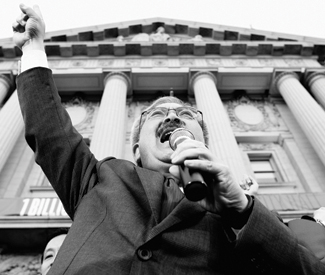
Things changed dramatically when the recession hit and Mayor Ed Lee took office with the promise to focus almost exclusively on economic development and job creation. Today, even with the technology and office development sectors booming and employment rates among the lowest in California, the city hasn’t returned its focus to the environment.

In fact, with ambitious new efforts to intensify development along the waterfront and only lackluster support for the city’s plan to build renewable energy projects through the CleanPowerSF program, the Lee administration seems to be exacerbating the environmental challenge rather than addressing it.

According to conservative projections by the Bay Conservation and Development Commission, the Bay is expected to rise at least 16 inches by 2050 and 55 inches by the end of the century. BCDC maps show San Francisco International Airport and Mission Bay inundated, Treasure Island mostly underwater, and serious flooding the Financial District, the Marina, and Hunters Point.

Lee’s administration has commissioned a report showing a path to carbon reduction that involves promoting city-owned renewable energy facilities and radically reducing car trips — while the mayor seems content do the opposite.

It’s not an encouraging sign for Earth Day 2013.


HOW WE’RE DOING

Last year, the Department of the Environment hired McKinsey and Company to prepare a report titled “San Francisco’s Path to a Low-Carbon Economy.” It’s mostly finished — but you haven’t heard much about it. The department has been sitting on it for months.

Why? Some say it’s because most of the recommendations clash with the Lee administration’s priorities, although city officials say they’re just waiting while they get other reports out first. But the report notes the city is falling far short of its carbon reduction goals and “will therefore need to complement existing carbon abatement measures with a range of new and innovative approaches.”

Data presented in the report, a copy of which we’ve obtained from a confidential source, shows that building renewable energy projects through CleanPowerSF, making buildings more energy-efficient, and discouraging private automobile use through congestion pricing, variable-price parking, and building more bike lanes are the most effective tools for reducing carbon output.

But those are things that the mayor either opposes and has a poor record of supporting or putting into action. The easy, corporate-friendly things that Lee endorses, such as supporting more electric, biofuel, and hybrid vehicles, are among the least effective ways to reach the city’s goals, the report says.

“Private passenger vehicles account for two-fifths of San Francisco’s emissions. In the short term, demand-based pricing initiatives appear to be the biggest opportunity,” the report notes, adding a few lines later, “Providing alternate methods of transport, such as protected cycle lanes, can encourage them to consider alternatives to cars.”

Melanie Nutter, who heads the city’s Department of the Environment, admits that the transportation sector and expanding the city’s renewable energy portfolio through CleanPowerSF or some other program — both of which are crucial to reducing the city’s carbon footprint — are two important areas where the city needs to do a better job if it’s going to meet its environmental goals, including the target of cutting carbon emissions 40 percent from 1990 levels by the year 2025.

But Nutter said that solid waste reduction programs, green building standards, and the rise of the “shareable economy” — with Internet-based companies facilitating the sharing of cars, housing, and other products and services — help San Francisco show how environmentalism can co-exist with economic development.

“San Francisco is really focused on economic development and growth, but we’ve gone beyond the old edict that you can either be sustainable or have a thriving economy,” Nutter said.

Yet there’s sparse evidence to support that statement. There’s a two-year time lag in reporting the city’s carbon emissions, meaning we don’t have good indicators since Mayor Lee pumped up economic development with tax breaks and other city policies. For example, Nutter touted how there’s more green buildings, but she didn’t have data about whether that comes close to offsetting the sheer number of new energy-consuming buildings — not to mention the increase in automobile trips and other byproducts of a booming economy.

Tom Radulovich, executive director of Livable City and president of the BART board, told us that San Francisco seems to have been derailed by the last economic crisis, with economic insecurity and fear trumping environmental concerns.

“All our other values got tossed aside and it was all jobs, jobs, jobs. And then the crisis passed and the mantra of this [mayoral] administration is still jobs, jobs, jobs,” he said. “They put sustainability on hold until the economic crisis passed, and they still haven’t returned to sustainability.”

Radulovich reviewed the McKinsey report, which he considers well-done and worth heeding. He’s been asking the Department of the Environment for weeks why it hasn’t been released. Nutter told us her office just decided to hold the report until after its annual climate action strategy report is released during Earth Day event on April 24. And mayoral Press Secretary Christine Falvey told us, “There’s no hold up from the Mayor’s Office.”

Radulovich said the study highlights how much more the city should be doing. “It’s a good study, it asks all the right questions,” Radulovich said. “We’re paying lip service to these ideas, but we’re not getting any closer to sustainability.”

In fact, he said the promise that the city showed 10 years ago is gone. “Gavin [Newsom] wanted to be thought of as an environmentalist and a leader in sustainability, but I don’t think that’s important to Ed Lee,” Radulovich said.

Joshua Arce, who chairs the city’s Environmental Commission, agreed that there is a notable difference between Newsom, who regularly rolled out new environmental initiatives and goals, and Lee, who is still developing ways to promote environmentalism within his economic development push.

“Ed Lee doesn’t have traditional environmental background,” Arce said. “What is Mayor Lee’s definition of environmentalism? It’s something that creates jobs and is more embracing of economic development.”

Falvey cites the mayor’s recent move of $2 million into the GoSolar program, new electric vehicle charging stations in city garages, and his support for industries working on environmental solutions: “Mayor Lee’s CleantechSF initiative supports the growth of the already vibrant cleantech industry and cleantech jobs in San Francisco, and he has been proactive in reaching out to the City’s 211 companies that make up one of the largest and most concentrated cleantech clusters in the world.”

Yet many environmentalists say that simply waiting for corporations to save the planet won’t work, particularly given their history, profit motives, and the short term thinking of global capitalism.

“To put it bluntly, the Lee administration is bought and paid for by PG&E,” said Eric Brooks with Our City, which has worked for years to launch CleanPowerSF and ensure that it builds local renewable power capacity.

The opening of the McKinsey report makes it clear why the environmental policies of San Francisco and other big cities matter: “Around the globe, urban areas are becoming more crowded and consuming more resources per capita,” it states. “Cities are already responsible for roughly seventy percent of global carbon dioxide emissions, and as economic growth becomes more concentrated in urban centers, their total greenhouse gas emissions may double by 2050. As a result, tackling the problem of climate change will in large part depend on how we reduce the greenhouse gas emissions of cities.”

And San Francisco, it argues, is the perfect place to start: “The city now has the opportunity to crystallize and execute a bold, thoughtful strategy to attain new targets, continue to lead by example, and further national and global debates on climate change.”

The unwritten message: If we can’t do it here, maybe we can’t do it anywhere.


ON THE EDGE

San Francisco’s waterfront is where economic pressures meet environmental challenges. As the city seeks to continue with aggressive growth and developments efforts on one side of the line — embodied recently by the proposed Warriors Arena at Piers 30-32, 8 Washington and other waterfront condo complexes, and other projects that intensify building along the water — that puts more pressure on the city to compensate with stronger sustainability initiatives.

“The natural thing to do with most of our waterfront would be to open it up to the public,” said Jon Golinger, who is leading this year’s referendum campaign to overturn the approval of 8 Washington. “But if the lens you’re looking through is just the balance sheet and quarterly profits, the most valuable land maybe in the world is San Francisco’s waterfront.”

He and others — including SF Waterfront Alliance, a new group formed to oppose the Warriors Arena — say the city is long overdue in updating its development plan for the waterfront, as Prop. H in 1990 called for every five years. They criticize the city and Port for letting developers push projects without a larger vision.

“We are extremely concerned with what’s happening on our shorelines,” said Michelle Myers, director of the Sierra Club’s Bay Chapter, arguing that the city should be embracing waterfront open space that can handle storm surge instead of hardening the waterfront with new developments. “Why aren’t we thinking about those kinds of projects on our shoreline?”

David Lewis, director of Save the Bay, told us cities need to think less about the value of waterfront real estate and do what it can to facilitate the rising bay. “There are waterfront projects that are not appropriate,” Lewis said. Projects he puts in that category range from a scuttled proposal to build around 10,000 homes on the Cargill Salt Flats in Redwood City to the Warriors Arena on Piers 30-32.

“We told the mayor before it was even announced that it is not a legal use of the pier,” Lewis said, arguing it violated state law preserving the waterfront for maritime and public uses. “There’s no reason that an arena has to be out on the water on a crumbling pier.”

But Brad Benson and Diana Oshima, who work on waterfront planning issue for the Port of San Francisco, say that most of San Francisco’s shoreline was hardened almost a century ago, and that most of the planning for how to use it has already been done.

“You have a few seawall lots and a few piers that could be development sites, but not many. Do we need a whole plan for that?” Benson said, while Oshima praises the proactive transportation planning work now underway: “There has never been this level of land use and transportation planning at such an early stage.”

The Bay Conservation and Development Commission was founded almost 50 years ago to regulate development in and around the Bay, when the concern was mostly about the bay shrinking as San Francisco and other cities dumped fill along the shoreline to build San Francisco International Airport, much of the Financial District, and other expansive real estate plans.

Now, the mission of the agency has flipped.

“Instead of the bay getting smaller, the bay is getting larger with this thing called sea level rise,” BCDC Executive Director Larry Goldspan said as we took in the commanding view of the water from his office at 50 California Street.

A few years ago, as the climate change predictions kept worsening, the mission of BCDC began to focus on that new reality. “How do we create a resilient shoreline and protect assets?” was how Goldspan put it, noting that few simply accept the inundation that BCDC’s sea level rise maps predict. “Nobody is talking about retreating from SFO, or Oakland Airport, or BART.”

That means Bay Area cities will have to accept softening parts of the shoreline — allowing for more tidal marshes and open space that can accept flooding in order to harden, or protect, other critical areas. The rising water has to go somewhere.

“Is there a way to use natural infrastructure to soften the effect of sea level rises?” Goldspan asked. “I don’t know that there are, but you have to use every tool in the smartest way to deal with this challenge.”

And San Francisco seems to be holding firm on increased development — in an area that isn’t adequately protected. “The seawall is part of the historic district that the Port established, but now we’re learning the seawall is too short,” Goldspan said.

BCDC requires San Francisco to remove a pier or other old landfill every time it reinforces or rebuilds a pier, on a one-to-one basis. So Oshima said the district is now studying what it can remove to make up for the work that was done to shore up Piers 23-27, which will become a new cruise ship terminal once the America’s Cup finishes using it a staging ground this summer.

Yet essentially giving up valuable waterfront real estate isn’t easy for any city, and cities have both autonomy and a motivation to thrive under existing economic realities. “California has a history of local control. Cities are strong,” Goldspan said, noting that sustainability may require sacrifice. “It will be a policy discussion at the city level. It’s a new discussion, and we’re just in the early stages.”


NEW WORLD

Global capitalism either grows or dies. Some modern economists argue otherwise — that a sustainable future with a mature, stable economy is possible. But that takes a huge leap of faith — and it may be the only way to avoid catastrophic climate change.

“In the world we grew up in, our most ingrained economic and political habit was growth; it’s the reflex we’re going to have to temper, and it’s going to be tough.” Bill McKibben writes in Eaarth: Making a Life on a Tough New Planet. “Across partisan lines, for the two hundred years since Adam Smith, we’ve assumed that more is better, and that the answer to any problem is another burst of expansion.”

In a telephone interview with the Guardian, McKibben discussed the role that San Francisco could and should be playing as part of that awakening.

“No one knows exactly what economy the world is moving toward, but we can sense some of its dimensions: more localized, less material-based, more innovative; these are things that San Francisco is good at,” he told us, noting the shift in priorities that entails. “We need to do conservation, but it’s true that we also need to build more renewable power capacity.”

Right now, CleanPowerSF is the only mechanism the city has for doing renewable energy projects, and it’s under attack on several fronts before it even launches. Most of the arguments against it are economic — after all, renewable power costs more than coal — and McKibben concedes that cities are often constrained by economic realities.

Some city officials argue that it’s more sustainable for San Francisco to grow and develop than suburban areas — thus negating some criticism that too much economic development is bad for the environment — and Radulovich concedes there’s a certain truth to that argument.

“But is it as green as it ought to be? Is it green enough to be sustainable and avert the disaster? And the answer is no,” Radulovich said.

For example, he questioned, “Why are we building 600,000 square feet of automobile-oriented big box development on Hunters Point?” Similarly, if San Francisco were really taking rising seas seriously, should the city be pouring billions of dollars into housing on disappearing Treasure Island?

“I think it’s a really interesting macro-question,” Jennifer Matz, who runs the Mayors Office of Economic Development, said when we asked whether the aggressive promotion of economic development and growth can ever be sustainable, or whether slowing that rate needs to be part of the solution. “I don’t know that’s feasible. Dynamic cities will want to continue to grow.”

Yet that means accepting the altered climate of new world, including greatly reduced fresh water supplies for Northern California, which is part of the current discussions.

“A lot of the focus on climate change has moved to adaptation, but even that is something we aren’t really addressing,” Radulovich said.

Nutter agreed that adapting to the changing world is conversation that is important: “All of the development and planning we’re doing today needs to incorporate these adaptation strategies, which we’re just initiating.”

But environmentalists and a growing number of political officials say that San Francisco and other big cities are going to need to conceive of growth in new ways if they want to move toward sustainability. “The previous ethos was progress at any cost — develop, develop, develop,” Myers said, with the role of environmentalists being to mitigate damage to the surrounding ecosystem. But now, the economic system itself is causing irreversible damage on a global level. “At this point, it’s about more than conservation and protecting habitat. It’s about self-preservation.”
Norman Solomon: Nominate Bradley Manning for the Nobel Peace prize!

1

Norman Solomon is co-founder of RootsAction.org and founding director of the Institute for Public Accuracy. His books include “War Made Easy: How Presidents and Pundits Keep Spinning Us to Death.” He writes the Political Culture 2013 column.

The Nobel Peace Prize that President Obama received 40 months ago has emerged as the most appalling Orwellian award of this century. No, war is not peace.

George Carlin used to riff about oxymorons like “jumbo shrimp,” “genuine imitation,” “political science” and “military intelligence.” But humor is of the gallows sort when we consider the absurdity and tragedy of the world’s most important peace prize honoring the world’s top war maker.

This week, a challenge has begun with the launch of a petition urging the Norwegian Nobel Committee to revoke Obama’s Peace Prize. By midnight of the first day, nearly 10,000 people had signed. The online petition simply tells the Nobel committee: “I urge you to rescind the Nobel Peace Prize that was awarded to Barack Obama.”

Many signers have added their own comments. Here are some samples:

“It is with very great regret that I sign this petition, but I feel it is morally the right thing to do. I had phenomenally high hopes that our President would be a torch bearer for the true message of Peace. Instead he has brought death, destruction and devastation to vast areas of the world, and made us less safe by creating more enemies.”  Sushila C., Punta Gorda, FL

“War is nothing to be given a peace prize for.”  Brent L., San Diego, CA

“President Obama has clearly demonstrated that he is undeserving of the Nobel Peace Prize. Revoke his prize and give it to Bradley Manning!”  Henry B., Portland, OR

“Perhaps a better president than Bush or Romney, but not a Nobel laureate for peace.”  Arun N., Woodinville, WA

“I honestly cannot understand how they could bestow that honor on President Obama to begin with; I’m still puzzled!”  Cindy A., Phoenix, AR

“Giving the prize to President Obama has degraded the esteem the Nobel Prize once had as a means of recognizing the best of us. It now represents a pat on the back for the thugs that roam freely amongst our governments. That decision has made me question the integrity of all previous nominations, and wonder if the entire Nobel Prize program is nothing but a sham.”  Juan F., Arcata, CA

“Continued occupation of Afghanistan and drone strikes across national borders are NOT the actions of a peacemaker. Mr. Obama has defiled the good will of the Nobel prize.”  Dudley D., Chicago, IL

“His actions are speaking louder than his words. He has continued Bush’s torture policy and both wars. He has sent armed drones in to remote places and only questionably killed terrorists, but definitely killed civilians. He does not deserve it.”  Katherine M., San Diego, CA

“Les espoirs envers Obama étaient élevés, les résultats décevants.”  André T., Quebec City, Canada

“A President for Peace? Tell that to the thousands of innocent men, women and hundreds of children that have been killed in drone strikes during the Obama administration. It was laughable that this coveted prize was given to him in the first place but now it is just obscene!”  Barlee R., Antioch, CA

“Allowing the Nobel Peace Prize to remain in Obama’s name forsakes the very creed the prize is meant to represent. Please don’t (continue to) be a hypocrite — no way in Hell does that man deserve to be credited in any way for being a peacemaker. I said the same for Bush by the way — so don’t think I’m just some partisan nutcase obsessed with bashing Obama. I simply speak the Truth as often as possible and let the chips fall where they may. Many of us peaceful, compassionate folks would like to have this message droned into your collective heads. Obama is just another puppet doing the bidding of the greedy, mass-murdering global elite.”  Greg C., Manhattan, KS

“The peace prize should be awarded to Pfc. Bradley Manning instead.”  Robert F., Santa Clara, CA

“This would be an extraordinarily bold move, but it certainly would send a message to the world that peace means peace, not war.”  David G., Portland, OR

“I so wish President Obama had lived up to the award he was given. Instead he has chosen to continue and expand the horrors being perpetrated by our country. War is not ever the answer.”  Carol G., Goshen, IN

“Droning people to death is not peace.”  William S., New York, NY

“Not being George W. Bush was never sufficient ground for this award, and Mr. Obama’s enthusiastic support for the extension of empire, fossil fuels, raw military power, and other violence against the earth and its people is further evidence of its unwisdom.”  Scott W., Durham, NC

“One must walk the walk of peace, not just talk the talk of peace in order to earn the Peace Prize.”  Paul M., Los Angeles, CA

“Drone Bombs create more terrorists than they kill.”  Jay J., Roachdale, IN

“A war criminal is not worthy of the Nobel Peace Prize.”  Lars P., Afton, WI

“Our President had an unprecedented opportunity to effect a turn-around in foreign policy after the illegal and failed wars of his predecessor. He was hired to do so; but he has squandered the opportunity and has in fact increased U.S. aggression. He does not deserve to be known as a Nobel Peace Prize recipient.”  Lynn J., Roslyn, PA

“The PEACE prize should be given to those that work toward PEACE, not the ones that only talk about it.”  Karen W., Weirsdale, FL

“Take it from Obama and give it to its rightful owner, Bradley Manning.”  Rand K., Hotchkiss, CO

 “I urge you to rescind the Nobel from this coward who kills children with drones. Are you intentionally making the peace prize a joke or are you just not too bright?”  Janet M., Charlottetown, CA

“He’s not as big a war criminal as Kissinger, so you should revoke both.”  Earl F., Santa Maria, CA

“This man is a disgrace in the cause of peace. What were you thinking?”  Sherrill F., Davis, CA

“Given his actions and policies, Obama is more a Man of Pieces — as in, ‘Blow them to pieces!’ — than he is a Man of peace.”  Marcus M., San Rafael, CA

“He’s done nothing to deserve it; and he’s done many things to destroy peace in this world.”  Danny D., Shoreline, WA

“This human has killed more after he got the prize.”  Thomas P., Lewiston, CA

“He obtained the award on promises he didn’t keep.”  Ron B., Bend, OR

“President Obama’s actions have shown that his words were meaningless. The Nobel Peace Prize means little if it’s so easily given away.”  Debra J., Pasadena, MD

“As an Obama voter I am deeply disappointed. It was bad judgment to give it to him in the first place.”  Tim K., Long Prairie, MN

“Drones are offensive weapons, in every sense of the word.”  Richard F., Portland, OR

“As much of an Obama supporter I am, perhaps stripping him of this award would get his attention, nothing else seems to be getting the message across that the American People have had enough of multiple trillion dollar unnecessary wars.”  Vern M., Albuquerque, NM

“Obama is a smiling war monger.”  Jon M., Wellington, New Zealand

“Under Obama’s leadership our assassination-by-drone foreign policy has increased dramatically, which makes him a war criminal.”  Frank S., Bellingham, WA

“As a constituent and two-time voter for Barack Obama, I am dismayed and frightened at the warmongering ways he has displayed as our leader. I urge the revocation of his undeserved Nobel prize.”  Samuel P., Colton, CA

“What a good idea! Yes, he has the blood of many innocents on his hands.”  Gene A., Athens, OH

“He should have never got it in the first place!”  David S., Everett, WA

“I voted for the president in both elections but I do not feel he ever deserved the Nobel Peace Prize! Please rescind it!”  Carol H., Michigan City, IN

“Please start with Henry Kissinger before Obama, whose hands are tied.”  Bob S., Gibsons, BC, Canada

“Giving him a Nobel Peace Prize is an affront to the deep heritage of true peacemakers who well deserved it. Obama has waged continuous war, torture and other violence since being President. Please revoke it now.”  Barry S., Macdoel, CA

“Bush gave us 2 unfunded wars. Will Obama add a few more? Stop wars, drones and killing with other people’s children.”  Burt S., Pompton Plains, NJ

“I voted for Obama — twice. I am very sad to sign this petition, but I believe in my heart, what he has done with drones is totally wrong!”  Gloria H., Santa Rosa, CA

“Obama’s deeds do not match his words.”  Evalyn S., Walnut Creek, CA

“You lost any credibility giving Obama the peace prize. Fix it.”  Camilo B., Long Beach, CA

“Obama’s harsh treatment of whistleblowers who are trying to expose the outlandish abuses of the military/corporate state disqualify him from any awards given to peacemakers.”  David L., Alamosa, CO

“It’s real sad that the promises that were made by Barack Obama concerning nearly everything have been lost with his sellout to corporate greed. We need a real leader for Peace.”  Al B., Ignacio, CO

“I had high hopes for this President when I voted for him. I believed him to be a peace maker, unlike the hawk who was his predecessor. However, there seems to be no effort at peacemaking, at reconciliation, at hope, and killing-by-drone simply leads to more fear and hatred. I fear the day that the government will try to control US with them, too.”  Louise A., Greenfield, MA

“You gave him the Nobel Peace Prize too soon. His use of drones and killing of innocent civilians attests to his being anything but a peace-maker.”  Rev. Sandy G., San Francisco, CA

“It is not a good example of what peace means when the Nobel Prize is awarded to the leader of a nation engaging in war as a business strategy. Make a statement, please.”  Chandra P., Walsenburg, CO

“I, like so many others, gave this man the benefit of the doubt. It has been thrown back in our faces.”  Chris C., Harrogate, Great Britain

“He never deserved it and he hasn’t earned it. Yes, please, take it back.”  Jackie F., Oakland, CA

 “The Nobel Peace Prize should not be awarded to war mongers and war criminals. Therefore, please revoke the Peace Prize you awarded to President Obama in 2009.”  Fred N., Pleasanton, CA

“It is with deepest regret we ask for this but our President’s actions have not lived up to the high honor of promoting peace.”  GlendaRae H., South Bend, IN

“I don’t think anyone ever understood what Obama was supposed to have done to have deserved the Peace Prize in the first place. And I’m a lifelong Democrat, so my feeling that the Nobel Committee made a mistake is not based in political partisanship.”  Steve J., Hermosa Beach, CA

“It appears that preemptive peace prizes work about as well as preemptive wars.”  Jaan C., Alameda, C

To read more comments, or to sign the RootsAction.org petition urging the Norwegian Nobel Committee to revoke President Obama’s Peace Prize, click here.

Norman Solomon is co-founder of RootsAction.org and founding director of the Institute for Public Accuracy. His books include “War Made Easy: How Presidents and Pundits Keep Spinning Us to Death.” He writes the Political Culture 2013 column.


Are you experimental?

0

cheryl@sfbg.com

FILM At 52, the San Francisco Cinematheque is nearly the same age as the San Francisco International Film Festival, which kicks off its 56th incarnation later this month. And though there’s bound to be some filmmaker overlap between SFIFF and SF Cinematheque’s fourth annual Crossroads festival,

fans of avant-garde, experimental, and non-commercial films won’t want to miss the latter, a weekend packed with works by 48 artists across eight esoterically-titled programs.

Crossroads, which is curated by Cinematheque artistic director Steve Polta, boasts several world premieres, including a pair worthy of particular attention: Jodie Mack’s Dusty Stacks of Mom: The Poster Project, and Scott Stark’s The Realist. At 40-something minutes each, these are among the longer works included in the program; both make the most of their running times to achieve artistically innovative and thematically complex results.

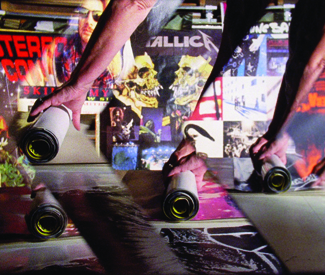
A partially animated, fully musical chronicle of the rise and fall of her mother’s mail-order poster shop, Mack’s Dusty Stacks of Mom lifts its tunes and certain motifs from Dark Side of the Moon. (Though the connection is never explained, it’s likely the Dark Side poster was a best-seller for the store, which specialized in dorm-room classics.) “Come and tour with me/my mother’s poster factory,” Mack sings by way of narration, as her camera discovers piles of cardboard tubes, stacks of handwritten invoices (which hint at why the business faltered in the Internet age), and images of stars like Leonardo DiCaprio and Johnny Depp frozen in time as their 1990s selves.

Stop-motion animation and eye-candy collages bring these paper performers to life, with Mack’s good-sport mother appearing periodically alongside what’s left of her inventory. Though some of the Pink Floyd covers-with-new-lyrics can skew a bit twee, Dusty Stacks‘ visuals never falter; this was clearly a labor-intensive labor of love for Mack, who teaches animation at Dartmouth. A particularly inspired sequence flashes between the holy trinity of college-dude decor: Che, Bob Marley, and Tony Montana.

Dusty Stacks anchors Crossroads’ “Gigs in the Sky: Let There Be More Light!”, which contains films tied together by music and “this post-Kenneth Anger kind of colorful thing,” as Polta calls it. Unlike more mainstream fests, which curate shorts programs with an eye for obvious links between the works, Polta tapped into a more intuitive process.

“The program ‘on the beach (at night)’ has a really interesting film by Jim Drain and Ben Russell called Ponce de León. It’s got these really strange camera techniques in it, and the way it deals with visual space is really interesting, outside of what it’s saying about the way people spend their time and the way generations look back and forth at each other,” he says. “When I saw the opening film of that program, Danielle Short’s Lost Ambulation, it was like, ‘Oh yeah. There’s this sort of depth and flatness going on.’ At a certain level there’s a whole thread in the avant-garde world about these issues; it’s just like talking about painting when you talk about depth and flatness.”

The programs began to take shape early on, while he was looking at all 400-something Crossroads submissions. “You start to take notes: here are some trends. This film and that film would look really interesting back to back. They start to assemble in these little sort of gravitational groups,” he says. “That’s the fun, or the challenge, of curatorial work. It’s like cooking: how can you get a certain kind of flavor, and what can you do to bring that flavor out? Here’s a really interesting film, and putting this other film next to it will sort of change the way you look at it.”

However, he adds, “I also think it’s worth leaving these connections a little bit mysterious. It’s interesting to kind of put these ideas out there and let the viewers sort of pick up on them, or not.”

Local filmmaker Scott Stark is the only artist in this year’s Crossroads to command a solo program (save the inclusion of a 1947 short by Fernand Léger). Stark’s latest, The Realist, uses flickering images of mannequins and consumer goods to investigate themes of “loneliness, desire, and presenting yourself in a certain way,” Polta says; it’s a mesmerizing work. But Polta is quick to note that, again, a sense of mystery is key to the viewing experience. “Part of the fun of The Realist is discovering, as you’re watching it, that there’s some suggestion of a narrative.”

A program of sorta-family-related films, “(as if clinging could save us),” contains another of Polta’s standouts: Jonathan Schwartz’s Animals Moving to the Sound of Drums.

“The film resonates with a well-known classical avant-garde film, [Jack Chambers’ 1970] The Hart of London, which also has to do with repetition of generational experiences through time, and relationships between animals and humans,” Polta says. More than that, though, “[Schwartz] makes films that are really bold in the ways they reach out and embrace sentimentality and emotionalism. They have a faith in sincere emotion that hasn’t been really hip in the last decade. I’d like to think that there’s a balance of that in this festival, between a certain kind of irony and a certain kind of sincerity. People are trying to work that out right now in the avant-garde world right now, whether to be sincere or ironic.”

Another emerging avant-garde star, Michael Robinson, has addressed this dichotomy in his work. His dreamy, glimmering 45-minute Circle in the Sand closes out Crossroads’ last program, “Slaves of Sleep”/”Destroy, She Said.”

“[Robinson has] made a lot of short films using found footage, stuff from video games, and music you’d hear on the radio — but in a way that sort of dares you to squeeze some real, serious emotion out of pop culture that most people would treat as this kind of ironic thing,” Polta says. “Circle in the Sand is mostly, if not completely, footage that he shot. It’s a science fiction film with a vague narrative; it feels like it’s set at a certain point in human evolution where the mundane world that we live in now isn’t going to matter anymore. It’s got a lot of mystery in it about what’s going to happen next to the human race — which is what we’re sort of leaving you with in the final program.” *

CROSSROADS 2013

Fri/5-Sun/7, $10 (festival pass, $50)

Victoria Theatre

2961 16th St, SF

www.sfcinematheque.org


Hot sexy events: Nerd boobs, Bill Gates’ condom quest, and the Sheagle = landed

0

Hey, dudes who don’t like condoms, has Bill Gates got your back or what? During the same month that the Pope Emeritus reincarnates as a wall of condoms, the tech bajillionaire has donated the change he found in his couch ($100,000) to the Global Health research foundation Bill and wife Melinda founded through their foundation to developing a rubber that feels better on penises.

Yes, we know, yet more money that focuses on male reproductive health. But for those who regularly find themselves in contact with penis-bearers, the promise of never hearing another “but I can’t feeeel it with the condom on,” will be a definite boon to that largest of sexual organs: our brain, which non-scientifically speaking, shrivels up and dies a little from so much whining in bed. (Also, penis bearers? Golf claps for science, but in the meantime you might benefit from not jerking it so damn hard. Try a Fleshlight.)

Chat about the politics of sex research, or forget about politics altogether, at this week’s sexy events:

Sheagle

A night presented by the female-identified kinksters of San Francisco, but open to attendees in the newly (more or less) re-opened space of this beloved leather bar. The monthly party will benefit a different female-identified organization — this month it’s the SF girls of Leather, who rad work you can read about in this Guardian cover story on their cute kink from a few years ago. 

Wed/27, 8pm-2am, free. Eagle, 298 12th St., SF. www.sf-eagle.com

“Bling My Vibe” awards ceremony 

When Good Vibrations contacted me about crafting an project from a vibrator for their March art contest I said: sure. And though every time I’ve been back to see it proudly installed in the Polk Street store’s gallery/education space there’s been a class going on, I have nothing but the utmost faith that the room full of Conehead vibes, vibrators fashioned into magical steeds, and Ninja Turtles vibes (HuffPo has a nice slideshow if you’re curious) is an uplifting experience. Today, the top crafters take home gift certificates so that they can continue to make sweet projects with Good Vibes gear.

Fri/29, 6-8pm, free. Good Vibrations, 1620 Polk, SF. www.goodvibes.com

Nerd Nite at the Lusty Lady

SF’s only co-op strip club welcomes sci-fi freaks tonight. Lusty dancer Pandora wrote us in an email that the Lusty theme nights are all about costumes: “Well, as much as you can costume and still be naked, which as it turns out is quite a bit. 😉 Sometimes music or activities like naked Twister, naked light saber battle. naked karaoke. Pretty much anything fun, and put naked in front of it.” Check out this video for more on why the peep shows and VIP booths here rock:

Fri/29, 8am-3pm. The Lusty Lady, 1033 Kearny, SF. www.lustylady.com

Spring Breakers 

“Why you acting ‘spicious?” The ATL twins, James Franco Gucci Mane, Vanessa Hudgens, blatant perversion of typical crime movie gender roles — Harmony Korine’s latest cult classic is the sexiest film of 2013 and you should see it before you get secondhand sick of the catchphrases. Which reminds me, “spring break 4eva.”

http://www.youtube.com/watch?v=rVvn9T6bqls

Various Bay Area theaters

Goodbye Gauley Mountain screening and dinner

Feminist porn pioneer Annie Sprinkle and partner Beth Stephens premiere the couple’s documentary on their ecosexual relationship with the Appalachian mountains and the crusade to stop destructive mining practices. Come early for the pre-screening vegan Appalachian dinner.

Trailer Goodbye Gauley Mtn: An Ecosexual Love Story from Elizabeth Stephens on Vimeo.

Sat/30, dinner 6:30pm, screening 7pm, $10-100. Center for Sex and Culture, 1349 Mission, SF. www.sexandculture.org

Faith in flow

0

culture@sfbg.com

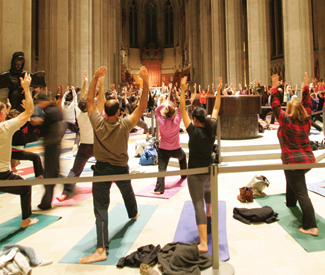
ON THE OM FRONT Every Tuesday evening, hundreds of people flock to the Grace Cathedral Labyrinth to practice yoga with local teacher Darren Main. With Easter around the corner, I talked to Main and the Reverend Jude Harmon, who manages the program, about how this unlikely class came to be, and why it works so well in San Francisco.

San Francisco Bay Guardian Darren, how did you wind up teaching the class at Grace Cathedral?

Darren Main Jamie Lindsay, a yoga teacher who had been attending Grace Cathedral for years, started the class there. When he moved to New York in 2009, he asked me if I would take the class. I had long admired Grace Cathedral for both its architectural wonder as well as how it has been on the cutting edge of social justice and spiritual equality. Right from the start I could feel something magical happening. What started off as a small group of students has now grown to over 300 people each week.

SFBG How does yoga fit in at the church?

Jude Harmon Grace Cathedral was established with the founding vision “to be a house of prayer for all people.” We were at the forefront of civil rights, welcoming Martin Luther King Jr. to preach here, and we paved the way forward for the embrace of LGBT people in the sacramental life of the Church long before it became the norm at a national level. This yoga class is just a natural extension of our commitment to welcome all people, from every walk of life, and to support them in their spiritual growth.

SFBG What’s it like to teach yoga at Grace?

DM It’s an amazing experience. You can’t help but feel something sacred by simply walking through the door. It’s like teaching in the Taj Mahal or the Great Pyramid. People come from all over the world just to see this building, walk its labyrinth, and admire the architecture and artwork. I am moved to tears sometimes when I think of how much this cathedral — and specifically doing yoga in this cathedral — represents the magic of San Francisco.

SFBG Do you have to be a churchgoer to attend?

DM Not at all. Yoga is a science, not a religion and so it requires no belief to be effective as a practice for quieting the mind, opening the heart, and balancing the body. In fact, many atheists find yoga extremely rewarding. Non-Christians attend the class for the community, the practice, and the beauty of the cathedral.

SFBG Can yoga enhance one’s spiritual practice?

DM Yes, because it helps us to more easily access the divine when we have a quiet mind, a balanced body and an open heart. Yoga can also be a way of exploring the same universal questions that religion explores, like “why are we here?” and “who are we?”

SFBG Does the practice of yoga connect in any way to the practice of Christianity?

JH I remember the first time I saw the yoga students ascending Grace Cathedral’s great steps in droves on the dusk of a July evening. They seemed like angelic visitors from some Hyperion realm. But they weren’t carrying Books of Common Prayer in their hands, or hymnals, or even Bibles — they were carrying yoga mats! While most of them wouldn’t dream of setting foot in a church for a traditional Eucharist, I felt my heart bond with them. At the heart of a yogic practice, just as at the heart of our Eucharistic practice, is the possibility of a self-integration that opens out our consciousness toward the world in compassion.

SFBG What is the yoga class like?

DM Given that the class is so diverse in terms of age, physical ability, and level of yoga practice, I focus on the more gentle and meditative side of yoga. The cathedral itself invites a more inward and contemplative experience as well, so it is really a perfect fit. Every week, I invite Bay Area musicians who have a transcendent quality to play at class.

SFBG Why do you think a class like this became so popular in San Francisco?

DM San Francisco has always been known for being open-mined, and that quality makes people open to the unique experience of doing yoga in a church. That said, I would not be at all surprised if we see this idea spreading beyond the Bay Area over the next 10 years or so.

Karen Macklin is a writer and yoga teacher in San Francisco. Read her On the Om Front column every other week on the SFBG Pixel Vision blog.


Alerts

0

Submit political events to be listed in Alerts at alert@sfbg.com or tweet us @SFBG_alerts.

WEDNESDAY 3

Protest Obama fundraiser outside the Getty mansion 2870 Broadway, SF. tinyurl.com/c2mkope. 5:30pm, free. Environmentalists opposing the Keystone XL oil pipeline will protest in San Francisco’s wealthy Pacific Heights neighborhood, where President Barack Obama will dine with the city’s upper crust for a Democratic Party fundraiser. Credo Action – the advocacy arm of telecom Credo Mobile – is mobilizing the protest in tandem with the Sierra Club, 350.org and Friends of the Earth.

Community meeting to save City College Pitcher Room, City College Southeast Campus, 1800 Oakdale, SF. info@saveccsf.org. 6pm, free. Students and community supporters who are engaged in the ongoing fight to save City College of San Francisco as an affordable and accessible educational resource are planning major actions in coming weeks. Join them for this informational and strategy session to preserve this important institution.

THURSDAY 4

Public forum with David Graeber Namaste Hall, California Institute for Integral Studies, 1453 Mission, SF. 7pm, free. An anthropologist from the University of London, author David Graeber is credited with helping to lay the intellectual framework underlying the Occupy Wall Street movement. His work includes Debt: The First 5000 Years, a tome exploring wealth inequality through the ages. Graeber’s talk will be on “Austerity and its Discontents.”

FRIDAY 5

Panel talk on global affirmative action Room 132, UC Berkeley School of Law, 215 Boalt Hall, Berk. tinyurl.com/ckc6qdu. 4-6pm, free. RSVP. Many fear that an upcoming Supreme Court ruling will spell the end of affirmative action admission programs for public colleges and universities. This panel will discuss global affirmative action law, with presenters from the European Commission, the University of Sydney School of Law, and Berkeley Law.

Forum with Dr. Ignacio Chapela Niebyl Proctor Library, 6501 Telegraph Ave, Oakl. SpeakOut-Now.org. 7pm, $3 donation. Dr. Ignacio Chapela, Associate Professor of Microbial Ecology at UC Berkeley, has been studying the impact of genetically modified plants and the misuse of science and its impact on our planet. Join this Speak Out Now forum to hear Chapela’s vision for how science could be used for more positive ends.

SUNDAY 7

Book talk: Beyond Walls and Cages Modern Times Bookstore Collective, 2919 24th St, SF. www.occupyu.org. 6pm, free. As part of Modern Times’ ongoing Occupy U workshop series, this book discussion will explore how prisons, criminalization and militarization facilitate wealth and power inequalities. Join editors Jenna M. Loyd, Matt Mitchelson, and Andrew Burridge in discussion of their book, Beyond Walls And Cages: Prisons, Borders, and Global Crisis.


Get discount tickets to see Karsh Kale

0

Karsh Kale live featuring Alam Khan: Classical Science Fiction
 
“Karsh Kale has established himself as a spokesman for a generation of music that incorporates electronica, dance grooves and classical Indian sound” – SF Chronicle

Classical Science Fiction is the brainchild of producer and multi-instrumentalist Karsh Kale, who breaks down the traditional constructs of Indian classical music while maintaining its emphasis on rhythm, scale, and improvisation. Karsh has put together an all-star ensemble of musicians who are rooted in traditional styles yet creating new paths in Indian classical, electronica, blues, jazz, rock, and ghazal.
 
Karsh is equally comfortable DJing as he plays tabla with the late sarangi maestro Ustad Sultan Khan, rock icon Lenny Kravitz, or R&B songstress Alycia Keys. He is at home performing with his childhood hero Ustad Zakir Hussain, or as a member of the super group Tabla Beat Science, or orchestrating and composing for Bollywood films. He is considered by many as the face of the emerging independent music scene in India.

With Alam Khan. Follow this link for more info and click here to buy tickets. Use code “SFBG” for 10% off.
 
Thursday, March 21 at 8pm @ Herbst Theatre, 401 Van Ness, SF | $50/$35/$25 via City Box Office

Yoga, church, and radical acceptance: An interview with the Grace Cathedral yoga team

1

Every Tuesday evening, hundreds of people flock to the Grace Cathedral Labyrinth to practice yoga with local teacher Darren Main. With Easter around the corner, SFBG talked to Main and the Rev. Jude Harmon, who manages the program, about how this unlikely class came to be, and why it works so well in San Francisco.

SFBG: Darren, how did you wind up teaching the class at Grace Cathedral?

Darren Main: My friend Jamie Lindsay, a yoga teacher who had been attending Grace Cathedral for years, started the class there. When he moved to New York in 2009, he asked me if I would take the class. I had long admired Grace Cathedral for both its architectural wonder as well as how it has been on the cutting edge of social justice and spiritual equality. Right from the start I could feel something magical happening. What started off as a small group of students has now grown to over 300 people each week.

SFBG: How does yoga fit in at the church?

Rev. Jude Harmon: Grace Cathedral, like the National Cathedral, was established with the founding vision “to be a house of prayer for all people.” We have hosted a wide variety of cultural events that span the spectrum of nearly every kind of diversity imaginable. We were at the forefront of civil rights, welcoming Martin Luther King Jr. to preach here, and we paved the way forward for the embrace of LGBT people in the sacramental life of the Church long before it became the norm at a national level. This yoga class is just a natural extension of our commitment to welcome all people, from every walk of life, and to support them in their spiritual growth.

SFBG: What’s it like to teach yoga at Grace?

DM: Teaching in a church, especially one the size of Grace Cathedral, is an amazing experience. You can’t help but feel something sacred by simply walking through the door. And there is something about being in such an iconic space. It’s like teaching in the Taj Mahal or the Great Pyramid. People come from all over the world just to see this building, walk its labyrinth, and admire the architecture and artwork. I am moved to tears sometimes when I think of how much this cathedral — and specifically doing yoga in this cathedral — represents the magic of San Francisco.

SFBG: Do you have to be a churchgoer to attend?

DM: Not at all. Yoga is a science, not a religion and so it requires no belief to be effective as a practice for quieting the mind, opening the heart, and balancing the body. In fact, many atheists find yoga extremely rewarding. Non-Christians attend the class for the community, the practice, and the beauty of the cathedral.

SFBG: Can yoga enhance one’s spiritual practice?

DM: Yes, because it helps us to more easily access the divine when we have a quiet mind, a balanced body and an open heart. Yoga can also be a way of exploring the same universal questions that religion explores, like Why are we here? and Who are we?

SFBG: Does the practice of yoga connect in any way to the practice of Christianity?

JH: Yes. Early Christians—known as monastics—went to live alone in the desert to train their bodies to perceive the Word of God that is spoken in nature. The ascetic practices they developed to help them are very similar to those employed by yogis. And like great yogis, these early Christian pioneers were sought after for their deep wisdom.

I remember the first time I saw the yoga students ascending Grace Cathedral’s Great Steps in droves on the dusk of a July evening. They seemed like angelic visitors from some Hyperion realm. But they weren’t carrying BCPs in their hands, or hymnals or even bibles—they were carrying yoga mats! While most of them wouldn’t dream of setting foot in a church for a traditional Eucharist, I felt my heart bond with them. At some very profound level, yogis and Episcopalians have this in common: an intuitive yearning for deep communion and real presence. At the heart of a yogic practice, just as at the heart of our Eucharistic practice, is the possibility of a self-integration that opens out our consciousness toward the world in compassion.

SFBG: Has the yoga class helped bring lapsed Christians back to church?

JH: I’ve heard a lot of people say that they’re surprised and delighted to see a priest [myself] practicing yoga with them, and that maybe religion, and Christianity in particular, isn’t ‘all bad after all’! The extent to which that translates into people coming to Sunday services is another question. I did issue an invitation to the yoga community to participate in Ash Wednesday services and I saw several of them there. I believe that we must continue to build relationship, and also to build content that is familiar and comfortable, meaningful and simple, and that appeals to both the congregation and the yoga community across contexts.

DM: Over the years, hundreds of students have told me that their experience at Yoga on the Labyrinth helped them let go of past religion-based trauma, and even recognize the beauty in Jesus’ message of compassion and forgiveness. While the yoga class may have brought them into the church, they eventually came to see that Grace Cathedral was not like traditional churches. It welcomes people of all stripes and backgrounds, and only wants people to find spiritual wellbeing on their own terms. Like yoga, Grace is about radical self-acceptance. This radical acceptance can be profoundly healing.

SFBG: What is the yoga class like?

DM: Given that the class is so diverse in terms of age, physical ability, and level of yoga practice, I focus on the more gentle and meditative side of yoga. The cathedral itself invites a more inward and contemplative experience as well, so it is really a perfect fit. Every week, I invite Bay Area musicians who have a transcendent quality to play at class. Artists include Sam Jackson (singing bowls), Kendra Faye (harp), Timothy Das (Native American flute and didgeridoo), and Amber Field, Christopher Love, and Mirabai (Indian chanting).

SFBG: Why do you think a class like this became so popular in San Francisco?

DM: San Francisco has always been known for being open-mined, and that quality makes people open to the unique experience of doing yoga in a church. That said, I would not be at all surprised if we see this idea spreading beyond the Bay Area over the next ten years or so.

SFBG: It’s Easter time. Will your classes this month connect at all with the holiday?

DM: I try to theme my classes around seasons, holidays, and current events and Easter is one of my favorite holidays. While the story of Jesus’ death and resurrection is unique to the Christian tradition, the underlying theme — which is about the endurance of hardship and the opportunity for transcendence and rebirth through that experience—is as universal and inevitable as the sunrise.

Karen Macklin is a writer and yoga teacher in San Francisco — her On the Om Front column appears biweekly here on sfbg.com

YOGA AND SPIRITUALITY LISTINGS

By Joanne Greenstein

Spring Equinox Celebration with Katherine Otis

Capture the spirit of the season of revitalization, rebirth, and renewal. Usher in spring with this

workshop designed to help you welcome new beginnings and set new intentions.

Sat/23, 2-4:30pm, $30-35. Bernal Yoga, 908 Cortland, SF. www.bernalyoga.com

Introduction to Yogic Philosophy with Karen Macklin

Wondering what your teachers are talking about in yoga class when they mention all of those obscure Sanskrit terms and philosophies? This exciting workshop with your On the Om Front columnist will cover many of the most popular philosophical concepts encountered in the yoga room today, and help you gain a better understanding of the roots and heart of this practice.

Sat/23, 1:30-4pm, $35. Yoga Garden, 286 Divisadero, SF. www.yogagardensf.com

Healing Sound Concert with WAH!

Searching for healing and balance? Lay back, relax, and listen as Wah’s voice and music bring you to a meditative space. Special effects and “blisslights” enhance the experience.

Sat/23, 8-10pm, $35-40. Urban Flow, 1543 Mission, SF. www.urbanflowyoga.com

Yoga and Hiking with Wesleigh Roeca

Take your yoga outside! Explore the city and your practice in an adventure integrating urban hiking with yoga, and break out of the confines of the studio walls.

Sun/24, 11:00am-1:15pm, $30-35. Aha Yoga, 1892 Union, SFwww.ahayogasf.com

Stillness & Silence: Renewing Our Spiritual Vision with Swami Ramananda & Integral

Let the power of silence at this ocean side setting provide the space for an inward journey. This three-day Yoga Institute retreat in Bolinas consists of hatha yoga, workshops, meditations, and a variety of evening programs.

April 4-7, $400 – $475. Commonweal Retreat Center, 451 Mesa Road, Bolinas. www.integralyogasf.org


The Performant: Oakland, We’re For You

0

Oakland Nights….LIVE! makes a scene

Clear your calendars everybody, Oakland’s own untelevised late-night talk show has returned from a wintry hibernation and found itself some indoor digs, all the better to display their charmingly populist showcase.

The brainchild of art teacher and science nerd Julie Crossman, and sound artist Jeremy Dalmas, Oakland Nights…LIVE! is a giddy mashup of brief lectures/guest speakers, interviews, contests, music, and general goofing around, loosely adhering to a pre-determined theme. Newly located in the recently outfitted hackerspace, the Sudo Room (it used to play in Dalmas’ backyard, and once, memorably, on BART), ONL’s spartan “set” resembles a picked-over yard sale in the late afternoon: a few mis-matched chairs, a desktop crowded with knickknacks, a rotary telephone, a pile of seemingly random toys, including an old fashioned porcelain doll named Spooky Lucy, a basket of (vegan) cookies for participants. A video screen hovers behind the stage, primed for live-cam action, and a winningly upbeat house band, the Hats, stand at the ready.

After an opening monologue about hemorrhoids and hot doctors delivered by Channing Tatum (just kidding, it was Oakland comedian Channing Kennedy who also provides most of the onscreen visuals) the show begins in earnest. There were cue cards (applause, maniacal laughter, awkward cough), and the first oddience competition of the evening “Who’s New?” — the highlight of which was a video of baby goats at the Oakland Zoo, because the highlight of just about everything in this cruel world is a video of baby goats.

The theme of the evening was “The Human Body,” so the first guest lecturer was a dermatologist, Ingrid Roseborough. First thing I learned over the course of the evening from the opening monologue is that there are four kinds of hemorrhoids (lovely). The second, during Roseborough’s Q&A, was about the lines of Blaschko, invisible stripes on the human body that become visible only in conjunction with certain skin conditions. Education and entertainment. It doesn’t get much better.

Except that it does. Among the guests wrangled by the impossibly buoyant Crossman and her laid-back co-conspirator Dalmas are Exploratorium Explainer Raha Behman who dissects a cow eye on the live-cam to predictable gasps and giggles, a duo of intensely-focused dancers, Christine Bonansea and Justin Morrison, whose aggressively industrial soundtrack would fit right in on a Throbbing Gristle album, swallowing expert Lauren Scheiner, who leads the room in a series of tongue exercises, and comedian David Cohen whose stated goal is to uncover  what constitutes the perfect smooch.

He raises some hackles with his San Francisco-based safari video, the popular sentiment being that Oakland should be the representative demographic at ONL, a stance that comes off sounding somewhat defensive to my own San Francisco-dwelling perspective (relax, guys, we all know you’re awesome!), but is enthusiastically supported by the general majority.

Cohen promises an Oakland edition, and the crowd settles back down just in time for the grand finale sing-along “Oakland, We’re For You,” a perfect tongue-in-cheek ending to the evening’s many shenanigans. Best of all, ONL’s quirky good fun is scheduled to continue indefinitely on each first Saturday, so plan to tune in, turn it up, and drop by soon.

http://www.youtube.com/watch?v=DujCHFWHKQI


On the Cheap listings

0

Submit items for the listings at listings@sfbg.com. For further information on how to submit items for the listings, see Picks.

WEDNESDAY 20

1960’s Go-Go Groove Make-out Room, 3225 22nd St., SF. www.1960sgo-go.com. 7pm, free. Bust out those white go-go boots and learn some standard ’60s dance moves like the twist, jerk, pony, watusi, hully gully — even the tighten up! If you’re in need of some liquid courage before you shake it, head over to the Make-out Room at 6pm for some sweet happy hour deals.

THURSDAY 21

“Bold Local NightLife” California Academy of Sciences, 55 Music Concourse, SF. www.calacademy.org. 6-10pm, $12. Art and science converge as the Bold Italic website takes over this week’s Nightlife at the Academy of Sciences. Meet the local merchants, designers, artists, and producers from the ‘hoods we know and love. Folks from Misdirections Magic Shop, bakery co-op Arizmendi, wine delivery service Rewinery, and more will all have tables alongside the alligators, jellyfish, and penguins.

“Growing Pains, The Business of Cannabis in San Francisco” San Francisco Planning and Urban Research Association, 654 Mission, second floor, SF. www.visityerbabuena.org/events 6:30-7:30pm, free. RSVP suggested. SF Appeal editor Eve Batey and writers Heather Donahue and Chris Roberts will explore the state of marijuana in SF, and possible impacts of proposed cannabis legislative reforms. If you have a specific topic or question you would like addressed, email growingpains@sfappeal.com before tonight’s talk.

FRIDAY 22

“Dance Anywhere” Various locations throughout the Bay Area. www.danceanywhere.org. Noon, free. Why wait until tonight to get your groove on? In this global event — offshoots are taking place in major cities around the globe — participants are encouraged to stop whatever they’re doing when the clock strikes 12, and bust a move. Performances by professional dancers will take place at the SFMOMA, City Hall, and Yerba Buena Center.

“PhotographsPlus” Dogpatch Café and Art Gallery, 2295 Third St., SF. www.dogpatchcafe.com. Through May 10. Opening reception 6-8pm, free. This exhibit features local artist Shawn Ray Harris includes three distinct series of works created over the last 15 years. Endowed with a whimsical charm, Harris’ work offers a look into urban landscapes and the creatures that inhabit them.

“Game On” 1AM Gallery, 1000 Howard, SF. www.1amsf.com. Through April 20. Opening reception: 6:30-9:30pm, free. We need not remind you that nerds are the new cool kids. Instead, we’ll let the new show at street art-centric 1AM Gallery lend more evidence to prove the point. Its new group show highlights videogame characters rendered in vinyl doll and canvas by graf artists like Vogue TDK, Estria, and Mike “Bam” Tyau.

SATURDAY 23

Easter egg hunt for dogs Golden Gate Park, Marx Meadow, SF. www.waghotels.com. Noon-2pm, $15. Purchase tickets online. Help your pup sniff out some of the 2,000-plus plastic eggs containing treats and prizes at dog and cat resort, Wag Hotel’s fourth annual fundraiser benefiting local animal rescue organizations. Attendees will also enjoy complimentary hor d’oeuvres and beverages, have a chance to see how their doggie bud feels about the Easter Bunny.

Art Explosion spring open studio Art Explosion Studios, 2425 17th St., SF. www.artexplosionstudios.com. 7-11pm, free. Also Sun/24, noon-5pm. One of San Francisco’s largest art collectives will be holding its 13th annual spring open studio this weekend. Check out work from over 140 artist, painters, photographers, fashion designers, jewelers, and textile designers from around the city.

SUNDAY 24

Backyard Foraging book signing Omnivore Books, 3885A Cesar Chavez, SF. www.omnivorebooks.com. 3-4pm, free. You don’t need to trek into the forest to forage edible plants. Ideal for first-time foragers, Backyard Foraging: 65 Familiar Plants You Didn’t Know You Could Eat by Ellen Zachos features 70 edible weeds, flowers, mushrooms, and ornamental plants typically found in urban or suburban neighborhoods. Head over to Omnivore Books today to meet Zachos, listen to her speak about her book, and get a signed copy.

SF Mixtape Society exchange The Make-Out Room, 3225 22nd St., SF. www.sfmixtapesociety.com. 4-6pm, free. The San Francisco Mixtape Society is dedicated to the art of making and exchanging music mixes. Attendees are invited to assemble a mix according to the theme (this month is “anchors and sails”) in cassette, CD, or USB form. Come ready for newness: a magically random raffle will send you home with someone else’s mix at the end of the night. Record yours in cassette form and score yourself a free drink.

MONDAY 25

Izzies Awards Ceremony Z Space, 450 Florida, SF. www.zspace.org. 6-8pm, free. The Oscars may be over but award season has not come to a close just yet. The 27th Annual Izzies awards will take place tonight, honoring outstanding achievements in dance across the Bay Area. Hosting the ceremony is AileyCamp director David McCauley, and CounterPULSE executive and artistic director Jessica Robinson. After the ceremony, mingle with some dance big shots over dessert and coffee.

TUESDAY 26

French cinema class Alliance Française, 1345 Bush, SF. alliance-francaise-sf.weebly.com. 6:45pm, $5. To help non-French speakers discover French cinema, the Alliance Française of San Francisco is offering this weekly Tuesday night class, which includes a French film screening followed by a discussion. The class will take place in the Alliance Française’s intimate theatre where free wine, refreshments, popcorn (and English subtitles) will be provided.

“Remnants of San Francisco: Pieces of the Bygone City” St. Philip’s Catholic Church, 725 Diamond, SF. www.sanfranciscohistory.org. 7:30pm, $5. San Francisco’s architecture is decorative, meticulous, and often begs the question of passers-by: “what is the story here?” Get that tale tonight as historian Christopher Pollock will present before and after photos of significant architecture around the city, explaining the buildings’ significance and why they were built the way they were.


Mathematical certainty

0

arts@sfbg.com

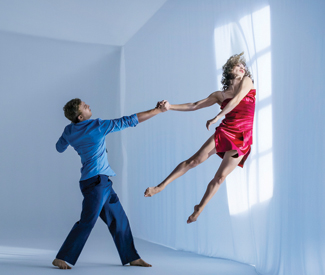
DANCE ODC/Dance started its 42nd season with a party-happy gala and two contrasting but complementary works: Brenda Way’s new Lifesaving Maneuvers and KT Nelson’s redressed and finessed 2012 Transit: Next Stop. Two days later, the season’s major premiere, Triangulating Euclid, co-choreographed by Way, Nelson, and Kate Weare, opened an intriguing perspective on what gifted women can do when they put their heads and hearts together. Of course, women working together is not exactly a fresh idea at ODC — it’s at the core of what this troupe set out to do four decades ago.

Though the dark Lifesaving has its moments of humor, Way’s look at wild excesses and paralyzing paranoia, both as social and personal phenomena, is a tough watch. The piece develops in front of Alexander Nichols’ semi-transparent curtain that closes off some ominous, hinted-at life beyond our vision.

While the sheer clarity and force of its choreographic vision pulls you in, Way’s unsparing look on coping strategies is chilling. Chaotic explosions could distill into social dance sequences where a partner, nonetheless, could be dropped like a rock. Yayoi Kambara looked caught in a tornado from which there seemed to be no exit, while Anne Zivolich darted around like a hunted rabbit.

Way grounds the choreography in an intense, often frantic energy that implodes mid-air. She balances discontinuity with unity processions, starting with battlefield imagery of dancers carrying off fallen comrades, women being pushed into the wings like brooms and vacuously waving men and women that might have stepped out of a Pina Bausch piece.

Still, Way doesn’t want us to feel too gloomy. You can’t help but smile when dancers choke and need Heimlich maneuvers as "Mad About the Boy" plays. In a silent movie melodrama, Natasha Adorlee Johnson throws herself at Corey Brady’s suave villain; he coolly assesses his victim and flips her off.

The piece ends with Justin Andrews cradling a desperately flailing Vanessa Thiessen. He tries to comfort her; she can’t respond. Curtain.

Whatever the process that the three collaborators engaged in for Triangulating, it worked. At first the piece looks like an illustration of basic plane geometry, but it quickly blossoms into an exuberant celebration of the way dancers inscribe themselves into space. From the moment a dancer’s leg smudges the carefully drawn line on the floor, you realize that poetry supersedes science.

The half-hour piece sails through its accumulations and dissolutions of staggered and overlapping encounters with surety and an increasing sense of freedom. The piece grows and finishes with Yayoi Kambara as the single dancer who draws the others onto the stage. Line formations give way to duets — still at the core of how and why we dance. Wonderfully, the cantilevered lifts, upside-down holds, and kicking feet feel thoroughly at home in Schubert’s music. The partnering between Corey Brady and Maggie Stack, contentious and passionate in the way he throws and whips her around, stands out.

Finally, Anne Zivolich sniffs, tiptoes, and encircles an indifferent Jeremy Smith; she breaks into one of her by-now-legendary whiplashing explosions when he takes off with someone else. One by one her colleagues march in and try to stomp her to the ground. The scene was both hilarious and spoke to truth: surely there is more to this dancer than being a female hurricane —something she appears as in just about every choreography that ODC produces.

The simple costumes (by Way and Lisa Claybaugh) of black shorts and bras for the women, and then supplemented by diaphanous white blouses, couldn’t be better. The score’s trajectory from synthesizer to Schubert to grand-style minimalism did its job as well.

Nelson’s Transit: Next Stop has acquired a spectacular set of animations which contextualize her urban dwellers’ attempts to manage their relationships. Yet Barry Steele’s design is so big that it draws undue attention to itself. It works best during a night scene in which life becomes a dream. But I am not sure whether adding a filmic sense of passing and changing habitats brings that much to this funny-yet-tender perspective on what it means to be a contemporary city dweller. *

ODC/DANCE DOWNTOWN 2013

Wed/20-Thu/21, 7:30pm; Fri/22-Sat/23, 8pm; Sun/24, 4pm, $20-$75

Yerba Buena Center for the Arts Theater

700 Howard, SF

www.odcdance.org

Cristian Mungiu on his stark, stunning ‘Beyond the Hills’

0

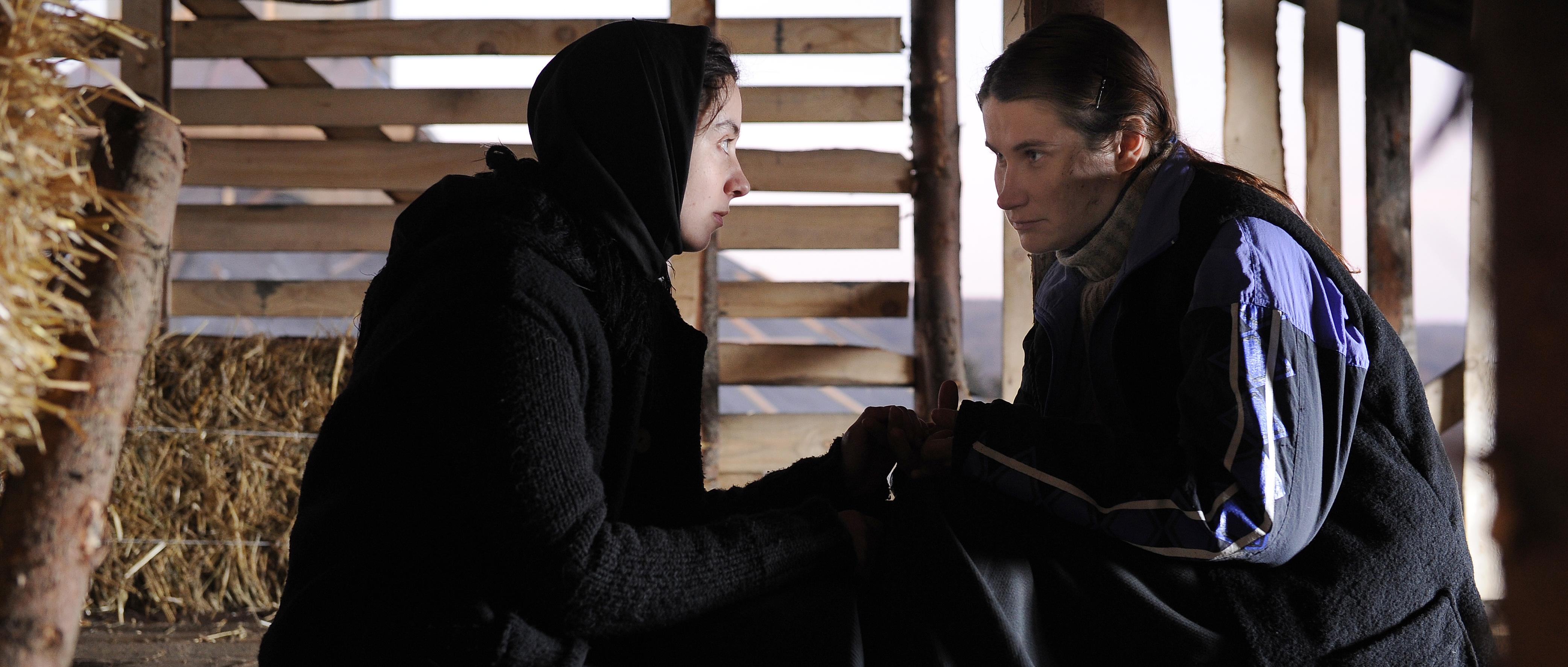
Cristian Mungiu — one of the main reasons everyone’s all excited about the Romanian New Wave — follows up his Palme d’Or winner, 2007’s 4 Months, 3 Weeks and 2 Days, with another stark look at a troubled friendship between two women. Beyond the Hills‘ Voichita and Alina (Cosmina Stratan and Cristina Flutur, who shared the Best Actress prize at the 2012 Cannes Film Festival; for his part, Mungiu won Best Screenplay) were BFFs and, we slowly realize, lovers while growing up at a Romanian orphanage.

When they aged out of the facility, the reserved Voichita moved to a rural monastery to become a nun, and the outburst-prone Alina pinballed around, doing a stint as a barmaid in Germany before turning up in Voichita’s village, lugging emotional baggage of the jealous, needy, possibly mentally ill, and definitely misunderstood variety. It can’t end well for anyone, as all involved — dismissive local doctors, Alina’s no-longer-accommodating foster family, the priest (Valeriu Andriuta), and the other nuns — would rather not spend any time or energy caring for a troubled, destitute outsider. Even Voichita can only look on helplessly as an exorcism, a brutal and cruel procedure, is decided upon as Alina’s last, best hope.

Based on a real 2005 incident in Moldavia, Mungiu’s unsettling film is a masterpiece of exquisitely composed shots, harsh themes, and naturalistic performances. I conducted the following email interview with Mungiu ahead of Beyond the Hills‘ Fri/15 Bay Area release.

http://www.youtube.com/watch?v=cL_5U73udXM

San Francisco Bay Guardian Both Beyond the Hills and 4 Months, 3 Weeks and 2 Days are about female friendships — troubled female friendships, to be specific, with shared secrets and repressed emotions. What interests you about these relationships, and telling these kinds of stories?

Cristian Mungiu My films are story-driven rather than character driven and I always start from some true story that I heard about. So, as much as these films could be depicted as films about female relationships, for me the starting points were different. For 4 Months, I mostly wanted to talk about freedom, compromise, responsibility, and circumstances when such an important issue as maternity is involved. In Beyond the Hills I was interested in understanding how violence progresses in a small community and I needed to talk about different kinds of love, social responsibility, and indifference, about the differences between religion and superstition, about the relationship between the level of education and free will.

I don’t think in terms of male/female characters when I think about my characters: I believe that as a storyteller, you either understand the human nature or you don’t — gender is irrelevant.

SFBG Both films also deal with medical issues, though in Beyond the Hills Alina’s suffering is more abstract and seems to be tied into a number of factors: her illness is mental, not physical; also, she is poor and has no family looking out for her. Does the portrayal of doctors and hospitals in Beyond the Hills reflect Romania’s treatment of “outsiders,” and what do you hope audiences take away from this?

CM It would be wrong to consider that the portrayal of the doctors in Beyond the Hills can be generalized to all doctors in Romania nowadays. I don’t think that any film should be taken as a relevant portrait of a country — it would be the same mistake we use to make in the ’80s, thinking about US as being primarily a country of mobsters (after watching The Godfather — that was very popular and highly appreciated).

I would rather say that Beyond the Hills speaks about dysfunctional institutions in general, about the side effects of incompetence and of superstitions in society — and it shows how empathy for the one next to you is influenced by poverty and how the decision to help him is influenced by your level of education.

SFBG Beyond the Hills might show the most realistic (and therefore, probably one of the scariest), take on an exorcism ever filmed. Why did you choose to take on a topic that’s primarily horror-movie element? Is it true the film is based on a true incident, and how did you hear about it?

CM The film is inspired by a couple of non-fictional novels documenting a real incident that happened in Romania in 2005. It was on the first page on the newspapers for weeks and months, it shattered the Romanian public opinion, and it generated a more general debate about the role of religion in the modern society and about some of the rituals in churches.

The film’s the main story line is quite close to what happened in reality so I didn’t choose to bring in an exorcism scene — it was pretty much there already — I just tried to treat it as non-spectacular and as realistic as possible, as it was important for me to avoid the possible tabloid perspective about this issue. It is part of a certain kind of realism that we are looking for in our films — a realism which is present at all levels — from the way of treating the subject to the
way of shooting and to handling filmic time — every scene is depicted in just one continuous shot in the film, no matter how complex or long it is.

SFBG Nuns are another familiar movie element — I’m thinking of everything from The Sound of Music to Sister Act to (most closely) Black Narcissus. How do you go about recreating such a private, closed-off world, and what were the challenges involved in doing that?

CM The greatest challenge always is to fight stereotypes: yours and others. I based my portrayal of the nuns on my observation about religious people, about the psychology of people living in small isolated communities and on my experience of talking to institutionalized children – but at the end of the day, again, we need to understand that nuns are also human beings with emotions, fears, doubts, and so on.

One of the major challenges was to instruct the actresses about the appropriate behavior and attitude their character would have in each given situation and to specifically ask them never to be judgmental about their characters. The screenplay was already depicting in detail most of the monastery routine — and before the shooting we sent the girls to a monastery — to spend some time with some real nuns because there are small things that, as an actor, you need to notice yourself.

SFBG The stark, austere landscape of Beyond the Hills is practically a character in the story. How did you find that location and what approach did you take to filming to heighten the story’s elements? I especially appreciated how key moments — Alina being carried into the church, for instance — happen in the background of long shots.

CM We started by visiting the site of the real incident and then we scouted for a barren hill with some solemnity, no electricity poles around — and having a direct view to a small town. It was quite a complicated scouting and finally we came across this hill — some 100 kilometers up- north Bucharest — where we built the whole Monastery and all the surrounding buildings.

When you decide to only shoot long takes you need to learn how to use the depth of field, the off camera, and the sound. My idea was that it’s more important to show the characters’ reaction to what happens than what happens — and therefore I decided for example that in the most of the violent scenes we’ll be with the camera on the nuns and not on Alina. A crucial decision regards the wideness of the framing — we try to match it always with the content of the scene and with its degree of intimacy. But filmmaking is not a science and you need to keep your mind free and your eyes open, to experiment on the set and to feel which is the most powerful and appropriate way of shooting each moment.

SFBG What does the title mean to you?

CM It refers to realities which are not in full view, which happen somewhere deep down — in our mind or in the world — but I don’t think film titles should be perfectly explicit in connection to the story.

Beyond the Hills opens Fri/15 in Bay Area theaters.

On the Om Front: Guys Wanted in the Yoga Room

4

I teach a weekly employee yoga class at a hospital where my students are all women. Every week, a young man peers curiously into the classroom. I asked him once if he’d like to join us, and he said, “Yes, but what would my friends say? Yoga is for girls.”

This odd societal notion that yoga is an emasculating, status-reducing activity is bad enough. But to make matters worse, people like William J. Broad, the so-called New York Times science writer, have publically espoused that yoga is actually harmful to men. Why? Because, he says, men have a tendency to push themselves too hard, and their bigger muscles are more injury prone.

Wait … what?

Here’s the truth: The majority of the yoga poses that we do in the studio today were developed by men, not women. In fact, women had to fight for the right to take part in this practice in the first place. And I could spend days discussing the fallacies of Broad’s arguments (which are based on poor science and don’t at all credit men with the ability to take care of themselves), but we all have better things to do. The point is: When did yoga get deemed wussifying or, worse, a threat to one’s health?

I don’t live in a man’s body, but I do teach yoga to a lot of strong, masculine, and intelligent men, and I can tell you from what I see that yoga is every bit as beneficial to men as it is to women. It does not seem to have negatively affected anyone’s testosterone levels, nor do my male students get injured any more than my female students — if they practice intelligently. (If one practices unintelligently, regardless of gender, one will get injured.) In fact, despite the obvious anatomical disparities, I see very little difference between the male and female practitioners I know in terms of commitment to practice, injury rate, and advancement. The largest challenge for men is the message in Western society that yoga was not made for them.

As a response to the dearth of dudes in yoga class, an interesting movement to promote male-only yoga classes has come about. The national Broga program is one example of this trend, though it hasn’t yet caught on locally. While I love that this movement is encouraging more men into the classroom, the segregation aspect feels weird to me. This is yoga, not football. I’d prefer to see all of us — men, women, and trans folk — practicing in the same room, side by side. Together.

As a society, both men and women have suffered from countless years of gender segregation. The yoga room can be a place for us to be in community together. Sure, we have different bodies, but we’re all there for the same reason: to improve ourselves and develop a deeper sense of inner intelligence. I understand that there’s a comfort in being around people who look like you, and avoiding environments where the other gender dominates. But if women had let that fear deter us, we wouldn’t have gained the right to attend college, vote, or have our own bank accounts. Besides, yoga is actually about moving out of your comfort zone, and confronting the fears and insecurities that imprison you. What better place to push your boundaries?

I’m a fan of anything that gets more guys, straight or gay, into the yoga room — even boys-only yoga. But the beautiful thing about bringing the genders together in general, and particularly in the yoga room, is that we balance one another energetically. We can learn from, support, and better understand one another. I think the time is ripe now for us to come together in mindful community — in fact, I think our evolution as a species depends on it.

And a little secret for those men who’ve yet to take a yoga class because they think the women don’t want them there: We do.

Karen Macklin is a writer and yoga teacher in San Francisco — her On the Om Front column appears biweekly here on sfbg.com.

___________________________________________________

Yoga and Spirituality Listings

By Joanne Greenstein

Restorative Yoga with Live Singing Bowls with Kevin Hibbit and Sam Jackson
Combining crystal bowl music, healing touch, poetry, and restorative yoga, this workshop will help attendees to slow down, relax and look within.
Sat/9, 6:30-9:30pm, $35, Mindful Body, 2876 California, SF

Naked Men’s Yoga
Check out these weekly classes for men that are aimed at offering community and more freedom for expression and movement. Clothing is not optional. Days and times and locations vary.

Therapeutics Workshop with John Friend
After a long hiatus from the yoga world, the founder of Anusara yoga is back in town. In this workshop, he will focus on common issues and injuries in the body, and how to overcome them using therapeutic postures based on principles of alignment.
Sat/9, 6:30-8:30pm, $50, Urban Flow Yoga, 1543 Mission, SF

Yoga Grad School
Laughing Lotus is offering several weekend workshops between now and the end of June on topics ranging from teaching yoga to at-risk youth to hands-on assisting. The workshops are appropriate for dedicated practitioners looking to deepen their practice as well as for those interested in earning credit toward advanced teacher certification. Price varies based on number of workshops taken.
Next up:
Lotus Fly: Advanced Asana and Sequencing with Sheri Celentano
March 16-17, 1-6pm, $199
Laughing Lotus, 3271 16th Street, SF

Healing the Heart – A Daylong Immersion in Bhakti Yoga with Jai Uttal, Nubia Teixeira, and Swami Ramananda
Immerse yourself in a day of devotional exploration. This daylong workshop integrates meditation, ceremony, breathing exercises, devotional dance, and chanting.
March 16, 10am-5pm, $100 ($90 by Mon/11); includes a vegetarian lunch
Integral Yoga Institute, 770 Dolores, SF

Yoga and Dance with Wendy Faith
Link two forms of movement in one in this workshop combining yoga and dance. Dance forms visited include Afro-Brazilian, salsa, tribal bellydance, Bhangra, West African and hip-hop.
March 17, 1-3:30pm, $35
Aha Yoga, 1892 Union, SF

On the Cheap listings

0

Submit items at listings@sfbg.com. For further information on how to submit items for listings, see Picks

WEDNESDAY 6

RayKo’s sixth annual plastic camera show RayKo Photo Center, 428 Third St., SF. www.raykophoto.com. Through April 22. Opening reception: 6-8pm, free. You’d never these cameras’ non-pro status by the breathtaking images they are capable of creating. Highlighted in this year’s RayKo show is LA-based artist Thomas Alleman, who began using a Holga camera in 2001 to document the aftermath of 9/11. His dreamy, dramatic prints perfectly pinpoint the dysfunctional beauty of these toy cameras.

“Beyond THC: Cannabidiol and the future of medical marijuana” Commonwealth Club of California, 595 Market, SF. www.commonwealthclub.org. 5:30pm, $12 members, $7 students, $20 nonmembers. Martin A. Lee, author of Smoke Signals — which focuses on the social history of cannabis — will be speaking about the benefits of cannabidiol (CBD), a non-psychoactive component of marijuana that lacks the “high” effect of THC and contains key medicinal benefits. Lee will discuss how the medical marijuana industry has responded to the discovery of CBD and sign copies of his book afterward.

THURSDAY 7

Robot NightLife California Academy of Sciences, 55 Music Concourse, SF. www.calacademy.org. 6-10pm, $12. This beloved weekly museum soiree delves into sci-fi this evening with a focus on robots. Managing director of Silicon Valley Robotics will speak to the local innovation and commercialization of robots and Academy curator Gary Williams will show off footage of deep-sea corals from Pillar Point Harbor. A robotic performance by art group Survival Research Labs and exceptional designs by robot design studio BeatBots are also on tonight’s schedule.

“Art Star” Otis Lounge, 25 Maiden Lane, SF. www.otissf.com. 10pm-2am, free. If you’re looking to submerge yourself into the city’s art community, head over to Otis Lounge to meet and network with artsy individuals at this monthly first Thursday event. Whether you make, buy, sell, or just love art, all creatives are welcome.

Community dinner St. Cyprian’s Episcopal Church, 2097 Turk, SF. www.saintcyprianssf.org. 7pm, free. Hungry, cash-strapped health nuts listen up. This free dinner created from USF’s garden and local farmers markets is open to everyone and anyone interested. The event lacks any motivation beyond a heartfelt effort to bring the community together through wholesome food.

Writerscorps Live with Tamim Ansary Contemporary Jewish Museum, 736 Mission, SF. www.sfartscommission.org. 6:30-7:30pm, free. Award-winning youth writing program WritersCorps has partnered with the CJM for a multi-generational live reading. Author Tamim Ansary will read from his memoir West of Kabul, East of New York, based on his family’s immigration from Afghanistan to San Francisco. The reading will also showcase WritersCorps teaching artist Minna Dubin and students from Downtown High School, Aptos Middle School, Mission High School, and more.

First Thursday with OM Cocktails Hang Street Gallery, 567 Sutter, SF. www.hangart.com. 6-8pm, free. Organic mixology — premixed in the bottle? Will wonders never cease. Check out this brand’s coconut-lychee cocktails and more at Hang Street’s First Thursday reception.

FRIDAY 8

East Bay Bike Party, location TBA. 7:30, free. eastbaybikeparty.wordpress.com. It’s time to go green, literally. The theme of this month’s East Bay group rideout is the favored color of enviro-fans and Kermit the Frog alike. Whether you want to channel your inner leprechaun or bike around as giant pot leaf, the possibilities are endless. If you’re a Bike Party virgin make sure to also look over the code of conduct to help keep the event as community-friendly as possible.

SATURDAY 9

White Walls gallery 10th anniversary show White Walls, 886 Geary, SF. www.whitewallssf.com. Through April 6. Opening reception 7-11pm, free. Town’s best-known “urban art” gallery hosts this retrospective of a decade of boundary-breaking work within its wall (kind of — the gallery recently moved to a larger space on Geary Street). Check out works from Shepard Fairey, ROA, Apex, Ferris Plock, and of the best who have plied works there.

“Doctors on Board” Oakland Marriott City Center, 1001 Broadway, Oakl. www.pmfmd.com/doctors-on-board. 6am-6:30pm, free to students. Application required. The Physicians Medical Forum is hosting a day of workshops and skills training session helping African American students to attend medical school and residency programs. Prominent physicians will provide information about medical school preparation, medical specialties, and life as a physician.

“Quilt San Francisco” Concourse Exhibition Center, 635 Eighth St., SF. www.sfquiltersguild.org Also Sun/10. 10am-4pm, $10 for two-day pass. This two-day exhibit, organized by the San Francisco Quilters Guild, vividly showcases the revitalization of the traditional art form. 400 quilts and special exhibits will shown the many artistic dimensions of wearable art and modern stitching. There will also be a children’s corner, where kids can get marching orders for a treasure hunt that will lead them to special quilts in the show.

Irish-American children’s hour of music, song and dance San Francisco Public Library, Fisher Children’s Center, 100 Larkin, SF. 11am, free. www.sfpl.org. Crossroads, an annual Irish-American festival timing to open up St. Patrick’s Day season, invites the kiddos to learn traditional Irish dance taught by instructors from the Brosnan School of Irish Dance.

Fourth annual World Naked Bike Ride Meet at Justin Herman Plaza, Market and Embarcadero, SF. www.worldnakedbikeride.org. 11am-4pm, free. Protest global dependency on oil and find out what its like to pedal through Fisherman’s Wharf in the buff. All are welcome to take part — even clothed riders — but those in the buff earn extra badass points, given the uncertain status of the ride under the city’s new anti-public nudity ordinance.

“Permutation Unfolding” Root Division, 3175 17th St., SF. www.rootdivision.org. Opening reception 7-10pm, free. Bring the kids to the opening of this group exhibition exploring the biomorphic formations that can spring from the artistic process (we’re not sure what that means either.) There will be an all-ages creativity station, a perfect place to craft while Markus Hawkins spins an auditory web in an 8pm performance.

SUNDAY 10

Exploratorium’s On the Move Fest Mission District location: Buena Vista Horace Mann School, 3351 23rd St., SF. 11am-4pm, free; Bayview location: Bayview Opera House Ruth Williams Memorial Theatre, 4705 Third St., SF. 11am-4pm; Embarcadero location: Pier 15, 11am-10pm. www.exploratorium.edu. All locations offer free admission. Everyone’s favorite on-hiatus science museum is sending 10 trucks tricked out with the kind of wacky, hands-on exhibits its know for to the Mission, Bayview, and the Embarcadero for a day of science, music, and food. In both Bayview and the Mission, enjoy itinerant filmmaking, projects that encourage attendees to sport costumes and act out a special script which will then be chopped, screwed, and shown to the public.

TUESDAY 12

“Stars of Stand-up Comedy” Neck of the Woods, 406 Clement, SF. www.dannydechi.com. 8pm, $10. Comedian and pencil musician (exactly what that means we are not quite sure, please report back if you go) Danny Delchi is hosting tonight’s show. Long-time Niners field announcer Bob Sarlatte and the quirky Mr. Mystic will be performing alongside a number of other top Bay Area comedians.

Persian New Year Festival Persian Center, 2029 Durant, Berk. www.anotherbullwinkelshow.com. What better way to welcome spring than to jump over a bonfire? Head over to the Persian Center to take part in this ritual that has been passed down since Zoroastrian times. Accompanying the fiery activity will be Persian food, music, and dancing.

Compromised position

16

steve@sfbg.com

When Mayor Ed Lee came to the Board of Supervisors for his monthly “question time” appearance Feb. 12, Sup. David Chiu tried to get some sense of where the mayor stood on a controversial piece of legislation that would allow more condominium conversions.

Chiu explained the complexities and implications of an issue where the two sides have dug in and appear to have little common ground, and he asked the mayor for some guidance.

“What is your position on this pending legislation?” he asked. “What protections would you support to prevent the loss of rent-controlled housing in our increasingly unaffordable city? How would you address the concern that if we allow the current generation of tenancy in common owners to convert, we will replace then with a new generation of TIC owners and additional real estate investments that will lead us right back to an identical debate within a short time?”

But if Chiu and other board members were looking for leadership, direction or a clue of where the mayor might stand, they didn’t get it. Lee said he understood both sides of the issue and hoped they could reach a consensus solution — without offering any hints what they might look like or how to achieve it. “I can’t say that I have a magic solution to this issue that will make everyone happy,” the city’s chief executive explained.

Asked by the Guardian afterward why he didn’t take a position and whether he might be more specific about how he’d like to see this conflict resolved, he replied, “I actually did take a position, even though it didn’t sound like it, because I actually believe they have good points on both sides.”

That’s a typical answer for a mayor who rose to power preaching the virtues of civility and compromise and striving to replace political conflict with consensus. But now several major, seemingly intractable issues are facing the city — and insiders say Lee’s refusal to take a strong stand is undermining any chance for successful.

The lack of mayoral leadership has been maddening to both sides involved in the negotiations over the condo-conversion legislation. Tenant advocates say the mayor’s waffling hardened the positions on both sides and emboldened the group Plan C and its allies in the real estate industry to reject the compromises offered by supervisors and tenant advocates.

“It’s very unhelpful,” San Francisco Tenants Union head Ted Gullicksen said of Lee’s refusal to take a stand. “Someone needs to kick the realtors in the butt, and that’s not happening. They have no impetus at all to compromise.”

Then there’s the case of California Pacific Medical Center’s proposed new hospital, a billion-dollar project that would transform the Cathedral Hill neighborhood and have lasting impacts on health care in San Francisco.

The mayor’s eagerness to get the deal done — even if it wasn’t the best deal for the city — led to a proposal that fell apart last year under scrutiny by the Board of Supervisors. That project has now been in mediation for months — and sources tell us they’re getting close to a deal that has little resemblance to the anything offered by the Mayor’s Office.

California Nurses Association Director of Public Policy Michael Lighty, who has been involved with the CPMC negotiations, said Lee’s unwillingness to take a strong and clear stand, or to help mediate the dispute once the deal blew up, is why this negotiation has been so difficult and protracted.

“If he had engaged stakeholders and the supervisors, we wouldn’t have had to go to the brink last summer,” he said. “You’ve got to have clear objectives and be willing to fight for those, and that means saying no…If you’re willing to accept any deal and just put political spin on it, this is what you get.”


ADMINISTRATOR-IN-CHIEF

Neither Lighty nor others involved in the CPMC negotiations would discuss details of the pending deal, as per the instructions of mediator Lou Giraudo. But they did talk to the Guardian about the political shortcomings that led to such a protracted mediation process on a project that has been in the works for many years and involving a looming state deadline to replace the seismically unsafe St. Luke’s Hospital.

Lighty called Lee’s conciliatory approach to CPMC “an administrative orientation and not a political one,” noting that what worked during Lee’s long career as a city administrator may not be working well now that he’s in the Mayor’s Office dealing with issues where consensus isn’t always possible.

“I don’t think it’s a very sophisticated view and I don’t think it’s one that produces the best results,” Lighty said.

Lighty did say the negotiations were getting close to resolution. “What comes before the board is going to be vastly superior to what the mayor and CPMC proposed,” he said. “I think what you’ll find whenever this comes out is it will repudiate the mayor’s approach.”

He contrasted Lee’s style to that of his predecessor, Gavin Newsom, who took positions on most controversial issues and would often get involved with forcing his allies to cut deals. For example, shortly after taking office on 2004, Newsom demanded that his allies in the hospitality industry end their lockout of hotel workers, and when they refused he turned on them and even famously joined workers on the picket line, pressuring the hotels to soon end the lockout.

“Why did you need to bring in an outside mediator for CPMC? Why didn’t the mayor do that?” Lighty asked, noting that Lee has stayed away from the current negotiations.

Ken Rich from the Mayor’s Office of Economic and Workforce Development has been in those meetings but didn’t return our call. Mayoral Press Secretary Christine Falvey has also ignored repeated messages seeking comment on the issues raised in this story.

Rudy Nothenberg, who negotiated big deals on behalf of five successive mayors before Lee and who has been critical of the Warriors Arena deal that the Mayor’s Office has negotiated, said Lee’s unwillingness to take strong stands with developers is hurting the city.

“I was able to say I’m going to get the best deal I can for the city,” Nothenberg told us, saying he approached all negotiations, including the construction of AT&T Park, with the understanding from the mayors he worked for that he could simply say no to bad deals. “You need to bargain for the city as if these guys walked away, well, then that’s okay too.”

Sup. David Campos, who has been trying to get CPMC to strengthen its commitment to keeping St. Luke’s open as a full-service hospital, agreed that, “There have to be times when you’re willing to say no.” And on the CPMC project, Campos said that fell to the supervisors when the Mayor’s Office wasn’t willing to. “It was clear that the board was not going to approve it,” Campos said, “and sometimes you have to do that to get to a result you can live with,”

UCSF Political Science Professor Corey Cook said the problem is less with Lee’s overall philosophy than with what is strategically smart on individual issues.

“The mayor’s strength is in trying to come up with consensus measures,” Cook told us, calling the approach “generally a good one” and saying “the decider isn’t always who you want, then you get George W. [Bush].” Yet Cook also said intractable problems like the condo conversion debate may require a different approach. “Sometimes you do need to stake out clear ground to limit the terms of the debate.”


CHIU’S CENTRAL ROLE

Chiu has at least been willing to put his energies behind his belief in compromise, taking an active role in the CPMC and condo negotiations, as well as complicated current negotiations involving how to legalize but limit Airbnb’s shared housing business in San Francisco, which involves landlord-tenant-neighbor dynamics, regulation of private leases, and complex land use and taxation issues.

“It’s been a very long month. I’ve been going around the clock on several challenging negotiations,” Chiu told the Guardian. “The most important things to work on are often the ones that are the most difficult to get done.”

Chiu was reluctant to discuss the negotiations, calling it a sensitive moment for each of them. But he did admit that he was disappointed in Lee’s non-answer to his publicly posed question. “I had hoped for a little more direction,” Chiu said. And while these negotiations haven’t shaken his faith in compromise, he did say, “It depends on the substance of the issue whether there are common ground solutions that are superior to two warring sides.”

But all involved in the condo debate say it appears we’ll be stuck with the latter. “The two sides are so far apart that I don’t know what a compromise that both sides would live with would even look like,” Campos said. “There are certain issues where I don’t think compromise or consensus is possible.”

On this one, tenant advocates are trying to protect a finite supply of rent-controlled housing and real estate interests want to convert that same housing into condos. “If the issue was just existing TIC owners, we would come to an agreement,” Gullicksen said. “But clearly the agenda of Plan C and the realtors is they just want more condos.”

Plan C board member Kat Anderson told us, “I have a simple approach to this: Home ownership is important to me.”

She was undeterred by arguments that thousands of new condos are now being built in San Francisco, but there’s a steadily dwindling number of rent-controlled apartments in a city where two-thirds of San Franciscans are renters.

Anderson made it clear that she wants to not only allow the backlog of condo applicants to be approved, but she doesn’t want to slow the flow of condo conversions for a few years thereafter or place TICs themselves under the cap, compromises offered by Gullicksen. “The worry is that if you change the system, it will never come back and we’ll lose our tiny toehold of 200 units [that the lottery allows to be converted to condos annually],” Anderson said. And so we end up with the very thing Lee sought to avoid: a big, nasty, divisive public fight that will probably end up being decided by big money and deceptive campaign mailers rather than a civil, deliberative political process. And the mayor has nobody to blame but himself.

Game on

1

arts@sfbg.com

DANCE Unlike more commercially competitive markets, the Bay Area is, fortunately, still a place where young choreographers have the freedom to grow. This past weekend, two who are primarily known for dancing other people’s works showed their own promising premieres.

Katharine Hawthorne graduated from college with degrees in physics and dance. On February 22, its opening night at the Joe Goode Annex, you could not possibly miss Analog’s dual pedigree. This startlingly intense quintet opened on the quietest of notes but built its trajectory like a smoldering volcano that finally erupted into a threatening destructive force.

Looking at movement through a scientist’s lens, in conjunction with knowing it to be the dancer’s basic tool, allowed Hawthorne — and her fearlessly athletic dancers — to offer a fascinating perspective on how art and science can elegantly coexist with each other. However, why the dancers repeatedly lugged around an overhead project (and barely used it) remains a mystery.

A 19th century illustration of a mechanical hand, against which Katherine Disenhof wiggled her fingers, set the tone. Those tiny live gestures led other dancers (Hawthorne, Jesse Chin, Luke Taylor, and Megan Wright) to use their arms in almost machine-like ways, as if to demonstrate speed, direction, level, and space. Movements changed with sharp angles, trajectories were linear, and collisions avoided. Dancers also looked like planets circling a sun. Chin and Taylor repeatedly repulsed each other like two positively charged particles. Wright found herself in a whirling circle — a tornado about to take off.

But more and more the movements’ relentless and increasing intensity began to look like threats to the dancers’ well being. Several times I thought Chin was about to collapse though touches and handholds seemed to suggest temporary respite. Yet Analog resembled a nightmarish perpetuum mobile until finally the clock began to slow everything down. We were left with darkness descending on the two dancers left. I couldn’t decide whether that meant peace or the ultimate catastrophe.

As a performer, Tanya Bello brings a ferocious appetite for space, soaring elevations, and dizzying spins to her dancing. So it was almost expected that as a young choreographer she brought many of these characteristics to GamesWePlay(ed), which premiered at the ODC Dance Commons this past weekend. The half-hour piece is a nicely calibrated essay on play as both an innocent activity but also as a means to manipulate those around us. Bello wisely engaged dancers from top local companies: Vilte Bacinskaite, Tristan Ching Hartmann, Kelly Del Rosario, Norma Fong, Chin-chin Hsu, Mei-ling Murray, and Katherine Wells. The work also greatly benefited from Judy Hansen’s costumes, which were elegant, tiny dresses with just a wisp of a tutu suggestion.

GamesWePlay(ed) consisted of a number of distinct episodes which included versions of tag, races, imitation, and mirroring activities, but also pure dance sections. Some looked highly structured only to explode; others involved repeated and fast partner changes. Woven wicker balls were passed around but also hung onto. When Del Rosario curled up on the floor, a tiptoeing Wells gently sent him back into the fracas. I couldn’t help but wonder whether there was a joke here since as the ensemble’s only male, Del Rosario had to do all of the heavy lifts.

Though the work was not particularly fresh in terms of the vocabulary used, Bello showed an already impressive control in the way she used the dancers on stage. The choreography — from solos to septets — flowed and dissolved with almost filmic quality. A mirroring duet opened up into a group, loosing its architecture but gaining breath. Two dancers approaching each other from opposite corners became a double duet. But the piece also had its moments of (ballet?) humor when Fong released a quartet of shadowing women from their monotonous tasks. At another point dancers flopped over received a magic touch to blossom again like those eternal flowers in the Nutcracker.

Towards the end Bello went back to material used earlier in the piece. Was that just to lead up to a finale? There must be better ways to end a show.

Performing on the same program was Karen Reedy Dance from Washington, D.C. Reedy’s Sleepwalking (2008) was a beautifully danced septet, a work that gently yet penetratingly considered what makes us panic and silently scream at night.

Mrs. Wilsey’s fine art

66

rebecca@sfbg.com

A little more than a year ago, Therese Chen, director of registration at San Francisco’s de Young Museum in Golden Gate Park, sent an email to another staffer concerning “Mrs. Wilsey’s new Matisse.”

That would be Diane “Dede” Wilsey, the wealthy art collector who is also president of the Board of Trustees of the Fine Arts Museums of San Francisco.

Chen asked Steve Brindmore, then a museum staff member who also runs a personal art crating business, whether he had a crate for the oil painting, which is titled “The Pink Blouse.” According to records from Sotheby’s New York auction house, the estimated value of this painting is between $3 and $4 million.

“The painting is on an A-frame in the Examination Room,” Chen wrote. “I’m taking the painting over to Dede on Wednesday … for [an event], and then it will come back here to the de Young to be crated for Portland around the week of Jan. 23.”

The exchange suggests that public museum facilities were being used to store and crate a piece of art from Wilsey’s personal collection.

Timestamps show that the exchange happened around 1:30 on a Monday, during museum hours. The correspondence was sent using museum staff email. It’s unclear what, if anything, this task had to do with the operations of a public museum. But FAMSF clearly handled a painting from the growing private art collection maintained by Wilsey, a major donor and key FAMSF fundraiser who loves Impressionist paintings and seems to gravitate toward works incorporating the color pink.

Beth Heinrich, a spokesperson for the Portland Art Museum, confirmed to the Guardian that a Matisse titled “The Pink Blouse” was indeed loaned to the museum from a private collection, and placed on display in its Impressionist galleries in February of 2012.

The email exchange between Chen and Brindmore is just one thread in a trove of correspondence, invoices, and other documentation anonymously submitted to the Guardian. Put together, the information shows museum staff being asked, during normal business hours, to handle, photograph, crate or arrange shipments for more than a dozen different pieces from Wilsey’s personal art collection in just the past two years. The documentation also shows several examples in which museum employees were directed by Chen to digitally reproduce works from Wilsey’s private collection.

It’s not uncommon for art collectors to put private pieces in the collection of a museum, nor it is unusual for collectors to lend out art to other museums. And if the de Young received some benefit from its association with Wilsey’s art, it wouldn’t be surprising (or inappropriate) for the museum to help reproduce or ship it.

On the other hand, if Wilsey is loaning out the pieces on her own, from her private collection, and using museum resources, it could raise conflicts of interest.

The de Young, for example, wasn’t cosponsoring the Portland exhibit where the Matisse was shown. Since Wilsey just bought the Matisse, it couldn’t have been part of the de Young’s collection.

There’s no indication that it was anything but her personal loan of a valuable painting — facilitated by the staff of a nonprofit that runs a city museum.

Invoices show that some staff members were paid separately for assisting with Wilsey’s art collection, in some cases through independent businesses.

WHO’S IN CHARGE?

The Fine Arts Museums include the de Young and the Legion of Honor. Included as charitable trust departments under the City Charter, they are governed by a 43-member Board of Trustees, which is responsible for appointing a director. Wilsey has presided over the body as board president since the 1990s. The bylaws of the board were changed to eliminate term limits for the president, meaning she could stay in the post for as long as her board colleagues want.

The FAMSF has been leaderless since director John Buchanan died in December, 2011.

Though the museums are public institutions, their governance structure is similar to that of a public-private partnership, since a private nonprofit organization called the Corporation of Fine Arts Museums of San Francisco handles museum administration and employs a number of museum staff, including curators and other professionals.

The city contributes some public funding to FAMSF, but the majority of revenue is derived from private sources. Wilsey, a multi-millionaire, contributed $10 million to the de Young, and spearheaded a 10-year fundraising campaign that culminated in 2005 with more than $180 million raised to rebuild the museum.

The socially connected philanthropist, known for throwing Christmastime bashes that attract a roster of powerful luminaries from government and big business to her Pacific Heights mansion, is often the subject of press reports or gossip surrounding San Francisco high society. Her stepson, Sean Wilsey, famously characterized Wilsey as his “evil stepmother” in his memoir, “Oh, the Glory of It All,” which includes an unflattering scene in which she is said to have pinned $200,000 brooches onto her bathrobe one Christmas morning.

She owns a fair amount of art — and apparently moves it around. In August of 2011, for instance, email threads show that Chen, using her FAMSF email address, contacted Jamil Abou-Samra of Masterpiece International, the shipping company, regarding “Mrs. Wilsey’s Degas.” Chen wrote: “I brought the Degas to the de Young last week for glazing. It should be ready for Steve to measure for crating any days [sic] now. Are we still looking at August 30, Tuesday, for pick up?” The thread indicates that the painting was destined for the Royal Academy of Arts, in London.

An Internet search shows that the Royal Academy indeed hosted an exhibit titled “Degas and the Ballet,” which opened in September of 2011. Press reports highlighting the artwork on display include an image of a Degas credited to “Collection of Diane B. Wilsey.”

There is no mention of the de Young or the Fine Arts Museums of San Francisco anywhere in the web or press materials discussing the exhibition. Numerous other cooperating museums are identified by name.

When the Guardian reached Abou-Samra by phone, she indicated that she was not at liberty to discuss any of Masterpiece International’s handling of art shipments.

OFF TO PARIS

In February of 2011, email records show, Chen contacted Brindmore on his FAMSF email regarding a crate for a painting by Jean-Louis Forain that was bound for an exhibition at the Petit Palais, in Paris. The Parisian exhibit was launched in partnership with a Forain exhibit at Dixon Gallery and Gardens in Memphis.

“Dede has a Forain painting that needs to be packed and crated … The painting is currently in our storage and [FAMSF staff member Steven Correll] knows the exact location,” Chen wrote to Brindmore. A few weeks later, Chen provided some special handling instructions for the Forain in an email to Samra, of Masterpiece International, just before it was transported to the airport.

There are established professional standards governing the operations of art museums, and the Guardian phoned several experts to determine whether it’s common practice for a member of the Board of Trustees to call upon museum staff members to handle their personal artwork. In response, communications director Dewey Blanton of the American Alliance of Museums highlighted an ethical standard stating, “No individual can use his or her position with the museum for personal gain.”

The code of ethics at the Boston Science Museum put it quite clearly: “When Museum of Science Trustees seek staff assistance for personal needs they should not expect that such help will be rendered to an extent greater than that available to a member of the general public in similar circumstances or with similar needs.”

It’s unlikely that a member of the general public who wanted to ship artworks would have the staff of the de Young at his or her disposal.

The Guardian telephoned a number believed to be Wilsey’s seeking comment, and was greeted with a receptionist who answered with the bright greeting, “Wilsey residence!” After being informed that Wilsey was traveling, we requested comment from her via email, explaining that documentation appeared to show use of museum time to manage her personal art collection. She had not responded by press time.

Ken Garcia, press spokesman for the Museums, told us “there are situations in which the museum facilitates loans to the Corporation of the Fine Arts Museums (COFAM), loans to other museums, and in other ways assists with the care and handling of artworks for private collectors, including trustees when there is significant value to our museum.” He added: “The reasons for museum staff to have handled the board president’s private art collection reflect standard practice for exhibitions and loans.”

He noted: “Reproductions of artworks (2D) are routinely requested by collectors when the loan of a picture conflicts with the lenders need for privacy, represents a potential security issue, or interrupts the continuity of the enjoyment of a collection. FAMSF provides for the photographic reproduction of artworks as an appreciative acknowledgment of the negotiated loan. Mrs. Wilsey has on occasion requested a reproduction be made of a loaned picture but on each occasion has generously assumed responsibility for the associated costs.”

Maybe it’s all perfectly fine and normal, “standard practice.” But there’s a lot of it going on, and some is at the very least curious.

Light-up wonders, deep sea explorers, jelly apps: Marine biology at the Bone Room

1

You don’t have to travel far to enter foreign waters. Just a few miles off San Francisco shores lies a world more alien to us than anything dreamed up by the likes of Ridley Scott or James Cameron. And as Doctor Steve Haddock of the Monterey Bay Aquarium Research Institute told us in his lecture, entitled “No Bones About It: The Diversity of Gelatinous Invertebrates in the Deep Sea” at Berkeley’s Bone Room last Thursday night, this world — otherwise known as Monterey Bay — holds 4,000 meters of uncharted underwater territory , miles of yet-to-be-discovered ecosystems, organisms, and almost unimaginable possibilities of new life.

Monterey Bay is one of the most biologically diverse bodies of waters in the world due to the massive sub-oceanic Monterey Canyon, one of the deepest of its kind off the coast of the United States. It stretches about 4,000 meters in depth, surpassing the depth of the Grand Canyon. 

Bioluminescence and zooplankton expert Haddock came up for air from his research to tell tales about the diversity of the underwater world, not to mention his discoveries regarding siphonophores, ctenophores, and various other classes of jellyfish — which turned out highly mysterious creatures, as far as science is concerned. 

Through his dedicated and highly specified research, Haddock is shedding light on what lies beneath. Reconsidering previous discoveries and challenging everything previously known about these deep-sea and open-ocean ctenophores, siphonophores, radiolarians, medusae and deep-sea gelatinous zooplankton, the scientist has discovered many new species, and has put out a call to realign and redefine some of the branches on marine biology’s tree of life.

He offered us a simplified glimpse into the world he is slowly but assuredly helping to piece together, proving that sometimes, all it takes to reach a sound conclusion is to turn off the lights.

More specifically, the lights on his submersible, which allowed Haddock to see the light, meaning bioluminescence.

This became the highlight of Haddock’s lecture on Thursday. He closed his talk with video slides of various jellies lighting up the layers of sea where the sun don’t shine, using a chemically-produced mechanism to hunt prey, defend themselves, find mates, and survive in the unfamiliar world of the deep.

Want to help Haddock and his team put together a more comprehensive look at the behaviors of jellies? There’s an app for that. (And it rocks). Next time you see a jelly, a bloom of jellies, or an an unidentifiable invertebrate washed up on a beach, snap a pic and upload it to Jellywatch — it’s available on iTunes for free. Happy jelly-watching! 

The Bone Room 1573 Solano, Berk. (510) 526-5252, www.boneroompresents.com