Scene

Panabay rising

4

MUSIC Last year was a big one for Los Rakas. The Oakland-by-way-of-Panama duo, Raka Rich and Raka Dun, have been hustling their frenetic Panabay stylings since they banded together as high school students in 2005. But on the cusp of their second mixtape, La Tanda Del Bus, the arresting diversity of their influences and musical ideas began to coalesce. The far reaches of the blogosphere and the streets took notice.

Los Rakas’ “Abrazame” — a song reworked from Gyptian’s crossover hit “Hold You” and remixed into sure shot form by Brooklyn producer Uproot Andy — overcrowded year-end lists as the pinnacle summer jam of 2010. In the video, parallel love stories unfold and collapse over the backdrop of San Francisco’s Carnaval Festival. Shuffling polyrhythms swarm underneath simple Casio chords as Raka Rich moves effortlessly from trading syrupy verses with guest songstress Faviola to bursts of rapid-fire lyricism.

Meanwhile, the video for Los Rakas’ “Soy Raka” — a youthful ode to turfin’ in the streets of Oakland — has surpassed 250,000 hits on YouTube. What other rap groups spit a chorus like “Tengo mi pistola y diente de oro” on the same playlist as a sweltering love ballad? The video not only helped spawn the syncopated dance movement in Panama, but also inspired kids to prefix their names with Raka — “you know, like Raka Miguel” — Dun tells me excitedly in a thick Spanish accent. “In Panama, ‘That’s raka’ or ‘We’re from raka’ means ‘that’s ghetto’ or ‘we’re from the ghetto.’ But it’s an empowering term. It means that we’re proud of who we are and where we come from.”

This sort of community-centered spirit has inspired Los Rakas since the beginning of its rhapsodic ventures. In 2006, Rich and Dun released their first Panabay Twist mixtape with the help and studio support of local outreach organizations Youth Uprising, BUMP (Bay Unity Music Project), and Youth Movement Records. Its single, “Mi Barrio,” in many ways a precursor to the anthemic “Soy Raka,” is driven by the standard hip-hop commandment to represent where you’re from. But the song also honors a more difficult and subtle hip-hop ideal: one love. Los Rakas might boast about Oakland and Panama stomping grounds, but the duo also calls out for us to be “orgulloso and put your flag in the air.” Which flag, exactly?

“Oakland influenced us,” says Dun, who moved to the Bay when he was 14. “It didn’t just shape our instrumentals and lyrical style, from Zion I to E-40—Oakland has the history of the Black Panthers and politicism, so we naturally put that content in our music too.”

Los Rakas sound a bit different from, say, any other Bay Area rapper, because Rich and Dun’s music is informed by the infectious rhythms and punctuated Spanish flows heard in Panama’s pop music of the day, plena. A sprawling folk genre that originated in the Caribbean and related regions of Central America, plena has recently been digitized for a new generation, becoming a Panamanian spin on reggaeton.

But the influences don’t stop there. “In Panama we listen to all types of music: reggae, dancehall, salsa, meringue,” says Dun. “When I met Rico, he was listening to Tupac and we traded music. Hip-hop caught my attention fast. I found out about Tribe [Called Quest], Lil Kim, Nas. I researched where it came from, and how it evolved, and just fell in love with it.” Although the connections aren’t obvious at first, hip-hop and plena have a lot in common. They’re both hybrid genres, forms of pastiche that draw from a wide range of sonic traditions and background, computerizing folk and funk for the bass-hungry children of the always-evolving soundsystem.

Unsurprisingly, Los Rakas garnered attention from an emerging scene of enthusiasts, producers, DJs, writers, and musicians concerned with the musical diaspora of the Afro-Caribbean, or more acutely, what British sociologist Paul Gilroy has called the Black Atlantic. The term denotes the webbed network of the African diaspora culture that is not so much organized by a clear conception of roots but by a rhizomatic set of exchanges and networks: migrations, ships, trade, Creole, European miscegenation, flights, origin myths, stories of repatriation, and now the most diffusive cross-cultural exchange device of them all, the Internet.

Keep in mind that 2010 was the year that Diplo and Switch’s over-the-top dancehall project, Major Lazer, took clubs by storm, and even Rihanna finally started reppin’ roots, rhythm, and wires with “Rude Boy” and multicolored neon booty shorts. Even if MIA’s third full-length was lackluster, something of her world-town swagger has penetrated our times, while her “Bird Flu” call to arms has circulated through our quickly multiplying musical economies. Check the formula: add world genre to rap and uptempo dancehall/Bmore/house/techno; reconfigure percussion patterns in a drum machine; loop melodic fragments of a regional instrument; add inner-city noise, gunshots, chants, or field recordings of aggressive animal life; manipulate with a swill of static, fuzz, and a heavy dose of low end. Bump loud. Call it third world democracy.

Los Rakas, without even asking for it, has popped up in countless mixes and blog posts loosely labeled under the category of tropical bass. Rich and Dun contributed the steady banger “Afro Latino” to the recent Banana Clipz EP, produced by tropical harbingers Chief Boima and Ora 11 of Bersa Discos, and released on their Ghetto Bassquake blog and upstart. Speaking of Bersa, it hosts the crazy monthly Tormenta Tropical, which spotlights new sounds of electro-cumbia and related frontiers arising from the Black Atlantic. “That movement, I’m not sure what to call it, embraced us,” says Dun. It only makes sense that Los Rakas — navigating Oakland and Panama, turfin’ and plena, hiphop and digital polyrhythms, the new and the old — has returned the favor.

AUDYSSEY PRESENTS THE NEIGHBORHOOD: LOS RAKAS

with Roach Gigz

Wed/2, 9 p.m.–-2 a.m.; free

111 Minna Gallery

111 Minna, SF

(415) 974-1719

www.111minnagallery.com

Po’ girl

0

le.chicken.farmer@gmail.com

CHEAP EATS It was minus two in Boston when I got on the airplane. I was all bundled up in borrowed and stolen clothing, trying to tap what was left of the warmth from our show there. Between 200 and 300 bodies, and, no, I didn’t get laid, but on the other hand I never felt more loved. There may have been one or two dry eyes in the house, but there were not a lot of dry pairs of underpants. Myself, I was completely creamed by the whole thing. I’m still a little shaken.

At the airport, on the weather on the news on TV, they showed a live shot of San Francisco, just before dawn, and said that it was 60 there, that San Franciscans would wake up to a clear, beautiful day.

But that wasn’t where I was going. I was going to New Orleans. New Orleans is where I am, and I intend to have a lot to say about the food scene here. Crawdad de la Cooter, who grew up in this neck of the swamp, thinks I’m not going to want to come home. I think it’s going to take more than red beans and rice and gumbo to change my life at this point.

Now Kayday, she gave us all a scare. After nine months of not finding a job in San Francisco, she found a job in L.A., and on the day before the big move, she got a call from her new employer saying that she’d been, in effect, laid off. Talk about cutting it close! She called me right afterward.

“I have good news,” she said. Then she told me the bad news.

“How are you feeling about this?” I asked.

She was shocked, she said, and also euphoric.

I said, “I’m sorry.” I said, “Congratulations!”

This was, unequivocally, bacon for my own musical future. When I come home now, my new band will be all in one piece and place, which is important for things like bands and chandeliers.

Last night while I was sleeping, a curtain rod did not fall on my head. However, almost the whole rest of my household here was of the opinion that one had. New Orleans is like that. It’s a haunted city. Things go bump in the night, and clang and crack and “Ow! Goddamn it!”

So far I am charmed. My first meal was a fried oyster po’ boy, and the first thing I saw when I left the house this morning was three giraffes — real, live, leafy-toothed giraffes that were not in any way a figment of my imagination, because it turns out there’s a zoo just across the park.

Tell you why I’m here: one of the families whose cute little nine-month-old childern I care for just moved from Berkeley to New Orleans, just for the semester. This childern, both his moms are perfessers, one at State, and one — uh oh — at Tulane. I’m here to help, but also to eat myself silly and have scary adventures to write home to you and/or Earl Butter about.

Since the fried oyster po’ boy I imbibed last night was, as the saying goes, nothing to write home to you and/or Earl Butter about, I will instead regale you with misinformation about a meal I ate with Kayday before I even left San Fran.

On a cold, cold and windy, windy night, the likes of which you haven’t seen and are not likely to see in some time, according to The Weather Channel, Kayday and I ventured our way over to Bernal Heights around dinner time. We were going to squeeze in one last practice at Bambam’s house before Kayday moved to the city of Angels and I to the city of Saints.

It all seemed like Not A Bad Idea at the time. To get something to eat first. So we wound up at Blue Elephant on Cortland Avenue. And we ordered imperial rolls, duck curry, and something else that I have forgotten. But the imperial rolls were not forgettable. They were great. And the duck curry, which is of course a red coconut milk curry with tomato, pineapple, and roasted duck, was fantastic.

Kayday told me she was going to make a blog about living in L.A. called “My Year of Living Los Angelesly,” and I thought that that was a fairly brilliant idea.

I still think so, but now someone else is going to have to do it.

BLUE ELEPHANT

Daily, Lunch: 10:30 a.m.–3 p.m.;

Dinner: 5 p.m.–10 p.m.

803 Cortland, SF

(415) 642-9900

AE/D/MC/V

Beer and wine

Bless this mess

0

arts@sfbg.com

FILM One of the most famous Korean films of its era — and notorious for its near-horror catalog of shocking behaviors — Kim Ki-young’s original 1960 The Housemaid took a caustic view of the new middle class emerging in a nation still crawling out from under the wreckage of war.

Its titular figure is not the sole but the third in a series of young women who bedevil an imperious yet apparently irresistible music professor, this one a smoker (gasp!) and thief hired as a domestic. When she succeeds where the others failed by seducing her employer, all further hell breaks loose. This lurid, recently restored wonder can’t quite make up its mind which is worse: the coldly exploitative bourgeoisie (even their children are obnoxious), or the specimens of youthful femininity who forever seem a heartbeat away from romantic hysteria manifesting itself in blackmail or stab wounds.

By contrast, Im Sang-soo’s extremely loose new remake — more of a complete rethink — has no doubt which side to blame. Its sole titular figure Eun-yi (Jeon Do-yeon) is pure innocent victim, a simple soul who can’t believe her luck at first in finding employment at what might easily be mistaken for a royal palace. But it’s just the humble home for Hoon (Lee Jung-jae), hard-bodied captain of politics and industry, and trophy wife Hera (Seo Woo), who is heavily pregnant with their second child. This job is not unlike being asked to dust at the Louvre, but our awed heroine is relieved to discover that her bosses are cultured and kind; their first child is a little angel; and even the stern chief housekeeper (Yun Yeo-jong, who gets a hilarious drunk scene) is made of softer stuff than she initially lets on.

But all this changes when Eun-yi lets herself be seduced by the master and gets pregnant. This triggers a series of acts (encouraged by Hoon’s particularly fearsome mother-in-law) that grow to encompass near-fatal “accidents,” poisonings, and lines like “How could that bastard do this to me? With the bitch who washes my underwear?!?”

Even farther from genre horror that its predecessor, this Housemaid is a glacially reserved black comedy that regards its characters as figures in a gorgeously expensive Architectural Digest landscape. As such it’s witty and entertaining until the very end, when the urge to go overboard can no longer be resisted (apparently), and an unconvincing final atrocity is followed by some sort of dream sequence that simply, ham-fistedly underlines what we already knew: the filthy rich are, well, in need of a moral wash. *

THE HOUSEMAID opens Fri/2 in Bay Area theaters.


Short takes on Indiefest ’11

1

So much to see, independently! Below are some quick reviews of flicks that caught our attention …

SAN FRANCISCO INDEPENDENT FILM FESTIVAL Feb 3–17, most shows $11. Roxie Theater, 3117 16th St., SF. 1-800-838-3006, www.sfindie.com

Bloodied but Unbowed (Susanne Tabata, Canada, 2010) “Nobody tells you that by the time you’re 25 half your friends will be gone” is just one of the memorable lines in Bloodied but Unbowed, director-writer Susanne Tabata’s affectionate and probing doc on the Vancouver punk-hardcore scene. It could have been any scene from around the U.S. in the early 1980s — except most weren’t as politicized and didn’t birth bands like the perpetually touring D.O.A., with speed-demon-in-the-pocket drummer Chuck Biscuits, who the Clash called the best, and the Subhumans, who made an impact with such songs as “Slave to My Dick” and whose vocalist Gerry “Useless” Hannah ended up serving five years in the pen for his involvement in the anarchist group Direct Action. Culling telling quotes from the musicians, managers, and knowledgeable onlookers like Jello Biafra, Henry Rollins, and Duff McKagen, Tabata contextualizes the scene up north, while also capturing the moment with the still-vital music, genuine-article photos and footage from Dennis Hopper’s Out of the Blue (1980), and those ironclad anecdotes, ending with the images of a road-worn D.O.A. and an encounter with the vanquished hope of the punk scene, Art Bergmann. What came after hardcore? Heroin is the bittersweet, inevitable punch line. But as narrator Billy Hopeless of the Black Halos offers at Bloodied but Unbowed‘s close, the memories and the music survive — and continue to inspire others to write their own chapters. Feb. 11 and 14, 7 p.m. (Kimberly Chun)

We Are What We Are (Jorge Michel Grau, Mexico, 2010) Hewn from the same downbeat, horror-in-the-cruddy-apartment-next-door fabric as 2008’s Let the Right One In, Mexican import We Are What We Are is a disturbing, well-crafted peek into the grubby goings-on of a family of urban cannibals. In the opening minutes, the patriarch collapses and dies in a shopping center; the rest of writer-director Jorge Michel Grau’s film follows the frantic actions of his widow and three kids, notably oldest son and apparent heir-to-the-hunt Alfredo (Francisco Barreiro), who seems way to timid to become the resident Leatherface. With Lady MacBeth-ish sis Sabina (Paulina Gaitán) urging him on — and volatile younger brother Julián (Alan Chávez) doing his best to blow the family’s tenuously-held cover — Alfredo grapples with the gory task at hand. (And I do mean gory.) If you miss this must-see at IndieFest (it’s sure to be a hot ticket), stay tuned for a theatrical release later in 2011. Fri/4, 7 p.m. (Eddy)

The Drummond Will (Alan Butterworth, U.K., 2010) For a quirky, fast-paced comedy, The Drummond Will has a high body count. It’s a mystery in the vein of Edgar Wright’s Hot Fuzz (2007), but it’s a much more subtle enterprise overall. Straight-laced Marcus (Mark Oosterveen) and charming Danny (Phillip James) travel from the city to the country for their father’s funeral. They soon learn that they stand to inherit his house, which — as it turns out — comes with a set of bizarre complications. Shot in black-and-white, The Drummond Will transitions seamlessly from fish-out-of-water comedy to bloody whodunit. As the deaths escalate, so do the laughs. Because, yes, sometimes it’s funny when people keep dying. I don’t know why the English seem to have a particular talent for gallows humor — the aforementioned Hot Fuzz, 2008’s In Bruges, the original Death at a Funeral (2007) — but let’s be glad they do. And here’s hoping first-time director Alan Butterworth (who co-wrote the film with Sam Forster) has more farce up his sleeve. Fri/4, 7 p.m.; Sun/6, 2:30 p.m. (Louis Peitzman)

Food Stamped (Shira Potash and Yoav Potash, U.S., 2010) Indeed, this is a doc by and about a Berkeley couple who temporarily set aside their Whole Foods-y ways and take the “food stamp challenge,” spending no more than $50 on a week’s worth of groceries (roughly $1 per meal, they figure). And they’re gonna eat only healthy meals, dammit, if they have to dumpster-dive to do it. But Food Stamped is, thankfully, not a self-righteous yuppie safari into po’ town — the Potashs’ experiment provides the framework for an investigation into ways diets could be improved among lower-income families, including visits to farmers’ markets and a farm in Maryland where food is grown for an entire school system. At a slim 60 minutes, Food Stamped is the ideal length to make its point succinctly, without getting preachy — though (and the filmmakers acknowledge this) their food-stamp project is merely a temporary stunt designed to open the eyes of those who’ve never actually needed food stamps to survive. These IndieFest screenings are copresented by the San Francisco Food Bank, which will be accepting donations on-site. Feb. 13, 4:45 p.m.; Feb. 15, 7 p.m. (Cheryl Eddy)

Free Radicals (Pip Chodorov, France, 2010) There’s a paradox at the core of Pip Chodorov’s feature, in that it employs perhaps the most commonplace and programmatic form of contemporary commercial moviemaking — documentary — to explore perhaps the most unique and expressive manifestation of film: experimental cinema. Free Radicals takes its title from a film by Len Lye, and one of the best aspects of Chodorov’s approach is that it doesn’t mercilessly chop up avant-garde works in the service of generic contemporary montage. He’s willing to show a work such as Lye’s film in its entirety, without intrusive voice-over. Chodorov is the son of filmmaker Stephan Chodorov, and his familiar and familial “home movie” approach to presentation is both an asset and a liability. It’s helpful in terms of firsthand and sometimes casual access to his subjects — he largely draws from and focuses on a formidable, if orthodox male, canon: Stan Brakhage, Robert Breer, Peter Kubelka. But it also opens the door for a folksy first-person approach to narration that can err on the side of too-cute. It’s subtitle — A History of Experimental Cinema — to the contrary, Free Radicals functions best as a celebration or appreciation of some notable and vanguard filmmakers and their efforts, rather than as an overview of experimental film. Feb. 13, 8:30 p.m.; Feb. 17, 7 p.m. (Johnny Ray Huston)

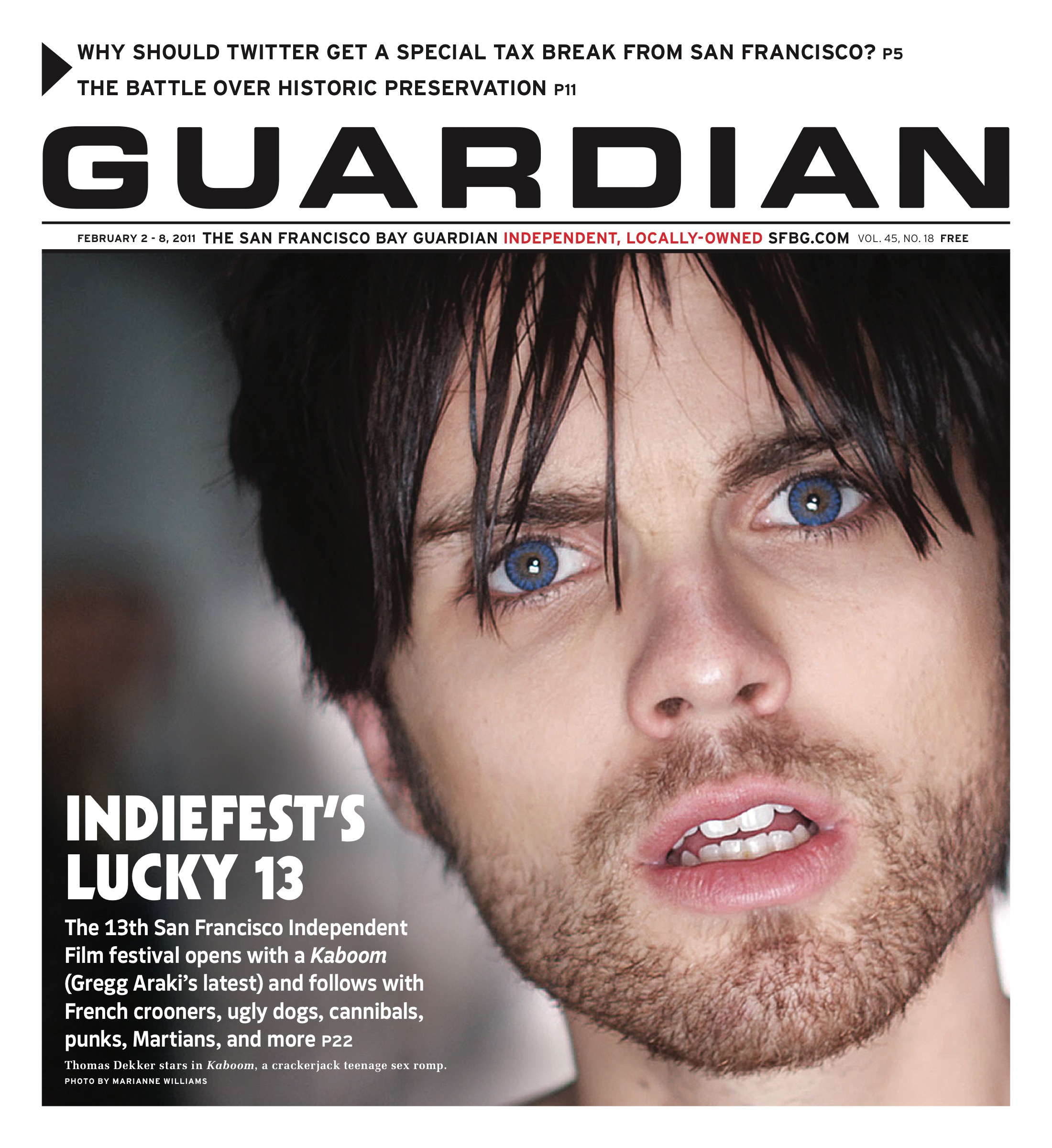
Kaboom (Gregg Araki, U.S.-France, 2010) Gregg Araki’s crackerjack teen sex romp is pure verve — a return to devil-may-care form for fans of The Doom Generation (1995) and Nowhere (1997). Kaboom is right: besides sneaking under the blue velvet rope for a classical mindfuck death trip (there’s even a good part for Jennifer Lynch), Araki and his winning cast let loose a fusillade of dorm-room chatter that runs metaphorical language to its limits. The cult-bidden mystery is too squarely accounted for, but then Kaboom is really as much The Palm Beach Story (1942) as Twin Peaks. Our coed heroes are Stella (Haley Bennett) and Smith (Thomas Dekker), and they’re the only platonic thing in the movie. Taken with Araki’s lasting affection for 1990s culture jamming, this rock-solid friendship is actually quite touching, but Kaboom works best when sliding up and down the Kinsey scale, huffing comic book paranoia for the fun of it. Thurs/3, 7 p.m. (Max Goldberg)

Mars (Geoff Marslett, U.S., 2010) Thanks to Mars, the question “Can mumblecore survive in outer space?” has been answered. (And it’s actually less annoying out there than it is on Earth!) Austin, Texas, writer-director Geoff Marslett’s rotoscope-animated tale follows three astronauts (including m-core heavy Mark Duplass) on a Mars mission, two of whom(Duplass and Zoe Simpson) spark romantically en route. Meanwhile, a solo robot delegation lands ahead of them, discovering new life forms and new emotions, as it sparks romantically, á la Wall-E (2008), with a Mars explorer thought lost a decade before. All the squee gets a little dippy toward the end, but the contrast between slacker and sci-fi genres mostly works. Added points for casting Texas hero Kinky Friedman as the POTUS; Giant Sand’s Howe Gelb did the film’s music and plays the sarcastic head of mission control. Fri/4, 9:15 p.m.; Mon/7, 7 p.m. (Eddy)

Special Treatment (Jeanne Labrune, France, 2010) Let’s get this out of the way first: Isabelle Huppert can do no wrong. That’s not to say she doesn’t occasionally pick terrible projects — she’s just never the thing that’s wrong with them. Special Treatment isn’t so much terrible as it is terribly misguided, contrasting the worlds of psychiatry and prostitution with broad, cartoonish strokes. Huppert plays Alice, a lady of the night who’s thinking about giving up the trade. I don’t blame her; the clients Special Treatment presents her with are the dullest of perverts. One wants her to dress up like a Japanese schoolgirl with a teddy bear and a giant lolly. Another goes the collar and dog bowl route. It’s 2011 — can’t we be a bit more creative with our fetishes? On the opposite end, there’s disenchanted therapist Xavier (Bouli Lanners). And wouldn’t you know it? His patients are photocopies from psychiatry textbooks. There’s a point to be made about the link between paying for sex and paying for someone to listen, but Special Treatment lacks the depth to drive it home. Sat/5 and Feb. 9, 7 p.m. (Peitzman)

Superstonic Sound: The Rebel Dread (Raphael Erichsen, U.K., 2010) “Everything I am came out of music,” says Don Letts — the second-generation Jamaican British DJ, director, and entrepreneur credited with turning punks on to reggae in the late 1970s — in this documentary about his life and work. Much like his contemporary, the late Malcolm McLaren, Letts was a cultural cross-pollinator, working in different mediums while encouraging subcultures to feedback into and off of each other to create something explosive and new. While this serviceable doc lets Letts himself retrace ground that’s been extensively covered elsewhere (it’s worth noting, though, that nearly all the archival footage used was shot by Letts himself), the scenes with his formerly estranged son, who’s also a DJ, are tender and unexpected. Feb. 12, 7 p.m.; Feb. 16, 9:15 p.m. (Matt Sussman)

Transformation: The Life and Legacy of Werner Erhard (Robyn Symon, U.S., 2010) The last thank you in the end credits of this documentary, in bold, is for Werner Erhard. The exiled former est leader and “personal growth” preacher or pioneer should thank director Robyn Symon — I think? – for Transformation, since it’s a 77-minute advertisement for him. Certainly, Erhard is a potentially rich choice in terms of subject matter, but very early on, it’s clear that Symon is out to paint a romantic, positive portrait: testimonials on his behalf are coupled with a low-volume acoustic guitar musical backdrop, and Erhard is even interviewed on the beach. Every once in a while an offhand moment — such as a brief mention of Scientology figurehead L. Ron Hubbard’s predatory view of Erhard — disrupts the soothing flow and opens the possibility of a broader, critical look at the “personal growth” phenomenon. (For the most part, it’s only been dramatized, usually through parody, in films such as 1999’s Magnolia and 1995’s Safe.) As a cultural and even historical figure, Erhard is worthy of an appraisal that’s neither enraptured nor utterly damning. This isn’t it. Thurs/3, 9:15 p.m.; Sat/5, 7 p.m.; Tues/8, 9:15 p.m. (Huston)

Worst in Show (Don Lewis, U.S., 2010) All films about animals in the competitive arena must acknowledge the fundamental truth that the animals themselves are nowhere near as entertaining as their owners. A dog just wants to play, eat, crap, sleep, and maybe have its belly rubbed. The dog’s owner, on the other hand, wants other things — titles, media attention, perhaps an endorsement deal — because they have convinced themselves (as they must convince the judges, and to some degree, the public) that their dog does not just want to play, eat, crap, sleep, and maybe have its belly rubbed. No! Their dog is special. Doc Worst in Show understands this basic drama and finds plenty of eager players in the canine and bipedal contenders, both new and returning, at Petaluma’s annual Ugliest Dog in the World Competition. Amid all the patchy fur, bad eyes, underbites, and malformed legs, it’s the big hearts and outsized egos that truly stand out in this portrait of pageant motherhood at its most extreme. Feb. 9, 9:15 p.m.; Feb. 13, 2:30 p.m. (Sussman)

Je T’aime, I Love You Terminal (Dani Mankin, Israel, 2010) It’s unfair to judge a film by its title, but Je t’aime, I Love You Terminal lets you know exactly what you’re in for. This twee indie romance is Before Sunrise (1995) meets Once (2006) meets every other twee indie romance you’ve ever seen. The film is more mediocre than it is bad, exploring the single-day love affair between two strangers stranded in Prague. Ben is moving from Israel to New York to marry the one that got away. Naturally, he also sings and plays guitar. Emily, an impulsive free spirit, teaches Ben a valuable lesson about living in the moment. Saying this story has been done before is an understatement: Je t’aime packs on indie cliché after indie cliché, without really bothering to develop Ben or Emily into interesting characters on their own. This is a retread without anything to distinguish it from the rest, dragging it down from shrug-worthy to eye-rolling. Feb. 12, 4:45 p.m.; Feb. 14, 9:15 p.m. (Louis Peitzman)

Landmark to loudness

0

MUSIC Happy Sanchez’s office is above the cafe, by the entrance. There are only a couple of windows. One opens onto the parking lot, where a car alarm blares during our interview. The other is dark; below it are the building’s two hourly rehearsal rooms. Aside from the vibration of a double bass revving, we’re cut off from the activity going on at Secret Studios. As the owner, Happy makes up for this isolation with a wall of closed-circuit TVs showing the hallways and common areas tying the Studio’s 130 monthly rehearsal spaces together.

“Mostly it’s just about dealing with the headaches of running a business,” Sanchez says. The headaches, when your clients are all musicians, can be numerous. Bands arrive at 2 a.m., fresh from a gig, and decide to toss utility carts down the stairs. People try to smoke inside, piss in the parking lot, live in their units. Watch out for speed freaks. Make sure women aren’t being harassed. “Sometimes I feel like I’m the principal of the school,” Sanchez says.

Sometimes it’s just plain traumatic. “The one thing that upset me the most, this fucking guy was pissed at his girlfriend, took her cat, put it in the [rehearsal] room, and left it for weeks. Fucking poor cat was skin and bones by the time the girlfriend came and asked me to look for it. Most I’ve ever been upset at anyone. He was banned.”

“But most of the time people are pretty cool,” Sanchez is quick to add. “The people who are on the lease are level-headed. It’s always the friend or the guy that’s just hanging out that makes problems.” There is reason for me to doubt this statement, having just heard Sanchez tell another story about being held up at gunpoint by a rapper who wants his demo tape. But I’m still inclined to believe him, given the sheer number of clients he’s come in contact with in the 25 years since he took a job as a studio manager at Secret Studios, back when it was a small two-room operation.

At the time, Secret, like most of the studios in town, was about hourly rehearsal and recording space. The two units of Secret Studios were originally at Third St., before a mid-1980s move to 215 Napoleon St. in a building with lots of neighbors. “Mostly we did a lot of punk rock recordings, back in ’87,” Sanchez remembers. “This guy David [Pollack], who I later bought the studio from, at the time I was just working for him and he set me up with all these gigs.” They’d rent the place out for parties, for extra money. “Metallica rented it, back in the days when I guess they were big in Europe but they weren’t really that big, yet. Before the Black Album [1991’s Metallica] came out, when they blew up.”

Those involved in Secret during the Napoleon Street era attempted to confine major sessions to nighttime, but it eventually became clear — as the neighbors bitched — that a different location was needed. After the owner sold the business to Sanchez (“Basically, he gave it to me at minimal cost”), he was able to expand and then move into 50 units at the current location on 2200 Cesar Chavez St. The large warehouse with a single floor of small rooms was previously the sound stage for the talk radio TV drama Midnight Caller.

Sanchez credits some of his success to timing. “I got in at the right time. It’s just more expensive to build nowadays. People have tried to build big studios like this and it’s just not affordable anymore. They see it as easy money, but it’s not easy to pull off.”

One person who tried — and succeeded — was Greg Koch, who developed the nearly 180-unit Downtown Rehearsal in 1992. Earlier, Sanchez had passed on its Third Street location. “It was shady at night when most of my clients would be around,” he says. “That building was cheap, though. They couldn’t give it away.”

Downtown was a major competitor until the summer of 2000, when Koch attempted to evict all of his tenants without notice in an attempt to flip the property for a huge profit. In the process, he instigated a musical community revolt, resulting in a large cash settlement and the formation of a then-hopeful, now apparently stagnant nonprofit, SoundSafe. At the time of the turmoil, Secret Studios was still expanding to its current size of 130 units. “I basically opened my units and saw a huge influx of bands,” Sanchez says.

Sanchez has had many models for what Secret Studios should — and shouldn’t — be. He recalls that Francisco Studios, a Turk Street basement space, had a bathroom out of Trainspotting. He’s quick to admit that since he’s taken over the business, there have been mistakes and failures. A plan to start the International DJ Academy in the front offices of the building, with a partner who managed Invisibl Skratch Piklz, fizzled. “They never could quite get it off the ground,” he says. “It was a good concept, but I think they needed someone to run it as a business.” Along with a rap studio that was going at the time, the academy devolved into something that included a barber shop and a night club before Sanchez had to shut it down.

Which, technically, makes two rap studios Sanchez had to end. Back in the late 1980s, at Secret’s old location, there was a lot of money to be made from hip-hop. “These rappers were coming in and you could pretty much just charge them anything,” Sanchez says. “I think there was always the drug dealer in the background financing it. I swear, we had like three clients over time that got murdered. The first time it was kind of a shock. They found the guy in a trunk in Oakland. The second guy got murdered on the night of the earthquake in 1989. The scene just got too crazy. Gangster rap came out, and the whole vibe changed. It got really hardcore.” After a hold-up occurred at the studio and an expensive keyboard was stolen, Sanchez stepped away from the rap game in 1991.

Many artists have come through Secret Studios, but it’s not something Sanchez brags about. In part this stems from his respect for overall security, a high priority when theft is a concern. But it also has to do with his respect for confidentiality. The music business exposed him to a lot of drugs in the ’80s, and he himself struggled with addiction. From 1989 until 1992, he hosted a Narcotics Anonymous gathering — the Straight Edge Rockers meeting — in the studio on Sunday nights. “There were a couple people there that you would definitely know their names,” he says. “I’m actually thinking about getting it going again. It’s not as easy to pull off, but I always thought that meeting was so cool. There are a lot of people in the music industry that need that.”

Sanchez is desensitized to stardom. He’ll say that no one really big has ever been at Secret Studios, then rattle off a long list of names: the Dead Kennedys, Michael Franti, the Go-Gos, EPMD, Romeo Void, Chris Isaak, Mike Pistel, Toots Hibbert. Some of these connections are long relationships, some are incidental. MC Hammer rehearsed at Secret before he was big (but had the parachute pants). Gene Simmons came down in a limo.

Sanchez is happy with his success so far and grateful for the freedom to be a musician with a stable business. With another 10 years on the lease (which he hopes to extend to when his two-and-a-half-year-old son reaches adulthood), he’s satisfied with assuming a more administrative role at Secret. He does the books, handles the day-to-day issues, and makes his own music, composing for movies and television as the Latin Soul Syndicate.

For a lot less drama, Sanchez is a little less in the know about his clients and their role in the scene of the moment. A while ago, for example, he needed to contact a band about a bill. But the band was on tour, and he was referred to its business manager. He went online to look it up. He had no idea who the band was until he Googled “The Dodos” and a video popped up showing the band playing on The Late Show with David Letterman.

www.secretstudios.com

arts@sfbg.com

Ollie beats

0

caitlin@sfbg.com

MUSIC Tommy Guerrero likes to skate down Potrero Hill. He’s been doing it since he was a young pup street boarder — one of the first to go pro, in fact — cruising down those steep residential declines that, looking south from SoMa, resemble like nothing so much as that scene from Inception where the dream city folds on top of itself. Guerrero skates smoothly from one legendary SF career to another, a shape-shift neatly illustrated by the release party for his eighth solo album Lifeboats and Follies at Cafe Du Nord Saturday, Feb. 5.

Despite the requests for autographs that he still gets; the occasional cravings his beat-up body experiences for skating (“It’s so raw and the energy is so fucking gnarly. Once you’ve had a taste of it, there’s no turning back.”); and a job that most ex-skate rats would kill for — he’s the art director for Krooked, a subset of Potrero Hill skate company Deluxe — he’s really more into music these days. “I would love to have all that time to work in the studio. I want to retire [from skate design] in a year,” he says, half-jokingly — but still longingly.

Maybe it’s a grass-is-always-greener thing, but until now he’s done a good job of balancing his various passions. Even in the 1980s and ’90s when Guerrero was grinding out his signature moves on the driveways and suicide hills of the city, back when he was popularizing Public Enemy in Japan by skating to the group’s tracks during competitions, music was always playing a supporting role. He and brother Tony played in punk bands, including Free Beer (a name that made for alluring concert flyers).

Nowadays Guerrero makes layered instrumental music that’s appropriately enough a mix of many different elements: chill jazz with electronic crescendos, a little Latin percussion, maybe a horn solo easefully inserted. Guerrero has a DJ-like impulse to play with genres. “I just hear so much shit in my head, this is what comes out.” Apparently his albums cause havoc in the Amoeba cataloging system. “I’ve seen it in electronic, rock, alternative, even experimental or some shit,” he laughs, sitting cross-legged in a patio booth at Thee Parkside, black leather Vans (his own signature design) on his feet.

He’s in the middle of doing some promotional work for Lifeboats and Follies, but like the rest of his projects, you get the feeling that Guerrero would be doing the same thing even if he never got paid a dime. After failing to resolve differences with his old label, Quannum, Guerrero bought the entire stock of his last album, From the Soul to the Soul, back from the company. He’s mulling over what to do with it — maybe give CDs away at Saturday’s show?

Guerrero never gained the Thrasher notoriety he got from skating in his musical career. But he casually mentions that he is, as the saying goes, big in Japan. He performs there a lot and gets off on being able to take risks with in his live performances that wouldn’t go over well with American audiences looking to hear the same old thing. “They can love J-pop and, at the same time, they can love John Zorn,” he says of his Japanese fans. It makes sense that Guerrero would gravitate toward an audience looking for a more diverse experience, one that trusts that whatever he’s popping off with — on the skateboard or mixing board — is gonna turn heads. 

TOMMY GUERRERO: LIFEBOATS AND FOLLIES RELEASE PARTY

Sat/5 9:30 p.m., $12

Cafe Du Nord

2170 Market, SF

(415) 861-5016

www.cafedunord.com>

Possibility: “Gush” presents Joe Goode the curator

0

Audiences can thank Raelle Myrick-Hodges, Artistic Director of Brava Theater, for cutting Joe Goode loose in curating “Gush,” Brava’s first dance theater specific series. Rather than defining dance theater, Goode, during his three-weekend series, showed us its possibilities. He served as a tastemaker and also opened minds in choosing a theme to frame and present Ledoh and Salt Farm Productions (a performance collective with roots in Butoh), Axis Dance Company (a contemporary mixed-ability dance company), as well as his own company, Joe Goode Performance Group

While an artist-driven curatorial practice is not necessarily new, Goode addressed the topic in the program, writing “One of the stellar differences between the dance scene here and in other countries (notably South America and Europe) is that, here in the U.S., artists are rarely given the opportunity to champion other artists and to offer the kind of insight and context that we are so perfectly equipped to provide.” Goode utilized his opportunity at Brava to direct attention to two other groups which inspire him. The thematic aspect of the title “Gush” drew attention to their lavish, bold, theatrical impulses.

The East Coast recently experienced a surge in artist-driven curation, with the 2010 inauguration of Danspace’s Platform series, envisioned by Judy Hussie-Taylor, Executive Director of the major downtown dance venue in New York City. For each Platform, a selected artist organizes a series of performances based on a theme, as well as discussions, open rehearsals, screenings, and a catalog. If the components sound like those of a visual arts exhibition, it’s for a reason -– Hussie-Taylor’s career includes years at museums and she is now a faculty member at the Institute for Curatorial Practice in Performance at Wesleyan University, the first program of its kind addressing performing arts curation. Among other topics, the program’s curriculum considers how the curatorial practices of the visual arts can be applied to the performing arts, enhancing context and experience of the work.

On Thursday, Jan. 27, during the last of the “Gush” programs, Goode arrived downstage at the microphone as a charming storyteller, party host, and tour guide. Describing his dance theater as a form of folk art which combines movement, spoken word, song, and visual imagery, he resurfaced onstage throughout the performance to contextualize a mashup of old and new works, including 29 Effeminate Gestures, Wonderboy, small experiments in song and dance, What the Body Knows, and a new collaboration with puppeteer Basil Twist set to premiere at YBCA’s Novellus Theater this June, The Rambler.

Sitting in the center of the stage, Goode elaborated on his process of generating, colliding, and editing material to developing work through “felt experience.” His dancers embodied the phases he described, resulting in a carefully crafted sort of lecture-demonstration. The opportunity to meet Goode in the role of curator and share the lens through which he sees the world was a delight. It revealed gems of dance theater work, and another layer of his artistry.

Aerial revolution

0

Consider the rise of the extreme athlete: generations of youngsters (and increasingly, brave older folks) competing to see who could pull the sweetest stunts and survive. Ever wonder how is it that a person can make the transition from earthbound and bipedal to gravity-be-damned dare-devilry? When exactly is the moment that a skater, skier, or snowboarder just lets go and trusts their body to take them up, over, around, and (hopefully) gracefully down to the ground?

Last Tuesday, I attended a press event at House of Air – the newest member of Crissy Field’s collection of renovated airplane hangars in San Francisco’s historic Presidio – where I was treated to a glimpse of how such a transformation might become reality. Not to mention a new way that a public sports facility can play with its community.

Given the Presidio’s military history, you may have been tempted to think the newly opened space at 926 Mason is home to helicopters and jets. But the pilots in House of Air aren’t crew-cutted cadets, and the only high-tech equipment in the corrugated steel hangar is an impressive array of custom-made trampolines. Every day in this house-of-bounce, tomorrow’s extreme sportsters are earning their wings – and there isn’t a major commander in sight.

House of Air is the brainchild of Dave Schaeffer and Paul McGeehan, two extreme sports aficionados who trained together on the Lake Tahoe snowboarding circuit. Their concept was helped off the ground (so to speak) by former Olympic skier Jonny Moseley. All three use trampolines to perfect their aerial artistry, and could commiserate over the difficulty of finding a facility where they could train with their respective equipment. According to Moseley, who raised eyebrows as a youth by flipping over his skis in a gymnastics studio, trampolines were few and far-between and most were used for coaching gymnasts and tumblers.

Large-scale trampolines provide the air time necessary for an athlete to teach his body to do tricks like corkscrews and 360s, serving as crucial incubators before a pro takes to the water, pavement, or snow with a new trick. But until House of Air, the idea of a dedicated facility for extreme athletes was unheard of. Now, the studio fills the void with over 2,000 square feet of trampoline space where serious athletes can perfect their skills in a safe (and soft) environment – and where, I was thrilled to find, even the not-so-extreme can have a blast.

House of Air provides lessons to beginners and more serious students of all ages. Instructors with backgrounds in everything from professional snowboarding to circus acrobatics use a specially designed high-performance trampoline deck to teach techniques to budding athletes. The center’s growing team also supervises two segmented jumping arenas, each about the size of a regulation basketball court, complete with angled trampoline enclosures that extend the bounce factor right up the walls. The facility also includes a kiddy bounce house for the younger set, special event rooms, lockers, and showers.

An average person arriving on the scene would begin their foray into the art of flight by checking out a pair of special House of Air shoes – modified wrestling shoes that provide ankle support. They would then have the option of renting some basic bounce time, participating in an organized game (think P.E. classics gone crazy: dodgeball or volleyball are both served up with a side of spring), or taking a class on the foundations of flying, which is where I wound up bouncing on my visit.

I was a bit apprehensive (read: terrified) as Moseley ushered me up to the trampoline deck and demonstrated a few tricks. He flopped through some sick twists, turns, and flips without missing a beat in our conversation. Then it was my turn.


Our intrepid reporter takes to the air at SF’s bounce palace. Photo courtesy of Jonny Moseley

I started with the aptly named “butt-drop”: a move in which the trampolinist replaces a single bounce with a fall on their bum and then – this is the crucial part – returns to her feet without missing a beat. After that, I moved onto “swivel-hips,” wherein the butt-drop is supplemented by a 180 degree revolution on the up-swing. For my final trick, I tried my hand at the sequence that leads up to a front flip: a jump, a fall to all fours, and then a forward rotation that landed me flat on my back. All in all, I wasn’t quite ready for the X Games, but it was killer on the knees and had my quads burning. I had new respect for the little groms busting board-grabs and aerials — and for the brave adults who come to House of Air for the “air conditioning” classes and company team-building sessions. Trampoline dodgeball: a fantastic way to build office camaraderie, or at the very least a good excuse to pummel that passive-aggressive co-worker with a deluge of flying foam rubber.  

Final impressions from the House of Air? Besides the sore thighs, of course? The center seems to be re-thinking the role of the public sports facility, from its boardrooms for the business set to its specially-manufactured props that emulate sports equipment for practicing athletes, like lightweight foam snowboards and a tow rope akin to what a wakeboarder would utilize on the waves. Even the layout of the building itself, which makes use of those large hangar doors to provide jumpers with such an excellent view of the bay one gets the feeling that with one wild leap one might land in the waves, helps to make House of Air a unique resource for the SF community.  

Given the chance to train in a facility like this one as a child, Moseley says he would have been thrilled – and possibly less banged-up in the bargain. “This is the way kids learn to be professionals — without getting hurt.”


House of Air, 926 Mason, SF. (415) 345-9675, www.houseofairsf.com


Century-old smut hits the Red Vic

0

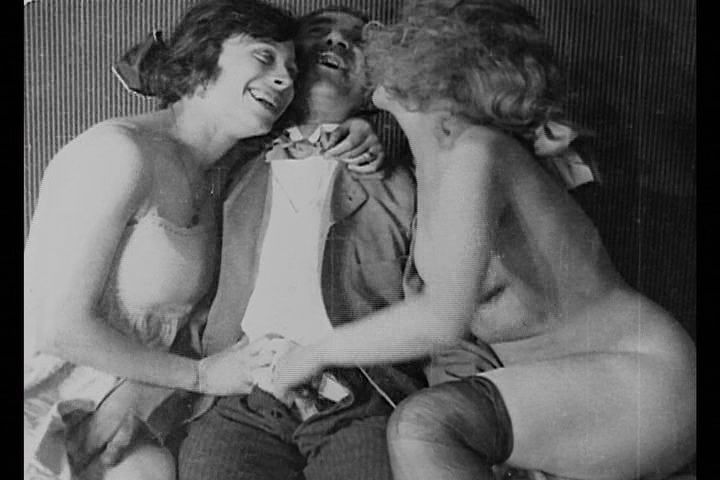
Sex education, y’all. Despite the fact that today’s parents outsource math lessons to Blue’s Clues, play time to iPhones, and secret homosexual programming to Gabba Gabba Hey!, the continuing furor over sex education in schools just refuses to quit talking, finish its drink, and go home. But, as a reclaimed 1900s reel of French brothel movies showing at the Red Vic Movie House this weekend (Fri/28 – Mon/31) proves, sex ed has always been around – it just used to happen in whorehouses.

The Good Old Naughty Days is a 69 (ha! Really!)-minute collection of silent shorts that were found in a well-to-do French family’s attic nearly a century after they were filmed. Most likely, according to the film’s producer Michel Reilhac, they were shot by conventional film crews on their day off. They’re low-budget affairs whose most salient expense was the fees of the prostitutes who starred in them — men and women whose bodies are un-siliconed and unaware of the histrionic boinking that would some day pass for erotic film. The movies were co-opted by brothels, who would play them in their waiting rooms as young gentleman killed time before their whoring. 

Which was, of course, where young cats learned about sex back in those days. When they showed up as virgins to the bordello, berets and handlebar mustaches a-twitchin’, these were the films to at least prevent them from shouting “qu’est-ce que c’est!” when their lady of the evening shuffled off her chemise (or their gentleman of the night his breeches, lest we forget). There’s gay and lesbian couplings, even priests and nuns — these last having a good time with candles.

Judging from The Good Old Naughty Days, them last century folk even got down in ways that we cultured cyborgs might find a wee bit mutt-like – apparently there’s a scene with a pooch unconcerned with which species recieves his Rover. In an interview with the UK Guardian (our namesake, holler), Reilhac says a few women took offense at this inter-mammal consorting at an early screening, to which he had this to offer: “thank God I took out the duck scene.”

But do not mourn the loss of this duck scene, San Francisco. Go out and be ever so naughty at the Red Vic – the two and four p.m. showings on Saturday and Sunday might make for a tasty post-brunch educational session. Just remember there is no sex-for-money waiting for you by the popcorn machine. Just wooden bowls, probably.


The Good Old Naughty Days

Fri/28 – Mon/31 7:15 and 9:15 p.m. (also Sat/29 – Sun/30 2 and 4 p.m.), $8

Red Vic Movie House

1727 Haight, SF

(415) 668-3994

www.redvicmoviehouse.com


Snap Sounds: Munly and the Lupercalians

0

MUNLY AND THE LUPERCALIANS
Petr and the Wulf
(Alternative Tentacles)

Munly J. Munly has long been one of the most enigmatic yet prolific figures of the Denver Music scene. And with his latest lineup, concept band The Lupercalians, he’s tapped into a treasure trove of possibility. Ostensibly the first of a series of albums focusing on the imaginary world of the “Kinnery of Lupercalia,” Petr and the Wulf is a dark retelling of the Prokofiev children’s symphony, whose characters are trapped by circumstance and each other in a deadlocked circle of vengeance and fear.

Reminiscent of, yet literal worlds apart from, the down-home fire and brimstone twang of Munly’s other projects (particularly Slim Cessna’s Auto Club), the musical arrangements of Petr and the Wulf are far closer in nature to the original symphony than to a hootenanny: strings, flute, organ, and even a tuba are represented in the mix along with multiple percussionists, a solitary banjo, and intense vocal layers. The last track, an eight-minute spoken-word soliloquy against a wailing wall of percussion-driven sound, exalts in the Wulf’s unrepentant ways: “If I am to be your reprobate,” he intones, “I shall at least enjoy the malefaction,” a phrase that seems just as easily applied to Munly himself.

Munly and the Lupercalians, “Grandfater”

Working to dance, dancing to live

5

arts@sfbg.com

DANCE When people ask what I do, I tell them I dance. I don’t tell them I work as a receptionist part time, or that I work events in a restaurant. I tell them I dance because, although it’s more glorious-sounding than my odd jobs, it’s also more important. These side jobs exist merely to facilitate the dance. They are expendable; dancing is not. But while dance fuels me physically and emotionally, it fails me financially. For better or worse, there is a whole community of dancers and choreographers in the Bay Area who share this same conundrum to lesser or greater degrees.

So what do Pilates instructors, nannies, dog walkers, waitresses, and personal assistants have in common? They are all jobs with variability in work scheduling, and they are just a handful of the flexible jobs employing Bay Area freelance dancers. Over the past month I’ve interviewed about 20 of my fellow dancers and have been heartened at the abounding courage found in the local dance community to pursue alternate lifestyles to continue dancing.

Daria Kaufman has an MFA in Dance from Mills College. She teaches Gyrotonic, works as a receptionist at a yoga studio, and does administrative work for the Subterranean Art House. “One of the major challenges for dancers and choreographers is money — how to afford classes, rehearsal space, and theater rentals, to name a few,” Kaufman says. “I’ve done a lot of work-study over the years to combat the issue of affording dance classes. Most studios have a work-study program — clean for an hour and a half, get a free class, that sort of thing. Some studios offer a similar deal for renting out rehearsal space.”

Adaptability is necessary. Schedules vary day to day and month to month according to who’s teaching which classes, who’s working on what project, and what jobs will work around those opportunities. Often the most flexible jobs can be found in the food industry. Evening shifts allow dancers and choreographers to take morning classes and rehearse through the day, while variability in shifts provides flexibility when it comes to evening performances.

Angela Mazziotta, a dancer with Cali & Co., works at Squat and Gobble Cafe and Crepery in the Marina. “Although I don’t work enough to be considered full time, I make enough to pay rent, eat, and dance,” Mazziotta says. “There are days that I long to have a ‘big girl’ job for security, insurance, and more financial cushion. The reality is that those full-time jobs don’t offer a lot in terms of flexibility, and the hours of operation coincide with dance classes and rehearsals.”

The downside of the restaurant business is the relentless fatigue it piles on a body. Foundry dancer Joy Prendergast discovered that a café job was too taxing and now primarily teaches dance and baby-sits. Project Thrust choreographer Malinda LaVelle also found the strain to be too much. “I stopped working restaurants because the physical aches and pains of dancing were compounded by the strain of standing on my feet until 2 a.m. and then getting up the next morning and dancing again.” After working five nights a week, LaVell quit the restaurant scene to walk dogs and pursue receptionist work.

Fitness-related instruction jobs are another popular money-making source. Many dancers are certified in Pilates, Gyrotonic, or yoga as a way to subsidize their income. “Teaching’s a great way to make consistent money,” says Gyrotonic instructor Andi Clegg. “I’ve been able to constantly shift my teaching schedule around shows or other dance-related work I am involved in.” SF Conservatory of Dance student Emily Jones finds Pilates adaptable to her lifestyle: “I sometimes wish that I had a job where I could just turn off my brain and go on autopilot. But then I think about all the people I know who have café jobs and how they wish they could do something a little less numbing.”

Perhaps the most obvious way for a dancer to make money is to teach dance. Gretchen Garnett, director and choreographer of Gretchen Garnett and Dancers, taught dance 25 hours a week at three different studios around the Bay Area when she first moved here. Since getting married, she has been able to teach a more reasonable 14 hours a week at two dance studios and dedicate more time to her company. Whitney Stevenson, who moved to SF within the past year to dance, enjoys teaching gymnastics to children because she gets to be active.

Although an active job like teaching classes or working in a restaurant might seem perfect for someone physically inclined, many dancers find it essential to sit down and rest their bodies while working. Gabby Zucker does transcription and reads drafts for author and music critic Jeff Chang. “It may sound silly, but I prefer desk jobs to waiting tables or working retail because I feel it’s important to rest my body when I’m not dancing,” Zucker says.

A more common sedentary line of work for dancers is administration. Maggie Stack works as the administrative assistant for the San Francisco Conservatory of Dance, and for her, the support and promotion of dance goes hand-in-hand with the medium. But for Julia Hollas, dancer and administrator for Dandelion Dance Theater, the realm of arts administration also became a bane. “There is always too much work, not enough funding, and the incredibly good people who stay in the field consistently take on more than they can comfortably handle,” says Hollas, who is currently seeking Pilates certification. “There is something quite noble about that fact, and I will always feel admiration for anyone who works as an administrator in the dance world. But what I was beginning to see in myself was a consistent state of burnout that took away from the inspiration I needed to pursue my art as I wanted.”

There are also those who take on jobs that are out of the ordinary. Darya Chernova moved here from Russia and was amazed by all the dance opportunities and classes available. Luckily, she found a job to facilitate that interest. “I have been working at the farmers market for an apple orchard farm for five years,” Chernova says. “Farmers market work is great but tiring. It can be very physical and socially exhausting. But I love fruit and being outside.”

Kaitlin Parks, who worked as an EMT before the job became too overwhelming, is another example. “Lights, sirens, and the glory of helping fellow humans are great, but the 10-hour shifts and the physical and emotional demands were dipping into my energy and attention for dance,” she says. “I currently dance with Alyce Finwall Dance Theater, the courage group, baby-sit for six different families, teach young children’s dance classes, and teach both EMT skills and CPR.”

When it comes down to it, making a life in dance is often an act of creativity in itself. Rachel Dichter helps organize people’s closets. Tyson Miller works room service at the Mandarin Oriental. Ri Molnar models for art classes, gardens, and assists people with disabilities. Paul Laurey lives in a theater basement with low rent to redirect time and financial resources to dance. While some may respond to his living situation with pity or concern, for him the luxury of pursuing dance outweighs any sacrifice in creature comforts.

Of course, pursuing dance becomes a whole different story when a family is involved. InkBoat dancer Dana Iova-Koga found that having a life in dance took on new meaning with a daughter. “Now that I am a mother, I’ve had to get more intentional with dancing,” Iova-Koga says. “It’s much harder to find the time to do it, and it has to be very planned out. But now, when I get to perform, it feels more essential and I appreciate being there in a whole new way.”

“Until recently, the key to making dance possible in my life was seeking out alternative lifestyles that allowed me to step aside from the money equation for the most part,” she continued. “This was much simpler to do as a single person, before becoming a family. We are still figuring out how we can keep the dance growing and maintain a sense of stability for our daughter.”

Although it’s a difficult balance to maintain, Bay Area dancers are more than up to the challenge of cultivating a life around a physically demanding art form with few monetary payoffs. Though it may demand fortitude, creativity, and a willingness to diverge from a more conventional lifestyle, the personal rewards of a life filled with inspiration and love-filled work are indeed great.

Stage Listings

0

Stage listings are compiled by Guardian staff. Performance times may change; call venues to confirm. Reviewers are Robert Avila, Rita Felciano, and Nicole Gluckstern. Submit items for the listings at listings@sfbg.com. For further information on how to submit items for the listings, see Picks. For complete listings, see www.sfbg.com.

THEATER

ONGOING

Audition – A Play Exit Theater, 156 Eddy; (800) 838-3006, www.brownpapertickets.com. Call for price. Thurs and Sat, 8pm; Sun, 3pm. Through Feb 13. GenerationTheatre presents a comedy of the absurd by Roland David Valayre.

Bone to Pick and Diadem Exit on Taylor, 277 Taylor; (800) 838-3006, www.cuttingball.com. $15-50. Thurs-Sat, 8pm; Sun, 5pm. Through Feb 13. Cutting Ball Theatre presents a pair of plays by Eugenie Chan.

Clue Boxcar Playhouse, 505 Natoma; 776-1747, www.boxcartheatre.org. $15-35. Wed-Fri, 8pm; Sat, 7 and 10pm. Through Feb 19. A play based on a film based on a board game is just the kind of tangled genealogy much goodtime theater is made of these days. So there’s nothing too new about Boxcar’s stage adaptation of the manic 1985 comedy derived from a once popular Parker Bros. diversion. In fact, it’s at least the second stage adaptation of same to be offered in San Francisco. (Impossible Productions remounted its version at the Dark Room just last year.) Nevertheless, led by adapter-director Nick A. Olivero, Boxcar’s production pursues its vision like a mad yen, with a loving fidelity and self-referential glee that are not so much inspired as just plain zealous (although Olivero’s scenic design does reach new heights: a TV-toned board-game set that the audience peers down on from six-feet-high balconies ringing the stage). Performances are dutiful and solid for the most part, with especially nice work from Brian Martin (as the butler) and J. Conrad Frank (as Mrs. Peacock). Although there’s something vaguely and not unpleasantly hypnotic about it all, groups of cult-film line-gleaners may be the best audience for this one. (Avila)

*The Companion Piece Z Space at Theatre Artaud, 450 Florida; (800) 838-3006, www.themarsh.org. Call for price. Thurs 7pm; Fri-Sat, 8pm; Sun, 5pm. Through Feb 13. Z Space presents the world premiere of a new play by Mark Jackson, with Beth Wilmurt and Christopher Kuckenbaker.

*A Hand in Desire Viracocha, 998 Valencia; www.viracochasf.com. $10-20. See website for dates and times. Through 1/29 Even though the card game of choice in Tennesee Willams’ A Streetcar Named Desire is poker, it’s fitting that the five-member cast of EmSpace Dance’s adaptation A Hand in Desire should play at hearts instead. After all, as Mitch (Christopher White) reminds us, “poker shouldn’t be played in a house with women” And besides, hearts are very much the core of each character: the heart of Blanche, a flighty bird, the heart of Stella, a string of colored lights, the heart of the doomed Allen Grey (Kegan Marling), an open wound. As the cast plays onstage with a custom-designed deck, each trump card is turned over to a laconic narrator/conductor (Heather Robinson) who names the scene they are to play next. Each evening promises a different sequence of scenes, some of which stick more closely to the original script than others. However, the ensemble is at it’s best when it lets go of text altogether, such as the scene “a cleft in the rock of the world I could hide in,” during which Stella (Natalie Greene) and Stanley (Peter Griggs) get it on, and Blanche (Rowena Richie) awkwardly waltzes with Mitch as Alan insinuates himself into their duet. Musicians Joshua Pollock and Chris Broderick tie the whole experiment together with aplomb. (Gluckstern)

Out of Sight The Marsh, 1062 Valencia; (800) 838-3006, www.themarsh.org. $15-35. Thurs and Sat, 8pm; Sun, 3pm. Through Feb 13. The Marsh presents a new solo show by Sara Felder.

Party of 2 – The New Mating Musical Shelton Theater, 533 Sutter; (800) 838-3006, www.partyof2themusical.com. $27-29. Sun, 3pm. Open-ended. A musical about relationships by Shopping! The Musical author Morris Bobrow.

*Pearls Over Shanghai Thrillpeddlers’ Hypnodrome, 575 Tenth St; 1-800-838-3006, www.brownpapertickets.com. $30-69. Sat, 8pm. Through April 9. Thrillpeddlers’ acclaimed production of the Cockettes musical continues its successful run.

Spalding Gray: Stories Left to Tell Gough Street Playhouse, 1620 Gough; (510) 207-5774, www.custommade.org. $10-25. Thurs-Sat, 8pm. Through Feb 19. Custom Made Theatre presents stories by the late writer and performer.

Treefall New Conservatory Theatre Center, 25 Van Ness; 861-8972, www.nctsf.org. $24-40. Call for dates and times. Through Feb 27. New Conservatory Theatre Center presents a tale of erotic attraction by Henry Murray.

BAY AREA

The Agony and the Ecstasy of Steve Jobs Berkeley Rep, Thrust Stage, 2025 Addison, Berk; (510) 647-2949, www.berkeleyrep.org. $14.50-73. Call for dates and times. Through Feb 27. Storyteller Mike Daisey spins a yarn about the Apple head.

East 14th – True Tales of a Reluctant Player The Marsh Berkeley, 2120 Allston Way, Berk; (800) 838-3006, www.themarsh.org. $20-50. Call for times. Through Feb 13. Don Reed’s one-man show continues its extended run.

Heartbreak House Live Oak Theatre, 1301 Shattuck, Berk; (510) 649-0999, www.berkeleyrep.org. $12-15. Fri-Sat, 8pm (also Feb 13, 2pm; Feb, 17, 8pm). Through Feb 19. Actors Ensemble of Berkeley presents the George Bernard Shaw comedy set just before World War I.

The Last Cargo Cult Berkeley Repertory Theatre, Thrust Stage, 2025 Addison, Berk; (510) 647-2949, www.berkeleyrep.org. $14.50-73. Call for dates and times. Through Feb 20. As fans of J. Maarten Troost have learned, life on an island “paradise” is far less idyllic than the imagination yearns to believe. So it’s hardly surprising that Mike Daisey’s monologue The Last Cargo Cult begins with a white-knuckle ride in a prop plane piloted by a man with a milky eye. Daisey’s destination, the Pacific island of Tanna, is the location of one of the world’s last so-called “cargo cults”, and their big celebration “John Frum Day” is approaching. Daisey’s intention to hang out at the festivities smacks a little of entitled voyeurism, but the parallel he manages to draw between the complexities of a religion dedicated to a mythical cargo of “awesome shit”, and our own dedication to the acquisition of same, is a striking one. From our almost blind faith in the value of basically valueless currency, to our even blinder faith that indenturing ourselves by debt will enrich us, the foundations of our own “cargo cult” are revealed smartly by Daisey to be just as precarious as if built at the base of a volcano as in Tanna. Still, I found the most revealing thing about the evening to be the moment when the couple next to me took off with a $100 bill they’d acquired free-of-charge at the door, to which I can’t help but ask them: “Did you get your money’s worth?” (Gluckstern)

No Good Deed Pear Avenue Theatre, 1220 Pear, Mtn View; (650) 254-1148, www.thepear.org. $15-30. Thurs-Fri, 8pm; Sat, 8pm; Sun, 2pm. Pear Avenue Theatre presents a world premiere noir-inflected play by Paul Braverman.

*Of the Earth – The Salt Plays Ashby Stage, 1901 Ashby; (510) 841-6500, www.shotgunplayers.org. $17-30. Thurs-Sat, 8pm; Sun, 5pm. Through Sun/30. If those whom the gods favor die young, it’s probably just as well for Odysseus (Dan Bruno) that Zeus (Rami Margron) happens to be irked at him. That Zeus occasionally manifests as a scary nurse with a penchant for ballroom dance is one of but many mysterious angles Jon Tracy teases out of the standard Odysseus myth. Another involves the instant-messaging potential of paper planes; a third, a blunt addiction metaphor for warmongering. In what must surely be a happy coincidence, the design elements and staging of Of the Earth are curiously similar to those of the recent Cutting Ball production of The Tempest. Characters leaping about from floor-to-ceiling ladders to physically embody shipwrecks and monsters, a handful of actors playing multiple roles, watery video installations, even the allusion to mental illness and modern psychiatry are threads that tie the two productions, however unsuspectingly, together. Happily for The Shotgun Players, their version floats above the comparison with a host of extra tension-drivers—the sinuously menacing fighting-style of Posiedon (Anna Ishida), the heart-throb pounding of Taiko drums, the sensual machinations of Circe (Charisse Loriaux), the clever usage of Penelope’s (Lexie Papedo) “tapestry” to weave together the action. And though at times the thread is broken mid-scene, we are finally given to understand that this epic tale of war’s fallout is first and finally a story of love. (Gluckstern)

Strange Travel Suggestions The Marsh Berkeley, Cabaret, 2120 Allston Way, Berk; (800) 838-3006, www.themarsh.org. $15-35. Thurs-Fri, 8pm; Sat, 5pm. Through Feb 19. Jeff Greenwald stars in a one-man show about the vagaries of wanderlust.

The 39 Steps TheatreWorks at the Mountain View Center for the Performing Arts, 500 Castro, Mtn View; (650) 463-1960, www.theatreworks.org. $24-79. Tues-Wed, 7:30pm; Thurs-Fri, 8pm; Sat, 2 and 8pm; Sun, 2 and 7pm. Through Feb 13. TheatreWorks presents Patrick Barlow’s comic adaptation of the book and movie of the same name.

World’s Funniest Bubble Show The Marsh Berkeley, 2120 Allston Way, Berk; (800) 838-3006, www.themarsh.org. $8-11. Sun, 11am. Through April 3. The Amazing Bubble Man extends the bubble-making celebration.

PERFORMANCE/DANCE

Gush Brava Theater, 2783 24th St; 6470-2822, www.brava.org. Call for dates and times (through Jan 29). $15-35. Brava presents a dance series curated by Joe Goode.

A Hand in Desire Viracocha, 998 Valencia; (800) 838-3006, www.brownpapertickets.com. $20. Fri-Sat, 8pm (through Jan 29). EmSpace Dance presents a “remix” of A Streetcar Named Desire.

Women of the Way Festival Shotwell Studios, 3252-A Shotwell; and The Garage, 975 Howard; (800) 838-3006, www.ftloose.org. Call for dates and times (through Jan 30). $15-20. The dance festival celebrates it 11th anniversary with 23 new shows.

BAY AREA

Marga’s Funny Mondays The Cabaret at The Marsh Berkeley, 2120 Allston; (800) 838-3006, www.themarsh.org. Mon/31, 8pm. $10. Marga Gomez hosts a Monday night comedy series.


Cannabis Club Guide

8

CANNABIS CLUB GUIDE 2012 When we first created our detailed local Cannabis Club Guide two years ago — which you can find at www.sfbg.com/cannabisguide — it seemed as if the marijuana business had entered a golden age of openness and professionalism in San Francisco. But with a federal crackdown shuttering at least a half-dozen dispensaries in the Bay Area (Market Street Collective, Sanctuary, Mr. Nice Guy, Medithrive, Divinity Tree, Marin Alliance for Medical Marijuana) things have changed. Luckily for needy patients and stoners alike, San Francisco has always been a resourceful city, so those meddling feds have actually done very little to disrupt the free flow of the world’s best marijuana.

Even before the cannabis industry moved above ground and into brick-and-mortar storefronts, there were always pot delivery services here. Now they’re really proliferating, so we thought it was high time to add them to our guide. And once we delved into this realm, we found that it was every bit as civilized and professional as a visit to our friendly neighborhood dispensary — and perhaps even more convenient and cost-effective.

The process seems just as secure and legally compliant as it is at the clubs, with most reputable delivery services requiring that you become a member before accessing their products. That means sending them copies of your doctor’s recommendation and California ID, which can be even done from a photo on your smart phone. After the services verify you, you’re good to go.

We’re starting the guide with just a trio of the most high-profile delivery services, as well as a couple more dispensaries, but we’ll be adding to the online guide throughout the year, so check back frequently for more updates.

DELIVERIES

THE GREEN CROSS

This is one of San Francisco’s premier cannabis clubs, setting the standard for everyone else in terms of quality, professionalism, and advocacy for the industry. My sources had long been telling me that the Green Cross carries the best weed in the city — information validated by the long string of awards it accumulates at cannabis competitions. And founder Kevin Reed has been a passionate, high-profile leader in the community for years.

But I became even more impressed once I actually used the service. Its great website features the best descriptions of its nearly two dozen strains of lab-tested marijuana, including where and how it was grown, as well as products ranging from inexpensive pipes to eye drops. I settled on a $40 eighth of Blue Deliah, a sativa-dominant hybrid that looked both cheap and good.

Within about 30 minutes, the friendly delivery guy showed up at my apartment, handed me a white paper bag full of goodies, and charged me $35 with my new customer discount. Inside the bag, there was a grinder, a cool jar, rolling papers, a lighter and other Green Cross swag, a pot cookie, non-medicated munchies, an information packet, a receipt stuck to the inside of the bag — and a baggie of beautifully trimmed buds.

www.thegreencross.org

(415) 648-4420

Opened in 2004

Price: Low to average

Selection: Huge and high-quality

Delivery time: Super fast

Sketch factor: Very low

Access: Secure but easy to use


MEDITHRIVE

When Medithrive opened as a dispensary in my Mission District neighborhood, it became one of my favorite clubs, so I was disappointed to see it shut down by threats from the federal government late last year. But it immediately reinvented itself as a delivery-only club, and it still retains the friendly service and large selection that first endeared me to it.

“It’s definitely been a change for us, but if patients can handle the delivery thing, it ends up being better for everyone,” said the employee who took my order: the Apocalypse Medi-Mix, a mix of high-quality small buds (better for vaporizers) for $40 for four grams. And because I was a newbie to its delivery service, they threw in a free joint.

I called at 3 p.m. and was told to expect delivery between 4:15 p.m.-4:45 p.m. — and it actually showed up at 4 p.m. It wasn’t a problem because I was working at home all afternoon, but I can imagine such a long arrival window wouldn’t be ideal for some. And frankly, the buds were pretty dry, perhaps the result of not moving as much inventory as Medithrive is used to.

But on the whole, it’s still a solid dispensary and a very friendly staff that’s still worth using.

www.medithrive.com

(415) 562-MEDI

Opened in 2010

Price: Average with good deals

Selection: Large

Delivery time: Fast but uncertain

Sketch factor: Low

Access: Secure but easy to use


FOGGY DAZE DELIVERY

This place pops up prominently when people Google marijuana delivery services in San Francisco, but other parts of its operation don’t seem quite as tight as its search engine savvy. Even its readily available website, I learned while trying to order, has an outdated menu of available items. For what it actually offers, customers need to visit www.weedmaps.com, where the guy said the menu would quickly appear when I typed in “foggydaze,” but it didn’t.

Finally, I just asked him to recommend a good sativa strain, and he mentioned just two that they had in stock: Headband and Cheezle. Shooting in the dark, I went with an eighth of Cheezle for $45, and he offered me a new member gift of a joint or sample of equal or lesser priced weed. I opted for the joint because it just seemed easier at that point, particularly since my initial call went to voicemail and then I had to wait 45 minutes to get my information verified. An hour later (he said it would be 45 minutes), I had my weed.

Compared to the bad old days of ordering whatever my underground drug dealer had and jumping through whatever hoops he required, Foggy Daze is much better. But in the modern marijuana scene in this highly evolved city, Foggy Daze doesn’t quite measure up as is.

www.foggydazedelivery.com

(415) 200-7451

Price: Average

Selection: Small

Delivery time: OK, but slow on verification

Sketch factor: Medium

Access: Pretty good


DISPENSARIES

APOTHECARIUM

It was only a matter of time before someone had the idea to really emphasize excellent personal service with high-end products in an elegant environment — but the folks at Apothecarium have done it in a way that really sets them apart from the rest of the pack. This place is an experience more than just a place to score weed, much the same way adventurous bars like Alembic aren’t just about getting tipsy but appreciating just what a cocktail can become in the right hands.

Visitors to the Apothecarium are warmly greeted and seated in front of an extensive (and well-designed) menu, which an knowledgeable staffer patiently and enticingly walks you through, focusing exclusively on you and your needs. Once you finally find what you want, a large jar of your chosen buds emerge, and the employee uses long silver tweezers to place the prettiest ones on a display tray in front of you to inspect while he weighs out your choice of small or large buds with an air of showmanship.

2095 Market, SF

(415) 500-2620

www.apothecariumsf.com

Buds weighed on purchase

Opened in 2011

Price: High to low (“compassionately priced” strains available)

Selection: Large, extremely informative menu available

Ambiance: Looks like a fancy hair salon, hardwood floors and patterned wallpaper

Smoke on site: No

Sketch factor: Low

Access/security: Secure but easy access


1944 OCEAN COLLECTIVE

Despite a somewhat forbidding waiting room, this neighborhood dispensary on a mellow stretch of Ingleside’s Ocean Avenue has a real family feel once you step onto the salesfloor.

I was in the market for edibles when I went to 1944, and chatted with the jocular sales staff about which available edible wouldn’t give me couch lock or paranoia — a fully-functioning treat, as it were. My budtender pointed me towards a sativa-based peanut butter cookie with high potency, and then made me feel OK about our difficulty making a decision. “We’re all stoners here,” he laughed.

Once you make your selection among the edibles, flowers, and tinctures on offer, head to the back of the low-glitz, comfortably appointed room to give your money at the cash register. Head back to the bud counter to pick up your selection — if you’re lucky you can grab a brownie bite, cup of tea, or apple from the buffet to assuage your munchies. There’s even a sign that announces the dispensary’s job counseling and resume writing classes. A somewhat cold exterior sure, but it belies a warm heart. (Reviewed by Caitlin Donohue)

1944 Ocean, SF.

(415) 239-4766

Buds weighed on purchase

Opened in 2004

Price: From cheap to high

Selection: Large

Ambiance: Comfortable seating, jovial staff, family feel

Smoke on site: No

Sketch factor: Forbidding waiting room, friendly inside

Access/security: Tight 


2011 REVIEWS

SPARC

The San Francisco Patient and Resource Center, or SPARC (1256 Mission, SF) immediately set a new standard for dispensaries when it opened last August, combining a stunningly beautiful facility with deep connections to the medical marijuana community and a strong commitment to taking care of patients and moving the movement forward.

Even the casual observer can see what a unique place this is. A selection of almost three dozen bud varietals is presented in the style of a Chinese apothecary, each strain laboratory-tested for strength and purity and labeled with THC and CBD levels. The facility was lovingly designed from scratch with state-of-the-art humidors and security systems, creating an environment that is warm, friendly, and secure, with more employees per customer than other clubs.

Below the surface, SPARC is also setting a standard. Founder Erich Pearson and others involved with the club have been movement leaders for many years and they have deep connections with growers, patient groups, and the progressive political community. So they offer everything from free acupuncture and other services to generous compassionate giving programs to strong support for all aspects of the vertically-integrated collective.

But it is the experience of visiting that is most striking. Get expert advice on choosing from a huge range on indoor and outdoor strains and then settle into one of the tables, load a bowl into the high-end Volcano vaporizer, and taste the fruits of SPARC’s expertise.

There are always lots of great deals to choose from, from one-pound bags for baking for $300 to eighths of the finest outdoor weed for as low as $28.

SPARC is truly an industry leader, setting a high bar for what dispensaries can be.

Prepackaged buds

Opened in 2010

Price: Wide range

Selection: Huge!

Ambiance: Warm, comfortable, hip

Smoke on site: Vaporizing only

Sketch factor: Low

Access/security: Tight but welcoming

———–

IGZACTLY HEALTH CENTER

Opening in late 2010, Igzactly (527 Howard, SF) is the new kid of the block — but it’s already establishing itself as one of the best cannabis clubs around. With a rotating supply of almost 40 varieties of buds to choose from at a full range of prices, it has the biggest selection in town. I asked the bud tender how the club is able to offer such a wide array of high-quality buds, and he said it’s because they’re using a different model than most clubs. Rather than buying the buds from growers, Igzactly uses a consignment system, splitting the proceeds with the growers.

Complementing the huge stock of dried buds, Igzactly also has a large selection of cannabis-infused edibles, concentrates, tinctures, ointments, and just about anything you can get weed into. On top of that, Igzactly has a comfortable lounge and is one of just a handful of clubs that allows vaporizing on site, giving clients a choice of using the top-end Volcano or the Zephyr (my personal favorite) vaporizer models. They even offer complimentary teas and coffee.

The staff there is friendly and customer-oriented. For example, when the club opened, it offered prepackaged buds like most clubs, but it heeded customer input and quickly switched to displaying all their buds in huge jars and weighing them out on purchase, which many patients prefer. And he said the club plans to expand the lounge soon and to add on-site laboratory services by year’s end.

If Igzactly is a sign of where the industry’s headed, the future looks bright and verdant.

Buds weighed on purchase

Opened in 2010

Price: From cheap to average

Selection: Huge!

Ambiance: Green, friendly, inviting

Smoke on site: Vaporizing only

Sketch factor: Low

Access/security: Secure but easy access

———–

SHAMBHALA

I visited Shambhala (2441 Mission, SF) on its second day open, when the smell of paint was stronger than that of weed, so it’s hard to judge it fairly. Check-in for new patients was maddening slow to an almost comical degree, they weren’t yet taking credit cards and had no ATM on site, and they offered a bigger selection of rolling papers than bud varieties.

But I still liked this place, the only one in that stretch of Mission Street. The staff is very friendly and they seem to really know their products. Unlike many clubs that offer a few good deals, the only cheap weed here was Afgoo for $25 per eighth, less than half the price of most of the 13 varieties they offered. When I asked why it was so much cheaper, the bud tender explained that the buds weren’t as tight or well-trimmed as the dispensary expects, although it still proved to be plenty strong and tasty.

Beyond the buds, Shambhala is also part head shop, selling lots of nice glass bongs, a display case filled with pipes, and rolling papers of all shapes and flavors. And while its selection of edibles is small, they do feature all of Auntie Dolores’ yummy cookies and savory snacks, even displaying the pretzels, chili-lime peanuts, and caramel corn in large glass jars on the counter.

Once Shambhala finds its groove, it will be a solid addition to the city’s dispensary network.

Prepackaged buds

Open since 2011

Price: Moderate

Selection: Limited buds, lots of paraphernalia

Ambiance: Clean, open, friendly

Smoke on site: No

Sketch factor: Low

Access/security: Tight

———-

MARKET STREET COOPERATIVE

It’s easy to overlook this place (1884 Market, SF), as I did last year when I first began to compile this guide. Nestled into the back of a wide sidewalk courtyard where Market meets Laguna just up the street from the LGBT Center, Market Street Cooperative has low-key signage and doesn’t seem to do much advertising or outreach, particularly compared to marketing-savvy clubs such as the Vapor Room, Medithrive, and SPARC.

But the operators clearly know what they’re doing, offering a wide product selection in a quiet, clean, no-nonsense environment. They offer a choice of buds for every taste and use, from the best high-end buds at a good price down to eighths for a dirt-cheap $18 and three different grades of shake, which many vaporizer users prefer over the tight buds that they need to grind themselves.

Access is limited to members, and the club insists on being able to verify the recommendation of users in a phone call to their doctors, a stricter standard that most clubs use and one that can get users turned away if their visit is after normal business hours (as they unapologetically did to my friend, the first time a club had denied him entry).

But once you’re in, you’re in, and this long-running club will take good care of you. 

Prepackaged buds

Opened in 1999

Price: Moderate with lots of good deals

Selection: High

Ambiance: Low-key and business-like

Smoke on site: No

Sketch factor: Very low

Access/security: Tight 


RE-LEAF HERBAL CENTER

I wasn’t terribly impressed by ReLeaf (1284 Mission, SF) when I first reviewed the club in 2010, so at their owner’s request I returned recently to give them another look. They have definitely improved in both the feel of the club and its customer service, but it still suffers from some of the same shortcomings I noticed last year.

While they allow smoking on site, which is great, they don’t have any vaporizers or bongs on hand for patients to use, making it seem a little sketchy. The selection of buds is also fairly limited, with about a dozen varieties divided into two pricing tiers (although only a couple selections on each tier really looked and smelled great), and the clones they had on sale during my visit looked scraggly and sickly.

But the employees there are very nice and helpful, and the atmosphere in the club has become more inviting. There carry a large stock of edibles not available in other clubs, including smoothies and other refrigerated snacks that require a special permit from the city to sell. And the customer appreciation barbecue events they offer are a nice touch.

For a small storefront operation, Releaf does a fine job and it’s worth a visit. But with the way in which the bar has been raised for dispensaries in this city, I wouldn’t put Releaf in the top tier. Sorry guys, maybe next year.


Buds weighed on purchase

Open since 2007 ( with three years at previous SF location)

Price: Moderate

Selection: Limited

Ambiance: A loud head shop that also has some weed

Smoke On Site: Yes

Sketch factor: Low

Access/Security: Moderate

—————

2010 REVIEWS

DIVINITY TREE

While the reviews on Yelp rave about Divinity Tree (958 Geary St.), giving it five stars, I found it a little intimidating and transactional (although it was the first club I visited, so that might be a factor). But if you’re looking to just do your business in a no-frills environment and get out, this could be your place.

The staff and most of the clientele were young men, some a bit thuggish. One worker wore a “Stop Snitching” T-shirt and another had “Free the SF8.” But they behaved professionally and were knowledgeable and easy to talk to. When I asked for a strain that would ease my anxiety but still allow me enough focus to write, my guy (patients wait along a bench until called to the counter) seemed to thoughtfully ponder the question for a moment, then said I wanted a “sativa-dominant hybrid” and recommended Neville’s Haze.

I bought 1/16 for $25 and when I asked for a receipt, it seemed as though they don’t get that question very often. But without missing a beat he said, “Sure, I’ll give you a receipt,” and gave me a hand-written one for “Meds.”

Buds weighed on purchase

Open for: four years

Price: Fairly low

Selection: Moderate

Ambiance: A transactional hole in the wall

Smoke On Site: No

Sketch factor: Moderate

Access/Security: Easy. Membership available but not required

————-

GRASS ROOTS

Located at 1077 Post St. right next to Fire Station #3, Grass Roots has the feel of a busy saloon. Indeed, as a worker named Justin told me, many of the employees are former bartenders who know and value customer service. With music, great lighting, and nice décor, this place feels comfortable and totally legit. Whereas most clubs are cash-only, Grass Roots allows credit card transactions and has an ATM on site.

The steady stream of customers are asked to wait along the back wall, perusing the menus (one for buds and another with pictures for a huge selection of edibles) until called to the bar. When asked, my guy gave me a knowledgeable breakdown of the difference between sativa and indica, but then Justin came over to relieve him for a lunch break with the BBQ they had ordered in and ate in the back.

Justin answered my writing-while-high inquiry by recommending Blue Dream ($17 for a 1.2-gram), and when I asked about edibles, he said he really likes the indica instant hot chocolate ($6), advising me to use milk rather than water because it bonds better with the cannabinoids to improve the high. Then he gave me a free pot brownie because I was a new customer. I was tempted to tip him, but we just said a warm goodbye instead.

Buds weighed on purchase

Open for: six years

Price: Moderate

Selection: High

Ambiance: A warm and welcoming weed bar

Smoke On Site: No

Sketch factor: Low

Access/Security: Easy

————–

HOPENET

Hopenet (223 Ninth St.) is one of the few places in the city where you can smoke on site, in a comfortable, homey style, as if you’re visiting a friend’s apartment. In addition to the loveseat, two chairs, and large bong, there is a small patio area for smoking cigarettes or playing a guitar, as someone was doing during my visit.

Although the small staff is definitely knowledgeable, they all seemed stoned. And when I asked about the right weed for my writing problem, a gruff older woman impatiently dismissed any indica vs. sativa distinctions and walked away. But I learned a lot about how they made the wide variety of concentrates from the young, slow-talking guy who remained.

He weighed out a heavy gram of White Grapes for $15, the same price for Blue Dream, and $2 cheaper than I had just paid at Grass Roots. That was in the back room, the big middle area was for hanging out, and the front area was check-in and retail, with a case for pipes and wide variety of stoner T-shirts on the walls.

Buds weighed on purchase

Open for: eight years

Price: Low

Selection: Moderate

Ambiance: Like a converted home with retail up front

Smoke On Site: Yes!

Sketch factor: Low

Access/Security: Easy

————

VAPOR ROOM

Vapor Room (607A Haight, www.vaporroom.com) is San Francisco’s best pot club, at least in terms of feeling like an actual club and having strong connections to its community of patients. It’s a large room where customers can smoke on site, giving this collective a warm, communal vibe that facilitates social interaction and fosters a real sense of inclusiveness.

Each of the four large tables has a high-end Volcano vaporizer on it, there’s a big-screen TV, elegant décor, and large aquarium. There’s a nice mix of young heads and older patients, the latter seeming to know each other well. But, lest members feel a little too at home, a sign on the wall indicates a two-hour time limit for hanging out.

Its early days in the spot next door were a bit grungier, but the new place is bright and elegant. It has a low-key façade and professional feel, and it strongly caters to patients’ needs. Low-income patients are regularly offered free medicine, such as bags full of vapor prepared by staff. Mirkarimi said the Vapor Room is very involved in the Lower Haight community and called it a “model club.”

But they’re still all about the weed, and they have a huge selection that you can easily examine (with a handy magnifying glass) and smell, knowledgeable staff, lots of edibles and concentrates, a tea bar (medicated and regular), and fairly low standardized pot prices: $15 per gram, $25 per 1/16th, $50 per eighth. And once you got your stuff, grab a bong off the shelf and settle into a table — but don’t forget to give them your card at the front desk to check out a bowl for your bong. As the guy told me, “It’s like a library.”

Buds weighed on purchase

Open for: seven years

Price: Moderate

Selection: High

Ambiance: Warm, communal hangout

Smoke On Site: Yes!

Sketch factor: Low

Access/Security: Easy, but membership required

————-

MEDITHRIVE

The newest cannabis club in town, MediThrive (1933 Mission, www.medithrive.com) has a bright, fresh, artsy feel to it, with elegantly frosted windows and a welcoming reception area as you enter. This nonprofit coop takes your photo and requires free membership, and already had almost 3,000 members when I signed up a couple weeks ago. Tiana, the good-looking young receptionist, said the club recently won a reader’s choice Cannabis Cup award and noted that all the art on the walls was a rotating collection by local patients: “We’re all about supporting local art.”

The decorators seemed to have fun with the cannabis concept, with a frosted window with a pot leaf photo separating the reception area from the main room, while the walls alternated wood planks with bright green fake moss that looked like the whole place was bursting with marijuana. There’s a flat-screen TV on the wall, at low volume.

The large staff is very friendly and seemed fairly knowledgeable, and the huge selection of pot strains were arranged on a spectrum with the heaviest indica varieties on the left to the pure sativas on the right. Lots of edibles and drinkables, too. The cheapest bud was a cool steel tin with a gram of Mission Kush for $14 (new members get a free sample), while the high rollers could buy some super-concentrated OG Kush Gold Dust ($50) or Ear Wax ($45) to sprinkle over their bowls.

Prepackaged buds

Open for: one year

Price: Moderate

Selection: High

Ambiance: Professional, like an artsy doctor’s office

Smoke On Site: No

Sketch factor: Very low

Access/Security: Easy, but membership required

————

KETAMA COLLECTIVE

At 14 Valencia St., Ketama is a testament to how silly it is that clubs within 1,000 feet of schools aren’t permitted to allow smoking on site. This former café has a large, comfortable seating area and full kitchen, both of which have had little use since a school opened way down the street last year, causing city officials to ban smoking at Ketama.

Pity, because it seems like a great place to just hang out. Yet now it just seemed underutilized and slow. The staff is small (one door guy and a woman hired last summer doing sales), and we were the only customers during the 20 minutes I was there (except for the weird old guy drinking beer from a can in a bag who kept popping in and out).

But it still had jars of good green bud, several flavors of weed-laced drinks and edibles, and a pretty good selection of hash and kief at different prices, and the woman spoke knowledgeably about the different processes by which they were created. To counteract the slow business, Ketama has a neon sign out front that explicitly announces its business — another indication the industry has gone legit.

Buds weighed on purchase

Open for: six years

Price: Low

Selection: Limited

Ambiance: Hippie hangout, but with nobody there

Smoke On Site: No

Sketch factor: Low

Access/Security: Easy, but free membership required

————

MR. NICE GUY

Belying its name, Mr. Nice Guy (174 Valencia St.) thrilled and scared me, but not necessarily in a bad way. Located across the street from Zeitgeist, the thug factor here was high and so was the security, allowing no human interaction that wasn’t mediated by thick Plexiglass, presumably bulletproof.

After initially being told by a disembodied voice to come back in five minutes, I submitted my doctor’s recommendation and ID into the slot of a teller’s window, darkened to hide whoever I was dealing with. Quickly approved, I was buzzed into a small, strange room with three doors.

I paused, confused, until the disembodied voice again told me, “Keep going,” and I was buzzed through another door into a hallway that led to a large room, its walls completely covered in brilliant murals, expertly painted in hip-hop style. Along the front walls, a lighted menu broke down the prices of about 20 cannabis varieties.

Then finally, I saw people: two impossibly hot, young female employees, lounging nonchalantly in their weed box, like strippers waiting to start their routines. The only other customer, a young B-boy, chatted them up though the glass, seemingly more interested in these striking women than their products.

I finally decided to go with the special, an ounce of Fever, normally $17, for just $10. I opened a small door in the glass, set down my cash, and watched the tall, milk chocolate-skinned beauty trade my money for Fever, leaving me feeling flushed. It was the best dime-bag I ever bought.

Prepackaged buds

Price: Moderate, with cheap specials

Selection: High

Ambiance: Hip hop strip club

Smoke On Site: No

Sketch factor: High

Access/Security: High security but low scrutiny

————-

BERNAL HEIGHTS COLLECTIVE

Bernal Collective (33 29th St. at Mission) seemed both more casual and more strict than any of the other clubs in town — and it also turned out to be one of my favorites.

After refusing to buy pot for a guy out front who had just been turned away, I entered the club and faced more scrutiny than I had at any other club. It was the only club to ask for my doctor’s license number and my referral number, and when I tried to check an incoming text message, I was told cell phone use wasn’t allowed for “security reasons.” On the wall, they had a blown-up copy of their 2007 legal notice announcing their opening.

But beyond this by-the-book façade, this club proved warm and welcoming, like a comfortable clubhouse. People can smoke on site, and there’s even a daily happy hour from 4:20–5:20 p.m., with $1 off joints and edibles, both in abundant supply. Normal-sized prerolled joints are $5, but they also offer a massive bomber joint with a full eighth of weed for $50.

The staff of a half-dozen young men were knowledgeable about the 20 varieties they had on hand and offered excellent customer service, even washing down the bong with an alcohol-wipe before letting a customer take a rip from the XXX, a strong, sticky bud that was just $15 for a gram.

Buds weighed at purchase

Open for: six years

Price: Fairly low

Selection: High

Ambiance: A clubhouse for young stoners

Smoke On Site: Yes

Sketch factor: Low

Access/Security: Fairly tight

————-

LOVE SHACK

This longtime club (502 14th St.) has had its ups and downs, the downs coming mostly because of its location on a fairly residential block. After taking complaints from neighbors, the city required Love Shack to cap its membership, although that seems to be changing because the club let me in, albeit with a warning that next time I would need to have a state ID card. It was the only club I visited to have such a requirement.

Once inside this tiny club, I could see why people might have been backed up onto the street at times. But the staff was friendly and seemed to have a great rapport with the regulars, who seemed be everyone except me. The knowledgeable manager walked me through their 20-plus varieties, most costing the standard street price of $50 per eighth, or more for stronger stuff like Romulan.

On the more affordable end of the spectrum was the $10 special for Jack Herrer Hash, named for the longtime legalization advocate who wrote The Emperor Wears No Clothes, a classic book on the history of the movement.

Buds weighed at purchase

Open for: nine years

Price: Moderate

Selection: High

Ambiance: Small, like a converted apartment

Smoke On Site: No

Sketch factor: Moderate

Access/Security: Tight

————-

COFFEE SHOP BLUE SKY

Blue Sky (377 17th St., Oakland)is based on the Amsterdam model of combining marijuana dispensaries with coffee shops, although it suffers a bit from Oakland’s ban on smoking. Still, it’s a cool concept and one that Richard Lee sees as the future of marijuana-related businesses because of the synergy between smoking and grabbing a bite or some coffee.

Most of Blue Sky is a small coffee shop and smoothie bar, but there’s a little room in back for buying weed. “We’ve got the best prices around,” said the guy who checked my ID, and indeed, $44 eighths and $10 “puppy bags” were pretty cheap. Customers can also sign up to do volunteer political advocacy work for free weed.

The only downside is the limited selection, only four varieties when I was there, although the woman at the counter said the varieties rotate over the course of the day based on the club’s purchases from growers.

Prepackaged buds

Open for: 15 years

Price: Low

Selection: Very limited

Ambiance: A fragrant little room behind a coffee shop

Smoke On Site: No

Sketch factor: Low

Access/Security: Easy

————–

HARBORSIDE HEALTH CENTER

I have seen the future of legitimized medical marijuana businesses, and it’s Harborside (1840 Embarcadero, Oakland). With its motto of “Out of the shadows, into the light,” this place is like the Costco of pot — a huge, airy facility with a dizzying number of selections and even a “rewards card” program.

All new members are given a tour, starting with sign-up sheets for daily free services that include yoga, chiropractic, acupuncture, reiki, consultations with herbalists, and classes on growing. Then we moved to a section with the clones of dozens of pot plant varieties available for purchase (limit of 72 plants per visit), along with a potted marijuana plant the size of a tree.

Harborside is also blazing the trail on laboratory services, testing all of its pot for contaminants and THC content, labeling it on the packaging just like the alcohol industry does. Some of the smaller clubs don’t like how over-the-top Harborside is, and they complain that its prices are high. But those profits seem to be poured back into the services at this unique facility.

Prepackaged buds

Open for: four years

Price: High

Selection: Huge

Ambiance: A big, open shopping emporium

Smoke On Site: No

Sketch factor: Low

Access/Security: Tight

————-

SANCTUARY

The people who run Sanctuary (669 O’Farrell St.), the first club to fully comply with the new city regulations and get its permanent license, have been active in the political push for normalizing medical marijuana, as a wall full of awards and letters from politicians attests. Owner Michael Welch was commended for his work by the Harvey Milk LGBT Democratic Club, where Sanctuary employee Tim Durning has been an active longtime member and former elected officer.

Sanctuary has a generous compassionate giving program and caters to lots of poor residents of the Tenderloin neighborhood. While the club is prohibited from allowing smoking, they fudge the restriction with a Volcano vaporizer. “A lot of patients are on fixed income and live in the SROs, where they can’t smoke, so we let them vaporize here whether they buy from us or not,” Durning told us.

Those who do buy from them find a huge selection — including 20 different kinds of hash and 17 varieties of buds — at a wide price range. Staffers know their products well and take their business seriously, giving a regular spiel to new members about responsible use, which includes maintaining neighborhood relations by not smoking near the business.

Buds weighed on purchase

Open for: six years

Price: Low to moderate

Selection: High

Ambiance: Campaign headquarters for the marijuana movement

Smoke On Site: No, but vaporizing OK

Sketch factor: Low

Access/Security: Easy

————–

GREEN DOOR

If low prices or a huge selection of edibles are what you seek, Green Door (843 Howard St., www.greendoorsf.com) could be the club for you.

Eighths of good green buds start at a ridiculously low $25 and go up to just $50 (the cheapest price for eighths at many clubs and also the standard black market price). If that’s not low enough, super-broke users can buy a quarter-ounce bag of high-grade shake for $40.

If you didn’t already have the munchies going in, you’ll get them perusing the huge menu of edibles: from weed-laced knockoffs of Snickers bars and Reese’s Peanut Butter Cups for just $5 to cupcakes, ice cream, or Chex party mix. They have lots of hash and other concentrates as well.

Somehow, the club also manages to have a strong compassionate giving program and contibutes to local civic organizations that include the Black Rock Arts Foundation, Maitri AIDS Hospice, and Friends of the Urban Forest.

The club itself is a little sterile and transactional, with an institutional feel and employees stuck behind teller windows. But even though that and the steady flow of tough-looking young male customers raise its thug factor a bit, the employees all seemed friendly and helpful, giving free edibles to first-time customers.

Prepackage buds

Open for: nine years (five here, four in Oakland)

Price: Cheap

Selection: High for edibles, moderate for weed

Ambiance: Like a community bank of cheap weed

Smoke On Site: No

Sketch factor: Moderate

Access/Security: Easy access, high security

————–

 

The Performant: A dance named desire

0

Exploring personal myth with EmSpace Dance and Porchlight

Descending the wooden staircase into the basement performance space at Viracocha, one leaves the surface world behind and enters a parallel underworld of theatricality and allusion. Warm hardwood panels and golden lights, a distinct contrast to the concrete and glass-filled streets above, soothe the spirit — and unintentionally convey the crux of one Blanche DuBois’ obsession with creating a more beautiful reality from the one she’s been sentenced to. Prone to artifice and artfulness, Ms. DuBois is the central catalyst of the action in Tennessee William’s A Streetcar Named Desire and its ultimate sacrifice. In EmSpace Dance’s adaptation (A Hand in Desire) however, the focus is spread more evenly among the five-person cast, both their stage personae and their “real” selves.


The likable cast, which includes a very present manifestation of Blanche’s (Rowena Richie) deceased husband Allan (Kegan Marling), jump from scene to scene guided by the chance provided in a custom deck of cards and an ongoing game of hearts. Some jumps make better sense than others and some scenes, especially the dance sequences, flow more smoothly, but the sheer gutsiness of the production makes it a compelling ride. Scenes in which the cast inhabited their everyday selves included a pair of interviews between Peter Griggs and Kegan Marling on the topic of repressed homosexuality, both Allan Grey’s and Williams’ own, and a pair of scenes in which one actor stood on a chair surrounded by the others and attempted to tell a great lie. Scenes straight out of the original play, set to dance, include Mitch’s (Christopher White) awkward courtship of Blanche, and Stella and Stanley’s (Natalie Greene and Peter Griggs) blowout fight and passionate reconciliation.

Any work, no matter how experimental, usually has at least one thread to bind the piece together, and the moody improvisational soundscape provided by musicians Josh Pollock and Chris Broderick did just that. With a few subtle effects, Pollock made his ukelele throb like a serious double bass and other instruments, while Broderick provided the flute, woodwinds, and the eerie tingle of a jaw harp.

Meanwhile at the special SF Sketchfest edition of the Porchlight story-telling series, local comics and writers also explored the themes of artifice vs. reality, and desire vs., well, reality, to a full house at the Purple Onion. Ali Liebegott told the story of a sequence of on-the-job lies she has told to keep sane (at a crappy waitressing gig: “Why aren’t you smiling?” “Because my mother has cancer”.) Matt Besser waxed un-nostalgic for his college obsession with losing his virginity. W. Kamau Bell dissected the myth/reality of “the big black dick”. Suzanne Kleid told a Snopes-worthy anecdote about her grandfather, a torn lottery ticket, and a tragically misapplied do-gooder’s instinct. Bucky Sinister examined his youthful naïveté and ambition to move to LA to be a screenwriter. At the heart of each story lay the wistfully human desire to believe in (or create) an artful truth, no matter how far removed from actual reality it might prove. Blanche DuBois, you are not alone.

Our Weekly Picks: January 19-25

0

WEDNESDAY 19

EVENT

“20 Under 40: Stories from The New Yorker”

Leave it to The New Yorker to pull out a short story series of “young fiction writers who we will believe are, or will be, key to their generation” who makes good on the promise. The 20 Under 40 class of 1999 featured Junot Díaz, Jhumpa Lahiri, and Jonathan Franzen — before the three had soared to the forefront of modern literature. This year’s edition has now been anthologized after being run story by story in the magazine. This event at City Lights gives Left Coasters a chance to thrill to readings by the collection’s exciting West Coast names: Chris Adrian, Daniel Alarcón, and Yiyun Li. (Caitlin Donohue)

7 p.m., free

City Lights Bookstore

261 Columbus, SF

(415) 362-4921

www.citylights.com


EVENT

“Nerd Nite”

Last year’s megahit The Social Network proved that nerds are now totally mainstream (see also: Mark “Person of the Year” Zuckerberg’s face taking up the entire cover of Time magazine). Geeks are golden (literally — Zuck’s worth like $7 billion), so there’s no shame in hitting up “Nerd Nite,” the monthly gathering for those who enjoy celebrating the cerebral (also, drinking; it’s at a bar, after all). As you might suspect, January’s edition goes way beyond center parts and suspenders; featured smarty-pants include an engineer heading up an open-source team competing for a $30 mil prize offered by Google to anyone who can fund, build, and land a robot on the Moon (what, like it’s hard?) and an actual (necro)neuroscientist speaking on “Scanning the Zombie Brain.” Brains: trendy, and delicious! (Cheryl Eddy)

7:30 p.m., $8

Rickshaw Stop

155 Fell, SF

www.rickshawstop.com


THURSDAY 20

MUSIC

Tobacco

Dusting off the confetti and party debris that usually accompanies Black Moth Super Rainbow’s performances, Tobacco breaks from his so-called side project to take matters into his own smokin’ hot meat hooks and show off last year’s Maniac Meat and his freshest slab of sound, La Uti EP. It’s all bewitching stuff, even without the motor-mouthed rap by Aesop Rock that graced Tobacco’s debut Fucked Up Friends. These days matters are less manic though plenty witchy (“Fresh Hex,” featuring Beck) with beats that land as heavily as heck (“Sweatmother”). Hex, if the Butthole Surfers can luck into a hit, who’s to say that the Pittsburgh music meister won’t have the kids singing along to “Motorlicker” or “Lamborghini Meltdown” sometime soon? (Kimberly Chun)

With Seventeen Evergreen and Odd Nosdam

10 p.m., $13–$16

New Parish

579 18th St., Oakl.

www.thenewparish.com


PERFORMANCE

Raw-Dios

Sing it, Roots (from the group’s song “Rising Up”): “Yesterday I saw a B-girl crying/ She told me that the radio’s been playing the same song all day long.” Clear Channel now owns 10 percent of all radio stations in this country, 776,000 advertising displays, and 200 major concert venues. Small wonder the truth is hard to come by. But this stage production, starring veterans of the Teatro Campesino activist theater and the spoken word scene, finds hope: the based-on-truth story of a raunchy morning show DJ that flips the corporate script when the U.S. starts bombing Iraq in 2003. A play to hope to … (Donohue)

Thurs/20-Sat/22, 8 p.m., $16

Mission Cultural Center for Latino Arts

2868 Mission, SF

(415) 643-2785

www.missionculturalcenter.org


THEATER

Bone to Pick and Diadem

Cutting Ball Theater presents a reimagining of the myth of Ariadne, Theseus, and the Minotaur. Bone to Pick premiered in 2008 to critical acclaim, and now returns with its sequel, Diadem. Bone to Pick begins with Ariadne as a waitress in a diner — 3,000 years after being left on the island of Naxos, which now happens to be a deserted U.S. Army base. Diadem flashes back to the day Ariadne was left on Naxos by Theseus. Written by Eugenie Chan and directed by Rob Melrose, Greek mythology takes a new twist in this postmodern explanation of love, war, and complicity. (Emmaly Wiederholt)

Through Feb. 13

Thurs.–Sat., 8 p.m.; Sun., 5 p.m., $15–$50

Exit on Taylor

277 Taylor, SF

(415) 419-3584

www.cuttingball.com


FILM/COMEDY

“RiffTrax Presents Night of the Shorts”

In the tradition of Mystery Science Theater 3000, RiffTrax can help turn even the lamest piece of cinematic garbage into worthwhile viewing. Selling audio commentaries through its website meant to be played in sync with various current or justifiably forgotten films, the RiffTrax team wastes no opportunity to exploit plot holes or bash lame special effects and embarrassingly awful acting. As part of the SF Sketchfest, Kevin Murphy and Bill Corbett, two of the company’s founding members and former MST3000 writers, will be ripping apart PSAs and training and safety shorts alongside comedians such as Maria Bamford, Paul F. Tomkins, and Adam Savage. (Landon Moblad)

9:30 p.m., $25

Castro Theatre

429 Castro, SF

www.sfsketchfest.com


FRIDAY 21

MUSIC

Witchburn

Jamie Nova’s voice takes no prisoners. Bluesy and deep, gritty and unfaltering — think, “Black Velvet, If You Please” but without all the drama. It makes sense considering her years of practice in her other endeavor, the AC/DC tribute band Hells Belles, as Bon Scott-Brian Johnson. In the Seattle-based Witchburn, Nova’s strong vocals are a quintessential match for straightforward rock. Guitarist Mischa Kianne, who’s been hammering away metal riffs since junior high, is her six-string equivalent. With a debut album produced by Jack Endino, the man behind seemingly every good band from Nirvana to High on Fire, Witchburn is rock incarnate. (Kat Renz)

With Sassy!!! and Diemond

9 p.m., $5

El Rio

3158 Mission, SF

(415) 282-3325

www.elriosf.com FILM


FILM

Two in the Wave and “Bringing Up Léaud: The Antoine Doinel Cycle”

Emmanuel Laurent chronicles the hugely influential French nouvelle vague through the lives of its flagship auteurs in Two in the Wave. Raised in hardscrabble poverty, Francois Truffaut made films that reflected an increasingly sentimental yearning for the middle class. Jean-Luc Godard was raised in Swiss bourgeois comfort — yet he gravitated toward a Marxist proletarianism perversely avant-garde in the extreme. Both shared (and fought over) onscreen muse Jean-Pierre Léaud, plucked from Parisian streets to star in Truffaut’s 1959 The 400 Blows. One might reasonably conclude from evidence here that Truffaut, dead from a brain tumor in 1984, was the greater artist — or at least humanitarian. Yet coldly intellectual, ever-more-bilious Godard continues into his 80s, last year’s abstract Film Socialisme restoring him to rarefied critical if not popular favor. This dual portrait reaches an ingratiating zenith toward its end, when we see surviving interviewee Léaud growing up onscreen, anxious to please twin mentors. The Roxie’s weeklong showcase is double-billed with all five films in which the actor played Truffaut alter ego Antoine Doinel, from Blows to 1979’s Love on the Run. (Dennis Harvey)

Jan. 21–27, $5–$9.75

Roxie

3117 16th St., SF

(415) 863-1087

www.roxie.com


SATURDAY 22

MUSIC

“Jersey Score”

It’s not enough that the Situation, Ronnie, and Vinny graced a certain New York alt weekly’s 2010 Queer Issue cover. It’s not enough that Snooki’s novel, A Shore Thing, could be read as an homage to Truman Capote’s Answered Prayers. (Sample line: “She could pour a shot of tequila down his belly and slurp it out of his navel without getting splashed in the face.”) Nor is it sufficient that the gay community has enough G.T.L. freaks — call them gaydos — to fill a million grenade-filled hot tubs. No, now we must celebrate Jersey Shore‘s beachy meatballs with a one-off party dedicated to “tanned-up muscle boys and fist-pumping homos that are D.T.F.” Exuberant promoter Joshua J.’s shindigs are equal parts irony and earnestness, which in this case basically equals frickle bombs no matter how you slice it. With creepin’ DJs Robert Jeffrey and Juan Garcia playing Pauly D classics. (Marke B.)

9 p.m., $5

UndergroundSF

424 Haight, SF

www.joshuajpresents.com


MUSIC

Juan MacLean DJ set

“The” Juan MacLean, club cornerstone of heralded New York City dance punk label DFA: that affiliation goes back to Six Finger Satellite, the band in which MacLean (at that time John) played guitar and future LCD Soundsystem mastermind James Murphy produced material and ear-drum destroying live setups. Since then MacLean has transitioned to creating steady dance grooves, where drums hit hard and fast atop a background of melancholy melodies, uncompressed and rarely distorted. His recent !K7 release, DJ-Kicks, is a straightforward ode to house music and was labeled the best compilation of last year by DJ Mag. (Ryan Prendiville)

With Conor and Vin Sol, and Jason Kendig

10 p.m., call for price

Public Works

161 Erie, SF

(415) 932-0955

www.publicsf.com


MUSIC

Fu Manchu

Sometimes, when I can’t get warm to save my life, I’ll bundle up, find a south-facing hillside full of sage and agave, and listen to Fu Manchu. I’ll forget I’m in San Francisco where I haven’t had tan legs in more than four years, reveling instead in that consummate blend of 1970s classic rock, 1980s SoCal punk, 1990s stoner metal, and skate-movie soundtrack sunshine. This is the band’s 20th anniversary tour, it’s playing two sets: one of its third album, “In Search of …” from an unprecedented start to finish, and the other with songs off its first two records. Opening band Santa Cruz’s Dusted Angel is worth being on time. (Renz)

With Dusted Angel

10 p.m., $12

Bottom of the Hill

1233 17th St., SF

(415) 621-4455

www.bottomofthehill.com


MONDAY 24

EVENT

“Porchlight”

This month at Porchlight, San Francisco’s “premiere storytelling series,” hosts Arline Klatte and Beth Lisick present “Giving It Up! Stories about Quitting, Stopping, Letting Go, and Never Coming.” Featured anecdotalists this month include up-and-coming comedian and “Lazy Sunday” counter clerk Emily Heller, and working-class weirdo Scott “Meatman” Vermiere, a self-admitted expert in hiding places whose nickname is absolutely not ironic. With an ever-changing cast of yarn-spinners, there’s no way of knowing where the 10-minute tales will go. But that’s the point. (Prendiville)

8 p.m., $15

Verdi Club

2424 Mariposa, SF

www.porchlightsf.com


The Guardian listings deadline is two weeks prior to our Wednesday publication date. To submit an item for consideration, please include the title of the event, a brief description of the event, date and time, venue name, street address (listing cross streets only isn’t sufficient), city, telephone number readers can call for more information, telephone number for media, and admission costs. Send information to Listings, the Guardian Building, 135 Mississippi St., SF, CA 94107; fax to (415) 487-2506; or e-mail (paste press release into e-mail body — no text attachments, please) to listings@sfbg.com. Digital photos may be submitted in jpeg format; the image must be at least 240 dpi and four inches by six inches in size. We regret we cannot accept listings over the phone.

Stage Listings

0

Stage listings are compiled by Guardian staff. Performance times may change; call venues to confirm. Reviewers are Robert Avila, Rita Felciano, and Nicole Gluckstern. Submit items for the listings at listings@sfbg.com. For further information on how to submit items for the listings, see Picks. For complete listings, see www.sfbg.com.

THEATER

OPENING

Audition – A Play Exit Theater, 156 Eddy; (800) 838-3006, www.brownpapertickets.com. Call for price. Opens Thurs/20, 8pm. Runs Thurs and Sat, 8pm; Sun, 3pm. GenerationTheatre presents a comedy of the absurd by Roland David Valayre.

Bone to Pick and Diadem Exit on Taylor, 277 Taylor; (800) 838-3006, www.cuttingball.com. $15-50. Opens Thurs/20, 8pm. Runs Thurs-Sat, 8pm; Sun, 5pm. Cutting Ball Theatre presents a pair of plays by Eugenie Chan.

The Companion Piece Z Space at Theatre Artaud, 450 Florida; (800) 838-3006, www.zspace.org. $20-40. Call for price. Previews Wed/19-Thurs/20, 7pm; Fri/21, 8pm. Opens Sat/22, 8pm. Runs Thurs 7pm; Fri-Sat, 8pm; Sun, 5pm. Through Feb 13. Z Space presents the world premiere of a new play by Mark Jackson, with Beth Wilmurt and Christopher Kuckenbaker.

Out of Sight The Marsh, 1062 Valencia; (800) 838-3006, www.themarsh.org. $15-35. Previews Thurs/20, 8pm. Opens Sat/22, 8pm. Runs Thurs and Sat, 8pm; Sun, 3pm. Through Feb 13. The Marsh presents a new solo show by Sara Felder.

Spalding Gray: Stories Left to Tell Gough Street Playhouse, 1620 Gough; (510) 207-5774, www.custommade.org. $10-25. Previews Fri/21-Sat/22, 8pm. Opens Tues/25, 8pm. Runs Thurs-Sat, 8pm. Through Feb 19. Custom Made Theatre presents stories by the late writer and performer.

The 39 Steps TheatreWorks at the Mountain View Center for the Performing Arts, 500 Castro, Mtn View; (650) 463-1960, www.theatreworks.org. $24-79. Previews Wed/19, 7:30pm; Thurs/20-Fri/21, 8pm. Opens Sat/22, 8pm. Runs Tues-Wed, 7:30pm; Thurs-Fri, 8pm; Sat, 2 and 8pm; Sun, 2 and 7pm. TheatreWorks presents Patrick Barlow’s comic adaptation of the book and movie of the same name.

Treefall New Conservatory Theatre Center, 25 Van Ness; 861-8972, www.nctsf.org. $24-40. Previews Fri/21-Sat/22, 8pm; Sun/23, 2pm; Jan 26-28, 8pm. Opens Jan 29, 8pm. Through Feb 27. New Conservatory Theatre Center presents a tale of erotic attraction by Henry Murray.

BAY AREA

The Agony and the Ecstasy of Steve Jobs Berkeley Rep, Thrust Stage, 2025 Addison, Berk; (510) 647-2949, www.berkeleyrep.org. $14.50-73. Previews Thurs/20-Sat/22, 8pm. Opens Sun/23, 7pm. Call for dates and times. Through Feb 27. Storyteller Mike Daisey spins a yarn about the Apple head.

Heartbreak House Live Oak Theatre, 1301 Shattuck, Berk; (510) 649-0999, www.berkeleyrep.org. $12-15. Opens Fri/21, 8pm. Runs Fri-Sat, 8pm (also Feb 13, 2pm; Feb, 17, 8pm). Through Feb 19.Actors Ensemble of Berkeley presents the George Bernard Shaw comedy set just before World War I.

ONGOING

Clue Boxcar Playhouse, 505 Natoma; 776-1747, www.boxcartheatre.org. $15-35. Wed-Fri, 8pm; Sat, 7 and 10pm. Through Feb 19. Boxcar Theatre presents a play based on a movie based on a board game.

No Good Deed Pear Avenue Theatre, 1220 Pear, Mtn View; (650) 254-1148, www.thepear.org. $15-30. Thurs-Fri, 8pm; Sat, 8pm; Sun, 2pm. Pear Avenue Theatre presents a world premiere noir-inflected play by Paul Braverman.

Party of 2 – The New Mating Musical Shelton Theater, 533 Sutter; (800) 838-3006, www.partyof2themusical.com. $27-29. Sun, 3pm. Open-ended. A musical about relationships by Shopping! The Musical author Morris Bobrow.

*Pearls Over Shanghai Thrillpeddlers’ Hypnodrome, 575 Tenth St; 1-800-838-3006, www.brownpapertickets.com. $30-69. Sat, 8pm. Through April 9. Thrillpeddlers’ acclaimed production of the Cockettes musical continues its successful run.

BAY AREA

East 14th – True Tales of a Reluctant Player The Marsh Berkeley, 2120 Allston Way, Berk; (800) 838-3006, www.themarsh.org. $20-50. Call for times. Through Feb 13. Don Reed’s one-man show continues its extended run.

The Last Cargo Cult Berkeley Repertory Theatre, Thrust Stage, 2025 Addison, Berk; (510) 647-2949, www.berkeleyrep.org. $14.50-73. Call for dates and times. Through Feb 20. Mike Daisey stars in a one-man show about obsession with commerce.

*Of the Earth – The Salt Plays Ashby Stage, 1901 Ashby; (510) 841-6500, www.shotgunplayers.org. $17-30. Thurs-Sat, 8pm; Sun, 5pm. Through Jan 30. If those whom the gods favor die young, it’s probably just as well for Odysseus (Dan Bruno) that Zeus (Rami Margron) happens to be irked at him. That Zeus occasionally manifests as a scary nurse with a penchant for ballroom dance is one of but many mysterious angles Jon Tracy teases out of the standard Odysseus myth. Another involves the instant-messaging potential of paper planes; a third, a blunt addiction metaphor for warmongering. In what must surely be a happy coincidence, the design elements and staging of Of the Earth are curiously similar to those of the recent Cutting Ball production of The Tempest. Characters leaping about from floor-to-ceiling ladders to physically embody shipwrecks and monsters, a handful of actors playing multiple roles, watery video installations, even the allusion to mental illness and modern psychiatry are threads that tie the two productions, however unsuspectingly, together. Happily for The Shotgun Players, their version floats above the comparison with a host of extra tension-drivers—the sinuously menacing fighting-style of Posiedon (Anna Ishida), the heart-throb pounding of Taiko drums, the sensual machinations of Circe (Charisse Loriaux), the clever usage of Penelope’s (Lexie Papedo) “tapestry” to weave together the action. And though at times the thread is broken mid-scene, we are finally given to understand that this epic tale of war’s fallout is first and finally a story of love. (Gluckstern)

Strange Travel Suggestions The Marsh Berkeley, Cabaret, 2120 Allston Way, Berk; (800) 838-3006, www.themarsh.org. $15-35. Thurs-Fri, 8pm; Sat, 5pm. Through Feb 19. Jeff Greenwald stars in a one-man show about the vagaries of wanderlust.

World’s Funniest Bubble Show The Marsh Berkeley, 2120 Allston Way, Berk; (800) 838-3006, www.themarsh.org. $8-11. Sun, 11am. Through April 3. The Amazing Bubble Man extends the bubble-making celebration.

PERFORMANCE/DANCE

Gush Brava Theater, 2783 24th St; 6470-2822, www.brava.org. Call for dates and times (through Jan 29). $15-35. Brava presents a dance series curated by Joe Goode.

A Hand in Desire Viracocha, 998 Valencia; (800) 838-3006, www.brownpapertickets.com. $20. Fri-Sat, 8pm (through Jan 29). EmSpace Dance presents a “remix” of A Streetcar Named Desire.

Women of the Way Festival Shotwell Studios, 3252-A Shotwell; and The Garage, 975 Howard; (800) 838-3006, www.ftloose.org. Call for dates and times (through Jan 30). $15-20. The dance festival celebrates it 11th anniversary with 23 new shows.

BAY AREA

Marga’s Funny Mondays The Cabaret at The Marsh Berkeley, 2120 Allston; (800) 838-3006, www.themarsh.org. Mon/24, 8pm. $10. Marga Gomez kicks off a Monday night comedy series.

Tango Buenos Aires Zellerbach Hall, UC Berkeley campus, Berk; (510) 642-9988, www.calperformances.org. Fri/21, 8pm. $22-52. The dance company visits the Bay Area as part of a ten-week tour of North America.

Playlist

0

>>Read part one here.

NOBUNNY

Raw Romance

(Burger Records)

Nobunny, the bunny-masked alter ego of Oakland rocker Justin Champlin, has been performing since 2001. He had his first full-length release in 2008 with Love Visions on Bubbledumb Records, and last fall he released his follow-up, First Blood, on Goner. Between that, in 2009, there was Raw Romance, a cassette-only release composed of new songs, covers, and acoustic alternates to favorites from Love Visions. With only 500 hand-numbered copies of Raw Romance in circulation, it garnered a cult following. Now Burger Records is releasing it remastered on vinyl, and the first 300 copies on pink vinyl.

Raw Romance starts out with a Buffalo 66 sample, and then plunges into “Your Mouth.” It’s a simple, sweet song with risque PG-13 lyrics, ornamented with tambourine, handclaps, and whistling. A nod to Nobunny’s own appearance, “Mask’s On” is an ode to mask-wearers and lovers. The recess-worthy “Apple Tree” is both sexy and scary, like a vampire crush. On “Tonight You Belong to Me,” Nobunny offers a raw acoustic version of the song famously sung by Steve Martin and Bernadette Peters in The Jerk. “The Gutter” is a mix of Elvis-rockabilly and country twang — a harrowing tale that ends in … the gutter. Although it’s a hodgepodge, Raw Romance makes a boisterous addition to any Nobunny fan’s collection. (Michelle Broder Van Dyke)


NOBUNNY

With Battlehooch, Exray’s, The Downer Party

Feb. 25, 9 p.m.; $12

Bottom of the Hill

1233 17th St., SF

(415) 621-4455

www.bottomofthehill.com


EXRAY’S

Exray’s

(Howells Transmitter)

From making “musical fiction” with Ray’s Vast Basement to playing in the SF band Black Fiction, a project with Tim Cohen from The Fresh and Onlys, Jon Bernson is a force in the Bay Area music scene. He’s contributed music to a dozen plays and at least four short films. And if you’ve seen the $200 million-grossing movie The Social Network, then music from his latest project Exray’s has no doubt crept into your ears.

As Exray’s, Bernson and Michael Falsetto-Mapp released a cassette, Ammunition Teeth, last year on San Francisco label Howells Trasmitter. The band is now set to release its self-titled full-length Feb. 1. It boasts an impressive guest list: Nate Query (the Decemberists), Warren Huegel (Citay, Jonas Reinhardt), and Cohen. Opening with “You Forget,” the album flows forth with uptempo beats and a florid blend of guitars, synths, and samples. This release evokes various moods, akin to the settings that Ray’s Vast Basement created for its “musical fiction,” making it clear why those behind The Social Network soundtrack found the Exray’s track “Hesitation” appropriate. Underneath the steady pulses and the pop melodies, there is an anxious undercurrent. “Stolen Postcard Sun” is a slowed-down number that hints at the mysterious. An album highlight comes at the end with “When I Was You,” which paints a somber postromantic picture. This electronic-pop duo crafts songs that hint at the unknown while steadily pacing ahead. (Broder Van Dyke)

EXRAY’S

With Magick Trick, Fiveng, DJ Cyclist

Feb. 4, 9:00 p.m.; $12

Cafe Du Nord

2170 Market, SF (415) 861-5016

www.cafedunord.com


TY SEGALL

Live in Aisle Five

(Southpaw)

Bay Area-favorite Ty Segall has been churning out recordings under his own name since 2008 with the cassette Horn The Unicorn on Wizard Mountain, and there are no signs he’s slowing down. To start 2011, Segall is releasing Live in Aisle Five, recorded by local noise-maker Eric Bauer last summer at an Amnesia show for Southpaw Records’ first-year anniversary party.

The album starts with a triumphant “How you guys doing?” from Segall, and then the smashing new song “Come to California.” There’s the usual rumble of reverb, so it’s hard to discern all the lyrics, but it sounds like a ragged advertisement for our home state. It’s got an astounding guitar solo that flushes the song out and moves into the pounding drums of “Imaginary Person,” off of 2010’s Melted, on Goner. Segall’s signature wolf-worthy howls are heard throughout the album. On his cover of GG Allin’s “Don’t Talk to Me,” the onomatopoeia of “chitter, chatter” and “yak tak” is screamed like it was meant to sound. More than his recordings, Segall wins fans live. And if you yearn for that visceral experience that is more human in its imperfections — one that makes you want to move — this is your record. (Broder Van Dyke)

TY SEGALL

With Nodzzz

Jan. 28, 8:30 p.m.; $12

Rickshaw Stop

155 Fell, SF

(415) 861-2011

www.rickshawstop.com

Grind fidelity

0

arts@sfbg.com

MUSIC For years, critics have written about heavy metal using the vocabulary of biology — the increasingly byzantine music was framed as an evolutionary process, a family tree of genre and subgenre. Given the nature of the predominant acts at heavy metal’s initial apex, this move made perfect sense. Metal has always been a supremely visceral music, acutely concerned with human bodies, from the imperious god-beings of Judas Priest lyrics (are you standing by for Exciter?) to the figures’ inverse: the cadavers depicted by the gleeful medical dictionary versification of Carcass.

Human bodies will always be tethered to metal. But for not entirely arbitrary reasons, I’ve been finding it interesting these days to map out the unfolding universe of metal spatially — as doom continues to position itself as the vanguard of the music (and with good reason), creating sprawling, planar worlds of tone, this approach seems like a productive step toward thinking about the specifically musical elements that link so many disparate styles within the coordinates of the blanket term “metal.” It also seems conducive to starting arguments with your friends about bands and shit, which is a constructive goal in its own right.

If funeral doom represents this (sonic) world-creating move, then grindcore represents its spatial inverse, an implosion of familiar dynamics into dense, indecipherable fragments that are over too quickly to unfold in time. There’s always been something hilarious and perverse about this anti-musical gesture, which is perhaps best explained by the genre’s bifurcated history — as much as it was an antecedent to later metal styles, grindcore was also fundamentally the next logical extreme of punk rock, and thus, rock ‘n’ roll reduced to its most unpleasant and confrontational.

Fundamentally, grindcore has always had a healthy sense of humor about itself: former Napalm Death guitarist Justin Broadrick, as quoted in Albert Mudrian’s book Choosing Death, recalls doubling over with laughter during early rehearsals as he and his fellow bandmates pushed then-drummer Mick Harris to blast away on his kit at increasingly nonsensical speeds. This pervasive sense of fun underlying even some of the most aggressive bands is perhaps one reason why a genre that tends to allow itself an extremely narrow musical space in which its ideas can stretch out has lasted for so damn long.

Napalm Death’s Scum (Earache), the first grindcore record (hypothetical metal-nerd/Siege/Extreme Noise Terror fan: stop yelling at the newspaper; you’re making a scene …) was released in 1987, 24 years ago. Since then, grindcore is still going strong, while countless styles, seemingly more complex, have exhausted themselves and bored their former fanbases in the interim. (Even crabcore, a genre that combined the dynamism of Casio keyboard demos with the showmanship of inexplicably squatting while playing guitar, has fallen by the wayside.)

Speaking of improbable, heroic survivors, what better venue to host the 10th anniversary of Short, Fast, and Loud, a massive showcase of all things grind, than Berkeley’s 924 Gilman, which, like grindcore, has been sticking it to the mainstream’s delicate sensibilities for more than 20 years by simply existing?

This year’s installment is a two-day affair, featuring an impressive collection of scene favorites (including several alumni of the legendary Slap A Ham Records) mostly spanning the West Coast, with one extremely notable exception being New York City’s legendary Brutal Truth. Undeniably one of the genre’s greats, Brutal Truth affects the kind of balance between righteous, politically-conscious anger and the unbalanced energy of the maelstrom of noise and blastbeats and buzzsaw-on-sheet-metal riffs that characterizes its medium. Come watch bodies collide in the space of one of the Bay Area’s most culturally significant venues at what promises to be one of the most thrillingly merciless shows of the year. BLAST! *

SHORT, FAST, AND LOUD

Jan. 21

Brutal Truth, Lack of Interest, Plutocracy, Voëtsek, Iron Lung, D.H.C.

Jan. 22

Flagitious Idiosyncrasy in Dilapidation, Capitalist Casualties, Bastard Noise, Despise You, P.L.F.

Population Reduction

7 p.m. both nights, $12 each

924 Gilman, Berk.

(510) 525-9926

924gilman.org

www.924gilman.org

‘Too Much’ — and more

0

arts@sfbg.com

THEATER/DANCE/PERFORMANCE Too much of a good thing can be a good thing. That became clear to artist/curators Julie Phelps and Keith Hennessy last year with the unexpected success of “Too Much!,” a no-holds-barred marathon of contemporary queer performance originally conceived as a cheeky 20th anniversary celebration of Hennessy’s lauded yet uncompromising career as performer, choreographer, and activist.

The idea of a “queer 20th anniversary” only got the conversation started, says Hennessy, whose company Zero Performance produced last year’s event. “I’m in a really different space than I was 20 years ago. I’m now 50. I made [my breakthrough] piece when I was in my late 20s. Who are those people now? And where is queer performance at? That sort of launched our thinking about putting on a festival, and [the idea] that the thing in itself should be excessive or ‘too much.’ So we crammed everything into 10 hours.”

This spirit of polymorphous plenitude launched a one-off “queer marathon” so momentous it turns into a second annual this Sunday, over the course of another 10 hours. Between 2 p.m. and midnight, three rooms at Dance Mission Theater are given over to the work of more than 50 artists — a mix of performance, installation, video, public discussion, workshops (in street art and queer games), and dinner. It promises to complicate all the usual expectations around identity-based art and politics. The only thing not overflowing is the price: 10 bucks.

This year’s “Too Much!” is more than a reprise, though. Co-curator Phelps — a young artist who recently cofounded queer performance incubator TheOffCenter, which comes on board as coproducer — explains that she and Hennessy have broadened the program. “Last year we only had performance, live installations, or full-length shows,” she says. “This year we were interested in adding this symposium element to it. While we’re all together, we might as well talk to each other, you know? So we’ve added a few workshops. Irina Contreras, for instance, is doing a stenciling workshop aimed at reminding people of the fully accessible tools they can use to express themselves as political beings, people of action.”

The symposia quotient includes a discussion of the controversial use of blackface as a subversive performance tool, a subject both Hennessy and Phelps see as particularly contentious in local identity-based art and academic discourse.

Among some notable returns from last year are Jesse Hewit, Laura Arrington, and Mica Sigourney, who as drag persona VyvvyAnne ForeverMore returns with another installment of her “Work MORE” series. Phelps describes the series, now in its third iteration, as “decentralizing drag out of nightlife bar culture and putting it into a contemporary art scene where it can be questioned and be challenged.” In this edition, Sigourney pairs drag queens with contemporary performance artists and challenges them to come up with a collaborative piece.

Of course, San Francisco has more than the average share of venues and platforms for queer art, so why is “Too Much!” not (despite the suggestion in the name) overkill?

“The Bay Area, obviously, is one of the gayest places on earth,” acknowledges Hennessy. “There are a number of different contexts for LGBT performers to work in. We looked at those and we tried to think of what doesn’t happen there? What if we did something, in a sense, more DIY? We don’t give a fuck what happens — we’re not going to pay anyone anyway. We’re just going to do this one day, organize it all ourselves, and if you want something different you can go somewhere else.”

Hennessy says they got a small grant this year that allows artists a modest remuneration. But the lack of institutional support or control, not to mention profit motive, combines neatly with a desire to include work that slips through the usual categories. “If we’re not beholden to anything, how much could we queer even the idea of an event?” he asks. “I think we’ve pulled [“Too Much!”] even further in the direction of messing with a simple theatrical structure. That means introducing people doing time-based work, or work that doesn’t fit into theatrical contexts for a variety of reasons.”

TOO MUCH!

Sun./23, 2 p.m.–midnight; $10

Dance Mission Theater

3316 24th St., SF

(800) 838-3006

www.brownpapertickets.com