San Francisco

Alerts

0

WEDNESDAY 10

Laborfest: CCSF’s accreditation crisis City College of San Francisco, Mission Campus, 1125 Valencia, SF. www.saveccsf.org. 6-8pm, free. City College serves about 85,000 students and faces threat of closure in July 2014 if its appeals to the Accrediting Commission for Community and Junior Colleges, which has threatened to revoke the school’s accreditation in a year, aren’t successful. At this forum, Marty Hittelman, former president of the California Federal of Teachers, will speak on accreditation and the ACCJC. Sponsored by Save CCSF Coalition and AFT 2121.

THURSDAY 11

Laborfest panel: The press and the powerful First Unitarian Universalist Church, 1187 Franklin, SF. www.laborfest.net. 7-9pm, free. Gray Brechin, author of Imperial San Francisco, will join Westside Observer publisher George Wooding, former Berkeley Daily Planet reporter Richard Brenneman, and former Bay Guardian reporter Savannah Blackwell for a panel talk on the erosion of investigative journalism in the face of commercialization and monopolization of the media.

SUNDAY 14

Panel: The continuing battle for free expression Contemporary Jewish Museum, 736 Mission, SF. www.ginsbergfestival.com. 3-5pm, $12. Allen Ginsberg’s seminal poem, Howl, represented a landmark in the history of freedom of speech, obscenity issues, and the censorship of literary works. This panel talk, led by Peter Maravelis of City Lights Booksellers with panelists Rebecca Farmer of the American Civil Liberties Union (ACLU), Mark Rumold of the Electronic Frontier Foundation (EFF), and James Wheaton of the First Amendment Project, will focus on the continuing fight against censorship today. Presented in conjunction with The Allen Ginsberg Festival and the exhibition Beat Memories: The Photographs of Allen Ginsberg, at the Contemporary Jewish Museum.

TUESDAY 16

Green renters expo Ecology Center, 2530 San Pablo Ave, Berk. Ecologycenter.org. 7-9pm, free. Who says you have to own a home to live a green and energy efficient lifestyle? The Bay Area offers a myriad of resources for renters who wish to green their living spaces with efficiency upgrades, which can also help save money. Representatives from Rising Sun Energy Center, Community Energy Services Corps, the City of Berkeley Recycling Program, Stopwaste.org, the Ecology Center and others will be on hand to offer presentations, tips and advice, and to answer questions.


Stage Listings

0

Stage listings are compiled by Guardian staff. Performance times may change; call venues to confirm. Reviewers are Robert Avila, Rita Felciano, and Nicole Gluckstern. Submit items for the listings at listings@sfbg.com.

THEATER

OPENING

Endgame Royce Gallery, 2901 Mariposa, SF; www.itetheater.org. $18-24. Previews Thu/11, 8pm. Opens Fri/12, 8pm. Runs Thu-Sat, 8pm. Through July 20. International Theater Ensemble performs Samuel Beckett’s Theatre of the Absurd classic.

Keith Moon: The Real Me Eureka Theatre, 215 Jackson, SF; www.brownpapertickets.com. $40. Opens Wed/10, 8pm. Runs Thu-Sat, 8pm; Sun, 7pm. Through July 28. Mick Berry performs the world premiere of his solo play about the Who drummer.

Wunderworld Creativity Theater, 221 Fourth St, SF; www.wunderworld.net. $10-15. Opens Sat/13, 11am and 2pm. Runs Sat-Sun, 2pm (also Sat, 11am; Sun, 5pm). Through Aug 11. Sara Moore and Michael Phillis wrote and star in this “world-premiere human cartoon,” a pantomime about an elderly Alice going back down the rabbit hole.

BAY AREA

The Loudest Man on Earth Lucie Stern Theatre, 1305 Middlefield, Palo Alto; www.theatreworks.org. $19-73. Previews Wed/10-Fri/12, 8pm. Opens Sat/13, 8pm. Runs Tue-Wed, 7:30pm; Thu-Sat, 8pm (also Sat, 2pm); Sun, 2 and 7pm. Through Aug 4. TheatreWorks presents the world premiere of Catherine Rush’s unconventional romantic comedy starring acclaimed actor Adrian Blue, who is deaf.

The Spanish Tragedy Forest Meadows Amphitheater, 890 Bella, Dominican University of California, San Rafael; www.marinshakespeare.org. $20-37.50. Opens Fri/12, 8pm. Presented in repertory Fri-Sun through Aug 11; visit website for performance schedule. Marin Shakespeare Company performs Thomas Kyd’s Elizabethan revenge tragedy.

The Wiz Julia Morgan Theater, 2640 College, Berk; www.berkeleyplayhouse.org. $17-60. Previews Thu/11, 7pm; Sat/13, 2pm. Opens Sat/13, 7pm. Runs Wed-Thu and Sat, 7pm (also Sat, 2pm); Sun, noon and 5pm. Through Aug 25. Berkeley Playhouse travels to Oz with the Tony-winning musical.

ONGOING

Betrayal Phoenix Theatre, 414 Mason, Sixth Flr, SF; www.offbroadwaywest.org. $40. Thu-Sat, 8pm. Through July 20. Off Broadway West Theatre Company performs Harold Pinter’s out-of-sequence drama about an unfaithful married couple.

Can You Dig It? Back Down East 14th — the 60s and Beyond Marsh San Francisco, 1062 Valencia, SF; www.themarsh.org. $15-50. Sat, 8:30pm; Sun, 7pm. Through Aug 25. Solo performer Don Reed returns with a prequel to his autobiographical coming-of-age hits, East 14th and The Kipling Hotel.

Chance: A Musical Play About Love, Risk, and Getting it Right Alcove Theater, 415 Mason, Fifth Flr, SF; www.thealcovetheater.com. $40-60. Thu-Sat, 8pm (also Sat, 3pm); Sun, 5pm. Through July 28. New Musical Theater of San Francisco presents Richard Isen’s world premiere work inspired by the writings of Oscar Wilde.

Dark Play, or Stories for Boys Exit Theatre, 156 Eddy, SF; www.theexit.org. $5-20. Fri/12-Sat/13, 9pm. Do It Live! Productions offers a steadily engrossing production of this slippery play from Chicago playwright Carlos Murillo, wherein a less-then-trusty teenage narrator, Nick (a clever, tightly wound, darkly charming Will Hand), addicted to “making shit up,” recounts his fateful internet-baiting of a fellow teen upon whom he had become fixated. As the unwitting object of Nick’s desire, sweet guy Adam (Adam Magil) gets pulled into an online love affair with Rachel (Amy Nowak), his first love, and — as fate and Nick would have it — Nick’s sister. But Rachel exists only online. And her equally fantastical evil stepdad (Nathan Tucker) soon intercedes, throwing Nick and Adam closer together. All of this disembodied desire floating around the ether leads to a physical climax even Freud might find a bit much, but the way there proves increasingly tense and interesting — if also a little frustrating itself at times in some strained plot points and, especially, its overwrought psychopathologizing of homoerotic desire. (Erik LaDue’s awkward set design also takes a little getting over.) But despite various flaws, the story intrigues, thanks to the solid performances from director Logan Ellis’s sure cast. Tucker and Kelly Rauch are dependable throughout in a varied range of sharp and often hilarious supporting roles. Nowak’s take on the vital (albeit imaginary) teen heroine is refreshingly straightforward. And Hand, while slightly slower to catch fire, ends up a persuasively complex figure at the center of it all. (Avila)

Foodies! The Musical Shelton Theater, 533 Sutter, SF; www.foodiesthemusical.com. $30-34. Fri-Sat, 8pm. Open-ended. AWAT Productions presents Morris Bobrow’s musical comedy revue all about food.

God of Carnage Shelton Theater, 533 Sutter, SF; www.sheltontheater.com. $26-38. Thu-Sat, 8pm. Through Sept 7. Shelton Theater peforms Yasmina Reza’s award-winning play about class and parenting.

Hedwig and the Angry Inch Boxcar Theatre, 505 Natoma, SF; www.boxcartheatre.org. $27-43. Thu-Sat, 8pm. Open-ended. John Cameron Mitchell’s cult musical comes to life with director Nick A. Olivero’s ever-rotating cast.

In A Daughter’s Eyes Brava Theater Center, 2781 24th St, SF; www.brava.org. $15. Thu/11-Sat/13, 8pm; Sun/14, 3pm. Brava! for Women in the Arts and Black Artists Contemporary Cultural Experience present the award-winning 2011 play by A. Zell Williams. It’s a tense, sophisticated exploration of the politics of class and race in the story of two daughters drawn together in uneasy alliance over a legal case that forever scarred each of their families. Based on the story of journalist-activist Mumia Abu-Jamal, placed on death row in 1982 for allegedly killing a Philadelphia police officer (he was removed form death row in 2012 but remains in prison), Williams’s well written and unpredictable two-hander takes place in the legal office of Rahema Abu-Salaam (a tough, tightly wound Britney Frazier), the young Stanford law graduate trying to get a new trial for her father, a well known Black Panther, author, and death row political prisoner. To this end, she’s convinced Katherine Tinney (a quietly forlorn, conflicted Lisa Anne Porter), daughter of the murdered white police officer with a checkered past, to craft a statement to the court requesting admittance of heretofore unexamined evidence. Director Edris Cooper-Anifowoshe and her excellent cast astutely draw out the subtleties and mounting tension in a timely and involving political play, convincingly re-set in West Oakland, that forgoes easy answers for a complicated portrait of competing filial claims to justice. (Avila)

Sex and the City: LIVE! Rebel, 1760 Market, SF; trannyshack.com/sexandthecity. $25. Wed, 7 and 9pm. Open-ended. It seems a no-brainer. Not just the HBO series itself — that’s definitely missing some gray matter — but putting it onstage as a drag show. Mais naturellement! Why was Sex and the City not conceived of as a drag show in the first place? Making the sordid not exactly palatable but somehow, I don’t know, friendlier (and the canned a little cannier), Velvet Rage Productions mounts two verbatim episodes from the widely adored cable show, with Trannyshack’s Heklina in a smashing portrayal of SJP’s Carrie; D’Arcy Drollinger stealing much of the show as ever-randy Samantha (already more or less a gay man trapped in a woman’s body); Lady Bear as an endearingly out-to-lunch Miranda; and ever assured, quick-witted Trixxie Carr as pent-up Charlotte. There’s also a solid and enjoyable supporting cast courtesy of Cookie Dough, Jordan Wheeler, and Leigh Crow (as Mr. Big). That’s some heavyweight talent trodding the straining boards of bar Rebel’s tiny stage. The show’s still two-dimensional, even in 3D, but noticeably bigger than your 50″ plasma flat panel. Update: new episodes began May 15. (Avila)

So You Can Hear Me Marsh San Francisco, 1062 Valencia, SF; www.themarsh.org. $15-50. Thu-Fri, 8pm; Sat, 5pm. Through July 20. A 23-year-old with no experience, just high spirits and big ideals, gets a job in the South Bronx teaching special ed classes and quickly finds herself in over her head. Safiya Martinez, herself a bright young woman from the projects, delivers this inspired accounting of her time not long ago in perhaps the most neglected sector of the public school system — a 60-minute solo play that makes up for its relatively slim plot with a set of deft, powerful, lovingly crafted characterizations. These complex portraits, alternately hysterical and startling, offer their own moving ruminations on a violent but also vibrant stratum of American society, deeply fractured by pervasive poverty and injustice and yet full of restive young personalities too easily dismissed, ignored, or crudely caricatured elsewhere. An effervescent, big-hearted, and very talented performer, Martinez’s own bounding personality and contagious passion for her former students (as complicated as that relationship was), makes this deeply felt tribute all the more memorable. (Avila)

Steve Seabrook: Better Than You Marsh San Francisco, 1062 Valencia, SF; www.themarsh.org. $15-50. Sat, 8:30pm. Extended through August 24. Self-awareness, self-actualization, self-aggrandizement — for these things we turn to the professionals: the self-empowerment coaches, the self-help authors and motivational speakers. What’s the good of having a “self” unless someone shows you how to use it? Writer-performer Kurt Bodden’s Steve Seabrook wants to sell you on a better you, but his “Better Than You” weekend seminar (and tie-in book series, assorted CDs, and other paraphernalia) belies a certain divided loyalty in its own self-flattering title. The bitter fruit of the personal growth industry may sound overly ripe for the picking, but Bodden’s deftly executed “seminar” and its behind-the-scenes reveals, directed by Mark Kenward, explore the terrain with panache, cool wit, and shrewd characterization. As both writer and performer, Bodden keeps his Steve Seabrook just this side of overly sensational or maudlin, a believable figure, finally, whose all-too-ordinary life ends up something of a modest model of its own. (Avila)

Tinsel Tarts in a Hot Coma: The Next Cockettes Musical Hypnodrome, 575 10th St, SF; www.thrillpeddlers.com. $30-35. Thu-Sat, 8pm. Extended through July 27. Thrillpeddlers and director Russell Blackwood continue their Theatre of the Ridiculous series with this 1971 musical from San Francisco’s famed glitter-bearded acid queens, the Cockettes, revamped with a slew of new musical material by original member Scrumbly Koldewyn, and a freshly re-minted book co-written by Koldewyn and “Sweet Pam” Tent — both of whom join the large rotating cast of Thrillpeddler favorites alongside a third original Cockette, Rumi Missabu (playing diner waitress Brenda Breakfast like a deliciously unhinged scramble of Lucille Ball and Bette Davis). This is Thrillpeddlers’ third Cockettes revival, a winning streak that started with Pearls Over Shanghai. While not quite as frisky or imaginative as the production of Pearls, it easily charms with its fine songs, nifty routines, exquisite costumes, steady flashes of wit, less consistent flashes of flesh, and de rigueur irreverence. The plot may not be very easy to follow, but then, except perhaps for the bubbly accounting of the notorious New York flop of the same show 42 years ago by Tent (as poisoned-pen gossip columnist Vedda Viper), it hardly matters. (Avila)

The World’s Funniest Bubble Show Marsh San Francisco, 1062 Valencia, SF; www.themarsh.org. $8-50. Sun, 11am. Through July 21. Louis “The Amazing Bubble Man” Pearl returns after a month-long hiatus with his popular, kid-friendly bubble show.

BAY AREA

Oil and Water This week: Rhythmix Cultural Works, 2513 Blanding, Alameda; www.sfmt.org. $15-25. Also Cedar Rose Park, 1300 Rose, Berk; www.sfmt.org. Free. Sat/13-Sun/14, 2pm. At various NorCal venues through Sept. 2. It’s a rough year for mimes, or at any rate for the San Francisco Mime Troupe who, after presenting 53 seasons of free theater in the parks of San Francisco (and elsewhere), faced a financial crisis in April that threatened to shut down this season before it even started. The resultant show, funded by an influx of last-minute donations, is one cut considerably closer to the bone than in previous years. With a cast of just four actors and two musicians, plus a stage considerably less ornate then usual, even the play has shrunk in scale, from one two-hour musical to two loosely-connected one-acts riffing on general environmentalist themes. In Deal With the Devil, a surprisingly sympathetic (not to mention downright hawt) Devil (Velina Brown) shows up to help an uncertain president (Rotimi Agbabiaka) regain his conscience and win back his soul, while in Crude Intentions adorable, progressive, same-sex couple Gracie (Velina Brown) and Tomasa (Lisa Hori-Garcia) wind up catering a “benefit” shindig for the Keystone XL Pipeline giving them the opportunity to perpetrate a little guerilla direct action on a bombastic David Koch (Hugo E Carbajal) with a “mole de petróleo” and a smartphone. Throughout, the performers remain upbeat if somewhat over-extended as they sing, dance, and slapstick their way to the sobering conclusion that the time to turn things around in the battles over global environmental protection is now — or never. (Gluckstern)

Sea of Reeds Ashby Stage, 1901 Ashby, Berk; www.shotgunplayers.org. $20-35. Wed-Thu, 7pm; Fri-Sat, 8pm; Sun, 5pm. Through Aug 18. Josh Kornbluth’s brand new comedy — it involves atheism, oboes, and the Book of Exodus — opens at Shotgun Players “before it goes on Torah.”

Superior Donuts Pear Avenue Theatre, 1220 Pear, Mtn View; www.thepear.org. $10-30. Thu/11-Sat/13, 8pm; Sun/14, 2pm. Pear Avenue Theatre performs Tracy Letts’ comedy about the redemptive power of friendship.

This Is How It Goes Aurora Theatre, 2081 Addison, Berk; www.auroratheatre.org. $32-60. Tue and Sun, 7pm (also Sun, 2pm); Wed-Sat, 8pm. Extended through July 28. An awkward love triangle between former high school classmates gets the caustic Neil LaBute treatment in Aurora Theatre Company’s production of This is How it Goes. Not content to merely skewer the familiar battles between the sexes, LaBute further prods his captive audience with the big stick of race relations, and the often unacknowledged prejudices that lurk in the hearts of men. And women. There are no innocents in this play, though each character certainly has moments where they play upon audience sympathies, only to betray them a few inflammatory lines later. As the marriage between the successful yet self-conscious African American alpha male Cody (Aldo Billingslea) and his neurotically placating Caucasian wife Belinda (Carrie Paff) erodes, the mostly affable (and former fat kid) “Man” (Gabriel Marin) insinuates himself in the middle of their troubled relationship, obviously still carrying the torch for Belinda he did 15 years ago — as well as the same wary animosity an unpopular kid carries for the star of the track team, in this case, Cody. All three actors do a very good job of shape-shifting between their middle-class Jekyll and Hyde selves, assisted in part by Marin’s amiable asides, which don’t so much lull the audience as tease them with the idea that things are about to get better, when they can only get worse. (Gluckstern)

PERFORMANCE/DANCE

BATS Improv Bayfront Theater, B350 Fort Mason, SF; www.improv.org. Fri, 8pm. Through July 26. $20. BATS Improv performs spontaneous shows based on current events.

“Botany’s Breath” Conservatory of Flowers, 100 JFK Dr, Golden Gate Park, SF; www.conservatoryofflowers.org. Wed/10-Sat/13, 7:30-8:30pm and 9-10pm (short, free outdoor video/dance performances take place each night from 8:30-9pm). $30. Epiphany Productions Sonic Dance Theater performs a site-specific contemporary dance work.

Caroline Lugo and Carolé Acuña’s Ballet Flamenco Peña Pachamama, 1630 Powell, SF; www.carolinalugo.com. Sat/13, July 21, and 27, 6:15pm. $15-19. Flamenco performance by the mother-daughter dance company, featuring live musicians.

“Courage” CounterPULSE, 1310 Mission, SF; www.counterpulse.org. Fri/12-Sat/13, 8pm. $10-15. Rasika Kumar presents a solo Bharatanatyam performance.

“Mission Position Live” Cinecave, 1034 Valencia, SF; www.missionpositionlive.com. Thu, 8pm. Ongoing. $10. Stand-up comedy with rotating performers.

“Randy Roberts: Live!” Alcove Theater, 414 Mason, Ste 502, SF; www.thealcovetheater.com. Tue, 9pm. Through July 23. $30. The famed female impersonator takes on Cher, Better Midler, and other stars.

“The Rape of Lucretia” Everett Auditorium, 450 Church, SF; www.merola.org. Thu/11, 7:30pm; Sat/13, 2pm. $25-60. Merola Opera Program presents Britten’s chamber opera.

Red Hots Burlesque El Rio, 3158 Mission, SF; www.redhotsburlesque.com. Wed, 7:30-9pm. Ongoing. $5-10. Come for the burlesque show, stay for OMG! Karaoke starting at 8pm (no cover for karaoke).

“San Francisco Magic Parlor” Chancellor Hotel Union Square, 433 Powell, SF; www.sfmagicparlor.com. Thu-Sat, 8pm. Ongoing. $40. Magic vignettes with conjurer and storyteller Walt Anthony.

“Union Square Live” Union Square, between Post, Geary, Powell, and Stockton, SF; www.unionsquarelive.org. Through Oct 9. Free. Music, dance, circus arts, film, and more; dates and times vary, so check website for the latest.

“Yerba Buena Gardens Festival” Yerba Buena Gardens, Mission between 3rd and 4th Sts, SF; www.ybgfestival.org. Through Oct 15. Free. This week: AXIS Dance Company, inMotion Dance Workshop (Sun/14, 1-2pm).

City College will appeal

9

OPINION City College will appeal last week’s decision by the Accrediting Commission for Community and Junior Colleges (ACCJC) to revoke City College’s accreditation.

The reason for the appeal is simple: Most of what ACCJC asked for has been accomplished, and the rest is well on its way towards completion within a year.

First, the San Francisco City College district is financially secure. This is not a district that is close to fiscal collapse. This year’s audit was “clean,” and the budget is balanced, thanks to multiple cost-saving reorganizations, large spending cuts, reforms in practices, and the passage of Propositions A and 30. City College also has a healthy reserve fund well above that of state requirements. City College is even squirreling away money for a special “Ninth year” fund in the event that voters don’t reapprove Prop A when it expires 8 years from now.

The City College budget also increases spending in areas that ACCJC wanted: there is nearly $3 million per year for new technology and building maintenance, both long deferred through the years of radical state funding cuts. City College is also paying money towards the unpaid liability in retiree health benefits. The City of San Francisco also has this kind of liability — to the tune of $4.4 billion — but has so far not come up with a plan to deal with it. City College, on the other hand, has a plan and the funds to enact it.

City College has also cut costs by millions of dollars. There have been layoffs and furloughs, and salary cuts. For instance, faculty members are earning 5 percent less than they did in 2007. Department chairs are earning less, and the Board of Trustees just cut administrators salaries. Streamlined operations have resulted in other savings.

Governance is another area where City College has made major changes. There have been five major management overhauls to streamline bureaucracy, increase efficiency and speed the carrying out of decisions. And many administrators have been replaced. Any one of these overhauls could ordinarily have taken a year each to implement. There were all done in a matter of months.

For instance, the job description of every dean’s position was completely rewritten; some posts disappeared, and new ones were created. Every dean had to reapply for a job, and many did not return. The same is true for other management positions.

City College also replaced a decades-old department chair structure with a system that costs less and has simpler lines of authority. And last fall, the Board of Trustees acted to completely restructure the Participatory Governance system. This is a state-mandated system of getting input from faculty and staff into management decisions. Over 40 committees were dissolved and replaced with a more streamlined system.

The faculty and staff also worked hard in fixing problems identified by ACCJC, particularly in the areas of planning. One of the most important of these is in the collection of Student Learning Outcome data -– a measure of how well students do. Faculty filed thousands of reports in order to fulfill this requirement, a truly enormous amount of work. The collected data will then be used to improve courses next year. This cycle of planning, data collection, and improvement are the basis of ongoing reform effort that takes a year at minimum to prove that it’s working. There is a lot more work to be done in this area. It will take another year to complete — if City College is given the time.

Not everyone at the college agrees with all of the changes that were made. People have the right to express their views, and indeed, we want the internal experts to speak up and give their best advice. And given the speed and monumental scope of the changes, it is very likely that these changes have flaws and that improvements can be made.

But regardless of what people think of the changes that have occurred, these are changes that ACCJC asked for. City College neither ignored nor fought ACCJC’s recommendations, as many people wish we had. City College’s response was to work to enact ACCJC’s will as quickly as possible.

Unfortunately, the decision to revoke accreditation will harm City College’s otherwise good financial position by causing a large drop in student enrollment for fall — and the loss of millions of dollars in state funding. Ironically, this will make it more difficult to finish what ACCJC wants done.

The best course for students is to let City College retain accreditation while it finishes the job that ACCJC wants done.

John Rizzo is President of the City College Board of Trustees


More ill winds

8

EDITORIAL After years of hype, the 34th America’s Cup finally got underway on the San Francisco Bay this past week — with a single boat formally winning in a match against itself, a fitting metaphor for this whole disappointing affair.

Emirates Team New Zealand sailed solo while its Italian would-be competitor, Luna Rossa, stayed ashore to protest a rule change on rudder design that had been unilaterally decided by regatta director Iain Murray. The third competitor with Larry Ellison’s Oracle Racing team that is defending the cup and hosting the event, Swedish team Artemis, was still trying to rebuild its vessel after a tragic accident resulted in the death of a renowned sailor in May.

It was a lame kickoff. The anticipated hordes of race-goers have yet to materialize, with the once-regal America’s Cup reduced to just another Fisherman’s Wharf tourist trap. In a display that might as well have been used to entice tourists to the Wax Museum, a barker outside the event’s sprawling Pier 27 spectator area fruitlessly tried to lure passersby: “See the fastest boats in the world!”

In an interview with ABC7 news, Oracle Racing CEO Russell Coutts declared the Italians to be “acting like a bunch of spoiled babies,” adding that if they didn’t want to race, they should just leave. You could practically hear the event’s corporate sponsors burying their faces in the palms of their hands.

It wasn’t supposed to be this way. In 2010, when software tycoon Larry Ellison of the Oracle Racing Team hinted to city officials that he might want to stage the next Cup on the Bay, if not Italy or some other exotic destination, economists with the Bay Area Council trumpeted the economic gain that stood to be reaped if Ellison’s plan was realized.

Since a dozen teams competed during the last America’s Cup, the authors of the study reasoned, at least as many could be expected to join this time around. Those initial projections — $1.4 billion in economic activity (like three Super Bowls!, the analysts enthused), thousands of new jobs, a tourism windfall — sounded so rosy in part because 15 syndicates were expected to compete.

But in time, this optimism faded and the city is arguably on the hook for millions in race-related costs. Fortunately, then-District 6 Sup. Chris Daly scuttled an initial plan to cede vast swaths of city-owned waterfront property to Ellison in exchange for the expected economic gain, thus averting an even greater loss.

Meanwhile, Oracle is weathering accusations that it cheated by slipping a design change into a list of safety recommendations, conveniently granting itself a competitive edge. An international jury’s decision on whether to honor the rule change was still up in the air at press time. While we at the Guardian find ourselves rooting for the Kiwis, we remind Ellison that it isn’t too late to right this ship — and cutting a check to the city to cover its losses would be a great place to start.

Who killed City College?

news@sfbg.com

The day City College of San Francisco heard it would close was the same day, July 3, that 19-year-old Dennis Garcia signed up for his fall classes.

With a manila folder tucked under his arm, he turned the corner away from the registration counter and strode by a wall festooned with black and white sketches of every City College chancellor since 1935, including a portrait of bespectacled founder Archibald Cloud. In a meeting room on the other side of that wall, the college’s current administrators were receiving the verdict from the Accrediting Commission for Community and Junior Colleges.

It was their worst fears of the past year realized: City College’s accreditation was being revoked. Accreditation is necessary for the college to receive state funding, for students to get federal loans, and for the degree to be worth more than the paper it’s printed on.

Unbeknownst to Garcia, he walked out of the building just as the college received its death sentence, which is scheduled to be carried out next July unless appeals now underway offer a reprieve. In the interim, CCSF will essentially be a ward of the state, stripped of the local control it has enjoyed since Cloud’s days.

Just a few blocks down Ocean Avenue is the nerve center of City College’s teachers union. Housed in a flat above a Laundromat, the scent of freshly washed clothes wafted up the staircase to an office that instantly became a flurry of ringing phones and rushed voices.

Only an hour later, 10 or so union volunteers were calling their members, contacting nearly 1,600 City College faculty whose responses ranged from sad to furious. The volunteers read them bulleted factoids about accreditation and a call to join an upcoming protest march.

But the woes of City College reach deeper than a three line script could ever cover, and can be traced back to the oval office itself, leading to a really odd question: Did President Obama kill City College?


PRESSURE FROM THE TOP

When the president trumpeted education in his 2012 State of the Union speech, he sounded an understandable sentiment. “States also need to do their part, by making higher education a higher priority in their budgets,” Obama told the nation. “And colleges and universities have to do their part by working to keep costs down.”

But the specifics of how to cut costs were outlined by years of policymaking and a State of the Union supplement sheet given to the press.

The president’s statement said that they will determine which colleges receive aid, “either by incorporating measures of value and affordability into the existing accreditation system; or by establishing a new, alternative system of accreditation that would provide pathways for higher education models and colleges to receive federal student aid based on performance and results.”

The emphasis is ours, but the translation is very simple: College accreditation agencies can either enforce the administration’s numbers-based plan or be replaced. The president’s college reform is widely known and hotly debated in education circles. Commonly known as the “completion agenda,” with an emphasis on measurable outcomes in job placement, it had its start under President George W. Bush, but Obama carried the torch.

The idea is that colleges divest from community-based programs not directly related to job creation or university degrees, and use a data measurement approach to ensure two-year schools transfer and graduate students in greater numbers. “Community colleges” would quickly become “junior colleges,” accelerating a slow transition that began many years ago.

But its critics say completion numbers are screwy: They discount students who are at affordable community colleges just to learn a single skill and students who switch schools, administrator Sanford Shugart of Valencia College in Florida wrote in an essay titled “Moving the Needle on College Completion Thoughtfully.”

Funding decisions made from completion numbers affect millions of students nationwide — and CCSF has now become the biggest laboratory rat in this experiment in finding new ways to feed the modern economy.

“I think there was a general consensus that the country is in a position that, coming out of the recession, we have diminished resources,” Paul Feist, spokesperson for the California Community College Chancellor’s Office, told us. “Completion is important to the nation — if you talk to economic forecasters, there’s a huge demand for educated workers. Completion is not a bad thing.”

Like dominoes, the federal agenda and Obama’s controversial Secretary of Education Arne Duncan tipped the Department of Education, followed by the ACCJC, and now City College — an activist school in an activist city and an institution that openly defied the new austerity regime.


WINNING THE BATTLE

In the ACCJC’s Summer 2006 newsletter, Brice Harris — then an accreditation commissioner, now chancellor of the state community college system — described the conflict that arose when colleges rallied against completion measurements established by the federal government.

“In the current climate of increased accountability, our regional accrediting associations find that tight spot to be more like a vice,” Harris wrote.

Many of the 14 demands the ACCJC made of City College trace back to the early days of Obama’s administration, when local trustees resisted slashing the curriculum during the Great Recession.

“There’s a logic to saying ‘We don’t want to put students on the street in the middle of a recession,'” said Karen Saginor, former City College academic senate president. “If you throw out the students, you can’t put them in the closet for two years and bring them back when you have the money.”

And they have a lot of students — more than 85,000. Like all community colleges in California, the price of entry is cheap, at $46 a unit and all welcome to attend. But since 2008, the system was hammered with budget cuts of more than $809 million, or 12 percent of its budget.

So programs were cut, including those for seniors, ex-inmates re-entering society, or young people enrolling to learn Photoshop or some other skill without committing to a four-year degree.

“As the recession hit, the Legislature instructed the community college system [to] prioritize basic skills, career technical, and transfer,” Feist said. “That’s to a large extent what we did. That was the reshaping of the mission of that whole system.”

It’s easy to cast the completion agenda as a shadowy villain in a grand dilemma, but as Feist or anyone on the federal level would note, people were already being pushed out of the system, to the tune of more than 500,000 students since the 2008-09 academic year due to the budget crisis. Course offerings have been slashed by 24 percent, according to the state chancellor’s office.

But City College would only go so far. Then-Chancellor Don Q. Griffin raised the battle cry against austerity and the completion agenda at an October 2011 board meeting, his baritone voice sounding one of his fullest furies.

“It was obvious to me when I heard Bush … and then Obama talking about the value of community colleges … they’re going to push out poor people, people of color, people who cannot afford to go anywhere else except the community college,” he said.

But when it came to paying for that pushback, things got tricky.

“No more of this bullshit, that we turn the other way and say it’s fine. We’re going to concentrate the money on the students,” Griffin said at a December 2011 board meeting. “You guys are talking about cutting classes, we don’t believe in that. Cut the other stuff first, cut it until it hurts, and then talk about cutting classes.”

So he slashed his own salary and lost staff through attrition and other means. The college had more than 70 administrators before 2008, and it now has fewer than 40.

“Since the recession in 2009, we’ve been seen as the rebels,” said Jeffrey Fang, a former student trustee on City College’s board. “When most of the colleges went and made cuts in light of the recession, we decided to find ways to keep everything open while doing what we could to eliminate spending.”

But those successes in saving classes put City College on a collision course with its accreditor.


LOSING THE WAR

Seven years ago, the ACCJC found six deficiencies that it asked City College to fix, finding it had too many campuses serving too many students, fiscal troubles, and hadn’t enforced measurement standards. Last year, it faulted City College for resisting those changes and tacked on eight additional demands, threatening to revoke its accreditation.

Speaking on condition of anonymity, an official who worked closely with ACCJC as a member of one of the visiting accreditation teams told us there was pressure to crack down on all the Western colleges.

“The message they’re hearing from (ACCJC President) Barbara Beno is that Washington is demanding, ‘Why are you not being more strict with institutions with deficiencies that have lasted more than two years [and taking action] to revoke their accreditation?'” the source said.

This official said this may soon ripple to other accreditation agencies. “What’s anomalous about California is we’re getting to where everyone will be in a few years.”

The ACCJC’s next evaluation is this December, where it will be reviewed by the Department of Education. It wants to be ready, says Paul Fain, a reporter for Inside Higher Ed, a national trade publication.

“Washington writ large … is pushing very hard on accreditors to drive a harder line,” Fain told us. “There’s a criticism out there that accreditation is weak and toothless.”

The U.S. Department of Education declined to comment on the issue, saying only that it will formally respond to all officially filed complaints about ACCJC.

But the numbers speak volumes. As an ACCJC newsletter first described federal pressure back in 2006, seven community colleges in California were on probation or warning by the ACCJC. By 2012 that number leapt to 28.

But the California Federation of Teachers is fighting back, and recently filed a 280-page complaint about the ACCJC with the Department of Education.

The allegations were many: Business conflict of interest from a commission member, failure to adhere to its own policies and bylaws, and even the commission President Beno’s husband having served on City College’s visiting team, which the unions said is a clear conflict of interest.

Some people think it’s a waste of time, that City College has already lost.

“That process of fighting accreditation won’t succeed, it just forestalls the problem,” said Bill McGinnis, a trustee on Butte College’s board for over 20 years. He’s also served on many ACCJC visiting teams.

But the unions are making some headway. The Department of Education wrote a letter to the ACCJC telling them to respond in full to the complaints by July 8, as this article goes to press. The accreditor will soon be the one evaluated.


WHAT’S NEXT?

In the meantime, City College has exactly one year to reverse its fortunes: The loss of accreditation doesn’t actually kick in until July, 2014. A special trustee appointed by the state will be granted all the powers of the locally elected City College Board of Trustees to get with the federal program. Without voting power, the elected body is effectively castrated.

No one knows what that will mean for the college board, not even Mayor Ed Lee, who issued a statement supporting the state takeover and criticizing local trustees for not cutting enough. “The ACCJC is fundamentally hostile to elected boards and they’ve made that clear,” City College Trustee Rafael Mandelman told us. “The Board of Trustees should and may look at all possible legal options around this.”

Although officials say classes will proceed as normal for the next year, some aren’t waiting around to see if City College will survive.

At its last board meeting, the CCSF Board of Trustees grappled with how to address dwindling enrollment. As news of its accreditation troubles spread, City College has been under-enrolled by thousands of students, exacerbating its problems. Since the state funds colleges based on numbers of students, City College’s funding is plummeting by the millions.

A frightening statistic: When Compton College lost its accreditation in 2005 and was subsequently absorbed by a neighboring district, it lost half its student population, according to state records.

Even the faculty is having a hard time hanging on, said Alisa Messer, the college’s faculty union president.

“People are looking for jobs elsewhere already. Despite everyone’s dedication to see the college through, it has tried everyone and stretched them to the limit,” she told us.

The college has two hopes — that the CFT wins its lawsuit and can reverse the ACCJC decision, or that the new special trustee can somehow turn the college around by next July. But either way, something will be lost. “City College is definitely changing,” Saginor said. “What it will change into, and if those changes will be permanent, that I don’t know.”

Last train

steve@sfbg.com

Last week’s four-day strike by Bay Area Rapid Transit workers dominated the news and made headlines around the country, marking the latest battleground in a national war between public employee unions and the austerity agenda pushed by conservatives and neoliberals.

Of course, that wasn’t how the conflict was framed by BART, most journalists, or even the two BART unions involved, all of whom dutifully reported the details of each sides’ offers and counter-offers, the competing “safety” narratives (new security procedures demands by unions versus spending more on capital improvements than raises), and the strike’s impact on commuters and the local economy.

But once this long-simmering labor standoff seized the attention of a public heavily reliant on BART, fueling the popular anger and resentment increasingly directed at public employee unions in recent years, familiar basic storylines emerged.

At that point, the Bay Area could have been placed in Wisconsin, Ohio, Michigan, or Illinois — the most recent high-profile labor union battlegrounds, with their narratives of greedy public employees clinging to their fully funded pensions and higher than average salaries while the rest of us suffer through this stubbornly lingering hangover from the Great Recession.

Around water coolers and online message boards, there were common refrains: How dare those unions demand the raises that the rest of us are being denied! Pensions? Who has fully funded pensions anymore? Why can’t they just be more realistic?

When Bay Area residents were finally forced to find other ways of getting around, within a transportation system that is already at the breaking point during peak hours thanks to years of austerity budgets and under-investment in basic infrastructure, those seething resentments exploded into outright anger.

And those political dynamics could only get worse in a month. The BART strike could resume full strength on a non-holiday workweek if the two sides aren’t able to come to an agreement before the recently extended contract expires.

This is the Bay Area’s most visible and impactful labor standoff, and it could prove to be a pivotal one for the modern American labor movement.


BART AS BELLWETHER

Chris Daly was a clarion voice for progressive values while serving on the San Francisco Board of Supervisors from 2000-2010. Now, as political director of Service Employee International Union Local 1021, one of the BART unions, he says this standoff is about more than just the issues being discussed at the bargaining table.

“The terms and conditions of workers in the public sector is a buoy for other workers,” Daly told us, explaining how everyone’s wages and benefits tend to follow the gains and setbacks negotiated by unions. “The right understands this, which is why the right has been mercilessly attacking public sector workers.”

Ken Jacobs, chair of the UC Berkeley Labor Center, confirmed that union contracts affect the overall labor market. “When unions improve wages and benefits, it does have a ripple effect,” Jacobs said. He agreed that the outcome at BART could be a bellwether for the question, “As the economy comes back, how much will workers share in that prosperity?”

Demonizing public sector workers as greedy or lazy also serves to undercut the entire labor movement, Daly said, considering that public employees make up a far higher percentage of union members than their private sector counterparts. And during election time, it is union money and ground troops that typically contest wealthy individuals and corporations’ efforts to maintain or expand power.

“Labor is one of the main checks on unbridled corporate power, and public sector unions are the backbone of labor,” Daly told us.

So in that context, BART’s battle is about more than just the wages and benefits of train drivers and station agents, with their average base salary of $62,000, just barely above the area median income, and their demand for raises after accepting wage freezes in recent years.

Daly sees this as part of a much broader political standoff, and he said there are indications that BART management also sees it that way, starting with the $399,000 the transit agency is paying its lead negotiator Thomas Hock, a veteran of union-busting standoffs around the country.

“He has a history of bargaining toward strikes, with the goal of breaking unions,” Daly said, noting that Hock’s opening offer would have taken money from BART employees, with new pension and healthcare contributions outweighing raises. “It was a takeaway proposal when you add it up, while they have a $100 million surplus in their budget and the cost of living in the Bay Area is shooting up.”

But BART spokesperson Rick Rice told us that Hock is simply trying to get the best deal possible for this taxpayer-funded agency, and he denied there is any intention to break the union or connection to some larger anti-worker agenda.

“There is definitely a need to start funding the capital needs of the district,” Rice told us. “I don’t see that we’re pushing an austerity agenda as much as a realistic agenda.”


AUSTERITY AND EXPANSION

But Daly said the very idea that austerity measures are “realistic” excuses the banks and other powerful players whose reckless pursuit of profits caused the financial meltdown of 2008. The underlying expectation is that workers should continue to pay for that debacle, rather than bouncing back with the rebounding economy.

“They get in this austerity mindset, and we see it in every contract we’re negotiating,” Daly said, noting that capital needs and benefits have always needed funding, despite their elevation now as immediate imperatives. “You have good people with good intentions like [BART Board President] Tom Radulovich pushing this austerity mindset.”

Radulovich, a longtime progressive activist, told us he agrees with some of how Daly is framing the standoff, but not all of it. He said that BART is being squeezed into its position by unique factors.

Radulovich said that healthcare and pension costs really are rising faster then ever, creating a challenge in maintaining those benefit levels. And he said that Hock isn’t simply carrying out some larger anti-union agenda. “He’s negotiating what the district wants him to negotiate,” he said.

Radulovich said that while BART’s workers may deserve raises, most of BART’s revenues come from fares. “So it’s taking from workers to give to other workers,” Radulovich said. “It’s a little more complicated because it is a public agency and Chris is aware of that.”

Yet Radulovich acknowledged that BART has opted to pursue an aggressive expansion policy that is diverting both capital and operating expenditures into new lines — such as the East Contra Costa, Oakland Airport, and Warm Springs extensions now underway — rather than setting some of that money aside for workers.

“And for a lot of those, we were being cheered on by the [San Francisco] Labor Council, one of many ironies,” said Radulovich, who favors infill projects over new extensions. “These are some of the conversations I’ve had with labor leaders in the last few weeks, how we think strategically about these things.”

But if BART wanted to defeat the union, it may have miscalculated the level of worker discontent with austerity measures.

“What they didn’t plan on is some high-level Bay Area political pressure,” Daly said, referring to the local uproar over the strike that led Gov. Jerry Brown to send in the state’s two top mediators, who made progress and created a one month cooling off period before the strike can resume.


RETIREMENT SECURITY

One of the hardest issues to overcome in the court of public opinion may be the fully funded pensions of BART employees. “Times are changing, costs are escalating rapidly, and we’re asking for a modest contribution,” Rice said of BART’s demand that employees help fund their pensions.

Daly acknowledges the resentments about the pension issue, even though it was essentially a trap set for public employee unions back in the 1980s, when BART and other public agencies were the ones offering to pay for employee pensions in lieu of raises.

But rather than resenting public employees for having pensions, he said the public should be asking why most workers don’t have retirement security and how to fix that problem.

“At what point do we organize and demand retirement security for all workers?” Daly said, noting that SEIU is now leading that fight on behalf of all workers, not just its members. “What we ought to be talking about is how we restore the social contract.”

Jacobs confirmed that SEIU has indeed been pushing the retirement security issue at the state and federal levels. And it’s a crucial issue, he said, noting that just 45 percent of workers have pensions and that the average retirement savings is just $12,000.

“The retirement problem we have is not the pension crisis, it is the lack of pensions crisis,” Jacobs said.

That’s one reason that he said this standoff has implications that extend far beyond the Bay Area.

“The fight goes beyond these particular workers,” Jacobs said. “It’s an important set of negotiations and an important strike in terms of looking at what happens in this country as the economy improves.”

Daly agrees there’s a lot at stake, for more than just his members.

“Losing on this means we’d be hard pressed to win elsewhere, anytime,” Daly said. “It is important symbolically, and it is important to the strength and morale of the movement.”


Independence movement

0

arts@sfbg.com

THEATER/DANCE The crowd outside the Niebyl-Proctor Marxist Library in Oakland was hopping. Fidgeting, really — imperceptibly at first, but soon enough bodies were bouncing and flailing, until the scrum of dancers packed shoulder-to-front-to-back on the sidewalk morphed their collective way through the front door.

June 22 marked one year’s worth of PPP, the monthly performance series instigated by Oakland-based dance collective SALTA. As much a scene as a performance platform, PPP has been building an ethic of serious, unbridled experimentation in a low-key setting where failure is as valid as success, and no one ever encounters a price tag, a door charge, or a gate keeper.

In terms of curation, PPP is equally promiscuous and shrewd, emphasizing a cross-generational perspective. “We try to reach out to people who have paved pathways for us,” says one SALTA member. “And we’ve been a little brazen about cold-emailing, cold-calling people who are in town, like Jeremy Wade.” Meanwhile, PPP has been building a unique audience for contemporary dance-performance and inspiring dialogue about the ethics of art-making in the Bay Area.

As an attribute of its headlong dive into experimentation and openness, PPP never sits still but moves restlessly and freely from one donated space to another. With each space come new networks as well as many PPP diehards. As its members explain, the anniversary installment marked the beginning of a summer hiatus for PPP, so that the collective can better focus on advancing other projects — all geared to creating space, in the widest sense, for dance in Oakland.

SALTA is very much the restive and searching reflection of its monthly series. What began as necessity — a space for dance — has been embraced as ethic. Not that the two were entirely strangers to begin with. As suggested by the conversation below with the members of SALTA (currently seven young women who preferred to speak as members of the collective rather than use their individual names), the realities of dance today imply, more than ever, a confrontation with the values of the dominant culture.

SFBG Which came first, PPP or SALTA, and what’s the relationship?

SALTA It’s funny, we were just talking about this earlier — it’s so confusing!

SALTA I guess we, as a collective, came first.

SALTA And we named that SALTA.

SALTA But the name SALTA didn’t come until after we had the name PPP.

SALTA We all came together in the idea of making space for dance. We were talking a lot about having an actual space and, in the meantime, [we said] let’s do a performance series. So that came second, and then it eclipsed a lot of what we’d been doing. We’re actually going to take a break over the summer and focus on some other stuff.

SALTA We want to have classes, [and start] a dance publication. We want to work on networking. We’ve had some out of town people, but just because the West Coast can be very isolating.

SFBG How did it all start?

SALTA We’re all based in Oakland, and we wanted to have a space for dance to happen here — there are not a lot of venues that are really open for experimental work. That was the big thing: we’re sick of going to San Francisco all the time, and we want to figure out what the community is in Oakland and see what we can build. Something that’s been really cool from the beginning is that a lot of non-dancers come to PPP, a lot of Oakland people who hear about it from different arenas.

SALTA As well as there not being institutions interested in the kind of work we were doing, we were also not interested in institutionalizing art, in the way that it’s done. Also, financially, making it a free event was really important to us as artists and the way we want to make art. Not having to play this whole [“who do you know”] game. It was modeled, or got a lot of guidance from Jmy [Leary] in LA, who started [dance organizers/activists] AUNTS in New York. That’s been a model that we’ve been in dialogue with.

SALTA She’s a mentor of ours, and a benefactor actually, through the Yellow House fund. We originally wanted to create a space here in Oakland similar to Pieter Pasd in LA, but the realities of being who we are as artists and where we are in our lives, as transient people, we thought we’d keep the space moving. We figured out that that worked over the past year.

SFBG I like this ethic of moving around, of asking for a free space each time. It seems a good social ethic to encourage, and it really pushes back against the spirit of the times.

SALTA It’s interesting who said no to the proposal, and who has been really willing to donate space and time — and their art.

SALTA I feel as we continue to exist and assert ourselves into spaces, it opens up more. We have to find a space, ask for a free space, because as dancers we don’t have the resources to be renting all the time. So where there’s this huge scene of First Friday or whatever — “art’s happening all the time in Oakland” — we’re not a part of that. It would be interesting at some point. Well, we WILL be a part of that. [Laughter.] But what does that mean? And how much more legit, in a certain sense, do we have to become? *

For a longer version of this interview, visit www.sfbg.com/pixel_vision; for more information on SALTA, visit www.saltadance.info.

Independence/Movement: extended interview with Oakland’s SALTA dance collective

1

Note: this is an extended version of an article in this week’s Guardian.

The crowd outside the Niebyl-Proctor Marxist Library in Oakland was hopping. Fidgeting, really. Almost imperceptibly at first, while above it a bulging moon hung in the temperate June sky, just itching to go super as it would the following night. But soon enough bodies were bouncing and flailing, until finally the scrum of dancers packed shoulder-to-front-to-back on the sidewalk morphed their collective way through the front door.

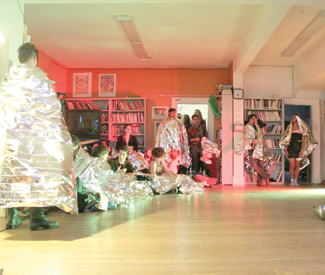
We followed the dancers (choreographed by Abby Crain) inside, swept along by their momentum, and were deposited around the perimeter of the main reading room like dust mice by a strong breeze. On that same floor, a few hours later, choreographer Ronja Ver would be sending her supine audience into dreamland with a couple of Finnish lullabies. Before that, a bowl of liquid nitrogen would send a delicate fog creeping over its wooden surface as the spectators (temporarily wrapped in reflective emergency blankets) braced themselves for a performance by Daniel Stadulis that was part science experiment, part detailed meditation on the fragility of the body.

Much else went on during the event’s roughly four hours, which ended with a dance party. No one stayed put the whole time. Some wandered off to the back rooms to the free bar, or to partake in the desultory clothing swap at the free boutique (both the bar and boutique are voluntarily stocked by the guests). Upstairs, meanwhile, the ebb and flow offered other attractions — a mother and daughter did a duet; a young writer read her first novel aloud for the first time, offering each completed page to anyone who paused to listen…

June 22 marked one year’s worth of PPP, the monthly performance series instigated by Oakland-based dance collective SALTA. As much a scene as a performance platform, PPP has been building a platform for serious, unbridled experimentation in a low-key setting where failure is as valid as success, and no one ever encounters a price tag, a door charge, or a gate keeper.

As an attribute of its headlong dive into experimentation and openness, PPP never sits still but moves restlessly and freely from one donated space to another. Among these have been the Foundry, The Vulcan, The Public School, Subterranean Arthouse, Sri Louise’s Underground Yoga Parlour, private homes, Ellen Webb’s studio, and Zach Houston’s poemstore gallery (site of the inaugural PPP in June 2012). With each space come new networks as well as a growing number of PPP diehards.

Providing room for experimentation and cross-fertilization among artists — from the well known to the unknown, and as disparate as Tere O’Connor (interviewed by Monique Jenkinson), Jmy James Kidd, Peter Max Lawrence, Miriam Wolodorski, Keith Hennessy, Ethan Cowan, Laura Arrington, and Philip Huang, among many others — PPP has also been building a unique audience for contemporary dance/performance, while inspiring dialogue about the nature of art-making in the Bay Area.

The anniversary installment of PPP marked the beginning of a summer hiatus for the series, so that the collective can focus on advancing other projects — all geared to creating space, in the widest sense, for dance in Oakland.

SALTA is very much the restive and searching reflection of its monthly series. What began as necessity — a space for dance — has been embraced as ethic. Not that the two were entirely strangers to begin with. As suggested by the conversation below with the seven women who currently make up SALTA, the realities of dance today imply, more than ever, a confrontation with the values of the dominant culture.

Note: the dancers preferred to speak as members of the collective rather than use their individual names.

SF Bay Guardian Did PPP come first, or SALTA, and what’s the relationship?

SALTA It’s funny, we were just talking about this earlier — it’s so confusing!

SALTA I guess we, as a collective, came first.

SALTA And we named that SALTA.

SALTA But the name SALTA didn’t come until after we had the name PPP.

SALTA We all came together in the idea of making space for dance. We were talking a lot about having an actual space and, in the meantime, [we said] let’s do a performance series. So that came second, and then it eclipsed a lot of what we’d been doing. We’re actually going to take a break over the summer and focus on some other stuff.

SALTA We want to have classes. We would really like a dance publication. We want to work on networking. We’ve had some out of town people, but just because the West Coast can be very isolating. So that’s one of our goals, we’d really like to figure out some way to connect.

SFBG What’s the most urgent or exciting project you’re discussing now?

SALTA I think building a floor.

SALTA And also exploring what it might look like to do a pop-up for one or two months. That would then allow us to do classes and hold performance.

SALTA Yeah, I think classes and workshops and stuff. Not only us — we have a lot of things we’re interested in exploring in teaching — but also, again, people we might invite in from out of town who could come do a workshop and perform. So that kind of thing.

SALTA In that vein of dialogue, it’s important to mention that a lot of our work is multi-generational in curation. We try to reach out to people who have paved pathways for us. And we’ve been a little brazen about cold-emailing, cold-calling people who are in town, like Jeremy Wade.

SFBG I saw his performance at CounterPULSE at that time; really great. What did he do at PPP?

SALTA He tried something new!

SALTA Yeah, he took advantage.

SALTA He did a kind of magic act. He had a crazy magician’s outfit on. Yeah, it was pretty awesome.

SALTA But even he, who is touring at that time with specific ideas, still adhered to this idea of coming and experimenting with us.

SALTA That’s something we’re trying to work more. Inviting people, colleagues, or people whose work we’re interested in that we don’t actually know, from other places but also from the Bay Area. I think last month was a pretty harmonious example of that because we had Ellen Webb. She runs a space for so long and had a company in the ’80s. We didn’t really know her work. We use her space all the time — we’ve actually used it for PPP as well. So we had her come and just share. She showed some video of an amazing piece she did with a hundred dancers on Mandela Parkway, right after the [1989] earthquake. She was there, and then Keith [Hennessy] was there — who’s kind of the next [generation] — and then Jmy [Leary, a.k.a. James Kidd] from LA, who is just a little bit older than us.

SFBG How did you start working together?

SALTA We’re all based in Oakland, and we wanted to have a space for dance to happen here — there are not a lot of venues that are really open for experimental work. That was the big thing: we’re sick of going to San Francisco all the time, and we want to figure out what the community is in Oakland and see what we can build. Something that’s been really cool from the beginning is that a lot of non-dancers come to PPP, a lot of Oakland people who hear about it from different arenas.

SALTA We were also not interested in institutionalizing art, in the way that it’s done. Also, financially, making it a free event — no one is paid, free boutique, free bar  —that was really important to us as artists and the way we want to make art. Not having to play this whole [who do you know] game. It was modeled, or got a lot of guidance from Jmy in LA, who started [dance organizers/activists] AUNTS in New York. That’s been a model that we’ve been in dialogue with.

SALTA She’s a mentor of ours, and a benefactor actually, through the Yellow House fund. So we’ve been working with her. We originally wanted to create a space here in Oakland similar to Pieter Pasd in LA, but the realities of being who we are as artists and where we are in our lives, as transient people, we thought we’d keep the space moving. We figured out that that worked over the past year. We actually made a list before you got here of all the [12] spaces we’ve been in, here in Oakland.

SFBG I like this ethic of moving around, of asking for a free space each time. It seems a good thing to encourage, and it really pushes back against the spirit of the times.

SALTA It’s interesting who has said no, at the proposal, and who has been really willing to donate space and time and their art.

SALTA I feel as we continue to exist and assert ourselves into spaces, it opens up more. We have to find a space, and ask for a free space, because as dancers we don’t have the resources to be renting all the time. So where there’s this huge scene of First Friday or whatever — “art’s happening all the time in Oakland” — we’re not a part of that. It would be interesting at some point. Well, we WILL be a part of that. [Laughter.] But what does that mean? And how much more legit, in a certain sense, do we have to become?

SFBG How did your thinking about a physical space evolve into this broader idea of creating space for dance?

SALTA I live between here and LA. And when I’m in LA I spent a lot of time at Pieter, and I kept asking Jmy questions about how she runs it and how the funding worked. About a year and half ago she asked me to have coffee with her and said, ‘It seems like you really just want to run a space.’ So that planted the seed. I’d danced with some of the people here, so I just brought up the conversation, “Should we start something?” And Ethan [a founding member not currently with SALTA] used to live in New York and we would go to AUNTS events. I think Ethan had an idea to start an event series. So we thought, let’s start an events series and hopefully that will snowball into something bigger.

SALTA Into an actual space.

SALTA Before we even talked about having a performance series, it was very much, “We want a space in Oakland that is about dance/experimental performance.” But, soon we found out: that’s hard!

SALTA I think, too, we like going to different spaces, and we like how that pulls in different people. [We realized] we want to actually make space, however that can happen. One of our ideas — there have been these pop-up spaces; different people have gotten subsidies from the city and empty buildings. We want to see if we can do that kind of thing. Build a moveable floor. So, yeah, it’s just kind of expanded.

SALTA I think too there’s something about the impermanence about it that’s special and that we like. So instead of focusing on the brick-and-mortar — “We’re going to have a space. That’s our jam” — opening it up and being a bit more flexible has allowed us to think a bit more creatively about, “What does it mean to really promote dance and make space for dance in Oakland?”

SALTA All of us are dancers. But something that feels important to us in creating this event is that it’s really not about us, or our agenda as dancers. All of us at some point have performed at a PPP. There’ve been 12, so we’ve all at some point done something. We’ve talked about doing a group dance — there’s this event called Oakland Nights Live that happens once a month. They invited SALTA to perform at it, even though we’ve never made a dance together before. We thought, OK, we’ll go do something there. So there is that fluidity and it definitely feeds into the work that we do, and we’re doing other projects too. But PPP is really about creating space for dance and really trying to open it up to the community.

SFBG It sounds like you’re really creating an audience too. Do you have a lot of return people?

SALTA Yeah! We have diehards.

SALTA We have a following! It’s crazy.

SALTA Our first PPP: Zach Houston had a space in downtown Oakland. It was a poetry space, specifically; he’s a poet…

SALTA That was our first one. And I think because of that we’ve had this nice relationship with the poetry community. And so we’ve had a lot of people from that community that come and watch. So people who are around the arts, or friends of friends — I mean one of the great thing about inviting all these performers is that they bring their people. And their people maybe bring someone else. And they go to the next one. Someone last night was like, “I feel like the more I come to these I get it more, I know how to watch it better.” I thought, wow, that’s a really cool thing.

SALTA It’s very unassuming. We don’t demand a lot. People can come and leave.

SALTA There’s literally an open door policy. Like at Niebyl-Proctor last night, the front door is open and people from the street walk in. That’s happened at a lot of the events we do. And that’s really nice, to have people that are called to it.

SALTA People come to it from so many different places too, which is exciting.

SALTA I think it’s important to us all as dancers, that it is a richer audience with various interests. Because we as dancers are like that, as people, we have varied interests outside of dance that informs our dancing.

SFBG Is performing in this kind of event is more satisfying in some ways? What are the advantages to you and others, as performers, with this kind of format?

SALTA We’ve had performers who are performing on the same night together who maybe have never met each other. There have been connections that have been made there between their work and their interests that might not have happened otherwise.

SALTA It’s a space for experimentation. I think that’s one thing we’re trying to be really intentional about it, how to create a space where people will take experimentation seriously. Not just come do whatever and don’t give a shit. That’s why we were really excited about what Keith [Hennessy] did [at the May PPP at Berkeley’s Subterranean Arthouse]. He was actually late to the pre-performer meeting, saying, “I’m sorry I was late. I was rehearsing!” People come with that mindset often. Not necessarily that they’re creating their masterwork — how can they? We’re not funding them. We don’t have any money. But it’s just a chance to try things out and be able to fail or do something absolutely spectacular, and everything in between. Really, most months, there is something that’s like oh god and also something that’s so inspiring …

SALTA I like that: take experimentation seriously.

SALTA And also it’s not like a critique. We didn’t want that. It’s just a time to try something out, and then you can have conversations about it afterward if you want.

SALTA That said, whenever I’ve performed at PPP there’s always someone who comes up to me who has a really interesting, deep perspective because it’s not your typical dance, performance audience member.

SALTA And I think too that there’s something freeing in that there’s not a whole lot at stake. Oh, you finally got a show at CounterPULSE and you have to make it good if you want to show anywhere else. I think there’s a lot of freedom in knowing that everyone’s there to do the same kind of experiment.

SFBG What’s the financial model that makes possible bringing artists in from out of town, and the other projects you’re looking at?

SALTA I think, at this point, we’re trying to go for the free and grant-supported. That might not be something we continue with.

SFBG So you’ve been getting grants.

SALTA Well, we got one. [Laughter.]

SALTA That’s how it started. It was from Jmy…

SALTA But that’s what we’ve talked about — more than trying to make it a viable business.

SALTA I think it’s really important for it to stay free and non-commodified. [SALTA] has lots of thoughts about the realm of recreation, and dance as recreation rather than something you make money off of.

SALTA One more thing about the name. We had a deadline to submit a fiscal sponsorship application. So there was one meeting where we had to come up with a name. I had the idea of wanting it to be a name, like Pieter, so it could be like a sister or brother [to Pieter Pasd]. But then no one else really liked that idea. So PPP was this compromise where it would be like initials but it wouldn’t refer to a name. But then I was reading a book by Marx and I came across the term, Hic Rhodus, hic salta, which is from an Aesop fable. But Marx translates it as, “Here is the rose, dance here.” Salta is a Latin term that means both to leap and to dance. The way Marx uses it, [the phrase means], “You want to do something? OK, do it. Show the dance. Do the leap.”

So for me it was this nice metaphor for what we were doing. And it’s also something about the dance world, and the disintegration of what it means to be a professional dancer; the eclipse of a company model, where you train and then suddenly there’s this company that will employ you to dance. So it’s also part of this question: What does it mean to dance in this post-Fordist moment when it’s not financially viable to dance? (And also everyone else seemed to like the name SALTA.)

SALTA She even put that on our website: “Hic Oakland, hic salta!”

SFBG In this one year since starting, has the collective or vision changed in ways you didn’t foresee?

SALTA I feel the main change is we’ve let go of trying to have an actual, permanent space. Because a year ago we were looking at Craigslist, and biking around to different buildings, and trying to figure out square footage — and that’s — just the logistics of everyone’s lives …

SALTA And the reality of the rental market right now, it’s insane.

SALTA We were like, “How can we do that with our grant?” The grant is generous but it’s not enough to last over a year of rent.

SALTA And a lot of us do travel a lot, or live in various cities, and we all have different creative projects…

SALTA Originally we had a little flyer saying SALTA is looking for a space. We said that a lot: “PPP is this, a project of SALTA. We are looking for a space. Please contact us.” And we’ve decided we’re just always looking for a space. That’s going to be our new flyer.

In tech-dominated Mid-Market, arts center beats the odds

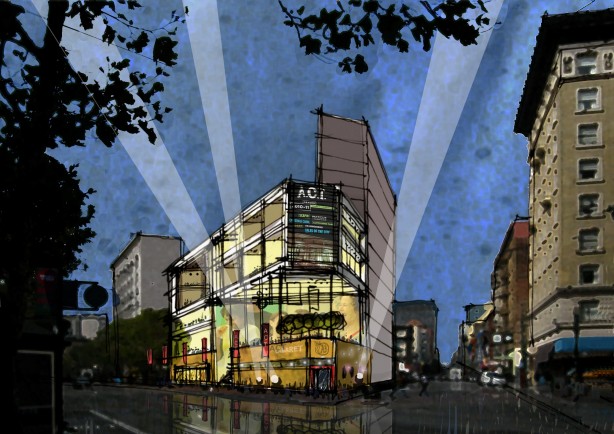
Is there a place for community theaters and nonprofit arts and education programs in pricey San Francisco? The 950 Center for Art and Education, a project that will be housed on the corner of Market and Turk streets in San Francisco, has gained a foothold against the odds.

Two years in the making, the center will provide permanently affordable performance facilities for the Lorraine Hansberry and Magic theaters, and create affordable space for art education organizations including Youth Speaks, the American Conservatory Theater and All Stars Project. Other groups, such as Lines Ballet, the Tenderloin Boys and Girls Club and others previously unsure whether they could continue to rent in the Tenderloin/SoMa area will get the chance to expand their performance and programming capabilities at the center.

Because the neighborhood is in such high demand in the wake of recent tax breaks and incentives designed to bring tech businesses to SF, it took the Tenderloin Economic Development Project, a part of the North of Market Neighborhood Improvement Corporation, at least two years to secure the property for the arts and education complex. Until very recently, the project’s fate was hanging in the balance, with many groups uncertain whether they would be able to remain in the city.

Three-quarters of the project space that TEDP had long set its sites on is located at 970 Market, and was initially owned by Lone Star, a Texas-based hedge fund. The remaining project space, at 950 Market, was under the ownership of the Thatcher family, known for philanthropy.

Initially, TEDP “had a deal with the hedge fund,” says TEDP director Elvin Padilla, but after property values rose, “they basically walked away from the negotiating table. The crisis moment was, who’s going to control the land – and will they collaborate with us?”

Padilla credits Gladys Thatcher, founder of the San Francisco Education Fund, as “the reason we decided to make the attempt [to acquire these spaces for the 950 Center] in the first place.” 

When TEDP first pitched the idea to her several years ago, “she gave us her blessing we decided to make a go of it,” he explained.

Thatcher is trustee and former board member of the San Francisco Foundation, which worked alongside TEDP and the Rainin Foundation to secure the lion’s share of the land needed for the 950 Center, by facilitating a purchase of the 970 Market Parcel from Lone Star.

On June 7, the property was transferred from Lone Star to Group I, a San Francisco-based real estate development firm that Thatcher is friendly with. Now that the sale has gone through, the space will be devoted to the arts and education programming that TEDP had long envisioned. The San Francisco Foundation plans to facilitate development of the center through the creation of a new sponsoring organization that will be housed at Community Initiatives, a nonprofit. 

While he is grateful for the community support, Padilla likened their quest to gain 970 Market to a climb up Mt. Everest.

A 2011 payroll tax exclusion zone introduced by Mayor Ed Lee vastly increased the property value in the mid-Market area. Although Lee had a soft spot for the 950 Arts and Education Center and even organized events to support bringing that use to mid-Market, his new policy left the project facing an uncertain future in a suddenly pricey strip along Market Street. “He doesn’t have any real authority over private sector transactions,” Padilla says, so all the Mayor could do was stipulate the city’s interest in using this land for “arts and education.”

The city doesn’t offer public funding for projects like 950 Center for Arts and Education. To “subsidize on the front end,” as Padilla puts it, the center will have to rely on the backing of individual investors, philanthropic groups and new market tax credits to reduce and eliminate the debt entirely, so the organizations that will be housed at the center don’t have to carry a mortgage.

In the end, it was only through the efforts of wealthy and connected individuals that plans for the center were nailed down rather than extinguished. “Mid-Market is going through a very rapid transformation,” says Dr. Sandra R. Hernández, Chief Executive Officer of the San Francisco Foundation. “We’re just lucky that Group I, the developer, shares this vision with us for an arts center.”

Looking back on the years of effort it took to piece the plan together, Padilla noted, “When we started this, it was before the tech boom. Now, the pressure on the real estate is many times what it was when we conceptualized the 950 project.” 

That uncertainty finally came to an end for Padilla’s organization when Group I closed the deal with Lone Star on June 7. “That really [did] start the project officially,” Hernández says. “We’re now working with a number of the organizations that have expressed interest in having permanent space or accessible space for their programming or rehearsals for their theater production.”

Opponents of City College takeover to march through SF

15

Opponents of last week’s decision to revoke the accreditation of City College of San Francisco and place the district under state control until that death sentence becomes official in July 2014 plan to rally and march through San Francisco today [Tues/9] at 4pm.

The procession will begin at the CCSF’s downtown campus at 88 Fourth Street and end outside the U.S. Department of Education — whose policy of coercing colleges to focus on job training and university prep led to the crackdown on CCSF, as we report in tomorrow’s Guardian — at 50 Beale Street.

Among the local officials who will join the march are Assemblymember Tom Ammiano, San Francisco Central Labor Council Executive Director Tim Paulson, and Alisa Messer, president of the American Federation of Teachers Local 2121, who this morning issued statements condemning the decision by the Accrediting Commission for Community and Junior Colleges.

“This decision is nothing less than an attack on the people of San Francisco,” Ammiano said. “All of us benefit from having this great 78-year-old institution, whether we take courses or not. San Francisco voters recognized that at the polls just last fall when they passed Proposition A to support the college financially. In addition, the appointment of a state official to manage the school takes away the local voice of CCSF’s duly elected trustees.”

“The quality of education at City College is not in question,” said Messer, who is also an English teacher at the college. “For the last year this institution has turned itself upside down to address the recommendations of the Commission, with employees putting in thousands of hours of effort and making huge sacrifices. To be told at the end of this process that the effort has had no impact is simply outrageous.”

“City College is vital and has made major progress in turning around many of the shortcomings identified by the Commission,” said Paulson. “The actions of the ACCJC – an organization accountable to no one — have unnecessarily put at risk the livelihoods of the nearly 2,500 hard-working men and women at the college. What’s more, their move to deny CCSF accreditation has imperiled the future of San Francisco’s working people, who rely heavily on a CCSF education for workforce training, language learning, and a pathway to better futures for themselves and their communities.”

“The Accrediting Commission’s handiwork has not improved educational quality at CCSF,” said Messer. “We want a stronger, better college, but in many instances direction from the ACCJC has moved us in the wrong direction. The Accrediting Commission should be accountable for the impact of its actions.”

 “The accrediting agency has only worked half-heartedly to support City College, and instead seems bent on tearing it down,” Ammiano said. “The decision needs to be reversed so we can all go to work building on the successes and fixing the few problems, instead of spending our time starting over from scratch because the school was destroyed by naysayers.”

Heads Up: 7 must-see concerts this week

2

This week I learned that if I should ever be presented with the chance to interview Selena Gomez, I should decline. The Toronto Star published this biting commentary on the current state of press interviews with pop stars, and had more information leading up to the interview than the actual chat. Recommended reading: “Meeting Selena Gomez rule No. 1: Do not mention Justin Bieber.”

Often, the story behind the stage is even more compelling. And there are some storied acts playing live in SF this week: local emcee DaVinci busts out with a freebie, the long-running Flamin’ Groovies are back, as are LA’s Happy Hollows, after a lineup shift and with a new album; we also welcome Weedeater, Japonize Elephants, and Acid Pauli. Plus the return of reliably great outdoor fest Phono Del Sol (Thee Oh Sees and YACHT headline this time).

Here are your must-see Bay Area concerts this week/end:

DaVinci
Fillmore District-raised emcee DaVinci plays this free show alongside fellow burgeoning local rap duo Main Attrakionz, Young Gully, Shady Blaze, Ammbush, and Sayknowledge. DaVinci has been releasing tracks for a few years, in late 2012 dropping full-length The MOEna Lisa with an ode to SF in track “In My City” with the telling lyric, “Trying to push us out of the city/but we ain’t leaving,” in a hoarse whisper, but also referencing favorite spots like the waffle house at Fillmore and Eddy (Gussies).
Wed/10, 9pm, free
Brick and Mortar Music Hall
1710 Mission, SF
www.brickandmortarmusic.com
http://www.youtube.com/watch?v=8PMgStbVNYk

The Flamin’ Groovies
Influential 1960s rockers the Flamin’ Groovies — who delivered wailing cult classics like “Slow Death,” “You Tore Me Down,” and “Shake Some Action” (you know this last one from its resurrection in the film Clueless) — have gone through some serious band changes over the past four decades, with more than 15 members rotating through the legendary group and some legendary rifts in the mix as well. Roy Loney has moved on to Roy Loney and the Phantom Movers. This current lineup is a circle back to Cyril Jordan, Chris Wilson, and George Alexander, who all overlapped in the group from 1971 through ’80. That powerpop lineup played a hastily arranged show in SF earlier this year, its first time together since ’81, but now it’s given you more advance notice. The current crew is rounded out by drummer Victor Penalosa. Don’t miss it again.
With Deniz Tek (Radio Birdman), Chuckleberries, DJ Sid Presley
Wed/10, 9pm, $25
Chapel
777 Valencia, SF
www.thechapelsf.com
http://www.youtube.com/watch?v=EI7-ol-TG2o

Happy Hollows
Happy Hollows, the LA group now made up of Sarah Negahdari, Charlie Mahoney, and Matthew Fry, will release its sophomore album Amethyst on July 30. Produced by Fools Gold guitarist Lewis Pesacov, the record has that shimmering indie thing down, especially on single, “Endless.” With “Endless,” you can squeeze your eyes shut and practically see the stars bouncing through the sky along with the beat, or perhaps the neon pink signs flickering down Sunset Boulevard. And then there’s bubbly electro “Galaxies,” (sensing a theme here?), used in the album trailer. They both present a compelling, synth-looped step away from 2010’s Spells.
With Nightmare Air, Broadheds
Wed/10, 9pm, $12
Café Du Nord
2170 Market, SF
www.cafedunord.com
http://www.youtube.com/watch?v=cJ5ZYMe2bIY

Japonize Elephants
The elegant yet spooky old-world-carnival act Japonize Elephants — noted for drawing sounds from eclectic styles like gypsy jazz, bluegrass, and klezmer — will celebrate the vinyl release party for newest album Mélodie fantastique, this week at Amnesia. Go, and witness all the instrumentation you can handle (fiddle, banjo, glockenspiel, vibraphone, accordion, percussion, surf guitar), along with four-part vocal harmonies. A group of waltzing ghosts, like the ones you find on the Haunted Mansion ride, wouldn’t seem out of place here.
Thu/11, 9:30pm, $7–$10
Amnesia
853 Valencia, SF
www.amnesiathebar.com
http://www.youtube.com/watch?v=axWdjXBZqIo

Weedeater
After last year’s triumphantly heavy opening slot before LA doom metal group Saint Vitus at the Indy, North Carolina sludge metal act Weedeater returns to the Bay to play a far more appropriate venue, the dank, dark cave of the Oakland Metro. And this time, local metal duo Black Cobra and fellow NC stoner act ASG will pummel the crowd first, setting up the perfect spotlight for the grimy Weedeater. Here’s hoping there’s another Southern Lord release on the horizon for Weedeater (the band’s most recent LPs, 2007’s God Luck and Good Speed and 2011’s Jason…The Dragon, were both put out by the well-curated metal label).
With ASG, Black Cobra
Fri/12, 9pm, $13
Oakland Metro
630 Third St., Oakl.
www.oaklandmetro.org
http://www.youtube.com/watch?v=3ZSN-d0e_bg

Acid Pauli
“Punk bands, Bjork productions, hip-hop projects, an ambient album on Nicolas Jaar’s label, mixes for Crosstown Rebels: Martin Gretschmann has many musical roles and aliases. In DJ mode as Acid Pauli, the guy sends me Googling every time, re-energizing my excitement for new sounds. Half the time it’s something I’ve never heard like the wonky jazz romp of Der Dritte Raum’s “Swing Bop,” or tectonically teutonic deep house of Gunther Lause’s “Mountain.” (Where the school children astral pop on Jan Turkenburg’s “In My Spaceship” came from I. Just. Don’t. Know.) Even when it’s as familiar as Nancy Sinatra or Johnny Cash, Gretschmann reworkings are something else entirely. At this debut three+ hour set, I expect to see at least few cell phones on the dance floor, Shazam-ing to keep up.” — Ryan Prendiville
With Eduardo Castillo (Crosstown Rebels/Voodoo),
Fri/12, 9pm-3:30am, $12 presale
Public Works
161 Erie St., SF
(415) 932-0955
www.publicsf.com
http://www.youtube.com/watch?v=PvwCggxOaKc

Phono Del Sol

In these past three years, Phono Del Sol has built itself up into a tastemaker midsummer’s indie music fest — and it’s one to watch. It makes sense: the one-day fest is curated by on-the-pulse local blog, the Bay Bridged. And beyond the interesting (and mostly local) band choices — the first year featured Aesop Rock and Mirah, last year the Fresh and Onlys and Mwahaha, and this year Thee Oh Sees, YACHT, Bleached, and K. Flay will headline — there’s something about the approach and atmosphere that calms the nerves. One of the newest bands on this year’s bill fits this feeling as well, the young garage pop four-piece Cool Ghouls will be bringing a horn section to Phono Del Sol this year.
Sat/13, 11:30am-7pm, $20
Potrero Del Sol Park
25th Street at Utah, SF
www.phonodelsol.com
http://www.youtube.com/watch?v=TuCx9kgtr38
http://www.youtube.com/watch?v=aeD3-sdGf1c

Is Larry Ellison cheating?

If you’re wondering why the hell there was only one boat was out there “racing” in the first match of the America’s Cup on Sunday, here’s the rundown on “Ruddergate,” yet another contentious chapter in the 162-year history of the America’s Cup.

At issue is the size and shape of the rudders on the twin hulls of the AC72s. Original design parameters were established back in 2010 when, in the interest of fairness, details of the boats were agreed upon by all teams — so exactly this kind of conflict wouldn’t occur. A “box rule” was applied, which means the boats won’t be identical, but they will be similar (Emirates Team New Zealand and Luna Rossa actually have near-identical boats as the Italians came late to the party and bought New Zealand’s design to save time.)

Then, after Andrew Simpson was killed when Artemis’s boat capsized on May 9, regatta director Iain Murray made 37 new safety recommendations, which the Coast Guard made into requirements when they permitted the race.

“Basically, for marine events, marine event sponsors are responsible for the safety of the events,” U.S. Coast Guard chief Mike Lutz explained, noting that the 37 rule changes originated with Murray and were approved by the Coast Guard as a package.

Some of those changes are straightforward and simple, like no guests aboard during races, more body armor, buoyancy and other personal safety gear, and no racing in winds over 23 knots (That one is actually a hindrance for ETNZ and Luna Rossa, who deliberately built for prevailing San Francisco Bay conditions, i.e. as much as 35 knots of wind.) 

But that’s not what the two teams are protesting. They don’t like new size and shape rules for the rudder elevators, which are designed to stabilize the boat when it’s foiling. Oracle has a pretty good description of how they work here.

The new rule lays out minimum and maximum area, depth, and span and says they should be symmetrical. None of the 36 other safety recommendations touch on design elements. The fishy part is that Oracle has been practicing with a bigger, symmetrical rudder elevator since they launched their second boat on April 24. Before Simpson died, before Murray’s new safety rules, Oracle was using what would be considered an illegal rudder. And now, voila, it’s legal.

The Kiwis immediately filed a protest to the rule, on June 28, and four days later Luna Rossa joined them.

“I’m not saying all the changes have been made for them, but it’s nothing related to safety. What really upsets me is that there is one boat sailing since they launched on April 24 who has been sailing out of the class rule,” Luna Rossa’s Max Sirena told the media on July 2. “Why design a boat that doesn’t comply with the class rule? And then one week before the Louis Vuitton Cup, you ask the other teams to change the position of the rudders and the elevators…”

In the meantime, rather than delay the first race or move up the date of the protest hearing, Murray said it was okay for the Kiwis and Italians to race without the “safer” rudder elevators, to which ETNZ’s Grant Dalton said, “The point is that under the recommendations you can run both. The question is why?  Because, if you can run both, then why do you need the ones that aren’t rule compliant?”

Dalton also thinks this design change could make the boats more dangerous because the rudder elevators would extend wider than the maximum beam of the boat and could slice a sailor in half if he slips over the side of the hull.

He hasn’t said something dirty’s going down. He told the media, “If the question is, has that rule been put in there deliberately to help Oracle, then no I don’t think it has – I don’t think for a second Iain Murray has done that. Is it helping them as a kind of byproduct of it, then yes it is.”

Luna Rossa’s Max Sirena has been more critical. “It is not safety related at all … It is the first time in the history of the America’s Cup that they can change the class rule just like that, just because they want to change it and with no reason. To change a class rule you need unanimity. Why when Oracle capsized last October did they not come up with this change then?”

Luna Rossa boycotted until the jury made a decision, stating that it would seem like silent affirmation if they raced. A last minute deal to get them on Sunday’s course fell through and for the time being, the Italians are sticking to their principles – they were out practicing yesterday, showing their boat is more than capable of performing with the smaller, asymmetrical, noncompliant rudders.

“The teams don’t believe it’s proper to change the class rule without a vote of the teams,” said America’s Cup spokesperson Sean McNeill. “They believe [Murray] didn’t have the authority to make such a change.”

If the jury rules in favor of Luna Rossa and ETNZ, Murray would have to go back to the Coast Guard with a new safety plan in order to obtain a new racing permit. “If there’s any change, they would have to submit an updated safety plan,” Lutz noted, saying he was confident that it could be reviewed in a short time and a second permit could be issued without too much of a delay.

The jury convened yesterday to hear the protests and a decision is due Wednesday, but this debacle raises a couple of questions. Why didn’t they hear the protests prior to the first race? That race day was established a long time ago, and hasn’t changed. The jury had at least five days to review the protests – ample time if the race organizers were really concerned with keeping the event from totally losing face.

Instead, two of the three boats were out of the race before it had even begun, creating animosity among the handful of sponsors still involved. Louis Vuitton’s Bruno Trouble – who initially anticipated 15 contenders, then 8, and certainly no less than 5 – is pissed that not even two could show up and the event has been very far from the big splash it was billed to be. Meanwhile, international media aren’t holding back the ridicule. Fairfax NZ’s Duncan Johnstone called it “a hugely embarrassing situation for regatta organisers, a major dent for the on-shore festivities and massive sponsorships that envelop this ridiculously expensive event.”

And, if the larger rudder elevators really are safer, why didn’t Oracle say something back in April before Simpson died? Or in October when their boat capsized? Instead, they’ve been very mum on the subject. Control is going to be as important as speed in this Cup and with the Kiwis and Italians burnt by the lowered wind limits, it looks like Ellison is hoping to top them in the control category. Larger rudders create more drag and less speed, but may get Oracle foiling for longer periods with enhanced stability – which they desperately need.

ETNZ and Luna Rossa have indicated it would be impossible for them to adapt their rudders now that racing has begun. Meanwhile, Oracle gets to hang back until the finals in September, practicing their moves while Ellison carries on with acting too rich too fail.

Rebecca Bowe contributed to this report.

Mime Troupe debuts its usual political satire in stripped down fashion

2

The San Francisco Mime Troupe overcame its recent financial troubles and debuted the SFMT’s latest season of free, socially-relevant theater in Dolores Park yesterday (Thu/4), a rollicking send-up on the political culture and Chevron’s greedy plunder of Ecuador, delivered by a smaller than usual cast.

“We all felt really great just to have the opportunity to do the show because of the financial issues,” Pat Moran, one of the SFMT’s head writers, told the Guardian.

“It came very close to not happening this year,” Moran said. “There was a period of about a month or a month and a half when the show wasn’t going to happen, but we had to keep writing as if there were going to be one.”

After a “successful grassroots fundraising effort,” according to the SFMT website, the Troupe knew for sure there would be a show, and was able to resume rehearsal in April. But it was a show marked by austerity measures that slashed the number of actors and musicians involved in the performance. There were just four actors who hurried through various costume changes to fill all the parts.

Moran helped write the SFMT’s two-part “Oil and Water” that debuted Thursday. The first part “Deal with the Devil” begins in the White House Oval Office, set in the future, where a secret service agent finds the President dead on the day of an important speech on environmental issues. The second part “Crude Intentions” focuses on Chevron, whose headquarters is now in San Ramon, CA, but was previously in San Francisco.

The performance “continues in a noir style with some slapstick comedy,” according to Moran. And as it has done since its beginning in 1959, the SFMT hits strongly on the political in “Oil and Water,” focusing on Chevron’s mounting counter-suits and millions of dollars spent in order to fend off the settlement requirements that an Ecuadorian judge awarded to its people for damages Chevron committed.

“We focus on Chevron as a specific and local entity, but also as a way to focus on the larger issue of how oil companies use tactics to control their image in public, from National Public Radio donations and advertisements,” Moran said.

These SFMT shows rely on foundational grants and on-the-spot cash donations from audiences. And earlier this year, the SFMT’s financial situation worsened due to the loss of foundation money, including its long-held National Endowment for the Arts grant and others. In addition, cash donations have gone down since, as Moran observed, “people carry less money around now” when they come to SFMT shows in the park.

“But at this point, we are optimistic. We have a show up, and that’s our focus,” Moran added. Although up and running now until its last show September 2nd, come the end of the season the SFMT may have to rethink doing its performances in public space for free, Moran said.
“In September we might have to re-imagine the show. We may not be able to make shows happen in park, or at least free with donations; it may not work out. We might have to figure out something new, rather than strip away the elements of the current show so we can afford it.”

When things get weird: X-Day, Weird Al, and more

2

Today is weird. It’s in that black hole gap between a nationally recognized holiday (er, Fourth of July) and the actual weekend, which begins for many traditional workers around 5pm on Fridays. So with this weirdness, we celebrate both X-Day, a parody of cult holidays, and the more literal, Weird Al — he shines down on the Alameda County Fair tonight with a beam of frizzy light.

Let’s get to Al, straightaway. While he used to be big-time MTV stock, parodying Michael Jackson and Madonna types, Weird Al has done something interesting in the past few years, and gone cult. It may have started with his cartoon-genius take on R. Kelly’s masterpiece, “Trapped in the Closet” (by the way, the Castro is having a “Trapped in the Closet” sing-along later this month). Weird Al made it better with strangely appealing “Trapped in the Drive-Thru.”

http://www.youtube.com/watch?v=SHnTocdD7sk

But before that, there were bona fide hits, this strange musical landscape, including “I Lost on Jeopardy,”  “Fat,” and Coolio’s worst nightmare, “Amish Paradise.” More recently, there was meh Gaga takedown “Perform This Way.”

And now he’s on the county fair circuit (full disclosure: I saw him on said same county fair circuit more than a decade ago, and loved every obnoxious moment, especially the costume changes).

Here’s the info on the fair and concerts. Show starts at 7pm tonight (July 5), and all concerts are free with paid admission to the fair.

http://www.youtube.com/watch?v=lOfZLb33uCg

And then there’s X-Day. It’s a faux-holiday celebrated every July 5 as part of the Church of the SubGenius — “a religion formed as a parody of cults and extreme religious groups.”

For X-Day, the church prophesized that an army of weirdo alien invaders would land their spaceship on earth and destroy all the normals, those without sin.

While celebrated worldwide, in Orange County, Calif. for many years and through the late ‘90s there was a nonprofit all-ages venue called Koo’s, which celebrated X-Day with a punky band called the Four Letter words — and a paper mache spaceship. The Four Letter words returned recently for a few reunion shows, and one can only hope that was in part in allegiance with X-Day, the Church of the Subgenius, and the Church’s leader, Bob Dobbs.

https://www.youtube.com/watch?v=vj127gtcqdk

http://www.youtube.com/watch?v=APSP0fjHqGQ

Or you could keep the weirdness more local tonight, and see Bart Davenport live in Oakland at the Uptown. The now LA-based leader of the avant-electro group Honeycut did the most surprising thing when he went solo a decade or so back, and put out tender, soulful pop songs, all about gooey love.

http://www.youtube.com/watch?v=7g-DOc9gVhM

He plays a free First Fridays show tonight with Extra Classic, Legs, and She Owl.
Fri/5, 6pm, free. Uptown, 1928 Telegraph, Oakl. www.uptownnightclub.com.

Celebrating independence, embracing wage slavery

50

On the eve of Independence Day, too many San Franciscans seem eager to give up on the very idea of independence, instead willingly buying into the divide and conquer strategies of those who seek to control and exploit us. Just consider the big news of the day.

On Day Three of the BART strike, mainstream and social media are once again awash with angry anti-union diatribes by people who are resentful of the fact that some workers in this society still manage to earn the pensions and decent salaries that most of us wage slaves are being denied.

Pensions are the one thing that allows the working class some degree of independence during its twilight years. And the average BART salary of $72,000 annually shouldn’t be considered excessive in an expensive city that will chew up at least a third of that in housing costs.

But they are each more than most of us are getting, so it’s easy to turn many people against their fellow workers, even though the real targets of our ire should be the bosses and economic system that are denying us our independence and the means to pursue our happiness.

It’s a similar story with the breaking news of the day: City College of San Francisco losing its accreditation and being turned over to state control. While there are some reasons to criticize how this important institution has been managed over the years, it was still being managed by locally elected trustees who made the best decisions they could under bad circumstances.

They made decisions to maintain a broad-based curriculum that this community wanted and needed, and to avoid exploiting the faculty like so many other educational institutions are doing, in the process taking a gamble with lower reserves than may be needed. And the voters of San Francisco stepped up to support CCSF with a parcel tax that was helping to ease it away from the brink, acting as a proud and independent community does during troubled times.

But a commission of unelected bureaucrats on a ideological mission to transform educational institutions into something less than the broad-based community resources that CCSF has strived to be decided to make an example of San Francisco. And they did so with the full support of Mayor Ed Lee, who issued a statement today criticizing local officials for not embracing even harsher austerity measures than they did, and saying “I fully support” the state takeover.

Lee’s hand-picked panel recommending reforms of the Housing Authority is also proposing to sacrifice the independence of poor San Franciscans in favor of ever-more subsidies to real estate developers, according to a story in today’s San Francisco Chronicle.

Among the “reforms” is a proposal to divert federal money from the Section 8 program that offers rent-subsidies to the poor, as Chron reporter John Cote described like this: “A terribly run program that provides low-income residents with vouchers for private housing would be administered by the city, rather than the federally funded public housing agency. The vouchers would be prioritized for certain affordable housing projects, creating dedicated revenue to help secure loans to build them.”

So the vouchers that allow low-income people some independence — rather than living in squalid, chronically mismanaged public housing projects in San Francisco — will instead subsidize development projects. Yes, we do need to subsidize affordable housing development, which this city is underfunding, but we shouldn’t be taking the meager resources of society’s least fortunate families to do so.  

I have no doubts that Lee will jump at this suggestion (although its unlikely to be so eagerly embraced by federal regulators at HUD) given his penchant for shady real estate schemes that line the pockets of the powerful, like the one that the Center for Investigative Reporting uncovered this week.

CIR reported that the San Francisco Bay Area Regional Center — a for-profit company connected to Willie Brown that is arranging immigration visas for Chinese nationals who invest in Lennar’s Hunters Point housing development — is getting key help from Lee and members of his staff.

This project was already looking like a bait-and-switch scam, as we also reported this week, with Lennar being guaranteed profits without even putting up its own money, thanks to Lee’s willingness to use the power of his office to solicit funds on behalf of the country’s biggest residential developer.

If Lennar wasn’t going to build the affordable housing we need on the front end, or put up the money itself, why didn’t the city just administer this project and give the work to local contractors? What exactly is this Florida-based corporation doing in exchange for being handed some of the most valuable real estate in the city, except for helping its powerful local friends who pulled strings on its behalf?

What’s motivating Lee these days? Well, considering that Brown and other power brokers placed him in the Mayor’s Office after a career at City Hall doing their bidding — a role he seems to be still playing today in his powerful new role — I’d say it was a lack of independence.

It’s all pretty depressing, but at least we have a holiday tomorrow to celebrate our independence. Happy Fourth of July, comrades.  

8 Washington opponents try to torpedo counter-initiative

Opponents of 8 Washington, a hotly contested development project that would erect 134 new condos priced at $5 million apiece and up along the San Francisco waterfront, are seeking to thwart a counter-initiative developers have launched to solicit voter approval for the project on the November ballot.

In a July 1 letter from The Sutton Law Firm to Hanson Bridgett LLP, a firm representing the project proponents, political lawyer and fixer Jim Sutton highlights “fatal legal flaws” he claims would invalidate each and every signature collected in support of the 8 Washington initiative. It’s likely a precursor to a lawsuit. Apparently, Sutton got involved through his connection with former City Attorney Louise Renne, who opposes the 8 Washington plan.

Organized under No Wall on the Northeast Waterfront, opponents circulated petitions of their own earlier this year to challenge San Francisco Board of Supervisors’ approval of 8 Washington, asking voters to weigh in on the Board’s waiver of building height limit restrictions. Polling has indicated they’ll succeed (a win in their case is a majority of “no” votes), effectively sinking the project. That prompted 8 Washington proponents to generate their own counter-initiative.

Sutton’s letter demands that 8 Washington proponents not submit the initiative to the Department of Elections for signature verification, unless they first re-circulate the petitions. Of course, that would torpedo the whole endeavor, since there’s no way proponents could gather enough signatures in time for the imminent filing deadline.

The aforementioned “fatal legal flaws,” meanwhile, seem to illustrate why high-powered attorneys like Sutton rake in the big bucks. Apparently, the initiative proponents neglected to attach a few maps detailing the height limit increases, in violation of a requirement that proponents present the “full text” of a proposal to voters. And then there’s this:

Whether it’s a photocopying error or an attempt at obfuscation, the map on the left (circulated by the pro-development camp) makes it impossible to read the height limit increase. (The map on the right was circulated by opponents.) This seemingly minute detail matters, according to No Wall on the Northeast Waterfront spokesperson Jon Golinger, because “the whole point of this is the height increase.”

David Beltran, a spokesperson for the pro- 8 Washington folks, responded to a Guardian request for comment by saying, “Our opponents are offering up yet another baseless claim.” He called it a distraction “from having to justify why they are asking our City to give up new parks, jobs, and housing and millions of dollars in city benefits that includes $11 million for new affordable housing—to protect an asphalt parking lot and private club,” referencing a recreational center that’s served a predominantly middle class clientele for years that would be razed to make way for 8 Washington.

Beltran also attached a complaint Hanson Bridgett had filed with the San Francisco Ethics Commission, charging that No Wall on the Northeast Waterfront had failed to meet campaign filing deadlines, and urging city officials to “immediately investigate the delay” and impose fines of $5,000 per violation.

The Fourth of July: Remembering the good old days in Rock Rapids, Iowa, circa 1940s to 1950s

0

By Bruce B. Brugmann

(Note: In July of 1972, when the Bay Guardian was short a Fourth of July story, I sat down and cranked out this one for the front page on my trusty Royal Typewriter. I now reprint it each year on the Bruce blog, with some San Francisco updates and postscripts.)

Back where I come from, a small town beneath a tall standpipe in northwestern Iowa, the Fourth of July was the best day of a long, hot summer.

The Fourth came after YMCA camp and Scout camp and church camp, but before the older boys had to worry about getting into shape for football. It was welcome relief from the scalding, 100-degree heat in a town without a swimming pool and whose swimming holes at Scout Island were usually dried up by early July. But best of all, it had the kind of excitement that began building weeks in advance.

The calm of the summer dawn and the cooing of the mourning doves on the telephone wires would be broken early on July Fourth: The Creglow boys would be up by 7 a.m. and out on the lawn shooting off their arsenal of firecrackers. They were older and had somehow sent their agents by car across the state line and into South Dakota where, not far above the highway curves of Larchwood, you could legally buy fireworks at roadside stands.

Ted Fisch, Jim Ramsey, Wiener Winters, the Cook boys, Hermie Casjens, Jerry Prahl, Elmer Menage, and the rest of the neighborhood gang would race out of  their houses to catch the action. Some had cajoled firecrackers from their parents or bartered from the older boys in the neighborhood: some torpedoes (the kind you smashed against the sidewalk); lots of 2 and 3-inchers, occasionally the granddaddy of them all, the cherry bomb (the really explosive firecracker, stubby, cherry red, with a wick sticking up menacingly from its middle; the kind of firecracker you’d gladly trade away your best set of Submariner comics for.)

Ah, the cherry bomb. It was a microcosm of excitement and mischief and good fun. Bob Creglow, the most resourceful of the Creglow boys, would take a cherry bomb, set it beneath a tin can on a porch, light the fuse, then head for the lilac bushes behind the barn.

“The trick,” he would say, imparting wisdom of the highest order, “is to place the can on a wood porch with a wood roof. Then it will hit the top of the porch, bang, then the bottom of the porch, bang. That’s how you get the biggest clatter.”

So I trudged off to the Linkenheil house, the nearest front porch suitable for cherry bombing, to try my hand at small-town demolition. Bang went the firecracker. Bang went the can on the roof. Bang went the can on the floor. Bang went the screen door as Karl Linkenheil roared out in a sweat, and I lit out for the lilacs behind the barn with my dog, Oscar.

It was glorious stuff – not to be outdone for years, I found out later, until the Halloween eve in high school when Dave Dietz, Ted Fisch, Ken Roach, Bob Babl, and rest of the Hermie Casjens gang and I made the big time and twice pushed a boxcar loaded with lumber across Main Street and blocked it for hours. But that’s another story for my coming Halloween blog.

Shooting off fireworks was, of course, illegal in Rock Rapids, but Chief of Police Del Woodburn and later Elmer “Shene” Sheneberger used to lay low on the Fourth. I don’t recall ever seeing them about in our neighborhood and I don’t think they ever arrested anybody, although each year the Lyon County  Reporter would carry vague warnings about everybody cooperating to have “a safe and sane Fourth of July.”

Perhaps it was just too dangerous for them to start making firecracker arrests on the Fourth – on the same principle, I guess, that it was dangerous to do too much about the swashbuckling on Halloween or start running down dogs without leashes (Mayor Earl Fisher used to run on the platform that, as long as he was in office, no dog in town would have to be leashed. The neighborhood consensus was that Fisher’s dog, a big, boisterous boxer, was one of the few that ought to be leashed).

We handled the cherry bombs and other fireworks in our possession with extreme care and cultivation; I can’t remember a single mishap. Yet, even then, the handwriting was on the wall. There was talk of cutting off the fireworks supply in South Dakota because it was dangerous for young boys. Pretty soon, they did cut off the cherry bomb traffic and about all that was left, when I came back from college and the Roger boys had replaced the Creglow boys next door, was little stuff appropriately called ladyfingers.

Fireworks are dangerous, our parents would say, and each year they would dust off the old chestnut about the drugstore in Spencer that had a big stock of fireworks and they caught fire one night and much of the downtown went up in a spectacular shower of roman candles and sparkling fountains.

The story was hard to pin down, and seemed to get more gruesome every year – but, we were told, this was why Iowa banned fireworks years before, why they were so dangerous and why little boys shouldn’t be setting them off. The story, of course, never made quite the intended impression; we just wished we’d been on the scene.  My grandfather was the town druggist (Brugmann’s Drugstore, “Where drugs and gold are fairly sold, since 1902″) and he said he knew the Spencer druggist personally. Fireworks put him out of business and into the poorhouse, he’d say, and walk away shaking his head.

In any event, firecrackers weren’t much of an issue past noon – the Fourth celebration at the fairgrounds was getting underway and there was too much else to do. Appropriately, the celebration was sponsored by the Rex Strait post of the American Legion (Strait, so the story went, was the first boy from Rock Rapids to die on foreign soil during World War I); the legionnaires were a bunch of good guys from the cleaners and the feed store and the bank who sponsored the American Legion baseball team each summer.

There was always a big carnival, with a ferris wheel somewhere in the center for the kids, a bingo stand for the elders, a booth where the ladies from the Methodist Church sold homemade baked goods, sometimes a hootchy dancer or two, and a couple of dank watering holes beneath the grandstand where the VFW and the Legion sold Grainbelt and Hamms beer  at 30¢ a bottle to anybody who looked of age.

Later on, when the farmboys came in from George and Alvord, there was lots of pushing and shoving, and a fist fight or two.

In front of the grandstand, out in the dust and the sun, would come a succession of shows that made the summer rounds of the little towns. One year it would be Joey Chitwood and his daredevil drivers. (The announcer always fascinated me: “Here he comes, folks, rounding the far turn…he is doing a great job out there tonight…let’s give him a big, big hand as he pulls up in front on the grandstand…”)

Another year it would be harness racing and Mr. Hardy, our local trainer from Doon, would be in his moment of glory. Another year it was tag team wrestling and a couple of barrel-chested goons from Omaha, playing the mean heavies and rabbit-punching their opponents from the back, would provoke roars of disgust from the grandstand. ( The biggest barrel-chest would lean back on the ropes, looking menacingly at the crowd and yell, “ Aw, you dumb farmers. What the hell do you know anyway? I can beat the hell out of any of you.”   And the crowd  would roar back in glee.)

One year, Cedric Adams, the Herb Caen of Minneapolis Star-Tribune, would tour the provinces as the emcee of local  variety shows. “It’s great to be in Rock Rapids,” he would say expansively, “because it’s always been known as the ‘Gateway to Magnolia.” (Magnolia, he didn’t need to say, was a little town just over the state line in Minnesota which was known throughout the territory for its liquor-by-the-drink roadhouses. It was also Cedric Adams’ hometown: his “Sackamenna,” as Caen would say.  Adams kissed each girl (soundly) who came on the platform to perform and, at the end, hushed the crowd for his radio broadcast to the big city “direct from the stage of the Lyon County Fairgrounds in Rock Rapids, Iowa.”

For a couple of years, when Rock Rapids had a “town team,” and a couple of imported left-handed pitchers named Peewee Wenger and Karl Kletschke, we would have some rousing baseball games with the best semi-pro team around, Larchwood and its gang of Snyder brothers: Barney the eldest at shortstop, Jimmy the youngest at third base, John in center field, Paul in left field, another Snyder behind the plate and a couple on the bench. They were as tough as they came in Iowa baseball.

I can remember it as if it were yesterday at Candlestick, the 1948 game with the Snyders of Larchwood. Peewee Wenger, a gawky, 17-year-old kid right off a high school team, was pitching for Rock Rapids and holding down the Snyder artillery in splendid fashion. Inning after inning he went on, nursing a small lead, mastering one tough Larchwood batter after another, with a blistering fastball and a curve that sliced wickedly into the bat handles of the right-handed Larchwood line-up.

Then the cagey Barney Snyder laid a slow bunt down the third base line. Wenger stumbled, lurched, almost fell getting to the ball, then toppled off balance again, stood helplessly holding the ball. He couldn’t make the throw to first. Barney was safe, cocky and firing insults like machine gun bullets at Peewee from first base.

Peewee, visibly shaken, went back to the mound. He pitched, the next Larchwood batter bunted, this time down the first base line. Peewee lurched for the ball, but couldn’t come up with it. A couple more bunts, a shot through the pitcher’s mound, more bunts and Peewee was out. He could pitch, but, alas, he was too clumsy to field. In came Bill Jammer, now in his late 30’s, but in his day the man who beat the University of Iowa while pitching at a small college called Simpson.

Now he was pitching on guts and beer, a combination good enough for many teams and on good days even good enough  to take on the Snyders. Jammer did well for a couple of innings, then he let two men on base, then came a close call at the plate. Jammer got mad. Both teams were off the bench and onto the field and, as Fred Roach wrote in the Reporter, “fisticuffs erupted at home plate.” When the dust cleared, Jammer had a broken jaw, and for the next two weeks had to drink his soup through a straw at the Joy Lunch cafe, John Snyder, it was said later, came all the way in from center field to throw the punch, but nobody knew for sure and he stayed in the game. I can’t remember the score or who won the game, but I remember it as the best Fourth ever.

At dusk, the people moved out on their porches or put up folding chairs on their lawns. Those who didn’t have a good view drove out to the New Addition or parked out near Mark Curtis’ place or along the river roads that snaked out to the five-mile bridge and Virgil Hasche’s farm.

A hush came over the town. Fireflies started flickering in the river bottom and, along about 8:30, the first puff of smoke rose above the fairgrounds and an aerial bomb whistled into the heavens. BOOM! And the town shook as if hit by a clap of thunder.

Then the three-tiered sky bombs – pink, yellow, white, puff, puff, puff. The Niagara Falls and a gush of white sparks.

Then, in sudden fury, a dazzling display of sizzling comets and aerial bombs and star clusters that arched high, hung for a full breath and descended in a cascade of sparks that floated harmlessly over the meadows and cornfields. At the end, the flag – red, white and blue – would burst forth on the ground as the All-American finale in the darkest of the dark summer nights. On cue, the cheers rolled out from the grandstand and the cars honked from the high ground and the people trundled up their lawn chairs and everybody headed for home.

Well, I live in San Francisco now, and I drive to Daly City with my son, Danny, to buy some anemic stuff in gaudy yellow and blue wrapping and I try unsuccessfully each year to get through the fog or the traffic to see the fireworks at Candlestick. But I feel better knowing that, back where I come from, everybody in town will be on their porches and on the backroads on the evening of the Fourth to watch the fireworks and that, somewhere in town, a little boy will put a big firecracker under a tin can on a wood porch, then light out for the lilacs behind the barn.

P.S. Our family moved in l965 from Daly City to a house in the West Portal area of San Francisco. There are, I assure you, few visible fireworks in that neighborhood. However, down at the bottom of Potrero Hill, the professional and amateur action is spectacular on the evening of the Fourth of July.

From any Potrero Hill height, you can see the fireworks in several directions: the waterfront fireworks in the city, fireworks on the Marin side of the Golden Gate bridge, fireworks at several points in the East Bay, fireworks along the Peninsula coast line.

And for the amateur action, parents with kids, kids of all ages, spectators in cars and on foot, congregate after dusk along Terry Francois Boulevard in San Francisco along the shoreline between the Giants ballpark and the  Mission Rock restaurant.

The action is informal but fiery, fast, and furious: cherry bombs, clusters, spinning wheels, high flying arcs, whizzers of all shapes and sizes. The cops are quite civilized and gingerly patrol the perimeter but don’t bother anybody. I go every year. I think it’s the best show in town. B3.

City College loses accreditation, throwing its future into doubt

79

City College of San Francisco will lose its accreditation, it was announced today, and the venerable local college may not survive. With its impending death, the future of thousands of San Franciscans seeking education and a better life are in limbo.

The loss of accreditation becomes effective in one year, and the decision is being appealed, during which time local control is being transferred to a state trustee. The California Community College Chancellor’s Office has not yet named the trustee that it will appoint, and officials say the trustee will be given full authority to make decisions in the place of the current Board of Trustees.

“I think state intervention is going to be necessary,” said Mayor Ed Lee told reporters this afternoon.

“It’s imperative City College stay open for business and education the 85,000 students it serves” Lee said in a conference call with reporters. “I’m concerned about the devastating impact City College’s termination would have on our great city.”

The long-awaited decision was expected sometime around this long holiday weekend, and officials knew losing the accreditation was a possibility, but most said privately that they didn’t think the Accrediting Commission of Community and Junior Colleges would actually pull the trigger. So right now, everyone is still reeling from the news.

“It’s too soon to say who that special trustee will be at that point,” State Community College Chancellor Brice Harris said. 

Locally elected Trustee Rafael Mandelman said that the locally elected board will continue operating until July of 2014, when the termination of the accreditation becomes effective, but it’s unclear what authority it will now have. 

“It’s disappointing, it’s outrageous, I don’t think it’s called for. I don’t think it’s the right outcome. I don’t think the state is going to do a better job running the school than a local board could,” he told us.

“We believe that the best way to bring the college from certain closure is to put the college under trusteeship of certain powers,” Harris said, adding that the search for a new chancellor for CCSF will now be accelerated. The current chancellor is an interim chancellor, the second one in a year after chancellor Don Griffin left the school due to an illness.

“We are disappointed in the Commission’s decision. We will be filing a request for review and will do everything in our power to have this decision reversed,” Chancellor Thelma Scott-Skillman said in a prepared statement. “What is of utmost importance at this time is that City College remains open, and instruction and services will continue. We want to assure our students and their families that we will serve them and continue to provide the high quality education that they expect from City College. We will continue to register new and returning students for the Fall semester and look forward to their arrival on campus in August.”

City College was put on sanction by the commission back in July of 2012 after allegedly failing to fix issues identified by the commission six years prior. Since then, the college has been in panic mode. 

The threat of closure brought drastic changes at whip lash speed over the past few months: two campuses shuttered, over 40 counselors and support staff were laid off, faculty took a 7 percent pay cut and student enrollment has plummeted.

Vice Chancellor of Administration and Finance Peter Goldstein put the college’s finances this way, “This has been a nightmare of a fiscal year.”

But there were positive improvements as well, said Alisa Messer, an English teacher and faculty union president of City College’s local AFT 2121. 

“Faculty have banded together and worked hard to address the requirements around student learning outcomes,” Messer said. SLOs, as they’re commonly known, measure student learning over the course of a class and in a student’s college career. 

“The accrediting commission felt it wasn’t integrated throughout the college, but they would be hard pressed to say it isn’t now,” she said.

Despite City College’s improvements the California Federation of Teachers is set on fighting the accreditation commission’s decision. They filed a massive 280-plus page complaint to the U.S. Department of Education alleging that the accreditation commission violated many of its own rules in evaluating CCSF.


The commission responded by locking out over 30 faculty and concerned citizens from its most recent public meeting, even barring a reporter from the SF Chronicle from entering.  

Now the commission has asked visiting accreditation teams, who evaluate colleges on site, to shred their documentation to make such complaints harder to research, which was originally reported on by the Chronicle of Higher Education.

“The work you do here is a position of trust, the documents you receive are given to you in that light.” said a faculty member who had served on prior accreditation teams, but did not wish to be named because they are not approved to speak on behalf of the accreditation commission. “When you’re done fulfilling your responsibility its good policy to dispose of them, and its the commission’s expectation.”

Some of the documents are proprietary information at for-profit colleges, such as Heald. It makes sense to protect that private information. The visiting team has “a look behind the curtain,” the faculty member said. 

But Messer isn’t buying it. “We’ve asked they be more transparent, they’ve done the opposite of that,” Messer said.

On the college’s Ocean campus, just outside the Chancellor’s office in a retro brown speckled hallway, Dennis Garcia walked by with his City College registration info in hand.

He’s ready for his next semester, and unlike the thousands of students that didn’t enroll in City College this year, he forged ahead.  

“I decided to come because I’m not scared or nervous about the school going down,” he said.

Garcia is an 18-year-old criminal justice major and SF native who dreams of transferring to San Francisco or San Jose State Universities. He wants to be a star soccer player while in school.

But why did he stay when so many others fled? 

“Why City College? It’s home,” he said. “People say, coming here is not successful, but I mean, sometimes you don’t have money and you’re not an A or B student, but you get your math and English done and you go from there. College is college.”

Now, whether City College remains a college this time next year is still an open question.


“Eviction Free Summer” activists show up outside a landlord’s office to protest an eviction

On July 2, activists from “Eviction Free Summer,” formed to defend tenants facing eviction, gathered outside landlord Rick Holman’s South Park office building in San Francisco to protest an eviction he’d initiated against a Mission-based activist collective.

Organizer Fred Sherburn-Zimmer said it was one of many peaceful protests the housing activists plan to stage against property owners this summer. “We’re taking it to the landlord’s homes and offices,” Sherburn-Zimmer said. “They can’t pretend they’re not ruining people’s lives by displacing them.”

This past April, collective members from In The Works, an organization that rents space in what is often called the “17 Reasons” building, at 17th and Mission streets, received an eviction notice from Holman alleging illegal subletting.

Holman is a managing partner at Asher Investment Group, and from the perspective of Sherburn-Zimmer and other protesters, his move to evict the collective is helping to propel a trend of gentrification in the Mission. “We need this space, and if the whole neighborhood is high-end realty, then it’s not really helping the community,” Sherburn-Zimmer said.

The In The Works Collective bills itself as an anti-authoritarian, anti-capitalist arts and events collective, which regularly hosts skill-sharing workshops and other activism-oriented events. A collective member who introduced herself as Madeline said Holman has not been the most hospitable landlord.

“When he first came to talk to us, he said we had bad posture and body language,” she recounted. “The day after we got the three-day notice, the locks were changed.” 

When the Guardian reached Holman this past May seeking comment for a longer article about widespread evictions, he declined to comment on the matter but emphasized that he planned to keep the building as commercial office space rather than convert it into high-end condos, and said his other tenants had expressed no complaints.

Like many folks facing eviction from San Francisco rental properties, In The Works may be forced to find another space. Currently, Madeline says the collective is paying 72 cents a square foot for the 5,200 square foot place — and it’s highly unlikely that they’ll find a place in the Mission for a similar price. That’s why they welcomed support from the activists at Eviction-Free Summer.

“I totally respect them helping us out,” Madeline said. “It’s important that we stick together. Our place has always been big on solidarity and community building.” 

Eviction Free Summer hasn’t revealed what other landlords they might target, yet they plan to continue staging protests outside landlords’ homes and offices in coming months. “This is just the beginning of this direct action group,” Sherburn-Zimmer said. “We will do anything to prevent people from losing their homes and spaces.”

Political Alerts

0

Thursday 4

San Francisco Mime Troupe: Oil and Water Dolores Park, 18thand Dolores, SF. www.sfmt.org. 2pm, free. This free performance by San Francisco’s beloved Mime Troupe actually incorporates two shorter plays, Crude Intentions and Deal with the Devil. Dealing with issues such as climate change, pollution, water scarcity and fossil fuel dependence, the plays involve a poisoned rainforest river, a senator mysteriously murdered in his office and, true to life, an oil refinery ablaze in the Bay Area.


Saturday 6

Laborfest bike tour of historic SF 518 Valencia, SF. (415) 608-9035, www.laborfest.net. noon-4pm, donation suggested. Led by local author and activist Chris Carlsson, this bike tour will delve into San Francisco’s working-class history, featuring stops at landmarks and tales of dozens of epic battles between owners and workers, culminating in the 1934 General Strike and its aftermath. Join this event for a different look at San Francisco labor history and a new perspective on San Francisco.


Sunday 7

Innocent! The case of Mumia Abu-Jamal 518 Valencia, SF. www.laborfest.net. 2-6pm, free. You may or may not know the story behind the campaign to free America’s most famous political prisoner, former Black Panther and revolutionary journalist, Mumia Abu-Jamal. But whatever your level of knowledge, here’s your chance to hear from experts including Rachel Wolkenstein, investigative attorney for Mumia; family spokesperson Bob Wells; Oakland Teachers for Mumia and ILWU organizer Jack Heyman of the San Francisco longshore union on the West Coast port shutdown organized in defense of Mumia.

Walking tour: Empires, Kings, and Labor Cable-car turnaround, Powell and Market, SF. commonwealth1234@yahoo.com, laborfest.net. 11am, free. Join this hour and fifteen minute tour of Union Square and surrounding blocks, where one can learn the history of labor struggles that unfolded in San Francisco. Tour is led by David Giesen.


Monday 8

Chinatown walk Portsmouth Square, Washington near Kearny, SF. www.laborfest.net. 10am, free. Join SF City Guide Mae Schoening in a walk through Chinatown to learn about Chinese labor history in California, where discrimination by governments and unions, sweatshops, housing issues and other problems have shaped experiences throughout the decades. Learn how immigrant labor struggled for fair treatment while mining gold, building railroads, and working in the garment and building trades. Meet inside Portsmouth Square Park in front of Parking Garage Elevators adjacent corner of Walter P. Lum Place and Washington.

So now what?

0

EDITORIAL The scene at City Hall on Friday, June 28 could have been a video rewind of 2004’s Winter of Love: a surprise announcement granting same-sex marriage licenses; a breathless rush of couples to the civic altar, led by two brave, symbolic women (lesbian groundbreakers Del Martin and Phyllis Lyon in 2004 and anti-Prop 8 plaintiffs Kris Perry and Sandy Stier in 2013), a city erupting with good will and cheer, dazed by the speed of luck and history. Earlier, Lt. Gov. Gavin Newsom, teeth and hair and all, was making grand pronouncements, strutting about like he was mayor of the place again.

Back in 2004, the city was scarred and drained from the first great Internet bust, and still reeling from the losses of AIDS. San Francisco was a mess, but it was starting to recover. People who had been forced to move out by the city’s skyrocketing rents and evictions in the early 2000s were beginning to trickle back in, and many of those beached by the boom’s collapse were turning into the very freaks, artists, and innovators they had helped displace. When Newsom launched SF’s same-sex marriage rebellion, it was an act of great civic uplift, burnishing SF’s progressive image in the eyes of the world, while boosting the city’s self-confidence. (Not to mention its economy, which benefited greatly from the wedding explosion.)

The act also burnished Newsom’s own reputation. Previously reviled for his “Care Not Cash” policies that demonized the poor and homeless, a significant percentage of LGBTQ people among them, he was suddenly a posterboy for civil rights. Now of course, San Francisco is supposedly on the arc of an economic boom, skyrocketing evictions included, and not in the dregs of a bust. So it was with a regretful shudder that we noticed some more ominous similarities between 2004 and 2013.

A week before this year’s Pride, and right before the wave of marriage elation overtook the festivities, the city’s homeless census was released. Out of the total count of 6,436 homeless people, a figure emerged that stunned many: 29 percent of 1000 people specifically asked identified themselves as LGBTQ, and it’s assumed that the actual percentage of queer homeless people is in fact higher, due to factors like closeting and mental health. A large portion of LGBTQ homeless are youth, still drawn here by San Francisco’s promise of inclusion and shelter from abusive and rejective backgrounds.

While the city celebrates the achievement of grand ideals of equality, we are failing the very people for whom those ideals may be most valuable. Currently, Dolores Street Services, along with help from Sup. David Campos and the city’s “homeless czar” Bevan Dufty, is working towards the building of a 24-bed shelter specific aimed to service LGBTQ homeless people. But that’s just a drop in the bucket. We need much more.

Now that DOMA has been overturned and Prop. 8 kicked to the curb, there’s a lot of discussion about what the powerful, energized “gay lobby” should take on next. Righting the horrible Supreme Court decision gutting the Voting Rights Act and achieving marriage equality in 37 more states are valiant, necessary goals. But turning toward the actual problems in our own backyard is another imperative.

As the Pride celebration in the Civic Center was winding down on the evening of Sunday, June 30, a group of young women emerged seemingly out of nowhere among the trash-strewn streets and beeping trucks being loaded with the party’s massive detritus. The women quietly dispersed among the leftover crowd, hauling sacks of bread on their shoulders. They made their way toward those lying on the street or huddled in doorways, distributing loaves in a matter-of-fact manner to people in need. It was a perfect reminder of the real spirit of Pride — an inclusivity that benefits all, empowered by actions on a one-to-one, human scale.

Parents, behind bars

3

By Ross Mirkarimi

OPINION Nearly 50 percent of the 2.7 million people incarcerated in US prisons and jails are mothers and fathers. In San Francisco, about 40 percent of the prisoners are parents. For their children, the punishment does not fit the crime.

Federal and state recidivism registers at 78 percent; locally the rate is 65 percent and dropping. If we’re serious about breaking the cycle of incarceration, we must get serious about restoring the family ties of the incarcerated.

Studies support what common sense suggests — strengthening the parent-child bond reduces recidivism. It also reduces the prospect that children of the incarcerated are more likely to violate the law. While maintaining appropriate safety and legal protocols, the San Francisco Sheriff’s Department is reexamining policies that invariably damage or strain relationships between an inmate parent and child, starting with birth. In honor of Mother’s Day, on May 9, the Community Works Jail Arts Program, with our department, converted the lobby of the SF women’s jail into a temporary gallery of art created by incarcerated and formerly incarcerated mothers.

That provided a warm environment to announce a policy first in California: The Birth Justice Project, designed to affirm the reproductive rights of all incarcerated women and provide prenatal and postpartum care during the transformative experience of pregnancy, birth and parenthood. With the stewardship of Dr. Carolyn Sufrin, an OB/GYN from UCSF, along with the Department of Public Health, Zellerbach Foundation, and our volunteer doulas (professional birth assistants), we’re radically distancing ourselves from the barbaric attitude of 33 states that still shackle women during labor. Rather, we seek to nurture the inimitable bond between mother and child.

While most jails and prisons shun a lactation policy, we’ve unveiled our pro-lactation program. Breast pumps, refrigeration, and delivery are provided around the clock, facilitated by our jail health professionals. While the arcane national practice is to separate baby and mother after the third day of birth, we’re working to maintain the connection. If we can’t do it through diversion (alternatives to incarceration), then we’ll continue to assess our facility in allowing mother and baby to stay together. I look forward to promoting breast feeding in San Francisco’s jails.

For children of incarcerated parents, the absence of a mother is the loss of a primary caregiver. Ninety percent of incarcerated fathers in the US report that while away, their children live with the child’s mother. In contrast, only 28 percent of incarcerated mothers report that their children live with their father. Routinely, her children are cared for by a grandparent or relative — and about 11 percent are placed in foster care. Many children are bounced from caregiver to caregiver during their parent’s incarceration.

These disruptions to a child’s life negatively affect their social and mental development. Acknowledging the sense of disconnection experienced by children whose parents are incarcerated also means we must grapple with the emotional poverty that increases the likelihood of criminal behavior. In San Francisco, we’re taking steps to bridge this disconnection by reforming visitation policies to facilitating regular contact between children and incarcerated parents.

The people in our jails will eventually be released and will return to communities that historically have been underserved. We’re trying to intensify resources toward exit planning for newly incarcerated parents and guardians. Depending on individuals cases, that could include a regiment of parenting classes, substance abuse and mental health treatment, domestic violence counseling, reunification counseling for parent and child, reading and writing comprehension, high school completion, life skills such as financial literacy, and vocational training.

Many people don’t know what the Sheriff’s Department does or the difference between us and the SFPD; we’ve launched a monthly e-newsletter to keep the public informed. To sign up or contact us at: Ross.Mirkarimi@SFgov.org

Ross Mirkarimi is sheriff of San Francisco