San Francisco

Advocates for higher minimum wage celebrate past success and look ahead

Balloons, snacks, cake, live music, an open wine bar and nearly 100 guests marked a Thu/6 celebration at the Women’s Building in San Francisco’s Mission district. You might never guess a party this fun would be held to celebrate the birthday of a city ordinance.

February marks the 10-year anniversary of San Francisco’s minimum wage ordinance, passed by voters in 2003 with Proposition L. The landmark initiative not only raised the minimum wage in San Francisco to $8.50 per hour, but stipulated that the amount would rise every year to reflect inflation. Thanks to Prop. L, San Francisco now boasts the highest minimum wage in the nation, at $10.74.

But being the nation’s highest still isn’t enough.

“Who thinks living in San Francisco is really expensive?” asked one of the event organizers and staff member of the Chinese Progressive Association, Shaw San Liu. All hands in the room shot up before the Spanish and Mandarin translators even had a chance to repeat the question.

Raising the minimum wage in San Francisco has been a hot topic recently, and Mayor Ed Lee even endorsed a significant increase back in December. The number that keeps floating around is $15 per hour, but nothing has been set in stone.

In addition to celebrating the 10-year anniversary of the minimum wage ordinance, Thursday’s event was also the official launch of the Campaign for a Fair Economy, a push to support the city’s lowest-paid workers and close the ever-growing wealth gap.

Raising the minimum wage is only part of the campaign, and advocates are also fighting for accountability from large chain businesses, stricter enforcement of existing labor standards, and expanding access to jobs for disadvantaged workers.

“San Francisco has led the way for employment policies in the past,” said Kung Feng, lead organizer for Jobs With Justice, a group that fights for workers’ rights. “We need to continue that.”

To say that San Francisco is leading the way is no understatement. In addition to having the highest minimum wage in the country, SF was also the first place in the U.S. to mandate paid sick leave, and the Health Care Security Ordinance works to guarantee medical benefits for all workers in the city.

Despite San Francisco’s long legacy of championing workers’ rights, there is still a tough battle ahead. Currently, minimum wage in the city automatically goes up every year to match inflation (on Jan. 1, 2014, it rose from $10.55 to $10.74). Any further increase requires voter approval.

While it seems a higher minimum wage does have strong support and has already been endorsed by major political figures, there’s still a powerful lobby against it from some businesses and restaurant associations. Despite the upcoming battle, advocates seemed optimistic.

“Who in here can tell me the significance of the Year of the Horse?” Liu of CPA asked the audience, referring to the ongoing Lunar New Year. A small woman sitting in the front row excitedly responded, “Maa dou gung sing!”

“Success comes in the horse year,” Liu explained. “And this will be a year of success and accomplishments for workers rights in San Francisco.”

Google ferry’s last ride is today

13

The Google-hired ferries skimming Bay Area waves are coming to the end of their pilot period, with their last scheduled rides running today, according to the Contra Costa Times.

Amidst the ire of San Francisco protesters fuming over Google buses, the company opted to experiment with alternatives to the buses: ferries. Two ferries from San Francisco and one from Alameda scooped up Google employees day by day for the month of January.

A Google spokesperson confirmed with the Bay Guardian that the pilot was ending. A source close to Google confirmed that they would “evaluate the results and viability of ferries as a more permanent solution.” 

No word from the protesters yet on if they’d block Google ferries via kayak, rowboat, or sloop.

For the full story, check out the Contra Costa Times piece, here.  

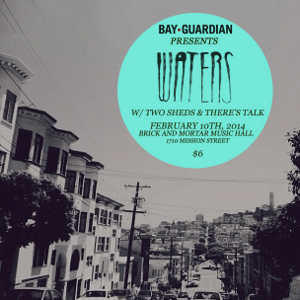
SF Bay Guardian presents night two of WATERS residency at Brick and Mortar

0

Winner of the 2012 Goldie Award for Music,  WATERS hits up Brick and Mortar this month for a February residency. Needless to say, the San Francisco Bay Guardian couldn’t be more proud to be a presenting co-sponsor along with Ineffable Music.

(Speaking of Goldies, the 25th Annual Goldies celebration is Friday, February 21 from 8-11pm at Folsom Street Foundry. Get more info and see who’s going here.)

Spring 2010 saw the demise of Port O’Brien and founding member/front man Van Pierszalowski needed a break from the hectic, wonderful mess that is touring. He stumbled into respite in Oslo, Norway and explored the new city, swam in the Norwegian fjords, enjoyed the weather and the experience of seasons changing. He found his bearings and formed WATERS. The band will be previewing material from their forthcoming album, a follow up to the critically acclaimed debut Out in the Light

The new album “is about waking up. It is about getting out of a situation that seems endless, and realizing you’re not too old to make dramatic and sudden changes in your life. It is about starting over.”

With Two Sheds and There’s Talk. Get advance tickets at here.

Monday, February 10 at 9pm @ Brick and Mortar, 1710 Mission, SF | $6

Uber neighborhood pricing surge charges Marina most

43

Uber charges the Marina and Pacific Heights districts up to three times as much for a ride as the rest of the city in its new “neighborhood surge” program, according to leaked emails and screen captures. 

The surges happen during rush hour, weekend night bar crawls, and also around concerts and other events that would draw riders to Uber’s app. 

Uber has caught a lot of flak for its New Year’s Eve “surge pricing,” a practice where the company raised rates during peak hours. Hell, it even looks like they’ve been raising rates when it rains. Just last month the Wall Street Journal reported that Uber would spike rates in neighborhoods of cities with the most demand, a practice called geo-surging.

The rates seem to go at least as high as $4 per mile in surge times, drivers told us, while SF taxis generally charge about $2.25 per mile. 

marina4

A driver sent a screenshot of a 9am morning surge. This particular morning the Richmond and Mission districts seemed to get a spike in pricing as well.

“If they’re upset about the price they accepted, that’s a different conversation than, say, a driver took a wrong turn,” Uber CEO Travis Kalanick told the Wall Street Journal, about neighborhood pricing in general. “The price must go up for these rides to happen. If surge pricing doesn’t happening, there’s no availability. You can’t get a ride.”

We emailed Uber but did not get a response.

In San Francisco, that demand is apparently highest in the Marina. In the leaked emails, Uber wrote to drivers to explain its reasoning behind the neighborhood pricing:

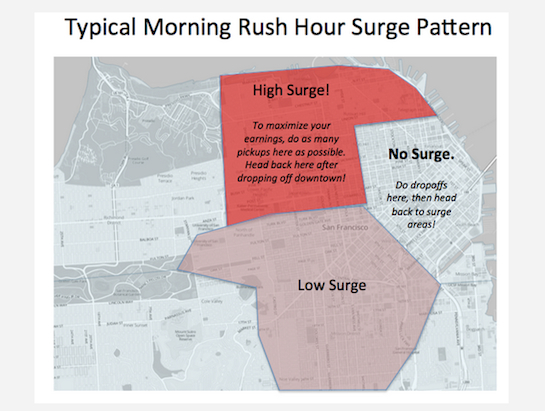
“Instead of rates being the same everywhere in SF, surge rates will be higher in busier parts of the city. 

Typically, the most demand comes from the Marina (and surge pricing is the highest), with some demand in the Mission neighborhood. 

We’re excited about this change, since this means surge pricing will happen in the areas that need it most.”

A look at their “typical morning rush hour surge pattern” has Uber labeling the Marina “high surge,” the Mission “low surge” and no mention for the rest of the city. Maybe the Outer Sunset and Excelsior folks just don’t use Uber? (Or maybe they’re bigger fans of pink mustaches.)

After we obtained the emails, we verified them with Uber driver Zach Hudson, who’s employed with a private limo company but uses the Uber app to find his riders. 

“The morning rush is in the Marina,” he said. “It’ll be near up to three times the normal rate. I don’t think there’s a limit. But near New Year’s Eve it’s been known to go up to 500 percent.”

marina1

In this screencap of an Uber email, the company advises goign to the “outer” neighborhoods. From the context of the rest of the email, it seems “outer” is anywhere not downtown. 

Uber seems to want to lure more drivers to in-demand areas, but it’s not a total loss for the western and southern neighborhoods, Hudson said. 

 “The avenues are pretty dead most of the time,” he explained. 

And besides, can’t the Marina dwellers afford it? Though the surge pricing may not be great for consumers, Hudson said it was good for drivers.

“After Uber cut fares and essentially our commission by 20 percemt, surge pricing is the only way we can survive,” he said.

http://www.youtube.com/watch?v=wvRuaNr5DKY

San Francisco landlords targeted for elder abuse

Lisa Gray-Garcia, aka “Tiny,” led a press conference outside the San Francisco Hall of Justice Feb. 5 to announce that she and fellow activists were filing elder abuse charges against San Francisco landlords.

Clad in a gray pantsuit and flanked by activists and senior citizens who were facing eviction or had lost housing in San Francisco, the Poor News Network founder condemned landlords who’ve invoked the Ellis Act as “dangerous criminals.”

Gray-Garcia said criminal charges were being filed against the landlords in accordance with California Penal Code 368, which creates a special category for crimes – such as infliction of pain, injury or endangerment – committed against elders and dependent adults.

The theory is that carrying out an Ellis Act eviction against a senior citizen qualifies as a criminal act under that law, since an elder can suffer physical harm as a result of being turned out of his or her home.

The targeted landlords were taken from a list compiled by the San Francisco Anti Eviction Mapping Project, a volunteer-led group that published names, property ownership, and identifying information of 12 landlords who had repeatedly invoked the Ellis Act in San Francisco. Garcia read out their names as part of the press event.

Beyond that, however, the announcement was short on specifics. Gray-Garcia told the Bay Guardian she did not want to share the names of the affected seniors because she did not feel comfortable exposing the elderly tenants to potential backlash.

Joining the group of activists was an 82-year-old woman who used a walker and declined to share her name. She told the Bay Guardian she had lived in her Richmond District flat for more than 30 years, and had recently received a verbal warning from her landlord that if she did not move out, he would invoke the Ellis Act.

When Gray-Garcia and others filed into the San Francisco District Attorney George Gascon’s office inside the Hall of Justice, however, Chief Assistant District Attorney Sharon Woo first told them that they should complain to the police department, then scheduled a meeting with them at a later date.

Here’s how it went:

Guardian video by Rebecca Bowe

In order of appearance, speakers include Erin McElroy, a tenants’ rights advocate; Gray-Garcia; a District Attorney staff person whose name we didn’t catch; Woo, and Anthony Prince (there because he is campaign manager to Green Party gubernatorial candidate Luis Rodriguez, who spoke at the press conference).

Board of Education president calls out thousands of “invisible suspensions”

39

K-12 student advocates have suspensions in their crosshairs.

At last night’s (Tue/4) Board of Education meeting, young students rallied against suspensions they see as unfair. Advocates negotiated rule changes. San Francisco Unified School District Board of Education commissioners shook their fists at injustice. 

“Willful defiance” suspensions are cited nationwide as a problematic category of suspension because of their subjective nature. Wearing a backwards cap, having a bad day, talking back, all of those fall under the umbrella of willful defiance.

The suspension ban is monumental, SFUSD Superintendent Richard Carranza told the board.

“We’re talking about culture change. A culture where it’s not okay for an adult to say ‘get out,’” Carranza said.

The point of the Board of Ed’s meeting last night was to discuss banning suspensions for willfully defiant behavior, and to refocus SFUSD resources on improving student-teacher relationships instead. 

But new data shows that a different form of punishment, which was previously unrecorded, may cause almost as much harm as suspensions. 

Ever been sent to the principal’s office? That’s a form of referral, and in California it’s enshrined in state education code. Students can be sent to a counselor, principal, or even another classroom. But President Sandra Lee Fewer said the numbers of referrals are getting out of hand, and must be addressed. 

Fewer made an amendment to the controversial resolution to ban suspensions at last night’s meeting, calling for it to also require a reduction of in-school referrals.

The punishment, she said, deprives students of needed classroom time — and is ineffective.

“We can’t pass a resolution like this without including referrals,” Fewer said. “These are in the thousands. Some schools have three times the amount of black children with referrals.”

She called them “invisible suspensions,” because this school year is the first time they’ve been thoroughly tracked, thanks to a new system called the Counselor Online Referral Form. 

The new data shows thousands of middle school students (high school data is still being collected), mostly black and Latino, were sent out of the classroom for “non-compliance” referrals since the last school semester alone. “Non-compliance” referrals are nebulous, advocates allege, a subjective catch-all category for bad behavior. 

referraldata

SFUSD referral data. This is incomplete data collected from the first semester and portion of the second semester of all SFUSD middle schools, but only a few high schools. Completed multi-year data of SFUSD high school suspensions show similar disparities in enforcement of punishments, however.

The board will vote on the proposed amendment and willful defiance resolution at their Feb. 25 meeting.

Fewer’s amendment would not go so far as to eliminate referrals entirely. That would be legally problematic, United Educators of San Francisco President Dennis Kelly said. 

“The teachers have a right under law to send a child to the office if there is a disruption in the classroom,” he said in a phone interview.

“There is a concern that an awful lot is being dumped on teachers and counselors,” Kelly added. “More and more people are having very good ideas and saying ‘you do it now.’” 

Reforms need to be backed by resources that help a teacher enact needed changes, he said. “Without those supplements, this is only so much talk.”

But in the meantime, students are suffering. Many students took to the podium at last night’s meeting, decrying policies they said were detrimental to their education.

Alexandria Berliner, now 22, said suspensions and referrals as a high schooler derailed her education. “I’ve been suspended so many times, I ended up dropping out of high school.”

Laura Faer is an attorney and director of the statewide education rights at the nonprofit Public Counsel. Faer told the Bay Guardian that though referrals could be problematic, it was less clear cut of an issue than suspensions.

“The question is: what is happening to the child who is referred?” she said. “If a referral goes to counseling and it’s productive, that could be a good thing.”

But the non-compliance category of referrals was a red flag for Faer. 

“Noncompliance is not specific, and I would say that’s a huge problem” she said. “It’s entirely subjective, from what we’re looking at right now. It could lead to a child losing instructional time.”

That was commissioner Fewer’s concern as well. At the meeting, she said she’s talked to kids as young as third-grade level who felt school administrators and teachers did not want them there in the schools. She blames policies that send kids out of the classroom. 

“We have a school-to-prison pipeline here, (while) we pat ourselves for our good work,” she said at the end of the meeting. 

“The impact these suspensions have is social isolation. We break spirit, and we are very good at breaking spirit.” 

Live Shots: WATERS is stormier than expected at Brick & Mortar

2

Live shows are an opportunity for musicians and music lovers to share an experience together. After all, you’re standing in the same room. Brick & Mortar Music Hall is a treasure trove for musicians. The small space offers an intimate setting that gives musicians the chance to embrace their audience.

I stood five feet away from WATERS’ lead singer and frontman Van Pierszalowski Monday night and not once did I feel embraced.

Skip the foreplay. WATERS jumped right into a distinctly scruffier and rowdier sound, playing brand-new music from its upcoming album set to be released in April. When two beardy, flannel-sporting men in the audience started running into each other within the first minute of WATERS’ set, I was afraid that this wasn’t my scene. But the two human pinballs quickly stopped before the end of the first song, after fellow audience members ignored the unwelcome cavorting.

“Thank you everybody. The name is WATERS and we’re from San Francisco,” Van said apathetically. After the dissolution of indie rock-folk band Port O’Brien, Van created WATERS. But similarities between the two start and end with the vague nautical allusion. Where Port O’Brien sailed toward hazy folk, WATERS capsized into rowdy rock.

The first half of the rambunctious set consisted of unheard songs off the band’s noisy sophomore LP while the second half was dedicated to the slightly less loud songs from Out In The Light, the band’s debut album; all of it was heavy guitar riffs and booming drums. A somewhat out-of-place female keyboardist played quietly in a dark corner, offering sweet harmonies that added a much-needed contrast to the harshness in Van’s voice.

Bangs calculatingly side-swept over his right eye, Van lightly rocked onto his toes when he sang. It was in those moments that I felt the disconnect melt away. But rather than building on that passion, Van would often sever the mood by rocking out alone on stage— creating an awkward feeling of detachment between the band and the crowd. Seemingly unaware of his relatively mellow audience, Van built up on boisterous vocals and turbulent beats as girls wearing black lipstick and acid-wash jeans swayed in the front row and cute boys with beards and suede jackets bobbed their heads up and down.

“I’m in love with every single one of you people,” Van admitted mid-set. The false grab at intimacy made me feel like a high school girl cornered at her locker by a boy professing his unrequited love. The singer asked if anyone would be coming to the next shows during his month-long Brick & Mortar residency. A few hands flew up, several pathetic howls echoed in the room. He asked again (“Just put your hands up to make me feel better.”) Several additional hands shot into the air.
 
The best part of the WATERS set was the last song, not only because it indicated the end of a generally lackluster show, but also because the acoustic version of “Mickey Mantle” was Van’s first demonstration of genuine emotion. The final song on Out In The Light is a soft, acoustic guitar-driven tune.

Van attempted to quiet the audience and urged us to huddle close to the stage so that he could play without amplification. Welcome to the Van Pierszalowski Show. The other band members sunk into the background as Van balanced on the edge of the stage.

Imploring the audience to shout rather than sing the chorus with him, Van commandeered the audience into enjoying the final song. The lovely female keyboardist chimed in at the chorus and the bassist occasionally strummed his unplugged instrument — two welcome breaks from the shouting. But even Van’s attempt at connecting with the audience was interrupted by accidental microphone feedback mid-song.

I promise I wasn’t in a bad mood before heading to Brick & Mortar. On the contrary, I was rather excited about WATERS. As a fan of Port O’Brien, I had a lot of hope for the local band. The story of how WATERS was born, in particular, intrigued me: Post-breakup and in search of inspiration, Van traveled the world to decidedly graceful landscapes — the ethereal Alaskan coast, the frigid Norwegian fjords, and his seaside hometown in California. With a beautiful name like WATERS, it’s difficult to grasp how such a harsh sound comes out of solitary travels to exquisite coastal settings. Unlike the graceful flow of rushing rivers and crashing waves, WATERS remained detached throughout its first show at Brick & Mortar. Despite the attempt to connect with nature and music, Van just seemed out of place.

Sue Hestor’s 70th birthday party: “We Shall Overcome.”

110

By Bruce B. Brugmann

Plus: Tim Redmond reports on Sue Hestor and her environmental legacy on his new local  website 48 Hills.org.  

How do you say happy birthday to a San Francisco icon like Sue Hestor?

Some 200 of her friends, allies, pro bono legal clients, political heavies, and fellow warriors against big developers and their pals in City Hall gathered Saturday at Delancey Street for a surprise party to celebrate Sue’s 70th birthday.

When she arrived, she was obviously surprised to find a band playing “We shall overcome” and her friends standing, clapping, cheering, and singing  in admiration for a woman who has spent more than four decades as a citizen activist and attorney fighting for one good cause after another, usually at bad odds against the big guys, often for clients without pay. It was truly a historic moment in the history of San Francisco politics. 

I first knew Sue when she popped up as a feisty volunteer in the Alvin Duskin anti-high rise campaign of the the early 1970s. The Bay Guardian was doing an investigative book, “The Ultimate HIghrise,” on the impact of highrises on the city. She pitched in on the project and was in the book’s  staff photo, jauntily wearing her trademark straw hat, standing next to the hole in the ground for the Yerba Buena Center development.

 We billed a central feature of the book as “the world’s first comprehensive study of the true cost of skyscrapers.” Our research group demonstrated that highrises cost much more in services than they bring back in revenue,  a finding that infuriated the Chamber of Commerce because they could never effectively refute it. We also laid out in detail for the first time the power structure behind pellmell Manhattanizaton, how destructive those policies are, how they shift the tax burden from dowotown to neighborhoods and small business, who profits from them, why there are more muckmakers than muckrakers. Our talented art director Louis Dunn provided brilliant graphics that drove home the damaging points about highrises.

Our conclusion was most prophetic: “The most disturbing finding can’t be quantified–but it should be shouted to the heavens.  It is this: unless the city of San Francisco reverses past practice and immediately enacts an ironclad land-use policy such as Duskin’s proposed height limit, the long scoffed at ‘Manhattanization’ of the entire city is a surefire, 100%-guaranteed inevitability.” 

I like to think this project and its results were a fitting start to Sue’s career in land use litigation and terrorizing big developers, City Hall enablers, and their ever more virulent forms of Manhattanization. 

In the early l990s, I called on Sue again, this time to be the founding chair of the spanking new Sunshine Task Force. It was a new task force formed to enforce the Sunshine Ordinance, which gave citizens the right to make complaints about government secrecy and its tradition of keeping City Hall safe for PG&E, big landlords, and developers etal. The task force would, I knew, drive the bureaucrats nuts and  it thus needed a strong attorney as chair who would be smart enough and tough enough to go up against the city attorney and the crocodiles in the back bays of City Hall.

 The neat thing was that nobody could kick Sue off the task force.  She was one of two members who were “grandfathered” in by the ordinance–an attorney (Sue)  and a media rep (B3) –who were selected by the Northern Chapter of the Society of Professional Journalists, not the supervisors. She performed admirably and got the task force on a firm footing as the first and still the best local open government task force in the country, if not the world. 

Through the years of development battles, it was often Sue and Calvin, Calvin and Sue.  Calvin being Calvin Welch, a crafty environmental and neighborhood strategist who worked with Sue and others in developing counters and initiatives and all kinds of hellish moves to beat or slow down and mitigate development.  He said Sue’s career could be summed up in two words: “cumulative impacts.”  The good thing was that we all knew, when the developers brought up their heavy artillery or their sneaky back alley maneuvers, Sue and Calvin would be there to blow the whistle and take on the fight. Call Sue, call Calvin was the watchword but they usually called us first at the Bay Guardian. 

Let me call now on Tim Redmond, a Guardian reporter who covered Sue and Calvin and the highrise battles from 1982 on, to explain what Calvin meant.  Tim laid out the political points in his piece, “Sue Hestor’s birthday and a lesson in SF environmental history,” on his new local  website “48 Hills.org.”  Read Tim’s first paragraphs for the fun stuff on Sue and the last paragraphs for the really important contributions she has made to the city and urban planning, as explained by Calvin.

As Tim concludes, “In 1964, Hestor, representing San Franciscans for Reasonable Growth, sued and won a stunning decision in the California Court of Appeal mandating that the city start studying the cumulative impacts of development. As Welch noted, ‘there was an obligation for developers to prioritize mitigations.’ That’s where the affordable housing program, the transit-impact fees–and the entire concept of analyzing development on the macro, not the micro level emerged.  That was the idea behind the 1986 measure Prop. M, which included no height limits at all–but did include programs and policies designed to protect neighborhoods from the effects of unlimited growth.” 

Well, the Hestor faithful may not have “overcome” the big developers and their latest monstrous Manhattanization plans.   But they have come pretty damn close. On Sunday, the day after Sue’s party, the Warriors caved on its waterfront project and Matier and Ross did a Chronicle column with the head, “Warriors call for timeout on Waterfront arena plan.” And on Monday, the waterfront warriors marched triumphantly into City Hall and, as the  Chronicle’s John Cote reported,  “turned in more than double the number of signatures needed to qualify a measure for the June 3 ballot that would require voter approval for any development on the San Francisco waterfront to exceed existing height limits.”

That could kill the massively inappropriate project.  “If passed,” the Chronicle continued, “the measure would put a check on high-rise hotels and condo towers along the bay and require voter approval for height increases for three major waterfront development plans, the Golden State Warriors’ proposal for an 18,000-seat arena complex, the San Francisco Giants’ plan for an urban neighborhood on what is their main parking lot and the development of the industrial Pier 70 area.”

Whew! That’s what I call a nifty bit of Hestoring and Calvinizing.   b3

If you don’t like the news, go out and make some of your own. (Wes “Scoop” Nisker on KSAN radio during the dark days of the Vietnam War.) 

(The Bruce blog is written and edited by Bruce B. Brugmann, editor at large of the Bay Guardian.  He is the former editor and co-founder and co-publisher of the Bay Guardian with his wife Jean Dibble, from 1966 to 2012.)


The trouble with compromise

44

“It takes no compromise to give people their rights… It takes no money to respect the individual. It takes no political deal to give people freedom. It takes no survey to remove repression.” — Harvey Milk

OPINION As I sat in the audience at the Jan. 23 San Francisco Young Democrats meeting and watched the first debate between David Campos and David Chiu in their race to represent San Francisco’s 17th Assembly District, I was disturbed to hear the words “compromise” and “consensus” come out of David Chiu’s mouth more often than the words “eviction” and “displacement.”

During the debate, a line in the sand was drawn by the two candidates: Campos was on the side of the underdog, a voice to the voiceless; and Chiu, by his own admission, was all about compromise and “getting things done.”

Don’t get me wrong. True compromise can be a good thing. Unfortunately, what has been coming out of City Hall, from both President Chiu’s Board of Supervisors chamber and the Mayor’s Office, hasn’t been real compromise. It’s been a wholesale selling of our city to the highest bidder. The only thing that our leadership’s compromises have yielded is a compromised San Francisco.

Compromise gave corporations millions of dollars in tax breaks and it has forced nonprofits and small businesses out of our neighborhoods. Compromise has not resulted in any substantive action to curb Ellis Act evictions, instead serving to green light the building of luxury condo towers throughout the city. Compromise has allowed queer youth shelters and our parks to be closed to the people who need them as a last resort, as our bus stops have been opened up to billionaires for little more than pennies.

Chiu’s compromises have cost this city dearly. His compromise with developers on Parkmerced will lead to the demolition of 1,500 units of rent-controlled housing. His compromise on Healthy San Francisco allowed restaurant owners to continue to defraud consumers and to pocket money that should have gone to health care for their employees. His compromise on Muni killed a much-needed ballot initiative that would have resulted in an additional $40 million for the agency — a ballot initiative that he originally co-authored.

Please forgive me if I am fed up with compromise and am demanding actual leadership from my representatives.

Now is the time to stand with people of color, with members of the LGBTQ community, with our youth and elders, with artists and with small businesses, all of whom are being forced out of our city.

Thankfully, we have another choice. Sup. David Campos has shown that real change comes not from compromising your values but standing up for your principles. His legislative accomplishments include providing free Muni for low-income youth, protecting women’s right to choose at the Planned Parenthood Clinic, and preventing teacher layoffs at our public schools.

Campos has demonstrated that he, not Chiu, is the right choice to follow Tom Ammiano’s footsteps to Sacramento. Ammiano, who had 13 of his 13 bills signed into law this past year, is the perfect example of the success that can come from leading with your principles and not compromising your integrity.

San Francisco needs a leader representing us in the capital. Successful victories in reforming the Ellis Act and closing the Prop. 13 tax loophole will take a leader who can stand up to landlords and corporations, not a compromiser who will sit down at the table in a backroom with them.

That is why I will give my all to make sure that David Campos is our next representative in Sacramento. Pardon me if I refuse to compromise.

Tom Temprano is president of the Harvey Milk LGBT Democratic Club.

This Week’s Picks: February 5 – 11, 2014

0


WEDNESDAY/5

Action Bronson

Action Bronson lives life large. Imposing both physically and lyrically, the Queens native and former gourmet chef draws upon his joys in life — food, drugs, and women — to construct poetically intricate and technically impressive rhymes. His mix tapes are full of love songs, both highly eloquent and frequently offensive, written about the grit of urban life and the beauty of a great meal. Lines about “pissing through your fishnets” are sprinkled among odes to “bone marrow roasted/spread it on the rosemary bread/lightly toasted,” all delivered with Bronson’s sure, sharp-tongued talent. At his live shows, Bronson is extremely interactive with his (extremely devoted) fans, passing back and forth joints, liquor, and jokes from the stage to the audience. With the brand-new addition of Odd Future thrash punks Trash Talk to the lineup, this show is sure to be insane. (Haley Zaremba)

With Trash Talk

9pm, $25

Slim’s

333 11th Ave, SF

(415) 255-0333

www.slimspresents.com


Alejandro Murguia

In a city overflowing with Google bussers and tech transplants, San Francisco’s newest poet laureate, Alejandro Murguía, seeks to revive a marginalized community through the written word. He’ll be honored at City Lights Bookstore with a reading from his new book, Stray Poems. The bilingual poet is the first Latino laureate, paving the way for the city’s poesía en español revival — not only through his poems but also through his activism. Marguía is the voice of the city’s forgotten residents, the voice of “the waitresses the norteños trios the flowers sellers / the blind guitarist wailing boleros at a purple sky / the shirtless vagrant vagabond ranting at a parking meter / the spray paint visionary setting fire to the word” (from the laureate’s poem “16th and Valencia”). (Laura B. Childs)

7pm, free

City Lights Bookstore

261 Columbus, SF

www.citylights.com


SF Bicycle Coalition’s Dating Game: Love On Wheels

This year’s Love on Wheels fundraiser is back with a ’90s twist. In a modern-day version of MTV’s dating show, Singled Out, bike-lovers looking for a mate will get paired up and sent off to a first date in time for the big V-day. Be sure to look the part — ’90s attire is encouraged. Find love in fellow midriff-bearing, flannel-sporting cyclists, or show off your best Tootsee Roll on the dance floor. Proceeds benefit the SF Bicycle Coalition’s work to make the city more bicycle-friendly. (Childs)

6:30pm, $10

DNA Lounge

375 11th St., SF

www.dnalounge.com


THURSDAY/6

Academy of Sciences Lunar New Year Celebration

Saddle up and celebrate the Year of the Horse at the California Academy of Sciences Lunar New Year Nightlife. The contemporary museum will be decked out with traditional occidental activities and performances. Let your inner wildcat out on the dance floor or watch an authentic lion dance routine. For a little wisdom, participate in a traditional Chinese tea ceremony and if you believe in making your own luck, check out the customized fortune cookie booth. Workshops will teach the lion dance or martial arts moves, but leave most of it to the pros. Throughout the night, live shows will feature authentic lion dance, a martial art demonstration and an ancient Chinese mask performance. (Childs)

6pm, $12

Academy of Sciences

55 Music Concourse

www.calacademy.org


Throwing Shade Live

Throwing Shade is a weekly podcast by LA comedians Bryan Safi and Erin Gibson in which the pair address queer and feminist issues in the news. Though the topics are often heavy, Gibson and Safi’s goofy back-and-forths, impressions, and gimmicks strike the perfect balance. Both hilarious and extremely insightful, Throwing Shade is the ideal way to hear about important and often under-reported topics without getting too blue — although your sides may ache by the end of the segment. Putting their show on the road for SF Sketchfest, the duo will be recording the show at the Punchline for the podcast. Endorsed by both Maximum Fun and Funny or Die, Throwing Shade is a serious laughing matter. Don’t miss this rare live appearance. (Zaremba)

8pm, $20

Punch Line

444 Battery, SF

(415) 397-7573

punchlinecomedyclub.com


Oneohtrix Point Never

Picking up on the ’90s era abstract, contemplative side of Warp Records, recent signee Oneohtrix Point Never’s R Plus Seven is thoroughly brain busting. The elements are disparate: vocals that begin without reference and depart without finishing, gamelan reminiscent rhythms seemingly performed on the Cosmic Key, and an ever-present effect best described as the stuttering sound of audio on an overburdened CPU. Partly playful, with New Age and stereotypically “world” music samples ripped off of Pirate Bay (where, to be fair, R Plus Seven gets the “plunderphonics” genre tag), the album still manages to sound wholly reverent. To what? Let me get back to you on that. (Ryan Prendiville)

With Holly Herndon (Live A/V), Marco de la Vega, DJ Will, Chad Salty

10pm-3am, $17.50-20

1015 Folsom

1015 Folsom St., SF

www.1015.com


FRIDAY/7


ASKEW

Performance art, visual art, and experimental film collide with boundary-pushing results at ASKEW, a Festival of Film and Performance Art, presented by the similarly edgy, female-focused Femina Potens Art Gallery. Three nights of themed events spotlight a variety of unique, fearlessly curious talents; tonight’s “We All Live Here: Primal Expressionism” includes SF Fringe Festival hit Fish Girl, by Siouxsie Q with Sean Andries. Tomorrow, it’s “Breaking Stones: Defining New Roles of Masculinity,” with a performance and screening by fest curator Madison Young, among others. Saturday’s “The Sacred and the Profane” features an appearance by sex-positive icon Annie Sprinkle, plus I Am Lady Samar, a work that mixes dance with “flesh hooks” — an act not for the faint-hearted, or close-minded. (Cheryl Eddy)

Through Sat/8, 7pm, $8-$10

Yerba Buena Center for the Arts

701 Mission, SF

www.ybca.org


Liquid Hymn

Feast your eyes! First Amendment Gallery presents the opening of Liquid Hymn, a solo exhibition of kaleidoscopic multimedia ink paintings by Oakland-based artist J.S. Weis. With wild animals pouring out of splashes of color, Weis’ projects seem like a 1970s acid trip — see: purple elephant, two-headed tiger, and a sea of crab legs; the artist uses ink, pencil, and intricately stacked paper to create a detailed 3D effect on his multimedia creations. Multicolored plants and ethereal animals roam through the psychedelic ink paintings, creating a fantastical symphony where nature and art become one. (Childs)

6:30pm, free

1AM SF

1000 Howard, SF

www.1amsf.com


SATURDAY/8

Top Secret

Continuing in the same zany and hilarious vein of comedy as seen in their earlier films Kentucky Fried Movie and Airplane!, writers and directors Jim Abrahams, Jerry Zucker, and David Zucker decided to spoof both 1960s cold war/spy movies as well as rock n’ roll musicals with 1984’s Top Secret! Featuring Val Kilmer (in one of his very first starring roles) as fictional American rocker Nick Rivers battling the evil empire of East Germany, the flick parodies a host of genre clichés and plays on pun after side-splitting pun. Join Abrahams and the Zucker brothers for what promises to be an unpredictable 30th anniversary screening, audience discussion and Q&A. (Sean McCourt)

1pm, $20

Castro Theatre

429 Castro, SF

www.sfsketchfest.com


Aszure Barton

When Mikhail Baryshnikov’s Hells Kitchen Dance troupe performed at the Zellerbach Play House in 2006, he looked fabulous — at 58, a self-effacing, masterful dancer. He also brought works by two barely known choreographers. Benjamin Millepied, at the time a dancer with New York City Ballet, now runs the Paris Opera Ballet; the Canadian Aszure Barton’s two pieces immediately marked her as someone with chops to burn and a fascinating individual voice. She hasn’t stopped working — all over the world. Now SF Performances is bringing her back with Awáa, a piece inspired by an underwater dream, in which Barton, apparently, explores the masculine and feminine traits we all have. I’ll take her word for it — anytime. (Rita Felciano)

Feb. 7/8. 7:30pm. $35-50

Aszure Barton + Artists

Lam Research Center, YBCA

700 Howard St. SF

415-978-2787

www.sfperformances.org

Thu/6-Sat/8


SUNDAY/9


Shakes The Clown Live

Although it was critically panned and considered a financial flop when it was first released, the 1991 movie Shakes The Clown has gone on to achieve a loyal cult following over the years. Comedian Bobcat Goldthwait wrote, directed, and starred in the dark comedy that follows the life of an alcoholic and depressed clown that shows up for kids’ parties drunk, sees his career going down the toilet, and even eventually gets framed for murder. Join Goldthwait, along with original film cast members Julie Brown, Tom Kenny, and Florence Henderson as they bring the under-appreciated story back to life in all its debaucherous glory, live on stage! (Sean McCourt)

4pm, $25

Cobb’s Comedy Club

915 Columbus, SF

(415) 928-4320

www.cobbscomedyclub.com

www.sfsketchfest.com


TUESDAY/11

Kid Congo

Helping form the influential roots-rock/punk band The Gun Club when he was still a teenager, Kid Congo Powers was quickly persuaded by the Cramps to join as their second guitar player in 1980 before he eventually went on to play with Nick Cave and the Bad Seeds for a time. Continuing to harness the power of American roots music and twist it into a warped web of perverse sounds over the ensuing years with his latest band, The Pink Monkey Birds, Kid Congo ventures further down the deliciously demented path on his latest record, Haunted Head (In The Red).

With Wax Idols, Dancer. (Sean McCourt)

8pm, $15

Slim’s

333 11th St., SF

(415) 255-0333

www.slimspresents.com


Hospitality

This trio’s debut S/T album was essentially a collection of undeniable indie-pop hooks matched by songwriting that combined Belle and Sebastian’s wittiness with the urban social unease of a Shirley Jackson story. Still it didn’t quite capture the appeal as a live band, where I found them to be most endearing. On its freshly minted second album, Trouble, Hospitality has set out to prove their mettle as simply a rock (drop the indie, drop the twee) group as well. While Amber Papini’s voice is still endlessly charming — listen to the way her double esses fill in some hissing hi-hat on The Who-styled percussion on “I Miss Your Bones” — but the band seems in less of a hurry, giving the guitar and bass its due. (Ryan Prendiville)

With Air Waves, Matt Kivel

8pm, $10-12

Rickshaw Stop

155 Fell, SF

(415) 861-2011

 www.rickshawstop.com


The Guardian listings deadline is two weeks prior to our Wednesday publication date. To submit an item for consideration, please include the title of the event, a brief description of the event, date and time, venue name, street address (listing cross streets only isn’t sufficient), city, telephone number readers can call for more information, telephone number for media, and admission costs. Send information to Listings, the Guardian, 225 Bush, 17th Flr., SF, CA 94105; or email (paste press releasea into email body — no attachments, please) to listings@sfbg.com. Digital photos may be submitted in jpeg format; the image must be at least 240 dpi and four inches by six inches in size. We regret w cannot accept listings over the phone.

Rep Clock: February 5 -11, 2014

0

Schedules are for Wed/5-Tue/11 except where noted. Director and year are given when available. Double and triple features marked with a •. All times pm unless otherwise specified.

ARTISTS’ TELEVISION ACCESS 992 Valencia, SF; www.atasite.org. $5-7. “OpenScreening,” Thu, 8. For participation info, contact programming@atasite.org. Boom: The Sound of Eviction (2001), Fri, 7:30.

BALBOA THEATRE 3630 Balboa, SF; cinemasf.com/balboa. $7.50-10. “Popcorn Palace:” The Seventh Voyage of Sinbad (Juran, 1958), Sat, 10am. Matinee for kids. Barbie: The Pearl Princess (2014), Sun, 10am.

BERKELEY FELLOWSHIP OF UNITARIAN UNIVERSALISTS 1924 Cedar, Berk; www.bfuu.org. $5-10. In Transition 2.0, Thu, 6:30. More info at www.transitionberkeley.com.

CASTRO 429 Castro, SF; (415) 621-6120, www.castrotheatre.com. $8.50-11. “SF Sketchfest:” “NPR’s Ask Me Another,” Wed, 8 (this event, $25-35); “Tribute to Alan Arkin:” The In-Laws (Hiller, 1979), Thu, 7 ($25); Cabin Boy (Resnick, 1994), Fri, 7:30 (20th anniversary screening, hosted by Peaches Christ with Chris Elliot in person, $20); Top Secret! (Abrahams, Zucker, and Zucker, 1984), Sat, 1 (30th anniversary screener with writers-directors in person, $20); “The Benson Movie Interruption:” The Twilight Saga: New Moon (Weitz, 2009), Sat, 4:20 ($20); Revenge of the Nerds (Kanew, 1984), Sat, 8:30 (30th anniversary screening with cast in person, $30). Visit www.sfsketchfest.com for tickets and more info on SF Sketchfest events. •The Lady From Shanghai (Welles, 1947), Sun, 3, 7, and Gilda (Vidor, 1946), Sun, 4:45, 8:45. •I Am Divine (Schwarz, 2013), Mon, 7:30, and Bettie Page Reveals All (Mori, 2012), Mon, 9:10. “Veteran Documentary Corps,” short documentaries, Tue, 7. Special event; purchase tickets ($10-50) at www.veterandocs.org.

CHRISTOPHER B. SMITH RAFAEL FILM CENTER 1118 Fourth St, San Rafael; (415) 454-1222, www.cafilm.org. $6.50-$10.75. The Girls in the Band (Chaikin, 2011), call for dates and times. “Oscar Nominated Short Films 2014,” call for dates and times. The Past (Farhadi, 2013), call for dates and times. Gloria (Lelio, 2013), Feb 7-13, call for times. Breathing Earth (2012), Sun, 7.

CLAY 2261 Fillmore, SF; www.landmarktheatres.com. $10. “Midnight Movies:” The Room (Wiseau, 2003), Sat, midnight.

CRANEWAY PAVILION 1414 Harbour Way South, Richmond; www.craneway.com. $20-30. “Lunafest Film Festival,” short films by, for, and about women, Fri, 6:30.

EXPLORATORIUM Pier 15, SF; www.exploratorium.edu. Free with museum admission ($19-25). “Saturday Cinema:” “Teachers Institute Film Festival,” Sat, 11am-2pm.

MECHANICS’ INSTITUTE 57 Post, SF; milibrary.org/events. $10. “CinemaLit Film Series: Villains We Love:” Caged (Cromwell, 1950), Fri, 6.

NEW PARKWAY 474 24th St, Oakl; www.thenewparkway.com. Free. “First Friday Shorts,” films from Creative Growth Video Production Workshop, Fri, 6.

OAKLAND PUBLIC LIBRARY Rockridge Branch, 5366 College, Oakl; www.oaklandlibrary.org. Free. “90-Second Newbery Film Festival,” Sat, noon.

OSHER MARIN JCC 200 N. San Pedro, San Rafael; www.marinjcc.org. $10-20. “Best of the San Francisco Jewish Film Festival:” Arab Labor, Tue, 7. Three episodes from season four of the Israeli TV show.

PACIFIC FILM ARCHIVE 2575 Bancroft, Berk; (510) 642-5249, bampfa.berkeley.edu. $5.50-9.50. “Film 50: History of Cinema:” M (Lang, 1931), with lecture by Emily Carpenter, Wed, 3:10. “African Film Festival 2014:” Tey (Gomis, 2012), Wed, 7. “Funny Ha-Ha: The Genius of American Comedy, 1930-1959:” Will Success Spoil Rock Hunter? (Tashlin, 1957), Thu, 7. “Against the Law: The Crime Films of Anthony Mann:” Strange Impersonation (1946), Fri, 7; Desperate (1947), Fri, 8:30. “Screenagers: 16th Annual Bay Area High School Film and Video Festival,” Sat, 3. “Jean-Luc Godard: Expect Everything from Cinema:” Vivre sa vie (1962), Sat, 6:30; Les carabiniers (1963), Sat, 8:15. “The Brilliance of Satyajit Ray:” Three Daughters (1961), Sun, 3. “Documentary Voices:” The Specialist (Sivian, 1999), Tue, 7.

ROXIE 3117 and 3125 16th St, SF; (415) 863-1087, www.roxie.com. $6.50-11. SF IndieFest, Feb 6-20. For program info, visit www.sfindie.com.

TANNERY 708 Gilman, Berk; berkeleyundergroundfilms.blogspot.com. Donations accepted. “Berkeley Underground Film Society:” “LOOP Presents:” What’s Up, Tiger Lily? (Allen, 1966), Sat, 7:30; Duck Soup (McCarey, 1933), Sun, 7:30.

TEMESCAL ART CENTER 511 48th St, Oakl; www.shapeshifterscinema.com. Free. “Shapeshifters Cinema: Lori Varga,” old and new analog film work, Sun, 8.

YERBA BUENA CENTER FOR THE ARTS 701 Mission, SF; www.ybca.org. $8-10. “Femina Potens’ ASKEW Film and Performance Festival,” screenings and performances, Thu-Sat. *


Q up

10

MUSIC “I always wanted to know how music sounded in outer space. And with certain types of crystals you can supposedly tune into different frequencies, receive other transmissions. Often I meditate with crystals, go to sleep, and dream about music from outer space. Then I wake up, make stuff like that on the turntables, and take it from there.”

That’s a lot of there to take it from, but DJ Qbert is no stranger to mixing the cosmic with the underground. A legendary emissary of scratch who became the international representative of turntable culture in the 1990s along with his “band” Invisibl Skratch Piklz, Q has always mixed a heavy dose of Bay Area flavor into his masterly sets — which aren’t typical DJ sets by any means, but untethered, jazz-like flights during which a set of turntables and a crossfader, manipulated lightning-fast, become their own kind of spaceship. His polyrhythmic scratch concertos summon white noise, radio interference, oceanic undertow, Looney Tunes quick cuts, vintage advertising jingles, embryonic hip-hop, Big Brother menace, and fiendish, childlike glee. Great beauty, too, especially when you think of them as pure sonic expression, floating free of time and space. Not that you can’t dance your ass off to most of it, mind you.

We were talking about his new album Extraterrestria, dropping in March on the Thud Rumble label and backed by a huge Kickstarter campaign that aims not just to fund the disc, a marketing campaign and a tour, but also typical Qbert innovations like amazing touch-sensitive digital album packaging that simulates DJ controller equipment. (More details at www.djqbert.com)

“The album is actually two albums in one, two different discs,” Qbert, looking tight in a buttondown shirt and track pants, told me. “Extraterrestria is music from another galaxy, hip-hop beats from other planets, collected by the Galactic Scratch Federation. It’s as bizarre and unique as I could make it, a collection of weird noises and different time signatures with as much scratching as possible. The second disc is called Galaxxxian, which is hip-hop from earth beamed into space: raw, primitive. It features a bunch of MCs — Kool Keith, Del Tha Funky Homosapien, Mr. Lif, Soul Khan, Bambu — doing their thing, which a lot of time, you know, means going for the sex, drugs, and hip-hop and roll. We’re not quite on the extraterrestrial level, yet.”

Other biggies like Dan the Automator, Chad Hugo of the Neptunes, cellist-trombonist Dana Leong, and rapper El-P (here a producer) also contributed. “What with the recession and everything, a lot of us have been trading with each other, so we can continue collaborating. Like I’ll do a beat for your album if you do a verse on mine. Something where the money’s phased out, a barter thing. It’s put us back in touch with what’s real,” Qbert said.


TWIST THE FORCE

As we talked on the second floor of the California Academy of Sciences, the first floor was rapidly filling up for the Academy’s weekly Nightlife party, this week a launch celebration and fundraiser for Extraterrestria — and a reunion of sorts for turntablism heads, albeit one bursting with fresh young faces. As b-boys and fly girls made their way through exotic landscapes, whale skeletons, stuffed giraffes, a butterfly-flooded rainforest dome, and aquarium displays including live stingrays, giant octopi, frisky penguins, Claude the albino alligator, and phosphorescent jellyfish, I couldn’t help but be reminded of the deliciously loopy, phantasmagorical animated movie version of Qbert’s era-defining previous album Wave Twisters, released 16 years ago.

That’s a long time between official releases, but it wasn’t like Qbert had been kidnapped by aliens. Although his live performance schedule was less-than-usual bonkers, he still made regular appearances, by himself or as part of his extended Bay Area scratch crew family. He popularized turntable techniques in a series of instructional videos and launched online educational community Qbert Skratch University, in 2009. He also went all in on the equipment tip, putting out his own brand of turntable cartridges and needles, an Invisibl Skratch Piklz-branded mixer, “and of course our own vinyl to scratch with — which is really vinyl on one side and a digital interface on the other, for use with DJ software like Traktor.”

Fifteen years has also seen the rise of social media and a more user-friendly Internet. Has that changed the way he produces beats or performs at all? “Of course it’s been great for finding new sounds to use,” Qbert said. “If I want to hear, say, a tarantula farting, I can look it up instantly and hear that. On the other hand, most of my old sets are up there now, with all their mistakes, and a lot of times I’m cringing and say in a small voice, ‘Please, please let them delete that.’ It keeps me on my toes now, knowing everything can be recorded in all its glory. But because I’ve actually been working on this album for seven years, all that’s been incorporated — it’s not like a shock. I use what I can use.

“But I try not to be trapped in the present. I often think back to the past, to cats like Sun Ra, Miles Davis, Louis Armstrong. That timeless, improvisational jazz feeling where you practice and practice, but when the time comes you’re just an instrument connecting with the god-force, channeling the sound through you, swinging through that ocean of feeling. When you’re in that zone, that’s the most wonderful thing. It’s a meditation, a spiritual thing. We’re all spirits, so we have to connect to other spirits and the most high, whatever you want to call it — God, Allah — connect to that creator source and use it because it’s yours to use. Like how some writers just flow and do that automatic writing, they’re just instruments. We’re just instruments you know, it all flows through us.”


SKRATCHING ROOTS

When Qbert, raised in SF’s Excelsior neighborhood, astonished the DJ world by winning its spun-out version of the Olympics, the DMC World Championships, not once (solo, 1991) but three more times in a row after that (as part of Rocksteady DJs with Mixmaster Mike and Apollo) it was an unparalleled triumph not just for local scratch and hip-hop community, but for Bay Area Filipino American culture as well.

http://www.youtube.com/watch?v=u2ZFsQjaOTI

As music critic and Guardian contributor Oliver Wang details meticulously in his forthcoming book Legions of Boom: Mobility, Identity and Filipino American Disc Jockeys in the San Francisco Bay Area (Duke University Press), a vibrant scene of Filipino mobile DJ crews — independent groups of teenage sound and lighting specialists hired to provide entertainment for weddings, graduations, and parties — thrived here since the 1970s. When hip-hop eclipsed disco on the request lists in the 1980s, the mobile crews defined streetwise Bay Area Filipino youth culture and provided a fertile training ground (and sometimes needed cash) for young DJ up-and-comers.

Qbert’s domination of the DJ world could be read as the apex of that scene, which faded in the 1990s with the rise of digital technology. And of course Qbert went on to create his own crew of fellow Filipino DJs: The Invisibl Skratch Piklz, with Shortkut, Apollo, Mix Master Mike, and several others. The Piklz went on to become insanely popular, establishing scratching and other turntable manipulations as a form of art and a highly marketable genre — turntablism — that changed the sound of hip-hop and dance music. Mix Master Mike went on to become, in essence, the fourth Beastie Boy; one early ISP member was A-Trak, current turntable-wielding heartthrob of the superstar EDM crowd.

In fact, the current popularity of turntable-rooted DJs like A-Trak and the burgeoning trip-hop and late ’90s revival makes the timing of Qbert’s return auspicious. “A-Trak runs a dance music scene and I think it’s great that he brings the scratching into it, he’s really unique in that field — so more power to him for turning on a different crowd to the sound. But for me it’s never really gone away, pure scratching. There’s a zillion underground cats who are genius at what they do — Quest, Deeandroid and Ceslkii, Disk, tons more. And maybe the widespread recognition isn’t there, maybe it isn’t in your face like it once was, but they’re all around. It’s like the guys who still do yo-yo tricks. They don’t know things have moved on. They keep practicing and practicing and doing incredible things, regardless of how many people are following. They’re always battling, always progressing. Never put down your yo-yo, man,” he laughs.

As for connecting to a new generation, working with (gasp!) turntables and (double gasp!) vinyl at this stage of DJ history is a deliberate artistic choice. Even with a resurgence of interest in analog techniques — a specific reaction to digital overload — does Qbert fear that scratching will be seen as merely a retro novelty?

“I think no one can deny that, whether you’re old or young, using a turntable to make a scratch sound — well, you can’t deny that it sounds really bugged out. How else are you going to make that sound unless you’re actually moving the sound with your own hand? Just to hold the sound and grab it, move it back and forth — that’s unique and fascinating to people. It’s like a sci-fi movie in real life, a sound that people have heard since maybe they were little kids, but one that also points to a future where man meets machine. It’s a real manipulation, a sound design in itself. What other instrument can do that?”


Ennui the people

0

cheryl@sfbg.com

FILM San Francisco IndieFest celebrates its Super Sweet 16 with multiple films presenting an appropriately teenage outlook on humanity: Most of the time, people suck. They suck in ways you expect, ways you don’t expect, and ways you should have expected but chose not to, for your own sucky reasons.

Fortunately, not all of these lessons in disappointment come packaged in depressing movies — though at least one, Bluebird, does. In snowy Maine, an otherwise kind and responsible school bus driver (Amy Morton) screws up the head count at the end of her route, and a child is left behind on a long, cold night. The small town reacts as you’d expect, with stares and whispered gossip. But as it turns out, most of the characters affected by this tragic mistake are already in a pretty bad place, and must now face hitting a floor even lower than they’d imagined was possible.

Chief among them is the bus driver’s weary husband (Mad Men‘s John Slattery, playing nicely against type except for one very Roger Sterling-ish scene), who’s just found out he’ll soon be unemployed, and the neglected boy’s troubled mother (Louisa Krause), who adds this incident to her running list of personal demons. Writer-director Lance Edmands edited Lena Dunham’s 2010 breakthrough Tiny Furniture (blink and you’ll miss Girls‘ Adam Driver in a handful of Bluebird scenes); his first feature as writer-director is very much in the classic American indie mode, with ordinary people’s lives intersecting in an ordinary town, extreme feelings of loneliness and unfulfilled dreams lurking just below the surface. Frankly, it can get morose, though Emily Meade (who resembles a younger Emma Stone) brings some spark as a high-schooler dealing with sucky boy drama on top of sucky everything else.

Less earnest, thank goodness, is the latest short from San Francisco filmmaker Vincent Gargiulo (2011’s The Muppetless Movie), which screens as part of IndieFest’s “#feelings” program. Filmed on location in Minnesota, Duluth is Horrible follows a handful of oddballs working through heartbreak via Reddit posts, awkward blind dates, and karaoke. Gargiulo — who told me during last year’s IndieFest that the idea for Duluth came to him in a dream — wields his own brand of bizarre humor with complete confidence. Here’s hoping he channels that into a feature film next.

Two of IndieFest’s genre standouts also hinge on human shortcomings. Joe Begos’ Almost Human follows a trio of friends dealing with the aftereffects when one is, uh, abducted by aliens, then returns a few years later acting mighty strange. The man’s left-behind former fiancée and best friend have just enough time to come to grips with their guilt and paranoia before they have to start fending off creepy offers of “Join me and be reborn!” Yeah, this is a wall-to-wall John Carpenter homage — the lead character appears to have stepped right off the set of 1982’s The Thing — but it’s done exactly right, with some spectacular, blessedly CG-free gore effects to boot.

Also a must-see for horror fans: Zack Parker’s Proxy, a Hitchcockian mindfuck of a movie that offers up so many plot twists it’d be nearly impossible to relay a spoiler-free plot summary — though as soon as you hear the pregnant woman’s last name is Woodhouse, as in Rosemary, it’s made pretty clear that this grieving-mother tale ain’t gonna be what it seems. If you can make it through the brutal attack that happens in Proxy‘s first five minutes (close your eyes if you must), you’ll be richly rewarded.

It feels almost wrong to lump Hank: Five Years From the Brink into this roll-call of sinister neighbors and emotional vampires, but there are certainly many who’d call former Treasury Secretary and Goldman Sachs CEO Hank Paulson worse names. This latest doc from Joe Berlinger (the Paradise Lost trilogy) follows the template favored by Errol Morris in films like 2003’s The Fog of War and last year’s The Unknown Known, surrounding an extended sit-down interview with news footage and home movies reflecting on a political subject’s career.

In Paulson’s case, he walks us through the 2008 financial crisis (Jon Stewart referred to him as “Baron Von Moneypants”) with the benefit of hindsight, and a certain amount of self-effacing humor. Whether or not you agree with the guy’s actions, he’s actually pretty likeable, and Berlinger’s decision to include interviews with Paulson’s no-nonsense wife, Wendy, adds a human angle to the decisions behind the “too big to fail” fiasco.

I hear you sighing. You demand uplift, dammit! Where are the happy movies? Though it’s not without moments of relationship angst, Mexican filmmaker Fernando Frias’ Rezeta just might be the festival’s feel-good breakout. Largely improvised and filmed using handheld cameras and a cast of first-time actors (how do you say “mumblecore” in Spanish?), Rezeta follows a year or so in the life of Albanian model Rezeta (Rezeta Veliu), who arrives in Mexico with a good grasp of English but little knowledge of the local culture.

On her first job, she meets Alex (Roger Mendoza), a metalhead whose friendship becomes the one constant in her breezy life. As they slowly become a couple — the passage of time is marked out by Alex’s changing facial hair and Rezeta’s developing Spanish-language skills — the places where their personalities don’t quite mesh become increasingly apparent. Rezeta picked up a special jury award at the recent Slamdance Film Festival, and it’s not hard to see why; the characters feel so real. Don’t we all know that sweet girl who turns into a catty pain when she’s drunk, or that guy who’s too cool to get excited about anything, or that couple who’s fun to be around — until they start screaming at each other on the sidewalk outside the bar? Ah, youth.

Also worth mentioning: wonderful centerpiece pick Teenage, a collage film by Matt Wolf (2008’s Wild Combination: A Portrait of Arthur Russell) that’s based on Jon Savage’s Teenage: The Creation of Youth Culture, spanning the adolescent experience from 1875-1945. First-person narrators (voiced by Jena Malone and Ben Whishaw, among others) reflect on the lives of teens from the US, the UK, and Germany, emphasizing both current events (World Wars I and II) as well as dance and music fads.

Finally, I’d be remiss for not calling your attention to A Field in England, easily the single weirdest pick of IndieFest 2014. Fans of Ben Wheatley, a fest vet and one of the most exciting directors to come out of England in years (2011’s Kill List, 2012’s Sightseers), already know what’s up; everyone else, step boldly into this black-and-white slab of insanity set amid a handful of deserters scuttling away from their posts during the English civil war. And then the cape-wearing necromancer shows up, because of course he does. “I think I’ve worked out what God is punishing us for,” one hapless character gasps. “Everything!” *

SAN FRANCISCO INDIEFEST

Feb. 6-20, most shows $12

Various venues, SF and Oakl.

www.sfindie.com


Momentum moment

1

arts@sfbg.com

DANCE For its 10th anniversary, the Black Choreographers Festival: Here & Now won’t start with its customary lineup of performances, but with a ritual so ingrained that many dancers continue it even after they have retired from the stage. Dancers are obsessed with taking classes. Classes are why they scrape money together. If you’re part of a company, classes are a part of your daily routine. If you aren’t, you’re on your own — and at around $10 or $15 a session, that can quickly add up to a serious amount of cash.

So how about 10 cents a class? At this year’s BCF, you can pay 50 cents for an all-day pass, good for up to five classes at Yerba Buena Center for the Arts’ Forum, taught by Robert Moses, Nora Chipaumire, Marc Bamuthi Joseph, and Rashad Pridgen. A showcase by the next generation of dancers — Dimensions Extensions Performance Ensemble, Destiny Arts, and the Village Dancers — is included in this bargain price.

BCF arose from the ashes of the renowned but collapsing festival known as Black Choreographers Moving Toward the 21st Century. At the festival’s final concert in 1995, financial constraints prevented it from inviting out-of-town artists, so it was an all-Bay Area show. That’s where the seed for BCF was planted. Laura Elaine Ellis, who had just started to choreograph, danced that night.

“I was so honored to be included,” she recalls. “After the performance, all of us realized that this was the first time ever that we all had shared a stage together. It felt so good.”

Kendra Barnes didn’t perform that evening — she was still a San Francisco State student — but “I had attended every concert, and I had just started my own company.” The two women realized that they, and many of their colleagues, would have to self-produce. The African and African American Performing Arts Coalition was a first, short-lived attempt.

But it was when Ellis and Barnes had one of those “what if we…” moments that BCF was born. “We wanted to create a community where we could come together and see each others’ work,” Barnes says.

From the beginning BCF turned a wide-angle lens on African American choreography. It aimed to showcase the whole range of ages and experiences, with beginning and experienced choreographers, plus youth dancers. The emphasis has always been on the “here and now” of its name, although that doesn’t mean, Ellis explains, “that folks who are rooted in traditional forms and rethink them are excluded.” The festival developed a format of showing one weekend in the East Bay (at Laney College) and in San Francisco (at Dance Mission Theater) with both established artists and what the BCF calls “Next Wave Choreographers.”

A lesser-known yet important part of the festival offers training opportunities for a handful of pre- and post-college students who are interested in theater management, tech, and other backstage responsibilities. Several of them, says Ellis, have been able to enter those fields professionally after completing the program.

For this anniversary season, BCF created its most ambitious schedule yet: four weekends of performances by an impressively diverse group of African American dance artists. A partnership with YBCA enabled the organizers to bring Zimbabwe-born Nora Chipaumire for the Bay Area premiere (Feb. 13-15 at YBCA) of Miriam, a work inspired by singer Miriam Makeba and the Virgin Mary, among others. “Nora has gone on to an international career, yet she started in the Bay Area,” Ellis points out.

On the penultimate weekend (Feb. 28-March 1 at Laney College), former Lines Ballet dancer-choreographer Gregory Dawson has created birdseye view, a sextet set to an original jazz score performed live by the Richard Howell Quintet. Zaccho Dance Theatre will present the Oakland premiere of Joanna Haigood’s haunting Dying While Black and Brown; it looks at the effect of incarceration on the human spirit. Joining the lineup will be a work in progress by Barnes (Feb. 28 only), Haitian Dancer Portsha Jefferson, and spoken-word artist Joseph.

Financial constraints prevented the programming of an accompanying film component this year, though the bitter pill was sweetened by a last-minute arrival: UPAJ, Hoku Uchiyama’s film about the partnership between Kathak artist Chitresh Das and tap dancer Jason Samuels Smith, will screen Feb. 28 at 6:30pm before that evening’s performance.

Looking back, Ellis figures that over the last decade they have presented almost 80 choreographers. So for this year’s special “Next Wave” program (Feb. 21-23 at Dance Mission), they sent out a call to “alumni.” It’s a homecoming for the 21 artists who accepted, and it should be heady mix, running (alphabetically) from Ramón Ramos Alayo to Jamie Wright.

For the ODC Theater finale (March 6-8), Robert Moses has curated an intriguing and somewhat mysterious evening, which includes a premiere of his own, Bliss Kohlmeyer and Dawson choreographing on his company, and Moses acting as a “host” to various choreographers. So far Raissa Simpson, Byb Chanel Bibene, and Antoine Hunter are confirmed, with more to come. *

BLACK CHOREOGRAPHERS FESTIVAL: HERE AND NOW

Feb 9-March 8, 50 cents-$35

Various venues, SF and Oakl.

www.bcfhereandnow.com


…And horror for all

2

arts@sfbg.com

CULTURE Like a mad scientist who has decided to open up his secret laboratory and show off his work to select guests, Metallica guitarist Kirk Hammett hosts “Fear FestEvil,” a convention bringing together the worlds of horror and heavy metal. Hammett has long been a horror film aficionado, and has amassed an extensive movie memorabilia collection of original props, costumes, posters, toys, and more over the years — an obsession that dates back to his childhood growing up in San Francisco.

“I first got into horror movies as a young kid — I think I was five years old when I saw my first horror movie, The Day of the Triffids, and totally loved it,” remembers Hammett. “I used to go to San Francisco Comic Book Company, which was one of the very first comic book stores in the country, at 23rd and Mission, and that was my repository for buying comic books and magazines. I just got into it and never got out of it.”

The idea for the festival — er, festevil — grew out of Hammett’s desire to share his extensive horror-movie collection with fans; it’s the same urge that first inspired his 2012 book, Too Much Horror Business, stuffed with color photos of his creepy cache. Following the success of that tome, he set up “Kirk’s Crypt,” an exhibit at Metallica’s Orion festival in 2012 and 2013 where fans could catch a glimpse of his collection in person. The next logical step, as Hammett saw it, was to create a mini-convention in his hometown.

“It was so fun, and such a big hit at the festival, I thought, why can’t I keep on doing this, but do it here in the Bay Area, and make it bigger and better, with more stuff, more guests, and with some bands that would fit in music-wise,” says Hammett.

“It’s my way of taking my collection and sharing it and turning it into a more giving process, because for years and years I collected — and collectors to a certain extent are selfish, you know, they collect things for themselves. After a while, I got tired of that feeling, so I decided that I would share it with like-minded people.”

Scheduled guests include several luminaries in the horror and sci-fi genres, such as makeup and special effects innovator Tom Savini, Night of the Living Dead (1968) co-writer John A. Russo, and A Nightmare on Elm Street series star Heather Langenkamp. There will also be some actors whose faces might not be familiar to the public, but are fan-beloved for portraying iconic movie monsters: Kane Hodder, who slaughtered countless camp counselors as Jason Voorhees in four of the Friday The 13th films, and Haruo Nakajima, aka the man who donned Godzilla’s iconic rubber suit in 12 movies, including the original 1954 classic.

“I’ve known Tom Savini for a while now, but for the most part, I don’t really know these people, and for me to be able to have them appear at the festival, and for me to get to meet them, is fantastic. That’s another reason this festival is happening — so I can meet these people for myself! It means as much to me as it does to the person who buys a ticket and comes to the convention.”

The descendents of three of horror’s high royalty — Bela Lugosi, Boris Karloff, and Lon Chaney — will also be in the (haunted) house. “It’s incredible that I have a relationship with the Karloff, Lugosi, and Chaney families,” Hammett enthuses. “It’s a really, really big thrill.”

Adding a dimension to the event that hasn’t been widely seen before in the world of conventions, Hammett wanted to add metal music to the horror genre mix. “To me, it’s such an obvious thing. One of the reasons I embraced heavy metal was because of the imagery, and because the feelings I felt when I listened to heavy metal were very similar to those when I was watching horror movies.”

In addition to bands performing on Friday and Saturday nights — including Carcass, Exodus, and Death Angel — the fest also features music-minded guests who have ventured into horror-film production, such as Scott Ian and Slash, and those who have had a long history of using horror imagery in their artwork and lyrics, like guitar player Doyle of the Misfits. Hammett hero Count Dracula, noted fan of music made by “children of the night,” would surely approve. *


KIRK VON HAMMETT’S FEAR FESTEVIL

Thu/6, 7pm-midnight (preview); Fri/7, noon-midnight; Sat/8 11am-midnight, $37.50–$175

Regency Ballroom

1300 Van Ness, SF

www.fearfestevil.com

Fresh out

21

Rebecca@sfbg.com

Food stirs strong passions in San Francisco. Protests have been mounted against foie gras and live chicken sales, and epic battles have been fought over chain grocery stores’ proposals to open up shop in certain neighborhoods.

When Whole Foods opened in the Upper Haight in 2011 amid no shortage of neighborhood controversy, Rachel Levin wrote in The Bold Italic that her glee at beholding offerings such as Kombucha on tap belied her nagging conscience about patronizing a chain retailer in an area dotted with local businesses. Internal conflict ensued; the writer confessed feeling “totally conflicted.”

But a very different food-related dilemma is currently plaguing residents in Bayview Hunters Point, a racially diverse, low-income area in the city’s southeast sector.

Six months after the Upper Haight Whole Foods flung open its doors to guilt-ridden and guilt-free patrons alike, a different grocery store was welcomed with much fanfare.

Five years had passed from the time when Fresh & Easy Market had agreed to do business in the Bayview to the day it finally opened for business. The store launch, held in late August of 2011, was treated as a celebratory affair — after much involvement by city officials, it marked the first time in 20 years that the low-income community would have a grocery store.

“The opening of Fresh & Easy on Third Street creates jobs for the community and will help make the neighborhood a place where families will want to stay and thrive,” Mayor Ed Lee said at the time.

But just over two years later, Fresh & Easy was closed. Tesco, the British parent company that owned the grocery chain, fell into financial trouble and unloaded its West Coast stores onto an affiliate of Yucaipa companies, headed by Los Angeles billionaire Ronald Burkle. Other San Francisco Fresh & Easy locations survived the transition, but the Bayview store didn’t make the cut.

Now it’s back to square one, and the neighborhood is once again without a grocery store where one can purchase fresh food. That’s especially problematic considering that Bayview residents suffer from diet-related illnesses such as heart disease and diabetes at much higher rates than other city residents.

And ever since Fresh & Easy closed, Sup. Malia Cohen, who represents District 10 where Bayview is located, has discovered that attracting a new grocery retailer to that neighborhood is like pulling teeth.

“Safeway was absolutely closed to the idea,” Cohen reports. “They cited safety concerns.”

When she first contacted Safeway representatives to pitch the idea of having the grocery retailer move into the vacant Fresh & Easy location, their response was to ask her office to track down emergency service call data in the surrounding neighborhood. “They said they couldn’t get the information,” Cohen said. “I said, that’s interesting, it’s public information.”

Safeway also cited concerns about the configuration of the vacant space and the size of the parking lot, Cohen said. She noted that the grocer has shown generosity in the past by making Safeway gift card donations to needy Bayview residents, but “that also presents a challenge. It’s a hike to get to the grocery store.”

Safeway spokesperson Wendy Gutshall did not answer questions about why the retailer was unwilling to consider moving to the area, and wrote in an email to Bay Guardian, “There are no plans at this time with respect to a new location in the Bayview.”

Cohen was frustrated, but undeterred. “I think there’s a certain level of racism and classism that blinds retailers from even exploring these communities,” she said. “I really want the community to be able to have healthy food options — not discounted toss-aways.”

Next on Cohen’s list was Trader Joe’s. “The conversation went well,” she noted, adding that she’s targeting the chain because numerous residents have told her they would shop there. “I’m optimistic — although they did express a desire to be in Noe Valley. Or the Castro.”

Asked whether the company would consider opening a store in the Bayview, Trader Joe’s spokesperson Alison Mochizuki would only say, “At this time, it’s not in our two-year plan to open a location in that area.”

Cohen said she’d also reached out to Kroger, Sterling Farms, and 99 Ranch Market to gauge interest. Meanwhile, nearby Visitation Valley will be getting its own grocery store, with an anticipated opening in June: discount retailer Grocery Outlet.

The closure of Fresh & Easy left some Bayview residents without jobs. Gloria Chan, spokesperson of the Office of Economic and Workforce Development, a city agency that works closely with Mayor Ed Lee, noted that OEWD had “deployed its rapid response team to assist [displaced Fresh & Easy] employees during the transition, and provided information on workforce services including unemployment assistance.”

Investment firm Fortress Investment Group acquired the vacant Fresh & Easy site in December, Chan added. “OEWD reached out to the Fortress Investment Group and expressed interest and the need for ensuring a grocery retail outlet continues to remain in the now vacant location,” she wrote. “OEWD remains diligent in pursuing a grocery retail outlet in the Bayview and have also spoken to various food operators.”

But so far, nothing has fallen into place, and Cohen says the mayor’s office could be offering more support. “We have the density needed to support a store — households, age range, all the qualifying data points,” Cohen said. “I do have my fingers crossed.”


Guns, gods, and government

20

EDITORIAL Humans tend to believe that we’re smarter than we really are. It’s a problem that can be exacerbated by concentrations of wealth and technological expertise, which can cause some people to believe they have an almost God-like power to manifest solutions to any challenge they confront, particularly when they have lots of money to throw at the problem.

But that’s really just hubris. It’s the story of Icarus striving for the sun and falling back to Earth when his technology failed him. Knowing our limits and feeling a sense of humility and social responsibility are the first steps toward dealing honestly with problems we face. And last week, we were reminded again of this reality by venture capitalist Ron Conway, the libertarian-leaning power broker who has taken a paternalistic hold on the city (see “The Plutocrat,” 11/27/12).

Being a newspaper that has always believed in gun control, we share Conway’s newfound desire to reduce gun violence, a cause he suddenly adopted after the massacre at Sandy Hook Elementary school in December 2012. Conway and his Smart Tech Foundation last week unveiled some early designs for high-tech guns that only work in the hands of their owners, and which will notify those owners when someone has moved them.

“Let’s use innovation to bring about gun safety. Let’s not rely on Washington,” Conway told the San Francisco Examiner, which put the story on its Jan. 29 cover.

There are many levels of ridiculousness to Conway’s belief that his gizmos can do more to reduce gun violence than even modest federal regulation of the more than 300 million guns in this country. After all, guns are designed to inflict violence, and just 3 percent of gun deaths are accidental shootings (62 percent are suicides and 35 percent are homicides). Sandy Hook shooter Adam Lanza used guns from his home that he’d been taught to use by his mother, who ended up being his first victim, so it seems unlikely Conway’s guns would have changed that outcome.

When reporter Jonah Owen Lamb asked Conway how his technology differed from widely available trigger locks, he compared them to the iPhone, which invented a new market for its product. So the answer to gun violence is creating a new market for a new generation of guns that only their wealthy owners can fire?

While we’re not huge fans of the Second Amendment — the one that conservatives like Conway consider sacrosanct — we do understand that it was written to give the masses tools to resist wealthy and powerful oppressors. That includes people like Conway, fellow venture capitalist Thomas Perkins (whose comparison of progressive activists to Nazis has been lighting the Internet), and the Establishment politicians whom they sponsor.

Guys, society doesn’t need your gizmos, libertarian ideals, or hubris to address the most vexing challenges we face, from gun violence to global warming to creating a modern transportation infrastructure. We just need some of the obscene wealth you’ve been hoarding.


Did Feinstein see a drone?

6

For years now, Bay Area organizers with the antiwar group Code Pink have been staging protests outside the Pacific Heights residence of Sen. Dianne Feinstein, who chairs the Senate Intelligence Committee.

Code Pink director Medea Benjamin has led delegations to Pakistan and Yemen in the past to protest US drone strikes, and San Francisco activists have frequently appeared outside the senator’s home to sound off against the US military’s use of drones.

But more recently, Code Pink activists have paid visits to Feinstein to let her know what they think of her comments condemning the actions of whistleblower Edward Snowden.

“We at Code Pink think Edward Snowden did a great service to this country,” by leaking secret National Security Agency documents detailing the intelligence agency’s dragnet surveillance program, said organizer Nancy Mancias.

So on June 15, 2013, “We flew a couple toy helicopters outside her home” as part of an anti-surveillance protest. It was an “Austin Powers” themed protest, she added, “playing spy-type music.”

But a couple months ago, Feinstein mentioned during a hearing about drones that she’d actually seen a drone peeking outside her window at her San Francisco home. She said it crashed shortly after she detected it.

But that left activists and others wondering about Feinstein’s account, since Mancias says the remote controlled device they sent up to fly around Feinstein’s mansion was not a drone, but rather a pink helicopter, “like a toy you pick up at Toys-R-Us.”

The Code Pink activists captured video of the event, she added, and sent it to the television program 60 Minutes. “Hopefully, they’ll air it when they interview Dianne Feinstein.”

Another wrinkle in Feinstein’s story is that “she said she was home when this demonstration was happening,” Mancias said. “But we were knocking on the door, ringing the doorbell.”

Believe it or not, Feinstein has actually responded to this sort of activity in the past by coming to the door and engaging with the concerned, pink-clad citizens.

“She’s a very old school politician,” Mancias said by way of explanation. “She’s very approachable. On that day she didn’t come outside, and if she was home, we would have loved to have a discussion with her about Edward Snowden.”

So was Feinstein’s account of spotting a surveillance drone rooted in nothing more than noticing a pink kid’s toy zip past her window during a routine Code Pink protest?

Nobody knows for sure but nevertheless, Code Pink activists feel vindicated. “I can say that we actually achieved our goal,” Mancias said. That’s because more recently, Feinstein has softened her stance somewhat and admitted that “we need to look into” the domestic surveillance program.

But that perception of a small victory doesn’t mean they aren’t going back. On Tuesday, Feb. 11, Code Pink plans to return to Feinstein’s Pac Heights mansion for yet another protest, this time to coincide with a national day of action being planned in opposition to NSA spying.

Called “The Day We Fight Back,” the Feb. 11 action day will consist of website owners installing banners to encourage their visitors to challenge online spying, and employees of tech companies calling on their organizations to do the same.

“We’re asking people to bring surveillance equipment, drones, and magnifying glasses,” to Feinstein’s house, Mancias said, presumably talking about props and not real surveillance equipment (does Google Glass count?). “We’ll just play some music,” she added, “and have a fabulous time.”

Conservative star in ‘Monologos de la Vagina’ replaced

5

Following national controversy over the resignation of a politically conservative actress from the local Spanish-language production of The Vagina Monologues, producer Eliana Lopez announced last week that the production had found a replacement.

Actress Alba Roversi, a veteran of the Spanish language Monologos de la Vagina, will take the place of Maria Conchita Alonso, whose departure from the play had Fox News crying foul over her being “forced out” for her conservative political views.

Any chance to needle San Francisco, right?

Roversi starred in over 20 Spanish language soap operas, though she may not have the same name recognition in the US as Alonso, whose filmography includes Predator 2 and The Running Man (with our former Governator). Roversi is in, and Alonso is out.

Alonso stirred the pot for backing Tea Party gubernatorial candidate Tim Donnelly in a YouTube ad that garnered just over 100,000 hits. Donnelly, a Republican Assemblymember representing the 33rd District along the Arizona border, is running a long-shot campaign to unseat the ever-popular Jerry Brown this November on a core right-wing platform.

“We’re Californians, I want a gun in every Californian’s gun safe, I want the government out of our businesses and our bedrooms,” he says in the controversial ad, standing in a cowboy hat next to Alonso.

“He has ‘big ones,’ and he is angry,” Alonso says in Spanish, by way of translation.

The ad had San Franciscans fired up, diverting attention from a performance celebrating women and devolving into a political shouting match, Lopez told the Guardian. Threats of boycotts put Monologos de la Vagina in the crosshairs. Alonso told media outlets she’d stepped down from the play to protect her fellow performers.

“The other actors don’t have to go through this,” she said to Fox News & Friends host Clayton Morris. “They don’t deserve this. It’s on me only, they can do whatever they want with me.”

Residents of the historically Latino Mission District have good reason to be pissed at Donnelly: The Tea Party wunderkind rose to fame as a former member of the gun toting border-patrollers, the Minutemen.

“Of course she [Alonso] has a right to say whatever she wants. But we’re in the middle of the Mission. Doing what she is doing is against what we believe,” Lopez, who is also starring in the play, said in her most oft-mentioned quote in national media outlets.

In particular, Alonso’s endorsement didn’t jibe with the intention behind bringing the Spanish-language Monologos de la Vagina to the Mission’s Brava Theater, which was to celebrate the rapidly disappearing Latino/a culture of the area.

“I’ve been working on this show for almost a year trying to raise the money, find the venue, the sponsors,” she said. “My feeling was, as Latinas we have such beautiful things to offer. We have great actors and actresses who can bring things to the Mission and feel proud of. Inside me I felt, I want to bring that here, I want to do it. We can bring attention to our culture in a beautiful way, a high quality way.”

With a new actress in place, she’s ready to move beyond the controversy, Lopez said. “How do you say in English? The show must go on.” 

Cities face legal obstacle to safer biking

7

San Francisco has been blazing the trail toward safer cycling with innovative designs such as cycletracks, or bike lanes that are physically separated from cars, which have been installed on Market Street and JFK Drive. But cycletracks aren’t legal under state law, something that a San Francisco lawmaker and activist are trying to solve so that other California cities can more easily adopt them.

“Right now, many cities are not putting in cycletracks for fear they don’t conform to the Caltrans manual,” says Assemblymember Phil Ting, whose Assembly Bill 1193 — which would legalize and set design standards for cycletracks — cleared the Assembly on Jan. 29 and is awaiting action by the Senate.

Ting is working on the issue with the California Bicycle Coalition, whose executive director, Dave Snyder, is a longtime San Francisco bike activist. Snyder says Caltrans doesn’t allow bike lanes that include physical barriers against traffic, even though they are widely used in other countries and states and considered to be safest design for cyclists.

“San Francisco is technically breaking the law because they have the best traffic engineers in the state and a good City Attorney’s Office and they know they can defend it in court if they have to,” Snyder said. “Most places in the state won’t do that.”

In addition to the direct benefits of the legislation in San Francisco and other cities, Snyder said the legislation seems to be triggering a long-overdue discussion at Caltrans and other agencies about how to encourage more people to see cycling as an attractive transportation option, with all the environmental, public health, and traffic alleviation benefits that it brings.

“It’s opened up a conversation about bike lane design and Caltrans’ role in encouraging safe cycling,” Snyder told the Guardian, praising Ting for championing the legislation. “It’s having an impact beyond its immediate impact.”

In response to a request for comment, a Caltrans spokesperson said, “It’s our policy not to comment on pending legislation.”

Surveys conducted by the San Francisco Bicycle Coalition have shown safety is the top concern of those considering riding to work or school more often. Ting said he hopes this legislation will address that concern: “By building more cycletracks in California, there will be increased ridership.”

Alerts: February 5 – 11, 2014

0

THURSDAY 6


Speaking event: After the Arab Spring 312 Sutter, 2nd Floor Auditorium, SF. www.globalexchange.org/events. 7-8pm, $15 or $5 for students. Three years ago, the Arab Spring started with a single protest in Tunisia and quickly spread across the rest of the region, bringing with it promise of a brighter future. As part of the national Engage America Series, internationally renowned blogger and professor Marc Lynch will discuss the current state of affairs in the Middle East, what’s gone wrong across the region, and what it means for the United States.


FRIDAY 7


Speaking Event: Islamaphobia Holy Spirit Parish, 2700 Dwight Way, Berk. (510) 499-0537. 7pm, free. Newman Nonviolent Peacemakers and the Fr. Bill O’Donnell Social Justice Committee are honored to present Attorney Zahre Billoo, who will examine the roots of anti-Muslim hate (or Islamaphobia), the funding which makes it possible, how it overlaps with other forms of bigotry, and how best to challenge it.


SATURDAY 8  

LGBTQ Rally for Winter Olympics UN Plaza, 7th St and Market, SF. maketheworldbetterSF@gmail.com. 11-1pm, free. Show your support for the victims of escalating fascism in Russia on the opening day of the Winter Olympic Games in Sochi. Recent legislation from the Kremlin unfairly persecutes the LGBTQ community in Russia, with sweeping laws that repress virtually any expression of queerness. Join the rally — and stand up for people who are prohibited for standing up for themselves.  

Citywide Tenant Convention Tenderloin Community School, 627 Turk, SF. www.sftu.org. 12pm, free. The San Francisco Anti-Displacement Coalition was formed by tenant organizations and their allies, who banded together and led the successful fight to curb condo conversions. Its mission is to organize against soaring evictions and rent increases which have resulted in the displacement of thousands of residents. Help build tenant power in SF, and participate in crafting a ballot measure to protect tenant concerns.  

Stop privatization of public goods Mission Cultural Center for Latino Arts, 2868 Mission, SF. (415) 282-1908. 1-6pm, $10 donation (no one turned away for lack of funds). Veolia is a multinational corporation that works to privatize water supply, waste management, transport services, and energy. They are currently pushing for water privatization in Richmond, CA, working against unions and environmental groups. A Veolia VP was also hired to represent BART management during the recent negotiations. Educate yourself and learn more by attending this conference.