


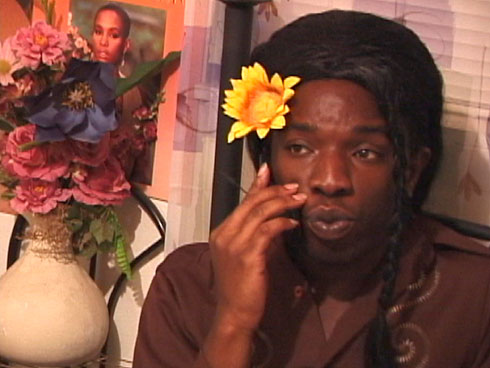
We’re interviewing all the candidates for Superior Court judge in San Francisco. Here’s Linda Colfax:
San Francisco
The Daily Blurgh: Bros before trolls
Curiosities, quirks, oddites, and items from around the Bay and beyond
For the love of God, iPad, or printed matter, please read former Guardian culture editor, and current lead editor of science and sci-fi wonderblog io9, Annalee Newitz’s eye-opening summary of the 5 ways the Google Book settlement will change the future of reading (one plus: “pulp science fiction will make a comeback in ways you might not expect”).
“It hurt the way your tongue hurts after you accidentally staple it to the wall.”
Early master of photography actually insane cuckold killer: “This commission took [Edweard Muybridge] out of San Francisco at a convenient moment: He’d recently murdered his young wife’s lover, but squeaked by with an acquittal in court — one part of his defense had been that only someone already unbalanced would take the risks that Muybridge did in Yosemite, just to get a picture.”
Meanwhile, still-living photo-snapper The Tens got a peek inside the bowels of Kink.com (h/t Mission Mission)
The Awl preaches bros before trolls: “Instead of shaking your Internetty fist at all that angers you though, what if you ignored it and discussed things that do work, things that are wonderful, and encouraged others to do the same?”
These gorgeous creatures – children of video artist and endless font of inspiration Kalup Linzy — are hitting Berkeley Art Museum tonight with support from DJ Bus Station John, starting at 6pm. Get it!
Park it here: an alterna-Dolores six pack
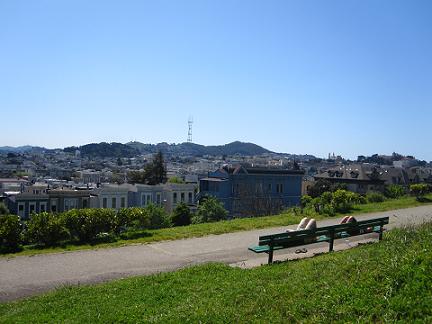
The other day, sharing the scrap of blanket space I was able to hustle between 1,000 of my Vitamin D deprived brethren, I spotted:
1. A green parrot. On a man’s shoulder.
2. A green python. Ditto, shoulders.
3. An LED light filled, fixed gear frame.
All in a ten foot radius. Freaky! Unique! Not very relaxing! Conclusion: I need a break from Dolo.
Luckily, I made a serendipitous discovery: there are other parks in San Francisco! Many, in fact. Here are some green spaces that are sunny, green, and relatively free of studied self imagery:
Alamo Square
Okay, so perhaps this won’t provide much respite from those hip cats and their big snakes — on a sunny day, Alamo is almost as flush with BBQs and irony as it’s neighbor in the Mission down South. But Alamo’s got the most iconic view in the city (if your icons, as mine, are based on early ‘90s sitcoms) and a really cool shoe garden by the public bathrooms.
Walk in at: Steiner & Hayes
Lafayette Square
One of the most intelligent ideas our city planners had was to put a park on nearly every peak in our city. Head up to Lafayette Square, deep in the heart of tony Pac Heights, and you can see their brillance manifested for yourself — a panoramic view of urban valleys, green hills. This park is where all the little old rich ladies go with their little old rich dogs, and its pristine lawns is aching for a little more infiltration by the prols.
Walk in at: Sacramento & Laguna, SF
Alta Plaza
One hill over, Alta Plaza is Lafayette’s only slightly less ritzy cousin. Most of the lawn space is on a terraced slant, perfect for when the sun is in the southern end of the sky. And should you get the yen to rise up and do something, Alta’s got superb tennis and basketball courts that are rarely occupied on weekdays.
Walk in at: Clay & Steiner, SF
Ocean Beach
Did you know that the western side of the city is lined by the Pacific Ocean? It’s true! And while Ocean Beach no longer features the amusement parks and boho repurposed streetcar villages, it’s still one of the coolest things about living here. Pick a sunny day (or a tempestuous one if you dig watching storm action in a solid coating of Gore-Tex) and post up between a couple dunes, where you chill in a little wind sheltered, clothing optional cove of your own. [note: nudity not really legal]
Walk in at: Judah & Great Highway, SF
Misson Creek Park
With all the UCSF construction in the neighborhood to the south, who knows how long it’ll stay this way, but for now, Mission Creek Park reminds me the river we used to escape to when I was in high school; a spot where we could swim that was still close enough to the city to be doable on a half day off. Don’t swim in Mission Creek (actually, do it! That’d be hilarious!). But you get what I mean, here’s a place to hang, eat, read, smoke that J — next to a river. Bliss.
Walk in at: Channel & 4th St.
Fillmore Center
Am I really blowing up the spot on this little oasis? Dang, I’m taking this whole journalism thing seriously. Consider yourself in on the greenest little patch of lawn in Western Addition — enter in through the snazzy plaza, and head straight past all the old people on benches to the wall of cascading water in back, which has a tranquil little pool and all the empty lawn space you need. All this solitude does come at a price though: BYO tamales and ganja treats.
Walk in at: Fillmore & O’Farrell
Candidates for judge: Harry Dorfman
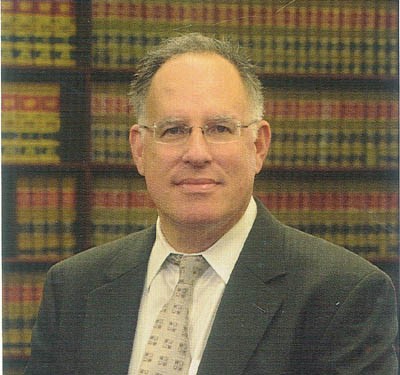
We’ve been interviewing candidates for the two contested judicial races in San Francisco, and posting the sound files. The most recent candidate is Harry Dorfman; you can listen to his comments here
Harry Dorfman by endorse
SF smokers kicked to curb, by the cars

By Adam Lesser
San Francisco smokers will be hit with the latest in a long lines of restrictions starting April 25, when they’ll be kicked to the curb, out by the cars whose tailpipes are at least as dangerous as secondhand smoke.
But drivers haven’t been as easy to demonize as smokers. Light up within 15 feet of a building entrance and you’ll be breaking the law. Other spots where smokers will be barred include outdoor areas at cafes and restaurants, farmer’s markets, and charity bingo games (grandma can take her wheelchair to the curb if she needs a puff).
But pot smokers need not fear. The new law maintains a provision allowing you to light up in licensed dispensaries. Smoking patios at bars are still okay, though smokers probably shouldn’t get too comfortable.
The San Francisco Department of Public Health frames the smoking debate in terms of the impacts of secondhand smoke. And there’s some good data there. People tend to think lungs and cancer when they think smoking, but the real problem with second hand smoke is heart attacks. A 2005 estimate from the California EPA put the number of heart attack deaths from second hand smoke at 3,600 annually. Second hand smoke contains a host of toxins from benzene to arsenic.
But it’s hard to know the incremental benefits of moving smokers to the curb. Almost all of the positive data on public health improvements from smoking bans has come from measures the city has already taken. But Mele Lau-Smith of DPH gave me a preview of the potential next battleground: third hand smoke.
“The new science that’s coming out on third hand smoke is interesting. Third hand smoke is everything that clings to furniture and hair and takes longer to dissipate. They’re smaller particles that get deeper into the lungs,” she says. The term was coined last year in the journal Pediatrics and a 2010 paper showed that nicotine reacts with nitrous acid to form carcinogenic molecules that hang around long after a smoker has left the room.
So the news gets worse for smokers, and the anti-smoking crusade to completely eliminate smoking gains an inch. The smoking prevalence rate in California is among the lowest in the country at 14.3 percent. Most states are in the 18-20 percent range.
And while it’s all well and good, one wonders if there are other problems in the air besides second hand smoke. Choosing to live in an urban area like San Francisco lowers one’s life expectancy by two years, and one of the major reasons for that is auto exhaust and illnesses related to poorer air quality.
Mark Jacobson, Professor of Civil and Environmental Engineering at Stanford University, believes the government should keep regulating until smoking is eliminated. But when comparing deaths from automobile emissions versus second hand smoke, he added, “If you look at the mass of the automobile exhaust, then you’re looking at a much bigger figure than second hand smoke. Vehicle exhaust is still way under regulated for addressing health concerns.” Over 2 million people die globally from air pollution each year. About 500,000 die from second hand smoke.
In the end, Jacobson says it comes down to combustion. When you start burning, you release toxins that eventually hurt or kill people. It doesn’t matter if it’s diesel fuel, gasoline, or tobacco. Combustible products harm public health, and in the case of oil, the environment.
Smokers have proven ideal targets for taxes. San Francisco smokers pay $2.08 in taxes on every pack of cigarettes. When you’re in the minority and the government needs cash, it’s a political no brainer. A 20 cent cigarette tax was tacked on by the Board of Supervisors last October, done under the argument that the money was needed to clean up cigarette butts. Recent proposals to add a local 10 cent tax on gasoline in order to help various cash strapped public transit agencies haven’t found much traction.
So smokers, enjoy the summer. It’ll be the last summer you can light up after an outdoor sunset meal. The smoking ban at restaurants won’t be implemented for another six months.
But come November you’ll be enjoying that smoke out by the curb, where you’ll also be treated to some car exhaust. But, hey, at this point you’re probably all in anyways.
The problem with Park Merced

It’s no secret that Park Merced, the sorta-suburban mega-housing complex in the southwest corner of the city, wants to expand. New mid-rise towers would house some 7,000 apartments, with space for maybe 12,000 new residents — which is fine if you like the idea of more rental housing in the city (although much of it not affordable). But it also means a huge amount of new traffic in the area, particularly on 19th Avenue, which is pretty crowded as it is.
Now, the developer and the city talk about adding new transit to the area — an underground Muni rail station at Park Merced, more buses, all that good stuff. Sup. Sean Elsebernd, who represents the district, is (properly) demanding it.
But here’s the hitch: Never once in the history of this city has a major new development paid enough fees or brought enough money into the city to pay for the infrastructure required to serve it. And that’s going to get even worse if the mayor gets his way and defers development fees.
The cost of the level of transit necessary to serve the new residents of Park Merced, along with the expanded number of students at San Francisco State, and the expansion of the Stonestown shopping center, is gong to be massive. Park Merced may pay to build a new station — but the developer won’t pay for the cost of buying new buses and trains, hiring operators, and paying them. The increased property tax revenue from the project won’t cover that, either — particularly since it also has to cover water and sewer expansion, police and fire expansion, new schools and parks, and all the other expensive things that 7,000 new residents will want.
I don’t think the city’s even come close to figuring out the total bill for all the infrastructure improvements this project will require. Let’s add that up first — before the city issues any permits — and present the developer with the bill. Then we can decide if this project is a good idea.
Holy smokes, could it be… the biggest SF mural ever?
The answer is yes, yes it will be. And how did the madness begin? “I was in the neighborhood and I saw this wall. And me being me, I got really excited and wanted to paint it.” And so it started, Brian Barneclo’s latest SOMA mural project, whose launch will be celebrated alongside “Systematics,” his solo (indoor art) show at fabric8 on Sat/10.
See a wall, paint it; It’s a common enough story in SF — until you look at one small variable; Barneclo’s wall is 600 feet long and 40 feet tall. And he intends to cover the whole thing. That’s 24,000 square feet, making Barneclo’s “Systems” the largest mural yet in a town filled with them. “That was recently pointed out to me,” he told me in a recent interview. “It’s an interesting thing because, yeah, its going to be helpful [for fundraising], people like to hear that stuff, ‘it’s the loudest, it’s the biggest.’ But it really has no… [the size] is such a byproduct.”
Barneclo’s known for his ambitious projects. The artist — in whose aesthetic fabric8 gallery owner and long time associate, Olivia Ongpin, detects traces of both the Mission school and the Bay area figurative movement from the ’50s and ’60s — has installed large scale pieces all over town, from Nopa, to the inner Mission, even on the side of our humble Guardian building. His most well known works are urban cultural/architectural jumbles, representational maps of the iconic streetlamps, restaurants, and skylines that we call our city. “Systems” will be a reflection of Barneclo’s recent meditations on interconnectivity; in our society, our city, and in our own bodies.

A mock up of “Systems,” slated to be completed by June
It’s easy to see why this particular wall caught the muralist’s eye. The 7th St. and Townsend building, owned by Crescent Cove Apartments, plays a visible role in the neighborhood. Barncelo’s wall can be seen from both I-80 commuters and Caltrain passengers, the train tracks passing at the wall’s base. Barneclo thinks it’s high time such a prominent canvass was utilized for art. “I think when we’re done, people will be like, ‘I can’t imagine that without a mural.”
But the mural’s not done yet. There’s the matter of funding, though Barneclo has already secured a $10,000 grant from Adobe and thinks “people are inclined to get behind the project once they see some action happening.” Barneclo has already put in nearly two years of permission getting and permit securing into the project, along with partner Christi Azevedo. And of course, there’s still a whole lot of wall to be painted.
But that will be the easy part. Barneclo completed “Food Chain,” his 200 by 25 foot mural on Shotwell between 14th and 15th Street in ten days, with only one helper. His goal is to maintain that same pace for “Systems,” completing the mega mural in one month with a team of three helpers. Barneclo doesn’t sound too stressed about the task ahead. “I’ll sleep when I’m dead. If I have a chance to take a month and paint one big mural, what more can I ask for? I mean, my girlfriend probably won’t like it, it’s probably going to be all I’m talking about and thinking about.”
Will he make it? Ongpin thinks so. “This might seem like a daunting prospect,” she said. “But if you look at the scope, and amount of murals he’s done around the city for the past six or seven years, I’m sure he can do it and do it well.”
So get ready, San Francisco, because “Systems” is set to be one of the first things some commuters see when they hit SOMA. “It’s almost a welcome to SF to people who are riding the train,” Barneclo imagines. “Or a farewell. Its like a port. Treat it like a “Boom! Welcome to San Francisco.”
Brian Barneclo‘s “Systems” Mural launch party/ “Systemics” exhibition
Sat/10 5-9 p.m., free
Fabric8 Gallery
3318 22nd St., SF
(415) 647-5888
Force is the weapon of the weak: decrying the right’s violent rhetoric

American political discourse is being poisoned by some truly scary rhetoric from the right-wing, which is increasingly resorting to threats and condoning of violence, a trend that has played out in recent weeks right here on the Guardian’s Politics blog. Now is the time to recognize and stop it, just as a new coalition is calling for.
San Francisco resident Greg Lee Giusti was arraigned in federal court this morning for making threatening phone calls to House Speaker Nancy Pelosi, one day after the arrest of Charles Alan Wilson for threatening to kill Sen. Patty Murray (D-Wash.). In both cases, the subject was the recent health care reform bill, the anger of the suspects stoked by misinformation and inflammatory rhetoric from top conservative politicians and media figures, as well as the Tea Party movement.
But these cases – along with the recent domestic terrorism plot by Christian fundamentalists and other incidents of overt and implied threats of violence – aren’t isolated examples; they are closer to the norm of rhetoric emanating from the right-wing these days, a trend not seen in this country since the months that led up to the bombing of the Oklahoma City federal building by right-wing radical Timothy McVeigh, the biggest act of domestic terrorism before 9/11.
Consider Giusti, who also wrote a scary letter to me and the Guardian in the midst of his threats against Pelosi, taking issue with our recent cover story that was critical of police crackdowns on SF nightlife. In additional to praising police violence and encouraging cops to “crack a few skulls open,” just like his NYPD cop uncle, who “knows how to inflect [sic] excruciating Paine [sic] on someone without leaving any signs of what happened.”
But Giusti was far from alone in promoting violence over the issues we’ve raised. SFPD Southern Station Capt. Daniel McDonough praised the sometimes-violent tactics of the two undercover cops who bust parties and nightclubs, strongly implying those tactics were justified to counter the unspecified threats of violence that nightclubs represent. “Because of their diligence and professionalism the amount of violence and disorder has been reduced,” McDonough wrote, echoing a troubling strain of right-wing political thought that condones violence to prevent even speculative threats of violence, a perspective that led us to invade Iraq.
And when I wrote about McDonough’s response yesterday, a commenter wrote that aggressive police tactics are justified because, “The unprecedented ascendancy of nightclubs and violation of the Constitutional rights of residents to peaceful use of their property calls for drastic measures.”
In a similar vein, our blog post this week on a newly released video of American soldiers in a helicopter opening fire on a crowd in Baghdad that included journalists and children while making disturbing comments that seemed to relish the opportunity to kill people also provoked some equally disturbing comments.
“So a couple of journalists embedded with terrorists killing Americans got wiped out…congrats to the shooters! A couple of terrorists in training got shot up in a terrorist rescue attempt…congrats to the shooters! Everyone on scene who died got what was coming to them,” one wrote, while another warned, “Raise a weapon against America or Americans and prepare to experience the worst day in the rest of your life. Hoowa!”
Even though the helicopter was miles away and the video showed no credible threats toward it or anyone else, supporters of the war seemed to think that quickly resorting to violence is acceptable. “This is the price we pay for are [sic] freedom. put yourself in that chopper and then put yourself on the ground they all no [sic] what can and will happen. It will happen at home again 911 just give it time. We will do are [sic] best to defend are [sic] country. GOD BLESS USA.”
And I will do my best to defend this country from right-wing extremists. That effort starts with challenging Sarah Palin’s winking exhortation for her followers to “lock and load,” and with letting commentators like Glenn Beck and Bill O’Reilly, on a nightly basis, cast liberals as enemies of the state to their well-armed listeners.
This is simply not OK, a point that’s being made by the prosecutors of Giusti and Wilson, as well as the new Stop Domestic Terrorism campaign by a coalition of organization concerns about the increasing violent rhetoric of the rights.
“Law abiding Americans do not advocate violence against fellow Americans,” campaign spokesperson Brad Friedman said in a public statement. “As Americans, we all need to engage in a vigorous debate of the issues based on facts and reason rather than fear and prejudice.”
But even in San Francisco, it’s common for conservatives and so-called “moderates” to condone violence against the homeless, drug users, petty criminals, ravers, Critical Mass bicyclists, “illegal immigrants,” or others that they dismiss as “getting what’s coming to them” for daring to violate laws or social mores. I’ve personally had violence wished on me more times than I can count, in letters, phone messages, and to my face.
As a full-time newspaper journalist for almost 20 years, I’ve dealt with right-wing crazies for a long time, but there are times when you can sense their indignation getting ratcheted up to dangerous levels. In 1994, I wrote stories for the Auburn Journal and Sacramento News & Review about right-wing “patriots” and “constitutionalists” that were part of the militia movement in Placer County.
They warned me that then-President Bill Clinton was an agent of the “New World Order” who was plotting a socialist takeover of the “real Americans,” and that violent resistance was necessary. They spun elaborate fantasies about the impending civil war, which they said the federal government had already started with their raids in Ruby Ridge and Waco.
“You won’t be able to write an article like this anymore because the government will come and kick in your door and murder you and your children,” one militia member told me after my first article came out.
On April 19 of the next year, while I was working for the Santa Maria Times, I remember vividly when the federal building in Oklahoma City was bombed, killing 168 people. For the first 24 hours, most media outlets speculated that it was an attack by terrorists from the Middle East, but as soon as I heard it was the anniversary of the Waco incident, I knew exactly who was really responsible: the dangerous right wing extremism that pushed militia member Timothy McVeigh to attack his own country.
And now, it’s happening again. Overheated rhetoric on the right is casting Pelosi and fellow Democrats not just as political opponents, but as dangerous enemies of the “real Americans” that Palin claims to champion. They have, like Wilson said of Murray, “ a target on her back.”
When Sen. Leland Yee tried to find out how much Palin was being paid to speak at California State University-Stanislaus, he was aggressively attacked by her acolytes for trying to “take away her constitutional right to free speech,” according to an anonymous message left on his answering message yesterday, which his office shared with the Guardian. “Maybe we ought to have a homosexual with a long enough dick so he can stick it up his ass and fuck himself while he’s on stage giving a speech.”
Such crass, semi-literate, weirdly homophobic comments might be funny if they weren’t part of a larger, more dangerous trend in this country. Once again, a Democratic president is being actively accused of treasonous hostility to “real Americans” by major conservative figures with huge audiences, and once again, the lunatic fringe is being worked up into a frenzy.
The recently uncovered plot by Michigan militia members to murder police officers in the hopes of starting a holy war with the enemies of Christianity is just one indication for what this kind of rhetoric is leading to in isolated pockets around the country. Now is the time to put a stop to condoning violence in any of its forms, whether it’s cops cracking the skulls of clubbers or street denizens, soldiers firing on crowds of people, or citizens threatening our elected representatives.
“Force is the weapon of the weak,” said the radical pacifist-anarchist Ammon Hennacy, a quote that was often repeated by folk singer and progressive writer Utah Phillips, who I had the honor of covering at the same time I was covering the militia movement. It’s true, and at this difficult moment in our country’s history, let’s all try to stay strong.
The Daily Blurgh: Stick a Bjork in it
Curiosities, quirks, oddites, and items from around the Bay and beyond
So what if the Fader posted this last week? Vallejo royalty E-40’s new Bjork-sampling track, the Droop-E produced, “Spend the Night” is too fabulous not to share (and it looks like the NY Times likes it too). The icing on the cake is that Bjork cleared the samples, taken from “Oceanea” off of her, IMHO severely underrated, acapella album Medulla. And as Fader commenter bollocks noted, this isn’t the first time Queen B has appeared on a local hip-hop track. The timpani-heavy riff from “Human Behavior” was used back in 2003, “by Bay Area legends Hieroglyphics, for ‘Let It Roll,’ off their classic album Full Circle.” Thanks for the knowledge.
I bet I can guess what you’re doing on your coffee break. Wheee!
Slog nicely sums up the cases of Gregory Lee Giusti, who was arrested yesterday for allegedly threatening House Speaker Nancy Pelosi over her support of the health care reform bill (he threatened us too), and Charles Alan Wilson, who allegedly threatened to kill Washington Senator Patty Murray over her support of the health care reform bill, best: “Powerful Women, and the Men Who Threaten Them.”

“Let’s just say that if Malcolm breathes, it’s too much for me to stomach.” Johnny Rotten on the Sex Pistols’ former manager Malcom McLaren. RIP, Madame Butterfly Buffalo Gal Duck Rock. (Watch all three simultaneously for our version of heaven?)
Researchers at UCSF School of Pharmacy want you to know that the bacteria in that tainted burger patty could become the next Monet.
Tonight, SFMOMA presents “Streets of San Francisco: Filmic Journeys,” a program of over 50 years of footage of SF’s streets as filmed by the many wonderful experimental filmmakers – including Martha Rosler, Hollis Frampton, Lawrence Jordan, and more – who have called this city home and muse. 50 footage!
Recology can’t have it both ways

Critics of San Francisco’s plan to award Recology the city’s trash disposal contract just alerted me to the curious fact that if you watch this video link (scroll down through the video clips to “Garbage 2”), you’ll hear Recology COO George McGrath say that rail haul in California isn’t economically viable.
The link features three excerpts of a August 2009 hearing in Humboldt County regarding rail hauling of Bay Area waste to Winnemucca, Nevada–a plan that got blocked this week.
And as critics of San Francisco’s plan note, that’s a curious thing for McGrath to say in Nevada given that Recology is proposing to haul San Francisco’s trash by rail to the Ostrom Road landfill in Yuba County, which is a 238-mile round trip.
Recology spokesperson Adam Alberti told me that while he hasn’t viewed the video in question, he believes folks are taking McGrath’s comments out of context, since McGrath wasn’t talking about the San Francisco proposal.
“In this particular case,” Alberti said, referring to the San Francisco contract, “rail works fine. Clearly pricing on rail was superior and allowed us the recommendation based on that grading criteria.”
“At the end of the day,” Alberti said, turning the focus back on Waste Management, Recology’s main competition for the San Francisco landfill disposal contract, “we are looking at a very monied competitor who wants the business. Our proposal is recommended by the City and County of San Francisco as the best cost alternative and, we believe, the most environmentally sustainable.”
SFPD’s Capt. McDonough defends rogue cops

The San Francisco Police Department has steadfastly tried to ignore back-to-back cover stories in the Bay Guardian and SF Weekly that detailed the campaign of harassment and brutality against nightclubs and parties in SoMa by a pair of undercover cops.
The fact that those two cops – SFPC Officer Larry Bertrand and state agent Michelle Ott – have reportedly been absent from the scene in recent weeks might indicate that the department has heeded the outcry and put a leash on them. But now, in the “Captain’s Comments” in today’s Southern Station Newsletter, Capt. Daniel McDonough – who, along with Commander James Dudley, is believed by nightlife advocates to be behind the crackdown – has issued a full-throated defense of the pair’s actions.
Despite the fact that those actions (including repeated and selective harassment of certain clubs, illegal property seizures, threats and retaliation against complainants, and unnecessary force) have resulted in multiple legal actions against the city, McDonough claims they have somehow prevented unspecified “problems” and “violence and disorder.”
That negative claim is impossible to prove or disprove, but it’s certainly true that it was the arrival of aggressive cops at a January party that we wrote about that precipitated the “violence and disorder” that night.
McDonough writes, in full:
There has been a recent deluge of articles about Nightlife in the Southern District. The articles particularly focused on two fine individuals, Officer Bertrand of Southern Station and Agent Ott of the Alcoholic Beverage Commission. (ABC)
One thing the articles didn’t have to focus on was the amount of violence occurring in the District at the late night venues. This I believe has been directly related to the good work of these dedicated Officers. In conjunction with the members of Southern Station, Officer Bertrand and Agent Ott would regularly inspect nightclubs and bars to ensure compliance with laws and codes that have been enacted to have an orderly establishment and to also stop the rampant amount of unpermitted parties that would arguably cause problems. Because of their diligence and professionalism the amount of violence and disorder has been reduced. Establishments that routinely would have numerous calls for services started to take responsibility to handle the influx of people and establish security procedures. The benefits reaped by the citizens of San Francisco by the actions of Officer Bertrand and Agent Ott are measured in the lack of homicides shootings and knifings that haven’t occurred because of their good work. They are to be commended. I would also like to thank all of those establishment owners who communicate to me their positive relationships with those two officers.
Community Meeting
Wednesday April 21 2010 6pm
Community Room
South Beach Harbor Pier 40
The Daily Blurgh: The true price of free food tattoos

Curiosities, quirks, oddites, and items from around the Bay and beyond
A. E. Housman (who once deliciously referred to poetry as a “morbid secretion”) said, “Perfect understanding will sometimes almost extinguish pleasure. ” And as John McWhorter so ably demonstrates, Sarah Palin’s words — or at least the art of parsing them — can be extremely pleasurable:
“This reminds me of toddlers who speak from inside their own experience in a related way: they will come up to you and comment about something said by a neighbor you’ve never met, or recount to you the plot of an episode of a TV show they have no way of knowing you’ve ever heard of. Palin strings her words together as if she were doing it for herself — meanings float by, and she translates them into syntax in whatever way works, regardless of how other people making public statements do it.”
She’s no delicate petal-pusher. How pretty are the state’s highway medians at this time of year? Check the Desert Wildflower report for daily updates.
No it’s not clip art. That twilight landscape on your iPad desktop was actually shot by a local. (h/t to Boing Boing)
“A San Francisco eatery has convinced some customers to get tattoos in exchange for free food for life.” Hint: It’s not Michael Mina — but possibly a replay of the great burrito tattoo “disaster” of 1999.

This was supposed to be worth $5.8 million at the time. Like Gezundheit.com
An addendum to yesterday’s esteemed guest columnist: the New York Times’ Bay Area blog (the nerve!) ran a profile yesterday of Glendon Hyde, aka our favorite punk rock dragtavist, Anna Conda. She knows from first hand experience what gets lost – and more importantly, who gets displaced — when a gayborhood becomes just a neighborhood. Granted, Polk Street’s de-gayification has been happening for decades now (the pink flight to the Castro began around the mid-to-late 60s), and is just one part of the long, ongoing story of gentrification in the TL. Still, Anna/Glendon’s efforts to “Take back the Polk,” and now, her current campaign for the District 6 supervisor’s seat, should serve as rebukes to Katz’s patronizing mourning of communities that he was only superficially invested in.
Finally, in honor of Lady Day would have been 95 today I’ll leave you with this:
http://www.youtube.com/watch?v=h4ZyuULy9zs
Tricia Taborn, a great San Francisco spirit, died today
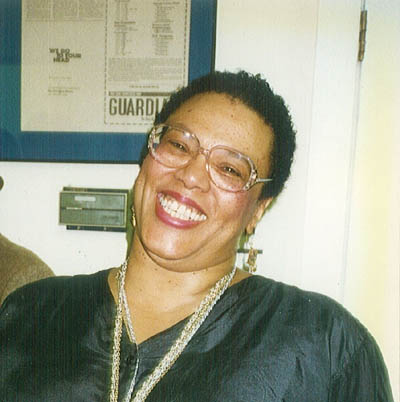
I was saddened to hear that my former associate of many years, Tricia Taborn, died today (April 7) of cancer at Kaiser Hospital in Oakland.
She was four days shy of her 62nd birthday.
She entered the hospital on Saturday (April 3). Her mother Neomi flew out from Dallas, Texas, to be with her the last few days. Her sister Ginny, her two brothers Kenneth and Michael and her husband Gerald Baron were with her when she died.
Tricia worked for me as assistant to the publisher from July of 1993 to April of 2000.
I always marveled at how she could jump into things and make them work. Her friends and family say that she has been doing that throughout her life. When she came to the Guardian, she had no newspaper or journalism experience, yet she quickly fit in and
became a valuable employee able to handle most any administrative job that came along. She kept me organized and she organized an endless series of events at the Guardian that included five annual awards contests and ceremonies (poetry, photography, cartoons, short stories, film treatments) that she structured to reflect the rich cultural diversity and artistic talent in San Francisco.
She also put on major events and dinners for the Northern California chapter of the Society of Professional Journalists and the California Freedom of Information Coalition during its early days. She loved being a hostess and she did so with flair, a rollicking laugh, flamboyant hats and an ability to make the event important and distinctive and to see that everyone was welcome and having fun. She served for several years as a director and treasurer of SPJ.
Victoria McDonnell, a friend that Tricia talked with almost every day on the phone, agreed that Tricia liked to jump into things.
“I know she joined her high school year book committee in Florida soon after arriving at the school. In San Francisco, she did this at Major Ponds (a jazz club where she worked as a bartender in the late 1970s and early 1980s), the Bay Guardian, the Industry Standard (the late dot.com magazine), OneWorld Health, and lastly selling real estate.
“Tricia was the first employee for One World Health, It started out at (founder) Victoria Hale’s house and grew to be a world-wide multimillion dollar non profit pharmaceutical company. The first ever non-profit pharmaceutical company in fact. Tricia thrived on ‘start ups.'”
Victoria Hale said that Tricia was “an amazing woman who accomplished much, despite the obstacles, with humor and passion, while caring for others. She had an especially good relationship with the Indian physicians who worked on leishmaniasis. She demonstrated much courage and trust by becoming the first employee of OneWorld Health, while still on the first floor of our house.”
Tricia lived in Florida, Utah, Atlanta, Dallas, and other places because her father Raymond Taborn was an aeronautical engineer and moved about because of his work. She bought a house in Berkeley in 2004 with her husband Gerald Baron.
For the last two years of her life, Tricia lived her dream: getting her independence by selling real estate and having fun doing it. She worked in the Berkeley office of Coldwell Banker, specializing in low price housing that many real estate people avoided. She was recently recognized as the top sales person in her office. Her main hobby, according to her friends, was shopping and she was well known at Nordstroms, Macys and Ross department stores, as well as thrift shops and farmer’s markets.
Tricia was diagnosed in November with metastatic colon cancer. Over the last two months she rallied and was able to spend time and phone calls talking to her friends and “wrapping up her relationships in a positive and meaningful way,” as Victoria Hale put it.
Invariably, her friends reported that Tricia remained upbeat until she went into the hospital for the last time.
She leaves her mother Neomi Taborn of Dallas, a sister Ginny of Dallas, two brothers, Kenneth of Arlington, Texas, and Michael of Phoenix, Arizona, her husband Gerald Baron, and Tommy, her beloved cat. Services are pending and will be reported on this blog when they are set.
The shit show’s extended run

By Brady Welch
You really can’t make this shit up, people. Since we last reported on the shit show which had gone cross-bay all the way to Alice Waters’ backyard, further accusations have been lobbed, acid press releases have issued forth, and now there’s even a “legal complaint” against, get this, the UK’s Guardian newspaper.
Francesca Vietor, executive director of the Chez Panisse Foundation and vice president at the center of the San Francisco Public Utilities Commission, the agency at the center of this mess, has filed contested a story in the Guardian,” with that paper including the line “This article is the subject of a legal complaint made by Fransesca Vietor” at the top of its article online. What seems to be at issue is a line that states that the SFPUC’s giveaway “was overseen” by Vietor. While that’s exactly the claim that the Organic Consumers Association has made on its website and in press releases, its probably more accurate to say she was a member of the board that oversees the agency that oversees the program.
In an April 1 statement by the Chez Panisse Foundation (issued the day of the OCA’s original but sparsely attended protest), the organization claimed that, “Ms. Vietor has never promoted the SFPUC program. In fact, as soon as [the OCA] brought the program to her attention, Ms. Vietor asked the staff of the SFPUC to do three things,” which the statement lists as putting the program on hold, conducting additional testing, and issuing a public call for alternative solutions. The first has been put into effect (a fact curiously absent from today’s belated San Francisco Chronicle story on the subject), but as far as we can tell, the last two are still waiting to happen.
Nevertheless, while we’re willing to grant Vietor the benefit of the doubt regarding her initial ignorance about the giveaway program (and then successfully suspending it), what’s still troubling is that it was an outside advocacy group that had to bring the program to her attention in the first place. She’s the vice president of the SFPUC after all, and the compost giveaways were a very public campaign.
It’s one thing if Berkshire Hathaway CEO Warren Buffet claims he didn’t know Fruit of the Loom, a Berkshire-owned company, was using, say, endangered albino chimpanzee pelts in its trademark tighty-whities (which we’re not saying, so put down that lawsuit, Warren). But it’s quite another when the VP of the SFPUC board of commissioners (and executive director of the Chez Panisse foundation, as well as former director of the SF Department of the Environment) didn’t know about her agency’s program to greenwash sewage sludge and give it to the city’s gardeners. We’re not saying Vietor lied. We’re just suggesting that maybe she should have read her company emails. Or at least picked up the newspaper.
The Chez Panisse Foundation, for their part, has asked for a public apology for what they take to be the slanderous charges of the Organic Consumers Association. But if we know the OCA, and we’ve talked to them many times on the phone, this is unlikely to happen.
As far as we’re concerned, the most important thing in the matter is that the program be suspended—something which the OCA, the Center for Food Safety, and apparently, Vietor herself, all sought, and succeeded in doing. The second most important thing is putting all the issues and stakeholders out in the open, which if nothing else, our continued reporting of the story has attempted to do. And while this shit is beginning to get a little bit old, and perhaps less odorous, the Guardian will continue to keep you posted.
Man who threatened Pelosi sent hate mail to Guardian
Remember when we told you about that very special piece of fan mail from the guy who didn’t like our cover story about undercover cops targeting San Francisco nightlife?
Well, he appears to be the same person who just got picked up by the FBI for making threatening and harrassing phone calls to House Speaker Nancy Pelosi.
“[Federal officials] said he recited her home address and said if she wanted to see it again, she would not support the health care overhaul bill that since has been enacted,” according to the Chron piece about his arrest.
We didn’t publish his name with the post, because we weren’t able to verify his identity. But the name signed at the end of the email sent to the Guardian was Greg Giusti, and the Chronicle names Gregory Lee Giusti, 48, as the man who was arrested in San Francisco this afternoon after threatening Pelosi.
In his email to us, Giusti included the phrase “that ugly witch Nancy Pelosi.”
Some of our readers commenting on his over-the-top letter, which contained racist and homophobic language, wondered if it was some kind of joke. We wondered about that, too.
But as we wrote in our post, “Receiving a letter crammed with hate-filled speech while witnessing pockets of far-right extremists grab headlines, we thought it best not to ignore it, but to call attention to it.”
Part of the solution

Caitlin@sfbg.com
CAREERS AND ED Just a thought. As our country becomes an economic-cultural stew fraught with problems so complex we don’t even know yet what they are, different approaches to education may be necessary for tomorrow’s good guys. Which is why it’s so positive that Bay Area higher ed institutions have developed unique degree programs that anticipate tomorrow’s issues today. From robot wars to social stratification — learn about this stuff and you’ve got the skills you need for the battles to come.
PHILIPPINE STUDIES
Rare is the program in our country that offers a concentration in the culture and history of the Philippines. But with 40,072 Filipinos in the Bay Area, that’s an oversight USF was happy to correct with this concentration, which can be paired with any of its undergraduate degrees to create a Filipino context within science, art, nursing, or the humanities.
University of San Francisco, 2130 Fulton, SF. (415) 422-5555, www.usfca.edu
LABOR AND COMMUNITY STUDIES
This associate degree program focuses on giving working people the educational background they need to be effective in the world of labor union activism — collective bargaining, labor law, and workplace discrimination issues, among other things. The school also runs not-for-credit programs that link minority students and workers up with job training for careers in the trades. Kicking ass for the working class, and all that.
City College of San Francisco, Evans Campus, 1400 Evans, SF. (415) 550-4459
TRANSFORMATIVE LEADERSHIP
On the slightly less tangible end of the spectrum, the California Institute for Integral Studies offers an online master’s degree program for “personal transformation and creating positive change in the world.” Courses focus on group mediation, identifying one’s own strengths and weaknesses, and effective leadership. Let Your Love Shine 101 (for professionals).
California Institute for Integral Studies, 1453 Mission, SF. (415) 575-6100, www.ciis.edu
EQUITY AND SOCIAL JUSTICE IN EDUCATION
There’s no way an equitable educational system wouldn’t improve this crazy old country of ours. To that end, the future teachers and leaders in this concentration of the master’s program in education study historical/political perspectives of injustice in schools, with a mind to changing things about the way Americans learn.
San Francisco State University, 1600 Holloway, SF. (415) 338-1111, www.sfsu.ca
DISABILITY STUDIES
A unique minor at Berkeley examines how the concept of disability has been shaped and created by our social constructs over time. Attention is also paid to how the interpretation of disability has been highlighted in law, art, and politics. The Web site on the study features a wheelchair basketball league open to all comers regardless of bodily capabilities.
University of California Berkeley, Berk. (415) 643-7691, www.berkeley.edu
COMPUTER GAME DESIGN
Look, not everything in the future’s gonna be heavy! We’re still gonna need people who are real good at making blood look realistic and keeping a step ahead of everyone’s World of Warcraft avatars. The students in this undergraduate major have seen the light: if we don’t master the machines, they master us.
University of California Santa Cruz, 1156 High, Santa Cruz. (831) 459-0111, www.ucsc.edu
Recology’s Nevada landfill blocked

The Las Vegas Review-Journal is reporting that the Planning Commission in Humboldt County, Nevada blocked Recology’s landfill expansion application in Winnemucca, which is halfway between San Francisco and Salt Lake City.
The news comes close on the heels of the Guardian’s report that San Francisco has tentatively selected Recology to dispose of the city’s waste in Yuba County.
The LVRJ articles notes that “Recology wants to haul in 4,000 tons of garbage a day from Northern California communities for the next 95 years and dump it on the desert playa about 28 miles west of Winnemucca.”
Adam Alberti, a spokesman for Recology and the Jungo Land Co., is quoted as saying that the commission’s decision “could cost the region more than $660 million and new jobs.”
And U.S. Senate Majority Leader Harry Reid, D-Nev., is quoted as calling the proposed dump a threat to Nevada’s “sovereignty and dignity.”
“The proposal to dump a mountain of California trash in Nevada is a lose-lose proposition for our state,” Reid said. “The people of Humboldt County have made it clear they don’t want other states dumping trash in their backyards, and I applaud their decision. “
Asked if there was a connection between the proposed Nevada dump and San Francisco’s trash, given that the city is only proposing a ten-year contract with Recology in Yuba County, Alberti said the landfill Recology was pursuing in Nevada is a “speculative effort” and that San Francisco “prohibits its waste from being taken out of state.”
“Recology has no contract in Winnemucca, and you have to have a landfill open before you can enter into a contract,” he said.
Here in San Francisco, District 10 candidate Eric Smith said he wants to see a whole lot more light being shone on the debate about what to do with the city’s trash.
“There needs to more transparency and accountability in the debate, which needs to include looking at all aspects of the issue, including where and how we transport our trash,” Smith said. “Should we barge, rail or truck it? What are the economic and environmental consequences? And is this something the citizens and ratepayers of San Francisco can support? Instead, there appear to be three main companies duking it out under cloak of darkness.”
Keep the faith
arts@sfbg.com
MUSIC My original topic for this article was how indie-rock artists exploit modern R&B and soul music for their nefarious gains. I planned to center my rage at Village Voice “Pazz & Jop” doofuses who ignore future soul overachievers like Sa-Ra Creative Partners; random idiots who bop around to the likes of Trey Songz and T-Pain in ironic, condescending fashion; rock-crit gatekeepers like Pitchfork’s Scott Plagenhoef, who claimed on ilovemusic.com that “I think your best bet is to turn music crit readers into R&B fans, not R&B fans into music crit readers,” as if R&B fans (re: black people?) aren’t smart enough to develop critical philosophy; recidivists who shill for mercury-laden masterpieces like Iggy Pop’s Funhouse and Weezer’s Pinkerton while shunning slickly produced wonders like Aretha Franklin’s Sparkle and Mary J. Blige’s My Life; and any dumbass who wails about how great Motown and Stax 45s are but stubbornly blocks them from the all-important Great Rock Albums canon, arguing that soul artists make classic singles, but not classic albums (in other words, sit in the back of the bus).
The turning point for my paranoid hipster conspiracy would be Little Dragon, who will conveniently return to San Francisco on April 14 for a gig at the Independent. Hailing from Sweden, Little Dragon fuses neo-soul and R&B with the whimsicality of electronic pop. So, for several minutes, I asked lead singer Yukimi Nagano to pick apart Little Dragon’s sound. It seemed silly in retrospect, and not just because Little Dragon already does that on its Web site. Nagano exudes a cool serenity that tames you like Pixar movies temper sugar-addled children and grownups. Focusing on her influences feels like analyzing the computers Pixar uses — worthwhile from a factual standpoint, but ultimately missing the point.
“My favorites were Faith Evans and Brandy, then also a lot of classics like Prince. I love Erykah Badu and a bunch of different stuff,” Nagano said. She and her bandmates — Erik Bodin, Frederik Wallin, and Hakan Wirenstrand — write songs in the classic pop format, blending in “electronic sounds and electronic music because you can experiment so much with it. We have so many different influences, everything from South African house music to soul, R&B, hip-hop and whatever. All the guys produce, and everyone has their own character in writing, so that also gives our albums a lift. It’s not just one person making everything.” Nagano’s character, so to speak, “is that I try to be free in my writing. And people can hear the soul influences in my vocals, I guess.”
Little Dragon’s 2007 self-titled debut was full of slow-burning ballads that owed as much to modern R&B, with its singers’ penchant for subdued melisma and jazzy inflections, as to the synthesized blue tones of 1980s New Wave. “No love left in here/No love in this room/No love in my soul left for you,” she sang on “No Love,” her dourness seeping through the downbeat track. A poetic writer, she used her bandmates’ atmospheric melancholia to coin strangely elliptical lines: “Walking down the stairs, anonymous detached, on the corner I turn, I turn, I turn left.” Not surprisingly, there is homage of sorts to Billie Holiday in “Stormy Weather,” although the lyrics concern something else.
Last year’s Machine Dreams also had lollygaggers wandering aimlessly about, but the music was fuller and more vibrant. Instead of ballads with sad little keyboard riffs, there were panoplies of sounds, from the percussion titters of “A New” to the dense yet airy washes of “Fortune.” Much of the album is kookily uptempo, with clockwork rhythms reminiscent of Howard Jones and Thomas Dolby (in a good way). “Playing live [during the tour for the first album] made us want to pick up the tempo,” Nagano said. “We really love playing dance music. There’s nothing as great as seeing people dancing.”
As Little Dragon pushes in a new direction, the R&B sounds that once inspired them drift into the past. The band is listening to different stuff now, like Depeche Mode, DJ Cleo, and Gui Buratto. “Obviously the first album was written a long time ago, and it’s been a few years. Those songs were written even before 2007. They were already old for us then. Time has passed and you change.”
Machine Dreams is a qualitative leap from the debut album, which Nagano dismisses as “demos” that the group’s label, Peacefrog Records, released without their permission. (She was pleasantly surprised when audiences responded so well to it.) And if Little Dragon is better equipped to harness its current Kraftwerk obsession than the R&B passions of the past, then so be it. Regardless, the results don’t sound like anything else.
“I love music so much, and the guys do as well,” Nagano said. “You know how you get that kick from something you haven’t heard, and get inspired? It’s a great kick to have in your life. We want to find that as often as we can.” That seems painfully obvious to me. *
LITTLE DRAGON
With VV Brown, HOTTUB
Tues/13–Wed/14, 9 p.m., $20 ($30 for two days)
Independent
628 Divisadero, SF
(415) 771-1421
Way out Middle East
arts@sfbg.com
FILM One frontier in which Israel remains politically left-forward is that of gay rights. Civil marriage, military service, foreign-partner naturalization, and job discrimination issues are all much more progressively legislated than in the U.S. — let alone the rest of the Middle East, where flogging, prison, or even execution punish homosexual "crimes." Nonetheless, as in much of the world today, fundamentalist religious currents endanger progress already made and still being worked toward.
Three out of five films in the "Out in Israel" series at the Roxie deal with strife between gay and Orthodox religious communities. Copresented by San Francisco’s Jewish Film Festival, they’re all part of a larger lineup of April events assembled by the Israeli Consulate in honor of Israel’s Gay Pride Month.
The oldest feature here is from 1992, though it feels like 1972 — Amos Guttman’s 16mm-shot Amazing Grace has the technical simplicity and variably professional acting of early gay-themed movies from just about any nation, whatever their era. And like most such, it’s a downer in which everyone is depressed, isolated, and broke. Young Jonathan (Gal Hoyberger) is fed up, especially with his quarrelsome family and slutty ex-boyfriend, when he meets handsome new neighbor Thomas (Sharon Alexander). Unfortunately the New York City-returned older musician is more interested in using drugs than love to drown his HIV-positive self-pity.
Israel’s gay cinema pioneer, Guttman died of AIDS the following year at age 38 without achieving anything like the popular success that greeted Eytan Fox a decade later. Fox’s 2002 international breakthrough Yossi and Jagger, originally made for local TV, stars Ohad Knoller and Yehuda Levi as IDF officers stationed in a mountain bunker on the Lebanon border. They’re carrying on a giddy affair almost no one knows about till tragedy intervenes. But Avner Bernheimer’s astute screenplay is still only half done: the rest of Fox’s finest effort to date finds closeted grief exacerbated by psychological theft and stinging injustice.
Moving from secular to religious conflict, the remaining "Out in Israel" features focus on clashes with those who view homosexuality’s mere existence as an affront to God. Nitzan Giladi’s documentary Jerusalem Is Proud to Present (2007) opens with Jewish, Muslim, and Christian clerics — united at last — condemning the city’s planned hosting of the 2006 International World Pride Parade as "nothing less than the attempted spiritual rape of this holy city." Violent rioting by Orthodox sects, death threats to gay leaders, and more attempts to shut down the event before it happens, succeeding somewhat yet also prompting righteous obstinacy from the LGBT community. One can laugh queasily at the grandmotherly type who claims HIV infection will jump 300 percent because those gays "just grab people" for their "orgies." But you’ll want to sucker-punch the loudmouthed Brooklyn rabbi who flies in just to spew his smirking homophobia.
Two recent features illustrate the impasse between homosexuality and ultra-Orthodox values in intimate dramatic terms. Haim Tabakman’s debut feature, 2009’s Eyes Wide Open (the only series program with a ticket charge; all others are free), watches trouble brew when a kosher butcher (Zohar Shtrauss) grows dangerously fond of the alluring new assistant Ezri (Ran Danker), whose reputation as a "curse to righteous men" precedes him. While borderline mannered in its minimalist dialogue and direction, the film packs a potent
punch.
Contrastingly not at all interested in restraint is Avi Nesher’s The Secrets (2007), about two girls (Ania Bukstein, Michal Shtamler) discovering Sapphic love at a women’s seminary. They also embark on a secret program of ritual cleansings for a prison-released French murderess (Fanny Ardant, atypically hammy) dying of both cancer and heart disease. It’s too bad the series’ sole lesbian feature is so melodramatically over the top. Then again, it’s probably pretty tasteful by the standards of a director previously associated with schlock like 2000’s Raw Nerve (Mario Van Peebles meets Nicollette Sheridan!) and 2001’s Tales from the Crypt Presents: Voodoo.
OUT IN ISRAEL
April 8–29, free–$8
Roxie
3117 16th St, SF
culture@sfbg.com CAREERS AND ED It’s not everyone’s idea of a good time to be choked from behind and thrown into a wall repeatedly, although this is San Francisco. But this is no kinkster playground; rather, it’s an unprepossessing mirrored studio on the Nob end of the Tenderloin where a diverse group encompassing just about every age, gender, and athletic quotient gathers to learn the hand-to-hand combat and self-defense techniques of Krav Maga. Krav is martial without the art: crude but effective street-fighting techniques and counter-weight defenses honed into body memory through repetition, use of full force, and peer coaching. Unlike more rigidly codified martial arts systems, which put an emphasis on form and fair play, Krav puts an emphasis on “whatever it takes.” Whatever it takes to get home alive. And the tradition of Krav Maga — “contact combat” in Hebrew — takes that mantra very seriously. Developed in the 1930s by Slovakian boxer Imi Lichtenfeld to help Jews defend themselves from anti-Semitic attacks, the “Israeli jujitsu” technique was honed by the Israeli Defense Forces for military purposes. Krav Maga San Francisco, founded in 1999 and owned by brown belt Barny Foland, offers 70 classes, and prepares you for any untoward situations. A relative newcomer, I attend level one classes at Krav Maga San Francisco once or twice a week, schedule permitting. This week we’re learning to break free from a choke from behind, followed by a push. The first thing we learn when being thrown into a wall from behind is how to protect the face, blocking the impact with our forearms and turning our heads to the side. “That part’s pretty important,” our instructor quips. “You can’t see them now, because we painted over them, but there used to be blood spots on the wall where people bashed their noses.” Good to know. The next step is breaking the choke, and though the movement itself is not complicated, training it to feel intuitive takes longer. Basically, the chokee shoots an arm straight into the air and quick turns, breaking the hold through leverage. Of equal importance to the choke-break is the follow-though, defensive moves morphing into offense: hammer strikes, groin kicks, a few rapid-fire punches to the soft tissues. Without pads, we mime the strikes, which earlier we practiced at full force on unwieldy foam “shields”. The choking is real enough, though, as is the body-slam, and two days later, a tender spot the size of a thumb rests below my jawline, and bruises on my elbows attest to how I finally learned to not block with them. The hardwiring process and use of full-force is what inspired me to take Krav in the first place. I had already taken an IMPACT (www.impactbayarea.org) self-defense seminar, which taught me how to take a fall and fight hard from the ground. But Krav aims to keep students on their feet. I find the benefit to training face-to-face against my peers (instead of a “padded suit”) is two-fold. Firstly I learn to strike with force against a person whose face I can see, and secondly, I learn to absorb their blows, a crucial key to surviving a real-life attack. Taking the time to help each class member master every skill genuinely is a top priority at Krav Maga SF. I’ve attended aerobics classes that were more competitive. Foland assures me it’s the norm. “Anybody who wants to come in and train for competition, we send them down the street to the local kickboxing gym. You can be in a level one class and have level four students in there with you, and the only reason you would know it is because they’re really good, and they’re trying to help you learn. You show your skill by how much you help your partner.” Of course, folks looking for a more graceful, philosophy-based martial art might ultimately decide that Krav Maga is just too rough around the edges. I think of the earnest man who attended an intro session about a month ago. He’d been blocking well all night, but balked when our instructor urged us to aim our punches for the throat, in order to cause “the most amount of damage in the quickest amount of time.” “But couldn’t you damage someone permanently if you hit them in the Adam’s apple,” the man asked, concerned. “I didn’t start the fight, remember,” our instructor said firmly. “But I’m going to finish it.” KRAV MAGA SAN FRANCISCO 1455 Bush, SF (415) 921-0612
Whatever it takes
Dreams on 45
johnny@sfbg.com
MUSIC Sonny Smith is sitting at a window table at the Latin with a cap on his head and a small glass of red wine and some 7-inch single cover art by Stephanie Syjuco in front of him. I get a whiskey and sit down to talk about the matter at hand: art, music, mythologies, and “100 Records,” the gargantuan yet in some ways quite local show of sounds and images he’s putting together at Gallery 16. One man, 100 records — with help from dozens of artists, a number of musicians, a carpenter, and an electrician, Smith not only has created a number of 45s by fictional musicians and bands, he’s built a jukebox to play them.
The due date for Smith’s mammoth creation is a week away, and he’s in the final stages of assembling it. “I’ve been struggling to write down all the bios,” he says, as we talk about some of his imaginary recording acts, which range from New Orleans drag queens to Utah nature lovers. “They’re not Wikipedia-esque, but more like entries in a Rolling Stone Encyclopedia [of Rock & Roll]. At the beginning, I was swapping names and titles all the time — if a surf jam turned out to be a folk song, I could give it to another character. But now, with the last three [records], it has to be what it is.”
What is it? An open-ended project, not solo and self-enclosed in the manner of the Magnetic Fields’ 1998 69 Love Songs, where Stephin Merrit’s formulaic writing reached its apex. Instead, Smith is allowing “100 Records” to form itself as he assembles it. “I’ve only brushed up against the edges of it all becoming interwoven,” he explains over the post-work barroom din. “It’s almost as if I’d rather it not be — if you read the Harry Smith Anthology [of American Folk Music], or a biography of a musician, it’s enjoyable that there are so many loose ends.”
The visual artists contributing to “100 Records” — including William T. Wiley, Alicia McCarthy, Harrell Fletcher, Paul Wackers, and Mingering Mike (who knows a thing or two about creating folk musical figures) — have responded to Smith’s call for cover art in a variety of ways. “Alice Shaw was this character Carol Darger, and I was Jackie Feathers,” Smith says, to give one country-tinged example. “Their biography is that they’ve gotten married and been divorced twice. We took photos together for cover art. And Jackie Feathers also has solo records with art by different artists.”
When one thinks of Sonny Smith, band names don’t come to mind, though his latest endeavor Sonny and the Sunsets plays wittily off of his current San Francisco neighborhood. For years, Smith has put his plain name forward rather than come up with musical monikers. “100 Records” changed all that. “What’s weird is that I tried for years to come up with cool band names,” he says. “I’d come up with one and think, ‘That’s dumb.’ I’ve never had a knack for it. But because [the acts in “100 Records” are] fictional, it was easy to come up with band names — the names came left and right. A lot of the names that came to me I’d be happy to use as real band names. In fact, I’m trying to get a couple of the bands to become real bands.”
Indeed, one of the groups on “100 Records,” the Loud Fast Fools, will soon make the transition from fiction to the reality of today with a gig at the Knockout. Smith’s recording process for the project has been varied. He’s taken instrumental passages from obscure ’50s, ’60s, and ’80s songs, patched and lopped them with Guitar Hero, and put vocals on top. He’s recorded solo. He also knocked out dozens of songs with a multi-instrumentalist group of largely San Francisco musicians, some of whom he refers to by last name: Stoltz, Dwyer.
“There are a couple of balls-out, crazy ‘Louie Louie’-type numbers, and Spencer [Owen] played drums on those,” Smith says, describing the sessions. “It was some of the best drumming I’ve ever played with. He had these bizarre beats and fills. I thought, ‘This is so perfect — this is probably how a song like “Louie Louie” happened.'”
A spaghetti-narrative project like “100 Records” is a natural for Smith, a storyteller who has documented his life in comic book form and written plays. Later in the interview, with the Rolling Stones’ Tattoo You on the stereo at my apartment, he tells me that one of the first singles he bought was by Mick Jagger. “I didn’t buy it because I knew anything — the guy at the record store just told me to buy it,” he says. “It was a record store in Fairfax that was Van Morrison’s parents’ record store. He just bought the store and put his parents there to run it.” This anecdote then spirals into a funny one that a member of Morrison’s band told him about being stuck playing an endless version of “Domino” on a darkened arena concert stage while Morrison secretly caught a cab and a plane to L.A.
Smith has a keen eye for the mythologizing involved in music, and how a college radio DJ can build the guy down the street into a mysterious cult figure. Around the release of one album, his label pestered him to write a fake Pitchfork review, but he declined. “I’d be more into writing a fake Playboy interview,” he says. Ironically, Pitchfork has come calling of late, writing about Sonny and the Sunsets.
Internet career-makers come and go. For now, Smith is more concerned with opening night of “100 Records” and the debut of his own art contribution to the show, a customized jukebox. “It’s a hell of a thing, ” he says, after breaking down the differences between Wurlitzers and other brands, and explaining that a rat-infested jukebox buried under stacks at Adobe Books first inspired the idea. “My friend who is a master carpenter used this German ’50s jukebox as a reference. It’s almost like a joke — like making a stove from scratch. Why would someone do that? But someone did.” That someone is Smith, and he’s hosting a jukebox party this week.
SONNY SMITH: 100 RECORDS
With music by the Sandwitches and Sonny and the Sunsets
Fri/9, 6–9 p.m. (through May 14), free
Gallery 16
501 Third St., SF
(415) 626-7495
Inside the squat
By Evan DuCharme
news@sfbg.com
Homes Not Jails (HNJ) has fought diligently for two decades to shed light on the economic disparity that exists in San Francisco, where the number of homeless people would fit almost perfectly into the supply of vacant homes.
So on a cold Saturday night, April 3, as I sit shivering in the back of a van waiting for my group’s turn to covertly enter a vacant house, I’m surprised at the calmness on some of the members’ faces. This group of eight is planning to enter and occupy apartments at 572 and 572A San Jose Avenue. And while only a few have been through this before, the rest make up for their lack of experience with a passion for the cause.
Around 2 a.m., the group somehow manages to enter the building without being caught, but it’s not easy. Between the drunken couple arguing on the street, the cops breaking up a bar fight nearby, and a neighboring couple who keep shining flashlights at the units, the group should never have made it in. But it does, and at the moment there’s no time to dwell on luck because there’s food and water to unpack, entrances to secure, and rooms to search, all while remaining perfectly silent and unseen.
Typically HNJ, a project of the San Francisco Tenants Union, conducts weekly searches it calls “urban exploring” in the hopes of finding useable vacant property to set up as a “squat” for people looking for a place to live rent-free. Every so often, its activism goes mainstream in the form of public occupations like this one, when the media is notified.
The immediate goal is to simply enter, secure, and occupy the apartment until noon the next day when a rally starting at 24th and Mission streets will march right in front of the building. Once there, they are supposed to let fly a couple HNJ banners while the rally outside features speeches, chants, and music by the Brass Liberation Orchestra.
But the catch is that the squatters cannot be seen before the rally arrives outside, otherwise their cover will be blown, they could be arrested, and the goal of shedding light on this waste of vacant housing will be ruined.
After attending HNJ meetings and events for a few weeks, I was allowed to follow the group into the apartment and report on their occupation from the inside as long as I protected the anonymity of those who wanted it. With that in mind, the group included Tim, one of the most experienced HNJ members; SFSU grad-student Aaron Buchbinder; Elihu Hernandez, a candidate for the District 6 seat on the Board of Supervisors; Matt, another experienced HNJ member; and local activists Carling, Scott, and a seventh member who asked to remain anonymous.
The building they targeted had strong symbolic value; it was where an elderly man was forced out by the landlord using the Ellis Act, which for the past decade has been the root cause of a large number of what the group sees as unjust and immoral evictions.
The Ellis Act was adopted in 1985 to give landlords the right to clear their rent-controlled buildings of tenants and get out of the rental business, expanding their previous rights to evict tenants through Owner Move-In (OMI) evictions, which allowed landlords and their immediate family members to oust renters.
Once a landlord invokes the Ellis Act, tenants in the building are given 120 days to move out, although seniors and those with disabilities must be given a year’s notice. Tenants are entitled to almost $5,000 each in relocation costs, or a maximum of almost $15,000 per unit. Seniors and those with disabilities get an extra $3,300 each.
After the building is vacated, it is usually taken off of the rental market for at least five years. During that time, the former tenants retain the right to reoccupy their old units at their original rent for 10 years. If the building is re-rented within five years, the landlord can only charge what the previous tenants were paying. These restrictions are attached to the deed and apply to subsequent property owners as well.
Although the restrictions were meant to discourage the eviction of tenants from rent-controlled units, they also have encouraged some property owners to keep buildings vacant while they wait for property values to increase or to re-rent their units at higher prices. If the landlord wants to convert, remodel, or add any additions to the property, they still must seek the city’s approval.
This landlord power is the primary reason HNJ chose to occupy 572 and 572A San Jose Avenue. A few years ago, the property was purchased by Ara Tehlirian, who sought to remodel it and live there himself, evicting 82-year-old Jose Morales in the process. Morales had been legally renting the property since 1965 and challenged his eviction in court.
Morales won when the judge ruled that it was illegal to evict him for the sole purpose of renovating the building for the new landlord. But Morales’ success was short-lived. Tehlirian invoked the Ellis Act, so Morales was no longer legally able to live in his home. When Tehlirian subsequently asked for permission to renovate his house as he had initially planned, the judge denied the request citing that landlords cannot invoke the Ellis Act for an OMI eviction.
One reason the Ellis Act is used so frequently traces back to the passage of Proposition G in 1998, which prevented the type of eviction initially tried on Morales. Prop. G requires landlords invoking an OMI eviction to move into the evicted tenant’s unit within three months of the eviction and to stay for a minimum of three years.
Furthermore, it limited such evictions to one person per building and banned them if a comparable unit was open in the building. Finally, and the reason cited in Morale’s case, it made permanent an existing law that was set to expire in June of that year that prohibited any OMI eviction of senior, disabled, or catastrophically ill tenants.
Tehlirian, like many others before him, decided to use the Ellis Act to bypass these OMI restrictions. Ted Gullicksen, director of the Tenants Union, said Prop. G had the unintended effect of encouraging property owners to clear their buildings of tenants, a requirement of Ellis Act.
“A vacant building is generally worth 20 to 30 percent more than a building occupied with tenants because the landlord can do whatever he wants with the units, including selling them or renting at market rate,” he told us.
So Morales was forced out of what remains a vacant building. This is why HNJ illegally occupied the property, arguing that trying to effect change through legal avenues is at times just as difficult as Morales’ individual struggle against the Ellis Act. It highlighted the human cost of property rights.
“People who keep vacant buildings for profit tend to be the same ones who donate money to political campaigns,” Tim said. Which is why he is resorting to a form of civil disobedience that is very likely to end with him in handcuffs.
Around 1 p.m. Sunday, April 4, the rally met in front of the property and the occupiers frantically rushed to hang banners and secure any entrance the San Francisco police might find. As the first drops of rain fell, the Brass Liberation Orchestra played, speakers including Gullicksen and Morales said a few words, and the Food Not Bombs organization supplied free food to occupiers and members of the rally.
After a few hours, the rally dispersed with much appreciation from those inside the apartment and what started as a group of seven SFPD squad cars dwindled to two. Tim, Elihu, Scott, Aaron, and Matt decided to remain in the building while the rest of us said goodbye and climbed out an open window.
The remaining members spent their second night in the building, but this time they didn’t have to be quiet. Supporters brought the group pizzas and a neighbor offered to supply water to the group as long as they didn’t mind if it came from her tap. They huddled in the same room playing cards and joking until Tehlirian and the SFPD made it through the front door, ending the occupation.
Each member was cited and released on the premises at 1:35 p.m. April 5 under penal code 602m for trespassing. Tehlirian stood by and observed while his lawyer, Zach Andrews, unsuccessfully pressed him to charge the group with breaking and entering. When the group dispersed, Tehlirian and a few members of the SFPD broke through a second door to gain access to the bottom level of the property.
When Tehlirian came out for a break, I tried to speak with him but he refused to answer my questions. Shortly afterward, I met up with the HNJ group at the Tenants Union and asked Tim if he thought they were successful in accomplishing their goals. “Not completely,” he said. “But we made the most with what we had.”
Tenants may not have the law on their side in many cases, but in a city that is two-thirds renters, they have each other. And for a few days, they had one more home. The group’s feelings seemed to be summed up by this quote on a HNJ pamphlet: “We are too valuable to live huddled in the rain, in the parks, in dangerous unhealthy shelters. Freezing, dying so that others can realize profits.”
Where’s teacher?
By Brady Welch
news@sfbg.com
Horace Mann Middle School principal Mark Sanchez sounded exhausted when we reached him on March 26. It wasn’t because Horace Mann is such a tough school, although the Mission District campus does have a disproportionate number of at-risk students. And it wasn’t because it was the Friday before spring break, although that might have had something to do with it.
All week Sanchez had been reeling from news that a whopping 10 out of his 20 full-time teachers had been issued pink slips by the San Francisco Unified School District. Including counselors, a vice principal, and other staff, the budget cuts essentially lopped off 24.6 percent of the school’s workforce, an unprecedented blow that speaks volumes about the state of California public education.
“A lot of the kids were wondering if the school was getting shut down,” Sanchez said. And although Horace Mann isn’t closing, with so many axed teachers, it might seem like a new school to many students come August. “If a significant number [of teachers] are moved, we don’t know what we’re in for.”
There is a legend that you will meet the person who will seal your fate long before the final event happens. And in an interesting turn of events, it was Sanchez who, as president of the Board of Education in 2007, hired current SFUSD Superintendent Carlos Garcia. Attempting to close a staggering $113 million budget gap over the next two years, it fell to Garcia on Feb. 23 to send out 645 layoff notices across the district in a list that included 163 administrators, 239 elementary school teachers, 124 high school teachers, and 104 middles school positions. Horace Mann was hit particularly hard because so many of its staff lacked seniority. Final decisions on layoffs will be made next month by the school board.
The first indications of this massive fiscal blood-letting came Jan. 20, when Garcia sent a letter to the entire district on learning of Gov. Arnold Schwarzenegger’s budget. The document was a glaring reminder of how bad things had gotten in Sacramento, and the superintendent wrote candidly of what he saw and what it meant for the district. “These numbers are large, and they will be devastating.”
Aside from the extraordinary blow to personnel, the proposed SFUSD budget will increase class sizes, freeze salaries, cancel summer school except for those who need credits to graduate, and reduce the number of days of classroom instruction to 175 annually, putting the district in conflict with a state law mandating at least 180 days. Given its deep cuts, Sacramento probably won’t enforce the statute.
“The state itself is in such a budget crisis,” Sanchez told us. “And [it’s] refusing to raise taxes. The fix has to be at the state level.”
But that’s been difficult since the passage of Proposition 13, the 1978 measure that limits property tax increases and gives control of whatever revenue is generated directly to the state. Because all state budgets must pass the Legislature with a two-thirds super-majority vote, a disciplined minority of virulently antitax Republicans block budgets that adequately fund education nearly every time.
Yet now, the bill for that political stalemate is coming due at schools like Horace Mann.
Beyond the numbers and politics, the Guardian wanted to get a closer look at how this regular cycle of cuts and layoffs is affecting teachers and students, so we spoke to a couple of eighth grade English teachers at Horace Mann who described it as dismal.
“I try to put it at the back of my mind, to be honest,” said Matt Borowsk, one of the 10 teachers at Horace Mann who received a pink slip. Borowsk reiterated a common sentiment that all teachers — potentially laid off or not — just want to do their jobs and focus on their classes. “I want to be able to stay and do my work and make improvements. And I want to do what I can for the school community and work with students,” he said. “I’m still in it, and I’m in it for the long run, despite what issues the district has about keeping their teachers.”
Gail Eigl, a teacher at Horace Mann for eight years who is tenured and therefore not at risk of a layoff, concurred. “No one I know who got a pink slip has changed their attitude. People are trying to stay focused on the present and teach.”
It’s an admirable response, and one Eigl understands well. She was laid off after her first year there in 2001. “Six of us got pink slips,” she recalled. “It was terrible.” She went looking for a job in South San Francisco, but in a strange turn of events, SFUSD called and offered her a job at Argonne Elementary in the Richmond District. A year later, she was back where she started at Horace Mann, and until now, she hadn’t really looked back.
“It’s like the school keeps having problems,” she said, an opinion that also hints at SFUSD’s skewed notion of teaching as a stable career path.
Borowski offers a similar story. This year’s pink slip is his second. Last year he received one after teaching only a year in Burlingame, which is how he ended up in San Francisco. Such rampant doling out of pink slips has nothing to do with Borowski’s performance. Rather, it has everything to do with seniority. And because the state is in such a crunch, it’s hard to stay in any school long enough before the budget’s grim reaper comes to collect.
“People who are able to stick through the first five years, they genuinely want to be a good teacher, make seniority, and not have to worry about it,” he said. And “because Horace Mann is a school where new teachers go, because it’s a tough school, then they’re the most vulnerable to layoffs. Which starts this vicious cycle.”
It’s classic Catch-22. Facing such a budget shortfall, how does SFUSD keep teachers who have little or no seniority teaching in the very schools whose litany of needs put those teachers there in the first place? In many ways, these are the most committed and passionate teachers the district has, and they represent for their classes a level of discipline and stability absent in many of their students’ home lives.
Many of Eigl’s students are low-income, speak English as a second language, or both. Some of their parents are deceased, others are undocumented immigrants, and a few are in jail.
“I honor tenure,” she told us. “I know there’s a reason for it. But right now, it doesn’t seem to be working for us.” Eigl brings up the case of a new parent liaison the school received this year, a critically important position that takes time building solid relationships with students’ families. “She got a pink slip too,” Eigl told us, the exasperation evident in her voice.
“I think people are really defeated inside. It’s so frustrating,” she continued. When asked what she meant by that, Eigl became heated. “It’s California! We’re supposed to be the richest economy. We should have money for schools. Why are other states doing so much more? We’re at the bottom. Where’s the money?” She suggested that Horace Mann should be granted special status because of its high-needs student body.
“It’s almost predictable that students who have a lot of unpredictability in their lives will suffer for this,” Sanchez told us. “It will be destabilizing for them. Teachers will get disrupted as well. A lot of what you do in schools has so much to do with outside the classroom, and it takes a lot of time to get acclimated.” At a tough school like Horace Mann, he says, “there’s been a lot of professional development and new programs.”
Borowski stresses the sentiment forcefully. “It’ll be devastating if the pink slips go through. It’ll be a huge mess.”
Both teachers participated in the massive statewide protests against the cuts on March 4. But other than letting Sacramento know how public educators feel, nothing concrete has come out of it. Sanchez suggested that it might be possible to sue the state for violating its statute on the minimum number of school days. Even SFUSD, at the last Board of Education meeting on March 23, didn’t rule out the possibility of suing the state for lack of adequate funding.
Negotiations are ongoing between the district and the United Educators of San Francisco teachers union about final layoffs. Those will be finalized May 15. Meanwhile, teachers at Horace Mann and across the district will continue to do their jobs despite how grim the outlook may be. As Eigl puts it, “It’s like out of a book from a bad future.”
Original synth
marke@sfbg.com
MUSIC “In a time when people are becoming more and more isolated every day by the Internet, alone at their computers and staring at the tiny, sad glowing screens in their cellular hands, it only makes sense to me that we are all feeling a slight sense of loneliness and (hopefully) the desire for connection with others … Whereas 1980s groups responded to implicit cold, colorless alienation of the repressive regimes of Reagan-Thatcher-era politics and culture, today’s groups I think express a similar frustration responding to what I call ‘the culture of isolation.'”
That’s Pieter Schoolwerth, founder of Wierd Records, a New York City label dedicated to releasing records by contemporary acts that eerily mimic the sounds of obscure electronic new wave, in a recent interview with Austrian music journal Skug. Oddly in the context of connection, he’s talking about some of the most deliberately cold, enigmatic, bleak yet beguiling music ever produced — “lost” underground European and American music that came out roughly between 1979 and 1986 (if it came out at all), was inspired by goth, industrial, and synthpop giants like Throbbing Gristle, Joy Division, Bauhaus, the Cure, and Depeche Mode, and is only being rediscovered now.
It’s igniting fierce interest, with musicological fanatics digging up spooky swaths of unknown angular gems and a slew of current bands channeling the sound. Originally made in decaying urban centers with then-newly-affordable analog synthesizers and drum machines by dozens of often untraceable musical mavericks — Ausgang Verboten, Esplendor Geometrico, Das Kabinette, Eleven Pond, Nine Circles, Zwischenfall, Gerry and the Holograms — these unearthed and unearthly tunes from decades ago are beginning to seep into the Bay Area scene via a handful of excellent compilations, club nights, and musical visionaries. Can something be retro if hardly anyone heard it the first time? That’s just one of the intriguing questions that springs to mind. Meanwhile, humans are dancing. Here’s a mix of some of the originals:
ANGULAR COLDWAVE LAUNCH MIX by Angular Recording Co
COLD CONNECTION, CHAIN REACTION
This bracingly unfamiliar music (or rather, slightly familiar — you think you’re hearing some bizarre 1981 B-side by Soft Cell or Visage but it turns out to be a crazy one-off from Columbus, Ohio from that same year) was usually grouped at the time into three fuzzy genres that overlapped at many points, sharing among them a DIY spirit, a dystopian view of the future, an urge to map the melodramatic onto the automatic, erotic astringency, and pretension without pretentiousness. Yes, much of it veers into “Sprockets” territory, but that’s actually part of the appeal.
Dark wave was an umbrella term for goth rock, early industrial, and darker synthpop. It grafted lamentation and cavernous basslines over post-punk’s angular angst and icebox oddity, and was popularized by groups like Fad Gadget, Front 242, and Chris and Cosey and at clubs like London’s seminal Batcave. Cold wave was the French version of dark wave that skewed toward more Pong-like synth figures, fizzling chords, studied malaise, and gnomic haiku. (“Business man/Yet you kill the boss/Computer programs/Shadows in the night,” Lyonnaise duo Deux disaffectedly intone on 1983’s unshakeable “Game and Performance.”) Synth wave, or minimal synth, was a kind of prickly disco: chromatic, sparsely produced, brooding and moody, yet often quite catchy and dance floor-oriented.
All three genres are now generally lumped together as “wave” (or sometimes “retrograde”), which can include a vast array of other period sounds, from John Zorn-like no-wave jazz explosions to Dead Can Dance spooky-tribal incantations. Basically, if it feels like you’re listening to a late-night college radio program somewhere in the Midwest in 1984, one possibly called “Flash Frequencies” or “Shadow Talk,” you’ve caught the uncanny wave gist. If you imagine yourself a fishnet-gloved extra in the movie Liquid Sky who pronounces “paradise” as “pah-rahd-eyes,” then you definitely have.

Dark wavers Brynna and Domini at Club Shutter. Photo by Sadie Mellerio
But just because the sound aimed for frigidity doesn’t mean it didn’t build community. Wave acts may have been what some would call “unbranded,” but they operated within close-knit networks: cassettes were passed hand-to-hand, recording studios were shared in warehouse-based artists’ communes, fans around the world braved dangerous parts of town to attend wave-centric club nights. The music itself attempted to humanize the arctic pitch of analog synths by infusing it with longing, restlessness, ennui, and gloom.
Vice Angular “This is Cold Wave” Mix
Today, that naive sincerity, refreshing lack of self-conscious irony, and marketplace virginity translate into authenticity, appealing to retro aficionados who vomit a tad at goth’s Hot Topicality, the macho posturing that torpedoed industrial, or the Polly Estherization of new wave. (Like techno, soul, and disco before it, new wave retro is finally purging itself of excess baggage and mainstream complications by going minimal and original.) Dusted-off waveforms and hyperactive web forums attract a network of virtual seekers and posters who salivate at each discovery. Schoolwerth may be right about wave’s cry against a culture of Internet isolation — and the turn toward analog is a specific rejection of the digital — but like an anxious clan gathered around a silicon-chip fire, its current fans watch anxiously online for freshly exhumed and re-chilled visions to appear. Then they go play them at clubs. Here is something old that seems truly new.
FOREVER EXHUMED, FOREVER ORANGE EYES
Wierd Records’ contemporary roster of disquieted simulators, including the almost paranormally attuned Xeno and Oaklander and Led er Est, has been gaining global club-play traction — something many of the original artists, who drifted off into other, often fascinatingly mundane lives, could only have hoped for. (One example: Lidia the Rose, one half of Dutch act Nine Circles, abandoned musicmaking in the early ’80s to raise “a half dozen” children in a commune-like setting. It was only after one of her sons Googled her name that she realized there were fans of her extremely limited, cassette-only output. She has since started making music again.) And wave affectations have garnered larger attention from the breakthrough of experimental synthpop band Cold Cave, which draws on the sound’s pallid idiosyncrasies. “Hear sounds about yesterday’s pain today,” the band’s MySpace deadpans.
Notable contemporary Bay Area wave acts include the excellently jerky Muscle Drum, founded by long-term wave-proponent Rob Spector of the group Bronze, fog-shrouded darkwave duo Sleeping Desiress, cinematic dirgers After Dark, and exquisitely anguished quintet Veil Veil Vanish. The East Bay’s Katabatik Sound System has been producing lurching experimental-industrial music and events for a while, and V. Vale’s Re/Search crew has been exhuming rare tunes forever. A particular favorite around the Bay Guardian office lately is the Soft Moon, a melancholic, pitch-perfectly crepuscular project of punk veteran and graphic designer Luis Vasquez.

The Soft Moon
“Honestly, being associated with the wave phenomenon was a little surprising to me at first,” Vasquez told me, balking, like many retro-contemporizers I talked to, at being associated with any kind of scene. “But I think I understand why. My instrumental formula is similar because of the use of drum machines, synthesizers, rhythmic bass lines, and somber melodies. It could also just be the overall feeling my music has. I’m still not quite sure.”
http://www.youtube.com/watch?v=Ufcfo9K1yfI
On the classic side of things, two just-released, high profile compilations — The Minimal Wave Tapes (Minimal Wave/Stones Throw) and Wierd-curated Cold Waves and Minimal Electronics Volume 1 (Angular) — along with recent German comp Genotypes (Genetic Records) have made underground synth rarities more accessible to potential wavers.
“I was exposed to new wave at a young age via my older brother’s small collection of cassettes,” NYC’s Veronica Vasicka of the Minimal Wave label wrote in an e-mail. “Later I’d sneak out of my parents’ apartment at night to go dancing in the East Village. I really associate those teenage days of first discovering record shops and old VHS tapes of bands like Throbbing Gristle with the inspiration that led me to launch the Minimal Wave label.”
Vasicka coined the term minimal wave to encompass her fascination with both cold wave and minimal synth sounds. Her long-running Sunday night East Village Radio show has served as a beacon for American synth fans, and the incredible response to her extensive Web site (www.minimal-wave.org) has established her as the point-person for the movement. She has her own theory about why the sound seems right:
“On one hand, I am surprised that minimal wave has been so easily welcomed in this day and age. But on the other, and when looking at things from an economic standpoint, there’s a distinct parallel between what was happening during the late 1970s and early ’80s and now. The weak economy that led to the recession peak in 1983 is similar to what has been happening during the past several years. And it seems that cultural and artistic output tend to be affected by economic and social struggle. So perhaps this context has provided the openness necessary to embrace minimal, DIY synthesizer music.”
PASSING FIRES, STRANGE DESIRES
I’ve just entered Sub Mission Gallery for underground queer punk party Sissy Fit. The energy is edgy. Clouds of smoke drift in from outside. Patrons in black sway on the dance floor and eye each other from the benches lining the bare walls. DJ Pickle Surprise, whose style ranges from hardcore blasts to camp classics, puts on a throbbing track by early ’80s Marseille synthers Martin Dupont and I’m instantly transported back to my shadowy youth, spent skulking around the checkerboard dance floors of downtown Detroit clubs Bookie’s, Todd’s, and Liedernacht. I whip an imaginary cigarette holder to my pursed lips, checking to make sure my phantom pillbox hat is properly tilted. He follows that up with a selection of wave tracks old and new, including Storüng, Oppenheimer Analysis, and 2VM, that transforms the joint into an electro-sepulchral time portal. The added twist to this nostalgia trip is mystery — the music ventures beyond the “‘remember the 80s party” canon and into some uncanny partial-recall state.

DJ Pickle Surprise
“I find I’m playing this sound more and more,” Pickle Surprise, a.k.a. Joe Krebs, told me. He got into wave after attending one of the parties Wierd has been throwing in Brooklyn since 2003. “It can call up visions of lasers and line-dancing robots, but after getting to know it more, there’s something less cold or android about it, more of a human touch. It’s analog. There’s something supernatural as well. Like Videodrome, where you’re up in the middle of the night and get pulled into something on television. Something haunting that recalibrates you.”
“Did the passions of the artists shape the way the technology was used, or did the technology shape the people using it? NERD!” DJ Nary Guman, a.k.a. Joe Polastri, teased over e-mail. Along with DJ Inquilab, a.k.a. Nihar Bhatt, he puts on the monthly wave-friendly Warm Leatherette. They started their own party early last year because they found their tastes didn’t quite fit in anywhere. “Once I started digging I found out just how vast the field was,” Bhatt added. “It’s exciting to have something that can be danceable, experimental, popular, and punk at the same time.”
Other San Francisco parties that have embraced the sound include the monthly Shutter (www.myspace.com/clubshutter) at Elbo Room, which packs in the kohled and the beautiful with hits from Sisters of Mercy and Fields of the Nephilim among rarer tracks. Local band Jonas Reinhardt’s Synth City, every last Thursday of the month at the Attic (www.jonasreinhardt.com) mixes a wave feel into atmospheric krautrock and new age rambles. And the Radioactivity happy hour at 222 Hyde (www.222hyde.com) celebrates “low-budget synths and Cold War dance parties.”
LE DECADENCE ELECTRONIQUE
The party most faithful to the retrograde spirit, however, is the energetically opaque Nachtmusik, put on by DJs Josh Cheon, Justin, and Omar. Chilly green lasers strobe live performers, wave-o-philes gather in corners to trade track knowledge, and open-minded dancers try out new-old moves to alien beats. (Surprisingly, this insular music sounds really good loud in a crowd.)

Josh Cheon of Dark Entries Records. Photo by Jon Rivera
If anyone’s the heart of the Bay wave scene, it’s Cheon. One of our most important amateur musicologists, he was integral to the disco revival of the ’00s, tracking down and conducting in-depth interviews with gay bathhouse-era survivors and then moving on to international wave. For him, the music summons youthful memories of dancing at NYC’s the Bank to Clan of Xymox, Q Lazzarus, Cetu Javu, Wolfshiem, Beborn Beton, and VNV Nation. “From the first notes of Ministry’s With Sympathy and Depeche Mode’s Speak and Spell, I’ve been a sucker for synths,” he told me, laughing.
Death Domain by darkentriesrecords
In 2009, Cheon started Dark Entries Records (www.darkentriesrecords.com) to release some of his finds, including Second Decay, Zwischenfall, Those Attractive Magnets, and upstate New York’s Eleven Pond, whose “Watching Trees” has become a wave anthem of sorts. (He found Eleven Pond through a comment one of the members posted on SF synth collector Goutroy’s A Viable Commercial blog, goutroy.blogspot.com.)
Staying true to the “DIY vinyl retrograde” spirit, Dark Entries releases come in hand-numbered batches of 500, and for the most part the digital rights are kept by the artists themselves. There are no CDs.
He shrugs off the possibility that there’s little left to discover. “It’s like gold mine after gold mine,” Cheon told me. “There’s just so much out there — even the artists themselves are surprised to be reminded of this time in their lives that they’d mostly forgotten. It’s actually really touching when they find out there’s an intense interest in what they did in their youth. They’re just amazed.”
Later this year he’ll be releasing a Bay Area Retrograde (BART) compilation, highlighting our own historical wave purveyors. “What many people forget is San Francisco’s rich synthpop and new wave history, with bands like Voice Farm, Tuxedomoon, the Units, and the Club Foot scene for starters. [Factrix, Minimal Man, and Los Microwaves are some others.] But that’s just scratching the surface. I mean, who knows what great tracks are waiting to be heard? And what amazing stories behind them.”
NACHTMUSIK
Wed/14 and second Wednesdays, 10 p.m., $3
The Knockout
3223 Mission, SF
WARM LEATHERETTE
Fri/16 and third Fridays, 9 p.m., free
Space Gallery
1141 Polk, SF
www.myspace.com/warmleatherettesf
THE SOFT MOON
Tue/20, 8 p.m., pay what you can
21 Grand
416 25th St., Oakl.