San Francisco

Live Shots: Rufus Wainwright and SF Symphony, 11/12/2010

0

Donning a huge red rose on his breast, Rufus Wainwright looked quite regal standing with the San Francisco Symphony this past weekend, performing musical renditions of five Shakespeare sonnets.

Wainwright was commissioned by the Symphony to create the pieces. Always ambitious, he wrote an entire orchestral score to accompany his magical voice. Singing in iambic pentameter is no simple feat, but to also make it sound incredibly beautiful, with hints of melancholy and pure joy, made the performance a total coup. It was also great to see such a mix of people in the audience, from classy bourgeois peeps in elegant silk dresses, to young hipsters in mix-matched plaids — but all of them giddy to see Rufus with orchestra.

Here’s a Youtube vid of part of the performance:


SF local artist’s purpose within reach

0

“I wanted to teach people, tell them how to do it. I always dream about taking back the city through art.” Reynaldo Cayetano Jr. is showing me his photographic prints in a Lower Haight coffee shop. He’s explaining to me how a guy who grew up in San Francisco came to be on the brink of his third art show in San Francisco (Purpose: Beyond Reach, coming up on Sat/20 at Rancho Parnassus).

Is it weird that this trajectory needs explaining? Common sense says that growing up in a world-class art city would give you a leg up on an career amidst darkrooms and gallery openings. But that’s not the case in cities, really. Local kids get the boot for all kinds of reasons in today’s 21st century – especially creative types who aren’t ready to divest their days to the rat race necessary to stay and live in our great urban spaces.

Maybe to look for real, SF-grown artists you have to see beyond the standard downtown gallery scene. Cayetano’s art shows take place at non-traditional venues – the most recent of which was Bayanihan Community Center on Sixth Street, in the neighborhood that Cayetano grew up. The 23 year old populates the shows half with friends he grew up with and half simpatico souls he meets around the city (full disclosure: my boyfriend falls into this category for the upcoming Sat/20 show). 

Cayetano (Rey to friends) says he’s always been “a spectator of art.” He began sketching as a teen, copying his older brothers who liked to draw. “But soon I was getting better than they were,” he tells me, smiling over coffee and a pastry at the round table we’re sitting at with fellow Inks of Truth artist, photographer Chris Beale (whose shots illustrate this article). 

We’re passing around the portfolio of the two men, who met in a City College photojournalism class and bonded over being the only ones working with film in a digital world (“making it, like, twice as hard on ourselves,” they tell me, clearly relishing the challenge). Cayetano’s folder of prints shows street scenes from his recent trip to the Phillipines — a journey he’s made only twice since his father, mother, two brother, and he moved to California in 1993. 

Real talk: Reynaldo Cayetano and a new friend downtown. Photo by Chris Beale

I turn the page and there is a black and white closeup of his uncle’s knotted hands, then photos from his life in SF: friends, protesters at immigration rallies, corners and streets he’s walked for years. Beale, a long time SF resident originally hailing from Baltimore, has crisply developed shots of Rey in his own book, a dissenter giving the finger to City Hall’s golden cupola, an image of the two’s friend – and emcee who’ll be playing his new album at Saturday’s event – Patience the Virtuous, gazing into the MUNI bus yards. 

Rey started curating his group shows — which display the work of a loosely bound collective called Inks of Truth — to fight ignorance in the SF community. Ignorance of pedestrians, that is. Spurred by a good friend’s death on the Alemany and San Jose S-curve (the young woman for whose 21st birthday present the camera he shoots with was intended), he brought together creative acquaintances for an event that “was supposed to be an art show, but leaned towards awareness.”

Photos from that show and Rey’s second depict a crowd of young people enjoying themselves amidst the physical evidence of their collective creativity, at one point clearing the floor for some b-boys to get in on the show and tell. It’s hardly the scene you see at many wine and cheese receptions that mark the debut of an artist’s work at other places around the city.

The events’ orchestration were big moves for a guy that has trouble seeing himself as a professional artist. “As soon as I call myself that, it comes with… I don’t want to say baggage, but it implies a lot of knowledge,” Rey tells me. “At first I thought that I shouldn’t have a show because I’m not a photographer, but then I thought no – that’s why I should do it.” When I ask him whether he sees a lot of the peers he grew up with in the Sixth Street neighborhood getting in on the SF art scene, he’s hesitant to make sweeping statements. “I feel like it’s lagging, but it’s not to the point where it’s hopeless.”

Perhaps this lag is what gives Cayetano the motivation for his inclusive shows. Saturday’s will feature works by sixteen artists in a variety of mediums. Cayetano is hungry to give others the adrenaline rush and fufillment that comes from finally, seeing one’s work on the wall. 

But it’s not always easy. In the midst of his own worry over producing events without professional guidance, Rey’s dealing with the varying levels of commitment of artists showing their beloved creative mindsprings for the first time. But overall, the process is one he seems to take inspiration in. “It’s great to give them that kind of anxiety, it’s a good stress. If you’re not stressing in the process, it’s not explosive,” he reasons.

In addition to bringing a taste of artistic involvement to the talented around him, the upcoming Purpose: Beyond Reach show at the Sixth Street cafe has another, even more salient community connection. It’s a food drive for Martin de Porres House of Hospitality, a place that Beale says is the soup kitchen of choice for many of the homeless people he’s spoken with. 

Cayetano elected Martin de Porres as the beneficee for its relatively small capacity. After speaking with representatives from larger shelters like Glide, he discovered “even if you raise a lot of cans, for a big shelter it will be gone within a meal.” Art show attendees are expected to load down their backpacks for entrance: those over the age of 21 are expected to donate at least five cans of food. 

For Cayetano, it was important that his third show reflect the entirety of the community where he was raised.  “It’s a testament of growing up on Sixth Street. The people out on the street now are the same ones that were there when I was growing up.” All the better to reflect the real community of San Francisco — if not that, then what are we painting for?


“Purpose: Beyond Reach”

Sat/20 4-10:30 p.m., free with can donation (21 and up, five to seven; 20 and younger three to five) 

Rancho Parnassus

132 Sixth St., SF

(415) 503-0700

www.wix.com/purposebeyondreach/inksoftruth


Will reapportionment change California?

21

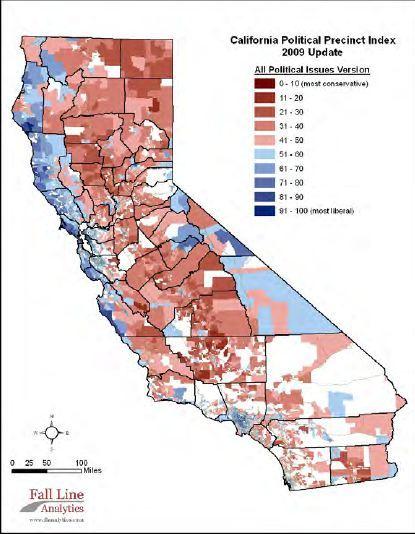
Probably not. The voters confirmed that the job of drawing new district lines next spring will be done by an independent (and unaccountable) commission whose makeup will not reflect California’s. (Five Republicans and five Democrats in a state where Democrats far outnumber Republicans?) But Brian at Calitics makes the case that it won’t matter much — and he’s hit on a really important point about California politics.


The voters have already gerrymandered themselves, in a sense. The liberals tend to live with liberals, the conservatives with conservatives. And any reasonably compact, fair district lines will reflect that.


In fact, the Fall Line Analytics map that Calitics cites makes an excellent case for splitting California into two or three states — one along the coast from Sonoma to Los Angeles, one in the Central Valley (including San Diego) and perhaps a third including the far-northern counties, which have wanted to secede for a while anyway. Then the coastal residents could have a progressive state with taxes on the wealthy to fund services, and the conservatives can try to survive in a low-tax heaven of their own. (And if you really think wealthy people will leave San Francisco and Silicon Valley and L.A. to move to Fresno for lower taxes, you’re as crazy as some of our blog trolls.)


The interesting twist on this all, though, is that there’s pretty good evidence that the population in California has shifted somewhat away from the coasts in the last decade and moved somewhat inland. Which means that Los Angeles and the Bay Area may wind up losing Congressional and state Legislative seats to the traditionally more conservative areas.


The data also suggests, though, that a lot of the new residents of the inland areas are Latino — and the way that Latino vote breaks may play a far more significant role than the redistricting commission.


Questions for the next mayor

19

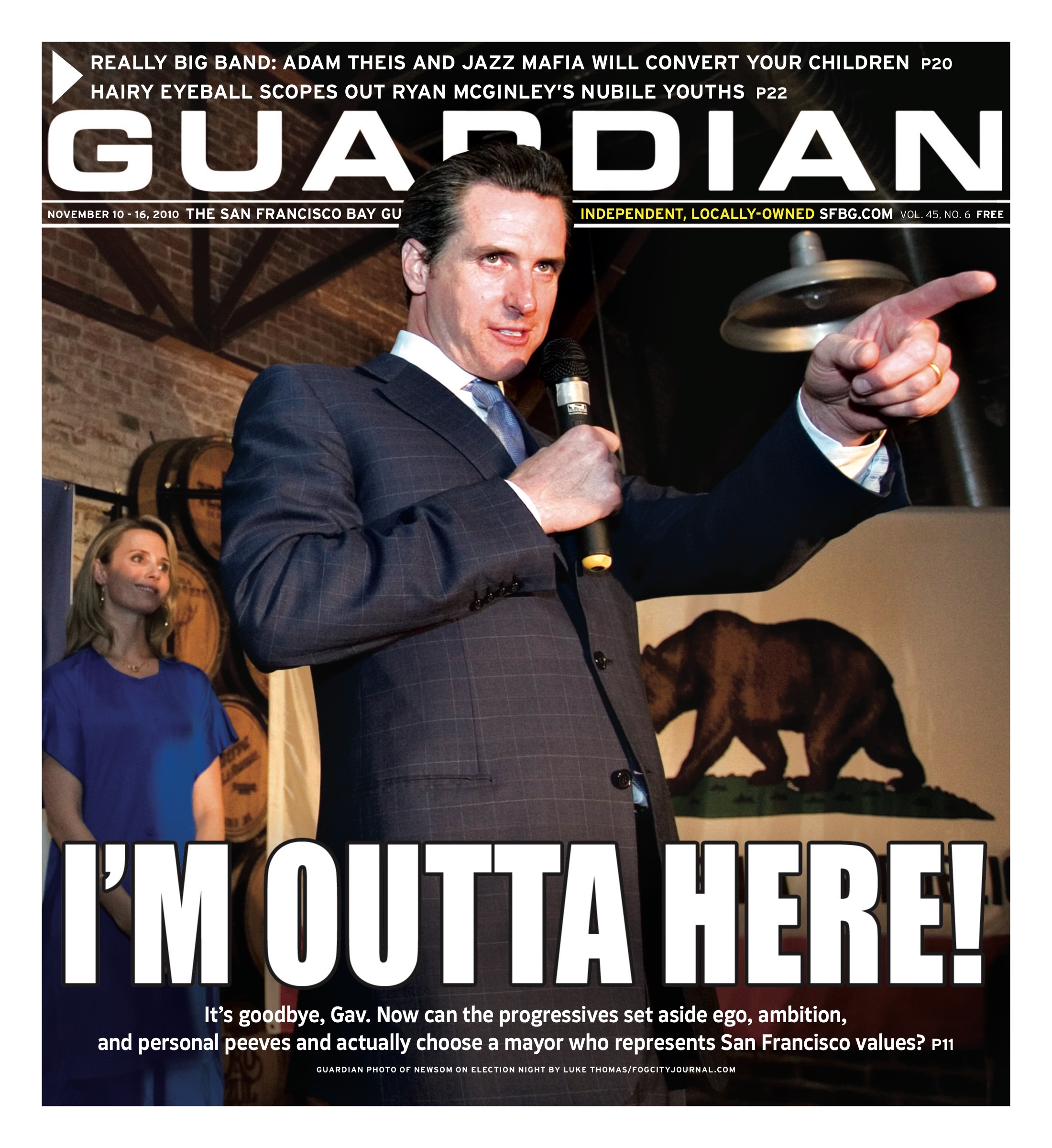
 The progressives on the Board of Supervisors are a long way from united on a possible mayoral candidate, and if they can’t come together, the person who finishes Gavin Newsom’s term will be a compromise candidate, either a short-term caretaker (not the greatest option) or someone who’s more in the moderate camp but a candidate the left can work with for 2011 and possibly four years after that.

We’re glad to see the proposal by Sup. John Avalos to begin the mayoral selection process early. Picking a mayor in a mad scramble on the day Newsom steps down is a recipe for chaos and potentially a bad outcome. And as the process begins, the last thing the city needs is a mayor chosen through a backroom deal.

But it’s entirely appropriate for progressive board members to set some standards and to ask the people who are angling for the job to make clear exactly what their positions would be on key policy issues.

In other words, anyone who wants to be the interim mayor and possibly mayor for the next five years or longer should have to answer, directly and without hedging, question like these:

How much new revenue does San Francisco need to solve its budget problems, and where, specifically, should it come from? This is the central issue facing the city, now and for the indefinite future. San Francisco’s budget has a structural deficit of at least $250 million, and it simply can’t be closed by cuts alone. What taxes will you pledge to support and put political capital and fundraising clout behind when they go on the ballot?

What specific programs ought to be cut? Everyone likes to talk about the city living within its means, but that ends up leading to a series of death-by-1,000-cuts decisions that year after year devastate services to the poor. Don’t tell us you need to look at budget figures and work it out later; the big-ticket items are no secret. What’s on the chopping block and what isn’t?

Will you work to promote public power? How will you expedite community choice aggregation, and will you support a ballot measure to replace Pacific Gas and Electric Co. with a full-scale municipal electric utility?

What are your law enforcement priorities? If money’s tight, should the San Francisco police be hassling nightclubs, or should more resources go into the homicide division? How important are foot patrols, and which neighborhoods should get them? Will the SFPD and juvenile authorities continue to turn young people over to federal immigration authorities?

Who should pay to fix Muni? Should the burden of paying for the transit system fall primarily on the riders (through fare increases and reduced services) or should big downtown businesses and retailers (the major beneficiaries of the system) pay more? Should car owners pay higher fees (including parking fees and congestion management fees) to subsidize transit? Which specific fees would you be willing to push for?

Who should the city build housing for? Right now, much of the new housing stock is aimed at the very rich and San Francisco is turning into a bedroom community for Silicon Valley. Would you set housing policy to conform with the city’s General Plan assertion that more than half of all new housing should be below market rate? How would you make that balance happen? Should the city spend a significant amount of money for affordable housing, and who should pay for it?

Do you agree that public sector jobs are as important as private sector jobs in San Francisco? Would you support the tax plan proposed by Sup. David Chiu?

Do you support giving the supervisors appointments to all major commissions?

Do you think the city should be doing more to stop TICs and condo conversions and to preserve existing rental housing?

That’s just the beginning of a long list of questions but the progressives and other supervisors  on the board should make sure they have answers before agreeing to support anyone, as a caretaker or interim mayor.


Red-eyed and happy at the Cannabis Competition

9

All photos by Erik Anderson

Somewhere amidst the marijuana energy drinks and exuberantly filled bags of Volcano vapor at yesterday’s fourth annual Cannabis Competition, a young lady named Lacey was making a name for herself. 

“Sales have been excellent – we’ve cornered it! I think the best sellers have been the shortbread cookies. You can have them alone or we also make them into filled sandwiches,” said the fetching entrepreneur of Laced Cakes, who sat with her girl friends behind stacks of individually packaged marijuana edibles, all attired in vintage approximations of boho homemakers.

The trio joined proud purveyors of marijuana energy drinks, handmade color-changing coffee mugs, and raw organic hemp rolling papers — not to mention the more urban, less crunchy beats than Competitions past by Bayonics, Manicato, and Mystic Roots — in a celebration of gourmand greens. Set in Terra’s be-succulented patio and indoor space, the Competition was a happy, if slow moving refutation of the fact that pot heads can’t party.

Lesson of the day? There is life post-Prop 19. Even while plagued with last-minute venue kerfuffle and copyright blowback from the OG cannabis cuppers, High Times, the Cannabis Competition hit it big with SF indian summer weather to die for and an enthusiastic crowd. “It was an extremely successful event in terms of people having fun,” said Kevin Reed, CEO of the Green Cross, the pot delivery service that sponsored the event. 

“I think that [the venue change] probably did keep a lot of people home – anything that has to do with the police department will do that – but it did get us some mentions in the press,” Reed continued. He said that a few vendors also backed out at last minute for fear of conflict with the law. 

But the trepidation of the competition suited Lacey (real name: Courtney, she didn’t want her surname in the press) just fine. Laced Cakes has been around since 2007, but lack of consistency with her inventory – “you know how that happens,” she smiles – led to Lacey losing her regular selling gig at the Green Door, a SoMa dispensary. 

Six days before the Competition, the buyer at the Green Door mentioned there was an empty vendor booth still available – would Laced Cakes like an expo debut? Lacey sprung into action and baked up some product, even learning a recipe for caramel that looked like a success from where I was standing and admiring her cakes. Her other offerings? Zucchini bread, vegan butter, take and bake cookies with their own little tubs of frosting – all “medicated,” all preciously packaged and ready for action. 

Which was kind of a shame, because by the time I ran across her booth, I was in no shape to eat any more weed. In fact, by the end of the eight hours of Cannabis Comp, it was fair to say that not many were – particularly the judges of the Patient’s Choice contest itself. I spoke with one judge, who paid $250 for the privilege of weighing in on the Bay’s best buds. The Green Cross mails these brave arbiters 43 strains of weed (a gram of each), 17 kinds of weed edibles, and eight weed concentrates. 

Ahem, a mere 10 days before the competition. Clear your schedule! Reed says some patients – you have to have your medical marijuana card to participate – hosted tasting parties with their similarly-carded friends to help share the burden of the position. 

I got a chance to check out the tiny microscopes included in the judge’s package of fun (the Green Cross hands them out to all its patients who place orders with them). Equipped with a button to turn regular or black light on your bud of choice, the ‘scope revealed a tiny new land of purples and greens and complex crystal formations. The whole thing looked a lot like some dendrite-heavy sea creature. An pungent anemone, maybe. Or maybe I was just stoned.  

Makes you think differently about marijuana – the intent, surely, of a peaceful party packed with pot. Maybe the rest of the state’s not ready for legalizing the dro, but it would seem that for San Francisco, a lot of the victory would be a symbolic one. Symbols, man. 


2010 Cannabis Competition Patient’s Choice award winners (congrats!)

Best Edibles: First place – Scott Van Rixel’s Bang Dark Chocolate

Second place – (tie) Auntie Dolores’ chili-lime peanuts, The Green Door’s Buddies peanut butter pucks

Third place – Sean Polly’s Hash on the Mountaintop 


Best Concentrates: First place – (tie) The Green Cross’ Frosty Oil, The Vapor Room Co-operative’s Blue Moonrocks

Second place – The Green Door’s G18

Third place – The Green Cross’ Sour diesel keef 


Best Cannabis: First place – Boss’ OG Kush

Second place – (tie) Allen Wrench’s Island in the Sky, The Green Door’s Granddaddy, The Green Cross’ Kryptonite

Third place (tie) – Earth Green Cali Farm’s Jack Hare, Dutch Treat by San Francisco Medical Cannabis Garden


SFBG Radio: The next counterculture

5

Today, Johnny’s got the apolitical blues, so we talk about the next counterculture — and why it might not come from San Francisco. Check it out after the jump.

sfbgradio11/15/2010 by endorsements2010

Only a miracle can save Steve Li now

41

Supporters of Shing Ma “Steve” Li, a 20-year-old nursing student, gathered outside the offices of Sen. Barbara Boxer today to urge her to sponsor a private bill in a last ditch effort to halt Li’s deportation to Peru, which is scheduled to take place Monday, November 15—two months after ICE (Immigration and Customs Enforcement) agents arrested Li in San Francisco.

“While we do not introduce private bills, our staff is happy to meet with Mr. Li’s family and his attorneys to discuss his case,” Boxer spokesperson Zachary Coile emailed the Guardian, as protesters delivered stack of letters to Boxer’s office, asking that she intervene in Li’s case.

Unlike Sen. Dianne Feinstein who has sponsored private bills in the past, Boxer has no record of intervening in this way. But advocates were hopeful that now that she has survived the November 2010 election, Boxer will pull off a miracle before Monday.

This afternoon, Li’s attorney Sin Yen Ling texted the Guardian that her request for deferred action had been denied, meaning that Li will be on a plane to Peru on Monday, baring some last minute miracle.

“Our office has been in touch with ICE and is exploring the options,” Gil Duran, media spokesperson for Sen. Dianne Feinstein told the Guardian, half an hour after Li’s request for deferred action was denied.

And Boxer spokesperson Zachary Coile said the senator’s staff met with Li’s mother, his attorney, his City College professor and others, this afternoon.

“While we do not introduce private bills, our staff was happy to meet with Steve Li’s family and his attorney to discuss his case,” Coile stated. “We reiterated Senator Boxer’s strong support for the DREAM Act, which would provide a path to citizenship for tens of thousands of undocumented students who go to college or serve in the military. Senator Boxer will keep working in the Senate until it becomes law.”

And tonight, Drew Hammill, press secretary to Speaker Nancy Pelosi emailed the following statement to the Guardian:

“Speaker Pelosi believes that Steve Li’s case is a textbook example of the pressing need for comprehensive immigration reform and passage of the DREAM Act. Speaker Pelosi is working with other Members to recommend that ICE grant deferred action in this case.”

Boxer, Feinstein and Pelosi, who have both been strong supporters of the DREAM Act, have vowed to keep working until it is passed.

Earlier this fall, on Sept. 14—the day before ICE arrested Li– Senate Majority Leader Harry Reid announced plans to add the DREAM Act as an amendment to the Department of Defense authorization bill.

But that effort was blocked by Senate Republicans. And after the bloodbath that congressional Democrats endured this November, it’s unclear if the DREAM Act has a prayer, though Nancy Pelosi vowed to move it forward during Congress’ upcoming lame-duck session, and it has continued to attract bi-partisan support since it was first introduced in 2001 by Senators Richard Durbin (D-Il) and Richard Lugar (R-IN).

At today’s protest, Li’s legal counsel, Sin Yen Ling, decried the federal government’s decision to deport her client.

“A 20-year-old City College student is not a threat to our national security,” Ling said. “We need to bring Steve Li home as soon as possible.”

According to Ling, Li has not seen his mother Maria, who divorced Li’s dad for years and lives with Li in San Francisco, since his Sept. 15 arrest, when  ICE picked up Li and his mother in Ingleside on Sept. 15 and placed them in separate cars. The car carrying Li then picked up Li’s  father in the Richmond, and all three family members were processed at ICE’s Sansome Street office in downtown San Francisco, before being transferred to Sacramento County Jail. But Li was then involuntarily transferred to an ICE detention facility in Arizona. Meanwhile, Li’s parents were released from detention when ICE determined that China does not want them back because they left China seeking political asylum. But they are now required to wear cumbersome electronic monitoring anklets, because they are deemed a flight risk, and are not allowed to leave San Francisco.

As a result, Li’s parents have been unable to visit their son in Arizona. And should he be deported to Peru, it’s not clear if they will be permitted to follow. And should if they decide to travel to Peru, they will not be allowed to reenter the U.S. for at least ten years, further complicating a complex situation.

At today’s rally, Li’s mother Maria spoke in public for the first time,  breaking down into tears, as she begged Sen. Boxer and the U.S. government to help.

“He has no money, no clean clothes, how will he get by?” she asked, referring to ICE’s plan to put her son on a plane to Lima, Peru, where he reportedly knows no one.  “Sen. Boxer, will you just watch and pretend you didn’t see anything? Today, when you see all of us standing here begging you, will you respond to us? I hope you can understand it from a mother’s perspective and meet with me to discuss how we can help Steve.”

Ling said Li’s mother decided to speak because of the direness of her son’s situation, even though she was wearing a federally-mandated monitoring anklet.
“She felt it was now or never,” Ling said.

Li’s teacher Sang Chi also spoke, praising Li as a model student and a prime example of the kind of person that should be eligible for the DREAM Act. And then the Rev. Norman Fang led Li’s supporters in a prayer.

‘We ask that a miracle take place and that Steve’s mom and San Francisco can be happy again, that the heart and soul of what is morally right can overcome regulations,” Fang said, noting that 100 years, his family members were detained at Angel Island “for no other reason than they were Chinese. ‘There is only one border in our world—the one that separates Heaven and Earth.”

Li’s attorney Sin Yen Ling clarified that she doesn’t believe that ICE singled Li out.
“He’s just been swept up as part of a larger program,” Ling said, noting that actions that split families apart and target folks who came to this country as undocumented children have inspired a movement of DREAMers—folks who support the DREAM Act.

Every year, about 65,000 U.S. raised students, who would qualify for the DREAM Act’s proposed benefits, graduate from high school, according to the National Immigration Law Center (NILC).

“These include honor roll students, star athletes, talented artists, homecoming queens, and aspiring teachers, doctors and U.S. soldiers,” states a NILC press release. “They are young people who have lived in the U.S. for most of their lives and desire only to call this country their home. Even though they were brought to the U.S. years ago as children, they face unique barriers to higher education, are unable to work legally in the U.S. and often live in constant fear of detection by immigration authorities.”

Asked how ICE caught up with Li, who does not have a criminal record, Ling pointed to modern technology
“In this day and age, you can track anyone down,” Ling said.” And it’s a priority for ICE to identify people with final deportation orders,” she continued. Ling was referring to the fact that Li’s parents were denied their request for political asylum from China and issued a removal order, unbeknownst to their son Steve, who was born in Peru, came to the U.S. when he was 12 and was 14, when his parents’ asylum request was denied.

But Ling did not blame President Barack Obama, who promised to bring millions of undocumented residents out of the shadows, when he was running for president in 2008.
“It’s tough to criticize the president when he had five different priorities coming into office, including healthcare. His administration probably miscalculated how long it would take to pass healthcare. And part of the problem is partisan politics around immigration.”

Ling estimates that there are two million young people currently in the U.S. who would benefit from the passage of the DREAM Act, but blamed partisan politics for why the legislation failed to pass by only 3 votes in the Senate in September.

Sup. David Campos showed up at the rally and told Li’s supporters that the Board of Supervisors unanimously approved a resolution Nov. 9 calling for ICE to defer Li’s deportation.

“The Board is not always on the same page, but on this issue we were unanimous,” Campos said. “We get it, we understand the tragedy that this deportation would result in. And we remain hopeful that something will happen. There are millions of young people in the same predicament, and the solution is not deportation. The solution is passing comprehensive immigration reform. Until then, we need an intervention.”

Meanwhile, somewhere in Arizona, Steve Li sits in a jail cell, hoping, praying and dreaming…

Downtown’s one-two punch on RCV

20

Examiner columnist Ken Garcia and Chronicle columnist C.W. Nevius – the Tweedledum and Tweedledee of pro-downtown propagandists – today put out a pair of hit pieces on San Francisco’s ranked-choice voting system, with Garcia stridently calling for its repeal. But if there was ever a good argument for ranked-choice voting, it’s the fact that these two bozos don’t like it.

They use this election’s results to make a case that this system is confusing, slow, and undemocratic, even though the reality is closer to the opposite. They moan that some supervisorial races don’t have clear outcomes yet and that doing RCV tabulations requires more work now by election’s officials, conveniently leaving out the fact that all four contested supervisorial election would be headed for costly and divisive runoff elections a month from now under the old system.

As for being undemocratic, it’s anything but. Would it be more democratic if the D10 race was decided by a runoff between Marlene Tran and Tony Kelly because the African-American vote was divided among too many candidates, rather than going to Malia Cohen, who most D10 voters voted for as one of their top three choices? Doesn’t it count for anything that a majority of D2 voters apparently didn’t want Janet Reilly to represent them? Similarly, in Oakland, it seems clear that a majority of voters did not want Don Perata to be their mayor, and so they listed Jean Quan in their top three votes. And did anyone really want to see progressive Jane Kim and Debra Walker slug it out in a D6 runoff election?

No, what this coordinated attack on RCV is really about is how democratic it really is, letting the people rank their choices from a plethora of options, rather than having our leaders chosen in a low-turnout election when downtown and the rich have a far better opportunity to determine the winner. It’s just too bad that these two columnists aren’t honest enough to admit who they’re shilling for.

As for my more detailed reporting on RCV and its renewed chances for promoting real political coalition-building – the essence of democracy – check out next week’s Guardian.

Portrait of a San Francisco construction worker

1

One of the many fascinating pieces of data to emerge in the discussion about Sup. John Avalos’ proposal to mandate local hiring is a recently published analysis of the characteristics of construction workers whose primary workplace is San Francisco.

In October, L. Luster & Associates published a labor market analysis, using data from EDD payrolls and the U.S. Census American Community Survey, that shows there were 14,629 construction workers employed in San Francisco in June 2010. And that five trades currently dominate this workforce and constitute more than 75 percent of the total numbers of construction workers employed in the city.

Carpenters are the biggest group (4,623 workers) followed by construction laborers (2,796 workers) painters (1,459 workers), electricians (1,119 workers) and plumbers, pipe fitters and steamfitters (1,023 workers).

But while this population shows racial diversity (whites and Latinos each make up about 40 percent of the workforce, followed by Asians and Pacific Islanders at 17 percent) African Americans and women each account for only 3 percent of this market. In other words, only 440 African Americans and 405 women were construction workers in June 2010, compared to 5,830 Latinos, 5673 whites, 2,528 Asians and Pacific Islanders.

So, how do these ethnic percentages compare with San Francisco’s overall distribution?
 “Latinos make up a considerably larger portion of workforce than they do the overall population (40 percent of construction workforce v. 13 percent of city’s population),” the Luster report states. “ All other major racial categories constitute a smaller portion of the construction workforce than they do of the total population: Whites (39 percent of construction workforce compared to 49 percent of city population overall) followed by Asian and Pacific Islanders (17 percent compared to 28 percent overall) and African Americans (3 percent compared to 6 percent overall.)

(That last statistic should be a shocker: What?! Only six percent of San Francisco’s current residents are African American?! But the city produced a report two years that detailed the “black out migration” –but provided little money or authority to help follow through on the report’s various recommendations).

Meanwhile, Luster’s report concludes that, “the main imbalance between the employed construction workforce and the San Francisco population lies with the gender distribution. Women comprise only 3 percent of the 14,629 construction workers in San Francisco, whereas they account for nearly half of the overall population.”

Next up in the Luster report was the question of residency. And according to its findings, only 39 percent of workers employed in San Francisco’s construction industry call the city and county of San Francisco their home.

San Mateo County is home to 18 percent of this workforce, Alameda County accounts for another 17 percent, Contra Costa County is home to 13 percent, Sonoma and Marin each are home to 8 percent, and Napa and Solano County each account for a further 5 percent.

These numbers are significant in a number of ways. For instance, 2, 636 workers commute in from San Mateo, 2,418 from Alameda, 1,929 from Contra Costa, 1,197 from Sonoma and Marin, and 773 workers from Napa and Solano, all of which adds up to wear and tear on roads, impacts on air quality, and increased levels of greenhouse gas generation (depending on whether these workers take public transit, car pool or drive the freeways solo, of course).

It also means that when communities oppose aspects of a local construction project—be it a proposed bridge over Yosemite Slough, or a proposed mega-hospital on Cathedral Hill—they are likely to encounter opposition from a workforce that increasingly lives outside San Francisco,  faces a 40 percent unemployment rate, and can be mobilized to show support for these projects, either through showing up physically at meetings or through union dues that can be used to wage political wars with far-reaching percussions for the ability of local residents to influence local land use and economic development decisions.

So, why do so many construction workers live outside San Francisco? The obvious reasons are their relatively low income levels and their related inability to afford housing in the city.
According to Luster’s report, “nearly 33 percent of these workers report earnings of less than $30,000 per year” (based on data that incorporates union and non-union workers, and part-time workers).

Another way of looking at this is to study Luster’s analysis of construction workers who currently live in San Francisco.

“From EDD payroll data and from historic employment relationships between San Francisco, San Mateo, and Marin counties, we estimate there were 7,855 construction workers residing in San Francisco and who were employed as of June 2010—roughly 1 percent of total residents in the city,” Luster reports.

The Luster report also notes that the same five trades make up an even higher proportion of the resident employed construction workforce than they did the total employed construction workforce in the city (86 percent v 75 percent). But now the top two places are reversed: Construction Laborers is the largest trade with 2,442 workers, followed by Carpenters (1,914 workers), Painters (1,122 workers), Electricians (814 workers) and Plumbers (484 workers).

The ethnic distribution of these resident workers is also diverse. Whites (34 percent,) Latinos (31 percent), Asians and Pacific Islanders (30 percent, which is considerably higher than for the overall workforce employed in San Francisco) and African Americans (5 percent).

But women, once again, make up only 3 percent of residents in construction employment.

The Luster report takes the analysis one step further by looking at age distribution. This criterion reveals that the white resident construction workforce is aging, as is the Asian resident construction workforce, though to a lesser extent.

“By contract, the Latino workforce is concentrated among the younger age groups, particularly among the 25-34 age group,” Luster notes. “Of note, 47 percent of the resident San Francisco construction workforce is over the age of 45. Moreover, 23 percent is already 55 years and older. Currently, the number of workers aged 55-64 is 1,544 and declines to 264 for workers aged 65 and older, dropping from 20 percent of the workforce to 3 percent. If construction workers continue to leave the sector in the same proportions by the time they reach 64, a sizeable number of new openings will be created.”

The report, which goes into detailed breakdowns of apprentices (each of the four largest ethnic groups have almost equal shares, and women have 10 percent), the construction trades (which has a greater participation of white workers) and journey people, also gets into workforce projections (the bulk of the jobs generated by the city’s Capital Plan will be generated within the first five years) local hire programs and policy issues. As such, it’s  a must-read for those following Avalos’ proposed local hire legislation, and you can view the full report by clicking here.

D10 nail biting continues, but Cohen remains in lead

10

When the city’s Department of Elections ran its second preliminary round of ranked choice voting scores Nov. 9, neither of the leading D10 contenders was in attendance. Malia Cohen, who was sick last week, was still under the weather, according to her campaign manager Megan Hamilton. And Tony Kelly was at home “reading the Bible and eating chocolate,” as he jokingly told the Guardian earlier that afternoon. All of which was hardly surprising since the stress of the unrevolved races in D10 (and D2) is beginning to fray the nerves of even the most hardened elections veterans.

But Marlene Tran, who ended up in third place after yesterday’s RCV count, was waiting outside the Elections office, which is located in the basement of City Hall. And she openly talked about the stress of waiting for the ranked choice results, the failure of English-speaking media to cover issues that concern non-English speaking residents, the unexpected attacks she endured on Chinese radio, and her hope that all the D10 candidates will work together to make the district and its various communities and neighborhoods a better place to live, regardless of who wins.

“I’ve been trying to take care of all my mail and petting my cat, who is extremely demanding,” Tran told the Guardian, when asked how she was dealing with a waiting game that has had campaign managers and members of the media descending daily on the Elections Department at 4 p.m. to get updated results.

Finally, Elections Department director John Arntz emerged and sat on a table outside the Department of Elections office as he gave his daily update.

“We did a big push over the weekend to get 95 percent of the cards processed,” Arntz said, noting that 10,000-11,000 vote-by-mails remain to be counted citywide. He also noted that of the 1,275 provisional ballots from D10, 1,044 have been accepted, and another 231 have been challenged.

“We’ll have a tally sheet tomorrow with reasons why the provisionals were challenged,” Arntz added, observing that one reason provisionals get challenged is when it turns out that folks who voted provisionally aren’t actually registered to vote in San Francisco.

“I think it will be next week until we get to all the provisional ballots,” Arntz continued.“But it’s not like I am trying to prolong anything. I’m guesstimating that all the vote-by-mail ballots will be counted by Friday. So, we may do another ranked choice count on Friday.”

Arntz clarified that the 75 ballots that were found floating in the Palace of Fine Arts pond in the Marina district originated from a polling station in D11—and therefore will not impact the as yet unresolved supervisoral races in D10 and D2, where Janet Reilly leads Mark Farrell in raw first choice votes, but has been slipping into second place when the ranked choice votes are calculated.

“The bag is sealed, but the ballots are damp,” Arntz said of the missing D11 ballots.

After Arntz was done with his daily dose of explaining, the ever outspoken Sharen Hewitt, executive director of the C.L.A.E.R. project, warned of the importance of  counting every provisional vote.
‘If anyone touches my granddaughter vote, they’ll be a tsunami,” Hewitt warned, referring to the fact that her 18-year-old granddaughter Tiara voted provisionally this year.  “And it seems that a disproportionate numbers of challenged provisionals seem to be coming from Bayview Hunters Point.”

Afterwards, as the running dogs of the media rushed off to file stories, Tran lingered long enough to tell the Guardian how she was attacked on afternoon programs on Chinese radio after she announced that Tony Kelly was her second choice in the race (with her first choice being herself, natch.)

“I was called a traitor, I was told I was too old to run, that I can hardly walk around, that I didn’t do anything for the community in 20 years,” Tran recalled. “It was very humiliating.”

But she believes the attacks may have backfired.
“The radio programs in the evening addressed the question of whether Tran deserved to be a traitor—and everyone was very supportive of me,” Tran said. “And everybody who heard about these attacks was very angry, so maybe they worked harder to support me.”

Tran says she didn’t hire a political consultant to manage her campaign, but still found herself ahead of most of the other 21 candidates in this hotly contested race.

“I did a lot of stuff with volunteers, and for the first few months I did everything myself, including the design and layout of my fliers,” Tran confided, showing me a tri-lingual flier which includes translations from Chinese media outlets Sing Tao, which called her the “Guardian Angel of Immigrants.”

Tran, who was born in Hong Kong, and came to the United States when she was 19, says she is grateful that she got to live and work in such a beautiful city, and that many first-time voters got invigorated and decided to participate in the election because she was running.

“Whoever gets elected, I’ll support that person, because this is about D10 and San Francisco,” Tran said. ‘but many voters are now wondering if ranked choice is the best thing, because of the endless wait.”

She also ruminated on what she describes as the “chasm of a communication problem between the ethnic and Western press” and how that worked for and against her in past elections.
“When I ran for DCCC in 1998, I felt like a grain of sand in the Sahara,” Tran said, recalling how folks were surprised when she won that race. “And this time, my results are pretty healthy in the D10 race, and people are also surprised.”

Many of the absentee ballots that have been counted in recent days originated in Viz Valley, giving Tran a boost that takes her to second-place once ranked choices get reassigned, and helps Cohen vault over Lynette Sweet and into first place. But as they say, it ain’t over ’til the fat lady sings, so stay tuned…

Pot competition survives SFPD crackdown

1

Prop. 19 may have been defeated last week, but marijuana is still the state’s top cash crop, and one where agricultural artisanship continues to flourish within the medical marijuana movement. The best of Northern California’s pot crop will be on display this weekend, Nov. 14, for the Fourth Annual Medical Marijuana Competition. The event features judging and awards in a variety of categories, from best bud to the best concentrates and edibles. The event, which will also feature information booths and entertainment, will be held at Terra Galley, 511 Harrison Street, SF. Tickets are $18.

But this was one party that almost wasn’t. Event organizers had to scramble for a new location after the San Francisco Police Department denied them a permit to hold event in the previous year’s location in Cafe Cocomo. According to David Goldman, a competition organizer and member of the Americans for Safe Access (ASA), the California department of Alcoholic Beverages Control even threatened to revoke Cafe Cocomo’s liquor license should they house the event. Café Cocomo has had recent problems, includng a shooting out front on Oct. 9, but club operators declined to comment on those incidents or the cops blocking their pot party.

Organizers say the ensuing scramble for a new location cost the event, which is a fundraiser for ASA, over $10,000. “It’s been a nightmare to throw this party,” Kevin Reed, co-chair of the event and president of the Green Cross, told us. But even with the cost of the move, Reed is hopeful about the new venue and the turnout. “Last year we had about 600 or 700 people and this year we anticipate 1,200 to 1,500.”

All of the proceeds of the upcoming competition will go to support ASA, a nonprofit group that holds weekly meetings at Bowzer’s Pizza that aim to educate patients on medical marijuana issues. “It’s amazing how pizza keeps it all together,” Reed said of the community that has formed up around these ASA meetings.

Yee launches mayoral bid as supervisors consider their options

0

Amid the jockeying for position on who will be San Francisco’s next mayor, Sen. Leland Yee this morning filed paperwork at the SF Elections Department to form a mayoral exploratory committee before a throng of journalists who were invited yesterday for a big “announcement.”

Yee diligently hit his talking points and did little to divert from a script emphasizing his deep local roots, his belief in being a humble public servant, and how this action was “beginning a conversation with San Franciscans” about “what they want of their city government and their next mayor.” Yee used the word “conversation” so many times that an AP reporter asked him to explain his issues and reasons for running without using the word “conversation,” a word Yee still slipped into his answer.

Meanwhile, members of the Board of Supervisors yesterday introduced competing motions for naming an interim mayor to replace Gavin Newsom while he leaves in January to become lieutenant governor. Sups. John Avalos, David Campos, and Chris Daly are seeking to have the board vote on a replacement mayor as soon as next week, while Board President David Chiu asked the board clerk’s office to develop a framework and process for choosing a new mayor. Asked whether he has the six votes needed to take up the matter next week, Avalos told the Guardian, “That’s my hope, but we’ll see.”

While Yee seems focused on winning the mayoral election next fall, rather than winning six votes on the board now, he told reporters, “I have the highest regard for members of the Board of Supervisors…They have a tremendous challenge in front of them and I wish them well.”

In his prepared statement that listed his contact person as Jim Stearns, a political consultant who usually works for progressive candidates and ballot measures, Yee sought to differentiate himself from Newsom, who has had hostile relations with the board throughout his seven-year tenure. “I want to see the Mayor work with, and not against the Board of Supervisors,” Yee said in that statement.

Asked by the Guardian to elaborate on what appears to be a critique of Newsom, Yee demurred. “I’m not going to judge this mayor. History will do that,” he said.

Playing it safe for now could be a sound strategy for Yee, who would be the city’s first Chinese-American mayor and who has a history of endorsing progressive candidates and positions, but who also just raised and spent more than $1.2 million (much of it in big corporate donations that far exceed limits on local donations that his committee will now allow him to begin collecting) on his uncontested Senate reelection, including giving six-figures to Stearns and spending almost as much on polling.

Stearns tells the Guardian that, consistent with his message today, Yee will run a very positive campaign. “We’re going to run a different kind of campaign, a very collaborative campaign,” he said. “This city deserves a different kind of campaign where people are just firing their guns at each other.”

The Performant: Cheers for fears

0

Scoping out “After Dark” at the Exploratorium and a Mark Growden singalong

“The oldest and strongest emotion of mankind is fear.” –H.P. Lovecraft

Bolshephobia is the fear of Bolsheviks. Sesquipedalophobia is the fear of long words, which does rather beg the question, how do people with that particular fear express it without using the eight-syllable word that defines it? At this month’s After Dark event at the Exploratorium, fear was the theme explored, and confronting one’s fears directly, in the spirit of scientific inquiry, strongly encouraged.


We’ve learned to accept fear as an instinct of self-preservation, yet on the surface, so many fears seem downright petty, even ridiculous. Take, for example, the “phobia trading cards” we were urged to grab on our way in. Mine: fear of vomiting (emetophobia). Theresa’s: fear of men (androphobia). Once inside, we made a beeline for the joint San Francisco Bay Area Tarantula Society/East Bay Vivarium,. What is it about creepy-crawlies that make the skin crawl? All around us, giant cockroaches, scorpions, and spiders were adorning outstretched palms, and snakes were slithering up forearms and around the necks of museum patrons.

I opted to handle a relatively user-friendly duo, a Chilean Rose Tarantula and a sleepy Pacific Gopher Snake. Theresa would not hold a snake, but she got to watch me flinch soon enough at the Pendulum of Truth. Placed behind safety shields, facing each other, we were urged to swing a bowling ball on a chain at each other’s faces. Being bashed by a flying bowling ball is not something I expect to happen to me regularly, but when confronted with one, I can attest, yes, it’s a very real fear. Less frightening was being locked in the Utica Crib, a reproduction of a nineteenth-century restraining device used primarily at the New York State Lunatic Asylum, though I suspect I’d weary of it soon enough after a few hours—or days.

There were people practicing tightrope-walking, watching dentistry demonstrations, and confronting the pitch black interior of the Tactile Dome as we headed over to the McBean Theatre for a presentation on Nightmares by dream expert Dr. Alan Siegel. Ever had that one dream where all your teeth crumble and fall out at once? Dr. Siegel can tell you why.

One fear shared by entirely too many people is the fear of singing in public. At least that’s a fear that has a cure—practice practice practice. Happily, it didn’t seem like fear was the driving force behind people’s decisions to attend the Mark Growden Sing-along at a.Muse Gallery Saturday night.
Part grade-school music class, part hootenanny, we warmed up our vocal chords with some scales and some tongue-twisting folk tunes before tackling the Mark Growden repertoire, mostly songs from Saint Judas (Porto Franco Records, 2009). Unlike the forced make-or-break centerstage experience of a karaoke bar, a sing-along’s success lies in its collaborative nature, from each according to their abilities. The informal, free-for-all atmosphere of the evening brought the old adage “if you can talk, you can sing,” to convivial life, and whatever fear was up to that evening, it most certainly wasn’t hanging out with us.

Our Weekly Picks: November 10-16, 2010

0

WEDNESDAY 10

EVENT

“Goldies After Party”

You dog-eared the pages of last week’s Guardian, reading about the Guardian Outstanding Local Discovery award winners. Tonight, head to 111 Minna to congratulate the artists in person — and to rock out at the free, open-to-the-public after party. Taking the stage: Oakland “slop-pop” rockers Bare Wires, SF popsters Brilliant Colors, dark post-punker Soft Moon (a.k.a. Luis Vasquez), pop sensation Myles Cooper (of “Gonna Find Boyfriends Today” fame) with club sensation Alexis Penney, and DJs Naoki Onodera and Primo Pitino. Don’t miss what’s sure to be a mother lode (yep, shameless gold joke) of a party! (Cheryl Eddy)

9 p.m., free

111 Minna Gallery

111 Minna, SF

www.sfbg.com/2010/11/03/goldies-2010


THEATER

Or,

Aphra Behn was a woman ahead of her time. A 17th century spy and the first professional female playwright, Aphra Behn is the topic of Liz Duffy Adams’ new play Or, at Magic Theatre. Full of sensationalism, sex, art, politics, and laughs, this comedy hosts a variety of eccentric characters including double agent William Scot, actress Nell Gwynne, and even King Charles II himself. Adams received the fifth Lillian Hellman Award for Playwrighting for Or, at the 2010 Lilly Awards; the play promises a dose of English history and a chance to chuckle the night away. (Emmaly Wiederholt)

Through Dec. 5

Wed.–Sat., 8 p.m. (also Sat, 2:30 p.m.);

Sun, 2:30 p.m.; Tues, 7 p.m., $45–$60

Magic Theatre

Fort Mason Center, Building D, Third Floor, SF

(415) 441-8822

www.magictheatre.org


THURSDAY 11

DANCE

Ampey!

In 2008, Adia Tamar Whitaker took a trip to Africa, where she encountered ampey, a Ghanian children’s dance for which you need to be on your toes in more ways than one. It became the inspiration for Ampey!, in which she explores complexities surrounding identity, family, and home. For Whitaker, that “return” trip had been become a voyage of discovery — though not in the way she anticipated. Presented as a work in progress last year, one could sense Ampey!’s artistic potential; it already included a powerful percussive “sitting dance.” Perhaps the best aspect of the two-year Performing Diaspora Project is its offer to artists like Whitaker to keep working on what needs to be done. (Rita Felciano)

Through Nov. 21

Thurs/11–Sun/14 and Nov. 18–20, 8 p.m.;

Nov. 21, 3 p.m., $19–$24

Counterpulse

1310 Mission, SF

1-800-838-3006

www.counterpulse.org


MUSIC

Ghostface Killah

No one has your back like Iron Man. Pretty Toney was the original link that brought the whole Wu-Tang together. Always willing to lend a devastatingly together verse to just about anybody’s single (MSTRKRFT, Prefuse 73, DANGERDOOM, etc), Starky still has found time to release classic after classic album. On his latest, Ghostdini: Wizard of Poetry in Emerald City, the Wallabee Kingpin went the extra mile, dispensing priceless relationship advice via a series of YouTube videos. Isn’t it about time you gave Ghostface Killah a little something back in return? (Ryan Prendiville)

With Sheek Louch and Music by Frank Dukes

9 p.m. $22

Slim’s

333 11th St., SF

(415) 255-0333

www.slims-sf.com


MUSIC

Masaki Batoh

Incorporating elements of Krautrock, folk, free jazz, and all manner of indigenous instrumentation, enigmatic Japanese psych collective Ghost are the heirs to such earlier cosmic emissaries as fellow countrymen the Taj Mahal Travelers. Founder and core player Masaki Batoh takes a similarly eclectic approach in his non-Ghost releases, whether turning out a chugging acoustic cover of Can’s “Yoo Doo Right” or mournful dirges, as on his recent collaborative albums with Espers’ Helena Espvall. Tonight’s rare solo set, with Batoh alternating between guitar and banjo and a table full of electronics, should prove no different. (Matt Sussman)

With Young Elders

10 p.m., $10

Vortex Room

1082 Howard, SF

www.myspace.com/thevortexroom

Also Fri/12

With Sic Alps

10 p.m., $5

Ghost Town Gallery

2519 San Pablo, Oakl.

www.myspace.com/ghosttowngallery


DANCE

Sankai Juku

Butoh is perhaps one of the most enigmatic dance forms. Emerging in the late 1950s in opposition to the Westernization of Japan, butoh often explores the more grotesque side of human nature. Unlike other dance forms with a syllabus of movements, butoh may be completely conceptual, hyper-slow, playful, scary, or none of the above. It defies definition. Audiences can begin to wrap their minds around butoh as Sankai Juku, the legendary Japanese butoh company, tours to San Francisco to present Hibiki: Resonance from Far Away, a piece said to plumb poetic beauty. Meditative and hypnotic in its simplicity, this award-winning work is a signature of butoh. (Wiederholt)

Thurs/11–Sat/13, 8 p.m.;

Sun/14, 2 p.m., $35–$60

Yerba Buena Center for the Arts

Novellus Theater

700 Howard, SF

(415) 978-2787

www.ybca.org


FRIDAY 12

MUSIC

Lindstrøm

Known to much prefer holing up in the studio in his home base of Oslo, Norway, than performing live, this is a rare opportunity to catch a set from one of the more interesting electronic music producers around. Lindstrøm first made a name for himself as a remix artist, reworking tracks from the likes of LCD Soundsystem, Roxy Music, Franz Ferdinand, and the Boredoms. His solo albums are full of frosty disco beats, heavy synthesizers, classic funk influences and enough of an adventurous streak to appeal to more than just the dance floor crowd. (Landon Moblad)

With Marbeya and Publicist

9 p.m., $15

Mezzanine

444 Jessie, SF

(415) 625-8880

www.mezzaninesf.com


DANCE

“Manifestival: Like Oil and Water: From Gaza to the Gulf”

Lots of Bay Area artists know that the world is a village, all politics are local, and that it’s probably not a good idea to ignore an problem until it burns your face. Socially committed dance is a large part of what we see on our stages. Artists are the antennas of the race and following them is fun as well as instructive. This year’s Manifestival theme of “Like Oil and Water: From Gaza to the Gulf” should provide more than enough inspiration for the two different programs. Onstage the first weekend are Jessica Damon, Jose Navarrete, Michael Velez, Nicole Klaymoon, Sri Susilowati, Naked Empire Buffoon, Stella Adelman, and Youth Speaks. (Felciano)

Through Nov. 20

Fri.–Sat., 8 p.m., $22

Dance Mission Theater

3316 24th St. SF

(415) 273-4633

www.brownpapertickets.com


VISUAL ART

“A Journeyman’s Papers”

Rare is the gallery show at which the owner of said gallery steps out from the wings and shows his or her own work. Risks! No one wants to be seen as the next megalomaniac Thomas Kincaid, drunkenly careening into the heavily curtained schlock-nests of Midwestern housewives, right? No fear of that kind of showboating here. Rob Delamater, co-owner of dapper cognoscenti-magnet Lost Art Salon, creates voluptuously genteel, generous-spirited pieces that fit right in with his gallery’s excellent collection of rare vintage modern works. Block-printed portraits of the wanton Bloomsbury group, evocative and crepuscular figure studies, and, perhaps most intriguing, softly primitive compositions evoking the California coastline painted on vintage book covers are the gorgeous, midcentury-type whistle stops on Delamater’s artistic journey. Doff your fedora, shed your silk shift, and have a lovely look. (Marke B.)

Through Jan. 31, 2011

5:30–8:30 p.m., free

Lost Art Salon

245 S. Van Ness, Suite 203, SF

(415) 861-1530

www.lostartsalon.com


SATURDAY 13

MUSIC

Dãm-Funk

George Clinton and Parliament Funkadelic are going to be at Yoshi’s next week. That’s cool. But instead of waiting to enjoy what’s sure to be a great reminiscing on where funk’s been, why not check where it’s going? Dãm-Funk (pronounced “Dame Funk”) lays down a DJ set at Som Bar. A DIY DJ, producer, and recording artist, Dãm-Funk uses the same playbook as Ariel Pink, digging deep into genres and musical styles that were left by the wayside to create distinct sounds. While I can’t guarantee that he’ll break out the Animal Collective (so many records to choose from), word is that he’ll bust out the keytar. (Prendiville)

With King Most, Jacob Pena, and Freddy Anzures

9 p.m., $10

Som.

2925 16th St., SF

www.som-bar.com


EVENT

“Frogs in the Fog”

Wow, I just found the frikkin’ treasure trove! Not even my ecology-expert friends knew that the San Francisco Naturalist Society has the most kickass events calendar (www.sfns.org/events) — one that’s updated daily, to (hiking) boot. Probably the coolest-sounding upcoming event is led by “Mr. Science,” a.k.a. Chris Giorni, founder of Tree Frog Treks, and starts with checking out his extensive stash of amphibians and reptiles. After bonding with uncharacteristic mini-fauna, grab a slice of pizza to sustain your explorer spirit onward toward the hidden ponds, sacred groves, and endless discoveries of western Golden Gate Park. While the Treks’ mission is to make science fun for the kiddos, this adventure is open to all. (Kat Renz)

4 p.m.–6:15 p.m., $15–$50 (sliding scale)

Tree Frog Treks’ Frog Hall

2114 Hayes, SF

(415) 564-4107

www.baynature.org


SUNDAY 14

MUSIC

Nile

Specializing in impossibly fast blast beats and meticulously researched Egyptological lyrics, Nile has carved out a niche as one of the scene’s most revered death metal acts. The South Carolina quartet hews closely to the genre’s traditions, playing intricate, epic compositions that lean heavily on tremolo picking and sheer speed. Replicating such extreme chops live is no mean feat, but previous appearances by the band have been flawless and incendiary, particularly when they launch into epic closer “Unas Slayer of the Gods.” Whether you’re there for the tales of bloodthirsty pharaohs or just excited to bask in the copious beats-per-minute, Nile will take no prisoners. (Ben Richardson)

With Ex Deo, Psycroptic, Keep of Kalessin

7:30 p.m., $30

Slim’s

333 11th St., SF

(415) 255-0333

www.slims-sf.com


MONDAY 15

MUSIC

Thermals

For punk-tinged indie rockers Thermals, consistency is the name of the game. Never straying too far from its bare-bones, guitar, bass, and drums format, the Portland, Ore.-based band has now released five albums of punchy Buzzcocks-esque rock ‘n’ roll. Its newest, Personal Life, was produced by Death Cab for Cutie’s Chris Walla and includes a nice mix of slower, more drawn-out tracks and infectious, pound-on-your-steering-wheel bursts of adrenaline, such as lead single “I Don’t Believe You.” (Moblad)

With Night Marchers and White Fang

8 p.m., $16

Independent

628 Divisadero, SF

(415) 771-1421

www.theindependentsf.com 


The Guardian listings deadline is two weeks prior to our Wednesday publication date. To submit an item for consideration, please include the title of the event, a brief description of the event, date and time, venue name, street address (listing cross streets only isn’t sufficient), city, telephone number readers can call for more information, telephone number for media, and admission costs. Send information to Listings, the Guardian Building, 135 Mississippi St., SF, CA 94107; fax to (415) 487-2506; or e-mail (paste press release into e-mail body — no text attachments, please) to listings@sfbg.com. We cannot guarantee the return of photos, but enclosing an SASE helps. Digital photos may be submitted in jpeg format; the image must be at least 240 dpi and four inches by six inches in size. We regret we cannot accept listings over the phone.

On the Cheap Listings

0

Events listings are compiled by Caitlin Donohue. Submit items for the listings at listings@sfbg.com. For further information on how to submit items for the listings, see Weekly Picks.

WEDNESDAY 10

Holiday Ice Rink in Union Square Union Square, SF. Sun-Thu 10am-10pm. Fri and Sat 10am-11:30pm. Runs through January 17. $4.50 for kids and $9 for adults before 6pm; $5 for kids, $9.50 for adults after. It’s time to glide into the holidays (or bruise your bottom) as this annual tradition opens for all comers on two blades. E may not have snow, but we’ll sure as heck have Celine Dion belting through the speakers at young couples.

How to Do Physics Experiments at Home Bazaar Café, 5927 California, SF. (415) 831-5620, www.julianagallin.com/howto. 7pm, free. Learn how to melt glass in your microwave, make your own speaker, speed up time (or at least your watch) – Maker Faire favorite Zeke Crossover of Physics Circus teaches you some snazzy physics tricks at the invaluable monthly How To series at Bazaar cafe.


THURSDAY 11

SF Etsy Team Show Shawna Stoney, 390 Kansas, SF. (415) 863-9700, www.shawnastoney.com. Noon-6pm, free. Kickstart your holiday shopping (or just pick up some ideas for the future) as Esty.com’s San Franciscan craftspeople band together to present an “Everything Handmade Show.” Cute and ingenious goodies galore – all locally made and often one-of-a-kind.

BAY AREA

Censored 2011 Revolution Books, 2425 Channing Way, Berk. (510) 848-1196, www.revolutionbooks.org. 7pm, free. From “Capitalist Forces Reaking Havoc in Africa” and “Internet Privacy and Personal Access at Risk” to “Global Plans to Replace the Dollar” and “US Funds and Supports the Taliban,” Project Censored has exposed the major stories reported about least in the mainstream media – in one handy annual compendium. Censored 2011 coauthors Mickey Huff and Peter Phillips discuss 20 of the big stories you might have missed, and how they affect us all.


FRIDAY 12

Big Things Grand Opening Kitsch gallery, 3265 17th St., SF; www.bigbigbigthings.com. 6pm, free. Big Things, a new local website dedicated to art, fashion, design, travel, people, “and other inspirational things” is launching, officially, with this giant shindig. Featuring drawings, paintings, video, sculpture and installations by a bevy of artists, music by kids from the the SF Rock Project and DJs April Knows Best and Ben Bracken. Plus, colorful objects to take home!


SATURDAY 13

“A Community Writing Itself” Book Launch Meridian Gallery, 535 Powell, SF. (415) 398-7229, www.acommunitywritingitself.com. 7:30pm, $10 (no one turned away for lack of funds). Local author and poet Sarah Rosenthal has compiled a book of her many fruitful and titillating conversations with Bay Area vanguard writers and experimentalists. This launch party will include poetry readings and Q&As with Truong Tranm Juliana Spahr, Stephen Ratcliffe, and Elizabeth Robinson.

“The Nutrition Perscription” Institute on Aging, 3600 Geary, SF; (415) 273-5481, www.sfvs.org. 8pm, free. The San Francisco Vegetarian Society invites Dr. Donald Forrester to speak about diet and its relationship to the major degenerative diseases plaguing Americans today. (Hint: drop that French fry!) Dr. Forrester has a background in both family practice medicine and chemical engineering, and has more than 30 years experience in the field.

Writers with Drinks Make-Out Room, 3225 22nd St., SF. www.makeoutroom.com; www.writerswithdrinks.com. 7:30pm-9:30pm, $5-$10 sliding scale. This monthly literary hoot continues to augment the heady with the fizzy. This time around, Richard Kadrey, Debbie Stoller, Deb Campo, Larry-Bob Roberts, and Indigo Moor take the stage and freshen your wordy cocktail.


MONDAY 15

Long Now: Rachel Sussman presents “The World’s Oldest Living Organisms” Cowell Theater, Fort Mason Center, Pier 2, SF; www.longnow.org; www.fortmason.org. 7 p.m., $10. long Now, the organizazion dedicated to slower living, presents a lecture and showing of Rachel Sussman’s photographs of some of the world’s longest-living beings, including 400,000-year-old Siberian bacteria.

TUESDAY 16

Mommy’s Playdate Good Vibrations Polk Gallery, 1620 Polk, SF; (415) 345-0400, www.goodvibessexymama.com. 7pm-9pm, free. Attend this afterhours mixer with like-minded moms who want to learn how to put some spice back into their sex lives. Enjoy a “Mommi-tini,” learn tips from Good Vibes sexologist Dr. Carol Queen, meet mommy writer Billee Sharp, quick-witted author of Fix It, Make It, Grow It, Bake It: The D.I.Y. Guide to the Good Life.

Stage Listings

0

Stage listings are compiled by Guardian staff. Performance times may change; call venues to confirm. Reviewers are Robert Avila, Rita Felciano, and Nicole Gluckstern. Submit items for the listings at listings@sfbg.com. For further information on how to submit items for the listings, see Picks. 

THEATER

ONGOING

Christian Cagigal’s Obscura: A Magic Show EXIT Cafe, 156 Eddy; (800) 838-3006, www.brownpapertickets.com. $15-25. Thurs-Sat, 8pm. Through Dec 18. Magician Christian Cagigal presents a mix of magic, fairy tales, and dark fables.

Comedy Ballet Exit Stage Left, 156 Eddy; (800) 838-3006, www.brownpapetickets.com. $10-20. Thurs-Sat, 8pm. Through Nov 20. Dark Porch Theatre’s latest (a reworked version of the piece it premiered at the Garage in July) is a fractured meta-theatrical tale about death. Not to put too fine a point on it, writer-director Martin Schwartz approaches the subject with what you might call deliberate absurdity, basking in whimsical inspiration with serious intent. Roxelana (a compellingly earnest Molly Benson) pursues an affair with the confident but completely in-over-his-head KC (Brandon Wiley), the handsome young employee of her husband (Scott Ragle), who goes tellingly by the moniker Baby Death God. Her three vaguely psychotic neighbors, meanwhile, known as The Intrepid Gentlemen (the amusingly anarchic trio of Natalie Koski-Karell, Bernard Norris, Matthew Von MeeZee), invite her to the wake for their dead dog, over whom they are unnaturally bereft. Between scenes an interviewer (Rachel Maize) queries members of the cast on a variety of subjects, including attitudes toward human sacrifice. (The actors feign indignation at the idea.) It all gradually comes to make some kind of sense, but letting go the effort to make any sense of it helps in the appreciation. Smoothing the way are likeable performances, not least Nathan Tucker’s wonderfully controlled hyperbole in the part of consummate thespian Foreplay. Integral and pleasingly unexpected passages of movement (choreographed by producer Margery Fairchild), as well as a permeating spirit of morbid fancy, further contribute to an intentionally jagged work that may be difficult to define but not hard to enjoy. (Avila)

Dracula’s School for Vampires Young Performers Theatre, Fort Mason Center, Bldg C, Third Floor, Room 300; 346-5550, www.ypt.org. $7-10. Sat, 1 pm; Sun, 1 and 3:30pm. Through Sun/14. Young Performers Theatre presents a Dracula comedy by Dr. Leonard Wolf.

*Equus Boxcar Theatre Playhouse, 505 Natoma; 776-1747, www.boxcartheatre.org. $10-25. Wed-Sat, 8pm. Through Nov 20. In the last year, it seems like there’s been more full-frontal nudity in Bay Area theatre than in the preceding ten years combined. One certainly hopes it’s not due to the economy. Of course, nudity isn’t the only reason you should go and see Boxcar Theatre’s Equus—but its presence is indicative of the overall bravery of the production. Minutely updated and Americanized by director Erin

Gilley, the tale of a troubled teen who mutilates a stable of horses without apparent provocation seems disconcertingly as plausible as when it first debuted in 1973. The uncomfortable parental dynamics as enacted by Laura Jane Bailey and Jeff Garret, the dogged pedantry of Michael Shipley’s Dysart, a man measuring out his desperation not with teaspoons but with tomes of Doric architecture. Most especially, rivaling the single-minded intensity of child crusaders, teenage suicide bombers, and accidental martyrs, 18-year-old Bobby Conte Thornton’s unflinching portrayal of Alan Stang ably taps into the extremist

impulses of adolescence. “Extremity,” Shipley reminds us, “is the point”, and it’s exactly what Thornton delivers, from his nervous misdirections, to the ferocious abandon of his midnight rituals. Artistic Director Nick a. Olivero’s skills as a set designer are suitably showcased by a convincingly stable-like thrust of rough planks and second story “loft” seating, while Krista Smith’s lighting subtly adds texture and depth. (Gluckstern)

Failure to Communicate The Garage, 975 Howard; (800) 838-3006, www.brownpapertickets.com. Call for prices. Fri-Sat 8pm; Sun, 2pm. Through Sun/14. One part Torey Hayden, and one part Dr. Pangloss, Veronica Gray (Jaimielee Roberts) is an artist in need of a job, and so takes the position of teaching assistant in a classroom for severely troubled children. At first it seems like a good fit for her — she’s unfazed by the student’s scare tactics and drawn to their talents, in particular the artistic streak displayed by the autistic Loomis (Geoff Bangs). But eventually the extreme stress of her responsibilities starts to effect her equilibrium, and the rest of the play becomes a sort of elegiac apology for her eventual request to be transferred, and the havoc it plays on the emotions of her students. A first foray into playwriting for Performers Under Stress company member Valerie Fachman, Failure to Communicate feels very much like a work in progress. Its strengths – compelling material, quirky characters, and an insider’s perspective on an overloaded educational system – are soon overwhelmed by its weak points: too many veiled references to various abuses without follow-up, too much random violence without consequences, too many lengthy transitions and choppy scenes which neither drive the skeletal plot nor flesh out the occasionally hilarious yet often frustratingly two-dimensional characters. As a concept, Failure is intriguing but I’m hoping there will be a version 2.0 in the future, with a tighter focus and more comprehensive character development. (Gluckstern)

*Hamlet Alcatraz Island; 547-0189, www.weplayers.org. By donation. Sat-Sun, times vary. Through Nov 21. Outside of an actual castle, it would hard to say what could serve as a more appropriate stand-in for Kronborg castle of Helsingør—also known as Elsinore—than the isolated fortress of Alcatraz Island, where WE Players are presenting Hamlet in all its tragic majesty. As audience members tramp along

stony paths and through prison corridors from one scene to the next, the brooding tension the site alone creates is palpable, and the very walls impart a sense of character, as opposed to window-dressing. Deftly leaping around rubble and rock, a hardy troupe of thespians and musicians execute the three-hour

production with neat precision, guiding the audience to parts of the island and prison edifice that aren’t usually part of the standard Alcatraz tour package. Incorporating movement, mime, live music, and carefully-engineered use of space, the Players turn Alcatraz into Denmark, as their physical bodies meld into Alcatraz. Casting actress Andrus Nichols as the discontent prince of Denmark is an incongruity that works, her passions’ sharp as her swordplay, the close-knit family unit of Laertes, Ophelia, and Polonius are emphatically human (Benjamin Stowe, Misti Boettiger, Jack Halton), and Scott D. Phillips plays the

appropriately militaristic and ego-driven Claudius with a cold steel edge. (Gluckstern)

Hedda Gabler Phoenix Theatre, 414 Mason; (800) 838-3006, www.offbroadwaywest.org. $35. Thurs-Sat, 8pm. Through Sat/13. The action unfolds in the parlor of the newly married Tesmans, young mediocre academic George (Adam Simpson) and town beauty Hedda, née Gabler (a crisp, tightly wound and nicely understated Cecilia Palmtag), a woman of exceptional intelligence, ambition and pride—to call her fiery wouldn’t be bad either, especially since she’s so fond of shooting off her late father’s pistols. Frustrated by her paltry new life, Hedda seeks news of an old flame, Eilert Lovborg (Paul Baird), via the admiring and vaguely lecherous Judge Brack (Peter Abraham) and a timid acquaintance from school days, Thea (Joceyln Stringer). The semi-wild but brilliant Lovborg has published a new book that imperils George’s chances for a professorship. Less interested in securing George’s career than controlling Lovborg’s destiny, Hedda soon manipulates events around her with bold determination and tragic consequences. Passionate, violent and psychologically complex, Henrik Ibsen’s titular heroine is at turns sympathetic and disturbing, an independent soul trapped in and warped by a society that allows her too little scope—a modern predicament that has inspired many modern and postmodern adaptations. Off Broadway West’s straight-ahead production of the late-19th-century drama, helmed by artistic director Richard Harder, remains faithful to the period setting. This includes Bert van Aalsburg’s respectable scenic design and Sylvia Kratins impressive costumes, as well as the old if fine translation by William Archer, who first introduced Ibsen to the English-speaking world. Unfortunately, the quaint diction is not handled with equal grace across an uneven cast. Palmtag’s solid, at times admirable performance in the lead, however, goes a good way toward grounding an otherwise patchy production. (Avila)

It’s All the Rage The Marsh, 1062 Valencia; (800) 838-3006, www.brownpapertickets.com. $20-50. Sat, 8:30pm; Sun, 7pm. Through Dec 5. The Marsh presents a new solo show by Marilyn Pittman.

Law and Order: San Francisco Unit: The Musical! EXIT Theater, 156 Eddy; (800) 838-3006, www.brownpapertickets.com. $10. Mon, 8pm. Through Mon/15. Funny But Mean comedy troupe extends its newest show at a new venue.

Marcus, or the Secret of Sweet American Conservatory Theater, 415 Geary; 749-2228, www.act-sf.org. $22-82. Call for dates and times. Through Nov. 21. American Conservatory Theater presents its contribution to the three-theater Bay Area debut of Tarell Alvin McCraney’s Brother/Sister Plays , completing the young African American playwright’s much-touted but generally underwhelming trilogy with a coming-of-age story about a gay 16-year-old (a sharp and likeable Richard Prioleau) in a small black community of the Louisiana bayou. A recurring dream haunts the still-closeted Marcus, while the man in it, the long-gone Oshoosi Size (a vital Tobie L. Windham), stalks the stage with an ominous-sounding message for his older brother, Ogun (played with listless, gathering despair by Gregory Wallace). But the action unfolding against Alexander V. Nichols’ gorgeously moody, shape-shifting backdrop (a video-based evocation of land, sky and built environment) has only a perfunctory urgency to it. The play, smoothly directed for maximum laughs by Mark Rucker, is more inclined toward amiable scenes of tentative concern by all (including three key female characters played brilliantly by Margo Hall), Marcus’s sexual initiation by a visitor from the Bronx (Windham), or the fraught but whimsical camaraderie between Marcus and childhood friends Osha (Shinelle Azoroh) and Shaunta (Omozé Idehenre). Last-minute intimations of Katrina, meanwhile, come as arbitrary and less than powerful. “Sweet” is the sexually knowing, ambiguous term attaching to Marcus—whom all seem to already know and more or less accept as gay—but it’s also a too apt description for this well-acted but overblown and forgettable play. (Avila)

Murder for Two: A Killer Musical Eureka Theatre, 215 Jackson; 252-8207, www.42ndstmoon.org. Runs Wed, 7pm; Thurs-Fri, 8pm, Sat, 6pm, Sun, 3pm. Through Nov 21. 42nd Street Moon presents a mix of Agatah Christie and musical comedy, by Kellen Blair and Joe Kinosian.

*Pearls Over Shanghai Thrillpeddlers’ Hypnodrome, 575 10th St; (8008) 838-3006, www.brownpapertickets.com. $30-69. Sat, 8pm. Through Dec 19. Thrillpeddlers’ acclaimed production of the Cockettes musical continues its successful run.

A Perfect Ganesh New Conservatory Theatre Center, 25 Van Ness; 861-8972, www.nctcsf.org. $22-40. Wed-Sat, 8pm; Sun, 2pm. Through Dec 19. New Conservatory Theatre Center presents the Terrence McNally play, directed by Arturo Catricala.

*Reluctant Brava Theater Center, 2781 24th St; 641-7657, www.brava.org. $10-25. Thurs, 8pm; Fri-Sat, 10pm. Through Sat/13. Joel Israel joins the likes of Eric Bogosian, Joe Frank, and Jack Nicholson (in The King of Marvin Gardens) in making the radio booth one of the more intimate yet far-reaching of metaphors—a hermetic recess of lonely, fervid minds that ranges over the collective unconscious by air, with the power to infiltrate the most vulnerable, unguarded corners of an unsuspecting populace. Shrewdly directed by Meiyin Wang, the New York playwright-performer’s cool, slyly seductive piece of theatrical psychopathology, Reluctant, makes an impressive West Coast debut in Brava’s appropriately intimate upstairs studio. There, on Sophia Alberts-Willis’s choice radio-studio set, and under Simone Hamilton’s moody lighting, the audience slips effortlessly into the hushed, anxious trance of Israel’s intoxicating noir storyteller. Nattily dressed in jacket and tie, and cooing deftly crafted prose over eerie nocturnal underscoring by sound designer Mark Valadez, the storyteller unfurls a performative “audio” spectacle at the borderline between imagination and deed—and maybe personality too. This guy is not to be trusted, especially opposite the woman he interviews (Brava’s artistic director Raelle Myrick-Hodges on opening night but played, in serial fashion, by a different actress each time). No, like any devil in your ear, you don’t want to trust him, but you don’t want to tune him out either. (Avila)

Shocktoberfest!! 2010: Kiss of Blood Hypnodrome Theatre, 575 10th; (800) 838-3006, www.brownpapertickets.com. $25-35. Thurs-Fri, 8pm. Through Nov 19. Thrillpeddlers’ seasonal slice of eyeball is comprised of three playlets variously splattered with platelets, all directed by Russell Blackwood and bridged by a rousing burst of bawdy song from the full cast. Rob Keefe’s Lips of the Damned (after La Veuve by Eugene Heros and Leon Abric) takes place in a rat-infested museum of atrocities just before the fumigating starts, as an adulterous couple—comprised of a kinky married lady (a vivacious Kara Emry) and a naïve hunk from the loading dock (Daniel Bakken)—get their kicks around the guillotine display, and their comeuppance from the jilted proprietor (Flynn DeMarco). Keefe’s delightfully off-the-wall if also somewhat off-kilter Empress of Colma posits three druggy queens in grandma’s basement, where they practice and primp for their chance at drag greatness, and where newly crowned Crystal (a gloriously beaming Blackwood) lords it over resentful and suspicious first-runner-up Patty Himst (Eric Tyson Wertz) and obliviously cheerful, non-sequiturial Sunny (Birdie-Bob Watt). When fag hag Marcie (Emry) arrives with a little sodium pentothal snatched from dental school, the truth will out every tiny closeted secret, and at least one big hairy one. Kiss of Blood, the 1929 Grand Guignol classic, wraps things up with botched brain surgery and a nicely mysterious tale of a haunted and agonized man (Wertz) desperate to have Paris’s preeminent surgeon (DeMarco) cut off the seemingly normal finger driving him into paroxysms of pain and panic. Well-acted in the preposterously melodramatic style of the gory genre, the play (among one or two other things) comes off in a most satisfying fashion. (Avila)

Susie Butler Sings the Sarah Vaughan Songbook Exit Theater Cafe, 156 Eddy; (510) 860-0997, www.brownpapertickets.com. $15-20. Sat, 8:30pm. Through Nov 20. Local actress and singer Susie Butler takes on the Sassy songbook.

The Tempest Exit on Taylor, 277 Taylor; (800) 838-3006, www.cuttingball.com. $15-20. Thurs-Sat, 8pm; Sun, 5pm (no show Nov 25). Cutting Ball Theater opens its 11th season with a three-person chamber version of the Shakespeare classic.

The Unexpected Man EXIT Theatre, 156 Eddy; (800) 838-3006, www.brownpapertickets.com. $18-25. Fri-Sat, 8pm; Sun, 3pm. Through Sun/14. Spare Stage revives Yasmina Reza’s ironic comedy, starring Ken Ruta.

*West Side Story Orpheum Theatre, 1192 Market; www.orpheum-theater.com. $88-378. Check for dates and times. Through Nov 28. Opening night of the touring Broadway revival coincided with game two of the World Series, and giddy Giants fans were loath to put away their smart phones until the final plea from the house managers. But then the curtain rose on perhaps the finest and most moving display of athleticism, professionalism, and grace to be found outside of AT&T Park. The 1957 musical, which updated Romeo and Juliet with a cross-cultural romance between Tony (Kyle Harris) and Maria (Ali Ewoldt) amid immigrant gangland New York, came instantly alive with all its storied potency—revved up for new millennium audiences with less reserved violence and the addition of a smattering of real Spanish throughout. David Saint’s excellent cast—including standout Michelle Aravena as Anita—and a nicely dynamic orchestra under conductor John O’Neill do satisfying justice to the jagged, jazzy modernism of Leonard Bernstein’s score, Stephen Sondheim’s soaring lyrics, Arthur Laurents’ smart book, and Jerome Robbins’ mesmerizing choreography (here re-created by Joey McKneely). At intermission, the house manager graciously announced the final winning score from the ballpark, and everyone cheered. It was a win-win situation. (Avila)

BAY AREA

Becoming Britney Center REPertory Company, Knight Stage 3 Theatre, 1601 Civic Drive, Walnut Creek; (925) 943-SHOW, www.centerREP.org. $25. Thurs-Sat, 8:15pm; Sun, 2:15pm. Through Sat/14. Center REPertory Company presents an original musical about a naïve pop star, written by Molly Bell and Daya Curley.

Burning Libraries: Stories From the New Ellis Island Laney College Theater, 900 Fallon, Oakl; (800) 838-3006, www.brownpapertickets.com. $15-25. Wed-Sat, 8pm, Sun, 3pm (also Sun/7, 7pm). Through Nov 14. Alice presents an evening-length theatrical performance spectacle, directed and co-written by Helen Stoltzfus.

Cinderella, Enchanted Julia Morgan Center for the Arts, 2640 College, Berk; (510) 665-5565, www.berkeleyplayhouse.org. $15-33. Call for run times. Through Dec 5. Frenchie Davis is plays the Fairy Godmother in this production of the Rogers and Hammerstein musical.

CTRL-ALT-DELETE Pear Avenue Theatre, 1220 Pear, Mountain View; (650) 254-1148, www.thepear.org. $15-30. Thurs-Sat, 8pm; Sun, 2pm. Through Nov 21. Pear Avenute Theatre presents the comedy by Anthony Clarvoe.

Dracula Center REPertory Company, 1601 Civic, Walnut Creek; (925) 943-SHOW, www.centerrep.org. $36-42. Wed, 7:30pm; Thurs-Sat, 8pm; Sun, 2:30pm (also Nov 20, 8pm). Through Nov 20. Eugene Brancoveanu stars as the Count in a production directed by Michael Butler.

*East 14th: True Tales of a Reluctant Player Marsh Berkeley, 2120 Allston, Berk; www.themarsh.org. $20-50. Dates and times vary. Through Nov 21. Don Reed’s solo play, making its Oakland debut after an acclaimed New York run, is truly a welcome homecoming twice over. (Avila)

*Loveland The Marsh Berkeley, 2120 Allston Way; (800) 838-3006, www.brownpapertickets.com. $20-50. Fri, 7pm; Sat, 5pm. Through Sat/13. Ann Randolph’s acclaimed one-woman comic show about grief returns for its sixth sold-out extension.

Palomino Aurora Theatre, 2081 Addison, Berk; (510) 843-4822, www.auroratheatre.org. $10-55. Wed-Sat, 8pm; Sun, 2 and 7pm; Tues, 7pm. Through Dec 5. David Cale brings his new solo play about a gigolo to Aurora Theatre for its Bay Area premiere.

Pirates of Penzance Novato Theatre Company Playhouse, 484 Ignacio, Novato; 883-4498, www.novatotheatercompany.org. $12-22. Thurs-Sat, 8pm; Sun, 3pm. Through Nov 21. Novato Theatre Company revives the popular Gilbert and Sullivan swashbuckling tale.

*The Play About the Naked Guy La Val’s Subterranean, 1834 Euclid, Berk; (800) 838-3006, www.brownpapertickets.com. $10-20. Thurs-Sat, 8pm (no show Nov 25). Through Dec 11. Impact Theatre presents an off-Broadway hit, written by David Bell and directed by Evren Odcikin.

Winter’s Tale Live Oak Theatre, 1301 Shattuck, Berk; (510) 649-5999, www.aeofberkeley.org. $12-15. Fri-Sat, 8pm (also Sat/14, 2pm; Nov 18, 8pm). Through Nov 20. Actor’s Ensemble of Berkeley presents the rarely-performed Shakespeare play.

Music Listings

0

Music listings are compiled by Cheryl Eddy. Since club life is unpredictable, it’s a good idea to call ahead to confirm bookings and hours. Prices are listed when provided to us. Submit items for the listings at listings@sfbg.com. For further information on how to submit items for the listings, see Weekly Picks.

WEDNESDAY 10

ROCK/BLUES/HIP-HOP

Bobs Café Du Nord. 8pm, $24.

Chicago Afrobeat Band Boom Boom Room. 9:45pm, $8.

Delorean, Lemonade, Butterfly Bones Great American Music Hall. 8pm, $16.

Grinn and Barrett, Coyotes, Red Light Circuit El Rio. 8pm, $5.

Have Special Power, Poison Control Center, Guitar vs. Gravity Elbo Room. 9pm, $7.

Derick Hughes Biscuits and Blues. 8pm, $16.

Gregg Laswell, Harper Blynn Independent. 8pm, $15.

Mae, Terrible Things, Windsor Drive Bottom of the Hill. 8pm, $14.

Terry Malts, Devon Williams, Lilac Hemlock Tavern. 9pm, $6.

Personal and the Pizzas, Natural Child, Wrong Words Rickshaw Stop. 8pm, $10.

Slick Rick Yoshi’s San Francisco. 8pm, $25.

Stars, Delays Fillmore. 8pm, $27.50.

DANCE CLUBS

Booty Call Qbar, 456 Castro, SF; www.bootycallwednesdays.com. 9pm, $3. Jualina More!, Joshua J, and guests spin booming, booty-shaking beats.

Fixup 222 Hyde; www.fixupsf.com. 9:30pm, $5. Bass music monthly with special guest Submerse.

Hands Down! Bar on Church. 9pm, free. With DJs Claksaarb, Mykill, and guests spinning indie, electro, house, and bangers.

Jam Fresh Wednesdays Vessel, 85 Campton, SF; (415) 433-8585. 9:30pm, free. With DJs Slick D, Chris Clouse, Rich Era, Don Lynch, and more spinning top40, mashups, hip hop, and remixes.

Mary-Go-Round Lookout, 3600 16th St, SF; (415) 431-0306. 10pm, $5. A weekly drag show with hosts Cookie Dough, Pollo Del Mar, and Suppositori Spelling.

Mods vs. Rockers Make-Out Room. 9pm. With Nectarine Pie and mod, garage, punk, and new wave DJs.

RedWine Social Dalva. 9pm-2am, free. DJ TophOne and guests spin outernational funk and get drunk.

Respect Wednesdays End Up. 10pm, $5. Rotating DJs Daddy Rolo, Young Fyah, Irie Dole, I-Vier, Sake One, Serg, and more spinning reggae, dancehall, roots, lovers rock, and mash ups.

Synchronize Il Pirata, 2007 16th St, SF; (415) 626-2626. 10pm, free. Psychedelic dance music with DJs Helios, Gatto Matto, Psy Lotus, Intergalactoid, and guests.

THURSDAY 11

ROCK/BLUES/HIP-HOP

Leila Broussard, Bess Rogers, Allison Weiss Hotel Utah. 8pm, $10.

Marc Broussard Yoshi’s San Francisco. 8pm, $30.

Collie Buddz and New Kingston, Los Rakas Independent. 9pm, $30.

Candy Claws, Chain Gang of 1974, Blackbird Blackbird Rickshaw Stop. 8pm, $12.

Ghostface Killah, Sheek Louch, Music by Frank Dukes Slim’s. 9pm, $22.

Jack Grisham and the West Coast Dudes, Stagger and Fall Thee Parkside. 9pm, $10-12.

Mayer Hawthorne and the County, Gordon Voidwell Bimbo’s 365 Club. 8pm, $16.

Mental 99 El Rio. 7pm, free.

RJ Mischo Biscuits and Blues. 8pm, $16.

Nitzer Ebb, //Tense//, Soft Metals, Terminal Twilight Mezzanine. 8:30pm, $20.

Taxes, Fake Your Own Death, Kill Moi, DJ Ted Bagel Radio Bottom of the Hill. 9pm, $10.

Tyrone Wells, Andrew Belle, Crown Point Café Du Nord. 8pm, $18.

Yo Mama’s Big Fat Booty Band Boom Boom Room. 9:30pm, $8.

Zoobombs, Uzi Rash, Cruddy Hemlock Tavern. 9pm, $6.

DANCE CLUBS

Afrolicious Elbo Room. 9:30pm, $10. DJs Pleasuremaker and Señor Oz with special guest Black Pearl 504 spin Afrobeat, tropicália, electro, samba, and funk.

CakeMIX SF Wish, 1539 Folsom, SF; www.wishsf.com. 10pm, free. DJ Carey Kopp spinning funk, soul, and hip hop.

Caribbean Connection Little Baobab, 3388 19th St, SF; (415) 643-3558. 10pm, $3. DJ Stevie B and guests spin reggae, soca, zouk, reggaetón, and more.

Drop the Pressure Underground SF. 6-10pm, free. Electro, house, and datafunk highlight this weekly happy hour.

Good Foot Som., 2925 16th St, SF; (415) 558-8521. 10pm, free. With DJs spinning R&B, Hip hop, classics, and soul.

Jivin’ Dirty Disco Butter, 354 11th St., SF; (415) 863-5964. 8pm, free. With DJs spinning disco, funk, and classics.

Kissing Booth Make-Out Room. 9pm, free. DJs Jory, Commodore 69, and more spinning indie dance, disco, 80’s, and electro.

Koko Puffs Koko Cocktails, 1060 Geary, SF; (415) 885-4788. 10pm, free. Dubby roots reggae and Jamaican funk from rotating DJs.

Mestiza Bollywood Café, 3376 19th St, SF; (415) 970-0362. 10pm, free. Showcasing progressive Latin and global beats with DJ Juan Data.

Motion Sickness Vertigo, 1160 Polk, SF; (415) 674-1278. 10pm, free. Genre-bending dance party with DJs Sneaky P, Public Frenemy, and D_Ro Cyclist.

Peaches Skylark, 10pm, free. With an all female DJ line up featuring Deeandroid, Lady Fingaz, That Girl, and Umami spinning hip hop.

Roger Sanchez Vessel. 9:30pm, $10-20. “The Return of House Tour” with Sidney Samson.

Wax Candy Ambassador, 673 Geary, SF; www.ambassador415.com. 9pm, free. Disco-licious party jams with Andre Lucero, Worker, Travis Dalton, and Sergio.

FRIDAY 12

ROCK/BLUES/HIP-HOP

“Bohemian Carnival” DNA Lounge. 9pm, $20. With Vau de Vire Society, Gooferman, Bambi Killers, and DJ Smoove.

Doomtree, POS, Dessa, Sims, Cecil Otter, Mike Mictlan, Lazerbeak, Paper Tiger, Rec-League Slim’s. 9pm, $15.

Emmitt-Nershi Band, Hot Buttered Rum Special String Band Independent. 9pm, $25.

Holy Shit, Bitter Honeys Knockout. 9pm, $7.

Talib Kweli Yoshi’s San Francisco. 8 and 10pm, $26.

Mayday Parade, Breathe Carolina, Every Avenue, Artist vs. Poet, Go Radio Regency Ballroom. 6pm, $20.

Narrows, Skinwalker, New Trust Bottom of the Hill. 10pm, $12.

Charles Neville, Youssoupha Sidibe and the Mystic Rhythms Coda. 9pm, $17.

Nosaj Thing, Toro Y Moi, Jogger Rickshaw Stop. 9pm, $18.

Number Prophets, Pebble Theory, Heart Touch Hotel Utah. 9pm, $8.

Rod Piazza and Mighty Flyers Biscuits and Blues. 8pm, $22.

Rocket Summer: Bruce Avary, his instruments and your voices, He Is We, Travis Hayes and An-Nhein Le Thee Parkside. 9pm, $15.

Le Serpent Rouge, Mardi Love and Zoe Jakes, Brass Menazeri Great American Music Hall. 9pm, $21.

Sista Sekunden, Roller, Lecherous Gaze, Fast Asleep Submission, 2183 Mission, SF; www.sf-submission.com. 9pm, $8.

This Charming Band, For The Masses Café Du Nord. 9:30pm, $12.

Young Offenders, Northern Towns, Sydney Ducks Hemlock Tavern. 9:30pm, $7.

JAZZ/NEW MUSIC

Paul Dresher Ensemble ODC Theater, 3153 17th St, SF; www.odctheater.org. 8pm, $18.

SF Jazz High School All-Stars Concert Jewish Community Center, 3200 California, SF; www.sfjazz.org. 8pm, $5-15.

3 Leg Torso Red Poppy Art House. 8pm, $15.

FOLK/WORLD/COUNTRY

Hobbyhorse Red Vic, 1665 Haight, SF; www.myspace.com/redvicsessions. 7:45pm, $2.

Marco Periera and Brasil Guitar Duo Herbst Theatre, 401 Van Ness, SF; www.omniconcerts.com. 8pm, $24-38.

DANCE CLUBS

Exhale, Fridays Project One Gallery, 251 Rhode Island, SF; (415) 465-2129. 5pm, $5. Happy hour with art, fine food, and music with Vin Sol, King Most, DJ Centipede, and Shane King.

Fat Stack Fridays Koko Cocktails, 1060 Geary, SF; (415) 885-4788. 10pm, free. With rotating DJs B-Cause, Vinnie Esparza, Mr. Robinson, Toph One, and Slopoke.

Fo’ Sho! Fridays Madrone Art Bar. 10pm, $5. DJs Kung Fu Chris and Makossa spin rare grooves, soul, funk, and hip-hop classics.

Fubar Fridays Butter, 354 11th St., SF; (415) 863-5964. 6pm, $5. With DJs spinning retro mashup remixes.

Good Life Fridays Apartment 24, 440 Broadway, SF; (415) 989-3434. 10pm, $10. With DJ Brian spinning hip hop, mashups, and top 40.

Heartical Roots Bollywood Café. 9pm, $5. Recession-friendly reggae.

Hot Chocolate Milk. 9pm, $5. With DJs Big Fat Frog, Chardmo, DuseRock, and more spinning old and new school funk.

Rockabilly Fridays Jay N Bee Club, 2736 20th St, SF; (415) 824-4190. 9pm, free. With DJs Rockin’ Raul, Oakie Oran, Sergio Iglesias, and Tanoa “Samoa Boy” spinning 50s and 60s Doo Wop, Rockabilly, Bop, Jive, and more.

Some Thing The Stud. 10pm, $7. VivvyAnne Forevermore, Glamamore, and DJ Down-E give you fierce drag shows and afterhours dancing.

Strictly Video 111 Minna. 9pm, $10. With VDJs Shortkut, Swift Rock, GoldenChyld, and Satva spinning rap, 80s, R&B, and Dancehall.

Treat Em Right Elbo Room. 10pm, $5. Hip-hop, funk, and more with DJs Vinnie Esparza and B. Cause, plus guest Primo.

SATURDAY 13

ROCK/BLUES/HIP-HOP

Blisses B, Tyler Matthew Smith, Vandella Café Du Nord. 9:30pm, $10.

Cat Party, Pins of Light Bender’s, 800 S. Van Ness, SF; www.bendersbar.com. 10pm, $5.

Dead to Me, Cobra Skulls, Thousand Watt Stare, Invalids Thee Parkside. 9pm, $10.

Full On Flyhead, Stomacher, Swoon, Nosebleed Academy Slim’s. 9pm, $14.

Hank IV, Carlton Melton, Circle Pit, Outlaw Bottom of the Hill. 9pm, $10.

Hot Lunch, Spider Fever, Harderships El Rio. 9pm, $7.

Junip, Sharon Van Etten Independent. 9pm, $20.

Talib Kweli Yoshi’s San Francisco. 8 and 10pm, $26.

Charles Neville, Youssoupha Sidibe and the Mystic Rhythms Coda. 10pm, $17.

Over the Rhine, Lucy Wainwright Roche Great American Music Hall. 9pm, $25.

Sista Monica Biscuits and Blues. 8pm, $22.

Trophy Fire, Ash Reiter, Foolproof Four Hemlock Tavern. 9:30pm, $7.

Two Headed Spy, Deeper, Thumper, Cold Steel Renegade Hotel Utah. 9pm, $8.

Dean Wareham Fillmore. 9pm, $25.

JAZZ/NEW MUSIC

Jazz Mafia, Realistic Orchestra, Latryx Mezzanine. 9pm, $20.

Jazz Sawyer 3rio Coda. 7-9pm, $5.

Paul Dresher Ensemble ODC Theater, 3153 17th St, SF; www.odctheater.org. 8pm, $18.

3 Leg Torso San Francisco Museum of Modern Art, 151 Third St, SF; www.ticketweb.com. 10am, $5-18.

FOLK/WORLD/COUNTRY

Banda de Turistas, Pacha Massive Elbo Room. 4pm, $5.

Broceliande Seventh Avenue Performances, 1329 Seventh Ave, SF; www.sevenperforms.org. 7:30pm, $15-20.

Go Van Gogh Café International, 508 Haight, SF; www.cafeinternational.com. 7pm.

Slavic Soul Party! Swedish American Hall (above Café Du Nord). 8pm, $30.

DANCE CLUBS

Bar on Church 9pm. Rotating DJs Foxxee, Joseph Lee, Zhaldee, Mark Andrus, and Nuxx.

Bootie DNA Lounge. 9pm, $6-12. Mash-ups with guest DJ Axel.

Frolic Stud. 9pm, $3-7. DJs Dragn’Fly, NeonBunny, and Ikkuma spin at this celebration of anthropomorphic costume and dance. Animal outfits encouraged.

Prom Milk. 9pm, $8. Wave not Wave DJs Jacob Fury and Mario Muse spin rock ‘n’ roll at this prom-themed dance party.

Rock City Butter, 354 11th St., SF; (415) 863-5964. 6pm, $5 after 10pm. With DJs spinning party rock.

Same Sex Salsa and Swing Magnet, 4122 18th St, SF; (415) 305-8242. 7pm, free.

Spirit Fingers Sessions 330 Ritch. 9pm, free. With DJ Morse Code and live guest performances.

Spotlight Siberia, 314 11th St, SF; (415) 552-2100. 10pm. With DJs Slowpoke, Double Impact, and Moe1.

Tormenta Tropical Elbo Room. 10pm. Electro cumbia with DJs Spoke Mathambo and Mshini Wam, Zuzuka Poderosa, Disco Shawn and Oro 11, and Panamami.

SUNDAY 14

ROCK/BLUES/HIP-HOP

Macy Blackman and the Mighty Fines Biscuits and Blues. 8pm, $15.

Cornershop, Tyde, Mar Carroll Independent. 8pm, $25.

High Places, Soft Circle, Sun Bottom of the Hill. 9pm, $10.

Erin Mckeown Café Du Nord. 8pm, $15.

Nile, Ex Deo, Psycroptic, Keep of Kalessin Slim’s. 7:30pm, $30.

Tennis, Eulogies Hotel Utah. 9pm, $8.

Thralls, Reverse Dotty, Spiro Agnew Hemlock Tavern. 9pm, $6.

JAZZ/NEW MUSIC

Sepia Yoshi’s San Francisco. 8pm, $22.

Vijay Iyer Trio Yerba Buena Center for the Arts, 701 Mission, SF; www.sfjazz.org. 7pm, $30-50.

FOLK/WORLD/COUNTRY

Rosanne Cash Palace of Fine Arts Theatre, 3301 Lyon, SF; www.sfjazz.org. 7pm, $25-65.

Hammerlock, K-9 Thee Parkside. 4pm, free.

DANCE CLUBS

DiscoFunk Mashups Cat Club. 10pm, free. House and 70’s music.

Dub Mission Elbo Room. 9pm, $6. Dub, dubstep, roots, and dancehall with DJ Sep, J Boogie, and guest Spliff Skankin’.

Gloss Sundays Trigger, 2344 Market, SF; (415) 551-CLUB. 7pm. With DJ Hawthorne spinning house, funk, soul, retro, and disco.

Hacienda Deco Lounge, 510 Larkin, SF; www.decosf.com. 10pm, $3. Classic electronic tracks with DJs Inquilab, Robots in Heat, Tristes Tropiques, and guest Chris Orr.

Honey Soundsystem Paradise Lounge. 8pm-2am. “Dance floor for dancers – sound system for lovers.” Got that?

Pachanga Coda. 5pm, $10. Salsa with DJs Fab Fred and Antonio, plus Orquesta La Moderna Tradición.

Play T-Dance DNA Lounge. 5pm-midnight, $25. House with DJ Rich Russ and DJ John LePage.

Swing Out Sundays Rock-It Room. 7pm, free (dance lessons $15). DJ BeBop Burnie spins 20s through 50s swing, jive, and more.

Tensnake Public Works, 161 Erie, SF; www.publicsf.com. 9pm, $10. Cosmic disco.

MONDAY 15

ROCK/BLUES/HIP-HOP

Alejandro Chavez, Korelenko, Upwords Movement El Rio. 7pm, $7.

Pomegranates, Oh No Oh My, Big Tree Rickshaw Stop. 8pm, $10.

Rattlesnakes, Silent Comedy, Scrote with Stripminers, Pink Snowflakes Elbo Room. 9pm, $7.

Someone Still Loves You Boris Yeltsin, Lonely Forest, Alright Bottom of the Hill. 9pm, $10.

Thermals, Night Marchers, White Fang Independent. 8pm, $16.

Nico Vega, Imagine Dragons, Saint Motel Café Du Nord. 8pm, $10.

DANCE CLUBS

Black Gold Koko Cocktails, 1060 Geary, SF; (415) 885-4788. 10pm-2am, free. Senator Soul spins Detroit soul, Motown, New Orleans R&B, and more — all on 45!

Krazy Mondays Beauty Bar. 10pm, free. With DJs Ant-1, $ir-Tipp, Ruby Red I, Lo, and Gelo spinning hip hop.

M.O.M. Madrone Art Bar. 6pm, free. With DJ Gordo Cabeza and guests playing all Motown every Monday.

Death Guild DNA Lounge. 9:30pm, $3-5. Gothic, industrial, and synthpop with Decay, Joe Radio, and Melting Girl.

Manic Mondays Bar on Church. 9pm. Drink 80-cent cosmos with Djs Mark Andrus and Dangerous Dan.

Musik for Your Teeth Revolution Café, 3248 22nd St., SF; (415) 642-0474. 5pm, free. Soul cookin’ happy hour tunes with DJ Antonino Musco.

Network Mondays Azul Lounge, One Tillman Pl, SF; www.inhousetalent.com. 9pm, $5. Hip-hop, R&B, and spoken word open mic, plus featured performers.

Skylarking Skylark. 10pm, free. With resident DJs I & I Vibration, Beatnok, and Mr. Lucky and weekly guest DJs.

TUESDAY 16

ROCK/BLUES/HIP-HOP

Bright Blues, Drums and Color, Moonshine and the Drugs Hemlock Tavern. 9pm, $6.

Cermak, Califia El Rio. 7pm, free.

Curse of Panties, Red Light Mind, Stowaways Hotel Utah. 9pm, $6.

Fat Tuesday Band Biscuits and Blues. 8pm, $15.

Generalissimo, Pegataur, Nero Order Café Du Nord. 8:30pm, $10.

Margot and the Nuclear So and Sos, Jookabox, Burnt Ones Great American Music Hall. 8pm, $16.

Bruno Mars, Donnis Slim’s. 8pm, $19.

Perfect Circle Fillmore. 8pm, $40.

Sole and the Skyrider Band, Egadz and Edison, Epcot, DJ Bomarr Bottom of the Hill. 9pm, $10.

Twiztid, Blade, Mclordz and Sauce Funky, Kung Fu Vampire Regency Ballroom. 7:30pm, $23.

Vaccuum, Unlearn, Kruel, Neo Cons Knockout. 9:30pm, $5.

DANCE CLUBS

Alcoholocaust Presents Argus Lounge. 9pm, free. With DJ Ken Prank and DJ Grenadine.

Brazilian Wax Elbo Room. 9pm, $7. With Samba de Raiz featuring Jorge Alabe, plus DJs Carioca and P-Shot.

Eclectic Company Skylark, 9pm, free. DJs Tones and Jaybee spin old school hip hop, bass, dub, glitch, and electro.

Share the Love Trigger, 2344 Market, SF; (415) 551-CLUB. 5pm, free. With DJ Pam Hubbuck spinning house.

Womanizer Bar on Church. 9pm. With DJ Nuxx.

Viva l’Italia

0

arts@sfbg.com

FILM Boy meets girl. Boy marries girl. Boy cheats on girl. They yell. A lot. If the story sounds familiar, it might be because you’ve seen it in any number of contemporary Italian films. That’s not to discount modern Italian cinema as a whole — for every rehashed infidelity plot, there’s a subtler treasure.

Ferzan Ozpetek is one of those original voices. With his Turkish background and queer identity, he brings a unique perspective to the table. And his best films showcase aspects of Italian culture that might otherwise go unexplored.

The San Francisco Film Society honors Ozpetek as part of its “New Italian Cinema” festival — screening his most recent movie, Loose Cannons, along with some of his past work. For those unfamiliar with Ozpetek, this is a primo opportunity to get acquainted. And if you need added incentive, he has a knack for procuring plenty of Italian eye candy.

Ozpetek’s first film, Steam: The Turkish Bath (1997), is likely his most amateur effort — and that’s to be expected. But there’s still plenty to enjoy about this surprisingly restrained drama. The porny title is a tad misleading, though Steam does establish Ozpetek as a filmmaker who can make a film sensual without baring it all. It also introduces his recurring themes of sexual awakening and culture clash. The film’s protagonist, Franceso (Alessandro Gassman), is an Italian living in Turkey — a reversal of Ozpetek’s status as a Turkish immigrant.

Ozpetek really hit his stride with 2001’s His Secret Life. While it’s not screening as part of “New Italian Cinema,” it’s certainly worth checking out. The film has a charmingly unpolished feel, with great performances from Margherita Buy and Stefano Accorsi. You might recognize them from about a dozen other recent Italian movies.

Thankfully, the festival is screening Ozpetek’s best film, Facing Windows, a drama that manages to integrate the Holocaust, forbidden gay love, and voyeurism without becoming overwrought. The script, which Ozpetek cowrote with Gianni Romoli, is tightly woven. Much credit is also due to Giovanna Mezzogiorno, a welcome presence in all her films. Yes, there are extramarital shenanigans, but the story feels fresh. And who wouldn’t concede to a dalliance with Raoul Bova?

It’s regrettably tricky to find a balanced, thoughtful queer film — much less when it’s an Italian import. That’s why it’s important to honor filmmakers, like Ozpetek, who challenge their viewers and subvert the norm.

“NEW ITALIAN CINEMA”

Nov 14-21, $12.50–$20

Embarcadero Cinema

One Embarcadero Center, Promenade Level, SF

www.sffs.org

Rock rolled

0

arts@sfbg.com

FILM Danny Boyle is a director whose projects seem chosen largely to have nothing in common with anything he’s done before. Mid-career at 54, he’s been good at a lot of things. But what, exactly, is his ideal fit?

Falling in the “good” department are 202’s 28 Days Later, which revivified the zombie flick at the cost of subsequent overexposure, not to mention introducing that whole “fast-moving zombie” conundrum. Children’s fantasy Millions (2004) had real charm almost overwhelmed by ADD; Sunshine (2007) was sci-fi so gorgeous you could almost ignore the black hole its narrative vanished into.

Not so hot were 1997’s A Life Less Ordinary and 2000’s The Beach, the latter from a novel that “couldn’t miss.” Which proved Boyle is capable of seizing on an approach entirely wrong for his material, his confidence unflagging to the bitter end. Shallow Grave (1994) was a cunning debut that owed a lot to John Hodge’s screenplay, yet made sure you couldn’t miss the directorial panache.

Which leaves 1996’s Trainspotting, the one perfect match of gonzo content and hyperactive execution. Plus 2008’s Slumdog Millionaire, of course — a Piccadilly masala of tragedy, coarse humor, melodrama, spectacle, outrageous fortune, grotesquerie, and whipped cream. Did Boyle and company truly fuse those elements, or just smash them haphazardly together? Most people were too dazzled by exoticism to care. But will its brief vogue eventually look like one of those pop anomalies more puzzling than nostalgic?

After that large-scale, Oscar-draped triumph, 127 Hours might seem starkly minimalist — if Boyle weren’t allergic to such terms. Based on Aron Ralston’s memoir Between a Rock and a Hard Place, it’s a tale defined by tight quarters, minimal “action,” and maximum peril: man gets pinned by rock in the middle of nowhere, must somehow free himself or die.

More precisely, in 2003 experienced trekker Ralston biked and hiked into Utah’s Blue John Canyon, falling into a crevasse when a boulder gave way under his feet. He landed unharmed … save a right arm pinioned by a rock too securely wedged, solid, and heavy to budge. He’d told no one where he’d gone for the weekend; dehydration death was far more likely than being found.

For those few who haven’t heard how he escaped this predicament, suffice it to say the solution was uniquely unpleasant enough to make the national news (and launch a motivational-speaking career). Yes, it was way worse than drinking one’s own pee.

Opinions vary about the book. It’s well written, an undeniably amazing story, but some folks just don’t like him. Alternating chapters between the canyon crisis and prior “hair-raising adventures,” Ralston is the life of every party, the apple of every eye. He’s forever leaping gung-ho into avoidable near-catastrophes (risking death by bear attack, drowning, etc.), then marveling at his luck in surviving them. Stuck passing long, possibly final hours in Blue John, he briefly experiences “regrets about not focusing on the people enough” in pursuit of “the essence of experience.” Example: once he lost two good friends by recklessly getting them near-killed in an avalanche. But oh well!

This being a Danny Boyle movie, it has of course has a much cooler soundtrack than Ralston would have mixtaped (it’s a no-Phish zone), albeit one sometimes quirky to a jarring fault. While hardly a pop-culture felon à la Baz Luhrmann, Boyle still easily errs on the side of excess flash. His 127 Hours has passages where the MTV-like cinematic gymnastics performed to keep us interested in a trapped hero are just trivializing and gratuitous.

Still, subject and interpreter match up better than one might expect, mostly because there are lengthy periods when the film simply has to let James Franco command our full attention. This actor, who has reached the verge of major stardom as a chameleon rather than a personality, has no trouble making Ralston’s plight sympathetic, alarming, poignant, and funny by turns. His protagonist is good-natured, self-deprecating, not tangibly deep but incredibly resourceful. Probably just like the real-life Ralston, only a tad more appealing, less legend-in-his-own-mind — a typical movie cheat to be grateful for here.

127 HOURS opens Fri/12 in San Francisco.

Buntology

0

le.chicken.farmer@gmail.com

CHEAP EATS Where were you when the Giants won?

I was eating Buffalo wings at NY Buffalo Wings with the Maze and Kayday, and when it was over we decided to spill into the streets.

What a great city our city was! This was the way that I was feeling, that San Francisco was the best place on Earth and had the best pitching. All that remained was to set a police car on fire.

“That’s what they do in Philadelphia,” Kayday explained.

Yeah, but we’re not Philadelphia, or Texas, are we? No, we are not. Besides better pitching we have district elections, the view from Dolores Park, and bike lanes. We have Buffalo wings, Philly cheese steak, Texas barbecue, Chicago pizza and Buster Posey. We have players with pretty hair, dyed beards, and cool names.

I don’t really follow baseball anymore. Baseball lost me a few years ago. Oh, I still appreciate good pitching when I see it. And a sacrifice bunt — which is not after all “hit,” but “laid down” — is still my favorite Thing in the whole wide world of sports. Executed properly — which is to say, poetically (see Aubrey Huff, top of the seventh, Game 5) — the sacrifice bunt makes me all buttery inside, and crispy outside, like the fried yucca at Limon Rotisserie.

I will never get tired of it. In fact, thanks to the tingly feeling I still have for power hitter Huff’s li’l push-n-puff between the mound and first base, I might just become a baseball fan again. Fuck Edgar Renteria. Fuck the sweet and sour punch of Lincecum-Wilson. They all might have won the game, according to sports sections, but — even before his thong-related antics at the parade — Aubrey Huff had won my heart. And which, in the long run, is really more important?

Oh, yeah … I guess you’re right: probably for sure the game, now that you mention it. This is why you’re not supposed to answer rhetorical questions.

But why am I writing about a week-old baseball game in the food section instead of dates and shit? Don’t answer that!

I want to. Because, like a lot of other wahoos hanging out of SUVs and minivans or dancing in intersections, on boats, or flying through the air, I was and still am beside myself with pride and joy for the city I live in and the people I live in it with.

Kayday was right. It was almost our civic duty to set things on fire. I wish I’d thought of this beforehand, but I’ve never been in a city that won the World Series before. As a result, I didn’t have matches or a lighter and that’s why I was at the corner of 18th and Mission streets rubbing two sticks together when the party started.

The Maze, who had come straight from the airport to wings and still had his luggage in tow and isn’t much of a baseball fan (lapsed or otherwise) and was tired, went home.

Kayday had her iPhone out and was taking pictures or making movies.

And I, like everyone else who has ever rubbed two sticks together, eventually gave up and started looking around for something to tip over, or at least kick.

All mayhem-related kidding aside, I love how everyone loved each other and seemed to want to hug or at least high five me. As someone who errs on the side of eye contact, who tends to smile and/or say hello and isn’t always (or even often) requited in this, I was like a kid on a choo-choo train.

I’d never felt anything like it.

So I stayed out late, in some cases dodging glass bottles, because I guess I wanted one more hug. One more high five. One more woohoo, ain’t we great.

Yeah, we are.

But I forgot to tell you about dim sum. Last week, and now, nearly, again. There’s this one out on the avenues, in the Richmond, that claims to be “the Very First Chinese Restaurant on Clement.” I don’t care about that. I barely care how good the dim sum was, which was, for the record, pretty good. What I do care about: $1.95 per plate, weekdays.

Ergo: new favorite restaurant!

LEE HOU

Sun.–Thu.: 8 a.m.–1 a.m.;

Fri.–Sat.: 8 a.m.-2 a.m.

332 Clement, SF

(415) 668-8070

D,MC,V

Beer and wine

Dodging bullets

14

steve@sfbg.com

Progressives in San Francisco dodged a few bullets on election night, which was the highest hope that many held in a campaign season dominated by conservative money and messaging. The Board of Supervisors retained a progressive majority, Prop B’s attack on public employees went down, the wealthy will pay more property transfer taxes, and — perhaps the best news of all — Gavin Newsom is leaving for Sacramento a year before his mayoral term ends.

But economically conservative and downtown-backed campaigns and candidates scored the most election-night victories in San Francisco, killing a temporary hotel tax hike pushed hard by labor and several progressive-sponsored ballot measures, and winning approval for the divisive sit-lie ordinance and Prop. G, removing Muni driver pay guarantees, which had the widest margin of the night: 65-35 percent.

“Ultimately, downtown did well,” progressive political consultant Jim Stearns told us on election night, noting how aggressive spending by downtown business and real estate interests ended a string of progressive victories in the last several election cycles. He cited the likely election of Scott Wiener in District 8 and the strong challenge in District 2 by Mark Farrell to perceived frontrunner Janet Reilly, who had progressive and mainstream endorsements.

A preliminary Guardian analysis of reported spending by independent expenditure committees shows that groups affiliated with downtown or supporting more conservative candidates spent about $922,435, the biggest contributions coming from conservative businessman Thomas Coates and the San Francisco Board of Realtors, compared to $635,203 by more progressive organizations, mostly the San Francisco Democratic Party and San Francisco Labor Council.

That spending piggy-backed on national campaigns that were also skewed heavily to conservative and corporate-funded groups and messaging that demonized government and public employee unions, playing on people’s economic insecurities during a stubborn recession and jobless recovery.

Stearns said voters are having a hard time in this economy “and they don’t like to see the government spending.” He said national polls consistently show that people are more scared of “big government” than they are “big corporations,” even if San Francisco progressives tend to hold the opposite view.

And even that narrow defeat came after an almost unprecedented opposition campaign that included every elected official in San Francisco except the measure’s sponsor, Public Defender Jeff Adachi, and both the labor movement and many moderate groups.

“The campaign on this was extraordinary and caught fire at the end,” Alex Clemens, founder of Barbary Coast Consulting, said at SPUR’s Nov. 4 election wrap-up event. In particular, the message about how much Prop B would increase the health care costs on median-income city employees seemed to resonate with voters.

“We are really happy that Prop. B is going down because it was such a misguided measure. It was not well thought through,” Labor Council President Tim Paulson told the Guardian at the election night party labor threw with the San Francisco Democratic Party at Great American Music Hall. “San Francisco voters are the smartest in America.”

Paulson was also happy to see those voters approve taxing the transfer of properties worth more than $5 million, “because San Franciscans know that everyone has to pay their fair share.”

In the Board of Supervisors races, it was basically a status quo election that shouldn’t alter the body’s current politics dynamics much. Sup. Bevan Dufty will be replaced with fellow moderate Scott Wiener in D8 and Sup. Chris Daly by progressive Jane Kim in D6. The outcome of races to replace ideological wobbler Sup. Sophie Maxwell in D10 and conservative Michela Alioto-Pier in D2 may not be conclusively known for at least a few more days (maybe longer if the close races devolve into lawsuits), but neither is a seat that would diminish the board’s progressive majority.

Progressives could have made a gain if Rafael Mandelman had won in D8, but he was seven points behind Wiener on election night and even more after the initial ranked choice tally was run on Nov. 5. And in D6, fears that downtown-backed candidate Theresa Sparks might sneak past dueling progressive candidates Jane Kim and Debra Walker never materialized as Sparks finished far behind the lefty pair.

Consultant David Latterman, who worked for Sparks, told us on election night that he was surprised to see that Kim was the choice of 32 percent of early absentee voters “because we targeted those voters.” By comparison, Walker was at 20 percent and Sparks was at 21 percent in the initial returns, which tend to be more conservative. By the end of the night, Kim had 31.3 percent, Walker 27.7 percent, and Sparks just 16.5 percent.

“If she did that well with absentees, it seems like it was Jane’s race to win. If they choose Jane, they wanted Jane. It’s just that simple,” Latterman told us on election night.

At her election night party, Kim credited her apparent victory to a strong campaign that she said fielded 400 volunteers on Election Day, most wearing the bright red T-shirts that read “See Jane Run” on the back. “I feel good,” Kim told the Guardian. “What I’m really happy about is we ran a really good campaign.”

In the end, Kim’s campaign was put over the top by the second-place votes of Sparks’ supporters, with 769 votes going to Kim and 572 to Walker in the first preliminary run of ranked-choice voter tabulations. But despite the bad blood that developed between progressives in the Kim and Walker campaigns, Board President David Chiu, an early Kim supporter, sounded a conciliatory note, telling the Guardian on election night, “Given where Debra and Jane are, I’m glad that we’re going to keep this a progressive seat.”

Prison for killer cop

0

rebeccab@sfbg.com

On Nov. 5, former BART Police officer Johannes Mehserle was sentenced to two years in state prison for fatally shooting Oscar Grant, a 22-year-old African American rider, on the Fruitvale train platform on New Year’s Day 2009.

Mehserle, who is white, was convicted of involuntary manslaughter in July in an incident that has become charged with racial undertones. He received credit for 292 days served in jail so far, which will considerably reduce his time in prison. It was the lightest prison sentence he could have received for the crime.

Grant supporters gathered in Frank Ogawa Plaza in downtown Oakland to express anger and sorrow upon hearing news of the sentence. “I’m not shocked,” said Cat Brooks, who helped organize an afternoon rally for the Coalition for Justice for Oscar Grant. “But I’m disgusted and distraught. It seems like the justice system didn’t work.”

After the rally came to a close and night fell, protesters spilled into the streets and marched toward the Fruitvale BART Station, the scene of the crime. But after a dozen car windows were smashed along the way, police officers in riot gear corralled the group into a residential neighborhood. Police then placed 152 protesters under mass arrest, mostly on charges of unlawful assembly. Roughly two-thirds of those arrested were Oakland residents, according to the Oakland Police Department, while others were from Berkeley, San Francisco, Hayward, and other local cities.


COMMUNITY RESPONDS

A stage outside Oakland City Hall was transformed into a venue for personal expression in the wake of the sentencing. Community members lined up to air their frustrations and resolve to keep fighting. They piled flowers onto a shrine that had been created with a picture of Grant’s face. Some painted pictures, while others gave spoken word or hip-hop performances. Several told stories of loved ones who’d died in police shootings.

Cephus Johnson, Grant’s uncle, was at the Los Angeles courtroom where Mehserle was sentenced, but shared some thoughts with the Guardian beforehand. Asked what he’d thought when the verdict had been announced, Johnson said, “My first thought was that we’re witnessing the criminal justice system failing to work as it should have worked.” If the sentence fell short of the 14-year maximum, he said, “it will be another slap in the face, signifying that black and brown men are worthless.”

East Bay labor organizer Charles Dubois was among those attending the Nov. 5 rally. “Every black parent, every brown parent, lives with this nightmare of their children being killed by some cops because they thought they had a gun,” Dubois said in an interview with the Guardian. “It’s been happening since I was a kid. It’s been happening then and it’s happening now, and it’s going to keep happening until we do something.”

California Assemblymember Tom Ammiano (D-SF) also weighed in during a phone call with the Guardian. “This verdict is outrageous,” he said. “It’s Dan White all over again.”


JUDGE DROPS GUN ENHANCEMENT

Judge Robert Perry sided with arguments presented by Mehserle’s defense attorney, Michael Rains, when he levied a reduced punishment. Mehserle could have served up to 14 years prison for involuntary manslaughter committed while wielding a gun, but Perry tossed out the firearm enhancement.

“No reasonable trier of fact could have concluded that Mehserle intentionally fired his gun,” the judge was quoted in media reports as saying. But that appears to be what the jury found, as the prosecution argued in a presentencing memorandum.

“The evidence was presented regarding the use of the gun, and in discussing the use of the gun in the jury room, somehow or another the jury decided he had used the gun illegally,” criminal defense attorney and National Lawyers Guild observer Walter Riley told the Guardian. “One has to believe the jury expected him to have exposure to a greater amount of jail time because of that.”

Perry said he believed Mehserle suffered a “muscle memory accident” that led him to draw and fire his service weapon instead of his Taser, a cornerstone of the defense’s case.

Rains wrote to the court prior to sentencing that jurors should never have been allowed to apply the firearm enhancement to an involuntary manslaughter conviction “because in this case, there is no logical way to square a verdict of involuntary manslaughter and a finding that Mehserle intended to use his gun.”

Prosecutor David Stein of the Alameda County District Attorney’s Office countered that the jury’s conviction showed they believed Mehserle intended to shoot, but not to kill, Grant. Yet Perry agreed with the defense, conceding he had mistakenly permitted the jury to enhance Mehserle’s sentence.

Riley said he sympathized with frustrations over the gun enhancement getting dismissed. “The use of guns is too prevalent in circumstances where law enforcement comes in contact with young black people,” he said. “Our society — our civil society, our judicial authority, and our communities — have to hold government and law enforcement officers to a higher level of accountability in their interactions with citizens. When people with guns shoot an inordinate number of people of one group, it’s worth tremendous scrutiny.”


ANOTHER NIGHT IN JAIL

Twice before, activists took to the streets in furious protest over this case. In January 2009, things escalated to the point where cars were set ablaze. In July 2010, a street rally gave way to rioting and looting. So on Nov. 5, many downtown Oakland storeowners boarded up and closed business early in anticipation of a third wave of vandalism.

Yet the turnout was smaller than the previous events. And while there were reports of smashed car windshields and other instances of vandalism along the circuitous path of the march, there was far less property destruction.

The community affair outside Oakland City Hall ended around 6 p.m., when the permit expired. Soon after, activists spilled into the intersection of 14th and Broadway streets, then began advancing down 14th Street chanting “No Justice! No Peace!” and “The whole system is guilty!” The march turned right onto Madison Street, then left onto 10th Street.

A police helicopter with a spotlight kept pace overhead while it progressed, and when protesters reached Laney College, police officers in riot gear blocked them in. So protesters cut through a park and wandered in a pack until they reached the intersection of East 18th Street and Sixth Avenue in a residential neighborhood. Once again, police surrounded the protesters. This time, the crowd was trapped.

Rachel Jackson, an activist who was barricaded in, began sounding off. “We were going to Fruitvale,” she explained. “We wanted to go to the scene of the crime. All night the police have been trying to suppress our free speech.” When a nearby TV news reporter asked her about windows that had been busted along the march, she was incensed. “We will not equate glass with Oscar Grant’s life!” she responded. “If we have to come out ourselves and board up windows, we’ll do that. But what we are concerned with right now is murder.”

Reporters were allowed to exit the confined area, but if anyone else had been inclined to leave peacefully, they were unable to. Police issued a call on a megaphone telling activists, “You are all under arrest. Do not resist arrest.” By the time the mass arrest was underway, public information officer Jeff Thomason told a group of reporters that there were more police officers on the scene than protesters.

“When the rocks were being thrown, it was declared an unlawful assembly,” Thomason explained. He said a dispersal order had been issued simultaneously. Yet it would have been impossible for the trapped crowd to comply with such an order.

Meanwhile, a resident of the Oakland neighborhood who had come outside when the commotion began told the Guardian that she sympathized with the protesters. “The only thing I don’t condone is the vandalism,” said Dyshia Harvey, who surveyed the scene from behind a fence with her six-year-old son.

Harvey had been anticipating word of Mehserle’s sentencing. “I was upset. I was frustrated, angry, and hurt” by the outcome, she said. But she wasn’t surprised. “I already knew we weren’t going to get no justice,” she said. “For taking a life, 14 years isn’t enough. It makes you feel like there’s no justice in the justice system.”


NOT OVER YET

Alameda County District Attorney Nancy O’Malley has not stated whether her office will appeal Perry’s ruling. Rains told reporters in L.A. that he would appeal Mehserle’s involuntary manslaughter conviction.

Meanwhile, the Civil Rights Division of the U.S. Department of Justice released a statement indicating that a federal investigation is in the works. “The Justice Department and the U.S. Attorney’s Office for the Northern District of California have been closely monitoring the local prosecution of this case,” a USDOJ prepared statement notes. “Now that the state prosecution has concluded and consistent with department policy, we will thoroughly review the prosecution and its underlying investigation to determine whether further action is appropriate.”

BART settled a civil lawsuit filed on behalf of Grant’s daughter in January that is likely to total $5.1 million, according to civil rights attorney John Burris’ website. Two other lawsuits, one on behalf of Grant’s mother and one on behalf of five other men on the Fruitvale station platform that night, have been consolidated into a single trial that will begin in May 2011, Burris told the Guardian.

Meanwhile, Grant’s death marked just one of three police shootings that occurred Jan. 1, 2009 — the other two cases also sparked allegations of civil-rights violations, since both victims were African American men. Adolph Grimes, 22, was fatally shot 14 times, including 12 times in the back, by a group of New Orleans police officers, who erroneously believed he was a suspect who’d fled the scene of a shooting.

The same night, Robert Tolan, 23 — the son of a Major League Baseball player — was shot and seriously injured outside his home in an upscale Houston suburb by a police officer who mistakenly believed Tolan had stolen the vehicle he was driving. Sgt. Jeffrey Cotton, the white officer who shot him, was ultimately acquitted.


CREATIVE OUTLET

Not everyone in Oakland reacted to Mehserle’s sentence by charging through the streets. The Oscar Grant Foundation, which facilitated live art performances at Frank Ogawa Plaza Nov. 5, is calling for youth groups, Bay Area schools, and adults to participate in an art and poetry showcase inspired by Grant. Information can be found online at IamOscarGrant.org. The foundation is advertising a $1,000 grand prize. Three artists from the Trust Your Struggle Collective didn’t wait to join a contest, however, and spent the afternoon of Nov. 5 adorning plywood covering the Youth Radio building windows at 17th Street and Telegraph Avenue, a few blocks from Frank Ogawa Plaza.

The mural displayed a prominent image of Grant holding his daughter, Tatiana, who was four years old when Grant was killed. The pair are flanked by the names and figures of more than 20 people killed by police.

“We asked the youth inside what they wanted to see,” Miguel Perez, an artist with the Trust Your Struggle Collective, told the Guardian as he looked over the mural. “They said they wanted to see the names of people killed by police nationwide, not just in the Bay Area. The list is so huge, it’s hard to pick out specific names.”

Perez said Trust Your Struggle is a group of artists and educators with social-justice backgrounds who create art as activism. “Being a person of color, I’ve had racist stuff said to me by the police,” Perez said. “It seems like it’s slowly been changing for the past hundreds of years, but it’s still not enough — enough being fairness.” *

The next mayor

108

tredmond@sfbg.com

By the time a beaming Mayor Gavin Newsom took the stage at Tres Agaves, the chic SoMa restaurant, on election night, enough results were in to leave no doubt: the top two places on the California ballot would go to the Democrats. Jerry Brown would defeat Meg Whitman in the most expensive gubernatorial race in American history — and Newsom, who once challenged Brown in the primary and dismissed the office of lieutenant governor, would be Brown’s No. 2.

It might not be a powerful job, but Newsom wasn’t taking it lightly anymore. “We can’t afford to continue to play in the margins,” he proclaimed proudly, advancing a vague but ambitious agenda. “There is absolutely nothing wrong with California that can’t be fixed with what’s right with California.”

But around the city, as results trickled in for the local races, the talk wasn’t about Newsom’s role in the Brown administration, or the change the Democrats might bring to Sacramento. It was about the profound change that could take place in his hometown as he vacates the office of mayor a year early — and opens the door for the progressives who control the Board of Supervisors to appoint a chief executive who agrees with, and is willing to work with, the majority of the district-elected board.

At a time when the Republican takeover of Congress threatens to create gridlock in Washington, there’s a real chance that San Francisco’s government — often paralyzed by friction between Newsom and the board — could take on an entirely new direction. It’s possible that the progressives, long denied the top spot at City Hall, could put a mayor in office who shares their agenda.

This could be a turning point in San Francisco, a chance to put the interests of the neighborhoods, the working class, small businesses, the environmental movement, and economic justice ahead of the demands of downtown and the rich. All the pieces are in place — except one.

To make a progressive vision happen, the fractious (and in some cases, overly ambitious) elected leaders of the progressive movement will have to recognize, just for a little while, that it’s not about any individual. It’s not about David Chiu, or Ross Mirkarimi, or Chris Daly, or John Avalos, or Eric Mar, or David Campos, or Jane Kim, or Aaron Peskin. It’s not about any one person’s career or personal power.

It’s about a progressive movement and the issues and causes that movement represents. And if the folks with the egos and personal gripes and career designs can’t set them aside and do what’s best for the movement as a whole, then the opportunity of a generation will be wasted.

Folks: this is a hard thing for politicians to recognize. But right now it’s not about you. It’s about all of us.

It’s an odd time in San Francisco, fraught with political hazards. And it’s so confusing that no one — not the elected officials, not the pundits, not the lobbyists, not the insiders — has any clear idea who will occupy Room 200 in January.

Here’s the basic scenario, as described by past opinions of the city attorney’s office:

Under the state Constitution, Newsom will take office as lieutenant governor Jan. 3, 2011. The City Charter provides that a vacancy in the Mayor’s Office is filled by the president of the Board of Supervisors until the board can choose someone to fill the job until the end of the term — in this case, for 11 more months.

So if all goes according to the rules (and Newsom doesn’t try to play some legal game and delay his swearing-in), David Chiu will become acting mayor on Jan.3. He’ll also retain his job as board president.

On Jan. 4, the current members of the Board of Supervisors will hold a regularly scheduled Tuesday meeting — and the election of a new mayor will be on the agenda. If six of the current supervisors can agree on a name (and sitting supervisors can’t vote for themselves) then that person will immediately take office and finish Newsom’s term.

If nobody gets six votes — that is, if the board is gridlocked — Chiu remains in both offices until the next regular meeting of the board — a week later, when the newly elected supervisors are sworn in.

The new board will then elect a board president — who will also instantly become acting mayor — and then go about trying to find someone who can get six votes to take the top job. If that doesn’t work — that is, if the new board is also gridlocked — then the new board president remains acting mayor until January 2012.

There are at least three basic approaches being bandied about. Some people, including Newsom and some of the more conservative members of the board, want to see a “caretaker” mayor, someone with no personal ambition for the job, fill out Newsom’s term, allowing the voters to choose the next mayor in November, 2011. That has problems. As Campos told us, “The city has serious budget and policy issues and it’s unlikely a caretaker could handle them effectively.” In other words, a short-termer will have no real power and will just punt hard decisions for another year.

Then there’s the concept of putting in a sacrificial progressive — someone who will push through the tax increases and service cuts necessary to close a $400 million budget gap, approve a series of bills that stalled under Newsom, take the hits from the San Francisco Chronicle, and step out of the way to let someone else run in November.

The downside of that approach? It’s almost impossible for a true progressive to raise the money needed to beat a downtown candidate in a citywide mayor’s race. And it seems foolish to give up the opportunity to someone in the mayor’s office who can run for reelection as an incumbent.

Which is, of course, the third — and most intriguing — scenario.

The press, the pundits, and the mayor have for the past few months been pushing former Sup. Peskin as the foil, trying to spin the situation to suggest that the current chair of the local Democratic Party is angling for a job he wouldn’t win in a normal election. But right now, Peskin is no more a front-runner than anyone else. And although he’s made no secret in the past of wanting the job, he’s been talking of late more about the need for a progressive than about his own ambitions.

“If the board chose [state Assemblymember] Tom Ammiano, I would be thrilled to play a role, however small, in that administration,” Peskin told us.

In fact, Peskin said, the supervisors need to stop thinking about personalities and start looking at the larger picture. “If we as a movement can’t pull this off, then shame on us.”

Or as Sup. Campos put it: “We have to come together here and do what’s right for the progressive movement.”

Two years ago, the San Francisco left was — to the extent that it’s possible — a united electoral movement. In June, an undisputed left slate won a majority on the Democratic County Central Committee. In November 2008, Districts 1, 3, 5, and 11 saw consensus left candidates running against downtown-backed opponents — and won. In D9, three progressives ran a remarkably civil campaign with little or no intramural attacks.

The results were impressive. As labor activist Gabriel Haaland put it, “we ran the table.”

But that unity fell apart quickly, as a faction led by Daly sought to ensure that Sup. Ross Mirkarimi couldn’t get elected board president. Instead that job went to Chiu — the least experienced of the supervisors elected in that class, and a politician who is, by his own account, the most centrist member of the liberal majority.

This fall, the campaign to replace Daly in D6 turned nasty as both Debra Walker and Jane Kim openly attacked each other. Walker sent out anti-Kim mailers, and Kim’s supporters charged that Walker was part of a political machine — a damaging (if silly) allegation that created a completely unnecessary rift on the left.

And let’s face it: those fights were all about personality and ego, not issues or progressive strategy. Mirkarimi and Daly have never had any substantive policy disagreements, and neither did Walker and Kim.

In the wake of that, progressives need to come together if they want to take advantage of the opportunity to change the direction of the city. It’s not going to be easy.

“We’re good at losing,” Daly said. “I’m afraid we’re doing everything we can to blow it.”

The cold political calculus is that none of the current board members can count on six votes, and neither can Peskin or any of the other commonly mentioned candidates. The only person who would almost certainly get six votes today is Ammiano — and so far, he’s not interested.

“I know you never say never in politics, but I’m happy here in Sacramento. Eighty-six percent of the voters sent me back for another term, and I think that says something,” he told us.

It’s hardly surprising that someone like Ammiano, who has a secure job he likes and soaring approval ratings, would demur on taking on what by any account will be a short-term nightmare. The city is still effectively broke, and next year’s budget shortfall is projected at roughly $400 million. There’s no easy way to raise revenue, and after four years of brutal cuts, there’s not much left to pare. The next mayor will be delivering bad news to the voters, making unpleasant and unpopular decisions, infuriating powerful interest groups of one sort or another — and then, should he or she want the job any longer, asking for a vote of confidence in November.

Yet he power of incumbency in San Francisco is significant. The past two mayors, Newsom and Willie Brown, were reelected easily, despite some serious problems. And an incumbent has the ability to raise money that most progressives won’t have on their own.

Chiu thus far is being cautious. He told us his main concern right now is ensuring that the process for choosing the next mayor is open, honest, and legally sound. He won’t even say if he’s officially interested in the job (although board observers say he’s already making the rounds and counting potential votes).

And no matter what happens, he will be acting mayor for at least a day, which gives him an advantage over anyone else in the contest.

But some of the board progressives are unhappy about how Chiu negotiated the last two budget deals with Newsom and don’t see him as a strong leader on the left.

Ross Mirkarimi is the longest-serving progressive (other than Daly, who isn’t remotely a candidate), and he’s made no secret of his political ambitions. Then there’s Campos, an effective and even-tempered supervisor who has friendly relationships with the board’s left flank and with centrists like Bevan Dufty. But even if Dufty (who I suspect would love to be part of electing the first openly gay mayor of San Francisco) does support Campos, he’d still need every other progressive supervisor. Campos also would need Chiu’s vote to go over the top. Which means Chiu — who needs progressive support for whatever his political future holds — would have to set aside his own designs on the job to put a progressive in office.

In other words, some people who want to be mayor are going to have to give that up and support the strongest progressive. “If there’s someone other than me who can get six votes, then I’m going to support that person,” Campos noted.

Then there are the outsiders. City Attorney Dennis Herrera has already announced he plans to run in the fall. If the board’s looking for a respected candidate who can appeal to moderates as well as progressives, his name will come up. So will state Sen. Mark Leno, who has the political gravitas and experience and would be formidable in a re-election campaign in November. Leno doesn’t always side with the left on local races; he supported Supervisor-elect Scott Wiener, and losing D6 candidate Theresa Sparks. But he has always sought to remain on good terms with progressives.

All that assumes that the current board will make the choice — and even that is a matter of strategic and political dispute. If the lame duck supervisors choose a mayor — particularly a strong progressive — you can count on the San Francisco Chronicle, Newsom, and the downtown establishment to call it a “power grab” and cast doubt on the legitimacy of the winner.

“But choosing a mayor is the legal responsibility of this board and they ought to do their jobs,” Peskin said.

The exact makeup of the next board was still unclear at press time. Jane Kim is the likely winner in D6 and has always been a progressive on the School Board. She’s also close to Chiu, who strongly supported her. If Malia Cohen or Lynette Sweet wins D10, it’s unlikely either of them will vote for a progressive mayor.

Newsom also might try to screw things up with a last-minute power play. He could, for example, simply refuse to take the oath of office as lieutenant governor until after the new board is seated.

Chiu’s allies say it makes sense for the progressives to choose a mayor who’s not identified so closely with the left wing of the board, who can appeal to the more moderate voters. That’s a powerful argument, and Herrera and Leno can also make the case. The progressive agenda — and the city — would be far better off with a more moderate mayor who is willing to work with the board than it has been with the arrogant, recalcitrant, and distant Newsom. And if the progressives got 75 percent of what they wanted from the mayor (as opposed to about 10 percent under Newsom), that would be cause to celebrate.

But to accept that as a political approach requires a gigantic assumption. It requires San Franciscans to give up on the idea that this is still, at heart, a progressive city, that the majority of the people who live here still believe in economic and social justice. It means giving up the dream that San Francisco can be a very different place, a city that’s not afraid to defy national trends and conventional wisdom, a place where socioeconomic diversity is a primary goal and the residents are more important than the big companies that try to make money off them. It means accepting that even here, in San Francisco, politics have to be driven by an ever-more conservative “center.”

It may be that a progressive can’t line up six votes, that a more moderate candidate winds up in the Mayor’s Office. But a lot of us aren’t ready yet to give up hope.

Additional reporting by Noah Arroyo.