San Francisco

Japan’s “unconscionable” radiation levels for schools

3

Japan Times is reporting that Physicians for Social Responsibility, a U.S.-based nonprofit, is challenging Tokyo’s position that it is safe for school kids to use playgrounds in the nuclear-stricken Fukushima Prefecture as long as the dose they are exposed to does not exceed 20 millisieverts (20 millirems) a year.

PSR has condemned those safety standards as “unconscionable”, Japan Times reported.

“Any exposure, including exposure to naturally occurring background radiation, creates an increased risk of cancer,” PSR said in a statement. “Children are much more vulnerable than adults to the effects of radiation, and fetuses are even more vulnerable. “

PSR claimed that a twenty millisieverts standard for children exposes them to a 1 in 200 risk of getting cancer. “And if they are exposed to this dose for two years, the risk is 1 in 100,” PSR’s statement said. “There is no way that this level of exposure can be considered ‘safe’ for children.”

Here in San Francisco, the Bay Citizen has an interesting piece about the difficulties of evaluating the real dangers from Japan’s unfolding crisis.

Homeowner defense groups to target Wells Fargo shareholders

8

“Foreclosures are the new F-Word.” So said Regina Davis, executive director of the San Francisco Housing Development Corporation, at an April 29 seminar at SFHDC’s office on Third Street that explored ways to prevent more foreclosures in San Francisco, California and beyond.

Since the economic meltdown in 2008, there have been 2,000 foreclosures in San Francisco. And the majority have impacted low-income folks and communities of color, who were sold more predatory loans than other groups, Davis and a panel of foreclosure experts warned
And as the recession drags on, another 2,000 foreclosures could be in the works, further destabilizing communities and draining more resources from the city, in terms of lost property values and related tax revenues.

And while deep-pocketed lobbyists have been making it hard to pass laws that would offer at-risk homeowners more protections, homeowner defender groups have decided to target, and now protest against, the group they believe stand directly in the way of equitable reforms: the banks.
 “Wells-Fargo CEO John Stumpf took home $21 million in 2009 while his bank received $25 billion in TARP funds,” stated a flier that ACCE (formerly ACORN) and the Home Defenders League are distributing to urge folks to meet at Justin Herman Plaza at 11: 30 a.m., May 3 and march to the Wells Fargo shareholder meeting where protesters plan to personally deliver a list of their demands to WF CEO Stumpf.

“He and his cronies fought tooth and nail to kill consumer protection bills in California and around the country and are currently trying to gut a 50-state Attorneys General settlement with homeowners that have been defrauded,” the flier concluded.
It noted that ACCE and the Home Defenders League sponsored this event, in partnership with the California State Labor Federation, the California Nurses Association, Contra Costa Interfaith Supporting Community Organizing, Causa Justa: Just Cause, ENLACE, Jobs for Justice, National Education Association, Oakland Education Association PICO California, PICO National Network, SEIU United Service Workers West and Local 1021 and Tenants Together.

“We are also part of The New Bottom Line, a national campaign focused on creating an economy that works for the many, and not the few,” the flier stated.

Dick Meister: The Real May Day

0

Dick Meister, formerly labor editor of the SF Chronicle and KQED-TV Newsroom, has covered labor, politics and other matters for a half-century.

May Day. A day to herald the coming of Spring with song and dance, a day for children with flowers in their hair to skip around beribboned maypoles, a time to crown May Day queens.

But it also is a day for demonstrations heralding the causes of working people and their unions such as are being held on Sunday that were crucial in winning important rights for working people. The first May Day demonstrations, in 1886,  won the  most important of tthe rights rever won by working people – the right demanded above all others by the labor activists of a century ago:

“Eight hours for work, eight hours for rest, eight hours for what we will!”

Winning the eight-hour workday took years of hard struggle, beginning in the mid-1800s. By 1867, the federal government, six states and several cities had passed laws limiting their employees’ hours to eight per day. The laws were not effectively enforced and in some cases were overturned by courts, but they set an important precedent that finally led to a powerful popular movement.

The movement was launched in 1886 by the Federation of Organized Trades and Labor Unions, then one of the country’s major labor organizations. The federation called for workers to negotiate with their employers for an eight-hour workday and, if that failed, to strike on May 1 in support of the demand.

Some negotiated, some marched and otherwise demonstrated.  More than 300,000 struck. And all won strong support, in dozens of cities – Chicago, New York, Baltimore, Boston, Milwaukee, St. Louis, San Francisco, Pittsburgh, Denver, Indianapolis, Cincinnati, Detroit, Washington, Newark, Brooklyn, St. Paul and others.

More than 30,000 workers had won the eight-hour day by April. On May Day, another 350,000 workers walked off their jobs at nearly 12,000 establishments, more than 185,000 of them eventually winning their demand. Most of the others won at least some reduction in working hours that had ranged up to 16 a day.

Additionally, many employers cut Saturday operations to a half-day, and the practice of working on Sundays, also relatively common, was all but abandoned by major industries.

“Hurray for Shorter Time,” declared a headline in the New York Sun over a story describing a torchlight procession of 25,000 workers that highlighted the eight-hour-day activities in New York. Never before had the city experienced so large a demonstration.

Not all newspapers were as supportive, however. The strikes and demonstrations, one paper complained, amounted to “communism, lurid and rampant.” The eight-hour day, another said, would encourage “loafing and gambling, rioting, debauchery, and drunkenness.”

The greatest opposition came in response to the demonstrations led by anarchist and socialist groups in Chicago, the heart of the eight-hour day movement. Four demonstrators were killed and more than 200 wounded by police who waded into their ranks, but what the demonstrators’ opponents seized on were the events two days later at a protest rally in Haymarket Square. A bomb was thrown into the ranks of the police who had surrounded the square, killing seven and wounding 59.

The bomb thrower was never discovered, but eight labor, socialist and anarchist leaders – branded as violent, dangerous radicals by press and police alike – were arrested on the clearly trumped up charge that they had conspired to commit murder.  Four of them were hanged, one committed suicide while in jail, and three were pardoned six years later by Illinois Gov. John Peter Altgeld.

Employers responded to the so-called Haymarket Riot by mounting a counter-offensive that seriously eroded the eight-hour day movement’s gains. But the movement was an extremely effective organizing tool for the country’s unions, and in 1890 President Samuel Gompers of the American Federation of Labor was able to call for “an International Labor Day” in favor of the eight-hour workday. Similar proclamations were made by socialist and union leaders in other nations where, to this day, May Day is celebrated as Labor Day.

Workers in the United States and 13 other countries demonstrated on that May Day of 1890 – including 30,000 of them in Chicago. The New York World hailed it as “Labor’s Emancipation Day.” It was. For it marked the start of an irreversible drive that finally established the eight-hour day as the standard for millions of working people.


Dick Meister, former labor editor of the SF Chronicle and KQED-TV Newsroom, has covered labor and politics for more than a half-century. Contact him through his website, www.dickmeister.com, which includes more than 300 of his columns.

Steady rollin’ once again: Two Gallants return at Bottom of the Hill

1

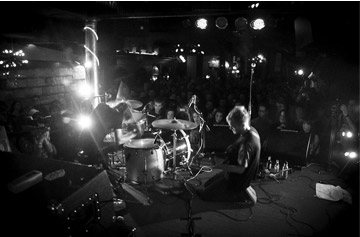
The San Francisco pop-folk duo Two Gallants played to a sold-out crowd on April 23, at its familiar stomping grounds, Bottom of The Hill. It was a reunion show of sorts. Two and a half years had passed since Adam Stephens (lead vocals/guitar/harmonica) and Tyson Vogel (drums/vocals) played together. In the interim, Stephens went by his full name, Adam Haworth Stephens, when gigging solo, and Vogel played guitar under the moniker Devotionals. While those endeavors were undoubtedly strong, they didn’t match Stephens’ and Vogel’s musical synergy as a duo.

Following Portland, Ore.’s The Bad Backs and Los Angeles’ Rumspringa, Stephens and Vogel took the stage to chants of “Two Gallants!  Two Gallants!” and roaring applause. The duo both sported new ‘dos: a longer, feathered look for Stephens, and shorter locks for Vogel.

As Stephens began to play, a (possibly drunk) woman got on stage, standing with her back to the crowd, and danced to the first measures of “Dyin’ Crapshooter’s Blues.” Thankfully, she was escorted off by security seconds later. During this song, and throughout the show, Stephens turned to Vogel in between verses and got down on his knees while playing his cherry-red electric guitar. The set list was written on the top of his left hand in black Sharpie ink. Vogel’s chin-length hair became drenched in sweat during his frenetic yet controlled drumming over the course of the night.

Two Gallants, “Steady Rollin'”:

Stephens’ voice was as gorgeously sandpaper-coarse as ever as he rasped, replete with torment, “You must have seen me ‘neath the pool hall lights/ Well, baby I go back each night/ If you got a throat/ I got a knife…Death’s comin’/ I’m still runnin’.” Nearly all of the crowd knew “Steady Rollin’” by heart, singing along to the point of almost drowning out Stephens’ amplified vocals.

Two Gallants played songs from its entire catalog, from its self-titled 2007 album on Saddle Creek to its first proper release, 2004’s The Throes. Its second and last encore song, “My Baby’s Gone,” seemed very fitting for the concert’s end. “Now my wave breaks down on me/ Whole world seems out to sound me,” Stephens sang. “I’ll drown, no one to show me/ Can’t swim, I lost my floaty.”

Are you really middle class?

A fascinating article appeared in the New York Times a couple days ago about the bias people tend to have when it comes to beliefs about their own economic standing in relation to the rest of society. It seems a trio of researchers found that Argentinians tend to view their personal economic classifications in much the same way people in the United States do: Everyone believes they are middle class.

The bias works differently depending on one’s income bracket, apparently: “Poor people consistently overestimated their rank, and rich people consistently underestimated their rank.”

According to the article, “Respondents were eventually informed about whether their own rankings estimates were too high or too low. This news changed people’s policy attitudes. People who thought they were relatively richer than they actually were started to demand higher levels of income redistribution when told they were actually relatively poor. After all, learning that they were poorer than they had believed also meant they’d be more likely to benefit from redistributive policies than they originally believed.”

This got me wondering what income distribution actually looks like in the San Francisco Bay Area, and how people view themselves within that spectrum. I went to the U.S. Bureau of Labor Statistics (BLS) to find the most recently available data for earners in this designated metropolitan area, which includes San Francisco, Oakland, and Fremont.

The data was from May of 2009. Taking into account all occupations and nearly 2 million earners, the mean annual wage was $58,250. That’s the number in the exact middle, but most earners were in employment categories which made less than that on average.

To better understand how it breaks down, I scrolled through the various employment categories. The data showed that around 6.8 percent of all earners worked in management — the bosses of all stripes — making an average of $126,260 per year. People working in the computer and mathematical science sector, such as programmers or database administrators, made an average of $91,440 a year, representing about 4.3 percent of all earners. The accountants, budget analysts, and others in business and financial occupations accounted for about 6.8 percent, earning an average of $84,330 per year.

Meanwhile, around 59 percent worked in employment categories with average earnings of less than $58,250. That’s not to say every single one of those earners made less than that — police officers, for example, registered at an average of $79,080 annually, while their “protective services” employment category had an annual average of $52,260. But it does suggest that at the end of the day, quite a few people fell below that middle income line.

The greatest areas of employment by far were office and administrative support services (around 16 percent of all earners; bringing in an average of $41,670 annually), sales (nearly 10 percent; earning an average of $45,860 annually), and food service (around 8.4 percent; earning an average of $23,740 annually).

People working in education, a category that includes teachers and instructors as well as librarians and curators, had median incomes that very closely reflected the exact middle — $58,880. That category made up around 6 percent of all earners.

Of course, there are flaws in any data set, it can only really reveal so much, and even this one was titled “wage estimates.” A study of San Francisco by itself would likely portray a different picture, with a higher mean annual wage. There are outliers, like Pacific Gas & Electric Co. CEO Peter Darbee, who made more than $10 million in 2009. And all of this should be considered in the context of an official 9 percent unemployment rate for San Francisco (actual unemployment rates tend to be higher than official estimates).

On a broader scale, we also know that 1 percent of the nation’s population takes nearly a quarter of the wealth.

The research cited in the NYT article offered this theory about why people are tend to be biased about where they stand: “If you’re mostly exposed to people earning about as much as you, you’re likely to think your earnings are average.”

Puke and privatization in Dolores Park

44

Editors note: the vow by Chicken John Rinaldi to vomit in Dolores Park has gotten a lot of media attention — but there’s a real story behind it that the press has missed. Chicken sent us this opinion piece presenting his side of the story.

By Chicken John Rinaldi

It happened pretty quickly, when privatization came to Doritos Park. Sorry; Dolores Park. I keep forgetting they haven’t sold the name yet.

It didn’t come like a wraith with icy fingers or an immense monster with an army of lawyers. Privatization came to Dolores Park in the form of a nonprofit incubator for immigrant women entrepreneurs called La Coucina. For a progressive city like San Francisco, you can’t get much more cuddly than that.

I hear the Trojan horse was adorable, too. It had a cute mane and soft eyes and was made of really high quality lumber. You’d be a fool to criticize that kind of craftsmanship. But it was privatization of a park, even so. Selling space on public land without the public’s consent.

And there was resistance, of course. But the resistance was met with the oddest enemy. The resistance didn’t find itself fighting against people who believed that the park should be privatized. The resistance debated with people who did not know what privatization was. The resistance debated with people who did not know it was coming. The resistance debated with people who knew what it was, but refused to recognize it.

“Yummy tacos!” they chirped, as though that actually was an answer. Enron served tacos, too. Every Tuesday. The problem wasn’t the tacos: it was Enron.

“It’s just a food truck!” they said. “For immigrant ladies! No one who gives work to immigrant ladies could ever be involved in something bad!” This kind of thinking, that anything is okay as long as it also raises money for a good cause, is what will sink our own City of Art and Innovation: San Francisco.

The people who resisted asked questions: Why can’t they park the taco truck on the curb, where cars belong? Why drive a truck on the grass? Why not rent a parking space for the truck? Ummmmmm….. “Yummy tacos!!!” They said, looking around the room for approval.

The people who resisted pointed out that the public outreach that was supposed to be done before this kind of thing is authorized was never done. They told us at the first meeting that it was too late to stop. They did that thing where they create the illusion of inevitability.

Some things are almost impossible to undo once they’ve happened. Sacking the city of Troy, for instance. Or detonating a neutron bomb. Or kissing your best friend. Or doing all the cocaine in the cab before you get back to the party. Privatization is like that. Once a government starts getting easy revenue from a public trust, it doesn’t want to go back. Then it starts taking everything else with it: once one park has a food concession, every park that doesn’t have a food concession starts to look like a drain on the budget. Once one park gets a gift shop, every park needs a gift shop. Pretty soon you end up with a city full of park-themed malls. Well, in the rich neighborhoods anyway. The poor neighborhoods will have fences around the parks. Because they can’t carry their weight.

This is what a class war looks like. Straight up. RPD (mainly the general manager, Philip Ginsburg) has declared class war on San Francisco.

We’ve seen where this leads before: like in the news industry. Back in 1967, network news was almost … almost … a public trust. There was tight regulation. There was no consolidated corporate ownership. The people who owned the stations had zero influence on what was broadcast. Most importantly, no one expected network news to turn a profit. It was something the networks did, for the public good, as a condition of getting access to the public airwaves. It wasn’t perfect, but it tended to be solid news about factual issues that were relevant to the times.

That began to change in 1968, when CBS started a show called “60 Minutes,” and for the first time in network history a news show made a profit. Suddenly all news had to make a profit. And then it had to make a bigger profit, and then a bigger profit. It was a slippery slope. By the 2000 election we had FOX news.

As part of this trend, facts got replaced with opinions – because opinions are cheap and profitable. You want to make more money? Cut your foreign reporters, replace them with a pundit who once visited France. Need to make more money? Cut your congressional reporters and replace them with a couple of hacks arguing about congress.

As a result of the rush to make a profit, news coverage has become completely tabloidized … which is why some idiot with a cause needs to throw a “Puke-In” to get attention to a relevant issue like the privatization of parks. And it worked.

A cleverly worded publicity stunt that claimed I was going to “Fill Dolores park with vomit and watch the trailer of privatization float away on a river of puke” got attention. News organizations that never would have run a headline like “parks department fails to consult with residents” were tripping over themselves to be the first to run headlines like “Incensed man vows to puke on immigrants” and “park activist to puke on vendors.” All told, 57 stories appeared online and in the papers.

 Eventually, most of them mentioned that the park was going to get privatized. It was ugly, but it was a win – and with the media the way it is, everything’s ugly.

After it had been going on for two weeks, I had to explain to people that my cheap and obvious publicity stunt was a cheap and obvious publicity stunt. This lead to more headlines. But come on – “puke in?” That’s funny! But for the record, no, I’m not going to throw up on immigrants. I do have $750 worth of novelty vomit, but all I’m really doing is collecting signatures for my petition: Did anyone really think I could puke on another human being … someone who I didn’t know … just because we had different opinions on the location of a taco truck? After I ran for mayor for second place? After Porneokie? After a career in San Francisco spent producing benefits and rallies and meetings and art incubators and pot luck dinners and bus trips to amazing places?

Well, actually… yes. People thought I was going to go assault someone. Welcome to San Fransandiego. Whatever. The point is: the Recreation and Parks department is trying to rent out public parks to make money, and they’re not consulting the neighborhoods. And while they’ve found the nicest, sweetest, bestest cause they could find to rent the first plot of your land too, the next time it might be FOX news. It might be Exxon. It might be Goldman Sachs. They don’t care: they’re just in it for the money.

Privatization came to Doritos Park. Shit, I did it again. Sorry. Privatization came to Dolores Park. And the progressive left of the Mission showed up. We showed up and we showed that we have a gag reflex. We let Mr. Ginsburg know that privatization makes us nauseous. If they’ve got budget problems, close a few golf courses, they’re horrible for our ecology anyway. Endangered species; frogs and what have you. Lowering kids services 30% and then raising your payroll 670% is not gonna work. Duh. You can’t fire all the kids’ teachers that were making $35K a year, close the clubhouses and then hire thirteen $120K a year bureaucrats and not start a class war. There should be 50 neighborhood groups at your door with torches and pitchforks!

If the Recreation and Parks Department needs more money, they should show good faith and manage what they have better first, before selling our future with privatization. And if they need more money from the General Fund, then lets find it! Lets partner with them to seek solutions or restructure how the financial system works so they get the money they need without ruining our city.

As for us eating each other alive over this issue? I think it’s worth our time to talk this out, argue it out. Work it out. It’s definitely worth poking taco truck sized holes in this moral justification for selfishness. Which is what I think we have here. I think fighting that is worth signing a petition, and worth protesting. And it’s worth a cheap publicity stunt. I bet I can think of another one, too.

Chicken John is a San Francisco showman. Here is the petition:

Thirty years of radical sex, as seen by Michael Rosen

15

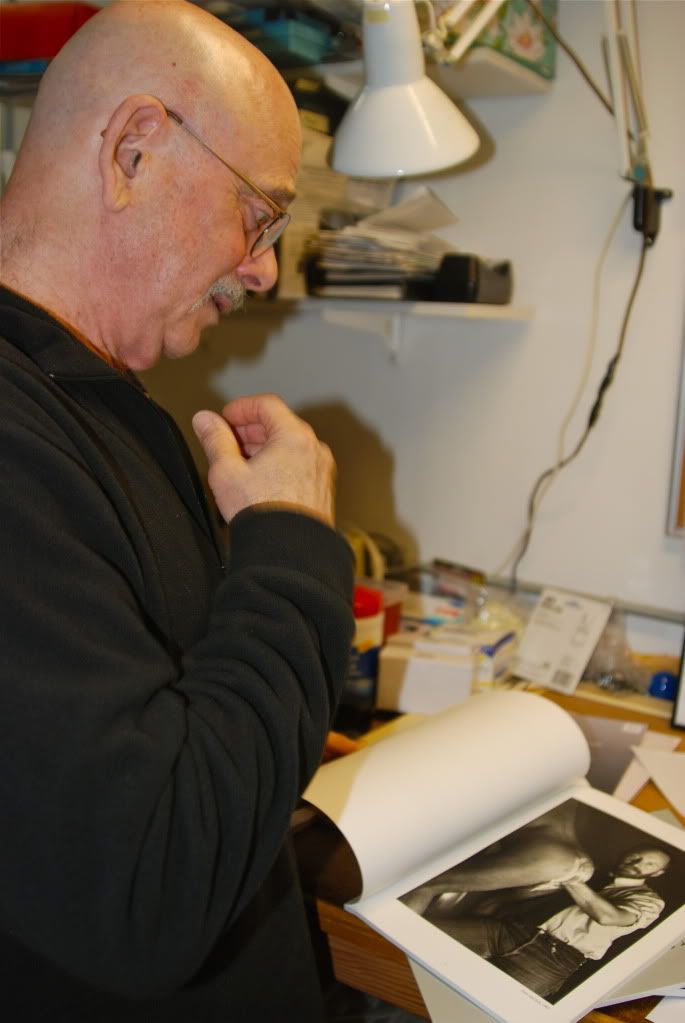
It’s been more than three decades since Michael Rosen began photographing radical sex, giving insight into sexual explorations that ridicule the notion of “mainstream” sexuality. People of all shapes, genders, and lifestyles have come out of their bedrooms to play in front of Rosen’s lens, but today it’s the man behind the camera who is giving it away, free of charge. 

Flesh grinds and bodies mount. Rope-entwined nipples seem ready to burst. A whip cracks on a slave’s bare cheeks. They may be still images, but the scenes Rosen captures aren’t static — they’re merely paused for outside reflection. Eyes dart across the images, consuming every engorged cock and clit while the brain attempts to control the influx of its own desires, inhibitions, and assumptions. Rosen’s work is refreshingly bold; a clear look at real, honest sex.

Rosen has published five books of beautifully lustful photographs throughout his career, but in 2007 he posted the entire collection on his website for free. In the three and a half years since, there have been 25,000 downloads. Rosen, a recently retired software developer, is weeks away from celebrating his 69th birthday and has no plans to start charging for his work. I tell him he’s crazy. 

“Didn’t I already mention that this is what I’m meant to do? Did I mention that I’m changing the world?” Rosen reminds me that we’ve already touched on this subject today, but I’m still in awe at his generosity. 

mrosen

Current work and his “timid” nude landscapes from the 70s

I’ve been hanging out in his studio in the basement of his San Francisco home for nearly two hours, flipping through photographs old and new, and listening to the wild stories behind some of his most favorite shoots. There’s a before and after photo of two transmen, first playing together as women and then years later, reconnecting for another romp with male bodies. There’s a striking photo of a man sucking himself off. Rosen points out the easily overlooked lesions on his body — he was dying from AIDS. Then there’s the story about the badass dominatrix best summarized with a series of nouns: slave, duct tape, funnel, piss, cum. 

mrosen

“Are you sure you can put this image on your site?” 

He stares at me with serious intent and tells me he considers himself a “concerned photographer”, dedicated to making important, original work. This is not pornography, but sexual art that offers insight into the curiosities of passion. Between the sheets, on the kitchen counter, or bound in a dungeon, there’s no such thing as right and wrong, only consensual. He presents me with a carefully planned quote, set to some dramatic classical piano pounding from the radio. 

“Whatever your plumbing and whatever the plumbing of your partner, it’s all good so long as you’re having safe, sane, and consensual fun together.”

mrosen2

A model named Becky photographed in 1975

In the early years Rosen’s subjects were exhibitionists who wanted professional prints. Word of mouth brought all kinds of couples, lovers, and individuals to Rosen’s studio and what they did on camera was their choice. He has never arranged stranger encounters — whether the lovers had already slept together or fantasized about the possibility, the desire has always been real.

Today he pays most of his nudes but the same guidelines apply: “They’re all just doing what they do.” He offers little direction besides offering technical suggestions, asking them “whip at a steady pace” so he can time the shot or reminding people to “come to rest at the base of his dick so you don’t hide it.” 

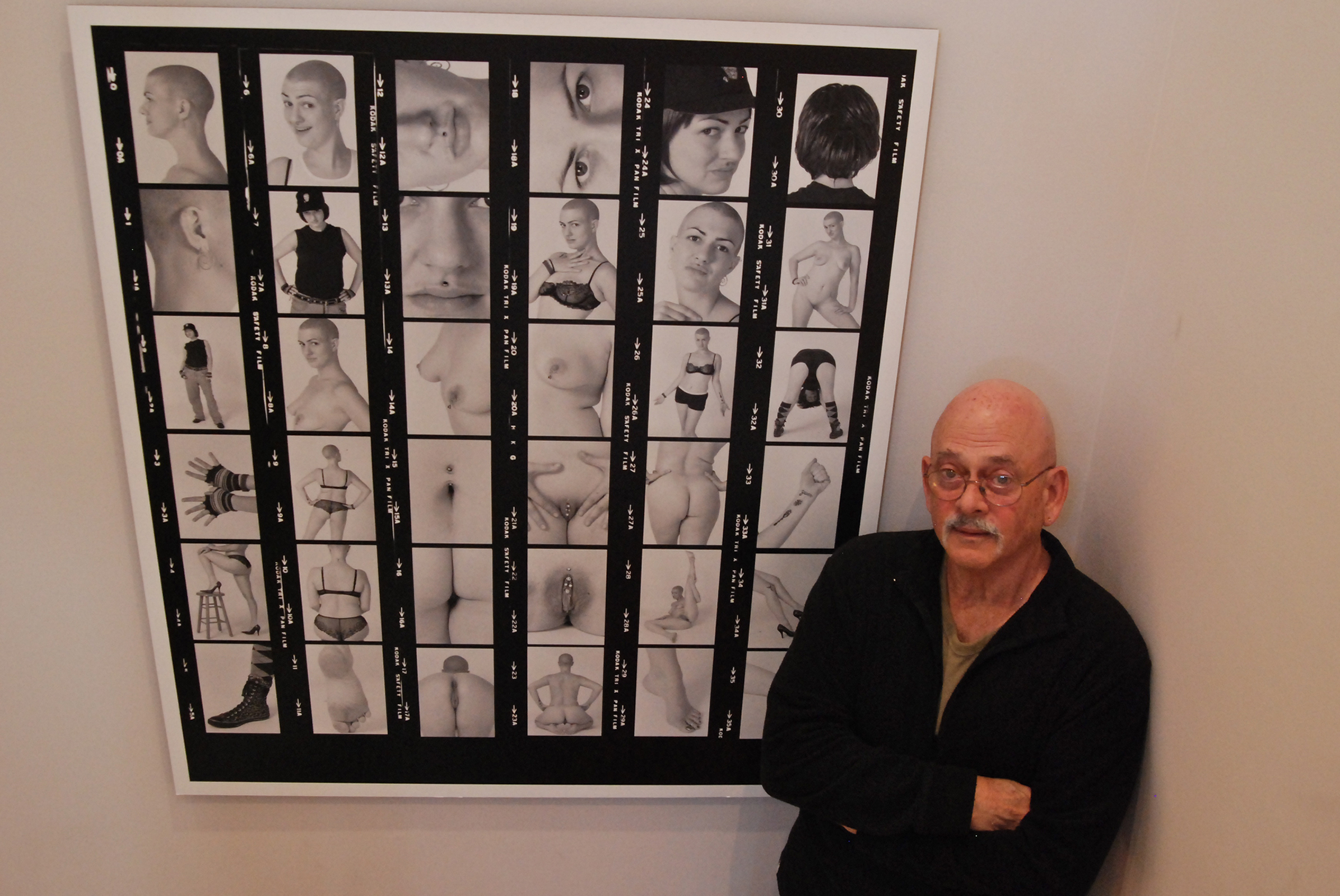
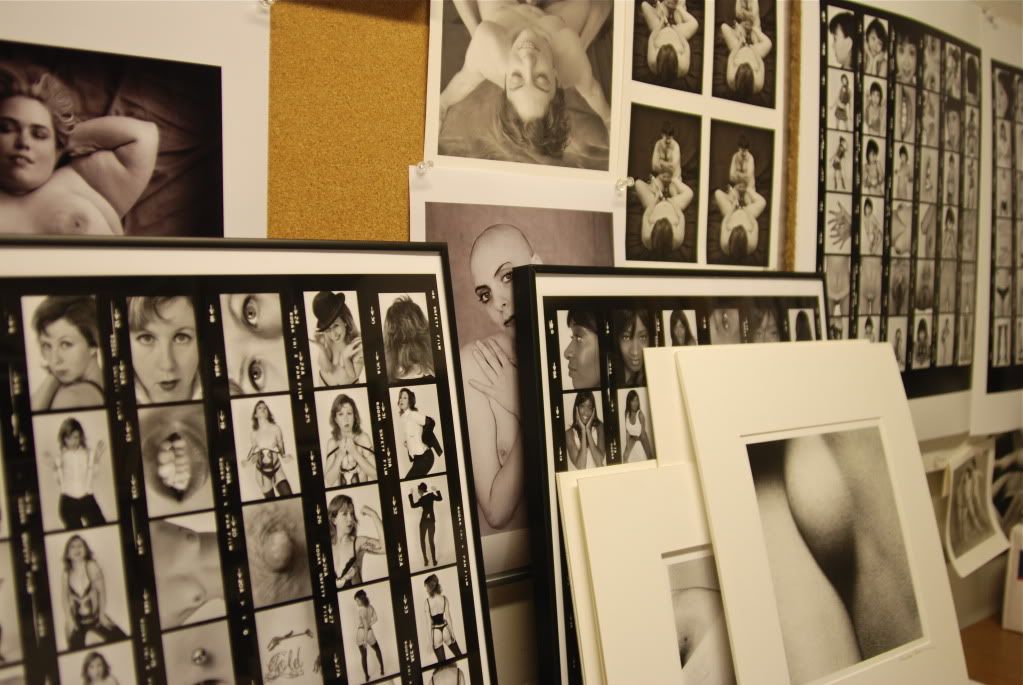
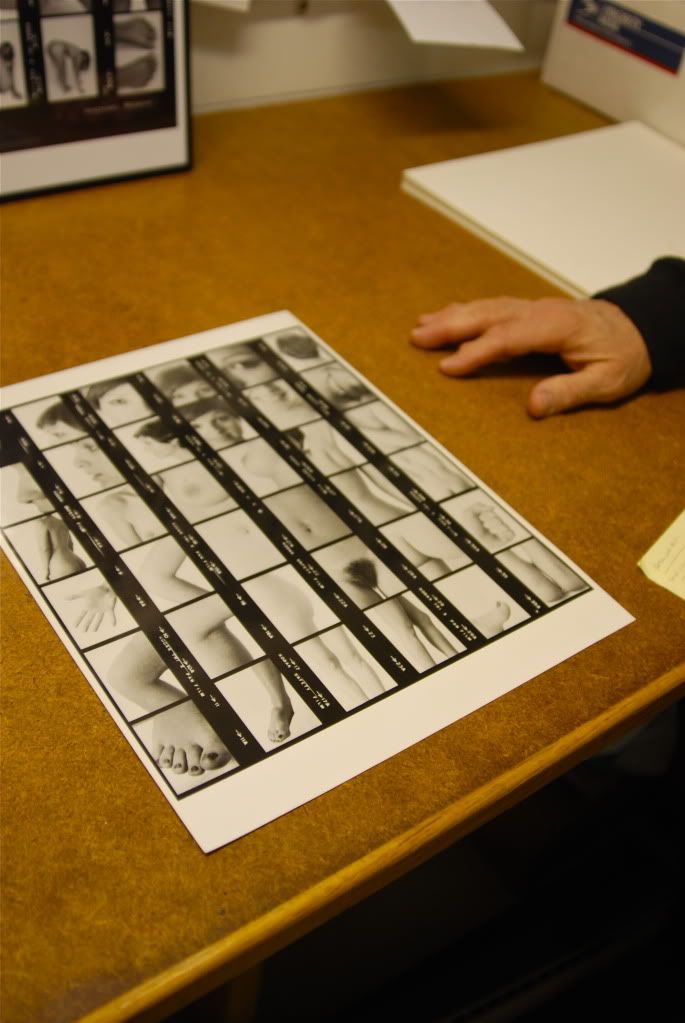
Rosen’s latest project is a series of contact sheets; his version of a Cubist-style sexual portrait. He’s shot over 50 women from head to toe, zooming in on hands, labias, tattoos, and nipples. The multiple simultaneous views of each lady expresses her individual personality, both clothed and naked. A collection of these photographs will be featured at the Seattle Erotic Art Festival next month and tentatively, this fall they’ll be showing at the SF Center for Sex and Culture. Although the layout veers away from his previous work, that real, tangible intimacy remains. 

“This is real and these are real people,” he looks around the room, scanning over the years of faces and bodies. “For some of these people, it was the first time they had sex and for others it was their last. That’s real life.”

mrosen4

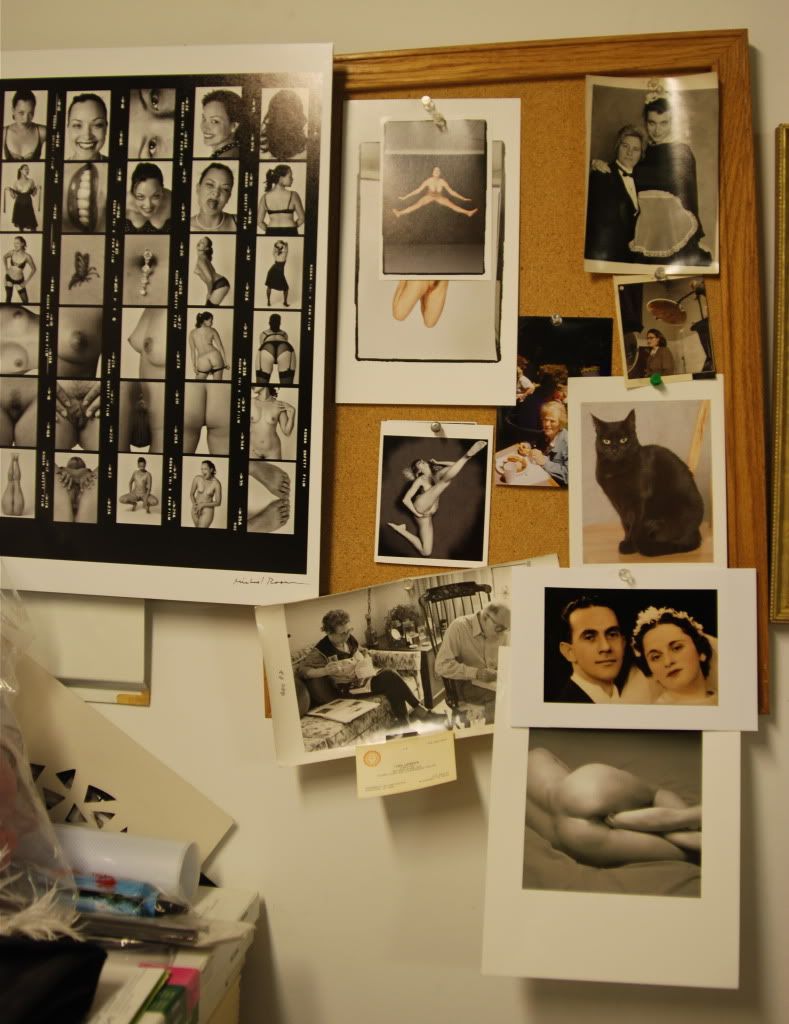
Sexual art and cats dominate Rosen’s home

I ask him what it’s like to be so closely involved with all this steamy sex. The moaning, the orgasms– does he ever get distracted? Excited?  He quotes photographer Jim Duvall. “I’m not a very good photographer with a hard on,” he cracks a small smirk and twiddles his thumbs. “It’s hard sometimes. But it’s ok.” 


5 Things: April 28, 2011

0

>>POP-UP-TASTIC Oh pop-up phenomenon…why are you so enticing? Is it because our hype-heavy culture is so ADHD that the newest and coolest bar, gallery, restaurant, or what have you is “out” even before it’s torn down and replaced by the next “it” concept? The once failing Corner restaurant on 18th and Mission is now bustling thanks to the eatery’s new format of hosting a different recession-plagued talent with a menu to die for every night of the week. So, too, are venues supporting a great idea, but not necessarily one with enough gas to keep it going long-term, like the coffee shop-record store-music venue-rehearsal space-anarcho bookbindery of our adolescent dreams. Enter the People’s Gallery, host to the Big Things pop-up shop this Sat/30, which will feature everything from a bookbinding workshop to sidewalk sale-type treasures, handmade goodies, photo exhibitions, and food. Get there early, for it might poof into the ether before you even get a chance to check out the buzz.

>>ANOTHER WEDDING OF THE CENTURY! As the media breaks out its best British accents, the complete mayhem engulfing the royal wedding reaches its fevered pitch tomorrow with the event itself. For the truly die-hard, there is but one place to take in the beauty of clan-building: the British consulate, where the official viewing party kicks off at 9 a.m. with remarks by UK Counsel General Julian Evans. Call Renee at (415) 407-7424 to RSVP.

>>BEATS AMBASSADOR When the publicity ploy involves bad-ass Ghanian American hip-hop, count us as happily-enlisted marketing allies. Blitz the Ambassador plays La Peña Cultural Center tonight, and is offering up a free stream of his new album Native Sun so that you can learn the words before you shake ass. The album is a powerful barrage of traditional percussion, guitar licks, and fly verses – worth banging in your headphones even if you can’t make Berkeley tonight.

Blitz the Ambassador, Native Sun:

>>TRUCKING COMPANY Do you dream of owning a food truck but aren’t quite sure how to fund it? Stop squirreling away your Tooth Fairy money and learn how to apply for a loan — and get approved — from a panel of finance experts, fellow foodies, and food truck owners. Tonight, our friends at Renaissance Entrepeneurship Center are sponsoring this workshop for only 10 bucks, but the free publicity that comes with Chicken John threatening to vomit all over your new local economy-boosting venture is absolutely priceless.

>>BACK TO THE BEACH The last eighteen months have brought a bunch of repeat-listen recordings from bands that invoke the oceanside, including Beach House, Dirty Beaches, and Beach Fossils, who return to San Francisco a week from today, taking the stage at Slim’s to play songs from their 2010 debut album and the more recent EP What a Pleasure.


And the next chief is…yes, Suhr!

3

Mayor Ed Lee appointed a deeply emotional Captain Greg Suhr as Chief of the San Francisco Police Department during a swearing-in ceremony where the majority of folks were either elected officials, running for election, running each other’s electoral campaigns—or wearing SFPD uniforms.

And in the end it seemed that the choice may have been influenced by pressure from the powerful San Francisco Police Officers Association, judging from the comment Lee jokingly directed at SFPOA leader Gary Delagnes, saying, “Gary, it’s time to get quiet and go to work.”

Lee told a standing-room only crowd that when he returned from Hong Kong to San Francisco four months ago finding a new police chief was his top priority. And that initially it was suggested (Lee did not say by whom) that he leave the SFPD situation alone and allow an elected mayor to appoint the next Chief.

‘While I am an interim mayor, this is not an interim decision,” Lee told the crowd, signaling that while he may be out of office in January, Suhr may be here to stay as the city’s top cop.

“Today, I’ve chosen the best candidate,” Lee continued, thanking Acting Chief Jeff Godown for his work leading the SFPD since former Mayor Gavin Newsom made the shocking decision to appoint former Chief George Gascón as District Attorney.

But while Newsom’s move may have upset the apple cart in the D.A.’s race, it sure seems to be working out well for Suhr.

Describing Suhr as “a police and people’s Chief: and “a reformer from the inside out,” Lee ran through a long list of the new Chief’s contributions to the SFPD. These included Suhr’s 30 years of service, his climb through the ranks to become Captain of the Mission station, his gig as Captain of the San Francisco Public Utilities Commission in a Homeland Security capacity, and, since 2009, as Captain of the Bayview station.

Suhr began by saying he was “speechless.” Donning glasses to read a speech that he had prepared the night before, Suhr choked up when he talked of being “fourth-generation, born and raised in San Francisco.” Recovering his composure, Suhr smoothly changed gears, as he joked how his appointment therefore makes him “a local hire,”—an insider reference to Sup. John Avalos’ recently approved local hire legislation that Mayor Lee is helping enact citywide.

Suhr recalled how he started out as a rookie on the midnight shift in the Tenderloin in 1981. He thanked his family, his friends and his girlfriend Wendy. And then he asked for a moment of silence “ to honor the memory of all the brave officers who have given their lives in the line of duty.”

Lee reclaimed the podium long enough to jokingly ask Suhr  “to investigate the whereabouts of my birth certificate” as his first assignment as the new chief.

Then it was Board President David Chiu’s turn. Chiu described Suhr as someone, ”who knows our streets, walked the walk, and knows the beats, someone who we all feel confident will be able to bring the SFPD the reform that former Chief Godown, Chief Gascón and Chief Heather Fong initiated. “

San Francisco Superior Court Judge Katherine Feinstein, who is the daughter of Sen. Dianne Feinstein and the presiding judge of the Superior Court, recalled how she has known Suhr since the mid 1980s. “I have watched him as each of our careers have moved forward,” Feinstein said, noting how there were some “steps forward and some steps backward” and how, “there were those who thought this day would never come.” (Feinstein’s words were the only reference to some of the less sunny moments in Suhr’s long and distinguished career. These included his 2003 indictment as part of Fajitagate, an incident that involved off-duty officers, a bag of take-out food, a beer bottle and injuries sustained by two local residents. Suhr was cleared of wrongdoing the next year, but was reassigned by then Chief Heather Fong to the PUC position after an incident in 2005, in which a police officer was seriously injured at an anarchist protest, and videographer Josh Wolf was held in federal prison for 226 days after he refused to release unedited footage of the protest.)

Next up was D.A Gascón and his rooster-like shock of silver hair. Gascón noted that when he first came to San Francisco, in the summer of 2009, he had no allegiances to, and no prior knowledge of, people inside the SFPD.

“I looked at Greg Suhr and one of the things that impressed me is how he worked with and related to people,” Gascón said, explaining why he appointed Suhr as Bayview Captain “Not only has he exceeded all expectations he did an incredible job,” he said.

 Police Commission President Thomas Mazzucco said that in the 100 days since the Commission announced it was looking for a new chief, it became clear that Suhr has the support of SFPD’s rank-and-file.

Mazzuco noted that he met Suhr in high school. “I knew he could hold a ball,” Mazzuco added, noting that he subsequently became Suhr’s football coach, even though he is younger than Suhr. “What the Police Commission has brought to us is not only a native son but also a cop’s cop. It’s an honor to have him as his chief.”

And after the swearing-in, the sentiment among officers in blue appeared to be strongly in Suhr’s favor. Lt. Ken Lee of Central Station recalled how he and Suhr went through the police academy together about 30 years ago.

“We went to different assignments but we’ve maintained a friendship,” Lee said. “The moment I met him I liked him. He was a very stand-up person, and as a native San Franciscan like myself, you could tell he had strong ties to the city. He’s a hard worker, he’s very dedicated to what he does.”

Lt. Mario Delgadillo, also of Central Station, said Suhr hasn’t lost his connection to the street. “That also means a lot, when you have a boss who’s walking with you,” Delgadillo said.

Suhr takes over the SFPD as it’s grappling with the fallout from a recent spate of scandals, including videos that Public Defender Jeff Adachi released that appear to show police misconduct at residential hotels and that forced DA Gascón to hand over his investigation of this alleged police misconduct to the FBI. Asked during a media roundtable what his appointment means for Acting Chief Godown, Suhr said Godown has returned to being Assistant Chief of Operations, which was the post he held before Gascón, who recruited Godown from LAPD, was appointed DA.

In response to a question about his top priorities as police chief, Suhr noted, “When I sit down with the mayor this afternoon, the mayor’s going to tell me what his priorities are. My first priority will be blocking the door open on the 5th floor so that if you wanna come see me you can, like it used to be. Then I have to meet with the command staff and captains and get their take on where they think we are, where they think we’re moving forward best, and match that up against how I’ve seen from a position of Bayview, how that matches up. And then see if I can’t meet with different community groups, the different police employee groups and the command staff.”

He didn’t mince words when it came to indicating that SFPD officers are going to be asked to give back during upcoming budget negotiations
“I’m sure that there’s going to have to be adjustments and I look forward to working with a collaborative effort with the mayor and the board and the unions and the rank and file,” Suhr said. “When the economy’s been good we’ve benefited by it, and now that the economy has … gone the other way, to some extent I think that the officers are willing to give back to do whatever needs to be done to keep the city safe.”

So, how does Suhr think he differs from former Chief Gascón? 

”He has a gorgeous head of hair,” Suhr joked. “To put it in a sports analogy, he’s a quarterback shortstop guy, and I’m more of a catcher, lineman, linebacker kind of guy. But I admire him, I think he moved a lot of issues forward for the police department, and I look forward to continuing those initiatives and giving a few of them a shot in the arm that I think were beginning to wane a bit.”

Suhr also talked about how he has always wanted to become a police officer (a comment that suggests he’s not planning to use the Chief’s post as a stepping stone to the District Attorney’s Office).

”When I went into the police department. on Silver Avenue which is now Willie Brown Academy — that was the police academy back in 1991 when I came in — man, we looked at just the regular uniformed police officers with just stars in our eyes, because they were just the sharpest, classiest folks that we were aspiring to be,” Suhr said.

And he indicated that as Chief, he won’t tolerate dishonesty in the face of ongoing investigations into alleged police misconduct. ”The character of a police officer must be above reproach,” Suhr said. “And I think that the investigation will show what it ends up showing, but I don’t think that there’s a police officer in San Francisco that would want to have a dishonest cop and I’d be at the top of that list. So I want all my officers to be of character that is above reproach.

Asked if he welcome clarification around the duties of SFPD officers assigned to the FBI’s Joint Terrorism Taskforce, Suhr said he believed an examination of the wording of the FBI’s most recent memorandum of understanding (MOU) with the department was already under way.

“I believe that the MOU is being revisited,” Suhr said. “I have not been a part of that, but again I think we have a real good policy with regard to our intelligence gathering and that does supercede any ask of any other agency. The officers are bound by policies and procedures. And that policy was well thought out with tremendous community and group input years and years ago, from situations that have not since repeated themselves. I think a lot of people back then couldn’t believe they happened in the first place, but I think measures were well thought out and put in place to make sure we don’t have a problem again.”

And at the end of the day, Suhr expressed the hope that his tenure as Chief would endure long after the interim mayor is replaced by an elected mayor.

”I’m a native San Franciscan, and this is a dream come true,” he said. “It’s my first day. However this story ends, with a little bit of luck (raps on the wood tabletop) it’s not going to end today.”

Hot sexy events: April 27-May 3

0

Hey there sexy, how’s life on the other side of the Intertubes? I wanna get real with some real questions in this week’s sexy events column. Don’t worry, it’s about you. Namely, we here at the SF of BG would like to know just what you feel is missing from sex coverage in this age of Aquarius (ha!) in which we live. Are you feeling like you have pressing sex ed questions that need answering? Are you wishing that there was more event coverage of the parties and perv-a-thons in our fair Sodom By the Bay?

See, we’re going through an evolution with our sex coverage, and though we’ve got some pretty hot and wild ideas up in our noggins, youse the readers are just that, and maybe you’re thinking something we missed. So how bout it – new voices, dildo reviews, heavy breathing monolouges? The Guardian’s mission is to be a voice for the community of San Francisco, so have at us. Um, our safe word is spelt. 


Erotic Reading Circle

Share your thoughts, air out those tired old insecurities – get real pervy with, whatever. The monthly Erotic Reading Circle at the Center for Sex and Culture provides a safe space for writers to share their bedroom-related materials. Carol Queen and Jen Cross of Writing Ourselves Whole facilitate the gathering, pretty much a must-do for any aspiring sex scribe. 

Weds/27 7:30 p.m., $5 suggested donation

Center for Sex and Culture 

1349 Mission, SF

www.sexandculture.org


Hot Draw

Unleash your wild, artistic side at these live drawing sessions – one need only peep the galleries on Mark I. Chester’s website to see that he doesn’t play when it comes to drawing dirty players. Kinky leathermen strut about for a crowd of strictly sketchy, strictly gay male artist scribblers.

Thurs/28 6:30-9:30 p.m., free

Mark I. Chester Studio

1229 Folsom, SF

(415) 621-6294

www.markichester.com


Art of Restraint

How would you like to be situated right in the center of a high-art, surround sound bondage performance? It’s all within your grasp, baby – this week’s Femina Potens event at Mission Control will string up local lovelies Fivestar and Madison Young, while adult film performers and submissives offering up chocolate-covered strawberries romp about. Does it sound too good to be true? Believe, child, believe. 

Sat/30 8 p.m.-3 a.m., $50-75

Mission Control 

www.missioncontrolsf.org


How Weird Street Faire

While not sexy per se, this fair sure is freaky: How Weird takes over a good portion of SoMa for stage upon stage of electronic ass-shaking, and community bonding. What community, you say? Bonding how, you ask? Well maybe just maybe that’s up to you, sailor. Head over in whatever state of disarray you like and get funky. 

Sun/1 noon- 8 p.m., $10 suggested donation

Howard and Second St., SF

www.howweird.org 


Kentucky Fried Woman’s Guilty Pleasures

You need this bucket of crispy, greasy, lip-smackin’ queers stripping down to their burlesque bundles like you need to watch your cholesterol intake. For reals, put down the trans fat. Instead, pop on over to Oakland’s Bench and Bar bar, and feast your eyes on the talents of Alotta Boutté, Scotty the Blue Bunny, and oh! So much more. Heart-stopping, in a good way. 

Sun/1 7:30-10:30 p.m., $10

Bench and Bar

510 17th St., Oakl.

(415) 374-1924

Facebook: Kentucky Fried Woman’s Guilty Pleasures 


“Finding and Maintaining a Happily Ever After: A Relationship Workshop for Lesbian Couples”

How do you make relationships last past the original courting period? Davina and Molly have married each other countless times in protest of unequal civil rights, and so they’re uniquely qualified (maybe) to talk about how to make matrimony mutually awesome (in and out of the bedroom).

Tues/3 6:30-8:30 p.m. $20-25 for singles $35-45 for pairs

Center for Sex and Culture 

1349 Mission, SF

www.sexandculture.org


Earth Day in City Hall … on Wells Fargo’s dime

Who was lucky enough to get treated to Mayor Ed Lee’s Earth Day Breakfast in City Hall, with the city’s top politicos and a smattering of high-profile San Franciscans? After noticing that the Board of Supervisors had approved a grant of $12,000 from Wells Fargo a few weeks ago to sponsor the event, the Guardian contacted the Mayor’s Office to ask for the guest list. The response came from the city’s Department of the Environment, which accepted the donation and organized the affair.

The 472-person invite list (we don’t know how many actually attended) included prominent figures such as Sens. Barbara Boxer and Dianne Feinstein, Rep. Nancy Pelosi, billionaire investor Warren Hellman, and former San Francisco Mayor Willie Brown. All 11 members of the Board of Supervisors were invited, too, as were mayoral hopefuls City Attorney Dennis Herrera, Assessor-Recorder Phil Ting, and state Sen. Leland Yee.
 
Invitations were extended to some truly green organizations, too, such as Green for All, Save the Bay, Rainforest Action Network, the Ella Baker Center for Human Rights, the Sierra Club, the Apollo Alliance, Greenaction, and others.

And many seats were reserved for the corporate sector. A total of nine representatives of Pacific Gas & Electric Co. were on the list. There were seven from Cisco, several from consulting and design firm CH2MHill, and a couple representatives from Skidmore, Owings & Merrill — the firm that’s doing the Parkmerced overhaul and which was tapped to envision waterfront venues for the America’s Cup. 

Seven representatives — including the CEO — were invited from Recology, which is in the midst of a debate over its high-stakes, $275 million no-bid garbage contract with the city.

According to Mark Westlund of the Department of the Environment, only half of the Wells Fargo grant went toward the mayor’s Earth Day Breakfast, “the remainder to a series of community events held in the Department’s EcoCenter lobby.” The other sponsors included Blue Shield of California ($2,000); CH2MHill; Skidmore, Owings & Merrill; United Airlines; Environmental Science Associates ($4,000); Levi Strauss & Co.; Cisco ($6,000) and Starbucks — which provided BPA-free travel mugs (double green points!).

It’s nice that San Francisco taxpayers didn’t have to shell out the $18,000 for all these people to celebrate Earth Day together. But at an event such as this, with so many millions of dollars in city contracts and major development projects flying around (not to mention the half a dozen or so people in need of campaign contributions), you can bet they weren’t all talking to one another about saving the planet.

FEAST: 10 contemporary kitchen essentials

0

By now, you (hopefully) know the basic building blocks of good eating: fresh, in-season vegetables and fruits, whole grains, and — for the carnivorous set — lean, unprocessed meat and fish. Awesome. But unless you’re an adherent of the new Paleo diet fad, which mimics the eating habits of our hunter-gatherer ancestors, it’s going to take a bit more to transform this no-frills foundation into something you’d want to sit down to. Here are a few kitchen essentials that can quickly shift your cooking from serviceable to superb. (Emily Appelbaum)


SESAME OIL

Ancient Assyrian legend holds that when the gods assembled to create the universe, their drink of choice was sesame seed wine. And when Ali Baba needed to unseal a magic cave stocked with treasure, it was Sesamum indicum, which bursts open at maturity, that he invoked with the famous phrase “Open, Sesame!” If you’re looking to introduce some similar magic into your cooking, sesame oil is a good place to start. The cold-pressed oil has a light flavor and high smoke point, making it ideal for fast, high-temperature stir fries and wok cooking. When toasted, the oil becomes rich, smoky, and deep. A few drops make salads and noodle dishes sinfully savory and create the perfect base for dipping sauces. For a decadent indulgence, try the following: spread hot toast with miso (fermented soybean paste), top with a slice of avocado, and a drizzle of toasted sesame oil, then close your eyes and float a bit.

Available at Ming Lee Trading Inc. 759 Jackson, SF. (415) 217-0088


TAHINI

Speaking of sesames, Bay Area veggies, vegans, and carnivores alike have been blending tahini, a paste made from hulled sesame seeds, into homemade hummus for years. When mixed with a little fresh garlic, lemon, and salt, tahini will make quick work of a can of garbanzos — but there are tons of other uses for this simple spread. Try branching out with bean dips. Include white cannellini beans, black beans, or even kidney beans, which are super-high in antioxidants. Ditch expensive bottled salad dressing in favor of tahini mixed with soy sauce, lemon juice, or cider vinegar, and any fresh herbs you like. Toss soba noodles with steamed veggies and tahini for a fast, healthy dish served hot or cold. Or, for a whole array of desserts, start by kneading tahini and honey into flour for a tender, pliable pastry.

Available at Semiramis Imports, 2990 Mission, SF. (415) 824-6555


QUINOA

If you haven’t tried this indigenous staple from the Andes, you’re missing out. Stocked with the full set of essential amino acids, these unassuming seeds may be the most complete protein source the plant kingdom can provide. Quinoa even made NASA’s short list for crops to be included in ecological life support systems for long-duration manned spaceflights. It cooks in minutes and — with its mild, nutty taste and light texture — it’s an ideal base for curries, stews, and cold salads mixed tabouleh-style. Unfortunately, the quinoa craze in wealthy countries has left the crop unaffordable in some traditional regions such as the Bolivian salt flats, where most cultivated quinoa is now grown for export. Be sure to look for quinoa from companies like La Yapa Organic that pay a fair price to farmers.

Available at Rainbow Grocery, 1745 Folsom, SF. (415) 863-0620, www.rainbow.coop


COCONUT MILK

If you’re the kind of good San Francisco citizen who duly visits the local farmers market every week, gets carried away by the textures and colors and aromas of nature’s bounty, and then balks at everything you’ve brought home when it comes time to stuff it in the fridge — fear not. Coconut milk is the thing for you. Nothing else can so quickly transform a mountain of disparate vegetables into a rich, harmonious meal. Nearly any food in any season (potatoes regular and sweet, carrots, sweet and spicy peppers, pineapple, green beans, onions, garlic, eggplant, zucchini, tomatoes, pumpkin, spinach, kale) can feel at home in a coconut milk bath, spiced with a pinch of curry powder or garam masala and perfumed with handful of fresh herbs.

Available at Khanh Phong Supermarket, 429 Ninth St., Oakl., (510) 839-9094


FRESH-GROUND BLACK PEPPER

My list of Things for Which There Is No Excuse is short, and most of the items on it — like tube tops and being mean — are negotiable under certain circumstances. But one entry that cannot be compromised on is the use of pre-ground black pepper. It is simply never, ever OK. The difference between the freshly cracked pepper and the plebian, tasteless grey powder that sifts from a can is like the difference between a jam band CD and a live show. Invest in a good-quality peppermill and you’ll end up putting pepper in all kinds of places you never imagined: after experiencing pepper’s pungency in soups and bisques, on roasted root vegetables, and over tomatoes served sliced and sprinkled with kosher salt, you’ll find yourself shaking it onto strawberries marinated in balsamic vinegar and pondering the possibilities of peppercorn ice-cream. A few turns of your grinder set to coarse can quite possibly make the world go ’round.

To browse more varieties of pepper than you crank a mill at, visit San Francisco Herb Co. 250 14th St., SF. (415) 861-3018, www.sfherb.com


FRESH-GROUND NUTMEG

Everything said on the subject of black pepper applies — with perhaps a smidge less fervor — to nutmeg. That sickly stuff stuck with humidity to the inside of a glass shaker at Starbucks does not even remotely resemble the delicately perfumed flakes that you scrape from a whole nutmeg seed, the hard, egg-shaped center of the nutmeg tree’s fruit). Once you stop shaking the horrid pre-ground granules over your coffee, you’re likely to realize the nutmeg is not just a sweet spice. It goes particularly well with cheese and cream sauces, enriches egg and pasta dishes, and enhances all types of savory cookery with that little something-something that makes diners go “hmmm.” But if you want to relegate it to the dessert realm, no one’s going to stop you from grating a little bit over your midnight dish of chocolate ice-cream.

Fremont-based organic spice company Spicely distributes to a bevy of Bay Area retailers, but their products are also available in bulk on its website, www.spicely.com


FRESH GINGER

Like nutmeg, the edible rhizome of Zingiber officinale is often relegated to the subsidiary role of sweet spice — at least in American cooking. But travel nearly anywhere else in the world, from Morocco to Malaysia, Venezuela to Vietnam, and ginger plays the snappy star in soups, roasts, stews, and salads. Grate fresh ginger and garlic into peanut oil as the base for a superlative stir-fry. Stir into soups for a revitalizing broth. For a crisp, peppery salad, shred cabbage, carrots, and green beans and toss with ginger, vinegar, or lime juice, and maybe a dollop of peanut butter (or use your newly purchased tahini). Pulse ginger, chiles, and garlic in your food processor for a quick crust to sear onto meats or tofu. Ginger is a versatile gal, so don’t be afraid to experiment.

Available at New May Wah Market, 707-719 Clement, SF. (415) 668-2583


FRESH LEMONS AND LIMES

Nothing wakes up heavy, sleepy flavors like a bright squeeze of acid, but don’t even bother with the bottled stuff here. Before you juice, take a second to zest the thin colored rind — which contains tons of essential oils — from the outside of the fruit, being careful to stay away from the white pith. Then cut in half through the equator and squeeze. Older fruits can be coaxed to spill their juice by rolling back and forth between the palm and the cutting board. Or zap in the microwave for just a few seconds. Lemons add zip to Italian and French dishes, limes to Asian, Indian and Latin. The brave and adventurous might even try whole lemons or limes — rind, pith, pulp, and all — chopped very finely in salsas; crusts for veggies, fish or tofu; and marinades. An old-timey recipe for something called Funeral Pie uses whole lemons, thrown in a blender with some sugar, eggs, and a little flour. The result is poured in a pie crust and “Viola!” A super-quick desert ready in a flash, in case of Great Aunt Millie’s untimely demise.

Bi-Rite Market stocks organic, biodynamic lemons and limes from Becks Grove whenever possible. 3639 18th St., SF. (415) 241-9760


BLACK BEAN SAUCE

Hot Chinese sriracha sauce might be manufactured right here in Northern California, but that’s no excuse for indiscriminately squirting that sticky red rooster bottle over everything — from eggs to escargot — that stands still long enough. If it’s spice you’re craving, aim for a subtler, deeper flavor. Chinese-style black bean sauces, garlic or chili, provide plenty of heat without the cloying, vinegary sweetness of sriracha. Instead, their fire is mellow and a bit smoky, and develops on the tongue. Try over steamed veggies such as asparagus, broccoli, or bok choy. Use to marinate tofu or chicken, and serve over everything from tempeh to tacos. If you like the taste, try going a step further and purchasing some fermented black beans — a salty, spicy condiment something like a cross between miso and Marmite.

Available at Pang Kee Bargain Market, 1308 Stockton, SF., (415) 982-1959


REAL MUSTARD

All mustards are essentially a combination of whole or ground mustard seeds suspended in vinegar and spices. But subtle variations in the type of grind and proportions of ingredients can make all the difference. If you inhabit the realm of ballpark-yellow, your culinary development has been sorely stunted. All mustards work as emulsifiers, making them ideal mix-ins for dressings, marinades, and notoriously finicky Hollandaise sauces. Whole grain mustards combined with miso, maple syrup, horseradish, or Parmesan cheese (not all at once!) make a crunchy coating for salmon, chicken, pork chops, or baked squash. Finely-ground mustards like German Hangstenberg are superhot and go well with preserved meats and blander veggies like cabbage. Some mustards are made with imported vinegars or champagnes, and are best paired with simple breads and cheeses so their unique flavors come through. And for something a little closer to home, try Mendocino Mustards, made in Fort Bragg.

Available at Canyon Market, 2815 Diamond, SF. (415) 586-9999


FEAST: 6 best breakfast bets

0

SF: a brunch town if ever there was one. The life of the alternative journalist is such that we’re rarely awake at sunrise, wondering from where the hell our next hangtown fry will materialize. But there are times when it behooves one to dine at 8 a.m. on a weekday (occasions that usually correspond to the appearance of a mother or father). Set that alarm, sweetie: here’s where you’ll find Guardian staff dragging to before a big day.


JUST FOR YOU

A menu peppered with delightful little zingers like “What’s grits? It’s that pasty white stuff … like you had in prison,” makes this my favorite sassy breakfast joint in Dogpatch. Just For You offers classic breakfast fare with a Southern twist — biscuits, cornbread, grilled catfish filets, or creole crab cakes to go along with your eggs and home fries. Breakfast is served all day, and if you’re an early bird, you can even score a deal-worthy plate of two pancakes with coffee for just $4.75 — but only if you get there between 7:30 and 8:30 a.m. weekdays. A strict schedule — just like you had in prison. (Rebecca Bowe)

732 22nd St., SF. (415) 647-3033, www.justforyoucafe.com


JOANN’S CAFE

Two good reasons to get up early in the morning. One: you are going on an exciting air voyage. Two: a nice meal is waiting for you. Or both — that’s generally the happy confluence that brings me to JoAnn’s, a cheery diner-like entity en route to the airport, where a display case full of homemade muffins greets early risers and a menu full of American classics and salsa-tinged breakfast items await to congratulate the new dawn. The tiny joint opens at 7:30 a.m. every day, and even if you are flying solo (my favorite), JoAnn’s counter seating provides the perfect perch to munch orange french toast and ponder whether you prefer the x-ray scan or the pat-down. (Caitlin Donohue)

1131 El Camino, South San Francisco. (650) 872-2810


JIM’S RESTAURANT

Jim’s is the ultimate greasy spoon, unpretentious, no-fuss diner food perfect for when you just want a simple breakfast and to avoid the scene. You won’t find brioche french toast or bottomless sherbet-colored sparkling drinks on the menu; instead, you’ll find classic breakfast options: eggs, pancakes, waffles — and beer, if that hangover’s knocking. Five bucks gets you eggs, hash browns, bacon, fruit, and toast; for $3 more, you can upgrade to hangtown fry. Speaking of relics, this joint is like the diner that time forgot. Wood-paneled walls and AM Gold on the stereo could keep you lingering till the afternoon. (Jackie Andrews)

2420 Mission, SF. (415) 285-6020


NEW POTRERO MARKET

I like to live outside the laws — of good nutrition, that is — and skip breakfast. But on those days when I’m extra-hungry or extra-rich, I’ll pick up a piece of fruit at New Potrero Market, right by the Guardian office. (Just go with whichever looks the most appealing — usually the bananas are pretty good, although they don’t always have them in stock. Apples are a good alternative. I don’t like oranges. Too much work, especially in the morning.) I don’t drink coffee, but I make up for it in Diet Cokes, which are also available at New Potrero Market. True convenience. (Cheryl Eddy)

301 18th St., SF. (415) 282-2225


BREAKFAST AT TIFFANY’S

When I want sheer comfort with a side of 1970s and Audrey Hepburn, I head to Breakfast at Tiffany’s. There, servers call you “hon” as the Beach Boys play on cassette tapes and you sip coffee, gazing at a faded Breakfast at Tiffany’s poster. But this dive provides a lot more to sink one’s teeth into than kitsch. I love Tiffany’s pancakes loaded with fresh blueberries, and they taste even better as you sit at the counter, watching them transform from batter to fluffy cakes on the griddle. For savory contrast (and if you have room), order giant hash brown “sandwiches” stuffed with ham, cheese, onions, and all-around goodness. (Virginia Miller)

2499 San Bruno, SF (415) 468-0977


CAFE LEILA

Don’t be thrown off by Cafe Leila’s flowery San Pablo facade or frilly name. Once you’re inside, it’s serious breakfast time whether you’re a morning person or a hungover owl. With a big dining room and sunny, cute patio, you’ll be sure to find a good amount of personal space to scarf down one of their many innovative breakfasts. Aside from a few everyday bagel options, Cafe Leila comes up with crazy omelet ideas that make me feel special, like the date omelet, a pile of farm eggs with dates and feta. And with three kinds of hot sauce, my condiment voice is always saying “Leilaaaaa.” (Hannah Tepper) 

1724 San Pablo, Berk. (510) 525.7544, www.cafeleila.com


Land of the undead

0

VAMPIRE APOCALYPSE There are no sparkly torsos in Jim Mickle’s Stake Land, a movie that depicts a vampire snacking on a human infant within its first five minutes. After that bold declaration that this is not a film to be fucked with, Stake Land shifts its focus to a ragtag pair of travelers who’ve taken to rural America’s back roads, trying to annihilate as many vamps as possible: teenage Martin (Gossip Girl‘s Connor Paolo), and his gruff mentor, Mister (Nick Damici, who co-wrote the script with Mickle).

As books, films, and comics have taught us, whenever a big chunk of the human race is wiped out (thanks to zombies, an unknown cataclysm, etc.), the remaining population will either be good (heroic, like Mister and Martin, or helpless, like the stragglers they rescue, played by Kelly McGillis and Danielle Harris, among others), or evil — cannibals, rapists, religious nuts, militant survivalists, etc. Stake Land doesn’t throw many curveballs into its end-times narrative, but it’s beautifully shot and doesn’t hold back on the brutality. The film opens at the Roxie on the heels of its local debut at the San Francisco International Film Festival. I recently chatted with up-and-comer Mickle about horror, the Internet, and … well, what else is there, really?

SFBG Stake Land feels very much like a zombie apocalypse film, except for the choice of monster. Why vampires?

Jim Mickle [Co-writer Damici and I] had just done zombies — we had rat zombies in [2006’s] Mulberry Street — but I think we both felt we didn’t get to do everything that we wanted to do there. Yet, also, we didn’t want to do the Romero thing and just do one zombie movie after another. I think we were looking for another monster, and we both liked vampires. They’re human-based, so I think you can treat them like characters and not just monsters, and be able to have them stand in for a lot of different things socially — but also have a lot of fun with them.

SFBG A lot of vampire stories depict the vampires as living secretly among the human race, but in Stake Land, they’ve basically taken over.

JM Originally, we [planned the film as a Web series], and that was how it started. The first 10 pages were always the same, and from there it went to different webisodes, where, for example [the characters] stopped off in New York City and had to fight a hopping vampire in Chinatown. It was all about, “When are people gonna wake up and realize they are surrounded by vampires?” But we were gonna do it very low-budget, and the question was always, like, “Holy shit. How are we gonna pull this off?” When the idea became to make a feature out of it and to sort of merge all these stories together, it just felt like that — a bunch of stories strung together and very chapterized. We wanted to hang onto that, but also give it a backbone and an overriding theme.

SFBG Do you have plans to follow through on the Web series?

JM We did try to keep it going — we have these prequels that have come out [on the iTunes Movie Trailers page at trailers.apple.com]. There are seven total — each character has their own short film, basically, sort of right before we meet them in the movie. We wanted to keep the idea of the serial going. We liked the idea that there are these new ways to release movies, and the online presence really matters for movies now. I still have yet to see a really successful Web series, so we tried to find a way to do that and mix that in [with the prequels]. But we still have all those scripts, you know, and when people talk about sequels and stuff — we still have that material there, and it’ll be interesting to see where it goes.

STAKE LAND opens Fri/29 at the Roxie.

This place

0

arts@sfbg.com

LIT Begun in part as a series of maps accompanying public lectures, Rebecca Solnit’s Infinite City: A San Francisco Atlas (University of California Press, 167 pages, $24.95) is a remarkable act of gathering, one that presents myriad versions and visions of San Francisco and its surrounding areas that can inform a reader’s experience.

Infinite City was recently selected by the Northern California Independent Booksellers as one of its 2011 winners. Duality is a fundamental aspect of the book’s breadth and depth and sense of sharply critical appreciation — structurally, Solnit pairs distinct maps with corresponding chapter-length essays. In keeping with that characteristic, and also with the book’s group spirit (though admittedly on a much smaller and less intensive scale), I asked different Guardian contributors to share appraisals of one, or in most cases two, of the 22 sections. The result provides just a hint of what can be found within Infinite City. (Johnny Ray Huston)

MAP 3. “Cinema City: Muybridge Inventing Movies, Hitchcock Making Vertigo

The map for this chapter tracks the San Francisco life of Eadweard (sic) Muybridge, alongside landmarks from Alfred Hitchcock’s Bay Area masterpiece Vertigo. In “The Eyes of the Gods,” Solnit, who won the National Book Critics Circle award for her 2003 Muybridge bio River of Shadows, writes of the 19th century artist’s breakthrough high-speed photography, “It was as though the ice of frozen photographic time had broken free into a river of images.”

Many such rivers flowed all over this fair city when Vertigo premiered at the Stage Door Theatre at 420 Mason St. on May 9, 1958. Alas, only 10 of the more than 60 single-screen venues extant that year, all demarcated on Shizue Seigel’s fine map, are still functioning. Solnit rightly describes the shift to watching films on various digital delivery mechanisms as leaving contemporary culture with a “curious imagistic poverty.” As she concisely describes watching Milk and Once Upon a Time in the West on the Castro Theatre’s giant screen, we’re reminded that there is no comparison between enjoying cinema in such a grand setting and staring at a laptop. The great 20th century memoirist and observer Quentin Crisp wrote, “We ought to visit a cinema as we would go to a church. Those of us who wait for films to be made available for television are as deeply suspicious as lost souls who claim to be religious but who boast that they never go to church.”

That applies to you too, Netflix subscribers! The Roxie, Castro, Red Vic, Clay, and a small number of other houses of worship are still in business, so what are you waiting for? (Ben Terrall)

MAP 4. “Right Wing of the Dove: The Bay Area as Conservative/Military Brain Trust”

In “The Sinews of War are Boundless Money and the Brains of War Are in the Bay Area,” Solnit argues that antiwar, green, and left Bay Area hotspots are well known and don’t need to be charted again — unlike military contractors and assorted other forces of reaction in the region.

Solnit notes that many military bases that used to operate in the Bay Area are closed, “but the research, development, and profiteering continue as a dense tangle of civilian and military work, technological innovation, economic muscle, and political maneuvering for both economic and ideological purposes.”

Among the hard-right compounds providing counterevidence for that demonstration chestnut “the people united will never be defeated”: Lawrence Livermore National Labs (birthplace of Star Wars — the Reagan era money pit, not the George Lucas movie); Lockheed Martin, world’s largest “defense” contractor; the Hoover Institution, Stanford’s reactionary think tank; and Northrop Grumman, missile component designer. It’s useful to have so many of them in one place, if queasy-making.

On the lower left of the map sits Sandow Birk’s beautifully warped code of arms, which features the Cicero quote (Nervi belli pecunia infinita) that Solnit cites in her chapter title, under a half eagle/half dove, a rifle-toting soldier, and a scythe-clutching skeleton. It should be on the door of every U.S. military recruiting center. (Terrall)

MAP 6. “Monarchs and Queens: Butterfly Habits and Queer Public Spaces”

“How thoroughly the lexical landscape of gay history is invested with [a] paradigm of emergence,” notes poet Aaron Shurin in “Full Spectrum,” the chapter accompanying Infinite City‘s sixth map. Like one of the dazzlingly-named butterfly species rendered by Mona Caron on the map, Shurin flits gracefully between memoir and historiography as he tracks San Francisco’s ongoing evolution as a locus for queer emergence.

From North Beach to Polk Gulch, from Folsom to Castro, LGBT folk — be they American painted ladies, Satyr angel wings, or Mission blues — have continually migrated to and within the city to shed their cocoons and show their true colors. Local faux-queen Fauxnique traced this metamorphosis at the 2003 Miss Trannyshack Pageant when she climatically emerged as a regal butterfly to Elton John’s “Someone Saved My Life Tonight” (apropos to Shurin’s royalty motif, she won the crown). So too did the late Age of Aquarius painter Chuck Arnett, who often nestled butterfly imagery into his portraits of SoMa’s leather demimonde, and whose murals once adorned some of the many now-extinct bars also denoted by Ben Pease’s cartography. Only more than half a dozen of these “wildlife sanctuaries,” in Shurin’s parlance, have survived, with the Eagle Tavern’s announced closure marking another loss of habitat. Queers, though, are if anything adaptive, and my hope is that the future fluttering tribes of San Francisco will keep alighting on new ground to unfurl their wings. (Matt Sussman)

MAP 7. “Poison/Palate: The Bay Area in Your Body”

“Food is part of the Bay Area you hear about nowadays, exquisite upscale food at famous restaurants and gourmet markets. But it’s so boring we couldn’t stay focused on it in this map.” These refreshing, if rarely uttered words come two-thirds of the way through the chapter that accompanies the “Poison/Palate” map, Rebecca Solnit’s “What Doesn’t Kill You Makes You Gourmet.”

The phony Tuscany of Napa and the once-orchard-filled, now-EPA-Superfund-site-speckled Silicon Valley are wisely singled out for derision, a convenient duality in both geography and culture and the perfect framework on which to hang a critique of the local culinary community’s smug, myopic self-indulgence, by raising the not-so-elite-specters in Bay Area food history (the It’s It, the Popsicle, the Hangtown Fry, the Rice-a-Roni), and reintroducing the politics of food into the conversation, in the form of the chemical tonnage used to produce wine grapes, food giveaways at community gardens, Diet for a Small Planet, and Black Panther breakfast programs for school-kids. The sprawling topic is almost given too short a shrift, threatening to leap its mutant-mermaid-bedecked map.

Better is the 18th chapter, “How to Get From Ethiopia to Ocean Beach.” Solnit begins by loosely charting the ingredients that go into your cuppa joe: the water from Hetch Hetchy, the milk from West Marin, the coffee that courses through the port of Oakland, and, impishly, the leavings that flow toward the Southeast Water Pollution Control Plant. All that’s missing from the equation is the sugar that I need to make the darkest, brandy-and-cherry-tinged brew palatable. SF’s cafe culture is also deservedly lionized — though some might want to hurl china due to the exclusions on the accompanying map: why, for instance, call out Blue Danube Coffee House and not the grungier, more Chinese-populated Java Source? (Kimberly Chun)

MAP 8. “Shipyards and Sounds: The Black Bay Area since World War II”

Though author Joshua Jelly-Schapiro opens this chapter, subtitled “High Tide, Low Ebb,” with an eloquent invocation of Otis Redding’s “(Sittin’ on) The Dock of the Bay” — penned in Sausalito, by the way — it was the slight mention of Lowell Fulson’s “San Francisco Blues” that most resonated with me. “Ohh, San Francisco,” the lyric goes, “Please make room for me.” The facts presented in “Shipyards and Sounds” record The City’s answer as a genteel and progressive “No nigger.”

Beginning at the start of WWII, when Southern blacks migrated to the Bay Area to build ships in Hunters Point, Jelly-Schapiro points out that the main areas of wartime shipbuilding (Richmond, Hunters Point, Marin City) are “places that today remain centers of black population and of black poverty.” Indicating, to me, that little has changed since the 1940s in some significant ways. Don’t get mad at me, I didn’t say it. Jelly-Schapiro did.

Jelly-Schapiro also shows how terms like “redevelopment” displaced black Fillmore District residents to housing projects they’d been banned from during the war and land-grab euphemisms like “urban renewal” decimated black neighborhoods such as West Oakland. Electoral laws mandating that the SF Board of Supervisors be elected by citywide contests and not by district allowed a city that desegregated its schools and transit system in the 1860s to remain progressive and very, very white.

Jelly-Schapiro’s conclusion contains a critique of Bay Area celebrations when “Negro president” Barack Obama was elected in 2008. What he won’t say is covered in Shizue Seigel’s map. A sidebar shows the dwindling soul of a city, while the headers cover the founding of the Black Panthers and Sylvester’s solo debut at Bimbo’s. (D. Scot Miller)

MAP 9. “Fillmore: Promenading the Boulevard of Gone”

After the damned disheartening facts presented in the previous chapter, it’s both merciful and hopeful that “Little Pieces of Many Wars” — though just as rage-inducing — establishes some kind of equilibrium.

Gent Sturgeon’s incredible Rorschach-inspired artwork opens a thoroughly-researched piece on Fillmore Street and its many incarnations. Mary Ellen Pleasant’s abolitionist work and her eucalyptus trees — which still stand on the corners of Bush and Octavia streets — are a starting point for a leisurely stroll with Solnit, who runs the voodoo down, “The war between the states left its traces here,” she says, “as did the Second World War, and the war on poverty, the war on drugs, the stale and ancient war of racism, and the various forms of freelance violence.”

She remembers San Francisco as an abolitionist headquarters, and Fillmore Street as the first place Allen Ginsberg read “Howl.” Recalling the Fillmore’s rich heritage of jazz, poetry, and art, Solnit takes it even further, adding, “The wealthy sometimes claim to bring civilization to rough neighborhoods, but the Upper Fillmore neighborhood that was so culturally rich when it was the property of poor people in the 1950s is smoothed over in significance now.”

The tragedy of Japanese internment, and the cross-cultural exchange that was demolished by it and redevelopment loom like white sheets over the city to this day. But Solnit closes with an optimistic sense of resurgence, even though Nickie’s has gone Irish.

Ben Pease’s cartography shows the cross-currents of culture of yesterday’s Fillmore Street, but not much else. That’s not a complaint, really. (Miller)

 MAP 13. “The Mission: North of Home, South of Safe”

Two 2009 shootings on 24th Street pop out, in blood red, on the map accompanying Adriana Camarena’s “The Geography of the Unseen,” in much the same way that the spate of shooting deaths the previous year marked my brief time spent living in the Mission. In ’08, I lived in a Victorian flat at Treat and 23rd, distinguished by the fact that it was a favorite hang for the teenaged homies — its steps were slightly tucked back off the street, ideal when it came to hiding out, smoking dope, and snacking out — until my landlords installed a fence, ostensibly to keep the steps free of spit.

We were on the same block as an appliance-loaded junkyard; the last stop of an ancient Mission industrial railroad; and the Parque Niños Unidos, with its swampy, grassy corner, so often cordoned off to keep the tots from wading in the mud, its circling ice cream carts and its de facto refreshment stand, El Gallo Giro taco truck; and the community garden, where the feral kittens tumbled and hid and fresh produce was given away free every Sunday afternoon.

The Parque likely was the last thing 18-year-old poet Jorge Hurtado saw when he was shot and killed on our corner at 1 a.m. that year. I remember waking up that night to what sounded like a cannon boom, only the first of a slew that sweltering, ominous summer — Mark Guardado, president of the SF chapter of the Hells Angels, was killed a little over a week later, down Treat, in front of Dirty Thieves. The tension was thick and gooey in the air — who was next? The beauty of Shizue Seigel’s Mission map lies in how intimate it is, how it’s threaded around the shaggy-dog snatches of yarns Camarena catches among the day laborers waiting at Cesar Chavez and Bayshore, from the long litany of splintered families, time spent in the refuge of gangs at 24th and Shotwell, and then, in Frank Pena’s case, lives cut sadly short farther up 24th at Potrero. The included stories, rarely straying beyond the tellers’ voices and the facts they choose to reveal, stay with you — even if her sources’ internal lives remain, as the chapter’s subtitle goes, “the Geography of the Unseen.” (Chun)


NORTHERN CALIFORNIA INDEPENDENT BOOKSELLERS 2011 BOOK OF THE YEAR AWARDS


FICTION


Gold Boy, Emerald Girl, stories, Yiyun Li (Random House, 240 pages, $25)

Nonfiction

Packing for Mars: The Curious Science of Life in the Void, Mary Roach (W.W. Norton and Company, 336 pages, $15.95)

Honorable Mention: Autobiography of Mark Twain, Vol. 1, (University of California, 760 pages, $34.95)


POETRY

Come On All You Ghosts, Matthew Zapruder (Copper Canyon, 96 pages, $16)

Food Writing

My Calabria: Rustic Family Cooking from Italy’s Undiscovered South, Rosetta Costantino, Janet Fletcher, and Shelley Lindgren (W.W. Norton and Company, 416 pages, $35)

Children’s Picture Book

The Quiet Book, Deborah Underwood and Renata Liwska (Houghton Mifflin Books for Children, 32 pages, $12.95)

Honorable mention: Zero, Kathryn Otoshi (KO Kids, 32 pages, $17.95)


TEEN LIT

The Sky is Everywhere, Jandy Nelson (Dial, 288 pages, $17.99)

Honorable mention: The Mockingbirds, Daisy Whitney (Little, Brown Books for Young Readers, 352 pages, $16.99)


REGIONAL TITLE

Infinite City: A San Francisco Atlas, Rebecca Solnit (University of California, 167 pages, $24.95)

Honorable mention: A State of Change: Forgotten Landscapes of California, Laura Cunningham (Heyday, 352 pages, $50)


 

Dark slice of life

0

arts@sfbg.com

SAN FRANCISCO INTERNATIONAL FILM FESTIVAL Despite the incredible current spread of festivals and formats by which art films can be exposed internationally, it’s still possible for masterful directors with considerable resumes to remain largely ignored outside their own country. Certainly that’s been the case with Agustí Villaronga, a fascinating Spanish director whose new film, Black Bread, is the latest in a career of superbly crafted films almost-commercial enough to gain U.S. release. Yet seldom quite enough.

Villaronga’s cinema is gorgeously cinematic, often historical, high in strikingly managed melodramatic content, sexually (often homoerotically) charged, frequently tinged by the fantastical, very interested in children’s perceptions of adult corruption. He’s a middleman between Luis Buñuel and Guillermo del Toro — less abstract than Buñuel, but evidently less accessible than del Toro, even if the ambitious Black Bread possibly got green-lit because in many respects it resembles del Toro’s international success Pan’s Labyrinth (2006).

Black Bread isn’t its director’s best work, though as usual it sports his aesthetic assurance, flair for alarming set pieces, and potency in juggling disparate tonal-thematic elements. It’s another very dark story — he’s never made a frivolous one — addressing sex, politics, and violent suppression toward both that manages to be expansive rather than claustrophobic, or simply depressing. It is, like many of his films, a great movie … nearly.

He started out, however, with a feature that was absolutely great, and could hardly have been more upsetting: 1987’s In a Glass Cage, about Klaus (Günter Meisner), a Nazi doctor who conducted World War II “experiments” on children. Years later, he is discovered hiding out by one of his surviving victims. Angelo (David Sust) is now an Angel of Death himself, committed to punishing his erstwhile tormentor by perversely reenacting his worst crimes — with the sickly doc, now helpless prisoner of a primitive “iron lung,” as captive witness.

Angelo invades Klaus’ home with alacrity, appointing himself sole attendant “nurse,” dispatching anyone who gets between him and his goal. This goal is a sadistic tables-turning that the pale, handsome-yet-ghoulish teenager wreaks upon his host family, to the extreme peril of its members and any unwilling “guests.”

Hitchcockian in their perfect storyboarded discipline, yet without his gloating chortle, the unforgettable set piece highlights of In a Glass Cage are excruciatingly tense, prolonged death-knells for characters Angelo chooses to eliminate. Yet there’s a terrible poignancy to the cruel proceedings.

After horrifying San Francisco International Lesbian and Gay Film Festival audiences 25 years ago — there is a certain thread of malevolently closeted homoeroticism — this cult object remained long absent from North American access until a 2003 DVD release. It remains an astonishing peak in sick but brilliantly accomplished cinema.

Villaronga should have shot to the fore of international auteurs with that extraordinary debut. But instead he’s enjoyed just sporadic exposure and (I’d assume) a lot of frustration, given just four features realized in the near quarter-century since. Most are barely known here, if at all — 1989’s atmospheric if slightly overcooked fantasy Moonchild, 1997’s quasi-horror 99.9, or 2000’s The Sea, a sometimes shattering drama about three children who share a traumatic secret, then meet again as young adult patients at a sanitarium. All of them were arresting, however, and none were seen in the U.S. beyond a handful of festivals and (at best) extremely limited VHS or DVD exposure. (In a Glass Cage is showing at the Yerba Buena Center for the Arts Screening Room in May.)

Black Bread is, incredibly, Villaronga’s first theatrical feature in a decade. (He’s made the rare short, documentary, and TV project in the meantime, and is currently planning a miniseries about Eva Peron’s visit to Spain.) Based on a novel by Emili Teixidor, Black Bread is a complex narrative and stylistic hybrid blending history, homophilia-phobia, humanism, and horror, even more accessibly than before. It’s a festival crowd-pleaser that pretty much swept Spain’s Goya Awards in February, albeit sadly still no shoo-in for theatrical release hereabouts.

Largely about how childish emotions betray adult hypocrisies — a la To Kill a Mockingbird — the 1944-set Black Bread operates on several levels, all thorny but vivid. Their core is the bewildered perspective of almond-eyed Andreu (Francesc Colomer), an 11-year-old peasant child who witnesses a gruesome crime at the beginning, only to find his father (Roger Casamajor) accused by a corrupt Fascist mayor eager to scapegoat a former Republican rebel. Dad must flee, and Andreu is sent by mom (Nora Navas) to live with his grandmother and aunts until the heat dies down.

Cramming an epic agenda into 108 minutes, Black Bread encompasses roiling coming-of-age emotions, folkloric streaks, a few shocking revelations (including pederasty), and hints of fabulism in a nearby asylum-slash-death camp whose inmates include an angelic young man without (or possibly with) wings. It’s a terrifically orchestrated film, even if it feels somewhat overstuffed with ripe elements, almost over-accomplished in terms of slick showcase sequences — including a grotesque fever-dream of fag-bashing sadism — whose variably florid, stirring parts are less effective as a whole.

Still, those parts are often very stirring indeed, with excellent performances by the juvenile and adult actors. It’s a movie most viewers will find unusually rich in complication and artistry. Why Villaronga hasn’t had a half-dozen more opportunities to impress us over his skinny quarter-century output is anyone’s guess. But it’s surely everyone’s loss.


BLACK BREAD

Fri/29, 3 p.m.; Mon/2, 6 p.m.;

May 4, 9:15 p.m., $13

Sundance Kabuki

1881 Post, SF

www.sffs.org

What to watch, part two

0

WEDS/27

The Ballad of Genesis and Lady Jaye (Marie Losier, U.S., 2011) Once dubbed “the wickedest man in the world”, shock artist and cofounder of seminal industrial music pioneers Throbbing Gristle Genesis Breyer P-Orridge has softened somewhat with time. Her plunge into pandrogyny, an ongoing artistic and personal process embarked upon with the late Jacqueline “Lady Jaye” Breyer P-Orridge, is an attempt to create a perfectly balanced body, incorporating the characteristics of both. As artists, the two were committed to documenting their process, but as marriage partners, much of their footage is sweetly innocuous home video footage: Genesis cooking in the kitchen decked out in a little black dress, Lady Jaye setting out napkins at a backyard bar-b-que or helping to dig through Genesis’ archives of COUM Transmissions and Throbbing Gristle “ephemera,” the two wrapped in bandages after getting matching nose jobs. “I just want to be remembered as one of the great love affairs of all time,” Jaye tells Genesis. This whimsical documentary by Marie Losier will go a long way toward making that wish a reality. Wed/27, 9:15 p.m., and May 5, 6:30 p.m., Kabuki. (Nicole Gluckstern)


THURS/28

Love in a Puff (Pang Ho-cheung, Hong Kong, 2010) In 2007 the global crackdown on smoking made its way to Hong Kong, where the smoking ordinance effectively banned the practice in all indoor areas. This has lead to the explosion of “hot pot packs,” where smokers from varying walks of life come together in solidarity to grab their drags in the streets. That’s the milieu of Love in a Puff, an utterly charming, endearingly funny rom-com from Hong Kong filmmaker Pang Ho-cheung. When Cherie, a pretty Sephora sales clerk and asthmatic with a magenta-hued bob, meets Jimmy, a blandly handsome 20-something advertising exec, over Capri Slims and Lucky Strikes, what follows is a thoroughly modern and tentative courtship waged through dozens of text messages, a dash of karaoke, and a chaste encounter in a Hong Kong “love hotel.” Throw in some haunted car trunks, rogue foreign pubes in bracelets, all night-smoke runs to beat brutal tax increases, and a dry-ice-in-the toilet fetish (“It’s like taking a dump in heaven!” exclaims Jimmy) and you get a thoroughly quirky but never overly cute take on modern romance, one that never blows smoke when it comes to navigating the messy realities of love. Thurs/28, 8:45 p.m., and Sat/30, 1:15 p.m., Kabuki. (Michelle Devereaux)


SAT/30

The Black Power Mixtape 1967-1975 (Göran Hugo Olsson, Sweden/U.S.) Cinematic crate-diggers have plenty to celebrate, checking the results of The Black Power Mixtape 1967-1975. Swedish documentarian Göran Hugo Olsson had heard whispers for years that Swedish television archives possessed more archival footage of the Black Panthers than anyone in the states — while poring through film for a doc on Philly soul, he discovered the rumors were dead-on. With this lyrical film, coproduced by the Bay Area’s Danny Glover, Olsson has assembled an elegant snapshot of black activists and urban life in America, relying on the vivid, startlingly crisp images of figures such as Stokely Carmichael and Huey P. Newton at their peak, while staying true to the wide-open, refreshingly nonjudgmental lens of the Swedish camera crews. Questlove of the Roots and Om’Mas Keith provide the haunting score for the film, beautifully historicized with shots of Oakland in the 1960s and Harlem in the ’70s. It’s made indelible thanks to footage of proto-Panther school kids singing songs about grabbing their guns, and an unforgettable interview with a fiery Angela Davis talking about the uses of violence, from behind bars and from the place of personally knowing the girls who died in the infamous Birmingham, Ala., church bombing of 1963. Sat/30, 9 p.m., Kabuki, and Tues/3, 6 p.m., New People. (Kimberly Chun)


SUN/1

Circumstance (Maryam Keshavarz, France/U.S./Iran/Lebanon) Thirteen (2003) goes to Tehran? The world of sex, drugs, and underground nightclubs in Iran provides the backdrop for writer-director Maryam Keshavarz’s lusty, dreamy take on the passionate teenagers behind the hijabs. Risking jail and worse are the sassy, privileged Atafeh (Nikohl Boosheri) and the beautiful, orphaned Shireen (Sarah Kazemy), who, much like young women anywhere, just want to be free — to swim, sing, dance, test boundaries, lose, and then find themselves. The difference here is that they’re under constant, unnerving surveillance, in a country where more than 70 percent of the population is younger than 30. Nevertheless, within their mansion walls and without, beneath graffitied walls and undulating at intoxicating house parties, the two girls begin to fall in love with each other, as Atafeh’s handsome, albeit creepy older brother Mehran (Palo Alto-bred Reza Sixo Safai) gazes on. The onetime musical talent’s back from rehab, has returned to the mosque with all the zeal of the prodigal, and has hooked up with the Morality Police that enforces the nation’s cultural laws. Filmed underground in Beirut, with layers that permit both pleasure and protest (wait for the hilarious moment when 2008’s Milk is dubbed in Farsi), Circumstance viscerally transmits the realities and fantasies of Iranian young women on the verge. Sun/1, 6 p.m., and Tues/3, 6:15 p.m., Kabuki. (Chun)

The Salesman (Sébastien Pilote, Canada) Indefatigably optimistic on the outside, small-town Quebec car salesman Marcel (Gilbert Sicotte) refuses to slow down, let alone retire — perhaps from fear that grief over his wife’s death would fill any hours left empty, though he’s far too composed to let that show. He has his daughter (Nathalie Cavezzali) and grandson (Jeremy Tessier) to dote on, and his customers to endlessly fuss over and reassure. But there are few customers these days because the local factory workers are on strike, their plant in danger of being shuttered. Sébastien Pilote’s quiet drama carefully accumulates everyday details toward a full understanding of Marcel and his milieu, the stability of both eventually threatened by factors that not even his formidable powers of denial can overcome. It’s the kind of movie so small and unassuming you’re caught completely unaware when it delivers a gut-punch. Sun/1, 6:15 p.m., Kabuki; Tues/3, 8:50 p.m., PFA; and May 5, 2 p.m., Kabuki. (Dennis Harvey)

13 Assassins Before you accuse Japan’s bad boy director Takashi Miike of going all prestige-y by making a Kurasawa-esque samurai pic, consider that his 13 Assassins is actually a remake of what was originally dismissed by many as a Seven Samurai knockoff, the late Eiichi Kudo’s 1963 film of the same name. Koji Yakusho stars as Shinzaemon Shimada, an aging ronin convinced to come out of the proverbial retirement to assassinate a psychotically brutal lord (Goro Inagaki) with a penchant for raping, killing, and wreaking general havoc. Shinzaemon assembles a ragtag team of warriors with varying levels of experience, and the requisite carnage ensues. Featuring solid performances and an impressively choreographed climax, this well-told tale nevertheless feels disappointing stale. The idea of the iconoclastic Miike reinventing the samurai genre is an intriguing one. But while the film at times gnashes the provocative pulp that most Miike devotees have come to crave, it admittedly elicits a measure of old-fashioned respectability that the genre, by default, seems to command like a master ordering his knightly charge. It certainly beheads all its targets, but with something of a shrug of its shoulders. Sun/1, 8:30 p.m., Castro. (Devereaux)


MON/2

Incendies (Denis Villeneuve, Canada/France, 2010) When tightly wound émigré Nawal (Luba Azabal) dies, she leaves behind adult twins Jeanne (Mélissa Désormeaux-Poulin) and Simon (Maxim Gaudette) — and leaves them documents that only compound their feelings of grief and anger, suggesting that what little they thought they knew about their background might have been a lie. While resentful Simon at first stays home in Montreal, Jeanne travels to fictive “Fuad” (a stand-in for source-material playwright Wajdi Mouawad’s native Lebanon), playing detective to piece together decades later the truth of why their mother fled her homeland at the height of its long, brutal civil war. Alternating between present-day and flashback sequences, this latest by Canadian director Denis Villeneuve (2000’s Maelstrom) achieves an urgent sweep punctuated by moments of shocking violence. Resembling The Kite Runner in some respects as a portrait of the civilian victimization excused by war, it also resembles that work in arguably piling on more traumatic incidences and revelations than one story can bear — though so much here has great impact that a sense of over-contrivance toward the very end only slightly mars the whole. Mon/2, 6:30 p.m., and May 5, 8 p.m., Kabuki. (Harvey)


TUES/3

Tabloid (Errol Morris, U.S., 2010) Taking a break from loftier subjects, Errol Morris’ latest documentary simply finds a whopper of a story and lets the principal participant tell her side of it — one we gradually realize may be very far from the real truth. In 1978 former Miss Wyoming Joyce McKinney flew to England, where the Mormon boy she’d grown infatuated with had been posted for missionary work by his church. What ensued became a U.K. tabloid sensation, as the glamorous, not at all publicity-shy Yankee attracted accusations of kidnapping, imprisonment, attempted rape, and more. Her victim of love, one Kirk Anderson, is not heard from here — presumably he’s been trying to live down an embarrassing life chapter ever since. But we do hear from others who shed considerable light on the now middle-aged McKinney’s continued protestations that it was all just one big misunderstanding. Most important, we hear from the lady herself — and she is colorful, unflappable, unapologetic, and quite possibly stone-cold nuts. Tues/3, 9:30 p.m., Kabuki, and May 5, 2:45 p.m., New People. (Harvey)

THE 54TH ANNUAL SAN FRANCISCO INTERNATIONAL FILM FESTIVAL runs through May 5. Venues are the Sundance Kabuki, 1881 Post, SF; Castro, 429 Castro, SF; New People, 1746 Post, SF; San Francisco Museum of Modern Art, 151 Third, SF; and Pacific Film Archive, 2575 Bancroft, SF. For tickets (most shows $13) and complete schedule visit www.sffs.org>.

Going back

0

arts@sfbg.com

DANCE Speaking from her home in New York, choreographer Lucinda Childs recalls the unfavorable reception to her 1979 piece Dance. “People walked out saying that I didn’t have a vocabulary and that anybody could do that kind of dancing.” Fortunately, perceptions and concepts of dance have evolved.

Childs’ one-hour pure dance piece, set to music by Philip Glass and accompanied by Sol LeWitt’s film, is presented this weekend by San Francisco Performances in association with Yerba Buena Center for the Arts. It is a rare opportunity to see a work by one of the seminal artists from the Judson Church movement, named after the New York City location that hosted the revolution.

In the early 1960s, choreographers tried to wipe the slate clean of what dance was, could, should, or need be. Technique, virtuosity, a codified vocabulary, and style — whether Balanchine’s, Martha Graham’s, or Merce Cunningham’s — were out. Everyday movement, improvisation, matter-of-factness and wysiwyg’s were the “cool” of the day. These at one time radical ideas were largely responsible for democratizing dance.

Today the movement has run its course. Its practitioners — with a few exceptions, such as Trisha Brown and David Gordon, who have continued onto international careers — are part of history. Childs is one of them — a legend in her own time whose choreography is almost never seen, in part because she works primarily in Europe. After the end of this tour, she is heading to Nice in France, then returning to the Ballet du Rhin, where she has been in residence for the last decade. “I am looking forward to going back,” says Childs, “It’s nice to work with dancers you know.”

So why Dance, and why now?

Even though her recent rigorous choreography is more conventionally theatrical, Childs is at heart a classicist. A piece like Dance transcends time and place even as it changes. Childs takes pedestrian movements — walking, skipping, running, hopping — and strips them of whatever context the steps might imply. They are performed with utmost clarity, without personal inflexion, giving the illusion that they are pure designs in space. But they are not. Repetition, accumulation, retrograde, overlaps, and mirroring are the formal devices that create incremental change, similar to the way it happens in Glass’ music. The whole dance becomes a shimmering unit and you begin to recognize differences among dancers. Geometry comes alive.

No surprise, therefore, that LeWitt was drawn to Childs. His work is as conceptually exacting as hers. His paintings and wall drawings are as meticulously planned and “impersonally” realized as her choreography. It probably also helped that Childs has a highly developed visual sense; she once took a section from a Seurat painting and danced its dots — backward.

For Dance‘s film element, shot by Lisa Rinsler, LeWitt superimposed a grid on the floor and captured sections of the choreography. He used split screens, odd angles, and close-ups. The film is synchronized with the live dance, initially making the performers dance with themselves. In 1979, video wasn’t as pervasive, so the effect of seeing the same dancers simultaneously on screen and on the stage was startling.

In the contemporary version of Dance, a gap has opened between the live and virtual performers. “The dancers today, are very different from what they were,” Childs explains. “They are much more technically trained, they also are different people.”

But the biggest change will be in the solo, which, when I saw the work a decade ago, Childs still danced herself. While it was fascinating to see contemporary and earlier dancers cohabiting the same universe, to see Childs dance against her younger self was breathtaking. Time collapsed into an eternal present.

At 70, Childs no longer performs the solo, yet she believes it’s in good hands. “I told Caitlin [Scranton] not to dance it like I did — to make it her own.”

LUCINDA CHILDS: DANCE

Thurs/28–Sat/30, 8 p.m.; $35–$60

Yerba Buena Center for the Arts, Novellus Theater

701 Mission, SF

(415) 978-2787

www.ybca.org


It’s 6 a.m. somewhere

1

ruggy@yelp.com

RUGGY’S YELP On my 21st birthday, I wanted to suck every single ounce of inebriated enjoyment out of the milestone occasion and tipped back my first airplane bottle of 99 Bananas schnapps at 5:45 a.m. outside one of San Diego’s premiere 20-hour bars, the Silver Fox. Before arriving, I was convinced I’d be the only patron crazy enough to enter when its doors opened at 6 a.m., but I found myself among 10 to 15 others queued up, awaiting an 80-proof wake-me-up with trembling hands.

It was an eclectic bunch I was rubbing elbows with: one gentleman wore military fatigues and downed a quick pint before reporting for duty at 0700 hours. Two others were just getting off the graveyard shift — at a local graveyard. Another middle-aged man with hints of gray at the temples, who sported a midnight blue three-piece wool suit, was there to whet his whistle before entering court to act as a fiduciary in a public defense case.

As a wide-eyed and bushy-tailed souse-in-training, this heterogeneous bunch was exactly the cluster of oddballs I’d been hoping to share my first alcoholic beverage with as an adult. Now, many years later with weakened internal organs, I still occasionally find myself atop a bar stool before the crack of daylight. For you, I’ve highlighted a few early morning standouts on the front lines of cock’s crow intoxication.


VESUVIO CAFE

Consider a pre-work stop at Vesuvio as less of a giant leap toward self-diagnosed alcoholism, and more of an “only in San Francisco” moment. As you probably know, the great Jack Kerouac spent many a day and night throwing back hooch at this notorious North Beach watering hole. Things turned out pretty well for him — they even named the street outside after the guy! Maybe that won’t happen in your case, but the connection between boozing at Vesuvio and success is duly noted. Staff know how to pour fantastically stiff drinks, there’s a robust array of beers on tap, and the deep-red, second-story mezzanine interior is just the thing to offset the lights of Broadway’s sinful adult institutions staring you in the face as night turns to day, or vice versa.

Opens at 6 a.m. 255 Columbus, SF. (415) 362-3370, www.vesuvio.com


SUTTER STATION

Judging from the denizens entering through this bar’s rear door, there’s a reason regulars refer to that particular point of entry as the “Sutter gutter.” However, we’re talking FiDi here — it’s not uncommon to observe dedicated drunks doing 12-ounce curls alongside well-groomed day traders en route to the office. Cocktails aren’t much to write home about, but the daring can pair their glass of firewater with a bowl of Orville Redenbacher’s from the popcorn machine that rests idly near the north end of the bar. There’s no telling when that popcorn was made, but it’s there for you if you’re hankering for a complimentary continental breakfast.

Opens at 7 a.m. 554 Market, SF. (415) 434-4768


GOLD DUST LOUNGE

Sadly, Gold Dust’s camp-tastic cover crew Johnny Z and the Camaros aren’t firing away on the encumbered bandstand at this aboriginal hour — even the hardest working men in local showbiz deserve some distance from the oldest bar in Union Square from time to time. Irish coffees are the name of the game at this mature rathskeller, and they’ll only set you back $3.50. You’d drop more cash on a venti caramel macchiato (extra whip!) at the Starbucks across the street, but until the ‘Bucks starts subbing the sugar for plastic bottle bourbon, guess where I’d rather spend my hard-earned dollars.

Opens at 7 a.m. 247 Powell, SF. (415) 397-1695


Ghosts in the machine

0

LIT According to the Bureau of Invented Statistics, 99.9 percent of all poetry disappears into the void. This rate remains steady throughout history, though at certain times and places the figure undergoes radical fluctuations, plummeting to as low as 99 percent. Such periods are eventually given names like the San Francisco Renaissance, or the Elizabethan Renaissance. I mention this because I think Bay Area poetry has quietly entered one of those periods. Currently on my desk are four local debuts — Palm to Pine by Sunnylyn Thibodeaux; A GUSTONBOOK by Patrick James Dunagan; El Golpe Chileño by Julien Poirier; and gowanus atropolis by now-New Yorker Julien Brolaski — each of which appeared in the past six months, and each of which is ass-kicking and assured. In the 15 years I’ve been a poet here, I can’t recall a similarly fertile time.

The situation’s gotten so out of hand, a book I edited, Stranger in Town by Cedar Sigo, was nominated for an NCIBA award, and I actually knew the work of all the other nominees. The list was so good it didn’t matter who won, so I was pleased to see former and newly-returned SF resident Matthew Zapruder snag the award for his third full-length collection, Come On All You Ghosts (Copper Canyon Press, 96 pages, $16).

I haven’t checked, but I imagine most reviews of this book are compelled to describe it as “haunted” since it has Ghosts in the title and deals in part with the death of the poet’s father. It’s not a Kaddish-like outpouring of grief, in other words, but it’s haunted by death in a more oblique, post-New York School fashion. “This book you are holding/ is about dying,” Zapruder writes, yet too, it is about love (a relationship, it appears, inspired his return to SF). Such topics are strongly emotional, and Zapruder grapples with them through a self-conscious distance: “let us live/ here in this apartment and make/ sounds of love,” he writes, rather than simply “make love.” Or, in a characteristic locution, where a sentence becomes a unit within itself: “It doesn’t spoil my time is what/ spoils my time.” You could call this “emotion recollected in tranquility” — Wordsworth even appears — only there’s little tranquility. It deals more with the long run; when someone close to you dies, they’re dead for the rest of your life, long after grief has passed, and Ghosts wrestles with this haunted aspect of the human condition throughout.

As a fellow poet, I’m not without prejudices. I feel ambition is the enemy, and most long poems are baggy, misguided affairs. While Zapruder hasn’t shaken this belief, he has provided a mighty exception in the title poem, which may in fact be the greatest piece in the book. As a long poem, it’s taut and disciplined, only 15 pages entirely in tercets. Indeed, my one criticism of the book is that Zapruder is preeminently a poet of the single verse column, but my favorite poems in Ghosts — “After Reading Tu Fu,” say, or the one prose poem, “April Snow” — are those that break with this form. “Ghosts” rips along without being hemmed in by the three-line form, using it instead for gymnastics:

I myself am suspicious

and cruel. Sometimes

when I close my eyes


I hear a billion workers

in my skull

hammering nails from which


all the things I see

get hung. But poems

are not museums,


they are machines

made of words

I like this because Zapruder entirely flouts the formal constraint even as his lines retain status as individual units. The way the second stanza seems to well up to an image that disintegrates with the third stanza’s interestingly unseeable “all the things I see” and the midline off-rhyme of “skull” and “hung” reveal considerable technical chops concealed in the single verse form. They exert themselves there, but discreetly, shifting the sense of lines through intricate syntactic ruses like a modern-day Basil Bunting, whereas here they assert themselves more forcibly. The theme of the poem as a machine — that “anyone with a mind/ who cares can enter” — returns to close “Ghosts,” and this is not a bad way to think about poetry. As Zapruder’s book attests, the poetry that endures is built to last.


Return of the skronk

0

arts@sfbg.com

MUSIC There’s a point at the start of Bill Orcutt’s recently reissued, acclaimed 2009 album, A New Way to Pay Old Debts (Editions Mego), during the violent, staccato blues of “Lip Rich,” when a telephone rings. Slight pause. And then the San Francisco musician picks up where he left off, with shattered, crashing runs of proudly broken-ass guitar notes, the occasional shout and cry. Pummeling his old Kay acoustic until it reverberates like a piano, Orcutt sounds as if he’s busy ripping apart blues guitar lines at the end of a long metal-clad tunnel — and exorcising a few demons while he’s at it. There, at Orcutt’s end, semis, motorcycles, and homegirls rumble past and Mississippi blues players still wander, stumbling into pale-faced strangers deconstructing Delta drone with their bare hands, nails, and bones.

The reality is that the police sirens, roaring buses, and streetside groans on New Way — all of which lend the music the beautifully devolved faux-authenticity of an old field recording — are the same sounds you can hear any day at 24th and York streets in the Mission. Orcutt and family moved to that spot when they relocated to San Francisco after the 1997 breakup of his old band Harry Pussy, the noise-experimental band he founded in Miami along with fearsome vocalist-drummer Adris Hoyos. New Way — a document of a new solo approach in an old room perched above an even older Mission thoroughfare—was recorded during the spring of ’09 in a window-lined spot within their corner apartment.

“It was just insanely loud,” Orcutt recalls now from his current home in Sunnyside. It’s late, but it’s one of the few times Orcutt, who holds down a job as a software engineer, can talk. “There were constantly trucks and people going by outside, so there was no way to record and keep the background out. I realized I should just go with whatever happened — and the phone rang in the middle of the take.”

As chance would have it, one of Orcutt’s favorite guitarists, English experimentalist Derek Bailey, also had a recording released, posthumously, that was punctuated by a disruptive phone call (“Wrong Number” on More 74 [Incus]).

At least it wasn’t simply a noisy trendoid bellowing in the brunch queue outside St. Francis Fountain.

“When we moved there, St. Francis was closed — it was weird when it first reopened,” says a dryly amused Orcutt. “Suddenly there were people waiting for tofu scramble, and we were like, ‘Why?'”

“Why?” also comes to mind as one listens to New Way: why hasn’t Orcutt played and recorded since the dissolution of Harry Pussy? Perhaps it was the move or work demands — more important, Orcutt got reinterested in playing music when he began to assemble a retrospective of Harry Pussy’s music for Load Records, You’ll Never Play This Town Again: Live, Etc 1997 (2008), and began to listen the furious skronk his band generated and the remarkably damaged, thick, and grotty guitar sound he developed.

“I hadn’t heard that music in 10 years. It was pretty extreme, and I forgot what it sounded like,” he says. “I was like, ‘Whoa, that is weird.’ I was listening to a lot of it because I had to, and it naturally made me want to pick up a guitar and start playing again.”

It was a slight case of being inspired by yourself — though the modest Orcutt immediately disavows this (“That sounds weird — don’t say that!”) — and remembering your roots, be they buried in the same hot soil as Mississippi Fred McDowell, or the same swampy morass as kindred noisy Floridian Rat Bastard. “Honestly, there were like two or three people that were doing strange stuff in Miami at that time,” Orcutt remembers. “It wasn’t much of a scene. It was just isolated weirdos going off on their own tangents — that pretty much described us.”

Orcutt’s incredible, atonal guitar playing is the uncommon element connecting Hoyos’ formidable shrieks and 24th Street grind. These days Orcutt prefers to play acoustic rather than electric, though it’s rigged as a four-string, with the A and D strings removed, much the same way his electric once was. The modification predates Harry Pussy: “It just stuck,” he notes. “At this point, there’s no rational reason for doing it. It’s just what I sound like in my own head.”

The acoustic was also an intuitive choice, and as Orcutt started listening to guitarists such as McDowell, Bailey, and Carlos Montoya, “just to see what had been done before and to get the lay of the land and an understanding of what the perimeters were,” its sound and mobility started to appeal. “It’s a nice way to be self-contained and self-reliant. As long as you can get it on the plane, you’re good. And in a really small venue, you can even get away without having a PA,” he explains. “If I have to, I could wind up at the BART Station and I’m good to go.”

And it exposed Orcutt as a musician, apart from the protective mob of a band. “Honestly, once I got into it, I really wanted to play solo,” he observes. “When I started playing in front of people, it was scary, but I have this weird compulsion to play solo.” That urge is still a puzzle — in Harry Pussy, he adds, “Adris [Hoyos] definitely led the way and it was easy to hang back. I don’t know …” Slight pause. “There’s some kind of process I’m working through by playing solo, and I’m definitely still working on whatever it is.”

Approve affordable housing — for youth

1

OPINION Booker T. Washington, born as a slave, risked his life to learn to read and write and went on to found Tuskegee University. At his core, he believed that economic independence and access to education were the keys to equality. He put it best when he said: “There are two ways of exerting one’s strength: one is pushing down, the other is pulling up.”

Since 1919, the Booker T. Washington Community Service Center has worked to lift up San Franciscans of every background, with a particular focus on the African American community. To continue that vision, the center is embarking on a capital project that will provide 50 units of affordable housing to youth and families, along with new athletic and educational space.

The most critical part of the project is providing housing for transitional-age youth. Many of these young people age out of foster care with no family support, few job skills, and no chance to rent a market-rate apartment in this expensive city. The project represents a real commitment to these youth, who are overwhelmingly people of color. With affordable housing funding under threat at the federal and state levels, it’s essential that shovel-ready projects get the green light from City Hall.

That is why we were thrilled when Sups. Ross Mirkarimi, Eric Mar, and Mark Farrell introduced the necessary legislation to allow this project to move forward. Joining hundreds of community leaders, countless families, and prominent African Americans, these supervisors lent their support for a project that continues the ongoing fight for economic justice.

It’s also why we are concerned that a few neighbors are using their influence to push down on the hopes of San Francisco’s youth. Some neighbors have asked that we add additional parking, even though the site is just a few blocks from Geary Boulevard and most low-income youth don’t have cars. Others have suggested that we cut nine units to make the building shorter, even though San Francisco’s housing needs are so acute. As is often the case in San Francisco, those who support progressive values need to speak up to ensure that we can overcome this campaign of misinformation and fear.

On April 28, the Planning Commission will consider whether to certify the environmental impact report for this project, and whether to approve it. We are hopeful that progressive voices speak out so we can provide hope and a future to youth in our community. As Booker T. often said: “Success is to be measured not so much by the position one has reached in life as by the obstacles one has overcome.” 

Julian Davis is president of the board and Patricia Scott is executive director of the Booker T. Washington Community Service Center, located at 800 Presidio Ave. The Planning Commission hearing is Thursday, April 28 at City Hall, Room 400.


Pete Petrakis, PG&E fighter, dies at 82

1

bruce@sfbg.com

Peter L. “Pete” Petrakis, the Guardian investigative reporter who developed the stories in the mid 1970s that became known to Guardian readers as the PG&E/Raker Act scandal, died Feb. 28 in Everett, Wash.

In story after story, Pete laid out the scandal that the local media had buried for generations: how Pacific Gas and Electric Co. had in effect stolen San Francisco’s electrical power supply from the Hetch Hetchy dam in violation of the public power mandate of the federal Raker Act of 1913.

The act allowed the city an unprecedented concession, to build a dam in a national park (Yosemite) on the condition that the city have a public water and public power system. Pete detailed how PG&E used its corporate and political muscle to keep the cheap, green, hydropower from city residents and businesses and instead forced them to buy PG&E’s expensive private power, at a cost of billions of dollars through the years.

Pete learned of the scandal in the mid-1960s as a student of J. B. Neilands, a biochemistry professor and citizen activist at UC Berkeley.

Neilands had in the late 1950s started the campaign in his living room in the Berkeley Hills that ended up stopping PG&E from building a nuclear power plant upwind of San Francisco at Bodega Bay.

In the process of researching the Bodega Bay story, Neilands came upon an even bigger scandal: the PG&E/Raker Act scandal. After winning at Bodega Bay, Neilands did the research into the scandal and then brought it to me shortly after the Guardian began publication in 1966.

This was a huge story and I remember saying, “Joe, why are you bringing a big story like this to me?” He replied, “Nobody else will print it because of PG&E. You’re my only hope. If you don’t print the story, nobody will.”

But the story needed much more research and development on several levels.

A few weeks after Neilands’ story appeared, Pete came to me at the Guardian with the big new angle. He had figured out that the city’s charter revision committee was about to quietly gut the provision in the 1932 charter that updated the Raker Act and mandated the city to “gradually acquire” and “ultimately own” its own power system. Pete swung into action with a three-page story on Sept. 30, 1969 that detailed the capitulation to PG&E under the headline: “The Charter Board — afraid to enforce the Raker Act and bring cheap public power to San Francisco.”

He added a timeline: “How to Hetch Hetchy the City Charter.” And he explained that “to Hetch Hetchy” meant to “confuse and confound the public by adroit acts and deceptive words in order to turn to private corporate profit a trust set up for the people”

In short, Pete dug into the scandal with gusto and research skill and wicked wit. He produced several major stories over a five-year period with shocking new information on how PG&E was systematically screwing the city by stealing its Hetch Hetchy power. Each year, we would turn Pete’s stories over to the civil grand jury, with his documentation, and formally ask the grand jury to investigate the Hetch Hetchy scandal and make a report and recommendation.

Finally, in 1974, the grand jury, to our great surprise, came out with a report that corroborated Pete’s reporting. As our editorial put it in our Jan. 17, 1974 edition: “In short, the grand jury has corroborated almost everything the Guardian has been saying about the Hetch Hetchy scandal for the past five years.”

At Pete’s request, a Celebration of Life service was held privately at the family home on March 13. Pete requested that memorial contributions be made to the American Red Cross. Condolences can be sent to Julia Petrakis at petrakisjw@yahoo.com.

So long, Pete, you left the Guardian and San Francisco with one helluva story.