San Francisco

Ross for boss (of the sheriff’s department)

3

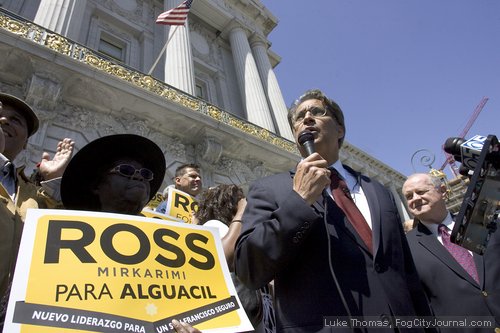
City Hall’s steps were awash in multi-lingual black and yellow “Ross Mirkarimi for Sherrif” signs at noon today, as Mirkarimi supporters watched Sheriff Mike Hennessey, who is stepping down after 31 years of service and eight elections, endorse Sup. Mirkarimi as the next sheriff.  “New Leadership for a Safe San Francisco” was printed on the English version of the signs that Mirkarimi’s supporters carried. They included former Mayor Art Agnos, Sups. David Campos and Eric Mar, Tim Paulson of the Labor Council, Debra Walker, Linda Richardson, Sharen Hewitt, Terry Anders, and Mirkarimi’s partner Eliana Lopez and their almost two-year old son Theo. And everyone had plenty of great things to say about outgoing sheriff Hennessey and sheriff candidate Mirkarimi. And Hennessey even pinned a shiny toy sheriff’s badge onto the T-shirt of Mirkarimi’s son Theo, making him the happiest kid in town. At least for the day.

Campos kicked off the event by honoring Hennessey as the “most progressive and most effective sheriff in the country.”
“Mike Hennessey is also my neighbor in District 9. I see him taking out the trash so I know he’s a good neighbor,” Campos joked, as he listed the many achievements in Hennessey’s long career as an elected official in San Francisco. These achievements included Hennessey’s pioneering innovations in criminal justice and culminated in his decision to blow the whistle in 2010 on the federal government’s plan to activate its controversial Secure Communities program in San Francisco—without telling the public.
“He’s not afraid to stand up for what’s right,” Campos said.

‘This is the time for me to move on,” Hennessey announced, as he laid out his reasons for endorsing Mirkarimi as Sheriff, over other candidates in the field.
Hennessey described the Sheriff’s Department as a “large enterprise” that has over 1,000 employees, a $150 million budget and whose jail houses an average population of 2,000 folks in custody, on a daily basis.
“It’s not something that can be handled lightly,” Hennessey said. “That’s why I’m here to endorse Ross Mirkarimi as the next sheriff.”

Hennessey listed the many endeavors that he and Mirkarimi have worked closely on, including a number of criminal justice issues, and he cited Mirkarimi’s extensive law enforcement background, his significant legislative accomplishments in the areas of criminal justice and public safety, and his ability to find innovative solutions and overcome obstacles to progress, as reasons to support Mirkarimi.

Hennessey observed that criminal justice is “one of the thornier issues” that members of the Board of Supervisors are often asked to get involved in, but often duck.”But Ross has not shied away from working on them,” Hennessey said, citing Mirkarimi’s involvement in shaping the “No Violence Alliance Project” and his leadership in creating the Safe Communities Re-entry Council.

Hennessey also noted that in face of AB 109, the Governor’s plan to transfer state inmates to county jails, “it’s vitally important to have person in charge of sheriff’s office that understands these alliances and can make them work more effectively.”

Hennessey concluded by observing that the Sherrif’s Department has to deal with a lot of bureaucracy, so it’s important to understand how the Board, the budget process and other city departments, including the District Attorney’s office and the police, work.
‘And that’s why I’m endorsing Ross as Sheriff,” Hennessey said

Then it was the turn of Mirkarimi, who graduated from the San Francisco Police Academy, did Naval Reserve training and worked for more than 8 years as an investigator for the District Attorney’s office, to speak.

“I have never been at a loss for words,” Mirkarimi acknowledged, as he launched into a speech that began by thanking everyone for showing up at short notice “for one of the most important occasions of my political career.”

Mirkarimi did a great job of giving Hennessey the praise he deserves.
“He is a living legend,” Mirkarimi said. “It’s completely impossible to fill his shoes.”
Citing Hennessey’s integrity and his ability to innovate, Mirkarimi warned that, “Maybe it’s come to the point where we have taken him for granted. He’s the longest serving elected official in the history of San Francisco, and he’s probably the most understated.”

“And the most important endorsement in this race is that of Mike Hennessey,” Mirkarimi added, as he gave Hennessey his commitment “to build upon your legacy as effectively as possible.”

Mirkarimi cited some of the most immediate and serious challenges that face the next sheriff. These include AB 109, which Gov. Jerry Brown just signed, which. Mirkarimi said, threatens to increase the reentry prisoner level by 30 percent in California. “It will take creative ingenuity and resources to make sure we are effective in taking care of this population,” he said.

Mirkarimi also touched on the rising number of veterans that are ending up in the prison system, talked more about the No Violence Alliance Project, and suggested that certified deputy sheriffs could help serve warrants, transfer prisoners, and patrol Muni, “when the police department finds itself understaffed” so as to ensure that San Francisco is safe.

“For every four people arrested and jailed in San Francisco, three out of four are repeat offenders in a three-year period,” Mirkarimi warned, by way of explaining why he wants to advance a more collaborative spirit between SPPD and the Sheriff’s department.

Mirkarimi also noted that one out of every 15 African American males are in jail, at any time in the year, compared to I out of 300 males who are not black or brown. “So, we must step up our game in dealing with poverty,” he said, as he recommended increased access to job training and good jobs, “so work doesn’t become a seasonal hope but a permanent job.” He also made the connections between a lack of good housing, childcare, and schools and a rise in poverty, crime and recidivism.

Mirkarimi concluded by crediting Hennessey for “walking that fine pirouette” between upholding the principles of public safety and understanding the power of redemption at the same time.

I asked Sheriff Mike Hennessey what he considers to be the biggest challenges of running for sheriff/
“Letting people know what you are going to do, and what your issues are,” Hennessey said, noting that San Francisco has an intelligent, issues-driven electorate.

And Mirkarimi’s supporters weren’t shy about letting folks know the issues that the current D5 Supervisor has helped them with, over the years.

“Ross, as a supervisor and me, as someone who comes from a community of color, we know the habits that ex-offenders can bring with them, if there are no safety nets,” said Terry Anders who sits with Mirkarimi on the Safe Communities Reentry Council. “And I believe in what Ross stands for and the integrity of his person. He’s one of the first people to show up when there are crimes and victims, and he attends basketball games and boxing matches.”

Paulette Brown, whose son Aubrey Abraska Jr, was murdered in August 2006, but whose killers have still not been brought to justice.
“We shouldn’t have to run and leave our families, we should be protected,” Brown said. “Ross is my district supervisor and if he can get in, and do something about crime and solve unsolved homicides, then I’m for him. Maybe if he gets in, he’ll have more pull to do something about these unresolved cases.”

And then it was back to work, which for Mirkarimi now includes the somewhat daunting task of trying to raise money in an election year that also includes a mayor’s race, but does not include the help of public financing, at least not for the sherrif’s race….

The darkness underneath

0

arts@sfbg.com

FILM It’s been more than 15 years since Jodie Foster sat in the director’s chair, but for a project like The Beaver, she was up to the challenge. As with her past directorial projects, Little Man Tate (1991) and Home for the Holidays (1994), Foster felt a connection to the material that inspired her to take on a larger role.

“The films that I do direct are personal films,” she reflects. “Their goals are very different from the things that I act in, and they really are about an expression of who I am and what I’ve lived.”

In this case, Foster can relate to the larger issues at hand if not the specifics. The Beaver tells the unique story of Walter Black (Mel Gibson), a clinically depressed man who struggles through his suicidal desires with the help of a beaver puppet. Walter uses the puppet — which he also voices — as a way of connecting with his family and the outside world.

“What I’ve seen as the years have gone on is that there’s a pattern of what I’m attracted to and what I take on,” Foster explains. “And it’s very much about people who are having a spiritual crisis. They have to delve through that spiritual crisis head on and hopefully emerge out on the other side as changed people.”

The Beaver requires its audience to take the journey with Walter, an occasionally unsettling experience that mimics Walter’s psyche. For Foster, it was important to stay true to the story, which meant both the comedic aspects and the devastating reality of mental illness.

“It’s a strange tone, and it’s a challenge for an audience,” she admits. “They’re either up for the challenge or they’re not, and we know that. We know the film is not for everybody … As an audience member, you have to be able to go through all those tones — start out light and then little by little, kind of discover the darkness underneath.”

The script itself walks the line between dark and light — it’s the first feature from Kyle Killen, who created the critically adored but short-lived TV series Lone Star. But Foster had her work cut out for her as she strived to maintain her vision for a film that’s an undeniably tough sell.

“That was something that we really talked about,” she recalls. “How do you make this movie entertaining in any way instead of having it just be grim and boring? That’s why there’s a fable quality to this film.”

For the same reason, Foster believes Gibson was the ideal choice for the role. As Walter, he must play both the depressed man at his wit’s end and the cheeky puppet who gets Walter through it.

“I think Mel struck just the right balance between his lightness of touch and a gruffness,” Foster says. “The Beaver is not Russell Brand in Hop. He’s got a deep, dark voice. He’s lewd. He’s tough. [Mel] can be witty and light, and he can also go to an incredibly dark place.”

But can audiences, who lack Foster’s personal relationship with Gibson, look past the man’s public troubles? In the past year alone, Gibson has faced accusations of racism and domestic violence.

Foster believes Gibson’s performance transcends any negative press he has endured. And since she has little control over what audiences will ultimately think, she chooses to focus on the positive.

“At this point I’ve kind of thrown up my hands,” Foster says. “The really good news is I got to make a movie I love. I am so genuinely grateful, and it does have its own reward.”

THE BEAVER opens Fri/6 in San Francisco.


Globe

1

paulr@sfbg.com

DINE When Globe opened nearly a decade and a half ago, it almost instantly developed a reputation as the place where you could find chefs having dinner at 1 a.m., after their own places had closed. The heart of the Barbary Coast restaurant (opened by Joseph Manzare and Mary Klingbell and still run by them) was a wood-burning oven that glared out over the dining room like the Eye of Sauron, and there was a wonderful perfume of woodsmoke in the air. (I think smokiness should be added as a flavor, incidentally, to make six. For years we were stuck with sweet, salty, sour, and bitter, and than umami, or meatiness, was added. Smokiness is distinct from those five, and also quite real.)

The march of time is often cruel to restaurants, and, as someone who last stepped into Globe before Bill Clinton got himself impeached, I wondered what I would find in these later days. An insider friend, discussing a famous San Francisco restaurant with me recently at a dinner party, ended up gently dismissing it by saying, “Well, it is a 30-year-old restaurant,” as if to say that loss of freshness is inevitable. But restaurants aren’t heads of iceberg lettuce in a refrigerator, de-freshening with every tick of the clock, and Globe isn’t even 15 yet.

My first impression, on stepping inside recently, was that the place is still recognizable. The walls are of exposed brick, the floors are simple wood plank stained dark; the stairs to the private dining room and restrooms downstairs are made from plain, workmanlike steel; and the dangling light fixtures over the small bar, of glass in several colors and elongated shapes, are mildly ornamental but not garish. The look is spare, muscular, and elegant, like that of an athlete in an ancient Olympic Games, clad only in a loincloth. (Actually such an athlete would probably have been naked, but put such thoughts from your mind.)

The menu is as pared-down and purposeful as the décor. I am heartened by brief menus, even though brevity is a kind of heresy in this gassy culture, where more is always better and is preferred without question or argument. Brief means: these are the dishes the kitchen believes in. And Globe’s kitchen obviously believes in its succinct list.

The restaurant’s wood-burning oven made it an important precursor of the current pizza chic, and pizza remains a significant element of the menu. The crusts, though thin, retain a distinctive elasticity and chewiness — which means that once you get some into your mouth, it’s a complex, satisfying experience. The downsides are that such crusts can be more difficult to cut, with slices sticking together, and the points can suffer from droopiness. Drooping pizza points remind me of the ears of a dog who’s just been chastised for some offense he doesn’t quite understand. We found the gambori mushroom pie ($16), boosted by white truffle oil, to be powerfully earthy, although the tomato sauce could have used a bit more salt.

Tuna tartare ($15) combined coarsely chopped fish with scallions, wonderfully peppery Genovese basil, and olive oil. The tartare was served with oily levain toasts and an Easter egg of black-olive tapenade, which provided a necessary correction of salt (and umami). We did think the macaroni and cheese ($8), made with Tillamook cheese — is that a selling point? — was good but not up to snuff, the bar having been raised sharply in the past few years. The best versions of mac ‘n’ cheese now use unusual pasta shapes, more intricate blends of cheeses, additions of fortifying and flavor-enhancing ingredients, and often a bread-crumb gratin. A gratin alone here would have made a big difference.

Several of the main courses offered an attractive char. A filet of wild coho salmon ($22) was laid atop a bed of boccacino pasta, with braised rapini, aglio e olio, and salsa verde — a Globe classic. One small niggle: the pasta, long fat tubes like bucatini on steroids, was awkward to eat gracefully. More user-friendly was the Cornish game hen ($21). The little bird seemed to have been largely boned out, and was plated atop a marvelous green garlic risotto that was not only beautifully cooked and seasoned but as bright a green as spring itself.

Only in the desserts did I detect any sign of fatigue and disengagement. A slice of amaretto cheesecake ($8) was quite good, very intense with almond and just sweet enough to win the day, but the apple tart ($8) could have used a serious rethink. The idea seemed to have been to deconstruct it, with apple slices laid on what looked like a napkin of pastry and topped with a scoop of vanilla ice cream. The glory of apple tarts is the melding of caramelized apple with nicely crisped pastry; here the pastry was sepulchral, the apples not caramelized. It was the flat-earth version, in need of some roundedness. 

GLOBE

Dinner: Mon.–Sat., 6 p.m.–1 a.m.; Sun., 6 p.m.–midnight

Lunch: Mon.–Fri., 11:30 a.m.–3 p.m.

290 Pacific, SF

(415) 391-4132

www.globerestaurant.com

Full bar

AE/MC/V

Noisy

Wheelchair accessible


Let it show

0

arts@sfbg.com

DANCE In December 2009, as part of a double bill with Kara Davis, Kate Weare showed an excerpt of a work in progress in which Leslie Kraus rammed her head into Douglas Gillespie’s chest, knocking him flat on his back. It’s a moment one is unlikely to forget. Weare must have thought so as well, because she retained the passage in Bright Land, which received its San Francisco premiere at ODC Theater this past weekend.

The setting is a hootenanny with the Crooked Jades quintet — splendid, smart, solid musicians — providing both the inspiration and the live accompaniment to the dances. Many of the songs — they were listed in the program, with the lyrics available online — are dark and ambiguous in the way that folk material tells one story on the surface, but covers up more complex perspectives. I regretted that more of the texts could not be easily understood during the performance.

Bright opens with the musicians strolling in and Lisa Berman’s steely version of “Moonshine” — a song about incest, rape, prison, and death. Not exactly happy-time music, but it pays tribute to those stark parts of life we don’t like to think about. Reflecting that double vision, the choreography starts with the dancers walking in, the men (Gillespie and Adrian Clark) from one side, the women (Kraus and Marlena Penney Oden) from the other. Crossing paths, they stop in their tracks and the party is on.

From the beginning, these dancers are as weary of as they are attracted to each other. Traditions are acknowledged, with the men swinging the women and the women circling the men — there are even shades of square dancing. But encounters are rough, short-lived, and pulling-at-the-seams. They are angular, dense, and then, for no apparent reason, the tumultuous actions stop, as if a film has been cut. Yet there are moments of joy and tenderness: a cheek receives a caress, skin-to-skin contact is fully relished.

In addition to the ever-surprising full-body language, Weare uses a rich mix of gestures: ramrod straight arms, chopping hands, sly smiles. Throughout the work, the women seem to have particular powers. At one point they head straight for each other and plant a kiss on each other’s lips. While clearly a sexual act, it looks even more like an acknowledgment that the two are on the same page. For “Old Man Below,” they sit like crones in wide squats, never taking their eyes off of the male duet. Skipping in an exuberant sisterhood, they swing the men’s shirts around their heads. Often they seem flirtatious, flipping their skirts and fanning themselves.

But Bright is no political tract. These dancers tangle, dive, and pull each other into duets, trios, and quartets, not so much in romantic or oppositional relationships, but as part of defining themselves and each other. In a slow dance section — with the lights discreetly lowered — the two couples seemed glued to each other, but without the expected erotic heat. In “Uncle Rabbit,” watched over by his colleagues, Gillespie’s questioning solo sent him into a tortuous back bend, echoed by the observers. Later he launched himself headfirst between the supine Kraus’ legs with no reaction from her. Penney Oden, however, stripped off her dress.

A long, sculpturally intricate duet in which the dancers flowed like cream over each other took excellent advantage of Kraus’ petite but fierce persona and Gillespie’s tall but lanky frame.

What fascinated throughout, besides the precise use of an intricate language, was the sense of these people simultaneously being pulled every which way. Weare doesn’t present this issue in terms of resolvable conflicts but as an existential state of being. These men and women live off ambiguity, contradictory impulses, and instability. They are going full-speed, except when everything stops. Yet they are also vibrantly and sensuously alive, every pore of their skin open to the next sensation, and knowing they can be kicked out of the game anytime. Rarely does putting up a mirror to our frantic, multitasking, and always-on existence make for such satisfying and well-performed choreography.


The San Francisco-Jalisco añejo

1

virginia@sfbg.com

DRINKS Tequila is not tequila unless it’s made in the Jalisco region of Mexico. So strictly speaking, you’re not going to find a local tequila in the Bay Area. But the case of Don Pilar is about as close as you’re going to get — his story is written by lines drawn directly between San Francisco and the Jalisco of his youth.

Pilar (a.k.a. Jose Pilar Contreras) is a Bay Area entrepreneur in the truest sense of the word, an all-around Mexican American success story. Born and raised in the Jaliscan highlands where his Don Pilar tequila is now distilled near the town of San Jose de Gracia, knowledge of the liquor runs in his blood. “My father is a proud alteño, a highland gentlemen,” says Juan Carlos Contreras, Pilar’s son and brand ambassador. “During the 40 years he’s spent in the U.S., he has always kept his heart in the highlands.”

Pilar moved to California in the 1960s to work its orchards and fields. After years of grueling labor, he joined two business partners (now commonly referred to as “the tres amigos”) to open the popular Tres Amigos Restaurant in Half Moon Bay in the 1980s, now with three locations. Pilar launched his own Amigos Grill in Portola Valley and in 2002, returned to Mexico to pursue his next venture: making his own añejo tequila.

“We are lucky to have [San Francisco] as our home base,” says Contreras. “People [here] are hip to trends and small, up-and-coming brands like us.” He cites the “great community” the city has bred of aficionados and tastemakers — like Julio Bermejo of Tommy’s Mexican Restaurant and Tequila Bar and Lippy the Tequila Whisperer — as one of the reasons that his family’s tequila business has been able to prosper and sell. Plus, “the large Latino community has been supportive of my father’s tequila, especially because of his immigrant story of success.”

Pilar is that rare figurehead who stays hands-on in his businesses. It’s not uncommon to find him buying supplies and produce for the restaurants, or to catch him supervising agave fields in Jalisco.

“In Spanish, you’d say that my father is a jalador,” Contreras reflects. “He and my mom work seven days a week. If he’s not at a local store signing bottles for customers, you’ll find him washing dishes at his restaurant. This is the key to his story of success.”

Yet another key would be value — you’d be hard-pressed to find a better añejo at this price (it’s often sold locally in the low $30 range).

An aged, golden version of tequila, añejos cost much more than blanco or reposado tequila. Pilar’s double-distilled release is aged in virgin American white oak barrels with a medium char. The taste is redolent of butterscotch, chocolate, and toasted agave. With a full, round finish, it has won a number of awards, often surpassing añejos that cost at least twice as much.

Recently the family has added to their tequila family with a blanco, a young, un-aged tequila. Where the añejo bottle features a photo of Pilar the patriarch, the blanco’s has a younger Pilar of years past. Clean and bright with pineapple and citrus zest notes, the blanco has a gentle, creamy finish, a standout among its peers.

It’s all built on traditional Jaliscan knowledge of the liquor — but Pilar adds a touch of artistic San Francisco spirit. His crew uses the Mozart method of fermentation, coaxing the process along by playing baroque music — Vivaldi’s Four Seasons, to be exact. They believe that the musical ambiance optimizes the tequila’s conversion from sugars to alcohol. 

Subscribe to Virginia’s twice-monthly newsletter, the Perfect Spot 


Nothing’s fixed

0

CYCLING The SF Bike Coalition’s valet parking was strangely empty for a blazingly sunny Saturday event by the Ferry Building. “They’ve just been leaving their bikes around,” a bored attendant told me of the crowd assembled for the Red Bull Ride + Style fixed-gear competition. But that wasn’t out of apathy to their rides — these attendees wanted to keep their bikes close.

Candy-colored fixies were turned upside-down on their handlebars, stacked in piles with the steeds of their owners’ friends. Young men (there were a lot of young men) kept their hands firmly locked in riding position, rolling their bikes back and forth as they spoke, some times gesticulating with them for added effect. Those slim, messenger-style backpacks were much in evidence.

In the competition arena, no one strayed far from their bikes either, except for the spectacular falls that sporadically broke up the action. Strap-on fixed-gear pedals make for epic wipe-outs; one soldier was taken off the field on a stretcher.

Save for the lone female who rolled about during the event’s interminable “practice times,” all riders were male. This was about bros on bikes. Indeed, as the final race around the hazardous, hairpin track was announced between Bay Area childhood friends Jason Clary and Kell McKenzie (Clary won), the announcer took a moment to salute their relationship. “You guys have known each other since you were 14? It’s bro versus bro! Fixed-gear nation!”

Competitive fixed-gear racing is, relatively speaking, a nascent addition to the legion of bone-cracking thrill fests enjoyed by extreme sports fans. The sport’s lexicon is borrowed from the death-defying ride tactics of gonzo bike messengers, a profession that has to sprint to keep up with e-mail and 3-D projection technology to stay salient for corporate America.

San Francisco is one of the messenger bike meccas. The city has given birth to some epically fly-terrifying fixie films — guys slaloming down from Twin Peaks, diving into traffic, holding onto buses for acceleration, basically using the ridiculous speed you can achieve on a fixed- gear bike for pure chaos (in the eyes of the pedestrian, surely).

But street stunts do not a competitive sport make. On Saturday, it was apparent that everyone was trying to figure out just what Ride + Style meant. The week before the event, the Guardian interviewed Austin Horse, one of New York City’s best-known bike messengers, by e-mail.

“Nobody knows what to expect about Ride N Style,” he wrote. “It’s very mysterious, but the riders know it’s going to be a challenging and compelling event because it’s coming from Red Bull. [Editor’s note: Apparently Red Bull’s sponsorship is a big deal. Red Bull also sponsored a downhill bike race through a Brazilian favela, the aerodynamic inanity of Flutag, and your most jittery friend in college who had a dorm room full of Red Bull crates. Remember that guy?] The result is that all the riders are a little more anxious about this race than other events. What we do know is that it’s gonna be a sprint with features some guys aren’t going to be comfortable with. It’s a little scary.”

The second half of the day was given over to what was billed as the most cutting edge part of the competition: the freestyle contest. Covered in sherbet colors, spiders, geometric whorls, and playing card designs, they looked every bit the background for an extreme sports tournament.

“Only rarely have events invested in features tailored to the constraints and potential of this type of riding,” Horse says. When the cameras are off “people practice wherever they can — skate parks and street spots.”

In San Francisco, one of the most reliable spots to watch good fixed-gear freestyling is in the Harry Bridges Plaza, the strip of asphalt between the Ferry Building and where Ride + Style was erected in the more ample Justin Herman Plaza. You can go out to Harry Bridges at dusk most days and see people hopping their bikes off the ground, spinning in the air, twerking their handlebars, riding backward in tight figure eights, and stopping on dimes.

But the ramps took it up a notch — so up that spectators began to compare the competition to those of BMX bikes, which can catch a lot more air than fixed gears. It wasn’t a coincidental connection: some of the competitors announced on the microphone that they were usually on a BMX, and Jeremy Witek, the lead designer of the ramps, told me during the construction phase that this was the first time he’d been asked to make structures like these for a fixed-gear competition.

There were some hands-down highlights of the freestyle portion — Kohei “Kozo” Fuji flew in from Osaka to bust the first fixed-gear back flip in international competition. But many of the routines seemed strangely suited for their setting. The beauty of the fixed-gear lies in its simplicity — one pump of the legs, one rotation of the wheels, the easy mathematics of human body and machine.

But the novelty of seeing these lifestyle bikes thrust into the bright lights and loud announcers of the X Games variety wasn’t lost on those least jaded of San Franciscans — the Embarcadero tourists. Washing my hands in the Embarcadero Center bathroom, I heard a young woman essentially ask her mom what the hell this crazy city of bikes is up to. “Does San Francisco always have this?”

Girl, it does now. 


Knee-jerked reaction

1

CHEAP EATS I left my uke in New York City — technically in Boston, in the back of a station wagon headed for New York City. I left my baby, my toothbrush, my second-favorite pillow, and my other baby in New Orleans. My rabbit-fur jacket that I only ever wear to Rainbow Grocery … I left that in New Orleans too. I left my stomach in Dallas. I left my left knee in San Francisco, on the 50-yard line of a football field at Crocker Amazon. I don’t know where I left my pink cowboy hat. I can’t find it, and it’s pink cowboy hat season.

I got the ain’t-got-no-cowboy-hat-or-left-knee-neither blues.

One thing: I do have a new baby. He’s four months old and lives upstairs in my apartment building, so the commute’s real easy compared to Louisiana or even Berkeley. And he likes to suck on my left bicep sometimes while I’m rocking him to sleep, which gives me cute little hickies there.

In Dolores Park, a live dog’s got a stuffed bunny by the throat. He’s thrashing it this way and that, hammering it into the ground, growling, and beating the living fuzz out of it.

In various states of revelry and/or reverie, my friends and I are occupied in just generally occupying a couple of blankets, watching this big dog do its thing.

“My money is on the rabbit,” I say, because it is. I love an underdog.

In fact, we all are one — back in last place, our one-game winning streak having come to an inglorious end earlier that morning. Dig, who had an important sack on a third-and-short, our play-of-the-game, goes, “Look! It’s playing possum.”

Sure enough, the rabbit is lying very still in the grass, the dog standing over it, watching warily. I’m not a dog person, but I almost feel bad for this un. Its prey, this shattered, chewed-up Easter bunny, is limper than limp, is missing an ear, and arguably never had much fight in it; Nevertheless, I more than half expect it to at least jump up and run away, if not kick the dumb dog’s ass first.

Next week is the Kentucky Derby, and now that I officially “play the ponies,” I will have to find me a long shot to get behind. And get shat upon.

I got the ain’t-got-no-cowboy-hat-or-even-no-left-knee-neither blues.

My own Hedgehog says I ain’t no spring chicken farmer. I’m afraid someone’s going to buy me golf clubs for my birthday. Please don’t buy me golf clubs please. I got some team sports left in me, and contact ones at that. I know I do. Get me a knee brace, an ice pack, and a Costco-size bottle of ibuprofen, I got the ain’t-got-no-left-knee blues is all.

When that happens — that is, this happens — there is only one thing for me, and that is some quality Chunks de la Cooter time. It puts everything else in perspective. So I went and made a chicken pot with them, and bathed them and sang them to sleep and woke up with them in the middle of the night, and in the morning I took them to their Chunk Fu class, and then to Arizmendi and then what they call “the new park” because it’s probably the oldest park in all of Berkeley and therefore not on their beaten path. And I took pictures of them on the big-girl swings.

It was hard to say goodbye, so I didn’t. I went to dinner with the whole de la Cooter fambly down to Solano, to the new-to-me Korean bowls-of-things place, called Bowl’d.

The idea here — at least the main one — is bibimbap in stone bowls with your choice of meat or tofu. They also give you a choice of white rice or mixed grain. Either way it’s going to get all crusty and delicious at the bottom of your hot hot hot stone bowl.

At the top: cabbage, carrots, sprouts, greens, bulgogi if you’re me, and one nice sunny-side-up fried egg.


I wish there was a little more meat in it. But the meat there was good, and so was everything else. They don’t give you so many little bowls of things for the table, but they’ll refill what you love. In my case: kimchi. Super spicy. New favorite restaurant. 

BOWL’D

Sun.–Thurs.: 11 a.m.–10 p.m.;

Fri.–Sat.: 11 a.m.–11 p.m.

1479 Solano, Albany

(510) 526-6223

Beer and wine

AE/D/MC/V


Evicting hoarders

2

news@sfbg.com

People who collect massive amounts of stuff in their apartments often suffer from a mental disability that causes them to become hoarders. Even so, they can face eviction — despite state laws that protect renters with disabilities. And when hoarders get evicted, they usually become homeless.

“Hoarding behaviors may result in a landlord issuing an eviction notice on the basis that the tenant has created a nuisance, fire hazard, or other danger in the building. If the tenant is diagnosed as disabled, the tenant may notify the landlord of the disability and request the landlord provide a reasonable accommodation to enable the tenant to remain in the apartment rather than being evicted,” reads a recent report from San Francisco’s Mental Health Association, which is seeking to educate renters, landlords, and the general public on the issue.

Evictions in San Francisco are on the rise. Between March 1, 2010 and Feb. 28, 2011, 1,370 evictions were filed, an 8 percent rise from 1,269 evictions the previous year. The Federal Fair Housing Act (FHA) and California Fair Employment and Housing Act (FEHA) offer protections to those who have a disability, but landlords say there are liability issues associated with excessive hoarding.

Tenants can fight evictions by asking their landlords for a “reasonable accommodation” whose duration depends on the situation. A reasonable accommodation could be a plan that requires 30 days of cleaning and support service for hoarders in an effort to avoid eviction.

According to Mayoclinic.com, hoarding is labeled an obsessive-compulsive disorder (OCD). But many researchers consider it a distinct mental health problem that can be treated with therapy or counseling. California law defines a disability as a physical or mental impairment that limits one or more life activities, such as walking, seeing, hearing, working, learning, or caring for oneself.

Sandra Stark, 66, hasn’t allowed anyone in her home for five years. She collects kitchenware and antiques. Like most hoarders, she started collecting after a traumatic event. It occurred when she was in her 30s and was gaining weight. Stark had never heard of the term “hoarder” until she watched a special on The Oprah Winfrey Show.

She claims her hoarding is a symptom of depression and disability, not OCD. “I feel like, with my weight, the clutter is a barrier between me and the world that hurt me,” she told us.

Before TV shows uncovered the lives of hoarders, family and friends often were the ones to call for help. These days, hoarders often seek help themselves. A&E’s Hoarders receives 1,000 submissions every month. After we spoke to some hoarders, they were all willing to seek change.

MHA recognized the problem and created a task force in 2007. Its goal was to build a plan of action to combat compulsive hoarding in San Francisco. The task force puts the costs of compulsive hoarding at more than $6 million per year. In 2009, the task force completed its report and estimated that between 12,000 and 25,000 residents in San Francisco struggle with this condition.

Most landlords try not to evict hoarding tenants right away. “Landlords may be compassionate and, in many cases, I believe, try hard to prevent evictions. However, they still have liability insurance and strict guidelines to follow,” said Tim Ballard, a social work supervisor for the city. “It is their responsibility to protect the other tenants, and the painful result used as a means of harm reduction is often the legal option of eviction proceedings.”

He said the heavy cleaning required on a hoarder’s home can cost between $6,000 and $8,000 and can include removing trash to create safety in their home. The largest amount spent was $16,000. Currently, Ballard has 300 clients who are hoarders or clutterers in San Francisco.

On March 10, MHA hosted its 13th Conference on Hoarding and Cluttering. Keynote speaker Christiana Bratiotis, who has her doctorate in social work and is director of the Hoarding Research Project, defined compulsive hoarding as the “acquisition of, and failure to discard, a large number of possessions that appear to be useless or of limited value.”

Michael Badolato, administrative assistant of Broderick Street Adult Residential Facility, attended to find a reasonable approach to deal with a hoarding resident living in his facility. “The challenge of hoarding is the mental health issue involved,” he said. Other attendees included educators, landlords, healthcare workers, attorneys, and hoarders themselves.

One panel discussion topic was how hoarding and cluttering are portrayed in the media. The panel included Michael Gause, associate director of MHA; Robin Zasio, a physician on A&E’s Hoarders; and Kari Peterson, an organizer from Hoarding: Buried Alive. Hoarders was created to show people in crisis and prevent the behaviors through the show.

The panelists claim that in order to show what the crisis is, a sensational aspect is involved. Ceci Garnett, whose mother was featured in an episode of Hoarders, says knowing that others are out there is “worth it to let people know they are not alone.

“And at least now there is treatment,” she continued. “We have to risk sensationalism to start a conversation.”

Ray Cleary, who was on season one of TLC’s Buried Alive, also appeared on the panel. Featured before and after treatment, he is still in the process of recovering. “I didn’t have to throw everything away,” he says. “I still have boxes and don’t know what to do with them.”

Another hoarder, who asked to remain anonymous to avoid eviction, was critical of the media attention on hoarding. “It’s a cult. People are going to make a career off my circumstance — making it a disease.”

These people have “already decided it’s a pre-mental disease,” she continued.

Inside her home near Van Ness Avenue, a small path led from the door to her living room. By the door hung green bead necklaces from years of parades; yellowing stacks of paper filled every space in the rooms. An information junkie, she collects newspapers and books. A San Francisco resident for 45 years, she used to be homeless and has suffered from a head injury. “Throwing something away is like throwing away memory — and that means it’s gone forever,” she says.

When she was homeless, her belongings went to storage. But when she got housing, she couldn’t throw anything away. Everyone she knows who has suffered from a head injury has this problem as well, she says, claiming it comes from gradually mixed emotional issues from losses and her health.

For years she tried to find someone to help her recycle or donate items, but she couldn’t find the help she needed, even from her case manager. Other hoarders claim that most caseworkers aren’t aware of their condition and assume they just need to throw everything out at once — something hoarders don’t feel they can easily do.

Her landlord isn’t involved with the property and doesn’t know of the situation. She would like someone to sit and accompany her as she cleans, but she doesn’t know of any service that provides this. During the interview, she picked up a phone call from someone who was going to stop by later to help. “But they usually flake on me,” she acknowledged. Her hoarding, she says, is part of a physical health issue, not a mental health problem.

But San Francisco does offer places such as the MHA conference to discuss the issue. Hoarders‘ Dr. Zasio says the show helps the people who are willing to go on TV. In exchange for going public, the network pays for six months aftercare, including services such as home repairs and therapy sessions. Although the network recognizes that it gains ratings by sensationalizing the condition for 44 minutes, it also wants to raise public awareness.

Of the 1,370 evictions in San Francisco in the past year, 442 cases were prompted by a breach of rental agreement and 271 cases were for committing a nuisance. These cases could include hoarding, but the city doesn’t specify that in its statistics.

As Teresa Friend from the Homeless Advocacy Project said: “If the person with a disability including hoarding is without family or friends to turn to or is not part of a legal intervention process and evicted, they will end up homeless.”


The case against consolidation

0

sarah@sfbg.com

With officials predicting that San Francisco will spend $500 million annually on health care costs for city employees and retirees, the Board of Supervisors Government Audit and Oversight Committee held an April 28 hearing to analyze why hospitals costs are higher in Northern California than Southern California, and why costs have escalated in the last decade.

A panel of experts outlined a list of cost drivers and identified hospital consolidation as the major culprit — a finding that fueled concerns that costs will skyrocket once Sutter Health, which operates the California Pacific Medical Center that took over St Luke’s in 2005, builds a 555-bed hospital on Cathedral Hill. The board will consider approving the project as soon as this summer.

Ellen Shaffer, codirector of the Center for Policy Analysis, said that the city’s recently approved Health Care Services Master Plan (“Critical Care,” 11/23/10) provides San Francisco with leverage to collect and analyze data and make informed health choices.

Shaffer noted that since 1960, when there were 26 hospitals in San Francisco, facilities consolidated so frequently that by 1990, only 12 hospitals remained. And by 1998, the three largest hospital networks controlled 43 percent of hospital beds — compared to 18 percent just four years earlier.

“Today in San Francisco, the most expensive of the northern counties hospitals get $7,349 per patient per day on average,” she said. “In Los Angeles County, the figure is $4,389.”

David Hopkins, a senior advisor at the Pacific Business Group on Health, said that Sutter Health, which reported a 30 percent increase in net income in 2010, already controls 44 percent of hospital beds in San Francisco. Catholic Healthcare West controls 28 percent, and UCSF controls 26 percent. “Insurance companies say Sutter’s size and dominant position give it an upper hand in contract negotiations,” Hopkins observed.

Healthcare planning and policy consultant Lucy Johns said technology is another key cost driver. “It’s a medical arms race,” Johns said. “Every hospital wants the latest everything.”

Jane Sandoval, a registered nurse at St Luke’s, said that what residents and workers need is access to affordable healthcare, not luxury care at overpriced rates.

“We’d rather have enough staff and the ability to care for all patients than work in a facility that’s likened to a five-star hotel,” Sandoval said. She noted that State Insurance Commissioner Dave Jones filed suit April 13 to intervene on behalf of the plaintiff in a whistleblower suit against Sutter Health, which has been accused of fraudulently charging insurers millions of dollars for anesthesia services that either weren’t provided or were billed higher than typical rates.

Anne McLeod, senior vice president of health policy for the California Hospital Association, an industry trade group, claimed that Northern California’s higher hospital prices are primarily due to higher labor and living costs in the Bay Area. “Wages are a huge component of hospital costs, and they represent the fastest growing component of costs,” she said.

But Glenn Melnick, a professor of health care finance at the University of Southern California, said that even if a hospital was airlifted from Los Angeles to San Francisco, its costs would still be 38 percent higher after adjusting for local differences. “When hospitals consolidate into large systems that dominate a specific region, that hospital system has the power to demand contracts from health plans that include high reimbursement rates for their services and limit the ability of health plans to offer low-cost products and share the data consumers need to compare costs across providers,” Melnick said

Sup. David Campos, who called for the hospital costs hearing, observed that the cost of creating jobs includes health care benefits. “So to the extent that things like hospital consolidation are increasing costs, the hospitals themselves are implicated,” he said.

But CPMC media relations manager Kevin McCormack noted that CPMC/Sutter has invested more than $7 billion since 2000 on technology, facility construction, and improvements to address medical needs and state seismic safety requirements.

“Sutter Health appreciates its role in ensuring that health care is affordable. And we realize that holding the line on prices without compromising quality will require additional cost reductions,” McCormack said. “To this end, doctors and nurses and support staff throughout our Sutter Health network are working aggressively to substantially reduce expenses.”

He denied that Sutter had engaged in inappropriate anesthesia billing practices. “The lawsuit paints a false and inaccurate picture,” McCormack said.

He also said that plenty of competition remains in Northern California. “The decision by the California Public Employees Retirement System in 2004 to shift a significant number of members away from Sutter-affiliated hospitals to other providers demonstrates there’s plenty of healthy competition,” McCormack said.

But Campos said the hearing clarified that, while there are different factors why costs are going up, one of the most important is hospital consolidation. “We need to ensure that we understand that, even in face of higher labor and cost of living costs, hospital costs in Northern California are still 30 percent higher than Southern California,” Campos said.

Noting that CalPERS excluded Sutter from its network, Campos added: “We need to follow suit in terms of saying that we’re only going to do business with hospitals that are responsive to our concerns and follow best practices.”


Canine conflict

34

news@sfbg.com

San Francisco enjoys proximity to natural beauty and recreation on a scale unlike any other major urban area in the country. The 75,000-acre Golden Gate National Recreation Area offers city dwellers almost 60 miles of rugged coastline, forested hiking trails, and scenic beaches to enjoy. In most cases, people can bring their dogs.

While the city is notoriously difficult to raise human children in, four-legged friends flourish in an environment that celebrates their existence. With a multitude of dog-friendly parks, pet hotels, and ubiquitous doggie boutiques to accommodate the estimated 120,000 dogs that call San Francisco home, the canines and their companions form their own political constituency.

So it’s only natural that GGNRA’s Draft Dog Management Plan, which restricts dog walking in the park, has the pet set howling. The plan would limit off-leash dogs to 21 different areas of the park, including some of the most popular places such as Crissy Field, Fort Funston, and Ocean Beach, and ban dogs from some areas, like Muir Beach, where they have long been welcome.

The 2,400-page plan has been in the works since 2002, created out of the need to uphold the agency’s duty to protect the sensitive wildlife and plant species in the park while accommodating a growing population of visitors. Since its unveiling in January, thousands have rallied against it, filing so many comments to the National Park Service that it has extended the public comment period until May 30.

Currently, dogs are allowed off-leash in small fraction of the GGNRA lands and on-leash throughout most of the park. The proposed plan offers six alternatives for each of the 21 areas examined, all strengthening existing — but often ignored — leashing policies and reducing areas where dogs are allowed to roam tether-free.

“This is overly restrictive and unrealistic,” said Martha Walters, chair of the Crissy Field Dog Group. “There are certainly more management measures that can be taken with signage and educational outreach to protect these environments without having to impose this plan.”

Opposition has been widespread among pet owners and groups like the SPCA and Animal Care and Control. The Board of Supervisors voted 10-1 on April 26 to adopt a resolution formally opposing the plan, although the city has no jurisdiction over the area.

“It’s one thing to make sure we protect endangered species, but this plan doesn’t just do that,” said District 8 Sup. Scott Wiener, who authored the resolution. “This is a much more extreme proposal that is a significant restriction to dogs.”

Opponents fear the plan will force more dogs into city parks where overcrowding and aggressive behavior could become problems. Dog owners and advocates stress that responsible dog guardianship can be compatible with environmental stewardship, and that the NPS should better enforce the pet policy already in place.

“This is not right for our community,” said Jennifer Scarlett, codirector of the SPCA. “I would never want to wish harm on any wildlife, but it’s a piece of land stuck in one of the most densely populated cities in the country.”

But the GGNRA is still part of NPS, although many existing national environmental policies have largely been ignored here.

“We don’t get to choose whether or not to fulfill federal mandates,” said Alexandra Picavet, public affairs specialist for the GGNRA.

The GGNRA allows leashed dogs in more places than any other national park, and is the only park in the entire NPS system that allows off-leash dogs. It achieved National Park status in 1972, but its unique position as the backyard of a major city caused it to bend the rules when it came to letting the dogs out.

“The policy was adopted by the superintendent at the time of the GGNRA, and even that wasn’t really enforced,” GGNRA spokesperson Howard Levitt told us. “This was relatively early in the parks history, and in the early days, we didn’t really understand the importance of natural resources and history in the park.”

According to NPS, GGNRA is home to more threatened and endangered species than Yellowstone, Yosemite, Sequoia, Death Valley, and Kings Canyon national parks combined. It has a higher concentration of sensitive species than all but four of the 394 parks in the system.

The new pet plan would not be implemented until late 2012, after public comment is taken and the plan is revised. For six to 12 months, monitoring areas to measure compliance with leash laws will be conducted. If 75 percent of users do not comply, further restrictions will be made.

Current regulations are broken everyday at Ocean Bean and Fort Funston. Like the lax marijuana laws that are synonymous with San Francisco, leash laws have historically been considered more of a suggestion than a rule. At Crissy Field, one of the most popular recreation spaces for off-leash dogs, NPS observed dog owners disobeying the guidelines more than 60 percent of the time.

Many people do not realize that the four-mile stretch of Ocean Beach slated for restriction currently only allows dogs from May to June, or that the Great Meadow of Upper Fort Mason has never allowed the many off leash dogs seen there every day. Dog advocates say better signage about existing rules would help.

“To me, they went this way instead of having any intermediate steps in current policy and off leash areas,” said Rebecca Katz, director of the Animal Care and Control. “I am not supportive of the alternative. This isn’t like any other national park, and we don’t want it to be.”

On a recent visit to Fort Funston, it was evident that the park was, as some environmentalists call it, a de facto off-leash area. Dozens of dogs, most off leash, romped in the windy dunes, far outnumbering dog owners and professional dog walkers. Most dogs happily jumped from car to sand without ever being put on a leash.

Longtime San Francisco resident Candy Deboer and her giant schnauzer, Leila, have been coming to the park for years after finding city parks unsatisfactory.

“Golden Gate Park? I’ve tried that and I ended up stepping over hypodermic needles,” Deboer said. “Plus, I have a dog that loves junkie poop. I grew up camping, hiking, and fishing. I know how to preserve wildlife and take care of a park.”

Many said closing Fort Funston and Ocean Beach in March during tsunami warnings resulted in horribly crowded dog parks, and felt that GGNRA’s plan would deliver more of the same.

“We are using the parks the way they are supposed to be used,” said San Francisco resident Willa Hagerty, who also spoke at some of the hearings on the plan. “If we are doing something wrong, let us know with signs or fences.”

For some, walking dogs isn’t just a means of enjoying the outdoors, it’s a source of income. “The plan would really affect a lot of jobs like mine,” said SF resident and dog walker Josh Boutelle, who impressively handled eight different dogs while on a run for SF Pup Prep. “There will be more incidents in parks when there is crowding.”

Although everyone surveyed at Fort Funston stridently opposed the plan, most supported regulations in some form, from limiting the number of dogs professional walkers can handle to requiring leashes in some parts of the park. Sup. Wiener is also in the process of devising regulations for dog walking in city parks.

But the GGNRA plan has pitted environmentalists against dog advocates. The Sierra Club and Golden Gate Audubon Society support the plan and even argue that more restrictions are needed than proposed. Those groups, along with six other organizations including the California Native Plant Society and Nature in the City, wrote a letter to the Board of Supervisors April 8 opposing Wiener’s resolution.

“The GGNRA was created in part to bring a national park-caliber experience to all Bay Area residents and visitors, not to expand recreation opportunities for dog owners,” the letter states. “Contrary to what some are saying, the proposed plan is not about keeping dogs out of the GGNRA. Rather, it is about inviting dogs into the park in a manner that is sustainable and fair to all park users.”

The Sierra Club has even used the dog debate as a big factor for its mayoral endorsement. Sen. Leland Yee has spoken in support of the plan, while mayoral candidates Sup. John Avalos and Board President David Chiu voted to oppose it.

“I’m concerned that the Sierra Club is going to use a microscope on a tiny, insignificant measure to make a decision on mayoral endorsement,” Avalos told us. “The dog policy is insignificant compared to so many other environmental issues.”

Others disagree. Michael Lynes, director of the Golden Gate Audubon society, thought Wiener’s resolution was hasty and did a disservice to the years of work NPS has put into the plan.

“They keep talking about the impacts to the city, while here they are trying to do something that impacts the National Park,” Lynes said. “The resolution is really strange. It opposes the Park Service’s effort to regulate land in a way that is sustainable and equitable.”

Opponents say evidence of dog-induced damage to wildlife and humans is unclear, but the plan gives hundreds of pages of studies and incident reports. In 2008, nearly 900 dog-related incidents were reported, including attacks on vulnerable populations such as young children, seniors, and, disabled people. In 2005, Guide Dogs for the Blind found that 89 percent of their graduates had guide dogs interfered with by off leash dogs.

Plus, as difficult as it may be for dog lovers to fathom, not everyone wants to be around dogs when enjoying the outdoors. Currently, dogs are allowed on all but one major trail in the GGRNA, and China Beach in the Presidio is the only beach where people can have a dog-free experience.

“At the end of the day,” Lynes said, “people don’t want to change their behavior.”


HOC farmers market bans live chicken sales

15

Feathers will cease to fly over alleged cruelty practices at the Heart of the City Farmers Market that we reported in February. The outdoor Civic Center market has announced it will no longer offer live poultry for sale as of May 27, a practice that had been grounds for a lawsuit and two years of fervent protesting from animal rights groups.

Raymond Young’s Poultry, a popular vendor, has been selling live chickens by the hundreds for nearly two decades at the HOC market every Wednesday and Sunday. In January, animal rights activist group LGBT Compassion filed a lawsuit alleging cruelty and civil rights violation against Young and the HOC after months of protesting and several attempts to get city agencies involved.

While the poultry stall remained popular with its largely Chinese clientele in spite of an ever-present throng of protesters, the practices caught the attention of Animal Care and Control and the Department of Public Health. Young had received hundreds of citations from ACC and warnings from the DPH, but they were essentially void due to an exemption in California law pertaining to poultry.

HOC market managers would not comment for this story, nor would Raymond Young. While the lawsuit is still pending, the announcement was perceived as a victory to the activist group.

“It sent a message to the city and to the public that animal cruelty and public health offenses is not acceptable and should not be endorsed or subsidized by the city,” said Andrew Zollman, founder of LGBT Compassion. “Having the market finally recognize that something like that should change is great.”

Zollman and fellow protestor Alex Felsinger filed the lawsuit with San Francisco attorney Matt Gonzalez. Zollman said that they had continued to protest in the months since filing the suit. Along with ACC, they said that Young had repeatedly violated animal cruelty laws and health codes even after the level of scrutiny on his stall had increased.

The ACC, which had cited Young hundreds of times for practices such as unsanitary conditions, lack of water, and improper handling of the chickens, viewed the decision by the market to ban sales as good news.

“Animals are food for a lot of people, but as Proposition 2 in California exhibited, people do care about the treatment of them,” said Rebecca Katz, director of the ACC, referring to the Prevention of Farm Cruelty Act of 2008. “If the vendors had been able to treat the animals appropriately, I don’t think it would have become this issue. This was profitable; he still could have made good money and done it properly.”

Bullfeathers Quail, the other live bird vendor at the market, had received significantly less attention from protesters and city agencies because it sold far fewer birds – about 350 per week – and had not been accused of nearly as many violations. Nonetheless, the vendor will also be banned.

Zollman said they will continue to protest the stall up until May 27, mainly because they fear the vendors will operate with a higher level of disregard since they have “nothing to lose.” Although they have received caustic criticism from groups who believe their protests are an attack on Chinese culture, they will plan to shift their attention north to Chinatown to live markets operating there.

“We are hoping that what we have learned and what city agencies have learned will pave the way,” said Zollman.

Editorial: Let counties raise taxes

3

The president of the state Senate, Darrell Steinberg (D-Sacramento), has a bill that could profoundly change that way California pays for government. At lot of insiders think it’s just a ploy, a way to force Republicans to come to the table and accept some tax measures, but Steinberg appears serious. He’s presenting the bill to the Governance and Finance Committee May 4, and a simple party-line majority vote could get it to the governor’s desk.

The bill, SB653, would allow counties and school districts to approve taxes — a wide range of taxes, the type that are now entirely under the control of the state. Local governments could impose an income tax, a transactions and use tax, an oil severance tax, a vehicle license fee, or a tax on alcohol, cigarettes, or marijuana. It’s part of what Gov. Jerry Brown calls “realignment” — returning more authority to local government, which is complicated and has advantages and disadvantages. But on its own, the tax measure makes perfect sense: if the residents of San Francisco want to pay a higher car tax, or income tax, or tax on booze, and use the money for better schools and public services, why shouldn’t they be allowed to do it?

San Franciscans pay far more in state taxes than the city gets in state money. That’s one of the great ironies of California finance: the more liberal counties, where the voters support adequate public services, wind up subsidizing the more conservative areas that demand tax cuts. A certain amount of that is inevitable, and even laudable: richer areas should be helping pay for schools, police, and roads in poorer areas. It’s certainly true in the arena of public education, where the courts have, properly, ruled that that state has to make sure every school district gets adequate funding so that kids in Marin County don’t get better educational opportunities than the kids in Tulare County.

And there’s always the risk that realignment will push the state back to the days when geographic inequality was even more dramatic, that California will wind up being, as Sen. Mark Leno (D-SF) once put it: “Hollywood next to Mississippi.”

But Steinberg’s bill doesn’t cut state funding at all; in fact, he’s among the Democrats working to avoid more budget cuts. SB653, properly administered, wouldn’t mean less money for any local agency. It would just remove the ceiling.

California is becoming too big to govern effectively with the current rules — and under the state Constitution, written in a very different era with a smaller, more homogeneous population, even a tiny number of Republicans can hold the budget process hostage. That means, for better or worse, that cities like San Francisco, where residents want decent services and a credible social safety net, are on their own. And if Brown’s proposals to put more of the service burden on the counties (for example, by shifting thousands of state prisoners into county jails) move forward, local governments are going to need the ability to raise their own resources.

Unfortunately, many of the taxes that state law currently allows local government to impose (sales taxes, for example) are regressive. Taxes on income and motor vehicles are far more fair and progressive, and ought to at least be available to cities and counties.

The Democrats in Sacramento need to take this seriously and work for its passage. It’s not the entire solution to the budget crisis and to economic inequality — but it’s an excellent start.

USF hosts mayoral forum focused on service

2

The University of San Francisco’s Leo T. McCarthy Center for Public Service will host the political season’s first major mayoral candidate forum – this one focused on public service and staged in partnership with the nonprofit group buildOn – on Thursday, May 5, at 6 pm.

Candidates Michela Alioto-Pier, John Avalos, David Chiu, Bevan Dufty, Tony Hall, Dennis Herrera, Joanna Rees, Phil Ting, and Leland Yee are expected to attend. Admission is free and the public is encouraged to attend this event held at USF’s McLaren Conference Center, 2130 Fulton Street.

“The intent of the forum is to help frame the mayoral campaign and also encourage candidates to talk about what drove them to service and how people can get involved in San Francisco, especially the youth,” Corey Cook, assistant professor in the USF Department of Politics, told us. Cook will moderate the event, which will include questions from high school students participating in buildOn and McCarthy Center service programs.

Carrie Pena, buildOn’s communications director, told us, “Students from public high school will ask questions based on bare thoughts on public service and what it means to be a good public servant.”

BuildOn provides programs for students to break the cycle of poverty and illiteracy. About 90 percent of buildOn students go to college. There are 19 schools in the Bay Area working with buildOn and in the previous year, the students contributed more than 24,000 hours to the Bay Area community.

At USF, service learning is a core class part of the graduation requirement where each student dedicates at least 20-25 hours of service per 15-week semester. “Co-hosting a mayoral forum is a fitting project for USF and buildOn because it will engage high school and college students, as well as the greater community, into the process of local politics,” Cook said on the USF website.

Catarina Schwab, buildOn’s vice president of development, said the partnership is a good match: “We aligned with USF because they focus a lot on service. Both were interested in a forum on service. We are even going to have a buildOn chapter at USF.”

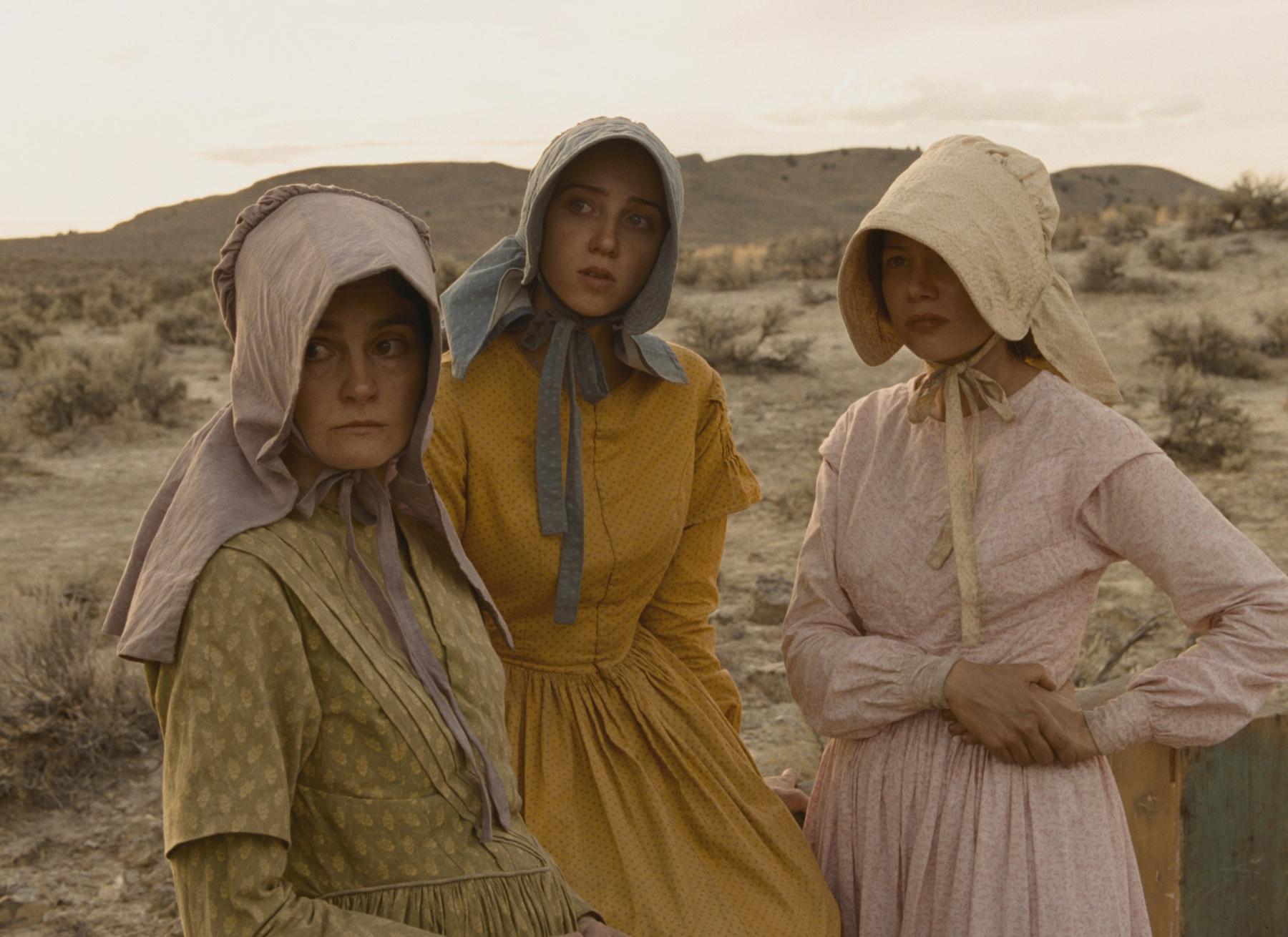
Northwest passage: Kelly Reichardt on “Meek’s Cutoff”

0

Over the past decade, Kelly Reichardt has consistently created an alternative cinema that is in opposition to modern Hollywood blockbusters. Her films, which emphasize minimalist and highly visual storytelling, transcend even the industry’s edgiest darlings (think Darren Aronofsky and Quentin Tarantino). Her films Ode (1999), Old Joy (2006), Wendy and Lucy (2008), and now Meek’s Cutoff (2010) cannot be categorized in the decade’s overhated mumblecore movement of Andrew Bujalski or the Duplass Brothers. Neither are they part of the world of extreme experimental artists, a la James Benning or Sharon Lockhart.

Somehow Reichardt has found a cinematic middle ground, balancing quiet and poetic allegories with accessible and emotional journeys — an achievement that present and future audiences will be hypnotized by for generations to come. After interviewing her for Wendy and Lucy, I spoke with her after Meek’s Cutoff played the 2011 Sundance Film Festival; it recently had its local debut at the San Francisco International Festival, and opens theatrically Fri/6.

San Francisco Bay Guardian: I recently saw your earliest films at the Pacific Film Archive retrospective and your adaptation of the Robby Benson-starring Ode to Billy Joe (1976), Ode (1999), was amazing! You shot the whole thing on Super 8, right? Do you like your earlier films?

Kelly Reichardt: Ode is very near and dear to my heart. It set me on my own way of making films. I don’t think I’m naturally a non-narrative person. And definitely not as much as I revere those kind of filmmakers like my colleagues: Peggy Ahwesh, Peter Hutton. I love seeing how their films unfold and really make the viewer be interactive in deciding what they’re about and what they mean to them. That’s what I’d like to do as a filmmaker. But I can see myself learning in all of my films, which is painful. A couple of students walked out of that screening of my earliest short films and I wanted to run out after them and say, “I totally understand!”

SFBG: You and [screenwriter] Jon Raymond seem to be consciously aware of just that! I know I have told you this before but I find your films so inspired. Your films are like the kind of classes I always wanted to have in college. You’re never telling me what to think, yet you are very precisely leading me towards something extremely imminent. And along the way, I get to experience my own journey with these characters and situations. Do you run into problems getting your films made and released because of this structure?

KR: That part of it, the endings, is [an element] coming from the world of non-narrative filmmaking. It doesn’t hand things over to the audience. It’s like a series of questions unfolding which is like a dream, which is something I want to bring into a more narrative form. It opens up the traditional genre a little which you already know how its’ suppose to go. Meek’s Cutoff and Wendy and Lucy were both released through Oscilloscope, while Old Joy was distributed by Kino. These are all small independent distributors and the things that they are looking for are not for everyone.

The hard part with filmmaking is getting the money to make the film. Everybody has a camera now. You can shoot a video. But if you’re not into naturalism and you’re trying to make things that are more extravagant, that vision is going to be much harder to just do on your own. If I were a student right now, my biggest fear would be how to rise up out of such a huge sea of voices. When I submitted my first feature, River of Grass, to Sundance in 1994, they had 600 entries that year which seemed overwhelming and huge. Six hundred and they were only gonna pick 16. And what was it this year? Didn’t they have something like 6,000 entries?

Getting your film out … worry about that later. Get your film made first. Plus there’s always the fear of even having something to say at the age of 20! Before you’ve lived on your own and been connected to the big black hole of employment, and public transportation and all those things. That could be good “big” fear to have as a young filmmaker.

SFBG: In your Q&A after the screening of Meek’s Cutoff at the Egyptian Theatre [in Park City, Utah], I was very excited about your bringing up forgotten and unavailable older films like Nicholas Ray’s The Lusty Men (1952).

KR: Me too! I was trying to make that point and I became so distracted by the woman sitting behind you filming. It’s just such a weird thing to look out and see 15 people videotaping you and you realize that no experience can ever just be with the people in the room again. Everything has to be some bigger purpose and I completely quit thinking about the film and the interaction. I think it’s a bizarre that people feel completely free about videotaping you and posting it on the Internet without asking me.

SFBG: Not only is it exciting that your films feel influenced by older cinema but you do it in a way that’s very much like Peter Bogdanovich, where it feels as if you truly understand the film’s themes and goals and you’re not just making a mixtape of your favorite scenes. Wendy and Lucy feels like a Vittorio De Sica neo-realist film, while Meek’s Cutoff feels like an existential William Wellman Western by way of Robert Flaherty’s Nanook of the North (1922). I mean, you even used the old Hollywood aspect ratio of 1.33:1 on Meek’s Cutoff! And it doesn’t come off kitschy; in fact, it feels even futuristic.

KR: It’s funny that you mention the aspect ratio. If anything is kitschy, and when you read back about the period, widescreen was what was kitschy. It was a gimmick! It’s what 3D or IMAX is to us today. What did Fritz Lang say, “Widescreens are for funerals and snakes.”

It’s funny now that this memory of widescreen is so embraced but it’s such a diminished landscape in a way. That question is always being asked to me in some tone of like, “When you accidentally picked the wrong aspect ratio did you have to just keep going with it?” (laughs) Though I knew going into it that it would limit the amount of theatres we can play Meek’s at. Sadly, very few theaters have the capabilities. 

SFBG: I’ve been watching a lot of Westerns this year and your horizons in every single shot of Meek’s Cutoff are truly spectacular. Your multi-layered colors! Your floating cowboys! The lined-up pioneers! I could just go on. All of it is so particular. How did you design this film? Did you do it on the landscape or storyboard it first?

KR: I storyboard but I can’t draw. (laughs) I have many different notebooks. Color is an early thing. But everything comes first from relentless scouting.  Scouting, scouting, scouting, scouting. I get familiar with the light and the colors of the day. The places you’re gonna be shooting in at certain times of the day. These locations were really remote and very hard to get to. And we ended up spending such a huge amount of time in that desert.

SFBG: Did you have to sleep out on the plains?

KR: We stayed in this town, Burns, Oregon. It’s a good two-street town and we’d drive off-road for two hours into the desert each day. This is where the actual wagon train got lost. There was nothing out there. We were actually finding pieces of wagon from the 1840s! So it would eat up a huge amount of our shooting day, which is already short because when you’re shooting in the mountains, the sun is gonna go behind them. So that’s four hours already out of your day.

My shooting schedule was so restricted that other producers would have said “You are sinking your ship by shooting out on these locations.” Fortunately my producers backed me and off we went, for better or worse. So you have to be on top of it when you’re there, knowing that there will be unexpected things to occur especially when you are dealing with oxen and mules and donkeys. All of that is to be embraced.

I also have to have a plan because we move so quickly. My DP [Chris Blauvelt] and I are talking, talking, talking. I have some books that are references, that I’ll steal frames from. Some that are location photos, people standing in the locations, some from old films. And some are just really crappy drawings I’ve done because I cannot draw, which I consider a huge handicap as a filmmaker. People always ask “Are you improvising?” We don’t have time for improv! Of course because of the weather, and the terrain, and rattlesnakes and the animals there’s certainly a certain amount of adjustment because when I storyboarded this, it wasn’t snowing. But you can’t go out there without a plan. The camera for me is the storyteller.

SFBG: Now you edit your own movies. Is that because you are a tyrant and you have to have it your own way or have you tried working with others? And by “tyrant,” I mean it in the nicest way possible.

KR: (laughs) You go through different stages: I have my writing partner [Jon Raymond] and that’s one stage and then it becomes very public and you’re working with a bunch of people when filming. Then editing is where you get your film back and it’s when I get to find my film. It’s a great moment when I’m in the editing room an I can say, “Oh yeah, that’s what Jon was originally talking about!” or “I felt that in Jon’s short story!”

But when you’re in production, there’s just so much going on! And editing is where you learn where you fucked up and should have put the camera. It’s the big payoff for me and I don’t want to hand it over to anyone else. It’s the interesting part of filmmaking. It’s where you can manipulate space and completely change the dynamic of a conversation or situation just by adding or taking away time. It’s not fun to edit with me, so I stopped using editors (laughs).

http://www.youtube.com/watch?v=AEmL9at6JT0

Meek’s Cutoff opens Fri/6 in Bay Area theaters.

Jesse Hawthorne Ficks is the Film History Coordinator at the Academy of Art University and programs the film series Midnites for Maniacs.

Mirkarimi running for sheriff

27

OPINION Serving as San Francisco Sheriff is a huge civic responsibility. The sheriff has 1,000 employees, more than 2,000 pretrial and sentenced prisoners daily, and management responsibility for a budget of more than $150 million. And, like all department heads, the sheriff’s involved in a lot of politics.

I believe Sup. Ross Mirkarimi is the person best prepared to serve as San Francisco’s next sheriff.

Mirkarimi has the law enforcement experience of graduating from the San Francisco Police Academy (as class president) and more than eight years of on-the-job experience as an investigator for the San Francisco District Attorney. He was the lead investigator in one of the city’s all-time biggest white collar crime cases, against Old Republic National Title Insurance Company.

As a union labor representative in the D.A.’s office, he picked up some significant experience negotiating contracts for public safety personnel under the CALPERS retirement system.

He’s no stranger to the training and discipline of a paramilitary institution, having been certified in advanced environmental crime forensics from the Federal Law Enforcement Training Center in Glynco, Ga., as well as earning an honorable discharge from the U.S. Navy for serving in the reserves.

Equally important, Mirkarimi has demonstrated the progressive values required to maintain and expand San Francisco’s outstanding track record of diversity in hiring, innovation in criminal justice, and commitment to rehabilitation San Francisco deserves in our next sheriff.

Elected supervisor in 2004, and reelected in 2008 with 77 percent of the vote, Mirkarimi has been a very effective advocate for his district and for San Francisco — especially on public safety issues.

As a member of the Budget Committee for five years and twice chair of the Public Safety Committee, he is intimately familiar with the complicated issues confronting all partners in San Francisco’s criminal justice system, whose combined budgets account for well over $1 billion.

Mirkairmi and I have worked together on many criminal justice issues, including the creation of San Francisco’s Reentry Council and an innovative community-based program that provides case management services to ex-offenders who have a history of violence. That program — the No Violence Alliance — has significantly reduced recidivism among the program’s participants. It was a risky venture to take on violent offenders as a case management study, but both Mirkarimi and I felt that it was time San Francisco expanded its approach toward effective reentry.

It is this type of thoughtful, yet courageous approach to our criminal justice challenges that leads me to endorse Ross Mirkarimi to be my successor.

The San Francisco Sheriff’s Department has many difficult challenges ahead: a diminishing budget; the governor’s “prison realignment,” which will put many state prisoners in the county jail; preserving the jail’s rehabilitation programs; and finding cost-effective ways of managing the 40,000 individuals who come through San Francisco’s jails each year.

I believe Ross Mirkarimi brings the right combination of law enforcement training, legislative experience, and political acumen to meet these challenges. I am proud to support him in his bid to become our next sheriff.

Mike Hennessey is sheriff of San Francisco.

Let counties raise taxes

2

EDITORIAL The president of the state Senate, Darrell Steinberg (D-Sacramento), has a bill that could profoundly change that way California pays for government. At lot of insiders think it’s just a ploy, a way to force Republicans to come to the table and accept some tax measures, but Steinberg appears serious. He’s presenting the bill to the Governance and Finance Committee May 4, and a simple party-line majority vote could get it to the governor’s desk.

The bill, SB653, would allow counties and school districts to approve taxes — a wide range of taxes, the type that are now entirely under the control of the state. Local governments could impose an income tax, a transactions and use tax, an oil severance tax, a vehicle license fee, or a tax on alcohol, cigarettes, or marijuana. It’s part of what Gov. Jerry Brown calls “realignment” — returning more authority to local government, which is complicated and has advantages and disadvantages. But on its own, the tax measure makes perfect sense: if the residents of San Francisco want to pay a higher car tax, or income tax, or tax on booze, and use the money for better schools and public services, why shouldn’t they be allowed to do it?

San Franciscans pay far more in state taxes than the city gets in state money. That’s one of the great ironies of California finance: the more liberal counties, where the voters support adequate public services, wind up subsidizing the more conservative areas that demand tax cuts. A certain amount of that is inevitable, and even laudable: richer areas should be helping pay for schools, police, and roads in poorer areas. It’s certainly true in the arena of public education, where the courts have, properly, ruled that that state has to make sure every school district gets adequate funding so that kids in Marin County don’t get better educational opportunities than the kids in Tulare County.

And there’s always the risk that realignment will push the state back to the days when geographic inequality was even more dramatic, that California will wind up being, as Sen. Mark Leno (D-SF) once put it: “Hollywood next to Mississippi.”

But Steinberg’s bill doesn’t cut state funding at all; in fact, he’s among the Democrats working to avoid more budget cuts. SB653, properly administered, wouldn’t mean less money for any local agency. It would just remove the ceiling.

California is becoming too big to govern effectively with the current rules — and under the state Constitution, written in a very different era with a smaller, more homogeneous population, even a tiny number of Republicans can hold the budget process hostage. That means, for better or worse, that cities like San Francisco, where residents want decent services and a credible social safety net, are on their own. And if Brown’s proposals to put more of the service burden on the counties (for example, by shifting thousands of state prisoners into county jails) move forward, local governments are going to need the ability to raise their own resources.

Unfortunately, many of the taxes that state law currently allows local government to impose (sales taxes, for example) are regressive. Taxes on income and motor vehicles are far more fair and progressive, and ought to at least be available to cities and counties.

The Democrats in Sacramento need to take this seriously and work for its passage. It’s not the entire solution to the budget crisis and to economic inequality — but it’s an excellent start.


Our Weekly Picks: May 4-11, 2011

0

WEDNESDAY

MAY 4


MUSIC

Wanda Jackson

Over her 50-plus years in show business, she’s been called “the Queen of Rockabilly” and “the Sweet Lady with the Nasty Voice” — and now fans can rightly call Wanda Jackson a true musical icon, with her recent induction into the Rock and Roll Hall of Fame. Don’t let that enshrinement fool you into thinking she’s retired, though. She can still belt out tunes like nobody’s business, and proved that yet again with the release of The Party Ain’t Over, her Jack White-produced album that came out earlier this year. Forget about the recent big fuss over in England; come to tonight’s show if you want to see some real royalty. (Sean McCourt)

With Red Meat and DJ Britt Govea

8 p.m., $21

Great American Music Hall

859 O’Farrell, SF

(415) 885-0750

www.gamh.com


MUSIC

J Mascis

It has been a good couple of years to be a Dinosaur Jr. fan. In 2005, lead singer J Mascis and bandmate Lou Barlow put aside their grievances enough to play shows as the original lineup, along with drummer Murph. In an era of live record performances from bands well past their prime, that would have been enough, but the band released new albums that were as good as ever. (In the case of 2009’s Farm, maybe better.) So now, almost just to show that he can, between Dinosaur Jr. tours and recording sessions, Mascis releases the solo album, Several Shades of Why. Exchanging shredded electric guitars for (still a little fuzzy) acoustics, it’s another surprise, but in the best way. (Ryan Prendiville)

With Black Heart Procession

8 p.m., $20

Independent

628 Divisadero, SF

(415) 771-1421

www.theindependentsf.com


THURSDAY

MAY 5


MUSIC

Frank Fairfield

Frank Fairfield’s adaptations of blistering American ballads are proudly faithful, but his ability to coax the rightness from battered banjos and fiddles (and to squeeze his voice as if onto fresh shellac) goes way beyond technique. “I don’t even know if [this music] has that much to do with tradition,” Fairfield told one interviewer. “I think it’s just people doing whatever they feel like doing. A lot of this stuff just gets mished and mashed, and that’s the beautiful thing about America.” The fact that he’s a young Angeleno who dresses the old-timey part may raise eyebrows — but trust your ears. He makes an intriguing opener for Cass McCombs, a troubadour cut from a different cloth. (Max Goldberg)

With Cass McCombs

8 p.m., $15

Swedish American Music Hall

2170 Market, SF

(415) 861-5016

www.cafedunord.com


FRIDAY

MAY 6


DANCE

Ahdanco/Abigail Hosein Dance Company

While dance can be described as poetry in motion, Ahdanco’s 2011 home season offers both poetry and motion in a dynamic dialogue. For one of the two new works on the program, the dancers share the stage with spoken word artists from the Bay Area Poetry Slam Circuit, weaving Abigail Hosein’s choreography with powerful narrative stories. The other dance is a trio set to an original score composed of four loop stations, trumpet, cello, upright bass, guitar, and female vocals performed live by ambient band, Entamoeba. Hosein’s strong female dancers (many of whom are Mills College alumni) skillfully balance the physical and theatrical. (Julie Potter)

Thurs/6–Fri/7, 8 p.m.; Sun/8, 6 p.m., $20

Ashby Stage

1901 Ashby, Berk.

(510) 837-0776

www.ahdanco.org


EVENT

“Bikes and Beats”

In response to SF’s burgeoning biking scene — and that empty moment on the first Fridays of the month when you realize that the SF Bike Party is over and the rest of your evening is TBA — comes this night club-bike club. Organizers’ goal for this fundraiser for Sunday Streets and the Wigg Party is to make bike culture as un-scary and fun as possible — even to those without handlebar calluses. Bike crafts and fashion will be on display, as well as a dope, divergent musical lineup featuring the Polish Ambassador, Non-Stop Bhangra, Madrone’s Motown on Mondays crew, and that party on two wheels well known to SF cruisers, DJ Deep. (Caitlin Donohue)

10 p.m.–3 a.m., $6–$10

Public Works

161 Erie, SF

(415) 932-0955

Facebook: Bikes & Beats


DANCE

“SCUBA 2011”

A terrific idea, SCUBA, a small presenters consortium, has been pooling resources for close to a decade to offer gigs to hot young choreographers, whether homegrown or invited from participating venues. So far, ODC Theater director Rob Bailis’ choices have always been worthwhile. The mix has been rich and varied. On this program, SF’s own Katie Faulkner, who will premiere Sawtooth, will be joined by Amelia Reeber from Seattle and Chris Yon from Minneapolis. Reeber is bringing this is a forgery, a multimedia work that examines choices and transformation. Yon draws on husband-wife vaudeville acts for his duet, The Very Unlikeliness (I’m Going to Kill You), with partner with Taryn Griggs. (Rita Felciano)

Fri/6–Sat/7, 8 p.m.; Sun/8, 7 p.m., $15–$18

ODC Theater

3153 17th St. SF

(415) 863-9834

www.odctheater.org


SATURDAY

MAY 7


MUSIC

“Walk Like An Egyptian”

What’s Zambaleta, you say? In Egypt, Zambaleta is a spontaneous chaotic street party that happens when everyone is participating, through music or dance. In the Mission, Zambaleta is a world music and dance school with an inclusive environment and celebratory spirit. This weekend’s “Walk Like An Egyptian” festival captures that spirit, featuring Bay Area music from blues and folk to jug bands and indie. The lineup of 18 bands includes an appearance by Annie Bacon’s Folk Opera — plus, proceeds from the festival support community programs at the world music and dance center. Come walk — and party — like an Egyptian. (Potter)

Sat/7, 1 p.m.–midnight;

Also Sun/8, noon–8 p.m., $5–$20

Restoration Workshop

630 Treat, SF

(415) 341-1333

www.zambaleta.org


EVENT

CELLspace Birthday Benefit Funkathon

Celebrate the 15th birthday of CELLspace, San Francisco’s original hub for artistic work and gatherings, by partying down at a Funkathon featuring Action Jackson and other funky music and dance acts. And this is just one event among many, including an art auction May 5, a swap meet and dance party May 6, and a party May 8 that coincides with the Sunday Streets closure of Mission District streets to automobile traffic. CELLspace, a venerable institution that offers classes on everything from welding to breakdancing, is going through ambitious fundraising efforts as it seeks the permits and resources to expand its nightlife offerings, so come have a funky time while supporting a great cause. (Steven T. Jones) 9 p.m., $10–$20

CELLspace

2050 Bryant, SF

(415) 410-7597

www.cellspace.org


FILM/PERFORMANCE

“Ultimate Mommie Dearest

Oh, I know you’ve already seen 1981’s Mommie Dearest. And I know you can quote all the famous lines (personal favorite: “Tina! Bring me the ax!”) But you’ve never experienced the ultimate Mommie Dearest — because it’s never been attempted until this once-in-a-lifetime event. Marking the cult classic’s 30th anniversary is a dame who surely has never touched a wire hanger in her life, Peaches Christ, and celebrated Peaches cohorts Heklina, Martiny, and (in honor of Mother’s Day), Mrs. Christ herself! A restored print of the film caps a night that also includes the musical stage spectacular Trannie Dearest, a drag tribute to Joan Crawford’s unfailingly dramatic life. Do I even have to add that costumes are encouraged? (Cheryl Eddy)

8 p.m., $25–$40

Castro Theatre

429 Castro, SF

www.peacheschrist.com


EVENT

Urban Cycling Workshop

If I had a nickel for every car devotee or exasperated Muni rider who’s lamented, “Oh, I would totally ride a bike if there weren’t so many scary cars!” I’d be, well, not rich but could certainly buy some fresh handlebar tape ($16 per roll). How awesome, then, that the hardworking bike advocates at the San Francisco Bicycle Coalition are offering a four-hour, in-classroom, free introductory course geared toward newbies and cyclists who want to feel more comfortable riding our tiny but intense peninsula. The class covers all the basics, from choosing the best bike to pulling emergency maneuvers, to knowing your legal rights. Ding, ding! (Kat Renz)

2 p.m., free (preregistration required; ages 14 and up)

Fort Mason Center, Bldg. C, Rm. 362

Laguna at Marina, SF

(415) 431-2453 x312

www.sfbike.org/edu


MONDAY

MAY 9


MUSIC

Mogwai

Much like the mythical creatures from Gremlins (1984) that they are named after, Mogwai’s sound can be soft and serene at one moment, then morph into an entirely different dynamic, with blistering guitars and noisy effects multiplying around you. The Glasgow-bred rockers returned in February with its seventh record, and its first Sub Pop release, Hardcore Will Never Die, But You Will, which continues the band’s mostly instrumental and highly successful approach to making music. Creating lush sonic soundscapes richly textured with a wide array of different riffs and tones, the five-piece group is definitely one to catch live if you can. (McCourt)

With Errors

8 p.m., $23.50–$26

Regency Ballroom

1290 Sutter, SF

1-800-745-3000

www.theregencyballroom.com


TUESDAY

MAY 10


DANCE

Project.B.

If you have seen Tanya Bello dance — Shift Physical Theater, Robert Moses’ Kin, and Janice Garrett + Dancers come to mind — you won’t have forgotten her. She probably was the shortest (but also the fastest and fiercest) tearing across the stage. Bello is small but she dances big. Lately she has taken advantage of the Garage’s RAW (Resident Artist Workshop) program to hone her choreographic skills. Moveable Feast, her first full-evening work, is plugging into her experience working with choreographers both here and on the East Coast. The idea is to show three versions of one piece in which components — lights, dancers, sets, music — get shuffled around. In the end the audience decides which one worked best. (Felciano)

May 10-11, 8 p.m., $15

Garage

975 Howard, SF

(415) 518 1517 www.brownpapertickets.com 


The Guardian listings deadline is two weeks prior to our Wednesday publication date. To submit an item for consideration, please include the title of the event, a brief description of the event, date and time, venue name, street address (listing cross streets only isn’t sufficient), city, telephone number readers can call for more information, telephone number for media, and admission costs. Send information to Listings, the Guardian Building, 135 Mississippi St., SF, CA 94107; fax to (415) 487-2506; or e-mail (paste press release into e-mail body — no text attachments, please) to listings@sfbg.com. Digital photos may be submitted in jpeg format; the image must be at least 240 dpi and four inches by six inches in size. We regret we cannot accept listings over the phone.

Stage Listings

0

Stage listings are compiled by Guardian staff. Performance times may change; call venues to confirm. Reviewers are Robert Avila, Rita Felciano, and Nicole Gluckstern. Submit items for the listings at listings@sfbg.com. For further information on how to submit items for the listings, see Picks. For complete listings, see www.sfbg.com.

THEATER

OPENING

Silk Stockings Eureka Theatre, 215 Jackson; 255-8207, www.42ndstmoon.org. $24-44. Previews Wed/4, 7pm; Thurs/5-Fri/6, 8pm. Opens Sat/7, 6pm. Runs Wed, 7pm; Thurs-Fri, 8pm; Sat, 6pm; Sun, 3pm. Through May 22. 42nd Street Moon presents a Cole Porter production.

ONGOING

Absolutely San Francisco Alcove Theater, 414 Mason; 992-8168, www.absolutelysanfrancisco.com. $32-50. Check for dates and times. Open-ended. Not Quite Opera Productions presents a musical.

*Caliente Pier 29, The Embarcadero; 438-2668, www.love.zinzanni.org. $117-145. Wed-Sat, 6pm; Sun, 5pm. Open-ended. Ricardo Salinas, cofounder of famed Mission-born radical Latino comedy trio Culture Clash, penetrates the velvet enclave of Teatro ZinZanni, taking the helm for its latest Euro-style dinner-cirque cabaret show. Under Salinas’ inspired direction, the evening plays as a revolt by brown-hued kitchen and wait staff against a ruthless takeover by, what else, a Chinese conglomerate. Multiculti clashes ensue, with the underdogs led by a brother-sister team played charmingly by ZinZanni regulars Christine Deaver and Robert Lopez, and with much expert repartee and physical humor neatly enveloping characteristically stunning feats of acrobatics and circus arts that leave forkfuls of grub hovering before slack-jawed mouths. I don’t know how many actual kitchen staffers out there can afford the ticket price (though it does come with a tasty five-course meal in addition to a first-class show), but the blend of Salinas and company’s shrewd if subdued social commentary and big-heated Latin-fueled humor—not to mention the exquisite musical numbers featuring guest star Rebekah Del Rio—lead to something altogether harmonious. (Avila)

Cancer Cells The Garage, 975 Howard; 518-1517, www.975howard.com. $15. Fri-Sat, 8pm; Sun, 2pm. Through May 22. Performers Under Stress and directors Geoff Bangs and Scott Baker offer this well-conceived program of late Pinter works, a total of nine plays and poems intelligently arranged and unevenly but in some cases vibrantly performed (especially in the case of One for the Road) in a fleet 90-minute evening. With the titular poem, written as the esteemed playwright was undergoing chemo (and recited here with somewhat unnecessary emotion by Valerie Fachman), a telling definition of cancer cells arises: “They have forgotten how to die/ And so extend their killing life.” Given the unbridled political nature of the work that follows—including the devastatingly stark (yet ever articulate to the point of being unexpected) dramatic vocabulary of Mountain Language, a compact depiction and rumination on state-sponsored genocide—those cancer cells grow out of their literal referent into a literary metaphor for the warping, perverting, and devastating consequences of supreme, unchecked power and its Olympian delusions. Pinter’s late works, written with a pronounced urgency in the face of ever-widening war and genocide, advance his shrewd and potent ability for exposing the obscenity beneath the shell games of language as deployed by power in pursuit of its imperial and totalitarian aims. (Avila)

Collected Stories Stage Werx, 533 Sutter; Z(800) 838-3006, www.brownpapertickets.com. $20-25. Fri-Sat, 8pm. Through Sat/ 7. Stage Werx presents David Margulies’ drama about art, ethics, and betrayal.

Cordelia NOHspace, 2840 Mariposa; (800) 838-3006, www.brownpapertickets.com. $18-20. Wed-Thurs, 7pm; Fri-Sat, 8pm. Through Sat/7. Theatre of Yugen presents world premiere of an abstraction of Shakespeare’s King Lear.

Devil/Fish 2781 24th St; www.cirquenoveau.com. $26. Fri-Sat, 7pm; Sun, 6pm. Through May 22. Cirque Noveau presents a story involving aerial performance, acrobatics, and more.

*Geezer Marsh, 1062 Valencia; (800) 838-3006, www.themarsh.org. $20-50. Thurs, 8pm; Sat, 5pm; Sun, 3pm. Through July 10. The Marsh presents a new solo show about aging and mortality by Geoff Hoyle.

*Killer Queen: The Story of Paco the Pink Pounder Michael the Boxer Gym and Barbershop, 96 Lafayette; (800) 838-3006, www.brownpapertickets.com. $20. Thurs-Sat, 8pm; Sun, 7pm. Through Sun/8. The boxing ring is no metaphor in Killer Queen, a vital and walloping new solo play by Peter Griggs set in a small, real-life boxing gym in SoMa (before moving to another in Los Angeles later in the run). And yet the ring—around which a privileged audience is excitingly pressed—encompasses so much of the queer American experience since the 1970s and ’80s that every punch, literary or otherwise, reverberates with wider significance and poetical precision. Griggs, as a gay youth of color who grows up to be the first openly gay title holder in his class, occupies that ring and that life with a rare and utterly persuasive intensity as he alternately cajoles, flirts with, dismisses, and even menaces his audience between a captivating narrative and highly credible boxing choreography (including a tense training scene with the gym’s Michael Onello). An effeminate boy growing up in a violently homophobic society, “Paco” (as he’s nicknamed despite not being Latino) discovers boxing—and Queen—in time to save his life, thanks to two crucial surrogate fathers. Set to the music of the seminal rock band (sometimes using original recordings, sometimes interpretations by nearby piano accompanist Stephen Mello), the music is, like the ring, anything but arbitrary, and beautifully deployed overall. There are some rough or abrupt transitions and some muddiness in the underscoring of dialogue, but these are minor and passing and hardly take away from a unique, enthralling work directed with incisive attention to emotional as well as social truths by Wolfgang Wachalovsky (cofounder of queer performance incubator THEOFFCENTER, which co-produced with Burning Monk Collective). Indeed, it’s the very rawness around the edges of this studiously developed piece—including a passionate digression concerning the current “It Gets Better” campaign pitched at queer youth—that gives it an immediate and politically-charged quality above and beyond the electricity of the setting and the pulsating athletic movement it foregrounds. Beyond the stage-ring, moreover, the play remains as serious as its site-specific setting: its development has led to the founding in LA of an Empowerment Center for disadvantaged queer youth as well as the first Gay Boxing League. (Avila)

Loveland The Marsh, 1062 Valencia; (800) 838-3006, www.themarsh.org. $20-35. Fri, 8pm; Sat, 8:30pm (also Sun/8, 7pm). Through Sun/8. Ann Rudolph’s one-woman show continues its successful run.

Party of 2 — The New Mating Musical Shelton Theater, 533 Sutter; 1-800-838-3006, www.partyof2themusical.com. $27-29. Fri, 9pm. Open-ended. A musical about relationships by Shopping! The Musical author Morris Bobrow.

Secret Identity Crisis SF Playhouse, Stage 2, 533 Sutter; 869-5384, www.un-scripted.com. $10-20. Thurs-Sat, 8pm (no show Sat/7). Through May 14. Un-Scripted Theater Company presents a story about unmasked heroes.

Shopping! The Musical Shelton Theater, 533 Sutter; (800) 838-3006, www.shoppingthemusical.com. $27-29. Sat, 8pm. Open-ended. A musical comedy revue about shopping by Morris Bobrow.

A Streetcar Named Desire Actors Theatre, 855 Bush; 345-1287, www.actorstheatresf.org. $26-38. Wed-Sat, 8pm. Through June 4. Actors Theatre of San Francisco presents the Tennessee Williams tale.

Talking With Angels Royce Gallery, 2901 Mariposa; (800) 838-3006, www.brownpapertickets.com. $21-35. Thurs-Sat, 8pm. Through May 21. A play by Shelley Mitchell set in Nazi-occupied Hungary.

Vice Palace: The Last Cockettes Musical Thrillpeddlers’ Hypnodrome, 575 10th St; (800) 838-3006, www.brownpapertickets.com. $30-35. Fri-Sat, 8pm; Sun, 7pm. Through July 31. Thrillpeddlers presents composer Scrumbly Koldewyn’s revival of the 1972 musical revue.

BAY AREA

East 14th – True Tale of a Reluctant Player The Marsh Berkeley, 2120 Allston Way, Berk; (800) 838-3006, www.themarsh.org. $20-50. Sat, 8pm; Sun, 7pm. Through Sun/8. Don Reed’s one-man show continues.

*Eccentricities of a Nightingale Aurora Theatre, 2081 Addison; (510) 843-4822, www.auroratheatre.org. $10-55. Tues, 7pm; Wed-Sat, 8pm; Sun, 2 and 7pm. Through Sun/8. Bracketed literally from beginning to end by fireworks, Aurora Theatre’s production of Tennessee Williams’ The Eccentricities of a Nightingale offers some serious bang. On the surface, a tragic-comic tale of unrequited love in small-town Mississippi, Eccentricities plunges into deeper waters, exploring the ever-waged war between societal norms and its misfits — and the struggle to remain true to oneself — with a subtly layered approach. Protagonist Alma (Beth Wilmurt), the titular Nightingale, isolated by her complicated family circumstances and her own mild eccentricities, carries a long-burning torch for the boy-next-door, a rather callow young doctor (Thomas Gorrebeeck) with a terrifyingly overprotective mother (Marcia Pizzo). But Alma’s yearning, as much habit as attraction, has less to do with a dream of settling down with a nice doctor husband, but rather of freeing herself from the conventions that threaten to crush her spirit. Alma’s nervous artistic temperament hides a solidly pragmatic core, and when she has her young doctor alone in a hotel room at last, her plea for him to “give me an hour and I’ll make a lifetime of it,” rings not of desperation but of the adventure she craves. Director Tom Ross deftly brings out the gentle humor and bittersweet victory in the text via a strong cast and stellar design team. (Gluckstern)

Lady With All the Answers Center REPertory Company, Lesher Center for the Arts, Knight Stage 3 Theatre, 1601 Civic Center, Walnut Creek; (925) 943-SHOW, www.centerrep.org. $45. Thurs-Sat, 8:15pm; Sun, 2:15pm. Through May 15. Center REPpresents Kerri Shawn’s one-woman play about Ann Landers.

Not a Genuine Black Man The Marsh Berkeley, TheaterStage, 2120 Allston Way, Berk; (800) 838-3006, www.themarsh.org. $20-50. Thurs, 7:30pm. Through Thurs/5. Brian Copeland’s one-man show continues.

Out of Sight The Marsh Berkeley, Theaterstage, 2120 Allston Way, Berk; (800) 838-3006, www.themarsh.org. $20-50. Sat, 5pm (no show Sat/9); Sun, 3pm. Through May 8. Sara Felder’s one-woman show returns.

Passion Play Live Oak Theatre, 1301 Shattuck, Berk; (510) 649-5999, www.aeofberkeley.org. $10-15. Fri-Sat, 7pm (also Sun/8, and may 15, 2pm). Through May 21. Actors Ensemble of Berkeley presents the West Coast premiere of a time-travel play by Sarah Ruhl.

Three Sisters Berkeley Repertory Theatre, Thrust Stage, 2025 Addison, Berk; (510) 647-2949, www.berkeleyrep.org. $29-73. Dates and times vary. Through May 22. Berkeley Rep presents a new version of Chekhov’s 1901 play by Sarah Ruhl (In the Next Room, Eurydice), directed by Les Waters. The language sounds generally and pleasingly modern in the mouths of the titular Prozorov sisters—Olga (Wendy Rich Stetson), Masha (Natalia Payne), and Irina (Heather Wood)—although the production is rather traditional in staging (period set by Annie Smart, and corresponding costumes by Ilona Somogyi). We follow the restless siblings and their flock of soldier-admirers through a handful of years in their provincial town, where their late father was an elite military officer. In this period, the dashing officer Vershinin (Bruce McKenzie) brings a spark of new life—especially to the unhappily married Masha—and stokes the sisters’ ultimately unanswered desire to return to their beloved Moscow. The production breathes a good deal of life into the play, whose half-foolish and heartbreakingly funny characters so palpably exude a complex set of longings and misplaced desires, but it labors under an initial stiffness and a somewhat jagged set of performances. (Payne’s twitchy Masha, for instance, whose features maintain throughout a look of unwelcome surprise, feels incongruent at times). Some of the more moving turns concentrate here in the supporting characters, including James Carpenter as Chebutykin, the fawning old doctor who has forgotten all he used to know; Thomas Jay Ryan as Tuzenbach, the self-conscious Russian of German descent desperately smitten with Irina; and Alex Moggridge as the sisters’ much put-upon, feckless, alternately gentle and petulant brother, Andrei. (Avila)

The World’s Funniest Bubble Show The Marsh Berkeley, Cabaret, 2120 Allston Way, Berk; (800) 838-3006, www.themarsh.org. $8-50. Through July 10. The Amazing Bubble Man performs.

PERFORMANCE

DIVAfest EXIT Theatre, 156 Eddy; 673-3847, www.theexit.org. Check for times and prices. Through May 28. Plays and performances by women artists, including Maggie Cronin, Christina Augello, Margery Fairchild, Cheryl Smith, and Diane di Prima. 

Rep Clock

0

Schedules are for Wed/4–Tues/10 except where noted. Director and year are given when available. Double and quadruple features are marked with a •. All times are p.m. unless otherwise specified.

ARTISTS’ TELEVISION ACCESS 992 Valencia, SF; www.atasite.org. $4-6. “Other Cinema:” “The Essays and Arguments of James Hong,” Sat, 8:30.

CASTRO 429 Castro, SF; (415) 621-6120, www.castrotheatre.com. Regular programming $7.50-10. “San Francisco International Film Festival:” On Tour (Amalric, 2010), Thurs, 7. For tickets and info, visit www.sffs.org. “Cinematic Titanic:” Samson and the 7 Miracles of the World (Freda, 1961), Fri, 7; Rattlers (McCauley, 1976), Fri, 9:30. This event, $35 (double feature, $60); tickets at www.sfsketchfest.com. “Peaches Christ Presents the Ultimate Mommie Dearest: 30th Anniversary Birthday Celebration:” Mommie Dearest (Perry, 1981), Sat, 8. This event, $25-40; tickets at www.peacheschrist.com.

CHRISTOPHER B. SMITH RAFAEL FILM CENTER 1118 Fourth St, San Rafael; (415) 454-1222, www.cafilm.org. $6.50-15. Certified Copy (Kiarostami, 2010), call for dates and times. Poetry (Yun, 2010), call for dates and times. Potiche (Ozon, 2010), call for dates and times. The Princess of Montpensier (Tavernier, 2010), call for dates and times. The Magic Flute, Thurs, 7; Sun, 1. Performed on film by Teatro alla Scala. Queen to Play (Bottaro, 2009), May 6-12, call for times.

EXPLORATORIUM McBean Theater, 3601 Lyon, SF; www.asifa-sf.org. Free. “An Evening With Marv Newland,” Fri, 7:30.

MECHANICS’ INSTITUTE 57 Post, SF; (415) 393-0100, rsvp@milibrary.org. $10. “CinemaLit Film Series: Elizabeth Taylor, Tribute to a Star:” A Place in the Sun (Stevens, 1951), Fri, 6.

PACIFIC FILM ARCHIVE 2575 Bancroft, Berk; (510) 642-5249, www.bampfa.berkeley.edu. $5.50-9.50. “San Francisco International Film Festival:” Ulysses (Godoy, 2011), Wed, 6:30; Detroit Wild City (Tillon, 2010), Wed, 8:40; Auroroa (Puiu, 2010), Thurs, 7. For tickets and info, visit www.sffs.org. “Film and Video Makers at Cal: Works from the Eisner Prize Competition,” Fri, 7.

RED VIC 1727 Haight, SF; (415) 668-3994; www.redvicmoviehouse.com. $6-10. William S. Burroughs: A Man Within (Leyser, 2010), Wed, 2, 7:15, 9:15. True Grit (Coen and Coen, 2010), Thurs-Sat, 7, 9:20 (also Sat, 2, 4:30). Hair (Forman, 1970), Sun-Mon, 7, 9:30 (also Sun, 2, 4:30). Bukowski: Born Into This (Dullaghan, 2003), May 10-11, 7, 9:20 (also May 11, 2).

ROXIE 3117 and 3125 16th St, SF; (415) 863-1087, www.roxie.com. $5-9.75. Stake Land (Mickle, 2010), Wed-Thurs, 7:15, 9:30. Taxi Driver (Scorsese, 1976), Sat-Mon, 7, 9:20 (also Sat-Sun, 2:30, 4:45).

VORTEX ROOM 1082 Howard, SF; www.myspace.com/thevortexroom. $5 donation. •Bucket of Blood (Corman, 1959), Thurs, 9, and Blind Beast (Masumura, 1969), Thurs, 11. YERBA BUENA CENTER FOR THE ARTS 701 Mission, SF; (415) 978-2787, www.ybca.org. $6-8. The Strange Case of Angelica (de Oliveira, 2010), Thurs and Sat, 7:30; Sun, 2.

Music Listings

0

Music listings are compiled by Cheryl Eddy. Since club life is unpredictable, it’s a good idea to call ahead to confirm bookings and hours. Prices are listed when provided to us. Submit items for the listings at listings@sfbg.com. For further information on how to submit items for the listings, see Picks.

WEDNESDAY 4

ROCK/BLUES/HIP-HOP

Pryor Baird and the Deacons Biscuits and Blues. 8 and 10pm, $15.

Between the Buried and Me, Job for a Cowboy, Ocean, Cephalic Carnage Slim’s. 8pm, $19.

Gas Mask Colony, Fist Fam, DJ Okeefe Elbo Room. 10pm, $10. With comedians Chris Storin, Kaseem Bentley, and Joseph Anolin.

Janks, Shivers Café Du Nord. 9:30pm, $10.

J Mascis, Black Heart Procession Independent. 8pm, $20.

Shelley Short, Darren Hanlon Hemlock Tavern. 9pm, $7.

Frank Turner, City Bottom of the Hill. 9pm, $12.

Vivian Girls, No Joy, Lilac Rickshaw Stop. 8pm, $14.

JAZZ/NEW MUSIC

Cosmo Alleycats Le Colonial, 20 Cosmo, SF; www.lecolonialsf.com. 7pm.

Dink Dink Dink, Gaucho, Michael Abraham Amnesia. 7pm, free.

Ben Marcato and the Mondo Combo Top of the Mark. 7:30pm, $10.

Tom Jonesing Café Royale, 800 Post, SF; (415) 641-6033. 8pm, free.

FOLK/WORLD/COUNTRY

Jesse Cook Yoshi’s San Francisco. 8 and 10pm, $16-22.

Wanda Jackson, Red Meat, DJ Britt Govea Great American Music Hall. 8pm, $21.

DANCE CLUBS

Booty Call Q-Bar, 456 Castro, SF; www.bootycallwednesdays.com. 9pm. Juanita Moore hosts this dance party, featuring DJ Robot Hustle.

Cannonball Beauty Bar. 10pm, free. Rock, indie, and nu-disco with DJ White Mike.

Jam Fresh Wednesdays Vessel, 85 Campton, SF; (415) 433-8585. 9:30pm, free. With DJs Slick D, Chris Clouse, Rich Era, Don Lynch, and more spinning top 40, mash-ups, hip-hop, and remixes.

Mary-Go-Round Lookout, 3600 16th St, SF; (415) 431-0306. 10pm, $5. A weekly drag show with hosts Cookie Dough, Pollo Del Mar, and Suppositori Spelling.

No Room For Squares Som., 2925 16th St, SF; (415) 558-8521. 6-10pm, free. DJ Afrodite Shake spins jazz for happy hour.

Respect Wednesdays End Up. 10pm, $5. Rotating DJs Daddy Rolo, Young Fyah, Irie Dole, I-Vier, Sake One, Serg, and more spinning reggae, dancehall, roots, lovers rock, and mash-ups.

THURSDAY 5

ROCK/BLUES/HIP-HOP

Beach Fossils, Craft Spells, Melted Toys Slim’s. 9pm, $15.

James Blunt, Christina Perri Warfield. 8pm, $40-50.

Dessa, Sims and DJ Lazerbeak, Sister Crayon Bottom of the Hill. 9pm, $10.

Dredg, Dear Hunter, Balance and Composure, Trophy Fire Great American Music Hall. 8pm, $20.

Glass Trains, Ugly Winner, Books on Tape Knockout. 9:30pm, $6.

Hundred in the Hands, Silver Swans, DJs Aaron Axelsen and Nako Rickshaw Stop. 9pm, $10.

Inferno of Joy, Jesse Morris and the Man Cougars Thee Parkside. 9pm, $6.

Cass Mccombs, Frank Fairfield Swedish American Hall (upstairs from Café Du Nord). 8pm, $15.

Pigeon John, Chicharones, Rocky Rivera Rock-it Room. 9pm, $12.

Ron Pope, Ari Herstand Café Du Nord. 8pm, $15.

Stop Motion Poetry Sub-Mission Art Space, 2183 Mission, SF; www.sf-submission.com. 8:30pm, $6.

Ty Curtis Band Biscuits and Blues. 8 and 10pm, $15.

JAZZ/NEW MUSIC

“From New Orleans to Now” Jewish Community Center of San Francisco, 3200 California, SF; www.sfjazz.org. 7:30pm, $5-15. With the SF Jazz High School All-Stars Jazz Orchestra.

Manhattan Transfer Yoshi’s San Francisco. 8 and 10pm, $35-45.

Organsm featuring Jim Gunderson and “Tender” Tim Shea Bollyhood Café. 6:30-9pm, free.

Stompy Jones Top of the Mark. 7:30pm, $10.

FOLK/WORLD/COUNTRY

Country Casanovas Atlas Café. 8-10pm, free.

“Twang! Honky Tonk” Fiddler’s Green, 1330 Columbus, SF; www.twanghonkytonk.com. 5pm.

DANCE CLUBS

Afrolicious Elbo Room. 9:30pm, $5. Cinco de Mayo celebration with DJs Pleasuremaker and Señor Oz, plus guests El Kool Kyle and Roger Mas, spinning Afrobeat, Tropicália, electro, samba, and funk.

CakeMIX SF Wish, 1539 Folsom, SF; www.wishsf.com. 10pm, free. DJ Carey Kopp spinning funk, soul, and hip-hop.

Caribbean Connection Little Baobab, 3388 19th St, SF; (415) 643-3558. 10pm, $3. DJ Stevie B and guests spin reggae, soca, zouk, reggaetón, and more.

Club Jammies Edinburgh Castle. 10pm, free. DJs EBERrad and White Mice spinning reggae, punk, dub, and post punk.

Drop the Pressure Underground SF. 6-10pm, free. Electro, house, and datafunk highlight this weekly happy hour.

80s Night Cat Club. 9pm, $6 (free before 9:30pm). Two dance floors bumpin’ with the best of 80s mainstream and underground with Dangerous Dan, Skip, Low Life, and guests.

Guilty Pleasures Gestalt, 3159 16th St, SF; (415) 560-0137. 9:30pm, free. DJ TophZilla, Rob Metal, DJ Stef, and Disco-D spin punk, metal, electro-funk, and 80s.

Jivin’ Dirty Disco Butter, 354 11th St., SF; (415) 863-5964. 8pm, free. With DJs spinning disco, funk, and classics.

Lacquer Beauty Bar. 10pm-2am, free. DJs Mario Muse and Miss Margo bring the electro.

Mestiza Bollywood Café, 3376 19th St, SF; (415) 970-0362. 10pm, free. Showcasing progressive Latin and global beats with DJ Juan Data.

1984 Mighty. 9pm, $2. The long-running New Wave and 80s party has a new venue, featuring video DJs Mark Andrus, Don Lynch, and celebrity guests.

Peaches Skylark, 10pm, free. With an all female DJ line up featuring Deeandroid, Lady Fingaz, That Girl, and Umami spinning hip hop.

Thursday Special Tralala Revolution Café, 3248 22nd St, SF; (415) 642-0474. 5pm, free. Downtempo, hip-hop, and freestyle beats by Dr. Musco and Unbroken Circle MCs.

FRIDAY 6

ROCK/BLUES/HIP-HOP

Avant Yoshi’s San Francisco. 8 and 10pm, $32.

Curren$y, Trademark, Young Roddy, Fiend, Corner Boy P Regency Ballroom. 9pm, $20.

Diddy Dirty Money featuring P. Diddy, Lloyd, Tyga Warfield. 9pm, $38-58.

Donkeys, Social Studies, Rademacher Bottom of the Hill. 10pm, $10.

Dredg, Dear Hunter, Balance and Composure, Trophy Fire Great American Music Hall. 8pm, $20.

Eddie and the Hot Rods, Prima Donna, Midnite Snaxx Thee Parkside. 9pm, $12.

Glitter Wizard, Hot Lunch, Gypsyhawk, El Topo Café Du Nord. 9:30pm, $8.

Groggs, True Foes, Shrouds Hemlock Tavern. 9:30pm, $6.

Mission Players Brick and Mortar, 1710 Mission, SF; (415) 371-1631. 9:30pm, $5.

RU36, Saint Vernon, Almost Dead, Kick Rocks Slim’s. 9pm, $14.

Telekinesis, Unknown Mortal Orchestra Fillmore. 9pm, $20.

Zola Jesus, Naked on the Vague, DJ Omar Rickshaw Stop. 9pm, $14.

JAZZ/NEW MUSIC

Black Market Jazz Orchestra Top of the Mark. 9pm, $10.

CéU Herbst Theatre, 401 Van Ness, SF; www.sfjazz.org. 8pm, $30-75.

Lavay Smith and Her Red Hot Skillet Lickers Biscuits and Blues. 8 and 10pm, $20.

FOLK/WORLD/COUNTRY

Sierra Leone’s Refugee All Stars, Youssoupha Sidibe with the Mystic Rhythms Band Independent. 9pm, $15.

DANCE CLUBS

Afro Bao Little Baobab, 3388 19th St, SF; (415) 643-3558. 10pm, $5. Afro and world music with rotating DJs including Stepwise, Steve, Claude, Santero, and Elembe.

Bikes and Beats Public Works, 161 Erie, SF; www.brownpapertickets.com. 10pm, $10. With Polish Ambassador, Party Ben, Non Stop Bhangra, M.O.M., and more, plus DIY bike crafts, street food vendors, a bike fashion show, and other attractions.

Deeper 222 Hyde, 222 Hyde, SF; (415) 345-8222. 9pm, $10. With rotating DJs spinning dubstep and techno.

Dirty Rotten Dance Party Madrone Art Bar. 9pm, $5. With DJs Morale, Kap10 Harris, and Shane King spinning electro, bootybass, crunk, swampy breaks, hyphy, rap, and party classics.

Exhale, Fridays Project One Gallery, 251 Rhode Island, SF; (415) 465-2129. 5pm, $5. Happy hour with art, fine food, and music with Vin Sol, King Most, DJ Centipede, and Shane King.

Fubar Fridays Butter, 354 11th St., SF; (415) 863-5964. 6pm, $5. With DJs spinning retro mashup remixes.

Good Life Fridays Apartment 24, 440 Broadway, SF; (415) 989-3434. 10pm, $10. With DJ Brian spinning hip hop, mashups, and top 40.

Hot Chocolate Milk. 9pm, $5. With DJs Big Fat Frog, Chardmo, DuseRock, and more spinning old and new school funk.

Hot Pink Feathers: Ten Year Anniversary DNA Lounge. 9pm, $10-75. Burlesque performances and live music by Blue Bone Express and the Hot Pink Feathers All-Star Marching Band.

120 Minutes Elbo Room. 10pm, $5-10. Goth and witchhouse with Whitch, oOoOO, and Nako.

Rockabilly Fridays Jay N Bee Club, 2736 20th St, SF; (415) 824-4190. 9pm, free. With DJs Rockin’ Raul, Oakie Oran, Sergio Iglesias, and Tanoa “Samoa Boy” spinning 50s and 60s doo-wop, rockabilly, jive, and more.

Some Thing Stud. 10pm, $7. VivvyAnne Forevermore, Glamamore, and DJ Down-E give you fierce drag shows and after-hours dancing.

Strangelove: Sacrilege Cat Club. 9:30pm, $6 (free before 10pm). Goth and industrial with DJs Tomas Diablo, Decay, Xander, and Ms. Samantha.

Vintage Orson, 508 Fourth St, SF; (415) 777-1508. 5:30-11pm, free. DJ TophOne and guest spin jazzy beats for cocktalians.

SATURDAY 7

ROCK/BLUES/HIP-HOP

Crystal Stilts, Mantles Rickshaw Stop. 9pm, $12.

English Beat Bimbo’s 365 Club. 9pm, $25.

Rick Estrin and the Nightcats Biscuits and Blues. 8 and 10pm, $20.

It Thing, Verms, Okie Rosette Café Du Nord. 9:30pm, $10.

Manic Hispanic, Old Man Markely, Hounds and Harlots Slim’s. 9pm, $18.

Rhett Miller, Robert Francis Swedish American Hall (upstairs from Café Du Nord). 8pm, $25.

Jonas Reinhardt, Cloudland Canyon, White Cloud Hemlock Tavern. 9:30pm, $8.

Corin Tucker, Billy and Dolly, Bruises Bottom of the Hill. 9:30pm, $14.

Wolfshirt, Paranoid Freakout Thee Parkside. 3pm, free.

Y&T, Kip Winger Fillmore. 9pm, $36.50.

JAZZ/NEW MUSIC

Manhattan Transfer Yoshi’s San Francisco. 8 and 10pm, $35-45.

Yanni Warfield. 8pm, $39-89.

DANCE CLUBS

Afro Bao Little Baobab, 3388 19th St, SF; (415) 643-3558. 10pm, $5. Afro and world music with rotating DJs including Stepwise, Steve, Claude, Santero, and Elembe.

Bootie SF DNA Lounge. 9pm, $6-12. Mash-ups.

Everlasting Bass 330 Ritch. 10pm, $5-10. Bay Area Sistah Sound presents this party, with DJs Zita and Pam the Funkstress spinning hip-hop, soul, funk, reggae, dancehall, and club classics.

Gemini Disco Underground SF. 10pm, $5. Disco with DJ Derrick Love and Nicky B. spinning deep disco. HYP Club Eight, 1151 Folsom, SF; www.eightsf.com. 10pm, free. Gay and lesbian hip-hop party, featuring DJs spinning the newest in the top 40s hip hop and hyphy.

Kontrol Endup. 10pm, $20. With resident DJs Alland Byallo, Craig Kuna, Sammy D, and Nikola Baytala spinning minimal techno and avant house.

Leisure Paradise Lounge. 10pm, $7. DJs Omar, Aaron, and Jet Set James spinning classic britpop, mod, 60s soul, and 90s indie.

Rock City Butter, 354 11th St., SF; (415) 863-5964. 6pm, $5 after 10pm. With DJs spinning party rock. Same Sex Salsa and Swing Magnet, 4122 18th St, SF; (415) 305-8242. 7pm, free.

Saturday Night Soul Party Elbo Room. 10pm, $10. DJs Lucky, Paul Paul, and Phengren Oswald spin butt-shakin’ ’60s soul on 45.

Souf Club Six. 9pm, $7. With DJs Jeanine Da Feen, Motive, and Bozak spinning southern crunk, bounce, hip hop, and reggaeton.

Soundscape Vortex Room, 1082 Howard, SF; www.myspace.com/thevortexroom. With DJs C3PLOS, Brighton Russ, and Nick Waterhouse spinning Soul jazz, boogaloo, hammond grooves, and more.

Spirit Fingers Sessions 330 Ritch. 9pm, free. With DJ Morse Code and live guest performances.

SUNDAY 8

ROCK/BLUES/HIP-HOP

Cowboy and Indian, Gentleman Coup Hemlock Tavern. 9pm, $6.

Dirty Heads, New Politics, Pacific Dub Fillmore. 8pm, $18.50.

William Fitzsimmons, Slow Runner Independent. 8pm, $18.

Symphony X, Powerglove, Blackguard Regency Ballroom. 8pm, $30.

KT Tunstall, Charlie Mars, Miggs Great American Music Hall. 8pm, $24.

JAZZ/NEW MUSIC

New York Voices, Alan Paul Trio Yoshi’s San Francisco. 6 and 8:30pm, $25.

Swing-out Sundays Milk Bar. 9pm, $7-15. With beginner swing lessons.

Tom Lander Duo Medjool, 2522 Mission, SF; www.medjoolsf.com. 6-9pm, free.

FOLK/WORLD/COUNTRY

Joe and the Sons of Emperor Norton Thee Parkside. 4pm, free.

DANCE CLUBS

Afterglow Nickies, 466 Haight, SF; (415) 255-0300. An evening of mellow electronics with resident DJs Matt Wilder, Mike Perry, Greg Bird, and guests.

Batcave Cat Club. 10pm, $5. Death rock, goth, and post-punk with Steeplerot Necromos and c_death. Call In Sick Skylark. 9pm, free. DJs Animal and I Will spin danceable hip-hop.

Dub Mission Elbo Room. 9pm, $6. Dub, roots, and classic dancehall.

Gloss Sundays Trigger, 2344 Market, SF; (415) 551-CLUB. 7pm. With DJ Hawthorne spinning house, funk, soul, retro, and disco.

Honey Soundsystem Paradise Lounge. 8pm-2am. “Dance floor for dancers – sound system for lovers.” Got that?

La Pachanga Blue Macaw, 2565 Mission, SF; www.thebluemacawsf.com. 6pm, $10. Salsa dance party with live Afro-Cuban salsa bands.

MONDAY 9

JAZZ/NEW MUSIC

Fred Frith, Beth Custer Yoshi’s San Francisco. 8pm, $12.

Mogwai, Errors Regency Ballroom. 8pm, $26.

DANCE CLUBS

Death Guild DNA Lounge. 9:30pm, $3-5. Gothic, industrial, and synthpop with Joe Radio, Decay, and Melting Girl.

Krazy Mondays Beauty Bar. 10pm, free. With DJs Ant-1, $ir-Tipp, Ruby Red I, Lo, and Gelo spinning hip hop.

M.O.M. Madrone Art Bar. 6pm, free. With DJ Gordo Cabeza and guests playing all Motown every Monday.

Network Mondays Azul Lounge, One Tillman Pl, SF; www.inhousetalent.com. 9pm, $5. Hip-hop, R&B, and spoken word open mic, plus featured performers.

Sausage Party Rosamunde Sausage Grill, 2832 Mission, SF; (415) 970-9015. 6:30-9:30pm, free. DJ Dandy Dixon spins vintage rock, R&B, global beats, funk, and disco at this happy hour sausage-shack gig.

Skylarking Skylark. 10pm, free. With resident DJs I & I Vibration, Beatnok, and Mr. Lucky and weekly guest DJs.

TUESDAY 10

ROCK/BLUES/HIP-HOP

Fat Tuesday Band Biscuits and Blues. 8 and 10pm, $15.

Ghostland Observatory Regency Ballroom. 8pm, $30.

Kina Grannis featuring Misa and Emi Grannis, Imaginary Friend Swedish American Hall (upstairs from Café Du Nord). 8pm, $15.

David Liebe Hart, Cool Ghouls Hemlock Tavern. 9pm, $7.

My Jerusalem, Michael Kingcaid, Dead Ships Bottom of the Hill. 9pm, $10.

Raveonettes, Tamaryn Bimbo’s 365 Club. 9pm, $25.

DANCE CLUBS

Eclectic Company Skylark, 9pm, free. DJs Tones and Jaybee spin old school hip hop, bass, dub, glitch, and electro.

Share the Love Trigger, 2344 Market, SF; (415) 551-CLUB. 5pm, free. With DJ Pam Hubbuck spinning house.


Film Listings

0

Film listings are edited by Cheryl Eddy. Reviewers are Kimberly Chun, Michelle Devereaux, Peter Galvin, Max Goldberg, Dennis Harvey, Johnny Ray Huston, Louis Peitzman, Lynn Rapoport, Ben Richardson, and Matt Sussman. For rep house showtimes, see Rep Clock. For first-run showtimes, see Movie Guide.

SAN FRANCISCO INTERNATIONAL FILM FESTIVAL

The 54th annual San Francisco International Film Festival runs through Thurs/5. Venues are the Sundance Kabuki, 1881 Post, SF; Castro, 429 Castro, SF; New People, 1746 Post, SF; San Francisco Museum of Modern Art, 151 Third, SF; and Pacific Film Archive, 2575 Bancroft, SF. For tickets (most shows $13) and complete schedule visit www.sffs.org.

OPENING

The Beaver See “The Darkness Underneath.” (1:31)

*Cave of Forgotten Dreams The latest documentary from Werner Herzog once again goes where no filmmaker — or many human beings, for that matter — has gone before: the Chauvet-Pont-d’Arc Cave, a heavily-guarded cavern in Southern France containing the oldest prehistoric artwork on record. Access is highly restricted, but Herzog’s 3D study is surely the next best thing to an in-person visit. The eerie beauty of the works leads to a typically Herzog-ian quest to learn more about the primitive culture that produced the paintings; as usual, Herzog’s experts have their own quirks (like a circus performer-turned-scientist), and the director’s own wry narration is peppered with random pop culture references and existential ponderings. It’s all interwoven with footage of crude yet beautiful renderings of horses and rhinos, calcified cave-bear skulls, and other time-capsule peeks at life tens of thousands of years ago. The end result is awe-inspiring. (1:35) (Eddy)

*Incendies When tightly wound émigré Nawal (Luba Azabal) dies, she leaves behind adult twins Jeanne (Mélissa Désormeaux-Poulin) and Simon (Maxim Gaudette) — and leaves them documents that only compound their feelings of grief and anger, suggesting that what little they thought they knew about their background might have been a lie. While resentful Simon at first stays home in Montreal, Jeanne travels to fictive “Fuad” (a stand-in for source-material playwright Wajdi Mouawad’s native Lebanon), playing detective to piece together decades later the truth of why their mother fled her homeland at the height of its long, brutal civil war. Alternating between present-day and flashback sequences, this latest by Canadian director Denis Villeneuve (2000’s Maelstrom) achieves an urgent sweep punctuated by moments of shocking violence. Resembling The Kite Runner in some respects as a portrait of the civilian victimization excused by war, it also resembles that work in arguably piling on more traumatic incidences and revelations than one story can bear — though so much here has great impact that a sense of over-contrivance toward the very end only slightly mars the whole. (2:10) Embarcadero. (Harvey)

Jumping the Broom It’s wedding (movie) season! Angela Bassett and Paula Patton star in this one. (1:48) Shattuck.

Last Night Married for three years and together “since college,” New York City yuppies Michael (Sam Worthington) and Joanna (Keira Knightley) have a comfortable, loving relationship, though it’s unclear how much passion remains. Still, it doesn’t take much for Joanna to bristle jealously when she meets Michael’s co-worker and frequent business-trip companion, Laura (Eva Mendes). As Michael and Laura flirt their way to an overnight meeting in Philly, Joanna runs into an old flame (Guillaume Canet); before long, it becomes a cross-cutting race to see who’ll cheat first. Writer-director Massy Tadjedin isn’t spinning a new story here — and though the film offers a sleek look at contemporary marriage, Last Night takes itself a tad too seriously, purporting to showcase realistic problems and emotions amid a cast beamed directly from Planet Gorgeous Movie Star. Beautiful people: they’re just like us? (1:30) (Eddy)

*Meek’s Cutoff See “Nothing Was Delivered.” (1:44) Albany, Embarcadero.

Queen to Play From first-time feature director Caroline Bottaro comes this drama about … chess. Wait! Before your eyes glaze over, here are a few more fast facts: it’s set in idyllic Corsica and features, as an American expat, Kevin Kline in his first French-speaking role. (Side note: is there a Kline comeback afoot? First No Strings Attached, then The Conspirator, and now Queen to Play. All within a few short months.) Lovely French superstar Sandrine Bonnaire plays Héléne, a hotel maid who has more or less accepted her unremarkable life — until she happens to catch a couple (one half of which is played by Jennifer Beals, cast because Bottaro is a longtime fan of 1983’s Flashdance!) playing chess. An unlikely obsession soon follows, and she asks Kline’s character, a reclusive doctor who’s on her freelance house-cleaning route, to help her up her game. None too pleased with this new friendship are Héléne’s husband and nosy neighbors, who are both suspicious of the doctor and unsure of how to treat the formerly complacent Héléne’s newfound, chess-inspired confidence. Queen to Play can get a little corny (we’re reminded over and over that the queen is “the most powerful piece”), and chess is by nature not very cinematic (slightly more fascinating than watching someone type, say). But Bonnaire’s quietly powerful performance is worth sticking around for, even when the novelty of whiskery, cardigan-wearing, French-spouting Kline wears off. (1:36) Embarcadero, Shattuck, Smith Rafael. (Eddy)

Something Borrowed Kate Hudson and Ginnifer Goodwin play frenemies of the highest order in this rom-com adapted from the best-selling novel. (1:53) Shattuck.

There Be Dragons Dougray Scott and Wes Bentley star in this drama set against the backdrop of the Spanish Civil War. (2:00)

*These Amazing Shadows If you love movies, it’ll be hard to resist These Amazing Shadows (subtitled “A story about the National Film Registry and the power of the movies”) — it’s chock full o’ clips from films that’ve been deemed worthy of inclusion in the National Film Registry’s elite ranks. This includes, of course, the likes of 1942’s Casablanca and 1939’s Gone With the Wind, but also more recent cultural touchstones like 1985’s Back to the Future and a number of experimental, short, and silent works, and even a few cult films too. Along the way film scholars and makers (including locals Barry Jenkins, Rick Prelinger, and Mick LaSalle) chime in on their favorite films and stress why preserving film is important. There’s a healthy dose of film history, as well, with mentions of groundbreaking director Lois Weber (one of early cinema’s most prolific artists, despite her gender) and a discussion of why racially questionable films like 1915’s The Birth of a Nation — a film that Boyz n the Hood (1991) director John Singleton recommended for Registry inclusion — are historically important despite their content. Dedicated film buffs won’t discover any surprises, and there’s not much discussion of queer film (unless John Waters talking about 1939’s The Wizard of Oz counts?), nor any mention of the current shift from film to digital formats (of course preserving old films is important, but will the Registry also start considering digital-only films for inclusion?) But perhaps these are topics for another film, not this nostalgia-heavy warm fuzzy that’ll affect anyone who remembers the magic of seeing a personally significant film — join the mob if it’s 1977’s Star Wars — for the first time. (1:28) Sundance Kabuki. (Eddy)

*Thor When it comes to superhero movies, I’m not easily impressed. Couple that with my complete disinterest in the character of Thor, and I didn’t go into his big-screen debut with any level of excitement. Turns out Kenneth Branagh’s Thor is a genre standout — the best I’ve seen since 2008’s Iron Man. For those who don’t know the mythology, the film follows Thor (Chris Hemsworth) as he’s exiled from the realm of Asgard to Earth. Once there, he must reclaim his mighty hammer — along with his powers — in order to save the world and win the heart of astrophysicist Jane Foster (Natalie Portman). Hemsworth is perfectly cast as the titular hero: he’s adept at bringing charm to a larger-than-life god. The script is a huge help, striking the ideal balance between action, drama, and humor. That’s right, Thor is seriously funny. On top of that, the effects are sensational. Sure, the 3D is once again unnecessary, but it’s admittedly kind of fun when you’re zooming through space. (2:03) (Peitzman)

ONGOING

The Adjustment Bureau As far as sci-fi romantic thrillers go, The Adjustment Bureau is pretty standard. But since that’s not an altogether common genre mash-up, I guess the film deserves some points for creativity. Based on a short story by Philip K. Dick, The Adjustment Bureau takes place in a world where all of our fates are predetermined. Political hotshot David Norris (Matt Damon) is destined for greatness — but not if he lets a romantic dalliance with dancer Elise (Emily Blunt) take precedence. And in order to make sure he stays on track, the titular Adjustment Bureau (including Anthony Mackie and Mad Men‘s John Slattery) are there to push him in the right direction. While the film’s concept is intriguing, the execution is sloppy. The Adjustment Bureau suffers from flaws in internal logic, allowing the story to skip over crucial plot points with heavy exposition and a deus ex machina you’ve got to see to believe. Couldn’t the screenwriter have planned ahead? (1:39) Shattuck. (Peitzman)

African Cats (1:40) 1000 Van Ness, Shattuck.

*Bill Cunningham New York To say that Bill Cunningham, the 82-year old New York Times photographer, has made documenting how New Yorkers dress his life’s work would be an understatement. To be sure, Cunningham’s two decades-old Sunday Times columns — “On the Street,” which tracks street-fashion, and “Evening Hours,” which covers the charity gala circuit — are about the clothes. And, my, what clothes they are. But Cunningham is a sartorial anthropologist, and his pictures always tell the bigger story behind the changing hemlines, which socialite wore what designer, or the latest trend in footwear. Whether tracking the near-infinite variations of a particular hue, a sudden bumper-crop of cropped blazers, or the fanciful leaps of well-heeled pedestrians dodging February slush puddles, Cunningham’s talent lies in his ability to recognize fleeting moments of beauty, creativity, humor, and joy. That last quality courses through Bill Cunningham New York, Richard Press’ captivating and moving portrait of a man whose reticence and personal asceticism are proportional to his total devotion to documenting what Harold Koda, chief curator at the Costume Institute at the Metropolitan Museum of Art, describes in the film as “ordinary people going about their lives, dressed in fascinating ways.” (1:24) Embarcadero, Shattuck. (Sussman)

Certified Copy Abbas Kiarostami’s beguiling new feature signals “relationship movie” with every cobblestone step, but it’s manifestly a film of ideas — one in which disillusionment is as much a formal concern as a dramatic one. Typical of Kiarostami’s dialogic narratives, Certified Copy is both the name of the film and an entity within the film: a book written against the ideal of originality in art by James Miller (William Shimell), an English pedant fond of dissembling. After a lecture in Tuscany, he meets an apparent admirer (Juliette Binoche) in her antique shop. We watch them talk for several minutes in an unbroken two-shot. They gauge each other’s values using her sister as a test case — a woman who, according to the Binoche character, is the living embodiment of James’ book. Do their relative opinions of this off-screen cipher constitute characterization? Or are they themselves ciphers of the film’s recursive structure? Kiarostami makes us wonder. They begin to act as if they were married midway through the film, though the switch is not so out of the blue: Kiarostami’s narrative has already turned a few figure-eights. Several critics have already deemed Certified Copy derivative of many other elliptical romances; the strongest case for an “original” comes of Roberto Rossellini’s Voyage to Italy (1954). The real difference is that while Rossellini’s masterpiece realizes first-person feelings in a third-person approach, Kiarostami stays in the shadow of doubt to the end. (1:46) Opera Plaza, Smith Rafael. (Goldberg)

The Conspirator It may not be your standard legal drama, but The Conspirator is a lot more enjoyable when you think of it as an extended episode of Law & Order. The film chronicles the trial of Mary Surratt (Robin Wright), the lone woman charged in the conspiracy to assassinate Abraham Lincoln. It’s a fascinating story, especially for those who don’t know much of the history past John Wilkes Booth. But while the subject matter is compelling, the execution is hit-or-miss. Wright is sympathetic as Surratt, but the usually great James McAvoy is somewhat forgettable in the pivotal role of Frederick Aiken, Surratt’s conflicted lawyer. It’s hard to say what it is that’s missing from The Conspirator: the cast — which also includes Evan Rachel Wood and Tom Wilkinson — is great, and this is a story that’s long overdue to be told. Still, something is lacking. Could it be the presence of everyone’s favorite detective, the late Lennie Briscoe? (2:02) Embarcadero, Empire, 1000 Van Ness, Piedmont. (Peitzman)

Dylan Dog: Dead of Night (1:47) SF Center.

Fast Five There are plenty of laugh-out-loud moments in Fast Five, in addition to a much demolition derby-style crunch — instances that stretch credulity and simultaneously trigger a chuckle at the OTT fantasy of the entire enterprise. Two unarmed men chained to the ceiling kick their way out of a torture cell, jump favela rooftops to freedom with nary a bullet wound in sight, and, in the movie’s smash-’em-up tour de force, use a bank vault as a hulking pair of not-so-fuzzy dice to pulverize an unsuspecting Rio de Janeiro. Not for nothing is rapper Ludacris attached to this franchise — his name says it all (why not go further than his simple closing track, director Justin Lin, now designated the keeper of Fast flame, and have him providing the rap-eratic score/running commentary throughout?) In this installment, shady hero Dominic (Vin Diesel) needs busting out of jail — check, thanks to undercover-cop-turned-pal Brian (Paul Walker) and Dominic’s sis Mia (Jordana Brewster). Time to go on the lam in Brazil and to bring bossa nova culture down to level of thieving L.A. gearheads, as the gearhead threesome assemble their dream team of thieves to undertake a last big heist that will set ’em up for life. Still, despite the predictable pseudo-twists — can’t we all see the bromance-bonding between testosteroni boys Diesel and Dwayne Johnson coming from miles of blacktop away? — there’s enough genre fun, stunt driving marvels, and action choreography here (Lin, who made his name in ambitious indies like 2002’s Better Luck Tomorrow, has developed a knack for harnessing/shooting the seeming chaos) — to please fans looking for a bigger, louder kick. (1:41) Empire, 1000 Van Ness. (Chun)

*Hanna The title character of Hanna falls perfectly into the lately very popular Hit-Girl mold. Add a dash of The Boys from Brazil-style genetic engineering — Hanna has the unfair advantage, you see, when it comes to squashing other kids on the soccer field or maiming thugs with her bare hands — and you have an ethereal killing/survival machine, played with impassive confidence by Atonement (2007) shit-starter Saoirse Ronan. She’s been fine-tuned by her father, Erik (Eric Bana), a spy who went out into the cold and off the grid, disappearing into the wilds of Scandinavia where he home-schooled his charge with an encyclopedia and brutal self-defense and hunting tests. Atonement director Joe Wright plays with a snowy palette associated with innocence, purity, and death — this could be any time or place, though far from the touch of modern childhood stresses: that other Hannah (Montana), consumerism, suburban blight, and academic competition. The 16-year-old Hanna, however, isn’t immune from that desire to succeed. Her game mission: go from a feral, lonely existence into the modern world, run for her life, and avenge the death of her mother by killing Erik’s CIA handler, Marissa (Cate Blanchett). The nagging doubt: was she born free, or Bourne to be a killer? Much like the illustrated Brothers Grimm storybook that she studies, Hanna is caught in an evil death trap of fairytale allegories. One wonders if the super-soldier apple didn’t fall far from the tree, since evil stepmonster Marissa oversaw the program that produced Hanna — the older woman and the young girl have the same cold-blooded talent for destruction and the same steely determination. Yet there’s hope for the young ‘un. After learning that even her beloved father hid some basic truths from her, this natural-born killer seems less likely to go along with the predetermined ending, happy or no, further along in her storybook life. (1:51) 1000 Van Ness, SF Center. (Chun)

Hoodwinked Too! Hood vs. Evil (1:25) 1000 Van Ness.

*In a Better World Winner of this year’s Best Foreign Language Film Oscar, this latest from Danish director Susanne Bier (2004’s Brothers, 2006’s After the Wedding) and her usual co-scenarist Anders Thomas Jensen (2005’s Adam’s Apples, 2003’s The Green Butchers) is a typically engrossing, complex drama that deals with the kind of rage for “personal justice” that can lead to school and workplace shootings, among other things (like terrorism). Shy, nervous ten-year-old Elias (Markus Rygaard) needs a confidence boost, but things are worrying both at home and elsewhere. His parents are estranged, and his doting father (Mikael Persbrandt) is mostly away as a field hospital in Kenya tending victims of local militias. At school, he’s an easy mark for bullies, a fact which gets the attention of charismatic, self-assured new kid Christian (William Jøhnk Nielsen), who appoints himself Elias’ new (and only) friend — then when his slightly awed pal is picked on again, intervenes with such alarming intensity that the police are called. Christian appears a little too prone to violence and harsh judgment in teaching “lessons” to those he considers in the wrong; his own domestic situation is another source of anger, as he simplistically blames his earnest, distracted executive father (Ulrich Thomsen) for his mother’s recent cancer death. Is Christian a budding little psychopath, or just a kid haplessly channeling his profound loss? Regardless, when an adult bully (Kim Bodnia as a loutish mechanic) humiliates Elias’ father in front of the two boys, Christian pulls his reluctant friend into a pursuit of vengeance that surely isn’t going to end well. With their nuanced yet head-on treatment of hot button social and ethical issues, Bier and Jensen’s work can sometimes border on overly-schematic melodrama, meting out its own secular-humanist justice a bit too handily, like 21st-century cinematic Dickenses. But like Dickens, they also have a true mastery of the creating striking characters and intricately propulsive plotlines that illustrate the points at hand in riveting, hugely satisfying fashion. This isn’t their best. But it’s still pretty excellent, and one of those universally accessible movies you can safely recommend even to people who think they don’t like foreign or art house films. (1:53) Lumiere. (Harvey)

Insidious (1:42) California.

*Jane Eyre Do we really need another adaptation of Jane Eyre? As long as they’re all as good as Cary Fukunaga’s stirring take on the gothic romance, keep ’em coming. Mia Wasikowska stars in the titular role, with the dreamy Michael Fassbender stepping into the high pants of Edward Rochester. The cast is rounded out by familiar faces like Judi Dench, Jamie Bell, and Sally Hawkins — all of whom breathe new life into the material. It helps that Fukunaga’s sensibilities are perfectly suited to the story: he stays true to the novel while maintaining an aesthetic certain to appeal to a modern audience. Even if you know Jane Eyre’s story — Mr. Rochester’s dark secret, the fate of their romance, etc. — there are still surprises to be had. Everyone tells the classics differently, and this adaptation is a thoroughly unique experience. And here’s hoping it pushes the engaging Wasikowska further in her ascent to stardom. (2:00) Albany, Lumiere, Piedmont. (Peitzman)

Kill the Irishman If you enjoy 1970s-set Mafia movies featuring characters with luxurious facial hair zooming around in Cadillacs, flossing leather blazers, and outwitting cops and each other — you could do a lot worse than Kill the Irishman, which busts no genre boundaries but delivers enjoyable retro-gangsta cool nonetheless. Adapted from the acclaimed true crime book by a former Cleveland police lieutenant, the film details the rise and fall of Danny Greene, a colorful and notorious Irish-American mobster who both served and ran afoul of the big bosses in his Ohio hometown. During one particularly conflict-ridden period, the city weathered nearly 40 bombings — buildings, mailboxes, and mostly cars, to the point where the number of automobiles going sky-high is almost comical (you’d think these guys would’ve considered taking the bus). The director of the 2004 Punisher, Jonathan Hensleigh, teams up with the star of 2008’s Punisher: War Zone, Ray Stevenson, who turns in a magnetic performance as Greene; it’s easy to see how his combination of book- and street smarts (with a healthy dash of ruthlessness) buoyed him nearly to the top of the underworld. The rest of the cast is equally impressive, with Vincent D’Onofrio, Val Kilmer, Christopher Walken, and Linda Cardellini turning in supporting roles, plus a host of dudes who look freshly defrosted from post-Sopranos storage. (1:46) Opera Plaza. (Eddy)

Legend of the Fist: The Return of Chen Zhen (1:46) Four Star.

*Limitless An open letter to the makers of Limitless: please fire your marketing team because they are making your movie look terrible. The story of a deadbeat writer (Bradley Cooper) who acquires an unregulated drug that allows him to take advantage of 100 percent of his previously under-utilized brain, Limitless is silly, improbable and features a number of distracting comic-book-esque stylistic tics. But consumed with the comic book in mind, Limitless is also unpredictable, thrilling, and darkly funny. The aforementioned style, which includes many instances of the infinite regression effect that you get when you point two mirrors at each other, and a heavy blur to distort depth-of-field, only solidifies the film’s cartoonish intentions. Cooper learns foreign languages in hours, impresses women with his keen attention to detail, and sets his sights on Wall Street, a move that gets him noticed by businessman Carl Van Loon (Robert DeNiro in a glorified cameo) as well as some rather nasty drug dealers and hired guns looking to cash in on the drug. Limitless is regrettably titled and masquerades in TV spots as a Wall Street series spin-off, but in truth it sports the speedy pacing and tongue-in-cheek humor required of a good popcorn flick. (1:37) 1000 Van Ness, SF Center. (Galvin)

*The Lincoln Lawyer Outfitted with gym’d-tanned-and-laundered manly blonde bombshells like Matthew McConaughey, Josh Lucas, and Ryan Phillippe, this adaptation of Michael Connelly’s LA crime novel almost cries out for an appearance by the Limitless Bradley Cooper — only then will our cabal of flaxen-haired bros-from-other-‘hos be complete. That said, Lincoln Lawyer‘s blast of morally challenged golden boys nearly detracts from the pleasingly gritty mise-en-scène and the snappy, almost-screwball dialogue that makes this movie a genre pleasure akin to a solid Elmore Leonard read. McConaughey’s criminal defense attorney Mickey Haller is accustomed to working all the angles — hence the title, a reference to a client who’s working off his debt by chauffeuring Haller around in his de-facto office: a Lincoln Town Car. Haller’s playa gets truly played when he becomes entangled with Louis Roulet (Phillippe), a pretty-boy old-money realtor accused of brutally attacking a call girl. Loved ones such as Haller’s ex Maggie (Marisa Tomei) and his investigator Frank (William H. Macy) are in jeopardy — and in danger of turning in some delightfully textured cameos — in this enjoyable walk on the sleazy side of the law, the contemporary courtroom counterpart to quick-witted potboilers like Sweet Smell of Success (1957). (1:59) 1000 Van Ness. (Chun)

*My Perestroika Robin Hessman’s very engaging documentary takes one very relatable look at how changes since glasnost have affected some average Russians. The subjects here are five thirtysomethings who, growing up in Moscow in the 70s and 80s, were the last generation to experience full-on Communist Party indoctrination. But just as they reached adulthood, the whole system dissolved, confusing long-held beliefs and variably impacting their futures. Andrei has ridden the capitalist choo-choo to considerable enrichment as the proprietor of luxury Western menswear shops. But single mother Olga, unlucky in love, just scrapes by, while married schoolteachers Lyuba and Boris are lucky to have inherited an apartment (cramped as it is) they could otherwise ill afford. Meanwhile Ruslan, once member of a famous punk band (which he abandoned on principal because it was getting “too commercial”), both disdains and resents the new order just as he did the old one. Home movies and old footage of pageantry celebrating Soviet socialist glory make a whole ‘nother era come to life in this intimate, unexpectedly charming portrait of its long-term aftermath. (1:27) Balboa. (Harvey)

*The Princess of Montpensier Marie (Mélanie Thierry), the titular figure in French director Bertrand Tavernier’s latest, is a young 16th century noblewoman married off to a Prince (Grégoire Leprince-Ringuet) of great wealth and property. But they’ve barely met when he’s called off to war — leaving her alone on his enormous estate, vulnerable to myriad suitors who seem to be forever throwing themselves at her nubile, neglected body. Lambert Wilson (2010’s Of Gods and Men) is touching as the older soldier appointed her protector; he comes to love her, yet is the one man upstanding enough to resist compromising her. If you’ve been jonesing for the kind of lush arthouse period epic that feels like a big fat classic novel, this engrossing saga from a 70-year-old Gallic cinema veteran in top form will scratch that itch for nearly two and a half satisfyingly tragic-romantic hours. (2:19) Opera Plaza, Smith Rafael. (Harvey)

*Of Gods and Men It’s the mid-1990s, and we’re in Tibhirine, a small Algerian village based around a Trappist monastery. There, eight French-born monks pray and work alongside their Muslim neighbors, tending to the sick and tilling the land. An emboldened Islamist rebel movement threatens this delicate peace, and the monks must decide whether to risk the danger of becoming pawns in the Algerian Civil War. On paper, Of Gods and Men sounds like the sort of high-minded exploitation picture the Academy swoons over: based on a true story, with high marks for timeliness and authenticity. What a pleasant surprise then that Xavier Beauvois’s Cannes Grand Prix winner turns out to be such a tightly focused moral drama. Significantly, the film is more concerned with the power vacuum left by colonialism than a “clash of civilizations.” When Brother Christian (Lambert Wilson) turns away an Islamist commander by appealing to their overlapping scriptures, it’s at the cost of the Algerian army’s suspicion. Etienne Comar’s perceptive script does not rush to assign meaning to the monks’ decision to stay in Tibhirine, but rather works to imagine the foundation and struggle for their eventual consensus. Beauvois occasionally lapses into telegraphing the monks’ grave dilemma — there are far too many shots of Christian looking up to the heavens — but at other points he’s brilliant in staging the living complexity of Tibrihine’s collective structure of responsibility. The actors do a fine job too: it’s primarily thanks to them that by the end of the film each of the monks seems a sharply defined conscience. (2:00) California, Opera Plaza. (Goldberg)

*Poetry Sixtysomething Mija (legendary South Korean actor Yun Jung-hee) impulsively crashes a poetry class, a welcome shake-up in a life shaped by unfulfilling routines. In order to write compelling verse, her instructor says, it is important to open up and really see the world. But Mija’s world holds little beauty beyond her cheerful outfits and beloved flowers; most pressingly, her teenage grandson, a mouth-breathing lump who lives with her, is completely remorseless about his participation in a hideous crime. In addition, she’s just been disgnosed with the early stages of Alzheimer’s, and the elderly stroke victim she housekeeps for has started making inappropriate advances. Somehow writer-director Lee Chang-dong (2007’s Secret Sunshine) manages not to deliver a totally depressing film with all this loaded material; it’s worth noting Poetry won the Best Screenplay Award at the 2010 Cannes Film Festival. Yun is unforgettable as a woman trying to find herself after a lifetime of obeying the wishes of everyone around her. Though Poetry is completely different in tone than 2009’s Mother, it shares certain elements — including the impression that South Korean filmmakers have recognized the considerable rewards of showcasing aging (yet still formidable) female performers. (2:19) Smith Rafael. (Eddy)

Pom Wonderful Presents: The Greatest Movie Ever Sold Don’t even think about shortening the title: Morgan Spurlock’s new documentary POM Wonderful Presents: The Greatest Story Ever Sold is ingenious, bitingly funny, and made possible by corporate sponsorship. POM paid good money to earn a spot about the title, so damned if I’m going to leave them out. Instead of keeping product placement subliminal — or at least trying — Spurlock shows exactly what goes into the popular marketing practice. His film isn’t so much critical as it is honest: he doesn’t fight product placement, but rather embraces it to his own advantage. It’s win-win. Spurlock gets to make his movie without losing any cash, and the audience gets a hilarious insider look into a mostly hidden facet of advertising. As he says, it’s about transparency, and no one can claim Spurlock is trying to go behind our backs. And what of the advertising that pops up throughout the film? I can only speak to my own experience, but yes, I’m drinking POM as I write this. (1:26) SF Center, Shattuck. (Peitzman)

Potiche When we first meet Catherine Deneuve’s Suzanne — the titular trophy wife (or potiche) of Francois Ozon’s new airspun comedy — she is on her morning jog, barely breaking a sweat as she huffs and puffs in her maroon Adidas tracksuit, her hair still in curlers. It’s 1977 and Suzanne’s life as a bourgeois homemaker in a small provincial French town has played out as smoothly as one of her many poly-blend skirt suits: a devoted mother to two grown children and loving wife who turns a blind eye to the philandering of husband Robert (Fabrice Luchini), Suzanne is on the fast track to comfortable irrelevance. All that changes when the workers at Robert’s umbrella factory strike and take him hostage. Suzanne, with the help of union leader and old flame Babin (Gerard Depardieu, as big as a house), negotiates a peace, and soon turns around the company’s fortunes with her new-found confidence and business savvy. But when Robert wrests back control with the help of a duped Babin, Suzanne does an Elle Woods and takes them both on in a surprise run for political office. True to the film’s light théâtre de boulevard source material, Ozon keeps things brisk and cheeky (Suzanne sings with as much ease as she spouts off Women’s Lib boilerplate) to the point where his cast’s hammy performances start blending into the cheery production design. Satire needs an edge that Potiche, for all its charm, never provides. (1:43) Clay, Shattuck, Smith Rafael. (Sussman)

Prom (1:44) 1000 Van Ness.

Rio (1:32) 1000 Van Ness, SF Center.

The Robber (1:37) Lumiere, Shattuck.

Scre4m Back in 1996, Wes Craven’s Scream revitalized the slasher genre with a script (by Kevin Williamson) that poked fun at horror clichés while still delivering genuine scares. The sequels offered diminishing returns on this once-clever formula; Scream 4 arrives 11 years past Scream 3, presumably hoping to work that old self-referential yet gory magic on a new crop of filmgoers. But Craven and Williamson’s hall-of-mirrors creation (more self-satisfied than self-referential, scrambling to anticipate a cynical audience member’s every second-guess) is barely more than than a continuation of something that was already tired in 2000, albeit with iPhone and web cam gags pasted in for currency’s sake. Eternal Ghostface target Sidney Prescott (Neve Campbell) returns to her hometown to promote what’s apparently a woo-woo self-help book (Mad Men‘s Alison Brie, as Sidney’s bitchy-perky publicist, steals every scene she’s in); still haunting Woodsboro are Dewey (David Arquette), now the sheriff, and Gale (Courteney Cox), a crime author with writer’s block. When the Munch-faced one starts offing high school kids, local movie nerds (Rory Culkin, Hayden Panettiere) and nubile types (Emma Roberts, Hayden Panettiere) react by screening all seven Stab films, inspired by the “real-life” Woodsboro murders, and spouting off about the rules, or lack thereof in the 21st century, of horror sequels. If that sounds mega-meta exhausting, it is. And, truth be told, not very scary. (1:51) 1000 Van Ness. (Eddy)

I Am File in the dusty back drawer of An Inconvenient Truth (2006) wannabes. The cringe-inducing, pretentious title is a giveaway — though the good intentions are in full effect — in this documentary by and about director Tom Shadyac’s search for answers to life’s big questions. After a catastrophic bike accident, the filmmaker finds his lavish lifestyle as a successful Hollywood director of such opuses as Bruce Almighty (2003) somewhat wanting. Thinkers and spiritual leaders such as Desmond Tutu, Howard Zinn, UC Berkeley psychology professor Dacher Keltner, and scientist David Suzuki provide some thought-provoking answers, although Shadyac’s thinking behind seeking out this specific collection of academics, writers, and activists remains somewhat unclear. I Am‘s shambling structure and perpetual return to its true subject — Shadyac, who resembles a wide-eyed Weird Al Yankovic — doesn’t help matters, leaving a viewer with mixed feelings, less about whether one man can work out his quest for meaning on film, than whether Shadyac complements his subjects and their ideas by framing them in such a random, if well-meaning, manner. And sorry, this film doesn’t make up for Ace Ventura: Pet Detective (1994). (1:16) Shattuck. (Chun)

*Source Code A post-9/11 Groundhog Day (1993) with explosions, Inception (2010) with a heart, or Avatar (2009) taken down a notch or dozen in Chicago —whatever you choose to call it, Source Code manages to stand up on its own wobbly Philip K. Dick-inspired legs, damn the science, and take off on the wings of wish fulfillment. ‘Cause who hasn’t yearned for a do-over — and then a do-over of that do-over, etc. We could all be as lucky — or as cursed — as soldier Colter Stevens (Jake Gyllenhaal), who gets to tumble down that time-space rabbit hole again and again, his consciousness hitching a ride in another man’s body, while in search of the bomber of a Chicago commuter train. On the upside, he gets to meet the girl of his dreams (Michelle Monaghan) — and see her getting blown to smithereens again and again, all in the service of his country, his commander-cum-link to the outside world (Vera Farmiga), and the scientist masterminding this secret military project (Jeffrey Wright). On the downside, well, he gets to do it over and over again, like a good little test bunny in pinball purgatory. Fortunately, director Duncan Jones (2009’s Moon) makes compelling work out of the potentially ludicrous material, while his cast lends the tale a glossed yet likable humanity, the kind that was all too absent in Inception. (1:33) 1000 Van Ness. (Chun)

Stake Land Not gonna lie — the reason I wanted to review this one was because of the film still in the San Francisco International Film Festival catalogue. Rotten-faced vampire with a stake through its neck? Yes, please! But while Jim Mickle’s apocalyptic road movie does offer plenty of gore, it’s more introspective than one might expect, following an orphaned teenage boy, Martin (Connor Paolo, Serena’s little bro on Gossip Girl), and his gruff mentor, Mister (Snake Plissken-ish Nick Damici), on their travels through a ravaged America. As books, films, and comics have taught us, whenever a big chunk of the human race is wiped out (thanks to zombies, vampires, an unknown cataclysm, etc.), the remaining population will either be good (heroic, like Mister and Martin, or helpless, like the stragglers they rescue, including a nun played by Kelly McGillis), or evil — cannibals, rapists, religious nuts, militant survivalists, etc. Stake Land doesn’t throw many curveballs into its end-times narrative, but it’s beautifully shot and doesn’t hold back on the brutality. Larry Fessenden (director of 2006’s The Last Winter) produced and has a brief cameo as a helpful bartender. (1:38) Roxie. (Eddy)

Tyler Perry’s Madea’s Big Happy Family (2:00) 1000 Van Ness, Shattuck.

Water for Elephants A young man named Jacob Jankowski (Robert Pattinson) turns his back on catastrophe and runs off to join the circus. It sounds like a fantasy, but this was never Jacob’s dream, and the circus world of Water for Elephants isn’t all death-defying feats and pretty women on horses. Or rather, the pretty woman also rides an elephant named Rosie and the casualties tend to occur outside the big top, after the rubes have gone home. Stumbling onto a train and into this world by chance, Jacob manages to charm the sadistic sociopath who runs the show, August (Christophe Waltz), and is charmed in turn by August’s wife, Marlena (Reese Witherspoon), a star performer and the object of August’s abusive, obsessive affections. Director Francis Lawrence’s film, an adaptation of Sarah Gruen’s 2006 novel, depicts a harsh Depression-era landscape in which troupes founder in small towns across America, waiting to be scavenged for parts — performers and animals — by other circuses passing through. Waltz’s August is a frightening man who defines a layoff as throwing workers off a moving train, and the anxiety of anticipating his moods and moves supplies most of the movie’s dramatic tension; Jacob and Marlena’s pallid love story feeds off it rather than adding its own. The film also suffers from a frame tale that feels awkward and forced, though Hal Holbrook makes heroic efforts as the elderly Jacob, surfacing on the grounds of — what else? — a modern-day circus to recount his tale of tragedy and romance. (2:00) Empire, 1000 Van Ness, SF Center. (Rapoport)

*Win Win Is Tom McCarthy the most versatile guy in Hollywood? He’s a successful character actor (in big-budget movies like 2009’s 2012; smaller-scale pictures like 2005’s Good Night, and Good Luck; and the final season of The Wire). He’s an Oscar-nominated screenwriter (2009’s Up). And he’s the writer-director of two highly acclaimed indie dramas, The Station Agent (2003) and The Visitor (2007). Clearly, McCarthy must not sleep much. His latest, Win Win, is a comedy set in his hometown of New Providence, N.J. Paul Giamatti stars as Mike Flaherty, a lawyer who’s feeling the economic pinch. Betraying his own basic good-guy-ness, he takes advantage of a senile client, Leo (Burt Young), when he spots the opportunity to pull in some badly-needed extra cash. Matters complicate with the appearance of Leo’s grandson, Kyle (newcomer Alex Shaffer), a runaway from Ohio. Though Mike’s wife, Jackie (Amy Ryan), is suspicious of the taciturn teen, she allows Kyle to crash with the Flaherty family. As luck would have it, Kyle is a superstar wrestler — and Mike happens to coach the local high school team. Things are going well until Kyle’s greedy mother (Melanie Lynskey) turns up and starts sniffing around her father’s finances. Lessons are learned, sure, and there are no big plot twists beyond typical indie-comedy turf. But the script delivers more genuine laughs than you’d expect from a movie that’s essentially about the recession. (1:46) Bridge, California, Piedmont. (Eddy)

REP PICKS

*A Place in the Sun A poor relation to wealthy manufacturers, George Eastman (31-year-old Montgomery Clift) accepts his uncle’s offer of a job, starting at the bottom but proving a quick study. As he rises up the ladder, he acquires an altatross — an atypically demure Shelley Winters as factory girl Alice — that becomes a serious liability as his stature rises enough to attract socialite goddess Angela (17 year-old Elizabeth Taylor). This kickoff to the Mechanics Institute’s month-long Taylor tribute was a sensation in 1951. Taylor had been a juvenile star (1944’s National Velvet), then a teenage ingenue, but this film established her as the most beautiful movie star of her generation — matched with dreamily vague Clift, a newcomer who’d created a sensation himself in 1948’s Red River and 1949s The Heiress. George Stevens — smack amidst his journey from being a lively iconoclast (Astaire and Rogers, Tracy and Hepburn, 1939’s Gunga Din) to the decreasingly prolific maker of solemn Oscar-bait epics — filmed the two of them in swooning, gigantic close ups that were the most star-makingly heated since Garbo met John Gilbert. In 1951, nobody read Clift’s aching sensitivity as gay; women wanted to clutch his bony, Brylcreemed body to their bosoms. Despite the actor’s tragic history — guarantee of his continued mythologizing — he’s a remote screen presence, as opposed to Taylor’s superficial ease. (She became an interesting actress later, when permitted to play harpies and hysterics.) But he’s very poignant in a monologue where George confesses all — well, nearly all — his vulnerable points to a potential future father-in-law. This adaptation of Theodore Dreiser’s 1925 An American Tragedy — an actual Great American Novel, published the same year as yea greater The Great Gatsby — is fairly frank for its era about unwedded pregnancies, the inaccessibility of abortion, and unbridgeable class divides. But it’s also aged unevenly, with awkward use of back-projection and a crucial softening of the novel’s most intense narrative turning point. The climatic courtroom drama is graceless; later progress more Christian-inspirational than Dreiser envisioned; nor does the fabled romance chemistry register as it once did. Still, this is a moment in film history: not one of Elizabeth Taylor’s best performances, but the one that secured her status as upmarket bombshell for a generation. Plus it won six Oscars, including Best Director. (2:02) Mechanics’ Institute. (Harvey)


On the Cheap Listings

0

On the Cheap listings are compiled by Jackie Andrews. Submit items for the listings at listings@sfbg.com. For further information on how to submit items for the listings, see Picks.

WEDNESDAY 4

Asterisk zine party Public Works, 161 Erie, SF; www.publicsf.com. 8pm, free. Celebrate one year of Asterisk, the fabulous print and online magazine highlighting all things San Francisco, with a party catered by Charanga and drinks specials courtesy of Blue Angel Vodka. Plus, the amazing soul group Nick Waterhouse and the Tarots will be performing and Erik Otto art displayed for you to enjoy while DJs get you dancing. There’s so much going on tonight, it’s hard to believe the party is free, but be sure to donate a few bills to benefit Renaissance Entrepreneurship Center, the non-profit that does a lot of good things for small business here in the city.

Zyzzyva spring celebration The Booksmith, 1644 Haight, SF; www.booksmith.com. 7:30pm, free. This art and lit journal (named after the last word in the dictionary, a genus of weevil, but you already know that, right?) has gone through some changes recently. When founder Howard Junker announced he would be stepping down as editor after 25 years, Laura Cogan jumped at the opportunity and has been busy cleaning house in the form of sprucing up the website and adding a blog, among other things. Joining her at tonight’s celebration. Reading selections from their work, will be Robin Ekiss, Tom Barbash, and Vanessa Hua.

THURSDAY 5

Craft bar Museum of Craft and Folk Art, 51 Yerba Buena Lane, SF; www.mocfa.org. 6-8pm, $5, t-shirts and totes are an extra $5. Make Sister Corita-style posters, t-shirts, and tote bags in honor of her messages of love and peace during the social upheavals of the 1960s and ’70s. The museum will have silk screens set up with inks prepared in advance to match her period colors – think day-glo – as well as all of the supplies needed. Also, enjoy a special live performance from Coconuts and free-flowing Trumer Pils courtesy of the Berkeley brewery.

FRIDAY 6

Bikes and Beats Public Works, 161 Erie, SF; www.publicsf.com. 10pm-3am, $6-10. Check out this new collaborative that merges Bay Area bike and music scenes at a party that benefits Sunday Streets and the urban sustainability guerrillas known as the Wigg Party. They’ve got bike-themed crafts and screenprinting planned, as well as food vendors, art, fashion, raffle prizes, and more. And it wouldn’t be a party without music, so they went ahead and wisely reserved, not one, but two rooms for DJs, live performances, and video installations.

SATURDAY 7

Mother’s Day book Sale Adobe Books, 3166 16th St, SF; www.adobebooksbackroomgallery.blogspot.com. 11am-5pm, free. Get lost in the organized-by-color bookshelves today at Adobe. This little gem of a bookstore will be selling all of their stock at a discount in honor of mothers everywhere. Books outside are all one dollar while everything inside the store is marked 25 percent off. Plus, check out the current exhibition in the backroom gallery for artwork related to the publication of Berkeley-based Allone Co. Editions’ From the Golden West Notebook, a work inspired by the ACE Double books of the fifties.

El Cerrito city-wide garage sale Various locations, El Cerrito; www.el-cerrito.org. 9am-3pm, free. Holy moly, this event is every collector and spendthrift’s dream come true – 67 garage sales all happening at once, carrying everything from furniture to household items to records and vintage clothing. Plot your route in advance – download the map complete with listings and take it with you on your meticulously planned hunt for one-of-a-kind bargain treasures. Rent a Zip Car – no, rent a U-Haul if you have to – because you’re not gonna want to miss this.

SUNDAY 8

Mother’s Day rose show Hall of Flowers, Golden Gate Park, SF; www.sfrosesociety.com. Noon-12:30-4pm, free. Score some serious bonus points with Mom this year and treat her to a lovely afternoon among the roses. The San Francisco Rose Society continues its annual Mother’s Day tradition of filling Golden Gate Park’s Hall of Flowers with spectacular rose exhibits of all varieties. Stroll along the fragrant and breathtaking paths between noon and 4pm, after which the public is invited to take home free roses!

TUESDAY 10

Emperor Norton history lesson Cafe Royal, 800 Post, SF; (415) 641-6033. 8pm, free. Attend this informal history lesson from historian Peter Molan, and learn all about the once celebrated San Francisco character – the self-proclaimed “Emperor of these United States” and later, the “Protector of Mexico”. Though considered insane by his fellow San Franciscans, he was well-loved and his regal decrees often humored. The day after he collapsed and died on a street corner in 1880, 30,000 people packed the streets to mourn his death.


Historic preservation debate raises a slew of questions

The Board of Supervisors Land Use Committee spent several hours yesterday hearing from city officials and members of the public on the hot-button issue of historic preservation. The informational hearing was called by Sup. Scott Wiener, who framed it as a discussion about “the impact of historic preservation policies on other major public policy goals and the need to adopt legislation to ensure that the policies are achieved” — a statement that raised alarm bells among historic preservationists and sent members of that community out in droves to defend preservationist efforts and to urge Wiener not to weaken any of the city’s existing policies.

Wiener raised concerns about the time and expense associated with environmental impact reviews (EIR) that could be triggered if a property falls within an historic district, saying, “there’s a sense that the cost is rather high, and the time it takes is rather high,” and added, “a lot of times we order an EIR, and that’s the end of the project.” He also raised questions about whether historic preservation efforts placed too many constraints on upgrading transit-oriented neighborhoods, parks, and libraries.

While Wiener had opened the debate in order to highlight problems associated with historic preservation policies, preservationists packed the room to defend their efforts. “I am dismayed that the importance of historic preservation is being challenged,” June Osterberg noted during public comment. She charged that San Francisco had gone from being “a paradise for residents to a developers’ paradise, to my despair. Please do not diminish the importance of what’s left in San Francisco.”

Arthur Levy noted, “If you go back to 1967 [when policies were first created] you will see that preservation has not thwarted or trumped development” in the decades since. “There’s nothing the matter systematically,” he added.

Wiener seemed surprised by some of the strong reactions. “They thought I was going to start knocking down the Golden Gate Bridge and the painted ladies,” he told the Guardian. He insisted that while he supported historic preservation, he wanted to have a conversation about balancing it with other policy goals, since “it’s an issue that has a lot of pent-up demand.”

The Historic Preservation Commission (HPC), created in 2008 with voter approval of Proposition J, has drawn criticism from members of the development community who’ve suggested that the panel would “shrink wrap” the city, stifling new building projects at a time when unemployment is particularly high in the construction sector. Yet Mike Buhler, executive director of San Francisco Architectural Heritage, noted that the city’s Historic Preservation Commission had given the green light to all but one project proposal that came before the it, suggesting that fears of the HPC freezing out potential development were unfounded.

Asked after the hearing how he reacted to those sending the message that everything was fine, Wiener noted, “In some respects, things are not fine,” citing the lengthy historic review process and lack of clarity on certain requirements.

Meanwhile, Sup. Malia Cohen took a different tack in her line of questioning on this issue. She wanted to know if teams of surveyors who conduct neighborhood assessments for designating historic districts reflected the ethnic diversity of the city, and whether historic context statements generated by those surveys took into account the myriad cultural and ethnic histories in a given neighborhood.

Planning officials assured Cohen that the surveyors were ethnically diverse, and community outreach was done in multiple languages. But one man who spoke during public comment charged that the planning department was “tone deaf” when it came to responding to concerns raised by the African American community, and that efforts to designate certain properties as historic, such as Sam Jordan’s Bar on Third Street in the Bayveiw, had “hit roadblocks.”

Speaking to the Guardian after the hearing, Cohen said she’d been hoping to highlight the omission of certain cultural perspectives when it came to decision-making about which properties are deemed historic. Cohen spoke about the contributions of Filipino, Chinese, Japanese, and African-American communities to the city’s historic landscape.

“And the Native Americans — they’re never included in the conversation,” she said, referencing a Shellmound on Bayview Hill leftover from an era when the Ohlone resided on the San Francisco peninsula. She said she was concerned that cultural contributions may not be reflected in the neighborhood surveys, or in which buildings are ultimately designated. “It’s systemic,” she noted.

Alerts

0

ALERTS


By Jackie Andrews

alert@sfbg.com


WEDNESDAY, MAY 4


Robert Reich lecture

Robert Reich — UC Berkeley professor of public policy, former U.S. secretary of labor, and best-selling author — asks the question, “Will corporate social responsibility stop a race to the bottom in labor standards?” Come hear what the man The Wall Street Journal called one of the “most influential business thinkers” has to say.

4–6 p.m., free

SFSU Seven Hills Conference Center

1600 Holloway, SF

(415) 338-2885

www.sfsu.edu/~news


THURSDAY, MAY 5


Chabot College walk-out

Chabot College students, as well as middle and high school students and other community members in and around Hayward, will walk out in protest of the construction of the Russell City Power Plant. Meet at Chabot College and march en masse to the proposed site of the plant for a lively rally.

Noon–3 p.m., free

Meet at Chabot College main courtyard

25555 Hesperian, Hayward

Facebook: Powerplanttaskforce Hayward


Hecho en San Francisco

Commemorate the Battle of Puebla while supporting local food vendors at this benefit for La Cocina and CUESA. Taste fresh tortillas, authentic puebla cooking, and the best of las cocinas Nopailito, Mijita, y Tacolicious — not to mention top shelf tequila, beer, and wine.

5:30–8:30 p.m., $50

CUESA Kitchen

Ferry Building, North Arcade, SF

www.hechoensanfrancisco.eventbrite.com


FRIDAY, MAY 6


War-tax resistance conference

Any interest in cutting off your own personal funding of America’s wars? Join the club. War-tax resisters from around the country are sure to attend this three-day national conference, which begins tonight and ends Sunday (at differing locales, so check the website for more info). Tonight’s discussion — following dinner at 6 p.m. — is on strengthening resistance through social networking.

6–9:30 p.m., $15

Berkeley Friends Church

1600 Sacramento, Berk.

www.nwtrcc.org


SATURDAY, MAY 7


Beyond gang injunctions

Join this community discussion on gang injunctions — a new strategy for policing gangs that has been criticized for siphoning money away from community programs while increasing racial profiling and other attacks on civil liberties. You’ll hear from prominent community leaders such as Sagnitche Salazar of Stop the Injunction Coalition and Whitney Young of Critical Resistance, among others, followed by a Q&A.

2:30–4:30 p.m., free

EastSide Arts Alliance

2277 International, Oakl.

www.radioproject.org


TUESDAY, MAY 10


Activism is not terrorism

Attend this reading and discussion of Will Potter’s Green is the New Red: An Insider’s Guide to a Social Movement Under Siege. In it, the award winning journalist discusses the “green scare” trend in the media and popular culture, which portrays environmental and animal rights activists as so-called ecoterrorists. Even the federal government is flippant with its use the word “terrorism,” he says, and it recently convicted a group of animal rights advocates of “animal enterprise terrorism.”

7 p.m., free

City Lights Books

261 Columbus, SF

www.citylights.com 

Mail items for Alerts to the Guardian Building, 135 Mississippi St., SF, CA 94107; fax to (415) 437-3658; or e-mail alert@sfbg.com. Please include a contact telephone number. Items must be received at least one week prior to the publication date.