San Francisco

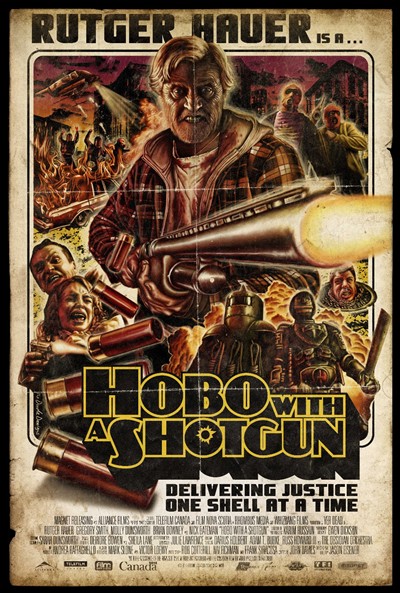
Last train to Fuck Town: Rutger Hauer rides again in “Hobo With a Shotgun”

0

The course of an acting career can vividly illustrate the randomness of fate. Rutger Hauer spent some years in Dutch experimental theater of the 1960s — after pulling off that best way to terminate one’s military service, faking mental illness — then became a local heartthrob as a medieval knight in a hit TV series at that decade’s end.

He spent the 1970s primarily starring in Dutch movies, notably the striking early films of Paul Verhoeven — well before Showgirls (1995), Starship Troopers (1997), or even 1987’s RoboCop (the director wanted Hauer for the lead, but was overruled by the studio). In the 1980s, Hauer played the memorable villains of Blade Runner (1982), The Hitcher (1986), and 1981’s Nighthawks (inducing tough investigative cop Sylvester Stallone to don drag at the end to catch him), between runs at being an action hero and theoretically loftier assignments around the globe.

Then he settled into a multilingual journeyman’s potluck of low-budget genre features, TV projects, small parts in mainstream films (2005’s Sin City and Batman Begins), Guinness commercials, and a Kylie Minogue video. Apparently 67-year-old Dutch actors in Los Angeles can’t be choosy.

Then again, sometimes better opportunities might choose them. At Sundance this January, Hauer played lead roles in two diametrically opposed movies. One was as the 16th-century Flemish artist Pieter Bruegel the Elder in Polish director Lech Majewski’s extraordinary The Mill and the Cross (recently at the San Francisco International Film Festival), which brings one of that painter’s most epic canvases to cinematic life and will hopefully open on U.S. art house screens later this year. The other was Hobo With a Shotgun. Guess which one is opening theatrically here already.

Hobo began as a $150 faux-trailer short that got considerable exposure online and off. The resulting long-form debut for director Jason Eisener and scenarist John Davies is doubtless the zenith in Halifax, Nova Scotia-shot retro ’ploitation splatter comedies to date. Which tells you nothing, of course. But it is pretty good — not great — insofar as spoofy gross-out nods to yesteryear’s exploitation cinema go. Better than Machete (2010), a whole lot better than the likes of Zombie Strippers! (2008) or 95 percent of what Troma puts out.

Grizzled Hauer stars as the titular character who rides rails into an equally nameless berg nicknamed “Fuck Town” because it’s so plagued by drugs ’n’ thugz. The hoodlums are led by crime kingpin “The Drake” (Brian Downey) and goon sons (Gregory Smith, Nick Bateman) whose violent perversities are Caligula-licious. With corrupt police force in pocket, they’re free to terrorize the populace via acts of degradation and violence pushed over the bad-taste top and then some.
When Hauer’s hobo rescues a prostitute (Molly Dunsworth) from this clan’s clutches, he trips his own mental wire from peaceably detached transient to pawnshop-armed streetsweeper of scum, à la 1980s vintage vigilante cheese like 1982’s Class of 1984 (Perry King vs. evil high school “punks”), 1985’s Death Wish 3 (Charles Bronson vs. evil gang “punks”), and 1984’s Savage Streets (Linda Blair versus … figure it out).

Hobo With a Shotgun faithfully apes exploitation conventions, from its lurid widescreen Technicolor hues to a score combining overproduced 1970s funky soundtrack kitsch with ’80s direct-to-video synth pulsing. (Complete with a closing-credits rock song that channels Pat Benatar.) Its ludicrously over-the-top violence is kinda funny, but also nastier than need be. Throughout, Hauer maintains a straight face. Maybe a tad more so than necessary — this movie could have used the wilder streak crazy-coot comedic streak shown by Jeff Bridges in last year’s True Grit or Kurt Russell in 2007’s Grindhouse.

Game Hauer retains his blue-eyed charisma and clearly relishes playing the gentle (when not lethal) giant in this artificially baroque scenario. He’s also an actor long on the world stage still seeking a role in a worthy film (or play) that may define him for posterity. He’s obviously got the talent — but at this point, would he take it? Would it even be offered? Did he take Hobo With a Shotgun because it seemed funny, or because it was the best he could get?

HOBO WITH A SHOTGUN opens Fri/27 in Bay Area theaters.


The sun rising

0

arts@sfbg.com

 The sun is high and your freezie is melting at a rapid, uncontrollable pace. Somehow a trail of sticky red syrup traces a path from hand to elbow, where it casually drips onto your exposed thigh. You’re seven and you don’t flinch because in five minutes you’ll be treading lake water. It’s summer and it’s damn hot. Life is simple and sweeter than high fructose corn syrup.

Fast-forward to adult status and days stacked with adult plans. Growing up totally blows (well, at least in terms of responsibilities, because puberty was a bitch and having your own place, a paycheck, a lover, and as many pets as you want is nice). Nostalgia for blissful, super-fun days of yore means we grown-ups will jump at anything and everything with hints of kiddie innocence.

Think giant trampoline gyms, mac ‘n’ cheese bars, and dodgeball leagues, plus all kinds of spiked youth-inspired activities: drunken spelling bees, boozy slip ‘n’ slides, and bars with board games. This stuff is all about guzzling a cocktail and laughing until you nearly pee, just like you did in the third grade, minus the vodka. It’s about having fun, being weird, and enjoying the simple things.

We have now entered the perfect time of year for getting caught up in a totally relaxed, school’s-out mentality. Use those sick days. Grill hotdogs and stain your upper lip with fruit punch. Don’t be intimidated by your age or your nasty bills. May means summer, and although we’re in San Francisco and must be very patient for the corresponding weather, this is the ideal season for simple, juicy living.

This mindset may take a little coaxing and the best non-pharmaceutical solution lies in the perfect soundtrack. Ironically, a trio of friends from the dreary north has crafted the perfect beach-inspired treat: Seattle’s Seapony is sure to get you in the summer mood with its 12-song debut, Go With Me (Hardly Art).

Seapony’s modest surf pop induces the most delightful high, thanks to a combination of super lo-fi recording and innocent melodies. Fuzzy guitars and light drums wrap around Jen Weidl’s breathy vocals, all blowing like a warm summer breeze through tall palms. The entire album runs in under 35 minutes, but could easily sit on repeat for hours, keeping fresh and light with its unpretentious appeal.

Songs on Go With Me are vaguely distinct and play better as one long dose. Songwriter Danny Rowland has intentionally kept things as simple as possible, setting up each track with the same basic framework: minimal major chords, a quiet drum machine, and super chill bass.

Weidl’s lyrics are in the same, slow-moving boat. There are no swells or outbursts; the minimal phrases do not beg for a psychologist’s interpretation. Her lackluster tone speaks of love and sadness in generics and the poppy track “Dreaming” repeats the same six lines over and over.

The band also doesn’t like to talk during performances, preferring to play song after song with limited interruptions, foraging yet another attempt at simplicity. According to a quote on Seapony’s website, this makes the group’s live show “cooler,” which could very well be true. Band witty banter is never very impressive.

In a world where everyone is trying to speed past the competition with innovative ideas, Seapony is riding the lazy river — the only water park attraction that never has a line. Is Seapony jaded? Or just looking to get a better tan? Adults are expected to tote around all sorts of bells and whistles, their eyes fixated on being first place, but Seapony doesn’t want to race. Instead, the group is producing music that wins by default. It sounds nice; it compliments sunshine; and it’s made for days free of responsibility.

This summer, put on that swimsuit, run around the yard, and laugh obnoxiously loud like you did as an awkward adolescent. Or keep it San Francisco-style by trading out the yard for Dolores Park and adding a brown paper sack. Just don’t forget the Seapony. 

SAN FRANCISCO POP FEST: SEAPONY

With the Beets, Catwalk, Eternal Summer

Sun/29, 8 p.m., $12

Hemlock Tavern

1131 Polk, SF

www.sfpopfest.com


Four for Popfest

0

arts@sfbg.com

 The third annual San Francisco Popfest kicks off Wednesday, May 25 at Rickshaw Stop. The good news is that this year’s festival has been expanded to five days, transforming Memorial Weekend into a music extravaganza. There are shows at Rickshaw, Cafe Du Nord, and Hemlock Tavern, as well as a secret Sunday show at Dolores Park. The bad news is that you can only be in one place at a time. Here are four must-see Bay Area groups.

The opening night headliner Blackbird Blackbird is spearheaded by vocalist, producer, and multi-instrumentalist Mikey Sanders. He released his debut album Summer Heart in late 2010 through Bandcamp on a “pay what you wish” system and followed it up in 2001 with Halo, which is a collection of new songs, B-sides, and unreleased tracks. With the aid of the blogosphere, Blackbird Blackbird quickly amassed a following.

Blackbird Blackbird’s music is electronic-based, although when performing live, Sanders plays with Cade Weidenhaft on drums. Sanders creates a rich, textured synthscape, as on “Sunspray,” where bubble sounds and an overall feeling of swirling makes the song seem as if it’s being sung from underwater. Other tracks, like “Ups and Down” with its heavy bass, sound dance party-ready.

Also on the Wednesday, May 25 bill is Sanders’ project Wolf Feet, which he started with Austin Wood. The pair recorded tracks while living in a “Hobbit-like apartment in Santa Cruz,” explains Sanders, who grew up in San Francisco but went to school in Santa Cruz. It’s a decidedly less electronic project than Blackbird Blackbird, and garage-rock influenced, with upbeat tempos, handclapping, twinkling guitars, and howling vocals.

Sanders is promoting Wolf Feet similarly to Blackbird Blackbird, self-releasing an EP in January via UFOLK Records and running a cute and informative Tumblr. The band’s homemade video for “Dead Hand,” a montage of vintage films such as Thunderbirds Are Go and Gamera vs. Zigra, was already featured on Pitchfork.

The Friday, May 27 Popfest show includes San Francisco’s beloved the Mantles. After a slew of singles, a self-titled LP, and the Pink Information EP, the group recently released the “Raspberry Thighs/Roman Hat” seven-inch single via SDZ Records. The song reveals a darker side to the band.

The Mantles have always been high on melodies, which they coat in reverb, but the sunny sounds are sometimes meant to distract from the truth. “Raspberry Thighs” starts with buoyant guitars, and Michael Olivares’ vocals are more spoken than sung as he says, “Hey there unassuming eyes/ What on earth can alarm you/ You’re too ready to derail/ You’re too ready to say goodbye.” It’s hard to discern all the lyrics, but there’s a sadness to Olivares’ farewell and description of the ephemeral summer.

The Saturday, May 28 show at Rickshaw Stop is a showcase for Slumberland Records. To put it simply, the entire lineup is awesome. San Francisco’s the Art Museums, formed by Josh Alper (Whysp) and Glenn Donaldson (Skygreen Leopards) in the summer of 2009, sing tales of artists, lovers, and imposters that read like mantras for the aught generation. The band released its debut record Rough Trade on Woodsist last year and will put out an EP called Dancing this summer.

From tales of bike-based dates and descriptions of art happenings to details of Sta-Prest trousers and even the band’s name, the Art Museums’ music is meant to be absurdly funny, and true. Alper and Donaldson craft hooks and sing in faux-British accents — their heroes include the Kinks, Swell Maps, and the Television Personalities. The band records on a Tascam 388 eight-track for its snap, crackle, and pop, and performs with Carly Putnam (Green Flash) and Virginia Weatherby (the Mantles) to fill out its live sound. 


SAN FRANCISCO POPFEST


Blackbird Blackbird, Wolf Feet

Wed/25, 8 p.m.; $12

Rickshaw Stop

155 Fell, SF

(415) 861-2011


The Mantles

Fri/27, 8 p.m.; $15–$17

Rickshaw Stop

Slumberland Recods Showcase

Sat/28, 5 p.m., $17

Rickshaw Stop


www.sfpopfest.com


Stein time

0

arts@sfbg.com

 A visit to the Bay Area from David Greenspan is a rare treat. A visit by Gertrude Stein even more so. It’s kind of a twofer this weekend as Greenspan delivers his version of Stein’s lecture on the theater, Plays, amid a wide-ranging Stein retrospective (Seeing Gertrude Stein: Five Stories) at the Contemporary Jewish Museum (which occurs simultaneously with the San Francisco Museum of Modern Art’s new exhibition, The Steins Collect). Although Greenspan is not often seen on stage in these parts, the inimitable New York City playwright-actor — whose brilliant comedies are often as rich in humor as in formal and intellectual surprises — has had his share of productions in the Bay Area. SF Playhouse recently mounted the musical Coraline (for which he wrote the book) and She Stoops to Comedy. A little further back. Thick Description and the Jewish Theatre had a hit with their coproduction of Greenspan’s Dead Mother, or Shirley Not All in Vain. Greenspan spoke to the Guardian by phone from New York ahead of his appearance at CJM.

SFBG The Stein lecture you’re presenting ran in rep with the New York revival of your 1999 play, The Myopia, in which Stein is also referenced. Was that the first time you’d done the lecture as a piece of theater?

David Greenspan I’ve done it periodically, one night here, one night there. And then I did it for a benefit for a theater company. Melanie Joseph, who runs the Foundry Theatre in New York, I invited her and she loved it. So when we began playing The Myopia, we decided we would include [a performance of] the Stein lecture in tandem. I had never had anything approaching a run before.

SFBG What drew you to that lecture as something to perform?

DG I’ve become interested over the last number of years in the theatrical possibilities of nontheatrical texts. I did this piece called The Argument, which is based on Aristotle’s Poetics and the writings of a man named Gerald F. Else, who wrote about The Poetics. The Argument recites the first half of The Poetics. I’d been toying with that for a while, and I’d also done — in a reading for a friend, a fellow playwright — the Stein lecture, and it went over so well, people so enjoyed it. So, besides the interest in the non-theatrical text as a performative work, it is an intriguing lecture.

And I should say, it’s not that it’s not performative. Even The Poetics. They’re both performative pieces in the sense that they’re both lectures, so they would have been given. Whatever difference between a lecture and a performance, it’s a presentation. So there’s theatrical potential in them. But I guess I was fascinated by her observations about the theater, how it addressed her own concerns, recollections, and reminiscences about growing up watching plays, and references to her experiences when she finally moved to Paris. I found it rather rich historically as well.

SFBG There’s that wonderful line you quote in The Myopia about theater as something that’s actually happening&ldots;

DG Right. Well, she says that something is always happening. And that anybody knows a quantity of stories, so what’s the use of telling another story? There are already so many stories. I think what she’s trying to get at is that there is something beyond simply telling the story. There’s some essence of what is happening. And she’s trying to depict [that] without actually telling a story. It’s almost a series of impressions that she’s molding, almost like a sculpture, to give an audience a sense, without a story, of an experience. Of course, in The Myopia I pickled it because The Myopia is filled with stories. In a sense, I use it as a way of separating myself from her because my concerns are different. But I still find her delightful.

SFBG What do you think of Stein’s plays?

DG I’ve seen a few of them on stage. They’re difficult to describe, and they’re difficult for me to talk about. The closest experience I’ve ever had to performing in something like Stein would be a Richard Foreman play. I acted for Richard Foreman once. His work eschews traditional action. It’s somewhat different, but it’s the closest I’ve come to something like Stein. Like she says, she’s not interested in story and action. She’s interested in emotion and time.

I think also what she’s interested in is coordinating to her own satisfaction a visual and aural experience, one that is not dependent on following a story. Because she had problems with that, she found that it bothered her to have to pay attention, particularly if it was a story that had any kind of nuance. She wanted to keep backing up and seeing it again and couldn’t do it. But to get back to your question, the plays themselves I can’t speak to, but the lecture itself with its analysis and observations of the theater experience — and it’s a very personal lecture, very personal descriptions for her — and the rich theatrical reminiscences, I find very satisfying and continually intriguing. Also it begins to elucidate what she was trying to do in her plays.

SFBG What kinds of things do audiences relate to?

DG When she describes her experience of theater as a young person, it’s all about San Francisco and Oakland. So it should give people a little bit of a peep hole into what it was like to see theater [back then]. It was very important to her, the arrival of foreign companies. And Sarah Bernhardt came through, and that was an important thing for her to see. It was very significant for her to see a play in a language she really didn’t understand. She didn’t have to follow it. She could just listen to it and look at it without dealing with a story. That’s what’s most important to her — how to coordinate seeing and hearing in the theater. 

DAVID GREENSPAN’S PLAYS

Thurs/26, 7 p.m.; Sun/29, 1 and 4 p.m., $20

Contemporary Jewish Museum

736 Mission, SF

(415) 655-7800

www.thecjm.org

SEIU 1021 withholds support for newly unveiled pension proposal

San Francisco’s largest labor union, Service Employees International Union 1021, is not on board with a proposed charter amendment that would reform the city’s pension system for public employees.

The pension reform proposal was unveiled by a coalition of city officials, labor representatives, and business leaders at a press conference in the mayor’s office in City Hall this morning, May 24. The plan would yield an estimated savings of $800 million to $1 billion in savings over the course of a decade, the bulk of it coming from increased employee contributions to retirement funds of up to six percent for future and current employees. The proposal would raise the retirement ages from 62 to 65, or 55 to 58 for public-safety workers, and impose caps on pensionable salaries for new employees. Mayor Ed Lee described the plan as “a serious, comprehensive plan and one that reflects the consensus.” The proposed charter amendment must go through the Board of Supervisors’ Rules Committee and win the approval of the full board before it can be placed on the ballot in November.

Lee emphasized that the pension plan had been crafted with a consensus-building approach over the course of several months, which brought business, labor, and city officials together. Billionaire Warren Hellman delivered comments about the historic nature of the proposal, and Rebecca Rhine from the Municipal Executives Association and Steve Falk from the San Francisco Chamber of Commerce each voiced support for the plan.  Sups. Sean Elsbernd and Board President David Chiu spoke of the collaborative and democratic process that had brought everyone in the city family under one tent.

Well, almost everyone.

“We’re stuck on one issue,” noted SEIU 1021 Vice President Larry Bradshaw. Under the plan, a pay cut would go into effect for three groups of lower-paid workers on the same date that they would be responsible for making new pension contributions, July 1, 2012, he explained. The affected workers include nursing assistants, security guards, and clerical workers, he said. While the mayor’s proposal requiring new pension contributions builds in an exemption for city workers making less than $50,000 per year, many of these SEIU employees would fall just above that cutoff mark, Bradshaw said.

“We’ve got workers that are just about at the $50,000 threshold … so they’re going to be paying about $2,000 a year out of their pocket,” toward new pension contributions, he said. “So the mayor’s plan has these workers, who are our lowest-paid workers, taking this huge pay cut, and then they want us to agree to this increase in contributions. And the scale of these pay cuts are just enormous. For someone who’s making $50,000 a year, to ask them to take $2,000 or $3,000 on top of $12,000 in a pay cut, is impossible.”

The pay cut is a leftover from the administration of former Mayor Gavin Newsom. For certified nursing assistants, the shift would amount to a roughly $12,000 annual pay cut, Bradshaw said. Security guards would face an estimated $5,000 per year cut, and clerical workers could face anywhere from $1,000 to $11,000 per year. Bradshaw estimated that a total of about 570 city employees would be affected. The workers faced getting fired and re-hired at lower-paid classifications in a prior budget year to make up for a revenue shortfall, but the union reached an agreement to stave off the worst pay cuts for those “de-skilled” employees by imposing a one percent across-the-board cut for all members in order to restore the salary cuts.

“This was such a sore point with our membership, the membership would not allow us to turn our backs on these workers, and we couldn’t get the city to restore the pay cuts,” Bradshaw said. “So we voluntarily took a one percent pay cut for every member to make up the loss in pay that these workers suffered.”

This arrangement would no longer be possible under the pension reform proposal, he said, because most union members would be asked to contribute 3.5 to 5 percent toward their pensions. “We’re already paying one percent more, so we’re not going to have that option of asking our members to keep funding these workers who have taken this 20 percent pay cut,” he said. “So the same day this goes into effect, these people take this horrible hit in their pay. And these are primarily women and people of color. Our problem is, we can’t leave these workers behind.”

Until that issue is resolved, the union cannot get on board with the plan, he said. “We’ve been waiting three weeks to meet with the mayor, and we can’t fix the problem if we can’t sit down with the mayor and talk about it,” he said, noting that  union representatives had been able to sit down with mayoral chief of staff Steve Kawa. Restoring the pay cut would have an estimated financial impact of $5 to $6 million.

Bradshaw said SEIU 1021 had hoped to fix the problem in order to be able to get on board and voice their support during the announcement this morning. “We were at the table until 11:30 last night,” he said. “We called the mayor, we had Tim Paulson at the [San Francisco Labor Council] text the mayor, we asked the city team to ask the mayor to come in. The mayor was a no show.” The Guardian has placed calls to the mayor’s office seeking comment, but hasn’t yet heard back.

Asked what he thought the outcome might be, Bradshaw said, “We think this situation cries out for justice. We think there are lots of ways to solve this problem, and we keep putting ideas on the table that are rejected by the mayor’s office. We’re hopeful. But, until we sit down with the mayor, it’s kind of a big question mark.”

SEIU 1021 represents around 17,000 city workers, making it the largest and one of the most politically powerful labor unions in the city.

Pattie Tamura attended the press conference on behalf of SEIU 1021, but stopped short of voicing support for the proposal when reporters questioned whether the union was on board with the plan, saying only that negotiations were ongoing. Bradshaw said they sent a representative as a sign of respect for the collaborative process that had been spearheaded by coalition leaders, particularly Warren Hellman.

Earthly creations, unearthly longings

0

arts@sfbg.com

The San Francisco International Arts Festival’s model of presenting guest and local dancers side by side was initially designed to alleviate Bay Area artists’ concern that SFIAF might siphon off funding for their own work. Yet the format works artistically. The 2011 festival’s first week’s lineup of local and imported dance proved it. One-night stands at the Marines Memorial Theatre came from Israel’s Barak Marshall Company and Santa Fe’s Dancing Earth. From San Francisco, Hope Mohr Dance and FACT/SF shared evenings at Fort Mason.

Marshall is a Yemeni-Israeli American now primarily living in Israel. Apparently the 2010 Monger was influenced by servant-master dichotomies like those portrayed, most prominently, in the evergreen British TV show Upstairs, Downstairs. The work turned out to be a Kafkaesque film noir comedy that wore its desperation just barely covered by maids’ aprons and grooms’ suspenders. That the despot, a mysterious Mrs. Margaret, is a woman — Marshall calls her the Whore of Babylon — only heightened its impact. After the recent Middle East (and elsewhere) turmoil, it’s impossible not to see Monger as deeply political. Marshall first presents his 10 dancers wrapped in black, anxiously scanning the sky. He ends on the same pessimistic note.

Marshall’s variety show format separates Monger‘s acts with blackouts and punctuates them with the tinkling service bell. Both provided a welcome continuum, though most of the sections work individually. The servants scurried like road-runners; the emotionally temperature between them steadily increased like a boiler about to explode. Attempts at self-assertion, whether through love or violence, failed repeatedly. I saw a touch of Ohad Naharin — Marshall cut some of his teeth in Naharin’s Batsheva Dance Company — in the hilarious hate- and gossip-mongering “upstairs” ladies. Spitting venom, they bobbed up like corks in the sea. Monger gained valuable support from the choreographer’s own exceptionally imaginative patchwork score.

I have, however, major concerns with the choreography. Although the extensive use of unisons, punctuated by gestural language, made intellectual sense, they pulled the piece down toward monotony.

What’s your idea of “Native American dance?” Stomping feet, flying fringe, and pounding drums? Not a trace of a powwow could be found in the excellently danced Of Bodies Of Elements by Dancing Earth’s 10 dancers (plus two babies).

Choreographed by Rulan Tangen and performed by members from diverse North American tribal cultures, Bodies included contributions from traditional practices, including a “Deer Dance” (by guest artist Jesus “Jacoh” Cortes) and a “Prayer Dance” (by Deollo Johnson), suspiciously looking like an Eagle Dance with strong elements from women’s fancy dances. But this is a thoroughly contemporary work with performers — men and women alike — whose athleticism and multifarious talents and training acknowledge the air as much as the ground under their feet.

Bodies is presented as a creation myth whose believers become alienated from the natural order but find their way back into it. The choreography sometimes doesn’t spell out the narrative that clearly, so the program notes help for those unfamiliar with indigenous American beliefs.

A small ritual sets the tone. A member of the local Ohlone tribe blessed the space the company had asked permission to perform in.

At 90 minutes, the two-act Bodies could be tightened, though I wouldn’t give up a second of the opening, which imagines the natural world — including a splendid tree — emerging from an inchoate mass. Moving from hunter-gatherers to agricultural life was economically and clearly presented, though the water choreography for the women felt vapid. But Raul Trujillo’s “Cage Dance,” which used an elaborate double contraption (one part of it a hoop skirt) to indicate various forms of imprisonment, missed its target. The dancers physically struggled to get in and out of it — surely not the intent.

The second act included a haunting Ghost Dance. It was danced with traditional bobbing steps against a wailing wall (video by Alejandro Quintana) that documented the destruction humankind manages to inflict on itself. Perhaps Tangen’s idea that a deracinated people experiencing degradation can still hear Earth’s heartbeat in contemporary urban rhythms is overly romantic. But it’s a lovely idea to consider and made for some impressive hip-hop dancing.

Putting Hope Mohr and Charles Slender on the same double bill paired two artists who are relatively new in town — Mohr since 2007, Slender since 2008. They have nothing in common except that they clothe their formal concerns with clear expressive intent. For Mohr, this has sometimes meant working in tandem with community and professional dancers. Slender has elaborate theatrical trappings that he seems to be constantly reworking at his disposal.

Mohr’s world premiere, the deep-ringing Plainsong, was a fragile mediation for a sturdy performer, the renowned Aleta Hayes. The subject is the mythic Penelope, waiting for Odysseus to return. Katrina Rodabaugh wove-unraveled Plainsong‘s exquisite backdrop. Every meaning, every gesture of this 20-minute solo was suspended in ambiguity. In Hayes’ touch, the pile of wool became bloody entrails. She enclosed her space with a fragile thread — to imprison or to protect herself? With vigorously shoveling hands, she could have been unearthing or burying something. Her deep, almost masculine voice surged from inside her guts. The full-of-potential Plainsong is one of Hope’s finest works yet; she may want to consider refining it in the future.

Slender’s mildly witty Consumption Series is a chameleon that adapts to wherever his intrepid FACT/SF troupers take it. It’s a piece — this is the third time I’ve seen it — that looks at obsessions (food, sex, power) and envelops them with pseudo-baroque accoutrements and a slyly ballet-based vocabulary and its aberrations. The costumes and the ideas are beginning to look ragged; it’s time to retire both. 

SAN FRANCISCO INTERNATIONAL ARTS FESTIVAL

Through June 5

Various venues

www.sfiaf.org


Hail Marys!

2

le.chicken.farmer@gmail.com

We ate chicken and waffles on the loading dock at farmerbrown’s Little Skillet, and garlic fries at AT&T Park. We ate chicken at Limon Rotisserie and chicken wings at San Tung. Tried to get a kimchi burrito, but John’s was sold out. We split a sandwich from Tartine.

She was interested in food, and naps. We did not go to the wharf, the bridge, the beach, the park, the Palace of Fine Arts, or Alcatraz. In fact, the only non-culinary landmark I even tried to sneak past her was The Good, the Bad and the Ugly at the Castro. That day, between meals, snacks, and shenanigans, I would occasionally put my lips close to her ear and go, “Boodi-boodi boooo. Bwa bwa bwa.” Only sometimes I would whistle it.

Didn’t happen. We went to Clement Street — me, Hedgehog, Earl Butter, the Choo-Choo Train, and King. There, at the Clement Street Bar & Grill, we met Baseball Mary. Who knows Choo-Choo, so he got a hug, and we all got baseball cards. Her position is “Lower Box 128, Row 3.” She has the biggest, cheerfulest smile, and has been to every MLB park.

Baseball Mary is from Portland, Maine, and therefore throws “wicked good parties,” according to the stats on the back of her card. In the interest of one day being invited to one, let me tell you that she is my new favorite waitressperson. Not that she waited on us. We didn’t eat. We just sat at the bar and drank and swapped Yogi Berraisms with the dude down the corner.

Truth be told, I was already happy. My three-week run of dark thoughts and existentially important-ass problems snapped the moment my new favorite airline, United, touched Hedgehog down safely at SFO. Of course, now I hate them again for taking her away.

But at least my ass feels better. As for the hamstring … well, there’s Burma Tea Leaf 1, for dinner. And to give you an idea how contented and all-around mentally stable I was feeling by then, they have duck noodle soup and I didn’t even notice! Who needed it, with mango salad, pork with pumpkin coconut curry, spicy catfish … everything under $10. And a waitressperson who gave Baseball Mary a run for her money, smilewise.

“Why didn’t you tell me you were writing this up?” Earl Butter said when I picked up the bill. “I would have been funnier.”

I wouldn’t have noticed. That whole long weekend was all about Hedgehog and me being us, me trying to impress her with chicken wings and so forth. For entirely selfish reasons, I want her to love San Francisco like I loved New Orleans while I was there — thanks largely to her plying me with fried things.

Our last night here we made the sweetest love two people have ever made, with due respect to everyone else in the world. Then, like in movies, I woke up early and snuck out of bed. I was going to be Rocky, and run and jump and run and just generally stretch my hamstring. There was a game at nine. It was the playoffs. I was going to play. Yeah: Rocky.

I got as far as cracking the eggs, then, being me, decided to cook them. With potatoes. And draw a bath. We had breakfast in the tub.

The game was on our way to the airport. On the first play I of course reinjured myself. But I had doctor’s permission now to play through the pain. So I went back in and was able to go about 65, 70 percent. With two minutes left we were losing by a safety and a touchdown.

I had nothing. On the sideline, I found out later, Coach said to Hedgehog, “Too bad you didn’t get to see her A-game.” I didn’t hear this, but must have felt it, because on the next play I wrestled a touchdown pass away from a defender, and a teammate.

But we were still down a safety, with a minute and a half left. For some reason instead of killing the clock, they passed, and for some reason I intercepted — and hobbled it back for a touchdown. Now we were winning with less than a minute left. So they had to pass — but I intercepted that one too. And one week after fearing my life was over because I couldn’t play sports, I was being carried off the field on shoulders, in front of my lover.

So. There’s that. 

BURMA TEA LEAF 1

Tues.–Thurs. 5-9:30 p.m.;

Fri.–Sun. 11:30 a.m.–3:30 p.m., 5–10 p.m.

731 Clement, SF

(415) 2221-3888

Beer

MC/V


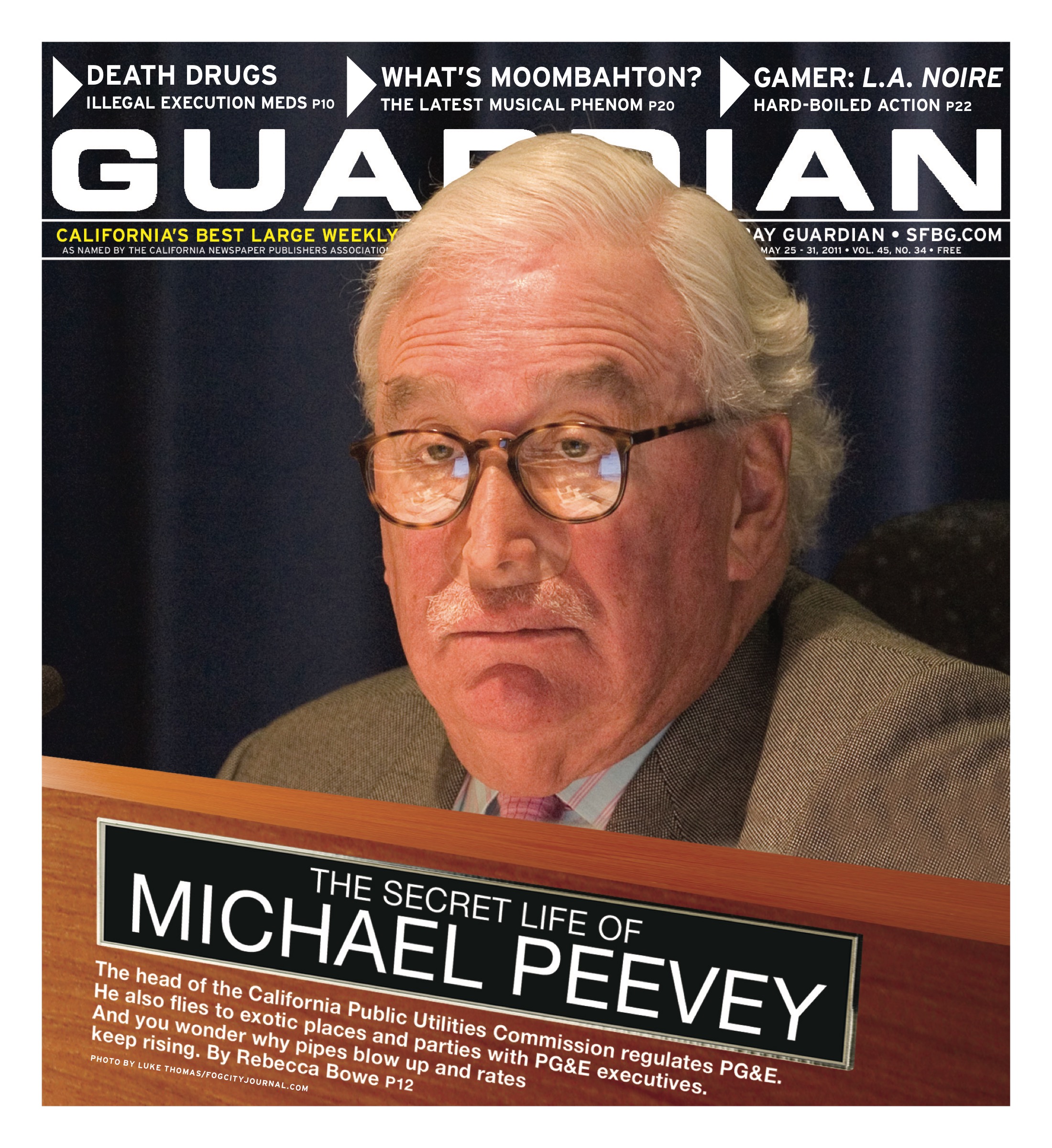
The secret life of Michael Peevey

11

rebeccab@sfbg.com

Inside a legislative hearing room at the state capitol, things were beginning to get uncomfortable. Roughly five weeks had passed since a Pacific Gas & Electric Co. pipeline explosion killed eight and leveled an entire San Bruno neighborhood, and this California Senate committee hearing was an early attempt to get answers.

San Bruno residents who lost loved ones in the deadly explosion huddled in the front row, their eyes fixed on company representatives and agency bureaucrats as they spoke. At the back of the room, a band of immaculately dressed PG&E executives and utility lawyers sat clustered together.

Richard Clark, director of the consumer protection and safety division of the California Public Utilities Commission (CPUC), fielded questions from visibly frustrated state legislators. Sen. Dean Florez (D-Shafter) wanted know why the CPUC hadn’t done anything when PG&E ignored an impaired section of the ruptured pipeline even after it was granted $5 million to fix it.

“Did the PUC do any accounting when you gave them $5 million?” Florez demanded. “Do we just give them money and cross our fingers and hope they fix it? Is that what we do? Until some terrible tragedy occurs?”

Sen. Mark Leno (D-San Francisco) said the CPUC needed to step it up and start practicing serious hands-on oversight. He recalled a tragedy that occurred in 2008 when a gas leak in Rancho Cordova triggered a pipeline explosion, killing one person and injuring several others. Although an investigation determined that PG&E was at fault, the CPUC hadn’t yet gotten around to fining the company.

“We’ve got a pattern here,” Leno said. “And we’re not doing anything differently.”

Less than three weeks after CPUC staff members were grilled in Sacramento, Michael Peevey — president of the CPUC and the top energy official in the state — boarded an airplane for Madrid. He was embarking on a 12-day travel-study excursion, with stops in Sevilla and Barcelona, sponsored by the California Foundation on the Environment and the Economy (CFEE).

Peevey’s wife, California Sen. Carol Liu (D-Glendale), was along for the trip. So were two other state senators, several members of the state Assembly, CPUC commissioner Nancy Ryan, and a host of representatives from the energy industry. The group included executives from Chevron, Mirant (now GenOn, the owner of the Potrero power plant), Covanta Energy Corporation, Shell Energy North America, and engineering giant AECOM. High-ranking executives of the state’s investor-owned utilities also participated, including Fong Wan, the senior vice president of energy procurement for PG&E.

Although strict rules normally govern commissioners’ interactions with parties that have a financial stake in the outcomes of commission rulings, there wasn’t anything especially unusual about Peevey traveling internationally with a group that included representatives from the same companies his regulatory commission oversees. CFEE trips happen every year. The nonprofit has footed the bill to fly groups of regulators, legislators, and utility executives to prime vacation destinations like Italy, Brazil, and South Africa in recent years, excursions organizers say are critical for educating top-level stakeholders about worldwide best practices for sustainable systems. However, groups such as The Utility Reform Network (TURN) have decried CFEE trips as “lobbying junkets.”

As PG&E and the CPUC both work to win back the public’s confidence after their latest deadly failure, it’s worth analyzing whether their relationship — shaped by vacations together at exotic locales — has grown too cozy.


THE BUDDY SYSTEM

CFEE isn’t the only nonprofit that regularly flies Peevey overseas for green travel tours with high-ranking utility executives, and the 12 days he spent in Spain wasn’t the only time he spent away from official duties and in the company of the corporations his commission regulates.

These controversial getaways are just a small part of Peevey’s involvement with private-sector interests. He also chairs the board of a nonprofit investment fund created as part of a $30 million settlement agreement with PG&E. Called the California Clean Energy Fund, it funnels money into private venture-capital funds that invest in green start-ups, plus a few companies in the fossil-fuel sector.

While legislators have voiced frustration that lax CPUC oversight of PG&E on pipeline-safety issues opened the door to disaster in San Bruno, inside observers are critical of the outright favors Peevey has granted utilities, such as guaranteeing an unprecedented, higher-than-ever profit margin for PG&E as part of the company’s 2004 bankruptcy settlement.

The CPUC is set up to perform as a watchdog agency, yet social and professional ties running deep within California’s insular energy community mean regulators sometimes run in the same circles as the executives who answer to them, making for cozier relationships than the general public might anticipate. It’s an old-fashioned insider game that one longtime observer wryly characterizes as “the buddy system.” But the buddy system can bring consequences.

As the public face of the CPUC, Peevey repeatedly has been thrust into the spotlight. He has absorbed advocates’ concerns about pipeline safety, rising electricity rates, SmartMeters, missed targets for energy efficiency, and municipalities’ David-vs.-Goliath battles with PG&E to implement community choice aggregation (CCA), to name a few. He’s a magnet for public scrutiny while occupying the center seat at commission meetings, but Peevey’s behind-the-scenes engagements with private-sector organizations bent on shaping statewide energy policy demonstrate how power is wielded in California’s energy world, a system in which regulators seem to be partnering with utilities rather than policing them.

Based at Pier 35 in San Francisco, CFEE’s board of directors is composed of a small group of officers, plus a long list of members who hail from some of the most prominent businesses nationwide. Shell, Chevron, J.P. Morgan, Goldman Sachs, AT&T, and PG&E all hold positions on CFEE’s membership board, and each entity chips in to fund the foundation’s activities and travel excursions.

The group also includes representatives from labor organizations like the International Brotherhood of Electrical Workers and mainstream environmental groups such as the Natural Resources Defense Council. Among the emeritus members of CFEE’s governing board are some high-ranking figures, such as CIA director-turned-Pentagon boss Leon Panetta. CFEE received $45,000 in donations from PG&E in 2009 (the most recent year available) and was granted similar amounts in prior years.

CFEE spokesperson P.J. Johnston, the son of former state senator and CFEE officer Patrick Johnston and the press secretary under former Mayor Willie Brown, described the trips as valuable opportunities for top-level stakeholders to gain insight on best practices and engage in noncombative dialogue on key issues.

“The idea for us was that it made sense to have someplace where it was nonconfrontational to engage in policy, work-type discussions,” Johnston explained. He added that the trips are “all about policy, on the 30,000-foot level,” and emphasized that discussions aren’t about specific decisions pending before the CPUC.

Loretta Lynch, a former president of the CPUC who brought a reformist spirit to the agency and was never shy about rebuking utilities, is skeptical of CFEE’s stated program goals. When she was first appointed to the commission, Lynch said, CFEE contacted her to ask where she wanted to travel. If the trips are arranged to fly regulators to destinations they’ve been itching to visit, she reasoned, must-see green innovations probably aren’t dictating the itineraries. “To me,” Lynch said, “they don’t have anything to study in mind.”


“PARTYING WITH THE JUDGE”

The CFEE trip to Spain included a briefing on developing wind energy from AES, a company working on wind and solar development in California that also operates polluting, gas-fired power plants in Huntington Beach, Long Beach, and Redondo Beach. There was a round table on solar energy featuring a presentation from the Independent Energy Producers Association, a trade group that regularly files petitions and comments on CPUC proceedings. The trip included a tour of a desalination plant, a talk from the president of the Madrid Chamber of Commerce, and discussions about California’s energy market. Scheduled activities ended by midafternoon on some days, and the itinerary left a Friday afternoon, Saturday, and Sunday in Sevilla wide open.

Asked to comment on concerns about inappropriate lobbying, Johnston said: “We’re not guarding against anyone’s potential behavior any more than we would be on the streets of Sacramento. We’re not setting ourselves up as the guardians. We’re not facilitating that, per se, either.” He added, “I realize there are critics of any kind of travel and any kind of commingling. But it is wise for us not to close our eyes to the rest of the world, and there’s not a great appetite for spending taxpayer money on these trips.”

Yet Lynch countered that there is an important distinction between the roles of Sacramento legislators and that of utility commissioners. “Regulators are not legislators,” Lynch said. “They’re more like judges. Their decisions have the power of a judge’s decision.” By inviting commissioners along on these lavish getaways, she said, “it’s as if you’re partying with the judge.”

Mindy Spatt, a spokesperson for TURN, echoed Lynch’s concerns. “These ostensibly educational trips are essentially lobbying junkets, where utilities … wine and dine legislators,” Spatt said. TURN raised the issue several years ago, she said, when Peevey joined a CFEE trip attended by a representative of Southern California Edison “just coincidentally at the exact same time that he was penning an alternate decision in Edison’s rate case.” She added: “In TURN’s perspective, the commissioners need to be more in touch with what actual utility customers are experiencing, rather than in touch with the top restaurants in Brazil.”

While Peevey is only one of a host of officials who attend CFEE trips, he has more than just a casual tie to the nonprofit. From 1973 to 1983, he served as president of the California Coalition for Environment and Economic Balance (CCEEB), an organization CFEE grew out of and whose membership shares some overlap with CFEE.

Based in San Francisco, CCEEB was founded by Edmund G. “Pat” Brown (Gov. Jerry Brown’s father) in 1973. CCEEB backed a late-1970s proposal to construct a series of nuclear power plants along the California coastline. More recently, the group honored BP with a 2009 award for environmental education — shortly before the company and lax federal regulators were responsible for the worst oil spill in U.S. history.


A YEAR IN THE LIFE

Spain wasn’t the only country Peevey jetted off to with complimentary airfare in 2010. According to a Form 700 filing with the Fair Political Practices Commission, he also traveled to Germany from Aug. 1–5 for a sustainable energy study tour organized by the Energy Coalition. Joining that trip were representatives from investor-owned utilities PG&E, Southern California Edison, and Sempra, plus various city officials and energy experts from the Swedish Energy Agency.

The group stayed at the Radisson Blu Berlin Hotel, which is famous for its AquaDom. “Standing at 25 meters high, it is the world’s largest cylindrical aquarium containing 1 million liters of saltwater,” according to the hotel website. All Radisson Blu Berlin guests have free access to “the hotel’s well-being area,” called Splash, which features a pool, sauna, steam bath, and fitness room.

Based in Irvine, the Energy Coalition’s Board of Directors is chaired by Warren Mitchell, a retired chair of the Southern California Gas Co. and San Diego Gas & Electric Co.. Another director is a utility lawyer who also sits on the board of directors of the Northeast Gas Association, a consortium of natural gas companies in the northeastern U.S.

Founded in the late 1970s by John Phillips to get large businesses to reduce energy consumption in partnership with utilities, the Energy Coalition has arranged excursions for years to bring energy regulators, city officials, and utility executives to Sweden (where Phillips’ wife was born) to exchange ideas on energy issues. The nonprofit organizes an annual summit called the Aspen Accord, “an energy policy forum where cities, utilities, regulators, and end-users collaborate to identify problems and propose solutions to our most pressing energy issues,” according to a 2009 tax filing. While it used to be held in Aspen, Colo., the most recent Aspen Accord was held at San Francisco’s Westin St. Francis. Peevey gave introductory remarks, and the conference featured talks from PG&E, among others.

Craig Perkins, executive director, told the Guardian that the Aspen Accord and study trips are designed to create a venue for major stakeholders to arrive at outside-the-box solutions. “What we try to do is get everybody out of their comfort zone, if you will — that’s the best way to support more creative thinking,” he said. Official regulatory proceedings are “so rigidly legalistic and bureaucratic that it almost prevents any creative thought from happening,” he added. “We’re not in San Francisco, we’re not in Sacramento, we’re not in corporate offices — let’s just talk about these really big issues, and really big challenges.”

The Germany tour included meetings with the Berlin Energy Agency, talks about climate policy, and a tour of an eco-community in Freiburg. Perkins said utility companies must to pay their own way on the trips, but costs are covered for governmental officials.

An Energy Coalition tax filing reveals that board members receive a monthly retainer of $1,000, quarterly meeting fees of $1,000, plus $500 for each board committee meeting. Teleconferences also result in $500 meeting fees.

Several years ago, the Energy Coalition partnered with PG&E to create the Business Energy Coalition, which paid businesses including Bank of America and the Westin St. Francis $50 per KW of energy savings for banding together to reduce energy during peak load hours. According to a tax filing, total annual Energy Coalition revenue dropped from $10.7 million in 2008 to $3.75 million in 2009 “due to large revenue receipts for participant incentives” for the Business Energy Coalition program, as “revenues were used for direct pass-through payments to program participants and contractors.” In 2006, according to a CPUC filing, PG&E paid the Energy Coalition $227,373 for unspecified consulting services.

In addition to the $8,880 trip to Spain (comped), and the $6,583 trip to Germany last year (comped), Peevey’s 2010 disclosure form shows that he also went to Australia May 14-19 to participate in a conference hosted by the Sydney-based Total Environment Center called “Smart Metering to Empower the Smart Grid” ($12,577, comped). And while it doesn’t show up on his FPPC filing, an agenda for CFEE’s Energy Roundtable Summit from Dec. 9-10 at the Carneros Inn in Napa lists Peevey as a participant. A glance through past filings suggests that 2010 was no anomaly; it’s a typical year in the life of a jet-setting utilities regulator.


GREEN CAPITALISM

Peevey once served as president of the Southern California Edison, an investor-owned utility, and was president of NewEnergy, Inc., an electricity company that later was sold to Williams Energy. Yet his professional image is that of a forward-thinker on climate change. According to a bio on the CPUC website, he’s received awards for achievements on green and sustainable energy from various organizations throughout California.

In 2005, speaking in Berkeley at an annual conference for the California Climate Action Registry, Peevey touted a list of his accomplishments on sustainable energy. My final example of PUC actions on climate change is related to PG&Es bankruptcy, he said. When they emerged from bankruptcy last year, one of many conditions of our support for their reorganization plan was that they create a $30 million Clean Energy Fund, devoted to investing in California businesses developing and producing clean technologies.

What Peevey didnt mention is that he chairs the board of directors of that fund. As a nonprofit venture capital fund, the obscure, San Francisco-based CalCEF sounds like an oxymoron. Based on the terms of the PG&E bankruptcy settlement, its governed by a nine-member board consisting of three CPUC appointees, three PG&E appointees, and the rest selected jointly by the CPUC and PG&E appointees. Other board members include past PG&E executives, a former member of the California Energy Commission, and a former chair of the board of governors of the California Independent System Operator (Cal-ISO), the body that ensures statewide grid reliability and blocked the closure of the Mirant Potrero Power Plant for years.

The nonprofit’s stated mission is to catalyze clean energy investment to aid in the state’s transition away from fossil fuels. CalCEF president Dan Adler described it as a sort of seasoned guide for fledgling green companies that might otherwise fail to navigate the murky, complicated clean-energy sector. CalCEF is in a position to usher start-ups toward success with a combination of funding, networking, and insider wisdom on state energy policy.

Among the challenges that the clean-energy sector faces, Adler said, are the utilities themselves. “They are effectively monopoly, or oligopoly, controllers of the energy industry,” he said. “And they don’t like outside innovation coming and disrupting their work process or their relationship with their customers.”

CalCEF aims to guide the finance community “to be partners with what public policy is doing around clean tech and clean energy,” Adler went on. “There’s a tremendous amount of money to be made, but there’s also a lot of opportunity for money to be wasted. If you don’t have a private-sector investment community that understands these rules and can put their money alongside these rules in a collaborative framework, we’re very unlikely to achieve the really aggressive energy targets that California has set.”

Yet as one skeptical energy insider noted, “there are 15 to 20 other funds, with 10 times as much money, an hour south in the same field,” referring to the burgeoning clean-tech hub in Silicon Valley. It’s questionable whether the CPUC is actually fulfilling some dire need with CalCEF, this person said.

Lynch, not surprisingly, takes a dim view of CalCEF. The former CPUC president questions what business the CPUC has creating a private foundation to guide venture capital investment. “It is a fundamental distortion of the PUC’s authority,” she charged, “all in service of Peevey’s ambitions.”

Peevey’s economic disclosure showed that he holds more than $1 million in a private family trust, without disclosing whether private investments contributed to that fund.

Adler stressed that there is arms-length relationship between CalCEF board members and the companies that benefit from the fund’s investments. “Because we are a nonprofit, and because we have on our board members of the regulatory community, we recognized quickly that we can’t be making direct investments into companies,” said Adler, a former CPUC staff member who was highly regarded even by the critics of CalCEF. “So … we’ve picked the venture-capital funds that we wanted to partner with.”

CalCEF funnels its capital into three different for-profit investment firms, which in turn select the companies that will be included in CalCEF’s investment portfolio. Several directors of the partnering investment firms also sit on the boards of directors of the companies they invest in. The startups run the gamut, from carbon-offset outfits, to energy-efficient lighting manufacturers to solar and wind companies, to biofuels startups to various kinds of technology firms related to the smart grid.

But CalCEF has also poured money into companies that bolster the fossil-fuel industry. One of its first investments was CoalTek, a company developing technology for so-called “clean coal.” Asked to explain why, Adler told the Guardian, “We don’t have veto power on every deal that goes down.”

Adler said he personally believes that “there’s no such thing as clean coal,” but tempered this by adding, “there are some very smart people in our community who will tell you that there’s no future … without coal.”

Another CalCEF investment, DynaPump, is developing technology to make it more energy efficient to pump oil and gas. Asked about this decision, Adler responded: “I will say that when we were approached with this investment by the venture partner that ultimately undertook it, we had our misgivings. If you can save energy in the production of oil and gas, then you’re definitely making a contribution to overall energy efficiency.”


TAX-EXEMPT TESLA

There appear to be some closer-than-arms-length links between CalCEF board members and the investment fund’s beneficiaries. A bio for CalCEF director Nancy Pfund, for example, notes that in her capacity as manager of an outside investment fund, she had “worked closely” with Tesla Motors, a CalCEF investment. Tesla provided CalCEF’s first investment return earlier this year after Tesla went public. A principal of one of the investment firms that works with CalCEF, Stephen Jurvetson of Draper Fisher Jurvetson, holds Tesla shares in a personal trust, according to a filing with the U.S. Securities and Exchange Commission.

Tesla manufactures sleek, electric, zero-emission sports cars with prices in the six-figures, and it’s gearing up to roll out a model that will cost somewhere closer to $50,000. The company’s success was helped by a sales-and-use-tax exclusion granted by the state of California last year. Peevey had a hand in that, too. Few Californians may have heard of the California Alternative Energy and Advanced Transportation Financing Authority (CAEATFA), a state body within the Office of the Treasurer, which has the power to authorize sales-tax exclusions for companies that are developing alternative energy technologies. Peevey has a seat on it.

In October 2009, according to a CAEATFA document, Tesla was granted a sales tax exclusion from that financing authority. The sports car manufacturer had received a tax break of $3.3 million as of December 2010, and stands to gain a tax break as large as $29.1 million, depending on its property purchases. As a CAEATFA member, Peevey approved the deal by proxy.

A central question is whether the CalCEF dollars that benefited Tesla and other CalCEF portfolio investments were originally derived from PG&E shareholder profits or ratepayer funds. Adler was careful to note that the initial $30 million came from company shareholders, not PG&E customers. But Lynch pointed out that every dime in PG&E coffers originates with the millions of customers who pay utility bills.

Lynch noted another provision of the bankruptcy settlement agreement, which guarantees PG&E a minimum annual profit of 11.2 percent, catapulting it forever into a higher rate of return than the 8 percent to 11 percent profit traditionally granted by the CPUC in prior decades. “They’re manipulating how big this bucket is to siphon off funds into programs like CalCEF,” Lynch said. “It’s all to give Peevey and his friends access — and to greenwash what was a very stinky deal for the ratepayer.”


ELUSIVE CLEAN ENERGY FUTURE

In California, a national leader in addressing climate change, the stakes are high in the energy sector. The CPUC is tasked not only with shoring up transmission-pipeline safety to prevent another San Bruno disaster, but helping to chart a course away from reliance on fossil fuel-powered energy sources.

CFEE, the Energy Coalition, and CalCEF share a common thread — their missions relate to advancing the cause of a clean energy future in California. And while utility funding and partnership is evident in all three operations, the overarching goal is understood to be green.

But as Adler observed, the utilities themselves present one of the greatest obstacles to progress on a clean-energy transition. While California has increased renewable energy sources, it’s done a poor job at supplanting fossil fuel generation with green alternatives, in part because the CPUC has allowed for increasing fossil fuel power generation even as renewable energy expands. According to a listing on the California Energy Commission website, nine natural gas power plants have won approval statewide and are moving toward construction, while six new ones are under review.

The CalCEF approach to addressing climate change, rather than aggressively targeting polluting industries, is to encourage the fledgling green industry in hopes of facilitating success in partnership with the financial sector. In many cases, the backers of the clean-tech companies are the same players behind the big energy giants.

Environmental advocates are critical. “If anyone thinks the CPUC is set up to serve public interests, forget that,” says Al Weinrub, executive director of the Local Clean Energy Alliance, a group that organized against PG&E’s ill-fated Proposition 16 last year. “They never have and they never will.”

Weinrub said he viewed proponents of green energy as falling into two camps: Moneyed interests motivated by a growing new market sector, and activists motivated by environmental and social justice causes. Major green investment firms “want to de-carbonize capitalism,” he observed. “But everything else stays the same.”

Peevey is considered a major driver behind the state’s climate change legislation, and he’s highly regarded for his dedication to green energy. Yet as long as the interlocking dynamic between energy regulators and California’s largest utilities goes unchallenged, change will only come in a way that’s as comfortable, profitable, and manageable for the state’s top polluters as they wish. And in a state with an aging energy infrastructure that’s vulnerable to the impacts of climate change, that pace isn’t nearly quick enough. 


Guardian takes seven awards

0

news@sfbg.com

The Bay Guardian won seven awards, including the top prize for overall excellence, at the Peninsula Press Club awards dinner May 21.

The overall excellence award cites the Guardian as the best non-daily paper in the region. The San Francisco Business Times was second and Central City Extra placed third.

Steven T. Jones won a first place award in the Specialty Story category for his report “Marijuana goes mainstream.” Jones and Rebecca Bowe shared top honors in the News Story category for “Buying power,” a report on corporate corruption. Tim Redmond won first place in the Political Column category and third place for editorial writing.

Bowe and Alex Emslie took third place honors in Breaking News for their report on the BART Police killing verdict. Redmond and Rula Al-Nasrawi shared second place in that category for “Mysteries of the death-drug scramble.”


Fatal stance

7

sarah@sfbg.com

Ever since Mayor Gavin Newsom appointed Police Chief George Gascón district attorney in January — when Gascón said he was “not categorically opposed to the death penalty and would consider it in appropriate cases” — capital punishment has become a big issue in a town where the last death penalty case was in 1989.

Gascón is running against former San Francisco Police Commissioner David Onek, who is the founding director of the Berkeley Center for Criminal Justice and has consistently promised since entering the race last summer that he will not seek the death penalty.

Both men also face a serious challenge from Alameda County Deputy D.A. Sharmin Bock, who opposes capital punishment but won’t categorically state that she would never seek it, as former DAs Kamala Harris and Terence Hallinan both did while running for office.

Bock said that Harris eventually formed a committee to review each capital case but never filed for the death penalty, including in the 2004 murder of San Francisco police officer Isaac Espinoza, the same approach Bock would take. But she doesn’t think it’s legally wise to make a categorical statement opposing the death penalty, saying it could be challenged in court, as some attorneys tried to do with Harris.

“But capital punishment is unjust, and can say that categorically,” she said.

In the week since Bock’s May 17 campaign launch, Gascón challenged her credibility on the issue by noting that Bock used the threat of the death penalty to secure a guilty plea from a sexual predator who tortured and killed women in Alameda County last year.

But Bock used that case to draw a distinction in their positions on the issue, telling us, “George Gascón says he’d use it for the most heinous cases, and I’ve seen the most heinous cases and I haven’t use it,” Bock said, emphasizing that she’s the only prosecutor in the race.

In a May 1 Chronicle op-ed, Gascón tried to neutralize Onek and those opposed to the death penalty by noting that he also has “serious misgivings” about capital punishment, including the potential for wrongful convictions, the disproportionate application on racial minorities, the roller-coaster the victims’ families endure as they wait decades for closure, and the financial impact on an already overburdened justice system.

But Gascón also tried to hide behind the “death penalty is state law” defense, even though prosecutors have extensive discretion in such matters. “Rather than refuse to enforce our laws, I believe the more appropriate approach is to accept the law and work to change it,” Gascón wrote. “I don’t believe district attorneys should be allowed to supplant the views of the state with those of their own.”

Bock criticized Gascón’s deferential stance, which was in sharp contrast to Sheriff Mike Hennessey, who recently announced that he will stop cooperating with federal immigration officials and start releasing undocumented immigrants jailed for minor offenses before they can be picked up for deportation, to comply with San Francisco’s sanctuary ordinance.

Gascón appeared to be trying to cast his position as a courageous stand. “Some have given me the political advice to simply say I will not seek the death penalty in San Francisco,” he wrote. “While I am not prepared to say that at this time, I can say that I do intend to be a district attorney committed to San Francisco values.”

And he promised that if he believes a case merits the death penalty, he would seek the advice and counsel of a panel of local prosecutors. “Ultimately, the decision will always rest on my shoulders, and it is a decision that I will not take lightly,” Gascón wrote.

But Onek accused Gascón of giving a politician’s answer. “Gascón is trying to have it both ways,” Onek told the Guardian. “The voters have the right to hear a clear answer to a fundamental question. And my answer is clear — I will not seek the death penalty in San Francisco and I will continue to work to change the law statewide. To me, it’s a yes or no question, and I won’t seek it. Period.”

Onek says his stance is informed by his belief that the death penalty solves nothing. “It doesn’t make us safer; it’s not fair and equitable; and it wastes enormous resources,” he said. “We are much better off spending our precious resources on things that actually make us safer, like more cops on the streets, more programs in our communities, and better services for victims.”

Gov. Jerry Brown made a similar comparison last month when he canceled a $356 million project for a new death row at San Quentin. “At a time when children, the disabled, and seniors face painful cuts to essential programs, the state of California cannot justify a massive expenditure of public dollars for the worst criminals in our state,” Brown said.

A recent David Binder research poll found 63 percent support statewide for commuting all of the 700 sentences of California’s death row inmates to life in prison without parole and requiring them to pay restitution to the victims’ families, while 70 percent of Bay Area voters support the plan, which would save the state $1 billion over five years.

At a May 18 panel discussion on the death penalty, Public Defender Jeff Adachi’s criminal justice summit offered panel moderator Matt Gonzalez, a chief attorney in Adachi’s office, a timely opportunity to grill Gascón about his death penalty stance.

“Folks felt it might be a step backward,” Gonzalez said, noting that former D.A. Terence Hallinan pledged not to seek the death penalty when he ran for reelection in 2000, and Harris followed suit when she first ran for district attorney in 2003. “So — are you pro death?” Gonzalez asked.

“No, but I am a public official,” Gascón replied, even as he repeated his misgivings about the death penalty, including the fact that 62 percent of those on death row are minority populations, especially from African American and Latino communities.

The panel also provided a chance to see Gascón debate exonerated death row inmate JT Thompson, watch American Civil Liberties Union of Northern California attorney Natasha Minsker explain why the death penalty system is dysfunctional, and witness former San Quentin prison warden Jeanne Woodford describe how the impacts of the four executions that she reluctantly oversaw motivated her to sign on as director of Death Penalty Focus, a nonprofit dedicated to abolishing capital punishment.

“Who is responsible for the prosecutors that go bad?” asked Thompson, an African American man who spent 14 years on death row in Louisiana, and another four facing life without parole, because a prosecutor suppressed exculpatory evidence.

“When I was sentenced to death in 1985, for a crime I didn’t commit, I thought this would be rectified right away. But it took 18 years, and I watched 12 inmates being executed while I was there,” Thompson said, noting that he was holed up 23 hours a day.

Gascón said he would terminate prosecutors who withheld exculpatory evidence, but said he didn’t know if he could charge them with murder.

Thompson, founder of the New Orleans-based nonprofit Resurrection after Exoneration, argued that the debate needs to be recast from its current public safety frame.

“People need to be asked, ‘Under what conditions do you support giving the state the right to kill you?’ ” Thompson said.

Woodford recalled how she got sick after the last execution she presided over. “I focused on what my responsibility was. But in hindsight, I realize it had had much more of an impact,” she said. “These executions happen in California at least 20 years after the crime. And they don’t bring victims back.”

Minsker noted that 16 states do not have the death penalty, and that every day brings people closer to ending the practice in California. “People once thought opposing the death penalty would end political careers, but Kamala Harris showed that it is no longer a liability,” she said.

Reached by phone after the debate, Onek said ending capital punishment makes sense morally and financially. “We would have $1 billion to invest in things that actually make us safer,” Onek said. “The D.A. is given discretion around requesting the death penalty, and I will use my discretion to reflect San Francisco values. That’s why people in the trenches working on these issues, including Jeanne Woodford, support me in this race.” 


Chevron’s critics gather before annual shareholder meeting

2

Chevron destroys everything, except profits. And by everything, we mean everything. The Amazon rainforest and its indigenous communities? Check. The Boreal Forest in northern Canada and its indigenous communities? Check. The Niger Delta? Check. Indonesia, Texas, and Iraq? Check, check and check. And even San Francisco’s own neighbor, Richmond, the home of one of Chevron’s largest oil refineries in the world? A big, whopping check.

Not that oil companies taking the lives, resources, and spaces of millions of people is something to take lightly. In fact, the opposition to Chevron is strong and growing, with many people across a network of international communities planning to stand up at Chevron’s shareholder meeting tomorrow (Wed/25) in San Ramon to give faces and names to the enormous destruction the company caused, which coincides with the release of the 3rd annual report on the company’s many misdeeds, The True Cost of Chevron.

At a press conference this morning (Tues/24) at a Chevron station in San Francisco, activists and representatives from places adversely affected by Chevron’s drilling, dumping, land grabbing, and environmental degradation told stories about losing mothers to cancer, women having miscarriages due to contaminated water, clear-cutting forests used by their ancestors for hunting and farming, and losing one’s sense of home.

“I have personally witnessed this devastation,” Servio Curipoma of the Amazon Defense Coalition in Ecuador said of Chevron’s operations within his country. “And I will fight to the bitter end and never give up,” he said after showing a photo of his mother who died of cancer. After an 18-year lawsuit by the people in Educator against the oil corporation, Chevron was found guilty of massive environmental crimes. But Chevron has yet to take note of its transgressions, and aggressively pursues communities at risk of complete disintegration.

Elias Isaac with the Open Society Initiative for Southern Africa spoke about entire fishing communities in Angola going days without catches as they rely on the waters that Chevron polluted through its operations in the country. “The pollution is effecting livelihoods,” said Isaac. “And it’s getting worse.”

Communities for a Better Environment also understands the nefarious ways in which Chevron puts its stock above its virtue. For example, the company doesn’t pay taxes to extract oil from California. “They had the audacity to ask for an exemption from the law,” said Jessica Tovar of the Oakland based advocacy group. Recently Chevron’s Richmond refinery was denied the possibility to process dirtier, heavier crude oil only after opponents went to court to stop the proposal.

The bitter truth, said Antonia Juhasz of Global Exchange and the co-editor of alternative report, is that no matter where Chevron decides to set up shop, the stories are the same: corporate side-stepping of responsibilities to the community, polluted water, love ones lost, environmental disaster that cannot be undone.

Just like the exploitation Chevron is responsible for through its operations across the globe, its profits are also ever increasing. Last year the company made $20 billion in profits, bolstering its standing as the 11th largest corporation in the world, and the largest in California.

In order to make a dent in its exploitative practices, members of different organizations will be voicing their opposition in Chevron’s shareholders meeting tomorrow, some through legal proxies of current shareholders.

There is a resolution activists hope will be discussed that will appoint a third party with expertise who will oversee operations to further prevent environmental disasters, said Mitchell Anderson, the Corporate Campaigns Director of Amazon Watch, which is based in San Francisco.

“We came to tell them that we disagree with their ads. It’s not a rosy image. It’s a lie,” said Juhasz. “Chevron knows how to do better but chooses to do worse.”


Lee needs to make a decision

2

news@sfbg.com

The moment Ed Lee accepted the job as interim mayor — with the strong support of former Mayor Willie Brown and Chinatown powerbroker Rose Pak — we knew that the word “interim” would soon be in play.

Lee promised he wouldn’t run in November, and for some supervisors (particularly Sean Elsbernd, who nominated Lee) that was a deal breaker: Elsbernd told us he wouldn’t vote for anyone who wanted to seek a full term. But immediately some of Lee’s supporters began pushing him — quietly and not-so-quietly — to go back on his word and announce his candidacy.

Last week, a fake “draft Ed Lee” campaign emerged and got front-page treatment in the San Francisco Chronicle, despite the fact that it was orchestrated entirely by two political consultants. And word around City Hall is that Lee faces immense pressure to get in the race — and hasn’t entirely ruled it out.

That’s a problem. Lee is heading into a crucial budget season and will be negotiating with, and making deals with, a wide range of constituency groups. Everyone in town needs to know, now, what sort of mayor is running the show — a caretaker trying to get San Francisco through a rough time until a duly elected replacement can take office, or an ambitious politician looking at how to leverage this appointment into a four-year gig.

Lee has every right to run for mayor, and the filing deadline isn’t until August. By law, and political tradition, he can wait until the last minute to tell the city how he plans to spend the fall. And the fact that he promised not to run shouldn’t be an absolute bar: we never endorsed the idea of a caretaker mayor in the first place. What if Lee does a great job? What if the voters overwhelmingly want him to stick around? Why should that be off the table?

Still, this waiting game and this ongoing round of rumors and back-room discussions isn’t good for the city. If Lee wants to run, he needs to announce it now. If he’s not going to run, he needs to tell everyone — starting with Brown, Pak, and his other top backers — that he’s simply not going to do it, that he’s not changing his mind, and that they have to stop pushing him and making noise about it.

There are other candidates in the race, some directly involved in making city policy. When Sup. David Chiu talks about his budget priorities, we know exactly whom we’re dealing with — a board president who wants to be mayor. When City Attorney Dennis Herrera takes on the tricky job of running for mayor while serving as an impartial city legal officer, we know what the conflicts are. It’s not fair to them, or to anyone else, to be dealing with a mayor who may have secretly promised his supporters (who are also players and lobbyists at City Hall) that he’s getting into the race.

Lee may be personally undecided — but he can’t manage the city this way. He has to give San Franciscans a straight, and final, answer: is he running or not? Otherwise all these behind-the-scenes whispers, involving some very shady political operators, will fatally undermine his credibility. 


Editor’s notes

3

tredmond@sfbg.com

When Cornel West blasted President Obama May 16 in an interview with the website Truthdig, it set off a pretty wild debate on the left. For the most part, it’s been more heat than light (imagine that happening on the left!), but it raises a crucial question about the role progressives play in the Democratic Party — particularly in the 2012 election season.

The best analysis so far comes from Robert Cruikshank, who writes for the blog Calitics. In a May 23 piece, he noted that the right keeps winning battles because the conservatives know how to play coalition politics:

“Conservative communication discipline is enabled only by the fact that everyone in the coalition knows they will get something for their participation…. Everyone knows they will get their turn. Why would someone who is primarily motivated by a desire to outlaw abortion support an oil company that wants to drill offshore? Because the anti-choicers know that in a few weeks, the rest of the coalition will unite to defund Planned Parenthood. And a few weeks after that, everyone will come together to appease Wall Street and the billionaires by fighting Elizabeth Warren. And then they’ll all appease the U.S. Chamber by fighting to break a union.”

Not so with the Democratic Party under Obama. The Wall Street Democrats (the neoliberals, the DLC types, and the power-at-any-price folks) get their way all the time. And those us of who consider ourselves part of the economic left (also known as progressives) not only get thrown under the bus — we see our existing gains rolled back, in exchange for nothing.

Sure, we all agree on a lot of social issues. The neolibs and the progressives support abortion rights and gays in the military and, for the most part, same-sex marriage. We agree that evolution is science and creation is religion.

But on basic economic issues — who pays the taxes, who gets the money, military spending vs. education spending, radical inequality, concentration of wealth, corporate power — we might as well be on different political planets. And while we’re the most active, hard-working members of the Democratic coalition, we get completely ignored on national policy.

Obama ought to be worried — not just by West’s criticism (any president ought to expect some allies to be pissed off) but by the fact that he has created an unsustainable coalition. And some of the San Francisco politicians who call themselves progressives ought to be paying attention too: When your political partners get nothing, they eventually walk. 


Our Weekly Picks: May 25-31, 2011

0

WEDNESDAY 25


MUSIC

Stiff Little Fingers

Led by founding member and singer Jake Burns for 34 years now, Belfast’s punk legends Stiff Little Fingers remain a stalwart musical force to be reckoned with. Fueled by the same energy and edgy political criticism that drove classic tracks like “Alternative Ulster” and “Suspect Device,” the band may have changed lineups over the years, but still delivers the goods live, and will likely showcase some songs from its forthcoming album, due out later this year. Be sure to catch SLF tonight in all its glory in a small club — later this weekend they co-headline the Punk Rock Bowling festival in Las Vegas. (Sean McCourt)

With Sharks

8 p.m., $20

Slim’s

333 11th St., SF

(415) 255-0333

www.slims-sf.com


MUSIC

Yeasayer

After listening to its self-described “Middle Eastern-psych-snap-gospel” music on its second studio album Odd Blood, you’ll only be yelling “yay!” to the stylings of Brooklyn-based trio (Chris Keating, Ira Wolf Tuton, and Anand Wilder), Yeasayer. Truth be told, the threesome admitted that Odd Blood was conceived because of a “massive” acid trip in New Zealand. Psychedelics or not, Yeasayer managed a more poppy feel to its much-acclaimed sophomore releases as opposed to its previous recordings. What’s more of a trip is that Peter Gabriel’s drummer, Jerry Marotta, assisted Yeasayer with its recording in an upstate New York studio. Trust me — you won’t be saying “nay” to Yeasayer.(Jen Verzosa)

 With Smith Westerns and Hush Hush

Wed/25-Thurs/26, $20

Fillmore

1805 Geary, SF

(415) 346-6000

www.livenation.com


THURSDAY 26


EVENT

“Muybridge in Three Movements”

It’s Eadweard Muybridge madness with performance, film, and conversation about the artist wrapped into one evening at SFMOMA. A pioneering spirit whose work led to early motion pictures, Muybridge began his artistic career in the 1860s in California. In conjunction with the retrospective exhibition “Helios: Eadweard Muybridge in a Time of Change,” SFMOMA presents excerpts from Catherine Galasso’s Bring On The Lumière!, a performance meditation on early cinema and the basic components of light and movement, key to Muybridge’s work. Also on the program: related short films selected by San Francisco Cinematheque’s Steve Polta and a conversation on cinematic space and time led by Infinite City: A San Francisco Atlas author Rebecca Solnit. (Julie Potter)

7 p.m., $10

Phyllis Wattis Theater

San Francisco Museum of Modern Art

151 Third St., SF

(415) 357-4000

www.sfmoma.org


MUSIC

Atomic Bomb Audition

The first time I heard the Atomic Bomb Audition, I wondered what film the band was scoring: desolate yet pretty, surreal but cohesive, complete with natural scene changes and visible textures. The Oakland band thus succeeds in its explicit compositional goal — to make music for films that don’t exist. Self-described “cinematic sci-fi metal” (Oh Lucifer, please not another heavy metal sub-sub-subgenre … ), ABA channels psychedelic black doom tainted with Mr. Bungle’s carnie creed and heartened by the fearlessness reminiscent of Pink Floyd’s Animals. The resulting soundtrack rings equally holy and dissonant; get your cinematic self to the show because this is the band’s last live one of the year. (Kat Renz)

With Listo, and Moe! Staiano

9 p.m., $8

Bottom of the Hill

1233 17th St., SF

(415) 621-4455

www.bottomofthehill.com


DANCE

“Post:Ballet Sneak Peek”

Rooted in ballet with an eye toward the future, Robert Dekkers’ Post:Ballet thrives on fresh, edgy collaborations with artists in other disciplines. “Sneak Peek” offers an interactive preview of Interference Pattern, a work in progress with film excerpts by Amir Jaffer, performances by the company, audience experiments, and discussion. In discovering how observations influence the subconscious, the exchange during the evening aims to draw a variety of responses from the dance-artists and the audience. Before starting Post: Ballet in 2009, Dekkers performed in the Bay Area with ODC/Dance and Company C Ballet. These days his gorgeous troupe breathes new movement and ideas into ballet. Go ahead, sneak a peek! (Potter)

7–9 p.m., $10

Public Works

161 Erie, SF

(415) 932-0955

www.postballet.org


FRIDAY 27


MUSIC

“Carnaval Fever”

Just can’t get enough SF Carnaval? Sparkly revelers: stray ye not far from the Mission this Memorial Day weekend. Go beyond the free parade and festival (more info on those events at www.sfcarnaval.com) and shake your feathers at the multi-venue after-party, “Carnaval Fever.” Brick and Mortar, newly opened in the old Coda space at Mission near Division, hosts a trio of live bands, starting with Latin American-Caribbean funksters B-Side Players (Fri/27) and followed by retro funksters Monophonics (Sat/28) and the not-purportedly-funky-but-no-doubt-will-make-you-dance-anyway Brazilian accordion slingers Forró Brazuca (Sun/29). For those who’d rather party in a club pounding with Latin beats, there’ll be DJ sets at Public Works (with headliner Marques Wyatt, Sat/28) and Som. (with Sabo, Sun/29). (Cheryl Eddy)

Fri/27–Sun/29, 9 p.m., $12–$15

Brick and Mortar

1710 Mission, SF

Sat/28, 9 p.m., $10

Public Works

161 Erie, SF

Sun/29, 9 p.m., $10

Som.

2925 16th St., SF

www.carnavalfever.com


SATURDAY 28


DANCE

“RAWdance Concept Series: 8”

I’m here to tell you: RAWdance’s Concept Series can become addictive. Few mixed programs of excerpted or in-progress works are as much fun as these occasional showings hidden in the Duboce Triangle (with parking as difficult as North Beach). Presided over — if such it can be called — by RAWdance’s Wendy Rein and Ryan Smith in a venue where, quite unceremoniously, you have to move your butt if the choreographer needs your space, the evenings offer glimpses of what these choreographers are up to. Rarely does it lack for something intriguing, even if it’s just a question the choreographer hasn’t found the answer to yet. This time AXIS’ Margaret Crowell, Amy Seiwert, and wild-woman Christine Bonansea join the hosts, along with the South Bay’s Nhan Ho. As always, coffee and popcorn are included. (Rita Felciano)

Sat/28–Sun/29, 8 p.m.;

Sun/29, 3 p.m., pay what you can

James Howell Studio

66 Sanchez, SF

(415) 686-0728

www.rawdance.org


SUNDAY 29


FILM

Saicomanía

If you haven’t heard of Los Saicos, you’re not alone — though Héctor M. Chávez’s new rockumentary, Saicomanía, aims to shed some long-deserved light on “the best-kept secret from the ’60s.” Formed in 1964 Peru, at the height of worldwide Beatlemania, the members of Los Saicos were anything but fresh-scrubbed mop tops (see: the band’s name, which recalls a certain 1960 Hitchcock movie). Amid (unfounded) rumors that its members were cannibals and played their instruments with hand tools, a raw, frenzied, jangly sound emerged, surging forth to influence countless other bands (including present-day darlings the Black Lips, who appear in the doc), but earning few props from music historians beyond connoisseurs of early garage rock. Saicomanía traces the band’s origins and catches up with its surviving members, still giving off mischievous punk-rock vibes after all these years. The film’s U.S. premiere is hosted by Colectivo Cinema Errante; the screening also features music videos by contemporary South American bands influenced by los abuelos of garage-punk. (Eddy)

7:30 p.m., $6

Artists’ Television Access

992 Valencia, SF

(415) 824-3890

www.atasite.org


TUESDAY 31


DANCE

Royal Danish Ballet

The 19th century Bournonville repertoire is what the Royal Danes — a.k.a. the Royal Danish Ballet, founded in 1748 — is best known for. With this company, forget about errant princes and lost princesses, sky-high extensions, and tornado like whirligigs. Instead, watch for ordinary folks in feathery footwork, rounded arms, suppleness, and ease. That’s what you’ll get with La Sylphide — the oldest extant Romantic ballet. But the Danes, no longer exclusively Danish, also are resolutely 21st-century dancers. That’s why the company is also bringing Nordic Modern, four hot-out-of-the-studio choreographies. Why won’t we see some of Bournonville’s fabled full-evening story ballets? Everyone else on this U.S. tour is getting them, but we don’t have an available theater that can accommodate the designs. What a pity. (Felciano)

Tues/31, June 1, and June 3–4,

8 p.m., $38–$100

Zellerbach Hall

Bancroft at Telegraph,

UC Berkeley, Berk.

(510) 642-9988

www.calperfs.berkeley.edu


MUSIC

Antlers

There are depressing albums, and then there is Antlers’ 2009 LP Hospice. Based on musician Peter Silberman’s intimate solo recordings, Hospice paints nightmares of hospitals, terminally ill children, death, and depression, all with such solemnity that it made this listener egregiously bummed. The band’s follow-up, Burst Apart, drops hospital drama for what might as well be a psychologist’s office — this time wrestling with universal themes of love, scary dreams, and putting the dog to sleep. It’s a far easier pill to swallow, and the newfound keyboard melodies provide a strong backbone for Silberman’s sing-along “ooh and ah” falsetto. It’s also the year’s first firmly melodramatic release to play equally well whether it’s late at night or a sunlit day. (Peter Galvin)

With Little Scream

8 p.m., $18

Great American Music Hall

859 O’Farrell, SF

(315) 885 0750

www.gamh.com 


The Guardian listings deadline is two weeks prior to our Wednesday publication date. To submit an item for consideration, please include the title of the event, a brief description of the event, date and time, venue name, street address (listing cross streets only isn’t sufficient), city, telephone number readers can call for more information, telephone number for media, and admission costs. Send information to Listings, the Guardian Building, 135 Mississippi St., SF, CA 94107; fax to (415) 487-2506; or e-mail (paste press release into e-mail body — no text attachments, please) to listings@sfbg.com. Digital photos may be submitted in jpeg format; the image must be at least 240 dpi and four inches by six inches in size. We regret we cannot accept listings over the phone.

Stage Listings

0

Stage listings are compiled by Guardian staff. Performance times may change; call venues to confirm. Reviewers are Robert Avila, Rita Felciano, and Nicole Gluckstern. Submit items for the listings at listings@sfbg.com. For further information on how to submit items for the listings, see Picks. 

THEATER

OPENING

The Pride New Conservatory Theatre Center, 25 Van Ness, SF; (415) 861-8972, www.nctcsf.org. $24-40. Opens Fri/27, 8pm. Runs Wed-Sat, 8pm; Sun, 2pm. Through July 10. New Conservatory Theatre Center performs the West Coast premiere of Alexi Kaye Campbell’s love-triangle time warp drama.

BAY AREA

Let Me Down Easy Berkeley Repertory Theatre, Roda Theatre, 2015 Addison, Berk; (510) 647-2949, www.berkeleyrep.org. $17-73. Opens Sat/28, 8pm. Runs Tues and Thurs-Sat, 8pm (also Sat, 2pm); Wed, 7pm; Sun, 2pm. Through June 26. Anna Deavere Smith performs her latest solo show.

Welcome Home, Julie Sutter Marion E. Greene Black Box Theater, 531 19th St, Oakl; www.theatrefirst.com. $10-30. Opens Thurs/26, 8pm. Runs Thurs-Sat, 8pm; Sun, 2pm. Through June 19. A combat veteran returns home to figure out her post-Iraq life in Julie Marie Myatt’s drama.

ONGOING

Little Shop of Horrors Boxcar Theatre Playhouse. 505 Natoma; www.boxcartheatre.org. $20-50. Opens Wed/25, 8pm. Runs Tues-Sat, 8pm; Sun, 2pm. Through June 26. Boxcar Theatre presents a new version of the musical.

*Lucky Girl EXIT Studio, 156 Eddy; (800) 838-3006, www.brownpapertickets.com. $10-25. Thurs/26-Sat/28, 8pm. Honey (Cheryl Smith) talks about “the shoes” first, the shoes repeatedly, against even her analyst’s power to retain a common interest in the footwear of her attacker. Why should she so concern herself with this detail of the man who assaulted her, wounding her in ways too subtle and deep to measure—unless through the wayward precision of the poetical imagination some measure might actually be taken. That is the force and beauty of Lucky Girl, a notable new stage adaptation by Tom Juarez of poet Frances Driscoll’s 1997 collection, The Rape Poems, which premieres as part of Exit Theatre’s DIVAfest 2011. Juarez crafts an engagingly dynamic and delicate narrative arc from Driscoll’s thematically joined but otherwise disparate poems, gorgeously formulated verses that delve into a devastating subject with an unexpected range of humor, insight, and compassion. This supple range is acutely grasped and exquisitely interpreted by Smith, whose gripping performance (keenly directed by Kathryn Wood) eschews anything remotely sentimental for a complex and moving portrait of the enduring aftermath of terror. (Avila)

Nobody Move Intersection for the Arts, 925 Mission, Golden Gate; 626-2787, www.brownpapertickets.com. $20-35. Thurs-Sat, 8pm; Sun, 3pm. Through June 12. Intersection for the Arts and Campo Santo present a play based on the novel by Denis Johnson.

*Queer Southside Theater, Bldg D, Third Floor, Fort Mason Center, Marina at Laguna, SF; (415) 399-9554, www.sfiaf.org. $12-25. Fri/27-Sat/28, 8 pm; Sun/29, 7pm. Composer Erling Wold’s 2001 chamber opera, based on the early novel by William S. Burroughs, returns as part of this year’s San Francisco International Arts Festival. It’s a moody, evocative, dreamy, and witty piece, beautiful to listen to and totally worth seeing, first of all for the soulful, salacious showmanship and prowess of Joe Wicht as Burroughs’s narrative stand-in Lee, a punchy junk-addicted American (decked in perfect period-setting attire by Laura Hazlett) on the prowl for boys and other highs in 1950s Mexico City. Wicht is magnetic in the part, embodying Lee with complete assurance and proving as potently dynamic in his singing as in the wry, textured delivery and well-wrought physicality of his characterization. Ken Berry as the other principal singer adds further energy and buoyancy in several supporting roles. James Graham, subdued and sly, plays well against Wicht as Lee’s obsession, the young Allerton, lured on a trip to South America to seek out the mysterious indigenous psychotropic drug called yage (aka ayahuasca). Graceful dancers Diana Consuelo Hopping Rais and Jorge Rodolfo De Hoyos Jr. meanwhile add an appealingly languid human landscape in a variety of non-speaking parts (in intelligent, sensual choreography by Cid Pearlman). The episodic plot is well-suited to Wold’s atmospheric score, which is here played by a five piece ensemble and blends elongated, jagged, whirling lines and harmonies with convincing splashes of Latin color. Minor distractions in some unfortunate technical glitches, uneven sound levels on the actors, and the rustle of body mics aside, this is a small but admirable production directed by Jim Cave and conducted by Bryan Nies. (Avila)

Reborning SF Playhouse, 533 Sutter; 677-9596. www.sfplayhouse.org. Tues-Wed, 7pm; Thurs-Sat, 8pm (also Sat, 3pm). Through June 11. Though emphatically fictional, Zayd Dohrn’s play Reborning, currently receiving its world premiere at the SF Playhouse, provides an intriguing introduction to a decidedly fringe occupation. That of reborning: the art of crafting photo-realistic doll children commissioned by collectors, and sometimes by grieving parents. The play opens with an act of creation, as Kelly (Lauren English) tidies up a closed eye with a sculptor’s blade while a joint burns in the ashtray beside her. Enter Lorri Holt as Emily, a crisp, efficient businesswoman, and a client, come to check on the progress of her “baby” Eva. Things start to go South when Emily suggests some modifications and Kelly’s own obsession with the project eventually spirals out of control. Amiable foil, Alexander Alioto as Kelly’s boyfriend Daizy, exudes eager, golden retriever-like loyalty, but as Emily coolly observes, has “nothing to offer someone who is drowning.” All three actors are top-notch and do a fine job processing thoroughly uncomfortable moments, and the crack design team set the stage and mood precisely. Unfortunately the script itself skews towards melodrama and certain themes (dildo-design, drug abuse, “the dumpster darling”) imbue Reborning with an almost seedy, Jerry Springer vibe that seems inconsistent with director Josh Costello’s strictly straightforward approach to the charged material. (Gluckstern)

Risk is This…The Cutting Ball New Experimental Plays Festival EXIT on Taylor, 227 Taylor; (800) 838-3006, www.cuttingball.com. $20-50. Fri-Sat, 8pm. Through June 25. Cutting Ball Theater closes its 11th season with a festival of experimental plays, including works by Eugenie Chan, Rob Melrose, and Annie Elias.

The Stops New Conservatory Theatre Center, 25 Van Ness; 861-8972, www.nctcsf.org. $24-40. Previews Wed/25-Thurs/26, 8pm. Opens Fri/27, 8pm. Runs Wed-Sat, 8pm; Sun, 2pm. Through June 25. New Conservatory Theater Center presents a musical comedy set in San Francisco.

A Streetcar Named Desire Actors Theatre, 855 Bush; 345-1287, www.actorstheatresf.org. $26-38. Wed-Sat, 8pm. Through June 25. Actors Theatre of San Francisco presents the Tennessee Williams tale.

*Vice Palace: The Last Cockettes Musical Thrillpeddlers’ Hypnodrome, 575 10th St; (800) 838-3006, www.brownpapertickets.com. $30-35. Fri-Sat, 8pm; Sun, 7pm. Through July 31. Hot on the high heels of a 22-month run of Pearls Over Shanghai, the Thrillpeddlers are continuing their Theatre of the Ridiculous revival with a tits-up, balls-out production of the Cockettes’ last musical, Vice Palace. Loosely based on the terrifyingly grim “Masque of the Red Death” by Edgar Allan Poe, part of the thrill of Palace is the way that it weds the campy drag-glamour of Pearls Over Shanghai with the Thrillpeddlers’ signature Grand Guignol aesthetic. From an opening number set on a plague-stricken street (“There’s Blood on Your Face”) to a charming little cabaret about Caligula, staged with live assassinations, an undercurrent of darkness runs like blood beneath the shameless slapstick of the thinly-plotted revue. As plague-obsessed hostess Divina (Leigh Crow) and her right-hand “gal” Bella (Eric Tyson Wertz) try to distract a group of stir-crazy socialites from the dangers outside the villa walls, the entertainments range from silly to salacious: a suggestively-sung song about camel’s humps, the wistful ballad “Just a Lonely Little Turd,” a truly unexpected Rite of Spring-style dance number entitled “Flesh Ballet.” Sumptuously costumed by Kara Emry, cleverly lit by Nicholas Torre, accompanied by songwriter/lyricist (and original Cockette) Scrumbly Koldewyn, and anchored by a core of Thrillpeddler regulars, Palace is one nice vice. (Gluckstern)

BAY AREA

Care of Trees Ashby Stage, 1901 Ashby, Berk; (510) 841-6500, www.shotgunplayers.org. $17-26. Thurs-Sat, 8pm; Sun, 5pm. Through June 26. Shotgun Players presents a play about love and belief by E. Hunter Spreen, directed by Susannah Martin.

Distracted 529 South Second St, San Jose; (408) 295-4200, www.cltc.org. $15-35. Thurs-Sat, 8pm (also Sun/29, 7pm; June 5, 12, and 19, 2pm). Through June 19. City Lights Theater Company of San Jose presents a drama written by Lisa Loomer and directed by Lisa Mallette. 


Rep Clock

0

Schedules are for Wed/25–Tues/31 except where noted. Director and year are given when available. Double features are marked with a •. All times are p.m. unless otherwise specified.

ARTISTS’ TELEVISION ACCESS 992 Valencia, SF; www.atasite.org. $3-6. “Retelling Stories,” films by Matt Wolf, Mike Kuchar, and Chris Vargas, Thurs, 7. New work by film students at the City College of San Francisco, Fri, 7. “Other Cinema:” “New Experimental Works,” Sat, 8:30. Saicomania (Chávez, 2011), Sun, 7:30.

BALBOA 3620 Balboa, SF; www.balboamovies.com. $20. “Opera, Ballet, and Shakespeare in Cinema:” Aida, Sat-Sun, 10am; June 1, 7:30. Performed by Maggio Musicale Fiorentino.

CASTRO 429 Castro, SF; (415) 621-6120, www.castrotheatre.com. Regular programming $7.50-10. Pirates of the Caribbean: On Stranger Tides (Marshall, 2011), Wed-Thurs, call for times. This film, $10-12. “The Castro Remembers Elizabeth Taylor (1932-2011):” •Cat on a Hot Tin Roof (Brooks, 1958), Fri, 2, 7, and Suddenly, Last Summer (Mankiewicz, 1959), Fri, 4, 9:30; •A Place in the Sun (Stevens, 1951), Sat, 2:30, 8, and Raintree County (Dmytryk, 1957), Sat, 4:50; Giant (Stevens, 1956), Sun, 2, 7; •Father of the Bride (Minnelli, 1950), Mon, 1, 5:05, 9:20, and National Velvet (Brown, 1944), Mon, 2:50, 7; •Secret Ceremony (Losey, 1968), Tues, 7, and X Y & Zee (Hutton, 1971), Tues, 9:05. Fri/27 evening-show double feature ($25) benefits Project Inform.

CHRISTOPHER B. SMITH RAFAEL FILM CENTER 1118 Fourth St, San Rafael; (415) 454-1222, www.cafilm.org. $10.25. The Double Hour (Capotondi, 2010), call for dates and times. The Princess of Montpensier (Tavernier, 2010), call for dates and times. Queen to Play (Bottaro, 2009), call for dates and times. 13 Assassins (Miike, 2010), call for dates and times. Nostalgia for the Light (Guzmán, 2010), Wed, 7. With Isabel Allende in person; this event, $12. As You Like It, Thurs, 7; Sun, 1. Performed at the Globe Theater, London. The First Grader (Chadwick, 2010), May 27-June 2, call for times.

PACIFIC FILM ARCHIVE 2575 Bancroft, Berk; (510) 642-5249, www.bampfa.berkeley.edu. $5.50-9.50. Programming resumes June 10.

RED VIC 1727 Haight, SF; (415) 668-3994; www.redvicmoviehouse.com. $6-10. Rubber (Dupieux, 2011), Wed-Thurs, 7:15, 9:15 (also Wed, 2). The Room (Wiseau, 2003), Fri-Sat, 7:15, 9:15 (also Sat, 2, 4, midnight). The Fall (Singh, 2006), Sun-Mon, 7, 9:25 (also Sun, 2, 4:25). Kill the Irishman (Hensleigh, 2011), May 31-June 1, 7:15, 9:30 (also June 1, 2).

ROXIE 3117 and 3125 16th St, SF; (415) 863-1087, www.roxie.com. $5-9.75. “I Wake Up Dreaming 2011: Legendary and Lost Film Noir:” •The 49th Man (Sears, 1953), Wed, 6:30, 9:40, and World for Ransom (Aldrich, 1954), Wed, 8; •Witness to Murder (Rowland, 1954), Thurs, 6:15, 10, and Kiss Me Deadly (Aldrich, 1955), Thurs, 8. Meek’s Cutoff (Reichardt, 2010), Wed-Thurs, 7:15, 9:30. “San Francisco Sex Worker Film and Arts Festival: Sex Worker Movies at the Roxie,” Sat, 2. For schedule, visit www.sexworkerfest.com. VORTEX ROOM 1082 Howard, SF; www.myspace.com/thevortexroom. $5 donation. •Dorian Gray (Dallamano, 1970), Thurs, 9, and De Sade (Endfield, 1969), Thurs, 11.

Editorial: Lee needs to make a decision

8


 The moment Ed Lee accepted the job as interim mayor — with the strong support of former Mayor Willie Brown and Chinatown powerbroker Rose Pak — we knew that the word “interim” would soon be in play.

Lee promised he wouldn’t run in November, and for some supervisors (particularly Sean Elsbernd, who nominated Lee) that was a deal breaker: Elsbernd told us he wouldn’t vote for anyone who wanted to seek a full term. But immediately some of Lee’s supporters began pushing him — quietly and not-so-quietly — to go back on his word and announce his candidacy.

Last week, a fake “draft Ed Lee” campaign emerged and got front-page treatment in the San Francisco Chronicle, despite the fact that it was orchestrated entirely by two political consultants. And word around City Hall is that Lee faces immense pressure to get in the race — and hasn’t entirely ruled it out.

That’s a problem. Lee is heading into a crucial budget season and will be negotiating with, and making deals with, a wide range of constituency groups. Everyone in town needs to know, now, what sort of mayor is running the show — a caretaker trying to get San Francisco through a rough time until a duly elected replacement can take office, or an ambitious politician looking at how to leverage this appointment into a four-year gig.

Lee has every right to run for mayor, and the filing deadline isn’t until August. By law, and political tradition, he can wait until the last minute to tell the city how he plans to spend the fall. And the fact that he promised not to run shouldn’t be an absolute bar: we never endorsed the idea of a caretaker mayor in the first place. What if Lee does a great job? What if the voters overwhelmingly want him to stick around? Why should that be off the table?

Still, this waiting game and this ongoing round of rumors and back-room discussions isn’t good for the city. If Lee wants to run, he needs to announce it now. If he’s not going to run, he needs to tell everyone — starting with Brown, Pak, and his other top backers — that he’s simply not going to do it, that he’s not changing his mind, and that they have to stop pushing him and making noise about it.

There are other candidates in the race, some directly involved in making city policy. When Sup. David Chiu talks about his budget priorities, we know exactly whom we’re dealing with — a board president who wants to be mayor. When City Attorney Dennis Herrera takes on the tricky job of running for mayor while serving as an impartial city legal officer, we know what the conflicts are. It’s not fair to them, or to anyone else, to be dealing with a mayor who may have secretly promised his supporters (who are also players and lobbyists at City Hall) that he’s getting into the race.

Lee may be personally undecided — but he can’t manage the city this way. He has to give San Franciscans a straight, and final, answer: is he running or not? Otherwise all these behind-the-scenes whispers, involving some very shady political operators, will fatally undermine his credibility.


The Performant 45: Oh Rapture, up yours!

1

Gearing up for the end times with Hoodslam

Well another Armageddon scare has come and gone and we’re all still here, as is my dirty laundry which I was letting pile up on the off chance that I wouldn’t need it again. Not that clean clothes were necessary to attend the Judgment Day edition of Oakland-based, amateur-wrestling-and-sideshow-freak extravaganza, Hoodslam

Housed in the strategically ramshackle Victory Warehouse, a couple of scenic blocks from the Oakland Greyhound station, the Hoodslam ring loomed large in the confines of what could be euphemistically referred to as the foyer. Cheerfully inebriated fans crowded in on three sides, a colorful wall of graffiti framed the fourth, a makeshift door led to the “dressing room,” and a chainlink barrier shielded the house band, Einstye, in classic “Blues Brothers at Bob’s Country Bunker” style. “You can cut the tension in this room with a knife,” wry match commentator Kevin Gill remarked. You could have cut the great cloud of cigarette-booze-and-blunt fumes with same.

In the best tradition of punk rock wrestling shows like the sorely-missed Incredibly Strange Wrestling, Hoodslam mixes costumed characters, fabricated grudge matches, aggro posturing, loud music, and theatrical bodyslamming with a healthy dose of humor and a pinch of what-the-fuck. But where the flamboyant weirdness of ISW was definitely a product of San Francisco’s love of themed masquerade parties and the slickly produced Lucha Va Voom is 100 percent LA, the scrappy phenomenon that is Hoodslam retains a thoroughly Oakland vibe. 

The sensation of being a first-time Hoodslam attendee is something akin to having a crack pipe in one hand and a spliff in the other, with a Steel Reserve going five rounds with a half bottle of NyQuil in the fight cage of your alimentary canal. It’s disorienting. It’s vaguely unsettling. And it’s a hell of a crazy ride.

On Friday, in preparation for the end of the world, a good two dozen Hoodslam “legends” showed up to settle some scores and create new ones (just in case we’d all live to fight another day). Contestants included a bi-polar clown, a French mime, an invisible man, a stampeding rhinoceros, a Winnie-the-Pooh lookalike armed with a garbage can, an unusually tall leprechaun, an Al Bundy clone, ISW remnant Otis the Gimp, the demonic Reverend Hellfyre and his passle of Zombie slaves, and a fanged Mexican werewolf—the dreaded chupacabra! 

There were even some wrestlers who could really fight: the acrobatic, bare-chested Juiced Lee for one, and native son, the masked El Lucha Magnifico, “the most evenly-matched men in Hoodslam.” 

The unbridled feistiness of the combatants was matched only by the rowdiness of the fans (“fuck the fans,” cheerfully reminded ring announcer Ike Emelio Burner on several occasions), whose profane chanting, frenzied pounding on the mat, and blow-by-blow heckling gave the event a post-apocalyptic edge, though the apocalypse wasn’t scheduled to arrive until the next day.

“Wrestling is a form of theatre designed to generate mass hysteria,” former ISW wrestler and book author Count Dante remarked in his Wired magazine interview. At the smackdown between the mass hysteria of Hoodslam vs. the mass hysteria of the pending Rapture, the former definitely took the win.

Stop the AT&T boxes!

15

By the League of Pissed Off Voters


More than 60 people showed up on the steps of City Hall May 21 to demand that AT&T engage in the same old basic planning process that even small-scale businesses have to go through.  (Read: even little people without expensive corporate lobbyists.)


Neighborhood organizations, disabled and senior representatives and environmentalists all pushed the supervisors to make the sensible vote at tomorrow’s full board meeting: support a full Environmental Impact Review of the consequences of 726 giant metal lockboxes cluttering up our public sidewalks.  As Julian Davis, a longtime community activist put it: “Why would you plunk down 726 giant Buicks all over the city when you have a perfectly good underground high speed rail?”


True that.  San Francisco currently has miles of fiber optic cable pulsing beneath our city streets, and even that is already becoming outdated.  So now AT&T’s brilliant idea is to litter our sidewalks with what amounts to giant crusty supercomputers? And what happens when they’re obsolete?  Basically, taxpayers just got stuck with a bunch of metal junk on our sidewalks, while AT&T expanded its profit margins.


Why do small cafes have to pay hundreds of dollars in permit fees to put two piddly tables outside their shops, while AT&T gets a blanket “categorical exemption” for almost no money to nail down ugly boxes that will block the sidewalk and attract graffiti?  (Hmm, we can probably think of some choice graffiti actually…)


The last time we heard from the folks at AT&T, they were helping the NSA wiretap our private calls from a secret room in their headquarters, so excuse us if we’re a little hesitant about giving the company a free pass to put creepy lock boxes in front of our homes. 


According to the Department of Public Works at the last public hearing on this issue, DPW staffers are relying on AT&T’s “expert analysis” to guide them on whether or not AT&T should receive a categorical exemption – in other words, DPW is relying on AT&T to do its job, and the community just got cut out of the process.  An independent EIR is necessary to address these blatant conflicts of interest. 


Speaking of conflicted interests: The latest scuttlebutt inside City Hall has some progressive supervisors desperately looking to cut a deal to save face in the midst of election season.  And what would that deal look like?  Cutting the number of boxes and giving neighborhoods an opportunity to decide whether they want 4’x4’x7′ lock boxs on their blocks. 


So, basically, if your block doesn’t have a home owner association advocating on your behalf, guess what you’re going to be walking around everyday?  As Juan Monsanto of San Francisco Beautiful pointed out, most of these boxes will be installed in less affluent communities without strong representation at City Hall.   AT&T’s sweetheart deal gives the supervisors cover to punt their responsibility to administer public space safely and equitably. 


So, to recap: we are now officially a city that will arrest human beings for sitting or lying in the middle of the sidewalk, but the board is working overtime to try and figure out how to exempt AT&T from city oversight process so it can stick giant immovable metal boxes in our right of way?


Oh, it’s okay because they’re going in the Bayview. Or in a neighborhood that already has a bunch of blight, so what’s a little more?  Lame.  Call your supervisor today and tell him or her to get a backbone.  It’s tough being the swing vote, you know?  Help ’em out, let ’em know you’re watching – and voting.


The San Francisco League of Pissed-Off Voters is the local chapter of the League of Young Voters, a national organization that engages young people in the political process, organizes around progressive issues and takes it beyond just “get out the vote.” 


Big launch for Avalos, emphasizing unity and integrity

69

John Avalos launched his mayoral campaign yesterday with a spirited event in a sunny SoMa park that drew several hundred enthusiastic supporters, ranging from elected officials such as Assemblymember Tom Ammiano and Sups. Ross Mirkarimi and Eric Mar to representatives of a wide variety of progressive and community organizations.

There was also an unlikely supporter: Sen. Leland Yee, who is also running for mayor but spoke to reporters wearing an Avalos sticker and said he was pleased that Avalos is in the race. The two men were each endorsed by the SF Bay chapter of the Sierra Club over weekend, and Yee’s campaign appears to be trying to court the second place votes from supporters of Avalos, the only solid progressive in the race.

But political sideshows aside, this was a day for Avalos and his supporters to shine, and they demonstrated a larger and more energetic event than other mayoral candidates have managed to pull together so far. And the crowd took the opportunity to emphasize Avalos’ progressive values of integrity and collaboration, in the process taking subtle swipes at the ambitions and egocentrism of other mayoral candidates.

“We are for John Avalos because John Avalos is for all of us,” was the repeated refrain in a strong speech by “progressive Christian pastor” and blogger Bruce Reyes-Chow.

Ammiano noted that it was the birthday of Harvey Milk and said that Avalos is the heir to Milk’s legacy of promoting progressive change through community organizing. “Harvey Milk knew the secret and the secret was grassroots…Without that tethering together, we never move forward,” said Ammiano, whose endorsement of Avalos could be a significant factor in the race, particularly as Bay Area Reporter writers and other LGBT entities support other candidates.

Ammiano offered a few reasons for his endorsement, joking that, “He has the best hair of all the candidates.” But even more important was the issue of integrity and trustworthiness, where Ammiano said Avalos really shines. “Trust is a significant attribute and you don’t see a lot of that [in public life]. And John is honorable,” Ammiano said.

Other speakers from labor and progressive organizations emphasized how Avalos has been fighting for progressive causes his entire adult life. “John cares about the issues we care about and he listens,” said Andrea Buffa of Global Exchange, who also worked with Avalos on campaigns against corporate dominance when she worked for Media Alliance.

“I’m here to fight for John because John fights for all of us,” was the conclusion of the fifth-grade student from San Francisco Community School, who introduced Avalos.

During his speech, Avalos said he was touched by the huge turnout and display of enthusiasm. “It’s such a joy to see you here. My heart is swollen,” he said, before introducing his family and telling a story of his father’s lifetime of union activism on behalf of Los Angeles dock workers. “I learned from him the value of hard work and devotion to something much greater than yourself,” Avalos said.

And the main cause that Avalos has devoted himself to in San Francisco has been the progressive movement, with its commitment to workers rights and social and economic justice. “We see that wealth is accumulating into fewer and fewer hands,” Avalos said, one of several core problems that he said his candidacy is committed to addressing, later adding, “I’m running for mayor to even the playing field.”

While he advocated for creating safe streets for pedestrians and cyclists, stimulating job growth, and adopting a housing policy designed to promote diversity by creating more homes for low- and middle-income San Franciscans, he devoted much of his address to addressing the core problem of wealthy special interests getting their way at City Hall.

“We cannot have the same business as usual that greases the wheels with lobbyists,” Avalos said. “I’ll put the interests of the collective above the interests of the few, day in and day out.”

Avalos cast this year’s mayoral election as pivotal to San Francisco’s future. “As a city, we are at the crossroads and only we can turn the tide,” Avalos told a crowd from which almost 400 people signed up to volunteer on his campaign, closing with a line that echoed Milk’s refrain from almost 40 years ago: “I want to recruit you to this movement.”

Why the right keeps winning

6

Robert Cruikshank, who is one of the best political bloggers around, has a fascinating piece today on Calitics about Cornel West’s attack on Obama, the politics of coalitions, and the fate of the Democratic Party. His thesis: The Republicans know how to make a coalition work, and the Democrats don’t.


Conservative communication discipline is enabled only by the fact that everyone in the coalition knows they will get something for their participation. A right-winger will repeat the same talking points even on an issue he or she doesn’t care about or even agree with because he or she knows that their turn will come soon, when the rest of the movement will do the same thing for them.


Progressives do not operate this way. We spend way too much time selling each other out, and way too little time having each other’s back. This is especially true within the Democratic Party, where progressives share a political party with another group of people – the corporate neoliberals – who we disagree with on almost every single issue of substance. But within our own movement, there is nothing stopping us from exhibiting the same kind of effective messaging – if we understood the value of coalitions.


More:


 If one part of the coalition gets everything and the other parts get nothing, then the coalition will break down as those who got nothing will get unhappy, restive, and will eventually leave. Good coalitions understand that everyone has to get their issue taken care of, their goals met – in one way or another – for the thing to hold together.


He points out, correctly, that the Democratic Party these days is actually two parties, and the only thing that holds them together is social issues. The neoliberals generally support same-sex marriage and abortion rights and can’t join the religious nuts who have taken over the GOP. But on economic issues, they might as well be two entirely distinct parties with very different messages.


It’s worth thinking about in the context of San Francisco politics, where a lot of people — including Board President David Chiu — talk about being part of a progressive coalition. And on a lot of issues, six of seven members of the board — and most people who call themselves progressives — agree. There ought to be a progressive coalition tha controls the political agenda in San Francisco, and there’s no reason that can’t happen.


But those of us who are part of what we can only call the economic left — the people who believe that the rich don’t pay enough taxes and the poor don’t get enough services and the public sector (yes, Government) is part of the solution — aren’t getting much of anything out of the coalition right now. Our issues (new revenue that matches or exceeds any cuts and a vigorous campaign by our elected leaders to make that happen) always disappear when the final deals are cut.


We’re always there on the non-economic issues — there was some grumbling, but in the end the progressives on the board all voted for Chiu’s yellow pages ban — but when it comes to budget time, we get thrown under the bus. And in the long term, that’s not going to hold a progressive coalition together.

Mayor Lee’s dismal budget challenge

4

The “create your own budget” app is nothing new; we’ve seen it at the state level for a couple of years. But it’s new to San Francisco, and Ed Lee’s promoting it. So you can go here and see if you can solve SF’s budget problems.


I did the whole thing, gave the best answers I could — and wound up with the city still deep in the red. That’s because the choices on the app are pretty limited. Only a few modest tax increases are available, along with a lot of cuts. There is, for example, no option for a commercial real estate tax, no option for a tax on vacant housing, no option for a prgoressive gross receipts tax, no option for a city income tax … just a higher sales tax, a utility user tax, and an increase in the (flat) payroll tax. Those are all somewhat regressive options (although the utility user tax isn’t that bad, but it offers a maximum of $4.6 million). All told, the taxes offered together make up about $60 million, or about 20 percent of the deficit.


So why the limited choices? According to the program, these options are “actual policy decisions the mayor and the board of supervisors must make in developing a balanced budget for the next fiscal year.”


Yes, but raising more revenue is also an “actual policy decision.” And while these budget simulators are just gimmicks, this one gives some indication of what Lee’s office things may be in the offing. And if these are the only options the mayor considers on the table, it’s not going to be a pleasant year for health, human services, parks, police, fire or anyone else.