San Francisco

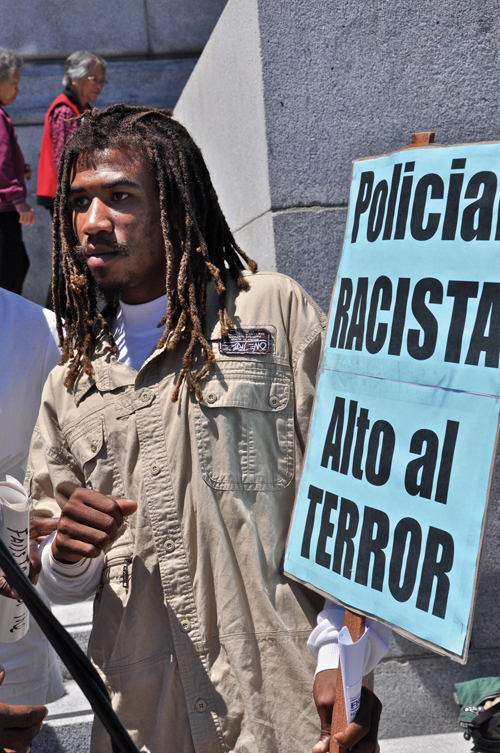
Doctor questions BART shooting

28

Nice piece in the Bay Citizen by Rupa Marya, M.D., who treated Charles Hill, the man killed by BART police. She points to the essential problem — BART cops don’t seem to be able to deal with people who are agitated or mentally ill without shooting them:


While I had seen him agitated before and while I can’t speak to all of his behavior, I never would have described him as threatening in such a way as to warrant the use of deadly force. We often have to deal with agitated and sometimes even violent patients in the hospital. Through teamwork, tools and training, we have not had to fatally wound our patients in order to subdue them.


I understand the police are there to protect us and react to the situation around them, but I wonder why the officer who shot Charles did not aim for the leg if he felt the need to use a gun, instead of his vital organs. I wonder if he possessed other training methods to subdue an agitated man with a knife or bottle.


I feel this situation quite deeply. It is hard to watch our civil servants (police) brutally handle a person and their body when I spend my time and energy as a civil servant (physician) honoring the dignity of that person, regardless of their race or social class, their beliefs or their affiliations.


I can tell you why the officer didn’t shoot Hill in the leg. Cops are trained to to shoot to kill, and only to kill — once a cop draws a gun and fires, he or she has already decided to use lethal force and is supposed to aim for center body mass and fire until the target is down. There are reasons for that — shooting someone in the leg is hard, and if you miss and the person shoots back, you can get killed yourself. Also, if cops were allowed to shoot people in the legs to stop or slow them down, there’d be a lot more police shootings — and sometimes the cops would miss the legs and kill somone who was only supposed to be disabled. Bottom line: Cops shouldn’t be firing their weapons at all unless there’s an immediate threat to their lives or the lives of others.


But therin lies the problem: Since the death of Idriss Stelley, San Francisco cops have been getting additional training in dealing with mentally ill people. It hasn’t always worked, and it’s not a perfect system, but at least there’s been an effort. As Dr. Marya clearly knows, health-care workers in the city have to handle mentally ill people, sometimes agitated people, all the time –without killing them.


The BART cops who shot Hill handled the situation really badly


And I don’t blame Dr. Marya for wanting to join the next protest.

Dick Meister: the farmworkers are marching to Sacramento

4

By Dick Meister

(Part one of a five part daily series on the farmworkers)

It’s hot, very hot, in the Central Valley, but still they march on toward Sacramento, thousands of members and supporters of the United Farm Workers union. They’ve been at it since August 22nd, when the 13-day, 200-mile trek began. The UFW has done it before, and for good reason. Like the others in the past, this march has drawn public attention to the union’s cause, energized its members and current supporters and doubtless added to its many supporters worldwide.

But will the march accomplish its immediate goal? That’s to win passage of the Fair Treatment for Farm Workers Act that would overcome serious obstacles to farm worker unionization, and another bill that would grant farm workers the right to be paid overtime after eight hours a day, 40 hours a week like non-agricultural workers.

That is largely up to Gov. Jerry Brown, who in June vetoed the Fair Treatment for Farm Workers Act for being “too drastic,” despite direct pressure from more than 1000 workers during the 12 days he deliberated before acting on the bill. They fasted, held vigils outside his office and rallies on the capitol grounds, complaining loudly about the desperate need for firm union rights to improve their miserable pay and working conditions, including the great need to protect them from the severe – sometimes deadly – heat in which they must work.

As a Kern County vineyard worker, Eva Orozco, explained:

“The pay is very low, they pressure us heavily to produce, they don’t respect us and we have to run and drink water quickly and use the bathroom quickly because if we take long we could be fired. Sometimes I’m afraid to show up for work for fear that that I will not work fast enough and I will be fired.”

The marchers will bring their complaints and demands directly to Brown when their march ends Sept. 4 outside Brown’s office. Like his father, former Gov. Pat Brown, Jerry Brown once was one of the UFW’s closest allies. In his earlier term as governor, Jerry Brown pushed through the Legislature the pioneering bill that granted California farm workers the union rights denied them elsewhere.

Ironically, the first of the UFW’s marches to Sacramento, in 1966, was aimed at pressuring Gov. Pat Brown to sponsor a bill that would grant union rights to farm workers. He refused, despite the urgings of more than 8,000 UFW members and supporters who gathered outside the Capitol at the end of the 25-day march.

Farm workers did not get those rights until his son won passage of the bill – the Agricultural Labor Relations Act or ALRA – that granted the rights nine years later after a week long march from San Francisco to the Modesto headquarters of the huge Gallo winery, which had rebuffed vineyard workers’ demands for a union representation election.

More than 15,000 people marched into Modesto, convincing Jerry Brown and state legislators that the UFW retained a sizable and influential constituency and great organizational ability. That had very much to do with passage of the ALRA and the consequent success of the UFW in winning union contracts, The law, however, was barely enforced by Democrat Brown’s successors as governor, Republicans George Deukmejian and Pete Wilson and Democrat Gray Davis.

The latest march could very well convince Jerry Brown to come to the aid of some of the state’s neediest, yet most broadly supported workers. He did it before and he can do it again.


Dick Meister, former labor editor of the SF Chronicle and KQED-TV Newsroom, has covered labor and politics for more than a half-century. Contact him through his website, www.dickmeister.com, which includes more than 350 of his columns.


Corporate vampires drink your blood

13

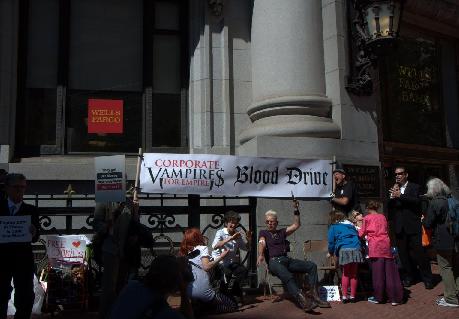
The same week that Warren Buffett gave an anemic Bank of America a $5 billion transfusion of capital, a score of protesters in downtown San Francisco said they know why the economy still sucks: corporate greed.

Demonstrators from US Uncut held a “corporate vampires for the empire” blood drive in front of several of Market Street’s most prominent storefronts August 27, pointing out corporations that haven’t paid their fair share of taxes.

“We have taken your money. We have taken your houses – now we want your blood!” cried out Vlad the Impaler in front of a Bank of America branch on Market street.

“No more, please no more,” his victim begged, a mock blood transfusion bag attached to her neck.

“More blood, more, you can give more!” laughed a jovial Vlad.

The victim fell to the sidewalk after giving her last ounce of blood to Bank of America.

According to US Uncut, Bank of America, despite having $2.2 trillion in assets, pays less in taxes than an average American household.

“Corporate tax evaders have no shame, they are sucking the economic vitality out of our country,” said protester and vampire hunter Bill Schwalb, who was quick to say he was in no way related to Charlies Schwab.

A crowd on lower Market drew its own picture of the American economy as a pair of women with shopping bags passed by in one direction and a homeless man with a bed roll passed the other way, both stopping a moment to observe the mock blood drive.

Pre-positioned victims at the Apple Store, Wells Fargo, FedEx, and Verizon were bitten and bled dry while waiting in line, to the shock and amusement of customers, while outside the blood donors were administered to by vampire nurses.

“Tax evasion, though vilified by the truthmongers of the left, is as American as apple pie. It’s an orgy of greed and blood lust,” Vlad told a crowd of bystanders who had stopped to gawk at the spectacle.
While the pantomime was funny, the issue is not. The group said the companies they targeted represented the worst of the worst of corporate tax dodgers. Together they represent billions of dollars in lost tax revenue – losses that are translating into service cuts to societies most vulnerable.

“No wonder we’re broke, all these corporations not paying their taxes,” exclaimed an irate passer-by in front of the Apple Store after listening to the group.

Tim Lincecum Bobble Head Day comes to AT&T Park. Giants fans get their Freak on.

1

“They’re taking torture to a new level.”

Such were the words of Giants manager Bruce Bochy after his team’s exhilarating 10th inning 2-1 walkoff win versus the visiting Houston Astros on Saturday night. Although it might not have been the best fielded game or the offensive show of force the Giants have been longing for, the team escaped with a win thanks to the bat of trade deadline acquisition Jeff Keppinger. 

But before the night’s climactic finish on the field, a different kind of celebration took place, just off it. It was Tim Lincecum Bobblehead Day at AT&T Park.

Giants fans impatiently lined up for their chance to get a miniature model of their beloved freak. Thousands of fans dressed in orange and black crammed their way into lines that surrounded every inch of the ballpark. 

The 25,000 bobbleheads available vanished within minutes of the gates being opened. If you didn’t line up at least two and a half hours before the game, you probably missed out on the action.

One of the die-hard fans anxiously waiting his opportunity to receive his figurine was Robert Novoa. A 52-year old San Francisco native, Novoa has been a Giants fan since 1963 and has memories of the Giants teams of the ‘60s and legends like Willie Mccovey and Willie Mays. He arrived in front of the Willie Mays gates six hours before the start of the Saturday night’s ballgame, but he was still all smiles at the prospect of scoring his one-of-a-kind Tim Lincecum bobblehead. “[Lincecum’s] the best there is right now. He’s got a unique way of pitching the ball. You have to watch him,” he said. 

But though the pregame chaos was pure Lincecum, the night’s on-field spotlight shined on another Giant. To a roaring, sold-out crowd, left handed pitcher Eric Surkamp took the mound, making his major league baseball debut. Prior to Saturday night’s game, Surkamp played for the Giants’ minor league team Richmond Flying Squirrels. 

“It was awesome. You dream about it your whole life. And for it to finally come true, is amazing,” he said.

The rookie pitched six solid innings, striking out four and allowing just one earned run. Surkamp, who admitted that he couldn’t feel his legs at the beginning of the game, was able to rid himself of the pre-game jitters and put on quite a performance in front of his friends, family, and 42,000 Giants fanatics. “The kid was impressive tonight,” said Bruce Bochy. “He comes in a packed house, pitching his first game. Believe me you’re nervous, you’re amped up, but he never showed it and looked very comfortable out there. I thought he did a great job.”

With the ups, come the downs. Outfielder Nate Schierholtz was placed on the 15 day disabled list with a bone fracture on his right foot; adding to the never ending list of injury ridden Giants. This marks the twenty-fifth time the Giants have used the disabled list, the most in the majors.

The win versus the Astros was the Giants second straight consecutive victory, something they hadn’t done since August 13th. However, they still remain three games back of the Arizona Diamondbacks who beat the San Diego Padres 3-1.

“Hopefully we’ll get on a roll here, keep this thing close, and get this offense clicking”

The Giants will look for production from right fielder Carlos Beltran to provide some offensive prowess for the ball club. Since returning from the disabled list and missing thirteen games, Beltran has been impressive; going 7-for-16 with a .438 average. Beltran went 2-for-4 on Saturday with a run batted in during the first inning.

Up next the Giants look to capitalize on a three game series against the struggling Chicago Cubs, and then will await the arrival of the Arizona Diamondbacks for a crucial weekend series.  

Game Note: On Sunday The Giants lost to the Astros 4-to-3 in eleven innings, and are now four games back of the Arizona Diamondbacks in the NL West Division.


Maximum Consumption: John Vanderslice’s tea time

0

Making a record takes a lot out of person. It’s actually grueling work; it requires obsessive attention to detail and long, ungodly hours. No one knows this more than revered local rocker-storyteller-recording studio owner John Vanderslice. He the creator of his own music (MK Ultra, a vast solo career) and the recorder of a great many others (Deerhoof, Death Cab for Cutie, Thao) at his Mission-based studio, Tiny Telephone. Perhaps this understanding of the stresses is why Vanderslice is quick to offer incoming bands a warm cup of calm.

Turns out, Vanderslice developed a taste for fragrant loose-leaf teas a while back, and has seen to it that his studio offerings come stocked with said caffeinated beverage. Naturally, I went to the source to discuss this obsession for Maximum Consumption. Enjoy the resulting interview with two lumps of sugar (or however you take it):

San Francisco Bay Guardian: When did you develop an interest in tea?
John Vanderslice: I lived in London for a year, that changed it for me. Bad coffee [plus] good tea [ equals] tea drinker.

SFBG: Where do you purchase your loose leaf teas?
JV: Rainbow Grocery, Five Mountains, and Red Blossom.

SFBG: What are the 11 loose leaf teas offered at Tiny Telephone?
JV: Right now there’s 12! They are: Gunpowder, Genmaicha, Keemun, China Black, Green Jasmine, Throat Coat (the real, strong organic blend from Rainbow), Chamomile, Assam Black, English Breakfast, Camellia Blossoms, Emperor Pu-erh, and JV’s Herbal Organic.

SFBG: When did you come up your own personal JV’s herbal organic tea blend?
JV:
I initially wrote it on a piece of masking tape affixed to a mason jar with my mix. I thought it would be kind of funny, but people just asked me what the ingredients were. Then I started to take it seriously, tweaking and improving it. It has Rainbow’s Love Tea blend (which is really good), dandelion, peppermint, blackberry bush, red clover blossoms, rose hips, and sage. Some things are there for taste, and others for medicinal reasons.

SFBG: Do you see any connection between the ways you approach creating music/writing songs/recording bands and mixing teas?
JV:
I’m a tweaker through and through, I imagine I could have worked on cars or hydroelectric dams. I love the intersection of the technical and the creative.

SFBG:Would you ever be interesting in putting out your own brand?
JV:
I can barely function as it is, I think adding more pursuit/business and I might crack. I love giving it away for free.

SFBG: Do you also drink coffee?
JV
:I love coffee but I find myself drinking a lot more tea. Usually very strong black in the morning and green in the afternoon.


A video of our interviewee for your viewing pleasure: http://www.youtube.com/watch?v=_VKpMDxhGQY

Getting to the bottom of Anal Sex Month

1

Open wide, sweet cheeks: August is for anal. Swap out this weekend’s BBQ plans and invite over a couple extra hands to give your rump the stimulating attention it deserves. Whether you’ve already succumbed to a heavy load of action in the previous weeks or you’re still feeling a bit shy about unlocking the back door, San Francisco’s adult-only retailers have some toys that will have you bending over with joy. 

While it has yet to reach Halmark holiday status, Anal Month does have a long-standing history (as “proved” by these mock-up ads). This celebration of bottom pleasure comes with the slogan, “Give in to haste and remain chaste” and encourages men and women to think outside the box when tempted by prenuptial, promiscuous desires. Today anal is cherished not as an alternative, but as an addition. The best thing about butts? Everybody has one and the all-inclusive play works well with fingers, lips, tounges, and of course, a variety of store-bought options. 

With only one week left, it’s time to get some gear for your rear. Check out these locally-foraged suggestions:


good_vibes_anal

“Romeo Silicone Anal Toy” from Good Vibrations

Good Vibrations has full shelves lined with props promising deep rectal pleasure, but if you’re uncertain where to start, take a peek at their online shopping guide before heading into the store or be brave and ask an employee for suggestions. These pretty magenta beads are slim at the top and grow wider down the string, making this toy ideal for testing the waters. When things get good, pull out one bead at a time to intesify your climax. 


amber_swirl

The “Amber Swirl” from Glass Kandi

Web shop Glass Dildo Me, has a wide web selection but head into their physical shop Glass Kandi, to see the gleaming glass beauties for yourself. Not only are they stunning visually, but glass dildos are hypoallergenic, odor free, and non-deteriorating. With a proper cleaning, even the dirtiest of play washes right off. If you like it hard, this toy offers absolute firmness and minimal friction with some super glossy lube. Get it hot, get it cold, this amber-colored gem will hold just what you like. 

mr_s_leather

“World’s Most Comfortable Butt Plug” from Mr. S Leather

Size large either looks intimidating or incredibly inviting– lucky for all, Mr. S Leather carries seven sizes in their signature plug, from mini to XXXL. They’re made of solid aluminum and can be worn for hours on end, fitting snug and hugging close to your prostate (if you have one, of course). Contrary to the way in-and-out of a dildo, butt plugs are meant to stay in place, filling up the anal cavity and adding intensity to an orgasm or an exciting walk around town. 

5 Things: August 26, 2011

0

>>WATER WORKS Everyone’s abuzz about Ali Farzat, the Syrian cartoonist whose hands were broken after creating wildly popular illustrated works critiquing the government. The assault on Farzat is a reminder that art has the power to change minds and lives — an idea that US artists with Estria Miyashiro’s Water Writes mural series were fully with when they teamed up with young people to create eight environmental justice-themed murals at water purification sites in eight days in Gaza. The beleaguered city was the project’s fifth stop — including already-completed Phillipines and Hawaii walls, the Water Writes project will go to 10 worldwide cities in total.

>>BABY BANKROLL Back in June, Tim Redmond looked at the reasons for why families stay in San Francisco. His isn’t the only clan that is sticking in the city: Broke Ass Stuart just launched a new column called Mommy No Bucks that’ll be looking at how all us broke asses (with children!!) make it work in the concrete jungle. 

Not til you’re 21, honey. 

>>CHEESE IT! With all the experimental mixologists in San Francisco and our very own grilled cheese food truck, Toasty Melts, you’d think we’d be the first to come up with this: the grilled cheese martini. The Internet has been aglow in gooey praise/disgust the past few days over this concoction, which can be ordered at Bennett’s Pure Food Bistro in Seattle and the Cellar at Beecher’s in New York – both owned by Kurt Beecher Dammeier. It consists of grilled cheese sandwich-infused vodka (“six piping hot sandwiches in 10 gallons of vodka”), fresh tomatoes, basil, and tomato juice. Sounds like vomit central.

>>WINING DOWN We went to check out the public premiere of Wine From Here, a documentary on California’s nascent natural wine culture. Natural wine, we say? Yeah, the definition’s under a fair amount of debate — never more evident than at the filmmaker Q&A after last night’s screening at the Victoria Theatre. The crowd quibbled over things like the use of oak barrels (shouldn’t the fragrant wood be considered an additive since it alters vino’s flavor profile?), labeling moratoriums, and relative price points of wine grown with and without the addition of foreign yeasts, dyes, and government-approved chemicals. Hopefully the differences of opinion were smoothed over at the screening’s after-party at natural wine-friendly Heart, where the profiled vignerons’ bottles were on the menu, including pours from Coturri Winery and Berkeley’s Edmund St. John.

>>BLAST-OFF TO THE WEEKEND When the aliens come for us, we hope they have noodle faces like the claymates in the new Hopie Spitshard and Del the Funky Homosapien video for Hopie’s single “Space Case,” shot outside Beauty Bar and around the Yay. And we hope they transmorgrify our faces with the same fly colorblock eyeshadow as Bay Area MC Hopie’s. And we hope that the ray of light doesn’t come for us today — we wanna catch Spitshard’s show at 111 Minna tonight, part of a fundraiser for Alameda’s Bohol Circle Filipino community center. 


The super-wealthy want our waterfront

13

We are at the Guardian have been raising questions about the deal that the city cut to bring the America’s Cup here – which involves turning prime waterfront property over to wealthy developers with long-term leases – since it was first proposed. But our valid concerns have been largely drowned out by economic development boosterism and the view that we need to simply accept whatever billionaire CEO/sailor Larry Ellison and his partners say they want.

So we were as cheered as we were dismayed to read writer John King’s article in this week’s San Francisco Chronicle about how race organizers are trying to build a harbor for the super-rich to park their yachts so they can watch the races right in the middle of the Embarcadero’s longest stretch of open water and unobstructed bay views, a harbor that would likely be permanent.

King supports the race and its economic benefits. “But we also need to remember that it never hurts to look a gift horse in the mouth. And the open water along Rincon Park is not a cavity that needs to be filled,” he writes. This proposal is so appalling that even Chronicle readers and blog commenters – usually a conservative and curmudgeonly lot that bristles at the idea of asking anything of capital – have overwhelmingly criticized the idea, filling most of today’s Letters the Editor section.

Hopefully, that’s a sign that this idea – which the EIR on the America’s Cup incomprehensibly concluded was not a “significant impact” – is dead in the water. But given how far city leaders like Mayor Ed Lee and Board President David Chiu have been willing to bend over backward to give race organizers what they want, I wouldn’t be so sure.

At its best, the America’s Cup could be a great opportunity to showcase San Francisco and bring in much-needed tax revenues. But if journalists, citizens, and city leaders don’t remain vigilant and skeptical, this race might be remembered most as the ruse that the greedy rich used to sully and exploit one of San Francisco’s most valuable public resources.

BART board mulls nation’s first cell service disruption policy

44

A special meeting of BART’s Board of Directors yesterday (Wed/25) was the first step in crafting a policy outlining the circumstances under which BART staff would be authorized to cut off cell phone service in its train stations. The resulting policy will be the first in the nation, and is likely to act as a model for other government agencies to address the issue.

While BART’s top management defended the suspension of cell phone service to disrupt a protest planned for August 11, BART’s board was divided over whether the suspension of cell service to prevent a protest was justified and what would constitute a justification for cutting cell service in the future.

“This group was encouraging, promoting and inciting illegal behavior on our platform,” BART police Chief Kenton Rainey reminded the board.

“Well, there is illegal activity every day at BART. The response does not feel proportional enough for justification,” responded BART director Tom Radulovich,

BART director Robert Raburn echoed Radulovich’s concerns. “Neither speculation about a protest, nor mere disruption of train service, nor other illegal activity by itself constitutes a risk to passenger safety that would warrant interrupting cell service. We must guard First Amendment freedom of speech, and this will become a landmark case,” said Raburn.

Staff and union representatives stressed that public safety was always BART’s top concern.

Officials from BART’s three unions generally agreed that the shutting of cell phone service was inappropriate, but admonished protesters for conducting protests on the platforms where they say there is a safety risk due to crowding.
“I applaud the individuals, the union supports the individuals who organize, for I understand organizing. I understand protesting,” said Austin Thomas, who represents BART employees from SEIU Local 1021. “But, I would like to see that this forum be the forum to bring your protest, to have your grievances redressed here.”

“The bottom line for BART is that downtown San Francisco at 5 pm is the maximum stress point at the maximum stress time. It’s all about public safety and keeping the trains moving,” stressed BART Assistant General Manager of Operations Paul Oversier.

“We keep going around with these safety issues, but do not be confused: We do not have to have one or the other,” urged director Lynette Sweet, who referenced the 1955 case Pike vs Southern Bell Telegraph.

“In this case, a gentleman by the name of Bull Connors ordered Southern Bell to remove the telephone of one Lewis Pike, described by Mr. Connors as a negro of questionable character who is known to be using his phone for unspecified illegal purpose. That is not where we as BART want to go. We don’t want to tell people, or signify, or specify, that you can’t talk, that you don’t have the ability to talk.”

But BART board Vice President John McPartland took a harder stance. saying the action was justified, and BART need to post signs informing the public of possible disruptions in cell service due to safety issues.

“This is the beginning of a review from a national perspective on this issue. I, for one, think we should maintain our ability to control cell service until we have it looked at from a legislative perspective.” said McPartland.

“Not all free speech is protected. There are some very narrow exceptions, and I believed this to be one of them,” Oversier insisted.

“If we are ever going to shut off cell phone service, ever, it should be for the most valid reasons that I equate with 9-11 [terrorist attack] level. Not the protests that we thought were going to happen on August 11th. We can’t do that,” cautioned Sweet, who wondered out loud if BART couldn’t just apologize for making a mistake and move on.

Members of the public present for the meeting remained dubious about BART creating policy concerning cell phone disruption at all.

Speaking on behalf of protest group No Justice No BART, an activist identifying himself only as Christof told the board, “We are not asking you to fix anything. We just simply don’t trust you to run a police force at all. We are not asking you to improve your free speech policy, we already have a free speech policy – it’s called the constitution.”

He expressed doubts as to whether BART should be trusted with the power to cut cell phone service. “What is the first thing that your police officers did on the Fruitvale platform after they shot Oscar Grant in the back? They tried to confiscate video footage taken by passengers,” Christof accused.

That footage from the New Years Eve shooting of Grant by officer Johannes Mehserle was the beginning of BART’s problems with anti-police brutality protesters.

Other speakers from the public had similar concerns about BART overreaching its authority.

“The proper place to present the arguments we have just heard is not to this board, but in a court room before a judge considering a motion or injunction. Instead of using those existing legal mechanisms, you have taken matters into your own hands as vigilantes,” said Edward Hasbrook representing the Identity Project.

BART officials expect the new policy will be crafted and voted on within a month. They say the new policy will be vetted through BART attorneys, the ACLU, and and BART’s civilian advisory committee. But they cautioned that BART could not envision every emergency that would warrant shutting off of cellular service as they craft their forthcoming policy, so the policy would include some flexibility at the discretion of BART management.

Both the California Public Utilities Commission and the Federal Communications Commission, who regulate cell phone providers, are already examining the legality of BART’s actions. As an afterthought, at the close of the meeting, Sweet urged the board to consult with those agencies over the policy before it is implemented.

BART has only provided cell service in its stations for a short time. While BART is under no legal obligation to provide phone service, once they began providing service they fall under the jurisdiction of the FCC, which regulates cell service nationally.

Speaking in Denver to CNET, FCC Commissioner Robert McDowell said the matter was still under investigation.

“What the heck happened, what precedent does it set, were there any laws that were broken?” McDowell questioned. “Let’s continue with the investigation. We’ll draw conclusions after we have all the facts.”

Tonight: the last of five Guardian forums on the issues for the next mayor

0

Join us tonight for the fifth and final installment of the Guardian Forum: a series of panel discussions and participatory debates framing the progressive issues for the mayor’s race and beyond:
 
Forum Five: Environment, Energy and Climate Change
Tonight, August 25 at 5:30PM
Koret Auditorium, San Francisco Main Library, 100 Larkin St., SF
(Civic Center BART and MUNI 5, 19, 47, 49, or F Train)

Featuring:
Tim Redmond, San Francisco Bay Guardian
Antonio Diaz, People Organizing to Demand Environmental and Economic Rights
Alicia Garza, People Organized to Win Employment Rights
Aaron Peskin, former San Francisco supervisor
Saul Bloom, Arc Ecology
 
Cosponsors: Harvey Milk LGBT Democratic Club, San Francisco Tenants Union, SEIU Local 1021, San Francisco Rising, San Francisco Human Services Network, Council of Community Housing Organizations, Community Congress 2010, Center for Political Education, Jobs with Justice
 
All events are free. Sessions will include substantial time for audience participation and discussion. Please join us!
 
Save the Date
On September 21st, we’ll present our platform to the mayoral candidates and see which ones are willing to sign on.

SF sued for approving AT&T’s sidewalk boxes without an EIR

19

A coalition of San Francisco citizens groups today sued the city over the 5-6 vote last month by the Board of Supervisors to allow AT&T to install 726 utility boxes on sidewalks throughout the city without studying the impact and alternatives with an environmental impact report.

The groups include San Francisco Beautiful (filing its first lawsuit against the city in its 64-year history), San Francisco Tomorrow, Dogpatch Neighborhood Association, Potrero Boosters, and the Duboce Triangle Neighborhood Association. Their appeal of AT&T’s permit was rejected by Sups. Sean Elsbernd, Mark Farrell, Malia Cohen, Carmen Chu, David Campos, and Scott Wiener, allowing the project to move forward.

“The city has refused to do what should be a routine environmental review,” Milo Hanke, a past president of San Francisco Beautiful, told us. He said the public should have been allowed to consider alternatives to the “unwanted and unwarranted degradation of the public sidewalks by a greedy corporation.”

While the project will allow AT&T to upgrade its Internet service and other capabilities, many in the technology community told us back in May that there are better options for improving the high-tech infrastructure in the city without the unsightly boxes that will block sidewalks and be magnets for graffiti.

But those groups, and the groups that filed this lawsuit, say they felt ignored by City Hall and AT&T. “We were shut out of the process,” Hanke said. Now, the plaintiffs will go to court to seek an injunction to stop the project as they wait for a ruling on the merits of the case.

Community creates “The People of Burning Man”

0

Drawing on support from the larger Burning Man community, San Francisco-based photographer Julian Cash this month released a colorful and engaging new photo book entitled The People of Burning Man: Portraits of Revolutionary Spirits.

The self-published book got a big boost when Black Rock City LLC, which stages Burning Man, this summer used its huge Jack Rabbit Speaks email list to encourage burners to donate to a Kickstarter campaign that Cash used to fund the project.

The response was huge, with 521 people donating a total of $36,830, in the process earning gifts ranging from small tokens of appreciation to signed copies of the book to the four donors of more than $1,000 each who received, “A piece of art from the LARGE ART gallery. Five signed copies of the book. Each book will have custom illustrations along with the names of the people the books will be given to. Your name printed in the book large + other names printed that you chose. A strange mystery gift. The extras from previous levels. Absurdly massive appreciation, love, and the knowledge that this book is forever something you made exist!”

It’s a beautiful book – supported by a great website and committed community – so check it out.

Maximum Consumption: il gato eats SF

1

When I sat down with il gato for this week’s cover story, I also grilled the band about their favorite local eateries. And they had some pretty serious opinions on the matter. Below is a transcript of our food-loving conversation:

San Francisco Bay Guardian: So where do you like to eat in San Francisco?

Johnny Major: Little Chihuahua, have you ever been there? I’m an absolute addict. It’s the perfect food. Garlic shrimp burritos! And they have amazing carnitas burritos. I go there all the time. And Lower Haight has got some great spots like Memphis Minnies. It’s great Southern barbecue. Where do you go and get some real Southern barbecue here? Those are my two favorite restaurants.
Daimian Holiday Scott: I was raised vegetarian so initially coming out here and, which I’m still super into, I’ve never had the experience of eating lots of different types of meat, so getting like, veggie chili cheese fries or there’s [Golden Era] that has fake fried chicken sticks that have a bamboo dowel.

SFBG: Are you still vegetarian?
DHS: Still vegetarian. Yeah.
JM: From birth! Never had a piece of meat.
DHS: [Laughs] That’s John’s favorite line! It’s not true.
JM: I mean a real piece of meat. You ever had a steak?
DHS: No, I don’t know if I have really.
JM: There you go.

DHS: I lived in Berkeley a couple of years, and Berkeley is still one of the top food spots. And I love Little Star and that rosemary cornmeal crust. I [also] like pickled things so I pickle a lot – cured olives and sauerkraut.

Andrew Thomas: I grew up in Texas, so I’ve had plenty of steak [laughs]. I’ve dabbled in all types. I’ve been a pescetarian, I’ve been a vegan, I’ve tried it all and I’m pretty much back to eating meat. I live in Oakland so I’ve got lots of favorites in Oakland. But I lived in San Francisco for a year and one of my favorites is House on Nanking in Chinatown. And in general, moving up here –  and my girlfriend is part of it too, she’s a big cook and into farmers’ markets – I’ve learned infinitely more about cooking and vegetables in general. And I have to say, my token place was Kennedy’s [Irish Pub and Curry House]. It’s pretty much an Irish bar meets and Indian place.

DHS: Indian pizza is one of my favorite things about living in San Francisco. Zantes is better but there used to be Raja in Lower Haight. I actually went to a [different] place that said they had Indian pizza – [it was] a cheese slice with garlic, spinach, and then some like, jarred Indian sauce on it. I was like, “what are you doing? How dare you?!” [laughs].

I walked home last night after Johnny’s [solo] show, and I got homemade apple pie with fresh whipped cream off a vender on Valencia. That’s tied into the city being one of the top two or three food cities in the world, which is so true and we’re so spoiled.

For the fall of it

0

arts@sfbg.com

FALL ARTS Puppets, fanciful forms of democracy, and disfigured villains are leitmotifs beyond the Beltway this season, as the following theater and performance highlights suggest.

Stuffed and Unstrung Bad puppets, puppets misbehaving, puppets you won’t see on Sesame Street, puppets you don’t want to meet on a darkened street. Eighty of them. And six improvising comedians too: Henson puppeteers gone wild. (Brian Henson, that is, son of puppeteering parents Jim and Jane). Co-presented by SF Sketchfest. (Through Sat/27, Curran Theatre; shnsf.com.)

Roughin’ It: Theater. Oysters. Campfire. Booze. Is one of these things not like the others? No, they are all just like the others. Now you can yell oyster in a crowded campfire and drink like an actor. It seems this unique opportunity (one night only, this weekend) arises because PianoFight is couch surfing right now, very near the actual surf in Tomales Bay. The show-show part of this show consists of new material by local playwrights writing plays for this very moment in time at the Tomales Bay Oyster Company in Point Reyes Station, just in case you were wondering about it. Round-trip shuttle ride from SF available for a few extra clams, and dollar oysters for a dollar. (Sat/27, Tomales Bay Oyster Company, Point Reyes Station; pianofight.com.)

A Delicate Balance Aurora Theatre turns 20 this season too. It has chosen to celebrate by kicking things off with a production of Edward Albee’s great and so great play, A Delicate Balance. And to include in the cast local luminaries Anne Darragh, Charles Dean, and Carrie Paff. This is all just an excellent idea. (Sept. 2-Oct. 9, Aurora Theatre; auroratheatre.org.)

San Francisco Fringe Festival, the 20th annual for god’s sake. Forty-four shows from all over, all over 12 days, all over the lovely Tenderloin. Good theater very cheap, and bad theater, also very cheap. The lottery-based, snob-resistant Fringe: this is what democracy looks like. (Sept. 7–18, Exit Theatre; www.sffringe.org.)

The People: San Francisco Corporations are people too, my friend. So was Hitler. Even I am people apparently. There’s a lesson there somewhere in this Yerba Buena Center for the Arts and Z Space co-production, as the New York–based performance team of Caden Manson and Jemma Nelson (makers of 2009’s wowing S.O.S. at YBCA) bring to the street outside Z Space the local installment of their globetrotting site-specific democracy-curious spectacle, featuring live performance and real-time gi-normous video projections. I’m told there will also be taco trucks. But really: no way you want to miss Big Art Group. (Sept. 16–17, Z Space; bigartgroup.com)

3 For All Maybe the SF Improv Festival has whetted your appetite. Or maybe you already know that this longstanding, outstanding long-form improv trio comprised of Rafe Chase, Stephen Kearin, and Tim Orr are always varied and strange and wonderful. (Sept. 16–17, Bayfront Theatre; www.improv.org.)

Frankenstein Independent Eye’s Conrad Bishop and Elizabeth Fuller present their take on Mary Shelley’s gothic (and profoundly modern) tale, using a trio of actors, a moody mix of sound and image, and their exquisitely crafted puppets. (Oct. 7–30, 6th Street Playhouse; 6thstreetplayhouse.com.)

Richard III Now is the winter of our discontent made glorious with this fall theater-season spectacular starring Kevin Spacey. M’lord. What hump? (Oct. 19–29, Curran Theatre; shnsf.com.)

Desdemona Responding to internationally acclaimed director Peter Sellars’s 2009 staging of Othello, author Toni Morrison and African singer-songwriter Rokia Traoré, together with Sellars himself, channel a conversation between Shakespeare’s unlucky heroine and her African nurse, Barbary, in this intimate and intriguing U.S. premiere. (Oct. 26–29, Zellerbach Playhouse; calperfs.berkeley.edu.)

Endgame and Watt Samuel Beckett is not the Gloomy Gus everybody likes to think. All right, sure, he kind of is. But he’s also very funny. And I’m told tidy. He’s also a genius, damn it, and when it comes to interpretations of Beckett nobody has the cred that these Irish cats do, in Gate Theatre of Dublin’s rare visit to Berkeley’s Zellerbach Playhouse. Starring Barry McGovern, who can’t go on but will go on, in the great play Endgame, as well as his own selections from the novel Watt. (Nov. 17–20, Zellerbach Playhouse; calperfs.berkeley.edu.)

Vision statement

0

arts@sfbg.com

FALL ARTS You better start doing your stretches and invest in a good pair of walking shoes. There’s as much ground to cover as there is art to see this fall, and if you get to every gallery, studio, and museum on this far-from-comprehensive list your eyes will probably be as sore as your feet. But as any seasoned hiker will tell you, the views are well worth any aches incurred along the way.

Julie Heffernan: Boy Oh Boy II” “Boschian” is an oft-overused adjective in art writing, and Heffernan’s more-is-more paintings, chock-full of twisted allusions to Renaissance art (Bosch included) and all sorts of fantastic razzle-dazzle, will have you scrambling for synonyms. (Sept. 3–Oct. 29, Catharine Clark Gallery; www.cclarkgallery.com)

Pamela Jorden” I’ll leave the question of whether or not painting’s dead up to more qualified coroners, and simply state that the oil-on-linen works of the young, Los Angeles-based Jorden make a powerful case for the continued relevance of gestural abstraction. There are echoes of Richard Diebenkorn or Clyfford Still in Jorden’s fractured cataracts of color (her blues will make you blush), but compositionally her canvases evince an alchemy that’s entirely her own. (Sept. 16-Oct. 15, Romer Young Gallery; www.romeryounggallery.com).

SF Open Studios Artists, they’re just like us! Seriously, though, one of the many pluses of ArtSpan’s annual city-wide event is that it helps demystify and de-romanticize what it means to be a working artist. Get to know the creative types in your neighborhood, see where the magic happens, and maybe help stimulate the local economy (hint, hint). (Oct. 1-18, various venues; www.artspan.org.)

Lionel Bawden: The World of the Surface” The title of Badwen’s American debut is a half-truth. His sculptural works, comprised of hexagonal colored pencils grouped together and shorn, topiary-like, into amorphous shapes, suggest a world far below the surface: caves, fatty tissue, cells. Dive in. (Oct. 1–Nov. 26, Frey Norris Gallery; www.freynorris.com.)

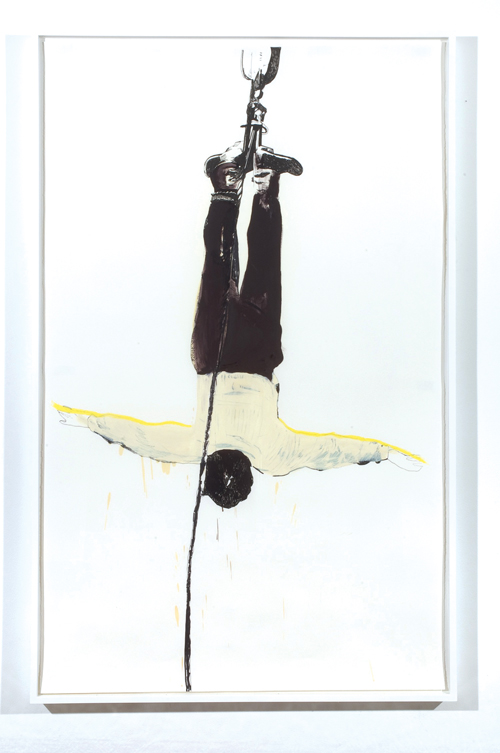
Houdini: Art and Magic” How does a museum escape the confines of the now tired “contemporary artists responding to famous historical figure X” approach to curating? Do like the Contemporary Jewish Museum and put on a show about legendary escape artist Harry Houdini. Come for tributes by Vik Muniz, Jane Hammond, etc. (what, no Matthew Barney?) but stay for a recreation of his famous Water Torture Cell illusion, along with the hundred other bits of Houdiniana. (Oct. 2–Jan. 16., 2012, Contemporary Jewish Museum; www.thecjm.org.)

Ralph Eugene Meatyard” The very banality of Meatyard’s biography — he was a happily married optician in Lexington, Ken. who did photography as a weekend hobby — only makes his singular and startling body of work that much more so: from children creepily posed with dolls and masks to bold experiments with abstraction and “no focus” imagery, Meatyard’s pictures push into territory far more strange and wondrous than the Gothic South. (Oct. 8- Feb. 26, de Young Museum, www.famsf.org.)

“Geoff Oppenheimer” Oppenheimer makes conceptually smart and visually arresting installation and video work that frequently voices the unspoken dynamics behind public performances of controlled discourse, such as press conferences. Be prepared to be discomfited. (Oct. 28–Dec. 11, Ratio 3; www.ratio3.org).

The Air We Breathe” I have some serious reservations about the San Francisco Museum of Modern Art’s decision to organize their first major contemporary group show in a long while around “the cause of marriage equality” (for starters, why not host “Hide/Seek,” the previously censored and now traveling exhibit about same-sex desire and American portraiture currently at the Tacoma Art Museum, instead?). That said, something truly queer, politically risky and aesthetically challenging has gotta happen when you put specially commissioned works by the likes of John Ashbery, Dodie Bellamy, Raymond Pettibon, Ann Hamilton, and Robert Gober (and many others) under one roof, right? For now, consider my tongue held and eyebrow raised. (Nov. 5–Feb. 20, 2012; SFMOMA, www.sfmoma.org.)

Of wings and thumbs

0

› le_chicken_farmer@yahoo.com

CHEAP EATS Hedgehog has a favorite restaurant in San Francisco. No, it’s not John’s Snack & Deli, but only because you can’t sit down in there, and so it’s hard sometimes to think of it as a restaurant. Hedgehog’s favorite restaurant restaurant is San Tung, the incredible chicken wing place.

We tried to go there during our Avenue Days. We did, we walked through the Golden Gate Park, past the De Young Museum, around that other thing, and then across the Big Rec baseball diamonds diagonally.

We did not step in dog shit. In this way, we were having the time of our lives. In other ways… not so much.

For example: There was an argument, at one point, over which way to turn. I said right. She said left. I said, no, right. She said left. I said it was my city, not hers, and if she wanted to go left she could but I was hungry so I was going right. She said I had no sense of direction, definitely left, blah blah blah, and I just looked at her. “Do you like being wrong?” I said. She laughed.

Meanwhile, it was Wednesday.

The importance of which will be obvious to all fans of San Tung chicken wings and even probably San Tung other things. We were arguing for no reason! For — sadly, maddeningly, ununderstandably, and entirely unreasonably — San Tung is closed on Wednesdays.

Why???!!! Wednesday is a day. Lovers of chicken wings will need chicken wings on Wednesdays too, don’t they know this?! What do they think, that weeks should have an island of winglessness in the middle of them? I don’t think so, and neither does Hedgehog; and yet, if I had a memory, I would have remembered that San Tung was closed on Wednesdays and steered us toward Memphis Minnie’s or some other good-wing-having open-on-Wednesday place.

My sense of direction, unlike my memory, is almost impeccable. I know where the sun rises and sets. I know how to find the North Star. I know where that smell is coming from. And I think I know what you’re thinking.

You’re thinking, I thought you were in France, Ms. Sense-of-Direction.

Well, yeah, but we’re time traveling. I know how to do that, too. For example, if it’s Wednesday when you read this, never mind San Tung. If you set your mind or heart on dry-fried chicken wings, or even wet ones, you are going to wind up at Perilla Vietnamese restaurant, drowning your sorrow in a big good bowl of rare beef pho. Not that that’s what we got.

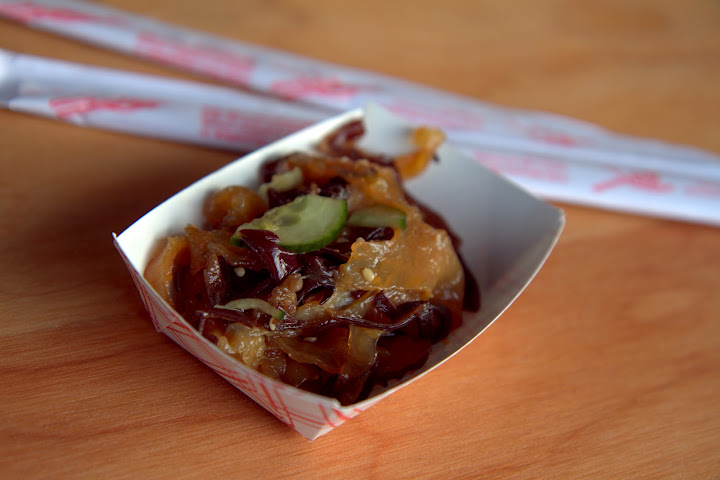
We got five-spice chicken (great), garlic noodles (great), and the raw beef appetizer that is normally called I think Bó Tai Chanh, but Perilla calls it beef carpaccio — which just doesn’t do it justice. It doesn’t pack the same lemony, peppery, peanuty, fish saucy punch as Bó Tai Chanh. Nor was Perilla’s as punchy or tender as the dish usually is.

Still, on the strength of the other stuff, I liked Perilla. No, it wasn’t what we had crossed the park for. But. You know. The best-laid plans of chicken farmers and sound editors … and so forth.

Or I should say writers and writers, technically, because as you know time has passed and Things have happened. I thought I was going to come back from France with a new lease on life, if not chicken farming, and the truth is that I did not.

I came back from France with a bum trigger finger and a healthy bum.

It’s not what you think. I simply spent so much time there pushing butter knives through butter that I actually deeply bruised the bone at the tip of my right index finger. It’s the first ever excessive buttering repetitive stress injury in the history of eating, that I know of.

So now almost everything I do kinda hurts, but especiall tpig — if o kw wat I ea.

I’m just kidding, of course. I mean, it hurts to use a knife, but not type. And I am otherwise as healthy as a hearse and happy to be reunited with my favorite language ever.

And my new favorite restaurant:

PERILLA

Daily: 11 a.m.-9 p.m.

836 Irving St., S.F.

(415) 564-9907

No alcohol

AE/D/MC/V


Parking on the park

13

news@sfbg.com

In a steering committee meeting for the Dolores Park Rehabilitation Project on August 4, San Francisco Recreation and Park Department (RPD) officials stunned the committee with a proposal to bring in more food trucks. The move came just two days after a ballot measure that would have banned more such leases in city parks was removed from the fall ballot.

The proposal included putting in a “cement pad,” with electrical and water hookups, where food trucks would park and sell their fare. It was just the latest in a series of controversial attempts to monetize park resources to raise funds for RPD (see “Parks Inc.,” July 12). But the steering committee reeled at the idea, worried it would permanently harm the image of Dolores Park.

“It was a surprise. It really hadn’t come up before,” said Rachel Herbert of Dolores Park Café, a steering committee member. Many of the neighbors don’t like the idea of commercializing the park because there’s no infrastructure to support it, she said.

“It personally made me question if the steering committee meetings are really just a way for Rec & Park to say, ‘We reached out to the community,'” said Herbert. The rehabilitation project is in its early stages of design and development, with a predicted completion date of April 2014.

There’s already one semi-permanent food truck in the park — the La Cocina-incubated, generator-powered Chaac-Mool truck — which is parked in the main park entrance. “We felt it would be irresponsible to ignore discussing a place for more food trucks in the new design,” said Jake Gilchrist, the park rehabilitation project manager.

“There were a lot of members in the room that didn’t want this to happen,” said steering committee member Robert Brust of the nonprofit Dolores Park Works. Brust said the argument over the proposal lasted all of five minutes before landscape architect Steve Cancian, employed by RPD to facilitate the meetings, “took it off the table.”

But it doesn’t look like they’re willing to give it up, said Brust. “The fight over the ‘commercialization’ of the park is at a stalemate right now,” he said. “Rec & Park has always sold stuff—they’re just trying to capitalize on it a little more now.”

Despite the steering committee’s obvious and immediate discontent with the idea to create a cemented, permanent space for food trucks, RPD officials say they are continuing to include the idea in community discussions. But they say they are open to suggestions.

“At the end of the day, it’s the community’s park,” RPD spokesperson Connie Chan told us. “We understand that whatever vision that we have, it needs to be with the community.”

The meeting came just two days after members of the Board of Supervisors killed a previously approved ballot measure that had been written by the group Take Back Our Parks, which had been severely criticized by RPD, Mayor Ed Lee, and supporters of the department’s privatization efforts. John Rizzo, a member of that group, expects RPD to move ahead with the proposal for Dolores Park.

“They never change something because of public opposition,” Rizzo said. “It’s the same stamp they use all over the city. They come up with these plans to make money and then they unveil the plans to the public.”

Rizzo suggested that the public contact San Francisco supervisors and the mayor to be heard regarding the privatization of parks, because “the [Recreation and Park] Commission is deaf ears.” Either way, Herbert said, significant changes are in store for Dolores Park, including the possibility of putting in a 14-foot paved road for vehicles. “I just really was kind of sad when I left that meeting. I don’t know if anyone’s really going to be able to make a difference. It seems like we’re in danger of it being built,” she said. “It’s not gonna be our sweet little Dolores Park anymore.”

Caught in a RAT trap

2

rebeccab@sfbg.com

Things are not always as they seem. That’s a lesson Matthew Martinez and Thad Conley learned the hard way — each of them after becoming unwitting targets of San Francisco Police Department (SFPD) sting operations that landed them in San Francisco County Jail, bewildered.

It was early October of 2010, and Martinez had just finished his shift as a chef at a San Francisco restaurant and was headed home when he encountered a man who seemed very intoxicated, near Eighth and Mission streets. The man asked him for a cigarette, so Martinez handed him one.

But then the man gestured to his chest, a move Martinez later explained he interpreted as an invitation to take one of the crumpled dollar bills that was spilling out of the disheveled drunk’s pocket, as payment for the cigarette. Martinez testified in court that he took one dollar, but tucked the other bills safely back into the hapless individual’s pocket.

As soon as Martinez had the bill in his hand, he was surrounded. Not only was the man who’d wanted a cigarette not drunk, he was a police officer. One of eight police officers. The undercover officer gave an arrest signal, and seven cops who had quietly been standing ready closed in, placing the 28-year-old chef under arrest.


TAKING THE BAIT

The cops had been staked out on the street for a sting operation as part of SFPD’s Robbery Abatement Team (RAT), a controversial unit that has drawn criticism from the San Francisco Public Defender’s Office for targeting some of the city’s poorest neighborhoods for busts, using cash as bait and sometimes snagging people with no prior criminal records.

Some of the same officers engaged in RAT stings have come under investigation for alleged misconduct in connection with a string of incidents at single room occupancy (SRO) hotels, publicized in a series of surveillance videos aired at press conferences earlier this year by San Francisco Public Defender Jeff Adachi.

“RAT … is used citywide as an effective tool to prevent robberies of innocent victims,” SFPD spokesperson Albie Esparza told the Guardian. “The Police Department uses this operation to catch people that are preying on the vulnerable. The theory is, you catch these people and get them off the street to prevent more robberies or more serious crimes from occurring, thus providing a safer neighborhood. Over 50 percent of the suspects arrested in RAT operations have a history of robbery or theft and a majority are on parole or probation.”

Esparza confirmed that some of the officers have been pulled from RAT duties. “Some of the officers that participated in the RAT operations are not actively working in that capacity due to the SRO/Henry Hotel investigations,” he said, referring to the alleged misconduct cases.

A couple months before Martinez’s ill-fated encounter with the man who he thought wanted to buy a cigarette, Conley was visiting San Francisco from Cincinnati to see friends and attend the Outside Lands music festival when he noticed something strange. Some women had made a show of leaving a car parked, with the doors open and engine still running, in the bus zone near the McDonald’s at Haight and Stanyan streets.

As they climbed into a cab, they spoke as if they were pulling a stunt to get back at a guy. According to Corey Farris, a public defender who represented Conley, he took it upon himself to move the car to a safe place. He first pulled it into the McDonald’s lot, but after someone informed him it would only get towed if he left it there, Farris says, Conley drove the car to a nearby police station.

The car had been placed there by SFPD and KKI Productions, which produces a television show called Bait Car. The whole thing was taped, and in footage obtained by the Guardian that was shot inside a stakeout vehicle where a cop and television producer were monitoring the scene, they can be heard laughing about sexually explicit comments one of them makes about a woman who walks in front of the camera.

At one point, the unidentified undercover officer wonders out loud who would take the bait, saying, “I was kinda hoping the Latin guy would do it.” Later in the video, when Conley comes into view after being apprehended by uniformed officers outside the police station where he’d parked the car, he’s heard explaining to officers that he moved the car because he didn’t want to see it towed.

“I read the police report,” Farris said. “And the police report doesn’t reference any of my client’s statements whatsoever. He says, ‘I’m taking it to the police station.’ That just seems like a big fact to leave out when you’re charging them for stealing the car.”


TELLING IT TO THE JUDGE

That dollar Martinez said he thought was meant as payment for a smoke snowballed into an expensive and time-consuming legal problem. He was held in jail for several days, according to his attorney, Prithika Balakrishnan, a public defender.

When Martinez, who is epileptic, asked to retrieve from his backpack the medication he takes to prevent seizures, his request was denied, Balakrishnan said. Unable to access his meds, he asked if he could sleep on a lower bunk in his jail cell in case he had a seizure, and Balakrishnan says that request was denied, too. The San Francisco Sheriff’s Department had not responded to a request for comment by press time.

Martinez’s trial was held in December 2010 and lasted several days. The officer who had been in plainclothes posing as a drunk denied ever motioning to his chest. At the end of the whole fiasco, it took a jury less than 20 minutes to find Martinez not guilty of grand theft. Disgusted, he left San Francisco soon after.

Conley, meanwhile, flew in from Cincinnati almost a year later for his trial date — only to be told upon arrival that his case had been dismissed.

Their cases were particularly bizarre, but Martinez and Conley aren’t the only ones to be targeted by undercover robbery abatement operations. A similar formula is employed in many cases, according to Deputy Public Defender Bob Dunlap, who heads up the office’s Felony Unit. An average of nine officers are staked out along the street, with a decoy officer posing as an easy target.

“He’ll have money crumpled up into balls in his shirt pocket,” Dunlap explains. “He’ll adopt the persona of someone who’s extremely intoxicated.” When someone tries to swipe the loose bills, the offender is immediately arrested. It’s easy to prove that the suspects are guilty. The offenders will have “marked city funds” in their possession — bills that have been photocopied in advance so serial numbers can be matched for evidence.

According to a tally of cases from the Public Defender’s Office, the average amount of money stolen in a RAT sting is $28, and there have been 118 cases filed with the Public Defender’s Office in connection with these undercover operations since 2007. Around 46 percent of all RAT stings take place in the Tenderloin, and 68 percent of the arrestees are black, according to Public Defender statistics. Officers are sometimes paid overtime while conducting RAT operations, and they earn extra pay for court appearances as well.

Just 35 percent of the cases were charged as misdemeanors, and the rest as felonies, according to the tally. “If it’s charged as a robbery, it counts as a strike offense,” points out Matt Gonzalez, chief attorney of the Public Defender’s Office. He’d like to know whether the program will continue under the direction of newly installed Police Chief Greg Suhr, particularly since some of the officers have been pulled from RAT operations in the wake of the SRO scandal, but SFPD has not made any indications that it will reevaluate the practice.

While the busts may be catching criminals who would be taking advantage of vulnerable residents, Gonzalez and Dunlap question the tactic of manufacturing crime, saying it’s an expensive operation that isn’t the best use of public resources. Dunlap likens it to a fishing expedition with an incredibly shallow reach. “They’re creating a different situation than they’re trying to abate,” he says. “There’s something distasteful about going into the poorest neighborhoods and fishing with money.”


Threats or payback?

1

news@sfbg.com

Officers from the San Francisco Police Department arrested a 21-year-old activist from Hunters Point less than 24 hours after he appeared on a public access television show where he indicted the police for a recent shooting and named officers he says have personally harassed him.

Around 4 p.m. on Saturday, July 23, Debray Carpenter, who is also known as Fly Benzo, was arrested near the intersection of Oakdale Avenue and Lane Street and booked on charges of threatening a police officer and resisting arrest. After spending almost four days in jail, the District Attorney’s Office declined to file any charges and Carpenter was released.

“If they feel like they can charge me, they would’ve,” Carpenter said after his release. “SFPD lies and that’s a fact. I just want the people to see how they lie. Just like they are lying about me, they could be lying about Kenneth Harding. Anything they say needs to be taken with a grain of salt.”

On July 16, police shot and killed Kenneth Harding Jr. while he was running from police. When officers stopped Harding at the 3rd and Oakdale Muni platform and asked him to produce a transfer, he bolted. The official story is that while he was running away, Harding pulled out a gun and fired at least one shot at police before they returned fire. Police later said the shot that killed him pierced his neck on the right side and was fired from his own gun, but some witnesses say that Harding didn’t have a gun, and many people in the community still have doubts about what happened.

Carpenter has spoken out against Harding’s death on the TV news, and he has participated in and organized protests calling for greater police accountability in the weeks following the shooting. On July 22, Carpenter appeared as the only guest on the public access program “CLAER Da Corner,” a 90-minute show hosted by Sharen Hewitt, the executive director of Community Leadership Academy & Emergency Response Project (CLAER), an anti-violence nonprofit.

During his appearance on the program, Carpenter named several SFPD officers who he claimed had harassed him in the past. He also recounted an exchange that took place a few days earlier on July 19. It was during this encounter that police say Carpenter made the criminal threat for which he was later arrested.

The police version of the incident differs significantly from the story that Carpenter shared with Hewitt on her show before his arrest.

According to Carpenter, he was with a group of people having a casual conversation with an SFPD officer as two other officers drove up and aggressively pursued a teenager for no apparent reason. When the group asked the officers about their behavior, one of the officers explained that she’s from New York, said Carpenter.

This prompted Carpenter to bring up Sean Bell, a young man who was gunned down by the NYPD, and the officer replied, “I haven’t shot anyone, yet,” according to Carpenter.

“Ya’ll bleed too. Just how we bleed, ya’ll bleed,” Carpenter shot back.

He told the host that the officer then responded by asking, “Is that a threat?”

“No, that’s a fact,” replied Carpenter. The police then drove away, he said.

But the police say that Carpenter threatened to kill one of the officers and was aggressive from the moment they arrived.

“Carpenter started yelling at them and he said, ‘White pig bitch I’m gonna put one in you,'” SFPD spokesman Lt. Troy Dangerfield told us.

“You bleed like I do. I’m gonna put one in you and show you,” Carpenter allegedly told police after being asked if his previous statement had been a threat, according to Dangerfield.

“There was a large crowd of people that began circling around the officers and they determined it was unsafe to make an arrest at the time,” Dangerfield said. “One of our rules is if you know somebody you don’t have to make an arrest right there and cause a big scene.”

The police arrested Carpenter four days later and booked him for allegedly making terrorizing threats and resisting arrest. While in jail Carpenter told his lawyer, John Hamasaki, that he didn’t know why he had been arrested and Hamasaki said at the time he wasn’t sure either.

“The arrest stinks,” Hamasaki told us. “Just an exercise of power by the police letting folks know if they speak up, they can be locked up.”

The District Attorney’s Office said that it declined to file charges because there was insufficient evidence to secure a conviction but declined to go into further detail.

“It is not uncommon for the District Attorney to drop charges that are against the police,” said Dangerfield, the police spokesman. “Unless there’s injuries, photos and things like that, they rarely want to prosecute a lot of threats against police officers, and even more resisting arrest, because they think that’s the type of business we’re in.”

“That’s bullshit,” said Hamasaki. “(Crimes against police are) the hardest things for us to negotiate to get them to come down. … The DA doesn’t want to upset the rank and file.”

Erica Derryck, a spokeswoman for the District Attorney’s Office, also disagreed with Dangerfield’s assessment.

“We take seriously any threats against San Franciscans whether they are uniformed sworn officers or members of the general public,” Derryck said. “We review every case on a case-by-case basis.”

Carpenter says he isn’t the only one being targeted for his activism in Hunters Point. Police arrested Henry Taylor, 54, as he was on his way to speak up at the July 20 town hall meeting at the Bayview Opera House in which Chief Greg Suhr’s appearance ignited pandemonium (see “Anger erupts over police shootings,” July 27).

Dangerfield said that police arrested Taylor for violating a stay-away order, but Taylor says that he isn’t under a stay-away order for that area and that police arrested him to prevent him from testifying at the town hall meeting.

No recordings are known to exist between Carpenter and the officer, just as no video recordings have revealed exactly what happened between Harding and the police on the 3rd Street Muni platform. There are several videos of the immediate aftermath, including footage of Harding writhing on the ground while police raised their weapons and denied him first aid, but apparently no video of the shooting itself. In Oakland, all officers are now issued small cameras to wear on their uniforms that record every interaction an officer has with the public. In the case of both Carpenter and Harding, such equipment would likely provide answers to what actually transpired, but Dangerfield said the SFPD has no plans to follow Oakland’s lead. “I know the chief of police has said he is looking into cameras for officers who do plain clothes assignments, and warrant arrests, and things like that. For the general patrol force, at this point, that’s not the case,” Dangerfield said. “There are some officers who do carry their own. … There’s no rule that says that can’t be done.”

Bravo, il gato

2

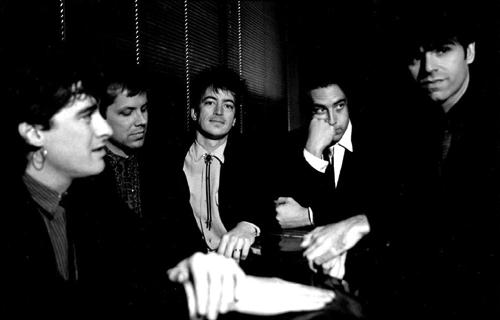
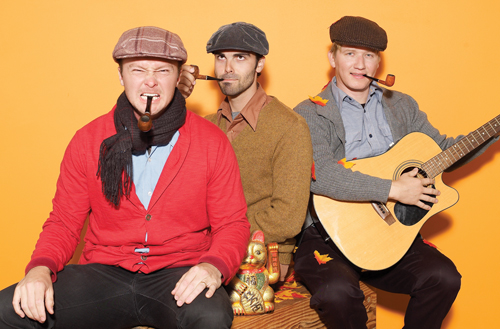
FALL ARTS The clouds hang over San Francisco like a brumous, early evening warning sign. It’s late summer on the back patio of popular Mission street bar El Rio. Small pockets of people huddle near outdoor heaters, and vintage pop songs come pumping through the speakers. Three men dressed neatly in sweaters and hoodies sit at a long picnic table clutching cheap beers.

This is the story of il gato, a San Francisco band that describes itself as indie-baroque-folk. Its music is baroque in the sense that it’s melancholic yet upbeat, lyric-heavy yet leans towards the classical, and highly decorated with a wide array of instrumentation. The band’s 2010 long-player, All These Slippery Things (self-released), and similarly-named followup EP All Those Slippery Things (released last month) feature banjo, mandolin, piano, a string quartet, and trumpets, along with aggressive acoustic folk guitar, looping pedal, upright and electric bass, and complex drumming.

After years of dutiful practice in tiny apartment kitchens, labored songwriting, and intimate live shows, the group finally recorded (thanks to a grant from the Bay Bridged blog) in 2009 at legendary studio Tiny Telephone, owned by revered local musician John Vanderslice. “I…remember how eclectic and fresh their instrumentation and arrangements were,” says Vanderslice. “They were a blast to have in the studio.” But this all came a decade after the first seedling of the il gato concept. Fittingly, the band’s journey — a mildly operatic one, given the twists and bumps along the way — began in Italy.

THE PROLOGUE: Daimian Holiday Scott is studying architecture abroad in Vicenza, Italy. The year is 1999; he hasn’t picked up an instrument since middle school. All of those niggling emotions involved with overseas travel had led to an outburst of emotions, which, naturally, led to buying a guitar. The initial concept was performance art: he’d speak with a fake Italian accent but sing cover songs in English. That never actually happened. “It’s the story before the story,” says il gato drummer, Johnny Major, “the prelude.”

THE FIRST ACT: fast forward five years. Scott shuts the door to the bedroom and asks his girlfriend to listen to the songs he’s been working on from a safe distance in the living room. “It took a long time for me to break free of being super shy and inhibited,” Scott says.

Scott was in his native Gainsville, Fla. writing songs on acoustic guitar and harmonica, learning that to be a songwriter, one must evolve out of the bedroom. He moved to the Bay Area in 2001, first to Berkeley and later, the Mission District of San Francisco, playing as il gato with a rotating cast of talented musicians friends. Years later, when he longed for consistency, he put up an ad on Craigslist seeking musicians.

Major, a San Francisco native who had recently returned from a two-year stay in Chile, answered it. “I liked the name,” says Major, “And of course, I really liked the music. I thought he sounded like a combination of Isaac Brock from Modest Mouse and Doug Martsch from Built to Spill, two of my favorite bands.”

Major — who has played in a variety of other bands including Sang Matiz and his new solo project, Adios Amigo — listened to Scott’s first album Conversation Music, which didn’t have drums, and heard some interesting potential for percussion. During this time, in 2008, Scott, Major and multi-instrumentalist Matthew Souther (who left the band a few months ago) would play in Major’s street-level Lower Haight apartment. The band next gained bassist Andrew Thomas, a Dallas, Tex.-born musician who had recently moved to SF with his girlfriend after a stint in college and other touring bands in Los Angeles. Scott and Thomas had been introduced by their girlfriends one night at the Latin American Club. “He came over the next week to my apartment in North Beach, we just played guitar and upright bass in my kitchen,” says Thomas of Scott.

ACT TWO: the end of an era. Scott’s aria, his solo work in effect, officially comes to an end. He’s part of a band now, all equal parts. “It was no longer just my project,” he says, taking a sip of Pabst Blue Ribbon. Over the course of four short days in February of 2010, the band essentially recorded two albums (the full-length and E.P.), 17 songs in total. The guitar, bass, vocals, and drums were all recorded live at Tiny Telephone. The overdubs of horns and string sections were recorded in Thomas’ home, to save time and money. “I can’t believe it turned out as well as it did,” Major says.

And it did turn out well. The songs are striking and wholly unique. That said, there are hints at the groups’ influences like Neutral Milk Hotel, Beirut, Modest Mouse, even Violent Femmes. But there are other elements, even hip-hop tucked in some parts as Major points out, especially in the mouthful of talk-sung lyrics in brassy folk single, “On Feathers and Arrows.” Major and Scott then discuss Scott’s predilection toward reggae beats, a holdover from his childhood with hippie parents. “That’s the nature of trying to describe your music to someone, it’s always difficult,” Scott says.

He adds that he is also influenced by the non-musical: acerbic, witty writers such as Kurt Vonnegut, along with films like Paul Thomas Anderson’s Magnolia. The band was recently featured on the soundtrack for the documentary Crime After Crime, something Scott is hoping to do more in the future.

ACT THREE: that future. The band has a handful of shows lined up this fall, including Cafe du Nord this week and Andrew Bird’s “Rock for Kids” fundraiser Sept. 19 at the Make-Out Room, along with some brief tours planned. Then, in January 2012, il gato wants to go back to Tiny Telephone to record a followup. Sitting in the back patio, chatting about the projects to come, the group’s goals are clear. Right now, all three are primarily focused on the band itself. In 2009, Scott was laid off from his job as an architect and Major was laid off six months ago. “I’m hopefully looking to break in to something else,” Major says. “Ideally, I’ll have a career as a performing musician, it’s difficult but that’s the dream for all of us. That’s why we’re here right now.”

CURTAIN CALL: take a bow. Crush the cans. 

Check out il gato’s favorite local eats here. They’ve got some good ones!

IL GATO

With Sallie Ford & The Sound Outside

Thurs/25, 9 p.m., $12

Cafe du Nord

2170 Market, SF

www.cafedunord.com