San Francisco

All backed up

0

news@sfbg.com

In February 2004, San Francisco saw an usually strong winter storm. More than an inch and a half of rain fell within 30 minutes, too much to handle for the wastewater system, which in parts of the city is more than 100 years old. In the Mission and Bayview, some homes were flooded with rainwater and raw sewage.

Before adjourning for the year, the Board of Supervisors on Dec. 13 approved payments settling a lawsuit filed in January 2005 by some of the residents affected by the storm. The main plaintiffs in the case were Jane Martin and David Baker, whose home in the Mission district were flooded.

More than 40 individuals and businesses joined the lawsuit as plaintiffs, with San Francisco and its San Francisco Public Utilities Commission (PUC) as the sole defendant in the case. The plaintiffs sued for dangerous conditions of public property, failure to maintain public property, negligence, nuisance, and the trespass of water and sewage onto the plaintiff’s properties.

The settlement totaled $624,930 in compensation for property damage, including $50,000 for Martin and Baker, and many of the other plaintiffs getting around $25,000 each.

“Simply put, the city wasn’t doing proactive maintenance,” Baker told us.

Representatives of the SFPUC are trying to change that. There are currently several projects in the works to address issues with the city’s sewers, including flooding. These include Model Block improvement programs, such as green streetscaping meant to soak up rainfall, and a Sewer System Improvement Program that is in its early stages.

According to SFPUC spokesperson Jean Walsh, the SSIP is meant to tackle a number of issues with the sewer system, including flooding. She listed “seismic reliability issues” and a projected increase in major storms due to climate change as pressing reasons for the plan.

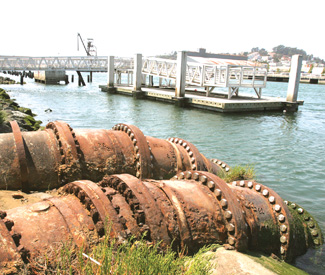
Besides the ancient pipes, the city’s network of storage transport boxes is routinely overloaded. These boxes are underground containers that catch water and hold it until it can be processed through the system and through to water treatment plants. Walsh says that they “surround the city like a moat… When those boxes fill up and all our capacity is full, the system overflows.”

This can cause flooding, especially in low-lying areas of the city and natural creek beds. Precita Creek, which once flowed freely along what is now Cesar Chavez Street, has been a site of overflows and flooding since it was first incorporated into the city’s sewer system in 1878. Nearby Islais Creek has also been diverted into sewers in the flooding-prone area.

The SSIP will have a particular focus on green technology. “One way that we’re going to address the flooding issue is by using low-impact design,” Walsh said. “We’re looking at permeable paving, bio-retention swales, and rainwater harvesting as ways to reuse the rainwater.”

Walsh says that the Model Block program has been a pilot for the SSIP. In May, the city and the Environmental Protective Agency unveiled a new green “streetscape,” part of the Model Block program, on the 1700 block of Newcomb Avenue. Areas of the sidewalk were replaced with permeable pavement, trees and gardens, meant to improve beauty and calm traffic as well as soak up rainwater so that it does not flow directly into the sewer system. In 2010, a similar project was completed on Leland Avenue between Bayshore Boulevard and Cora Street.

Neighborhoods in San Francisco’s southeast, particularly the Mission and Bayview, have been disproportionately affected by problems with the sewer system. Olin Webb, a lifelong Bayview resident and member of the group Bayview Hunters Point Community Advocates, says that sewer improvements are long overdue.

“Whenever it storms, there’s an overflow here,” Webb said. “Every time it rains, you can smell the raw sewage.”

Bayview community organizations have been campaigning for improvement to the sewer system for decades. Webb said some progress has been made in the past few years, including the installation of a pathway at Yosemite Slough Park, part of an effort to restore the wetlands in the area and turn it into a pleasant community space.

Webb was ambivalent about recent improvements. Bayview Hunters Point, like most of San Francisco, has lost much of its African American population during a recent surge in out-migration. According to a 2010 census, San Francisco’s black population has declined by 22.6 percent in the last decade.

“This took too long,” Webb said of the sewer improvement. “I’ve been here 60-something years, my mother worked on this before me. It’s like a joke to me that now everything’s getting fixed up and most of the people can’t enjoy it.”

Residents may still have a to wait for SSIP projects to begin construction. The program will likely span 15-20 years, and is currently in its early stages. “The project is still in design and planning stages,” Walsh said. “It needs to be validated and budgeted. We know it’s going to cost multiple billions of dollars”

Yet Walsh is optimistic that the project will make real change in a sewer system that’s been inadequate for decades. “It’s going to be an impactful project,” she said. “People are going to notice it happening.”

Occupy and the hostile media

8

OPINION Every progressive movement in U.S. history was portrayed negatively by mainstream media at the time it was happening. It’s no surprise that the media portray the Occupy Wall Street movement in the same light.

During the Montgomery bus boycott, mainstream media outlets interviewed black folks who were against it and talked about how the boycott was misguided and hurt the local economy. The day after the boycott started, the Montgomery Advertiser ran a story featuring the manager of the bus lines saying that bus drivers were being shot at and rocks were being thrown at them.

During the rest of the civil rights movement, protesters who were fire-hosed and otherwise brutalized were called “violent protesters” in the mainstream media, which again featured interviews with people saying that the protests were wrongheaded.

During the Anti-Vietnam War movement, the mainstream media portrayed protesters as out of touch, violent, and dirty. There was a picture in the San Francisco Chronicle of a guy who was throwing back a tear gas canister that had been shot at the peaceful crowd. This was shown as proof of protesters being wild, out of touch, and violent. The Black Panther Party had free breakfast programs and was beloved worldwide — but every mainstream media outlet that covered it, covered it negatively.

There has never been any strike, work stoppage, or union action that was supported by the mainstream media at the time that it was happening.

The mainstream press didn’t support the Anti-Apartheid movement and doesn’t support the boycott, disinvestment and sanctions movement for Palestine.

The mainstream press is always on the wrong side of history because it’s always on the side of the status quo, which is capitalist exploitation and oppression.

Here’s an example: Every article about the port shutdown featured a trucker speaking against the shutdown. However, the Occupy movement received and circulated a letter from an organization representing hundreds of port truckers which thanked us all for this action in support of their struggle. None of those folks were interviewed by media.

Another example: In any movement we will make in the U.S. that is multi-racial, there will be real problems to fix around race. These are good problems, because they come from the fact that a lot of different groups of people who normally wouldn’t work together are doing so now.

But the article in the Chronicle that supposedly showed that Occupy Oakland doesn’t connect with black folks was poor and unethical journalism. The paper quoted only two black folks; one said the answer is to tell other Black folks to “Stop The Violence.” Okay. But the Chron didn’t interview any of the folks in the neighborhood around Gayla Newsome who was put back into her foreclosed home. They didn’t interview anyone from the neighborhood around 10th and Mandela, where the Tactical Action Committee has made a foreclosed Fannie Mae home into a community center with workshops for the community. They didn’t interview anyone involved with Occupy Oakland’s November 19th march, which was 2,000 strong and focused on school closures. They didn’t interview any of the many black union members who have worked with us. They didn’t interview anyone in the People Of Color Caucus, or anyone else who is black and works with Occupy Oakland.

Don’t be surprised at the media’s negative portrayal of our movement. It’s happening because we are growing, we are effective, and we are right. *

Boots Riley is a musician and activist.

Money and values

0

steve@sfbg.com

Warren Hellman left a hole in the heart of San Francisco when he died on Dec. 18 at the age of 77. That’s where he existed, right in the city’s heart, keeping the lifeblood of money and values flowing when nobody else seemed up to that task. But as the outpouring of affection and appreciation that followed his death attests, he set an example for others to follow…and maybe they will.

Hellman was born into one of San Francisco’s premier wealthy families, a status he maintained by becoming a rich and famous investment banker. His great-grandfather founded Well Fargo, as well as the Congregation Emanu-El, the spectacular temple where Hellman’s memorial service was held Dec. 21, attended by a huge crowd ranging from Gov. Jerry Brown to young country music fans.

Hellman was more than just a philanthropist who funded key institutions such as the San Francisco Free Clinic, the Bay Citizen newsroom, and a variety of programs and bond measures benefiting local public schools. He was more than the go-to guy for mediating sticky political problems such as this year’s pension reform struggle.

Hellman was the conscience of San Francisco, reminding his rich friends of their obligations to fair play and the common good. And he was the rhythm of the city, single-handedly creating and funding the Hardly Strictly Bluegrass Festival, perhaps the greatest free music festival in the country. And he was so much more.

“What do banjos, garages, Levis, 50- and 100-mile runs, ride and tie, investment banking, public policy, ballot measures, free medical clinics, and a zest for women,” U.S. Sen. Dianne Feinstein said at his service, causing the room to erupt in laughter at the misstated last item, “for winning — correction, a zest for winning — have in common? The answer, of course, is simple: Warren Hellman.”

It was a gaffe that Hellman probably would have appreciated as much as anyone. Speaker after speaker attested to his marvelous, and often risqué, sense of humor. It was a theme that ran through the testimonials almost as strongly as two of his other key qualities: his competitiveness and his compassion.

For a charter member the 1 percent, Hellman had a deep appreciation for the average person of goodwill, and he found those people as often on the bottom of the socioeconomic ladder as he did on the top. While most of his contemporaries in San Francisco’s uber-wealthy class, such as Don Fisher and Walter Shorenstein, often used their money to wage class warfare on the 99 percent, Hellman used his wealth and influence to bridge the divide.

He generously gave to good causes and advocated for higher taxes on the wealthy to lessen the need for such charity. Hellman understood that we all help make San Francisco great, and that perspective animated his love of bluegrass music, which he called “the conscience of our country.”

As he told me in 2007, “A big passion of mine is to try to help — and people have defined it too narrowly — the kinds of music that I think have a hell of a lot to do with the good parts of our society.”

Hellman may have started the Hardly Strictly Bluegrass Festival because it was music he loved and played, but he turned it into such a major spectacle — booking some of the biggest acts from around the country, going as big as the city and space would allow — because he thought it was important to the soul of his city.

“I’m glad that we have first-rate opera, but it’s equally important that we foster the kind of music, lyrics, etc., that support all this,” Hellman told me. And by “all this,” he was talking about the grand social bargain, the fact that we’re all sharing this planet and we’ve got to understand and nurture one another.

At the memorial service, that attitude came through most strongly in the words — spoken with a country twang — of musician Ron Thomason, who became good friends with Hellman through their shared loves of bluegrass music and horseback riding, including the endurance rides in which they each competed.

“I know I’m amongst all good folks,” Thomason told the packed synagogue. “The plain truth is Warren didn’t tolerate the other kind.”

That was true. No matter your perspective or station in life, Hellman wanted to know and appreciate you if had a good heart and curious mind. And if not, he would let you know — or cut you off, as he did with the political group he helped start, SFSOS, after its director Wade Randlett launched nasty attacks on progressive politicians and advocates.

Thomason joked about how ridiculous much of this country has become. “It’s hard to believe that only half the people are dumber than average,” he said. “But I don’t think anyone ever saw Warren Hellman talk down to anybody.”

He told the story of meeting Hellman backstage at Hardly Strictly. Thomason knew Hellman from equestrian events and didn’t know that he was a wealthy banker or that he created and funded the festival. And Hellman didn’t immediately offer that information, telling his friend that he was just backstage because he knew someone in management.

“He knew everyone in management, and he expected them to do right,” Thomason said, later adding, “In his mind, there should not be any disenfranchised.”

It was a perspective that was echoed by people from all parts of Hellman’s life, from his family members to his business partners.

“He taught us to respect people from all walks of life,” said Philip Hammarskjold, the CEO of Hellman & Friedman and Hellman’s business partner of 17 years, describing how Hellman was as engaged with and curious about the firm’s low-level support staff as he was its top executives, an attitude that infected those around him. “His culture is now our culture. His values are now our values.”

“Money meant noting to Warren,” said his sister, Nancy Bechtle. “But in business, money was the marker that you won and Warren always wanted to win.”

He was a competitive athlete and an investment banker who wanted to give companies the resources they needed to succeed, rather than slicing and dicing them for personal gain. And he used the wealth he accrued in the process to make San Francisco a better place.

“He treated San Francisco as if it were part of his family, nurturing its health and education,” said his granddaughter, Laurel Hellman.

Personally, he was an iconoclast with a lively sense of play.

“He never worried about the things that most parents worried about,” said Frances Hellman, the eldest of Warren’s four children. Rather than getting good grades and staying out of trouble, Hellman wanted his children to be happy, hard-working, respectful of people, and always curious about the world.

She told stories about taking Hellman to his first Burning Man in 2006 (along with Rabbi Sydney Mintz, who led the service), an event he loved and returned to the next two years, and watching his childlike pleasure at leaving his painted footprints on a sail that was headed around the world, or with just sitting on the playa, picking his banjo, watching all the colorful people go by.

“I love him and I miss him more than I can express,” she said.

As Hellman told me in 2007, he just loved people and was genuinely curious about their perspectives.

“I’m so grateful for the friendship of Warren, to know this incredible man,” singer Emmylou Harris — one of Hellman’s favorite musicians — said before singing for a crowd of others who felt just the same way.

PG&E’s system fails — again

2

EDITORIAL There’s no question that officials from Santa Clara — thrilled to have finalized financing for a new 49ers stadium — were taking full political advantage of the Dec. 19 blackouts at Candlestick Park. There’s no question that the event Mayor Ed Lee called a “national embarrassment” helped guarantee that the team will leave San Francisco after one more season.

But this is about more than football — and the mayor and the supervisors ought to using this latest PG&E screw-up to take a serious look at the company’s reliability and its impact on the city.

This is hardly the first embarrassing PG&E blackout in San Francisco. For the past few years, the private utility’s aging infrastructure has been failing, leaving businesses and residents in the dark. And while PG&E officials are trying to blame the city for the latest snafu, everyone admits that the problem started when a PG&E power line snapped.

Snapping power lines are a dangerous prospect — in this case, nobody was hurt and the arcing electricity didn’t start any fires. But that was largely a matter of luck — the jolt from the broken line lit up TV screens all over the country and if it had happened close to some flammable object (or, worse, some live person), the damage could have been serious.

As it was, millions of people watched San Francisco’s football stadium go dark — twice. The electricians at Candlestick patched things together and the game went on, but the message was clear: PG&E can’t be trusted to keep its equipment in safe, operating condition.

The city of San Bruno is still trying to recover from the natural gas explosion that killed eight people and leveled a neighborhood. And while local and state officials are giving increased scrutiny to PG&E’s underground gas pipes, the electricity system isn’t in much better shape.

Blackouts are more than an embarrassment — they cost the city and its businesses money. And, as the almost certain loss of the 49ers shows, unreliable infrastructure doesn’t help the local business climate. As Santa Clara Mayor Jamie Matthews told the Bay Citizen: “The reason they moved to Santa Clara is the reliability of our services. We have reliability in our electricity system that is unparalleled.”

One reason: Santa Clara has its own municipal power system. Rates are lower, blackouts are unheard of and the equipment is well maintained. Compare that to PG&E, where company executives diverted gas line maintenance money to pay themselves bonuses, and you see why San Francisco, which relies on the private monopoly, has a problem.

The supervisors ought to take this opportunity to hold hearings on the reliability of PG&E’s electric and gas system in the city — looking not just at the Candlestick problem but at the maintenance records, the age of crucial equipment, the company’s replacement plans and the economic impact of a shoddy electrical system. That should be part of Mayor Lee’s investigation, too.

At some point, San Francisco residents are going to have to pay to rebuild this system. They can pay through higher PG&E rates when the utility finally gets around to it — or they can begin the process of creating a municipal utility, which can do the job right, bring down rates and improve the business climate that the mayor so loves to discuss.

Editor’s notes

4

Tredmond@sfbg.com

I’m not good at holidays. When your world is made of deadlines, the holidays are just one more — gotta get the kids presents, gotta get the tree, gotta make plans, gotta do dinner … one more set of hassles. Bah humbug.

And I’ve never been a big fan of New Year’s Eve. Too many people acting like they’ve never been drunk before and will never be drunk again, and everything costs too much. I drink every day; I can miss New Year’s Eve. Party pooper.

So I don’t do my own new year’s resolutions; I do them for other people. This is what I would like everyone else to do in 2012:

I would like the Occupy organizers to put together a massive day of teach-ins and a march on Washington in the spring, to keep the movement alive and bring in a lot more people.

I would like my fellow dog owners to pick up the shit off the sidewalks.

I would like the Department of Parking and Traffic to put up No Left Turn signs on 16th Street at Potrero and Bryant.

I would like Visconti to lower the price on that really cool lava fountain pen.

I would like the transportation whizzes at City Hall to figure out how to put bike lanes on Oak Street so I can ride back from Golden Gate Park as safely as I can ride to the park.

I would like the supervisors to change the rules for Question Time so the mayor doesn’t get all the questions in advance and there’s a chance for real discussion that isn’t stupid and boring.

I would like middle school English teachers in San Francisco to explain to their students that homeless people are not “hobos.”

I would like the Obama Administration to quit hassling pot dispensaries.

I would like the airlines to start serving cocktails before takeoff.

I would like the thriller writers of America to learn how to write decent sex scenes.

I would like Jerry Brown to endorse the initiative to outlaw the death penalty.

I would like everyone in politics to stop saying the words “together” and “shared” since we aren’t together and I don’t want to share with the rich.

Anything else? Happy New Year.

Gifted: The Poor Bastard’s SF Almanac

0

Hey, Slingshot Organizer gang. Yeah youse, the well-planned anarchists in the corner. Stephen Kovacic would like you folks to know you are no longer the only alt-dayplanner game in town. 

Kovacic — inspired, he says, by his experience working the front desk at the LGBT Community Center — has pulled off the impressive feat of assembling a one-stop guide to sustainable brokeness in this fair city of ours. Not only is The Poor Bastard’s SF Almanac a calendar, but it is also is packed with supervisoral district maps, last-BART-of-the-night times, guides to where to find fair trade coffee, free museum and zoo visits, eight (!) $1 oyster happy hours, and San Francisco pools. The result is delightfully scrappy, delightfully useful package of wisdom. In an email interview with the Guardian, Kovacic admitted to ordering far, far too many of the things from the print shop, so in addition to being able to cop the planners for $12 in local bookstores (we even spotted them at Scarlet Sage Herb Company), you can order them from his website at prices as low as five for $35.

The thing even comes with a mix CD of local artists, from the Dents to Rin Tin Tiger (listen to it for free here). So, maybe New Year’s Day gifts are the new, hot holiday present? Here’s what Kovacic had to say about his labor of love. 


SFBG: Tell us a little about yourself.

SK: My name is Stephen Kovacic, I’m a 28-year old male, I’ve lived in San Francisco for nine years. I went to SFSU and CCSF. I like chemistry, and turtles, and Rubix cubes, and the people in my life. I like making systems work better.


SFBG: What inspired you to put together this dayplanner?

SK: I was working for three years as the front desk info and referral person at the LGBT Community Center, compiling info for visitors or people off the street who needed referrals to services. I noticed immediately that there were a ton of services and fun things and things to know about the city, but no really good compendium of up-to-date information. Websites on the subject are woefully out of date.   

When budget issues dissolved that job I was gainfully unemployed for a while, living very cheap, going to free things, writing things that were useful into my Slingshot Organizer. I wrote in free zoo and museum days, and I drew guitar chords and such in the back pages. It seemed like a logical progression to make my own organizer and fill it with as many useful things as possible, like supervisor contact info, or last BART times, or when to register to vote, or your rights at work, or a list of anti-gay companies to boycott. Things that empower people to be who they want to get around to being. And to entice people to carry it around all the time, i put games and trivia and interesting days in SF history, free days, zodiacs, SF celebrity births, guitar chords, fun stuff. 


SFBG: What’s your favorite feature in its pages?

SK: The history probably. I spent a long time finding things that happened in this city 100 years ago, and there’s a ton of them. I put the most compressible, interesting stories in there. I encourage people to look them up because there’s a lot more to each story than i had room to put in. At the same time, the CD is the thing i’m least tired of seeing. It’s really good.


SFBG: Who were the artists that helped you out with it?

SK: The folks on the CD are all local San Franciscan bands. Mostly talented friends of mine that I’ve been collecting. People can listen to the whole CD for free at www.SFalmanac.org. Sometimes compilations are crappy, but this one turned out really good. Mostly because I took songs that were already my favorites and begged their SF writers to let me use them. Everybody was really supportive of the idea. There’s even some gems on there [that are] previously unreleased.

The [visual] art is about one-third mine, the rest is my friends’, people that supported the concept. If it’s going to happen next year I’ll need a whole bunch more contributing artists. The real star player is Justine Lucas, she did the cover and a whole bunch of other pages too. She’s been the most supportive and encouraging person there could be, it would never have happened without her support and advice and skill.

Localized Appreesh: Buffalo Tooth

0

Localized Appreesh is our weekly thank-you column to the musicians that make the Bay. Each week a band/music-maker with a show, album release, or general good news is highlighted and spotlit. To be considered, contact emilysavage@sfbg.com.

This week’s Localized Appreesh hones in on the mysterious garage punk of San Francisco’s Buffalo Tooth. The band has a set of thrashy-fun songs up now on Bandcamp, recorded by the illustrious Matthew Melton of Oakland’s Bare Wires, but that’s all to be had so far besides the live show (you can catch that this week at Hemlock Tavern). Buffalo Tooth is patiently awaiting an official release. Which, aren’t we all?

Year and location of origin: 2011, Black Hills of South Dakota, Buffalo Specimen: A-46B.
Band name origin: It’s a symbol of resistance and power in Native American culture.
Band motto: Mid-set high fives.
Description of sound in 10 words or less: Blue Cheer/Black Flag; basically bands with colors in their names.
Instrumentation: Guitar/Vox – Greg Downing, Bass/Vox – Eric Kang, Drums/Vox – Sean Grange
Most recent release: Upcoming 7″ S/T EP on Archer’s Guild Records, recorded by: Matthew Melton (Bare Wires) and mastered by: Patrick Haight.
Best part about life as a Bay Area band: Tons of awesome bands to play with, the Bay has so many killer bands right now.
Worst part about life as a Bay Area band: No moneys……
First record/cassette tape/or CD ever purchased:Oh boy, Slipknot when I was 11.
Most recent record/cassette tape/CD/or Mp3 purchased/borrowed from the Web: Danava Hemisphere of Shadows.
Favorite local eatery and dish: Morty’s in the TL, Chicken BLT.

Buffalo Tooth
With Down Dirty Shake, and E Minor and the Dirty Diamonds
Wed/28, 9 p.m., $6
Hemlock Tavern
1131 Polk, SF
(415) 923-0925
www.hemlocktavern.com

Period Piece: Brannan Street sense (and Geary Boulevard, too)

0

Guardian history writer Lucy Schiller is exploring the city street-by-street in the slow week inter-holiday weekends. Today, learn about Samuel Brannan’s shipment of Mormons to San Francisco and John Geary side jobs (which include governor of Philadelphia). Click here for yesterday’s installment on Baker Street.

Brannan Street 

Named for Samuel Brannan, Mormon, ex-Mormon, journalist, Gold Rush instigator

Samuel Brannan (1819-1889) brought 240 Mormons to San Francisco on a ship along with a printing press, effectively tripling the tiny town’s population. And though he himself steered clear of panning for gold, Brannan was the first man to capitalize on the Gold Rush. And capitalize he did, publishing news of California’s gleaming bounty in his newspaper The California Star, while simultaneously selling mining supplies out of a well-placed general store. Brannan quickly became a millionaire, and with his notoriety, his character displayed itself. After being expelled from the church for some pretty questionable tithe diversions, Brannan became an integral member of San Francisco’s notorious citizen police force, the Vigilance Committee. Brannan Street runs in a fittingly prominent path parallel to Market.

Geary Boulevard

Named for John Geary, postmaster, mayor, governor

Just like the street named in his honor, John Geary (1819-1873) was a bustling behemoth, standing around six and a half feet tall and holding the dubious honor of more than 10 war wounds. He also managed to hold an impressive array of titles throughout his violent life, working as San Francisco’s first postmaster, last alcade (premier authority during Mexican rule), first mayor, military general, governor of Kansas, and governor of Pennsylvania. Geary levied the first taxes on San Franciscans, established the first jail (a stinking, unsanitary mess on the ship Euphemia), and ensured that both Washington Square and Union Square remain public spaces.  


Guardian editorial: PG&E’s system fails again!

37

EDITORIAL There’s no question that officials from Santa Clara — thrilled to have finalized financing for a new 49ers stadium — were taking full political advantage of the Dec. 19 blackouts at Candlestick Park. There’s no question that the event Mayor Ed Lee called a “national embarrassment” helped guarantee that the team will leave San Francisco after one more season.

But this is about more than football — and the mayor and the supervisors ought to be using this latest PG&E screw-up to take a serious look at the company’s reliability and its impact on the city.

This is hardly the first embarrassing PG&E blackout in San Francisco. For the past few years, the private utility’s aging infrastructure has been failing, leaving businesses and residents in the dark. And while PG&E officials are trying to blame the city for the latest snafu, everyone admits that the problem started when a PG&E power line snapped.

Snapping power lines are a dangerous prospect — in this case, nobody was hurt and the arcing electricity didn’t start any fires. But that was largely a matter of luck — the jolt from the broken line lit up TV screens all over the country and if it had happened close to some flammable object (or, worse, some live person), the damage could have been serious.

As it was, millions of people watched San Francisco’s football stadium go dark — twice. The electricians at Candlestick patched things together and the game went on, but the message was clear: PG&E can’t be trusted to keep its equipment in safe, operating condition.

The city of San Bruno is still trying to recover from the natural gas explosion that killed eight people and leveled a neighborhood. And while local and state officials are giving increased scrutiny to PG&E’s underground gas pipes, the electricity system isn’t in much better shape.

Blackouts are more than an embarrassment — they cost the city and its businesses money. And, as the almost certain loss of the 49ers shows, unreliable infrastructure doesn’t help the local business climate. As Santa Clara Mayor Jamie Matthews told the Bay Citizen: “The reason they moved to Santa Clara is the reliability of our services. We have reliability in our electricity system that is unparalleled.”

One reason: Santa Clara has its own municipal power system with a much better service and reliability record than PG&E.  Rates are lower, blackouts are unheard of and the equipment is well maintained. Compare that to PG&E, where company executives diverted gas line maintenance money to pay themselves bonuses, and you see why San Francisco, which relies on the private monopoly, has a problem.

The supervisors ought to take this opportunity to hold hearings on the reliability of PG&E’s electric and gas system in the city — looking not just at the Candlestick problem but at the maintenance records, the age of crucial equipment, the company’s replacement plans, the expensive loss of the city’s Hetch Hetchy power being wheeled on PG&E lines, and the economic impact of a shoddy electrical system.  That should be part of Mayor Lee’s investigation, too.

At some point, San Francisco residents are going to have to pay to rebuild this system. They can pay through higher PG&E rates when the utility finally gets around to it — or they can begin the process of creating a municipal utility, which can do the job right, bring down rates, improve the business climate that the mayor so loves to discuss, and move  the city  into compliance with the federal Raker Act mandating public power for San Francisco.


Period Piece: Baker Street sense

1

Guardian history writer Lucy A. Schiller is examining SF’s history corner by corner this week — in this piece, the murder in Baker Street’s torrid past

It should come as no surprise that many of San Francisco’s streets are named for old white men. After all, many financially successful California pioneers were just that (occasionally minus the “old”). But the figures referenced by San Franciscan alleys, thoroughfares, boulevards, and avenues do hold some insight into the city’s past. The picture of 19th century San Francisco painted by its street names is a wildly weird one. Common themes: lawlessness, violence, sometimes ugly individualism, and the occasional progressive value.

Baker Street

Named for Edward Dickinson Baker, orator, senator, friend of Abe Lincoln

Edward D. Baker (1811-1861) holds a distinct honor in American history as the only sitting senator to have been killed in the Civil War. The British-born, Free Soil politician traveled in his youth throughout the Midwest (including a stint at a cotton mill in a failed utopian community) before moving to San Francisco and quickly making his mark as a lawyer and public speaker. A sort of Californian Abraham Lincoln (the President was a close friend and named his second son after Baker), the senator was renowned for his oratorical skills. Attorney general George Williams later called Baker “the most eloquent man I ever heard speak.” Baker was killed in Virginia at the Battle of Ball’s Bluff. The silvertongued politician’s eponymous street stretches from Buena Vista Park to the Marina. 


10 places to eat and drink on Christmas Day

3

Because you and yours might be itching for something other than ham, sweet potatoes, and intense family time, we here present a list of restaurants that will be open Christmas Day providing non-holiday-oriented dinners and desserts. Relish in the savory bite-sized flavors of dim sum, or skip the solid food entirely and head to a downtown lounge for a cocktail with friends or solo.


Chouchou

Now this French restaurant is just plain cute. Perfect for dinner, or if you just want to grab a glass of wine and a chocolate pear tart while everyone else is doing the presents thing. Start off with an organic salad of mixed greens, red chard, tomatoes, goat cheese, apples, and pistachios. Then, enjoy the spot’s infamous homemade French onion soup. Still hungry? Request the Camembert apple tart, caramelized with honey.

Open Sun/25 5:30 p.m.-9:30 p.m.

400 Dewey, SF

(415) 242-0960

www.chouchoubistro.com


Mangia Tutti Ristorante

For over a decade Mangia Tutti Ristorante has been a local favorite offering a comfortable, casual atmosphere for inexpensive homestyle Italian food. Located in the Financial District, Mangia Tutti Ristorante serves garlic pastas with Italian sausage and prawns, homemade ravioli, and spaghetti. Even the bread is too good for words. And of course there are a wide variety of red wines to choose from — how else are you suppose to enjoy Italian food?

Open Sun/25 5:00-9:30 p.m.

635 Clay, SF

(415) 788-2088

www.mangiatuttisf.com


PPQ Dungeness Island

Although its often very busy for dinner, the cuisine here is worth the wait. Garlic noodles, peppercorn crab, and crab-fried rice are just a few of this Vietnamese restaurant’s mouth-watering selections. Its prices are very reasonable, and after all that holiday shopping you did it will be nice to eat on a budget.

Open Sun/25 1:00 a.m.-10:00 p.m.

2332 Clement, SF

(415) 386-8266


Top of the Mark

Feeling fancy? Feeling romantic? Take your love to Top of the Mark for that breathtaking view and fawning service. Top of the Mark has been a San Francisco landmark since the late 1930s, when the 19th floor penthouse apartment of the Mark Hopkins Hotel was converted into a cocktail lounge. With over 100 cocktails to choose from you can get a little holiday buzz and wonder at the gorgeous views of downtown San Francisco.

Open Sun/25 10:00 a.m.-1:00 p.m.

Mark Hopkins San Francisco

1 Nob Hill, SF

(415) 616-6916

www.topofthemark.com


Boboquivari’s

Yes, there is a restaurant in the city where there is free valet service. After handing over your keys you can bite into a savory steak and a twice-baked baked potato. Boboquivari’s has been mentioned in over a dozen “top restaurants in San Francisco” lists, so you should definitely treat yourself to a wonderful Christmas Day dinner. Wash down your filet mignon with its Basil Hayden’s bourbon martini, the “bohattan,” because an unconventional Christmas meal calls for a cocktail. 

Open Sun/25 5:00 p.m.-10:00 p.m.

1450 Lombard, SF.

(415) 441-8880

www.boboquivaris.com


M’s Café

It’s Christmas Day and you’re in a pickle. You shouldn’t have taken those last shots of tequila the night before at the Christmas Eve party and now you’re in desperate need of a cure-my-hangover-quick breakfast before heading to Mom and Dad’s house. When it comes to breakfast and brunch, M’s Café has got you covered. Try its corned beef hash (to die for!), its French toast (amazing!), and its black and white pudding (yum!). Mom will never know of the debauchery that took place the night before.

Open Sun/25 7:00 a.m.-4:00 p.m.

1376 Ninth Ave., SF

(415) 665-1821


Chabaa Thai Cuisine

Celebrate Christmas Day with the rich flavors of the Far East. Its colorful curries and Thai spices make its feasts succulent and tender. You have the option of spicy or veggie dishes, red, yellow, and green curry, and of course panaeng. This Outer Sunset restaurant will even deliver to your home, so if you really can’t step away from that basketball or football game before halftime, no worries, just order online.

Open Sun/25 11:00 a.m.-1:00 a.m.

2123 Irving, SF

(415) 753-3347

420 Geary, SF

(415) 346-3121

www.chabaathaicuisine.com 


Great Eastern Restaurant

What’s better than dim sum on a Sunday? Dim sum on Christmas Day. Located in the heart of Chinatown, this Chinese restaurant’s food will make you want to return every Christmas just for their Peking spareribs, clams with black bean sauce, and variety of dumplings. Invite the gang to a filling and tasty meal (for cheap).

Open Sun/25 9:00 a.m.-nidnight

649 Jackson, SF

(415) 986-2500


Waterfront Restaurant

Pier 7 houses an elegant seafood restaurant perfect for groups on this holiday. With dishes like crab mashed potatoes and lobster risotto, everyone’s tastebuds will be pleased. If you have relatives visiting from out-of-town they will love the beautiful view of the Bay Bridge through the restaurant windows. For dessert, order the sticky pudding with caramel ice cream that has a perfect cake-to-ice cream ratio.

Open Sun/25 11:30 a.m.-10: 00 p.m.

Pier 7, SF

(415) 391-2696

www.waterfrontsf.com


Aslam’s Rasoi

Probably one of the best Pakistani and Indian restaurants in the city, Aslam’s is open every day, every holiday. This Mission spot has a staff that is friendly and engaging, so don’t be afraid to ask questions or for recommendations. Its most popular dishes are the goat cheese naan, lamb korma, and chicken tikka masala. With a broad palette of Pakistani flavors, the chef and owner — Aslam himself — blends cuisines for a healthy dining meal.

Open Sun/25 5-11 p.m.

1037 Valencia, SF

(415) 695-0599

www.aslamsrasoi.com

Occupying the future

0

p { margin-bottom: 0.08in; }

It was a funny feeling, seeing so many faces from Occupy San Francisco and Occupy Oakland in the bright, clean “Gold Room” of San Francisco’s Commonwealth Club, particularly after spending so many nights camping with them and covering the movement.

But they were there on Dec. 15, just up Market Street from their old campsites, along with a couple hundred supporters and interested community members, attending a forum on “Occupy: What now? What’s next?” Facilitator Caroline Moriarty Sacks announced that she “expected a civic conversation.” What she got was a very Occupy answer to the question of the evening which, in typical style, redefined the very concept of “civic” conversation.

The forum involved voices from many different parts of the left. Jean Quan, the Oakland mayor with a progressive activist past. George Lakoff, an outspoken liberal professor of linguistics at UC Berkeley. In the audience, dozens of people who support or are interested in Occupy, the mostly leftist San Francisco political milieu. And, of course, representing most of the panel and a good chunk of the audience were the active occupiers: anarchists, peace activists, labor organizers, and everything in between.

During the panels, their perspectives clashed. Yet Occupy strives to be a coalition of everyone, and all of these voices will be important as it progresses. Sacks had planned a 90-minute forum, featuring a panel to answer both moderator and audience questions, a break-out session, and summary reports back.

In their quest to practice participatory democracy, Occupy protesters have become used to long meetings that strive for non-hierarchical structure and a platform to hear the voice of anyone who would like to speak. If there’s one thing they can all agree upon, it’s that they’re a little tired of waiting patiently for their voices to be heard.

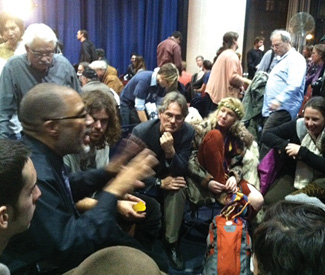
During the panel discussion, a few Occupiers started a Peoples Mic, interrupting Mayor Quan. They were escorted out. This fazed no one, and by the time she left the panel, chants demanding her recall rang in the hall. At each disruption, some Occupy-involved folks would object, “Listen to her! I want to hear all viewpoints!”

The tone was rowdy, but not aggressive. Minutes after disrupting the forum, protesters were back on schedule, sitting in small groups engaged in dialogue with other audience members. Even Quan was fine with it; she told the Oakland Tribune, “It was a chance to talk and have dialogue…We fostered a debate.”

This event was a microcosm of the thorny but crucial way that Occupy is uniting the left. The people in the room had something in common: belief in the visions and goals of Occupy. They just disagreed on how to get there.

Discussing, debating, and creatively bridging these differences has been one of the movement’s greatest struggles. But the more Occupy succeeds on the thorny path to unity, the more its strength builds.

Misrepresenting anarchism

Civil disobedience, peace, non-violence—all of these are critical concepts for the Occupy movement, and wrestling with them frankly has been part of the long road towards unification.

This has been done through the application of what’s originally an anarchist concept: embracing a diversity of tactics.

This is what the Occupy protesters did at the Commonwealth Club Forum. Some disapproved of disruptions, others thought them necessary. Individuals acted as they felt was right.

The Occupy supporters who turned their backs on Quan and interrupted her didn’t do it because they are inexplicably rude. They gave their reasons, including still being hurt and angry after Quan unleashed police using tear gas, rubber bullets, and aggression to break up their encampment on Oct. 25.

Quan also was displeased about that night’s events, saying that “No one is happy about what happened around the tear gas and mutual aid.”

The second reason for the reactions was what an Occupy Oakland protester who mic-checked Quan called her “misrepresentation of anarchism.” This has been dismissed and mocked by many press outlets, as if to say: What’s the point of bothering to understand anarchism?

Many people who identify with anarchist principles and tactics are involved with Occupy groups. This has contributed to the growth and development of autonomous communities at camps, as many anarchists have extensive knowledge and practice in building alternative communities based on horizontalism and collective management of resources. Occupy’s anarchist roots go deep.

This has also created controversy when tactics like property destruction and the black bloc, both associated with anarchism, become a part of Occupy. One example was the bank windows smashed and vacant building occupied during Occupy Oakland’s General Strike on Nov. 2, and riot police again responded with tear gas that night. The next day, 700 attended a General Assembly meeting to focus on discussing violence, its nature, and the ethics surrounding it.

Many have been quick to characterize this ongoing debate as a division in the movement. But if unity is to be achieved, these tough conversations are necessary.

Bringing it home

Occupy has been criticized for its lack of leaders, but that has left it open to exciting possibilities. To start a new Occupy project, you just have to convince some people to help you out—you must gain approval from no one. Some have described the organization as a “do-ocracy.” Don’t ask for permission, they say, just do it.

As such, the ideas for moving forward span from handfuls of people on street corners to millions converging on Washington.

Lakoff presented one of these concepts to the group at the Commonwealth Club, what he called “Occupy Elections.” Lakoff said, “Join Democratic clubs, and insist on supporting those people with your general moral principles. If you join Democratic clubs soon, you decide who gets to run. This is how the Tea Party took over.”

Like most ideas floating around in Occupy, there’s already something similar underway. Berkeley resident Joshua Green started the Occupy the Congress initiative, which hopes to organize and fund efforts for candidates “who support the declaration of the occupation of Wall Street.” Congressional candidates such as Elizabeth Warren in Massachusetts and Norman Solomon here in California have expressed support for and goals similar to the Occupy movement.

Occupy Washington DC has taken the message to Congress in other ways. In an open forum with supporters and renowned economists, they developed their Budget Proposal for the 99 Percent and are coordinating with Occupy groups throughout the country to call for a National Occupation of Washington DC starting March 30.

A call to action like that has a chance of being huge. With the West Coast Port Shutdown on Dec. 12, Occupy has demonstrated an ability to coordinate nationally. Those actions also showed Occupy’s growing unity with labor groups, as ILWU members worked closely with Occupy to plan those actions.

On Dec. 6, Occupy demonstrated its dedication to yet another new frontier—occupying foreclosed homes. That was a national day of action called by Occupy Our Homes and Occupy groups in over two dozen cities participated, defending homeowners threatened with eviction and moving the homeless into empty properties.

Hibernation

By the time moderator Melissa Griffin asked her final question to the panel, it was clear that the “civic conversation” had not gone as planned. Two Occupy protesters had been escorted out for interrupting Jean Quan. A handful of others had stood and turned their backs when she spoke. The crowd was restless for their own chance to grill the panelists, and there were only a few minutes left. With a faint look of dismay and hopelessness, Griffin asked the question that had no chance of being quickly answered: What’s next for occupy?

She quoted Kalle Lasn, co-founder of Adbusters, the “culture-jamming” organization credited with prompting Occupy Wall Street. In a recent interview with NPR, Lasn said: “I think that we should hibernate for the winter. We should brainstorm with each other. We should network with each other and then come out swinging next spring.” Griffin asked the panelists if they agreed with that statement.

Of course, some did and some didn’t. In fact, some form of “hibernation” is what many plan to do. In San Francisco, Occupy reading groups, workshops, and educational circles are on the rise. Small actions happen almost daily, ranging from workshops to meetings to marches to pop-up occupations.

Occupiers who were kicked out of camps are sleeping in networks of squats, safe-houses, and what one long-time camper described as “little homeless encampments around the city. We don’t put up an Occupy banner, and police don’t arrest us.”

The forum was a microcosm of the debates and plans brewing within Occupy, and it ended like most Occupy events. New connections had been made. Most people trickled out while several Occupy campers stayed to help stack chairs and clean up from the event. They all eventually exited the warm building, with its empty lobby that could have slept at least 50 people. OccupySF and Oakland activists chatted and advised each other on where to go.

Occupy is a resurgence in the spirit and power of protest and peoples movements, a recognition that the personal is political, that individuals losing their jobs and their homes can have more power in numbers. Organizing and protest has become a lifestyle.

As the Occupiers left the Commonwealth Club building, the future seemed thrilling, although many still needed a place to sleep for the night while those possibilities continue to percolate.

Style Paige: Retrofit Republic’s vintage flair

0

Wedged between two clothing stores in San Francisco, a narrow alley leads to the home of Jenny Ton and Julie Rhee, a.k.a. the alternative vintage boutique Retrofit Republic. Inside on a recent visit, I felt like a kid in a candy store – except there was no candy. Instead, bowls of earrings, necklaces, and pendants were neatly displayed on a table. Here, a stunning sequin clutch with colorful roses. There, four racks of vintage men’s and women’s clothing, with shoes on display wherever they could fit. Wearing the perfect gold holiday dress, a mannequin peeking around the corner told me to look around, stay awhile.

It didn’t feel as though I was standing in an apartment at all. With a floral curtain hiding the kitchen and bedrooms on the far side of their apartment, the place felt like a quaint little vintage shop. 

“I feel like I have a relationship with every piece in here,” said Ton, who along with Rhee owns the store. The two handpick every item that now decorates their living room. A sustainable vintage seller with a social impact,  Retrofit Republic offers styling to individuals, changemakers, and brands. Its slogan: Look good. Do good. Make an appointment and you can enter the home for a free private session of custom styling, or to buy signature vintage pieces.

Julie Rhee [left] and Jenny Ton [right]: Owners of Retrofit Republic, stylists extraordinaire. 

Old tennis rackets were stacked in front of luggage pieces, handbags hung on a coat rack with a grey hat resting on the top, and a vintage clock reading the wrong time sat in front of a framed photo of the duo’s company name. Each piece had incredible details, embroidery, and structure, like the off-white brocade coat with gold buttons and the men’s herringbone blazers with brown elbow patches. I wanted to slip away with one of the many fur coats, or perhaps the pair of Salvatore Ferragamo flats. 

To schedule a private shopping appointment, you must fill out a styling profile on Retrofit Republic’s website. The 26 questions include queries regarding your signature style and favorite accessories, as well as your shoe, pant, and dress sizes. Based on your profile, Ton and Rhee will pull together head-to-toe outfits that fit your style and personality.

Along with providing private shopping sessions to those who first fill out the 26-question style interview, Retrofit Republic styles photoshoots, bridal parties, and – perhaps its most popular service – does home wardrobe assessments. 

The hour-long assessment (particularly for those who are looking to revamp their wardrobe) includes getting rid of not-so-flattering garments. The duo teaches customers how to pick clothes that are more flattering but still compliment their lifestyle and personality. Ton says the service is perfect for people who are tired of their work wardrobe. “And it helps that we’re a good time,” Rhee added.

The shop’s mission is to prove that being fashionable and socially responsible can go hand-in-hand. Fusing passions for fashion, thrifting, and sustainability gave birth to Retrofit Republic. Ton and Rhee got started at an all-weekend yard sale they set up to clear out stuff before moving to another apartment. 

Their endeavor has been going strong for almost a year. Both Ton and Rhee came from non–profit backgrounds, so it is fitting that Retrofit Republic is a community- and consumer-conscious company.

So many shiny things, so little time: the sea of accesories at Retrofit Republic 

And although the duo has styled CEOs, political candidates, and music artists they stay mindful of their local community. Retrofit Republic works with every budget and markets to low-income people of color and the LGBT community by collaborating with various community organizations. The shop has also donated styling services to non-profits in the Bay Area like the Asian Pacific Environmental Network and the Lyon-Martin Clinic, and never requires a purchase to enter the store.

Ton and Rhee find vintage pieces anywhere and everywhere. They hit up local thrift stores, yard sales, garage sales, estate sales, and accept donations. They have traveled as far as Europe, South America, and Asia to find unique vintage goods. The two can tell you about each piece’s journey to the shop – on each hang tag, printed opposite the shop’s logo there is the line “Where I’m from?” Below that, a handwritten answer brings to life thrift stories. 

Browsing the amazing finds, I found myself wondering how the two were able to say goodbye to some of the items when it was time to sell. 

“I found these amazing, amazing vintage boots at a street market in Argentina and I’m kicking myself because I sold them,” Rhee said laughing. “They were so amazing.”

Only they said they don’t get attached. They’re constantly shopping, so there’s a strong probability that they’ll find those amazing boots over and over again.

Besides, “it’s the thrill of the hunt,” said Ton. 

Set up an appointment to check out Retrofit Republic at www.retrofitrepublic.com

Nite Trax: Housepitality warms, Jason Kendig’s solstice mix chases winter chills

0

Local and global nightlife notes, reviews, tunes, and more

I’m still buzzing over last night’s fantastic installment of the Housepitality weekly at Icon, which was a classic San Francisco get-down, a warm intersection of smiling hotties, sweet freaks, and warm tunes from main men DJ Bus Station John and Honey Soundsystem’s Ken Vulsion. A gay old time indeed in a perfectly pan-orientational venue.

(Many of us queens used Bus Station John’s hopping back room — which he’d decorated with fuschia and yellow Christmas lights — as a respite from the often too-crowded front room dance floor, and it was funny to see some of the straighter bro-types who wandered back there do a double take and slowly start to back out. But more often than not, they soon rejoined and dropped their inhibitions in our true nightlife style. I even helped hook one up with this amazing girl, because he was so tipsy and shy, and because I’m lady-magic.) It was a perfect solstice evening — definitely hit up future Housepitalities.

Speaking of Honey Soundsystem and the solstice, one of queer techno-ish collective Honey’s heartthrobs, Jason Kendig (also cofounder of the MR INTL label), has released his annual, eagerly awaited Winter Solstice mix. If you’re looking for the spot-on alternative to playing Barbra Streisand at your holiday affair, this chill, sophisticated techno set will do the trick nicely. Oh hell, play both!

Jason says:

“I made a mix last year on the solstice that also coincided with the lunar eclipse. I got a request to make another one and since the timing was right i thought i’d put together a collection of tunes that i’ve been digging lately. Something on the deeper side of things. Goes well with a hot toddy.” (And listen for some canny references to Jason’s beloved hometown, Detroit. They call her Ms. Ross!)

Dance to Honey Soundsystem every Sunday night — except this Christmas one — at Holy Cow and swing by the Honey-Sunset New Year’s Eve party at Public Works with hot ‘n heavy Bulgarian tech-house star KiNK and, as always, a thrilling, nubile crowd ready to dance I’m sure.

Jason Kendig winter mix 2011 by kendig

Tracklist:

beatbox (pbr streetgang remix) – crazy p
rainbow road – tornado wallace
if i feat. valentine (jay shepheard remix) – hamid
no one – daniel bortz
love in me (eats everything’s loving you re-work) – laura jones
what’s there – dauwd
ensnare – julio bashmore
call me (dixon edit) – mark e
intersection – tevo howard
something – honeydrop
life of plants & flowers – tom trago
wecanonlybewhoweare – crazy p

High whore holy day: A San Francisco tradition turns nine

4

It was Saturday, December 17. A jazz funeral was being held for victims of violence against sex workers at the Center for Sex and Culture. Post-event, its message was still resonating in its attendees. “The holiday was beautiful,” sex activist and post-porn star Annie Sprinkle told the Guardian about the ninth year of the International Day to End Violence Against Sex Workers that she helped to found. 

The tradition goes back to 2003, when hundreds of sex workers and their allies came together on the steps of San Francisco’s City Hall. Gary Ridgeway, Seattle’s “Green River Killer,” had just been convicted, having confessed to murdering 90 women over 20 years before he was caught. Prostitutes, he said, “were easy to pick up without being noticed…I thought I could kill as many of them as I wanted without getting caught.”

Bay Area performance artist and long-time sex worker Sprinkle was incensed. She teamed up with Robyn Few of the Sex Workers Outreach Project (SWOP) to create an event that would raise awareness about the abuse experienced by workers in the sex industry. 

The event has now spread to the far corners of the earth. Last Saturday, vigils, marches, and educational events to commemorate the day took place from Chicago to Cape Town. 

Kitty Stryker, a local sex worker and performer who worked as stage manager for San Francisco’s event, said that the mood in 2011 was more celebratory this year. There were spoken word, humor and musical performances that “were celebratory and fierce and fighting back, and performances that were more introspective and hurt, understanding that these things come in balance,” she said.

“It wasn’t all angry activism or all sad crying,” continued Stryker. “We wanted the event to be a celebration of people who are still here with us, and support so we can continue to do this work.”

Sex workers rights groups decry coerced or forced prostitution, insisiting that many prostitutes have chosen their profession and deserve the same rights as other workers. This message conflicts with that of many anti-sex trafficking groups, who often conflate prostitution and sex trafficking, and depict all prostitutes as victims.

Sprinkle told the Guardian that the day is especially important because it is planned by and for sex workers and their allies. “It’s become a high holy day of whores. The one day that we all remember the real victims, not these made up situations. A lot of them are not victims, but people like to think we are.”

Sprinkle remembered the story of a friend who was raped and robbed while working as an escort in New York City. The friend reported the crime to the police, and the culprit was apprehended — along with the victim, who was arrested for being a prostitute. Many sex workers rights activists campaign for the decriminalization of sex work, arguing that if sex workers could report crimes against them to the police, it could help curb high rates of rape, robbery, assault and murder of sex workers. 

Sprinkle pointed out that sex work is not the only risky business out there. “Working in a convenience store or as a taxi driver is also very dangerous. Your risk being killed working at a 7/11.” 

The modern sex workers’ rights movement demanded the decrimalization of sex work, working to end the stigma against sex workers in the 1970s. San Francisco was the movement’s teeming center. Prostitutes marched on City Hall singing, “Everybody Needs a Hooker Once in Awhile.” Even Willie Brown attended the fabulous annual Hookers’ Ball.

And this year’s news stories provided a poignant reminder of the day’s importance. During last summer a serial killer targeting prostitutes in Long Island murdered eight women. He was the third Long Island-based serial killer in twenty years to target sex workers.

Sex workers may still be considered criminals. But if the now-decades-old sex workers rights movement has anything to say about it, that view will evolve in years to come. Hopefully someday we will all be able to walk the streets a little more safely.

10 places to eat and drink on Christmas Day

1

Because you and yours might be itching for something other than ham, sweet potatoes, and intense family time, we here present a list of restaurants that will be open Christmas Day providing non-holiday-oriented dinners and desserts. Relish in the savory bite-sized flavors of dim sum, or skip the solid food entirely and head to a downtown lounge for a cocktail with friends or solo.


Chouchou

Now this French restaurant is just plain cute. Perfect for dinner, or if you just want to grab a glass of wine and a chocolate pear tart while everyone else is doing the presents thing. Start off with an organic salad of mixed greens, red chard, tomatoes, goat cheese, apples, and pistachios. Then, enjoy the spot’s infamous homemade French onion soup. Still hungry? Request the Camembert apple tart, caramelized with honey.

Open Sun/25 5:30 p.m.-9:30 p.m.

400 Dewey, SF

(415) 242-0960

www.chouchoubistro.com


Mangia Tutti Ristorante

For over a decade Mangia Tutti Ristorante has been a local favorite offering a comfortable, casual atmosphere for inexpensive homestyle Italian food. Located in the Financial District, Mangia Tutti Ristorante serves garlic pastas with Italian sausage and prawns, homemade ravioli, and spaghetti. Even the bread is too good for words. And of course there are a wide variety of red wines to choose from — how else are you suppose to enjoy Italian food?

Open Sun/25 5:00-9:30 p.m.

635 Clay, SF

(415) 788-2088

www.mangiatuttisf.com


PPQ Dungeness Island

Although its often very busy for dinner, the cuisine here is worth the wait. Garlic noodles, peppercorn crab, and crab-fried rice are just a few of this Vietnamese restaurant’s mouth-watering selections. Its prices are very reasonable, and after all that holiday shopping you did it will be nice to eat on a budget.

Open Sun/25 1:00 a.m.-10:00 p.m.

2332 Clement, SF

(415) 386-8266


Top of the Mark

Feeling fancy? Feeling romantic? Take your love to Top of the Mark for that breathtaking view and fawning service. Top of the Mark has been a San Francisco landmark since the late 1930s, when the 19th floor penthouse apartment of the Mark Hopkins Hotel was converted into a cocktail lounge. With over 100 cocktails to choose from you can get a little holiday buzz and wonder at the gorgeous views of downtown San Francisco.

Open Sun/25 10:00 a.m.-1:00 p.m.

Mark Hopkins San Francisco

1 Nob Hill, SF

(415) 616-6916

www.topofthemark.com


Boboquivari’s

Yes, there is a restaurant in the city where there is free valet service. After handing over your keys you can bite into a savory steak and a twice-baked baked potato. Boboquivari’s has been mentioned in over a dozen “top restaurants in San Francisco” lists, so you should definitely treat yourself to a wonderful Christmas Day dinner. Wash down your filet mignon with its Basil Hayden’s bourbon martini, the “bohattan,” because an unconventional Christmas meal calls for a cocktail. 

Open Sun/25 5:00 p.m.-10:00 p.m.

1450 Lombard, SF.

(415) 441-8880

www.boboquivaris.com


M’s Café

It’s Christmas Day and you’re in a pickle. You shouldn’t have taken those last shots of tequila the night before at the Christmas Eve party and now you’re in desperate need of a cure-my-hangover-quick breakfast before heading to Mom and Dad’s house. When it comes to breakfast and brunch, M’s Café has got you covered. Try its corned beef hash (to die for!), its French toast (amazing!), and its black and white pudding (yum!). Mom will never know of the debauchery that took place the night before.

Open Sun/25 7:00 a.m.-4:00 p.m.

1376 Ninth Ave., SF

(415) 665-1821


Chabaa Thai Cuisine

Celebrate Christmas Day with the rich flavors of the Far East. Its colorful curries and Thai spices make its feasts succulent and tender. You have the option of spicy or veggie dishes, red, yellow, and green curry, and of course panaeng. This Outer Sunset restaurant will even deliver to your home, so if you really can’t step away from that basketball or football game before halftime, no worries, just order online.

Open Sun/25 11:00 a.m.-1:00 a.m.

2123 Irving, SF

(415) 753-3347

420 Geary, SF

(415) 346-3121

www.chabaathaicuisine.com 


Great Eastern Restaurant

What’s better than dim sum on a Sunday? Dim sum on Christmas Day. Located in the heart of Chinatown, this Chinese restaurant’s food will make you want to return every Christmas just for their Peking spareribs, clams with black bean sauce, and variety of dumplings. Invite the gang to a filling and tasty meal (for cheap).

Open Sun/25 9:00 a.m.-nidnight

649 Jackson, SF

(415) 986-2500


Waterfront Restaurant

Pier 7 houses an elegant seafood restaurant perfect for groups on this holiday. With dishes like crab mashed potatoes and lobster risotto, everyone’s tastebuds will be pleased. If you have relatives visiting from out-of-town they will love the beautiful view of the Bay Bridge through the restaurant windows. For dessert, order the sticky pudding with caramel ice cream that has a perfect cake-to-ice cream ratio.

Open Sun/25 11:30 a.m.-10: 00 p.m.

Pier 7, SF

(415) 391-2696

www.waterfrontsf.com


Aslam’s Rasoi

Probably one of the best Pakistani and Indian restaurants in the city, Aslam’s is open every day, every holiday. This Mission spot has a staff that is friendly and engaging, so don’t be afraid to ask questions or for recommendations. Its most popular dishes are the goat cheese naan, lamb korma, and chicken tikka masala. With a broad palette of Pakistani flavors, the chef and owner — Aslam himself — blends cuisines for a healthy dining meal.

Open Sun/25 5-11 p.m.

1037 Valencia, SF

(415) 695-0599

www.aslamsrasoi.com

Last-minute gift guide

0

HOLIDAY GUIDE Look at it this way: you’re not a procrastinator, you’ve just been resisting the pull of the holiday commercial machine.. until you’re on the way to spin the dreidel — or it’s dusk, Saturday, and the thought of tomorrow’s Christmas festivities with your clan is giving you sweaty palms. Will your lack of giftage imply a cold heart? If you lose your anti-consumerist stubborn, last minute shopping that a. supports your local businesses and b. won’t make you look like you left it all for the last minute is available to you. Here’s our list, complete with the final hour the shop is open on Christmas Eve (which doesn’t mean these stores won’t serve just as well for Chanukers, Kwanzelles, and Festiv-ites).

Z. CIOCCOLATO

Every once in awhile you come across a future giftee like a brick wall. Maybe you don’t know the person all that well (boyfriend’s as-yet un-met mom), you’re having issues getting them something they don’t have already (your too-cool tech-glich neighbor). May we suggest candy? This North Beach sweet spot is open really late on Saturday and stocks the finest in fudge, caramel popcorn, and retro throwbacks. Abba Zabba? Indeed.

Open until midnight, 474 Columbus, SF. (415) 395-9116, www.zcioccolato.com

COLLAGE GALLERY

A store full of knick-knacks is a great bet for finding unique gifts for your loved ones. From loose typewriter keys and scrabble pieces to jewelry by local artists and vintage purses, this Potrero Hill shop is a super stop when you’ve got a femme artistic type in mind. Have a friend who is decorating their new apartment? Sis just had a baby? Collage Gallery is known for having the most eclectic collections of vintage wall letters, numbers, and clocks. So tick-tock, get over there.

Open until 5 p.m., 1345 18th St., SF. (415) 282-4401, www.collage-gallery.com

AMOEBA MUSIC

This music store is godsend on Christmas Eve. With a large selection of new and used CDs, 45s, concert posters, and out-of-print albums, you already know Amoeba Music is a music lover’s dream. You can buy gifts for the whole family: a Grateful Dead album for Dad, Common’s just-released The Dreamer, the Believer for your brother and something vinyl for your “we’ve only been dating a few months, what the hell do I buy them?” partner. Treat yourself to the new Snoop Dogg-Wiz Khalifa collab album when your list is all checked off.

Open until 7:30 p.m., 2455 Telegraph, Berk. (510) 549-1125, www.amoeba.com

GG’S

The place to last-minute shop for mom is clearly GG’s, although you can probably find gifts for just about anyone in this West Portal shop. GG’s is a specialty store with a product selection that traverses from the creative to the elegant to the witty. Selling jewelry, candles, lotions, perfumes, and soaps, pretty little things will catch your eye, almost guaranteed. And GG’s does do giftwrap — a Christmas lifesaver.

Open until 6 p.m., 11 West Portal, SF. (415) 731-1108

THE FRUIT GUYS

For the super-last minute, nothing beats a solid online purchase. The Fruit Guys is a local farm delivery service that was started out of South San Francisco. It’s burgeoned dramatically and now has centers in Phoenix, Philadelphia, and Chicago — so if you have relatives in the Mid-West and East Coast that “don’t get” the whole local food thing, give ’em a little goose. Fruit boxes run as little as $26 per month, and you can cease delivery whenever you wish. (Note: If your rels don’t live in one of those cities, the food might come from a little further away, but the Fruit Guys try to utilize local farms wherever they can.)

(877) 378-4863, www.fruitguys.com


>>STORES ALSO OPEN LATE ON CHRISTMAS EVE:

FOOD

Shufat Market Open until 2 a.m., 3807 24th St., SF. (415) 826-6207

17th and Noe Groceteria Open until 11 p.m., 3900 17th St., SF. (415) 863-6337

ART/BOOKSTORES

Green Apple Books Open until 11:30 p.m., 506 Clement, SF. (415) 387-2272, www.greenapplebooks.com

SF MOMA Museum Store Open until 6:30 p.m., 151 Third St., SF. (415) 357-4000, www.sfmoma.org/museumstore

Alexander Book Company Open until 5 p.m., 50 Second St., SF. (415) 495-2992, www.alexanderbook.com

TOY/HOBBY STORES

The Ark Toy Store Open until 5 p.m., 3845 24th St., SF. (415) 821-1257, www.thearktoys.com

Jeffrey’s Toys Open until 6 p.m., 685 Market, SF. (415) 243-8697

Mission Skateboards Open until 5 p.m., 3045 24th St., SF. (415) 647-7888, www.missionsk8boards.com

CLOTHING/ACCESSORIES

Gravel and Gold Open until 4 p.m., 3266 21st St., SF. (415) 552-0112, www.gravelandgold.com

Therapy Open until 7:30 p.m., 545 Valencia, SF. (415) 865-0981, www.shopattherapy.com

Unionmade Open until 4:30 p.m., 493 Sanchez, SF. (415) 861-3373, www.unionmadegoods.com

FLORAL SHOPS

Verde SF Open until 6 p.m., 1265 Fell, SF. (415) 796-3890, www.verdesf.com

Utsuwa Floral Design Open until 7 p.m., 1339 Polk, SF. (415) 447-8476, www.utsuwafd.com


Snap Sounds: Thee Oh Sees

0

By Irwin Swirnoff

THEE OH SEES
CARRION CRAWLER/THE DREAM
(In The Red)

It’s very easy to take things for granted in San Francisco, and in many ways that’s been the demise of so many amazing things in this city; we forget to applaud, support, and revel in the magic when it’s here, only to lament it when it’s taken away. Thee Oh Sees are on fire, this is their second full length of the year. Their work ethic is as charged as the songs that fill this record. Something happens when you listen to Carrion Crawler/The Dream, you blast it loud and then you begin to move, and sweat, and get out of your head and into your body and feel so raw and alive. Don’t take them for granted; they are the best rock band on the planet right now. See videos after the jump.

Pretty amazing, the band’s whole set at New Parish:
http://www.youtube.com/watch?v=IB5JThQWXxM

Or if you prefer a quicker snippet of Thee Oh Sees live:
http://www.youtube.com/watch?v=ySbvZfpvPdc&feature=related

Or just want to hear a track off Carrion Crawler/The Dream, here’s “Heavy Doctor:”
http://www.youtube.com/watch?v=Be_I5Opx12s

More reasons why PG&E hurts the city

136

I know that the folks in Santa Clara are just taking full political advantage of the Candlestick blackout, buy you have to admit: They have a persuasive case. Here’s today’s Bay Citizen:

On Tuesday, Santa Clara’s mayor said his city’s superior public infrastructure helped lure the Niners away from San Francisco.

“To say this would be unlikely here is too kind: it simply could not happen in Santa Clara,” Mayor Jamie Matthews said in a Tuesday interview.

Santa Clara’s publicly owned Silicon Valley Power agency runs its own power generation and distribution system, drawing on sources such as wind turbines on Altamont Pass.

“The reason they moved to Santa Clara is the reliability of our services,” Matthews said. “We have reliability in our electricity system that is unparalleled.”

Yep: PG&E’s aging infrastructure and its inability to keep the lights on costs San Francisco jobs. And a reliable public system like the one in Santa Clara would help attract business. Maybe even more than tax breaks.

You paying attention, Mr. Mayor?


The reluctant soloist

0

MUSIC Michael Beach is not the conventional — or, cliché — singer-songwriter. Granted, he writes stripped down folk rock, but he’s not locked in the style. He can swallow the comparisons to Nick Drake or Mason Jennings, but he hasn’t modeled himself after those (or any other) singer-songwriters really. “I think that I would get bored if that’s all I listened to,” he says. It explains why there’s more to his bare bones sound — the dude simply doesn’t fit the mold.

“It’s not like I sit at home and read Greek mythology,” Beach tells me over the phone. Yet, in answer to a question about his newest record, Mountains + Valleys, released on Spectacular Commodity/Twin Lake Records, he evokes narratives and characters from biblical text and classical myths.

“You take something,” he explains, “a character from a myth, a religious tradition, or a historical figure and that symbolizes an idea. And then you manipulate those ideas by explaining it through the characters.”

“So you make it your own in other words,” I counter.

“I mean I’m certainly not under the impression that nothing like this has ever been done before.”

Beach is quick to pass on credit to others, whether it’s his predecessors or the musicians who’ve lent him a hand in the studio. It makes you think he’s still vaguely uncomfortable as a solo artist. First and foremost, Beach is the guitarist and lead singer of Electric Jellyfish, a rock band based out of Melbourne, Australia. Beach, who’s from Merced, attended La Trobe University in the suburbs of Melbourne and formed the band with Peter Warden and Adam Camilleri roughly seven years back.

It was when Electric Jellyfish took a short break that Beach started recording on his own. “I didn’t want to be idle, so I recorded an album.” It was as simple as that — Blood Courses was released in 2008. However, two years later, Beach’s visa expired. He was forced back to the states and made his home in San Francisco.

Now the members of Jellyfish take turns touring their respective countries. They have a forthcoming seven-inch entitled Trouble Coming Down, and are on the bill to play Austin, Texas’ SXSW in March. In the meantime, Beach is left to his own devices.

Mountains + Valleys shares similarities with Beach’s previous album, but with some notable differences. “[Blood Courses] was really, really sparse and brittle; purposefully one guitar track and one vocal track. I wanted to stretch my legs a little bit and incorporate some other instruments for a whole band sound. But I still wanted to keep things sparse and basic.”

Mountains + Valleys is sparse. However, as the title indicates, it ascends in dramatic directions too. Beach may hold back at times, but he can yank those chains off and embrace a devil-may-care attitude. It’s painstaking calculation as much as pure impulse. If Beach is fairly abstruse with his words, he’s clearly vulnerable in his vocal delivery. If “So Said the Birds” has elements you might ascribe to folk, “Straight Spines” gushes with enough drive to call straight indie-rock.

Interspersed throughout the album are brief instrumentals that vary from the electric rock collage of “Central San Joaquin” to the more subtle and dissonant “Shasta.” Beach says the inspiration for the instrumentals was Chris Smith’s Bad Orchestra, which wasn’t widely released outside of Australia.

“I think [the instrumentals] made me less one-dimensional, less like ‘I’m a guy who writes songs and strums my guitar.’ There’s more than one way of conveying meaning in music.”

MICHAEL BEACH

Wed/21

With Brian Smith, and the Same

9 p.m., $6

Hemlock Tavern

1131 Polk, SF

(415) 596-7777

www.hemlocktavern.com


Are we green yet?

2

rebeccab@sfbg.com

A contract agreement for San Francisco’s innovative clean energy program, CleanPowerSF, could be approved by the San Francisco Board of Supervisors as soon as January, representing a major milestone for efforts to put the city in the retail electricity business.

CleanPowerSF, which stands out as one of California’s most ambitious community choice aggregation (CCA) municipal energy programs, would offer San Francisco customers the option of powering their homes with 100 percent renewable energy instead of the standard mix of predominantly gas and nuclear-generated power supplied by PG&E.

According to a draft contract introduced at the board, energy would be purchased on the open market by Shell Energy North America and delivered to residential customers, who would pay a modest premium for the service. The first phase would target a narrow customer base, with plans for expansion.

In the long run, the San Francisco Public Utilities Commission (SFPUC) has committed to constructing city-owned wind farms, solar arrays, and combined-heat-and-power systems to generate green power locally, which would ultimately lock in lower electricity rates — but this remains in an early assessment phase. Energy consultant Paul Fenn of Local Power Inc. is conducting the study.


HURRY UP AND WAIT?

The fact that a draft contract agreement is under consideration signifies a breakthrough for a program that for years crept along at a snail’s pace, as tension simmered between SFPUC officials and members of the Local Agency Formation Commission (LAFCo), the body overseeing CleanPowerSF implementation.

“We have been waiting for this for so many years,” remarked Sup. David Campos, who chairs LAFCo. “We pushed the [SFPUC] really hard.”

Yet longtime advocates of San Francisco’s CCA, like Eric Brooks and other environmentalists affiliated with the Local Clean Energy Alliance, worry that CleanPowerSF will never hit its stride because it won’t be accessible to customers who want to go green but can’t afford the higher price tag. In an ironic twist, he and others who previously excoriated the SFPUC for its sluggish progress are now urging the lead agency to pause instead of steamrolling ahead.

“We did not want things to go the way they did,” Brooks said. “We’re saying, you should not finalize the contract with Shell until we have the build-out information. It enables us to get better rates,” he added. With detailed, shovel-ready plans in place, Brooks said, arrangements with Shell could hinge on plans for city-owned generation.

Early plans for city-generated power call for enough projects and retrofits to account for 360 megawatts of efficient and renewable energy capacity, including 31 MW of solar panels and 150 MW from a wind farm, plus a combination of weatherization and other efficiency measures. The Local Clean Energy Alliance estimates that more than 1,000 jobs associated with these projects could be created within the first three years.

SFPUC officials and Campos remain unconvinced that it’s a good idea to hold off on finalizing the Shell contract.

“We’re all kind of moving toward the same goal,” SFPUC spokesperson Charles Sheehan said. “If we wait a year or two years, you don’t know what’s going to happen in the future. We have to seize the moment.”

Campos and Sheehan both said advocates’ concerns would be addressed by a contract provision allowing the city to swap green power purchased by Shell with green power produced locally, once the electricity becomes available. The SFPUC also agreed to a provision committing to the build-out program, on a separate track from the Shell contract.

“We’re not going to be able to [start building] unless we have the customer base to begin with,” Campos pointed out. “I have a different perspective in terms of why it’s important to move forward,” he acknowledged, but said he was looking forward to a “healthy debate” at the board.

For all its complications, CleanPowerSF is a quintessential example of that progressive adage “think globally, act locally.” In early November, the International Energy Agency issued a warning calling for dramatic changes in power generation. With so many coal-fired power plants under construction worldwide, the agency noted, the opportunity to avert the worst impacts of global climate change will have passed completely by 2017.


ULTRA GREEN, FOR A FEE

San Franciscans will be able to reduce personal energy usage and perhaps shed some consumer guilt by participating in the CCA program. Under the plan, Shell will purchase electricity from carbon-free sources and sell it to the SFPUC for distribution to CleanPowerSF customers. The shift will green the power mix on the grid while sending market signals that the demand for renewable power is on the rise.

At the start of the program, which the SFPUC pegs as July or August of 2012, up to 270,000 residential customers will be automatically enrolled. Targeted customers will also receive notices asking them to choose whether to stay with the program, or opt out and continue receiving power from PG&E.

Exact rates won’t be hammered down until February or March of 2012, but preliminary estimates suggest most customers will pay roughly $7 a month more for the green power, though a few (those who use a lot of electricity) could wind up paying as much as $50 more.

The price tag could prove to be a tough sell, even in affluent San Francisco. “We’ve done extensive market research,” explained Sheehan. “And we have taken into account PG&E’s opposition campaign,” an all-but-guaranteed response to the program which the utility giant unleashed in full force when neighboring Marin County undertook its own CCA.

Based on the research, “We are forecasting a two-thirds opt-out rate,” Sheehan explained. Initially, this means only around 10 percent of San Francisco residents — a population likely limited to those in higher income brackets — are expected to enroll. From there, new rounds of enrollment and opt-out noticing would follow.

The draft contract includes a $19.5 million appropriation, which includes operating reserves plus a $15 million escrow account. That’s the maximum payout Shell could receive if the city terminated the contract before the agreed-upon date and left the company stuck with unused power.

“It’s one way of showing we have some skin in the game,” Sheehan explained. Shell would only be eligible for $15 million at the start of the 4.5 year contract, he added, and even then it would only take effect if Shell was forced to sell the excess power at a lower price than it paid.

The Shell contract cannot go into effect until several steps have been accomplished. First, the board must give its stamp of approval for the contract and the $19.5 million appropriation. The SFPUC must then finalize program rates.

The SFPUC is also awaiting a ruling from the California Public Utilities Commission (CPUC) determining a bond amount required for all CCA programs. The bond is “kind of a mechanism to make PG&E whole, if in the very unlikely circumstance, this program would cease,” and PG&E had to absorb all CCA customers immediately, Sheehan explained. He said a ruling is expected in February.

The plan to offer ultra green power at a higher price is a departure from the original program goals, which were to offer greener-than-average power at or below PG&E electricity rates. That concept was jettisoned after SFPUC staff determined the objective wouldn’t pencil out in the short term.

Whether or not the supervisors will sign off on the contract as it stands remains to be seen, though Sheehan was optimistic. Campos said it would be important to educate members of the board of supervisors and the public about the program. “It’s going to be investment that’s going to pay for itself,” he said, “many years down the road.”

The unlikely sheriff

1

Michael Hennessey has served as San Francisco’s sheriff for half of his life, the longest such career in California history — and by all accounts the most progressive. Since taking office in 1980, Hennessey has been an island of liberal enlightenment in a political climate and law enforcement culture where tough-talking conservatism has been ascendant.

Yet in that era, Hennessey pioneered the creation of innovative programs to compassionately deal with drug abuse, violence, recidivism, and lack of education among jail inmates. He proactively brought unprecedented numbers of minorities, women, LGBT employees, and ex-convicts onto his staff. And he sometimes resisted carrying out evictions or honoring federal immigration hold orders, bold and risky social-justice stands.

His stances drew scorn from the local law enforcement community, which never endorsed him in contested elections, and criticism from political moderates and national media outlets. But San Francisco voters reelected him again and again, until he finally decided to retire as his current term ends next month.

He credits his success and longevity to the people of San Francisco, who have also bucked the harsh national attitude toward criminals and the poor. “San Francisco is still largely a liberal voting town,” he told us in his well-worn office at City Hall, “and not many liberals run for sheriff.”

That logic held up in this year’s election when progressive Sup. Ross Mirkarimi — Hennessey’s hand-picked successor — was elected to the post. Mirkarimi, who led a tribute to Hennessey at the Dec. 13 Board of Supervisors meeting, said he’s honored to be able to continue the legacy of someone he called “the most innovative sheriff in the United States.”


LONG RECORD

Hennessey was a 32-year-old Prisoner Legal Services attorney for the Sheriff’s Department in 1979 as he watched then-Sheriff Eugene Brown letting go of reform-minded staffers and ending his predecessor Dick Hongisto’s early experiment with a school in the jail. So Hennessey quit his job and focused on running for the office.

“I said to myself that I’m not sure if I’ll be a good sheriff or not, but I know I’m better than anyone else running,” he told us, later adding, “I certainly never expected to be sheriff for 32 years.”

Rank-and-file deputies — with whom Hennessey has periodically clashed throughout his career — always preferred one of their own in the job. “As seen in this election, they would like to see someone coming from their ranks,” said Hennessey, even though he notes that at this point, he has hired all but three of the department’s nearly 1,000 employees.

But Hennessey’s outsider status allowed him to deal with the inmate population in a way that the average San Franciscan appreciated, even if the average cop didn’t. “When you’re in law enforcement, all you see are criminals, victims, and people in law enforcement. But I would talk to all kinds of people in the community,” Hennessey said, noting that his experience as a jailhouse attorney gave him a holistic view of his job. “I worked in the jail and I got to know prisoners as people.”

They were people who had certain needs and problems, such as substance abuse, a common problem among criminals. And they were people who would be returning to society at some point, as Hennessey constantly reminded those who expected prisoners to be treated harshly or simply warehoused.

So he broke down the wall between the jail and the community, bringing the city’s social service providers and educators to work programs in the jails, and developing anti-recidivism and vocational programs that allowed ex-offenders to re-engage with the local community.

“Take the bold step of inviting the public in, not all the public, but those who can provide services and help address people’s problems,” Hennessey said. “Then we took the same concept and applied it to violent offenders, which is a little riskier.”

But it was a risk that has paid off as recidivism rates among jail inmates has dropped, and it’s been without any serious cases of inmates harming outsiders. Hennessey is particularly proud of the high school he created in the jail, which will graduate its next class on Jan. 3.

He said the school can truly transform those who end up behind bars. “It gives them a leg up and it’s like a booster shot,” Hennessey said. “They’re at the lowest point in their lives when the come to jail, and then they’re given an opportunity to accomplish something they haven’t been able to on the outside.”

One of many controversial moves during Hennessey’s storied career was his decision to allow female inmates to leave the jails and perform in theaters around San Francisco with the Medea Project, which was created by Rhodessa Jones and the Culture Odyssey art collective to turn the stories of female inmates into plays.

“Rhodessa is a very persuasive person who talked me into letting these women out of jail to perform,” Hennessey said, smiling at the memory. “It was very controversial.”


HIRING REFORMERS

Hennessey’s mentor in the Sheriff’s Department — the man who hired him, ran his first campaign, and then became his longtime chief-of-staff — was the late Ray Towbis, a tough activist whose social justice stands on behalf of tenants, prisoners, and other marginalized members of society would sometimes put Hennessey into difficult positions.

“Ray caused me aggravation many times,” said Hennessey, who nonetheless kept a life-sized cutout photo of Towbis in his office long after he was gone, a reminder to fight for the values he believed in.

There was the time when Towbis angrily flipped over a table and cursed at a panel of parole commissioners after failing to win the release of a model inmate, triggering a demand from the presiding judge that Hennessey fire Towbis, which the sheriff ignored.

Later, Towbis adopted a compassionate approach to the evictions that sheriff’s deputies are forced to perform, allowing deputies to spare tenants who were disabled or elderly and personally calling journalists to help publicize cases in which the parties bringing the eviction action might back off. That sensitivity stays with Hennessey today.

“That’s one of the tough spots I’m in is doing these foreclosure evictions,” Hennessey said, clearly troubled by his duty but also aware that it is one that he is required to perform, despite pressure from progressive groups urging him to refuse to carry them out.

As a lawyer, Hennessey said he must respect court orders and avoid being held in contempt of court, as Hongisto was in the mid-1970s for refusing to carry out evictions against tenants in the International Hotel.

Hennessey and his staff have always been willing to help tenants resist eviction. His office has an eviction assistance program, and Towbis would sometimes tip off the media to publicize certain unjust evictions. One time, Hennessey said Towbis even called hotel magnate Leona Helmsley and talked her out of allowing her company to evict an elderly ParkMerced resident. Instead, Helmsley allowed the woman to live rent-free for the rest of her life, an unlikely gesture of kindness from the “queen of mean” that Towbis helped publicize.

Hennessey draws the line at outright refusal to carry out a judge’s eviction order. “The sheriff shouldn’t be a law-breaker,” he says. Yet Hennessey’s lawyerly approach to complex issues also resulted in his recent policy of not honoring federal detention holds on undocumented immigrants in the jail, after discovering that the holds are administrative — different than arrest warrants — so defying them isn’t a crime.

The policy Hennessey created last year was to ignore ICE requests for prisoners who aren’t charged with felonies or domestic violence charges, noting that the latter charges are often brought but eventually dropped against people who are the victims of domestic violence.

Hennessey tapped federal and foundation grant money to fund his new treatment and educational programs, hiring an ex-convict to write his grant proposals, something that particularly irked many of his deputies.

But Hennessey believed that ex-offenders had something to offer the department so he didn’t back down in hiring them, going so far as to elevate Michael Marcum, who had gone to prison for killing his own abusive father, to the top position of undersheriff in 1993.

Police groups were outraged, but Hennessey said he had known Marcum for many years and valued his counsel and perspective on the criminal justice system. “It wasn’t hard because I knew him and I know of his integrity and loyalty,” Hennessey said.

Hennessy also irked conservative cop culture for aggressive efforts to make the department more diverse. “We wanted more minorities, we wanted more women, and we wanted gay people,” said Hennessey, who initiated outreach efforts to each of those communities.

In 1984, when he approved of an outreach event in Chaps, a gay leather bar in the Castro — complete with flyers around the Castro publicizing the event — it generated a furor that made headlines not just locally in the San Francisco Chronicle, but the National Enquirer tabloid as well.

Yet Hennessey was able to ride out each of the controversies, many of which happened to fall years away from his next reelection campaign. “Those are good times to make dramatic changes,” Hennessey said.

And because he also saw to some neglected basics in the Sheriff’s Department — such as improving training and the jails’ physical structures to prevent escapes and instituting policies to reduce violence between inmates and guards — Hennessey endured and became a beloved sheriff.


VICTORY OF PERSISTENCE

“I’ve always felt somewhat isolated in these beliefs,” said Hennessey, who said that the biggest failure of his career was not proselytizing those beliefs to a statewide and national audience more aggressively. Instead, he has focused on San Francisco, quietly turning the city into a national model for a different kind of policing.

Despite his progressive record, Hennessey has won plaudits and respect from across the political spectrum. In the last election, even the cops who sought to replace him and to undermine his endorsement of Mirkarimi — Chris Cunnie, Paul Miyamoto, and David Wong — all praised Hennessey and promised to continue his programs.

During the Dec. 13 board meeting, Sup. Mark Farrell — consistently one of the most conservative votes on the board — said he has known Hennessey almost his entire life (the sheriff and Farrell’s dad were law school classmates). “I cannot think of anyone with more integrity, a more trustworthy and honest person, than I’ve ever know in my life,” Farrell said.

Sup. David Campos said the immigrant community owes Hennessey a tremendous debt of gratitude. “You have been a tremendous champion for civil rights,” Campos said. “For that, history will judge you very kindly.”

It is a history that Mirkarimi pledges to continue. “Who’s going to fill his shoes? It’s impossible,” Mirkarimi said at the board meeting. “But we certainly have an incredible standard to try to live up to.”

As for Hennessey, he has a fairly clear idea of what he plans to do now that his long and unlikely run as one of the city’s top cops is over: “I’m going to goof around.” *


Top flight

0

arts@sfbg.com

YEAR IN DANCE If you are a trend spotter, you will have noticed two changes within the local dance ecology that probably will influence how we see dance in the foreseeable future.

First, not only have dancers been foregoing the proscenium theater — after all, there aren’t that many around here — but they’ve also been sidestepping theaters altogether. They find spaces in museums, bars, parks, and streets, even former newspaper offices. Or they perform in studios which become informal community gatherings where audiences, in addition to seeing work, get a sense of participating in something being created. Dancers’ Group and CounterPULSE’s “2nd Sundays,” the RAWDance’s “CONCEPT Series,” and Kunst-Stoff Arts are among the most prominent examples of this.

The second change relates to funding. No need to spell out how dire the financial picture has become for big organizations that have infrastructures to support. But for the small and medium-sized companies, it’s been just about catastrophic. So how to get the cash to put on a show or take advantage of a touring opportunity? In the commercial world it’s called “direct marketing.” Dancers are nothing if not entrepreneurial. They are taking to the internet, asking for small donations and keeping people informed about the progress of the “campaign.”

Trying to rethink the past 12 months of dance viewing is mind-boggling; coming up with a “best-of list” is no less so. Take the following ten as one observer’s bouquet to all the dancers who have enriched our lives in 2011. They are listed chronologically by the date of when they were seen.

In its third program (Feb. 24, War Memorial Opera House), San Francisco Ballet showcased the classical language as infinitely pliable and capable of contemporary expressiveness. Yet Yuri Possokhov and William Forsythe could not have done it more differently. Possokhov’s 2010 small-scaled Classical Symphony — three couples and a corps of eight — seduced with its speed, wit, and exuberance. Forsythe’s 1984 tour de force Artifact Suite challenged a huge ensemble with gale-force attacks, imploding unisons, and ever-changing designs. In this context even Helgi Tomasson’s 1993 Nanna’s Lied looked decent.

Spanning 55 years of work, the Merce Cunningham Company (Feb. 3, Cal Performances/Zellerbach Hall) bid its farewell with three pieces that beautifully showcased the late choreographer’s extraordinary range. Antic Meet (1958) showed him young and clever; in the lyrical Pond Way (1998) we saw Cunningham’s affinity for the natural world, and in Sounddance (1975) the backdrop swallowed his dancers one by one. It was a good-bye from artist who had the guts to pull the curtain on himself.

Zaccho Dance Theatre‘s The Monkey and the Devil (April 17, Novellus Theater) didn’t pull any punches about the persistence of racism. A tough show to watch, it was low on “entertainment” values but chock-full of convincingly painful confrontations in which two couples, one white, one black, mirrored each others’ anguish and anger.

In 1979, audiences were taken aback by Lucinda ChildsDance (April 28, San Francisco Performances/Novellus Theater) which incorporated a film by Sol LeWitt and a score by Philip Glass. Its rigor, aesthetic purity, and pedestrian vocabulary alienated many. Yet Dance is a gorgeous piece of choreographic architecture. How fun it was to watch, in 2011, dancers doing the exact same steps so differently as those caught on the film more than 30 years ago.

The Polish Teatr Zar‘s stunningly original and impeccably realized The Gospels of Childhood Triptych, (May 25, St. Gregory’s Episcopal Church and Potrero Hill Neighborhood House) is one of the reasons that the San Francisco International Arts Festival has to exist. With its ritualistic pacing and its fusion of music, movement, and language (“Zar” means “funeral song”), Gospels attempted to suggest something approaching the divine and the restrictions of the self.

Pooling resources is today’s mantra. But few go to the depth of intellectual and emotional sharing that Janice Garrett and Charles Moulton do. They co-choreographed the exhilarating The Experience of Flight in Dreams (June 9, ODC Theater) and came up with a soloists-ensemble format rarely seen in modern dance. To have such a unified and well-realized perspective from such different artists was thrilling.

Science, or writers such Maxine Hong Kingston or Gary Snyder, often inspire Kathryn Roszak‘s work. The reprise of the fine Pensive Spring (Sept. 25, Hertz Hall, UC Berkeley), based on the works by Emily Dickinson, proved to be a thoroughly intelligent and finely crafted dance theater piece that illuminated a great creative mind through music, dance, and language.

AXIS Dance Company (Oct. 7, Malonga Casquelourd Theater) commissioned the Australian choreographer Marc Brew to give the company its first story-ballet. Taking a bow to dance history and soap operas, Brew’s slyly voyeuristic Full of Words moved through knotted entanglements with insight, humor, and compassion. It was a fine vehicle for the company and should be around for a long time.

José Limón is a giant of early modern dance, yet few practitioners have ever seen his work live. So for tiny San Jose’s sjDANCEco (Oct. 15, California Theatre, San Jose) to attempt Missa Brevis, a major Limon choreography, just about amounted to hubris. But former Limón dancer and sjDANCEco’s artistic director, Gary Masters, scoured the community and trained the dancers — some of them college and high school students — in the requisite combination of strength and restraint. The performance of this jewel of modernism became a minor miracle.

Finally, Deborah Slater and Julie Hébert‘s Night Falls (Oct. 21, ODC Theater) looked at the process of aging from a “three ages of man” perspective, except that this was a woman’s life crisis. Most intriguing was the way language and dance — much of it gestural — bounced off each other, creating the vibrant environment in which the performers could fully extend themselves.

Tough mustard

2

le.chicken.farmer@gmail.com

CHEAP EATS Zeni said she’d been cooking for three days. But the shopping was the hardest part. She had to go all over town, she said, to get the right sausages and other meat … things.

Such as knuckles.

I have a new favorite butcher shop, but first I have to tell you about Zeni’s feijoada. Her man Nutmeg, who plays soccer with me and Alice Shaw the Person (and some other people) has been talking up Zeni’s feijoada for many, many seasons. Most often after the game, when all of us are hungry. But since our team conducts its games in Portuguese, a language I don’t understand, it’s all pretty much feijoada to me.

There’s always all this hollering on the field: feijoada, feijoada.

"I’m trying," I say, whenever it seems like they might be talking to me.

Generally speaking, we win.

But now Nutmeg and Zeni are moving back to Brazil, and as soon as we learned this our post-game chatter shifted from feijoada to feijoada-with-a-sense-of-urgency.

Then the next thing I knew I had died and gone to heaven. Which I readily identified by the smell of it, and then by this steaming plate of rice and black beans with sausage, pork, and everything but the chicken sink. The dish was sided by finely chopped collard greens, or couve, garnished with orange slices, and sprinkled with farofa — which is cassava flour toasted with butter and bacon.

Jesus, Mary and Joseph, I could have gone straight from that meal to the firing squad, uncomplainingly, but as it was I got to go to Berkeley, instead, and make some kitchen noodle soup with Crawdad’s kids.

Now, my friend Papa is learning to be a butcher, which is about as admirable and honest a line of work as is out there, to my way of thinking. So every time I saw her I would ask about her career and she would say, among other things, "Steak sandwich!" with the same kind of reverence with which Brazilians say feijoada.

I pictured raw, sawed beef on a roll, which made me happy. Then one day, eventually, we climbed that hill to Avedano’s, on Cortland St. in Bernal. Or Holly Park. In any case, Avedano’s is a butcherer of local grass-fed beef and other responsibly-raised animals, and they don’t only just saw and hack them for you to take home; they’ll also make you a nice (and entirely cooked) samwich. If you want.

Hedgehog had the Tuscan pork sandwich, with pickled onions and tomato. I got the steak with pecorino, arugula, and pickled tomatoes.

And these things did we eat on a bench. Outside. There, in the sunlight and warmth of mid-day, San Francisco, my love and I got in a huge fight over mustard. I won’t bore you with the details, cause I don’t remember them. But suffice to say that I loved my sandwich, and Hedgehog loved hers.

I’m not a very experienced sandwich eater, though. With my first bite, I lost a big juicy piece of steak to the sidewalk. It landed right between my feet, where other people’s dogs sit on their asses, between other people’s feet, and stare at other people’s sandwiches, panting and trying to make just the right face.

"Pick it up and eat it," Hedgehog said.

So I did.

I might have pushed the limit of the five-second rule, but it’s the spirit of the rule that matters.

And the steak was that good, I’m saying. Slightly rare, succulent … I couldn’t let some dumbass Bernal dog come and lap it up. It was mine!

And it was delicious, even with residual sidewalk all over it. Anyway, I didn’t get any dog ass cooties, or other exotic diseases. That I know of. Yet.

Although: a big dumb dog did come along, only moments later, and sniff and lick a little at the spot, before it’s owner tugged him away. "Ha," I said.

I am not, as you know, a dog lover.

AVEDANO’S

Mon.-Fri. 11 a.m.-8 p.m.; Sat. 9 a.m.-8 p.m; Sun. 11 a.m.-6 p.m.

235 Cortland, SF.

(415) 285-6328

AE/D/MC/V

No alcohol