San Francisco

Editor’s notes

0

tredmond@sfbg.com

EDITOR’S NOTES The San Francisco Local Agency Formation Commission is holding a hearing Dec. 7 on the Mayor’s Renewable Energy Task Force report. That may not sound like the most exciting moment in any of our lives — but it’s actually worth talking about, a lot. Because the city has a goal of reaching 100 percent renewable energy in just eight more years, and the task force think it can be done — and the report, while it has its moments, completely screws up the central tenet of any long-term renewables policy.

Background: Former Mayor Gavin Newsom, who was prone to making sweeping press statements about things he never really intended to do, proclaimed in 2010 that San Francisco would be free of all fossil fuel electricity in 10 years. Then he went on his merry way to the Lieutenant Governor’s Office.

It fell to his successor, Ed Lee, to figure out how to make this happen, so Lee appointed a task force to study the situation. A lot of the members were environmental activists; some were experts in solar energy. One, Ontario Smith, worked for Pacific Gas and Electric Co., hung up five minutes into the first phone-conference meeting, and took his name off the final report.

If you don’t think this is serious business, you haven’t been looking out the window this past week. Scientists are now saying that it’s already too late to prevent the surface temperature of the Earth from rising three degrees, which means volatile and dangerous weather patterns are going to be part of the future anyway, and things might get way, way worse. San Francisco’s energy policy isn’t going to prevent China from burning coal, but it’s a step — and a 100 percent renewable portfolio would be a signal to other cities (and countries) that this is economically and technically feasible.

The report has 39 recommendations, many of them simple, practical, and laudable. It talks (correctly) about the importance of distributed generation — that is, small-scale solar and other renewable systems on houses and commercial buildings. It gives a nod to CleanPowerSF, the city’s community-choice aggregation system.

And it never once mentions public power.

In fact, from the tone of the report, the city plans to get to 100 percent renewable generation with the support and assistance of PG&E.

Let me give you a ring on the clue phone, folks: It isn’t going to happen.

Private utilities don’t have any interest in distributed generation, because it, quite literally, destroys their business model. If I have solar panels on my roof that meet my family’s energy demands, I have no need for PG&E anymore (except to use the company’s grid as a storage battery system, but soon we won’t need that, either). The only functional path to 100 percent renewables in a dense city is small-scale generation — and PG&E stands directly in the way.

I’ve always been a proponent of public ownership of essential services — water, power, streets and roads, firefighting and police operations, broadband, etc. But when it comes to electricity, this is more than a financial and resource-control issue. I see no path to a carbon-free (and nuclear-free) future, in San Francisco or anywhere else, as long as private companies make profits generating power in one place, shipping it along their private lines, and selling it someplace else.

Public power is not sufficient to create Newsom’s energy dream — but it’s absolutely necessary. And I hope the members of LAFCO make that point — and suggest that the task force update its report to reflect economic and political reality.

Phantasms

1

marke@sfbg.com

SUPER EGO Scene: Midnight, Tiara Sensation drag pageant, Rickshaw Stop, September. A naked, enormously white-and-purple-bewigged figure in two-foot-high Plexiglass heels, laid across three raised Plexiglass pillars, faces away from us. The pitched down strains of Frank Ocean’s “Pyramid,” his voice syrupped into a slo-mo Judy Garland phantasmagoria, drown us in waves of bass. Sheee’s wooorkiiing at the Pyyyramid toniiiight.

Awkwardly, riskily the figure rises almost to the rafters, its back still to us, spreads its legs, and begins to pull a tangled string of multicolored Christmas lights from her crotch. It performs this deliberately, turning the Rickshaw stage into a pressure cooker of strobe lights, sexual horror, and incipient danger — a strip club where no one can hear you scream. The atmosphere is so tense that when the figure finally turns around to reveal her eyeless, bloody-mouthed, death-pale self, as Ocean’s voice tweaks a level higher, shivers and gasps run right through the audience. Shiva the Great Destroyer, her tits bound with duct tape, a makeshift pouch at her crotch the source of her glittering lights.

It’s an out-of-body look that works. And it’s emblematic of a new glitchy-nightmare drag style (or the reboot of one) that’s bewitching clubgoers.

DIA DEAR

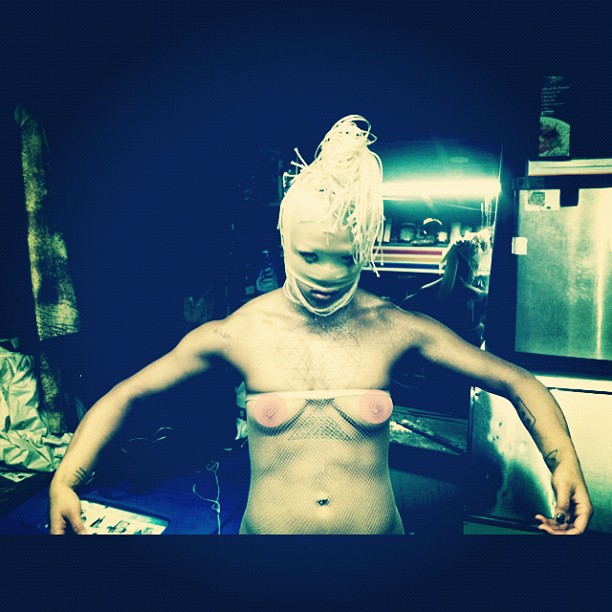
The performer was the amazing Dia Dear, one of a number of recent young arrivals who’ve zapped nightlife to another level by unselfconsciously — and quite organically — raiding the shelves of performance art, horror films, contemporary R&B, club kid history, and the Walgreen’s down the street to create striking personae for themselves, and electrify the city’s drag stages. They’re also so freaking smart it scares me, no Christmas crotch lights required.

Drag as confrontational, sometimes blood-spilling performance art has a long history here, of course, from the Cockettes in the 1970s, through the Popstitute and Club Uranus scenes in the early ’90s, through Trannyshack into the ’00s. It’s currently found a home at the Some Thing party every Friday at the Stud, High Fantasy every Tuesday at Aunt Charlie’s, and the Dark Room monthly party at Hot Spot. Iconic, sensibility-scrambling club kid styles like those of Michael Alig, Desi Monster, James St. James, our own Phatima Rude and Ggreg Taylor, and the ultimate drag inverter-perverter Leigh Bowery are all the rage in this retro-minded, post-Gaga moment. But something about this fresh wave, something about how it’s coming from people with no nightlife background at all, is different. Drag stages have become the affordable breeding ground for committed performance artists, expressing essential truths about our moment. Mere lipsyncing is so last century.

boychild

“I never even knew who Leigh Bowery was until people started mentioning his name this summer,” boychild, another of this new tribe, told me over the phone. (I live next door to boychild, and it’s not rare to find a neon-yellow spray-painted birdcage, a chandelier made of wigs, or an entire store display case sitting outside, waiting to become part of a perspective-shattering outfit or brandished onstage in a cyber-Wiccan, dystopian android ritual.) Like Dia, boychild just started going out to clubs very recently — pretty much arriving out of nowhere, both of them declining to share their pasts — and when she did she was almost fully formed as a stage presence, with a genius sense of makeup and a cerebral agenda.

http://www.vimeo.com/49244470

“Everything I do is a reaction to being categorized: as a person of color, as a female-bodied queer,” she said. “It’s really bad right now, because it’s so hip to be black, “urban culture” is being fetishized to an enormous extent. I feel I encounter so much that makes me angry just existing in this world as a queer creature. My performance and look ties everything to my experience through my body. That’s where I express myself most fluidly, more acutely and vividly than through language.”

“Horror is where I’m coming from and where I exist,” Vain Hein, another performer, told me. Unlike Boy Child and Dia Dear, Vain Hein is open about his past: raised as a Born Again Christian in both Puget Sound and Phoenix, Arizona — “My childhood consisted of traveling between extremes” — he eventually found his way to the San Francisco Art Institute to study New Genres (this is actually a program there!) Vain Hein, who also performs to music he chops and screws at home, most explicitly ties sex to horror in his work — it’s chockful of surprise lactations, menstrual blood, live births, prosthetic triple breasts, and weird asses.

VAIN HEIN (Photo by Eric Harvieux)

“I think a lot about the apocalypse, it’s how I filter and understand the world. Decay, destruction — everything I wear is just what’s at hand around my house, held together with scotch tape and nail glue, the shitty, shitty, shittest things ever that just fall apart during the night, even when I’m not performing. I literally shed my skin.”

Yet even as a queer art student in San Francisco, liberated from fundamentalism, he never went out until last year. “I just had preconceived notions about what going to a gay club involved. Then my friend dragged me to a drag show in the spring, and I was like, ‘I can do this.’ I had studied mostly performance art and video so it was a good fit.”

Being a young queer and not going to the clubs is incomprehensible to me — but of course these 20-somethings grew up with the Internet, where you can be gay by yourself, and which looms like a Poltergeist vortex over their work.

“Oh, the vast blessing of the Internet,” boychild half-laughs. “I wish I was better at it. We’re so bombarded with information and images, just so much shit. That can be great because my generation has all of the past available. But we’ve been drowning in this stream of complete crap, too. I can define myself as a freaky-freak just by how I navigate it. But the power of live performance is channeling all that into immediate emotion, a moment when everyone’s together, something that can’t and should never be documented as just images.”

The charming and soft-spoken Dia Dear, who has become kind of a mother the nascent phantasmic drag scene — even though she, like boychild and Vain Hein, operates mostly outside traditional drag house family structures — says, “I haven’t quite figured out my relationship to the Internet. I feel like it’s a positive tool because it can connect us to the spirit of people who are dead. But it’s also this kind of dark rectangle in the corner that can suck out all your energy. It exists for its own sake. But to be on the Internet now, you have to have a certain level of narcissism and self-interest. A lot like you have to have as a performer. Performance and the Internet should be natural lovers, in a sense. Twisted together …entwined.”


DISQUIET NIGHT

This live experimental music concert at the Luggage Store Gallery is the brainchild of one of the brainiest yet approachable people I know, Marc Weidenbaum, who started his fascinating daily music site, Disquiet.com, 15 years ago — way before blogs were invented. His project Disquiet Junto challenges Soundcloud members to respond to a prompt with unique compositions. This round: field recordings of Hurricane Sandy, with Cullen Miller, Subnaught, Jared Smith, and more.

Thu/6, 8pm-10pm, $6–$10 sliding scale. Luggage Store Gallery, 1007 Market, SF. www.luggagestoregallery.org


DEE-TOY

Over the past year we’ve been treated to some tasty South African contemporary dance music flavor, from Black Coffee to Die Antewoord. (Somebody please get the Tshetsha Boys out here!) DJ Dee-toy, of Sebokeng Township continues this great microtrend with deep, deep house vibes and off-your-seat Afrofunk jams.

Fri/7, 10pm-4am, $15–$20. Mighty, 119 Utah, SF. afrofunk.eventbrite.com


GIGAMESH

Yeah, yeah, the phenomenally successful Minneapolitan remixes pop hits into slick little machines of hummable electro-disco bliss. He is also very, very fun.

Fri/7, 10pm-3am, $15–$20. Monarch, 101 Sixth St., SF. www.monarchsf.com


TORMENTA TROPICAL 5-YEAR ANNIVERSARY

This monthly party launched the nu-cumbia sound in SF, splashing some much-needed Latin electronica onto our shores, while introducing global bass to a new generation of underground-minded clubgoers. Some major players have stomped the floor here, and quite a few sonic permutations of TT’s sound have found more mainstream success — but founders Shawn Reynaldo and oro11, who brought their inspiration directly from Argentina, are keeping it crazy and real with a marathon tag-team set in celebration.

Sat/8, 10pm, $5 before 10pm, $10 after. Elbo Room, 647 Valencia, SF. www.elbo.com


ACCIDENTAL BEAR!

Gay people won’t stop rapping and blogging, and that’s OK! Our favorite local blogger (and perpetual crush) Mike “Accidental Bear” Enders covers way too much ground online. Now the super-enthusiastic cutie is celebrating two years of cybergossip by hosting a cartoon-colored gay rapstravaganza with Big Dipper, Rica Shay, and MC Crumbsnatcher, plus singer Tim Carr and DJs Medic and Dav-O of Double Duchess. There’ll be a lot of cute gay guys with beards.

Sat/8, 9pm, $3. Truck, 1900 Folsom, SF. www.accidentalbear.com


ATTACK OF THE TYPEWRITERS

Writer, drinker, arts-minded political activist, and bon vivant Hiya Swanhuyser is combining her interests in this neato, monthly, potentially wonderfully absurd thingie. Come to the Makeout Room, grab a drink, and then bang out a letter to any politician you have beef with. “One letter = 100 votes,” she says. Cocktails and truth to power, yasss. She’ll bring the actual, clickety-clackety typewriters! You bring the drink-fueled rage!

Tue/11, 6pm-8pm, free. Makeout Room, 3225 22nd St., SF. www.tinyurl.com/typeattack


Left-right punch knocks out increased development fees for Muni

148

A new and unusual coalition of nonprofit, religious, and corporate interests today killed a legislative effort to get more money for Muni through the Transit Impact Development Fee, which was going through its process of being reauthorized every five years and came to the Board of Supervisors today.

The San Francisco Municipal Transportation Agency was hoping to get millions of dollars more per year from the fee to help cover the increasing costs of Muni service, so the city last year commissioned a study establishing a nexus between new development projects and their impact on the public transit system as a way to set the fees developers would pay.

Using that study, Sup. Scott Wiener sponsored legislation that increased the cost per square foot of development for some business types – mostly notably hospitals, big retail and entertainment complexes, and Cultural/Institution/Education facilities – and ended the categorical exemption for nonprofit organizations.

Those who could be impacted by the increased fees banded together into an organization calling itself NOTT (Non-profits Opposed to the Transit Tax), a group that included the city’s major health care providers, religious institutions, and influential nonprofits such as Council of Community Housing Organizations and Chinatown Community Development Center.

“We are gravely concerned that elements of the forthcoming Transportation Sustainability Program (TSP), especially elimination of the non-profit fee exemption, have been selectively imbedded in the TIDF update legislation. Elimination of the non-profit exemption has not been considered through a thorough and transparent process and is not good public policy,” SF Chamber of Commerce President Steve Falk wrote in Nov. 27 letter to supervisors on behalf of the organization.

In the face of opposition from both downtown and progressive groups, and hoping to get SFMTA more money for its next budget cycle, Wiener appealed for support to sustainable transportation activists, who had mixed feelings on the legislation for reasons ranging from its exemption of parking garages and development in Mission Bay to its inclusion of organizations serving low-income communities.

So Sup. Sean Elsbernd – who spoke on behalf of Catholic schools and churches – was able to amend the legislation back to the status quo on a 9-2 vote, with only Wiener and Sup. Carmen Chu opposed (Sup. Christina Olague, who co-sponsored the measure with Wiener, even failed to support it in the end).

While that ends this effort for now, it is really only the first round of efforts that are just getting underway to find more funding for Muni, which is underfunded and at capacity on many lines, and implement the TSP when it is unveiled next year.

Ethics Commission wants to hide its own flaws

3

The Ethics Commission has serious problems. A detailed report by Board of Supervisors Budget Analyst Harvey Rose, comparing SF’s ethics rules and enfocement to that of Los Angeles, found a long list of ways that this city is falling short. The supervisors asked the commission to have a robust discussion of the findings and propose reforms.

Now Friends of Ethics, made up of a number of former commissioners, activists, and campaign-finance watchdogs, says that the commission is trying to hold a quick hearing that will gloss over much of the criticism of the Rose report. The group wants the hearing delayed until there’s a lot more time to bring a lot more people into the process.

Here’s the letter FOE sent over:

To the Ethics Commission and Staff:

Friends of Ethics is writing with objections and protests regarding the upcoming “Interested Persons” meetings scheduled for December 4 and 10, 2012.

The Commission notified “Candidates, Treasurers and Interested Persons” of meetings “to discuss recommendations of the Budget Analyst report (also known as the Harvey Rose report) comparing programs of the San Francisco Ethics Commission with those of the Los Angeles Ethics Commission.”

The notice was dated November 28, providing only three business days before the first meeting will take place.

The Friends of Ethics bases its protest and objections on the following facts, and by this memo, formally requests that Ethics postpone these meetings until February.

     The proposed Interested Persons meetings do not mention inclusion of a representative from the Board Budget Analyst office to present their report and to discuss its findings. Without their direct involvement, as well as the invited presence of Supervisor Campos who requested the Rose report, the Interested Persons meeting will have only the staff’s views of the report as a basis for discussion. We believe this fails to provide the direct interaction and communication that should be part of this process.

    Ethics was requested by the Board of Supervisors to conduct robust and inclusive outreach to all participants in San Francisco’s political life. Ethics provided Friends of Ethics with the list used to contact Interested Persons about this meeting. We believe the list provided is not an adequate outreach, includes no community-based organizations active in electoral politics, any of the chartered Democratic clubs or other partisan political organizations, or special focus organizations active in San Francisco elections. We believe the lack of an inclusive outreach as evidenced by this list denies the Commission of a full discussion of the issues and is weighted toward the regulated community. We are puzzled by the fact that many people who do receive the Interested Persons notices are not on the list provided by Ethics, and seek a clarification on whether additional lists were used that were not disclosed to us. We also note that the late Joe Lynn, while the Campaign Finance Officer for Ethics, not only conducted extensive outreaches for IP meetings, including contacting past treasurers and press and posting notices on local political blogs and chat boards, but also later informed Director St. Croix in writing about those practices for the purpose of encouraging the continuation of such outreach.

    Ethics provided insufficient time for a review and analysis of recommendations that are significant and meaningful for the operation and success of the Ethics Commission mission. We believe that Ethics has done the bare minimum of notice of a public meeting and failed to take a serious approach to this important issue. Providing notice three days before the meeting, particularly in the holiday period between Thanksgiving and the first of December, means that no organization has an opportunity to place this issue on their agenda for a discussion or to endorse comments to be provided to the Ethics Commission.

    Ethics prepared an agenda that omitted significant and critically important comparisons between the Los Angeles and San Francisco Ethics Commissions that were included in the Rose report. While Ethics did list specific recommendations from the Rose report, the report itself detailed a number of additional differences that are significant to the San Francisco political community as we know it, and that should be part of a discussion of the Rose report.

Among the omitted points are:

    Los Angeles has a private right of action for citizens to act when Ethics does not; in Los Angeles this can include penalties under a civil action. San Francisco has no such provision. We believe this is essential to meaningfully empower citizens to directly seek compliance with our laws.

    Los Angeles requires disclosure of contributors of $100 or more to groups making “third party” expenditures. San Francisco does not require public disclosure of this money stream. Disclosure of donors to third party committees would add transparency, particularly if this has become a strategy to allow city contractors to influence elections.

    Los Angeles prohibits contributions from those seeking permits, while San Francisco does not. Friends of Ethics has determined that over 90 percent of all City Hall lobbying involves permit decisions.

    Los Angeles prohibits commissioners from fundraising for candidates, while San Francisco does not. This is the heart of pay-to-play politics that infects city appointments as commissioners are often the first stop for fundraising on behalf of city elected officials. We note a recent case where a city commissioner hosted a fundraiser that included contributions from city employees from the same department. The candidate returned the contributions, recognizing that commissioners are prohibited from seeking contributions from city employees. However, this demonstrates the potential abuse and underscores that Los Angeles’ policy is a stronger and more easily enforced prohibition. We recommend it.

    Los Angeles prohibits fundraising from city contractors and those seeking city actions. San Francisco allows contractors to fundraise and serve on candidate finance committees, although they may not contribute their own funds. Currently San Francisco also does not require candidates to disclose the names of their Finance Committee members. However, we strongly prefer closing the loophole, as Los Angeles has done, by prohibiting city contractors and permit seekers from fundraising.

    Los Angeles requires a more robust disclosure of “paid by” notification on telephone messages when 200 or more people are called. San Francisco sets the threshold at 500 people. Therefore, “paid by” calls to members of political clubs during the endorsement process would be missed under San Francisco’s standard but included under LA’s standard.

    Los Angeles provides a “Guide for Contributors” that educates donors and reduces confusion on such issues as aggregate contribution limits, prohibitions on officers of organizations receiving city funds, and so forth. This is done at minimal cost and made available on the Internet with no printing or mailing costs. San Francisco does not provide a Guide. Instead, the Ethics staff has recommended that the Commission rewrite the law to overturn specific prohibitions, stating that contributors are confused about the rules. The best approach is Los Angeles, where an educational outreach to contributors is part of their program. We note that San Francisco provides guides and outreach to most others involved in political activities, including committee treasurers, candidates and others but does not include an educational outreach to donors.

    Los Angeles prohibits political contributions from being made at City Hall or other city offices, including offices rented with city funds. San Francisco allows contributions to take place in the mayor’s own office, supervisor’s offices, at Redevelopment, Planning, Port or other offices – in short, anywhere that a donor chooses to make a contribution. We believe allowing contributions to be made in the workplace of city officials undermines public confidence and is inconsistent with other restrictions on the use of city resources for political purposes.

    Los Angeles has a more robust view of what constitutes lobbying and includes attorneys who offer strategic advice even if they do not directly contact a city official. San Francisco does not require registering or disclosing clients from such attorneys involved in orchestrating a favorable result for a paying client. Attorneys who serve as committee treasurers also do not face the same level of public disclosure as lobbyists.

We believe this list of omitted topics, coupled with the unacceptable short timeframe provided for analysis and review by the political community, and the failure to provide adequate outreach, raises serious concerns that Ethics is not engaged in a serious effort to obtain the public’s views on its operations and policies based on the Harvey Rose report.

We further note that Ethics has not provided a public schedule of when it will complete a summary of the Interested Persons meeting and comments, or a schedule for consideration by the full Commission of any recommendations.

In addition, Friends of Ethics requests that the San Francisco Ethics Commission audio record the IP meetings regarding the Rose report and post the recordings on its website, as is done by the Los Angeles City Ethics Commission.  In the past, the San Francisco Ethics Commission made audio recordings of its IP meetings, though they were not posted online.  The Commission’s Directors later discontinued the audio recording altogether, which may have been motivated by valuing the privacy of attendees over public transparency.  Given that the Rose report IP meetings are about comparing San Francisco’s good government laws with Los Angeles’ to consider adopting improvements offered by Los Angeles, Friends of Ethics believes that the first improvement that San Francisco should adopt is the Los Angele set of standard practices for conducting IP meetings.  When it comes to the development of good government law and policy, the public’s right to know is paramount.  Therefore, Friends of Ethics requests that all future IP meetings held by the San Francisco Ethics Commission be audio recorded and the recordings promptly posted online.”

Our reasons for requesting a specific timetable for next steps is based on our observation of lengthy delays in staff action on issues even when raised by the Commission itself. We believe the political community will be unlikely to participate in a process that has no specific and public timetable for action but that could take more than a year to reappear.

For example:

    In July 2011, the Ethics Commission requested that staff draft proposals to close the loophole that allows committees seeking to draft a candidate to fall outside the normal reporting and disclosure requirements. However, staff did not produce a proposal until November 2012, 16 months later, and did so without an Interested Persons meeting to discuss their proposal.

    Also at the July 2011 meeting, the Ethics Commission requested that staff examine the loophole that prevented the Commission from acting in cases of Official Misconduct by a commissioner. Ethics staff still has not produced a proposal to close that loophole.

    Also in 2011, a Superior Court judge suggested that San Francisco adopt a policy prohibiting commissioners from recommending a specific lobbyist to parties seeking a contract or other decision from that commission. Ethics has not prepared any response to that suggestion.

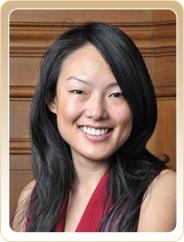
    In June 2012, Rules Committee Chair Jane Kim requested that the Ethics Commission provide some information on the city’s Ethics laws in languages other than English, noting that the rules are as important to donors and committees as they are to the public. The Ethics Commission has taken no steps, including in the election just concluded.

Given this record, we believe that any public process to examine the Harvey Rose Report and build new recommendations must include proposed timelines for action if there is to be public confidence that this process is meaningful.

We also strongly recommend that the Ethics Commission set aside time to allow a full discussion before the Commission itself. We believe that such a discussion should not place a two-minute limit on public members making comments.

For the above reasons and cited facts, Friends of Ethics requests that the Interested Persons meeting on the Harvey Rose Report be postponed until February when the political community will have an opportunity to evaluate the proposals and endorse changes, that the Commission immediately engage in a more robust outreach effort that extends beyond the list provided by Ethics to us, that the conversation be broadened to include all topics of comparison between Los Angeles and San Francisco, and that a proposed timeline for a record of the Interested Persons meeting and action by the Commission be provided.

We submit this protest respectfully and with support for the work of the Commission and specifically for the thorough review of any steps that can improve the Commission and public confidence in our political process.

Signed:

Eileen Hansen, former Ethics Commissioner
Bob Planthold, former Ethics Commissioner
Paul Melbostad, former Ethics Commissioner
Sharyn Saslafsky, former Ethics Commissioner
Bob Dockendorff, former Ethics Commissioner
Joe Julian, former Ethics Commissioner
Oliver Luby, former Ethics Commission staffer
Aaron Peskin, past President, Board of Supervisors
Charles Marsteller, former SF Coordinator, Common Cause
Karen Babbitt, community advocate
Marc Saloman, community advocate
Larry Bush, Publisher, CitiReport


The missing element of the Renewable Energy study

36

Since San Francisco’s Local Agency Formation Commission is meeting Dec. 7 to talk about renewable energy, I went and read the 100-page report of the Mayor’s Task Force on Renewable Energy, which offers 39 different suggestions for meeting the goal of 100 renewable electricity in the city by 2020.

That’s a pretty ambitious goal. The guy who set it, Gavin Newsom, loved lofty, ambitious projects, particularly when he was never going to be the one to carry them out. So too here: Newsom announced the city’s goal in 2010, shortly before he left for the Lieutenant Governor’s Office. Ed Le convened the task force earlier this year, and the members, most of whom have legitimate qualifications for the job, got right to work.

The most important conclusion of the report: Yes, it’s financially and technologically feasible to generate all of San Francisco’s electricity from reneweable sources, and we can get their in a short eight years. One key element: More distributed generation — that is, the city needs to create financial and regulatory incentives for people to put solar panels on their roofs. In San Francisco, with sun much of the year (and small houses), a rooftop solar installation can pretty much power the average single-family home and can pick up a fair share of the load of the typical four-unit building.

But while the report gives a shout-out to CleanPowerSF, which will soon be offering 100 percent renewable energy service (for a slightly higher price), and talks about the need for the city to build its own renewable generation facilities, which have to be a part of the plan. But it has a glaring omission — it doesn’t once mention public power.

Why is that an omission? Because San Francisco is never getting to 100 percent renewables while Pacific Gas & Electric Co. still controls the grid.

Right now, with today’s technology, you can’t get close to 100 percent without a significant amount of distributed generation. Lots and lots of people have to generate their own power — at which point, they no longer need PG&E (except that, by law, the grid is the default storage battery, but that’s going to change soon, too). In simple terms, distributed generation puts private utilities out of business. So they won’t ever go for it, and will — quietly, behind the scenes — so everything possible to keep if from happening.

Likewise demand management, something the Renewable Energy Task Force discusses at length. San Francisco already gets about 40 percent of its electricity from the Hetch Hethcy hydro project; If the city could reduce its energy use by 20 percent, that’s 20 percent we don’t have to generate. And reducing use is way cheaper than building new generation facilities.

But why would PG&E want to sell less electricity? There are all sorts of state laws mandating efficiency, but no PG&E CEO is going to make that a big push; it costs the company money. A PG&E that sells 20 percent less electricity is a smaller PG&E, with smaller staff, smaller revenue, and smaller profits. 

That’s why the only way the key components of distributed generation and demand management are ever going to work is if San Francisco gets rid of PG&E and sets up a municipal system. Around the country, the munis are leading the way in renewables, because they have no stockholders to satisfy.

At least that ought to be part of the report, no?


W. Kamau Bell returns triumphant to the Bay, needs burrito

0

Attention burrito vendors of the Mission, there is a sale to be made at the arrivals gate of SFO this weekend when newly-minted TV star W. Kamau Bell makes his triumphant return to the city in which he spent 15 years honing his comedic chops. He is aching for a Mission burrito like this city is aching for a more efficient MUNI system.

Culinary yearnings aside, this Sunday Bell headlines a standup show at the Fillmore as part of his “Kamau Mau Uprising” tour. The tour’s moniker should come as no surprise to those who are familiar with Bell’s politically progressive, acerbic wit.

These days, that category includes more people than ever. Earlier this year Bell ditched left our lovely 49-square-mile patch for Gotham when he was offered his own TV show on FX (Thursdays at 11:30pm). And it looks like he’ll be spending more time back east — said show Totally Biased with W. Kamau Bell just got picked up for a second season that will start January 17.

In the inaugural season of Totally Biased, Bell and his crew of writers have covered a lot of ground, exploring the differences between Sikhs and Sheiks, sweet potato and pumpkin pies. They’ve made a fake PSA telling men to stay home and watch porn on Election Day instead of vote, and watched presidential election returns with the Brooklyn Young Republicans (some of whom are not, it turns out, are not so young.)

Now that both he and President Obama will be back in 2013, Bell looks forward to holding our Commander in Chief to task. Right before the Thanksgiving Break, and just hours after finding out his show got renewed, the self-proclaimed “billionth most famous person in the history of New York” took some time to chat with the Guardian about his homecoming, and on what makes a San Francisco comedian different from those from NY, LA, or Boston. Plus, on whether he’ll ever drop a “hella” on Totally Biased.

SFBG: In the past you’ve referred to Totally Biased executive producer Chris Rock as the “foul-mouthed Yoda.” How far along have you come in your Jedi training?

Assuming that this is the original prequel, I would say I’m probably halfway through the first movie. Although Yoda wasn’t in the first movie, so I’m screwing up my nerd status, but I’m at the very beginning of the Jedi training, if it’s Empire Strikes Back, I’m at the point where I lifted the thing out and then I got scared.

SFBG: What’s Mr. Rock’s involvement in the show? Is he more hands-on or hands-off?

WKB: I just talked to him and he literally said, “I’m around if you need me, call me.” He’s as available as we need him and he jokes that’s he’s on sabbatical from show business because he has no projects right now. He comes to all the tapings, but then again he also wants this to be my show so he allows me to use him as much or as little as I want to. Overall, I’ve used him a lot less than people thought I would.

SFBG: Would you say that your show is in competition with The Colbert Report and Daily Show?

WKB: Not really, but I would say that they’re a standard that we’re measuring ourselves against. You know, I’m just the new guy who likes “Hey guys can I hang out!” We’re certainly aiming for a lot of the same people, but I think that by the nature of Totally Biased we’re also reaching a group of way different people.

SFBG: Do you ever plan on saying hella during the show?

WKB: Here’s the thing, by the time I moved to San Francisco, I knew if I started saying hella, people from Chicago would think I had lost my mind. On the back of the set, we have these designs and there are a couple of Bay Area shout-outs and that’s the closest I’ll get to saying hella on air.

SFBG: How did your stand-up show Ending Racism in a Hour prep you for Totally Biased?

WKB: When I wrote that show, the idea behind it was: what kind of show would I write if I was famous? I would have a screen, I would have a computer, I would talk about the world, I would talk about racism all the time, and I would be very topical.

So I did Ending Racism the way I would do it if I had a TV show and through lots of luck and hard work I ended up with Totally Biased. I know for sure that I would not have gotten Totally Biased if I had just done stand up. And by the time Chris saw me at the UCB (Upright Citizens Brigade) Theatre in New York, I had already been doing for about three or four years.

SFBG: Do you have writers from the Bay?

WKB: Janine Brito, Kevin Avery, Kevin Kataoka, and Nato Green.

SFBG: What’s the history of your relationships with them?

WKB: I used to do “Siskel & Negro” with Kevin Avery, who’s from San Jose, on Live 105 back in the day and I met him right when I moved out to San Francisco. We did a lot of shows together, we were writing partners and almost got hired to do a D.L. Hughley show for CNN.

Kevin Kataoka is originally from Oakland and I met him when I first moved to San Francisco, in the SF comedy scene. He actually introduced me to Chuck Scolar who’s an executive producer of the show, and he’s the guy who introduced me to Chris Rock.

I’ve said many times that Janine is my comedy daughter, who’s this little hipster, half Cuban, all lesbian. I met Nato on the scene about six or seven years ago, so I had already been on the scene by the time I had met Nato and Janine.

Myself, Nato, Janine, and at one point Hari Kondabolu (fellow TB writer) had a three-headed standup comedy monster called “Laughter Against the Machine” that we started in the Bay Area and the New Parish in Oakland was the home base for that show. We’re currently working on a documentary about going on the road last year to various political hotspots in America.

SFBG: What’s your take on the SF comedy scene?

WKB: The thing about San Francisco is that it always has had a good reputation as a good comedy city. Ever since Mort Sahl stepped on stage at The Hungry i in the ‘50s San Francisco has had a great reputation as a comedy town. Even though we’re not the biggest city, all the greats come through San Francisco.

I remember seeing [Dave] Chappelle when I moved to town, and he was already packing the club despite not being nationally famous. This is was big because this was before the Internet took hold. He was already a legend and I remember one night when he was stage and he said yeah I just finished filming this movie and it’s all about weed! I saw him go to the next level when he got his own show, and so San Francisco is a great city for developing comedic talent.

If you come up in the San Francisco comedy scene, clubs like The Punchline and Cobb’s are loyal to local talent if you show loyalty to them. You will work with the best in the business. I’ve heard that New York comics say that San Francisco comics know more headliners and have more personal relationships with headliners than New York comics do because San Francisco comics hang out a lot before and after shows, whereas in New York everyone is always running to the next thing. The city is known for having good comedians but there’s not a style called “San Francisco comedian.” You can pick out a Boston, New York, or LA comedian but you can’t really pick out a San Francisco comedian.

SFBG: How does it feel to headline a show at The Fillmore?

WKB: In some sense that’s bigger than getting a TV show [laughs] when they said that I was going to play The Fillmore, I thought “wait a minute! It’s too soon!” And time will tell if it is too soon. It’s just weird to me that it’s happening now. I think a lot of it is because I’ve built up a name in the Bay Area.

SFBG: Will you have time to stop by your old spots?

WKB: I’ll have a chance to visit my old spots and look at the “did that really happen?!” look on people’s faces.

SFBG: What are places and things you miss the most about the Bay Area?

WKB: The one thing overall that both my wife — who’s from Monterrey — and I miss most is that the style of living in Northern California is so easy. When I think about my time in San Francisco, even walking outside my house, it feels like a baby bird being born. When I think about New York, every time I walk out of my house, I feel like a paratrooper jumping out of a plane. And there are definitely five or six Mission burritos in my future because New York does not understand how burritos work.

I also want to go back to The Punchline on a Sunday night where all of it really started for me. That place is my mecca. I just need to go there and walk around the stage seven times and really reflect on all that is happening. And oh! I’ll be probably ride the N-Judah and visit my old block of Ninth and Irving.

SFBG: I know you just found out about the second season but now that the election is over and your boy is back for a second term what direction do you think the show will be taking?

WKB: My career and act has followed Obama’s presidency and a lot of comics say it would have been better if Mitt Romney had won and I’m like noooooo this black president thing has worked out for me nicely. And the great thing about Romney being gone is that now we can actually talk about Obama from a more critical angle. Now we can talk about how Obama is not a great president, we can talk about Guantanamo and immigration. I don’t just want to be a cheerleader.

The Kamau Mau Uprising

Sun/9, 8pm, $29.50

The Fillmore 

1805 Geary, SF

www.thefillmore.com

HANC evicted, but the poor recyclers could remain in the Haight

36

In a win for the gentrifiers of the Haight Ashbury, the Haight Ashbury Neighborhood Council’s (HANC) Recycling Center has been issued an official eviction notice, posted by the Sheriff’s Department, and is slated to be out on the street by this Wednesday, Dec. 5. But those who hoped this would rid the neighborhood of poor people recycling bottles and cans may be disappointed.

The HANC site in Golden Gate Park — which houses a community garden, native plant nursery, and recycling center — has been battling eviction pushed by the Mayor’s Office and mayoral appointees for nearly a decade. Previously, the city Recreation and Park Department pushed for HANC to leave, a stand reinforced by court rulings, but the eviction notice looks like the last nail in the coffin. The recycling center’s employees will lose their jobs just as the winter holiday season begins.

“The notion that they’d put people out of work before Christmas was horrendous,” said Ed Dunn, HANC’s director. The eviction caught him totally flat footed, as he had just last week given a tour to San Francisco officials interested in mediating the dispute.

“It seemed like there was growing awareness that we’re a public good,” Dunn said. “I guess that went nowhere.”

Deputies posted the eviction notice at HANC’s doors on Wednesday, Nov. 28. Susan Fahey, the Sheriff’s Department media relations officer, declined to discuss the details on how the department would handle the eviction, saying only that “we plan accordingly.”

And though some, like Chronicle columnist C.W. Nevius, are celebrating HANC’s demise, the unintended consequences should have all small businesses in the Haight Ashbury worried.

 State law requires that Californians have easy access to a “convenience zone,” basically somewhere nearby that they can sell the cans and bottles and get back the “redemption” fee charge to consumers. HANC served that purpose for a half mile radius around its location on Frederick, near Stanyan.

“My position is we have to understand the full potential of the decision we’re making,” Regina Dick-Endrizzi, director of San Francisco’s Office of Small Business, told us. Namely, that without HANC, two local grocers will have to pick up the slack and buy back the bottles and cans they sell.

“Whole Foods and Andronicos were serviced by HANC’s existence,” Dick-Endrizzi said. With HANC gone, “they will be required to buy back [bottles and cans] from local stores.”

The whole reason that HANC was being pushed out in the first place was due to a vocal few, like the Haight Ashbury Improvement Association, saying that HANC was a magnet to the homeless population and their shopping carts filled with bottles and cans. Now those same poor folks may take their business from Golden Gate Park to the Haight neighborhood itself, frequenting the local Whole Foods, defeating the whole purpose behind the opposition’s scorn for HANC.

But sometimes local grocery stores defy the state mandate, and instead choose to pay state fines, Dick-Endrizzi said. If they choose not to take recyclables, small businesses all over the Haight would be required to individually pay customers for their used recyclables.

If they don’t, small businesses could be fined as $100 a day under state law. A year gone without dealing with the issue could cripple a business, with fines up to $36,000.

When contacted, Whole Foods representative Adam Smith said that the company was aware of the issue and was still deciding on a course of action for the neighborhood.

Funding SFUSD’s graduation rescue

45

The San Francisco school district’s achievement gap exploded into the news when district officials learned that as many as 1,900 High School juniors — the vast majority of them students of color — aren’t on track to meet the new graduation standards.

It’s a crisis: The district several years ago mandated that every high school graduate complete the A to G classes required by the California State University system — essentially a requirement that every graduate be prepared for college. It was going to be a tough standard to meet — and that was before the state whacked $77 million out of the SFUSD budget.

Now, with the new standards on the books, the class of 2014 is nowhere near ready. The city’s laudatory 82 percent graduation rate is at risk — and more important, there’s a real possibility that hundreds of kids won’t get a high school diploma, which will severely damage their employment opportunities.

To make things worse, the district’s funding for after-school classes to help students who are behind catch up — known as “credit recovery” — is ending in December.

The statistics are alarming: More than 80 percent of African American kids and 70 percent of Latinos aren’t on track to graduate. And while Prop. 30 passed, preventing any more cuts, it doesn’t add to the district’s funding.

So Sup. Jane Kim is asking the city to pick up the $2.7 million tab for the credit recovery program, which makes perfect sense: If 1,900 kids don’t graduate from high school, the impacts on the city, from crime, unemployment, and social-service needs to homelessness, will vastly exceed that number. 

“It’s part of violence and crime prvention,” School Board member Sandra Fewer explained.

It’s also an issue of civic responsibility — we, as San Franciscans, can’t just let those kids fail. “Remember, these are the ones who stuck it out, who are really trying,” Kim told me. “They aren’t the drop-outs.”

There is, of course, the question of whether this is going to be an ongoing problem — what about the class of 2015? Fewer thinks the numbers will be a lot lower then: “”We’ve learned a lot,” she said. “We’ve had early warning indicators and I don’t think we’ll see these numbers again.”

Kim said that at first she thought the appropriation request would be noncontroversial — it is, after all, a fairly modest amount of money, and the city’s budget picture is improving. “We’re doing fairly well,” Kim said. “One of the promises of all this tech growth was that we’d get some more revenue, and I think we need to spread that wealth.”

But the Mayor’s Office and some of her colleagues weren’t ready to go along. So, as often happens in these situations, somebody found some fiscal magic — the Mayor’s Office folks “discovered” that the city had put an additional $1.5 million into the school district’s allocation from the Rainy Day Fund. Gee, maybe that could cover part of the cost.

Now it gets tricky.

The Rainy Day Fund, which Assemblymember Tom Ammiano created when he was supervisor, requires the city to set aside cash in flush years to use when times are tigher — and part of it goes to the school district. That money has been used in the past few years to prevent teacher layoffs. (Another whole crazy issue — the district has to issue layoff notices in the spring, and then rescind them, which sucks for everyone, but at least the Rainy Day Fund money has made most of the recissions possible).

So the teachers union isn’t thrilled with the idea of taking money that would prevent layoffs and using it for another worthy program. “We’re in support of the $2.7 million allocation,” union staffer Ken Tray told me. “We can’t fail these kids. But we’re afraid that the money that would go for this very good thing would lead to teacher layoffs.”

Sup. David Campos has concerns, too: “I think the Rainy Day Fund should stand on its own terms,” he said. “If any time something comes up we say let’s take it from the Rainy Day Fund, it can become a problem.”

He supports spending city money to help the students: “If it’s a crisis, we should handle it as a crisis.”

Which makes perfect sense to me. This IS a crisis, and Kim has properly identified a small amount of money for a one-time effort to address it, and in the end, her allocation would save the city way more than it costs. I can’t see why the mayor and the supervisors have to play games here; this is serious, serious stuff, and if the district thinks it can address it in a serious way for a modest amount of money at a time when the economy is picking up and the city budget is improving, why not just do it?

2012: Beginning of the End or a New Beginning

33

In recent months, I’ve been exploring the rabbit hole of 2012 prophecy and possibility, a beguiling mixture of myth, spirituality, and hope that humans will finally awaken to the global ecological and economic catastrophes we’re creating and make a fundamental shift in our approach, whether that’s sparked by cosmic energies or our own earthly intention.

When the Mayan calendar ends on Dec. 21 – a date that also marks the Winter Solstice and the peak of our alignment with the galactic center (Earth, sun, and the dark center of the Milky Way lining up for the first time in recorded human history) – it will be a day anticipated by millions of people around the world. Thanks to the modern amplification by pop culture and the Internet, it will be an unprecedented and potentially auspicious astrological, energetic, and cultural moment.

“The earth is being flooded with energies from the galactic center,” San Francisco Astrological Society President Linea Van Horn, who has been giving presentations for eight years on the significance of a cosmic alignment that occurs once every 26,000 years, told us. “That was the alignment that the Mayans were marking on their calendars.”

It isn’t just the Mayan Long Count calendar that indicates the current age is ending and a new one dawning. Some Aztec, Toltec, Indian, and Egyptian scholars and writer Terence McKenna (who used the I Ching to make the revelation in his book The Invisible Landscape) and various New Age authors have predicted we’re entering a new era, one many believe will be marked by enhanced human consciousness.

But one needn’t believe any of this to understand the pressing need for humans to wake the fuck up and start working together on issues ranging from global warming and the alarming decrease in the planet’s biodiversity to the many shortcomings of global capitalism and the escalating social unrest it’s creating. So why not use this grand mystical moment to spark that discussion, as many progressive activists and conscious community advocates have suggested.

“It allows us to have a stage for the question, a frame for the question. We have to ask very basic questions about our survival,” said Rev. Billy Talen, an artist/activist whose latest book, The End of the World, delves into the earth’s ecosystems reaching their tipping points. “We have the uncanny, mythic, prophetic calendar ending and beginning. And then we have scientists saying the same thing, so where does that leave you?”

There will be many epicenters and gathering points on Dec. 21, both real and virtual. Personally, I’m headed down into the heart of the Mayan empire to Chichen Itza, Mexico, where I’ll be attending the Synthesis Festival and doing daily dispatches through this website. Daniel Pinchbeck, author 2012: The Return of Quetzacoatl, will be in Egypt at The Great Convergence “celebrating the dawning of a new era.”

“Basically, we are going to have to have a rapid shift in global consciousness,” Pinchbeck told me, arguing that shift has already begun, as seen in movements from Arab Spring to Occupy Wall Street. “It is happening in terms of horizontal, peer-to-peer, cooperative movements with no top down hierarchy…We can make a much more rapid transition than most people realize.”

Both festivals, and many others around the world, will be heavily attended by people from the Bay Area, where many of the concepts behind transformational possibilities and alternative organizing models have incubated and evolved for decades. The organizers of Synthesis have also set up a World Unity 2012 online hub where people can participate with livestreams from where they are and join in conversation about what’s next.

“It’s probably one of the most pointed to and significant times ever,” said Synthesis Executive Producer Michael DiMartino, who has been leading tours of Mayan sites for almost 20 years, establishing a close working relationship with the Mayan community in Piste Pueblo adjacent to the pyramids at Chichen Itza that he’s tapping for this event. “We’re at a crossroads in human history – and the crossroads are self-preservation or self-destruction…We create the future. As we make our decisions, we create the future now.”

While DiMartino and other festival organizers believe in the spiritual and energetic possibilities of this moment, they emphasize that it is an opportunity to bring together people with a variety of worldviews and belief systems and have a conversation about how the global community of people can work together on solutions.

“Obviously, the planet has been getting out of balance and there is a need to go back to basics,” said Debra Giusti, founder of the Harmony Festival and author of Transforming Through 2012. “We need to get back to the values of the indigenous people, but in the modern context making use of our technology.”

As I’ve interviewed people about 2012, from true believers to skeptics, mystics to scientists, a common theme has been that nobody knows what this intriguing moment portends. They have their hopes and their fears, their doubts and their desires. I’ll be looking at the 2012 question from a variety of perspectives in my upcoming coverage, and I’m open to your suggestions and observations as well.

But for now, for me, I’m maintaining an open heart and an open mind. “There are more things in heaven and earth, Horatio, that are dreamt up in your philosophy,” Shakespeare’s Hamlet said, a statement for ages that our modern minds, so rational and cynical, too often forget.

Maybe this metaphysical moment will be the anticlimactic New Age equivalent of Y2K, or maybe it will be an important signpost on the road to global transformation in consciousness, or something in between. Whatever happens, it’s bound to be interesting, and I hope you’ll join me on this journey.

Localized Appreesh: Coo Coo Birds

1

Localized Appreesh is our thank-you column to the musicians that make the Bay. To be considered, contact emilysavage@sfbg.com.

Music should be fun. We forget that little factor, those of us drenched in so many layers of irony we can no longer differentiate between sounds. Lest we draw another blank, I present Coo Coo Birds.

The band – made up of singer-guitarist Jonny Cat, producer-bassist Charles James Gonzalez, and singer-drummer Ryan Zweng – is connected to the Convent arts collective (hence the song, “Convent Girl”), and seems to have a real good time making music together. It dropped full-length debut, Don’t Bring You Boyfriends, in September, quickly followed that up with the forthcoming Psychedelic Warrior, and have another release already on the horizon: Sultan of Cats, due February 2013.

So far, the tracks have been about things like rock and roll animals, sake babies, and marshmallow pies, sonically mixing in swishy psychedelia, swinging 1960s pop, and the band’s professed love of rock’n’roller Link Wrap, and the Kinks.

And the Birds have some pretty fun musician friends too: Steve Mackay of Iggy Pop and the Stooges, who lent some tenor sax to Coo Coo Birds’ first release; fellow locals and Localized Appreeshers Brand New Trash, and legendary song-man/ex-Modern Lover Jonathan Richman, who recently gave them a Big Star boxset, and invited them to open for him at the Great American Music Hall this weekend.

Also, a note for the not-so-distant future: the band will perform as the Order of the Holy Coo at the First Church of Sacred Silversexual’s Very Bowie Glampocalypse blowout Dec. 21 at Cafe Du Nord. So you’ll be able to spend the last night on earth in style. 

First, get to know the Coo Coo Birds, the rarest of the species:
http://www.youtube.com/watch?v=xT6srRZcEiE

Year and location of origin: November 2011 at the Condor Strip Club in San Francisco.  That was when we first played together and felt something extraordinary.  At that moment Coo Coo Birds were born.

Band name origin: A film maker who now lives in New York named the band after who knows what.  We just like the sound of it so we kept the name.
Band motto: Don’t Bring Your Boyfriends.

Description of sound in 10 words or less: The Sound of Coo Coo Birds is 1 part LINK WRAY, 1 Part KISS, and 1 part T-REX.

Instrumentation: All band members sing behind a wall of guitar, bass, and drums.

Most recent release: Our first LP, entitled Don’t Bring Your Boyfriends was released in Sept. 2012.

Best part about life as a Bay Area band:
Girls, drugs, fun and very loud music.

Worst part about life as a Bay Area band:
Girls, drugs, fun and very loud music.

First album ever purchased:
KISS ALIVE II with the cutout corner. Things were never the same afterwards.

Most recent album purchased/downloaded: BIG STAR box set on vinyl. Jonathan Richman gave us a copy a couple weeks ago. I guess that counts.

Favorite local eatery and dish: Coo Coo Birds have regular band meetings at Da’ Pitt BBQ on Divisadero and Grove in SF.  We usually order a rack of Ribs, with mac & cheese, collared greens, white bread and hot sauce on the side.  We always wash it down with 32oz bottles of Coors (Banquet) beer.

Coo Coo Birds
With Jonathan Richman
Sun/2, 8pm, $16
Great American Music Hall
859 O’Farrell, SF
www.slimspresents.com

You’ll be a woman soon

0

emilysavage@sfbg.com

Tofu and Whiskey The phrase “‘woman’ is not a genre” has been popping up again. It’s been in articles, board threads, and subsequently, conversations I’ve been a part of. It’s a good one. Kind of an earworm of a saying, because on its face, it’s implicit, simplistic, obvious, even. But it’s a good mantra, for music writers. “Woman” is not a genre.

Maybe it’s a backlash against Rolling Stone’s recent, ridiculous “women who rock” package, which sought out the “best” woman in rock with votes from readers, and somehow ended up with cloying pop act Karmin plastered across the cover, cleavage-y as all Rolling Stone cover ladies. Can you imagine a “best white guy in rock” contest in RS?

But this is nothing new. As far as I can trace it, Little Boots said “‘girl’ is not a genre” in 2009, but — seeing as how it’s so gosh darn simple — it’s got to have been uttered previously, and certainly, undoubtedly, felt since the first time a woman picked up a different instrument from her female neighbor, and got thrown in concert together.

It was the headline and thesis of a piece on Electronic Beats about the rise of thinkpieces sputtering about a supposed rise of women making electronic music, another fallacy; it’s just the cheap shots in feature pieces clumping heterogeneous acts together again.

One of the only things linking all ladies of wildly divergent sounds at this point is the gendered showcases, or gendered comparisons. That’s not to say all comparisons are entirely inaccurate, they just frequently are made based on little more than appearance.

Ash Reiter, the frontperson for her eponymous East Bay band, saw plenty of comparisons after the release of her first album, Paper Diamonds, in 2010, with passing references to Fleetwood Mac and Cat Power, both of whom she admires. The singer-songwriter-guitarist was also hoping to sound like a mix of Paul McCartney, Brian Wilson, Grizzly Bear, and OK, Jolie Holland.

Now, Reiter and her band have taken that sound for a walk in another direction. With the new LP, Hola — which see release on 20 Sided Records Fri/30 with a show at the Rickshaw Stop (8:30pm, $10. 155 Fell, SF. www.rickshawstop.com) — the local musicians took notes more from bubbly 1960s pop and classic Motown cuts, arrangements interspersed with bits of funk and Afro-pop.

“With our first album, I was in a folkier place with a lot of those songs, doing the Jolie Holland thing, which, you know, I cut my teeth singing along to her songs,” says Reiter, remarkably cheerful on the phone the afternoon before her current 54-day tour ends. “But I’ve gotten more excited about writing more upbeat pop songs with grooves to them, and working with my band to write music instead of writing it alone.”

On this tour, Reiter and her drummer Will Halsey went to the Motown Museum in Detroit, which was particularly meaningful because of its influence on Hola: “that’s a lot of the music we look up to. Of course, [we’ve always looked up to] the Beatles and the Beach Boys, but also all these girl groups, the Ronettes, and the Shirelles, and the Crystals. And we definitively imitated a lot of what we heard in the background vocals listening to the Supremes.”

She had just gotten the Supremes box set, but also was listening to early Nigerian pop, and Os Mutantes when she first began work on Hola, and brought those inspirations to New Improved Recording, where the band worked for the first time with engineer Carlos Arredondo, who they met at a party at Anna Ash’s house.

You can hear Ash Reiter’s many complimentary influences on Hola opening track, “I’ve Got Something I Can Laugh About Now,” with jangly guitars, shakers, cooing harmonies, and Reiter’s crystal-clear, honey-sweet lead vocals. Funkier, electro-shot “Ishi,” written about the last member of the Yahi, very much a part of California’s history, follows. Reiter read his biography for that song, but also just liked the phonetic sound of his name.

Raised in Northern California (specifically, Sebastopol), Reiter looked to the state’s history for inspiration lyrically this time around; the former modern lit major was reading voraciously during the making of the record, including Joan Didion’s Where I Was From. The song “Little Sandy” has a chorus that’s a quote Didion included from a pioneer girl’s diary.

While Hola was girl group-influenced, Reiter wasn’t about to write a break-up album — she’s dating the band’s drummer, Halsey, who also plays with Oakland’s the Blank Tapes.

Another Bay Area act — freshly rejiggered and condensed — is headlining the release show with Ash Reiter this week: DRMS. It’s also a new progression for the plucky electro Afro-pop act, formerly known simply as Dreams. Down from eight players, the now-four piece has whittled to bandleader-keyboardist Rob Shelton, vocalist-percussionist Emily Ritz, drummer Ross McIntire, and Mark Clifford on vibraphone, melodica, and backup vocals.


DON’T CALL IT FREAK-FOLK

Local singer-songwriter Jessica Pratt just released a mystical, fleeing-through-a-foggy-forest folk album that’s so stripped down, quavering and personal, crackling yet crisp, it sounds like a rare, weird gem from the early ’70s that you’d unearth in the lower racks of Amoeba. The self-titled LP has such a true-blue timeless quality, however, to call it a throwback would do it injustice. White Fence’s Tim Presley is said to have created new label Birth Records solely to release Pratt’s debut, which came out Nov. 13. Pratt recently told Fader: “I was really afraid of some freak-folk comparisons because I’m from San Francisco, and I play electric guitar, and it’s kind of weird, folky stuff.” I’ll refrain.

TALES FROM THE FRONT LINE

Part of Nayland Blake’s ongoing FREE!LOVE!TOOL!BOX! exhibit, Show and Tell: Queer Punks in Conversation will include conversations with Leslie Mah of Tribe 8, Brontez Purnell of Gravy Train!!! and The Younger Lovers, Jess Scott of Make-A-Mess Records, Brilliant Colors, Index, and Flesh World, and Matt Wobensmith, founder of Goteblüd Vintage Zine Store and Outpunk. Full disclosure, the panel discussion will be moderated by SFBG managing editor, Marke B., but I’d have gone regardless.

Fri/30, 6:30pm, free with admission

Yerba Buena Center for the Arts

701 Mission, SF

www.ybca.org


Fatshion

10

caitlin@sfbg.com

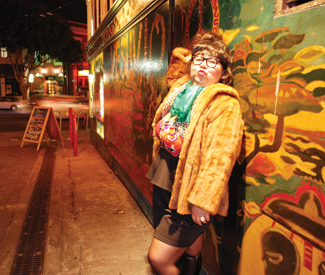
STREET SEEN “Can I do a small rant on boobs?” Fat activist Virgie Tovar’s boobs — I can see most of them in the swank North Beach cocktail bar we’re sitting in — are really big. Many parts of Virgie are, which is kind of her thing. The editor of the recently-published anthology Hot and Heavy: Fierce Fat Girls on Life, Love, and Fashion (Seal Press) talks dirty to telephone sex customers during the day, and carries her curves with a pride that runs completely counter-current to all the ways we are taught to be ashamed of fat in this world.

Obviously, I want to hear her rant about boobs. It turns out to be: Tovar is sick of partners who place their attraction to her squarely on her ample bosom. “I have to have them verbally say that [I’m fat] before we have sex. They can’t accept that they want to have sex with a fat woman.”

So don’t call her busty. Especially since if you do, you’re going to miss the whole point of her look.

“I dress for visibility,” Tovar puts it. You can definitely see her perched somewhat precariously on this North Beach bar stool. Her ample decolletage is emphasized by a floral onesie-now-a-dress, the crotch of which was cut out before our interview for enhanced comfort, a tight skirt, vintage fur coat (“My rule is, I wear fur if it’s 25 years old or older,” she tells me. “I love wearing dead animals”), teal scarf, and knee-high black boots.

You can’t miss Virgie, a fact which our fellow bar patrons quickly learn when we launch into a high-spirited discussion of one of her regular phone sex customers, a “pay pig” who gets off on paying $50 for the pleasure of her telephone voice — $50 every 15 minutes, that is.

She wants you to look at her and see fat, and look at her and see style, and look at her and want to have sex with her — and then she wants you to think about what those things say about your own adherence to normative beauty ideals. Virgie identifies her style as high femme, by her own definition “the intentional performance of femininity in order to subvert masculinity. My fat has become a part of my performance, like jewelery.”

As a chubby child, Tovar shied from glitz and glamour. Girly clothes either didn’t fit, she says, or just plain didn’t fit into her mission to be completely invisible. It was hard to hide, however, from the sartorial impulses of her mother, who loved few things more than embellishing Tovar’s garments with lace and the occasional scene from Disney’s The Little Mermaid, rendered in puff paint.

But Tovar quashed that timidity in adulthood, when she found partners who “found me sexy and wanted to do all these nasty things to me,” she says. “If your liberation comes from somebody eating your ass, by all means necessary.”

She went onto San Francisco State University’s sexuality studies department, where she focused on fat sex, eventually proposing a fat-positive manifesto to Brooke Warner, senior editor at Seal Press. That morphed into Hot and Heavy, a project that Tovar feels coincides with a surge of fat cultural activism, evidence of which she sees popping up, of all places, in retail.

Luscious shopping spots to embrace your own zaftig fabulosity? If you’re down for big brands, Tovar gives high marks to Forever 21’s plus size offerings (“It’s gaudy, it’s slutty. They’ve really tapped into that audience that I’m a part of”), also to ASOS’ Curve line (www.asos.com), Domino Dollhouse (www.dominodollhouse.com), and Cupcake and Cuddlebunny (www.cupcakeandcuddlebunny.com).

Across the country, a smattering of high femme fat vintage stores have popped up: Portland’s Fat Fancy (www.fatfancyfashions.com), Brooklyn’s Re/Dress (whose stock is available online at www.redressnyc.com). And of course, she says, there’s the old standbys: Lane Bryant, Avenue for tights and boots, and the Stonestown Galleria’s most gloriously trashy clothes purveyor, Torrid. Tovar says she finds fat fashion inspiration in Marie Claire writer Nicolette Mason, Marie “Curvy Fashionista” Denee (thecurvyfashionista.mariedenee.com), and the Near-Sighted Owl (www.nearsightedowl.com)

For Tovar, the key to fashion, for girls big, small, and in-between, is ignoring the rules and becoming the fly, fabulous change you want to see. “The tag says no, but the stretch says yes! When I see a garment, I’m seeing hope for all the hopeless situations in the world.”

HOT AND HEAVY READING

with Virgie Tovar, Deah Schwartz, Abby Weintraub, Jessica Judd

Fri/30, 7pm, free

Modern Times Bookstore

2919 24th St., SF

www.moderntimesbookstore.com

www.virgietovar.com


Chopping spree

2

cheryl@sfbg.com

FILM Unlike the San Francisco Independent Film Festival’s flagship event and its popular DocFest, which more or less put roots down at the Roxie, genre fest Another Hole in the Head spreads its horror, sci-fi, and just plain weird wealth around to various venues. Yeah, the Roxie’s still on its list, but HoleHead also hosts events down 16th Street at the Victoria Theater, and at SOMA’s Terra Gallery and the Vortex Room — the latter an inspired addition, given the Vortex’s reputation as a haven for mondo cinema.

This year, HoleHead opens with a screening of Richard Elfman’s 1982 cult musical Forbidden Zone, presented in — holy Tyrrell! — remastered and colorized form. Elfman will be on hand to answer all your Sixth Dimensional questions, and a party (complete with Oingo Boingo cover band) follows.

Closing night looks to be a decidedly less festive affair, with Austrian director Michal Kosakowski’s unsettling Zero Killed — a feature film spun from his video installation and short film project, Fortynine. From 1996 to 2006, Kosakowski interviewed people about their murder fantasies, then used the tales (suicide bombings, school shootings, dog attacks, dinner-party poisonings, stabbings, shoving people into traffic or letting them slip off cliffs, etc.) as short-film inspiration, starring the storyteller as either perpetrator or victim.

A haunting musical score ups the creep factor, as Kosakowski tracks down each participant (many, but not all, are actors by trade) to interview them about their specific fantasies and other troubling topics, like revenge, torture, and “What is evil?” Zero Killed is a uniquely disturbing mix of fiction and documentary, cutting between horrific, blood-soaked vignettes and clinical talking-head interviews — often featuring the same subject.

There’s plenty of blood gushing forth in slick British standout Axed (listed as “Fangoria presents Axed” on the HoleHead schedule, so that right there should assure you of its splatter cred). When a businessman is, uh, axed from the corporate gig that turned him into an uptight prick long ago, he goes all Jack Torrance on his wife and teenage kids. As you might guess, the titular implement figures prominently in his plans, and Ryan Lee Driscoll’s film spirals from satirical to sadistic as each new body drops.

Changing gears, from in-your-face to perhaps too subtle: posting recently to his Observations on Film Art blog, scholar David Bordwell scrutinized what he called “discovered footage” horror films, with a focus on the Paranormal Activity series. Bordwell took particularly interest in the “rewards and risks” of the genre’s “narrow set of stylistic choices.” In these films, the camera itself occupies a heightened presence within the story. By now, everyone knows the psychological effect that’s supposed to have: if we’re aware of the camera, and it seems like an actual person is filming what we see, the images appear more real — and hopefully, “the reward” translates to genuine shrieks in the dark.

But for every Paranormal Activity sequel that’s seen by millions and rakes in hundreds of millions, there are dozens of copycats. And why not? Found-footage horror is non-traditional filmmaking at its most democratic. It can be made on the cheap, and wobbly production values are de rigueur. Unfortunately, it’s a lot easier to get ahold of a camera than to come up with an original idea, much less one that yields actual moments of fright.

With that said, The Garlock Incident does make an effort to tread new, albeit Blair Witch-y, ground. The set-up is that a group of Los Angeles actors — appealing 20-somethings all — are en route to Vegas for a movie shoot. Also in the van is ambitious director Lily (Ana Lily Amirpour), who obsessively films everything. After taking a spontaneous detour to visit a ghost town with a sinister back story, they discover a couple of maybe-abandoned shacks — and soon realize that getting off the main road was a bad idea. Oh, kids. It’s always a bad idea, especially for city slickers who can’t function without cell service.

Garlock‘s frustrating ending, which I wouldn’t dare spoil even if I fully understood it (even after watching it several times), is a letdown. Until its last act, though, Garlock is actually a pretty interesting look at how quickly relationships can break down when circumstances slide from uncertain to dire. But once you start puzzling over the ending, other doubts surface — like, by what logic would the actors’ audition footage be neatly edited into this roughly-shot, “found” chronicle of wilderness terror?

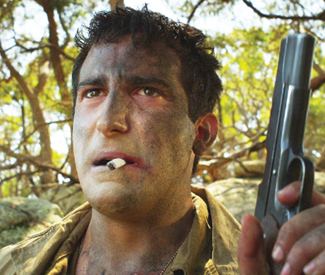
Speaking of wilderness terror and, alas, unsatisfying finales, retro-styled sci-fi adventure The 25th Reich screeches to a halt with a “to be continued” cliffhanger, just when shit is starting to get mind-blowingly insane. Argh! Fortunately, for the most part, the film — about a group of World War II soldiers who time-travel back and forth, squabbling among themselves as they pursue UFOs and Nazis — works just fine as a stand-alone, though its gleeful reliance on stereotypes (the Jew, the Italian, the Southern redneck, etc.) feels less like a nod to classic war films than a way to avoid actual character development.

The best gimmick centers on Captain O’ Brien, an erstwhile matinee idol not above reciting cornball lines from his own films at crucial moments. That he’s played by Jim Knobeloch — who also appeared in 2012’s other Nazi sci-fi flick, Iron Sky — is a perfect bit of obscure-genre synergy.

It wouldn’t be HoleHead without zombies. Comic The Living Corpse gets the (re-)animated treatment in The Amazing Adventures of the Living Corpse, which follows the titular beastie’s existential crisis after he — oops! — rips apart almost his entire family. Spared is a young son who is sent to a creepy boarding school for orphans, though he’s soon plucked from its halls to apprentice under a mad scientist. Meanwhile, the guilt-ridden corpse — real name: John Romero; memo to creative types: naming anyone “Romero” in your zombie-related whatnot is no longer a novel idea — roams the underworld and the land of the living, meting out occasional supernatural ass-kickings but mostly searching for his long-lost offspring.

The haunted-school scenes (complete with a kids vs. demons showdown) are clever, and the catchy soundtrack has punky flair, but the sheer number of plot threads nearly overwhelms the 82-minute film — maybe cool for fans of the comic, but viewers new to the material might wonder why, say, the “Spectral Protection Society” is elaborately introduced and then discarded. The overall effect is not nearly as fun (or “amazing”) as it should be.

Amazing, however, is one of many gushing adjectives I might use to describe my top pick of the festival: Mike Malloy’s Eurocrime! The Italian Cop and Gangster Films That Ruled the ’70s — a jazzy, lovingly-compiled homage to some of the trashiest, most mean-spirited films ever made. Everyone’s heard of Spaghetti Westerns, but poliziotteschi movies have yet to make a true cult breakthrough (or be remade by Quentin Tarantino, but I’m sure he’ll get there eventually). A groovy-sleazy score and endless clips, posters, and still shots set the tone for Eurocrime!, which gathers some of the genre’s biggest stars (laid-back John Saxon; gracious Franco Nero; bratty Antonio Sabàto) to look back at their years chasing each other across rooftops, brawling in junkyards, and working with directors like Umberto Lenzi (“the screaming-est director I ever met in my life,” according to actor Henry Silva).

The doc, a tad long at 137 minutes, also explores why the films became so popular, despite the fact that their scripts were often ripped wholesale from American “angry cop” films (and, later, from each other) — and why that popularity didn’t last (possible culprits: laughable dubbing, distracting mustaches, brutal violence against women). Newcomers won’t believe that such a world of insane film exists, longtime aficionados will dig the nostalgia, and both camps will enjoy Eurocrime!‘s high-energy appreciation of a genre long overdue for this kind of treatment. 

ANOTHER HOLE IN THE HEAD

Nov. 28-Dec.9, $10-$12

Various venues, SF

www.sfindie.com

Orexi

8

virginia@bayguardian.com

APPETITE West Portal has long warmed my heart. Maybe it’s the removed setting, tucked in the shadow of Twin Peaks where T line ends and the M emerges. Or it’s a sense of stepping back in time to a 1970s San Francisco, a sleepy area unfazed by trends and hipsterization. It’s a family neighborhood, residential and small town in feel — and like any corner of our city, has its food gems, like old school blue cheese buffalo burgers at charmingly dated Bulls Head, or vividly fresh sandwiches and salads at the original location of Market and Rye.

For the past couple months, West Portal residents have been flocking to Orexi, which has quickly made a name for itself and is bustling even on weeknights. It’s Greek… sadly a rarity in the Bay Area despite a plethora of Mediterranean eateries. The upscale Kokkari has long been the Greek queen of San Francisco (sister restaurant Evvia rules Palo Alto) and it has no equal. Downtown’s Ayola also offers Greek favorites, but on the cheaper side. Yet I find myself longing for restaurants like Taverna Kyclades in Astoria, Queens, a mid-range, family-style seafood Greek restaurant typical of New York City’s famed Greek neighborhood, convivial with families, rounds of crisp, Greek white wines, and platters of octopus and grilled fish.

Orexi is a step in the right direction — a comfortable, mid-range neighborhood Greek restaurant using quality ingredients. Owners John and Effie Loufas have created an approachable dining experience — I ate here a couple weeks after opening, returning again one month later to the same waiter who remembered a wine I ordered the month before and a busser who recalled the shirt my husband was wearing last visit. No wonder they’re securing repeat diners.

The understated dining room is chic rather than rustic, warm with a honeycomb-like wall hanging and mirrors reflecting the room’s glow. As for the food, first the bad news: grilled octopus ($11 — there’s also an octopus salad for $12.50), typically a favorite of mine, is a bit rubbery over arugula, while gigantes ($7) baked white beans, suffer from blandness but for a dousing of appropriately sweet-savory tomato sauce and crumbled feta on top.

My appetite (the meaning of the Greek word “orexi”) is satiated in unexpected places. House pita bread arrives humbly from the oven, belying its addictive nature, gratifying with small scoops of house dips ($6 each), my favorite being a salty taramosalata, a creamy, fish roe spread laden with olive oil and lemon. The eggplant dip, melitzanosalata, is a balanced expression of the vegetable’s smoky notes, while I wish tyrokafteri, a spicy feta spread dotted with jalapeno, was actually spicy.

Zucchini fritters ($7) with tzatziki (a tangy cucumber yoghurt dip) are a solid starter. Lamb riblets ($9) or lamb carpaccio ($10.75) step it up in tenderness and meaty (not gamey) flavor. In terms of entrees, I’m smitten with homey moussaka ($17). Layers of ground lamb and beef meld with allspice and stewed eggplant under creamy bechamel sauce, reminiscent of the melty, homemade lasagna of my childhood. Simple and also enticing, the “signature” rotisserie chicken ($17) is a generous half-bird (free range, thank you very much), over greens and unremarkable potatoes, marinated in lemon, oil, and spices, tender inside, with slightly crispy, oregano-laced skin.

In the mix with zippy Greek whites and California wines, the wine list holds a rare treat (and I always head straight for the unusual): retsina. Retsina ($6 a glass at Orexi) is a thousands year old Greek tradition of white or rose wine aromatized with pine resin (used to seal ancient wine vessels from excess oxygen). As you might imagine, pine resin gives the wine a foresty flavor, which some describe as turpentine or sap: “Not for everyone,” our waiter clarifies. Its herbal green notes work beautifully with the roasted chicken.

Orexi’s amiable welcome and candelit glow is comfortably gratifying, like slipping on a pair of slippers by the fire. Thankfully not about “the scene” or the next hot trend, the restaurant is about well-executed comfort food in a neglected category with effortless service paramount.

OREXI

Tue.-Thu., 5-9:30pm; Fri.-Sat. 5pm-10:30pm, Sun. 5pm-9:30pm, closed Mon.

243 W. Portal Ave.

415-664-6739

www.orexisf.com

MC, V

Wine

Subscribe to Virgina’s twice-monthly newsletter, The Perfect Spot, www.theperfectspotsf.com

All reflected

3

caitlin@sfbg.com

VISUAL ARTS Glossy and matte stripes alternate across the walls and floor of the 941 Geary gallery in the Tenderloin, occasionally illuminated by striking reflections from the exhibition’s 10 hanging canvases. These are perfectly symmetrical morphs of traditional letter-form graffiti, each done in Easter-ready pastels, save for a black-and-white tag that takes up one enormous gallery wall.

“I just want to continue painting different visions I have,” says the creator of this immersive art experience, visual artist Ricardo “Apex” Richey. He got his start tagging the streets of San Francisco in the early 1980s, perfecting his now-revered, precise hand forms inside Muni buses and walls around the city.

“Reflected,” this new solo show, plays on the entrance into the gallery world of an art form once done covertly on exterior walls. He’s taking graffiti and, like artists before him, skewing and reimagining it. “Abstracting the notion of Apex,” he tells me.

>>CHECK OUT OUR SLIDESHOW OF APEX’S ROOFTOP GALLERY AND SOME OF HIS TECHNICOLOR WORKS FROM AROUND THE SIXTH STREET NEIGHBORHOOD

With the current mania for street art-inspired pieces, Apex has been able to make a career of his work. He capitalizes on the legions of graff-nerd followers on his social networks, and his drive to refract and skew the recognizable shape of graffiti in endless ways. The 941 Geary show was inspired by an iPhone app that allowed him to mirror pre-existing works. After speaking with Justin Giarla, founder of 941 and the rest of the White Walls family of urban art galleries, the two decided the idea merited more exploration.

But during the same week “Reflection” opened, Apex’s personal life was morphing as well. After three years in an epic factory-cum-studio on Market and Sixth Street, his building was sold and he was out. Goodbye to its 13-foot ceilings and the rotating, 10-foot high windows that look out on Market.

http://vimeo.com/21421094

And goodbye to the museum he’d been curating upstairs on the roof, where SF street artists Chez and Neon had contributed massive works, among others. Painted vegetation by muralist Mona Caron curled to the sun in a piece one could nearly see from Trailhead, the pop-up cafe down the street in the Renoir Hotel whose back wall, by chance, is graced by a collaboration mural done by Caron and Apex.

If you wander around the Mid-Market neighborhood, it’s not hard to see that Apex spends his nights working in a neighborhood studio. He’s certainly left his mark. The first piece in the area was Yerba Buena Liquors’ sign, years ago. Since then he’s painted all over the place. The corner of Turk, Mason, and Market Streets is graced by a super-burner of his, a phrase coined to describe his pieces that use hundreds of hues of aerosol.

“I would love to stay there,” he tells me at his new FiDi day job (more on that in a sec.) “In that regard, this is kind of sad.” But Apex knew he was in the studio and roof space on borrowed time — rumors had swirled since he first moved in that the building was for sale. He sees the “gradient” of real estate prices, that Sixth Street was an anomaly in a ridiculously expensive city to live in.

“On one hand it sucks, on the other, I understand it. Overall, it’s better for the city.” He’s looking for a new space anywhere in the “industrial band” that loops between his old studio and Potrero Hill, hoping to get lucky with one of the city’s few remaining industrial spaces.

And, as his solo show is testament, he’s not letting the forced move stop him. That day job? He bought a coffee kiosk. The business is about him “trying to be mature,” he says, laughing as he talks about Otis Cafe, the Four Barrel-equipped stand he’s set up in the Otis Lounge nightclub entryway (25 Maiden, SF) where you can now find him weekdays from 7am to 3:30pm.

“This idea popped into my head,” he says. ‘Coffee cart, that’s a low end startup.” The Maiden Lane micro-‘hood lacks designer coffee, and on the day I visit, new regulars are already lining up.

For Apex, the kiosk is just product of a creative mind. “I feel very blessed, fortunate,” he muses. “Like, I’m an idea person. Painting, art allows me to get the most of those ideas to come to light.” The Otis Cafe sandwich board and cart bear Apex’s signature loops of color — a new home in the downtown area for the artist himself.

“REFLECTED”

Through Jan. 5

941 Geary, SF

(415) 931-2500

www.941geary.com


Event Listings

0

Listings compiled by George McIntire. Submit items for the listings at listings@sfbg.com. For further information on how to submit items for the listings, see Picks.

WEDNESDAY 28

The Guardian presents: GOLDIES Afterparty 111 Minna, SF. www.sfbg.com. 9pm, free. Perhaps you caught the paper a couple weeks ago — you know, the one with all the mega-talented rising art stars? That’d be the Goldies. Tonight, our honorees get their actual awards and to celebrate, we’re throwing a totally free, totally amazing afterparty featuring DJ Bus Station John and performances by Kat Marie Yoas, Mad Noise, and Dr. Zebrovski. Gold attire is encouraged, as are winter formal looks.

Grant 121: The Best of Young Brazilian Novelists Green Apple Books, 506 Clement Street, SF. (415) 387-2272, . 7pm, free. Brazil well on its way to becoming an economic super power, and it’s going to need some adept writers to chronicle its ascent. Scratch that, it already has plenty: Cristhiano Aguiar and Vinicius Jatoba are among their number. The two will be reading about modern Brazilian society from the latest issue of Granta Magazine.

Ferocious Reality Tosca Café, 242 Columbus, SF. (415) 986-9651, . 7-9pm, free. Eric Ames penned Ferocious Reality: Documentary according to Werner Herzog, an examination of more than 25 of Werner Herzog’s films. If you’re a Herzog head or simply curious about his work, come for a conversation and Q&A at this book-signing with Professor Ames.

THURSDAY 29

Collecting 2.0 Contemporary Jewish Museum, 736 Mission, SF. (415) 655-7800, . 6:30-8pm, free–$5. Does the Internet enhance or detract from experiencing art? How has the Internet affected our ability to collect art? These questions and others like them will be at the center of the discourse at this event where curators, gallerists, collectors, and other art world denizens will come together to expound on the Internet’s influence on modern creativity.

FRIDAY 30

SCRAP Art Fair Arc Gallery, 1246 Folsom, SF. (415) 298-7969, . Through January/9. Opening reception: 6:30-9pm, free. One person’s trash is another person’s art supply. Arc Gallery presents its fourth exhibition of creatively-used pieces of scrap taken from landfills and used as tools for art. The show’s purpose, however, isn’t just to say, “hey you can make art out of trash!” Rather, it expands our notion of where art can come from, and promotes reuse.

Call Me Home Gallery Carte Blanche, 973 Valencia, SF. (415) 821-1055, . Through Jan. 23. Opening reception: 6-9pm, free. If you’re a proud San Franciscan, check out this event to make your chest swell and tears surface. “Call Me Home: A Photographic Journey in San Francisco” is presented by the one-year old Carte Blanche Gallery and features the works of five photographers

SATURDAY 1

Paxton Gate Anniversary Party Paxton Gate, 824 Valencia, SF. (415) 824-1872, . 8-10pm, free. The eccentric shop will be celebrating two decades at its Valencia location in carnival-like fashion. Among the fanfare will be contortionists, stilt walkers, and the sounds of “Shovelman” in addition to an open bar of courtesy of Hendrick’s Gin.

Palestinian Gifts Bazaar Middle East Children’s Alliance, 1101 Eighth St., Berk. (510) 548-0542, . Also Sun/2, 10am-5pm, free. Come peruse this superb emporium of elegantly fashioned items from across the Middle East. If you got someone special in your life who lives from things like pure olive oil soap, exotic scarves & shawls, and hand-blown glassware, make sure you circle this event for your holiday shopping to-do list.

SUNDAY 2

Psychotherapy Institute Art Show and Sale Psychotherapy Institute, 2322 Carleton, Berk. (510) 548-2250, . Noon-5pm, free. Support local artists and the advancement of the study of psychotherapy at this art sale benefiting the Psychotherapy Institute of Berkeley. The event, which also celebrates the 40th anniversary of the institute, features work from artists like Joan Alexander, Jim Fishman, and Jane Reynolds.

Readings on Cinema: The Truman Show Pacific Film Archive Theater, 2575 Bancroft, Berk. (510) 642-1124, . 5:20pm, $5.50-13.50. I’m sure we’ve all had the feeling that each one of us is the star of our very own “Truman Show” because if someone else had his or her own Truman show, you’d know about it right? Well this feeling of screens staring at you is what motivated Bay Area film historian David Thomson to pen his latest book, The Big Screen: The Story of the Movies—and What They Have Done to US. In this book event Thomson plans to illustrate the concepts of his book via the existential comedy The Truman Show.

TUESDAY 4

Wood Shoppe Free Concert Series Brick and Mortar Music Hall, 1710 Mission, SF. (415) 371-1631, . 8pm, free. A free concert is like a 72 degree day in the city — you’ve just gotta take advantage. Participating in this free concert series occurring on the first Tuesday of every month is Oakland DIY pop outfit Trails and Ways, music theorist Cayucas, and garage psych-poppers The Tambo Rays.

Film Listings and Reviews

0

Film listings are edited by Cheryl Eddy. Reviewers are Kimberly Chun, Dennis Harvey, Lynn Rapoport, and Sara Vizcarrondo. For rep house showtimes, see Rep Clock.

OPENING

Back to 1942 Multiple storylines wend through Feng Xiaogang’s historical epic about a devastating drought that brought famine to China’s Henan province. Abandoned by their government, millions of refugees would eventually die in a situation compounded by corrupt officials, the Chinese army’s demands on the region’s nonexistent grain stores, and looming Japanese troops. The scenes from the road are grim, on both small (a desperate family tries to trade their child for grain) and larger (Japanese bombing raids, cannibalism) scales — though there are moments of hope, as when rival families put aside their differences to help a pregnant daughter. (Hope doesn’t last, though: when the baby is born, the half-dead mother mutters, “Kill it.”) Meanwhile, an American journalist (Adrien Brody) chases the story with the help of a priest (Tim Robbins, working a distracting accent); after witnessing horrors in Henan, his reporting helps nudge the government into action, however slightly. It would take an exceptionally even hand to prevent this heavily tragic material from sliding face first into melodrama, something Back to 1942 doesn’t even attempt to do. Whether you feel moved or manipulated is up to you. (2:26) Presidio. (Eddy)

The Collection A young woman is kidnapped by a torture-happy killer. (1:23)

Dragon Donnie Yen and Takeshi Kaneshiro star in this detective-meets-wuxia film set in 1917 China. (1:51)

Just 45 Minutes From Broadway Henry Jaglom’s latest is about a struggling actor who heads to upstate New York for a her eclectic family’s Passover Seder. (1:59) Roxie.

Killing Them Softly Lowest-level criminal fuckwits Frankie (Scoot McNairy) and Russell (Ben Mendelsohn) are hired to rob a mob gambling den, a task which miraculously they fail to blow. Nevertheless, the repercussions are swift and harsh, as a middleman suit (Richard Jenkins) to the unseen bosses brings in one hitman (Brad Pitt), who brings in another (James Gandolfini) to figure out who the thieves are and administer extreme justice. Based on a 1970s novel by George V. Higgins, this latest collaboration by Pitt and director-scenarist Andrew Dominik would appear superficially to be a surer commercial bet after the box-office failure of their last, 2007’s The Assassination of Jesse James By the Coward Robert Ford — one of the great films of the last decade. But if you’re looking for action thrills or even Guy Ritchie-style swaggering mantalk (though there is some of that), you’ll be disappointed to find Killing more in the abstracted crime drama arena of Drive (2011) or The American (2010), landing somewhere between the riveting former and the arid latter. This meticulously crafted tale is never less than compelling in imaginative direction and expert performance, but it still carries a certain unshakable air of so-what. Some may be turned off by just how vividly unpleasant Mendelsohn’s junkie and Gandolfini’s alchie are. Others will shrug at the wisdom of re-setting this story in the fall of 2008, with financial-infrastructure collapse and the hollow promise of President-elect Obama’s “Change” providing ironical background noise. It’s all a little too little, too soon. (1:37) Four Star, Marina. (Harvey)

Starlet Fresh off the bus from Florida, Jane (Dree Hemingway, daughter of the perennially undervalued Mariel) is living an indolent existence in the San Fernando Valley — it takes a while for us to realize she even has a job, albeit a pretty irregular and undemanding one. (Hint: What movie industry is largely based in the Valley? Second hint: It’s not the non-porn one.) Most of the time she just hangs about with her equally immature, similarly employed housemates, tanning and playing with her little dog. When a chance find at a yard sale yields a stash of hidden cash, Jane goes on a brief spending spree, then guiltily tries to return the remaining cash to Sadie (Besedka Johnson). The latter is an extra-cranky elderly woman who has no idea she’s missing any money and slams the door in Jane’s face before she can explain. Undaunted, perhaps needing some semblance of family in her vapid new life, Jane basically forces her friendship on the old lady, with eventual success albeit a few speed bumps. Sean Baker’s film is often an uncomfortable watch, because the dynamic between lead characters is so frequently awkward and discordant. (And also because the other major figures, Jane’s housemates played by Stella Maeve and James Ransome, are so completely obnoxious.) But its resistance to easy odd-couple sentimentality ultimately works to Starlet‘s favor, making the low key (like everything else here) close unexpectedly poignant. Real-life adult entertainment stars Manuel Ferrara and Asa Akira appear as themselves. (1:59) Opera Plaza, Shattuck. (Harvey)

ONGOING

Anna Karenina Joe Wright broke out of British TV with the 9,000th filmed Pride and Prejudice (2005), unnecessary but quite good. Too bad it immediately went to his head. His increasing showiness as director enlivened the silly teenage-superspy avenger fantasy Hanna (2011), but it started to get in the way of Atonement (2007), a fine book didn’t need camera gymnastics to make a great movie. Now it’s completely sunk a certified literary masterpiece still waiting for a worthy film adaptation. Keira Knightley plays the titular 19th century St. Petersburg aristocrat whose staid, happy-enough existence as a doting mother and dutiful wife (to deglammed Jude Law’s honorable but neglectful Karenin) is upended when she enters a mutually passionate affair with dashing military officer Count Vronsky (Aaron Taylor-Johnson, miscast). Scandal and tragedy ensue. There’s nothing wrong with the screenplay, by Tom Stoppard no less. What’s wrong is Wright’s bright idea of staging the whole shebang as if it were indeed staged — a theatrical production in which nearly everything (even a crucial horse race) takes place on a proscenium stage, in the auditorium, or “backstage” among riggings. Whenever we move into a “real” location, the director makes sure that transition draws attention to its own cleverness as possible. What, you might ask, is the point? That the public social mores and society Anna lives in are a sort of “acting”? Like wow. Add to that another brittle, mannered performance by Wright’s muse Knightley, and there’s no hope of involvement here, let alone empathy — in love with its empty (but very prettily designed) layers of artifice, this movie ends up suffocating all emotion in gilded horseshit. The reversed-fortune romance between Levin (Domhall Gleeson) and Kitty (Alicia Vikander) does work quite well — though since Tolstoy called his novel Anna Karenina, it’s a pretty bad sign when the subsidiary storyline ends up vastly more engaging than hers. (2:10) Albany, Metreon, Piedmont, Sundance Kabuki. (Harvey)

Argo If you didn’t know the particulars of the 1979 Iranian Revolution, you won’t be an expert after Argo, but the film does a good job of capturing America’s fearful reaction to the events that followed it — particularly the hostage crisis at the US embassy in Tehran. Argo zeroes in on the fate of six embassy staffers who managed to escape the building and flee to the home of the sympathetic Canadian ambassador (Victor Garber). Back in Washington, short-tempered CIA agents (including a top-notch Bryan Cranston) cast about for ways to rescue them. Enter Tony Mendez (Ben Affleck, who also directs), exfil specialist and father to a youngster wrapped up in the era’s sci-fi craze. While watching 1973’s Battle for the Planet of the Apes, Tony comes up with what Cranston’s character calls “the best bad idea we have:” the CIA will fund a phony Canadian movie production (corny, intergalactic, and titled Argo) and pretend the six are part of the crew, visiting Iran for a few days on a location shoot. Tony will sneak in, deliver the necessary fake-ID documents, and escort them out. Neither his superiors, nor the six in hiding, have much faith in the idea. (“Is this the part where we say, ‘It’s so crazy it just might work?'” someone asks, beating the cliché to the punch.) Argo never lets you forget that lives are at stake; every painstakingly forged form, every bluff past a checkpoint official increases the anxiety (to the point of being laid on a bit thick by the end). But though Affleck builds the needed suspense with gusto, Argo comes alive in its Hollywood scenes. As the show-biz veterans who mull over Tony’s plan with a mix of Tinseltown cynicism and patiotic duty, John Goodman and Alan Arkin practically burst with in-joke brio. I could have watched an entire movie just about those two. (2:00) 1000 Van Ness, SF Center, Sundance Kabuki. (Eddy)

The Big Picture Trading places, especially under sinister circumstances, seems unnervingly easy to do — if you’re the talented Mr. Ripley or The Big Picture‘s adorably scruffy bourgeois-on-the-run Paul (Romain Duris of 2005’s The Beat That My Heart Skipped). Coming from wealth and amiably going through the motions of upper-middle-class lawyerly life with his wife (Marina Fois) and kids, Paul is accustomed to relegating his love of photography to the sidelines as a hobby. So when photojournalist neighbor Gregoire (Eric Ruf) has a freakish accident, Paul throws himself down the rabbit hole of another man’s identity. Is it possible to completely start over — and is there a kind of freedom in death? Working from Douglas Kennedy’s novel, director and co-writer Eric Lartigau keeps his camera firmly fixed on his camera-wielding, metamorphosing lead, sidestepping the meta and going for the clearly Hitchcockian (though Hitch would probably reject the occasional cheesy slow-motion effect and reach for something more visually or technically audacious). To his credit, Lartigau keeps the audience guessing even beyond the credits, making this noir something of an artist’s parable, while Duris makes you root for his haunted, puppy-dog-ish Paul as he falls, finds his métier, and tumbles once more. (1:50) Embarcadero. (Chun)

Chasing Ice Even wild-eyed neocons might reconsider their declarations that global warming is a hoax after seeing the work of photographer James Balog, whose images of shrinking glaciers offer startling proof that our planet is indeed being ravaged by climate change (and it’s getting exponentially worse). Jeff Orlowski’s doc follows Balog and his Extreme Ice Survey team as they brave cruel elements in Iceland, Greenland, and Alaska, using time-lapse cameras to record glacier activity, some of it quite dramatic, over months and years. Balog is an affable subject, doggedly pursuing his work even after multiple knee surgeries make him a less-than-agile hiker, but it’s the photographs — as hauntingly beautiful as they are alarming — that make Chasing Ice so powerful. Could’ve done without Scarlett Johansson crooning over the end credits, though. (1:15) California, Embarcadero. (Eddy)

Cloud Atlas Cramming the six busy storylines of David Mitchell’s wildly ambitious novel into just three hours — the average reader might have thought at least 12 would be required — this impressive adaptation directed (in separate parts) by Tom Twyker (1998’s Run Lola Run) and Matrix siblings Lana and Andy Wachowski has a whole lot of narrative to get through, stretching around the globe and over centuries. In the mid 19th century, Jim Sturgess’ sickly American notory endures a long sea voyage as reluctant protector of a runaway-slave stowaway from the Chatham Islands (David Gyasi). In 1931 Belgium, a talented but criminally minded British musician (Ben Whishaw) wheedles his way into the household of a famous but long-inactive composer (Jim Broadbent). A chance encounter sets 1970s San Francisco journalist Luisa (Halle Berry) on the path of a massive cover-up conspiracy, swiftly putting her life in danger. Circa now, a reprobate London publisher’s (Broadbent) huge windfall turns into bad luck that gets even worse when he seeks help from his brother (Hugh Grant). In the not-so-distant future, a disposable “fabricant” server to the “consumer” classes (Doona Bae) finds herself plucked from her cog-like life for a rebellious higher purpose. Finally, in an indeterminately distant future after “the Fall,” an island tribesman (Tom Hanks) forms a highly ambivalent relationship toward a visitor (Berry) from a more advanced but dying civilization. Mitchell’s book was divided into huge novella-sized blocks, with each thread split in two; the film wastes very little time establishing its individual stories before beginning to rapidly intercut between them. That may result in a sense of information (and eventually action) overload, particularly for non-readers, even as it clarifies the connective tissues running throughout. Compression robs some episodes of the cumulative impact they had on the page; the starry multicasting (which in addition to the above mentioned finds many uses for Hugo Weaving, Keith David, James D’Arcy, and Susan Sarandon) can be a distraction; and there’s too much uplift forced on the six tales’ summation. Simply put, not everything here works; like the very different Watchmen, this is a rather brilliant “impossible adaptation” screenplay (by the directors) than nonetheless can’t help but be a bit too much. But so much does work — in alternating currents of satire, melodrama, pulp thriller, dystopian sci-fi, adventure, and so on — that Cloud Atlas must be forgiven for being imperfect. If it were perfect, it couldn’t possibly sprawl as imaginatively and challengingly as it does, and as mainstream movies very seldom do. (2:52) California, 1000 Van Ness, SF Center. (Harvey)

The Comedy Though it stars Adult Swim personalities Tim Heidecker and Eric Wareheim, and has a seemingly obvious title, The Comedy is not what you think it is. Prepare to cringe, be outraged, or (worst of all) be bored, as Heidecker’s character — a 35-year-old hipster whose schlubby appearance belies the fact that he’s swimming in inherited wealth — drifts around New York, provoking unsuspecting victims with his awkward, obnoxious behavior. He’s sarcastic, entitled, and appears to have no actual emotions. It’s possible that The Comedy (directed by Rick Alverson, who’s also credited as a co-writer, though I’d guess some of the film is improvised) is aiming to make a larger statement (generational malaise?), but the film is most notable for its sustained mood of who-gives-a-fuck-ness. Tight close-ups further underscore how self-centered the characters are, a choice designed to heighten the audience’s discomfort. You can’t engage with anyone in The Comedy, but neither can you look away. (1:34) Roxie. (Eddy)

The Flat Arnon Goldfinger’s The Flat begins as the filmmaker’s family descends upon the Tel Aviv apartment of his recently-deceased grandmother, “a bit of a hoarder” who lived to 95 and seemingly never got rid of anything. This includes, as Goldfinger discovers, copies of the Joseph Goebbels-founded newspaper Der Angriff, containing articles about “the Nazi who visited Palestine.” The Nazi was Leopold von Mildenstein, an SS officer with an interest in Zionism. Turns out he made the journey in 1933 with his wife and a Jewish couple named Kurt and Gerda Tuchler — Goldfinger’s grandparents. Understandably intrigued and more than a little baffled, Goldfinger investigates, finding letters and diary entries that reveal the unlikely traveling companions were close friends, even after World War II. His mother, the Tuchler’s daughter, prefers to “keep the past out,” but curiosity (and the pursuit of a good documentary) presses Goldfinger forward; he visits von Mildenstein’s elderly daughter in Germany, digs through German archives, and unearths even more suprises about his family tree. Broader themes about guilt and denial emerge — post-traumatic coping mechanisms that echo through generations.

(1:37) Opera Plaza. (Eddy)

Flight To twist the words of one troubled balladeer, he believes he can fly, he believes he can touch the sky. Unfortunately for Denzel Washington’s Whip Whitaker, another less savory connotation applies: his semi-sketchy airline captain is sailing on the overconfidence that comes with billowing clouds of blow. Beware the quickie TV spot — and Washington’s heroic stance in the poster — that plays this as a quasi-action flick: Flight is really about a man’s efforts to escape responsibility and his flight from facing his own addiction. It also sees Washington once again doing what he does so well: wrestling with the demons of a charismatic yet deeply flawed protagonist. We come upon Whip as he’s rousing himself from yet another bender, balancing himself out with a couple lines with a gorgeous, enabling flight attendant by his side. It’s a checks-and-balances routine we’re led to believe is business as usual, as he slides confidently into the cockpit, gives the passengers a good scare by charging through turbulence, and proceeds to doze off. The plane, however, goes into fail mode and forces the pilot to improvise brilliantly and kick into hero mode, though he can’t fly from his cover, which is slowly blown despite the ministrations of kindred addict Nicole (Kelly Reilly) and dealer Harling (John Goodman at his most ebullient) and the defensive moves of his pilots union cohort (Bruce Greenwood) and the airline’s lawyer (Don Cheadle). How can Whip fly out of the particular jam called his life? Working with what he’s given, Washington summons reserves of humanity, though he’s ultimately failed by John Gatins’ sanctimonious, recovery-by-the-numbers script and the tendency of seasoned director Robert Zemeckis to blithely skip over the personal history and background details that would have more completely filled out our picture of Whip. We’re left grasping for the highs, waiting for the instances that Harling sails into view and Whip tumbles off the wagon. (2:18) 1000 Van Ness, SF Center, Sundance Kabuki. (Chun)

Hitchcock On the heels of last year’s My Week With Marilyn comes another biopic about an instantly recognizable celebrity viewed through the lens of a specific film shoot. Here, we have Anthony Hopkins (padded and prosthetic’d) playing the Master of Suspense, mulling over which project to pursue after the success of 1959’s North by Northwest. Even if you’re not a Hitch buff, it’s clear from the first scene that Psycho, based on Robert Bloch’s true crime-inspired pulpy thriller, is looming. We open on “Ed Gein’s Farmhouse, 1944;” Gein (Michael Wincott) is seen in his yard, his various heinous crimes — murder, grave-robbing, body-part hoarding, human-skin-mask crafting, etc. — as yet undiscovered. Hitchcock, portrayed by the guy who also played the Gein-inspired Hannibal Lecter, steps into the frame with that familiar droll greeting: “Guhhd eevvveeeening.” And we’re off, following the veteran director as he muses “What if somebody really good made a horror picture?” Though his wife and collaborator, Alma (Helen Mirren), cautions him against doing something simply because everyone tells him not to, he plows ahead; the filmmaking scenes are peppered with behind-the-scenes moments detailed in Stephen Rebello’s Alfred Hitchcock and the Making of Psycho, the source material for John J. McLaughlin’s script. But as the film’s tagline — “Behind every Psycho is a great woman” — suggests, the relationship between Alma and Hitch is, stubbornly, Hitchcock‘s main focus. While Mirren is effective (and I’m all for seeing a lady who works hard behind the scenes get recognition), the Hitch-at-home subplot exists only to shoehorn more conflict into a tale that’s got plenty already. Elsewhere, however, Hitchcock director Sacha Gervasi — making his narrative debut after hit 2008 doc Anvil: The Story of Anvil — shows stylistic flair, working Hitchcock references into the mise-en-scène. (1:32) California, Metreon, Sundance Kabuki. (Eddy)

Holy Motors Holy moly. Offbeat auteur Leos Carax (1999’s Pola X) and frequent star Denis Lavant (1991’s Lovers on the Bridge) collaborate on one of the most bizarrely wonderful films of the year, or any year. Oscar (Lavant) spends every day riding around Paris in a white limo driven by Céline (Edith Scob, whose eerie role in 1960’s Eyes Without a Face is freely referenced here). After making use of the car’s full complement of wigs, theatrical make-up, and costumes, he emerges for “appointments” with unseen “clients,” who apparently observe each vignette as it happens. And don’t even try to predict what’s coming next, or decipher what it all means, beyond an investigation of identity so original you won’t believe your eyes. This wickedly humorous trip through motion-capture suits, graveyard photo shoots, teen angst, back-alley gangsters, old age, and more (yep, that’s the theme from 1954’s Godzilla you hear; oh, and yep, that’s pop star Kylie Minogue) is equal parts disturbing and delightful. Movies don’t get more original or memorable than this. (1:56) Embarcadero. (Eddy)

A Late Quartet Philip Seymour Hoffman is fed up playing second fiddle — literally. He stars in this grown-up soap opera about the internal dramas of a world-class string quartet. While the group is preparing for its 25th season, the eldest member (Christopher Walken) is diagnosed with early stage Parkinson’s. As he’s the base note in the quartet, his retirement challenges the group’s future, not just his own. Hoffman’s second violinist sees the transition as an opportunity to challenge the first violin (Mark Ivanir) for an occasional Alpha role. When his wife, the quartet’s viola player (Catherine Keener), disagrees, it’s a slight (“You think I’m not good enough?”) and a betrayal because prior to their marriage, viola and first violin would “duet” if you get my meaning. This becomes a grody aside when Hoffman and Keener’s violin prodigy daughter (Imogen Poots) falls for her mother’s old beau and Hoffman challenges their marriage with a flamenco dancer. These quiet people finds ways to use some loud instruments (a flamenco dancer, really?) and the music as well as the views of Manhattan create a deeply settled feeling of comfort in the cold —insulation can be a dangerous thing. When we see (real world) cellist Nina Lee play, and her full body interacts with a drama as big as vaudeville, we see what tension was left out of the playing and forced into the incestuous “family” conflicts. In A Late Quartet, pleasures are great and atmosphere, heavy. You couldn’t find a better advertisement for this symphonic season; I wanted to buy tickets immediately. And also vowed to stay away from musicians. (1:45) Albany, Opera Plaza, Smith Rafael. (Vizcarrondo)

Life of Pi Several filmmakers including Alfonso Cuarón, Jean-Pierre Jeunet, and M. Night Shyamalan had a crack at Yann Martel’s “unfilmable” novel over the last decade, without success. That turns out to have been a very good thing, since Ang Lee and scenarist David Magee have made probably the best movie possible from the material — arguably even an improvement on it. Framed as the adult protagonist’s (Irrfan Khan) lengthy reminiscence to an interested writer (Rafe Spall) it chronicles his youthful experience accompanying his family and animals from their just shuttered zoo on a cargo ship voyage from India to Canada. But a storm capsizes the vessel, stranding teenaged Pi (Suraj Sharma) on a lifeboat with a mini menagerie — albeit one swiftly reduced by the food chain in action to one Richard Parker, a whimsically named Bengal tiger. This uneasy forced cohabitation between Hindu vegetarian and instinctual carnivore is an object lesson in survival as well as a fable about the existence of God, among other things. Shot in 3D, the movie has plenty of enchanted, original imagery, though its outstanding technical accomplishment may lie more in the application of CGI (rather than stereoscopic photography) to something reasonably intelligent for a change. First-time actor Sharma is a natural, while his costar gives the most remarkable performance by a wild animal this side of Joaquin Phoenix in The Master. It’s not a perfect film, but it’s a charmed, lovely experience. (2:00) Balboa, Metreon, 1000 Van Ness, Presidio, Sundance Kabuki. (Harvey)

Lincoln Distinguished subject matter and an A+ production team (Steven Spielberg directing, Daniel Day-Lewis starring, Tony Kushner adapting Doris Kearns Goodwin, John Williams scoring every emotion juuust so) mean Lincoln delivers about what you’d expect: a compelling (if verbose), emotionally resonant (and somehow suspenseful) dramatization of President Lincoln’s push to get the 13th amendment passed before the start of his second term. America’s neck-deep in the Civil War, and Congress, though now without Southern representation, is profoundly divided on the issue of abolition. Spielberg recreates 1865 Washington as a vibrant, exciting place, albeit one filled with so many recognizable stars it’s almost distracting wondering who’ll pop up in the next scene: Jared Harris as Ulysses S. Grant! Joseph Gordon-Levitt as Robert Lincoln! Lena Dunham’s shirtless boyfriend on Girls (Adam Driver) as a soldier! Most notable among the huge cast are John Hawkes, Tim Blake Nelson, and a daffy James Spader as a trio of lobbyists; Sally Field as the troubled First Lady; and likely Oscar contenders Tommy Lee Jones (as winningly cranky Rep. Thaddeus Stevens) and Day-Lewis, who does a reliably great job of disappearing into his iconic role. (2:30) 1000 Van Ness, Presidio, SF Center, Shattuck, Sundance Kabuki. (Eddy)

The Other Son The plot of ABC Family’s Switched at Birth gets a politically-minded makeover in Lorraine Lévy’s The Other Son, in which the mixed-up teens represent both sides of the Israel-Palestine conflict. When mop-topped wannabe rocker Joseph (Jules Sitruk) dutifully signs up for Israeli military duty, the required blood test reveals he’s not the biological son of his parents. Understandably freaked out, his French-Israeli mother (Emmanuelle Devos) finds out that a hospital error during a Gulf War-era evacuation meant she and husband Alon (Pascal Elbé) went home with the wrong infant — and their child, aspiring doctor Yacine (Medhi Dehbi), was raised instead by a Palestinian couple (Areen Omari, Khalifia Natour). It’s a highly-charged situation on many levels (“Am I still Jewish?”, a tearful Joseph asks; “Have fun with the occupying forces?”, Yacine’s bitter brother inquires after his family visits Joseph in Tel Aviv), and potential for melodrama is sky-high. Fortunately, director and co-writer Levy handles the subject with admirable sensitivity, and the film is further buoyed by strong performances. (1:53) Smith Rafael. (Eddy)

The Perks of Being a Wallflower Move over, Diary of a Wimpy Kid series — there’s a new shrinking-violet social outcast in town. These days, life might not suck quite so hard for 90-pound weaklings in every age category, what with so many films and TV shows exposing, and sometimes even celebrating, the many miseries of childhood and adolescence for all to see. In this case, Perks author Stephen Chbosky takes on the directorial duties — both a good and bad thing, much like the teen years. Smart, shy Charlie is starting high school with a host of issues: he’s painfully awkward and very alone in the brutal throng, his only friend just committed suicide, and his only simpatico family member was killed in a car accident. Charlie’s English teacher Mr. Andersen (Paul Rudd) appears to be his only connection, until the freshman strikes up a conversation with feline, charismatic, shop-class jester Patrick (Ezra Miller) and his magnetic, music- and fun-loving stepsister Sam (Emma Watson). Who needs the popular kids? The witty duo head up their gang of coolly uncool outcasts their own, the Wallflowers (not to be confused with the deeply uncool Jakob Dylan combo), and with them, Charlie appears to have found his tribe. Only a few small secrets put a damper on matters: Patrick happens to be gay and involved with football player Brad (Johnny Simmons), who’s saddled with a violently conservative father, and Charlie is in love with the already-hooked-up Sam and is frightened that his fragile equilibrium will be destroyed when his new besties graduate and slip out of his life. Displaying empathy and a devotion to emotional truth, Chbosky takes good care of his characters, preserving the complexity and ungainly quirks of their not-so-cartoonish suburbia, though his limitations as a director come to the fore in the murkiness and choppily handled climax that reveals how damaged Charlie truly is. (1:43) Bridge, Embarcadero, Shattuck. (Chun)

Pitch Perfect As an all-female college a cappella group known as the Barden Bellas launches into Ace of Base’s “The Sign” during the prologue of Pitch Perfect, you can hear the Glee-meets-Bring It On elevator pitch. Which is fine, since Bring It On-meets-anything is clearly worth a shot. In this attempt, Anna Kendrick stars as withdrawn and disaffected college freshman Beca, who dreams of producing music in L.A. but is begrudgingly getting a free ride at Barden University via her comp lit professor father. Clearly his goal is not making sure she receives a liberal arts education, as Barden’s academic jungle extends to the edges of the campus’s competitive a cappella scene, and the closest thing to an intellectual challenge occurs during a “riff-off” between a cappella gangs at the bottom of a mysteriously drained swimming pool. When Beca reluctantly joins the Bellas, she finds herself caring enough about the group’s fate to push for an Ace of Base moratorium and radical steps like performing mashups. Much as 2000’s Bring It On coined terms like “cheerocracy” and “having cheer-sex,” Pitch Perfect gives us the infinitely applicable prefix “a ca-” and descriptives like “getting Treble-boned,” a reference to forbidden sexual relations with the Bellas’ cocky rivals, the Treblemakers. The gags get funnier, dirtier, and weirder, arguably reaching their climax in projectile-vomit snow angels, with Elizabeth Banks and John Michael Higgins as grin-panning competition commentators offering a string of loopily inappropriate observations. (1:52) Metreon. (Rapoport)

Red Dawn A remake of a 1984 movie that seemed a pretty nutty ideological throwback even during the Reagan Era’s revived Cold War air conditioning, Red Dawn should have come out a couple years ago, having been shot late 2009. But in the meantime MGM was undergoing yet another seismic financial rupture, and as the film sat around for lack of the means needed for distribution and marketing, it occurred that perhaps it already had a fatal, internal flaw. You see, this update re-cast our invaders from Russkies to People’s Republicans, tapping into the modern fear of China as debtor and international bully. But: China is also a huge fledgling market for Hollywood product. So a tortured makeover of the remake ensued; scenes were added, re-shot, and digitally altered to impose a drastic narrative change. The new villain is absurd it gets acknowledged as such by dialogue: “North Korea? It doesn’t make any sense!” Yup, in the new Red Dawn a coastal Washington state burg is the first attack point in a wholesale invasion of the U.S. (pop. 315 million) by the Democratic People’s Republic (pop. 25 million). It’s football season, so a Spokane suburb’s team — Wolverines!! — lends its name as battle cry and its revved up healthy young flesh as guerilla martyrs to the fight for, ohm yeah, freedom. Do they drink beer? Do they rescue cheerleader girlfriends from concentration camps? Do they kick North Korean ass? Do you really need to ask? (1:34) Metreon, 1000 Van Ness. (Harvey)

Rise of the Guardians There’s nothing so camp as “Heat Miser” from The Year Without a Santa Claus (1974) in Rise of the Guardians,, but there’s plenty here to charm all ages. The mystery at its center: we open on Jack Frost (voiced by Chris Pine) being born, pulled from the depths of a frozen pond by the Man on the Moon and destined to spread ice and cold everywhere he goes, invisible to all living creatures. It’s an individualistic yet lonely lot for Jack, who’s styled as an impish snowboarder in a hoodie and armed with an icy scepter, until the Guardians — spirits like North/Santa Claus (Alec Baldwin), the Tooth Fairy (Isla Fisher), and the Easter Bunny (Hugh Jackman) — call on him to join them. Pitch the Boogeyman (Jude Law) is threatening to snuff out all children’s hopes and dreams with fears and nightmares, and it’s up to the Guardians must keep belief in magic alive. But what’s in it for Jack, except the most important thing: namely who is he and what is his origin story? Director Peter Ramsey keeps those fragile dreams aloft with scenes awash with motion and animation that evokes the chubby figures and cozy warm tones of ’70s European storybooks. And though Pine verges on blandness with his vocal performance, Baldwin, Jackman, and Fisher winningly deliver the jokes. (1:38) Balboa, Metreon, 1000 Van Ness. (Chun)

A Royal Affair At age 15 in 1766, British princess Caroline (Alicia Vikander) travels abroad to a new life — as queen to the new ruler of Denmark, her cousin. Attractive and accomplished, she is judged a great success by everyone but her husband. King Christian (Mikkel Boe Følsgaard) is just a teenager himself, albeit one whose mental illness makes him behave alternately like a debauched libertine, a rude two year-old, a sulky-rebellious adolescent, and a plain old abusive spouse. Once her principal official duty is fulfilled — bearing a male heir — the two do their best to avoid each other. But on a tour of Europe Christian meets German doctor Johann Friedrich Struenesse (Mads Mikkelsen), a true man of the Enlightenment who not only has advanced notions about calming the monarch’s “eccentricities,” but proves a tolerant and agreeable royal companion. Lured back to Denmark as the King’s personal physician, he soon infects the cultured Queen with the fervor of his progressive ideas, while the two find themselves mutually attracted on less intellectual levels as well. When they start manipulating their unstable but malleable ruler to push much-needed public reforms through in the still basically feudal nation, they begin acquiring powerful enemies. This very handsome-looking history lesson highlights a chapter relatively little-known here, and finds in it an interesting juncture in the eternal battle between masters and servants, the piously self-interested and the secular humanists. At the same time, Nikolaj Arcel’s impressively mounted and acted film is also somewhat pedestrian and overlong. It’s a quality costume drama, but not a great one. (2:17) Clay, Smith Rafael. (Harvey)

Searching for Sugar Man The tale of the lost, and increasingly found, artist known as Rodriguez seems to have it all: the mystery and drama of myth, beginning with the singer-songwriter’s stunning 1970 debut, Cold Fact, a neglected folk rock-psychedelic masterwork. (The record never sold in the states, but somehow became a beloved, canonical LP in South Africa.) The story goes on to parse the cold, hard facts of vanished hopes and unpaid royalties, all too familiar in pop tragedies. In Searching for Sugar Man, Swedish documentarian Malik Bendjelloul lays out the ballad of Rodriguez as a rock’n’roll detective story, with two South African music lovers in hot pursuit of the elusive musician — long-rumored to have died onstage by either self-immolation or gunshot, and whose music spoke to a generation of white activists struggling to overturn apartheid. By the time Rodriguez himself enters the narrative, the film has taken on a fairy-tale trajectory; the end result speaks volumes about the power and longevity of great songwriting. (1:25) Opera Plaza. (Chun)

The Sessions Polio has long since paralyzed the body of Berkeley poet Mark O’Brien (John Hawkes) from the neck down. Of course his mind is free to roam — but it often roams south of the personal equator, where he hasn’t had the same opportunities as able-bodied people. Thus he enlists the services of Cheryl (Helen Hunt), a professional sex surrogate, to lose his virginity at last. Based on the real-life figures’ experiences, this drama by Australian polio survivor Ben Lewin was a big hit at Sundance this year (then titled The Surrogate), and it’s not hard to see why: this is one of those rare inspirational feel-good stories that doesn’t pander and earns its tears with honest emotional toil. Hawkes is always arresting, but Hunt hasn’t been this good in a long time, and William H. Macy is pure pleasure as a sympathetic priest put in numerous awkward positions with the Lord by Mark’s very down-to-earth questions and confessions. (1:35) Embarcadero, Piedmont, Shattuck. (Harvey)

Seven Psychopaths Those nostalgic for 1990s-style chatty assassins will find much to love in the broadly sketched Seven Psychopaths. Director-writer Martin McDonough already dipped a pen into Tarantino’s blood-splattered ink well with his 2008 debut feature, In Bruges, and Seven Psychopaths reads as larkier and more off-the-cuff, as the award-winning Irish playwright continues to try to find his own discomfiting, teasing balance between goofy Grand Guignol yuks and meta-minded storytelling. Structured, sort of, with the certified lucidity of a thrill killer, Seven Psychopaths opens on Boardwalk Empire heavies Michael Pitt and Michael Stuhlbarg bantering about the terrors of getting shot in the eyeball, while waiting to “kill a chick.” The talky twosome don’t seem capable of harming a fat hen, in the face of the Jack of Spades serial killer, who happens to be Psychopath No. One and a serial destroyer of hired guns. The key to the rest of the psychopathic gang is locked in the noggin of screenwriter Marty (Colin Farrell), who’s grappling with a major block and attempting the seeming impossible task of creating a peace-loving, Buddhist killer. Looking on are his girlfriend Kaya (Abbie Cornish) and actor best friend Billy (Sam Rockwell), who has a lucrative side gig as a dog kidnapper — and reward snatcher — with the dapper Hans (Christopher Walken). A teensy bit too enthusiastic about Marty’s screenplay, Billy displays a talent for stumbling over psychos, reeling in Zachariah (Tom Waits) and, on his doggie-grabbing adventures, Shih Tzu-loving gangster Charlie (Woody Harrelson). Unrest assured, leitmotifs from McDonough plays — like a preoccupation with fiction-making (The Pillowman) and the coupling of pet-loving sentimentality and primal violence (The Lieutenant of Inishmore) — crop up in Seven Psychopaths, though in rougher, less refined form, and sprinkled with a nervous, bromantic anxiety that barely skirts homophobia. Best to bask in the cute, dumb pleasures of a saucer-eyed lap dog and the considerably more mental joys of this cast, headed up by dear dog hunter Walken, who can still stir terror with just a withering gaze and a voice that can peel the finish off a watch. (1:45) Metreon. (Chun)

Silver Linings Playbook After guiding two actors to Best Supporting Oscars in 2010’s The Fighter, director David O. Russell returns (adapting his script from Matthew Quick’s novel) with another darkly comedic film about a complicated family that will probably earn some gold of its own. Though he’s obviously not ready to face the outside world, Pat (Bradley Cooper) checks out of the state institution he’s been court-ordered to spend eight months in after displaying some serious anger-management issues. He moves home with his football-obsessed father (Robert De Niro) and worrywart mother (Jacki Weaver of 2010’s Animal Kingdom), where he plunges into a plan to win back his estranged wife. Cooper plays Pat as a man vibrating with troubled energy — always in danger of flying into a rage, even as he pursues his forced-upbeat “silver linings” philosophy. But the movie belongs to Jennifer Lawrence, who proves the chops she showcased (pre-Hunger Games megafame) in 2010’s Winter’s Bone were no fluke. As the damaged-but-determined Tiffany, she’s the left-field element that jolts Pat out of his crazytown funk; she’s also the only reason Playbook‘s dance-competition subplot doesn’t feel eye-rollingly clichéd. The film’s not perfect, but Lawrence’s layered performance — emotional, demanding, bitchy, tough-yet-secretly-tender — damn near is. (2:01) Piedmont, SF Center, Shattuck. (Eddy)

Skyfall Top marks to Adele, who delivers a magnificent title song to cap off Skyfall‘s thrilling pre-credits chase scene. Unfortunate, then, that the film that follows squanders its initial promise. After a bomb attack on MI6, the clock is running out for Bond (Daniel Craig) and M (Judi Dench), accused of Cold War irrelevancy in a 21st century full of malevolent, stateless computer hackers. The audience, too, will yearn for a return to simpler times; dialogue about “firewalls” and “obfuscated code” never fails to sound faintly ridiculous, despite the efforts Ben Whishaw as the youthful new head of Q branch. Javier Bardem is creative and creepy as keyboard-tapping villain Raoul Silva, but would have done better with a megalomaniac scheme to take over the world. Instead, a small-potatoes revenge plot limps to a dull conclusion in the middle of nowhere. Skyfall never decides whether it prefers action, bons mots, and in-jokes to ponderous mythologizing and ripped-from-the-headlines speechifying — the result is a unsatisfying, uneven mixture. (2:23) Four Star, Marina, Metreon, 1000 Van Ness, Shattuck, Sundance Kabuki, Vogue. (Ben Richardson)

Taken 2 Surprise hit Taken (2008) was a soap opera produced by French action master Luc Besson and designed for export. The divorced-dad-saves-daughter-from-sex-slavery plot may have nagged at some universal parenting anxieties, but it was a Movie of the Week melodrama made on a major movie budget. Taken 2 begins immediately after the last, with sweet teen Kim (Maggie Grace) talking about normalizing after she was drugged and bought for booty. Papa Neeson sees Kim’s mom (Famke Janssen) losing her grip on husband number two and invites them both to holiday in Istanbul following one of his high-stakes security gigs. When the assistant with the money slinks him a fat envelope, Neeson chuckles at his haul. This is the point when women in the audience choose which Neeson they’re watching: the understated super-provider or the warrior-dad whose sense of duty can meet no match. For family men, this is the breeziest bit of vicarious living available; Neeson’s character is a tireless daddy duelist, a man as diligent as he is organized. (This is guy who screams “Victory loves preparation!”) As head-splitting, disorienting, and generally exhausting as the action direction is, Neeson saves his ex-wife and the show in a stream of unclear shootouts. Taken 2 is best suited for the small screen, but whatever the size, no one can stop an international slave trade (or wolves, or Batman) like 21st century Liam. Swoon. (1:31) Metreon. (Vizcarrondo)

The Twilight Saga: Breaking Dawn – Part 2 The final installment of the Twilight franchise picks up shortly after the medical-emergency vampirization of last year’s Breaking Dawn – Part 1, giving newly undead Bella Swan (Kristen Stewart) just enough time to freshen up after nearly being torn asunder during labor by her hybrid spawn, Renesmee. In a just world, Bella and soul mate Edward Cullen (Robert Pattinson) would get more of a honeymoon period, given how badly Part 1‘s actual honeymoon turned out. Alas, there’s just enough time for some soft-focus vampire-on-vampire action (a letdown after all the talk of rowdy undead sex), some catamount hunting, some werewolf posturing, a reunion with Jacob (Taylor Lautner), and a few seconds of Cullen family bonding, and then those creepy Volturi are back, convinced that the Cullens have committed a vampire capital crime and ready to exact penance. Director Bill Condon (1998’s Gods and Monsters, 2004’s Kinsey) knows what the Twi-hards want and methodically doles it out, but the overall effect is less sweeping action and shivery romance and more “I have bugs crawling on me — and yet I’m bored.” Some of that isn’t his fault — he bears no responsibility for naming Renesmee, for instance, to say nothing of a January-May subplot that we’re asked to wrap our brains around. But the film maintains such a loose emotional grip, shifting clumsily and robotically from comic interludes to unintentionally comic interludes to soaring-music love scenes to attempted pathos to a snowy battlefield where the only moment of any dramatic value occurs. Weighed down by the responsibility of bringing The Twilight Saga to a close, it limps weakly to its anticlimax, leaving one almost — but not quite — wishing for one more installment, a chance for a more stirring farewell. (1:55) Metreon, 1000 Van Ness, Presidio, Sundance Kabuki. (Rapoport)

Wreck-It Ralph Wreck-It Ralph cribs directly from the Toy Story series: when the lights go off in the arcade, video game characters gather to eat, drink, and endure existential crises. John C. Reilly is likable and idiosyncratic as Ralph, the hulking, ham-fisted villain of a game called Fix-It-Felix. Fed up with being the bad guy, Ralph sneaks into gritty combat sim Hero’s Duty under the nose of Sergeant Calhoun (Jane Lynch), a blond space marine who mixes Mass Effect‘s Commander Shepard with a PG-rated R. Lee Ermey. Things go quickly awry, and soon Ralph is marooned in cart-racing candyland Sugar Rush, helping Vanellope Von Schweetz (a manic Sarah Silverman), with Calhoun and opposite number Felix (Jack McBrayer) hot on his heels. Though often aggressively childish, the humor will amuse kids, parents, and occasionally gamers, and the Disney-approved message about acceptance is moving without being maudlin. The animation, limber enough to portray 30 years of changing video game graphics, deserves special praise. (1:34) Metreon, 1000 Van Ness, Shattuck. (Ben Richardson)


Stage Listings

0

Stage listings are compiled by Guardian staff. Performance times may change; call venues to confirm. Reviewers are Robert Avila, Rita Felciano, and Nicole Gluckstern. Submit items for the listings at listings@sfbg.com. For further information on how to submit items for the listings, see Picks.

THEATER

OPENING

A Christmas Carol Geary Theater, 415 Geary, SF; www.act-sf.org. $20-95. Opens Fri/30, 7pm. Runs Tue-Sat, 7pm (no evening performance Dec 6, 11, or 18; also 2pm matinees Sat/1, Dec 8, 12, 15, 21, and 22; Sun, 5:30pm (also 1pm matinees Dec 9, 16, 23); Dec 24, 1pm. Through Dec 24. American Conservatory Theater’s annual holiday performance features James Carpenter as Scrooge.

The Marvelous Wonderettes New Conservatory Theatre Center, 25 Van Ness, SF; www.nctcsf.org. $27-46. Previews Fri/30-Sat/1 and Dec 5-7, 8pm; Sun/2, 2pm. Opens Dec 8, 8pm. Runs Wed-Sat, 8pm; Sun, 2pm (no show Dec 23). Through Jan 13. New Conservatory Theatre Center performs Roger Bean’s 1950s pop-hit musical.

The New California Traveling Jewish Theater, 470 Florida, SF; www.pianofight.com. $20-25. Opens Wed/28, 8pm. Runs Wed, 8pm. Through Dec 19. PianoFight Productions’ female-centric sketch comedy group ForePlays presents an all-new variety show.

Pal Joey Eureka Theatre, 215 Jackson, SF; www.42ndstreetmoon.org. $25-75. Previews Wed/28, 7pm; Thu/29-Fri/30, 8pm. Opens Sat/1, 6pm. Runs Wed, 7pm; Thu-Fri, 8pm; Sat, 6pm; Sun, 3pm. Through Dec 16. 42nd Street Moon performs the Rodgers and Hart classic.

BAY AREA

Big River TheatreWorks, 1305 Middlefield, Palo Alto; www.theatreworks.org. $23-73. Previews Wed/28, 7:30pm; Thu/29-Fri/30, 8pm. Opens Sat/1, 2 and 8pm. Runs Tue-Wed, 7:30pm; Thu-Sat, 8pm (also Sat, 2pm); Sun, 2 and 7pm. Through Dec 30. TheatreWorks performs the Tony-winning musical based on Mark Twain’s Huck Finn stories.

Dracula Berkeley Community Church, 1802 Fairview, Berk; www.infernotheatre.org. $12-25. Opens Thu/29, 8pm. Runs Thu and Sat-Sun, 8pm; Fri, 9pm. Though Dec 16. Inferno Theatre Company performs Giulio Cesare Perrone’s adaptation of the Bram Stoker classic.

Woyzeck Ashby Stage, 1901 Ashby, Berk; www.shotgunplayers.org. $23-35. Previews Thu/29 and Dec 5-6, 7pm; Fri/30-Sat/1, 8pm; Sun/2, 5pm. Opens Dec 7, 8pm. Runs Wed-Thu, 7pm; Fri-Sat, 8pm; Sun, 5pm. Through Jan 27. Shotgun Players presents Tom Waits, Kathleen Brennan, and Robert Wilson’s tragic musical, based on an unfinished 1837 play by Georg Büchner.

ONGOING

Foodies! The Musical Shelton Theater, 533 Sutter, SF; www.foodiesthemusical.com. $30-34. Fri-Sat, 8pm. Open-ended. AWAT Productions presents Morris Bobrow’s musical comedy revue all about food.

History: The Musical Un-Scripted Theater, 533 Sutter, SF; www.un-scripted.com. $10-20. Thu-Sat, 8pm. Through Dec 22. The Un-Scripted Theater Company performs “an unscripted romp through Western history.”

Hysterical, Historical San Francisco: Holiday Edition Alcove Theater, 414 Mason, Ste 502, SF; www.thealcovetheater.com. $25-40. Fri-Sat and Dec 26-31, 9pm. Through Dec 31. Comedian Kurt Weitzmann takes on San Francisco history, adding some holiday flair along the way.

The Rainmaker Shelton Theater, 533 Sutter, SF; www.sheltontheater.org. $38. Fri-Sat, 8pm. Through Dec 22. Shelton Theatre preforms N. Richard Nash’s classic drama.

Slugs and Kicks Thick House, 1695 18th St, SF; www.therhino.org. $15-30. Previews Wed/28, 8pm. Opens Thu/29, 8pm. Runs Wed-Sat, 8pm; Sun, 3pm. Through Dec 9. Theatre Rhinoceros performs John Fisher’s play about the offstage drama at a college theater company.

Speed-the-Plow Actors Theatre of San Francisco, 855 Bush, SF; www.actorstheatresf.org. $26-38. Wed-Sat, 8pm. Extended through Dec 21. Actors Theatre of San Francisco performs the David Mamet drama.

The Submission New Conservatory Theatre Center, 25 Van Ness, SF; www.nctcsf.org. $25-45. Wed-Sat, 8pm; Sun, 2pm. Through Dec 16. New Conservatory Theatre Center performs Jeff Talbott’s drama about a playwright who falsifies his identity when he enters his latest work into a prestigious theater festival.

Superior Donuts Gough Street Playhouse, 1622 Gough, SF; www.custommade.org. $25-30. Thu-Sat, 8pm; Sun, 7pm. Through Dec 2. Consider the doughnut: an infinite ring of fried dough and glaze, simple, unassuming, ubiquitous. Once a staple of on-the-go breakfasts and on-the-road snacking, the doughnut has gone into decline, assaulted on all sides by nutritionists, tastier pastries, and luxury branding. Arthur (Don Wood), the aging protagonist of Tracy Letts’ Superior Donuts, has failed to see the writing on the wall, perhaps for decades, as his family doughnut shop, whose regulars include a feisty bag lady (Vicki Siegel) and a pair of beat cops (Ariane Owens, Emmanuel Lee), struggles to compete with the Starbucks across the street and the changing mores and values of the neighborhood demographic. Enter Franco (Chris Marsol), a likable youthful hustler in desperate need of a job, who sees potential in Arthur’s decrepit shop: poetry readings! Bran muffins! A liquor license! Drawn to each other by mutual loneliness the two warily navigate the waters of friendship, despite their obvious gaps in age, ambition, and fashion sense (Franco to Arthur: “the Grateful Dead aren’t hiring anymore”). Custom Made’s production, directed by Marilyn Langbehn, breathes vibrancy into a gentrifying corner of Chicago, thanks especially to Chris Marsol, whose Franco is bold, intelligent and thwarted, and Don Wood, who plays Arthur like a man frozen in ice, whose eventual thaw speaks to the restorative powers of possibility. (Gluckstern)

The Waiting Period Marsh San Francisco, 1062 Valencia, SF; www.themarsh.org. $15-50. Thu-Fri, 8pm; Sat, 5pm. Extended through Dec 8. Brian Copeland (comedian, TV and radio personality, and creator-performer of the long-running solo play Not a Genuine Black Man) returns to the Marsh with a new solo, this one based on more recent and messier events in Copeland’s life. It’s a worthy aim but only a fitfully engaging piece, since as drama it remains thin, standing at perhaps too respectful a distance from the convoluted torment and alienation at its center. (Avila)

BAY AREA

Acid Test: The Many Incarnations of Ram Dass Marsh Berkeley, 2120 Allston, Berk; www.themarsh.org. $15-50. Thu-Fri, 8pm; Sat, 5pm. Extended through Jan 5. Lynne Kaufman’s new play stars Warren David Keith as the noted spiritual figure.

It’s a Wonderful Life: A Live Radio Play Marin Theatre Company, 397 Miller, Mill Valley; www.marintheatre.org. $36-57. Tue and Thu-Sat, 8pm (also Sat/1 and Dec 15, 2pm; Dec 6, 1pm); Wed, 7:30pm; Sun, 2 and 7pm. Through Dec 16. Marin Theatre Company performs Joe Landry’s live radio play adaptation of the classic Capra film.

The Kipling Hotel: True Misadventures of the Electric Pink ’80s Marsh Berkeley, 2120 Allston, Berk; www.themarsh.org. $20-50. Sat, 8:30pm; Sun, 7pm. Extended through Dec 16. This new autobiographical solo show by Don Reed, writer-performer of the fine and long-running East 14th, is another slice of the artist’s journey from 1970s Oakland ghetto to comedy-circuit respectability. Even with some awkward bumps along the way, it’s never a dull thing watching Reed work. (Avila)

The Sound of Music Julia Morgan Theatre, 2640 College, Berk; www.berkeleyplayhouse.org. $15-35. Thu-Sat, 7pm (also Sat, 2pm); Sun, noon and 5pm. Through Dec 2. Berkeley Playhouse opens its fifth season with the Rodgers and Hammerstein musical.

Toil and Trouble La Val’s Subterranean, 1834 Euclid, Berk; www.impacttheatre.com. $10-20. Thu-Sat, 8pm (no show Thu/22). Through Dec 8. For a theater company known for its radical interpretations of the Shakespearean canon, a play such as Lauren Gunderson’s Toil and Trouble, a goofy Generation Why retelling of Macbeth, is a particularly good fit for Impact Theatre. Whittled down to a dynamic three-character chamber play featuring delusionary slackers plotting to turn their MBAs and nebulous SF Giants connections into a bloodless takeover of a remote island nation rather than get crappy café jobs to pay the rent, Toil throws baseball, investors, Wikipedia, fortune cookies, hypothetical sex, and real violence into one cauldron, letting them bubble and froth throughout the piece. The so-crazy-it-might-just-work plan hatched by Adam (Michael Delaney), a relentlessly cheerful narcissist, quickly leads to tension between the three, especially once the potential payout is estimated at 30 million dollars, and before their plot is even finalized, a tenuous, murderous alliance forms between the insufferably wimpy Matt (Will Hand) and the rage-aholic Beth (Jeanette Penley). All three actors play their all-too-familiar characters to the hilt, and Josh Costello’s direction is deft and assured. A surprise twist subverts the expected lull of tragedy, and all is resolved, more or less, in a manner more appropriate to this time and place than Shakespeare’s, though not without some grand sound and fury beforehand, signifying both. (Gluckstern)

The White Snake Berkeley Repertory Theatre, Roda Theatre, 2025 Addison, Berk; www.berkeleyrep.org. $29-99. Tue and Thu-Sat, 8pm (also Nov 29, Dec 13, and Sat, 2pm; no matinee Dec 1; no show Thu/22); Sun, 2 and 7pm. Through Dec 23. In Mary Zimmerman’s The White Snake, nothing is quite as it seems. A mysterious stranger and her faithful servant are, in reality, a pair of shape-shifting serpents, the humble village pharmacy they build (with stolen money) is a front for their magical healing powers, a venerated Buddhist Abbott is actually a small-minded tyrant with a remarkably unholy obsession. Based on a Chinese myth dating to the 10th century, elements of “The White Snake” can be found in other mythologies around the world — from the biblical tempter in the Garden of Eden, to the healer snakes of Asclepius. However, in accordance with the tale’s historical evolution, from horror story to romance, Zimmerman’s treatment focuses mainly on the unusual love affair between Madame White (Amy Kim Waschke) and her karma-selected husband Xu Xian (Christopher Livingston). Weaving together fanciful design (a rainfall of ribbons, parasol puppetry, elegant period costuming and evocative video), elements of Chinese drama (amusingly described by narrators as they take place on stage), and a stirring reflection on the transformative power of love, complete with themes of self-sacrifice and endless fidelity, The White Snake, is a delicately-rendered fairytale which may not offer a way to enlightenment, but certainly clears a path to the heart. (Gluckstern)

Wilder Times Aurora Theatre, 2081 Addison, Berk; www.auroratheatre.org. $32-60. Tue, 7pm; Wed-Sat, 8pm; Sun, 2 and 7pm. Through Dec 9. Aurora Theatre performs a collection of one-acts by Thornton Wilder.

The World’s Funniest Bubble Show Marsh Berkeley, 2120 Allston, Berk; www.themarsh.org. $8-50. Fri/23-Sun/25, 11am. Louis “The Amazing Bubble Man” Pearl brings his lighter-than-air show back to the Marsh.

PERFORMANCE/DANCE

BATS Improv Bayfront Theater, B350 Fort Mason Center, SF; www.improv.org. $20. “Theatresports,” Fri, 8pm, through Dec 21.

“The Buddy Club Children’s Shows” Randall Museum Theater, 199 Museum Wy, SF; www.thebuddyclub.com. Sun/2, 11am-noon. $8. Juggling and acrobatics with the Keith Show.

“Clas/sick Hip-Hop” Yerba Buena Center for the Arts, 701 Mission, SF; www.ybca.org. Fri/30-Sat/1, 8pm. $15-20. Violinist Daniel Bernard Roumain accompanies hip-hop dancers Rennie Harris, Rokafella, and others.

“Instrument” CounterPULSE, 1310 Mission, SF; www.counterpulse.org. Thu-Sun, 8pm. Through Dec 9. $15-20. Monique Jenkinson, a.k.a. Fauxnique, performs her new solo show.

“Life with Laughter” Garage, 715 Bryant, SF; www.975howard.com. Tue/4, 8:30pm. $10-20. comedy, storytelling, spoken word, and music.

“Murderous Little World” ODC Theater, 3153 17th St, SF; www.odctheater.org. Mon/3, 8pm. $15-30. NEXMAP and ODC present the US premiere of Linda Bouchard’s experimental musical theater work, based on poems by Anne Carson and performed by Canadian trio Bellows and Brass.

“The Romane Event” Make-Out Room, 3225 22nd St, SF; www.pacoromane.com. Wed/28, 8pm. $7-10. Comedy with Alex Koll, Johnny Taylor, Leslie Small, Andrew Holgren, Lynn Ruth Miller, and Paco Romane.

San Francisco Comedy College Purple Onion at Kells, 530 Jackson, SF; www.sfcomedycollege.com. $5-15; all shows ongoing. “Laughter Hour,” Thu-Fri, 7pm. “Destini and Yonatan’s Stand-Up Rebellion,” Thu, 8:30. “Comedy Bottle,” Fri-Sat, 8:30pm. “Kells Comedy Saturday,” Sat, 7pm. “New Talent Shows,” Tue-Wed, 7. Also Larkspur Hotel, 524 Sutter, SF. “Rocket Salad,” Sun, 7.

“San Francisco Magic Parlor” Chancellor Hotel Union Square, 433 Powell, SF; www.sfmagicparlor.com. Thu-Sat, 8pm. Ongoing. $40. Magic vignettes with conjurer and storyteller Walt Anthony.

BAY AREA

“Hear Me Now” Ashby Stage, 1901 Ashby, Berk; www.shotgunplayers.org. Mon/3, 8pm. $15. Shotgun Cabaret presents cell phone monologues as part of its First Person Singular reading series.

“A Memory from the Future/Un Recuerdo del Futuro” Studio 8, 2525 Eighth St, SF; www.theteadancers.org. Sat/1 and Dec 8, 8pm; Dec 9, 2pm. $20. The Tea Dancers/Ballet de la Compasion perform a bilingual multimedia show.

“Risk for Deep Love” Temescal Art Center, 511 48th St, Oakl; www.eroplay.com. Sat/1, 8pm. Free. “Improvised passions” with performance artist Frank Moore. *


Sharing the sun

1

news@sfbg.com

Dan Rosen, the co-founder of Solar Mosaic, told us there was an ironic note to the devastation that Hurricane Sandy recently brought to New York City. The same power grid that helps create such fierce hurricanes through the burning of fossil fuels was unable to distribute power to thousands of homes, in mostly low-income neighborhoods, for weeks in the wake of storm.

Sandy brought to the forefront a huge energy challenge: how to move over to renewable energy fast enough to avoid catastrophic climate change and the killer storms in generates, build more efficient and reliable grids, and ensure that everyone can equitably participate in the new renewable energy economy. Bay Area energy entrepreneurs such as Rosen are working on innovative energy models that address those issues.

So far, the solar debate has mostly been between proponents of personal solar projects such as residential rooftop installations, also known as distributed generation, and those who back industrial-scale projects in far away plains and deserts.

But Rosen and other entrepreneurs are championing a middle route: They propose vastly increasing the prevalence of large solar power arrays and other renewable power plants close to where the energy is consumed, and opening up creative new ways for more people to buy into those projects.

This kind of approach to energy has the potential to democratize power production, avoid costly and environmentally unsound transmissions lines, and prevent utilities from monopolizing renewable energy.


CROWD FUNDING SOLAR

One of the barriers to the proliferation of solar is the relatively high upfront cost of purchasing and installing the panels. But with the rising costs of fossil fuel and the government incentives around renewable energy, investments in solar infrastructure can pay off big.

Bloomberg New Energy Finance crunched the numbers and according to a report that came out in June, large solar projects may soon pay a 5-9 percent return on investment. Big financial institutions and other corporate players have taken note of these figures and potential for profit they represent.

For example, Google has invested almost $1 billion in renewable energy that it plans to sell into the grid, including opening a $75 million fund for residential rooftop solar this past September. The problem is that big lenders are only looking for large-scale solar deals in order to cover their costs.

Enter Rosen and Solar Mosaic, who are coming up with a way to harness the power of crowds to fund the local and decentralized projects that big financial institutions tend to overlook. Solar Mosaic specializes in raising seed capital for solar projects by collecting many small investments into one pool.

That idea won Solar Mosaic a $2 million grant from the Department of Energy’s SunShot Initiative, and attracted $3.5 million in venture capital.

“Our job — not just as Mosaic, but as society — is to make sure that the next energy economy has participation and ownership from millions of people and communities around the world,” Rosen said. “Crowd funding is really the beginning of a broader movement to democratize and distribute capital — enabling people to invest in projects they otherwise wouldn’t have had access to.”

This vision proved itself initially with a successful Kickstarter-like crowd funding platform that facilitated the development of five solar projects with the participation of more than 400 small investors and over $350,000 raised. The money went to fund solar panel installations on the roofs of community organizations in California and Arizona, including People’s Grocery in Oakland.

But there’s a catch. As the law currently stands, Solar Mosaic, or any company engaged in crowd funding, cannot offer any interest on the money invested by small online contributors. Since there is only a limited pool of people who believe in an energy revolution enough to shell out money for free, these examples are not entirely replicable. “We chose to start with those ones because they have very strong constituencies and we were using more a philanthropic model,” Rosen said.

The new model the company is developing is “getting people who are not necessarily just environmentalists invested in the clean energy economy,” Rosen said. “I want people who are like, ‘Oh, cool, I can make [a decent return] if I invest in this,’ and that gets more stakeholders than Sierra Club members. Let’s have millions of stakeholders with skin in the game.”

So how to move forward? The controversial federal Jumpstart Our Business Startups (JOBS) Act passed in April by Congress included a much-trumpeted crowd funding provision. The bill charged the Securities and Exchange Commission with the responsibility of putting meat on the legislation’s skeleton.

The SEC has until the Dec. 31 deadline to come up a set of rules allowing start-ups to gather small investments from ordinary people online while still offering provisions to protect the public from fraud. Many are skeptical that the SEC will complete the rule-writing process by the end of year.

Impatient to wait for the SEC and unsure whether the provisions will be practical for their purposes, Solar Mosaic is following a different path. It is using the funds raised already to pay for a lengthy and expensive filing with the SEC to upgrade its financial status.

Rosen said he couldn’t discuss details, but he said the new status should grant Solar Mosaic some leeway on offering financial returns to a wider variety of investors.


ENERGY IN THE CLOUD

Investment opportunities in local solar projects may be a good way to get people financially involved in clean energy but what about Californians who simply wish to purchase renewable energy for their homes or business?

California leads the country in rooftop solar installation, much to the credit of two programs: rebates that offset the cost of the panels through the California Solar Initiative and a program that allows those who own a rooftop with solar panels to offset their utility bills with credit from the energy they produce. California Public Utilities Commission statistics indicate these programs are largely responsible for some 1,379 megawatts of solar that have been installed in California at 131,874 different sites; about as much energy as one large nuclear reactor.

There has been record growth in adoption of solar by homeowners in the past two years, according to the CPUC, including a 364 percent jump in low income areas in since 2007. Yet that’s a far shot from the goal of 12,000 megawatts of local clean energy by 2020 called for by Gov. Jerry Brown in July.

Californians who do not have savings or a high credit score or who have shaded roofs usually can’t participate in the state’s renewable energy programs. But the most significant obstacle to increased participation is that only homeowners are eligible, while renters must contend with whatever power they can get from their utility. In a city like San Francisco, where almost two-third of residents rents, that is the overwhelming majority of citizens.

One solution that would circumvent the property-owning restrictions is allowing people to subscribe to solar gardens and other renewable energy facilities in their area and receive the same credit on their utility bill for their share of energy delivered to the grid. Decoupling where energy is made from who is able to buy it “allows everyone to participate, it makes it so it doesn’t matter if you are rich or poor, the only thing that matters that you have a utility bill,” said Tom Price of CleanPath, a solar project investment firm.

California Senate Bill 843, introduced by Sen. Lois Wolk (D-Davis) and coauthored by Price, attempted to create the legal framework for this kind of virtual transaction. Over the summer, it died in the Assembly Committee on Utilities and Commerce as result of late session lobbying by Pacific Gas & Electric and Southern California Edison. Notably, the state’s other largest utility, San Diego Gas and Electric, supported SB843. Also supporting the bill was a wide and diverse coalition ranging from the US Department of Defense to the Ella Baker Center for Human Rights. Wolk plans to reintroduce SB843 in the next legislative session.

Price and other supporters see the bill’s eventual passage as inevitability: “In an age when so many transaction are virtual [and] we can put so many parts of our lives in the cloud, why can’t we put energy in the cloud and let people virtually subscribe to it? From the grid’s perspective, there is no difference.”


COOPERATIVE ENERGY

Democratizing the green energy industry is about allowing everyone to participate easily, but it is also about empowering those who are typically left out of the conversation.

Low-income and marginalized communities are often the ones most impacted by the environmental and health effects of burning fossils fuels. As the green energy revolution expands, those same communities will potentially be last in line to benefit from or exert influence over the transformation.

Considering that solar can be small scale and still financially sound in the long term, “there is an opportunity to rebuild the energy infrastructure…from the grassroots,” said Shiva Patel who co-founded Energy Solidarity Cooperative. Patel and his partner Dave Ron want to set up multi-stakeholder cooperatives that promote ownership and decision-making by consumers.

In a low-income neighborhood, residents are most likely tenants with little leverage and no eligibility for California’s renewable energy incentives. The cooperative model suggests residents can pool space, financial resources, and labor to become players in small-scale power production.

Normally, consumers considered downstream along the energy supply chain do not have the financial or political means to make decisions about the energy their communities use. “We are flipping that on its head,” said Ron “We want those people to be upstream. We are taking a very horizontal approach.

The nuts and bolts of the coop’s structure may be new, but the distinction between those who own and control the community power project and those who finance it is important. There are three types of members in the cooperative: consumers, workers, and community investors. The consumers initiate the community power project and then maintain ownership of it. They contribute labor and money toward the project according to their ability. The workers are a group of energy experts organized into a collective that provide support and advice for the project. Decisions about the coop and its projects are left to the consumers and workers. Community investors are drawn to the project by crowd funding, but financial support does not buy them a decision making role. Once the upfront costs of the project are paid back to the community investors, consumers can keep the revenue or use it to foster more community power projects.

One source of inspiration for the duo is Co-op Power based in Boston, which has more than 150 full-time green jobs with living wages, spawning 10 businesses in the decade since its founding.

“We had a large number of people trying to solve the puzzle of how communities could come together and create sustainable energy models,” said President and CEO Lynn Benander. “It’s the brain child of many people.”