Review

Kindred spirits

0

arts@sfbg.com 

Heady, hoppy, smoky with the musky tang of interstellar, international exotica shot through a post-hardcore prism. Oakland psych-space-rock-drone outfit Lumerians’ sound is intoxicatingly addictive enough to inspire that imaginary brewski review, even in the thick of the raging patio at Jack London Square’s Beer Revolution. And if the band was a glass of sheer liquid refreshment, what would it be? A complex Cab, a supernatural Super Tuscan, or a solid stout?

I’m guessing a highly groovy gruit, as drummer Christopher Musgrave takes another gulp of his herbaceous, hops-free custom-crafted Two Weeks Notice. “It’s really weird, but after a few sips it gets really good,” he tells newly arrived bass player Marc Melzer. Musgrave should know: he makes beer by the keg in the former Murder Dubbs church he now calls home — and Lumerians’ recording studio. “I’m changing my mind. I might order it again.”

We swap slugs of our selections from the pub’s massive menu — Melzer’s Big Eye IPA and my Sweetgrass pale ale. It’s all in keeping with Lumerians’ shared approach to life and music-making: card that ego at door, share your inspirations — be they musical, painterly, or brew-crafted — and strive to work as one fluidly intuitive, wholly non-derivative whole.

Taking in Lumerians’ recently released, long-awaited debut, Transmalinnia (Knitting Factory), I’ve been sucked into the burly, bass-smudged biker boogie of “Burning Mirrors,” the witchy organ-shimmy and sex-magik drone of “Black Tusk,” and feathery woodwind textures and unholy shrieks of “Calalini Rises.” The LP shares its name with its artwork, a glorious finger-painting from the “Voyage Into Space” series by outsider artist Eugene Von Bruenchenhein — a vision borrowed by a band just a vowel or two away from the lost world of Lemuria, undertaken to turn kindred spirits onto the late self-taught surrealist’s mind-blowing art.

“One of the foundations of our band is we do try and make egoless music,” explains Melzer with equanimity while a birthday party brays in the background. “It’s not about one person writing the music, and it’s not about guitar solos or bass solos or drum solos. It’s about us, where all these different personalities meet and what develops after that.”

Of course, adds Musgrave, “it’s not all sunshine and puppy dogs.” Lumerians’ origins began humbly, with Melzer and Musgrave vowing to play together after a “strange hiatus” from music: they were disillusioned by the band politics in their old indie and hardcore groups. Guitarists-organists-synth-players Tyler Green and Jason Miller had begun to make music in 2006 when Musgrave joined in and enlisted Melzer, a guitarist now playing bass for the first time. “We hold it down,” Musgrave exclaims proudly. “We’re the earthbound ones. We’re like the tractor and the plow.” Soft Moon voyager Luis Vasquez eventually rounded out the fivesome on conga and synth.

The group took its time, hoping to create a “sustainable” environment — a world of its own, if you will — and built a studio in SF’s South Park where it recorded Transmalinnia, the follow-up to its self-titled, self-released, now-out-of-print, much-praised 2008 EP, forging the songs via jams that they’re reluctant to call jams. “The difference is everything we play in the band is pretty simple, but it combines to create a greater whole,” says Melzer. “We also play repetitive stuff — we’re either trying to trance out our audience or ourselves or both. I don’t think that’s one of the aims of a jam band.” They’ve succeeded to the point where Melzer confesses he’s more than once almost fallen off the stage.

The tough part was capturing the songs in their perfectly imperfect “nascent state,” as Musgrave puts it. “We’ve always tried to capture those ephemeral moments — it’s proven to be very difficult,” he explains. “Hard drives crash. Or we’ll think we’re recording and look over and it’s stopped. But the power of inspiration is so powerful you can’t pull away — it’s like you’re in a tractor beam!”

Fortunately, Lumerians doesn’t seem destined to perish in obscurity à la Von Bruenchenhein — the combo had just returned from the Austin Psych Fest, where by their accounts, they were the underdog belles, hampered by two power outages during their set. Will bands of the future find their minds blown by dog-eared Lumerians LPs? “I don’t know if that’s the way I think about it,” Musgrave says, “but any artifacts we put out are hopefully worthy of discovery.”

“So when the blogosphere forgets about us,” adds Melzer, tongue lodged in cheek, “and three months later, we get rediscovered!”  


LUMERIANS

With Young Prisms and Bronze

July 2, 9 p.m., $13

Great American Music Hall

859 O’Farrell, SF

(415) 885-0750 www.gamh.com


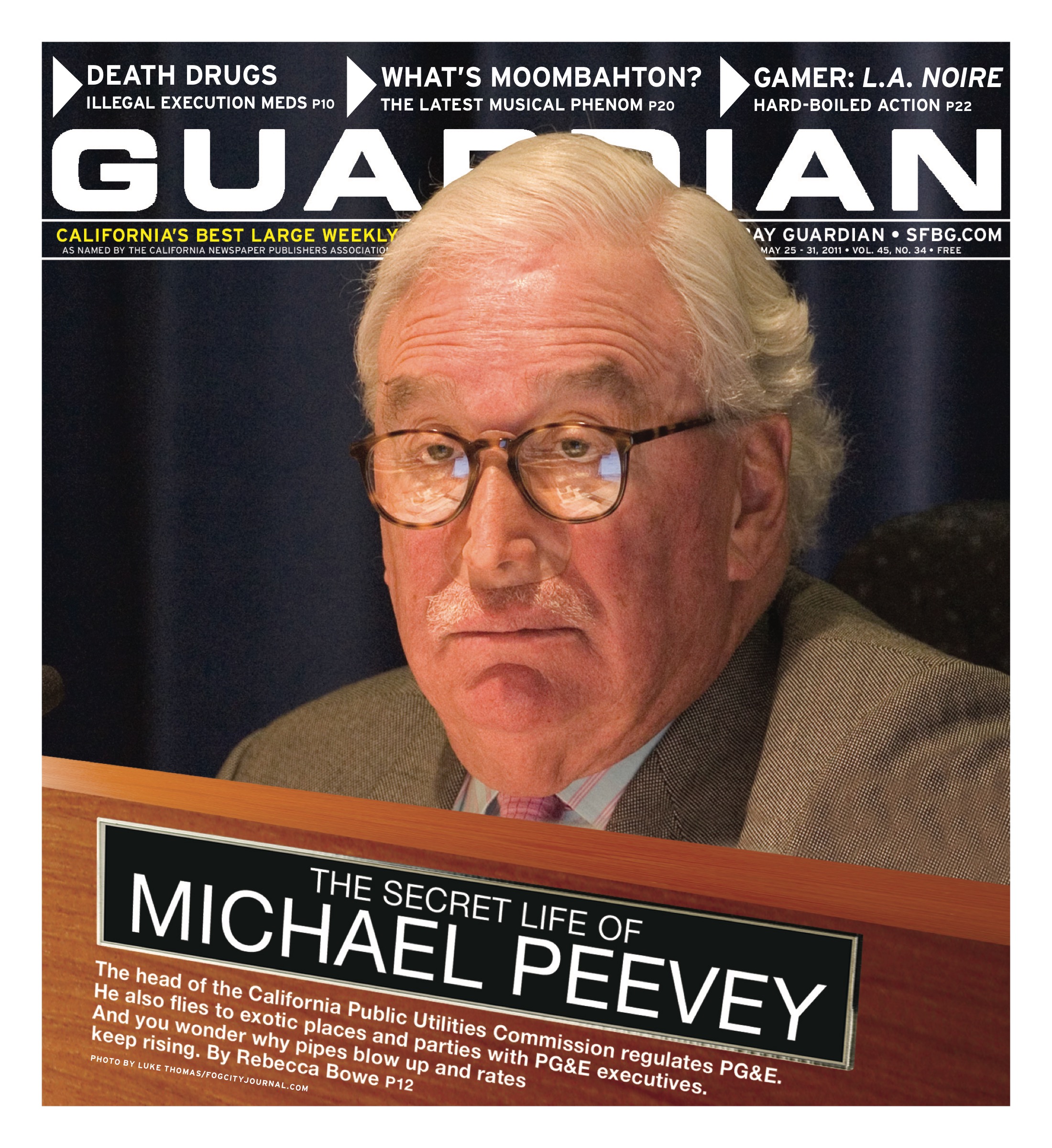
The secret life of Michael Peevey

11

rebeccab@sfbg.com

Inside a legislative hearing room at the state capitol, things were beginning to get uncomfortable. Roughly five weeks had passed since a Pacific Gas & Electric Co. pipeline explosion killed eight and leveled an entire San Bruno neighborhood, and this California Senate committee hearing was an early attempt to get answers.

San Bruno residents who lost loved ones in the deadly explosion huddled in the front row, their eyes fixed on company representatives and agency bureaucrats as they spoke. At the back of the room, a band of immaculately dressed PG&E executives and utility lawyers sat clustered together.

Richard Clark, director of the consumer protection and safety division of the California Public Utilities Commission (CPUC), fielded questions from visibly frustrated state legislators. Sen. Dean Florez (D-Shafter) wanted know why the CPUC hadn’t done anything when PG&E ignored an impaired section of the ruptured pipeline even after it was granted $5 million to fix it.

“Did the PUC do any accounting when you gave them $5 million?” Florez demanded. “Do we just give them money and cross our fingers and hope they fix it? Is that what we do? Until some terrible tragedy occurs?”

Sen. Mark Leno (D-San Francisco) said the CPUC needed to step it up and start practicing serious hands-on oversight. He recalled a tragedy that occurred in 2008 when a gas leak in Rancho Cordova triggered a pipeline explosion, killing one person and injuring several others. Although an investigation determined that PG&E was at fault, the CPUC hadn’t yet gotten around to fining the company.

“We’ve got a pattern here,” Leno said. “And we’re not doing anything differently.”

Less than three weeks after CPUC staff members were grilled in Sacramento, Michael Peevey — president of the CPUC and the top energy official in the state — boarded an airplane for Madrid. He was embarking on a 12-day travel-study excursion, with stops in Sevilla and Barcelona, sponsored by the California Foundation on the Environment and the Economy (CFEE).

Peevey’s wife, California Sen. Carol Liu (D-Glendale), was along for the trip. So were two other state senators, several members of the state Assembly, CPUC commissioner Nancy Ryan, and a host of representatives from the energy industry. The group included executives from Chevron, Mirant (now GenOn, the owner of the Potrero power plant), Covanta Energy Corporation, Shell Energy North America, and engineering giant AECOM. High-ranking executives of the state’s investor-owned utilities also participated, including Fong Wan, the senior vice president of energy procurement for PG&E.

Although strict rules normally govern commissioners’ interactions with parties that have a financial stake in the outcomes of commission rulings, there wasn’t anything especially unusual about Peevey traveling internationally with a group that included representatives from the same companies his regulatory commission oversees. CFEE trips happen every year. The nonprofit has footed the bill to fly groups of regulators, legislators, and utility executives to prime vacation destinations like Italy, Brazil, and South Africa in recent years, excursions organizers say are critical for educating top-level stakeholders about worldwide best practices for sustainable systems. However, groups such as The Utility Reform Network (TURN) have decried CFEE trips as “lobbying junkets.”

As PG&E and the CPUC both work to win back the public’s confidence after their latest deadly failure, it’s worth analyzing whether their relationship — shaped by vacations together at exotic locales — has grown too cozy.


THE BUDDY SYSTEM

CFEE isn’t the only nonprofit that regularly flies Peevey overseas for green travel tours with high-ranking utility executives, and the 12 days he spent in Spain wasn’t the only time he spent away from official duties and in the company of the corporations his commission regulates.

These controversial getaways are just a small part of Peevey’s involvement with private-sector interests. He also chairs the board of a nonprofit investment fund created as part of a $30 million settlement agreement with PG&E. Called the California Clean Energy Fund, it funnels money into private venture-capital funds that invest in green start-ups, plus a few companies in the fossil-fuel sector.

While legislators have voiced frustration that lax CPUC oversight of PG&E on pipeline-safety issues opened the door to disaster in San Bruno, inside observers are critical of the outright favors Peevey has granted utilities, such as guaranteeing an unprecedented, higher-than-ever profit margin for PG&E as part of the company’s 2004 bankruptcy settlement.

The CPUC is set up to perform as a watchdog agency, yet social and professional ties running deep within California’s insular energy community mean regulators sometimes run in the same circles as the executives who answer to them, making for cozier relationships than the general public might anticipate. It’s an old-fashioned insider game that one longtime observer wryly characterizes as “the buddy system.” But the buddy system can bring consequences.

As the public face of the CPUC, Peevey repeatedly has been thrust into the spotlight. He has absorbed advocates’ concerns about pipeline safety, rising electricity rates, SmartMeters, missed targets for energy efficiency, and municipalities’ David-vs.-Goliath battles with PG&E to implement community choice aggregation (CCA), to name a few. He’s a magnet for public scrutiny while occupying the center seat at commission meetings, but Peevey’s behind-the-scenes engagements with private-sector organizations bent on shaping statewide energy policy demonstrate how power is wielded in California’s energy world, a system in which regulators seem to be partnering with utilities rather than policing them.

Based at Pier 35 in San Francisco, CFEE’s board of directors is composed of a small group of officers, plus a long list of members who hail from some of the most prominent businesses nationwide. Shell, Chevron, J.P. Morgan, Goldman Sachs, AT&T, and PG&E all hold positions on CFEE’s membership board, and each entity chips in to fund the foundation’s activities and travel excursions.

The group also includes representatives from labor organizations like the International Brotherhood of Electrical Workers and mainstream environmental groups such as the Natural Resources Defense Council. Among the emeritus members of CFEE’s governing board are some high-ranking figures, such as CIA director-turned-Pentagon boss Leon Panetta. CFEE received $45,000 in donations from PG&E in 2009 (the most recent year available) and was granted similar amounts in prior years.

CFEE spokesperson P.J. Johnston, the son of former state senator and CFEE officer Patrick Johnston and the press secretary under former Mayor Willie Brown, described the trips as valuable opportunities for top-level stakeholders to gain insight on best practices and engage in noncombative dialogue on key issues.

“The idea for us was that it made sense to have someplace where it was nonconfrontational to engage in policy, work-type discussions,” Johnston explained. He added that the trips are “all about policy, on the 30,000-foot level,” and emphasized that discussions aren’t about specific decisions pending before the CPUC.

Loretta Lynch, a former president of the CPUC who brought a reformist spirit to the agency and was never shy about rebuking utilities, is skeptical of CFEE’s stated program goals. When she was first appointed to the commission, Lynch said, CFEE contacted her to ask where she wanted to travel. If the trips are arranged to fly regulators to destinations they’ve been itching to visit, she reasoned, must-see green innovations probably aren’t dictating the itineraries. “To me,” Lynch said, “they don’t have anything to study in mind.”


“PARTYING WITH THE JUDGE”

The CFEE trip to Spain included a briefing on developing wind energy from AES, a company working on wind and solar development in California that also operates polluting, gas-fired power plants in Huntington Beach, Long Beach, and Redondo Beach. There was a round table on solar energy featuring a presentation from the Independent Energy Producers Association, a trade group that regularly files petitions and comments on CPUC proceedings. The trip included a tour of a desalination plant, a talk from the president of the Madrid Chamber of Commerce, and discussions about California’s energy market. Scheduled activities ended by midafternoon on some days, and the itinerary left a Friday afternoon, Saturday, and Sunday in Sevilla wide open.

Asked to comment on concerns about inappropriate lobbying, Johnston said: “We’re not guarding against anyone’s potential behavior any more than we would be on the streets of Sacramento. We’re not setting ourselves up as the guardians. We’re not facilitating that, per se, either.” He added, “I realize there are critics of any kind of travel and any kind of commingling. But it is wise for us not to close our eyes to the rest of the world, and there’s not a great appetite for spending taxpayer money on these trips.”

Yet Lynch countered that there is an important distinction between the roles of Sacramento legislators and that of utility commissioners. “Regulators are not legislators,” Lynch said. “They’re more like judges. Their decisions have the power of a judge’s decision.” By inviting commissioners along on these lavish getaways, she said, “it’s as if you’re partying with the judge.”

Mindy Spatt, a spokesperson for TURN, echoed Lynch’s concerns. “These ostensibly educational trips are essentially lobbying junkets, where utilities … wine and dine legislators,” Spatt said. TURN raised the issue several years ago, she said, when Peevey joined a CFEE trip attended by a representative of Southern California Edison “just coincidentally at the exact same time that he was penning an alternate decision in Edison’s rate case.” She added: “In TURN’s perspective, the commissioners need to be more in touch with what actual utility customers are experiencing, rather than in touch with the top restaurants in Brazil.”

While Peevey is only one of a host of officials who attend CFEE trips, he has more than just a casual tie to the nonprofit. From 1973 to 1983, he served as president of the California Coalition for Environment and Economic Balance (CCEEB), an organization CFEE grew out of and whose membership shares some overlap with CFEE.

Based in San Francisco, CCEEB was founded by Edmund G. “Pat” Brown (Gov. Jerry Brown’s father) in 1973. CCEEB backed a late-1970s proposal to construct a series of nuclear power plants along the California coastline. More recently, the group honored BP with a 2009 award for environmental education — shortly before the company and lax federal regulators were responsible for the worst oil spill in U.S. history.


A YEAR IN THE LIFE

Spain wasn’t the only country Peevey jetted off to with complimentary airfare in 2010. According to a Form 700 filing with the Fair Political Practices Commission, he also traveled to Germany from Aug. 1–5 for a sustainable energy study tour organized by the Energy Coalition. Joining that trip were representatives from investor-owned utilities PG&E, Southern California Edison, and Sempra, plus various city officials and energy experts from the Swedish Energy Agency.

The group stayed at the Radisson Blu Berlin Hotel, which is famous for its AquaDom. “Standing at 25 meters high, it is the world’s largest cylindrical aquarium containing 1 million liters of saltwater,” according to the hotel website. All Radisson Blu Berlin guests have free access to “the hotel’s well-being area,” called Splash, which features a pool, sauna, steam bath, and fitness room.

Based in Irvine, the Energy Coalition’s Board of Directors is chaired by Warren Mitchell, a retired chair of the Southern California Gas Co. and San Diego Gas & Electric Co.. Another director is a utility lawyer who also sits on the board of directors of the Northeast Gas Association, a consortium of natural gas companies in the northeastern U.S.

Founded in the late 1970s by John Phillips to get large businesses to reduce energy consumption in partnership with utilities, the Energy Coalition has arranged excursions for years to bring energy regulators, city officials, and utility executives to Sweden (where Phillips’ wife was born) to exchange ideas on energy issues. The nonprofit organizes an annual summit called the Aspen Accord, “an energy policy forum where cities, utilities, regulators, and end-users collaborate to identify problems and propose solutions to our most pressing energy issues,” according to a 2009 tax filing. While it used to be held in Aspen, Colo., the most recent Aspen Accord was held at San Francisco’s Westin St. Francis. Peevey gave introductory remarks, and the conference featured talks from PG&E, among others.

Craig Perkins, executive director, told the Guardian that the Aspen Accord and study trips are designed to create a venue for major stakeholders to arrive at outside-the-box solutions. “What we try to do is get everybody out of their comfort zone, if you will — that’s the best way to support more creative thinking,” he said. Official regulatory proceedings are “so rigidly legalistic and bureaucratic that it almost prevents any creative thought from happening,” he added. “We’re not in San Francisco, we’re not in Sacramento, we’re not in corporate offices — let’s just talk about these really big issues, and really big challenges.”

The Germany tour included meetings with the Berlin Energy Agency, talks about climate policy, and a tour of an eco-community in Freiburg. Perkins said utility companies must to pay their own way on the trips, but costs are covered for governmental officials.

An Energy Coalition tax filing reveals that board members receive a monthly retainer of $1,000, quarterly meeting fees of $1,000, plus $500 for each board committee meeting. Teleconferences also result in $500 meeting fees.

Several years ago, the Energy Coalition partnered with PG&E to create the Business Energy Coalition, which paid businesses including Bank of America and the Westin St. Francis $50 per KW of energy savings for banding together to reduce energy during peak load hours. According to a tax filing, total annual Energy Coalition revenue dropped from $10.7 million in 2008 to $3.75 million in 2009 “due to large revenue receipts for participant incentives” for the Business Energy Coalition program, as “revenues were used for direct pass-through payments to program participants and contractors.” In 2006, according to a CPUC filing, PG&E paid the Energy Coalition $227,373 for unspecified consulting services.

In addition to the $8,880 trip to Spain (comped), and the $6,583 trip to Germany last year (comped), Peevey’s 2010 disclosure form shows that he also went to Australia May 14-19 to participate in a conference hosted by the Sydney-based Total Environment Center called “Smart Metering to Empower the Smart Grid” ($12,577, comped). And while it doesn’t show up on his FPPC filing, an agenda for CFEE’s Energy Roundtable Summit from Dec. 9-10 at the Carneros Inn in Napa lists Peevey as a participant. A glance through past filings suggests that 2010 was no anomaly; it’s a typical year in the life of a jet-setting utilities regulator.


GREEN CAPITALISM

Peevey once served as president of the Southern California Edison, an investor-owned utility, and was president of NewEnergy, Inc., an electricity company that later was sold to Williams Energy. Yet his professional image is that of a forward-thinker on climate change. According to a bio on the CPUC website, he’s received awards for achievements on green and sustainable energy from various organizations throughout California.

In 2005, speaking in Berkeley at an annual conference for the California Climate Action Registry, Peevey touted a list of his accomplishments on sustainable energy. My final example of PUC actions on climate change is related to PG&Es bankruptcy, he said. When they emerged from bankruptcy last year, one of many conditions of our support for their reorganization plan was that they create a $30 million Clean Energy Fund, devoted to investing in California businesses developing and producing clean technologies.

What Peevey didnt mention is that he chairs the board of directors of that fund. As a nonprofit venture capital fund, the obscure, San Francisco-based CalCEF sounds like an oxymoron. Based on the terms of the PG&E bankruptcy settlement, its governed by a nine-member board consisting of three CPUC appointees, three PG&E appointees, and the rest selected jointly by the CPUC and PG&E appointees. Other board members include past PG&E executives, a former member of the California Energy Commission, and a former chair of the board of governors of the California Independent System Operator (Cal-ISO), the body that ensures statewide grid reliability and blocked the closure of the Mirant Potrero Power Plant for years.

The nonprofit’s stated mission is to catalyze clean energy investment to aid in the state’s transition away from fossil fuels. CalCEF president Dan Adler described it as a sort of seasoned guide for fledgling green companies that might otherwise fail to navigate the murky, complicated clean-energy sector. CalCEF is in a position to usher start-ups toward success with a combination of funding, networking, and insider wisdom on state energy policy.

Among the challenges that the clean-energy sector faces, Adler said, are the utilities themselves. “They are effectively monopoly, or oligopoly, controllers of the energy industry,” he said. “And they don’t like outside innovation coming and disrupting their work process or their relationship with their customers.”

CalCEF aims to guide the finance community “to be partners with what public policy is doing around clean tech and clean energy,” Adler went on. “There’s a tremendous amount of money to be made, but there’s also a lot of opportunity for money to be wasted. If you don’t have a private-sector investment community that understands these rules and can put their money alongside these rules in a collaborative framework, we’re very unlikely to achieve the really aggressive energy targets that California has set.”

Yet as one skeptical energy insider noted, “there are 15 to 20 other funds, with 10 times as much money, an hour south in the same field,” referring to the burgeoning clean-tech hub in Silicon Valley. It’s questionable whether the CPUC is actually fulfilling some dire need with CalCEF, this person said.

Lynch, not surprisingly, takes a dim view of CalCEF. The former CPUC president questions what business the CPUC has creating a private foundation to guide venture capital investment. “It is a fundamental distortion of the PUC’s authority,” she charged, “all in service of Peevey’s ambitions.”

Peevey’s economic disclosure showed that he holds more than $1 million in a private family trust, without disclosing whether private investments contributed to that fund.

Adler stressed that there is arms-length relationship between CalCEF board members and the companies that benefit from the fund’s investments. “Because we are a nonprofit, and because we have on our board members of the regulatory community, we recognized quickly that we can’t be making direct investments into companies,” said Adler, a former CPUC staff member who was highly regarded even by the critics of CalCEF. “So … we’ve picked the venture-capital funds that we wanted to partner with.”

CalCEF funnels its capital into three different for-profit investment firms, which in turn select the companies that will be included in CalCEF’s investment portfolio. Several directors of the partnering investment firms also sit on the boards of directors of the companies they invest in. The startups run the gamut, from carbon-offset outfits, to energy-efficient lighting manufacturers to solar and wind companies, to biofuels startups to various kinds of technology firms related to the smart grid.

But CalCEF has also poured money into companies that bolster the fossil-fuel industry. One of its first investments was CoalTek, a company developing technology for so-called “clean coal.” Asked to explain why, Adler told the Guardian, “We don’t have veto power on every deal that goes down.”

Adler said he personally believes that “there’s no such thing as clean coal,” but tempered this by adding, “there are some very smart people in our community who will tell you that there’s no future … without coal.”

Another CalCEF investment, DynaPump, is developing technology to make it more energy efficient to pump oil and gas. Asked about this decision, Adler responded: “I will say that when we were approached with this investment by the venture partner that ultimately undertook it, we had our misgivings. If you can save energy in the production of oil and gas, then you’re definitely making a contribution to overall energy efficiency.”


TAX-EXEMPT TESLA

There appear to be some closer-than-arms-length links between CalCEF board members and the investment fund’s beneficiaries. A bio for CalCEF director Nancy Pfund, for example, notes that in her capacity as manager of an outside investment fund, she had “worked closely” with Tesla Motors, a CalCEF investment. Tesla provided CalCEF’s first investment return earlier this year after Tesla went public. A principal of one of the investment firms that works with CalCEF, Stephen Jurvetson of Draper Fisher Jurvetson, holds Tesla shares in a personal trust, according to a filing with the U.S. Securities and Exchange Commission.

Tesla manufactures sleek, electric, zero-emission sports cars with prices in the six-figures, and it’s gearing up to roll out a model that will cost somewhere closer to $50,000. The company’s success was helped by a sales-and-use-tax exclusion granted by the state of California last year. Peevey had a hand in that, too. Few Californians may have heard of the California Alternative Energy and Advanced Transportation Financing Authority (CAEATFA), a state body within the Office of the Treasurer, which has the power to authorize sales-tax exclusions for companies that are developing alternative energy technologies. Peevey has a seat on it.

In October 2009, according to a CAEATFA document, Tesla was granted a sales tax exclusion from that financing authority. The sports car manufacturer had received a tax break of $3.3 million as of December 2010, and stands to gain a tax break as large as $29.1 million, depending on its property purchases. As a CAEATFA member, Peevey approved the deal by proxy.

A central question is whether the CalCEF dollars that benefited Tesla and other CalCEF portfolio investments were originally derived from PG&E shareholder profits or ratepayer funds. Adler was careful to note that the initial $30 million came from company shareholders, not PG&E customers. But Lynch pointed out that every dime in PG&E coffers originates with the millions of customers who pay utility bills.

Lynch noted another provision of the bankruptcy settlement agreement, which guarantees PG&E a minimum annual profit of 11.2 percent, catapulting it forever into a higher rate of return than the 8 percent to 11 percent profit traditionally granted by the CPUC in prior decades. “They’re manipulating how big this bucket is to siphon off funds into programs like CalCEF,” Lynch said. “It’s all to give Peevey and his friends access — and to greenwash what was a very stinky deal for the ratepayer.”


ELUSIVE CLEAN ENERGY FUTURE

In California, a national leader in addressing climate change, the stakes are high in the energy sector. The CPUC is tasked not only with shoring up transmission-pipeline safety to prevent another San Bruno disaster, but helping to chart a course away from reliance on fossil fuel-powered energy sources.

CFEE, the Energy Coalition, and CalCEF share a common thread — their missions relate to advancing the cause of a clean energy future in California. And while utility funding and partnership is evident in all three operations, the overarching goal is understood to be green.

But as Adler observed, the utilities themselves present one of the greatest obstacles to progress on a clean-energy transition. While California has increased renewable energy sources, it’s done a poor job at supplanting fossil fuel generation with green alternatives, in part because the CPUC has allowed for increasing fossil fuel power generation even as renewable energy expands. According to a listing on the California Energy Commission website, nine natural gas power plants have won approval statewide and are moving toward construction, while six new ones are under review.

The CalCEF approach to addressing climate change, rather than aggressively targeting polluting industries, is to encourage the fledgling green industry in hopes of facilitating success in partnership with the financial sector. In many cases, the backers of the clean-tech companies are the same players behind the big energy giants.

Environmental advocates are critical. “If anyone thinks the CPUC is set up to serve public interests, forget that,” says Al Weinrub, executive director of the Local Clean Energy Alliance, a group that organized against PG&E’s ill-fated Proposition 16 last year. “They never have and they never will.”

Weinrub said he viewed proponents of green energy as falling into two camps: Moneyed interests motivated by a growing new market sector, and activists motivated by environmental and social justice causes. Major green investment firms “want to de-carbonize capitalism,” he observed. “But everything else stays the same.”

Peevey is considered a major driver behind the state’s climate change legislation, and he’s highly regarded for his dedication to green energy. Yet as long as the interlocking dynamic between energy regulators and California’s largest utilities goes unchallenged, change will only come in a way that’s as comfortable, profitable, and manageable for the state’s top polluters as they wish. And in a state with an aging energy infrastructure that’s vulnerable to the impacts of climate change, that pace isn’t nearly quick enough. 


Fatal stance

7

sarah@sfbg.com

Ever since Mayor Gavin Newsom appointed Police Chief George Gascón district attorney in January — when Gascón said he was “not categorically opposed to the death penalty and would consider it in appropriate cases” — capital punishment has become a big issue in a town where the last death penalty case was in 1989.

Gascón is running against former San Francisco Police Commissioner David Onek, who is the founding director of the Berkeley Center for Criminal Justice and has consistently promised since entering the race last summer that he will not seek the death penalty.

Both men also face a serious challenge from Alameda County Deputy D.A. Sharmin Bock, who opposes capital punishment but won’t categorically state that she would never seek it, as former DAs Kamala Harris and Terence Hallinan both did while running for office.

Bock said that Harris eventually formed a committee to review each capital case but never filed for the death penalty, including in the 2004 murder of San Francisco police officer Isaac Espinoza, the same approach Bock would take. But she doesn’t think it’s legally wise to make a categorical statement opposing the death penalty, saying it could be challenged in court, as some attorneys tried to do with Harris.

“But capital punishment is unjust, and can say that categorically,” she said.

In the week since Bock’s May 17 campaign launch, Gascón challenged her credibility on the issue by noting that Bock used the threat of the death penalty to secure a guilty plea from a sexual predator who tortured and killed women in Alameda County last year.

But Bock used that case to draw a distinction in their positions on the issue, telling us, “George Gascón says he’d use it for the most heinous cases, and I’ve seen the most heinous cases and I haven’t use it,” Bock said, emphasizing that she’s the only prosecutor in the race.

In a May 1 Chronicle op-ed, Gascón tried to neutralize Onek and those opposed to the death penalty by noting that he also has “serious misgivings” about capital punishment, including the potential for wrongful convictions, the disproportionate application on racial minorities, the roller-coaster the victims’ families endure as they wait decades for closure, and the financial impact on an already overburdened justice system.

But Gascón also tried to hide behind the “death penalty is state law” defense, even though prosecutors have extensive discretion in such matters. “Rather than refuse to enforce our laws, I believe the more appropriate approach is to accept the law and work to change it,” Gascón wrote. “I don’t believe district attorneys should be allowed to supplant the views of the state with those of their own.”

Bock criticized Gascón’s deferential stance, which was in sharp contrast to Sheriff Mike Hennessey, who recently announced that he will stop cooperating with federal immigration officials and start releasing undocumented immigrants jailed for minor offenses before they can be picked up for deportation, to comply with San Francisco’s sanctuary ordinance.

Gascón appeared to be trying to cast his position as a courageous stand. “Some have given me the political advice to simply say I will not seek the death penalty in San Francisco,” he wrote. “While I am not prepared to say that at this time, I can say that I do intend to be a district attorney committed to San Francisco values.”

And he promised that if he believes a case merits the death penalty, he would seek the advice and counsel of a panel of local prosecutors. “Ultimately, the decision will always rest on my shoulders, and it is a decision that I will not take lightly,” Gascón wrote.

But Onek accused Gascón of giving a politician’s answer. “Gascón is trying to have it both ways,” Onek told the Guardian. “The voters have the right to hear a clear answer to a fundamental question. And my answer is clear — I will not seek the death penalty in San Francisco and I will continue to work to change the law statewide. To me, it’s a yes or no question, and I won’t seek it. Period.”

Onek says his stance is informed by his belief that the death penalty solves nothing. “It doesn’t make us safer; it’s not fair and equitable; and it wastes enormous resources,” he said. “We are much better off spending our precious resources on things that actually make us safer, like more cops on the streets, more programs in our communities, and better services for victims.”

Gov. Jerry Brown made a similar comparison last month when he canceled a $356 million project for a new death row at San Quentin. “At a time when children, the disabled, and seniors face painful cuts to essential programs, the state of California cannot justify a massive expenditure of public dollars for the worst criminals in our state,” Brown said.

A recent David Binder research poll found 63 percent support statewide for commuting all of the 700 sentences of California’s death row inmates to life in prison without parole and requiring them to pay restitution to the victims’ families, while 70 percent of Bay Area voters support the plan, which would save the state $1 billion over five years.

At a May 18 panel discussion on the death penalty, Public Defender Jeff Adachi’s criminal justice summit offered panel moderator Matt Gonzalez, a chief attorney in Adachi’s office, a timely opportunity to grill Gascón about his death penalty stance.

“Folks felt it might be a step backward,” Gonzalez said, noting that former D.A. Terence Hallinan pledged not to seek the death penalty when he ran for reelection in 2000, and Harris followed suit when she first ran for district attorney in 2003. “So — are you pro death?” Gonzalez asked.

“No, but I am a public official,” Gascón replied, even as he repeated his misgivings about the death penalty, including the fact that 62 percent of those on death row are minority populations, especially from African American and Latino communities.

The panel also provided a chance to see Gascón debate exonerated death row inmate JT Thompson, watch American Civil Liberties Union of Northern California attorney Natasha Minsker explain why the death penalty system is dysfunctional, and witness former San Quentin prison warden Jeanne Woodford describe how the impacts of the four executions that she reluctantly oversaw motivated her to sign on as director of Death Penalty Focus, a nonprofit dedicated to abolishing capital punishment.

“Who is responsible for the prosecutors that go bad?” asked Thompson, an African American man who spent 14 years on death row in Louisiana, and another four facing life without parole, because a prosecutor suppressed exculpatory evidence.

“When I was sentenced to death in 1985, for a crime I didn’t commit, I thought this would be rectified right away. But it took 18 years, and I watched 12 inmates being executed while I was there,” Thompson said, noting that he was holed up 23 hours a day.

Gascón said he would terminate prosecutors who withheld exculpatory evidence, but said he didn’t know if he could charge them with murder.

Thompson, founder of the New Orleans-based nonprofit Resurrection after Exoneration, argued that the debate needs to be recast from its current public safety frame.

“People need to be asked, ‘Under what conditions do you support giving the state the right to kill you?’ ” Thompson said.

Woodford recalled how she got sick after the last execution she presided over. “I focused on what my responsibility was. But in hindsight, I realize it had had much more of an impact,” she said. “These executions happen in California at least 20 years after the crime. And they don’t bring victims back.”

Minsker noted that 16 states do not have the death penalty, and that every day brings people closer to ending the practice in California. “People once thought opposing the death penalty would end political careers, but Kamala Harris showed that it is no longer a liability,” she said.

Reached by phone after the debate, Onek said ending capital punishment makes sense morally and financially. “We would have $1 billion to invest in things that actually make us safer,” Onek said. “The D.A. is given discretion around requesting the death penalty, and I will use my discretion to reflect San Francisco values. That’s why people in the trenches working on these issues, including Jeanne Woodford, support me in this race.” 


Stop the AT&T boxes!

15

By the League of Pissed Off Voters


More than 60 people showed up on the steps of City Hall May 21 to demand that AT&T engage in the same old basic planning process that even small-scale businesses have to go through.  (Read: even little people without expensive corporate lobbyists.)


Neighborhood organizations, disabled and senior representatives and environmentalists all pushed the supervisors to make the sensible vote at tomorrow’s full board meeting: support a full Environmental Impact Review of the consequences of 726 giant metal lockboxes cluttering up our public sidewalks.  As Julian Davis, a longtime community activist put it: “Why would you plunk down 726 giant Buicks all over the city when you have a perfectly good underground high speed rail?”


True that.  San Francisco currently has miles of fiber optic cable pulsing beneath our city streets, and even that is already becoming outdated.  So now AT&T’s brilliant idea is to litter our sidewalks with what amounts to giant crusty supercomputers? And what happens when they’re obsolete?  Basically, taxpayers just got stuck with a bunch of metal junk on our sidewalks, while AT&T expanded its profit margins.


Why do small cafes have to pay hundreds of dollars in permit fees to put two piddly tables outside their shops, while AT&T gets a blanket “categorical exemption” for almost no money to nail down ugly boxes that will block the sidewalk and attract graffiti?  (Hmm, we can probably think of some choice graffiti actually…)


The last time we heard from the folks at AT&T, they were helping the NSA wiretap our private calls from a secret room in their headquarters, so excuse us if we’re a little hesitant about giving the company a free pass to put creepy lock boxes in front of our homes. 


According to the Department of Public Works at the last public hearing on this issue, DPW staffers are relying on AT&T’s “expert analysis” to guide them on whether or not AT&T should receive a categorical exemption – in other words, DPW is relying on AT&T to do its job, and the community just got cut out of the process.  An independent EIR is necessary to address these blatant conflicts of interest. 


Speaking of conflicted interests: The latest scuttlebutt inside City Hall has some progressive supervisors desperately looking to cut a deal to save face in the midst of election season.  And what would that deal look like?  Cutting the number of boxes and giving neighborhoods an opportunity to decide whether they want 4’x4’x7′ lock boxs on their blocks. 


So, basically, if your block doesn’t have a home owner association advocating on your behalf, guess what you’re going to be walking around everyday?  As Juan Monsanto of San Francisco Beautiful pointed out, most of these boxes will be installed in less affluent communities without strong representation at City Hall.   AT&T’s sweetheart deal gives the supervisors cover to punt their responsibility to administer public space safely and equitably. 


So, to recap: we are now officially a city that will arrest human beings for sitting or lying in the middle of the sidewalk, but the board is working overtime to try and figure out how to exempt AT&T from city oversight process so it can stick giant immovable metal boxes in our right of way?


Oh, it’s okay because they’re going in the Bayview. Or in a neighborhood that already has a bunch of blight, so what’s a little more?  Lame.  Call your supervisor today and tell him or her to get a backbone.  It’s tough being the swing vote, you know?  Help ’em out, let ’em know you’re watching – and voting.


The San Francisco League of Pissed-Off Voters is the local chapter of the League of Young Voters, a national organization that engages young people in the political process, organizes around progressive issues and takes it beyond just “get out the vote.” 


Perception of lost integrity costs police

1

Reporting by Sarah Phelan. Photograhy by Luke Thomas.

At the San Francisco Public Defender’s Office’s May 18 Justice Summit, the ethics of law enforcement were a central topic. And not surprisingly, the latest incidents of alleged police conduct in which SFPD officers are caught on surveillance video, which the Public Defender’s Office released, as they apparently steal personal property from suspects whose homes in the Julian Hotel they searched for drugs under possibly illegal circumstances, were on everyone’s minds, along with the crime lab and Henry Hotel scandals.

Asked if District Attorney George Gascón, who was Chief of Police until January, is considering a special prosecutor to look into these latest incidents, Sharon Woo, the D.A.’s Chief Assistant of Operations, said the D.A. looks into each case as it comes in. “We are trying to enhance the videos that came in from the Public Defender’s Office,” Woo said in a pre-summit interview. “Some are not as clear as we’d like.”

Earlier this year, when Gascón first became aware of the allegations against officers at the Henry Hotel, he directed the D.A.’s office to open an investigation into the officers and their alleged conduct. The move got David Onek, who is running against Gascón in the D.A.’s race, urging Gascón to turn the investigation over to an independent prosecutor.

But for a week, Gascón maintained that there was no conflict, and when he did finally announce that he was turning the investigation over to the to the U.S. Attorney’s Office – he claimed it was about “resources”. “New information has come to light that indicates it is better to turn over this investigation to the FBI,” Gascón said. “I have spoken to the U.S. Attorney, Melinda Haag, and she has agreed to take over the full investigation. We will of course cooperate fully with the FBI, and provide whatever assistance they need from us.”

At the time, Onek noted that Gascón’s decision was correct step. But he criticized Gascón for not making it his policy to recuse himself from any investigations that relate to his own tenure as chief. And Alameda Assistant D.A. Sharmin Bock, who recently sprung into the D.A.’ race, described Gascón’s situation on this matter as being “between a rock and a hard place.”

But yesterday, Woo noted that while it’s true that Gascón was SFPD Chief when many of the recent misconduct scandals occurred, Mayor Gavin Newsom had already appointed him D.A. when the Julian Hotel incidents occurred in February.

And Peter Herley, former chief of the Tiburon Police Department, told the Guardian that there “is always the Attorney General” to refer cases if D.A.’s feel conflicted. “George Gascón is a very upstanding individual who has also worked for the Los Angeles Police Department and was Chief of Meza, Arizona, and has done a good job in every place he’s been,” Herley said during a pre-summit interview. “So, if he sees a conflict arise, he’d probably recuse himself. It’s the public perception that’s key, that’s paramount.”

During the summit’s panel on ethics, retired San Francisco Superior Court judge Lee Baxter grilled panelists with incisive questions—as befits any self-respecting judge, retired or otherwise–on whether police misconduct is the product of a departmental culture. Noting that there had been a seemingly non-stop string of alleged police misconduct scandals in the Bay Area from drug thefts, dirty D.U.I cases, stolen drugs and setting up a brothel, Baxter observed, “If I saw a movie that included all those things, I’d think that this is not realistic.”

And there was a perhaps surprising amount of stated consensus about what needs to happen next from panelists Woo, Herley, defense attorney Stuart Hanlon, newly sworn-in SFPD Chief Greg Suhr, Anne Irwin, an attorney at the Public Defender’s Office, and John Burris, an Oakland-based civil rights attorney who is renowned for representing plaintiffs in police brutality cases.

Baxter asked the panelists why abuse of power happens, and whether, when we see media accounts of alleged police misconduct, we see the most extreme cases.

Hanlon kicked off by referring to the case of Elmer “Geronimo” Pratt, a former high ranking member of the Black Panther Party, who was tried and convicted of the kidnap and murder of Caroline Olsen in 1972, and spent 27 years in prison, eight in solitary confinement, until 1997 when his conviction was vacated on the grounds that the prosecution concealed evidence that might have exonerated him. In particular, the government had not disclosed that a key witness against Pratt, Julius Butler, was an informant for both the FBI and the LAPD. Pratt eventually received $4.5 million as settlement for false imprisonment—the city of L.A. paid $2.75 million, the U.S. Department of Justice paid $1.75 million.

“We learned that law enforcement officers had hidden evidence, let people commit perjury, and destroyed evidence to convict someone who was innocent, “ Hanlon recalled, noting how when he first worked on the case, folks wondered if Pratt’s claim of innocence was simply part of a big conspiracy theory. “But it was not, it was men and women who thought the ends justified the means” Hanlon said, noting that the “bad apples” theory is typically trotted out during investigations into alleged police misconduct. “But officers see people who they think are bad people, and they feel they must whatever it takes,” Hanlon continued. “Primarily, most law enforcement people are good, but sometimes you get good cops lying to protect bad cops. It’s a dilemma, this concept of ‘what we do we need to do, this ‘us versus them’ concept.”

Hanlon claimed that officers don’t think citizens who live in SROs (single room occupancy hotels) have the same rights as folks in Pacific Heights.
“They think it’s OK to break down doors because these are drug dealers,” he said. And he noted that the recent string of back-to-back scandals are unusual in their proximity but are not unusual, generally speaking. “I’m not an apologist for (Chief) Suhr or the D.A., but I’ve seen these problems forever, and without trust law enforcement doesn’t work,” Hanlon concluded.

Next, Baxter put Suhr in the hot seat by asking him what to do about the “ends justify the means concept”. At which point Suhr, who has been Chief for less than two weeks, observed that the summit, which was packed to the gills with defense and civil rights attorneys, was “a bit of an away game for me, but it’s O.K., I can handle it.” He noted that only 1 in 11 applicants make it through the SFPD Police Academy, where folks undergo 1,100 hours of training, including sessions on abuse of power and responsibilities. “But if something is proven, it’s my intention not to have those officers in the SFPD any more,” Suhr said.

Retired Tiburon Chief Pete Herley revealed that during his decades-long police career, he blew the whistle when three officers nearly beat a gay man to death. “I suffered the consequences for many years,” he said. “It’s very lonely getting death threats, it’s very lonely when you don’t get the backing of fellow officers.”

Herley claimed times have changed a lot. “Change starts in the Academy and the selection of officers, and you have no other law enforcement officers that get more scrutiny, background checks m psychological checks and an 18-month probation period,” he said.

He noted that police chiefs inherit a departmental culture, whether they come into the post from the inside or the outside of the department. And that while the number of officers involved in misconduct is small, “it makes good press.” 

“I really feel one needs to be more loyal to integrity than to people,” Herley continued, noting that his parents were Holocaust survivors, and that his father was aghast when he decided to become a police officer. “But I had certain values and I don’t expect anything less from other people. I expect that every department has something in their rules and regulations that directs their officers that if they see misconduct, it’ll be stopped and the action will be reported immediately to the Chief.

Baxter asked Woo what the D.A. should do, if there is a problem.“All we are is our integrity, our ability to communicate and put forth evidence to juries “ Woo observed, noting that she has been on the frontlines as allegations about the crime lab, the Henri Hotel, and now potential theft, surfaced. “We find ourselves very reactive,” Woo observed, noting that if officers are not being truthful, the D.A.’s office has to look at all the cases they were involved in. “So it really impacts public safety and how all of us view the criminal justice system,” Woo said, noting that officers involved in the Henri Hotel allegations taken off the street.“But we have no interest in prosecuting individuals if it’s not based on solid evidence,” Woo said.

She recommended proactive steps like getting involved in Police Academy training on the law, and what officers can and cannot do, and giving officers tools to make good decisions and arrests, so there is integrity in the system. “If there isn’t, we all lose, not just the criminal justice system, but the entire community,” Woo observed, noting that as SFPD Chief, “Gascón instituted lots of policies to make sure people are doing an appropriate level of review.”

Baxter asked Anne Irwin, an attorney in the Public Defender’s Office, about their office’s role in bringing abuse of power to the attention of the public. “The Public Defender has a unique and natural role as a messenger,” Irwin replied. “We have more meaningful interaction with the victims of police misconduct than anyone else in the criminal justice system. We get into the intimate details of their lives, we develop a relationship of trust, so they confide their stories about police misconduct. And those stories are commonplace.”

Irwin noted that these stories include a disrespect for the Fourth Amendment, perjury and theft. “When you hear those stories over and over, there’s a ring of truth, a consistency,” Irwin said, noting that this is not the first time officers have been captured on camera. “We didn’t say, let’s amass a bunch of evidence. We just basically did our job. Residents told us what someone said in a report is not what happened, so we got videos from Dec. 23 and Jan. 5, and lo and behold, every word was true, two for two.”

Irwin noted that there are many good officers in the SFPD, but questioned whether a culture develops in certain departments, including the plain-clothes units, that allows misconduct to happen. “Without the videos officers would not have had to answer for their conduct,” she observed.

Baxter asked Suhr what it is about the culture that makes some cops go rogue. “Did they work there too long, were the temptations too much?” she asked.

Suhr replied that he worked in narcotics for a long time, and recovered $1.4 million in cash from an apartment in the Western Addition. “I never took a dime, and I am confident that the officers I worked with were of the highest caliber,” he said. “To paint a 2,000-person organization with a broad brush is unfair,” he added. “In the legal profession, every once in a while, you see ugly stories there too.”

Burris, who filed a $25 million wrongful death claim against BART on behalf of Oscar Grant’s family, noted that he has been involved in about 1,000 police misconduct cases in the Bay Area. “A culture exists about how you treat minority communities, “ he said, noting that he had represented black and brown clients for over 20 years. “A culture where you beat people and nothing is done, and you get away with it.”

Burris believes the problem lies in how policies are imposed, as he claimed that when officers join departments they are told to forget what they were taught in the Academy.“This is what you do on the streets,” he said.

Baxter observed that she has seen movies about the code of silence and wondered if it actually exists in police departments. “I don’t think so generally,” Suhr said. “There’s peer pressure to be sure. A regular citizen has a right not to self incriminate, and in the Police Department you can say that, but you are immediately sent to Internal Affairs, where you are told, tell me what happened or you are fired. So, today, the light is shining on us 100 percent of the time.”

Herley noted that his concern lay with situations in which officers see something, but don’t say anything. “I never thought I’d sit here and agree with every word John Burris says, but it starts at the top, and has to be enforced throughout the organization.”

Herley said the two best tools to prevent indiscretions and ensure responsibility are tape recorders and video cameras. “There’s certification of exactly what happened.” As for questions of how much it would cost to outfit officers with this recording equipment, Herley said, “ What is the cost of a lawsuit, the cost the perception of a loss of integrity to a department?”

Garbage shuffle

1

sarah@sfbg.com

The Department of Public Health has scheduled a May 13 hearing to review allegations that Recology subsidiary Sunset Scavenger overbilled for trash collection at a condominium building for years, resulting in $84,544 in excess charges, erroneously charged the building commercial rates, and is refusing to make a full refund. Recology counters that the building’s managers oversubscribed, and the company gave a three-month refund as a show of good faith, but considers additional refunds punitive.

The hearing should interest the 21 percent of San Francisco residents who own units in condominium buildings. According to the Assessor-Recorder’s Office, 42,478 of the city’s 200,409 recorded parcels are now condominiums, with 3,192 registered as live/work, 38,300 as market rate, 980 as below-market rate, and 958 as commercial condo parcels as of fall 2010.

This struggle between ratepayers and Recology, which controls almost all aspects of the city’s $275 million-a-year waste stream, seems emblematic of the problems that can arise when a monopoly is only partially regulated by local officials (the city does not have oversight of commercial collection rates) and then only in a labyrinthine process.

DPH’s May 13 hearing comes three weeks after the Board’s Budget and Finance Committee voted to wait until July before deciding whether to award the city’s next landfill disposal contract to Recology. And it hits 18 months after the Department of the Environment, which derives half its budget from Recology’s rates, first tentatively awarded the city’s landfill contract to the San Francisco based garbage giant.

Since then critics have questioned how Recology got its monopoly, whether the arrangement benefits rate payers, and whether it makes environmental sense to haul the city’s trash all the way to Yuba County, as Recology is proposing.

In February, the budget and legislative analyst recommended that the city replace existing trash collection and disposal laws with legislation that would require competitive bidding on all aspects of the city’s waste collection, consolidation, and recycling system.

The analyst also recommended requiring that refuse collection rates for residential and commercial services be subject to board approval, noting that competitive bidding could result in reduced refuse collection rates (see “Garbage curveball,” 02/8/11).

“The latest report says that the current system has been in existence since 1932 and let’s put it out to competitive bid,” said budget and legislative analyst Harvey Rose.

A 2002 report by Rose noted that the city has no regulatory authority over commercial refuse rates. “Instead, commercial rates are subject to agreements between the permitted and licensed refuse collectors and individual commercial producers of refuse, commercial tenants and building owners,)” the report stated.

Rose’s report also found that commercial building owners often pay commercial refuse fees to Recology, so tenants don’t know how much they are paying. “Normally, if tenants occupy such buildings for commercial purposes, the commercial refuse fees are passed on to the tenants as part of the overall rent and operating costs. As a result, it is likely that many commercial tenants do not know how much they are actually paying for commercial refuse collection,” the report found.

It also noted that when the analysts attempted to complain about commercial refuse collection and commercial refuse rates (“for audit procedure purposes”) and to inquire how to lodge a complaints with the city, there was “nobody to call.”

Fast-forward nine years, and Golan Yona, who sits on the board of the Alamo Square Board Homeowners Association, which represents 200 residents in a 63-unit building on Fulton Street, claims the city gave him the run-around when he complained that, over a four-year period, Recology subsidiary Sunset Scavenger billed his building to pick up two, two-yard compactor containers three times a week but only picked up one. “Each time one of the bins is being put out for collection, the second bin is connected to the trash chute,” and thus not in service for pickup, Yona said.

But Recology claims that HSM Management, the company the homeowners association hired to manage its building, “oversubscribed” for waste collection. Recology also notes that the commercial rate the association paid resulted in the building being charged a lower monthly cost, but that Sunset recognized this as an “internal error” and therefore is not pursuing collection of the undercharged amounts.

Recology spokesperson Adam Alberti characterized the disagreement as “a pretty simple billing dispute,” even as he claimed that HSM sometimes put two bins curbside.

“Recology has been providing a level of service that was not fully utilized,” Alberti said. “They had two bins and were only setting out one, though there were numerous times throughout the year when they set out two bins.”

Alberti said the responsibility lies with the condo group, which opted for that level of bin service. “At some point they called to discuss ways to reduce their bill, at which point Recology suggested they reduce their service to one bin. At that point, the homeowners association sought compensation,” he said.

“No, this is based on actual consumption,” Yona told the Guardian, claiming that Sunset has no problem charging extra if buildings put out extra bins.

Alberti claims it’s “far more common” for buildings to oversubscribe. “They plan for peak times,” he said. “As a good faith gesture, the company sought to come to terms with the customer — but they weren’t able to do so.”

DPH’s Scott Nakamura confirmed that rate hearings are rare in his department. “This is the first time in 30 years that I have heard of a dispute like this going to the DPH — and I’ve been working here more years than I’d like to admit,” he said.

Based on his experience and Rose’s 2002 report, Yona suspects that the reason for this lack of hearings lies with a lack of process — not a lack of complaints.

Yona held up a flow chart that depicts 17 contacts he had with City Hall in a five-week period as he tried to find out how collection rates are set, how homeowners can determine what their building should be paying, and how they can register complaints.

These included calls to the City Attorney’s Office, Department of Public Works, Department of Public Health, and the DPH’s offices of Environmental Health and Solid Waste.

As a result of his persistence, Yona discovered that the city’s refuse collection and disposal ordinance, adopted Nov. 8, 1932, stipulates that DPH’s director can revoke the license of any refuse collector “for failure in the part of the refuse collector to properly collect refuse, or for overcharging for the collection of same, or for insolence toward persons whose refuse he is collecting.”

In a complaint submitted to DPH director Barbara Garcia on behalf of Alamo Square Board HOA, Yona wrote: “We would like to note that our attempts to talk to the right authority in City Hall have met so far with difficulty. The seriousness of the matter requires intervention of the highest authority in City Hall.” 

Boxed out

5

rebeccab@sfbg.com

The Board of Supervisors is gearing up to revisit whether telecommunications giant AT&T should be permitted to install 726 new metal boxes on city sidewalks for a communications network upgrade, without completing an environmental impact review.

At an April 26 meeting, the board spent several tedious hours listening to concerns such as whether the boxes would attract graffiti or clutter the sidewalks, and debated the finer points of whether the project could legally be considered exempt, ultimately resolving to take up the issue again May 24.

Meanwhile, a small cadre of tech-savvy San Franciscans has seized on this debate as an opportunity to drum up enthusiasm for an alternate vision of a citywide communications future, one with faster connection speeds that wouldn’t necessarily be controlled by the AT&T and Comcast duopoly.

At the meeting, AT&T California President Ken McNeely, dressed in a sharp suit, trumpeted the company’s proposed upgrade, part of a new system called U-verse. “This is the largest single upgrade to the San Francisco local phone network in more than a century,” he said. “Our network will provide the next-generation IP technologies that San Francisco needs to provide if it wants to continue to attract the best and brightest in the region.”

Yet Rudy Rucker, bearded and clad in a camouflage T-shirt, sounded a different note. “The U.S. is No. 30 in the world in Internet speed,” he said. “The boxes are not the way to go. What we need to do is rework the entire infrastructure of how we do communications in the city. We’re relying on copper lines. We need to pull all those out, recycle the copper, and put in fiber-optic cable.” Rucker is a cofounder of MonkeyBrains, an independent Internet service provider (ISP) based in San Francisco.

AT&T’s U-verse upgrade would enable it to offer connection speeds three times faster than current service — but not nearly as fast as what fiber proponents envision. Several members of the tech industry interviewed by the Guardian cautioned that another AT&T upgrade might be necessary after less than a decade to keep pace with technological advancement. At that point, it’s anyone’s guess whether those boxes would continue to be useful. AT&T did not respond to a query from the Guardian.

SPEED FREAKS

When it comes to Internet speeds, the United States trails Asia and some European countries. “We’ve fallen from first place,” said Ashwin Navin, who founded several tech startups including a file-sharing company called BitTorrent. “It’s really put our software and technology industry at a disadvantage.”

According to a website that compares connection speeds using data compilation, California ranks 23rd in the nation, while San Francisco doesn’t even clear the top 30 cities nationwide, Navin noted.

Yet much faster connection speeds are possible — even commonplace — in countries such as Japan and Singapore. “Right now, the average download speed in San Francisco is something around eight megabits,” explained Dana Sniezko, who’s emerged as a tech activist since creating a website called SF Fiber, which calls for a neutral, open, affordable community fiber network. “What U-verse is going to offer is about three times that. Something like fiber can offer service that’s 1,000 megabits [called a gigabit], or even much larger than that. Fiber allows you to really have a huge capacity for the future.”

Put in practical terms, Sniezko said, the difference between a connection speed of eight megabits and a gigabit amounts to downloading a full-length feature film in 90 minutes, versus several seconds. And since fiber also can deliver faster upload speeds, it opens the door to new possibilities. “It lets individuals potentially come up with really innovative and creative ideas,” Sniezko said. “If you wanted to have your own streaming TV channel from your house, you could. Or anything, really.”

Fiber already exists under San Francisco city streets — but most places lack the direct connections to homes or businesses, so the capacity is not realized. The city’s Department of Technology and Information Services (DTIS) convened a study in 2007 for developing the infrastructure to create a full-fiber network, deeming fiber “the holy grail of communications networking: unlimited capacity, long life, and global reach.”

Since then, progress has been slow. AT&T’s new system would also be based on fiber, but information would still travel to homes or offices over copper phone lines, resulting in slower speeds than a direct connection could supply.

On a recent afternoon, MonkeyBrains cofounder Alex Menendez scrambled up a ladder leading from his small Potrero Hill office space to show off some rooftop antennas and laser devices. There was a clear view from the flat, sunny roof to the office building the laser was pointed at, many blocks away. Secured to a hand-built metal stand, the gadgets were part of the company’s high-speed Internet network, which counts KQED among its roughly 1,000 subscribers.

Menendez was explaining how his small company is able to use these microwave devices in combination with fiber-optic cables to provide high-speed Internet by leapfrogging from node to node throughout San Francisco.

Menendez said he didn’t feel strongly one way or another about AT&T’s metal boxes. “But it raises a more interesting issue: what’s the 50-year-down-the-line solution? There’s much better technology out there. It could be super-affordable, with a wide-open, massive amount of bandwidth.”

But, he added, it won’t happen without the support of local government.

MISSED CONNECTIONS

The City and County of San Francisco owns an underground fiber-optic network spanning more than 110 miles, used mostly for municipal and emergency purposes. AT&T has its own fiber — and with a history going back more than a century in San Francisco, it also has a lock on the market.

AT&T owns underground cables, copper phone lines, and rights-of-way, making it necessary for small market players to interface with the corporation and pay fees. This makes it difficult for local ISPs to compete on any meaningful scale. “They have the right to trench the street,” Menendez explained. “We don’t.”

Mendendez and others are looking at micro-trenching as a possible way around this. Last summer, Google hosted an event at its Mountain View headquarters called the Micro-trenching Olympics (“A very Google-y thing to do,” according to a company representative speaking in a YouTube video) to find out which contractor could best slice a one-inch wide, nine-inch deep trench in a parking lot and install fiber-optic cable inside. The idea behind micro-trenching is that it’s fast and minimally disruptive — and best of all, it doesn’t interfere with existing infrastructure, so there’s no need to pay a fee to AT&T, or any other company.

Some in the tech community are hoping it will signify a new and efficient way to link fiber-optic cable directly to homes and businesses, ultimately resulting in the kind of Internet speed that would let you download a movie in less than ten seconds. With micro-trenching, there would be no need for utility boxes.

Navin, Mendendez, and several others have talked up the idea of micro-trenching a small area in the Mission District to bring fiber-optic, high-speed Internet to an entire neighborhood. Yet their early conversations with the city’s Department of Public Works suggest that it may be a slow process. “They were like, ‘What is this?'” Menendez recounted. “There’s no established permitting process.”

Meanwhile, Board of Supervisors President David Chiu recently asked DTIS to examine the possibility of leasing excess capacity on city-owned dark-fiber infrastructure, which is currently in place but not being used. This could boost bandwidth for entities such as nonprofits, health care facilities, biotech companies, digital media companies, or universities, Chiu said, while bolstering city coffers. “There are many places in town that need a lot more bandwidth, and this is an easy way to provide it,” he said.

Sniezko noted that other cities have created open-access networks to deploy fiber. “This is really effective because it’s a lot like a public utility,” she explained. “The city or someone fills a pipe, and then anyone who wants to run information or service on that pipe can do so. They pay a leasing fee. This has worked in many places in Europe, and they actually do it in Utah. In many cases, it’s really cool — because it’s publicly owned and it’s neutral. There’s no prioritizing traffic for one thing over another, or limitation on who’s allowed to offer service on the network. It … creates some good public infrastructure, and also allows for competition, and it sort of revives the local ISP. Chiu’s proposal is a little bit in that vein, it sounds like. But he hasn’t released a lot of details on it yet, so we’re still looking.”

Visit www.sffiber.info for more info


Mayor Lee to partially implement Campos’ due process ordinance

1

Today at question time, Sup. Jane Kim will ask Mayor Ed Lee what his plan is to implement a due process ordinance that Sup. David Campos authored and a super majority of the Board approved in 2009, prohibiting the Juvenile Probation Department from reporting undocumented youths at the time of arrest. And according to an anonymous source, Lee will say he has decided to implement the policy, if the youth in question are “accompanied,” which means they have family here.

Immigrant advocates say Mayor Lee should be commended for his leadership in implementing the due process policy to keep immigrant families together. But they believe that Lee needs to go the whole way. “Immigrant and civil rights groups are adamant that the policy must be implemented for all youth, accompanied and unaccompanied, and this has to be immediately,” our source said. “The due process policy does not discriminate between these two groups and the policy cannot be selectively enforced.”
 
As Kim planned to point out during the Board’s question time, voters approved San Francisco’s Sanctuary City Ordinance in 1989. That ordinance prohibits our Police Department and local government officials from assisting in the prosecution of immigration enforcement unless it is required under federal or state law.

In 2009, the Board, under Campos’ leadership, passed-by a supermajority-a clarification to that ordinance to prohibit local law enforcement from reporting undocumented youths unless they are convicted of a felony. To date, this ordinance has not been followed by the City.

But in a May 9 memo to the city’s Probation Department personnel, Juvenile Probation Department Chief Probation Officer William Siffermann and Assistant Chief Probation Officer Allen Nance wrote that since revising JPD’s policy 8.12 nearly three years ago [per Mayor Gavin Newsom’s instructions], they have closely monitored JPD’s implementation of its protocols.

And after considering all perspectives and after careful review, they have decided to “modify our existing policy in a manner that aligns our Departmental policies more closely with the values inherent within San Francisco’s Sanctuary City ordinance, without compromising our balanced commitment to public safety and the best interests of the minor.”

“Effective immediately, San Francisco Juvenile Probation Department notices to the federal authorities of minor/persons booked on felonies who are suspected of being undocumented AND are accompanied (lives with a verifiable parent, guardian or blood relative in the immediate Bay Area and is enrolled in school) will be made only upon a felony adjudication, upon apprehension on an outstanding warrant, or upon issuance of a new warrant following release from custody pending adjudication,” the JPD memo reads. “Minor/persons booked on felonies who are suspected as being undocumented, AND are verified adults or unaccompanied by any verifiable parent, guardian or blood relative residing in the Bay Area, whether or not enrolled in school, will continue to be reported to the federal authorities upon determination of this status.”

“Policy 8.12 will continue to ensure that all suspected undocumented minors booked and convicted of committing a felony will continue to be reported to the federal authorities,” the JPD memo continues. ‘While the Department will neither assist nor interfere with the federal authorities’ overwhelming duties and responsibilities related to the enforcement of immigration laws, we will continue to honor their lawful detainers regarding suspected illegal immigrants.”

“We are confident that your uniform compliance with this policy adjustment will continue to reflect the Department’s interest and your professional commitment to preserving families while we discharge all of our many duties that protect public safety,” the JPD memo concludes.

Film Listings

0

Film listings are edited by Cheryl Eddy. Reviewers are Kimberly Chun, Michelle Devereaux, Peter Galvin, Max Goldberg, Dennis Harvey, Johnny Ray Huston, Louis Peitzman, Lynn Rapoport, Ben Richardson, and Matt Sussman. For rep house showtimes, see Rep Clock. For first-run showtimes, see Movie Guide.

OPENING

*Bridesmaids For anyone burned out on bad romantic comedies, Bridesmaids can teach you how to love again. This film is an answer to those who have lamented the lack of strong female roles in comedy, of good vehicles for Saturday Night Live cast members, of an appropriate showcase for Melissa McCarthy. The hilarious but grounded Kristen Wiig stars as Annie, whose best friend Lillian (Maya Rudolph) is getting hitched. Financially and romantically unstable, Annie tries to throw herself into her maid of honor duties — all while competing with the far more refined Helen (Rose Byrne). Bridesmaids is one of the best comedies in recent memory, treating its relatable female characters with sympathy. It’s also damn funny from start to finish, which is more than can be said for most of the comedies Hollywood continues to churn out. Here’s your choice: let Bridesmaids work its charm on you, or never allow yourself to complain about an Adam Sandler flick again. (2:04) Balboa. (Peitzman)

*The Double Hour Slovenian hotel maid Sonia (Ksenia Rappoport) and security guard Guido (Filippo Timi) are two lonely people in the Italian city of Turin. They find one another (via a speed-dating service) and things are seriously looking up for the fledgling couple when calamity strikes. This first feature by music video director Giuseppe Capotondi takes a spare, somber approach to a screenplay (by Alessandro Fabbri, Ludovica Rampoldi, and Stefano Sardo) that strikingly keeps raising, then resisting genre categorization. Suffice it to say their story goes from lonely-hearts romance to violent thriller, ghost story, criminal intrigue, and yet more. It doesn’t all work seamlessly, but such narrative unpredictability is so rare at the movies these days that The Double Hour is worth seeing simply for the satisfying feeling of never being sure where it’s headed. (1:35) Clay, Smith Rafael. (Harvey)

*Everything Must Go Just skirting the edge of sentimentality and banality, Everything Must Go aims to do justice by its source material: Raymond Carver’s rueful, characteristically spare short story, “Why Don’t You Dance?,” from the 1988 collection Where I’m Calling From. And it mostly succeeds with some restraint from its director-writer Dan Rush, who mainly helmed commercials in the past. Everything Must Go gropes toward a cinematic search for meaning for the Willy Lomans on both sides of the camera — it’s been a while since Will Ferrell attempted to stretch beyond selling a joke, albeit often extended ones about masculinity, and go further as an actor than 2006’s Stranger Than Fiction. The focus here turns to the despairing, voyeuristic whiskey drinker of Carver’s highly-charged short story, fills in the blanks that the writer always carefully threaded into his work, and essentially pushes him down a crevasse into the worst day of his life: Ferrell’s Nick has been fired and his wife has left him, changing the locks, putting a hold on all his bank accounts, and depositing his worldly possessions on the lawn of their house. Nick’s car has been reclaimed, his neighbors are miffed that he’s sleeping on his lawn, the cops are doing drive-bys, and he’s fallen off the wagon. His only reprieve, says his sponsor Frank (Michael Pena), is to pretend to hold a yard sale; his only help, a neighborhood boy Kenny who’s searching for a father figure (Christopher Jordan Wallace, who played his dad Notorious B.I.G. as a child in 2009’s Notorious) and the new neighbor across the street (Rebecca Hall). Though Rush expands the characters way beyond the narrow, brilliant scope of Carver’s original narrative, the urge to stay with those fallible people — as well as the details of their life and the way suburban detritus defines them, even as those possessions are forcibly stripped away — remains. It makes for an interesting animal of a dramedy, though in Everything Must Go‘s search for bright spots and moments of hope, it’s nowhere near as raw, uncompromising, and tautly loaded as Carver’s work can be. (1:36) (Chun)

Forks Over Knives Lee Fulkerson steps up as the latest filmmaker-turned-guinea-pig to appear in his own documentary about nutrition. As he makes progress on his 12-week plan to adopt a “whole foods, plant-based diet” (and curb his Red Bull addiction), he meets with other former junk food junkies, as well as health professionals who’ve made it their mission to prevent or even reverse diseases strictly through dietary changes. Along the way, Forks Over Knives dishes out scientific factoids both enlightening and alarming about the way people (mostly us fatty Americans, though the film investigates a groundbreaking cancer study in China) have steadily gotten unhealthier as a direct result of what they are (or in some cases, are not) eating. Fulkerson isn’t as entertaining as Morgan Spurlock (and it’s unlikely his movie will have the mainstream appeal of 2004’s Super Size Me), but the staunchly pro-vegan Forks Over Knives certainly offers some interesting, ahem, food for thought. (1:36) Bridge. (Eddy)

*Hesher See “Ride the Lightning.” (1:45) Embarcadero.

*Nostalgia for the Light Chile’s Atacama Desert, the setting for Patricio Guzmán’s lyrically haunting and meditative documentary, is supposedly the driest place on earth. As a result, it’s also the most ideal place to study the stars. Here, in this most Mars-like of earthly landscapes, astronomers look to the heavens in an attempt to decode the origins of the universe. Guzmán superimposes images from the world’s most powerful telescopes — effluent, gaseous nebulas, clusters of constellations rendered in 3-D brilliance — over the night sky of Atacama for an even more otherworldly effect, but it’s the film’s terrestrial preoccupations that resonate most. For decades, a small, ever dwindling group of women have scoured the cracked clay of Atacama searching for loved ones who disappeared early in Augusto Pinochet’s regime. They take their tiny, toy-like spades and sift through the dirt, finding a partial jawbone here, an entire mummified corpse there. Guzmán’s attempt through voice-over to make these “architects of memory,” both astronomers and excavators alike, a metaphor for Chile’s reluctance to deal with its past atrocities is only marginally successful. Here, it’s the images that do all the talking — if “memory has a gravitational force,” their emotional weight is as inescapable as a black hole. (1:30) Lumiere. (Devereaux)

Priest Paul Bettany stars as the titular vampire-fighter in this graphic novel adaptation. (1:27)

True Legend “Directed by Yuen Woo Ping” = high-flying martial arts galore. (1:56) Lumiere.

ONGOING

The Beaver It’s been more than 15 years since Jodie Foster sat in the director’s chair; she’s back with The Beaver, which tells the unique story of Walter Black (Mel Gibson), a clinically depressed man who struggles through his suicidal desires with the help of a beaver puppet. Walter uses the puppet — which he also voices — as a way of connecting with his family and the outside world. The film examines both the comedic aspects and the devastating reality of mental illness, and the script walks the line between dark and light — it’s the first feature from Kyle Killen, who created the critically adored but short-lived TV series Lone Star. The Beaver gets points for ambition, but it’s ultimately too all over the place to come together in the end. The moments of humanity are undercut by scenes of Walter and his wife Meredith (Foster) having sex with the puppet in the bed — intentionally funny, but jarring nonetheless. Still, Foster’s direction is solid and, for all its faults, The Beaver is a great reminder of Gibson’s legitimate talent. (1:31) SF Center, Sundance Kabuki. (Peitzman)

*Bill Cunningham New York To say that Bill Cunningham, the 82-year old New York Times photographer, has made documenting how New Yorkers dress his life’s work would be an understatement. To be sure, Cunningham’s two decades-old Sunday Times columns — “On the Street,” which tracks street-fashion, and “Evening Hours,” which covers the charity gala circuit — are about the clothes. And, my, what clothes they are. But Cunningham is a sartorial anthropologist, and his pictures always tell the bigger story behind the changing hemlines, which socialite wore what designer, or the latest trend in footwear. Whether tracking the near-infinite variations of a particular hue, a sudden bumper-crop of cropped blazers, or the fanciful leaps of well-heeled pedestrians dodging February slush puddles, Cunningham’s talent lies in his ability to recognize fleeting moments of beauty, creativity, humor, and joy. That last quality courses through Bill Cunningham New York, Richard Press’ captivating and moving portrait of a man whose reticence and personal asceticism are proportional to his total devotion to documenting what Harold Koda, chief curator at the Costume Institute at the Metropolitan Museum of Art, describes in the film as “ordinary people going about their lives, dressed in fascinating ways.” (1:24) Embarcadero. (Sussman)

*Cave of Forgotten Dreams The latest documentary from Werner Herzog once again goes where no filmmaker — or many human beings, for that matter — has gone before: the Chauvet-Pont-d’Arc Cave, a heavily-guarded cavern in Southern France containing the oldest prehistoric artwork on record. Access is highly restricted, but Herzog’s 3D study is surely the next best thing to an in-person visit. The eerie beauty of the works leads to a typically Herzog-ian quest to learn more about the primitive culture that produced the paintings; as usual, Herzog’s experts have their own quirks (like a circus performer-turned-scientist), and the director’s own wry narration is peppered with random pop culture references and existential ponderings. It’s all interwoven with footage of crude yet beautiful renderings of horses and rhinos, calcified cave-bear skulls, and other time-capsule peeks at life tens of thousands of years ago. The end result is awe-inspiring. (1:35) SF Center, Sundance Kabuki. (Eddy)

The Conspirator It may not be your standard legal drama, but The Conspirator is a lot more enjoyable when you think of it as an extended episode of Law & Order. The film chronicles the trial of Mary Surratt (Robin Wright), the lone woman charged in the conspiracy to assassinate Abraham Lincoln. It’s a fascinating story, especially for those who don’t know much of the history past John Wilkes Booth. But while the subject matter is compelling, the execution is hit-or-miss. Wright is sympathetic as Surratt, but the usually great James McAvoy is somewhat forgettable in the pivotal role of Frederick Aiken, Surratt’s conflicted lawyer. It’s hard to say what it is that’s missing from The Conspirator: the cast — which also includes Evan Rachel Wood and Tom Wilkinson — is great, and this is a story that’s long overdue to be told. Still, something is lacking. Could it be the presence of everyone’s favorite detective, the late Lennie Briscoe? (2:02) Embarcadero. (Peitzman)

Fast Five There are plenty of laugh-out-loud moments in Fast Five, in addition to a much demolition derby-style crunch — instances that stretch credulity and simultaneously trigger a chuckle at the OTT fantasy of the entire enterprise. Two unarmed men chained to the ceiling kick their way out of a torture cell, jump favela rooftops to freedom with nary a bullet wound in sight, and, in the movie’s smash-’em-up tour de force, use a bank vault as a hulking pair of not-so-fuzzy dice to pulverize an unsuspecting Rio de Janeiro. Not for nothing is rapper Ludacris attached to this franchise — his name says it all (why not go further than his simple closing track, director Justin Lin, now designated the keeper of Fast flame, and have him providing the rap-eratic score/running commentary throughout?) In this installment, shady hero Dominic (Vin Diesel) needs busting out of jail — check, thanks to undercover-cop-turned-pal Brian (Paul Walker) and Dominic’s sis Mia (Jordana Brewster). Time to go on the lam in Brazil and to bring bossa nova culture down to level of thieving L.A. gearheads, as the gearhead threesome assemble their dream team of thieves to undertake a last big heist that will set ’em up for life. Still, despite the predictable pseudo-twists — can’t we all see the bromance-bonding between testosteroni boys Diesel and Dwayne Johnson coming from miles of blacktop away? — there’s enough genre fun, stunt driving marvels, and action choreography here (Lin, who made his name in ambitious indies like 2002’s Better Luck Tomorrow, has developed a knack for harnessing/shooting the seeming chaos) — to please fans looking for a bigger, louder kick. (1:41) Empire, 1000 Van Ness. (Chun)

*Hanna The title character of Hanna falls perfectly into the lately very popular Hit-Girl mold. Add a dash of The Boys from Brazil-style genetic engineering — Hanna has the unfair advantage, you see, when it comes to squashing other kids on the soccer field or maiming thugs with her bare hands — and you have an ethereal killing/survival machine, played with impassive confidence by Atonement (2007) shit-starter Saoirse Ronan. She’s been fine-tuned by her father, Erik (Eric Bana), a spy who went out into the cold and off the grid, disappearing into the wilds of Scandinavia where he home-schooled his charge with an encyclopedia and brutal self-defense and hunting tests. Atonement director Joe Wright plays with a snowy palette associated with innocence, purity, and death — this could be any time or place, though far from the touch of modern childhood stresses: that other Hannah (Montana), consumerism, suburban blight, and academic competition. The 16-year-old Hanna, however, isn’t immune from that desire to succeed. Her game mission: go from a feral, lonely existence into the modern world, run for her life, and avenge the death of her mother by killing Erik’s CIA handler, Marissa (Cate Blanchett). The nagging doubt: was she born free, or Bourne to be a killer? Much like the illustrated Brothers Grimm storybook that she studies, Hanna is caught in an evil death trap of fairytale allegories. One wonders if the super-soldier apple didn’t fall far from the tree, since evil stepmonster Marissa oversaw the program that produced Hanna — the older woman and the young girl have the same cold-blooded talent for destruction and the same steely determination. Yet there’s hope for the young ‘un. After learning that even her beloved father hid some basic truths from her, this natural-born killer seems less likely to go along with the predetermined ending, happy or no, further along in her storybook life. (1:51) 1000 Van Ness, SF Center. (Chun)

Hoodwinked Too! Hood vs. Evil (1:25) 1000 Van Ness.

*Incendies When tightly wound émigré Nawal (Luba Azabal) dies, she leaves behind adult twins Jeanne (Mélissa Désormeaux-Poulin) and Simon (Maxim Gaudette) — and leaves them documents that only compound their feelings of grief and anger, suggesting that what little they thought they knew about their background might have been a lie. While resentful Simon at first stays home in Montreal, Jeanne travels to fictive “Fuad” (a stand-in for source-material playwright Wajdi Mouawad’s native Lebanon), playing detective to piece together decades later the truth of why their mother fled her homeland at the height of its long, brutal civil war. Alternating between present-day and flashback sequences, this latest by Canadian director Denis Villeneuve (2000’s Maelstrom) achieves an urgent sweep punctuated by moments of shocking violence. Resembling The Kite Runner in some respects as a portrait of the civilian victimization excused by war, it also resembles that work in arguably piling on more traumatic incidences and revelations than one story can bear — though so much here has great impact that a sense of over-contrivance toward the very end only slightly mars the whole. (2:10) Embarcadero. (Harvey)

*Jane Eyre Do we really need another adaptation of Jane Eyre? As long as they’re all as good as Cary Fukunaga’s stirring take on the gothic romance, keep ’em coming. Mia Wasikowska stars in the titular role, with the dreamy Michael Fassbender stepping into the high pants of Edward Rochester. The cast is rounded out by familiar faces like Judi Dench, Jamie Bell, and Sally Hawkins — all of whom breathe new life into the material. It helps that Fukunaga’s sensibilities are perfectly suited to the story: he stays true to the novel while maintaining an aesthetic certain to appeal to a modern audience. Even if you know Jane Eyre’s story — Mr. Rochester’s dark secret, the fate of their romance, etc. — there are still surprises to be had. Everyone tells the classics differently, and this adaptation is a thoroughly unique experience. And here’s hoping it pushes the engaging Wasikowska further in her ascent to stardom. (2:00) Opera Plaza. (Peitzman)

Jumping the Broom (1:48) 1000 Van Ness, Shattuck.

Last Night Married for three years and together “since college,” New York City yuppies Michael (Sam Worthington) and Joanna (Keira Knightley) have a comfortable, loving relationship, though it’s unclear how much passion remains. Still, it doesn’t take much for Joanna to bristle jealously when she meets Michael’s co-worker and frequent business-trip companion, Laura (Eva Mendes). As Michael and Laura flirt their way to an overnight meeting in Philly, Joanna runs into an old flame (Guillaume Canet); before long, it becomes a cross-cutting race to see who’ll cheat first. Writer-director Massy Tadjedin isn’t spinning a new story here — and though the film offers a sleek look at contemporary marriage, Last Night takes itself a tad too seriously, purporting to showcase realistic problems and emotions amid a cast beamed directly from Planet Gorgeous Movie Star. Beautiful people: they’re just like us? (1:30) Sundance Kabuki. (Eddy)

*Limitless An open letter to the makers of Limitless: please fire your marketing team because they are making your movie look terrible. The story of a deadbeat writer (Bradley Cooper) who acquires an unregulated drug that allows him to take advantage of 100 percent of his previously under-utilized brain, Limitless is silly, improbable and features a number of distracting comic-book-esque stylistic tics. But consumed with the comic book in mind, Limitless is also unpredictable, thrilling, and darkly funny. The aforementioned style, which includes many instances of the infinite regression effect that you get when you point two mirrors at each other, and a heavy blur to distort depth-of-field, only solidifies the film’s cartoonish intentions. Cooper learns foreign languages in hours, impresses women with his keen attention to detail, and sets his sights on Wall Street, a move that gets him noticed by businessman Carl Van Loon (Robert DeNiro in a glorified cameo) as well as some rather nasty drug dealers and hired guns looking to cash in on the drug. Limitless is regrettably titled and masquerades in TV spots as a Wall Street series spin-off, but in truth it sports the speedy pacing and tongue-in-cheek humor required of a good popcorn flick. (1:37) 1000 Van Ness. (Galvin)

*Meek’s Cutoff After three broke down road movies (1994’s River of Grass, 2006’s Old Joy, 2008’s Wendy and Lucy), Kelly Reichardt’s new frontier story tilts decisively towards socially-minded existentialism. It’s 1845 on the choked plains of Oregon, miles from the fertile valley where a wagon train of three families is headed. They’ve hired the rogue guide Meek to show them the way, but he’s got them lost and low on water. When the group captures a Cayeuse Indian, Solomon proposes they keep him on as a compass; Meek thinks it better to hang him and be done with it. The periodic shots of the men deliberating are filmed from a distance — the earshot range of the three women (Michelle Williams, Zoe Kazan, and Shirley Henderson) who set up camp each night. It’s through subtle moves like these that Meek’s Cutoff gives a vivid taste of being subject to fate and, worse still, the likes of Meek. Reichardt winnows away the close-ups, small talk, and music that provided the simple gifts of her earlier work, and the overall effect is suitably austere. (1:44) Opera Plaza. (Goldberg)

*My Perestroika Robin Hessman’s very engaging documentary takes one very relatable look at how changes since glasnost have affected some average Russians. The subjects here are five thirtysomethings who, growing up in Moscow in the 70s and 80s, were the last generation to experience full-on Communist Party indoctrination. But just as they reached adulthood, the whole system dissolved, confusing long-held beliefs and variably impacting their futures. Andrei has ridden the capitalist choo-choo to considerable enrichment as the proprietor of luxury Western menswear shops. But single mother Olga, unlucky in love, just scrapes by, while married schoolteachers Lyuba and Boris are lucky to have inherited an apartment (cramped as it is) they could otherwise ill afford. Meanwhile Ruslan, once member of a famous punk band (which he abandoned on principal because it was getting “too commercial”), both disdains and resents the new order just as he did the old one. Home movies and old footage of pageantry celebrating Soviet socialist glory make a whole ‘nother era come to life in this intimate, unexpectedly charming portrait of its long-term aftermath. (1:27) Balboa. (Harvey)

*The Princess of Montpensier Marie (Mélanie Thierry), the titular figure in French director Bertrand Tavernier’s latest, is a young 16th century noblewoman married off to a Prince (Grégoire Leprince-Ringuet) of great wealth and property. But they’ve barely met when he’s called off to war — leaving her alone on his enormous estate, vulnerable to myriad suitors who seem to be forever throwing themselves at her nubile, neglected body. Lambert Wilson (2010’s Of Gods and Men) is touching as the older soldier appointed her protector; he comes to love her, yet is the one man upstanding enough to resist compromising her. If you’ve been jonesing for the kind of lush arthouse period epic that feels like a big fat classic novel, this engrossing saga from a 70-year-old Gallic cinema veteran in top form will scratch that itch for nearly two and a half satisfyingly tragic-romantic hours. (2:19) Opera Plaza, Smith Rafael. (Harvey)

Potiche When we first meet Catherine Deneuve’s Suzanne — the titular trophy wife (or potiche) of Francois Ozon’s new airspun comedy — she is on her morning jog, barely breaking a sweat as she huffs and puffs in her maroon Adidas tracksuit, her hair still in curlers. It’s 1977 and Suzanne’s life as a bourgeois homemaker in a small provincial French town has played out as smoothly as one of her many poly-blend skirt suits: a devoted mother to two grown children and loving wife who turns a blind eye to the philandering of husband Robert (Fabrice Luchini), Suzanne is on the fast track to comfortable irrelevance. All that changes when the workers at Robert’s umbrella factory strike and take him hostage. Suzanne, with the help of union leader and old flame Babin (Gerard Depardieu, as big as a house), negotiates a peace, and soon turns around the company’s fortunes with her new-found confidence and business savvy. But when Robert wrests back control with the help of a duped Babin, Suzanne does an Elle Woods and takes them both on in a surprise run for political office. True to the film’s light théâtre de boulevard source material, Ozon keeps things brisk and cheeky (Suzanne sings with as much ease as she spouts off Women’s Lib boilerplate) to the point where his cast’s hammy performances start blending into the cheery production design. Satire needs an edge that Potiche, for all its charm, never provides. (1:43) Embarcadero, Smith Rafael. (Sussman)

Prom (1:44) 1000 Van Ness.

Queen to Play From first-time feature director Caroline Bottaro comes this drama about … chess. Wait! Before your eyes glaze over, here are a few more fast facts: it’s set in idyllic Corsica and features, as an American expat, Kevin Kline in his first French-speaking role. (Side note: is there a Kline comeback afoot? First No Strings Attached, then The Conspirator, and now Queen to Play. All within a few short months.) Lovely French superstar Sandrine Bonnaire plays Héléne, a hotel maid who has more or less accepted her unremarkable life — until she happens to catch a couple (one half of which is played by Jennifer Beals, cast because Bottaro is a longtime fan of 1983’s Flashdance!) playing chess. An unlikely obsession soon follows, and she asks Kline’s character, a reclusive doctor who’s on her freelance house-cleaning route, to help her up her game. None too pleased with this new friendship are Héléne’s husband and nosy neighbors, who are both suspicious of the doctor and unsure of how to treat the formerly complacent Héléne’s newfound, chess-inspired confidence. Queen to Play can get a little corny (we’re reminded over and over that the queen is “the most powerful piece”), and chess is by nature not very cinematic (slightly more fascinating than watching someone type, say). But Bonnaire’s quietly powerful performance is worth sticking around for, even when the novelty of whiskery, cardigan-wearing, French-spouting Kline wears off. (1:36) Opera Plaza, Smith Rafael. (Eddy)

Rio (1:32) 1000 Van Ness, SF Center.

Scre4m Back in 1996, Wes Craven’s Scream revitalized the slasher genre with a script (by Kevin Williamson) that poked fun at horror clichés while still delivering genuine scares. The sequels offered diminishing returns on this once-clever formula; Scream 4 arrives 11 years past Scream 3, presumably hoping to work that old self-referential yet gory magic on a new crop of filmgoers. But Craven and Williamson’s hall-of-mirrors creation (more self-satisfied than self-referential, scrambling to anticipate a cynical audience member’s every second-guess) is barely more than than a continuation of something that was already tired in 2000, albeit with iPhone and web cam gags pasted in for currency’s sake. Eternal Ghostface target Sidney Prescott (Neve Campbell) returns to her hometown to promote what’s apparently a woo-woo self-help book (Mad Men‘s Alison Brie, as Sidney’s bitchy-perky publicist, steals every scene she’s in); still haunting Woodsboro are Dewey (David Arquette), now the sheriff, and Gale (Courteney Cox), a crime author with writer’s block. When the Munch-faced one starts offing high school kids, local movie nerds (Rory Culkin, Hayden Panettiere) and nubile types (Emma Roberts, Hayden Panettiere) react by screening all seven Stab films, inspired by the “real-life” Woodsboro murders, and spouting off about the rules, or lack thereof in the 21st century, of horror sequels. If that sounds mega-meta exhausting, it is. And, truth be told, not very scary. (1:51) 1000 Van Ness. (Eddy)

Something Borrowed (1:53) 1000 Van Ness.

*Source Code A post-9/11 Groundhog Day (1993) with explosions, Inception (2010) with a heart, or Avatar (2009) taken down a notch or dozen in Chicago —whatever you choose to call it, Source Code manages to stand up on its own wobbly Philip K. Dick-inspired legs, damn the science, and take off on the wings of wish fulfillment. ‘Cause who hasn’t yearned for a do-over — and then a do-over of that do-over, etc. We could all be as lucky — or as cursed — as soldier Colter Stevens (Jake Gyllenhaal), who gets to tumble down that time-space rabbit hole again and again, his consciousness hitching a ride in another man’s body, while in search of the bomber of a Chicago commuter train. On the upside, he gets to meet the girl of his dreams (Michelle Monaghan) — and see her getting blown to smithereens again and again, all in the service of his country, his commander-cum-link to the outside world (Vera Farmiga), and the scientist masterminding this secret military project (Jeffrey Wright). On the downside, well, he gets to do it over and over again, like a good little test bunny in pinball purgatory. Fortunately, director Duncan Jones (2009’s Moon) makes compelling work out of the potentially ludicrous material, while his cast lends the tale a glossed yet likable humanity, the kind that was all too absent in 2010’s Inception. (1:33) 1000 Van Ness, Sundance Kabuki. (Chun)

Stake Land Not gonna lie — the reason I wanted to review this one was because of the film still in the San Francisco International Film Festival catalogue. Rotten-faced vampire with a stake through its neck? Yes, please! But while Jim Mickle’s apocalyptic road movie does offer plenty of gore, it’s more introspective than one might expect, following an orphaned teenage boy, Martin (Connor Paolo, Serena’s little bro on Gossip Girl), and his gruff mentor, Mister (Snake Plissken-ish Nick Damici), on their travels through a ravaged America. As books, films, and comics have taught us, whenever a big chunk of the human race is wiped out (thanks to zombies, vampires, an unknown cataclysm, etc.), the remaining population will either be good (heroic, like Mister and Martin, or helpless, like the stragglers they rescue, including a nun played by Kelly McGillis), or evil — cannibals, rapists, religious nuts, militant survivalists, etc. Stake Land doesn’t throw many curveballs into its end-times narrative, but it’s beautifully shot and doesn’t hold back on the brutality. Larry Fessenden (director of 2006’s The Last Winter) produced and has a brief cameo as a helpful bartender. (1:38) Roxie. (Eddy)

There Be Dragons (2:00) SF Center, Sundance Kabuki.

These Amazing Shadows If you love movies, it’ll be hard to resist These Amazing Shadows (subtitled “A story about the National Film Registry and the power of the movies”) — it’s chock full o’ clips from films that’ve been deemed worthy of inclusion in the National Film Registry’s elite ranks. This includes, of course, the likes of 1942’s Casablanca and 1939’s Gone With the Wind, but also more recent cultural touchstones like 1985’s Back to the Future and a number of experimental, short, and silent works, and even a few cult films too. Along the way film scholars and makers (including locals Barry Jenkins, Rick Prelinger, and Mick LaSalle) chime in on their favorite films and stress why preserving film is important. There’s a healthy dose of film history, as well, with mentions of groundbreaking director Lois Weber (one of early cinema’s most prolific artists, despite her gender) and a discussion of why racially questionable films like 1915’s The Birth of a Nation — a film that Boyz n the Hood (1991) director John Singleton recommended for Registry inclusion — are historically important despite their content. Dedicated film buffs won’t discover any surprises, and there’s not much discussion of queer film (unless John Waters talking about 1939’s The Wizard of Oz counts?), nor any mention of the current shift from film to digital formats (of course preserving old films is important, but will the Registry also start considering digital-only films for inclusion?) But perhaps these are topics for another film, not this nostalgia-heavy warm fuzzy that’ll affect anyone who remembers the magic of seeing a personally significant film — join the mob if it’s 1977’s Star Wars — for the first time. (1:28) Sundance Kabuki. (Eddy)

*Thor When it comes to superhero movies, I’m not easily impressed. Couple that with my complete disinterest in the character of Thor, and I didn’t go into his big-screen debut with any level of excitement. Turns out Kenneth Branagh’s Thor is a genre standout — the best I’ve seen since 2008’s Iron Man. For those who don’t know the mythology, the film follows Thor (Chris Hemsworth) as he’s exiled from the realm of Asgard to Earth. Once there, he must reclaim his mighty hammer — along with his powers — in order to save the world and win the heart of astrophysicist Jane Foster (Natalie Portman). Hemsworth is perfectly cast as the titular hero: he’s adept at bringing charm to a larger-than-life god. The script is a huge help, striking the ideal balance between action, drama, and humor. That’s right, Thor is seriously funny. On top of that, the effects are sensational. Sure, the 3D is once again unnecessary, but it’s admittedly kind of fun when you’re zooming through space. (2:03) Empire, 1000 Van Ness, Sundance Kabuki. (Peitzman)

Tyler Perry’s Madea’s Big Happy Family (2:00) 1000 Van Ness.

Water for Elephants A young man named Jacob Jankowski (Robert Pattinson) turns his back on catastrophe and runs off to join the circus. It sounds like a fantasy, but this was never Jacob’s dream, and the circus world of Water for Elephants isn’t all death-defying feats and pretty women on horses. Or rather, the pretty woman also rides an elephant named Rosie and the casualties tend to occur outside the big top, after the rubes have gone home. Stumbling onto a train and into this world by chance, Jacob manages to charm the sadistic sociopath who runs the show, August (Christophe Waltz), and is charmed in turn by August’s wife, Marlena (Reese Witherspoon), a star performer and the object of August’s abusive, obsessive affections. Director Francis Lawrence’s film, an adaptation of Sarah Gruen’s 2006 novel, depicts a harsh Depression-era landscape in which troupes founder in small towns across America, waiting to be scavenged for parts — performers and animals — by other circuses passing through. Waltz’s August is a frightening man who defines a layoff as throwing workers off a moving train, and the anxiety of anticipating his moods and moves supplies most of the movie’s dramatic tension; Jacob and Marlena’s pallid love story feeds off it rather than adding its own. The film also suffers from a frame tale that feels awkward and forced, though Hal Holbrook makes heroic efforts as the elderly Jacob, surfacing on the grounds of — what else? — a modern-day circus to recount his tale of tragedy and romance. (2:00) Empire, 1000 Van Ness, SF Center. (Rapoport)

*Win Win Is Tom McCarthy the most versatile guy in Hollywood? He’s a successful character actor (in big-budget movies like 2009’s 2012; smaller-scale pictures like 2005’s Good Night, and Good Luck; and the final season of The Wire). He’s an Oscar-nominated screenwriter (2009’s Up). And he’s the writer-director of two highly acclaimed indie dramas, The Station Agent (2003) and The Visitor (2007). Clearly, McCarthy must not sleep much. His latest, Win Win, is a comedy set in his hometown of New Providence, N.J. Paul Giamatti stars as Mike Flaherty, a lawyer who’s feeling the economic pinch. Betraying his own basic good-guy-ness, he takes advantage of a senile client, Leo (Burt Young), when he spots the opportunity to pull in some badly-needed extra cash. Matters complicate with the appearance of Leo’s grandson, Kyle (newcomer Alex Shaffer), a runaway from Ohio. Though Mike’s wife, Jackie (Amy Ryan), is suspicious of the taciturn teen, she allows Kyle to crash with the Flaherty family. As luck would have it, Kyle is a superstar wrestler — and Mike happens to coach the local high school team. Things are going well until Kyle’s greedy mother (Melanie Lynskey) turns up and starts sniffing around her father’s finances. Lessons are learned, sure, and there are no big plot twists beyond typical indie-comedy turf. But the script delivers more genuine laughs than you’d expect from a movie that’s essentially about the recession. (1:46) Lumiere. (Eddy)


Illinois pulls out of Secure Communities

16

As California considers reforming Secure Communities, Illinois announced today that it is terminating its involvement in the controversial federal immigration program. California and Illinois moves come in face of Washington D.C’s decision to opt out of S-Comm and Washington State’s refusal to participate. And they test ICE’s claims that the program is mandatory, as other states watch these developments.

(UPDATE: Yesterday, I erroneously reported that New York State had refused to participate in S-Comm.That is not the case. New York State does allow jurisdictions to participate, they have a MOA with ICE, and 8 more counties just joined. I confused NY with Washington State, which has refused to join.)

In a May 4 letter to Immigration and Customs Enforcement (ICE), Illinois Gov. Pat Quinn enclosed a notice from Illinois State Police (ISP) director Hiram Grau, notifying ICE that because of its indiscriminate use of the “Secure Communities” deportation program, Illinois is terminating the November 2009 S-Comm Memorandum of Agreement (MOA) between ISP and U.S. Department of Homeland Security’s ICE.”

“The stated purpose of the program, as set forth in the MOA, is to “identify, detain and remove from the United States aliens who have been convicted of ¬serious criminal offenses and are subject to removal (emphasis added), ICE’s statistics on the Secure Communities program, compiled through February 28, 2011, reveal that the implementation of the Secure Communities program in Illinois is contrary to the stated purpose of the MOA: more than 30 percent of those deported from the United States, under the program, have never been convicted of ¬any crime, much less a serious one. In fact, by ICE’s own measure, less than 20 percent of those who have been deported from Illinois under the program have ever been convicted of a serious crime.”

Quinn notes that on November 9, 2010, his office directed ISP to suspend S-Comm until a review of the program and its adherence to the MOA could be conducted. “Upon evaluation of data provided by ICE to the State of Illinois, conversations between ICE and members of my administration, and a new, proposed MOA from ICE, it’s clear that the conflict between the MOA as signed by ISP and ICE’s implementation of the program cannot be resolved to the State of Illinois’ satisfaction.”

“With this termination, no new counties in Illinois can be activated and those counties that were previously activated… must be deactivated and removed from the Secure Communities program,” Quinn concludes.

Illinois’ move comes as California Assemblymember Tom Ammiano’s Transparency and Responsibility Using State Tools (TRUST) Act passes out of the California Assembly’s Public Safety Committee, next stop appropriations. The TRUST Act would allow local governments to opt out of S-Comm or set standards for jurisdictions that chose to participate. Joining Ammiano as co-sponsors of the TRUST Act are Assemblymembers Gil Cedillo (D-LA) and Bill Monning (D- Carmel) and Sen. Leland Yee (D-SF). Endorsers include 80 organizations, local governments and elected officials, including the Santa Clara and Santa Cruz County Boards, San Francisco Sheriff Michael Hennessey, who blew the whistle on S-Comm in San Francisco a year ago, and has endorsed San Francisco Sup. Ross Mirkarimi in the sheriff’s race this fall, retired Sacramento Police Chief Arturo Venegas, and civil rights and faith groups, including the California Partnership to End Domestic Violence, the California Labor Federation, the San Bernardino Catholic Diocese and Equality California.

Advocates hope Ammiano’s TRUST Act will restore balance and accountability to the nation’s immigration system. They charge that S-Comm’s misleading focus, over-broad reach and lack of transparency have eroded trust between police and immigrant communities, making victims and witnesses to crimes reluctant to come forward.

The TRUST Act would make S-Comm an “opt-in” program so local governments can tailor their participation based on local needs.The bill would set safeguards for municipalities that do elect to participate in S-Comm to guard against racial profiling and would ensure that children and domestic violence survivors are not swept up by S-Comm. The TRUST act also upholds the right to a day in court by only reporting for deportation individuals convicted – not merely accused – of crimes.

These moves come fresh in the heels of Congressman Luis Gutierrez’s April 27 appearance in San Francisco, where he was joined by San Francisco Sups David Campos and John Avalos, and Board President David Chiu in asking President Obama for administrative relief from rapidly increasing deportations.
“We need to stop deporting parents and ripping apart all families, including same-sex partners, “ wrote Chiu, Campos and mayoral candidate Avalos. “We need to stop deporting students who would have been eligible for the DREAM ACT. Last year, the U.S. deported an estimated 400,000 immigrants, the highest number of deportations per year in the history of our nation. We must allow our counties to opt out of  “S-Comm” (Secure Communities), which is making our communities less secure, and we support Congressman Gutierrez in these courageous requests. Immigrants are part of the fabric of our communities, and we need to fix our immigration system so everyone who lives here can continue to live as a full member of society without constant fear of safety, security, and livelihood being jeopardized at any moment.”


Power and shared wealth

0

rebeccab@sfbg.com

In the 1930s, political cartoonists often portrayed California’s monolithic Pacific Gas & Electric Co. as a giant octopus, its tentacles extending into every sphere of civic life. If money buys influence, the cephalopod analogy may still be apt today when considering the company’s tally of corporate giving, part of a detailed filing with the California Public Utilities Commission.

PG&E’s largesse, measured in thousands of dollars in donations, spills into a broad array of nonprofit organizations, educational institutions, chambers of commerce, and volunteer-led efforts throughout the state. PG&E’s corporate giving is so broad that it even extends to several organizations affiliated with appointees to the Independent Review Panel convened by the California Public Utilities Commission (CPUC) to investigate PG&E’s deadly San Bruno pipeline explosion.

While the utility undoubtedly advances worthy causes with its myriad donations to youth groups, cultural centers, organizations fighting AIDS and cancer, arts councils, environmental groups, and other charitable entities, corporate contributions always reflect a calculated decision, notes Bob Stern of the Center for Governmental Studies.

“They’re a big company, and they’re trying to, shall we say, ingratiate themselves with a wide swath of community interests, including nonprofit groups,” Stern told us. “The cigarette companies did that all the time, and it was very effective … because nonprofits then laid off on ballot measures, for example, or they would oppose ballot measures that would increase cigarette taxes. My bottom line is, businesses don’t just spend money gratuitously. There is a business reason a business spends money — campaign contributions or donations. And they have to justify that to their shareholders.”

In mid-October 2010, CPUC president Michael Peevey announced his selection of five expert panelists for the newly created advisory body on the San Bruno explosion. In an official filing, Peevey ordered PG&E to fund the panel, which would be tasked with gathering facts and making recommendations to the CPUC “as to whether there is a need for the general improvement of the safety of PG&E’s natural gas transmission lines, and if so, how these improvements should be made.” A report on the panel’s initial findings is expected in the coming weeks. The effort is on a parallel track with the federal investigation now underway at the National Transportation Safety Board.

The appointees bring a wealth of knowledge and expertise to the table. Panelist Karl Pister, for example, chairs the board of the California Council on Science and Technology, served as chancellor at UC Santa Cruz, and has taught civil engineering. Jan Schori has an insider’s understanding of how an energy company is run thanks to her past experience as CEO of the Sacramento Municipal Utility District (SMUD).

Yet some of Peevey’s appointees to the Independent Review Panel have ties to PG&E. Panelist Paula Rosput Reynolds formerly held positions at the investor-owned utility, according to her bio, including serving as an executive of the PG&E’s interstate natural gas pipeline subsidiary. An understanding of the company’s inner workings could be considered an asset, but it also raises questions about her independence.

Panelist Patrick Lavin serves as an executive council member of the International Brotherhood of Electrical Workers, which represents PG&E employees. He’s also on the board of directors of the California Foundation on the Environment and the Economy (CFEE), a nonprofit that counts PG&E among its membership. CFEE sponsored a two-week trip to Spain last November for government officials, energy industry representatives, and others to study “renewable energy, infrastructure, public private partnerships, desalination, and rail,” according to its website, picking up the $8,880 tab for Peevey to join the trip. The nonprofit received donations from PG&E totaling $45,000 in 2009, $45,000 in 2008, and $40,000 in 2006 — the three most recent years available.

Schori, meanwhile, has clearly held roles in the past that have placed her in an adversarial relationship with the utility considering that SMUD — a public power utility — has engaged in territorial battles against PG&E. Yet Schori also serves on the board of the Climate Action Reserve, a nonprofit that also counts former PG&E vice president of operations Nancy McFadden — the architect behind PG&E’s ill-fated ballot initiative Proposition 16 — on its board of directors.

Climate Action Reserve received $45,000 from PG&E in 2009, according to a CPUC filing. Schori also previously served on the board of directors of a nonprofit called the Alliance to Save Energy, which was co-chaired by former PG&E CEO Peter Darbee, who was expected to step down April 30 with a retirement package totaling nearly $35 million. The Alliance to Save Energy received $45,000, $35,000, and $35,000 in PG&E donations in 2009, 2008, and 2006, respectively. Schori did not respond to a request for comment.

The chair of the San Bruno Independent Review Panel is Larry Vanderhoef, former chancellor of UC Davis and a highly respected academic. As an ex-officio trustee of the UC Davis Foundation, Vanderhoef is engaged in soliciting private-sector contributions for the university. UC Davis has received an average of around $200,000 in philanthropic contributions from PG&E each year since 2005. In an e-mail to the Guardian, spokesperson Claudia Morain noted that Vanderhoef “has never been involved in PG&E solicitations.”

PG&E’s contributions to the two nonprofits and the university represent very small portions of the total budgets of these three entities, particularly in the case of UC Davis. At the same time, they are relatively large sums compared to the contributions the company generally makes. The city of Berkeley, for example, received just $2,500 from PG&E in 2009. Most organizations receive less than $10,000, but certain groups are given much more. The UC Regents, for example, received a $406,400 donation from PG&E in 2009.

“The panel members are all eminently qualified to perform the important job that has been entrusted to them.” CPUC spokesperson Terrie Prosper told us. “It is not surprising, or inappropriate, that the panel members also are involved in philanthropic activities of various kinds in California. Nor is it surprising that PG&E, California’s largest public utility company, in its own donations to various public and nonprofit institutions and its other philanthropic activities, supports some of these same worthy causes. These philanthropic activities in no way impair the independence, good judgment, or valued public service the members of the Independent Review Panel are giving to California.”

Stern, of the Center for Governmental Studies, said PG&E contributions to organizations affiliated with members of the Independent Review Panel did not necessarily raise a red flag. “Sure it has some impact, but not in terms of disqualification. That’s off the table as far as I’m concerned,” he said. “I have 15 members on my board of directors. I would never say that because we got a grant worth $200,000 from PG&E that that would affect my board member ruling on a PG&E matter,” he added, speaking hypothetically.

As members of an advisory group rather than public officials, he noted, the panelists would not be in violation of any conflict-of-interest rules. “Certainly there’s always a question of bias and appearance of impropriety. And the question is, how extensive is it? It’s a whole bunch of different factors. It’s all gradations. There is no rule on this, obviously, but it’s an appearance question, and whether or not the appearance looks like they’re going to be biased.” At the end of the day, he added, the question would be settled by “looking at the final results and seeing what the final results say.”

Film Listings

0

Film listings are edited by Cheryl Eddy. Reviewers are Kimberly Chun, Michelle Devereaux, Peter Galvin, Max Goldberg, Dennis Harvey, Johnny Ray Huston, Louis Peitzman, Lynn Rapoport, Ben Richardson, and Matt Sussman. For rep house showtimes, see Rep Clock. For first-run showtimes, see Movie Guide.

SAN FRANCISCO INTERNATIONAL FILM FESTIVAL

The 54th annual San Francisco International Film Festival runs through Thurs/5. Venues are the Sundance Kabuki, 1881 Post, SF; Castro, 429 Castro, SF; New People, 1746 Post, SF; San Francisco Museum of Modern Art, 151 Third, SF; and Pacific Film Archive, 2575 Bancroft, SF. For tickets (most shows $13) and complete schedule visit www.sffs.org.

OPENING

The Beaver See “The Darkness Underneath.” (1:31)

*Cave of Forgotten Dreams The latest documentary from Werner Herzog once again goes where no filmmaker — or many human beings, for that matter — has gone before: the Chauvet-Pont-d’Arc Cave, a heavily-guarded cavern in Southern France containing the oldest prehistoric artwork on record. Access is highly restricted, but Herzog’s 3D study is surely the next best thing to an in-person visit. The eerie beauty of the works leads to a typically Herzog-ian quest to learn more about the primitive culture that produced the paintings; as usual, Herzog’s experts have their own quirks (like a circus performer-turned-scientist), and the director’s own wry narration is peppered with random pop culture references and existential ponderings. It’s all interwoven with footage of crude yet beautiful renderings of horses and rhinos, calcified cave-bear skulls, and other time-capsule peeks at life tens of thousands of years ago. The end result is awe-inspiring. (1:35) (Eddy)

*Incendies When tightly wound émigré Nawal (Luba Azabal) dies, she leaves behind adult twins Jeanne (Mélissa Désormeaux-Poulin) and Simon (Maxim Gaudette) — and leaves them documents that only compound their feelings of grief and anger, suggesting that what little they thought they knew about their background might have been a lie. While resentful Simon at first stays home in Montreal, Jeanne travels to fictive “Fuad” (a stand-in for source-material playwright Wajdi Mouawad’s native Lebanon), playing detective to piece together decades later the truth of why their mother fled her homeland at the height of its long, brutal civil war. Alternating between present-day and flashback sequences, this latest by Canadian director Denis Villeneuve (2000’s Maelstrom) achieves an urgent sweep punctuated by moments of shocking violence. Resembling The Kite Runner in some respects as a portrait of the civilian victimization excused by war, it also resembles that work in arguably piling on more traumatic incidences and revelations than one story can bear — though so much here has great impact that a sense of over-contrivance toward the very end only slightly mars the whole. (2:10) Embarcadero. (Harvey)

Jumping the Broom It’s wedding (movie) season! Angela Bassett and Paula Patton star in this one. (1:48) Shattuck.

Last Night Married for three years and together “since college,” New York City yuppies Michael (Sam Worthington) and Joanna (Keira Knightley) have a comfortable, loving relationship, though it’s unclear how much passion remains. Still, it doesn’t take much for Joanna to bristle jealously when she meets Michael’s co-worker and frequent business-trip companion, Laura (Eva Mendes). As Michael and Laura flirt their way to an overnight meeting in Philly, Joanna runs into an old flame (Guillaume Canet); before long, it becomes a cross-cutting race to see who’ll cheat first. Writer-director Massy Tadjedin isn’t spinning a new story here — and though the film offers a sleek look at contemporary marriage, Last Night takes itself a tad too seriously, purporting to showcase realistic problems and emotions amid a cast beamed directly from Planet Gorgeous Movie Star. Beautiful people: they’re just like us? (1:30) (Eddy)

*Meek’s Cutoff See “Nothing Was Delivered.” (1:44) Albany, Embarcadero.

Queen to Play From first-time feature director Caroline Bottaro comes this drama about … chess. Wait! Before your eyes glaze over, here are a few more fast facts: it’s set in idyllic Corsica and features, as an American expat, Kevin Kline in his first French-speaking role. (Side note: is there a Kline comeback afoot? First No Strings Attached, then The Conspirator, and now Queen to Play. All within a few short months.) Lovely French superstar Sandrine Bonnaire plays Héléne, a hotel maid who has more or less accepted her unremarkable life — until she happens to catch a couple (one half of which is played by Jennifer Beals, cast because Bottaro is a longtime fan of 1983’s Flashdance!) playing chess. An unlikely obsession soon follows, and she asks Kline’s character, a reclusive doctor who’s on her freelance house-cleaning route, to help her up her game. None too pleased with this new friendship are Héléne’s husband and nosy neighbors, who are both suspicious of the doctor and unsure of how to treat the formerly complacent Héléne’s newfound, chess-inspired confidence. Queen to Play can get a little corny (we’re reminded over and over that the queen is “the most powerful piece”), and chess is by nature not very cinematic (slightly more fascinating than watching someone type, say). But Bonnaire’s quietly powerful performance is worth sticking around for, even when the novelty of whiskery, cardigan-wearing, French-spouting Kline wears off. (1:36) Embarcadero, Shattuck, Smith Rafael. (Eddy)

Something Borrowed Kate Hudson and Ginnifer Goodwin play frenemies of the highest order in this rom-com adapted from the best-selling novel. (1:53) Shattuck.

There Be Dragons Dougray Scott and Wes Bentley star in this drama set against the backdrop of the Spanish Civil War. (2:00)

*These Amazing Shadows If you love movies, it’ll be hard to resist These Amazing Shadows (subtitled “A story about the National Film Registry and the power of the movies”) — it’s chock full o’ clips from films that’ve been deemed worthy of inclusion in the National Film Registry’s elite ranks. This includes, of course, the likes of 1942’s Casablanca and 1939’s Gone With the Wind, but also more recent cultural touchstones like 1985’s Back to the Future and a number of experimental, short, and silent works, and even a few cult films too. Along the way film scholars and makers (including locals Barry Jenkins, Rick Prelinger, and Mick LaSalle) chime in on their favorite films and stress why preserving film is important. There’s a healthy dose of film history, as well, with mentions of groundbreaking director Lois Weber (one of early cinema’s most prolific artists, despite her gender) and a discussion of why racially questionable films like 1915’s The Birth of a Nation — a film that Boyz n the Hood (1991) director John Singleton recommended for Registry inclusion — are historically important despite their content. Dedicated film buffs won’t discover any surprises, and there’s not much discussion of queer film (unless John Waters talking about 1939’s The Wizard of Oz counts?), nor any mention of the current shift from film to digital formats (of course preserving old films is important, but will the Registry also start considering digital-only films for inclusion?) But perhaps these are topics for another film, not this nostalgia-heavy warm fuzzy that’ll affect anyone who remembers the magic of seeing a personally significant film — join the mob if it’s 1977’s Star Wars — for the first time. (1:28) Sundance Kabuki. (Eddy)

*Thor When it comes to superhero movies, I’m not easily impressed. Couple that with my complete disinterest in the character of Thor, and I didn’t go into his big-screen debut with any level of excitement. Turns out Kenneth Branagh’s Thor is a genre standout — the best I’ve seen since 2008’s Iron Man. For those who don’t know the mythology, the film follows Thor (Chris Hemsworth) as he’s exiled from the realm of Asgard to Earth. Once there, he must reclaim his mighty hammer — along with his powers — in order to save the world and win the heart of astrophysicist Jane Foster (Natalie Portman). Hemsworth is perfectly cast as the titular hero: he’s adept at bringing charm to a larger-than-life god. The script is a huge help, striking the ideal balance between action, drama, and humor. That’s right, Thor is seriously funny. On top of that, the effects are sensational. Sure, the 3D is once again unnecessary, but it’s admittedly kind of fun when you’re zooming through space. (2:03) (Peitzman)

ONGOING

The Adjustment Bureau As far as sci-fi romantic thrillers go, The Adjustment Bureau is pretty standard. But since that’s not an altogether common genre mash-up, I guess the film deserves some points for creativity. Based on a short story by Philip K. Dick, The Adjustment Bureau takes place in a world where all of our fates are predetermined. Political hotshot David Norris (Matt Damon) is destined for greatness — but not if he lets a romantic dalliance with dancer Elise (Emily Blunt) take precedence. And in order to make sure he stays on track, the titular Adjustment Bureau (including Anthony Mackie and Mad Men‘s John Slattery) are there to push him in the right direction. While the film’s concept is intriguing, the execution is sloppy. The Adjustment Bureau suffers from flaws in internal logic, allowing the story to skip over crucial plot points with heavy exposition and a deus ex machina you’ve got to see to believe. Couldn’t the screenwriter have planned ahead? (1:39) Shattuck. (Peitzman)

African Cats (1:40) 1000 Van Ness, Shattuck.

*Bill Cunningham New York To say that Bill Cunningham, the 82-year old New York Times photographer, has made documenting how New Yorkers dress his life’s work would be an understatement. To be sure, Cunningham’s two decades-old Sunday Times columns — “On the Street,” which tracks street-fashion, and “Evening Hours,” which covers the charity gala circuit — are about the clothes. And, my, what clothes they are. But Cunningham is a sartorial anthropologist, and his pictures always tell the bigger story behind the changing hemlines, which socialite wore what designer, or the latest trend in footwear. Whether tracking the near-infinite variations of a particular hue, a sudden bumper-crop of cropped blazers, or the fanciful leaps of well-heeled pedestrians dodging February slush puddles, Cunningham’s talent lies in his ability to recognize fleeting moments of beauty, creativity, humor, and joy. That last quality courses through Bill Cunningham New York, Richard Press’ captivating and moving portrait of a man whose reticence and personal asceticism are proportional to his total devotion to documenting what Harold Koda, chief curator at the Costume Institute at the Metropolitan Museum of Art, describes in the film as “ordinary people going about their lives, dressed in fascinating ways.” (1:24) Embarcadero, Shattuck. (Sussman)

Certified Copy Abbas Kiarostami’s beguiling new feature signals “relationship movie” with every cobblestone step, but it’s manifestly a film of ideas — one in which disillusionment is as much a formal concern as a dramatic one. Typical of Kiarostami’s dialogic narratives, Certified Copy is both the name of the film and an entity within the film: a book written against the ideal of originality in art by James Miller (William Shimell), an English pedant fond of dissembling. After a lecture in Tuscany, he meets an apparent admirer (Juliette Binoche) in her antique shop. We watch them talk for several minutes in an unbroken two-shot. They gauge each other’s values using her sister as a test case — a woman who, according to the Binoche character, is the living embodiment of James’ book. Do their relative opinions of this off-screen cipher constitute characterization? Or are they themselves ciphers of the film’s recursive structure? Kiarostami makes us wonder. They begin to act as if they were married midway through the film, though the switch is not so out of the blue: Kiarostami’s narrative has already turned a few figure-eights. Several critics have already deemed Certified Copy derivative of many other elliptical romances; the strongest case for an “original” comes of Roberto Rossellini’s Voyage to Italy (1954). The real difference is that while Rossellini’s masterpiece realizes first-person feelings in a third-person approach, Kiarostami stays in the shadow of doubt to the end. (1:46) Opera Plaza, Smith Rafael. (Goldberg)

The Conspirator It may not be your standard legal drama, but The Conspirator is a lot more enjoyable when you think of it as an extended episode of Law & Order. The film chronicles the trial of Mary Surratt (Robin Wright), the lone woman charged in the conspiracy to assassinate Abraham Lincoln. It’s a fascinating story, especially for those who don’t know much of the history past John Wilkes Booth. But while the subject matter is compelling, the execution is hit-or-miss. Wright is sympathetic as Surratt, but the usually great James McAvoy is somewhat forgettable in the pivotal role of Frederick Aiken, Surratt’s conflicted lawyer. It’s hard to say what it is that’s missing from The Conspirator: the cast — which also includes Evan Rachel Wood and Tom Wilkinson — is great, and this is a story that’s long overdue to be told. Still, something is lacking. Could it be the presence of everyone’s favorite detective, the late Lennie Briscoe? (2:02) Embarcadero, Empire, 1000 Van Ness, Piedmont. (Peitzman)

Dylan Dog: Dead of Night (1:47) SF Center.

Fast Five There are plenty of laugh-out-loud moments in Fast Five, in addition to a much demolition derby-style crunch — instances that stretch credulity and simultaneously trigger a chuckle at the OTT fantasy of the entire enterprise. Two unarmed men chained to the ceiling kick their way out of a torture cell, jump favela rooftops to freedom with nary a bullet wound in sight, and, in the movie’s smash-’em-up tour de force, use a bank vault as a hulking pair of not-so-fuzzy dice to pulverize an unsuspecting Rio de Janeiro. Not for nothing is rapper Ludacris attached to this franchise — his name says it all (why not go further than his simple closing track, director Justin Lin, now designated the keeper of Fast flame, and have him providing the rap-eratic score/running commentary throughout?) In this installment, shady hero Dominic (Vin Diesel) needs busting out of jail — check, thanks to undercover-cop-turned-pal Brian (Paul Walker) and Dominic’s sis Mia (Jordana Brewster). Time to go on the lam in Brazil and to bring bossa nova culture down to level of thieving L.A. gearheads, as the gearhead threesome assemble their dream team of thieves to undertake a last big heist that will set ’em up for life. Still, despite the predictable pseudo-twists — can’t we all see the bromance-bonding between testosteroni boys Diesel and Dwayne Johnson coming from miles of blacktop away? — there’s enough genre fun, stunt driving marvels, and action choreography here (Lin, who made his name in ambitious indies like 2002’s Better Luck Tomorrow, has developed a knack for harnessing/shooting the seeming chaos) — to please fans looking for a bigger, louder kick. (1:41) Empire, 1000 Van Ness. (Chun)

*Hanna The title character of Hanna falls perfectly into the lately very popular Hit-Girl mold. Add a dash of The Boys from Brazil-style genetic engineering — Hanna has the unfair advantage, you see, when it comes to squashing other kids on the soccer field or maiming thugs with her bare hands — and you have an ethereal killing/survival machine, played with impassive confidence by Atonement (2007) shit-starter Saoirse Ronan. She’s been fine-tuned by her father, Erik (Eric Bana), a spy who went out into the cold and off the grid, disappearing into the wilds of Scandinavia where he home-schooled his charge with an encyclopedia and brutal self-defense and hunting tests. Atonement director Joe Wright plays with a snowy palette associated with innocence, purity, and death — this could be any time or place, though far from the touch of modern childhood stresses: that other Hannah (Montana), consumerism, suburban blight, and academic competition. The 16-year-old Hanna, however, isn’t immune from that desire to succeed. Her game mission: go from a feral, lonely existence into the modern world, run for her life, and avenge the death of her mother by killing Erik’s CIA handler, Marissa (Cate Blanchett). The nagging doubt: was she born free, or Bourne to be a killer? Much like the illustrated Brothers Grimm storybook that she studies, Hanna is caught in an evil death trap of fairytale allegories. One wonders if the super-soldier apple didn’t fall far from the tree, since evil stepmonster Marissa oversaw the program that produced Hanna — the older woman and the young girl have the same cold-blooded talent for destruction and the same steely determination. Yet there’s hope for the young ‘un. After learning that even her beloved father hid some basic truths from her, this natural-born killer seems less likely to go along with the predetermined ending, happy or no, further along in her storybook life. (1:51) 1000 Van Ness, SF Center. (Chun)

Hoodwinked Too! Hood vs. Evil (1:25) 1000 Van Ness.

*In a Better World Winner of this year’s Best Foreign Language Film Oscar, this latest from Danish director Susanne Bier (2004’s Brothers, 2006’s After the Wedding) and her usual co-scenarist Anders Thomas Jensen (2005’s Adam’s Apples, 2003’s The Green Butchers) is a typically engrossing, complex drama that deals with the kind of rage for “personal justice” that can lead to school and workplace shootings, among other things (like terrorism). Shy, nervous ten-year-old Elias (Markus Rygaard) needs a confidence boost, but things are worrying both at home and elsewhere. His parents are estranged, and his doting father (Mikael Persbrandt) is mostly away as a field hospital in Kenya tending victims of local militias. At school, he’s an easy mark for bullies, a fact which gets the attention of charismatic, self-assured new kid Christian (William Jøhnk Nielsen), who appoints himself Elias’ new (and only) friend — then when his slightly awed pal is picked on again, intervenes with such alarming intensity that the police are called. Christian appears a little too prone to violence and harsh judgment in teaching “lessons” to those he considers in the wrong; his own domestic situation is another source of anger, as he simplistically blames his earnest, distracted executive father (Ulrich Thomsen) for his mother’s recent cancer death. Is Christian a budding little psychopath, or just a kid haplessly channeling his profound loss? Regardless, when an adult bully (Kim Bodnia as a loutish mechanic) humiliates Elias’ father in front of the two boys, Christian pulls his reluctant friend into a pursuit of vengeance that surely isn’t going to end well. With their nuanced yet head-on treatment of hot button social and ethical issues, Bier and Jensen’s work can sometimes border on overly-schematic melodrama, meting out its own secular-humanist justice a bit too handily, like 21st-century cinematic Dickenses. But like Dickens, they also have a true mastery of the creating striking characters and intricately propulsive plotlines that illustrate the points at hand in riveting, hugely satisfying fashion. This isn’t their best. But it’s still pretty excellent, and one of those universally accessible movies you can safely recommend even to people who think they don’t like foreign or art house films. (1:53) Lumiere. (Harvey)

Insidious (1:42) California.

*Jane Eyre Do we really need another adaptation of Jane Eyre? As long as they’re all as good as Cary Fukunaga’s stirring take on the gothic romance, keep ’em coming. Mia Wasikowska stars in the titular role, with the dreamy Michael Fassbender stepping into the high pants of Edward Rochester. The cast is rounded out by familiar faces like Judi Dench, Jamie Bell, and Sally Hawkins — all of whom breathe new life into the material. It helps that Fukunaga’s sensibilities are perfectly suited to the story: he stays true to the novel while maintaining an aesthetic certain to appeal to a modern audience. Even if you know Jane Eyre’s story — Mr. Rochester’s dark secret, the fate of their romance, etc. — there are still surprises to be had. Everyone tells the classics differently, and this adaptation is a thoroughly unique experience. And here’s hoping it pushes the engaging Wasikowska further in her ascent to stardom. (2:00) Albany, Lumiere, Piedmont. (Peitzman)

Kill the Irishman If you enjoy 1970s-set Mafia movies featuring characters with luxurious facial hair zooming around in Cadillacs, flossing leather blazers, and outwitting cops and each other — you could do a lot worse than Kill the Irishman, which busts no genre boundaries but delivers enjoyable retro-gangsta cool nonetheless. Adapted from the acclaimed true crime book by a former Cleveland police lieutenant, the film details the rise and fall of Danny Greene, a colorful and notorious Irish-American mobster who both served and ran afoul of the big bosses in his Ohio hometown. During one particularly conflict-ridden period, the city weathered nearly 40 bombings — buildings, mailboxes, and mostly cars, to the point where the number of automobiles going sky-high is almost comical (you’d think these guys would’ve considered taking the bus). The director of the 2004 Punisher, Jonathan Hensleigh, teams up with the star of 2008’s Punisher: War Zone, Ray Stevenson, who turns in a magnetic performance as Greene; it’s easy to see how his combination of book- and street smarts (with a healthy dash of ruthlessness) buoyed him nearly to the top of the underworld. The rest of the cast is equally impressive, with Vincent D’Onofrio, Val Kilmer, Christopher Walken, and Linda Cardellini turning in supporting roles, plus a host of dudes who look freshly defrosted from post-Sopranos storage. (1:46) Opera Plaza. (Eddy)

Legend of the Fist: The Return of Chen Zhen (1:46) Four Star.

*Limitless An open letter to the makers of Limitless: please fire your marketing team because they are making your movie look terrible. The story of a deadbeat writer (Bradley Cooper) who acquires an unregulated drug that allows him to take advantage of 100 percent of his previously under-utilized brain, Limitless is silly, improbable and features a number of distracting comic-book-esque stylistic tics. But consumed with the comic book in mind, Limitless is also unpredictable, thrilling, and darkly funny. The aforementioned style, which includes many instances of the infinite regression effect that you get when you point two mirrors at each other, and a heavy blur to distort depth-of-field, only solidifies the film’s cartoonish intentions. Cooper learns foreign languages in hours, impresses women with his keen attention to detail, and sets his sights on Wall Street, a move that gets him noticed by businessman Carl Van Loon (Robert DeNiro in a glorified cameo) as well as some rather nasty drug dealers and hired guns looking to cash in on the drug. Limitless is regrettably titled and masquerades in TV spots as a Wall Street series spin-off, but in truth it sports the speedy pacing and tongue-in-cheek humor required of a good popcorn flick. (1:37) 1000 Van Ness, SF Center. (Galvin)

*The Lincoln Lawyer Outfitted with gym’d-tanned-and-laundered manly blonde bombshells like Matthew McConaughey, Josh Lucas, and Ryan Phillippe, this adaptation of Michael Connelly’s LA crime novel almost cries out for an appearance by the Limitless Bradley Cooper — only then will our cabal of flaxen-haired bros-from-other-‘hos be complete. That said, Lincoln Lawyer‘s blast of morally challenged golden boys nearly detracts from the pleasingly gritty mise-en-scène and the snappy, almost-screwball dialogue that makes this movie a genre pleasure akin to a solid Elmore Leonard read. McConaughey’s criminal defense attorney Mickey Haller is accustomed to working all the angles — hence the title, a reference to a client who’s working off his debt by chauffeuring Haller around in his de-facto office: a Lincoln Town Car. Haller’s playa gets truly played when he becomes entangled with Louis Roulet (Phillippe), a pretty-boy old-money realtor accused of brutally attacking a call girl. Loved ones such as Haller’s ex Maggie (Marisa Tomei) and his investigator Frank (William H. Macy) are in jeopardy — and in danger of turning in some delightfully textured cameos — in this enjoyable walk on the sleazy side of the law, the contemporary courtroom counterpart to quick-witted potboilers like Sweet Smell of Success (1957). (1:59) 1000 Van Ness. (Chun)

*My Perestroika Robin Hessman’s very engaging documentary takes one very relatable look at how changes since glasnost have affected some average Russians. The subjects here are five thirtysomethings who, growing up in Moscow in the 70s and 80s, were the last generation to experience full-on Communist Party indoctrination. But just as they reached adulthood, the whole system dissolved, confusing long-held beliefs and variably impacting their futures. Andrei has ridden the capitalist choo-choo to considerable enrichment as the proprietor of luxury Western menswear shops. But single mother Olga, unlucky in love, just scrapes by, while married schoolteachers Lyuba and Boris are lucky to have inherited an apartment (cramped as it is) they could otherwise ill afford. Meanwhile Ruslan, once member of a famous punk band (which he abandoned on principal because it was getting “too commercial”), both disdains and resents the new order just as he did the old one. Home movies and old footage of pageantry celebrating Soviet socialist glory make a whole ‘nother era come to life in this intimate, unexpectedly charming portrait of its long-term aftermath. (1:27) Balboa. (Harvey)

*The Princess of Montpensier Marie (Mélanie Thierry), the titular figure in French director Bertrand Tavernier’s latest, is a young 16th century noblewoman married off to a Prince (Grégoire Leprince-Ringuet) of great wealth and property. But they’ve barely met when he’s called off to war — leaving her alone on his enormous estate, vulnerable to myriad suitors who seem to be forever throwing themselves at her nubile, neglected body. Lambert Wilson (2010’s Of Gods and Men) is touching as the older soldier appointed her protector; he comes to love her, yet is the one man upstanding enough to resist compromising her. If you’ve been jonesing for the kind of lush arthouse period epic that feels like a big fat classic novel, this engrossing saga from a 70-year-old Gallic cinema veteran in top form will scratch that itch for nearly two and a half satisfyingly tragic-romantic hours. (2:19) Opera Plaza, Smith Rafael. (Harvey)

*Of Gods and Men It’s the mid-1990s, and we’re in Tibhirine, a small Algerian village based around a Trappist monastery. There, eight French-born monks pray and work alongside their Muslim neighbors, tending to the sick and tilling the land. An emboldened Islamist rebel movement threatens this delicate peace, and the monks must decide whether to risk the danger of becoming pawns in the Algerian Civil War. On paper, Of Gods and Men sounds like the sort of high-minded exploitation picture the Academy swoons over: based on a true story, with high marks for timeliness and authenticity. What a pleasant surprise then that Xavier Beauvois’s Cannes Grand Prix winner turns out to be such a tightly focused moral drama. Significantly, the film is more concerned with the power vacuum left by colonialism than a “clash of civilizations.” When Brother Christian (Lambert Wilson) turns away an Islamist commander by appealing to their overlapping scriptures, it’s at the cost of the Algerian army’s suspicion. Etienne Comar’s perceptive script does not rush to assign meaning to the monks’ decision to stay in Tibhirine, but rather works to imagine the foundation and struggle for their eventual consensus. Beauvois occasionally lapses into telegraphing the monks’ grave dilemma — there are far too many shots of Christian looking up to the heavens — but at other points he’s brilliant in staging the living complexity of Tibrihine’s collective structure of responsibility. The actors do a fine job too: it’s primarily thanks to them that by the end of the film each of the monks seems a sharply defined conscience. (2:00) California, Opera Plaza. (Goldberg)

*Poetry Sixtysomething Mija (legendary South Korean actor Yun Jung-hee) impulsively crashes a poetry class, a welcome shake-up in a life shaped by unfulfilling routines. In order to write compelling verse, her instructor says, it is important to open up and really see the world. But Mija’s world holds little beauty beyond her cheerful outfits and beloved flowers; most pressingly, her teenage grandson, a mouth-breathing lump who lives with her, is completely remorseless about his participation in a hideous crime. In addition, she’s just been disgnosed with the early stages of Alzheimer’s, and the elderly stroke victim she housekeeps for has started making inappropriate advances. Somehow writer-director Lee Chang-dong (2007’s Secret Sunshine) manages not to deliver a totally depressing film with all this loaded material; it’s worth noting Poetry won the Best Screenplay Award at the 2010 Cannes Film Festival. Yun is unforgettable as a woman trying to find herself after a lifetime of obeying the wishes of everyone around her. Though Poetry is completely different in tone than 2009’s Mother, it shares certain elements — including the impression that South Korean filmmakers have recognized the considerable rewards of showcasing aging (yet still formidable) female performers. (2:19) Smith Rafael. (Eddy)

Pom Wonderful Presents: The Greatest Movie Ever Sold Don’t even think about shortening the title: Morgan Spurlock’s new documentary POM Wonderful Presents: The Greatest Story Ever Sold is ingenious, bitingly funny, and made possible by corporate sponsorship. POM paid good money to earn a spot about the title, so damned if I’m going to leave them out. Instead of keeping product placement subliminal — or at least trying — Spurlock shows exactly what goes into the popular marketing practice. His film isn’t so much critical as it is honest: he doesn’t fight product placement, but rather embraces it to his own advantage. It’s win-win. Spurlock gets to make his movie without losing any cash, and the audience gets a hilarious insider look into a mostly hidden facet of advertising. As he says, it’s about transparency, and no one can claim Spurlock is trying to go behind our backs. And what of the advertising that pops up throughout the film? I can only speak to my own experience, but yes, I’m drinking POM as I write this. (1:26) SF Center, Shattuck. (Peitzman)

Potiche When we first meet Catherine Deneuve’s Suzanne — the titular trophy wife (or potiche) of Francois Ozon’s new airspun comedy — she is on her morning jog, barely breaking a sweat as she huffs and puffs in her maroon Adidas tracksuit, her hair still in curlers. It’s 1977 and Suzanne’s life as a bourgeois homemaker in a small provincial French town has played out as smoothly as one of her many poly-blend skirt suits: a devoted mother to two grown children and loving wife who turns a blind eye to the philandering of husband Robert (Fabrice Luchini), Suzanne is on the fast track to comfortable irrelevance. All that changes when the workers at Robert’s umbrella factory strike and take him hostage. Suzanne, with the help of union leader and old flame Babin (Gerard Depardieu, as big as a house), negotiates a peace, and soon turns around the company’s fortunes with her new-found confidence and business savvy. But when Robert wrests back control with the help of a duped Babin, Suzanne does an Elle Woods and takes them both on in a surprise run for political office. True to the film’s light théâtre de boulevard source material, Ozon keeps things brisk and cheeky (Suzanne sings with as much ease as she spouts off Women’s Lib boilerplate) to the point where his cast’s hammy performances start blending into the cheery production design. Satire needs an edge that Potiche, for all its charm, never provides. (1:43) Clay, Shattuck, Smith Rafael. (Sussman)

Prom (1:44) 1000 Van Ness.

Rio (1:32) 1000 Van Ness, SF Center.

The Robber (1:37) Lumiere, Shattuck.

Scre4m Back in 1996, Wes Craven’s Scream revitalized the slasher genre with a script (by Kevin Williamson) that poked fun at horror clichés while still delivering genuine scares. The sequels offered diminishing returns on this once-clever formula; Scream 4 arrives 11 years past Scream 3, presumably hoping to work that old self-referential yet gory magic on a new crop of filmgoers. But Craven and Williamson’s hall-of-mirrors creation (more self-satisfied than self-referential, scrambling to anticipate a cynical audience member’s every second-guess) is barely more than than a continuation of something that was already tired in 2000, albeit with iPhone and web cam gags pasted in for currency’s sake. Eternal Ghostface target Sidney Prescott (Neve Campbell) returns to her hometown to promote what’s apparently a woo-woo self-help book (Mad Men‘s Alison Brie, as Sidney’s bitchy-perky publicist, steals every scene she’s in); still haunting Woodsboro are Dewey (David Arquette), now the sheriff, and Gale (Courteney Cox), a crime author with writer’s block. When the Munch-faced one starts offing high school kids, local movie nerds (Rory Culkin, Hayden Panettiere) and nubile types (Emma Roberts, Hayden Panettiere) react by screening all seven Stab films, inspired by the “real-life” Woodsboro murders, and spouting off about the rules, or lack thereof in the 21st century, of horror sequels. If that sounds mega-meta exhausting, it is. And, truth be told, not very scary. (1:51) 1000 Van Ness. (Eddy)

I Am File in the dusty back drawer of An Inconvenient Truth (2006) wannabes. The cringe-inducing, pretentious title is a giveaway — though the good intentions are in full effect — in this documentary by and about director Tom Shadyac’s search for answers to life’s big questions. After a catastrophic bike accident, the filmmaker finds his lavish lifestyle as a successful Hollywood director of such opuses as Bruce Almighty (2003) somewhat wanting. Thinkers and spiritual leaders such as Desmond Tutu, Howard Zinn, UC Berkeley psychology professor Dacher Keltner, and scientist David Suzuki provide some thought-provoking answers, although Shadyac’s thinking behind seeking out this specific collection of academics, writers, and activists remains somewhat unclear. I Am‘s shambling structure and perpetual return to its true subject — Shadyac, who resembles a wide-eyed Weird Al Yankovic — doesn’t help matters, leaving a viewer with mixed feelings, less about whether one man can work out his quest for meaning on film, than whether Shadyac complements his subjects and their ideas by framing them in such a random, if well-meaning, manner. And sorry, this film doesn’t make up for Ace Ventura: Pet Detective (1994). (1:16) Shattuck. (Chun)

*Source Code A post-9/11 Groundhog Day (1993) with explosions, Inception (2010) with a heart, or Avatar (2009) taken down a notch or dozen in Chicago —whatever you choose to call it, Source Code manages to stand up on its own wobbly Philip K. Dick-inspired legs, damn the science, and take off on the wings of wish fulfillment. ‘Cause who hasn’t yearned for a do-over — and then a do-over of that do-over, etc. We could all be as lucky — or as cursed — as soldier Colter Stevens (Jake Gyllenhaal), who gets to tumble down that time-space rabbit hole again and again, his consciousness hitching a ride in another man’s body, while in search of the bomber of a Chicago commuter train. On the upside, he gets to meet the girl of his dreams (Michelle Monaghan) — and see her getting blown to smithereens again and again, all in the service of his country, his commander-cum-link to the outside world (Vera Farmiga), and the scientist masterminding this secret military project (Jeffrey Wright). On the downside, well, he gets to do it over and over again, like a good little test bunny in pinball purgatory. Fortunately, director Duncan Jones (2009’s Moon) makes compelling work out of the potentially ludicrous material, while his cast lends the tale a glossed yet likable humanity, the kind that was all too absent in Inception. (1:33) 1000 Van Ness. (Chun)

Stake Land Not gonna lie — the reason I wanted to review this one was because of the film still in the San Francisco International Film Festival catalogue. Rotten-faced vampire with a stake through its neck? Yes, please! But while Jim Mickle’s apocalyptic road movie does offer plenty of gore, it’s more introspective than one might expect, following an orphaned teenage boy, Martin (Connor Paolo, Serena’s little bro on Gossip Girl), and his gruff mentor, Mister (Snake Plissken-ish Nick Damici), on their travels through a ravaged America. As books, films, and comics have taught us, whenever a big chunk of the human race is wiped out (thanks to zombies, vampires, an unknown cataclysm, etc.), the remaining population will either be good (heroic, like Mister and Martin, or helpless, like the stragglers they rescue, including a nun played by Kelly McGillis), or evil — cannibals, rapists, religious nuts, militant survivalists, etc. Stake Land doesn’t throw many curveballs into its end-times narrative, but it’s beautifully shot and doesn’t hold back on the brutality. Larry Fessenden (director of 2006’s The Last Winter) produced and has a brief cameo as a helpful bartender. (1:38) Roxie. (Eddy)

Tyler Perry’s Madea’s Big Happy Family (2:00) 1000 Van Ness, Shattuck.

Water for Elephants A young man named Jacob Jankowski (Robert Pattinson) turns his back on catastrophe and runs off to join the circus. It sounds like a fantasy, but this was never Jacob’s dream, and the circus world of Water for Elephants isn’t all death-defying feats and pretty women on horses. Or rather, the pretty woman also rides an elephant named Rosie and the casualties tend to occur outside the big top, after the rubes have gone home. Stumbling onto a train and into this world by chance, Jacob manages to charm the sadistic sociopath who runs the show, August (Christophe Waltz), and is charmed in turn by August’s wife, Marlena (Reese Witherspoon), a star performer and the object of August’s abusive, obsessive affections. Director Francis Lawrence’s film, an adaptation of Sarah Gruen’s 2006 novel, depicts a harsh Depression-era landscape in which troupes founder in small towns across America, waiting to be scavenged for parts — performers and animals — by other circuses passing through. Waltz’s August is a frightening man who defines a layoff as throwing workers off a moving train, and the anxiety of anticipating his moods and moves supplies most of the movie’s dramatic tension; Jacob and Marlena’s pallid love story feeds off it rather than adding its own. The film also suffers from a frame tale that feels awkward and forced, though Hal Holbrook makes heroic efforts as the elderly Jacob, surfacing on the grounds of — what else? — a modern-day circus to recount his tale of tragedy and romance. (2:00) Empire, 1000 Van Ness, SF Center. (Rapoport)

*Win Win Is Tom McCarthy the most versatile guy in Hollywood? He’s a successful character actor (in big-budget movies like 2009’s 2012; smaller-scale pictures like 2005’s Good Night, and Good Luck; and the final season of The Wire). He’s an Oscar-nominated screenwriter (2009’s Up). And he’s the writer-director of two highly acclaimed indie dramas, The Station Agent (2003) and The Visitor (2007). Clearly, McCarthy must not sleep much. His latest, Win Win, is a comedy set in his hometown of New Providence, N.J. Paul Giamatti stars as Mike Flaherty, a lawyer who’s feeling the economic pinch. Betraying his own basic good-guy-ness, he takes advantage of a senile client, Leo (Burt Young), when he spots the opportunity to pull in some badly-needed extra cash. Matters complicate with the appearance of Leo’s grandson, Kyle (newcomer Alex Shaffer), a runaway from Ohio. Though Mike’s wife, Jackie (Amy Ryan), is suspicious of the taciturn teen, she allows Kyle to crash with the Flaherty family. As luck would have it, Kyle is a superstar wrestler — and Mike happens to coach the local high school team. Things are going well until Kyle’s greedy mother (Melanie Lynskey) turns up and starts sniffing around her father’s finances. Lessons are learned, sure, and there are no big plot twists beyond typical indie-comedy turf. But the script delivers more genuine laughs than you’d expect from a movie that’s essentially about the recession. (1:46) Bridge, California, Piedmont. (Eddy)

REP PICKS

*A Place in the Sun A poor relation to wealthy manufacturers, George Eastman (31-year-old Montgomery Clift) accepts his uncle’s offer of a job, starting at the bottom but proving a quick study. As he rises up the ladder, he acquires an altatross — an atypically demure Shelley Winters as factory girl Alice — that becomes a serious liability as his stature rises enough to attract socialite goddess Angela (17 year-old Elizabeth Taylor). This kickoff to the Mechanics Institute’s month-long Taylor tribute was a sensation in 1951. Taylor had been a juvenile star (1944’s National Velvet), then a teenage ingenue, but this film established her as the most beautiful movie star of her generation — matched with dreamily vague Clift, a newcomer who’d created a sensation himself in 1948’s Red River and 1949s The Heiress. George Stevens — smack amidst his journey from being a lively iconoclast (Astaire and Rogers, Tracy and Hepburn, 1939’s Gunga Din) to the decreasingly prolific maker of solemn Oscar-bait epics — filmed the two of them in swooning, gigantic close ups that were the most star-makingly heated since Garbo met John Gilbert. In 1951, nobody read Clift’s aching sensitivity as gay; women wanted to clutch his bony, Brylcreemed body to their bosoms. Despite the actor’s tragic history — guarantee of his continued mythologizing — he’s a remote screen presence, as opposed to Taylor’s superficial ease. (She became an interesting actress later, when permitted to play harpies and hysterics.) But he’s very poignant in a monologue where George confesses all — well, nearly all — his vulnerable points to a potential future father-in-law. This adaptation of Theodore Dreiser’s 1925 An American Tragedy — an actual Great American Novel, published the same year as yea greater The Great Gatsby — is fairly frank for its era about unwedded pregnancies, the inaccessibility of abortion, and unbridgeable class divides. But it’s also aged unevenly, with awkward use of back-projection and a crucial softening of the novel’s most intense narrative turning point. The climatic courtroom drama is graceless; later progress more Christian-inspirational than Dreiser envisioned; nor does the fabled romance chemistry register as it once did. Still, this is a moment in film history: not one of Elizabeth Taylor’s best performances, but the one that secured her status as upmarket bombshell for a generation. Plus it won six Oscars, including Best Director. (2:02) Mechanics’ Institute. (Harvey)


Historic preservation debate raises a slew of questions

The Board of Supervisors Land Use Committee spent several hours yesterday hearing from city officials and members of the public on the hot-button issue of historic preservation. The informational hearing was called by Sup. Scott Wiener, who framed it as a discussion about “the impact of historic preservation policies on other major public policy goals and the need to adopt legislation to ensure that the policies are achieved” — a statement that raised alarm bells among historic preservationists and sent members of that community out in droves to defend preservationist efforts and to urge Wiener not to weaken any of the city’s existing policies.

Wiener raised concerns about the time and expense associated with environmental impact reviews (EIR) that could be triggered if a property falls within an historic district, saying, “there’s a sense that the cost is rather high, and the time it takes is rather high,” and added, “a lot of times we order an EIR, and that’s the end of the project.” He also raised questions about whether historic preservation efforts placed too many constraints on upgrading transit-oriented neighborhoods, parks, and libraries.

While Wiener had opened the debate in order to highlight problems associated with historic preservation policies, preservationists packed the room to defend their efforts. “I am dismayed that the importance of historic preservation is being challenged,” June Osterberg noted during public comment. She charged that San Francisco had gone from being “a paradise for residents to a developers’ paradise, to my despair. Please do not diminish the importance of what’s left in San Francisco.”

Arthur Levy noted, “If you go back to 1967 [when policies were first created] you will see that preservation has not thwarted or trumped development” in the decades since. “There’s nothing the matter systematically,” he added.

Wiener seemed surprised by some of the strong reactions. “They thought I was going to start knocking down the Golden Gate Bridge and the painted ladies,” he told the Guardian. He insisted that while he supported historic preservation, he wanted to have a conversation about balancing it with other policy goals, since “it’s an issue that has a lot of pent-up demand.”

The Historic Preservation Commission (HPC), created in 2008 with voter approval of Proposition J, has drawn criticism from members of the development community who’ve suggested that the panel would “shrink wrap” the city, stifling new building projects at a time when unemployment is particularly high in the construction sector. Yet Mike Buhler, executive director of San Francisco Architectural Heritage, noted that the city’s Historic Preservation Commission had given the green light to all but one project proposal that came before the it, suggesting that fears of the HPC freezing out potential development were unfounded.

Asked after the hearing how he reacted to those sending the message that everything was fine, Wiener noted, “In some respects, things are not fine,” citing the lengthy historic review process and lack of clarity on certain requirements.

Meanwhile, Sup. Malia Cohen took a different tack in her line of questioning on this issue. She wanted to know if teams of surveyors who conduct neighborhood assessments for designating historic districts reflected the ethnic diversity of the city, and whether historic context statements generated by those surveys took into account the myriad cultural and ethnic histories in a given neighborhood.

Planning officials assured Cohen that the surveyors were ethnically diverse, and community outreach was done in multiple languages. But one man who spoke during public comment charged that the planning department was “tone deaf” when it came to responding to concerns raised by the African American community, and that efforts to designate certain properties as historic, such as Sam Jordan’s Bar on Third Street in the Bayveiw, had “hit roadblocks.”

Speaking to the Guardian after the hearing, Cohen said she’d been hoping to highlight the omission of certain cultural perspectives when it came to decision-making about which properties are deemed historic. Cohen spoke about the contributions of Filipino, Chinese, Japanese, and African-American communities to the city’s historic landscape.

“And the Native Americans — they’re never included in the conversation,” she said, referencing a Shellmound on Bayview Hill leftover from an era when the Ohlone resided on the San Francisco peninsula. She said she was concerned that cultural contributions may not be reflected in the neighborhood surveys, or in which buildings are ultimately designated. “It’s systemic,” she noted.

What to watch

0

THURS/21

Beginners (Mike Mills, U.S., 2010) There is nothing conventional about Beginners, a film that starts off with the funeral arrangements for one of its central characters. That man is Hal (Christopher Plummer), who came out to his son Oliver (Ewan McGregor) at the ripe age of 75. Through flashbacks, we see the relationship play out — Oliver’s inability to commit tempered by his father’s tremendous late-stage passion for life. Hal himself is a rare character: an elderly gay man, secure in his sexuality and, by his own admission, horny. He even has a much younger boyfriend, played by the handsome Goran Visnjic. While the father-son bond is the heart of Beginners, we also see the charming development of a relationship between Oliver and French actor Anna (Melanie Laurent). It all comes together beautifully in a film that is bittersweet but ultimately satisfying. Beginners deserves praise not only for telling a story too often left untold, but for doing so with grace and a refreshing sense of whimsy. Thurs/21, 7 p.m., Castro. (Louis Peitzman)


FRI/22

The Good Life (Eva Mulvad, Denmark, 2010) Portraits of the formerly wealthy are often guilty of peddling secondhand nostalgia for some ancien regime while simultaneously stoking schadenfreude toward the now-deposed (just ask Vanity Fair). Eva Mulvad’s melancholy character study of 50-something Annemette Beckmann and her aged mother, Mette, avoids both traps even as her subjects — formerly wealthy Danish expats living on the dole in a cramped apartment in a coastal Portuguese town — offer few inroads for sympathy. Narcissistic and petulant, Annemette blames the loss of her family’s wealth on the 1974 nationalization of Portugal’s then-Communist government, and claims that her cosseted upbringing has made it hard to find a job (“Work doesn’t become me,” she gratingly protests at one point). Mette, who is more likeable, is a resigned realist whose sole comfort, aside from the pet dog, seems to be her knowledge that she is not long for this world. Comparisons to Grey Gardens (1975) are inevitable here, but the Beckmanns simply aren’t as interesting or possessed by as idiosyncratic a joie de vivre as the Beales, making The Good Life a tough slog. Fri/22, 3:45 p.m.; April 28, 6:45 p.m.; and May 1, 9:30 p.m., Kabuki. (Matt Sussman)

Hahaha (Hong Sang-soo, South Korea, 2010) Do you remember a time you behaved badly (not horribly, but bad enough that you felt ashamed) but you didn’t really think about it until long after the fact, say, when getting drinks with an old friend? If you can’t, than the latest from South Korean director Hong Sang-soo will probably jog your memory. As with many of Hong’s films, Hahaha’s premise is similar to the above scenario: two 30-something buds get together and reminisce about their recent trips to the same seaside town. Shown in episodic flashbacks, we start to realize that the incidents and players in their separate accounts overlap into one story filled with terrible poetry, domineering mothers, stalker-ish behavior, and poorly made choices. Hong’s films are primers in how not to treat your fellow human beings (straight dudes are usually the culprits), so take notes. Fri/22, 9:15 p.m.; Mon/25, 9 p.m.; and Tues/26, 3:30 p.m., Kabuki. (Sussman)

I’m Glad My Mother is Alive (Claude Miller and Nathan Miller, France, 2009) Codirected with his son Nathan, this latest by veteran French director Claude Miller is an about-face from his acclaimed 2007 period epic A Secret. Viscerally up-to-the-moment in content and handheld-camera style, it’s a small story that builds toward an enormous punch. Thomas (played by Maxime Renard as a child, then Vincent Rottiers) is a lifelong malcontent whose troubles are rooted in his abandonment at age five by an irresponsible mother (Sophie Cattani). Neither the attentions of well-meaning adoptive parents or the influence of his better-adjusted younger brother can quell Thomas’ mix of furious resentment and curiosity toward his mere, whom he finally develops a relationship with as a young adult. As usual, Miller doesn’t “explain” his characters or let them explain themselves, yet everything feels emotionally true — right up to a narrative destination both that feels both shocking and inevitable. Fri/22, 6:45 p.m., and Mon/25, 9:30 p.m., Kabuki. (Dennis Harvey)

Meek’s Cutoff (Kelly Reichardt, U.S., 2010) After three broke down road movies (1994’s River of Grass, 2006’s Old Joy, 2008’s Wendy and Lucy), Kelly Reichardt’s new frontier story tilts decisively toward socially-minded existentialism. It’s 1845 on the choked plains of Oregon, miles from the fertile valley where a wagon train of three families is headed. They’ve hired the rogue guide Meek to show them the way, but he’s got them lost and low on water. When the group captures a Cayeuse Indian, Solomon proposes they keep him on as a compass; Meek thinks it better to hang him and be done with it. The periodic shots of the men deliberating are filmed from a distance — the earshot range of the three women (Michelle Williams, Zoe Kazan, and Shirley Henderson) who set up camp each night. It’s through subtle moves like these that Meek’s Cutoff gives a vivid taste of being subject to fate and, worse still, the likes of Meek. Reichardt winnows away the close-ups, small talk, and music that provided the simple gifts of her earlier work, and the overall effect is suitably austere. Fri/22, 9 p.m., and Mon/25, 4:30 p.m., Kabuki. (Max Goldberg)

Stake Land (Jim Mickle, U.S., 2010) Not gonna lie — the reason I wanted to review this one was because of the film still in the SFIFF catalog. Rotten-faced vampire with a stake through its neck? Yes, please! But while Jim Mickle’s apocalyptic road movie does offer plenty of gore, it’s more introspective than one might expect, following an orphaned teenage boy, Martin (Connor Paolo, Serena’s little bro on Gossip Girl), and his gruff mentor, Mister (Snake Plissken-ish Nick Damici), on their travels through a ravaged America. As books, films, and comics have taught us, whenever a big chunk of the human race is wiped out (thanks to zombies, vampires, an unknown cataclysm, etc.), the remaining population will either be good (heroic, like Mister and Martin, or helpless, like the stragglers they rescue, including a nun played by Kelly McGillis), or evil — cannibals, rapists, religious nuts, militant survivalists, etc. Stake Land doesn’t throw many curveballs into its end-times narrative, but it’s beautifully shot and doesn’t hold back on the brutality. Larry Fessenden (director of 2006’s The Last Winter) produced and has a brief cameo as a helpful bartender. Fri/22, 11:30 p.m., and Mon/25, 9:45 p.m., Kabuki. (Cheryl Eddy)


SAT/23

The Autobiography of Nicolae Ceausescu (Andrei Ujica, Romania, 2010) Andrei Ujica’s three-hour documentary uses decades of propagandic footage to let the late Romanian dictator — who was overthrown by popular revolt and executed in 1989 — hang himself with his own grandiose image-making. While the populace suffered (off-screen, you might want to bone up on the facts before seeing this ironical, commentary-free portrait), the “great leader” and his wife Elena were constantly seen holding state dances, playing volleyball, hunting bear, and vacationing hither and yon. (We even see them on the Universal Studios tour.) There’s no surprise in seeing them greeted with enormous pageantry in China; but it’s a little shocking to see this tyrant welcome Nixon (in the first-ever U.S. presidential visit to a Communist nation), lauded by Jimmy Cartner, and hobnobbing with Queen Elizabeth. This grotesque parade of self-glorifying public moments has a happy ending, however. Sat/23, 12:45 p.m., Kabuki; Sun/24, 5:15 p.m., New People; May 1, 1:30 p.m., PFA. (Harvey)

Life, Above All (Oliver Schmitz, South Africa/Germany, 2010) It’s tough enough to simply grow up, let alone care for a parent with AIDS and deal with the suspicions and fears of the no-nothing adults all around you. Rising above easy preaching and hand-wringing didacticism, Life, Above All takes as its blueprint the 2004 best-seller by Allan Stratton, Chandra’s Secrets, and makes compelling work of the story of 12-year-old Chandra (Khomotso Manyaka) and her unfortunate family, unable to get effective help amid the thicket of ignorance regarding AIDS in Africa. After her newborn sister dies, Chandra finds her loyalty torn between her bright-eyed best friend Esther (Keaobaka Makanyane), who’s rumored to hooking among the truck drivers in their dusty, sun-scorched rural South African hometown, and her mother (Lerato Mvelase), who listens far too closely to her bourgie friend Mrs. Tafa (an OTT Harriet Manamela), for her own good. Cape Town native director Oliver Schmitz sticks close to the action playing across his actors’ faces, and he’s rewarded, particularly by the graceful Manyaka, in this life-affirmer about little girls forced to shoulder heart-breaking responsibility far too soon. Sat/23, 4 p.m., and April 28, 6 p.m., Kabuki. (Kimberly Chun)

The Mill and the Cross (Lech Majewski, Poland/Sweden, 2010) One of the clichés often told about art is that it is supposed to speak to us. Polish director Lech Majewski’s gorgeous experiment in bringing Flemish Renaissance painter Peter Bruegel’s sprawling 1564 canvas The Procession to Calvary to life attempts to do just that. Majeswki both re-stages Bruegel’s painting — which draws parallels between its depiction of Christ en route to his crucifixion and the persecution of Flemish citizens by the Spanish inquisition’s militia — in stunning tableaux vivant that combine bluescreen technology and stage backdrops, and gives back stories to a dozen or so of its 500 figures. Periodically, Bruegel himself (Rutger Hauer) addresses the camera mid-sketch to dolefully explain the allegorical nature of his work, but these pedantic asides speak less forcefully than Majeswki’s beautifully lighted vignettes of the small joys and many hardships that comprised everyday life in the 16th century. Beguiling yet wholly absorbing, this portrait of a portrait is like nothing else at the festival. Sat/23, 12:30 p.m., SFMOMA, and April 27, 9 p.m., Kabuki. (Sussman)

Mind the Gap Experimental film fans: come for the big names, but don’t miss out on the newcomers. Locals Jay Rosenblatt (melancholy found-footage bio The D Train), Kerry Laitala (psychedelic 3-D brain-dazzler Chromatastic), and Skye Thorstenson (mannequin-horror music video freak out Tourist Trap, featuring the acting and singing stylings of the Guardian’s Johnny Ray Huston) offer strong entries in an overall excellent program. International bigwigs Peter Tscherkassky (the 25-minute Coming Attractions, a layered study of airplanes, Hollywood, and Hollywood airplanes — not for the crash-phobic) and Jonathan Caouette (“Lynchian” has been used to describe the Chloë Sevigny-starring All Flowers In Time, though it contains a scary-faces contest that’d spook even Frank Booth) are also notable. New names for me were Zachary Drucker, whose Lost Lake introduces a transsexual, pervert-huntin’ vigilante for the ages, and my top pick: Kelly Sears’ Once it started it could not end otherwise, a deliciously sinister hidden-history lesson imagined via 1970s high-school yearbooks. Sat/23, 4:45 p.m., and May 1, 9:45 p.m., Kabuki. (Eddy)

The Troll Hunter (André Ovredal, Norway, 2010) Yes, The Troll Hunter riffs off The Blair Witch Project (1999) with both whimsy and, um, rabidity. Yes, you may gawk at its humongoid, anatomically correct, three-headed trolls, never to be mistaken for grotesquely cute rubber dolls, Orcs, or garden gnomes again. Yes, you may not believe, but you will find this lampoon of reality TV-style journalism, and an affectionate jab at Norway’s favorite mythical creature, very entertaining. Told that a series of strange attacks could be chalked up to marauding bears, three college students (Glenn Erland Tosterud, Tomas Alf Larsen, and Johanna Morck) strap on their gumshoes and choose instead to pursue a mysterious poacher Hans (Otto Jespersen) who repeatedly rebuffs their interview attempts. Little did the young folk realize that their late-night excursions following the hunter into the woods would lead at least one of them to rue his or her christening day. Ornamenting his yarn with beauty shots of majestic mountains, fjords, and waterfalls, Norwegian director-writer André Ovredal takes the viewer beyond horror-fantasy — handheld camera at the ready — and into a semi-goofy wilderness of dark comedy, populated by rock-eating, fart-blowing trolls and overshadowed by a Scandinavian government cover-up sorta-worthy of The Girl with the Dragon Tattoo (2009). Sat/23, 11:30 p.m., Kabuki; Mon/25, 6:15 p.m., New People. (Chun)

World on a Wire (Rainer Werner Fassbinder, Germany, 1973) The words “Rainer Werner Fassbinder” and “science fiction film” are enough to get certain film buffs salivating, but the Euro-trashy interior décor is almost reason enough to see this restored print of the New German Cinema master’s cyber thriller. Originally a two-part TV miniseries, World on a Wire is set in an alternate present (then 1973) in which everything seems to be made of concrete, mirror, Lucite, or orange plastic. When the inventor of a supercomputer responsible for generating an artificial world mysteriously disappears, his handsome predecessor must fight against his corporate bosses to find out what really happened, and in the process, stumbles upon a far more shattering secret about the nature of reality itself. Riffing off the understated cool of Godard’s Alphaville (1965) while beating 1999’s The Matrix to the punch by some 25 years, World on a Wire is a stylistically singular entry in Fassbinder’s prolific filmography. Sat/23, 8:45 p.m., Kabuki, and April 30, 2 p.m., PFA. (Sussman) SUN/24

A Cat in Paris (Alain Gagnol and Jean-Loup Felicioli, France/Belgium/Netherlands/Switzerland, 2010) Save your pocket poodles, please: Paris, as cities go, is most decidedly feline. From 1917’s silent serial Les Vampires to its uber-cool 1990s update Irma Vep, cat burglars and the Parisian skyline have gone together like café and au lait. Add actual cats and jazz to the mix for good measure (even Disney saw fit to set its jazzy 1970 Aristocats in the City of Light). At just over an hour long, the animated A Cat in Paris is an enjoyable little amuse-bouche that employs all the standards of the cats-in-Paris meme: Billie Holiday warbling on the soundtrack, a dashingly heroic antihero who scales the rooftops as if he studied parkour under Spider-Man, and the titular untamable black cat who serves as his partner in crime. Complete with a climatic Hitchcockian set piece on the rooftops of Notre Dame Cathedral, A Cat in Paris has a refreshingly angular and graphic, almost cubist, feel. Directors Alain Gagnol and Jean-Loup Felicioli’s work certainly doesn’t rank among that of countryman Sylvain Chomet (2010’s The Illusionist), but this family film is worth checking out if kitties up to no good in Purr-ree simply make you want to le squee. Sun/24, 12:30 p.m., Kabuki, and May 1, 12:30 p.m., New People. (Michelle Devereaux)


MON/25

Cave of Forgotten Dreams (Werner Herzog, U.S., 2010) The latest documentary from Werner Herzog once again goes where no filmmaker — or many human beings, for that matter — has gone before: the Chauvet-Pont-d’Arc Cave, a heavily-guarded cavern in Southern France containing the oldest prehistoric artwork on record. Access is highly restricted, but Herzog’s 3D study is surely the next best thing to an in-person visit. The eerie beauty of the works leads to a typically Herzog-ian quest to learn more about the primitive culture that produced the paintings; as usual, Herzog’s experts have their own quirks (like a circus performer-turned-scientist), and the director’s own wry narration is peppered with random pop culture references and existential ponderings. It’s all interwoven with footage of crude yet beautiful renderings of horses and rhinos, calcified cave-bear skulls, and other time-capsule peeks at life tens of thousands of years ago. The end result is awe-inspiring. Mon/25, 7 p.m., and Tues/26, 9:30 p.m., Kabuki. (Eddy)


TUES/26

Nostalgia for the Light (Patricio Guzmán, France/Chile/Germany, 2010) Chile’s Atacama Desert, the setting for Patricio Guzmán’s lyrically haunting and meditative documentary, is supposedly the driest place on earth. As a result, it’s also the most ideal place to study the stars. Here, in this most Mars-like of earthly landscapes, astronomers look to the heavens in an attempt to decode the origins of the universe. Guzmán superimposes images from the world’s most powerful telescopes — effluent, gaseous nebulas, clusters of constellations rendered in 3-D brilliance — over the night sky of Atacama for an even more otherworldly effect, but it’s the film’s terrestrial preoccupations that resonate most. For decades, a small, ever dwindling group of women have scoured the cracked clay of Atacama searching for loved ones who disappeared early in Augusto Pinochet’s regime. They take their tiny, toy-like spades and sift through the dirt, finding a partial jawbone here, an entire mummified corpse there. Guzmán’s attempt through voice-over to make these “architects of memory,” both astronomers and excavators alike, a metaphor for Chile’s reluctance to deal with its past atrocities is only marginally successful. Here, it’s the images that do all the talking — if “memory has a gravitational force,” their emotional weight is as inescapable as a black hole. Tues/26, 6:30 p.m., Kabuki, and April 28, 6:15 p.m., PFA. (Devereaux)

The Sleeping Beauty (Catherine Breillat, France, 2010) Fairytales are endemically Freudian; perhaps it has something to with their use of subconscious fantasy to mourn — and breathlessly anticipate — the looming loss of childhood. French provocateuse Catherine Breillat’s feminist re-imagining of The Sleeping Beauty carries her hyper-sexualized signature, but now she also has free reign to throw in bizarre and beastly metaphors for feminine and masculine desire in the form of boil-covered, dungeon-dwelling ogres, albino teenage princes, and icy-beautiful snow queens. The story follows Anastasia, a poor little aristocrat, who longs to be a boy (she calls herself “Sir Vladimir”). When her hand is pricked with a yew spindle (more of a phallic impalement, really), Anastasia falls into a 100-year adventurous slumber, eventually awakening as a sexually ripe 16-year-old. It all plays like an anchorless, Brothers Grimm version of Sally Potter’s 1992 Orlando. And while it’s definitely not for the kiddies, it’s hard to believe that many adults would find its overt symbolism and plodding narrative any more than a sporadically entertaining exercise in preciousness. Your own dreams will undoubtedly be more interesting — perhaps you can catch a few zzz’s in a theater screening this movie. Tues/26, 6:15 p.m., and April 27, 6:30 p.m., Kabuki. (Devereaux)

THE 54TH ANNUAL SAN FRANCISCO INTERNATIONAL FILM FESTIVAL runs April 21–May 5. Venues are the Sundance Kabuki, 1881 Post, SF; Castro, 429 Castro, SF; New People, 1746 Post, SF; San Francisco Museum of Modern Art, 151 Third, SF; and Pacific Film Archive, 2575 Bancroft, SF. For tickets (most shows $13) and complete schedule visit www.sffs.org>.

New development planned for site of demolished historic cottage

About two years ago, the Guardian reported on the demolition of one of San Francisco’s oldest buildings — the Little House, a cottage on Russian Hill that stood for 148 years at 1268 Lombard Street.

The demolition drew the ire of the Russian Hill Neighbors Association and local historic preservationists, because the historic property came down in the blink of an eye after the owners were granted an emergency demolition permit from the Department of Building Inspection. At the time, surrounding neighbors raised concerns that the Little House had been purposefully neglected in order to get it to a demolish-able condition, so that the lot could be cleared for development without undergoing the standard environmental review process.


Co-owners of the lot (pictured in the box) where the Little House once stood now want to construct a 4-unit building.

The agenda for today’s Board of Supervisors meeting includes a public hearing on a conditional use permit for a new building at 1268 Lombard, deemed to be an infill project because it’ll be constructed on what’s now an empty lot. Co-owners James Nunenbacher and Michael Cassidy are requesting city approval to construct a four-unit, 40-foot high residential project there.

Expect fireworks, as residents such as F. Joseph Butler, an architect with the Little House Committee, haven’t forgotten the loss of the cottage, which was one of the only structures on Russian Hill that emerged unscathed after the 1906 earthquake and ensuing fires.

“I think that the project sponsors … should not be rewarded for tearing down one of our most historic properties,” a woman from the preservation community noted at a Feb. 17 Planning Commission meeting about the conditional use permit.

At today’s meeting, supervisors could vote either to approve or disapprove the conditional-use permit.

***UPDATE*** No fireworks after all, the item was continued.

Anti nuclear movement gears up

11

  The ongoing battle to stop Pacific Gas and Electric Co. from renewing its license to operate the Diablo Canyon nuclear plant continued April 14th as part of a nationwide antinuclear campaign. In the wake of the disaster at Japan’s Fukushima nuclear facility, activists around the country are calling on the California Public Utilities Commission and the U.S. Nuclear Regulatory Commission to cease issuing license renewals.

A demonstration of about four dozen lively activists on the steps of the CPUC office across from City Hall followed a public hearing at which more than 30 speakers expressed concern about the presence of nukes in California.   “This is basically an introduction event,” Jason Ahmadi, an Oakland resident and member of the April Action Committee, the group that organized the protest, told the Guardian. “We came out today to make the statement to shut down nuclear facilities.”  

“The PUC acts as an interface between the industry and residents,” Jan Lundberg, oil analyst and founder of the nonprofit Culture Change, said. “The system is out of control. We are trying to keep the truth about nuclear power out there.”   The truth, Lundberg, who spoke in front of the CPUC, includes the irresponsibility of plants creating radioactive waste that will be toxic for thousands of years — and the risk factors associated with generating nuclear power and maintaining nuclear facilities.  

“I do not approve of nuclear power,” he said. “It’s my planet too. There is a vast overabundance of energy in California. We need to conserve. We need to share.”  

Activists also presented arguments in favor of phasing out nuclear power in California at the Senate Energy Committee in Sacramento today.  

On another anti-nuclear front, close to 45 organizations filed a petition challenging the way the NRC conducts business. NRC officials are required to respond to the petition, according to Jane Swanson, spokesperson for the San Luis Obispo-based Mothers For Peace spokesperson. The petition calls for the suspension of six existing reactor license renewal decisions, including Diablo Canyon as well as permit decisions for 21 proposed nuclear reactor projects in 15 states, according to a Physicians for Social Responsibility news release.  

Swanson told us she thinks it’s possible that the NRC will suspend nuclear licenses. “I don’t think this many groups would be working so hard these last few days without a strong possibility of it happening,” Swanson said   

“There is precedent. Lessons have been learned,” she said. The historical precedent Swanson mentioned was a review of all U.S. nuclear facilities after the Three Mile Island accident in 1979, a review that triggered the NRC to suspend all licensing decisions of nukes at that time.  

Currently, Mothers for Peace is suing the NRC and PG&E to require seismic studies of earthquake faults around the plant that have only been recently discovered before PG&E’s license is renewed.   PG&E requested in a letter to the NRC on April 10 that the commission delay the final processing of the application to renew its license, which would keep DCPP operating until 2045, until 3-D seismic studies— studies the CPUC approved funding for in August of last year— were completed.   In response to the company’s attempt to assuage the public’s concern over Diablo Canyon’s long-term safety Swanson said, “PG&E is not really interested in working with anyone, they only care about profits.”  

Mothers for Peace will hold a rally in opposition of license renewal on April 16, in Avila Beach adjacent to the DCPP in San Luis Obispo.

Music Listings

0

Music listings are compiled by Cheryl Eddy. Since club life is unpredictable, it’s a good idea to call ahead to confirm bookings and hours. Prices are listed when provided to us. Submit items for the listings at listings@sfbg.com. For further information on how to submit items for the listings, see Picks.

WEDNESDAY 13

ROCK/BLUES/HIP-HOP

Broken Social Scene, Gord Downie Warfield. 8pm, $27.

Francis and the Lights, Oh Land, Sunday Ghost Café Du Nord. 9:30pm, $15.

Girls in Trouble, Jascha vs. Jascha Viracocha, 998 Valencia, SF; www.viracochasf.com. 8pm, $5-10.

Hammerlock, Scheisse Minnelli, Seven Crowns, Lecherous Gaze Thee Parkside. 8pm, $6.

Black Joe Lewis and the Honeybears, Those Darlins Independent. 8pm, $18.

Lightning Bolt, Tits, High Castle Rickshaw Stop. 8pm, $12.

Majesty, Sweet Chariot, Tarantula Tango Knockout. 9pm, $6.

Curtis Peoples, Keaton Simons, Whitney Nichols Hotel Utah. 8pm, $10.

Porch, Bone Dweller Hemlock Tavern. 9pm, $6.

Rural Alberta Advantage, Lord Huron, Birdmonster Bottom of the Hill. 9pm, $14.

Chelsea TK and the Tzigane Society, Parlour Suite, Starfish in the Clouds, Uni and Her Ukelele, DJ Neil Martinson Elbo Room. 9pm, $7.

Yacht, Bobby Birdman Bimbo’s 365 Club. 8pm, $20.

JAZZ/NEW MUSIC

Cosmo Alleycats Le Colonial, 20 Cosmo, SF; www.lecolonialsf.com. 7pm.

Dink Dink Dink, Gaucho, Michael Abraham Amnesia. 7pm, free.

Jazz All-Stars Revolution Café, 3248 22nd St, SF; (415) 642-0474. 8:30pm, free.

Ben Marcato and the Mondo Combo Top of the Mark. 7:30pm, $10.

New Rite Spot All-Stars Rite Spot, 2099 Folsom, SF; www.ritespotcafe.net. 9pm, free.

Rudy Simone 50 Mason Social House, 50 Mason, SF; www.50masonsocialhouse.com. 9pm, free.

DANCE CLUBS

Booty Call Q-Bar, 456 Castro, SF; www.bootycallwednesdays.com. 9pm. Juanita Moore hosts this dance party, featuring DJ Robot Hustle.

Buena Onda Little Baobab, 3388 19th St., SF; (415) 643-3558. 10pm, $3. Soul, funk, swing, and rare grooves with residents Dr. Musco and DJB.

Cannonball Beauty Bar. 10pm, free. Rock, indie, and nu-disco with DJ White Mike.

Jam Fresh Wednesdays Vessel, 85 Campton, SF; (415) 433-8585. 9:30pm, free. With DJs Slick D, Chris Clouse, Rich Era, Don Lynch, and more spinning top40, mashups, hip hop, and remixes.

Mary-Go-Round Lookout, 3600 16th St, SF; (415) 431-0306. 10pm, $5. A weekly drag show with hosts Cookie Dough, Pollo Del Mar, and Suppositori Spelling.

Mod vs. Rocker Make-Out Room. 10pm, free. DJs all night spinning 60s pop; come at 7:30 p.m. (cover $7) for a live concert with Bond Girl and 10 ft. 5.

No Room For Squares Som., 2925 16th St, SF; (415) 558-8521. 6-10pm, free. DJ Afrodite Shake spins jazz for happy hour.

Obey the Kitty Vessel. 10pm, $10. With a Ladytron DJ set.

Respect Wednesdays End Up. 10pm, $5. Rotating DJs Daddy Rolo, Young Fyah, Irie Dole, I-Vier, Sake One, Serg, and more spinning reggae, dancehall, roots, lovers rock, and mash ups.

Strutter El Rio. 9pm, $3. DeeJay Andre spins electro, booty bass, hip-hop, and more for lesbians and friends.

Synchronize Il Pirata, 2007 16th St, SF; (415) 626-2626. 10pm, free. Psychedelic dance music with DJs Helios, Gatto Matto, Psy Lotus, Intergalactoid, and guests.

“When I Was a Youth: Big Up Magazine Issue Release” Mezzanine. 9pm, $10. With Breakage, Goth Trad, and a screening of the documentary Bassweight.

THURSDAY 14

ROCK/BLUES/HIP-HOP

Cults, Magic Kids, White Arrows Independent. 8pm, $13.

Cute Lepers, Re-Volts, Complaints, Lydia and the Projects Thee Parkside. 9pm, $10.

Delorean, Water Borders Slim’s. 9pm, $21.

“Eddie Dane Memorial” DNA Lounge. 9pm, $5 suggested donation. With Hi-Rhythm Hustlers and burlesque performances.

Ellie Goulding, Knocks Rickshaw Stop. 9pm, $13.

Joy Formidable, Lonely Forest Bottom of the Hill. 8:30pm, $12.

Lake, AgesandAges, Michael Beach Hemlock Tavern. 9pm, $8.

Little Mercury, Exit Wonderland, Curly El Rio. 8pm, $5.

Vonda Shephard Yoshi’s San Francisco. 8pm, $25.

Tomihara, My Second Surprise, Haberdasher Red Devil Lounge. 8pm, $6.

Two Door Cinema Club, Globes, Work Drugs Fillmore. 8pm, $20.

Matt Wertz, Ben Rector Swedish American Hall (upstairs from Café Du Nord). 8pm, $15.

JAZZ/NEW MUSIC

Zach Hash Revolution Café, 3248 22nd St, SF; (415) 642-0474. 8:30pm, free.

Organsm featuring Jim Gunderson and “Tender” Tim Shea Bollyhood Café. 6:30-9pm, free.

Ken Sealy Rite Spot, 2099 Folsom, SF; www.ritespotcafe.net. 9pm, free.

SF Jazz Hotplate Series Amnesia. 9pm.

Scott Sier Café Royale, 800 Post, SF; (415) 641-6033. 8pm, free.

Stompy Jones Top of the Mark. 7:30pm, $10.

FOLK/WORLD/COUNTRY

Meredith Axelrod 50 Mason Social House, 50 Mason, SF; www.50masonsocialhouse.com. 9pm, free.

Bay Island Ramblers Atlas Café. 8-10pm, free.

Amy Obienski Mama Art Café, 4754 Mission, SF; www.mamasf.com. 8pm, free.

Yeye Suárez Red Poppy Art House. 7pm, $12-15.

“Twang! Honky Tonk” Fiddler’s Green, 1330 Columbus, SF; www.twanghonkytonk.com. 5pm.

DANCE CLUBS

Afrolicious Elbo Room. 9:30pm, $5. DJs Pleasuremaker and Señor Oz spin Afrobeat, tropicália, electro, samba, and funk.

CakeMIX SF Wish, 1539 Folsom, SF; www.wishsf.com. 10pm, free. DJ Carey Kopp spinning funk, soul, and hip hop.

Caribbean Connection Little Baobab, 3388 19th St, SF; (415) 643-3558. 10pm, $3. DJ Stevie B and guests spin reggae, soca, zouk, reggaetón, and more.

Culture Corner Koko Cocktails, 1060 Geary, SF; www.kokococktails.com. 10pm, free. Roots reggae, dub, rocksteady, and classic dancehall with DJ Tomas, Yusuke, Vinnie Esparza, and Basshaka and ILWF.

Drop the Pressure Underground SF. 6-10pm, free. Electro, house, and datafunk highlight this weekly happy hour.

Electric Feel Lookout, 2600 16th St, SF; www.fringesf.com. 9pm, $2. Indie music video dance party with subOctave and Blondie K.

80s Night Cat Club. 9pm, $6 (free before 9:30pm). Two dance floors bumpin’ with the best of 80s mainstream and underground with Dangerous Dan, Skip, Low Life, and guests. This week’s theme is Duran Duran; come dressed as a member of the band and get in free before 11pm.

Guilty Pleasures Gestalt, 3159 16th St, SF; (415) 560-0137. 9:30pm, free. DJ TophZilla, Rob Metal, DJ Stef, and Disco-D spin punk, metal, electro-funk, and 80s.

Jivin’ Dirty Disco Butter, 354 11th St., SF; (415) 863-5964. 8pm, free. With DJs spinning disco, funk, and classics.

Kissing Booth Make-Out Room. 9pm, free. DJs Jory, Commodore 69, and more spinning indie dance, disco, 80’s, and electro.

Mestiza Bollywood Café, 3376 19th St, SF; (415) 970-0362. 10pm, free. Showcasing progressive Latin and global beats with DJ Juan Data.

Motion Sickness Vertigo, 1160 Polk, SF; (415) 674-1278. 10pm, free. Genre-bending dance party with DJs Sneaky P, Public Frenemy, and D_Ro Cyclist.

1984 Mighty. 9pm, $2. The long-running New Wave and 80s party has a new venue, featuring video DJs Mark Andrus, Don Lynch, and celebrity guests.

Peaches Skylark, 10pm, free. With an all female DJ line up featuring Deeandroid, Lady Fingaz, That Girl, and Umami spinning hip hop.

Thursday Special Tralala Revolution Café, 3248 22nd St, SF; (415) 642-0474. 5pm, free. Downtempo, hip-hop, and freestyle beats by Dr. Musco and Unbroken Circle MCs.

FRIDAY 15

ROCK/BLUES/HIP-HOP

Blank Tapes, Little Wings, Kacey Johansing, Rad Cloud Great American Music Hall. 8:30pm, $13.

Burmese, CCR Headcleaner, Crib Death Hemlock Tavern. 9:30pm, $7.

“Cheerleader Graduation Party” Rickshaw Stop. 8pm, $10. With Cock-Ts, Devil-Ettes, Boner Jams, and Six Million Dollar Band.

Entrance Band, Rachel Fannan, Nick Waterhouse, Allah Las, DJ Selections by KC Bull Slim’s. 9pm, $13.

Gr’ups, Swann Danger, Street Eaters, Hounds and Harlots Thee Parkside. 9pm, $8.

Katdelic, DJ K-Os Boom Boom Room. 9:30pm, $15.

Naked Fiction Amnesia. 7pm.

Night Call, Purple Rhinestone Eagle, Bad Dream El Rio. 9pm, $5.

Nodzzz, Art Museums, Gun Outfit Bottom of the Hill. 10pm, $10.

Residents Bimbo’s 365 Club. 9pm, $30.

Raphael Saadiq, Quadron Regency Ballroom. 9pm, $39.50-49.50.

Scissor Sisters, Oh Land Warfield. 9pm, $37.

Upsets 50 Mason Social House, 50 Mason, SF; www.50masonsocialhouse.com. 9pm, free.

JAZZ/NEW MUSIC

Emily Anne Revolution Café, 3248 22nd St, SF; (415) 642-0474. 9pm, free.

“B3 Bash” Herbst Theatre, 401 Van Ness, SF; www.sfjazz.org. 8pm, $25-60. With Dr. Lonnie Smith and Barbara Dennerlein Trio.

Black Market Jazz Orchestra Top of the Mark. 9pm, $10.

Chelle! and friends Red Poppy Art House. 8pm, $12-15.

Melees, Ken Sealy Rite Spot, 2099 Folsom, SF; www.ritespotcafe.net. 9pm, free.

Maceo Parker Yoshi’s San Francisco. 8 and 10pm, $20-30.

FOLK/WORLD/COUNTRY

Deke Dickerson, B-Stars, Golddigger Elbo Room. 9pm, $13.

Amjad Ali Khan Palace of Fine Arts, 3301 Lyon, SF; www.ciis.edu/publicprograms. 8pm, $25-100.

Amy Obienski Velo Rouge Café, 798 Arguello, SF; www.velorougecafe.com. 7pm, free.

Pine Box Boys, Hubba Hubba Revue, Possum and Lester Café Du Nord. 9:30pm, $14.

Shakulintang Rancho Parnassus, 505 Minna, SF; www.ranchoparnassus.com. 8pm, $10-15.

DANCE CLUBS

Afro Bao Little Baobab, 3388 19th St, SF; (415) 643-3558. 10pm, $5. Afro and world music with rotating DJs including Stepwise, Steve, Claude, Santero, and Elembe.

Chase and Status, 2cents, Lukeino, Kuze DNA Lounge. 10pm, $20.

DJ Momentum Medjool, 2522 Mission, SF; www.medjoolsf.com. 10:30pm, $10.

DJ What’s His Fuck Riptide. 9pm, free. Old-school punk and other gems.

Dirty Rotten Dance Party Madrone Art Bar. 9pm, $5. With DJs Morale, Kap10 Harris, and Shane King spinning electro, bootybass, crunk, swampy breaks, hyphy, rap, and party classics.

Exhale, Fridays Project One Gallery, 251 Rhode Island, SF; (415) 465-2129. 5pm, $5. Happy hour with art, fine food, and music with Vin Sol, King Most, DJ Centipede, and Shane King.

Fubar Fridays Butter, 354 11th St., SF; (415) 863-5964. 6pm, $5. With DJs spinning retro mashup remixes.

Good Life Fridays Apartment 24, 440 Broadway, SF; (415) 989-3434. 10pm, $10. With DJ Brian spinning hip hop, mashups, and top 40.

Mary Anne Hobbs 1015 Folsom. 10pm, $15. With Joy Orbison, Kode9, Lorn, Gonja Sufi, and more.

Hot Chocolate Milk. 9pm, $5. With DJs Big Fat Frog, Chardmo, DuseRock, and more spinning old and new school funk.

Radioactivity 222 Hyde, SF; (415) 440-0222. 6pm. Synth sounds of the cold war era.

Rockabilly Fridays Jay N Bee Club, 2736 20th St, SF; (415) 824-4190. 9pm, free. With DJs Rockin’ Raul, Oakie Oran, Sergio Iglesias, and Tanoa “Samoa Boy” spinning 50s and 60s Doo Wop, Rockabilly, Bop, Jive, and more.

Some Thing Stud. 10pm, $7. VivvyAnne Forevermore, Glamamore, and DJ Down-E give you fierce drag shows and afterhours dancing.

Vintage Orson, 508 Fourth St, SF; (415) 777-1508. 5:30-11pm, free. DJ TophOne and guest spin jazzy beats for cocktalians.

SATURDAY 16

ROCK/BLUES/HIP-HOP

All Time Low, Yellowcard, Hey Monday, Summer Set Warfield. 7pm, $27.

Arrival, Luvplanet, Relay Company Showroom, 1000 Van Ness, SF; (415) 346-5597. 8:30pm, $12-15.

Crazy Alligators Revolution Café, 3248 22nd St, SF; (415) 642-0474. 9pm, free.

Forrest Day, Bayonics, Ghost and the City Great American Music Hall. 9pm, $14.

Druglords of the Avenues, Fracas, Street Justice Bender’s, 806 S. Van Ness, SF; www.bendersbar.com. 9:30pm, $5.

Duran Duran Fillmore. 9pm, $57.50.

Full on Flyhead, Lavish Green, Ben Benkert Band, Scholar and the Melting Pot Slim’s. 9pm, $14.

Heavy Liquid, Tempermentals Thee Parkside. 3pm, free.

Maserati, Kenseth Thibideau, Glaciers Hemlock Tavern. 9:30pm, $10.

OONA, Super Adventure Club, Dogcatcher Bottom of the Hill. 10pm, $10.

Orgone, Quinn Deveaux and the Blue Beat Review Independent. 9pm, $16.

Residents Bimbo’s 365 Club. 9pm, $30.

Stymie and the Pimp Jones Love Orchestra Café Du Nord. 9pm, $15-25.

JAZZ/NEW MUSIC

Billy White Quintet West Red Poppy Art House. 8pm, $12-20.

JP and the Rhythm Chasers, Petunia and the Vipers Verdi Club, 2424 Mariposa, SF; www.oldtimey.net. 8pm, $15.

Maceo Parker Yoshi’s San Francisco. 8 and 10pm, $30.

Proverb Trio with Dafnis Prieto, Kokyai, and Jason Lindner Swedish American Hall (upstairs from Café Du Nord). 8pm, $30.

FOLK/WORLD/COUNTRY

Culann’s Hounds, Lucia Comnes St. Cyprian’s Church, 2097 Turk, SF; www.noevalleymusicseries.com. 8pm, $20.

Octomutt, Lily Taylor Rite Spot, 2099 Folsom, SF; www.ritespotcafe.net. 9pm.

Craig Ventresco and Meredith Axelrod Atlas Café. 4pm, free.

DANCE CLUBS

Afro Bao Little Baobab, 3388 19th St, SF; (415) 643-3558. 10pm, $5. Afro and world music with rotating DJs including Stepwise, Steve, Claude, Santero, and Elembe.

Cock Fight Underground SF. 9pm, $7. Gay locker room antics galore with electro-spinning DJ Earworm, MyKill, and Dcnstrct.

Bootie SF: Bootiechella DNA Lounge. 9pm, $8-15. Coachella artists get mashed up by Adrian and Mysterious D, and more.

DJ Nik Medjool, 2522 Mission, SF; www.medjoolsf.com. 10:30pm, $10.

Fringe Madrone Art Bar. 9pm, $5. Indie music video dance party with DJ Blondie K and subOctave bringing the best of Coachella to SF.

Full House Gravity, 3505 Scott, SF; (415) 776-1928. 9pm, $10. With DJs Roost Uno and Pony P spinning dirty hip hop.

HYP Club Eight, 1151 Folsom, SF; www.eightsf.com. 10pm, free. Gay and lesbian hip-hop party, featuring DJs spinning the newest in the top 40s hip hop and hyphy.

Prince vs. Michael Madrone Art Bar. 8pm, $5. With DJs Dave Paul and Jeff Harris battling it out on the turntables with album cuts, remixes, rare tracks, and classics.

Saturday Night Soul Party Elbo Room. 10pm, $10. Sixties soul with DJs Lucky, Phengren Oswald, and Paul Paul.

Spirit Fingers Sessions 330 Ritch. 9pm, free. With DJ Morse Code and live guest performances.

SUNDAY 17

ROCK/BLUES/HIP-HOP

“Bands for the Rising Sun: Benefit for Japan Tsumani Quake Relief” Maggie McGarry’s, 1353 Grant, SF; bandsfortherisingsun@gmail.com. 2-9pm, donations accepted. With Dyno Cats, Deepest Purple, Project Gojira, and more.

“Battle of the Bands” DNA Lounge. 5:30pm, $12. With Glorious Birds, Style Like Revelators, and more.

Black Wizard Hemlock Tavern. 9pm, $6.

Foxtails Brigade, Rachel Fannan Swedish American Hall (upstairs from Café Du Nord). 8pm, $15.

Hauschka, Magik*Magik Orchestra Great American Music Hall. 8pm, $18.

Goh Nakamura, Come Gather Round Us, Yea-Ming Café Du Nord. 8pm, $10.

Vostok-Zapad Rickshaw Stop. 7pm, $25.

Wire Slim’s. 9pm, $21.

JAZZ/NEW MUSIC

“Bruno’s/Wayne Niethold Tribute” Public Works, 161 Erie, SF; www.publicsf.com. 4-10pm, $15-50. With DJ Chase Gowdy, Todd Sickafoose Group, Graham Connah’s Sour Note Seven, Scott Amendola Quartet, and more.

Jennifer Bryce and Josh Workman Bliss Bar, 4026 24th St., SF; www.blissbarsf.com. 4:30pm, $10.

Jazz jam 50 Mason Social House, 50 Mason, SF; www.50masonsocialhouse.com. 9pm, free.

Ellis Marsalis Herbst Theatre, 401 Van Ness, SF; www.sfjazz.org. 7pm, $25-65.

Tom Lander Duo Medjool, 2522 Mission, SF; www.medjoolsf.com. 6-9pm, free.

FOLK/WORLD/COUNTRY

Andy y Callao El Rio. 4-8pm, $8.

Family Folk Explosion Revolution Café, 3248 22nd St, SF; (415) 642-0474. 8:30pm, free.

Silver Threads, Kitchen Fire Thee Parkside. 4pm, free.

Venezuelan Music Project Yoshi’s San Francisco. 7pm, $16.

DANCE CLUBS

Batcave Cat Club. 10pm, $5. Death rock, goth, and post-punk with Steeplerot Necromos and c_death.

Call In Sick Skylark. 9pm, free. DJs Animal and I Will spin danceable hip-hop.

Chocolate Sundays Beauty Bar. 9pm. With DJs 4AM and Automatic Transmission, plus a drunken spelling bee.

Dub Mission Elbo Room. 9pm, $6. Dub, roots, and classic dancehall with DJ Sep, Vinnie Esparza, and guest DJ Ripley.

Gloss Sundays Trigger, 2344 Market, SF; (415) 551-CLUB. 7pm. With DJ Hawthorne spinning house, funk, soul, retro, and disco.

Honey Soundsystem Paradise Lounge. 8pm-2am. “Dance floor for dancers – sound system for lovers.” Got that?

La Pachanga Blue Macaw, 2565 Mission, SF; www.thebluemacawsf.com. 6pm, $10. Salsa dance party with live Afro-Cuban salsa bands.

MONDAY 18

ROCK/BLUES/HIP-HOP

!!! Independent. 9pm, $20.

New Pornographers, Menomena Regency Ballroom. 8pm, $32.

One Way Station, Califia, Songs for Snakes Elbo Room. 9pm.

Spiral Bombs, Narooma, Hazel’s Wart El Rio. 7pm, $5.

Tame Impala, Yuck Fillmore. 8pm, $20.

DANCE CLUBS

Death Guild DNA Lounge. 9:30pm, $3-5. Gothic, industrial, and synthpop with Joe Radio, Decay, and Melting Girl.

Krazy Mondays Beauty Bar. 10pm, free. With DJs Ant-1, $ir-Tipp, Ruby Red I, Lo, and Gelo spinning hip hop.

M.O.M. Madrone Art Bar. 6pm, free. With DJ Gordo Cabeza and guests playing all Motown every Monday.

Network Mondays Azul Lounge, One Tillman Pl, SF; www.inhousetalent.com. 9pm, $5. Hip-hop, R&B, and spoken word open mic, plus featured performers.

Sausage Party Rosamunde Sausage Grill, 2832 Mission, SF; (415) 970-9015. 6:30-9:30pm, free. DJ Dandy Dixon spins vintage rock, R&B, global beats, funk, and disco at this happy hour sausage-shack gig.

Skylarking Skylark. 10pm, free. With resident DJs I & I Vibration, Beatnok, and Mr. Lucky and weekly guest DJs.

TUESDAY 19

ROCK/BLUES/HIP-HOP

Marcia Ball Yoshi’s San Francisco. 8pm, $20.

“Beyond the Music Label Series” Boom Boom Room. 6-9pm, free. With Blind Willies.

Grooming the Crow, Scott Gagner El Rio. 7pm, free.

Janet Jackson Bill Graham Civic Auditorium, 99 Grove, SF; www.ticketmaster.com. 8pm, $49.50-149.50.

Pains of Being Pure at Heart Amoeba, 1855 Haight, SF; www.amoeba.com. 6pm, free.

Pains of Being Pure at Heart, Twin Shadow, Catwalk Great American Music Hall. 8pm, $17.

Rubber O Cement, Dental Work, Shortwave Surfers, Terror Apart Hemlock Tavern. 9pm, $6.

FOLK/WORLD/COUNTRY

Bomba Estéreo, Bayonics Independent. 8pm, $18.

Lumanation, Dubtown Dread John Colins, 138 Minna, SF; www.johncolins.com. 9pm, $5.

Sue Quigley Café Royale, 800 Post, SF; (415) 641-6033. 8pm, free.

DANCE CLUBS

Boomtown Little Baobab, 3388 19th St, SF; www.bissapbaobab.com. 9pm, free. DJ Mundi spins roots, ragga, dancehall, and more.

Brazilian Wax Elbo Room. 9pm, $7. Forro and samba with Razteria, DJ Carioca, and DJ P-Shot.

Eclectic Company Skylark, 9pm, free. DJs Tones and Jaybee spin old school hip hop, bass, dub, glitch, and electro.

Share the Love Trigger, 2344 Market, SF; (415) 551-CLUB. 5pm, free. With DJ Pam Hubbuck spinning house.


 

Acid-washed terror

0

RETRO GORE With the upcoming release of Scream 4 — the overlong-awaited latest in a series riffing on 1980s slasher clichés — it feels like a good moment to review the source material, which is to say the deadly spawn of Halloween (1978) and Friday the 13th (1980). Issued at the heyday of the direct-to-video market, those films’ myriad cheap-and-cheaper knockoffs explored the full range of variably amateur charm.

Two years ago Ti West made a very nice homage in The House of the Devil, a babysitter-in-peril thriller that was slick and canny enough to get an actual theatrical release. No such thing is risked by Drew Rosas’ Blood Junkie, a new DVD release from Troma — the company so indiscriminate it can’t help but release a good movie once in a while. (Still, it should dial down its contempt: Lloyd Kaufman’s recycled all-purpose introduction suggests any movie might be better than the one you’re about to watch.) This dead-on parody of no-budget VHS horror circa 1987 (according to its website, Blood Junkie was “shot in Wisconsin for $7,000”) is a sleeper and a keeper for anyone who covets the worst of Reagan decade style.

Mulleted Craig (Nick Sommer) and fellow pencil-‘stached buddy Teddy (Mike Johnston) are on the prowl for chicks, a quest answered when they meet high school best friends Rachel (tube-topped Emily Treolo) and Laura (feather-haired, four-eyed Sarah Luther), who has just come into a big $35 booze budget left as grocery money by traveling parents for her insect-tormenting brainiac little bro Andy (Brady Cohen). The attraction is irresistible; Teddy alone sports a lime-green tiger-striped T, denim vest, and acid-washed jeans. Babe magnet!

Anyway, this quartet plus imp go camping near an abandoned chemical plant. Bad things happen, thanks to a killer of extremely vague identity and motivation. Which is just as it should be.

With its dweezly synth score, post-synched dialogue, lowbrow FX, fake aerobics workouts, and pseudo-age-streaked “film” stock, Blood Junkie is pure retro-flavva’d silliness. One nice touch is the male protagonists’ bromantic frisson — played as a joke, albeit so persistently that Craig’s offhand mid-wrestle “I seriously want you, man” feels like a naked confession. 


Tome time

0

arts@sfbg.com

LIT This week brings the 30th installment of the National California Book Awards. Some of the books up for awards have been written about in the Guardian during the past year, including Rebecca Solnit’s Infinite City: A San Francisco Atlas, Richard O. Moore’s Writing the Silences, and Destiny Disrupted: A History of the World Through Islamic Eyes, by the 2011 Fred Cody Award for Lifetime Achievement winner Tamim Ansary. Local authors, editors, and translators among this year’s nominees include Solnit, Moore, Aife Murray, Brian Teare, Damion Searls, Michael Alenyikov, John Sakkis (who has contributed to the Guardian), Kate Moses, Matthew Zapruder, Lewis Buzbee, Neelanjana Bannerjee, and Pireeni Sundaralingam.

The 2011 edition of NCBA arrives at a time when the value and resolve of independent booksellers is clear. For many years, Borders and other chain stores seemed poised to kill small businesses devoted to selling books, and in fact, chain marketing undoubtedly has had a negative impact on individual shops. But Borders recently filed for bankruptcy, while a number of unique booksellers in the Bay Area and beyond continue to survive and thrive. Thanks to the Berkeley-based Small Press Distribution and San Francisco shops such as Needles & Pens, small publishing is also alive and within real-life reach. Here is the list of this year’s NCBA nominees, for the next time you venture into the neighborhood bookshop or library.


FICTION

 Ivan and Misha, stories, Michael Alenyikov (TriQuarterly Books, 212 pages, $18.95)

 Heidegger’s Glasses, Thaisa Frank (Counterpoint, 320 pages, $25)

 Gold Boy, Emerald Girl, stories, Yiyun Li (Random House, 240 pages, $25)

 Death is Not an Option, stories, Suzanne Rivecca (W.W. Norton, 22 pages, $23.95)

 The More I Owe You, Michael Sledge (Counterpoint, 320 pages, $15.95)

GENERAL NONFICTION

 Winner-Take-All Politics: How Washington Made the Rich Richer—And Turned Its Back on the Middle Class, Jacob S. Hacker and Paul Pierson (Simon & Schuster, 368 pages, $27)

 The Big Short: Inside the Doomsday Machine, Michael Lewis (W. W. Norton, 320 pages, $15.95)

Maid as Muse: How Servants Changed Emily Dickinson’s Life and Language, Aífe Murray (University Press of New England, 324 pages, $35)

 Aftershock: The Next Economy and America’s Future, Robert B. Reich (Alfred A. Knopf, 273 pages, $27.95)

 The Twilight of the Bombs: Recent Challenges, New Dangers, and the Prospects for a World Without Nuclear Weapons, Richard Rhodes (Alfred A. Knopf, 400 pages, $29.95)


CREATIVE NONFICTION

 Not by Chance Alone: My Life as a Social Psychologist, Elliot Aronson (Basic Books, 304 pages, $27.50)

• A State of Change: Forgotten Landscapes of California, Laura Cunningham (Heyday, 352 pages, $50)

• Cakewalk, a memoir, Kate Moses (The Dial Press, 368 pages, $26)

 Infinite City: A San Francisco Atlas, Rebecca Solnit (University of California Press, 167 pages, $24.95)

 Deep Blue Home: An Intimate Ecology of Our Wild Ocean, Julia Whitty (Houghton Mifflin Harcourt, 256 pages, $24)


POETRY

 Suck on the Marrow, Camille T. Dungy (Red Hen Press, 88 pages, $18.95)

Trance Archive: New and Selected Poems, Andrew Joron (City Lights Publishers, 120 pages, $14.95)

 Writing the Silences, Richard O. Moore (University of California Press, 136 pages, $19.95)

• Rough Honey, Melissa Stein (The American Poetry Review, 96 pages, $14)

 Pleasure, Brian Teare (Ahsahta Press, 88 pages, $17.95)

 Come on All You Ghosts, Matthew Zapruder (Copper Canyon Press, 96 pages, $16.95)


TRANSLATION, FICTION

 Translation by Anne Milano Appel, Blindly, by Claudio Magris, from Italian (Penguin Group Canada)

Translation by David Frick, A Thousand Peaceful Cities, by Jerzy Pilch, from Polish (Open Letter Books, 143 pages, $14.95)

 Translation by Damion Searls, Comedy in a Minor Key, by Hans Keilson, from German (Farrar, Straus and Giroux, 144 pages, $22)


POETRY

• Translation by Kurt Beals, engulf—enkindle, by Anja Utler, from German (Burning Deck, 96 pages, $14)

• Translation by Joshua Edwards, Ficticia, by María Baranda, from Spanish (Shearsman Books)

• Translation by John Sakkis and Angelos Sakkis, Maribor, by Demosthenes Agrafiotis, from Greek (Post-Apollo Press, 86 pages, $15)


CHILDREN’S LITERATURE

• Arroz con leche/Rice Pudding: Un poema para cocinar/A Cooking Poem, Jorge Argueta, illustrator Fernando Vilela (Groundwood Books/Libros Tigrillo, 32 pages, $18.95)

• The Haunting of Charles Dickens, Lewis Buzbee (Feiwel and Friends, 368 pages, $17.95)

• The Vinyl Princess, Yvonne Prinz (HarperTeen/HarperCollins Publishers, 320 pages, $16.99)

• Other Goose: Re-Nurseried!! and Re-Rhymed!! Children’s Classics, J. Otto Seibold (Chronicle Books, 80 pages, $19.99)

• Shooting Kabul, N.H. Senzai (Simon & Schuster Books for Young Readers/Paula Wiseman Books, 272 pages, $16.99)


SPECIAL RECOGNITION AWARD

Indivisible: An Anthology of Contemporary South Asian American Poetry, edited by Neelanjana Banerjee, Summi Kaipa, and Pireeni Sundaralingam (University of Arkansas Press, 220 pages, $24.95)


FRED CODY AWARD FOR LIFETIME ACHIEVEMENT

Tamim Ansary 

NORTHERN CALIFORNIA BOOK AWARDS

Sun/10, 1 p.m.–2:30 p.m.

Koret Auditorium

San Francisco Main Library

100 Larkin, SF

(510) 525-5476

www.poetryflash.org


Jane Kim’s credibility problem

96

(UPDATED AND CLARIFIED ON 4/7 BELOW) Two weeks ago, when Sup. Jane Kim voted to move the Twitter/mid-Market/Tenderloin tax exclusion zone forward before Twitter had agreed to a community benefits agreement (CBA), over the objections of Sup. Ross Mirkarimi and other opponents of the legislation who wanted a chance to review the CBA, she announced at the Budget & Finance Subcommittee meeting that she would delay the vote if the CBA wasn’t approved by the day before the hearing.

Today, the full board is scheduled to consider approving the legislation and Twitter has not yet agreed to a CBA, which is the only thing the city gets in return for giving the company a $57 million tax break. So, during a rally this morning at City Hall against the CPMC project, I asked Kim whether she would keep her word and delay the legislation.

No, she said, they will be voting today to approve it and then they’ll approve the CBA later as trailing legislation. When I pointed out that she was going back on her word and reminded her of the comments she made publicly two weeks ago, she said, “Well, the community understands and wants us to move this forward.”

What community, I asked, noting that much of the community opposes the legislation. She said, “SOMCAN is OK with this,” referring to the South of Market Community Action Network, whose members were perhaps the most vociferous opponents of the legislation at that March 23 committee hearing, their members uniformly asking that the legislation be delayed until after a CBA is approved by Twitter and subjected to community input.

After that conversation, a SOMCAN member who overheard the exchange confirmed that the organization continues to oppose the legislation, although City Hall sources tell us that Kim’s office has assured the group that it will get money out of the final CBA. It is illegal for supervisors to direct funding to specific groups in such agreements, which are negotiated by the Office of Economic and Workforce Development, as Deputy City Attorney Cheryl Adams testified at the March 23 hearing.

UPDATE AND CLARIFICATION: Kim legisiative aide Matias Mormino and SOMCAN organizational director Angelica Cabande strongly deny the organization was promised financial compensation from the Twitter CBA, saying the only assurance the organization was given was Kim’s pledge to create legislation designed to prevent the displacement that SOMCAN fears this legislation will create. Cabande also told us, ” The CBA will keep the corporation accountable to our neighborhood and residents’ concerns by specifically defining how Twitter’s presence will benefit the surrounding low-income communities.” 

Kim has made several statements about this legislation that weren’t true or were contradicted by the testimony of City Economist Ted Egan, as we’ve reported. Previously, she has also lied to others about statements I’ve made in conversations with her and about whether she’s ever met privately with Willie Brown, who supported her supervisorial campaign with an independent expenditure mailer that was illegally created in her campaign manager’s office.

Kim’s sponsorship of this tax break legislation comes despite the fact that she’s said she generally opposes such supply-side economic schemes. In his economic analysis of the legislation, Egan recommended doing a parcel tax on vacant commercial property as a better way to address vacant storefronts in mid-Market, the problem that Kim and others have claimed that this legislation is about.

I asked her about that recommendation during the March 16 committee hearing and she said that she strongly supports the proposal and that she has directed her staff to work on it. Is she going to keep her word and follow through on that pledge? I’ll believe it when I see it.

How to move 200,000 people around America’s Cup

3

I’ve been wondering how the city plans to move the thousands of spectators expected to show up for a series of regattas in 2012 and 2013, leading up to and including the 34th America’s Cup Final.

And today I had a chance to start perusing the city’s draft People Plan which aims to move up to 200,000 residents and visitors daily to the city’s waterfront and is promising to be “the most transit, bicycle and pedestrian-friendly major sporting event in history.”

(Note to compulsive printers of online government documents: thanks to some nifty maps in this document, your printer may experience replication difficulties. For instance, I had to print everything but the maps on pages 13 and 14 of the document.)

Anyways, my preliminary review revealed that there is a special section in the draft dedicated to the “special transportation needs” of America’s Cup “participants” and that these participants include teams, event staff and, ta da!, accredited media.

“Special transportation needs for the ‘participant” group include but are not limited to staff access to race-related areas and other constricted waterfront areas,” states the plan. “These activities may require unique and frequent vehicle access to various sites.”

[Note to self: Remember to check out what is required to qualify as “accredited media” for a seat in one of the vehicles frequently accessing the area.]

Just kidding, and now, back to the needs of regular people who want to see the event.

“Part of the appeal that brought the Events to San Francisco Bay was the opportunity to create a new kind of viewing experience for the highest level of competitive sailing, with races held in close proximity to urban areas and accessible shoreline instead of open seas,” states the plan’s “Strategic Adaptability” section.

“The novelty of this concept creates excitement but it also creates uncertainty, in that there are few instructive examples of how spectators will choose to attend an America’s Cup Final-level sailing event in the middle of a weekend day, or how a large event in San Francisco Bay during a weekday will affect the ability of Bay Area residents to commute to work or their other daytime destinations,” the section notes.

{This sounds like the city is trying to figure out how many of us will choose to be anywhere but San Francisco on the weekends in question, how many of us who work in San Francisco are planning to play hookey to attend week day events, and how many will show up even if the Bay is swathed in fog.]

Un its draft plan,  the city promises  “to seed the strategies set forth in the People Plan with a measure of adaptability to allow for the strategic deployment of a finite amount of transportation resources across the spectrum of transportation demands associated with the Events in accordance with the expected demands of each day.”

Beyond that, the document is divided into three main parts. One itemizes likely destinations, the next describes transportation strategies to serve these key destinations, and the final section describes “additional considerations and strategies.”

To learn a) which race facilities, waterfront locations, and race viewing locations will be accessible to the public, b) which bus, rail, cable car, bike, automobile and ferry routes will be modified, and c) which parking and special locations will be added, be sure to check out the plan. And then eave your comments at the city’s feedback site here.

For, as the city’s website warns, “The early draft of the People Plan is the product of analysis by city and SFMTA staff, with early input from stakeholder groups. The draft People Plan announced today will also undergo significant and further revisions, following input from members of the public, advocates, city and agency staff, the environmental community and other stakeholders in the coming months. Final approval and consideration will occur following the completion of environmental review.”

In other words, review the documents now and speak your piece soon, otherwise your ideas won’t have any chance of making it into the final plan.

Or at Mayor Ed Lee put it in a press release, “We are moving rapidly to meet our commitments to host a spectacular 34th America’s Cup in 2013 and set a new standard for sustainable event-planning. The America’s Cup is a unique opportunity to leverage our region’s transportation resources and our enthusiasm to deliver the most transit, bicycle and pedestrian-friendly international major sporting event in history for residents and visitors alike.”

And here’s hoping that we will all be “moving rapidly” when the regatta finally rolls into town…