

The people aren’t that weird in Oregon. They drink the same coffee we do, and the same beer, and they’re just as surprised as we are that a team from the land of Beavers and Ducks will be playing in the Rose Bowl. It rains a lot, so they don’t worry about water the way we do — in some places, you can actually take a shower with an old-fashioned spigot that pours an unconstrained and luxurious flow that would be illegal in most of California — but generally speaking, it’s not like an alien territory.
But the Oregon government took a radically different approach to the state’s budget problems over the summer. The governor and the Legislature passed measures to raise taxes on households with incomes of more than $260,000 a year and corporations with profits of more than $10 million. The bills also cut taxes on unemployment benefits. The deal would bring in $737 million and avoid deep cuts in essential public services.
Of course, some things don’t stop at state lines: antitax activists have forced a referendum on the new taxes, and in January, in a vote-by-mail ballot, Oregonians will decide whether to reject the tax plan. The newspapers are full of discussions on the impact, and the message is clear: Scrap the taxes and teachers will face layoffs, schools will face serious problems, and other public services will suffer.
I was up visiting over Thanksgiving, and I asked a friend what he thought would happen. He was pretty confident that the taxes would be retained: “I don’t know anyone who makes more than $260,000 a year.”
Of course, they don’t have a two-thirds majority requirement to raise taxes — and while Republicans all over have become little more than obstructionist troglodytes, Oregon Republicans haven’t all signed the “no-new-taxes” pledge required of every GOP legislator in California.
Even so, you have to wonder: Why can’t we do that here?
The answer, I think, is that we can — not necessarily on a statewide level (where anything progressive seems almost impossible today) but right here at home in San Francisco.
A poll commissioned by SEIU Local 1021, which came out while I was away, showed that a majority of San Francisco voters would support a broad range of new taxes, from a five-cent-a-drink tax on alcoholic beverages to a $10 a car tax on motor vehicles to an increase in the hotel tax. The poll didn’t ask about a tax on incomes of more than $260,000, but I bet the results would be about the same.
So what’s headed for the June ballot? Well, at this point all I hear is that the mayor wants to fund the expansion of Moscone Center with $140 million in revenue bonds — and might want to designate a hike in the hotel tax to pay for it. That’s a great way to set priorities — the health care system is in total collapse, Muni lines are getting shut down … and we’re going to use new tax revenue for a convention center expansion.
This comes just after the mayor announced he wasn’t going to spend the money to save critical public health services. Perhaps he’ll find some spiritual guidance on his trip to India.
Republicans
Editor’s Notes

US out of Afghanistan
We knew President Obama wasn’t going to be perfect. We knew he was a lot more of a political moderate than the left — which was about getting rid of George W. Bush and voting for a candidate who was against the war in Iraq — always wanted to acknowledge. And we knew that the key to a progressive national agenda was keeping the pressure on the new president, who won on the basis of massive grassroots support and would be, we hoped, swayed be the mobilization of that same coalition on key political issues.
And now, after the biggest disappointment yet of his young presidency, it’s more important than ever for the movement that swept Obama into office to get back into the streets. Because the president’s decision to put 30,000 more troops into Afghanistan — to escalate, at great expense, a war the United States can’t win — is a disaster for the nation.
Obama was, to some extent, trapped by his own political rhetoric. Reportedly during the campaign, he chided the Republicans and their candidate, John McCain, for the morass of Iraq and argued that the real fight was in Afghanistan, where Osama Bin Laden and his terrorists were holed up. That was probably untrue back then, and it’s almost certainly untrue now: ss Harvard professor and Afghanistan expert Rory Stewart noted on Bill Moyers’ TV show Journal show Sept. 25th, al Qaeda is in Pakistan now. It’s true that the Taliban — a brutal and repressive fundamentalist sect — is gaining ground in Afghanistan, but the people under the sway of that religious movement aren’t a serious threat to U.S. national security. As Stewart noted:
“One of the things that’s a little misleading about people who say, ‘If we don’t fight the Taliban in Afghanistan, we’re going to have to fight them in the streets of the United States’ is that most of these people we’re dealing with can barely read or write…. They’re often three hours’ walk from the nearest village. The idea that they’re somehow going to turn up on the streets of the United States with a train of goats behind them in order to conduct war here is a bit misleading.”
And the president didn’t make things any better by asking the generals on the ground to tell him how many more troops they needed — without spelling out exactly what the mission was or how success would be measured. Now that the Pentagon — as usual — has asked for more troops, Obama was in a bind, and was unable to show the courage to reject that proposal and completely rethink the U.S. role in Afghanistan.
Then there’s the fact — and it’s a cold, hard fact, borne out by centuries of history — that invasions and nation-building efforts by outside military forces never succeed in Afghanistan. Everyone who’s ever tried to conquer Afghanistan — from the Mongols to the British to the Russians — has failed. It’s a rough country with little civilian infrastructure. There’s no effective national leadership — the government of Hamid Karzai is monumentally corrupt and incompetent — and most civil authority rests with tribal councils and warlords. In fact, it’s probably misleading to call Afghanistan a country; it’s never had much national government. For the past 40 years, the place has been ravaged by war. “To rebuild a country like that would take 30 or 40 years of patient, tolerant investment,” Stewart notes — and even then the result would probably be closer to a state like Pakistan, which is hardly a shining example of democracy (and is, in fact, more of a threat to our security).
So why, exactly, is the United States still there — and what possible reason could Obama have for expanding the war effort, at a cost of hundreds of billions of dollars that are badly needed back home to create jobs and stabilize the economy? It’s the worst mistake of his presidency and the worst threat to his legacy and the U.S. national security and any hope of brining the U.S. back into a leadership role in creating a more peaceful and stable world.
As Simon Jenkins, a columnist for the U.K. Guardian noted Nov. 17, “If militarism wins and Obama commences a 10-year battle over the mountains and plains of Afghanistan, it will spell the end of America’s status as cold war victor and putative world policeman. The complex will have him trapped. The Taliban will have him cornered, as will bin Laden. America’s democratic leadership will have been pitted against American militarism — an informal component of the republic since the founding fathers — and will have capitulated.”
The antiwar movement needs to come back to life, quickly, on every level and every front, to demand a reversal of this misguided policy, a quick withdrawl of troops from both Iraq and Afghanistan and an end to decades of failed military and foreign policy. And that movement can and should start in San Francisco, bringing pressure on Rep. Nancy Pelosi not to fund the Afghanistan war and giving support to the antiwar Democrats who will have trouble opposing the Democratic president.
This city, and this newspaper, have opposed foolish military adventures in Vietnam, Central America, and Iraq. It’s time to start beating the drums again: U.S. out of Afghanistan!
PS: The Nation has a stunning report in its Nov. 30 edition on how U.S. contractors are paying off the Taliban to protect military shipments through the country. That’s a major source of income to the fundamentalists. In other words, U.S. tax dollars are funding the U.S. enemy. That’s how screwed up this war is.
Memo to Obama on Afghanistan
Scroll down for an excellent analysis of Obama’s predicament by Center for American Progress.
I find most troubling President Obama’s statement that the Bush administration didn’t have the resources nor the
strategy in Afghanistan and that he will now finish the job.
I also find most troubling that his generals leaked their need for more troops to the press, so the hawks and the Republicans could start the Vietnam-style drumbeat for more troops and more war and in effect more occupation. That advice should have been presented in confidence to Obama and his military advisers.
I am more interested in hearing how many U.S. servicemen heading for Afghanistan will be on their second, third, or fourth tours? How many families in how many communities will be wrenched by this yet another war-by-surges policy? How many returning servicemen will be properly treated for their war wounds, physical and psychological? How in the world can Obama, taking on one of the world’s toughest assignments, finish the job in a country and with a government that is the most corrupt in the world behind Somalia? How can he bypass the more sensible advice from his vice-president and plunge further into the Big Muddy and once again endanger the strong reform agenda of a Democratic president? How can he put more billions into this country that nobody, from the Mongols to Alexander to the Brits to the Russians, have been able to tame? How can he spend more blood and treasure in Afghanistan when faced with the terrible job and economic problems back home in the U.S.?
We started out chasing Al Queda and we are now fighting the Taliban in a vicious civil war seemingly without end. As we should have learned long ago, it’s easy to put the troops in. It’s hell to get them out.
That is the big challenge in Obama’s speech: to show us the way out with as little collateral damage as possible. Here is one of the best analyses I have seen, from the Center American Progress.
Stmt on Obama’s Upcoming Afghanistan Decision & Press Call Monday
Statement on Obama’s Upcoming Decision on Afghanistan and Press Call Advisory
CAP Experts Brian Katulis, Lawrence Korb, and Caroline Wadhams are available for comment on this statement over the weekend, and will be hosting a press conference call on Monday, November 30th, at 12:30 p.m. More information on the call below.
FAIR: The press fails the midterms

Failing the Midterms: Press overplays election results
Republican candidates won gubernatorial races in New Jersey and Virginia on Tuesday; meanwhile, Democratic candidates won two special elections for the U.S. House of Representatives in New York and California. But it was very clear which set of elections corporate media wanted to portray as sending an important message about national politics–that voters were discontented with the White House and wanted Democrats to move to the right.
“By seizing gubernatorial seats in Virginia and New Jersey, Republicans on Tuesday dispelled any notion of President Obama’s electoral invincibility,” declared the Los Angeles Times (11/4/09)–as if Obama had previously been confused with Superman. On NPR, Mara Liasson reported (11/4/09): “There’s already a feisty argument going on about what the election results tell us, but there’s no argument about the score. The Democrats got a slap in the face. The Republicans a much-needed victory.”
What if …

le.chicken.farmer@gmail.com
CHEAP EATS Surreally, I find myself a student at Kennesaw State University north of Atlanta. It’s weird. Not the least because I am not really of course a student. I’m a guest of the university. Technically I’m a guest of a guest of the university.
Romea is the rock star. I’m a tag-alonger, which suits me. Turns out I am good at tagging along. Sometimes I even say things. For example, I have managed to interject the word "barbecue" into several cuisiney conversations, and while they acknowledge it exists, days pass before anyone offers to take us to it. Liberal academic smarty-pantses in the South (or at least here) associate barbecue with Republicans, I find, and therefore don’t want any, at worse, or at best consider it a guilty pleasure. To which I say … well, to which I am speechless, actually.
Being a hanger-onner, I hang on, biding my time in respectful silence and tiding myself over (to the amusement of our hostess) with fried chicken wings from the grocery store deli. Next week in North Carolina, I know, I will have my way. My way = pulled pork and sweet tea.
Speaking of sweet, Romea and me are so increasingly insanely in-lovingly besmoldered of each other, I don’t think we can at this point bear to be apart. There are physical symptoms. And it’s so great to be so in love with a writer, but so strange to not be able to read her novels. Not to mention her short stories. One of which I have heard her read now twice, and I’ve read it on paper, and am just now beginning to get an inkling of what happens.
I know I’m going to be fluent in German one day, but …
I mean, I feel certain about Romea. About us. I have never been more sure of anything, but …
Well, her love poems to me she has the decency to write in English, at least, and with all the possible objectivity in the world I can say that they are wonderful, but …
You know, it could take decades. I could be old, and about to die happy, in love and in German, as I imagine, before I can really really read one of her novels, and …
I mean, not that it could possibly matter … not that in fact it isn’t half the fun of it, not knowing, but what if … what if I ultimately only then find out that I find her prose slightly somewhat stilted? Or something. I’m just asking.
This afternoon Romea rocks the Goethe Institute in Atlanta. This morning, against the worst odds ever, we sit side by side on our comfy bed in the cozy attic apartment of KSU’s International House, her practicing today’s reading aloud, in German, me trying to write in English, and about 20 guys in work boots walking with Southern accents on our heads, sliding ladders, scraping shingles, hammering roof nails, staple-gunning … Outside our window, on the lawn, there’s a generator, a table saw, and a 100 percent chance of rain. Thunderstorms, actually. I can’t wait. It’s going to seem so quiet, so calm, ka-boom.
I’ve danced to a lot of things in my day, but can’t quite pick the beat out of this one. Still, I have something to say. It’s just going to be hard to understand me over all this racket. One day in Berkeley, I said ONE DAY IN BERKELEY when Vik Wholesale was closed, I mused with the Maze at India Chaat & Sweets over curry goat. Curry goat! Well, goat curry, technically, is what they call it there. And it’s $12.99. Almost all their stuff is more than $10, which would explain why no one else was eating there.
Oh, but it was so quiet. I could hear the Maze’s musings, and he could hear mine, and neither of us had to raise our voice, as I recall. In fact we kind of whispered.
And the curry goat curry was great. But really, why anyone would want to eat there except in an emergency (i.e. Vik’s is closed) … is far, far beyond me.
INDIA CHAAT & SWEETS
Mon., Wed.–Fri., 11:30 a.m.–3:30 p.m, 4:30 p.m.–9:30 p.m.
Sat., 11:30 a.m.–10 p.m.; Sun., 11:30 a.m.–9:30 p.m.
824 University, Berk.
(510) 704-1200
Beer & wine
MC/V
L.E. Leone’s new book is Big Bend (Sparkle Street Books), a collection of short fiction.
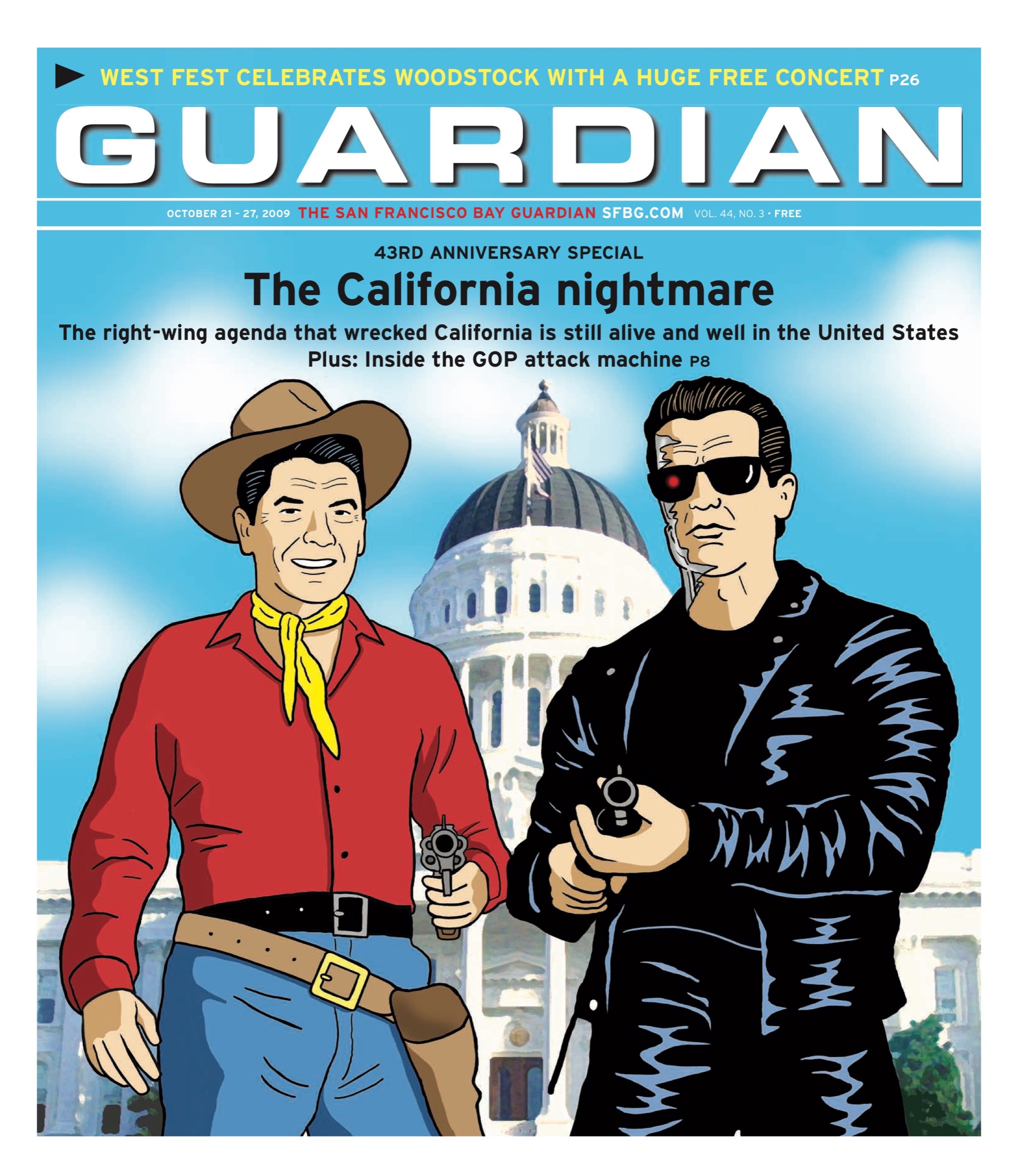
Attack of the right-wing nuts
news@sfbg.com
In April 2006, with the approval ratings of President George W. Bush plummeting, his senior political advisor, Karl Rove, began discussing a plan to turn things around.
His strategy: attack progressive organizations that were registering low-income people to vote and helping them fight corporate power — and claim it was about voter fraud.
The main White House target, newly released records show, was the Association of Community Organizations for Reform Now (ACORN). By the end of 2006, Rove would oversee the removal of eight U.S. attorneys, including two who refused to press bogus charges against ACORN in New Mexico and Missouri, and a third under similar suspicions in Washington state.
ACORN made a convenient target for Rove and his gang — and the well-orchestrated attacks on that group, which have exploded into the headlines this year, provide a compelling case study in how the right wing operates in this country.
Although it was the GOP that removed tens of thousands of likely Democratic voters from the rolls in the 2000 and 2004, the Republicans and their allies were able to make the issue of voter fraud all about ACORN, using a handful of isolated problems to undercut an organization focused on giving a voice to poor people.
Founded in Little Rock, Ark. at the end of the 1960s, ACORN has grown into the nation’s top community-organizer group, thanks to success in improving poor people’s housing, wages, and educational access. By the eve of the 2008 presidential election, ACORN had helped register more than 1.3 million voters — mostly young, low-income minorities — in 21 states, including the battleground states of Florida, Pennsylvania, Michigan, and Ohio.
As The Nation put it, these successes made ACORN “something of a right-wing bogeyman.”
And while the recent furor over a conservative videographer secretly taping ACORN employees saying dumb things has somehow become one of the big political stories of the year, the major media have mostly ignored how this attack is part of a larger conservative strategy.
In August, hundreds of pages of e-mails and transcripts related to the 2006 U.S. attorney-firing scandal were released to the press and public — but few news outlets mentioned that Rove was focused on attacking ACORN’s voter registration efforts, even though ACORN and voter fraud are repeatedly mentioned in these documents.
“This is about a campaign that goes back a decade to big business and that people who don’t like what ACORN does and is effective at — namely, helping groups to organize and put pressure on banks around sub[prime] mortgage loans to stop racial discrimination,” Peter Dreier, a professor of politics at Occidental College, told us.
It wasn’t really about voter fraud. As former U.S. Attorney David Iglesias, a Republican from New Mexico, recently stated on The Rachel Maddow Show: “They were looking at numbers [and] didn’t like the demographic tidal wave that was coming their way so they wanted to engage the machinery of the Justice Department to stop that wave.”
After two years of investigating ACORN and other supposed perpetrators of left-wing voter fraud, Igelias said, “I couldn’t find one case I could prosecute.”
But for the right-wing attack machine, it didn’t matter — the damage was done.
THEIR MASTERS’ VOICE
White House communications strategist Anita Dunn created a stir in mid-October when she told CNN host Howie Kurtz that Fox News “is really more of a wing of the Republican Party. … Let’s not pretend they’re a news network like everybody else is.”
It didn’t take long for Fox commentator Glenn Beck to retaliate. In a series of broadcasts, he attacked Dunn, compared the Obama administration to a communist dictatorship, and likened the criticism to the Holocaust. “Ask yourself this question,” Beck said during a radio segment, vaguely addressing people he called “good journalists” at other mainstream news networks. “When they’re done with Fox, and you decide to speak out on something — it’s the old ‘first they came for the Jews, and I wasn’t Jewish.'” Beck concluded the segment by warning his audience, “this is how a dictatorship always starts.”
Beck’s comment may strike San Francisco progressives as outrageous, but given the rhetoric routinely issuing from the right-wing megaphone, it’s also 100 percent predictable.
But when Dunn called Fox News Channel an arm of the GOP, she was dead on. Consider the history of its chairman and CEO, Roger Ailes, who ran Richard Nixon’s 1968 presidential campaign and later those of presidents Ronald Reagan and George H.W. Bush, guiding them all to victory through his brilliant and successful media campaign strategies.
“Roger Ailes is a newsman with a profound disdain for newsmen,” according to a New York magazine profile. “Fox News is being promoted as an anti-network, a news channel designed to appeal to the people … who don’t trust [the others].” Portrayed in the story as a “self-described paranoid,” Ailes reportedly resigned from an earlier position as head of CNBC after questions were raised about his desire to use his position as a weapon against his enemies.
Fox News is an outgrowth of its parent company, Rupert Murdoch’s News Corporation. A look at the board of directors of this multinational giant yields some startling insight into who controls the “fair and balanced” news network. Ailes himself has a seat at the table — but not every board member has a background in media.
News Corp. board member Viet Dinh, for example, is an attorney who came to the United States as a boy from Vietnam. In a 2002 interview with the Los Angeles Times, Dinh, who then served as an assistant attorney general at the Department of Justice, recalled an exchange he had with then-Attorney General John Ashcroft in the wake of the Sept. 11 attacks. “He told me: ‘The art of leadership is the redefinition of the possible. I want you to be the think tank to help me redefine the possible for the Department of Justice.'”
Dinh successfully redefined “the possible” by acting as a primary author of the USA PATRIOT Act, quickly propelling himself to prominence as a darling of conservatives and an enemy of civil liberties watchdog groups. A law professor at Georgetown University, Dinh is also founder and chief of Bancroft Associates PLLC, a consulting firm that specializes in helping Fortune 500 companies “navigate the federal and state criminal or civil investigations, congressional investigations, and complex litigation,” according to the firm’s Web site. It also specializes in public relations.
Another board member is José Maria Aznar, former prime minister of Spain. Aznar was born into a politically active, conservative family in Spain in 1953, and both his father and grandfather held government jobs under Gen. Francisco Franco, the fascist dictator. Aznar was handpicked by Manuel Fraga, a minister under Franco, to succeed him in leading Spain’s center-right People’s Party (Partido Popular), according to an article in the U.K.’s The Independent.
Aznar now serves as president of the Foundation for Social Studies and Analysis, a right-wing think tank based in Spain that, according to its Web site, works closely with the CATO Institute, the Heritage Foundation, and other conservative U.S. think tanks.
Occupying other seats at News Corp.’s board table is an assortment of professors, attorneys, public-relations experts, and businessmen with their fingers in a variety of banks and multinational corporations. Among the more familiar names are Phillip Morris, Ford Motor Co., Hewlett Packard, Goldman Sachs, HSBC North America, and JP Morgan Chase. Lesser known are the investment banking firms that have stakes in the petroleum industry, utilities, mining companies, and real estate.
While the connections between corporate interests and the country’s leading conservative propagandist are extensive and obvious, there’s a stark contrast between the message delivered by Fox News and the interests of its parent company.
Fox News plays up the theme of patriotism and reinforces the idea that there is a distinction between “real Americans” and outsiders. But Fox’s board is made up of members whose lives and economic interests are scattered across the globe, but have one common thread: they all control extraordinary sums of concentrated wealth.
PROPAGANDA AND EMOTIONS
While Dunn called Fox News Channel an arm of the Republican Party, others have gone so far as to label its content pure propaganda — and incredibly effective propaganda at that.
“This is very, very sophisticated propaganda,” says Bryant Welch, a clinical psychologist, author, and expert on political manipulation. “I don’t think progressives really get it that it’s a technique being used all the time.”
Welch said when he began working as a Washington, D.C., lobbyist on behalf of the American Psychological Association years ago, he started observing the tricky political maneuverings at play in the nation’s capital through the eyes of a psychotherapist who had spent some 30,000 hours helping patients confront their deep-seated hang-ups.
To his surprise, Welch found that some of the most successful right-wing political operatives also seemed to have an understanding of psychology — although they use the knowledge very differently. “A lot of it is psychological manipulation,” Welch asserts.
George Lakoff, a professor of linguistics at UC Berkeley and author of Don’t Think of an Elephant: Know Your Values and Frame the Debate, offered a similar analysis. He said Republicans approach issues as a marketing challenge. “They’ve learned from the cognitive scientists. Even if they don’t understand the science, they know how to do marketing.”
Welch, who is also an attorney and Huffington Post blogger, provides an analysis of how the right wing gets its message across in his book, State of Confusion: Political Manipulation and the Assault on the American Mind. He argues that public relations professionals, right-wing commentators, and others in the business of shaping public opinion are skilled at tapping into widespread feelings of anxiety and uncertainty.
“In this world, things are confusing,” he explains. “You’ve got to be constantly adapting and assimiutf8g new information. When times get confusing, people have a hard time forming a sense of what’s real.”
Right-wing television and radio personalities like Sean Hannity, Glenn Beck, or Rush Limbaugh prey on this widespread uncertainty, Welch argues, by providing viewers and listeners with an absolute version of reality that is easily grasped, neatly divided into right and wrong, and spelled out in very certain terms.
“The thing that Bill O’Reilly and Sean Hannity do is, they sound very powerful, certain, and aggressive,” Welch told us. “[Viewers] identify with that strength. They draw a sense of security from someone who has certainty about what is real.”
Viewers who find that their anxiety subsides when they tune in are hard-pressed to go back and reexamine their views later on, Welch said, because they’re satisfied with the answers they’ve been given. And in right-wing messaging, those answers consistently cast government as the enemy.
On Fox and AM radio, the use of repetition helps drive home an idea until it becomes a conviction in the mind of a listener. Television reinforces those key phrases with patriotic color schemes. The whole package is designed to transform an audience’s sense of bewilderment over a complex world into trust in spokespeople helping them make sense of it.
The right-wing commentators’ success lies partly in their ability to harness core human emotions such as paranoia or envy, Welch said. He pointed to the health care debate as an example, noting how Fox News has repeatedly played up the false concept of “death panels” to create fear.
To counter this tactic, Lakoff suggests that the left would do well to learn how to frame things in moral terms instead of playing defense against right-wing spin masters.
President Obama’s problem, Lakoff said, is that he is still trying to unify the country. “More power to him, but I don’t believe it’s possible,” Lakoff said. “Republican presidential candidate Sen. John McCain got 47 percent of the vote, bad as he was, and given how terrible a campaign he ran, and given that Obama ran a perfect campaign. So Obama’s election was not a landslide, even though he had one of the best campaign organizations and one of the best framed campaigns ever.” Obama doesn’t play the same manipulative games, Lakoff noted. “Obama believes that if you just tell the truth, it’ll be OK, and every day have a truth squad to find the conservative lies,” Lakoff said. “What he didn’t understand was that by focusing on the conservative lies, he was in fact helping the conservative cause. It’s like Richard Nixon saying, ‘I’m not a crook.'” That why Lakoff says it’s so important for Obama, and for the progressive movement in general, to define the moral imperative behind empowering the people and their government to create a better world, then aggressively push a campaign to do so. “It’s the ‘this is the right thing to do’ approach,” Lakoff explained. “And once it’s been framed that way, then you can say what’s false or true. But you should never go on the defensive first. As soon as you go point by point, you are on the defensive.”
Environmental pork?
By Rebecca Bowe
Gov. Arnold Schwarzenegger announced yesterday that he wouldn’t sign any new legislation unless a water plan is in place — and he has some very concrete ideas about what that plan should be. There are about 700 bills awaiting his signature by Sunday.
Siding with Republicans and Central Valley farmers on the water issue, Schwarzenegger has said he would veto any water package that does not include bonds for new dams and reservoirs, at a cost of an estimated $12 billion.
Major agricultural interests are hopeful that these projects will improve their access to water for irrigation, but environmentalists fear that investing in them would take the state down the wrong path when it comes to protecting environmental resources and encouraging more efficient water use. So far, an agreement hasn’t been reached.
As the deadline creeps closer, money is becoming a key concern, especially in the wake of dramatic budget cuts to education and social services. Environmentalists are worried that protections for the Sacramento-San Joaquin Delta will be abandoned in favor of the major water-storage projects forcefully championed by Central Valley farmers who say they’re in dire straits due to unreliable water supply. Sen. Mark Leno told the Guardian this afternoon that as discussions go on, funding for stronger Delta protections is being eyed as a way to bring down the total cost of the water package.
Signaling a reversal from what lawmakers characterized as the “coequal goals” of water reliability and environmental protection at the beginning of the process, Leno says Delta ecosystem protections are now being characterized as “environmental pork” that should have a lower funding priority.
“Republicans are squawking [about the cost], but they won’t let there be any impact on dams, so all the money is coming out of protections for the Delta,” Leno said.
The local list of censored stories

By Guardian News Staff
Every year, when the Guardian covers the release of Project Censored’s list of underreported news story, we also try to list a few local stories that didn’t get the coverage they deserve. For 2009, they include:
Gavin Newsom’s no-new-taxes budget
When Gov. Arnold Schwarzenegger and the Republicans in Sacramento insisted that they wouldn’t raise taxes to address the budget deficit, it was big news — and plenty of San Francisco officials were critical. When Mayor Gavin Newsom took the exact same stance — no new taxes — the news media largely ignored the story and let him off the hook.
What happened to the tax measures?
Last winter, there were big fights over putting revenue measures on the fall ballot. Progressives dug in and fought through a mayoral veto. Commissions were convened. Polls were taken. Promises were made. And then the election deadline simply passed and it was as if the whole thing never happened.
The demise of newspapers
The San Francisco Chronicle has done a few, weak stories about its own extensive layoffs, and other news outlets have discussed the paper’s shaky finances. And the news industry fretted about MediaNews gobbling up most Bay Area newspapers. But there’s been little deep analysis or attention to the end game: What would San Francisco be like with no daily newspaper? Is that where this city is headed? Who will speak truth to power?
Hope in hard times: Michael Moore discusses “Capitalism: A Love Story”
By Louis Peitzman

To call Michael Moore a contentious filmmaker would be something of an understatement. A stalwart champion of the left, he has managed to piss off Republicans and Democrats alike. At an appearance in San Francisco recently, I spoke to Moore about his latest film, Capitalism: A Love Story, a bipartisan look at an economic system that — according to Moore — has let this country down.
San Francisco Bay Guardian: With a topic as broad as capitalism, where do you begin?
Michael Moore: Well, I began by thinking about all the stories I’ve heard over the years of things that, to me, are the most illustrative of this economic system. So I first talked to a pilot on food stamps 13 years ago. I first heard about “dead peasants” eight or nine years ago. I’ve kept in my head a list of these stories, because a lot of people stop me on the street or in a restaurant or whatever, and they want to tell me their story. I’ve listened to a lot of stories. I get thousands of emails every week and so I hear a lot that way. It’s a culmination of 20 years of just being inundated by the misery that this economic system has created.
Prison report: What the state really wants
By Just A Guy
Editors note: Just A Guy is an inmate in a California state prison. His dispatches appear twice a week.
I guess this is sort of a continuance from my last blog, which was, What Plan?My sentiment hasn’t changed — what the California Department of Corrections and Rehabilitation has offered the three-judge panel is a “plan” that will surely get rejected.
The political rhetoric indicates that the state will fight — but it really is weak rhetoric, spoken just between the ears of constituents by politicians who want to appear tough on crime.
For those who that don’t deal directly with lawyers and politicians on a daily basis, the “we-will-fight-the-feds” speech really is weak. They have to say that — to appear tough on crime and strong for public safety (in their minds anyway). But I believe a good percentage of them are silently grateful for the escape granted to them by the feds. Ultimately, the court will reject their weak plan and take over long enough to release dozens of thousands of us .
If CDCR and the politicians who say they’re against releases felt as strong as they would have you think, a much more robust, pragmatic, well-thought-out process to deal with overcrowding would have been presented.
The Republicans claim to be against big government. If they really thought that way about the release scenario, they would have pushed for a plan that would have been acceptable to the courts and kept the big federal government out of the California prison system.
The Democrats who speak against releases and federal interference are just hypocrites scampering for a way to ride out the potential political fallout they perceive if they don’t “speak out” against releases.
Meanwhile, the ones who are speaking up for sanity are not getting the shaft that the others so feared.
The long-term results of the current budget cuts for health care, welfare and education are not seen as threats to public safety. But its so right in front of everyone to see and it’s not too complicated to explain nor to understand:
— Cuts to welfare mean more people have to find a way to feed themselves and their families. Consequently, they may steal or deal drugs.
— Cuts to health care mean less money to pay for you and your family’s health — consequently people will steal or deal drugs to pay for health care.
— Cuts to education mean a less-educated workforce that can’t get jobs because the economy sucks so they get on welfare …. oops, there is no welfare. Consequently, they steal or deal drugs to pay for food or healthcare or both.
Of course, there are those that wind up on drugs because it’s easier to worry about the next high than your next meal.
40,000 now — or what, 400,000 in five years?
Can we talk about capitalism now?
By Steven T. Jones

Are we actually, finally, about to have a long overdue national conversation about capitalism? I really hope so, and perhaps the catalyst for that conversation can be Michael Moore’s new film, “Capitalism: A Love Story,” which I saw yesterday and which debuts in theaters on Oct. 2.
Moore doesn’t pull any punches in assailing an economic system that has created huge and growing disparities in wealth, corrupted both the public and private sectors, destroyed people’s lives and the country’s manufacturing base, and is both wasteful and unsustainable — a system that even the mainstream clergy he interviews labels as “evil.”
He makes excellent use of last year’s financial meltdown and the electoral gun that Wall Street power brokers (working inside and outside the federal government, Democrats and Republicans alike) held to the heads of Congress members in order to get their $700 billion bailout, which Moore calls a theft of the US treasury.
But it’s his use of archival footage that really brings home just how much capitalist propaganda has conditioned the American people into accepting as natural and inevitable an economic system that is so hostile to their interests. Particularly powerful was a speech that FDR made a year before his death calling for a “Second Bill of Rights” that would guarantee the right to work for livable wages, have access to affordable health care and quality education, housing that is adequate and reasonably priced, a pension and vacation time, and the resources to enjoy recreation and pursue our happiness.
These are reasonable expectations that the richest 1 percent of the country – which Moore shows as actively conspiring against basic equity, fair competition, and the common good, citing an incriminating Citibank memo among other evidence – has removed from the realm of the possible. And it’s time that the people rose up against our economic masters and demanded a new economic system that is sustainable, equitable, and just, something he shows as already starting to happen here and there.
“I refuse to live in a country like this and I’m not leaving,” Moore said toward the end of the film, soon adding, “Capitalism is an evil and you can’t regulate evil — you have to eliminate it.”
Editor’s Notes
Tredmond@sfbg.com
I’m really glad that you can watch the state Legislature on streaming video, because it gave me something to do Friday night. For a couple of hours, I sat there transfixed, flicking from the Assembly channel to the Senate channel, as the exhausted and somewhat punchy leaders of our state government blazed through about 100 different bills.
I think my favorite moment was when the Assembly Republicans tried to derail AB 962, a bill by Assembly Member Kevin De Leon (D-Los Angeles) that bans the sale of mail-order ammunition. De Leon tried to explain how reasonable the measure is — you can still order ammo on the Internet, but it has to be delivered to a licensed gun store, someplace where a clerk can check to make sure you’re over 18 and not a felon. He spoke of teenagers in his district ordering thousands of rounds of deadly bullets and getting them delivered to their doorsteps.
But oh my, the GOP was outraged. One Assembly Member announced that this was a violation of the Second Amendment and started chanting "let my people go." Another described a letter she received from a senior citizen who apparently had trouble getting around but needed a thousand rounds of live ammo for a "cowboy reenactment." The guy can’t drive to a gun store, but he can shoot live bullets at other old cowboys? What a great country.
At any rate, the Assembly passed the bill, with the minimum 41 votes, and the governor will now get to decide once again if he’s with the gun nuts or reasonable law enforcement.
I was a little worried that the modest prison reform bill would fail. Barely enough Assembly Democrats supported it, and some of the more liberal state Senators said it didn’t go far enough. Which it didn’t, and it doesn’t, and it’s at best a weak plan that could lead to the release of 17,000 nonviolent inmates. But the heart of the original bill, which called for a commission to review the state’s insane and often arbitrary sentencing policies, died. And some Assembly Democrats — including San Francisco’s Fiona Ma — refused to support a proposal to release more inmates to alternative custody, including home detention with electronic monitoring. So an alternative-release bill never made it to the floor.
That means the state is at least $200 million short of the cuts it needs to make in the prison system to balance the budget — cuts that were already included in the fiscal plan approved this summer. And California is still out of compliance with the federal courts, which have ordered the state to release some 40,000 inmates.
Something’s got to give.
The water system isn’t getting any better, either. The five key water bills failed to get approval, so it appears the Legislature will be coming back for a special session on water. Maybe one on education, too. Maybe more prison reform will come up in those sessions. Maybe Fiona Ma will realize that unlike some moderate Dems, she runs no risk of losing reelection over prison releases and can vote the right way next time.
And maybe Tantalus will get to eat some apples. Last I heard, he was still hungry.
The Legislature’s all-nighter fails
The state Legislature wrapped up its session around 7 a.m. Saturday, after officially stopping the clock on the midnight deadline and pretending it wasn’t the next day yet until 120 elected officials endured a sleepless night and a lot of critical work didn’t get done. The really bad all-nighters in college were the ones when you felt like hell the next day and didn’t finish the term paper anyway.
There’s a pretty good roundup here and hereon a couple of the bills.
It’s remarkable: Governor Schwarzenegger is going to veto the very bill he initially proposed. He’s going to sign a prison reform bill that doesn’t even come close to doing what he agrees has to be done to cut prison costs. And unless he calls a special session of the Legislature to deal with water issues, there will be nothing to stave off the near-collapse of the Bay/Delta estuary.
Meanwhile, of course, the Republicans refused to back down and approve a tiny $16 million allocation to save domestic violence sheters (which literally save lives).
At least the Senate refused to exempt a bizarre sports stadium plan in Southern California from CEQA; it looked for a while there as if the legislators were going to cut a huge hole in the state’s landmark environmental law just to please a billionaire.
Hell of a session. Can’t wait for the fall.
UPDATE: Prison reform squeaks through
By Tim Redmond
Well, the state Senate just approved the Assembly’s version of a prison reform bill, which is too weak but at least it’s something. It will go back to the Assembly tonight.
By the way, if you want to watch all the end-of-session madness — the bills flying through, the impassioned speeches and the outright nuttery (I was just enjoying the debate in the Assembly over limits on mail-order ammunition — good God, these Republicans are strange), you can get streaming video here.
Editorial: No compromise on health care
By Tim Redmond
It’s not hard to find suggestions for how President Obama should handle his speech tonight. Maybe the speech isn’t all that important anyway — it’s what the president does afterward.
But our line on it is simple: The Democrats have compromised enough. The Republicans have no credibility here and there isn’t going to be a bipartisan solution. So Obama needs to fight to win.
Ted Kennedy: always a liberal
By Bruce B. Brugmann
I liked Ted Kennedy for lots of reasons. But I think I liked him the most because, in carrying the Kennedy family torch for all these decades, he was the most liberal of the Kennedys and he never backed down from calling himself a liberal, even when the word went out of fashion and lots of “liberals” were ducking for cover. To me, a liberal is someone who tries to make things better.
Kennedy spent his Senate career working tirelessly and effectively to make things better, for all of us, and applying his liberal voice to a breathtaking range of issues from health care reform, to civil rights, to opposing the Gulf and Iraq wars, to backing Obama at the right moment.
If Kennedy had not been stricken in the middle of his greatest battlle and his greatest cause (“health care for all is the cause of my life”), I’m certain that single payer health care would not have been taken off the table so cravenly and there would at minimum be a real public option with real public support and without a lot of cowering Democrats and Republicans. And there would be real health care reform, perhaps a version of Medicare for all, with a liberal Ted Kennedy imprimatur. He was the one politician in all these years and all these battles who could have made it happen. Alas. Alas.
The Boston Phoenix, the liberal alternative newsweekly of Boston and New England, has covered the Kennedys and liberal Ted since Steve Mindich founded the paper in l966.
Click here to view its splendid coverage, updated regularly.
The big prison duck
EDITORIAL A panel of federal judges has ordered the release of 44,000 California prisoners, sending politicians of both parties scrambling for cover and throwing a crucial issue into the heart of the Democratic campaign for governor.
And so far, both major candidates are ducking, badly.
The state prison system is a mess; any sane person knows that. California incarcerates 170,000 people in facilities designed for less than half that number. Sick inmates don’t get to see doctors; mentally ill or drug-addicted inmates often get no treatment at all. It’s so bad that a federal monitor appointed by the courts has demanded that the state spend $8 billion building new medical facilities for prisoners.
Meanwhile, inmates are crowded into makeshift bunks in gymnasiums and dayrooms. The few modest rehabilitative programs California offers are stretched so thin that many inmates get no job training or violence-prevention skills at all. The parole system is overburdened and focuses far too heavily on people with minor, nonviolent offenses.
And politicians wonder why the state has a recidivism rate of 70 percent.
The solutions aren’t rocket science, either. There’s a clear reason why incarceration rates have jumped so high: harsh sentencing laws, passed by the Legislature and the voters with no concern for the costs of implementation. The state’s three-strikes law is so draconian that thousands of people are serving 25 years to life for nonviolent felonies that typically would carry a sentence of a few years. So the first thing the Legislature and the governor need to do is change the sentencing laws (and give back discretion to judges).
Then there’s a drug problem. California prisons are packed with people serving sentences for drug possession — and most of these people, and society in general, would be better served, at less than half the cost, with treatment programs.
And frankly it wouldn’t be hard to release 44,000 inmates without any new threats to public safety. The vast majority of the inmates in California prisons are going to be released at some point anyway; in fact, the state now releases about 10,000 people a month. The early releases envisioned by the federal courts could simply mean allowing people who have served, say, three years of a four-year sentence to leave prison and shift to the custody of the parole system a few months earlier than scheduled. Many of those people are nonviolent offenders, particularly drug offenders.
With the state in a catastrophic fiscal condition, the cost of corrections ought to be a huge issue for the candidates for governor, particularly the Democrats. Mayor Gavin Newsom and Attorney General Jerry Brown ought to be promoting a plan that would end the insanity of "three strikes," offer alternatives to incarceration for nonviolent offenders and drug addicts, and allow early releases to bring down the current unsustainable incarcerated population.
So what are these candidates, supposedly alternatives to the Republican agenda, saying?
Here’s Brown, quoted in the Los Angeles Times: "Government is established to protect the safety and security of its citizens, and these wholesale releases are totally incompatible with that." Where’s Newsom? We called his campaign press office for comment, and haven’t heard back.
This is unacceptable.
It’s typical for Republicans to use scare tactics and talk about crime as a cheap way to win votes. But Newsom and Brown ought to know better. This is no time for demagoguery — the prison crisis is serious, festering, and a major factor in the state’s financial mess. If the two leading Democrats can’t come up with honest answers, it’s time for someone else to enter the race. *
What went wrong
EDITORIAL David Dayen, a political blogger at Calitics, had the best line on the California budget crisis.
"Whoever cares the least about the outcome wins," he wrote July 20. "If you don’t care whether children get health care, whether the elderly, blind and disabled die in their homes, whether prisoners rot in modified Public Storage units, whether students get educated … you have a very good chance of getting a budget that reflects that."
In the end, the Republicans largely carried the day because they had all the power: they could block any budget deal, they refused to raise any taxes, and they don’t really care if the state goes bankrupt. In fact, Gov. Schwarzenegger was happy to draw the crisis out as long as necessary — it helped his poll rating.
San Francisco should have had a very different situation and a very different outcome. The progressives control the Board of Supervisors and the mayor is in a tight spot — he’s running for governor and wants to show that he can manage San Francisco better than anyone in Sacramento is managing the state. It’s part of his campaign theme. A prolonged budget standoff was not in his interest.
And while the city budget is far, far better than the state budget, and the progressives managed to get a few concessions, the bottom line remains: this is a no-new-taxes budget, balanced largely with cuts and regressive new fees. In fact, for all the mayor’s talk of working with the board on possible tax measures, it now appears likely that there will be no revenue proposals whatsoever on the November ballot.
And the mayor is going to make another deep round of cuts soon, when the figures on what San Francisco will lose in state funding (almost certainly more than $150 million) become available.
It took last-minute efforts by Sup. Ross Mirkarimi, supported by Sup. David Campos, to win back funding for the Public Defender’s Office and at least a shot at funding the public finance system for the next local elections.
The supervisors, frankly, should have pushed harder. The message to Newsom should have been: no budget without new revenue. And as the board approaches the next fiscal year — projections already call for a $300 million deficit — that absolutely has to be the bottom line. Critical services have been cut too deeply already.
The process needs to be better too. Allowing two supervisors — the budget committee chair and the board president — to negotiate a closed-door deal with the mayor without briefing their colleagues or letting the other stakeholders know what was going on was a big mistake that can’t be repeated.
The New York Times ran a front-page story July 21 describing in bleak terms how California has abandoned its safety net and given up the ambitious dreams that for so long defined the state. "At no point in modern history," reporter Jennifer Steinhauer wrote, "has the state dealt with its fiscal issues by retreating so deeply in its services, beginning this spring with a round of multibillion-dollar budget cuts and continuing with, in total, some $30 billion in cuts over two fiscal years to schools, colleges, health care, welfare, corrections, recreation and more.
That can’t be the model for San Francisco to follow. *
Editorial: What went wrong in Sacramento
In the end, the Republicans largely carried the day because they had all the power and could block any budget deal, refuse to raise taxes, and don’t really care if the state goes bankrupt
EDITORIAL David Dayen, a political blogger at Calitics, had the best line on the California budget crisis.
“Whoever cares the least about the outcome wins,” he wrote July 20. “If you don’t care whether children get health care, whether the elderly, blind and disabled die in their homes, whether prisoners rot in modified Public Storage units, whether students get educated … you have a very good chance of getting a budget that reflects that.”
In the end, the Republicans largely carried the day because they had all the power: they could block any budget deal, they refused to raise any taxes, and they don’t really care if the state goes bankrupt. In fact, Gov. Schwarzenegger was happy to draw the crisis out as long as necessary — it helped his poll rating.