Republicans

Teabaggers: Angry, ignorant, and proud of it

16

As the teabaggers hit the streets again on April 15 to shout their denunciations of taxes and government, a new poll in the New York Times confirms what most of us knew: these people are angrier, more conservative, and less informed than the average American – a deadly combination.

The Grey Lady didn’t say it that way exactly, but that’s what the results show. They overwhelmingly hate Obama and think that he’s been pushing policies that disproportionately help the poor and African-Americans and that he has already increased taxes on most Americans, none of which is true, as untrue as the supposed “government takeover” of the health care system that ushered in the Tea Party in the first place.

The teabaggers are older and wealthier than most Americans, and they also describe themselves as far more angry than the average American or even most Republicans. And considering their affections for guns and Revolutionary War metaphors, that’s kinda scary.

Frankly, I was hoping that these people would eventually realize that Obama was as far from being a socialist and I am from being, well, a teabagger. But this strange circle jerk of proud ignorance seems to have some staying power. In San Francisco, there are not one but two Tax Day Tea Parties: an event from 4-7 pm at Union Square and another from 1-4 pm at Civic Center with the telling title, “Tell Pelosi to Shove It!”

Where’s teacher?

4

By Brady Welch

news@sfbg.com

Horace Mann Middle School principal Mark Sanchez sounded exhausted when we reached him on March 26. It wasn’t because Horace Mann is such a tough school, although the Mission District campus does have a disproportionate number of at-risk students. And it wasn’t because it was the Friday before spring break, although that might have had something to do with it.

All week Sanchez had been reeling from news that a whopping 10 out of his 20 full-time teachers had been issued pink slips by the San Francisco Unified School District. Including counselors, a vice principal, and other staff, the budget cuts essentially lopped off 24.6 percent of the school’s workforce, an unprecedented blow that speaks volumes about the state of California public education.

“A lot of the kids were wondering if the school was getting shut down,” Sanchez said. And although Horace Mann isn’t closing, with so many axed teachers, it might seem like a new school to many students come August. “If a significant number [of teachers] are moved, we don’t know what we’re in for.”

There is a legend that you will meet the person who will seal your fate long before the final event happens. And in an interesting turn of events, it was Sanchez who, as president of the Board of Education in 2007, hired current SFUSD Superintendent Carlos Garcia. Attempting to close a staggering $113 million budget gap over the next two years, it fell to Garcia on Feb. 23 to send out 645 layoff notices across the district in a list that included 163 administrators, 239 elementary school teachers, 124 high school teachers, and 104 middles school positions. Horace Mann was hit particularly hard because so many of its staff lacked seniority. Final decisions on layoffs will be made next month by the school board.

The first indications of this massive fiscal blood-letting came Jan. 20, when Garcia sent a letter to the entire district on learning of Gov. Arnold Schwarzenegger’s budget. The document was a glaring reminder of how bad things had gotten in Sacramento, and the superintendent wrote candidly of what he saw and what it meant for the district. “These numbers are large, and they will be devastating.”

Aside from the extraordinary blow to personnel, the proposed SFUSD budget will increase class sizes, freeze salaries, cancel summer school except for those who need credits to graduate, and reduce the number of days of classroom instruction to 175 annually, putting the district in conflict with a state law mandating at least 180 days. Given its deep cuts, Sacramento probably won’t enforce the statute.

“The state itself is in such a budget crisis,” Sanchez told us. “And [it’s] refusing to raise taxes. The fix has to be at the state level.”

But that’s been difficult since the passage of Proposition 13, the 1978 measure that limits property tax increases and gives control of whatever revenue is generated directly to the state. Because all state budgets must pass the Legislature with a two-thirds super-majority vote, a disciplined minority of virulently antitax Republicans block budgets that adequately fund education nearly every time.

Yet now, the bill for that political stalemate is coming due at schools like Horace Mann.

Beyond the numbers and politics, the Guardian wanted to get a closer look at how this regular cycle of cuts and layoffs is affecting teachers and students, so we spoke to a couple of eighth grade English teachers at Horace Mann who described it as dismal.

“I try to put it at the back of my mind, to be honest,” said Matt Borowsk, one of the 10 teachers at Horace Mann who received a pink slip. Borowsk reiterated a common sentiment that all teachers — potentially laid off or not — just want to do their jobs and focus on their classes. “I want to be able to stay and do my work and make improvements. And I want to do what I can for the school community and work with students,” he said. “I’m still in it, and I’m in it for the long run, despite what issues the district has about keeping their teachers.”

Gail Eigl, a teacher at Horace Mann for eight years who is tenured and therefore not at risk of a layoff, concurred. “No one I know who got a pink slip has changed their attitude. People are trying to stay focused on the present and teach.”

It’s an admirable response, and one Eigl understands well. She was laid off after her first year there in 2001. “Six of us got pink slips,” she recalled. “It was terrible.” She went looking for a job in South San Francisco, but in a strange turn of events, SFUSD called and offered her a job at Argonne Elementary in the Richmond District. A year later, she was back where she started at Horace Mann, and until now, she hadn’t really looked back.

“It’s like the school keeps having problems,” she said, an opinion that also hints at SFUSD’s skewed notion of teaching as a stable career path.

Borowski offers a similar story. This year’s pink slip is his second. Last year he received one after teaching only a year in Burlingame, which is how he ended up in San Francisco. Such rampant doling out of pink slips has nothing to do with Borowski’s performance. Rather, it has everything to do with seniority. And because the state is in such a crunch, it’s hard to stay in any school long enough before the budget’s grim reaper comes to collect.

“People who are able to stick through the first five years, they genuinely want to be a good teacher, make seniority, and not have to worry about it,” he said. And “because Horace Mann is a school where new teachers go, because it’s a tough school, then they’re the most vulnerable to layoffs. Which starts this vicious cycle.”

It’s classic Catch-22. Facing such a budget shortfall, how does SFUSD keep teachers who have little or no seniority teaching in the very schools whose litany of needs put those teachers there in the first place? In many ways, these are the most committed and passionate teachers the district has, and they represent for their classes a level of discipline and stability absent in many of their students’ home lives.

Many of Eigl’s students are low-income, speak English as a second language, or both. Some of their parents are deceased, others are undocumented immigrants, and a few are in jail.

“I honor tenure,” she told us. “I know there’s a reason for it. But right now, it doesn’t seem to be working for us.” Eigl brings up the case of a new parent liaison the school received this year, a critically important position that takes time building solid relationships with students’ families. “She got a pink slip too,” Eigl told us, the exasperation evident in her voice.

“I think people are really defeated inside. It’s so frustrating,” she continued. When asked what she meant by that, Eigl became heated. “It’s California! We’re supposed to be the richest economy. We should have money for schools. Why are other states doing so much more? We’re at the bottom. Where’s the money?” She suggested that Horace Mann should be granted special status because of its high-needs student body.

“It’s almost predictable that students who have a lot of unpredictability in their lives will suffer for this,” Sanchez told us. “It will be destabilizing for them. Teachers will get disrupted as well. A lot of what you do in schools has so much to do with outside the classroom, and it takes a lot of time to get acclimated.” At a tough school like Horace Mann, he says, “there’s been a lot of professional development and new programs.”

Borowski stresses the sentiment forcefully. “It’ll be devastating if the pink slips go through. It’ll be a huge mess.”

Both teachers participated in the massive statewide protests against the cuts on March 4. But other than letting Sacramento know how public educators feel, nothing concrete has come out of it. Sanchez suggested that it might be possible to sue the state for violating its statute on the minimum number of school days. Even SFUSD, at the last Board of Education meeting on March 23, didn’t rule out the possibility of suing the state for lack of adequate funding.

Negotiations are ongoing between the district and the United Educators of San Francisco teachers union about final layoffs. Those will be finalized May 15. Meanwhile, teachers at Horace Mann and across the district will continue to do their jobs despite how grim the outlook may be. As Eigl puts it, “It’s like out of a book from a bad future.”

Radio: It’s about local, dammit

8

By Johnny Angel Wendell


arts@sfbg.com

As the 2010 midterm elections approach, so rises the heat level in one of the American news media’s most vitriolic battlegrounds: AM (and increasingly FM) news/talk radio. Dominated almost entirely by the American right in all its permutations, the genre is part of what Hillary Clinton once deemed a "vast right-wing conspiracy." And while she may have overstated the case somewhat, talk radio is the angry white male’s jungle drum. As the broadcast point for the economic and social theorizing emanating from billionaire-funded think tanks like the Heritage Foundation and American Enterprise Institute, as well as repeating anti-government (when the government is not being run by Republicans) doggerel whose roots run all the way back to Father Coughlin’s screeds in the 1930s, it’s as effective a tool for mounting outrage (which is never aimed at corporate America, a telling sign, populism-wise).

Because of this obvious one-sidedness masquerading as news, many media critics on the left have demanded the reinstatement of the Fairness Doctrine — a law enacted in 1949 that required the holders of broadcast licenses to present issues of public importance in a way that a government commission deemed fair and equal, so both sides of an issue got equal time. The doctrine remained the standard by which talk radio operated until it was repealed in the late 1980s. Shortly after that, Rush Limbaugh began his ascent to the summit of talk radio, becoming its most popular voice. If the Fairness Doctrine was still in place, however, that might never have happened.

President Obama has said that he has no interest in restoring the doctrine, claiming it’s a distraction. Despite the fact that reinstating it would personally benefit yours truly as a left-leaning talk show host, I’m also opposed to it — it does not solve what truly ails talk radio today.

What’s really wrong with talk isn’t the imbalance between right and left — it’s local vs. national, live vs. syndicated. Tune in to nearly 80 percent of talk outside of morning and afternoon drive time, and it’s one national show after another: Rush Limbaugh, Sean Hannity, Glenn Beck, Dr. Laura. Their politics are irrelevant — they’re broadcasting on local frequencies and not discussing local events.

Talk radio does not need partisan balance. At this point, half the country gets its news from the Internet, where thousands of Web sites provide every conceivable point of view. What talk does need — and badly — is a requirement that stations devote at least half their time to local issues. Most of the day or part of the evening should be devoted to what actually affects the audience — schools, traffic, cops, corruption, our kids, our money, what we see and hear right in front of us.

Radio chains might scream bloody murder at this because syndication is cheaper. But the two most popular AM stations in the state — KFI AM640 in Los Angeles and KGO 810 in San Francisco — are locally-based stations. KGO has no syndicated programming at all Monday through Friday, and consistently has been the top-rated station in the city.

A Fairness Doctrine would be seen (rightfully so) as a way to shut up the right. But a 50/50 Doctrine would not — and given that the polarity of opinion on local issues is less (because it’s real and present), the blatant disregard for fact would evaporate quickly. This is worth lobbying for — if anything meant "bringing it all back home," local talk would be the optimal place to begin. *

Johnny Angel Wendell is a talk show host at KTLK AM 1150 in Los Angeles and has been on Green 960 and KIFR 106.8 in SF.

The pot initiative’s going to win

9

It seems pretty clear to me that, with polls showing widespread support and money pouring in for the campaign, the initiative to legalize pot in California is going to pass. So why are all of the candidates for governor, even Jerry Brown (who may have smoked a joint or two in his time) coming out so strongly against it?


Jerry knows that legal pot isn’t going to create new law-enforcement problems; quite the contrary. It’s going to save huge amounts of money that the state and local governments now waste enforcing a silly law that nobody respects, will cut down on the jail population and discourage the environmentally damaging (and sometimes violent) gangs of rogue growers who plant on public land.


And he ought to know that this kind of a stand isn’t going to help him get elected. Once you take the hard-core Republicans who would never vote for Brown anyway out of the equation and look at the universe of potential Brown voters, legalizing pot probably gets more than 60 percent approval.


If you asked me back in 1978 whether I could imagine a day when Jerry Brown would oppose a marijuana legalization measure that was polling at 60 percent, I would have said: Whoa, man, no way. But then, I inhaled.

Editorial: Who wins with the Transamerica condos?

4

The developers aren’t offering to build something that will create permanent jobs for local residents. They want a huge favor from San Francisco: they want the city to ignore its own planning rules, ignore its park-shadow ordinance, and hand over a piece of city street, just to make their project more profitable.

EDITORIAL  As the Planning Commission prepares to vote March 18 on a pointless and overly large condominium complex next to the Transamerica Pyramid, let us take a moment to look at who would benefit from the project’s approval.

The project sponsors, Aegon USA and Lowe Enterprises, would get the right to shadow public parkland, turn a city street into a private parking garage, and construct a project far beyond the allowable height for the location. They’d construct 248 luxury condos, which the city doesn’t need and will do nothing for the housing crisis. The developers would also make a lot of money on the deal; that’s why they want spot zoning to double the allowable height. When it comes to these sorts of projects, taller is more profitable.

And the two companies asking for these civic favors aren’t exactly San Francisco outfits that share the city’s values.

Aegon is a giant insurance and finance company based in the Netherlands that bought out the local Transamerica Company in 1999. The money Aegon makes on the deal won’t stay in San Francisco; even Aegon’s American subsidiary doesn’t have a home office here.

The company’s PAC is a major contributor to Republican causes and candidates (although some Democrats get money, too, particularly the likes of Sen. Blanche Lincoln of Arkansas, one of Aegon’s top-dollar friends, who is among the main reasons the Senate won’t pass a public option for health insurance). And over the past 10 years, Aegon PAC has contributed $39,500 to Lifepac, a Columbus, Ohio-based anti-abortion group.

Then there’s Lowe Enterprises, based in Los Angeles. The company’s chairman, Robert Lowe, and his employees were among Arnold Schwarzenegger’s top donors, with a whopping $159,500 in contributions to the Republican governor. Lowe is also a big supporter of Meg Whitman’s campaign for governor, and is on her finance committee.

So here we are in Democratic San Francisco, with a mayor who will be running on a Democratic ticket for statewide office (and a mayor, by the way, who loves to talk about supporting small local business and keeping money in the local economy) preparing to give a huge financial gift to a pair out out-of-town companies that share their wealth with right-wing Republicans.

Of course, it’s no surprise that a real estate developer would support Republican candidates — and it’s no surprise an insurance company would be working against health care reform. And if the city granted or denied building permits based on the politics of the applicant, there’d be serious legal consequences (and there should be). These things ought to be decided on the merits; developers who contribute to Democrats (like the Shorenstein Company) deserve the same scrutiny as the ones who give to Republicans.

But this isn’t a typical development deal. Aegon and Lowe aren’t asking for a permit for a project that meets the current zoning laws. They aren’t offering to build something that will create permanent jobs for local residents. They want a huge favor from San Francisco: they want the city to ignore its own planning rules, ignore its park-shadow ordinance, and hand over a piece of city street, just to make their project more profitable — and to give them more money that can go to opposing health-care reform and opposing abortion rights and electing right-wing Republicans. And they’re offering the city nothing in return.

On the merits, the project richly deserves to be rejected. The only reason to approve it is to grant a civic boon to a bunch of out-of-town corporations that ought to be embarrassed to be asking a favor from San Francisco. And the Planning Commission should be embarrassed to consider granting it.

Who wins with the Transamerica condos?

0

EDITORIAL As the Planning Commission prepares to vote March 18 on a pointless and overly large condominium complex next to the Transamerica Pyramid, let us take a moment to look at who would benefit from the project’s approval.

The project sponsors, Aegon USA and Lowe Enterprises, would get the right to shadow public parkland, turn a city street into a private parking garage, and construct a project far beyond the allowable height for the location. They’d construct 248 luxury condos, which the city doesn’t need and will do nothing for the housing crisis. The developers would also make a lot of money on the deal; that’s why they want spot zoning to double the allowable height. When it comes to these sorts of projects, taller is more profitable.

And the two companies asking for these civic favors aren’t exactly San Francisco outfits that share the city’s values.

Aegon is a giant insurance and finance company based in the Netherlands that bought out the local Transamerica Company in 1999. The money Aegon makes on the deal won’t stay in San Francisco; even Aegon’s American subsidiary doesn’t have a home office here.

The company’s PAC is a major contributor to Republican causes and candidates (although some Democrats get money, too, particularly the likes of Sen. Blanche Lincoln of Arkansas, one of Aegon’s top-dollar friends, who is among the main reasons the Senate won’t pass a public option for health insurance). And over the past 10 years, Aegon PAC has contributed $39,500 to Lifepac, a Columbus, Ohio-based anti-abortion group.

Then there’s Lowe Enterprises, based in Los Angeles. The company’s chairman, Robert Lowe, and his employees were among Arnold Schwarzenegger’s top donors, with a whopping $159,500 in contributions to the Republican governor. Lowe is also a big supporter of Meg Whitman’s campaign for governor, and is on her finance committee.

So here we are in Democratic San Francisco, with a mayor who will be running on a Democratic ticket for statewide office (and a mayor, by the way, who loves to talk about supporting small local business and keeping money in the local economy) preparing to give a huge financial gift to a pair out out-of-town companies that share their wealth with right-wing Republicans.

Of course, it’s no surprise that a real estate developer would support Republican candidates — and it’s no surprise an insurance company would be working against health care reform. And if the city granted or denied building permits based on the politics of the applicant, there’d be serious legal consequences (and there should be). These things ought to be decided on the merits; developers who contribute to Democrats (like the Shorenstein Company) deserve the same scrutiny as the ones who give to Republicans.

But this isn’t a typical development deal. Aegon and Lowe aren’t asking for a permit for a project that meets the current zoning laws. They aren’t offering to build something that will create permanent jobs for local residents. They want a huge favor from San Francisco: they want the city to ignore its own planning rules, ignore its park-shadow ordinance, and hand over a piece of city street, just to make their project more profitable — and to give them more money that can go to opposing health-care reform and opposing abortion rights and electing right-wing Republicans. And they’re offering the city nothing in return.

On the merits, the project richly deserves to be rejected. The only reason to approve it is to grant a civic boon to a bunch of out-of-town corporations that ought to be embarrassed to be asking a favor from San Francisco. And the Planning Commission should be embarrassed to consider granting it.

Steve Poizner is scary!

10

I knew that Republicans have gotten pretty loony these days, but gubernatorial hopeful Steve Poizner was downright scary in his debate with Meg Whitman yesterday, threatening to create racial unrest and bankrupt the state in the name of being more conservative-than-thou.

He wants to deny all public services to undocumented immigrants and chided Whitman for not currently supporting Prop. 187, the 1994 measure that was struck down by the courts as unconstitutional. And after correctly saying California was “on the brink of economic collapse,” he went on promote that collapse by calling for a 10 percent reduction in sales, corporate, and income taxes, which really would bankrupt a state government that is already wrestling with a multi-billion-dollar budget deficit.

Now, I know that he’s pandering to the right-wing lunatic fringe of California, where Republicans are less than a third of voters and shrinking, and they’re all riled up these days from drinking too much Fox-brewed tea. But damn, this guy has really lost his mind.

Politics and redistricting: The madness in SF’s future

8

The political merry-go-round in San Francisco going to be whirling at light speed soon. It’s partially the fault of term limits — over the next couple of years, some very talented, ambitious politicians are going to be forced to leave local office, and they’re looking for the next step. Part of it is the confluence of a bunch of events, starting with Mayor Gavin Newsom and District Attorney Kamala Harris both seeking statewide office.


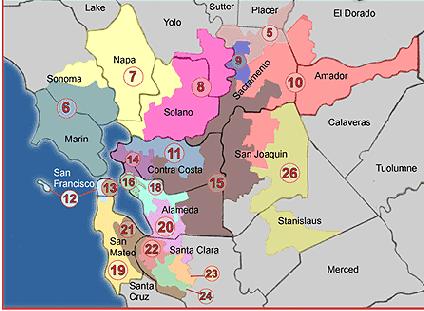
And there’s another factor that hasn’t been talked about much, but it’s really important: Next year, every Congressional, state Legislative and local supervisorial district is going to change.


After the decennial census, everyone has to draw new lines to reflect population shifts. At the state level (and Congressional redistricting is also a state function), that’s in the hands of a reapportionment commission, which I’m dubious about: The majority of the applicants are white people, and it’s supposed to have an equal number of Democrats and Republicans, although the state has far more Democratic voters. It’s anybody’s guess how they’ll actually draw the lines.


An elections task force will do the local lines, and it’s going to be harder to screw up; San Francisco supervisorial districts are supposed to reflect established neighborhood boundaries, and the population shifts within the city haven’t been that dramatic.And it’s unlikely anyone’s going to try to draw lines just to force an incumbent supervisor out of a district. But the districts will be a little bit different, and in San Francisco politics, a little bit can mean a lot.


The state Legislative districts will change significantly — and could change the politics of this area, and the state, in dramatic ways. For example, suppose Mark Leno’s Senate District moves somewhat North, to include a majority of Marin and Sonoma residents and only a small minority of San Franciscans? Suppose that district no longer includes Marin or Sonoma, but includes all of San Francisco (which would put Leno and Leland Yee in the same district)?


Suppose the 12th and 13th Assembly Districts, which now divide about East/West, shift to North and South? What if Tom Ammiano and Fiona Ma end up in the same district? (Um, I think that’s a closer relationship than either of them wants ….)


What happens if Nancy Pelosi is redistricted out of her seat? (Heh heh, won’t happen, but in theory, she and Lynn Woolsey could wind up living in the same district.)


It’s going to change the dynamics in a city that’s already poised for some upsets to the political apple cart.


Ross Mirkarimi’s termed out in 2012, and if he doesn’t run for mayor (or doesn’t get elected) he’ll be looking for the next step, which could be a run for the state Assembly; Tom Ammiano will be termed out in 2014. Of course, that’s been a gay seat for a long time (Carole Migden, Mark Leno, Ammiano) and by them someone like David Campos might be interested.


Or the district lines might have changed so much that both of them – or neither of them – can get elected.


If Bevan Dufty doesn’t get elected mayor, he’s out of a job – and he’s a political junkie who won’t easily retire. He’ll be looking at other offices, too. So will Sean Elsbernd, I suspect.


And that doesn’t even count the mayor’s race, which could, at this point, involve both state Senators, Leno and Leland Yee, and if either one wins, that opens up a Senate seat. And at the same time, if Kamala Harris is elected district attorney, that job will be open, and it’s an open secret that Board of Supervisors President David Chiu, a former prosecutor, would love to be in that office some day.


And in the background is the question of who becomes mayor if Newsom becomes lt. governor


 (and what happens to Aaron Peskin, an astute politician if ever there were one, and a potential mayor if this board of supervisors gets to make the appointment ). At lot to think about – and trust me, the thinking is already going on.

The Green Party’s nadir

2

This should be a great time for the Green Party. Its namesake color is being cited by every corporation and politician who wants to get in good with the environmentally-minded public; voters in San Francisco are more independent than ever; and progressives have been increasingly losing the hope they placed on President Barack Obama.
But the Green Party of San Francisco — which once had an influence on city politics that was disproportionate to its membership numbers — has hit a nadir. The number of Greens has steadily dwindled since its peak in 2003; the party closed its San Francisco office in November; and it has now lost almost all its marquee members.
Former mayoral candidate Matt Gonzalez, school board member Jane Kim, community college board member John Rizzo, and Planning Commissioner Christina Olague have all left the party in the last year or so. Sup. Ross Mirkarimi — a founding member of the Green Party of California and its last elected official in San Francisco — has also been openly struggling with whether to remain with an organization that doesn’t have much to offer him anymore, particularly as he contemplates a bid for higher office.
While a growing progressive movement within the Democratic Party has encouraged some Greens to defect, particularly among those with political ambitions, that doesn’t seem to be the biggest factor. After all, the fastest growing political affiliation is “Decline to State” and San Francisco now has a higher percentage of these independent voters than any other California county: 29.3 percent, according to state figures.
Democratic Party registration in San Francisco stood at 56.7 percent in November, the second-highest percentage in the state after Alameda County, making this essentially a one-party town (at last count, there were 256,233 Democrats, 42,097 Republicans, and 8,776 Greens in SF). Although Republicans in San Francisco have always outnumbered Greens by about 4-1, the only elected San Francisco Republican in more than a decade was BART board member James Fang.
But Republicans could never have made a real bid for power in San Francisco, as Gonzalez did in his electrifying 2003 mayoral run, coming within 5 percentage points of beating Gavin Newsom, who outspent the insurgent campaign 6-1 and had almost the entire Democratic Party establishment behind him.
That race, and the failure of Democrats in Congress to avert the ill-fated invasion of Iraq, caused Green Party membership to swell, reaching its peak in San Francisco and statewide in November 2003. But it’s been a steady downward slide since then, locally and statewide.
So now, as the Green Party of California prepares to mark its 20th anniversary next month in Berkeley, it’s worth exploring what happened to the party and what it means for progressive people’s movements at a time when they seem to be needed more than ever. Mirkarimi was one of about 20 core progressive activists who founded the Green Party of California in 1990, laying the groundwork in the late 1980s when he spent almost two years studying the Green Party in Germany, which was an effective member of a coalition government there and something he thought the United States desperately needed.
“It was in direct response to the right-wing shift of the Democrats during the Reagan and Bush Sr. administrations. It was so obvious that there had been an evacuation of the left-of-center values and policies that needed attention. So the era was just crying out woefully for a third party,” Mirkarimi said of the Green Party of California and its feminist, antiwar, ecological, and social justice belief system.
But he and the other founding Greens have discovered how strongly the American legal, political, and economic structures maintain the two-party system (or what Mirkarimi called “one party with two conservative wings”), locking out rival parties through restrictive electoral laws, control of political debates, and campaign financing mechanisms.
“I’m still very impassioned about the idea of having a Green Party here in the United States and here in California and San Francisco, vibrantly so. But I’m concerned that the Green Party will follow a trend like all third parties, which have proven that this country is absolutely uninviting — and in fact unwelcoming — of third parties and multiparty democracy,” Mirkarimi said.
Unlike some Greens, Mirkarimi has always sought to build coalitions and make common cause with Democrats when there were opportunities to advance the progressive agenda, a lesson he learned in Germany.
When he worked on Ralph Nader’s 2000 presidential campaign — a race that solidified the view of Greens as “spoilers” in the minds of many Democrats — Mirkarimi was involved in high-level negotiations with Democratic nominee Al Gore’s campaign, trying to broker some kind of leftist partnership that would elect Gore while advancing the progressive movement.
“There was great effort to try to make that happen, but unfortunately, everyone defaulted to their own anxieties and insecurities,” Mirkarimi said. “It was uncharted territory. It had never happened before. Everyone who held responsibility had the prospect of promise, and frankly, everybody felt deflated that the conversation did not become actualized into something real between Democrats and Greens. It could have.”
Instead, George W. Bush was narrowly elected president and many Democrats blamed Nader and the Greens, unfairly or not. And Mirkarimi said the Greens never did the post-election soul-searching and retooling that they should have. Instead, they got caught up in local contests, such as the Gonzalez run for mayor — “that beautiful distraction” — a campaign Mirkarimi helped run before succeeding Gonzalez on the board a year later.
Today, as he considers running for mayor himself, Mirkarimi is weighing whether to leave the party he founded. “I’m in a purgatory. I believe in multiparty democracy,” Mirkarimi said. “Yet tactically speaking, I feel like if I’m earnest in my intent to run for higher office, as I’ve shared with Greens, I’m not so sure I can do so as a Green.”
That’s a remarkable statement — in effect, an acknowledgement that despite some success on the local level, the Green Party still can’t compete for bigger prizes, leaving its leaders with nowhere to go. Mirkarimi said he plans to announce his decision — about his party and political plans — soon.
Gonzalez left the Green Party in 2008, changing his registration to DTS when he decided to be the running mate of Nader in an independent presidential campaign. That move was partly necessitated by ballot access rules in some states. But Gonzalez also thought Nader needed to make an independent run and let the Green Party choose its own candidate, which ended up being former Congress member Cynthia McKinney.
“I expressly said to Nader that I would not run with him if he sought the Green Party nomination,” Gonzalez told us. “The question after the campaign was: is there a reason to go back to the Green Party?”
Gonzalez concluded that there wasn’t, that the Greens had ceased to be a viable political party and that it “lacks a certain discipline and maturity.” Among the reasons he cited for the party’s slide were infighting, inadequate party-building work, and the party’s failure to effectively counter criticisms of Nader’s 2000 and 2004 presidential campaigns.
“We were losing the public relations campaign of explaining what the hell happened,” he said.
Gonzalez was also critical of the decision by Mirkarimi and other Greens to endorse the Democratic Party presidential nominees in 2004 and 2008, saying it compromised the Greens’ critique of the two-party system. “It sort of brings that effort to an end.”
But Gonzalez credits the Green Party with invigorating San Francisco politics at an important time. “It was an articulation of an independence from the Democratic Party machine,” Gonzalez said of his decision to go from D to G in 2000, the year he was elected to the Board of Supervisors.
Anger at that machine and its unresponsiveness to progressive issues was running high at the time, and Gonzalez said the Green Party became one of the “four corners of the San Francisco left,” along with the San Francisco Tenants Union, the Harvey Milk LGBT Democratic Club, and the San Francisco Bicycle Coalition, which helped set a progressive agenda for the city.
“Those groups helped articulate what issues were important,” Gonzalez said, citing economic, environmental, electoral reform, and social justice issues as examples. “So you saw the rise of candidates who began to articulate our platform.” But the success of the progressive movement in San Francisco also sowed the seeds for the Green Party’s downfall, particularly after progressive Democrats Chris Daly, Tom Ammiano, and Aaron Peskin waged ideological battles with Mayor Gavin Newsom and other so-called “moderate Democrats” last year taking control of the San Francisco Democratic Party County Central Committee.
“Historically, the San Francisco Democratic Party has been a political weapon for whoever was in power. But now, it’s actually a democratic party. And it’s gotten progressive as well,” Peskin, the party chair, told us. “And for a lot of Greens, that’s attractive.”
The opportunity to take part in that intra-party fight was a draw for Rizzo and Kim, both elected office-holders with further political ambitions who recently switched from Green to Democrat.
“I am really concerned about the Democratic Party,” Rizzo, a Green since 1992, told us. “I’ve been working in politics to try to influence things from the outside. Now I’m going to try to influence it from the inside.”
Rizzo said he’s frustrated by the inability of Obama and Congressional Democrats to capitalize on their 2008 electoral gains and he’s worried about the long-term implications of that failure. “What’s going on in Washington is really counterproductive for the Democrats. These people [young, progressive voters] aren’t going to want to vote again.”
Rizzo and Kim both endorsed Obama and both say there needs to be more progressive movement-building to get him back on track with the hopes he offered during his campaign.
“I think it’s important for progressives in San Francisco to try to move the Democratic Party back to the left,” Kim, who is considering running for the District 6 seat on the Board of Supervisors, told us. “I’ve actually been leaning toward doing this for a while.”
Kim was a Democrat who changed her registration to Green in 2004, encouraged to do so by Gonzalez. “For me, joining the Green Party was important because I really believed in third-party politics and I hope we can get beyond the two-party system,” Kim said, noting the dim hopes for that change was also a factor in her decision to switch back.
Another Green protégé of Gonzalez was Olague, whom he appointed to the Planning Commission. Olague said she was frustrated by Green Party infighting and the party’s inability to present any real political alternative.
“We had some strong things happening locally, but I didn’t see any action on the state or national level,” Olague said. “They have integrity and they work hard, but is that enough to stay in a party that doesn’t seem to be going anywhere?”
But many loyal Greens dispute the assertion that their party is on the rocks. “I think the party is going pretty well. It’s always an uphill battle building an alternative party,” said Erika McDonald, spokesperson for the Green Party of San Francisco, noting that the party plans to put the money it saved on its former Howard Street headquarters space into more organizing and outreach. “The biggest problem is money.”
Green Party activist Eric Brooks agrees. “We held onto that office for year and year and didn’t spend the money on party building, like we should have done a long time ago,” he said. “That’s the plan now, to do some crucial party organizing.”
Mirkarimi recalls the early party-building days when he and other “Ironing Board Cowboys” would canvas the city on Muni with voter registration forms and ironing boards to recruit new members, activities that fell away as the party achieved electoral successes and got involved with policy work.
“It distracted us from the basics,” Mirkarimi said. Now the Green Party has to again show that it’s capable of that kind of field work in support of a broad array of campaigns and candidates: “If I want to grow, there has to be a companion strategy that will lift all boats. All of those who have left the Green Party say they still support its values and wish it future success. And the feeling is mostly mutual, although some Greens grumble about how their party is now being hurt by the departure of its biggest names.
“I don’t begrudge an ambitious politician leaving the Green Party,” said Dave Snyder, a member of the Golden Gate Bridge, Highway, and Transportation District Board of Directors, and one of the few remaining Greens in local government.
But Snyder said he won’t abandon the Green Party, which he said best represents his political values. “To join a party means you subscribe to its ideals. But you can’t separate its ideals from its actions. Based on its actions, there’s no way I could be a member of the Democratic Party,” Snyder said.
Current Greens say many of President Obama’s actions — particularly his support for Wall Street, a health reform effort that leaves insurance companies in control, and the escalation of the war in Afghanistan — vindicate their position and illustrate why the Green Party is still relevant.
“The disillusionment with Obama is a very good opportunity for us,” McDonald said, voicing hope they Green can begin to capture more DTS voters and perhaps even a few Democrats. And Brooks said, “The Obama wake-up call should tell Greens that they should stick with the party.”
Snyder also said now is the time for Greens to more assertively make the case for progressive organizing: “The Democrats can’t live up to the hopes that people put on them.”
Even Peskin agrees that Obama’s candidacy was one of several factors that hurt the Green Party. “The liberal to progressive support for the Obama presidency deflated the Greens locally and beyond. In terms of organizing, they didn’t have the organizational support and a handful of folks alienated newcomers.”
In fact, when Mirkarmi and the other Green pioneers were trying to get the party qualified as a legal political party in California — no small task — Democratic Party leaders acted as if the Greens were the end of the world, or at least the end of Democratic control of the state Legislature and the California Congressional delegation. They went to great lengths to block the young party’s efforts.
It turns out that the Greens haven’t harmed the Democrats much at all; Democrats have even larger majorities at every legislative level today.
What has happened is that the Obama campaign, and the progressive inroads into the local party, have made the Greens less relevant. In a sense, it’s a reflection of exactly what Green leaders said years ago: if the Democrats were more progressive, there would be less need for a third party.
But Mirkarimi and other Greens who endorsed Obama see this moment differently, and they don’t share the hope that people disappointed with Obama are going to naturally gravitate toward the Greens. Rizzo and Kim fear these voters, deprived of the hope they once had, will instead just check out of politics. “They need to reorganize for a new time and new reality,” Rizzo said of the Greens.
Part of that new reality involves working with candidates like Obama and trying to pull them to the left through grassroots organizing. Mirkarimi stands by his decision to endorse Obama, for which the Green Party disinvited him to speak at its annual national convention, even though he was one of his party’s founders and top elected officials.
“After a while, we have to take responsibility to try to green the Democrats instead of just throwing barbs at them,” Mirkarimi said. “Our critique of Obama now would be much more effective if we had supported him.”
Yet that’s a claim of some dispute within the Green Party, a party that has often torn itself apart with differences over strategy and ideology, as it did in 2006 when many party activists vocally opposed the gubernatorial campaign of former Socialist Peter Camejo. And old comrades Mirkarimi and Gonzalez still don’t agree on the best Obama strategy, even in retrospect.
But they and other former Greens remain hopeful that the country can expand its political dialogue, and they say they are committed to continuing to work toward that goal. “I think there will be some new third party effort that emerges,” Gonzalez said. “It can’t be enough to not be President Bush. People want to see the implementation of a larger vision.”

Editor’s Notes

0

Tredmond@sfbg.com

The crowd protesting at San Francisco’s Civic Center March 4 had a different demographic than we’re used to. There were families, moms and dads with their kids. A lot of the people there don’t demonstrate and protest on a regular basis; they have jobs and families and can barely keep up with their day-to-day responsibilities. I know the drill.

But they were out in the streets because they’re furious at what’s happening to public education in California — and they should be. It’s criminal. The state is headed for the very bottom, and at this rate we’ll soon have the worst-funded public schools in America. And a gem of a state higher education system is on its way to becoming a set of overpriced, second-rate institutions.

And now everyone who stood up to be counted last week needs to take the next step and support the only solution that will actually work. It’s called raising taxes.

California’s more than $20 billion in the hole. There’s money going to waste, plenty of it. We could release every prisoner doing time on drug charges and save a few billion. But even that wouldn’t be enough to save the education system.

We all knew, or should have known, back in 1978, when Proposition 13 passed, that this day was coming. When you cut off the main source of revenue for schools — local property taxes — and rely on state funding, and the state Legislature can’t raise new revenue without a two-thirds vote, which means a handful of troglodyte Republicans can prevent it, this kind of crisis is inevitable.

So some intense, ongoing political action has to come out of the exciting and wonderful Day of Action. And if it’s going to make a difference, the action has to take place on three fronts.

1. We’ve got to get rid of the two-thirds majority requirement. There’s a ballot initiative circulating now that would do that.

2. We’ve got to amend Prop. 13. Assembly Member Tom Ammiano is pushing for a split-roll, to tax commercial property at a higher rate. That’s an excellent start.

3. We’ve got to push local government to raise taxes — right here at home — to help fund schools and public services. That means pushing Mayor Gavin Newsom, who loves to crow about education, to work with the supervisors on some major new revenue measures.

Either that or we let the politicians point fingers and blame each other. And the schools fall apart.

Oil company profits vs. education

4

I like Darrell Steinberg’s idea: The people protesting cuts in education should sign on to the oil-severance tax bill, and then force the Republicans to decide whether they want to protect the oil companies or fund public education.


Not that the crazy no-new-taxes folks will come around and do the right thing, but the issue will be pretty clear; it’s not, as Gloria Romero argues, a Sophie’s Choice:


We don’t want to cut education. The thing you have to ask is, are you willing to yank the dentures out of the mouths of the elderly? Am I willing to take away that wheelchair?”


It’s oil company profits against the future of the state. Let’s let Meg Whitman run for governor on that platform.


Editor’s Notes

0

Tredmond@sfbg.com

Hundreds of parents packed the Marina Middle School auditorium last week to talk about cuts to public education — and Assembly Member Tom Ammiano, who spoke about reforming Proposition 13, said he thought the response to his suggestions was overwhelmingly positive. That’s not surprising — public school parents in San Francisco are not really the demographic you worry about when you talk about raising taxes to pay for education.

And until fairly recently, I thought it was impossible to do anything worthwhile about tax policy on a statewide level. I figured the state Legislature, with its obstinate Republicans, could never launch a tax reform movement, and that passing a ballot measure to alter Prop. 13 was a long shot at the very best. I was the one telling local officials that we had to look to our own resources, right here in San Francisco.

But when I see hundreds of parents organizing around school cuts, and hundreds of Muni riders organizing around transit cuts, and tens of thousands of students organizing around cuts to higher education, I start to think: maybe there’s hope.

Maybe the state has gotten so bad, the red ink so awful, that Californians will finally realize that they can’t have good public services for free. And maybe they’ll realize that Prop. 13 does a lot more for big commercial property owners than for homeowners, and that a split-roll measure like the one Ammiano is proposing could raise the kind of money we need for decent schools and public services.

I have to hope so.

Marching on Sacramento

15

Angry parents, hundreds of them, met in Marina Middle School to demand an end to cuts in education.

Angry Muni riders, hundreds of them, jammed City Hall to oppose Muni fare hikes and service cuts.

Angry students from the University of California — thousands of them — will hold a huge event March 4th to push for better education funding and lower fees.

There’s something going on here — because in every case, grassroots activists in huge numbers (numbers that dwarf the so-called Tea Party events) want to force the state of California to change its budget priorities. And they are starting to talk seriously about taxes.

The Republicans are pretty intransigent up in Sacramento. But if these groups — the public school parents, the UC students, the transit users and the wide range of other middle-class folks who are sick to death of California’s budget mess and how it’s screwing them — could start working together, we could see a powerful coalition emerging.

And what that coalition needs to do, among other things, is push for Assemblyman Tom Ammiano’s legislation to change Prop. 13 and Sen. Mark Leno’s efforts to allow a local vehicle license fee, and a Constitutional amendment to get rid of the two-thirds majority for budget approval and tax hikes.

The Republicans have all signed this no-new-taxes pledge and it’s going to be hard to move them. Any attempt to change Prop. 13 will be met with huge opposition from big business. I used to think that it was hopeless even to talk about that … but maybe it’s not. Maybe if everyone who’s angry about government cuts understood that the only way to solve the problem in the end is to allow local government to raise money for the schools through property taxes, and allow state government to raise income taxes on the rich and impose taxes on big businesses, we’d be able to build a movement that could make some progress.

It’s worth thinking about.


Going Rogue

0

By Robyn Johnson

The second decade of the millennium has ushered in some upheavals, and whether they’re for the better or worse it’s hard to say. Tea Partiers are the new Republicans. Doughnuts are the new cupcakes. And now, beer is the new wine.

I recently attended the increasingly popular SF Beer Week, specifically the “A Taste of the Rogue Nation” event at the Rogue Ale Pub House, featuring a delightful cornucopia of their popular brews. Beer sommelier Sheana Davis of the Epicurean Connection elevated the status of the tasting from a mere beer bust to a frou-frou gourmet gathering with her artfully chosen pairings of artisan cheeses and chocolates. Although a little under a dozen samples were served, the following are the highlights — and what I could mostly remember to take notes on after several drinks. (Like true beer badasses, we did not expectorate.)
The tasting started off with Dirtoir Black Lager. Obsidian in color, it looked like coffee, it smelled like coffee, and it tasted like… coffee-ish beer: dark, roasted, and bitter. It was tasty in itself, but the lager became quite a treat when paired with the sampling of Rouge de Noir Le Petit Dejeuner—a sweet, creamy cheese with a white rind covered in penicillium fungi. Our lovely hostess Sheana told us it was mostly eaten as a morning cheese, which partially explained how well it complemented a coffee-like lager.

The Morimoto Soba Ale was also interesting, at least conceptually. A collaboration between Rogue and Chef Masaharu Morimoto (of Iron Chef fame), the specialty grain ale makes use of buckwheat—the same grain used for the flour of soba noodles. The taste was reminiscent of my favorite cheap beer, Asahi (Don’t kill me, beer aficionados, or Chef Morimoto.) In other words, it was refreshing, crisp, light, and on the dry side. I had a hard time placing the buckwheat nuttiness, though.

Not originally included in our tasting menu, John John Dead Guy Ale snuck in as an additional round. Another collaborative product, it’s comprised of Dead Guy Ale (creative contribution of Rogue Brewmaster John Maier) that has been aged in the leftover barrels of Dead Guy Whiskey (Rogue Spirits Master Distiller John Couchot’s input in the unholy scheme). It was delicate and sweet with the oaky notes of whiskey. To give us a basis of comparison, Double Dead Guy Ale was served immediately afterwards; with twice the normal amount of ingredients, it’s also twice as alcoholic. More bitter and less carbonated, it had a ghost of a caramel flavor.
 
While I did not care for the next round of Yellow Snow IPA, the immediate and bold hop flavor really assaulted my palate (for you hopheads, though, this beer’s for you), it’s worth mentioning because the cheese pairing was manna from heaven. Aged for 8 years, Widmer Cellar’s special cheddar actually develops crystals of condensed cheese, which adds a fun consistency to the concentrated, tangy flavor. It’s really the Übermensch of cheddar.

Finishing as the appropriate crescendo to the evening with rich, deep flavors, the Russian Imperial Stout, paired with Sheana’s espresso cookies, conjured up leather and smoke and the flashing eyes of Ivan the Great as he took to the battlefield against the advancing Mongol horde: earthy and full. I have to point out that at this point my intoxication level was at its peak, perhaps affecting my judgment. But the beer and its pairing were good in the way that dark, strong, and chocolatey foods are good.

All in all, my first foray into the complexities of beer and its relationship to food was edifying, especially in the case of the delicious synergism between the Dirtoir Black Lager and Rouge de Noir Le Petit Dejeuner. The conclusion? A pint glass can replace my wine glass any time.

Rogue Ales Public House

673 Union, SF

(415) 362-7880

www.rogue.com

Meister: Obama’s promise to women

0

It’s time to enact the Paycheck Fairness Act that would allow women to negotiate with employers for equal pay with men

By Dick Meister

(Dick Meister, former labor editor of the SF Chronicle and KQED-TV Newsroom, has covered labor and politics for a half-century.)

One of the most important promises made by President Obama in his State of the Union address has been largely overlooked – his promise to “crack down on violations of equal pay laws, so that women get equal pay for an equal day’s work.”

The need for that is great. Despite the 47-year-old law that promises women equal pay, their earnings remain well below men’s pay. They average only 77 cents for every dollar earned by men, even though their work is obviously every bit as valuable to employers and society at large as the work of men.

The pay discrepancy is even greater for women of color. African American women earn 63 cents and Latinas 52 cents for every dollar earned by men.

It’s estimated that if women were granted equal pay, they could earn as much as $2 million more over the whole of their working lives. It’s also estimated that if women were paid equally, the number of families living in poverty could be reduced by as much as half. Women’s earnings are needed by most families, and in many cases, women are their family’s only breadwinner.

Even women doing the same work as men, or work that’s as valuable to employers as that of their male counterparts, almost always are paid less. It’s as bad for women in the professions as for others. Female nurses, for instance, physicians and surgeons, professors, school teachers and lawyers earn as much as 30 percent less than men in their fields.

President Obama already has signed a bill that should help narrow the male-female pay gap. It was, in fact, the very first bill he signed after taking office – the Lilly Ledbetter Fair Pay Restoration Act. It’s named for a retired tire plant supervisor in Alabama who discovered after nearly 20 years on the job that she was being paid less than male supervisors.

Ms. Ledbetter sued for discrimination under the 1964 Civil Rights Act. But the Supreme Court ruled in 2007 that the law requires workers to sue no later than 180 days after their discriminatory pay rate was set – even if, like Ms. Ledbetter, they don’t discover the pay discrimination until years later. As the result of the decision, hundreds of pay discrimination cases were thrown out of court.

Shortly after the Supreme Court acted, the House passed a bill that would have overturned the court’s outrageous decision. But Senate Republicans, claiming the bill would lead to a flood of unfounded suits against employers, blocked a vote, and President Bush vowed to veto the bill if it ever crossed his desk.

The bill that finally reached Obama’s desk for signing provides that the 180-day time limit for filing lawsuits under the Civil Rights Act doesn’t begin to run until the last discriminatory act by an employer.

What’s most needed now is enactment of the Paycheck Fairness Act that’s been pending for a dozen years. The bill made it through the House last year, but was blocked by Senate Republicans. Obama, who voted for the bill as a senator, is certain to sign the new bill – if it’s not kept from him by a Republican filibuster in the Senate.

The Fairness Act would close loopholes in the 1963 Equal Pay Act that have made it relatively easy for employers to pay women less than their male co-workers holding the same jobs. The law would empower women to negotiate with employers for equal pay; prohibit retaliation against workers who share salary information with co-workers; strengthen government outreach, education and enforcement, and generally make the law much stronger.

There ‘s no doubting President Obama’s firm support for the act. As he’s said, “We won ‘t truly have an economy that puts the needs of the middle class first until we ensure that when it comes to pay and benefits at work, women are treated like the equal partners they are.”

Dick Meister, former labor editor of the SF Chronicle and KQED-TV Newsroom, has covered labor and politics for a half-century. Contact him through his website, www.dickmeister.com

Editor’s Notes

0

When Ronald Reagan took office as president in 1981, Democrats controlled the House of Representatives and the Republicans only had a narrow majority in the Senate. Yet Reagan was able to undertake a series of profound, far-reaching and radical policy changes that transformed the United States. He cut taxes on the rich, deregulated industries, drove up the military budget (and the deficit) and reshaped the Supreme Court — all without seeking bipartisan unity or offering major concessions to the Democrats.

That, I think, is why so many people are so mad at the Obama administration — and why we shouldn’t panic about the loss of a Senate seat in Massachusetts. Yeah, it’s terrible (and historic) to lose Ted Kennedy’s seat to a weak and lame Republican. And it’s alarming to think the Democrats could lose several more Senate seats this fall.

But that shouldn’t either stop Obama from pushing a legislative agenda or terrify the Democrats into paralysis.

Look, the Democrats still control Washington. The Republicans still have no ideas of their own, and are doing nothing but obstructing progress so the Obama administration will fail. And nobody seems to be calling them on it. The Democrats were a lot more vocal (and acted a lot more like Democrats) when Bush was in office.

I can’t get too agitated about the loss of a 60-vote majority in the Senate; the Democrats never really had that anyway. One of the 60 was Joe Lieberman, who isn’t even a Democrat in name anymore and who held Obama hostage, demanded concessions and cave-ins for his vote on health care, and still couldn’t be trusted. Now there are 58 Democrats instead of 59; most Democratic presidents in the past century would have loved those numbers. So would most Republicans.

And let’s remember — the economy was almost as bad during Reagan’s first year as it is now, and it wasn’t showing any signs of getting better.

Reagan was a Hollywood-trained actor who’d been a pitchman for cigarette companies; he knew how to look into a camera and make an emotional case for his positions. Obama is by far the best speaker the Democrats have had in decades, and he has the natural ability to go beyond what Reagan did. He can go after the Republicans, make the case for legislative action, push the voters to push their senators and Congress members to approve his agenda, and turn this political funk around. But he’s got to give up the bipartisan rhetoric (been there, tried that), convince the millions of people who put their hopes in him that there’s still reason to believe, and stop looking at the Massachusetts vote as a rejection of progressive policies.

The mood in the country is anxious, restive, impatient, and displeased — not with the ideas Obama presented during his campaign, but with his failure to make them happen. He can still turn this around by talking about the economy, creating (public sector) jobs — now — and using the still-solid majorities in Congress.

Or he can get all defensive and change course. We know how well that’s going to work.

Meister: Labor’s big election loss

0


The loss of a filibuster majority in the U.S. Senate is virtually certain to doom attempts to revive the barely functioning National Labor Relations Board

By Dick Meister

(Dick Meister, formerly labor editor of the SF Chronicle and KQED-TV Newsroom, has covered labor, politics and other matters for a half-century.)

The Senate Democrats loss of a filibuster-proof 60-vote majority seems almost certain to doom attempts to revive the barely functioning National Labor Relations Board, the country’s chief labor law administrator and enforcer.

That, along with its effects on health care reform, is certainly one of the most serious consequences stemming from the election of Massachusetts Republican Scott Brown to the seat formerly held by the late Ted Kennedy.

For more than two years, the five-seat NLRB has limped along with only two members, a Republican appointee of President George W. Bush and a Democratic appointee of President Bill Clinton. The other three seats had been held by Republicans, but were vacated when their five-year terms expired. Democrats, who by then controlled the Senate, refused to confirm the anti-labor Republicans that Bush nominated to replace them.

Solomon: Democrats boosting rightwing populism

0

The Democratic leadership on health care and bank bailouts has been so corporate that it has demobilized and demoralized the Democrat ic base and the Republicans have found it easy to play populist

By Norman Solomon

(Norman Solomon is national co-chair of the Healthcare NOT Warfare campaign, launched by Progressive Democrats of America. His books include “Made Love, Got War: Close Encounters with America’s Warfare State.”)

In his triumphant speech on election night, the next senator from Massachusetts should have thanked top Democrats in Washington for all they did to make his victory possible.

For a year now, leading Democrats have steadily embraced more corporate formulas for “healthcare reform.” In the name of political realism, they have demobilized and demoralized the Democratic base. In the process, they’ve fueled right-wing populism.

Restoring majority rule

0

Gov. Arnold Schwarzenegger’s lame duck response to California’s projected $20 billion state deficit has given supporters of more than 30 budget and revenue-related state initiatives now in circulation a renewed sense of urgency as they scramble to gather signatures and qualify proposed solutions to the state’s ongoing financial emergency for the November ballot.

But while this plethora of initiatives reflects widespread frustration over the state’s broken system of governance, disagreement rages over how to fix it and how best to restore majority rule to California.

“These are the hardest decisions a government must make, yet there is simply no conceivable way to avoid more cuts and more pain,” the governor told reporters Jan. 8 as he released a new budget proposal calling for $8.5 billion in cuts to state workers’ wages, health and human services, and prisons; a legally questionable $4.5 billion shift in other funds; and $6.9 billion in federal reimbursements that have yet to be approved.

Even steeper social services cuts are in the works, Schwarzenegger warned, if the feds don’t comply with this request for a bailout. But he refused to target corporations and millionaires as revenue sources, clinging instead to the standard Republican pledge not to raise taxes.

“We didn’t hear him say, ‘We are going to pinch the wealthy and the corporate,'<0x2009>” State Sen. Mark Leno observed. “He is definitely setting his sights on the social safety net.”

Recent revolts within the public university system, including the November takeover of UC Berkeley’s Wheeler Hall, suggest that tuition hikes, layoffs, and reduced study options have brought students to the tipping point.

But UC Berkeley linguistics professor George Lakoff fears that without restoring majority rule to the state’s budget and revenue-related measures, such revolts only address symptoms, not causes, of the impasse.

So Lakoff decided to author the California Democracy Act, an initiative that would replace the state’s two-thirds requirement on budget and revenue bills with a simple majority vote, after Sen. Loni Hancock invited him to meet with a group of Democratic state senators last spring.

“She said the Democrats were having problems getting anything done, and I went away saying, ‘this is ridiculous,'<0x2009>” Lakoff said. “It occurred to me that since the problem came by way of the initiative process, then it was possible to rectify it that way.”

Proposition 13, approved by voters in 1978, limited property tax increases and required a two-thirds supermajority in the Legislature to approve most new tax increase, measures that contributed mightily to the state’s bleak financial situation.

California also requires a two-thirds vote for the Legislature to approve the annual budget, along with only Arkansas and Delaware. On Jan. 5, Sonoma State philosophy professor Teed Rockwell told the Potrero Hill Democratic Club to endorse Lakoff’s initiative, noting that California is the only state to require two-thirds vote on budget and revenue bills.

“I have learned that essentially everything that is uniquely wrong with California results from this one fact,” Rockwell said.

California has the largest number of millionaires in the U.S., but as Rockwell observed, thanks to the fiscal stranglehold of the Republican minority, “We do not have enough money to keep our parks open or maintain affordable tuition at our public colleges. And the extremists in Sacramento want to solve this problem by decreasing taxes on millionaires and increasing taxes on the middle class.”

Rockwell noted that of the 22 states that produce oil in the U.S., all have oil severance taxes, including Sarah Palin’s Alaska and George W. Bush’s Texas — except California.

But while the California Democracy Act simply resolves that “all legislative actions on revenue and budget must be determined by a majority vote,” neither the state Democratic Party nor the major unions are willing to support Lakoff’s measure, citing its bad results in the polls.

Instead, veteran legislator and California Democratic Party Chair John Burton is backing a Hancock proposal that seeks to reduce to a simple majority the Legislature’s voting requirement on budget bills.

Lakoff warns that budget bills merely determine how to slice the pie, while revenue bills determine the size of the pie. This means that if Democrats succeed in only reforming the state’s budget voting requirements, they’ll still be stuck with having to make painful cuts.

But Hancock, who has been living with the results of this fiscal gridlock since she was elected to the state Assembly six years ago and helped sponsor the failed oil severance tax initiative in 2006, believes decisions to cut prison or education spending are not trivial.

“Last year Democrats gave $2 billion in tax breaks just to get one desperately needed Republican vote on the budget,” Hancock told the Guardian. “And now the Republicans are asking for takeaways on environmental and labor protections that they otherwise wouldn’t have any power to negotiate.”

“I am a realistic idealist,” Hancock continued. “I believe we are better off to get the majority vote to pass the budget. That way, the minority might begin to negotiate and have a more rational conversation. I’m very pleased that throughout the state, folks are recognizing that state governance is broken.”

California Tax Reform Association executive director Lenny Goldberg told us it’s hard to choose between the Lakoff and Hancock initiatives.

“It’s a question of what’s achievable, of how to focus energy,” Goldberg said. “Lowering the vote requirement for the budget would eliminate some of the hostage-taking and help reverse the corporate loopholes that the Democrats were forced to accept to get a budget passed. So at least it would make the budget process better.”

But he agrees that budget reform only makes the Democrats solely responsible for the budget, while preventing them from raising revenue.

“So there is some disagreement whether it’s better to do one, if you can’t do tax reform,” he said. “In the end, it’s a strategic, not substantive, question. Is it better to do budget alone, or not at all? Personally, I think we’re better off doing budget reform than nothing — but it’s a close call.”

Hancock and Lakoff both believe that a competing initiative, endorsed by Schwarzenegger and funded by the group California Forward, is the poison pill in the upcoming fiscal equation.

“Unfortunately, it’ll make it harder to raise fees,” Hancock said.

“It should be renamed California Backward,” Lakoff quipped, noting that while the California Forward initiative supports a simple majority on budget bills, it seeks to raise to two-thirds the voting threshold on new fees.

California Forward executive director Jim Mayer said his organization supported Prop. 11, the redistricting measure that passed in November 2008, “as a start to melt the political gridlock.

“And our two initiatives will help legislators do a better job of spending the pie,” Mayer added, noting that his group is talking to Democrats and Republicans as well as counties, cities, and branches of the Chamber of Commerce.

One of California Forward’s initiatives seeks to change the budget vote requirement to a simple majority and create a two-year budget cycle. It also forces the Legislature to use one-time revenues for one-time expenditures — and requires a two-thirds vote on fee increases, raising Democrat hackles.

“When the Legislature attempts to replace what’s currently a tax on utilities with a fee, currently they can do that with a simple majority. But people on the right tend to worry that if you eliminate a tax and call it a fee, it’s illegal,” California Forward spokesperson Ryan Rauzon explained.

The other initiative would allow county governments to identify priorities and raise revenue with a simple majority vote, Mayer said, a plan he claims is about “empowering local governments.”

Gavin Newsom is flat-out factually wrong

0

By Tim Redmond

The mayor of San Francisco made a remarkable statement in his state of the city address. It goes like this, according to the Chron’s report:

“I have not met one human being who says we’re undertaxed in San Francisco,” [Newsom] said.

That’s flat-out factually wrong. And I can prove it.

Gavin Newsom has met me on many occasions. He’s been to my office, and I’ve been to his. We’ve had extensive talks about tax policy. I am a human being, and I’m willing to take a DNA test to prove it.

And Newsom knows that I believe very strongly that we are undertaxed in San Francisco.

I don’t think I’m the only human being he knows who believes that, either. As Aaron Peksin, chair of the local Democratic party, pointed out when I called him on this::

I believe that the voters of San Francisco have demonstrated repeatedly that they are willing to accept new taxes. In November, 2008, they closed loopholes on the payroll taxes, increased the real-property transfer tax and voted in a 911 tax. The voters recently chose to tax themselves for an open space and recreation bond, have voted repeatedly to levy taxes against themselves to improve their schools, and I believe the mayor himself is the sponsor of a proposed general obligation bond — a form of tax — for this June to improve seismic safety.

There is, of course, a distinction between regressive taxes like sales taxes and progressive taxes (like the property transfer levy). But San Franciscans don’t seem to believe, on the whole, that they are overtaxed.

And they shouldn’t. Thanks to Prop. 13, California homeowners and commercial property owners pay scandalously low property taxes. Thanks to the Republicans in Sacramento, wealthy California residents pay scandalously low income taxes. Thanks to Ronald Reagan and G.W. Bush, wealthy Americans pay scandalously low taxes.

And as a whole, Americans pay lower taxes than most other industrialized democracies.

That’s one reason we have such a weak education system and that the gap between the rich and the poor is so high.

So you’re wrong, Gavin. You do know people who think San Franciscans are under taxed. And they’re right.

Flares in the Political Dark

0

Norman Solomon is a nationally syndicated columnist on media and politics. He wrote the weekly “Media Beat” column from 1992 to 2009. His latest book is “Made Love, Got War: Close Encounters with America’s Warfare State” (2007). To read more from Solomon, visit www.normansolomon.com.

The winter solstice of 2009 arrived as a grim metaphor for the current politics of healthcare, war and a lot more. “In a dark time,” wrote the poet Theodore Roethke, “the eye begins to see.”

After a year of escalation in Afghanistan, solicitude toward Wall Street and the incredible shrinking healthcare reform, we ought to be able to see that the biggest problem among progressives has been undue deference to the Obama administration.

In recent months, the responses from the progressive base to the Obama presidency have often resembled stages of grief — with rotations of denial, bargaining, anger, depression and acceptance.

Mobilization of progressive movements to pressurize Obama in the White House and Democrats on Capitol Hill has always been essential. It hasn’t happened. Instead, among Democratic loyalists, reflexive support for the latest line from the administration has made it easier for Obama to move rightward.

In 2010, we should concentrate on generating the kind of public information, vigorous debate and grassroots organizing that could shift the center of political gravity in a progressive direction.

At every turn, progressives should be putting up a fight — not only in all kinds of venues outside the electoral system but also inside the Democratic Party. Winning elections will require doing the methodical and difficult work of running candidates in Democratic primaries, sometimes against entrenched incumbents.

For instance, that’s what stalwart anti-war progressive Marcy Winograd is doing in her challenge to Congresswoman Jane Harman in the Los Angeles area. Across the country, dozens of strong progressives are running for Congress with a real chance to win. They need our volunteer help and our financial support.

In some congressional districts with many progressive voters, blue dog Democrats are running for re-election without any declared primary opposition so far. That should change.

It’s time for progressives to get out there and fight the good fight in election campaigns. We should do what our conservative and centrist and mushy-liberal adversaries least want us to do. They don’t want more progressives to seriously engage in electoral battles.

During the last year, left to their own devices, the Democratic leaders on Capitol Hill and in the White House have managed to demobilize the progressive base that swept them into office. The latest nationwide polls are foreshadowing grim consequences; Republicans express far more eagerness to vote in 2010 than Democrats do.

In Washington, the conventional wisdom of top Democratic strategists has run amok, continually splitting the difference with Republicans. All year long we’ve seen Congress undermine basic progressive principles, whether for healthcare or peace or economic justice or environmental protection or civil liberties.

Despite the Democratic Party’s leadership, we have a huge stake in thwarting GOP ambitions and in replacing tepid Democrats with progressives. It might be more comfortable to just engage in the politics of denunciation — but we also need to change who is casting votes on Capitol Hill.

Among progressives, there’s a surplus of frustration, anger and despair. Let’s transform those downbeat energies into fuel for the imperative political work ahead.

FAIR: The 2009 P.U.-Litzer Awards

0

FAIR, the national media watch group, has been offering well-documented criticism of media bias and censorship since 1986.

The 2009 P.U.-Litzer Awards

For 17 years our colleagues Jeff Cohen and Norman Solomon have worked with FAIR to present the P.U.-Litzers, a year-end review of some of the stinkiest examples of corporate media malfeasance, spin and just plain outrageousness.

Starting this year, FAIR has the somewhat dubious honor of reviewing the nominees and selecting the winners. It’s a dirty job, but someone has to do it. So, without further ado, we present the 2009 P.U.-Litzers.

–The Remembering Reagan Award
WINNER: Joe Klein, Time

Time columnist Joe Klein (12/3/09), not altogether impressed by Obama’s announcement of a troop escalation in Afghanistan, wrote that a president “must lead the charge–passionately and, yes, with a touch of anger.”

He described the better way to do this:

Ronald Reagan would have done it differently. He would have told a story. It might not have been a true story, but it would have had resonance. He might have found, or created, a grieving spouse–a young investment banker whose wife had died in the World Trade Center–who enlisted immediately after the attacks…and then gave his life, heroically, defending a school for girls in Kandahar. Reagan would have inspired tears, outrage, passion, a rush to recruiting centers across the nation.

Ah, Reagan–now there was a president who could inspire people to fight and die based on lies.

–The Cheney 2012 Award
WINNER: Jon Meacham, Newsweek

Newsweek editor Jon Meacham declared (12/7/09) that Dick Cheney running for president in 2012 would be “good for the Republicans and good for the country.” He explained that “Cheney is a man of conviction, has a record on which he can be judged, and whatever the result, there could be no ambiguity about the will of the people…. A campaign would also give us an occasion that history denied us in 2008: an opportunity to adjudicate the George W. Bush years in a direct way.”

While the 2008 election might have seemed a sufficient judgment of the Bush years, it’s worth pointing out that at beginning of the year (1/19/09), Meacham was adamantly opposed to re-hashing Cheney’s record, calling it “the rough equivalent of pornography–briefly engaging, perhaps, but utterly predictable and finally repetitive.” The difference? That was in response to the idea that Cheney should be held accountable for lawbreaking. Apparently a few months later, the same record is grounds for a White House run.

–The Them Not Us Award
WINNER: Martin Fackler, New York Times

The New York Times (11/21/09) describes the severe problems with Japan’s elite media–a horror show where “reporters from major news media outlets are stationed inside government offices and enjoy close, constant access to officials. The system has long been criticized as antidemocratic by both foreign and Japanese analysts, who charge that it has produced a relatively spineless press that feels more accountable to its official sources than to the public. In their apparent reluctance to criticize the government, the critics say, the news media fail to serve as an effective check on authority.”

The mind reels.

–The Thin-Skinned Pundits Award
WINNER: Dana Milbank, Washington Post

Washington Post reporters Dana Milbank and Chris Cilizza got into trouble when, in an episode of their “Mouthpiece Theater” web video series, they suggested brands of beer that would be appropriate for various politicians. What would Hillary Clinton drink? Apparently something called “Mad Bitch.” The video, unsurprisingly, was roundly criticized, and was pulled from the Post site. So what lesson was learned? Milbank complained (8/6/09) that “it’s a brutal world out there in the blogosphere…. I’m often surprised by the ferocity out there, but I probably shouldn’t be.”

Yes, the problem with calling someone a “bitch” is the “ferocity” of your critics.

–The Sheer O’Reillyness Award
WINNER: Bill O’Reilly, Fox News Channel–TWICE!

1) Asked by a Canadian viewer, “Has anyone noticed that life expectancy in Canada under our health system is higher than the USA?,” Fox’s O’Reilly (7/27/09) responded: “Well, that’s to be expected, Peter, because we have 10 times as many people as you do. That translates to 10 times as many accidents, crimes, down the line.”

2) Drumming up fear of Democrats’ tax plans: “Nancy Pelosi and her far-left crew want to raise the top federal tax rate to 45 percent. That’s not capitalism. That’s Fidel Castro stuff, confiscating wages that people honestly earn.”

Perhaps Castro was president of the United States in 1982-86, when the top rate was 50 percent. Or maybe all of the 1970s, when it was 70 percent. Or from 1950-63, when it was 91 percent.

–The Less Talk, More Bombs Award
WINNER: David Broder, Washington Post

Post columnist Broder expressed the conventional wisdom on Barack Obama’s deliberations on the Afghanistan War, writing under the headline “Enough Afghan Debate” (11/15/09):

It is evident from the length of this deliberative process and from the flood of leaks that have emerged from Kabul and Washington that the perfect course of action does not exist. Given that reality, the urgent necessity is to make a decision–whether or not it is right.

–The Racism Is Dead Award
WINNER: Richard Cohen, Washington Post

Post columnist Richard Cohen wrote (5/5/09): “The justification for affirmative action gets weaker and weaker. Maybe once it was possible to argue that some innocent people had to suffer in the name of progress, but a glance at the White House strongly suggests that things have changed. For most Americans, race has become supremely irrelevant. Everyone knows this. Every poll shows this.”

For the record, “every poll” does not actually show this; the vast majority of Americans continues to recognize that racism is still a problem. Cohen went on to write months later–still presumably living in his racism-free world–that he did not believe Iran’s claims about its nuclear program, because “these Persians lie like a rug.”

–The When in Doubt, Talk to the Boss Award
WINNER: Matt Lauer, NBC News

Today show host Lauer announced a special guest on April 15: “If you really want to know how the economy is affecting the average American, he’s the guy to talk to.” Who was Lauer talking about? Wal-Mart CEO Mike Duke. The ensuing interview touched on the Employee Free Choice Act, which Lauer noted was supported by many unions but opposed by some large corporations–leading him to ask Duke, “What’s the truth?” Yes, look for “the truth” about a proposed pro-labor bill from the new CEO of an adamantly anti-labor corporation.

–The Socialist Menace Award
WINNER: Michael Freedman, Newsweek

Newsweek’s “We Are All Socialists Now” cover (2/16/09) certainly turned heads, but one of the stories inside explained in more detail the real threat. As senior editor Michael Freedman asked: “Have you noticed that Barack Obama sounds more like the president of France every day?”

The real problem, though, is what that’s going to do to us Americans, says Freedman: “If job numbers continue to look dismal, or get even worse, an ever-greater number of people will start looking to the government for support…. It’s very easy to imagine a chorus of former American individualists demanding cushy French-style pensions and free British-style healthcare if their private stock funds fail to recover and unemployment inches upward toward 10 percent and remains there.”

Pensions and healthcare for all–this is worse than we thought!

–The Iraq All Over Again Award
WINNER: Too Many to Name

After the invasion of Iraq, countless journalists who had treated allegations about Iraq’s weapons of mass destruction as facts were embarrassed when there were no such weapons to be found. So you’d think they’d be more careful about thinly sourced claims that Iran is seeking nuclear weapons. But in 2009, many journalists are still willing to treat such allegations as facts.

-NBC’s Chris Matthews (10/4/09): “As if Afghanistan were not enough, now there’s Iran’s move to get nuclear weapons.”

-NBC’s David Gregory (10/4/09). “Iran–will talks push that country to give up its nuclear weapons program?”

-Fox News Channel’s Bill O’Reilly (9/25/09): “All hell breaking loose as a new nuclear weapons facility is discovered in Iran, proving the mullahs have been lying for years…. Iran’s nuclear weapons program has now reached critical mass. And worldwide conflict is very possible. Friday, President Obama, British Prime Minister Brown and French President Sarkozy revealed a secret nuclear weapons facility located inside Iran.”

Some even went further, turning allegations of a nuclear weapons program into the discovery of actual nuclear weapons:

-ABC’s Good Morning America host Bill Weir (9/26/09): “President Obama and a united front of world leaders charge Iran with secretly building nuclear weapons.”

–The Talking Like a Terrorist Award
WINNER: Thomas Friedman, New York Times

In a January 14 column, New York Times superstar pundit Tom Friedman explained Israel’s war on Lebanon as an attempt to “educate” the enemy by killing civilians: The Israeli strategy was to “inflict substantial property damage and collateral casualties on Lebanon at large. It was not pretty, but it was logical.” Friedman added, “The only long-term source of deterrence was to exact enough pain on the civilians–the families and employers of the militants–to restrain Hezbollah in the future.” That strategy of targeting civilians to advance a political agenda is usually known as terrorism; Osama bin Laden couldn’t have explained it much better.

–The It Only Bothers Us Now Award
WINNER: Wall Street Journal editorial page

When Barack Obama only called on journalists from a list during a press conference, the Wall Street Journal did not like the new protocol (2/12/09):”We doubt that President Bush, who was notorious for being parsimonious with follow-ups, would have gotten away with prescreening his interlocutors.”

Actually, Bush was famous for calling only on reporters on an approved list; as he joked at a press conference on the eve of the Iraq War (3/6/03), “This is scripted.”

–The No Comment Award
WINNERS: MSNBC’s Mika Brzezinski and Rush Limbaugh

When asked by Politico (10/16/09) to name her favorite guest, MSNBC host Mika Brzezinski named arch-conservative Pat Buchanan “because he says what we are all thinking.”

Rush Limbaugh on Obama (Fox News Channel, 1/21/09): “We are being told that we have to hope he succeeds, that we have to bend over, grab the ankles…because his father was black.”

Editor’s Notes

0

Tredmond@sfbg.com

Rep. Nancy Pelosi is scared. She hasn’t told me about it (we’re not that kind of friends), and she hasn’t said much in public, but I can sense it in her political decisions. She’s facing her toughest test yet as Speaker — managing the ambitious agenda of a new president whose popularity is declining while at the same time trying to avoid the type of loss in House seats that almost always befalls the president’s party at the first midterm elections.

In the past four years, with the Bush administration in shambles and Obama ascendant, the Democrats in Congress were soaring — Pelosi’s party picked up seats in 2006 and 2008, even in places where Democrats have never had much success. The Republican Party was on the ropes a year ago, staggering around like a punch-drunk boxer who can only swing wildly and blabber incoherently while the folks in the audience alternately laugh and shake their heads with pity.

But Pelosi’s discovering that it’s not so easy being in charge. The wars in Iraq and Afghanistan, the bank bailouts, the continued recession, the health care debate … it’s all wearing on the voters, and the Democrats no longer seem to have all the answers. So Pelosi is looking at a potential train wreck next fall, a drop in her majority that will have people questioning her leadership ability as Speaker.

I hope she’s taken the time to read a recent poll commissioned by the Progressive Change Campaign Committee, which shows that as many as a third of the Democratic voters in the country are less likely to go to the polls and support their party’s candidates in 2010 if Pelosi, Obama, and Co. can’t deliver a public option for health insurance.

"Obviously, passions over the public option are on full boil right now," blogger Greg Sargent wrote in his report on the poll in the Plum Line. "Passage of a health care bill of some kind, not to say the passage of time, could reduce the impact that dropping the public option could have on Dem turnout in the 2010 elections, particularly since they’re nearly a year away.

"But these numbers are a reminder of just how dispirited the Dem base is by the party’s inability to leverage their comfortable majority in support of an agenda built on core liberal priorities."

See, the danger for Pelosi and the Democrats isn’t that a few swing seats in traditionally Republican districts will shift away from the D column. It’s that millions of Democrats, particularly young, motivated, idealistic Democrats who worked their asses off to get Obama elected, and partied in the streets when he won, will give up next year and stay home.

That will have an impact on key Senate races, key House races, and races for governor in dozens of states (including California). The party’s activist base didn’t just help elect the president last fall; those organizers and campaigners gave Pelosi her powerful majority and bolstered the Democrats’ control of the Senate. And their efforts trickled down to the state and local level.

But we’re unhappy now. Afghanistan has us wondering what Obama’s idea of change really is — and a health care bill that caters to the private insurance industry is going to make it hard to get any of us motivated next year. We all know the difference between the Democrats and Republicans, and we’re not naive idiots who are going to vote the wrong way out of spite. But we might not fight so hard next time around — and for Pelosi, that would be a serious problem.

Losing hope

0

news@sfbg.com

In the back room of Tommy’s Joynt, more than a dozen members of the antiwar group Code Pink gathered Dec. 1 to watch television coverage of President Barack Obama’s speech announcing that 30,000 more U.S. troops would be sent to fight in Afghanistan, his second major escalation of that war this year.

“This is not the hope you voted for!” read a flyer distributed at the event.

Yet even among Code Pink’s militant members, reactions ranged from feeling disappointed and betrayed to feeling validated in never believing Obama was the agent of change that he pretended to be.

Jennifer Teguia seemed an example of former, while Cecile Pineda embodied the latter. “Right down the line, it’s been the corporate line,” Pineda told us, citing as examples Obama’s support for Wall Street bailouts and insiders and his abandonment of single-payer health reform in favor of an insurance-based system. “For serious politicos, hope is a fantasy.”

Throughout the speech, Pineda let out audible groans at Obama lines such as “We did not ask for this fight” and “A place that had known decades of fear now has reason to hope.” When the president promised a quick exit date, Pineda labeled it “the old in and out.” And when Obama made one too many references to 9/11, she blurted out, “Ha! 9/11!” and “He sounds just like Bush!”

But Teguia just looked saddened by the speech, and maybe a little weary that after nearly eight years of fruitlessly fighting Bush’s wars, the movement will now need to reignite to resist Obama’s escalation, which will put more U.S. troops in Iraq and Afghanistan than Bush ever deployed.

“People are feeling tired and overwhelmed. We’ve been doing this year after year, and it’s endless. People are feeling dispirited,” Teguia told me just before the speech began.

She and other Obama supporters were willing to be patient and hopeful that Obama would eventually make good on his progressive campaign rhetoric. “But people are starting to feel like this window is closing,” Teguia said. “Now it’s at the tipping point.”

Obama has always tried to walk a fine line between his progressive ideals and his more pragmatic, centrist governing style. But in a conservative and often jingoistic country, Obama’s “center” isn’t where the antiwar movement thinks it ought to be.

“Obama is trying to unite the establishment instead of uniting the people against the establishment,” Teguia said.

That grim perspective was voiced by everyone in the room.

“Not only is he not clearing up the mess in Iraq, he’s escautf8g in Afghanistan,” said Rae Abileah, a Code Pink staff member who coordinates local campaigns. “I think people are outraged and frustrated and they’ve had enough.”

Perhaps, but the antiwar movement just isn’t what it was in 2003, when it shut down San Francisco on the first full day of war in Iraq. And the fact that Obama is a Democrat who opposed the Iraq War presents a real challenge for those who don’t support his Afghanistan policy and fear that it will be a disaster.

Democratic dilemma

Obama’s announcement — more then anything Bush ever said or did — is dividing the Democratic Party establishment, and the epicenter of that division is in San Francisco.

Rep. Nancy Pelosi is the Speaker of the House, second in command of the Democratic Party, essentially the person most responsible for the success or failure of a Democratic president’s agenda in Congress. She also represents a city where antiwar sentiment is among the strongest in the nation — and many of her Bay Area Democratic colleagues have already spoken out strongly against the Afghanistan troop surge.

Lynn Woolsey, the Marin Democrat who chairs the Progressive Caucus, issued a statement immediately following Obama’s speech in which she minced no words: “I remain opposed to sending more combat troops because I just don’t see that there is a military solution to the situation in Afghanistan,” she said, adding that “This is no surprise to me at all. I knew [Obama] was a moderate politician. I’ve known it all along.”

Woolsey told the Contra Costa Times that she thinks a majority of Democrats will oppose funding the troop increase — and that it will pass the House only because Republicans will vote for it.

Barbara Lee, (D-Oakland), the only member of Congress to vote against sending troops to Afghanistan eight years ago, has already introduced a bill, HR 3699, that would cut off funding for any expanded military presence there.

George Miller, (D-Martinez), has been harsh in his criticism. “We need an honest national government in Afghanistan,” Miller said in a statement. “We don’t have one. We need substantial help from our allies in the region, like Russia, China, India, and Iran. We are not getting it. We need Pakistan to be a credible ally in our efforts. It is not. We need a substantial commitment of resources and troops from NATO and our allies. While NATO is expected to add a small number of new troops, other troops have announced they are leaving. We need a large Afghan police force and army that is trained and ready to defend their country. We don’t have it.”

So where’s Pelosi? Hard to tell. At this point, she’s refused to say whether she supports the president’s plan. We called her office and were referred to her only formal statement on the issue, which says: “Tonight, the president articulated a way out of this war with the mission of defeating Al Qaeda and preventing terrorists from using Afghanistan and Pakistan as safe havens to again launch attacks against the United States and our allies. The president has offered President Karzai a chance to prove that he is a reliable partner. The American people and the Congress will now have an opportunity to fully examine this strategy.”

That sounds a lot like the position of someone who is prepared to support Obama. And that might not play well in her hometown.

The San Francisco Democratic County Central Committee has been vocal about criticizing the wars in Iraq and Afghanistan, and on July 22, 2009, the committee passed a resolution demanding an Afghanistan exit strategy. There’s a good chance someone on the committee will submit a resolution urging Pelosi to join Woolsey, Lee, and Miller in opposition to the Obama surge. “I’ve been thinking about it,” committee member Michael Goldstein, who authored the July resolution, told us.

That sort of thing tends to infuriate Pelosi, who doesn’t like getting pushed from the left. And since there are already the beginnings of an organized effort by centrist Democrats and downtown forces to run a slate that would challenge progressive control of the local Democratic Party, offending Pelosi (and encouraging her to put money into the downtown slate) would be risky.

Still, Goldstein said, “she’ll probably do that anyway.”

And it would leave the more moderate Democrats on the Central Committee — who typically support Pelosi — in a bind. Will they vote against a measure calling for a withdrawal from Afghanistan? Could that be an issue in the DCCC campaign in June 2010 — and potentially, in the supervisors’ races in the fall?

In at least one key supervisorial district — eight — the role of the DCCC and the record of its members will be relevant, since three of the leading candidates in that district — Rafael Mandleman, Scott Wiener, and Laura Spanjian — are all committee members.

Tom Gallagher, president of the Bernal Heights Democratic Club and author of past antiwar resolutions at the DCCC, acknowledged what an uphill battle antiwar Democrats face.

“The antiwar movement today is a bunch of beleaguered people, half of whom have very bad judgment,” he said. “I’m afraid a lot of people have just given up.”

On the streets

The day after Obama’s speech, Code Pink, the ANSWER Coalition, and four other antiwar groups sponsored a San Francisco rally opposing the Afghanistan decision — the first indication of whether Bay Area residents were motivated to march against Obama.

ANSWER’s regional director Richard Becker told us the day before, “I think we’re going to get a big turnout. The tension has really been building. We may see a revival.”

But on the streets, there wasn’t much sign of an antiwar revival, at least not yet. Only about 100 people were gathered at the intersection of Market and Powell streets when the rally begun, and that built up to maybe a few hundred by the time they marched.

“I’m wondering about the despair people are feeling,” Barry Hermanson, who has run for Congress and other offices as a member of the Green Party, told us at the event. He considered Obama’s decision “a betrayal,” adding that “it’s not going to stop me from working for peace. There is no other alternative.”

As Becker led the crowd in a half-hearted chant, “Occupation is a crime, Afghanistan to Palestine,” Frank Scafani carried a sign that read, “Democrats and Republicans. Same shit, different assholes.”

He called Obama a “smooth-talking flim-flam man” not worthy of progressive hopes, but acknowledged that it will be difficult to get people back into the streets, even though polls show most Americans oppose the Afghanistan escalation.

“I just think people are burned out after nine years of this. Nobody in Washington listens,” Scafani said. “Why walk around in circles on a Saturday or Sunday? It doesn’t do anything.”

Yet he and others were still out there.

“I think people are a little apathetic now. Their focus in on the economy,” said Frank Briones, an unemployed former property manager. He voted for Obama and still supports him in many areas, “but this war is a bad idea,” he said.

Yet he said people are demoralized after opposing the preventable war in Iraq and having their bleak predictions about its prospects proven true. “Our frustration was that government ignored us,” he said. “And they’ll probably do the same thing now.”

But antiwar activists say they just need to keep fighting and hope the movement comes alive again.

“We don’t really know what it is ahead of time that motivates large numbers of people to change their lives and become politically active,” Becker told us after the march, citing as examples the massive mobilizations against the Iraq War in 2003, in favor of immigrants rights in 2006, and against Prop. 8 in 2008. “So we’re not discouraged. We don’t have control over all the factors here, and neither do those in power.”

Antiwar groups will be holding an organizing meeting Dec. 9 at 7 p.m. at Centro del Pueblo, 474 Valencia, SF. Among the topics is planning a large rally for March 20, the anniversary of the Iraq War. All are welcome.