Rent

In defense of Bay to Breakers

32

By Conor Johnston

OPINION An op-ed piece in the June 9 issue of Guardian (“When the rich can sit on the sidewalks“) was the latest in a rash of negative media stories about Bay to Breakers. I am not going to respond to that article specifically, except to thank the Guardian for giving us equal time.

For 99 years, Bay to Breakers has been lifting the city’s spirits, bringing fun, tax revenue, millions of tourism dollars, and nationwide attention to San Francisco. If ever we needed those things, it’s now, when we have record deficits, 47,000 people out of work, and may lose the football team that is named after us.

So let’s set the record straight.

Bay to Breakers does not cost taxpayers a dime. The event pays for all costs, including cleanup. And the permit fees and tourism generate tax revenue. ING probably dropped its sponsorship for reasons unrelated to B2B. Sponsors come and go. B2B will find another. Bay to Breakers is a financial boon for San Francisco. The event attracts thousands of people to the city; 49 of 50 states were represented by participants in 2008. The average tourist spends $505 in the local economy. Bay to Breakers is and always has been peaceful. There were fewer than five arrests reported this year. I have never seen a fight at B2B, not once, in seven years. Bay to Breakers remains enormously popular. There are about 100,000 participants and spectators, including many world-class runners.

This said, there are problems at B2B, namely public urination and the overall impact on the neighborhoods. We absolutely acknowledge that. But unlike the critics, we still believe in this city’s ability to solve problems.

How do we do it? Not with prohibitions — they are a retreat, not a policy. Sound policy takes effort, collaboration, and commitment. Let’s get the stakeholders together — neighborhood groups, race organizers, race supporters, SFPD, and city officials — and create a plan to protect the neighborhoods while preserving the race’s spirit.

Our group, Citizens for the Preservation of Bay2Breakers, is committing to raise money for 100 additional multiperson urinals and to leading the cultural campaign for more responsibility among participants. And we have other ideas:

Ticket people who urinate on or disturb private property.

Rent more toilets.

Implement multiperson urinals, which are six times more efficient and are one-third of the cost per user.

Improve the barricades to keep participants on course.

Increase revenue with a tiered registration for non-runners.

Host an event in the park that attracts participants out of the neighborhoods sooner.

I see in Bay to Breakers a celebration of what it means to be San Francisco, to be capable, to be unafraid of free expression and unapologetic of diversity.

I see world-class runners lined up next to 30-somethings in Elvis costumes. I see convalescent patients lining the sidewalk, smiling and taking pictures with Rambo and Cinderella. I see mothers pushing costumed babies. I see 100,000 happy faces. But most of all, I see a century-old civic institution that is worth fighting for. *

Conor Johnston is co-chair of Citizens for the Preservation of Bay2Breakers and a resident of District 5.

How SF can get $50 million a year from PG&E

1

EDITORIAL Sup. John Avalos, who chairs the Budget Committee, is looking for ways to bring another $100 million into the city’s coffers this year. There’s a hotel tax initiative headed for the fall ballot. He’s talking about an increase in the real-estate transfer tax for high-end properties. And he and his colleagues are looking into a tax on commercial rents.

Those are all valid ideas. But there’s another way the city can bring in as much as $50 million more a year — without raising anyone’s taxes. It just involves increasing the franchise fee Pacific Gas and Electric Co. pays to the city.

PG&E uses the city’s streets and rights-of-way to run its gas lines and electricity cables; the company doesn’t pay rent for that space. Instead, it pays an annual franchise fee to the city, a percentage of its gross sales. Other utilities pay, too — Comcast, for example, pays 5 percent of its gross to San Francisco every year for its cable-TV franchise.

PG&E pays 0.05 percent for electricity sales, and 1 percent for natural gas.

That deal was reached in 1939. The Board of Supervisors back then gave PG&E the lowest franchise fee in California, a pittance, a fraction of what other cities and counties charge — and the contract has no expiration date. It’s a perpetual deal, something highly unusual.

Sup. Ross Mirkarimi wants to open up the 72-year-old contract for renegotiation and raise the fee significantly. It seems like a perfectly reasonable idea — Berkeley charges PG&E 5 percent for electricity. San Diego charges 3.5 percent. If the city is desperately scrambling for money to close the budget gap, why are we leaving so many millions on the table?

The numbers are big. In 2008, according to the Controller’s Office, PG&E paid San Francisco $3.5 million for electricity sales and $3.16 million for gas. If the city raised both fees to the level that cable TV providers pay, the general fund would pick up another $50 million.

It seems crazy that a franchise deal signed seven decades ago, by a board that was in PG&E’s pocket, should tie the hands of elected officials today. Most legislative bodies have rules barring any laws that would tie the hands of future legislators forever.

It’s particularly ironic for this to happen in the only city in the United States that is mandated by federal law (the Raker Act) to run a public power system.
But according to City Attorney Dennis Herrera, raising the fee would be very difficult; California law allows perpetual utility franchises. If Herrera is right (and no city attorney has ever been willing to challenge PG&E on this), then the state Legislature needs to act.

One idea from Mirkarimi’s office: simply mandate that all perpetual utility franchises increase every year by the cost of living index, up to a maximum of, say, 5 percent. If all the years since 1939 were counted, the city would be at the max today.

An even simpler option: the state could outlaw perpetual franchise deals — something that should have been done years ago — and mandate that all existing deals expire on, say, Jan. 1, 2011. That would give San Francisco six months to negotiate a new deal with PG&E, and the money from that deal would save a lot of city services.

Both Assembly Member Tom Ammiano and state Sen. Mark Leno have expressed interest in a bill that would open up San Francisco’s franchise fee, and both told us that they’re looking into it. Leno already has a bill barring PG&E from using ratepayer money on political campaigns; potentially, a franchise fee amendment could be added to it. The deadline for introducing bills for this session has already passed, so it would be a little tricky to find a way to change state law in the next few months. But it’s worth a try: there’s never been a time when PG&E was less popular in Sacramento. The company violated its own agreement with the Legislature, promising to support the law authorizing local community choice aggregation systems then turned around and spent nearly $50 million to overturn it.

Leno and Ammiano should pursue a bill as soon as possible to get rid of one of the great scandals in city history, a sweetheart deal in 1939 that has saved PG&E billions and cost the city dearly.

Before I die, if printing still exists: An interview with Daniel Clowes

0

By Sam Stander

Daniel Clowes has made the leap over the past decade from underground comics hero to a more mainstream identity, with an Oscar nomination for screenwriting, several New Yorker covers, and a comic serialized in the New York Times Magazine under his belt. Despite his raised profile, his newest work, Wilson (Drawn and Quarterly, 80 pages, $15.37), comes closer to home than ever before. The cynical comic strip-based book is largely set in Oakland, of which he is a proud denizen. Clowes recently appeared at Diesel in Oakland, in conversation with McSweeney’s editor Eli Horowitz and the audience. On the setting of the comic, he proclaimed, “I’m pro-Oakland, I’m not sure Wilson is.” He also discussed his forays into film, his debt to Charles M. Schulz and R. Crumb, and the slight controversy over his recent New Yorker cover, among other things.

A lengthy signing followed, where fans presented everything from freshly purchased copies of Wilson to old favorites like David Boring to collector’s items like Lout Rampage for signing. Once the line had dwindled, Clowes sat down for a one-on-one interview.

San Francisco Bay Guardian One of the things I wanted to ask you, if the Oakland observations haven’t been beaten into the ground, was that you also used to live in Berkeley, right? When you were writing Ghost World?
Daniel Clowes Yeah, I was living up by College and Ashby.

SFBG Why are you explicitly writing about Oakland now, and why did you choose to live in Oakland? What do you see as the differences between the different areas?
DC It’s funny, I sort of wound up in Oakland by default. We were living in Berkeley, because my wife was going to Berkeley, and our landlord doubled our rent one month, which I actually didn’t think was legal. And so we said, well, maybe we should try to buy a house. This was years ago. We looked all around Berkeley and it was really expensive, and we found this neighborhood in Oakland that we didn’t even know about, over where we live now, and wound up buying a house there.
You know, I never really thought about Oakland. Even living there for two or three years, I thought, well, we’re near San Francisco and Berkeley. Then I started to walk around and embrace the idea of Oakland. I kind of learned to like Oakland above all its other surrounding cities. I’ve gotten to the point where I almost never go to San Francisco. It’s like, I go to LA more than I go to San Francisco. I just don’t relate to San Francisco at all, and somehow Oakland feels — I grew up in Chicago, and Oakland has this kind of second-tier quality that I find appealing.

SFBG Second-tier?
DC It’s not San Francisco. It’s [its] ugly sister across the Bay, and I prefer that somehow. I was in New York recently, and I was on a block in the Upper East 70s, I think, and I was looking around and I realized every building on the block was a beautiful art deco building built in the ’20s. And I thought, well, Oakland has one building like that. It has the Bellevue-Staten down by Lake Merritt. That’s it. But I’d prefer that, because, to see 20 of them, it has no impact anymore. It’s just, wow, a lot of buildings, and your brain can’t grasp that. But somehow I’m obsessed with this one building in Oakland and I know all about it. I can fixate on that one thing, so I like a city that has one of everything rather than hundreds of the same thing.

SFBG One of the strips in Wilson is him talking about all the bookstores closing down. I was wondering if that was you speaking through him at all, and if so, what bookstore are you saddest to see close down?
DC Well, that was really all about Cody’s. My wife worked at Cody’s, and when I moved here, I sort of agreed to move to Berkeley with my wife because of Cody’s. I thought that [was] something I needed, this world-class bookstore. It was sort of the focal point of my life for many years. I would go there two, three times a week and see what was new, and it just felt like the focus of my world in a way. And when it closed down, it was really hard for me to accept. It was like, you know, you always hear stories of guys who talk about their baseball team leaving town. The guys from Brooklyn are like, “The Dodgers left town in 1958,” or whenever it was. It felt like that to me…Still, when I go to downtown Berkeley and see that empty building, it seems so awful. It seems just like an awful thing that the world couldn’t support that.

SFBG At least it didn’t become a CVS.
DC Exactly.

SFBG [There] was a brief interlude where it was going to be a CVS.
DC Yeah, that’s true. There is that. At least the tomb of Cody’s is still there. And you think, “Well, somebody could just reopen it. Why not? Nobody’s paying rent.”

SFBG Looming over Moe’s.
DC Yeah, I should count my blessings. At least Moe’s is still around, and this place. Better than most cities.

SFBG You were talking about Wilson sort of materializing as a character, [that] you didn’t know who he was at first, but that it was you interacting with him. I was wondering if you’ve ever had experiences with a character who you didn’t have such a productive relationship with, or if you’ve ever had characters who worked against you?
DC Oh, that’s a good question. It’s more that they just run out of — it’s usually a character that I’ve kind of predetermined. Like, I need a character who’s a certain type of person to fit into a story, like, “I need a comic relief character.” Something where you have a role for them, and then they’re never that interesting. I find the best way to do it is to just let the characters come naturally. If they’re forced at all, they tend to [be] artificial. They have to seem like real people. There are characters that I’ve written the hell out of for page after page and they never quite are real people to me. Those are the things that never work, and that I usually have the good sense to throw away before they see print. [Laughs]

SFBG You’ve always had a really strong interest in perversity and human weirdness, and that’s not so central in Wilson. Was that a conscious move away or a permanent move away, or just a change in interests?
DC I think that’s true, you know. I always had a real interest in outsider culture. When I first began doing comics, that kind of thing was so inaccessible. I had a little group of friends who would send me all these weird things. You’d find out about little groups of people who were all linked together by some really odd interest, but they were so segregated. They’d maybe have some little newsletter that they all communicated through, but it felt like the world was filled with these little secret societies. And ever since the Internet has taken hold, it doesn’t feel like that anymore. It feels like the minute anybody hears about any weird little perversion or interest or anything like that, that everybody finds out about it and they know all about it, so it’s sort of lost its interest.
Also, having a child, you sort of reassess what you’re interested in, and you think, would this make me proud for my son to find my collection of books of pictures of freaks, or whatever? You just think, “Ehhh, I’m not sure I want to stand behind that.” Certain [times], you [decide] “I really do think this is cool and I will defend this,” but you weed out a lot of things that were just there because they would get a good reaction out of people.

SFBG Possibly spinning off from that question, but on another angle: You said [during the Q&A] that, specifically, no filmmaker has a strong specific influence on you, but certain films or certain scenes do. Are there any films or scenes you have in mind for Wilson or any of your other works?
DC I feel like Wilson is very non-filmic as far as most of my books go. It’s not about the images at all. A lot of my comics come from ideas that are images, that then turn into stories. Like David Boring and the Velvet Glove thing, and even a little bit of Ghost World. But Wilson was really all about this guy. If it were a movie, it would be more like a Mike Leigh movie or something than a Stanley Kubrick movie. [Laughs]

SFBG And you were saying that to make it into a film would be a strange format for a film.
DC It would be a strange format. I mean, you could certainly rethink it as a story about a guy, and sort of have the same elements, but to replicate the feel of the book would be a very odd thing. That’s the beauty of comics, is you can do all those different styles and they actually resonate off of each other, and even a really amateurish reader, a non-reader of comics, can tell the difference between the styles, whereas in a movie it’d be very hard to do different styles. Only film experts would get that you’re doing, you know, Michael Bay and then Alfred Hitchcock, or whatever.

SFBG Have you seen Natural Born Killers?
DC Yeah, that’s a perfect example.

SFBG Where it’s kind of off-putting at the end of the movie.
DC Right, it’s just a little irritating. Although I think that was the idea, I suppose. I haven’t seen that movie in a long time, I bet it’s really irritating now.

SFBG I’ve never seen all of it, actually. I’ve had friends show me parts.
DC I barely could tolerate it in theaters.

SFBG Woody Harrelson and Juliette Lewis are —
DC Yeah, she’s great. I like him, too.

SFBG In the right role.
DC Yeah, yeah.

SFBG Somebody was asking you about drawing eyes and mouths and conceiving of how people look in each panel, and you were saying that you do [stick-figure] sketches beforehand. How much do you script or plan out or storyboard versus just drawing a comic?
DC It depends on, not even the story, but just on my mood before I start. I usually try to do each story somewhat consistently, but I’m always trying to come up with a new way to do things. Not to be different or to give myself a challenge, but [because] I’m looking for a better way to work. And I always have this carrot dangling in front of me that there’s some other way, that if I could only find that way, it’ll make everything easy. And then it never does, and it always comes out exactly the same, no matter if I script the thing carefully or if I make it up off the top of my head. I could show those comics to a hundred people, and they would have no idea what was the planned-out one and what was the one I just made up. It all turns out the same. And I think that’s true of most artists. You can’t really tell what they’re going through, it’s just their work is always them, you know.

SFBG Do you always get a stack of other people’s works [at signings]?
DC [Holding a thick stack of various printed matter presented by fans] This was a good stack, I’d have to say. Often it’s much more, like, Xeroxed stuff. This actually looks like some pretty decent stuff that people have actually printed up. But yeah, usually you get a big pile of stuff, although not as much anymore, because a lot of people don’t print anything. So now I get business cards, like, “Check out my webcomic.” I have to go type it in at home.

SFBG You have the thing in the little author’s bio in Wilson about [how] you have danielclowes.com reserved.
DC That’s right.

SFBG Do you have any ideas for using that, or anything you want to use it for?
DC Well, my publisher actually said, “Now you have to put something on there, since you said that in the book.” So they just put an ad for Wilson that links right back to their website. I don’t want to get into doing, like, a blog or responding to people, ’cause my life is already so taken up by just responding to e-mails from my friends that I can’t imagine introducing a whole ’nother element of that. But it would be good to make announcements, and just to clarify things. I feel like the average reader doesn’t understand that I used to do a comic called Eightball and the stories were serialized — I figure if there’s some way [to] really concisely explain my career, then I won’t have to explain it to everybody over and over. [Laughs]

SFBG Are the original sequences of Eightball ever going to be made available again, and things that aren’t collected?
DC One of these days we’re going to do the complete Eightball, and do like a hardcover thing, but that’s nine projects down the road or something. But before I die, if printing still exists.

SFBG As far as film projects, is there anything on the horizon or anything you’re excited about working on?
DC With Ghost World, I learned, don’t tell anybody about your film projects until they have a release date. I used to tell people, “Oh, they’re going to make a Ghost World movie,” and then five years later, they finally actually made it. I felt like such a chump. But I wrote a screenplay for this thing that Michel Gondry came up with, this crazy dystopian sci-fi epic. I wrote a script based on his ideas. His son is going to do the drawings for it. I’m not animating it, but I think he wants to do that as his next film, so that should be fun, if that actually happens.

SFBG Have you ever done any animation?
DC I did a video for the Ramones in 1995, and that was it.

SFBG Would you ever do it again?
DC Yeah, I’d like to, I’d like to. I need to sort of come up with an idea that’s only appropriate for animation, and then actually try to get somebody interested in producing it. So there’s lots of hurdles there. [Laughs] But yeah, I’d love to. I feel like I should do that one of these days.


Another bloody budget

6

rebeccab@sfbg.com

In the days since June 1, when Mayor Gavin Newsom unveiled his proposal for San Francisco’s $6.48 billion budget for the next fiscal year, public sector employees and community organizations have been poring over the hefty document to determine how their jobs, services, and programs survived cuts made to close a $483 million shortfall.

For police and firefighters, a key Newsom constituency, the news is good. There were no layoffs to San Francisco firefighters, and while members of the Police Officer’s Association gave up $9.3 million in wage concessions under the lucrative contract Newsom gave them a few years ago, police officers will still receive a 4 percent wage increase on July 1.

For others, the release of the mayor’s budget signified a tough fight looming before the Board of Supervisors, one with high stakes. Cuts to homeless services, mental health care, youth programs, and housing assistance, along with privatization proposals, have raised widespread concern among labor and liberal advocacy organizations. Public input on the budget will continue at the Board of Supervisors Budget and Finance Committee until July 15, when the amended document is considered by the full board.

At a June 1 announcement ceremony, Newsom asserted that the budget was balanced “without draconian cuts,” saying, “We were able to avoid the kind of cataclysmic devastation that some had argued was inevitable in this budget.”

Nearly a week later, Board President David Chiu told the Guardian that sort of cataclysm wouldn’t be staved off for long if the city continues on the course of repeatedly making deep budget cuts without proposing any significant new sources of revenue.

“Now that the smoke has cleared, it is clear that the mayor’s proposed budget is perfect for a mayor who is only going to be around for the short term, but it does not address the long-term fiscal crisis that our city is in,” Chiu said. “Next year, we’re looking at over a $700 million budget deficit. The year after that, we’re looking at almost an $800 million budget deficit. The budget proposal that Newsom put out balances the … deficit on many one-time tricks and assumptions of uncertain revenue.”

Meanwhile, advocates said even the cuts proposed this time would bring serious consequences, especially with unemployment on the rise, state programs being cut in Sacramento, and families feeling the pinch more than ever.

“Poor and working class families, and families of color in San Francisco, are facing kind of an assault on funding and on safety net services on multiple levels,” said Chelsea Boilard, family policy and communications associate for Coleman Advocates for Children and Youth. “I think a lot of it is that families are concerned about their ability to stay in the city and raise their kids here.”


“NO NEW TAXES”

During the budget announcement, Newsom emphasized the positive. He found $12 million in new revenue simply by closing a loophole that had allowed Internet-based companies to avoid paying that amount in hotel taxes. He said 350 currently occupied positions would be cut, but noted that it was less than a cap of 425 that public sector unions had agreed to. Cuts were inevitable since the ailing economy inflicted the city’s General Fund with significant losses, particularly from business and property tax revenues.

Nonetheless, Newsom’s budget is already coming under fire from progressive leaders. For one, there are no new revenue-generating measures in the form of general taxes, which could have averted the worst blows to critical safety-net services and might help remedy the city’s economic woes in the long-term.

“There are no new taxes in this budget,” Newsom declared. “I know some folks just prefer tax increases. I don’t.”

Yet Chiu said many of Newsom’s assumptions for revenue were on shaky ground, prompting City Controller Ben Rosenfield — Newsom’s former budget director — to place $142 million on reserve in case the projected revenues don’t pan out.

“These budget deficits continue as far as the eye can see,” Chiu noted. “Even if those amounts come in, something like 90 percent of them are one-time fixes. So even if the mayor is right, it doesn’t solve next year’s problem, or the year after. Which is why many of us at the board believe that we have to consider additional revenue proposals to think about the long-term fiscal health of the city.”

Sup. John Avalos, chair of the Budget and Finance Committee, described Newsom’s budget as “pretty much an all-cuts budget,” noting that he and Chiu planned to introduce revenue-generating measures. They were expected to introduce proposals — including an increase in the hotel tax and a change in the business tax — at the June 8 board meeting.

Because despite Newsom’s rosy assessment, many of his proposed cuts are deep and painful: the Recreation and Park Department would be cut by 42 percent (with its capital projects budget slashed by 90 percent), Economic and Workforce Development by 34 percent, Ethics Commission by 23 percent (basically eliminating public financing for candidates), Department of the Environment by 14 percent, Emergency Management by 10 percent, and the list goes on.


CUTS TO SOCIAL SERVICES

Progressives say Newsom’s budget reflects skewed priorities. While relatively little is asked of public safety departments, health and human services programs face major staffing and funding losses. “Poor people are being asked to shoulder the burden,” noted Jennifer Friedenbach, director of the Coalition on Homelessness.

Nearly $31 million would be slashed from the Department of Public Health, and more than $22 million would be cut from the Human Services Agency under Newsom’s proposed budget. While this reflects only 2–3 percent of the departmental budgets, there’s widespread concern that the cuts target programs designed to shield the most vulnerable residents.

Proposals that deal with housing are of special concern. “We have more and more families moving into SRO hotel rooms. We have families in garages. We have a really scary situation for many families,” Friedenbach said.

Affordable housing programs within the Mayor’s Office of Housing would get slashed from $16.8 million currently down to just $1.2 million, a 92 percent cut. Other cuts seem small, but will have big impacts of those affected. Newsom’s budget eliminates 42 housing subsidies, which boost rent payments for families on the brink of homelessness, for a savings of $264,000. Meanwhile, a locally funded program that subsidizes housing costs for people with AIDS would be cut, for a savings of $559,000.

Transitional housing would be affected, too, such as 59 beds at a homeless shelter on Otis Street, which Friedenbach says would be lost under Newsom’s budget proposal. “We’ve already lost more than 400 shelter beds since Newsom came to office, so that’d be a huge hit,” she said. Since the recession began, she added, the wait-list at shelters has tripled. The Ark House, a temporary housing facility that serves LGBT youth, would also be closed.

Overall, homeless services delivered by HSA would take a $12 million hit in Newsom’s budget, or about 13 percent, offset slightly by homeless services being increased by $2 million within the Mayor’s Office budget, a 71 percent increase.

Outpatient mental health services, such as Community Behavioral Health Services, would also be affected (See “Cutting from the bottom”), in violation of current city law. Several years ago, then-Sup. Tom Ammiano introduced legislation establishing a “single standard of care” to guarantee access to mental health services for indigent and uninsured residents.

“If timely, effective, and coordinated mental health treatment is not provided to indigent and uninsured residents who are not seriously mentally ill, those residents are at risk of becoming seriously mentally ill and hence requiring more expensive and comprehensive mental health care from San Francisco,” according to the ordinance, which was passed in June of 2005. Newsom’s budget proposes changing this legislation to enable cuts to those services, which would result in 1,600 people losing treatment, according to Friedenbach.

Unfortunately, advocates for the poor has gotten used to this ritual of trying to restore cuts made by Newsom. “There are some sacred cows that seem to survive year after year, and then we’re left fighting over what we can get,” said Randy Shaw, executive director of the Tenderloin Housing Clinic (THC).

The Central City SRO Collaborative, which supports tenants living in single-room occupancy hotels in the mid-Market Street area and is operated through THC, is slated to be cut by 40 percent along with three other similar programs — a replay from last year when the mayor proposed eliminating funding and the Board of Supervisors restored the cut.

“I think you’d see more fires, more people dying from overdoses. You’d see really bad conditions,” Jeff Buckley, director of the program, told us of the potential consequences of eliminating the inspections and resident training that is part of the program.

Funding was also eliminated for THC’s Ellis Eviction Defense Program, the city’s only free legal defense program with capacity to serve 55 low-income tenants facing eviction under the Ellis Act.


THREAT TO RENTERS

One of the most controversial proposals to emerge from Newsom’s budget is a way for property owners and real estate speculators to buy their way out of the city lottery that limits conversion of rental properties and tenants-in-common (TICs) to privately-owned condos if they pay between $4,000 and $20,000 (depending on how long they have waited for conversion), a proposal to raise about $8 million for the city.

“I went back and forth because I know the Board of Supervisors can’t stand this,” Newsom said as he broached the subject at the June 1 announcement. “I still don’t get this argument completely. Except it’s a big-time ideological discussion. It’s so darn ideological that I think it gets in the way of having a real discussion.”

Yet Ted Gullicksen, director of the San Francisco Tenants Union, said the argument is quite clear: making it easier to convert rental units into condos will accelerate the loss of rental housing in a city where two-thirds of residents are tenants, in the process encouraging real estate speculation and evictions.

“It will encourage TIC conversions and evictions because it makes the road to converting TICs to condos that much easier,” Gullicksen said. “It’s going to be a huge gift to real estate speculators.”

Newsom press secretary Tony Winnicker disputes that impact, saying that “these units were going to convert anyway, whether next year or six years. This merely accelerates that conversion without altering the lottery to protect jobs and services.”

But Gullicksen said the proposal obviously undermines the lottery system, which is the only tool tenant advocates have to preserve the finite supply of rent-controlled apartments, noting that even if the condos are later rented out, they will no longer to subject to rent control. That’s one reason why the Board of Supervisors has repeatedly rejected this idea, and why Newsom probably knows they will do so again.

Avalos said he and other progressive supervisors will oppose the proposal, despite the difficulties that will create in balancing the budget. “It’s kind of like putting a gun to our heads,” Avalos said of Newsom’s inclusion of that revenue in his budget.

To offset that revenue loss, Avalos has proposed a tax on alcohol sold in bars and Gullicksen is proposing the city legalize illegal housing units that are in habitable condition for property owners willing to pay an amnesty fee.

Some housing advocates were also struck by the timing of proposing condo conversion fees while also eliminating the Ellis Eviction Defense Program. “We’re really the only ones doing this,” Shaw noted. He said the program is crucial because it serves low-income tenants, many of whom are monolingual Chinese or Spanish speakers who lack the ability to pay for private attorneys to resist aggressive landlords.


PRIVATIZATION PROPOSALS RETURN

The Department of Children, Youth. and Families budget would be reduced by 20 percent under Newsom’s budget, with the greatest cuts affecting after school and youth leadership programs. Roughly a $3 million cut will result in the loss of around 300 subsidized slots for after school programs, said Boilard of Coleman Youth Advocates. Another $3 million is expected to come out of violence-prevention programs for troubled youth; an additional $1 million would affect youth jobs programs.

Patricia Davis, a Child Protective Services employee who lives in the Mission District with her two teenage sons, said she was concerned about the implications for losses to youth programs, particularly during the summer. “You can imagine what’s going to happen this summer,” she said. “I feel that a lot of kids are going to do a lot of things that they have no business doing.”

Davis, who says she’ll have to look for a new job come Sept. 30 because the federal stimulus package funding that supports her position will run out, said she was not happy to hear that police officers would be getting raises just as that summer school programs are being threatened with closure. “Couldn’t the 4 percent [raise] go somewhere else — like to the children?” she wondered.

Meanwhile, privatization proposals are causing anxiety for SEIU Local 1021 members, who recently gave millions in wage concessions and furloughs along with other public employees to help balance the budget. A proposal to contract out for jail health services cropped up last year and was shot down by the board, but it’s back again.

“When you make it a for-profit enterprise, the bottom line is the profit. It’s not about the health care,” SEIU Local 1021 organizer Gabriel Haaland told us. “It isn’t the same quality of care.”

Haaland said he believes the mayor’s assumption that the proposal could save $13 million should be closely examined. Other privatization schemes would contract out for security at city museums and hospitals.

Institutional police in the mental health ward at SF General Hospital and other sensitive facilities are well trained and experienced with difficult situations so, Haaland said, “the workers feel a lot safer” than they would with private contractors.

Regarding Newsom’s privatization proposal, Avalos said the board was “opposed last year and the year before, and we’ll oppose [them] this year.”

In the coming weeks, Avalos and other members of the Budget and Finance Committee will carefully go over Newsom’s proposed budget — which is now being sized up by Budget Analyst Harvey Rose’s office — and solicit input from the public. Chances are, they’ll get an earful.

“People are scared. They are scared to death right now,” Boilard said. “As it is, people’s hours are being reduced. And it’s getting harder and harder to find a job because so many people are out of work that the level of competition has gotten really fierce. This is the time that we need to invest in safety net services for young people and families more than ever — and all those services and programs and relationships that people depend on are disappearing.”

Steven T. Jones and Kaitlyn Paris contributed to this report.

Viva La Peña

0

Here’s to you, Salvador Allende. Our governmental baddies-that-were may have helped assassinate you over the copper-nationalizing ways of your democratically elected Chilean presidential administration. But in your passing, you inspired the birth of an East Bay community center focused on the use of art for social awakening. Which we’re happy to tell you continues to be an integral part of our area’s radical cultural milieu to this day. I’m talkin’ about La Peña Cultural Center, which is celebrating its 35th anniversary Sat., June 5 — a day that will henceforth known as La Peña Day in Berkeley.

You should check it out, Mr. A. Oh wait — you’ve long since shuffled off this mortal coil. My bad. Pero no importa, mi amigo, I’ll tell you about it.

Back in 1975, things were much as they are today, with bullheaded “leaders” encroaching on the sovereignty of other countries. Rankled over the turmoil in Chile, Panama, and Nicaragua, a cadre of political activists took over the rent of a defunct French restaurant in Berkeley.

And just what were these hippies and reds up to? The budding La Peña’s aim was to disseminate information about the conflicts in a way that was not just educational but entertaining. “The core was to use art and music, because you can reach more people that way. It’s much more accessible than political speeches,” executive director Paul Chin tells me. Their model was the Chilean peñas where Allende began his political campaign — salons where art, politics, and community flowed comfortably.

I’m having this conversation with Chin in the center’s lobby. On the walls around us is the center’s 35th anniversary mural, painted by local artists collective Trust Your Struggle. It’s a contemporary take on La Peña’s frontal façade on Shattuck Avenue, an eye-popping 3-D work the center is known for. We’re light-years and several generations from the center’s first years, back before the Internet, before Bushes I and II (and Reagan!), before Shakira, even before Ricky Martin.

Back then, Chin tells me, art and music from the developing world was considered less sophisticated than their Western counterparts. So La Peña began bringing in acts from around the world, artists who could communicate the struggle in their own countries. For some, the fact that they were gracing an American stage was a political statement in and of itself. Over the years, a few got famous: Eddie Palmieri, Los Lobos, Julieta Venegas, and Isabel Allende have performed there — even folk legend Pete Seeger played a La Peña-sponsored show at Berkeley Community Theater.

The center has grown, offering art courses for youth and adults, gallery shows that include international and local artists, weekly jam sessions for immigrant communities. It has hosted cultural series in conjunction with numerous community groups, on Arab culture, on the black lesbian experience, on hip-hop. The center has multiple stages and one of the region’s few Chilean restaurants attached to the lobby so “we can provide food for the body as well as the spirit,” Chin said.

It’s a successful exercise in cross-cultural understanding through art. “I’m proud to say that our stage has been reflective of most of the oppressed communities in the U.S.,” Chin said. But it’s an ongoing process. He recounts an incident with a male-dominated weekly drum session that was reported to be excluding women from hitting the skins. The artists were told to let the ladies play or leave. (Happily, they decided the space for their music was more important than their machismo).

The kaleidoscopic lineup planned for La Peña’s 35th anniversary party, which also serves as the celebration for the newly designated La Peña Day, is a fitting tribute to the center’s accomplishments. A Friday night concert of infectious cumbia beats by Chilean musician-activists Chico Trujillo. A free Saturday street festival featuring dancers, classes, and singing. And, later that evening, a performance by Las Bomberas de la Bahia, local percussionists who play classic Puerto Rican bomba music. Las Bomberas, by the way, is an all female group.

¿Te gusta, Señor Allende?

LA PEÑA 35TH ANNIVERSARY CELEBRATION

Chico Trujillo: Fri/4, 8–10 p.m., $15–$18

La Peña Day Street Carnival and Fair: Sat/5, 12–6 p.m., free

Las Bomberas de la Bahia and Rebel Diaz: Sat/5, 9 p.m., $10–$12

La Peña Cultural Center

3105 Shattuck, Berk.

(510) 849-2568

www.lapena.org


Triumph of tenacity

rebeccab@sfbg.com

Nearly four years after City Attorney Dennis Herrera filed suit against Frank and Walter Lembi and their dizzying array of companies affiliated with CitiApartments for “an outrageous pattern of corporate lawlessness,” the powerful and notorious San Francisco landlords have watched their empire crumble.

The Lembi empire consisted of more 300 apartment buildings in San Francisco at its peak. Four Lembi subsidiaries that owned 16 buildings filed for Chapter 11 bankruptcy in February. Twenty Lembi properties were taken over by Lennar spin-off LNR in late May; another 24 buildings are slated to be foreclosed in early June; 51 were deeded back to UBS bank in lieu of foreclosure early last year; and still others are now held by court-appointed receivers and managed by Laramar, an unaffiliated property-management company.

CitiApartments still owns and manages a large portion of the buildings it controlled in its heyday, but it’s had to either restructure loans or get payment extensions to hold onto many of them, according to general counsel Ed Singer. The Lembi Group staff has dwindled, and a team of 18 dedicated solely to relocating tenants is now long gone.

For many renters in foreclosed units who managed to ride out what San Francisco Tenants Union director Ted Guillicksen has labeled CitiApartments’ “war of terror” against its occupants, the dust has finally settled. Gullicksen says that living in limbo is better than living under Lembi.

There are no more harassing phone calls pressuring them to move. No more sudden utility shutoffs. No armed agents showing up at the doorstep unannounced. No illegal construction projects clamoring away on the other side of paper-thin walls, destroying any hope of tranquility at home.

These are tactics CitiApartments used to drive people out, according Herrera’s 2006 complaint and an award-winning Guardian series (“The Scumlords,” March 25), in order to vacate units so they could be renovated and removed from rent control protections. A San Francisco Rent Board roster of 174 current and former Lembi properties as of May 25 lists no fewer than 1,890 cases associated with those buildings, the majority of them now settled.

While the sordid history of CitiApartments’ strong-arm tactics has been well-documented, tenant-rights advocates say the untold story of the Lembis’ rise and demise is that its entire business model hinged on evicting and relocating existing tenants — but that strategy failed, in large part because of a grassroots organizing effort that emboldened renters to stand their ground.

“The economic downturn played a role in it because the money stopped flowing,” says Gullicksen, who helped form the CitiStop Campaign in 2004 in response to reports of outrageous tactics. “But if the money kept flowing, I think they would have failed anyway. The end result was inevitable, given the tenant resistance.”

Darin Dawson moved into his apartment at 2 Guerrero St. in 1994 on a lease secured through the federal Housing Opportunities for People With AIDS program. Dawson, who was diagnosed in 1987, said things turned sour in 1998 when Trophy Properties I DE LLC — one of the Lembis’ dozens of subsidiaries — snapped it up.

Their first contact was to inform him that he would have to move “because we don’t allow those kinds of leases in our buildings,” he recalled. He fought it with the help of the Housing Authority and managed to stay put. It was the first in a series of standoffs that ultimately stopped last September when the property was repossessed.

“Basically, I just dug my heels in and knew that I couldn’t get evicted,” Dawson said. Nonetheless, he spent years embroiled in conflict with the Lembi subsidiary while also battling AIDS-related illnesses.

There was the time he was ordered to vacate his apartment for two weeks during a seismic retrofit only to find it trashed when he returned. “The floors were ripped up,” he said. “The ceiling was hanging in some places. There was black grease smeared all over the walls.” He repaired it himself. Then came the constant phone calls, which started off artificially cheerful but turned threatening if he refused to accept money to relocate.

Dawson pays a base amount of $635 per month for his rent-controlled studio, so he suspected he might be a target. Once a residential manager discreetly warned him that his name was on a “hit list” of tenants whom the owners wanted gone, he said.

According to a confidential document leaked to advocates by an anonymous source, tenants who paid the least came under the greatest pressure to relocate since San Francisco rent-control laws prohibit raising existing occupants’ rents to market rate. The document outlines how loan repayment and estimated profits were calculated wholly on the expectation that existing tenants would vacate, rather than relying on normal projections like natural turnover.

“Tenants with significantly below market rents are chosen for thorough screening to see if they might be relocated,” according to the document, a 2008 Credit Suisse prospectus concerning a pool of 24 buildings under Lembi ownership that have since been foreclosed. “Those tenants most below market and/or with the longest history are the priority for relocation.”

All 24 buildings in question — including properties on Larkin, Market, Cesar Chavez, Post, and Leavenworth streets, in addition to others — were subject to rent control. “At acquisition [Aug. 30, 2007], the portfolio was approximately 5 percent vacant,” it notes. “As of May 2008 the portfolio was 19 percent vacant, as a result of Lembi successfully executing their business plan of vacating units and rolling them to market.”

Although the paperwork spelling this out in stark terms didn’t surface until recently, advocates who worked on the CitiStop campaign essentially figured it out years ago. A collaboration between the Tenants Union, Pride at Work, and other advocacy groups, the campaign sent organizers door-to-door to inform tenants of their rights, hosted potlucks where people could swap horror stories and forge alliances, and staged demonstrations outside CitiApartments’ Market Street offices.

They tracked public records from the Assessor-Recorder Office and swooped in to warn tenants whose buildings had fallen into the Lembis’ clutches. It didn’t always work. According to the Credit Suisse document, Lembi had relocated 2,500 units as of August 2008, a fact pointed to as evidence of its “successful track record.” But the relocation team only drove out a small number of the lowest-paying tenants; the vast majority of those who took buyout offers left units that paid closer to market rate.

“They really needed to get more turnover than what they accomplished,” Gullicksen said. “The fact that they couldn’t is attributable to the CitiStop campaign.”

Singer rejected this assessment, saying the real problem was the economic downturn and the loss of capital availability. “I can see why they want to say that, why they want to take credit for bringing down the Lembis,” he said. “But I don’t think it would have made any difference if [tenants] left or not.”

A common complaint nowadays is that former tenants haven’t gotten their security deposits back, a matter that has spurred a class-action lawsuit against 57 corporate defendants associated with the Lembi Group.

“They’re claiming that they have no money,” Brian Devine, an attorney with Seeger Salvas LLP, told the Guardian. Devine estimates that he will end up representing several thousand tenants who are entitled to their deposits. In March, a judge awarded sanctions of $30,000 to Devine’s firm because the Lembi Group refused to cooperate with discovery, withholding documents necessary for the case to proceed.

Herrera has encountered a similar recalcitrance in his own suit and won court sanctions of $50,000 in February for the same reason. “We have been engaged in discovery for a long, long time,” noted city attorney spokesperson Matt Dorsey. “We’re hoping that the judge is at the edge of his patience.”

Singer said the problem was that there wasn’t enough “people power” to photocopy thousands of documents. The Lembis were never up to any nefarious purpose, Singer insisted — they only wanted to make the buildings nicer. As for the tenants who endured the most brutal relocation tactics? “I can understand why they didn’t want to leave,” he said. “Some of them didn’t leave — and they’re still there.”

Psychic Dream Astrology

0

June 2-8

ARIES

March 21-April 19

Put your money where your mouth is, Aries. By taking full responsibility for what you are and are not doing this week, you can make better choices about what comes next. This is a great time for beginnings.

TAURUS

April 20-May 20

We all have to be able to handle distress and upsets sometimes. Drum up inspiration for some good old- fashioned goal-setting, Taurus. Things in your present direction are played out; its time to try something new.

GEMINI

May 21-June 21

You have got to figure out what you really think and stop trying on different theories, already! This week engage in heart to hearts that allow for the truth to be put squarely on the table. Whatever follows is what ya need.

CANCER

June 22-July 22

Be careful not to overwork the things that matter most this week. Now is the time to maintain your foundations, not complete the whole project. Focus on the basics and allow for a healthy learning curve, Moonchild.

LEO

July 23-Aug. 22

Impulsively pushing for changes just transfers your problems around — it doesn’t actually solve anything! Be humble enough to slow your shit down, and tough enough to hold your ground for best results this week.

VIRGO

Aug. 23-Sept. 22

Take time to earn your reputation for being an introspective, analytical type this week, Virgo. The more high quality self-reflection you engage in, the closer you will be to that ever-elusive perfection you are seeking!

LIBRA

Sept. 23-Oct. 22

Don’t alienate your old friends when you feel awesome, Libra. Make sure to share the good vibes and excitement in your life with those you turn to in the rough times, too. Pace yourself though relationships this week.

SCORPIO

Oct. 23-Nov. 21

Make coping with uncertainty and anxiety your No. 1 priority. If you let yourself be in a constant stream of reacting to others, you’ll never be present enough to figure out what works for you! Be here now.

SAGITTARIUS

Nov. 22-Dec. 21

Feeling the sads is unavoidable sometimes; the trick is to not freak yourself out about every bad feeling you have. Be courageous in the face of your inner complexities, Sag. Take tender care of your heart this week.

CAPRICORN

Dec. 22-Jan. 19

No matter how much you feel like you’ve got things under control, avoid adding anything new to your inbox. Emotions have a pesky way of getting in the mix of things and slowing down progress. Budget for it this week.

AQUARIUS

Jan. 20-Feb. 18

Ah, the honeymoon phase, when your brand new shoes have no scuffs and your rent hasn’t been deducted from your paycheck yet! It’s just a phase, Aquarius, so enjoy it without getting too attached.

PISCES

Feb. 19-March 20

Embody the shifts you want to see take shape in your life by finding your center and acting from that place. Yeah, it may be a little hippie-esque, but it’ll help you get (and hold onto!) what you want.

Jessica Lanyadoo has been a psychic dreamer for 15 years. Check out her Web site at www.lovelanyadoo.com or contact her for an astrology or intuitive reading at (415) 336-8354 or dreamyastrology@gmail.com.

Receiver appointed to investigate assets of SF Weekly and parent chain

0

 The California Superior Court has appointed a receiver to investigate the finances of SF Weekly’s parent company and develop a plan to pay the Bay Guardian the $22 million that the chain owes as a result of our predatory pricing lawsuit. 


 On May 25, Commissioner Everett A. Hewlett, Jr., entered an order appointing professional receiver David Summers to investigate the assets of New Times Media LLC and its subsidiary, SF Weekly LP.


New Times Media LLC is the holding company for the nationwide Village Voice chain of alternative weekly newspapers.


Summers has been ordered to develop a plan for the disposition of the company’s assets so the Bay Guardian can get paid.


“This is a very significant step forward in our collection efforts,” said Bruce B. Brugmann, Bay Guardian editor and publisher.


After a six-week trial in 2008, a San Francisco jury found that the Weekly and New Times had intentionally sold ads below cost in an effort to damage the independently owned local competitor.


The jury awarded the Bay Guardian $6.39 million, and Judge Marla Miller trebled part of the damages and added on attorney’s fees. With interest accruing at 10 percent a year, the judgment is now more than $22 million.


New Times and SF Weekly Have appealed the judgment. The California Court of Appeal has set oral argument for 9 a.m. June 11.


Earlier this year, a lending syndicate lad by Bank of Montreal declared the Village Voice chain to be in default of their $77 million loan arrangements. Bank of Montreal claims to be daily sweeping the moneys earned by the Village Voice chain into a special account so as to protect the lenders’ interests.


The banks in the syndicate that are holding the VVM debt (as of March, 2009) are Bank of Montreal, U.S. Bank, Wells Fargo, WestLB AG, Rabobank, BNP Paribas, and Brown Brothers Harrimann.


The Bay Guardian has already seized two of SF Weekly’s vehicles and the rent that the paper’s subtenants pay. The California Superior Court has previously ordered half the SF Weekly’s advertising revenues diverted into an independent bank account, and placed a lien on New Times’ interests in its subsidiaries to protect the Bay Guardian’s interests.


Andy Van De Voorde, spokesperson for VVM, didn’t respond to an email requesting comment. 

Affordable housing group’s shady, “shameless” endorsements

0

Editors note: This article orginally ran in October, 2000.T


he Brown machine’s soft money operation is churning out some very
duplicitous propaganda. While we haven’t seen many mailers attacking
independent candidates yet (they’re usually deployed in the final days
of the campaign, when the targets don’t have a chance to respond), we’ve
come across flyers that aim to portray business-friendly machine
candidates as champions of progressive causes.


Perhaps the most egregious comes from an organization called the
Affordable Housing Alliance.


Once a legitimate tenant advocacy group, the AHA does little these days
except endorse candidates and send out mailers during election season.
Numerous well-known tenant activists say the AHA reflexively promotes
the candidates of the Willie Brown machine — no matter where they
stand on tenant issues.


And from what we’ve learned about the group’s endorsement process, AHA
director Mitchell Omerberg isn’t even trying to give the group the
appearance of legitimacy.


Omerberg, who works as a deputy city attorney for San Francisco, was
active in the 1979 fight for rent control. We called him several times
and left messages at the AHA, at his home, and at his city office. He
never called us back or faxed us a copy of the group’s endorsements.
The shenanigans began when Omerberg invited candidates to speak at the
AHA’s endorsement meeting. Chris Daly, the District Six hopeful who has
inspired more enthusiasm from tenant activists than any other candidate
in the city, wasn’t even invited. Daly told us his campaign called
Omerberg to ask when the meeting was scheduled, and Omerberg never
called back.


At the Sept. 28 meeting, the candidates whom Omerberg did invite made
their speeches. Then the group’s supposed members voted on the club’s
endorsements. But it’s not clear who most of those members are or where
they came from.


Progressive activist Richard Ow, who probably attends more political
meetings than anyone in San Francisco, told us he didn’t recognize a
single other tenant activist among the voting members. Ow sits on the
boards of the San Francisco Tenants Union, the Housing Rights Committee,
and the Senior Action Network and is active in dozens of other tenant
groups.


The most egregious maneuver came at the end of the meeting. According
to District One supervisorial candidate Jake McGoldrick (one of the few
people who stayed until the end) Omerberg refused to open the ballot box
and tally up the votes there and then.


Instead, he insisted on taking the ballot box home with him.
Apparently Omerberg prefers to count the ballots alone: one former AHA
member, who asked to remain anonymous, told us he did the same thing
after at least two endorsement meetings in years past.


Alex Wong, chair of the Democratic County Central Committee, helped
Omerberg run the meeting, introducing the candidates and watching the
clock as they spoke. Wong, a Brown ally, told us he didn’t know if Omerberg had taken the ballots home with him; he says he, too, had left the meeting by that point. Then he got off the phone, saying he’d call
us back. He never did.


With Omerberg and Wong keeping mum, we couldn’t track down a copy of
the group’s endorsement list. (McGoldrick campaign manager Jerry Threet
says he asked Omerberg for a copy and Omerberg flat out refused.) But an
AHA mailer sent to tenant voters in the Richmond provides a clue.
“Renters have two choices in the November election,” the flyer
proclaims. “Michael Yaki will preserve rent control. Rose Tsai wants to
repeal it.”


Of course, Richmond renters have more than two choices. There are five
candidates on the District One ballot, including McGoldrick. McGoldrick
has been active on tenant issues for decades, including a term as a San
Francisco Rent Board commissioner from 1988 to 1992 and another as
cochair of the now defunct Housing and Tenants Council, an umbrella
coalition for the movement.


“Jake has a long history of being pro-tenant, from his days on the Rent
Board to doing grassroots work on every tenant campaign and every piece
of tenant legislation,” said Ted Gullicksen of the Tenants Union. The
city’s preeminent renters’ advocacy group, the Tenants Union gave
McGoldrick its enthusiastic endorsement. If you believe the AHA’s
mailer, he’s not even in the race.


On the other hand, Gullicksen said, “Yaki initiated legislation to stop
owner move-in evictions — but then, under pressure from landlords,
killed it himself. Since then he has consistently been against tenants
and with the real estate industry.”


That’s the candidate of the Affordable Housing Alliance. Yaki has a
strong claim on AHA support: he is backed by Willie Brown, of whom he
has been a stalwart ally, and Omerberg worked on Yaki’s 1998 campaign
for the board.


“As a tenant who went through an owner-move-in eviction, I strongly
believe in protecting our rent-control laws and stringently enforcing
protections for seniors and the disabled,” Yaki told us through his
consultant Ellie Schafer. “I am proud to have supported all the measures
which passed the Board of Supervisors expanding OMI and Ellis Act
protections.” (Note Yaki’s careful phrasing: he supported the measures
that passed, and opposed the measures that failed. The same can be said
for most of Willie Brown’s other appointees; that’s why those measures
passed and the others failed.)


The AHA also endorsed Meagan Levitan in District Three, according to a
Levitan mailer. Her opponent Aaron Peskin, who spoke at the endorsement
meeting, has the support of the Tenants Union and just about every other
legitimate tenant activist. Yaki and Levitan are both endorsed by the
Small Property Owners Association and the San Francisco Apartment
Association, which lobby for landlords.


The AHA’s endorsements of Yaki and Levitan were no surprise to longtime
members of the tenant movement. “Historically, the Affordable Housing
Alliance hasn’t endorsed credible pro-tenant supervisors,” Robert
Haaland of the Housing Rights Committee told us. “It’s a group that’s
used to perpetuate machine candidates. It’s another shameless example of
how the machine stays in power.”

Realtors send deceptive mailer to SF renters

0

The San Francisco Association of Realtors, which has a long history of actively opposing the protection of tenants and rental housing, now wants tenants to believe it is on their side. The Realtors even recently formed and funded the Committee to Preserve Rental Housing to alert tenants about a ballot measure that they say favors dreaded rich people.

The only problem: It’s complete bullshit.

“Wealthy tenants will benefit most if Proposition F passes,” warns a mailer that landed this week in the mailboxes of San Francisco apartment dwellers, referring a local ballot measure that would allow renters to delay rent increases if they lose their job or their salaries dip by 20 percent or more.

But the mailer warns that the measure would somehow favor rich renters, citing this example: “Take a tenant whose annual income has dropped, for any reason, from $250,000 to $200,000. Under Proposition F, that tenant would be able to apply for financial hardship status and, at the discretion of a public official, qualify for financial relief.”

Yet the measure doesn’t really allow that scenario. Ted Gullicksen, director of the San Francisco Tenants Union, which helped draft the measure, points out that it only applies to renters who pay 33 percent or more of their incomes in rent, which in the Realtors’ example, would be a $5,500 per month home.

“Which, even in San Francisco, is pretty high,” he said. Plus, the Rent Board (that “public official” the mailer darkly warns of) could still tell that poor rich guy, sorry, you’re denied, perhaps it’s time to find a slightly cheaper place to live. But Gullicksen said he’s not surprised at such a deceptive attack from the Realtors (which formed the group on April 30 using campaign attorney Jim Sutton, downtown’s usual dirty trickster, according to an Ethics Commission filing).

“The Realtors over the years have increasingly taken the lead in fighting rent control measures, so they are now even more active than groups like San Francisco Apartment Association,” Gullicksen said, noting the Realtors have also pushed hard on ending condo conversion limits and other efforts to protect rental housing. “The individual Realtors are also landlords and speculators to a great degree.”

I called the Association of Realtors for comment and am waiting for a return call, but I’ll add their response as a comment if and when I hear back.

Gullicksen was confident renters would see through the mailer, particularly because it was required by law to include the line “major funding by San Francisco Association of Realtors.” He’s more worried about voter turnout, which could be low for the June 8 election. And even though two-thirds of San Franciscans are renters, they aren’t the most reliable voters and could constitute as low as 40 percent of voters in this election.

So if you rent, don’t be fooled and don’t forget to vote.

The feminization of Mexican agriculture

0

SANTA CRUZ TANACO (May 20th) – When I first settled into this tiny Purepecha Indian village high in the Meseta Tarasca of west-central Michoacan state 50 years ago, few women tilled the land. Tending the “milpa” (corn patch) was strictly a man’s work. The men ploughed the fields and planted in the spring and the wives and daughters would help to weed (“barbechar”) and glean in the harvest — but it was the men who strapped on the “tchundi” basket as they moved up and down the rows, snapping off the big ears of maiz to be sold in the markets of neighboring cities.

While the men lorded it over the corn patch, women had dominion over the home and the children. They cared for the kids and the chickens and prepared the meals. At mid-day, they wrapped up fresh, warm tortillas in colorful “servietas” and carried them out to the fields to feed their husbands.    

Only two women in Tanaco actually worked their own “parcelas” (plots.)  Dona Teresa Garcia had a handful of fields scattered up and down the valley she had inherited from her murdered husband and many sons to work them, and although she was known to get her hands dirty, she was more an overseer and administrator.


Slight and sprightly, Tere delighted in a full storehouse and was proudest of her purple and red and blue pinto corn she grew from her cache of grandfather seeds.  

Nana Eloisa, on the other hand, was a mountain of a woman who ploughed the rocky valley soil at the foot of volcanic mountains and lush pine forests — when she didn’t have an ox or the wherewithal to rent one, Eloisa was known to harness up the plough and pull it herself. Nana Eloisa had no husband although men sometimes hid in her long serge skirts. Unlike Dona Teresa, who preferred to negotiate off stage with the men who ruled the community, Eloisa, who was equipped with a stentorian voice, often spoke up at assemblies of the “comuneros” (indigenous landholders.) The neighbors talked about her in awed whispers.

Times have changed up in the Meseta — and changed again. In the 1980s, as the first of five neo-liberal regimes took hold far away in Mexico City, the Purepechas — who never strayed far from the Meseta, unlike their mestizo neighbors in Tangancicuaro and Gomez Farias who first began trekking north a hundred years ago — plunged into the immigration stream with a vengeance. Fathers and sons went off to find their fortunes in El Norte and many never came back.

The women were left in charge of the house and the milpa both, a double workday (“doble jornada.”) Their husbands would send home the “remisas” (money orders) with instructions on where and how much corn to plant. Any cash left over was destined to pay off loans for the “coyotes” who charged thousands of pesos to get the men across the border.  

Often the women would hire “peones” and “jornaleros” to do the fieldwork, but others worked the milpas on their own. Gradually the women began to make their own decisions about their husbands’ land.  Many stepped out of the traditional long Purepecha skirts and literally and figuratively put on the “pantalones.”

There are more women than men in Mexico 53,000,000 to 50,000,000, according to the 2005 half census. Although many are still tied to the home, women now comprise 40% of the workforce.


In the rural sector where 28% of the population continues to subsist, the stats are even more skewed. One estimate is that 18 million women are now the primary workers on the land — but only 4.5 million actually have title to it. Title allows them membership and voice and vote in the ejido (villages that are designated rural production units) and community, access to agricultural credits, and full agrarian rights. But women landholders are often relegated to servant stature in the ejido assemblies where only 2.5% serve as officials of the 28,000 communal farms so designated by the Secretary of Agriculture.

Although many women farmers or “campesinas” join mixed gender farmers organizations like the PRI party-run National Confederation of Campesinos (CNC) or the more left UNORCA and El Barzan, the dismaying disparity in their recognition as producers have motivated the women to form their own groupings such as the Ecological Campesinas of the Sierra of Petatlan Guerrero and the CONOC (National Council of Women Farmers’ Organizations.)  

But whether within the male-dominated farmers centrals or those of their own making, equal recognition has been slow in coming for the campesinas. Although agricultural budgets put together by the Secretary of Agriculture (SAGARPA) and the Secretary of Social Development (SEDESO) appear to allocate 42% of their resources to women, the numbers are deceiving – most of the money designated for women farmers is assistencial aid drawn down from the “Oportunidades” poverty program.  

Other monies are assigned to crafts collectives such as the ceramicists of Ocumicho just over the mountain from Tanaco, where the women throw the much-in-demand pots and the men bring the wood to keep the ovens fired up. Funds for micro-projects such as keeping chickens are available to women farmers but as Blanca Rubio writes in the left daily La Jornada, the campesinas would rather be recognized as producers of maiz than for their ancillary talents.          

In addition to the gender of farming, the gender of out-migration from feeder states like Michoacan, Jalisco, Guanajuato, Zacatecas, and more indigenous Chiapas and Oaxaca, has changed radically. Once upon a time only men headed for El Norte and the potentially mortal consequences of this dangerous migration but womens’ numbers in the flow north have tripled in the last decade as neo-liberal agrarian policies imposed from Mexico City have devastated the “campo” and the bottom has fallen out of Mexican agriculture.

Under presidents Carlos Salinas and Ernesto Zedillo (1988-2000), the Constitution was mutilated to allow the privatization of communally-held land, grain distribution was handed over to transnationals like the Cargill Corporation, guaranteed prices were scrapped, and credit for poor farmers dried up. Vicente Fox and Felipe Calderon (2000-2010), presidents chosen from the right-wing PAN party, have hastened the demise of the agricultural sector.

The coffin nail was the 1994 North American Free Trade Agreement.  Every year since, millions of tons of cheap U.S. and Canadian corn swamp Mexico forcing small-hold campesinos and campesinas out of business. A Carnegie Endowment investigation into the impacts of NAFTA on poor Mexican farmers published on the tenth anniversary of the trade treaty calculated that 1.8 million farmers had abandoned their milpas in NAFTA’s first decade – since each farm family represents five Mexicans, the real number of expulsees comes in close to 10,000,000, at least half of them women.

One consequence is that women now swim in the migration stream in dramatically increased numbers. Sisters follow their brothers north and wives their husbands, leaving the children at home with the grandmothers. A third of the households in Tanaco and just down the valley in Cucucho have no mother or father at home.  

For those women who stay behind, lifestyles have changed.  Families have abandoned or sold off their milpas and the remisas from El Norte (which decreased 20% in recession-ridden 2009) are now invested in building up the house, laying cement floors and hooking up electricity lines. Women open “changaros,” storefronts where they sell knicknacks and snacks to their neighbors.

Women farmers who still till their parcelas now have to work a triple workday (“triple Jornada”) just to make ends meet, finding jobs outside of the community as domestics or factory workers, taking care of the house and the kids and the chickens, and tending to the milpa. When the husbands do come home, the once rigidly defined roles of men and women in the Mexican countryside have been irreversibly altered. Men are not the sole breadwinners now and decisions must be taken together. Left to their own devices to survive, the campesinas have become empowered.  They have feminized agriculture.

The feminization of the Mexican campo is a bright light in a dismal prospectus, thinks the much-respected agrarian analyst Armando Bartra. Gender articulates how farmers approach the land, Bartra writes. Men wrest the crops from the soil. They plant to achieve bigger and better harvests and resort to chemical fertilizers and pesticides and genetically modified seed to speed up the bounty. They pin their hopes on the market, Bartra underscores, “and the market has no future” for small farmers.

By way of contrast, women are more in sync with the land. They don’t till the soil for profit as much as to keep their families well nourished. They are commited to auto-sufficiency first and do not poison the land upon which they grow their family’s food with chemicals. The feminization of farming, Bartra concludes, is “the only salvation for Mexican agriculture.”

John Ross has returned to El Monstruo (Mexico City), the title of his most recent volume “El Monstruo – Dread & Redemption in Mexico City” and the most contaminated, crime-ridden, corrupt, and conflictive megalopolis in the Americas.      


Fiona Ma’s cash machine

6

Why does Assembly member Fiona Ma take on odd causes like ending rent control for trailer parks?


Maybe it’s because almost 90 percent of the money she raises comes from outside her district. From the Chron today:


But San Francisco’s Fiona Ma, who was elected in 2006 and quickly rose to power within the Democratic Caucus, took the top spot when it came to sheer cash collected out of district: $1.68 million. Ma, now speaker pro tempore, raised more campaign cash from outside her district than either of the leaders of both houses. Her outside contributions made up 88 percent of the money she raised, placing her 29th in funds raised outside the district. Ma attributed the prolific fundraising to her involvement in statewide issues, such as high-speed rail, agriculture and domestic violence, that take her on the road. She said that as a member of the Assembly’s Democratic leadership – and someone from a safe Democratic district – she funnels a lot of money to other candidates. But she said the interests of her San Francisco constituents are well served because her high profile helps her promote those interests.


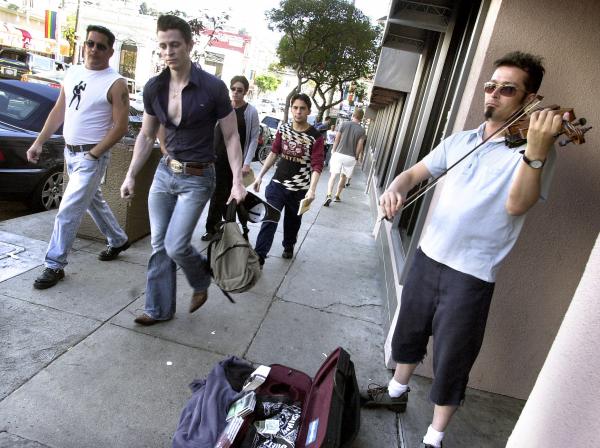
Streets of San Francisco: Benjamin Barnes

0

Benjamin Barnes is one of the street musicians interviewed within our “Streets of San Francisco” issue. He’s played with Mr. Bungle, DJ Disk, and a host of other musicians and bands, and he teaches music. His current group Swindlefish is playing a show on Sunday, May 16 at 2 p.m. at Caffeinated Comics Company. It’s the store’s first live music show, though they also have karaoke. Treat your eyes to some comics and your ears to some music.

Name Benjamin Barnes

What styles of music do you play? I play guitar and viola, but violin projects better than those and I know a lot of repertory. I’ve got maybe three hours of Bach memorized. It’s a meditative thing.

There’s six sonatas and and six cello suites and I play the cello suites on viola and violin. They’re nice profound pieces and sometimes people will stop and listen.
I was playing the Bach Chaconne and this guy stopped and listened to the whole piece and tipped me afterward. Several times when I play someone will stop and listen for a while. That’s why I do it.

Where are your favorite sites to play? The first place I played was Powell Street station. It was 1989. I remember I put my can down and basically practiced and made 15 dollars. I packed it all up and went home and threw the money on my bed and laughed. I was working at a coffee shop and putting myself through school and I realized I didn’t have to work at the coffee shop.
In college I had a string quartet [Rilke String Quartet]. We used to play at Montgomery and Embarcadero and people enjoyed it and would hire us out to gigs like weddings and street fairs. We called it practicing guerrilla warfare — we were guerrilla musicians. We’d set up and play for a few hours and sell a lot of CDs at the street fair.
I like to play at 24th Street station. The acoustics aren’t bad — you get a little reverb like you would in a hall sometimes. Now I’m not out there just trying to make a buck, it’s a personal thing.

How long have you been playing in the streets or underground? For several years I didn’t — I just recently started playing again. I also sometimes play with my brother, he plays guitar. We play jazz songs and Beatles songs and David Bowie songs.

What do you like about it, and why do you do it? I used to get stressed out if I didn’t make any money, because I was using it to pay my rent. Now I have students — sometimes they’ll stop by. I do a lot of teaching and I’m not tied to needing to make the money at the BART station. When I do make money it’s always nice, but I can’t be in the mindset where I have to make money — your playing suffers because you’re not playing from the heart.
The Pacbell Canon will bring in tips. The [Rilke] String Quartet would play it for a few hours at Embarcadero and Montgomery and we’d make a fair amount of money. What I’m doing now is a little more artistic. I’ve been working on memorizing all these pieces and finding new ways to interpret them as I play them. If people stop and listen I might get nervous and get some adrenaline going. These pieces are masterpieces for the violin, I have five of the six cello suites memorized.
There’s a few fiddle players [playing outside in SF] and sometimes it’s hard to get a spot. It’s first come, first served. In order to get the spot you have to have the right attitude. It’s good to have extra spending money because times are rough. This buys me coffee and allows me to take my girlfriend someplace nice. I try to put away about half the money I make and save it for special occasions.
I was just in New York and I saw people busking in Central Park and Greenwich Village, but not on the subway because people were rushing by. There’s a famous violinist, Joshua Bell, who played in the New York subway for a couple of hours, and no one recognized him, or that he was playing on a Stradivarius. Most people walked by, or gave him a dollar, and one kid played air violin. He made 26 dollars.

Do you have recordings and/or a website? If anyone’s interested I have a lot of songs and string quartet and solo viola stuff that I’ve written and played on the website. You can download it for free. There’s a spot where you can make a donation. I’ve gotten 26 dollars (laughs).
I think some people have become students because they liked the music, or gone to shows by my band. I’m playing a free show at Caffeinated Comics on the 16th. It’s a great place. We’re going to play an acoustic show, with songs I wrote, Bowie covers, Beatles covers, Led Zep and “Devil Went Down to Georgia.” We have an upright bass, two guitars, and an excellent singer who does lead and backup.

What are your best and worst experiences playing? I’ve had a lot of great experiences and bad ones. Lately I’ve been playing really well and there’s one guy that tips me a 20 every couple months. One time a junkie tried to brush me away from my spot and started yelling at me with a story of how long I’d been there. I get a little worried sometimes. You get some pretty rough-looking characters, but most will like what you’re doing. Mostly I’m out here because I have fun and I like people and I’ve spent my life on music. It’s nice to be appreciated and have people enjoy what your’re doing.

SWINDLEFISH

Sun/16, 2 p.m.

Caffeinated Comics Company

3188 Mission, SF

(415) 829-7530

www.caffcom.com

Dude, where’s my car share?

2

By Brady Welch


news@sfbg.com

GREEN CITY Owning and storing a car in San Francisco is neither cheap nor efficient, so car-sharing companies have become increasingly popular in recent years. So why can’t individual car owners share or rent their vehicles? Right now, insurance law makes that difficult, but new legislation could make it easier for people to share their cars.

California Assembly Member Dave Jones (D-Sacramento), a candidate for Insurance Commissioner, unveiled the legislation during an April 28 press conference in San Francisco. Flanked by City CarShare CEO Rick Hutchinson and Sunil Paul, chief of a car-sharing start-up called Spride, Jones outlined legislation that would allow car owners to rent their vehicles to car-sharing organizations without risk of losing their individual auto insurance. Think of the idea as a more decentralized — but not quite DIY, at least not yet — version of other successful car-sharing organizations.

Hutchinson said there would likely be little difference between current City CarShare members’ experience and these new ventures. The change would be most significant in less dense areas where economic and logistical conditions prevent companies like City CarShare from expanding. By contracting with individual car owners, Spride is proposing to cut out much of the financial and logistical overhead, bringing the benefits of car sharing to a wider array of people. Folks would still reserve vehicles online or over the phone, and the cars would be maintained and tracked using City CarShare’s technology.

Vehicle owners could potentially earn "hundreds of dollars" per month through Spride, Paul said. Although owners wouldn’t be able to set their own rates under Spride’s pilot program, Paul did mention the possibility of pricing "flexibility" if the model proves successful. Owners would set the hours for the vehicle’s availability.

California law is unclear about the insurance ramifications of individual car sharing. The snags concern commercial use of the vehicle and insurance liability. Currently, if you charge people to borrow your car, insurance companies can technically revoke your insurance. This, in turn, leads to the issue of whose insurance policy covers the person who is driving at any given time.

Jones’ bill would clarify that. "Participating in car sharing is something we want to encourage," he said. The legislation would specifically define personal vehicle sharing in car sharing organizations as noncommercial usage. This is significant because commercial insurance is more expensive than personal insurance. By "expanding what City CarShare has pioneered" with the company’s technology and network of members, Jones said that California can "take it to the next level" by promoting and expanding the practice to new markets and individuals.

Even so, the bill still doesn’t address the ramifications of person-to-person car sharing, so don’t rush off to Craigslist in hopes of renting out your Pinto for some extra scratch. It’s still legal to lend your car to friends and family for free, but if donations are offered, you might want to keep that secret from your insurer.

The Association of California Insurance Companies opposes Jones’ legislation. But according to ACIC vice president Mark Sektnan, amending it could bring the group’s members on board. "We want to make sure that people who put their cars into these operations are protected. And we want to make sure the car sharing organization fixes" the vehicle if it’s involved in a crash. As currently written, the bill only provides the car owner with liability insurance. Sektnan wants something more comprehensive. "The car sharing club has to provide appropriate insurance to the people who lend the cars," he said.

Sarah Moussa, a field representative in Jones’ office, said it’s an issue Jones is working on. "The bill only addresses liability, but they want to see more comprehensive coverage," she said. "Right now, we’re working closely with the insurance industry to make sure those amendments are addressed."

Jones noted that the legislation would play a big role in promoting clean air and mitigating traffic congestion. If this change passes and works well, it could be the first step toward getting the most efficiency out of the least green transportation option.

Reupholstering “Defenestration”

0

 all photos by Erik Anderson

“Can you wait about fifteen minutes?” Brian Goggin asks as he climbs into the harness that will lift him up to the fourth floor of the abandoned building on Sixth and Howard. Out of respect for this remarkable artist (and rapt awe his elevation has on the observer), we wait, standing to the side on the pavement below. Goggin’s restoration of his iconic piece of public art, “Defenestration,” bears witnessing.
Since its installation in 1997, the piece has become a Fellini-esque addition to its rough SOMA street corner. Its canvas is large, rundown building, its doors and windows boarded up since the owner’s renovations stalled in the ‘80s from permit violations. Pieces of furniture — chairs, lamps, coffee tables with their telephones still clinging to them — fling themselves from the roof and windows, causing passer-bys to gaze upward, wary of falling sofas. It’s like a free for all from a sinking ship.

But the wooden legs are beginning to rot, the upholstery fraying and tearing from 13 years of exposure to the elements. The area’s been targeted in a beautification campaign, and the city recently seized the property, citing eminent domain. There are vague plans to tear it down to make way for more low income housing, along the lines of the flashy edifice that stands kitty corner to “Defenestration.” Goggin is determined to give the piece a last hurrah. “If the wrecking ball does come, at least it will be dressed up for the occasion,” he says, looking up at his masterpiece.

It’s a labor of love. Goggin had done other public art before, and since “Defenestration” (the flying books on Columbus and Broadway, “The Language of the Birds,” is another one of his works), but few pieces have captured the city’s imagination like the building on Sixth and Howard. He estimated it would take $75,000 to fully restore the work.

“I had done similar pieces before “Defenestration.” my piece “Herd Mentality” in the Yerba Buena Gardens is a bunch of Queen Anne tables climbing up a wall, jumping over, and running across the lawn — like a herd of wild buffalo roaming through the plains,” says Goggin of the providence of the leaping living room sets at Sixth and Howard. “This one I wanted to do in a neighborhood where people were finding creative ways to uplift their life.”

He originally envisioned the work on an occupied building, explaining to property owners in the area “all I wanted to do was drill big holes in their walls and stick furniture to them. None of them were interested.” Eventually, walking down Sixth Street he saw a sign with a number to call regarding interest in an abandoned building there. He called. The owner was away on a trip to Gujurat, but his daughter was intrigued by Goggin’s preliminary sketches of the project. “She told me I could install the piece if I could do it by the time her dad got back,” the artist remembers.

Eight months later, with the help of somewhere between 30 to 70 volunteers, “Defenestration” was up, making an impression on Sixth Street residents in the process.

One neighbor put a sign in their window that said “get out of the neighborhood art fags,” but for the most part, people were curious about Goggin’s leaping tables. “Everyone seemed to understand [“Defenestration”] without question,” says the artist. “They even started bringing me furniture. I appreciated their eccentricities, and they appreciated mine.”

We chat on the sidewalk while Goggin and his assistant, Valerie Levy, mix epoxy with rubber gloved hands. We are interrupted sporadically by people walking by with questions about all the pulleys and caution tape surrounding us.

“What, you’re tearing this down?” one man asks us in disbelief. “It’s been here for 35 years! It’s a landmark!” “102 years! We‘re putting up condos!” Goggin calls after him with a grin. It must be rewarding to see one’s work become such an accpeted feature in it’s environment.

Though he was working on the site nearly every day when he started in December, Levy and Goggin have cut back to two days a week after a beautiful exhibit of photos taken of the site that was held across the street at 1AM Gallery failed to raise sufficient funds. He’s collected $20,000 now, with an adjusted goal of $10,000 more. “The dream is to rent a boom lift,” Levy confides as she shows us around the interior of the building.

Entering into the gloom inside the metal door, the magic of the site is easy to absorb. Save for the original hotel lobby on the ground floor, it’s an absolute mess. Orange spray paint marks the rotten spots in the floorboards, walls have been knocked down, debris is everywhere. But the filth creates a certain, raw magic.

Large porcelain tubs remain from the SRO’s original residents. A natural camera obscura from holes in a boarded up window projects an image of the sky and buildings across the street, upside-down, on the wall. Pigeons have laid claim to entire floors, particularly the room with the dining room set one of Goggin’s friends arranged for a formal dinner party as a surprise birthday present for his girlfriend. The vast, “over engineered,” steel frames that secure the hanging furniture seem to be the only solid parts of the structure (“they had to do that,” explains Levy. “otherwise, you can’t really have sofas hanging over peoples’ heads”). The squatters that occupied the building before Goggin returned for restoration have cleared out, ingratiating his project to the managers of the property.

The whole thing has an air of the absurd.

Goggin has nurtured, and embraced the oddness of it all. Sideshow freak panels from the “Urban Circus” he threw in 1997 for the piece’s debut still cling to the walls outside and sit in stacks within the workshop.

“The question of restoration was one I pondered for a number of years,” he tells us, a bit tired from another trip up the wall to fix a coffee table. “I liked the idea of revisiting it, of going back to the community to see whether this was something they wanted, if it was important to them.”

But it’s clear, from the smile on his face, and they way he lights up to discuss the job, that “Defenestration” is important to Goggin, as well — a feeling that is contagious to those around him. “I’m interested in perpetuating the joy, fun, and absurdity of it all,” he concludes, and we leave him to his work.

To donate to the “Defenestration” restoration project, go here.

North Beach and Chinatown lift forks for Noodlefest 2010

1

I do love me some noodles. As do we all — just ask the cooks carving them from a solid, gyro like block of pasta at the Seattle Chinese restaurant I once blissfully attended, or the happy fettuccine eaters at the sidewalk cafes on Columbus Avenue. The world would be a better place if we could all put down our weapons and pick up our forks and spoons.

Which is roughly what is happening at this weekend’s Noodlefest 2010 (Sun/2). Sure, the days of armed warfare between North Beach and Chinatown may be safely behind us (were they ever in existence), but the two adjacent neighborhoods rarely come together to plan community happenings. Harken to the candlelit dinner scene in The Lady and the Tramp — it takes a pasta strand to break the ice, and bring you snout to snout.

But why eat a strand when you can sample six different pasta meals? Entry to Noodlefest gets you a taste of three steaming mountains of Chinatown noodles, and three from North Beach, in addition to live noodle making demonstrations and entertainment of all stripes.

So grab a fork. And to reinforce what this peaceful coexistence of culinary traditions signifies in the history of our city, two long time residents of the neighborhoods, Reverend Norman Fong of the Chinatown Community Development Center, and Dan Macchiarini of the North Beach Merchants’ Association, sent us their memoirs of growing up in the city’s historically Chinese and Italian ‘hoods. If the following tales of downtown SF life in the ‘50s and ‘60s don’t make you feel all noodley inside, then I don’t know what will.


Noodlefest 2010
Sun/2 3-7pm, $15
Grant, between Pacific & Vallejo, SF

www.chinatowncdc.org
———————-

The yin and yang of Chinese-Italian relationships
By Reverend Norman Fong, Chinatown Community Development Center


During the 1950s and 1960s,  it wasn’t all fine and dandy growing up in Chinatown and North Beach, although I wouldn’t trade my life experience for anything. In my younger elementary school years, I was a Chinatown kid; all my classmates were Chinese-Americans.

Then I had to cross Washington Square to head to Francisco Jr. High, where I learned about other races.  I remember having a crush on one very cute girl who lived in North Beach but I was too shy to ever ask her out and there weren’t too many cross-cultural relations back then. I also remember some very negative moments when groups of Italian boys would harass me.

One time I was chased by these boys who screamed “let’s get the Chinaman” and they tied me to the fence near St. Peter & Paul and they threw water balloons at me. I went home and I told my mom “I hate italians” and explained what happened.

My mom said life was about balance. “Did you know our landlord is Italian? He only charges us $90 rent and never raised the rent?” I didn’t fully understand at the time just how much that meant, but I do now. Years later, when I was about 18 years old, we were evicted from our home — by a Chinese landlord who bought the building.

Life is about balance, the Yin and Yang of life. Dan Macchiarini and Kathleen Dooley of the North Beach Merchants Association are friends because we shared the same block at the Chinatown Community Development Center office at 1525 Grant. I bought my Valentine’s Day flowers from Kathleen for my wife a number of years.

This Noodlefest is not just about noodles, spaghetti versus chow mein… It’s about relationships… and building cultural bridges… and “balance.”

Fireworks and noodles
By Dan Macchiarini, North Beach Merchants’ Association


Back in the day of the day, back when I was around 9 years old in the early 1960’s, I was among a bunch of kids my age from North Beach and Chinatown who would regularly play pick up games of football in Washington Square. Park Saturdays, Sundays, and whenever we could during the summer. We would have played baseball but the adults using the park wouldn’t let us and we could only play softball down at the Joe DiMaggio playground.

This was also a time when there were no real playgrounds at all in Chinatown, so a lot of the Chinese kids would come across Broadway to play in North Beach at Washington Square Park with us Italian kids. Some kids from Chinese ancestry lived in North Beach already. We got along fairly well too, considering the nonsensical historic animosity between a lot of our parents from our two distantly different racial and ethnic backgrounds.

We also hung out and played tennis dodge ball in the alley streets in both communities. These alleys during the day were very safe and were the kind of the place where car drivers looked out for and expected us kids to be.   Chinatown and North Beach both share a network of smallish streets and alleys. We made these “kids turf” when we weren’t in the park.

However, the most fun time for us was around mid February every year. It was always rainy and cold but this is the time of Chinese New Year. None of us Italian kids, even on the fourth of July, had access to fire works like the Chinese kids did. This made for a great trading relationship between us, everything from baseball cards to candy and sometimes even money changed hands for us to get the fireworks and use them. We had great contests blowing up tin cans, setting off stings of fire crackers to see how much noise and smoke we could make, until we got nailed by our parents who would attempt to restrict our alley pyrotechnics antics, commerce and careers on both sides of the ethnic divide.

The Chinese kids seemed to be at greater liberty to get and use these fireworks than we Italian kids were. It didn’t seem fair to me. I asked my father why this was. He said it was part of their culture and explained the “lunar new year.” He and my mother regularly took us to the Chinese New Year parade during the late 1950s and early 1960s. There were massive fireworks and firecrackers there, mostly still in the rain but spectacular at night during the parade of dragons and lions.

Before the parade, my parents would take my sister and I to dinner in their favorite Chinese restaurant and they would order all kinds of exotic dishes.  The restaurant, still there, was up Washington Street just off Grant Ave., three block off of Broadway and, literally, under the building. You walk down concrete steps to the doorway. Very “old school” Chinatown. My father knew all the waiters and the owner would greet us with broad smile.  Somehow, they knew each other back in their day, the 1930s, when everyone was struggling just to survive. So we got the VIP treatment there.

The food was incredibly good, although as a nine year old, I was somewhat picky — which my father had a VERY low tolerance for. I loved the Chinese noodles, all the chow mien dishes, and was okay with the rice dishes, but I had a lot of trouble with egg fu yung types; they tasted runny and raw to me. My mother insisted that my sister and I “try everything” they ordered, and my father would cuff me in the head to get my attention and tell me to “eat all your food.” I evolved a plan through; it involved a conspiracy with my sister because she loved egg fu yung. When my parents were distracted and not looking, we would change plates under the table. This all worked out fairly well until one time when we dropped one of the plates we were exchanging under the table. The food hit the floor and my father hit the ceiling. I was good at ducking, though. Luckily, the waiters and the owner were in fits laughter over this so my father’s temper cooled off fast but my mother made us kids sit through the rest of the meal without ANY more food as well as having to help the waiters picked up the mess.

I complained to my father, asking him why I couldn’t just eat the chow mien, like the pasta we made and ate at home. He told me that he brought me out to a Chinese restaurant so “you can learn” the taste of the way other people make food — and beside, the Chinese invented pasta too.

He said it was part of history, that about 800 years ago Marco Polo, an Italian merchant, went to China from Europe to Asia along the silk road to trade — and brought the idea of pasta to Italy and Europe (along with gunpowder).

He went on about this history, lecturing about how food was part of culture and we, as kids, should experience all kinds of food to learn about all kinds of cultures.  This lasted about ten minutes, but it still didn’t get me to like egg fu yung — although a thought pushed itself into my nine year old mind that those Chinese kids I played and “traded” with in the alleys of North Beach and Chinatown for fireworks were my “Silk Road,” and going between North Beach and Chinatown was truly great adventure.

ENDORSEMENTS: San Francisco ballot measures

0

 PROPOSITION A

SCHOOL FACILITIES SPECIAL TAX

YES

This measure would extend a 1990 parcel tax that expires in 2010 by another 20 years, keeping it at its current rate ($32 a year for single family homes and commercial enterprises, $16 a year per dwelling unit for mixed use buildings). The tax brings in $7 million a year for San Francisco school facilities and would finance seismic upgrades, structural strengthening and related improvements of its facilities, and child care centers. Vote yes.


PROPOSITION B

EARTHQUAKE SAFETY AND EMERGENCY RESPONSE BONDS

YES

It’s hard to argue against a $430 million bond act to upgrade police, fire, and water facilities to prevent a catastrophic collapse of the city’s most basic public safety infrastructure in the event of an inevitable earthquake. Hard — but not impossible: Sup. Chris Daly, the lone vote against Prop. B, points out that the bond money would be used to upgrade police stations but that the old County Jail at 850 Bryant St. wouldn’t get any help. Prisoners, it seems (even those who are awaiting trial and have been convicted of nothing) aren’t worth protecting. And the Fire Department has been very hazy about where it’s going to spend the cash. So we’ve got some concerns here — but on balance, we’re endorsing Yes on B.


PROPOSITION C

FILM COMMISSION

YES

By some accounts, this measure was put together in retaliation for Mayor Gavin Newsom’s November 2009 demand that Film Commission executive director Stefanie Coyote resign — shortly after her husband, actor Peter Coyote, supported Attorney General Jerry Brown over Newsom for governor. But Bill Barnes, who works as a legislative aide for Newsom ally Sup. Michela Alioto-Pier, the author of Prop. C, says Alioto-Pier was working on this measure even before Coyote got ousted.

Either way, it’s a positive step. Prop. C would streamline a convoluted permitting process for shooting films in San Francisco — a process that can involve multiple departments — and would create a one-stop shop. It would also split the power to appoint the film commissioners between the mayor and the board (6-5, respectively), and require that all 11 commissioners have specific qualifications or experience. Vote yes.


PROPOSITION D

RETIREMENT BENEFITS

YES

Prop. D is a compromise. Sup. Sean Elsbernd wanted to reform the city’s pension system by mandating higher employee contributions and an end to what’s known as “spiking” — giving some employees a big raise just before they retire. Under current law, that worker would get a pension based on the inflated salary.

Elsbernd wanted to change the calculation and base pensions on an average of the final three years of salary an employee earned. Labor countered that some lower-paid workers only reach their top pay at the end of their careers. The final deal would base pensions on a two-year average. Prop. D would also require future employees to contribute and extra 2 percent to their pensions and require the city to set aside some money every year for the pension and retiree health care systems. In the end, progressive Sups. David Campos and Eric Mar signed on, and the city employee unions aren’t opposed. Vote yes.


PROPOSITION E

BUDGET LINE ITEM FOR POLICE SECURITY

YES

Prop. E would make one simple tweak to the reporting requirements for San Francisco’s annual city budget: a line-item on how much is spent on security for city officials and visiting dignitaries. As things stand, the amount the police department spends to protect people like, oh, say Mayor Gavin Newsom while he is crisscrossing the state campaigning for (lieutenant) governor is kept secret. That’s information the public has a right to know. Vote yes.


PROPOSITION F

RENTERS’ FINANCIAL HARDSHIP APPLICATIONS

YES

Prop. F would allow a tenant facing a rent increase to file a petition with the Rent Board claiming financial hardship. If the tenant was unemployed, or had his or her wages cut by 20 percent or more, or didn’t get a cost of living increase in government benefits and was paying at least 33 percent of his or her income as rent, the rent hike would be delayed for 60 days pending a hearing. If the renter can establish hardship, the landlord would have to hold off on the increase until the tenant’s employment or benefit situation improved. Few San Francisco landlords would be hurt by the delay in what are typically modest rent hikes — but a lot of tenants could avoid eviction. Vote yes.


PROPOSITION G

TRANSBAY TRANSIT CENTER

YES

Prop. G, a policy statement, became a moot point earlier this year, but it’s still good for San Franciscans to affirm the city’s support for bringing high-speed rail service downtown. The California High-Speed Rail Project is moving to create bullet train service from SF to downtown Los Angeles using bond money approved by voters in 2008. Even though that bond measure named the Transbay Terminal as the northern terminus of the first phase, some officials raised doubts about whether the downtown location was the best choice. That rail service was integral to plans for the transit center, which is currently being rebuilt, so the Board of Supervisors placed this measure on the ballot to support that choice. Earlier this month, the California High-Speed Rail Authority considered other alternatives and voted to stay with the Transbay Terminal. That’s the right way to go; vote yes.

ENDORSEMENTS: National and state races

15

Editor’s note: the file below contains a correction, updated May 5 2010. 


National races


U.S. SENATE, DEMOCRAT


BARBARA BOXER


The Republican Party is targeting this race as one of its top national priorities, and if the GOP can dislodge a three-term senator from California, it will be a major blow for the party (and agenda) of President Obama. The pundits are happily talking about how much danger Barbara Boxer faces, how the country’s mood is swinging against big-government liberals.


But it’s always a mistake to count out Boxer. In 1982, as a Marin County supervisor with little name recognition in San Francisco, she trounced then-SF Sup. Louise Renne for an open Congressional seat. Ten years later, she beat the odds and won a hotly contested primary and tough general election to move into the Senate. She’s a fierce campaigner, and with no primary opposition, will have a united party behind her.


Boxer is one of the most progressive members of the not-terribly progressive U.S. Senate. She’s been one of the strongest, most consistent supporters of reproductive rights in Washington and a friend of labor (with 100 percent ratings from the AFL-CIO and National Education Association). We’ve had our disagreements: Boxer supported No Child Left Behind, wrote the law allowing airline pilots to carry guns in the cockpit, and was weak on same-sex marriage when San Francisco sought to legalize it (although she’s come around). But she was an early and stalwart foe of the war in Iraq, split with her own party to oppose a crackdown on illegal immigration, and is leading the way on accountability for Wall Street. She richly deserves reelection, and we’re happy to endorse her.


CONGRESS, 6TH DISTRICT, DEMOCRAT


LYNN WOOLSEY


It’s odd that the representative from Marin and Sonoma counties is more progressive by far than her colleague to the south, San Francisco’s Nancy Pelosi. But over the years, Lynn Woolsey has been one of the strongest opponents of the war, a voice against bailouts for the big Wall Street banks, and a foe of cuts in the social safety net. We’re proud to endorse her for another term.


CONGRESS, 7TH DISTRICT, DEMOCRAT


GEORGE MILLER


George Miller has been representing this East Bay district since 1974, and is now the chair of the Education and Labor Committee and a powerhouse in Congress. He’s too prone to compromise (with George W. Bush on education policy) but is taking the right line on California water (while Sen. Dianne Feinstein is on the wrong side). We’ll endorse him for another term.


CONGRESS, 8TH DISTRICT, DEMOCRAT


NANCY PELOSI


We’ve never been terribly pleased with San Francisco’s most prominent Congressional representative. Nancy Pelosi was the author of the bill that created the first privatized national park at the Presidio, setting a horrible standard that parks ought to be about making money. She was weak on opposing the war, ducked same-sex marriage, and has used her clout locally for all the wrong candidates and issues. But we have to give her credit for resurrecting and pushing through the health care bill (bad as it was — and it’s pretty bad — it’s better than doing nothing). And, at a time when the Republicans are trying to derail the Obama presidency, she’s become a pretty effective partner for the president.


Her fate as speaker (and her future in this seat) probably depends on how the Democrats fare in the midterm Congressional elections this fall. But if she and the party survive in decent shape, she needs to take the opportunity to undo the damage she did at the Presidio.


CONGRESS, 9TH DISTRICT, DEMOCRAT


BARBARA LEE


Barbara Lee, who represents Berkeley and Oakland, is co-chair of the Progressive Caucus in the House, one of the most consistent liberal votes in Congress, and a hero to the antiwar movement. In 2001, she was the only member of either house to oppose the Bush administration’s Use of Force resolution following the 9/11 attacks, and she’s never let up on her opposition to foolish military entanglements. We’re glad she’s doing what Nancy Pelosi won’t — represent the progressive politics of her district in Washington.


CONGRESS, 13TH DISTRICT, DEMOCRAT


PETE STARK


Most politicians mellow and get more moderate as they age; Stark is the opposite. He announced a couple of years ago that he’s an atheist (the only one in Congress), opposed the Iraq war early, called one of his colleagues a whore for the insurance industry, and insulted President Bush and refused to apologize, saying: “I may have dishonored the commander-in-chief, but I think he’s done pretty well to dishonor himself without any help from me.” He served as chair of the House Ways and Means Committee for exactly one day — March 3 — before the Democratic membership overruled Speaker Pelosi and chucked him out on the grounds that he was too inflammatory. The 78-year-old may not be in office much longer, but he’s good on all the major issues. He’s also fearless. If he wants another term, he deserves one.


State races


GOVERNOR, DEMOCRAT


EDMUND G. BROWN


Jerry Brown? Which Jerry Brown? The small-is-beautiful environmentalist from the 1970s who opposed Pacific Gas and Electric Co.’s Diablo Canyon nuke and created the California Conservation Corps, the Office of Appropriate Technology, and the Farm Labor Relations Board (all while running a huge budget surplus in Sacramento)? The angry populist who lashed out at corporate power on a KPFA radio talk show and ran against Bill Clinton for president? The pro-development mayor of Oakland who sided with the cops on crime issues and opened a military academy? Or the tough-on-crime attorney general who refuses to even talk about tax increases to solve the state’s gargantuan budget problems?


We don’t know. That’s the problem with Brown — you never know what he’ll do or say next. For now, he’s been a terribly disappointing candidate, running to the right, rambling on about preserving Proposition 13, making awful statements about immigration and sanctuary laws, and even sounding soft on environmental issues. He’s started to hit his stride lately, though, attacking likely GOP contender Meg Whitman over her ties to Wall Street and we’re seeing a few flashes of the populist Brown. But he’s got to step it up if he wants to win — and he’s got to get serious about taxes and show some budget leadership, if he wants to make a difference as governor.


LIEUTENANT GOVERNOR, DEMOCRAT


JANICE HAHN


Not an easy choice, by any means.


Mayor Gavin Newsom jumped into this race only after it became clear that he wouldn’t get elected governor. He sees it as a temporary perch, someplace to park his political ambitions until a better office opens up. He’s got the money, the statewide name recognition, and the endorsement of some of the state’s major power players, including both U.S. Senators and House Speaker Nancy Pelosi. He’s also been a terrible mayor of San Francisco — and some progressives (like Sup. Chris Daly) argue, persuasively, that the best way to get a better person in Room 200 is to ship Newsom off to an office in Sacramento where he can’t do much harm and let the supervisors pick the next mayor.


But it’s hard to endorse Newsom for any higher office. He’s ducked on public power, allowing PG&E to come very close to blocking the city’s community choice aggregation program (See editorial, page 5). His policies have promoted deporting kids and breaking up families. He’s taken an approach to the city budget — no new revenue, just cuts — that’s similar to what the Republican governor has done. He didn’t even bother to come down and talk to us about this race. There’s really no good argument for supporting the advancement of his political career.


Then there’s Janice Hahn. She’s a Los Angeles City Council member, the daughter of a former county supervisor, and the sister of a former mayor. She got in this race way before Newsom, and her nightmare campaign consultant, Garry South, acts as if she has some divine right to be the only Democrat running.


Hahn in not overly impressive as a candidate. When we met her, she seemed confused about some issues and scrambled to duck others. She told us she’s not sure she’s in favor of legalizing pot, but she isn’t sure why she’s not sure since she has no arguments against it. She won’t take a position on a new peripheral canal, although she can’t defend building one and says that protecting San Francisco Bay has to be a priority. She won’t rule out offshore oil drilling, although she said she has yet to see a proposal she can support. Her main economic development proposal was to bring more film industry work to California, even if that means cutting taxes for the studios or locating the shoots on Indian land where there are fewer regulations.


On the other hand, she told us she wants to get rid of the two-thirds threshold in the state Legislature for passing a budget or raising taxes. She supports reinstating the car tax at pre-Gov. Arnold Schwarzenegger levels. She supports a split-roll measure to reform Prop. 13. She wants to see an oil-severance tax to fund education. She’s one of the few statewide candidates who openly advocates higher taxes on the wealthy as part of the solution to the budget crisis.


We are under no illusions that Hahn will be able to use the weak office of lieutenant governor to move on any of these issues, and we’re not at all sure she’s ready to take over the top spot. But on the issues, she’s clearly better than Newsom, so she gets our endorsements.


SECRETARY OF STATE, DEMOCRAT


DEBRA BOWEN


Debra Bowen is the only Democrat running, a sign that pretty much everyone in the party thinks she’s doing a fine job as Secretary of State. She’s run a clean office and we see no reason to replace her.


CONTROLLER, DEMOCRAT


JOHN CHIANG


Like Bowen, John Chiang has no opposition in the primary, and he’s been a perfectly adequate controller. In fact, when Gov. Schwarzenegger tried two years ago to cut the pay of thousands of state employees to the minimum wage level, Chiang defied him and refused to change the paychecks — a move that forced the governor to back down. We just wish he’d play a more visible role in talking about the need for more tax revenue to balance the state’s books.


TREASURER, DEMOCRAT


BILL LOCKYER


Bill Lockyer keeps bouncing around Sacramento, waiting, perhaps, for his chance to be governor. He was attorney general. Now he’s treasurer seeking a second term, which he will almost certainly win. He’s done some good things, including trying to use state bonds to promote alternative energy, and has spoken out forcefully about the governor’s efforts to defer deficit problems through dubious borrowing. He hasn’t, however, come out in favor of higher taxes for the rich or a change in Prop. 13.


ATTORNEY GENERAL, DEMOCRAT


KAMALA HARRIS


There are really only two serious candidates in this race, Kamala Harris, the San Francisco district attorney, and Rocky Delgadillo, the former Los Angeles city attorney. Harris has a comfortable lead, with Delgadillo in second and the others far behind.


Delgadillo is on his second try for this office. He ran against Jerry Brown four years ago and got nowhere. And in the meantime, he’s come under fire for, among other things, using city employees to run personal errands for him (picking up his dry-cleaning, babysitting his kids) and driving his car without insurance. On a more significant level, he made his reputation with gang injunctions that smacked of ethnic profiling and infuriated Latino and civil liberties groups. It’s amazing he’s still a factor in this race; he can’t possibly win the general election with all his baggage.


Harris has a lot going for her. She was among the first California elected officials to endorse Barack Obama for president, and remains close to the administration. She’s a smart, articulate prosecutor and could be one of the few women atop the Democratic ticket this year. We were never comfortable with her ties to Willie Brown, but he’s no longer a factor in state or local politics. These days, she’s more closely allied with the likes of State Sen. Mark Leno.


That said, we have some serious problems with Harris. She’s been up in Sacramento pushing Republican-style tough-on-crime bills (like a measure that would bar registered sex offenders from ever using social networking sites on the Internet) and forcing sane Democrats like Assembly Member and Public Safety Committee Chair Tom Ammiano to try to tone down or kill them (and then take the political heat). If she didn’t know about the problems in the SFPD crime lab, she should have, and should have made a bigger fuss, earlier.


But Harris has kept her principled position against the death penalty, even when it meant taking immense flak from the cops for refusing to seek capital punishment for the killer of a San Francisco police officer. She’s clearly the best choice for the Democrats.


INSURANCE COMMISSIONER, DEMOCRAT


DAVE JONES


Two credible progressives are vying to run for this powerful and important position regulating the massive — and massively corrupt — California insurance industry. Dave Jones and Hector De La Torre are both in the state Assembly, with Jones representing Sacramento and De La Torre hailing from Los Angeles. Both have a record opposing insurance industry initiatives; both are outspoken foes of Prop. 17; and either would do a fine job as insurance commissioner. But Jones has more experience on consumer issues and health care reform, and we prefer his background as a Legal Aid lawyer to De La Torre’s history as a Southern California Edison executive. So we’ll give Jones the nod.


BOARD OF EQUALIZATION, DISTRICT 1, DEMOCRAT


BETTY T. YEE


Betty Yee has taken over a job that’s been a stronghold of progressive tax policy since the days of the late Bill Bennett. She’s done well in the position, supporting progressive financial measures and even coming down, as a top tax official, in favor of legalizing (and taxing) marijuana. We’re happy to endorse her for another term.


SUPERINTENDENT OF PUBLIC INSTRUCTION


TOM TORLAKSON


Two prominent Democratic legislators are running for this nonpartisan post, state Sen. Gloria Romero of Los Angeles and Assembly Member Tom Torlakson of Martinez. It’s a pretty clear choice: Romero is a big supporter of charter schools who thinks parents should be able to move their kids out of one school district and into another (allowing wealthier white parents, for example, to abandon Los Angeles or San Francisco for the suburban districts). She’s been supported in the past by Don and Doris Fisher, who put a chunk of their GAP Inc. fortune into school privatization efforts. Torlakson wants more accountability for charters, opposes the Romero district-option bill, and has the support of every major teachers union in the state. Vote for Torlakson.


STATE SENATE, DISTRICT 8, DEMOCRAT


LELAND YEE


Sen. Leland Yee can be infuriating. Two years ago, he was hell-bent on selling the Cow Palace as surplus state property and allowing private developers to take it over. In the recent budget crisis, he pissed off his Democratic colleagues by refusing to vote for cuts that everyone else knew were inevitable (while never making a strong stand in favor of, say, repealing Prop. 13 or raising other taxes). But he’s always been good on open-government issues and has made headlines lately for busting California State University, Stanislaus over a secret contract to bring Sarah Palin in for a fundraiser — and has raised the larger point that public universities shouldn’t hide their finances behind private foundations.


Yee will have no serious opposition for reelection, and his campaign for a second term in Sacramento is really the start of the Leland Yee for Mayor effort. With reservations over the Cow Palace deal and a few other issues, we’ll endorse him for reelection.


 Correction update: Yee’s office informs us that the senator suports an oil-severance tax and a tax on high-income earners and “believes that Prop. 13 should be reformed,” although he hasn’t taken a position on Assemblymember Tom Ammiano’s reform bill. 


STATE ASSEMBLY, DISTRICT 12, DEMOCRAT


FIONA MA


Fiona Ma’s a mixed bag (at best). She doesn’t like Pacific Gas and Electric Co. and supports public power, but comes up with strange bills that make no sense, like a 2009 measure to limit rent control in trailer parks. Why does Ma, who has no trailer parks in her district, care? Maybe because the landlords who control the mobile home facilities gave her some campaign cash. She faces no opposition, and we’re not thrilled with her record, but we’ll reluctantly back her for another term.


STATE ASSEMBLY, DISTRICT 13, DEMOCRAT


TOM AMMIANO


When the history of progressive politics in modern San Francisco is written, Tom Ammiano will be a central figure. His long-shot 1999 mayoral campaign against Willie Brown brought the left to life in town, and his leadership helped bring back district elections and put a progressive Board of Supervisors in place in 2000. As a supervisor, he authored the city’s landmark health care bill (which Newsom constantly tries to take credit for) and the rainy day fund (which saved the public schools from debilitating cuts). He uses his local influence to promote the right causes, issues, and candidates.


And he’s turned out to be an excellent member of the state Assembly. He forced BART to take seriously civilian oversight of the transit police force. He put the battle to reform Prop. 13 with a split-role measure back on the state agenda. And his efforts to legalize and tax marijuana are close to making California the first state to toss the insane pot laws. As chair of the Public Safety Committee, he routinely defies the police lobbies and the right-wing Republicans and defuses truly awful legislation. We’re glad Ammiano’s still fighting in the good fight, and we’re pleased to endorse him for another term.


STATE ASSEMBLY, DISTRICT 14, DEMOCRAT


NANCY SKINNER


Nancy Skinner has taken on one of the toughest, and for small businesses, most important, battles in Sacramento. She wants to make out-of-state companies that sell products to Californians collect and remit sales tax. If you buy a book at your local bookstore, you have to pay sales tax; if you buy it from Amazon, it’s tax-free. That not only hurts the state, which loses hundreds of millions of dollars in tax revenue, it’s a competitive disadvantage to local shops. Skinner’s a good progressive vote and an ally for Ammiano on the Public Safety Committee. We’re happy to endorse her for another term.


STATE ASSEMBLY, DISTRICT 16, DEMOCRAT


SANDRE SWANSON


Sandre Swanson represents the district where BART police killed Oscar Grant, but he wasn’t the one out front pushing for more civilian accountability; that was left to SF’s Ammiano. And while Swanson was generally supportive of Ammiano’s bill, he was hardly a leader in the campaign to pass it. This is too bad, because Swanson’s almost always a progressive vote and has been good on issues like whistleblower protection (a Swanson bill that passed this year protects local government workers who want to report problems confidentially). We’ll endorse him for another term, but he needs to get tougher on the BART police.

Music listings

0

Music listings are compiled by Paula Connelly and Cheryl Eddy. Since club life is unpredictable, it’s a good idea to call ahead to confirm bookings and hours. Prices are listed when provided to us. Submit items at listings@sfbg.com.

WEDNESDAY 28

ROCK/BLUES/HIP-HOP

*Aesop, Venture Capitalists, New Humans Bottom of the Hill. 9pm, $10.

Fix My Head, This Runs on Blood, Useless Children, Gain to Lose Sub-Mission, 2183 Mission, SF; www.sf-submission.com. 9pm, $6.

*"Full Pink Moon Party" Rickshaw Stop. 8pm, $10. With Sonya Cotton, Honeycomb, Jascha vs. Jascha, and Kris Gruen.

Japanther, Reaction, Dirty Marquee, Street Eaters Hemlock Tavern. 9pm, $8.

Pomegranate, Fall Risk, Control-R Hotel Utah. 8:30pm, $6.

Chad Price, Michael Dean Damron, Micah Schabnel, Piss Pissdofferson Thee Parkside. 8:30pm, $5.

Stymie and the Pimp Jones Luv Orchestra, Funk Revival Orchestra Café du Nord. 9pm, $10.

Volker Strifler Band Biscuits and Blues. 8pm, $15.

FOLK/WORLD/COUNTRY

Anoushka Shankar Palace of Fine Arts Theater, 3301 Lyon, SF; (415) 563-6504. 8pm, $25-$65.

DANCE CLUBS

Booty Call Q-Bar, 456 Castro, SF; www.bootycallwednesdays.com. 9pm. Juanita Moore hosts this dance party, featuring DJ Robot Hustle.

Club Shutter Elbo Room. 10pm, $5. Goth with DJs Omar, Nako, and Justin.

Hands Down! Bar on Church. 9pm, free. With DJs Claksaarb, Mykill, and guests spinning indie, electro, house, and bangers.

Machine Sloane, 1525 Mission, SF; (415) 621-7007. 10pm, free. Warm beats for happy feet with DJs Sergio, Conor, and André Lucero.

Mary-Go-Round Lookout, 3600 16th St, SF; (415) 431-0306. 10pm, $5. A weekly drag show with hosts Cookie Dough, Pollo Del Mar, and Suppositori Spelling.

RedWine Social Dalva. 9pm-2am, free. DJ TophOne and guests spin outernational funk and get drunk.

Respect Wednesdays End Up. 10pm, $5. Rotating DJs Daddy Rolo, Young Fyah, Irie Dole, I-Vier, Sake One, Serg, and more spinning reggae, dancehall, roots, lovers rock, and mash ups.

Synchronize Il Pirata, 2007 16th St, SF; (415) 626-2626. 10pm, free. Psychedelic dance music with DJs Helios, Gatto Matto, Psy Lotus, Intergalactoid, and guests.

Telephoned Harlot, 46 Minna, SF; www.harlotsf.com. 7pm. Mash-ups with DJ Sammy Bananas and singer Maggie Horn.

Yoruba Dance Sessions Bacano! Som., 2925 16th St, SF; (415) 558-8521. 9pm, free. With resident DJ Carlos Mena and guests spinning afro-deep-global-soulful-broken-techhouse.

THURSDAY 29

ROCK/BLUES/HIP-HOP

Aquaserge, Casper and the Cookies, Grand Lake Rickshaw Stop. 8pm, $10.

Arcadio, Guns for San Sebastian, Charles Gonzalez Café du Nord. 9pm, $10.

C-Mon and Kypski, Frequency, Sweet Snacks, DJ Mancub Independent. 9pm, $12.

A Day to Remember, August Burns Red, Silverstein, Enter Shikari, Go Radio Regency Ballroom. 6:45pm, $23.

Dunes El Rio. 8pm, $5.

Shane Dwight Biscuits and Blues. 8pm, $20.

Flood, Hashishian, Days of High Adventure Knockout. 10pm, $6.

49 Special, Big Nasty, TV Mike and the Scarecrowes Hotel Utah. 9pm, $7.

Emily McLean, Quinn DeVeaux, Street Sirens Red Devil Lounge. 8pm, $8.

Murs, Sick Jacken Fillmore. 8pm, $20.

Photo Atlas, Moog, Smile Radio Thee Parkside. 9pm, $8.

Spill Canvas, Tyler Hilton, AM Taxi, New Politics Slim’s. 7:30pm, $16.

Sugar and Gold, Nite Jewel, Baron Von Luxxury, DJ Loose Shus Bottom of the Hill. 9pm, $10.

Sugar Butt Tiger, Bare Wires, Girl Band, MC Meathook and the Vital Organs, SF Rockstar Paradise Lounge. 9pm, $7. Proceeds benefit the Haight-Ashbury Street Fair.

Emily Jane White, Helene Renault, Chloe Makes Music Hemlock Tavern. 9pm, $7.

FOLK/WORLD/COUNTRY

Bluegrass and old-time jam Atlas Café. 8pm, free.

Jordan Carp Bollyhood Café. 8pm, free.

Jon Rubin with Cal Keaoola Bliss Bar, 4026 24th St., SF; (415) 826-6200. 8pm, free.

DANCE CLUBS

Afrolicious Elbo Room. 9:30pm, $8-10. DJs Pleasuremaker and Señor Oz mark their night’s third anniversary with a live performance by Aphrodesia.

Caribbean Connection Little Baobab, 3388 19th St, SF; (415) 643-3558. 10pm, $3. DJ Stevie B and guests spin reggae, soca, zouk, reggaetón, and more.

Drop the Pressure Underground SF. 6-10pm, free. Electro, house, and datafunk highlight this weekly happy hour.

Good Foot Yoruba Dance Sessions Bacano! Som., 2925 16th St, SF; (415) 558-8521. 9pm, free. A James Brown tribute with resident DJs Haylow, A-Ron, and Prince Aries spinning R&B, Hip hop, funk, and soul.

Koko Puffs Koko Cocktails, 1060 Geary, SF; (415) 885-4788. 10pm, free. Dubby roots reggae and Jamaican funk from rotating DJs.

Mestiza Bollywood Café, 3376 19th St, SF; (415) 970-0362. 10pm, free. Showcasing progressive Latin and global beats with DJ Juan Data.

Peaches Skylark, 10pm, free. With an all female DJ line up featuring Deeandroid, Lady Fingaz, That Girl, and Umami spinning hip hop.

Popscene 330 Rich. 10pm, $10. Rotating DJs spinning indie, Britpop, electro, new wave, and post-punk.

FRIDAY 30

ROCK/BLUES/HIP-HOP

Aunt Kizzy’z Boyz Biscuits and Blues. 8 and 10pm, $20.

David Baron, Dan Vickrey, Blackstone Heist, American Studies Hotel Utah. 9pm, $10.

Clipd Beaks, Sightings, Bill Orcutt Hemlock Tavern. 9pm, $7.

Flexx Bronco, My Revolver, Bourbon Saints, Electric Sister Thee Parkside. 9pm, $6.

JFP, Cnote, Mack Misstress El Rio. 10pm, $5.

Kapakahi, Dogman Joe, Stranger Café du Nord. 9:30pm, $12.

Lemonade, Solid Gold, Active Child, DJ Aaron Axelsen Rickshaw Stop. 9pm, $10.

Lord T. and Eloise, Tenderloins, Hottub DJ Set Independent. 9pm, $14.

Ponys, Disappears, Spencey Dude and the Doodles Bottom of the Hill. 10pm, $12.

Rogue Wave, Man/Miracle Fillmore. 9pm, $19.50.

Joe Rut Great American Music Hall. 9pm, $14. With comedian Will Franken.

Shpongle, ADHK, Hallucinogen LIVE Regency Ballroom. 9pm, $30.

Shayna Steele Coda. 10pm, $10.

JAZZ/NEW MUSIC

Audium 9 1616 Bush, SF; (415) 771-1616. 8:30pm, $15.

Black Market Jazz Orchestra Top of the Mark. 9pm, $10.

Chano Dominguez Flamenco Jazz Quartet featuring Tomasito Palace of Fine Arts Theare, 3301 Lyon, SF; www.sfjazz.org. 8pm, $25-60.

Dan Zemelmen Quartet with Kenny Washington Red Poppy Art House. 8pm, $12-15.

Eric Kurtzrock Trio Ana Mandara, Ghirardelli Square, 891 Beach, SF; (415) 771-6800. 8pm, free.

Fred Frith and Theresa Wong Meridian Gallery, 535 Powell, SF; www.meridiangallery.org. 8pm, $10.

Kenny Lattimore Yoshi’s San Francisco. 8 and 10pm, $38.

"A Night at Birdland" Deco Lounge, 510 Larkin, SF; (415) 346-2025. 9pm. With the MegaFlame Blue Band.

FOLK/WORLD/COUNTRY

Eek-a-mouse Rock-it Room. 10pm, $22. With the Holdup and DJ Mr. E.

Lava, Mestizo, Carmen Milagro Slim’s. 8pm, $16.

Melees Socha Café, 3235 Mission, SF; (415) 643-6848. 8:30pm, free.

Stairwell Sisters Revolution Café, 3248 22nd St, SF; (415) 642-0474. 8:45pm, free.

DANCE CLUBS

Activate! Lookout, 3600 16th St, SF; (415) 431-0306. 9pm, $3. Face your demigods and demons at this Red Bull-fueled party.

Afrolicious Elbo Room. 9:30pm, $8-10. DJs Pleasuremaker and Señor Oz mark their night’s third anniversary with Chico Mann and guest DJ Similak Chyld.

Area Codes Element Lounge. 10pm, $10. With DJs Platurn, Doc Fu, and White Mike spinning Bay Area hip hop.

Blow Up Rickshaw Stop. 10pm, $10. With rotating DJs.

Exhale, Fridays Project One Gallery, 251 Rhode Island, SF; (415) 465-2129. 5pm, $5. Happy hour with art, fine food, and music with Vin Sol, King Most, DJ Centipede, and Shane King.

Fat Stack Fridays Koko Cocktails, 1060 Geary, SF; (415) 885-4788. 10pm, free. With rotating DJs Romanowski, B-Love, Tomas, Toph One, and Vinnie Esparza.

Gay Asian Paradise Club Eight, 1151 Folsom, SF; www.eightsf.com. 9pm, $8. Featuring two dance floors playing dance and hip hop, smoking patio, and 2 for 1 drinks before 10pm.

Good Life Fridays Apartment 24, 440 Broadway, SF; (415) 989-3434. 10pm, $10. With DJ Brian spinning hip hop, mashups, and top 40.

Hot Chocolate Milk. 9pm, $5. With DJs Big Fat Frog, Chardmo, DuseRock, and more spinning old and new school funk.

Look Out Weekend Bambuddha Lounge. 4pm, free. Drink specials, food menu and resident DJs White Girl Lust, Swayzee, Philie Ocean, and more.

M4M Fridays Underground SF. 10pm-2am. Joshua J and Frankie Sharp host this man-tastic party.

Meat Vs. Death Guild DNA Lounge. 8:30pm, $4-8. Industrial, gothic, EBM, and more with Decay, BaconMonkey, Joe Radio, and Melting Girl.

Quantic Mighty. 10pm, $12. With Disco Shawn and DJ Sake 1.

Rockabilly Fridays Jay N Bee Club, 2736 20th St, SF; (415) 824-4190. 9pm, free. With DJs Rockin’ Raul, Oakie Oran, Sergio Iglesias, and Tanoa "Samoa Boy" spinning 50s and 60s Doo Wop, Rockabilly, Bop, Jive, and more.

Suite Jesus 111 Minna. 9pm, $20. Beats, dancehall, reggae and local art.

Teenage Dance Craze Party Knockout. 10pm, $3. With DJ Sergio Iglesias, Russell Quann, and dX the Funky Gran Paw.

SATURDAY 1

ROCK/BLUES/HIP-HOP

*AC/Dshe, Total B.S., Honeydust Slim’s. 9pm, $14.

Antlers, Phantogram Independent. 9pm, $14.

Mike Beck and the Bohemian Saints Riptide. 9pm, free.

Broken Social Scene Fillmore. 9pm, $25.

Grand National, Bonafide, General Jones Hotel Utah. 9pm, $8.

JC Smith Band Biscuits and Blues. 8 and 10pm, $16.

*Laudanum, Worm Ouroboros, Dispirit Hemlock Tavern. 9:30pm, $7.

Maus Haus, Rafter, White Cloud Bottom of the Hill. 10pm, $10.

Outernational Thee Parkside. 9pm, $10.

Plushgun, Music for Animals, Fake Your Own Death, Marissa Guzman Rickshaw Stop. 8pm, $15.

Warren Teagarden, Collisionville, Charmless Kimo’s. 9pm, $7.

JAZZ/NEW MUSIC

Audium 9 1616 Bush, SF; (415) 771-1616. 8:30pm, $15.

Eric Kurtzrock Trio Ana Mandara, Ghirardelli Square, 891 Beach, SF; (415) 771-6800. 8pm, free.

Hypnotic Brass Ensemble Palace of Fine Arts Theatre, 3301 Lyon, SF; www.sfjazz.org. 3 and 8pm, $5-25.

Kenny Lattimore Yoshi’s San Francisco. 8 and 10pm, $38.

Marlena Teich Quintet Savanna Jazz. 8pm.

Sanctuary Trio featuring Peter Apfelbaum and guests Coda. 10pm, $10.

Ricardo Scales Top of the Mark. 9pm, $15.

FOLK/WORLD/COUNTRY

Boyd and Wain Socha Café, 3235 Mission, SF; (415) 643-6848. 8:30pm, free.

Evangenitals El Rio. 11:30pm, $7.

Gold Live Rockit Room. 9pm, $15. With Ce’Cile, Daddy Rolo, Empress I-Lexis, Danneekah.

Sour Mash Hug Band, Four Inch Pony, Janay Rose Mercury Café, 201 Octavia, SF; (415) 252-7855. 7pm, $5.

Red Hot Chachkas Red Poppy Art House. 8pm, $15.

Brazil Vox Revolution Café, 3248 22nd St, SF; (415) 642-0474. 8:45pm, free.

DANCE CLUBS

Bar on Church 9pm. Rotating DJs Foxxee, Joseph Lee, Zhaldee, Mark Andrus, and Niuxx.

Dead After Dark Knockout. 6-9pm, free. With DJ Touchy Feely.

Debaser Knockout. 9pm, $5. Alt-rock hits from the 90s with DJ Jamie Jams and Emdee of Club Neon.

Everlasting Bass 330 Ritch. 10pm, $5-10. Bay Area Sistah Sound presents this party, with DJs Zita and Pam the Funkstress spinning hip-hop, soul, funk, reggae, dancehall, and club classics.

Fire Corner Koko Cocktails, 1060 Geary, SF; (415) 885-4788. 9:30pm, free. Rare and outrageous ska, rocksteady, and reggae vinyl with Revival Sound System and guests.

Foundation Som., 2925 16th St., SF; (415) 558-8521. 10pm.

Gemini Disco Underground SF. 10pm, $5. Disco with DJ Derrick Love and Nicky B. spinning deep disco.

HYP Club Eight, 1151 Folsom, SF; www.eightsf.com. 10pm, free. Gay and lesbian hip hop party, featuring DJs spinning the newest in the top 40s hip hop and hyphy.

Kontrol Endup. 10pm, $20. With resident DJs Alland Byallo, Craig Kuna, Sammy D, and Nikola Baytala spinning minimal techno and avant house.

Leisure Paradise Lounge. 10pm, $7. DJs Omar, Aaron, and Jet Set James spinning classic britpop, mod, 60s soul, and 90s indie.

New Wave City DNA Lounge. 9pm, $7-12. Erasure tribute with Skip and Shindog and Andy T.

Rebel Girl Rickshaw Stop. 10pm, $5. "Electroindierockhiphop" and 80s dance party for dykes, bois, femmes, and queers with DJ China G and guests.

Saturday Night Soul Party Elbo Room. 10pm, $10. Sixties soul with DJs Lucky, Phengren Oswald, and Paul Paul.

So Special Club Six. 9pm, $5. DJ Dans One and guests spinning dancehall, reggae, classics, and remixes.

Social Club Lookout, 3600 16th St, SF; (415) 431-0306. 9pm. Shake your money maker with DJs Lee Decker and Luke Fry.

Soundscape Vortex Room, 1082 Howard, SF; www.myspace.com/thevortexroom. With DJs C3PLOS, Brighton Russ, and Nick Waterhouse spinning Soul jazz, boogaloo, hammond grooves, and more.

Spirit Fingers Sessions 330 Ritch. 9pm, free. With DJ Morse Code and live guest performances.

SUNDAY 2

ROCK/BLUES/HIP-HOP

Eluvium, Benoit Pioulard Café du Nord. 8pm, $12.

Nymph, Three Leafs, Woom Hemlock Tavern. 9pm, $6.

Shootin’ Lucy, Neutralboy, Steel Tigers of Death, Gunner Kimo’s. 5:30pm, $6.

JAZZ/NEW MUSIC

Kenny Lattimore Yoshi’s San Francisco. 5pm, $5-38.

Raul Midon Palace of Fine Arts Theatre, 3301 Lyon, SF; www.sfjazz.org. 7pm, $25-55.

Ray Obiedo and the Urban Latin Jazz Project Coda. 8pm, $10.

*Kronos Quartet Herbst Theatre, 401 Van Ness, SF; www.performances.org. 11am, $8-15.

Rent Romus and the Emergency String Ensemble, Noertker’s Moxie Chamber Ensemble Musicians Union Hall, 116 Ninth, SF; www.noertker.com. 7:30pm, $10.

FOLK/WORLD/COUNTRY

Damon and the Heathens, Graves Brothers Deluxe, Doc Holler Amnesia. 8:30pm, $7.

"Wanderlust at the Fillmore" Fillmore. 8pm, $25. With Rupa and the April Fishes, MC Yogi, and DJ Dragonfly.

DANCE CLUBS

Afterglow Nickies, 466 Haight, SF; (415) 255-0300. An evening of mellow electronics with resident DJs Matt Wilder, Mike Perry, Greg Bird, and guests.

Call In Sick Skylark. 9pm, free. DJs Animal and I Will spin danceable hip-hop.

DiscoFunk Mashups Cat Club. 10pm, free. House and 70’s music.

Dub Mission Elbo Room. 9pm, $6. Dub, roots, and classic dancehall with Vinnie Esparza and guest Spliff Skankin’.

FlashDance SF Glas Kat, 520 4th St., SF; www.flashdancesf.com. 6pm, $25.

Gloss Sundays Trigger, 2344 Market, SF; (415) 551-CLUB. 7pm. With DJ Hawthorne spinning house, funk, soul, retro, and disco.

Honey Soundsystem Paradise Lounge. 8pm-2am. "Dance floor for dancers – sound system for lovers." Got that?

Jock! Lookout, 3600 16th St, SF; (415) 431-0306. 3pm, $2. This high-energy party raises money for LGBT sports teams.

Kick It Bar on Church. 9pm. Hip-hop with DJ Zax.

Lowbrow Sunday Delirium. 1pm, free. DJ Roost Uno and guests spinning club hip hop, indie, and top 40s.

Religion Bar on Church. 3pm. With DJ Nikita.

Stag AsiaSF. 6pm, $5. Gay bachelor parties are the target demo of this weekly erotic tea dance.

MONDAY 3

ROCK/BLUES/HIP-HOP

"Felonious Presents Live City Revue" Coda. 9pm, $7.

Futurecop, Keith Masters Elbo Room. 9pm, $7.

Green River Ordinance, Matt Hires, Angel Taylor Café du Nord. 8pm, $12.

Garrison Starr, Joey Ryan, Cate Le Bon Bottom of the Hill. 9pm, $10.

FOLK/WORLD/COUNTRY

AaronandJane Rockit Room. 8pm, free.

DANCE CLUBS

Bacano! Som., 2925 16th St, SF; (415) 558-8521. 9pm, free. With resident DJs El Kool Kyle and Santero spinning Latin music.

Black Gold Koko Cocktails, 1060 Geary, SF; (415) 885-4788. 10pm-2am, free. Senator Soul spins Detroit soul, Motown, New Orleans R&B, and more — all on 45!

Death Guild DNA Lounge. 9:30pm, $3-5. Gothic, industrial, and synthpop with Decay, Joe Radio, and Melting Girl.

M.O.M. Madrone Art Bar. 6pm, free. With DJ Gordo Cabeza and guests playing all Motown every Monday.

Manic Mondays Bar on Church. 9pm. Drink 80-cent cosmos with Djs Mark Andrus and Dangerous Dan.

Monster Show Underground SF. 10pm, $5. Cookie Dough and DJ MC2 make Mondays worth dancing about, with a killer drag show at 11pm.

Network Mondays Azul Lounge, One Tillman Pl, SF; www.inhousetalent.com. 9pm, $5. Hip-hop, R&B, and spoken word open mic, plus featured performers.

Skylarking Skylark. 10pm, free. With resident DJs I & I Vibration, Beatnok, and Mr. Lucky and weekly guest Djs.

TUESDAY 4

ROCK/BLUES/HIP-HOP

Heartless Bastards, Hacienda, Amy Cook Independent. 8pm, $18.

*Lupe Fiasco, B.o.B. Warfield. 8pm, $40.

MC Frontalot, Brandon Patton, Edible Norris Café du Nord. 8pm, $12.

Mantles, Dimmer, Weekend Rickshaw Stop. 8pm, $10.

Mudface, Great American Beast, Motogruv Elbo Room. 9pm, $6.

Needtobreathe, Stephen Kellogg and the Sixers, Seabird Great American Music Hall. 8pm, $19.
Rangers, Jon Porras, Radiant Husk, Centipede Eest Hemlock Tavern. 9pm, $6.
Title Tracks, New Trust, Bye Bye Blackbirds Bottom of the Hill. 9pm, $10.
Zweng, Frisky Disco, Parachute Musical, Winter Sounds Thee Parkside. 8pm, $6.
DANCE CLUBS
Alcoholocaust Presents Argus Lounge. 9pm, free. With DJs What’s His Fuck, Taypoleon, and Mackiveli.
Eclectic Company Skylark, 9pm, free. DJs Tones and Jaybee spin old school hip hop, bass, dub, glitch, and electro.
La Escuelita Pisco Lounge, 1817 Market, SF; (415) 874-9951. 7pm, free. DJ Juan Data spinning gay-friendly, Latino sing-alongs but no salsa or reggaeton.
Mixology Aunt Charlie’s Lounge, 133 Turk, SF; (415) 441-2922. 10pm, $2. DJ Frantik mixes with the science and art of music all night.
Rock Out Karaoke! Amnesia. 7:30pm. With Glenny Kravitz.
Share the Love Trigger, 2344 Market, SF; (415) 551-CLUB. 5pm, free. With DJ Pam Hubbuck spinning house.
Womanizer Bar on Church. 9pm. With DJ Nuxx.


Housing relief – for tenants

1

OPINION Since the burst of the housing bubble, we’ve seen a lot of attention paid to the plight of homeowners hit hard by the recession and facing foreclosure. Indeed, President Obama recently enacted a protection for homeowners that requires banks to let unemployed homeowners delay their mortgage payments. But until now there has been little talk and even less action on how we can help tenants who are also in danger of losing their homes.

Tenants need economic relief too. Renters have been particularly hard hit by the housing bubble and the ensuing recession. During the bubble, real estate speculation caused San Francisco rents to increase by an average of 50 percent. When the bubble burst, tenants saw their jobs disappear and incomes drop — but rents remained at record high levels. Evictions for nonpayment of rent shot up as renter after renter found it impossible to keep up with San Francisco’s housing costs.

The June 8 election will give voters a chance to change that. Proposition F will give tenants the right to postpone rent increases when they’ve lost their jobs or seen their wages or hours cut.

Many tenants struggle to pay San Francisco’s sky-high rents in the best of times and, when hit with a layoff or reduction in pay, it becomes even more difficult. Any further rent increases would be devastating and put their housing at risk. Prop. F will provide needed relief to those tenants trying to pay high rents with vastly reduced incomes. Unemployed tenants or those who have seen their wages cut by 20 percent or more will be able to get any rent increase delayed simply by filing a petition with the San Francisco Rent Board and documenting that they are unemployed or have had wages cut.

With the difficulties renters face in one of the country’s most expensive housing markets, Prop. F is a mild and measured response to a very real crisis. Prop. F essentially does what any decent landlord would do anyway: give a break to tenants who’ve just lost their jobs and hold off on rent increases until back on their feet.

San Francisco voters should also give a break to tenants on the verge of losing their homes. Vote Yes on Prop. F.

Ted Gullicksen runs the San Francisco Tenants Union.

The Daily Blurgh: Leaf us alone

0

Curiosities, quirks, oddites, and items from around the Bay and beyond

If a tree falls in San Francisco will anyone hear it? Probably. But more importantly, concerned citizens will be able to track the felled arbor online thanks to the Urban Forest Map.

*****

Get out your Legos: Berkeley Art Museum/PFA is looking for new architectural proposals.

*****

“If I could give back those last five beers, I would do it in a heartbeat. I don’t know why I let that girl look at it. That was a total disregard of our phones before hos mantra.” McSweeney’s imagines Gray Powell’s mea culpa to his Apple coworkers.

******

Rent a Cable Car or an F-Market street car for your next drunken spectacle/flashmob. It’s cheaper than you think.

*****

First, the bad news: Gonorrhea, like Nickelback fandom, becoming more incurable, sayeth Science.

*****

Now, the good news: it’s hump day!

oh!

Benefits: April 21-April 27

0

Ways to have fun while giving back this week – shop, get your hair done, collect art, and be entertained…for a cause.


Wednesday, April 21


Rent Party

Help support Central Works, a Berkeley non-profit theater company that aims to develop and produce new works for the theater, at this annual rent-raising fundraiser featuring dinner, wine, live and silent auctions, and entertainment.
6:30 p.m., $75
Berkeley City Club
2315 Durant, Berk.
(510) 558-1381
www.centralworks.org

Saturday, April 24


Elisa’s Green Benefit Fashion Show

This fashion show will feature a showcase of work from young Bay Area designers and a Project Runway style prom-dress makeover challenge. Proceeds to benefit Princess Project, a local non-profit that promotes self-confidence and individual beauty by providing free prom dresses and accessories to high school girls who cannot afford them.
6 p.m., $15
Rythmix Cultural Works
2513 Blanding, Alameda
(510) 864-4134

Save Wildlife from Trash
In celebration of Earth Day, the thrift store Buffalo Exchange will be donating all the proceeds from their “Dollar Day Sale” to the Humane Society of the United States’ “Don’t Trash Wildlife” campaign.
All day, free
1210 Valencia, SF
1555 Haight Street, SF
www.buffaloexchange.com

Sunday, April 25


Beat Sarcoma Fun Run

Help raise funds for sarcoma-specific research and to help support those dealing with Sarcoma at this fun run featuring a 5k and 10k run, complete with a “fun/costumed” theme category and a “pet” category.
8:30 a.m., $25
Conservatory of Flowers
Golden Gate Park
100 John F Kennedy Drive, SF
www.beatsarcoma.org

Beauty for a Cause
Stop by Moxi Salon on Sunday and pamper yourself for a cause, with $25 haircuts and $35 minifacials being offered all day. Proceeds to benefit Nature in the City, a non-profit for conserving and restoring San Francisco’s biodiversity.
1 p.m., $25-$35
Moxi Salon
1980 Union, Suite 8, SF
www.natureinthecity.org

Tuesday, April 27


Breast Cancer Fund Heroes Celebration

Attend this awards program and fundraiser to recognize people for their groundbreaking work to stop breast cancer before it starts. The evening to feature an awards ceremony, organic buffet, eco-friendly marketplace, and more. The Breast Cancer Fund advocates for the elimination of environmental and other preventable causes of breast cancer.
6 p.m., $200
Yerba Buena Center for the Arts
701 Mission, SF
www.breastcancerfund.org

SF Center for the Book Spring Art Show
Attend this art show and silent auction for San Francisco Center for the Book (SFCB) featuring a showcase of traditional and experimental book art forms. SFBC is celebrating 15 years of championing book arts as an enduring medium of self-expression.
6 p.m. preview hour, $75
7 p.m., $25
San Francisco Center for the Book
300 De Haro, Suite 334, SF
(415) 565-0545 ext. 14
http://www.sfcb.org

How to run your life: today’s stand up comedians and The Believer weigh in

0


As far as advice columns go, I’ve always been partial to E. Jean’s bon mots in Elle, if only for her use of the term ‘whipsawed by confusion.’ But for a swift, re-motivating kick to the rear, I’ve never read anything like the gems dished out by You’re a Horrible Person, But I Like You, The Believer’s new tome of celebrity counsel.

By way of example, here’s Zach Galifianakis’ “ways to kick-start a satisfying life.”

1. Start reading Teen People

2. Rent a stretch Hummer to go see Noam Chomsky speak

3. Model your life after the movie Sideways, but instead of wine make your passion Mountain Dew

4. Ask a state trooper where the closest gay bar is

5. Have a Super Bowl party with no television

The book gives a few pages apiece to today’s fly young comedians — bro extraordinaire Judd Apatow, his minion Michael Cera, Janeane Garafolo, and Samantha Bee all pick up the pen, among others — and throws at them some standard  “whatdoIdo” queries. How do I tell my girlfriend she’s got a mustache? Why did my dog die? What do I do with all these grass cuttings? The conundrums of our times.

It was surprising to me how well these film and TV types can actually write. I guess film and television comics are literate, after all. 

You’re a Horrible Person scores some hits from Sarah Silverman (“You may think you’re a shut-in and that therefore you don’t wash your balls. But I’m here to tell you that you a re shut-in because you don’t wash your balls,”), and Adam McKay (“Lies and fantasy are the nectar of good lovemaking,”), and all the witty back and forth makes for a quick read for certain — far less taxing on the old noggin than the deep thinking Believer itself. 

It’s kind of a one-off deal — comedy books in general have to work pretty hard to earn a spot on my bookshelf. But the book definitely gets some guffahs. You might even pick up some advice you can use. Truly, without Michael Ian Black, I might never have thought to smooth things over with an irate father in law by making him my DJ, and as Amy Sedaris (who granted, has had some practice at this in her Believer online column “Sedaratives”) helpfully points out, “It’s called a tongue bath, and it’s not just for felines anymore.”

I’ve got to admit, E. Jean’s never weighed in on the hygenic properties of saliva baths. Take notes, blondie.