redevelopment

How about Scott Olsen Plaza?

14

Occupy Oakland changed the name of Frank Ogawa Plaza; it’s time for OccupySF to do the same.

The place where the protesters are gathered is named for Justin Herman, the notorious director of San Francisco’s Redevelopment Agency in the terrible days of the 1950s and 1960s, when “redevelopment” meant removing black people from the Western Addition and removing poor people, particularly Filipinos, from South of Market and later the International Hotel. Herman once famously said that the SOMA land where he wanted to build hotels was “too valuable to permit poor people to park on it.”

In the 1960s, the battle against redevelopment was one of the defining political struggles in San Francisco, bringing Asians, African Americans, white progressives, young community organizers, affordable housing and tenant activists, poverty and civil rights lawyers … just about the whole spectrum of the city’s left. It’s been the subject of books and movies. The people who fought Justin Herman are part of a long political thread in San Francisco — as is OccupySF today.

I’ve always thought it was an abomination to have a downtown plaza named after a guy who did so much to destroy San Francisco. Maybe from now on we should all call it Scott Olsen Plaza.

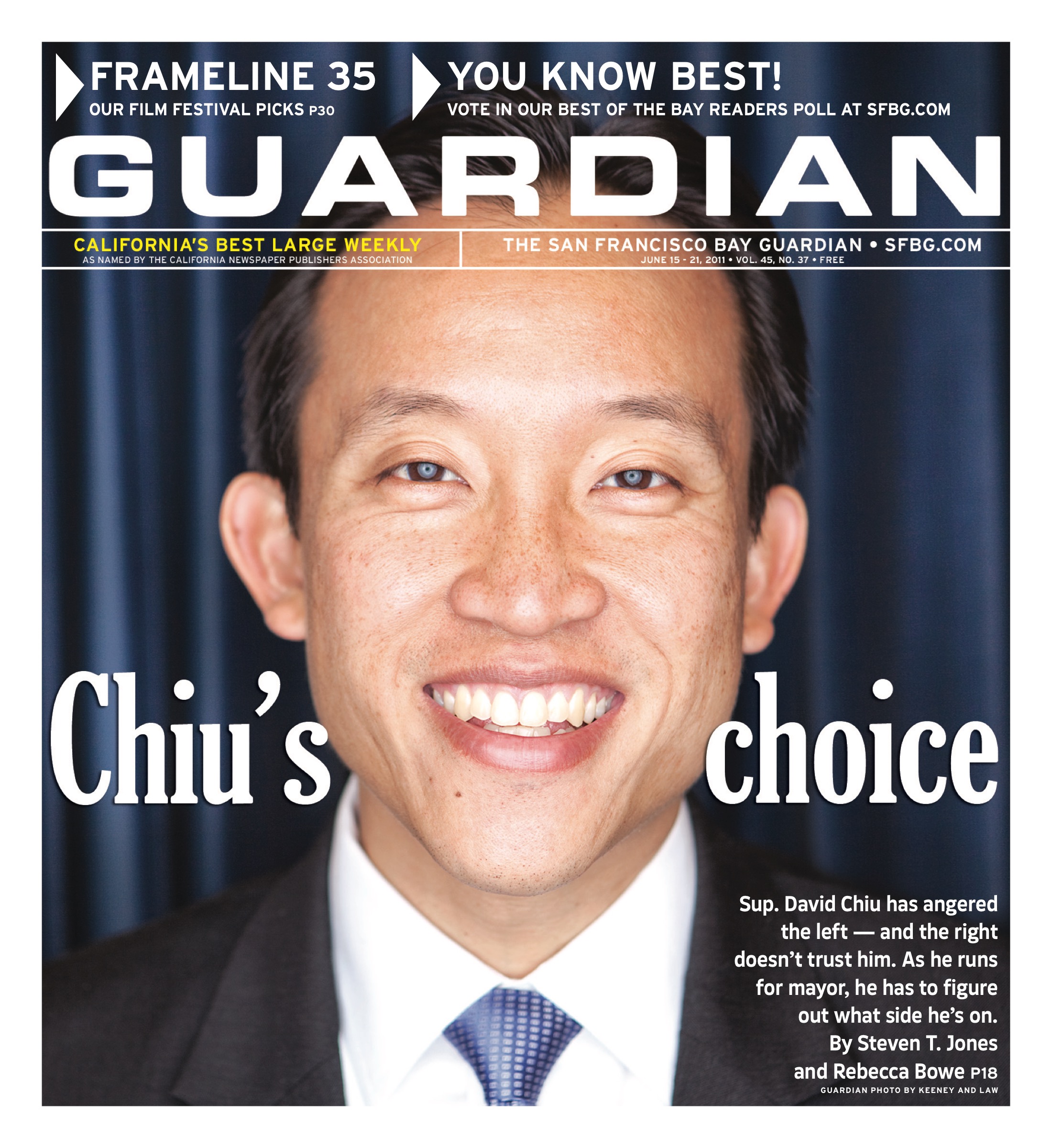
The odd twist to the Chron’s Chiu endorsement

18

The most obvious interpretation of the San Francisco Chronicle’s endorsement of David Chiu is that the Chron thinks Chiu has completely left the progressive camp and is now aligned with the political wing the daily paper calls “moderates:”

What is impressive about Chiu is that “change” and “jobs” are not just campaign slogans for him. He can go into detail about the redundancies and red tape at City Hall that are holding back economic development: the 15 departments that regulate the private sector, the hundreds of fees that burden businesses big and small, a payroll tax that is a disincentive to hire … If elected, he would have a mandate to make city government more efficient and effective.

(I don’t know how many times I have to say this, but the payroll tax is NOT a disincentive to hire.)

The Chron — which, on economic issues like taxes and development, is a very conservative paper — clearly thinks Chiu can be trusted, which ought to make progressives nervous.

But here’s the other interesting twist.

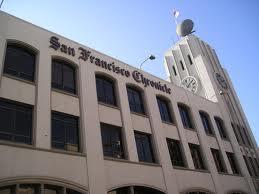
Hearst Corporation bought the San Francisco Chronicle in 2000, at the top of the market, for more than $500 million. I guarantee the paper isn’t worth more than a tiny fraction of that today. It’s still losing money, and has been for years, and nobody’s buying daily newspapers any more, and if Hearst wanted to unload the Chron, the New York publishing chain would be lucky to get $50 million. Hell, they’d be lucky to get $25 million.

So the bean counters in New York have this nonperforming half-billion-dollar asset on their balance sheets, and there’s no way to recover that money — except for one thing: The Chron owns a bunch of land around Fifth and Mission, including its own historic building. And that property is potentially worth a whole lot of money. When the economy picks up, Hearst can develop the parking lots, old press facilities and even its HQ; turn it all into condos and office space, and suddenly there’s a real chance of recouping some of those deep losses.

The process is already underway — the Chron’s been moving tech firms into vacant space in its building, and is working with developers on the shape of what could be a major project still to come.

And guess what? In June, William Randolph Hearst III — heir to part of the Hearst fortune and a member of the Hearst Corp. board — made a rare campaign contribution to a San Francisco political candidate. He gave the maximum allowable $500 to … David Chiu. Around the same time, Michael Cohen and Jesse Blout, the partners in a firm called Strada that’s working on the redevelopment of the Chron’s property, also gave Chiu the maxiumum $500.

I figured the top people at the Chron would back Ed Lee because they figured he’d be down with whatever they wanted to do with that land — particularly since Lee’s good buddy Willie Brown is now a San Francisco Chronicle columnist. But it appears they’ve cast their lot with Chiu. As Mr. Spock would say, fascinating.

A new progressive agenda

56

Over the past three months, the Guardian has been hosting a series of forums on progressive issues for the mayor’s race. We’ve brought together a broad base of people from different communities and issue-based organizations all over town in an effort to draft a platform that would include a comprehensive progressive agenda for the next mayor. All told, more than 100 people participated.

It was, as far as we know, the first time anyone tried to do this — to come up with a mayoral platform not with a few people in a room but with a series of open forums designed for community participation.

The platform we’ve drafted isn’t perfect, and there are no doubt things that are left out. But our goal was to create a document that the voters could use to determine which candidates really deserve the progressive vote.

That’s a critical question, since nearly all of the top contenders are using the word “progressive” on a regular basis. They’re fighting for votes from the neighborhoods, the activists, the independent-minded people who share a vision for San Francisco that isn’t driven by big-business interests.

But those of us on what is broadly defined as the city’s left are looking for more than lip service and catchy phrases. We want to hear specifics; we want to know that the next mayor is serious about changing the direction of city policy.

The groups who endorsed this effort and helped plan the forums that led to this platform were the Harvey Milk LGBT Club, SEIU Local 1021, the San Francisco Tenants Union, the Human Services Network, the Community Congress 2010, the Council of Community Housing Organizations, San Francisco Rising, Jobs with Justice, and the Center for Political Education.

The panelists who led the discussions were: Shaw-san Liu, Calvin Welch, Fernando Marti, Gabriel Haaland, Brenda Barros, Debbi Lerman, Jenny Friedenbach, Sarah Shortt, Ted Gullicksen, Nick Pagoulatos, Sue Hestor, Sherilyn Adams, Angela Chan, David Campos, Mario Yedidia, Pecolio Mangio, Antonio Diaz, Alicia Garza, Aaron Peskin, Saul Bloom, and Tim Redmond.

We held five events looking at five broad policy areas — economy and jobs; land use, housing and tenants; budget and social services; immigration, education and youth; and environment, energy and climate change. Panelists and audience participants offered great ideas and the debates were lively.

The results are below — an outline of what the progressives in San Francisco want to see from their next mayor.


ECONOMY AND JOBS

Background: In the first decade of this century, San Francisco lost some 51,000 jobs, overwhelmingly in the private sector. When Gavin Newsom was sworn in as mayor in January 2004, unemployment was at 6.4 percent; when he left, in January 2011, it was at 9.5 percent — a 63 percent increase.

Clearly, part of the problem was the collapse of the national economy. But the failed Newsom Model only made things worse. His approach was based on the mistaken notion that if the city provided direct subsidies to private developers, new workers would flock to San Francisco. In fact, the fastest-growing sector of the local economy is the public sector, especially education and health care. Five of the 10 largest employers in San Francisco are public agencies.

Local economic development policy, which has been characterized by the destruction of the blue-collar sector in light industry and maritime uses (ironically, overwhelmingly privately owned) to free up land for new industries in business services and high tech sectors that have never actually appeared — or have been devastated by quickly repeating boom and bust cycle.

Instead of concentrating on our existing workforce and its incredible human capital, recent San Francisco mayors have sought to attract a new workforce.

The Mayor’s Office has, as a matter of policy, been destroying blue-collar jobs to promote residential development for people who work outside of the city.

There’s a huge disconnect between what many people earn and what they need. The minimum wage in San Francisco is $9.92, when the actual cost of living is closer to $20. Wage theft is far too common.

There is a lack of leadership, oversight and accountability in a number of city departments. For example, there is no officiating body or commission overseeing the work of the Office of Economic and Workforce Development. Similarly the Arts Commission, the chartered entity for overseeing cultural affairs, is responsible for less than 25 percent of the budget reserved for this purpose

There’s no accountability in the city to protect the most vulnerable people.

The city’s main business tax is highly regressive — it’s a flat tax on payroll but has so many exceptions and loopholes that only 8,500 businesses actually pay it, and many of the largest and richest outfits pay no city tax at all.


Agenda items:

1. Reform the Mayor’s Office of Economic and Workforce Development to create a department with workforce development as a primary objective. Work with the San Francisco Unified School District, City College and San Francisco State to create sustainable paths to training and employment.

2. Create a municipal bank that offers credit for locally developed small businesses instead of relying on tax breaks. As a first step, mandate that all city short-term funds and payroll accounts go only to banks or credit unions that will agree to devote a reasonable percentage of their local loan portfolios for small business loans.

3. Reform procurement to prioritize local ownership.

4. Link economic development of healthcare facilities to the economic development of surrounding communities.

5. Link overall approval of projects to a larger economic development policy that takes as its centerpiece the employment of current San Francisco residents.

6. Enforce city labor laws and fund the agency that enforces the laws.

7. Establish the Board of Supervisors as the policy board of a re-organized Redevelopment Agency and create community-based project area oversight committees.

8. Dramatically expand Muni in the southeast portion of the city and reconfigure routes to link neighborhoods without having to go through downtown. Put special emphasis on direct Muni routes to City College and San Francisco State.

9. Reform the payroll tax so all businesses share the burden and the largest pay their fair share.

10. Consolidate the city’s various arts entities into a single Department of Arts & Culture that includes as part of its mandate a clear directive to achieve maximum economic development through leveraging the city’s existing cultural assets and creative strengths and re-imagining San Francisco’s competitive position as a regional, national and international hub of creative thinking. Sponsor and promote signature arts programs and opportunities to attract and retain visitors who will generate maximum economic activity in the local economy; restore San Francisco’s community-based cultural economy by re-enacting the successful Neighborhood Arts Program; and leverage the current 1-2 percent for art fees on various on-site building projects to be directed towards non-construction-site arts activity.


LAND USE, HOUSING AND TENANTS

Background: Since the office market tanked, the big land-use issue has become market-rate housing. San Francisco is building housing for people who don’t live here — in significant part, for either very wealthy people who want a short-term pied a terre in the city or for commuters who work in Silicon Valley. The city’s own General Plan calls for 60 percent of all new housing to be below-market-rate — but the vast majority of the new housing that’s been constructed or is in the planning pipeline is high-end condos.

There’s no connection between the housing needs of city residents and the local workforce and the type of housing that’s being constructed. Family housing is in short supply and rental housing is being destroyed faster than it’s being built — a total of 21,000 rental units have been lost to condos and tenancies in common.

Public housing is getting demolished and rebuilt with 2500 fewer units. “Hotelization” is growing as housing units become transitory housing.

Planning has become an appendage of the Mayor’s Office of Economic Development, which has no commission, no public hearings and no community oversight.

Projects are getting approved with no connection to schools, transit or affordable housing.

There’s no monitoring of Ellis Act evictions.

Transit-oriented development is a big scam that doesn’t include equity or the needs of people who live in the areas slated for more development. Cities have incentives to create dense housing with no affordability. Communities of concern are right in the path of this “smart growth” — and there are no protections for the people who live there now.

Agenda items:

1. Re emphasize that the Planning Department is the lead land-use approval agency and that the Mayor’s Office of Economic and Workforce Development should not be used to short-circuit public participation in the process.

2. Enact a freeze on condo conversions and a freeze on the demolition of existing affordable rental housing.

3. Ban evictions if the use or occupation of the property will be for less than 30 days.

4. Index market-rate to affordable housing; slow down one when the other is too far ahead.

5. Disclose what level of permanent affordability is offered at each project.

6. Stabilize existing communities with community benefits agreements before new development is approved.


BUDGET AND SOCIAL SERVICES

Background: There have been profound cuts in the social safety net in San Francisco over the past decade. One third of the city’s shelter beds have been lost; six homeless centers have closed. Homeless mental health and substance abuse services have lost $32 million, and the health system has lost $33 million.

None of the budget proposals coming from the Mayor’s Office have even begun to address restoring the past cuts.

There’s not enough access to primary care for people in Healthy San Francisco.

Nonprofit contracts with the city are flat-funded, so there’s no room for increases in the cost of doing business.

The mayor has all the staff and the supervisors don’t have enough. The supervisors have the ability to add back budget items — but the mayor can then make unilateral cuts.

The wealthy in San Francisco have done very well under the Bush tax cuts and more than 14 billionaires live in this city. The gap between the rich and the poor, which is destroying the national economy, exists in San Francisco, too. But while city officials are taking a national lead on issues like the environment and civil rights, there is virtually no discussion at the policy level of using city policy to bring in revenue from those who can afford it and to equalize the wealth disparities right here in town.

Agenda items:

1. Establish as policy that San Francisco will step in where the state and federal government have left people behind — and that local taxation policy should reflect progressive values.

2. Make budget set-asides a budget floor rather than a percentage of the budget.

3. Examine what top city executives are paid.

4. Promote public power, public broadband and public cable as a way to bring the city millions of dollars.

5. Support progressive taxes that will bring in at least $250 million a year in permanent new revenue.

6. Change the City Charter to eliminate unilateral mid-year cuts by the mayor.

8. Pass a Charter amendment that: (a) Requires the development of a comprehensive long-term plan that sets the policies and strategies to guide the implementation of health and human services for San Francisco’s vulnerable residents over the next 10 years, and (b) creates a planning body with the responsibility and authority to develop the plan, monitor and evaluate its implementation, coordinate between policy makers and departments, and ensure that annual budgets are consistent with the plan.

9. Collect existing money better.

10. Enact a foreclosure transfer tax.


YOUTH, IMMIGRATION, AND EDUCATION

Background: In the past 10 years, San Francisco has lost 24,000 people ages 12-24. Among current youth, 5,800 live in poverty; 6,000 have no high school degree; 7,000 are not working or attending school; 1,200 are on adult probation.

A full 50 percent of public school students are not qualified for college studies. Too often, the outcome is dictated by race; school-to-prison is far too common.

Trust between immigrants and the police is a low point, particularly since former Mayor Gavin Newsom gutted the sanctuary ordinance in 2008 after anti-immigrant stories in the San Francisco Chronicle.

Some 70 percent of students depend on Muni, but the price of a youth pass just went from $10 to $21.

Agenda items:

1. Recognize that there’s a separate role for probation and immigration, and keep local law enforcement from joining or working with immigration enforcement.

2. Improve public transportation for education and prioritize free Muni for youth.

3. Create family-friendly affordable housing.

4. Restore the recreation direction for the Recreation and Parks Department.

5. Implement police training to treat youth with respect.

6. Don’t cut off benefits for youth who commit crimes.

7. Shift state re-alignment money from jails to education.


ENERGY, ENVIRONMENT AND CLIMATE CHANGE

Background: When it comes to land use, the laws on the books are pretty good. The General Plan is a good document. But those laws aren’t enforced. Big projects get changed by the project sponsor after they’re approved.

Land use is really about who will live here and who will vote. But on a policy level, it’s clear that the city doesn’t value the people who currently live here.

Climate change is going to affect San Francisco — people who live near toxic materials are at risk in floods and earthquakes.

San Francisco has a separate but unequal transportation system. Muni is designed to get people downtown, not around town — despite the fact that job growth isn’t happening downtown.

San Francisco has a deepwater port and could be the Silicon Valley of green shipping.

San Francisco has a remarkable opportunity to promote renewable energy, but that will never happen unless the city owns the distribution system.


Agenda items:

1. Promote the rebirth of heavy industry by turning the port into a center for green-shipping retrofits.

2. Public land should be for public benefit, and agencies that own or control that land should work with community-based planning efforts.

3. Planning should be for the community, not developers.

4. Energy efficiency programs should be targeted to disadvantaged communities.

5. Pay attention to the urban food revolution, encourage resident owned farmers markets. Use unused public land for local food and community gardens.

6. Provide complete information on what parts of the city are fill, and stop allowing development in areas that are going to be inundated with sea level rise.

7. Prioritize local distributed generation of electricity and public ownership of the power grid.

8. Change Clean Energy San Francisco from a purchasing pool system to a generating system.

Fresh and Easy displacement

20

OPINION You could cut the hate with a knife. All eyes were on my fumbling fingers, unable to sign my WIC coupons fast enough with one hand while holding my 13-month-old son with the other. “Somebody’s using welfare checks to pay for their food,” A 20 something man in a polo shirt shouted into his phone next to me.

I spend so many days like this while trying to shop as a poor mama, its hard to even think about them. The life of a poor parent in the U.S. is always a scarcity model rollercoaster ride of hate, system abuse, subsistence crumbs and criminalization, best exemplified in the supermarket experience where the so-called paying customers suffer through the bother of waiting for poor parents to pay with our WIC coupons, working poor mamas to pay with payroll checks or indigenous elders to count out their multiple coupons.

I began to reflect on this when I heard about the new fresh and Easy Markets opening in the Bayview-Hunters Point, the Mission and the Portola district. It’s a new supermarket chain from England that by policy doesn’t accept WIC coupons.

WIC — the federal Women, Infants and Children’s program, is not welfare, but rather a supplemental program that allows low-income parents to get milk, grains, cereal and other basic foodstuffs. It’s a program used by many working poor as well as mamas on government crumbs so we can feed our children a balanced diet.

The Bayview, Mission, and Portola neighborhoods are peopled with a lot of multi-generational, multi-lingual mamas, and families in poverty like mine, who need access to affordable fruits and vegetables and non-hormone-filled meat like Fresh and Easy has, but are these stores really being built for us?

Like so much of San Francisco and the whole Bay Area, these communities are under attack from redevelopment and gentrification efforts. Removal and evictions of poor families and elders happen everyday in the city to make way for the corporate veneer of Lennar and John Stewart properties, condominiums, lofts and the rich young people who they are built for.

So who is Fresh and Easy for? They don’t take coupons, personal checks or WIC — and like their Whole Paycheck counterparts, they don’t hire union employees, or ultimately many employees at all, as they have the new self-pay check-out stands.

Fresh and Easy claims it doesn’t except the manufacturers’ coupons for the same reasons it doesn’t accept paper personal checks, W.I.C. vouchers, or cash payroll checks: That elimination of manual paper processing, combined with its self-service checkout system, saves money.

Pressured by community members who protested outside the Bayview store on its opening day, Fresh and Easy CEO Tim Mason now claims that Fresh and Easy in the Bayview will eventually begin taking WIC.

As this poor mama tries to move out from under the lie of criminalized government crumbs and the non-existent, bootstraps centered, corporate underwritten American dream, I have come to realize our collective, self-determined liberation begins with growing our own food in our poor neighborhoods with people-led community gardens, taking back stolen indigenous land and resources with organized poor people led/indigenous people-led efforts and whenever we have the energy, after all the other things we have to do to survive in this capitalist society fighting the exclusion and removal efforts of us by the smooth talking corporations who don’t see us as part of their grand profit-making plans.

Tiny aka Lisa Gray-Garcia, daughter of Dee and mama of Tiburcio is the co-founder of POOR Magazine/PoorNewsNetwork and author of Criminal of Poverty: Growing up Homeless in America

The Fillmore’s facelift: Independent Artists Week fills the street

1

Bayview native Meaghan Mitchell first started working in the neighborhood as a hostess at 1300 on Fillmore. Not anymore – now she co-owns a pop-up neighborhood art gallery across the street from the restaurant and is organizing an entire week of events geared towards filling the historic neighborhood’s streets again (Independent Artists Week, now through Sun/11).

The Fillmore’s the kind of neighborhood that inspires creative growth, famous for its days as a cultural hub where African Americans celebrated the arts, succeeded in the business arena, and solidified community. This week’s lineup of IAW events hopes to highlight that legacy, with speed networking for creative types, free art walks, and more. 

Because right now, the area definitely needs some shine.

“We’re struggling with the identity of the Fillmore right now,” says Mitchell, who sits in her small gallery space surrounded by paintings and sculptures done by local artists during her interview with the Guardian. Sisters Melorra and Melonie Green co-own the space, and Mitchell gives us a tour of the neighborhood art the three have filled their gallery with, from elaborate metal wall sculptures to small drawings by local grade-schoolers. The Greens are the other two lead organizers of Independent Artists Week. 

Mitchell gestures to the towering condo and apartment buildings visible through the gallery’s front windows. “Look at all those apartment buildings. Where do those people go?”

Despite its history of locally-owned businesses, Fillmore is far from bustling during the daytime, when the street’s renowned jazz clubs are closed. There’s a handful of black-owned businesses (including New Chicago Barbershop, which we profiled earlier this summer) that are still standing, but you see a lot of empty storefronts when you walk down the sidewalk. 

Mitchell and her partners would like to reverse that trend. “There’s so much potential for African American people to take back our neighborhood,” she says. “Facilitating our own events is a part of that.”

She should know – she learned from an event-planner extraordinaire. Mitchell says she owes her organizing skills to Ave Montague, the woman who was in charge of public relations at 1300 when Mitchell was first hired on. 

“She made this neighborhood poppin’,” remembers Mitchell. Montague organized the Black Film Festival, and took Mitchell under her wing, training her to help coordinate a slew of other events that were important to the Fillmore community – and the country. Montague passed away shortly after she threw the official West Coast inauguration party for Barack Obama in 2008. 

“When she died, this neighborhood was in a different place,” says Mitchell. “It was grey.”

There was some question about who would take up Montague’s crusade to make Fillmore Street a vibrant center of black Bay Area culture once again. But not for long – soon Mitchell and the other neighborhood business-owners and advocates from the Fillmore Community Benefit District were back in talks with the Mayor’s Office, which is now once again subsidizing their event-planning efforts. 

Of course, Mitchell says, there are challenges to this kind of city government-funded community organizing in a neighborhood that was gutted by “redevelopment” campaigns in the past. Long-time residents are less than thrilled to put the future of the neighborhood in the hands of organizations responsible for driving out black families in the first place. She’s attended CBD meetings that ended in shouting and finger-pointing over who did and didn’t deserve a piece of the $800,000 the Mayor’s Office had contributed to their work. 

“You’ve got to check in with folks.” Mitchell says that even though she is a San Francisco native, she’s still a newcomer to the Fillmore scene – and that a big part of her work is involving the long-time movers and shakers in the area. She now holds monthly merchant meetings that started out with three and now generally attract 11 participants. 

But it’s worth it to become a part of a neighborhood this unique. “[Working in] the Fillmore, it was the first time I worked in a place where I really felt appreciated,” she says. “I met all these prestigious African American people who helped me and who I could look up to.” 

Hopefully this week’s events will provide similar opportunities for other up-and-comers – check out the schedule below to see what’s on offer for artists, art lovers, wannabe yogis, and anyone who is into the idea of a new, brighter Fillmore. 

Photo above right: Mitchell has joined Fillmore’s entrepreneurs with a gallery space of her own on the strip. Photo by Caitlin Donohue


“Opportunity Knocks” speed-networking event

Local music scenesters, public relations experts, and other sources of knowledge on making a living off of art in the Bay Area will be available to chat with artists on those topics and more. 

Tues/6 7-9 p.m., $15. Yoshi’s, 1330 Fillmore, SF. 


Sustainable fashion fair-clothing swap

Trade in your clothes for other people’s hand-me-downs – style on a budget (and with a low carbon profile, hell yeah). 

Wed/7 7-10 p.m. African American Cultural Arts Center, 762 Fulton, SF. 


Thank You Awards

Honorees will include filmmaker Kevin Epps, Sup. Ross Mirkarimi, and other supporters of the local arts community. 

Thu/8 7-9 p.m., $15. African American Cultural Arts Center. 


Fillmore Art Walk

Art in the streets! Tour the neighborhood’s galleries and businesses (including Mitchell’s space at 

Fri/9 6 p.m.-midnight, free. Fillmore between Post and McAllister, SF. 


Healing arts demonstration

The perfect, low-commitment intro to tai chi, yoga, acupuncture, meditation, and more. Swing through to ask about body and soul woes with experienced practitioners in the sunshine. 

Sat/10 9 a.m.-1 p.m., free. Fillmore Center Plaza, Fillmore and O’Farrell, SF. 


Western Addition Sunday Streets

A huge swath of Fillmore, Divisadero, and the Panhandle will be blessed with a free roller disco, break dancing lessons, free bike repair and rental, and of course lots of car-free asphalt for walking, biking, boarding, and blading community members. 

Sun/11 11 a.m.-4 p.m., free. Various streets in Western Addition, SF. www.sundaystreetssf.com


The America’s cup confusion

19

If the sponsors (and city officials) are right, the America’s Cup is going to be a huge event, attracting hundreds of thousands of spectators, many of whom will want to be on the San Francisco waterfront to watch. But it’s never been clear to me exactly how that’s going to work — how are all those (rich) people who are used to getting around in limos going to travel from their downtown hotels to the viewing areas? If the city wanted to do this right, we should close down the Embarcadero and some of the feeder streets to all vehicles (except ambulances — always needed when rich old people get excited) and force everyone to travel by pedicab. Buy up a fleet of several hundred of the human-powered vehicles and let all the unemployed teenagers get a shot at driving them. Job creation for youth; environmentally sound transportation; potentially fun bumper-car action with well-heeled patrons screaming in fear.


Remember: The f-line, even with improvements, can’t possibly handle the necessary traffic. And the AC types aren’t going to ride the train anyway. No way private cars can all fit without massive gridlock.


So: Pedicabs. My suggestion.


In the meantime, there’s this little problem of 8 Washington.


See, the developer of what would be the city’s most expensive condos ever is planning on excavating 110,000 cubic yards of soil for a massive underground parking garage — right along the Embarcadero, and right during the America’s Cup events. The Draft Environmental Impact Report for 8 Washington indicates that the dump trucks (about 20 big trucks per day, and possibly a lot more) would be using that roadway to get to 101 or 280.


Actually, if activist Brad Paul is correct, there’s no way the developer can excavate that much dirt in the time frame that it’s supposed to happen unless the number of trucks is closer to 300 a day. Imagine all of that happening while 100,000 people are trying to get to the waterfront to watch the show. Oh, and according to the DEIR for the America’s Cup, the Embarcadero will be CLOSED during that period.


The fact is, the 8 Washington project is not only a terrible idea (just what the city needs — more condos for mega-millionaires) but would directly screw up the whole America’s Cup effort. And the amazing thing is that the AC people and the Mayor’s Office don’t seem to be paying attention.


Paul has put together a lengthy critique of the whole mess that makes great reading if you’re into this sort of thing. So I thought I’d just post it all here. Warning: It’s long. Enjoy.


August 15, 2011                                                                                                         


Bill Wycko
Environmental Review Officer
San Francisco Planning Department
1650 Mission Street, Suite 400
San Francisco, CA  94103


Re: COMMENTS ON DRAFT EIR FOR 8 WASHINGTON STREET/
SEAWALL LOT 351 PROJECT    
Case No. 2007.0030E


Dear Mr. Wycko:


I am writing to my provide my comments on the Draft Environmental Impact Report (“DEIR”) for this project, a document that is incomplete, inadequate and in places quite misleading. I’ve organized my comments in sections beginning with a detailed discussion of how the project’s construction schedule has been greatly underestimated. This is followed by discussions of the DEIR’s failure to address key Housing and Population issues, misstatements regarding historic obligations related to Golden Gateway, comments on recreation issues, and more.  In general, I believe the DEIR fails to present objective information and analysis, it omits a number of relevant issues that are critical to the ability of public officials to make objective and informed decisions about the project and it is filled with judgments and assertions that are not supported by facts.


The DEIR is incomplete and inadequate in the following areas:


I. THE DEIR CONSTRUCTION SCHEDULE FOR 8 WASHINGTON IS BOTH INACCURATE AND MISLEADING.


The DEIR construction schedule is based on overly optimistic assumptions that are totally unrealistic; the ramifications of these erroneous assumptions need to be carefully considered as they will cascade throughout the project requiring major revisions to the DEIR before it can be considered accurate and complete.


At the bottom of page II.19 it states:
 
      Project construction, including demolitions, site and foundation work,
      construction of the parking garage, and construction of the buildings,
      would take 27-29 months. Assuming that construction would begin in 2012,   
      the buildings would be ready for occupancy in 2014. The first phase of the
      construction would take about 16 months and would include demolition       
     (2 months), excavation and shoring (7 months), and foundation and below
      grade construction work (7 months).


While the DEIR unequivocally states the project will take 27-29 months to construct, from 2012 to 2014, facts provided elsewhere in the DEIR together with current city policies,  the City’s America’s Cup Host and Venue Agreement and basic math indicate that this schedule is not tenable. The remainder of this section provides the data and analysis that lead to the conclusion that construction of 8 Washington will take much longer than 27-29 months, almost TWICE AS LONG, with excavation taking 2.5 to 3 TIMES longer.  


Table 1: Requested Changes to the overall DEIR construction schedule


          ACTIVITY             MINIMUM           MAXIMUM


    DEIR’s construction schedule: 27 months    to    29 months  


    Actual excavation schedule:  18 months           22 months
    — DEIR estimate for excavation – 7 months            – 7 months
    + Increased excavation time  11 months      to       15 months 
    + Archeology delays                .5 months      to         2 months
    +  America’s Cup delays                  2.5 months       to         5 months
    +  Weather delays                        .25 months      to         1 months


   ACTUAL CONSTRUCTION TIME 41 months       to      52 months


To refute the numbers in Table 1, project sponsors must present additional, verifiable data supporting their unrealistic assumptions, beginning with the claim that the first phase of construction takes 16 months with a mere seven months allocated for excavation/shoring.


A. The DEIR fails to accurately ascertain and analyze the excavation/shoring schedule.


The DEIR states on page II.20 that “approximately 110,000 cubic yards of soil” will be excavated from the site for an underground garage (approximately 90,000 cubic yards) and other foundation work during the seven (7) month “excavation” portion of the projected timeline. It later states excavation will take place 6.5 hours per day with an average of 20 truck trips per day (pg.IV.D.31). Assuming the average dump truck holds 12 cubic yards of dirt (typical payload for a dump truck), that would mean:


      · 110,000 cu. yards/12 cubic yards per truck = 9,166 truck trips


      · 20 trucks/day X 12 cubic yards/trip = an average of 240 cu. yards/day


      · 110,000 cu. yards/240 cu. yards per day = 458 working days for this task


Could this task be completed in seven (7) months as claimed in the DEIR?  NO.


     ·5 working days per week X 52 weeks = 260 working days per year
             – 11 holidays per year
                   249  total working days/year


     ·458 days to finish task/249 working days per year = 22 months  (not 7)
     
For this to take 7 months as the DEIR asserts, the following would have to be true:


   · 20 trucks/day X 7 months (145 working days ) = 2,900 total truck trips


   · 110,000 cu. yards/2,900 trucks = each truck must average 38 cubic yards/trip
Empirical evidence exists, however, proving the DEIR’s claim that the excavation portion of the schedule will take seven months is inaccurate and misleading:


        CASE STUDY #1: San Francisco General Hospital Rebuild Project


A recent SF General Hospital (SFGH) Newsletter reports the hospital’s contractor just finished hauling 120,000 cu. yards of dirt from the 45’ deep hole that was dug to build two basement levels and the foundation for a new hospital building. This is as close as anyone is likely to get to replicating what 8 Washington proposes, a three level 40’ deep underground garage accounting for most of the 110,000 cubic yards of dirt that must be removed from the site. 


A call to the SFGH Rebuild office revealed their excavation process took seven (7) months with an average truck load of 13 cu. yards per trip. How was that possible?


“The average truck load was 13 cubic yards. Some days we had
over 300 truck loads hauled in one day. This volume was possible
through use of a paved drive that allowed trucks to enter the side, be
loaded up then tires washed to prevent dirt on road causing storm-            
water pollution and dust.”


The SF General site is just a few blocks from U.S. 101 with direct access via Potrero Ave., thus minimizing potential traffic conflicts. The 8 Washington site will require driving long distances on city streets including “The Embarcadero, Harrison Street, and King Street… likely the primary haul and access routes to and from I-80, U.S. 101, and I-280 (pg. IV.D.31).” Imagine 300 trips a day on one of these streets.


               CASE STUDY #2: SF PUC’s New Hetch Hetchy Reservoir Tunnel


A recent Oakland Tribune story (4/8/11) describes construction of a new 3.5-mile tunnel designed to protect the water supply from SF’s Hetch Hetchy reservoir from major earthquakes by boring a 2nd, state-of-the-art tunnel from Sunol to Fremont alongside the existing 81-year-old Irvington Tunnel. The article states:


      “By the time the New Irvington Tunnel is completed in 2014, crews will have
        excavated about 734,000 cubic yards of material—the equivalent of 61,000
        dump-truck trips, said officials with the SF Public Utilities Commission.”


Dividing 734,000 cubic yards of soil by the 61,000 dump truck trips that the PUC says are necessary equals 12 cubic yards per truck trip. Given this job’s overall size and $227 million budget, it would seem to confirm the fact that the most efficient excavation equipment for the 8 Washington site will be 12 cubic yard dump trucks.


In light of these facts and the analysis provided above, the only way 8 Washington could meet its proposed seven (7) month excavation schedule would be to:


a) schedule up to 300 TRUCK TRIPS A DAY, over 10 TIMES the average number of trips per day (20) stated in the DEIR and 3 TIMES the absolute maximum of 100 truck trips per day (pg. IV.D.31)  along the Northeast Embarcadero during a period of time that directly overlaps with the major America’s Cup events and activities, something specifically prohibited by the City’s America’s Cup Host and Venue Agreement ,        


         OR


b) average 38 cubic yards of dirt per truck trip, 3 TIMES the average truck payload of both the PUC’s Irvington Tunnel project and SF General Hospital’s 120,000 cubic yard excavation project—assuming that 38 cubic yard trucks:  a) exist in sufficient quantity in   the Bay Area, b) would be available during that period of time described and c) would be allowed on The Embarcadero, Harrison St., King St., Washington St. and Drumm St. by     the City. [see photo comparison of 12 cubic yard vs. 30 cubic yard trucks below]


Unless the project sponsor can demonstrate that one of these two highly unlikely scenarios is possible, then the EIR must reanalyze a number of impacts (e.g. Land Use, Air Quality, Greenhouse Gases) based on a revised excavation schedule, one that takes 2.5 to 3 TIMES as long as the one described in DEIR to complete excavation work, and this 22 month timeline assumes NO archeological remains are found on site and the City imposes NO stop work orders related to America’s Cup (see below).


This 15-month difference between the excavation period analyzed in the DEIR and the ACTUAL time it will take to complete the excavation (22 months vs. 7 months) is a major deficiency in the DEIR with profound impacts.  For instance, some of the most significant unavoidable negative impacts described in the DEIR involve degraded air quality both during and after construction. Adjusting the environmental analysis to reflect how long excavation will actually take means significant air quality impacts related to excavation (with the greatest detrimental effect on seniors, children and people exercising) will persist for 2.5 to 3 TIMES LONGER than described in the DEIR.  This flaw also requires significant revisions to other sections of the DEIR.


In light of this new information, the next draft of the EIR must contain an analysis of    this longer overall construction period—two months for demolition; a range of 18 to 22 months for excavation (not seven months); a built-in range of time for the shutting down of the site when archeological artifacts are uncovered, documented and extracted (something the DEIR’s archeology consultant states is “likely” ); and the building construction period. Finally, given these overly aggressive excavation schedule estimates, all other estimates for later construction phases must now to be cross checked for accuracy by independent contractors (e.g. not working for 8 Washington developer    or the source of the prior DEIR excavation estimate).


B. The actual construction timeline for 8 Washington will be 41-52 MONTHS. 
If the project sponsors disagree with this assessment, they must provide the Planning Department with much more detailed information on how they expect to achieve a shorter construction period given the restrictions described in the DEIR itself as well as mathematical analysis described above. For instance,


– Did the developers err when they reported that the average number of truck
   trips per day would be 20 as analyzed in the DEIR?  If so, what number do they 
   choose to use now and how does that impact various aspects of the DEIR analysis
   such as air quality, conflicts with pedestrians, MUNI and America’s Cup, etc.. 


– Does the developer plan to raise the limit of truck trips per day from 100 (as
   per the DEIR) to 300 truck trips per day? If so, how often will this happen and 
   how will these changes impact various aspects of the previous EIR analysis (e.g. air
   quality, traffic/transit/pedestrian conflicts, America’s Cup)?


– Does the developer plan to lengthen the average workday or work six days a
   week? If so, how often and how would this impact the previous DEIR analysis?
   NOTE: The DEIR construction schedule (27-29 months) was not predicated on the
   trucks operating 6 days a week EVERY WEEK. But even if the developer ran dump  
   trucks 6 days a week for the ENTIRE excavation period it would still take TWICE AS
   LONG as the DEIR states to remove 110,000 cubic yards of dirt .


– Where is the project sponsor planning to route 100 to 300 trucks a day as they
   leave the site, particularly during the various America’s Cup trials (2012) and
   finals (2013) when vehicular traffic will be severely limited or prohibited?
   Washington Street? The Embarcadero? Drumm Street? Clay Street?, where exactly?


– Have the developers located a source of 30+ cubic yard trucks and secured
   city permission to use them on the specific streets described in the DEIR?
   It seems fair to assume the SF General Hospital’s excavation contractor would have
   done this if it were possible (and the SF PUC’s Irvington Tunnel contractor). See the  
   three photos below to get a sense of the size difference between a typical 12 cubic yard
   dump truck and the type of tractor-trailer rig required to carry 30 cubic yards or more.


As the questions and examples (SF General Hospital) above demonstrate, the DEIR’s claim that 110,000 cubic yards can be excavated in seven months defies the laws of physics and math, not to mention the America’s Cup Host & Venue Agreement between the City and Larry Ellison’s Oracle BMW Racing Team 


 A thorough reading of the DEIR’s Archeology section and the America’s Cup Host and Venue Agreement indicate that additional time must be built into the construction schedule for predictable work stoppages related to both issues.


KNOWN ARCHEOLOGICAL RESOURCES IDENTIFIED ON THIS SITE IN THE DEIR


On page IV.C.12, the DEIR’s archeology consultant, Archeo-Tec, identifies the Gold Rush ship Bethel as located under a portion of the site and states that “If discovered, the Bethel would be the oldest known (and perhaps most intact) archeological example of an early Canadian built ship (Pg. IV.C.3)”. On page IV.C.11, the archeology consultant states “Significant archeological resources are likely to exist at this site”.  The DEIR, goes on to state the proposed project will destroy a portion of city’s original Seawall causing “the largest disturbance of the Old Seawall to date”.


As a result of these DEIR findings, the archeology consultant should now be asked for an estimate of the time required to mitigate the discovery of the Bethel and other likely finds (e.g. original Seawall, other Gold Rush ships, original Chinatown). This “likely” work delay should be built into the construction schedule and stated as a range. For purposes of the matrix below (Table 1) we chose a time of two weeks to two months based on anecdotal information from other similar sites. Archeo-Tec, the archeology consultant, should be able to come up with a more precise estimate.


KNOWN AMERICA’S CUP SCHEDULING CONFLICTS


Based on recent MTA staff presentations on protocols for the America’s Cup, it seems clear that traffic, particularly construction dump trucks, will be banned from Washington Street, Drumm Street and The Embarcadero during major America’s Cup events that include, at a minimum, the America’s Cup World Series warm-up races (July/Sept. 2012), the penultimate Louis Vuitton Cup Series (July/August 2013) and the America’s Cup finals (Sept. 2013).  


This represents a minimum of 2.5 months that must be added to the construction schedule, something the DEIR authors should have included if they had read the America’s Cup DEIR which states there are 9+ weeks of races associated with this event in 2012/2013. The extra few weeks added to the low end range in Table 1 (below) are there to accommodate last minute weather delays and various large non-racing events held along the waterfront that will require closure of The Embarcadero, Washington Street, Drumm Street, etc.


Table 1 below lays out a more credible and realistic construction schedule based on the factors described at length above, taken directly from the DEIR or readily available from the city (e.g. America’s Cup DEIR) and the America’s Cup Host and Venue Agreement.


Table 1: Requested Changes to the overall DEIR construction schedule


          ACTIVITY             MINIMUM           MAXIMUM 


    DEIR’s construction schedule: 27 months    to    29 months  


    Actual excavation schedule:  18 months           22 months
    — DEIR estimate for excavation – 7 months            – 7 months
    + Increased excavation time  11 months      to       15 months 
    + Archeology delays                .5 months      to         2 months
    + America’s Cup delays                   2.5 months        to         5 months
    + Weather delays                        .25 months      to         1 months


   ACTUAL CONSTRUCTION TIME 41 months       to      52 months


To refute these numbers, the project sponsors must not only present a verifiable and detailed plan to remove 110,000 cubic yards (9,167 truck trips) in seven months that the City has signed off on but also produce a letter from the City and Oracle BMW Racing granting a waiver from Section 10.4 of the America’s Cup Host and Venue Agreement that would allow 20 to 300 trucks a day to drive along The Embarcadero, Washington Street   or Drumm Street during major America’s Cup events in 2012 and 2013.


D. Significant Transportation and Energy issues that were not addressed in DEIR.


More specific information related to the construction process needs to be provided and analyzed in the EIR, particularly regarding the far reaching impacts of those 9,166 dump truck trips, impacts that go beyond the immediate Northeast Waterfront.


The DEIR states “While the exact routes that construction trucks would use would depend on the location of the available disposal sites, The Embarcadero, Harrison Street, and King Street would likely be the primary haul and access routes to and from I-80, U.S. 101, and I-280”. At a minimum, The EIR needs to include information on where the two or three most likely disposal sites are located, based on recent experience (SF General Hospital excavation) so that one can analyze the extent of potential conflicts on the Bay Bridge or 101 South where other trucks will be transporting dirt to and/or from the Transbay Terminal project, Hunters Point Shipyard, Mission Bay, Treasure Island, etc. Without this information, the City could find itself creating significant traffic conflicts on the Bay Bridge or highway 101 that greatly increase air quality, traffic and transit problems without having analyzed these potential impacts in a flawed EIR.


Simply saying “While the exact routes that construction trucks would use would depend on the location of the available disposal sites” isn’t adequate or acceptable. Assumptions must be made regarding most likely disposal sites and routes to those sites and what additional cumulative impacts these routes (and 9,166 trucks) will create. The EIR must provide a MAP of the route to be used for hauling soil, all the way from the departure point at 8 Washington to the final destination(s) with an explanation of where trucks will drive and what restrictions there are on hours, size of payload, safety, etc. for the various streets, highways and bridges they will travel on. If the options include trucking the soil to San Francisco’s southern waterfront to transfer it to barges, then this needs to be disclosed and analyzed, including the potential routes and destinations of those barges.
In addition, to accurately compare the environmental impacts of the project sponsor’s ‘Preferred Project’ to the “No Project” alternative (energy consumption, traffic impacts, air quality degradation, etc.), one needs to know not only the destination of the approximately 9,166 dump truck trips but also the average miles per gallon of a typical dump truck. For instance, if the final destination for the soil was 100 miles away and a typical dump truck averages 8 miles per gallon of diesel fuel, then:


      9,166 truck trips X 200 miles per round trip = 1,833,200 miles for all dump trucks;


      1,833,200 gallons/8 MPG = 229,150 gallons of diesel fuel that would be burned. 


In other words, the city’s choices would be:


     229,150 gallons of diesel fuel used to transfer 110,000 cubic yards 1,833,200 miles


VS.


    ZERO (O) gallons of diesel fuel used if the NO PROJECT alternative were approved.


E. Importance of accurate, detailed information re: the construction process.


Given the above discussion, it is clear that the construction schedule set forth in the DEIR is inaccurate at best and has led, in many cases, to the significant understating of major negative impacts associated with this project. The lack of a detailed discussion of some of the key aspects of the construction process, e.g. the route and destination of 9,166 dump trucks, is also highly problematic.


Without a complete and thorough analysis of the impacts of a of an overall construction schedule that is TWICE AS LONG as the one analyzed in this DEIR, city officials will be missing much of the critical information they need to determine whether or not the developer’s ‘Preferred Project’ is necessary, desirable or feasible. A complete and factual analysis of this issue must be included in the next draft of the EIR which, given this and  other major inaccuracies and omissions (see below), should be recirculated in draft form.


II. THE DEIR FAILS TO DISCUSS OR ANALYZE ANY CRITICAL HOUSING ISSUES RELEVANT TO 8 WASHINGTON OR UNIQUE ENVIRONMENTAL AND ENERGY IMPACTS THOSE HOUSING ISSUES CREATE. 


A. Impacts of the project on the City’s Housing Needs were Not Analyzed in DEIR.  The DEIR states that potentially significant impacts to Population and Housing will not be discussed because the 2007 NOP/Initial Study found that the proposed project would not adversely affect them. Unfortunately the DEIR lacks the basic information needed to reach such a conclusion and, as we will demonstrate, an objective review of relevant 2008-2011 housing data contradicts this conclusion.


The world, particularly regarding housing, has changed radically since 2007. Relying   on housing and population information from 2007 ignores the financial and housing meltdown of 2008 and is simply indefensible. In addition, back in 2007, the EIR consultants were relying on stale, seven-year-old census data while today they have access to a multitude of fresh 2010 census data. No one can dispute that the housing environment today could not be more unlike the housing environment in 2007.
By relying solely on pre-2008 housing data from the 2007 NOP/Initial Study, this DEIR    lacks any of the basic information needed to conclude that this project would not have adverse effects on Population and Housing and must now revisit and thoroughly analyze these issues.


B. The DEIR fails to analyze how the type and price of housing proposed for
8 Washington determines whether or not it meets the city’s housing needs.


One of the project objectives (Pg II.14) is to “help meet projected City housing
needs.” How is that possible, given the fact that the developer has publicly stated
that these will be “the most expensive condominiums in the history of SF” ? With a
$345,000,000 project cost , 8 Washington’s 165 units will cost $2.0 million a unit
just to build . To secure financing and a ‘reasonable’ profit, each unit will have to
sell for $2.5-$5 million with penthouses selling for $8-$10 million.


Nowhere in the DEIR is ANY of this discussed. There is no analysis of how these
very high sales prices will determine who lives at 8 Washington (e.g. how many San
Francisco families could afford these prices?) and how the incomes of these new
residents ($250,000 to over $1 million/year) will dramatically change a number of
the environmental impacts of the project, with major implications for sustainability
and energy use, among other things.


The final EIR must state the average cost to build each unit and the range of
sales prices expected so that public officials can assess for themselves whether
the proposed condos will or will not  “help meet projected City housing needs.” 


The 2009 Housing Element, signed into law by Mayor Ed Lee on June 29, 2011, states that 61% of the housing need in San Francisco is for below-market-rate housing—serving families making 30-120% of Area Median Income (AMI), and only 39% of the city’s housing need is for market rate housing (120% to 500+% AMI).


As Planning staff and Commissioners know from their Housing Element discussions, the luxury condos proposed for this project are so expensive they will not help the city meet its current unmet housing needs. If this project objective (Pg II.14) is left in the final EIR, it should include a note explaining that the project, as proposed, is unlikely to meet this objective for the following reasons:


Condominiums selling for $2.5 million and more fall into the one segment of the city’s housing market that is currently overbuilt and has historically been over represented in relation to the state’s Regional Housing Needs Allocation (RHNA) goals that underpin the updated 2009 Housing Element of the city’s General Plan. An ABAG report on housing needs vs. housing production in SF (1999-2006) that came out in 2007—a report that should have informed the 2007 NOP/Initial Study for 8 Washington—states RHNA Allocations (Goal), Permits Issued (Permitted) and % of Allocation Permitted (% of RHNA Goal) by income category as follows:


Table 2: SF Housing Production (1999-2006)*


Housing Type  Very Low    Low              Moderate       Market Rate 
by Income    Income Income  Income           Housing
____________________________________________________________________________________________________________
  % of AMI:    21-50%  51-80%  81-120%         120-500+%
  Annual income: [21-50K] [57-81K] [85-123K]   [123K-$1million+]
———————————————————————————————————-
·RHNA Goal (units)   5,244       2,126   5,639                7,363


·Permitted    4,203       1,101      661                        11,474


·% of RHNA Goal     80%      52%       12%             156%


        * from a 2007 ABAG report entitled: A Place to Call Home


A chart like this, showing housing goals by income group (based on RHNA numbers from the State Office of Housing and Community Development), must be included in the DEIR so public officials can analyze what portion of the city’s unmet affordable and middle income housing needs, if any, the proposed project would meet. It illustrates something local housing experts have long known, that the city consistently comes in well above its RHNA goals for market rate condos, and has historically fallen short of its goals in all other categories for affordable housing, the housing that serves the 61% of San Franciscans that cannot afford ‘market rate’ housing.
C. Dramatic changes to the San Francisco housing market since the 2007 NOP/ Initial Study were not acknowledged and analyzed in the DEIR. All the traditional (pre-2007) sources of funding for the city’s affordable housing programs have dried up since the 2008 housing crash. Redevelopment tax increment funds will either be significantly reduced to pay the state to avoid closure of the SF Redevelopment Agency, or they will be eliminated altogether. Proceeds from the state’s $2.8 billion Affordable Housing Bond (Prop. 1C) are all spent. The federal Low Income Housing Tax Credit, a major source of funding for affordable housing, is under attack by House and Senate Republicans and may not survive.


This indicates that San Francisco won’t come close to meeting its pre-2007 affordable housing production levels  until we find a new permanent local source of funding for affordable housing. How long will that take? The DEIR must address this issue.


Another chart that must be included in the DEIR shows the city’s RHNA goals by income category combined with a summary of a recent SF Business Times (6/24/2011) chart showing all San Francisco residential projects under construction, permitted or  in the planning pipeline . Such a chart would look something like Table 3 below:


Table 3: Where does the city need help in meeting its RHNA goals?


          Extremely Low       Very Low            Low             Moderate          Market Rate   
                 Income          Income           Income            Income               Housing
         Below 30% AMI          31-50%            51-80%           81-120%              120-500+% 
      [21K-30K]         [35K-50]        [57K-81K]      [85K-120K]        [120K-$1M+]
____________________________________________________________________________________________________________


RHNA      439/yr.                   439/yr.           738/yr.            901/yr.                    1,632/yr.
Goals:      10.5%        +          10.5%      +      18%        +     22%  =  61%           39%
# of units                    of total        of total
% of goal
                             All Affordable Categories Combined            Market Rate_


Underway:          470 units                 1,557 units


Approved:                  8,751 units             30,878 units


In Pipeline:                   780 units                     4,184 units 
________________________________________________________________________
                          10,000 units             36,619 units 
            or                     or
          21.5% of all units                 78.5% of all units


                        56% of RHNA goals                                300% of RHNA goal
                in all affordable categories                        in market rate category
Some version of Table 3 must be included in the revised DEIR to help public officials determine whether the significant negative environmental impacts this project creates are outweighed by the ‘need’ for the type of housing that 8 Washington provides given the priorities set forth in the Housing Element of the General Plan and what the above-mentioned SF Business Times chart tells us about likely housing production for each segment of the city’s housing needs (from 2011-2014). 


Table 3 demonstrates that in a few years, if nothing changes, the city will have approved and built out 300% of its RHNA goal for Market Rate projects (such as 8 Washington) but only 56% of its RHNA goals for all other housing that serves San Franciscans making 30% AMI to 120% AMI. But given what we now know about the current lack of funding for affordable housing, the exact opposite of what was true in 2007 (when the city had significant amounts of Redevelopment tax increment and other affordable housing funds), many of the affordable housing projects listed by the Business Times are now on hold and unlikely to come on line by 2014. This means the mismatch between market rate (39% of need but 300% of production) and all categories of affordable will be even greater than Table 3 indicates.


To be fair, one could argue that some of the market rate housing on the Business Times chart may not be built soon either given that banks have been reluctant to lend money lately. However, a recent article in the SF Chronicle (8/11/11) entitled “Rents Go Through Roof” indicates that the city’s housing market is roaring back; Dennis Robal, property manager with Chandler Properties, reports “Noe Valley apartments that were $2,000 a month a year ago are now going for $2,400”. These kinds of increases, driven by new renters from the tech sector, are prompting major increases in investments by financial institutions in new rental housing.


Regarding the condo market, the one group of potential condominium buyers that
have not suffered financially from the economic meltdown are the very people who
caused it, the Wall Street investors, derivatives specialists, hedge fund managers,
etc. who are now making record salaries and bonuses. These are some of the people
8 Washington will be marketing to because they have the cash to spend $2.5-$10
million on a second, third or fourth home in San Francisco.


NONE of this housing analysis appears in the DEIR yet including it in the DEIR is
critical to the ability of public officials to make informed, rational decisions on this
project, particularly claims by the developer that this project will “help meet
projected City housing needs”. The information and analysis described above is
necessary to allow city officials and all readers to determine accurately and
objectively what portion of San Francisco’s unmet affordable and middle income
housing needs, if any, 8 Washington would meet.


Each year, as the City assesses how well it is meeting its RHNA (state) housing goals, the one area that has consistently over produced is high-end market rate housing affordable to people making $250,000 to $1 million+ a year.
How does building second, third and fourth homes for this demographic “help the city meet its housing needs?”


The unmet housing needs in San Francisco are for people making from 30%-50% of median income all the way up to 100-120%, not people making $250,000 to $1,000,000+ a year (200-500% or more of area median income). The DEIR needs to discuss the following questions to be considered complete, adequate and accurate, questions such as:


How does this project relate to the objectives, policies and goals of San Francisco’s recently enacted 2009 Housing Element of the General Plan?


What portion of San Francisco’s affordable and middle-income housing needs will this proposed project actually meet?


How many other projects under construction, approved or in the pipeline (see June 24,
2011 SF Business Times chart) will meet the needs of San Franciscans who can afford market rate housing vs. those that meet the needs of  the 61% of SF residents needing below market housing?


What percentage of “residents” of these condos will be using this housing as their primary residence vs. as second, third and fourth vacation homes?


Given that numerous studies show transit use goes down as income goes up,
how likely is it that these new owners will use public transit?


Again, the answer to each of these questions provides critical information that public
officials need to assess for themselves whether the proposed condos will or will
not “help meet the projected City housing needs.” 


Everything that’s happened since the 2008 economic/housing meltdown has made our housing problems worse, something the DEIR doesn’t attempt to analyze, arguing instead that a 2007 NOP/Initial Study—competed a year before the housing bubble burst—absolves it of all such responsibility, an argument that is factually absurd.


D. The DEIR fails to acknowledge, measure or analyze the unique environmental impacts generated by owners who can pay $2.5 to $10 million for luxury condos.


Building housing for this demographic has measurable impacts on transit and energy use that were not included in the DEIR. We know from national studies that low-and middle- income residents are far greater consumers of public transit than people with higher incomes. Imagine how much different public transit use will be when this inverse relationship includes people who can afford $2.5-10 million condos that come with             1-for-1 parking (costing almost $100,000 a space to build).


But a far greater environmental impact than driving private cars was not addressed in this DEIR, an impact resulting from lifestyle differences one can anticipate with some members of this highest of high-end demographics: owning and/or using private jets.


It’s reasonable to assume that five of the 165 condo buyers at 8 Washington (just 3% of   all buyers) are Wall Street hedge fund managers, derivatives traders or venture capitalists using these condos as second, third or fourth homes. It’s also reasonable to assume that these five buyers will use their condos 1.5 times a month on average and commute to and from SF aboard private business jets, a perfectly rational assumption for Wall Street executives making tens of millions in salary and bonuses each year. Why would they fly private jets rather than take Southwest…because they can. The fact that a handful of  people that are this wealthy will buy units at 8 Washington must be factored into any environmental analysis of a project that will explicitly market to this high-end demographic. That analysis must include, among others, the following:


                           Table 4: The Jet Fuel Burn Rate for Luxury Condominiums
___________________________________________________________________________
Mid to large size business jets used to fly cross country (e.g. Hawker 800XP, Gulfstream G2/G3, Bombardier Global Express) average 400 gallons of jet fuel per hour and take six hours to fly New York to SF and five hours to fly back for an 11 hour round trip  :


     · 11 hours X 400 gallons per hour = 4,400 gallons of jet fuel per trip
          a typical family car burns 1,200 gallons of gas per year so one flight from
          NYC to SF equals almost four years of driving a typical family car.
               ————————————————————————————————————————————————————————————————————-
       
        ·  1.5 trips/mo. = 6,600 gallons/mo. X 12 mo. = 79,200 gallons of jet fuel/year


        ————————————————————————————————————————————————————————————————————-
Using our example of 5 residents, the numbers over one year and 20 years are:


        ·  5 X 79,200 gallons/per year = 396,000 GALLONS OF JET FUEL A YEAR or
         equivalent to driving a family car 330 years, A THIRD OF A MILENNIUM, per year.


        ·  396,000 gallons/year X 20 years = 7,920,000 GALLONS of jet fuel in 20 years
         equivalent to driving family car 6,600 years, OVER 6 MILLENIUM, in 20 years.


Given these condos cost $2+ million to build and will sell for $2.5 to $8 million or more,    it seems quite reasonable to assume a mere 3% of these buyers—just five (5) buyers out of 165 —will be part-time residents wealthy enough to commute to San Francisco by business jet. If this is a reasonable assumption , then the DEIR must include the mathematical calculations above to show the true energy costs of this project. In fact, it would also be reasonable to assume a few other buyers will use private business jets to commute from LA, San Diego, Denver, etc. The only way to prevent this, forbidding buyers to own or use corporate jets, is of course impossible.
This is just one example of how housing prices—and who lives in that housing—greatly changes environmental impacts and why this analysis must be included in the DEIR for    8 Washington. As condo prices reach $2.5-10 million, it’s reasonable to assume a number of buyers will use them as a second, third or fourth homes and that some of those buyers will travel here by jet, not car or public transit. On the other hand, if units at 8 Washington were affordable or market rate rental or affordable-by-design condos (80%-150% AMI), it’s very unlikely any of its residents would own or use business jets. Price does matter with regard to energy consumption and transit use.


Given these facts, the 8 Washington DEIR must analyze such questions as:


How many solar panels do you need to make up for 396,000 gallons of jet fuel per year?


How many low flow toilets make up for 396,000 gallons of jet fuel per year?


How many double pane windows make up for 396,000 gallons of jet fuel per year?


How many on-demand hot water heaters make up for 396,000 gallons of jet fuel per year?


Looking at the longer term impacts of this excessive consumption of energy resources:


How many solar panels compensate for 7,920,000  gallons of jet fuel over 20 years?


How many low flow toilets make up for 7,920,000 gallons of jet fuel over 20 years?


How many double pane windows make up for 7,920,000 gallons of jet fuel over 20 years?


How many on demand water heaters make up for 7,920,000 gallons of jet fuel over 20 years?


Having this information in the DEIR is necessary for the Planning Commissioners or Board of Supervisors to make informed decisions about 8 Washington, especially when the project sponsor keeps touting it as state-of-the-art, sustainable, LEED certified (at Gold or Platinum level), etc. When added to the project sponsor’s insistence on building a 420-car underground (below sea level) garage, one has to question how one can call this a model of sustainable development or let the DEIR include sustainability as a project objective.


Unless the DEIR seriously and objectively addresses questions of how the price of housing and who lives in that housing impacts environmental sustainability, we risk creating a backlash against things like LEED certification and terms like “sustainability”. They could easily become just another example of slick marketing and “greenwashing”. Everyone agrees that building 10,000 s.f. McMansions in the Sierra Foothills on 2-acre lots—even if they’re LEED certified at the highest level—is NOT sustainable development. Why is it any less absurd to use “green” and “sustainable” to describe $2.5-$10 million condos built as second and third homes for extremely wealthy part-time residents, some of whom commute from their primary residence by private jet?


The DEIR must provide public officials with the data and information they need to analyze all the significant impacts that units this expensive have on the environment. With this information, decision makers might choose to require a much smaller garage or no garage at all (insisting on more efficient use of nearby existing garages). They might also choose to support a much smaller project or no project at all, based on the lack of demonstrable need for this housing type and all the other negative impacts described above. But they cannot make any of these decisions in a rational and objective manner without all the facts, many of which are missing from this DEIR.


E. The DEIR confuses project “objectives” with city mandated requirements with regard to Inclusionary Housing, then fails to discuss any of the relevant issues around this city policy.


The project objective (Pg II.14) that talks about the project’s ability “to help meet
projected City housing needs” reads in full:


 “To develop a high-quality, sustainable and economically feasible
   high-density, primarily residential, project within the existing
   density designation for the site, in order to help meet projected
   City housing needs and satisfy the City’s inclusionary affordable
         housing requirement;” 


Satisfying the city’s inclusionary affordable housing requirement, for this or any market  rate housing development, IS NOT an Objective, and stating it as such is misleading. It is,  in fact, legally mandated by city ordinance. The developer doesn’t have a choice in the matter and it should be stricken from this Objective. However, this reference to inclusionary housing leads one to ask several questions that are never addressed in the DEIR but should be. An Inclusionary Housing section must be added that answers questions such as:


What are the specific requirements for including permanent below market rate (BMR) units in all market rate projects and how many would be required on-site for this one?


Did the developer ever consider building on-site BMR units and if not, why not?


If the developer did consider and reject on-site BMR units, why?


If the developer has decided to pay the in-lieu affordable housing fee, what would it be and how and where (e.g. within a 1-mile radius of the project) would it be spent?


Given that the in-lieu fee charged developers to buy out of providing BMR units on-site is based on construction costs and sales prices for “average” condos, how will the extraordinarily high construction costs and sales prices for these condos impact the in-lieu fee? If it doesn’t impact the fee, would an appropriate mitigation measure be amending the Inclusionary Housing policy so that it does?


Mentioning the inclusionary requirement as part of an objective stating that the project seeks to “help meet projected City housing needs” is misleading and inaccurate. It tries to infer that the funding for 30 affordable units provided by the developer’s inclusionary requirement is helping to meet this objective when, in fact, relying on inclusionary payments to advance the city’s affordable housing goals will only drive the city further   out of compliance with its state mandated RHNA goals. The following example clearly demonstrates the validity of this claim:


TNDC’s proposed affordable family apartment project at Eddy and Taylor Streets is typical of the projects now stalled in the city’s affordable housing pipeline due to the lack of affordable housing funding from traditional sources. But the Eddy and Taylor project is a 150 unit development, not 30 units. For it to go forward, you would need the inclusionary housing funds from FIVE market rate projects like 8 Washington. What would that do to San Francisco’s RHNA goals:


         If:  165 market rate units are needed to fund 30 affordable units,
  Then:   825 market units (5X) are needed to fund 150 affordable units (975 total units).
      
         If:  out of a every 975 new housing units, 825 are market rate & 150 are affordable,
   Then:  for each new 975 units built in SF: 85% are market rate, 15% affordable.


But the 2009 Housing Element of San Francisco’s General Plan (based on the state RHNA goals) calls for 39% OF NEW HOUSING TO BE MARKET RATE (NOT 85%). Relying on Inclusionary Housing off-site payments to fund affordable housing clearly runs counter to the housing production goals set forth in the 2009 Housing Element in the General Plan as well as the RHNA goals for San Francisco established by the state of California. Furthermore, as SB375 Sustainable Development funding criteria begins influencing state funding decisions, by driving our RHNA numbers toward 85% market rate, projects like 8 Washington could jeopardize San Francisco’s ability to apply for and receive state and federal infrastructure and transit funding.


The only way to bring San Francisco’s housing production numbers back into line with the goals in the Housing Element (and RHNA numbers) is to create a new local permanent and dedicated source of funding for affordable housing. These relevant facts regarding the impacts of inclusionary housing must be included in the DEIR.


III. THE DEIR IGNORES THE GENTRIFICATION/DISPLACEMENT IMPACTS OF THIS PROJECT THAT WILL RESULT IN THE LOSS OF HUNDREDS OF RENT CONTROLLED UNITS IN THE GOLDEN GATEWAY BY ENCOURAGING THE FURTHER HOTELIZATION OF ITS 1,200 RENTAL APARTMENTS


The other ‘partner’ in this project is Timothy Foo, who bought Golden Gateway from Perini Corp. about 20 years ago. Only 20% of the 8 Washington site is on Port land, while 80% of the site is on land owned by Mr. Foo and currently occupied by Golden Gateway’s community recreation center. However, Mr. Foo’s only mention in the DEIR is in a footnote to the first sentence of the Introduction which states: “On January 3, 2007, an environmental evaluation application (EE application) was filed by San Francisco Waterfront Partners II (the “project sponsor”) on behalf of the Golden Gateway Center*”. That footnote says “*Golden Gateway Center, Authorization Letter from Timothy Foo, December 27, 2006”).


In addition to violating the original Golden Gateway development agreement that required Perini (and future owners) to preserve the recreation center in exchange for deep discounts in land prices charged by Redevelopment, for some time now Mr. Foo has also been converting rent controlled apartments in the Golden Gateway to short term rental use (e.g. on one floor of a high-rise tower, a third of the units are rented this way). These conversions have been documented by the Golden Gateway Tenants Association, the Affordable Housing Alliance and the San Francisco Tenants Union. While such conversions are not unique to the Golden Gateway Center (see attached Bay Citizen article), they are illegal and violate city zoning, rent control and apartment conversion ordinances.


The DEIR must address this issue by posing the following questions to Mr. Foo and incorporating his answers into the DEIR. He must provide this information because as the owner of 80% of the underlying land that comprises the 8 Washington site, he has had and continues to have a direct financial stake in this project. He must be asked the following questions:


How many of Golden Gateway’s 1,200 rental apartments are currently being used as hotel rooms and/or short-term rentals and/or rented to persons other than those using them as primary residences or directly related to the person residing there (e.g. corporations, business organizations, apartment brokers).


Has Mr. Foo consulted with either the Rent Board or the Planning Department as to the legality of his use of apartments in Golden Gateway as hotel rooms or short-term rentals under applicable city zoning codes, the San Francisco Rent Control ordinance or the city’s Apartment Conversion Ordinance?


Upon receiving and analyzing this information from Mr. Foo, the DEIR must then answer the following questions:


Is the ‘hotelization’ of Golden Gateway and other large apartment complexes likely to increase with the approval of 8 Washington, a development that:


a) builds 165 high-end luxury condos ($2.5 – $10 million each)
 on Mr. Foo’s property—creating a much more upscale
environment adjacent to his Golden Gateway apartments;


b) provides Mr. Foo with $10-15 million (what he’s likely to
be paid for his 80% of the site) that can be used to upgrade
his rent controlled apartments at Golden Gateway in order                             to attract even more higher paying hotel users; and


c) if no mention of these conversions is made in the DEIR, after                     these written comments have been submitted, will send a clear
message to Mr. Foo and others that the City has no intention of
enforcing its own zoning, rent control and apartment conversion
ordinances, thereby encouraging even more conversions.


If conversions like those at Golden Gateway are not stopped soon, the city is at risk of losing thousands of residential apartments in its downtown neighborhoods.


What kind of mitigations would prevent the further hotelization of the Golden Gateway’s 1,200 rent controlled apartments?


With larger apartment complexes such as Golden Gateway, Parkmerced and Fox Plaza, owners get around the current prohibition on renting residential apartments for less than 30 days as hotel rooms (an action that is legally prohibited by the San Francisco Apartment Conversion Ordinance) by leasing them for more than 30 days to third parties (e.g. corporations, apartment brokers). These intermediaries then rent the apartments for anywhere from a day or two to a few weeks to a month or two.


A simple amendment to the Apartment Conversion Ordinance that changes “you cannot rent an apartment for less than 30 days” to “you cannot rent or occupy an apartment for less than 30 days” would prevent Golden Gateway and others from renting apartments for anywhere from a few days to up to four weeks. Preventing 30-60 day rentals would be a more complicated matter.


The DEIR must address how constructing 8 Washington could encourage, help fund and accelerate Mr. Foo’s conversion of the 1,200 units at Golden Gateway from rent controlled apartments to hotel use as well as the impacts this would have on the city’s housing goals as set forth in the San Francisco’s 2009 Housing Element and its RHNA goals. For instance, if we’re converting housing to non-housing (hotel) uses as fast or faster than we are creating new housing units, we will never dig ourselves out of our current housing crisis and that outcome would have catastrophic impacts on the environmental and economic sustainability of San Francisco as a city.


The DEIR must also describe, in detail, the kind of mitigations (see above) that, if enacted, could mitigate the potential impact of losing more that 165 rent controlled apartments at the Golden Gateway, erasing the gain, on paper, of 165 luxury condos.


IV. FREQUENT USE OF THE WORD “PRIVATE” AS A MODIFIER OF THE GOLDEN GATEWAY RECREATION FACILITIES THROUGHOUT THE DEIR  IS BOTH MISLEADING AND INNACCURATE IN LIGHT OF THE RECENT PRIVITIZATION AND FEE STRUCTURES IMPOSED ON THE CITY’S “PUBLIC’ RECREATION FACILITIES AND SWIMMING POOLS.


The current fee structure for public recreation facilities in San Francisco results in situations where the cost of attending ‘public’ pools can often exceed fees charged by    the “private” Golden Gate Tennis & Swim Center (GGTSC).


The use of the term “private” in this context throughout the DEIR appears to be an attempt to justify the loss of GGTSC facilities for the 3-4 years that it would be shut down if the “preferred project” were approved (see section I.A for actual construction schedule) as well as the permanent loss of five of nine tennis courts, the basketball court and the current, family-friendly ground level swimming pools, Jacuzzi and open space.


In the past, the city’s public recreation facilities, including its swimming pools, were  “public” in every sense of the word—open long-hours, open 6-7 days a week and “free” to residents. In recent years, however, the San Francisco Recreation & Parks Department has increased resident user fees, reduced hours and increased the privatization of its facilities in response to ongoing budget deficits. Today, both the ‘private’ Golden Gateway facility and ‘public’ pools are open to anyone, anyone who is willing to pay   the fees that they charge. Neither is free.


A. The DEIR fails to discuss the privatization of the City’s  recreation centers: According to a 7/9/11 SF Chronicle article, the city is now leasing 23 of its 47 recreation centers to outside interests (e.g. nursery schools, private classes) with the city staffing only a dozen (12) of the 47 former “public” recreation centers. Seven (7) of the remaining recreation centers are under renovation and five (5) are vacant, unavailable for any kind of use “because no one has leased them and there is no money for city workers to run them”. Out of a total of 47 city recreation centers, only 12 are staffed by city workers who run programs for residents, many of them for a fee, during reduced days and hours.


The City also runs nine “public” swimming pools in neighborhoods such as North Beach, the Mission, Bayview, Visitacion Valley, etc. These pools used to be open five or six days a week and were free for residents. Today, residents pay $5 for each swim and $7 for adult swim lessons/water exercise. Children under 17 pay $1 per swim and $2 for swim lessons/water exercise ($3 for a swim & a class together).


Active Recreation Facilities: Public vs. Private… is there a difference anymore?


Each time a family of two adults goes to a city pool it costs $10 per visit to swim and up to $14 per visit if they participate in swim lessons or water exercise. If that family went three times a week, it would cost them $120-$168 per month depending upon how many times they took a swim vs. participated in swim lessons/water exercise. That comes to at least $1,440 dollars per year. Additional swim lessons/water exercise classes drive costs of using a “public” pool even higher.


Now imagine a family of two adults living at the Golden Gateway who currently       swim every day at the Golden Gate Tennis and Swim Center. At the city’s North Beach (public) pool, it would cost them $200 a month ($10/swim X 20 days) to swim Tuesday through Saturday (the pool is closed Sunday/Monday) and their schedules would have to match specific windows each day when the pool is available for adult lap swimming. Compare that to the two pools at the Golden Gateway Tennis and Swim Center—one just for swimming laps; one for kids, families and seniors that are open seven days a week for longer hours.


B. Comparative Costs. Because our hypothetical couple live at the Golden Gateway Apartments they automatically receive a discounted membership of about $170  per month ($85 each) to use the two pools, full gym across the street and have the ability to reserve tennis courts at $20 per use. Since the Golden Gateway was built (1960’s), residents have always received discounted membership at this facility, one of two community benefits Redevelopment required, along with Sidney Walton Square, in exchange for entitlements to build both the Golden Gateway (1,150 rental units) and the adjacent Gateway Commons (condominiums). Redevelopment felt both amenities were needed to meet the open space and active recreation needs of what was to become one of the densest residential communities in San Francisco and discounted the land for the GGTSC and Gateway Commons in exchange for the owner maintaining an active recreation facility at the GGTSC in perpetuity.


Even for those who don’t get the Golden Gateway resident discount, memberships to the Tennis and Swim Center that don’t include automatic access to the tennis courts cost about $220 a month to swim 30 days a month, the same price two adults would pay to swim only 20 days a month at the North Beach pool, a facility with no gym and only   one pool and therefore greater restrictions on when they could swim laps. It should also be noted that over 300 “guests” are admitted free to the Golden Gateway recreation facility each month, a total of 3,000 to 4,000 guests each year. We are not familiar with   a similar policy for free guests at the North Beach pool (or any other city pools).


Clearly, the recent privatization and escalating fee structures at the city’s “public” recreation centers/swimming pools have erased any real distinctions between public facilities and private facilities as viewed by local families and residents. But one of          8 Washington’s main justifications for closing the Golden Gateway Tennis and Swim Center for 3-4 years during construction—and downsizing the replacement facility—
is that it is a “private” club maintained for the selfish interests of the few.


Putting aside the fact that 8 Washington’s condos will cost $2 million each to build  and will sell for $2.5 to $5 million each and up (for upper floors), making them unaffordable to 97% of all San Franciscans (talk about catering to “the few”), the issue of who uses the current recreation facilities on this site is an important one that the DEIR must address. The similarities outlined above between today’s Golden Gateway recreation facilities and the City’s current “public” recreation centers/swimming pools contradicts the impression created by the DEIR in its current form with so many derogatory references to GGTSC as a ‘private’ club.


It is imperative that public officials have the information outlined above regarding the current costs of “public” recreation in front of them so they can decide for themselves what distinctions, if any, exist in today’s world between this ‘private’ club and so called “public” alternatives. This information is precisely what an EIR is suppose to provide to officials charged with making these kinds of decisions.


For these reasons, we must insist that you provide—in the Comments and Responses document—a clear, complete explanation of this issue, with a chart (see attached for potential template) that compares the facilities, hours, programs and costs to San Francisco residents of the city’s nine (9) “public” swimming pools with the current Golden Gateway recreation facility fee structure. Without such an analysis critical information will be lacking, information that Planning Commissioners, Park and Recreation Commissioners, Port Commissioners and the Board of Supervisors will clearly need as they assess the validity of the developer’s claims about who is served by the current facilities (and what environmental impacts they have) versus those who’ll be served by the proposed project (and its environmental impacts).


Without this information, it will be difficult for these public bodies to make informed decisions as to whether to grant or not grant the conditional use authorizations, upzonings and dozens of separate approvals and permits needed for this complicated and controversial project to proceed.


V. THE DEIR FAILS TO ADDRESS OR ANALYZE ANY OF THE MAJOR ECONOMIC ISSUES RELATED TO THIS PROJECT, ISSUES THAT HAVE SIGNIFICANT ENVIRONMENTAL AND FINANCIAL IMPACTS ON THE NEIGHBORHOOD AND THE CITY.


Several of the project sponsor’s and the Port’s objectives for this project speak to the “economic” benefits of the project for the developers, the Port and the City. The DEIR and other Port documents talk about the need to develop SWL 351 in order to generate revenue for badly needed Port infrastructure work. But the Port’s financial term sheet for this project is unrealistic, misleading and relies on depriving the city of $32 million in general fund dollars as part of a proposed Infrastructure Financing District.


This section addresses the DEIR’s lack of analysis or scrutiny regarding the ‘alleged’ financial benefits of the project as described in the Port’s Term Sheet for Seawall Lot 351 with San Francisco Waterfront Partners (“Term Sheet”) and how that Term Sheet, if executed, would have very real environmental impacts with regard to transit, open space, recreation, housing and population.  An examination of the Term Sheet demonstrates that the stream of income on which the term sheet’s finances rely cannot be achieved.  An objective analysis of “payments” described in this Term Sheet leads one to a much more pessimistic set of income projections than those presented in the September 23, 2010 Director’s Recommendation to the Port Commission. That report describes three payment sources as follows:


(1)  a land lease with annual payments of $120,000 per year;
(2)  future payments triggered by resale of condos created by the Project;
(3)  a to-be-established Infrastructure Financing District (IFD) that allows
              a portion of growth in property taxes to be reinvested in public facilities;  
 
That third source of funding is particularly troubling since it requires a sizeable appropriation of City General Fund revenues ($32 million) by the Port for its own purposes. We will now examine each of these proposed “payment” schemes to determine how realistic they are as well as the potential environmental and economic consequences they create for San Francisco’s residents and taxpayers:
1.  Lease Payments. It is easy to refute the likelihood of the $120,000/year lease payment for parcels to be used as open space with related facilities.  The second paragraph of Director’s Recommendation (page 5) states: “If engineering and cost analyses deem additional funding is needed to finance agreed upon public improve- ments, the Port agrees to designate some or all of the $120,000 per year park rent to augment financing of these public improvements.”  If the developer produces “engineering and cost analyses” showing “additional funding is needed to finance agreed upon public improvements,” the Port will “designate some or all of the $120,000/year in park rent to finance public improvements,” improvements that the developer is responsible for.  Suddenly this $120,000 of alleged “rent” could become no rent. Is that likely to happen? You be the judge:


A Little Recent History


The developer of 8 Washington is San Francisco Waterfront Partners, a partnership between Pacific Waterfront Partners and CALSTRS, the same partnership that  developed Piers 1½, 3 and 5 across the street. According to the Port’s rent rolls, San Francisco Waterfront Partners makes rent payments for Piers 1½, 3  and 5 of  $41,666.67 per month or $500,000 annually. But 90% of this is wiped out by a rent credit of a $450,000 annual rent credit ($37,500.00 per month). This means that the actual rent for Piers 1½, 3 and 5 paid by San Francisco Waterfront Partners isn’t $500,000/year, but $50,000/year or 1/10 of the original rent. Knowing this, it seems highly likely that the Port will grant a similar rent credit to 8 Washington, a credit that it has already offered in the Term Sheet approved last year.


The DEIR needs to discuss this and ask the following questions to help establish for public officials whether or not 8 Washington has the possibility of generating resources to fix up the Port’s historic infrastructure.


Was the $450,000 rent rebate given Piers 1½, 3 and 5 given for “public improvements” in the same way the 8 Washington Term Sheet proposes to give      8 Washington an up-to-$120,000/year (100%) rebate for “public improvements?


How much of this $120,000/year lease payment to the Port is guaranteed?


Based on recent history with this developer (see above box), it would appear that claiming a $120,000 per year lease payment is, at best, a gross overestimate.


2.  Future payments triggered by resale of condos (aka increased transfer tax). The second source of payments (around $25 MILLION over life of the lease) involves the developer recording covenants “committing all owners to transfer payments to the Port of ½ percent of sale value for all sales of the residential condominiums and all re-sales of commercial condominiums” (from Director’s Report, Page 4), in other words, a ‘voluntary’ increase in the transfer tax.  


This idea of obligating future owners to a special transfer “fee” was already tried, unsuccessfully, several years ago by then Mayor Gavin Newsom’s office as a way to provide ‘stimulus’ for large condo developers with approved projects who were trying to get financing. In exchange for agreeing to binding future condo owners to ‘voluntarily’ pay a 1% increase in the real estate transfer tax (but not calling it a “tax”), the Mayor’s Office proposed relieving the developers of 1/3 of their affordable housing requirement. That idea failed to get off the ground for both legal and political reasons. Regarding this proposal:


How does the Port plan to argue this increase in the real estate transfer TAX is not really a tax and do so in a way that convinces the Pacific Legal Foundation, Howard Jarvis Taxpayers Association and SF Board of Realtors not to sue?
Mayor Newsom’s failed proposal did trigger an multi-stakeholder discussion of a broader, legally defensible strategy, going to the voters for a permanent, across the board increase in the transfer tax on ALL real estate transactions (above the median home price) generating tens of millions of dollars a year for affordable housing. A portion of this new money would fund traditional affordable housing built by non- profit housing development corporations, but a portion would also be available to for-profit housing developers to buy down their affordable housing obligations. All sides agreed to this compromise and to place it on the November 2010 ballot, because it HAD to go to the voters, just as the ½% transfer tax increase proposed     in this Term Sheet would need voter approval.


NOTE: The reason that this proposal was not on the ballot that November, as reported in the New York Times, was because Mayor Newsom refused to support it or ANY tax increase, no matter how much support it had, for fear of giving his Republican opponent in the Lt. Governor’s race an issue to use against him in the 2010 election.


If the best legal and political minds in the city couldn’t figure out a way to “voluntarily” increase the real estate transfer tax without going to the voters then, how does the Port propose to do the same thing for 8 Washington now?


3.  New IFD Funding Mechanism. The third weak link in this financing plan is the as yet “to-be-established Infrastructure Financing District (IFD) that will allow a portion of growth in property taxes to be reinvested in public facilities.”  Port Director’s Recommendation, page 2.   While the concept is an interesting one, it is in its infancy in San Francisco. The Board of Supervisors is in the process of setting up a pilot IFD with seven or eight property owners on Rincon Hill to test this model.


To date, citywide discussions about the use of tax increment financing tools, such as the IFD, have linked their use to funding a larger set of neighborhood infrastructure needs and public benefits previously identified through adopted Area Plans such as Eastern Neighborhoods, Market Octavia and Rincon Hill and not for the specific needs of individual projects or developers (e.g. 8 Washington).


Looking ahead, it isn’t hard to imagine the kind of criteria the Board of Supervisors might adopt to determine what developments could avail themselves of IFDs. Those with significant legal, political and financial challenges, such as 8 Washington, would not score well.  Nor would projects that dramatically reduce and eliminate active recreation facilities serving middle-income families and seniors for over 45 years.  Finally, projects that undo decades old community benefits agreements, provided as part of a Redevelopment plan (e.g. Golden Gateway’s permanent active recreation center), probably wouldn’t pass muster .


Assuming the city eventually creates IFDs in certain circumstances, how does the Port make the case for THIS project, given the growing political and legal opposition to it, the long standing community resource that it destroys and the fact that the Board of Supervisors won’t give up $32 million for it (see below).


 4. Diversion of property taxes from the General Fund to the Port. The majority of the 8 Washington/SWL 351 site is NOT Port property, but under the jurisdiction of the City and County of San Francisco. Exhibit A of the Term Sheet shows the boundary of the 0.64 acre under Port control (SWL 351) and the 2.51 acres portion currently privately owned by Golden Gateway on AB168, 171, 291 (80% of the site). SWL 351 (the Port land) is only 20% of the total development site.


While these blocks were under the jurisdiction of the Redevelopment Agency, the property tax increment was diverted from the City’s General Fund to that Agency.  Following termination of the Redevelopment project area several years ago, however, ALL property tax revenue from this land flows to the General Fund.  The Port now proposes to divert the property tax increment from the portion of this site NOT UNDER PORT JURISDICTION away from the General Fund and to the Port.


The Port Director’s Term Sheet Recommendation on page 6 proposes “a new Port IFD” covering both SWL 351 and the Golden Gate Tennis and Swim Club (WHICH IS NOW ENTIRELY UNDER THE CITY’S JURISDICTION AND TAXING AUTHORITY).  Under the “new Port IFD” all the property tax increment from development on non-Port property would be diverted FROM the General Fund TO the Port.  Toward the end of the Term Sheet recommendation the Port Director does state that the Board of Supervisors would have to agree to this arrangement, which prompts several questions that should have been asked and answered in the DEIR:


Who from the city, not the Port, agreed to including these IFD financial terms in the Term Sheet?


Which members of the Board of Supervisors were consulted regarding this planned appropriation of property tax revenue from the city’s general fund?


What would lead the Port to think ANY current or future Board of Supervisors would  ‘voluntarily’ turn over $32 million in General Fund dollars to the Port, providing a $32 MILLION CITY SUBSIDY FOR LUXURY CONDOS when the Board is struggling with massive budget deficits, layoffs and cuts to vital city programs?


The DEIR must address whether or not this project is financially viable because if it is not, then the public facilities and infrastructure the project has promised to provide cannot be built. The DEIR must also assess the likelihood of the Board of Supervisors turning over $32 million in General Fund monies as a subsidy to the Port for this and other Port projects and analyze what environmental impacts this loss of $32 million to the city would create over time: what parks wouldn’t be maintained, which parks and recreation centers closed, what transit lines discontinued or run less frequently, etc.; actions that would not have been necessary had the city kept that $32 million. Specifically, the DEIR must answer the following questions:


Can 8 Washington’s public facilities (e. g. Jackson Commons, other open space) ever  be built with IFD funding, given that:


a) the IFD is predicated on the Port capturing 100% of the tax increment generated by 8 Washington even though the Port only owns 20% of the site, and


b) according to recent testimony before the Planning Commission by Michael Yarne (OEWD), under state law IFD’s are prohibited on land that “is currently,  or was previously part of a redevelopment area”?
 
Under what circumstances does the Port anticipate that the current (or a future) 
Board of Supervisors would voluntarily give up its 80% of this tax increment
($32 million out of $40 projected by the Port) to fund public improvements for   
LUXURY CONDOS at 8 Washington or other Port projects?


Has the Port had any discussions with the Board of Supervisors regarding this?


If so, what was the Board’s reaction?
    
Has the Port or project sponsor had state legislation passed (or introduced) that
provides the necessary waivers from the current state prohibition against
setting up IFD’s in former redevelopment areas?


Again, this is information that public officials must have to make informed, objective
decisions about the impacts of this project.


VI. THE DEIR FAILS TO DISCLOSE THAT 8 WASHINGTON IS THE FOURTH ATTEMPT TO CONVERT THE GOLDEN GATEWAY TENNIS & SWIM CLUB FROM CITY MANDATED ACTIVE RECREATION USE TO CONDOMINIUMS. IT PRESENTS VERY BRIEF AND MISLEADING INFORMATION REGARDING THE HISTORIC RECORD SUPPORTING THE REQUIREMENT TO PRESERVE THE CURRENT ACTIVE RECREATION FACILITIES ON SITE IN PERPETUITY.


The DEIR addresses this issue very briefly in a footnote on page II.3 that states:


2 The original development agreement governing the Golden Gateway Center Lots required the developer to provide non-profit community facilities as part of the overall development with the Golden Gateway Center. In Section 4 (a) of the Agreement for Disposition of Land for Private Development (“Agreement”) between Perini-San Francisco Associates (the “Developer’) and the Redevelopment Agency, dated August 27, 1962, the Developer agreed to maintain “community facilities of  a permanent nature… designed primarily for use on a nonprofit basis” (page 25 of the Agreement). Subsequent to the Agreement, the Agency and Golden Gateway Center (the successor to the Developer) entered into a Second Supplement and Amendment to the Agreement (“Second Supplement”) on March 14, 1976. Section 1(d) of the Second Supplement deleted Section 4(a) of the agreement (page 12 of Second Supplement) and thereby removed the requirement to maintain community facilities on the property in exchange for the dedication of Sydney Walton Park for perpetual use as a public park.


This interpretation of those documents contradicts evidence previously by individuals with intimate, first hand knowledge of those Golden Gateway redevelopment agreements. Those comments are attached as:


Exhibit A: A May 9, 1984 letter from then Mayor Dianne Feinstein that begins:“As a supervisor and as mayor, I have a long history with the redevelopment plan and agree with those who maintain that this site has always been considered set aside for recreation and open space.”


Exhibit B: An August 8, 1990 letter from Robert Rumsey to then redevelopment director Ed Helfeld that states:


  “I happened to be Deputy Director of Redevelopment in the late 1950’s and early  
    1960’s when the Golden Gateway redevelopment plan was adopted by the city and
    when Perini Corp. was subsequently selected as the developer of the Golden Gateway
    over eight other competitors… I feel it is important to place on the record the view of  
    the staff and commissioners of the agency at the time of selection: The provision of that
    open space and recreational space was a significant factor in the selection of the
    Perini proposal. And clearly, the space was presumed to be kept that way in
    perpetuity” (underlining Mr. Rumsey’s).


Exhibit C: A January 24, 2003 letter from Senator Dianne Feinstein reiterating that: 
  
   “I have a long history with the redevelopment area at Washington and Drumm Streets     
    and concur with those who believe this space was intended for recreation and open
    space. Please oppose further development of the Golden Gateway Tennis & Swim Club.”


These letters came in reaction to THREE previous unsuccessful attempts to develop the Golden Gateway Recreation Center as condominiums. Those attempts included:


1. Perini Corp. (early 80’s). The original developer of the Golden Gateway project proposed replacing the Golden Gate Tennis & Swim Club (GGT&SC) with a 9-story condominium project, in violation of its original approvals for the larger project that called for the GGTSC to serve as one of two major community benefits (along with Sidney Walton Sq.) in perpetuity. NOTE: This took place after the Second Supplement and Amendment to the Agreement referenced in Footnote 2 (above) was executed. Clearly, then Mayor Feinstein, had a very different interpretation of the Second Supplement than that of the author of Footnote 2 when she says in her letter that  “I agree with those who maintain that this site has always been considered set aside for recreation and open space.”


2. Perini Corp. (early 90’s). Again the owners of the Golden Gateway proposed replacing the project’s active recreation center with a condo project. This time, a letter from former Redevelopment Director Robert Rumsey date 8/8/90 provides extensive evidence that the interpretation of events contained in Footnote 2 is neither complete nor accurate. His detailed first hand description of that transaction which took place in the 1970’s is quite instructive. In addition to his comment that:


     “I feel it is important to place on the record the view of the staff and commissioners  
      of the agency at the time of selection: The provision of that open space and
      recreational space was a significant factor in the selection of the Perini proposal.
      And clearly, the space was presumed to be kept that way in perpetuity”


his letter states that “if it is now proposed that there is a loophole permitting that space to be invaded by condominiums, I would consider that to be most unfortunate for the city” and describes the land use negotiations that allowed Perini to substitute 155 low-rise condos for the four remaining high-rise rental towers that were suppose to be built as Phase III of the redevelopment plan. According to Rumsey, the agency finally, “albeit reluctantly” agreed to let Perini make this change “because some seven years had elapsed since completion of Phase II and there was otherwise no prospect for building on those long-barren blocks”.


Rumsey then states that the Agency’s October 28, 1975 minutes show the debate over what the Agency should charge Perini for the land that made up Phase III (now Gateway Commons condominiums) focused on “whether it should be $8.45 a square foot, the price established 15 years earlier, or a more realistic 1975 price of $15-$20 a square foot”. He then states:


      “My new successor, Arthur F. Evans, said he might agree with the higher number if
      the land was offered without restrictions, such as requirements of open space. And
      he added: Amenities such as Sidney Walton Square and the Golden Gateway tennis
      courts were on land that was not income producing, and since no one could build
      highrise buildings on this area, its value could be considered zero.”


As a result of this discussion, according to Rumsey, “Evans and the commission agreed to hold the land sales price to the original $8.45 a square foot, as the agency continued to view the open and recreation space to be in perpetuity.”


Based on Rumsey’s letter and substantial community opposition, this second attempt to replace the GGT&SC was defeated.


3. John Hamilton, developer (2003-04). In the mid-90’s Perini sold Golden Gateway to Timothy Foo and a group of investors. In 2003, developer John Hamilton proposed another condo tower on the site. Senator Feinstein’s January 24, 2003 letter was responding to that proposal. After reiterating her conclusion that “this space was intended for recreation and open space”,  she goes on to say, “increasing the height of the Club would drastically change the picturesque panorama of the Bay and would create shadow effects on the newly constructed Embarcadero. Further, development of more residential units would increase traffic noise and pollution, and disregard the original understanding between City officials and area residents that open space and recreational amenities should be preserved.”


4. Current 8 Washington Street/SWL 351 proposal is the 4th Attempt (2006-present) to develop condos on this site and demolish the Golden Gateway’s active recreation center, a facility that’s successfully fulfilled its intended purpose for almost 50 years.


In his written comments on 8 Washington’s DEIR dated August 11, 2010, Mr. Edward Helfeld, Director of the Redevelopment during the second attempt to demolish the Golden Gateway Tennis and Swim Club speaks to the original purpose of the facility, how it has successfully served San Francisco’s recreation needs for over four decades and how relatively inexpensive it is compared to other tennis facilities in the city. He also writes that “As Executive Director (1987-1994) I was in total support of retaining Golden Gateway Tennis and Swim Club”.


Any public official or member of the general public reading the current DEIR would have no knowledge of these three previous attempts to build on this site, their outcome and the role former city officials have played in confirming that the Golden Gateway active recreation center was meant to be preserved as an active recreation center in perpetuity. The Comments and Responses to the 8 Washington Street/SWL 351 DEIR must include this historic information in order to be considered accurate, complete and objective.


VII. ADDITIONAL COMMENTS ON THE 8 WASHINGTON DEIR


A.  The DEIR’s Introduction presents confusing and conflicting information regarding how, when and by whom environmental review for this project was initiated. The first two paragraphs of the DEIR’s Introduction (pg. Intro.1) raise some troubling questions about how environmental review for 8 Washington was carried out that need to be addressed more completely and forthrightly. The timeline for environmental review is described as follows (quoting from the DEIR):


1. “On January 3, 2007, an environmental evaluation application (EE application) was filed by San Francisco Waterfront Partners II (the “project sponsor”) on behalf of the Golden Gateway Center for a project at 8 Washington Street and the adjacent Seawall Lot 351, which is owned by the Port….(the Port is not a co-sponsor of the proposed project, but has authorized San Francisco Waterfront Partners II to submit an EE application that includes Seawall Lot 351).”


2. “On August 15, 2008, the Port issued a Request for Proposals (RFP) for the development of Seawall Lot 351. Two parties submitted timely proposals: SF Waterfront Partners II and a development group led by Dhaval Panchal (which later withdrew its proposal).”


3. “On November 10, 2008, the Port reissued the RFP for this project.”


4. “On February 24, 2009, the Port Commission authorized Port staff to enter into an exclusive negotiating agreement with SF Waterfront Partners II, finding that the proposal submitted by SF Waterfront Partners II meets the requirements of the RFP and meets the Port’s objectives for Seawall Lot 351.”


It appears from this timeline that the ‘project sponsor’, SF Waterfront Partners, was selected to carry out the 8 Washington project on January 3, 2007 when they were “authorized” (by the Port) to submit an Environmental Evaluation (EE) application officially beginning environmental review. However, there’s no explanation in the DEIR as to why, 18 months later (August 2008), the Port decided to issue an official RFP to select a developer for Seawall Lot 351.


This makes no sense given that Seawall Lot 351 was included in the January 3rd EE application submitted by SF Waterfront Partners (if not as designated developer, then in what capacity?). Then three months later (November 2008), we’re told the Port reissued the RFP with no explanation as to why. Finally, on Feb. 24, 2009, twenty five months after SF Waterfront Partners filed the EE application and began the environmental review process, the Port Commission authorizes staff to enter into an exclusive negotiating agreement with SF Waterfront Partners (SFWP) to develop  SWL 351. This raises troubling questions that need to be addressed in the DEIR to give public officials (and the general public) a clearer sense of the appropriateness, completeness and legality of the current environmental review process.


The DEIR must explain:


1. Is this how environmental review is normally sequenced? Is it routine for a developer that has not yet been selected by the Port to undertake a specific project, let alone negotiated an Exclusive Negotiating Agreement (ENA) with the Port for said project, to submit an EE application to Planning for this project that they haven’t yet been selected to develop and then for the Port, eighteen months later, to issue the first RFP to select a developer for the project and have a developer other than the one who submitted the EE respond to the RFP—then drop out (with     no explanation why in the DEIR), then have the RFP reissued six months later and then finally,
25 months after the current developer of 8 Washington submitted the EE, the Port finally selects said developer (SFWP) as the official developer of 8 Washington and begins negotiating an ENA? Is this NORMAL procedure?


2. How could the Port authorize SFWP’s EE application without a written agreement designating SFWP as the approved developer of SWL351? Is this standard procedure in these matters?


3. If this EE process was, in fact, legal prior to August 2008, why did the Port reverse course on August 15, 2008 and issue an RFP for SWL 351 (a site already included in the EE application filed 18 months earlier)? Doesn’t the initial applicant in the EE process have to be either the property owner or his designated developer and be able to demonstrate site control? How would that have been possible back in January 3, 2007 for SWL 351?


4. What role did SFWP play in drafting the RFP (and Port’s objectives for SWL351)?


5. What reasons did the second respondent to RFP give for “withdrawing his proposal?”


6. Why was the RFP reissued on November 10, 2008?


7. When on January 3, 2007, the Planning Department accepted an environmental evaluation application (EE) “filed by San Francisco Waterfront Partners II (the “project sponsor”) on behalf of Golden Gateway Center for a project at 8 Washington Street and the adjacent Seawall Lot 351”, was Planning aware that San Francisco Waterfront Partners had not been and could not be legally designated as “project sponsor” for SWL 351 at that time?


8. Why didn’t the fact that SFWP had no legal basis to claim that it was the “project sponsor” for SWL 351 invalidate the EE application? The DEIR states that the Port “authorized San Francisco Waterfront Partners II to submit an EE application that includes Seawall Lot 351” but wouldn’t that imply SFWP would eventually be selected as the developer and discourage other developers from submitting responses to the Port’s August 15, 2008 RFP given that SFWP had been working with Planning staff on the environmental evaluation for 18 months already?


9. Is what happened in January 2007 legal? If not, when did the Planning Department become aware of this problem and what did it do about it?


10. Having now publicly described this chronology in the DEIR, what legal impact does this have today on the environmental and project review process?


11. Would any other developer be allowed to begin the environmental review process on a project for which they had neither been designated developer nor had site control?


These questions MUST be answered in the DEIR given the bizarre and confusing chronology that now appears in it regarding how environmental review was initiated for this project.


B. In other Port documents related to 8 Washington, San Francisco Waterfront Partners II is described as a partnership between Pacific Waterfront Partners (PWP) and California State Teachers Retirement System (CalSTRS). However, the involvement of CalSTRS in this project appears nowhere in the DEIR. Given that CalSTRS has already spent over $23 million dollars in predevelopment funds for 8 Washington, the DEIR must contain some mention of CalSTRS as a member of this partnership and the fact that the same partnership (PWP and CalSTRS) developed Piers 1½, 3 and 5 across The Embarcadero from this site.


Finally, the first sentence of the Introduction to the DEIR refers to the fact that “on January 3, 2007 an environmental evaluation application (EE) was filed by SF Waterfront Partners on behalf of the Golden Gateway Center   for a project at 8 Washington”. That footnote references “Golden Gateway Center, Authorization Letter from Timothy Foo dated Dec. 27, 2006.”


For this DEIR to be complete and accurate it must address several key questions including:


1. Who is developing this project? Pacific Waterfront Partners?  CalSTRS? Golden Gateway Center (Timothy Foo)? What are their relationships to each other and the proposed project?


2. What precisely is the relationship between these three entities and the Port?


3. What was the understanding between SFWP, Timothy Foo and the Port when SFWP submitted its EE application on behalf of Golden Gateway Center? All three are mentioned in the relevant discussion in the DEIR.


C. The DEIR is inadequate and incomplete due to its failure to include A Community Vision for San Francisco’s Northeast Waterfront. The DEIR is inadequate and biased in discussing the Planning Department’s Northeast Embarcadero Study (NES), while failing to include an equally detailed discussion of the background and recommendations of the study prepared by Asian Neighborhood Design entitled A Community Vision for San Francisco’s Northeast Waterfront, dated February 2011, which was presented to the Planning Commission on July 7, 2011. 


The second sentence in the third paragraph of the Introduction states that the purpose of the Northeast Embarcadero Study (NES) was “to foster consensus on the future of Seawall Lot 351 and at other seawall lot properties on the northern waterfront” and leaves the reader with the impression that it succeeded in this goal by stating how many public workshops were held (five) and “on July 8, 2010, the San Francisco Planning Commission adopted a resolution that it ‘recognizes the design principles and recommendations of the Study’ and urges the Port of San Francisco to consider the recommendations of the NES when considering proposals for new development in this area”.


To be accurate and truthful, the DEIR should mention the level of anger and frustration expressed by the majority of the public that attended these five workshops who felt the Port, who was paying for the NES, was dictating its conclusions in order to facilitate the approval of the
8 Washington. For example, when 30-40 people at a workshop opposed the notion advanced by Planning staff that The Embarcadero needed a “hard edge” and that “higher heights” were appropriate for the 8 Washington site and only 6-8 people expressed support for these ideas, the notes from that meeting would later say that opinion was divided on these matters. To its credit, the Planning Department states clearly in the final draft of the NES that they failed in their goal   of achieving consensus on the future of SWL 351.


The DEIR needs to include this information to provide a more accurate representation of the outcome of the NES process.


People were so upset by what they perceived as a transparent attempt to ‘justify’ 8 Washington, that they began their own community-based planning process to address the larger issues of reconnecting Chinatown, North Beach, Russian Hill and Telegraph Hill to the Waterfront; healing the wounds left by the ramps to the Embarcadero Freeway by making Broadway, Washington and Clay Streets more pedestrian, bicycle and transit friendly; and fostering consensus on the future of Seawall Lot 351 and at other seawall lot properties on the northern waterfront.


Four major community organizations representing thousands of local residents, small businesses        and property owners became the primary sponsors/organizers of this “Community Vision for the Northeast Waterfront” and hired Asian Neighborhood Design to assist them in developing it.    These organizations included: Friends of Golden Gateway; Golden Gateway Tenants Association; Telegraph Hill Dwellers and Barbary Coast Neighborhood Association. Stakeholders from Chinatown, Russian Hill, Nob Hill, Fisherman’s Wharf and other neighborhoods also participated.


On July 7, 2010, when the Planning Department staff presented the NES to the Planning Commission, AND and the four sponsors of the “Community Vision for the Northeast Waterfront” were invited to present a summary of their planning work to date.


The DEIR fails to make any mention of the alternative plan created by these four community groups with AND’s help. It needs to describe this study, how it differs from Planning’s NES and include it in the final EIR so public officials can evaluate the merits of both studies for themselves.
 
The DEIR must describe the reasons why this alternative community planning process was undertaken and include a detailed discussion how the proposed project would or would not conform to each of the recommendations contained in A Community Vision for San Francisco’s Northeast Waterfront?


I am attaching a copy of the AND Study: A Community Vision for San Francisco’s Northeast Waterfront to these comments and ask that it be included in the EIR so that readers and public officials can gauge for themselves if it was more successful in “fostering consensus on the future of Seawall Lot 351 and at other seawall lot properties on the northern waterfront” than the Planning Department’s Northeast Embarcadero Study (NES).


D. The DEIR tries, unsuccessfully, to minimize the loss of iconic views of Coit Tower and Telegraph Hill from in front of the Ferry Building with its argument about ‘episodic’ views and a new claim that “trees” already obscure the views of Coit Tower from in front of the Ferry Building, views enjoyed by millions of tourists, residents and office workers each year.  As demonstrated in Figure IV.B-3: View B (page IV.B.7), the height and mass of the proposed project would completely obstruct views of Coit Tower and Telegraph Hill currently seen from the Embarcadero Promenade at the northern end of the Ferry Building. This significant adverse effect on the visual quality and scenic vistas enjoyed by the public puts the project in direct conflict with a number of city and Port planning policies. The DEIR’s conclusion that this would not create a substantial adverse effect on a scenic vista because “Coit Tower and Telegraph Hill would continue to be visible from numerous vantage pointes in the vicinity of the Project site and the City” is a biased and subjective judgment that is not based on fact. This ‘episodic’ argument could be used to claim that NO building ever blocks an important view because if you walk far enough past the offending structure, you might get the view back.
The comment about trees blocking the view of Coit Tower from in front of the Ferry Building must be stricken from the document. I just came from standing at the main entrance of the Ferry Building and I could clearly see Coit Tower and most of Telegraph Hill. While several trees in front of the F-line stop across the street did impede the view around the edges, these trees could easily be pruned to eliminate the problem.


E. The DEIR’s Traffic and Transit Data is Seriously Out of Date.


The traffic data relied upon by the DEIR in reaching its conclusions is incredibly stale, having been based on surveys done in 2006-2007 and with 2000 census data (page IV.D.5 of the DEIR).  These studies must be updated.  For example, the assumptions made in the DEIR that the existing conditions at the Embarcadero/Broadway and Embarcadero/Washington intersections are “satisfactory” (at LOS D) defy logic.  Anyone familiar with the real time conditions at these intersections knows that this assessment could not be based on a factual analysis of current conditions at peak periods which, by the way, often occur on weekends (not studied in DEIR).


Also out of date is the transit information relied upon by the DEIR in reaching its conclusion that the project would not result in significant transportation impacts to transit systems (Impact TR-2), having been based upon data on capacity and utilization of individual MUNI lines from 2007 (page IV.D.9 of the DEIR).  This data should also be updated. For example, whoever was responsible for the assumption in the DEIR that the F-Line is not at capacity during peak periods has never ridden the F-line at peak periods. The America’s Cup will only make this worse.


F. The DIER belittles Pedestrian Safety Issues. The DEIR states that: “Conflicts between pedestrians and vehicles could occur at the project garage driveway, which could cause the potential inbound vehicles to queue onto Washington Street. Outbound vehicles would queue inside the garage and would not affect street traffic. Conflicts between outbound vehicles and pedestrians could still occur, but their effect on pedestrians would be reduced because pedestrians on the sidewalk have the right-of-way.” (page IV.D.25). I’m sure the fact that pedestrians have the right-of-way is of great comfort to families of children and seniors who’ve been struck and killed by cars. This statement is insulting and MUST be stricken from the DEIR. It’s also not true.


In the very next paragraph the DEIR makes the following statement about these potential vehicular and pedestrian conflicts at the garage driveway:


“The number of vehicles and pedestrians per minute are relatively small (about one vehicle and three pedestrians every 30 seconds on average) and it is therefore not anticipated that the proposed project would cause any major conflict or interfere with pedestrian movements in the area.” (page IV.D.25)


These numbers translate to 2 cars and 6 pedestrians every minute or 120 cars and 360 pedestrians an hour (or approximately 1,440 cars and 4,320 pedestrians coming into potential conflict in any given 7 am to 7 pm period).  The DEIR’s conclusion that such conflict between vehicles and pedestrian movement would be “less than significant” makes no logical sense and is simply not supported by the facts presented in the DEIR. 


G. The DEIR must include a new fence around the Golden Gateway Tennis and Swim Club in its NO PROJECT Alternative. Finally, the comments often heard about the “ugly green fence” around the GGTSC reminds us that the DEIR must let the reader know that it is the owner of the property, Mr. Timothy Foo, who is responsible for the ugly “green fence”. First, he has put the GGTSC operator on a month-to-month lease making it difficult for them to make a substantial investment in a nicer fence. Second, Mr. Foo himself stands to gain financially if 8 Washington is approved, so he has no incentive to fix the fence since its unsightliness is being used as an argument for demolishing the current facility. This simplest way to correct this bias would be to:


Include a rendering of the site with a new, attractive fence in the NO PROJECT alternative .


For the reasons stated in this letter, I believe this DEIR is seriously incomplete and inadequate to address the potentially significant impacts of this project.  I urge you to revise the document and re-circulate it in draft form.


Sincerely,


Brad Paul



An unresponsive landlord could mean the end of Sixth Street’s DA Arts

0

All photos by Allison Ekevara / The Aperturist

“When I was growing up, the space was empty the whole time.” And as it stands, Sixth Street resident and photographer Reynaldo Ruetas Cayetano Jr. will be seeing the storefront gallery where his collective Inks of Truth created a community art project stand empty once again. 

“No one’s even been back in to turn off the lights,” he told the Guardian when he stopped by our offices last week. On August 6, Inks of Truth was holding a release party for its new zine – until the owner of 135 Sixth Street (which also houses the Sunshine Hotel, an SRO) stopped by to kick everyone out.

Cayetano grew up across the street from the DA Arts building, which occupies a central space on Sixth and Minna streets. It was once a liaison office for the city’s district attorney, filled with file cabinets. But the space became a creative hub in 2006 when Tenderloin Housing Clinic started leasing it to display art by local residents. 

Years of gallery shows culminated in THC turning artistic control of the space over to Ujima Artists, a group that hosted four to five shows before, THC artistic director Patrick Flanagan remembers, members began squatting in the small space, which faces onto Sixth Street and has massive windows. 

“It was a total party scene,” says Flanagan, who told the Guardian he ignored the misuse until he found crack vials in the gallery. Ujima Artists were kicked out, but the PR damage done to the gallery may have been too late to correct.

But Cayetano was ready for his crack at DA Arts. He contacted Flanagan, and within a month Inks of Truth had cleaned out the space. Mikio “Ears” Rose airbrushed galaxy designs across the walls, and on April 1 of this year, the group held a block party that attracted young artists, older Sixth Street residents, and everyone in between. On the gallery walls: black-and-white photos of the neighbors that rendered Sixth Street in all its grittiness, but also showed all the striving and community on the block.

“Not everyone can just go in there and have this community event. Knowing how my neighborhood is, I wanted [the people that live on Sixth Street] to be comfortable,” says Cayetano. 

Inks of Truth made a concerted effort to include everyone – not just artists and conventional art lovers, but the low-income elderly folk and those dealing with addiction. The gallery became a space for those who’d never shown an interest in art before, passers-by excited by their likenesses on the wall asking collective members where they could get a camera of their own.

Cayetano says his events rendered the neighborhood become a more inclusive place. “Basically, every time we had a show at DA Arts we all had a hood pass.”

But was the gallery’s owner impressed by the changes taking place on his ground floor?

Apparently not. When Flanagan, Cayetano, and Inks of Truth member Chris Beale attempted to set up a meeting with the owner of DA Arts and the Sunshine Hotel about extending THC’s lease on the place past May 28, Surajnaben Indrasinh Solanki was less than enthusiastic. In fact, he would hardly get back to them at all. 

“The guy’s not saying anything. He’s not even giving us an offer,” says Flanagan, who along with the Inks of Truth members left phone numbers and messages for Solanki at the Sunshine Hotel’s front desk to little avail. (The Guardian had a similar experience – Sunshine Hotel staff would hang up on us when we called to speak with Solanki, and leaving contact information in person at the front desk didn’t yield a call back). 

Eventually, the three managed to set up a meeting with Solanki on August 1. When the day came, he stood them up. 

“It reflects his style of overseeing that space,” says Cayetano.

Later that week Flanagan (who lives across Minna Street at the Rose Hotel and flips the lights on at DA Arts every evening to illuminate the corner and the art inside the gallery) ran into Solanki. “He told me not to go into the space, that we weren’t supposed to be in there, and that’d he call the police.”

Which Flanagan could have done – but he didn’t. “The ball’s was in his court,” he told the Guardian, frustrated that Solanki wouldn’t communicate with the Inks of Truth team about the future of the building. “So I said, let’s keep putting on shows.” 

When asked why he thought Solanki didn’t express any interest in the young people holding their events at DA Arts, Flanagan had two theories: that the owner is reluctant to get involved in any more leases because he’d like to be able to sell the building (which is in a SF Redevelopment Agency project area), or maybe because he was wary of Flanagan’s history as a tenant organizer. 

At any rate, Flanagan told Cayetano to go along with the previously-scheduled zine release party. 

So they did – and for a few hours, Inks of Truth and the rest of Sixth Street got to see their images published and bound (you can too – go here for a copy of Sixth Sense). That’s when Solanki finally showed up, yelling for everyone to get out. 

The collective grabbed everything from the gallery – framed photography, boxes of zines, the bottles of red wine that were being shared, everything but the Best of the Bay award they’d won the week before – and migrated across the street to Rancho Parnassus, a cafe that’s hosted Inks of Truth shows in the past. 

There, they rearranged the photos on the cafe tables and regrouped. Cayetano hyped the group up for October’s Sixth Street art walk, and reassured everyone that Inks of Truth would still have a presence on Sixth Street, with or without DA Arts. 

Reflecting on the tribulations the collective has undergone, Cayetano’s not ready to let go of his dream of bringing pride to his neighborhood. “We’re not here just to have a show and disappear,” he says. “Sixth Street is the heart for me.”


Civil Grand Jury: Parkmerced tenant protections ‘just talk’

The Board of Supervisor’s Government Audit & Oversight Committee heard from members of the San Francisco Civil Grand Jury this morning about a report it issued on the Parkmerced redevelopment.

“When you read this report, nowhere in this report does it say, ‘do not develop,'” said Michael Golrick, a juror with the civil grand jury. Yet he noted that the primary concern highlighted in the document was a perceived lack of tenant protections for residents living in rent-controlled units.

The assurances in the development agreement — that tenants will be moved into new units after their  existing units are demolished, with the same rent-control protections they had before — can’t be guaranteed due to unresolved legal questions, he said. “It is aspirational and inconclusive. Tenants will live under a cloud of uncertainty, possibly for years.” He added, “Until a court decides, it’s all just talk.”

Jennifer Matz of the Office of Economic and Workforce Development and John Rahaim, director of the San Francisco Planning Commission, both noted that the Civil Grand Jury report was hitting on a legal issue, so the city’s formal responses will be prepared in concert with City Attorney Dennis Herrera’s office.

Matz also noted that the draft of the Development Agreement which the Civil Grand Jury had based its assessment on had changed since the Civil Grand Jury report was issued, with new provisions to shore up tenant protections. She also charged that the report “fails to understand certain aspects of the Development Agreement.”

Meanwhile, residents organized under the Parkmerced Action Coalition are still hoping they may have a chance to reverse the Board’s decision to approve the Parkmerced overhaul by placing a referendum on the Nov. 8 ballot to ask voters whether the zoning for the project should be approved. The group of tenants, organized under the “Committee to Stop Mass Demolition of Housing,” submitted 18,487 signatures on July 8. The Department of Elections is still verifying them and so far, the referendum has not yet qualified for the ballot.

Best of the Bay 2011: BEST EMANCIPATION STATION

5

Independent broadcast radio can be hard to locate on the dial these days. But we can still turn to KPOO, an African American owned and operated — and nonprofit — radio station. Since 1971 it’s been playing the silkiest, grooviest, most obscure soul, jazz, R&B, rap, blues, and gospel out there. KPOO also broadcasts weekly meetings of the San Francisco Redevelopment Agency, as well as community-minded interviews and event coverage catering to underserved audiences — y’know, Native Americans, women, LGBT folk, youth, and low-income listeners. Click over to 89.5 FM, pump up the volume, and listen. That’s the sound of freedom from corporate media, folks.

1329 Divisadero, SF. (415) 346-5373, www.kpoo.com

The Fillmore’s clip, cut, and snip: Reggie Pettus of New Chicago Barbershop No. 3 speaks

0

35 years ago, if you were to step through the doors of New Chicago Barbershop No. 3 you’d probably find Reginald “Reggie” Pettus standing behind his classic barber’s chair. Today, Pettus can still be found in the shop on Fillmore Street, an area that has seen seismic changes in its community. Pettus and the shop are a part of the Fillmore’s African American past, but he wants people to know that the shop is part of the present, too.

Born in Mobile, Alabama, the now seventy-one year old Pettus came to the Fillmore District in 1958, when he enrolled at City College of San Francisco. “Half of my family was in Mobile, Alabama, the other half was in San Francisco, so when I graduated from high school I wanted to come out here to go to school, so that’s what I did,” said Pettus in a Guardian interview one summer afternoon at his shop.

Known for its doo-wop beginnings and its present day rhythmic hot spots, the Fillmore District is the place to be when it comes to absorbing San Francisco’s jazz culture. Home to the historic Fillmore theater, and popular jazz club Yoshi’s San Francisco, the Fillmore District brings in people of all ages and colors to enjoy its good times. But if you’re looking to get a handle on some parts of Fillmore history, you won’t find it in the clubs. 

1551 Fillmore: The place to be for a beard trim, haircut, and some neighborhood history

Pettus has been working in The New Chicago Barbershop No. 3, a business originally opened on Ellis Street by his uncle James “Mack” McMillan in 1968, for thirty five years. Another branch (Chicago Barbershop No. 2), is located on Divisadero Street.

Pettus said that he’s been a professional barber for thirty seven years, but has been cutting hair since he was a young adult, including the time when he served in the Air Force from 1960 to 1964. “I’ve always been [a barber]. When I was in high school I cut hair, when I was in the service I cut hair. So when I got out of the service and came to California, my uncle, he had a barbershop so I went to school and became a barber, a legal barber that is.”

This year marks the forty-forth year of business for the barbershop, a success that Pettus credits to the staff’s welcoming customer service. “We open on time; we treat all the customers the same way, whether they’re Willie Brown or somebody that has come off the street. The way we treat people. That’s why we’re still here.”

Nevertheless, the barbershop has faced tougher times as the years have progressed. Pettus described the current business flow to be “fair”. “It’s holding on, put it that way.” He was adamant about the reasons for the ongoing decrease in clientele for the shop. He said that during the mid ‘70s, redevelopment came in and tore down most of the buildings around the Fillmore (the neighborhood had been slated for redevelopment since 1948 by the San Francisco Redevelopment Agency and by 1956, 60 blocks were included in this designated blighted area). As a result, most of the middle-class African American population had moved out of the Fillmore by the ’70s, resulting in a drop in business for the barbershop. “When they moved down, our business moved down,” said Pettus.

After the redevelopment, Pettus said that the makeup of the neighborhood had shifted. “Way back in the day it used to be mostly Afro Americans, Italians, and Asians. Now, after they tore all the buildings, then brought everything back, you got quite a few Koreans and Caucasians in comparison to Afro Americans.” 

“We’re the only Afro Americans on this block,” Pettus said. He takes pride in the fact that the shop has stuck around, but at the same time Pettus knows that it’s evidence of the lack of representation of African American businesses in the Fillmore District.

When asked what he’d change if he could tackle one aspect of the Fillmore’s future, Pettus responded “I would put more emphasis on having more Afro American people come back into the area, and let them know that we are still here too.”

Through the hardships that the New Chicago Barbershop No. 3 has faced, it has always been able to fall back on what it does best — cut hair. One of Pettus’s fonder memories was when Willie Brown came to the shop during his time as mayor. Over the years the shop has served as barbers to local stars, visiting celebrities – and the everyday residents of the Fillmore.

As many of the shop’s neighbors come and go, the New Chicago Barbershop No. 3 carries on as the Fillmore District’s spot for a cut, clip, or snip. But its owner is humble about its importance in the neighborhood. When asked about what separates the barbershop from other businesses on Fillmore Street, Pettus jokingly answered, “We’ve been here the longest.” 

Now retired, Pettus, who continues to live in the Fillmore,  and still makes frequent stops to the shop on 1551 Fillmore Street. 

Said Pettus, “I still do the same thing; I still deal with mostly the same people, and I enjoy it, I enjoy it.”


New Chicago Barbershop No. 3

1551 Fillmore, SF

(415) 563-9793

www.newchicagobarbershop.net


Civil Grand Jury slams shipyard development project

5

“The Civil Grand Jury concludes that the Hunter’s Point Shipyard redevelopment project will require more communication, more transparency, and more commitment from the City in order to achieve its goals of providing housing, jobs and economic development, tax revenue and open spaces to San Francisco and its residents, particularly those residing in the surrounding neighborhoods.”

So reads the conclusion of the Civil Grand Jury’s 2010-2011 report, which is titled, “Hunters Point Shipyard: a shifting landscape.” The report makes six findings and seven recommendation that city departments and the Board will have to respond to within the next 60-90 days. And some of these recommendations reflect problems the Guardian unearthed and highlighted during in its coverage of the development.

The jury found that the San Francisco Department of Public Health (SFDPH) is not in compliance with its pledge to the California Department of Public Health to keep residents informed of developments at the Hunters Point Shipyard. As the report’s authors note, the SFDPH’s website “is not regularly updated.”

The jury also found that the City has placed itself in a potentially compromising situation with developer Lennar where in essence, “the wolf is paying the shepherd to guard the flock.”

The jury further noted that by having developer Lennar reimburse the city for monitoring expenses associated with the shipyard project, SFDPH has created a situation that “could raise doubt in the public’s mind about its commitment to proactively and impartially enforce environmental health regulations even when it might adversely impact Lennar.”

Public trust in the SFPDH has been further jeopardized by its failure to update its website in a timely manner, and its apparent reluctance to comment publicly on the best method to deal with the clean-up of Parcel E-2, which is the site of a former dump and deemed one of the most polluted parcels of land on the shipyard.

The jury found that the above concerns were “further reinforced by the recent release of email messages that purportedly showed inappropriate communications between senior officials at the SFDPH and the U.S. Environmental Protection Agency and Lennar.”

The jury found that with the exception of Parcel A, the City has no legal control over the remaining shipyard property. “Consequently, in a technical sense, the City has no authority over matters dealing with deadlines and deliverables for environmental clean-up. However, the City does in fact have some standing in these matters via the 2004 conveyance agreement between the San Francisco Redevelopment Agency (SFRA) and the Navy. The agreement stipulates that the Navy will work collaboratively with the SFRA and share information about cleanup work.”

Last but not least, the jury found the previous efforts by the City to implement workforce policies at city-funded construction projects such as the shipyard have “largely proved ineffective” as they only require contractors to make good-faith efforts, but that earlier this year, a new local hire ordinance was implemented with stricter requirements and mandates.

Based on these findings, the jury recommended that SFDPH needs to update its shipyard project website on a weekly or monthly basis, immediately stop accepting money from Lennar to pay for monitors at the shipyard and cover the costs from its own resources, rigorously enforce conflict of interest guidelines governing deals between its officials and the companies they are monitoring, and conduct its own environmental assessment of the issue of capping Parcel E-2 and make its findings available to the public for comment.

The jury also recommended that because the Navy still owns the majority of the shipyard land and therefore the city has no direct control over deadlines and deliverables, it is critical that the Bay Area Air Quality Management District and SFDPH be “particularly vigilant in monitoring clean-up activities at the shipyard.”

The jury further recommended that the City and the SFRA should have “contingency plans in place” for continuing Redevelopment-related projects, including the shipyard, “in the event State redevelopment plans are cut or eliminated.”

Last but not least, the jury recommended that to ensure that promised job creation goals for the shipyard are realized, “the City should ensure that the Office of Labor Standards Enforcement has sufficient resources to allow it to effectively enforce the provisions of the new workforce laws.”

According to the conditions of the Civil Grand Jury’s report, for each finding the responding parties must report if the recommendation has been implemented or not, whether it requires further analysis, or was not implemented because it is either unwarranted or not reasonable.

So, expect to see some fireworks in the coming weeks, given that the Mayor’s Office, the Board, the Office of Economic and Workforce Development, SFDPH, the Office of Labor Standards Enforcement, the Redevelopment Agency and the BAAQMD have been named as the responding parties in this report…

Sneaky campaign to draft Lee sullies political environment

92

At a time when City Hall is taking on several important issues – from the budget and pension reform to massive projects such CPMC’s mega hospital and housing project and the redevelopment of Parkmerced and Treasure Island – an ambitious cabal of political operators bent of convincing Mayor Ed Lee to break his word and run for office is poisoning the environment under the dome.

A series of unfolding events over the last week makes it clear that Sup. Jane Kim’s campaign team – political consultants Enrique Pearce and David Ho, Tenderloin shot-caller Randy Shaw, and their political benefactors Willie Brown and Rose Pak – are orchestrating another campaign to convince Lee to run for office, apparently abandoning the mayoral campaign of Board President David Chiu.

The Bay Citizen reported that Pearce was pursuing creation of a mayoral campaign that Lee could simply step into, while blogger Michael Petrelis caught Pearce creating fake signs of a grassroots groundswell for Lee over the weekend. That effort joins another one by the Chronicle and a couple of downtown politicos to create the appearance of popular demand for Lee to run despite a large field of well-qualified mayoral candidates representing a wide variety of constituencies.

And then today, Shaw joined the effort with a post in his Beyond Chron blog that posed as political analysis, praising the John Avalos campaign – an obvious effort to ingratiate himself to the progressive movement that Shaw alienated by aggressively pushing the Twitter tax break deal and Kim’s candidacy – while trying to torpedo the other mayoral campaigns, calling for Lee to run, and offering a logic-tortured take on why the public wouldn’t care if Lee breaks his word.

Pearce and Ho – who sources say have been aggressively trying to drum up support for Lee in private meetings around town over the last couple weeks – didn’t return our calls. Kim, who is close to both Chiu and Avalos, told us she is withholding her mayoral endorsement until after the budget season – which, probably not coincidentally, is when Lee would get into the race if he runs.

Fog City Journal owner Luke Thomas, who Petrelis caught taking photos for Pearce over the weekend – told us Pearce’s Left Coast Communications, “hired me in my capacity as a professional photographer to take photographs of people holding ‘Run Ed Run!’ signs and should not be construed as an endorsement of the effort to draft Ed Lee into the mayor’s race.”

In an interview with the Guardian last week, Lee reiterated his pledge not to run for mayor – which was the basis for his appointment as a caretaker mayor to finish the last year of Gavin Newsom’s term – but acknowledged that Pak and others have been actively trying to convince him to run. Pak has an open disdain for candidate Leland Yee and fears his ascension to Room 200 would end the strong influence that Pak and Brown have over the Mayor’s Office and various department heads.

“I am not running. I’ve told people that. Obviously, there is a group of good friends and people who would be happy for me to make a different decision, so they’re going to use their time trying to persuade me. I’ve told them I’m not interested and I have my personal reasons for doing that but they’re not convinced that someone who has held this office for five months and not fallen into a deep abyss would not want to be in this office and run for mayor. I’ve been honest with people that I’m not a politician. I’ve never really run for office nor have I ever indicated to people that I’d like to run for mayor of San Francisco. That’s just not in my nature so it’s been a discussion that is very foreign to me that has been very distracting for me in many ways because I set myself a pretty aggressive piece of work that this office has to get to. The way I do it is very intensely. I do meet a lot of people and seek their input before I made a decision,” Lee told us.

Even Sup. Sean Elsbernd, who nominated Lee for mayor, told the Chronicle that he doesn’t support the effort to pressure Lee into running and he feels like it could hurt sensitive efforts to craft compromises on the budget and pension reform. When asked by the Guardian whether he would categorically rule out a run for mayor, Lee told us he would.

“I’ve been very adamant about that yet my friends will still come up to me and they’ll spend half their time talking to me about it. And I say thank you, I’m glad you’re not calling me a bum and trying to kick me out,” Lee told us, noting that Pak – a longtime ally who helped engineer the deal to get Lee into office, for which Chiu was the swing vote, parting from his five one-time progressive supervisorial allies in the process – has been one of the more vociferous advocates on him running.

Asked whether there are any conditions under which he might change his mind, Lee told us, “If every one of the current supervisors in office asked me to run and those supervisors who are running voluntarily dropped out.” But Avalos says he’s committed to remain in the race, and his campaign has been endorsed by three other progressive supervisors.

David Chiu helps Leland Yee

118

It’s nice, sometimes, to be in Sacramento. You can run for local office without having to vote on local issues. Witness State Sen. Leland Yee, who didn’t have to take a formal position on the Park Merced project — and now can bask in the wonder of seeing David Chiu hand him thousands of tenant votes.


Here’s the deal: Chiu and Yee are both fighting for progressive voters in the mayor’s race. Most progressive groups will endorse John Avalos, but Yee and Chiu want those second-place votes, badly. Yee’s already got his West-side base, and getting a number two nod from, say, the Milk Club or SEIU 1021 won’t hurt him a bit with those voters. But he’s not strong with Chinatown leaders (Rose Pak despises him) and he’s in a race with three (so far) Asian candidates. He’s also contending with a bunch of other center-moderate types (Dennis Herrera, Bevan Dufty) in a very crowded race.


His strategy — and it’s smart — is to court the left, get those second- and third-place nods on the East side of town and emerge from the pack when all the votes are counted. Problem is, that’s Chiu’s natural constituency (or should be) — he talks about “our shared progressive values,” was elected as a progressive and, frankly, can’t win this race just by sticking to the center. It’s just too crowded there with too many people who have won citywide races.


And Chiu just gave up a huge chunk of the city’s left by alienating every tenant group in town.


As Dean Preston of Tenants Together put it in BeyondChron (which is generally quite friendly to Chiu):


 Chiu reached a backroom deal with the developer and provided the crucial sixth vote to approve the largest demolition of rent-controlled housing in San Francisco since the redevelopment of the Fillmore. Despite a good record on tenant rights issues before his work on Parkmerced, Chiu has now earned the distrust of tenants across the city.


The tenants aren’t always a solid bloc. Mitchell Omerberg of the Affordable Housing Alliance and Ted Gullicksen at the Tenants Union don’t always agree on candidates or issues. But there was no division or dissent on this one. Omerberg, who has been known to slide to the center, was adamant that Chiu’s vote — the swing vote to move the project forward — was “deeply disappointing.” He told us: “In general it’s an unwise, immoral plan to demolish a neighborhood. When you demolish people’s homes, you always regret it later.”


So now Yee can go to progressives and say — as he did at the Democratic County Central Committee — that he has all kinds of concerns about Park Merced and make it sound as if he opposes it, and use that leverage to peel some endorsements and votes away from Chiu. It’s ironic: When he was on the Board of Supervisors, Yee was hardly known as a pro-tenant vote. His record on tenant issues, while ancient history in political terms, was going to haunt him with some progressives (and still may). But now he’s gotten a boost — if only because he and Chiu are the ones most agressively working to get endorsements from progressive groups, and Chiu just shot himself in both feet.


Civil Grand Jury report rips Parkmerced plan

One week before the massive Parkmerced redevelopment project is slated to go before the Board of Supervisors for a second shot at approval, the San Francisco Civil Grand Jury has issued a scathing critique of the plan in a report titled “The Parkmerced Vision: Government-by-Developer.” The assessment charges that the project’s development agreement fails to guarantee adequate rent-control protections for current tenants whose homes will be razed and replaced with new units as part of the ambitious, 20-to-30 year overhaul.

The Civil Grand Jury report charges that the development agreement “is fundamentally unable to deliver such assurances because of overarching state laws that are changeable and subject to court interpretation. Through its call for demolition of existing units, the agreement eliminates existing statutory rights of tenants, replaces them with a contractual agreement from the owner/developer, and bypasses due process in the face of eviction.”

The report appears to reject the claim that the tenant protections are “ironclad,” an assurance that was repeated often in public hearings by representatives of the developer and the city’s Office of Economic and Workforce Development. “As it is stated, the agreement claims it can cause newly constructed units to be protected under the same rent stabilization ordinance previously applied to the demolished dwellings,” the report notes. “In reality, current laws appear to contravene this claim.”

When a discussion about Parkmerced was continued several weeks ago at a Board of Supervisors meeting, several members of the board voiced concerns that they did not have enough clarity on the question of whether renter protections could be guaranteed for tenants who reside in the complex’s 3,221 rent-controlled units, some of whom have lived there for decades.

“Never before has a redevelopment project of this size and length been undertaken in San Francisco in an existing community where more than 9,000 people live,” the report notes. It acknowledges the enormous tax revenues that the city stands to gain from the development, but cautions that “this windfall, no matter how promising, should not come at the expense of citizens’ legal rights.”

To remedy the flawed agreement, the Civil Grand Jury recommends that the city “enact legislation prior to signing the Development Agreement that adequately assures the statutory rights of existing tenants to remain at Parkmerced and enjoy undisturbed continued tenancy,” and goes onto suggest language providing that “If a landlord demolishes residential property currently protected under the City’s Rent Stabilization and Arbitration Ordinance, and builds new residential rental units on the same property within five (5) years, the newly constructed units are subject to the San Francisco Rent Stabilization Ordinance.”

Meanwhile, Parkmerced spokesperson P.J. Johnston has already issued a response the hot-off-the-presses report, sending out a press release calling it “flawed,” and charging that the Civil Grand Jury is “calling for a solution to a problem San Francisco has already solved.”

Johnston contends that San Francisco already has a provision in the local municipal code that would do exactly what the Civil Grand Jury is asking city government to enact as a remedy for the shortcomings of the development agreement. Is Johnston’s interpretation of the local ordinance an accurate assessment? Not being lawyers ourselves, the Guardian phoned the office of the City Attorney to find out. We’ll post a response as soon as we receive one.

Johnston criticized the Civil Grand Jury report as “a highly political stink bomb,” saying, “I believe we’ve been able to address those concerns over the past several weeks, and I hope our leaders are able to see past this kind of last-minute distraction.” Johnston, who previously served as former Mayor Willie Brown’s press secretary, added, “This reeks of the nasty side of San Francisco politics.”

**UPDATE** The Guardian just received a call from an official from the City Attorney’s office, who said they did not want to be quoted because Parkmerced is a highly politicized issue. This person confirmed that the existing code Johnston pointed to does in fact do just what the Civil Grand Jury was asking for, and added that the local law had been referenced in a Parkmerced board file from last week. Seems the Civil Grand Jury didn’t have that information when it issued the report.

This place

0

arts@sfbg.com

LIT Begun in part as a series of maps accompanying public lectures, Rebecca Solnit’s Infinite City: A San Francisco Atlas (University of California Press, 167 pages, $24.95) is a remarkable act of gathering, one that presents myriad versions and visions of San Francisco and its surrounding areas that can inform a reader’s experience.

Infinite City was recently selected by the Northern California Independent Booksellers as one of its 2011 winners. Duality is a fundamental aspect of the book’s breadth and depth and sense of sharply critical appreciation — structurally, Solnit pairs distinct maps with corresponding chapter-length essays. In keeping with that characteristic, and also with the book’s group spirit (though admittedly on a much smaller and less intensive scale), I asked different Guardian contributors to share appraisals of one, or in most cases two, of the 22 sections. The result provides just a hint of what can be found within Infinite City. (Johnny Ray Huston)

MAP 3. “Cinema City: Muybridge Inventing Movies, Hitchcock Making Vertigo

The map for this chapter tracks the San Francisco life of Eadweard (sic) Muybridge, alongside landmarks from Alfred Hitchcock’s Bay Area masterpiece Vertigo. In “The Eyes of the Gods,” Solnit, who won the National Book Critics Circle award for her 2003 Muybridge bio River of Shadows, writes of the 19th century artist’s breakthrough high-speed photography, “It was as though the ice of frozen photographic time had broken free into a river of images.”

Many such rivers flowed all over this fair city when Vertigo premiered at the Stage Door Theatre at 420 Mason St. on May 9, 1958. Alas, only 10 of the more than 60 single-screen venues extant that year, all demarcated on Shizue Seigel’s fine map, are still functioning. Solnit rightly describes the shift to watching films on various digital delivery mechanisms as leaving contemporary culture with a “curious imagistic poverty.” As she concisely describes watching Milk and Once Upon a Time in the West on the Castro Theatre’s giant screen, we’re reminded that there is no comparison between enjoying cinema in such a grand setting and staring at a laptop. The great 20th century memoirist and observer Quentin Crisp wrote, “We ought to visit a cinema as we would go to a church. Those of us who wait for films to be made available for television are as deeply suspicious as lost souls who claim to be religious but who boast that they never go to church.”

That applies to you too, Netflix subscribers! The Roxie, Castro, Red Vic, Clay, and a small number of other houses of worship are still in business, so what are you waiting for? (Ben Terrall)

MAP 4. “Right Wing of the Dove: The Bay Area as Conservative/Military Brain Trust”

In “The Sinews of War are Boundless Money and the Brains of War Are in the Bay Area,” Solnit argues that antiwar, green, and left Bay Area hotspots are well known and don’t need to be charted again — unlike military contractors and assorted other forces of reaction in the region.

Solnit notes that many military bases that used to operate in the Bay Area are closed, “but the research, development, and profiteering continue as a dense tangle of civilian and military work, technological innovation, economic muscle, and political maneuvering for both economic and ideological purposes.”

Among the hard-right compounds providing counterevidence for that demonstration chestnut “the people united will never be defeated”: Lawrence Livermore National Labs (birthplace of Star Wars — the Reagan era money pit, not the George Lucas movie); Lockheed Martin, world’s largest “defense” contractor; the Hoover Institution, Stanford’s reactionary think tank; and Northrop Grumman, missile component designer. It’s useful to have so many of them in one place, if queasy-making.

On the lower left of the map sits Sandow Birk’s beautifully warped code of arms, which features the Cicero quote (Nervi belli pecunia infinita) that Solnit cites in her chapter title, under a half eagle/half dove, a rifle-toting soldier, and a scythe-clutching skeleton. It should be on the door of every U.S. military recruiting center. (Terrall)

MAP 6. “Monarchs and Queens: Butterfly Habits and Queer Public Spaces”

“How thoroughly the lexical landscape of gay history is invested with [a] paradigm of emergence,” notes poet Aaron Shurin in “Full Spectrum,” the chapter accompanying Infinite City‘s sixth map. Like one of the dazzlingly-named butterfly species rendered by Mona Caron on the map, Shurin flits gracefully between memoir and historiography as he tracks San Francisco’s ongoing evolution as a locus for queer emergence.

From North Beach to Polk Gulch, from Folsom to Castro, LGBT folk — be they American painted ladies, Satyr angel wings, or Mission blues — have continually migrated to and within the city to shed their cocoons and show their true colors. Local faux-queen Fauxnique traced this metamorphosis at the 2003 Miss Trannyshack Pageant when she climatically emerged as a regal butterfly to Elton John’s “Someone Saved My Life Tonight” (apropos to Shurin’s royalty motif, she won the crown). So too did the late Age of Aquarius painter Chuck Arnett, who often nestled butterfly imagery into his portraits of SoMa’s leather demimonde, and whose murals once adorned some of the many now-extinct bars also denoted by Ben Pease’s cartography. Only more than half a dozen of these “wildlife sanctuaries,” in Shurin’s parlance, have survived, with the Eagle Tavern’s announced closure marking another loss of habitat. Queers, though, are if anything adaptive, and my hope is that the future fluttering tribes of San Francisco will keep alighting on new ground to unfurl their wings. (Matt Sussman)

MAP 7. “Poison/Palate: The Bay Area in Your Body”

“Food is part of the Bay Area you hear about nowadays, exquisite upscale food at famous restaurants and gourmet markets. But it’s so boring we couldn’t stay focused on it in this map.” These refreshing, if rarely uttered words come two-thirds of the way through the chapter that accompanies the “Poison/Palate” map, Rebecca Solnit’s “What Doesn’t Kill You Makes You Gourmet.”

The phony Tuscany of Napa and the once-orchard-filled, now-EPA-Superfund-site-speckled Silicon Valley are wisely singled out for derision, a convenient duality in both geography and culture and the perfect framework on which to hang a critique of the local culinary community’s smug, myopic self-indulgence, by raising the not-so-elite-specters in Bay Area food history (the It’s It, the Popsicle, the Hangtown Fry, the Rice-a-Roni), and reintroducing the politics of food into the conversation, in the form of the chemical tonnage used to produce wine grapes, food giveaways at community gardens, Diet for a Small Planet, and Black Panther breakfast programs for school-kids. The sprawling topic is almost given too short a shrift, threatening to leap its mutant-mermaid-bedecked map.

Better is the 18th chapter, “How to Get From Ethiopia to Ocean Beach.” Solnit begins by loosely charting the ingredients that go into your cuppa joe: the water from Hetch Hetchy, the milk from West Marin, the coffee that courses through the port of Oakland, and, impishly, the leavings that flow toward the Southeast Water Pollution Control Plant. All that’s missing from the equation is the sugar that I need to make the darkest, brandy-and-cherry-tinged brew palatable. SF’s cafe culture is also deservedly lionized — though some might want to hurl china due to the exclusions on the accompanying map: why, for instance, call out Blue Danube Coffee House and not the grungier, more Chinese-populated Java Source? (Kimberly Chun)

MAP 8. “Shipyards and Sounds: The Black Bay Area since World War II”

Though author Joshua Jelly-Schapiro opens this chapter, subtitled “High Tide, Low Ebb,” with an eloquent invocation of Otis Redding’s “(Sittin’ on) The Dock of the Bay” — penned in Sausalito, by the way — it was the slight mention of Lowell Fulson’s “San Francisco Blues” that most resonated with me. “Ohh, San Francisco,” the lyric goes, “Please make room for me.” The facts presented in “Shipyards and Sounds” record The City’s answer as a genteel and progressive “No nigger.”

Beginning at the start of WWII, when Southern blacks migrated to the Bay Area to build ships in Hunters Point, Jelly-Schapiro points out that the main areas of wartime shipbuilding (Richmond, Hunters Point, Marin City) are “places that today remain centers of black population and of black poverty.” Indicating, to me, that little has changed since the 1940s in some significant ways. Don’t get mad at me, I didn’t say it. Jelly-Schapiro did.

Jelly-Schapiro also shows how terms like “redevelopment” displaced black Fillmore District residents to housing projects they’d been banned from during the war and land-grab euphemisms like “urban renewal” decimated black neighborhoods such as West Oakland. Electoral laws mandating that the SF Board of Supervisors be elected by citywide contests and not by district allowed a city that desegregated its schools and transit system in the 1860s to remain progressive and very, very white.

Jelly-Schapiro’s conclusion contains a critique of Bay Area celebrations when “Negro president” Barack Obama was elected in 2008. What he won’t say is covered in Shizue Seigel’s map. A sidebar shows the dwindling soul of a city, while the headers cover the founding of the Black Panthers and Sylvester’s solo debut at Bimbo’s. (D. Scot Miller)

MAP 9. “Fillmore: Promenading the Boulevard of Gone”

After the damned disheartening facts presented in the previous chapter, it’s both merciful and hopeful that “Little Pieces of Many Wars” — though just as rage-inducing — establishes some kind of equilibrium.

Gent Sturgeon’s incredible Rorschach-inspired artwork opens a thoroughly-researched piece on Fillmore Street and its many incarnations. Mary Ellen Pleasant’s abolitionist work and her eucalyptus trees — which still stand on the corners of Bush and Octavia streets — are a starting point for a leisurely stroll with Solnit, who runs the voodoo down, “The war between the states left its traces here,” she says, “as did the Second World War, and the war on poverty, the war on drugs, the stale and ancient war of racism, and the various forms of freelance violence.”

She remembers San Francisco as an abolitionist headquarters, and Fillmore Street as the first place Allen Ginsberg read “Howl.” Recalling the Fillmore’s rich heritage of jazz, poetry, and art, Solnit takes it even further, adding, “The wealthy sometimes claim to bring civilization to rough neighborhoods, but the Upper Fillmore neighborhood that was so culturally rich when it was the property of poor people in the 1950s is smoothed over in significance now.”

The tragedy of Japanese internment, and the cross-cultural exchange that was demolished by it and redevelopment loom like white sheets over the city to this day. But Solnit closes with an optimistic sense of resurgence, even though Nickie’s has gone Irish.

Ben Pease’s cartography shows the cross-currents of culture of yesterday’s Fillmore Street, but not much else. That’s not a complaint, really. (Miller)

 MAP 13. “The Mission: North of Home, South of Safe”

Two 2009 shootings on 24th Street pop out, in blood red, on the map accompanying Adriana Camarena’s “The Geography of the Unseen,” in much the same way that the spate of shooting deaths the previous year marked my brief time spent living in the Mission. In ’08, I lived in a Victorian flat at Treat and 23rd, distinguished by the fact that it was a favorite hang for the teenaged homies — its steps were slightly tucked back off the street, ideal when it came to hiding out, smoking dope, and snacking out — until my landlords installed a fence, ostensibly to keep the steps free of spit.

We were on the same block as an appliance-loaded junkyard; the last stop of an ancient Mission industrial railroad; and the Parque Niños Unidos, with its swampy, grassy corner, so often cordoned off to keep the tots from wading in the mud, its circling ice cream carts and its de facto refreshment stand, El Gallo Giro taco truck; and the community garden, where the feral kittens tumbled and hid and fresh produce was given away free every Sunday afternoon.

The Parque likely was the last thing 18-year-old poet Jorge Hurtado saw when he was shot and killed on our corner at 1 a.m. that year. I remember waking up that night to what sounded like a cannon boom, only the first of a slew that sweltering, ominous summer — Mark Guardado, president of the SF chapter of the Hells Angels, was killed a little over a week later, down Treat, in front of Dirty Thieves. The tension was thick and gooey in the air — who was next? The beauty of Shizue Seigel’s Mission map lies in how intimate it is, how it’s threaded around the shaggy-dog snatches of yarns Camarena catches among the day laborers waiting at Cesar Chavez and Bayshore, from the long litany of splintered families, time spent in the refuge of gangs at 24th and Shotwell, and then, in Frank Pena’s case, lives cut sadly short farther up 24th at Potrero. The included stories, rarely straying beyond the tellers’ voices and the facts they choose to reveal, stay with you — even if her sources’ internal lives remain, as the chapter’s subtitle goes, “the Geography of the Unseen.” (Chun)


NORTHERN CALIFORNIA INDEPENDENT BOOKSELLERS 2011 BOOK OF THE YEAR AWARDS


FICTION


Gold Boy, Emerald Girl, stories, Yiyun Li (Random House, 240 pages, $25)

Nonfiction

Packing for Mars: The Curious Science of Life in the Void, Mary Roach (W.W. Norton and Company, 336 pages, $15.95)

Honorable Mention: Autobiography of Mark Twain, Vol. 1, (University of California, 760 pages, $34.95)


POETRY

Come On All You Ghosts, Matthew Zapruder (Copper Canyon, 96 pages, $16)

Food Writing

My Calabria: Rustic Family Cooking from Italy’s Undiscovered South, Rosetta Costantino, Janet Fletcher, and Shelley Lindgren (W.W. Norton and Company, 416 pages, $35)

Children’s Picture Book

The Quiet Book, Deborah Underwood and Renata Liwska (Houghton Mifflin Books for Children, 32 pages, $12.95)

Honorable mention: Zero, Kathryn Otoshi (KO Kids, 32 pages, $17.95)


TEEN LIT

The Sky is Everywhere, Jandy Nelson (Dial, 288 pages, $17.99)

Honorable mention: The Mockingbirds, Daisy Whitney (Little, Brown Books for Young Readers, 352 pages, $16.99)


REGIONAL TITLE

Infinite City: A San Francisco Atlas, Rebecca Solnit (University of California, 167 pages, $24.95)

Honorable mention: A State of Change: Forgotten Landscapes of California, Laura Cunningham (Heyday, 352 pages, $50)


Reject the Treasure Island plan

18

EDITORIAL After a long, long hearing April 21, as the San Francisco Planning Commission prepared to vote on an ambitious development plan for Treasure Island, Commissioner Gwyneth Borden acknowledged that the plan wasn’t perfect. But, she said, on balance it ought to be approved: “Twenty five percent affordable housing is better than zero percent.”

That’s not necessarily true.

Treasure Island is an usual piece of real estate, 403 acres of artificial land created in 1937 by dumping sand and dirt on a shallow part of the bay. It’s less than two miles from downtown San Francisco — but there’s no rail service, no BART station. The only way off the island is by boat — or by driving onto a Bay Bridge that’s already jammed way beyond capacity every morning and afternoon.

The soil is unstable, prone to liquefying in an earthquake — and if sea levels rise as high as some predictions suggest, the whole place could be underwater in a few decades.

A strange hybrid agency called the Treasure Island Development Authority, created by former Mayor Willie Brown, cut a deal with Lennar Urban (the same outfit that has the redevelopment deal for Bayview Hunters Point) and several partners to construct a neighborhood of some 19,000 people on the island. Among the features: a 450-foot condominium tower and 6,000 units of high-end housing. The developers brag that a fleet of new ferries will offer a 13-minute ride to the city and that some streets will be designed for pedestrians and bicycles.

But the fact remains that the developers want to add 19,000 new residents — almost all of whom will work off the island somewhere — to a place that has no credible transportation system. City studies show that even with an extensive (and costly) ferry service, at least half the new residents would drive cars to work (and, presumably, to shop, and go to movies, and eat and drink), joining the mob of vehicles heading east or west on the bridge. That’s almost 10,000 new cars each day trying to jam onto a roadway that can’t handle the existing traffic. The backups would stretch well onto San Francisco surface streets and as far back as Berkeley.

A rail line on the Bay Bridge would solve part of the problem. So would bike lanes. Neither option is even remotely possible in the foreseeable future. Free, or heavily subsidized ferries could, indeed, be a positive alternative — but who is going to pay for that service? Nonsubsidized ferries would be far more expensive than current Muni or BART service, a particular burden on the residents of the below-market housing.) And does anybody really think there’s going to be enough ferry capacity to carry 10,000 people a day to downtown SF, the East Bay, and the Peninsula?

The bottom line: this isn’t a good deal for San Francisco. The affordable housing level is too low. The transportation problems are nightmarish. The last thing Treasure Island needs is a 450-foot tower.

There’s no rush to approve this — and no immediate downside to waiting for a better deal. The supervisors should tell Lennar to come back with a project that has fewer residents, better transit options, and more affordable housing. Because zero is looking a lot better than what’s on the table.

PS: The 4-3 Planning Commission vote demonstrated exactly why it’s important to have key commission appointments split between the mayor and the Board of Supervisors. The mayoral appointees all rolled over — but at least the board-appointed members made strong points, forced real debate, and gave the supervisors plenty of ammunition to demand a better deal.

Editorial: Reject the Treasure Island plan

1

After a long, long hearing April 21, as the San Francisco Planning Commission prepared to vote on an ambitious development plan for Treasure Island, Commissioner Gwyneth Borden acknowledged that the plan wasn’t perfect. But, she said, on balance it ought to be approved: “Twenty five percent affordable housing is better than zero percent.”

That’s not necessarily true.

Treasure Island is an usual piece of real estate, 403 acres of artificial land created in 1937 by dumping sand and dirt on a shallow part of the bay. It’s less than two miles from downtown San Francisco — but there’s no rail service, no BART station. The only way off the island is by boat — or by driving onto a Bay Bridge that’s already jammed way beyond capacity every morning and afternoon.

The soil is unstable, prone to liquefying in an earthquake — and if sea levels rise as high as some predictions suggest, the whole place could be underwater in a few decades.

A strange hybrid agency called the Treasure Island Development Authority, created by former Mayor Willie Brown, cut a deal with Lennar Urban (the same outfit that has the redevelopment deal for Bayview Hunters Point) and several partners to construct a neighborhood of some 19,000 people on the island. Among the features: a 450-foot condominium tower and 6,000 units of high-end housing. The developers brag that a fleet of new ferries will offer a 13-minute ride to the city and that some streets will be designed for pedestrians and bicycles.

But the fact remains that the developers want to add 19,000 new residents — almost all of whom will work off the island somewhere — to a place that has no credible transportation system. City studies show that even with an extensive (and costly) ferry service, at least half the new residents would drive cars to work (and, presumably, to shop, and go to movies, and eat and drink), joining the mob of vehicles heading east or west on the bridge. That’s almost 10,000 new cars each day trying to jam onto a roadway that can’t handle the existing traffic. The backups would stretch well onto San Francisco surface streets and as far back as Berkeley.

A rail line on the Bay Bridge would solve part of the problem. So would bike lanes. Neither option is even remotely possible in the foreseeable future. Free, or heavily subsidized ferries could, indeed, be a positive alternative — but who is going to pay for that service? Nonsubsidized ferries would be far more expensive than current Muni or BART service, a particular burden on the residents of the below-market housing.) And does anybody really think there’s going to be enough ferry capacity to carry 10,000 people a day to downtown SF, the East Bay, and the Peninsula?

The bottom line: this isn’t a good deal for San Francisco. The affordable housing level is too low. The transportation problems are nightmarish. The last thing Treasure Island needs is a 450-foot tower.

There’s no rush to approve this — and no immediate downside to waiting for a better deal. The supervisors should tell Lennar to come back with a project that has fewer residents, better transit options, and more affordable housing. Because zero is looking a lot better than what’s on the table.

PS: The 4-3 Planning Commission vote demonstrated exactly why it’s important to have key commission appointments split between the mayor and the Board of Supervisors. The mayoral appointees all rolled over — but at least the board-appointed members made strong points, forced real debate, and gave the supervisors plenty of ammunition to demand a better deal. *


Green today, gone tomorrow

1

culture@sfbg.com

URBAN FARMING Green thumbs may soon be mourning the partial removal of Hayes Valley Farm. The urban agriculture education project is facing the prospect of condos being built on one of its two sections of city-issued property by Bay Area development company Build Inc., as early as February 2012. The company has been slated to build on the property since before the farm project began in January 2010, but was delayed by the recession of 2008 and its wet-blanket effects on new construction projects.

Today the farm sits on 2.2 shady acres near the heart of the Hayes Valley neighborhood. Visit on a typical day and you’ll find volunteers planting fava beans, school-age kids wandering through crops and trees on a school tour, perhaps a instructor teaching a beekeeping class, and on Sundays, a group of volunteers distributing free produce to anyone who stops by. All the while, plant and animal life buzz amid the fertile urban enclave.

But while volunteers have put hundreds of hours into making the farm what it is today — even going so far as to purify the car exhaust-infused soils to make the land arable — this green space was never intended for long-term use. Hayes Valley Farm is among a handful of ventures around the city — another one is interdisciplinary collective Rebar’s Showplace Triangle, a street at the base of Potrero Hill that has been turned into a pedestrian zone with repurposed benches and planter beds as part of the group’s Pavement to Parks project — that are aimed at making interim public space out of underutilized properties.

The current story of the land that the farm occupies starts with the 1989 Loma Prieta earthquake. The quake’s damage to the Central Freeway resulted in the city acquiring major parcels of land where the thoroughfare once stood. Since then, the city has relied on sales of those properties — which it designated as Parcels A to V — to build Octavia Boulevard and redevelop the Hayes Valley-Market Street neighborhood. Half the land was to be made into affordable housing.

But at one point, the neighborhood noticed that some of the parcels awaiting sale were attracting crime, graffiti, dumping, and otherwise unsavory activities. The Hayes Valley Neighborhood Association teamed up with the Mayor’s Office of Economic and Workforce Development to go looking for potential projects that could put these spaces to constructive use during the time that they awaiting development.

“We went out and actually sought a user for this. We got in contact with Jay Rosenberg and Chris Burley, who were interested in doing the farm, and we brought them here and asked them if this was doable,” says Rich Hillis of the Office of Economic and Workforce Development. “We were 100 percent clear that it was going to be for interim use only, and they embraced that.” Hillis and colleague Ken Rich ensured that Hayes Valley Farm received a $50,000 grant from the Mayor’s Office to get started on the work of clearing the property and setting up community programming on the land.

While it’s clear that the farm project was meant from the get-go to be an interim use for Parcels O and P, some members of the community are upset to see Parcel P turned over so soon to Build Inc. “As a citizen, I have the freedom of being able to ask what’s better for the community, this farm or more developments?” says Morgan Fitzgibbons, head of the neighborhood sustainability group the Wigg Party and farm volunteer. “The farm is an anchor of a burgeoning sustainability movement, and after seeing all the good it can do, are we still going to go in there and build? I think the issue is bigger than one city block.”

But Booka Alon, who is part of the 10 core farm volunteers who manage and run the farm, says they will not be putting up a fight. “We are very grateful to the Mayor’s Office and we’re ready to leave when asked. That’s part of our agreement.”

Alon says that the farm gives a sense of hopefulness and accomplishment to many young volunteers who are otherwise underemployed during the economic downturn, but turning Hayes Valley Farm into a long-term career commitment is not something many volunteers are itching to take on. “Planting and farming are hopeful acts, but not very lucrative in an urban setting.”

Many community members who championed the farm in the first place hope that the transition of Parcel P to Build Inc. will go smoothly so that other interim-use projects will be supported in the future. “We love the farm,” says Hayes Valley Neighborhood Association member Jim Warshell. “What they’ve done has been spectacular and wonderful, but that doesn’t mean that you don’t honor your commitment. The way we respond to Parcel P will affect how people trust us with future deals.” And while the farm’s popularity among city residents can’t be denied, some look forward to the fruition of the city’s promise that the area will be converted into homes that residents can afford.

But the sun hasn’t set on the work of Hayes Valley Farm. The group is collaborating with the city on finding another location to continue planting and teaching. And the future of Parcel O appears to be some shade of green. For now, there are no imminent development plans for the space and, unlike Parcel P, Parcel O is under the auspices of the city’s Redevelopment Agency, not a private company.

Alon says that some of the plant beds and flowers on Parcel O might someday be incorporated into the mixed-income housing developments that will eventually stand around — and possibly on — it. As for the permaculture soil that the farm hands have diligently created, she hopes it can be recycled along with the knowledge that was shared through the project. “Maybe we’ll give the soil to neighbors when it’s over. They can use it in their own gardens.”

For more information on how to support the farm, visit www.hayesvalleyfarm.com.


Drawing a line in the toxic triangle

5

rebeccab@sfbg.com

GREEN ISSUE California is often viewed as being among the brightest shades of green. The Golden State’s landmark climate-change legislation has proven magnetic for green-tech startups, while Northern California is defined in part by its longstanding love affair with natural foods and solar power. San Francisco boasts a well-used network of bike routes, a ban on plastic bags, mandated composting of kitchen scraps, and a host of urban agriculture projects.

While much of the Bay Area’s environmental reputation is well-deserved, things look different from poor neighborhoods where homes are clustered beside hulking industrial facilities and public health suffers. For years, grassroots organizations working in Richmond, Oakland, and Bayview-Hunters Point have sought to improve air quality and promote environmental justice in neighborhoods plagued by higher-than-average rates of respiratory disease, cancer, and other preventable illnesses.

The Rev. Daniel Buford of Oakland’s Allen Temple Baptist Church told the Guardian that he began talking about the polluted areas of Richmond, Oakland, and San Francisco as a “toxic triangle” two decades ago. It was an analogy, he explained, that plays off the mysterious deaths that the Bermuda Triangle is famous for. Yet the label also served a purpose — to unite three communities of color that were fighting separate yet similar battles against health hazards associated with their surroundings.

“There were a lot of things that weren’t in place with public consciousness that are in place now,” Buford said.

Today, he isn’t the only one uttering the catch phrase. A host of community organizations banded together as the Toxic Triangle Coalition last year to organize three forums on environmental justice in the three cities. Advocates cast the neighborhood-specific problems as three parts of a regionwide phenomenon, highlighting how pollution from shipping, crude oil processing, freeway transportation, abandoned manufacturing sites, hazardous waste handlers, and other industrial facilities disproportionately affect communities of color, where poverty and unemployment rates are already high.

Buford views the Toxic Triangle Coalition as a strategy to mount pressure for stronger enforcement of environmental laws in disproportionately affected areas. “We live in the whole Bay Area — we don’t live in one little part of the Bay Area,” he noted. “Our coalition strongly urges our state representatives in each of the counties to call for a hearing at the state level.”


OIL WARS

In Richmond, California’s top greenhouse-gas emitter looms as an expansive backdrop of the city, a tangled network of smokestacks and machinery near a hillside cluster of large, cylindrical oil storage containers. Chevron Corporation’s Richmond Refinery was built more than a century ago. A few years ago, the oil company began making noise about how it was in need of an upgrade.

Weaving through a blue-collar residential area of Richmond in her sedan, Jessica Guadalupe Tovar recounted how Communities for a Better Environment (CBE), the nonprofit she works for, revealed that Chevron hadn’t told the whole story when it was petitioning for a permit to expand the refinery. The oil company’s long-term goals, CBE learned from a financial report, included gaining capability to process thicker crude that tends to be sourced from places like Canada’s Alberta tar sands.

“We call it dirty crude,” she said. “But it’s really dirtier crude.”

Converting thicker crude to fuel requires higher temperatures and pressures — and that translates to higher greenhouse-gas emissions and a heightened risk of flaring and fires.

The refinery expansion could have meant an air-quality situation going from bad to worse. Public health problems such as asthma and cancer have spurred campaigns led by the West County Toxics Coalition, CBE, and other environmental justice groups. Tovar explained how CBE orchestrated an air-monitoring program in 2006, collecting samples from 40 homes in Richmond and 10 in Bolinas as a point of comparison.

While trace amounts of chemicals from household cleaners were present in both, samples from the Richmond residences also contained the same toxic compounds that spew from Chevron’s refinery. “We found pollution known to come from the oil refinery settling inside people’s homes,” Tovar explained. “Once it’s trapped in your home, it starts to accumulate.”

Chevron won its expansion permit by a slim margin in 2008 with a city council dominated by officials who had reputations for being friendly to the oil giant. Yet environmental organizations filed suit, saying the environmental impact report (EIR) approval was based on was illegal because it failed to analyze the company’s likely plans for heavier crude processing. A Contra Costa County judge ruled in favor of the environmentalists, halting the expansion project in 2009. Chevron appealed, but the decision was upheld in 2010.

Stopping the expansion was a substantial victory, but environmental justice advocates remain wary of Chevron — particularly after the company attempted to blame job losses on the green coalition that filed suit. “Chevron pit workers against us,” Tovar noted. “And also started saying, ‘This is why environmental laws are bad for the economy.'”


GLOBAL TRADE, LOCAL FUMES

Each day, the Port of Oakland fills with trucks waiting to load up on goods shipped in from around the globe on massive cargo vessels. It’s a local symbol of a globalized economy. But for the West Oakland neighborhoods surrounding the port, the daily gathering of diesel rigs means an unhealthy infusion of particulate matter into the air.

A report issued by the East Bay Alliance for a Sustainable Economy (EBASE), the Pacific Institute, and the Coalition for Clean and Safe Ports found that West Oakland residents are exposed to particulate matter concentrations nearly three times higher than the regional average. Health studies have shown that asthma rates in West Oakland are five times higher than that of people living in the Oakland hills, and cancer risks are threefold compared to other Bay Area cities. For the truck drivers, the risk of cancer is significantly higher than average.

A state air-quality law that went into effect in early 2010 banned pre-1994, heavily polluting diesel trucks from the port, thanks in part to years of environmental campaigning that has publicized public-health impacts associated with the diesel pollution. Yet the new regulation brought an unintended consequence: for truck drivers who must purchase their own gas and pay for their own upgrades, the new rule was ruinous. A survey by the Public Welfare Foundation found that since the new environmental regulation went into effect, 25 percent of Oakland truck drivers had declared bankruptcy, been evicted, or faced foreclosure.

Retrofitting the trucks with new air filters is a five-figure prospect, while the cost of a new truck can clear $100,000. “At the end of the day … a lot of them will only take home about $25,000 a year,” explained EBASE spokesperson Nikki Bas. “It’s an immigrant workforce who are living in poverty.”

So the Coalition for Clean and Safe Ports, which pushed for tougher air-quality regulations, is now pressuring for a reform of the trucking industry to place the cost of clean upgrades onto powerful trucking companies instead of low-wage drivers. The coalition’s campaign has sought to link the needs of the drivers and the surrounding community, organizing rallies with blue-green signs bearing the motto “Good Jobs & Clean Air” to call for a change to the truckers’ employment classification from independent contractors to employees, which would shift the cost of compliance onto employers instead of drivers.

West Oakland isn’t the only East Bay area inflicted by excessive levels of diesel particulate matter from trucks entering the Port of Oakland. The fumes also affect East Oakland neighborhoods bisected by the big rigs’ primary thoroughfares. In addition to truck traffic and freeways, East Oakland is also the site of numerous hazardous-waste handlers and abandoned industrial sites.

Nehanda Imara, an organizer with CBE who also helped put together the Toxic Triangle Coalition forums, described how her organization recruited volunteers to count the number of trucks passing through a heavily traveled East Oakland strip as a way to quantify the source of particulate matter pollution. They reached a tally of around 11,700 over the course of 10 days.

Some progress has been made to limit the exposure of diesel pollution for East Oakland residents. The city is working on a comprehensive plan to assess trucking routes, and a campaign to limit truck idling is helping to limit unnecessary tailpipe emissions.

Yet youth hospitalizations for asthma in East Oakland are 150 percent to 200 percent higher than Alameda County taken as a whole, and an air-monitoring project in that area revealed high levels of particulate matter exceeding state and federal standards.

“That’s also an environmental injustice,” Imara said. “When the laws are there, but not being enforced.”


TOXIC SOUP

In San Francisco’s Bayview-Hunters Point neighborhood, environmental justice groups have spotlighted the toxic stew associated with the naval shipyard and other pollution sources for years. A 2004 report produced jointly by Greenaction for Health and Environmental Justice, the Bayview-Hunters Point Mothers Environmental Justice Committee, and the Huntersview Tenants Association outlined a “toxic inventory” of the area. The inventory depicts a more complicated web of toxic sources than the asbestos dust and naval shipyard cleanup that have been focal points of news coverage surrounding Lennar Corp.’s massive redevelopment plans for that neighborhood.

“Over half of the land in San Francisco that is zoned for industrial use is in Bayview-Hunters Point,” this report noted. “The neighborhood is home to one federal Superfund site, the Hunters Point Naval Shipyard … a sewage treatment plant that handles 80 percent of the city’s solid wastes, 100 brownfield sites [a brownfield is an abandoned, idled, or underused commercial facility where expansion or redevelopment is limited because of environmental contamination], 187 leaking underground fuel tanks, and more than 124 hazardous waste handlers regulated by the U.S. Environmental Protection Agency.”

The shipyard, meanwhile, has been the central focus of controversy surrounding plans to clean up and redevelop the area. People Organized to Win Employment Rights (POWER) and Greenaction are currently challenging the EIR for Lennar’s massive redevelopment plan for the neighborhood, charging that the study is inadequate because a cleanup effort on the part of the U.S. Navy has yet to determine the level of toxicity that will need to be addressed, so the assessment is based on incomplete information. Asthma is commonplace in the Bayview, and health surveys have shown that the rates of cervical and breast cancer are twice as high as other places in the Bay Area.

“Our environmental issues are massive still, and it’s not just Bayview- Hunters Point,” notes Marie Harrison, a long-time organizer for Greenaction and a Bayview resident.

Harrison recalled the many times she’d gotten out of bed in the middle of the night to drive a friend’s or neighbor’s asthmatic child to the hospital. “That story has repeated itself tenfold in Richmond and in Oakland,” she added. Nor is the problem simply limited to those Bay Area cities, she said, noting that communities of color throughout the Environmental Protection Agency’s Region 9 face similar issues.

As awareness about the scope of the problem has increased over the years, she said, “We start to say, my God, this triangle has to become a circle.”