Poverty

Do we care?

77

steve@sfbg.com

Teresa Molina faced abusive, belittling treatment on the job.

The 52-year-old immigrant from Sinaloa, Mexico, says she was paid $500 a month to provide 24-hour, live-in care to a girl in a wheelchair and her family. She wasn’t allowed regular breaks. She couldn’t eat what she wanted. Even her sleep was disrupted.

“I spoke up a couple times, but when I did, my employer told me I was dumb and good for nothing,” Molina, speaking Spanish through a translator, told us. “She would ask my immigration status, and I said that was not important, but she used that as a threat.”

Molina is a domestic worker — one of the only two professions (the other being farm work) exempt from federal labor standards.

Her experience, a common one among immigrant women in California, prompted Molina to get involved in last year’s California Domestic Worker Bill of Rights campaign, part of national effort that resulted in the first-ever protections being signed into law in New York in 2010.

Gov. Jerry Brown vetoed the California version of the bill late on the night of Sept. 30, 2012, the deadline for signing legislation, citing the paternalistic concern that better pay and working conditions might translate into fewer jobs or fewer hours for domestic workers.

“I was offended by how he did it, in the middle of the night on the last day, and he basically trivialized it,” Assembly member Tom Ammiano (D-SF), who sponsored the measure, told us. “Here in California, it’s a major workforce, but there’s no rules and there’s a documented history of abuses.”

But if anything, Brown’s veto has energized local activists, who say the battle for domestic worker rights is part of a much larger issue that women, children, immigrants, and their supporters are struggling against as they try to get society to value one of the most basic of social and economic functions: caring and caregiving.

Those in the caregiving professions are used to such defeats, but this one seems to be galvanizing and uniting several parallel movements — most of which have a strong presence here in the Bay Area — that want to apply human values and needs to an economic system that has never counted them.

It is, economists and policy experts say, a profoundly different way to measure economic output — and if the domestic workers and their allies succeed, it could have long-term implications for national, state, and local policy.


CARING DOESN’T COUNT

There are endless examples of how society undervalues caring and caregiving and other labor that has long been deemed “women’s work.” They range from nurses fighting for fair contracts to in-home support service workers fighting for their jobs. Many are jobs that have traditionally been done in the home — and in some cases, not counted at all as part of the Gross Domestic Product.

Social work, teaching, administrative support, caring for children or seniors, community organizing, and other jobs held predominantly by women and people of color are consistently among the lowest paid professions.

But the demand for those jobs is increasing — and the price of under-investing in education, caregiving, and child development is decreased productivity and increased crime and other costs for decades to come — so activists say they are critical to the nation’s future.

“It’s a different perspective. Caregiving isn’t transactional the way we think about other jobs,” said Alicia Garza, executive director of People Organized to Win Employment Rights (POWER), which has joined with other organizations nationwide for a Caring Across Generations campaign. “We’re a nation that has a growing aging population with no plan for how we’re going to take care of these people.”

In California today, caregivers find themselves under attack. Despite playing an important role in electing Brown as governor and in keeping Kaiser Hospital in Oakland and CPMC’s St. Luke’s Hospital in San Francisco open to the low-income residents they serve, the California Nurses Association is still stuck in a years-long contract impasse with those huge hospital corporations.

“We don’t think of ourselves first, we think of others first,” says Zenei Cortez, a CNA co-president who has been a registered nurse for 33 years, noting that patient care and advocacy standards have been key sticking points in their negotiations.

During each year with a budget shortfall, in-home support services for the sick, elderly, and disabled have been placed on the budgetary chopping block in California and many of its counties — including San Francisco, which has about 21,000 such workers — saved only by political organizing efforts and a longstanding lawsuit against the state (which was just settled on March 20 and will result in an 8 percent across-the-board cut in services).

“This program has been under assault for a full decade,” says Paul Kumar, a public policy and political consultant for the National Union of Healthcare Workers, calling that attack short-sighted, in both fiscal and human terms. “People get better care in a home setting.”


UNDERVALUED, ACROSS THE BOARD

If people generally act in their financial self interest, as economic theory holds, Oakland resident Lil Milagro Martinez would oppose the Domestic Workers Bill of Rights and its requirement that she pay her nanny at least minimum wage and allow for breaks and sick days.

After all, Milagro and her family are barely scraping by, with her husband working four jobs as she balances care for their infant son with coursework as a theology graduate student. Instead, Milagro said, she offers their nanny a living wage, benefits, and good working conditions.

“I wanted to feel that we were affirming her rights, so she would pass on that level of respect to my son,” Milagro told us. “If I can do this, and there are companies out there saying they can’t afford to do the right thing, that angers me.”

She was also angry when Brown vetoed the Domestic Workers Bill of Rights. She’s been working with a domestic worker employer group called Hand in Hand, a part of the larger National Domestic Worker Coalition.

“Our goal is to bring people together to create the kinds of worker relationships they want with people in their homes,” Danielle Feris, the national director of Hand in Hand, told us. “There will just be more and more people that need care in the home, so this touches all families.”

Milagro and other domestic worker employers say their stand is about much more than enlightened self-interest. They say this is an important step toward recognizing the important contributions that women and minority groups make to society and creating an economy focused on addressing human needs.

“Care, we can say, is undervalued across the board,” Feris said.

In addition to reintroducing the bill in Sacramento this year, the coalition is pushing similar legislation in Massachusetts and Illinois.

“I think the domestic workers have done a fantastic job at organizing across the country,” Ammiano said. “Making a movement of something isn’t easy, but once it gets traction then it’s tough to ignore.”

Like Milagro and Ammiano, Molina said she was bitterly disappointed by Brown’s veto, although all say it only strengthened their resolve to win the fight this year. “I felt very sad, depressed, and betrayed,” Molina said. “But we will win this…And I think the movement for women, workers, and immigrants will only grow from us winning.”

Domestic Workers Coalition campaign coordinator Katie Joaquin noted that the campaign is about triggering a cultural shift as much as it’s about winning legal protections, as important as they may be. “Once this bill passes and we have basic protections doesn’t mean the abuses will stop,” she said, noting that this is really about valuing care work.

“It’s bringing people together around the care we need,” Joaquin said. “These are conversations that are breaking new ground. The bill is really something that gets the ball rolling.”

Once some household work gets recognized, it’s not a big step toward a conversation about valuing all kinds of caring work and including that in our measures of economic progress.

“We definitely support the idea of valuing all care work, both paid and unpaid,” Feris said. “We all have something to gain by valuing each other.”


THE REAL WEALTH OF NATIONS

Author and researcher Riane Eisler has been a leading thinker and advocate for creating a more caring economy for decades, work that resulted in her seminal 1988 book The Chalice and the Blade, which sold half a million copies and was lauded as a groundbreaking analysis of the gender roles in ancient and modern history. She followed that with The Real Wealth of Nations in 2007, and the creation of the Center for Partnership Studies (CPS) and the Caring Economy Campaign.

Eisler takes issue with what most people call “the economy,” a wasteful and incomplete system that doesn’t actually economize in connecting what we have to what we need. She persuasively argues that it makes sense in both human and fiscal terms to value caring and caregiving, for one another and the natural world, providing myriad examples of countries, cultures, and companies that have benefited from that approach.

“In a way, the concepts are very simple. What could be more simple than saying the real wealth of nations isn’t financial? It consists of the contributions of people and nature,” Eisler told us by phone from her home in Monterey.

On March 20, Eisler gave a Congressional Briefing (attended by members and staffers in the Rayburn House Office Building) entitled “The Economic Return From Investing in Care Work & Early Childhood Education,” presenting a report on the issue that CPS and the Urban Institute released in December: “National Indicators and Social Wealth.”

“I think this is extremely timely,” Eisler told us, noting that the Republican Party’s currently aggressive fiscal conservatism must be countered with evidence that meeting people’s real needs is better economic policy than simply catering to Wall Street’s interests.

Her address to Congress followed ones that Eisler has given to the United Nations General Assembly and other important civic organizations around the world, and it was followed the next day by an address she gave to the State Department entitled: “What’s Good for Women is Good for World: Foundations of a Caring Economy.”

While Eisler said “there are people who are very excited about it,” she admits that her ideas have made little progress with the public even as the global economy increasingly displays many of the shortcomings she’s long warned against. “This is still very much on the margins.”

But that could be changing, particularly given the political organizing work that has been done in recent years around the rights of domestic workers and immigrants and on behalf of the interests of children and the poor, some of it drawing on the work of liberal economists such as Paul Krugman and Joseph Stiglitz.

“The Gross Domestic Product is a very poor measure of economic health,” she told us, noting that it perversely counts excessive healthcare spending, rapid resource depletion, and the cleanups of major oil spills as positive economic activity.

Erwin de Leon, a Washington DC policy researcher, opens “National Indicators and Social Wealth” with a quote from a speech that Robert F. Kennedy gave in 1968 criticizing GDP as a bad measure of progress: “It measures neither our wit nor our courage, neither our wisdom nor our learning, neither our compassion nor devotion to our country, it measures everything, in short, except that which makes life worthwhile.”

De Leon then writes: “An urgent need met by measuring a nation’s social wealth is identifying the attributes of a society that make it possible to create and support the development of the full capacities of every individual through the human life span. Social wealth indicators identify these drivers, with special focus on the economic value of caring for and educating children and the contributions of women and communities of color.”

The carefully documented report makes an economic argument that investment in caregiving and early childhood development more than pays for itself over the long run in terms of increased productivity and decreased costs from crime and other social ills, creating a happier and more egalitarian society in the process.

“Nobody talks about the work that immigrant women do and how it contributes to productivity. They free us up to do other things, but we don’t count it,” De Leon told us in a phone interview. “We put lots of value on numbers and the views of economists. The problem with the numbers is it’s an economic number that just values production.”

Eisler’s approach is neither liberal nor conservative, and she takes equal issue with capitalism and socialism as they’ve been practiced, labeling them both “domination-based” systems (as opposed to the “partnership-based” systems she advocates) that devalue caregiving and real human needs.

In fact, she seems to be even harder on progressives than those on the other end of the ideological spectrum, given the Left’s stated concern for women and communities of color. It was a point that Ammiano echoed: “There’s a lot of liberal guilt, but the follow-through has yet to happen.”

“What this entails is re-examining everything,” Eisler told us. “It starts with examining the underlying beliefs and values.”


INSTITUTIONAL SEXISM

Even in supposedly enlightened San Francisco, things are getting worse. On March 26, following a battle with SEIU Local 1021 that began last fall, the city’s Department of Human Resources submitted to a labor mediator its proposal to lower the salaries for new hires in 43 job categories, including vocational nurses, social workers, and secretaries.

The rationale: Those workers were paid more than market rates based on a survey of other counties. But it’s also true that those positions are disproportionately held by women and minorities. In the 1980s, San Francisco made a policy decision to raise the pay of what were traditionally female-dominated professions, part of a nationwide campaign to erase decades of pay inequity.

“The city is rolling back decades of historic work on pay equity in this city,” SEIU Political Director Chris Daly told us. “We were concerned about equal treatment of workers who were disproportionately women and people of color.”

DHS spokesperson Susan Gard told us, “The city is committed to that principal, equal pay for equal work, and we don’t think our proposal erodes that.” But she couldn’t explain why that was true. In reality, the move will lower the salaries for women that come to work for the city.

Those involved in the Domestic Workers Bill of Rights campaign mince no words when it comes to seeing the long history of sexism in political and economic institutions as one of the main obstacles they face.

“In so many ways, domestic work is women’s work, and women’s work has always been undervalued and underpaid,” Milagro said.

She even saw it growing up as child when she accompanied her father when he did housekeeping work, when he was treated “as nonentity, not human,” abuse and mistreatment that was exacerbated by the twin facts that he was an immigrant doing women’s work.

“Sexism has undervalued care work,” Feris said.

Ammiano likened the current struggle to the gay rights movement, and he said that when he started as a teacher back in the 1970s and wanted to teach in the early primary grades, he was told that was for women.

“It’s the feminization of labor,” Ammiano said. “When you have institutional sexism, you have to peel it back layer by layer.”

Eisler is equally direct: “We’ve all been taught to marginalize anything connected to the feminine,” she said.

She noted the vastly disproportionate global poverty rates of women compared to men and said “it’s because most are full or part-time caregivers,” work that isn’t often compensated.

Eisler said the current economic system “marginalizes and dehumanizes half the population,” asking how that could ever be considered ethical or equitable. She dismisses arguments that we can’t afford to value caregiving or work done in the home, noting that “there’s always money for the masculine values” of war and economic expansion.

Ammiano said the cultural blinders that prevent people from seeing how society discriminates against women and the work they do makes the problem more insidious and tougher to solve.

“If they’re doing it deliberately, it’s almost better because you can sink you teeth into it, but if it’s not deliberate then it’s tougher to corral,” he said.

Yet there could be subtle but important changes underway in how people value the roles of men and women in society.

There are indications that substantial majorities of people increasingly see men and masculine values as a big part of the problems the people of the world are facing. Author John Gerzema, whose forthcoming book is entitled Athena Doctrine: How Women (And the Men Who Think Like Them) Will Rule the Future, revealed some of the extensive polling research behind his book in a recent TED Talk.

Much of it points to what he called a “global referendum on men,” with strong majorities in countries around the world — with Canada the only exception — agreeing with the statements “I’m dissatisfied with the conduct of men in my country” and “The world could be better if men thought more like women.”

He and his research partners also had the tens of thousands of people they surveyed rate a list of traits as either masculine or feminine, and then later he had respondents state the traits they most wanted to see in their political leaders, finding that people around the world have begun to strongly prefer feminine traits to male ones in their leaders.

His conclusion: “Femininity is the operating system of 21st Century progress.”


THE SILVER TSUNAMI

The “silver tsunami” — Baby Boomers reaching old age and about to need more care — is about to break.

POWER, Senior Action Network, and many other San Francisco-based organizations in the Caring Across Generations campaign are part of a national push to increase access to and investment in caregiving, from early childhood development through care for those with disabilities to elder care.

“The caregiver industry is something we should invest in,” said POWER’s Garza. “We believe in a society that values care and we want to value that work.”

Yet with short-term, bottom-line thinking guiding the decisions, that requires a bold paradigm shift. Instead, the popular state In-Home Support Services program — which provides some compensation for caregivers of those with disabilities — is now facing an 8 percent cut as part of the recent settlement to lawsuits filed to prevent the 20 percent cut that then-Gov. Arnold Schwarzenegger had proposed.

The SF-based lawyer who filed the lawsuit, Stacey Leyton, told us this was the best settlement possible given the current political climate and the risk of deeper cuts if the Ninth Circuit Court of Appeals ruled in the state’s favor. But she thinks any IHHS cuts are short-sighted: “Any cuts to home care may balance the budget ledger now, but they can cause more costs later in the form of nursing home care and emergency room visits.”

James Chionsini, a community organizer with the Senior and Disability Action (SDA, formerly Senior Action Network), tells us that in addition to the sheer size of the “silver tsunami” coming through — which will require a huge influx of caregivers — efforts by the federal and state governments to contain medical costs could hurt the “upper-poor,” who are required to somehow pay a share of their MediCal health care costs.

That’s one reason why SDA, POWER, and other groups are supporting several campaigns aimed at creating a more caring society, from the Domestic Workers Bill of Rights to Caring Across Generations to basic, bread-and-butter political organizing efforts.

“Organizing is so important,” Garza said, while Chionsini said, “It’s about raising the profile of people who are providing care.”

Milagro said that if the immigrant women who do domestic work score a major victory, that could empower other marginalized groups. “It’s about a change in consciousness,” she said. “This can show a path for other movements to build, strengthen, and work together.”

Garza agrees that important, foundational changes are already underway, even though they will require lots of hard organizing work to bring them to fruition.

“There is a groundswell. This is happening,” she said, noting that it revolves around asking important questions. “How do you look at an economy not rooted in patriarchy? What would it look like if we had to compensate mothers?”

Next week: Part II, Do we care about the natural world?
“It just gets different”: Ali Liebegott on her third book ‘Cha-Ching!’

1

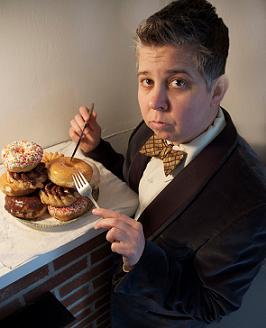
When you’ve spent long, smelly months in a bus traveling the world sharing words with pockets of alternative community, the issue of place takes the fore. As she releases her third book Cha-Ching!, and as her decades-old Sister Spit collective embarks upon yet another tour of spoken word, queer revelry, and cramped living conditions, author Ali Liebegott is getting academic about it.

“I’m kind of obsessed with how artists can live,” she tells me in a SoMa coffeehouse. She had texted me for clarification the night before on whether it was okay to look “scummy” at our interview, but she looks pretty neat in her white tee, motorcycle helmet sitting next to her on a bench. “And how queer people can live. I always think, where would I live if I couldn’t live in San Francisco or New York?”

Liebegott teaches Sarah Schulman’s Gentrification of the Mind — a book that looks at how economic displacement changes our brain’s wiring — in her fiction class at Mills College. And in Cha-Ching!, the economy is an ever-present force, guiding protagonist Theo into shitty apartments in both NY and SF neighborhoods where there are few out gay people. (Not to mention a ludicrously depressing janitor job at a junk mail factory.) The book is Liebegott’s third after The Beautifully Worthless and The IHOP Papers

When I ask whether they’re getting easier to write as time goes on she just laughs. “If I had been a plumber, I’d be able to fix things in my sleep. It doesn’t get easier, it just gets different.”

Liebegott reads from Cha-Ching! at City Lights in October

In an ever-more-caffeinated manner, she and I discuss how those higher rents are coinciding with an era in which publishing houses are more hesitant about what they throw their weight behind. “[Queer literature] is the first to go,” Liebegott says. “All the queer books at Barnes and Noble are behind a potted plant, there’s like four of them, and one of those is Best Lesbian Erotica 1994.”

So it’s good that, as poor queers and creatives and poor creatives and queers get kicked out of their urban homes and prime shelf space, Sister Spit is on the rise. Once restricted to queer female writers, the tour now includes a variety of genders, and different kinds of artists.  

Liebegott’s book is one of the first to come out on the imprint that the group’s founder Michelle Tea was able to start through City Lights Books in the fall of 2012 — The Beautifully Worthless was also released through the imprint, as well as the amazing Sister Spit anthology from earlier this year. Tea’s fantastical young adult novel Mermaid in Chelsea Creek, set to drop this summer, is delicious. The collective’s gig at the main library on Sun/31 is in advance of yet another of its fabled tours. This time the path lies up and down the coasts, up to Canada, and into the Mid-West. 

>>LISTEN TO CITY LIGHTS BOOKS’ RECENT PODCAST INTERVIEW WITH ALI LIEBEGOTT 

Along the way, the Sister Spit artists will meet audience members in places where there is no queer community, places where people fundraised to get them there. 

“I don’t want to say we’re a beacon of hope, but it is nice to give people this connection that they might not have,” Liebegott says. 

And that connection, more and more, may not be associated with any specific urban area. San Francisco, for example, would be beyond Liebegott’s reach as a home if it weren’t for her and her girlfriend’s rent control. “I kind of feel like we’re headed towards hell,” Liebegott muses, taking in our swank, caffeinated surroundings. “I feel like we’re already there.”

Regardless, art. Cha-Ching! deals in gambling addiction, drug addiction, poverty, ennui, animal abuse, powerlessness — but nonetheless, can be laugh out loud funny even, especially, when characters hit their low points.

She’s already planning her next book, about a war vet obsessed with feeding ducks. “I feel like I’m so mired in depressing things!” Liebegott says. “My threshold for that is much higher than most people.”

Cha-Ching!‘s ending, though, leaves room to hope that queers can triumph over today’s adversities. Or does it? At any rate, you have ample chances to buy the book at this week’s readings (Liebegott is one of the featured artists at the Sister Spit reading on Sun/31 as well.)

In other news, Liebegott’s big into Sizzler. She told me to write that.

Ali Liebegott’s Cha-Ching! release party

Wed/27, 7pm, free

City Lights Bookstore

261 Columbus, SF

www.citylights.com


Sister Spit tour kick-off reading

Sun/31, 2-5pm, free

San Francisco Main Library

100 Larkin, SF

www.sfpl.org

Artists respond to hate-speech ads with “fabulous” alterations

When it comes to countering hate speech, there’s nothing like creative expression mixed with direct action. Activists affiliated with art collectives Bay Area Art Queers Unleashing Power (BAAQUP) and Street Cred declared yesterday to be “Hate Free Monday,” and celebrated by modifying hate speech ads recently plastered on Muni buses.

Purchased by the pro-Israeli American Freedom Defense Initiative (AFDI), the ads contain bigoted, inflammatory quotations directed at LGBT people, attributed to prominent Muslims. Although city officials have condemned the advertisements, they were nevertheless allowed to be displayed because Muni determined them to be within First Amendment guidelines.

Headed by conservative blogger Pamela Geller, AFDI has been deemed a hate group by the Southern Poverty Law Center and the Anti-Defamation League. Geller herself is the target of the activists’ handiwork.

“We believe that all public spaces, including public transit, should be welcoming and safe for all members of our community,” the artists, who did not give their names, wrote to the Guardian in a statement sent from baqupower@gmail.com. “The hate-filled messages purchased by Pamela Geller’s AFDI defame and vilify Muslims and are harmful and offensive to residents and visitors in San Francisco, both Muslim and non-Muslim. 
Since the city will not take action against these ads on city buses, we have.”

To read BAAQUP’s full description of the motivations behind their action, go here.

Their statement concludes: “As long as these advertising outrages continue to appear on our streets, we will continue to reconstitute them to reflect something more truthful, just, and ideally fabulous.”


The human price of Catholic conservatism

2

A new book by local historian William Issel explains the key role the Catholic Church played in funding and supporting progressive causes in 20th Century San Francisco, and Randy Shaw’s take on it is accurate: For a while, in the 1970s and 1980s, the Church funded a lot of the tenant advocacy and poverty work in this city. The other side of that is a piece of the debate over the new Pope that we’re not hearing much.

As John Paul II moved the Church to the right, he also shifted its focus — away from concerns with economic justice and towards issues like same-sex marraige and abortion (oh, and covering up sex crimes by priests). In the process, not only did vast numbers of Western Catholics start to lose faith in their church — the money and focus that used to help local activists fight for the poor went away.

The new Pope Francis I is known for his work on poverty — but not for his advocacy of progressive organizations that take that fight out of the pulpit and into the streets, where material good is done.

There’s a human cost to the conservatism of the Catholic Church, and it goes way beyond the altar.


The lies of war

111

I was listening to Democracy Now this morning, and the introduction to a segment on the tenth anniversary of the Iraq War started out with such an honest, accurate, straightforward statement that I didn’t even think about it until later:

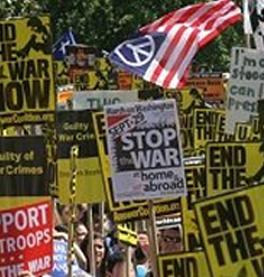
It was 10 years ago today that the U.S. invaded Iraq on the false pretext that Saddam Hussein was hiding weapons of mass destruction. The attack came despite worldwide protest and a lack of authorization from the U.N. Security Council.

Those are facts. That’s about as clean and well-documented a lead as you can put on a news story. It took me a while to realize that a show I listen to because of it’s outfront progressive politics was simply saying what should have been on the front page of the New York Times and every other “objective” news media outlet in the country.

Let’s just parse those 40 words for a second.

Yes, it was 10 years ago. Yes, the U.S. invaded Iraq. Yes, Bush knew that Saddam had no weapons of mass destruction, making that claim by definition a “false pretext.” Yes, there was well-documented worldwide protest. Yes, the U.N. Security Council refused to sanction the invasion.

That’s not liberal bias. It’s demonstrable historical fact.

Let’s compare that to what the New York Times said:

Ten years ago this week, on March 20, 2003, the United States invaded Iraq.

Also true — but inaccurate. Inaccurate because it’s incomplete. And that matters, a lot.

I go to Paul Krugman, the NYT columnist who (unlike his bosses) was right about the war from the start. Here’s his lead:

Ten years ago, America invaded Iraq; somehow, our political class decided that we should respond to a terrorist attack by making war on a regime that, however vile, had nothing to do with that attack.

That’s 100 percent accurate and a lot more complete than the “news stories.” He continues:

There were, it turned out, no weapons of mass destruction; it was obvious in retrospect that the Bush administration deliberately misled the nation into war. And the war — having cost thousands of American lives and scores of thousands of Iraqi lives, having imposed financial costs vastly higher than the war’s boosters predicted — left America weaker, not stronger, and ended up creating an Iraqi regime that is closer to Tehran than it is to Washington.So did our political elite and our news media learn from this experience? It sure doesn’t look like it.

And here’s why it matters: We’re doing the same thing again, in a different forum, with the discussion of budget deficits and the need for cuts in spending:

What we should have learned from the Iraq debacle was that you should always be skeptical and that you should never rely on supposed authority. If you hear that “everyone” supports a policy, whether it’s a war of choice or fiscal austerity, you should ask whether “everyone” has been defined to exclude anyone expressing a different opinion

Here’s my lead for the next story on the “sequester:”

House Republicans and the Obama administration met again this week to discuss a problem that doesn’t exist, offer solutions that won’t work, and drive the nation further into poverty, inequality, and debt.

Accurate. Complete. Factual. I can’t wait to see it on the front page of the Times.


Cristian Mungiu on his stark, stunning ‘Beyond the Hills’

0

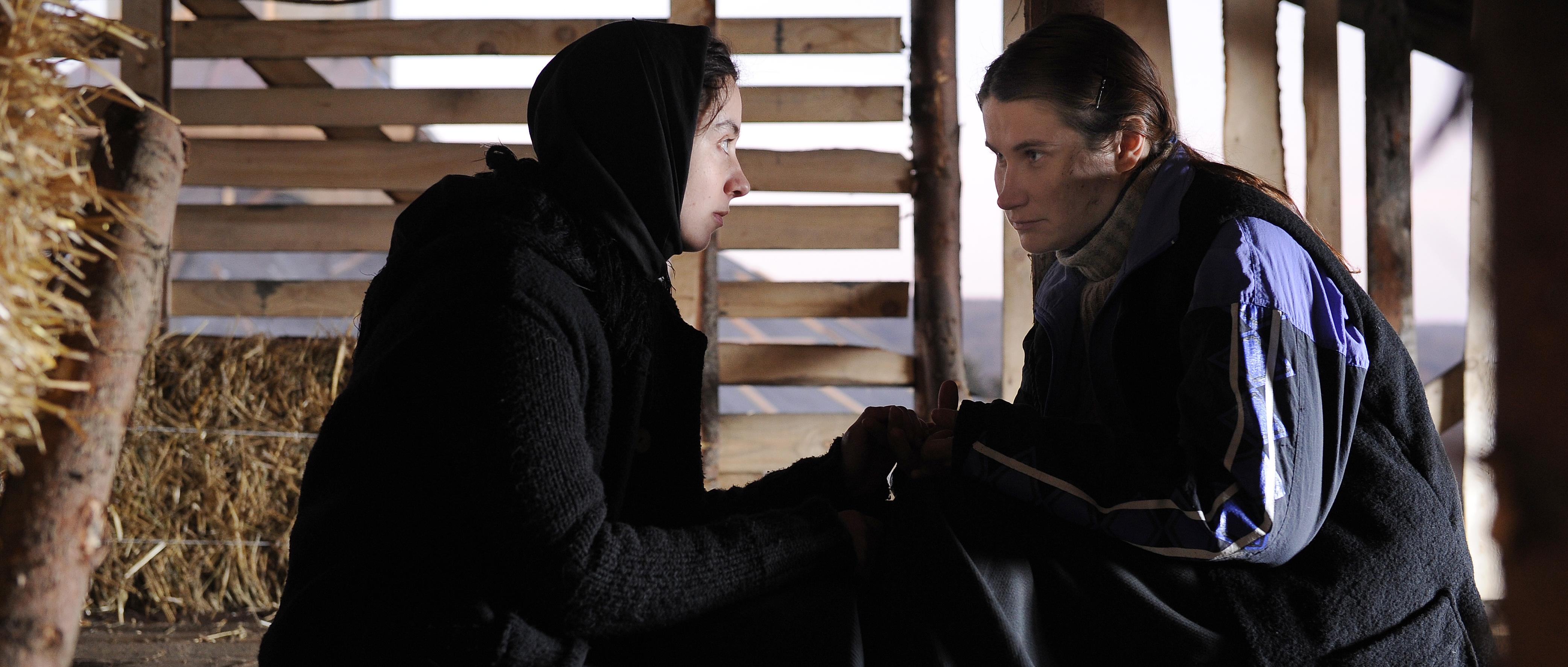
Cristian Mungiu — one of the main reasons everyone’s all excited about the Romanian New Wave — follows up his Palme d’Or winner, 2007’s 4 Months, 3 Weeks and 2 Days, with another stark look at a troubled friendship between two women. Beyond the Hills‘ Voichita and Alina (Cosmina Stratan and Cristina Flutur, who shared the Best Actress prize at the 2012 Cannes Film Festival; for his part, Mungiu won Best Screenplay) were BFFs and, we slowly realize, lovers while growing up at a Romanian orphanage.

When they aged out of the facility, the reserved Voichita moved to a rural monastery to become a nun, and the outburst-prone Alina pinballed around, doing a stint as a barmaid in Germany before turning up in Voichita’s village, lugging emotional baggage of the jealous, needy, possibly mentally ill, and definitely misunderstood variety. It can’t end well for anyone, as all involved — dismissive local doctors, Alina’s no-longer-accommodating foster family, the priest (Valeriu Andriuta), and the other nuns — would rather not spend any time or energy caring for a troubled, destitute outsider. Even Voichita can only look on helplessly as an exorcism, a brutal and cruel procedure, is decided upon as Alina’s last, best hope.

Based on a real 2005 incident in Moldavia, Mungiu’s unsettling film is a masterpiece of exquisitely composed shots, harsh themes, and naturalistic performances. I conducted the following email interview with Mungiu ahead of Beyond the Hills‘ Fri/15 Bay Area release.

http://www.youtube.com/watch?v=cL_5U73udXM

San Francisco Bay Guardian Both Beyond the Hills and 4 Months, 3 Weeks and 2 Days are about female friendships — troubled female friendships, to be specific, with shared secrets and repressed emotions. What interests you about these relationships, and telling these kinds of stories?

Cristian Mungiu My films are story-driven rather than character driven and I always start from some true story that I heard about. So, as much as these films could be depicted as films about female relationships, for me the starting points were different. For 4 Months, I mostly wanted to talk about freedom, compromise, responsibility, and circumstances when such an important issue as maternity is involved. In Beyond the Hills I was interested in understanding how violence progresses in a small community and I needed to talk about different kinds of love, social responsibility, and indifference, about the differences between religion and superstition, about the relationship between the level of education and free will.

I don’t think in terms of male/female characters when I think about my characters: I believe that as a storyteller, you either understand the human nature or you don’t — gender is irrelevant.

SFBG Both films also deal with medical issues, though in Beyond the Hills Alina’s suffering is more abstract and seems to be tied into a number of factors: her illness is mental, not physical; also, she is poor and has no family looking out for her. Does the portrayal of doctors and hospitals in Beyond the Hills reflect Romania’s treatment of “outsiders,” and what do you hope audiences take away from this?

CM It would be wrong to consider that the portrayal of the doctors in Beyond the Hills can be generalized to all doctors in Romania nowadays. I don’t think that any film should be taken as a relevant portrait of a country — it would be the same mistake we use to make in the ’80s, thinking about US as being primarily a country of mobsters (after watching The Godfather — that was very popular and highly appreciated).

I would rather say that Beyond the Hills speaks about dysfunctional institutions in general, about the side effects of incompetence and of superstitions in society — and it shows how empathy for the one next to you is influenced by poverty and how the decision to help him is influenced by your level of education.

SFBG Beyond the Hills might show the most realistic (and therefore, probably one of the scariest), take on an exorcism ever filmed. Why did you choose to take on a topic that’s primarily horror-movie element? Is it true the film is based on a true incident, and how did you hear about it?

CM The film is inspired by a couple of non-fictional novels documenting a real incident that happened in Romania in 2005. It was on the first page on the newspapers for weeks and months, it shattered the Romanian public opinion, and it generated a more general debate about the role of religion in the modern society and about some of the rituals in churches.

The film’s the main story line is quite close to what happened in reality so I didn’t choose to bring in an exorcism scene — it was pretty much there already — I just tried to treat it as non-spectacular and as realistic as possible, as it was important for me to avoid the possible tabloid perspective about this issue. It is part of a certain kind of realism that we are looking for in our films — a realism which is present at all levels — from the way of treating the subject to the
way of shooting and to handling filmic time — every scene is depicted in just one continuous shot in the film, no matter how complex or long it is.

SFBG Nuns are another familiar movie element — I’m thinking of everything from The Sound of Music to Sister Act to (most closely) Black Narcissus. How do you go about recreating such a private, closed-off world, and what were the challenges involved in doing that?

CM The greatest challenge always is to fight stereotypes: yours and others. I based my portrayal of the nuns on my observation about religious people, about the psychology of people living in small isolated communities and on my experience of talking to institutionalized children – but at the end of the day, again, we need to understand that nuns are also human beings with emotions, fears, doubts, and so on.

One of the major challenges was to instruct the actresses about the appropriate behavior and attitude their character would have in each given situation and to specifically ask them never to be judgmental about their characters. The screenplay was already depicting in detail most of the monastery routine — and before the shooting we sent the girls to a monastery — to spend some time with some real nuns because there are small things that, as an actor, you need to notice yourself.

SFBG The stark, austere landscape of Beyond the Hills is practically a character in the story. How did you find that location and what approach did you take to filming to heighten the story’s elements? I especially appreciated how key moments — Alina being carried into the church, for instance — happen in the background of long shots.

CM We started by visiting the site of the real incident and then we scouted for a barren hill with some solemnity, no electricity poles around — and having a direct view to a small town. It was quite a complicated scouting and finally we came across this hill — some 100 kilometers up- north Bucharest — where we built the whole Monastery and all the surrounding buildings.

When you decide to only shoot long takes you need to learn how to use the depth of field, the off camera, and the sound. My idea was that it’s more important to show the characters’ reaction to what happens than what happens — and therefore I decided for example that in the most of the violent scenes we’ll be with the camera on the nuns and not on Alina. A crucial decision regards the wideness of the framing — we try to match it always with the content of the scene and with its degree of intimacy. But filmmaking is not a science and you need to keep your mind free and your eyes open, to experiment on the set and to feel which is the most powerful and appropriate way of shooting each moment.

SFBG What does the title mean to you?

CM It refers to realities which are not in full view, which happen somewhere deep down — in our mind or in the world — but I don’t think film titles should be perfectly explicit in connection to the story.

Beyond the Hills opens Fri/15 in Bay Area theaters.

Cutting from the bottom

86

news@sfbg.com

While the looming federal budget cuts known as sequestration were designed to equally hit Democratic and Republican party priorities, from social services to the military budget, in the Bay Area they would disproportionately target society’s most vulnerable citizens and strain already-stretched local agency budgets.

If Congress and the White House fail to forge a budget deal by March 1, the cuts could begin to withdraw $9-10 billion of federal support from the California. In the Bay Area, these cuts would have the biggest impact on low-income families, the homeless, victims of domestic violence, adults living with AIDS, and children ages 3-5.

Back in September, San Francisco Mayor Ed Lee signed a U.S. Conference of Mayors’ letter that called on federal lawmakers to resolve the budget conflict before the sequestration cuts could take effect, labeling the budget cuts “a threat” to local economies nationwide. Now, with the deadline looming, city officials and social service providers across the Bay Area are bracing for the impact.

Depending to how the cuts are eventually allocated, San Francisco alone could lose more than $10 million in critical social services. “All across the city, the sequestration hurts those most in need of services and support,” Gentle Blythe, spokesperson with the San Francisco Unified School District, told the Guardian.

San Francisco Unified stands to lose $3.8 million in funding, over 5 percent of the district’s federal education dollars. The cuts would strain an already-tight education budget, which has suffered from the slow economy and the corresponding dip in tax revenue. “We’ve been in a climate of cuts for years,” Blythe said. “There is a definite sense of fatigue.”

The pending round of cuts would force San Francisco district officials to make a series of uncomfortable decisions. The bulk of San Francisco’s federal education funding comes from Title I and Title III grants, money specifically earmarked for low-income students and English-language learners. If the state does not step in to fill the hole, the $3.8 million shortfall will translate into a significant rollback of services for the city’s most at-risk students and potential layoffs of teachers and resource officers.

Early childhood programs are especially vulnerable to the impact of the sequester. San Francisco Head Start Director Marjorie Weiss told us the demand for these federal education programs is spiking as more San Francisco children are living in poverty.

US Census figures show 13.8 percent of San Francisco residents were living below the federal poverty line in 2011, up from 12.2 percent in 2005. Over the last decade, 850 additional children became eligible for SF Head Start, which operates federally funded preschool programs in 19 classrooms at 9 different centers across the city.

These programs significantly improve the long-term employment and educational prospects of children living in or near poverty. But as the need for these early-childhood services grows, the money is drying up. Over the last two years, state and local funding for early-childhood education has be cut by nearly 20 percent.

Now, with the sequestration looming, San Francisco Head Start providers are worried about their ability to continue providing services. “At Head Start, we have already been dealing with years of budget cuts,” Weiss told us. If the sequester comes through, the program will lose an additional $1.1 million and will be forced to eliminate programming for more than 100 low income children ages 3-5.

“This will be devastating. These cuts will have a crippling effect on low-income children in the community and their ability to be ready for school” says Weiss. The funding cuts will take effect June 1st and directly impact the incoming class of 3-year-old preschool students.

Although education will absorb a significant impact from the sequestration, social services across the city will be cut back. San Francisco homeless advocates are forecasting a $1 million cut in federal assistance and AIDS groups have warned that nearly $800,000 dollars in housing vouchers for AIDS patients are on the chopping block. Federal funding for the AIDS Drug Assistance Program (ADAP), which subsidized medical care for AIDS patients, is set to be slashed by nearly 8 percent across the board.

Advocates for the victims of domestic abuse are also worried about the sequester’s impact on local survivors of domestic violence. In San Francisco, federal money provides crucial services for victims of domestic violence through nationally-mandated Family Violence and Prevention Services (FVPS). The city’s three primary domestic violence shelters rely on this revenue stream for outreach programming, translation services, and extended operating hours. The pending sequester would cut nearly 10 percent of FVPS grants, forcing shelters to tighten their belts.

“The sequester is going to dramatically impact the funding for lifesaving services for domestic violence shelters and rape crisis centers, as well as legal service, and children’s programs,” Beckie Masaki, the founder and former executive director of San Francisco’s Asian Women’s Shelter, told the Guardian. Masaki now works with the Asian and Pacific Island Institute (APIDV) on Domestic Violence, where she advocates for more federal funding for domestic violence service providers.

Masaki is worried that the cuts will disproportionately impact the city’s most vulnerable women: low-income and non-English speaking victims of domestic violence, as cash-strapped shelters lay off translators and cut back on outreach and group therapy.

“In the past, when we were facing cuts, we did our best to minimize the impact on survivors,” she explains. “But in this era of constant cuts, it’s going to mean layoffs, and ultimately fewer services for the most vulnerable survivors”. As lawmakers in Washington scramble to pass a budget deal before the March 1 deadline, the climate of uncertainty leaves local service agencies in a state of limbo. With future funding in doubt, long-term planning and strategizing become increasingly difficult. Yet for many local service providers, the most recent threat of sequestration is a familiar consequence of an increasingly fragile social safety net. According to Masaki, the sequestration should motivate Congress to rethink its budgeting priorities: “If they invest in these baseline life-saving services for those that are most vulnerable in our community, in the end that is the path to better economic and social sustainability for our whole nation.”

Sequestration cuts would hit the Bay Area’s most vulnerable

31

While the looming federal budget cuts known as sequestration were designed to equally hit Democratic and Republican party priorities, from social services to the military budget, in the Bay Area they would disproportionately target society’s most vulnerable citizens and strain already-stretched local agency budgets.

If Congress and the White House fail to forge a budget deal by March 1, the cuts could begin to withdraw $9-10 billion of federal support from the California. In the Bay Area, these cuts would have the biggest impact on low-income families, the homeless, victims of domestic violence, adults living with AIDS, and children ages 3-5.

Back in September, San Francisco Mayor Ed Lee signed a U.S. Conference of Mayors’ letter that called on federal lawmakers to resolve the budget conflict before the sequestration cuts could take effect, labeling the budget cuts “a threat” to local economies nationwide. Now, with the deadline looming, city officials and social service providers across the Bay Area are bracing for the impact. Depending to how the cuts are eventually allocated, San Francisco alone could lose more than $10 million in critical social services.

“All across the city, the sequestration hurts those most in need of services and support,” Gentle Blythe, spokesperson with the San Francisco Unified School District, told the Guardian.

San Francisco Unified stands to lose $3.8 million in funding, over 5 percent of the district’s federal education dollars. The cuts would strain an already-tight education budget, which has suffered from the slow economy and the corresponding dip in tax revenue. “We’ve been in a climate of cuts for years,” Blythe said. “There is a definite sense of fatigue.”

The pending round of cuts would force San Francisco district officials to make a series of uncomfortable decisions. The bulk of San Francisco’s federal education funding comes from Title I and Title III grants, money specifically earmarked for low-income students and English-language learners. If the state does not step in to fill the hole, the $3.8 million shortfall will translate into a significant rollback of services for the city’s most at-risk students and potential layoffs of teachers and resource officers.

Early childhood programs are especially vulnerable to the impact of the sequester. San Francisco Head Start Director Marjorie Weiss told us the demand for these federal education programs is spiking as more San Francisco children are living in poverty.

US Census figures show 13.8 percent of San Francisco residents were living below the federal poverty line in 2011, up from 12.2 percent in 2005. Over the last decade, 850 additional children became eligible for SF Head Start, which operates federally funded preschool programs in 19 classrooms at 9 different centers across the city.

These programs significantly improve the long-term employment and educational prospects of children living in or near poverty. But as the need for these early-childhood services grows, the money is drying up. Over the last two years, state and local funding for early-childhood education has be cut by nearly 20 percent.

Now, with the sequestration looming, San Francisco Head Start providers are worried about their ability to continue providing services. “At Head Start, we have already been dealing with years of budget cuts,” Weiss told us. If the sequester comes through, the program will lose an additional $1.1 million and will be forced to eliminate programming for more than 100 low income children ages 3-5.

“This will be devastating. These cuts will have a crippling effect on low-income children in the community and their ability to be ready for school” says Weiss. The funding cuts will take effect June 1st and directly impact the incoming class of 3-year-old preschool students.

Although education will absorb a significant impact from the sequestration, social services across the city will be cut back. San Francisco homeless advocates are forecasting a $1 million cut in federal assistance and AIDS groups have warned that nearly $800,000 dollars in housing vouchers for AIDS patients are on the chopping block. Federal funding for the AIDS Drug Assistance Program (ADAP), which subsidized medical care for AIDS patients, is set to be slashed by nearly 8 percent across the board.

Advocates for the victims of domestic abuse are also worried about the sequester’s impact on local survivors of domestic violence. In San Francisco, federal money provides crucial services for victims of domestic violence through nationally-mandated Family Violence and Prevention Services (FVPS). The city’s three primary domestic violence shelters rely on this revenue stream for outreach programming, translation services, and extended operating hours. The pending sequester would cut nearly 10 percent of FVPS grants, forcing shelters to tighten their belts.

“The sequester is going to dramatically impact the funding for lifesaving services for domestic violence shelters and rape crisis centers, as well as legal service, and children’s programs,” Beckie Masaki, the founder and former executive director of San Francisco’s Asian Women’s Shelter, told the Guardian. Masaki now works with the Asian and Pacific Island Institute (APIDV) on Domestic Violence, where she advocates for more federal funding for domestic violence service providers.

Masaki is worried that the cuts will disproportionately impact the city’s most vulnerable women: low-income and non-English speaking victims of domestic violence, as cash-strapped shelters lay off translators and cut back on outreach and group therapy.

“In the past, when we were facing cuts, we did our best to minimize the impact on survivors,” she explains. “But in this era of constant cuts, it’s going to mean layoffs, and ultimately fewer services for the most vulnerable survivors”.

As lawmakers in Washington scramble to pass a budget deal before the March 1 deadline, the climate of uncertainty leaves local service agencies in a state of limbo. With future funding in doubt, long-term planning and strategizing become increasingly difficult. Yet for many local service providers, the most recent threat of sequestration is a familiar consequence of an increasingly fragile social safety net.

According to Masaki, the sequestration should motivate Congress to rethink its budgeting priorities: “If they invest in these baseline life-saving services for those that are most vulnerable in our community, in the end that is the path to better economic and social sustainability for our whole nation.”

A fine use for Larry’s fine art

23

A loyal reader contacted us with a great suggestion to solve all the fundraising problems of the America’s Cup.

This summer, it turns out, will be about more than racing for the city’s mega-billionaire yacht-race king. The Asian Art Museum’s latest program guide notes that from June 28-Sept. 22, the museum will host “In the Moment: Japanese Art from the Larry Ellison Collection.”

The museum will present “works from the rarely seen collection of Larry Ellison, owner of cup defender Team Oracle USA. The exhibition introduces about 80 artworks spanning 1,300 years. Included are works of the Momoyama (1573-1615) and Edo (1615-1868) periods.” According to the Metropolitican Museum of Art, “this period was characterized by a robust, opulent, and dynamic style, with gold lavishly applied to architecture, furnishings, paintings, and garments.”

Oh, and it’s worth noting that the Momoyama and Edo periods were also marked by the dominance of brutal warlords who claimed much of the nation’s wealth while most subjects lived in dire poverty.

At any rate, I’m sure the stuff is nice. Beautiful, even. And pricey. Bet a philanthropist of Ellison’s stature could auction off just a couple of those 80 pieces and raise enough to pay off the entire AC budget deficit. Eh, Larry?


Nite Trax: DJ Sprinkles lays it out

32

The phenomenal house DJ and experimental musicmaker on mainstream visibility, transgender globalism, Bay Area queer culture, and the “shopping mall diversity” of the current dance music scene.

Techno has always had room for theorists and intellectuals, from Derrick May to the Mille Plateaux label roster, and social activists, like Moodymann and Underground Resistance. Most of that discourse usually takes place musically, however, with concepts emerging from the vinyl itself. The celebrated DJ Sprinkles, a.k.a. Terre Thaemlitz, the American head of Japan-based label Comatonse, tops all that by making intellectually grounded music glimmering with poetic touches and expounding in interviews and writing on such heady, heated topics as essentialism, gender idenitity, surveillance, and authenticity. She leads workshops, goes on speaking engagements, and isn’t afraid to let loose in interviews. (For example — see below — rather than “born this way” platitudes, she considers her queer identity “beat this way.”) 

It’s a beautiful thing, especially in the rare context of controversial truth and radical opinion pouring from the mouth and keyboard of an outspoken transgender major player on the stubbornly homogenous global house-techno DJ scene. Of course, it all comes down to the music — we’ll get a treat when Sprinkles (who chose the name because he wanted something that sounded “totally pussy” in opposition to macho DJ culture, to buck the testosteronal scene) performs Sun/24 at Honey Soundsystem — and Sprinkles certainly has the goods. He’s released umpteen pieces in an astoundng breadth of genres under multiple pseudonyms over the past 20 years. Masterpiece deep house album “Midtown 120 Blues” siezed the top of several best of 2009 charts and was, typically, followed by Soulnessless, a 30-hour “mp3 album” of music and video. Because why the hell not?

I got a chance to exchange emails with Sprinkles before her appearance here. It’ll be an interesting return to the Bay Area, where she lived for several years before decamping to Japan. Here’s all she had to say.    

http://www.youtube.com/watch?v=UY79cyv8pH8

SFBG It’s been 13 years since you lived in Oakland, is that correct? Can you tell me why you decided to leave and what it was like to live here then, with regards to the music, political, and queer scene?

DJ SPRINKLES Yes, it’s been a long time. I used to live across the street from a hotel where the Unabomber once stayed. Honestly, I can’t say I miss California. I never really connected with any queer or transgendered communities in SF or Oakland. Whenever I tried, they seemed immersed in West Coast spiritualism and zodiac bullshit, which I found completely alienating. Most of the transgendered people I met there were prone to metaphysics — by which I mean they were ideologically (and economically and medically) invested in defining their transgenderism in relation to a perceived split between their “physical bodies” and their “true inner selves.” I’m an anti-essentialist, non-op, materialist, anti-spiritualist… so that clearly wasn’t a match with my own transgendered identity.

There was also a weird conservatism in SF’s queer scenes that I associated with the fact a lot of people in SF had been raised in conservative Midwestern towns, so they were in SF to “live the life.” I felt there was a lot of unacknowledged parody and role play going on — people trying to overcome a life of repression and closets by wrapping themselves in rainbow flag culture. Yet, when going to buy groceries or such, I still found myself being harassed as a “fag” on the street like in any other town in the US. I felt my four years there was all quite standard. I don’t really think of the Bay Area as a “special place” for being queer and transgendered.

US identity politics have a particularly inextricable link to the concept of the ghetto — not only as a place of economic strife and forced communal ostracization from a “white middle-class mainstream,” but also as a self-invested “safe space” for non-mainstream social movements. This is part of migrant culture. For example, after my grandparents passed through Ellis Island, they immediately moved to a place where people spoke the same language as their homeland, etc. The Castro, New York’s West Village, Little Italy, China Town… these are all migrant-based communities formed by people seeking safety in numbers in the face of not being welcome elsewhere — these two dynamics of “safety” and “alienation” are inseparable to most US identity politics. So these communal zones all display the problems and contradictions of cultural identification that plague mainstream US culture as an “immigrant nation” that is simultaneously “anti-immigrant” – because the “immigrant” is a brutal reminder that there are no “real Americans” beyond Native Americans, which the majority are not. And of course, the fact that recent generations of immigrants are primarily people of color does not jibe with conventional black/white US race discourse, which continues to be largely devoid of other browns, as well as the concept of the person of color as a willing immigrant (as opposed to the descendant of a slave). This history and context is peculiar to the US social landscape, and it creates a lot of weird identity essentialisms and hostilities around gender, sexuality, race, ethnicity, class…

Not to say other countries don’t have their own fucked up ways of causing and dealing with social problems, but moving to Japan and realizing that pretty much the entirety of Western identity politics did not function here was a big life experience. It was like leaving the Earth’s gravitational pull — it didn’t mean gravity no longer existed, but almost everything I had internalized and believed I understood about my relationship to gravity was no longer helpful in understanding the dynamics of dominations at work in this other context. I wasn’t freed of gravity, but lost in weightlessness. I had to learn to feel weight in a completely different way. This is why so many of my projects dealing with my own immigration and cultural issues consistently invoke the rather limited and problematic US language of black/white race relations. It is a critical gesture intended to highlight the limitations of my having been raised amidst that US language and social conditioning, yet now living within a non-US context with few tools to work with.

Because music’s value is so often tied to an essentialist concept of racial authenticity, it becomes difficult and risky to ask an audience to question their relationships to the very value systems through which they likely purchased the album – but that is also why I choose to work with audio. Not because of its possibilities, but its all-too-clear limitations. Since I am unable to believe in the authenticity or purity of identities of any kind, when I invoke “identifiable” sounds (a “queer” sound, a “black” sound, etc.) I am doing so to question the social relationships around their construction, proliferation, and distribution. The moment we become lazy about our use of those “identifiable” sounds — the minute we take it for granted that the essentialist associations they have come to carry are unquestionable and real reflections of material social experiences — everything becomes one-dimensional and shallow. This is why almost all music is one-dimensional and shallow! [Laughs.] For example, if I can beat a dead horse, my problem with Madonna’s “Vogue” is not that it was “inauthentic,” but that its terms of discourse misrepresented its relationship to vogueing by actively erasing the very contexts of Latina and African-American transgendered culture that inspired it (via lyrics about “It makes no difference if you’re black or white, a boy or a girl”… it TOTALLY made a difference, and THAT SOCIAL REALITY is where any real discussion on vogueing BEGINS.). So I’m interested in these other directions of audio discourse that cannot even occur if one is preoccupied with conflated essentializations of identity and sound. There is never a true point of origin for anything. It’s all referential and contextual. In my opinion, there is no point in discussions focussing on identifying the source of a sound or style — that is a hopelessly futile exercise, although it is the dominant exercise! It’s a distraction from the real discussions needing to be held, and those are discussions on relations of domination.

As a DJ in the late ’80s and early ’90s, there were a lot of drag queens asking me to play Madonna’s “Vogue” when it first came out. I refused, but I could understand their requests. We all have very complicit and complex relationships to dominations, and a perverse desire to celebrate our visibility within the dominant mainstream, no matter how unfamiliar or distorted that reflection may be… often because we are conditioned to feel so unhappy with what we see in the mirror to begin with. Mainstream visibility is like getting approval of the Father. It’s a mental and abusive process. It is also totally standard. So I get it… But there is also that which remains unrepresented and invisible to most. That which existed, and may have already been lost, but did so without seeking approval of the Father. And again, this is generally not a freed or liberated space, but a space of intense hatred for the Father. These are difficult things to speak of and represent, because any act of representation has the potential to be a violation of the cultural site it wishes to speak of. So to speak of them requires obfuscating or complicating the usual functions of language – not through vague poetry, but unexpected flashes of clarity coming from unexpected vectors.

http://www.youtube.com/watch?v=R2iKF_11WbY

SFBG You left during the first Internet boom I believe, and now SF is in the middle of a second one (although a bit different than the first —  the first wave seemed to have much more geeks and freaks in it, while this one seems much more regimented and Ivy League, even while many longtime residents are still feeling the results of “global recession”). When was the last time you were back here? And what are some of your recent thoughts on how house music is being affected by economic circumstances?

DJ SPRINKLES I was only back once about 10 years ago, visiting friends for a few days. When I moved away at the end of 2000, internet and web development had already undergone a rigid formalization. Years earlier, a web designer did a bit of everything. By 2000, developers were already split into specific teams focussing on interface, coding, page flow, etc… all processes were specialized, departmentalized, corporatized. I hadn’t heard about the “second internet boom” there, but the way you describe it doesn’t surprise me since it would surely be an extension of that regimentation that took place in the first boom.

And in a way, the same can be said of this “second boom” (third?) around house music. In the same way almost all websites have taken on the same continuity and feel, so has electronic dance music. You buy an album, and all the tracks sound similar — as opposed to the old days when an electronic dance track like Donna Summer’s “I Feel Love” was tacked on to the end of an otherwise standard soul-band album that didn’t sonically match it at all. Today’s music consumer experience is much more streamlined and organized, which affects how people produce an album as well. Younger generations — 20-somethings — grew up amidst this homogenization, so I am fairly sure they do not feel what I am speaking of… although they may recognize it as a historical process.

I try to play with discontinuity and mixing things up, like in my K-S.H.E album, “Routes not Roots,” which had monologues and ambient tracks interspersed between house cuts. But I once made the mistake of reading people’s blog comments, and they really seemed upset about this kind of thing. “Way to ruin the mix,” or “Why the fuck didn’t you put that monologue at the end of the album?” They have no patience for non-homogeneity. The same goes for my Comatonse Recordings website itself — people seem utterly confused and helpless. If one doesn’t do everything completely standard and at the same level, people get disoriented. It’s a kind of cultural compression going on, similar to audio compression, where everything has to be “punched up” to the same intensity or people feel lost. What the fuck is so wrong with being lost? Why would you expect — let alone insist — your interactions with non-mainstream media to be completely mainstream in process?

http://www.youtube.com/watch?v=B8iF7JQiz50

SFBG I’ve been hanging out recently with the new, young generation of ACT-UP activists who are transcending mere ’90s revival and undertaking a lot of energizing political discourse and action. Were you involved in the queer activist movement back then — or now? Would you characterize your musical project as a form of activism, especially in its more intellectual and challenging aspects?

DJ SPRINKLES That’s nice to hear. Although you use the term “action,” I assume the real interesting stuff has little to do with demos and “direct actions,” and more to do with communal education initiatives, etc.? My direct action days were mostly during the late ’80s and early ’90s, while living in New York. Most of those activities were in conjunction with various caucuses in ACT-UP, and WHAM! (Women’s Health Action & Mobilization).

I do consider my audio and other projects “political” — in theme, and also in their attempts to (dis)engage with standard industry practices. But clearly this is something different than direct action “activism” or community outreach, because my main social engagements are with people working for labels, distributors, music festivals, museums, and other culture industries. Maybe “culture jamming” is a better way to put this kind of political activity. Personally, I found myself distanced from direct action groups because the terms of identification they cultivated out of strategic necessity so often folded back into essentialisms that excluded me on a personal level. So I was always advocating for the recognition and acceptance of something other than myself (like the way “born this way” ideologies take over discussions of LGBT rights… I consider myself more “beat this way,” my queer identity being primarily informed by material ostracism and harassment than by some mythological self-actualization and pride). That, combined with the mid-’90s move away from direct action toward CBO’s (Community Based Organizations) — largely because the tactics of direct action had been so thoroughly coopted by mainstream media – was pretty much the end of my serious direct action involvements. Over the years, enunciating this process has become the core political act of my projects and activities. I do not do this to discourage people from forms of direct action, but as a simultaneous form of critical analysis that hopefully contributes in other ways to our various attempts to react to dominations.

SFBG Do you feel that, as the means of production and distribution have been more and more democratized in the past decade, house and techno music-making and DJing have been living up to their potential as a form of resistance to mainstream capitalism and culture, or do you feel they’ve become more homogenized and/or annexed by neoliberal, bourgeois culture?

DJ SPRINKLES I do not believe the means of production and distribution have become more democratized. I take issue with the way people always confuse “commercial accessibility” with “democratization.” The breadth and variation of today’s music production strategies is no more than a shopping mall diversity. We are all working with similar software on similar platforms. Mac, Windows, Unix… Banana Republic, Abercrombie & Fitch, The Gap… Having said that, if these musics had a potential, I believe it was lost back in the ’90s when anti-sampling legislation (mostly focusing on hip-hop) laid the groundwork for today’s electronic music. It basically reinvigorated house with “musicianship,” “authorship,” and all that crap which used to play far less of a role in this genre’s early days. And the younger generation – basically, today’s 20-somethings who grew up after the whole sampling debates — really don’t seem to understand how record label legal departments work.

So they list up all the samples they recognize in a track in the comment fields of music websites, which is putting the producers they wish to support at risk. There is no sense of how we can cultivate — let alone protect — “underground” media and information in this online era. Everything is about “sharing,” when in fact we need to be developing a parallel discourse around meaningful information distribution patterns, including strategically withholding information from the web. The cliché idea of making “everything accessible for everyone” is not only naîve, but negates the social and cultural specificities that give certain forms of media their alternative values, in particular collage and sampling. Anyone who has used a random image taken from a Google image search on their blog page, and then gotten an email from Getty Images’ legal department asking for back royalties, knows what I’m talking about. Treating subcultural musics as though they are meant for “everyone” — whether this is being done by fans, or the labels and online distributors themselves — is the biggest sign of people not understanding the media they are dealing with. And since all of that is SOP these days, it’s pretty much a sign that the sample-based genres of house is dead. Is talking about house’s political potential in 2013 really all that different than the trend of talking about the radical politics of ’60s rock during the ’80s?

http://www.youtube.com/watch?v=v4M3-t9lw7o

SFBG I feel like, with parties like Honey Soundsystem, there is a huge resurgence of interest in an underground queer dance music culture — a kind of new underground opposed to corporate or low-quality dance music (yet still taking place in corporate spaces). Is this phenomenon occurring in Japan as well? Do you feel there are specific possibilities with this, not just in terms of opportunity for queer DJs to travel but of transformation of queer discourse and politically actualizing a new generation?

DJ SPRINKLES Hey, low-quality is where it’s at. It’s what it’s all about. What was Chicago house if not low quality? It’s important to place value within the “low” in order to counter conventional associations between the terms “good,” “high quality” and “upper class.” I’m not talking about celebrating kitsch, or that kind of petit-bourgeois trivialization of the “low.” I’m talking about finding other values in the “low” that cannot find expression within a language developed to express everything in terms of “low vs. high.” This is ultimately about the identification of other values amidst class struggle.

I don’t think house resonates as a queer medium anymore. Those days are over. Today it is primarily a white, heterosexual, European phenomenon. That was the case early on. I mean, how many Americans became aware of house music in the ’80s by buying Chicago house sold back to us on UK compilations? The US has always treated its own history of electronic music like utter shit… The US is such a fucking rock’n’roll shithole. So I think for people to appreciate house music’s queer roots, and to actively invest in those themes today, requires people becoming deliberate and explicit about those interests. But whether that deliberate action would focus on “queer visibility” or not is another issue. It doesn’t have to focus on “visibility” — especially since visibility has become such an oppressive aspect of dominant LGBT movements. Explicitness can also be about closets. Not only the usual closets born of heterosexism, but less considered closets around sexuality and gender that have been formed by the actions of the “born this way” LGBT mainstream. Well, that’s the direction I try to take it… reflecting on, and constructing, queer and transgendered histories that are as skeptical of Pride[TM] as they are angry about violence. And I do believe, globally speaking, queer and transgendered experiences are much more informed by violence than pride. So this should be reflected in how and where we make noise. In my opinion, music that functions in completely standard ways – socially and economically – does not have much potential for reflecting queer or transgendered contexts in politically precise, helpful or meaningful ways. You end up with essentialist, humanist shit like Lady Gaga’s, “Born This Way.” She is not somebody I would consider an ally.

You know, American media is so fixated on the idea that sexuality and gender must either be biologically predetermined, or a personal choice. The “it’s not a choice” argument is a common theme in television shows, etc. Both of these options revolve around a fiction of free will. Like, if it’s not a choice, then the only other possibility must be some supra-social, biological reason that cannot be questioned. Both of these conclusions preserve the status quo brutality of how culture forces gender and sexual binaries upon us. The thought that our absence of choice might be rooted in social tyrannies – not biological predispositions – remains unthinkable. The mainstream has it half right when they say, “it’s not a choice,” but it’s a half-truth that has been twisted into a decoy from the real issues at hand – the inescapability of the hetero/homo and female/male paradigms. We are given no other choices through which to understand our genders and sexualities. Sexuality is far greater than two or three. The same goes for gender — and yes, I’m speaking biologically, human bodies are way more diverse than A or B. To argue that the reason you deserve rights under a humanist democratic system is because of genetics is a retreat into feudalist logic. It’s the same as an aristocrat arguing that their rights and privileges were deserved because of their family blood-line and DNA. “Born this way” is antithetical to any democratic argument for rights rooted in a social capacity for understanding and transformation. It is astounding that the majority of people cannot comprehend that any “born this way” argument is a complete obliteration of their social agency. “I can’t help it, so give me the same rights as you…” Fuck that. We shouldn’t be asking to participate in the rights and privileges of those who have oppressed us. We should be trying to divest those groups of privileges. That is the best way to help ourselves and minimize the violence we enact on others.

Humanist legislative practices are still rooted in feudal ideologies, and I am convinced the long-term repercussions of this is a cultural entrenchment that makes any democratic project (including US-brand democracy, socialism or communism) an impossibility. We can already see how the post-Cold War world is retreating into clan-based, privatized, anti-state organization structures. Capitalism is increasingly liberated of democratic agendas because — surprise! — capitalism works better with slavery. Capitalism is not about the distribution of wealth, and everyone’s equal chance to partake in a petit-bourgois lifestyle. It is about the isolation of wealth. There is no doubt in my mind that today’s moral insistence that all people must work at whatever job society throws them, and the accompanying presumption that all lower-class unemployed people are “lazy” (which is perpetuated by many lower-class peoples themselves), is an argument for slavery: forced labor in return for base subsistence at best. How is that not the reality of poverty under globalized capitalism?

…and that’s why I hate Lady Gaga. [Laughs.]

http://www.youtube.com/watch?v=y-JtoRxqK8s

SFBG You have some fascinatingly poetic thoughts about the intersection of transgender issues and immigration, the idea of “living as a ghost” in politicized and police-monitored spaces. Do you have any current thoughts on how globalization continues to affect transgender issues?

DJ SPRINKLES I think the fact that the world’s two largest economies around gender transitioning are in Thailand and Iran, yet the aesthetics of those economies follow largely western models of beauty and body, says a lot about how globalization affects transgendered issues. Thailand’s dominant transgendered culture revolves around the “Ladyboy” — a very essentialist transgendered model that is rooted in heterosexism and the cultural/ideological necessity for some men to “unbecome-man” in order for “straight men” to have sex with other men. Western transgendered discourses love to fetishize the “Ladyboy” as some kind of locally celebrated and accepted third-world transgendered native other, but this is patent orientalism. It refuses to envision how the strict regimentation of social codes for those transgendered people can be oppressive, or how the mythical “transgendered native’s special place at the edge of the village, possibly as a shaman” is a form of segregation. People also never address how such cultures are invariably patriarchies, and their models for transgenderism almost exclusively revolve around the MTF paradigm. And far as I know, Thailand has still not lifted their government prohibition on homosexual government employees, which is relatively new legislation passed just a few years back. This is all part of that context of transgendered production.

Meanwhile, Iran is a country where Islamic law prohibits homosexuality by fatwah. Since the ’70s, gender transitioning has been promoted as a way for men who have sex with men to avoid the death penalty, although many transitioned people still face the possibility of being murdered by their families or local communities. The cost of their procedures is partially subsidized by the Iranian government itself. While some Westerners have attempted to portray that as “progressive,” clearly it is the opposite. Many post-op transsexuals find themselves ghettoized, unemployed and cut off from the family structures that play such important roles in Iran’s social structure.

In both Thailand and Iran one can see how the global growth of gender-transitioning economies is connected to heterosexism and homophobia — something current Western gender analyses attempt to separate from gender transitioning through clear ideological divisions between gender and sexuality. While I believe these divisions between gender and sexuality are important and do have social value in the West, it is clear that the West is not the world. And the West has surely not overcome its heterosexism and homophobia, either. I believe it is more than coincidence that the global proliferation of gender transitioning technologies is happening parallel to medical industries’ attempts to divest of their previously blatant attempts to cure homosexuality, due to such methods falling out of cultural favor in the West and elsewhere. I also believe it is more than coincidence that today’s inescapable “born this way” arguments serve and justify today’s medical agendas so well.

For sure, my stance on medical transitioning has always been that I support peoples’ abilities to transform their bodies as they see necessary. Considering how few options for gender identification are offered to us, I can understand how a person can become no longer able to live within one’s body as it has been defined and shaped by social gender constraints. But, for obvious reasons, I am unable to believe those medical systems which propagated today’s gender binary are capable or willing to offer us a way out of our gender crises. Those industries move us further and further away from cultural environments that enable transgendered people to build medically unmediated relationships to our bodies. I just can’t accept that the medical industry’s methods for mediating our suffering are the only way. It really angers me… particularly since so many transgendered people are impoverished and without health care…

Hmm, you’re probably getting an idea as to why I am never invited to perform my more thematic projects in the US — just to DJ some house and go back home to Japan. [Laughs.]

SFBG Speaking of essentialism, ha: Any food or restaurants you miss from living here?

DJ SPRINKLES Mexican food…! It’s shockingly absent in Japan… and when you do find some, you generally wish you hadn’t. But what a weak note upon which to end this interview. [Laughs.]

Baby-carrot steps

San Francisco is known for its discerning foodies and exotic culinary offerings, but not every neighborhood has access to nutritious, let alone gourmet, fare. Yet several programs have sprouted up recently to boost businesses that want to improve environmental practices or benefit their surrounding communities.

Carrotmob, an international organization that runs campaigns in San Francisco, encourages local consumers to make purchases at targeted businesses in order to help the establishments meet sustainability goals. “We refer to it as ‘sustainability,’ but that encompasses a broad range of issues,” explains Nisha Gulati, an organizer with the group. “A Carrotmob can range from anything from helping to reduce climate change, to carrying fair trade products.”

There is one day left for socially conscious diners to support Carrotmob’s campaign to benefit the Old Skool Café, a Bayview restaurant that employs at-risk youth. The 1940’s-style supper club, which held its grand opening last fall, is a nonprofit “designed to provide solid alternatives to a life of crime and poverty by providing jobs and a community of support,” according to the website. For every $25 dinner voucher purchased online via the “mob,” 15 percent will be dedicated to a college scholarship fund for its crew of young servers and cooks.

This past weekend, Carrotmob held a kickoff for its second San Francisco campaign to help Valencia artisan cheese vendor Mission Cheese apply for and maintain bike parking, and to install water-saving devices.

Gulati says Carrotmobbers have spent more than $1 million at 250 campaigns around the world since 2008, helping businesses achieve socially just or climate-friendly improvements. While the endeavor deserves points for creativity, we can’t help but bristle at Carrotmob’s tagline: “In a boycott, everyone loses. In a Carrotmob, everyone wins.” (Hello? Ever heard of the Anti-Apartheid Movement? The Coalition of Immokalee Workers’ boycott against Taco Bell? Those boycotts produced some winners, we think.)

Meanwhile, there’s a push underway to bring healthier food to the city’s Southeast sector. While Fresh & Easy Markets in the Bayview and other locations may or may not shut their doors (stay tuned), the Southeast Food Access Coalition (SEFA) has started partnering with Third Street corner stores to improve residents’ access to healthy food options. The coalition is a collaborative of residents, community based organizations and city agencies focused on public health and food access.

The phrase “food desert” is typically used to describe low-income areas where stretches of pavement are dotted with liquor stores peddling unhealthy products. While corner stores in upscale neighborhoods may have vats of fresh chilled salads for sale under curved glass cases, stores in food desert areas typically carry little more than high-sodium chips, sugary soft drinks and alcohol.  A SEFA survey found that 60 percent of Bayview residents do their grocery shopping outside the area, and 33 percent reported that there were produce items they wanted but couldn’t buy in the area. 

Lee’s Market and Ford’s Grocery are two corner stores participating in the program, which aims to transform businesses’ food product offerings to promote overall health in a neighborhood disproportionately impacted by diabetes and other kinds of disease. In exchange for stocking fresh foods, the stores receive access to retail technical assistance, promotion efforts by SEFA and other government incentives. Similar efforts are underway in the Tenderloin.

In late January, District 10 Sup. Malia Cohen joined representatives from SEFA and other community organizations for a store “reopening” to raise awareness about the healthier product offerings. “Within one week of stocking fresh produce, Lee’s Market sold out of its inventory,” Cohen’s aide Andrea Bruss told the Guardian via email, “demonstrating that there is a demand from these communities for fresh foods.”

Dick Meister: The pioneering black porters

1

By Dick Meister

Bay Guardian columnist Dick Meister, former labor editor of the SF Chronicle and KQED-TV Newsroom, has covered labor and politics for more than a half-century. Contact him through his website, www.dickmeister.com, which includes more than 350 of his columns.

It’s Black History Month, a good time to honor the Brotherhood of Sleeping Car Porters, one of the most important yet too often overlooked leaders in the long struggle for racial equality and union rights.

The union, the first to be founded by African Americans, was involved deeply in political as well as economic activity, joining with the NAACP to serve as the major political vehicle of African Americans from the late 1930s through the 1950s.

Together, the two organizations led the drives in those years against racial discrimination in employment, housing, education and other areas that laid the groundwork for the civil rights movement of the1960s.

The need for a porters’ union was painfully obvious. Porters commonly worked 12 or more hours a day on the Pullman Company’s sleeping car coaches for less than $100 a month. And out of that, they had to pay for their meals, uniforms, even the polish they used to shine passengers’ shoes. And they got no fringe benefits.

In order to meet their basic living expenses, most porters had to draw on the equally meager earnings of their wives, who were almost invariably employed as domestics.

It was a marginal and humiliating experience for porters. They were rightly proud of their work, a pride that showed in their smiling, dignified bearing. But porters knew that no matter how well they performed, they would never be promoted to higher-paying conductors’ jobs. Those jobs were reserved for white men.

Porters knew most of all that their white passengers and white employers controlled everything. It was they alone who decided what the porters must do and what they’d get for doing it.

When a passenger pulled the bell cord, porters were to answer swiftly and cheerfully. Just do what the passengers asked – or demanded.  Shine their shoes, fetch them drinks, make their beds, empty their cuspidors, and more. No questions, no complaints, no protests. No rights. Nothing better epitomized the vast distance between black and white in American society.

Hundreds of porters who challenged the status quo by daring to engage in union activity or other concerted action were fired. But finally, the administration of President Franklin D. Roosevelt granted workers, black and white, the legal right to unionize. And finally, in 1937 the Brotherhood of Sleeping Car Porters won a union contract from Pullman.

The contract was signed exactly 12 years after union president and founder A. Philip Randolph had called the union’s first organizing meeting in New York City. It was a long arduous struggle, but it brought the porters out of poverty. It won them pay at least equal to that of unionized workers in many other fields, a standard workweek, a full range of employer financed benefits.  Most important, porters won the right to continue to bargain collectively with Pullman on those and other vital matters.

Union President Randolph and Vice President C.L. Dellums, who succeeded Randolph in 1968, led the drive that pressured President Roosevelt into several key actions against discrimination. That included creation of a Fair Employment practices Commission in housing as well as employment.

FDR agreed to set up the commission – a model for several state commissions – and take other anti-discrimination steps only after Randolph and Dellums threatened to lead a march on Washington by more than 100,000 black workers and others who were demanding federal action against racial discrimination.

Randolph and Dellums struggled as hard against discrimination inside the labor movement . . . particularly against the practice of unions setting up segregated locals, one for white members, one for black members.

Randolph, elected in 1957 as the AFL-CIO’s first African–American vice president, long was known as the civil rights conscience of the labor movement, often prodding federation President George Meany  and other conservative AFL-CIO leaders to take firm stands against racial discrimination.

The sleeping car coaches that once were the height of travel luxury have long since disappeared. And there are very few sleeping car porters in this era of less-than-luxurious train travel. The Brotherhood of Sleeping Car Porters is gone, too. But before the union disappeared, it had reached goals as important as any ever sought by an American union or any other organization.

Bay Guardian columnist Dick Meister, former labor editor of the SF Chronicle and KQED-TV Newsroom, has covered labor and politics for more than a half-century. Contact him through his website, www.dickmeister.com, which includes more than 350 of his columns.

Norman Solomon: Verbal tics and political routines

1

By Norman Solomon

Norman Solomon is co-founder of RootsAction.org and founding director of the Institute for Public Accuracy. His books include “War Made Easy: How Presidents and Pundits Keep Spinning Us to Death.” He writes the Political Culture 2013 column.

A lot of what we say and do becomes habit-forming. Groundhog Day 2013 could serve as a reminder that some political habits should be kicked. Here are a few:

**  “Defense budget

No, it’s not a defense budget. It’s a military budget.

But countless people and organizations keep saying they want to cut “the defense budget” or reduce “defense spending.”

Anyone who wants to challenge the warfare state should dispense with this misnomer. We don’t object to “defense” — what we do oppose, vehemently, is military spending that has nothing to do with real defense and everything to do with killing people, enforcing geopolitical control and making vast profits for military contractors. And no, they’re not “defense contractors.”

President Eisenhower’s farewell address didn’t warn against a “defense-industrial complex.”

The fact that there’s something officially called the Department of Defense — formerly the Department of War, until 1947 — doesn’t make its huge budget a “defense budget,” any more than renaming the Bureau of Prisons “the Bureau of Love” would mean we should talk about wanting to cut the “love budget.”

**  “Pro-life”

Last week, midway through a heated debate on the PBS “NewsHour,” the president of NARAL Pro-Choice America said that some politicians get elected while hiding their extreme anti-abortion positions — but would be rejected at the ballot box “if they ran on their pro-life values.”

“Pro-life” values? Not a label that abortion-rights advocates should use for opponents of a woman’s right to choose an abortion. One of the main reasons those opponents keep calling themselves “pro-life” is they want to imply that supporters of abortion rights are anti-life. Why help?

**  “Globalization”

In many realms, globalization can be positive, even essential. For instance, wonderful results flow from globalizing solidarity among workers around the world. Likewise, the planetary spread of awareness and cooperation among people taking action to protect the environment, stop human-rights abuses and end war.

Corporate globalization is another matter. Its destructive effects are lashing every continent with voracious commercialization along with exploitive races to the bottom for cheap labor, extraction of raw materials, privatization, flattening of protective tariffs, overriding of national laws that protect workers and replacement of democratic possibilities with the rule of big money.

Putting “corporate” before “globalization” may seem cumbersome, but it’s worth another three syllables. There’s a world of difference between globalization for human cooperation and corporate globalization. Blurring it all together misses the chance to clarify the distinct possibilities.

**  “Moderates”

Fifty-five years ago, in his book “The Causes of World War Three,” sociologist C. Wright Mills wrote about what he called “crackpot realism” — policy nostrums widely touted by mass media outlets and other powerful institutions as wisely reasonable, yet actually disastrous.

In a similar groove, these days, we hear about how certain elected officials are “moderates.” And we might refer to them that way ourselves. But the grim results of crackpot moderation — climate change and environmental degradation, incessant warfare, more poverty, widening economic inequities, abuse of civil liberties and so much more — are all around us. So-called “moderates” fuel the infernos of catastrophe.

What’s moderate about the extreme injustices and destructiveness of the status quo?

**  Skimming the headlines

We all do it sometimes — glancing at headlines and scarcely reading the stories — one of the reasons why, all too often, what we think we know actually isn’t so.

Case in point: a headline at the top of the New York Times front page days ago, no doubt leaving many quick readers with the belief that President Obama is getting tough on Wall Street.

Well, that’s what the headline conveyed. “SIGNAL TO STREET IN OBAMA’S PICK FOR REGULATORS,” it began, followed by an elaboration in big type just below: “A Renewed Resolve to Hold Financial Firms Accountable.”

Mostly focusing on the appointment of Mary Jo White to chair the Securities and Exchange Commission, the article offered a fleeting indication in its eighth paragraph that the “renewed resolve” might actually be wobbly. “While Ms. White is best known as an aggressive prosecutor,” the article noted, “she also built a lucrative legal practice defending Wall Street executives, a potential concern for consumer advocates.”

The basis for that potential concern, however, did not gain any further elucidation until the article’s twenty-sixth paragraph, which provided the other mention of why consumer advocates might be concerned: “Ms. White could face additional questions about her career, a revolving door in and out of government. In private practice, she defended some of Wall Street’s biggest names, including Kenneth D. Lewis, a former chief of Bank of America. As the head of litigation at Debevoise & Plimpton, she also represented JPMorgan Chase and the board of Morgan Stanley.”

So much for headlines

Norman Solomon is co-founder of RootsAction.org and founding director of the Institute for Public Accuracy. His books include “War Made Easy: How Presidents and Pundits Keep Spinning Us to Death.” He writes the Political Culture 2013 column.

Gavin Newsom, author

16

Oh My Freakin God, the Gavster has a book and it’s called “Citizenville.” And it’s all about how government isn’t  a vending machine and we should look to the private sector to do everything much better with a lot of technology. I suspect there’s not a lot in the book about homelss policy or poverty or income inequality, since those can’t be solved with an app. Check out the trailer. Gack.


Bratton controversy divides Oakland community as council approves contract 7-1

Following a highly attended and closely watched meeting on Tuesday, Oakland City Council voted 7-1 to approve a $250,000 contract to hire a team of police consultants which includes controversial stop-and-frisk advocate Bill Bratton. During an eight-hour meeting that went until 2 a.m., hundreds of residents crammed into the council chambers to weigh in, some voicing concerns about what Bratton would mean for Oakland and others offering support for bringing him on to advise the Oakland Police Department (OPD) on combating crime.

While several council members voiced reservations about Bratton’s association with the controversial stop-and-frisk policy, only District 6 Councilmember Desley Brooks voted against the contract. Brooks stressed that any effort to fight crime in Oakland would require more than aggressive policing, and must address the root causes of criminal activity.

“A vote against this contract tonight is not about not being serious about crime,” she said. “It’s about [how] we need to do the real work. The real work to address crime in this community.”

Speaking to the SF Bay Guardian after the meeting, District 3 Councilmember Lynette Gibson McElhaney echoed many of Brook’s concerns. “Of course we have deal with poverty and access to education,” she said. “But that isn’t going to stop the bleeding now.” But in the end, McElhaney deferred to Jordan. “It’s about supporting the police chief who says he needs new resources to get the job done,” she said.

African American clergymen Bishop Bob Jackson, Bishop Frank Pincard and Reverend Gregory Payton voiced support for the contract. Jackson, who leads the 7,500-member Acts Full of Gospel Church in East Oakland, lamented a wave of violent crime that claimed more than 130 lives in 2012. “It’s gotten way out of control,” he said. “If Bratton can help stop the bloodshed, then I am for Bratton.”

Yet opponents of the contract expressed concern that Bratton’s support for stop-and-frisk policing would further exacerbate tensions between OPD and the community. “Stop-and-frisk will blow up in our face,” said Adam Blueford, whose teenage son Alan Blueford was fatally shot by Oakland police last May.

This clip was originally posted to Vimeo by Daniel Arauz.

George Holland, president of the Oakland branch of the NAACP, echoed these concerns, saying the NAACP opposes stop-and-frisk because “it invariably leads to racial profiling.”

In a presentation outlining the details of the $250,000 contract, Jordan stated that despite Bratton’s support for stop-and-frisk, there were no plans to implement the controversial tactic in Oakland.  “I do not support stop-and-frisk, I will not condone it, and we will practice constitutional policing,” the police chief assured the crowd.

But the practice, which was deemed unconstitutional earlier this month by a federal court ruling on its use in the Bronx in New York, is central to Bratton’s philosophy on policing. In a recent interview, Bratton told CBS San Francisco, “For any city to say they don’t do ‘stop-and-frisk’…I’m sorry, they don’t know what the hell they’re talking about … Any police department in America that tries to function without some form of ‘stop-and-frisk,’ or whatever terminology they use, is doomed to failure. It’s that simple.”

Our freak of a governor

17

We all know this, but I have to say it again: Jerry Brown is one strange agent.

His State of the State address was blessedly short: Jer doesn’t waste a lot of time. In fact, a few minutes in, the crowd in the state Assembly chambers was applauding for the second or third time, and he told them to stop; “this is my longest speech and we’re not going to get out of here.” I clocked it, applause and all, at about 16 minutes.

But lordy, lordy, what a crazy amalgam of stuff he packed in. From Montaigne to the Little Engine that Could, the Ten Commandments to Pharoh’s dream about the seven cows, Franklin Roosevelt to Gaspar Portola … all over the map would be a gentle way of describing it.

And that was the political message, too: We can do great things, spend billions on a massive underground peripheral canal and high-speed rail — but we can’t backfill the cuts that are leaving tens of thousands in poverty because we have to live within our means. The mandate for renewable energy is great, but we shouldn’t just keep on passing laws:

Constantly expanding the coercive power of government by adding each year so many minute prescriptions to our already detailed and turgid legal system overshadows other aspects of public service. Individual creativity and direct leadership must also play a part. We do this, not by commanding thou shalt or thou shalt not through a new law but by tapping into the persuasive power that can inspire and organize people. Lay the Ten Commandments next to the California Education code and you will see how far we have diverged in approach and in content from that which forms the basis of our legal system.

Serious, Guv? “Constantly expanding the coervice power of government?” That’s channelling your inner Ronald Reagan, no? Oh, and weren’t you the mayor of Oakland who let the cops do pretty much anything they wanted in the name of public safety — and who is the darling and best pal of the prison guards union? Talk about the coercive power of government. And one of the bills you’ve never supported is Assemblymember Tom Ammiano’s effort to legalize marijuana — eliminating a particularly troubling “coercive power of government” — because you’re worried that we can’t compete with China if everybody’s stoned.

I like high-speed rail, and investing in education, and I agree that there’s too much emphasis on one-size-fits-all standardized tests and measurement tools in the public school system. The school funding formula is, generally, a good idea. And I am utterly on the side of our tightwad leader in the battle to keep tuition from rising at CSU and UC.

So on some of the substance, Brown’s speech made sense. But I’ve been a Jerry watcher for many, many years, and he never ceases to baffle me. I supose that’s part of his point.

Let’s remember: Brown grew up in a wealthy patrician family, and he’s never had to worry about working for a living or finding an affordable place to live. He’s way out of touch with what millions of Californians face every day — and that’s why it’s easy for him to sit up in Sacramento and talk about “living within our means.”

The roots of crime

31

The Chron has figured out how to solve Oakland’s crime problem, in one sentence.

Here it is:

Critics said police don’t address the roots of crime, which can be solved with greater social services and educational opportunities.

That is a thing of beauty, right there.

Reminds me of an old college friend who went and got himself a Ph.D in criminology, and when he was passing through town, we had drinks, and I asked him: What does a doctor of criminology do? His response: We study the causes of crime.

So I requested that he enlighten me with his academic wisdom; what, I said, are the causes of crime? He paused for a moment to gather his thoughts, then said:

“Poverty.”

That’s a lot of book-learning there. And now “critics” say that crime can be addressed by social services and educational opportunities. Remarkable.

An overwhelming majority of the Oakland City Council approved the deal to hire a consulting firm that will bring on William Bratton to help the cops get a handle on the horrible violent crime problem in the city. It’s worth noting, for the record, that Bratton got his fame (and, given his price tag, his apparent fortune) with programs like Stop and Frisk, which is still going on in New York even thought a judge agrees it’s unconstitutional. Oakland isn’t implementing Stop and Frisk, at least not now. but this sort of aggressive policing is Bratton’s M.O., so I don’t think the debate over the proper role of cops in the community is over.

And if you think Stop and Frisk is a dandy way to fight crime, check out this stunning video of what it’s done in New York:

The inauguration and the economic divide

112

Second inaugration speeches are hard; you have to be political without sounding partisan, inspiring without being divisive — and promise change and progress even if you haven’t accomplished what you wanted in the first term. The Obama address surprised me: He went left, making clear that he wants economic and social equality to be his final legacy. It’s getting rave reviews in the lib-blogosphere, where it’s been described as the speech liberals have been begging him to give for years. You can’t argue with the content — he mentions gay rights, global climate change, equal pay, protecting social security, economic inequality, the need for collective effort … he even talks about reforming the tax code.

So now comes the hard part: The struggle for economic justice has to go beyond a compromise plan that limits higher tax rates to people earning more than $400,000 a year.

In fact, the best thing I read this weekend was a NY Times piece by Nobel-Prize-winning economist Joseph Stiglitz, who argues forcefully that continued economic inequality is prolonging the recession. It’s also destroying the nation’s future:

Our skyrocketing inequality — so contrary to our meritocratic ideal of America as a place where anyone with hard work and talent can “make it” — means that those who are born to parents of limited means are likely never to live up to their potential. Children in other rich countries like Canada, France, Germany and Sweden have a better chance of doing better than their parents did than American kids have. More than a fifth of our children live in poverty — the second worst of all the advanced economies, putting us behind countries like Bulgaria, Latvia and Greece. Our society is squandering its most valuable resource: our young.

Stiglitz says what few in Washington want to admit: We can’t get the economy going again without rebuilding the middle class, and we can’t do that without higher taxes on the rich and a lot more public investment in education. Oh, and all this talk of how it’s out of our control is bullshit:

There are all kinds of excuses for inequality. Some say it’s beyond our control, pointing to market forces like globalization, trade liberalization, the technological revolution, the “rise of the rest.” Others assert that doing anything about it would make us all worse off, by stifling our already sputtering economic engine. These are self-serving, ignorant falsehoods. Market forces don’t exist in a vacuum — we shape them. Other countries, like fast-growing Brazil, have shaped them in ways that have lowered inequality while creating more opportunity and higher growth. Countries far poorer than ours have decided that all young people should have access to food, education and health care so they can fulfill their aspirations.

Makes me think about some of what I hear out of San Francisco City Hall. Oh, we can’t do anything about economic inequality; that’s a national issue. Or maybe it’s a state issue. I bet there’s not an elected official in town today who woudn’t proclaim complete agreement with everything Obama just said — and there are very few of them who are trying to bring that message back home.

In San Francisco, we give tax breaks for businesses that create high-end jobs that drive poor people out of town. We happily seek development without considering the impact it will have on existing vulnerable populations. We even struggle over free Muni for low-income youth. We do nothing — nothing — to reclaim wealth from the 1 percent and put it into local housing, public education, and job-training that could make a dent in our local economic inequality.

Mr. Mayor: Are you even paying attention?


Despite settlement, Wells Fargo still in housing activists’ crosshairs

Federal regulators cut a deal with 10 major banks to “speed up housing relief,” major news outlets reported earlier this week – but to exactly no one’s surprise, the amount promised to struggling homeowners is a pittance compared with the overwhelming losses sustained during the foreclosure crisis. National consumer advocates criticized the deal as a lost opportunity to demand some accountability from Wall Street. In San Francisco, neighborhood activists with Occupy Bernal dismissed the agreement as falling short and vowed to continue campaigning against Wells Fargo, a primary mortgage lender based in San Francisco and one of the 10 financial institutions to sign on. 

The bank settlement replaced a mandatory, independent foreclosure review process that financial institutions were required to take on following revelations of widespread abuses, like robo-signing. Created to benefit homeowners who faced foreclosure in the wake of these shady lending practices, the program was ultimately chalked up as a failure for being too slow, costly and ineffective. Not only did it reach just a tiny fraction of those eligible to file claims, said Bruce Mirken of the Greenlining Institute, but “as of the end of the year, nobody had actually gotten any money.”

Instead of continuing down that fraught path, big lenders such as Bank of America, Wells Fargo, JPMorgan Chase and others agreed to shell out $8.5 billion to settle the claims. Under a process that remains far from clear, payments are supposed to be distributed among 3.8 million struggling households nationwide – some of whom went through foreclosure in 2009 and 2010, and others currently in danger of losing their homes.

Local housing activists were cynical. “Wells Fargo and the other big banks have agreed to paying principal reductions and affordable permanent loan modifications about 20 times. They haven’t done it yet, and they’re not going to do it unless we make ’em,” said Buck Bagot, a neighborhood activist who has been organizing around foreclosure issues with Occupy Bernal. In San Francisco alone, more than 1,200 foreclosed properties turned up in a quick search on Trulia.com – many listed at prices exceeding $500,000.

The situation is far worse in the East Bay. From 2006 to 2011, one out of every 14 Oakland households faced foreclosure and had their property reverted back to the bank, according to data compiled by the Urban Strategies Council, an Oakland-based nonprofit working on anti-poverty issues. East Oakland was hit hardest, with data visualizations showing between 165 and 409 properties per census tract that had reverted back to lenders in 2008. (You can view detailed geographic foreclosure data compiled by the Council here.)

“The amount of wealth that has been sucked out of communities is astonishing,” said Mirken, of the Greenlining Institute, a Berkeley-based research advocacy organization focused on economic justice. “It’s not at all clear that the $8.5 billion is at all in relation to the trillions in wealth that was drained from communities in the foreclosure crisis.” In California there are currently 208,435 foreclosed homes up for sale, according to data recently accessed on housing tracking site RealtyTrac, with average price listings of around $273,000. The amount that stands to be gained by selling off bank-owned properties exceeds the total settlement payout by many orders of magnitude. 

Mirken said he was glad the banks are promising at least some form of relief to struggling homeowners, even if it’s small potatoes. “I’m not dismissing this as nothing,” he said. “But it feels like the response has never matched the scale of the problem.”

Meanwhile, some nationwide consumer advocates blasted the deal. “The capped pool of cash payments is wholly inadequate in light of the scale of the harm,” said Alys Cohen, staff attorney for the National Consumer Law Center. “If the reviews had been done right the first time, banks would have been on the hook to pay far more to homeowners, even though the planned scheme fell far short of full compensation.”

Occupy Bernal staged a protest at the Bayview branch of Wells Fargo several weeks ago in an effort to draw attention to abusive lending practices that disproportionately affected African American, Asian and Latino homeowners. Bagot told the Guardian there are more to come. As for the bank settlement deal, he scoffed: “These governmental chickens live in the chicken coop that’s run by the fox.”

Lamebows 2013

0

marke@sfbg.com

POODLES ON PARADE Marriage, the military, nudity bans, Bravo TV: queople, why must we torture ourselves! It’s true that we are everywhere, lurking even in the aeries of stupid-headedness. But queen, please, put down that can of mentally challenged and back slowly away in your new cha-cha heels. Here I am once again to call my people out for their foibles of faggotry with the annual Lamebow Awards. Even in a banner year for LGBT wins, we still clutched a Gucci full of dumb.

The cliches write themselves: My Dearest Scott Wiener, I write this not as someone who disagrees profoundly with your “moderate” politics or your collection of Banana Republic v-neck sweaters. I write this because, this year, a supervisor named Wiener, representing the Castro, got so obsessed with a few naked guys that he rammed through a nudity ban (oh, and a bunch of other awful stuff, too) that made national news. I have to talk to my relatives back East about all this. My great-aunt-in-law almost choked to death on her turkey from laughter. Please stop.

Not helping: Mountain-out-of-molehill blogger Michael Petrelis in turn became obsessed with Wiener’s penis, attempting to snap a pic of the Supes’ member at a City Hall urinal. Not making this up. Nor this: it took too long for Petrelis’ camera from the ’90s to warm up, so he only managed a shot of Wiener brushing his teeth, post-pee. Petrelis is being sued by Wiener.

Seriously not helping though: In August, 28-year-old Floyd Corkins II, a former LGBT center volunteer, attempted to storm the Washington, DC headquarters of the Family Research Council (recently and correctly categorized as a hate group by the Southern Poverty Law Center), shooting a security guard.

You just helped, actually: We never knew we should be boycotting Sodastream products because they are manufactured in illegal Israeli settlements on Palestinian land. But thanks to a widely viewed YouTube video — in which it appears a peaceful Code Pink protest inside Sodastream-carrying Cliff’s Variety in the Castro is violently broken up by hysterically screaming Cliff’s employees — we know! Troll is successful.

The fact is, you’re late: “The fact is, I’m gay,” Anderson Cooper wrote to blogger Andrew Sullivan by way of coming out. Anderson Cooper is the Clay Aiken of our generation.

The fact is you’re veeery late: As her 50th birthday approached, Kristy McNichol came out. “She hopes that coming out can help kids who need support,” said her publicist. There are no kids who know who Kristy McNichol is.

And you’re just trapped in a closet full of spray-on hair forever now: Many, many of John Travolta‘s male masseurs “opened up” about his happy endings. His response? A horrifying Christmas album reunion with Olivia Newton John full of the most awkward sexual metaphors ever. Greased lightning!

Freedom to fly, to fail: Director Lena Wachowski came out beautifully, vocally, and powerfully as a transgender person with deep thoughts about the nature of sexual identity. Too bad Cloud Atlas had me rolling my eyes to the high heavens.

Hide your buns, hide your wings: Reviving his meme career somewhat, Antoine Dodson said she was gonna eat Chik-fil-A anyway. Well-played.

I’m sorry: Castigating Log Cabin Republicans is easier than finding Anderson Cooper on Grindr, but watching them bend over backwards to justify supporting the Tea Party party when even our president had “evolved” on gay marriage was a real hoot. Especially because they had to say “fiscal” so many times.

All of us: While we were all arguing over gay shit (as usual), a young musical genius named Frank Ocean quietly erased the goalposts and went public with his generation’s sublime, amorphous “meh” about sexual labels. Let’s catch up.


Dick Meister: Good news for our neediest workers

13

By Dick Meister

Bay Guardian columnist Dick Meister, former labor editor of the SF Chronicle and KQED-TV Newsroom has covered labor and politics for more than a half-century. Contact him through his website, www.dickmeister.com, which includes more than 350 of his columns.

Here’s some good news for the new year: Ten states are set to raise their minimum wage rates on January first.

The National Employment Law Project (NELP) calculates that the increased rates will boost the pay of more than 850,000  low-income  workers in Arizona, Colorado, Florida, Missouri, Montana, Ohio, Oregon, Rhode Island, Vermont and Washington.

The rates, raised in accord with state laws requiring automatic adjustments to keep pace with the rising cost of living, will go up by 10 to 35 cents an hour depending on the state. NELP figures that will mean $190 to $510 more a year for the four million workers who are paid at the minimum in those states.

That may not seem like much in today’s economy, but most of the workers are living at or near the poverty level, and it will mean a lot to them and their families. Another 140,000 needy low-paid workers will get indirect raises as pay rates are adjusted upward to reflect the new minimum wage in their states.

Nineteen states, including California, plus the District of Columbia will now have rates higher than the federal minimum. But though the increases in state minimum wages are vital, what’s needed now is also to raise the federal minimum so that all minimum wage workers are paid at a higher and uniform rate.  The federal rate has remained at $7.25 an hour  – about $15,000 a year for the average minimum wage worker – since it was set in 2007, although inflation has continued to erode its purchasing power

A bill now pending in Congress would raise the federal rate to $9.80 an hour by 2014, set the rate for tipped workers at 70 percent of that, and provide for the rates to rise to match future increases in the cost of living.

Federal action is badly needed, notes NELP’s executive director, Christine Owens, to “make sure workers earn wages that will at the very least support their basic needs. But earning an income that meets basic needs shouldn’t depend on the state where a working family lives.”

OK, but won’t increasing the pay of minimum wage workers discourage employers from hiring more workers and thus weaken the economy and hurt jobless workers? That’s often claimed by fiscal conservatives, but it’s simply not so.

NELP cites a large body of research clearly showing that “raising the minimum wage is an effective way to boost the incomes of low-paid workers without reducing employment.” NELP notes in particular research showing that “even during times of high unemployment, minimum wage increases did not lead to job loss.”

On the contrary. NELP estimates that increased spending by workers paid at the new state minimums will pump an estimated $183 million into the economy, creating the equivalent of more than 100,000 full-time jobs. Other estimates indicate that every dollar increase in wages for workers at the minimum rate would trigger more than $3000 in new spending.

But can employers afford to pay a higher minimum? Wouldn’t it be a burden on small businesses, as those opposing a raise often claim? No. NELP found that more than two-thirds of minimum wage workers are employed by large companies, and that many of the companies could easily afford a raise, especially since they “have fully recovered from the recession and are enjoying strong profits.”

There’s no excuse for inaction.  Ten states have done the right thing for their neediest working citizens. It’s time for Congress and President Obama to do their part.

Bay Guardian columnist Dick Meister, former labor editor of the SF Chronicle and KQED-TV Newsroom has covered labor and politics for more than a half-century. Contact him through his website, www.dickmeister.com, which includes more than 350 of his columns.