Politics

Redevelopment throws Arc Ecology under the bus

3

No one was really surprised when the Redevelopment Commission voted 4-0 not to renew Arc Ecology’s contract to provide environmental information services regarding remediation plans at Hunters Point Shipyard and award it to Circle Point.

Sad and disgusted, yes. But surprised, no. That’s because everyone expected that Commissioners Leroy King, Darshan Singh, Rick Swig and Francee Covington, who are all appointees of Mayor Gavin Newsom, would throw Arc under the bus as payback for Arc’s decision to comment on the EIR for Lennar’s Candlestick Point/shipyard redevelopment plan and oppose the giving away of state parklands so Lennar could build luxury condos.

“The message was that we shouldn’t have commented ” Arc’s executive director Saul Bloom told the Guardian after the Commission vote went down. “But this you’re-either-on-our-side-or-out-of-a- contract attitude is completely bogus. It’s tactics that Republicans use against Democrats.”

And with the exception of Al Norman (who had the bad manners to burst out laughing when Arc got voted out) and Circle Point staffers, who obviously wanted the contract, those who attended the Commission’s September 21 meeting agreed that the outcome symbolized everything that’s wrong with Redevelopment’s current model of governance, in which political appointees, not elected officials, make decisions that majorly impact the city’s land use.

Thor Kaslofsky, Redevelopment’s shipyard project manager, kicked off the Commission’s contract discussions by explaining why Redevelopment Agency staff were recommending that the Commission award the contract to Arc Ecology.
As Kaslofsky explained, Circle Point received 0.2 points more than Arc from the Agency’s scoring panel, “making it difficult for the panel to determine who is the most qualified.”

Kaslofsky noted that there had been “concerns about Arc Ecology’s multiple roles in the community.”
This was a reference to the fact that, besides, providing independent assessments on the Navy’s clean-up plans, Arc produced “Alternatives For Study,” a report that studied alternatives to a plan that Lennar and the city refused to change–a public-private stubbornness that most recently resulted in a lawsuit from the Sierra Club and the Golden Gate Audubon Society.

“But the panel voted for Arc as the most qualified firm,” Kaslofsky concluded, noting that there were “concerns about Circle Point’s ability to ramp up”—a reference to the fact that though Circle Point has offices in Sacramento and downtown San Francisco, it doesn’t have a presence in the Bayview and little-to-no experience of the military base clean-up process.

Bloom then talked about how Arc has been active in the Bayview for decades.

“We’ve been in the Bayview for 25 years,” Bloom told the Commission. “We’ve read every environmental document that’s been produced. And our office is on Third Street,”
Bloom noted that after Arc scored the highest for Redevelopment’s environmental services contract in 2009, the Agency withdrew its request for proposals (RFP) leaving the community without Arc’s services—and without the services of the Navy’s community-based Restoration Advisory Board—at a time when the Navy was pushing clean-up plans that favor capping the shipyard’s heavily polluted Parcel E-2, rather than digging and hauling out the contamination.

As Bloom noted, the Agency’s contract RFP switcheroo, “caused significant costs to the community because we were unable to provide services at the same time the Navy’s RAB was closed down.”

After Bloom spoke, a stream of Bayview advocates testified in support of Arc.

“Arc is more knowledgeable about clean-up issues than most government regulators,” said Scott Madison, a member of the shipyard’s citizen advisory committee.
“The community asked for—and you granted—an independent contractor, a watch dog, not a lap dog,” Madison continued. “Circle Point may be technically qualified, but they are strangers to the Bayview. The Commission should have the courage to hire a watchdog, even at the risk of a nip at the heels.”

Michael Lynes, conservation director with the Golden Gate Audubon Society, which recently joined the Sierra Club in suing to block the city’s EIR on Lennar’s Candlestick/ shipyard plans, told the Commission that he found “the value provided by Arc to be absolutely essential.”

D10 candidate Eric Smith, a member of the Navy’s now defunct RAB, praised Arc for, “being fantastic in sharing the information.”
“There is no other organization that has their history, has done the work they’ve done, and has the relationship with the community,” Smith said, “With the loss of the RAB, Arc was the only place to go.”

Jackie Phillips of ACCE (Alliance of Californians for Community Empowerment) noted that how a lot of organizations come to the Bayview, but unlike Arc, few stay the course.
“I’ve gone to their workshops,” Phillips said. “They sat us down, they’ve taken us on tours, they’ve taken us to the toxic sites, they have shown us what these changes will mean.”

Phillips also expounded on the difficulty of winning the trust of the Bayview community.
“In the Bayview, we don’t know who to trust, because there have been a lot of broken promises,” Phillips said. “Arc did not try to hide things from us. They have a relationship with the community.”

Next up was Claude Eberhart, who said ordinarily he’d be happy to see Circle Point get the contract, because he likes their staff.
“But by rights, I can’t recommend that,” Eberhart said. “The issue is trust.”
Noting that he has worked with Arc since 1987 when he and Bloom fought plans to homeport the USS Missouri at the shipyard, Eberhart said that in terms of getting “clear, concise and correct information,” Arc is “one environmental organization we can rely on.”

Eberhart also noted that last year, when there was pressure to take a large chunk out of the Candlestick Point State Recreation Area so that the city/Lennar could build luxury condos on state parklands, “Arc stepped forward and provided the information we needed to achieve a community consensus and have the Sierra Club come up with the final deal that allowed for an exchange [of state parklands].”

John Eller, an organizer with ACCE, which co-signed the community benefits agreement that the Labor Council negotiated with Lennar to secure living wages and higher levels of affordable housing, noted that Commission President Rick Swig had spoken earlier in the meeting about how Cohen, Newsom’s former economic advisor, was a consensus builder.

“And that’s exactly what Arc has done over the years,” Eller said.

Kate Kelley, director of the Sierra Club’s San Francisco Bay Chapter, praised Arc’s integrity.
“The information it provided was balanced, responsive and certainly technically competent,” she said.

“This is not a baseball game,” Kelley continued, referring to Circle Point’s understandable claim that it rightfully won the contract based on the Agency’s scoring process. “This is about relationships and trust—and I trust Arc Ecology to do the right thing.”

Al Norman, who heads the Bayview Merchants Association, was the sole dissenter among Bayview residents who spoke at the meeting.
Norman claimed that Arc’s critique of the city’s EIR was somehow “a conflict of interest.”

But instead of providing evidence to support his claims, Norman launched into a personal attack.
“[Bloom] went against this agency and the community, concerning his alternative plan, when we already had a plan in place,” Norman said. “I think Circle Point deserves a chance.”

The son of the late Jesse Mason, who worked for Arc until he died this summer, spoke in support of Arc and Bloom.
“My father believed in Arc, he trusted Arc,” Mason said.

And Christine Johnson, secretary of the shipyard’s Citizen Advisory Committee, spoke of the pressing need in the Bayview for independent review of technical environmental documents.
“We feel it’s imperative to get immediate advice and expert opinion and to properly assimilate information,” Johnson said, referring to the Navy’s shipyard clean-up plans.
‘We’ve been without that advice for nearly a year.”

Terry Ander, whose organization is a member of the Southeast Jobs Coalition, which includes Brightline, Inner City Youth, Visitacion Valley Community Development Coalition and Young Community Developers, spoke highly of Arc.
“Arc Ecology deserves this contract,” Anders said, noting that the Bayview community has been part of “enough neglect and B.S. to last for ten life times.”

And D10 candidate Kristine Enea, a former member of the Navy’s RaB, urged the Commission to “support Arc and focus on the community’s need for information.”

Bayview community advocate Espanola Jackson stressed the need for accurate information from a trusted source, as opposed to politically comfortable lip service.
“We need the correct information and not the lies and the politics that have been played upon my community,” Jackson said.

After 17 folks spoke in favor of Arc, many of them registering surprise that there was talk of taking the contract away from a small Bayview-based non-profit, Bloom sought to correct any misinformation that had been spread about his organization.
Noting that Arc’s Alternative for Studies “was an attempt to do some problem solving,” Bloom observed how, “Instead, we got painted as an opponent to a bridge. We are a strong supporter of the development and we have put 300 people to work in the Bayview.”

But all this support and clarification was not enough to save Arc from being thrown under the bus.

Commissioners Leroy King, Francee Covington and Darshan Singh joined Commission President Rick Swig in calling for Arc’s ouster. And along the way, they variously accused Bloom of disloyalty, dishonesty and expectations of winning the contract. (The latter accusation was a tad ironic given that there are currently no term limits for Redevelopment commissioners, as evidenced by King who has sat on the commission for decades and has just been renominated by Mayor Gavin Newsom to serve yet another term.)

“I’m opposed to giving the contract to Arc,” Commissioner King said. “Each time, [Bloom] spoke opposed to Redevelopment,” King continued, without proffering any details to support his claims, but giving a disturbing insight into how he thinks organizations that contract with Redevelopment for $282,000 a year (the amount Circle Point will be paid for four years for the environmental services contract) should position themselves on all Agency-related issues.

“[Lennar’s] Kofi Bonner called me and said. ‘Will you chance your vote? We need him’” King said, acknowledging that he didn’t want to award the contract to Arc, when it first applied, four years ago.  “But every time [Bloom] was opposed to basic things to fill that shipyard. He talks against Lennar.”

Commissioner Covington confused the audience by pulling out a copy of the city’s response to comments on its EIR for Lennar’s redevelopment plans, even though the Redevelopment contract in question concerns assessing the environmental issues related to the Navy’s shipyard clean-up plans.

Covington then pointed to, but did not identify, letters that she claimed were from individuals who alleged their names were falsely included in a letter supporting Arc’s EIR comments.

Covington then told the audience that the Agency’s 50 percent small business enterprise standard in contract awards “ is a goal but does not apply to non-profits”.

And Commission President Swig, a hotel and tourism industry consultant, sought to frame Arc, which is respected as an independent non-profit, as an ungrateful consultant.
“As a consultant myself, I don’t agree with all my customers, but I don’t bite the hand that feeds me,” Swig said.

And then the Commission voted 4-0 to reject Arc—and award the contract to Circle Point.

Outside the meeting, a black mood reigned.
“It was political payback,” Scott Madison said. “I think the Commission made a bad choice.”

Mike McGowan. Arc’s senior scientist, noted that public support was 17-3 in favor of Arc.
“But I guess only four votes counted,” he observed. “It seemed that Redevelopment’s staff was in favor of Arc, as was the community except for a few voices, but the Commission kept harping on incidental issues. The truth is that there are no holes in our qualifications.”

McGowan noted that the environmental services contract relates primarily to Navy clean-up.
“Arc never got in the way of the development,” McGowan said. “What it did was participate more fully in the EIR process, and, as I understand, Lennar incorporated some of Arc’s suggestions into their design. But by Arc not having its contract for the last 18 months, a lot of misinformation floated to the top.”

McGowan noted that the spirit of the Agency’s policy on small business enterprises is to foster the development of small firms that are disadvantaged and local.
“And Arc definitely is smaller, less advantaged and based in the Bayview, but it seemed like a lot of personal animosity came up,” he said.

Bloom acknowledged that the loss of this contract is a serious economic blow for Arc.
“They screwed a local small non-profit in the face of a multi-million dollar organization that swathed itself in a couple of small Bayview businesses,” Bloom continued, referring to Circle Point’s inclusion of three local SBEs as sub-contractors in its contract proposal.

Others, speaking off the record for fear of political reprisal, told the Guardian that the Commission’s treatment of Arc—and its refusal to listen to community members and community-based organizations that represent many thousands of local residents—calls into question the need for Redevelopment to exist in its present configuration, if the Commission believes its priority is to fire contractors that disagree with its plans in other arenas.

“The Board can eliminate the Redevelopment Agency and/or change its governance,” a Bayview resident said. “The Bayview is the last frontier of the eastern side of San Francisco. It’s a historically neglected neighborhood that many folks in City Hall now see as the next potential gold mine.”
District 2 race divides Alioto clan

6

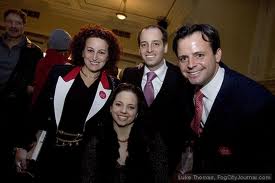
The Janet Reilly for District 2 Supervisor campaign today announced its endorsement by Angela Alioto, the former supervisor, mayoral candidate, and aunt of the current incumbent, Michela Alioto-Pier, who endorsed Reilly rival Mark Farrell in the race. Hmm, I wonder how this will go over at the next family gathering.

“As a former supervisor and a District 2 resident, I am backing Janet Reilly 100 percent,” Alioto said, according to the Reilly campaign press release. “At such a crucial moment in this city we need leaders like Janet who combine strong business credentials with a proven track record of public service.”

Contrast that with her niece’s recent praise of Farrell as “someone with common sense values who will stand up to the special interests and lead with honor and integrity.”

What’s the back story on this? Well, neither Alioto returned my calls yet, but it’s well-known that Michela is bitter about how the courts and City Attorney’s Office wouldn’t let her run for a third term and with the fact that Reilly didn’t defer to her desires to do so, instead securing an early endorsement from Mayor Gavin Newsom, who appointed Michela to succeed him in the D2 seat.

But this thicket of family conflicts is even more tangled than that. Michela’s husband, Tom Pier, used to work for Janet’s husband, Clint Reilly. And when Clint sued the San Francisco Chronicle, twice, over the company’s improper and anticompetitive collusion first with the Examiner and then with MediaNews, his attorney was Joe Alioto Jr., son of former Mayor Joe Alioto, sister of Angela, and father of Michela. Perhaps politics is thicker than blood.

Yet for the Guardian, it’s really simpler than all that: We thought Angela was a far better supervisor than Michela, who has been little more than a Newsom proxy and call-up vote for the Chamber of Commerce, so this is one more vote in Janet Reilly’s favor as we consider who to endorse for the seat.

The real Steve Moss

83

Some folks are so mad about D. 10 candidate Steve Moss that they have put together a website titled The Real Steve Moss that pulls together public records and poses a series of questions in an effort to make Moss provide concrete answers about his residency and his handling of tax-payer dollars before the November election rolls around.

“If Mr. Moss believes that he is such a great candidate, we suggest he answer critics instead of hiding out and just dodging the questions,” The Real Steve Moss website states. “Anyone who won’t answer direct questions while running, certainly won’t in office.”

The website challenges Moss to provide more details about his residency, including the exact date he moved back to D10, the identity and move-in date of the person(s) currently living in his Dolores Park home in D8, along with copies of his utility, internet, cable and telephone bills and records from his D8 Dolores Park home and the place he is currently renting in 18th Street to prove Moss’ residency claims.

“If your Dolores home wasn’t occupied till August 2010, did you maintain services such as Internet, cable and telephone, and if so why?” the website asks.

The Real Steve Moss also drills into questions about the $1.5 million that the Department of the Environment paid to Moss’ private company, M-Cubed.
Last week, the Department of Environment confirmed to the Guardian that a grant was awarded to M-Cubed sometime between 2000 and 2001. 
“The total amount of the agreement was $1.5 million and the purpose of the agreement was to set up an energy cooperative in Bayview Hunter’s Point,” the Department told us.

Yet, 990 forms filed by Moss’s SF Community Power Cooperative and his parallel SF Community Power non-profit in 2002 and 2003 do not reflect large infusions of tax payer dollars that the City reportedly paid to Moss’ private company M.Cubed to set up an energy cooperative.

As “The Real Steve Moss” notes, “information easily obtained from Mr.Moss’ for profit, non-profit, and campaign websites do not appear to match records obtained from the City, State or the IRS.”

And while the Guardian waits for the Department of the Environment to respond to our request for more information about this grant, The Real Steve Moss drills into other questions about Moss’ money flow.

“What exactly did you do with the $4m plus in mostly public and private funding that you stated was to create a newswire and help Bayview Hunters Point residents?” The Real Steve Moss  asks, presumably referring to, amongst other donations, a series of $50,000 grants that the Goldman Fund, where Moss’ wife works, paid to Moss’ SF Community Power.

“Exactly how many paid jobs did you create and for how long? Why is your non-profit paying such a lot of rent and for what? Why is your non-profit’s communications bills so high? How much money did you pay yourself from your non-profit and for profit companies funded in majority by taxpayer funds?”
Hopefully, Moss will respond to these and other questions posed at The Real Steve Moss with concrete evidence. And soon. So, stay tuned.

http://www.sfbg.com/politics/2010/09/21/plan-c-endorses-sweet-and-moss-d10

9/11 rescuers need rescuing

0

Dick Meister, former labor editor of the SF Chronicle and KQED-TV Newsroom, has covered labor and politics for a half-century. Contact him through his website, www.dickmeister.com, which includes more than 250 of his columns.

A new AFL-CIO report shows that more than 13,000 of the truly heroic firefighters, police and other rescuers who were the first to rush to the scene of the attacks on the World Trade Center in New York City on Sept. 11, 2001 are still being treated for the serious injuries they received.

They were exposed to a highly toxic mix of chemicals, jet fuel, asbestos, lead, glass fragments and other debris that caused a wide range of respiratory, intestinal and mental health problems. Also exposed were nearly 53,000 other first responders who are being monitored for signs of 9/11 related illness. Yet another 71,000 are being watched closely because they also were exposed to the extremely harmful toxins while helping clear debris.

The number of reported victims continues to grow. For example, another new study, from the Mount Sinai Medical Center, shows that some 70 percent of the 10,000 workers involved in the cleanup who were tested between 2000 and 2004, now say they have new or more serious respiratory illnesses.

In addition to firefighters and police, the victims include construction workers, residents of the area and school children, among others. The new report, by the AFL-CIO’s James Parks and Mike Hall, focuses in part on one of the first to reach Ground Zero — Vito Friscia, a Brooklyn homicide detective.  He was only a block away when the second of the Twin Towers fell. He rushed to the site through a dense cloud of toxins to seek – and to rescue – survivors.  Friscia spent a week helping with the rescue efforts.

Today, Detective Friscia has a deep cough that won’t go away, chronic sinus problems and shortness of breath.

“But I’m no hero,” he insists. “I was just doing my job.” Many others involved in the rescue efforts say pretty much the same thing – that they were just doing their jobs as police officers, firefighters or as other public service employees.

Frisia’s sister-in-law, Maria Pusteri, has produced a documentary film, “Vito After,” which takes a detailed look at what the detective has endured since his rescue efforts.  The film, first released in 2005, recently made its international debut in London.

What’s needed now, the AFL-CIO says, is to provide long-term medical care and careful monitoring of the tens of thousands of rescue and recovery workers and community members whose health remains at serious risk because of their exposure to contaminated materials.

The AFL-CIO rightly blames part of the problem on Republican opposition. For instance, the Bush administration refused to create or support a permanent research, monitoring and health care program for Ground Zero workers. And the administration also cut funding for health care related to the 9/11 cleanup.

 Just before the congressional recess in August, House Republicans managed to block a bill – the 9/11 Health and Compensation Act – that would provide $7.5 billion for long-term monitoring and health care of victims.

This prompted another of the ailing first responders, Greg Staub, to complain that “they told us if we did our job, they’d take care of us. We did our job. Now we’re sick and they don’t remember who we are anymore.” Staub was forced to retire from the New York City Fire Department last year because of chronic lung problems stemming from his rescue efforts.

The odds, however, are that the House Republicans will not be able to block passage of the proposed Health and Compensation Act when comes up for a second vote, which is expected soon.

Those who rushed to Ground Zero to help the 9/11 victims clearly need – and certainly deserve – lots of help, probably at least as much as provided by the bill. As one of those treating the 9/11 victims noted, “Our patients are sick, and they will need ongoing care for the rest of their lives.”

Providing that care is the very least we can do.

Dick Meister, former labor editor of the SF Chronicle and KQED-TV Newsroom, has covered labor and politics for a half-century. Contact him through his website, www.dickmeister.com, which includes more than 250 of his columns.

Our Weekly Picks: September 22-28, 2010

0

WEDNESDAY 22

MUSIC

Mary Wilson

As one of the founding members of the Supremes, Mary Wilson sang on countless classic rock, R&B, soul, and doo-wop hits, including “Baby Love,” “Come See About Me,” “Stop! In The Name Of Love,” “Back In My Arms Again,” and many, many more. While that legendary group’s rise to fame has been celebrated in fictionalized form with the hit film and stage production Dreamgirls, Wilson has continued to perform and record, wowing fans with her outstanding voice that still powerfully belts out her hits, along with her interpretations of jazz standards. Fans can expect a bit of both when she comes to the city for a series of special, intimate shows. (Sean McCourt)

Wed/22-Sat/25, 8 p.m.; Sun/26, 7 p.m., $40–$55

Rrazz Room

Hotel Nikko

222 Mason, SF

1-866-468-3399

www.therrazzroom.com


EVENT

Jonathan Safran Foer

Every once in a while, a nonfiction book arrives that makes my head hurt, my tear ducts blow, and my appetite long for more discerning times ahead. Last time it was The Omnivore’s Dilemma. This time it’s Eating Animals, the author of loss literature Everything is Illuminated and Extremely Loud and Incredibly Close Jonathan Safran Foer’s voyage into the depraved bowels of our country’s factory farms. Since I lack the power of Safran Foer’s elegant prose, lemme summarize his findings: they are a stain upon our earth. Let him tell you himself at this benefit for the ever-fantastic 826 Valencia. (Caitlin Donohue)

8 p.m., $20

Herbst Theater

401 Van Ness, SF

(415) 392-4400

www.cityarts.net


DANCE

Alyce Finwall Dance Theater and PunkkiCo Dance

From the outside, a red door is all that distinguishes performing arts venue the Garage from other warehouse-like SoMa buildings. Once inside, the intimate space seems too small to function as a theater. Yet the diverse range of upcoming and established choreographers that RAW (the venue’s resident artist workshop) hosts always manages to bring explosive dance to the small, box-like space. This week RAW hosts PunkkiCo Dance and Alyce Finwall Dance Theater. Using the Garage’s interior space for inspiration, choreographer Raisa Punkki and her company present End Trance, a piece exploring large movement within claustrophobic spaces. Similarly, Alyce Finwall Dance Theater (directed by choreographer-dancer Finwall) explores explosive and raw movement in a piece that investigates femininity, beauty, and identity, to name a few. (Katie Gaydos)

Through Thurs/23

8 p.m., $15

Garage

975 Howard, SF

(415) 518-1517

www.975howard.com


THURSDAY 23

MUSIC

Big Boi

When is Outkast dropping its next album? When it damn well feels like it, that’s when. In the meantime, get up with the more elegant side of the ATL hip-hop duo — the checkered space-ghetto luxe of André 3000’s “Hey Ya!” partied hard, but when you found your dance partner and were ready to really get down, where’d you turn? “The Way You Move,” that’s where. Big Boi’s double time flows fill in languorous beats on new solo album Sir Lucious Leftfoot: The Son of Dusty Chico, which Jive demurred on because it was too much “a piece of art.” Their loss, and when Def Jam picked it up again, our gain. (Donohue)

8 p.m., $35

Regency Ballroom

1300 Van Ness, SF

www.theregencyballroom.com


EVENT

Oktoberfest by the Bay

Can’t make it all the way to Munich this year to mark the 200th anniversary of Oktoberfest? Then throw on your lederhosen and dirndls and bring your appetite for beer, bratwurst, and Bavarian-themed good times and head down to our own San Francisco waterfront for the 11th annual Oktoberfest by the Bay. A smorgasbord of food awaits to soak up the specialty suds being offered up by Spaten, as will a host of bands playing traditional music for all the partygangers raising their steins and dancing the schuhplattln. Prost! (McCourt)

Thurs/23–Fri/24, 5 p.m.–midnight; Sat/25, 11 a.m.–midnight;

Sun/26, 11 a.m.–6 p.m., $25–$30

Pier 48 (across from AT&T Park), SF

1-888-746-7522

www.oktoberfestbythebay.com


FRIDAY 24

PERFORMANCE

3 For All

Some veteran performers think they know it all already, feeling sufficient unto themselves. But despite the dizzying level of expertise evinced by 3 For All’s Rafe Chase, Stephen Kearin, and Tim Orr, these guys still take suggestions. In fact, they don’t do what they do without a little help from the audience, by way of nouns, adjectives, and odd phrases shouted out in eager expectation that these three improv masters will take their idea and transform it into a breathless and hysterical wonder of theatrical spontaneity. Really, if you haven’t seen 3 For All do its thing, you haven’t seen all that improv has to offer. These are the troupe’s last San Francisco performances of 2010. (Robert Avila)

Through Sat/25

8 p.m., $22–$25

Bayfront Theater

Fort Mason Center, Bldg. B

Marina at Laguna, SF

www.improv.org


FILM

“Radical Light: Return to Canyon, Program II”

Filmmaker Bruce Baillie first conceived of Canyon Cinema as a communal gathering in the redwood groves between Oakland and Moraga. The screenings showcased fresh, avant-garde work and self-produced newsreels, along with classic serials and government films. “We’d sit under the trees in the summer with all the dogs and people and watch,” Baillie once reminisced to interviewer Scott MacDonald. Canyon came down the mountain soon enough, but this special 50th anniversary event revives its original al fresco spirit. The show features many fine Canyon films new and old, as well as a newsreel produced by the kids of the Canyon School with help from USF’s film students. Baillie will be there too, still tossing the seeds of creative growth. (Max Goldberg)

6 p.m., free

Canyon School

187 Pinehurst, Canyon

www.sfcinematheque.org


EVENT

“24 Days of Central Market Arts: Kick-off Event”

In an area known for its uninviting sights and smells, visitors to the central Market Street area can instead treat themselves to the sights and sounds of art during 24 Days of Central Market Arts. The three-week festival kicks off today with LEVYdance, Robert Moses’ Kin, and Kunst-Stoff, followed by Cali & Co & The Welcome Matt, and vocalist Joshua Klipp with Sarah Bush Dance Project. Saturday continues with performers including La Alternativa and Hope Mohr Dance. The event culminates Sunday with more performances, belly dance classes, an improv dance jam, and indie rockers Handshake. (Emmaly Wiederholt)

Through Oct. 17

Kick-off: Fri/24, 1–2 p.m. and 5–7 p.m.;

Sat/25-Sun/26, 1–-5 p.m., free

Mint Plaza

Fifth St. between Market and Mission, SF

www.centralmarketarts.org


DANCE

Lenora Lee

In Lenora Lee’s Passages, politics and art work in tandem to tell the story of one person. Yet the piece also speaks for the courage and determination of thousands of others who left — and still leave — everything behind to make a better life for themselves, their children, and in Lee’s case, a grandchild. Lee’s grandmother was married in China and spent 10 years waiting to reunite with her husband on Gold Mountain, as California was called. She became an anchor in the little girl’s life, one in which dance lessons and visits with Grandma fused. The interdisciplinary Passages — with media design by Olivia Ting and a score by Francis Wong — commemorates the centennial of the Angel Island Immigration Station. (Rita Felciano)

Fri/24–Sat/25, 8 p.m.; Sun/26, 2:30 p.m., $20

Dance Mission Theater

3316 24th St., SF

1-800-838-3006

www.asianimprov.org


SUNDAY 26

MUSIC

Git Some

Gotta love hard rockers — and even harder livers — like those in Denver’s Git Some. Mixing hardcore maximalism with post-punkin’ Jesus Lizard freewheelery, the foursome — founded by ex-Planes Mistaken for Stars members Chuck French and Neil Keener — tear through bulldozers à la “There Is So Much Blood” and thrashers such as “Entrails for the Altar” on the new Loose Control with the barely harnessed ferocity of zombies served a groaning sideboard of fresh body parts. Translation: meaty satisfaction — the added wrinkle being the occasional butt-wiggling, cheese-gobblin’ guitar-god flourish found on, say, “Broken Bodies Glisten.” Taste the glove — and Git Some love? (Kimberly Chun)

With Pins of Light and Hazzard’s Cure

8 p.m., $6

Knockout

3223 Mission, SF

(415) 550-6994

www.theknockoutsf.com


TUESDAY 28

MUSIC

Odd Nosdam

Get your cerebral and head-bopping fix at this show featuring two all-star experimental electronic artists. The Bay Area’s Odd Nosdam makes sound collages with ideas and samples pulled from the worlds of hip-hop, ambient music, drone, and indie-rock, often set among creative drum patterns you can still tap your foot to. Austria-based musician Christian Fennesz (see music feature) combines spacey, manipulated electric guitar with dissonant textures and glitchy beats. Either of these guys playing on their own would make for a fantastic show. Together, for $10 per set, you’d be a fool to miss it. (Landon Moblad)

With Fennesz

8 p.m., $20

Swedish American Hall (above Café Du Nord)

2170 Market, SF

(415) 861-5016

www.cafedunord.com


EVENT

Guillermo del Toro

In addition to directing superbly haunting, dark, atmospheric films like Hellboy (2004) and Pan’s Labyrinth (2006), Guillermo del Toro also pens novels (with cowriter Chuck Hogan), the second of which, The Fall, hits stores this week. Though the topic of vampires may seem worn out to some, with the teenybopper Twilight series driving some genre fans to swear they’ll stake themselves at the mention of one more fang-based outing, del Toro brings the bite back into the fold with this second part of a planned trilogy of tales. Join the talented artist for a special evening of discussion about his work on the written page and silver screen. (McCourt)

7:30 p.m., $12–$75

Sundance Kabuki Theater

1881 Post, SF

1-800-838-3006

www.booksmith.com 


The Guardian listings deadline is two weeks prior to our Wednesday publication date. To submit an item for consideration, please include the title of the event, a brief description of the event, date and time, venue name, street address (listing cross streets only isn’t sufficient), city, telephone number readers can call for more information, telephone number for media, and admission costs. Send information to Listings, the Guardian Building, 135 Mississippi St., SF, CA 94107; fax to (415) 487-2506; or e-mail (paste press release into e-mail body — no text attachments, please) to listings@sfbg.com. We cannot guarantee the return of photos, but enclosing an SASE helps. Digital photos may be submitted in jpeg format; the image must be at least 240 dpi and four inches by six inches in size. We regret we cannot accept listings over the phone.

Dreams untrue

0

arts@sfbg.com

FILM Alternatively hailed as a sensitive cine-poet and derided as a brazenly ethnocentric pseudo-anthropologist cloaking shoddy fieldwork with mystification, Robert Gardner remains a controversial figure — when he is remembered at all. With a younger generation of filmmakers (Lisandro Alonso, Apichatpong Weerasethakul, Ben Russell, Claire Denis) rewiring the tropes of sensory ethnography to their own ends, the troubling beauty of Gardner’s work seems freshly relevant if no less problematic. Yerba Buena Center for the Arts opens this Pandora’s box the right way, with restored 35mm prints of three of Gardner’s best known works.

I first encountered Gardner’s work in the classroom, where it made an appealing target for students eager to sniff out colonialist discourses in documentary form. The argument against a film like Dead Birds (1964) is well rehearsed: Gardner depicts the Nuer people as a primitive culture untouched by history or politics; masks the participatory aspects of ethnographic filmmaking; allows himself a ranging voice-over while leaving all Nuer speech untranslated; and contrives two protagonists to act as convenient ciphers for Hollywood narrative conventions of simultaneity and suspense. Then there is the Harvard credit. Gardner led the university’s Film Study Center for 40 years, and the films say so: “Produced for the Film Study Center, Harvard University.” The charges of cultural paternalism come easily enough.

Even taking the charitable view that Gardner acted more on allegorical ambition than innate arrogance, he clearly avails himself of the least reputable power base of anthropology — I speak about them; they do not speak back to me. Moreover, he does so with a formal insouciance that would drive most anthropologists nuts. What burned me about the line taken on Gardner in my seminar was that it came of watching his films on projected VHS, a degraded medium that implicitly treats films as content rather than experience. And indeed, it’s on the level of content that Gardner’s failings are most manifest. But seen in 35mm, when the filmmaker’s attention to sensory detail (sound, color, texture) and psycho-kinetic cutting might at the very least provoke unexpected feelings, the argument against loses some of its inevitability.

The second film of the Yerba Buena program, Rivers of Sand (1974), is even thornier than Dead Birds. Whereas in the earlier work, Gardner considers the universal impulse to draw battle lines in the Nuer’s ritual warfare, here he lets the Hamar of Ethiopia stand for the common issue of sexism. Throughout the film, a Hamar woman tells the camera about the abusive treatment of women in her culture (“He’s beating you even when he’s not”). Alas, any dialogic potential of this thread is diluted by her being the only speaker and, more important, there being no context for her testimony. At the aural level, however, the film’s dense, impressionistic catalog of sounds makes for distinctly lyrical, at times surreal viewing. In certain passages, like when an afternoon downpour sends a sudden river across the hard land, it seems we’ve left empirical reality behind altogether.

Arresting fragments like these point the way to Forest of Bliss (1986), Gardner’s feature-length contemplation (sans voice-over) of life rhythms and funeral rites on the Ganges. The India quest is an orientalist standby, of course, and brings into focus the counterculture strain that’s always run through Gardner’s work (remember, Timothy Leary was a Harvard man too). But while the fluid camerawork may be touristic, it’s also more modest than in his previous work. More often than not we’re following a single person’s movements: at home, through the streets, to the river, relying more on intimacy than intimation. The striking glimpses of the sacred in view of the profane suggest a solitary traveler rather than a scientific observer. It is one thing to caution against ascribing knowledge to this passing view and quite another to claim it does not have any foothold in the imagination; the first is common sense, the second wishful thinking.

“OTHERS/OURSELVES: THE CINEMA OF ROBERT GARDNER”

Sept. 23–30, $6–$-8

Yerba Buena Center for the Arts

701 Mission, SF

(415) 978-2787

www.ybca.org

The District 8 dilemma

13

tredmond@sfbg.com

Gabriel Haaland, a longtime queer labor activist, was talking to a friend from District 8 the other day, chatting about the race for a supervisor to fill the shoes of Harvey Milk, Harry Britt, Mark Leno, and Bevan Dufty. “She told me that she didn’t know who to vote for,” Haaland said, “because she didn’t know who the progressive was in the race.”

For supporters of Rafael Mandelman, that’s a serious challenge. “The polls are very consistent,” Haaland said. “Most of the voters in D-8 would prefer a progressive over a moderate, and when they know who the progressive is, they support that candidate.”

But oddly enough, although District 8 — the Castro, Noe Valley, and parts of the Mission — is one of the most politically active parts of the city, where voter turnout is consistently high, the supervisorial race is getting only limited media attention. The neighborhood and queer papers are doing a good job of covering the race, but for the rest of the media, it’s as if nothing’s happening. And that’s left voters confused about what ought to be a very clear choice.

The San Francisco Chronicle featured the District 6 race on the front page Sept. 19, with a long story about how demographic changes in the South of Market area would affect the successor to Sup. Chris Daly. District 10, with the mad political scrum of 22 candidates, no clear front runner and endorsements all over the map, has received considerable media attention.

Yet D–8 — which offers by far the most striking distinctions between candidates and the sharpest divisions over issues — has been flying under the radar.

Three major candidates are in the race, two gay men and a lesbian. All of them, for what it’s worth, are lawyers. Rafael Mandelman, who works for a firm that advises cities and counties, has the support of the vast majority of progressive leaders and organizations. Rebecca Prozan, a deputy district attorney, and Scott Wiener, a deputy city attorney, are very much on the moderate-centrist (some would say, by San Francisco standards, conservative) side of the political spectrum.

“As Barbara Boxer has said in her ads, the choice is clear,” Aaron Peskin, chair of the local Democratic Party and a Mandelman backer, told us. “Not to exaggerate, but this is like Boxer v. Carly Fiornia, and Rafael is our Boxer.”

Yet by almost all accounts, Wiener is ahead in the race.


ON THE ISSUES

The San Francisco Board of Supervisors has been roughly divided in the past decade between the progressive camp and moderate camp. And while those labels are hard to define (the Chronicle won’t even use the term “progressive,” preferring “ultraliberal”), most observers have a basic grip on the differences.

The moderates, who tend to support Mayor Gavin Newsom, are social liberals but fiscal conservatives. They talk about the city surviving budget red ink without major tax increases. They talk about controlling government spending and increasing public safety. The progressives generally see local government as underfunded after four years of brutal cuts and support the idea of raising new revenue to fill the gap. They support tenants over landlords, seek stronger protections for affordable housing, support Sanctuary City, and oppose sit-lie.

Certainly with Wiener and Mandelman, it’s abundantly clear where the candidates fall. The two agree on some things (they both oppose Prop. B, the pension-reform measure that would reduce health care payments for the children of city employees) and they both support nightlife. But overall, they take very different political stands.

Wiener told us, for example, that the city’s structural budget problems won’t be solved without cuts. “We’re not going to able to tax our way out of this,” he said in an endorsement interview. “We have to lower our expectations for government.”

Other than Muni, public safety, and core public health services, cuts “will have to be across the board,” he said. “What are the things we really can’t do without?”

Wiener supports the sit-lie proposal, saying that he doesn’t think the local police have the tools they need to get poorly behaving people off the streets. He doesn’t support Sup. Ross Mirkarimi’s measure mandating foot patrols because, he told us, he doesn’t think the supervisors should micromanage the Police Department.

Sup. Bevan Dufty, who currently holds the D–8 seat, has voted with the progressives occasionally — but almost never on tenant issues. And Wiener, who has the support of the rabidly anti-tenant Small Property Owners of San Francisco, is likely to follow that approach. Although he told us he supports rent control (which just about everyone in local politics agrees on at this point), he’s not a fan of additional protections against evictions and condo conversions. “I’m not prepared to go beyond what we have now” on eviction protections, he said. He supported Newsom’s plan to allow people to buy their way out of the waiting list and lottery for condo conversions.

And when it comes to public power, he’s to the right of the incumbent: Dufty has said repeatedly that he supports the city taking over Pacific Gas and Electric Co.’s infrastructure and putting the city in control of a full-scale public power system. Wiener says he supports community choice aggregation (CCA), but not full-scale public power.

Mandelman is a big supporter of local government and says, without hesitation, that the city needs more revenue. “The public sector is dramatically underfunded,” he told us in a recent interview. “There’s great wealth in the city and it needs to be tapped to preserve public services.” Mandelman said he’s not “tax happy,” but told us that the structure of how the city raises revenue is a mess. He supports a top-to-bottom review of the city’s revenue base with the goal of making taxation more progressive — and bringing in enough money to fund crucial services.

Mandelman is a foe of sit-lie, which he sees as punitive and ineffective. He opposes gang injunctions and supports Sanctuary City. And he’s a strong advocate for tenants, supporting stronger eviction protections and limits on condo conversions that take away affordable rental stock.

“You have to look at the candidates and ask what their priorities are,” he said. “Are the displacement of long-time residents critically important or something that’s not on the top of the list? Do you believe we need to rebuild the safety net? Or is queer politics all about property values?”

Prozan told us that she’s the one who can “bring the two sides together” and said that, like Dufty, she is “right up the middle.” She supports the hotel tax and the vehicle license fee and opposes sit-lie, but also thinks gang injunctions are a useful tool for law enforcement. She doesn’t see any reason to split appointments between the mayor and the supervisors for the board that oversees Muni or the Redevelopment Agency. She doesn’t think the city can or should do anything more about the conversion of rental property to tenancies in common, but supports the idea of taking over foreclosed properties to create housing for teachers, cops, and firefighters. So it’s safe to say the Prozan would probably be similar to the incumbent — with the progressives on a few things, against them on others.


UNDER THE RADAR?

Wiener and Mandelman agree on two basic points: there are stark differences between the candidates — and the city’s major media outlets aren’t paying enough attention. That’s probably because the relatively tame politics doesn’t compare to the sort of wild excitement you see in Districts 6 and 10.

“There’s less chaos than some of the other districts,” Wiener said. “The three major candidates are all hard-working, respected people who have all lived in the district a while.”

He also agreed that he and Mandelman have “very different visions” for the district and the city, and that there are sharp contrasts and divisions between the two candidates.

Prozan also argued that the political differences on issues aren’t going to be the only — or even the deciding — factor for many voters. “I think they’re looking for who’s got the courage and independence to do what’s right,” she told us.

But Mandelman told us there’s a crucial story here that needs to be told: “It’s a definitional fight about what the queer community is about in 2010. As goes D–8, so goes San Francisco.”

Editor’s Notes

0

Tredmond@sfbg.com

On Sept. 16, supporters of Proposition B, the pension reform measure that would also reduce health care benefits for the children of city workers, held a fundraiser at Le Méridien Hotel — which is one of the hotels on the union boycott list. That was a bad idea, and it put Public Defender Jeff Adachi, the sponsor of Prop. B, in a difficult bind. His proposition, his fundraiser — and he had to cross a picket line to get in the door. So did former mayor Willie Brown, who was one of the fundraiser’s feature guests.

Labor people were furious about the two Democrats crossing the line. Labor Council Executive Director Tim Paulson told Guardian City Editor Steven T. Jones that the move was "outrageous." At the very least, it’s highly unusual in this labor town.

And I thought of something else unusual: Brown, who among other things is a San Francisco Chronicle columnist, was helping host a political fundraiser. That’s interesting because just a few weeks earlier, the conservative San Francisco Coalition for Responsible Growth invited the Chron’s C.W. Nevius to speak at a fundraising event — and when the SF Appeal reported on it, Chron management told Nevius that wasn’t allowed.

What’s the difference? One columnist can do fundraisers and one can’t? When I asked Chron Editor Ward Bushee, he referred me to a Matier and Ross column, which included a quote on the matter from Managing Editor Steve Proctor:

"When we gave him a column, we never had any illusion he would cease to be involved in politics. I think the readers of the Chronicle understand that."
So it’s one standard for Willie, another for everyone else. Just like old times.

At the Drive-In

0

arts@sfbg.com

VISUAL ART Before it became the context-free darling of YouTubers and meta-bloggers, the 1980s was a real, living era. Movies and music videos copulated. An actor became president and decided to invade Grenada despite a warning from, yes, Prime Minister Margaret Thatcher that the action would be seen as "intervention by a Western country in the internal affairs of a small independent nation, however unattractive its regime." The pre-politics Governator appeared in 1984’s The Terminator as "something unstoppable … that felt no pain." And Martin Amis, in Einstein’s Monsters (1987), wrote that "the arms race is a race between nuclear weapons and ourselves." The future appeared bleaker than bleak, its robotic violence and darkness palatable if seen through neon-tinted pop culture glasses.

The 01SJ Biennial, a welcome if dizzying affair that opens this week in San Jose, is a plugged-in antidote to ’80s-era apocalyptic soothsaying. Although more recent cultural creations from 28 Days Later (2002) to The Road (2009) have done little to imagine a coherent future, they’ve at least begun asking what it means to be honestly human. Might we finally stop blaming technology?

Blogging about the biennial’s "Build Your Own Future" theme, Artistic Director Steve Dietz recently noted that the event offers a chance for "serious play." For an illustration of what he means, look no further than Todd Chandler and Jeff Stark’s Empire Drive-In, a fully functional theater featuring cars saved from a local auto wrecker and a screen built almost entirely from salvaged wood. A collaboration with artists including Brett James, Ian Page, and Robin Frohardt (who designed and fabricated a unique concession stand), Empire‘s cinema comes to life inside the San Jose Convention Center’s airplane hangar-sized South Hall.

Last week, Chandler took a break from cleaning broken glass out of one of the cars to chat about the project. He said he had first presented Dietz with the idea of a possible live performance by his band Dark Dark Dark, along with Flood Tide: Remixed. a sort of contemplative preview version of his forthcoming feature film of the same name. "Steve was interested," Chandler explained, "but he said that it wasn’t enough. I was like, not enough?!"

Though Chandler had been pouring himself into Flood Tide project, if the biennial wanted something even bigger, he knew what to do. He called Stark, the intrepid editor of Nonsense NYC (www.nonsensenyc.com ). "Jeff is amazing at pulling off really big, impossible projects," Chandler says. "And he’d had this idea in his head for a while about a junk car drive-in."

Chandler and Stark met while working on the Miss Rockaway Armada project (www.missrockaway.org ), the first iteration of a number of artistic ventures involving large rafts made of salvaged materials. That participatory trip down the Mississippi River — deemed an "anarchist county fair" and a "fools’ ark" — gave birth to the projects that became the subject of Flood Tide. In turn, Empire Drive-In includes not just the hypnotic Flood Tide: Remixed, but a number of "live cinema" presentations, including Zoe Keating and Robert Hodgin’s Into the Trees, and Laetitia Sonami and SUE-C’s Sheepwoman.

"The cars we’re using were on their way to Redwood City to get crushed," Chandler explained. "A lot of them had smashed windshields." He and Stark chose vehicles based on what was available rather than a predetermined vision: "We didn’t want to do a retro, ’50s-style drive-in."

As with any other theater, when a drive-in closes for good, we say that it has "gone dark." My childhood haunt, Skyview Drive-In in Santa Cruz, went dark a few years ago. When I drove by and saw the missing screens, I started to cry. Empire Drive-In presents the unbearable lightness of seeing in a world that might someday go dark.

01SJ BIENNIAL: EMPIRE DRIVE-IN

Thurs/16–Sun/19, various venues

(408) 916-1010

www.01sjart.org

PG&E’s tragically misplaced priorities challenged

0

Throughout the spring political season, we at the Guardian argued there were more important things on which Pacific Gas & Electric could be spending $45 million – the amount it spent on Prop. 16, its losing effort to kill public power programs in California – such as infrastructure maintenance, lowering its high rates, or adding more renewable projects to its dirty energy portfolio.


Now that the deadly gas explosion in San Bruno has been linked to internal company warnings that PG&E’s 52-year-old line was dangerously in need of replacement and that it failed to heed customer complaints about smelling gas in the air for weeks before the explosion, it appears that the company could finally be called to account for its misplaced priorities.


State Sen. Mark Leno is calling a joint hearing into the matter before the Public Safety Committee, which he chairs, and the Utilities Committee. “The current leadership at PG&E has lost its way. Nobody is minding the ship,” Leno told the Guardian. He said that he’s furious about the explosion and PG&E’s shoddy safety record.
“Enough with the self-initiated, self-serving, self-funded political campaigns,” he told us. “Enough with the illegal attempts to interfere with community choice aggregation in Marin. Enough with the mad rush to smart meters. How about focusing on the current mission — to provide gas and electricity safely reliably and affordably, without death and destruction?”


Ironically, it’s possible that PG&E’s efforts to prevent a greater public role into how energy is provided to Californians could end up resulting in far more public oversight over a utility that has put more energy into regular political campaigns – from this year’s statewide campaign to similarly over-the-top spending to kill public power proposals recently in San Francisco, Yolo, and Sacramento counties – than the energy business. Leno told us the model of the private regulated utility no longer works. “This hybrid creation of sort of public, kind of private, state regulated but not really is a creation that no longer functions.”


Meanwhile, while the PG&E-friendly San Francisco Chronicle has yet to really connect the dots on this disaster, other mainstream San Francisco voices are. For example, Christine Pelosi – daughter of Speaker of the House Nancy Pelosi – yesterday penned a piece for the Huffington Post that explicitly connects the Prop. 16 campaign to the deadly explosion, entitled. “Deadly Priorities: Why Did PG&E Spend Millions on Politics, Instead of Pipelines?”


She closes the piece with an apt question, one that Leno’s committee will hopefully answer: “The San Bruno tragedy is a clarion call to rebuild America and insist on ratepayer say on utility pay. I think most taxpayers would reject deadly priorities that put politics over pipelines and choose repairs to the ground literally crumbling beneath our feet, and most ratepayers would choose crumbling infrastructure repairs over political campaigns. Wouldn’t you?”


Yes, we would.

Steve Moss responds

55

Editor’s note: On Sept. 10, we posted a story called “Steve Moss, carpetbagger,” explaining how a leading candidate for District 10 had had filed his intent to run for office while he still lived in another district. Moss sent us a response, which we’re posting below (and our response to him follows that).


 There are many things you could say about me.  You could say that you hope
someone else wins the race for Supervisor in District 10.  You could say that
you don’t like my politics.  You could say you think that if I were Supervisor,
the city would fall into the ocean (although that seems a bit extreme).
But to suggest that I’m not really in the district, as your reporter did in a
story on 9/10 – what’s up with that?


 If you really wonder whether I live in District 10, you could send a reporter
over to my house on Potrero Hill.  You’ll see a home lived in by a family (and a
very large mutt), my family…not a Potemkin village.  Or come by my office at the
Potrero View.  Or talk to the folks at Farley’s or Goat Hill Pizza or The Good
Life Grocery.  I’m not saying that I’m known to everyone, but I’m hardly a
stranger.


 Three years ago, after living in the district for years, I moved to Mission
Dolores so we could walk our daughter to her new school (Alvarado).  When she
switched schools, and I decided to run for Supervisor, we moved back.  That was
last winter.


 That’s not a secret.  There’s no secret life, no secret pied a’ terre, no
secret, period.   I completed all the paper work the city and state asks of a
candidate, using my office address for mailing purposes and my home address on
the appropriate forms.  I’m a resident of District 10.  My daughter was born in
District 10.  I work in District 10.  I have history in District 10.
If you want to say that you don’t like what I think about development in the
district, schools, or post-modern theater – by all means, let’s have that
debate.  But surely, even in San Francisco, we can find a way to disagree with
one another politically without resorting to something like this.


 P.S.  Regarding Form 501 referenced in your article, see the official FPPC
instructions on page 38 in this link, which states that using a
business address is fine.


 Tim Redmond responds:


 For the record, we never stated that Moss is “not really in the district.” He says he lives in D-10 now, and we have no reason to doubt him. What we said was that he didn’t live in the district when he launched his campaign by filing his statement of intent to run for supervisor. We reported that he had moved out of the district, and apparently — according to an email from his wife — moved back specifically to enter this race. I quote the July 8, 2009 email Debbie Findling, Moss’s wife, sent to friends:


 “Steven has decided to run for City Supervisor in District 10!!! (Sophie Maxwell’s term ends in November 2010) so we’ll be moving back to the Hill in early spring! If you hear of any lovely rentals let us know. Or—I know it’s a crazy idea—but if you’re interested in swapping houses with us for a year as an even trade—you can move into our place on Dolores Park! (We’re hedging our bets in case he doesn’t win we’d be moving back to Dolores Park after the elections- If he does win, we’ll find a long-term place to live…).”


 Here’s the key: “We’re hedging our bets in case he doesn’t win we’d be moving back to Dolores Park after the elections.” And, from his comment above: “When … I decided to run for supervisor, we moved back.”


 That sounds like someone moving into a district just to run for office.


 Now, Moss is singing a slightly different tune today. When I asked him if he intended to stay past the election, he said:


 “We love our home on 18th and vermont street, and very much hope to stay here (its a rental). If I don’t win I’m thinking of launching a southside newspaper, to serve the neighborhoods of district 10.”


 Good for him; we need more neighborhood newspapers.


 Still, our point remains: Moss wasn’t living in the district when he started his campaign for D-10 supervisor.


 It’s not illegal to move into a district to run for supervisor. You just have to live there 30 days prior to filing. But I still think it’s wrong. The law ought to mandate at least a year’s residency prior to filing an intent to run. And since Moss’s residency in D-10 seems based at least in part on his desire for a job at City Hall, that’s something the voters ought to know.  

DCCC endorsements — how the hell did this happen?

35

Everyone knew that the DCCC, the endorsing arm of the San Francisco Democratic Party, would have trouble choosing candidates in the heavily contested D. 10 race. After all, the member decided at the August endorsement meeting to punt the D. 10 decision for four weeks.

But the DCCC’s September 8 endorsement of civil rights attorney Dewitt Lacy, former Newsom staffer Malia Cohen, and biodiesel activist Eric Smith, in that order, was somewhat mind-boggling. It left the San Francisco Democratic Party in the position of endorsing a candidate who is utterly unreliable on tenant issues and passing over perhaps the most progressive contender in the race.


D. 10 candidate Tony Kelly, who has a long history of progressive involvement in the district and who thought he had strong support on the DCCC, felt as if he’d been thrown under the endorsement bus. And it left fellow progressive Chris Jackson feeling that the DCCC endorsement process didn’t take the community’s wishes into consideration.

It’s common knowledge that DCCC members felt they had to endorse an African American in this district, since it contains the city’s largest remaining black community, and since it’s unlikely that a black candidate will get elected from any other district this fall, potentially leaving the board with no African American representation.

But that does not explain why the DCCC, after giving Lacy its first place endorsement, gave its second slot to Cohen, a moderate who told the Guardian in a recent endorsement interview that she doesn’t support further controls on evictions and condo conversions because that would infringe on property owners’ rights.


And in the end, you have to wonder: Does this end up helping Steve Moss, the candidate most progressives on the DCCC most fear?

Insiders point to two hidden plays that worked against Kelly, and for Cohen, in terms of getting the DCCC’s nod.

The first was a push by downtown interests to have their representatives on the DCCC make no endorsements in the race. The idea was to keep Kelly off the slate, so that downtown’s preferred D. 10 candidate Steve Moss would have a better chance of sewing up the vote on Potrero Hill, where Kelly is expected to do well.

The other play was a push among some DCCC members to put a black woman on the slate. This made Cohen, despite her moderate stance on some progressive issues, their choice, since she was born and raised in the district and has raised enough money to run a competitive campaign.

DCCC chair Aaron Peskin told the Guardian that he wanted Kelly to get one of the slots.


“My failure to do so proves that the DCCC isn’t a machine,” Peskin said. “I wanted Tony on there somewhere, and for a while it was looking like he might get second or third place.”

Kelly told the Guardian that he was surprised not to get the DCCC endorsement—and that he has received 8 phone calls from DCCC members apologizing for what happened.


“Nobody wanted those three candidates, except perhaps Scott Wiener,” Kelly said.


“At the same time, there have been so many gyrations around this in the last week. I’ve had more than half of the DCCC members tell me directly, ‘You’ll make the best supervisor—and I’m supporting someone else.’ But now they don’t even have three progressives in the slate.”

Kelly added: “This is a weak moment for the Democratic Party. This is not a machine, it’s not something that has strength or relevance to the district. This is the most clueless endorsement possible.”


Jackson believes that what happened last night was purely politics.


“This was a very political process and they made a political decision,” Jackson said. “But ultimately, it’ll be up to the neighborhoods and community to make their own choice.”

 “Unbelievable,” is how Smith described the DCCC’s D. 10 slate. “Right before this vote started, Eric Quezada told me, no matter what happens, there are better things in life than this. But now I feel great. It’s given my campaign a big boost.”

“I’m close to Tony Kelly, I consider him as a friend,” Smith added. “But in some ridiculous karmic way, the stars aligned, and I’m one lucky bro.”

Lacy for his part was clearly elated at getting the DCCC’s top slot.


“I’m really excited,” Lacy said.  “I believe this means D. 10 has a strong opportunity to get its fair share of good things and the Democratic Party will take part in making that happen.”


It also means Lacy — whose campaign has been a little slow and underfunded — is really going to have to ramp up his efforts in the next few weeks to take advantage of the DCCC nod. And it means Moss will get a boost, since Kelly could take Potrero Hill votes away from him. Kelly’s the only candidate who got the Potrero Hill Democratic Club endorsement.


American politics is a circus that never leaves town

0

 American politics is a circus, no doubt of that. The trouble is, it’s a circus that never leaves town.

That’s bad for the country, but good for observers who are interested in becoming more intimately acquainted with the talent on display. Having watched several recent performances, I’d like to offer my opinion of some of the leading players in what is surely the greatest show on earth, Ringling Brothers, Barnum and Bailey, and Buffalo Bill Cody himself notwithstanding.

(One caveat: Because the show never stops, there’s a regular turnover in personnel. I can’t guarantee that the same performers will be on hand when you next visit the big tent. But don’t worry about being short-changed on entertainment. The supply of people who want to be in this circus is limitless.)

Aerialists:

The principal high flyer of the moment is Rep. Paul Ryan, Republican of Wisconsin, who when he’s not soaring high above reality represents, with no particular distinction, a district just down the road from where I live. Brightly costumed in Austrian economic theory and unencumbered by data or any knowledge of the behavior of actual human beings, he swings on his trapeze while waving the banner of his Plan for America’s Future. In the future this daring young man envisions, taxes will be cut, the budget will be pared down to next to nothing, the deficit will be erased, Medicare will be replaced by vouchers and Social Security with private accounts, all insurance companies will be scrupulously honest and all businessmen incorruptible and everyone will invest wisely and there will never be another depression or even recession and wishes will be horses and beggars will ride to El Dorado, which will turn out to be situated at the base of the Big Rock Candy Mountain . Remember, though, that while Rep. Ryan is working with a net, if he gets his way you won’t have one.

Jugglers:

Right now it’s the Tea Partiers doing the bulk of the juggling. They’re mostly old enough to be covered by Medicare and on the receiving end of Social Security and no way in hell are they giving up those benefits. Still, they are committed to reducing government spending as long as there’s a black guy running the government. So to keep those balls in the air they have to believe both things at least until 2012 when they can put a white person back in the White House (and why else would they call it that?) and the deficit won’t matter anymore.

Clowns:

Those oddly-dressed and -painted little men you see emerging from the tiny car, whom you first take to be syphilitic dwarfs, are in reality congressman of both parties fleeing responsibility for anything congress itself may have done. Good or bad doesn’t matter; if the public is anti-Washington, so are they. With their antics – hurling invective and flailing at one another with slap-sticks – they hope to distract you from examining their records; regrettably, they are no more amusing than ordinary clowns.

Lion Tamers:

No lions are being tamed at present. The erstwhile lion tamers – the members of the Supreme Court – have been called away to protect corporations from the depredations of the public interest.

Contortionists:

Before your very eyes, the Anti-Defamation League will twist its principles (in order to suck up the American right-wing) by opposing the so-called Ground Zero mosque. Pretzel-making is a straightforward business in comparison. Don’t miss this one.

Ringmaster:

There is no ringmaster, but candidates for the position are coming from all directions. There are so many of them Halloween party-goers can’t find costumes and BDSM parlors are facing a shortage of whips. First there’s Sarah Palin, all spiffed up and ready to take charge. But no, here comes Glenn Beck and he’s got God on his side. Now Bill O’Reilly is sputtering with anger at his losing his lead. Sean Hannity wants the world to know that if anger is what it takes nobody can get than him. And Rupert Murdoch may just decide to let his underlings sulk and take the job himself.

Nobody can predict the outcome. All we know, alas, is that the show must go on.

The Guardian 2010 election Endorsement Interviews

13

The Guardian is interviewing candidates for the fall elections, and to give everyone the broadest possible understanding of the issues and our endorsement process, we’re posting the sound files of all the interviews on the Politics blog. Our endorsements will be coming out Oct. 6th. Click here to listen — page will be updated as we publish more interviews.

SFBG Radio: Why voters should think like junkies

11

Today we talk about a different approach to politics: Why voters should think like junkies. Johnny’s got a good argument here — your typical junkie is a lot more cynical about people trying to sell him something than the typical voter who listens to Glenn Beck. Oh, and why is that preacher in Florida going to burn a stack of Korans? Any junkie could figure out that it’s all about making a fast buck. You can hear the discussion after the jump.

sfbgradio9/7/2010 by endorsements2010

Editor’s Notes

0

tredmond@sfbg.com

California politics starts early. The campaigns in this state were underway long before the traditional Labor Day launch of the fall campaign season. Except for Jerry Brown, who only in the past week has started acting like a candidate for governor of the most populous state in the nation.

And that’s not a mistake.

Here’s how I’m seeing things shape up at what is more accurately described as a midpoint in the campaign season:

Jerry Brown’s starting to hit back. The once and maybe future governor has much of the state’s political class mystified; with Meg Whitman blanketing the airwaves, promoting herself and whacking away at him, why has he waited so long to fight back? Actually, it’s a calculated strategy, Jerry’s version of the old Muhammed Ali rope-a-dope. He knew he couldn’t match Whitman blow for blow — and he also suspected that at a certain point, she’d start to punch herself out. It’s been working: after spending more than $100 million, Whitman hasn’t cracked 45 percent in the polls. And some polls now show that the more people view her ads, the less they like her.

So now Jerry Brown appears — a 72-year-old career politician who’s going to look like a fresh face. And all he has to do is knock her back a little and the race is his.

Barbara Boxer’s nailed Carly Fiorina where she’s most vulnerable. Boxer’s got incumbency trouble — that is, everyone’s sick of incumbents. But she has an opponent who has something even worse — a record of sending jobs offshore while collecting $100 million for herself. Boxer hammered that point home in the first and only Senate debate — and I can see that clip appearing in TV ads all fall.

And I hate to say it, but those two campaigns are going to eat up all the statewide campaign oxygen between now and November. Between those four candidates, we’ll see upwards of $120 million in TV spending — and the rest of the campaigns probably won’t even be able to buy much time in major markets.

That could be good for Gavin Newsom and Kamala Harris. They’re Democrats in a state where Democrats way outnumber Republicans, and Republicans only win when they make a strong case that the Democrat sucks. Whitman can try to do that, and so can Fiorina, but even if they had the money, I don’t see Abel Maldonado or Steve Cooley, the GOP candidates for lieutenant governor and attorney general, getting their messages heard in the cacophony that will be the top of the ticket.

So maybe Whitman is not only hurting herself with her excessive spending. Maybe she’s hurting the rest of the party, too. Not that she cares.

Play at work, or more at play?

8

rebeccab@sfbg.com

There’s a long-standing perception in San Francisco that certain development firms are treated more favorably than others thanks to insider politics. And while supporters of Mayor Gavin Newsom say he’s cleaned up the pay-to-play culture, a look at the list of contributors to Newsom’s run for lieutenant governor at the very least raises questions.

For example, according to campaign filings, Newsom received $6,500 from a business called 706 Mission Street Co. LLC, which was formed to construct a condo high-rise at Yerba Buena Center. The building would also be a new permanent home for the city’s Mexican Museum. The 706 Mission project, which has been in the works for several years, is a joint venture between developer Millennium Partners and JMA Ventures, a San Francisco-based real estate investment firm. JMA Ventures contributed $5,000 to Newsom, campaign finance records show, and the firm’s president and CEO, Todd Chapman, also made a generous donation of $1,000. Effectively, Newsom’s campaign received a total of $12,500 from individuals or firms associated with 706 Mission.

The project has been under the jurisdiction of the San Francisco Redevelopment Agency since 2008, when the Redevelopment Commission authorized an exclusive negotiations agreement with the developer for the mixed-use high-rise and museum, to be partially constructed on a parcel owned by Redevelopment and later included plans to integrate the landmark Mercantile Building. The project went dormant in the face of the economic downturn, but it’s now moving forward again, and the environmental review of the proposed 600-foot tower falls under the purview of the city’s Planning Department. On Sept. 1, Newsom mentioned 706 Mission, a “new, world-class facility,” in a press release announcing a new director for the Mexican Museum.

“The Redevelopment Agency and the city are fully committed to the public/private/nonprofit partnership that will eventually bring the Mexican Museum to a new home in the heart of Yerba Buena Center, San Francisco’s premier cultural district,” Redevelopment Agency executive director Fred Blackwell proclaimed.

Another contributor that demonstrated strong financial support for Newsom’s bid is a global technical firm that has a hand in several major infrastructure and development projects throughout San Francisco. AECOM contributed $13,000 to Newsom’s campaign, and a handful of people who work for AECOM chipped in smaller amounts totaling $3,600, according to campaign-finance records. In an April 15 news release for investors, AECOM noted that it had been awarded a $26 million contract for construction management of the San Francisco Public Utilities Commission’s Water Improvement Infrastructure Project. As the San Francisco Chronicle reported in May, the firm was also awarded a five-year, $147 million contract with the San Francisco Metropolitan Transportation Agency for construction management on the Central Subway project. AECOM is also playing a role in a number of major developments currently under review in city planning. It is the prime environmental impact report consultant for the California Pacific Medical Center proposal for a giant new hospital on Van Ness Avenue. It’s also completing a traffic corridor analysis for 19th Avenue on behalf of the developers of Parkmerced, a renovation and in-fill project on track to be one of the largest new residential developments in the city.


A $2 MILLION BONUS

The Parkmerced developers have helped Newsom’s campaign along too. Craig Hartman, an internationally renowned architect with Skidmore, Owings & Merrill who is a design partner for the project, dropped $1,000 into Newsom’s hat. Two executives associated with Parkmerced each pitched in another $1,000.

A smaller project that has been in the works for years also seems close to home for Newsom. Michael Yarne, of the Mayor’s Office of Economic and Workforce Development, is a former director of development of the Martin Building Co., the lead developer on mixed-use residential project located in Central Waterfront at 2235 Third St. The project has commendable features such as a reuse of an existing industrial building, proximity to transit, and 39 below-market-rate units — and the project developer managed to secure an incredible deal with the city.

This past April, the Planning Commission approved an unprecedented in-kind agreement with Martin Building Co. that waived nearly $2 million in development fees, including about $1.2 million for 2235 Third St. and the rest for a second Martin Building Co. project on Townsend Street, in exchange for the developer’s commitment to construct a space for a day-care facility on the Third Street site and lease that portion of the property to a childcare provider for free for 55 years. The provider would have to operate the facility without profit and would be required to have low-income child-care slots, so this bargain would serve to create affordable day care.

Yarne’s close ties to the mayor and the developer — plus a $2,000 campaign contribution to Newsom from the head of the project’s general contractor, a building company called Nibbi Bros. — could raise a few eyebrows in light of this unprecedented deal, especially given the city’s gaping deficit and the question of how else that $2 million might have been put to use. The project was also awarded more than $1.6 million in American Recovery and Reinvestment Act funds to excavate lead-contaminated soil from the property and transport it away for off-site disposal. The project, which has already been approved and moved to the Department of Building Inspection phase, also incorporates a City CarShare space. Yarne’s on the board of City CarShare, too.

It’s always possible that there is no connection between Newsom’s campaign contributions, his personal staff, and contributors’ connections to the myriad development projects in the hopper — but that doesn’t stop observers from asking questions. Developers who are anxious about the economic downturn may be motivated do everything in their power to speed a project along, and it’s possible that throwing money at a political campaign is just one tool among many.

Or maybe they just think Newsom would make a great lieutenant governor.


PLANNERS COMPLAIN

Nonetheless, the perception that certain developers get special treatment is shared by at least two former planners in the city’s Planning Department — one of whom is facing termination in the wake of a recent investigation surrounding porn email.

Following an internal shake-up at the planning department triggered by the discovery that some staffers shared pornographic e-mails, messages started flying about what was behind the crackdown. “Porn is not the real story,” Lois Scott, a retired planner and former president of International Federation of Professional and Technical Engineers Local 21 wrote in an e-mail to the Guardian.

After the porn scandal broke, the hammer came down. Five people were terminated effective this past May, and another 20 or more reportedly faced some form of disciplinary action.

Some have interpreted the move as a signal that Planning Director John Rahaim, a Newsom appointee, won’t stand for inappropriate conduct on his watch. At the same time, others have contacted the Guardian to voice concerns that the firings and internal shakeup were connected to something deeper than dirty emails.

Although speculative theories abound and there is a paucity of official comments on the firings due to privacy laws, one point is abundantly clear. In a city where powerful developers will go to great lengths to secure approval for lucrative projects, there’s a great deal of wariness surrounding city planning. San Francisco is host to leagues of developers, real estate investment groups, prestigious law firms specializing in land use, technical consultants, and politically powerful associations of residential builders, building owners, and building-trade unions — all with a huge financial stake in seeing projects make it past the approval finish line and onto groundbreaking.

When it comes to a major project that will transform a city block in San Francisco, the planning department (which relies on development fees to pay the bills) inevitably encounters pressure from two sides: well-connected development teams with economic interests on the one hand, and neighborhood groups or historic preservationists who aren’t shy about hurling criticism on the other.

So it’s no surprise than anything affecting the planning staff in a major way would not pass quietly.

One of the planners affected by the firings told the Guardian that the porn investigation went on for months. There were one-on-one interviews, and some 70 staff members were called in and questioned, some two or three times. Contents of computer hard drives and city e-mail accounts were analyzed. Later, huge posters went up, displaying questions like, “How Are You Going to Make a Better Planning Department?”

“It was bizarre,” the former planner said.

According to Leigh Kienker — a former planner who recently retired and was not implicated in the computer misuse investigation — the result of all this was to create a sort of chilling effect on the planning staff, especially since she said two of the five individuals who lost their jobs had been more likely to question management and speak up when they didn’t think a project was being handled properly. When it comes to ensuring that projects conform to the planning code, “We need to be able to speak up,” she said. “This is our expertise.”

Jim Miller, who had been with the department for more than 32 years and is regarded by his peers as very outspoken, discussed his own termination in an e-mail to a number of supporters. “I was given a loose-leaf binder indicating the reasons for the firing,” he wrote. “The information contained therein was decidedly very thin. This, plus the fact that others who had a greater role in the ‘wrongdoing’ received job suspension rather than termination, leads me to believe that there is some other reason for the action taken. This reason is heretofore unbeknownst to me.”

Cynthia Servetnick, shop steward for IFPTE Local 21 planner’s chapter and a historic preservation advocate, voiced concerns about how the department dealt with the porn problem in an e-mail to Rahaim. “Frankly, the firing of so many senior Planning Department staff members not only seems like a ‘witch hunt,’ but smacks of age discrimination against a class of union-represented employees for the purpose of shoring-up budget deficits and intimidating less senior employees,” she charged. In response, Rahaim dismissed her comments as baseless accusations.


BADINER GETS $82,500

At a Feb. 18 Planning Commission meeting, when the department’s proposed budget came under review, commissioners noted that Rahaim was in the unenviable position of having to lay off four to six staffers in order to balance the budget. Noting that a great deal of effort had gone into attracting fresh talent and hiring younger planners, several commissioners expressed hope that they wouldn’t be the first to go. Rahaim responded that, given the union’s seniority rules, his hands were tied to an extent. In light of that conversation, Servetnick suggested that the porn e-mails presented a convenient solution for a director faced with a thinly stretched budget. All of the five who were fired were 50 or older.

At the same time, others who closely follow city planning rejected the idea of any ulterior motive. Sue Hestor, a land-use attorney who seems to have her finger firmly on the pulse of San Francisco development, told the Guardian that she’d heard plenty of rumors, but wasn’t necessarily buying the hype. Charles Marsteller, a former director of Common Cause and a keen observer of the planning process, said he had little reason to suspect that what had happened was anything more than responding to inappropriate conduct.

Zoning Administrator Larry Badiner, a 28-year veteran of the department who critics say was friendly to high-end developers, was fired in the wake of the porn investigation along with three lower-level staffers — but he appeared to walk away with a better deal than his subordinates.

A Guardian sunshine request revealed that Badiner received a six-month severance package amounting to $82,500, plus benefits he was eligible for that could have amounted to more than $57,000 (but may be significantly less). In exchange, he agreed not to sue the city. None of the other planning staffers who were terminated appear to have received such a payout.

Meanwhile, Badiner may not have been the highest-ranking city employee to be snagged in the porn investigation. An e-mail address of dlmacris[at]aol.com was included on an e-mail provided to the Guardian that contained a rather tame pornographic image.

The planner who sent the e-mail was fired after the porn investigation, and so were three of the recipients. Former Planning Director Dean Macris, who more recently served as a special advisor to Newsom, stopped working for the city around the same time Badiner and the others were terminated. Mayoral spokesperson Tony Winnicker told the Guardian he could not discuss anything related to how or why Macris left city service.

Rahaim said he had no choice in the Badiner severance. “The issue with Larry Badiner was required as part of a MEA labor contract. It requires a payout in any situation where a person is terminated or laid off.” He added that the firings were “strictly because of inappropriate use of city resources and also because of the type of material” that was being viewed. There was “absolutely no other reason.”

And he insisted that no developers get favoritism: “I have no idea who’s contributing to whose campaign.”

At least one response to the rash of firings commended the planning director for taking action. “I applaud your efforts to address hostile working conditions related to gender and sexual preference, which have long existed in the Planning Department,” a retired senior planner wrote to Rahaim shortly after the firings. “There is, perhaps as you have realized, a deep undercurrent of unresolved and unpleasant practices which perhaps finally led to the present complaints.”

Does the planning department shake-up indicate a move away from the bad old days of quid pro quo dealings and hostile working conditions, thanks to a director who’s standing strong against inappropriate conduct — or is it a move to consolidate power in a department led by a mayoral appointee at a time when the development community is particularly hungry to move new projects forward? Given the knock-down, drag-out fights that have unfolded over planning in the city’s history, and the high sums of money that are gushing into project proposals and campaign coffers, it’s no wonder the question is being posed.

“The bottom line is, the public is not being served,” Servetnick said. “Developers shouldn’t be able to come in and say, ‘Just for me!’ If everybody who pays to play gets away with that, we’re going to end up with a really ugly city.”

Alerts

0

alert@sfbg.com

THURSDAY, SEPT 9

Feminists for Pubic Education


Attend this meeting to kick off a door-to-door campaign to help defend and extend free public education in San Francisco and the Bay Area. All are welcome to participate in the discussion and planning. Dinner with vegetarian option will be available at 6:15 p.m. for $7.50.

7 p.m., free

Radical Women

New Valencia Hall

625 Larkin, SF

(415) 864-1278

Free community health


Support two free community health programs at this benefit concert featuring Embers, Speed of Darkness, Somnolence, and Crucifixion. One program, the Street Level Health Project, offers medical screenings, a lunch program, mental health support, herbal medicine and nutrition, and other services for urban immigrant communities in the Bay Area. Another program, Casa Besu, aims to bring alternative, holistic treatments to the people of the Navajo Nation in New Mexico.

8 p.m., $5–$10

El Rio

3158 Mission, SF

(510) 533-9906

"Nine Years Later"

Hear Stephen Zunes, professor of politics and international studies at USF and an expert on Middle Eastern politics, U.S. foreign policy, international terrorism, nuclear nonproliferation, strategic nonviolent action, and human rights, gives a talk titled "9/11: Nine Years Later. Where Has This Country Gone?"

6:30 p.m., free

Red Victorian Peace Café

1665 Haight, SF

www.pdamerica.org

Running Dry


National Geographic explorer and author Jonathan Waterman reads from and discusses his new book, Running Dry: A Journey from Source to Sea Down the Colorado River, about his trip down America’s most iconic whitewater river. The shrinking river irrigates 3.5 million acres of farmland and supports 30 million people on arid lands throughout the western U.S. and northern Mexico.

6 p.m., $10

The David Brower Center

2150 Allston, Berk.

(510) 848-1155

SATURDAY, SEPT 11

9/11 Rally and March


Honor the 104th anniversary of Ghandi’s nonviolent direct action practices by gathering in the Panhandle for speakers and performances promoting peace and an end to torture, occupations, racism, police violence, and other civil rights issues. Following the rally, there will be an 11 a.m. march through the Haight and Golden Gate Park to the Power to the Peaceful Festival.

10 a.m., free

Gather at the Panhandle

Fell at Ashbury, SF

(650) 857-0927

TUESDAY, SEPT 14

Choosing Children

Celebrate the 25th anniversary of the 1985 documentary that introduced viewers to the first generation of lesbians and gay men who chose to become parents after coming out, and to the challenges and joys faced by this early generation of parents. This screening and reception includes a discussion by Debra Chasnoff and Kim Klausner, the two Bay Area filmmakers who produced the film.

6:30 p.m., $25

Herbst Theater

401 Van Ness, SF

www.cityboxoffice.com

Mail items for Alerts to the Guardian Building, 135 Mississippi St., SF, CA 94107; fax to (415) 437-3658; or e-mail alert@sfbg.com. Please include a contact telephone number. Items must be received at least one week prior to the publication date.

Labor Day heroes

0

Dick Meister, former labor editor of the SF Chronicle and KQED-TV Newsroom, has covered labor and politics for a half-century. Contact him through his website, www.dickmeister.com, which includes more than 250 of his recent columns.

Let’s pause for a moment this Labor Day to recognize some of our most important, yet most maligned workers.

They’re teachers and librarians, police officers and firefighters.  They’re bus drivers, doctors and nurses. Judges and lawyers, landscape gardeners and arborists. They’re laborers and other maintenance and construction workers . . .

They are, of course, public employees. There are millions of them, who every day perform many thousands of the essential tasks that keep our country going.

It is they who keep our streets and highways, our parks and playgrounds safe and clean, who help educate our children, provide emergency health care, convey us to our jobs and back home, who sometimes risk their very lives to protect us from harm.

Yet for all that, public employees have come under heavy bipartisan attacks by political leaders and would-be leaders who find them an easy target to blame for the budget shortfalls that beset government at all levels. Labor costs, after all, make up the bulk of government spending everywhere.

The politicians and too many others who benefit from the public employees’ services – and, in fact, demand the services – say public employees are paid too much and their fringe benefits are way too generous, especially their pensions.

The employees’ pay and benefits were in most cases the result of democratic give-and-take collective bargaining and are guaranteed in union contracts that their government employers agreed to, sometimes after a long and difficult struggle by the workers.

But that was then, this is now. This is a time to make scapegoats of public employees, to shift the blame for economic troubles to them.

Public servants they were then, but public enemies they are now in many quarters, where they’re characterized as overpaid and underworked members of greedy and much too economically and politically powerful unions.
Their unions are now in the vanguard of the labor movement, growing larger and stronger while other unions shrink, and becoming serious new threats to anti-labor forces on Wall Street and elsewhere that seek profit from the work of others in private and public employment alike.

There’s no legitimate reason for any government entity to finance operations at the expense of its employees, whose jobs are among the nation’s most important, or to deny  them much deserved pay and benefit increases.  There’s plenty of money available to cover the costs.

And where is that treasure trove to be found?  Where else but in money-hungry corporate America. It’s simple. Repeal the huge tax cuts that President Bush and his corporation-loving, union-hating Republican colleagues bestowed on their wealthy friends.

That would bring in an estimated $3.75 trillion over the next ten years and just about erase the federal budget deficit.  But that’s not going to happen as long as Republicans retain enough votes in Congress to wage a filibuster.

GOP leaders would rather try to reduce the deficit by such outrageous steps as raising the Social Security retirement age from 67 to 70, and thus deny much-needed benefits to millions of the working class Americans who we honor on Labor Day.

None are more deserving of our appreciation, none more deserving of being honored than the men and women who do the work of government that benefits us all.

Happy Labor Day.

Dick Meister, former labor editor of the SF Chronicle and KQED-TV Newsroom, has covered labor and politics for a half-century. Contact him through his website, www.dickmeister.com, which includes more than 250 of his recent columns.

Portraits of Jason

2

arts@sfbg.com

HAIRY EYEBALL “The black queen is not interested in sympathy,” intones the artist Tim Roseborough dryly in Portrait of Jason II: Rebirth of the B*tch , his “sequel” to Shirley Clarke’s 1967 film Portrait of Jason. It’s one of many verbal snaps issued by Roseborough’s piece, a séance with and tribute to its titular subject currently on view at the tiny Scenius Gallery.

The Jason is question is Jason Holliday, who, for close to 100 minutes, gives Clarke’s near-static 16mm camera the performance of a lifetime. In an uninterrupted stream of speech filmed mostly in medium close-up, Holliday holds forth on the life experiences, aspirations, and observations he’s picked up as an African American, a gay man, an ex hustler, and a showbiz dreamer.

As the culled remains of the 12-hour shoot roll on and Clarke loads in new reel after new reel, Holliday’s finger poppin’ sassy front gradually gives way to flashes of deep-rooted pain and vodka-fueled rage, culminating in a tear-streaked finale that qualifies as one of the most unsettling moments in American documentary film.

Dressed in Jason drag — Coke bottle glasses, a natty white shirt, and dark blazer — and speaking in Holliday’s jivey cadence, Roseborough resurrects Clarke’s subject as a ghost from the past commenting on current events (Obama is discussed) and a cultural climate worlds away from the pre-Stonewall moment of Portrait.

Things get more interesting when Roseborough uses his performance of Jason to dive into how race and gender are affectively coded in Clarke’s film. The above quote is spoken in the midst of a disquisition on representations of “the queeny black man” as either an object of (presumably white) pity — here he brings up Paris is Burning — or exotic fascination (RuPaul), who is invariably collapsed with the figure of the drag queen.

Although it bears the look of its source material, Roseborough’s piece fundamentally differs from Clarke’s film in its presentation. Shot on single-channel video, Roseborough’s movie is shown on DVD. At my viewing session, I was given a remote allowing me to skip around between chapters, effectively taking in as much or as little of his Jason as I would like. Of course, when watching the original Portrait, you can up and leave the theater at any time (many viewers have in the two screenings I’ve attended), but its grueling duration and unrelenting pace are also what gives Jason’s performance, and Clarke’s film, their urgency.

Roseborough’s Jason might be more effective if unleashed across YouTube instead of confined to the by-appointment-only limitations of Scenius’ white cube (although, even former reigning queen Kalup Linzy has moved on and up to episodes of General Hospital). I’m glad the bitch is back, but I’d like to have a clearer sense of the stakes behind Roseborough’s new portrait.


FREE TO FALL

There are scads more shows opening just around the corner that space limits me from including in last week’s fall arts preview. That said, here are a few more current and upcoming exhibits worth seeking out in the coming weeks:

Composed of hundreds of miniature landscapes inspired by Western landscape painting, Sean McFarland’s refracted view of California’s blues, browns, greens, and golds turns Adobe Books’ back room into an exploded postcard shop.

At the Contemporary Jewish Museum, the cleverly titled “Black Sabbath” examines how black artists used Jewish music as way to define African American identity, history, and politics. The Idelsohn Society of Musical Preservation, which curated CJM’s recent “Jews on Vinyl” exhibit, has uncovered all sorts of hidden-in-plain-sight encounters between black and Jewish musical cultures, from Cab Calloway doing Yiddish jive to Johnny Mathis singing the Aramaic prayer “Kol Nidre.”

Radiohead fans know Stanley Donwood as the go-to cover artist and frequent artistic collaborator for the British rock group’s albums from The Bends onward. “Over Normal,” Donwood’s first stateside solo exhibit, features many of the painter’s colorful “word map” canvases, whose wavy, grid-like structures (based on the street layouts of major world cities) are filled in with politically resonant and controversially juxtaposed words (see the cover for 2003’s Hail to the Thief). 

TIM ROSEBOROUGH: PORTRAIT OF JASON II: REBIRTH OF THE B*TCH

Through Sept. 10

Scenius

3150 18th St., Suite 104, SF

(415) 420-2509

www.scenius.com

SEAN MCFARLAND: UNTITLED LANDSCAPES (CALIFORNIA)

Through Sept. 19

Adobe Books Backroom Gallery

3166 16th St, SF

(415) 864-3936

www.adobebooksbackroomgallery.blogspot.com

BLACK SABBATH: THE SECRET MUSICAL HISTORY OF BLACK-JEWISH RELATIONS

Through March 1, 2011

Contemporary Jewish Museum

736 Mission, SF

(415) 655-7800

www.thecjm.org

STANLEY DONWOOD: OVER NORMAL

Fifty24SF

Thurs/2 through Oct. 27

218 Fillmore, SF

(415) 861-1960

www.fifty24sf.com


Turf politics

1

arts@sfbg.com

MUSIC Messy Marv, a.k.a. The Boy Boy Young Mess, is probably San Francisco’s most popular rapper. Within the city, fellow Fillmore District native San Quinn remains SF’s icon, but, as Will Bronson, head of SMC Recordings, says: “Once you cross that [Bay} Bridge, it’s Mess.” According to Saeed Crumpler, the rap buyer for Rasputin, the prolific Mess outsells everyone in the Bay save E-40 and The Jacka, often having three or four CDs among the store’s top 20 rap chart. SMC has thus tapped the raspy-voiced gangsta rapper to preside over the just-released compilation Thizz City, first of a Frisco-focused series paralleling the label’s Oakland-oriented imprint Town Thizzness.

“We’re trying to brand the city and showcase the talent and the up and coming talent,” Mess says of Thizz City, a partnership between SMC and Thizz Entertainment, hence the name. “People can get on my promotion as far as where I’m at in my career.”

True to this conception, Thizz City attempts to represent all of the city’s scattered hoods, with a lineup that ranges from enduring O.G.s like Lakeview’s Cellski to new acts like Roach Gigz, a white kid from the Fillmore. Yet behind this apparent display of unity lurks an inconvenient truth: SF rappers don’t get along. By comparison, Oakland is a rap utopia — not that there’s never beef so much as the prominent acts tend to find common cause in the endless quest to make it big.

“In Oakland, they come together,” says Killa Keise, also of Lakeview. Keise, who began recording with Cellski at 12 and later hooked up with Hunters Point’s Guce, is simultaneously a vet and a young act, one of several slated for a Thizz City album later this year. “We just did a video shoot in Oakland for Guce and all the Oakland rappers came out to support it,” Killa says. “But there really wasn’t that Frisco support.”

The lack of camaraderie in SF is evident, and neutrality is frequently not an option. I’ve confirmed stories, off the record, of people being threatened just for recording with another rapper’s rival, and never have I been forced to have so many off-the-record conversations to get a picture of what’s happening. In Oakland, threats are generally reserved for someone who owes someone money, not for guilt by association. But in SF, where the African American population has shrunk from 13 percent to 6.5 percent since 1970 (according to an Aug. 8, 2008 article in the San Francisco Chronicle), street politics tend to exert more pressure on its necessarily smaller rap scene.


MESSY SITUATIONS

Mess’s situation is instructive. Currently he’s prepping his first full-blown solo album in several years, Waken Dey Cook Game Up, due this month from his own company, Scalen LLC/Click Clack Records. Produced largely by Mess’s longtime collaborator Sean T, who also made Mac Dre’s classic “Fellin’ Myself,” Waken will be the Fillmore rapper’s first big release as The Boy Boy Young Mess. It’s also a serious bid for chart action, with singles featuring Keyshia Cole (whom Mess discovered in the late 1990s) and Houston rapper Chalie Boy, whose 2009 independent hit “I Look Good” snagged him a deal with Jive. Clearly Mess has similar major label ambitions, and Chalie Boy proves that despite rap’s youth bias, a 30-year-old underground legend like Mess himself can still fulfill them. (In the age of Jay-Z, 30 is the new 25.)

“If one of us makes it from Frisco, we all make it,” says Guce, articulating the regional rap logic that has turned once-fledgling scenes like Houston into national powerhouses. But the SF rap scene hasn’t rallied around Mess the way the entire Bay seemed to support Jacka for last year’s Billboard-charting Tear Gas (SMC). This is partly due to feuds that have divided the Fillmore itself. A vicious beef with San Quinn two years ago has left lingering tension. Their battle was shocking because Quinn and Mess literally grew up under the same roof — Mess lived with Quinn’s family for a time — and the two have recorded together since they were teens.

“It was an ugly fight because they knew too much about each other,” says Fillmore’s Big Rich, who is in the studio working on his new album, Built to Last, with his protégés, Evenodds. “When Rick Ross and 50-Cent beef, they don’t know each other like that. It’s very nonpersonal. But these two brothers, every line they said was real.”

Just as this beef was “officially” squashed, another exploded between Mess and his former associates the Taliban (Young Boo and Homewrecka), which the group airs on Thizz City. The reasons for the dispute are less clear than the duo’s mode of attack, which is to question Mess’ street cred due to his recent absence from the Bay. On probation after his second weapons conviction — one strike away from serious prison time — Mess relocated to Miami in 2008 to focus on his music and his new endeavors Scalen Clothing and Scalen Films.

“When you break away and do other things, you get negative shit: ‘He ain’t fuck with the hood no more. He ain’t got money no more,'<0x2009>” Mess says during our phone interview. “Ain’t nobody run me out of Fillmore. I go wherever the fuck I please. I got out of jail and moved myself because I don’t want to go through that situation no more.”

This is an eternal dilemma, not limited to SF. A gangsta rapper faces an unrealistic if not impossible demand: to maintain credibility, you’re supposed to simultaneously get rich and stay in the hood.

“A lot of my people are brainwashed to believe you’re supposed to be in the hood and stay there,” Mess says. “That’s not what it’s supposed to be. I want to break the cycle. I have a kid. I don’t want him to go through the shit I went through. So I’m doing what I need to do for what’s better for my kid.”


WESTERN SUBTRACTION

No rap scene is immune to street politics, but the degree to which they affect SF is more extreme than anywhere else in the Bay. To every rapper I spoke with, I put the same question: why? Big Rich links the widespread volatility to both the depressed economy and drug abuse.

“The turf war in SF hip-hop is because niggas ain’t eatin’ enough,” Rich says. “Only a few of us can live off rap. And a few aren’t livin’ the way they used to because of the economy. That’s problem No 2. Problem No. 1 is drugs. A lot of Frisco rappers do cocaine and ecstasy, and drugs alter your thought process and your actions. So you get the drugs mixed in with the street politics and the lack of money being circulated.”

Another answer comes from the Fillmore’s DaVinci, a rising star originally from Quinn’s Done Deal camp. In March, DaVinci released his debut, The Day the Turf Stood Still (SWTBRDS), one of the most powerful, thought-provoking recent Bay Area albums, using gangsta rap to explore the problems of urban life. (The album is available for purchase or for free at www.swtbrds.com/DaVinci) As on his album, DaVinci suggests that gentrification is the root of many problems that bleed into the SF’s rap scene.

“Not only did gentrification break up families, but families that stayed let personal problems get in the way of coming together,” DaVinci said. “Fillmore used to be a whole, and now it’s broken up into different sections. Families who were keeping it together moved or got bought out of they houses, and we’re left with sprinkles of people who don’t know each other well. Or the second generation from them isn’t able to connect the dots like, ‘Oh, my pops used to go to school with him; he’s cool.’ It wasn’t instantly beef, but it was more like, ‘I ain’t fuckin with them.'<0x2009>”

As the aforementioned Chronicle article notes, SF has the most rapidly dwindling black population in the country, and the Fillmore, prime real estate in the middle of one of the most expensive cities on earth, has particularly felt the squeeze.

“The neighborhood’s shrinking every year,” DaVinci says. “It’s like, first you had two blocks for your territory, now you only got half a block. You do whatever you can to protect your half-block, even if it means you just fuck with these two niggas on your block. People don’t trust each other. And that’s reflected in the music because the music always reflects what’s going on in the neighborhood.”

Everyone I spoke with agrees that the lack of unity in SF rap is a problem. It’s bad for business, even locally. Town Thizzness, for example, has been thriving since 2008 while Thizz City is just getting off the ground, though they were conceived at the same time. “It’s like there’s a dark cloud over the city,” DEO of Evenodds sighs.

Occasionally a ray of light breaks through. Berner, a Mexican Italian SF native whose duo projects with the likes of Jacka also made Billboard noise, recently brokered what seemed impossible: getting Mess and Quinn on the same track — twice! — for his new collaboration with Mess, Blow (Blocks and Boatdocks) from Bern One Entertainment.

“I’m a fan first,” Berner says. “To be able to bring them together after all the problems is the greatest feeling in the world.”

They may have recorded their parts on opposite coasts without personal interaction, but that Mess and Quinn agreed to appear together sends a powerful message. Yet the tension in SF rap runs far deeper than any one dispute and Rich, for one, is tired of it.

“People be like, ‘We need a meeting, all the rappers come out,'<0x2009>” he says. “Every meeting, niggas say ‘This is what we need to do, this is what we gonna do,’ then everyone puts their hand in the circle and we break out the huddle. And niggas go out that room like, ‘Fuck that nigga.’ So I gotta carve my own lane and stay in it.”

School board race shouldn’t be personal

36

The backroom anti-Brodkin campaign has to stop

EDITORIAL There are plenty of issues to talk about in the San Francisco School Board race. The new student assignment process marks a dramatic shift in the way parents and kids get to choose schools. The district’s decision to pursue federal Race to the Top money was a mistake. There are too many charter schools, and not enough money for basic programs. The district has made great strides in closing the achievement gap, but there’s more to do. Many school facilities still need upgrades, meaning — potentially — more bond acts. The austerity budget has meant teacher layoffs. Overall, the district is in better shape than it was five years ago, but the goal of quality education for all kids is still a long way off.

This is what candidates and interest groups ought to be talking about. Instead, it seems as if the entire race is about one candidate: Margaret Brodkin.

Brodkin, the former director of Coleman Advocates for Children and Youth and former head of the Mayor’s Office of Children, Youth, and Families is by all accounts among the most experienced people ever to run for the office. She’s also strong-willed, forceful, and sometimes difficult. That’s what’s made her such a successful advocate. Over the past 30 years, she’s been involved in almost every progressive cause involving children and youth in the city, from the creation of the Children’s Fund to the battle against privatization in the public schools.

You think she’d at least be considered a serious candidate and that elected officials and political groups would give her the respect she deserves as someone who has devoted her life to activism on behalf of children.

But some incumbent board members have been engaged in a full-scale, anti-Brodkin campaign the likes of which we’ve rarely seen, even in the rough and sometimes brutal politics of this city. It’s mostly quiet, backroom stuff — and as far as we can tell, it’s not about issues. But they’ve approached just about everyone in local politics to badmouth Brodkin.

Let us stipulate: there are issues, real issues, progressives can disagree on with Brodkin. We’ve fought with her ourselves over some of the programs she implemented when she worked in the Newsom administration. Brodkin was far too supportive of former school superintendent Arlene Ackerman, who was secretive and imperious, for far too long. She’s also a close ally of board member Jill Wynns, who was wrong on a lot of issues over the past few years.

Brodkin has extensive proposals about education reform that she has discussed over and over; if you don’t like them, then don’t vote for her. If you think her proposals would be bad for the kids in the public schools — and in the end, that’s what this is all about — then work to elect somebody else. That’s how politics works.

But the misleading whisper campaign annoys us, and is often based on inaccurate information. Brodkin, we’ve been told, opposed voting rights for noncitizens back in 2004. Not true — she personally wrote a ballot argument in favor of the law. She told us, for the record, on tape, that she disagrees with Wynns and opposes JROTC in the public schools.

There’s also the line (and it’s somewhat reminiscent of some of things that were said about Hillary Clinton during the presidential campaign) that she’s hard to get along with, that she won’t be collegial on the board. At her campaign kickoff, incumbent Hydra Mendoza praised the lack of conflict on the current board and said she wanted to preserve that — the implication being that Brodkin would bring disunity.

But unanimity and lack of conflict isn’t always good for a public board. Too much consensus leads to complacency — and that’s always a big problem, particularly when it comes to oversight.

We’ll issue our endorsements Oct. 6, when we’ve had a chance to talk to all the candidates — and right now we’re not ready to give the nod to Brodkin or anyone else. And we’d be the first to say that she has made mistakes and they ought to be taken into account in any endorsement process.

But we don’t like personal attacks, and we don’t like the politics of personal destruction. It’s not good for the schools, not good for democracy, not good for San Francisco. Argue issues, debate public problems — but this nasty whisper campaign has to stop.