Police

Newsom’s sanctuary policy destroys MUNI worker’s family

12

“They used our son as bait, just to get the mother to come in,” Washington said.

When San Francisco native and MUNI bus driver Charles Washington married Tracey, his Australian girlfriend in Reno last April, he never imagined that she and her sons would be deported after her 13-year-old bullied another kid at school for 46 cents.

But that’s what will happen Friday, March 5, almost a year after their wedding, unless a miracle happens. And this travesty is happening thanks to Mayor Gavin Newsom’s overreaching juvenile sanctuary policy, a broken federal immigration system, and a couple who tried to do the right thing, but were told they didn’t need to apply for a green card in a hurry, when they called an immigration number for information last year.

‘What more could we have done other than call the number?” Washington asked, noting that once they were told it wasn’t urgent, they began saving up, so they could afford the several thousand dollars a green card for his wife and two kids was going to cost.


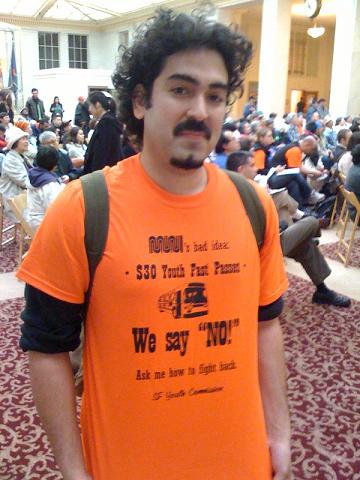
But now, thanks to a bullying incident at school, and the city’s overly draconian policy towards immigrant youth, Washington’s wife and her 13-year-old son will be deported to Australia on Friday, and her 5-year-old boy will accompany them, while Washington  stays in San Francisco to look after his 12-year old daughter (pictured in a photograph taken at the March 1 press conference at Asian Law Caucus).

“There are no laws that prevent me from going to Australia, but I have joint custody of my daughter from a previous marriage and her mother is not going to authorize the child to move, so I’m hoping for a miracle,” Washington explained.

His wife Tracey, who has been forced to wear a federal electronic monitoring bracelet since February, looked on in silence, flanked by her sons and step-daughter.

Washington, who grew up on Mt. Davidson Terrace, and was formerly in the military, had been driving a MUNI bus for a year and a half, when he woke one morning after he got home from his late-night MUNI shift, to hear the phone ringing with a call from his stepson’s school to say there where problems between him and a sixth grader.

“The school told me it was their policy to call the parents any time the police are going to talk to a child,” Washington said. Twenty minutes later, he and his wife were at the school, talking to an SFPD officer, who said a report had been filed by another parent about the incident and the police now wanted to talk to their kid.

After the interview with the police, Washington thought the worst thing that could happen was that the officer would write a citation to say his son needed to appear at juvenile court. Instead, the police arrested his stepson, putting him in handcuffs and saying that they were going to take him to the Juvenile Justice center.

“I think my son was in shock, as I was, “ Washington said. “What he actually did, and what the actual charges are, they are universes apart. Back when I was in school, at worst, a bully was sent home for the day, creating problems for them at home, when they explain to their parents why they’ve been sent home.”

Instead, Washington’s stepson was charged with felony robbery, extortion and assault after the parents of a sixth-grader at his school called the police, but his case has yet to be adjudicated by a juvenile justice, –and a bench warrant will be issued if he fails to attend a March 8 hearing in San Francisco—3 days after he and his mother are deported.

According to Washington, (pictured here (left) with Angela Chan, (right) staff attorney for the Asian Law Caucus) no weapons, no injuries and no witnesses were involved in his stepson’s incident. “And it was strictly one kids’ words against the other,” Washington said.

So, why did the police decide to refer his stepson to the federal immigration authorities?

“I think the officer picked up on the fact that he had an accent,” Washington said. “And when asked where he was born, my stepson said, ‘Australia.’ He is 13 years old. He doesn’t know if he is undocumented or not. As far as he is concerned, he was born in Australia, moved to San Francisco, and this is his family, his new family.”

Washington said his stepson was held for a week at Juvenile Hall for a week, during which the atmosphere at home became tense and stressful.

“We did not understand why this was happening,” Washington said. “Kids on my bus get on and do way worse things than he actually did, and the police usually make their presence known, but there is no worry about going to Juvenile Hall.”

But the worst was yet to come.
After his stepson had been at Juvenile Hall for about a week, Washington got a call from his stepson’s probation officer, saying that he was going to have to contact federal Immigration and Customs Enforcement (ICE).

“He said he had to contact ICE, that he was just doing his job, that it’s what’s required under his job title,” Washington said.

Under a new policy that Mayor Gavin Newsom ordered in the summer of 2008, the city’s juvenile probation officers are required to contact the feds when a juvenile is booked on suspected felony charges. This means, the probation officers are required to contact ICE before immigrant kids have even had a hearing before a juvenile judge to determine if they are in fact, guilty, as charged.

‘They didn’t say, ‘he might be deported,’” Washington said.” I was just told that there might be a ‘ICE hold put on him,’ but at this point I was still not understanding the importance of ICE.”

Once ICE picked up his stepson and transferred him to ICE’s facility on Sansome Street, Washington got a call from his stepson, who said he was OK.

“At this point, we were aware of the immigration issue, so I told my wife to stay at home and I went down there with a lawyer, and I was able to meet with my son,” Washington recalled.

But when he got back home, he received a call from his lawyer who notified him that if his wife was willing to go in and put on an electronic monitoring ankle bracelet, the feds would release their son.

“So, I drove my wife to Sansome Street, and that’s when we were informed that she was being handed her deportation orders, along with our 13-year-old son,” he said

His wife has been wearing the electronic monitoring ankle bracelet ever since.

“She wore pants today because it makes her feel ashamed, and she cries nightly over the fact that she feels like she’s being treated like an animal,” Washington said. “She says, ‘I feel like they think I’m a murderer, but I’m not, I haven’t done anything wrong.’”

According to Washington, his wife arrived in the country along with her kids on a 90-day visa-waiver, and the couple got married about 45 days into that visa.

“We had known each other for seven years, and we looked into getting a green card, two days after we were married, and we were told, not once, but twice, that if you enter on a visa-waiver, there is no deadline to apply for your green card. We were misinformed.”

But while Washington notes that the office that he spoke to was a contractor for the federal government and had its information wrong, he still can’t get over the fact that the federal government would treat him and his wife this way, using their son as bait.

‘This is all shocking to me,” Washington said. “I never dreamed America would treat not only someone from America, but someone not from America, this way. All we want is for our application to be reviewed based upon the facts. We are being told it’s too late.”

Equally upsetting for Washington was the experience of seeing his stepson used as bait.

‘They used our son as bait, just to get the mother to come in,” he said. “ Our son wasn’t there for more than 4 or 5 hours ,and we had no clue that the deportation papers would be served until we walked in. They hadn’t even put the monitoring bracelet on her. She could easily have run, but we still don’t want to break the law, regardless of the outcome. Even though we did something wrong according to ICE, it wasn’t intentionally. If we had been given the correct information, we wouldn’t be here. Yes, we couldn’t afford the money at that time, but we’d have made sacrifices.”

Washington said he is reaching out to the media in a last ditch effort to save his family.

“I don’t know any other way but to network, maybe someone might know someone else who can save my family,” he said. ‘My stepson, he’s just a nerd, he’s not a violent person, he’s not aggressive at all, he’s just being a boy, and he really hasn’t had a father figure in his life, until he moved here.”

Angela Chan, staff attorney for the Asian Law Caucus, which has been helping the Washington family try to get their green cards, said that if the son had never been reported to ICE, then the family likely would have received green cards.

“But now they are refusing to consider it, because of the ICE referral,” Chan said.

Chan also explained that if the boy was able to appear before a juvenile justice, he’d likely get informal probation for a first-time minor offense.

“He only had a hearing, but the juvenile proceedings were halted, when he got handed off to ICE,” Chan said. “The District Attorney had filed charges, but they had not yet been adjudicated, and a judge had not yet reduced the charges.”

Jane Kim, President of the San Francisco United School District said the School Board unanimously supported the amendment to Newsom’s policy that Sup. David Campos introduced last year and which a supermajority of the Board of Supervisors supports.

“We have seen how changes in the Juvenile Probation Department as of August 2008 have been used as a blunt tool to separate family members, regardless of whether the juvenile is convicted of the charges, and regardless of the family’s circumstances. And we don’t believe that the Campos amendment violates the US Constitution.”

“Newsom’s policy has put a lot of burden on our staff,’ Kim said, explaining how schools are now worried about calling the police, lest students end up being deported because the police referred them to ICE, based merely on accusations, 

“For those worried about public safety, I think this type of situation encourages under reporting,” Kim said.

Washington for his worries that his wife and her kids will be homeless in Australia.

‘My wife sold her furniture and gave up her apartment in Melbourne to come here, and her mother and father have a one-bedroom apartment, so there is no space for her and two kids,” he said

He also worries that if they ever manage to come back, his stepson will have a warrant out for his arrests:
 ‘Today we were notified that if my stepson doesn’t show up for his March 8 pre-hearing (in the juvenile justice system where the DA’s office is pressing charges), we’ll have to worry about a warrant for his arrest, which will make it even more difficult for him to move back” Washington said.

If a person is deported, they are barred from reentering the country for 3-10 years.

The Washingtons’ federal deportation will occur the day after the Board of Supervisors holds a hearing into why the city’s Juvenile Probation Department has failed to implement the city’s new policy towards immigrant youth: under the new policy, which the Board passed in 2009, a teenager like Tracey Washington’s son would get his day in court before being referred to federal immigration.

Since July 2008, when Newsom first began requiring probation officers to report all suspected undocumented youth for deportation right after arrest – before the youth  receives an attorney or a hearing on the alleged charges, over 160 children have been reported to ICE without regard to their innocence or how minor the offense.

In November 2009, a community-based based campaign resulted in the passage of a new policy that restores due process to immigrant youth. The new policy gives youth an opportunity to have a hearing and requires a finding that the youth committed a felony before any referral to ICE. If implemented, the new policy would boost public safety for all residents because it would put an end to the Mayor’s policy, which has caused immigrant residents to be afraid to have contact with city employees.

 “Until Mayor Newsom restores due process to all youth in San Francisco, many more hard-working families like the Washingtons will be torn apart,” said Chan.
On Thursday, March 4, the Board’s’ Rules Committee will hold a 10.30 am hearing at City Hall regarding Juvenile Probation Department’s refusal to implement the Campos amendment which would restore due process to youth.

Pressure builds to save Muni

5

Widespread frustration with Muni service cuts and fare hikes – passionately expressed by the public on Friday at a San Francisco Municipal Transportation Agency meeting that continues tomorrow (Tuesday, March 2, starting at noon in City Hall Room 400) – has prompted a surprisingly diverse backlash.

From angry, street-level progressive activists to the downtown-friendly San Francisco Planning and Urban Research Association (SPUR), San Franciscans are criticizing the SFMTA’s budget plan (including the 10 percent service cuts approved on Friday, which could be revisited tomorrow) as short-sighted and unnecessarily divisive, prompting the biggest and most diffuse progressive organizing effort in years.

“I’ve never seen anything like this,” SFMTA spokesperson Judson True told me as he surveyed the huge, passionate crowd assembled for Friday’s meeting, adding, “It’s clear grassroots organizing is alive and well in San Francisco.”

It’s true that grassroots organizing helped with Friday’s massive turnout, with hundreds of people lined up to give almost five hours worth of public testimony, much of it expressing frustration with poor city leadership (particularly by Mayor Gavin Newsom and his appointed SFMTA board and director) and declining public services.

But these weren’t the talking points of a centrally organized effort, which is what’s so remarkable about this movement. While many progressive groups joined forces under the Transit Not Traffic banner (coordinated by MTA Citizens Advisory Board member Sue Vaughn and others), and there’s a new San Francisco transit riders union (coordinated by transportation activist Dave Synder), the huge turnout on Friday came also from disability rights groups, ethnically identified groups from the Mission and Chinatown, the Senior Action Network, San Francisco Tomorrow, the social justice group POWER, the antiwar ANSWER Coalition, and several other groups, with very little coordination among them.

“We are really seeing a diverse group of people arguing for transit justice,” said Marc Caswell of the San Francisco Bicycle Coalition, which was part of the Transit Not Traffic coalition.

In fact, with Muni fares increasing and services declining since Newsom became mayor, a wide variety of groups seems to have figured out independently that there’s something seriously wrong with Newsom’s no-new-taxes approach to running the city, particularly given declining transit funding from the state and feds.

“These aren’t solutions. They’re just pitting one group against another,” said Frank Lara of the ANSWER Coalition, which opposes a proposal for extended parking meter hours, much to the chagrin of progressive groups who want motorists to help close the budget gap by giving up their free parking on Sundays.

One SPUR proposal also seeks to eliminate this pitting of groups against each other, listing as its biggest dollar proposal the elimination of work orders from the San Francisco Police Department, which would save $12.2 million per year, which the SFPD charges SFMTA for unspecified services that it has yet to document, despite agreeing to as part of last year’s budget deal.

When asked about the work order proposal, Newsom press secretary Tony Winnicker said doing so would make Muni less safe by discouraging officers from riding buses, saying such work orders were a “good accounting practice” rather than the budgetary shell game that progressive supervisors and SPUR director Gabriel Metcalf have called it.

“The gamesmanship with work orders has got to stop,” Metcalf told the Guardian, criticizing the SFMTA for cutting service across the board and raising fares for express bus service and cable cars. “They don’t have to do that and they shouldn’t do that. They just need some political courage right now.”

The next largest SPUR proposals are to charge $300 per year for disabled placards that allow drivers to park for free (which would raise $10 million per year) and to enforce existing city codes that require garages to charge by the hour rather than all day (which would raise $6.85 million), followed by Muni work rule changes that would need union approval.

Winnicker said Newsom was aware of the big turnout on Friday and the anger voiced by the crowd, telling us, “He understands people are concerned and he shares those concerns.” But rather than accepting that many people blame Newsom, Winnicker blamed Muni’s Transportation Workers Union for voting down about $5 million worth of wage concessions and work rule changes. Yet many speakers criticized Newsom’s finger-pointing on Friday, saying he and the SFMTA were too focused on targeting workers rather than the downtown corporations that Newsom has refused to adequately tax.

“There was already a fare increase last year, so for the low-income popular, this is major,” Wing Hoo Leung, vice president of the Community Tenants Association, told me in Mandarin, translated by Tan Chow, an organizer with Chinatown Community Development Center. “In a bad economy, the low-income people can’t get hit again and again. We need to cut from the top.”

Tax measures will be a big part of tomorrow’s SFMTA discussion of the $100 million budget deficit looming for the next two years – such as a parcel tax, downtown transit assessment district, parking tax increase, or local vehicle license fee — and several SFMTA board members agreed with the statement made Friday by Trustee Malcolm Heinicke that, “We need to look for other sources of revenue.”

Even Winnicker said Newsom acknowledges the need to discuss tax measures, even though he philosophically opposes them: “He understands that many things have to be on the table to close next year’s budget gap.”

But he’s far from advocating for any revenue-side solutions.

“The mayor doesn’t think the tax measures will have much public support,” Winnicker said. Yet progressive groups say that’s because Newsom has undermined people’s faith in local government and actively opposed tax increases rather than trying to make the case to the public that they’re needed to present public transit and other vital services.

“Newsom has to be out there fighting, one at the state level, and he needs to show some leadership here,” said Bob Allen of the group Urban Habitat. “I don’t want to hear Gavin Newsom say again that this is a transit-first city if he’s not going to do anything to support it.”

But Allen said that if Newsom and other city leaders made the case for new taxes to support transit and ran a strong campaign, “This city will support a ballot measure to protect Muni and expand it.”

Yet right now, he said one of the things frustrating low-income San Franciscans is there is a basic inequity between motorists and Muni riders: “If parking is going to be free on Sunday, transit should be free on Sunday. If parking is going to be free in the evenings, transit should be free in the evenings.”  

Newsom has long voiced opposition to extended meter hours, only recently softening that position slightly to possibly allow for a small pilot program for Sundays. But his appointed trustees might be willing to go even further, with Bruce Oka saying on Friday, “I know the mayor doesn’t like it, but it has to be tried.”

Bill Bennett, the only public official in California to take on PG&E

0

William Morgan Bennett, 1918-2010

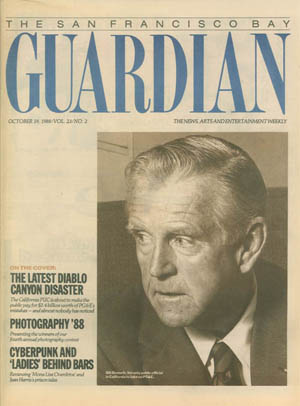
On the front page of the Guardian of Oct. 19, 1988, we ran a big picture of Bill Bennett with a caption that read: “Bill Bennett, the only public official in California to take on PG&E.”

The reason we featured Bennett was because the California Public Utilities Commission was poised to make yet another multi-billion giveaway to the Pacific Gas & Electric Company.

This time the CPUC would force the public to pay $3.4 billion worth of PG&E’s mistakes  at its Diable Canyon nuclear power plant and not one public official in San Francisco, home of the PG&E/Raker Act scandal, and not one from any other public agency or public institution was on hand to monitor the CPUC hearings and testify about the horrible impacts the Diablo rate hike will have on the public.

The lone, honorable exception was Bill Bennett. Our editorial noted, “The only public official in California who has taken on the case is Bill Bennett, a member of the State Board of Equalization and a former member of the CPUC, a determined old warrior who fought Diablo from the start and continues to do so today, on his own, against the odds and at considerable personal cost.”

To drive the point home about Bennett’s couirageous stand, we continued, “Those who ignored the case–for example, the supervisors, mayor and city attorney of San Francisco, the board of directors of BART, the regents of the University of California and their counterparts in every other public agency and institution that pays or represents people who pay PG&E bills–ought to be ashamed. The citizens of every city, county and district ought to look at their representatives and ask: Where were you when PG&E walked away with all the marbles.”

 The press in Northern California was ignoring the story, despite the colorful,  forceful and newsworthy campaign that Bennett was waging. He said he had called the  Chronicle and Examiner reporters to try to interest them in the story, but “it was useless so I gave up.”  Guardian Reporter Jim Balderston did the story and quoted Bennett  as saying, among other things, “This commission (the CPUC) must think long and hard of the welfare of the ratepayers and the shareholders of PG&E.” With no Bill Bennett on the CPUC, PG&E once again quietly walked away with billions in ratepayer money.

William Morgan Bennett, the public attorney  who for more than five decades fought the corporate goliaths from taking all the marbles, died Feb.9th at his home in Kentfield after a short illness. He was 91. An overflow crowd paid tribute  to his extraordinary life and career at services held on Feb. 12th at St. Patrick’s Church in Larkspur

When his daughter Joan phoned me about Bennett’s death, I realized once again how much the Guardian and the consumer and the rate-payer would miss Bennett. We are in the middle of PG&E’s biggest monopoly scam ever –Prop l6 and PG&E’s initiative to kill public power and community choice aggregation (CCA)– and Bennett is alas missing in action, for one of the first times in his life. Today, there are other public officials out there fighting PG&E, but there is nobody who can  take on PG&E and its allies as effectively as Bennett.

Our 1988 story had a sidebar with the head, “Bennett vs. PG&E: The 30 years war.” The sidebar recounted an incident characteristic of Bennett and the way he gave new meaning to the term public service.  In 1959 the El Paso/Pacific Northwest natural gas pipeline merger was all but approved by the CPUC, except for an appeal from Bennett as CPUC general counsel.  Before Bennett could file the appeal, he got a phone call from Gregory Harrison, a partner in the politically powerful law firm of Brobeck, Phleger and Harrison. Harrison asked Bennett if he was going to file. Bennett said yes and Harrison responded, “I told them you would say that.”

Harrison told Bennett he would be removed from the case if he filed the appeal. Bennett told Harrison he was going to call a press conference. Harrison responded. “I told them you would say that,” and hung up. Shortly thereafter, Bennett got a call from Gov. Brown, who asked him if he was going to file the appeal. Bennett said yes and Brown refused to discuss the matter further.

Twenty minutes later, Bennett got a telegram from Brown that stated, “You no longer represent me or the State of California in USA v El Paso.” This infuriated Bennett and fueled his relentless 14-year crusade to compel El Paso to divest itself of Pacific Northwest. because of its price-fixing and monopolistic implications for California. In 1969, appearing as a private citizen, he successfully argued the final U.S. Supreme Court appeal in the case, the last oral argument heard by the Earl Warren court.

The Washington Monthly caught the drama and precedent of Bennett’s appearance in its November 1971 issue. “His last appearance before the court in 1969
needs to have been witnessed. Standing alone against an array of the best legal talent that could be provided by El Paso, the states of California and Utah, lawyers for other gas companies and the U.S. government, represented personally by Solicitor General Erwin Griswold, Bennett attacked as the lone surviving avenging angel of the original antitrust action. Finger in the air, voice crying out in toners of retribution, he spoke brilliantly and forcefully without notes for an hour…In the process, Bennett impressed at least one justice privately, and many more observers, as one of the most brilliant and effective lawyers to have gotten to his feet to present oral arguments to the court during the last 14 years.”

 As the final footnote in this legal saga, Bennett  stopped El Paso’s efforts in Congress to pass legislation to void the breakup of El Paso. The result: the largest refund for California ratepayers in the history of regulation to date.  The decision set a  national precedent in antitrust law.

Bennett was born Feb. 20, 1918 in San Francisco to Lt. William M. Bennett of the San Francisco Police Department and Eva Curran of Amador. He attended Most Holy Redeemer Elementary School, St. Ignatius High School, the University of San Francisco and the Hastings College of Law. At the outbreak of World War II, he suspended his law studies and joined the U.S. Army Air Corps.

He was a B-17 pilot in the North African, Mediterranean and European theater of operations, l5th Air Force, 483rd Bombardment Group, 815th Squadron, stationed in North Africa and then in Foggia, Italy. The 483rd flew a total of 215 combat missions during 14 months of combat duty and Bennett was in the middle of it all. “Wherever there were major oil refineries, aircraft and parts factories, tank works, railroad terminals and marshaling yards, supply dumps, bridges and communication networks, he saw action,” Jane Bennett said.  He flew 35 missions and encountered severe flak and fighter attacks at some of the most heavily defended targets in Europe:  Linz’ Herman Goering Tank Works; Berlin’s Daimler-Benz Tank Works; Innsbruck; Vienna; Regensburg; Blechhhammer; Schweinfurt; Salzburg; Landshut; Moosbierbaum, and Ruhland where ME 262 German jets attacked his squadron.

The Tuskegee Airmen, the famous black squadron, escorted Bennett’s missions. “Their base was right next to my father’s,” Joan Bennett said. “They were separated on the ground but equal in the air. That is, they were  equal targets for the Germans.” Bennett often visited some of the fighters across the runway that segregated the blacks.   George McGovern,  the bomber pilot who later became a presidential candidate in l972, was stationed at a nearby base.  He flew B-24s.

Bennett flew some of the first shuttle missions into Russia.  As the bomber squadrons flew deeper into Germany, the planes did not have fuel or were too shot up  to return to their base in Italy. So the squadrons continued on to Poltova,  Russia, to get refueled  and repaired, and  then either flew back  immediately back to their base or stayed over night and flew back the next day.  The missions were kept secret during the war  but later became known as the “Poltova missions.”

 Of the original 646 crew members sent to Italy in March 1944, 38 per cent were killed or missing in action. His bomb group received numerous battle awards, including two outstanding unit presidential citations. Bennett was highly decorated and won three Oak Leaf Clusters, four Bronze Stars and the Distinguished Flying Cross. He was awarded the DFC  for his courage and skill in miraculously bringing his plane back from a mission over Worgi, Austria, in February, 1945.  Bennett’s plane was hit by heavy enemy fire and the two right engines were shot out. He told his crew to bail out but they refused because they counted on Bennett to pull  them through.  Bennett did, safely piloting his crippled plane over the Alps. When the plane limped back to its base in Italy, there was nothing left inside, because the crew had ditched everything to lighten the load.


Col. Paul L. Barton, Bennett’s commanding officer, pins the Distinguished Flying Cross on Bennett in a ceremony on May 12, l945, at the air base on the Sterparone farm in Foggia, Italy.  Gen. Twining, head of the l5th Air Force who ended up as Chief of Staff of the USAF after the war,  attended the ceremony.  “There was no Tom Hanks, Brad Pitt, Tom Cruise WWII move glamor,”  Bennett’s daughter Jane told me.  “The base itself was primitive: steel mats for runways.  Ankle deep mud in the winter along with snow, ice and rain. Open latrines, no toilet paper, tent-living with one crew per tent. No mess halls. One canteen of water per day, etc.”  She said the Bennetts visited the farm in l982.  “The runways were vineyards,” she recalled. “The briefing hall for the men still stands. The interior of white plaster is still lined with drawings of pinup girls. The young girl who lived on the farm during the war is now the owner of the family land. She was very gracious.  She invited us in for coffee.”

 After the war, Bennett finished  law school at the University of San Francisco and then embarked upon a remarkable career of public service. Until I started working on his obituary,  I knew nothing about Bennett’s distinguished war record as a bomber pilot.   But it is clear to me that, having followed Bennett through the years, that  his combat experience under artillery fire and with flak coming at him from all directions served him well in public life.  He spent most of his public career  as a tough, smart and  aggressive attorney who relished  taking on the big cases and the big corporate behemoths who were screwing the public on illegal mergers or monopoly rate increases. To him, this was just combat in a different theater of operations. Sometimes as a public attorney, sometimes acting as an individual citizen, he handled precedent-setting cases  in antitrust, regulatory and criminal law and argued six times before the U.S. Supreme Court. He earned the nickname “the legal Houdini” but I always thought of him as “Fighting Bill” Bennett.

 As a deputy attorney general, he successfully prosecuted public corruption trials in 1954-55 against the State Board of Equalization in San Diego and put l3 public officials in jail. From 1957-59, he handled the celebrated case of Caryl Chessman, known as “the redlight bandit.” After his argument before the U.S. Supreme Court, the court clerk quietly handed him a note from Associate Justice Felix Frankfurter. He wrote, “There is no reason why I should not tell you how admirably you represented the state in this important case.” The clerk told Bennett he should save the note because it was only the second such note that Frankfurter had ever written.

From 1957-58, Bennett represented the state before the CPUC and won many cases against utilities that resulted in hundreds of millions of dollars in ratepayer rebates. Gov. Brown appointed him chief counsel of the PUC in 1958.

In 1960 Bennett was invited to join Sen. John F. Kennedy’s campaign as an advance man canvassing a territory from Chicago to New York.  He became friends with JFK and was considered part of Kennedy’s “Irish mafia.” Kennedy asked him to head the Federal Power Commission but he rejected it to remain with his family.

Bill Bennett and then presidential candidate John F. Kennedy  are pictured in 1960 as they got off the campaign plane at O’Hare field in Chicago.  Bennett was an advance man for JFK and helped stage several rallies in Chicago. Then JFK and Bennett headed east to Hamtramck, Michigan, and finished up at the garment center in New York.  JFK asked Bennett to be head of the Federal Power Commission but Bennett turned the appointment down to remain in California with his family.

In 1962, after Brown appointed Bennett to the CPUC, he promptly took on PG&E with gusto.  With the support of the Sierra Club, Bennett filed the lone dissenting opinion against the CPUC’s approval of a nuclear power plant upwind of San Francisco at Bodega Bay. The  Bodega fight was started in the living room of Prof. Joe Neilands, a UC-Berkeley biochemistry professor and stoked along by the Neilands/CharlieSmith/David Pesonen gang, with help from the Chronicle and its executive editor Scott Newhall and environmental writer Harold Gilliam.  The battle caught on and became a national story and focal point for the emerging anti-nuclear movement. PG&E was forced by public opinion to withdrew its application and skedall down  to Diablo Canyon. And so did Bennett.
Bennett was later visited by the chairman of PG&E, Robert Gerdes. told Bennett, “We don’t mind you dissenting, but do you realize the Russians are trying to stop us from building atomic plants.”

During his CPUC tenure, Bennett led the commission to regularly reduce electricity and gas rates in response to rate cases before the commission. In 1968, then Gov. Ronald Reagan refused to reappoint Bennett to the commission and sent Bennett a letter apologizing for not being able to reappoint him. Reagan did not explain the reason. Before Reagan could kick him off the CPUC,  Bennett  had saved the consumers hundreds of millions of dollars. Ever after Bennett, the CPUC has operated on a supine  basis with PG&E and other utilities and has handed down rate increases and goodies to them on a virtual assembly line basis.  

I first met Bennett in 1967 in his CPUC office overlooking the Civic Center  in the  state building. Lee Fremstad, then the San Francisco correndent for the Sacramento Bee, took me in and introduced me. I had rarely seen a public official like Bennett. He knew about the Guardian and me, had some juicy story ideas for me, and a batch more for Fremstad. Fremstad bantered back and forth with Bennett, noting a couple of ideas but rejecting others as too much even for the Bee and its longtime public power posture.  Bennett was open, expansive,  full of Irish humor,  a populist Democrat full of opinions I liked, jutting the Bennett jaw to make a point, and the kind of guy  who might be good for a lively  three martini lunch.

I thought he would have made a wonderful newspaper columnist or editorial writer, if he could find a newspaper that would publish his  tough consumer-oriented opinions that so  agitated the PG&Es and Hearsts  of the region.  We always enjoyed  Bennett at the Guardian, endorsed and supported him and used him as a friendly source and inspiration.all through the years. 

When Bennett left the CPUC, Neilands and Smith held an appeciation dinner for him in Berkeley that brought together the Bodega Bay/public power warriors of the era.   This was a watershed moment for the Guardian and me.  My wife Jean and I went, met Bennett and Neilands et al and got initiated. We also met Peter Petrakis, a fan of Bennett’s, and a graduate student of Neilands. Neilands did our pioneering expose of the PG&E/Raker Act  scandal in l969.   Petrakis joined the Guardian and  followed up Neilands’ work with a series of investigative storiies that revived the scandal and  the public power movement in San Francisco.  Bennett, as I realized, was a catalyst.  

Bennett’s next move to stay in public service was to run for the State Board of Equalization and Franchise Tax Board. He won his first campaign in l970 even though his opponent outspent him $450,000 to $4,000, all his own money. He was relected to five more terms, despite refusing to accept campaign contributions, and continued to fight the good fight against the special interests in Sacramento and beyond. He was also a professor of law at Hastings while on the board.

Bill Bennett with his wife Jane in 1943 at the primary cadet school in King City, Calif. They were married 67 years.

Bennett is survived by his wife of 67 years, Jane, and sons William (wife Gwendolyn) of Lafayette, James (Paula) of Kentfield, Michael (Roxanne) of Manhattan, Kansas, and daughter Joan of Kentfield and grandsons Jimmy, Will, Jack, and Brendan of Kentfield.

The Bennett family obituary  sums up their patriarch: “Despite his friendships with president and esteemed jurists, his out-going nature was such that he was a friend to all. He was a populist democrat, consumer rights advocate, and a veritable David against the corporate world’s Goliaths, in the vein of his mentor and ultimately friend, Earl Warren. Even with such achievements, his most important and cherished career was as a father and family man. Upon retirement, he embarked upon his most rewarding and enjoyable career: a devoted, loving, entertaining husband, father, and grandfather. For them and through them, he will live forever ‘in his way.'” 

For me, I will stick with our cutline under Bennett’s picture on our l988 front page: “Bill Bennett, the only public official in California to take on PG&E.”


The Bennett family photo was taken in May,  2009, at the Napa airport. A B-l7 was touring the country and Bennett wanted to see it. Jane Bennett said he actually went through the plane. “It was not easy. The access was a skinny, steep, metal ladder to the cockpit. I don’t know how he got up it. He refused a ride in the plane. As he said, ‘If I cannot fly it, what’s the point.'”

Who cares about SF’s (black and brown) prisoners? Part 2

2

Eileen Hirst of the San Francisco County Sheriff’s Office just sent me statistics that prove that the majority of folks sitting in our county jails are black men awaiting trial — statistics that underscore the extent to which the “let’s not rebuild the prison” debate really is racially tinged:

“On any given day, we have about 2000 to 2100 people in custody,” Hirst said, noting that the two jails at the center of the debate only house male prisoners.

The biggest group in custody, Hirst said, are African American (58 percent). Next come Caucasians (18 percent), Latinos/Hispanics (15 percent), Asians (4 percent) and others (4 percent).

The overwhelming majority are male (87 percent).

And the vast majority (80 percent) are simply awaiting trial.
”Only 20 percent of the jail population is sentenced,” Hirst said.

So, does this mean that the nine supervisors who voted this week for a $412 million seismic safety bond that won’t upgrade these jails are racist?

No, but it does suggest that they believe that voters won’t support a bond that uses money to help build safe facilities to house black men in custody. Instead, the $412 million bond they voted to place on the June ballot will be used to build a new police command center, and retrofit firehouses and secure their water supply.

“No one is saying that we’re not going to rebuild the jails, but they are going to do the project in phases, and this bond represents the first phase,” Hirst said.

She noted that two previous attempts to pass bonds to rebuild prisons failed to get the required two-thirds of voter approval.

(In 1992, 57 percent of voters approved a $158  million general obligation bond, ten percent short of the needed 67 percent. Two years later, in 1994, only 54 percent of voters approved a similar bond, only know the same project’s costs had expanded to $195 million.)

‘And at that point we were under a federal court order to rebuild the jails,” Hirst said. She recalled how hot water had to be pumped in from a flatbed truck parked on the front lawn in front of those facilities that lay just two football fields away from the San Andreas fault, and that they have since been rebuilt.

Hirst said community groups went out with huge photos of those poor conditions, but the public still didn’t vote to support the bond, and the jails eventually got  rebuilt through a “certificate of participation” financing mechanism that Monique Moyer (who was then mayor Willie Brown’s director of public finance) came up with.

“So. I don’t think we are not going to rebuild,” Hirst said. “But we do operate in a landscape of competing priorities.”

Gascon’s remarks at press conference are stunning

4

By Brady Welch

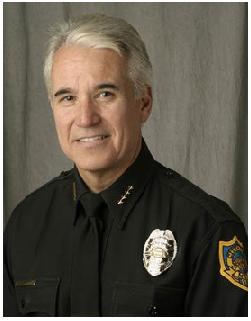
Police Chief George Gascon held a press conference Feb 25th to discuss his desire to arm his officers with Conducted Energy Devices (known to you and me as Tasers or stun guns) — and his comments demonstrated that the chief still doesn’t get it.

Gascon is arguing that Tasers could prevent some deadly police shootings. But there’s a much larger issue that he seems to be ignoring.

On December 28, 2009, the federal Ninth Circuit Court of Appeals right here in San Francisco affirmed the decision of a lower court that an unarmed man shot with a Taser can sue the city of Coronado, just outside San Diego. The zapping caused Carl Bryan to fall face first into the pavement, thus knocking out his four front teeth. To add insult to injury, one of the Taser probes lodged in the man’s flesh, requiring a doctor’s scalpel to remove it.
And what was this citizen’s crime? Getting upset with himself for being pulled over twice in the same day for routine traffic infractions. According to court records, the 21-year-old Bryan was driving home on a Sunday morning after a long night with friends and got pulled over for speeding. Later that same morning, he got stopped again, this time for not wearing a seat belt (which he forgot to put back on after initially getting stopped).

Bryan pulled to the curb and started punching the steering wheel, shouting expletives at himself for being so careless. He then got out of the car “yelling gibberish and hitting his thighs,” the court decision reports. The officer yelled at Bryan to get back in the car, but Bryan apparently didn’t hear him. Then the cop, without warning, shot the kid with his Taser gun.
Bryan didn’t die. He also wasn’t on drugs (Tasers are particularly dangerous to people under the influence of stimulants). But he was hurt — and at least according to the court files, there’s good grounds to argue that he should never have been zapped in the first place.

Gascon acknowledged that Tasers can be dangerous, although he offered a somewhat morbid justification of taser-implicated deaths—loosely paraphrased, he suggested that if you ask a crackhead to run around the block, that person would probably suffer cardiac arrest anyway. And he talked about special training to avoid police Tasing of drug-addled and mentally ill people.

But what he’s missing — and what has a lot of community activists concerned — is the situation in Coronado: The Taser shooting of someone who should never have been shot with anything. Two police commissioners, Petra DeJesus and Vincent Pan, have expressed concerns over whether people can trust a San Francisco police department armed with semi-lethal weapons that officers might feel inclined to used in decidedly less than semi-lethal situations. The Ninth Circuit’s opinion is only the most recent and ballyhooed case.

What was particularly galling during the chief’s press conference was when Taser-supporting commissioners Tom Mazzucco and Jim Hammer came forward to plead the case for using Tasers on the mentally ill — as opposed to real bullets — almost as if to say, Certainly, we can all agree on this.

Well, maybe not. Here’s what the Ninth Circuit had to say:

A mentally ill individual is in need of a doctor, not a jail cell, and in the usual case—where such an individual is neither a threat to himself nor to anyone else—the government’s interests in deploying force to detain him is not as substantial as its interest in deploying that force to apprehend a dangerous criminal. Moreover, the purpose of detaining a mentally ill individual is not to punish him, but to help him. The government has an important interest in providing assistance to a person in need of psychiatric care; thus, the use of force that may be justified by that interest necessarily differs both in degree and in kind from the use of force that would be justified against a person who has committed a crime or who poses a threat to the community.

In other words: Cops shouldn’t be shooting mentally ill people anyway, with Tasers or with pistols.

And if you give the cops Tasers, it’s almost certain that they’ll zap a whole lot of people who were, as one critic put it, “guilty of nothing more than mouthing off to a cop on the bus.”

BTW, there’s an interesting Amnesty International report on Tasers here


Film listings

0

Film listings are edited by Cheryl Eddy. Reviewers are Kimberly Chun, Michelle Devereaux, Max Goldberg, Dennis Harvey, Johnny Ray Huston, Erik Morse, Louis Peitzman, Lynn Rapoport, Ben Richardson, and Matt Sussman. The film intern is Peter Galvin. For rep house showtimes, see Rep Clock. For first-run showtimes, see Movie Guide.

OPENING

Cop Out Kevin Smith directs Tracy Morgan and Bruce Willis in this buddy-cop comedy. (1:50) Oaks.

The Crazies Remake alert! This time, it’s a revisiting of George A. Romero’s 1973 cult flick about a town whose residents suddenly start going insane. (1:41)

Formosa Betrayed The turbulent modern history of Taiwan is certainly deserving of increased international attention, but writer-producer Will Tao’s strategy of structuring Formosa Betrayed as a political thriller is too often at odds with imparting facts and information. Set in the early 80s, the film thrusts viewers into an unraveling government conspiracy that has FBI agent Jake Kelly (James Van Der Beek) trailing the suspected murderers of a Chicago professor to Taipei. Initially, selling Dawson’s Creek alum Van Der Beek as an FBI agent seems a strange choice, but undoubtedly his name will fill seats, and Formosa Betrayed is shooting for maximum awareness. There are some scenes of real tension, but just when you are beginning to get wrapped up in the inherent drama of conspiracy and murder, the suspense is interrupted by a long-winded bout of soapboxing. Formosa Betrayed might enlighten some audiences about Taiwan’s controversial history, but it too often does so at the expense of its own watchability. You start to wonder why Tao didn’t just make a documentary. (1:43) Shattuck. (Galvin)

*"German Gems" Berlin and Beyond film festival founder Ingrid Eggers programmed this slate of 2009 German-language releases, which range in content and tone from a quirky documentary of a female-helmed, around-the-world adventure by automobile in 1927, Miss Stimmes, to the not-quite-dark-nor-funny enough "noir comedy" about extortion, cannibalism, and revenge, The Bone Man. But it’s the two featured dramas that will likely garner the most attention: Being Mr. Kotschie, by Norbert Baumgarten, and Vision, by Margarethe von Trotta. As Jürgen Kotschie wearily anticipates his fiftieth birthday, his rather bland, suburban life begins to fracture almost imperceptibly; imperceptibly, at least, to others. But from Kotschie’s point of view, the tenuous line between reality and dreams begins to blur, and he becomes increasingly alienated from his uneventful existence. A fevered, hallucinogenic road-trip to an equally uneventful village in search of an old flame ensues, and, somewhat remarkably for a modern German film, he learns to gratefully accept the simple pleasure of being alive. Being Mr. Kotschie offers a dose of existential-crisis-lite, neurotically embodied by a thoroughly likeable lead (Stefan Kurt), whose minor resemblance to Basil Fawlty adds a sense of physical playfulness to the role. In Vision, the remarkable life of Hildegard von Bingen is given the biopic treatment by von Trotta with mixed results. On the one hand, the subject matter of a multi-talented, visionary "renaissance woman" who lived 300 years before the Renaissance even began, is truly compelling. But von Trotta can’t help but throw a little Sapphic mystery into the mix, and the powerful bond between Hildegard (Barbara Sukowa) and the spirited Richardis (Hannah Herzsprung) plays out like a not entirely convincing hot-for-teacher melodrama. Fortunately, Sukowa plays the headstrong Hildegard with just the right amount of compassion and self-importance, and Heino Ferch is rock-solid as her confidante, scribe, and confessor, Brother Volmar. Castro. (Nicole Gluckstern)

The Ghost Writer Embattled filmmaker Roman Polanski’s latest is a thriller starring Ewan McGregor, Pierce Brosnan, and Olivia Williams. (1:49) Embarcadero.

*"Red Riding Trilogy" There’s a "wolf" of sorts and several unfortunate little girls, but no fairy tale whimsy whatsoever in this trilogy of features originally made for U.K. broadcast. Based on David Pearce’s literary mystery quartet (the second volume goes unadapted here), it’s a complicated dive into conspiracy, cover-up, and murder in England’s North Country. Directed by Julian Jarrold (2008’s Brideshead Revisited), first installment Red Riding: 1974 centers on ambitious young journalist Eddie (Andrew Garfield), who at first sees a string of abducted, then grotesquely mutilated children as a career-making opportunity. The deeper in he gets, though, the more troubling are the case’s murky connections to police and private-sector corruption. 1980, directed by James Marsh (2008’s Man on Wire), finds a new protagonist in Hunter (Paddy Considine). Now local fears are focused on the "Yorkshire Ripper" a savage (real-life) killer of at least 13 women between 1975 and 1981 whose so-far hapless police investigation Hunter has been assigned to audit. Finally, 1983 (directed by Anand Tucker of 2005’s Shopgirl) divides its attention between Yorkshire chief detective Jobson (David Morrissey) and low-rent lawyer Piggot (Mark Addy). After the first copycat child slaying in years occurs, both become convinced a mentally challenged man (Daniel Mays) was framed for the original murders. The nearly six hours this serpentine tale takes can’t help but impress as a weighty experience (at least on your posterior), and it’s duly won some sky-high critical acclaim ("better than the Godfather trilogy", etc.) Certainly Red Riding is rich in period detail, fine characterizations, and bleak atmospherics. But the cumulative satisfaction expected of a true epic is broken up by the sole ongoing characters being supporting ones — heroes who eventually "know too much" don’t survive long. In each segment (Marsh’s Super-16-shot one being most stylistically distinctive), women deployed as romantic interests seem largely superfluous. The whole fussy, cipherous narrative points toward a heart of jet-black darkness its climactic revelations are at once too banal and implausible to deliver. So, worthwhile? Yes, if you’ve got the time to spare. A hype-justifying masterpiece? No. (1974, 1:45; 1980, 1:36; 1983, 1:44) Lumiere, Shattuck. (Harvey)

ONGOING

*"Academy Award-Nominated Short Films: Animated" Just because it’s animation doesn’t mean it’s just for kids. Like the live-action Oscar-nominated shorts, this year’s animated selections have got range, from the traditionally child-friendly to downright vulgar. Skewing heavily towards CG fare, the shorts vary from a Looney Tunes-style chase for an elderly woman’s soul (The Lady and the Reaper) to the Wallace and Gromit BBC special, A Matter of Loaf and Death. Most entertaining by far is Logorama, an action-packed tale set in a world populated by familiar trademarked logos. Any film that casts the Michelin man as a garbage-mouthed cop on the case of a renegade Ronald McDonald deserves to win all the awards in the universe. (1:35) Lumiere, Opera Plaza, Shattuck. (Galvin)

*"Academy Award-Nominated Short Films: Live Action" Aren’t you tired of wondering what all the fuss is about when the Academy awards their Oscar for Best Short? In an effort to give audiences a chance to play along, Shorts International is screening these less-seen works together. Though one or two of the five nominated films threaten to adhere to the Academy’s penchant for either heartbreaking or heartwarming, the majority are surprisingly oddball picks. Perhaps most odd of all is Denmark/U.S. submission The New Tenants. Feeling a tad forced but no less funny for it, Tenants draws on celebrities like Vincent D’Onofrio and comedian Kevin Corrigan to bring life to this surreal adaptation by Anders Thomas Jensen (2006’s After the Wedding). My pick would be Sweden’s gloriously goofy Instead of Abracadabra, which stars a stay-at-home slacker as he puts on a magic show for his father’s birthday. Obviously, some selections are going to be better than others, but hey, they’re shorts. If you don’t like one, just wait 10 minutes and you’ll find yourself somewhere completely different. (1:35) Lumiere, Opera Plaza, Shattuck. (Galvin)

Avatar James Cameron’s Avatar takes place on planet Pandora, where human capitalists are prospecting for precious unobtainium, hampered only by the toxic atmosphere and a profusion of unfriendly wildlife, including the Na’vi, a nine-foot tall race of poorly disguised cliches. When Jake Sully (Sam Worthington), a paraplegic ex-marine, arrives on the planet, he is recruited into the "Avatar" program, which enables him to cybernetically link with a part-human, part-Na’vi body and go traipsing through Pandora’s psychedelic underbrush. Initially designed for botanical research, these avatars become the only means of diplomatic contact with the bright-blue natives, who live smack on top of all the bling. The special effects are revolutionary, but the story that ensues blends hollow "noble savage" dreck with events borrowed from Dances With Wolves (1990) and FernGully: The Last Rainforest (1992). When Sully falls in love with a Na’vi princess and undergoes a spirit journey so he can be inducted into the tribe and fight the evil miners, all I could think of was Kevin Bacon getting his belly sliced in The Air Up There (1994). (2:42) 1000 Van Ness, Sundance Kabuki. (Richardson)

The Blind Side When the New York Times Magazine published Michael Lewis’ article "The Ballad of Big Mike" — which he expanded into the 2006 book The Blind Side: Evolution of a Game — nobody could have predicated the cultural windfall it would spawn. Lewis told the incredible story of Michael Oher — a 6’4, 350-pound 16-year-old, who grew up functionally parentless, splitting time between friends’ couches and the streets of one of Memphis’ poorest neighborhoods. As a sophomore with a 0.4 GPA, Oher serendipitously hitched a ride with a friend’s father to a ritzy private school across town and embarked on an unbelievable journey that led him into a upper-class, white family; the Dean’s List at Ole Miss; and, finally, the NFL. The film itself effectively focuses on Oher’s indomitable spirit and big heart, and the fearless devotion of Leigh Anne Tuohy, the matriarch of the family who adopted him (masterfully played by Sandra Bullock). While the movie will delight and touch moviegoers, its greatest success is that it will likely spur its viewers on to read Lewis’ brilliant book. (2:06) Marina, Oaks. (Daniel Alvarez)

The Book of Eli The Book of Eli isn’t likely to win many prizes, but it could eventually be up for a lifetime achievement award in the "most sentimental movie to ever feature multiple decapitations by machete" category. Denzel Washington plays the titular hero, displaying scant charisma as a post-apocalyptic drifter with a beatific personality and talent for dismemberment. Eli squares off against an evil but urbane kleptocrat named Carnegie (Gary Oldman phoning in a familiar "loathsome reptile" performance). Convinced that possession of Eli’s book will place humanity’s few survivors in his thrall, Carnegie will do anything to get it, even pimping out the daughter (Mila Kunis, utterly unconvincing) of his blind girlfriend (Jennifer Beals, who should stick to playing people who can see). The two slumming lead actors chase each other down the highway, pausing for some spiritual hogwash and an exchange of gunfire before limping towards an execrable twist ending. At least there’s a Tom Waits cameo. (1:58) 1000 Van Ness. (Richardson)

Broken Embraces Pedro Almodóvar has always dabbled in the Hitchcockian tropes of uxoricide, betrayal, and double-identity, but with Broken Embraces he has attained a polyglot, if slightly mimicking, fluency with the language of Hollywood noir. A story within a story and a movie within a movie, Embraces begins in the present day with middle-aged Catalan Harry Caine (Lluís Homar), a blind screenwriter who takes time between his successful writing career to seduce and bed young women sympathetic to his disability. "Everything’s already happened to me," he explains to his manager, Judit (Blanca Portillo). "All that’s left is to enjoy life." But this life of empty pleasures is brought to a sudden halt when local business magnate Ernesto Martel (José Luis Gómez) has died; soon after, Ernesto Jr. (Rubén Ochandiano), who has renamed himself Ray X, visits Caine with an unusual request. The action retreats 14 years when Caine was a young (and visually abled) director named Mateo Blanco; he encounters a breathtaking femme fatale, Lena (Penelope Cruz) — an actress-turned-prostitute named Severine, turned secretary-turned-trophy wife of Ernesto Martel — when she appears to audition for his latest movie. If all of the narrative intricacies and multiplicitous identities in Broken Embraces appear a bit intimidating at first glance, it is because this is the cinema of Almodóvar taken to a kind of generic extreme. As with all of the director’s post-’00 films, which are often referred to as Almodóvar’s "mature" pictures, there is a microscopic attention to narrative development combined with a frenzied sub-plotting of nearly soap-operatic proportions. But, in Embraces, formalism attains such prominence that one might speculate the director is simply going through the motions. The effect is a purposely loquacious and overly-dramatized performance that pleasures itself as much by setting up the plot as unraveling it. (2:08) Shattuck, Smith Rafael. (Morse)

Crazy Heart "Oh, I love Jeff Bridges!" is the usual response when his name comes up every few years for Best Actor consideration, usually via some underdog movie no one saw, and the realization occurs that he’s never won an Oscar. The oversight is painful because it could be argued that no leading American actor has been more versatile, consistently good, and true to that elusive concept "artistic integrity" than Bridges over the last 40 years. It’s rumored Crazy Heart was slotted for cable or DVD premiere, then thrust into late-year theater release in hopes of attracting Best Actor momentum within a crowded field. Lucky for us, this performance shouldn’t be overlooked. Bridges plays "Bad" Blake, a veteran country star reduced to playing bars with local pickup bands. His slide from grace hasn’t been helped by lingering tastes for smoke and drink, let alone five defunct marriages. He meets Jean (Maggie Gyllenhaal), freelance journalist, fan, and single mother. They spark; though burnt by prior relationships, she’s reluctant to take seriously a famous drunk twice her age. Can Bad handle even this much responsibility? Meanwhile, he gets his "comeback" break in the semi-humiliating form of opening for Tommy Sweet (Colin Farrell) — a contemporary country superstar who was once Bad’s backup boy. Tommy offers a belated shot at commercial redemption; Jean offers redemption of the strictly personal kind. There’s nothing too surprising about the ways in which Crazy Heart both follows and finesses formula. You’ve seen this preordained road from wreckage to redemption before. But actor turned first-time director Scott Cooper’s screenplay honors the flies in the windshield inherited from Thomas Cobb’s novel — as does Bridges, needless to say. (1:51) California, Embarcadero, Empire, Piedmont, Presidio, 1000 Van Ness, Sundance Kabuki. (Harvey)

Dear John As long as you know what you’re getting yourself into, Dear John is a solid effort. Not extraordinary by any means, it’s your standard Nicholas Sparks book-turned-film: boy meets girl — drama, angst, and untimely death ensue. Here, Channing Tatum stars at the titular John, a soldier on leave who falls in love with the seemingly perfect Savannah (Amanda Seyfried). Both actors are likable enough that their romance is charming, if not always believable. And Dear John‘s plot turns, while not quite surprising, are at least dynamic enough to keep the audience engaged. But at the end of the day, this is still a Nicholas Sparks movie — even with the accomplished Lasse Hallström taking over directorial responsibilities. There are still plenty of eye-roll moments and, more often than not, Dear John employs the most predictable tearjerking techniques. By the time you realize why the film is set in 2001, it’s September 11. Sad? Surely. Cheap? You betcha. (1:48) 1000 Van Ness, SF Center. (Peitzman)

Edge of Darkness (1:57) 1000 Van Ness, SF Center.

*An Education The pursuit of knowledge — both carnal and cultural — are at the tender core of this end-of-innocence valentine by Danish filmmaker Lone Scherfig (who first made her well-tempered voice heard with her 2000 Dogme entry, Italian for Beginners), based on journalist Lynn Barber’s memoir. Screenwriter Nick Hornby breaks further with his Peter Pan protagonists with this adaptation: no man-boy mopers or misfits here. Rather, 16-year-old schoolgirl Jenny (Carey Mulligan) is a good girl and ace student. It’s 1961, and England is only starting to stir from its somber, all-too-sober post-war slumber. The carefully cloistered Jenny is on track for Oxford, though swinging London and its high-style freedoms beckon just around the corner. Ushering in those freedoms — a new, more class-free world disorder — is the charming David (Peter Sarsgaard), stopping to give Jenny and her cello a ride in the rain and soon proffering concerts and late-night suppers in the city. He’s a sweet-faced, feline outsider: cultured, Jewish, and given to playing fast and loose in the margins of society. David can see Jenny for the gem she is and appreciate her innocence with the knowing pleasure of a decadent playing all the angles. The stakes are believably high, thanks to An Education‘s careful attention to time and place and its gently glamored performances. Scherfig revels in the smart, easy-on-eye curb appeal of David and his friends while giving a nod to the college-educated empowerment Jenny risks by skipping class to jet to Paris. And Mulligan lends it all credence by letting all those seduced, abandoned, conflicted, rebellious feelings flicker unbridled across her face. (1:35) Opera Plaza, Presidio, Shattuck, Smith Rafael. (Chun)

*Fish Tank There’s been a string of movies lately pondering what Britney once called the not-a-girl, not-yet-a-woman syndrome, including 2009’s An Education and Precious: Based on the Novel Push By Sapphire. Enter Fish Tank, the gritty new drama from British filmmaker Andrea Arnold. Her films (including 2006’s Red Road) are heartbreaking, but in an unforced way that never feels manipulative; her characters, often portrayed by nonactors, feel completely organic. Fish Tank‘s 15-year-old heroine, Mia (played by first-time actor Katie Jarvis), lives with her party-gal single mom and tweenage sister in a public-housing high-rise; all three enjoy drinking, swearing, and shouting. But Mia has a secret passion: hip-hop dancing, which she practices with track-suited determination. When mom’s foxy new boyfriend, Connor (Michael Fassbender, from 2008’s Hunger) encourages her talent, it’s initially unclear what Connor’s intentions are. Is he trying to be a cool father figure, or something far more inappropriate? Without giving away too much, it’s hard to fear too much for a girl who headbutts a teenage rival within the film’s first few minutes — though it soon becomes apparent Mia’s hard façade masks a vulnerable core. Her desire to make human connections causes her to drop her guard when she needs it the most. In a movie about coming of age, a young girl’s bumpy emotional journey is expected turf. But Fish Tank earns its poignant moments honestly — most coming courtesy of Jarvis, who has soulfullness to spare. Whether she’s acting out in tough-girl mode or revealing a glimpse of her fragile inner life, Arnold’s camera relays it all, with unglossy matter-of-factness. (2:02) Smith Rafael. (Eddy)

From Paris with Love Every so often, I walk out of a film feeling like I’ve been repeatedly buffeted by blows to the face. Transformers 2: Revenge of the Fallen (2009) had this effect, and it is now joined by From Paris With Love, a movie so aggressively stupid that the mistaken assumption that it was adapted from a video game could be construed as an insult to video games. John Travolta shows up chrome-domed as Charlie Wax, a loose-cannon CIA operative with a lot of transparently screenwritten machismo and an endless appetite for violence. He is joined by Jonathan Rhys Meyers, sporting a risible American accent, and the two embark on a frantic journey across the French capital that is almost as racist as it is misogynistic. I could fill an entire issue of this newspaper eviscerating this movie —suffice to say, don’t see it. (1:35) 1000 Van Ness, SF Center. (Richardson)

The Hurt Locker When the leader of a close-knit U.S. Army Explosive Ordnance Disposal squad is killed in action, his subordinates have barely recovered from the shock when they’re introduced to his replacement. In contrast to his predecessor, Sgt. James (Jeremy Renner) is no standard-procedure-following team player, but a cocky adrenaline junkie who puts himself and others at risk making gonzo gut-instinct decisions in the face of live bombs and insurgent gunfire. This is particularly galling to next-in-command Sanborn (Anthony Mackie). An apolitical war-in-Iraq movie that’s won considerable praise for accuracy so far from vets (scenarist Mark Boal was "embedded" with an EOD unit there for several 2004 weeks), Kathryn Bigelow’s film is arguably you-are-there purist to a fault. While we eventually get to know in the principals, The Hurt Locker is so dominated by its seven lengthy squad-mission setpieces that there’s almost no time or attention left for building character development or a narrative arc. The result is often viscerally intense, yet less impactful than it would have been if we were more emotionally invested. Assured as her technique remains, don’t expect familiar stylistic dazzle from action cult figure Bigelow (1987’s Near Dark, 1989’s Blue Steel, 1991’s Point Break) — this vidcam-era war movie very much hews to the favored current genre approach of pseudo-documentary grainy handheld shaky-cam imagery. (2:11) Opera Plaza, Shattuck. (Harvey)

*The Imaginarium of Doctor Parnassus From the title to the plot to the execution, The Imaginarium of Doctor Parnassus is the kind of movie you’re told not to see sober. This is a film in which Tom Waits plays the Devil, in which characters’ faces change repeatedly, in which Austin Powers‘ Verne Troyer makes his triumphant big-screen return. The story is your basic battle between good and evil, with Doctor Parnassus (Christopher Plummer) struggling to save souls from Mr. Nick (Waits) in order to protect his daughter Valentina (Lily Cole). Meanwhile, Valentina is wooed by the mysterious Tony, played by Heath Ledger in his final film role — along with Johnny Depp, Jude Law, and Colin Farrell. There are plenty of big important themes to be analyzed here, but it’s honestly more fun to simply get lost in Doctor Parnassus’ Imaginarium. Director and co-writer Terry Gilliam has created a world and a mythology that probably takes more than one viewing to fully comprehend. Might as well let yourself get distracted by all the shiny colors instead. (2:02) Shattuck. (Peitzman)

Invictus Elected President of South Africa in 1995 — just five years after his release from nearly three decades’ imprisonment — Nelson Mandela (Morgan Freeman) perceives a chance to forward his message of reconciliation and forgiveness by throwing support behind the low-ranked national rugby team. Trouble is, the Springboks are currently low-ranked, with the World Cup a very faint hope just one year away. Not to mention the fact that despite having one black member, they represent the all-too-recent Apartheid past for the country’s non-white majority. Based on John Carlin’s nonfiction tome, this latest Oscar bait by the indefatigable Clint Eastwood sports his usual plusses and minuses: An impressive scale, solid performances (Matt Damon co-stars as the team’s Afrikaaner captain), deft handling of subplots, and solid craftsmanship on the one hand. A certain dull literal-minded earnestness, lack of style and excitement on the other. Anthony Peckham’s screenplay hits the requisite inspirational notes (sometimes pretty bluntly), but even in the attenuated finals match, Eastwood’s direction is steady as she goes — no peaks, no valleys, no faults but not much inspiration, either. It doesn’t help that Kyle Eastwood and Michael Stevens contribute a score that’s as rousing as a warm milk bath. This is an entertaining history lesson, but it should have been an exhilarating one. (2:14) Oaks. (Harvey)

*The Last Station Most of the buzz around The Last Station has focused on Helen Mirren, who takes the lead as the Countess Sofya, wife of Leo Tolstoy (Christopher Plummer). Mirren is indeed impressive — when is she not? — but there’s more to the film than Sofya’s Oscar-worthy outbursts. The Last Station follows Valentin Bulgakov (James McAvoy), hired as Tolstoy’s personal secretary at the end of the writer’s life. Valentin struggles to reconcile his faith in the anarchist Christian Tolstoyan movement with his sympathy for Sofya and his budding feelings for fellow Tolstoyan Masha (Kerry Condon). For the first hour, The Last Station is charming and very funny. Once Tolstoy and Sofya’s relationship reaches its most volatile, however, the tone shifts toward the serious — a trend that continues as Tolstoy falls ill. After all the lighthearted levity, it’s a bit jarring, but the solid script and accomplished cast pull The Last Station together. Paul Giamatti is especially good as Vladimir Chertkov, who battles against Sofya for control of Tolstoy’s will. You’ll never feel guiltier for putting off War and Peace. (1:52) Albany, Embarcadero, Piedmont, Sundance Kabuki. (Peitzman)

*Leonard Cohen: Live at the Isle of Wight 1970 The dawn of the Me Decade saw the largest-ever music festival to that date —albeit one that was such a logistical, fiscal and hygenic disaster that it basically killed the development of similar events for years. This was the height of "music should be free" sentiments in the counterculture, with the result that many among the estimated six to eight hundred thousand attendees who overwhelmed this small U.K. island showed up without tickets, refused to pay, and protested in ways that included tearing down barrier walls and setting fires. It was a bummer, man. But after five days of starry acts often jeered by an antsy crowd — including everyone from Joni, Hendrix, Dylan, Sly Stone, the Who and the Doors to such odd bedfellows as Miles Davis, Tiny Tim, Voices of East Harlem, Supertramp, and Gilberto Gil — Canadian troubador Cohen appeared at 4 a.m. on a Monday to offer balm. Like director Murray Lerner’s 1995 Message to Love, about the festival as a whole, this footage has been shelved for decades, but it bounces right back from the dead — albeit soothingly. Cohen seems blissed out, pupils like black marbles, his between-song musings are as poetical as those fascinating lyrics, and his voice is suppler than the rasp it would soon become. Kris Kristofferson, Judy Collins, Joan Baez, and bandmate Bob Johnson offer reflections 40 years later. But the main attraction is obviously Cohen, who is magnetic even if an hour of (almost) nothing but ballads reveals how stylistically monotone his songwriting could be. (1:04) Roxie. (Harvey)

*The Most Dangerous Man in America: Daniel Ellsberg and the Pentagon Papers For many, Daniel Ellsberg is a hero — a savior of American First Amendment rights and one of the most outspoken opponents of the Vietnam war. But as this documentary (recently nominated for an Academy Award) shows, it’s never an an easy decision to take on the U.S. government. Ellsberg himself narrates the film and details his sleepless nights leading up to the leak of the Pentagon Papers — the top secret government study on the Vietnam war — to the public. Though there are few new developments in understanding the particulars of the war or the impact the release of the Papers had on ending the conflict, the film allows audiences to experience the famous case from Ellsberg’s point of view, adding a fresh and poignantly human element to the events; it’s a political documentary that plays more like a character drama. Whether you were there when it happened or new to the story, there is something to be appreciated from this tale of a man who fell out of love with his country and decided to do something about it. (1:34) Embarcadero, Shattuck. (Galvin)

My Son, My Son, What Have Ye Done "David Lynch presents a Werner Herzog film" — there’s a phrase guaranteed to titillate a certain percentage of the filmgoing public. Anyone still reeling from last year’s The Bad Lieutenant: Port of Call New Orleans may not be ready for My Son, My Son, What Have Ye Done, a less accessible tale imprinted with trademark quirks from both its producer and director. Loosely based on a true case of matricide in San Diego, My Son begins as Brad McCullum (Michael Shannon of 2008’s Revolutionary Road) has just used a sword to slay his mother (Grace Zabriskie). As police, led by Detective Hank Havenhurt (Willem Dafoe), gather ’round Mark’s pink, flamingo-festooned home — where he’s barricaded himself, apparently with hostages — the tale of a son’s bizarre downfall is pieced together via flashbacks courtesy of his fiancée, Ingrid (Chloë Sevigny), and ascot-wearing theater director Lee (Udo Kier). The whole thing, as Brad might say, is a "cosmic melodrama" imbued with just enough surreal and off-putting stylistic choices to alienate general audiences. Ernst Reijseger’s score is haunting, often to the point of distraction. A tuxedo-wearing little person appears, maybe as a shout-out to Lynch fans. A dinner scene involving Jell-O is capped by a frozen tableau, actors motionless even as the dessert jiggles. Ostriches, only slightly more integrated into the plot than Bad Lieutenant‘s iguanas, stalk across the screen. Herzog, ever the outsider auteur, may win no new fans with My Son. One senses he’s just fine with that. (1:31) Castro. (Eddy)

*North Face You’ll never think of outerwear the same way again — and in fact you might be reaching for your fleece and shivering through the more harrowing climbing scenes of this riveting historical adventure based on a true tale. Even those who consider themselves less than avid fans of outdoor survival drama will find their eyes frozen, if you will, on the screen when it comes to this retelling/re-envisioning of this story, legendary among mountaineers, of climbers, urged on by Nazi propaganda, to tackle the last "Alpine problem." At issue: the unclimbed north face of Switzerland’s Eiger, a highly dangerous and unpredictable zone aptly nicknamed "Murder Wall." Two working-class friends, Toni Kurz (Benno Fürmann of 2008’s Jerichow) and Andi Hinterstoisser (Florian Lukas) — here portrayed as climbing fiends driven to reach summits rather than fight for the Nazis — take the challenge. There to document their achievement, or certain death, is childhood friend and Kurz’s onetime sweetheart Luise (Johanna Wokalek, memorable in 2008’s The Baader Meinhof Complex), eager to make her name as a photojournalist while fending off the advances of an editor (Ulrich Tukur) seeking to craft a narrative that positions the contestants as model Aryans. But the climb — and the Eiger, looming like a mythical ogre — is the main attraction here. Filmmaker Philipp Stölzl brings home the sheer heart-pumping exhilaration and terror associated with the sport — and this specific, legendarily tragic climb — by shooting in the mountains with his actors and crew, and the result goes a way in redeeming an adventure long-tainted by its fascist associations. (2:01) Bridge, Shattuck, Smith Rafael. (Chun)

*Percy Jackson and the Olympians: The Lightning Thief It would be easy to dismiss Percy Jackson and the Olympians: The Lightning Thief as an unabashed Harry Potter knock-off. Trio of kids with magic powers goes on a quest to save the world in a Chris Columbus adaptation of a popular young adult series — sound familiar? But The Lightning Thief is sharp, witty, and a far cry from Columbus’ joyless adaptation of Harry Potter and the Sorcerer’s Stone (2001). Logan Lerman stars as Percy Jackson, the illegitimate son of Poseidon and Catherine Keener. Once he learns his true identity at Camp Half-Blood, he sets off on a quest with his protector, a satyr named Grover, and potential love interest Annabeth, daughter of Athena. Along the way, they bump into gods and monsters from Greek mythology — with a twist. Think Percy using his iPhone to fight Medusa (Uma Thurman), or a land of the Lotus-Eaters disguised as a Lady Gaga-blasting casino. A worthy successor to Harry Potter? Too soon to say, but The Lightning Thief is at least a well-made diversion. (1:59) 1000 Van Ness. (Peitzman)

*Precious: Based on the Novel Push By Sapphire This gut-wrenching, little-engine-that-could of a film shows the struggles of Precious, an overweight, illiterate 16-year-old girl from Harlem. Newcomer Gabourey Sidibe is so believably vigilant that her performance alone could bring together the art-house viewers as well as take the Oscars by storm. But people need to actually go and experience this film. While Precious did win Sundance’s Grand Jury and Audience Award awards this year, there is a sad possibility that filmgoers will follow the current trend of "discussing" films that they’ve actually never seen. The daring casting choices of comedian Mo’Nique (as Precious’ all-too-realistically abusive mother) and Mariah Carey (brilliantly understated as an undaunted and dedicated social counselor) are attempts to attract a wider audience, but cynics can hurdle just about anything these days. What’s most significant about this Dancer in the Dark-esque chronicle is how Damien Paul’s screenplay and director Lee Daniels have taken their time to confront the most difficult moments in Precious’ story –- and if that sounds heavy-handed, so be it. Stop blahging for a moment and let this movie move you. (1:49) Presidio, Roxie, Shattuck. (Jesse Hawthorne Ficks)

*Sherlock Holmes There is some perfunctory ass-kicking in director Guy Ritchie’s big-ticket adaptation of the venerable franchise, but old-school Holmes fans will be pleased to learn that the fisticuffs soon give way to a more traditional detective adventure. For all his foibles, Ritchie is well-versed in the art of free-wheeling, entertaining, London-based crime capers. And though Sir Arthur Conan Doyle’s legendary characters have been freshened up for a contemporary audience, the film has a comfortingly traditional feel to it. The director is lucky to have an actor as talented as Robert Downey Jr. in the title role, and the pair make good use of the American’s talents to create a Holmes resplendent in diffident, pipe-smoking, idiosyncratic glory. Though the film takes liberal creative license with the literary character’s offhand reference to martial prowess, it’s all very English, very Victorian (flying bowler hats, walking sticks, and bare-knuckle boxing), and more or less grounded in the century or so of lore that has sprung up around the world’s greatest detective. Jude Law’s John Watson is a more charismatic character this time around, defying the franchise’s tradition, and the byzantine dynamics of the pair’s close friendship are perfectly calibrated. The script, by Michael Robert Johnson, Anthony Peckham, and Simon Kinberg, suffers a little by borrowing from other Victorian crime fictions better left untouched, but they get the title character’s inimitable "science of deduction" down pat, and the plot is rife with twists, turns, and inscrutable skullduggery. (2:20) SF Center. (Richardson)

Shutter Island Director Martin Scorsese and muse du jour Leonardo DiCaprio draw from oft-filmed novelist Dennis Lehane (2003’s Mystic River, 2007’s Gone Baby Gone) for this B-movie thriller that, sadly, offers few thrills. DiCaprio’s a 1950s U.S. marshal summoned to a misty island that houses a hospital for the criminally insane, overseen by a doctor (Ben Kingsley) who believes in humane, if experimental, therapy techniques. From the get-go we suspect something’s not right with the G-man’s own mind; as he investigates the case of a missing patient, he experiences frequent flashbacks to his World War II service (during which he helped liberate a concentration camp), and has recurring visions of his spooky dead wife (Michelle Williams). Whether or not you fall for Shutter Island‘s twisty game depends on the gullibility of your own mind. Despite high-quality performances and an effective, if overwrought, tone of certain doom, Shutter Island stumbles into a third act that exposes its inherently flawed and frustrating storytelling structure. If only David Lynch had directed Shutter Island — it could’ve been a classic of mindfuckery run amok. Instead, Scorsese’s psychological drama is sapped of any mystery whatsoever by its stubbornly literal conclusion. (2:18) California, Four Star, 1000 Van Ness, Presidio, Sundance Kabuki. (Eddy)

A Single Man In this adaptation of Christopher Isherwood’s 1964 novel, Colin Firth plays George, a middle-aged gay expat Brit and college professor in 1962 Los Angeles. Months after the accidental death of Jim (Matthew Goode), his lover for 16 years, George still feels worse than bereft; simply waking each morning is agony. So on this particular day he has decided to end it all, first going through a series of meticulous preparations and discreet leave-takings that include teaching one last class and having supper with the onetime paramour (Julianne Moore) turned best friend who’s still stuck on him. The main problem with fashion designer turned film director Tom Ford’s first feature is that he directs it like a fashion designer, fussing over surface style and irrelevant detail in a story whose tight focus on one hard, real-world thing — grief — cries for simplicity. Not pretentious overpackaging, which encompasses the way his camera slavers over the excessively pretty likes of Nicholas Hoult as a student and Jon Kortajarena as a hustler, as if they were models selling product rather than characters, or even actors. (In fact Kortajarena is a male supermodel; the shocker is that Hoult is not, though Hugh Grant’s erstwhile About a Boy co-star is so preening here you’d never guess.) Eventually Ford stops showing off so much, and A Single Man is effective to the precise degree it lets good work by Goode, Moore and especially the reliably excellent Firth unfold without too much of his terribly artistic interference. (1:39) Embarcadero, 1000 Van Ness, Piedmont, Shattuck. (Harvey)

*Terribly Happy The Coen Brothers’ Blood Simple (1984) is the obvious corollary for this coolly humorous Danish import, though director/co-writer Henrik Ruben Genz’s firmly dampened-down thriller of sorts is also touched by David Lynch’s parochial surrealism and Aki Kaurismäki’s backwater puckishness. Happy isn’t quite the word for handsome, seemingly upstanding cop Jakob (Robert Hansen), reassigned from the big city of Copenhagen to a tiny village in South Jutland. There he slowly learns that the insular and self-sufficient locals are accustomed to fixing problems on their own and that cows, trucks, and other troubles have a way of conveniently disappearing into the bog. When buxom blonde Ingerlise (Lene Maria Christensen) whispers to him that her husband Jørgen (Kim Bodnia) beats her, Jakob begins to find his moral ground slipping away from him — while his own dark secrets turn out to be not so secret after all. More of a winkingly paranoid, black-hearted comedy about the quicksand nature of provincial community and small-town complicity than a genuine murder mystery, Terribly Happy wears its inspirations on its sleeve, but that doesn’t stop this attractively-shot production from amusing from start to finish, never tarrying too long to make a point that it gets mired in the bog that swallows all else. (1:42) Opera Plaza. (Chun)

Up in the Air After all the soldiers’ stories and the cannibalism canards of late, Up in the Air‘s focus on a corporate ax-man — an everyday everyman sniper in full-throttle downsizing mode — is more than timely; it’s downright eerie. But George Clooney does his best to inject likeable, if not quite soulful, humanity into Ryan Bingham, an all-pro mileage collector who prides himself in laying off employees en masse with as few tears, tantrums, and murder-suicide rages as possible. This terminator’s smooth ride from airport terminal to terminal is interrupted not only by a possible soul mate, fellow smoothie and corporate traveler Alex (Vera Farmiga), but a young tech-savvy upstart, Natalie (Anna Kendrick), who threatens to take the process to new reductionist lows (layoff via Web cam) and downsize Ryan along the way. With Up in the Air, director Jason Reitman, who oversaw Thank You for Smoking (2005) as well as Juno (2007), is threatening to become the bard of office parks, Casual Fridays, khaki-clad happy hours, and fly-over zones. But Up in the Air is no Death of a Salesman, and despite some memorable moments that capture the pain of downsizing and the flatness of real life, instances of snappily screwball dialogue, and some more than solid performances by all (and in particular, Kendrick), he never manages to quite sell us on the existence of Ryan’s soul. (1:49) Marina, 1000 Van Ness, Piedmont, SF Center, Shattuck, Sundance Kabuki. (Chun)

Valentine’s Day Genre moviemaking loves it a gimmick — and nothing gets more greeting-card gimmicky or sell-by-date corny than the technique of linking holidays and those mandatory date nights out. You’re shocked that nobody thought of this chick flick notion sooner. Valentine’s Day is no My Bloody Valentine (1981, 2009) — it aspires to an older, more yupscale lady’s choice-crowd than the screaming teens that are ordinarily sought out by horror flicks. And its A-list-studded cast — including Oscar winners Julia Roberts, Jamie Foxx, and Kathy Bates as well as seemingly half of That ’70s Show‘s players — is a cut above TV tween starlets’ coming-out slasher slumber parties. It partly succeeds: bringing Valentine’s haters into the game as well as lovers is a smart ploy (although who believes that the chic-cheekbones-and-fulsome-lips crew of Jessica Biel and Jennifer Garner would be dateless on V-Day?), and the first half is obviously structured around the punchlines that punctuate each scene — a winning if contrived device. Juggling multiple storylines with such a whopping cast lends an It’s a Mad Mad Mad Mad World (1963) quality to the Jessica- and Taylor-heavy shenanigans. And some tales get a wee bit more weight than others (the charisma-laden scenes with Bradley Cooper and Roberts cry out for added screentime), creating a strangely lopsided effect that adds unwanted tedium to an affair that should be as here-today-gone-tomorrow as a Whitman’s Sampler. (1:57) Empire, Marina, 1000 Van Ness, SF Center, Shattuck. (Chun)

*The White Ribbon In Michael Haneke’s The White Ribbon, his first German-language film in ten years, violence descends on a small northern German village mired in an atmosphere of feudalism and protestant repression. When, over the course of a year, a spate of unaccountable tragedies strikes almost every prominent figure as well as a powerless family of tenant farmers, the village becomes a crucible for aspersion and unease. Meanwhile, a gang of preternaturally calm village children, led by the eerily intense daughter of the authoritarian pastor, keep appearing coincidentally near the sites of the mysterious crimes, lending this Teutonic morality play an unsettling Children of the Corn undertone. Only the schoolteacher, perhaps by virtue of his outsider status, seems capable of discerning the truth, but his low rank on the social pecking order prevent his suspicions from being made public. A protracted examination on the nature of evil — and the troubling moral absolutism from which it stems. (2:24) Albany, Clay. (Nicole Gluckstern)

The Wolfman Remember 2000’s Hollow Man, an update of 1933’s The Invisible Man so over-the-top that it could only have been brought to you by a post-Starship Troopers (1997) Paul Verhoeven? Fear not, Lon Chaney, Jr. fanclub members — The Wolfman sticks fairly true to its 1941 predecessor, setting its tale of a reluctant lycanthrope in Victorian England, where there are plenty of gypsies, foggy moors, silver bullets, angry villagers, and the like. Benicia Del Toro plays Lawrence Talbot, who’s given an American childhood backstory to explain his out-of-place stateside accent (and a Mediterranean-looking mother to make up for the fact that he’s supposed to be the son of Anthony Hopkins). Soon after returning to his estranged father’s crumbling manor, Lawrence is chomped by a you-know-what. Next full moon, Lawrence realizes what he’s become; murderous rampages and much angst ensue. (He’s kind of like the Incredible Hulk, except much hairier). Director Joe Johnston (a tech whiz who worked on the original Star Wars movies, and helmed 2001’s Jurassic Park III), doesn’t offer much innovation on the werewolf legend (or any scares, for that matter). But the effects, including transformation scenes and claw-tastic gore, are predictably top-notch. (2:05) Empire, 1000 Van Ness, SF Center, Sundance Kabuki. (Eddy)

REP PICKS

*"Darkest Americana and Elsewhere: Films, Video, and Words of James Benning" See "Siteseeing." McBean Theater, Presentation Theater, Yerba Buena Center for the Arts.

*To My Great Chagrin: The Unbelievable Story of Brother Theodore See "tk feature." (1:10) Yerba Buena Center for the Arts.


The attack on the SF left

20

If I were a political consultant hired by the San Francisco Chamber of Commerce and the big developers and the landlords and Mayor Newsom, and my job was to launch an effective attack on the progressive movement in the city and undermine progressive control of the Board of Supervisors, here’s what I’d do:


1. I’d attack district elections. See, every time the downtown folks have tried to run candidates in swing districts under the existing system, they’ve lost. That’s in part because the business types can’t seem to find decent candidates, and part because money doesn’t rule in districts, so progressives who can mobilize at the grassroots level have a better chance.


So when you can’t win the game you try to change the rules. You can’t do it too directly, because the polls show that people like having district supervisors, so I’d come up with a “hybrid” plan — say, seven districts and four at-large supervisors. Since anyone who runs at large in this city needs gobs of campaign cash, that would pretty much guarantee that four board members would be accountable to downtown. Then draw the districts to create two moderate-conservative seats, and the progressives have lost control.


I’d launch this by planting stories in the San Francisco Chronicle about a “growing movement” to change the way the supervisors are elected — even thought there is no real grassroots movement.


But that creates the appearance that’s needed to begin raising money and preparing for a ballot initiative. It’s not hard to get the Chron to bit on something like this; C.W. Nevius, the local columnist who lives in the East Bay suburbs, never liked district elections, so he’ll play along and the Chron’s corporate ownership, which is close to the Chamber folks, never liked the system either. You can expect an editorial from the Chronicle Feb. 28th calling for a partial repeal of district elections.


The argument won’t have anything to do with the fact that the Chron doesn’t like the policies this particular board has passed; it will be all about the need for a “citywide perspective.” Now, that’s just horseshit, since the district boards have done an immense amount of work on citywide issues (like mininum wage and health care) that the at-large boards would never do.


But “citywide perspective” is a term that’s been focus-group tested and sounds good.


2. I’d look for a nice wedge issue for the November elections — something that could be used against progressives in swing districts. When Newsom ran for mayor the first time, he used “care Not Cash” — a well-funded attack on homeless people.


And gee, guess what? There’s another nice anti-homeless measure that’s recently been floating around, and it comes from the media-savvy police chief, George Gascon. It’s called a “sit-lie” law — legislation that would criminize the act of sitting on the sidewalk. It’s got a lot of populist zing to is, particularly since Gascon is talking about the need to clean up Haight Street, where some ill-behaved young people have been bothering the merchants and shoppers.


A November ballot initiative on a sit-lie law would allow downtown to raise a lot of money — and attack people like Rafael Mandelman and Debra Walker, candidates for supervisor in districts where a simplistic attack on the homeless might play. 


3. I’d try to split the city’s labor movement and drive labor away from the progressives. The obvious tactic: Construction jobs. I’d get every construction trade union member to campaign in District 10 for a supervisor who will support Lennar Corp.’s redevelopment project, and I’d attack any supervisor or candidate who supports limits on, say, buildings that shadow the parks and call them anti-jobs.


4. I’d launch a quiet effort to raise a big chunk of money to push pro-downtown candidates for the Democratic County Central Committee. The DCCC used to be something of a political backwater, but under progressive control, it’s become a significant force in local elections. The DCCC controls the local Democratic Party endorsements and money — which can be a big factor in district supervisorial races.


Now: I have no evidence that any individual consultant has created any such plan — but it’s sure an interesting coincidence, isn’t it?


What I see right now is a coordinated, orchestrated attack on the left — and I’m getting a little nervous that our current leadership on the Board of Supervisors isn’t doing enough about it.


Loose in Obamalandia: Dead man walking through CA

1

I am on a low-rent book tour with my new cult classic El Monstruo – Dread & Redemption In Mexico City.  For the next three months, I will stumble across this land from sea to stinking sea probing the underbelly of Obama’s America.  The findings will be posted on these pages.

1.
First stop was the near north woods, Humboldt County USA, to wheedle the medicos into granting me a clean bill of health before I hit the road.  A year ago this February, my doctor who has poked and probed my old broken cadaver for nearly 20 years, pronounced me dead. “Liver Cancer” he parsed gravely — but I am still alive and kicking. The class enemy be warned: I am not dead yet.

Humboldt had just been wracked by a 6.5 earthquake that cut a swath through Oldtown Eureka’s antique shops but was not quite Haiti.  Nonetheless, the shake-up worked its usual bad mojo and implanted the seeds of fear and loathing in every soul.  On January 22nd, three separate police agencies shut down the north end of Arcata and evacuated hundreds of residents after a scruffy hippie-type tried to fed ex a suspicious package to Berkeley that leaked, according to the clerk at Kinko’s, “a chemical odor.” The offending package was blown up in a back alley.

The next day, the local rag commonly known as the Times-Slander conceded in front-page headlines that the “bomb” was “Actually a brake light.” The paranoia was symptomatic.  A commercial jetliner to Kentucky was forced down by air force jet fighters after an orthodox Jewish kid pulled out his Tefillin to pray and, in a spasm of extreme religious irony, the panicked stewardess took him for some Muslim terrorist and confused the leather straps and little prayer boxes with bomb components that would blow the paying customers to kingdom come. 

Nine years ago, just weeks after 9/11, I got on the road to preach Zapatismo to the North Americanos. Flags flew from every home, a sort of Talisman against the terrorist devils.  It was not a healthy ambiance for spreading revolution and resistance in Amerikkka.  Prospects for the Monster Tour suddenly turned ominous.

2.  
San Francisco’s Mission District gets shabbier day by day as the “Great Recession” (read “Depression”) gallops towards economic Armageddon. The Miracle Mile is lined with empty storefronts and 98 Cent Stores (marked down from 99.)  The homeless sleep under their shopping carts – the Mission Local reports that 40 homeless families are living in 16th Street Single Room Occupancy hotels, twice the occupancy rate of a year ago.  In this Sanctuary City for the rich, the yuppie Mayor, who now aspires to be nothing more than a yuppie clerk in a yuppie wine store, is deporting undocumented teenagers convicted of no crime and the class divide seems more brutal than ever.

We posted up on Market Street in front of the Commonwealth Club, where torture enabler John Yoo was hawking his new book to the City’s elite. Financial District drones en route back to the ‘burbs asked Yoo Who?
I checked my watch.  It was time to hit the rails.

3.
The Central Valley was the first stop on the Monster Tour, the most deadly stretch of soil in North American California. The water plumes are all poisoned by agrochemicals and when one turns on the faucet on the west side of the valley, deformed babies pop out. 

This cesspool of chemical effluvia is populated by perhaps the most ethnically diverse crazyquilt in all of Obama’s America.  Anglo bigwigs and white Armenians rule the roost but down below Mixteco is spoken on the radio, communicating the bad news to the out-of-work Oaxacans who once toiled in the fields and packing sheds. The humongous Hmung community is up in arms over the FBI’s harassment of their spiritual leader, General Vang Pau who authorities accuse of conspiring to overthrow the doctrinaire Communist government of Laos.  Unemployed Palestinians and Pakistanis, Filipinos, white trash, and historic enclaves of Blacks, survive in this fulminating chemical stew by their wits. On every street corner, the down-at-the-heels don shabby green gowns and sagging Styrofoam Statue-of-Liberty crowns, holding up cardboard arrows pointing towards strip mall tax return scammers.

I stepped out into Catherine Campbell’s unplanted garden.  Police helicopters hovered overhead, searching out suspected gangbangers. Catherine is a veteran prison rights attorney who pays particular attention to what goes on behind bars at Corcoran and Chowchilla, two of the cruelest his & her lock-ups in the state. Recently, she put her know-how to work defending anarchists who had been beaten into the sidewalk by the Fresno pigs for handing out graphic leaflets depicting the torture of elephants during Ringling Brothers Barnum & Bailey’s annual visit to town, and she and a gaggle of advocates have been trying to keep the cops off a venerable homeless encampment. Now the City Council is seeking to felonize panhandling on Fresno’s median strips as a “safety hazard.” 

The Fresno gendarmes are particularly keen on persecuting young adults of color for alleged gang activities. An article in the Morning Bee reported on the so-called “Bulldog Gang” (the bulldog is the icon of the Fresno State football team so gang colors are readily available) whose members were accused of smashing windows and barking at the cops over on the decrepit west side.  Catherine says the bulldogs’ bark is more a growl.  Such are the sounds of hope in the second year of Obama’s lacerated reign.

Sam Stoker is a child of the Valley. One night last summer, I bought him a beer at the counter of my beloved Café La Blanca back home in the Centro Historico of Mexico City.  Sam, an acculturated Chicano, had journeyed to Mexico to connect with his family in Tamaulipas and bum around, sniffing out what was left of the 2006 rebellion in Oaxaca. When he went home to Winton near Merced, he spoke enough Spanish to delight his grandma. 

Sam is also an anarchist and a budding journalist who has been up to his neck in the struggle for justice for Oscar Grant in Oakland. Now he had come to the Valley to spread the virus of anarchism. Rebellion in the fields could bring California to its knees, he confided. I was only too happy to help out. 

Anarchism has a beachhead in Fresno at the Infoshop where 70 folks turned out to hear me preach revolution. Not all of the fellow workers were young punks. One gentleman in attendance told me he had been an organizer for Cuauhtemoc Cardenas’s foiled presidential campaign in 1988 in Sinaloa and fled Mexico when dozens of his companeros were gunned down by the mal gobierno.  He was still here, still waiting for the revolution. 

Over in Merced, I shouted out my poems in a long dark bar, The Partisan, on Superbowl Sunday.  A “digital remix” of Guy Debord’s “Society of The Spectacle ” preceded my incendiary words.  Maybe Sam Stoker’s pipedream is not as wacky as it sounds.

4.
So it was goodbye to Fresno and hello to Hollywood. I accessed the City of Fallen Angels over the Grapevine with a pit stop at Bob Hope airport and a bar in Santa Monica to watch the Lakers kick booty. My gigs were spread out all over this pedestrian unfriendly megalopolis and the signs of hard times were hard to avoid.  On the beach in Santa Monica, excruciatingly gaunt old men jogged against debilitating cancers and aging hippies scoured the sands with metal detectors for spare change.

Even out in ritzy Claremont, where I hobnobbed with a Palestinian restaurateur about the Nakba, Obama’s America seemed out of synch.  A student at Pomona College where I spieled had just been handcuffed and interrogated by transit security cops in Philadelphia for transporting 200 Arabic-English flashcards across state lines and some cad ripped off my cane down at the train station.  The Inland Empire, which abuts this restricted enclave, has the fifth highest mortgage foreclosure rates in the nation.

In Hollywood, where I spent a night on my favorite sofa, the glitz was tempered by the homeless with all their possessions piled high atop their shopping carts around the new Metro station. How many of them were out-of-work script doctors is not yet known.

Down in South Central, where anger is endemic, I spoke to a handful of Afro-Americans at Eso Won, an admirable black bookstore. The proprietor sported a prototypical pork pie hat and told me that when he sees the Mexicans coming over the border, he sees black people. We talked animatedly for a few hours about Afro-Mexicans who were a third of the population of Mexico at liberation from Spain in 1810 and whose history has been pointedly ignored south of the border.             

L.A. is gearing up for the trial of killer BART cop Johannes Mehserle, Oscar Grant’s assassin, that will be held in the same court house where O.J. won acquittal — if it’s not moved to Ensenada, taking a cue from outgoing Governor Terminator’s plan to build California prisons south of the border.

Students at Cal State L.A., the most Chicano university in Califas, honed in attentively when I expounded on the revolution that is brewing down south.  1810-1910-2010 – every hundred years on the tenth year of the century, Mexico explodes in violent social upheaval and even the Wall Street Journal is worried (see WSJ front pager January 15th.)

Looking at Obamalandia through the eyes of students is a useful handle for understanding what comes next.  Classes and services have been bludgeoned by budget cuts and the profs at Cal State furlough one day a week to make ends meet in this damaged economy that the President lies is booming again because only a half a million workers filed first time unemployment claims last month.  The light at the end of the tunnel is a bullet train pointed straight at the heart of the people.

All of this bad news is healthy for fightback.  The day I hit El Ley, Muslim students at U.C.-Irvine rose up against the Israeli consul ten times in a single speech until the university president sicced the campus cops on them. The next day a whole coast away, kids at Georgetown shouted down General Betrayus. Throw in the cutbacks and the furloughs and the hopelessness and it could be a long, hot spring semester and it won’t be just because of global warming.  I will do my best to fan the flames as I stumble front one campus to the next in the coming months.

On my last days in the late great golden state, I slept in a yoga house under a colorful banner of Ganesh, the elephant guy who gets fat eating others’ obstacles.  Lets hope he’s on my side. A year ago I was sentenced to death and although I’m still kicking, the future is laced with sharpened punji sticks, not the least of which incubates on my liver.

Talking truth to power is still the best medicine to beat back Nuestra Senora Santa Muerte.

John Ross and The Monstruo will be visiting the Narciso Martinez Cultural Center in the heart of the Rio Grande Valley Sat. Feb 20th. The Monster Tour plays El Paso, Las Cruces, and Albuquerque from Feb. 21st-28th.  Consult the Nation Books page for details or write johnross@igc.org

Taser trouble

6

You can say this for Police Chief George Gascon: He’s not shy. He’s pushing so many things, on so many fronts, that it’s hard to keep track, and some of them are real problems. One example: The Feb. 17th Police Commission meeting, where Gascon paraded a bunch of experts to talk about how great it would be if the SF cops had tasers.

I’m not against tasers per se; I’d rather the cops were shooting people with less-lethal weapons than with pistols. Quite a few people might be alive today if the more trigger-happy among Gascon’s force pulled a trigger that didn’t send a deadly bullet into a suspect’s body.

But you have to remember that a taser can be a lethal weapon, too; people die from taser blasts.

And when I talked to the folks in the SFPD public affairs office recently, they told me that the chief was drafting guidelines on the use of tasers, and that the taser would fall somewhere in between the use of a baton (non-lethal in all but the most exceptional cases) and a gun (lethal). That’s the wrong approach — and it’s what’s missing from Gascon’s argument.

A cop is only allowed to pull a gun in a situation where lethal force is justified; that is, when the officer’s life of the life of another person is in imminent danger. Same rules should go for the taser. That’s where the commission has to come in, because I don’t think Gascon is going to make that policy.

In fact, I’m getting the impression that the chief doesn’t like anyone else to make policy for him. That’s why he’s got an oped in the Chronicle today that goes after two proposals from Sup. Ross Mirkarimi. Gascon:

The San Francisco Board of Supervisors has proposed two pieces of legislation that would directly impact my ability as chief to provide effective and efficient public safety. One of these pieces, which would establish a community-based foot-beat patrol program, directs subordinates under my command to establish staffing levels absent my direction or control. The second, which seeks to require the police department to itemize the cost of dignitary protection, would jeopardize the safety of public officials who receive valid threats against themselves or their loved ones. These legislative proposals directly circumvent my ability to lead this department effectively. This ultimately makes the goal of making San Francisco the safest large city in America more difficult to achieve.

Translation: I don’t like the San Francisco supervisors setting law-enforcement policy. But actually, that’s the board’s job — to set the rules for how all city departments, including the SFPD, operate.

I can’t figure out why Gascon is fighting this foot-patrol legislation. He admits that foot patrols are a good idea and would solve a lot of crime problems. He just says he doesn’t have the budget. So take that to Mirkarimi and the other board members; tell them you’ll do foot patrols if they’ll fund it. Discuss the police budget in open session with the Budget and Finance Committe (which Mirkarimi sits on) and look for ways to make it work.
That’s how things get done in this city.

Event Listings

0

Events listings are compiled by Paula Connelly. Submit items for the listings at listings@sfbg.com. For further information on how to submit items for the listings, see Picks.

WEDNESDAY 17

LGBT Job Fair SF LGBT Center, 1800 Market, SF; (415) 865-5555. 11am, free with registration at jobfair.sfcenter.org. All levels of job seekers are welcome at this Bay Area diversity LGBT workforce recruitment event.

THURSDAY 18

Trotsky: Downfall of a Revolutionary Mechanics’ Institute, 57 Post, SF; (415) 393-0100. 6pm, $12. Hear Stanford University lecturer and author Bertrand M. Patenaude discuss the dark and tumultuous last days of revolutionary Leon Trotsky in Mexico, while hiding from Stalin’s secret police.

BAY AREA

“Teaching What Really Happened” First Unitarian Church of Oakland, 685 14th St., Oak.; (510) 601-0182 ext. 302. 7pm, $10-15 sliding scale. Hear author James W. Loewen discuss his new book Teaching What Really Happened: How to avoid the tyranny of textbooks and get students excited about history, a book that attempts to overturn myths and misinformation that pass for U.S. history.

FRIDAY 19

California Media in Crisis Commonwealth Club, 2nd floor, 595 Market, SF; (415) 597-6700. Noon, $15. Hear a panel of experts from New American Media, Oakland Tribune, Los Angeles Times, and more discuss “Who will hold California institutions accountable” at a time when traditional media is in a state of crisis.

SATURDAY 20

Jamaica Dyer Cartoon Art Museum, 655 Mission, SF; (415) CAR-TOON. Noon, free. Hear Bay Area native Jamaica Dyer talk about cartooning and view some of her work, including her recent book Weird Fishes about two outsider kids coming to terms with their identities.

Found Art Workshop Meet at Mina Dresden Gallery, 312 Valencia, SF; (415) 863- 8312. 10am, $40. Learn how to reuse, reimagine, and repurpose found objects with artists Truong Tran, who will begin by discussing his own process followed by a treasure hunt throughout the streets and thrift stores in the Mission.

BAY AREA

“Art of Revolution” Joyce Gordon Gallery, 406 14th St., Oak.; (510) 465-8928. Sat. and Sun. 3pm, $5-10 sliding scale. In honor of Black History Month hear featured poets Tureeda Mikell as the storyteller, Michael Lange as Malcolm X, Dough Howerton performing readings from “Firing Banks and Moving Targets”, and Charles Dubois performing the “History of the Black Panther Party”.

“Do It for Haiti” NIMBY, 8410 Amelia, Oak.; (510) 633-0506. 2pm, $10. Enjoy live music, art installations, and performances at this benefit and clothing drive for Bay Area organizations working in Haiti. Donations of summer clothing for children and adults welcome.

SUNDAY 21

Evolutionary Biology Today Humanist Hall, 390 27th St., Oak.; (510) 681-699. 1pm, $5 suggested donation. In honor of Darwin Day, attend this talk led by evolutionary biologist David Seaborg on what science knows today about adaptation, the evolution of altruistic behavior, sexuality and mating behavior, mass extinctions, and more.

WordUp Wine Tasting Fort Mason Center, Conference Center, Beach at Laguna, SF; (415) 626-7512 ext. 107. 2pm, $50. Meet artisan winemakers from the Richmond, Presidio, Marina, Excelsior, and more and enjoy handcrafted wines, hors d’oeuvres, and a silent auction. All proceeds to benefit the Neighborhood Library Campaign.

BAY AREA

Try! Magazine 21 Grand, 416 25th St., Oak.; newyipes.blogspot.com. 6pm, $10. Attend this fundraiser for Try! Magazine, celebrating their first two years as a voice for the Bay Area writing community. Featuring presentations from past issues by readers, DJs, drinks, and plenty of things to look at, listen to, and purchase.

MONDAY 22

Community Benefit Districts AIA San Francisco, Suite 600, 130 Sutter, SF; (215) 546-4128 to RSVP. Noon, free. Attend this Next American City lecture titled, “Community Benefit Districts: The Future of San Francisco Development?,” featuring a panel discussion with planning and development professionals that will explore what implications CBDs may have beyond streetscape improvement and beautification.

Joseph Stiglitz Commonwealth Club, 2nd floor, 595 Market, SF; (415) 597-6700. 6pm, $18. Hear Nobel Prize winner and economist Joseph Stiglitz speak about restoring the balance between markets and governments and addressing the inequalities of the global financial system.

TUESDAY 23

Reimagining Market Street San Francisco Planning and Urban Research, 654 Mission, SF;

(215) 546-4128. 6pm, $20. Take part in this interactive design collaboration from Next American City, SPUR, and the American Institute of Architecture titled, “Reimagining Market Street: Creating our own Champs-Elyssees.” Participants will discuss what it takes to make a great street before breaking into groups facilitated by leaders in local public space projects, transit, public art, bike activism, and more.

Ain’t no iguana

0

cheryl@sfbg.com

“David Lynch presents a Werner Herzog film” — there’s a phrase guaranteed to titillate a certain percentage of the filmgoing public. Anyone still reeling from last year’s The Bad Lieutenant: Port of Call New Orleans may not be ready for My Son, My Son, What Have Ye Done, a less accessible tale imprinted with trademark quirks from both its producer and director.

Loosely based on a true case of matricide in San Diego, My Son begins as Brad McCullum (Michael Shannon of 2008’s Revolutionary Road) has just used a sword to slay his mother (Grace Zabriskie). As police, led by Detective Hank Havenhurt (Willem Dafoe), gather ’round Mark’s pink, flamingo-festooned home — where he’s barricaded himself, apparently with hostages — the tale of a son’s bizarre downfall is pieced together via flashbacks courtesy of his fiancée, Ingrid (Chloë Sevigny), and ascot-wearing theater director Lee (Udo Kier).

Lee had recently cast aspiring actor Brad in a Greek tragedy as noted mother-killer Orestes — a role that inspired him to borrow the eventual murder weapon from his Uncle Ted (Brad Dourif). But Brad proved too wacko for the stage, interrupting rehearsals to reflect on his glory days as a high school basketball star, and to make pronouncements about the state of the universe. As Ingrid primly explains, Brad hasn’t been the same since he returned from a trip to Peru, the only survivor of a rafting trip that apparently visited the setting of Herzog’s Aguirre, the Wrath of God (1972). (Peru is only glimpsed in a few scenes, but the locations are indeed authentic.) But Ingrid’s description of life at Casa McCullum suggests that all hasn’t been well for some time; Mrs. McCullum puts the smother in mother, and Brad’s been seeing God in his oatmeal since childhood.

The whole thing, as Brad might say, is a “cosmic melodrama” imbued with just enough surreal and off-putting stylistic choices to alienate general audiences. Ernst Reijseger’s score is haunting, often to the point of distraction. A tuxedo-wearing little person appears, maybe as a shout-out to Lynch fans who’re hanging on hope that 2006’s Inland Empire won’t be his last theatrical film. A dinner scene involving Jell-O is capped by a frozen tableau, actors motionless even as the dessert jiggles. Ostriches, only slightly more integrated into the plot than Bad Lieutenant‘s iguanas, stalk across the screen. Herzog, ever the outsider auteur, may win no new fans with My Son. One senses he’s just fine with that.

MY SON, MY SON, WHAT HAVE YE DONE opens Fri/19 at the Castro.

Day laborers protest U-haul and police crackdown

6

Every day, on my bike ride to work, I see the day laborers lined up along Alameda Street across from the U-haul office, hoping to get work. It’s a great little community, full of friendly people (mostly Latino men, but sometimes a couple young African-Americans as well), and they wave, smile, and try to get me to jingle my bell or honk my horn at them as I pass, which I always oblige.

But a couple months ago, the scene changed. Police officers now show up more often to hassle the day laborers, often demanding they clear the street. So they linger on adjacent streets, still trying to make themselves available for work, but clearly intimidated and wary of getting busted.

Well today, the workers pushed back, with the help of La Raza Centro Legal’s Day Laborer Program and nearly 100 supporters, who came to chant and protest a new U-Haul manager who they say constantly harasses them and calls the police three times a day. That manager, who was chatting with two cops at the scene, refused to identify himself or speak with me, referring me to their corporate flak (who hasn’t returned my call).

Anecdotally, we’ve heard that day laborers around the city have been rousted by police far more often in recent months, just one more of the SFPD crackdowns under new Police Chief George Gascon, which include raids on pot growers in the Sunset, mass arrests in the Tenderloin, regular raids of underground parties in SoMa, and lots more citations for drinking in Dolores Park and other parks.

The heart of art

0

arts@sfbg.com

DANCE In 1960, San Francisco City Hall’s glorious staircase became infamous when police turned fire hoses on protesters at a hearing of the House Un-American Activities Committee. Fifty years later, these same stairs will become the stage for a very different event: Erika Chong Shuch Performance Project’s Love Everywhere, a celebration of love and marriage equality.

Chong Shuch had never heard of the protest incident when Dancers’ Group commissioned her as part of its ONSITE initiative — free performances in public spaces that offer artists the opportunity to create something otherwise not possible (Joanna Haigood, Patrick Makuakane, and Anna Halprin are previous participants; Benjamin Levy is next). When Chong Shuch received the grant, she was asked to consider the Civic Center area as a possible site.

She first looked at the San Francisco Public Library, but upon walking into City Hall she was struck “by the beauty of the architecture of this public space that belongs to everybody living here.” She knew she wanted to make a work about “love and joy and the big things in my life as opposed to the difficulties.” Deciding on a Valentine’s Day piece, she was reminded that Feb. 12 is the sixth anniversary of when the city started issuing marriage licenses to same-sex couples. That sealed the deal.

“I remembered how incredibly joyous it was to be in that City Hall space at the time, and I was inspired to try to generate that kind of joy,” she recalls.

You certainly couldn’t miss the love and joy in the couple dances, spiraling chains, and whirling circles practiced at a recent rehearsal in the Margaret Jenkins Performance Lab. Fifty or so performers (“At this point, I am not sure myself of how many,” she says) answered Chong Shuch’s call for volunteers to join her octet of professional dancers. These folks — primarily young, but with a gray head or two — were having the time of their lives.

Two also had a surprise awaiting them. In addition to calling for volunteers, Chong Shuch sent out a request for marriage vows that people had written for each other. She received around 30, ranging from “African ceremonial” to “quirky and artsy” and “formal, God-ly.” These vows form the texts for Love. One became the basis for a call-and-response: “I promise to pay close attention; I promise to listen.” But one couple recognized lyrics from a Daveen DiGiacomo song composed for the piece — because they had selected them for their wedding. “It’s a lovely way for this couple to have their own vows reflected back to them,” Chong Shuch says.

Using amateur performers — “I don’t like to call them that, I prefer to simply call them people” Chong Shuch says — seems to be something of a trend among Bay Area choreographers. Joe Goode, Janice Garrett and Charles Moulton, and Chong Shuch in her 2008 After All have done it successfully. It’s a way to fill large spaces where the added numbers often serve as choruses, but it’s also a sign of what might be called an attempt to “democratize” dance.

For Chong Shuch, this means thinking differently about her own role as choreographer. Just as she increasingly seeks her professional dancers’ input, she also thinks that “regardless of their training or lack thereof, individual expressions are still of value and of worth” — and, therefore, have a place on stage.

LOVE EVERYWHERE

Fri/12, noon–1 p.m., free

San Francisco City Hall Rotunda

One Dr. Carlton B. Goodlett Place, SF

Sat/13, performances TBA (check Web site for updates)

Sun/14, 9 a.m. and 11 a.m., free

Glide Memorial Church

330 Ellis, SF

www.dancersgroup.com, www.erikachongshuch.org

’80s babies

1

arts@sfbg.com

I’m from the city of gangstas and broken dreams / where we hopin’ the Lord hear our silent screams / but this dope money helpin’ my self-esteem — J Stalin, “Self-Destruction”


MUSIC I’ve known J Stalin for five years, during which I’ve watched the pint-sized, eternally baby-faced rapper develop from cocky adolescent to full-blown boss, head of a label and an ever-expanding crew of talent both known as Livewire. When we met, he’d already made a prestigious debut as an 18-year-old on Richie Rich’s Nixon Pryor Roundtree (Ten-Six, 2002), but he still had a long grind to get where he is now.

The title of “hottest rapper in Oakland” changes hands rapidly, but at the moment, it’s Stalin’s, coinciding with the recent release of his sophomore album, The Prenuptial Agreement (Livewire/SMC). “Sophomore” is misleading; J’s released countless projects since his first album, On Behalf of the Streets (Livewire/Zoo Ent, 2006) — not simply mixtapes, but full albums under one pretext or another, like a duo disc with Livewire-member Mayback, The Real World, Vol 2 (Livewire/DJ Fresh, 2008), or his entry in SMC’s Town Thizzness series, Gas Nation (2008). But these days, rappers reserve the right to designate “official solo albums” among their endless stream of releases, and J has patiently assembled Prenup over roughly three years.

On Behalf of the Streets was to prove myself to Oakland,” he says. “When I made Prenup, I was trying to make music for the world. My fanbase is bigger than Oakland now, so I gotta make my music bigger.”

Prenup definitely succeeds in this ambition. The Mekanix — who produced all of Streets — return in force, alongside numerous newer producers like teenage Alameda resident Swerve. Tracks like Swerve’s “Neighborhood Stars” (blessed by Oakland’s godfather, Too Short, as well as Mistah FAB) or the Mekanix’s “HNIC” (featuring Messy Marv) are spacious, state-of-the-art numbers that hold up against anything on national radio.

Yet the core of Stalin’s sound is very Oakland — unsurprising, given his role in shaping the Town’s current obsession: the 1980s. Musically, the signatures of this trend are classic 808 beats, layered with old skool keyboards from a time when synths barely resembled the instruments they allegedly imitated. Aside from the 808s, the resulting tracks sound little like ’80s hip-hop (or even funk), evoking more the sonic palette of that decade’s R&B and even new wave.

DJ Fresh, producer of J’s first “pre-album” The Real World (Livewire/DJ Fresh, 2006) and other Livewire projects, acknowledges that these sounds have had a role in digital hip-hop. “That sound was there, but we mastered it,” he said. “Nobody was really touchin’ that sound before. It helped me find my sound, and it sounds natural with the way Stalin raps.”

“I just got it in me, those ’80s beats,” the often melodic Stalin concurs. “It probably got beat into my head as a child. I got a smooth style of rappin’, my harmonizing and all that. I’m on that ’80s melody vibe.”


ROCK OF AGES

Given the size and influence of Livewire, and its association with Beeda Weeda’s PTB crew, the ’80s vibe has gone viral in Oakland over the past couple of years. But unlike other miners of ’80s terrain — say, the Casio rock trend of last decade — the new sound of the Town has an organic lyrical connection through tales of crack and the devastation the drug has wreaked in the ghetto. “Slangin’ rocks” is hardly a novel topic in rap, yet there’s been a shift in presentation. This, I think, is a directly connected to age: unlike their elders, these new rappers are the first generation born during the crack epidemic. Born in West Oakland’s Cypress Village in 1983, Stalin himself is literally a crack baby.

“My mama been clean for two-and-a-half years,” Stalin says. “She did drugs all my life. We wasn’t always broke, because she sold drugs too. But as she got older, she started using more and selling less.”

This was a harsh environment for the young Jovan Smith. When J was only five, his 18-year-old brother, Lamar Jackson, died from swallowing his rocks while escaping from the police. Stalin’s dad, a con man, was in jail for most of Stalin’s childhood.

Stevie Joe — a Livewire rapper whose upcoming disc ‘80s Baby also refers to his East Oakland hood, the Shady 80s — succinctly articulates the effects of such an upbringing.

“A lot of kids grew up alone,” he says. “You gotta go outside because your parents tell you, ‘I’m getting high, get outta here.’ When you outside and they inside getting high, they don’t know what you doing out there. That’s how people get involved with selling drugs, doing drugs, all that.”

Immersed in this environment, Stalin became a d-boy — a teen crack dealer — standing on the corner, taking turns with his friends selling as customers came through. Stevie himself sold drugs more casually until age 19, when his daughter was born. “I never wanted to hit the block, but I needed a stable place where I could make money. It might sound bad on paper, but it helped me raise her.”

Others, like Livewire’s Philthy Rich, whose Town Thizzness disc Funk or Die (SMC) dropped in late ’09, began even earlier. Hailing from East Oakland’s Seminary neighborhood, Philthy caught his first case at age 11 for stealing a bike, before graduating to the dope game.

“I got in the streets when I was young because I had a rough parenthood,” he said. “A single mother. Five different kids from five different fathers. For attention I was rebelling. And it’s not hard to start selling drugs when you already been around that life. Most of the crackheads is people’s family from the neighborhood. So it’s nothing new.

“It was just me out there, trying to find myself,” he continued. “I used to wonder why I was even born.”


D-BOY BLUES

In lyrical terms, the ’80s baby generation primarily identifies with classic Bay Area mob music, bypassing more recent hyphy. But there seems to be a difference in presentation. The ’90s mob rapper tended to rap from an adult perspective, portraying himself in hyperbolic exploits as a kind of Scarface-inspired action figure. To be sure, the ’80s babies haven’t abandoned such tales of million-dollar deals, speedboats, and private planes. But alongside this, the story of the d-boy has emerged, reflecting the trauma of the generation’s upbringing. In contrast to the mobster’s comic-book glory, d-boy stories are frequently anti-glamour in tone, from the mundane, heartbreaking experiences of neglect — wearing the same clothes for a week or more being a common detail — to the painful tragedies of losing parents and siblings to drugs or murder. These stories generally unfold against a middle-school or high-school backdrop and are narrated from a present-tense, first-person perspective. The popularity of Stalin and ’80s-baby peers partly stems from the bond these narratives create between a rapper and his young ghetto fanbase. They can appreciate and admire Stalin as the grownup mobster who measures dope by the kilo, but they can identify with J as the d-boy with a bundle of rocks and “dope fiend” mother.

“They relate to us because we talking about what they going through too,” Stalin says. “I was 17 once upon a time. I can still relate; you just got to remember. I remember when I was 12. I can relate to a 12-year-old.”

Despite his chaotic childhood, Stalin wound up one of the lucky ones. Busted at 17, with a weekday curfew and weekends in juvenile hall, he had time on his hands and, like Mac Dre and many others, he used this isolation to begin writing raps. As it turned out, his late brother’s best friend grew up to be DJ Daryl, who produced 2pac’s 1993 smash “Keep Ya Head Up.” Daryl took Stalin under his wing, eventually introducing J to Richie Rich, who was impressed enough to feature Stalin on several tracks on Nixon. For Philthy Rich — subject of a segment in the recent, somewhat histrionic Discovery TV documentary Gang Wars: Oakland (2009) — as well as Stevie Joe, getting off the block took a lot longer.

“After I had my second son,” says Philthy, “I needed to do something else than what I was doing, in and out of jail. The cycle was just going to repeat. I feel like I can get further doing this.”

A chance encounter with Keak da Sneak manager Dame Fame, who was impressed with the rapper’s talents, helped get Stevie off the block and into the recording studio.

“I backslid one time, after a couple of months,” he admits. “But that didn’t last long because I couldn’t do it no more. So every day since I been rappin’.”

While J, Stevie, and Philthy have left the d-boy life behind, they haven’t forgotten the struggles they went through. The pain of this music offers solace to today’s disaffected youth, who, given the cumulative social effects of crack, are wilder than ever.

“These motherfuckers are crazy, because they never been raised,” Stevie says, citing the passing of pre-crack generations in the hood. These are the kids the new brand of “conscious thug” reaches out to. Alongside glorified tales of killing and dealing, the rappers send out more cautionary messages. Stalin voices the paradox on the intro to Prenup: “I told them I sold rocks on MTV / I’m a hustla, I could sell a million mp3s / and still send the message ‘don’t sell drugs’ to teens.” “As black people, we adapted to the ghetto to where we feel like there’s nothing wrong with us,” Stalin says. “It’s like nobody sees the big picture. It seem like nobody have big dreams of getting out the ghetto. They content; fuck being content — strive for more. Like OK, I sold drugs, but when I die, my obituary’s not going to say ‘drug seller.’ My obituary’s something whole different.”

Editorial: The attack on district elections

0

Nobody can honestly say that the district supervisors have ignored citywide issues or that they don’t have a citywide perspective.

The Chamber of Commerce, the Mayor’s Office, and the San Francisco Chronicle have created, apparently out of whole cloth, a new attack on district elections of supervisors. And although there’s no campaign or formal proposal on the table, the new move needs to be taken seriously.

And it’s important to understand from the start what this is really about.

The Chamber and the Chron are talking about the need for more “citywide perspective,” trying to spin the notion that supervisors elected by district care only about micro-local, parochial issues. But after 10 years of district elections, the record is exactly the opposite. District-elected supervisors have devoted themselves to a long string of exceptional citywide reform measures and have been guilty of very little district pandering.

Consider a few examples:

Healthy San Francisco, the local effort at universal health care that has drawn national attention and plaudits from President Obama, was a product of the district board, led by then-Sup. Tom Ammiano. So was the rainy day fund, which has provided millions to the public schools and prevented widespread teacher layoffs.

The district board reformed the makeup of the Planning Commission, Police Commission, and Board of Appeals.

District-elected Sup. Ross Mirkarimi’s legislation restricting the use of plastic bags has been hailed by environmental groups all over the country.

The district board passed the city’s minimum wage and sick day laws.

The district board created a citywide infrastructure plan and bond program.

Community choice aggregation, a direct challenge to Pacific Gas and Electric Co. that will bring San Francisco clean energy and lower electricity rates, is entirely a product of the district board. So is campaign finance reform, sanctuary city protecting for immigrants, a long list of tenant-protecting laws … the list goes on and on. What significant policy initiatives came out of the previous 10 years of at-large supervisors? Very little — except the promotion of hyper-expensive live-work lofts; the displacement of thousands of tenants, artists, and low-income people; and the economic cleansing of San Francisco, all on behalf of the dot-com boom, real estate speculators, and developers.

People can agree or disagree with what the board has done in the past decade, but nobody can honestly say that the district supervisors have ignored citywide issues or that they don’t have a citywide perspective.

No, this has nothing to do with citywide issues vs. district issues. It’s entirely about policy — about the fact that district supervisors are more progressive. About the fact that downtown can’t possibly get a majority under a district system — because with small districts, big money can’t carry the day.

Under an at-large system, nobody can seriously run for supervisor without at lest $250,000, and candidates who start off without high name recognition need twice that. There’s only one way to get that kind of money — and it’s not from protecting tenants and immigrants and fighting developers and PG&E.

In a district system, grassroots organizing — the stuff that labor and nonprofits and progressive groups are good at — is more important than raising money. So district supes are accountable to a different constituency.

Polls consistently show that people like having district supervisors — and for good reason. With at-large elections, the only people who have regular, direct access to the supervisors are big donors and lobbyists who can deliver money. District supervisors are out in the neighborhoods, take phone calls from community activists, and are far more accessible to their constituents.

So instead of trying to repeal the district system, the Chamber has come up with this “hybrid” effort. The idea would be to reduce the number of districts to seven and elect four supervisors citywide.

What that means, of course, is that a third of the board, elected on a pile of money, will be pretty much call-up votes for downtown. With two more from the more conservative districts, you’ve got a majority.

So this is about money and political control, and about the political direction the city is going, and about who’s going to set that direction. That’s the message progressive leaders need to start putting out, now. And every incumbent supervisor, and every candidate for supervisor, needs to make preservation of district elections a public priority


Alerts

0

alerts@sfbg.com

THURSDAY, FEB. 11

Let BART know


Protest the upcoming BART Board meeting, which follows BART attorney Dale Allen’s announcement that BART intends to "vigorously fight [a lawsuit brought by friends of Oscar Grant] based on their contributing actions to the tragic accident." Ex-BART police officer Johannes Mehserle is being tried for murder in the case.

9 a.m., free

Kaiser Center

20th St. Mall, third floor

344 20th St., Oakl.

indybay.org/oscargrant

Responding to Mein Kampf


Attend this exhibit by French artist Linda Ellia, where pages of Hitler’s book Mein Kampf (My Struggle) have been transformed by artists, youths, and citizens into transformative artistic responses to the text creating a new book, Notre Combat (Our Struggle).

11 a.m., $10

Contemporary Jewish Museum

736 Mission, SF

(415) 655-7800

She wrote it


Attend the first lecture in the Radical Women’s 2010 Feminist Theory Series for a discussion with author and socialist feminism pioneer Clara Fraser on her book Revolution, She Wrote.

7 p.m., free

Radical Women

625 Larkin, Suite 202, SF

(415) 864-1278

V-Day East Bay


Celebrate the diversity and strength of local women at this performance of Eve Ensler’s play The Vagina Monologues starring local women. Proceeds benefit global women’s organizations.

8 p.m., $10

La Peña Cultural Center

3105 Shattuck, Berk.

(510) 849-2568?

Eat right


Dine and do good. Pick up a copy of Young Workers United 2010 Restaurant Guide to Guilt-Free Eating, which recognizes restaurants in San Francisco that provide good working environments and delicious food.

6:30 p.m., $5–$10 suggested donation

Women’s Building

Audre Lorde Room

3543 18th St., SF

(415) 621-4155

FRIDAY, FEB. 12

Black Rock


Attend this screening of the Kevin Epps film, The Black Rock: The Untold Story of the Black Experience on Alcatraz, which chronicles the role of African Americans in the history of Alcatraz.

8 p.m., $6

Artists’ Television Access

992 Valencia, SF

www.blackalcatraz.com

SATURDAY, FEB. 13

Save Stowe Lake Boathouse


Enjoy free festivities and snacks for the whole family at this historic boathouse building and help send a message to the SF Recreation and Park Department that you oppose the take-over of the top floor of the boathouse for an indoor, privately-owned restaurant. Rain cancels.

11 a.m., free

Stowe Lake Boathouse

Golden Gate Park

50 Stow Lake Drive, SF

www.savestowlake.org

TUESDAY, FEB. 16

MTA Not ATM


Protest Muni’s service cutbacks and fee hikes at this rally and press conference preceding a 2 p.m. MTA board meeting. Demand that the city implement progressive taxes instead of "taxing" the people who rely on Muni to get to work.

1 p.m., free

Steps of City Hall

1 Dr. Carlton B. Goodlett Place, SF

(415) 821-6545

Mail items for Alerts to the Guardian Building, 135 Mississippi St., SF, CA 94107; fax to (415) 255-8762; or e-mail alert@sfbg.com. Please include a contact telephone number. Items must be received at least one week prior to the publication date.

The attack on district elections

3

EDITORIAL The Chamber of Commerce, the Mayor’s Office, and the San Francisco Chronicle have created, apparently out of whole cloth, a new attack on district elections of supervisors. And although there’s no campaign or formal proposal on the table, the new move needs to be taken seriously.

And it’s important to understand from the start what this is really about.

The Chamber and the Chron are talking about the need for more “citywide perspective,” trying to spin the notion that supervisors elected by district care only about micro-local, parochial issues. But after 10 years of district elections, the record is exactly the opposite. District-elected supervisors have devoted themselves to a long string of exceptional citywide reform measures and have been guilty of very little district pandering.

Consider a few examples:

Healthy San Francisco, the local effort at universal health care that has drawn national attention and plaudits from President Obama, was a product of the district board, led by then-Sup. Tom Ammiano. So was the rainy day fund, which has provided millions to the public schools and prevented widespread teacher layoffs.

The district board reformed the makeup of the Planning Commission, Police Commission, and Board of Appeals.

District-elected Sup. Ross Mirkarimi’s legislation restricting the use of plastic bags has been hailed by environmental groups all over the country.

The district board passed the city’s minimum wage and sick day laws.

The district board created a citywide infrastructure plan and bond program.

Community choice aggregation, a direct challenge to Pacific Gas and Electric Co. that will bring San Francisco clean energy and lower electricity rates, is entirely a product of the district board. So is campaign finance reform, sanctuary city protecting for immigrants, a long list of tenant-protecting laws … the list goes on and on. What significant policy initiatives came out of the previous 10 years of at-large supervisors? Very little — except the promotion of hyper-expensive live-work lofts; the displacement of thousands of tenants, artists, and low-income people; and the economic cleansing of San Francisco, all on behalf of the dot-com boom, real estate speculators, and developers.

People can agree or disagree with what the board has done in the past decade, but nobody can honestly say that the district supervisors have ignored citywide issues or that they don’t have a citywide perspective.

No, this has nothing to do with citywide issues vs. district issues. It’s entirely about policy — about the fact that district supervisors are more progressive. About the fact that downtown can’t possibly get a majority under a district system — because with small districts, big money can’t carry the day.

Under an at-large system, nobody can seriously run for supervisor without at lest $250,000, and candidates who start off without high name recognition need twice that. There’s only one way to get that kind of money — and it’s not from protecting tenants and immigrants and fighting developers and PG&E.

In a district system, grassroots organizing — the stuff that labor and nonprofits and progressive groups are good at — is more important than raising money. So district supes are accountable to a different constituency.

Polls consistently show that people like having district supervisors — and for good reason. With at-large elections, the only people who have regular, direct access to the supervisors are big donors and lobbyists who can deliver money. District supervisors are out in the neighborhoods, take phone calls from community activists, and are far more accessible to their constituents.

So instead of trying to repeal the district system, the Chamber has come up with this “hybrid” effort. The idea would be to reduce the number of districts to seven and elect four supervisors citywide.

What that means, of course, is that a third of the board, elected on a pile of money, will be pretty much call-up votes for downtown. With two more from the more conservative districts, you’ve got a majority.

So this is about money and political control, and about the political direction the city is going, and about who’s going to set that direction. That’s the message progressive leaders need to start putting out, now. And every incumbent supervisor, and every candidate for supervisor, needs to make preservation of district elections a public priority.

Memorial for Charles Lee Smith (1925-2010), passionate pamphleteer

1

Memorial services for Charles Lee Smith, a classic liberal activist whose hero was Tom Paine and whose passion was pamphleteering, will be held at 3 p.m. on Friday, Feb. 12, at the Friends Meeting House, Walnut and Vine, in Berkeley. He died at his Berkeley home on Jan. 7 at 84.

His wife Anne said that Charlie, as we all called him, fell in December and never fully recovered. She brought him home under hospice care on Jan. 5 and she and his two sons Greg and Jay were with him his last three days.

Charlie first contacted me in the early days of the Guardian in the late l960s. I soon realized that he was my kind of liberal, always working tirelessly, cheerfully, and quietly to make things better for people and their communities. He was a remarkable man with a remarkable range of interests and causes that he pursued his entire life.

He campaigned endlessly for causes ranging from the successful fight to stop Pacific Gas and Electric Co. from building a nuclear power plant on Bodega Bay to integrating the Berkeley schools to third brake lights for cars to one-way tolls on bridges to disaster preparedness to traffic safety and circles to public power and keep tabs on PG@E and big business shenanigans.


When he first began sending tips our way, he was working with, among many others, UC Berkeley Professor Paul Taylor with his battles with the agribusiness interests. He was helping UC Berkeley professor Joe Neilands on his public power campaigns. I remember a key public power meeting that Joe and Charlie put together in a Berkeley restaurant. It brought together the sturdy public power advocates of that era. Charlie did much of the staff work and was seated at the speaker’s table next to the sign that read, Public Power Users Association.

I credit that event and its assemblage of public power activists as inspiring the Guardian to make public power and kicking PG@E out of City Halls a major crusade that continues to this day. Charlie and Joe rounded up, among others, then CPUC commissioner Bill Bennett, consumer writer Jennifer Cross, William Domhoff, the UC Santa Cruz political science professor who was the main speaker, and Peter Petrakis, a student of Neilands’ in biochemistry who researched and wrote the Guardian’s early pioneering stories on the PG@E/Raker Act scandal. (See Guardian stories and editorials since l969.) The room was also full of veteran public power warriors from PG@E battles in Berkeley, San Francisco, and around the bay.

Charlie was a lifelong volunteer for the Quakers and pamphleteered on many of their projects.

My favorite story was how he was helping Dr. Ben Yellen, a feisty liberal pamphleteer in Brawley. Yellen and Charlie were political and pamphleteering soulmates, but Charlie was operating in liberal Berkeley and Yellen was in very conservative Imperial County.

Yellen was blasting away at the absentee land owners who were cheating migrant laborers on health care, on high private power costs of city dwellers, and the misuse of government water subsidies. And so he had trouble getting his leaflets printed in Brawley. He would send leaflets up to Charlie and Charlie would get them duplicated and then send the copies back to Yellen. Yellen would distribute them, mimeographed material on legal-sized yellow construction paper, under windshield wipers during the early morning hours and into open car windows on hot afternoons.

Charlie relished promoting Yellen as a classic in the world of pamphleteering and loved to talk about how Yellen followed up his pamphleteering with several pro per lawsuits, an appearance on CBS’ 60 Minutes television show, and a case that went to the U.S. Supreme Court.

Charlie liked to talk about his triple play of information distribution. He pamphleteered on street corners, prepared more than 50 bibliographies of undiscussed issues (including the best bibliography ever done on San Francisco’s Raker Act Scandal), and circulated his personal essays and cut and pasted newspaper articles. Almost every day, he would take the newspapers from the sidewalk near his house and put them on the front porches of his neighbors. He got some exercise, since his house was on a Berkeley hill, and he endeared himself to his neighbors. He was given the title of “Mayor of San Mateo Road.”

Charlie pamphleteered on more than l50 “undiscussed subjects,” as he called them, in Berkeley, Oakland and San Francisco. He sometimes went out to Palo Alto, Santa Rosa, and Napa, with occasional excursions to Boston and London. His subjects were practical and straightforward but breathtaking in their range: humanizing bureaucracy, employee suggestions, penal reform, illiteracy, migant labor, water, energy, land reform, ombudsmen, coop issues, library use, land value taxation, transportation, disaster recovery planning. He handed out KPFA folios and an occasional Bay Guardian.

He often combined pamphleteering with doing bibliographies to spread the word about the undiscussed subjects.  On the first Earth Day in l970 at California State University, Hayward, Charlie spoke about the evils of automoblies. Then he distributed his bibliography of the Automobile Bureaucracy. In recognizable Charliese, he produced a blizzard of numbered citations on a summary of his speech so the audience could read further on his issues.

He considered pamphleteering as a noble form of communication that “went on during the colonial Period for a l00 years before the revolution and the arrival of Tom Paine in l775,” as he put it in his own pamphlet, “Pamphleteering: an old tradition.” He wrote that his main contribution “is the novel use of sandwich boards to screen out the disinterested while reaching the already-interested and open-minded persons with leaflets on the street, but not invading anyone’s privacy.”

Sometimes, Charlie had news close to home.

He said that giving out pamphlets to one or two people at a time was like holding a meeting with those persons and thus it was possible to have a “meeting” with several hundred people nearly anywhere within reasonable limits. He concluded that pamphleteering was “basic to building support for worthwhile projects” and claimes that it “may even be more effective than other forms of expensive communication.”

Charlie knew how to work the streets, but he also knew how to work inside the bowels of the bureaucracy. He worked for the California Division of Highways (now Caltrans) from l953 to 1987, mostly in an Oak Street office in San Francisco. I admit when Charlie talked to me about fighting bureaucracy, as he often did, I had trouble understanding how he was going about it. But Charlie had his ways.

Executive Editor Tim Redmond recalls that Charlie worked for Caltrans back in the days when the very thought there might be transportation modes other than highways was heresy.

He was an advocate of bicycles, carpools and public transit and Redmond thought that, when he first met Charlie in l984, “he must be like the monks in the middle ages, huddled in a corner trying to preserve knowledge. Nobody else at Caltrans wanted to talk about getting cars off the roads. Nobody wanted to shift spending priorities. Nobody wanted to point out that highrise development in San Francisco was causing traffic problems all over the Bay Area–and that the answer was slower development, not more highways.

“But Charlie said all those things. He told me where the secrets of Caltrans were hidden, what those dense environmental impact reports really showed, and how the agency was failing the public. I had a special card in my old l980s Rolodex labeled ‘Caltrans: Inside Source.’ The number went directly to Smith’s desk.” Charlie usually carpooled from Berkeley to his San Francisco office.

Charlie wrote a leaflet about the “Work Improvement Program” that then Gov. Pat Brown instituted in l960. It was, he wrote, a “novel program to get all state employees to submit ideas to improve their work.” Charlie labeled it “corrupt” and laid out the damning evidence. No appeal procedure. No protection for the employee making suggestions that the supervisor or organization didn’t want to use. No requirement for giving the employee credit for the idea or for following up the idea.

Charlie noted that he was a generalist with lots of ideas, read lots of publications, and was “sensitive to the problems that bother people.” He noted that there were l,500 employees in his Caltrans district who submitted 236 suggestions. Charlie submitted 35 of them.  But, he noted wryly, “my supervisor, Charles Nordfelt, did not respond at all to any of my suggestions.” And then, to make neatly make his point, Charlie listed a few of his suggestions, all of them practical and useful.

Many were adopted without Charlie ever getting credit. Others were adopted decades later. For example, he pushed the then-heretical idea of collecting tolls on a one-way basis only, instead of collecting them two ways. He noted that the tolls are now  being collected on the wrong side of the bridge. They should, he argued,  be collected coming from  the San Francisco side, where the few lanes of the bridge open up to many lanes. This would reduce or eliminate congestion. .

He listed other suggestions that showed his firm and creative grasp of the useful idea. Putting the third stop light on vehicles (which was finally put into effect in 1985). Numbering interchanges. Installing flashing red and yellow lights at different rates. (He  explained that his wife’s grandfather was color blind and drove through a flashing red light when she was with him.) Getting vehicle owners to have reflective white strips on the front bumpers of their cars, helping police spot stolen vehicles. Some of his suggestions are still percolating deep in the bureaucracies and may yet go into effect.

Charlie never got the hang of the internet but he covered more territory and reached more people in his personal face-to-face way than anybody ever did on the internet.

Charlie was born on a homestead farm eight miles from Weldona, Colorado. He attended a one-room school house and then moved on to a middle and high school in Ft. Morgan, Colorado. He got “ink in his blood,” as he liked to say, by working on the school paper called the Megaphone and then as a printer’s devil at the weekly Morgan Herald.

He was drafted into the army in l943 and served as an infantryman with the 343rd regiment, 86th Infantry Division. He was severely sounded in 1945 in the Ruhr Pocket battle near Cologne, Germany, the last major battle of the war. He suffered leg and hip injuries and had a l6 inch gouge  out of his right hip that cut within a quarter inch of the bone. He spent six months in the hospital. He was recommended for sergeant but he refused the promotion and ended the war as a private first class.

After his recovery, Charlie came to the Bay Area and took his undergraduate work at Napa Community College and San Francisco State, then did graduate work in sociology at the University of Washington, and in city and regional planning at the University of California-Berkeley.

In 1949, Charlie joined the American Friends Service Committee and became a lifelong volunteer, working on a host of projects. He did everything from helping with a clothing drive in Napa to being part of the crew that built the original Neighborhood House in Richmond.

Charlie met Anne Read in l954, a college student in Oregon, when she was on an AFSC summer project in Berkeley. Charlie visited the project, spotted Anne, and double dated with her. When she returned to Oregon State for her senior year, Charlie wrote her every single day. The two were married the following summer in June of l955.

Charlie is survived by Anne, two sons Greg and Jay, daughter-in-laws Karen Vartarian and Andrea Paulos, and granddaughter Mabel.

The family asks that, in lieu of flowers, please send a donation in Charlie’s name to the American Friends Service Committee, 65 9th St., San Francisco, Calif. 94l03.

I asked Anne why Charlie, the inveterate communicator, had not taken to the internet. Charlie, she replied, was a print guy and simply could not understand the internet. “He never ever used email,” she said. “He still thought he had to go to a library to make up a bibliography. I think Charlie was so sure that making a bibliography meant a lot of hard work, he couldn’t possibly do it on the internet.”

Well, Charlie, you may have missed the internet but you covered more territory and reached more people in your direct personal way with good ideas than anybody ever did on the internet.

Here are some of Charlie’s favorite pamphlets:
Governor Pat Brown’s Work Improvement Program
Pamphleteering: An Old Tradition
Short Statement on Plamphleteering

Dick Meister: Combating workplace violence

0

Organized labor and its allies are rightly alarmed over the high incidence of on-the-job accidents that have killed or maimed many thousands of workers. But they haven’t forgotten – nor should we forget – the on-the-job violence that also afflicts many thousands.

Consider this: Every year, almost two million American men and women are the victims of violent crime at their workplaces. That often forces the victims to stay off work for a week or more and costs their employers more than $60 billion a year in lost productivity.

The crimes are the tenth leading cause of all workplace injuries. They range from murder to verbal or written abuse and threatening behavior and harassment, including bullying by employers and supervisors.

Women have been particularly victimized. At least 30,000 a year are raped or otherwise sexually assaulted while on the job. The actual total is undoubtedly much higher, since it’s estimated that only about one-fourth of such crimes are reported to the police.

Estimates are that more than 900,000 of all on-the-job crimes go unreported yearly, including a large percentage of what’s thought to be some 13,000 cases annually that involve boyfriends or husbands attacking women at their workplaces.

The Retail, Wholesale & Department Store Union (RWDSU), which represents many of the victimized workers, cites that as an example of the job violence problem that is often distorted by media coverage that “would lead us to believe that most workplace violence involves worker against worker situations.”

The union says that has focused many employers “on identifying troubled employees or disgruntled workers who might turn into violent predators at a moment’s notice. But in fact, 62 percent of all violence at worksites is caused by outsiders.”

As you might expect, those most vulnerable to the violence are workers who exchange money with the public, deliver passengers, goods or services, work alone or in small groups during late night or early morning hours in high-crime areas or wherever they have extensive contact with the public.

That includes police, security guards, water meter readers and other utility workers, telephone and cable TV installers, letter carriers, taxi drivers, flight attendants, probation officers and teachers. Convenience store clerks and other retail workers account for fully one-fifth of the victims.

The American Federation of Teachers is so concerned that it has provided each of its 1.4 million members a $100,000 life insurance policy payable if the teacher dies as the result of workplace violence.

The major violence victims also include health care and social service workers such as visiting nurses, and employees of nursing homes, psychiatric facilities and prisons. They suffer two-thirds of all physical assaults. Many of the victims regularly deal with volatile, abusive and dangerous clients, often alone because of the understaffing that’s become all too common.

It could get even worse, at least for some workers. The RWDSU warns that today’s troubled economic times create additional threats. The danger is especially great for retail workers whose stores are likely to face increased incidents of theft, some involving gun-wielding robbers.

The RWDSU and other unions have been pushing for recognition of workplace violence as an occupational as well as criminal justice issue. That would put it under the purview of the federal Occupational Safety and Health Administration (OSHA) and state job safety agencies.

The federal and state agencies could then issue enforceable regulations designed to lessen the on-the-job dangers of violence, as they do for other hazardous working conditions. A few states do that already, but only for a very limited number of industries.

OSHA has issued guidelines for workers in late-night retail jobs, cab drivers and some healthcare workers, but the guidelines are strictly voluntary. Although the unions’ top priority is for legally binding regulations, they also are pressing employers to meanwhile voluntarily implement violence prevention programs.

Currently, only about one-fourth of them have such programs or any guidelines at all. The RWDSU ‘s Health and Safety Department is offering to help the other employers develop programs.

We have federal and state standards, laws and regulations designed to protect working Americans from many of the serious on-the-job hazards they face daily. Yet we have generally failed to lay down firm guidelines for protecting workers from the workplace violence that’s one of the most dangerous hazards of all.

Dick Meister, former labor editor of the SF Chronicle and KQED-TV Newsroom, has covered labor and politics for a half-century. Contact him through his website, www.dickmeister.com, which includes more than 250 of his recent columns.

The attack on district elections begins

2

I knew it was coming. After ten years of district-elected supervisors promoting progressive policies (minimum wage and sick day laws, universal health care, tenant protections, public power, development limits, affordable housing etc.) downtown has finally figured out how to launch a counter-attack. It was announced this morning in the pages of the Chronicle

I knew it was coming. After ten years of district-elected supervisors promoting progressive policies (minimum wage and sick day laws, universal health care, tenant protections, public power, development limits, affordable housing etc.) downtown has finally figured out how to launch a counter-attack. It was announced this morning in the pages of the Chronicle

The idea is to replace some of the district supes with at-large representatives – say, four of the 11. That Chamber of Commerce is doing a poll on the issue. Expect a November ballot initiative.

C.W. Nevius chimed in, too, arguing in favor of the “hybrid” (sounds so much like an eco-friendly car) system.

The line is going to be this: District supervisors don’t pay attention to citywide issues.

“People like the idea of being able to talk to a district supervisor about neighborhood problems, but also feel that they want someone they can go to with broader, citywide concerns,” said Steve Falk, president and CEO of the San Francisco Chamber of Commerce.

Or as Nevius puts it:

The truth is that San Francisco has more supervisors than any county in California. Is it too much to ask that a few of them have the entire city’s best interest in mind?

Let’s consider for a moment what this is really about.

For starters, get rid of the nonsense about a “citywide perspective.” Even Nevius didn’t try to push that too hard when I emailed him with the facts, to wit: Over the past ten years, district-elected supervisors have devoted themselves to a long string of exceptional citywide reform measures and have been guilty of very little district pandering.

Consider a few examples:

Healthy San Francisco
The Rainy-Day Fund
Reforming the makeup of the Planning Commission, Police Commission and Board of Appeals
Restricting the use of plastic bags
Minimum wage and sick day laws
A citywide infrastructure plan and bond program
Community choice aggregation and green energy
Campaign finance reform
Sanctuary city protecting for immigrants

The list goes on and on.

You may agree or disagree with what this board has done, but nobody can honestly say that the district supervisors have ignored citywide issues or that they don’t have a citywide persoective. No: This has nothing to do with citywide issues vs. district issues. It’s entirely about policy – about the fact that district supervisors are more progressive. About the fact that downtown can’t possibly get a majority under a district system – because with those small districts that Nevius complains about, big money can’t carry the day.

In a district system, grassroots organizing – the stuff that labor and nonprofits and progressive groups are good at – is more important than raising money. So district supes are accountable to a different constituency.

I watched an at-large board for almost 20 years, and it was, by and large, a collection of sold-out hacks who did exactly what the mayor and the downtown donors said. It was really pathetic.

The polls have consistently shown that people like have district supes, so now there’s this “hybrid” effort.

Here’s what it means:

Right now, there are three districts that will generally elect a more conservative representative – D 2 (Michela Alioto-Pier) D- 4 (Carmen Chu) and D-7 (Sean Elsbernd). Districts 8, 10, 11 and 1 are swing districts, and the rest are going to go generally progressive.

So the odds are under this system that the left-leaning constituencies will have at least six votes, and in good times, as many as eight.

Now take four of those votes away, pretty much forever. Set it up so that four supervisors, elected citywide, will be guaranteed downtown call-up votes. Then add in one or two more from the more conservative districts, and you’ve got a majority.

That, my friends, is exactly what this is about, and any effort to frame it as anything else is just spin.

I asked Nevius what the hell he was doing buying the bogus argument that we need citywide perspective – since the district board has already demonstrated that, consistently. Here’s his response:

First, I’d envision the city-wide supes as made to order swing votes. When a district supervisor had a good idea, let’s say Healthy San Francisco, it might not be an issue of critical interest for a district supervisor. But it would be right in the wheelhouse for a city-wide official, who is looking for broad stroke issues to back. And, although you didn’t advance the idea, I’d reject the notion that whomever it was that was elected city-wide would be incredibly conservative and obstructionist. The most moderate politician we’ve elected in this city is Gavin Newsom. Although the Guardian doesn’t agree with him much of the time, he’s still advanced some very progressive ideas. Everyone jumps on the Chris Daly example as why district elections are a problem, but I think we can look beyond that. I think he’s been an aberration. District supes like David Campos and David Chiu have proved they can compromise and govern so I think that’s a good thing. I would never advocate that we get rid of representation in the neighborhoods. But c’mon, 11 little districts in a very small city? As Jim Stearns said, some of the districts are no more than a mile square. Combining some of them would still let residents have someone they could call to get the potholes fixed, but also spread out the areas.

Okay, I didn’t say citywide supes would be conservative. Sean Elsbernd is (relatively) conservative. He’s also independent of any big-money interest and does what he thinks is right. He doesn’t need half a million dollars to get elected in his district.

What I say is that citywide supes would be in hock to big money. I’ve seen it, lived with it. Suffered from it.

And guess what: Healthy San Francisco didn’t need any citywide supes; it passed just fine with the district board.

So what this is about is money and political control, and it’s about the political direction the city is going and who’s going to set that direction. Let’s get that straight and be honest about, and then we can have this discussion.

Recalling Sophie Maxwell

0

Written with Adrian Castañeda

maxwell.jpg
Does it make sense to try and recall termed-out D. 10 Sup. Sophie Maxwell?


A group of District 10 residents has turned in 8,008 signatures in an effort to recall Sup. Sophie Maxwell. Election department staff says that 7,529 signatures must be verified for the recall attempt to go forward.

‘We think it’s going to be a little tight,” said an election department worker, who preferred to remain anonymous.

Department of Elections staff have 30 days to count and verify the submitted signatures, but they predict the process could be completed as early as Thursday afternoon (Feb. 4) or Friday morning (Feb. 5).

Meanwhile, Maxwell is termed-out in January 2011–a mere 11 months away. And 15 candidates have already filed to enter the D. 10 race this fall, with a dozen others variously threatening to throw their hats in the ring.

But if the recall effort gets the green light and is placed on the June 8 ballot, and if Maxwell actually gets recalled as a result of that vote, Mayor Gavin Newsom would then get to appoint his choice of successor to her seat. And if that successor happens to be one of the candidates vying for Maxwell’s seat, wouldn’t that person have an enviable edge come the November election?

Bayview activist Daniel Landry insists the recall effort would be effective. 
“We’re sending a message to anyone who wants to be a supervisor of D-10, you must recognize the will of the voters,” Landry said.

D 10 candidate Ed Donaldson warns that any supervisor that does not understand the complexity of the city’s largest district can expect a similar backlash. He says the recall effort is evidence of District 10’s diversity.
“There is no one homogenous voice in the community,” Donaldson said.
He says that the current grass-roots organizing that brought about the recall effort is a result of changing political structure in the area, but is not yet on par with the other districts in town.
“We still allow our politics to be controlled from downtown,” Donaldson observed.

D 10 candidate Espanola Jackson warns that if Newsom appoints someone, that person had better listen to the wishes of the community, or else they will face a similar fate to Maxwell.

“What the mayor needs to understand is that if we can get the signatures in two weeks to recall Sophie, we can get them on whoever he appoints as well,” Jackson said.

But D 10 candidate Eric Smith worries that the recall effort will backfire. He cites a recent community meeting in the Bayview on the Department of Park and Recreation’s budget, as an example of why folks are turning to this seemingly desperate strategy.

“People were emotional, angry and desperate, because they feel no one listens to them,” Smith said. “That’s part of the problem here; they would rather have a supervisor go down swinging for them, rather than watch one seemingly side with Lennar, PG&E and the Mayor on issues contrary to their interests. At the DCCC [Democratic County Central Committee] last week, everyone except Chris Daly voted against the recall in support of Sophie.”

Smith added that Daly’s vote, “likely had more to do with his belief that this was a waste of time and had no chance of actually succeeding, but you’ll have to ask him.”

Daly, for his part, says he doesn’t believe the recall effort will qualify.

“Jake McGoldrick introduced an item in committee when he was a supervisor that the Board then passed that doubles the numbers of signatures required for a recall to qualify,” Daly said, noting that under the old recall rules the current effort would likely have succeeded in getting onto the ballot.

“And I don’t think the DCCC’s resolution against the recall effort was accurate,” Daly added. “It was long on the fact that Sophie isn’t guilty of malfeasance, but the truth is that a recall is a tool of democracy that is available and can be applied in cases where a representative is not being responsible to the needs of their district. So, while I’m not supportive of recalling Sophie, it would be patronizing for me to say that thousands of D. 10 residents don’t know what they are doing. The Democratic Party (with a capital D) is working against democracy (with a small d) in a patronizing way in a district that has a disproportionately high number of low-income folks and people of color. There is a significant level of disgruntlement, if that is a word, in District 10, and its residents have lodged a pretty real and significant complaint.”

Aaron Peskin, who chairs the DCCC’s executive board and is the former President of the San Francisco Board of Supervisors, also predicts that the effort to recall Maxwell is probably headed nowhere.

“There’s no way they got the numbers,” Peskin said. “You’re lucky if 50 percent of that shit runs.”

Peskin proffers three reasons why recalling Maxwell is against the community’s own interests.
“First, recalls are an instrument to be used when a representative has committed malfeasance, and not because you disagree with the political positions of a person who has been duly elected three times,” Peskin said. “Second, this elected official is in her last eleven months in office. So, it’s a huge waste of time and money. And third, for those not satisfied with their current supervisor, any representative that the mayor might nominate would be far, far worse.”

Smith also worries that the recall effort is akin to the community shooting itself in the foot.

“If Sophie gets recalled, (and that is a very big if), the Mayor will insert someone and we may be right back where we started from, or worse. That’s the terrible irony and one of the biggest problems in District 10. Folks are so mad, they’re willing to do whatever it takes to make them feel they have a voice in the outcome, even if it’s potentially worse. The same thing happened with the Navy and the Restoration Advisory Board. Some of the same folks who were frustrated by the process, tried to send a signal to the Navy that they weren’t being heard and for all their well- intentioned efforts, got the RAB dissolved. I truly feel for them, it’s absolutely heartbreaking, but at times, they can be their own worst enemy.”

To Smith’s mind, a recall has the potential for exacerbating the very problems the effort is purported to be about.

“This isn’t about malfeasance, or not showing up for work,” Smith observed. “It’s about being heard, respected and listened to. I don’t think any other Supervisor has ever had the challenges that Sophie has had to face here; the Bayview, the Hunters Point Shipyard’s toxic super-fund site, the homicide rate, unemployment, poor public transportation, dwindling services and community resources have made D10 one of the City’s largest melting pots of discontent. It’s just one of the reasons I’m running. The health, welfare, quality of life issues and the environment are the things I put above everything else out here, particularly above special interests and big money.”

“We will soon know how valid those signatures are; I can tell you that the many of the folks behind it feel very confident about it,” Smith continued. “But Sophie still has a lot friends in D10 who will not vote her out, so even if this makes the ballot, there is no guarantee it will carry. There are many, many folks who still love and support Sophie, so the folks who signed the recall petition will have to overcome the balance of the 37,000 D.10 voters who may not want to see her go and have a vested interest in seeing a fair electoral process in November, untainted by a Mayoral appointee, an appointee that would have implied advantage over any of the candidates in November.”

Smith has asked many folks why they are launching a recall when Maxwell only has 10 months left on the job.

“For them, it’s about making a statement; they want everyone to know that ‘They’re mad as hell and not going to take it anymore,’” Smith said. “They also want to send a signal to the D10 candidates that this is what you will face if you don’t listen to them. D10 is not for the squeamish, those easily intimidated or the faint of heart.”

On a side note, Smith observed that “we will need the world to come out to defeat Proposition 16″, the PG&E ballot measure in June. “And, depending on the turn out, many of the folks needed to come out for that, may also play a role as it relates to Sophie’s recall.”

Asked what she thought of the effort to recall her, Maxwell characterized it as “strange” and “destabilizing.”

‘It seems to me that this effort is destabilizing the community,” Maxwell said. “When you undercut the leadership, you destabilize a community in transition. At a time when these folks could have something to say about the future, they are looking at the past. It’s about backward thinking. It’s about not having the best interests of the community. It’s about egos. Because if this is for the community, then why not bring something to the table that’s about bringing some direction to the district?”

One of the last straws, in the minds of some recall signature gatherers, was Maxwell’s 2009 vote against a resolution that would have advised the Navy to restore its community-based Restoration Advisory Board. This board, which was established in 1994, had consistent access to the many technical and environmental documents surrounding the proposed clean-up of the heavily polluted Hunters Point Shipyard.

The RAB, whose primary fucntion was to share information on investigations and clean-ups at the shipyard, was also able to vote on the Navy’s proposed solutions and to request more information and/or speakers and experts so its members could educate themselves on related public health and safety issues. But early last year, the Navy announced that it was dissolving the RAB, citing dysfunctional behavior and off-topic discussions that were getting in the way of the RAB’s intended purpose.

The move to dissolve the RAB came just as the Navy was poised to take a series of important decisions on some of the most polluted and radiologically-impacted parcels on the shipyard. And many in the community saw the timing of the RAB’s dissolution as evidence that the Navy was going to ignore their wish to have these parcels dug out and hauled away, and not capped (a wish shared by the 87 percent of voters who supported Prop. P in 2000.)

But despite the outcry that followed the RAB’s 2009 dissolution, Maxwell voted to tell the Navy to either restore the RAB or find other ways to involve the community–thereby giving the Navy the choice, some felt, to ignore the community’s desire to reinstate the RAB.

And last night, the Navy, along with a flotilla of police and special agents, showed up at the Bayview YMCA to share its plan to reformulate the Navy’s original Community Involvement Plan—a plan that angered many meeting goers ( the majority of which were former RAB members,) since it didn’t appear to aim at reinstating the RAB. But to give the Navy credit, once it became clear that meeting attendees were underwhelmed by its plan, Navy officials scrapped their original agenda and allowed the community to speak instead about their wounds from the past and their hopes for the future. It remains to be seen where the Navy will go next, but those interested in tracking these developments can visit the Navy’s website for updates.

Maxwell for her part defended her vote–and pointed the finger at the Navy.

“The Navy has an obligation to get out its plans to the public,” Maxwell said. “People are getting information in many ways, these days, not just by coming to meetings. The Navy has just got another $92 million towards the shipyard clean up, but does anyone know what this means? It means that instead of taking years to clean up groundwater at the shipyard, we can spend that money on it, now. And if folks knew what capping really means, maybe they wouldn’t be against it. Mission Bay is capped. Schlage Lock will be. And all of them are brown fields.”

Maxwell worries that democracy is not currently being well served within her district, but not by her.
“There are folks who are trying to block real information from getting out, and if only your view can get out, that’s not democracy,” Maxwell said.

But so far, she’s not willing to publicly support anyone in the November D. 10 race.
“I’m waiting for people to have a better understanding of what this community is, what the common thread running through it is, and how to use rank choice voting,” she said.

And despite the current recall effort—and the insults regularly hurled her way with a voracity and meanness not generally seen in other supervisorial districts, Maxwell said she has truly enjoyed serving as D. 10 supervisor.

“When people say that it’s an honor to serve as an elected official, I really know what they mean, because I really feel that. Democracy is challenging, it’s messy and it’s invigorating. I think a lot of what’s going on in my district is about people using people. But what has changed for these folks? Their lives have gotten worse, not better. And they are going after me, because I am not part of their group. I have tried to stay focused on the issues.”


Community policing in the Haight

3

By Tim Redmond

There’s lots of commentary on my latest post on the proposed sit-lie law. In one of his numerous comments, Arthur Evans argues that

We, the residents, also believe that a sit-lie law would help make things uncomfortable for the thugs.

It’s always tricky to say that “we, the residents” of the Haight, or any other neighborhood, are in unanimous agreement about anything. In fact, the Haight Ashbury Neighborhood Council recently adopted a statement on policing in the neighborhood that doesn’t call for a sit-lie law at all. Here’s the relevant part:

HAIGHT STREET

What happens on Haight Street rarely stays on Haight Street, and oftentimes doesn’t even start on Haight Street.

The need is for constant, predictable, visible and persistent patrols on Haight Street, Page Street and Waller Street from Stanyan to Baker. Additionally, the Panhandle must be viewed as an integral part of the policing of Haight Street as the two are linked by both residents and visitors. Foot patrols should be maximized on Haight Street while regular bicycle patrols should be the primary means used in the Panhandle. Regular car patrols can be used to supplement foot patrols for Page and Waller streets.

Care should be taken by the SFPD to pay particular attention to the area around Park Station itself, especially the area around the intersection of Haight and Stanyan, as it is a heavily used pedestrian, transit and automobile corridor with major retailers – McDonald’s, Amoeba and the proposed Whole Foods – joining the Alvord Lake, Children Playground, and Golden Gate Park pedestrian entrance creating a complex mix of tourist, visitor, shopper and resident users. Community attempts to smooth out these complex interactions through more police presence and various traffic calming proposals should be supported by Park Station.

The entire statement is after the jump. HANC will be holding a community meeting on the issue Feb. 11.\\

On pension reform, a way forward

0

EDITORIAL Sup. Sean Elsbernd is taking on one of the most complicated and politically tricky issues in San Francisco — reforming the pension fund and health care system for retired city employees. He’s right that the system needs reform — but his measure has some serious drawbacks and needs some significant amendments.

The problems facing the system are so confusing, and the legal and financial aspects so arcane, that it’s hard for anyone to grasp the full situation. But we can sum it up pretty simply:

San Francisco’s pension fund is in far better shape than pension funds in many cities and is a long way from any financial crisis. But over the next few years, thanks to weak stock market performance, the city’s cash obligation — the amount of general fund money that must be paid into the retirement system — is going to rise quickly into the hundreds of millions of dollars.

The retiree health care system is in a lot more trouble — with the rising cost of care, the city will be on the hook for a serious amount of money over the next decade or two. And since the obvious answer — a single-payer system that would cut costs immensely — isn’t anywhere on the immediate political horizon, the San Francisco supervisors need to address the problem.

Elsbernd’s proposed fix is also complicated; the main legislation runs 61 pages. But in essence, he wants to make sure all city employees pay directly into the system; raise the amounts new employees, cops, and firefighters contribute; and set up a rainy-day fund to divert excess pension revenue in good years into a trust that could fund health care pension obligations in down years. He’s also going after a scam common in the police and fire departments where people about to retire get sudden promotions and big salary bumps for a few months, then collect pensions based on the higher pay scale.

The first part is — and should be — almost certainly dead. Members of the Service Employees International Union local 1021 agreed several years ago as part of contract negotiations to give up a pay hike; in exchange, the city agreed to take over the workers’ obligation to pay into the pension fund. Changing that, and outlawing any similar deals in the future, is unacceptable to labor and could drag down the whole proposal.

It’s also tricky to raise pension contributions for “new employees” since Mayor Gavin Newsom has been firing people then rehiring them at lower pay rates. Do those people lose their pension seniority? That has to be fixed.

But given the sweet deal cops and firefighters have, it’s entirely appropriate to ask them to contribute more to retirement. And while some city employees actually get and deserve raises in their final year of work (and the language in Elsbernd’s bill doesn’t address this and needs work), pension spiking is a problem that tends to give extra cash to people who are on the higher end of the pay scale at the expense of lower-paid workers.

And the heart of his proposal — to set up a trust fund for excess money in good years — deserves serious consideration. Yes, it’s a set-aside, and yes, there are legal complications. But the cost of doing nothing is too high to ignore.

Elsbernd should have done this differently — he should have met in advance with all the stakeholders and sought to hammer out a compromise. Even so, there’s a lot for progressives to work with here. If Elsbernd is willing to engage with labor and the board majority, and the progressive supervisors are willing to acknowledge the problem and look for amendments that make this bill acceptable, there’s a way for the city to come out ahead.

Sup. David Campos has moved to “split the file” — that is, to turn the Elsbernd bill into two identical measures. The move gives the progressives a chance to make amendments even if Elsbernd doesn’t want to go along, and could wind up giving the supervisors a choice between two competing measures. We’d prefer that Elsbernd work with his colleagues on a measure everyone can back. But in the end, the best option is a charter amendment that fixes the problems Elsbernd has identified — without being unfair to city employees.

And if Elsbernd and the progressives can come to a deal, there’s a lesson here for the mayor: if you try to work with your opponents, you can actually get things done.

Progressives should care about pension reform

2

OPINION In today’s failing economy, with double-digit unemployment and huge government deficits, progressives have a strong interest in ensuring that San Francisco’s pension system remains viable.

After years of working and contributing a percentage of their income to a pension fund, city employees receive a guaranteed annual pension based on an employee’s years of service and his or her pay level at retirement. In the private sector, most employees participate in a 401(k)-type of retirement plan, in which the pension is based on the amount contributed to the fund.

Under the city charter, the city is only required to pay into the pension fund when its liabilities exceed its income. When the fund loses money, as it has in recent years, the city is required to make up the difference.

In 2005, investments losses brought the fund below the break-even mark, requiring the city to pay $175 million in retiree pension and health premiums. Today, that number has grown to $525 million — an increase of 200 percent. Two years from now, in 2013, the amount will grow to $675 million, eclipsing what it costs to run San Francisco General Hospital for one year.

While headlines reporting pensioners who receive $100,000 or more raise the public’s ire, most retired city workers receive modest pensions. Still, there are abuses to the pension system that must be eliminated. A recent civil grand jury report found that some police and firefighters engage in pension “spiking” by promoting employees in their last year of service to increase the amount of their pensions. That practice has cost the city $132 million.

The question of how to address the city’s growing pension liability is now before the Board of Supervisors. A proposed charter amendment would change the contribution levels for police and fire employees hired after July 2010 from 7.5 percent to 9 percent and base pensions on the last three years of the employee’s salary to reduce pension spiking.

Some argue that the measure unfairly targets labor and city workers by eliminating pension formulas that have been used for decades. But with the city’s $522 million budget deficit, if San Francisco’s pension problem isn’t fixed, escalating pension costs will ultimately force city officials to confront this choice: make huge service cuts and layoffs or be unable to meet the city’s retirement obligations to its retired workers. That’s why we have to act now.

Other pension funds have faced this reality. One San Francisco union leader whose fund is paid by its workers told me that his union voted to reduce future pension benefits while increasing the amount of employees’ contributions. “It was a bitter pill, but we knew we had to do it,” he said.

The proposed charter amendment doesn’t go this far and only has a minimal impact on the city’s present pension liabilities since it only changes contribution levels for future employees. However, if the amendment reaches the June ballot, these modest reforms should not become a wedge issue.

Having a sustainable pension fund that protects the futures of workers without bankrupting the city is a progressive value. Progressives should also support ending pension abuses that only benefit a small number of workers at the expense of taxpayers and other workers who contribute to the fund. Pension reform is one step, among others, that must be taken to restore San Francisco’s fiscal stability.

Jeff Adachi is San Francisco’s public defender.