Police

Occupation! exhibit highlights racism at SF businesses

1

By Cécile Lepage

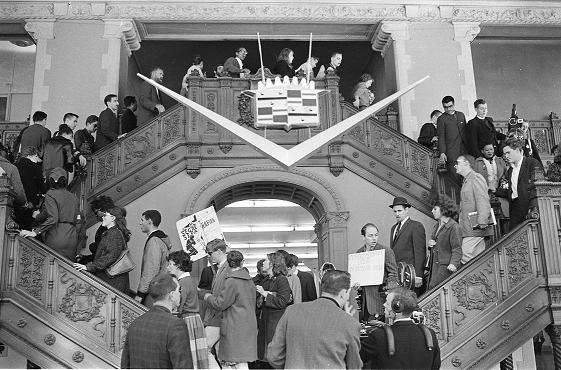
San Francisco has always had a liberal streak, but not so its business community, as a current exhibit highlights. In 1963 and ‘64, San Francisco was hit with massive demonstrations that denounced businesses’ discriminatory hiring practices and demanded equal work opportunity for African-Americans. Crowds picketed on Auto Row, in front of Mel’s Drive-In, Lucky Store, the Sheraton Palace Hotel, and Bank of America.

The Main Library exhibit “Occupation! Economic Justice as a Civil Right in San Francisco, 1963-64” retraces a struggle for economic justice that was specific to the city by the Bay, where thousands of African-Americans had moved to during World War II to work on the shipyards. When the war effort wound down, they were the first to be fired. Only direct actions—sit-ins, sleep-ins, and shop-ins—were able to shake the status quo: they led to more than 260 employment agreements for minority workers. There’s only a few days left to discover this important yet underrepresented piece of SF history: the display ends on March 27.

We spoke with curator Nancy J. Arms Simon about the exhibit and its relevance:

SFBG: How did this exhibition come to be?

NAS: It was actually the brainchild of Susan Goldstein, from the San Francisco History Center, and Catherine Powell, the director of the Labor Archives and Research Center. They had talked about collaborating on an exhibit related to labor, drawing from both collections.

In the meantime, I had fallen in love with the photographs of the photojournalist Phiz Mezey that I had discovered at the Labor Archives. She documented the April ‘64 demonstrations on Auto Row. So, it was a perfect blending. Those pictures are amazing because esthetically they’re incredible. On every single one of them, the layout just keeps your eyes circling. And the other part is that Phiz Mezey had been removed from her position at San Francisco State University, where she had been a professor. She had refused to sign the Communist Levering Act that all public employees were required to sign. In the 1950s, anyone who worked for a state agency had to sign an anti-communist oath.

While she was petitioning San Francisco State for years to get her job back, which she did in 1978, she was also trying to support herself and her kids. And so she became a documentary photographer. So I had become intrigued with her and with that story. When I started the project, I thought it would be an exhibit on the Auto Row protests. I didn’t even realize that this was part of a greater series of events that had spanned for two years.

SFBG: What were people asking for?

NAS: What they wanted was jobs, what I refer to as front-end jobs. I don’t like the idea of using the terms skilled and unskilled labor, because too many things that are very skilled get lumped under unskilled labor.

Blacks in San Francisco were assigned to jobs where they didn’t interact with the public. Basically, they weren’t allowed to. So they were allowed to be mechanics, janitors, but they weren’t allowed to be service people: bank tellers, waitresses, salesmen. There were two big pushes conjointly going on. There was the push for equality in housing, to end the segregation in housing, and also this push for jobs. If you don’t have access to jobs, there’s so much that you lose along with that. There’s that compounded effect of not saving to send your kids to college or provide for your own retirement… 

SFBG: But during the Second World War, [President] Roosevelt had enacted the Fair Employment Practices Act that made discrimination unlawful with companies that held government contracts.

NAS: But it was slated to end once the war was over. It was voted through to continue slowly across the country state by state, but it wasn’t nationwide until ‘64, when LBJ signed the Civil Rights Act. So for 20 years, from 1945 to 1964, people who had known a certain quality of life were fighting just to maintain it. Laws to promote equality might have been enacted, or agreements might have been signed, but having the law didn’t mean anything. There was this understanding that you can never let out the pressure; you have to keep pushing to make sure that that equality is actually enacted.

SFBG: How did the protesters organize their actions?

NAS: There’s a lot of lessons on how you effectively make change. There was a lot of unity amongst the groups, CORE, the WEB Du Bois Club, and the Ad-hoc Committee to End Discrimination. They had lawyers in place. Before a protest, they would decide who could afford to get arrested, and who couldn’t. So the people who could afford to get arrested would go to a certain level, they would maybe go inside the building. And all the leaders always made a point to get arrested, because they knew that that would get more press. And they also intentionally clogged the courts. They made sure that hundreds of people would get arrested just to slow things down and make it more difficult on the system.

It was really effective. And I think there’s a lot of these lessons that we miss today. They started with Mel’s Diner and they did get the owner to sign the agreements. Over at Lucky Store grocery, they did a shop-in. This is non-violent protest at its most beautiful! They went in and filled their shopping carts, they got to the counter and got them all run through. Remember, this is all scanned by hand. And then, once everything was scanned, they would say, “I will pay for these groceries once you give better jobs to Blacks,” and then they would leave. And all these bagged groceries filled the entire floor! All this stuff had to be put away. Plus people were picketing outside the store. So not only are you creating this major headache and throwing this wrench in the wheel, you’re also blocking people from shopping. So they were significantly cutting into their income.

SFBG: The Sheraton Palace Hotel rally was the biggest protest to take place.

NAS: It was really hard to narrow it down to a few statements to get into a showcase! About 1,500 protesters surrounded the hotel on March 6, 1964. There were other events leading up to that, though, they had tried negotiations, they had started smaller pickets outside. There would have been a court order to end the picket. So this is all building up.

During the major protest, I think 450 people entered the building and wouldn’t leave the lobby. The police carried them out, but they came back. They slept in overnight. And then the mayor, Jack Shelley, stepped in. He worked on the negotiation process and made it happen. After that, literally, the day they signed the agreement, they started picketing on Auto Row. This is how well organized they were. At the same time, other businesses were signing agreements for hiring Blacks, because they didn’t want this kind of press to happen. Remember, this is all happening in “liberal” San Francisco, so the fact that this is not good press for them counted.

SFBG: In the outcomes, you were careful to underline how these events had an impact on individuals’ lives.

NAS: It’s so easy for us in hindsight to know that civil rights were the right thing to fight for. But just think about what it would take out of somebody to get arrested. Tracy Sims, who later became Tamam Tracy Moncur, basically took the fall for her group. Because there were so many people arrested, they sent them to court in groups of 10 to12 people. She ended up getting 60 days in jail, plus a $200 fine. It was horrible for her. She was an idealistic 18-year-old. She knew she was doing the right thing. They were successfully changing laws just to confirm she was doing the right thing. And then she’s punished. After she served her time, her mother was already back on the East Coast, and she went to live with her mom.

SFBG: You were able to gather artifacts to tell this story, pins in particular.

NAS: These are all part of the Labor Archive collection. Graphically, they’re so simple, easy to read. You see them in photographs and they absolutely pop out. My favorite one is this “= Quality” one. It’s timeless. You’ve got the word play of equality equals quality. It’s got the silhouettes of a white child and a black child. What does equality really mean? It means equal quality for everybody. It’s not just a word. I really love that one, because it’s still so contemporary. Objects have got a power of their own. If you can stop and think of what’s involved, why they were created, and all the places they’ve been to… Some of the old pins will have the printer’s union stamp and the sheet metal workers’ stamp Look at that! That’s pride in your work right there.

Thawing ICE

0

sarah@sfbg.com

Top San Francisco officials are still refusing to implement legislation approved by the Board of Supervisors that requires due process to play out before immigrant youth accused of felonies are turned over to the federal government, despite recent developments that call into question arguments that have been made against that policy.

Mayor Gavin Newsom, whose veto of the legislation was overridden by the board in November 2009, has been the main obstacle to putting the new policy in place. He has argued that it violates federal law, that the city faces civil liability for harboring undocumented immigrants accused of crimes, and that only serious criminals have been affected by his unilateral 2008 decision to turn minors over to federal authorities before they have been convicted.

But then Muni bus driver Charles Washington’s wife, Tracey Washington, and 13-year-old stepson, undocumented immigrants from Australia, were placed under the control of U.S. Immigration and Customs Enforcement and ordered deported after the boy got into a fight at his middle school.

The case generated sympathetic media coverage because the felony charges and deportation order seemed excessive, so the federal government issued a 60-day reprieve to allow the family to finish applying for green cards and so the boy could have his day in juvenile court.

“All this got triggered by the non-implementation of a law that the board duly enacted last year,” Washington said March 11, a week after getting his reprieve, expressing exasperation with city officials. “The police are overcharging kids and waiting for someone else to whittle the charges down, and the probation officers are referring the kids to ICE, waiting for someone else to deal with the situation.”

Newsom’s policy required the city’s juvenile probation department to refer Washington’s stepson to federal immigration authorities after local police charged the boy with felony robbery, assault, and extortion in a dispute over 46 cents. Authorities then required his mother, rather than his stepfather, to come pick him up and placed an electronic monitoring device on her pending a deportation hearing.

Newsom’s policy has had a big impact in the city’s immigrant communities. Since July 2008 when the mayor ordered changes to Sanctuary City policies that had been in place for two decades, 125 youths have been referred to ICE, according to a March 9 report from the city’s Juvenile Probation Department.

In addition to the Mayor’s Office, the JPD has refused to enforce policies enacted through legislation by Sup. David Campos that are technically supposed to be the new city policy on referring undocumented youth, and the City Attorney’s Office has not required city employees to follow the new law, arguing it can only give advice and not compel departments to take action.

“With the benefit of legal advice provided by the City Attorney’s Office and outside legal counsel, and in light of current restrictions imposed by federal law, particularly the position taken by federal law enforcement authorities, the department has concluded that it cannot modify its policies and practices,” probation chief William Siffermann said at a March 4 hearing of the Board of Supervisors Rules Committee on why his department didn’t implement the legislation.

Grilled by Campos, Siffermann could not identify a federal law that requires city officials to report kids to federal immigration authorities upon arrest. Instead, Sifferman pointed to what many in the criminal justice community see as U.S. Attorney Joseph Russoniello’s overly broad interpretation of federal immigration laws, including his allegation that transporting arrested juveniles to court hearings amounts to “harboring aliens.”

But the Washingtons’ case struck a raw nerve at City Hall, and the Obama administration’s conciliatory response, along with other recent legal developments, indicate that it isn’t the feds that are preventing implementation of Campos’ legislation.

In February, Superior Court Judge Charlotte Woolard ruled in a civil case that the Bologna family — of which three members were murdered in 2008, allegedly by Edwin Ramos, an undocumented immigrant who had been in city custody as a juvenile — can’t hold the city liable for failing to prevent the murders.

That crime had been sensationalized by the San Francisco Chronicle, the San Francisco Examiner, and nativist groups, putting pressure on Newsom to change the Sanctuary City policy. Newsom’s spokespeople repeatedly have referred to it as an example of the civil liability the city faced.

On March 1 (the same day Washington first went public), City Attorney Dennis Herrera replied to allegations that his office has not done enough to implement Campos’ amendment by citing its victory in the Bolognas’ civil case, which sought punitive damages and to invalidate the city’s sanctuary ordinance.

Herrera also asked Gary Grindler, acting deputy attorney general at the U.S. Department of Justice, to direct the U.S. Attorney’s Office in the Northern District of California to “not use its limited resources to criminally prosecute local officials and employees who abide by California and local laws regarding the reporting of undocumented juvenile immigrants to the federal immigration authorities.”

Herrera based his March 12 request on an Oct. 19, 2009 memo that Grindler’s predecessor, David Ogden, issued curtailing federal action against medical marijuana dispensaries, which Herrera argued could serve as the model for clarifying the federal position on the city’s sanctuary law.

“If city officials and employees follow the mandates of state law, including those regarding the confidentiality of records of juvenile detainees, and the requirements of the amendment permitting the reporting to ICE of juveniles only after they have been adjudicated as wards of the court for criminal conduct, then the U.S. Attorney should not make it a priority to use its scarce federal resources to prosecute those city officials on the theory that by not reporting them at an earlier point, the city officials or employees are guilty of harboring,” Herrera wrote.

Campos said he welcomes any effort to get clarification from the feds, but believes such clarification is not necessary — and may not be forthcoming anyway. “So San Francisco should move forward. The law, in my view, allows us to do so, and it’s the right thing to do.”

Who profits from ICE’s electronic monitoring anklets?

1

One of the many troubling things to emerge from the threatened deportation of the wife and stepsons of Muni bus driver Charles Washington is the extent to which the Department of Homeland Security (DHS) is using electronic monitoring bracelets to track immigrants–and is turning to private contractors to deliver these services.
Take the Washingtons’ case. Charles Washington told reporters that US Immigration and Customs Enforcement (ICE) told him they would release his teenage stepson, if his wife Tracey, went to ICE’s Sansome Street office in San Francisco and agreed to wear an electronic anklet (pictured below).

Tracey's anklet
Tracey Washington agreed to the deal, worried about her 13-year old son, who had spent close to a week in detention at juvenile hall, after he got into a fight at school over 46 cents, and who was now in the hands of federal immigration authorities. And she had cause to worry. The feds have been known to transfer teenage immigrants arrested in San Francisco to detention facilities in Florida, Virginia and Oregon, while their deportation is pending.
So, the Washingtons hurried down to Sansome Street to retrieve their son.  And, there Tracey Washington was given deportation orders for herself and her son, and an electronic monitoring device, which contains a GPS device to monitor her movements 24/7, was placed around her ankle.
Tracey says the device was too tight at first, and, though it has since been adjusted, wearing it makes her feel as if she has committed a serious crime. But so far, no one in her family has actually been found guilty of a crime in this Kafkaesque episode.
Instead, her 13-year-old son has been charged with felony robbery, assault and extortion, charges that sound serious but have yet to be adjudicated in a juvenile justice court, and that were made in the wake of a schoolyard fight, which did not involve weapons, after the parent of the victim called the police.
But these felony charges are the reason why a juvenile probation officer called ICE, who picked up the boy, and, within 5 hours, released him to his mother, once they’d locked an electronic monitoring device on her ankle.
As for the question of the Washingtons’ visa overstay, which is ICE’s grounds for the anklet, the couple say they called the US Citizenship and Immigration Service (US CIS), not once, but twice, two days after they got married in April 2009, when Tracey, who met Charles on vacation six years ago, was midway through a 90-day visa waiver.
The couple say they were given misinformation on the phone about the urgency of applying for a green card, and that’s how they came to be only at the beginning of that process when their son got nabbed—a lag that Charles Washington attributes to the time it took for his family to save up the thousands of dollars that green card applications cost.
And apparently there is no way for the Washingtons or the US government to verify what happened when the couple called US CIS, and spoke to an operator. US CIS spokesperson Sharon Rummery told the Guardian that it is impossible to ascertain if a contractor with the US government misinformed the family.
‘I can’t say that it’s true or not, because it was a private conversation between one of the operators who works on our customer service line,” Rummery said. “Our operators are highly trained and are backed up by our trained officers,” Rummery continued, confirming that the operators are contractors, not US CIS staff.
Either way, Tracey Washington is left wearing an anklet. And as a hard-working, bus-driving US citizen, her husband Charles is not pleased that his tax dollars are being put to use in a way that leaves his wife stressed and feeling like a criminal.

“It’s my belief they are wasting tax payer money,” Washington said, eight days after US ICE granted his wife and stepson 60-day deportation reprieve. “With all the publicity this case has received, and the fact that our green card application has been sent in, I don’t see why she needs to be on the anklet. Everything that immigration has requested, we have complied with.”

So, just how widely spread is the use of anklets to track immigrants?

In 2002, federal immigration authorities created a $3 million Alternatives to Detention (ATD) program, to ensure that “aliens released from detention appear for their court hearings,” according to a 2010 ICE report.Fast forward to 2010 and the program’s FY 2010 budget is set at $69.9 million.
And somewhere along the way, the program began requiring immigrants who are in the process of applying for residency to wear electronic monitoring ankle bracelets 24/7—a requirement otherwise reserved for rapists, child molesters and other convicted criminals on parole.
This pilot program, which began in eight cities, including San Francisco, has since grown to a nationwide multimillion opportunity for contractors and now involves at least 30 cities: Atlanta, Charlotte, Baltimore, Boston, Hartford, Buffalo, Chicago, Kansas City, Dallas, Denver, Detroit, El Paso, Houston, Los Angeles, Delray Beach, Miami, Orlando, Newark, New Orleans, New York, Philadelphia, Phoenix, Portland, Seattle, San Francisco, Salt Lake City, San Antonio, San Diego, St. Paul and Washington.
In July 2009, DHS/ICE’s office of Detention and Removal Operations (DRO) awarded a $372 million, 5-year contract to BI Incorporated, a Boulder Colorado-based company, to provide support services for its Intensive Supervision Appearance Program  (ISAP) 11, as the federal government previously called its electronic monitoring program.
G4S Government Services of Atlanta, Georgia, which held the previous ISAP’s pilot contract, and put in a S489 million bid for ISAP 11, protested the BI award, arguing that DHS’ evaluation and BI’s price proposal were “unreasonable.”
Either way, DHS’ “statement of work” documents, which were posted online as part of that contract bid, suggest that ICE plans to use ATD on an even wider basis, in future.
“Approximately, 32,000 persons are held in secure detention by DRO each day,” the contract’s statement of work (SOW) section states, noting that this figure includes “aliens in the United States who are in violation of the Immigration and Nationality ACT (INA) who pose a threat to community safety, national security, and/or may be a flight risk, in addition to those aliens required to be detained under specific provisions of the INA.”
“Limited detention capacity and an increasing detainee population coupled with the need to lower alien absconder rates have sparked national efforts over the past several years to integrate into DRO’s general practices the use of various alternatives to detention for aliens who do not require mandatory detention in accordance with the INA,” the contract continues. “Alternatives to detention offer the prospect of a considerable cost savings over secure detention for eligible aliens.”
“Depending on available funding during the execution of the ISAP 11 contract, DRO intends to expand its ISAP coverage,” the contract notes. An attached appendix shows a list of 165 cities in which the program would operate nationwide. In addition to San Francisco and Los Angeles, California cities on the list include Bakersfield, San Diego, El Centro, Fresno, Imperial, Lancaster, Lompoc, Sacramento, San Jose, San Pedro, Santa Ana, Stockton, and Ventura.
Under the current contract, BI was expected to be fully prepared with sufficient staff and equipment to fulfill all statement of work requirements for 16,750 ISAP II slots, within two months of assuming control of the program. San Francisco was expected to fill 850 of these slots, putting it in fourth place behind Los Angeles (3,400 slots), New York, (1,500 slots) and Washington, D.C., (1,025).
And by the end of the five-year contract, the numbers of slots are expected to rise to 27,237 slots—a 10,487 increase, along with a steady increase in participating cities. Under those estimates, San Francisco is expected to have 957 slots five years from now,
The federal government touts ISAP, which relies on telephonic reporting, unannounced home visits, and regular face-to-face interviews, as well as electronic GPS monitoring devices, as a “cost-effective alternative to detention for aliens being processed through the Immigration Court system.”
ICE’s Lori Haley stressed that the program, with its focus on alternatives to detention, is part of the department’s “commitment to immigration reform.”
“Our mission is to ID non-citizens here without legal status and move them through the immigration process how the court sees fit,” Haley said.
She also stressed that the anklet program is preferable to detention and is suitable for folks with families who are not posing a danger to their community.
“We also found that as people get closer to the conclusion of the process, they may need a stronger level of monitoring,” Haley added, alluding to the reaction of folks on realizing that they are going to be deported after all.
These statistics paint a perhaps surprising picture to the average American, who likely wasn’t aware that there are thousands of immigrants in the US, who haven’t committed a serious crime, yet are walking around wearing these onerous, privacy-invading devices, hidden beneath their pants, or while they shower, or go to bed, while they await a ruling from the courts on their request to stay here permanently.
And these numbers are only going to grow bigger, if ICE has its way.
“Depending how long an alien remains in the ATD program and the number of individuals enrolled in the ATD program, implementing ATD nationwide would require between $88 million and $513 million,” ICE stated in its 2010 report to Congress. “The most realistic scenario for expansion requires a reduction in the average length in the ATD program to 180 days, down from the current average of 310 days. Reducing the average length on the program requires significant coordination within the Department of Justice, Executive Office for Immigration Review.”
“310 days in an anklet” sounds like the name of a funny film. Unfortunately for the 800 people in San Francisco, including Tracey Washington, who are apparently walking around wearing these devices in any given year, the situation is not funny, but it is all too real. And is this really the way to reform the federal immigration system in a humane and meaningful way?

Why Muni is in such trouble

10

OPINION The Municipal Transportation Agency’s Web site states a goal of providing a "convenient, reliable, accessible, and safe transit system that meets the needs of all transit users" in San Francisco. I have a feeling that if you ask most Muni riders, few would use those words ("convenient," "reliable," "safe," "meeting the needs of all transit users") to describe Muni today.

Riders have been put in the untenable position of paying higher fares for less service. Yet Muni still faces a $17 million deficit (projected to grow to $55 million next year), which it proposes to close by again increasing fares and cutting services. When asked about Muni recently, Mayor Gavin Newsom pointed to a $179 million reduction in state funding as the culprit. And while no one can dispute the devastating impact of such a cut, there are a few questions that suggest that the state alone is not to blame for Muni’s troubles.

For one, we just learned that the MTA has not had a management and performance audit since 1996. Although it’s undergone a number of fiscal audits, a management audit is different; such an audit would actually evaluates Muni’s operations to determine if the system is run effectively and efficiently. How is it that an $800 million operation can go for 14 years without that type of evaluation?

Moreover, what does it say about how Muni is managed when the agency has consistently failed to control overtime costs? We just learned that Muni accounts for about half of the city’s overtime expenses. This fiscal year alone, Muni has spent $23.8 million in overtime, or 45.6 percent of the city’s total. What kind of management and operational practices allow an agency to function like this?

And why is Muni spending 9 percent of its budget ($67 million) on work orders (with other departments) for services that may or may not have much to do with its mission — including $12.2 million for the Police Department, $8.5 million for the Department of Telecommunications, and $6.9 million for the General Services Agency that runs 311? Since a quarter of the value of these work orders would suffice to wipe away its deficit, what, if anything, has Muni done about this?

And speaking of Muni’s deficit, why is it that increasing fares and reducing services seem to be the only tools in its tool box? As a number of transportation experts have suggested, there are several options that should have been on the table — raising parking fees, adding parking meters, charging for blue placards, and putting a revenue measure on the ballot, just to name a few. While some of these options may not be the answer, has Muni at least considered them? Did it consider them before proposing more fare increases and service cuts, including doubling fares for seniors, the disabled, and youth?

All this points to a more fundamental question — what about the MTA Board? Has the board provided the type of engaged and independent oversight needed to guarantee effective management? And is independent oversight even possible when all board members are appointed by one person, the mayor?

Because of these and other questions, I am proud that the Board of Supervisors unanimously approved a motion I introduced asking the budget analyst to conduct an independent management audit of the MTA. Given the timing of the budget process, the first phase of the audit will be completed by May 1, with the remainder in the summer. The audit will evaluate key areas of Muni’s operations to shed light on whether it is truly following best practices. We owe it to the ridership to face these questions head on. We no longer have the luxury to wait for the state to do the right thing.

SF Supervisor David Campos represents District 9.

Behind the Mexican drug war

1

Editors note: The killings of three U.S. consular employees in Ciudad Juarez has brought increased press attention in this country to the violence of Mexico’s drug gangs.  Our Mexico City correspondent, John Ross, reports on the background story.

MEXICO CITY – Last July, in a meticulously planned raid reminiscent of the classic guerrilla jail breakouts that are legend in Latin America, a commando force of 20 heavily armed fighters freed 53 comrades from a prison in the northern state of Zacatecas. Were the perpetrators in fact guerrilleros from some as-yet unknown revolutionary foco or narcos emulating a guerrilla-style jailbreak intent on freeing their own?


Recent assassination attempts against high-ranking state officials — Sinaloa’s Secretary of Tourism (successful), Coahuila’s Attorney General (the restaurant at which he was dining with a Texas mayor was sprayed with automatic weapon fire), and a Baja California finance undersecretary (hung by the neck from a Tijuana freeway overpass) — suggest revolutionary retribution in a year that marks the 100th anniversary of the Mexican Revolution in which jitters of new uprisings are legion. January 1st was welcomed in with anarchist bombs, sabotage, and “expropriations” in Mexico City and Tijuana on the northern border.

Although the incidents cited suggest revolutionary subversion, they were all the handiwork of Mexico’s five narco cartels, which are locked in an intractable war with both President Felipe Calderon’s military and federal police — and reportedly hundreds of U.S. drug warriors — that has now taken more than 19,000 lives since December 2006.

The jail breakout in Zacatecas and the Sinaloa and Coahuila shootings are attributed to the syndicates headed by Joaquin “El Chapo” Guzman, his former associates in the Beltran Leyva gang, and the notorious Zeta cartel.

The hanging of Baja California state finance official Rogelio Sanchez Jimenez was charged to a blood-drenched capo Teodoro Garcia Simentel, a.k.a. “El Teo” or “Three Letters” who is deemed responsible for hundreds of hangings, beheadings, and excessively violent homicides — an associate, Santiago Meza (“El Pozalero”) has reportedly confessed to dissolving 300 victims in vats of acid. Most of the victims were allies of the fading Arellano Felix clan, with whom El Teo is contesting Tijuana.

Simentel was captured this past January 14th in an upscale residential neighborhood of La Paz in adjourning Baja California Sur state, the second top-rung narco purportedly taken down by Mexican authorities in a month. The bust earned bouquets of kudos from Washington, which is financing Calderon’s drug war under the $3,000,000,000 Merida Initiative.

The U.S. role in the capture of El Teo and Arturo Beltran Leyva, “the Boss of Bosses,” who was gunned down by Mexican marines December 16th, appears to have been purposefully downplayed. According to an unidentified member of Calderon’s Security Cabinet as reported by Gustavo Castillo, a La Jornada correspondent with exceptional sources, Simentel was located by the U.S. Department of Homeland Security’s Immigration & Customs Enforcement, a first indication that ICE is now being deployed in Mexico’s drug war.

The Drug Enforcement Administration and the FBI are also thought to have armed agents on the ground here under provisions of the Merida Initiative and the North American Security and Prosperity Agreement.    

The Calderon government vehemently denies that participation of U.S. agents led to the capture of El Teo or Beltran Leyva, although it acknowledges enhanced cooperation between the two nations’ drug fighters. The suggestion that Washington has assets on the ground here is not acceptable to many Mexicans, whose country has been repeatedly invaded and even annexed by U.S. troops, and is regarded as a violation of national sovereignty.

The number of U.S. security agents working in Mexico is closely held, but observers of Washington’s presence here such as specialist Jorge Camil affirm that it has been rising dramatically since the 9/11 terror attacks on New York and Washington and now totals in the hundreds. The DEA and the FBI now have offices in provincial capitals such as Tuxtla Gutierrez Chiapas, close to the Guatemalan border and multiple smuggling routes.

Mexico is not only in the crosshairs of the U.S. security apparatus because of the flourishing drug trade — the infiltration of terrorists across the porous border also excites attentions, although all reported incidents to date have proven to be false alarms.

Of increasing interest to Washington is the possible alliance of narco gangs with Mexico’s fledgling guerrilla cells, an interpolation of the Colombian model.

The concept of narco-guerrilla coalescence was first proffered in the mid-1980s, soon after Ronald Reagan officially proclaimed the War on Drugs. Then-veep George H.W. Bush, a Navy man, was placed in charge of overseeing interdiction efforts in the Caribbean to stop the Colombian cocaine flow into the southern United States.

Under Bush’s watch, intelligence reports placed the onus on the Marxist-Leninist Revolutionary Armed Forces of Colombia (FARC), the Army of National Liberation (ELN), and M-19, a left nationalist movement later decimated by the Colombian army, for extending protection to such world-class kingpins as Pablo Escobar.

The truth was, however, more diffuse: paramilitary units such as the United Auto-Defenders of Colombia (AUC) armed by right-wing rural “terratenientes” (rich land owners) and the Colombian military were the big players in the so-called “narco-guerrillas,” although several FARC fronts openly provided protection to the druglords.

The narco-guerrilla thesis eventually became the underlying reason d’etre for Plan Colombia, in which the twin wars on drugs and terrorism were married. Since the late 1990s, Washington has pumped billions into Colombia to sustain this counter-insurgency strategy. The Merida Initiative, signed in that Yucatan city by George Bush and Felipe Calderon in 2007, is often referred to as Plan Mexico.

As recipients of billion-dollar boodles in U.S. drug war largesse, Colombia’s Alvaro Uribe and Mexico’s Calderon are Washington’s most significant allies on a continent where the left has taken power in a majority of countries.

Today, despite a decade of Plan Colombia, Colombian cocaine production has held steady and the FARC ranks as Latin America’s most powerful narco-guerrilla group. Although Mexico has no known counterpart, FARC activities here are closely monitored. FARC offices were shuttered during the presidency of Vicente Fox (2000-2006) — the FARC and Colombian president Andres Pastrana entabled negotiations in Mexico City in the 1990s.

A Colombian-born National University graduate student was deported to Bogotá last year on terrorism charges for sympathizing with the FARC, and Uribe has issued extradition warrants for a Mexican student who survived the bombing of the Ecuadorian jungle camp of FARC leader Raul Reyes (not his real name) in 2008.

One connection: FARC operators are said to consort with the Valle del Norte Cartel, the main Colombian supplier for El Chapo’s Sinaloa Cartel. A purported 2007 jungle tete a tete between Reyes, and an unidentified cartel representative suggested the possibility that the Sinaloa boys would buy cocaine directly from the Colombian rebels rather than deal with a series of middlemen suppliers.

Mexico’s armed leftists take pain to steer clear of association with drug gangs. Military intelligence first identified the Zapatista Army of National Liberation (EZLN) as drug and gunrunners on the Guatemalan border, an estimate said to have been backed up by CIA satellite overflights. The Zapatistas have dodged the stigma by waging a vigilant crusade against drugs in their autonomous communities in southeastern Chiapas. Cultivation of marijuana by militants is severely punished by banishment from the EZLN. Nonetheless, the Mexican Army has repeatedly stormed into Zapatista villages on the pretext of marijuana patch sightings.

Mexico’s homegrown guerrilla bands have their roots in the north of the country where this distant neighbor nation’s 1910-1919 revolution first germinated. Revolutionary martyrs Francisco Madero, Pancho Villa, Venustiano Carranza, and Alvaro Obregon were all northerners who marched their armies south to seize power. In 1965, Arturo Gamiz, a disaffected rural schoolteacher, and 12 rebels laid siege to army barracks in Ciudad Madero, Chihuahua; all were killed in the assault. Six years later, the September 23rd Communist League based in the northern industrial city of Monterrey took its name from the date of the assault; 15 armed groups of which the September 23rd league was the most prominent operated throughout Mexico in the 1970s. The Forces of National Liberation (FLN), also based in Monterrey, gave birth to the EZLN in Chiapas. A sister guerrilla group, the Villista Army of National Liberation in Chihuahua, was never consolidated.

Conditions in the north of Mexico where both the narco cartels and the military concentrate their forces are propitious for a resurgence of guerrilla activity.

Unemployment in the region, driven by the decline of the maquiladora industry (many assembly plants have moved to China), is at a 15-year high. The rural economy has been eclipsed by neo-liberal adventures such as the North American Free Trade

Agreement and the deepening recession, the worst in 80 years, is forcing campesinos to abandon their land. A hundred years ago in this vast, mineral-rich region of deserts and scarred mountains, landless peasants and displaced farmers formed the nucleus of Pancho Villa’s revolutionary army.

In 2010, many survive the economic crisis by turning to drug cropping — a half million Mexicans are said to earn their living in the drug economy. One indication of increasingly close ties between militant farmers and the drug cartels was the slaying of Margarito Montes Parra, longtime leader of the leftist UGOCEP (General Popular Union of Workers and Farmers) who was ambushed by cartel gunmen in Ciudad Obregon last fall.

Widespread human rights abuses by federal troops who combat the narcos along the northern border has provoked a wave of anti-army, anti-government anger in many northern states and conditions for a Gamiz-like assault on military installations cannot be discounted should drug gangs and armed radicals find common cause.

For prospective guerrilla formations, alliance with narcos has its perks: weapons and money. Both the narcos and the radicals are interested in subverting the state, although their motives may be distinct. For anti-imperialist revolutionaries, poisoning the Yanquis with drugs is a weapon of class war. But negatives abound: everything the cartels touch is corrupted by profit-driven mercantile greed that is at odds with revolutionary ideals, although there are always those who will argue that the end justifies the means.

For Homeland Security and Washington’s security apparatus, the nightmare prospect of a coalition of narcos and guerilleros cruising the border is reason enough to sustain agents on the ground south of the border whether or not Mexican authorities are prepared to admit their presence. Indeed, this January, Obama’s Justice Department announced the merger of its International Terrorism and Narcotics investigation units to prepare for just such an eventuality. The vision of Mexico as a potentially failed narco-state advanced by the Pentagon and the Joint Chiefs of Staff in a 2008 evaluation is a five-star national security issue for Washington and the option of a U.S. preventative invasion is always on the table.          

John Ross continues to slog across Obama’s America now in the second month of his monster book tour with “El Monstruo – Dread & Redemption In Mexico City” (“gritty and pulsating” – NY Post.) The author will be in Madison Wisconsin, Traverse City, Grand Rapids Michigan and Chicago (Heartland Café March 31st) during the final two weeks of March.  Consult johnross@igc.org or www.nationbooks.org for local dates.

Sit-lie gets skeptical reception

35

By Skyler Swezy

On Wednesday, the Coalition on Homelessness held a press conference on City Hall’s front steps to denounce the proposed sit-lie ordinance shortly before the Police Commission convened to discuss the topic. Symbolically choosing to sit, more than 35 members of various San Francisco rights and neighborhood organizations. Speakers passed the microphone before a sparse group of journalists.

Joey Cain, representing the Haight-Ashbury Neighborhood Council, told the gathering, “There’s a lot of people from the Haight who oppose this law and we’re going to show up at every meeting to fight this thing.”

Inside City Hall, Assistant Chief Kevin Cashman gave a power point presentation before the Police Commission, explaining the sit-lie ordinance would prohibit sitting or lying on a public sidewalk between 7 a.m. and 11 p.m. and emphasized a warning would be issued before a citation.

“Our goal with this ordinance is not to cite everyone. Our goal is to change behavior,” Cashman said.

He said the police receive constant complaints from business owners in the Haight about people lying in front of their stores, however these owners rarely file an official complaint because they say they fear retaliation. He said that under current law, willful intent to obstruct must be proven in court and a third party must testify, thus the law is ineffectual.

Commissioner Petra DeJesus was the most skeptical of the proposal and thorough in her questioning of the police. “So under this new law, just the act of sitting would be a criminal act?” she asked, drawing laughter from the audience.

“Do you have any examples of how many people are blocking the sidewalks and what their status is?” she asked.

The police could not provide related statistics.

Police Capt. Teresa Barrett, whose jurisdiction includes the Haight, said local business owner and resident complaints at community meetings prompted the push for a new ordinance.

“In November, we were starting to see a trend they [community members] had not seen in many years in the Haight,” she said. However, when pressed by Commissioner Dejesus, Capt. Barret could not produce statistics or numbers that would indicate a rise in thuggish behavior or community complaints.

“Let’s do our homework and gather statistics, and see whether or not we are really having serious problems,” said Commissioner Dejesus. She remained doubtful that proper enforcement of current laws would be unable to solve aggressive or criminal behavior in the Haight.

During public commentary, anti sit-lie speakers far outnumbered those in support of a new ordinance. The creation of a “forced march”, further marginalization of troubled youth and an open-ended law that could be abused in the future, were among the fears voiced.

One long-time resident in favor of the ordinance said 20-somethings she knew avoided the bars and restaurants of Haight because of the panhandlers. “Our economy is failing because of these aggressive thugs,” she said.


Ultimately, it is the Board of Supervisors who will vote on the issue, which was filed by the Mayor’s office on March 1 and is currently under 30 day rule.


Take off your clothes! World Naked Bike Ride, spring edition

0

Strap on your helmet and strip down to your skin— it’s time to ride bikes in the buff. San Francisco regularly participates in the ‘Northern Hemisphere’ World Naked Bike Ride each summer, but Saturday (3/13) marks the city’s first inclusion in the Southern Hemisphere’s jaunt. Spring or summer, the ride aims to expose the dangers bicyclists and pedestrians face in a car-dominated culture and to protest against “indecent exposure to vehicle emissions.”  

Bay Area bicyclists will join pedaling nudes in Sydney, Cape Town, Lima, and other Southern parts of the globe this weekend, flashing their junk on two wheels for a “critical mass with a lenient dress code.” The crowd will cruise from Justin Herman Plaza to Golden Gate Park, stopping at City Hall for a photo shoot. Because this is the virgin spring fling, the group may be small, but definitely not shy.

Interested in joining but feeling a little insecure about disrobing? Here a few tit-bits of advice from bare-skinned veteran, George Davis.

1. Wear sunscreen— sunburned genitalia isn’t sexy or fun.
2. Wear a bike helmet; decorate it and the rest of your exposed self.
3. Think of your unclothed body as freedom from speed-slowing textiles.
4. Revel in the thumbs up from police and bask in the rock star status you’ll receive while cruising through Fisherman’s Wharf.
5. You are “natural gas powered”— to hell with oil dependency.

And a few more sensitive items to consider:

1. Shoes are good. Pedals are rough on bare toes.
2. Smile! People may photograph you. Be proud and confident. Slouching is never flattering.
3. If you’re hesitant about putting your pussy on the seat or getting your long schlong caught in the chain, wear some cute undies.
4. Children are allowed— non-sexualized nudity is not harmful to young eyes.
5. Worried you’re not ‘hot enough’ to bare all? Damn Gina, everyone looks good when they’re riding green.

Southern Hemisphere Naked Bike Ride
Sat/13, Noon
Meet at Justin Herman Plaza, just North of the huge fountain with all the cubic shapes
(Market and Steuart)
www.SFBikeRide.org


Supes pass resolution protecting SF Patrol Special Police Officers

Jane Warner, or “Officer Jane” as she’s known throughout the Castro, had a rough Christmas Eve. It started when Warner, a San Francisco Patrol Special Police officer who was out walking the foot beat, was alerted that a fight had broken out at Trigger, a bar on Market Street. When she arrived, she says she encountered a drunk and belligerent man. “He got more excited and charged the doormen, he pushed me, I pushed him back, and I said, ‘You’re under arrest,’” Warner told the Guardian shortly after the incident occurred. “He started to walk away from me, I drew my baton, I hit him twice, and he turned around and he hit me and I went to block his punch and he broke my arm,” at which point she fell to the ground in pain. “It cracked the bone right between the elbow and the shoulder,” she said.

According to a police report, several San Francisco police officers arrived on the scene shortly after and arrested the man, James Crayton McCullough. But when they arrived at the police station and tried to get him out of the police car, according to the report, he wedged his body onto the floor of the vehicle and allegedly shouted at one of them, “I’m going to shoot you in the fucking head!” Later, he was transported to San Francisco General Hospital because he had a laceration on his head, where he allegedly threatened a nurse.

Before he was through that night, he’d amassed six felony charges and three misdemeanor charges, District Attorney spokesperson Brian Buckelew told us shortly after the incident. He somehow managed to make $250,000 bail. But he was issued orders to stay 150 yards away from Warner, as well as Castro bars Trigger and Badlands. McCullough also received an order to stay out of the entire Castro neighborhood — a move Buckelew says is highly unusual.

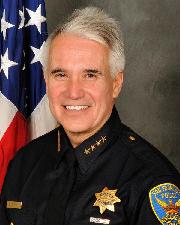
The incident prompted Sup. Bevan Dufty to introduce a resolution to encourage San Francisco Police Chief George Gascon to consider imposing an increase in penalties for an assault on a Patrol Special Police Officer. This past Tuesday, at the Board of Supervisors meeting, that resolution was approved.

Since Warner was assaulted, other incidents have occurred in which Patrol Special Officers were placed in harm’s way, according to a press release sent out yesterday by the organization.

San Francisco’s Patrol Special Police, roughly 40 strong, is a private force dating back to the days of the Gold Rush. In a rare arrangement, they’re authorized under the City Charter to patrol different neighborhoods, hired by private clients such as merchant associations, and they adhere to regulations set by the Police Commission. While they aren’t sworn officers, they undergo a training process similar to that of SFPD officers and they make arrests. Warner describes the patrol specials’ model as a form of “community policing” which she says emphasizes crime prevention.

When asked about Dufty’s resolution in an interview with the Guardian last week, Gascon was somewhat resistant to the idea. He said he had a problem with private policing in general. “This is more of a private police model,” he said. “Their uniforms are very similar to the San Francisco Police Department. So, quite frankly to the majority of the public, it is very hard to distinguish between one and the other.”

“I understand where Supervisor Dufty’s coming from,” Gascon added. “These are people that are certainly out there providing public safety services and they sometimes become the target of people that, for whatever reason or another, they don’t want to be subject to their authority. The problem that I have again is that it continues to blur the line of a very unusual process. … There’s no question that in some places there are people who certainly are in favor of having patrol specials. This is not to take away from the quality of service that patrol special officers provide because I think some of them are very professional and they are very courteous and very effective in what they do. ”

While it’s a felony to assault a San Francisco Police Officer, there are no special charges in the penal code for an individual who commits an assault on a patrol special officer. Dufty’s resolution asks the Police Commission and Gascon to provide Patrol Specials with “the same protections that San Francisco Police Department officers and a number of others who are protected under state code from being assaulted in the line of duty.”

Dare you take offense at Steven Wolf Fine Arts?

4

Keith Boadwee is a fascinating artist. Known for his outrageous self-portraits — which combine media that include but are not limited to photography, performance art, painting, self-administered enemas, and pornography — his work is unorthodox to say the least. Boadwee has photographed himself in situations that 99.999% of the world would probably rather die (like for real die) than experience for themselves, and he kills himself fearlessly (see NSFW — I repeat NSFW — images on his Web site). Viewing Boadwee’s work in a gallery setting, such as that of Steven Wolf Fine Arts, is like experiencing the collision of someone’s private world with your own public forehead.

Boadwee’s “Denim on Ice” exhibit there — consisting of works he made with his former students Erin Allen and Issac Gray — evokes the demented scribblings of a disturbed child, albeit one with a great sense of humor. In a more hostile environment, these painting would be legitimately disturbing. Seen together as they are, crowded onto a single gallery wall, the effect is still one of something totally crazy, though overall harmless. Even weirder: the paintings in this exhibit, with their wholly unsophisticated content, evoke the high expressionism of artists like Matisse and Muehl. My favorite piece in “Denim on Ice” was the still-life rendering you see above, “Titties and Milk,” a strange composition of breasts, a glass of milk, and a hat-wearing cactus (who has a face).

“Lincoln Log Bong” by Boadwee, Allen, and Gray

The gallery describes “Denim on Ice” as “paintings that take low humor and bad taste so far they come around again as refinement.” To me this feels accurate. The paintings are in such absurdly bad taste that it’s difficult to imagine how taste level can possibly go lower. While I wouldn’t call any of the work particularly “refined,” the collection displays its subterranean brow so cheerfully that you can’t help but smile and enjoy the ride.

“Birmingham I” by Rives Granade

Paintings “Birmingham I” and “Birmingham II” by Rives Granade — also on display in the gallery in a collection called “Love Force” — pluck figures from famous civil rights photos and transpose them into the sterility of corporate architecture. The effect is uncanny in the strictest Freudian sense. The old black and white photographs of the Birmingham freedom marches, with their nightmarish displays of police brutality, disturb and shame us deeply. In light of the past, the instinctive reaction upon viewing these new paintings is to cry blasphemy. Upon further examination, viewers will note that these paintings are not actually politically irresponsible.

“Birmingham II” by Rives Granade

The images, which draw from the firmament of political history, invite viewers to draw new moral comparisons. The past is still present in Granade’s re-contextualized paintings, camouflaged but not erased. The brutality of that past is obvious, even in an ahistorical setting that seems, for all its artifice and architecture, like a Hobbesian state of nature.

Keith Boadwee, Erin Allen, and Isaac Gray: “Denim on Ice”
Rives Granade: “Love Force”
Through March 20
Steven Wolf Fine Arts
49 Geary Street
www.stevenwolffinearts.com

Newsom’s plan means service cuts

15

The San Francisco Controller’s Office says that Mayor Newsom’s plan to lay off 15,000 city employees then hire most of them back at a reduced workweek will save $110 million. The Examiner quotes the mayor:


“The 37½-hour idea was a way of equalizing,” Newsom said in an interview Tuesday. “I would have to go to every single labor union, open contracts that are closed and engage with those open contracts in collective bargaining for each and every local.
“Every labor union is in this together. We aren’t going to pick and choose. That being said, they are coming back Thursday with a set of alternatives, and I will keep an open mind.”


Actually, it’s not exactly equalizing — no police officers or firefighters will get what amounts to 6.25 percent pay cuts. But here’s the more important issue:


The mayor — and, to a great extent, the newspapers — present this as a simple way of saving money; sure, the workers take a little hit in their pay, but jobs are preserved. What nobody’s saying is that this will amount to more very significant service cuts.


Take 15,000 employees and cut 2.5 hours from each of their workweeks. That’s 37,500 hours of work a week, or the equivalent of 937 full-time jobs. So one of two things are going to happen: Either city employees are going to be working 40 hours for 37.5 hours pay — that is, taking a direct pay cut, which is what I think Newsom really wants — or the city’s going to lose the equivalent of 937 workers.


If you assume that it’s unfair to ask people to work 40 hours for 37.5 hours pay (and if you assume, as I do, that the unions won’t stand for that), we’re going to be talking about service cuts — work that doesn’t get done. And where will those cuts happen? Guess what — it’s the usual places.


Public health takes the biggest hit, with $35.5 million in “savings” (actually, cuts) over the next 14 months. Human Services gets $10 million cut, and Muni about $8 million.


That means longer lines and sicker people at SF General, and more broken buses with no mechanics to fix them, which means slower Muni service … you get the picture.


I’m not saying that we don’t need cuts, and you could argue that it’s more fair to cut everyone’s pay a little than to eliminate 937 jobs altogether. But let’s be honest about this — it’s not just “salary savings.” It’s service cuts. On top of last year’s service cuts, on top of the previous year’s service cuts … and it’s being done without any real overall plan for what services we need to provide and what takes priority.


And of course, it’s being done with no discussion at all of raising new revenue.  

Place of refuge?

0

LIT If you’ve been tracking the battle over San Francisco’s sanctuary ordinance, or you’re simply interested in the fight for immigration reform at the federal level, then check out Just Like Us: The True Story of Four Mexican Girls Coming of Age in America (Scribner, 400 pages, $27.99). Written by Helen Thorp, a journalist married to Denver mayor and Colorado gubernatorial candidate John Hickenlooper, Just Like Us is the true story of four young girls whom Thorp tracked for five years, starting with their senior year in high school.

“All had at least one parent who entered the country from Mexico without the right documentation,” Thorp says over the phone. “One was born here; one had a green card; and two didn’t have papers, so they were split down the middle on their legal status — through no fault of their own — but because of a situation they inherited.” This split led to differing experiences as all four girls came of age in the United States, even though all excelled in public high school.

“Two of them didn’t have the same opportunities, privileges, or even ways to pay for college as the two with papers had,” Thorp explains, noting that she changed the names of all four students to protect their identities. The main narrative of Thorp’s book sticks closely to the experiences of these four exemplary girls — including the political firestorm that broke out in Denver (and spread statewide) after an undocumented Denver resident committed a violent crime.

The echoes for San Francisco are obvious. The slaying in 2008 of three members of the Bologna family by the alleged killer Edwin Ramos, an immigrant who repeatedly passed through the city’s justice system as a juvenile, increased the heat in a political firestorm that had been crackling since the city passed its City of Refuge ordinance in 1989 and burst into flames in December 2007. That was when federal agents intercepted San Francisco probation officers at a Houston airport as they tried to repatriate Honduran teenagers by flying them home instead of reporting them for formal federal deportation.

In the Denver-based story Thorp recounts in Just Like Us, a young man who never had much schooling and was in Colorado without the necessary paperwork shot two police officers at a party, killing one. To add to the intrigue, the man was employed as a dishwasher at a restaurant owned in part by Thorp’s husband.

“It certainly was a heinous crime, since this young man shot two police officers in the back,” Thorp recalls. “Even the Mexican immigrant community was horrified, and no one rallied to his side. He was disrupting a baptismal party for a Mexican family in a popular social hall. He destroyed the celebration and he had a young daughter, who he essentially ended up abandoning, when he went to jail. He had lived in Los Angeles — that’s where he purchased the gun — and may have had gang ties. That, at least, was what was alleged at his sentencing. He shot the police officers because he felt one of them had insulted him and allegedly had mishandled him. His pride was wounded, but his response was so aggravated, there was no justification for it.”

As a result of this tragedy, which touched one of the high school students she was tracking, Thorp ended up becoming close to the widow of the police officer. “His family had an immigrant background, and he grew up in a Spanish-speaking family — though that was not reported in the media — and his widow’s mother was an immigrant from England who kept her green card and never became a citizen,” Thorp continues. “So the widow ended up having an incredibly nuanced point of view and would comment on what happened to her family with more grace and generosity than you would ever expect a human being to muster in those circumstances.”

Thorp feels that heated debates between advocates on opposing sides of the immigration equation is a result of what she calls “a collision of different beliefs.”

“We believe strongly that you are innocent until proven guilty, and we believe in the United States as a nation founded by immigrants. But we also believe in the value of law and order, so we don’t have a favorable view of illegal immigrants, and definitely not of illegal immigrants who commit crimes,” Thorp observes. She also noted that people tend to view juvenile immigrants in a kinder light: “They are morally in a different category than people who made the decision to come here without documents.”

But Thorp suggests that tackling immigration locally may be a losing proposition. “I understand why people want to tackle the subject at a local level since the federal government continues not to resolve the issue,” she says. “But you run into the fact that, peculiarly, this issue needs a federal solution even though we feel the impacts at the local level.” She believes the Obama administration needs to create reform that clarifies whether the feds are offering people a path to citizenship and that involves penalties for those who knowingly broke the law when they came here without papers,

“I understand that San Francisco is on the cutting edge of many things, but I can’t imagine that my husband, as mayor, would adopt a sanctuary policy in Denver,” she says. “And that’s because the concept of a sanctuary city in Colorado is only used by social conservatives with derision. The way ‘sanctuary city’ is used here signals a flagrant disrespect for law and order.”

That said, Thorp notes that the question of whether local police should become an arm of U.S. Immigration and Customs Enforcement (ICE) and an enforcer of federal immigration laws has been debated, and that people generally agree that this is not the job of the local police. “Local police department budgets are exhausted simply by doing the other tasks we’ve given them. If you add to that locking up nonviolent offenders [accused of being here illegally], it would break the bank.”

Informing the public

1

news@sfbg.com

Information is power. But too often, those with political power guard public documents and information from the journalists, activists, lawyers, and others who seek it on the people’s behalf. So every year, we at the Guardian honor those who fight for a freer and more open society by highlighting the annual winners of the James Madison Freedom of Information Awards, which are given by the Northern California chapter of the Society of Professional Journalists.

This year’s winners are:

Beverly Kees Educator Award

Rachele Kanigel

Rachele Kanigel, an associate professor of journalism and advisor to Golden Gate Xpress publications at San Francisco State University, has been highly involved in student press rights work on a national level. She wrote The Student Newspaper Survival Guide (Blackwell Publishing, 2006), a book designed to empower budding campus reporters. A champion of the free speech rights of her students, Kanigel has gone to bat on several occasions on behalf of student journalists whose work was challenged by interests that didn’t believe students should be afforded the same protections as professional reporters. Kanigel sees part of her job as educating the world about the importance of student journalists and standing up for their rights. “A lot of people won’t talk to student journalists, but they’re doing some really important work,” she said. “A lot of what we have to do is to assure the student journalists and tell the world outside that these are journalists.” The educator award is named in honor of Beverly Kees, who was the SPJ NorCal chapter president at the time of her death in 2004.

Norwin S. Yoffie Career Achievement Award

Mark Fricker

Mary Fricker is the kind of investigative reporter many of us would like to be.

She started out in the 1980s investigating complaints of irregularities at her local savings and loan when she was reporting for the old Russian River News community paper. Her dogged research and hard-hitting stories produced the first major investigation into the toxic problems of financial deregulation in S&Ls. Her work won numerous awards, including the Gerald Loeb Award given out by UCLA and the prestigious George Polk Award, and ultimately led to the book, Inside Job: The Looting of America’s Savings and Loan. The book won Best Book of the Year award from the Investigative Reporters and Editors association.

Fricker did business reporting and major investigative work for 20 years with the Santa Rosa Press Democrat. She retired and joined the Chauncey Bailey Project as a volunteer investigative reporter, researcher, Web site maestro, and general good spirit. Her work included several key investigations that determined that the Oakland Police Department was virtually alone in not taping interviews with suspects in investigations. Her stories changed that practice. She is a most worthy recipient of the Norwin S.<0x2009>Yoffie award, which honors the memory of the former publisher of the Marin Independent Journal, a founder of the SPJ/FOI committee, and a splendid warrior in the cause of Freedom of Information.

Professional Journalist

G.W. Schulz

G.W. Schulz was busy when we got him on the phone. “I’m sending out about eight or nine new freedom of information requests a day,” he said. “I fired off a few to the governor of Texas this morning.”

The relentless reporter is working on the Center for Investigative Reporting’s program exposing homeland security spending. It hasn’t been easy. Since the federal government began making big grants to local agencies for supposed antiterrorism and civil emergency equipment and programs, following the money has required unusual persistence. Homeland Security officials don’t even know where their grants are going, so Schulz has been forced to dig deeper.

“I think this is the biggest open government campaign I’ll ever do in my career,” he said. “We’re juggling dozens of requests, state by state. And it’s breathtaking what some people will ignore in their own public records laws.”

He’s found widespread abuse. “These agencies are getting all this expensive equipment and they don’t even maintain it or train their staff how to use it,” he said. CIR is not only doing its own stories, it’s working with local papers that don’t have the resources to do this kind of work. “Lots of great stories in the pipeline,” he said before signing off to get back to the battle. “I’m really excited.”

Legal Counsel

Ann Brick/ACLU

On the heels of a now-infamous Supreme Court ruling on so-called First Amendment rights for corporate political speech, SPJ is honoring an individual who has made a career devoted to protecting real, individual free speech rights for almost 20 years. Ann Brick, staff attorney for the Northern California chapter of the American Civil Liberties Union, has litigated in defense of privacy rights, free speech, government accountability, and student rights in cases ranging from book burning to Internet speech to illegal government wiretapping. “I can’t tell you how much of an honor it is to have worked with the ACLU,” she says, adding, “I can’t think of another award I’d rather get than this one — an award from journalists.” But the public’s gratitude goes to Brick, whose years of service are a shining example of speaking truth to power.

Computer Assisted Reporting

Phillip Reese

Phillip Reese of The Sacramento Bee is being honored for his unrelenting pursuit of public records and for producing interactive databases. Reese was the architect of the Bee‘s data center, providing readers readily accessible information about legislative voting records, neighborhood election results, state employee salaries, and other important information. At one point, the city of Sacramento demanded several thousand dollars in exchange for employee salary data. Reese gathered the city’s IT workers and a city attorney for a meeting, where he argued that organizing records in an analyzable format would insure the system wasn’t being abused, so they chose to provide the records for free. The online databases provide public access to records that are often disorganized and cryptic. “Sometimes these databases go well with a story, and sometimes they can stand on the Internet alone. People can view them in a way that is important to themselves,” Reese said.

Public Official

Leland Yee

State Sen. Leland Yee (D-San Francisco) has been an open government advocate since his days on the San Francisco Board of Supervisors, and one of his favorite targets is the administration of the University of California. He has fought to protect UC students from administrators who want to curtail their free-speech right and to get documents from university officials.

In 2008, he authored and passed SB 1696, which blocked the university from hiding audit information behind a private contractor. UCSF was refusing to release the information in an audit the school paid a private contractor to conduct. “I read about this in the newspaper and I was just scratching my head. How can public officials do this stuff?” Yee said. He had to overcome resistance from university officials and public agencies arguing that the state shouldn’t be sticking its nose into their business. “But it’s public money, and they’re public entities, and the people have a right to know where that money is going.”

Computer Assisted Reporting

Thomas Peele and Daniel Willis

This duo with the Bay Area News Group, which includes 15 daily and 14 community newspapers around the Bay Area, performed monumental multitasking when they decided to crunch the salaries of more than 194,000 public employees from 97 government agencies into a database. Honored with the Computer Assisted Reporting Award, the duo provided the public with a database that translated a gargantuan amount of records into understandable information. They had to submit dozens of California Public Records Act requests to access the records of salaries that account for more than $1.8 billion in taxpayer money. “It is important that the public know how its money is spent. This data base, built rather painstakingly one public records act request at a time by Danny Willis and myself as a public service, goes a long way in helping people follow the money,” Peele said.

Nonprofit

Californians Aware: The Center for Public Forum Rights

California’s sunshine laws, including the Brown Act open meeting law and California Public Records Act, aren’t bad. Unfortunately, they are routinely flouted by public officials, often making it necessary to go to court to enforce them. That’s why we need groups like CalAware, and individuals like its president, Rick McKee, and its counsel, longtime media attorney Terry Francke. Last year, while defending an Orange County school board member’s free speech rights and trying to restore a censored public meeting transcript, CalAware not only found itself losing the case on an anti-SLAPP (strategic lawsuit against public participation) motion, but being ordered to pay more than $80,000 in school district legal fees. “It’s never been easy, but that was going to be the end of private enforcement of the Brown Act,” Francke said. Luckily, Sen. Leland Yee intervened with legislation that prevents awarding attorney fees in such sunshine cases, leaving CalAware bruised but unbowed. “We’ve become active in court like never before.”

News Media

SF Public Press/McSweeney’s

Last year, when author Dave Eggers and his McSweeney’s magazine staff decided to put out a single newspaper issue (because “it’s a form we love,” Eggers told us), they filled San Francisco Panorama with the unusual mix of writers, topics, and graphics one might expect from a literary enterprise. But they wanted a hard-hitting investigation on the cover, so they turned to the nonprofit SF Public Press and reporters Robert Porterfield and Patricia Decker. Together, they worked full-time for four months to gather information on cost overruns on the Bay Bridge rebuild, fighting for public records and information from obscure agencies and an intransigent CalTrans. “We’re still dealing with this. I’ve been trying to secure documents for a follow-up and I keep getting the runaround,” said Decker, a new journalist with a master’s degree in engineering, a nice complement to Porterfield, an award-winning old pro. “He’s a great mentor, just such a fount of knowledge.”

Professional Journalist

Sean Webby

San Jose Mercury News reporter Sean Webby won for a series spotlighting the San Jose Police Department’s use of force and how difficult it is for the public or the press to track.

The department and the San Jose City Council refused to release use-of-force reports, so Webby obtained them through public court files. He zeroed in on incidents that involved “resisting arrest” charges, and even uncovered a cell phone video in which officers Tasered and battered suspects who did not appear to be resisting.

Webby has won numerous awards in the past, but says he is particularly proud of this one. “Freedom of information is basically our mission statement, our bible, our motto,” he said. “We feel like the less resistance the average person has to getting information, the better the system works.”

Webby said that despite causing some tension between his paper and the San Jose Police Department, the project was well worth it. “We are never going to back off the hard questions. It’s our job as a watchdog organization.”

Public Service

Rita Williams

KTVU’s Rita Williams is being honored for her tireless efforts to establish a media room in the San Francisco Federal Building that provides broadcasters the same access to interviews as print reporters.

Television and radio equipment was banned from the federal pressroom following 9/11, but Williams solicited support from television stations, security agencies, the courts, and the National Bar Association. After a six-year push, they were able to restore access.

Williams and her supporters converted a storage unit in the federal building into a full-blown media center, which was well-used during the Proposition 8 trial. “I only did two days of the trials, but every time I walked into the room, I would just be swarmed with camera folks saying thank you, thank you, thank you,” she said. “I’m getting close to retirement and I was in the first wave of women in broadcasting, and I’m proud that almost 40 years later, I can leave this legacy.”

Citizen

Melissa Nix

With her Betty Page looks, dogged sense of justice, and journalistic training, Melissa Nix became a charismatic and relentless force in the quest to find out how her ex-boyfriend Hugues de la Plaza really died in 2007. Nix began her efforts after the San Francisco medical examiner declared it was unable to determine how de la Plaza died and the San Francisco Police Department seemed to be leaning toward categorizing the case as a suicide. Using personal knowledge of de la Plaza and experience as a reporter with The Sacramento Bee, Nix got the French police involved, who ruled the death a homicide, and unearthed the existence of an independent medical examiner report that concluded that de la Plaza was murdered.

Editorial/Commentary

Daniel Borenstein

Contra Costa Times reporter Daniel Borenstein wasn’t out to deprive public worker retirees of yachting, country club golf, and rum-y cocktails at tropical resorts. The columnist was only trying to figure out how, for example, the chief of the Moraga-Orinda Fire District turned a $185,000 salary into a $241,000 annual pension. Borenstein’s effort to unearth and make public, in easily readable spreadsheets, the records of all Contra Costa County public employee pensioners led the Contra Costa Times to a court victory stipulating just that: all records would be released promptly on request without allowing retirees time to go to court to block access. The effects have been noticeable: “I get scores of e-mails most weeks in reaction to the columns I’m writing on pensions, [and] public officials are much more sensitive to the issue,” Borenstein says. It is a precedent that has carried into the Modesto Bee‘s similar pension-disclosure efforts in Stanislaus County.

Student Name Withheld After a photojournalism student at San Francisco State University snapped photographs at the scene of a fatal shooting in Bayview-Hunters Point, police skipped the usual process of using a subpoena to seek evidence, and went straight into his home with a search warrant to seize this student’s work. But with the help of his attorney, the student quashed the warrant, arguing California’s shield law prevents law enforcement from compelling journalists to disclose unpublished information. He won, and the case served to demonstrate that the shield law should apply to nontraditional journalists.

The student is being recognized because he resisted the warrant rather than caving into the demands of law enforcement. Invoking the shield law in such cases prevents reporters from being perceived as extensions of law enforcement by the communities they report on, enabling a free exchange of information. The student remained anonymous in the aftermath of the shooting because he feared for his life. Based on his ongoing concerns, NorCal SPJ and the Guardian have agreed to honor his wish to have his name withheld.

SOC it to ’em

1

sarah@sfbg.com

On the same evening the Police Commission shot down Chief George Gascón’s plan to arm his officers with Tasers, a Sunshine Ordinance Task Force (SOTF) committee reviewed a proposal to give itself a set of enforcement tools that, if approved, could help nail governmental agencies and officials that violate public information laws.

These proposals include the right to appoint outside counsel to enforce serious, willful violations of the voter-approved Sunshine Ordinance against respondents who fail to comply with SOTF orders, thereby allowing enforcement actions to be brought in civil court.

Despite the potential significance of these amendments to the cause of open government and the history of SOTF findings being blatantly ignored by Mayor Gavin Newsom and other officials who have refused to release public documents, only a small posse of regular sunshine advocates attended the March 4 meeting of SOTF’s Compliance and Amendments Committee.

This lack of public interest underscores how the inability to enforce its findings has undercut its power, and why its members believe the legal equivalent of a stun gun is needed if people are going to start taking the work of this Board of Supervisors appointed body seriously.

Erica Craven-Green, an attorney who has served on SOTF for six years, has seen a number of departments not take the body’s proceedings seriously.

“There are very few penalties for individuals and departments that choose not to comply with the ordinance,” Craven-Green observed. “We’ve had numerous instances where representatives from city departments and the offices of elected officials failed to show up at our hearings and explain how they did or did not comply with the ordinance.”

Angela Chan, staff attorney of the Asian Law Caucus, filed a complaint with SOTF in October 2009 after the Mayor’s Office refused to explain why it gave a confidential City Attorney’s Office memo about sanctuary city reforms to the San Francisco Chronicle but not her organization for two full weeks, despite her requests.

At a December 2009 SOTF hearing, Brian Purchia of the Mayor’s Office of Communications handed SOTF a note that read, “I had to leave to respond to the press,” shortly before Chan’s complaint was heard. As a result, the task force decided to continue the matter to January so someone from the Mayor’s Office could attend. Yet despite repeated requests, no mayoral representatives attended that or subsequent SOTF’s meetings about Chan’s complaint.

“It is deeply disappointing that the Mayor’s Office has not shown any respect for the Sunshine Ordinance Task Force, which works hard to try to improve government transparency and accountability for the residents of San Francisco,” Chan told the Guardian. “The mayor appears to be acting like a monarch rather than a democratically-elected official who is accountable and responsive to the people. Reform is needed to ensure all city officials comply with our Sunshine Ordinance and heed [SOTF’s] orders.”

And it’s not just members of the public who feel their time is being wasted. “I think it is very frustrating and, quite frankly, a waste, not only of the task force’s [time], but of city resources as well, to have a hearing on a matter that the city decides not to reply to and/or show up for,” said Craven-Green, who steps down from SOTF later this year.

SOTF is seeking to address this sense of powerlessness by renaming SOTF the Sunshine Ordinance Commission (SOC), giving it the ability to hire an attorney and propose fines, and requiring that departments post notices of sunshine violations on their Web sites. The amendments also expand the list of public officials required to keep working calendars and clarify access requirements for electronic records and systems.

Craven Green said changing the SOTF’s name is a “nonsubstantive” amendment, but that it “makes it sound more permanent.”

The key difference between SOTF and SOC is that, under the proposed amendments, SOC could, with a two-thirds vote, appoint outside counsel to enforce serious and willful violations of the ordinance by bringing action against them in civil court. Right now, only the Ethics Commission and District Attorney’s Office can enforce SOTF decisions, and neither has been willing to do so.

Retired attorney and sunshine advocate Allen Grossman recently won a $25,000 settlement to cover legal fees in a lawsuit he brought against the Ethics Commission and its executive director John St. Croix to force the city to provide him with previously withheld public records about why Ethics dismissed 14 sunshine cases SOFT had referred to it. The amendment would give SOC that same authority.

“Where we feel there hasn’t been sufficient action by the Ethics Commission or sufficient compliance on issues we think are very important for public access, we could instigate outside counsel to prosecute serious and willful violations,” Craven-Green said.

The amendments also lay out penalties for officials who willfully flout sunshine laws. Government officers and employees found to have committed official misconduct would be required to personally pay $500 to $5,000, while public agency violations would have that amount taken from their budgets.

SOC would recommend the level of these fines, and any fines that Ethics decided to impose would be placed in SOC’s litigation fund. “That should be enough for most departments to comply,” Craven-Green said.

Terry Francke, general counsel of Californians Aware, a Sacramento-based center for public forum rights, has been consulting with SOTF on the changes. He says the Achilles’ heel of the Sunshine Ordinance, which the board enacted in 1993 and voters amended in 1999 through Proposition G, has been what happens to a department or official who refuses to comply with what SOTF thinks is required.

Under the state’s Brown Act open meeting law and the California Public Records Act, correcting the unlawful withholding of public information requires a civil lawsuit. “You go into court, tell them this or that practice violates the Brown Act and ask the court to order a correction,” Francke said. “Or you go to court with a request for public records that you believe are being unlawfully withheld.”

But now SOTF is folding Francke’s recommendations to hire a litigator into the SOC amendment package, along with establishing a $50,000 annual litigation fund. The amendments would require voter approval and the willingness of four members of the Board of Supervisors to place them on the ballot.

Francke acknowledges that this litigation fund could sound odd, “but it’s a kick start that’s needed” to encourage compliance. “It’s not so much a net outflow of funds as a kind of transfer of funds from the operating fund of a particular agency that violated law to the litigation fund of the SO commission.”

Francke says Grossman’s lawsuit is a good example of a successful effort to take the city to court. “But the difference, under the proposed amendments, is that $25,000 payment would go into SOC’s litigation fund,” Francke said. “If the lawsuit by Mr. Grossman had been filed by SOC with its enforcement attorney, that would not have meant a net loss by the city, it would mean a net gain to the commission’s litigation fund.”

The problem now, Francke observes, is that Ethics dismisses most complaints on the grounds that it was not official misconduct or willful failure because employees or officials were acting on City Attorney’s Office advice.

“It’s less important that the occasional willful violation of the Sunshine laws gets punished personally than that the violation gets stopped,” Francke said. “And someone saying, ‘Harry/Judy, what you did there cost $25, 000’ is not a career morale builder.”

Craven-Green agrees that the problem to date has been that departments rely on the advice of the City Attorney’s Office, and SOTF often disagrees with its positions. “One of the reasons we referred these cases to Ethics was so it would take a neutral look,” she explained. “What’s been frustrating is that the Ethics Commission has not done that. It’s simply sided with the City Attorney’s Office.”

Last year, following a joint meeting between the Ethics Commission and SOFT to discuss difficulties those bodies have had with one another, Ethics’ St. Croix introduced changes in how the agency handles SOTF referrals, including defining when he may simply dismiss a referral and allow some documents from its investigations to be made public.

“We are really working to resolve these difficulties,” St. Croix told us. “The core of the conflict has been that when they refer complaints, we investigate. But from their point of view, they’ve done an investigation, and our response should be to assign penalties.”

Grossman is hopeful that SOTF’s proposed amendment package will resolve some problems. As he told us, “It substantially reduces Ethics’ ability to dismiss cases arbitrarily.”

Events listings

0

Events listings are compiled by Paula Connelly. Submit items for the listings at listings@sfbg.com. For further information on how to submit items for the listings, see Picks.

WEDNESDAY

Women in Publishing Intersection for the Arts, 446 Valencia, SF; (415) 626-2787. 7pm, $5-15 sliding scale. Learn more about the history and current state of feminist publishing at this panel discussion with current and former publishers and editors from the Bay Area.

THURSDAY 11

Claim the Block Contemporary Jewish Museum, 736 Mission, SF; (415) 252-4655. 7pm, free. Attend this reading by young Bay Area writers from Mission High School, Hilltop High School, and the San Francisco Public Library as part of a WritersCorps museum reading series. Visit www.sfartscommission.org/WC for info on other readings.

Original Plumbing Books Inc., 2275 Market, SF; (415) 864-6777. 7:30pm, free. Celebrate the release of the second issue of Original Plumbing magazine, a trans male quarterly that gives trans men the opportunity to express themselves in words and images. Editors Amos Mac and Rocco Kayiatos will be present.

BAY AREA

Celebrate Copwatch Ashkenaz, 1317 San Pablo, Berk; (510) 548-0425. 7:30pm, $10-20 sliding scale. Celebrate the 20th anniversary of Copwatch, founded by three women in 1990 to monitor police actions, at this Women’s Day event featuring a live performance by Sisters in the Pit, special guests, poets, and speakers.

Paper Politics Pegasus Books Downtown, 2349 Shattuck, Berk.; (510) 649-1320. 7:30pm, free. Attend this book release for Paper Politics: Socially Engaged Printmaking Today with editor Josh Macphee and others discussing politically and socially engaged printmaking and a book that showcases print art that uses themes of social justice and global equality.

Thrillville Forbidden Island, 1304 Lincoln, Alameda; (510) 749-0332. 8pm, free. Watch Forbidden Planet (1956) on Forbidden Island’s indoor drive-in at this retro pop culture cabaret featuring prizes, futuristic cocktails, and a live performance by the Tomorrowmen.

FRIDAY 12

BAY AREA

"State of Public Education" Education Public Library, UC Berkeley, 2600 Tolman Hall, Berk.; stateofeducationsymposium.eventbrite.com, registration requested. 8:15am, free. Take part in this day-long symposium bringing together scholars and policy-makers in education from across California to discuss economic, political, and social issues related to public education today.

SATURDAY 13

Bay Area Anarchist Book Fair San Francisco County Fair Building, Golden Gate Park, Lincoln and 9th Ave., SF; (415) 431-8355. Sat. 10am-6pm, Sun. 11am-5pm; free. Featuring over 55 vendors and author events featuring San Francisco poet laureate Diane di Prima, John Zerzan, Tommi Avicolli Mecca, and many more.

Queericulum Mama Calizo’s Voice Factory, 1519 Mission, SF; www.playajoy.org/queericulum. 10am, $20. Attend this day-long educational , regenerative, homocentric retreat featuring homo-focused workshops, dinner theater cabaret, and a celebratory dance party with DJs Lord Kook, Samnation, and StudlyCaps. Dinner, refreshments, and raffle tickets available for purchase. Suggested attire is "fabulous comfortable pajamas."

St. Patrick’s Day Festival and Parade Festival at Civic Center Plaza, SF. 10am-5pm, free. Parade starts at 2nd St. at Market and proceeds to Civic Center Plaza, SF. 11am, free. Celebrate Irish history and culture with a full day of performances, live music, arts and crafts, food, drinks, and more. Everyone’s Irish on St. Patrick’s Day.

Writers with Drinks Make Out Room, 3225 22nd. St., SF; 7:30pm, $5-10 sliding scale. Enjoy a spoken word variety show that helps raise money for local causes featuring Mary Gaitskill, Jerry Stahl, Michael Shea, Dylan Landis, and Alli Warren.

BAY AREA

"Artist Residencies" Berkeley Art Center, 1275 Walnut, Berk.; (510) 644-6893. 4pm, $5-10 sliding scale. Learn about the different types of artist residencies and how to research, locate, and apply for them at this panel discussion led by artist and CCA lecturer Susan Martin.

Empowering Women of Color Conference MLK Jr Student Union, UC Berkeley, Bancroft at Telegraph, Berk.; ewocc.berkeley.edu. Sat. 9:30am-5:30pm, Sun. 9:30am-2:30pm; $25 one day, $45 both days. Honor the legacy of women of color in the U.S. at this conference titled, "Intergenerational Wisdom: Celebrating Our Past, Present, & Future," dedicated to issues affecting women at every stage of their lives with workshops, speakers, panels, performances, networking, and vendors of interest to all age groups.

SUNDAY 14

Pi Day Exploratorium, 3601 Lyon, SF; (415) EXP-LORE. 1pm, $15. Celebrate Pi, the never ending number, and Einstein’s birthday by creating Pi puns, taking part in activities, rituals, and Pi-related antics, and eating a slice of pie prepared by the museum staff.

Sex Furniture and Bedroom Olympics Good Vibrations Polk Street Gallery, 1620 Polk, SF; (415) 345-0400. 5:30pm, free. Let Dr. Carol Queen, PhD show you how to incorporate sex furniture into the bedroom including instructions on how to use "the Ramp" and "the Wedge" and a contest to win a new "Axis."

The Vegetarian Myth San Francisco Public Library, Main Branch, 100 Larkin, SF; (415) 557-4484. 12:30pm, free. Hear author Lierre Keith discuss her new book, The Vegetarian Myth: Food, Justice, and Sustainability, which examines the destructive history of agriculture, champions eating locally, and reveals the risk of a vegan diet.

MONDAY 15

BAY AREA

Re:Imagining Change Pegasus Books Downtown, 2349 Shattuck, Berk.; (510) 649-1320. 7:30pm, free. Hear author Patrick Reinsborough discuss his new book that provides resources, theories, hand-on tools, and case studies which outline practical methods for amplifying progressive causes in popular culture.

"We Need a Total Revolution" Pacific Film Archive Theater, 2575 Bancroft, Berk.; (510) 848-1196. 4pm, $10-$20. Hear Sunsara Taylor, writer and activist, make the case for why there is no biological, god-given, or man made reason why the oppression of women throughout the world has to remain this way and how we can change things through communist revolution.

TUESDAY 16

Persian New Year Persian Center, 2029 Durant, Berk.; (510) 548-5335. 6pm, free. Welcome spring by taking part in the Persian custom of jumping over a bonfire to welcome spring. Featuring Persian food, music, and dance.

Guardian reporter’s inside story on arrested protesters

17

Story and photos by Jobert Poblete

I thought I was keeping a safe distance, observing Day of Action protesters as they went onto Interstate 880 to block traffic rather than participating, until a line of riot cops came barreling towards where I stood by the side of a freeway offramp. But my flight instinct took over, and I found myself running along northbound 880 with my notebook and pen still in my hands. What had been an impressive but otherwise peaceful protest was taking a surreal turn. But maybe I should start from the beginning.

As a recent UC Berkeley grad, I had been on campus many times in the last few months, invited by friends to support the occupations and protests that were fueling an extraordinary movement to defend public education. So I was excited to go out on March 4th to cover the Day of Action in the East Bay. This was a new experience for me. Like any good Berkeley grad, I’ve participated in my share of protests, but now I was a Bay Guardian news intern and this was the first time I was going out as a reporter.

There was a lot to be impressed with that day. In Berkeley, activists had succeeded in creating a broad coalition made up of graduate and undergraduate students, faculty, union members, lecturers, and campus workers and staff. These constituencies were well-represented Thursday morning.

Berkeley organizers were also working to expand their movement beyond the university. Callie Maidhof, a graduate student in anthropology, told me that March 4th is the “first attempt to organize beyond a single system, to organize across California, across the public education systems, and across the nation.”

On the four and a half mile march from Berkeley to downtown Oakland, there was plenty of evidence that they were succeeding. As the Berkeley contingent marched down Telegraph Ave., it was joined by middle school and high school students who brought their own concerns about teacher layoffs and program cuts.

At the rally in Oakland, I spoke to high school students who had walked out of their schools to participate. Sophomore Sienee Dakina from Oakland’s Envision Academy told me that her school lost three teachers because of budget cuts. “We feel like it’s not right,” Dakina said. “We’re losing our teachers.” Ninth graders Victoria Romero and Andrea Barba from Life Academy told me that they were protesting so that the school district would “not take our dreams away.”

When the rally ended, some people were headed to San Francisco to take part in the big rally at Civic Center. I knew that there would already be Guardian reporters there, so I decided to stay in Oakland for what was being billed as an after-protest dance party and “snake march.”

The dance party started around 4:30 with a couple hundred people taking Broadway accompanied by a mobile sound system, black flags, and large banners that declared “We Have Decided Not to Die” and “Occupy Everything.” For the first time that day, I saw riot cops in full force. I read these as signs that something dramatic was probably in store. The dance party wound its way through downtown Oakland, stopping in front of the UC Office of the President before heading towards West Oakland.

I was at the back of the march, talking to an Oakland teacher who was telling me about layoffs at his school, when the police started warning the crowd that they could face arrest. I fell behind and was playing catch-up as a group of around 150 people took to the freeway. I decided to stick by the offramp and watched as a bicyclist, who appeared to be riding on the freeway away from the march, got violently tackled by a fast-moving line of cops.

It was at this point that another line of cops started up the offramp and I fled up the freeway. An officer on a motorcycle yelled at me to continue and join the protesters or face arrest. I ran to catch up with the crowd, which was in chaos as the police approached. (I later learned that, in the chaos, a local high school student fell off the elevated highway and was taken to Highland Hospital with serious injuries.) I saw two kids – perhaps as young as 12 or 13 – trying to get away on skateboards. I was with a cluster of journalists as a line of cops and a blur of batons fell upon a group on the far side of the southbound lanes. We retreated to the dividing wall, me still clutching my pen and notebook, holding my hands in the air.

We were ordered to lay on the ground. My pen was still out so I continued taking notes. An officer noticed me and ordered me up. I explained that I was a reporter and offered to show him proof of my affiliation with the Guardian. “But you’re on a freeway,” he said. “You’re under arrest.” He did help me secure my notes and camera.

I was handcuffed and ordered to kneel on the side of the highway with the protesters, next to a friend from Berkeley, a graduate student at the journalism school. We knelt for hours waiting for the buses that would take us to Glenn Dyer jail in Oakland and Santa Rita jail in Dublin. A handful of stranded motorists cheered, presumably for the protesters, and in one of the lofts next to the freeway, a resident had posted a sign that said “FUCK U Protesters.”

I was sent to Santa Rita with around 100 of those arrested on the freeway. We were informed that we would be charged with misdemeanors and released, but it was clear that our numbers had overwhelmed the jail’s systems. Deputies told us that we would be in there for 10 hours. Ten hours turned into 20, most of that time spent in a cold concrete cell, seven feet long and seven feet wide, with 14 other inmates. There wasn’t room for all of us to lie down at the same time. The fluorescent lights were kept on all night, and I was disoriented, groggy.

The sheriff’s deputies joked about IEDs and half-heartedly threatened us with prison clichés. An agent with U.S. Immigration and Customs Enforcement visited my cell and questioned me and another person of color, asking us for our names and where we were born. My cell mates, worried about the possibility that an undocumented student had been arrested, discussed whether we should refuse to answer their questions. An inmate in a nearby cell hurled obscenities at the “protesters.” But most of the other inmates were merely curious. A few held up their fists in solidarity as they were led past our cell.

I shared cells with a diverse group of people, some I had known for years: a teacher’s aid, a Berkeley freshman computer science major, a veteran, an older man who called himself a communist, and a handful of community college students from Modesto. There were a number of other journalists: two stringers working for Democracy Now!, a reporter from the Daily Californian, and a friend who was covering the protest for Indybay.org. I had seen other journalists with big video rigs on the freeway, but one of the other arrestees told me that they had been allowed to leave.

We passed the time as best we could. The Berkeley computer science major taught us how to fold origami cranes. One of the other reporters gave an impromptu teach-in about some Bay Area residents imprisoned in Iran. We took advantage of the concrete cell’s unique acoustic properties by humming harmonies. A few cells over, the women agitated for food and we got bologna sandwiches and a strange powdered juice that tasted like the color yellow. Mostly, we tried to sleep, in fetal positions, sitting up, or curled around the toilet using our arms, shoes, and rolls of TP for pillows.

There were also discussions about the movement: how to make it broader, how best to organize and make decisions, and what should come next. It was clear to me that many of the people I was with did not know that they would end up on a freeway, but if there were any regrets, no one in my cell let that on. One man commented that the movement was getting bigger – earlier protests had resulted in dozens of arrests, but this one had 150 people taking a freeway. Another said that only the movement “intellectuals” were taking militant action. A community college student objected to that point. Earlier, he had joked about the $6 increase in his fees, but now he spoke bitterly and passionately about how he considered himself working class and not an intellectual. The budget cuts had made him feel that a quality education at a UC was getting further from his grasp.

I was not released until around 4 p.m. on Friday, charged with two misdemeanors – unlawful assembly and obstructing a public place – and ordered to appear in court April 5. Outside the jail, a small crowd of supporters had been gathered all day and it did not take long to find a familiar face and a ride back home.

A friend who had worked through the night to rally support and secure attorneys told me that a lot of students were upset about what had happened. They were critical about what they called a lack of planning and angry that protesters had been led into an action they did not fully understand and did not fully prepare for.

But the freeway action also showed how far the movement has come. Resistance to the budget cuts has spilled out of the universities and gotten bigger, broader, and, yes, perhaps more foolhardy. From my vantage point on that elevated highway, the movement has definitely upped the ante and more and more people are calling the bet.

MUNI driver: luck, not system, saved my family

3

MUNI bus driver Charles Washington says it was luck that won his family a reprieve from a federal deportation order. His Australian bride Tracey, who he married in Reno last April, and her 13-year-old son were served deportation orders after the boy got into a schoolyard fight and a police officer wrote him up with three felony charges. Under the city’s current policy, felony charges against undocumented youth triggers an immediate referral to ICE before the youth can prove their innocence.

Charles and Tracey Washington hug outside a hearing on the city’s policy towards immigrant youth. After the hearing, the juvenile probation department dropped language from its policy that advocates say could lead to racial profiling, but JPD Chief William Sifferman said the department cann’t allow kids due process for fear of being accused of harboring and transporting aliens.

Washington’s family won a reprieve after the media learned of their plight, an outcome Charles puts down to luck, not evidence that the system is working. He believes the nightmare his family is going through proves that the city’s policy towards immigrant youth isn’t working. And he wants those responsible for setting that policy to take responsibility and fix what’s broken,  not pass the buck by trying to hide behind federal laws they claim prevent them from fixing their own policy.

“The problem with the policy is that is doesn’t allow for due process,” Washington said during a March 4 hearing on the city’s policy which Mayor Gavin Newsom ordered in 2008.”The policy is based upon the original charges that a police officer made, a  field officer who has to make a quick decison based upon a couple of known facts,” Washington said. “Kids get treated as if they are guilty before they are proven innocent. There has to be a better way for the system to work.”

Washington doesn’t blame the city’s police or probation officers for his stepson getting referred to the feds before he could prove he was innocent of felony-level charges.

Gabe Calvillo, president of the city’s probation officers union, congratulated the Washington family on their reprieve, but repeated concerns that giving kids their day in court would put his members at risk.

And Washington does not blame city workers for the fact that federal immigration agents used his stepson as bait to get his wife to come in to their Sansome Street office where they handed her and her son deportation orders and slapped an electronic monitoring device on her ankle–a device she is still wearing to this day.

 Tracey Washington demonstrates the device that the feds are forcing her to wear, making her feel like a “murderer,” even though the couple say federal contractors gave them misinformation about when to apply for a green card, after she got married to  Charles Washington while she and her two sons were here on a visa waiver.

As a city worker, Washington gets that these city workers were simply following orders. But as a husband, father and US citizen who is still fighting to keep his family intact, he believes that those responsible for the policy that led to this nightmarish sequence of events are hiding behind claims that their hands are tied by federal law. And he wants them to get off their hands and back to the drawing board, so other families don’t have to go through what his family just experienced.

And unlike many families that feel they were unnecessarily ripped apart by the city’s policy towards immigrant kids, Washington can articulate his concerns without fear of being deported himself.

“It’s unbelievable how any family could have been put in that position,” Washington said, recalling how his son landed in ICE’s hands, after a SFPD officer wrote him up for three felony charges, following a schoolyard fight over 46 cents.

When an SFPD officer charges a juvenile with a felony, juvenile probation is required to refer the kid to US Immigration and Customs Enforcement (ICE), if they suspect the youth is here without legal documentation.

Once Washington’s stepson was referred to ICE, under a policy that Mayor Gavin Newsom ordered in 2008, the feds ordered him and his mother deported, without waiting to see if local courts actually find the boy guilty of any felony charges.

It was only when Washington went public with his family’s nightmare and the media started making calls that ICE backed off.

But while it was the city’s flawed policy that landed the Washingtons in this dilemma, the Mayor’s Office did not offer to try and help. Instead, the Mayor’s office claimed that their case proves that Newsom’s policy is “not draconian.” (You can read Newsom’s full statement at the end of this post.)

“The Mayor’s Office could have contacted me, tracked me down,” Washington said. “But they just sat back and waited to jump on the band wagon, whichever way it went.”

Mayoral spokesperson Tony Winnicker said the Mayor’s Office was sympathetic to the family’s plight but could see no reason to get involved in what he described as “a federal immigration matter.”

But Washington notes that it was Newsom’s policy that led to his stepson being referred to ICE, and the feds would have deported his family this week, if they hadn’t gone public with their case,a step most immigrant families are afraid to take.

“The bottom line is that we got lucky,” Washington said. “How many families wouldn’t know what to do in this situation? When I spoke at the press conference at the Asian Law Caucus,  I didn’t know what to do either. What if the Asian Law Caucus had been too busy, or the media hadn’t come to the press conference? Does everybody have to contact a lawyer. Our story shows that the system failed, and that it was luck that saved us.”

While folks are acting as if the Washingtons’ problems are over, the family still faces huge financial and legal challenges.

“For the time being, we’ve had a huge burden lifted off of us, but the next huge problem is that we are bing requested to have one-way plane tickets ready for the first part of April, though we are not being asked to leave now until May 4, that’s several thousand dollars that we have to lose,” Washington said, noting that it will cost over $4,000 to apply for green cards.
“Meanwhile, It looks like everyone wants to point the finger at someone else instead of focusing on the fact that there is a problem.”

Washington made his comments after a hearing that Sup. David Campos called to determine why the Juvenile Probation department hasn’t implemented an amendment that Campos introduced in 2009 to address the Catch 22 situation that’s  hidden within Newsom’s current policy and that ensnared the Washingtons’ kid.

Campos’ amendment instructed probation officers to wait until kids have had their day in court before referring them to ICE. But Mayor Newsom said he will ignore the amendment, and JPD Chief Sifferman has refused to implement it.

Either way, Campos’ March 4 hearing offered a rare insight into the, some would say, dysfunctional dynamics within the city’s juvenile justice department since it came under the microscope of US Attorney Joe Russoniello in 2008.

A Bush appointee, Russoniello has been ideologically opposed to the concept of sanctuary ever since the city enacted its City of Refuge ordinance in the 1980s, when he was first US Attorney for Northern California.

After Kevin Ryan was fired as US Attorney in 2006 and hired as Newsom’s director of criminal justice in 2007, Russoniello resumed his post as top federal prosecutor, a position of power that let him launch a federal Grand Jury investigation in 2008 to determine if JPD’s former practices violated federal law.

Ryan has since resigned from the Mayor’s Office, and the Obama adminstration is vetting Russoniello’s replacement, but the City claims it can’t give immigrant kids their day in court for fear of federal retaliation. And some believe the unresolved tension between the city’s sanctuary policy and the federal immigration laws will continue, unless national immigration reform occurs.

Juvenile Probation Department Chief William Sifferman said today that his department is eliminating language from its juvenile immigrant policy that could be an invitation to racial profiling.

JPD Chief William Sifferman told Campos that his department looked into Campos’ amendment, which directs JPD to modify its policies and practices to the “extent permitted by federal law”‘and concluded that it cannot modify them.

Sifferman recalled what happened when JPD used to return immigrant youth to their country of origin or place them in group homes, with no notification to ICE.

“Many of these youth were arrested for selling crack cocaine in the Tenderloin, were placed in group homes, ran away, were rearrested, selling drugs again,” Sifferman testified.

He recalled how JPD officers were interrogated and threatened with arrest by federal agents who intercepted them at Houston airport as they were accompanying minors to Honduras. And that Russoniello subsequently convened a Grand Jury to investigate JPD’s actions.

“That investigation continues to this day,” Sifferman said. “The department’s current policy was adpoted becoasue of these concerns.”

“Until a court rules otherwise, the department must conclude that [federal] law would not allow the city to change its policy,” Sifferman said.

He said probation officers are trained not to directly question juveniles or their parents about their immigration status. And hee noted “a marked reduction” in the number of unaccompanied Honduran minors who have been arrested for selling crack cocaine.

“We believe our policy has significantly reversed a 15-year trend in the city’s history,” he said.

Sifferman said he did not receive Campos’ request for time estimate information until 48 hours before the March 4 hearing, though Campos said he made his request weeks ago.

But he offered some statistics, including the fact that “since July 2008, JPD has released 107 unduplicated youth to ICE, 125 times.”

“This means that 17 were referred to ICE twice, that they returned to country of origin, then reoffended,” Sifferman explained.

He also noted that 92 percent of the youth are released to ICE after a felony finding.

“Only a small number are released to ICE without having determined if they had committed a felony,” Sifferman said.

The monthly average of kids referred to ICE for the first four months of the city’s new policy was ten, Sifferman said.

“And for the past 16 months, it’s been five,” he said. “We attribute this decline to undocumented Honduran youth no longer returning to the Tenderloin to sell crack with the same frequency.”

But he claimed that while there has been a reduction in releases to ICE, there had been no measurable decline in probation officer’s case or work load.

‘They continue to supervise kids who have not been referred to ICE,” he said.

“We have dedicated none of our resources to working with ICE,” he added.

Contact with ICE is limited to fax transmissions, follow-up phone calls, and follow-up responses, Sifferman said.

“Probation officers do not arrest or detain youth based on their undocumented status nor do they assist in taking youth into ICE custody,” Sifferman said. “We must always recognize the public safety impliations of our policy.”

Asked what kind of resources JPD spends on this contact, Sifferman said, “De minimus.”

Pressed  for more details,  Sifferman said, “It’s difficult to estimate given that our staffing level functions are ministerial—a fax being sent a record placed in a file, a phone call about a potential release date. We haven’t done a time study.”

Campos noted that unlike JPD’s former policy, the amendment he enacted last fall does not call for prior policing and actual transport of youth across the country. But Sifferman countered that if youth are released back into the community, JPD could be aked to transport them “to various locales.”

Campos questioned Sifferman as to the origin of language in Newsom’s current policy that immigrant advocates believe could lead to racial profiling (language that, as the Guardian learned today, has now been deleted from the policy).

“In determining whether there is reasonable suspicion that youth is undocumented, one of the criteria listed in the policy says, ‘presence of undocumented persons, ‘ but how would you know when a person is undocumented?” Campos asked.

“There could be information in the arresting report describing the conditions,” Sifferman suggested.

“How did you decide to include this language in the policy?” Campos asked.

“It was based on research and advice we received from the City Attorney’s office,” Sifferman said. “The entire policy is based on review and approval of the City Attorney’s office.”

“Can you see how something as open-ended as this could lead to racial profiling?” Campos asked.

‘It could, it requires vigilant oversight, if that criterion was taken alone, we’d have  a problem wth that,” Sifferman said.

Sup. Eric Mar said he was “very upset,” that Sifferman did not have the cost estimates available.
Mar also voiced concerns that the policy sounded “like a justification for racial profiling.”

“I really respect you, but it sure sounds like you’re flying in the face of San Francicso values when you are not implementing a policy to protect due process,” Mar said.

“I disagree that we have been intentionally stalling,” said Sifferman, who has been hit with budget cuts and staffing reductions in the past couple of years like other department heads.

Campos took issue with Sifferman citing Title 8, Section 1373 of the US code as justification for not implementing his policy amendment.

That section of the US code states that, “Notwithstanding any other provision of Federal, State, or local law, a Federal, State, or local government entity or official may not prohibit, or in any way restrict, any government entity or official from sending to, or receiving from, the Immigration and Naturalization Service information regarding the citizenship or immigration status, lawful or unlawful, of any individual. “

“Can you point to a section of the federal law that requires you to report?” Campos said
“No, I can’t,” Sifferman said.

But Sifferman subsequently noted  that there is a prohibition against “transporting and harboring any person known to be undocumented,” a position that leaves JPD officers feeling vulnerable given that the department has received three federal Granf Jury subpoenas related to JPD’s previous policy towards juveniles.

During public comment, UC Davis Law Professor Bill Ong Hing addressed the fact that a bunch of misinformation continues to swirl around the city’s immigrant juvenile policy.

“I would encourage the Board, Chief Sifferman, the Mayor’s Office and City Attorney’s office to sit down together,” Hing said. “A lot of misinformation is floating around.”

Hing noted that there is nothing in the Campos amendment that prohibits reporting kids to ICE.

“But you do not have to volunteer information to them, if it’s not required,” Hing said.

“The vast majority of jurisdictions don’t contact ICE [before kids have day in court], they recognize that’s not good policing, ” Hing continued. “Under the rules of federalism, there is nothing that prohibits this ordinance.”

“And there has never been a prosecution of a city worker [for following a city’s sanctuary policy], and [a prosecution of a city worker for that] wouldn’t be authorized by the Obama admininstration,” Hing claimed.

He also said that a confidential memo that Mayor Newsom leaked to the Chronicle was ‘laughable”.

“It exagerrates the likelihood of a successfully overruling the sanctuary ordinance,” Hing said.

Hing concluded that City Attorney approved language in Newsom’s current policy, “is a complete inviation for racial profiling.”

City Attorney spokesperson Matt Dorsey responded forcefully to these accusations.

“Racial profiling is illegal, and something we take very seriously,” Dorsey wrote in an email.” Part of the City Attorney’s duty is to advise against illegal conduct. If a client department informs us that a policy could risk illegality, we will work with our clients to make sure laws aren’t broken, and that no one’s rights are violated. That’s a job lawyers do every day.  And that’s especially true here, where the matter involves litigation, threats of litigation, and a federal criminal investigation.”

And today, JPD decided to eliminate the language that was triggering racial profiling concerns.

Meanwhile, mayoral spokesperson Tony Winnicker noted that of the 125 reports to ICE since July 2008, 97 percent were for felony arrests, and the other 3 percent were “misdemeanors with priors.”

Winnicker also emailed a statement from Newsom that reads as follows:

“I have long supported our sanctuary policy and a range of policies and programs designed to assist our immigrant community. I believe San Francisco continues to be an international leader with our efforts to protect immigrants in our community. However, the sanctuary ordinance as originally conceived and adopted was designed to protect all residents of our city, not as a shield for felons and criminal behavior. I will not put City staff, our sanctuary city policy and thousands of residents at risk to shield felony criminal behavior by a few. Immigration and Customs enforcement is a federal responsibility. San Francisco cannot be the arbiter of immigration cases that take place within the City. That’s why many other counties in California have a similar policy of reporting suspected juvenile felons to Immigration and Customs Enforcement at the booking stage. The recent example of the Washington family validates that our current policy is appropriate. Juvenile Probation officials report undocumented felony arrests to Immigration & Customs Enforcement, and Immigration & Customs Enforcement officials determine the appropriate response. In this case, once President Obama’s Immigration and Customs Enforcement office became aware of the exceptional circumstances around the case, they took commendable action to ensure that the young boy and his family were given time to resolve their residency status.San Francisco’s Sanctuary Ordinance continues to strike the appropriate balance between offering a welcoming hand to our immigrant community and protecting the public safety of law-abiding residents of our City.”

That’s a fine statement, and I’m sure the mayor cares about youth, whatever their nationality and immigration status. But  immigrant youth still face a  Catch 22 trap within his policy that has led kids who haven’t committed felonies being referred to ICE for deporation. The question now becomes, can a miracle happen? Will everyone involved–at the city and federal level–sit down and hash out an equitable solution? Will heads of other city departments acknowledge their role in this process or will Sifferman be hung out to dry all on his lonesome? And will a bunch more kids get thrown under the bus before we as a nation find our way towards a saner and more equitable immigration process? Stay tuned.

SF State students march

0

Story and photos by Nima Maghame

San Francisco State University added pageantry to the Day of Action protest, one of the many schools from around the Bay Area from Kindergarten to Ph.D that united on the steps of San Francisco City Hall yesterday.

Students, faculty and staff painted their faces, wore colorful t-shirts and paraded 10-feet high puppets depicting a skull-faced grad, a crying queen and a fossilized dinosaur; each representing greedy politics and the killing of education.

SF State students started the day with blocking traffic on Holloway and 19th streets, an echo of the 1968 student strike when SF State students did the same thing to protest civil rights. Police were ordered to clear the protesters out of the streets, but students continued on the sidewalk before merging with several other organized demonstrations in Malcolm X plaza.

Hundreds of students filled the open-air plaza to dance to music, hear spoken word poetry and chant. By 3:30 p.m. the festivities moved to City Hall where university students marched along side elementary, middle and high school students. “We’re in solidarity with everyone in this protest. Not centralized but many coming together to send one message. We have elementary students protesting, for the first time ever all facets of education are joining up. It’s beautiful and it’s healthy,” Phil Lassky, an Ethnic Studies teacher.

Empowerment was the feeling in the air. Many who participated had stories about how budget cuts have kept them from graduating, sitting on the floor in classrooms and not receiving their financial aid checks. “They have forgotten about us. Here we are paying for the bank’s debt and we get our budgets cut? Time for this to stop,” said Andrea Thomas a senior at SF State. Some teachers were uncertain if they’ll have work in the fall, and some were certain they would have no classes to teach.

Not all on the Gator campus were eager to spray paint a sign. Some students said they thought the Day of Action was futile and contradictory. “Ditching class is a hypocritical message that goes against what we are all trying to do,” said Travis Northup, SF State sophomore. “Instead of posters with vague statements we should be trying to find solutions that are reasonable.”

But most of the campus community seemed down with the cause. Ramon Castellblanch, health professor and California Faculty Association president for the university, was one of the leading protest organizers for SF State. Planning had begun back in January and he was astounded by the number of students willing to volunteer. Speaking on those who have chosen not to join in, Castellblanch remarked, “They need to decide the best way to spend their time, usually it’s being in the classroom, other times it’s not. If something doesn’t happen, there may not be any classes left to be in.”

Police Commission shoots down Tasers

4

The San Francisco Police Commission came to its senses last night, and — after an immense amount of work by community activists and Commissioner Petra DeJesus — voted 4-3 not to move forward with a plan for giving the cops Tasers.


A lot of the discussion revolved around the safety of the stun guns; zapping someone with 50,000 volts can cause injury and sometimes death. But there’s another issue here, and the pres coverage only touched on it.


When, exactly, would Tasers be used?


From the Chron:


After becoming chief in July, Gascón commissioned a study of officer-involved shootings in San Francisco over five years that found that as many as one-third could have been avoided had police been able to use Tasers.


But 38-year SFPD veteran Vince Repetto, who joined a contingent of officers waiting to speak in favor of Tasers, said before the meeting that the Taser proposal is literally “a life-or-death decision.”
“It’s not if, but when, a Taser is used to stop a knife-wielding suspect and a life is saved,” he said. “Then you will see the results of your decision. Let us hope that same suspect is not shot dead because an officer lacked a valuable option to deadly force.”
Okay, so the idea here is that a Taser is a replacement for lethal force? That cops should use Tasers instead of their service pistol in an instance when a shooting would otherwise be justified?


Remember: Under police general orders, it’s only okay to draw and fire a gun when an officer’s life of the life of another person is in imminent danger. That means a suspect has a lethal weapon of his or her own, and is directly threatening someone with it.


Gascon says that there were five instances where a police shooting could have been prevented if the cops had Tasers. As he told my colleague Rebecca Bowe in an interview:


We just did a study of San Francisco police shootings in the last five years. We looked at 15 or 16 shootings, and of those we have determined at least five that, if the officer would’ve had a Taser available, they would have been able to control the situation without having to unload their firearm. And some of those shootings, by the way, resulted in the death of the other individuals. So we believe that even within the deadly force universe if you will, the Tasers sometimes have a very useful place in reducing violence.


What this says to me — since a Taser isn’t considered a substitute for a gun in a case where there’s a real threat — is that there were five cases where the cops shouldn’t have shot someone. Somehow, I can’t see the SF cops using Tasers on people they think are about to kill another person. 


What I do see is officers using their Tasers on people who are just a pain in the ass; it’s way easier to cuff a difficult suspect if you zap him immobile first.


The chief acknowledged to Bowe that Tasers could be misused:


Any time that you have human beings involved  there will be sometimes when they will be involved in aberrant behavior.


Do we have officers that overdrive? We do.


One of the deadliest weapons we have is an automobile, but I don’t hear people saying we should take their cars away and make them walk. It’s a tool, and it it’s a tool that has the potential for being misused. How do you reduce that misuse? Training, discipline and supervision.


The problem is that people in San Francisco — particularly people of color, low-income people and people in some neighborhoods — have had such a bad experience with the SFPD in the past that they aren’t going to trust the department to properly train, discipline and supervise its armed force. I think Gascon needs to rebuild that trust first — and one way to start is by demonstrating that the department is serious about internal discipline. Then we can talk about adding more firepower.


(Oh, and by the way: This entire episode demonstrates the value of having appointments to the Police Commission split between the mayor and the supervisors. The differing perspectives and opinions allowed for some real debate.

Day of Action field reports

3

We’re starting to get some field reports from today’s big Strike and Day of Action — which culminates in a 5 p.m. rally in Civic Center Plaza — from some Guardianistas who we have covering various marches. And it sounds like the turnout is big and lively.

Over at SF State, hundreds of protesting students blocked 19th Avenue before being cleared by police. Then, for those students who hadn’t walked out in protest of rising fees and declining class offerings, someone pulled a fire alarm and shut down classes that way.

Meanwhile, in the East Bay, intern Jobert Poblete is with a march that he estimates to be a couple thousand people that has taken Telegraph Avenue and is trying to go all the way from the UC Berkeley campus to downtown Oakland, where they’ll rally in the Frank Ogawa Plaza outside Oakland City Hall this afternoon. So far, they’ve met with little resistance or police activity.

Currently, there are already hundreds of protesters outside Oakland City Hall, which has been locked down, and the crowd is expected to swell to several thousand once the Telegraph protest and other East Bay events converge there. It’s the same story outside San Francisco City Hall, where a rally is now underway with several satellite protests making their way there now.

See Alerts for more on the various marches and check back to this post later for updates and photos.  

2:15 update: Brady Welch reports that around 100 Mission High students have walked off campus together and are now marching up Valencia Streets, banging drums and chanting slogans, with some SFPD squad cars providing an escort. We’ve also heard from various sources through SF and the East Bay that there’s been more than a dozen smaller protests, many of them involving grade school children carrying protest signs. SF Public Press has an interesting report by a former Guardian intern on that phenomenon.

Shot of crowd at East Bay march.

And a couple photos from Brady Welch:


This photo (taken from inside Oakland City Hall by my friend, Deputy City Attorney Alix Rosenthal, less than an hour ago) shows a smaller than expected turnout:

Meanwhile, San Francisco Mayor Gavin Newsom has issued a statement of support for the Day of Action that begins, ““I join the thousands of students, parents and teachers across California and here in San Francisco today calling for adequate, equitable education funding for our public schools and universities.”

Newsom also opposed the Iraq War but never took part in any of the peace marches (unlike progressive members of the Board of Supervisors, who marched and gave speeches at the events), but I’m headed to the Civic Center rally soon, so I’ll let you know if he makes an appearance. We’ll have more extensive coverage of today’s events and what they mean tomorrow.

UPDATE: Guardian intern Jobert Poblete was among 150-200 people arrested in the East Bay during the Day of Action protests this evening, a group that he says including several journalists. Details are sketchy in the brief messages that we’ve had from him, but most of the arrests reportedly occurred when the protesters briefly blocked Interstate 880. They’ve been taken to Alameda County Jail in Dublin where jail personnel tell us most of those arrested are likely to be cited and released sometime tonight. Meanwhile, a 5 p.m. rally at Civic Center Plaza in San Francisco was packed with an exhuberant crowd of several thousand, the largest demonstration there in years. We’ll have a full report of the day’s events tomorrow.

Film listings

0

Film listings are edited by Cheryl Eddy. Reviewers are Kimberly Chun, Michelle Devereaux, Max Goldberg, Dennis Harvey, Johnny Ray Huston, Erik Morse, Louis Peitzman, Lynn Rapoport, Ben Richardson, and Matt Sussman. The film intern is Peter Galvin. For rep house showtimes, see Rep Clock. For first-run showtimes, see Movie Guide.

OPENING

Alice in Wonderland Tim Burton and Johnny Depp go down the 3D rabbit hole. (1:48)

Brooklyn’s Finest "Really? I mean, really?" asked the moviegoer beside me as the final freeze-frame of Brooklyn’s Finest slapped our eyeballs. Yes, that’s the sound of letdown, despite the fact that Brooklyn’s Finest initially resembled a promisingly gritty juggling act in the mode of The Wire and Cop Land (1997), Taxi Driver (1976) and Training Day (2001). Bitter irony flows from the title — and from the lives, loves, bad habits, pressure-cooker stress, and unavoidable moral dilemmas of three would-be everyday cops, all occupying several different rungs on a food chain where right and wrong have an unpleasant way of switching sides. Eddie (Richard Gere) is the veteran officer just biding his time till he gets his pension, all while comforting himself with the meager sensuous attentions of hooker Chantel (Shannon Kane). Sal (Ethan Hawke) is the bad detective, stealing from the dealers to fund a dream home for his growing family with Angela (Lili Taylor). Tango (Don Cheadle) is the undercover detective who has cultivated friendships with dealers like Caz (Wesley Snipes) and sacrificed his marriage for a long-promised promotion from his lieutenant (Will Patton) and his superior (Ellen Barkin, in likely the most misogynist portrayal of a lady with a badge to date). You spend most of Brooklyn’s Finest waiting for these cops to collide in the most unfortunate, messiest way possible, but instead the denouement leaves will leave one wondering about unresolved threads and feeling vaguely unsatisfied. In any case, director Antoine Fuqua and company seem to pride themselves on their tough-minded if at times cartoonish take on law enforcement, with Hawke in particular turning in a memorably OTT and anguished performance. (2:13) Shattuck. (Chun)

*Prodigal Sons See "My Son, My Son." (1:26) Lumiere, Shattuck.

*A Prophet See "Education of a Felon." (2:29) Embarcadero, Shattuck.

The Yellow Handkerchief The Yellow Handkerchief is one of those quiet, character-driven dramas that get mistaken for subtle classics. It’s not bad, just bland. In fact, there’s something pleasant about the way the film’s three unlikely friends forge a lasting bond, but the movie as a whole is never quite that cohesive. William Hurt stars as Brett Hanson, an ex-con with a dark past. (The Yellow Handkerchief tries to make this mysterious by way of vague flashbacks, but the audience gets there faster than the film does.) His inadvertent sidekicks are the troubled Martine (Kristen Stewart) and the awkward Gordy (Eddie Redmayne). The talented cast, rounded out by Maria Bello as the wife Brett left behind, does solid work with the material, but no one really stands out enough to elevate The Yellow Handkerchief to greatness. Redmayne is perhaps the most impressive, ditching his British accent to play a character so quirky, he’s almost Rain Man. But after taking a step back, the big picture is muddled. People are fascinating, but what does it all mean? (1:36) Albany. (Peitzman)

ONGOING

*"Academy Award-Nominated Short Films: Animated" Just because it’s animation doesn’t mean it’s just for kids. Like the live-action Oscar-nominated shorts, this year’s animated selections have got range, from the traditionally child-friendly to downright vulgar. Skewing heavily towards CG fare, the shorts vary from a Looney Tunes-style chase for an elderly woman’s soul (The Lady and the Reaper) to the Wallace and Gromit BBC special, A Matter of Loaf and Death. Most entertaining by far is Logorama, an action-packed tale set in a world populated by familiar trademarked logos. Any film that casts the Michelin man as a garbage-mouthed cop on the case of a renegade Ronald McDonald deserves to win all the awards in the universe. (1:35) Opera Plaza, Shattuck. (Galvin)

*"Academy Award-Nominated Short Films: Live Action" Aren’t you tired of wondering what all the fuss is about when the Academy awards their Oscar for Best Short? In an effort to give audiences a chance to play along, Shorts International is screening these less-seen works together. Though one or two of the five nominated films threaten to adhere to the Academy’s penchant for either heartbreaking or heartwarming, the majority are surprisingly oddball picks. Perhaps most odd of all is Denmark/U.S. submission The New Tenants. Feeling a tad forced but no less funny for it, Tenants draws on celebrities like Vincent D’Onofrio and comedian Kevin Corrigan to bring life to this surreal adaptation by Anders Thomas Jensen (2006’s After the Wedding). My pick would be Sweden’s gloriously goofy Instead of Abracadabra, which stars a stay-at-home slacker as he puts on a magic show for his father’s birthday. Obviously, some selections are going to be better than others, but hey, they’re shorts. If you don’t like one, just wait 10 minutes and you’ll find yourself somewhere completely different. (1:35) Opera Plaza, Shattuck. (Galvin)

Avatar James Cameron’s Avatar takes place on planet Pandora, where human capitalists are prospecting for precious unobtainium, hampered only by the toxic atmosphere and a profusion of unfriendly wildlife, including the Na’vi, a nine-foot tall race of poorly disguised cliches. When Jake Sully (Sam Worthington), a paraplegic ex-marine, arrives on the planet, he is recruited into the "Avatar" program, which enables him to cybernetically link with a part-human, part-Na’vi body and go traipsing through Pandora’s psychedelic underbrush. Initially designed for botanical research, these avatars become the only means of diplomatic contact with the bright-blue natives, who live smack on top of all the bling. The special effects are revolutionary, but the story that ensues blends hollow "noble savage" dreck with events borrowed from Dances With Wolves (1990) and FernGully: The Last Rainforest (1992). When Sully falls in love with a Na’vi princess and undergoes a spirit journey so he can be inducted into the tribe and fight the evil miners, all I could think of was Kevin Bacon getting his belly sliced in The Air Up There (1994). (2:42) 1000 Van Ness, Sundance Kabuki. (Richardson)

The Blind Side When the New York Times Magazine published Michael Lewis’ article "The Ballad of Big Mike" — which he expanded into the 2006 book The Blind Side: Evolution of a Game — nobody could have predicated the cultural windfall it would spawn. Lewis told the incredible story of Michael Oher — a 6’4, 350-pound 16-year-old, who grew up functionally parentless, splitting time between friends’ couches and the streets of one of Memphis’ poorest neighborhoods. As a sophomore with a 0.4 GPA, Oher serendipitously hitched a ride with a friend’s father to a ritzy private school across town and embarked on an unbelievable journey that led him into a upper-class, white family; the Dean’s List at Ole Miss; and, finally, the NFL. The film itself effectively focuses on Oher’s indomitable spirit and big heart, and the fearless devotion of Leigh Anne Tuohy, the matriarch of the family who adopted him (masterfully played by Sandra Bullock). While the movie will delight and touch moviegoers, its greatest success is that it will likely spur its viewers on to read Lewis’ brilliant book. (2:06) Oaks. (Daniel Alvarez)

Broken Embraces Pedro Almodóvar has always dabbled in the Hitchcockian tropes of uxoricide, betrayal, and double-identity, but with Broken Embraces he has attained a polyglot, if slightly mimicking, fluency with the language of Hollywood noir. A story within a story and a movie within a movie, Embraces begins in the present day with middle-aged Catalan Harry Caine (Lluís Homar), a blind screenwriter who takes time between his successful writing career to seduce and bed young women sympathetic to his disability. "Everything’s already happened to me," he explains to his manager, Judit (Blanca Portillo). "All that’s left is to enjoy life." But this life of empty pleasures is brought to a sudden halt when local business magnate Ernesto Martel (José Luis Gómez) has died; soon after, Ernesto Jr. (Rubén Ochandiano), who has renamed himself Ray X, visits Caine with an unusual request. The action retreats 14 years when Caine was a young (and visually abled) director named Mateo Blanco; he encounters a breathtaking femme fatale, Lena (Penelope Cruz) — an actress-turned-prostitute named Severine, turned secretary-turned-trophy wife of Ernesto Martel — when she appears to audition for his latest movie. If all of the narrative intricacies and multiplicitous identities in Broken Embraces appear a bit intimidating at first glance, it is because this is the cinema of Almodóvar taken to a kind of generic extreme. As with all of the director’s post-’00 films, which are often referred to as Almodóvar’s "mature" pictures, there is a microscopic attention to narrative development combined with a frenzied sub-plotting of nearly soap-operatic proportions. But, in Embraces, formalism attains such prominence that one might speculate the director is simply going through the motions. The effect is a purposely loquacious and overly-dramatized performance that pleasures itself as much by setting up the plot as unraveling it. (2:08) Opera Plaza, Smith Rafael. (Morse)

Cop Out I think there was a plot to Cop Out — something involving a stolen baseball card and a drug ring and Jimmy (Bruce Willis) trying to pay for his daughter’s wedding. Frankly, it’s irrelevant. Kevin Smith’s take on the buddy cop genre, which partners Willis with Tracy Morgan, is more a string of dick jokes and toilet humor than anything else. Not that there’s anything wrong with that. Sometimes it’s nice to sit back and turn off your brain, as Morgan’s Paul describes his bowel movements or when hapless thief Dave (Seann William Scott) begins imitating everything our heroes say. At the same time, Cop Out is easily forgettable: Smith directed the film, but writing duties went to the Cullen Brothers of TV’s Las Vegas. All judgments about that series aside, the script lacks Smith’s trademark blend of heart and vulgarity. Even Mallrats (1995) had a beginning, a middle, and a satisfying end. Without Smith as auteur, Cop Out is worth a few laughs but destined for the bargain bin. (1:50) Oaks, 1000 Van Ness. (Peitzman)

The Crazies Disease and anti-government paranoia dovetail in this competent yet overwhelmingly non-essential remake of one of George A. Romero’s second-tier spook shows. In a small Iowa hamlet overseen by a benevolent sheriff (Timothy Olyphant) and his pregnant wife (Radha Mitchell), who’s also the town doctor, a few odd incidents snowball into all-out chaos when a mysterious, unmarked plane crashes into the local water supply. Before long, the few residents who aren’t acting like homicidal maniacs are rounded up by an uber-aggressive military invasion. Though our heroes convey frantic panic as they try to figure out what the hell is going on, The Crazies never achieves full terror mode. It’s certainly watchable, and even enjoyable at times. But memorable? Not in the slightest. (1:41) 1000 Van Ness. (Eddy)

Crazy Heart "Oh, I love Jeff Bridges!" is the usual response when his name comes up every few years for Best Actor consideration, usually via some underdog movie no one saw, and the realization occurs that he’s never won an Oscar. The oversight is painful because it could be argued that no leading American actor has been more versatile, consistently good, and true to that elusive concept "artistic integrity" than Bridges over the last 40 years. It’s rumored Crazy Heart was slotted for cable or DVD premiere, then thrust into late-year theater release in hopes of attracting Best Actor momentum within a crowded field. Lucky for us, this performance shouldn’t be overlooked. Bridges plays "Bad" Blake, a veteran country star reduced to playing bars with local pickup bands. His slide from grace hasn’t been helped by lingering tastes for smoke and drink, let alone five defunct marriages. He meets Jean (Maggie Gyllenhaal), freelance journalist, fan, and single mother. They spark; though burnt by prior relationships, she’s reluctant to take seriously a famous drunk twice her age. Can Bad handle even this much responsibility? Meanwhile, he gets his "comeback" break in the semi-humiliating form of opening for Tommy Sweet (Colin Farrell) — a contemporary country superstar who was once Bad’s backup boy. Tommy offers a belated shot at commercial redemption; Jean offers redemption of the strictly personal kind. There’s nothing too surprising about the ways in which Crazy Heart both follows and finesses formula. You’ve seen this preordained road from wreckage to redemption before. But actor turned first-time director Scott Cooper’s screenplay honors the flies in the windshield inherited from Thomas Cobb’s novel — as does Bridges, needless to say. (1:51) California, Embarcadero, Empire, Piedmont, Presidio, 1000 Van Ness, Sundance Kabuki. (Harvey)

Dear John As long as you know what you’re getting yourself into, Dear John is a solid effort. Not extraordinary by any means, it’s your standard Nicholas Sparks book-turned-film: boy meets girl — drama, angst, and untimely death ensue. Here, Channing Tatum stars at the titular John, a soldier on leave who falls in love with the seemingly perfect Savannah (Amanda Seyfried). Both actors are likable enough that their romance is charming, if not always believable. And Dear John‘s plot turns, while not quite surprising, are at least dynamic enough to keep the audience engaged. But at the end of the day, this is still a Nicholas Sparks movie — even with the accomplished Lasse Hallström taking over directorial responsibilities. There are still plenty of eye-roll moments and, more often than not, Dear John employs the most predictable tearjerking techniques. By the time you realize why the film is set in 2001, it’s September 11. Sad? Surely. Cheap? You betcha. (1:48) 1000 Van Ness, SF Center. (Peitzman)

Edge of Darkness (1:57) SF Center.

*An Education The pursuit of knowledge — both carnal and cultural — are at the tender core of this end-of-innocence valentine by Danish filmmaker Lone Scherfig (who first made her well-tempered voice heard with her 2000 Dogme entry, Italian for Beginners), based on journalist Lynn Barber’s memoir. Screenwriter Nick Hornby breaks further with his Peter Pan protagonists with this adaptation: no man-boy mopers or misfits here. Rather, 16-year-old schoolgirl Jenny (Carey Mulligan) is a good girl and ace student. It’s 1961, and England is only starting to stir from its somber, all-too-sober post-war slumber. The carefully cloistered Jenny is on track for Oxford, though swinging London and its high-style freedoms beckon just around the corner. Ushering in those freedoms — a new, more class-free world disorder — is the charming David (Peter Sarsgaard), stopping to give Jenny and her cello a ride in the rain and soon proffering concerts and late-night suppers in the city. He’s a sweet-faced, feline outsider: cultured, Jewish, and given to playing fast and loose in the margins of society. David can see Jenny for the gem she is and appreciate her innocence with the knowing pleasure of a decadent playing all the angles. The stakes are believably high, thanks to An Education‘s careful attention to time and place and its gently glamored performances. Scherfig revels in the smart, easy-on-eye curb appeal of David and his friends while giving a nod to the college-educated empowerment Jenny risks by skipping class to jet to Paris. And Mulligan lends it all credence by letting all those seduced, abandoned, conflicted, rebellious feelings flicker unbridled across her face. (1:35) Opera Plaza, Presidio, SF Center, Shattuck, Smith Rafael. (Chun)

*Fish Tank There’s been a string of movies lately pondering what Britney once called the not-a-girl, not-yet-a-woman syndrome, including 2009’s An Education and Precious: Based on the Novel Push By Sapphire. Enter Fish Tank, the gritty new drama from British filmmaker Andrea Arnold. Her films (including 2006’s Red Road) are heartbreaking, but in an unforced way that never feels manipulative; her characters, often portrayed by nonactors, feel completely organic. Fish Tank‘s 15-year-old heroine, Mia (played by first-time actor Katie Jarvis), lives with her party-gal single mom and tweenage sister in a public-housing high-rise; all three enjoy drinking, swearing, and shouting. But Mia has a secret passion: hip-hop dancing, which she practices with track-suited determination. When mom’s foxy new boyfriend, Connor (Michael Fassbender, from 2008’s Hunger) encourages her talent, it’s initially unclear what Connor’s intentions are. Is he trying to be a cool father figure, or something far more inappropriate? Without giving away too much, it’s hard to fear too much for a girl who headbutts a teenage rival within the film’s first few minutes — though it soon becomes apparent Mia’s hard façade masks a vulnerable core. Her desire to make human connections causes her to drop her guard when she needs it the most. In a movie about coming of age, a young girl’s bumpy emotional journey is expected turf. But Fish Tank earns its poignant moments honestly — most coming courtesy of Jarvis, who has soulfullness to spare. Whether she’s acting out in tough-girl mode or revealing a glimpse of her fragile inner life, Arnold’s camera relays it all, with unglossy matter-of-factness. (2:02) Smith Rafael. (Eddy)

Formosa Betrayed The turbulent modern history of Taiwan is certainly deserving of increased international attention, but writer-producer Will Tao’s strategy of structuring Formosa Betrayed as a political thriller is too often at odds with imparting facts and information. Set in the early 80s, the film thrusts viewers into an unraveling government conspiracy that has FBI agent Jake Kelly (James Van Der Beek) trailing the suspected murderers of a Chicago professor to Taipei. Initially, selling Dawson’s Creek alum Van Der Beek as an FBI agent seems a strange choice, but undoubtedly his name will fill seats, and Formosa Betrayed is shooting for maximum awareness. There are some scenes of real tension, but just when you are beginning to get wrapped up in the inherent drama of conspiracy and murder, the suspense is interrupted by a long-winded bout of soapboxing. Formosa Betrayed might enlighten some audiences about Taiwan’s controversial history, but it too often does so at the expense of its own watchability. You start to wonder why Tao didn’t just make a documentary. (1:43) SF Center, Shattuck. (Galvin)

From Paris with Love Every so often, I walk out of a film feeling like I’ve been repeatedly buffeted by blows to the face. Transformers 2: Revenge of the Fallen (2009) had this effect, and it is now joined by From Paris With Love, a movie so aggressively stupid that the mistaken assumption that it was adapted from a video game could be construed as an insult to video games. John Travolta shows up chrome-domed as Charlie Wax, a loose-cannon CIA operative with a lot of transparently screenwritten machismo and an endless appetite for violence. He is joined by Jonathan Rhys Meyers, sporting a risible American accent, and the two embark on a frantic journey across the French capital that is almost as racist as it is misogynistic. I could fill an entire issue of this newspaper eviscerating this movie —suffice to say, don’t see it. (1:35) SF Center. (Richardson)

*The Ghost Writer Roman Polanski’s never-ending legal woes have inspired endless debates on the interwebs and elsewhere; they also can’t help but add subtext to the 76-year-old’s new film, which is chock full o’ anti-American vibes anyway. It’s also a pretty nifty political thriller about a disgraced former British Prime Minister (Pierce Brosnan) who’s hanging out in his Martha’s Vineyard mansion with his whip-smart, bitter wife (Olivia Williams) and Joan Holloway-as-ice-queen assistant (Kim Cattrall), plus an eager young biographer (Ewan McGregor) recently hired to ghost-write his memoirs. But as the writer quickly discovers, the politician’s past contains the kinds of secrets that cause strange cars with tinted windows to appear in one’s rearview mirror when driving along deserted country roads. Polanski’s long been an expert when it comes to escalating tension onscreen; he’s also so good at adding offbeat moments that only seem tossed-off (as when the PM’s groundskeeper attempts to rake leaves amid relentless sea breezes) and making the utmost of his top-notch actors (Tom Wilkinson and Eli Wallach have small, memorable roles). Though I found The Ghost Writer‘s ZOMG! third-act revelation to be a bit corny, I still didn’t think it detracted from the finely crafted film that led up to it. (1:49) California, Embarcadero, Sundance Kabuki. (Eddy)

The Hurt Locker When the leader of a close-knit U.S. Army Explosive Ordnance Disposal squad is killed in action, his subordinates have barely recovered from the shock when they’re introduced to his replacement. In contrast to his predecessor, Sgt. James (Jeremy Renner) is no standard-procedure-following team player, but a cocky adrenaline junkie who puts himself and others at risk making gonzo gut-instinct decisions in the face of live bombs and insurgent gunfire. This is particularly galling to next-in-command Sanborn (Anthony Mackie). An apolitical war-in-Iraq movie that’s won considerable praise for accuracy so far from vets (scenarist Mark Boal was "embedded" with an EOD unit there for several 2004 weeks), Kathryn Bigelow’s film is arguably you-are-there purist to a fault. While we eventually get to know in the principals, The Hurt Locker is so dominated by its seven lengthy squad-mission setpieces that there’s almost no time or attention left for building character development or a narrative arc. The result is often viscerally intense, yet less impactful than it would have been if we were more emotionally invested. Assured as her technique remains, don’t expect familiar stylistic dazzle from action cult figure Bigelow (1987’s Near Dark, 1989’s Blue Steel, 1991’s Point Break) — this vidcam-era war movie very much hews to the favored current genre approach of pseudo-documentary grainy handheld shaky-cam imagery. (2:11) Opera Plaza, Shattuck. (Harvey)

Invictus Elected President of South Africa in 1995 — just five years after his release from nearly three decades’ imprisonment — Nelson Mandela (Morgan Freeman) perceives a chance to forward his message of reconciliation and forgiveness by throwing support behind the low-ranked national rugby team. Trouble is, the Springboks are currently low-ranked, with the World Cup a very faint hope just one year away. Not to mention the fact that despite having one black member, they represent the all-too-recent Apartheid past for the country’s non-white majority. Based on John Carlin’s nonfiction tome, this latest Oscar bait by the indefatigable Clint Eastwood sports his usual plusses and minuses: An impressive scale, solid performances (Matt Damon co-stars as the team’s Afrikaaner captain), deft handling of subplots, and solid craftsmanship on the one hand. A certain dull literal-minded earnestness, lack of style and excitement on the other. Anthony Peckham’s screenplay hits the requisite inspirational notes (sometimes pretty bluntly), but even in the attenuated finals match, Eastwood’s direction is steady as she goes — no peaks, no valleys, no faults but not much inspiration, either. It doesn’t help that Kyle Eastwood and Michael Stevens contribute a score that’s as rousing as a warm milk bath. This is an entertaining history lesson, but it should have been an exhilarating one. (2:14) Oaks. (Harvey)

*The Last Station Most of the buzz around The Last Station has focused on Helen Mirren, who takes the lead as the Countess Sofya, wife of Leo Tolstoy (Christopher Plummer). Mirren is indeed impressive — when is she not? — but there’s more to the film than Sofya’s Oscar-worthy outbursts. The Last Station follows Valentin Bulgakov (James McAvoy), hired as Tolstoy’s personal secretary at the end of the writer’s life. Valentin struggles to reconcile his faith in the anarchist Christian Tolstoyan movement with his sympathy for Sofya and his budding feelings for fellow Tolstoyan Masha (Kerry Condon). For the first hour, The Last Station is charming and very funny. Once Tolstoy and Sofya’s relationship reaches its most volatile, however, the tone shifts toward the serious — a trend that continues as Tolstoy falls ill. After all the lighthearted levity, it’s a bit jarring, but the solid script and accomplished cast pull The Last Station together. Paul Giamatti is especially good as Vladimir Chertkov, who battles against Sofya for control of Tolstoy’s will. You’ll never feel guiltier for putting off War and Peace. (1:52) Albany, Embarcadero, Empire, Piedmont, Sundance Kabuki. (Peitzman)

*Leonard Cohen: Live at the Isle of Wight 1970 The dawn of the Me Decade saw the largest-ever music festival to that date —albeit one that was such a logistical, fiscal and hygenic disaster that it basically killed the development of similar events for years. This was the height of "music should be free" sentiments in the counterculture, with the result that many among the estimated six to eight hundred thousand attendees who overwhelmed this small U.K. island showed up without tickets, refused to pay, and protested in ways that included tearing down barrier walls and setting fires. It was a bummer, man. But after five days of starry acts often jeered by an antsy crowd — including everyone from Joni, Hendrix, Dylan, Sly Stone, the Who and the Doors to such odd bedfellows as Miles Davis, Tiny Tim, Voices of East Harlem, Supertramp, and Gilberto Gil — Canadian troubador Cohen appeared at 4 a.m. on a Monday to offer balm. Like director Murray Lerner’s 1995 Message to Love, about the festival as a whole, this footage has been shelved for decades, but it bounces right back from the dead — albeit soothingly. Cohen seems blissed out, pupils like black marbles, his between-song musings are as poetical as those fascinating lyrics, and his voice is suppler than the rasp it would soon become. Kris Kristofferson, Judy Collins, Joan Baez, and bandmate Bob Johnson offer reflections 40 years later. But the main attraction is obviously Cohen, who is magnetic even if an hour of (almost) nothing but ballads reveals how stylistically monotone his songwriting could be. (1:04) Roxie. (Harvey)

*The Most Dangerous Man in America: Daniel Ellsberg and the Pentagon Papers For many, Daniel Ellsberg is a hero — a savior of American First Amendment rights and one of the most outspoken opponents of the Vietnam war. But as this documentary (recently nominated for an Academy Award) shows, it’s never an an easy decision to take on the U.S. government. Ellsberg himself narrates the film and details his sleepless nights leading up to the leak of the Pentagon Papers — the top secret government study on the Vietnam war — to the public. Though there are few new developments in understanding the particulars of the war or the impact the release of the Papers had on ending the conflict, the film allows audiences to experience the famous case from Ellsberg’s point of view, adding a fresh and poignantly human element to the events; it’s a political documentary that plays more like a character drama. Whether you were there when it happened or new to the story, there is something to be appreciated from this tale of a man who fell out of love with his country and decided to do something about it. (1:34) Bridge, Shattuck. (Galvin)

*North Face You’ll never think of outerwear the same way again — and in fact you might be reaching for your fleece and shivering through the more harrowing climbing scenes of this riveting historical adventure based on a true tale. Even those who consider themselves less than avid fans of outdoor survival drama will find their eyes frozen, if you will, on the screen when it comes to this retelling/re-envisioning of this story, legendary among mountaineers, of climbers, urged on by Nazi propaganda, to tackle the last "Alpine problem." At issue: the unclimbed north face of Switzerland’s Eiger, a highly dangerous and unpredictable zone aptly nicknamed "Murder Wall." Two working-class friends, Toni Kurz (Benno Fürmann of 2008’s Jerichow) and Andi Hinterstoisser (Florian Lukas) — here portrayed as climbing fiends driven to reach summits rather than fight for the Nazis — take the challenge. There to document their achievement, or certain death, is childhood friend and Kurz’s onetime sweetheart Luise (Johanna Wokalek, memorable in 2008’s The Baader Meinhof Complex), eager to make her name as a photojournalist while fending off the advances of an editor (Ulrich Tukur) seeking to craft a narrative that positions the contestants as model Aryans. But the climb — and the Eiger, looming like a mythical ogre — is the main attraction here. Filmmaker Philipp Stölzl brings home the sheer heart-pumping exhilaration and terror associated with the sport — and this specific, legendarily tragic climb — by shooting in the mountains with his actors and crew, and the result goes a way in redeeming an adventure long-tainted by its fascist associations. (2:01) Lumiere, Shattuck, Smith Rafael. (Chun)

*Percy Jackson and the Olympians: The Lightning Thief It would be easy to dismiss Percy Jackson and the Olympians: The Lightning Thief as an unabashed Harry Potter knock-off. Trio of kids with magic powers goes on a quest to save the world in a Chris Columbus adaptation of a popular young adult series — sound familiar? But The Lightning Thief is sharp, witty, and a far cry from Columbus’ joyless adaptation of Harry Potter and the Sorcerer’s Stone (2001). Logan Lerman stars as Percy Jackson, the illegitimate son of Poseidon and Catherine Keener. Once he learns his true identity at Camp Half-Blood, he sets off on a quest with his protector, a satyr named Grover, and potential love interest Annabeth, daughter of Athena. Along the way, they bump into gods and monsters from Greek mythology — with a twist. Think Percy using his iPhone to fight Medusa (Uma Thurman), or a land of the Lotus-Eaters disguised as a Lady Gaga-blasting casino. A worthy successor to Harry Potter? Too soon to say, but The Lightning Thief is at least a well-made diversion. (1:59) 1000 Van Ness. (Peitzman)

*Precious: Based on the Novel Push By Sapphire This gut-wrenching, little-engine-that-could of a film shows the struggles of Precious, an overweight, illiterate 16-year-old girl from Harlem. Newcomer Gabourey Sidibe is so believably vigilant that her performance alone could bring together the art-house viewers as well as take the Oscars by storm. But people need to actually go and experience this film. While Precious did win Sundance’s Grand Jury and Audience Award awards this year, there is a sad possibility that filmgoers will follow the current trend of "discussing" films that they’ve actually never seen. The daring casting choices of comedian Mo’Nique (as Precious’ all-too-realistically abusive mother) and Mariah Carey (brilliantly understated as an undaunted and dedicated social counselor) are attempts to attract a wider audience, but cynics can hurdle just about anything these days. What’s most significant about this Dancer in the Dark-esque chronicle is how Damien Paul’s screenplay and director Lee Daniels have taken their time to confront the most difficult moments in Precious’ story –- and if that sounds heavy-handed, so be it. Stop blahging for a moment and let this movie move you. (1:49) Presidio, Roxie, Shattuck. (Jesse Hawthorne Ficks)

*"Red Riding Trilogy" There’s a "wolf" of sorts and several unfortunate little girls, but no fairy tale whimsy whatsoever in this trilogy of features originally made for U.K. broadcast. Based on David Pearce’s literary mystery quartet (the second volume goes unadapted here), it’s a complicated dive into conspiracy, cover-up, and murder in England’s North Country. Directed by Julian Jarrold (2008’s Brideshead Revisited), first installment Red Riding: 1974 centers on ambitious young journalist Eddie (Andrew Garfield), who at first sees a string of abducted, then grotesquely mutilated children as a career-making opportunity. The deeper in he gets, though, the more troubling are the case’s murky connections to police and private-sector corruption. 1980, directed by James Marsh (2008’s Man on Wire), finds a new protagonist in Hunter (Paddy Considine). Now local fears are focused on the "Yorkshire Ripper" a savage (real-life) killer of at least 13 women between 1975 and 1981 whose so-far hapless police investigation Hunter has been assigned to audit. Finally, 1983 (directed by Anand Tucker of 2005’s Shopgirl) divides its attention between Yorkshire chief detective Jobson (David Morrissey) and low-rent lawyer Piggot (Mark Addy). After the first copycat child slaying in years occurs, both become convinced a mentally challenged man (Daniel Mays) was framed for the original murders. The nearly six hours this serpentine tale takes can’t help but impress as a weighty experience (at least on your posterior), and it’s duly won some sky-high critical acclaim ("better than the Godfather trilogy", etc.) Certainly Red Riding is rich in period detail, fine characterizations, and bleak atmospherics. But the cumulative satisfaction expected of a true epic is broken up by the sole ongoing characters being supporting ones — heroes who eventually "know too much" don’t survive long. In each segment (Marsh’s Super-16-shot one being most stylistically distinctive), women deployed as romantic interests seem largely superfluous. The whole fussy, cipherous narrative points toward a heart of jet-black darkness its climactic revelations are at once too banal and implausible to deliver. So, worthwhile? Yes, if you’ve got the time to spare. A hype-justifying masterpiece? No. (1974, 1:45; 1980, 1:36; 1983, 1:44) Lumiere. (Harvey)

Shutter Island Director Martin Scorsese and muse du jour Leonardo DiCaprio draw from oft-filmed novelist Dennis Lehane (2003’s Mystic River, 2007’s Gone Baby Gone) for this B-movie thriller that, sadly, offers few thrills. DiCaprio’s a 1950s U.S. marshal summoned to a misty island that houses a hospital for the criminally insane, overseen by a doctor (Ben Kingsley) who believes in humane, if experimental, therapy techniques. From the get-go we suspect something’s not right with the G-man’s own mind; as he investigates the case of a missing patient, he experiences frequent flashbacks to his World War II service (during which he helped liberate a concentration camp), and has recurring visions of his spooky dead wife (Michelle Williams). Whether or not you fall for Shutter Island‘s twisty game depends on the gullibility of your own mind. Despite high-quality performances and an effective, if overwrought, tone of certain doom, Shutter Island stumbles into a third act that exposes its inherently flawed and frustrating storytelling structure. If only David Lynch had directed Shutter Island — it could’ve been a classic of mindfuckery run amok. Instead, Scorsese’s psychological drama is sapped of any mystery whatsoever by its stubbornly literal conclusion. (2:18) California, Four Star, 1000 Van Ness, Presidio. (Eddy)

A Single Man In this adaptation of Christopher Isherwood’s 1964 novel, Colin Firth plays George, a middle-aged gay expat Brit and college professor in 1962 Los Angeles. Months after the accidental death of Jim (Matthew Goode), his lover for 16 years, George still feels worse than bereft; simply waking each morning is agony. So on this particular day he has decided to end it all, first going through a series of meticulous preparations and discreet leave-takings that include teaching one last class and having supper with the onetime paramour (Julianne Moore) turned best friend who’s still stuck on him. The main problem with fashion designer turned film director Tom Ford’s first feature is that he directs it like a fashion designer, fussing over surface style and irrelevant detail in a story whose tight focus on one hard, real-world thing — grief — cries for simplicity. Not pretentious overpackaging, which encompasses the way his camera slavers over the excessively pretty likes of Nicholas Hoult as a student and Jon Kortajarena as a hustler, as if they were models selling product rather than characters, or even actors. (In fact Kortajarena is a male supermodel; the shocker is that Hoult is not, though Hugh Grant’s erstwhile About a Boy co-star is so preening here you’d never guess.) Eventually Ford stops showing off so much, and A Single Man is effective to the precise degree it lets good work by Goode, Moore and especially the reliably excellent Firth unfold without too much of his terribly artistic interference. (1:39) Embarcadero, 1000 Van Ness, Piedmont, Shattuck. (Harvey)

*Terribly Happy The Coen Brothers’ Blood Simple (1984) is the obvious corollary for this coolly humorous Danish import, though director/co-writer Henrik Ruben Genz’s firmly dampened-down thriller of sorts is also touched by David Lynch’s parochial surrealism and Aki Kaurismäki’s backwater puckishness. Happy isn’t quite the word for handsome, seemingly upstanding cop Jakob (Robert Hansen), reassigned from the big city of Copenhagen to a tiny village in South Jutland. There he slowly learns that the insular and self-sufficient locals are accustomed to fixing problems on their own and that cows, trucks, and other troubles have a way of conveniently disappearing into the bog. When buxom blonde Ingerlise (Lene Maria Christensen) whispers to him that her husband Jørgen (Kim Bodnia) beats her, Jakob begins to find his moral ground slipping away from him — while his own dark secrets turn out to be not so secret after all. More of a winkingly paranoid, black-hearted comedy about the quicksand nature of provincial community and small-town complicity than a genuine murder mystery, Terribly Happy wears its inspirations on its sleeve, but that doesn’t stop this attractively-shot production from amusing from start to finish, never tarrying too long to make a point that it gets mired in the bog that swallows all else. (1:42) Opera Plaza. (Chun)

Up in the Air After all the soldiers’ stories and the cannibalism canards of late, Up in the Air‘s focus on a corporate ax-man — an everyday everyman sniper in full-throttle downsizing mode — is more than timely; it’s downright eerie. But George Clooney does his best to inject likeable, if not quite soulful, humanity into Ryan Bingham, an all-pro mileage collector who prides himself in laying off employees en masse with as few tears, tantrums, and murder-suicide rages as possible. This terminator’s smooth ride from airport terminal to terminal is interrupted not only by a possible soul mate, fellow smoothie and corporate traveler Alex (Vera Farmiga), but a young tech-savvy upstart, Natalie (Anna Kendrick), who threatens to take the process to new reductionist lows (layoff via Web cam) and downsize Ryan along the way. With Up in the Air, director Jason Reitman, who oversaw Thank You for Smoking (2005) as well as Juno (2007), is threatening to become the bard of office parks, Casual Fridays, khaki-clad happy hours, and fly-over zones. But Up in the Air is no Death of a Salesman, and despite some memorable moments that capture the pain of downsizing and the flatness of real life, instances of snappily screwball dialogue, and some more than solid performances by all (and in particular, Kendrick), he never manages to quite sell us on the existence of Ryan’s soul. (1:49) 1000 Van Ness, Piedmont, SF Center, Shattuck, Sundance Kabuki. (Chun)

Valentine’s Day Genre moviemaking loves it a gimmick — and nothing gets more greeting-card gimmicky or sell-by-date corny than the technique of linking holidays and those mandatory date nights out. You’re shocked that nobody thought of this chick flick notion sooner. Valentine’s Day is no My Bloody Valentine (1981, 2009) — it aspires to an older, more yupscale lady’s choice-crowd than the screaming teens that are ordinarily sought out by horror flicks. And its A-list-studded cast — including Oscar winners Julia Roberts, Jamie Foxx, and Kathy Bates as well as seemingly half of That ’70s Show‘s players — is a cut above TV tween starlets’ coming-out slasher slumber parties. It partly succeeds: bringing Valentine’s haters into the game as well as lovers is a smart ploy (although who believes that the chic-cheekbones-and-fulsome-lips crew of Jessica Biel and Jennifer Garner would be dateless on V-Day?), and the first half is obviously structured around the punchlines that punctuate each scene — a winning if contrived device. Juggling multiple storylines with such a whopping cast lends an It’s a Mad Mad Mad Mad World (1963) quality to the Jessica- and Taylor-heavy shenanigans. And some tales get a wee bit more weight than others (the charisma-laden scenes with Bradley Cooper and Roberts cry out for added screentime), creating a strangely lopsided effect that adds unwanted tedium to an affair that should be as here-today-gone-tomorrow as a Whitman’s Sampler. (1:57) Empire, 1000 Van Ness, Shattuck, Sundance Kabuki. (Chun)

*The White Ribbon In Michael Haneke’s The White Ribbon, his first German-language film in ten years, violence descends on a small northern German village mired in an atmosphere of feudalism and protestant repression. When, over the course of a year, a spate of unaccountable tragedies strikes almost every prominent figure as well as a powerless family of tenant farmers, the village becomes a crucible for aspersion and unease. Meanwhile, a gang of preternaturally calm village children, led by the eerily intense daughter of the authoritarian pastor, keep appearing coincidentally near the sites of the mysterious crimes, lending this Teutonic morality play an unsettling Children of the Corn undertone. Only the schoolteacher, perhaps by virtue of his outsider status, seems capable of discerning the truth, but his low rank on the social pecking order prevent his suspicions from being made public. A protracted examination on the nature of evil — and the troubling moral absolutism from which it stems. (2:24) Clay, Shattuck. (Nicole Gluckstern)

The Wolfman Remember 2000’s Hollow Man, an update of 1933’s The Invisible Man so over-the-top that it could only have been brought to you by a post-Starship Troopers (1997) Paul Verhoeven? Fear not, Lon Chaney, Jr. fanclub members — The Wolfman sticks fairly true to its 1941 predecessor, setting its tale of a reluctant lycanthrope in Victorian England, where there are plenty of gypsies, foggy moors, silver bullets, angry villagers, and the like. Benicia Del Toro plays Lawrence Talbot, who’s given an American childhood backstory to explain his out-of-place stateside accent (and a Mediterranean-looking mother to make up for the fact that he’s supposed to be the son of Anthony Hopkins). Soon after returning to his estranged father’s crumbling manor, Lawrence is chomped by a you-know-what. Next full moon, Lawrence realizes what he’s become; murderous rampages and much angst ensue. (He’s kind of like the Incredible Hulk, except much hairier). Director Joe Johnston (a tech whiz who worked on the original Star Wars movies, and helmed 2001’s Jurassic Park III), doesn’t offer much innovation on the werewolf legend (or any scares, for that matter). But the effects, including transformation scenes and claw-tastic gore, are predictably top-notch. (2:05) 1000 Van Ness, SF Center, Sundance Kabuki. (Eddy)

REP PICKS

*The Hellcats The problem with most old biker movies is that there’s waaaaay too much aimless hog riding occasionally interrupted by repetitious fist and/or chain-fighting. This obscure 1967 entry, however, gets its priorities right: the characters are pretty seldom on the road, for that would leach precious time away from the hilarious quasi-hipster dialogue, fascinating personalities (with names like "Six Pack," "Heinie" and "Zombie"), and complex intrigue. Ross Hagen and Dee Duffy play the military-officer brother and fianceé, respectively, of a freshly assassinated police detective. To investigate they go undercover as the new biker couple in town, infiltrating the Hellcats’ clubhouse where booze, acid ("You ran into a bad cube, man!"), drug-running, and chick-swapping are the usual entertainment. These are hippie bikers, though they talk like Hollywood "beatniks" circa 1959 — which is to say, like no one who ever actually lived. They call each other Mamma, Daddy, and Baby a lot, and it’s presumably this familial spirit that leads both motorcycle gang and undercover pigs to finally join forces in defeating the real bad guys, some big-league mobster types. You know this movie is going to rock from the start, as blobular psychedelic paintings background opening credits to the sound of the lamest Farfisa organ-driven theme song ever. This was the first narrative feature by director Robert F. Slatzer, who for years claimed he was married to Marilyn Monroe for three days in 1952 (and subsequently milked two books out of that tall tale). His second (and last) was the even more ludicrous 1970 Bigfoot, in which bikers rescue pretty girls kidnapped and kept chained in a cave by horny sasquatches. A past Mystery Science Theater fave that requires no snarky commentary to entertain, Hellcats is presented as a double-feature with a better-known wanton-youth nugget, 1964’s Kitten With a Whip, starring a very naughty Ann-Margret. Thurs/4, 9 p.m., $5, Vortex Room, 1082 Howard, SF; www.myspace.com/thevortexroom. (Harvey)


Family’s deportation illustrates why Campos’ amendment is needed

7

The case of MUNI bus driver Charles Washington, whose wife Tracey and her 13-year old son face deportation on Friday after the boy tried to take 46 cents from another kid, helps illustrate why Sup. David Campos spent over a year working with local immigration experts to figure out a way to amend the city’s sanctuary policy. Under the Campos amendment, which Mayor Gavin Newsom has refused to implement, kids like Charles Washington’s 13-year-old stepson would only be referred to US immigration and Customs Enforcement after a juvenile justice determined that they were actually guilty of a felony.

Unfortunately, the city’s juvenile probation department, under Mayor Gavin Newsom’s orders, and running scared of rightwing nuts who have unsuccesfully tried to sue the city, has refused to implement Campos amendment. Campos, who spent over a year working with immigration experts to develop a measured and legally defensible amendment, has called a hearing to determine why juvenile probation is refusing to implement his amendment, which a super majority of the Board supported last year,thereby overriding Newsom’s mayoral veto.

And now, with the face of the Washingtons all over the local media, city officials are either rushing to clarify their positions, or avoiding reporters altogether, as the Washingtons fight to keep their family intact–and in San Francisco.

Sgt Tomioka of the San Francisco police Department left me a message this morning to clarify that the SFPD doesn’t refer immigrant youth to US Immigration and Customs Enforcement (ICE).

“That is not a function of the SFPD,” Tomioka said in a voice message.
And she’s right. That job is left to the city’s probation officers. But the city’s probation officers are required, under Newsom’s policy, to refer kids to ICE if the arresting SFPD officer charges them with a felony. So, in that sense the SFPD is involved in the ICE referral process, albeit indirectly.

As the SFPD’s Sgt. Wilfred Williams explained, SFPD officers make the arrests, write up the charges and transport suspected juvenile felons to the Juvenile Justice Center.

And it’s at the Juvenile Justice Center that members of the city’s Juvenile Probation Department are required, under Newsom’s orders, to pick up the phone and refer kids to US Immigration and Customs Enforcement (ICE) when kids they suspect of being undocumented are booked with felony charges.

In the case of Charles Washington’s skinny 13-year-old stepson, the kid was arrested by the SFPD on Jan. 25 and charged with felony assault, extortion and robbery. I haven’t seen a police report of the incident, yet. But Washington said it was based on what the other kid’s family told the police, and that there were no witnesses to the incident. And felony charges are all that’s needed, under Newsom’s current policy to require a probation officer to refer a kid to ICE.

And once juveniles are in the hands of ICE, a nightmarish Catch 22 kicks in, in which local protections no longer apply, and ICE’s deportation orders can trump any legal immigration application, including green card applications.

In the case of the Washingtons, the family was applying for green cards–applications that cost thousands of dollars. And US Citizenship and Immigration Services had agreed to review their case. But then came their son’s arrest by the SFPD who charged him with three felonies and transported him to Juvenile Probation, whose officers were required to refer him to ICE. And ICE, according to Washington, then used his son “as bait” to get his wife to show up at their office, where they slapped an electronic monitoring device on her ankle and gave her and her son their deportation marching orders.

Angela Chan, staff attorney at the Asian Law Caucus, and the lawyer helping the Washingtons’ negogiate their way through this immigration nightmare, clarified that USCIS isn’t refusing to consider their case, because of the stepson’s referral.
Instead, the problem is that USCIS  won’t be able to finish that process before Friday, when the Washingtons are due to be deported.

“Unfortunately, the mother and her child will be deported by ICE well before their greencard application can be processed by USCIS, which can take months,” Chan said.

Further compounding the Washingtons’ legal problems is the fact that their 13-year-old is supposed to appear before a juvenile justice on Monday (March 8) to review the charges against him.Chan said it’s likely that a juvenile justice would review the boy’s case and reduce the charges, probably requiring him to do six months informal probation. In other words, the felony charges that led to his referral to ICE likely wouldn’t be upheld in court.

Now, under the amendment that Sup. Campos authored and the Board approved last fall, but Newsom is refusing to implement, the boy’s probation oficer would not be required to refer him to ICE if the felony charges aren’t upheld. In which case, the boy would go free, his parents could continue applying for green cards, and the family could remain intact

But since ICE want to deport Washington’s stepson before his March 8 hearing, the boy won’t have his day in court. Even worse, he will likely be slapped with a bench warrant by the juvenile justice department–the kind of Catch 22 detail that will play havoc with future attempts to apply for green cards from outside the US.

I asked Lori Haley of US ICE what’s the big hurry to deport the Washingtons by Friday.
“They overstayed their visas,” was all Haley would say, along with the comment that “We don’t confirm when someone is going to be deported.”

Asked who was responsible for telling the Washingtons that they needn’t rush to apply for green cards, which is what Charles Washington said happened, Haley referred me to UC CIS, whose spokesperson Sharon Rummery said it was impossible to ascertain if a contractor with the US government misinformed the family.

‘I can’t say that it’s true or not, because it was a private conversation between one of the operators who works on our customer service line,” Rummery said. “Our operators are highly trained and are backed up by our trained officers,” Rummery continued, confirming that the operators are contractors, not US CIS staff.

Rummery offered that folks who are deported to their native country can file for a waiver of deportation and also a waiver of a ban on reentering the country.

“They have to demonstrate that an immediate relative, who has legal status, in this case the husband, will suffer severe hardship,” Rummery said. “When they are sent away, then they can apply for a waiver and return with a green card.”

But Rummery said she could not provide a reliable time estimate as to how long all this would take, nor did she know how the stepson’s felony charges and possible bench warrant would impact the family’s chances of getting a green card through this process.

So, I called Sens. Barbara Boxer, Dianne Feinstein, Speaker of the House Nancy Pelosi, and President Barack Obama’s press office to see if any of them are aware of this case and whether they would consider a private bill. As the Asian Law Caucus’ Chan explained to me, earlier today, “A private bill is when a bill is passed to grant immigration relief for an individual.  It doesn’t change SF’s policy or the way the feds are bullying us, but it may help this family.
  
No one in Boxer, Feinstein, Pelosi or Obama’s press offices was aware of this case when I called, but they all said they’d look into it,and the folks in Feinstein’s office sounded horrified that a kid could be deported thanks to a schoolyard fight over 46 cents. So, maybe there is hope after all.

To date, Mayor Gavin Newsom’s new media spokesperson Tony Winnicker hasn’t returned my calls.

But I did read that Winnicker had told the Chronicle that it was “‘an unfortunate situation for the family, and we’re sympathetic to it.”

“But [Winnicker] said the mayor is actually protecting ‘hard-working, law-abiding residents of this city, including undocumented residents’ by reporting youths after felony arrests,” the Chronicle continued.

Somehow, I don’t think that Charles Washington, a hard-working law-abiding resident of San Francisco, would agree that anybody is protecting him by deporting his wife and her two kids. Especially since the 13-year old hasn’t even had his day in court to determine if he is even guilty as charged.

And while the Chron wrote that Washington “hopes to visit them in Australia,” the Chron’s reporter must have left the press conference by the time Washington explained  how often he is likely to get to visit Australia. As Washington noted,  if you are deported, you typically have to wait 3-10 years to visit the US again.
“So, if it’s a 10-year ban, I’ll get to visit them 3 times, and if it’s a 3-year ban, I’ll get to visit them once,” Washington, who drives a MUNI bus, said.

“I refer to them as my sons, because I’m still going to be their dad,” continued Washington, who is praying for a miracle.

In the meantime, Sup. David Campos is holding a March 4 hearing before the Board’s rules committee to explore why the City’s Juvenile Probation Department has refused to implement Campos’ amendment to Newsom’s sanctuary policy. Up unitl now, Newsom’s office has claimed that taking this extra precaution would violate the US Constitution. I wonder how many families like the Washingtons are going to have to be destroyed before someone in the Mayor’s Office decides that it’s time to revaluate their position and prevent local families from get ripped apart, simply because their kids, green cards or not, insist on acting like kids.


My son, my son, what have ye done

0

FILM Some of the best documentaries in recent years have been hijacked by their subject — or even by another subject the filmmaker wasn’t planning on. Prodigal Sons was supposed to be Kimberly Reed’s story about a high-school quarterback, basketball captain, class president, and valedictorian born to a family of Montana farmers, returning for a reunion 20 years later — albeit as a fully transitioned male-to-female transgender person attending with her female lover. This will definitely be news to most of Helena, Mont., especially those former classmates who once swooned with puppy love or envy over the jock prince who is no more.

That would have made for an interesting movie. What makes Sons a fascinating one is that Reed finds the camera focus — as director/producer/coeditor, her own camera — stolen almost right away by a crisis in progress. Its name is Marc, adopted “problem child” of the McKerrow family (Kimberly changed her surname post-op). It’s not so much that Marc grabs the spotlight out of a jealous need for attention, though that may be a factor. It’s that he’s still trapped in a sibling relationship that for her ceased to exist — at least in its original form — decades ago, and Kimberly’s presence stirs up all kinds of buried shit.

Marc’s living in the past isn’t mere self-pity or indulgence. Already stamped as a bit of a fuckup (held back in grade school, a high school dropout), he suffered a head injury at 21. That commenced an ordeal of seizures, brain surgeries, and complicated med cocktails. He’s married with a daughter, but emits toxic clouds of social awkwardness and discontent that sometimes erupt in violent mood swings, which here result in at least one police intervention.

“It’s not the real me” is his usual refrain afterward each such “episode.” While Kimberly looks to reconcile her successful new identity with a community she’d ago severed most ties to, Marc struggles to assert any cogent post-accident identity at all.

Running a gamut from harrowing to miraculous (not necessarily in that order), the remarkable Prodigal Sons grows stranger than fiction when abandoned-at-birth Marc discovers something jaw-dropping about his ancestry. Suffice it to say, this results in a trip to Croatia and biological link to some of Hollywood’s starriest legends.

If Kimberly’s story is about repression forcing a mentally healthy transformation, Marc wrests us away from that inspirational self-portrait. He renders Sons a challenging, head-on glimpse of mental illness with no easy answers in sight. Christianity, a well-adjusted gay third brother, conservative yet surprisingly adaptable parents, jail time, savant piano mastery, and other elements also factor into this wild ride of a documentary. Its narrative progress might be dismissed as over-the-top if it didn’t happen to be true. 

PRODIGAL SONS opens Fri/5.