Police

Those overpaid city employees? Mostly cops

16

The big banner headline on the front page of today’s Chronicle exposes the fact that one out of every three city employees makes more than $100,000 — great fodder for the no-new-taxes-we-pay-the-workers-too-much bunch. But it’s worth taking a second to run the full database (which sfgate has made easy for you); ask for the top 20 earners.


Here’s what you find:


Four of the top five are cops (Deputy Chief Charles Keohane, $516,000; Deputy Chief Morris Tabak, $425,000, Cpatain Greg Suhr, $345,000 and Captain Sylvia Harper, $345,000. The only civilian in the bunch is the head of Muni, Nat Ford, who has a contract paying him $354,000. What puts the top cops over the top is overtime, hundreds of thousands of dollars of overtime. Nat Ford — who also works hard, probably as many hours as a deputy chief — doesn’t get overtime. The chief of police doesn’t get overtime. Why do top-level police managers?


Okay, that’s the top five. Of the top 20, 11 are either cops or firefighters. The only civilians? The head of the Public Utilties Commission, Ed Harrington, the guy who manages investments for the city, Kavid Kushner, and three doctors who work in the Medical Examiner’s Office. Investment managers get paid pretty well in the private sector; so do pathologists, and you have to pay a fair amount to get people with those specialized skills.


And the docs put in for a combined $4,300 in OT; the retirement guy got none.


So if you want to complain about overpaid city employees, let’s be honest about where the problem starts. We’re paying far too much overtime to management-level cops and firefighters, who already make very comfortable salaries. And while it’s tough to be a cop or a firefighter, most of these senior managers are not putting their lives on the line every day busting bad guys and walking into burning buildings; they’re supervisors.


I hope all the cut-the-fat folks will keep that in mind.


Day laborers link sit-lie to Arizona crackdown

13

After another overwhelming vote against it last night, the sit-lie ordinance (banning sitting or lying on SF sidewalks) proposed by Mayor Gavin Newsom and Police Chief George Gascon is probably toast. But just to make sure, the activists at Stand Against Sit Lie are holding another day of creative protests on sidewalks around the city this Saturday, 4/24.

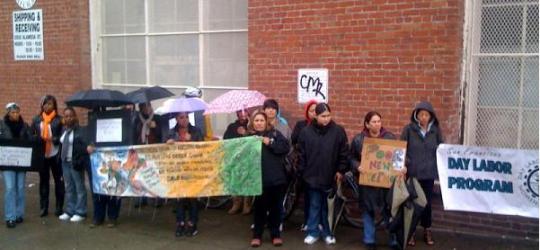
Among the 13 events scheduled so far will be immigrant day laborers sitting along Cesar Chavez Street between Mission and San Van Ness streets to protest both sit-lie and another legislative attack on immigrants, the controversial Arizona measure that essentially bans undocumented immigrants and encourages police to arrest them using racial profiling techniques.

The SF Day Labor Program is organizing the protest and today sent out a statement linking the two measures, noting that the sit-lie ordinance criminalizing otherwise lawful behavior and targets marginalized populations. Last night at the DCCC meeting, Sup. David Campos also made the point that day laborers who stand on street corners all day seeking work sometimes need to rest.

“Day laborers in San Francisco have to sit down once in awhile when they’re out on street corners waiting for work,” Jose Ramirez, a day laborer and coordinator of the SF Day Labor Program, said in today’s statement.  “Taking us to jail for sitting down in San Francisco is the same as immigrants being targeted by police for simply being Latino.”

After the Planning Commission early this month voted 6-1 to recommend against the sit-lie ordinance – finding that it violated a number of city goals and policies – the measure is awaiting consideration by the Board of Supervisors Public Safety Committee, possibly on May 3. 

DCCC: Thumbs down on sit / lie

San Francisco’s Democratic County Central Committee voted last night in favor of a resolution opposing San Francisco’s proposed sit / lie ordinance, a law backed by Mayor Gavin Newsom and Police Chief George Gascon that would make it illegal to sit or lie down on city sidewalks. Gabriel Haaland introduced the resolution, and it passed with overwhelming support.

Here’s a YouTube clip of Haaland’s comments during the committee discussion, filmed by Linda Post.

The DCCC is the policy-making body for the Democratic Party in San Francisco, chaired by former Board of Supervisors President Aaron Peskin. The vote followed a lengthy public comment session in which a wide variety of people voiced their opposition to sit / lie, including homeless youth advocates, residents of the Haight, and surprise guest Malia Cohen — formerly an executive staff member for Mayor Gavin Newsom. Some comments provoked laughter (“Sit /lie is like the fungus that won’t go away!” one Tenderloin resident exclaimed), while others framed their arguments in moral terms (“It’s hard to think of it as anything less than criminalizing poverty,” attorney David Waggoner charged). Cohen, for her part, called the ordinance “mean-spirited.”

The central committee members held a meaty discussion too, in which several members shared deeply personal stories to explain their feelings about the ordinance. Haaland described how, after graduating from law school in the mid-1990s, he found it so difficult to find work as a transgendered person that he worried about becoming homeless himself.

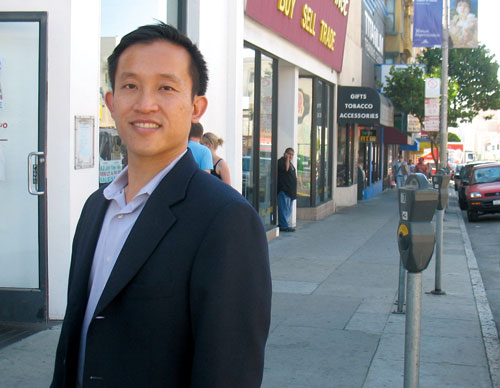
Committee member Tom Hsieh, who said he’d lived in the Haight for 10 years, spoke about his young daughter and expressed his discomfort about the “anything goes attitude” he’d seen people on the streets exhibit in her presence. Hsieh was one of a handful of committee members who voted against Haaland’s resolution. The others were Scott Wiener, Meagan Levitan, Mary Jung, and the proxy for Sen. Dianne Feinstein, while Matt Tuchow and the proxy for Assemblymember Fiona Ma abstained.  

Sup. David Campos addressed Hsieh’s concerns directly, saying that he did not believe the proposed ordinance actually addressed the sort of behavior that he found upsetting. “Sit / lie is the wrong focus,” Campos said. “The focus should be, how do we make policing better in San Francisco?” Noting that he had formely served as a police commissioner, he called for more effective community policing.

When he met with the mayor’s office about sit / lie, Campos added, he got the impression that the law was not actually meant to stop people from sitting or lying down on the sidewalk, but to target hostile behavior occurring on the street. “When you pass a law, you have to mean what it says,” he noted. He also pointed out that day laborers who wait on sidewalks for work would essentially be criminalized by the ordinance, since it’s unreasonable to expect that they wouldn’t occasionally sit down while waiting for a job.

Meanwhile, Scott Wiener’s resolution to endorse the Community Justice Center and encourage its expansion into the Haight failed with 14 voting against it and 10 voting to support it, while two abstained. While many committee members voiced general support for the CJC, a few said they resisted the idea of dictating to the Haight that it should install a similar court.

The DCCC also endorsed Linda Colfax and Michael Nava as candidates for Judge.

John Ross: Time travelling down the Mississippi

1

 Editors note: John Ross is wandering the country on a book tour, sharing his observations of Obamalandia, 2010. You can read his previous dispatches here and here  

I. Role models


When I finally made Chicago, they were all waiting for me down there two blocks south of the end of the Blue Line, through the wrought-iron gates of Forest Home Cemetery, past the ostentatious mausoleums of fabulous gypsies and clustered around the heroic monument to the Haymarket Martyrs: Red Emma, looking a little dingy these days; Elizabeth Gurley Flynn, the Rebel Girl; William Z. Foster, the CPUSA’s most rigid ideologue and the leaders of its black sector Henry Winston and William Patterson; the anarchist femme fatal Voltairine de Cleyres; hobo-ologist Ben Reitman; and, of course my personal role model, Lucy Parsons, who outlived her Albert (hung by the State for the Haymarket frame-up) by 50 years, traveling this poisoned landscape from sea to stinking sea speechifying to the masses and hawking her incendiary pamphlets to make ends meet. A single wilted rose adorned the soft granite pillow that bears her name and dates.


Scattered amidst the tombstones of the 70-plus anarchists and communists, radicals and rabble-rousers that Irving Abrams and the Pioneer Aid Society planted here are the DNAs of Joe Hill and Big Bill Haywood and Eddie Balchowsky, the one-winged barrelhouse piano player who gave up his arm to Franco’s fascists in the Spanish Civil War. Irving himself has a box seat at the foot of the Haymarket marker, now a National Historical Landmark managed by the government that these brave souls in residence once sought to overthrow.

Emma Goldman and her condescending epitaph (“a people must rise up to liberty”) was unquestionably Irving’s greatest steal, having won the bidding war for her cadaver after she croaked up in Toronto, to bring her home to the country from which she had been deported decades before for counseling young men not to sign up for the First Imperialist War. But despite the old-time luminaries in repose, I had journeyed down to Forest Home to visit with a recent implant, Franklin Rosemont, the anarchist writer and majordomo of Charles Kerr, the oldest radical publishing house in the U.S., now being sustained by his widow Penelope.  

“Surrealism Forever!” reads Franklin’s slab, in keeping with the celebratory tone of this section of the old boneyard. Franklin, who passed abruptly last year, is buried within the arc of the Haymarket monument.  The Cottons, Clara and Warren (not known to be subversives), keep him company.    

I doubt that our current president, whose adopted city Chicago is, has ever communed with these noble spirits, but it would be an educational experience if ever he should make his way down to Forest Home. Enveloped by deal-making devotees of Chicago’s backroom Democratic Party politics like Rahm Emmanuel, Valerie Jarrett, and Education Secretary Arne Duncan (now neck-deep in a hometown scandal for A-listing the scions of the influential in Chicago’s elite public schools), the examples set by Lucy Parsons and Emma Goldman might have stiffened Obama’s shaky backbone and taught him to stand up for the principles he has abandoned as the CEO of the planet’s longest-running criminal conspiracy.

Michael James rules the venerable Heartland Café in Rogers Park in the extreme northwest of this windy metropolis, a schmooze and booze venue for the left side of the local Democratic Party machine for the past three decades.  Both Obama and Bill Ayers have crossed its threshold occasionally at the same time, and Michael, the facilitator of “Rising Up Angry,” a militant Uptown youth group at the tail end of the turbulent ’60s, is now the chairperson of the local Demo ward committee. Although he will never concede that Baracko has squandered the faith that millions invested in him, I sense growing disappointment with Hope Man’s wishy-washy performance 15 months into his tainted term in office.  

As always, I bunked with the James Gang — Paige, the kids, and the estimable Che, a Labrador with a most dignified demeanor — and plunged into Chicago’s stimulating cultural mix. Also in residence: the foot-stomping Irish fiddler Paddy Jones, just in from Tralee — three years ago, Mike dragged Paddy and I off to the Korean baths where the local political class conspires. We sat buck naked in the sauna and Paddy insisted I regale him with the cautionary tale of El Che (the revolutionary martyr not the mutt).  

This time around, Michael escorted me to the late Nelson Algren’s birthday party in a church close by this quintessential Chicago scribbler’s beloved Division Street neighborhood, during which mash notes from his lover Simone de Beuvoir were read, lending credence to Frankie Lyman’s pointed inquiry “Why Do Fools Fall In Love?”

Yet another highpoint of my weeklong pilgrimage to the Hog Butcher of the World were a pair of meetings in Pilsen, an industrial enclave where the U.S. Communist Party first convened hard by Blue Island Avenue back in 1919 and now the most pertinent barrio in Mexico’s second U.S. city. More than a hundred Latino activists showed up to hear me rant and rave about the prospects for a new Mexican revolution and plot this year’s May 1st march in a city where immigrant workers first took to the streets 124 years ago to demand redress for crimes inflicted upon the working class by the bosses of industry and commerce. Four years ago, a half million immigrant workers marched here to demand recognition of their rights and despite the broken promises encapsulated in the Schumer-Graham proposed Immigration “Reform” bill, Chicago’s Mexican community is warming up for another red-hot May Day.  

II.  Resurrection

I followed the contours of the mighty Mississippi from Chicago to St. Louis through rich bottomland that is now the domain of Archer Daniels Midland. St. Louis is an urban hub that features wide, well-kept lawns and bushels of dirty money — Monsanto, Boeing, Peabody Energy, and Talx, which counsels greedy congloms on unemployment compensation, are all headquartered here.  

Yet, despite the capitalist connivance, the city has its own sui generis radical history. The 1877 railroad strike spread from the east to St. Louis and set the style for labor strife in the west, and the anarchist Flores Magon brothers published “Regeneracion,” the bible of the 100 year-old Mexican revolution, here before they were run out of town in the teens of the past century.

My days in St. Louis were well spent. I preached an Easter Sunday sermon at the Mid Rivers Ethical Society, sharing my vision of resurrection and insurrection in the aforementioned Forest Home boneyard, and offered up my palaver at a Black Green Party forum in a soul food parlor off Delmar, spreading the news of the Mexican government’s execrable persecution of  electrical workers pushed out of their workplaces last October at bayonet point by the military and police in a scheme to privatize electricity generation south of the border.  

I walked the St Louis Walk of Fame, stepping over the stars of the likes of William Burroughs, Chuck Berry, Walker Evans, and Fontella Bass, all of whom had to leave town to achieve a modicum of notoriety. I even encountered my very first St. Louie Cardinal, a crimson-hued bird perched in a sapling, spring zephyrs ruffling its crest, from which the Anheuser Busch dynasty drew the logo for the local nine in this beisbol-intoxicated town (they were previously dubbed the “Perfectos” after a popular cigar.)

III. Black & Brown

Further down river, the scrublands of Mississippi spread into the horizon beneath the cramped commuter flight in from Memphis. I had not touched down in the state since Freedom Summer 1964, when I arrived on the very day that the bodies of three civil rights workers (Michael Schwerner, Andrew Goodman, and James Chaney) were unearthed beneath a dam in Philadelphia, Miss.  

Although Black and White speak more cordially to each other these days and there are few black bodies swinging from the poplar trees, Mississippi God Damn (dixit Nina Simone) is still moldering down below. I could feel the heat at my hotel just off the Millsaps College campus in Jackson, where a statewide PTA meeting was in progress. In the conference rooms, black parents squared off against white school administrators over curriculums and the unequal quality of education. This is a commemoration year for black activism, the 40th anniversary of the killings at Jackson (and Kent) State and the 50th for SNCC — and old grievances burn long and deep.

The old civil rights movement achieved only token parity in this the poorest state in the union. Now a new civil rights movement is focusing on the flood of Mexican and Latino workers who poured into Mississippi in the wake of Katrina, and brown people are today’s niggers down at the bottom of the food chain.

Only 34,000 “Hispanics” were officially counted in the 2000 state census but Bill Chandler, a veteran of the Texas farm workers union and spokes for the Mississippi Immigrant Rights Alliance (MIRA), thinks that three times as many undocumented workers, lured to the state by casino construction, were overlooked back then. In 2010, Chandler calculates that the immigrant numbers have swelled to 200,000, nearly 10% of the state population, and taken together with close to a 40% Afro-American share, Mississippi now verges on becoming a majority People of Color entity. A similar equation is at work throughout the Deep South with Alabama and South Carolina and Georgia also hanging in the balance. Such changing demographics help to explain the vitriol the Teabaggers and White Citizen Council types shower upon the newcomers.

Back in August 2008, Immigration Control and Enforcement broke its own despicable workplace raid record by imprisoning (in Jena La., the site of other racist outrages) and deporting 595 Mexican and Latino workers who had been employed by Howard Industries down in Laurel. Chandler thinks the pogram was accomplished with the complicity of the company which was intent on cheating workers out of their wages. MIRA eventually won checks for most of those detained and deported.

An even more outrageous incidence of lingering Mississippi bigotry was the treatment of Cirila Balthazar Cruz, a mono-lingual Chatino indigena from Oaxaca who was picked up by police as she stumbled along the highway shoulder trying to get to a local hospital to give birth. Her baby daughter Ruby was subsequently stolen from her by child welfare authorities who deemed her an unfit mother because she couldn’t speak English and given to a well-appointed childless white couple. As might be anticipated, such blatant racism struck a tender nerve south of the border and a year later, Ruby was returned to her birth mother.  

Justice in Mississippi, as in much of Obamalandia, remains elusive but every once in a while the push of the people from down below captures such small prizes.

On their East Coast swing, John Ross & “El Monstruo” will visit Washington/Baltimore (Red Emma’s April 19th/ University of Maryland – Baltimore on the 20th/ Institute for Policy Studies the 21st); New York (NYU the 22nd/ Sixth Street Community Center the 23rd/Bluestockings the 25th); and Boston (Harvard Coop the 27th/David Rockefeller Center for Latin American Studies the 28th/Mass Global Action the 29th/IPS-Jamaica Plains the 30th/ topped of by a May 1st rally on the Boston Commons between Noon & Two.) All events are all free.


MTA board approves controversial budget

2

By Adam Lesser

City Hall needed an overflow room to accommodate all the disenchanted Muni riders who showed up to protest the two-year San Francisco Municipal Transportation Agency budget plan yesterday (4/20). The budget locks in a 10 percent service cut through July 1st, 2011, at which point the MTA board is hopeful that the service cut will be lowered to 5 percent. The controversial budget was adopted on a 4-3 vote, and now goes to the Board of Supervisors, where progressive supervisors have already signaled opposition to the service cuts.

“It still seems and feels as I look at it [the budget], that it’s very tenuously put together. In light of the fact that it’s going to impact the least, the lonely, and the lost of us, I had to say, let’s keep looking at it,” said Director James McCray, who was one of three dissenting votes.

McCray, along with Director Malcolm Heincke who voted for the budget, were the two directors to openly express concern about the pay of transit operators and overtime charges. In a $750 million budget, service cuts wound up providing $29 million in savings, a relatively small number compared to the $456 million that will be spent on salaries and benefits, as well as the $59 million in work orders to other agencies like the police department and the city attorney.

Small revenue measures like adding 1,000 metered spaces, eliminating free reserved parking around areas like City Hall, and window advertising wrap on buses are part of the budget.

Heincke questioned MTA Executive Director Nathaniel Ford about the budget which includes $10 million in labor concessions from MTA employees while locking in a $9 million raise in 2011 and a $9.5 million raise in 2012 for transit operators from Transit Workers Union (TWU) Local 250-A. Transit operators’ wages and raises are written into the city charter. 

“The bubble over my head says wow,” said Heincke. Ford’s attempts to negotiate with the union over work rules have been unsuccessful. Sup. Sean Elsbernd is pushing a charter amendment for the November ballot that would remove the TWU’s pay rates from the city charter.

Anger over Muni’s payment of work orders to other city agencies was a constant theme among community groups as diverse as the Chinese Progressive Association and the San Francisco Transit Riders Union. Those work orders have increased from $36 million in 2006 to $66 million in 2010.

“What really happened is the rest of the city had a budget crisis and the mayor went after Muni looking for funds,” said Dave Snyder, coordinator for the San Francisco Transit Riders Union. Newsom appoints the directors who sit on the MTA Board. “Muni is paying for service the public doesn’t want them to pay for at the expense of transit service.”

Members of the Latino and Chinese-American community were out in large numbers, not just to protest service cuts that they felt disproportionately impact the Mission and Chinatown, but to complain about harassment by the police. Enforcement of the Proof of Payment program has increased with Muni agents and police checking the amount of time left on riders’ transfer tickets, and issuing fines.

“You have police asking for ID and issuing $75 fines. There have been a few cases of deportation,” Beatriz Herrera, an organizer for People Organized to Win Employment Rights (POWER). Referring to riders whose transfers expire while riding a bus, Emily Lee of the Chinese Progressive Association said, “They expect folks to get off the bus. That’s an unreasonable expectation. It’s stressful for the community. The police are intimidating.”

The service changes are slated to take effect May 8th.

Rolling forward

7

By Adrian Castañeda

news@sfbg.com

San Francisco’s Potrero del Sol Skatepark is often packed with skaterboarders, a testament to the sport’s popularity and to the dearth of places in the city where it’s legal to skate. But that will soon change with the city’s commitment to build two new skateparks: one in SoMa and the other in the Haight.

Both have been tentatively approved by the Board of Supervisors. But before any concrete is poured, the skaters will have to overcome budget crises, angry homeowners, and their own bad reputations, particularly in the Haight, where the proposed park has gotten caught up in the furor over vagrants and the proposed sit-lie ordinance.

San Francisco has long been a skateboarding hub, yet there’s always been friction with police, businesses, and everyday city life. Even though it’s legal, there just aren’t that many places to do it anymore, partially because the city and property owners routinely attach barriers to any surfaces that might be appealing to skaters.

Skateboarders, long accustomed to being ignored and disenfranchised, have responded in their usual DIY fashion, such as building a few obstacles in an empty parking lot under a freeway overpass. The city took notice of the demand and after three years of planning and meetings, the newest of San Francisco’s skate parks has finally been allotted the necessary funds to begin construction around the end of summer.

The Central Freeway Skate Park will be located in what is now a parking lot at the intersection of Duboce and Stevenson streets in the north Mission District area. With $2 million collected through the Central Freeway Corridor Housing and Transportation Improvement Act of 1999, which provides for the sale and lease of parcels of city land that were under the now-demolished freeway, officials plan to develop the park to eventually include basketball courts and a dog run.

Rich Hillis of the Mayor’s Office of Economic Development said the city is considering a variety of improvements, but confirmed that “we think the skate park is the priority.” He attributes the park’s relatively unopposed approval to the demands of the city’s skaters and to the community as a whole. “They embraced the idea of a skatepark early on,” Hillis said of the forward-thinking residents of the area. He jokingly adds that the park should be named “Hornbeck Park” after Bryan Hornbeck, director of the San Francisco Skateboard Association. Hornbeck and his associates started the SFSA to push the city to build new parks designed with skaters in mind.

“San Francisco has to have a world-class skatepark,” Hornbeck said at one of the many skate events his group organizes. Hornbeck said the city has been receptive, working with skaters on the design of the park, but left SFSA to organize skaters and raise the funds. “It’s bake sale; it’s lemonade stand; it’s the best we can do,” Hornbeck said. “We’re not trying to take anything, we’re trying to make our own thing.”

Plans for the park, drawn up by notable skatepark design firm New Line Skateparks, are currently under review by civil engineers. After the plans are finalized, the project will be bid out to find a contractor. Tentative 3-D renderings have been online for months, sparking heated debate on skateboarding Web sites.

When the acclaimed Potrero del Sol Skatepark opened in 2008, many skaters felt that while it was well-designed and enjoyable, it didn’t have enough terrain that mimicked street riding. New Line has designed a number of skating plazas, most recently in Los Angeles. Its involvement gives many skaters hope that the new park will incorporate obstacles that represent the city’s rich street skating history.

But things are not moving as swiftly for the city’s other planned skate park, just beyond where Waller dead-ends at Stanyan in the Haight, which doesn’t have the same guaranteed funding stream. While bids for a design have been submitted, the Recreation and Park Department needs to get approval for $1 million–$2 million in construction funds before moving forward. The city proposed the 120,000-square-foot cul-de-sac at the end of Waller and next to SFPD’s Park Station after the original site near the Golden Gate Park horseshoe pits was found to be too small and lacking the necessary sight-lines for safety. But according to some residents groups, the parking lot is less safe for youths.

Citing police incident reports, Lena Emmery, president of the Cole Valley Improvement Association, told us the Waller park would be in an area with a high number of reported assaults and drug arrests and would add to noise pollution. “This location puts a skateboard park too close to a dense residential area, as well as some businesses that would be negatively impacted by the noise from the skaters,” she wrote via e-mail.

While the lot is occasionally used for bicycle safety classes and overflow parking at Kezar Stadium, it sits empty most of the year, although a farmers market will hold its grand opening there April 28. Will Keating, a Waller Street resident and skateboarder who works on Haight Street, is excited about the proposed park. He disagrees with claims that the park would be a negative impact on his neighborhood. “I hear homeless mutants going crazy outside my window every night, I would much prefer skateboards,” Keating said of the current noise pollution.

The Haight Ashbury Improvement Association, which is leading the charge for a sit-lie ordinance, conducted a survey on its Web site and found that many of its visitors feel the skatepark would increase noise and safety problems in the Haight. Visitors to the site also said the lot would be better used as a farmers market. Yet city officials say the two are not mutually exclusive, and early designs for the project are said to include a large public plaza adjacent to the park intended for community events.

“We realize this is going to be a multiuse space,” said Nick Kinsey, property manager for the Recreation and Park Department. “Throughout San Francisco there are thousands and thousands of skateboarders but only two places where it is legal to skate.” Kinsey called the park is “a done deal,” citing a 2007 ordinance introduced by Sup. Ross Mirkarimi that mandates the department build a skatepark on the cul-de-sac.

Kent Uyehara, merchant chair for the HAIA and owner of FTC skateshop on Haight, said the community’s fears about pedestrian safety are understandable, but that fears of increased violence and drug use are irrational. “If you can’t have a skate park next to a police station, then basically you are saying you can’t have it.”

If the city enacts the sit-lie ordinance, which Uyehara supports, it would be easy to imagine that a skate park would be a magnet for homeless and others looking to escape police harassment. But Uyehara is adamant that the park would not become a haven for Haight Street refugees. “Skateboarders self-police their own areas,” he said. “We’re not trying to kick the homeless out,” he added. “We’re trying to make the neighborhood attractive for everyone, whether they’re buying something or not.”

Uyehara is no stranger to opposition. When his shop first moved to the Haight in 1994, he had to deal with threats from residents and a neighborhood organization, similar to the one he is now a part of, because of what skateboarding represented to them. Since then skateboarding and his business have prospered, and FTC now has four locations worldwide. “For a city that hosted the X-Games, it’s pathetic how skateboarding has been treated.”

Uyehara says the Waller park, along with the Central Freeway and Potrero del Sol parks, are part of a plan developed by the San Francisco Skate Task Force, created in 2002 by then-Sup. Gavin Newsom to address the growing friction between the city and its skateboard population. The task force envisioned “a series of five parks located in a star pattern, and one in the middle of the city, [that] would make it possible for users to easily get to a park within at least two miles of their home.”

All the meetings and fundraising will be in vain if the park is poorly designed and built, said Jake Phelps, editor-in-chief of Thrasher Magazine. He says locals should design the park “so we have no one to blame but ourselves,” and avoid another flawed park like Crocker Amazon in Sunnydale where, he says, “the fence costs more than the skatepark.” Unimpressed with preliminary designs for the park on Duboce, the notoriously blunt Phelps says, “They’re going to come to our town, drop a turd, and leave.”

The veteran skater is wary of “landscape designers” with grandiose ideas. “There are people who get too involved. They don’t skate. Who are they to tell anybody what it is?” Newer skateparks are too crowded with obstacles trying to please all different kinds of skaters, he said. Instead, he urges a simple design similar to the streets of downtown. “The whole idea of skating is being utilitarian with your environment.” Regardless of the design, he believes it won’t have a dramatic effect on the Haight community: “Homeless people are gonna sleep there,” he said. “People are gonna tag on it and think it’s theirs.”

“The whole city’s a park, but people need somewhere to go when they get kicked out of everywhere,” says pro skater Tony Trujillo, who is able to skate to the Potrero park from his house and thinks others should have the same proximity to hassle-free skating. Julien Stranger, another local pro, feels a park in the Haight would benefit youth in the area by giving them a healthy, creative outlet, something the Haight symbolizes to many. “I don’t think that the neighborhood should be complaining about the energy a skate park will bring,” he said. “Skate parks are pretty positive.”

Earlier this month, an informational meeting hosted by the Haight Ashbury Neighborhood Council, Kinsey, Hornbeck, and other residents raised concerns that noise pollution and property damage would increase because of the skate park. “There’s been no public outreach,” said Martha Hoffman, who lives across from where the park is slated to be built. “If we’d known about it sooner, we would have opposed earlier.”

Thuy Nguyen of the SF Skate Club, an after-school program that promotes skateboarding as a safe and positive activity, urged residents to look beyond their property values and consider the benefits for the city’s youth. “It’s important for kids who feel that traditional sports aren’t for them.” Her partner, Shawn Connolly, added that skateboarding has grown in popularity with children. “It’s right after baseball,” he said.

“If the city doesn’t have a skatepark, the city is the skatepark,” Hornbeck said of the Waller Street lot where he often hosts skate events with donated ramps to ease the community into the idea of skateboarders using the area. But until the city budget can provide for skateboarders, the debate over the park will rage — and the underused parking lot at the end of Waller will remain just that.

The inside angle

0

rebeccab@sfbg.com

Josh Wolf’s second spell in the hot seat — and other penalties brought down against independent journalists documenting California’s defiant student movement — raise some important questions about the freedom of the press at civil disobedience protests.

Wolf, a student at UC Berkeley’s Graduate School of Journalism, faces a possible academic suspension for violating the student conduct code during a Nov. 20 student occupation of a campus lecture hall. But Wolf says he was there to document the moment as a reporter.

Brandon Jourdan, an independent journalist who was also inside the hall with Wolf, now faces his own set of misdemeanor charges after capturing footage of a March 4 student protest that broke onto a West Oakland freeway. And David Morse, a journalist and Indybay collective member who reported on a raucous Dec. 11 protest at the UC Berkeley chancellor’s residence, is now fighting the seizure of his camera and a search warrant issued by UC police for his unpublished photographs — something the First Amendment Project maintains is in violation of state law.

The footage that Wolf and Jourdan took on Nov. 20 and March 4 captured police use of physical force against protesters and documented the widely publicized actions from unique perspectives. The reports were broadcast on Democracy Now!, a popular independent news program that airs nationally on satellite television stations, public access channels, and online.

The gutsy camerapersons aren’t the first to face criminal charges. After nine reporters followed several hundred protesters seeking to block construction of the Black Fox Nuclear Power Plant onto private property in June 1979 and were arrested, an Oklahoma court of appeals ruled the First Amendment guaranteed them no immunity from prosecution for trespassing.

“That makes the position of a journalist very difficult, in areas where demonstrators are essentially exercising civil disobedience to make a point,” notes Terry Francke, executive director of Californians Aware, a watchdog organization focused on First Amendment issues. “There’s no free pass for journalists in the crowd recording what’s going on. Their principled position would presumably be yes, like [protesters] risk arrest and consequences for the greater good, they’d risk the same for the sake of giving the public … a close-up picture of what it’s like to be in those circumstances.”

Without that journalistic witness, “When you hear stories about what went on in the middle of a police and demonstrators’ confrontation … you’ll have two irreconcilable versions, from only directly interested parties,” Francke points out.

There’s been no shortage recently of civil disobedience on California college campuses, where operations have been ravaged by budget cuts. The Nov. 20 occupation was staged early in the morning at Wheeler Hall, when students barricaded themselves inside to protest a 32 percent fee hike imposed by the UC Board of Regents. While most reporters gathered outside the building or flew over in helicopters, Wolf was inside, and he’s the only student to claim being there in a journalistic capacity. He says he wore a police-issued press badge.

Wolf, a video journalist, enjoys a sort of celebrity status because he spent 226 days in jail after resisting a subpoena to testify before a federal grand jury. It started when he shot a film of a 2005 protest in San Francisco, which police tried to obtain because they believed it could help them pinpoint demonstrators who vandalized a police car and injured an officer. Since the case was pursued at the federal level, he was unable to invoke California’s shield law protecting journalists from being compelled to reveal unpublished material.

Democracy Now! aired a lengthy report of the Nov. 20 occupation featuring footage that the two embedded reporters had captured from the interior of Wheeler, coproduced by David Martinez. Show host Amy Goodman specifically named Wolf as a co-contributor when the report aired.

Now Wolf is facing a possible seven-month suspension by the campus Center for Student Conduct, which charges him with violating the student conduct code on multiple counts. “Their perspective is that I am a student and that I am a journalist,” Wolf explained. “My responsibility is no different from anyone else’s in there, and therein, my punishment should be reflective of that of everyone else.” Wolf said he had the backing of the journalism school, which confirmed to the Guardian that the dean wrote a letter of support for Wolf.

David Morse, 42, is a journalist who has covered hundreds of Bay Area protests on Indybay, an online news site that spotlights grassroots movements and protests. In a motion filed against UCPD, the First Amendment Project charges that Morse was arrested and had his camera seized Dec. 11 despite repeating six times that he was a journalist and displaying a press pass. “They told me, ‘You have a camera, we want your camera,'<0x2009>” Morse recounted. The next morning, as reports of angry, torch-wielding students storming the chancellor’s home and smashing windows made headlines, Morse was still sitting in jail in Santa Rita. “My voice as an eyewitness was completely silenced,” he said. His charges were dropped, but now he is challenging the search warrant to get his memory discs back.

When the police department sought a search warrant for Morse’s unpublished photos, they didn’t mention that he had identified as a journalist, the FAP charges. The legal nonprofit filed a motion to quash the warrant on grounds that it violates a provision in the penal code barring search warrants for journalistic work products, invoking the state shield law.

Jourdan, meanwhile, faces five misdemeanor charges after filming the March 4 freeway protest and subsequent police response, which many have characterized as excessive. (In one clip, an officer can be seen striking an individual who doesn’t appear to be resisting with a baton.) He was arrested along with two other videographers who also face criminal infractions. Footage Jourdan and Martinez captured from March 4 aired on Democracy Now!, and Jourdan’s report was also featured as a lead story on the Huffington Post. Jourdan says he wore press credentials.

“It’s unfair for them to file charges against me when they’ve dropped charges against others,” Jourdan said. The Oakland Police Department confirmed to the Guardian that Jourdan had been charged with crimes such as unlawful assembly and obstruction of a thoroughfare, but did not respond to a message asking what set him apart from other reporters.

Jourdan, who has also contributed to Reuters, The New York Times, and other outlets, has managed to capture a variety of similar events on film, including Amy Goodman’s arrest during protests outside the Republican National Convention in 2009. “Barely a month goes by that some lawyer isn’t calling me up trying to get footage of some one getting beat up,” he said. But he maintains that documenting these intense moments is crucial, not for resolving disputes, but to document these moments in history.

Reporters from mainstream television news programs toting bulky cameras were also filming on the freeway, but were allowed to leave. Guardian news intern Jobert Poblete and multimedia producer Cameron Burns with UC Berkeley’s Daily Californian were arrested on the freeway too, but their charges were later dropped after state Sen. Leland Yee intervened. “Journalists are generally provided greater access to cover news stories than other members of the public,” Yee wrote in a letter to the Alameda County District Attorney’s Office. “Unfortunately, law enforcement did not provide such leeway in this case.”

Adam Keigwin, Yee’s chief of staff, said the senator’s office got involved on behalf of the Guardian and the Daily Cal because he knew those publications. “We just need to know more about this,” Keigwin said. “Once credentialed media is present, it’s the senator’s perspective that journalists should have the right to cover these things and should not be charged.”

But when asked if there is a deficiency in state law since that right doesn’t technically exist, Keigwin responded, “This may be something we should consider.”

The crime-lab mess: Who knew?

2

It’s no secret that the San Francisco crime lab is a godawful mess; in fact, we first pointed out problems in the lab back in 2001. Nobody took it seriously, and things continued to deteriorate.


Now the Examiner is pointing fingers at District Attorney Kamala Harris, saying her office had word that things weren’t exactly hunkey-dorey at the testing facility long before the current mess emerged. And if, indeed, a senior deputy in the D.A.’s office knew that the crime lab was bungling cases, Harris should have been informed, and she should have gone to the police chief and demanded to know what was going on; after all, lots and lots of her cases are now going south because of screw-ups in the lab.


But let me add another element to this, one that the daily newspapers haven’t put much focus on:


Where the hell was the chief of police, the assistant chief in charge of the crime lab, the crime lab director — all the top SFPD brass — whose job it was to monitor the lab and ensure its quality — while a truly nasty, messy situation was developing? Now, much of this pre-dates Chief George Gascon, and the guy he brought in from L.A., Assistant Chief Jeff Godown, who’s now trying to patch things up. But if the D.A.’s office knew there were problems, and a deputy D.A. was able to point to one lab employee who was allegedly calling in sick just to screw up lab operations, it’s almost inconceivable that nobody at the Police Department had a clue what was going on.


Godown appeared April 19 at the Board of Supervisors Public Safety Committee, and Sup. Ross Mirkarimi grilled him about how the situation was allowed to get so bad. Godown’s answer: “We’re still trying to piece together who knew what at the crime lab. Did the commanding officer know? Did the command staff at the Hall of Justice know?”


Good questions, because either somebody knew — and didn’t report it — or nobody knew anything, in which case you wonder why the SFPD is allowed to run a crime lab in the first place.

Crime Bomb

1

Editors note: This story was originally published May 31,  2001.


They found Virginia Lowery lying in the garage of her Excelsior home, an electrical cord around her throat, an ice pick jammed through her skull — in one ear and out the other. For the next 11 years San Francisco homicide detectives made no progress on the case. Promising leads turned into dead ends. Theories collapsed. The cops assigned to the case retired. It looked like Lowery’s 1987 slaying would never be solved.


Then in April 1998, by pure chance, police found Robert C. Nawi. Or rather, they found his fingertips.


When Nawi, a 57-year-old carpenter, got in a shouting match in a North Beach watering hole, he was picked up by the cops on misdemeanor charges and shuttled to county jail, where he was fingerprinted and booked. The computer spat out some interesting news: Nawi’s digits, according to the database, resembled a fingerprint found at the scene of Lowery’s slaying.


Soon thereafter, police evidence analyst Wendy Chong made a positive print match, and the new suspect found himself facing murder charges and life in a cage.


Nawi’s fate, to be decided at trial next year, rests largely on police readings of his fingerprints, as well as some DNA gathered by the coroner. Which raises some questions: How, exactly, did the cops and their computers analyze the evidence? Did they get it right? Is anybody checking their work?


Making a match between the distinguishing ridges and whorls, often microscopic, of two fresh fingerprints is a relatively simple task for a print expert. However, cases like Nawi’s aren’t so clear-cut: the print collected in Lowery’s garage is faint, smudged, and missing in patches.


Michael Burt, the resident forensicscience guru at the San Francisco Public Defender’s Office, shows me an 8-by-10-inch enlargement of the print discovered at the murder scene; it’s blurry, grainy, and only about 60 percent complete. To my layperson’s eye, it bears little resemblance to the clear, fresh mark left by Nawi at his booking. “The one print is so washed out you can’t see anything,” says Burt, who is representing Nawi. “This is not science at all; it’s subjective and shouldn’t be allowed.”


Burt, a 22-year veteran defense lawyer known around the Hall of Justice for his trademark cart full of documents, has plenty of cause to doubt the cops’ evidence. Despite what you may have seen on Law and Order, fingerprint examiners can — and often do — get it wrong. Last year 141 of America’s top forensic labs were tested to see if they could accurately match two fingerprints: 39 percent failed; 11 labs made false IDs. San Francisco analysts are rarely, if ever, graded for accuracy.


Jim Norris, head of the San Francisco Police Department’s forensics division, argues that new computer imaging tools are making it possible to match even sketchy, partial prints. “When somebody shows a print that was originally collected at the crime scene, and it looks very difficult to deal with, what they’re not looking at is the image that has been [digitally] enhanced,” Norris explains. “It’s a lot easier to deal with.” Norris admits that the department has seldom tested its print examiners for accuracy, but he says their work is constantly checked by superiors.


According to Burt, in this particular instance analysts didn’t turn to computers but simply enlarged the prints before making the call. The district attorney’s DNA evidence against Nawi is equally flawed, he says. When coroner Boyd Stephens autopsied the corpse, he — per routine — snipped the woman’s fingernails with a household nail clipper and stuck them in an envelope. Unrefrigerated, the clippings slowly rotted for more than a decade, until, in the wake of Nawi’s arrest, prosecutor John Farrell had them tested for DNA.


When the crime lab got the evidence, in 1998, DNA analyst Alan Keel scraped all 10 nails with a single cotton swab, combined the scrapings into one tiny pile, and dropped them into a genetic-typing device. According to standard forensic procedure, each nail should’ve been swabbed and tested separately.


Now, Burt contends, the sample has deteriorated because of a lack of refrigeration and has been contaminated with the DNA of more than one person. “[Keel] says there are three, possibly four different individuals underneath her fingernails,” the lawyer says. “He’s trying to grab my client out of that mixture. There’s no scientific way to do that.”


Norris disagrees: “There are ways to deal with [DNA] mixtures; it’s not a common problem luckily, but it’s something that comes up — for example, in rape cases where there are multiple assailants. There are ways to deal with it.”


I run down the scenario for Dr. Simon Ford, a Ph.D. biochemist and DNA expert who heads up San Francisco–based Lexigen Science and Law Consultants. “That’s not good,” Ford tells me. “You should deal with each hand separately, at least, and probably each nail separately. I don’t think combining all the nails together is a good idea.”


The dispassionate examination of crime scene evidence — narcotics, fingerprints, hair and fibers, genetic material, firearms, and everything else — is a cornerstone of the American justice system. The work, which can mean the difference between life and death for a suspect, is carried out by more than 500 labs nationwide, most of them run by law enforcement agencies.


In the public imagination — as shaped by endless cops-and-lawyers TV shows — forensic science is a perfectly impartial arbiter of justice. Eyewitnesses get confused. Police may be corrupt. Lawyers can corkscrew facts. Juries, not always composed of the brightest lights, can be swayed by mob dynamics. But science doesn’t lie. If the analyst says the bullet came from the suspect’s gun, then it must have.


It’s a comforting thought.


There’s just one problem: All forensic science is performed by humans, and all people make blunders. They mislabel samples. They use malfunctioning equipment. They inadvertently drop a flake of skin in a vial of blood, thus adding their own DNA to the sample.


Subjectivity, too, plays a starring role in forensic science, much of which depends on human-made comparisons. In one case heard last year by San Francisco Superior Court Judge Robert Dondero, two DNA experts couldn’t agree on the meaning of a genetic sample.


In addition to honest mistakes born of incompetence and overwork, there are continuously uncovered examples of fraud: the lab analyst, believing that the verdict justifies the means, willing to lie on the stand or fake test results. While the scientific question of DNA accuracy has been hashed out extensively in court rooms and the media, the issue of police crime lab accuracy has gone ignored, both by press and government regulators.


Each year California cops make 1.5 million arrests. Each of the state’s 19 local crime labs — run by sheriffs, prosecutors, and cops — performs thousands of analyses annually. Each of those tests, if faulty, could put an innocent person behind bars, or set a guilty soul free.


And in the wild world of forensics there are precious few safeguards against human bias and error: Crime labs are almost entirely unregulated. There are virtually no federal laws governing their operation; no law that says, “Bullet comparisons must be done using the best, most accurate techniques”; no law that says, “DNA examiners must meet these basic educational criteria”; no requirement that crime labs be audited and inspected. In California only DUI-<\h>testing procedures are regulated by state law.


“There’s more regulation in whether some clinical lab can give a test for strep throat than there is on whether you can use a test to put somebody in the gas chamber,” public defender Burt says. “That to me seems backwards. The stakes are the highest in the criminal justice system. These people are deciding who lives or dies.”


The ramifications spread beyond individual cases. While billions of dollars have been poured into police departments and prisons over the past two decades, pols and badge wearers have shown little interest in adequately funding or regulating crime labs. California’s facilities need hundreds of millions of dollars in repairs and equipment upgrades. The idea of public oversight is off the radar entirely.


The nonprofit American Society of Crime Laboratory Directors (ASCLD) is the closest thing forensics has to a regulatory agency. Created in the early 1970s to “improve the quality of laboratory services provided to the criminal justice system,” the group runs a voluntary accreditation program for forensic facilities. To get the society’s stamp of approval, a facility must pass a 149-point inspection. (Sample question: “Are the procedures used generally accepted in the field or supported by data gathered in a scientific manner?”) To maintain the certification, a lab must be tested annually and be reinspected every five years.


Of the approximately 500 labs in the United States, a mere 187 are accredited by the ASCLD. Only 11 of California’s 19 local crime labs have the group’s seal of approval. The San Francisco police facility isn’t one of them. Neither is the Contra Costa sheriff’s lab. Nor the San Mateo sheriff’s forensic unit.


“Got dope?” asks the white-coated woman who opens the locked door to the SFPD crime lab. She’s expecting cops bearing drug-filled baggies, to be weighed and tested and filed away until the courtroom beckons. Crime lab chief Martha “Marty” Blake steps out of her windowless office to greet me.


A few months back, Blake and her 18-person team traded overstuffed quarters in the city’s central cop shop at Eighth Street and Bryant for expansive new $1.5 million digs out in the asphalt wastes of the Hunters Point shipyard. “I’m getting ready to apply for accreditation, hopefully by next spring,” she says, pointing to a file cabinet emblazoned with the ASCLD seal. “We couldn’t get accredited in that facility when we were downtown at the Hall of Justice. It was too cramped. There was no way we could guarantee there would never be any chance for any contamination of the evidence when we had four people crammed into a little room trying to look at clothing, for example.”


Blake’s operation has taken its lumps over the years. In 1994 analyst Allison Lancaster was canned after she was videotaped faking drug tests. Last year Superior Court Judge Dondero slammed the lab’s lead DNA expert for “engaging in shortcuts,” “performing missteps,” and harboring a questionable “degree of bias” against defendants. Defense lawyers like Burt continue to hammer the lab for its lack of credentials.


With her eyeglasses and graying hair Blake looks more like a schoolteacher than a cop. She pulls a xeroxed sheet of paper out of a drawer and eagerly places it in front of me. “We just switched to a new case review process. This is the sort of thing we have to implement for accreditation. Every case we produce has to go through a review by a supervisor,” she explains. “This wasn’t happening before; a review happened before, but you’d just glance over [the work] and say, ‘Hmm, looks good to me,’ and initial it. It was sort of lightweight.” Bolstered by an increased budget and a growing staff, the lab’s procedures are improving across the board, according to Blake.


Why should forensic labs, which can land someone on death row, go without government oversight? “I’d like to think we can do this ourselves,” Blake replies, noting that the state’s management of the DUI testing program has been less than stellar. “I’m a little nervous about other agencies getting involved in regulation,” she says, because they don’t “really know the science.”


Nationally, the accountability vacuum is producing a steady stream of scandals, raising unsettling questions about the way we administer justice in this locked-down nation. A small sampling:
• Let’s start with the trial of the century, wherein O.J.’s defense team put the forensic bunglings of the Los Angeles Police Department on display for “unacceptable sloppiness,” pointing out a dozen major instances of possible evidence contamination. After losing the Simpson trial, the lab promptly began a thorough overhaul.
• In 1993 the West Virginia Supreme Court found a police blood expert guilty of fabricating or misrepresenting evidence in a staggering 134 cases. The man, one Fred Zain — employed by the state cops during the 1980s — was put on trial for perjury, while the state freed several unjustly imprisoned death row inmates and paid out millions to people who had been wrongfully convicted. Bexar County, Texas, where Zain worked in the early ’90s, also prosecuted him for perjury.
• A few years later, in 1997, the reputation of the Federal Bureau of Investigation crime lab — at the time widely regarded as the pinnacle of forensic science — was shredded by the allegations of a whistle-blowing scientist. The bureau’s lab practiced shoddy science and regularly presented inaccurate, pro-prosecution testimony, charged Dr. Frederic Whitehurst, one of the agency’s top explosives experts. The FBI denied the allegations and tried to discredit Whitehurst, but a scathing 517-page report by the Justice Department’s inspector general corroborated many of the scientist’s major claims and recommended disciplinary action against five agents.


• An April 1997 front-page story in the Wall Street Journal brought more unflattering publicity to the FBI lab, scrutinizing the track record of agent Michael Malone, a hair and fiber analyst. The paper quoted three well-known forensic scientists who challenged Malone’s analyses (one labeled him a “fraud”), illustrated numerous cases where the agent seemed to be fudging the evidence — and noted that courts were busy overturning convictions obtained with his testimony. “The guy’s a total liar,” one defense lawyer told the Wall Street Journal.
• In 1998 San Diego jurors convicted a top county police DNA expert of embezzling $8,100 in cash seized as evidence in murder cases. That same year the San Diego Police Department embarked on a 10-month internal investigation into charges of sloppy work and missing evidence at its crime lab, and it admitted that it had lost crucial evidence in an unsolved homicide case.
• Last year a crime lab chemist in Prince George’s County, Md., claimed that the police department was using improperly calibrated drug analysis equipment. Defense lawyers promptly challenged some 100 pending drug cases.


California is one of the few states that has actually scoped the inner workings of its local crime labs. The results of that onetime review, performed in 1998 by the state auditor’s office, are disturbing. Quality control was lacking at most of the facilities. Many of the labs were using “outdated and improperly working equipment.” As in San Francisco, many didn’t make their scientists undergo regular proficiency testing.


Without quality assurance measures — minimal at 13 of the 19 labs — the potential for error shoots through the roof. California auditor Elaine Howel says the study raised serious questions. “There are several issues,” she says. “Is the evidence being handled appropriately so there’s no potential for contamination?” Labs, according to Howel, should “make sure they are consistently applying the methodology so one forensic examiner isn’t using one technique and someone is using a different technique to conduct the same type of testing. That ties back to the credibility of the results.”


Ten of the outfits were relying on “outmoded” technology that needed replacement. At the Huntington Beach Police Department lab, staffers worked up a Rube Goldberg–<\d>esque scheme to revive a broken arson analysis gadget. Sort of. “Because the laboratory does not have the funds to replace this equipment, staff found a creative way to cool the [machine] using hoses rigged to a faucet,” auditors found. But, they noted, “this method could negatively affect the analysis of the evidence processed by this instrument.”


Then there was the question of whether the analysts themselves were up to par. “We think forensic examiners need to be tested every year to make sure they’re maintaining competence in their ability to perform the forensic examinations they’re doing,” Howel tells me. Eight of the labs had no proficiency testing for their staffers.


“It helped us put our operation in perspective to the rest of the state,” says S.F. lab chief Blake, who thinks the audit was fair. “We did look like we were swamped. It helped us get our additional staff.”


Whitehurst, the former top explosives expert at the FBI, doesn’t like the term ‘whistle-blower.’ “We’re simply scientists, and we disagree with the type of science that’s being practiced — because it’s not science,” he told me. “Our forensic labs are dictating truth; they’re not discovering it.” Whitehurst says he constantly hears from irate crime lab scientists claiming their operations are riddled with improprieties.


The Ph.D. chemist spent eight years at the bureau combing the rubble of bomb blasts for clues. And complaining. During his tenure with the bureau, he made 237 written complaints concerning what he saw as a pattern of bunk science and bogus testimony on the part of his colleagues. The charges spurred an 18-month probe by the Justice Department, the phone-book-size results of which were made public in 1997, undoubtedly marking one of the FBI’s worst public embarrassments.


The special-inspection team, an international panel of renowned forensic scientists, had few kind words for the lab, finding “significant instances of testimonial errors, substandard analytical work, and deficient practices” in numerous investigations, including the Unabomber, Oklahoma City, and World Trade Center bombings. Among the skeletons in the bureau’s closet: “scientifically flawed reports”; examiners devoid of the “requisite scientific qualifications”; and five agents who couldn’t be trusted.


Whitehurst’s experiences have led him to believe that crime labs should be overseen by federal or state authorities, rather than by ASCLD and its voluntary certification program. “It’s a foregone conclusion; there’s no question in my mind in five years forensic labs will be regulated, and they will be audited,” said Whitehurst, who now lives in Bethel, N.C., and acts as an expert witness in criminal trials. “There’s too much discovery happening.”


Lab directors argue that their work is constantly reviewed by the courts — juries don’t have to believe a forensic expert; judges can overturn verdicts based on forensic evidence — making their profession among the most scrutinized.
Whitehurst disagrees, saying juries, defense lawyers, and judges are often baffled by the science presented to them. “Listen to this phrase: pyrolisis-gas chromatography/mass spectrometry,” he says. “Do you know what that is? Let’s try this one: fourier transform infrared spectrometry. I’ve got a doctorate in chemistry and a jurisdoctorate also. What I’m saying to you are completely foreign concepts. When I try to explain how a ultraviolet spectraphatometer works, or how a micro spectraphatometer works, just saying the words begins the glass-over of the eyes.”


The Alameda County Sheriff’s crime lab is housed in a two-story building in the foothills just off 150th Avenue in San Leandro. On the second floor, in a series of linoleum-tiled rooms connected by a cluttered hallway, the lab’s technicians scope the physical remnants of crime, putting bullets beneath microscopes, lifting latent fingerprints from knife handles, culling DNA strands from splattered blood.


Each year the operation, which analyzes evidence for most of the county’s police forces, handles some 200 “major” investigations, most of them murders and rapes. But drug cases (1,800 to 2,000) and DUIs (more than 4,700) make up the bulk of the work. There are only eight lab technicians to handle the massive load.


“Every analytical report has to be right on the mark,” said lab director Tony Sprague, who has worked at the facility for 30 years. “We have a huge responsibility to make sure all the results are accurate.”


Sprague guides me through the building, showing me a single lead particle, as magnified 10,000 times by a monstrous, $270,000 scanning electron microscope. Next door a white-<\h>coated technician sits glued to a conventional microscope, studying a handgun cartridge. Across the hall are the analysts’ personal workstations: on one of the wide-topped tables sit the innards of an auto; on another lie sheets of paper covered with boot prints.


Sprague is an amiable gearhead and explains in detail how each of the machines works. The gas chromatograph/mass spectrometer, an ovenlike slab of a machine, can detect the presence of gasoline or kerosene in air samples collected at the scene of a suspected arson fire. Another device uses infrared light to determine the chemical composition of a given substance — a bag of white powder for instance.


The lab’s ASCLD accreditation in June 1999 was a huge undertaking, according to Sprague. “It took us about two years [to get certified],” he says. “It was costly from the standpoint that you have to take dedicated staff time away from analytical work to get the paperwork done for the accreditation process. In our case we really didn’t change our ways of doing forensic science to meet accreditation standards. There was really no issue about doing things differently — the thing we had to do, we had to document all the policies, the procedures, all of our quality assurance records had to be brought up to a little bit higher level.”


Voluntary reviews by the nonprofit ASCLD are enough regulation for Sprague, who views government oversight as a losing proposition. “Some mandated federal program? I don’t know that that’s really the answer,” he says. “That would involve a huge bureaucracy. It would be a very difficult situation.”


Ralph Keaton, executive director of ASCLD’s accrediting board, agrees. “I think crime laboratories should have some kind of program to review the quality of the work being produced by the laboratory — and that’s the reason we came into existence,” he tells me via telephone from the organization’s headquarters in Garner, N.C. “It’s my opinion that no one can evaluate the type of work being done better than the actual practitioners of that discipline. Just like the oversight of the medical profession is best done by the doctors themselves.”


Speaking to me in his office library, Sprague tells me he is proud of the work his team does, proud to be acknowledged by his peers. But he admits to a certain frustration, saying that his lab is seriously short-staffed: “We’re about one-third the strength we should be at for what we’re doing.”

Crime Bomb

0

Editors note: This story was originally published in 2001.


They found Virginia Lowery lying in the garage of her Excelsior home, an electrical cord around her throat, an ice pick jammed through her skull — in one ear and out the other. For the next 11 years San Francisco homicide detectives made no progress on the case. Promising leads turned into dead ends. Theories collapsed. The cops assigned to the case retired. It looked like Lowery’s 1987 slaying would never be solved.
Then in April 1998, by pure chance, police found Robert C. Nawi. Or rather, they found his fingertips.
When Nawi, a 57-year-old carpenter, got in a shouting match in a North Beach watering hole, he was picked up by the cops on misdemeanor charges and shuttled to county jail, where he was fingerprinted and booked. The computer spat out some interesting news: Nawi’s digits, according to the database, resembled a fingerprint found at the scene of Lowery’s slaying.
Soon thereafter, police evidence analyst Wendy Chong made a positive print match, and the new suspect found himself facing murder charges and life in a cage.
Nawi’s fate, to be decided at trial next year, rests largely on police readings of his fingerprints, as well as some DNA gathered by the coroner. Which raises some questions: How, exactly, did the cops and their computers analyze the evidence? Did they get it right? Is anybody checking their work?


Making a match between the distinguishing ridges and whorls, often microscopic, of two fresh fingerprints is a relatively simple task for a print expert. However, cases like Nawi’s aren’t so clear-cut: the print collected in Lowery’s garage is faint, smudged, and missing in patches.
Michael Burt, the resident forensic-<\h>science guru at the San Francisco Public Defender’s Office, shows me an 8-by-10-inch enlargement of the print discovered at the murder scene; it’s blurry, grainy, and only about 60 percent complete. To my layperson’s eye, it bears little resemblance to the clear, fresh mark left by Nawi at his booking. “The one print is so washed out you can’t see anything,” says Burt, who is representing Nawi. “This is not science at all; it’s subjective and shouldn’t be allowed.”
Burt, a 22-year veteran defense lawyer known around the Hall of Justice for his trademark cart full of documents, has plenty of cause to doubt the cops’ evidence. Despite what you may have seen on Law and Order, fingerprint examiners can — and often do — get it wrong. Last year 141 of America’s top forensic labs were tested to see if they could accurately match two fingerprints: 39 percent failed; 11 labs made false IDs. San Francisco analysts are rarely, if ever, graded for accuracy.
Jim Norris, head of the San Francisco Police Department’s forensics division, argues that new computer imaging tools are making it possible to match even sketchy, partial prints. “When somebody shows a print that was originally collected at the crime scene, and it looks very difficult to deal with, what they’re not looking at is the image that has been [digitally] enhanced,” Norris explains. “It’s a lot easier to deal with.” Norris admits that the department has seldom tested its print examiners for accuracy, but he says their work is constantly checked by superiors.
According to Burt, in this particular instance analysts didn’t turn to computers but simply enlarged the prints before making the call. The district attorney’s DNA evidence against Nawi is equally flawed, he says. When coroner Boyd Stephens autopsied the corpse, he — per routine — snipped the woman’s fingernails with a household nail clipper and stuck them in an envelope. Unrefrigerated, the clippings slowly rotted for more than a decade, until, in the wake of Nawi’s arrest, prosecutor John Farrell had them tested for DNA.
When the crime lab got the evidence, in 1998, DNA analyst Alan Keel scraped all 10 nails with a single cotton swab, combined the scrapings into one tiny pile, and dropped them into a genetic-<\h>typing device. According to standard forensic procedure, each nail should’ve been swabbed and tested separately.
Now, Burt contends, the sample has deteriorated because of a lack of refrigeration and has been contaminated with the DNA of more than one person. “[Keel] says there are three, possibly four different individuals underneath her fingernails,” the lawyer says. “He’s trying to grab my client out of that mixture. There’s no scientific way to do that.”
Norris disagrees: “There are ways to deal with [DNA] mixtures; it’s not a common problem luckily, but it’s something that comes up — for example, in rape cases where there are multiple assailants. There are ways to deal with it.”
I run down the scenario for Dr. Simon Ford, a Ph.D. biochemist and DNA expert who heads up San Francisco–<\d>based Lexigen Science and Law Consultants. “That’s not good,” Ford tells me. “You should deal with each hand separately, at least, and probably each nail separately. I don’t think combining all the nails together is a good idea.”
Blinding them with science
The dispassionate examination of crime scene evidence — narcotics, fingerprints, hair and fibers, genetic material, firearms, and everything else — is a cornerstone of the American justice system. The work, which can mean the difference between life and death for a suspect, is carried out by more than 500 labs nationwide, most of them run by law enforcement agencies.
In the public imagination — as shaped by endless cops-and-<\h>lawyers TV shows — forensic science is a perfectly impartial arbiter of justice. Eyewitnesses get confused. Police may be corrupt. Lawyers can corkscrew facts. Juries, not always composed of the brightest lights, can be swayed by mob dynamics. But science doesn’t lie. If the analyst says the bullet came from the suspect’s gun, then it must have.
It’s a comforting thought.
There’s just one problem: All forensic science is performed by humans, and all people make blunders. They mislabel samples. They use malfunctioning equipment. They inadvertently drop a flake of skin in a vial of blood, thus adding their own DNA to the sample.
Subjectivity, too, plays a starring role in forensic science, much of which depends on human-<\h>made comparisons. In one case heard last year by San Francisco Superior Court Judge Robert Dondero, two DNA experts couldn’t agree on the meaning of a genetic sample.
In addition to honest mistakes born of incompetence and overwork, there are continuously uncovered examples of fraud: the lab analyst, believing that the verdict justifies the means, willing to lie on the stand or fake test results.
While the scientific question of DNA accuracy has been hashed out extensively in court rooms and the media, the issue of police crime lab accuracy has gone ignored, both by press and government regulators.
Each year California cops make 1.5 million arrests. Each of the state’s 19 local crime labs — run by sheriffs, prosecutors, and cops — performs thousands of analyses annually. Each of those tests, if faulty, could put an innocent person behind bars, or set a guilty soul free.
And in the wild world of forensics there are precious few safeguards against human bias and error: Crime labs are almost entirely unregulated. There are virtually no federal laws governing their operation; no law that says, “Bullet comparisons must be done using the best, most accurate techniques”; no law that says, “DNA examiners must meet these basic educational criteria”; no requirement that crime labs be audited and inspected. In California only DUI-<\h>testing procedures are regulated by state law.
“There’s more regulation in whether some clinical lab can give a test for strep throat than there is on whether you can use a test to put somebody in the gas chamber,” public defender Burt says. “That to me seems backwards. The stakes are the highest in the criminal justice system. These people are deciding who lives or dies.”
The ramifications spread beyond individual cases. While billions of dollars have been poured into police departments and prisons over the past two decades, pols and badge wearers have shown little interest in adequately funding or regulating crime labs. California’s facilities need hundreds of millions of dollars in repairs and equipment upgrades. The idea of public oversight is off the radar entirely.
The nonprofit American Society of Crime Laboratory Directors (ASCLD) is the closest thing forensics has to a regulatory agency. Created in the early 1970s to “improve the quality of laboratory services provided to the criminal justice system,” the group runs a voluntary accreditation program for forensic facilities. To get the society’s stamp of approval, a facility must pass a 149-point inspection. (Sample question: “Are the procedures used generally accepted in the field or supported by data gathered in a scientific manner?”) To maintain the certification, a lab must be tested annually and be reinspected every five years.
Of the approximately 500 labs in the United States, a mere 187 are accredited by the ASCLD. Only 11 of California’s 19 local crime labs have the group’s seal of approval. The San Francisco police facility isn’t one of them. Neither is the Contra Costa sheriff’s lab. Nor the San Mateo sheriff’s forensic unit.
Renewing the review process
“Got dope?” asks the white-<\h>coated woman who opens the locked door to the SFPD crime lab. She’s expecting cops bearing drug-filled baggies, to be weighed and tested and filed away until the courtroom beckons. Crime lab chief Martha “Marty” Blake steps out of her windowless office to greet me.
A few months back, Blake and her 18-person team traded overstuffed quarters in the city’s central cop shop at Eighth Street and Bryant for expansive new $1.5 million digs out in the asphalt wastes of the Hunters Point shipyard. “I’m getting ready to apply for accreditation, hopefully by next spring,” she says, pointing to a file cabinet emblazoned with the ASCLD seal. “We couldn’t get accredited in that facility when we were downtown at the Hall of Justice. It was too cramped. There was no way we could guarantee there would never be any chance for any contamination of the evidence when we had four people crammed into a little room trying to look at clothing, for example.”
Blake’s operation has taken its lumps over the years. In 1994 analyst Allison Lancaster was canned after she was videotaped faking drug tests. Last year Superior Court Judge Dondero slammed the lab’s lead DNA expert for “engaging in shortcuts,” “performing missteps,” and harboring a questionable “degree of bias” against defendants. Defense lawyers like Burt continue to hammer the lab for its lack of credentials.
With her eyeglasses and graying hair Blake looks more like a schoolteacher than a cop. She pulls a xeroxed sheet of paper out of a drawer and eagerly places it in front of me. “We just switched to a new case review process. This is the sort of thing we have to implement for accreditation. Every case we produce has to go through a review by a supervisor,” she explains. “This wasn’t happening before; a review happened before, but you’d just glance over [the work] and say, ‘Hmm, looks good to me,’ and initial it. It was sort of lightweight.” Bolstered by an increased budget and a growing staff, the lab’s procedures are improving across the board, according to Blake.
Why should forensic labs, which can land someone on death row, go without government oversight? “I’d like to think we can do this ourselves,” Blake replies, noting that the state’s management of the DUI testing program has been less than stellar. “I’m a little nervous about other agencies getting involved in regulation,” she says, because they don’t “really know the science.”
Beyond O.J.
Nationally, the accountability vacuum is producing a steady stream of scandals, raising unsettling questions about the way we administer justice in this locked-down nation. A small sampling:
• Let’s start with the trial of the century, wherein O.J.’s defense team put the forensic bunglings of the Los Angeles Police Department on display for “unacceptable sloppiness,” pointing out a dozen major instances of possible evidence contamination. After losing the Simpson trial, the lab promptly began a thorough overhaul.
• In 1993 the West Virginia Supreme Court found a police blood expert guilty of fabricating or misrepresenting evidence in a staggering 134 cases. The man, one Fred Zain — employed by the state cops during the 1980s — was put on trial for perjury, while the state freed several unjustly imprisoned death row inmates and paid out millions to people who had been wrongfully convicted. Bexar County, Texas, where Zain worked in the early ’90s, also prosecuted him for perjury.
• A few years later, in 1997, the reputation of the Federal Bureau of Investigation crime lab — at the time widely regarded as the pinnacle of forensic science — was shredded by the allegations of a whistle-<\h>blowing scientist. The bureau’s lab practiced shoddy science and regularly presented inaccurate, pro-<\h>prosecution testimony, charged Dr. Frederic Whitehurst, one of the agency’s top explosives experts. The FBI denied the allegations and tried to discredit Whitehurst, but a scathing 517-page report by the Justice Department’s inspector general corroborated many of the scientist’s major claims and recommended disciplinary action against five agents.
• An April 1997 front-page story in the Wall Street Journal brought more unflattering publicity to the FBI lab, scrutinizing the track record of agent Michael Malone, a hair and fiber analyst. The paper quoted three well-known forensic scientists who challenged Malone’s analyses (one labeled him a “fraud”), illustrated numerous cases where the agent seemed to be fudging the evidence — and noted that courts were busy overturning convictions obtained with his testimony. “The guy’s a total liar,” one defense lawyer told the Wall Street Journal.
• In 1998 San Diego jurors convicted a top county police DNA expert of embezzling $8,100 in cash seized as evidence in murder cases. That same year the San Diego Police Department embarked on a 10-month internal investigation into charges of sloppy work and missing evidence at its crime lab, and it admitted that it had lost crucial evidence in an unsolved homicide case.
• Last year a crime lab chemist in Prince George’s County, Md., claimed that the police department was using improperly calibrated drug analysis equipment. Defense lawyers promptly challenged some 100 pending drug cases.
Under the microscope
California is one of the few states that has actually scoped the inner workings of its local crime labs. The results of that onetime review, performed in 1998 by the state auditor’s office, are disturbing. Quality control was lacking at most of the facilities. Many of the labs were using “outdated and improperly working equipment.” As in San Francisco, many didn’t make their scientists undergo regular proficiency testing.
Without quality assurance measures — minimal at 13 of the 19 labs — the potential for error shoots through the roof. California auditor Elaine Howel says the study raised serious questions. “There are several issues,” she says. “Is the evidence being handled appropriately so there’s no potential for contamination?” Labs, according to Howel, should “make sure they are consistently applying the methodology so one forensic examiner isn’t using one technique and someone is using a different technique to conduct the same type of testing. That ties back to the credibility of the results.”
Ten of the outfits were relying on “outmoded” technology that needed replacement. At the Huntington Beach Police Department lab, staffers worked up a Rube Goldberg–<\d>esque scheme to revive a broken arson analysis gadget. Sort of. “Because the laboratory does not have the funds to replace this equipment, staff found a creative way to cool the [machine] using hoses rigged to a faucet,” auditors found. But, they noted, “this method could negatively affect the analysis of the evidence processed by this instrument.”
Then there was the question of whether the analysts themselves were up to par. “We think forensic examiners need to be tested every year to make sure they’re maintaining competence in their ability to perform the forensic examinations they’re doing,” Howel tells me. Eight of the labs had no proficiency testing for their staffers.
“It helped us put our operation in perspective to the rest of the state,” says S.F. lab chief Blake, who thinks the audit was fair. “We did look like we were swamped. It helped us get our additional staff.”
Busting the FBI
Whitehurst, the former top explosives expert at the FBI, doesn’t like the term ‘whistle-blower.’ “We’re simply scientists, and we disagree with the type of science that’s being practiced — because it’s not science,” he told me. “Our forensic labs are dictating truth; they’re not discovering it.” Whitehurst says he constantly hears from irate crime lab scientists claiming their operations are riddled with improprieties.
The Ph.D. chemist spent eight years at the bureau combing the rubble of bomb blasts for clues. And complaining. During his tenure with the bureau, he made 237 written complaints concerning what he saw as a pattern of bunk science and bogus testimony on the part of his colleagues. The charges spurred an 18-month probe by the Justice Department, the phone-book-<\h>size results of which were made public in 1997, undoubtedly marking one of the FBI’s worst public embarrassments.
The special-inspection team, an international panel of renowned forensic scientists, had few kind words for the lab, finding “significant instances of testimonial errors, substandard analytical work, and deficient practices” in numerous investigations, including the Unabomber, Oklahoma City, and World Trade Center bombings. Among the skeletons in the bureau’s closet: “scientifically flawed reports”; examiners devoid of the “requisite scientific qualifications”; and five agents who couldn’t be trusted.
Whitehurst’s experiences have led him to believe that crime labs should be overseen by federal or state authorities, rather than by ASCLD and its voluntary certification program. “It’s a foregone conclusion; there’s no question in my mind in five years forensic labs will be regulated, and they will be audited,” said Whitehurst, who now lives in Bethel, N.C., and acts as an expert witness in criminal trials. “There’s too much discovery happening.”
Lab directors argue that their work is constantly reviewed by the courts — juries don’t have to believe a forensic expert; judges can overturn verdicts based on forensic evidence — making their profession among the most scrutinized.
Whitehurst disagrees, saying juries, defense lawyers, and judges are often baffled by the science presented to them. “Listen to this phrase: pyrolisis-gas chromatography/mass spectrometry,” he says. “Do you know what that is? Let’s try this one: fourier transform infrared spectrometry. I’ve got a doctorate in chemistry and a jurisdoctorate also. What I’m saying to you are completely foreign concepts. When I try to explain how a ultraviolet spectraphatometer works, or how a micro spectraphatometer works, just saying the words begins the glass-over of the eyes.”
Understaffed in Alameda
The Alameda County Sheriff’s crime lab is housed in a two-<\h>story building in the foothills just off 150th Avenue in San Leandro. On the second floor, in a series of linoleum-<\h>tiled rooms connected by a cluttered hallway, the lab’s technicians scope the physical remnants of crime, putting bullets beneath microscopes, lifting latent fingerprints from knife handles, culling DNA strands from splattered blood.
Each year the operation, which analyzes evidence for most of the county’s police forces, handles some 200 “major” investigations, most of them murders and rapes. But drug cases (1,800 to 2,000) and DUIs (more than 4,700) make up the bulk of the work. There are only eight lab technicians to handle the massive load.
“Every analytical report has to be right on the mark,” said lab director Tony Sprague, who has worked at the facility for 30 years. “We have a huge responsibility to make sure all the results are accurate.”
Sprague guides me through the building, showing me a single lead particle, as magnified 10,000 times by a monstrous, $270,000 scanning electron microscope. Next door a white-<\h>coated technician sits glued to a conventional microscope, studying a handgun cartridge. Across the hall are the analysts’ personal workstations: on one of the wide-<\h>topped tables sit the innards of an auto; on another lie sheets of paper covered with boot prints.
Sprague is an amiable gearhead and explains in detail how each of the machines works. The gas chromatograph/mass spectrometer, an ovenlike slab of a machine, can detect the presence of gasoline or kerosene in air samples collected at the scene of a suspected arson fire. Another device uses infrared light to determine the chemical composition of a given substance — a bag of white powder for instance.
The lab’s ASCLD accreditation in June 1999 was a huge undertaking, according to Sprague. “It took us about two years [to get certified],” he says. “It was costly from the standpoint that you have to take dedicated staff time away from analytical work to get the paperwork done for the accreditation process. In our case we really didn’t change our ways of doing forensic science to meet accreditation standards. There was really no issue about doing things differently — the thing we had to do, we had to document all the policies, the procedures, all of our quality assurance records had to be brought up to a little bit higher level.”
Voluntary reviews by the nonprofit ASCLD are enough regulation for Sprague, who views government oversight as a losing proposition. “Some mandated federal program? I don’t know that that’s really the answer,” he says. “That would involve a huge bureaucracy. It would be a very difficult situation.”
Ralph Keaton, executive director of ASCLD’s accrediting board, agrees. “I think crime laboratories should have some kind of program to review the quality of the work being produced by the laboratory — and that’s the reason we came into existence,” he tells me via telephone from the organization’s headquarters in Garner, N.C. “It’s my opinion that no one can evaluate the type of work being done better than the actual practitioners of that discipline. Just like the oversight of the medical profession is best done by the doctors themselves.”
Speaking to me in his office library, Sprague tells me he is proud of the work his team does, proud to be acknowledged by his peers. But he admits to a certain frustration, saying that his lab is seriously short-staffed: “We’re about one-third the strength we should be at for what we’re doing.”<\!s>v

Chiu talks MTA reform as agency fails to support Muni

3

With the San Francisco Municipal Transportation Agency Board of Directors poised to approve a truly terrible two-year budget today (4/20) – one that locks in Muni service cuts, subsidizes the police and other city departments, and fails to seek new revenue sources – there is talk about reforming an agency run exclusively by appointees of Mayor Gavin Newsom.

The most significant figure sounding that call is Board of Supervisors President David Chiu, who told the Guardian that he plans to hold hearings this year on the MTA board failures to support transit service, with the goal of placing reform measures on the November ballot. Helping that effort will be his newest board aide, Judson True, who comes from a fire-tested stint as the MTA’s spokesperson and before that was a board aide to then-Sup. Gerardo Sandoval.

“We’re going to have a very serious discussion about MTA reform,” Chiu told the Guardian. “I’ve got some real questions and for the next six months, that will be front and center…I expect there to be a very robust discussion about the MTA and balancing that budget on the backs of transit riders.”

Those discussions will be wrapped into city budget season, a realm in which Chiu is also adding firepower right now by hiring Cat Rauschuber as his other new board aide. Rauschuber has her masters in public policy from Harvard’s Kennedy School of Government, most recently worked for city Budget Analyst Harvey Rose, and earlier worked in the city’s Legislative Analyst’s Office.

“It’s important that we hire folks who have experience in city government, particularly solid policy experience,” Chiu said, adding that his third board aide, Victor Lim, came from the Asian Law Caucus and has experience in immigration reform, another valuable asset given the ongoing standoff between the board and Newsom over sanctuary city policies. 

True and Rauschuber are also master networkers with strong and extensive connections in the progressive community, as well as more mainstream arts, culture, and political communities (Full disclosure: They’re also friends of mine). Those connections and social skills could help unite the varied critics of the current MTA budget, which range from the downtown-oriented SPUR to the new San Francisco Transit Riders Union (SFTRU) to the radical ANSWER Coalition, all of whom have areas of policy disagreement over the best way forward.

All are expected to weigh in today (4/20) at 2 p.m. when the SFMTA convenes in City Hall Room 400 to discuss and vote on the agency’s two-year budget. And while the groups may differ over partial solutions like extended parking meter hours, they all agree this a truly terrible budget that disproportionately punishes low-income people who rely on Muni.

“The budget is irresponsible and dishonest,” SFTRU project director Dave Snyder. “It reveals the hypocrisy in the mayor’s stated environmental commitments. This action will cut public transit permanently and that’s irresponsible.”

Mayoral press secretary Tony Winnicker has not yet responded to the accusations or to Chiu’s calls for MTA reform, but I’ll post his response in the comments section if I hear back.

Connecting the dots between Lennar’s vendors

4

Tomorrow (April 20), the Board of Supervisors will decide whether to support Sup. Chris Daly’s resolution to urge the Lennar Corp. to issue a formal, written apology to members of the Stop Lennar Action Movement and the City and County of San Francisco for irresponsible and potentially dangerous behavior.

At issue is a Feb. 18 incident in which a retired SFPD officer took a concealed weapon to a community meeting at the Nation of Islam’s Third Street mosque, where he gave a false name–and ended up handcuffed to a light pole.

If the past is any indication, plenty of allegations will be swirling tomorrow. So, before that drama unfolds, here is what’s in the public record, so far.

After questions arose as to whether the retired SFPD officer was employed by Lennar’s public relations subcontractor Sitrick and Company, or global security giant Andrews International, which swallowed up Lennar’s security subcontractor Verasys LLC, last fall, Lennar Urban’s president Kofi Bonner sought to clarify the Feb. 18 incident.

In an April 15 letter, Bonner tried to reassure Daly, other elected officials and the community, “that we are working to ensure that such an episode will never happen again.”

“You can be assured that no one from Lennar has any wish to escalate the atmosphere of blame and suspicion that led to this incident, which we truly regret happened,” Bonner said.

“As part of this effort the vendor and subcontractor most directly involved have expressed their apologies and clarified the record and facts surrounding this unfortunate occurrence,” Bonner said.

Bonner was referring to an April 14 letter that Verasys’ managing partner D.C. Page sent to San Francisco’s Board of Supervisors.
“Verasys was requested by our client, Lennar, to send a consultant to take notes at the public hearing,” Page wrote. “Lennar did not at any time ask that the consultant carry a firearm to the meeting and was not informed in advance that he had a concealed weapon.”

“Similarly, we had no way of knowing that the retired police officer whom we assigned to attend the meeting was going to a mosque or a house of worship,” Page continued. “Had we known, we would have ensured that the consultant did not bring a firearm to the meeting. We apologize to anyone who was offended by the presence of a weapon at a community meeting.”

Daly also received an April 14 letter from consultant Denise LaPointe, who clarified that Sitrick and Company has worked for Lennar and its subsidiaries since 2007.
“The Miami office originally hired the public relations firm to work on various matters relating to Lennar, which is a publicly traded company,” LaPointe wrote.

“As a result, the Los Angeles office of Sitrick became engaged with Lennar’s efforts in California including, but not limited to, the Hunter’s Point Shipyard project,” LaPointe continued, noting that Sitrick has offices in the Silicon Valley, San Francisco and New York, in addition to its Miami and Los Angeles offices.

(Sitrick’s office in Miami is located at 66 West Flagler Street, in Suite 410, which sounds like just a short stroll from Verasys’s office in Miami, which is located at 66 West Flagler Street, in Suite 401.)

‘In my experience, Sitrick and Company has worked in concert with Singer and Associates, a firm with a contractual agreement with Lennar dating back to 2000,” LaPointe continued, noting that Sitrick and Singer are both “communications firms specializing in large companies with complex public relations needs.”

Finally, LaPointe noted that the retired police officer didn’t have a contract with Andrews International.
“I have been informed that no contract exists,” LaPointe wrote.

Last but not least, an attorney for the retired SFPD officer sent the Board an apology, dated April 15, on behalf of his client.

“I would like to sincerely apologize for taking a concealed and un-displayed firearm to a community meeting held at the Nation of Islam center in Bayview Hunters Point on Feb. 18,” reads the apology, which was submitted by attorney James A. Lassart, who works in the San Francisco offices of Ropers, Majeski, Kohn & Bentley.

“I was assigned by a security firm, Verasys LLC, to attend a public meeting to make a record of a lecture concerning a draft environmental impact report,” Lassart’s client continues. “As a retired police officer in good standing with the San Francisco Police Department after 33 years of service, I routinely carry a concealed firearm and am licensed by the state of California to do so. Neither Verasys nor Lennar was aware that I had a firearm that night, nor did they request that I take one.”

”Notwithstanding my legal right to carry a firearm, I was unaware that the presence of my firearm would result in so much controversy,” Lassart’s client continues. “Had I known the meeting was being held in a house of worship, I would not have brought a weapon.”

“I am hopeful that my own ordeal that night is not forgotten,” the retired SFPD officer’s apology letter concludes. “I am withholding my identity because I was terrified by what happened to me and continue to fear for my safety. I was held against my will for nearly an hour, handcuffed to a light pole and repeatedly threatened with death by members of the Nation of Islam.”

Reached by phone, Daly said the letters don’t do what the resolution asks of Lennar.

“First, they are not addressed to the coalition,” Daly said, referring to the Stop Lennar Action Movement. “And I don’t need an apology.”

Daly said the letters seem to apologize for not knowing the meeting was held at a mosque, but not for sending an armed guy into a community meeting.

“It almost seems as if the letters were constructed in such a way as to avoid taking responsibility,” Daly said.

Calls to Lassart, the attorney for the retired police officer, remained unreturned as of this blog’s posting time.

At tomorrow’s Board meeting, there will be public comment on Daly’s resolution, but not a hearing into what happened Feb. 18, since a Board committee examined that incident at an April 12 meeting. So, in an effort to shine light on the serious issues that were raised on both sides of the equation, here are the main points from the SFPD report on the Feb. 18 incident:

According to the SFPD report, two officers were dispatched to 5048 Third Street, which houses the Nation’s Center for Self Improvement and Community Development, around 11.14 p.m, Feb. 18, regarding a “possible gun call” that involved “an approximately 50-year-old white male with a gun, surrounded by a group of eight black males.”

When the officers arrived, they found “a white male”, who identified himself as Robert “Bob” Tarantino* (the name given on the police report is not the real name of the retired SFPD officer) with his arms handcuffed in front of him around a light pole, and several black males surrounding him,” the report states.

The police asked Bob if he had a gun and he said yes, it was located in his left, rear pants pocket. The police removed the gun. Bob then told them that he was “a retired Q50 (Sergeant)”.
In the man’s wallet, police found a retired SFPD ID card that bore a CCW-approved logo on it, “thus allowing him to legally carry a concealed weapon,” the police report observes.
The retired officer also had a California Guard registration card in his wallet.

The report notes that Nation of Islam member Mark Muhammad told the police that night that he was responsible for handcuffing the retired officer and that he wanted to make a citizen’s arrest.
“However, he did not have the key in his possession and would have to go home to get it,” the report states, adding that Muhammad returned a few minutes later and unlocked the handcuffs on Bob, who willingly agreed to return to the Bayview Station, pending further investigation.

When the police interviewed Mark Muhammad, he said it was brought to his attention that Bob, who arrived at the meeting around 7 p.m. with an associate, was attempting to record what was said in the meeting. Muhammad told the police that The Nation doesn’t allow recordings, “unless they have our permission.”

Muhammad said he asked Bob if he could speak with him outside, where he advised him that he could not record the meeting. After speaking with Bob, Muhammad cross-referenced the man’s alleged name with the sign-in sheet and found a different name.
Two other Nation members informed Mark that they had seen, “the imprint of a firearm in the man’s left rear pants pocket as he went to sit at his seat.”
According to the police report, when the Nation members confronted Bob, he denied having a firearm, at which point they physically escorted him from the building.

Once outside, Muhammad told Bob he was going to make a citizen’s arrest.
Muhammad subsequently told the police that at no point did Bob, “brandish a firearm, gesture as if he had a pistol, nor did he physically assault him, or any other members of the congregation throughout the entire incident.”

Muhammad told police that Bob said to him, “You are making a mistake Mark! You’re going about this the wrong way! You are going about this completely wrong! You’ll see!”

The police report notes that Muhammad told police that he interpreted these words as threats. However, the police told Muhammad that since nothing Bob said was an actual threat, he could not be arrested.

Muhammad then told the police that he wanted to make a citizen’s arrest for trespassing, and the officers accepted the citizen’s arrest “pending further investigation of the allegation.”

At the Bayview station, Bob produced a flyer advertising the meeting.
“The flyer stated that the meeting was open to the public, and anyone in the community was welcome to attend,” the police report states.

Bob told the police that he admitted having a tape recorder to the Nation’s Miles Muhammad, but denied taping the meeting.
Bob said Miles at first demanded the recorder, but eventually requested Bob’s name and contact information, then returned with Mark Muhammad, who questioned the validity of his contact information and then asked him to leave.

Bob told the police that as he got up and walked to the door, Mark Muhammad grabbed his right arm and Miles grabbed his left arm, forcing him out of the building.
Bob said that as he was being forced out, Mark said,” You have a gun,” and “You brought a gun in here.”
Bob told the police that he denied having a gun and said it was his wallet.

Outside the building, Bob said Mark, Miles, Terrance Muhammad, and an unknown person threw him against a wall.

Bob said he asked to leave, but was held against his will for approximately half an hour.

According to the police report, Bob said Mark yelled “You white motherfucker!” and “You come to our place.”
The report states that when Bob asked to leave again, Terrance said, “If you move I’ll break your fucking arm.”

Bob said Mark eventually had him call his supervisor in Florida.

Bob said that conversation “lasted for ten minutes of Mark screaming at [Bob’s] supervisor.”

Bob said he feared the Nation members would take his firearm from him. He said he told them he had a legal right to carry a firearm and had documentation to prove it.
“At that point Mark grabbed his left wrist and handcuffed it and forced him to the light pole and handcuffed him to the light pole,”  the police report states.

Bob said he pleaded with the Nation to call 9-11.
According to the police report, “Mark replied, ‘Don’t tell us what to fucking do,’ and ‘You ain’t going nowhere.’”

Bob said he was handcuffed to the light pole for about ten minutes before police arrived.
He again said he was in fear of his life and his associates’ life and believed Mark, Miles, Terrance and the unknown suspect were going to physically harm him. Bob also said during the entire time he never made any threats towards any one and was fully cooperating with the nation.

SFPD’s Captain Jimenez, who headed the police’s investigation into the incident, “decided that due to the fact that the meeting was open to the public and anyone in the community was invited to attend and the fact that Bob did not refuse to leave the meeting once ordered by Muhammad, he could not be cited for trespassing and he was subsequently released.

“Prior to leaving, Bob gladly provided the SFPD with his personal information however requested it be kept confidential as he was concerned with the possible retaliation by the individuals involved in the incident,” the report concludes, noting that Sgt. Daniels took all evidence and took it into custody at the Bayview Station.

Sit/lie debate takes a strange new turn

Emails are rocketing around San Francisco political circles in anticipation of an April 21 meeting of the Democratic County Central Committee (DCCC), the policy-making body for the Democratic Party in San Francisco. Committee members are slated to discuss the city’s proposed sit/lie ordinance, a controversial measure backed by Mayor Gavin Newsom and Police Chief George Gascon meant to afford police more powers for dealing with hostile youth occupying sidewalk space.

Labor activist Gabriel Haaland, a DCCC committee member, touched off a small firestorm early this week when he submitted a resolution against the sit/lie ordinance. Haaland, who has lived in the Haight for around 15 years, said wayward youth have been flocking to that neighborhood and hurling occasional barbs at passersby (including himself) since he can remember, and recent interest in the issue does not make it a new problem. “What would actually solve the problem?” Haaland asked, and offered that sit/lie is not the answer. According to a post on Fog City Journal, his resolution for the Democratic Party to oppose sit/lie was co-sponsored by Assemblymember Tom Ammiano, Supervisor David Campos, Supervisor Chris Daly, Supervisor Eric Mar, Aaron Peskin, Hene Kelly, Rafael Mandelman, Michael Goldstein, Joe Julian, Jane Morrison, Jake McGoldrick, Michael Bornstein, and Debra Walker.

While some might look at a grungy street kid and see a menace to smooth business functioning or an unruly vagrant not being properly dealt with because the laws are too weak, Haaland said he perceives a kid from a broken home who already feels alienated from society. Incarceration for a nonviolent crime such as lying on the sidewalk would only further alienate these youths, he argued, possibly nudging them toward criminal behavior instead.

“This legislation will not solve longstanding, complex problems,” Haaland’s resolution reads. “City Hall has openly and repeatedly admitted in the press that the criminal justice system is failing to deal with similar issues in the Tenderloin, and has created an alternative known as the Community Justice Court (CJC) that is founded on principles of Restorative Justice.”

Restorative Justice is an alternative approach to dealing with crime that involves bringing together those who are directly affected to understand and address the harm that has been done, with emphasis on personal accountability and transformation. Some models also seek to change the conditions in which harmful actions occurred.

Haaland’s resolution urges the Board of Supervisors and the Mayor to oppose sit/lie, and to explore successful alternatives to incarceration.

The proposal sparked a second resolution, this one from committee member Scott Wiener, who is a candidate for the District 8 seat on the Board of Supervisors. Wiener submitted that the Democratic Party should officially get behind the CJC, and should acknowledge its error in opposing the court, a Newsom pet project, in 2008. “When I saw Gabriel’s resolution … I noticed it contained a positive reference to the [CJC],” Wiener told the Guardian. “I was pleasantly surprised.”

Furthermore, his resolution “encourages the Mayor and Board of Supervisors, budget permitting and based on careful analysis, to consider future expansion of the CJC’s geographic boundaries to include the Haight-Ashbury.”

Wiener is fully behind the sit/lie ordinance. “Right now, the police do not have enough enforcement tools to deal with some of the behavior on the streets,” he said. The measure has been an issue in the District 8 race, since progressive candidate Rafael Mandelman opposes the ordinance.

The resolution contest wasn’t over yet. In response to resolution No. 2, Haaland submitted yet another resolution — along with a personal note that appeared to extend an olive branch — revising Wiener’s proposal by urging support for “the restorative justice model as an alternative to incarceration.” (Haaland wrote an in-depth piece about restorative justice in a recent Guardian editorial.)

“I appreciated him doing that,” Wiener said when asked what he thought about resolution No. 3. “But I’m not convinced that that’s the way to go. That’s why I did not agree to it.”

Perhaps there won’t be any kum-ba-ya moments after all.

Along other email-blast circuits, Haaland’s initial proposal prompted David Villa-Lobos, a strong sit/lie advocate and District-6 contender, to sound his own alarm by urging SFPD officers to attend the April 21 meeting and defend the sit/lie ordinance.

The city Planning Commission recently voted 6-1 against the measure, and a grassroots group that brought opponents of the rule onto city sidewalks last month will hold another Stand Against Sit Lie citywide protest on April 24. The measure is expected to go before the Board of Supervisors near the end of the month.

The DCCC meeting will be held on Wednesday, April 21, at 6 p.m. in the basement auditorium of the California State Building, 455 Golden Gate Ave.

Josh Wolf in the eye of the storm (again)

Josh Wolf has landed in hot water again — this time in connection with his reporting from inside the student occupation at Wheeler Hall on the University of California Berkeley campus to protest budget cuts.

The blogger and videographer was jailed in 2006 after resisting a subpoena to testify before a Federal grand jury because he had taken footage at a 2005 San Francisco protest against the G8 summit. His case was widely reported on, in part because he set a record for jail time served — 226 days — for refusing to give up newsgathering materials. Police believed Wolf possessed footage that could be used to press charges for vandalism of a police car and an assault on an officer. He didn’t.

Now the 27-year-old filmmaker, a student at the Graduate School of Journalism at UC Berkeley, faces a possible seven-month suspension in the wake of a student occupation of Wheeler Hall last November 20. Wolf was one of two reporters whose footage from inside Wheeler Hall was included in a Democracy Now! broadcast about the occupation — but he was the only UC Berkeley student who has said he was there documenting the event as a member of the press.

Wolf says he wore a police-issued press badge around his neck during the Wheeler Hall occupation. Press passes can serve to flag journalists as being in a separate category from civilians in situations involving law enforcement, but displaying one does not always provide a reporter immunity from arrest. The video he shot was integrated into a report produced with independent journalist Brandon Jourdan, who was also inside the building. Wolf and Jourdan were both arrested — but their footage was widely viewed on Democracy Now!, a national alternative news outlet.

In an “informal resolution” issued April 9, UC Berkeley’s Center for Student Conduct found that Wolf “participated in a disturbance of the peace,” charging him with multiple violations of the student conduct code. Wolf’s role as a journalist is not discussed in the list of charges, making it seem as if he’s being lumped in with the student protesters, despite being there as a reporter.

But the fact that he wears another hat as a journalist clearly hasn’t escaped the campus enforcers of the student conduct code. As part of the disciplinary measure, Wolf was also directed to write a 10-page essay reflecting on a list of questions, including: “How do you consider and reconcile the roles of being a student and being a journalist? At what points does either role become more important to you and why? What are your limits as a journalist? Where and how do you draw lines for yourself in terms of things you will or will not do to pursue professional goals?”

Wolf is being given the option of writing the paper and taking the seven-month suspension (a plea bargain of sorts), or moving on to a formal adjudication process that would entail going before a five-member hearing panel, like a court trial. His plan is to try and get an extension for the informal resolution process as a means of getting the charges dropped altogether.

Berkeley Associate Dean of Students Christina Gonzales, whose office oversees the Center of Student Conduct, was unable to discuss Wolf’s particular case because of a federal law prohibiting public disclosure on such matters. Nonetheless, she offered some general comments. “In the big picture, whenever you’re dealing with conduct, you do take into consideration circumstances,” Gonzales said. “If some one reported, ‘I have special credentials’ or whatever, then [the Center for Student Conduct] will go back as part of their research on any of the cases and try to find out as much information they can to determine if that was a known fact, whatever it is that the student’s telling us.” She stressed that the informal resolution was only a first step in the disciplinary process, and that no formal decision has been made at this point in time.

 “There’s always information that comes from others that’s taken into consideration with the whole picture,” Gonzales added.

Wolf says that when he asked Laura Bennett, Assistant Director at the Center for Student Conduct, whether it would impact the outcome of his case if he submitted a letter from Jourdan confirming that he was there as a reporter, he didn’t get a straightforward response. “Her response was, well, that kind of a letter would simply lead me to have more questions, such as, ‘how did you get into the building, who did what, what happened inside the building,’ a whole bunch of stuff that I’m not inclined to help with for any number of reasons,” Wolf said. “Some of this was given on a privileged basis. … And admittedly it’s like, wait, I went down this rabbit hole before, with the grand jury, and I’m not about to deviate from that path.”

Jourdan, who has contributed to the Huffington Post, Reuters, and the New York Times, among other outlets, told the Guardian that he wrote a letter supporting Wolf in this case. “To the best of his ability, he was there to capture a moment in history,” Jourdan said. Wolf is holding off on submitting the letter for now.

“I think what’s happening in the UC system is there’s a sort of crackdown,” added Jourdan, who faces his own charges after reporting on a March 4 demonstration against budget cuts to education that broke onto a West Oakland freeway. “When journalists are charged with criminal offenses … it’s impeding the work. The information is not free flowing. It’s imperative that journalists be given access to cover something … that in time will be seen as an historic movement.”

Pick up next week’s issue or visit us online for a more detailed report.

Music listings

0

Music listings are compiled by Paula Connelly and Cheryl Eddy. Since club life is unpredictable, it’s a good idea to call ahead to confirm bookings and hours. Prices are listed when provided to us. Submit items at listings@sfbg.com.

WEDNESDAY 14

ROCK/BLUES/HIP-HOP

*Beach House, Bachelorette Bimbo’s 365 Club. 8pm, $18.

Beatbeat Whisper, Todayokay, Vandella Café du Nord. 9:30pm, $10.

Little Dragon, VV Brown, Hottub Independent. 9pm, $20.

Pleasure Kills, Tranzmitors, Facts on File Hemlock Tavern. 9pm, $7.

Ash Reiter, Y La Bamba, Belly of the Whale Bottom of the Hill. 9pm, $8.

La Roux Fillmore. 8pm, $22.50.

Kevin Russell Biscuits and Blues. 8pm, $15.

Sia, Body Language Regency Ballroom. 8pm, $33.

Frank Turner, Franz Nicolay, Jonathan Devoto Rickshaw Stop. 8pm, $12.

Whitest Boy Alive Slim’s. 9pm, $18.

Yogoman Burning Band, Uncle Charlie, Buds Hotel Utah. 8pm, $8.

Yung Mars Project, Wooster Madrone Art Bar. 9pm, $5.

DANCE CLUBS

Booty Call Q-Bar, 456 Castro, SF; www.bootycallwednesdays.com. 9pm. Juanita Moore hosts this dance party, featuring DJ Robot Hustle.

Hands Down! Bar on Church. 9pm, free. With DJs Claksaarb, Mykill, and guests spinning indie, electro, house, and bangers.

Infatuation Vessel, 85 Campton, SF; (415) 433-8585. 10pm, $10. With DJs Erol Alkan, Sleazemore, Shane King, and White Girl Lust.

Jam Wednesday Infusion Lounge. 10pm, free. DJ Slick Dee.

Machine Sloane, 1525 Mission, SF; (415) 621-7007. 10pm, free. Warm beats for happy feet with DJs Sergio, Conor, and André Lucero.

Mary-Go-Round Lookout, 3600 16th St, SF; (415) 431-0306. 10pm, $5. A weekly drag show with hosts Cookie Dough, Pollo Del Mar, and Suppositori Spelling.

Nacht Musik Knockout. 10:30pm, $5. Dark and minimal with DJs Omar, Josh, and Justin.

Open Mic Night 330 Ritch. 9pm, $7.

RedWine Social Dalva. 9pm-2am, free. DJ TophOne and guests spin outernational funk and get drunk.

THURSDAY 15

ROCK/BLUES/HIP-HOP

Apache Thunderbolt, Outlier, Zodiac Death Valley, Damage the Dream, Greg Dale and Sotto Voice Paradise Lounge. 9pm, $7. Proceeds go to Haight-Ashbury Street Fair.

Cast of Clowns Boom Boom Room. 9:30pm, $10.

Bart Davenport, Kacey Johansing, JL Stiles Café du Nord. 9pm, $12.

*Dead Weather, Ettes Fillmore. 8pm, $35.

Foolproof Four, Caldecott, Riot Professor Grant and Green. 9pm, free.

*King Khan and the Shrines, Fresh and Onlys Bimbo’s 365 Club. 8pm, $17.

Laurie Morvan Band Biscuits and Blues. 8pm, $15.

Passion Pit, Mayer Hawthorne and the County Bear Hands Warfield. 8pm, $29.50.

Petunia and the Vipers, B-Stars, Hotsy Totsy Hillbilly Jazzbos Hotel Utah. 9pm, $8.

Pretty Lights, Eliot Lipp Mezzanine. 9pm, $20.

Psychedelic Horseshit, Dadfag, Murkins Hemlock Tavern. 9pm, $7.

Corinne Bailey Rae, Daniel Merriweather, Overtone Regency Ballroom. 8pm, $27.50-30.

Rubbersidedown Rickshaw Stop. 8pm, $10.

RX Bandits, Builders and the Butchers, Zechs Marquise Slim’s. 8pm, $16.

Soft Pack, Male Bonding, Nodzzz Bottom of the Hill. 9pm, $12.

Steve Taylor-Ramirez, Essence, Ziva, Dogman Joe, Valerie Orth 111 Minna. 9pm, $10-20. Benefit for the American Diabetes Association. Also with RYP, Kindness and Lies, Alice Tong, and more.

Yann Tiersen Great American Music Hall. 9pm, $20.

JAZZ/NEW MUSIC

Nick Rossi Revolution Café, 3248 22nd St, SF; (415) 642-0474. 8:30pm, free.

Christian Scott Borders, 233 Winston, SF; (415) 731-0665. 7pm, free.

Snake Plissken Quintet with Pocket Presidents Coda. 9pm, $7.

Terrence Blanchard Quintet Yoshi’s San Francisco. 8 and 10pm, $12-18.

DANCE CLUBS

Afrolicious Elbo Room. 9:30pm, $5-7. DJs Pleasuremaker and Señor Oz spin Afrobeat, Tropicália, electro, samba, and funk.

Caribbean Connection Little Baobab, 3388 19th St, SF; (415) 643-3558. 10pm, $3. DJ Stevie B and guests spin reggae, soca, zouk, reggaetón, and more.

Club Jammies Edinburgh Castle. 10pm, free. DJs EBERrad and White Mice spinning reggae, punk, dub, and post punk.

Drop the Pressure Underground SF. 6-10pm, free. Electro, house, and datafunk highlight this weekly happy hour.

Electric Feel Lookout, 3600 16th St, SF; (415) 431-0306. 9pm, $2. With DJs subOctave and Blondie K spinning indie music videos.

Good Foot Yoruba Dance Sessions Bacano! Som., 2925 16th St, SF; (415) 558-8521. 9pm, free. A James Brown tribute with resident DJs Haylow, A-Ron, and Prince Aries spinning R&B, Hip hop, funk, and soul.

Heat Icon Ultra Lounge. 10pm, free. Hip-hop, R&B, reggae, and soul.

Kick It Bar on Church. 9pm. Hip-hop with DJ Jorge Terez.

Koko Puffs Koko Cocktails, 1060 Geary, SF; (415) 885-4788. 10pm, free. Dubby roots reggae and Jamaican funk from rotating DJs.

Meat DNA Lounge. 9:30pm, $2-5. Industrial with BaconMonkey, Netik, Mr. Smith, and Holy Filament.

Mestiza Bollywood Café, 3376 19th St, SF; (415) 970-0362. 10pm, free. Showcasing progressive Latin and global beats with DJ Juan Data.

Nightvision Harlot, 46 Minna, SF; (415) 777-1077. 9:30pm, $10. DJs Danny Daze, Franky Boissy, and more spinning house, electro, hip hop, funk, and more.

Peaches Skylark, 10pm, free. With an all female DJ line up featuring Deeandroid, Lady Fingaz, That Girl, and Umami spinning hip hop.

Popscene 330 Rich. 10pm, $10. Rotating DJs spinning indie, Britpop, electro, new wave, and post-punk.

Represent Icon Lounge. 10pm, $5. With Resident DJ Ren the Vinyl Archaeologist and guest. Rock Candy Stud. 9pm-2am, $5. Luscious Lucy Lipps hosts this electro-punk-pop party with music by ReXick.

FRIDAY 16

ROCK/BLUES/HIP-HOP

Bad Lieutenant, Run Run Run Regency Ballroom. 9pm, $27.

Jeff Beck Nob Hill Masonic Center, 1111 California, SF; www.livenation.com. 8pm, $42.50-78.

City Center, Baths, Ben Bracken Hemlock Tavern. 9:30pm, $7.

Crime in Stereo, Robbers Thee Parkside. 9pm, $8.

*Dead Weather, Ettes Fillmore. 8pm, $35.

ii, Gomorran Social Aid and Pleasure Club, Karina Denike Bottom of the Hill. 10pm, $14.

Jonsi Palace of Fine Arts, 3301 Lyon, SF; www.livenation.com. 8pm, $36.50.

Love is All, Princeton, Butterfly Bones Rickshaw Stop. 8:30pm, $14.

*Red Meat, Dave Gleason, Golden Cadillacs Café du Nord. 9pm, $12.

Lavay Smith and Her Red Hot Skillet Lickers Biscuits and Blues. 8 and 10pm, $20.

Tea Leaf Green Great American Music Hall. 8:30pm, $25.

*Wolves in the Throne Room, Earth, Lori Goldston Slim’s. 9pm, $16.

*Z-Man, Kirby Dominant, Trunk Drank, Spank Pops, DJ E Da Boss, B-Cause, A-R0N Elbo Room. 10pm, $5-10.

JAZZ/NEW MUSIC

“Activating the Medium” Lab, 2948 16th St, SF; www.thelab.org. 8:30pm, $8-15. With G*Park, Joshua Churchill, Adam Sonderberg, and a panel-lecture hosted by Cheryl Leonard.

Audium 9 1616 Bush, SF; (415) 771-1616. 8:30pm, $15.

Bruno Pelletier Bacquart Socha Café, 3235 Mission, SF; (415) 643-6848. 8:30pm, free.

Black Market Jazz Orchestra Top of the Mark. 9pm, $10.

Emily Anne’s Delights Revolution Café, 3248 22nd St, SF; (415) 642-0474. 8:45pm, free.

Eric Kurtzrock Trio Ana Mandara, Ghirardelli Square, 891 Beach, SF; (415) 771-6800. 8pm, free.

Monterey Jazz All-Stars Yoshi’s San Francisco. 8 and 10pm, $26-32.

*Pharaoh Sanders Grace Cathedral, 1100 California, SF; www.sfjazz.org. 8pm, $25-50.

Terry Disley Experience Trio Vin Club, 515 Broadway, SF; (415) 277-7228. 7:30pm, free.

FOLK/WORLD/COUNTRY

Chicago Afrobeat Project Coda. 9pm, $15.

Earl Brothers, Devine’s Jug Band Plough and Stars. 9pm, $6-$10 sliding scale.

Rob Reich, Craig Ventresco Amnesia. 7pm, free.

Sila, DJ Jeremiah, Chicago Afrobeat Project Coda. 10pm, $10.

DANCE CLUBS

Activate! Lookout, 3600 16th St, SF; (415) 431-0306. 9pm, $3. Face your demigods and demons at this Red Bull-fueled party.

Bar on Church 9pm. Rotating DJs Zax, Zhaldee, and Nuxx.

Blow Up Rickshaw Stop. 10pm, $10. With rotating DJs.

Deep Fried Butter, 354 11th St, SF; (415) 863-5964. DJs jaybee, David Justin, and Dean Manning spinning indie, dance rock, electronica, funk, hip hop, and more.

Dirty Rotten Dance Party Madrone Art Bar. 9pm, $5. With DJs Morale, Kap10 Harris, and Shane King spinning electro, bootybass, crunk, swampy breaks, hyphy, rap, and party classics.

Exhale, Fridays Project One Gallery, 251 Rhode Island, SF; (415) 465-2129. 5pm, $5. Happy hour with art, fine food, and music with Vin Sol, King Most, DJ Centipede, and Shane King.

Fat Stack Fridays Koko Cocktails, 1060 Geary, SF; (415) 885-4788. 10pm, free. With rotating DJs Romanowski, B-Love, Tomas, Toph One, and Vinnie Esparza.

Gay Asian Paradise Club Eight, 1151 Folsom, SF; www.eightsf.com. 9pm, $8. Featuring two dance floors playing dance and hip hop, smoking patio, and 2 for 1 drinks before 10pm.

Good Life Fridays Apartment 24, 440 Broadway, SF; (415) 989-3434. 10pm, $10. With DJ Brian spinning hip hop, mashups, and top 40.

Hot Chocolate Milk. 9pm, $5. With DJs Big Fat Frog, Chardmo, DuseRock, and more spinning old and new school funk.

Hubba Hubba Revue DNA Lounge. 9pm, $10-15. Disco-themed burlesque.

Look Out Weekend Bambuddha Lounge. 4pm, free. Drink specials, food menu and resident DJs White Girl Lust, Swayzee, Philie Ocean, and more.

Loose Stud. 10pm-3am, $5. DJs Domino and Six spin electro and indie, with vintage porn visual projections to get you in the mood.

M4M Fridays Underground SF. 10pm-2am. Joshua J and Frankie Sharp host this man-tastic party.

Major Lazer Mezzanine. 9pm, $30. With Rusko, Mike Snow, and more.

Oldies Night Knockout. 9pm, $2-4. Doo-wop and one-hit wonders with DJs Primo, Daniel, and Lost Cat.

Radioactivity 222 Hyde, SF; (415) 440-0222. 6pm. Followed by Warm Leatherette at Space Gallery, 1141 Polk, SF; (415) 377-3325. 9pm. A back to back traveling Cold Wave night with DJs spinning danceable post-punk and psychedelic.

Rockabilly Fridays Jay N Bee Club, 2736 20th St, SF; (415) 824-4190. 9pm, free. With DJs Rockin’ Raul, Oakie Oran, Sergio Iglesias, and Tanoa “Samoa Boy” spinning 50s and 60s Doo Wop, Rockabilly, Bop, Jive, and more.

SATURDAY 17

ROCK/BLUES/HIP-HOP

Frankie Alpine, Group Rhoda Amnesia. 9pm, $5. Presented by O.K. Hole.

Bananas, Pins of Light, Lenguas Larvae, Underground Railroad to Candyland Knockout. 5pm, $6.

Collie Budz, Phife Dawg Independent. 9pm, $28.

Dust, Mariana Trench Thee Parkside. 3pm, free.

*Charlotte Gainsbourg, Jogger, AM Palace of Fine Arts, 3301 Lyon, SF; www.ticketmaster.com. 8pm, $37.50.

*Heavy Hindenberg, Inferno of Joy, Smokestacks El Rio. 9pm, $7.

Holly Golightly and the Brokeoffs, Ferocious Few, Hudson Bell Café du Nord. 9:30pm, $15.

Debora Iyall, Persephone’s Bees Slim’s. 9pm, $15.

Jonsi Amoeba, 1855 Haight, SF; www.amoeba.com. 2:30pm.

Judgement Day, Battle Hooch, 7 Orange ABC Bottom of the Hill. 9pm, $12.

Paranoids, Midnight Strangers, Pets Hemlock Tavern. 9:30pm, $6.

Public Image Ltd. Regency Ballroom. 9pm, $53.

Tea Leaf Green, Nicki Bluhm and the Gramblers Great American Music Hall. 8:30pm, $25.

Earl Thomas and the Blues Ambassadors Biscuits and Blues. 8 and 10pm, $22.

Wires in the Walls, Real Numbers, Procrastinators Hotel Utah. 9pm, $8.

Yeasayer, Sleigh Bells Fillmore. 9pm, $20.

JAZZ/NEW MUSIC

“Activating the Medium” Lab, 2948 16th St, SF; www.thelab.org. 8:30pm, $8-15. With Cheryl Leonard, Pedestrial Deposit, Jesse Burson, and Rale.

Audium 9 1616 Bush, SF; (415) 771-1616. 8:30pm, $15.

Eric Kurtzrock Trio Ana Mandara, Ghirardelli Square, 891 Beach, SF; (415) 771-6800. 8pm, free.

“Jazz Mafia Presents Remix: Live with Supertaster” Coda. 10pm, $10.

Megan Keely Socha Café, 3235 Mission, SF; (415) 643-6848. 8:30pm, free.

Ricardo Scales Top of the Mark. 9pm, $15.

Caetano Veloso Nob Hill Masonic Center, 1111 California, SF; www.sfjazz.org. 8pm, $30-90.

FOLK/WORLD/COUNTRY

Clerestory St. Gregory of Nyssa Church, 500 DeHaro, SF; clerestory.org. 8pm, $20.

Ya Elah Women’s Ensemble Seventh Avenue Performances, 7th Ave., SF; (415) 664-2543 ext. 3.

Zoyres Revolution Café, 3248 22nd St, SF; (415) 642-0474. 8:45pm, free.

DANCE CLUBS

Bar on Church 9pm. Rotating DJs Foxxee, Joseph Lee, Zhaldee, Mark Andrus, and Niuxx.

Bootie DNA Lounge. 9pm, $6-12. Mash-ups with special guest Moldover.

Booty Bassment Knockout. 10pm, $5. Hip-hop with DJs Ryan Poulsen and Dimitri Dickenson.

Cock Fight Underground SF. 9pm, $6. Locker room antics galore with electro-spinning DJ Earworm and hostess Felicia Fellatio.

Fire Corner Koko Cocktails, 1060 Geary, SF; (415) 885-4788. 9:30pm, free. Rare and outrageous ska, rocksteady, and reggae vinyl with Revival Sound System and guests.

Fringe Madrone Art Bar. 9pm, $5. With DJs Blondie K and subOctave spinning indie music videos.

Full House Gravity, 3505 Scott, SF; (415) 776-1928. 9pm, $10. With DJs Roost Uno and Pony P spinning dirty hip hop.

HYP Club Eight, 1151 Folsom, SF; www.eightsf.com. 10pm, free. Gay and lesbian hip hop party, featuring DJs spinning the newest in the top 40s hip hop and hyphy.

Non Stop Bhangra Rickshaw Stop. 9pm, $20. World beats.

Prince vs. Michael Madrone Art Bar. 8pm, $5. With DJs Dave Paul and Jeff Harris battling it out on the turntables with album cuts, remixes, rare tracks, and classics.

Saturday Night Live Fat City, 314 11th St; selfmade2c@yahoo.com. 10:30pm.

Saturday Night Soul Party Elbo Room. 10pm, $10. With DJs Lucky, Phengren Oswald, and Paul Paul spinning 60s soul on 45s.

Social Club Lookout, 3600 16th St, SF; (415) 431-0306. 9pm. Shake your money maker with DJs Lee Decker and Luke Fry.

Spirit Fingers Sessions 330 Ritch. 9pm, free. With DJ Morse Code and live guest performances.

SUNDAY 18

ROCK/BLUES/HIP-HOP

Bermuda Triangle Service, Canja Rave, Bouvier Girls Kimo’s. 9pm, $6.

Foxy Shazam, Young Veins, Bad Rabbits Bottom of the Hill. 9pm, $10.

Hungry Merch Band, Kally Price Amnesia. 9pm, $10.

*Overkill, Vader, God Dethroned, Warbringer, Evile, Woe of Tyrants Regency Ballroom. 6:30pm, $30.

Society of Rockets, Little Bridges, Panduh Hemlock Tavern. 9pm, $6.

Transatlantic Palace of Fine Arts, 3301 Lyon, SF; www.ticketmaster.com.8pm, $49.50-74.50.

Uriah Duffy Band, Jamie Wong and the Emergency Pants, Gentry Bronson Hotel Utah. 8pm, $8.

Yoshitake Expe, Barn Owl, Why Because Café du Nord. 8pm, $10.

JAZZ/NEW MUSIC

Celia Malheiros Bliss Bar, 4026 24th St, SF; (415) 826-6200. 4:30pm, $10.

Punch Brothers featuring Chris Thile Herbst Theatre, 401 Van Ness, SF; www.sfjazz.org. 7pm, $25-55.

“Resonant World: An Afternoon of Music by John Cage” Meridian Gallery, 535 Powell, SF; www.meridiangallery.org. 3pm, $10.

Anton Schwartz and Grant Levin Noe Valley Jazz at the Ministry, 1021 Sanchez, SF; www.noevalleyministry.org/jazzvespers. 5pm, free.

FOLK/WORLD/COUNTRY

Arborea Rite Spot, 2099 Folsom, SF; (415) 552-6066. 9pm, free. With Jeffery Luck Lucas and Lily Taylor.

Birdlips Amnesia. 7pm, free.

Blue Diamond Fill Ups, Ghost Writer Thee Parkside. 3pm, free.

*Ceu, Boca Do Rio, DJ Felina Independent. 8pm, $22.

Hungry March, Kally Price Band Amnesia. 9pm, $7-10.

International Sitar and Tabla Festival Red Poppy Art House. 6pm, 7pm; $10 per show, $40 full day pass.

“Te Gusto Musical … Chelle and Friends” Coda. 8pm, $10.

*Tribute to Buffy St. Marie Make Out Room. 7:30pm, $8. With Emily Jane White, Mariee Sioux, Michele Hannigan, Heidi Alexander, Conspiracy of Venus, and more.

DANCE CLUBS

All Fall Down Knockout. 9pm, free. With DJs Melanie Anne Berlin and Jessica Beard.

Call In Sick Skylark. 9pm, free. DJs Animal and I Will spin danceable hip-hop.

DiscoFunk Mashups Cat Club. 10pm, free. House and 70’s music.

Dub Mission Elbo Room. 9pm, $6. Dub, roots, and classic dancehall with Vinnie Esparza and Maneesh the Twister.

Gloss Sundays Trigger, 2344 Market, SF; (415) 551-CLUB. 7pm. With DJ Hawthorne spinning house, funk, soul, retro, and disco.

Honey Soundsystem Paradise Lounge. 8pm-2am. “Dance floor for dancers – sound system for lovers.” Got that?

Jock! Lookout, 3600 16th St, SF; (415) 431-0306. 3pm, $2. This high-energy party raises money for LGBT sports teams.

Kick It Bar on Church. 9pm. Hip-hop with DJ Zax.

Lowbrow Sunday Delirium. 1pm, free. DJ Roost Uno and guests spinning club hip hop, indie, and top 40s.

Religion Bar on Church. 3pm. With DJ Nikita.

Stag AsiaSF. 6pm, $5. Gay bachelor parties are the target demo of this weekly erotic tea dance.

MONDAY 19

ROCK/BLUES/HIP-HOP

As Tall As Lions, Bad Veins, Civil Twilight Slim’s. 8pm, $15.

Band of Skulls, 22-20s, Saint Motel Rickshaw Stop. 8pm, $14.

Bitch, Your Cannons Café du Nord. 8pm, $14.

Echo and the Bunnymen Fillmore. 8pm, $27.50.

“Felonious Presents: Live City Revue” Coda. 9pm, $7.

John Brown’s Body, Toubab Krewe Independent. 8pm, $22.

Mr. Gnome, Moonbell Elbo Room. 9pm, $7.

DANCE CLUBS

Bacano! Som., 2925 16th St, SF; (415) 558-8521. 9pm, free. With resident DJs El Kool Kyle and Santero spinning Latin music.

Black Gold Koko Cocktails, 1060 Geary, SF; (415) 885-4788. 10pm-2am, free. Senator Soul spins Detroit soul, Motown, New Orleans R&B, and more — all on 45!

Ceremony Knockout. 10pm, $10. DJs Deadbeat and Yule Be Sorry, plus live performances by Chameleons Vox, Veil Veil Vanish, and the Magic Bullets.

Death Guild DNA Lounge. 9:30pm, $3-5. Gothic, industrial, and synthpop with guest DJ Ronan Harris.

M.O.M. Madrone Art Bar. 6pm, free. With DJ Gordo Cabeza and guests playing all Motown every Monday.

Manic Mondays Bar on Church. 9pm. Drink 80-cent cosmos with Djs Mark Andrus and Dangerous Dan.

Monster Show Underground SF. 10pm, $5. Cookie Dough and DJ MC2 make Mondays worth dancing about, with a killer drag show at 11pm.

Network Mondays Azul Lounge, One Tillman Pl, SF; www.inhousetalent.com. 9pm, $5. Hip-hop, R&B, and spoken word open mic, plus featured performers.

Skylarking Skylark. 10pm, free. With resident DJs I & I Vibration, Beatnok, and Mr. Lucky and weekly guest Djs.

Spliff Sessions Tunnel Top. 10pm, free. DJs MAKossa, Kung Fu Chris, and C. Moore spin funk, soul, reggae, hip-hop, and psychedelia on vinyl.

TUESDAY 20

ROCK/BLUES/HIP-HOP

*Almighty Defenders Great American Music Hall. 8pm, $16.

Awesome Color, Hair Police, Glitter Wizard Hemlock Tavern. 9pm, $8.

Cypress Hill Warfield. 8pm, $45.

HIM, We Are the Fallen, Dommin, Drive A Regency Ballroom. 7pm, $33.

Killola, Sick of Sarah, Jonesin’ Thee Parkside. 8pm, $8.

*Lidtoker, Hazzard’s Cure, Nine Worlds, Burns Red Kimo’s. 8pm, $7.

Megafaun, Trampled By Turtles, Breathe Owl Breathe Independent. 8pm, $14.

Moonalice Slim’s. 7:20pm, $4.20. Gary Numan Fillmore. 8pm, $27.50.

Rademacher, Sporting Life, Last of the Steam Powered Trains Knockout. 9pm, $5.

Chantelle Tibbs, Tyler Stafford, Nathan Hughes Bottom of the Hill. 9pm, $8.

DANCE CLUBS

Alcoholocaust Presents Argus Lounge. 9pm, free. With DJ What’s His Fuck and Johnny Repo. Eclectic Company Skylark, 9pm, free. DJs Tones and Jaybee spin old school hip hop, bass, dub, glitch, and electro. La Escuelita Pisco Lounge, 1817 Market, SF; (415) 874-9951. 7pm, free. DJ Juan Data spinning gay-friendly, Latino sing-alongs but no salsa or reggaeton. Share the Love Trigger, 2344 Market, SF; (415) 551-CLUB. 5pm, free. With DJ Pam Hubbuck spinning house. Womanizer Bar on Church. 9pm. With DJ Nuxx. *


Editorial: No free ride for developers

0

Under Newsom’s approach, the current residents and businesses of San Francisco will have to put up millions of dollars to cover the costs created by market-rate housing developers

The dumbest plan the Newsom administration has cooked up in a long time continues to make its way through City Hall. The mayor wants to defer fees for housing developers as a way to “stimulate” the economy — despite the fact that the city’s own economist concluded the plan would lead to the creation of a relatively tiny number of jobs and perhaps 40 or 50 new market-rate condos over the next two years.

And the cost would be staggering. Over the next 15 to 20 years, depending on how much the housing market picks up, $43 million worth of fees developers typically pay before they break ground could be deferred, an analysis by Fernando Marti, a member of the Eastern Neighborhoods Citizens Advisory Committee, shows. The city would get the money eventually — but buildings would go up before the cash to provide water and sewer service, public transportation, schools, parks, and other amenities is in the city’s accounts.

At the same time, information released by the city last week shows that the gap between the cost of the infrastructure needed for the Eastern Neighborhoods plan and the fees developers will pay is at least $100 million, and perhaps as much as $234 million.

The message is clear. Under Newsom’s approach, the current residents and businesses of San Francisco will have to put up millions of dollars to cover the costs created by market-rate housing developers. In fact, Newsom’s administration is already suggesting special levies on property in the impacted areas to make up the difference.

In underserved areas like the Eastern Neighborhoods, where transit and open space are already inadequate to meet current needs, the situation is particularly harsh. “They want to have the Eastern Neighborhoods pay higher taxes than anyone else to mitigate the impacts of new stuff that was supposed to pay for itself,” planning activist Tony Kelly, who is running for District 10 supervisor, told us. “This is a non-starter.”

The problem is nothing new — although a lot of pro-development activists have been denying it for years: new high-end housing development doesn’t pay its own way. If more than 40,000 new residents are going to live in the southeast part of town, San Francisco will have to build schools, police stations, firehouses, bus and rail lines, parks, and in some cases new roads. Then the city will have to hire (and train) cops, bus drivers, firefighters, gardeners, and teachers. None of that is cheap — in fact, the Eastern Neighborhoods Infrastructure Finance Working Group estimates that the actual cost of providing basic infrastructure would be about $22 for every square foot of new development.

The developers howl at that sort of number and insist they can’t afford it, so the city is prepared to charge closer to $10 a square foot. To make up the difference in the Eastern Neighborhoods, the working group suggested some form of tax-increment financing — that is, the city would borrow against the expected new property tax revenues from the new development and use that to build infrastructure. The mayor took that off the table, wanting any new revenue to go right to the General Fund.

And, of course, under the mayor’s current plan, the modest fees developers actually have to pay will be deferred for several years, making the problem even worse. So the only way to pay for the costs of new housing development is some sort of special property-tax district in the affected neighborhoods.

Add to this the fact that the mayor’s proposal would mean the immediate loss of at least 400 affordable housing units, and the whole thing becomes untenable.

The supervisors have amended the fee-deferral plan to make it a bit less awful, but the whole approach is still completely backward. City fees aren’t holding up housing construction; the weak market and tight credit are to blame for that. And when those conditions change, developers will be poised — as always — to make a vast amount of money selling overpriced condos for millionaires in San Francisco. And if they can’t pay their own way, the city shouldn’t allow them to break ground.


No free ride for developers

2

EDITORIAL The dumbest plan the Newsom administration has cooked up in a long time continues to make its way through City Hall. The mayor wants to defer fees for housing developers as a way to "stimulate" the economy — despite the fact that the city’s own economist concluded the plan would lead to the creation of a relatively tiny number of jobs and perhaps 40 or 50 new market-rate condos over the next two years.

And the cost would be staggering. Over the next 15 to 20 years, depending on how much the housing market picks up, $43 million worth of fees developers typically pay before they break ground could be deferred, an analysis by Fernando Marti, a member of the Eastern Neighborhoods Citizens Advisory Committee, shows. The city would get the money eventually — but buildings would go up before the cash to provide water and sewer service, public transportation, schools, parks, and other amenities is in the city’s accounts.

At the same time, information released by the city last week shows that the gap between the cost of the infrastructure needed for the Eastern Neighborhoods plan and the fees developers will pay is at least $100 million, and perhaps as much as $234 million.

The message is clear. Under Newsom’s approach, the current residents and businesses of San Francisco will have to put up millions of dollars to cover the costs created by market-rate housing developers. In fact, Newsom’s administration is already suggesting special levies on property in the impacted areas to make up the difference.

In underserved areas like the Eastern Neighborhoods, where transit and open space are already inadequate to meet current needs, the situation is particularly harsh. "They want to have the Eastern Neighborhoods pay higher taxes than anyone else to mitigate the impacts of new stuff that was supposed to pay for itself," planning activist Tony Kelly, who is running for District 10 supervisor, told us. "This is a non-starter."

The problem is nothing new — although a lot of pro-development activists have been denying it for years: new high-end housing development doesn’t pay its own way. If more than 40,000 new residents are going to live in the southeast part of town, San Francisco will have to build schools, police stations, firehouses, bus and rail lines, parks, and in some cases new roads. Then the city will have to hire (and train) cops, bus drivers, firefighters, gardeners, and teachers. None of that is cheap — in fact, the Eastern Neighborhoods Infrastructure Finance Working Group estimates that the actual cost of providing basic infrastructure would be about $22 for every square foot of new development.

The developers howl at that sort of number and insist they can’t afford it, so the city is prepared to charge closer to $10 a square foot. To make up the difference in the Eastern Neighborhoods, the working group suggested some form of tax-increment financing — that is, the city would borrow against the expected new property tax revenues from the new development and use that to build infrastructure. The mayor took that off the table, wanting any new revenue to go right to the General Fund.

And, of course, under the mayor’s current plan, the modest fees developers actually have to pay will be deferred for several years, making the problem even worse. So the only way to pay for the costs of new housing development is some sort of special property-tax district in the affected neighborhoods.

Add to this the fact that the mayor’s proposal would mean the immediate loss of at least 400 affordable housing units, and the whole thing becomes untenable.

The supervisors have amended the fee-deferral plan to make it a bit less awful, but the whole approach is still completely backward. City fees aren’t holding up housing construction; the weak market and tight credit are to blame for that. And when those conditions change, developers will be poised — as always — to make a vast amount of money selling overpriced condos for millionaires in San Francisco. And if they can’t pay their own way, the city shouldn’t allow them to break ground.

Did Lennar hire an armed security guard from Andrews International?

11

I didn’t attend the April 12 hearing of the Board’s city operations and neighborhood services committee about Lennar’s decision to send an armed ex-SFPD officer to a Feb. 18 community meeting at the Nation of Islam’s mosque on Third Street.

But video footage shows that it was a packed house, during which plenty of folks stated loud and clear that they thought it was a really bad and potentially dangerous idea to send an armed ex-officer into a community meeting in the Bayview.


“What next? Concealed weapons at City Hall?” a member of the public asked.

At meeting’s end, Sups. John Avalos, Carmen Chu, Sean Elsbernd voted to refer a resolution urging Lennar Corporation to issue a formal, written apology to members of the Stop Lennar Action Movement (SLAM.) to the full Board without recommendation, after Elsbernd voiced concern that the ex-officer may have been threatened and had racial epithets hurled his way.

“If the gentleman was threatened, if racial language was used, in that case it should not be one- sided,” Elsbernd said. “There should be apologies on the other side as well.”

Meanwhile, it’s worth shining light on another question: Who was the ex-officer actually working for?

During the meeting, much was made of the fact that the ex-officer, who told police his name was Bob Tarantino though apparently that is not his real name, gave as his work contact an address in Miami, Florida, where PR agency Sitrick and Company, has an office.

(Lennar once sent a Sitrick employee to talk to me and my editors at the Guardian, after we published the first in a series of reports that showed that the company failed to adequately enforce promised asbestos dust mitigation plans at its Shipyard site.)

But Sitrick managing director Glenn Bunting, who oversees the company’s San Francisco, Silicon Valley and Miami offices, told the Guardian that the ex-officer in question has never worked for or been an employee of Sitrick.

“We know who is on our pay roll and we don’t provide security services,” Bunting said.

He confirmed that Sitrick recently opened an office in Miami and sublets space from another firm in the same building. “We have a very small presence in Miami,” Bunting said.

So, who could Tarantino work for who  also has the same address in Miami, Florida, where Lennar Corporation is headquartered?

The building in question looks pretty big, lies across the street from the court house and is home to Andrews International, which is headquartered in Los Angeles, and bills itself as “a full service provider of security and risk mitigation services” and the “largest private, American-owned full-service security provider in the United States.”

In October 2009, Andrews International acquired Verasys LLC, a Miami-based consulting firm focused on global risk mitigation, investigations and security services.

“The acquisition added new offices in Miami, Tampa, Dallas, Atlanta and Bogotá, expanding service capabilities in all 50 states and Latin America” an Andrews International press release states.“ This followed the June 2009 acquisition of the U.S. and Mexico guarding operations of Garda World Security Corporation (TSX: GW), encompassing 14 offices across the U.S. and abroad. Most recently in January 2010, Andrews International acquired A&S Security, a California-based full service security company, expanding operations in its Western U.S. Region.”

So, it’s possible Bob Tarantino, or whatever his name is, works for these folks?
Lennar Urban’s Kofi Bonner has not replied to this question, as of this blog posting. But in a March 15 letter to Board President David Chiu and D. 10 supervisor Sophie Maxwell, Bonner said he was “working with our vendors to prevent such an episode from happening again.”


Bonner’s letter wasn’t entirely apologetic.

“Lennar has become increasingly concerned that some community meetings have devolved into hostility accompanied by intimidation of our supporters,” Bonner stated. “For that reason, I decided against sending any employees or consultants to the meeting in question.”

“I am truly disturbed by the ensuing physical and verbal abuse directed at the security firm employee,” Bonner continued. “Not surprisingly, he is independently considering his legal options.”

New media sources win Pulitzers

2

American journalism’s biggest awards, the Pulitzer Prizes, were awarded today and among the honorees was a nonprofit newsroom, Pro Publica, which was recognized for groundbreaking work that it did on the aftermath of Hurricane Katrina.

Pro Publica reporter Sheri Fink was honored for “The Deadly Choices at Memorial,” which chronicled ethically questionable decisions made by medical staff about what to do with critically ill patients awaiting a delayed evacuation. The nonprofit operation partners with other newsrooms, and Fink’s story also ran in New York Times Magazine.

Although he was not part of the Pulitzer Prize, former Guardian writer A.C. Thompson has been part of the Pro Publica team covering the aftermath of Katrina, doing amazing work on troubling actions (and inaction) by the New Orleans Police Department in the wake of Katrina, partnering with The Nation, Frontline, and The Times-Picayune on his stories.

Closer to home, SFGate cartoonist Mark Fiore won the Pulitzer for editorial cartooning, the first time that prize went to an online-only cartoonist.    

Just out of prison, Addis returns to SF with a message

60

Paul Addis is a playwright and performance artist best known for prematurely igniting Burning Man‘s eponymous central effigy during a Monday night lunar eclipse at the event in 2007, a crime for which he served two years in a Nevada prison. He was recently released and returned to San Francisco, where his new one-man show debuts at The Dark Room on April 30.

Last week, Addis sat down for an extended interview with the Guardian to discuss that momentous night – when he grabbed the Holy Grail of burner malcontents, lighting the Man early, and paid a heavy price for it – and its aftermath, including developing his play, “Dystopian Veneer,” while in a prison work camp near Las Vegas.

“It’s a brand new life and I’ve got all this potential and I want to make the most out of it,” said Addis, an intense guy who exhibited a wide range of emotions during the three-hour interview, from easy laughter to frustrations with what he sees as the lack of risk-taking in San Francisco to excitement over his future to flashes of real menace when discussing those who have done him wrong.

Addis is a lightning rod whose torching of the Man still elicits strong reactions from those who attend Burning Man. Some angrily condemn an act they see as destructive and dangerous, while others appreciate the ultimate symbolic assault on an event that they think had become too orderly and calcified.  
Paul Addis's mug shot after burning The Man.

Addis’s post-burn mug shot.

“Everybody knew it needed to be done for lots of reasons,” Addis said of an action that was his sole purpose in attending Burning Man that year. “I felt like Burning Man as an event was starting to coddle people way too much.”

But the event’s leaders certainly didn’t coddle Addis, instead testifying at his 2008 sentencing hearing about the high cost of replacing the Man (high enough to bump the destruction of property charge up to a felony) and the early burn’s negative impact on the event. “They didn’t have to do this,” Addis said of Burning Man board member Will Roger’s testimony at the hearing. “Instead, they decided to deliberately take action they knew would send me to prison.”

Marian Goodell, the director of business and communications for Burning Man, declined to discuss the accusation, or Addis’ complaint that she and others have publicly misrepresented the role of Burning Man brass in sending him to prison, including statements in the film “Dust & Illusions” that the sentencing was beyond their control. “It doesn’t do us or him any good to open that wound again,” Goodell told the Guardian. “We’re not going to discuss it.”

Starting the fire wasn’t Addis’s only crime of that era. Within weeks of returning to Burning Man, he was arrested in Washington for carrying guns in public (he says they were props for the one-man play about Hunter S. Thompson he was doing at the time) and for possession of fireworks and an air gun near Grace Cathedral (which police said at the time was a plot to burn down the stone church, a notion that Addis calls preposterous). Addis has innocent narratives for each incident, blaming others for overreacting.

Yet Addis now says that he’s let go of his old grudges, describing a moment of clarity and peace that came over him while driving his motorcycle through the Nevada desert on his way back to San Francisco. He said that he feels most happy and alive when he’s on stage, a passion that he said sustained him while in prison, “so it’s imperative for me to get back to what I love doing.”

Addis posted a promotional video for his new show on Laughing Squid (whose owner, Scott Beale, Addis has known for many years). It opens with Addis looking up at the camera, his mouth covered in duct tape that he slowly rips off and begins speaking. “In a society whose foundation is free expression under the First Amendment and liberty under the Constitution, this is probably the most desperate, despicable and disgusting thing that can be done to an outspoken and risk-taking performance artist,” he says, indicating the tape in his fingers, before tossing it aside and saying, “Well, that’s over now.”

He goes on to criticize how sanitized San Francisco has become, singling out the police crackdown on SoMa parties and nightclubs that we’ve been covering in the Guardian and calling for people to join him in pushing the edge. But just how San Franciscans will greet this controversial figure is still an open question. 

I’ll have more from my interview with Addis, along with reactions from other figures in the Burning Man world, in the Guardian in coming weeks; and even more in my upcoming book, “The Tribes of Burning Man: How an Experimental City in the Desert is Shaping the New American Counterculture,” due out later this year from CCC Publishing.  

The problem with Park Merced

7

It’s no secret that Park Merced, the sorta-suburban mega-housing complex in the southwest corner of the city, wants to expand. New mid-rise towers would house some 7,000 apartments, with space for maybe 12,000 new residents — which is fine if you like the idea of more rental housing in the city (although much of it not affordable). But it also means a huge amount of new traffic in the area, particularly on 19th Avenue, which is pretty crowded as it is.


Now, the developer and the city talk about adding new transit to the area — an underground Muni rail station at Park Merced, more buses, all that good stuff. Sup. Sean Elsebernd, who represents the district, is (properly) demanding it.


But here’s the hitch: Never once in the history of this city has a major new development paid enough fees or brought enough money into the city to pay for the infrastructure required to serve it. And that’s going to get even worse if the mayor gets his way and defers development fees.


The cost of the level of transit necessary to serve the new residents of Park Merced, along with the expanded number of students at San Francisco State, and the expansion of the Stonestown shopping center, is gong to be massive. Park Merced may pay to build a new station — but the developer won’t pay for the cost of buying new buses and trains, hiring operators, and paying them. The increased property tax revenue from the project won’t cover that, either — particularly since it also has to cover water and sewer expansion, police and fire expansion, new schools and parks, and all the other expensive things that 7,000 new residents will want.


I don’t think the city’s even come close to figuring out the total bill for all the infrastructure improvements this project will require. Let’s add that up first — before the city issues any permits — and present the developer with the bill. Then we can decide if this project is a good idea.

Force is the weapon of the weak: decrying the right’s violent rhetoric

16

American political discourse is being poisoned by some truly scary rhetoric from the right-wing, which is increasingly resorting to threats and condoning of violence, a trend that has played out in recent weeks right here on the Guardian’s Politics blog. Now is the time to recognize and stop it, just as a new coalition is calling for

San Francisco resident Greg Lee Giusti was arraigned in federal court this morning for making threatening phone calls to House Speaker Nancy Pelosi, one day after the arrest of Charles Alan Wilson for threatening to kill Sen. Patty Murray (D-Wash.). In both cases, the subject was the recent health care reform bill, the anger of the suspects stoked by misinformation and inflammatory rhetoric from top conservative politicians and media figures, as well as the Tea Party movement.

But these cases – along with the recent domestic terrorism plot by Christian fundamentalists and other incidents of overt and implied threats of violence – aren’t isolated examples; they are closer to the norm of rhetoric emanating from the right-wing these days, a trend not seen in this country since the months that led up to the bombing of the Oklahoma City federal building by right-wing radical Timothy McVeigh, the biggest act of domestic terrorism before 9/11.

Consider Giusti, who also wrote a scary letter to me and the Guardian in the midst of his threats against Pelosi, taking issue with our recent cover story that was critical of police crackdowns on SF nightlife. In additional to praising police violence and encouraging cops to “crack a few skulls open,” just like his NYPD cop uncle, who “knows how to inflect [sic] excruciating Paine [sic] on someone without leaving any signs of what happened.”

But Giusti was far from alone in promoting violence over the issues we’ve raised. SFPD Southern Station Capt. Daniel McDonough praised the sometimes-violent tactics of the two undercover cops who bust parties and nightclubs, strongly implying those tactics were justified to counter the unspecified threats of violence that nightclubs represent. “Because of their diligence and professionalism the amount of violence and disorder has been reduced,” McDonough wrote, echoing a troubling strain of right-wing political thought that condones violence to prevent even speculative threats of violence, a perspective that led us to invade Iraq.

And when I wrote about McDonough’s response yesterday, a commenter wrote that aggressive police tactics are justified because, “The unprecedented ascendancy of nightclubs and violation of the Constitutional rights of residents to peaceful use of their property calls for drastic measures.”

In a similar vein, our blog post this week on a newly released video of American soldiers in a helicopter opening fire on a crowd in Baghdad that included journalists and children while making disturbing comments that seemed to relish the opportunity to kill people also provoked some equally disturbing comments.

“So a couple of journalists embedded with terrorists killing Americans got wiped out…congrats to the shooters! A couple of terrorists in training got shot up in a terrorist rescue attempt…congrats to the shooters! Everyone on scene who died got what was coming to them,” one wrote, while another warned, “Raise a weapon against America or Americans and prepare to experience the worst day in the rest of your life. Hoowa!”

Even though the helicopter was miles away and the video showed no credible threats toward it or anyone else, supporters of the war seemed to think that quickly resorting to violence is acceptable. “This is the price we pay for are [sic] freedom. put yourself in that chopper and then put yourself on the ground they all no [sic] what can and will happen. It will happen at home again 911 just give it time. We will do are [sic] best to defend are [sic] country. GOD BLESS USA.”

And I will do my best to defend this country from right-wing extremists. That effort starts with challenging Sarah Palin’s winking exhortation for her followers to “lock and load,” and with letting commentators like Glenn Beck and Bill O’Reilly, on a nightly basis, cast liberals as enemies of the state to their well-armed listeners.

This is simply not OK, a point that’s being made by the prosecutors of Giusti and Wilson, as well as the new Stop Domestic Terrorism campaign by a coalition of organization concerns about the increasing violent rhetoric of the rights. 

“Law abiding Americans do not advocate violence against fellow Americans,” campaign spokesperson Brad Friedman said in a public statement. “As Americans, we all need to engage in a vigorous debate of the issues based on facts and reason rather than fear and prejudice.”

But even in San Francisco, it’s common for conservatives and so-called “moderates” to condone violence against the homeless, drug users, petty criminals, ravers, Critical Mass bicyclists, “illegal immigrants,” or others that they dismiss as “getting what’s coming to them” for daring to violate laws or social mores. I’ve personally had violence wished on me more times than I can count, in letters, phone messages, and to my face. 

As a full-time newspaper journalist for almost 20 years, I’ve dealt with right-wing crazies for a long time, but there are times when you can sense their indignation getting ratcheted up to dangerous levels. In 1994, I wrote stories for the Auburn Journal and Sacramento News & Review about right-wing “patriots” and “constitutionalists” that were part of the militia movement in Placer County.

They warned me that then-President Bill Clinton was an agent of the “New World Order” who was plotting a socialist takeover of the “real Americans,” and that violent resistance was necessary. They spun elaborate fantasies about the impending civil war, which they said the federal government had already started with their raids in Ruby Ridge and Waco. 

“You won’t be able to write an article like this anymore because the government will come and kick in your door and murder you and your children,” one militia member told me after my first article came out.

On April 19 of the next year, while I was working for the Santa Maria Times, I remember vividly when the federal building in Oklahoma City was bombed, killing 168 people. For the first 24 hours, most media outlets speculated that it was an attack by terrorists from the Middle East, but as soon as I heard it was the anniversary of the Waco incident, I knew exactly who was really responsible: the dangerous right wing extremism that pushed militia member Timothy McVeigh to attack his own country.

And now, it’s happening again. Overheated rhetoric on the right is casting Pelosi and fellow Democrats not just as political opponents, but as dangerous enemies of the “real Americans” that Palin claims to champion. They have, like Wilson said of Murray, “ a target on her back.”

When Sen. Leland Yee tried to find out how much Palin was being paid to speak at California State University-Stanislaus, he was aggressively attacked by her acolytes for trying to “take away her constitutional right to free speech,” according to an anonymous message left on his answering message yesterday, which his office shared with the Guardian. “Maybe we ought to have a homosexual with a long enough dick so he can stick it up his ass and fuck himself while he’s on stage giving a speech.”

Such crass, semi-literate, weirdly homophobic comments might be funny if they weren’t part of a larger, more dangerous trend in this country. Once again, a Democratic president is being actively accused of treasonous hostility to “real Americans” by major conservative figures with huge audiences, and once again, the lunatic fringe is being worked up into a frenzy.

The recently uncovered plot by Michigan militia members to murder police officers in the hopes of starting a holy war with the enemies of Christianity is just one indication for what this kind of rhetoric is leading to in isolated pockets around the country. Now is the time to put a stop to condoning violence in any of its forms, whether it’s cops cracking the skulls of clubbers or street denizens, soldiers firing on crowds of people, or citizens threatening our elected representatives.

“Force is the weapon of the weak,” said the radical pacifist-anarchist Ammon Hennacy, a quote that was often repeated by folk singer and progressive writer Utah Phillips, who I had the honor of covering at the same time I was covering the militia movement. It’s true, and at this difficult moment in our country’s history, let’s all try to stay strong.