Police

Editorial: Don’t undo ballot measures

3


The California initiative process is broken. The state’s too big, and it costs too much to gather signatures and mount a media campaign for or against a ballot measure.

But in San Francisco, the initiative process has traditionally been, and for the most part continues to be, a check on corrupt or ineffective political leaders and a chance for progressive reforms that can’t make it through City Hall. That’s why Sup. Scott Wiener’s proposal to allow the supervisors to amend (or, in theory, abolish) laws passed by the voters is a bad idea.

Since 1968, the San Francisco voters have approved 96 ordinances; that’s an average of about two a year. Obviously the pace has picked up since the 1970s. In 2008, there were eight measures approved; in 2010 there were four. The length and complexity of the ballot makes it appear that the supervisors aren’t doing their work, Wiener says. He notes that when he was campaigning, one of the most common complaints was that the voters were being asked to decide too many things that should have been handled at City Hall.

Some of that is the result of an unwieldy City Charter. Benefits for police and firefighters, for example, are specified in the charter, and any change needs voter approval. Wiener’s measure, aimed only at initiatives and not charter amendments, wouldn’t change that situation.

But some of it relates to the political alignments in San Francisco. For much of the past decade, the supervisors and the mayor were at odds over major issues. The mayor couldn’t get his (bad) proposals, like a ban on sitting on the sidewalks, through the board, and the progressives couldn’t get their proposals past a mayoral veto. So both sides went directly to the voters.

That’s a lot better than the paralysis we’re seeing in Sacramento. At least the issues are getting decided.

And over the years, some of the most important legislation in San Francisco — growth controls, tenant protections, protections for children’s programs, the city’s landmark open-government law — has come through ballot initiatives. The only way public power advocates have been able to get the issue on the agenda has been through ballot initiatives.

Those were issues that generations of supervisors and mayors wouldn’t take on — the developers and landlords and secrecy lobbyists and Pacific Gas and Electric Co. had too much power at City Hall. And those protections for the public, the environment, and the most vulnerable residents only survive today because they’re set in law and can’t easily be changed.

If Wiener’s measure has been in effect a decade ago, for example, Proposition M — the 1986 law that set neighborhood planning priorities and limits on office development, would have been summarily scrapped by Mayor Willie Brown and a pro-developer board. Key rent-control laws would have been repealed or amended to death. The ban on buildings that cast shadows on parks would be gone. Killing the Sunshine Ordinance would have been Brown’s first act.

Today’s district-elected board is far more accountable to the voters — but there’s hardly a reliable progressive majority. And the point of ballot initiatives is that you can’t predict who will control City Hall next year, or in 10 years.

We don’t think the initiative process in San Francisco is out of control. Sure, big money wins the day too often — but on balance, it’s a check that the Board of Supervisors should leave alone.


Memorial Day in Rock Rapids, Iowa, circa 1940s-50s

2


When I was growing up in my hometown of Rock Rapids, Iowa, a farming community of 2,800 in the northwest corner of the state, Memorial Day was the official start of summer.

We headed off to YMCA camp at Camp Foster on West Okiboji Lake and Boy Scout camp at Lake Shetek in southwestern Minnesota. The less fortunate were trundled off to Bible School at the Methodist Church.

As I remember it, Memorial Day always seemed to be a glorious sunny day and full of action for Rock Rapids. The high school band in black and white uniform would march down Main Street under the baton of the local high school band teacher (in my day, Jim White.) A parade would feature floats carrying our town’s veterans of the First and Second World wars, young men I knew who suddenly were wearing their old uniforms. And there was for many years a veteran of the Spanish American War named Jess Callahan prominently displayed in a convertible. Lots of flags would be flying and the Rex Strait American Legion Post and Veterans of Foreign Wars would be out in force. We never really knew who Rex Strait was, except that he was said to be the first Rock Rapids boy to die in World War I and the post was named after him.

After the parade, we would make our way to our picture post card cemetery, atop a knoll just south of town overlooking the lush green of the trees and the fields along the lazy Rock River.

A local dignitary would give a blazing patriotic speech. A color guard of veterans would move the flags into position and then at the command fire their rifles off toward the river. I remember this was the first time I ever saw a color guard in action, with a sergeant who moved his men with rifles into position with strange “hut, hut, hut” commands.

After the ceremony, everyone would go to the graves of their family and friends and people they knew and look at the flowers that would be sitting in bouquets and little pots by the headstones. The cemetery was and is a beautiful spot and many of us who are natives have parents, friends, and relatives buried here. It is one of the wonderful things that connects us to the town, no matter where we end up.

And so this year I got my annual telephone call from the Flower Village florist in Rock Rapids, reminding me two weeks ahead of Memorial Day about the flowers I always place on the graves of my relatives in the Brugmann plot. I always get a kick out of doing business with Flower Village, because it once was in the Brugmann Drugstore building on Main Street that had housed our family store since l902. It later moved across the street to the building that once housed the Bernstein Department store.

I always ask for the most colorful flowers of the moment and the Flower Village people always put them out on the headstones in the Brugmann plot a couple of days ahead of Memorial Day. This year, I called Pauline Knobloch to pick up the flowers and put them in her garden.  Pauline and I go back to 1947, when she was a young clerk, just in from Lester, in the store.  I started clerking at age 12  that year, selling stamps and peanuts in the front of the store.  Pauline worked for many years in our store and is still going strong, as they say in Rock Rapids.

Ours is an unusual plot, because it holds the graves of my four grandparents, my parents, my aunt and uncle and someday my wife and I. My grandfather C. C.Brugmann and my father C.B.Brugmann spent their entire working lives in Brugmann’s drugstore, which my grandfather started in l902. My father (and my mother Bonnie) came into the store shortly after the depression.

My grandfather A. R. Rice (and his wife Allie) was an eloquent Congregational minister who had parishes throughout Iowa in Waverly, Eldora, Parkersburg,  and Rowan. He retired in Clarion. My aunt Mary was my father’s sister and her husband was her Rock Rapids high school classmate, Clarence Schmidt. He was a veterinarian and a reserve army officer who was called up immediately after Pearl Harbor and ordered to report to Camp Dodge in Des Moines within 48 hours. He did and served in Calcutta, India, as an inspector of meat that was flown over the hump to supply the Chinese forces under Generalissimo Chiang Kai-Shek.

Through the years, Elmer “Shinny” Sheneberger, the police chief when I was in school, would say to me, “Well, Bruce, you and I have to get along. We’ll be spending lots of time together someday.” I never knew what he meant until one day, visiting the Brugmann plot, I noticed that the Sheneberger family plot was next to ours. Every Memorial Day, Shinny took  pictures in color of the flowers on the Brugmann and Sheneberger family graves and would  send them to me. I would  them on to my sister Brenda in Phoenix and the families of the three Schmidt boys John in Cedar Falls, Iowa, and Conrad and Robert in Worthington, Minnesota. Well, Shinny died last year and so I won’t be getting his annual batch of pictures. But he was right. We will be together for a long, long time.

Every year the rep from our American Legion Post puts a small American flag on the grave of every person buried in the cemetery who served in the Armed Forces. Chip Berg, who was three years ahead of me in school, performs this chore every year. My uncle gets one. And, Chip assures me, I will get one someday. I earned it, I am happy to report, as a cold war veteran in 1958-60, an advanced infantryman at Ft. Carson, Colorado, a survivor of two weeks of winter bivouac in the foothills of the Rockies, and bureau chief in the Korea Bureau of Stars and Stripes, dateline Yongdongpo. I am proud of the flag already. B3, who never forgets how lucky he is to come from the best small town in the country.

P.S. As the years went by, I became more curious about how my uncle Schmitty, as he was known, could leave his three young boys and his veterinary practice in nearby Worthington, Minnesota,  and get to Camp  Dodge so fast and serve throughout the entire war. I asked him lots of questions. How, for example, did he handle his veterinary practice? Simple, he said, “my partner just said let’s split our salaries. You give me half of what you make in the Army and I’ll give you half of what I make in veterinary practice.” And that’s what they did and that’s how the veterinary practice kept going throughout the war. Schmitty returned to a healthy practice, retired in the 1960s, and turned it over to his second son Conrad.

P.S. 1: Confession: I was not drafted. I enlisted in the federal reserve in the summer of 1958, which amounted to the same thing. Two years of active duty, two years of active reserve, and two years of inactive reserve. I did this maneuver so that I could formally say that I beat Elmer Wohlers. Elmer was the local draft board chief who had spent a little time in World War I, “the big one,” as he would say. The word around town was that he never got out of Camp Dodge in Des  Moines. He had a bit of black humor about his job and we had a running skirmish for years.

Whenever he would see me on the street in Rock Rapids, he would say, ” Bruce, I’m going to get you, I’m going to get you.” And I would reply, “No, no, Elmer, you’ll never get me.”  I think he was particularly annoyed when I escaped his grasp and went off for a year to graduate school at the Columbia University Graduate School of Journalism in New York City. I would send him cards through the years, from an ATO  fraternity party at the University of Nebraska, or from my hangout bar  in New York City (the West End Bar, across from the Columbia Journalism building.) I would write in effect, but with elegant variations, “Elmer, having a wonderful time. Keep up the good work. Wish you were here.” And so I joined the federal reserve and ended up with the initials FR instead of  US on my dog tags that hung around my neck for two years. I was officially FR17507818 and rose from recruit in the 60th infantry at Ft Carson  to E-5 in the Stars and Stripes bureau in Yongdongpo.  But my big accomplishment  was that Elmer didn’t get me. I still feel good about beating Elmer at his own game.

P.S. 2: Here’s how things work in Rock Rapids.  I mentioned my annual Memorial Day drill in an email note to Rock Rapids alumni of my era. I recounted the Shinny anecdote and placed the Brugmann and Sheneberger plots in the southeastern corner of the cemetery. I promptly got an email note back from Joanne Schubert Vogel (class of ’49). She wrote that she had sent my note to her brother Dale Schubert in Rock Rapids (class of ’55, who was a halfback when I was a quarterback on the celebrated Rock Rapids Lions football team.) Dale called her and said that I had made an error and that the Brugmann and Sheneberger plots were in the southwestern corner of the cemetery, not in the southeast corner. Amazing.  He was right and I was wrong. Joanne softened the blow by saying she was sure that this was the first error I had ever made.


Great news! More BART Police tasers!

7

I cannot contain my joy and excitement: BART is buying 130 new Tasers so every cop can have one! Imagine — more ways for the not-ready-for-prime-time police force to hurt people!


I’m dubious about BART police carrying guns — the seem to shoot the wrong people pretty often. And this new policy won’t replace lethal weapons with “less lethal” ones — the idea is to give the BART cops TWO ways to shoot people.


As we all know, “less lethal” is like “a little bit pregnant.” Either a weapon kills you or it doesn’t. Tasers are known to kill people.


But the larger point is that cops with Tasers are going to use them — and use them in circumstances where other alternatives tha don’t involve shooting anyone with anything were also possible. Tasers are a shortcut, an easy way to subdue a suspect. And I don’t care how much training the BART cops get; there are going to be mistakes, possibly deadly mistakes.


Why is the BART Board allowing this to happen?

Activists speak out at Chevron’s shareholder meeting

2

Police and security guards were out in full force in San Ramon yesterday, (Wed/25) where activists and shareholders of Chevron’s valuable stock converged at the company’s annual shareholders meeting at its headquarters.

Inside, the meeting, Chevron Board Chairman John Watson touted the oil corporation’s “community engagement” and market growth. Outside, around 140 activists from all over the world held signs to the speedy traffic on Bollinger Canyon Way, beseeching the general public to understand the costs of Chevron’s high profits. Some even made it inside.

“Our people have been dying,” said Tom Evans of the Sugpiat People of the Alutitiq Tribe in the native village of Nanwalek, Alaska, choking back tears during the 45-minute Q&A session with Watson.

“You are all a bunch of liars and thieves,” said Rev. Kenneth Davis, a Richmond resident who was arrested last year at Chevron’s shareholders meeting in Houston, Texas. He claimed he could see Chevron’s refinery from a window in his home. “People are dying, you steal from all over the world and process it in Richmond,” he said.

“When will Chevron embody in its operations environmental and social justice?” Elias Isaac of Open Society Initiative for Southern Africa asked the chairman.

After giving one of his canned responses of “we are a force for good everywhere we operate,” Watson conceded, “Perhaps it’s not enough, and we could always do more.”

Chevron just came out of a record-breaking year with $20 billion in profits, making it the largest corporation in California and the 11th in the world, with expectations of more growth in the years to come. It has nine new exploration projects it hopes to start in the next decade that will make Poland, Romania, Western Australia, China and other countries a part of the at-risk catalog of nations where Chevron chooses to do business.

It has claimed over 14 million acres of land for “exploration activities.” It’s also planning the world’s largest carbon sequestration project in Australia on a nature reserve and turtle habitat. If all this information isn’t scary enough, Chevron also makes huge messes and ducks out of cleaning them up.

Recently, the corporation appealed a guilty verdict from an Ecuadorian court for $8.6 billion in damages because of massive environmental degradation. The 18-year lawsuit stems from the destruction and mismanagement of the diseased Amazonian land that Chevron acquired when it bought Texaco in 2001. Ecuadorian Servio Curipoma lost his mother due to Chevron’s toxic sludge and was present at the meeting with other indigenous community members pleading with Watson and Chevron’s shareholders to change its policies in Ecuador.

“Take it up with your government,” Watson said to the speakers. “Petroecuador has not been a good partner,” he added, passing the blame onto Ecuador’s state-owned oil company. Chevron execs decided that was a good time to roll a video about the lawsuit and smeared the plaintiff’s lawyer, Steven Donziger, showing outtakes of the documentary “Crude,” emails and other private meetings, displaying Donziger to be haughty about the case. As the film rolled, most of the stockholders applauded Chevron’s PR efforts.

Seven items on the meeting’s agenda pertained to stockholders’ proposals on various subjects, including hiring a third party director with environmental expertise, creating a human rights committee, and disclosing the guidelines for Chevron’s country selection. None of the stockholders proposals passed, including one on the controversial process of “fracking,” which extracts natural gas from rock, that obtained 41 percent of the preliminary votes.

Once the meeting ended, the activists in attendance were met with a hero’s welcome out on the streets. Gitz Crazyboy of the First Nation Dene/Pikini in Alberta, Canada told the crowd he didn’t buy Chevron’s excuses that they were just following government mandates.

“If that were true we wouldn’t be here right now,” he said.

Antonia Juhasz of Global Exchange and the co-editor of the recently released The True Cost of Chevron: An Alternative Annual Report, said that although Chevron wasn’t as responsive as they hoped it was a victory nonetheless for the protesters.

“What was spit back at us was spin,” she said to the crowd. “We didn’t hear a truly substantive response to the damning human rights abuses that Chevron has caused.”

Last train to Fuck Town

0

arts@sfbg.com

The course of an acting career can vividly illustrate the randomness of fate. Rutger Hauer spent some years in Dutch experimental theater of the 1960s — after pulling off that best way to terminate one’s military service, faking mental illness — then became a local heartthrob as a medieval knight in a hit TV series at that decade’s end.

He spent the 1970s primarily starring in Dutch movies, notably the striking early films of Paul Verhoeven — well before Showgirls (1995), Starship Troopers (1997), or even 1987’s RoboCop (the director wanted Hauer for the lead, but was overruled by the studio). In the 1980s, Hauer played the memorable villains of Blade Runner (1982), The Hitcher (1986), and 1981’s Nighthawks (inducing tough investigative cop Sylvester Stallone to don drag at the end to catch him), between runs at being an action hero and theoretically loftier assignments around the globe.

Then he settled into a multilingual journeyman’s potluck of low-budget genre features, TV projects, small parts in mainstream films (2005’s Sin City and Batman Begins), Guinness commercials, and a Kylie Minogue video. Apparently 67-year-old Dutch actors in Los Angeles can’t be choosy.

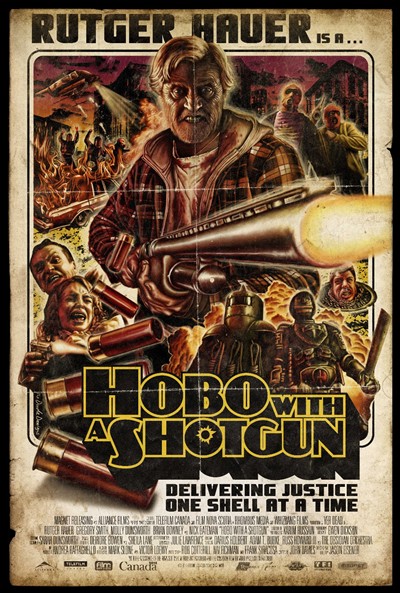
Then again, sometimes better opportunities might choose them. At Sundance this January, Hauer played lead roles in two diametrically opposed movies. One was as the 16th-century Flemish artist Pieter Bruegel the Elder in Polish director Lech Majewski’s extraordinary The Mill and the Cross (recently at the San Francisco International Film Festival), which brings one of that painter’s most epic canvases to cinematic life and will hopefully open on U.S. art house screens later this year. The other was Hobo With a Shotgun. Guess which one is opening theatrically here already.

Hobo began as a $150 faux-trailer short that got considerable exposure online and off. The resulting long-form debut for director Jason Eisener and scenarist John Davies is doubtless the zenith in Halifax, Nova Scotia-shot retro ‘ploitation splatter comedies to date. Which tells you nothing, of course. But it is pretty good — not great — insofar as spoofy gross-out nods to yesteryear’s exploitation cinema go. Better than Machete (2010), a whole lot better than the likes of Zombie Strippers! (2008) or 95 percent of what Troma puts out.

Grizzled Hauer stars as the titular character who rides rails into an equally nameless berg nicknamed “Fuck Town” because it’s so plagued by drugs ‘n’ thugz. The hoodlums are led by crime kingpin “The Drake” (Brian Downey) and goon sons (Gregory Smith, Nick Bateman) whose violent perversities are Caligula-licious. With corrupt police force in pocket, they’re free to terrorize the populace via acts of degradation and violence pushed over the bad-taste top and then some.

When Hauer’s hobo rescues a prostitute (Molly Dunsworth) from this clan’s clutches, he trips his own mental wire from peaceably detached transient to pawnshop-armed streetsweeper of scum, à la 1980s vintage vigilante cheese like 1982’s Class of 1984 (Perry King vs. evil high school “punks”), 1985’s Death Wish 3 (Charles Bronson vs. evil gang “punks”), and 1984’s Savage Streets (Linda Blair versus … figure it out).

Hobo With a Shotgun faithfully apes exploitation conventions, from its lurid widescreen Technicolor hues to a score combining overproduced 1970s funky soundtrack kitsch with ’80s direct-to-video synth pulsing. (Complete with a closing-credits rock song that channels Pat Benatar.) Its ludicrously over-the-top violence is kinda funny, but also nastier than need be.

Throughout, Hauer maintains a straight face. Maybe a tad more so than necessary — this movie could have used the wilder streak crazy-coot comedic streak shown by Jeff Bridges in last year’s True Grit or Kurt Russell in 2007’s Grindhouse.

Game Rutger Hauer retains his blue-eyed charisma and clearly relishes playing the gentle (when not lethal) giant in this artificially baroque scenario. He’s also an actor long on the world stage still seeking a role in a worthy film (or play) that may define him for posterity. He’s obviously got the talent — but at this point, would he take it? Would it even be offered? Did he take Hobo With a Shotgun because it seemed funny, or because it was the best he could get? 

HOBO WITH A SHOTGUN opens Fri/27 in Bay Area theaters.

Dick Meister: A Memorial Day Massacre

1


It’s a dramatic, shocking and violent film. Some 200 uniformed policemen armed with billy clubs, revolvers and tear gas angrily charge an unarmed crowd of several hundred striking steelworkers and their wives and children who are desperately running away. The police club those they can reach, shoving them to the ground and ignoring their pleas as they batter them with further blows. They stand above the fallen to fire at the backs of those who’ve outraced them.

Police drag the injured along the ground and into patrol wagons, where they are jammed in with dozens of others who were also arrested. Four are already dead from police bullets, six others are to die shortly. Eighty are wounded, two-dozen others so badly beaten that they, too, must be hospitalized.

The close-ups are particularly brutal. As one newspaper reviewer noted, “In several instances from two to four policemen are seen beating one man. One strikes him horizontally across the face, using his club as he would a baseball bat. Another crashes it down on top of his head and still another is whipping him across the back.”

The film ends with a sweaty, fatigued policeman looking into the camera, grinning, and motioning as if dusting off his hands.

The film was made in 1937. It was not, however, one of those popular cops and robbers features of the thirties. It was not fictional. It was an on-the-scene report of what historians call “The Memorial Day Massacre,” a newsreel segment filmed by Paramount Pictures as it was happening on the south side of Chicago on May 30, 1937.

We’re accustomed these days to the use of videotaped evidence to show wrongdoing by abusive law enforcement officers. Video technology was unknown in 1937, of course, and though film was available, it had rarely – if ever – been used for that purpose. The 1937 film, in fact, was initially kept from the general public by Paramount’s executives. Fearful of “inciting riots,” they refused to include it in any of their newsreels that were shown regularly in movie theaters nationwide.

But the film was shown to a closed session of a Senate investigating committee chaired by Robert LaFollette Jr. of Wisconsin. The committee, concerned primarily with civil liberties, was outraged – particularly since the Chicago police had acted in violation of the two-year-old federal law that guaranteed workers the right to strike and engage in other peaceful union activities.

The committee found that strikers and their families, while noisily demanding collective bargaining rights as they massed in front of the South Chicago plant operated by Republic Steel, had indeed been generally peaceful.

But that was beside the point to the police in Chicago and other cities with plants operated by Republic and two other members of the “Little Steel” alliance that also were struck.  For, as the committee concluded, the police had been “loosed … to shoot down citizens on the streets and highways” at the companies’ behest. The companies even supplied them with weapons and ammunition from their own stockpiles.

The committee said the companies had spent more than $40,000 on machine guns, rifles, shotguns, revolvers, tear gas canisters and launchers and 10,000 rounds of ammunition to use against strikers. Republic alone had more supplies than any law enforcement agency in the entire country.

The companies were prepared to go to any extreme to remain non-union. Two closed their plants temporarily, anticipating that most of the 85,000 strikers would soon be forced to return to work because they had little – if any – savings. But though Republic Steel closed most of its plants, it continued to operate the Chicago plant and a few others.

Republic fired union members at the plants that remained open and, with police help, cleared out union sympathizers and brought in strikebreakers to replace them. The strikebreakers, guarded by police day and night, ate and slept in the plants to avoid confronting the pickets outside.

Municipal police, company police and National Guardsmen harassed and often arrested pickets for doing little more than lawfully picketing. Six strikers were killed outside Republic’s Ohio plants in Cleveland, Youngstown, Canton and Massillon.

The killings and other violence, the steadily increasing financial pressures on strikers, unceasing anti-union propaganda – all that and more combined to end the strike in mid-July, two months after it had begun.

But the steelworkers didn’t give up.  Determined to not have made such great sacrifices in vain, they turned to the labor-friendly administration of President Franklin D. Roosevelt for help. They got it in 1941, when heavy pressures from the administration finally forced the steel companies to recognize their employees’ legal right to unionization and the many benefits, financial and otherwise, that it brought them and the many other industrial union members who followed their lead.

Dick Meister, former labor editor of the SF Chronicle and KQED-TV Newsroom, has covered labor and politics for more than a half-century. Contact him through his website, dickmeister.com, which includes more than 300 of his columns.


Last train to Fuck Town: Rutger Hauer rides again in “Hobo With a Shotgun”

0

The course of an acting career can vividly illustrate the randomness of fate. Rutger Hauer spent some years in Dutch experimental theater of the 1960s — after pulling off that best way to terminate one’s military service, faking mental illness — then became a local heartthrob as a medieval knight in a hit TV series at that decade’s end.

He spent the 1970s primarily starring in Dutch movies, notably the striking early films of Paul Verhoeven — well before Showgirls (1995), Starship Troopers (1997), or even 1987’s RoboCop (the director wanted Hauer for the lead, but was overruled by the studio). In the 1980s, Hauer played the memorable villains of Blade Runner (1982), The Hitcher (1986), and 1981’s Nighthawks (inducing tough investigative cop Sylvester Stallone to don drag at the end to catch him), between runs at being an action hero and theoretically loftier assignments around the globe.

Then he settled into a multilingual journeyman’s potluck of low-budget genre features, TV projects, small parts in mainstream films (2005’s Sin City and Batman Begins), Guinness commercials, and a Kylie Minogue video. Apparently 67-year-old Dutch actors in Los Angeles can’t be choosy.

Then again, sometimes better opportunities might choose them. At Sundance this January, Hauer played lead roles in two diametrically opposed movies. One was as the 16th-century Flemish artist Pieter Bruegel the Elder in Polish director Lech Majewski’s extraordinary The Mill and the Cross (recently at the San Francisco International Film Festival), which brings one of that painter’s most epic canvases to cinematic life and will hopefully open on U.S. art house screens later this year. The other was Hobo With a Shotgun. Guess which one is opening theatrically here already.

Hobo began as a $150 faux-trailer short that got considerable exposure online and off. The resulting long-form debut for director Jason Eisener and scenarist John Davies is doubtless the zenith in Halifax, Nova Scotia-shot retro ’ploitation splatter comedies to date. Which tells you nothing, of course. But it is pretty good — not great — insofar as spoofy gross-out nods to yesteryear’s exploitation cinema go. Better than Machete (2010), a whole lot better than the likes of Zombie Strippers! (2008) or 95 percent of what Troma puts out.

Grizzled Hauer stars as the titular character who rides rails into an equally nameless berg nicknamed “Fuck Town” because it’s so plagued by drugs ’n’ thugz. The hoodlums are led by crime kingpin “The Drake” (Brian Downey) and goon sons (Gregory Smith, Nick Bateman) whose violent perversities are Caligula-licious. With corrupt police force in pocket, they’re free to terrorize the populace via acts of degradation and violence pushed over the bad-taste top and then some.
When Hauer’s hobo rescues a prostitute (Molly Dunsworth) from this clan’s clutches, he trips his own mental wire from peaceably detached transient to pawnshop-armed streetsweeper of scum, à la 1980s vintage vigilante cheese like 1982’s Class of 1984 (Perry King vs. evil high school “punks”), 1985’s Death Wish 3 (Charles Bronson vs. evil gang “punks”), and 1984’s Savage Streets (Linda Blair versus … figure it out).

Hobo With a Shotgun faithfully apes exploitation conventions, from its lurid widescreen Technicolor hues to a score combining overproduced 1970s funky soundtrack kitsch with ’80s direct-to-video synth pulsing. (Complete with a closing-credits rock song that channels Pat Benatar.) Its ludicrously over-the-top violence is kinda funny, but also nastier than need be. Throughout, Hauer maintains a straight face. Maybe a tad more so than necessary — this movie could have used the wilder streak crazy-coot comedic streak shown by Jeff Bridges in last year’s True Grit or Kurt Russell in 2007’s Grindhouse.

Game Hauer retains his blue-eyed charisma and clearly relishes playing the gentle (when not lethal) giant in this artificially baroque scenario. He’s also an actor long on the world stage still seeking a role in a worthy film (or play) that may define him for posterity. He’s obviously got the talent — but at this point, would he take it? Would it even be offered? Did he take Hobo With a Shotgun because it seemed funny, or because it was the best he could get?

HOBO WITH A SHOTGUN opens Fri/27 in Bay Area theaters.


Facing the right way

0

It has been roughly two decades since the arrival of 3-D graphics changed video games forever. Visual fidelity and realism have increased geometrically. But though the ability of designers to render convincing buildings and 800-ton interstellar battlecruisers is at a zenith, one aspect of their games falls consistently behind: the people.

Sure, glistening muscles have long been perfected, and the hair looks better every year. Stare into the lifeless, glassy eyes of a cartoonishly-breasted video game sexpot, however, and there’s no mistaking where you are: the uncanny valley, a metaphorical location coined to describe the sudden onset of revulsion we experience when exposed to simulated humans that approach but do not attain realism (think Tom Hanks in 2004’s The Polar Express).

L.A. Noire, at long last, has built a giant suspension bridge over the gap. Team Bondi, the game’s Australian developers, relied on a new technology called MotionScan, which entails filming actors in a special room using 32 synchronized high-definition cameras that shoot from every angle, but focus on the head. The data from the cameras is then combined to create a stunningly accurate 3-D model of an actor’s face, right down to the laugh lines and the slicked-back, 1940s hairstyle. The model is then grafted onto a body rendered using conventional motion capture, resulting in the most believable human beings ever seen in a video game.

This technological innovation was crucial to L.A. Noire‘s design. As a police procedural, the game makes interrogating suspects the player’s most important challenge. Team Bondi turned to MotionScan in order to create a game that allows sharp-eyed, controller-clutching gumshoes to scrutinize the faces of potential perps, hoping to spot the telltale hard swallows, sidelong glances, and spastic blinking of a liar.

The success of MotionScan reaches far beyond the interrogation sequences, however, or even the game itself. There are important scientific findings suggesting that the interpretation of facial expressions is crucial to the way we experience empathy and understand emotions. The introduction of believable human faces into video games will have a seismic effect on the medium, revolutionizing the creation and efficacy of story and character.

L.A. Noire, like any good detective, provides elegant proof. It may be a game about arresting criminals and identifying their lies, but it is also a game whose strength lies in its tragedy. Lives are ruined, children are orphaned, and a generation of soldiers struggles to cope with the horrors it experienced on the killing fields of World War II. Though they all refuse to talk about it, you can see it in their faces. 


Guardian takes seven awards

0

news@sfbg.com

The Bay Guardian won seven awards, including the top prize for overall excellence, at the Peninsula Press Club awards dinner May 21.

The overall excellence award cites the Guardian as the best non-daily paper in the region. The San Francisco Business Times was second and Central City Extra placed third.

Steven T. Jones won a first place award in the Specialty Story category for his report “Marijuana goes mainstream.” Jones and Rebecca Bowe shared top honors in the News Story category for “Buying power,” a report on corporate corruption. Tim Redmond won first place in the Political Column category and third place for editorial writing.

Bowe and Alex Emslie took third place honors in Breaking News for their report on the BART Police killing verdict. Redmond and Rula Al-Nasrawi shared second place in that category for “Mysteries of the death-drug scramble.”


Fatal stance

7

sarah@sfbg.com

Ever since Mayor Gavin Newsom appointed Police Chief George Gascón district attorney in January — when Gascón said he was “not categorically opposed to the death penalty and would consider it in appropriate cases” — capital punishment has become a big issue in a town where the last death penalty case was in 1989.

Gascón is running against former San Francisco Police Commissioner David Onek, who is the founding director of the Berkeley Center for Criminal Justice and has consistently promised since entering the race last summer that he will not seek the death penalty.

Both men also face a serious challenge from Alameda County Deputy D.A. Sharmin Bock, who opposes capital punishment but won’t categorically state that she would never seek it, as former DAs Kamala Harris and Terence Hallinan both did while running for office.

Bock said that Harris eventually formed a committee to review each capital case but never filed for the death penalty, including in the 2004 murder of San Francisco police officer Isaac Espinoza, the same approach Bock would take. But she doesn’t think it’s legally wise to make a categorical statement opposing the death penalty, saying it could be challenged in court, as some attorneys tried to do with Harris.

“But capital punishment is unjust, and can say that categorically,” she said.

In the week since Bock’s May 17 campaign launch, Gascón challenged her credibility on the issue by noting that Bock used the threat of the death penalty to secure a guilty plea from a sexual predator who tortured and killed women in Alameda County last year.

But Bock used that case to draw a distinction in their positions on the issue, telling us, “George Gascón says he’d use it for the most heinous cases, and I’ve seen the most heinous cases and I haven’t use it,” Bock said, emphasizing that she’s the only prosecutor in the race.

In a May 1 Chronicle op-ed, Gascón tried to neutralize Onek and those opposed to the death penalty by noting that he also has “serious misgivings” about capital punishment, including the potential for wrongful convictions, the disproportionate application on racial minorities, the roller-coaster the victims’ families endure as they wait decades for closure, and the financial impact on an already overburdened justice system.

But Gascón also tried to hide behind the “death penalty is state law” defense, even though prosecutors have extensive discretion in such matters. “Rather than refuse to enforce our laws, I believe the more appropriate approach is to accept the law and work to change it,” Gascón wrote. “I don’t believe district attorneys should be allowed to supplant the views of the state with those of their own.”

Bock criticized Gascón’s deferential stance, which was in sharp contrast to Sheriff Mike Hennessey, who recently announced that he will stop cooperating with federal immigration officials and start releasing undocumented immigrants jailed for minor offenses before they can be picked up for deportation, to comply with San Francisco’s sanctuary ordinance.

Gascón appeared to be trying to cast his position as a courageous stand. “Some have given me the political advice to simply say I will not seek the death penalty in San Francisco,” he wrote. “While I am not prepared to say that at this time, I can say that I do intend to be a district attorney committed to San Francisco values.”

And he promised that if he believes a case merits the death penalty, he would seek the advice and counsel of a panel of local prosecutors. “Ultimately, the decision will always rest on my shoulders, and it is a decision that I will not take lightly,” Gascón wrote.

But Onek accused Gascón of giving a politician’s answer. “Gascón is trying to have it both ways,” Onek told the Guardian. “The voters have the right to hear a clear answer to a fundamental question. And my answer is clear — I will not seek the death penalty in San Francisco and I will continue to work to change the law statewide. To me, it’s a yes or no question, and I won’t seek it. Period.”

Onek says his stance is informed by his belief that the death penalty solves nothing. “It doesn’t make us safer; it’s not fair and equitable; and it wastes enormous resources,” he said. “We are much better off spending our precious resources on things that actually make us safer, like more cops on the streets, more programs in our communities, and better services for victims.”

Gov. Jerry Brown made a similar comparison last month when he canceled a $356 million project for a new death row at San Quentin. “At a time when children, the disabled, and seniors face painful cuts to essential programs, the state of California cannot justify a massive expenditure of public dollars for the worst criminals in our state,” Brown said.

A recent David Binder research poll found 63 percent support statewide for commuting all of the 700 sentences of California’s death row inmates to life in prison without parole and requiring them to pay restitution to the victims’ families, while 70 percent of Bay Area voters support the plan, which would save the state $1 billion over five years.

At a May 18 panel discussion on the death penalty, Public Defender Jeff Adachi’s criminal justice summit offered panel moderator Matt Gonzalez, a chief attorney in Adachi’s office, a timely opportunity to grill Gascón about his death penalty stance.

“Folks felt it might be a step backward,” Gonzalez said, noting that former D.A. Terence Hallinan pledged not to seek the death penalty when he ran for reelection in 2000, and Harris followed suit when she first ran for district attorney in 2003. “So — are you pro death?” Gonzalez asked.

“No, but I am a public official,” Gascón replied, even as he repeated his misgivings about the death penalty, including the fact that 62 percent of those on death row are minority populations, especially from African American and Latino communities.

The panel also provided a chance to see Gascón debate exonerated death row inmate JT Thompson, watch American Civil Liberties Union of Northern California attorney Natasha Minsker explain why the death penalty system is dysfunctional, and witness former San Quentin prison warden Jeanne Woodford describe how the impacts of the four executions that she reluctantly oversaw motivated her to sign on as director of Death Penalty Focus, a nonprofit dedicated to abolishing capital punishment.

“Who is responsible for the prosecutors that go bad?” asked Thompson, an African American man who spent 14 years on death row in Louisiana, and another four facing life without parole, because a prosecutor suppressed exculpatory evidence.

“When I was sentenced to death in 1985, for a crime I didn’t commit, I thought this would be rectified right away. But it took 18 years, and I watched 12 inmates being executed while I was there,” Thompson said, noting that he was holed up 23 hours a day.

Gascón said he would terminate prosecutors who withheld exculpatory evidence, but said he didn’t know if he could charge them with murder.

Thompson, founder of the New Orleans-based nonprofit Resurrection after Exoneration, argued that the debate needs to be recast from its current public safety frame.

“People need to be asked, ‘Under what conditions do you support giving the state the right to kill you?’ ” Thompson said.

Woodford recalled how she got sick after the last execution she presided over. “I focused on what my responsibility was. But in hindsight, I realize it had had much more of an impact,” she said. “These executions happen in California at least 20 years after the crime. And they don’t bring victims back.”

Minsker noted that 16 states do not have the death penalty, and that every day brings people closer to ending the practice in California. “People once thought opposing the death penalty would end political careers, but Kamala Harris showed that it is no longer a liability,” she said.

Reached by phone after the debate, Onek said ending capital punishment makes sense morally and financially. “We would have $1 billion to invest in things that actually make us safer,” Onek said. “The D.A. is given discretion around requesting the death penalty, and I will use my discretion to reflect San Francisco values. That’s why people in the trenches working on these issues, including Jeanne Woodford, support me in this race.” 


Mayor Lee’s dismal budget challenge

4

The “create your own budget” app is nothing new; we’ve seen it at the state level for a couple of years. But it’s new to San Francisco, and Ed Lee’s promoting it. So you can go here and see if you can solve SF’s budget problems.


I did the whole thing, gave the best answers I could — and wound up with the city still deep in the red. That’s because the choices on the app are pretty limited. Only a few modest tax increases are available, along with a lot of cuts. There is, for example, no option for a commercial real estate tax, no option for a tax on vacant housing, no option for a prgoressive gross receipts tax, no option for a city income tax … just a higher sales tax, a utility user tax, and an increase in the (flat) payroll tax. Those are all somewhat regressive options (although the utility user tax isn’t that bad, but it offers a maximum of $4.6 million). All told, the taxes offered together make up about $60 million, or about 20 percent of the deficit.


So why the limited choices? According to the program, these options are “actual policy decisions the mayor and the board of supervisors must make in developing a balanced budget for the next fiscal year.”


Yes, but raising more revenue is also an “actual policy decision.” And while these budget simulators are just gimmicks, this one gives some indication of what Lee’s office things may be in the offing. And if these are the only options the mayor considers on the table, it’s not going to be a pleasant year for health, human services, parks, police, fire or anyone else.


Perception of lost integrity costs police

1

Reporting by Sarah Phelan. Photograhy by Luke Thomas.

At the San Francisco Public Defender’s Office’s May 18 Justice Summit, the ethics of law enforcement were a central topic. And not surprisingly, the latest incidents of alleged police conduct in which SFPD officers are caught on surveillance video, which the Public Defender’s Office released, as they apparently steal personal property from suspects whose homes in the Julian Hotel they searched for drugs under possibly illegal circumstances, were on everyone’s minds, along with the crime lab and Henry Hotel scandals.

Asked if District Attorney George Gascón, who was Chief of Police until January, is considering a special prosecutor to look into these latest incidents, Sharon Woo, the D.A.’s Chief Assistant of Operations, said the D.A. looks into each case as it comes in. “We are trying to enhance the videos that came in from the Public Defender’s Office,” Woo said in a pre-summit interview. “Some are not as clear as we’d like.”

Earlier this year, when Gascón first became aware of the allegations against officers at the Henry Hotel, he directed the D.A.’s office to open an investigation into the officers and their alleged conduct. The move got David Onek, who is running against Gascón in the D.A.’s race, urging Gascón to turn the investigation over to an independent prosecutor.

But for a week, Gascón maintained that there was no conflict, and when he did finally announce that he was turning the investigation over to the to the U.S. Attorney’s Office – he claimed it was about “resources”. “New information has come to light that indicates it is better to turn over this investigation to the FBI,” Gascón said. “I have spoken to the U.S. Attorney, Melinda Haag, and she has agreed to take over the full investigation. We will of course cooperate fully with the FBI, and provide whatever assistance they need from us.”

At the time, Onek noted that Gascón’s decision was correct step. But he criticized Gascón for not making it his policy to recuse himself from any investigations that relate to his own tenure as chief. And Alameda Assistant D.A. Sharmin Bock, who recently sprung into the D.A.’ race, described Gascón’s situation on this matter as being “between a rock and a hard place.”

But yesterday, Woo noted that while it’s true that Gascón was SFPD Chief when many of the recent misconduct scandals occurred, Mayor Gavin Newsom had already appointed him D.A. when the Julian Hotel incidents occurred in February.

And Peter Herley, former chief of the Tiburon Police Department, told the Guardian that there “is always the Attorney General” to refer cases if D.A.’s feel conflicted. “George Gascón is a very upstanding individual who has also worked for the Los Angeles Police Department and was Chief of Meza, Arizona, and has done a good job in every place he’s been,” Herley said during a pre-summit interview. “So, if he sees a conflict arise, he’d probably recuse himself. It’s the public perception that’s key, that’s paramount.”

During the summit’s panel on ethics, retired San Francisco Superior Court judge Lee Baxter grilled panelists with incisive questions—as befits any self-respecting judge, retired or otherwise–on whether police misconduct is the product of a departmental culture. Noting that there had been a seemingly non-stop string of alleged police misconduct scandals in the Bay Area from drug thefts, dirty D.U.I cases, stolen drugs and setting up a brothel, Baxter observed, “If I saw a movie that included all those things, I’d think that this is not realistic.”

And there was a perhaps surprising amount of stated consensus about what needs to happen next from panelists Woo, Herley, defense attorney Stuart Hanlon, newly sworn-in SFPD Chief Greg Suhr, Anne Irwin, an attorney at the Public Defender’s Office, and John Burris, an Oakland-based civil rights attorney who is renowned for representing plaintiffs in police brutality cases.

Baxter asked the panelists why abuse of power happens, and whether, when we see media accounts of alleged police misconduct, we see the most extreme cases.

Hanlon kicked off by referring to the case of Elmer “Geronimo” Pratt, a former high ranking member of the Black Panther Party, who was tried and convicted of the kidnap and murder of Caroline Olsen in 1972, and spent 27 years in prison, eight in solitary confinement, until 1997 when his conviction was vacated on the grounds that the prosecution concealed evidence that might have exonerated him. In particular, the government had not disclosed that a key witness against Pratt, Julius Butler, was an informant for both the FBI and the LAPD. Pratt eventually received $4.5 million as settlement for false imprisonment—the city of L.A. paid $2.75 million, the U.S. Department of Justice paid $1.75 million.

“We learned that law enforcement officers had hidden evidence, let people commit perjury, and destroyed evidence to convict someone who was innocent, “ Hanlon recalled, noting how when he first worked on the case, folks wondered if Pratt’s claim of innocence was simply part of a big conspiracy theory. “But it was not, it was men and women who thought the ends justified the means” Hanlon said, noting that the “bad apples” theory is typically trotted out during investigations into alleged police misconduct. “But officers see people who they think are bad people, and they feel they must whatever it takes,” Hanlon continued. “Primarily, most law enforcement people are good, but sometimes you get good cops lying to protect bad cops. It’s a dilemma, this concept of ‘what we do we need to do, this ‘us versus them’ concept.”

Hanlon claimed that officers don’t think citizens who live in SROs (single room occupancy hotels) have the same rights as folks in Pacific Heights.
“They think it’s OK to break down doors because these are drug dealers,” he said. And he noted that the recent string of back-to-back scandals are unusual in their proximity but are not unusual, generally speaking. “I’m not an apologist for (Chief) Suhr or the D.A., but I’ve seen these problems forever, and without trust law enforcement doesn’t work,” Hanlon concluded.

Next, Baxter put Suhr in the hot seat by asking him what to do about the “ends justify the means concept”. At which point Suhr, who has been Chief for less than two weeks, observed that the summit, which was packed to the gills with defense and civil rights attorneys, was “a bit of an away game for me, but it’s O.K., I can handle it.” He noted that only 1 in 11 applicants make it through the SFPD Police Academy, where folks undergo 1,100 hours of training, including sessions on abuse of power and responsibilities. “But if something is proven, it’s my intention not to have those officers in the SFPD any more,” Suhr said.

Retired Tiburon Chief Pete Herley revealed that during his decades-long police career, he blew the whistle when three officers nearly beat a gay man to death. “I suffered the consequences for many years,” he said. “It’s very lonely getting death threats, it’s very lonely when you don’t get the backing of fellow officers.”

Herley claimed times have changed a lot. “Change starts in the Academy and the selection of officers, and you have no other law enforcement officers that get more scrutiny, background checks m psychological checks and an 18-month probation period,” he said.

He noted that police chiefs inherit a departmental culture, whether they come into the post from the inside or the outside of the department. And that while the number of officers involved in misconduct is small, “it makes good press.” 

“I really feel one needs to be more loyal to integrity than to people,” Herley continued, noting that his parents were Holocaust survivors, and that his father was aghast when he decided to become a police officer. “But I had certain values and I don’t expect anything less from other people. I expect that every department has something in their rules and regulations that directs their officers that if they see misconduct, it’ll be stopped and the action will be reported immediately to the Chief.

Baxter asked Woo what the D.A. should do, if there is a problem.“All we are is our integrity, our ability to communicate and put forth evidence to juries “ Woo observed, noting that she has been on the frontlines as allegations about the crime lab, the Henri Hotel, and now potential theft, surfaced. “We find ourselves very reactive,” Woo observed, noting that if officers are not being truthful, the D.A.’s office has to look at all the cases they were involved in. “So it really impacts public safety and how all of us view the criminal justice system,” Woo said, noting that officers involved in the Henri Hotel allegations taken off the street.“But we have no interest in prosecuting individuals if it’s not based on solid evidence,” Woo said.

She recommended proactive steps like getting involved in Police Academy training on the law, and what officers can and cannot do, and giving officers tools to make good decisions and arrests, so there is integrity in the system. “If there isn’t, we all lose, not just the criminal justice system, but the entire community,” Woo observed, noting that as SFPD Chief, “Gascón instituted lots of policies to make sure people are doing an appropriate level of review.”

Baxter asked Anne Irwin, an attorney in the Public Defender’s Office, about their office’s role in bringing abuse of power to the attention of the public. “The Public Defender has a unique and natural role as a messenger,” Irwin replied. “We have more meaningful interaction with the victims of police misconduct than anyone else in the criminal justice system. We get into the intimate details of their lives, we develop a relationship of trust, so they confide their stories about police misconduct. And those stories are commonplace.”

Irwin noted that these stories include a disrespect for the Fourth Amendment, perjury and theft. “When you hear those stories over and over, there’s a ring of truth, a consistency,” Irwin said, noting that this is not the first time officers have been captured on camera. “We didn’t say, let’s amass a bunch of evidence. We just basically did our job. Residents told us what someone said in a report is not what happened, so we got videos from Dec. 23 and Jan. 5, and lo and behold, every word was true, two for two.”

Irwin noted that there are many good officers in the SFPD, but questioned whether a culture develops in certain departments, including the plain-clothes units, that allows misconduct to happen. “Without the videos officers would not have had to answer for their conduct,” she observed.

Baxter asked Suhr what it is about the culture that makes some cops go rogue. “Did they work there too long, were the temptations too much?” she asked.

Suhr replied that he worked in narcotics for a long time, and recovered $1.4 million in cash from an apartment in the Western Addition. “I never took a dime, and I am confident that the officers I worked with were of the highest caliber,” he said. “To paint a 2,000-person organization with a broad brush is unfair,” he added. “In the legal profession, every once in a while, you see ugly stories there too.”

Burris, who filed a $25 million wrongful death claim against BART on behalf of Oscar Grant’s family, noted that he has been involved in about 1,000 police misconduct cases in the Bay Area. “A culture exists about how you treat minority communities, “ he said, noting that he had represented black and brown clients for over 20 years. “A culture where you beat people and nothing is done, and you get away with it.”

Burris believes the problem lies in how policies are imposed, as he claimed that when officers join departments they are told to forget what they were taught in the Academy.“This is what you do on the streets,” he said.

Baxter observed that she has seen movies about the code of silence and wondered if it actually exists in police departments. “I don’t think so generally,” Suhr said. “There’s peer pressure to be sure. A regular citizen has a right not to self incriminate, and in the Police Department you can say that, but you are immediately sent to Internal Affairs, where you are told, tell me what happened or you are fired. So, today, the light is shining on us 100 percent of the time.”

Herley noted that his concern lay with situations in which officers see something, but don’t say anything. “I never thought I’d sit here and agree with every word John Burris says, but it starts at the top, and has to be enforced throughout the organization.”

Herley said the two best tools to prevent indiscretions and ensure responsibility are tape recorders and video cameras. “There’s certification of exactly what happened.” As for questions of how much it would cost to outfit officers with this recording equipment, Herley said, “ What is the cost of a lawsuit, the cost the perception of a loss of integrity to a department?”

Finally, a prosecutor leaps into D.A.’s race

73

From the moment I walked into Sharman Bock’s District Attorney campaign launch and saw the roomful of “signs proclaiming, “A prosecutor for District Attorney”, I realized that Bock isn’t the type of candidate to hold her punches. And that makes perfect sense, because unlike the other candidates in the D.A.’s race, Bock, 48,  is a seasoned prosecutor.


Bock, as I soon found out, is also a longtime San Francisco resident, who moved here from Iran when she was four and has lived in the city for more than four decades. She went to high school here, returned after graduating cum laude from Georgetown University Law Center, and earned a clerkship with the Hon. D. Lowell Jensen of the Northern District of California, before starting her prosecutorial career in Alameda County, where she has served as an Assistant D.A. since 1989.  And she continues to live in San Francisco, where she is currently raising two kids with her husband in the Richmond District.


Joined by Congressmember Jackie Speier, Lulu Flores, President of the National Women’s Political Caucus, and Shronda Wallace, whose mother was brutally murdered in 1989, Bock made no bones about why she has decided to spring into the race.


“I’m running for San Francisco District Attorney because this is a job that requires a seasoned prosecutor who knows what it takes to put the most violent and dangerous criminals behind bars and keep them there,” Bock said. “I am a professional prosecutor. I want to give voters a real choice. No other candidate in this race has prosecuted even a single criminal case. This is no job for rookies. The stakes are too high and rookies make mistakes.”


When Bock noted that her conviction rate is over 90 percent, and that she has never lost a serious or violent jury trial, I wondered how successful the other main contenders–former SFPD Chief George Gascón, who Mayor Gavin Newsom appointed as D.A. in January, and former San Francisco Police Commissioner David Onek, are going to be when it comes to downplaying the fact that neither, as Bock wasn’t afraid to remind reporters, “has ever prosecuted a criminal case.”


“This is not a managerial, police or career job,” Bock continued, confronting head-on the arguments Gascón and Onek have already tossed out in response to questions about how they can be D.A. given their complete lack of prosecutorial experience.


“It’s certainly not a job for a rookie, and with 22 years of experience, I’m ready,” Bock commented.


“To lead an office of trial lawyers, you’d have to walk a mile in their shoes,” Bock added, noting that currently she is doing just that. “I’m responsible for supervising extremely experienced trial lawyers each day,” she said, referring to her job as Assistant D.A. in Alameda County.


Praising the record of former D.A. Kamala Harris, who was elected Attorney General in November, Bock observed that San Francisco “sets the national standard. Kamala did a good job, and I’d like to keep the momentum going. We can’t lose it.”


Next, Bock outlined some of the highlights of her prosecutorial career.


A national expert on efforts to combat human trafficking, Bock leads the Human Exploitation and Trafficking (HEAT) Unit, which prosecutes complex trafficking cases. In fact, Bock actually prosecuted the first human trafficking case in California.


Based on her expertise with DNA and other forensic evidence, Bock was tapped to lead the Cold Case Unit, which focuses on solving old murder and sexual assault cases.


Bock also oversees other specialized felony units, including Public Integrity, Child Sexual Assault, Sexually Violent Predator and Restitution, which recovered more than $15 million for victims of violent crime last year.


In 2009, Bock received the Fay Stender Award from the California Women’s Lawyers Association for her “ability to affect change and her commitment to representing the underprivileged. And in 2010, the California Legislature recognized Bock as “Woman of the Year” for her groundbreaking work to stop human trafficking.


“American children are being sold for sex in our own backyard,” Bock warned, as she talked about what she has learned from her decades as a prosecutor. She said solving cold cases “provides closure that is priceless for families of victims” and is part of keeping the community safe. She talked about the fact that she is an independent prosecutor, who won’t be conflicted by police misconduct and crime lab scandals, unlike our current D.A. And she wrapped up by voicing her desire to serve—and remain in—San Francisco. “I am committed to giving back and serving the city I love,” Bock said.


Meanwhile, across the city, D.A. Gascón had just a neighborhood prosecution program in the Bayview and Mission districts. According to a Gascón press release, the program, “brings immediacy to the resolution of crimes that diminish the livability of local communities by employing a restorative justice model” and “brings the D.A.’s Office into the community, positioning the office to be more directly and immediately responsive to the needs of community members.”


Gascón promised that the program will engage “residents in the process of determining an appropriate sanction focused on repairing the harm done to the community and setting the offender on the path to long-term productivity. This approach will bring a swifter and more certain resolution to offenses that have repeatedly gone unchecked for too long.”


The idea is that designated Assistant D.A’s will be assigned to  local police station to pre-screen eligible individuals and determine if the offenses they have been cited for by police are suitable to be heard in neighborhood courts. “Under the supervision of the District Attorney’s Office local residents are trained in restorative justice to adjudicate matters, instead of having cases charged and heard in criminal courts,” Gascón stated. “The adjudicators represent a wide swath of the community and include merchants, home owners retirees and students.”


Gascón says a range of non-violent offenses, including drinking in public, vandalism and petty theft, fit the criteria for matters that can be reviewed in the neighborhood court.“Eligible individuals cannot be under the supervision of the criminal justice system,” he stated. “Individuals who volunteer to have their matters heard in the neighborhood courts agree to abide by the prescribed outcomes that focus on restoring both the community and the offender. Individuals who are successful in meeting the terms avoid the blight of a mark on their criminal record. By taking this restorative justice approach, the program seeks to break the cycle of crime. It increases the accountability of the offenders to the community and the community’s stake in the offenders’ rehabilitation.”


Gascón claimed the program saves money by significantly shortening the length of time it takes to resolve offenses. “Typically the offenses being heard in a neighborhood court in one to two weeks from the time a citation is written would take nine months to a year to be heard in a criminal court,” he stated. “The average cost of having these cases charged and heard in a traditional criminal court would be $1500 per misdemeanor compared to $300 in a neighborhood court.”


Gascón concluded by noting that this new neighborhood prosecution program will operate under the direction of the newly-formed Collaborative Courts Division of the D.A.’s Office and is scheduled to spread citywide. “The Bayview and Mission district launches are part of D.A. Gascón’s initiative to increase accountability and integration of the former Community Court programs,” Gascón’s press release stated. “The neighborhood prosecution program model will eventually be adopted and employed city-wide, district by district as a replacement for the former model.”


Bock for her part seemed less than impressed by the fairness of Gascón’s program. “People dealing with quality of life crimes deserve a District Attorney,  a defense attorney and a judge,” she said. “You can’t shortchange justice “


And she wasn’t shy about sharing her thoughts on the conflict of interest Gascón faces when dealing with the ongoing police misconduct and crime lab scandals.“George Gascón is between a rock and a hard place,” Bock said. “He was in charge of the police district during that time period,” she observed. “And it’s important that the police don’t get thrown under the bus in the process.”


And unlike Gascón, Bock is personally opposed to the death penalty.“I will oppose any effort to further that law, and I would support ballot measures to change it,” Bock said. “It hasn’t had a deterrent effect, it doesn’t make the community safer, but it is the law of the state.”


As D.A., Bock would implement the same procedures that former D.A. Kamala Harris had in place—a committee where each case is reviewed in fact and law, and not reflective of a personal opinion. “I would look at each case,” Bock said.


“I want to make this city as safe to live in as I have fought in Oakland to achieve,” Bock continued, noting that when she graduated, she faced a choice of a corporate job or public service. “I chose public service,” she said.


Unlike Gascón, Bock does not think the city’s recently enacted sit-lie legislation has resolved anything. “Sit-lie is a perfect example of why political hot-button measures don’t work,” Bock said. “People should be able to use the sidewalks. But at the same time, there are people with serious mental health issues. Sit-lie hasn’t solved any problem. And the good news about me is that I am not a politician.”


Congressmember Jackie Speier enthusiastically endorsed Bock. “This is a very important race for San Francisco, and it’s not a political race,” Speier said. “It’s a race about safety and prosecution and making sure we have a District Attorney who is going to be here for thecommunity.”


Speier noted that Bock has worked for some of the finest law firms, has dedicated more than 20 years of her life to prosecuting heinous criminals, has deep roots in San Francisco, and is on the board of numerous non-profits.


“She has been successful in over 1,000 cases—tough cases, including murder, torture and sex trafficking,” Speier continued. “She is someone who has the capacity to handle this job like no one I’ve ever seen. Her passion for her work knows no bounds.”


“And she is truly committed to San Francisco,” Speier added. “It’s no secret that the present occupant of the D.A.’s office is interested in being a highly placed person in the F.B.I. I think Gaston will be good in some respects should he seek that.”


“Politics is a funny thing, the process works the way it does, but the people of San Francisco have an opportunity to compare and contrast—and this is a stark contrast,” Speier concluded, pointing to Bock’s “impeccable credentials and proven track record in the prosecution of criminals,” and describing her as “the best and brightest” as she lauded Bock’s leadership skills and talent as a prosecutor.


Lula Flores, who flew in from Washington, D.C. to announce the National Women’s Political Caucus early endorsement of Bock, described Bock as a “progressive forward-thinking candidate.”


“We need more women in leadership safety positions,” Flores said, noting that Bock “represents diversity and is the most qualified and most experienced candidate.”


“She will do the best job,” Flores continued. “San Francisco is home to a myriad of leaders, it is the place that has grown so many of our national leaders.”


And Shronda Wallace recalled how her mother’s 1989 murder had been “all but forgotten, but then Sharman Bock took charge.”
Wallace described how, using DNA from the crime, Bock “re-created the scene, identified the killer, proved he intended to kill my mother, convicted him, and put him in prison without parole for the rest of his life. Through her determined and relentless prosecution of this cold case, not only did Sharman Bock make me feel safer, but she brought me desperately needed closure, and that is something I will never forget.”


Police officers accused of theft in videotaped incidents

4

In the two such incidents exposed in less than a week by the San Francisco Public Defenders Office, San Francisco Police officers have been caught on surveillance videotape appearing to steal personal property from suspects whose homes were searched for drugs, searches that were also likely to be considered illegal.
“We’re very concerned that these officers are still active, still on the streets, and still testifying in court,” Public Defender Jeff Adachi said during a press conference today, later adding, “We have a pattern of illegal searches and seizures that are occurring.” He called the undocumented property nabs “thefts” and raised doubts about whether officers were actually given permission by the suspects to enter the rooms, as they claimed in their reports.
During Adachi’s press conference, Police Chief Greg Suhr – who was shown the latest video footage on Friday – issued a statement saying the charges were being investigated and the officers involved were being taken off plainclothed duty pending the outcome.
Two officers, Ronaldo Vargas and Richard Guerrero, were involved in both of the videotaped incidents that Adachi released in the last week. In the latest — from a Feb. 25 incident involving 65-year-old Jesus Reyes in which he was stopped in a van and police then searched his apartment at the Julian Hotel, where officers say they found a small amount of methamphetamines – the pair can be seen entering empty-handed and leaving with bags that Reyes says contained his video camera and his nephew’s laptop computer. Neither item was booked into evidence and they remain missing.
In the earlier incident, the officers were accused of stealing a duffel bag during a Dec. 30 raid on a room at the Jefferson Hotel. Adachi has also released four other videotaped police raids in recent months that all seem to show officer misconduct and false statements in their subsequent police reports. And the recent spate of revelations follows a scandal last year in which police and prosecutors withheld information on officer misconduct from the Public Defenders Office and other defense attorneys, despite legal requirements that they share that information. Judges have now dismissed hundreds of criminal cases because of the misconduct by police and prosecutors, and Adachi said the FBI is also investigating the pattern of behavior by SFPD officers.
The drug charges against Reyes were dropped when Guerrero failed to show at the hearing despite being subpoenaed by defense attorneys. But Guerrero was actually on the stand yesterday testifying as a prosecution witness in an unrelated case, raising question about why the DA’s office and SFPD would allow the testimony of someone whose credibility has now been called into serious question.
Reyes said it was his first arrest and that he has no criminal background, but Adachi said that a couple years ago, Vargas was disciplined by the Police Commission after slashing a suspect’s face with a broken pipe.

Gascón’s essential conflict

0

The latest video of a police arrest in a Tenderloin hotel room — this one apparently showing police officers entering a room without a warrant, attacking an unarmed bystander, and stealing a resident’s duffle bag — has set off a wide range of investigations. But what’s really disturbing is that the video is all too typical of what seems to be business as usual among undercover narcotics detectives. In fact, a series of recent security videos show San Francisco cops doing one thing — and reporting something else.

“We’ve yet to run across a single video that matches up with what the police swear to in their report,” noted Chief Public Defender Attorney Matt Gonzalez.

We’re not talking about one police station, one crew, or one rogue cop. This is, to all available evidence, a pattern of rotten behavior in the department. It’s impossible to believe that these are just a few isolated incidents — or that the problems are concentrated in the lower ranks. If command-level officers didn’t know what was going on, then they’re incompetent. If they knew — which is far more likely — then they were covering up.

That’s nothing new in the old boy’s club that is the San Francisco Police Department. While the criminal cases against senior cops in the Fajitagate scandal went nowhere, the evidence strongly suggested that a cover-up had been ordered and executed at all levels.

In that case, Terence Hallinan, the district attorney, took the lead in trying to hold the cops accountable. But now the person running the D.A.’s Office — former Police Chief George Gascón — is politically paralyzed. Gascón can’t investigate systemic corruption in a department that until recently he was running. He can’t, at this point, even seem to figure out which cases he can take and which he can’t. He hasn’t adopted and made public a conflict of interest policy for himself and his office. And any honest policy would make it impossible for him to get involved in any action involving his former employees.

This is, to put it mildly, the exact reason why police chiefs don’t become district attorneys, why Gavin Newsom’s parting shot to the city has badly damaged the credibility of local law enforcement. It’s also the strongest argument possible for the election of a new district attorney.

David Onek, one of the candidates challenging Gascón, has called for a conflict of interest policy saying, “The people of San Francisco deserve and demand a district attorney who will avoid clear conflicts of interest as a matter of policy — rather than personal whim.” That’s a no-brainer. But the problem goes deeper. As Sharmin Bock, a veteran Alameda County prosecutor who is also running for Gascón’s job, noted, there’s no policy that can address this problem. If Gascón punts all investigations of the SFPD to the FBI or the state attorney general, he’s not only giving up local jurisdiction, he’s vastly increasingly the likelihood that nothing will ever happen. The FBI has limited jurisdiction; the Attorney General’s Office isn’t set up to do this kind of work.

“The only answer,” she said, “is a different D.A.”

Gascón needs to deal with this situation immediately, publicly, and credibly. Perhaps the city needs an independent special prosecutor, someone outside Gascón’s office but with full authority to seek indictments (paid for out of Gascón’s budget, since he created this mess.) Because if he can’t find a solution, he’s going to have a hard time convincing anyone he deserves to stay on the job. 


Fear the beard

12

rebeccab@sfbg.com

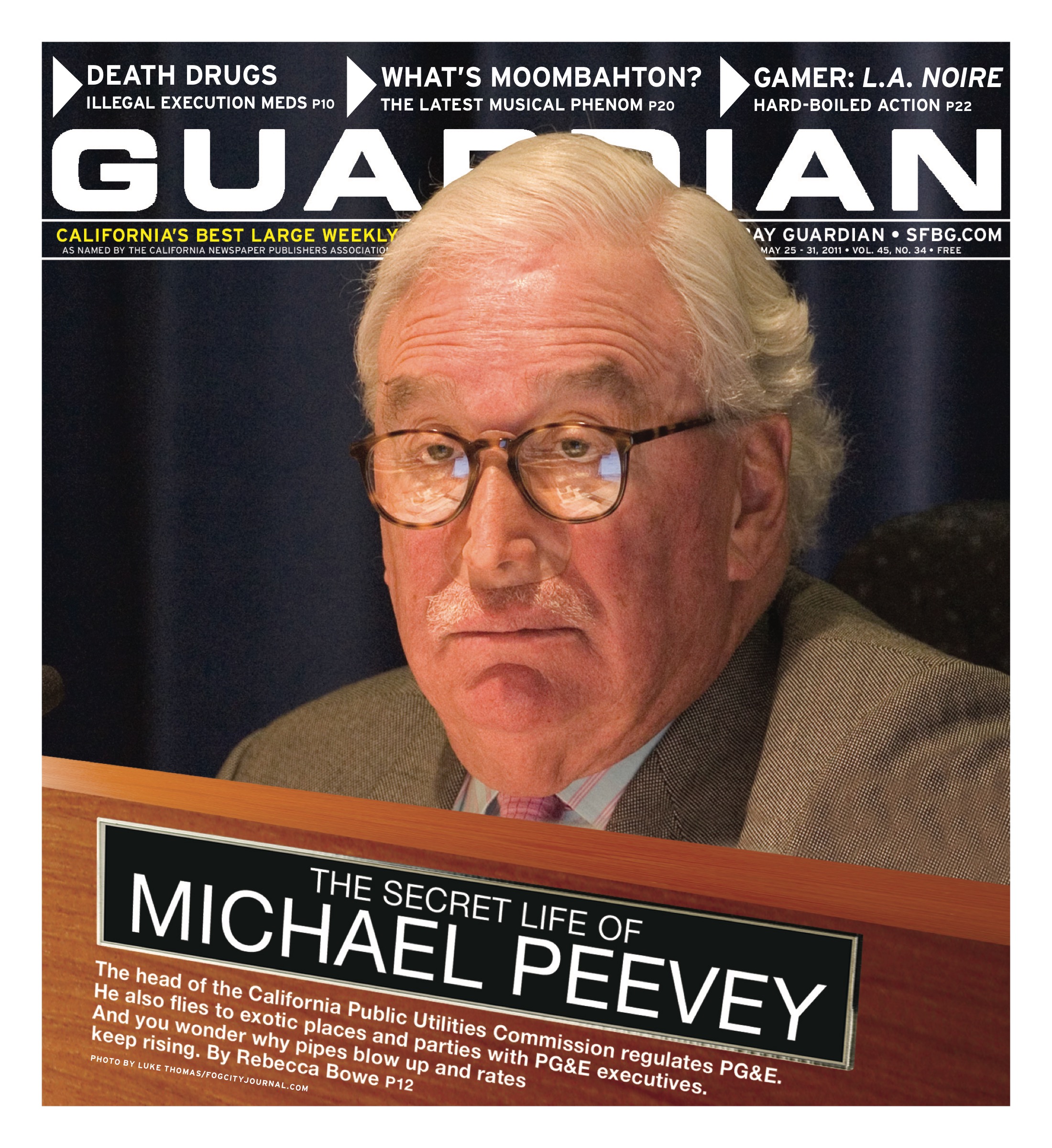
Christopher Hanson, a 38-year-old single father who lives in Albany, doesn’t have one of those scraggly, runaway beards that one might associate with jam bands or train hopping. He keeps his goatee neat and trimmed, sometimes using scissors to clip back the mustache. Yet Hanson says he got fired last month because his facial hair was deemed a violation of his company’s employee appearance policy. Now, he’s fighting back.

Hanson worked as an audio-video technician for Swank Audio Visuals, a company that does conferences and events at major hotels throughout the Bay Area, including the Westin St. Francis, the Claremont, and the Four Seasons. On the day he was fired, he was on his hands and knees taping down a power cord for an event that was about to start at the Claremont when his supervisor asked to have a word with him. Having spoken with his boss about the beard situation before, he got a funny feeling.

“I just knew what he was going to say,” Hanson recalled. “I thought: are these guys really going to push this, this far?”

For Hanson, having a beard is not a matter of personal expression; nor is it related to religious reasons. He has psoriasis, which prevents him from being able to shave. About a week before he was let go, his dermatologist sent a note to Swank’s human resources department explaining that although he was undergoing treatment, she had counseled him never to shave his beard. It could exacerbate the disease, she explained. Shaving the affected area could cause pain, redness, and irritation on a daily basis, as well as unsightly rash. The doctor urged Swank to grant a medical exception for Hanson.

Hanson says he reminded his boss, Ken Reinaas, and Reinaas’ boss, Todd Liedahl, about that letter when he was approached for their final conversation about the beard. “I said, ‘I have a medical condition,” Hanson recalled. But he says the response he got was, “I’m sorry, but that’s the way it is.” Hanson says he didn’t yell or let himself become agitated. “I just kind of stood there and tried to keep a calm and humble mannerism,” he said.

About a week later, Swank’s human resources department issued a letter at Hanson’s request explaining why he’d been fired. It stated: “The reason for [sic] end of your employment is due to the fact that we are unable to accommodate your medical request not to shave because this is a standard of our company appearance policy.” Swank did not return multiple Guardian requests for comment.

The job, which had a strict dress code requiring AV techs to wear ties and shirts with collars, paid around $15 an hour. With a teenage daughter to support, Hanson needed every cent to make ends meet. He also had taken on substantial debt to finance an education at Ex’pression College for Digital Arts — a for-profit school in Emeryville with a tuition rate of $11,200 per semester for full-time students — and he needed to be able to pay back the student loans.

Hanson began to suspect that his former employer might have broken the law, so he sought legal representation. According to a complaint filed May 12 on Hanson’s behalf by attorney Albert G. Stoll Jr., the Claremont Hotel — which houses the Swank office where Hanson was based — has no employee restrictions against facial hair. “The manager of hotel banquets had a goatee; one of the hotel banquet employees had a goatee; another hotel banquet employee had a mustache; and at least two other employees had facial hair,” the lawsuit points out.

However, Swank employees were barred from having facial hair because company policy was pegged to the most conservative hotel employee appearance policy in the region, Hanson said.

In the case of the Bay Area, that hotel is the Four Seasons. Before being hired as a full-time AV tech based in Berkeley, Hanson took on part-time gigs for Swank to set up for hotel events as far north as Sausalito and as far south as San Jose. He says that when he was first hired, nobody informed him of the no-beard policy — and he had sported the goatee at the time he was offered the job.

The first time he learned there was a problem was when he was called on to do a job at the Four Seasons in San Francisco. He completed the first job without incident, yet when he was asked to go back a second time, Reinaas told him he would have to shave. He said it was impossible to do that, so the job went to someone else.

When the Guardian phoned the San Francisco Four Seasons to find out just what its employee appearance policy was — and to ask whether exceptions are granted for individuals who cannot shave due to medical or religious reasons — assistant director of human resources Jason Brown said he could not comment.

Months later, after Hanson had been hired as a full-time staff member based at the Claremont, Hanson says he was informed that Swank was ramping up enforcement of its no facial hair policy. He was told he’d have to comply even though he was willing to opt out of work at the Four Seasons. He asked his dermatologist to send the letter urging the company to grant an exception, and shortly after, he was fired.

The lawsuit charges that it was illegal for Swank to fire Hanson because the Fair Employment and Housing Act forbids employers from discharging an employee for designated reasons, including disability. Since Hanson’s psoriasis is a disability, the argument goes, his termination constitutes a form of illegal discrimination.

However, not all medical conditions are considered disabilities in the court of law. Under state law, a disability is considered a serious medical condition that limits a major life activity. If Hanson is successful in proving that psoriasis constitutes a disability, Swank could be ordered to make a reasonable accommodation — such as retaining him as an AV tech while allowing him to opt out of work at the Four Seasons. Hanson’s lawyer Tim Phillips describes this case as being “on the cutting edge of discrimination law.”

There have been similar face-offs over appearance policies in the past, but none that fit Hanson’s circumstance exactly — and, ironically, it seems that he might have an easier time arguing his case in court if he is unable to shave for religious reasons, or if he belongs to a racial minority that is disproportionately affected by a particular medical condition.

Not all cases brought against employers with similar policies in the past have been successful. In 1984, a Sikh machinist working for Chevron refused to shave his beard, in violation of a company policy, and wound up getting demoted to a lower-paid job as a janitor. Chevron’s no-beard rule was created to ensure that employees had a gas-tight seal on respirators worn to protect against exposure to toxic gases, but the machinist could not shave for religious reasons. The Sikh man sued Chevron and lost.

In 1999, Sunni Muslim police officers in Newark sued when they were required to shave their beards to comply with an officer appearance policy, and the court ordered the police department to create an exception for those who couldn’t shave for religious reasons.

Meanwhile, a spate of cases have been brought against no-beard policies at fire departments around the country by African American men suffering from a common skin condition called pseudofolliculitis barbae. The condition, which disproportionately affects African Americans, leaves pimply bumps on the beard area after shaving and can cause scarring over time — and the 100 percent effective cure is to refrain from shaving. No-beard policies in fire departments are borne out of the need for firefighters to wear respirators when battling infernos. While the results of those cases varied from city to city, some plaintiffs were able to show that the policies were a form of racial discrimination because they had a disparate impact on African Americans.

Meanwhile, staff attorney Linda Lye of the American Civil Liberties Union (ACLU) of Northern California was willing to weigh in. There are no laws banning no-beard policies on the state or federal level, Lye said, yet courts have ordered employers to make exceptions for religious reasons and to prevent racial discrimination in the case of the black firefighters. She added that certain municipalities such as Santa Cruz have enacted employment laws that prevent discrimination in appearance policies. In general, Lye noted, the ACLU is “troubled whenever employees are penalized because of medical conditions, race, sexual orientation, or other similar factors.” 

Editorial: Gascón’s essential conflict

0


The latest video of a police arrest in a Tenderloin hotel room — this one apparently showing police officers entering a room without a warrant, attacking an unarmed bystander, and stealing a resident’s duffle bag — has set off a wide range of investigations. But what’s really disturbing is that the video is all too typical of what seems to be business as usual among undercover narcotics detectives. In fact, a series of recent security videos show San Francisco cops doing one thing — and reporting something else.

“We’ve yet to run across a single video that matches up with what the police swear to in their report,” noted Chief Public Defender Attorney Matt Gonzalez.

We’re not talking about one police station, one crew, or one rogue cop. This is, to all available evidence, a pattern of rotten behavior in the department. It’s impossible to believe that these are just a few isolated incidents — or that the problems are concentrated in the lower ranks. If command-level officers didn’t know what was going on, then they’re incompetent. If they knew — which is far more likely — then they were covering up.

That’s nothing new in the old boy’s club that is the San Francisco Police Department. While the criminal cases against senior cops in the Fajitagate scandal went nowhere, the evidence strongly suggested that a cover-up had been ordered and executed at all levels.

In that case, Terence Hallinan, the district attorney, took the lead in trying to hold the cops accountable. But now the person running the D.A.’s Office — former Police Chief George Gascón — is politically paralyzed. Gascón can’t investigate systemic corruption in a department that until recently he was running. He can’t, at this point, even seem to figure out which cases he can take and which he can’t. He hasn’t adopted and made public a conflict of interest policy for himself and his office. And any honest policy would make it impossible for him to get involved in any action involving his former employees.

This is, to put it mildly, the exact reason why police chiefs don’t become district attorneys, why Gavin Newsom’s parting shot to the city has badly damaged the credibility of local law enforcement. It’s also the strongest argument possible for the election of a new district attorney.

David Onek, one of the candidates challenging Gascón, has called for a conflict of interest policy saying, “The people of San Francisco deserve and demand a district attorney who will avoid clear conflicts of interest as a matter of policy — rather than personal whim.” That’s a no-brainer. But the problem goes deeper. As Sharmin Bock, a veteran Alameda County prosecutor who is also running for Gascón’s job, noted, there’s no policy that can address this problem. If Gascón punts all investigations of the SFPD to the FBI or the state attorney general, he’s not only giving up local jurisdiction, he’s vastly increasingly the likelihood that nothing will ever happen. The FBI has limited jurisdiction; the Attorney General’s Office isn’t set up to do this kind of work.

“The only answer,” she said, “is a different D.A.”

Gascón needs to deal with this situation immediately, publicly, and credibly. Perhaps the city needs an independent special prosecutor, someone outside Gascón’s office but with full authority to seek indictments (paid for out of Gascón’s budget, since he created this mess.) Because if he can’t find a solution, he’s going to have a hard time convincing anyone he deserves to stay on the job.<0x00A0><cs:5>2<c


Will SF follow Portland on FBI spy concerns?

1

The Human Rights Commission and the Police Commission will hold a May 18 joint hearing at City Hall to discuss a recently released memo between the SFPD and the FBI that suggests that SFPD officers assigned to the FBI’s Joint Terrorism Task Force are under the control & rules of the FBI. The concern is that the memo allows SFPD officers to circumvent local intelligence-gathering policies, departmental orders and California privacy laws that prevent spying on people without any evidence of a crime. And the hearing comes a few weeks after Portland’s City Council unanimously approved a resolution that Portland Mayor Sam Adams introduced to clarify that Portland and FBI have decided not to enter into a Memorandum of Understanding (MOU) for the JTTF, but that the City will be cooperating with the JTTF according to the terms of Adams’ resolution.

During Portland’s public hearing, the American Civil Liberties Union (ACLU) of Oregon testified in support of the resolution, while raising concerns about the current and past practices of the FBI and the need to ensure that City personnel comply with Oregon laws.

“The Mayor’s proposal represents a thoughtful framework that should meet the City’s and the FBI’s needs to keep our community safe while also ensuring that Portland police stay within the confines of the Oregon Constitution and Oregon Charge of such violations, and a public annual report on the work the Portland Police Bureau does with the FBI JTTF,” ACLU Legislative Director Andrea Meyer stated.

“It is not a question of if but when, our officers will be asked to engage in investigative activities in violation of Oregon law,” Meyer testified. “To guard against this, we expect that there will be appropriate training of PPB personnel not just on Oregon law but on the FBI guidelines and the minimal criteria necessary for them to be able to engage in assessments and preliminary inquiries so that our PPB officers will be equipped to ask the right questions and refuse to participate and report this to the Chief and, in turn, the Commissioner-in-Charge.”
 
During Portland’s hearing, Mayor Adams stressed that the FBI’s standard JTTF MOU (which is similar to the agreement SFPD officers have operated under since March 2007) —is neither clear nor adequate in terms of addressing local civil rights concerns. And that’s why he sought and won federal consent for a non-MOU arrangement with Portland participating on a limited basis, on its own terms, with local civilian oversight and involvement from the City Attorney.  

“The question pending in SF is whether local officials — from the Police Commission, to City Attorney, to Mayor, will eventually insist on a similarly protective arrangement here, “John Crew of the ACLU of Northern California told the Guardian. “Right now, Portland shows what’s possible, and what the federal government will accommodate. I don’t know why Bay Area cities would not insist on at least something this strong.”

San Francisco’s joint hearing takes place May 18, 5:30 p.m. – 8:30 p.m. in Room 250 at City Hall.

Ghosts of sit-lie past

5

Is sit-lie a case of not learning from our mistakes?

An interesting bit of history that for the most part failed to enter the debate over the ordinance is that San Francisco enacted a similar ban on sitting and lying  in public spaces in the late 1960’s (PDF).

Inspired 40 years later by the same neighborhood, the current sit-lie law is a legislative throwback. Back then, Haight Street was a center of controversy as hippies began to arrive in droves – hanging out, singing, dancing and generally occupying the sidewalks. Some business and property owners were apprehensive over the rapid changes to the neighborhood.

The Board of Supervisor enacted the ordinance, which made it a crime to “willfully sit, lie or sleep in or upon any street, sidewalk or other public place,” with a unanimous vote in 1968. Violation carried a fine of up to $500 and a maximum jail sentence of six months.

Then-Mayor Joseph L. Alioto, who signed the ban into law, told the San Francisco Chronicle the ordinance “will not be used to discriminate against any group or person.” His promise echoes the claims of contemporary proponents of sit-lie.

But police used the law to target not only hippies but also gay men in the Castro. The predictable reality of selective enforcement galvanized popular resistance.

Over the next decade, the ACLU sued and managed to overturn parts of the law. “[The original laws] were being used unjustly by the police against people who were considered undesirable,” said Alan Schlosser, legal director of the ACLU, who has been working for the organization since 1976. They were used against Hippies in the Haight, they were used in the Castro and the Tenderloin against the prostitutes.”

Political pressure from a wide coalition, which included Harvey Milk, convinced the board to rescind the ordinance in 1979. In fact, one of Milk’s signature campaign issues was stopping police harassment of gay people.

The current law does avoid some of the pitfalls of the old one. The ban only applies to sitting and lying down; the sixties-era law referred to the obstruction of public space. Police are now required to issue a warning, and the punishment for violation is significantly lower. Neither distinction, however, alters the fundamental problem of sit-lie.

The ordinance criminalizes an extremely common behavior, which is in itself harmless. The most vulnerable members of our society depend on public space and are inevitably the most susceptible to getting in trouble into the crosshairs sit-lie enforcement.

Queer activists are once again leading the effort against unfair and unwise regulation of public space. We reported April 11th that self-proclaimed “angry queers” installed handmade benches on city streets as a form of protest art. Likewise, this upcoming May 22nd, which is Milk’s birthday, Queers for Economic Equality Now (QUEEN) will be coordinating sidewalk events against sit-lie in San Francisco and Berkeley.

Tommi Avicolli Mecca who organizes with QUEEN, said “for me it is so thrilling to see two cities doing something against sit-lie and invoking Harvey’s name.”


Campos urges Lee to implement entire due process law

12

Text by Sarah Phelan. Photographs by Luke Thomas


After the Guardian broke the news that Mayor Ed Lee was planning to only partially implement Sup. David Campos’ due process legislation, we headed to City Hall to witness Lee announce his partial shift during question time. And afterwards, Lee told reporters that he spent the months since he was appointed reviewing the policy and talking with leaders in the city’s juvenile justice departments.


“I looked at the difference between youth with family here and youth who did not,” Lee said, noting that his decision to let youth that have family here to have their day in court is in keeping with his policy of focusing on family reunification and getting families more involved.


Lee stressed that youth with family here will still need to be enrolled in school and not be repeat offenders in order to have their day in court.


“It will be decided upon on a case by case basis,” he said.


Lee said he has had conversations with the federal government and US Immigration and Customs Enforcement (ICE) about the policy shift. “We have discussed this,” Lee said. “And we did get a very strong feeling that the federal government is a bit confused.”


Asked how far he is willing to go to defend this latest policy shift, Lee said, “I’ll take that up as it comes. President Obama is struggling with immigration right now.”


Reminded that his predecessor Mayor Gavin Newsom refused to implement any aspect of Campos’ due process legislation, even though a super-majority of the Board passed the ordinance in 2009, Lee said, “I don’t compare myself with the former mayor.”


Asked what percentage of immigrant youth that end up getting booked are “unaccompanied,” Lee said he did not have those statistics. “Check with Siffermann,” he said, referring to the head of the city’s Juvenile Probation Department.”


Lee’s announcement was met with mixed reviews among immigrant advocates.


Civil rights groups applauded Lee’s decision to immediately begin implementation of Campos’ legislation, which was passed in November 2009, restores due process for immigrant youth in the city’s juvenile justice system and ensures that innocent youth are not torn from their families for deportation.  But they also expressed disappointment that Lee will only be implementing the policy for youth who have immediate family here, and not for unaccompanied youth.  And they all urge him to fully implement what they described as Campos’ “duly-enacting, common-sense law so that all innocent youth receive protections.”


They noted that implementation of Campos’ broadly-supported law, which has been endorsed by over 70 organizations, had been stalled until today due to former Mayor Newsom’s refusal to enact the law. 


Under Newsom’s direction, Juvenile Probation reported over 160 youth to ICE at the point of arrest, prior to the youth receiving due process, based only on a juvenile probation officer’s “reasonable suspicion” that a youth is undocumented. 


Civil rights advocates note that Newsom’s problematic policy was responsible for tearing innocent youth from their families and spreading fear among immigrant residents around coming forward to cooperate with police, either as witnesses or victims of crime.  


And they observe that the policy that Juvenile Probation Department has been enforcing since the summer of 2008, and which involved reporting youth for life-altering deportation at arrest, went well above and beyond any obligations under federal law. 


They noted that, as a cadre of legal scholars, including University of San Francisco Law Professor Bill Ong Hing, have repeatedly made clear, there is no requirement imposed on city officials under federal law to ask about immigration status or to report individuals suspected of being undocumented.”


Ana Perez, executive director of Central American Resource Center, agreed.“While we appreciate Mayor Lee taking action to finally begin implementation, we are concerned that he is only implementing the policy for accompanied youth and not for youth who may be unaccompanied because they are trafficked to this country, are orphans, or are escaping persecution.”


“I’m certain it’s not for all youth,” Pérez continued. “So, it’s a small win. But what about the kids who are victims of human trafficking? The fact is we spent so much time developing a policy that was approved by a majority of the Board. So, this is bitter sweet.”


Asked what became of the criminal grand jury investigation that then US Attorney Joe Russoniello initiated in 2008, when Mayor Gavin Newsom was running for governor, and news first broke that the city was accompanying youth who weren’t here with family back to their home country, Pérez suppressed a snort. “It seems that was a bunch of empty threats to try and get the city to move to a more conservative position,” she said. “It’s been a whole new day with Obama.”


Angela Chan, staff attorney at the Asian Law Caucus said that Juvenile Probation’s prior policy of reporting innocent youth exacerbated the impact of a broken federal immigration system on local immigrant families. “We appreciate that Mayor Lee has taken this long awaited step forward because he values family unity and due process for youth,” Chan said. “However, we ask that the Mayor not exclude unaccompanied youth from receiving due process protections.”


Patricia Lee, managing attorney in the Juvenile Unit at the Public Defender’s Office also supported the demand for complete implementation of Campos’ legislation. “If you want the immigrant community to feel safe enough to cooperate with police and probation, then those agencies should not be viewed as representatives of immigration,” she said. “My clients and their families are scared of probation, they are scared of police. Selective implementation of the due process policy for only accompanied youth and not to unaccompanied youth does not solve this problem.” 


And Charles Washington, the Muni bus driver and longtime San Francisco resident, whose wife and 14 year old son were almost separated from him as a result of the prior Juvenile Probation policy, expressed concern that the policy would only be implemented for some youth. “I’m glad to see Mayor Lee is doing the right thing by implementing the due process policy,” he said. “However, he should not leave any youth, especially those who are most vulnerable, behind.”


Sup. Campos applauded the Mayor for implementing the policy while expressing disappointment that it is only partial implementation. As Campos’ stated during the Board meeting, but after Lee had already left, “This body enacted that law and that law needs to be respected.  It is not up to the executive branch to second guess the legislative branch.” 


Sup. Eric Mar added that he supports full implementation for all youth.


 And Sup. Jane Kim, who asked the Mayor during the Board’s Question Time about his plans for implementation, stated, “My hope is that he will commit to full implementation of this policy.”


But in the end, the burden fell on Campos to explain why partial due process is unjust. “This is a good first step, but it doesn’t go far enough,” Campos explained. “As I understand it, the decision Mayor Lee has taken is, that if you are a minor, and are accused of a felony, you will be given due process if you have family here. But if you are charged with a felony, but don’t have family here, then you will not be given due process. Let me begin by thanking Mayor Lee for at least taking one step in the right direction. That said, we still will not have full compliance with a law that was duly enacted by this body. Full compliance means giving every child that interacts with the juvenile justice system due process. So, {Mayor Lee’s first step] is simply not sufficient.”


Campos noted that when mayors are sworn in, they agree to uphold laws that the Board enacts. “So, the law needs to be respected,” Campos said. “It’s not up to the executive branch to second guess the legislative body. That second guessing can only be done by the courts. Therefore, we, once again, ask the mayor of San Francisco to comply with full implementation.”


Noting that a bedrock of the U.S.’ justice system is the principle that we are innocent until proven guilty, Campos said that if the mayor does not fully implement the law, as approved by the Board, “There’s a very real possibility that children that we are reporting [to ICE for possible deportation] are not guilty of what they have been accused of. So, once again, I ask the mayor to reconsider his opinion.”


Campos also noted that there are already procedures in place, within the existing juvenile justice system, to ensure that “we do not have individuals released who should not be.”


After the meeting, Campos noted that the format for the Board’s question time with the mayor currently leaves something to be desired: an opportunity for the Board to reply.


“It would be better if it would allow for some exchange, though obviously, we don’t want it to be a ‘gotcha’ game. But at this moment, it’s too rigid.”


 Asked who drafted the current Question Time format, Campos replied, “Board President David Chiu.”

The fun side of bikes

3

steve@sfbg.com

Paul Freedman, a.k.a. the Fossil Fool, is a singer-songwriter and builder of elaborate art bikes who lives in San Francisco’s Mission District. Since 2001, when he decided to apply his Harvard University education to building custom bikes, accessories, pedal-powered products, and mobile sound systems, Freedman created Fossil Fool and Rock the Bike to sell his creations and provide a platform for his performances and alternative transportation advocacy work.

But anyone who’s watched Freedman build and ride his creations — such as his latest, El Arbol, a 14-foot fiberglass tree built around a double-decker tall bike with elaborate generator, sound, and lighting systems and innovative landing gears — knows this is a serious labor of love by an individual at the forefront of Bay Area bike culture. We caught up with him recently to discuss his work and vision.

SFBG How did Rock the Bike start?

FOSSIL FUEL I was working at a shop in Berkeley and I decided to make my first bike music system, which I called Soul Cycles. So I had that other job at a bicycle nonprofit, which is cool, and that was the first impetus. I did two innovative things with my first bike music system: I put the controls on the handlebars, which I’d never seen anyone do, and I put speaker back-lighting to make the speakers look nice at night. I used a really nice CFL fluorescent lamp, and I started playing around with those and it looked great, so that was our first product for those first three or four years.

SFBG What was going on in the larger culture at the time that led you to believe your interest in bikes and technology was going to be fruitful or make an interesting statement?

FF I care deeply about biking and a lot of the people I was with did too, but I felt like the bicycle advocacy scene was not very effective when it came to actual outreach. I felt like the thing that had been really formative for me was this person-to-person interaction, in my case by hanging out with the guys who started Xtracycle, and going on quests to get ingredients for dinner and riding late at night with the music systems on the tour. I felt like those experiences were what made bicycling appealing, but the bike advocacy scene was using guilt trips and telling people you should ride a bike because you’re too fat and you should ride a bike because there’s too much traffic. And I felt like we needed to shift that mindset and really start focusing on the fun aspects of biking and the social aspects to grow the scene.

SFBG Do you feel like it has, and what effect do you think it had on those who weren’t already riding bikes?

FF I think it’s moving that direction. Even within traditional bike advocacy groups, those people are starting to really focus on their events and creating community, in a good way, and challenging themselves with doing so. And I think that’s really positive.

SFBG Your timing also dovetailed with heightened green awareness — with a push for renewable energy, concerns over peak oil, and things like that.

FF Yeah, I feel that transportation choices are the main thing people need to examine about their lives with respect to their impact on global warming. And that’s not just a feeling, that’s the consensus of the Union of Concerned Scientists. They say that if you want to have an impact on the planet, positive or negative, the first thing you should consider is your transportation habits. So that means flying, it means driving, and everything else. I don’t think it’s really beneficial to focus on what people need to do with a car, like they need to drop their kids off. It’s more important how people do the optional things with cars like the trips to Tahoe, and the flights to Mexico. It’s those optional things I want to focus on, which is why I’m so interested in Sunday Streets, which is like the antidote. It’s this thing you can do here, that you can walk and bike to, that’s as fun as driving to Tahoe.

SFBG Through your technology and design work, it also seems like you’re showing a broad range of what people can do on a bike, with lots of cargo or a whole performance stage setup. Do you think design is convincing people that bikes are more versatile that they thought they were?

FF Oh yeah, I think that would be a really beneficial outcome of this work. By riding through town with our music gear, of course people are going to look at that and think, oh yeah, I could probably go to Rainbow Grocery and buy a bunch of food for my household on a bike. So it would be a great outcome if people would make that connection.

SFBG Is there anything about San Francisco that makes people here more receptive to your message?

FF San Francisco is a very tight city geographically. It’s not like Phoenix. The blocks are pretty short here and the distances are pretty short here, and you can ride year-round here, which is not true in Boston where I grew up.

SFBG The focus on technology and design here also probably helps, right?

FF Oh, for sure. This is an awesome place to be prototyping and doing funky mechanical, electrical art. There’s a lot of support for it. There are places like Tap Plastics for learning about fiberglass. There are lots of electronics stores that serve the Silicon Valley tech developer communities. You can buy stuff there that’s helpful. You can learn about Arduino [an open source microprocessor] at Noisebridge. There are a lot of resources for doing interactive art here or for doing bicycle-related projects. There are a lot of welders here.

SFBG Where do you think we are on the arch with this stuff — the beginning, the middle? — in terms of gaining wider acceptance of biking as an imperative and an option for anyone?

FF I think there’s an important generational shift underway, and I don’t know whether it’s my focus on bikes that leads me to meet all these kinds of people, but it feels like I’m meeting more people these days that are going to pick their next city or their next neighborhood based on how it is to bike there. They’re bringing it up in conversation, it’s not me. So it seems like people are really considering what their daily life is going to be like and how the community feels, and biking is one of the symbols of a whole swath of other beneficial things. They know that if they see a bunch of bikes when they visit a place, then there’s probably a lot of other cool stuff like music, arts, farmers markets. Those kinds of things are sort of linked together, and the bike is the key indicator. So there’s been this generational change of thought. The idea that having a bigger, faster car is better, I just don’t think that’s popular with these people. They no longer believe it.

SFBG It’s having cooler bike.

FF It’s having cooler bike and being able to use it and not have to step into the stress of car culture if you can avoid it.

SFBG What’s your next step?

FF One of the really positive things for me has been the Rock the Bike community, with its roadies, performers, musicians — all types of people who are on our e-mail list. So I can just say, I need three roadies for a three-hour performance slot and there’s going to be a jam at the end, so bring your instruments. That’s an awesome thing and it’s just going to improve, so I think the community will grow as we continue do gigs where we have fun and the people have fun.

In terms of my own art, this tree [gesturing to his El Arbol bike] has been my focus for the last year or two, and it’s not done yet. It has to look undeniably like a tree. It looks like a tree, but with a light green bark that you really don’t see in nature, so that has to change. I want it to have brown bark, but I still want it to do beautiful things at night with translucency. And I want it to have a true canopy of leaves, so that when you’re far away from it at Sunday Streets and you’re wondering whether to go over there, you’ll see a tree. Not just a representation of a tree, but I want them to be like, how the hell did he ride a tree over here?

SFBG Why a tree?

FF I don’t know. You get these ideas, and you start drawing them and can’t shake them. There are all sorts of reasons why trees are interesting. They are gathering points.

SFBG And you’re doing some very innovative design work on this bike, such as the landing gear.  

FF The roots. Yeah, that’s never been done before. Through the course of doing the project, people would send me tips and interesting things, and one guy sent me a link to a photo of tall bikes being used in Chicago in the early 1900s as gas lamp lighting tools, and they were very tall. I’d say 10 to 12 feet tall, and they were tandems, so there was a guy on top and a stoker on the bottom providing extra power, and they didn’t have landing gears. So they would ride from one lamp to another and hold the lamp as they refilled it. And I just love that story because if you were growing up in Chicago, and you saw these gas lamp people coming by in the early evening to turn the lights on, and if you were a little kid trying to fall asleep or whatever, that would have an indelible mark on your childhood, and that whimsical quality is what I’m going for. That should be part of what it’s like to grow up in the Mission District in 2011.

SFBG How does that fit into the other cultural stuff that you’re also bringing to the bike movement, the music you’re writing, design work, the style, and the events that you’re creating?

FF Sometimes I wish it wasn’t so multipronged. I would clearly be a better performer and musician if it was the only thing I did, so I apologize to all my fans for not putting 100 percent into the music. But I put 100 percent into the whole thing, including creating bikes and running Rock the Bike, which is a business.

SFBG But are you doing all these things because you find a synergy among them?

FF It’s the fullest expression of who I am.

SFBG Where do you see this headed? What will Rock the Bike be like five years from now?

FF I would like to see the quality of our entertainment offerings steadily improve to the point where people genuinely look forward to it, and not just to the gee-whiz aspect of look what they’re doing, but just for the feeling of being there. So I’d like to challenge ourselves with the quality of the music, how it is to be engaged in the setup process — because I think the setup is cool, with biking to the event and engaging in the transition to a spectacle, where every step along the way is part of the show. I like that idea. I’d like to challenge ourselves to be a carbon-free Cirque du Soleil, a show that is slamming entertainment and they bike there and pedal-power everything: the lighting, the sound, the transportation. And I want the performers to be just as good.

SFBG Are there people in other cities doing similar things?

FF The Bicycle Music Festival is spreading to other cities, which is cool. I think there are going to be over a dozen bicycle music festivals this summer. In terms of people doing really inspiring work with bike culture or this kind of mobile art, you definitely see some amazing things at Burning Man. That’s probably one of the best venues for this type of art. But I can’t think of another city where people are doing all of this. I’m part of a group on Flickr called Bicycle and Skater Sound Systems, and there’s nothing on that whole group that I see as being on this level. I don’t know why.

SFBG When you ride a cool custom bike down the street, the reactions it elicits from passersby is just so strong and happy. What is that about?

FF It’s a reaction to an expression of personal freedom. People light up when they see you expressing yourself, and a part of them thinks, oh yeah, that would be fun, I’d like to express myself. And there are just so many ways to express yourself and be human — and that’s something that we need to remind ourselves because, in many ways, our personal freedoms are declining and there’s more surveillance.

SFBG And people might take that spark and do any number of things with it.

FF One of the very cool things about bicycle art is that it’s mobile. So you ride your bike and you might turn heads a couple dozen times a day. I ride this tree, and if it’s in the full mode where it’s 14-feet tall and there’s music on, and I’m going from here to Golden Gate Park, I’d estimate that 500 people see it. There’s probably no other art form you can do that with. I can’t think of any other that’s like that. So it’s a really cool art form. Those people aren’t paying you, but you shared art with them, and it’s a good way to get exposure. It’s a great way for a lot of people to see your art.

SFBG With your mobile, pedal-powered stages, you’re also demonstrating green ways of powering even stationary art.

FF It is an interesting time for pedal power. I feel like there’s a turning point that’s maybe beginning in the field of events with how they’re powered. I think there are going to be a lot more people who are going to festivals in the coming years who are looking at the diesel generators and saying, ‘My summertime festival experience is being powered by diesel.’ And I think there are going to be a lot of people seeing that and wanting to do something else.

SFBG Have the technologies for how much juice you’re able to get out of pedal power been advancing since you’ve been working on it?

FF Yes, it’s truly impressive right now, particularly if you’re putting that juice into music because we have very efficient generators where there’s no friction interface anymore, nothing rolling on the tire, it’s all just ball bearings rolling on the hub. Then we put that power into these new modified amps, and they have a DC power supply now, as opposed to an AC power supply, so we don’t have to put the power into an inverter. So the net sum of that is one person can pedal-power dance music for 200 people, which is pretty amazing and inspiring.

SFBG And the battery technology is also improving, right?

FF Yeah, the batteries are what you use for the mobile rides, and that’s getting better. If you’ve been to a bike party, it’s just incredible how many good, loud sound systems there are right now. It’s a very kinetic art form, although I wish people would focus more on the visual aspects of their system, because I feel like there’s a trend to get big and loud fast. But I wish there were more people doing the work that Jay Brummel is doing, where he doesn’t just want to ride on a bicycle, so he turned his bike into a deer and he steers by holding the antlers.

SFBG But there has been some push-back from the police. Have you gotten many tickets?

FF Well, I got tickets for riding up high on this quadracycle. There is a law against riding tall bikes in California. It says you shouldn’t ride a bicycle in such as manner as to not be able to stop safely and put your foot down. Obviously you can’t put your foot down on a tall bike.

SFBG The fact that you have landing gears on your bike didn’t make a difference?

FF Well the officer didn’t take it seriously, but the court sided in my favor. The judge was flipping through photos of the landing gear the entire trial — he couldn’t stop flipping through them. And he asked, ‘How do you get on? Where do you step?’ So I was like, ‘Well, you step here, you step there, and you swing.’ It was pretty fun. 

BICYCLE MUSIC FESTIVAL

Saturday, June 18

11 a.m.–10 p.m., free

Various locations, SF

www.rockthebike.com

www.fossilfool.com