Poetry

Stage Listings

0

Stage listings are compiled by Guardian staff. Performance times may change; call venues to confirm. Reviewers are Robert Avila, Rita Felciano, and Nicole Gluckstern. Submit items for the listings at listings@sfbg.com. For further information on how to submit items for the listings, see Picks.

THEATER

OPENING

Fear SF Playhouse, Stage Two, 533 Sutter, SF; www.un-scripted.com. $12-25. Opens Tues/25, 8pm. Runs nightly through Oct 31, 8pm. Un-Scripted Theater Company performs improvised horror stories.

Pellas and Melisande Cutting Ball Theater, Exit on Taylor, 277 Taylor, SF; 1-800-838-3006, www.cuttingball.com. $10-50. Previews Fri/21-Sat/22, 8pm; Sun/23, 5pm. Opens Oct 27, 8pm. Runs Thurs, 7:30; Fri-Sat, 8pm (also Sat, 2pm); Sun, 5pm. Through Nov 27. Cutting Ball Theater performs Rob Melrose’s new translation of Maurice Maeterlinck’s avant-garde classic.

Race American Conservatory Theater, 415 Geary, SF; (415) 749-2228, www.act-sf.org. $10-85. Previews Fri/28-Sat/22 and Tues/25, 8pm (also Sat/22, 2pm); Sun/23, 7pm. Opens Oct 26, 8pm. Runs Tues-Sat, 8pm (Nov 1, performance at 7pm; also Wed and Sat, 2pm); Sun, 2pm (no matinee Oct 26; additional show Nov 6 at 7pm). Through Nov 13. ACT performs David Mamet’s wicked courtroom comedy.

Richard III Curran Theatre, 445 Geary, SF; 1-888-746-1799, www.shnsf.com. $35-150. Opens Wed/19, 7:30pm. Runs Tues-Fri, 7:30pm; Sat, 2 and 8pm; Sun, 3pm. Through Oct 29. Kevin Spacey plays the lead in this Sam Mendes-directed production of the Shakespeare classic.

The Rover, or the Banish’d Cavaliers, The American Clock Hastings Studio Theater, 77 Geary, SF; (415) 749-2228, www.act-sf.org. $10 ($15 for both productions). Oct 19-Nov 5, performance times vary. American Conservatory Theater’s Masters of Fine Arts program presents plays in repertory by Aphra Behn and Arthur Miller.

Savage in Limbo Actors Theatre of San Francisco, 855 Bush, SF; (415) 345-1287, www.actorstheatresf.org. $26-38. Opens Wed/21, 8pm. Runs Wed-Sat, 8pm. Through Dec 3. Actors Theatre of San Francisco performs John Patrick Shanley’s edgy comedy.

You Will Gonna Go Crazy Bayanihan Community Center, 1010 Mission, SF; 1-800-838-3006, www.brownpapertickets.com. $7-17. Opens Fri/21, 8pm. Runs Fri-Sat, 8pm; Sun, 3pm. Through Oct 30. Kularts presents a multimedia dance-theater play.

BAY AREA

Doubt: A Parable Live Oak Theatre, 1301 Shattuck, Berk; www.aeofberkeley.org. $12-15. Opens Fri/21, 8pm. Runs Fri-Sat, 8pm; Nov 13, 2pm. Through Nov 19. Actors Ensemble of Berkeley performs John Patrick Shanley’s Pulitzer-winning drama.

Rambo: The Missing Years Cabaret at Marsh Berkeley, 2120 Allston, Berk; (415) 282-3055, www.themarsh.org. $15-50. Opens Thurs/20, 7pm. Runs Thurs-Fri, 7pm; Sat, 8:30pm. Through Dec 10. Howard “Hanoi Howie” Petrick presents his solo show about being an anti-war demostrator — while also serving in the Army.

Sam’s Enchanted Evening TheaterStage at Marsh Berkeley, 2120 Allston, Berk; (415) 282-3055, www.themarsh.org. $15-50. Opens Thurs/20, 8pm. Runs Thurs-Fri, 8pm; Sat, 8:30pm. Through Nov 26. The Residents wrote the script and did the musical arrangements for this musical, featuring singer Randy Rose and pianist Joshua Raoul Brody.

ONGOING

“AfroSolo Arts Festival” Various venues, SF; www.afrosolo.org. Free-$100. Through Thurs/20. The AfroSolo Theatre Company presents its 18th annual festival celebrating African American artists, musicians, and performers.

Almost Nothing, Day of Absence Lorraine Hansberry Theatre, 450 Post, SF; (415) 474-8800, www.lhtsf.org. $43-53. Wed-Sat, 8pm (also Sat, 2pm); Sun, 2pm. Through Nov 20. Lorraine Hansberry Theatre performs one-act plays by Marcos Barbosa and Douglas Turner Ward.

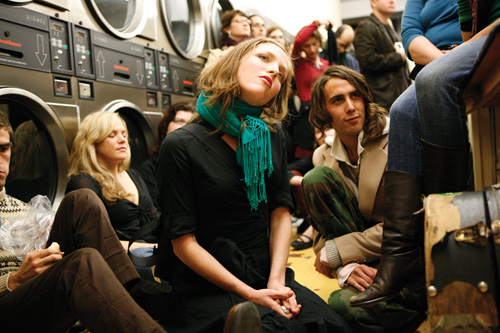
Desdemona: A Play About a Handkerchief Boxcar Theatre Playhouse, 505 Natoma, SF; www.boxcartheatre.org. $15-35. Wed-Sat, 8pm; Sun, 3pm. Through Nov 5. Written in 1979 by a 28-year-old Paula Vogel, Desdemona retells a familiar Shakespearean tragedy, Othello, through the eyes of its more marginalized characters, much as Tom Stoppard’s Rosencrantz and Guildenstern are Dead did with Hamlet in 1966. In Vogel’s play, it is the women of Othello — Desdemona the wife, Emilia her attendant (demoted down to washer-woman in Vogel’s piece), and Bianca, Cassio’s lover, and the bawdy town pump — who are the focus, and are the play’s only onstage characters. Whiling away an endless afternoon cooped up in the back room of the governor’s mansion, the flighty, spoiled, and frankly promiscuous Desdemona (Karina Wolfe) frets over the loss of her “crappy little snot-rag,” while her subservient, pious, but quietly calculating washer-woman Emilia (Adrienne Krug) scrubs the sheets and mends the gubernatorial underpants with an attitude perfectly balanced between aggrieved, disapproving, and cautiously optimistic. Though the relationship between the two women often veers into uncomfortable condescension from both sides, their repartee generally feels natural and uncontrived. Less successfully portrayed is Theresa Miller’s Bianca, whose Cockney accent is wont to slip, and whose character’s boisterous nature feels all too frequently subdued. Jenn Scheller’s billowing, laundry-line set softens the harsh edges of the stage, just as Emilia’s final act of service for her doomed mistress softens, though not mitigates, her unwitting role in their mutual downfall. (Gluckstern)

Honey Brown Eyes SF Playhouse, 533 Sutter, SF; (415) 677-9596, www.sfplayhouse.org. $20-50. Tues-Thurs, 7pm; Fri-Sat, 8pm (also Sat, 3pm). Through Nov 5. Bosnia in 1992 is divided in a horrifying civil war, some characteristics of which play out in parallel circumstances for two members of a single rock band in SF Playhouse’s west coast premiere of Stefanie Zadravec’s new play. In the first act, set in Visegrad, a young Bosnian Muslim woman (Jennifer Stuckert) is held at gunpoint in her kitchen by a jumpy soldier (Nic Grelli) engaged in a mission of murder and dispossession known as ethnic cleansing. The second act moves to Sarajevo and the apartment of an elderly woman (Wanda McCaddon) who gives shelter and a rare meal to an army fugitive (Chad Deverman). He in turn keeps the bereaved if indomitable woman company. Director Susi Damilano and cast are clearly committed to Zadravec’s ambitious if hobbled play, but the action can be too contrived and unrealistic (especially in act one) to be credible while the tone — zigzagging between the horror of atrocity and the offbeat gestures of romantic comedy — comes over as confused indecision rather than a deliberate concoction. (Avila)

The Kipling Hotel: True Misadventures of the Electric Pink ’80s Marsh San Francisco, 1062 Valencia, SF; (415) 282-3055, www.themarsh.org. $15-50. Sat, 8:30pm; Sun, 7pm. Through Nov 13. Acclaimed solo performer Don Reed (East 14th) premieres his new show, based on his post-Oakland years living in Los Angeles.

Making Porn Box Car Theatre Studios, 125A Hyde, SF; www.brownpapertickets.com. $25-50. Thurs, 8pm; Fri-Sun, 7pm (also Fri-Sat, 10pm). Through Oct 29. Ronnie Larsen brings back his crowd-pleasing comedy about the gay porn industry.

“Master Harold” … and the Boys Phoenix Theater, 414 Mason, Ste 601, SF; 1-800-838-3006, www.offbroadwaywest.org. $18-40. Thurs-Sat, 8pm. Through Nov 19. Off Broadway West Theatre Company performs Athol Fugard’s South African-set drama.

Not Getting Any Younger Marsh San Francisco, Studio Theater, 1062 Valencia, SF; (415) 826-5750, www.themarsh.org. $15-50. Thurs/19-Fri/21, 8pm; Sat/22, 8:30pm; Sun/23, 3pm. Marga Gomez is back at the Marsh, a couple of too-brief decades after inaugurating the theater’s new stage with her first solo show — an apt setting, in other words, for the writer-performer’s latest monologue, a reflection on the inevitable process of aging for a Latina lesbian comedian and artist who still hangs at Starbucks and can’t be trusted with the details of her own Wikipedia entry. If the thought of someone as perennially irreverent, insouciant, and appealingly immature as Gomez makes you depressed, the show is, strangely enough, the best antidote. (Avila)

Nymph Errant Eureka Theater, 215 Jackson, SF; (415) 255-8207, www.42ndstmoon.org. $20-50. Wed, 7pm; Thurs/19-Fri/21, 8pm; Sat/22, 6pm; Sun/23, 3pm. 42nd Street Moon performs Cole Porter’s madcap 1933 musical.

*The Odyssey Aboard Alma, Hyde Street Pier, San Francisco Maritime National Historic Park, SF; www.weplayers.org. $160. Oct 28-29, Nov 4-6, 11-12, and 18, 12:30pm. Heralding their hugely ambitious Spring 2012 production of The Odyssey, which will take place all over Angel Island, the WE Players are tackling the work on a slightly smaller scale by staging it on the historic scow schooner Alma, which is part of the Maritime National Historical Park fleet docked at the end of Hyde Street Pier. Using both boat and Bay as setting, the essential chapters of the ten-year voyage — encounters with the Cyclops, Circe, the Underworld, the Sirens, Aeolus, the Laestrygonians, and Calypso — are enacted through an intriguing mash-up of narration, choreography, sea chanteys, salty dog stories (like shaggy dog stories, but more water-logged), breathtaking views, and a few death-defying stunts the likes of which you won’t see on many conventional stages. High points include the casual swapping of roles (every actor gets to play Odysseus, however briefly), Ross Travis’ masked and flatulent Prometheus and sure-footed Hermes, Ava Roy’s hot pants-clad Circe, Charlie Gurke’s steady musical direction and multi-instrumental abilities, and the sail itself, an experiential bonus. Landlubbers beware, so much time facing the back of the boat where much of the action takes place can result in mild quease, even on a calm day. Take advantage of the downtime between scenes to walk around and face forward now and again. You’ll want to anyway. (Gluckstern)

On the Air Pier 29 on the Embarcadero (at Battery), SF; (415) 438-2668, love.zinzanni.org. $117 and up (includes dinner). Wed-Sat, 6pm; Sun, 5pm. Through Dec 31. Teatro ZinZanni’s final performance at Pier 39 riffs on the company’s own struggles to stay in San Francisco. Geoff Hoyle and Duffy Bishop are the headlining guest stars.

*red, black & GREEN: a blues (rbGb) Yerba Buena Center for the Arts, 701 Mission, SF; (415) 978-2787, www.ybca.org. $5-25. Thurs/19-Sat/22, 7:30pm. This remarkably protean new piece from Marc Bamuthi Joseph/The Living Word Project searches for common ground between the environmental movement at large and movements for social justice rooted in poor communities of color (where ecological crisis is only one among multiple life-threatening issues). Structured as a vibrant multimedia installation and performance work at once, red, black & green transforms co-commissioner YBCA’s Forum stage into an evolving environment audiences can walk through and linger in, as performers Bamuthi Joseph, Theaster Gates, Tommy Shepherd, and Traci Tolmaire deliver a multifaceted narrative road-trip through Chicago, Huston, New York, and West Oakland, following the “Life Is Living” festivals bringing arts, education, and activism to urban parks. The highly attuned ensemble conveys and accentuates this narrative with a commanding mix of firsthand accounts, poetry, dance, song, and percussion (tapped out on surfaces with fingers, palms, or carving knives). Theaster Gates’ gorgeous set design, meanwhile, blends repurposed materials into mobile environments — floating island habitats beautifully lit by James Clotfelter, decorated with sculpture and video designs (evocative media collages composed by David Szlasa), and continually reconfigured as neighborhoods, shotgun houses, storefronts, and other environs. Intended to provoke discussion about social justice struggles in the age of environmental crisis, the production’s ambitious balancing of history, contemporary politics, center and periphery, personal idealism and doubt, and individual voices feels perhaps inevitably uneven and incomplete, but the attempt is frequently bracing and the delivery as sure as it is urgent. (Avila)

“San Francisco Olympians Festival” Exit Theater, 156 Eddy, SF; www.sfolympians.com. Thurs-Sat, 8pm. Through Oct 28. No Nude Men Productions presents a festival of 12 new full-length plays written by 14 local writers. Each play focuses on one of the Olympian characters from ancient Greece.

ShEvil Dead Cellspace, 2050 Bryant, SF; www.brownpapertickets.com. $25. Fri/21 and Oct 28-29, 8pm. Primitive Screwheads return with a horror play (in which the audience is literally sprayed with blood, so leave the fancy suit at home!) based on the Evil Dead movies.

“Shocktoberfest 12: Fear Over Frisco” Hypnodrome Theatre, 575 10th St, SF; (415) 377-4202, www.thrillpeddlers.com. $25-35. Thurs-Sat, 8pm. Through Nov 19. In its annual season-scented horror bid, Thrillpeddlers joins forces with SF’s Czar of Noir, writer-director Eddie Muller, for a sharply penned triplet of plays that resurrect lurid San Francisco lore as flesh-and-blood action. In the slightly sluggish but intriguing Grand Inquisitor, a solitary young woman modeling herself on Louise Brooks in Lulu (an alluringly Lulu-like Bonni Suval) believes she has located the Zodiac killer’s widow (a sweet but cagey Mary Gibboney) — a scenario that just can’t end well for somebody, yet manages to defy expectations. An Obvious Explanation turns on an amnesiac (Daniel Bakken) whose brother (Flynn de Marco) explains the female corpse in the rollaway (Zelda Koznofski) before asking bro where he hid a certain pile of money. Enter a brash doctor (Suval) with a new drug and ambitions of her own vis-à-vis the hapless head case. Russell Blackwood directs The Drug, which adapts a Grand Guignol classic to the hoity-toity milieu of the Van Nesses and seedy Chinatown opium dens, where a rough-playing attorney (an ever persuasive Eric Tyson Wertz) determines to turn a gruesome case involving the duplicitous Mrs. Van Ness (an equally sure, sultry Kära Emry) to his own advantage. The evening also offers a blackout spook show and some smoothly atmospheric musical numbers, including Muller’s rousing “Fear Over Frisco” (music composed by Scrumbly Koldewyn; accompaniment by Steve Bolinger and Birdie-Bob Watt) and an aptly low-down Irving Berlin number — both winningly performed by the entire company. (Avila)

Sorya! A Minor Miracle (Part One) NOHSpace, Project Artaud, 2840 Mariposa, SF; www.brownpapertickets.com. $12-18. Sun/23-Mon/24, 7pm. Each year, NOHspace residents Theatre of Yugen present a program of short Kyogen and Noh pieces, demonstrating the building blocks that define their unique approach. Blending classical Japanese theatrical styles with original and contemporary works, the company’s multi-cultural ensemble has been performing their specialized brand of East-West fusion since 1978. This year’s Sorya! program includes two modern-day works written by Greg Giovanni, a Philadelphia-based playwright and Noh artist, directed by Theatre of Yugen artistic director Jubilith Moore, and one traditional comedy, Boshibari (Tied to a Pole), directed by company founder Yuriko Doi. This piece is by far the strongest of the three, a tale of two servants pulling one over their master, who has tied them up in order to prevent them from breaking into the sake cellar. Lluis Valls and Sheila Berotti as Taro and Jiro execute the highly-ritualized aspects of the Kyogen farce with deft mobility and expressiveness, working together to overcome their captivity just enough to enjoy a few drinks before being discovered by their irate master (Sheila Devitt). The other two pieces, one set in Narnia and the other based on an Irish folk ballad, are less compelling, though no less ambitious, and Stephen Siegel and Karen Marek’s joint performance as a pair of squabbling dwarves is worthy of praise. (Gluckstern)

*Tutor: Enter the Enclave Exit Studio, 156 Eddy, SF; (415) 673-3847, www.darkporchtheatre.com. $15-25. Thurs/19-Sat/22, 8pm. Dark Porch Theatre performs Martin Schwartz’s play, inspired by an 18th century German drama, about a tutor who realizes the creepy family he works for is not quite what they seem.

*Wallflower Little Theatre, San Francisco State University, 1600 Holloway, SF; creativearts.sfsu.edu. $8-12. Thurs/20-Sat/22, 8pm; Sun/23, 2pm. One by one a baker’s dozen appears in the otherwise abandoned gymnasium: high schoolers in their awkward finery all fleeing prom night, which rages away on the other side of the wall like a blast furnace and shrieks like a jet engine every time the double doors are thrown open in escape. Here, in relative silence and stillness, begins a dream-dance of its own, largely wordless but speaking volumes through a brilliantly devised choreography of hesitation, alienation, attraction, and repulsion — the push-and-pull of fear and desire epitomized by adolescence in all its desperate and beautiful vulnerability (but of course from this school no one ever really graduates). At turns hilarious, raucous, wrenching, and sweetly, smolderingly sensual, Wallflower is another must-see collaboration between Bay Area director Mark Jackson and a remarkably adept cast and crew from San Francisco State’s theater department — collaborations that have blazed a regular path out to Lakeside for discriminating theatergoers. Like last year’s stunning Juliet, Wallflower draws equal inspiration from Shakespeare (here A Midsummer Night’s Dream) and the personal insecurities and compulsions offered up by the performers themselves. Impressively designed throughout — including a choice and supple sound design by Teddy Hulsker — this dance-theater performance is an elating mixture of flooring choreography and the mesmerizing personalities and relationships registered in the subtlest of words and gestures. It’s all as enchanting and revelatory as the intoxicating dream it describes. (Avila)

BAY AREA

Bellwether Marin Theatre Company, 397 Miller, Mill Valley; (415) 388-5208, www.marintheatre.org. $34-55. Tues, Thurs-Sat, 8pm (also Thurs/20, 1pm; Oct 29, 2pm); Wed, 7:30pm; Sun, 2 and 7pm. Through Oct 30. Marin Theatre Company performs Steve Yockey’s spooky fairy tale for adults.

Clementine in the Lower 9 TheatreWorks at the Mountain View Center for the Performing Arts, 500 Castro, Mtn View; (650) 463-1960, www.theatreworks.org. $19-69. Tues-Wed, 7:30pm; Thurs-Sat, 8pm (also Sat, 2pm); Sun, 2 and 7pm. Through Oct 30. TheatreWorks presents the world premiere of Dan Dietz’s post-Katrina New Orleans drama.

*A Delicate Balance Aurora Theatre, 2081 Addison, Berk; (510) 843-4822, www.auroratheatre.org. $10-48. Wed/19-Sat/22, 8pm; Sun/23, 2 and 7pm. Aurora Theatre performs Edward Albee’s comedy of manners.

How to Write a New Book for the Bible Thrust Stage, 2025 Addison, Berk; (510) 647-2949, www.berkeleyrep.org. $14.50-73. Tues, Thurs-Sat, 8pm (also Sat, 2pm; no matinee Sat/22; no show Nov 18); Wed and Sun, 7pm (also Sun, 7pm). Through Nov 20. Berkeley Rep performs a world premiere by Bill Cain.

Inanna’s Descent Codornices Park, 1201 Euclid, Berk; www.raggedwing.org. Free. Sat-Sun, 1pm. Through Oct 30. Special Halloween show Oct 31, 5-8pm. After last year’s memorable presentation of the Persephone myth as a site-specific, Halloween-heralding, multi-disciplinary performance in the wooded glades of Codornices Park, it seemed inevitable that Ragged Wing Ensemble would want to build on that success by following it up with an equally memorable exploration of another mythological underworld. This year’s chosen subject, the descent of the Sumerian Goddess Inanna, Queen of the Heavens into the Underworld where her jealous sister Ereshkigal reigns, is enacted as a half-hour play as well as a self-guided, seven-station circuit around the park, from the tunnel to the fire pit, where the central performance is held. Each station is hosted by a different character from the play, who engages each passing audience member in a series of activities: from wishing on the future to coloring in a self-portrait of “meat.” The play itself stars Kelly Rinehart as Inanna, “the bombshell of the story,” who appears onstage clad in a dress of shredded reflective insulate and a giant leonine headdress. The other ensemble-created costumes are cleverly constructed of equally non-biodegradable materials: a faux-fur cloak decorated with remote controls, robes of state made entirely from rustling plastic shopping bags, a bandolier of empty water bottles. More genial and thought-provoking than a typical trip to a haunted house, Inanna’s Descent is an inventive Halloween expedition for children of most ages, and adults with young hearts. (Gluckstern)

*Phaedra Ashby Stage, 1901 Ashby, Berk; (510) 841-6500, www.shotgunplayers.org. $17-26. Wed/19-Thurs/20, 7pm; Fri/21-Sat/22, 8pm; Sun/23, 5pm. Catherine (Catherine Castellanos) is the loveless matron in the impeccably tidy, upper-class home of middle-aged right-wing judge Antonio (Keith Burkland), secretly infatuated with her stepson (Patrick Alparone), the prodigal returning home from jail and rehab for a new start. Catherine’s cold, obsessively ordered run of the household — with heavy-lifting by her cheerful, steadfast housekeeper (a wonderfully genuine Trish Mulholland) — masks a desolation and chaos inside her, a churning emptiness evoked in the deliberately listless pace of act one and the skudding clouds we can see reflected in the walls of designer Nina Ball’s impressively stolid, icily tasteful living room. Portland Center Stage’s Rose Riordan directs a strong cast (which includes Cindy Im, as the stepson’s rehab partner and sexual interest) in a modern-day adaptation of the Greek myth by Adam Bock (The Shaker Chair, Swimming in the Shallows), in a worthy premiere for Shotgun Players. The drama comes leavened by Bock’s well-developed humor and the dialogue, while inconsistent, can be eloquent. The storm that breaks in the second act, however, feels a bit compressed and, especially after the languid first act, contributes to a somewhat pinched narrative. But whatever its limitations, Catherine’s predicament is palpably dramatic, especially in Castellanos’s deeply moving performance — among her best work to date and alone worth giving Phaedra a chance. (Avila)

*Rita Moreno: Life Without Makeup Berkeley Repertory Theatre, Roda Theatre, 2015 Addison, Berk; (510) 647-2949, www.berkeleyrep.org. $14.50-73. Tues-Sun, showtimes vary. Through Oct 30. The life of stage and screen legend Rita Moreno is a subject that has no trouble filling two swift and varied acts, especially as related in anecdote, song, comedy, and dance by the serene multiple–award-winning performer and Berkeley resident herself. Indeed, that so much material gets covered so succinctly but rarely abruptly is a real achievement of this attractively adorned autobiographical solo show crafted with playwright and Berkeley Rep artistic director Tony Taccone. (Avila)

The World’s Funniest Bubble Show Marsh Berkeley, TheaterStage, 2120 Allston, Berk; (415) 826-5750, www.themarsh.org. $8-50. Sun, 11am. Through Nov 20. Louis “The Amazing Bubble Man” Pearl returns with this kid-friendly, bubble-tastic comedy.

DANCE/PERFORMANCE

*”PanderFest 2011″ Stage Werx 446, 446 Valencia, SF; www.panderexpress.com. Thurs-Sat, 8pm. Through Oct 29. $20. San Francisco’s Crisis Hopkins and (PianoFight’s S.H.I.T. Show makers) Mission Control join forces for a tag-team evening of sketch and “improv” (quotes kind of necessary this time). Claiming dubiously to fill a need for yet another festival in this city (though at the same time striving for above-average fawning of the public), the show delivers two acts of mostly spot-on comedy by two agreeable ensembles and is thus a fine night out anyway. The program (based rather loosely on online-video–generated audience suggestions, interspersed with the sneezing Panda baby and other YouTube perennials) also inaugurates Stage Werx’s cozy new Mission District venue — the former digs of Intersection for the Arts and a huge improvement over Stage Werx’s old subterranean lair on Sutter Street. Highlights of a ridiculous evening include a two-part Crisis Hopkins sketch detailing a site visit by a ball-wrecking contractor (Christy Daly) to her chary foreman (Sam Shaw) and his withering cherries; and Mission Control’s pointed ’70s TV show homage with a twist, Good Cop, Stab Cop. (Avila)

Our Weekly Picks: October 12-18

0

WEDNESDAY 12

EMA

“Fuck California. You made me boring,” South Dakota-born Erika M. Anderson declares defiantly on “California,” the breakout single from her cathartic, crushing first proper release, Past Life Martyred Saints (Souterrain Transmissions, 2011). I find that hard to believe. Not the bit about our fair state — living in LA made me about as interesting as an insurance seminar. But the notion that anything could make the person who created this album boring seems completely implausible. An emotional haymaker of an album, the only thing less tedious than the ex-Gowns singer’s lyrics — dealing with topics like self-mutilation, drug addiction, violence, and sex with stunning, often uncomfortable clarity and candor — is her exceptionally versatile musical palette. Anderson tosses touches of drone, punk, indie, folk, and noise rock into a sonic stew that veers as wildly as her moods. If this is what a boring EMA sounds like, I shutter to think what an engaged one could do. (Dan Alvarez)

With Sister Crayon and Alexis

8 p.m., $12 The Independent 628 Divisadero, SF

(415) 771-1421

www.theindependentsf.com


Mary Roach

There goes Oakland’s Mary Roach, delving into the scientific questions we all ponder (and some we’re not smart enough to think of). In the past, she’s brought readers on her fringe forays into sex, dead bodies, and the afterlife. Her latest book, Packing for Mars, explores the weird, the unsavory, and the absurdity found in astronaut space exploration and on-earth preparation. What are the health risks associated with cramped space shuttles without showers? What does dispelled urine look like in space? In Packing, named the 2011 selection for One City One Book: San Francisco Reads, Roach provides the answers in grisly and entertaining detail.(Kevin Lee)

7:30 p.m., free

Booksmith

1644 Haight, SF

(415) 863-8688

www.booksmith.com


THURSDAY 13

“Flight of Poets”

Does a pinot grigio complement Matthew Zapruder’s charismatic poems, or would a spicy zinfandel? How about Jane Hirshfield’s disciplined lines and forceful resolutions, do they call for a bold merlot? Wine steward Christopher Sawyer puts these questions to rest at “Flight of Poets,” LitQuake’s poetry reading and wine bash, curated by Tess Taylor and Hollie Hardy. Sawyer matches a wine with each of the evening’s poets, including Gabrielle Calvocoressi, Robert Polito, Rachel Richardson, and C. J. Sage in addition to Zapruder (Come On All You Ghosts, 2010) and Hirshfield (Come, Thief). In the words of Charles Baudelaire: “It is time to be drunk!” (James H. Miller)

7 p.m., $15

Hotel Rex

562 Sutter, SF

(415) 440-4177

www.litquake.org


Daniel Francis Doyle

When his band broke up in 2005, Austin, Texas’s Daniel Francis Doyle needed a quick fix for performing live. He began experimenting with guitars duct-taped to amps and quickly evolved into a noisy force to be reckoned with. The one-man music machine uses a loop pedal, drum kit, and headset microphone to make a ruckus that’s frenetic, exhausting, and surprisingly melodic. After developing a respectable body of solo work, he’s come full circle — writing and performing with a backing band as well. Catch him shredding solo and showcasing collaborative work in a single fun-filled evening at Club Paradiso. (Frances Capell)

With Clarissa, and Hazel’s Wart

8 p.m., $5

Club Paradiso

2272 Telegraph, Oakl.

(510) 735-9095

www.disolounge.com


“Doc”

Novelist Paul Auster called him “a ravaged, burnt-out writer who had run aground on the shoals of his own consciousness;” Norman Mailer said he wanted to be “dictator of the world.” At any rate, everyone who knew H.L. “Doc” Humes agreed that he was a genius. Co-founder of The Paris Review, and author of two lauded political novels, Doc was integral to New York’s literary and jazz scenes in the 1950s. However, in the 1960s, Doc plunged into madness and paranoia, started ranting about government conspiracies, and gave up writing altogether. Doc (2008) is the documentary directed by his daughter, Immy. With interviews with Auster, Mailer, Timothy Leary, and others, the film traces the life and times of this eccentric genius. (Miller)

7:30 p.m., $12

Oddball Film+Video

275 Capp, SF

(415) 558-8112

info@oddballfilm.com


Enslaved

Musical evolution can be risky. For every storied success, there’s a fan-alienating failure. Thankfully, Enslaved belongs in the former category. Though begun in 1991 as a traditional Norwegian black metal outfit, the Bergen-based band gradually began introducing textural flourishes, epic, narrative arrangements, and tasteful clean singing. Now they rank among the most fascinating, progressive-inflected extreme metal bands in the business. Headlining a full American run should show off the quintet at its enveloping best — who says songs about Vikings can’t be psychedelic? Haunting, costumed buzz band Ghost had to drop off the bill due to visa issues, but Enslaved’s copious talent should staunch all complaints. (Ben Richardson)

With Alcest, Junius, and the Swizard

7:30 p.m., $17

Slim’s

333 11th St., SF

(415) 255-0333

www.slims-sf.com


FRIDAY 14

Jeffrey Eugenides

It’s been nine long years since the publication of Jeffrey Eugenides’ ambitious, Pulitzer winning epic, Middle Sex (2002), and eighteen years since his stunning debut, The Virgin Suicides (1993), which makes the author’s new novel, The Marriage Plot, without a doubt one of the most anticipated of the decade (by those who have a good memory anyway). The Marriage Plot probes the lives of three Brown University seniors in the 1980s — Mitchell, Leonard, and Madeline — and the love triangle that emerges between them over the course of one year. At this free event at Books Inc., Eugenides (at long last) reads from his new novel. (Miller)

7 p.m., free

Books Inc. Opera Plaza

601 Van Ness, SF

(415)-776-1111

www.litquake.org


Frank Turner & the Sleeping Souls

It comes as no surprise that British folk-punk singer-songwriter Frank Turner is rapidly ascending as a cult hero here in the States. Though he often references geography, you don’t have to be from Winchester to identify with the punk poet’s themes of mortality, self-deprecation, and living life to the fullest. Prior to the release of his fourth album England Keep My Bones (Epitaph), Turner toured North America, completely selling out every date. Now the hardcore singer turned folk-troubadour returns to San Francisco with backing band the Sleeping Souls for a rowdy, beer-soaked night to remember. (Capell)

With Andrew Jackson Jihad and Into It. Over It.

8:30 p.m., $16

Slim’s

333 11th St., SF

(415) 255-0333

www.slims-sf.com


SATURDAY 15

“An Afternoon of Soccer Culture”

Soccer fans — football fans elsewhere in the world — might know Simon Kuper thanks to his Freakonomics-styled best-seller Soccernomics. In his latest, Soccer Men, the veteran sports journalist compiles the profiles he’s written over the past 15 years for papers like the Financial Times and the Times of London. Though the chapter titles are a superstar roll call (Messi, Rooney, Drogba, etc.), there’s no fawning here; instead, Kuper offers thoughtful, witty insights into what makes a particular player (or coach) valuable, distinctive, or well-liked (or hated) by the masses. He hits up local footy hotspot Edinburgh Castle to discuss “the beautiful game” with San Francisco author Alan Black (The Glorious World Cup). Only 970-something-ish days until Brazil 2014! (Cheryl Eddy)

3 p.m., free

Edinburgh Castle Pub

950 Geary, SF

(415) 885-4974

www.castlenews.com


“The Hula Show”

A sort of armchair travel, Na Lei Hulu I Ka Wekiu’s The Hula Show 2011 stops in India, Samoa, Turkey, Spain, and Wai’anae, blending traditional and contemporary forms of hula. The group brings the art back to California with a suite of chants called Hanohano Kapalakiko, which illustrate the bond between Hawaii and San Francisco. Following opening weekend of The Hula Show, performances on Oct. 22 and 23 feature guests from the Golden Gate Men’s Chorus. If you can’t make the trip to Hawaii this month, pick up a one-way ticket to The Hula Show, for a small taste of the culture. (Julie Potter)

8 p.m. also Sun/16, 4 p.m., $35–$45

Palace of Fine Arts Theater

3301 Lyon Street, SF

(415) 392-4400

www.naleihulu.org


SATURDAY 15

JFK of MSTRKRFT

Jesse F. Keeler, perhaps better known as JFK to fans of MSTRKRFT and Dim Mak Records, has not been neglecting his dance floor duties. Even while reuniting with Sebastien Grainger for the highly anticipated Death From Above 1979 reunion tour, JFK has been putting in time on the decks, frequently double slotted at festival dates. DFA 1979 is easily one of the biggest draws of this year’s Treasure Island Music Festival and JFK will follow the band’s sure to be frenzied dance-punk (emphasis on punk) performance on T.I. with a live DJ set back at Mezzanine, which will likely contain some extremely headbanging electro floor stompers. (Ryan Prendiville)

With Chain Gang of 1974, Sticky K, and DJ Morale

9:30 p.m. Doors, $20

Mezzanine

444 Jessie, SF

(415) 625-8880

www.mezzaninesf.com


Never Knows

A Korg-load of brainiacs are still making techno in this town (yay!). But how many of those brainiacs are merely getting in the way of their machines? “There’s something beautifully pure about techno. Too pure. That pristine, precise sound needs to be undermined, soiled and sullied. Electronic dance music usually relates a narrative that is predictably written. The only way I see out of this trap is to be more of a mediator between the machines as they each take turns telling their own side of the story: sometimes harmonious, sometimes revelatory, often conflicted.” That’s Marc Kate (a.k.a. Silence Fiction, a.k.a.Husband), one of SF’s more vital underground fixtures, whose latest, kind of spooky incarnation as Never Knows channels a tasty bank of live equipment as it folds old-school goth atmospheres into sweeping techscapes. Ensorcel much? Strap in for his debut at the essential, experimental monthly O.K. Hole party. (Marke B.)

With Water Borders and Total Accomplishment

9 p.m., $5

Amnesia

853 Valencia, SF.

(415) 970-0012

www.amnesiathebar.com


TUESDAY 18

Opeth

Iconoclastic. Idiosyncratic. Inimitable. Whichever “i”-adjective you prefer, Opeth has long occupied its very own metal subgenre, blending limber, tuneful death metal with progressive excursions and mournful clean singing. Despite melodic accomplishments, the music was often quite heavy, which is why Heritage, the band’s brand-new album, came as a surprise. Largely abandoning distorted guitars, Opeth perplexed critics and fans by releasing a full-fledged 70’s prog album, leaning heavily on organ parts and mastermind Mikael Âkerfeldt’s dulcet vocals. A national tour should help head-scratching headbangers embrace Opeth’s new direction, combining King Crimson-style epics with the band’s blast-beaten back catalogue. (Richardson)

With Katatonia

8 p.m., $27

The Warfield

982 Market, SF

(415) 345-0900

www.thewarfieldtheatre.com


The Guardian listings deadline is two weeks prior to our Wednesday publication date. To submit an item for consideration, please include the title of the event, a brief description of the event, date and time, venue name, street address (listing cross streets only isn’t sufficient), city, telephone number readers can call for more information, telephone number for media, and admission costs. Send information to Listings, the Guardian Building, 135 Mississippi St., SF, CA 94107; fax to (415) 487-2506; or e-mail (paste press release into e-mail body — no text attachments, please) to listings@sfbg.com. Digital photos may be submitted in jpeg format; the image must be at least 240 dpi and four inches by six inches in size. We regret we cannot accept listings over the phone.

City Lights celebrates a vital, veteran publisher

1

The avant-garde publisher New Directions was founded in 1936, but the idea was borne two years earlier when Ezra Pound gave some fairly harsh advice to James Laughlin, a 22-year-old aspiring poet and Harvard undergrad. In 1934, Laughlin was ambitious enough to travel to Rapallo, Italy, to meet and study under Pound, who was by that time a fascist and outspoken anti-Semite, but still respected by young writers as the force behind Eliot, Joyce, and Hemingway, as well as Imagism, the movement he helped shape. After two months, though, Pound didn’t think Laughlin possessed enough talent, and told him to return to the states and “do something useful.”
 
Three quarters of a century later, “useful” hardly describes New Directions (which will be celebrated Tues/11 at City Lights Books) and its dedication to publishing eccentric and groundbreaking work, beginning with the likes of Dylan Thomas, Denise Levertov, Tennessee Williams, and Marianne Moore, and continuing today with contemporaries like László Krasznahorkai and Javier Marías.

Birds, Beasts, and Seas: Nature Poems from New Directions (New Directions Publishing, 191 pages, $14.95) testifies to that dedication. Published to commemorate its 75th anniversary this year, and edited by the poetry editor, Jeffrey Yang, the anthology draws from the New Directions’ exhaustive archive, piling together over 140 poets of every nationality, period, and style into a handsome little book. Arranged chronologically by date of birth, and spanning from antiquity to the present, the anthology explores the vastly different ways poets have responded to nature: worshipping it, vilifying it, and bemoaning its loss. As luck would have it, four contributors to the anthology will read at City Lights to commemorate New Directions’ anniversary: Michael Palmer, Michael McClure, Lawrence Ferlinghetti, and Nathaniel Tarn.
 
As conventional or even dry as an anthology of nature poems may sound, Birds, Beasts, and Seas is impressive simply because New Directions’ specialty has always been renegades, rejects, and intransigents. It’s an anthology of nature poems, of course, but the poems are by no means characteristic of the genre. They are, however, characteristic of New Directions. Several of the poets here are rarely anthologized at all, and stumbling onto them is like bumping into old friends suddenly back from oblivion. William Bronk, for instance, whose poem “Aspects of the World Like Coral Reefs” dismantles science and asserts “It is absurd to describe the world in sensible terms;” or French poet Saint John Perse, Chilean poet Vincente Huidobro, and some of the very poets reading at City Lights on Tuesday, like Nathaniel Tarn whose brooding poem from “The Fire Season” wouldn’t appear in your typical nature anthology:
 
Our pines continue to die and continue to die—
funeral carpets of needles around their base.
You could sleep there, you could suffocate
soundly and be in harmony with all of nature.
 
Editor Yang writes in the preface that nature poems could change our way of thinking about the environment, and while Yang’s faith in the poem is admirable (however naive), the most anyone can really expect from Birds, Beasts, and Seas is an anthology that, at its finest moments, is new and invigorating.

New Directions Publishing 75th Anniversary
Tues/11, 7 p.m., free
City Lights
261 Columbus, SF
www.citylights.com

Shakin’ spines

0

marke@sfbg.com

LIT Once again, the raucous, two-week Litquake festival is set to liquidate our shores with the mighty crack and crash of living language. Dazed authors and reeling poets will grace our lesser known alleyways; literary agents and bookstore owners will awaken satisfied on the curbs of our better sex clubs. Kindles will be hijacked, asses will be signed. Some actual writing may get done.

And yet, while the larger events justly command the spotlight (opening party “The Devil’s Lexicon” on Fri/7, New Directions 75th anniversary party on Tue/11, infamously drunken unofficial closing blowout Litcrawl on Sun/15), there are a host of smaller and satellites events that tap into the true flavor of contemporary literature. Below are some attractive-looking ones. (Unless noted, more info can be found on these functions at www.litquake.org.)


OFF THE RICHTER SCALE

This two-part event is the quavering blood and guts of Litquake: an unabashed free showcase of some of the most cutting-edge talent on offer. Rhyming or Not: Bay Area Poetry (Sat/8, 1 p.m., free) shores up the verse side of things, while Golden Gate and Beyond (Sun/9, noon, free) props up the prose. This year’s theme is, “to explore writing in extreme circumstances and from deep within the mind—defined in terms spiritual, physical, or cybernetic.” I’m bringing popcorn.

Sat/8 and Sun/9, Variety Room, 582 Market, SF.


CHRISTINE BEATTY

OK, this isn’t officially a part of Litquake — but the ‘quake also spawns a slew of satellite events, so let’s just shake things up. Christine Beatty is tearing up the transsexual literature circuit with her memoir, “Not Your Average American Girl,” which tells her fascinating story from growing up hippie, serving in the military, hooking in the Tenderloin, engineering software, and much more. It’s a great slice of Northern Californiana.

Sat/8, 8 p.m., free. Center for Sex and Culture, 1349 Mission, SF. www.sexandculture.org


THAT’S MY F*CKING STOOL! WRITERS AT THE BAR

I know next to nothing about this night except that it takes place at one of my favorite bars, Vesuvio, and involves some very interesting writer-personalities, like Jack Boulware, Beth Lisick, Missy Roback, and Frances Stroh. I hope it’s Jell-O wresting, but I’ll be happy with a good ol’ round of slams and shots.

Sun/9, 4 p.m., free. Vesuvio, 255 Columbus, SF.


THE SECRET LIFE OF METAPHOR

Am I terrified of an expert on metaphors who is also a juggler, and who illustrates his points by “juggling balls as well as words”? I am kind of terrified of this person! And yet, I find the promise of respected writer James Geary’s lecture almost too tantalizing to resist. Should I let my prejudices keep me away, or should I let the wild carnival of knowledge commence? Right now, it’s a toss-up.

Sun/9, 4 p.m., $5–$7. Z Space, 450 Florida, SF.


TEENQUAKE: NOT YOUR MOTHER’S BOOK CLUB

You either have come to accept that teenagers are rightfully taking over this world, or you need to look up this little thing called the Internet. Of course, teens have maliciously kept most of the best recent fiction writing to themselves, via “young adult” books. (If I’m addicted to Hunger Games does that mean I’m young forever?) Popular teen fiction writers Simone Elkeles, Becca Fitzpatrick, Michelle Hodkin, and Moira Young come together to dish their secrets.

Mon/19, 7 p.m., free. Books Inc. Opera Plaza, 601 Van Ness, SF.


ORIGINAL SHORTS: FAILURE TO COMMIT

Will the six authors — including Ladipo Manyiko and Shawna Yang Ryan — who were asked to “look deep into the heart of the flaky soul and emerge with original short stories on the theme of failing to commit” even show up? Now that would be some performative literature right there. If you’re stood-up, you’ll at least have the Lone Palm’s excellent cocktails for succor.

Mon/10, 7 p.m., free. Lone Palm, 3394 22nd St., SF.


BARBERSHOP READING: A LITTLE OFF THE TOP AND OVER THE TOP

The gays do love to fuss about their tops! This party-slash-gathering of LGBT writers in the fab Joe’s Barbershop has already become a Litquake fixture for lit queens and their chasers, and proof that our community’s writing talent hasn’t been sucked into Grindr chats and Dinah missed connections.

Tue/11, 9 p.m., free ($5–$10 suggested donation). Joe’s Barbershop, 2150 Market, SF.


FIGURE FOUR CAPS LOCK: PRO WRESTLING MEMOIRS FROM CLASSY FREDDIE BLASSIE TO THE FABULOUS MOOLAH

Boxing, schmoxing — the real money melon for sports book fans of the last two decades have been professional reminiscences of flamboyant flings in the ring. I mean, c’mon, Rowdy Roddy Piper, people: what more titillation do you need (besides a kick in the rear from the Iron Sheik’s pointy-toed shoes?) Writers Alia Volz, Rick Luxury, Alan Black and many more cactus clothesline this important body of work with tributes and testimonials.

Fri/14, 7 p.m., $10. Hemlock Tavern, 1131 Polk, SF.


INVISIBLE CITY AUDIO TOURS: EVERYWHERE MAN

“Alternative self-guided walking audio tour” purveyors Invisible City combine music, words, sonic landscapes, and historical information to create realtime experiences that map the ethereal onto SF streets. Latest work “Everywhere Man” is a mystery that whose clues are divulged while participants ride cable cars throughout the city. This sounds too, too cool, especially for first-time visitors.

Sat/15, 2 p.m., pre-order accompanying map and podcast at www.invisiblecityaudiotours.org for $15. Meet at the cable car turnaround, Market and Powell, SF.


WORDS ON WAVES

The North Bay literary scene gets some incredible shine at this event, which takes place on the houseboats of Sausalito. Move from one houseboat to the next and experience samplings of such topics as “Rum, Sodomy, and the Lash: Tall Tales from the Boat Dwellers” on Boat #134, SMITH Magazine’s “Water, Fire, Rocks: Life in Six Words” on Boat #42, and “Vanda Marlow, Poetry Faerie” on Boat #12 (actually a restored World War II landing craft.) Get saucy, Sausalito. Literally.

Sat/15, 1 p.m., $25 advance. Private houseboat pier (for exact location email wotw@litquake.org), Sausalito.

The sight of sound

0

arts@sfbg.com

HAIRY EYEBALL “Home taping is killing music”, declared the 1980s anti-copyright infringement campaign waged by British music industry trade group, the British Phonographic Industry. History has proven BPI’s concerns to have been mis-targeted, with cassettes becoming an increasingly irrelevant medium in the ensuing decades, even as the music industry still struggles to respond to ever-mercurial forms of bootlegging and pirating. The cassette tape, however, has—perhaps unsurprisingly— re-emerged in recent years as both an object of nostalgia and a more exclusive format for more out-there musicians to release their small, home-made batches of black metal, experimental electronica, or noise out into the world for listeners for whom Tumblr is not enough.

Composer and musician Christian Marclay’s visual art often engages with our complicated relationship to outmoded technologies of audio-visual reproduction, particularly vinyl records. The photograms in his current show at Fraenkel Gallery continues this line of inquiry, playfully condensing the cassette tape’s arc from boon to perceived threat to obsolescence to fetish object.

For the gorgeous 2009 photogram “Allover (Dixie Chicks, Nat King Cole and Others),” Marclay exposed photo-sensitized paper to light after he had strewn over it the magnetic innards of cassette tapes and fragments of the broken plastic shells that once contained them that had been coated in a photosensitive solution. The resulting sprawl of tangled white lines on blue brings to mind the splatter canvases of Jackson Pollock or the chalk squiggles of Cy Twombly (associations Marclay’s titular “allover” winks at). In other photograms, such as “Large Cassette Grid No. 9,” also from 2009, Marclay has arranged plastic cassette cases in block-like patterns that cover the entire paper, with each cases’ accumulated wear and tear providing subtle variations.

That cyan-like blue color is what gives Marclay’s chosen process, the cyanotype, its name. Discovered by English scientist Sir John Herschel in 1842, the cyanotype process was historically used to make blueprints. I’d like to imagine that this irony isn’t lost on Marclay. By using an outmoded photographic technology to make visual art out of an outmoded audio technology, Marclay underscores the eventual obsolescence of all reproductive technologies. His cyanotypes aren’t blueprints so much as headstone rubbings.

In “Looking for Love” (2008), a single channel video shown in the gallery’s backroom, Marclay’s stationary camera stays zoomed-in on a well-worn phonographic stylus, as his giant hands roughly skip the needle around record after record searching for any utterance of the word “love.” The film’s exaggerated scale combined with Marclay’s increasingly impatient and roughshod sample hunting can be read as a parody of the audiophile as techno-purist. But the film also speaks to our enduring investment in music—be it the Dixie Chicks, Nat King Cole, or any of the other inaudible “others” that went into the making of Marclay’s cyanotypes—even as our experience of listening to it becomes more and more immaterial.


HOMETOWN GIRL

Fran Herndon was not a name I was familiar with, so I’m glad to now be acquainted with this largely unsung player in San Francisco’s artistic firmament of the 1950s and 1960s (and all around bad-ass) thanks to the eye-opening selection of early oil paintings and mixed-media collages organized by Kevin Killian and Lee Plested currently on view at Altman Siegel.

An Oklahoma native, Herndon moved to San Francisco in 1957 with her husband, the California teacher and writer Jim Herndon, who she met while traveling in France. She quickly fell in with the likes of the Robin Blaser, Jess and his partner Robert Duncan, and Jack Spicer, with whom she formed an intense intellectual and aesthetic bond. Together, they founded the mimeographed poetry and art magazine J, and Herndon created lithographs for poet Spicer’s 1960 master-work The Heads of the Town Up to the Aether. All the while, Herndon continued to produce her own varied body of work that was as much a response to her newfound creative circle of friends and collaborators as it was to the times in which they were making art.

The series of sports themed collages she made in 1962 are especially representative of Herndon’s gift for exploding the hidden currents of emotion contained in her source material—in this case, images clipped from popular magazines such as Sports Illustrated and Life are transformed into near-mythological tableaux of victory and defeat in which race and the volatile racial climate of Civil Rights era-America are front and center (Herndon, who is of Native American heritage, has said “[America] is no place for a brown face”).

In “Collage for Willie Mays” the baseball legend is depicted hitting a homer out of a Grecian colonnade whereas in the decidedly darker and Romare Bearden-esque “King Football” an actual mask has fallen away from the titular ruler, revealing a skull-like visage wrapped in a cloak of newspaper clippings about the 49er’s then-scandalous decision to trade quarterback Y.A. Tittle for Lou Cordilione. The headlines about devastation and death speak to other off-field losses, though.

Other pieces resonate on a more emotional level. The gauche-smudged greyhounds in “Catch Me If You Can” bound past their bucolic counterparts like horses in a Chinese brush painting—all speed and wind—and are as much signs-of-the-times as the more politically overt anti-draft and anti-war collages Herndon made later in the decade.

Certainly, there was no time to wait. So much of Herndon’s art seems to come from an urge to document her “now” with whatever tools she had on hand, a present being lived and produced in the company of so many extraordinary others, from Spicer to Mays. Even her paintings seem to have been worked on only to the point at which their subjects just emerge distinct from their swirled backgrounds of color. Nearly fifty years later, Herndon’s urgency is still palpable.


CHRISTIAN MARCLAY: CYANOTYPES

Through Oct. 29

Fraenkel Gallery

49 Geary, Fourth Floor

(415) 981-2661

www.fraenkelgallery.com


FRAN HERNDON

Through Oct. 29

Altman Siegel Gallery

49 Geary, Fourth Floor

(415) 576-9300

www.altmansiegel.com

Fighting displacement in Fiji, San Antonio’s community gardens

3

Last Saturday, the website 350.org encouraged people met up to protest dependence on fossil fuels and celebrate community-based activism. The result was 2,000 events across the world for a day of action called Moving Planet Day, a dispersed mix that illustrated how climate change is affecting and being worked on in different parts of the world. We checked in with organizers in San Francisco and Buenos Aires last week (check shots from the celebration in San Francisco’s Civic Center Plaza here) and will round out the series with news from activists in San Antonio, Tex. and Suva, Fiji. Their answers spoke to the breadth of the day’s significance.

Mobi Warren, founder of 350SanAntonio.org and Moving Planet volunteer coordinator, helped organize two events in her city — one at a community garden and one at a repurposed brewery, at the same time as a farmers market. 

SFBG: What was the goal of Moving Planet Day in your town?

MW: Increased awareness among citizens; expanded partnerships and new alliances between environmental, civic, non-profit, and local governmental organizations who engage with the issue of climate change from different perspectives; momentum and inspiration for all the hard work that lies ahead.  


SFBG: How did people mark the day? What was going on in San Antonio?

MW: We had [Moving Planet Day] events at two venues. One was sponsored by the Health Collaborative, a non-profit that works in local schools and that has a beautiful community garden (next door to the school where I am a fifth grade math teacher — the Roots and Shoots Environmental Club I sponsor at my school partners with the garden) — they offered several family-friendly, hands-on activities that explored community gardens and local food as one of the solutions to climate change. They also had two huge pinatas in the shape of Hummers filled with green surprises that children broke open as a symbolic way of breaking an addiction to fossil fuel.

The second event was a larger awareness fair that took place at a popular San Antonio gathering place — the historical Pearl Brewery — a completely solar-powered space that has been repurposed and that holds a popular farmer’s market every Saturday that draws a good crowd. Twenty groups set up tables with hands-on activities and info related to climate change solutions: green building, alternative transportation, recycling, community gardening, etc. Sierra Club members took on the task of inviting an impressive slate of speakers for the Pearl event. We had state representative Mike Villareal, two Texas  Climate Scientists, Gunnar Schade and Gerald North who gave terrific and informative presentations, and Congressman Lloyd Doggett, a strong advocate of 350.org. There was even a poetry reading as part of Moving Planet in the local bookstore at the Pearl, The Twig. Poets read poems on the theme of climate change and environmental issues.


SFBG: Your favorite part of the day?

MW: The entire event was pretty amazing. We estimate 800 to 1000 people passed through the awareness fair and there was a lot of engagement and conversation going on the whole time. Seeing citizens stay after the speakers’ presentations to ask questions and discuss with them how we can better work together on the urgent issue of climate change made me feel that awareness and momentum is growing here in the heart of Texas. But maybe the most inspiring moment was seeing the face of one of my students who came to both venues with her mom and siblings (and this is a low income family that gets everywhere by bus or foot) — explaining to her family what 350.org means.   


Ewan Cameron celebrated two Moving Planet Days — roughly the first and last ones in the world. The coordinator for the Pacific chapter of Moving Planet Day and part of the organizing committee for Moving Planet Samoa, he participated in a Suva, Fiji walk-bike-canoe-run event. We caught up with him via email before he flew the 719 miles — and 22 hour time difference — to Samoa to participate in festivities there. 

SFBG: What is your role in your city’s Moving Planet Day events?

Ewan Cameron: I am the Pacific coordinator for Moving Planet as well as a part of the Samoa Moving Planet organizing committee.


SFBG: What inspired you to get involved?

EC: The problems that small islands face, the interactiveness of 350.org, the friendship and inspiration of others, and the passion.


SFBG: What did Suva get up to on Saturday?

EC: We paddled a six-person canoe, sailed, walked, ran, and cycled from Suva Point to Suva’s grammar school and back.


SFBG: What, for you, was the most inspiring moment?

EC: Sharing this moment with fellow Pacific Islanders, and with the rest of the entire world, in addition the fact that the Pacific officially began the campaign with in Tonga, and we in Samoa will be the last country to close the campaign. I am fortunate at this moment to be in Fiji participating in the Moving Planet event in Suva, I was here attending a 2 week training, and then I fly out tonight back to Samoa where I live to celebrate our event in Samoa which is the last event on the planet. So I will be in two different time zone.


SFBG: How many people attended the event?

EC: Over 50 people participated.


SFBG: Why was this such a big deal?

EC: Because the climatic impacts are already being felt, people, and communities within the Pacific are being forced to relocate and are being displaced. These problems are not being exaggerated, Coastal areas are eroding, saltwater from king tides are damaging staple foods that people rely on, climate change is a real issue. The science is there, it can be proven, and on top of that major emitters are violating people rights!


SFBG: What do you hope that Saturday’s activities achieve?

EC: Major public pressure on governments to commit to a emissions reduction target that will bring the planet down below the safety level of 350ppm, and a serious, rapid display of movement towards the use of cleaner energy sources.  


SFBG: How did you transport yourself to the festivities?

EC: I walked.


SFBG: Complete this sentence: We can reverse the causes of man-made climate change if we… 

EC: … stop burning coal, and not allow the burning of tar sands. 

Lit love at Ourshelves, the Mission’s new lending library

1

Perched on a wooden bench built into the salvaged redwood walls of the back room of Viracocha, surrounded by the Ourshelves lending library she’s created in the nook, the soft-spoken Kristina Kearns reads “literary heroine.” For Pete’s sake, she’s making literature that you can’t find at the library available to the masses in the heart of the Mission. 

But also this: Kearns once worked in a small bookshop on the island of Santorini, Greece. She lived in the store, in fact, tending it while the owner was away during the off season. “That was when Greece started to fall apart,” she says. Political unrest made her stay untenable, so she flew back to the United States — with very little funds to nurture her bibliophilic nature.

Our heroine is a fan of hard-to-find European authors. She points me towards a slim volume by Hungarian author László Krasnahorkai entitled Animalinside and speaks reverently of Scottish poet W.S. Graham. “He’s not even in print here,” she tells me disbelievingly. 

To go from literally living amongst her favorite tomes to not being able to afford to read them at all must have been fairly heartbreaking. 

“It’s hard to find international books in the library,” says Kearns, who recently scratched a cornea and couldn’t see print for six days. During that time she “realized I don’t love reading. I need reading.” She invokes Vonnegut’s theory of reading as occidental meditation, saying “It makes me a happier person.”

Even sadder than Kearns’ empty wallet was the general sense of doom she discovered in the publishing world.

“It was difficult to come back to the States and hear from authors that publishing is dead. It’s not! The history of books is long. What if we just try? What if we don’t complain and just try? Jonathan let me try, and I think that’s awesome.”

She had this thought: “one of the things we can do is flex our idea of what a bookshop is. Why do people go to bookshops in the first place?” Many people, she thought, have to be led to a good book — and to be led, people have to trust their curator. 

“Jonathan” is Johnathan Siegel, owner of Viracocha. Siegel and Kearns met and wound up talking about her dream to create a space dedicated to books, one that wasn’t a library or commercial bookstore. Kearns says she didn’t think much of the conversation, but one month later Siegel called to offer her a room at the back of his antiques and art store that was at the time being used, Kearns says, “for haircuts and storage.” 

She had been working five part-time jobs to assemble the library necessary for the space, and had been contacting publishing houses and authors, asking anyone who would listen if they would donate books towards her nascent lending library. The San Francisco Public Library now donates five copies each time there is a new volume being read in the city’s “One City, One Book” book club. Michael Chabon offered up his home library. “We just kind of roamed through and took what we wanted,” says Kearns. 

But there was still the matter of the space itself. 

“I was naïve in the beginning — I thought I would magically start on June 1, like the shelves would magically appear,” Kearns says, remembering that it took three to four tries for her to properly install each shelf, made from wood and metal pipes. Others contributed elbow grease and artistic aptitudes and soon enough Kearns was hosting an opening party with a surprising crowd of 100 attendees. 

Ourshelves as a physical space is somewhat transcendent. Kearns carefully arranges the books on the shelves, and the antique volumes of Alice and Wonderland and other classics on the table. There is a painted tree made of books that grows out from the bench seating in the back corner, and a whiskey bottle placed just so on an antique desk. She now has shelves “curated” by local authors, among them, Stephen Elliott, Tamin Ansary, and one-time editor of The Believer Andrew Leland. It’s hush is perfect for running a hand across the spines of the new and used novels and poetry volumes — and once one is selected it, reading it in view of its brothers and sisters. 

Tucked away at the back of Viracocha, Kearns puts much truck in the experience of stumbling across Ourshelves. On the day I visited, a man had done just that and after speaking with Kearns for a comfortable spell, he donated money to the library without even checking out a book.

There are 62 members now, each paying $10 each month to check out as many books as they’d like. Their fees go towards rent, and towards the 20 to 40 titles a month that Kearns aims to bring in at members’ requests. 

“Learn about the world, dammit!” Siegel interrupts a discussion Kearns and I are having about superlative fiction writers. He is, she tells me, going to be the space’s non-fiction curator.

“You can in fiction!” she retorts. 

Certainly, Kearns has found a way to manifest her version of a better world through books with Ourshelves. The small room has become a place to honor the written world, a place where quiet conversations between strangers can start — and a place to discover that perhaps publishing is not so dead, after all. 

“For people who love books,” Kearns smiles. “Being surrounded by books is nice feeling.”


Desolation angels

0

arts@sfbg.com

FILM Wanda (1970) takes a long time to settle into anything resembling a plot, but the wayward scenes at the start of the film have a remarkable exactness to them. In one, the title character (played by director Barbara Loden) walks into a dingy bar looking to end the day early. She’s fresh from divorce court, where she lost her kids, merely acceding to the judgments of her ex-husband and the court. As the bartender puts a bottle of beer and glass on her table, a greasy lump at the bar says he’ll take care of the drink. The unsolicited offer clouds Wanda’s face; she sips her drink resigned to what it means. A rude cut takes us to a spent motel room where Wanda sleeps naked alone in pale afternoon light. The guy from the bar tiptoes around the room to leave, but he makes a noise setting Wanda to hurriedly dress herself, pointlessly calling after him to wait. The plainness of the scene’s despair tells us it’s nothing new for her.

Characterization emerges in the fluidity of situation and behavior, melancholy in an unanchored camera and stark ellipses. Once its protagonist takes up with an amateur thief who radiates nervous energy, Wanda unspools as an inverted Gun Crazy (1950), its unsentimental portrait of a female drifter looking ahead to films like Jeanne Dielman (1975), Vagabond (1985), Safe (1995), and Kelly Reichardt’s River of Grass (1994) and Wendy and Lucy (2008). Wanda screens in a restoration print as part of a bountiful overview at the Pacific Film Archive called “The Outsiders: New Hollywood in the Seventies.”

Drawing inspiration from The Last Great American Picture Show, an excellent anthology edited by Alexander Horwath to accompany an earlier retrospective at the Austrian Film Museum, the PFA series shifts the historical narrative of New Hollywood from movie brats to unnamed margins. Celebrity-driven surveys of the same period (like Peter Biskind’s Easy Riders, Raging Bulls) miss the congruence of by-the-teeth filmmaking and borderline characters that helps to define the PFA series. Ample room is made for those filmmakers whose careers couldn’t hold a straight line (Loden’s career as a director began and ended with Wanda), and familiar landmarks like Mean Streets and Badlands (both 1973) are considered alongside lesser known but no less groundbreaking character studies like Dusty and Sweets McGee (1971), Ice (1970) and The Heartbreak Kid (1972).

The swift scene of Wanda getting picked up at the bar establishes a few leitmotifs for “The Outsiders.” You notice right away that the crummy motel rooms and bars are the real thing, and that an actor’s vanity is never spared a frank look at a character’s worn down body and face. The incidental nature of the camera placement, long duration of scenes, and dispersive spread of sound deepen the melancholy reality of these appearances. A verité-style handheld camera takes single measure of the scene, registering the immediacy of behavior but stopping short of slicing up the conflict into easy points of identification (Wanda cinematographer Nicholas T. Proferes cut his teeth with Robert Drew’s pioneering documentary crew in the early 1960s). Also borrowed from observational documentary is an interest in private, semi-coherent forms of speech; the stories are as much told through gesture and movement. You constantly feel on the precipice of emotions, watching as they form and stagnate in a languid real time that makes a character’s exhaustion palpable in the theater.

Most of these movies are indeed populated by outsiders, though the meaning of the word shifts from film to film. There are plenty of figures of hedonism (memorably, Rip Torn’s hard-driving country western singer in 1972’s Payday), but so too are there close portraits of the lived differences of gender, race, class and age — Wanda, but also Killer of Sheep (1977), Bush Mama (1975), and Over the Edge (1979). Unlike Easy Rider (1969), the film typically cited as launching a hundred New Hollywood productions, these movies don’t valorize the outsider towards an obvious political morality. A film like Killer of Sheep is delicate because it recognizes the social constraints of the central character’s life while at the same time respecting the fullness of his winnowed existence. The same long-take camera style which expresses pessimism is also left open to moments of ragged beauty that escape political allegory.

The exciting vision of radical heroism offered by Sweet Sweetback’s Baadasssss Song (1971) is the exception that makes it easier to imagine how Wanda‘s brittle poetry of despair might have disappointed feminists at the time. Wanda is left alone again at the end of the film, seemingly unable to live with or without a man. There’s a glimmer of hope when another woman invites her inside a raucous roadhouse where mixed company drink and smoke and laugh as a string duo stomp out a joyful sound. But through it all Wanda remains withdrawn, eating and drinking as if someone might at any moment snatch the food out of her hands. The film ends with a freeze frame of her blank face as the music slowly drains away on the soundtrack. The shot holds a mirror up to our desire for her story to mean something, our wish for the succor of tragedy or redemption. Loden’s film instead narrows in on the insoluble nature of the character’s existence, holding the wreckage of her life in view with both pitiless reserve and tender regard.

THE OUTSIDERS: NEW HOLLYWOOD CINEMA IN THE SEVENTIES

Sept. 2-Oct.27, $5.50–<\d>$9.50

Pacific Film Archive

2575 Bancroft, Berk.

(510) 642-5249

bampfa.berkeley.edu

The Performant New York Edition: Forever Fringe

0

I’ve been flying all week and boy are my arms tired! But at last I’ve landed, soft in the lap of Brooklyn, from where I’ve been commuting to the 15th annual New York Fringe Festival (say that five times fast). 

Perhaps the largest multi-arts festival in the US, the New York Fringe hosts close to 1200 performances from 194 companies, spread out in 18 venues all over the Lower East Side. Fringers pack the sidewalks and the black box venues from Bleecker Street to the Bowery — just minutes away from Broadway, but light years apart in terms of budget, content, daring.

Hailing from as close to home as Downtown Manhattan to as far away as Australia, each company serves as an ambassador for the theatre scene in their region. Once again, the Bay Area is well represented, not to mention Tennessee (“The Disorientation of Butterflies”), Massachusetts (“Dancing in the Garden”), Kentucky (“Civilian”), Texas (“A.Chekov’s The Darling”), and Seattle (“Virtual Solitaire”), among others.

The possibilities for connecting with performances from around the world, not to mention from our own backyards, are practically endless, just one reason why fringe festivals have grown into the international phenomenon they have, having spread from Edinburgh, Scotland to every continent save Antarctica — and I wouldn’t rule that out as a future possibility.

Just a few days in and I’ve already been a silent witness to one woman’s eating disorder (Craving), been converted to Islam (All Atheists are Muslim), gotten an eyeful at not one, but two boob-related shows (Mama Juggs, The Booby Prize), cheered Rosaline on in Romeo and Juliet: Choose Your Own Ending, checked out a Zombie Wedding, dropped by a poetry reading given by way-underground poetess and public school security guard Molly “Equality” Dykeman (portrayed by Andrea Alton), and witnessed the birth of a preemptive celebrity biography in Mark Sam Rosenthal’s I Light up my Life

I’ve seen a washed-up and forgotten opera singer struggle with her past balanced against the future in The Unsung Diva, a stream-of-consciousness-spouting, post-existential “rabbi,” Moshe Feldstein, whose name has been lovingly smeared in excrement by one of his faithful followers (an act detailed in the “fan” mail he reads onstage), a trio of funny females being funny in Lipshtick, and a very funny, very crude, third-wave existentialist rant from Romania called Nils’ Fucked up Day.

This last piece to me is an epitome of the possibilities of fringe. Where else can “Romania’s most obscene play” find not just a foothold but some real acclaim without spending a fortune in venue rental, publicity, special visas, and all the rest? And where but at Fringe could your average, broke-ass arts lover get a chance to see “Romania’s most obscene play” for a ticket price roughly equivalent to a tepid Hollywood blockbuster with a tub of greasy popcorn on the side? Everybody wins at the Fringe in some way; even the foul-mouthed losers portrayed in Nils (except maybe the guy who is beaten to death with a baseball bat). 


Once upon a time in the Bronx

0

arts@sfbg.com

FILM Though the visibility of gays and lesbians in cinema remains (largely) confined to independent film, Rashaad Ernesto Green, in his debut feature Gun Hill Road, uses the creative freedom afforded by that closeting to explore issues of race and confused sexuality amid the Latino population of the Bronx.

Esai Morales is Enrique, a former drug dealer returning from prison to his wife Angela (Judy Reyes) and teenage son Michael (Harmony Santana). But everyone seems to have moved on with their lives. Angela is having an affair, and Michael has created a new persona, Vanessa. Green’s film focuses on the relationship between the damaged Enrique and Michael, whose cross-dressing and budding transsexuality puts the family members at odds.

Nominated for the Grand Jury Prize at Sundance and an entry in this year’s Frameline Film Festival, Gun Hill Road is one in a recent spate of films that deals with coming out in an urban setting. Like Green’s film, Peter Bratt’s La Mission (2009) offered a picture of homophobia in the Latino community. But Gun Hill Road, despite its bulging dramatic heft, shirks the after-school-special formula of La Mission by imagining complex characters rather than hewing them from instantly recognizable, sympathetic archetypes.

Yet Gun Hill Road takes many a detour into hokum-town. There’s a lot of yelling and screaming in that tiny Bronx apartment, which makes the proceedings occasionally claustrophobic and tiresome. The film has the subtlety of a slam poetry reading: it has emotional punch, but that punch often feels like its swinging in the dark. Yet the whole thing is handled with such chutzpah and bravery that you have to admire it.

The young Santana is fearless, portraying Michael-Vanessa with a naked-to-the-world earnestness that makes him the emotional center of the film. Enrique’s fist-wielding masculinity makes him a difficult character to like, but the film is well-cast and the performances are on-point. Though the script is flawed, it’s the execution that succeeds.

With a handheld camera in the tradition of gritty social realism, Green sheaths the Bronx cityscape in a muted lacquer of beige and blue, affording visual pleasures while treating Michael’s disoriented sexuality with sensitivity rather than camp. But the film probably could have used a sense of humor. Perhaps it’s because Michael isn’t yet comfortable in his own skin. In the end, Green gives us reason to believe that he’ll get there. 


GUN HILL ROAD opens Fri/19 at the Sundance Kabuki.

YOSHI’S PRESENTS TALKING TAIKO

0

Talking Taiko, a book party/show featuring poetry and music to celebrate Yuri Kageyama’s book The New and Selected Yuri Writing From Peeling Till Now, by Ishmael Reed Publishing Co. Kageyama herself will perform her works of poetry, and taiko masters Eric Kamau Gravatt (McCoy Tyner, Weather Report, Source Code, Charles Mingus, Stanley Clark, Wayne Shorter) and Isaku Kageyama (Tokyo taiko group Amanojaku, Toshinori Kondo and fusion trio Hybrid Soul), guitarist Makoto Horiuchi and bassist Hiroyuki Shido are also featured.  Special-guest poets include Ishmael Reed and Tennessee Reed.  

Monday, Aug 15, 8pm at Yoshi’s San Francisco, 1330 Fillmore St., SF

Perverts give good poetry

0

culture@sfbg.com

LUST FOR LIFE I work at the St. James Infirmary, an occupational health clinic for current and former sex workers. The clinic is a beneficiary of Dore Alley’s Up Your Alley Fair — a pride celebration for kinky people and little sister of the Folsom Street Fair — so every year I have to a work a shift at the festival. I haven’t been able to enjoy the actual street fair aspect of it for a while. But I always look forward to this week, and to Dore Alley Eve (as those of us in the kink and leather communities jokingly call it) because of Perverts Put Out (PPO), which this year takes the stage Saturday, July 30.

Now, it’s impossible for me to write about PPO without bias. I’m good friends with the producers and I’ve been on their rotating roster of performers since 2007. But I’ve also been coming to PPO as an audience member since 2004, right about the time I graduated from teen poetry slams and started performing my own works around the Bay Area.

Attending PPO for those first three years as an adult performer (in all senses of that term) and newly-minted sex writer trying to find her place in the SF spoken word scene, I received an amazing lesson in our sex and art communities. PPO is responsible for much of my education about both writing and performance. I sat back. I watched. I learned. I took a lot of notes.

So consistently well curated it borders on absurd, PPO is an impressive mix of genre and content — everything from poetry to performance art, diatribes to elegantly crafted erotic short stories. The unifying theme of PPO is of course sexuality, and most of the performers are queer in some way. But queerness and sexuality can cover a lot of ground.

Some of my favorite PPO memories from over the years: Kirk Read’s tragically beautiful piece about going duck hunting with a new lover. Daphne Gottlieb’s gorgeous poem “Carpe Nocturne” about (among other things) desire, lineage, death, and love. Lori Selke’s razor-sharp breakup letter to the racist and sexist mainstream BDSM scene. Meliza Banales’ riotously funny story about doing crystal healing sex work in Santa Cruz. Steven Schwartz’s “Bearlesque,” a smart and funny rumination on bear identity, complete with dancing and tassles. Jaime Cortez’s eerily beautiful short story “Excelsior,” about queer men cruising not in the Castro or SoMa, but in the Excelsior District. Fran Varian’s secret and brutal cop fantasy, told from the perspective of an anti-imperialist queer activist protagonist. Pretty much everything poet Horehound Stillpoint has ever done, ever. I could go on. But really, you should just come to the show.

PERVERTS PUT OUT: THE DORE ALLEY EDITION

Sat/30 7:30 p.m., $10–$15

Center for Sex and Culture

1349 Mission, SF

(415) 902-2071

www.sexandculture.org


Best of the Bay 2011: BEST WORD OF LAW

0

Gone are the days when poetry readings were confined to the dimly lit coffee shops, public libraries and beat bars of urbania. San Francisco being one of the world’s meccas for all things literary, we word-worshipping denizens hardly bat an eyelash when we hear of something like the regular poetry readings at Tony Serra’s law offices on Pier Five. Serra, who has made a career defending and championing society’s outcasts by expressing “the poetry of the law,” has been holding such events for three years, usually with a theme attached and a lively crowd attending. This year included poetry events celebrating Native American culture and the great, lost deserts of America.

506 Broadway, SF. (415) 986-5591, www.pier5law.com/j-tony-serra

Youth Speaks finds its Brave New Voices at this week’s international poetry slam

0

Bay Area, meet your home team. Their names are Joshua Merchant, Noah St. John, E.J. Walls, Gretchen Carvajal, Cassanda Euphrat Weston, and Jade Cho – spoken word poets, representatives of their cities in an international competition that has been the subject, even, of an HBO reality series, and all under the age of 18. Do you know about Brave New Voices?

A performance from BNW 2010 on everyone’s (least) favorite sustenance diet

 The international youth spoken word competition has been shocking senses and giving young people a way to spit the most difficult and important aspects of their lives since 1998 (go here for our recent post on Youth Speaks, the SF organization that was instrumental in making this slam royale happen and coordinates the Bay’s BNV representatives). What happens is teams of high school poets, usually selected through city-wide slams in their own areas, hit the stage during three rounds, reciting poems in tandem and solo that they’ve been revising and perfecting for months. Offstage, the kids get to meet fellow poets from around the world, ciphering and practicing their performances into the night.

We’re stoked at the Guardian for our Bay beatniks, and we somehow hooked two of them for an email interview in the middle of their preparations for the competition, which starts tomorrow, Wed/20, and culminates in the final slam Sat/23 at the SF Opera. Like Youth Speaks executive director James Kass says, here’s your “unadulterated, uncensored kids.”

San Francisco Bay Guardian: Introduce yourself to the city — how old you are, how long you’ve been involved with Youth Speaks, what do you like about spoken word?

Cassandra Euphrat Weston: I’m 18, I’ve been involved with Youth Speaks for about a year. I love the directness and honesty that spoken word demands of me as a writer. There is only one chance to connect with the audience; there’s no leisurely re-reading spoken word poems, and that immediacy creates an extremely powerful connection.

Gretchen Carvajal: I’m 17, I’ve been involved with Youth Speaks for almost three years now, and I love the entire spoken word community, the freeing environment [of] integrity and vulnerability coexisting.  All in all, spoken word is dope.


SFBG: You guys are less than a week out from Brave New Voices, how are you feeling?

GC: It feels surreal, we’ve been working at this for so long and it’s finally coming down to the wire, it’s Judgment Day. For real. Make it or break it. Think of every cliché used to describe this eye of the tiger moment, that’s what it is, times a million.


SFBG: What’s been the most challenging part about training for an international competition like this?

GC: Traveling from Newark to Oakland and Berkeley and San Francisco, it’s a lot of money to drop on BART. Also, several edits on the same poem can get a little repetitive, but it’s all for making the pieces stronger. 


SFBG: What are you most looking forward to about BNV? What do you think is going to be happening there when a country full of young spoken word artists meet?

CEW: I can’t wait to meet poets from all over the country and hear their work. I don’t know exactly what will happen, but I know the experience will be absolutely phenomenal.


SFBG: Tell me something that you’re proud of about your San Francisco team.

CEW: I love how different we all are, and how close we’ve become over the course of the past few months. Everybody has pushed themselves into the most difficult conversations and poems. This effort definitely shows.

GC: I’m proud of the mix we have in our team, and how we coincide. Our team has so many different styles and we can contribute to each other’s style, making everyone diverse within themselves. I just love my team.


Brave New Voices International Youth Poetry Festival

Wed/20-Sat/23, $6-100

Various Bay Area venues

www.bravenewvoices.org


One Hundred Days of Spring: As Mid-Market talks, two organizers do

1

All photos by Stephen Heraldo

Just beyond the scope of the perpetual debate of revitalizing Mid-Market — defined as the stretch from Fifth Street to Van Ness Avenue — an extraordinary project is quietly closing its doors on an oblique, no-man’s-land corner of Market near Franklin. There, for one hundred days and nights, an empty glass storefront opened up to spill a swath of light and music onto the cigarette-studded sidewalk — without funding, a business model, or (as founders Will Greene and Sam Haynor are the first to say) much of anything else.

“Ask us our mission statement,” One Hundred Days of Spring organizer Haynor challenges.

“We don’t have one,” Greene, his creative partner, cuts in.

“Well, yes we do,” says Haynor.

“Yeah, that not doing it seemed like a cop-out,” the pair concludes.

“It” was creating more than three months of free and donation-based events, classes, and recorded stories representing a variegated slice of the local population: hipster kids in art collectives, professionals on their Market Street commutes, and low income neighborhood residents, including many who bed down each night on the block.

As part of Central Market Partnership’s ongoing efforts to inject arts and culture into revitalization plans for mid-Market, the San Francisco Office of Economic and Workforce Development is joining with the Arts Commission to hold a series of focus groups exploring ways to engage artists, small businesses and cultural organizations in the making of a thriving creative district.

Five focus groups have already met, according to OEWD’s Jordan Klein, and over the coming weeks, more gatherings — of community residents, transportation advocates, historical preservation advocates, and nonprofit leaders — will provide insight for the Central Market Economic Strategy, to be released in the late summer or early fall.

One Hundred Days of Spring wasn’t on the agenda of any of these meetings. A former boutique clothing store sandwiched between SROs and auto body shops on a strip shadowed by the sheer, block-long face of a Honda dealership, the space’s previous tenants didn’t last long. But transformed into a gypsy-tent-circus-wagon-theater-gallery-cum-classroom, the storefront, reborn as the Schoolhouse, rooted itself in the neighborhood in just a few months.

The hundred days are now over. But if the packed closing ceremony was any indication, Haynor and Greene’s model is one that the community is keen to reproduce. Mark Singer, a research librarian and freelance writer who found the project in what the two founders call the “analog way” — by stumbling across the threshold — told supporters, “I challenge everyone in this room to replicate what we’ve seen here, seen in the last hundred days.”

“The ultimate goal,” Haynor said, “is not only to share and to educate, but at the end of one hundred days, to have created one hundred new ideas for people to carry out into the world.”


Nothing to it

One Hundred Days of Spring was an experiment in community-supported programming. Rather than relying on or waiting for grant money, Haynor and Greene hoped to show that a community space can be self-sustaining — for the benefit of those who can contribute more and those who must contribute less.

“San Francisco is grant rich,” Haynor explains, “but it’s also full of people waiting for grants. They have a bunch of awesome ideas, but by the time the grant cycle comes around, the initial spark is gone. For us, going after a grant would just eat up time, and we wouldn’t end up doing what we wanted.”

Instead, the two 25-year-olds pooled their savings and paid $2,000 a month for rent from March to June, $200 for utilities, plus a few hundred extra for renovations and insurance. Within three weeks of the initial idea, they had moved into the space and populated a calendar of events through friends, friends of friends, and tools like SF Chalkboard. They were running full tilt by day six. 

In just over three months, the team offered more than 250 classes, shows, and tutorials — sometimes five in a day — covering everything from truffle-making and fermentation to bike repairs, aerial silks, and open mics. By collecting donations on a pay-what-you-can basis, Haynor and Greene were able to recover a large portion of their initial output, and also garner an extra $4,000 to reinvest into the project.

Greene on the value of 100 days of events: “If you try to put a value on what we have now, that we didn’t have then, you couldn’t buy it for $4,000.”

Though the Schoolhouse founders ended up $4,000 short, Greene says they “could have broken even” if they had focused more on the project’s revenue-generating components, like filming videos for musicians who performed in the space.

Even so, for Greene the worth of One Hundred Days of Spring was indisputable. “If you try to put a value on what we have now, that we didn’t have then, you couldn’t buy it for $4,000,” he says.

When Judy Nemzoff, community arts and education program director for the Arts Commission, stopped by the Schoolhouse and asked how Haynor and Greene did what they did, the two replied, “Well, we just signed a lease.”


It takes two

Inside the Schoolhouse, the laid-back attitude seemed to likewise shrug “nothing to it but to do it.” But the warm, easy atmosphere belied the late nights and hard work it took to get ‘er done.

Understanding how One Hundred Days of Spring came to be — and why it worked so well — means understanding a bit about its creators

Greene and Haynor, hanging at the Schoolhouse

Haynor and Greene have the kind of friendship people make movies about. Besides the sort-of charming things like finishing each other’s sentences and bragging about accomplishments each knows the other would never mention for himself, there’s the sense that somehow, these two unassuming fellows are going to change the world.

“We’re a good balance,” Greene says. With the air of someone showing how two-plus-two equals four, he explains, “Sam’s a bit spastic, and I can plunge a toilet.”

“We have different skill sets, but we share goals,” he continues. “We keep each other in check. We’re both very often wrong, but we’re rarely both wrong at the same time.”

Coco Spencer, who joined One Hundred Days of Spring as an intern partway through and become an indispensible team member, says she was willing to dedicate so many hours to the Schoolhouse because, “Basically, Sam and Will are the most inspiring people I’ve ever met.”

Haynor and Greene were campers and later counselors together at the Bar 717 Ranch in Trinity County. There, they found each other, and also a passion for teaching — or, as they put it, “helping people to be good versions of themselves.”

Though each has traveled and embarked on sundry individual projects — Greene as a musician and videographer, Haynor as a chess champion and conflict-area journalist — they continue to connect over their drive to educate in unique new ways.


Bathroom, beats, and big ideas

At the Schoolhouse, that meant engaging community members through a service-based approach. “Our main goal is to provide resources to people who need resources,” Greene says. “We’re not interested in providing resources to people who have resources.”

Given the diversity of The Schoolhouse’s participants, “resources” could mean different things.

Haynor explains, “For some people, we’re a bathroom. For some we’re a place to stop in and say ‘hi.’ For some, we’re a place to do events.”

“We’re successful because we’re always doing something fun, and everyone feels invited,” Greene says. “It’s the loose nature of our project. There’s no doorman, no guy with a cash box.”

There were challenges (“Sam’s been trying to put together homeless poetry readings, but he’s scheduled them for the first of the month. That’s when everyone gets their checks, so everyone gets drunk,” Greene says at one point), but there were also many moments — like when a woman from the block walked up and started giving Haynor a massage, or when Greene calmly negotiated with a rowdy, intoxicated visitor, encouraging her to pipe down and eventually leave — that pointed to a deft interface with the surrounding community.

“They respect our storefront more than they do the others,” Greene says. Some locals worked shifts at the Schoolhouse in return for resources. Others stopped in for music, for food and nutrition classes, or to look at the art. Some simply came by to talk about living in the area.

During an “Un-Talent Show”, a performer named SofT humorously described a street-dweller’s perpetual problem: carrying belongings. He showed an in-stitches audience how to bundle objects in an old sweater — a wholly relatable rap on wrapping. Another visit came from Benny, one of SF’s famous itinerant tamale sellers, who lives in an SRO across the street and makes what partakers described as “possibly the world’s best tamales” across town in his girlfriend’s kitchen.

Haynor describes a woman who walked into a sewing workshop — run by SF Social Fabric, a volunteer-staffed bike maintenance and sewing skills collective — with “some trepidation.”

“She was in a room with a bunch of people who were nothing like her,” he says, “but we got to know each other over the fact that we all wear clothes. And they all fall apart.”

Neighborhood connections at the Schoolhouse

“There’s a duality to this corner,” Haynor says. “From doctors to the people who live on the block to all the people in the middle who travel Market Street. Before us, some wouldn’t even cross the street.”

“At our best,” he continues, “we’re a place people from another demographic can discover the old-fashioned way — with their eyes and their feet. They cross the threshold, ask what we’re doing, decide to stay, and learn something. Now, I can’t go five minutes without seeing someone I know, or someone who I recognize, or someone who just popped in.”

Singer, a perfect example of the phenomenon, started stopping by between two and five times a week after his initial discovery. He framed the project’s importance in simpler terms: “This is where we need these things to happen. Where it smells like urine on a hot day.”


Let’s put on a show!

Singer believes that projects like the Schoolhouse can “transform parts of San Francisco” by providing services that are more than “just artists and gallery-talk.” The Schoolhouse, he says, “was something visceral.”

“One Hundred Days of Spring created an infinite possibility for community that can’t be replicated on a screen or keyboard. We’re not talking Internet cafés with white earbuds, but humans breathing in the same space — collaborating, communicating in one room, and that room changing every darn day.”

Indeed, the walls of the Schoolhouse were repainted so many times over the course of the hundred days — with layers of murals, street art, installations, white space for projecting films — that Spencer, who took charge of many of the events’ logistics, joked she was hoping to reduce the interior square footage, and thus, the rent.

The zealous energy required to transform the space again and again was reminiscent — Singer pointed out — of Babes-in-Arms-era Mickey Rooney and Judy Garland exclaiming Hey, kids! Let’s put on a show in this old barn! That down-home, DIY energy may be just what efforts like the Mid-Market revitalization require.

Greene, who attended one of the Central Market Partnership’s focus groups, says the consensus was that knowledge about and access to space were the biggest obstacles to creating and executing programs of any kind.

“People are looking for answers,” he says, “looking for some larger entity to hand them space, or looking tax breaks. There’s the feeling that you can’t just do what you want to do.”

“Rather than saying ‘if you give us space, we’ll fill it with beautiful things,’ you can say ‘I’m just going to do it.’ If you’re willing to make it happen, if you work really hard, if you work with the people you’re trying to reach, then you don’t have to worry about anything else.”

Despite the waiting, wanting, hoping attitudes Greene says he encountered, he points out that plenty of others are “just doing it.” The Schoolhouse helped along a few such visionaries by sponsoring two “Grant Prix Dinners.” During the informal roundtables, entrepreneurs presented project ideas between courses. Participants paid a fee for dinner and a ballot on which to elect their favorite projects – to whom the entry frees were turned over as seed money at the end of the night. 


Bringing together the neighborhood

At times, especially in San Francisco and other urban areas where real estate is costly, amping up a neighborhood’s arts and cultural amenities has acted as a roundabout measure to invite the type of gentrification that sweeps streets clean. That kind of programming is not intended to serve current residents so much as to usher in new ones. 

By contrast, the Schoolhouse made a conscious decision to serve the neighborhood’s existing population — with safer-feeling streets resulting, and much more quickly, at that. 

One Hundred Days of Spring was a bold, direct move to engage the local community. As such, it was highly effective not only at providing needed resources, but at tempering the less-desirable qualities of the neighborhood by creating a sense of community and responsibility among residents and passers-through.

“Coming out of Muni, walking home on Market Street,” Singer had said, “can frankly be pretty scary. There’s substance abuse, drug deals, and people who may or may not be harmless.” The Schoolhouse, he said, helped diffuse that lack of ownership and feeling of “anything goes.” For Singer – and Schoolhouse denizens of all backgrounds — the space managed to help tie a few new knots. 

“The Schoolhouse brought me closer to a world that’s very marginal,” Singer said. “the homeless world.”

Whether or not Mid-Market planners will look to the Schoolhouse for a lesson in effective community building, the project’s two masterminds have undoubtedly developed a model they can draw on in the future.

Haynor and Greene plan to continue working together on community education projects. With One Hundred Days of Spring under their belts, they will be able to approach supporters “not just with an idea, but with a proven concept.”

“We are both in this together to see what we’re both capable of,” Haynor said. “To see if we’re any good at this thing.”

In the style of banter so typical of the pair, Greene added, “So we can figure out the rest of what we’re going to do with our whole darn lives.”


Life at 45 r.p.m.

2

arts@sfbg.com

MUSIC Hunter Mack is many things — visual artist, U.C. Berkeley mechanical engineering PhD, new dad — but music fans know him best as the owner and president of Oakland-based, 7-inch-centric Gold Robot Records. The indie label’s releases include the now-disbanded Volunteer Pioneer, San Francisco’s Man/Miracle, and Bonnie “Prince” Billy of Drag City Records, among others.

Thirty-two-year-old Mack, an avid concert-goer and audiophile, became disheartened when bands he saw perform only had their music available on CDRs. And he would continually hear these musicians express their want and longing to do a vinyl record. His close friend, Graham Hill, drummer for Beach House and Papercuts who records solo under the moniker Roman Ruins also had a few tracks that had not been released. “[Hill] is one of the reasons [I started the label]. His music needed to be preserved on something archival,” Mack explains.

Early on, Mack resolved to physically release GRR’s music on vinyl only (through its website, gold-robot.com/records, the label also distributes digital downloads). “I like the active listening experience that a 7-inch forces you into. You listen to things on one side; you have a song; if you want to listen to that song you have to actively flip it over,” he says. “Instead of setting your music on shuffle and not knowing where it came from or not making an actual choice, a 7-inch makes you — forces you — to make a choice.”

Thus GRR’s inaugural release was “Releasing Me/Your House,” a 7-inch by Roman Ruins, in 2007. “It was wonderful. I worked with [Hill] since and continue to work with him now,” Mack says.

Since its inception, GRR has grown to include a very diverse array of artists who have produced more than 30 releases, from Ned Oldham’s simple guitar songs, to the 1990s hip-hop of Meanest Man Contest, to the experimental noise rock of Railcars. “There’s something vain about being able to choose all the music that goes onto [the label]. I’m essentially the decider on what comes out,” he says. “For that reason, it ends up being an extremely eclectic collection of music because I listen to extremely eclectic music.”

An older version of GRR’s website explained that the only requirement for music to be considered for the label was that it “inspired space travel.” This, of course, was a joke — but it stuck and has become the label’s tagline throughout the years. In selecting artists to work with, Mack exclusively seeks out musicians who are as excited, motivated, and invested in the project as he is. “I’m just looking for stuff that I’m listening to and that I’m loving. I’m looking for somebody who needs my support,” he explains.

Mack enjoys working with artists in different stages in their careers: emerging artists like Monster Rally; well-established musicians doing a unique project (Bonnie “Prince” Billy’s Gold Robot Release featured poetry set to music); or a solo side project of an artist already in a band, like Roman Ruins. Mack’s openness to work with artists at different points in their professional careers reflects his commitment to providing musicians with several avenues to showcase their art.

This philosophy extends to designers too. While Mack has created album art for different releases — including the abstract cover for “Pastor/al,” a Roman Ruins 7-inch on orange vinyl — most of the artwork is done by other artists. “I know when I was just starting my visual arts career, I would have jumped at any chance to make art for a release. And so I’m trying to give people that opportunity,” Mack says. This year, Mack anticipates the release of five new GRR releases, from Not the 1s, Primary Structures, Seamonster, Monster Rally, and Roman Ruins. He acknowledges that this release schedule is very ambitious. “[It’s] a lot for me,” he says. Despite his mild apprehension, his passion for and love of music is palatable. “I’m not making any money off this,” Mack says. “It’s solely a project of getting music out and giving music back to the musicians.”

Quickies: Short Frameline reviews

0

Below are some reviews of films that intrigued us from the upcoming Frameline Film Festival. Check out more of our coverage here.

Codependent Lesbian Space Alien Seeks Same (Madeleine Olnek, U.S., 2011) Who can’t identify with that title? Metaphorically speaking, that is. Although Madeleine Olnek’s B&W feature insists on etaking it quite literally, to pretty hilarious results. Lonely stationery-store clerk Jane (Lisa Haas) tells her shrink she dreamed a close encounter in which a space ship dropped a note her way that read “What are you doing later?” Shortly thereafter, she finds herself the object of amorous pursuit by Zoinx (Susan Ziegler), one of several bald-pated, high Peter Pan-collared exiles from planet Zotz who’ve been dumped in Manhattan to seek “hot Earthling action” and get their hearts broken — because it is believed back home that “big feelings” of love are destroying the ozone. Ergo, guilty citizens must be rendered “numb and apathetic” by off-shore interspecies romance before safely returning. Meanwhile two badly mismatched government operatives (Dennis Davis, Alex Karpovsky) are spying upon the intergalactic love intrigue. Go Fish (1994) meets Plan 9 From Outer Space (1959), at last! June 25, 3:30 p.m., Castro. (Dennis Harvey)

The Evening Dress (Myriam Aziza, France, 2009) Everybody’s crushed on a teacher at some point, and indeed everybody in Helene Solenska’s (Lio) sixth grade French grammar class seems to have a crush on her. Why not: she’s attractive, wears sexy clothing (by classroom standards at least), and addresses the occasional sass with challenging provocation rather than simple discipline. But shy, studious Juliette (Alba Gaia Bellugi) has a crush bordering on obsession, particularly once she misinterprets teach’s attentions toward outgoing male student Antoine (Léo Legrand). You’re never too young to have a nervous breakdown, and our heroine’s increasingly reckless actions threaten to make her a pariah. Myriam Aziza’s feature is in that My Life as a Dog (1985) realm of movies about unpleasant childhoods that aren’t exploitative but at times grow truly discomfiting — it’s a worst case-scenario of pubescent imagination run amuck amid the usual teasing and bullying of peers. It’s a very good film if not an especially pleasant one. June 22, 4 p.m., Castro. (Harvey)

A Few Days of Respite (Amor Hakkar, Algeria and France, 2010) Quiet, bespectacled Moshen and his younger lover Hassan have fled Iran in the hopes of starting a new life together in Paris. They have only each other, and yet, because they lack visas, they must keep their distance while traveling to avoid arousing suspicion. While on a train in southern France, Moshen befriends Yolande, an older widow hungry for companionship who offers him a quick job painting her flat in a nearby small town. He agrees, forcing Hassan to continue hiding out, first in plain sight, and later, unknown to Yolande, in her attic, until tragedy drags everything out into the open. Algerian writer-director Amor Hakkar, who also plays Moshen, has crafted a sparse, intimate drama — emotionally enriched by its muted performances and minimal dialogue — about the lengths we are willing to go for love and the price we must pay in the process. Mon/20, 9:30 p.m., Elmwood; June 22, 9:30 p.m., Castro. (Matt Sussman)

How Are You? (Jannik Splidboel, Denmark, 2011) In the past few years Michael Elmgreen and Ingar Dragset, a Berlin-based artistic duo and romantic couple, have become international art world darlings known for their ambitious, playful, and critical large-scale installations, such as turning an exhibition space into a life-size replica of a New York City subway station or building a Prada pop-up shop in the Southwestern art mecca Marfa, Texas. At only 70 minutes, How Are You? can’t help but be a whirlwind tour, air kissing the bigger issues (commodity fetishism, identity politics, commercialism, and the vexed relationship the art world has to all three) Elmgreen and Dragset’s projects touch on while tracing the duo’s career trajectory all the way to their victory lap at the 2009 Venice Biennale. Brief but solid. Sun/19, 6:30 p.m., Roxie. (Sussman)

L.A. Zombie (Bruce LaBruce, Germany/U.S./France, 2010) If you’re going to see one Bruce LaBruce gay zombie erotic film, don’t make it L.A. Zombie. Alas, the latest from the queer Canadian auteur doesn’t hold up alongside its thematic predecessor, 2008’s Otto; or Up With Dead People. Lacking any of Otto‘s subtlety, L.A. Zombie is all sex, no substance. Sometimes that works: LaBruce’s The Raspberry Reich (2004) doesn’t go light on the porn, and that’s surely one of his best. But L.A. Zombie is lacking on all fronts. It stars noted gay porn actor Francois Sagat as a possible zombie (as in Otto, this is never made clear) who makes it his mission to fuck dead men back to life. Insert endless scenes of the zombie sticking his weird alien cock into gaping wounds and ejaculating blood onto corpses. If you can stomach that sentence, you can handle the film, but what’s the point? LaBruce’s past efforts have all the full-frontal male nudity without sacrificing the humor or cultural commentary. June 23, 9:30 p.m., Victoria. (Louis Peitzman)

Miwa: A Japanese Icon (Pascal-Alex Vincent, France, 2011) Chanteuse, star of stage and screen, outspoken champion of gay rights, drag queen: Akihiro Miwa has worn these many titles on her taxi-yellow, hair-like tiaras since she first rose to prominence as an androgynous torch singer at Tokyo jazz clubs in the 1950s. But it wasn’t until her dazzling star turn as the titular jewel thief in the camp classic Black Lizard (1968) that Miwa became a household name throughout Japan. Despite its clear admiration of its subject, Pascal Alex-Vincent’s documentary gives Miwa the Wikipedia treatment, resulting in a film that shares the unfortunate distinction of being both heartfelt and dull. Even his interviews with the lady herself come off as lusterless. Do yourself a favor, and track down a copy of Black Lizard instead. Mon/20, 1:30 p.m., Castro. (Sussman)

The Mouth of the Wolf (Pietro Marcello, Italy, 2009) This experimental narrative is a mix of archival footage and dramatic vignettes depicting the great love between two unlikely entwined souls who met in prison: ex-hood/longtime jailbird Enzo, a.k.a. Vincenzo Motta), and sometimes drug-addicted transsexual Mary Monaco (who died last year after filming). It’s also a lyrical appreciation of Genoa, the fabled northern Italian seaport that’s experienced tumultuous changes for over two millennia. Pietro Marcello’s unpinnable “docu-fiction” — Motta and Monaco apparently play themselves, a highlight being a 12-minute, nearly unbroken-shot dual interview — is frequently gorgeous cinematic poetry. If you seek the more conventional rewards of prose, you’ll probably be bored. However: anybody looking for Daddy should be informed that Enzo is pretty much the last word in unreconstructed macho-manliness. June 22, 9:30 p.m., Elmwood; June 24, 11 a.m., Castro. (Harvey)

Smut Capital of America (Michael Stabile, U.S., 2010) San Francisco. It’s smutty! You already know that, but do you know how deep-down and dirty it really is, in a historical sense? Basically we invented hardcore pornography in the 1960s (OMG, pubic hair!) and this lively local short, soon to expand to full-length, tells that story through fascinating archival footage, no-punch-pulled interviews with folks like John Waters and pornologist John Karr, and titillating naughty bits. Throughout there’s a feeling that a vital part of the story of sexual liberation, gay and straight, is being unearthed. And the raunchy tales of Polk Street hustlers, sticky-floored cinemas, and buck-wild hippie girls throwing open their golden gates will flood you with San Francisco pride. The short plays as part of the “Only in San Francisco” program with Running in Heels: The Glendon ‘Anna Conda’ Hyde Story and Making Christmas: The View From the Tom and Jerry Christmas Tree. Sun/19, 11 a.m., Victoria. (Marke B.)

Weekend (Andrew Haigh, U.K., 2011) The mumblecore-y movie many of us who lived through the 1990s wish was made back then: all that’s missing is the purposefully retro Cure soundtrack. Two scruffy, hipsterish, actually attractive Brit boys enjoy an ideal weekend fling. There is a fixie involved. Commitment-phobes each — one because he isn’t quite into the gay scene, one because he’s too full-on liberated for relationship gibberish — they gradually and adorably deal with their emotional attraction. By no means is this My Beautiful Launderette, and the melancholy self-regard might come a bit thick (Weekend was a big hit at the SXSW film fest, so … ), but it’s a well-acted, lovely film that examines the state of cute white skinny young bearded gay blokes today. Fri/17, 4:15, Castro. (Marke B.)

Without (Mark Jackson, U.S., 2011) This first feature by Seattle’s Mark Jackson (not to be confused with the Bay Area theater talent) is a stark reading of the psyche of 19-year-old Joslyn (Joslyn Jensen), newly arrived as temporarily caretaker to nearly-vegetative, wheelchair-bound Frank (Ron Carrier) while his kids and grandkids are on vacation. Left with this almost completely helpless charge — requiring butt-wiping, wheelchair-to-bed lifting, and regular transfusions of the Fishing Channel as stimulant — Joslyn seems to wallow in rather than escape her problems. Which appear to consist largely of a lesbian relationship whose gasping breaths we witness in occasional flashback. Isolated by no Internet or cellphone reception, not to mention her own powers of repression, Joslyn gradually looses grip as Jackson’s narrative grows more disturbing and ambiguous. Sat/18, 6:30 p.m., Victoria. (Harvey)

Frameline 35: San Francisco International LGBT Film Festival

June 16–26, most films $9–$15

Castro Theatre, 429 Castro, SF

Rialto Cinemas Elmwood, 2966 College, Berk.

Roxie Theater, 3117 16th St., SF

Victoria Theatre, 2961 16th St., SF

www.frameline.org


The importance of being self-important

1

arts@sfbg.com

FILM Mainstream American films are so rarely adventuresome that overreactive gratitude frequently greets those rare, self-conscious, usually Oscar-baiting stabs at profundity. Terrence Malick has made those gestures so sparingly over four decades that his scarcity is widely taken for genius. Badlands (1973) was the kind of idiosyncratic, near-brilliant commercial nonentity that period’s commercial flailing allowed executives to fund; 1978’s Days of Heaven was pictorially stunning, but dramatically freeze dried, its 19th-century prairie triangle a melodrama sublimated by a director who worshipped landscapes. People? Not so much.

Yet those films’ cool status as commercial failures and artistic treasures fostered a Malick cult, amplified by his elusiveness in subsequent decades. He became the holy grail — one prodigy who checked out before he could disappoint (unlike, say, Michael Cimino), heightening all expectations by staying nearly as inaccessible an artist and celebrity as Thomas Pynchon.

Were those two in cahoots? Because around the same time Pynchon launched his shockingly unexpected literary return, Malick returned with 1998’s The Thin Red Line, a James Jones novel (à la From Here to Eternity) turned metaphysical spectacular, with half the male stars in Hollywood drafted to prove their artistic cred by working for the master. It was a pretentious, uneven, distractingly starry movie — but also frequently transcendent, the horror of World War II military life and death spun into a frequently rapturous lyric meditation on nature, God, and existence. It provided the hitherto unknown, subsequently not-much-less-so Jim Caviezel with a better Jesus part than The Passion of the Christ (2004). It was a film whose tremendous poetry and heart barely triumphed over self-indulgence. Still, it did.

By contrast, 2005’s The New World was a mess no amount of pretty pictures could sculpt into viable shape. It offered the worst of latter-day Malick — New Age coffee-table-book photography, the endless banal stream-of-consciousness voiceovers in search of a screenplay — with scant narrative or thematic spine.

Now there’s The Tree of Life. Famously delayed over and over again from predicted festival debuts while Malick tinkered, it’s at once astonishingly ambitious — insofar as general addressing the origin/meaning of life goes — and a small domestic narrative artificially inflated to a maximally pretentious pressure-point.

Tree starts (after a quote from Job 38) with a 1950s all-American family getting some very bad news — never specified — about one of its sons. Soon we get a lot of gauzy psychedelia, cosmos views, and miscellaneous FX one gradually perceives are meant to be the mind of God, the big bang, and subsequent evolutionary development of earthly life. Malick does not disappoint with the staggering imagery. Some is gorgeous if predictable in his now-familiar staring-through-trees-at-glinting-sunlight fashion, some space-odyssey fantastical (2001: A Space Odyssey‘s VFX wizard Douglas Trumbell is listed as a consultant).

What’s simplistic is the larger meaning — despite the now-usual Malick excess of affected voice-overs ("Father … always you wrestle inside me, always you will" a child intones) — the gender roles (Jessica Chastain’s ’50s wife is part Donna Reed, part angel of mercy) and aesthetic cliches of his prayerful search for significance beyond the underserved norms of narrative and character development.

The thesis here is a conflict between "nature" (the way of striving, dissatisfied, angry humanity) and "grace" (the way of love, femininity, and God). After a while Tree settles into a fairly conventional narrative groove, dissecting — albeit in meandering, often forcedly "lyrical" fashion — the travails of a middle-class Texas household whose patriarch is sternly demanding of his three young sons. Eldest Jack (Hunter McCracken) eventually comes to hate this alternately affectionate and cruel father.

As the father, a solid Brad Pitt gets the best-defined part here, playing a man who invents arbitrary rules simply to punish petty transgressions. Yet he’s no monster but a conflicted, resentful aspirant toward the American dream taking those frustrations out on his loved ones. The specificity of everyday tyranny, most often practiced at family meal times — the movie’s aesthetically simplest, most emotionally potent scenes — suggest Malick is working through autobiographical demons here.

The Tree of Life is thus like The Great Santini or This Boy’s Life meets Tarkovsky (or, worse, Tarsem); something relatably intimate housed in the most ornately overblown package imaginable. It’s like those James Michener novels in which a simple soap opera is backgrounded by 300 pages of historical errata practically going back to the amoeba from which our protagonists descended. Only Malick, bless him, actually depicts the amoeba.

As a modern-day survivor of that household, Malick’s career-reviving ally Sean Penn has little to do but look angst-ridden while wandering about various alien landscapes. The child actors are excellent. But Chastain, in an expansion of the Eternal Woman roles played by Miranda Otto in The Thin Red Line and Q’orianka Kilcher in The New World, plays not a character but an abstract of ethereal, endlessly giving maternity, forever swanning about in gauzy sundresses, at one point so full of grace she literally floats in midair. I doubt Malick realizes he’s put her on a traditional sexist pedestal that reduces while it exalts. She’s a simple creature — all love! — while the menfolk get to be thorny and complicated.

Set in Waco but also shot in Rome, at Versailles, and in Saturn’s orbit (trust me), The Tree of Life is so astonishingly self-important while so undernourished on some basic levels that it would be easy to dismiss as lofty bullshit. (Malick’s soundtrack of Mahler, Smetana, Holst, Górecki, Berlioz, etc. only heightens his grandiosity.) Its Cannes premiere audience booed and cheered — both factions right, to an extent.

Speaking for the middle ground, I’d say this is a cheeringly daft enterprise by turns extraordinary, masturbatory, and banal. Encouraging slightly loony poets to work on a grand scale is always a good thing, even if the results are this mixed. Malick goes way out on a limb, his attempted philosophical weight often nearly crashing the movie to the ground. But by a hair’s breadth he stays on that branch, wobbling and flapping wings — while most major studio-bankrolled American directors never think of climbing the tree in the first place.

THE TREE OF LIFE opens Fri/3 in San Francisco.

‘AMERICA’ the beautiful

0

arts@sfbg.com

LIT/VISUAL ART Dear Mr. Ligon,

I’d like to begin this letter with an apology.

For years I’ve included your work in my personal pantheon. Since my first encounter with your text-based paintings in the pages of Artforum during your early days at the Whitney Museum, to your critiques of Mapplethorpe, to your contributions to the San Francisco Museum of Modern Art, I have always found your work intriguing, inspiring, and — at times — exasperating. In short, you’ve never failed to impress me. Even more so when I consider your very vocal status as a gay black man in the high-end art world and as a gay black artist in the world at large. Still, I owe you this apology because, though I’ve held you in high esteem, I have underestimated you.

AMERICA, the catalog for your 20-year retrospective show held at the Whitney this year, has given me the opportunity to study the breadth and depth of your body of work. Being able sit with this sturdy black book, this 300-page piece of art in itself has — frankly — put me through some changes, brother.

Scott Rothkopf’s introductory essay talks about your early days as an Abstract Expressionist seeking your voice and how you found “that there was too much of a gap between what I wanted to say and the means I had to say it.” This reminded me of the line, “I’m simply without the means to conduct my own prism” from Will Alexander’s poetry collection Compression and Purity — which is what inspired me to write you this letter instead of some critique or some such. If you haven’t yet, you should read Alexander’s book. You’d like it.

Pulling inspiration from sources like Basquiat, David Hammons, Adrian Piper, Jasper Johns, and Martin Puryear, you began to make literary-based pieces where text is the primary — but not the only — means of communicating your newfound voice. And this, I confess, is where I got all messed up.

Take your dreambook series. As a viewer of painted text, I took it as a given that everyone knew what a dreambook was. That everyone knew what those three stenciled numbers in the middle of each piece meant. I thought everyone knew that you were preserving a magical artifact, and lucky magic at that. Only you knew better. You knew that everyone did not know dreambooks, or magic numbers — and where better to preserve this occult knowledge than in a museum of modern art? You understand curatorial expression, that how and where you say it is just as important as the saying itself. You have created literary-based multimedia narratives. I didn’t see this until AMERICA, and for this, I apologize.

I also apologize for what I can say, in hindsight, was a once-over of many of my favorite text pieces. In my defense, I didn’t get the opportunity to study your work in such great detail as the lush and plentiful plates in AMERICA have allowed me. Perhaps if I had, I wouldn’t be feeling so bad right now. I was so taken by the passages you chose from Zora Neale Hurston, Ralph Ellison, James Baldwin, and Richard Pryor that I seemingly glossed over the statements the paintings themselves were making.

In one of my favorites, the words, “I’m Turning Into A Specter Before Your Very Eyes and I’m Going to Haunt You,” are painted in bold black stencil that starts at the very top of a large white canvas. And as the phrase repeats again and again, the letters begin to merge and darken, so by the bottom of the piece the letters are so thick, smeared, and obscured that all that remains is the intent of words, the feeling behind them. The effect is eerie and liberating at the same time. Okwui Enwezor’s essay “Text, Subtext, Intertext: Painting Language and Signifying in the Work of Glenn Ligon” shed much light on that.

I guess because of your dry wit and wry observations, I have not given you your “teeth.” Your take on runaway slave posters, placing yourself as described by friends and associates as the runaway, or your tribute to Henry “Box” Brown, the man who mailed himself to freedom, have intrigued me. But it was in the interview with Thelma Golden, where you mention that quoting Richard Pryor was scary, that I found my missing piece. There is something in the way that I laugh when I listen to Pryor that is relieving. His every punch line is like a daredevil outrunning the hell-hounds once again. You’re right, Pryor is scary.

For your part as the impetus to the “post-black” movement, for your haunting texts and textures, for deciding that AMERICA is the best theme for your retrospective — you scare me. I wrote this to say you scare me, Glenn Ligon. And I like it.

Beating a fourth horse

0

Beat poet and Buddhist Allen Ginsberg inspires “The Worst Horse,” a Fri/27 program of multidisciplinary work at the San Francisco Zen Center curated by acclaimed SF author and RADAR founder Michelle Tea.

If Ginsberg’s definition of poetry as “making the private world public” is one starting point, the other is the Buddhist parable of the fourth horse, related by Zen Center founder Shunryu Suzuki Roshi in his famous Zen Mind, Beginner’s Mind. In the story, the mere shadow of the whip causes the first horse to run swiftly away, while it’s the first touch of the whip that induces the flight of the second, and the whip’s tearing of the flesh that provokes the third horse’s flight. But the fourth horse does not run until it’s repeatedly lashed.


 “If you think the aim of Zen practice is to train you to become one of the best horses,” writes Suzuki, “you will have a big problem. This is not the right understanding.” Considering the merciful nature of the Buddha, however, it becomes clear: “He will have more sympathy for the worst one than for the best one.”

The parable acts as the specific point of departure for the featured group of artists, some of whom are well-versed in Buddhism while others fall under the “beginner’s mind” rubric. The bill includes Philip Huang (writer, performer, agent provocateur and founder of the Home Theater Festival), acclaimed actress and Cultural Odyssey co–artistic director Rhodessa Jones, writer and artist Ali Liebegott, and poet-comedian and “reluctant self-help guru” Bucky Sinister. The evening also includes a screening of the 1960 award-winning short film Dream of the Wild Horses, a gorgeous and haunting cinematic rumination on the wild horses of France’s Camargue District, presented by Oddball Films.
 
“The Worst Horse”

Fri/27, 7:30 p.m., $10-$12 suggested donation

San Francisco Zen Center

300 Page, SF

http://news.sfzc.org/content/view/961/46/

Alerts

0

ALERTS

By Jackie Andrews


WEDNESDAY, MAY 25

The true cost of Chevron

Join the global resistance movement against Chevron’s callous methods of operation and confront the oil giant at its annual shareholders meeting. Representatives from communities that have suffered the dire impacts of the company’s reckless pursuit of profits will be on hand to testify, including Humberto Piaguaje of the Amazon Defense Coalition in Ecuador and Elias Isaac of the Open Society Initiative in Angola.

7–11 a.m., free

Chevron’s World Headquarters

6001 Bollinger Canyon Road., San Ramon

www.truecostofchevron.com


Fundraiser for at-risk youth

The John Burton Foundation for Children Without Homes hosts this food truck fundraiser to support former foster youth in their pursuits of higher education. The event features tastings from favorite local food trucks, breweries, and wineries, as well as live music and a silent auction.

6–9 p.m., $150

Herbst Pavilion, Fort Mason

Buchanan and Marina, SF

(415) 348-0011

www.brownpapertickets.com

www.johnburtonfoundation.org


FRIDAY, MAY 27

Critical Mass

Take part in this peaceful, leisurely bike parade that follows no set route and obeys no traffic laws or authorities except yielding to pedestrians and emergency vehicles.

6 p.m., free

Justin Herman Plaza

Market and Embarcadero, SF

Facebook: SF Critical Mass


SATURDAY, MAY 28

Sit-in against violence and intolerance

In response to the brutal beating of a transgendered woman in a Maryland McDonalds, where employees filmed and heckled the incident, demonstrations have been organized around the country. Attend this peaceful sit-in to help spread the message that the franchise needs to update its polices and employee training.

10 a.m.–1 p.m., free

McDonalds

5454 Mission, SF

inoculatedcityblog@gmail.com


SUNDAY, MAY 29

Library fundraiser

Help raise funds for the Niebyl-Proctor Library, whose goal is to preserve the history of radical politics, labor movements, and social struggles with a book sale featuring a good selection of novels, poetry, art, pamphlets, and books, including selected works by Marx, Lenin, and Mao.

10 a.m.–2 p.m., free

Niebyl Proctor Marxist Library 6501 Telegraph, Oakl.

(510) 595-7417

www.marxistlibr.org


TUESDAY, MAY 31

Talkin’ Trotsky

This is the first session of a 12-week course to discuss Leon Trotsky and the concept of “Permanent Revolution,” including workers’ power, internationalism, and social transformation.

7–-8:30 p.m., $2 suggested donation

New Valencia Hall 625 Larkin, No. 202, SF

415-864-1278

www.socialism.com 


Mail items for Alerts to the Guardian Building, 135 Mississippi St., SF, CA 94107; fax to (415) 437-3658; or e-mail alert@sfbg.com. Please include a contact telephone number. Items must be received at least one week prior to the publication date.