Planning

The “jobs” shell game

0

Written with Nima Maghame

news@sfbg.com

While many San Francisco city officials have been trying to figure out how to close a projected budget deficit of more than $520 million, Mayor Gavin Newsom has spent the last month trying to make that spending gap even larger by aggressively pushing a variety of business tax cuts that economists say will do little to improve the local economy and could actually make it worse.

Newsom first proposed his so-called “local economic stimulus package” a year ago during his ill-fated run for governor, just as President Barack Obama was pushing his own economic stimulus plan. But unlike the federal government’s $787 billion plan, about a third of which involved tax cuts demanded by conservatives, Newsom proposed to cut local business taxes while also deeply slashing local government spending and laying off hundreds of city workers.

Most economists say that’s a terrible idea. In fact, a report issued at the time by Moody’s Investor Services made it clear that every dollar of direct government spending adds about $1.60 into the economy (or $1.73 if it’s on food stamps, the most stimulative spending government can make), whereas business tax cuts add only about $1 to the economy for every dollar spent.

We clashed with the Mayor’s Office at the time on our Politics blog (see “Mayor Newsom doesn’t understand economics,” 2/13/09), with Newsom’s spokesperson telling us the mayor was relying on the input of City Economist Ted Egan. But when we interviewed Egan about the issue, he agreed that it’s a bad idea to slash government spending to pay for tax cuts.

“We were in no way saying you should cut taxes to stimulate the economy, particularly if it means reducing government spending,” Egan told us then. And when we asked directly whether it’s better for San Francisco’s economy for the city to directly spend a dollar on payroll or to give that dollar away in a private sector tax break, he told us, “The consensus among economists is that most of the time government spending stimulates the economy more.”

The Board of Supervisors basically ignored Newsom’s proposal. But he revived it last month, expanding the proposals with even more private sector subsidies and making them the centerpiece of his Jan. 13 State of the City speech, publicly pushing it since then with a series of public events at businesses located in the city.

And this time — with the local economy still slow, projected city budget deficits bigger than ever, and little serious talk about how the city can bring in more money — it appears the proposals will be the subject of a series of hearings before Board of Supervisors’ committees in the coming weeks.

Newsom’s tax cut proposals include a proposal to waive the 1.5 percent payroll tax (the city’s main business tax) for all new hires; extend and expand the payroll tax exemption for biotech companies (see “Biotech’s bonanza,” p. 12); give small businesses tax credits for their spending on health plans; and allow developers to pass one-third of their affordable housing in-lieu fees onto future homeowners.

Newsom and his Press Secretary Tony Winnicker have spoken euphorically about the proposals, saying they’re desperately needed to spur the local economy. “We believe that enacting these tax incentives, particularly the payroll tax credit for new hires, is one of the single biggest things we can do for economic growth,” Winnicker said.

Despite repeated questions about the economists’ concerns over financing tax cuts with government spending cuts, we couldn’t get them to address the tradeoff directly. “The mayor will support critical public services,” was all Winnicker would say about the deep cuts that Newsom is expected to announce in his June 1 budget.

Sup. John Avalos, who chairs the Board of Supervisors Budget and Finance Committee, expressed more skepticism about the mayor’s proposals. “Do tax breaks have the intended effect of stimulating the economy? As we underfund government services, are we getting a net gain or are we getting something taken away? For the very small businesses in my district, it’s going to be trickle-down economics. It’s very unrelated and unmeasurable in benefit,” he told us.

David Noyola, board aide to President David Chiu, said his boss is supporting the biotech tax credit but reserving judgment on the rest. “It’s going to be a cost-benefit analysis,” Noyola said. “When we’re talking about jobs, we’re talking about public and private sector jobs, always.”

While Egan’s economic analysis predicts tax cuts will encourage some economic growth, even he is circumspect about the good it will do, particularly without finding a way to avoid deep cuts in city spending. “The truth of the matter is that our stimulus efforts are small because the city has relatively small power to affect the local economy,” Egan told us.

That’s the consensus economic opinion. Huge federal spending can help a national economy a little bit, but local economies are just different animals that local governments are largely powerless to really alter, particularly through tax cuts.

“I agree with Egan: city government has little power over the local economy,” Mike Potepan, an urban development economist at San Francisco State University, told the Guardian.

Both economists agree that tying tax cuts to job creation or development stimulus is better than general tax cuts, but that neither is good if it means laying off more city workers.

“Research shows that by cutting taxes you have more business activity where studies show it is likely to effect employment,” Potepan said. “On the other side, you have to think about revenue. Cities are going to have to balance their budgets, which could mean a cut in services.”

Author Greg LeRoy expresses a more critical perspective in his book The Great American Jobs Scam: Corporate Tax Dodging and the Myth of Job Creation (1995, Berrett-Koehler), amassing evidence from economic studies and CEO surveys that corporate tax breaks, even those tied to new job creation, have almost no effect on private companies’ decisions about where to locate and whether to hire.

“How can companies get away with this? Because the system is rigged. Corporations have it down to a science. They have learned how to chant ‘jobs, jobs, jobs’ to win huge corporate tax breaks — and still do whatever they wanted all along,” LeRoy writes. “That’s the Great American Jobs Scam: an intentionally constructed system that enables corporations to exact huge taxpayer subsidies by promising quality jobs — and lets them fail to deliver. The other benefit often promised — higher tax revenues — often proves false as well.”

While proposing to forgo collecting millions of dollars in payroll taxes (the Controller’s Office is still working on a projected total for the tax cut package), the Mayor’s Office also wants to spur development of new housing with a proposal that would delay collection of needed affordable housing money by more than a decade.

After hearing mostly from a large crowd of desperate developers and construction workers during a Jan. 21 hearing on the proposal, the Planning Commission approved the package on a 4-3 vote, with the mayor’s appointees in agreement and the board’s appointees in dissent. It will be considered by the Board of Supervisors Land Use Committee sometime after Feb. 12.

The most controversial part of the fee reform package involves reducing the fee developers pay to support affordable housing by 33 percent, then charging a 1 percent transfer tax to subsequent buyers of those homes. Egan estimates developers would save almost $20,000 per housing unit, and that it would take an average of 16 years for the city to recover that money. But for high-rise luxury condos, the city would eventually recover about $27,000 per unit.

“It’s a classic make-an-investment-now-to-get-more-later strategy,” Michael Yarne, who crafted the policy for the Mayor’s Office of Economic and Workforce Development at Newsom’s direction, told the Guardian.

“If it makes it feasible for projects to be started, then it is worth passing,” Tim Colen, a representative of San Francisco Housing Action, said at the Planning Commission hearing, expressing hope that it will help create desperately needed construction jobs and new market rate housing.

But affordable housing advocates and some progressives criticize the policy as completely backward, saying that affordable housing development is desperately needed now, during these tough economic times, rather than a policy that encourages more market rate housing and bails out bad investments made at the height of the real estate bubble.

“What the city needs to do is directly build affordable housing, for which there is a demand,” affordable housing activist Calvin Welch told us. “The problem is that the banks don’t want to lend these guys money because they know nobody can afford to buy houses at the prices that these guys are demanding.”

Debra Walker, who is running for supervisor from District 6 and voted against the proposal when it came before the Building Inspection Commission (the sole vote on a commission dominated by mayoral appointees), agrees.

“The whole argument is that it stimulates development, but it doesn’t,” Walker said, arguing that the incremental gains (about 25 housing units per year, Egan estimates) will be offset by delayed affordable housing construction. “There would be more economic stimulus by using the fee to build more affordable housing.”

Instead, it simply shifts resources to favored entities: from home owners to developers, in the case of the affordable housing fees, or in the case of the tax credits, from the public to the private sector. But Newsom’s office just doesn’t see it that way.

“The Guardian believes in protecting public sector employees over private sector employees,” was how Winnicker formulated our understanding of what the economists are saying. “Most people don’t work for the city, and if we can support private sector jobs, that adds to sales tax revenues and benefits the economy. Despite a short-term impact of the tax credit, that’s a benefit.”

Adam Lesser contributed to this report


Editorial: The attack on district elections

0

Nobody can honestly say that the district supervisors have ignored citywide issues or that they don’t have a citywide perspective.

The Chamber of Commerce, the Mayor’s Office, and the San Francisco Chronicle have created, apparently out of whole cloth, a new attack on district elections of supervisors. And although there’s no campaign or formal proposal on the table, the new move needs to be taken seriously.

And it’s important to understand from the start what this is really about.

The Chamber and the Chron are talking about the need for more “citywide perspective,” trying to spin the notion that supervisors elected by district care only about micro-local, parochial issues. But after 10 years of district elections, the record is exactly the opposite. District-elected supervisors have devoted themselves to a long string of exceptional citywide reform measures and have been guilty of very little district pandering.

Consider a few examples:

Healthy San Francisco, the local effort at universal health care that has drawn national attention and plaudits from President Obama, was a product of the district board, led by then-Sup. Tom Ammiano. So was the rainy day fund, which has provided millions to the public schools and prevented widespread teacher layoffs.

The district board reformed the makeup of the Planning Commission, Police Commission, and Board of Appeals.

District-elected Sup. Ross Mirkarimi’s legislation restricting the use of plastic bags has been hailed by environmental groups all over the country.

The district board passed the city’s minimum wage and sick day laws.

The district board created a citywide infrastructure plan and bond program.

Community choice aggregation, a direct challenge to Pacific Gas and Electric Co. that will bring San Francisco clean energy and lower electricity rates, is entirely a product of the district board. So is campaign finance reform, sanctuary city protecting for immigrants, a long list of tenant-protecting laws … the list goes on and on. What significant policy initiatives came out of the previous 10 years of at-large supervisors? Very little — except the promotion of hyper-expensive live-work lofts; the displacement of thousands of tenants, artists, and low-income people; and the economic cleansing of San Francisco, all on behalf of the dot-com boom, real estate speculators, and developers.

People can agree or disagree with what the board has done in the past decade, but nobody can honestly say that the district supervisors have ignored citywide issues or that they don’t have a citywide perspective.

No, this has nothing to do with citywide issues vs. district issues. It’s entirely about policy — about the fact that district supervisors are more progressive. About the fact that downtown can’t possibly get a majority under a district system — because with small districts, big money can’t carry the day.

Under an at-large system, nobody can seriously run for supervisor without at lest $250,000, and candidates who start off without high name recognition need twice that. There’s only one way to get that kind of money — and it’s not from protecting tenants and immigrants and fighting developers and PG&E.

In a district system, grassroots organizing — the stuff that labor and nonprofits and progressive groups are good at — is more important than raising money. So district supes are accountable to a different constituency.

Polls consistently show that people like having district supervisors — and for good reason. With at-large elections, the only people who have regular, direct access to the supervisors are big donors and lobbyists who can deliver money. District supervisors are out in the neighborhoods, take phone calls from community activists, and are far more accessible to their constituents.

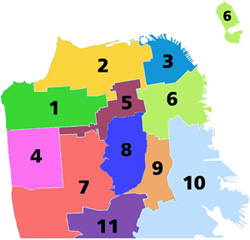
So instead of trying to repeal the district system, the Chamber has come up with this “hybrid” effort. The idea would be to reduce the number of districts to seven and elect four supervisors citywide.

What that means, of course, is that a third of the board, elected on a pile of money, will be pretty much call-up votes for downtown. With two more from the more conservative districts, you’ve got a majority.

So this is about money and political control, and about the political direction the city is going, and about who’s going to set that direction. That’s the message progressive leaders need to start putting out, now. And every incumbent supervisor, and every candidate for supervisor, needs to make preservation of district elections a public priority


The attack on district elections

3

EDITORIAL The Chamber of Commerce, the Mayor’s Office, and the San Francisco Chronicle have created, apparently out of whole cloth, a new attack on district elections of supervisors. And although there’s no campaign or formal proposal on the table, the new move needs to be taken seriously.

And it’s important to understand from the start what this is really about.

The Chamber and the Chron are talking about the need for more “citywide perspective,” trying to spin the notion that supervisors elected by district care only about micro-local, parochial issues. But after 10 years of district elections, the record is exactly the opposite. District-elected supervisors have devoted themselves to a long string of exceptional citywide reform measures and have been guilty of very little district pandering.

Consider a few examples:

Healthy San Francisco, the local effort at universal health care that has drawn national attention and plaudits from President Obama, was a product of the district board, led by then-Sup. Tom Ammiano. So was the rainy day fund, which has provided millions to the public schools and prevented widespread teacher layoffs.

The district board reformed the makeup of the Planning Commission, Police Commission, and Board of Appeals.

District-elected Sup. Ross Mirkarimi’s legislation restricting the use of plastic bags has been hailed by environmental groups all over the country.

The district board passed the city’s minimum wage and sick day laws.

The district board created a citywide infrastructure plan and bond program.

Community choice aggregation, a direct challenge to Pacific Gas and Electric Co. that will bring San Francisco clean energy and lower electricity rates, is entirely a product of the district board. So is campaign finance reform, sanctuary city protecting for immigrants, a long list of tenant-protecting laws … the list goes on and on. What significant policy initiatives came out of the previous 10 years of at-large supervisors? Very little — except the promotion of hyper-expensive live-work lofts; the displacement of thousands of tenants, artists, and low-income people; and the economic cleansing of San Francisco, all on behalf of the dot-com boom, real estate speculators, and developers.

People can agree or disagree with what the board has done in the past decade, but nobody can honestly say that the district supervisors have ignored citywide issues or that they don’t have a citywide perspective.

No, this has nothing to do with citywide issues vs. district issues. It’s entirely about policy — about the fact that district supervisors are more progressive. About the fact that downtown can’t possibly get a majority under a district system — because with small districts, big money can’t carry the day.

Under an at-large system, nobody can seriously run for supervisor without at lest $250,000, and candidates who start off without high name recognition need twice that. There’s only one way to get that kind of money — and it’s not from protecting tenants and immigrants and fighting developers and PG&E.

In a district system, grassroots organizing — the stuff that labor and nonprofits and progressive groups are good at — is more important than raising money. So district supes are accountable to a different constituency.

Polls consistently show that people like having district supervisors — and for good reason. With at-large elections, the only people who have regular, direct access to the supervisors are big donors and lobbyists who can deliver money. District supervisors are out in the neighborhoods, take phone calls from community activists, and are far more accessible to their constituents.

So instead of trying to repeal the district system, the Chamber has come up with this “hybrid” effort. The idea would be to reduce the number of districts to seven and elect four supervisors citywide.

What that means, of course, is that a third of the board, elected on a pile of money, will be pretty much call-up votes for downtown. With two more from the more conservative districts, you’ve got a majority.

So this is about money and political control, and about the political direction the city is going, and about who’s going to set that direction. That’s the message progressive leaders need to start putting out, now. And every incumbent supervisor, and every candidate for supervisor, needs to make preservation of district elections a public priority.

Memorial for Charles Lee Smith (1925-2010), passionate pamphleteer

1

Memorial services for Charles Lee Smith, a classic liberal activist whose hero was Tom Paine and whose passion was pamphleteering, will be held at 3 p.m. on Friday, Feb. 12, at the Friends Meeting House, Walnut and Vine, in Berkeley. He died at his Berkeley home on Jan. 7 at 84.

His wife Anne said that Charlie, as we all called him, fell in December and never fully recovered. She brought him home under hospice care on Jan. 5 and she and his two sons Greg and Jay were with him his last three days.

Charlie first contacted me in the early days of the Guardian in the late l960s. I soon realized that he was my kind of liberal, always working tirelessly, cheerfully, and quietly to make things better for people and their communities. He was a remarkable man with a remarkable range of interests and causes that he pursued his entire life.

He campaigned endlessly for causes ranging from the successful fight to stop Pacific Gas and Electric Co. from building a nuclear power plant on Bodega Bay to integrating the Berkeley schools to third brake lights for cars to one-way tolls on bridges to disaster preparedness to traffic safety and circles to public power and keep tabs on PG@E and big business shenanigans.


When he first began sending tips our way, he was working with, among many others, UC Berkeley Professor Paul Taylor with his battles with the agribusiness interests. He was helping UC Berkeley professor Joe Neilands on his public power campaigns. I remember a key public power meeting that Joe and Charlie put together in a Berkeley restaurant. It brought together the sturdy public power advocates of that era. Charlie did much of the staff work and was seated at the speaker’s table next to the sign that read, Public Power Users Association.

I credit that event and its assemblage of public power activists as inspiring the Guardian to make public power and kicking PG@E out of City Halls a major crusade that continues to this day. Charlie and Joe rounded up, among others, then CPUC commissioner Bill Bennett, consumer writer Jennifer Cross, William Domhoff, the UC Santa Cruz political science professor who was the main speaker, and Peter Petrakis, a student of Neilands’ in biochemistry who researched and wrote the Guardian’s early pioneering stories on the PG@E/Raker Act scandal. (See Guardian stories and editorials since l969.) The room was also full of veteran public power warriors from PG@E battles in Berkeley, San Francisco, and around the bay.

Charlie was a lifelong volunteer for the Quakers and pamphleteered on many of their projects.

My favorite story was how he was helping Dr. Ben Yellen, a feisty liberal pamphleteer in Brawley. Yellen and Charlie were political and pamphleteering soulmates, but Charlie was operating in liberal Berkeley and Yellen was in very conservative Imperial County.

Yellen was blasting away at the absentee land owners who were cheating migrant laborers on health care, on high private power costs of city dwellers, and the misuse of government water subsidies. And so he had trouble getting his leaflets printed in Brawley. He would send leaflets up to Charlie and Charlie would get them duplicated and then send the copies back to Yellen. Yellen would distribute them, mimeographed material on legal-sized yellow construction paper, under windshield wipers during the early morning hours and into open car windows on hot afternoons.

Charlie relished promoting Yellen as a classic in the world of pamphleteering and loved to talk about how Yellen followed up his pamphleteering with several pro per lawsuits, an appearance on CBS’ 60 Minutes television show, and a case that went to the U.S. Supreme Court.

Charlie liked to talk about his triple play of information distribution. He pamphleteered on street corners, prepared more than 50 bibliographies of undiscussed issues (including the best bibliography ever done on San Francisco’s Raker Act Scandal), and circulated his personal essays and cut and pasted newspaper articles. Almost every day, he would take the newspapers from the sidewalk near his house and put them on the front porches of his neighbors. He got some exercise, since his house was on a Berkeley hill, and he endeared himself to his neighbors. He was given the title of “Mayor of San Mateo Road.”

Charlie pamphleteered on more than l50 “undiscussed subjects,” as he called them, in Berkeley, Oakland and San Francisco. He sometimes went out to Palo Alto, Santa Rosa, and Napa, with occasional excursions to Boston and London. His subjects were practical and straightforward but breathtaking in their range: humanizing bureaucracy, employee suggestions, penal reform, illiteracy, migant labor, water, energy, land reform, ombudsmen, coop issues, library use, land value taxation, transportation, disaster recovery planning. He handed out KPFA folios and an occasional Bay Guardian.

He often combined pamphleteering with doing bibliographies to spread the word about the undiscussed subjects.  On the first Earth Day in l970 at California State University, Hayward, Charlie spoke about the evils of automoblies. Then he distributed his bibliography of the Automobile Bureaucracy. In recognizable Charliese, he produced a blizzard of numbered citations on a summary of his speech so the audience could read further on his issues.

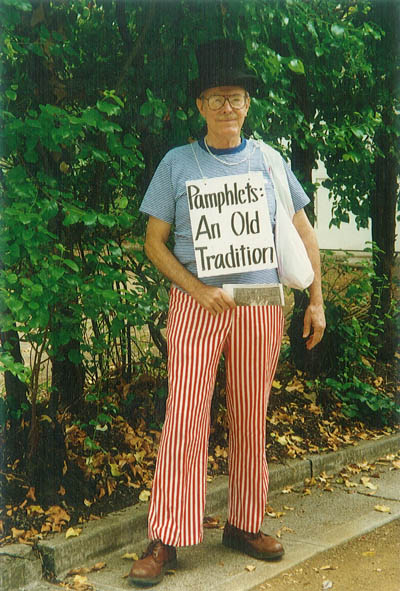
He considered pamphleteering as a noble form of communication that “went on during the colonial Period for a l00 years before the revolution and the arrival of Tom Paine in l775,” as he put it in his own pamphlet, “Pamphleteering: an old tradition.” He wrote that his main contribution “is the novel use of sandwich boards to screen out the disinterested while reaching the already-interested and open-minded persons with leaflets on the street, but not invading anyone’s privacy.”

Sometimes, Charlie had news close to home.

He said that giving out pamphlets to one or two people at a time was like holding a meeting with those persons and thus it was possible to have a “meeting” with several hundred people nearly anywhere within reasonable limits. He concluded that pamphleteering was “basic to building support for worthwhile projects” and claimes that it “may even be more effective than other forms of expensive communication.”

Charlie knew how to work the streets, but he also knew how to work inside the bowels of the bureaucracy. He worked for the California Division of Highways (now Caltrans) from l953 to 1987, mostly in an Oak Street office in San Francisco. I admit when Charlie talked to me about fighting bureaucracy, as he often did, I had trouble understanding how he was going about it. But Charlie had his ways.

Executive Editor Tim Redmond recalls that Charlie worked for Caltrans back in the days when the very thought there might be transportation modes other than highways was heresy.

He was an advocate of bicycles, carpools and public transit and Redmond thought that, when he first met Charlie in l984, “he must be like the monks in the middle ages, huddled in a corner trying to preserve knowledge. Nobody else at Caltrans wanted to talk about getting cars off the roads. Nobody wanted to shift spending priorities. Nobody wanted to point out that highrise development in San Francisco was causing traffic problems all over the Bay Area–and that the answer was slower development, not more highways.

“But Charlie said all those things. He told me where the secrets of Caltrans were hidden, what those dense environmental impact reports really showed, and how the agency was failing the public. I had a special card in my old l980s Rolodex labeled ‘Caltrans: Inside Source.’ The number went directly to Smith’s desk.” Charlie usually carpooled from Berkeley to his San Francisco office.

Charlie wrote a leaflet about the “Work Improvement Program” that then Gov. Pat Brown instituted in l960. It was, he wrote, a “novel program to get all state employees to submit ideas to improve their work.” Charlie labeled it “corrupt” and laid out the damning evidence. No appeal procedure. No protection for the employee making suggestions that the supervisor or organization didn’t want to use. No requirement for giving the employee credit for the idea or for following up the idea.

Charlie noted that he was a generalist with lots of ideas, read lots of publications, and was “sensitive to the problems that bother people.” He noted that there were l,500 employees in his Caltrans district who submitted 236 suggestions. Charlie submitted 35 of them.  But, he noted wryly, “my supervisor, Charles Nordfelt, did not respond at all to any of my suggestions.” And then, to make neatly make his point, Charlie listed a few of his suggestions, all of them practical and useful.

Many were adopted without Charlie ever getting credit. Others were adopted decades later. For example, he pushed the then-heretical idea of collecting tolls on a one-way basis only, instead of collecting them two ways. He noted that the tolls are now  being collected on the wrong side of the bridge. They should, he argued,  be collected coming from  the San Francisco side, where the few lanes of the bridge open up to many lanes. This would reduce or eliminate congestion. .

He listed other suggestions that showed his firm and creative grasp of the useful idea. Putting the third stop light on vehicles (which was finally put into effect in 1985). Numbering interchanges. Installing flashing red and yellow lights at different rates. (He  explained that his wife’s grandfather was color blind and drove through a flashing red light when she was with him.) Getting vehicle owners to have reflective white strips on the front bumpers of their cars, helping police spot stolen vehicles. Some of his suggestions are still percolating deep in the bureaucracies and may yet go into effect.

Charlie never got the hang of the internet but he covered more territory and reached more people in his personal face-to-face way than anybody ever did on the internet.

Charlie was born on a homestead farm eight miles from Weldona, Colorado. He attended a one-room school house and then moved on to a middle and high school in Ft. Morgan, Colorado. He got “ink in his blood,” as he liked to say, by working on the school paper called the Megaphone and then as a printer’s devil at the weekly Morgan Herald.

He was drafted into the army in l943 and served as an infantryman with the 343rd regiment, 86th Infantry Division. He was severely sounded in 1945 in the Ruhr Pocket battle near Cologne, Germany, the last major battle of the war. He suffered leg and hip injuries and had a l6 inch gouge  out of his right hip that cut within a quarter inch of the bone. He spent six months in the hospital. He was recommended for sergeant but he refused the promotion and ended the war as a private first class.

After his recovery, Charlie came to the Bay Area and took his undergraduate work at Napa Community College and San Francisco State, then did graduate work in sociology at the University of Washington, and in city and regional planning at the University of California-Berkeley.

In 1949, Charlie joined the American Friends Service Committee and became a lifelong volunteer, working on a host of projects. He did everything from helping with a clothing drive in Napa to being part of the crew that built the original Neighborhood House in Richmond.

Charlie met Anne Read in l954, a college student in Oregon, when she was on an AFSC summer project in Berkeley. Charlie visited the project, spotted Anne, and double dated with her. When she returned to Oregon State for her senior year, Charlie wrote her every single day. The two were married the following summer in June of l955.

Charlie is survived by Anne, two sons Greg and Jay, daughter-in-laws Karen Vartarian and Andrea Paulos, and granddaughter Mabel.

The family asks that, in lieu of flowers, please send a donation in Charlie’s name to the American Friends Service Committee, 65 9th St., San Francisco, Calif. 94l03.

I asked Anne why Charlie, the inveterate communicator, had not taken to the internet. Charlie, she replied, was a print guy and simply could not understand the internet. “He never ever used email,” she said. “He still thought he had to go to a library to make up a bibliography. I think Charlie was so sure that making a bibliography meant a lot of hard work, he couldn’t possibly do it on the internet.”

Well, Charlie, you may have missed the internet but you covered more territory and reached more people in your direct personal way with good ideas than anybody ever did on the internet.

Here are some of Charlie’s favorite pamphlets:
Governor Pat Brown’s Work Improvement Program
Pamphleteering: An Old Tradition
Short Statement on Plamphleteering

The attack on district elections begins

2

I knew it was coming. After ten years of district-elected supervisors promoting progressive policies (minimum wage and sick day laws, universal health care, tenant protections, public power, development limits, affordable housing etc.) downtown has finally figured out how to launch a counter-attack. It was announced this morning in the pages of the Chronicle

I knew it was coming. After ten years of district-elected supervisors promoting progressive policies (minimum wage and sick day laws, universal health care, tenant protections, public power, development limits, affordable housing etc.) downtown has finally figured out how to launch a counter-attack. It was announced this morning in the pages of the Chronicle

The idea is to replace some of the district supes with at-large representatives – say, four of the 11. That Chamber of Commerce is doing a poll on the issue. Expect a November ballot initiative.

C.W. Nevius chimed in, too, arguing in favor of the “hybrid” (sounds so much like an eco-friendly car) system.

The line is going to be this: District supervisors don’t pay attention to citywide issues.

“People like the idea of being able to talk to a district supervisor about neighborhood problems, but also feel that they want someone they can go to with broader, citywide concerns,” said Steve Falk, president and CEO of the San Francisco Chamber of Commerce.

Or as Nevius puts it:

The truth is that San Francisco has more supervisors than any county in California. Is it too much to ask that a few of them have the entire city’s best interest in mind?

Let’s consider for a moment what this is really about.

For starters, get rid of the nonsense about a “citywide perspective.” Even Nevius didn’t try to push that too hard when I emailed him with the facts, to wit: Over the past ten years, district-elected supervisors have devoted themselves to a long string of exceptional citywide reform measures and have been guilty of very little district pandering.

Consider a few examples:

Healthy San Francisco
The Rainy-Day Fund
Reforming the makeup of the Planning Commission, Police Commission and Board of Appeals
Restricting the use of plastic bags
Minimum wage and sick day laws
A citywide infrastructure plan and bond program
Community choice aggregation and green energy
Campaign finance reform
Sanctuary city protecting for immigrants

The list goes on and on.

You may agree or disagree with what this board has done, but nobody can honestly say that the district supervisors have ignored citywide issues or that they don’t have a citywide persoective. No: This has nothing to do with citywide issues vs. district issues. It’s entirely about policy – about the fact that district supervisors are more progressive. About the fact that downtown can’t possibly get a majority under a district system – because with those small districts that Nevius complains about, big money can’t carry the day.

In a district system, grassroots organizing – the stuff that labor and nonprofits and progressive groups are good at – is more important than raising money. So district supes are accountable to a different constituency.

I watched an at-large board for almost 20 years, and it was, by and large, a collection of sold-out hacks who did exactly what the mayor and the downtown donors said. It was really pathetic.

The polls have consistently shown that people like have district supes, so now there’s this “hybrid” effort.

Here’s what it means:

Right now, there are three districts that will generally elect a more conservative representative – D 2 (Michela Alioto-Pier) D- 4 (Carmen Chu) and D-7 (Sean Elsbernd). Districts 8, 10, 11 and 1 are swing districts, and the rest are going to go generally progressive.

So the odds are under this system that the left-leaning constituencies will have at least six votes, and in good times, as many as eight.

Now take four of those votes away, pretty much forever. Set it up so that four supervisors, elected citywide, will be guaranteed downtown call-up votes. Then add in one or two more from the more conservative districts, and you’ve got a majority.

That, my friends, is exactly what this is about, and any effort to frame it as anything else is just spin.

I asked Nevius what the hell he was doing buying the bogus argument that we need citywide perspective – since the district board has already demonstrated that, consistently. Here’s his response:

First, I’d envision the city-wide supes as made to order swing votes. When a district supervisor had a good idea, let’s say Healthy San Francisco, it might not be an issue of critical interest for a district supervisor. But it would be right in the wheelhouse for a city-wide official, who is looking for broad stroke issues to back. And, although you didn’t advance the idea, I’d reject the notion that whomever it was that was elected city-wide would be incredibly conservative and obstructionist. The most moderate politician we’ve elected in this city is Gavin Newsom. Although the Guardian doesn’t agree with him much of the time, he’s still advanced some very progressive ideas. Everyone jumps on the Chris Daly example as why district elections are a problem, but I think we can look beyond that. I think he’s been an aberration. District supes like David Campos and David Chiu have proved they can compromise and govern so I think that’s a good thing. I would never advocate that we get rid of representation in the neighborhoods. But c’mon, 11 little districts in a very small city? As Jim Stearns said, some of the districts are no more than a mile square. Combining some of them would still let residents have someone they could call to get the potholes fixed, but also spread out the areas.

Okay, I didn’t say citywide supes would be conservative. Sean Elsbernd is (relatively) conservative. He’s also independent of any big-money interest and does what he thinks is right. He doesn’t need half a million dollars to get elected in his district.

What I say is that citywide supes would be in hock to big money. I’ve seen it, lived with it. Suffered from it.

And guess what: Healthy San Francisco didn’t need any citywide supes; it passed just fine with the district board.

So what this is about is money and political control, and it’s about the political direction the city is going and who’s going to set that direction. Let’s get that straight and be honest about, and then we can have this discussion.

Appetite: Planning ahead for V-Day

0

By Virginia Miller of www.theperfectspotsf.com. View the previous installment of Appetite here. Check out more V-Day dining ideas here.

meltingpot0110.jpg
Fondue you: The Melting Pot draws couples closer for Valentine’s

2/14 – Belgian beer and butchery at La Trappe
Many of us don’t get excited by the commercialism of Valentine’s Day – and not just because we may or not have a special someone in our lives. It could just be that we don’t like things rosy, pink and cute. No need to go the hearts and chocolate route when you can do Belgian beers and butchery, right? La Trappe does it right by making their enchanting Belgian brick-walled, candlelit basement the setting for A Porcine Valentine. Only 45 lucky people will have their run of the place, cozying up on church pews and couches with all the beers and pig they can ingest. La Trappe’s Dave and Chris will each be breaking down a whole pig, showcasing different butchering techniques between the US and Italy.
3-11:30pm
$95 per person, limited to 45 people
800 Greenwich Street
415-440-8727

www.latrappecafe.com

missionbeach0110.JPG
Mission Beach makes it sweeter

2/14 – Mission Beach Cafe sweets for the sweet
ILove Mission Beach Café. Not only is it a morning delight for weekend brunch or weekday pastries and Blue Bottle coffee, but its dinners are some of the best and most underrated neighborhood dining in the city. Valentine’s Day there is, yes, a special four-course prix fixe dinner (including white linens, roses, champagne toast, amuse bouche and sweets from fab pastry chef, Alan Carter). Knowing their track record, it won’t be the often overpriced, mediocre food one gets for Valentine’s. There’s dishes like Heirloom Chicory Salad with pomelos and huckleberries, Lobster and Dungeness Crab Ravioli or Prather Ranch organic prime rib. All this in the cozy, chic glow of a neighborhood restaurant that’s also a worthy destination.
$75 per person
198 Guerrero Street
415-861-0198
www.missionbeachcafesf.com

2/13-14 – The Melting Pot – Valentine’s fondue feast
The Melting Pot chain may not be your first thought for Valentine’s Day, but if you’re in Marin or the idea of a relaxed fondue feast (cozy in these Winter months) in a unique setting is appealing, here’s an idea (discounts for groups of 7 or more friends): head to Larkspur’s Melting Pot in an 1891 brick kiln, forced to close for economic reasons in 1915, empty for over 70 years until restored in 1989. The space has the feel of a labyrinthine Spanish wine cellar set in a circular, brick tunnel. For Valentine’s they’ve got a four-course prix fixe at $65 a person – there’s choices each course, like Quattro Formaggio Fondue (fontina, gruyere, raclette, mozzarella cheeses with roasted garlic, basil, pesto) or Crab Imperial Cheddar Fondue, a Caprese or Caesar Salad, entree fondue meats like Filet Mignon Florentine, Limoncello Basamic Sirloin, Orange Fennel Pork Tenderloin, and a finish of either Milk Chocolate Tiramisu or Dark Chocolate Raspberry Fondue. Females get a rose as they leave… if you guys want one, too, you could probably ask. 
$65 per person (10% off for group of 7 or more)
125 E. Sir Francis Drake, Larkspur, CA
415-461-6358
www.meltingpot.com

2/10 – La Cocina’s Truffle-Making Class
Community treasure La Cocina, along with fabulous Neo Co coa chocolates and ever-popular Kika’s Treats, host a hands-on evening rolling your own truf fles, either to with your sweetheart or to give as a Valentine’s gift. The theme is “how to be a bet ter lover”… I always knew chocolate was somehow involved. The class includes wine, din ner and a take-home box of your handiwork.
$65 class; $85 class + 10-piece truffle box & 5-pack of Kika’s Treats (a $27 value)
6:30-9pm
2948 Folsom Street
415-824-2729
www.lacocinasf.org


Good vibes

1

Many people consider massage a luxury, a kind of pampering or relaxation that is lovely but unnecessary. But done right, massage — or any kind of bodywork — is actually an integral part of overall well-being. A powerful tool to balance the body physically, mentally, and spiritually, bodywork is an act of self-love. And what better time to express love of any kind than Valentine’s Day? Whether you want to honor yourself, your partner, or your coupledom, now is the perfect moment to tend to your somatic needs. Below are three of our favorite spots for personal treatments, gift certificates, and couples’ sessions. Each place is focused on holistic health and all are refreshingly between the extremes of new age woo-woo hippie-dom and pretentious L.A. spa culture.

EARTHBODY

This intimate Hayes Valley spot is more healing center than mere day spa. Therapists are trained in several modalities and develop custom sessions for every client, including consultations before and after treatment. It’s also worth noting that Earthbody is uniquely committed to sustainability, using only organic materials (including fair-trade cotton sheets), plant-derived ingredients in balms and oils that are made in-house, and eco-safe cleaning products.

Individuals: No matter what you choose for yourself or for a loved one, you can’t go wrong. Those with chronic pain might try a body centering treatment ($95–<\d>$155), while those looking for a bit more pampering might like a classic facial ($75–<\d>$165). Not sure what you want? Let the therapist figure it out in a basic bodywork session, starting at $65 for 30 minutes, then find out what your bodyworker learned about you while you snack on almonds, fruits, tea, and specially filtered Kangen water.

Couples: Many couples’ massages are merely two individual massages happening in the same room. Not so at Earthbody. Meant to honor the special union between two people — whether they are lovers, friends, or family — these treatments feature two therapists performing a special synchronized choreography. “When people have a commitment to each other, they have an energy that radiates with another field,” says founder Denmo Ibrahim. “Each body is being addressed, but the field also is being addressed.” Treatments start at $225 per couple for 60 minutes and go up to $490 for the two-and-a-half-hour Lotus treatment.

534 Laguna, SF. (415) 552-7000, www.earthbody.net

THERAPEIA

Fans of contemporary design will drool over this gorgeous, 10,000-square-foot oasis, where walls are bedecked with art and mirrors and lounges look like sets for a photo shoot in Dwell. The nine-year-old center specializes in personalized, customized service, keeping charts on every client that include therapist notes after every session. An added bonus for Valentine’s Day: mention this article and get 14 percent (Get it?) off any service, along with a free soy-based candle.

Individual: Give yourself or your loved one the center’s specialty treatment, a 90-minute hot stone massage ($165). Unlike similar treatments at other places, bodyworkers at Therapeia actually use the heated stones as tools for massage, rather than simply placing them on the body. “The stones have such a smooth, even, wide surface area, it’s like two massages in one,” says studio coordinator Jacquelyn Moore. For something even more special, add the gift of ongoing self-care with a membership. For $49 a year, members get access to featured specials, including 20 percent off every treatment, 10 percent off products, and 40 percent off treatments during their birthday week. Anyone planning to visit more than three times a year will save money.

Couples: Special, larger rooms are reserved for couples’ treatments ($295–<\d>$385), which feature two therapists working on each person individually. “People enjoy relaxing in same room as a partner,” Moore says. Or if you’d like to share your space with four or more people, you can all enjoy your massage in a special lounge outfitted with a fireplace, fountains, and luxurious leather couches.

1801 Bush (lower level), SF. (415) 885-4450, www.therapeiamassage.com

SUCHADA

Exotic, elegant, and decadent, this locally-owned business specializes in traditional Thai massage. Not only are the treatments fantastic, but the new Embarcadero location is beautiful, accented with imported Thai furniture and fabrics, recycled wood, and floating flowers in a tinkling fountain. Bonus? If you book a treatment at the King Street location, you can get 10 percent off a meal at nearby Grand Pu Bah.

Individuals: A first-timer’s best bet is a one-hour traditional Thai massage ($60). You’ll slip on light, pajama-like garments and lie on a cushioned mat in a curtained room while your therapist — trained in Thailand as well as certified here — uses hands, elbows, and knees to knead, stretch, and press out your kinks. Both relaxing and active, many people call this modality a cross between a massage and a workout.

Couples: Book two massages together and you can receive tandem treatments, or spoil yourselves with the three-hour Royal Lanna or Royal Siam massage, both centuries-old combinations of traditional Thai bodywork, reflexology, and herbal massage. Finish with delicious homemade lemongrass tea and, a special for Valentine’s Day, chocolate.

38 Bryant, SF. (415) 644-0808; 690 King, SF. (415) 252-5020, www.suchadathaimassage.com

Building the movement

2

Frustrated by deep cuts to education spending and quality, momentum is building across California in support of the “Strike and Day of Action to Defend Public Education” on March 4.

Students, laborers, and faculty throughout the University of California system are trying to expand on last semester’s organizing efforts by strengthening ties to groups from all tiers of the public education system. But questions linger about the best way to proceed and what exactly the event should look like.

“I think that the regents and [UC President Mark] Yudof are very fearful of what would happen if the students and workers united. They could be unstoppable,” said Bob Samuels, president of the University Council-American Federation of Teachers (UC-AFT).

That collaboration is exactly what many grassroots organizers are hoping to achieve, although their central message is not limited to participants in the UC system alone. They argue that fee increases and cutbacks at the universities are symptomatic of a greater problem, namely the denigration of free and low-cost public education.

“This emerged as a movement of students and workers at the university level. What we’re doing now is going beyond the UCs,” said Blanca Misse, a graduate student and member of the Student Worker Action Team (SWAT).

By reaching out to members of preschool, K-12 public school, community college, and California State University communities, organizers hope to turn March 4 into a rallying moment for the entire public education system in the state. Organizers also want to ensure that the UC system isn’t funded at the expense of other institutions of public learning.

“We need to be fighting for money and political power,” Misse added. “The committees need to mobilize all of the fighting sectors and show them our strength.”

At the Jan. 17 meeting of the Berkeley March 4 organizing committee, one of many ad hoc groups set up across the state, a gathering of about 35 union members, graduate students, community activists, and undergraduates discussed what the day should look like locally. They also reported back on their attempts at organizing the local community, including garnering union support and reaching out to high school students.

Javier Garay noted that at a meeting of the Oakland Education Association, a union of public school workers, “89 percent of the nearly 800 attendees voted in solidarity with the March 4 Day of Action, possibly including a strike.”

Yet the most heated discussions centered on how to unite the interests and power of the university population behind the broader fight for public education funding.

During the meeting, Tanya Smith, president of the local chapter of the University Professional and Technical Employees union (UPTE), stressed the importance of “not being an ivory tower” by extending activism “beyond Berkeley’s campus and reaching out to the political center in Oakland.”

Student activist Nick Palmquist, a fourth-year development studies student at UC Berkeley, admitted that the “tuition issue” is a big motivating factor for college students. At the same time, he noted, “Students have a lot of potential to see the bigger picture. We’re trying to expand the consciousness of the movement.”

That movement stretches back to the beginning of the school year, when students realized that Yudof and the Board of Regents were planning on making up for the $814 million budget cut from 2008-09 and the additional $637 million cut in 2009-10 with layoffs, furloughs, and a possible fee hike.

On Sept. 24, 2009, groups organized strikes and walkouts across the University of California system, including an estimated 5,000-person protest in the legendary Sproul Plaza at UC Berkeley.

Exactly one month later, several hundred people gathered on the Berkeley campus for the Mobilizing Conference to Save Public Education. According to the invitation, the purpose of the conference was “to democratically decide on a statewide action plan capable of winning this struggle, which will define the future of public education in this state, particularly for the working-class and communities of color.”

After an intense day of discussion, the body voted to establish March 4 as a “statewide strike and day of action.” Though it remains unclear how the different interests would come together (the call left demands and tactics open for debate), the message was clear: to save public education, diverse groups need to stand together cohesively.

Tensions escalated dramatically in November when the regents approved a 32 percent fee increase. At UCLA, where the regents held the meeting, an estimated 2,000 students gathered in demonstration and protest.

UC Berkeley student Isaac Miller told the Guardian, “I think we left there feeling like even though the fee increase went through, this is a long-term fight. It was really empowering to connect to students from all over the UC community.”

Meanwhile, a three-day protest at UC Berkeley culminated in a day-long occupation of Wheeler Hall on Nov. 20. As the protesters outside multiplied in support of the occupiers, they expressed solidarity with their causes as well as anger at the fee hike.

Callie Maidhof, a graduate student and spokesperson for the occupiers, said at the time, “One of the reasons behind this particular action is that students realized that not only is the state an unreliable partner, so is the administration. The only thing students can do at this point is reach out to each other.”

Maidhof was referring to a frequently repeated refrain from the regents and Yudof: “The state is an unreliable partner.” They argue that their hands are tied by the budget shortfall and the UC system has to figure out ways to sustain itself apart from increasingly erratic state funding. “The message is if the state fixes the budget, all our problems will be over,” said Mike Rotkin, mayor of Santa Cruz and a former lecturer at UC Santa Cruz.

So when a Jan. 21 San Francisco Chronicle article (“Regents to Back UC Students’ Protest at Capitol”) reported that the regents and Yudof agreed to stand alongside the students in Sacramento on the March 4 Day of Action, many were shocked and angered. “This is a complete turn-around for them,” Palmquist said. “They were never in support of our efforts. But now they feel threatened and they also feel like they can capitalize on them.”

In an open-letter response, several unions wrote back: “This is a cynical publicity stunt, and we do not buy it.”

Victor Sanchez, president of the UC Students Association (UCSA), said the article misrepresented what Yudof and the Regents said. “The regents and Yudof agreed to participate with students on a separate March 1 day of activism, not March 4,” he said. Calls and e-mail to Yudof’s office to confirm were unreturned at press time.

Sanchez explained that the March 1 activities are the culmination of UCSA’s annual Student Lobbying Conference, which takes place in Sacramento from Feb. 28–March 1. Its actions focus primarily on lobbying the Legislature. That approach is more in tune with the administration’s message that the problem lies in Sacramento.

UCSA’s demands include increasing funding for higher education by $1 billion, creating alternative sources of revenue through comprehensive prison reform, preserving the California grant program, and passing Assembly Bill 656.

Sponsored by Assembly Majority Leader Alberto Torrico (D-Fremont), AB 656 would place a severance tax on oil companies and divert revenues toward higher education. “It is strategic for us to focus resources in Sacramento, because that’s where the negotiations are happening,” Sanchez said. “But we also understand that we’re fighting a two-front war and need to hold both the Legislature and the administration responsible.

“At the end of the day, it is our event and our day of action,” he continued. “We made it clear we aren’t going to change our demands. We stand in solidarity with the March 4 organizers. We’re all advocating a common goal, and folks are going to apply complementary pressure. Our end goal is prioritizing education, and we need to move forward with that collective mentality.”

If all this seems confusing, that’s because it is. The groups that have formed in reaction to cuts to public education are numerous, amorphous, and have slightly different agendas. Some subscribe to the position that the fault and solution primarily rests in Sacramento, while others argue that the administration and appointed, rather than elected, regents are to blame. Most agree with Sanchez that both are part of the problem.

As community organizers build toward March 4, it is clear that the day will be significant. The real question is, if students can maintain their momentum and their newfound network with other sectors of public education, what will happen on March 5 and beyond?

DEIR in the headlights

0

GREEN CITY Public comments on the city’s draft environmental impact report (DEIR) for Lennar Corp.’s massive redevelopment proposal on Candlestick Point and the Hunters Points Shipyard includes complaints that the comment period was too short (see “The Candlestick Farce,” 12/23/09), concerns that the city violated state requirements to notify the Ohlone Tribe, and frustration that the city’s preferred plan represents the most significant and substantial impacts of any of the five scenarios analyzed in the DEIR.

These and many other concerns about the impacts of the 10,500-home project will need to be addressed in the final EIR, which Mayor Gavin Newsom and other project proponents expect to be completed by June.

Some object that the city is considering an early transfer of the shipyard and would undertake activities that are currently the Navy’s responsibility (see “Eliminating Dissent,” 06/17/09), saying the final EIR should prominently reference Proposition P, which voters approved in 2000, establishing community acceptance criteria for the cleanup.

Saul Bloom, executive director of Arc Ecology, submitted his organization’s comments “under protest for the inadequate extension of the public comment period, which we believe unfairly penalizes the public review of the draft EIR.”

Land use attorney Sue Hestor called the public comment submission schedule “abusive” in comments submitted for POWER (People Organized to Win Employment Rights). “The schedule is being driven by an insane desire to have the final EIR certified and all local approvals done by June,” Hestor said.

Ohlone chairperson Ann Marie Sayers and Neil MacClean of the Ohlone Profiles Project wondered why the Planning Department did not contact anyone on the city’s list of official Ohlone representatives. “We want the SF Planning Department to follow Senate Bill 18, which requires them to include Ohlone people in the planning process,” MacClean said, noting that there are at least four Ohlone villages within the proposed development area.

Jaime Michaels, coastal program analyst for the San Francisco Bay Conservation and Development Commission, expressed concerns about the DEIR’s proposal to make a 23.5 acre reduction in existing state park boundaries (see “Can I buy your park?” 08/12/09).

Project proponents, Michaels said, “would need to demonstrate that the decreased area would not compromise or reduce its value as a park/beach facility.” Michaels also worries about the impact of adding a minimum of 1.7 acres of fill in the bay to accommodate a bridge at Yosemite Slough, a plan she described as “a significant amount of coverage, particularly for a facility where the large majority of its coverage is needed to serve vehicles accessing the new stadium only 12 days a year.”

Michaels expressed concerns that the project’s plans to address sea level rise would negatively affect bay views and public access to the shoreline.

The project includes a 9.6-mile trail and a variety of other public amenities directly adjacent to the shoreline. Proposed building structures located away from the immediate shoreline would accommodate a 36-inch sea level rise by 2075, and the DEIR promises to employ adaptive management strategies along the perimeter beyond 2050.

“Unfortunately, partly due to illegibility and the scale of the drawings, it is difficult to assess precisely how these adaptations would appear,” Michaels observed. “However, it can be assumed that over time levees would need to be raised and likely widened at the base, thereby partly or entirely obstructing the public’s view of the bay from inland areas, encroaching on and reducing the area devoted for public use and impacting the overall public access experience.”

Arc Ecology discussed the DEIR’s failure to provide a comprehensive sustainability plan, address adjacent development projects, justify a 49ers stadium on the shipyard, or evaluate the potential for the development of port-related heavy industrial activities.

“The city is determined to get this project passed right now, and the developer is afraid that if someone else comes along as mayor and District 10 supervisor, they may not be as sympathetic,” Bloom said. “But the project — as outlined in the DEIR and the city’s way of approaching the deal — is against the interests of San Francisco.”

Marijuana goes mainstream

6

I’ve smoked marijuana on and off for most of my adult life, usually in the evening to help let go of the anxieties associated with being a progressive wage slave in an increasingly conservative capitalist country.

Buying my pot, which is California’s biggest cash crop, has always been a criminal transaction: in hushed tones or coded language, I arrange to meet a dealer I’ve been set up with through friends. And when I meet him (they’ve always been men), I give him cash in exchange for an eighth- or quarter-ounce of whatever kind of pot he’s selling.

I don’t know what variety I’m buying, who grew it, or how it was grown; whether violence or environmental degradation have occurred along the supply chain; or even whether it is an indica or sativa, the two most basic cannabis families that have differing effects on users.

I’ve been completely in the dark, both in terms of what I was buying and who was benefiting from the transaction, but that changed recently. I obtained a doctor’s recommendation to legally smoke weed — honestly citing anxiety as my affliction — and set out to explore the area’s best cannabis clubs.

It was a little strange and disorienting at first, this new world of expert purveyors of the finest Northern California marijuana and the various concentrates, edibles, drinkables, and other products it goes into. But what eventually struck me is just now normal and mainstream this industry has become, particularly in San Francisco, which has long led the movement to legalize marijuana.

Unlike in cities such as Los Angeles, where the rapid proliferation of unregulated pot clubs has made headlines and raised community concerns, San Francisco years ago made its clubs jump through various bureaucratic hoops to become fully licensed, permitted, and regulated, free to join the mainstream business community, pay their taxes, and compete with one another on the basis of quality, price, customer service, ambiance, and support for the community.

As Californians prepare to decide whether to decriminalize marijuana for even recreational use — on Jan. 28, advocates plan to turn in enough valid signatures to place that initiative on the fall ballot — it’s a good time to explore just what the world of legal weed looks like.

Pretty much everyone involved agrees that San Francisco’s system for distributing marijuana to those with a doctor’s recommendation for it is working well: the patients, growers, dispensary operators, doctors, politicians, police, and regulators with the planning and public health departments.

“It works and it should continue to be replicated,” Sup. Ross Mirkarimi, who created the legislation four years ago that led to the current system, told us. “It’s now mainstream.”

Public health officials agree. “In general, we’re very happy about our relationship with the industry and their commitment to the regulations,” said Dr. Rajiv Bhatia, San Francisco’s environmental health director. “We did this well and we did it cooperatively with the clubs.”

Bhatia said there are now 22 fully-permitted clubs (and two more under review) in San Francisco, less than half the number operating when the regulations were created. He also said the city no longer receives many complaints from neighbors of clubs.

Misha Breyburg, managing partner of the nonprofit Medithrive, which opened just a few months ago on Mission Street, supports the process too. “The regulations generally are not easy, but I think that’s okay,” he said. “The process was long and cumbersome and stressful, but very fair.”

Martin Olive, director of the Vapor Room, one of the city’s largest and best dispensaries, agrees that the permitting process professionalized the industry: “I’m proud to be here because the city government has been amazing.”

Richard Lee — founder of Oaksterdam University in Oakland, which teaches marijuana cultivation and is the main financial backer behind the initiative to legalize and tax pot — said San Francisco and Oakland have demonstrated that cannabis clubs can function like any other legitimate industry and become a real asset to their neighborhoods and the local economy.

“Once they started legalizing the clubs, they had no more problems,” Lee told us. “It really is boring and really not a big deal. It’s only the prohibition that makes it exciting and a little scary.”

In fact, Lee said that normalizing and legalizing the marijuana industry is the best way to deal with the problems associated with the illegal drug trade, such as violence, creation of a criminal class, respect for law enforcement, wasted public resources, lost tax opportunities, unsafe growing operations, and environmental damage.

“We need to end cannabis prohibition to end the violence,” Lee said.

Bringing marijuana above ground also has created an artisanship that’s similar to the wine industry, elevating cultivation practices to an art form, improving the science behind it, and making users more sophisticated about subtle differences in taste and effect among the dozens of varieties now on the market.

But the growers themselves still exist in a murky gray area. Although they can get some legal cover as registered caregivers to a cooperative’s members, they’re still exposed to thefts, shakedowns, logistical difficulties, and raids by federal agents or even local police, such as the series of raids in the Sunset District last fall that targeted even legitimate growers for the clubs.

“Right now, cultivators have no air cover at all and they’re getting mixed messages,” Mirkarimi said, calling for the city to better protect growers and even consider getting into the business of growing pot for the clubs and patients. “General Hospital should dispense medical cannabis.”

That issue and others related to the city’s relationship with the industry are currently the subject of a working group convened by Sup. David Campos, a byproduct of which is the proposal to create a Medical Cannabis Task Force to advise the Board of Supervisors, an item the board was scheduled to vote on Jan. 26.

Mirkarimi said he’s also concerned about current rules that ban smoking in clubs that are within 1,000 feet of schools or drug treatment facilities, which has served to prohibit smoking in all but a few San Francisco clubs. Oakland bans smoking in all its clubs. “That’s where the laws could be modified, because you don’t want to take away that social vibe,” Mirkarimi said. “San Francisco needs to be a leader in activating the next step.”

Olive, whose club allows smoking and has a great social scene, agrees that something is lost when the clubs are forced to be simply transactional.

“This is a social healing medicine, and we’re here to promote an inviting atmosphere where people can share their stories,” Olive said. “The whole point is not to just come in and get your medicine, but to be a part of a community.”

That community can range from young stoners to dying old patients, who can both benefit from their communion. “It’s the hippies and the yuppies. Everyone comes here,” Breyburg said. Or as Olive told me, “There is something intrinsically rewarding to sharing a joint with someone, as silly as that sounds.”

The voter-approved Proposition 215 and state law are deliberately vague on what ailments qualify for a doctor’s recommendation, spawning a sub-industry of physicians who specialize in pot, like the ones at the clinic I visited, Dr. Hanya Barth’s Compassionate Health Options in SoMa.

The busy clinic charges around $130 for an initial visit and patients walk away with a legal recommendation, which is all state law requires to legally use marijuana (the clinic recommended also buying a $100 state ID card or a $40 card from the Patient ID Center in Oakland, but I didn’t need them to enter any of the clubs I visited).

The long forms patients fill out even suggest anxiety as an affliction that pot can help, but the clinic also asks patients to sign a waiver to obtain detailed medical records supporting the recommendation. When Barth learned that I have a shoulder separation for which I underwent an MRI a few years ago, she requested those records and added “shoulder pain” to my “anxiety” affliction.

“My goal is not just to give people a recommendation. I look at how I can help or support the person beyond just giving them a recommendation,” Barth told me, illustrating her point by showing me two packs of cigarettes from patients whom she said she convinced to quit smoking.

Her vibe combines the healer and the old hippie, someone who sees a plethora of uses for marijuana and generally thinks society would be better off if everyone would just have a puff and chill out. The clubs also don’t draw distinctions based on their customers’ reasons for smoking.

“There is a distinct difference between medical use and recreational use,” Olive said, telling stories about amazing turnarounds he’s seen in patients with AIDS, cancer, and other debilitating diseases, contrasting that with people who just like to get high before watching a funny movie, which he said is also fine.

But Olive said there’s an important and often under-appreciated third category of marijuana use: therapeutic. “They use cannabis to cope, to unwind, to relax, to sleep better, or to think through problems in a different way,” Olive said.

This third category of user, which I officially fall into, seems to be the majority people I encountered in the local clubs. And while it may be easy for cannabis’ critics to dismiss such patients as taking advantage of laws and a system meant to help sick people, Olive says they play an important role.

“They make it easier for the cannabis clubs to give it away to the people who really need it,” Olive said, referring the practice by most clubs of giving away free weed to low-income or very sick patients, which is supported by the profits made on sales.

The Vapor Room is widely regarded as having one of the best compassionate giving programs, and Olive estimated that the operation gives away about a pound per week through local hospice programs and by giving away edibles and bags of cannabis vapor at the club.

Some of the profits are also used to offer free massage, yoga, chiropractic, and other classes to their members, a system being taken to new heights by Harborside Health Center in Oakland, which has fairly high prices but uses that revenue to offer an extensive list of free services and laboratory analysis of the pot it sells, identifying both contaminants (such as molds or pesticides) and the level of THC, the compound that gets you high.

Olive said there’s also a positive psychological impact of legitimizing the use of marijuana: “It no longer feels like you’re doing a bad thing that you have to be sneaky about.”

As I created my list of the clubs I planned to review, I found abundant online resources such as www.sanfranciscocannabisclubs.com and www.weedtracker.com. But an even better indicator of how mainstream this industry has become were the extensive listings and reviews on Yelp.com.

I combined that information with recommendations from a variety of sources I interviewed to develop my list, which is incomplete and entirely subjective, but nonetheless a good overview of the local industry and the differences among the clubs.

Also, like our restaurant reviewers, I didn’t identify myself as a journalist on my visits, preferring to see how the average customer is treated — and frankly, I was amazed at the high level of friendly, knowledgeable customer service at just about every club. To comply with city law, all the clubs are fully accessible by those with disabilities.

So, with that business out of the way, please join me on my tour of local cannabis clubs, in the (random) order that I visited them:

————

DIVINITY TREE

While the reviews on Yelp rave about Divinity Tree (958 Geary St.), giving it five stars, I found it a little intimidating and transactional (although it was the first club I visited, so that might be a factor). But if you’re looking to just do your business in a no-frills environment and get out, this could be your place.

The staff and most of the clientele were young men, some a bit thuggish. One worker wore a “Stop Snitching” T-shirt and another had “Free the SF8.” But they behaved professionally and were knowledgeable and easy to talk to. When I asked for a strain that would ease my anxiety but still allow me enough focus to write, my guy (patients wait along a bench until called to the counter) seemed to thoughtfully ponder the question for a moment, then said I wanted a “sativa-dominant hybrid” and recommended Neville’s Haze.

I bought 1/16 for $25 and when I asked for a receipt, it seemed as though they don’t get that question very often. But without missing a beat he said, “Sure, I’ll give you a receipt,” and gave me a hand-written one for “Meds.”

Buds weighed on purchase

Open for: three years

Price: Fairly low

Selection: Moderate

Ambiance: A transactional hole in the wall

Smoke On Site: No

Thug factor: Moderate

Access/Security: Easy. Membership available but not required

————-

GRASS ROOTS

Located at 1077 Post St. right next to Fire Station #3, Grass Roots has the feel of a busy saloon. Indeed, as a worker named Justin told me, many of the employees are former bartenders who know and value customer service. With music, great lighting, and nice décor, this place feels comfortable and totally legit. Whereas most clubs are cash-only, Grass Roots allows credit card transactions and has an ATM on site.

The steady stream of customers are asked to wait along the back wall, perusing the menus (one for buds and another with pictures for a huge selection of edibles) until called to the bar. When asked, my guy gave me a knowledgeable breakdown of the difference between sativa and indica, but then Justin came over to relieve him for a lunch break with the BBQ they had ordered in and ate in the back.

Justin answered my writing-while-high inquiry by recommending Blue Dream ($17 for a 1.2-gram), and when I asked about edibles, he said he really likes the indica instant hot chocolate ($6), advising me to use milk rather than water because it bonds better with the cannabinoids to improve the high. Then he gave me a free pot brownie because I was a new customer. I was tempted to tip him, but we just said a warm goodbye instead.

Buds weighed on purchase

Open for: five years

Price: Moderate

Selection: High

Ambiance: A warm and welcoming weed bar

Smoke On Site: No

Thug factor: Low

Access/Security: Easy

————–

HOPENET

Hopenet (223 Ninth St.) is one of the few places in the city where you can smoke on site, in a comfortable, homey style, as if you’re visiting a friend’s apartment. In addition to the loveseat, two chairs, and large bong, there is a small patio area for smoking cigarettes or playing a guitar, as someone was doing during my visit.

Although the small staff is definitely knowledgeable, they all seemed stoned. And when I asked about the right weed for my writing problem, a gruff older woman impatiently dismissed any indica vs. sativa distinctions and walked away. But I learned a lot about how they made the wide variety of concentrates from the young, slow-talking guy who remained.

He weighed out a heavy gram of White Grapes for $15, the same price for Blue Dream, and $2 cheaper than I had just paid at Grass Roots. That was in the back room, the big middle area was for hanging out, and the front area was check-in and retail, with a case for pipes and wide variety of stoner T-shirts on the walls.

Buds weighed on purchase

Open for: seven years

Price: Low

Selection: Moderate

Ambiance: Like a converted home with retail up front

Smoke On Site: Yes!

Thug factor: Low

Access/Security: Easy

————

VAPOR ROOM

Vapor Room (607A Haight, www.vaporroom.com) is San Francisco’s best pot club, at least in terms of feeling like an actual club and having strong connections to its community of patients. It’s a large room where customers can smoke on site, giving this collective a warm, communal vibe that facilitates social interaction and fosters a real sense of inclusiveness.

Each of the four large tables has a high-end Volcano vaporizer on it, there’s a big-screen TV, elegant décor, and large aquarium. There’s a nice mix of young heads and older patients, the latter seeming to know each other well. But, lest members feel a little too at home, a sign on the wall indicates a two-hour time limit for hanging out.

Its early days in the spot next door were a bit grungier, but the new place is bright and elegant. It has a low-key façade and professional feel, and it strongly caters to patients’ needs. Low-income patients are regularly offered free medicine, such as bags full of vapor prepared by staff. Mirkarimi said the Vapor Room is very involved in the Lower Haight community and called it a “model club.”

But they’re still all about the weed, and they have a huge selection that you can easily examine (with a handy magnifying glass) and smell, knowledgeable staff, lots of edibles and concentrates, a tea bar (medicated and regular), and fairly low standardized pot prices: $15 per gram, $25 per 1/16th, $50 per eighth. And once you got your stuff, grab a bong off the shelf and settle into a table — but don’t forget to give them your card at the front desk to check out a bowl for your bong. As the guy told me, “It’s like a library.”

Buds weighed on purchase

Open for: six years

Price: Moderate

Selection: High

Ambiance: Warm, communal hangout

Smoke On Site: Yes!

Thug factor: Low

Access/Security: Easy, but membership required

————-

MEDITHRIVE

The newest cannabis club in town, MediThrive (1933 Mission, www.medithrive.com) has a bright, fresh, artsy feel to it, with elegantly frosted windows and a welcoming reception area as you enter. This nonprofit coop takes your photo and requires free membership, and already had almost 3,000 members when I signed up a couple weeks ago. Tiana, the good-looking young receptionist, said the club recently won a reader’s choice Cannabis Cup award and noted that all the art on the walls was a rotating collection by local patients: “We’re all about supporting local art.”

The decorators seemed to have fun with the cannabis concept, with a frosted window with a pot leaf photo separating the reception area from the main room, while the walls alternated wood planks with bright green fake moss that looked like the whole place was bursting with marijuana. There’s a flat-screen TV on the wall, at low volume.

The large staff is very friendly and seemed fairly knowledgeable, and the huge selection of pot strains were arranged on a spectrum with the heaviest indica varieties on the left to the pure sativas on the right. Lots of edibles and drinkables, too. The cheapest bud was a cool steel tin with a gram of Mission Kush for $14 (new members get a free sample), while the high rollers could buy some super-concentrated OG Kush Gold Dust ($50) or Ear Wax ($45) to sprinkle over their bowls.

Prepackaged buds

Open for: three months

Price: Moderate

Selection: High

Ambiance: Professional, like an artsy doctor’s office

Smoke On Site: No

Thug factor: Very low

Access/Security: Easy, but membership required

————

KETAMA COLLECTIVE

At 14 Valencia St., Ketama is a testament to how silly it is that clubs within 1,000 feet of schools aren’t permitted to allow smoking on site. This former café has a large, comfortable seating area and full kitchen, both of which have had little use since a school opened way down the street last year, causing city officials to ban smoking at Ketama.

Pity, because it seems like a great place to just hang out. Yet now it just seemed underutilized and slow. The staff is small (one door guy and a woman hired last summer doing sales), and we were the only customers during the 20 minutes I was there (except for the weird old guy drinking beer from a can in a bag who kept popping in and out).

But it still had jars of good green bud, several flavors of weed-laced drinks and edibles, and a pretty good selection of hash and kief at different prices, and the woman spoke knowledgeably about the different processes by which they were created. To counteract the slow business, Ketama has a neon sign out front that explicitly announces its business — another indication the industry has gone legit.

Buds weighed on purchase

Open for: five years

Price: Low

Selection: Limited

Ambiance: Dirty hippie hangout, but with nobody there

Smoke On Site: No

Thug factor: Low

Access/Security: Easy, but free membership required

————

MR. NICE GUY

Belying its name, Mr. Nice Guy (174 Valencia St.) thrilled and scared me, but not necessarily in a bad way. Located across the street from Zeitgeist, the thug factor here was high and so was the security, allowing no human interaction that wasn’t mediated by thick Plexiglass, presumably bulletproof.

After initially being told by a disembodied voice to come back in five minutes, I submitted my doctor’s recommendation and ID into the slot of a teller’s window, darkened to hide whoever I was dealing with. Quickly approved, I was buzzed into a small, strange room with three doors.

I paused, confused, until the disembodied voice again told me, “Keep going,” and I was buzzed through another door into a hallway that led to a large room, its walls completely covered in brilliant murals, expertly painted in hip-hop style. Along the front walls, a lighted menu broke down the prices of about 20 cannabis varieties.

Then finally, I saw people: two impossibly hot, young female employees, lounging nonchalantly in their weed box, like strippers waiting to start their routines. The only other customer, a young B-boy, chatted them up though the glass, seemingly more interested in these striking women than their products.

I finally decided to go with the special, an ounce of Fever, normally $17, for just $10. I opened a small door in the glass, set down my cash, and watched the tall, milk chocolate-skinned beauty trade my money for Fever, leaving me feeling flushed. It was the best dime-bag I ever bought.

Prepackaged buds

Open for: ???

Price: Moderate, with cheap specials

Selection: High

Ambiance: Hip hop strip club

Smoke On Site: No

Thug factor: High

Access/Security: High security but low scrutiny

————-

BERNAL HEIGHTS COLLECTIVE

Bernal Collective (33 29th St. at Mission) seemed both more casual and more strict than any of the other clubs in town — and it also turned out to be one of my favorites.

After refusing to buy pot for a guy out front who had just been turned away, I entered the club and faced more scrutiny than I had at any other club. It was the only club to ask for my doctor’s license number and my referral number, and when I tried to check an incoming text message, I was told cell phone use wasn’t allowed for “security reasons.” On the wall, they had a blown-up copy of their 2007 legal notice announcing their opening.

But beyond this by-the-book façade, this club proved warm and welcoming, like a comfortable clubhouse. People can smoke on site, and there’s even a daily happy hour from 4:20–5:20 p.m., with $1 off joints and edibles, both in abundant supply. Normal-sized prerolled joints are $5, but they also offer a massive bomber joint with a full eighth of weed for $50.

The staff of a half-dozen young men were knowledgeable about the 20 varieties they had on hand and offered excellent customer service, even washing down the bong with an alcohol-wipe before letting a customer take a rip from the XXX, a strong, sticky bud that was just $15 for a gram.

Buds weighed at purchase

Open for: five years

Price: Fairly low

Selection: High

Ambiance: A clubhouse for young stoners

Smoke On Site: Yes

Thug factor: Low

Access/Security: Fairly tight

————-

LOVE SHACK

This longtime club (502 14th St.) has had its ups and downs, the downs coming mostly because of its location on a fairly residential block. After taking complaints from neighbors, the city required Love Shack to cap its membership, although that seems to be changing because the club let me in, albeit with a warning that next time I would need to have a state ID card. It was the only club I visited to have such a requirement.

Once inside this tiny club, I could see why people might have been backed up onto the street at times. But the staff was friendly and seemed to have a great rapport with the regulars, who seemed be everyone except me. The knowledgeable manager walked me through their 20-plus varieties, most costing the standard street price of $50 per eighth, or more for stronger stuff like Romulan.

On the more affordable end of the spectrum was the $10 special for Jack Herrer Hash, named for the longtime legalization advocate who wrote The Emperor Wears No Clothes, a classic book on the history of the movement.

Buds weighed at purchase

Open for: eight years

Price: Moderate

Selection: High

Ambiance: Small, like a converted apartment

Smoke On Site: No

Thug factor: Moderate

Access/Security: Tight

————-

COFFEE SHOP BLUE SKY

Blue Sky (377 17th St., Oakland)is based on the Amsterdam model of combining marijuana dispensaries with coffee shops, although it suffers a bit from Oakland’s ban on smoking. Still, it’s a cool concept and one that Richard Lee sees as the future of marijuana-related businesses because of the synergy between smoking and grabbing a bite or some coffee.

Most of Blue Sky is a small coffee shop and smoothie bar, but there’s a little room in back for buying weed. “We’ve got the best prices around,” said the guy who checked my ID, and indeed, $44 eighths and $10 “puppy bags” were pretty cheap. Customers can also sign up to do volunteer political advocacy work for free weed.

The only downside is the limited selection, only four varieties when I was there, although the woman at the counter said the varieties rotate over the course of the day based on the club’s purchases from growers.

Prepackaged buds

Open for: 14 years

Price: Low

Selection: Very limited

Ambiance: A fragrant little room behind a coffee shop

Smoke On Site: No

Thug factor: Low

Access/Security: Easy

————–

HARBORSIDE HEALTH CENTER

I have seen the future of legitimized medical marijuana businesses, and it’s Harborside (1840 Embarcadero, Oakland). With its motto of “Out of the shadows, into the light,” this place is like the Costco of pot — a huge, airy facility with a dizzying number of selections and even a “rewards card” program.

All new members are given a tour, starting with sign-up sheets for daily free services that include yoga, chiropractic, acupuncture, reiki, consultations with herbalists, and classes on growing. Then we moved to a section with the clones of dozens of pot plant varieties available for purchase (limit of 72 plants per visit), along with a potted marijuana plant the size of a tree.

Harborside is also blazing the trail on laboratory services, testing all of its pot for contaminants and THC content, labeling it on the packaging just like the alcohol industry does. Some of the smaller clubs don’t like how over-the-top Harborside is, and they complain that its prices are high. But those profits seem to be poured back into the services at this unique facility.

Prepackaged buds

Open for: three years

Price: High

Selection: Huge

Ambiance: A big, open shopping emporium

Smoke On Site: No

Thug factor: Low

Access/Security: Tight

————-

SANCTUARY

The people who run Sanctuary (669 O’Farrell St.), the first club to fully comply with the new city regulations and get its permanent license, have been active in the political push for normalizing medical marijuana, as a wall full of awards and letters from politicians attests. Owner Michael Welch was commended for his work by the Harvey Milk LGBT Democratic Club, where Sanctuary employee Tim Durning has been an active longtime member and former elected officer.

Sanctuary has a generous compassionate giving program and caters to lots of poor residents of the Tenderloin neighborhood. While the club is prohibited from allowing smoking, they fudge the restriction with a Volcano vaporizer. “A lot of patients are on fixed income and live in the SROs, where they can’t smoke, so we let them vaporize here whether they buy from us or not,” Durning told us.

Those who do buy from them find a huge selection — including 20 different kinds of hash and 17 varieties of buds — at a wide price range. Staffers know their products well and take their business seriously, giving a regular spiel to new members about responsible use, which includes maintaining neighborhood relations by not smoking near the business.

Buds weighed on purchase

Open for: five years

Price: Low to moderate

Selection: High

Ambiance: Campaign headquarters for the marijuana movement

Smoke On Site: No, but vaporizing OK

Thug factor: Low

Access/Security: Easy

————–

GREEN DOOR

If low prices or a huge selection of edibles are what you seek, Green Door (843 Howard St., www.greendoorsf.com) could be the club for you.

Eighths of good green buds start at a ridiculously low $25 and go up to just $50 (the cheapest price for eighths at many clubs and also the standard black market price). If that’s not low enough, super-broke users can buy a quarter-ounce bag of high-grade shake for $40.

If you didn’t already have the munchies going in, you’ll get them perusing the huge menu of edibles: from weed-laced knockoffs of Snickers bars and Reese’s Peanut Butter Cups for just $5 to cupcakes, ice cream, or Chex party mix. They have lots of hash and other concentrates as well.

Somehow, the club also manages to have a strong compassionate giving program and contibutes to local civic organizations that include the Black Rock Arts Foundation, Maitri AIDS Hospice, and Friends of the Urban Forest.

The club itself is a little sterile and transactional, with an institutional feel and employees stuck behind teller windows. But even though that and the steady flow of tough-looking young male customers raise its thug factor a bit, the employees all seemed friendly and helpful, giving free edibles to first-time customers.

Prepackage buds

Open for: 8 years (4 here, 4 in Oakland)

Price: Cheap

Selection: High for edibles, moderate for weed

Ambiance: Like a community bank of cheap weed

Smoke On Site: No

Thug factor: Moderate

Access/Security: Easy access, high security

————–

RE-LEAF HERBAL CENTER

While I had heard good things about Re-Leaf (1284 Mission St.), my first impression was that it’s a little sketchy. As the door guy was checking my recommendation card and ID, I asked whether they allow smoking on site. He looked as if this was a difficult question, paused, and finally told me to ask the people behind the counter.

The small club was blaring gangsta rap when I entered, after a while lowering the volume to compete less with the blaring television set to an ultimate fighting match. It had two small fridges filled with tasty-looking edibles and lots of vaporizers and other merchandise for sale, but only eight varieties of marijuana.

But the service was good, and after knocking $5 off my gram of Jim Jones (a variety I only found here) because I was a first-time customer, he told me it was OK to smoke on site. I sat down on the couch, but there were no bongs, vaporizers, pipes, or even ashtrays to use.

Buds weighed on purchase

Open for: two years (three years at previous SF location)

Price: Fairly low

Selection: Limited

Ambiance: A loud head shop that also has some weed

Smoke On Site: Yes and no

Thug factor: Moderate to high

Access/Security: Easy

alt.sex.column: The old triangle

0

By Andrea Nemerson. Email your questions to andrea@mail.altsexcolumn.com. Read more of Andrea’s columns here.

AltSex_Icon.jpg


Dear Andrea:

I seem to find myself being one-third of a long-term, stable threesome. Or is there no such thing?

I was dating “Jill,” who is bi but was only dating me. We decided to try a threesome just for fun and invited her friend “Jen.” It turned out not to be one-time thing. Jen came back, and came back again, and she and Jill started to fall in love, and so did we (Jen and me), and before you knew it, we had this thing that looks weird from the outside but feels very normal and even simple to us. Only a few close friends know, and we are worried about what parents and others would say if they knew. Jill and I were planning on getting married and having a kid, and we still want to, but now Jen would be part of our family too. And we’d like to get a house together, but wouldn’t people know then?

I know “one guy, two girls” sounds like a porno fantasy, but it isn’t like that really. We all have jobs and lives, and it’s not like we hang around the pool having crazy three-way sex all the time. But we do want to stay together. What do you think? Is such a thing possible?

Love,

Equilateral

Dear Equ:

Clearly so, since you are doing it. As for the future, who can tell?


An equilateral triangle is about as stable a shape as you can find, but even triangles suffer stresses. You are still in the two-honeysmoon phase and everyone is, I am sure, on his or her best behavior. This is certain not to last. Sooner or later someone will feel neglected or insufficiently supported and will not repress the urge to make that snappish comment, and somebody else will come back with a “Yeah? If you’re so ____ing _____ why don’t you ______instead of ______ing?” and somebody else will roll his or her eyes and somebody will yell at the eye-roller for eye-rolling. It is inevitable. And soothing three egos and salving three sets of hurt feelings is exponentially more complicated.

I would also not discount the lack of societal support for nontraditional unions as a source of yet more stress. I hesitate to draw a direct parallel to gay couples, but not having people beam at you when you announce your intentions and not having all the aunts tear up at the sight of the lovely bride (groom) and not having the chair dance and the “mazel tov and siman tov” can be a real loss. It isn’t all about the health insurance and the tax breaks or even about commitment — marriage is also about societal support and approval, and that support and approval does help solidify a union. As I said, not exactly the same thing, though. Your situation is worse.

What? No. I don’t disapprove. But other people will, so strenuously that you will feel obligated to keep it a secret. And while secrets can be sexy and sharing them can be bonding, living in hiding (or in a situation generally misunderstood or despised) is ultimately pretty destructive. Which is certainly no reason not to do it.

The complications of a multiple marriage (equivalent) go far beyond potential threats to peace on the home front like jealousy, possessiveness, and schedule difficulties. (Have you never watched Big Love? Even if you’re not planning on founding your own splinter sect, you might want to.) Spouses are family, but what are second spouses? What happens if Jen has a family emergency, is ill herself, or otherwise in need of immediate succor? Your boss understands “My wife’s mother died, I’ll be out this week.” She doesn’t give a damn about your wife’s girlfriend’s mother. What if Jen wants to have a baby too? The three of you may fall easily into a family pattern that works for you, with one mommy and one mama, or whatever — children never seem to find unusual arrangements the least bit troublesome, since they have no idea what “usual” is and what’s normal is what’s normal for them. Schools and soccer coaches and other authorities, however, will have Opinions.

In other, fewer words, sure, you can do this. Jill can do it. Jen can do it. But living a life that sounds like somebody else’s dirty joke is not going to be easy. If I’m sick of hearing “You’ve really got your hands full!” when I walk by with my twins — imagine how tired of it you’re going to get. You might want to get in practice now: “How do you figure out which one to do first?” sniggers the office wit when you let slip that you’re finding your home life complicated, “I wish I had your problems.”

“Dude,” you’ll sigh, as you attempt to side-step him to get to the copier, “You have noidea.” And he won’t.

Love,

Andrea


Norm Rolfe, a sane voice for transportation planning

0

Norm Rolfe, a voice for sane transportation planning

By Jerry Cauthen and Mary Anne Miller

For almost 50 years Norman Rolfe, transportation activist and dedicated San Franciscan, was a strong and consistent champion of a more pedestrian-oriented and less car-oriented San Francisco. He died on Friday, January 15 at the age of 84.

Norm Rolfe could be called the voice of sane transportation planning in San Francisco. With his well reasoned and strongly voiced arguments, he helped save the cable cars and the Muni J-Line. He helped prevent upper Market Street from being converted into a San Jose style, 8-lane “boulevard.” He also helped block the Second Crossing, an ill-conceived scheme to build another transbay automobile bridge.

In the early 1960’s, Rolfe joined others to keep a freeway from running through the Panhandle and Golden Gate Park, and thus became an influential part of San Francisco’s campaign to prevent the California Division of Highways from ripping the city to shreds in deference to the almighty auto. Later he helped block the scheme for building an auto tunnel under Russian Hill. And he was one of the first people to call for the removal of the Embarcadero Freeway.

After the Central Freeway was damaged by the 1989 Loma Prieta Earthquake, Rolfe was also part of the successful campaign to tear it down and replace it with a new Octavia Boulevard. In recent years, he strongly opposed the grandiose plan to build an unnecessary, full-sized freeway through the Presidio of San Francisco. He also fought against the Metropolitian Transportation Commission’s unaccountable desire to expand Bay Area freeways under the guise of its so-called HOT lane program.

In 1970 Rolfe became one of San Francisco Tomorrow’s original members and has long served on its Board of Directors as chair of its Transportation Committee. In 1971, he helped write San Francisco Tomorrow’s transportation policy, which remains largely intact and current today. He also was active for many years on the Sierra Club’s Bay Chapter transportation committee.

Rolfe studied every issue thoroughly and usually got to the crux of the matter while everyone else was still on the first page. He strongly supported the return of streetcar service to Market Street and later the extension of the line along the Embarcadero (a service now highly popular with tourists and San Franciscans alike). In public hearings and in meetings with public officials, he never minced words. He expected other people to be persuaded by his voice and was impatient when they did not see things as clearly and with as much farsightedness as he did. He was incapable of sugar-coating an issue, or spinning it or making it more palatable for his audience.

He was a strong and consistent but nevertheless fair-minded advocate of passenger rail. While a long time supporter of the vitally important Tranbay Terminal/Caltrain Extension Project, Rolfe correctly foresaw major weakness in the ill-conceived BART/SFIA extension, now widely recognized as a short-sighted and money losing failure. More recently he opposed the squandering of scarce Muni capital on an ultra-expensive, virtually useless short piece of subway a third of the way into Chinatown.

At the time of his death, Rolfe was a member of the Citizens Advisory Council for the San Francisco Municipal Transportation Agency, Citizens Advisory Committee for the Transbay Joint Powers Authority, and the Octavia Boulevard Central Freeway Citizens Advisory Committee.

He will be missed.

Jerry Cauthen is a longtime environmental activist and former president of San Francisco Tomorrow. Mary Anne Miller is the editor of the San Francisco Tomorrow newsletter.

East Bay Depot finds treasure in our trash heaps

0


depot 1 0110.jpg
One man’s junk… Photo by Erik Anderson

It doesn’t bear thinking about. This tray for making heart-shaped ice cubes (50 cents), that “Tamales of the World” poster (two for $3), the pile of fabric swatches over yonder- what would have become of them if not for the East Bay Depot for Creative Reuse? The Temescal neighborhood donation center/junk store was started in 1979 by a pair of teachers as a place where educators could find cheap classroom supplies. It’s since become a mecca for the creative, the industrious and the very, very cheap. We’re talking shelves and buckets of loosely organized ephemera, priced at costs that encourage you to stock up on… whatever. Turkey basters to vintage postcards.


But East Bay Depot is more than just a thrift shopper’s wet dream. It is also the site of a massive project in trash diversion- over 200 tons a year rescued from becoming landfill muck through donations from individuals, manufacturers and businesses. They’ve even got a partnership with the Contra Costa county solid waste authority that shunts items that have been dumped curbside right into your grubby little, deal-seeking mitts.

Win-win? Actually, it’s more win-win-win. The Depot “has been approved by the Department of Defense to ship to any area that is in need of humanitarian aide,” says director Linda Levitsky. The center has sent shipments including warm used clothing and blankets to Contra Costa homeless shelters, cast-off parkas to Pakistan and job training supplies to Afghani women. Levitsky is currently in planning with Rep. Barbara Lee‘s office to ship a 24-foot trailer of shoes to Haiti. “Shoes are needed in Haiti with all the rubble. It seems like the logical thing to do,” says Levitsky.


So humor your inner pack rat and do something swell for the global community. Drop by the store this month for a recent shipment of light fixtures, garden tools and sewing equipment, including some older pieces of vintage costume flair from the 1970s and ‘80s.


East Bay Depot for Creative Reuse
4695 Telegraph, Oakland
(510) 547-6470
www.creativeresuse.org

Stop the Transamerica condo high-rise!

0

The San Francisco Planning Commission and Recreation and Park Commission will hold a special joint meeting Jan. 21 to decide whether to allow the owner of the Transamerica Building to construct a 400-foot condo tower next door that would violate so many elements of the city’s Planning Code and rational planning policy that it’s almost impossible to list them all.

The building, which would contain 248 luxury housing units — something the city doesn’t need — would cast shadows on two city parks, make downtown traffic and air quality much worse (thanks to a four-level underground parking garage), and require special spot zoning to double the allowable height from 200 feet to 400 feet.

There is no conceivable policy reason to approve this abomination. Even so, Mayor Newsom’s Planning Department is pushing it, and four of the seven planning commissioners are Newsom appointees. If the mayor’s staff and appointees allow this project to go forward, it will be a lasting legacy of shame for his administration.

Aegon Corp. wants to build housing next to its landmark property, and nothing in the Planning Code discourages that. In fact, city planners are pushing for more housing downtown, close to workplaces. In theory, that should cut down on transportation needs and car use. And of course, just about everyone in town believes that San Francisco needs more housing.

In practice, the program hasn’t worked out. The new housing units built in downtown San Francisco have been purchased to a large extent by commuters who travel to Silicon Valley, by retirees who aren’t working anyway, by wealthy people who want a pied-à-terre in San Francisco and by real-estate speculators looking for a quick buck.

The high-end condos haven’t done anything to relieve pressure on the housing market and don’t meet the city’s urgent need for more housing for middle-class and low-income families. If anything, the luxury condo market downtown is overbuilt right now.

Still, if Aegon wanted to build a 200-foot tower within existing zoning parameters, the company could probably get away with it.

But that’s now what’s on the table. The 555 Washington St. building would be double the allowable height — and would violate Proposition K, the 1984 law that bars the construction of towers casting shadows on public parks. City planners acknowledge that both Sue Bierman Plaza and Maritime Park would lose sunshine if the high-rise is built.

In exchange, the developer has offered to give the city a new park. But that proposal is a scam, too. There’s already open space on the site — Redwood Park. That’s considered private property, to be used by Transamerica Building residents — but it exists only because the city mandated it in 1971 as part of the trade-off for constructing the Pyramid, which violated city height and bulk rules at the time.

The new park would include an additional 4,000 square feet, but also requires that the city sell Aegon part of a city street, Mark Twain Alley. Aegon will then use the air rights above that street to increase the bulk of the building, and construct a parking garage below.

So the city gives up public property to gain a slight addition to a park that the city forced the developer to construct in the first place — and in exchange lets the developer block the sun on two existing parks. This is considered a fair tradeoff?

In the wake of the construction of the Pyramid, the city adopted zoning rules that drove high-rises south of Market Street and imposed straight height limits on the edge of Chinatown and North Beach. The 555 Washington project would be a major, precedent-setting step backward.

And what’s the endgame here? What does the city get for bestowing a developer with a huge basket of favors? An unattractive building that will offer housing for a small number of very rich people.

The Planning Commission and Rec-Park Commission must both sign off on any proposal that casts shadows on a park. And while planning staffers have come up with some remarkably convoluted arguments (there weren’t good computer programs in 1984, and now we can track the sun better so it’s okay to rewrite the rules to allow more shade), the sunlight issue alone ought to derail this building. But there’s so much wrong with the proposal that any one of half-dozen issues should be enough to ensure that it never gets beyond the drawing board.

Thursday’s vote will be a test for Newsom and his commissioners. If they allow 555 Washington to proceed, it will be a sign that city planning is entirely in the hands of private developers and that any sense of reason has been lost in the process.

Editorial: Stop the Transamerica condo high-rise!

0

What’s the endgame here? What does the city get for bestowing a developer with a huge basket of favors?
If Newsom and his planning commissioners alllow 555 Washington to proceed, it will signal that city planning is entirely in the hands of private developers

Editorial: The San Francisco Planning Commission and Recreation and Park Commission will hold a special joint meeting Jan. 21 to decide whether to allow the owner of the Transamerica Building to construct a 400-foot condo tower next door that would violate so many elements of the city’s Planning Code and rational planning policy that it’s almost impossible to list them all.

The building, which would contain 248 luxury housing units — something the city doesn’t need — would cast shadows on two city parks, make downtown traffic and air quality much worse (thanks to a four-level underground parking garage), and require special spot zoning to double the allowable height from 200 feet to 400 feet.

Development stimulus would delay affordable housing construction

0

By Steven T. Jones
onerincon.jpg
Would the partially completed One Rincon and other stalled luxury condo tower projects move forward if the city reduced their front-end fees, and is the cost worth benefit?

In order to encourage the development of more market-rate housing projects in San Francisco, Mayor Gavin Newsom and his administration are trying to let developers pass a third of their affordable housing fees onto the buyers of their homes, who would eventually pay them though a 1 percent transfer tax – a change that the Controller’s Office says would delay collection of those fees an average of 16 years.

That’s the most controversial component in the package of pro-development proposals that’s headed to the Planning Commission on Thursday. Consolidating the collection of various developer fees within the Department of Building Inspection makes sense to many observers, and there’s some left-of-center support for another proposal to let developers delay fee collection until after the building is nearly complete, as long as they pay the city an additional surcharge.

But affordable housing advocates are howling about letting the developers of projects that don’t pencil out and can’t get bank loans avoid their obligations to help the city meet its urgent affordable housing needs, in the process exacerbating the growing imbalance between homes for millionaires and those for the working class. They say it’s the latest example of Newsom’s perverse belief in discredited trickle-down economic theories.

“This is the world as viewed by (Newsom economic advisor) Michael Cohen, that the way out of a real estate speculation bubble is to blow as hard as you can to re-inflate that bubble,” affordable housing activist Calvin Welch told us, noting that many of targeted property were bought at the height of that bubble and are aimed at buyers that are now in short supply because of the recession. “They have to fail and reset, then there will be development.”

Muni layoffs don’t make sense

0

By Tim Redmond

Nobody likes the folks who drive around and issue parking tickets, those poor souls who used to be called “meter maids” and are now known much less lyrically as “parking control officers.” It’s a tough job — PCOs get assaulted, abused and sneered at. But they bring in a lot of money for San Francisco.

And frankly, it’s not their fault that it’s hard to park in this city. There are too many cars in too little space — and too many San Franciscans who came from more suburban areas think that they ought to be able to drive anywhere and find a free spot to park. But it’s not like that in this city.

Anyway, I was intrigued to see that the SF MTA is now planning to lay off 24 PCOs. That’s along with four mechanics, 10 people who clean trains and buses (eew, that’s going to make things nice on Muni) and handful of others.

First of all, I understand that the MTA has a budget problem and nobody wants to raise Muni fares any more. We could have solved a lot of this by extending parking meter hours, but the mayor didn’t want to do that. So now we’re looking at cuts.

The problem with cutting people who write tickets is that, in the end, I think less tickets will be written. And however joyful that may be to the free parking set, it will wind up costing the city money in the long run.

The overall problem with all of this? Muni, for all of its problems, is one of those public agencies that just get better when you throw money at them. That doesn’t always work; the solution to every public-sector problem isn’t more money. But when it comes to Muni, I’ve followed budgets and performance over the years, and I think it’s pretty clear: When Muni is better funded, the buses run more often, are on time more, are cleaner and come closer to providing a valid alternative to driving.

When you make cuts, the system gets worse, more people drive, and everyone complains that Muni is no damn good.

Something to think about, Mr. Mayor.

Lilies Beach

2

Rating: A

Mendocino’s Lilies Beach, one of Northern California’s top swimming holes, has more water than the last few years. “And,” adds Jeanne Coleman, the affable education director of the nearby Mendocino Woodlands Camp Association, “people can’t drive to it because of a fallen bay tree, so it’s never crowded.” Coleman’s never seen more than 30 people there, and that group was on a field trip from the Woodlands. “I’m looking forward to going there right now,” she told us last summer. “I like it because it keeps getting sunlight late into the day and has a nice gravel sand bar.” Plus, when we spoke with her, Lilies’ stream orchids were in full bloom.

Lilies is great to visit in summer or early fall, when temperatures often rise into the 80’s, even though it may be only in the 50’s just down the street in nearby Mendocino village. Depending on the previous winter’s storms, roads leading from Little Lake Road near Highway 1 in Mendo may be rutted, but usually passable. Expect a nice, fairly mellow crowd with a mix of men and women with up to half of them nude, a drop from 10 years ago. There’s usually a sprinkling of youths, who deputies sometimes cite for underage drinking. In the past, some visitors have complained about trash and noise from adjacent homeless camps, but the campers have only occasionally been spotted in recent years. “Nobody cares whether you have clothes on,” adds Coleman. “And it gets less traffic and trash than anywhere else nearby. I often see people stop off who have been mountain biking.” 


Legal status:

Part of the Big River unit of Mendocino Headlands State Park. According to a park planning document, the hole at Lilies is considered a “local gathering spot” and swimming there is “currently not restricted,” a sign that nudity may be permitted to continue.


How to find it:

From Albion, take Highway 1 north to Mendocino, then turn right on Little Lake Road, the first right turn past the main Mendocino turnoff sign. Drive four or five miles east on Little Lake until you see a sign for Mendocino Woodlands. Follow the dirt road that starts there for about three miles. When you see the Woodlands retreat, go right about .3 miles, until the dirt road ends next to Big River. Park just off the road, where you see other cars pulled over. Follow the trail that begins there a quarter mile to the beach. Or, to save 1.5 miles, from Mendocino drive 3.5 miles east on Little Lake until you spot a dirt road with a yellow Forest Service gate. Follow the road to a second yellow gate. Just past the gate, at the juncture of several roads, turn right and take the dirt road to the parking area.  The walk from the Woodlands only takes about 20 minutes.


The beach:

Are you ready to enjoy a beautiful forest riverbank with nice water for swimming? If so, then you’ll probably like Lilies. Bring flip-flops or old shoes to wear in the rock-strewn creek. To reach the beach from the path, wade across the water to a site that’s part sand and also has some gravel.  


The crowd:

Anywhere from a few (more the norm) to 20 people can usually be found at Lilies, depending on the time of year and weather, according to frequent visitor Henry. That’s quite a plunge from the crowds that came in the ’80s and ’90s, when some 50 to 200 users would appear on hot summer days, nine out of 10 of them usually going nude. Nudists, including small groups and families who often come in the summer, enjoy the town’s favorite swimming hole along with swimsuit-wearing teens and adults.


Problems:

Increased ticketing of off-road drivers and underage drinkers reported; bumpy, rutted roads after heavy winter rains; trash near parking area; poison oak may be present; rocky river bottom; cold water; long walk to beach.

Gualala River

0

Rating: C

Are you planning to travel on Highway 1 north of Sea Ranch? If it’s not too windy or foggy, then a stop at this little beach, which is used by nudes and prudes alike, may provide the perfect respite. Want to stay longer?  There’s a campground nearby. Tip: bring a jacket and windbreak with you in case weather conditions change.


Legal status:

Unknown.


How to find it:

The beach is one mile south of the town of Gualala and 1.5 miles north of Gualala Point County Park. From Bodega Bay, drive north on Highway 1 past Fort Ross, Plantation, and Sea Ranch. Look for cars parked on Highway 1 just past the park boundary at Gualala River, the first landmark you’ll see after the park. Access to the river mouth is by some dirt roads on the ocean side.


The beach:

Big and sandy, but sometimes buffeted by breezes.


The crowd:

Numbers depend on the weather and the time of year. On the sunniest summer days, no more than a few dozen visitors are usually present.


Problems:

Wind; fog; cool temperatures; lack of seclusion.

This Week’s Picks

0

WEDNESDAY 30th

DANCE

Rhythm & Motion 30th Anniversary Dance Bash

If you’re really going to throw down on the dance floor this New Year’s Eve, it’s time to train, and there is no better time or place than the 30th birthday celebration of Rhythm and Motion, a center for global dance and dance workout created by Consuelo Faust. The events include team-taught, all-star master classes, an evening performance by the Rhythm and Motion teachers, and a dance party finale. Everyone is invited. (Johnny Ray Huston)

10 a.m.–midnight, free

ODC Dance Commons

351 Shotwell, SF

(415) 863-9830 x100

www.rhythmandmotion.com

MUSIC

X

Legendary Los Angeles punk rockers X distinguished themselves from other bands of their era by honing the same searing energy that propelled their counterparts and adding the rock solid rhythms of DJ Bonebrake, the guitar virtuosity of Billy Zoom, and the poetic lyrics and intimate vocal interplay of John Doe and Exene Cervenka. This holiday season finds the band celebrating a “Merry Xmas,” having recently released new recordings of holiday favorites “Jingle Bells” and “Santa Claus Is Coming To Town.” Despite Cervenka’s recent multiple sclerosis diagnosis, she and the band sound stronger than ever. They’re the perfect musical friends to help welcome in a rockin’ New Year. (Sean McCourt)

With Dave Gleason and the Golden Cadillacs (Wed.) and the Heavenly States (Thurs.)

9 p.m. (also Thurs/31), $31–$71

Slim’s

333 11th St., SF

(415) 255-0333

www.slims-sf.com.

THURSDAY 31st

MUSIC

Boyz IV Men

Don’t be fooled: you might think this band altered their name in parodic jest, but really, it was just an evasive maneuver to throw everyone off while they continue campaigning under their banner of complicit subjection to everything that is male. Boyz IV Men like to think of it as being in the closet — a closet inside an even bigger closet. Their sound is of equal subterfuge: two of them play children’s keyboards with pinky fingers while the third cranks out aggressive, tantrum-driven disco beats. This is all to say that I also grow my beard out for every one of their shows. Spending NYE with a bunch of sweaty, hairy-chested boys and men? Count. Me. Down. (Spencer Young)

With 1.2..3 … Knife!, DJ Summer Camp, and B4M DJ Set

9 p.m., free

Five Points Art House

72 Tehama, SF

(415) 989-1166

www.fivepointsarthouse.com

FILM

“Quintessential Chaplin”

Things you could do tonight at the movie theater: visit an overstuffed multiplex, and suffer through something with the word “Squeakquel” in its title. What you should do instead: head to gorgeous Grace Cathedral for three Charlie Chaplin shorts with live organ accompaniment by Dorothy Papadakos. The bill compiles three movies from 1917: The Cure, in which the Little Tramp is a drunk on the mend; The Immigrant, in which he encounters immediate money woes upon landing in America; and The Adventurer, in which he’s an escaped convict. Classic shenanigans all, with nary a chipmunk in sight. (Cheryl Eddy)

7 and 10 p.m., $10–$15

Grace Cathedral

1100 California, SF

(415) 392-4400

www.gracecathedral.org

MUSIC

Disco 2010 with Glass Candy

Mirror mirror, on the wall, which is the fairest disco NYE event of all? No question: it’s Disco 2010. Aside from some Popscene DJ spots, this is a showcase for the formidable Johnny Jewel, bringing two of his musical projects together on one bill. Most people know of Glass Candy and their aerobic appeal. Not as well-known and newer on the scene is Desire, whose debut recording on Italians Do it Better brought one of 2009’s catchiest and most haunting pop songs, “Don’t Call,” a four-minute breakup anthem that tapped into the “Billie Jean” backbeat before MJ’s death, adding a mournful but propulsive string arrangement to a tale of new independence. (Huston)

9 p.m., $45

Rickshaw Stop

155 Fell, SF

(415) 861-2011

www.rickshawstop.com

FRIDAY 1st

EVENT

Supper Club’s Breakfast in Bed

I enjoy my bed. Comfortable, familiar, a place where everybody knows my name. But after this year’s fabulous New Year’s Eve carousing, how anticlimactic will it be to sink into the same old sheets? Luckily, I don’t have to, because Supper Club is planning a party. Breakfast in Bed includes a breakfast buffet, mimosas, the chain’s trademark mattress hangouts, and house beats that are respectful of the fact that this is probably not the first party you’ve gone to in the last 12 hours. For $140, you and three of your accomplices can even reserve your own bedstead, complete with pillow-side food and drink service. If you’re not a total hedonistic degenerate, you can go to bed when the ball drops and head out here sober to live vicariously through the hangovers of others. (Caitlin Donohue)

5–11 a.m., $10–$40

Supper Club

657 Harrison, SF

(415) 348-0900

www.supperclub.com

SATURDAY 2nd

VISUAL ART

“When Lives Become Form: Contemporary Brazilian Art, From the 1960s to the Present”

Kick off the new year with a blast of Technicolor via this traveling exhibition dedicated to the formidable and ever-morphing visual art and music phenom known as tropicália. With a range that extends from the Brazilian movement’s originator, Hélio Oiticica, to newer artists such as the pre-Ryan Trecartin and pre-Paper Rad color assaults of assume vivid astro focus, “When Lives Become Form” might make it a little easier to forgive Os Mutantes for that McDonald’s commercial. (Huston)

Noon-8 p.m. (through Jan. 31), $5–$7

Yerba Buena Center for the Arts

701 Mission, SF

(415) 978-2787

www.ybca.org

SUNDAY 3rd

FILM

You, the Living

“Be pleased then, you the living, in your delightfully warmed bed, before Lethe’s ice-cold wave will lick your escaping foot.” This Goethe quote opens Roy Andersson’s You, the Living, the sequel to his 2000 tragicomedy Songs From the Second Floor. Composed of 50 absurdist vignettes, You, the Living does not transcend existential ennui; neither does it wallow in angst. Rather, it couples pain with love, portraying a bleakly comic world where despair and happiness carry the same weight. The palette of drab blues and yellows mimic the color of pills, and one could say the film serves as an advertisement for Prozac. The dissonant noise of sousaphones, bass drums, and banjos create an artifice of comedic musicality set against a backdrop of frumpy bedrooms, bars, and office buildings, where nothing really happens. Just everyday life. (Lorian Long)

2, 4, 7:15 and 9:20 p.m. (also Mon/4, 7:15 and 9:20 p.m.)

Red Vic Movie House

1727 Haight, SF

(415) 668-3994

www.redvicmoviehouse.com

CLASS

Yoga and Ayurveda for Real Life

Here, tallied and totaled, is the approximate intake of the average festive individual over the last week: a cheese plate, a bite of questionable ham, three scoops of black-eyed peas, two pounds of turkey, 15 latkes with applesauce, 110 frosted cookies, a barely edible door off of some poor child’s gingerbread house, a carafe of mulled cider, six cups of eggnog, eight flutes of champagne, a half bottle of Jack Daniels, three trips to the mall after you said you weren’t going to go this year, and the guilt of getting a camera tripod from Aunt Sara when you sent her a very nice bar of soap. A few days late. Yes, your body hates you. Get back in its good graces with a class from one of the most affordable, least judging yoga/massage studios in the city. The Mindful Body’s Kate Lumsden is offering a tutorial on integrating yoga — back? — into your life for the new year, the perfect chance to feel centered again before Monday. (Donohue)

1–4 p.m., $35

The Mindful Body

2876 California, SF

(415) 931-2639

www.themindfulbody.com

MUSIC

Hunx and His Punx, Brilliant Colors

The world was in need of a true gay Teen Beat pin-up, not a closeted one. Luckily, the fun and sexy Hunx came to the rescue, posing in a jockstrap splayed out on a bed filled with pop culture treasures. He’s made some great clips with music video wunderkind Justin Kelly, and his new LP Gay Singles (True Panther/Matador) is great front and back — as evidenced by its cover, which presents crotch-and-ass close-ups of zebra bikini briefs. Do your makeup, and then do someone at this show, which doubles the pop appeal with Slumberland girls Brilliant Colors. (Huston)

With Gun Outfit

9 p.m., $6

Hemlock Tavern

1131 Polk, SF

(415) 923-0923

www.hemlocktavern.com

TUESDAY 5th

MUSIC

Pirate Cat Radio Benefit Show

After 13 years of putting the “arr!” in radio (sorry, couldn’t resist), Pirate Cat Radio has officially been fucked by the FCC. The corporate whores slapped the unlicensed broadcast radio station with a $10,000 fine back in August, and gave founder Daniel K. Roberts (“Monkey”) 30 days to either pay up or challenge the fine. As Roberts fights to put Pirate back on the air, several benefit shows are being held to help save SF’s favorite renegade station. One such show will be at Bottom of the Hill, where local music cuties Hey Young Believer and Blood and Sunshine will play electropop alongside UK electronic artist Con Brio. (Long)

8:30 p.m., $9

Bottom of the Hill

1233 17th St., SF

(415) 621-4455

www.bottomofthehill.com

FILM

Rocky

SFMOMA’s “Museum Highs, Museum Lows” film series continues the binary theme of last year’s film series “Vegas Highs, Vegas Lows,” but shifts locales. The Italian stallion, Mr. Balboa, starts things off, not just because he’s everyone’s favorite underdog — and thus the perfect archetype for overcoming the terrible economy — but because he’s enshrined in bronze at the top of the Philadelphia MoMA’s steps. The thought behind this whole “High/Low” dichotomy is in line with camp — so bad it’s good — so perhaps SFMOMA’s is out to reverse Philly MoMA’s embarrassment about the statue. But who cares about that damned thing? It’s Rocky’s will to survive that we want to see. (Young)

Noon, free

Phyllis Wattis Theater

San Francisco Museum of Modern Art

151 Third St., SF

(415) 357-4400

www.sfmoma.org

The DEIR that ate Christmas!

0

Text by Sarah Phelan. Photo by Ben Hopfer.

Grinch.jpg

I don’t know if Mayor Newsom took a copy of the city’s 4,400 page draft environmental impact report (DEIR) for Lennar’s proposed massive Candlestick/Hunters Point Shipyard redevelopment on vacation at the swanky Mauna Kea Beach Hotel in Hawaii.

New-Room.jpg
This is what a room at the Newsoms’ get away (from the folks wanting more time to read the DEIR) hotel in Hawaii looks like.

But if he did, he’d need an extra suitcase just to carry the darn thing, not to mention an ante chamber to store it, when he goes swimming, or whatever, in between readings.

EIR_report.jpg
As our illustration shows, a volume of this massive six-volume report is the size of a phone book. And way denser.
That’s because it’s packed with all kinds of interesting information. Which is why folks have been asking Newsom to extend the public comment period on this document, which was released in mid-November, to mid-February.

This requested extension would give folks three months to read, digest and comment on one of the most important and legally binding documents to land on Newsom’s desk since he became mayor. And the last month of this requested extension wouldn’t be unencumbered by Thanksgiving, Christmas and New Years.

But to hear Newsom’s appointees on the Redevelopment and Planning Commissions, those folks asking for a mid-February extension are just whining, or don’t plan on reading the documents at all. And anyways, who cares if the public doesn’t get their comments in time. Because there’ll be plenty of opportunity to comment later on, right?

Wrong. The DEIR public comment period represents one of the few moments when comments have to be put into the public record—and replied to. That was not the case during all those hundreds of meetings that city staff and project boosters like to quote as alleged evidence that there has been plenty of public input into this process.

In fact, when folks were worried about the prospect of selling off a slice of Candlestick Park so that Lennar could build luxury condos on prime waterfront land, they were told, don’t worry, they’ll be plenty of opportunity to review this plan when the environmental impact report comes out. But now it’s all, hurry up and finish, already.

But now that a draft version has been released, and is available online—or in the offices of the Redevelopment Agency and the Planning Department, it’s critical that folks read all of it, and not just the executive summary. It’s also important that folks not versed in “DEIR speak” find professionals that are to give them independent feedback, and that they then submit written comments to Redevelopment and Planning, the city’s two lead agencies on this project, by the deadline that the city has set.

The city’s original deadline was Dec. 28–the minimum 45-day public review period that’s required under the California Environmental Quality Act (CEQA), when a project has to be reviewed by state agencies. That’s why a lot of folks showed up at the city’s two DEIR hearings on Dec. 15 and Dec. 17 to voice their concerns. And while I sympathize with the plight of Alice Griffith residents, who continue to live with cockroaches and backed-up sewers and leaking roofs and broken windows, and unemployed workers in this town, rushing DEIR review won’t get housing built or jobs created any sooner. What it will do is increase the chances that the city will get sued.

Which is why folks who seriously want to read and comment on the DEIR asked the city for the Feb. 12 extension. Instead, they got a patronizing rebuff from Newsom’s commissioners, who gave them a 15-day extension, which ends Jan. 12. Along with the opportunity to voice their concerns one more time before Redevelopment on Jan. 5.

That’s why some folks are planning to ask Newsom not to be a Grinch, by faxing copies of a poster that features a cool looking Grinch to City Hall. So, while it won’t be snowing in Hawaii, it could be snowing faxes in the Mayor’s Office. As the poster notes,

“Don’t be a Grinch! Mister Mayor. Don’t steal Christmas and New Years. Your staff released the draft environmental impact report a week and a half before Thanksgiving.”

“Your staff had two years to work on it, but your commissioners just gave the public two months to read 4,400 pages. It’s unfair to steal the public’s Christmas and New Years’ to meet an arbitrary deadline.”

“Extend public comment on the Candlestick Point Hunters Point Shipyard draft environmental impact report (DEIR) to Feb. 12, 2010.”

This follows on the heels of a letter that a broad coalition of environmental and community groups, along with concerned Bayview Hunters Point residents, sent to Newsom before the Dec. 15 and 17 hearings, asking for the Feb. 12 extension, a copy of which follows:

The Candlestick farce

0

No one was really surprised when commissioners for the Redevelopment Agency and Planning Department voted last week to only give the public a Scrooge-like 15 days to review a six-volume, 4,400-page draft environmental impact report for Lennar Corp.’s massive 700-acre Candlestick Point redevelopment project.

Everybody knew that Michael Cohen, Mayor Gavin Newsom’s top economic advisor, wanted to jam this proposal through the certification process by early June in a last-ditch effort to win back the 49ers, even though the team has said it wants to go to Oakland if the City of Santa Clara doesn’t vote to build a new stadium.

The decision gives the public until Jan. 12th to submit written comments on the DEIR. A broad coalition of community and environmental justice groups asked for a 45-day extension.

And the entire process — including condescending remarks by commissioners, a fight, the forcible removal of several members of the audience, and statements from developer allies that were, at best, highly misleading — can only be described as a farce.

The rush to approve the document is entirely political. Santa Clara voters go to the ballot June 8 to decide if they want to build the 49ers a fancy facility near Great America. But June 8 is the same day, according to a spreadsheet maintained by city Shipyard/Candlestick planners, that the San Francisco Board of Supervisors is scheduled to approve the EIR for Lennar’s proposal.

The city’s DEIR envisions building a new 49ers stadium on the shipyard — a position that would allow thousands of luxury condos to be built on the site where the team currently plays, including a significant slice of Candlestick Point State Recreation Area.

To meet the increasingly artificial-looking June 8 EIR deadline, Cohen signaled he’d only be able to squeeze out 15 extra days for draft EIR review.

LENNAR’S PAID SUPPORTERS

With Cohen nowhere in sight at the DEIR hearings last week, his deputy, Tiffany Bohee, was left to kick off Redevelopment’s Dec. 15 and Planning’s Dec. 17 DEIR hearings.

“Time does matter for this project,” Bohee told commissioners, claiming that the project has been vetted exhaustively, including at least 177 public meetings — when the truth was that the public had never had an opportunity to review the complete draft EIR, a binding legal document, before its recent release.

“The consequence of delays is that it precludes the city’s ability to get ahead of the Santa Clara election in June,” Bohee said.

Bohee’s introduction was followed by a string of “no delay” and other off-point comments from representatives of the San Francisco Labor Council, the San Francisco Organizing Project, SF ACORN, and other groups that signed a community benefits agreement with Lennar in May 2008 that promised them millions of dollars in work and housing benefits — provided they show up at public meetings and support the development.

SF Labor Council vice president Connie Ford told commissioners that her organization “looks forward to the day when much-needed resources and support comes our way.”

A dozen residents of the Alice Griffith public housing project talked about their deplorable living conditions.

Asked by Redevelopment commissioner London Breed what the impact of a DEIR review extension would have on the planned rebuild of the Alice Griffith project, Bohee said, “It will jeopardize our ability to get any city decision on the project by June. As a result, delays to Alice Griffith could be indefinite.”

But that’s a stretch — at best. According to Lennar and the city’s own schedule, new Alice Griffith replacement units won’t be available before 2015 at the earliest. An additional 30 days of environmental review at this point will make no difference.

THE BOZO COMMISSIONERS

Compounding the city’s half-truths was the patronizing attitude of those commissioners who thought that their opinion of the DEIR should satisfy members of the public who hadn’t had enough time to review it.

“I think it’s an extremely well done document,” Planning commissioner Michael Antonini told a crowd that had sat through five hours of testimony and been warned by Planning Commission chair Ron Miguel that they’d been thrown out if they spoke during others’ testimony.

Bizarrely, planning commissioner Bill Lee tried to use the fact that the public wasn’t making many substantive comments on the DEIR as an argument against giving anyone more time to read it. Commissioner Gwyneth Borden made the equally odd argument that since people are almost certain to sue the city over the DEIR, there’s no reason to give an extension now.

And Miguel asked the public to put their faith in some vague meeting in the future rather than agreeing to what were asking for at the meeting. “I do believe that when all the comments are considered and answered and the final EIR comes before us and the Redevelopment Agency, that everything will come together,” Miguel said.

By that time, Arc Ecology’s director Saul Bloom, Jaron Browne of People Organized to Win Employment Rights, and POWER’s attorney Sue Hestor told the commissioners that they believe the project’s impacts on transportation, state park habitat, and the foraging requirements of the peregrine falcon had not been adequately analyzed. Eric Brooks of the Green Party expressed concern that sea level rise will be more pronounced than the DEIR projections.

Bloom also explained that a lack of adequate review time hindered his staff’s ability to prepare comments in time for a hearing that came only a month after the DEIR’s release.

Planning Commission vice president Christina Olague and commissioners Kathrin Moore and Hisashi Sugaya tried to extend the review period to February. As Olague pointed out, the commission recently granted a public DEIR review extension to a 15,959-square-foot parcel in Russian Hill, which is tiny compared to Lennar’s 708-acre proposal in the Bayview, where residents have the city’s lowest educational levels

But the Planning Commission’s 4-3 vote against a February extension revealed how mayoral appointees ignore common sense once they have their political marching orders.

COHEN’S FANTASY

“This appears to be all about Cohen’s fantasy of out-maneuvering Santa Clara to get the 49ers to move into a new Hunters Point stadium,” Hestor told the Guardian.

Hestor also pointed to a Dec. 18 San Francisco Business Times guest editorial titled “Business Leaders Can Save the Niners” that Planning Commissioner Michael Antonini had clearly written before Planning’s marathon Dec. 17 hearing.

“The editorial illuminates why, at the Planning Commission on Dec. 17, Antonini argued against any extension for public comment on the DEIR beyond Dec. 28,” Hestor said, noting that Dec. 28 was the absolute minimum DEIR review period required under the California Environmental Quality Act — a review period that straddled Thanksgiving, Hanukkah, Kwanza and Christmas (see Holiday Snowjob, 12/09/09).

Earlier this month, a coalition of environmental and community development groups, including Arc Ecology, the Sierra Club, the Potrero Hill Democratic Club, San Francisco Tomorrow, Literacy for Environmental Justice, Young Community Developers, the Neighborhood Parks Council, the South East Jobs Coalition, Walden House, Urban Strategies Council, India Basin Neighborhood Association, California Native Plants Society, Golden Gate Audubon Society, and the Bayview Resource Center, wrote to Mayor Gavin Newsom, requesting a 45-day DEIR review extension.

The request seemed further vindicated when it became apparent that most of the people who showed up at the DEIR hearings, including those opposed to extending the review period, admitted that they had not actually read the documents in question. And the commissioners’ failure to honor the extension request represents a new low in a process that threatens to become a classic lesson in the dangers of public-private partnerships.

Opponents of giving the public a decent chance to read the DEIR argue that there have already been hundreds of meetings on the proposed project. But as Bloom pointed out, the character and focus of EIR is different from any other document that has been produced for discussion. “If an issue is not raised during the EIR process, it cannot be raised subsequently,” Bloom said. “Releasing an EIR during the holiday season and providing the minimum amount of time allowable under the law for public review undermines the public’s ability to evaluate an EIR and disenfranchises people at one of the most critical points of the project approval process.”

Bloom also noted that a standard strategy for drastically limiting public input while appearing to be transparent is to spend time evaluating nonbinding documents while providing the minimum time required to evaluate the legally binding stuff.

“The Phase 2 Urban Design Plan released in October 2008 was in public discussion until it was approved in February 2009 — five months,” Bloom observed, noting that nothing in that document was legally binding. Neither was Lennar required to disclose negative effects of its plan. But an EIR is a legally binding document. “It’s a fiction that a 45-day DEIR public review extension would have cause a domino effect of indefinitely delaying the approval of the project,” Bloom added.