Planning

Day laborers link sit-lie to Arizona crackdown

13

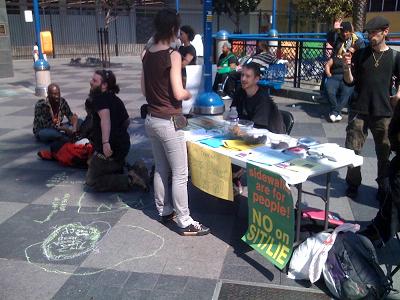
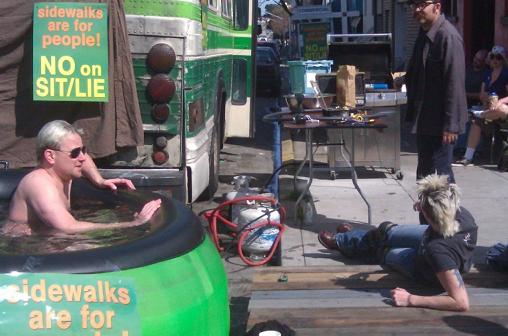
After another overwhelming vote against it last night, the sit-lie ordinance (banning sitting or lying on SF sidewalks) proposed by Mayor Gavin Newsom and Police Chief George Gascon is probably toast. But just to make sure, the activists at Stand Against Sit Lie are holding another day of creative protests on sidewalks around the city this Saturday, 4/24.

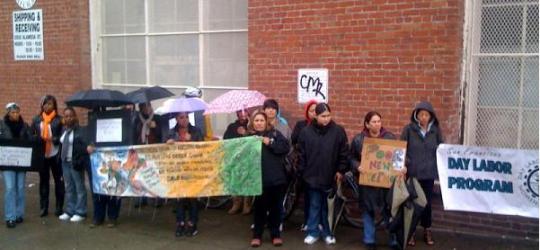
Among the 13 events scheduled so far will be immigrant day laborers sitting along Cesar Chavez Street between Mission and San Van Ness streets to protest both sit-lie and another legislative attack on immigrants, the controversial Arizona measure that essentially bans undocumented immigrants and encourages police to arrest them using racial profiling techniques.

The SF Day Labor Program is organizing the protest and today sent out a statement linking the two measures, noting that the sit-lie ordinance criminalizing otherwise lawful behavior and targets marginalized populations. Last night at the DCCC meeting, Sup. David Campos also made the point that day laborers who stand on street corners all day seeking work sometimes need to rest.

“Day laborers in San Francisco have to sit down once in awhile when they’re out on street corners waiting for work,” Jose Ramirez, a day laborer and coordinator of the SF Day Labor Program, said in today’s statement.  “Taking us to jail for sitting down in San Francisco is the same as immigrants being targeted by police for simply being Latino.”

After the Planning Commission early this month voted 6-1 to recommend against the sit-lie ordinance – finding that it violated a number of city goals and policies – the measure is awaiting consideration by the Board of Supervisors Public Safety Committee, possibly on May 3. 

The message of 555 Washington

16

The San Francisco supervisors not only rejected the environmental impact report for the condo tower next to the Transamerica building; they did it unanimously. And although the developer could still go back and write a new EIR — one that takes into account all the many, many issues this one ignored — that seems unlikely:


The developer, Andrew Segal, said he does not plan to go forward. “If we have to recirculate the EIR, I think we’re done,” Segal said.


There are a couple of important lessons here.


For starters, I hope the folks at the Planning Department who allowed this steaming turd of a project to go forward, and the commissioners who voted to certify the EIR, got the message: Just because a developer wants to do something, and the mayor thinks it’s a dandy idea, doesn’t mean that it’s good planning policy. The 555 Washington project was more than twice the size that current zoning allows on the site, and internal emails from frontline planning staffers showed that the folks who did the actual analysis of the thing were pretty darn dubious. But Planning Director John Rahim pushed it for approval anyway.


I think the supervisors made clear that the days of developer-driven planning on this scale, with this magnitude of arrogance and absurdity, are over. Let’s hope Planning Dept. management is paying attention.


Then there’s the wonderful fact that, after insisting for years that this project would only work if the city allowed the developer to build a 430-foot tower in a slot with a 200-foot height limit, the project sponsor suddenly backed down at the last minute and said, hey, 200 feet would actually be fine. That’s something that city officials too often forget: Developers lie, and demand concessions and say that they can’t build anything unless we give them tax breaks, and waive fees, and allow spot zoning, and offer all sorts of other goodies. But when you tell them no, they often seem to have a sudden moment of clarity — and announce that, hey, we didn’t really need all that.


Back in the late 1980s, Southern Pacific Railroad’s land development subsidiary insisted that nothing could be built at Mission Bay unless the city allowed multiple 50-story office towers and mandated only limited affordable housing. Then-mayor Art Agnos told the voters that he’d cut the best deal the city could ever get, and the future of the southeast neighborhoods was at stake. Then the proposal lost at the ballot — and immediately, SP came back with a much better option.


How many times did the San Francisco Giants tell us they couldn’t build a ballpark without public money? Guess what — when the city said no, the team came back with a privately financed plan. 


As the lawyers say, so too here. If a 200-foot tower was a viable option, why didn’t the developer offer that from the start? Here’s why — you get richer if you build taller. But that’s not a particularly good reason for the city to make planning decisions.

Rolling forward

7

By Adrian Castañeda

news@sfbg.com

San Francisco’s Potrero del Sol Skatepark is often packed with skaterboarders, a testament to the sport’s popularity and to the dearth of places in the city where it’s legal to skate. But that will soon change with the city’s commitment to build two new skateparks: one in SoMa and the other in the Haight.

Both have been tentatively approved by the Board of Supervisors. But before any concrete is poured, the skaters will have to overcome budget crises, angry homeowners, and their own bad reputations, particularly in the Haight, where the proposed park has gotten caught up in the furor over vagrants and the proposed sit-lie ordinance.

San Francisco has long been a skateboarding hub, yet there’s always been friction with police, businesses, and everyday city life. Even though it’s legal, there just aren’t that many places to do it anymore, partially because the city and property owners routinely attach barriers to any surfaces that might be appealing to skaters.

Skateboarders, long accustomed to being ignored and disenfranchised, have responded in their usual DIY fashion, such as building a few obstacles in an empty parking lot under a freeway overpass. The city took notice of the demand and after three years of planning and meetings, the newest of San Francisco’s skate parks has finally been allotted the necessary funds to begin construction around the end of summer.

The Central Freeway Skate Park will be located in what is now a parking lot at the intersection of Duboce and Stevenson streets in the north Mission District area. With $2 million collected through the Central Freeway Corridor Housing and Transportation Improvement Act of 1999, which provides for the sale and lease of parcels of city land that were under the now-demolished freeway, officials plan to develop the park to eventually include basketball courts and a dog run.

Rich Hillis of the Mayor’s Office of Economic Development said the city is considering a variety of improvements, but confirmed that “we think the skate park is the priority.” He attributes the park’s relatively unopposed approval to the demands of the city’s skaters and to the community as a whole. “They embraced the idea of a skatepark early on,” Hillis said of the forward-thinking residents of the area. He jokingly adds that the park should be named “Hornbeck Park” after Bryan Hornbeck, director of the San Francisco Skateboard Association. Hornbeck and his associates started the SFSA to push the city to build new parks designed with skaters in mind.

“San Francisco has to have a world-class skatepark,” Hornbeck said at one of the many skate events his group organizes. Hornbeck said the city has been receptive, working with skaters on the design of the park, but left SFSA to organize skaters and raise the funds. “It’s bake sale; it’s lemonade stand; it’s the best we can do,” Hornbeck said. “We’re not trying to take anything, we’re trying to make our own thing.”

Plans for the park, drawn up by notable skatepark design firm New Line Skateparks, are currently under review by civil engineers. After the plans are finalized, the project will be bid out to find a contractor. Tentative 3-D renderings have been online for months, sparking heated debate on skateboarding Web sites.

When the acclaimed Potrero del Sol Skatepark opened in 2008, many skaters felt that while it was well-designed and enjoyable, it didn’t have enough terrain that mimicked street riding. New Line has designed a number of skating plazas, most recently in Los Angeles. Its involvement gives many skaters hope that the new park will incorporate obstacles that represent the city’s rich street skating history.

But things are not moving as swiftly for the city’s other planned skate park, just beyond where Waller dead-ends at Stanyan in the Haight, which doesn’t have the same guaranteed funding stream. While bids for a design have been submitted, the Recreation and Park Department needs to get approval for $1 million–$2 million in construction funds before moving forward. The city proposed the 120,000-square-foot cul-de-sac at the end of Waller and next to SFPD’s Park Station after the original site near the Golden Gate Park horseshoe pits was found to be too small and lacking the necessary sight-lines for safety. But according to some residents groups, the parking lot is less safe for youths.

Citing police incident reports, Lena Emmery, president of the Cole Valley Improvement Association, told us the Waller park would be in an area with a high number of reported assaults and drug arrests and would add to noise pollution. “This location puts a skateboard park too close to a dense residential area, as well as some businesses that would be negatively impacted by the noise from the skaters,” she wrote via e-mail.

While the lot is occasionally used for bicycle safety classes and overflow parking at Kezar Stadium, it sits empty most of the year, although a farmers market will hold its grand opening there April 28. Will Keating, a Waller Street resident and skateboarder who works on Haight Street, is excited about the proposed park. He disagrees with claims that the park would be a negative impact on his neighborhood. “I hear homeless mutants going crazy outside my window every night, I would much prefer skateboards,” Keating said of the current noise pollution.

The Haight Ashbury Improvement Association, which is leading the charge for a sit-lie ordinance, conducted a survey on its Web site and found that many of its visitors feel the skatepark would increase noise and safety problems in the Haight. Visitors to the site also said the lot would be better used as a farmers market. Yet city officials say the two are not mutually exclusive, and early designs for the project are said to include a large public plaza adjacent to the park intended for community events.

“We realize this is going to be a multiuse space,” said Nick Kinsey, property manager for the Recreation and Park Department. “Throughout San Francisco there are thousands and thousands of skateboarders but only two places where it is legal to skate.” Kinsey called the park is “a done deal,” citing a 2007 ordinance introduced by Sup. Ross Mirkarimi that mandates the department build a skatepark on the cul-de-sac.

Kent Uyehara, merchant chair for the HAIA and owner of FTC skateshop on Haight, said the community’s fears about pedestrian safety are understandable, but that fears of increased violence and drug use are irrational. “If you can’t have a skate park next to a police station, then basically you are saying you can’t have it.”

If the city enacts the sit-lie ordinance, which Uyehara supports, it would be easy to imagine that a skate park would be a magnet for homeless and others looking to escape police harassment. But Uyehara is adamant that the park would not become a haven for Haight Street refugees. “Skateboarders self-police their own areas,” he said. “We’re not trying to kick the homeless out,” he added. “We’re trying to make the neighborhood attractive for everyone, whether they’re buying something or not.”

Uyehara is no stranger to opposition. When his shop first moved to the Haight in 1994, he had to deal with threats from residents and a neighborhood organization, similar to the one he is now a part of, because of what skateboarding represented to them. Since then skateboarding and his business have prospered, and FTC now has four locations worldwide. “For a city that hosted the X-Games, it’s pathetic how skateboarding has been treated.”

Uyehara says the Waller park, along with the Central Freeway and Potrero del Sol parks, are part of a plan developed by the San Francisco Skate Task Force, created in 2002 by then-Sup. Gavin Newsom to address the growing friction between the city and its skateboard population. The task force envisioned “a series of five parks located in a star pattern, and one in the middle of the city, [that] would make it possible for users to easily get to a park within at least two miles of their home.”

All the meetings and fundraising will be in vain if the park is poorly designed and built, said Jake Phelps, editor-in-chief of Thrasher Magazine. He says locals should design the park “so we have no one to blame but ourselves,” and avoid another flawed park like Crocker Amazon in Sunnydale where, he says, “the fence costs more than the skatepark.” Unimpressed with preliminary designs for the park on Duboce, the notoriously blunt Phelps says, “They’re going to come to our town, drop a turd, and leave.”

The veteran skater is wary of “landscape designers” with grandiose ideas. “There are people who get too involved. They don’t skate. Who are they to tell anybody what it is?” Newer skateparks are too crowded with obstacles trying to please all different kinds of skaters, he said. Instead, he urges a simple design similar to the streets of downtown. “The whole idea of skating is being utilitarian with your environment.” Regardless of the design, he believes it won’t have a dramatic effect on the Haight community: “Homeless people are gonna sleep there,” he said. “People are gonna tag on it and think it’s theirs.”

“The whole city’s a park, but people need somewhere to go when they get kicked out of everywhere,” says pro skater Tony Trujillo, who is able to skate to the Potrero park from his house and thinks others should have the same proximity to hassle-free skating. Julien Stranger, another local pro, feels a park in the Haight would benefit youth in the area by giving them a healthy, creative outlet, something the Haight symbolizes to many. “I don’t think that the neighborhood should be complaining about the energy a skate park will bring,” he said. “Skate parks are pretty positive.”

Earlier this month, an informational meeting hosted by the Haight Ashbury Neighborhood Council, Kinsey, Hornbeck, and other residents raised concerns that noise pollution and property damage would increase because of the skate park. “There’s been no public outreach,” said Martha Hoffman, who lives across from where the park is slated to be built. “If we’d known about it sooner, we would have opposed earlier.”

Thuy Nguyen of the SF Skate Club, an after-school program that promotes skateboarding as a safe and positive activity, urged residents to look beyond their property values and consider the benefits for the city’s youth. “It’s important for kids who feel that traditional sports aren’t for them.” Her partner, Shawn Connolly, added that skateboarding has grown in popularity with children. “It’s right after baseball,” he said.

“If the city doesn’t have a skatepark, the city is the skatepark,” Hornbeck said of the Waller Street lot where he often hosts skate events with donated ramps to ease the community into the idea of skateboarders using the area. But until the city budget can provide for skateboarders, the debate over the park will rage — and the underused parking lot at the end of Waller will remain just that.

Driving up the cost of housing

0

By Jobert Poblette

news@sfbg.com

GREEN CITY If you think living in the Bay Area is expensive, think about what it would be like if you didn’t have access to public transportation. A new report by Chicago-based think tank Center for Neighborhood Technology (CNT) considers just that problem, offering a new way of understanding just what constitutes affordable housing.

The CNT report — dubbed the Housing and Transportation (H+T) Affordability Index (www.htaindex.cnt.org) — maps housing affordability for 337 metropolitan areas and provides before-and-after snapshots that show how affordability changes when transportation costs are taken into account.

Affordable housing is usually defined as consuming 30 percent or less of a household’s income, but CNT proposes a redefinition. Under CNT’s new definition, housing is only considered affordable if the sum of housing and transportation costs constitutes 45 percent or less of household income. That redefinition would have dramatic effects on the Bay Area’s affordability picture.

Many communities in the region that would have been considered affordable under the old definition — including large swaths of Hayward, Marin County, Sacramento, and Stockton — would be unaffordable under the new standard. And San Francisco, well served by public transit, would be deemed a lot more affordable.

The difference that smart planning and public transportation make can be huge, especially for households already feeling the pinch of a weak economy. According to CNT, transportation costs in “location efficient” neighborhoods — its term for “compact, mixed-use communities with a balance of housing, jobs, and stores, and easy access to transit” — can be as low as 12 percent of a household’s budget versus up to 32 percent for less efficient neighborhoods where residents must drive to jobs and services.

For example, CNT calculated an annual transportation cost difference of $2,780 between Oakland’s Rockridge neighborhood, which it calls “compact,” and the city of Antioch, which it considers “dispersed.”

CNT says “location efficiency” in development can translate to big savings. According to its report, if 50 percent of new growth in the Bay Area occurs in compact rather than dispersed neighborhoods, the region could collectively save more than $1.1 billion in transportation costs.

Besides reducing a community’s environmental impact and improving residents’ quality of life, the report argues that things like walkability, proximity to jobs and services, and efficient public transportation help make an area more livable and affordable. The report also raises questions about the wisdom of cutting public transportation, especially in a period when many households are being forced out of their homes.

CNT hopes that its analysis will lead to more awareness for policy makers and more transparency for consumers. “What we’re looking for is a new definition of affordability, transportation cost disclosures for consumers, and incentives to build more compact communities around transit,” CNT spokesperson Nicole Gotthelf told us.

Gotthelf said the Bay Area has been at the forefront of this issue, specifically mentioning the work of the Bay Area Metropolitan Transportation Commission (MTC), the agency that plans, coordinates, and finances transportation in the nine counties that make up the region. “They’ve been actively trying to understand the housing and transportation trade-offs for Bay Area households.”

In turn, MTC offered support for the principles behind the CNT study. “We agree that it is good policy to promote the development of affordable housing at or near transit hubs,” MTC spokesperson John Goodwin told the Guardian.

In its “Transportation 2035 Plan for the San Francisco Bay Area,” which outlines how the agency will spend $218 billion in transportation funds over the next 25 years, MTC even sets out a goal of “decreas[ing] by 10 percent the combined share of low-income and lower-middle-income residents’ household income consumed by transportation and housing.”

Goodwin told us the agency is committed to smart growth principles: “The Bay Area is not unique, but I think the Bay Area is part of a vanguard … We are among the leading metro areas in making this a policy priority, and I feel confident in saying that this priority will continue to be affirmed.”

Goodwin pointed to the agency’s Transportation for Livable Communities (TLC) program, which is designed to promote development that “revitalizes central cities and older suburbs, supports and enhances public transit, promotes walking and bicycling, and preserves open spaces and agricultural lands.” Now in its 12th year, the TLC program has helped fund scores of transportation-related and affordable housing projects.

The MTC also administers the Housing Incentive Program, which “rewards communities … when they successfully promote high-density housing and mixed-use developments at transit stops to support transit use.” The program provides up to $3 million in grants to local governments that partner with developers to build housing near transit hubs.

Conversely, the agency also won’t approve funding for new transit stops that aren’t in dense areas. The thresholds require a minimum number of housing units within a half-mile radius of new transit stops, from 750 units for new ferry terminals to 3,850 units for new BART stations.

But the MTC’s efforts represent only one part of the equation. Goodwin said that coordination is key. “What we have here in the Bay Area is that decisions about transportation funding — for the most part — are conducted at the regional level, while land-use decisions are made at the local level. So it requires coordination between regional agencies like MTC and local cities and counties.”

In spite of the MTC’s efforts, huge problems plague the region. Housing costs in the Bay Area are among the highest in the nation. A recent report conducted by the Urban Land Institute — based on research conducted by CNT — found that, on average, Bay Area households spent $41,420 a year on housing and transportation, a whopping 59 percent of median income.

With budget crises affecting many of the region’s public transit providers, service cuts and fare hikes make the picture bleaker. Recently, AC Transit and Muni services were cut by almost 10 percent, causing longer waits and crowded buses — and a huge budget deficit could mean deep cuts in Caltrain service this summer. If these cuts force more Bay Area households to turn to cars, the region’s affordability can be adversely affected, even as households deal with the pressures of a weak economy.

On the national stage, several developments offer signs that smart growth principles — including the link between housing affordability and transportation — may be gaining wider traction. These developments are presenting smart growth and public transportation advocates with opportunities to push for reform.

Last year, three federal agencies — the Department of Housing and Urban Development, the Department of Transportation, and the Environmental Protection Agency — announced a partnership that would have the agencies working together on housing and transportation initiatives. The partnership laid out six “livability principles,” including commitments to provide more transportation choices, “promote equitable, affordable housing,” support existing communities, and “value communities and neighborhoods.” The new partnership’s rhetoric includes references to location and energy efficiency, transit-oriented and mixed-use development, and walkable neighborhoods.

On Capitol Hill, Congress is working on a new omnibus transportation bill to replace a bill that expired in 2009. The bill would provide billions in federal funding for highways and other forms of surface transportation. Consideration of the new bill in both the House and Senate has stalled, but some proposals emphasize the creation of transportation choices and livable communities. Transportation for America (www.t4america.org), a coalition of housing, transportation, environmental, and other groups, is mobilizing to promote public transportation and sustainable development in the new transportation bill, seeking to make CNT’s way of looking at the world into official U.S. policy.

Stage listings

0

Stage listings are compiled by Guardian staff. Performance times may change; call venues to confirm. Reviewers are Robert Avila, Rita Felciano, and Nicole Gluckstern. Submit items for the listings at listings@sfbg.com.

THEATER

OPENING

Peter Pan Threesixty Theater, Ferry Park (on Embarcadero across from the Ferry Bldg); www.peterpantheshow.com. $30-125. Previews Tues/27 and April 29, 7pm; April 30-May 1, 7:30pm (also May 1, 2pm); April 28 and May 5, 2pm; May 2, 1 and 5pm. Opens May 8, 7:30pm. Runs Tues and Thurs, 7pm; Fri-Sat, 7:30pm (also Sat, 2pm); Wed, 2pm; Sun, 1 and 5pm. Through August 29. JM Barrie’s tale is performed in a specially-built 360-degree CGI theater.

Tartuffe Studio 205 at Off-Market Theater, 965 Mission; 377-5882, http://generationtheatre.com. $20-25. Opens Fri/23, 8pm. Runs Fri-Sat, 8pm; Sun, 3pm. Through May 16. Generation Theatre performs a new English translation of Molière’s classic, in Alexandrine verse.

BAY AREA

Oliver! Julia Morgan Center for the Arts, 2640 College, Berk; www.berkeleyplayhouse.org. $24-33. Opens Sat/24, 7pm. Runs Fri, 7:30pm; Sat, 2 and 7pm; Sun, 1 and 6pm. Through May 16. Berkeley Playhouse performs the Dickens-based musical.

ONGOING

An Accident Magic Theatre, Bldg D, Fort Mason Center, Marina at Laguna; 441-8822, www.magictheatre.org. $25-55. Opens Wed/21, 8pm. Runs Wed-Sat, 8pm (also Sat, 2:30pm); Sun, 2:30pm; Tues, 7pm. Through May 9. Magic Theatre closes their season with Lydia Stryk’s world premiere drama.

*…And Jesus Moonwalks the Mississippi Cutting Ball Theater, 277 Taylor; 1-800-838-3006, www.cuttingball.com. $15-30. Thurs/22-Sat/24, 8pm; Sun/25, 5pm. In this inspired poetical-historical counter-narrative from Bay Area playwright Marcus Gardley, Greek mythology, African American folklore, personal family history, and Christian theology are all drawn irresistibly along in a great sweep of wild and incisive humor, passion, pathos and rousing gospel music as buoyant and wide as the Mississippi — or rather Miss Sippi (the impressive Nicole C. Julien), personification of the mighty and flighty river. The Cutting Ball-Playwrights Foundation coproduction, lovingly directed by Amy Mueller, sports exquisite design touches from Cutting Ball regulars like Michael Locher, whose gorgeous plank-wood set serves as the ideal platform for a work both magnificently simple and eloquently evocative. (Avila)

Andy Warhol: Good For the Jews? Jewish Theatre, 470 Florida; 292-1233, www.tjt-sf.org. $15-45. Thurs-Sat, 8pm; Sun, 2 and 7pm. Through May 16. Renowned monologist Josh Kornbluth is ready to admit his niche is a narrow one: he talks about himself, and more than that, he talks about his relationship to his beloved late father, the larger-than-life old-guard communist of Kornbluth’s breakthrough Red Diaper Baby. So it will not be surprising that in his current (and still evolving) work, created with director David Dower, the performer-playwright’s attempt to "enter" Warhol’s controversial ten portraits of famous 20th-century Jews (neatly illuminated at the back of the stage) stirs up memories of his father, along with a close family friend — an erudite bachelor and closeted homosexual who impressed the boyhood Josh with bedtime stories culled from his dissertation. The scenes in which Kornbluth recreates these childhood memories are among the show’s most effective, although throughout the narrative Kornbluth, never more confident in his capacities, remains a knowing charmer. But the story’s central conceit, concerning his ambivalence over presenting a showing of "Warhol’s Jews" at San Francisco’s Contemporary Jewish Museum, feels somehow artificial. It’s almost a stylized rendition of the secular-Jewish moral quandary and neurotic obsession driving Kornbluth works of the past — or in other words, all surface, not unlike the work of another shock-haired artist, but less meaningfully so. (Avila)

The Diary of Anne Frank Next Stage, 1620 Gough; 1-800-838-3006, www.custommade.org. $10-28. Thurs-Sat, 8pm; Sun, 7pm. Through May 1. Custom Made performs Wendy Kesselman’s modern take on the classic.

"DIVAfest" Exit Theatre, 156 Eddy; 673-3847, www.theexit.org. Check website for dates and times. Through May 1. The ninth annual festival features plays and performances by women artists.

Eat, Pray, Laugh! Off-Market Theaters, 965 Mission; www.brownpapertickets.com. $20. Wed, 8pm. Through April 28. Off-Market Theaters presents stand up comic and solo artist Alicia Dattner in her award-winning solo show.

Frau Bachfeifengesicht’s Spectacle of Perfection Stage Werx Theatre, 533 Sutter; 1-800-838-3006, www.circusfinelli.com. $15-20. Fri/23-Sun/25, 8pm. San Francisco’s all-women clown troupe, Circus Finelli, performs their comedy show inspired by European circus acts and American vaudeville.

*Loveland The Marsh, 1074 Valencia; 826-5750, www.themarsh.org. $15-50. Sat/24, 8:30pm; Sun/25, 7pm. Starting May 8, runs Sat, 5pm and Sun, 2pm at the Marsh Berkeley, 2120 Allston, Berk. Through June 13. Los Angeles–based writer-performer Ann Randolph returns to the Marsh with a new solo play partly developed during last year’s Marsh run of her memorable Squeeze Box. Randolph plays loner Frannie Potts, a rambunctious, cranky, and libidinous individual of decidedly odd mien, who is flying back home to Ohio after the death of her beloved mother. The flight is occasion for Frannie’s own flights of memory, exotic behavior in the aisle, and unabashed advances toward the flight deck brought on by the seductively confident strains of the captain’s commentary. The singular personality and mother-daughter relationship that unfurls along the way is riotously demented and brilliantly humane. (Avila)

Macho Bravado Thick House, 1695 18th St; http://machobravado.eventbee.com. $15-25. Thurs/22-Sat/24, 8pm. Asian American Theater Company performs Alex Park’s drama about a Korean-American soldier dealing with life on the home front after fighting in the Middle East.

*Master Class New Conservatory Theatre Center, 25 Van Ness; 861-8972, www.nctcsf.org. $22-40. Wed-Sat, 8pm; Sun, 2pm. Through May 2. Terrence McNally’s lovingly clever and thoroughly engaging portrait-play about opera icon Maria Callas takes the inspired notion of post-career Callas (Michaela Greeley) teaching a Julliard master class of eager young singers, while naturally finding herself unable to resist dominating the stage once more. Through a set of arias performed to piano accompaniment (by Kenneth Helman) by a cast of actor-singers (Alyssa Stone, Holly Nugent, Gustavo Hernández), Callas’s unselfconsciously curt and even brutal interactions with the students finally evoke for this deeply proud yet insecure woman both past theatrical glories and backstage heartaches. The play receives an impressive, all-around satisfying production at New Conservatory Theatre under Arturo Catricala’s astute direction. Of course, even with decent to excellent work on and off stage by the entire production team — including a stately mood-setting scenic design by Kuo-Hao Lo — it would no doubt amount to little without a formidable lead actor to fill Callas’s elegant but slightly over-the-top shoes. Here a marvelously imposing yet charming Greeley delivers the part as if she were born to play it, and all goes swimmingly as a result. (Avila)

Pearls Over Shanghai Hypnodrome, 575 Tenth St.; 1-800-838-3006, www.thrillpeddlers.com. $30-69. Fri-Sat, 8pm; starting July 10, runs Sat, 8pm and Sun, 7pm. Extended through August 1. Thrillpeddlers presents this revival of the legendary Cockettes’ 1970 musical extravaganza.

The Real Americans The Marsh, 1062 Valencia; 826-5750, www.themarsh.org. $18-50. Wed-Thurs and May 28, 8pm; Sat, 5pm; Sun, 3pm. Through May 30. The Marsh presents the world premiere of Dan Hoyle’s new solo show.

SexRev: The José Sarria Experience Mama Calizo’s Voice Factory, 1519 Mission; 1-800-838-3006, www.therhino.org. $10-25. Previews Wed/21-Fri/23, 8pm. Opens Sat/24, 8pm. Runs Wed-Sat, 8pm; Sun, 2pm. Through May 2. Theatre Rhinoceros presents John Fisher’s musical celebration of America’s first queer activist.

Shopping! The Musical Shelton Theater, 533 Sutter; 1-800-838-3006, www.brownpapertickets.com. $27-29. Fri-Sat, 8pm. Ongoing. The musical is now in its fifth year at Shelton Theater.

Tell It Slant Southside Theater, Fort Mason Center, Bldg D, Marina at Laguna; www.tixbayarea.com. $20-40. Fri-Sun, 8pm (also Sun, 2pm; no 8pm show May 16). Through May 16. BootStrap Foundation presents Sharmon J. Hilfinger and Joan McMillen’s musical about Emily Dickinson.

"Wanton Darkness: Two Plays By Harold Pinter and Conor McPherson" Phoenix Theatre, 414 Mason; 335-6087. $24-28. Thurs-Sat, 8pm; Sun, 2pm. Through May 8. 2nd Wind Productions performs Ashes to Ashes and St. Nicholas in repertory.

What Mama Said About Down There Our Little Theater, 287 Ellis; 820-3250, www.theatrebayarea.org. $15-25. Thurs-Sun, 8pm. Through July 30. Writer-performer-activist Sia Amma presents this largely political, a bit clinical, inherently sexual, and utterly unforgettable performance piece.

BAY AREA

*East 14th: True Tales of a Reluctant Player Marsh Berkeley, 2120 Allston, Berk; www.themarsh.org. $20-35. Sun/25, 2pm; April 30 and May 7, 9pm; May 1 and 8, 8pm. Through May 8. Don Reed’s solo play, making its Oakland debut after an acclaimed New York run, is truly a welcome homecoming twice over. (Avila)

Equivocation Marin Theatre Company, 397 Miller, Mill Valley; (415) 388-5208, www.marintheatre.org. $34-54. Tues and Thurs-Sat, 8pm (also Sat/24 and May 1, 2pm; no show April 30); Wed, 7:30pm; Sun, 2 and 7pm. Through May 2. Marin Theatre Company presents playwright Bill Cain’s award-winning hit, a sparksy drama that steeps itself in the history of Shakespeare’s life, labors and times to, among other things, draw pointed references to a barbaric period of fear, witch-hunting and state-sponsored torture ("Politics is religion for people who think they’re god," as one character has it). As staged by artistic director Jasson Minadakis, the play is nervously kinetic and pitched rather high by a cast of first-rate actors delivering surprisingly lackluster performances. The fact is Cain also bites off quite a bit in Equivocation, including "Shagspeare"’s (Charles Shaw Robinson) fraught relationship with his morosely clever daughter (Anna Bullard), neglected twin of the beloved son he lost — which is perhaps why some of it seems only half chewed by the end. The play — set in designer J.B. Wilson’s metallic two-tiered semi-circle representing the storied Globe Theatre, where the Bard wrote and occasionally acted alongside his fellow King’s Men as co-proprietor — has also a wearying tendency to spell its morals in block letters. Some genuine insight into the plays and their meaning then and now lifts interest in the fictionalized action, which otherwise skirts by on mild amusement, somewhat strained dialogue and familiar post-9/11 indignation. (Avila)

Girlfriend Berkeley Repertory Theatre, Thrust Stage, 2025 Addison, Berk; (510) 647-2949, www.berkeleyrep.org. $27-71. Wed, 7pm; Thurs-Sat and Tues, 2pm (also Sat, 2pm); Sun, 2 and 7pm. Through May 9. If you like Matthew Sweet’s songs you’ll probably like the spirited renditions in this new boy-meets-boy musical, which borrows its title from Sweet’s famous 1991 album. The songs, backed by a solid band in a recessed fake-wood-paneled den at the back of the stage, underscore the fraught but exhilarating emotional bond between two Nebraska teens at the end of their high school careers and the cusp of an anxious, ambiguous independence. The performances and chemistry generated by actors Ryder Bach and Jason Hite under Les Waters’ sharp direction are marvelous, delivering perfectly the inherent honesty and feeling in Todd Almond’s book, while Joe Goode’s beautifully understated choreography adds a fresh, youthful insouciance to the staging. But the story is a small one, not just a small town story, and its short, predictable arc makes for a slackness not altogether compensated for by the evocative tension between the lovers. (Avila)

A History of Human Stupidity LaVal’s Subterranean Theatre, 1834 Euclid, Berk; (510) 499-0356, www.randt.org. $16-20. Thurs/22-Sat/24, 8pm; Sun/25, 7pm. Rough and Tumble presents a new play about an old subject, human folly. Actually, Andy Bayiates’ play — which under Cliff Mayotte’s direction takes the form of an out-to-the-audience physicalized history lesson before a blackboard wall — is less than comprehensive, leaping from a Dawn-of-Man slugfest to a familiar recounting of Western imperial history under an evolving definition of stupidity — initially, "a good idea gone bad." Performed unevenly by a five-member female cast, the wordier humor leans toward the quirky or goofy, while the slapstick lacks much of a punch, despite a fair amount of punching. In the end, the insights and irreverence are too pedestrian to sustain even those theoretically receptive to a wacky lecture on familiar themes. (Avila)

John Gabriel Borkman Aurora Theatre, 2081 Addison, Berk; (510) 843-4822, www.auroratheatre.org. $34-55. Tues and Sun, 7pm (also Sun, 2pm); Wed-Sat, 8pm. Through May 9. A former bank manager (James Carpenter) who did time for illegally speculating with customer accounts to the ruin of all now paces like a lone wolf (in the operative metaphor) in his upstairs study, planning a return to respectability, as his estranged wife (Karen Grassle) occupies the rooms below along with a testy housekeeper (Lizzie Calogero), where her sister (Karen Lewis) competes for the love and loyalty of the patriarch’s grown son (Aaron Wilton), who contrary to the designs of all his elders is determined to marry a charming widow (Pamela Gaye Walker) and "live," as he is compelled to reiterate. Ibsen’s play has an enduring topicality that is hard to miss of course, but Aurora’s production, directed by veteran hand Barbara Oliver, also inadvertently suggests why this leaden, slightly ridiculous work is so rarely produced, despite some solid acting, especially from an imposing yet slyly comical Carpenter in the title role. (Avila)

The Lysistrata Project Regent House, 2836 Regent, Berk; www.crowdedfire.org. $10-15. Thurs/22-Fri/23, 8pm. Crowded Fire presents Elana McKernan’s Aristophanes-inspired tale as part of its Matchbox Production development program for new works.

*A Seagull in the Hamptons Ashby Stage, 1901 Ashby, Berk; www.shotgunplayers.org. $15-30. Wed/21, 7pm; Thurs/22-Sat/24, 8pm; Sun/25, 5pm. Emily Mann’s free adaptation of Chekhov’s Seagull captures the essence of his early "comedy" — very much a human comedy, brimming with pain, turmoil and tragedy in equal measure with laughter, love and folly — and yet manages to be completely of its own (our own) time and place, so effortlessly as to seem a little miraculous. It helps, naturally, that director Reid Davis has assembled a very solid and enjoyable ensemble cast for this wonderfully tailored Shotgun Players production. (Avila)

To Kill a Mockingbird Mountain View Center for the Performing Arts, 500 Castro, Mtn View; (650) 463-1960, www.theatreworks.org. $27-62. Tues-Wed, 7:30pm; Thurs-Sat, 8pm (also Sat, 2pm); Sun, 2 and 7pm. Through May 9. TheatreWorks performs Christopher Sergel’s adaptation of Harper Lee’s literary masterpiece.

PERFORMANCE/DANCE

Alonzo King LINES Ballet Novellus Theater, Yerba Buena Center for the Arts, 700 Howard; 978-2787, www.linesballet.org. Wed-Thurs, 7pm; Fri-Sat, 8pm; Sun, 5pm. The company performs its 2010 spring season.

"Bay Area National Dance Week" Various locations; www.bayareadw.org. April 23-May 2. Over 400 free events, including performances and classes, hightlight this 12th annual celebration of dance.

"The Cat’s Pajamas" Make-Out Room, 2335 22nd St; www.makeoutroom.com. Mon, 8pm, $5. Cabaret show featuring a variety of acts under the theme "ModMambo."

"CubaCaribe Festival of Dance and Music" Dance Mission Theater, 3316 24th St; www.cubacaribe.org. Fri-Sat, 8pm; Sun, 7pm; Sun/25, 3pm. Through May 2. $12-22. The sixth annual fest showcases Cuban and Caribbean performers from the U.S. and abroad.

"Diaspora Tales #2: 1969" CounterPULSE, 1310 Mission; www.brownpapertickets.com. Fri-Sat, 8pm. $15. Asian Improv Arts, Asian Pacific Islander Cultural Center, and Oakland Asian Cultural Center collaborate on this interdisciplinary work.

"Evolution of a Kiss" Shotwell Studios, 3252-A 19th St; www.brownpapertickets.com. Fri-Sat, 8pm. Through May 1. $10-15. Cynthia Brinkman performs her solo show based on real-life accounts of first kisses.

"Kindergarde: Avant-Garde Poems, Plays, Stories, and Songs for Children" California College of Arts, 1111 Eighth St; www.sptraffic.org. Sun, 5:30pm, $5. Small Press Traffic presents this eclectic performance.

"Performance Art in Front of an Audience Ought to Be Entertaining" Marsh Studio Theater, 1062 Valencia; www.themarsh.org. Wed, 7:30pm. $10-20. Phillipe Coquet and Carla Pauli perform Sean Fletcher and Isabel Reichert’s drama set amid the 1980s avant garde art scene.

"La Semilla Caminante/The Traveling Seed" Intersection for the Arts, 446 Valencia; 626-2787. Fri-Sun, 8pm. $5-15. Intersection and Campo Santo present a new multimedia performance work by Celia Herrera Rodriguez, Cherrie Moraga, and Alleluia Panis.

"Springboard V" Meridian Gallery, 535 Powell; www.brownpapertickets.com. Fri-Sat, 8pm; Sun, 7pm. $10-25. Jump! Theater presents this staged reading of excerpts from plays by local writers.


Sit/lie debate takes a strange new turn

Emails are rocketing around San Francisco political circles in anticipation of an April 21 meeting of the Democratic County Central Committee (DCCC), the policy-making body for the Democratic Party in San Francisco. Committee members are slated to discuss the city’s proposed sit/lie ordinance, a controversial measure backed by Mayor Gavin Newsom and Police Chief George Gascon meant to afford police more powers for dealing with hostile youth occupying sidewalk space.

Labor activist Gabriel Haaland, a DCCC committee member, touched off a small firestorm early this week when he submitted a resolution against the sit/lie ordinance. Haaland, who has lived in the Haight for around 15 years, said wayward youth have been flocking to that neighborhood and hurling occasional barbs at passersby (including himself) since he can remember, and recent interest in the issue does not make it a new problem. “What would actually solve the problem?” Haaland asked, and offered that sit/lie is not the answer. According to a post on Fog City Journal, his resolution for the Democratic Party to oppose sit/lie was co-sponsored by Assemblymember Tom Ammiano, Supervisor David Campos, Supervisor Chris Daly, Supervisor Eric Mar, Aaron Peskin, Hene Kelly, Rafael Mandelman, Michael Goldstein, Joe Julian, Jane Morrison, Jake McGoldrick, Michael Bornstein, and Debra Walker.

While some might look at a grungy street kid and see a menace to smooth business functioning or an unruly vagrant not being properly dealt with because the laws are too weak, Haaland said he perceives a kid from a broken home who already feels alienated from society. Incarceration for a nonviolent crime such as lying on the sidewalk would only further alienate these youths, he argued, possibly nudging them toward criminal behavior instead.

“This legislation will not solve longstanding, complex problems,” Haaland’s resolution reads. “City Hall has openly and repeatedly admitted in the press that the criminal justice system is failing to deal with similar issues in the Tenderloin, and has created an alternative known as the Community Justice Court (CJC) that is founded on principles of Restorative Justice.”

Restorative Justice is an alternative approach to dealing with crime that involves bringing together those who are directly affected to understand and address the harm that has been done, with emphasis on personal accountability and transformation. Some models also seek to change the conditions in which harmful actions occurred.

Haaland’s resolution urges the Board of Supervisors and the Mayor to oppose sit/lie, and to explore successful alternatives to incarceration.

The proposal sparked a second resolution, this one from committee member Scott Wiener, who is a candidate for the District 8 seat on the Board of Supervisors. Wiener submitted that the Democratic Party should officially get behind the CJC, and should acknowledge its error in opposing the court, a Newsom pet project, in 2008. “When I saw Gabriel’s resolution … I noticed it contained a positive reference to the [CJC],” Wiener told the Guardian. “I was pleasantly surprised.”

Furthermore, his resolution “encourages the Mayor and Board of Supervisors, budget permitting and based on careful analysis, to consider future expansion of the CJC’s geographic boundaries to include the Haight-Ashbury.”

Wiener is fully behind the sit/lie ordinance. “Right now, the police do not have enough enforcement tools to deal with some of the behavior on the streets,” he said. The measure has been an issue in the District 8 race, since progressive candidate Rafael Mandelman opposes the ordinance.

The resolution contest wasn’t over yet. In response to resolution No. 2, Haaland submitted yet another resolution — along with a personal note that appeared to extend an olive branch — revising Wiener’s proposal by urging support for “the restorative justice model as an alternative to incarceration.” (Haaland wrote an in-depth piece about restorative justice in a recent Guardian editorial.)

“I appreciated him doing that,” Wiener said when asked what he thought about resolution No. 3. “But I’m not convinced that that’s the way to go. That’s why I did not agree to it.”

Perhaps there won’t be any kum-ba-ya moments after all.

Along other email-blast circuits, Haaland’s initial proposal prompted David Villa-Lobos, a strong sit/lie advocate and District-6 contender, to sound his own alarm by urging SFPD officers to attend the April 21 meeting and defend the sit/lie ordinance.

The city Planning Commission recently voted 6-1 against the measure, and a grassroots group that brought opponents of the rule onto city sidewalks last month will hold another Stand Against Sit Lie citywide protest on April 24. The measure is expected to go before the Board of Supervisors near the end of the month.

The DCCC meeting will be held on Wednesday, April 21, at 6 p.m. in the basement auditorium of the California State Building, 455 Golden Gate Ave.

SanFolk Disco’s blazing neo-folk collision

1

JL Stiles would like it if we all just appreciated what we’ve got a little more. 

“If you look at the new artists that have come out of San Francisco recently, we’re got some really innovative people. But in the belly of the beast, traction is not easy to come by. The great artists, someone discovers them and cashes out on their genius, and then they’re touring all over and just come back every once in awhile,” says the mathematician/musician/creator of the new neo folk concert series San Folk Disco, which kicks off Thur/15 at Café Du Nord.

The series will showcase three Bay area artists each month, with the intent to gather together three different kinds of folk sound, what the event’s website calls “three blazing comets of musical ice and fire.”  

Stiles, himself an accomplished guitarist who attributes his musical acumen to a penchant for advanced mathematical theorems, has aspirations of becoming “a personal music scene.” Though he has taken pleasure in the aspects of SanFolk Disco he’s orchestrated, when it comes to event planning in general “I prefer that everybody else do it, and me be the source of it. I’m about what music is fundamentally; inspiration, profundity, a serious, magical thing. If it’s only about JL Stiles, it’s really small. If it’s about what music encompasses for humankind, it’s something to live your life for.”

Here’s the profundity going down at tomorrow night’s SanFolk Disco; Stiles opens (as he will each month), and from there the boundaries of folk, rock, and bluesy jam music will be explored. Sweet, jazzy Kasey Johansing’s ephemeral purrs are set to lay a nice, velvety groundwork for a more jingle-jangle, feel good sesh by Bart Davenport. “Bart’s the kind of guy that always leaves you with a smile on your face. He gets crowds dancing,” says Stiles.

Sounds like a fun night; support your local music scene while it still is local, hear a bunch of different artists’ interpretation of what folk music is today… strike a blow for personal connections in a rapidly digitizing social sphere? “It’s a civic duty to go out and take charge and participate in some way in peoples’ lives,” exhorts Stiles. “Do your civic duty, come out and party!”

SanFolk Disco feat. Bart Davenport, Kacey Johansing & JL Stiles

Thur/15 8 p.m., $10-12

Café Du Nord

2170 Market, SF

www.sanfolkdisco.blogspot.com


Emerald city

0

GREEN ISSUE Walk out your front door today and you won’t find a corner store that doesn’t sell “organic food,” a restaurant whose we-buy-sustainable addendum reads “whenever possible,” a trash can with a precious separate compartment for your all-natural soda cans. It’s hard to forget that it’s not all another secret plan from the government to make your life less fun. But it’s not! Below, please find assembled an all-star list of resources that are honest-to-goodness designed to help you help out our little ball, spinning all terrestrially out in space.

RECYCLING
They’ve tried to make it easy on you. Compost goes in green! Beer bottles in blue! Devil Styrofoam — where’d you get that? — in black! But still, you have questions. What about the bottle caps? Can I recycle the bag my Korean taco came in? Can I get a new green bin without a rat-hole in it? (Yes! No, that’s compost! Yes, but work on that vermin problem!) One quick stop at the Recology SF Web site has you sorted. You’ll also find info on the dump’s sculpture garden — the world’s only garbage company’s art park.

GROWING THAT GREEN
Because that window box in your bedroom hasn’t contributed anything to dinner in way too long, SF Garden Resource Organization maintains a database on everything you need to grow your own sustenance in the city. Find within its welcoming Internet embrace info on cheap local classes to turn that idle thumb green, all kinds of gardening pointers, and the lowdown on which community gardens are accepting new plot tenders.

PESTICIDES AND JUNK MAIL
They’re awful, aren’t they? And they’re all around us, which is why the Environmental Health Association of Nova Scotia’s toxicity guide for everyday lotions, cleaners, and pet products is so nice to have on hand. Thanks, Nova Scotia! For up close and personal commerce, the friendly worker-owners at Rainbow Grocery can steer you toward natural household products. An there are a bajillion lovely shops like Marie Veronique Organics (1790 Fifth St., Berk.) that’ll sell you the good local stuff. Kill your junk mail with the support of the helpful folks at Bay Area Recycling Outreach Coalition.

SHOPPING
Go organic or go secondhand. For natural fiber or recycled fabric gear, the Bay’s got lots of flash spots like Ladita (827 Cortland, SF. 415-648-4397 www.shopladita.com) or Eco Citizen (1488 Vallejo, SF. 415-614-0100. www.ecocitizenonline.com). Little Otsu (849 Valencia, SF. 415-255-7900 www.littleotsu.com) is all you need for gift shopping, with unique posters, books, and various assorted preciousness. But for the broke environmentalists, wait for the $2 per item of clothing sales at Goodwill (Various locations, www.goodwill.com), Mission Thrift (2330 Mission, SF. 415-821-9560), or even one of the several consignment stores along Fillmore like Repeat Performance (2436 Fillmore, SF. 415-563-3123) or Seconds to Go (2252 Fillmore, SF. 415-563-7806) to feel good about confounding consumerism. The big fish in our green pond, however, remains the invaluable Green Zebra coupon book, with hundreds of deals on earth-lovin’ spas, goods, and adventures.

OUT ON THE TOWN
There are oodles of spots to help you make a night of it without playing our environment for a fool. Terroir (1116 Folsom, SF. (415) 558-9546, www.terroirsf.com) serves elegant, chemical-free wines that taste even better if the wine-bar’s adorably scruffy owners pour them. Thirsty Bear Brewpub (661 Howard, SF. (415) 974-0905. www.thirstybear.com) has a stellar system of low-waste operation and serves only organic brews through its taps. For the club kids, the eco spot de rigueur is Temple (540 Howard, SF. (415) 978-8853 www.templesf.com), where owner Paul Hemming’s Zen Compound concept is expanding to include a roof garden, global art gallery, and dance floor that harnesses the energy expended on beats.

ACTIVISM
Of course, you could always do something outside your day’s normal scope. Hit up the following organizations to make change in your little corner of the world: Roots of Change for food sustainability issues, Livable City for hopes of a future outside our cars, and Planning and Conservation League for work on issues like global warming and water usage.

The dawn of Earth Day

2

tredmond@sfbg.com

GREEN ISSUE The heavens welcomed Earth Day to America. All over the country, April 22, 1970 dawned clear and sunny; mild weather made it even easier to bring people into the streets. The Capitol Mall was packed, and so many members of Congress were making speeches and appearing at events that both houses adjourned for the day.

Mayors, governors, aldermen, village trustees, elementary school kids, Boy Scout troops, labor unions, college radicals, and even business groups participated. In fact, the only organization in the nation that actively opposed Earth Day was the Daughters of the American Revolution, which warned ominously that "subversive elements plan to make American children live in an environment that is good for them."

By nightfall, more than 20 million people had participated in the First National Environmental Teach-In, as the event was formally known. It established the environmental movement in the United States and helped spur the passage of numerous laws and the creation of hundreds of activist groups.

It was, by almost all accounts, a phenomenal success, an event that dwarfed the largest single-day civil rights and antiwar demonstrations of the era — and the person who ran it, 25-year-old Denis Hayes, wasn’t happy.

His concern with the nascent movement back then says a lot about where environmentalism is 40 years later.

Gaylord Nelson, a mild-mannered U.S. senator from Wisconsin, came up with the idea of Earth Day on a flight from Santa Barbara to Oakland. Nelson was the kind of guy who doesn’t get elected to the Senate these days — a polite, friendly small-town guy who was anything but a firebrand.

A balding, 52-year-old World War II veteran who survived Okinawa, Nelson was a Democrat and generally a liberal vote, but he got along fine with the die-hard conservatives. He kept a fairly low profile, and did a lot of his work behind the scenes.

But long before it was popular, Nelson was an ardent environmentalist — and he was always looking for ways to bring the future of the planet into the popular consciousness.

In August 1969, Nelson was on a West Coast speaking tour — and one of his mandatory stops was the small coastal city that seven months earlier had become ground zero for the environmental movement. Indeed, a lot of historians say that Earth Day 1970 was the coming out party for modern environmentalism — but the spark that made it possible, the event that turned observers into activists, took place Jan. 28, 1969 in Santa Barbara.

About 3:30 on a Tuesday afternoon, a photographer from the Santa Barbara News Press got the word that something had gone wrong on one of the Union Oil drilling platforms in the channel just offshore. The platforms were fairly new — the federal government had sold drilling rights in the area in February 1968 for $603 million, and Union was in the process of drilling its fourth offshore well. The company had convinced the U.S. Geological Survey to relax the safety rules for underwater rigs, saying there was no threat of a spill.

But shortly after the drill bit struck oil 3,478 feet beneath the surface, the rig hit a snag — and when the workers got the equipment free, oil began exploding out. Within two weeks, more than 3 million gallons of California crude was on the surface of the Pacific Ocean, and a lot of it had washed ashore, fouling the pristine beaches of Santa Barbara and fueling an angry popular backlash nationwide.

Nelson received an overwhelming reception at his Santa Barbara talk — and horrified as he was by the spill, he was glad that an environmental concern was suddenly big news. But, as he told me in an interview years ago, he still wasn’t sure what the next steps ought to be — until, bored on an hour-long flight to his next speech in Berkeley, he picked up a copy of Ramparts magazine.

The radical left publication, once described as having "a bomb in every issue," wasn’t Nelson’s typical reading material. But this particular issue was devoted to a new trend on college campuses — day-long "teach-ins" on the Vietnam War.

Huh, Nelson thought. A teach-in. That’s an intriguing idea.

Hayes was a student in the prestigious joint program in law and public policy at Harvard. He’d been something of a campus activist, protesting against the war, but hadn’t paid much attention to environmental issues. He needed a public-interest job of some sort for a class project, though, so when he read a newspaper article about the senator who was planning a national environmental teach-in, he called and offered to organize the effort in Boston. Nelson invited him to Washington, was impressed by his Harvard education and enthusiasm, and hired him to run the whole show.

The senator was very clear from the start: the National Environmental Teach-In would not be a radical Vietnam-style protest. The event would be nonpartisan, polite, and entirely legal. Hayes and his staffers chafed a bit at the rules (and the two Senate staffers Nelson placed in the Earth Day office to keep an eye on things), and they ultimately set up a separate nonprofit called the Environmental Action Foundation to take more aggressive stands on issues.

Meanwhile, Hayes did the job he was hired to do — and did it well. Everywhere he turned, from small towns to big corporations, people wanted to plug in, to be a part of the first Earth Day. Many wanted to do nice, noncontroversial projects: In Knoxville, Tenn., students decided to scour rivers and streams for trash to see if they could each clean up the five pounds of garbage the average American threw away each day. In dozens of communities, people organized tree-plantings. In New York, Mayor John Lindsay led a parade down Fifth Avenue.

A few of the actions were more dramatic. A few protesters smashed a car to bits, and in Boston, 200 people carried coffins into Logan International Airport in a symbolic "die-in" against airport expansion. In Omaha, Neb., so many college students walked around in gas masks that the stores ran out. But it was, Hayes realized, an awful lot of talk and not a lot of action. The participants were also overwhelmingly white and middle-class.

Hayes wasn’t the only one feeling that way. In New York, author Kurt Vonnegut, speaking from a platform decorated with a giant paper sunflower, added a note of cynicism.

"Here we are again, the peaceful demonstrators," he said, "mostly young and mostly white. Good luck to us, for I don’t know what sporting event the president [Richard Nixon] may be watching at the moment. He should help us make a fit place for human beings to live. Will he do it? No. So the war will go on. Meanwhile, we go up and down Fifth Avenue, picking up trash."

Hayes finally broke with the politics of his mentor early on Earth Day morning when it was too late to fire him. The next day, the National Environmental Teach-In office would close and the organization would shut down. From that moment on, he could say what he liked and not worry who he offended.

"I suspect," he told a crowd gathered at the Capitol Mall, "that the politicians and businessmen who are jumping on the environmental bandwagon don’t have the slightest idea what they are getting into. They are talking about filters on smokestacks while we are challenging corporate irresponsibility. They are bursting with pride about plans for totally inadequate municipal sewage plants. We are challenging the ethics of a society that, with only 6 percent of the world’s population, accounts for more than half the world’s annual consumption of raw materials.

"We are building a movement," he continued, "a movement with a broad base, a movement that transcends traditional political boundaries. It is a movement that values people more than technology and political ideologies, people more than profit.

"It will be a difficult fight. Earth Day is the beginning."

I first met Hayes in 1990, near the office in Palo Alto where he was planning the 20th anniversary of Earth Day. He’d continued his environmental work inside and outside government, at one point running the National Energy Laboratory under President Jimmy Carter. Earth Day 20 was shaping up as a gigantic event, one that would ultimately involve 200 million people around the globe. Earth Day was becoming the largest secular holiday on the planet.

Hayes was excited about the event, which he was running this time without the moderating influence of a U.S. senator. And he was aiming for a much more activist message — in fact, at that point, he was pretty clear that the U.S. environmental movement was running out of time.

"Twenty years ago, Earth Day was a protest movement," he told a crowd of more than 300,000 in Washington, D.C. "We no longer have time to protest. The most important problems facing our generation will be won or lost in the next 10 years. We cannot protest our losses. We have to win."

And now another 20 years have passed — and by many accounts, we are not winning. Climate change continues, and even accelerates; an attempt at a global accord just failed; and Congress can’t even pass a mild, watered-down bill to limit carbon emissions.

And Hayes, now president of the Bullitt Foundation, a sustainability organization in Seattle, thinks the movement has a serious problem. "Earth Day has succeeded in being the ultimate big tent," he told me by phone recently. "To some rather great extent, is had some measure of success."

But he noted that "in American politics these days, it’s not the breadth of support, it’s the intensity that matters. Environmentalists tend to be broadly progressive people who care about war and the economy and health care. They aren’t single-issue voters. And somehow, the political intensity is missing."

Hayes isn’t advocating that environmentalists forget about everything else and ignore all the other issues — or that the movement lose its broad-based appeal — but he said it’s time to bring political leaders and policies under much, much sharper scrutiny and to "stop accepting a voting record of 80 percent."

It’s hard today to be bipartisan, and compromise is unacceptable, Hayes told me. "I was probably right [in 1990]," he said. "If what you’re aspiring to do is stop the greenhouse gases before they do significant damage to the environment, it’s too late." At this point, he said, it’s all about keeping the damage from turning into a widespread ecological disaster.

"I would like to see Earth Day 50 be a celebration," he said. "I would like to see by then a real price on carbon, nuclear power not proliferating, and a profound, stable investment in cost-effective, distributed renewable energy." But for that to happen, "we need to have a very intense core of environmental voters who realize that these threats to life on the planet are more important than a lot of other things."

Tim Redmond is the author, with Marc Mowrey, of Not In Our Back Yard: The People and Events that Shaped America’s Modern Environmental Movement (William Morrow, 1993) which can still be found in the remainder bins of a few used book stores.

Editorial: No free ride for developers

0

Under Newsom’s approach, the current residents and businesses of San Francisco will have to put up millions of dollars to cover the costs created by market-rate housing developers

The dumbest plan the Newsom administration has cooked up in a long time continues to make its way through City Hall. The mayor wants to defer fees for housing developers as a way to “stimulate” the economy — despite the fact that the city’s own economist concluded the plan would lead to the creation of a relatively tiny number of jobs and perhaps 40 or 50 new market-rate condos over the next two years.

And the cost would be staggering. Over the next 15 to 20 years, depending on how much the housing market picks up, $43 million worth of fees developers typically pay before they break ground could be deferred, an analysis by Fernando Marti, a member of the Eastern Neighborhoods Citizens Advisory Committee, shows. The city would get the money eventually — but buildings would go up before the cash to provide water and sewer service, public transportation, schools, parks, and other amenities is in the city’s accounts.

At the same time, information released by the city last week shows that the gap between the cost of the infrastructure needed for the Eastern Neighborhoods plan and the fees developers will pay is at least $100 million, and perhaps as much as $234 million.

The message is clear. Under Newsom’s approach, the current residents and businesses of San Francisco will have to put up millions of dollars to cover the costs created by market-rate housing developers. In fact, Newsom’s administration is already suggesting special levies on property in the impacted areas to make up the difference.

In underserved areas like the Eastern Neighborhoods, where transit and open space are already inadequate to meet current needs, the situation is particularly harsh. “They want to have the Eastern Neighborhoods pay higher taxes than anyone else to mitigate the impacts of new stuff that was supposed to pay for itself,” planning activist Tony Kelly, who is running for District 10 supervisor, told us. “This is a non-starter.”

The problem is nothing new — although a lot of pro-development activists have been denying it for years: new high-end housing development doesn’t pay its own way. If more than 40,000 new residents are going to live in the southeast part of town, San Francisco will have to build schools, police stations, firehouses, bus and rail lines, parks, and in some cases new roads. Then the city will have to hire (and train) cops, bus drivers, firefighters, gardeners, and teachers. None of that is cheap — in fact, the Eastern Neighborhoods Infrastructure Finance Working Group estimates that the actual cost of providing basic infrastructure would be about $22 for every square foot of new development.

The developers howl at that sort of number and insist they can’t afford it, so the city is prepared to charge closer to $10 a square foot. To make up the difference in the Eastern Neighborhoods, the working group suggested some form of tax-increment financing — that is, the city would borrow against the expected new property tax revenues from the new development and use that to build infrastructure. The mayor took that off the table, wanting any new revenue to go right to the General Fund.

And, of course, under the mayor’s current plan, the modest fees developers actually have to pay will be deferred for several years, making the problem even worse. So the only way to pay for the costs of new housing development is some sort of special property-tax district in the affected neighborhoods.

Add to this the fact that the mayor’s proposal would mean the immediate loss of at least 400 affordable housing units, and the whole thing becomes untenable.

The supervisors have amended the fee-deferral plan to make it a bit less awful, but the whole approach is still completely backward. City fees aren’t holding up housing construction; the weak market and tight credit are to blame for that. And when those conditions change, developers will be poised — as always — to make a vast amount of money selling overpriced condos for millionaires in San Francisco. And if they can’t pay their own way, the city shouldn’t allow them to break ground.


No free ride for developers

2

EDITORIAL The dumbest plan the Newsom administration has cooked up in a long time continues to make its way through City Hall. The mayor wants to defer fees for housing developers as a way to "stimulate" the economy — despite the fact that the city’s own economist concluded the plan would lead to the creation of a relatively tiny number of jobs and perhaps 40 or 50 new market-rate condos over the next two years.

And the cost would be staggering. Over the next 15 to 20 years, depending on how much the housing market picks up, $43 million worth of fees developers typically pay before they break ground could be deferred, an analysis by Fernando Marti, a member of the Eastern Neighborhoods Citizens Advisory Committee, shows. The city would get the money eventually — but buildings would go up before the cash to provide water and sewer service, public transportation, schools, parks, and other amenities is in the city’s accounts.

At the same time, information released by the city last week shows that the gap between the cost of the infrastructure needed for the Eastern Neighborhoods plan and the fees developers will pay is at least $100 million, and perhaps as much as $234 million.

The message is clear. Under Newsom’s approach, the current residents and businesses of San Francisco will have to put up millions of dollars to cover the costs created by market-rate housing developers. In fact, Newsom’s administration is already suggesting special levies on property in the impacted areas to make up the difference.

In underserved areas like the Eastern Neighborhoods, where transit and open space are already inadequate to meet current needs, the situation is particularly harsh. "They want to have the Eastern Neighborhoods pay higher taxes than anyone else to mitigate the impacts of new stuff that was supposed to pay for itself," planning activist Tony Kelly, who is running for District 10 supervisor, told us. "This is a non-starter."

The problem is nothing new — although a lot of pro-development activists have been denying it for years: new high-end housing development doesn’t pay its own way. If more than 40,000 new residents are going to live in the southeast part of town, San Francisco will have to build schools, police stations, firehouses, bus and rail lines, parks, and in some cases new roads. Then the city will have to hire (and train) cops, bus drivers, firefighters, gardeners, and teachers. None of that is cheap — in fact, the Eastern Neighborhoods Infrastructure Finance Working Group estimates that the actual cost of providing basic infrastructure would be about $22 for every square foot of new development.

The developers howl at that sort of number and insist they can’t afford it, so the city is prepared to charge closer to $10 a square foot. To make up the difference in the Eastern Neighborhoods, the working group suggested some form of tax-increment financing — that is, the city would borrow against the expected new property tax revenues from the new development and use that to build infrastructure. The mayor took that off the table, wanting any new revenue to go right to the General Fund.

And, of course, under the mayor’s current plan, the modest fees developers actually have to pay will be deferred for several years, making the problem even worse. So the only way to pay for the costs of new housing development is some sort of special property-tax district in the affected neighborhoods.

Add to this the fact that the mayor’s proposal would mean the immediate loss of at least 400 affordable housing units, and the whole thing becomes untenable.

The supervisors have amended the fee-deferral plan to make it a bit less awful, but the whole approach is still completely backward. City fees aren’t holding up housing construction; the weak market and tight credit are to blame for that. And when those conditions change, developers will be poised — as always — to make a vast amount of money selling overpriced condos for millionaires in San Francisco. And if they can’t pay their own way, the city shouldn’t allow them to break ground.

Recology’s Nevada landfill blocked

6

The Las Vegas Review-Journal is reporting that the Planning Commission in Humboldt County, Nevada blocked Recology’s landfill expansion application in Winnemucca, which is halfway between San Francisco and Salt Lake City.

The news comes close on the heels of the Guardian’s report that San Francisco has tentatively selected Recology to dispose of the city’s waste in Yuba County.

The LVRJ articles notes that “Recology wants to haul in 4,000 tons of garbage a day from Northern California communities for the next 95 years and dump it on the desert playa about 28 miles west of Winnemucca.”

Adam Alberti, a spokesman for Recology and the Jungo Land Co., is quoted as saying that the commission’s decision “could cost the region more than $660 million and new jobs.”

And U.S. Senate Majority Leader Harry Reid, D-Nev., is quoted as calling the proposed dump a threat to Nevada’s “sovereignty and dignity.”

“The proposal to dump a mountain of California trash in Nevada is a lose-lose proposition for our state,” Reid said. “The people of Humboldt County have made it clear they don’t want other states dumping trash in their backyards, and I applaud their decision. “

Asked if there was a connection between the proposed Nevada dump and San Francisco’s trash, given that the city is only proposing a ten-year contract with Recology in Yuba County, Alberti said the landfill Recology was pursuing in Nevada is a “speculative effort” and that San Francisco “prohibits its waste from being taken out of state.”

“Recology has no contract in Winnemucca, and you have to have a landfill open before you can enter into a contract,” he said.

Here in San Francisco, District 10 candidate Eric Smith said he wants to see a whole lot more light being shone on the debate about what to do with the city’s trash.

“There needs to more transparency and accountability in the debate, which needs to include looking at all aspects of the issue, including where and how we transport our trash,” Smith said. “Should we barge, rail or truck it? What are the economic and environmental consequences? And is this something the citizens and ratepayers of San Francisco can support? Instead, there appear to be three main companies duking it out under cloak of darkness.”

Inside the squat

1

By Evan DuCharme

news@sfbg.com

Homes Not Jails (HNJ) has fought diligently for two decades to shed light on the economic disparity that exists in San Francisco, where the number of homeless people would fit almost perfectly into the supply of vacant homes.

So on a cold Saturday night, April 3, as I sit shivering in the back of a van waiting for my group’s turn to covertly enter a vacant house, I’m surprised at the calmness on some of the members’ faces. This group of eight is planning to enter and occupy apartments at 572 and 572A San Jose Avenue. And while only a few have been through this before, the rest make up for their lack of experience with a passion for the cause.

Around 2 a.m., the group somehow manages to enter the building without being caught, but it’s not easy. Between the drunken couple arguing on the street, the cops breaking up a bar fight nearby, and a neighboring couple who keep shining flashlights at the units, the group should never have made it in. But it does, and at the moment there’s no time to dwell on luck because there’s food and water to unpack, entrances to secure, and rooms to search, all while remaining perfectly silent and unseen.

Typically HNJ, a project of the San Francisco Tenants Union, conducts weekly searches it calls “urban exploring” in the hopes of finding useable vacant property to set up as a “squat” for people looking for a place to live rent-free. Every so often, its activism goes mainstream in the form of public occupations like this one, when the media is notified.

The immediate goal is to simply enter, secure, and occupy the apartment until noon the next day when a rally starting at 24th and Mission streets will march right in front of the building. Once there, they are supposed to let fly a couple HNJ banners while the rally outside features speeches, chants, and music by the Brass Liberation Orchestra.

But the catch is that the squatters cannot be seen before the rally arrives outside, otherwise their cover will be blown, they could be arrested, and the goal of shedding light on this waste of vacant housing will be ruined.

After attending HNJ meetings and events for a few weeks, I was allowed to follow the group into the apartment and report on their occupation from the inside as long as I protected the anonymity of those who wanted it. With that in mind, the group included Tim, one of the most experienced HNJ members; SFSU grad-student Aaron Buchbinder; Elihu Hernandez, a candidate for the District 6 seat on the Board of Supervisors; Matt, another experienced HNJ member; and local activists Carling, Scott, and a seventh member who asked to remain anonymous.

The building they targeted had strong symbolic value; it was where an elderly man was forced out by the landlord using the Ellis Act, which for the past decade has been the root cause of a large number of what the group sees as unjust and immoral evictions.

The Ellis Act was adopted in 1985 to give landlords the right to clear their rent-controlled buildings of tenants and get out of the rental business, expanding their previous rights to evict tenants through Owner Move-In (OMI) evictions, which allowed landlords and their immediate family members to oust renters.

Once a landlord invokes the Ellis Act, tenants in the building are given 120 days to move out, although seniors and those with disabilities must be given a year’s notice. Tenants are entitled to almost $5,000 each in relocation costs, or a maximum of almost $15,000 per unit. Seniors and those with disabilities get an extra $3,300 each.

After the building is vacated, it is usually taken off of the rental market for at least five years. During that time, the former tenants retain the right to reoccupy their old units at their original rent for 10 years. If the building is re-rented within five years, the landlord can only charge what the previous tenants were paying. These restrictions are attached to the deed and apply to subsequent property owners as well.

Although the restrictions were meant to discourage the eviction of tenants from rent-controlled units, they also have encouraged some property owners to keep buildings vacant while they wait for property values to increase or to re-rent their units at higher prices. If the landlord wants to convert, remodel, or add any additions to the property, they still must seek the city’s approval.

This landlord power is the primary reason HNJ chose to occupy 572 and 572A San Jose Avenue. A few years ago, the property was purchased by Ara Tehlirian, who sought to remodel it and live there himself, evicting 82-year-old Jose Morales in the process. Morales had been legally renting the property since 1965 and challenged his eviction in court.

Morales won when the judge ruled that it was illegal to evict him for the sole purpose of renovating the building for the new landlord. But Morales’ success was short-lived. Tehlirian invoked the Ellis Act, so Morales was no longer legally able to live in his home. When Tehlirian subsequently asked for permission to renovate his house as he had initially planned, the judge denied the request citing that landlords cannot invoke the Ellis Act for an OMI eviction.

One reason the Ellis Act is used so frequently traces back to the passage of Proposition G in 1998, which prevented the type of eviction initially tried on Morales. Prop. G requires landlords invoking an OMI eviction to move into the evicted tenant’s unit within three months of the eviction and to stay for a minimum of three years.

Furthermore, it limited such evictions to one person per building and banned them if a comparable unit was open in the building. Finally, and the reason cited in Morale’s case, it made permanent an existing law that was set to expire in June of that year that prohibited any OMI eviction of senior, disabled, or catastrophically ill tenants.

Tehlirian, like many others before him, decided to use the Ellis Act to bypass these OMI restrictions. Ted Gullicksen, director of the Tenants Union, said Prop. G had the unintended effect of encouraging property owners to clear their buildings of tenants, a requirement of Ellis Act.

“A vacant building is generally worth 20 to 30 percent more than a building occupied with tenants because the landlord can do whatever he wants with the units, including selling them or renting at market rate,” he told us.

So Morales was forced out of what remains a vacant building. This is why HNJ illegally occupied the property, arguing that trying to effect change through legal avenues is at times just as difficult as Morales’ individual struggle against the Ellis Act. It highlighted the human cost of property rights.

“People who keep vacant buildings for profit tend to be the same ones who donate money to political campaigns,” Tim said. Which is why he is resorting to a form of civil disobedience that is very likely to end with him in handcuffs.

Around 1 p.m. Sunday, April 4, the rally met in front of the property and the occupiers frantically rushed to hang banners and secure any entrance the San Francisco police might find. As the first drops of rain fell, the Brass Liberation Orchestra played, speakers including Gullicksen and Morales said a few words, and the Food Not Bombs organization supplied free food to occupiers and members of the rally.

After a few hours, the rally dispersed with much appreciation from those inside the apartment and what started as a group of seven SFPD squad cars dwindled to two. Tim, Elihu, Scott, Aaron, and Matt decided to remain in the building while the rest of us said goodbye and climbed out an open window.

The remaining members spent their second night in the building, but this time they didn’t have to be quiet. Supporters brought the group pizzas and a neighbor offered to supply water to the group as long as they didn’t mind if it came from her tap. They huddled in the same room playing cards and joking until Tehlirian and the SFPD made it through the front door, ending the occupation.

Each member was cited and released on the premises at 1:35 p.m. April 5 under penal code 602m for trespassing. Tehlirian stood by and observed while his lawyer, Zach Andrews, unsuccessfully pressed him to charge the group with breaking and entering. When the group dispersed, Tehlirian and a few members of the SFPD broke through a second door to gain access to the bottom level of the property.

When Tehlirian came out for a break, I tried to speak with him but he refused to answer my questions. Shortly afterward, I met up with the HNJ group at the Tenants Union and asked Tim if he thought they were successful in accomplishing their goals. “Not completely,” he said. “But we made the most with what we had.”

Tenants may not have the law on their side in many cases, but in a city that is two-thirds renters, they have each other. And for a few days, they had one more home. The group’s feelings seemed to be summed up by this quote on a HNJ pamphlet: “We are too valuable to live huddled in the rain, in the parks, in dangerous unhealthy shelters. Freezing, dying so that others can realize profits.”

Momentum shifts against sit-lie

19

Proponents of criminalizing sitting or lying on San Francisco sidewalks have seen their prospects of success steadily dwindle in the last week, starting with the creative and well-covered Stand Against Sit-Lie protests on March 27 and continuing through last week’s Planning Commission vote against the measure to yesterday’s debate on BBC’s The World, in which opponent Andy Blue clearly bested proponent Ted Loewenberg.

In fact, Blue and his grassroots band of progressive allies deserve tremendous credit for flipping the momentum on the issue away from the narrative pushed by Mayor Gavin Newsom, Police Chief George Gascon, and the reactionary Haight area property owners from Loewenberg’s Haight Ashbury Improvement Association.

While Newsom and Loewenberg tried to argue this was about giving police another “tool” to use against violent street ruffians, Blue and the progressives have correctly pointed out that the overblown examples proponents cite (ie hoodlums punching passersby, barricading businesses, and spitting on babies) are already illegal and that the law actually punishes the simple act of lounging in public.

That argument by progressives got strong support from a Planning Department report on how the sit-lie ordinance cuts against a variety of city policies and goals that promote open space and using sidewalks for more than just transportation, a view that the Planning Commission endorsed on a surprisingly lopsided 6-1 vote, with even Newsom’s appointees crossing him on the issue.

Few members of the Board of Supervisors have embraced the push for sit-lie, so it’s likely to be dead-on-arrival when the board considers it later this month, but Blue’s group isn’t taking any chances. Stand Against Sit Lie is planning another day of creative protest – with more sidewalk picnics, games, and maybe a return of Chicken John’s sidewalk hot tub – on April 24.

Sit-lie: A city planning issue?

4

The City Planning Commission will be taking up the proposed sit-lie law April 1. No, that’s not an April Fool’s joke — city planners are going to take testimony and weigh in on the proposal to ban sitting on the sidewalks. Why is this a planning issue? Well, Commissioner Michael Antonini asked for a hearing to see what other cities do (and he’ll probably push the commission to endorse the law) — and Commissioner Christina Olague wanted to see what impact the law would have on the city’s Pavement to Parks program.

It’s a serious question: A Planning Department staff report (PDF) discusses the issue in some depth, noting that the General Plan suggests that “parts of wide sidewalks can be turned into children’s play areas and sitting areas for adults.” General Plan policy 26.1 calls on the city to “consider the sidewalk as an important element in the citywide open-space system.” After all, streets and sidewalks take up 25 percent of all the land in San Francisco — far more than the parks.

And the Planning Department has been moving actively in the past year to turn more bits of pavement into temporary urban parks, places that used to be streets or sidewalks where people are now encouraged to …. sit. “It is unclear if the ordinance would apply to the temporary plazas and informal seating crated by Pavement to Parks,” the report concludes.

So expect some sparks to fly here, and for a heated debate if the commission tries to take action supporting or opposing the law.


Introducing Fossil Fools Day

0

“The fossil fools ain’t no joke – but that doesn’t mean we can’t fight them with one,” say activists at www.fossilfoolsdayofaction.org as they announce plans to pull pranks April 1.

Citing destabilization of the global climate, and the inconvenient truth that communities from Alaska to Alberta to Appalachia are being destroyed by dirty energy extraction and combustion, super hurricanes, droughts, Rising Tide North America charges that in December 2009, politicians in Copenhagen, “sold us out to the fossil fools, corporate lobbyists and big banks.”

“Now we’re left with ‘green capitalism,’ carbon market shenanigans and continued assaults on our communities and ecosystems,” Rising Tide states. ” If we’re going to stop climate change, the only real solution is to keep fossil fuels in the ground.”

They are promising to convert the usual April Fool’s Day jokery into Fossil Fool’s Day, by “pulling some pranks that pack a punch.”

In the Bay Area, some of these self-described clowns plan to pay a visit to Chevron “to send a message that fooling around with fossil fuels is fooling around with our future.”

Rising Tide North America spokesperson Sarah Hampton told the Guardian that interested parties are invited to meet at 6:45 am, April 1 at Ashby BART station in Berkeley “to make noise and theater and educate the local public about our demands to Chevron and the atrocities that Chevron is responsible for globally.”

“We are not announcing where we will be going,” Hampton clarified. “But if folks want to get involved, they are welcome to meet at Ashby BART station, dressed like clowns and bringing musical instruments, as long as they are not planning to be violent.”

SCENE: Jazz Mafia Keeps it in the family

1

Written by Lilan Kane. From Scene: The Guardian Guide to Bay Area Nightlife and Glamour — on stands now in the Guardian

Jazz in its most fashionable and handsome form found itself around a table at Coda recently. I had the pleasure of meeting with dapper Jazz Mafia members Adam Theis, Joe Bagale, and Dublin to gain some insight into their music and experiences as members of one of the Bay’s most youthful jazz ensembles.

The Mafia (www.jazzmafia.com), as one might expect, is a collective that incorporates several smaller groups containing dozens of members into a large and tuneful family. The first of these groups, Realistic Orchestra, was established about 10 years ago when various jazz forces of the Bay Area started to intertwine and jam together. (Other branches of the family include Brass Mafia, Spaceheater, and the Shotgun Wedding Quintet.)

Main Mafia figures Theis (trombonist, arranger, and bandleader) and Dublin (emcee, vocalist, rapper) are still at the forefront of Realistic Orchestra. They’ve held a Tuesday night residency at Coda for several years, rotating various Jazz Mafia acts. The night I interviewed them, singer and multi-instrumentalist Joe Bagale was taking the stage, with Theis manning the bass.

Before moving to the elegantly appointed Coda, the Mafia had a raucous six-year run at Bruno’s, racking up several awards and introducing jazz to a new generation of night-lifers. The sharpshooters have played with Lyrics Born, Santana, Bobby McFerrin, Sly and the Family Stone drummer Gregg Errico, and many more. A highlight: recently Joe was closing a Saturday night show with Donny Hathaway’s version of John Lennon’s song “Jealous Guy.” He was lost in the moment of it with his eyes closed and his heart pouring out into the microphone. He opened his eyes to find Stevie Wonder in front of him. Wonder got onstage and the band prompted him to revisit an old B-side cut, “All Day Sucker.” Suffice to say, the house was rocked and shocked.

But Mafia members’ interests aren’t limited to revamping standards with star power. In 2008, Theis won the prestigious Gerbode-Hewlett Foundation’s Emerging Composers Grant, which he used to fund his latest project, “Brass Bows and Beats,” a 50-minute innovative suite with strings, vocals, horns, a DJ, and even a didgeridoo. When Theis took the group to the Playboy Jazz Festival last year, host Bill Cosby called Bagale to the stage, facetiously suggested that the variety of genres in the piece would sound like skimming through all the channels of satellite radio really fast. Admittedly, this concept — infusing hip-hop, jazz, classical, soul, electronic, and more — is ambitious. But Brass Bows and Beats debuted with a sold-out performance at the Palace of Fine Arts in San Francisco last April and was deemed an artistic success. (Theis will also be jazzing up the San Francisco Symphony’s performance of Shostakovich’s Symphony 8 in April.)

Dublin, the MC of the group, adds a hip-hop element to the mix — and a connection to younger fans. He recently paired with producer Elon to release a solo record, Ease The Pain (Jazz Mafia Recordings), featuring singers Emily Schmidt and Forrest Day. And Bagale, although able to call up the deepest soul and sharpest wit in his vocal stylings, enjoys taking a background role as head vocal arranger. “One of the coolest experiences for me is to be able to write and arrange for other singers and not be the focal point,” he said.

About those arrangements — it’s in its orchestral distribution of sounds that the Mafia really shines. Its talented members have the capacity hear and highlight a dazzling array of instrumental lines, often numbering up to 45. Then the group’s arrangers write them out instrument by instrument, voice by voice, line by line. “To do one three-minute or so tune, I usually put in 50 to 100 hours,” Theis said.

In an attempt to reach more young jazz enthusiasts, the Mafia is planning a summer tour across Canada, New York, and New England, the first major tour it has undertaken. These young men and women are trying to expand the palette of the live scene, one arrangement at a time.

JAZZ MAFIA TUESDAYS

Tuesdays, 9 p.m., $7

Coda Lounge

1710 Mission, SF

www.codalive.com

ADAM THEIS AND ALL-STAR JAZZ MAFIA ENSEMBLE WITH SF SYMPHONY

April 2, 8 p.m., $15–$130

Davies Symphony Hall

201 Van Ness, SF

www.sfsymphony.org

JAZZ MAFIA TOUR FUNDRAISER FEATURING BRASS, BOWS, AND BEATS

April 25, 3 p.m. and 7 p.m., $25–$75

Yoshi’s SF 1330 Fillmore, SF

www.yoshis.com

Moore and less

0

FILM The people in Atom Egoyan’s movies have a tendency to be hiding things — pieces of their history, damages inflicted along the way, and complex motivations that are keys to our understanding of how the lives in a knotted web intersect and affect one another. We follow these expressive yet withholding characters, often back and forth through time, and collect subjective and fractional versions of the truth. Like the films themselves, Egoyan’s touch can be heavy — the characters saddled with exposition, the presence of coincidence at the intersections verging on the magical. He’s also proved that his intricate planning can backfire spectacularly (see: 2005’s Where the Truth Lies). But the results of his maneuverings rarely feel inconsequential: we are told, and have reason to believe, that our actions, our ideas, and even our untrustworthy narrations are freighted with meaning, for ourselves and those around us, in our peripheral vision and far out of sight.

The theme of undependable narrative surfaces in Egoyan’s newest film, Chloe (a remake of French director Anne Fontaine’s 2003 Nathalie), but here the artifice — of the premise itself — is so hard to move past as to feel at times like a barrier, rather than a passageway into the interior of a handful of lives. We do see interiors, in the beautiful, chilly household of Catherine (Julianne Moore), a Toronto doctor who suspects that her professor husband, David (Liam Neeson), may be cheating on her. And one of the more haunting images in the film is the painful sight of Catherine drifting through their home at night, barred from the rooms where her husband and teenage son (Max Thieriot) carry on their private, unknowable lives.

Why this unbearable situation would lead her to contact Chloe (Amanda Seyfried), a beautiful young call girl she just met, and hire her to engineer an interaction with David to test his fidelity, is not quite clear. Nonetheless, one masochistic transaction leads to another, and in a series of lavish and exquisite settings, we, along with Catherine, are treated to the erotic details of Chloe’s encounters with David, which begin to charge the connection between the two women as well.

Moore’s work is as fine as ever, and she invests with pathos the role of a woman anxiously examining both her marriage and herself for signs of frailty and decay. But Egoyan has settled for something here: trying to beguile and seduce us. And in the end, this is more disturbing, and surprising, than the rather sharp turn Chloe makes into the landscape of the erotic thriller, where it takes the shape of an unbelievable story we’ve been told many times before. (Lynn Rapoport)

CHLOE opens Fri/26 in Bay Area theaters.

To read Mara Math’s interview with Atom Egoyan, go here.

Developers win, but just this round

16

So the developers won the first round of the 555 Washington battle — and the role of the Recreation and Parks and City Planning Commissions said a lot about the state of local politics today. In both cases, you had the equivalent of a party-line vote: Every commissioner appointed by Mayor Gavin Newsom voted in favor of the project, and every commissioner appointed by the Board of Supervisors voted against it.


And since the Rec-Park commission is entirely made up of mayoral appointees, that vote was unanimous.


The fact that there were dissenting views on the Planning Commission is a clear indication of why it’s so important that the supes and the mayor both get to name members of that panel. And perhaps it’s time to apply the same standard to Rec-Park.


A sign of how bad it was at planning: Toward the end of the discussion on the certification of the environmental impact report, after board-appointed commissioner Christina Olague complained about the threats to the redwood trees on the site, commissioner Bill Lee insisted on taking some expert testimony on the issue. And who did he call up? The landscape architect for the project sponsor. Guess what? She thought the trees would be just fine.


But this shady deal is not done yet. The Planning Commission was set to vote not only on the EIR but on the other various approvals the project needs, but Sue Hestor, a lawyer and project foe, pointed out that the developer had made some last-minute changes to the plans, and by law, the public needed more time to review the new material. And the City Attorney’s Office, to its credit, agreed, and told the commission to continue that part of the vote for two weeks.


Meanwhile, it’s pretty clear that opponents will appeal the EIR certification to the Board of Supervisors — and the board will also have to approve the zoning changes and the sale of a public street that are necessary for the project to go forward.


And interesting twist at the commission meeting: Former Sup. Aaron Peskin pointed out that in 1992, a similar project came before the Recreation and Parks Commission — similar except that it was about half as tall. And the commission rejected it because it would cast shadows on public parkland.


And yet, a much bigger project, which must more extensive shadows, sailed through Newsom’s park panel — with no discussion at all. “This thing was a greased as it gets,” Peskin told me.


If we’re going to be whores, let’s at least get paid

2

The San Francisco City Planning Commission will be voting March 18th on a proposal to build luxury condos next to the Transamerica building. The developers are two out-of-town outfits that support Republican candidates. And therein lies an interesting tale.


Back in 1984, when dinosaurs roamed the Earth and newspapers made a lot of money and Dianne Feinstein was mayor, San Francisco was host to the Democratic National Convention, which nominated a guy named Walter Mondale (talk about dinosaurs) to run against Ronald Reagan for president. Running the convention, and all the parties and galas, cost a fair amount of cash, and Feinstein hit up all the big civic donor types to chip in.


One of the people atop her list was Walter Shorenstein, the local real-estate tycoon who was a huge donor to Democratic Party candidates (Bill Clinton used to stay at Shorenstein’s house when he was in town). Shorenstein was also trying to get permits to build some new highrises — and some of his buildings were so grossly out of proportion that even Feinstein’s Planning Commission, which loved all things big and highrise, was balking a little.


So Walter calls the mayor and says this: Don’t you dare ask me to donate to your Democratic Convention if your planners are going to jerk me around on my permits. And Feinstein, of course, made sure the Planning Commission backed down and Shorenstein got exactly what he wanted.


We did a big story, and even the Chronicle, which wasn’t big on criticizing Feinstein or Shorenstein, wrote about it, and there was all manner of outrage — as there should have been. It was terribly unseemly, and made the city look bad, and made Feinstein look like she could be pushed around by developers ….


And for all that, at least the special favors were going to a local guy who was donating money to Democrats and to the city’s convention efforts. Hideous as it was, as least San Francisco (and Feinstein, and Mondale) were getting something out of it.


Fast forward to today — when Gavin Newsom’s Planning Commission is considering an awful, out-of-scale project that even architecture magazines don’t like. And who benefits from the special favors? Not a local guy helping out with a local project, but an offshore corporation and a developer from L.A. who is on Meg Whitman’s Finance Committee.


I mean, if we’re going to be whores here in Democratic San Francisco, shouldn’t we at least get paid for it? 


Editorial: Who wins with the Transamerica condos?

4

The developers aren’t offering to build something that will create permanent jobs for local residents. They want a huge favor from San Francisco: they want the city to ignore its own planning rules, ignore its park-shadow ordinance, and hand over a piece of city street, just to make their project more profitable.

EDITORIAL  As the Planning Commission prepares to vote March 18 on a pointless and overly large condominium complex next to the Transamerica Pyramid, let us take a moment to look at who would benefit from the project’s approval.

The project sponsors, Aegon USA and Lowe Enterprises, would get the right to shadow public parkland, turn a city street into a private parking garage, and construct a project far beyond the allowable height for the location. They’d construct 248 luxury condos, which the city doesn’t need and will do nothing for the housing crisis. The developers would also make a lot of money on the deal; that’s why they want spot zoning to double the allowable height. When it comes to these sorts of projects, taller is more profitable.

And the two companies asking for these civic favors aren’t exactly San Francisco outfits that share the city’s values.

Aegon is a giant insurance and finance company based in the Netherlands that bought out the local Transamerica Company in 1999. The money Aegon makes on the deal won’t stay in San Francisco; even Aegon’s American subsidiary doesn’t have a home office here.

The company’s PAC is a major contributor to Republican causes and candidates (although some Democrats get money, too, particularly the likes of Sen. Blanche Lincoln of Arkansas, one of Aegon’s top-dollar friends, who is among the main reasons the Senate won’t pass a public option for health insurance). And over the past 10 years, Aegon PAC has contributed $39,500 to Lifepac, a Columbus, Ohio-based anti-abortion group.

Then there’s Lowe Enterprises, based in Los Angeles. The company’s chairman, Robert Lowe, and his employees were among Arnold Schwarzenegger’s top donors, with a whopping $159,500 in contributions to the Republican governor. Lowe is also a big supporter of Meg Whitman’s campaign for governor, and is on her finance committee.

So here we are in Democratic San Francisco, with a mayor who will be running on a Democratic ticket for statewide office (and a mayor, by the way, who loves to talk about supporting small local business and keeping money in the local economy) preparing to give a huge financial gift to a pair out out-of-town companies that share their wealth with right-wing Republicans.

Of course, it’s no surprise that a real estate developer would support Republican candidates — and it’s no surprise an insurance company would be working against health care reform. And if the city granted or denied building permits based on the politics of the applicant, there’d be serious legal consequences (and there should be). These things ought to be decided on the merits; developers who contribute to Democrats (like the Shorenstein Company) deserve the same scrutiny as the ones who give to Republicans.

But this isn’t a typical development deal. Aegon and Lowe aren’t asking for a permit for a project that meets the current zoning laws. They aren’t offering to build something that will create permanent jobs for local residents. They want a huge favor from San Francisco: they want the city to ignore its own planning rules, ignore its park-shadow ordinance, and hand over a piece of city street, just to make their project more profitable — and to give them more money that can go to opposing health-care reform and opposing abortion rights and electing right-wing Republicans. And they’re offering the city nothing in return.

On the merits, the project richly deserves to be rejected. The only reason to approve it is to grant a civic boon to a bunch of out-of-town corporations that ought to be embarrassed to be asking a favor from San Francisco. And the Planning Commission should be embarrassed to consider granting it.

Who wins with the Transamerica condos?

0

EDITORIAL As the Planning Commission prepares to vote March 18 on a pointless and overly large condominium complex next to the Transamerica Pyramid, let us take a moment to look at who would benefit from the project’s approval.

The project sponsors, Aegon USA and Lowe Enterprises, would get the right to shadow public parkland, turn a city street into a private parking garage, and construct a project far beyond the allowable height for the location. They’d construct 248 luxury condos, which the city doesn’t need and will do nothing for the housing crisis. The developers would also make a lot of money on the deal; that’s why they want spot zoning to double the allowable height. When it comes to these sorts of projects, taller is more profitable.

And the two companies asking for these civic favors aren’t exactly San Francisco outfits that share the city’s values.

Aegon is a giant insurance and finance company based in the Netherlands that bought out the local Transamerica Company in 1999. The money Aegon makes on the deal won’t stay in San Francisco; even Aegon’s American subsidiary doesn’t have a home office here.

The company’s PAC is a major contributor to Republican causes and candidates (although some Democrats get money, too, particularly the likes of Sen. Blanche Lincoln of Arkansas, one of Aegon’s top-dollar friends, who is among the main reasons the Senate won’t pass a public option for health insurance). And over the past 10 years, Aegon PAC has contributed $39,500 to Lifepac, a Columbus, Ohio-based anti-abortion group.

Then there’s Lowe Enterprises, based in Los Angeles. The company’s chairman, Robert Lowe, and his employees were among Arnold Schwarzenegger’s top donors, with a whopping $159,500 in contributions to the Republican governor. Lowe is also a big supporter of Meg Whitman’s campaign for governor, and is on her finance committee.

So here we are in Democratic San Francisco, with a mayor who will be running on a Democratic ticket for statewide office (and a mayor, by the way, who loves to talk about supporting small local business and keeping money in the local economy) preparing to give a huge financial gift to a pair out out-of-town companies that share their wealth with right-wing Republicans.

Of course, it’s no surprise that a real estate developer would support Republican candidates — and it’s no surprise an insurance company would be working against health care reform. And if the city granted or denied building permits based on the politics of the applicant, there’d be serious legal consequences (and there should be). These things ought to be decided on the merits; developers who contribute to Democrats (like the Shorenstein Company) deserve the same scrutiny as the ones who give to Republicans.

But this isn’t a typical development deal. Aegon and Lowe aren’t asking for a permit for a project that meets the current zoning laws. They aren’t offering to build something that will create permanent jobs for local residents. They want a huge favor from San Francisco: they want the city to ignore its own planning rules, ignore its park-shadow ordinance, and hand over a piece of city street, just to make their project more profitable — and to give them more money that can go to opposing health-care reform and opposing abortion rights and electing right-wing Republicans. And they’re offering the city nothing in return.

On the merits, the project richly deserves to be rejected. The only reason to approve it is to grant a civic boon to a bunch of out-of-town corporations that ought to be embarrassed to be asking a favor from San Francisco. And the Planning Commission should be embarrassed to consider granting it.

Daly for mayor?

9

Sup. Chris Daly just called to comment on the selection of the next mayor of San Francisco. Gavin Newsom may want to change the Charter to mandate a special election if there’s a vacancy in the Mayor’s Office (thus preventing the district-elected supes from choosing a new mayor if he’s elected lieutenant governor). Daly’s already a step ahead: He’s planning to introduce his own Charter amendment, which would mandate special elections to fill vacancies for either supervisor or mayor — and the election would be a plurality victory. That means the person with the most votes wins — no matter how many candidates or how small the actual victory total.


Under that scenario, a special election for mayor — a crowded special election, with eight or ten or 15 candidates — could go to almost anyone; someone with a loyal, organized and modest constituency could round up, say, 20,000 votes and be the next mayor.


Even, maybe, someone like Chris Daly.


And he knows that. “I will not be running for mayor of San Francisco in November, 2011,” he told me. “But I would seriously consider running in March.”


Gavin — you sure this is a good idea?

The Green Party’s nadir

2

This should be a great time for the Green Party. Its namesake color is being cited by every corporation and politician who wants to get in good with the environmentally-minded public; voters in San Francisco are more independent than ever; and progressives have been increasingly losing the hope they placed on President Barack Obama.
But the Green Party of San Francisco — which once had an influence on city politics that was disproportionate to its membership numbers — has hit a nadir. The number of Greens has steadily dwindled since its peak in 2003; the party closed its San Francisco office in November; and it has now lost almost all its marquee members.
Former mayoral candidate Matt Gonzalez, school board member Jane Kim, community college board member John Rizzo, and Planning Commissioner Christina Olague have all left the party in the last year or so. Sup. Ross Mirkarimi — a founding member of the Green Party of California and its last elected official in San Francisco — has also been openly struggling with whether to remain with an organization that doesn’t have much to offer him anymore, particularly as he contemplates a bid for higher office.
While a growing progressive movement within the Democratic Party has encouraged some Greens to defect, particularly among those with political ambitions, that doesn’t seem to be the biggest factor. After all, the fastest growing political affiliation is “Decline to State” and San Francisco now has a higher percentage of these independent voters than any other California county: 29.3 percent, according to state figures.
Democratic Party registration in San Francisco stood at 56.7 percent in November, the second-highest percentage in the state after Alameda County, making this essentially a one-party town (at last count, there were 256,233 Democrats, 42,097 Republicans, and 8,776 Greens in SF). Although Republicans in San Francisco have always outnumbered Greens by about 4-1, the only elected San Francisco Republican in more than a decade was BART board member James Fang.
But Republicans could never have made a real bid for power in San Francisco, as Gonzalez did in his electrifying 2003 mayoral run, coming within 5 percentage points of beating Gavin Newsom, who outspent the insurgent campaign 6-1 and had almost the entire Democratic Party establishment behind him.
That race, and the failure of Democrats in Congress to avert the ill-fated invasion of Iraq, caused Green Party membership to swell, reaching its peak in San Francisco and statewide in November 2003. But it’s been a steady downward slide since then, locally and statewide.
So now, as the Green Party of California prepares to mark its 20th anniversary next month in Berkeley, it’s worth exploring what happened to the party and what it means for progressive people’s movements at a time when they seem to be needed more than ever. Mirkarimi was one of about 20 core progressive activists who founded the Green Party of California in 1990, laying the groundwork in the late 1980s when he spent almost two years studying the Green Party in Germany, which was an effective member of a coalition government there and something he thought the United States desperately needed.
“It was in direct response to the right-wing shift of the Democrats during the Reagan and Bush Sr. administrations. It was so obvious that there had been an evacuation of the left-of-center values and policies that needed attention. So the era was just crying out woefully for a third party,” Mirkarimi said of the Green Party of California and its feminist, antiwar, ecological, and social justice belief system.
But he and the other founding Greens have discovered how strongly the American legal, political, and economic structures maintain the two-party system (or what Mirkarimi called “one party with two conservative wings”), locking out rival parties through restrictive electoral laws, control of political debates, and campaign financing mechanisms.
“I’m still very impassioned about the idea of having a Green Party here in the United States and here in California and San Francisco, vibrantly so. But I’m concerned that the Green Party will follow a trend like all third parties, which have proven that this country is absolutely uninviting — and in fact unwelcoming — of third parties and multiparty democracy,” Mirkarimi said.
Unlike some Greens, Mirkarimi has always sought to build coalitions and make common cause with Democrats when there were opportunities to advance the progressive agenda, a lesson he learned in Germany.
When he worked on Ralph Nader’s 2000 presidential campaign — a race that solidified the view of Greens as “spoilers” in the minds of many Democrats — Mirkarimi was involved in high-level negotiations with Democratic nominee Al Gore’s campaign, trying to broker some kind of leftist partnership that would elect Gore while advancing the progressive movement.
“There was great effort to try to make that happen, but unfortunately, everyone defaulted to their own anxieties and insecurities,” Mirkarimi said. “It was uncharted territory. It had never happened before. Everyone who held responsibility had the prospect of promise, and frankly, everybody felt deflated that the conversation did not become actualized into something real between Democrats and Greens. It could have.”
Instead, George W. Bush was narrowly elected president and many Democrats blamed Nader and the Greens, unfairly or not. And Mirkarimi said the Greens never did the post-election soul-searching and retooling that they should have. Instead, they got caught up in local contests, such as the Gonzalez run for mayor — “that beautiful distraction” — a campaign Mirkarimi helped run before succeeding Gonzalez on the board a year later.
Today, as he considers running for mayor himself, Mirkarimi is weighing whether to leave the party he founded. “I’m in a purgatory. I believe in multiparty democracy,” Mirkarimi said. “Yet tactically speaking, I feel like if I’m earnest in my intent to run for higher office, as I’ve shared with Greens, I’m not so sure I can do so as a Green.”
That’s a remarkable statement — in effect, an acknowledgement that despite some success on the local level, the Green Party still can’t compete for bigger prizes, leaving its leaders with nowhere to go. Mirkarimi said he plans to announce his decision — about his party and political plans — soon.
Gonzalez left the Green Party in 2008, changing his registration to DTS when he decided to be the running mate of Nader in an independent presidential campaign. That move was partly necessitated by ballot access rules in some states. But Gonzalez also thought Nader needed to make an independent run and let the Green Party choose its own candidate, which ended up being former Congress member Cynthia McKinney.
“I expressly said to Nader that I would not run with him if he sought the Green Party nomination,” Gonzalez told us. “The question after the campaign was: is there a reason to go back to the Green Party?”
Gonzalez concluded that there wasn’t, that the Greens had ceased to be a viable political party and that it “lacks a certain discipline and maturity.” Among the reasons he cited for the party’s slide were infighting, inadequate party-building work, and the party’s failure to effectively counter criticisms of Nader’s 2000 and 2004 presidential campaigns.
“We were losing the public relations campaign of explaining what the hell happened,” he said.
Gonzalez was also critical of the decision by Mirkarimi and other Greens to endorse the Democratic Party presidential nominees in 2004 and 2008, saying it compromised the Greens’ critique of the two-party system. “It sort of brings that effort to an end.”
But Gonzalez credits the Green Party with invigorating San Francisco politics at an important time. “It was an articulation of an independence from the Democratic Party machine,” Gonzalez said of his decision to go from D to G in 2000, the year he was elected to the Board of Supervisors.
Anger at that machine and its unresponsiveness to progressive issues was running high at the time, and Gonzalez said the Green Party became one of the “four corners of the San Francisco left,” along with the San Francisco Tenants Union, the Harvey Milk LGBT Democratic Club, and the San Francisco Bicycle Coalition, which helped set a progressive agenda for the city.
“Those groups helped articulate what issues were important,” Gonzalez said, citing economic, environmental, electoral reform, and social justice issues as examples. “So you saw the rise of candidates who began to articulate our platform.” But the success of the progressive movement in San Francisco also sowed the seeds for the Green Party’s downfall, particularly after progressive Democrats Chris Daly, Tom Ammiano, and Aaron Peskin waged ideological battles with Mayor Gavin Newsom and other so-called “moderate Democrats” last year taking control of the San Francisco Democratic Party County Central Committee.
“Historically, the San Francisco Democratic Party has been a political weapon for whoever was in power. But now, it’s actually a democratic party. And it’s gotten progressive as well,” Peskin, the party chair, told us. “And for a lot of Greens, that’s attractive.”
The opportunity to take part in that intra-party fight was a draw for Rizzo and Kim, both elected office-holders with further political ambitions who recently switched from Green to Democrat.
“I am really concerned about the Democratic Party,” Rizzo, a Green since 1992, told us. “I’ve been working in politics to try to influence things from the outside. Now I’m going to try to influence it from the inside.”
Rizzo said he’s frustrated by the inability of Obama and Congressional Democrats to capitalize on their 2008 electoral gains and he’s worried about the long-term implications of that failure. “What’s going on in Washington is really counterproductive for the Democrats. These people [young, progressive voters] aren’t going to want to vote again.”
Rizzo and Kim both endorsed Obama and both say there needs to be more progressive movement-building to get him back on track with the hopes he offered during his campaign.
“I think it’s important for progressives in San Francisco to try to move the Democratic Party back to the left,” Kim, who is considering running for the District 6 seat on the Board of Supervisors, told us. “I’ve actually been leaning toward doing this for a while.”
Kim was a Democrat who changed her registration to Green in 2004, encouraged to do so by Gonzalez. “For me, joining the Green Party was important because I really believed in third-party politics and I hope we can get beyond the two-party system,” Kim said, noting the dim hopes for that change was also a factor in her decision to switch back.
Another Green protégé of Gonzalez was Olague, whom he appointed to the Planning Commission. Olague said she was frustrated by Green Party infighting and the party’s inability to present any real political alternative.
“We had some strong things happening locally, but I didn’t see any action on the state or national level,” Olague said. “They have integrity and they work hard, but is that enough to stay in a party that doesn’t seem to be going anywhere?”
But many loyal Greens dispute the assertion that their party is on the rocks. “I think the party is going pretty well. It’s always an uphill battle building an alternative party,” said Erika McDonald, spokesperson for the Green Party of San Francisco, noting that the party plans to put the money it saved on its former Howard Street headquarters space into more organizing and outreach. “The biggest problem is money.”
Green Party activist Eric Brooks agrees. “We held onto that office for year and year and didn’t spend the money on party building, like we should have done a long time ago,” he said. “That’s the plan now, to do some crucial party organizing.”
Mirkarimi recalls the early party-building days when he and other “Ironing Board Cowboys” would canvas the city on Muni with voter registration forms and ironing boards to recruit new members, activities that fell away as the party achieved electoral successes and got involved with policy work.
“It distracted us from the basics,” Mirkarimi said. Now the Green Party has to again show that it’s capable of that kind of field work in support of a broad array of campaigns and candidates: “If I want to grow, there has to be a companion strategy that will lift all boats. All of those who have left the Green Party say they still support its values and wish it future success. And the feeling is mostly mutual, although some Greens grumble about how their party is now being hurt by the departure of its biggest names.
“I don’t begrudge an ambitious politician leaving the Green Party,” said Dave Snyder, a member of the Golden Gate Bridge, Highway, and Transportation District Board of Directors, and one of the few remaining Greens in local government.
But Snyder said he won’t abandon the Green Party, which he said best represents his political values. “To join a party means you subscribe to its ideals. But you can’t separate its ideals from its actions. Based on its actions, there’s no way I could be a member of the Democratic Party,” Snyder said.
Current Greens say many of President Obama’s actions — particularly his support for Wall Street, a health reform effort that leaves insurance companies in control, and the escalation of the war in Afghanistan — vindicate their position and illustrate why the Green Party is still relevant.
“The disillusionment with Obama is a very good opportunity for us,” McDonald said, voicing hope they Green can begin to capture more DTS voters and perhaps even a few Democrats. And Brooks said, “The Obama wake-up call should tell Greens that they should stick with the party.”
Snyder also said now is the time for Greens to more assertively make the case for progressive organizing: “The Democrats can’t live up to the hopes that people put on them.”
Even Peskin agrees that Obama’s candidacy was one of several factors that hurt the Green Party. “The liberal to progressive support for the Obama presidency deflated the Greens locally and beyond. In terms of organizing, they didn’t have the organizational support and a handful of folks alienated newcomers.”
In fact, when Mirkarmi and the other Green pioneers were trying to get the party qualified as a legal political party in California — no small task — Democratic Party leaders acted as if the Greens were the end of the world, or at least the end of Democratic control of the state Legislature and the California Congressional delegation. They went to great lengths to block the young party’s efforts.
It turns out that the Greens haven’t harmed the Democrats much at all; Democrats have even larger majorities at every legislative level today.
What has happened is that the Obama campaign, and the progressive inroads into the local party, have made the Greens less relevant. In a sense, it’s a reflection of exactly what Green leaders said years ago: if the Democrats were more progressive, there would be less need for a third party.
But Mirkarimi and other Greens who endorsed Obama see this moment differently, and they don’t share the hope that people disappointed with Obama are going to naturally gravitate toward the Greens. Rizzo and Kim fear these voters, deprived of the hope they once had, will instead just check out of politics. “They need to reorganize for a new time and new reality,” Rizzo said of the Greens.
Part of that new reality involves working with candidates like Obama and trying to pull them to the left through grassroots organizing. Mirkarimi stands by his decision to endorse Obama, for which the Green Party disinvited him to speak at its annual national convention, even though he was one of his party’s founders and top elected officials.
“After a while, we have to take responsibility to try to green the Democrats instead of just throwing barbs at them,” Mirkarimi said. “Our critique of Obama now would be much more effective if we had supported him.”
Yet that’s a claim of some dispute within the Green Party, a party that has often torn itself apart with differences over strategy and ideology, as it did in 2006 when many party activists vocally opposed the gubernatorial campaign of former Socialist Peter Camejo. And old comrades Mirkarimi and Gonzalez still don’t agree on the best Obama strategy, even in retrospect.
But they and other former Greens remain hopeful that the country can expand its political dialogue, and they say they are committed to continuing to work toward that goal. “I think there will be some new third party effort that emerges,” Gonzalez said. “It can’t be enough to not be President Bush. People want to see the implementation of a larger vision.”