Opinion

The politics of the last great depression

4

The American economy’s worse now than at any time since the Great Depression — and whatever the Republicans say in Congress (and the president signs on to) the private sector alone can’t possible pull us out. The only reason we’re not at 1930s levels of unemployment is that we’ve had some modest federal stimulus money over the past two years.


But we’ve got this dilemma: Although every smart economist agrees that it will take more massive federal spending to turn things around, all we’re getting out of Washington is the worst kind of spending — tax cuts for the rich, which will cost $900 billion and do very little to help the economy.


Part of what’s going on — and Jerry Brown talked about it at his education summit — is that the public doesn’t trust government to spend their money wisely. Brown cited a poll saying that nearly half of Californians still think we can solve most of the budget problems in the state by getting rid of government waste.


The Pew Research Center has put together a couple of fascinating papers on attitudes toward the public sector, and they’re worth a rad. (Thanks, Gabriel Metcalf at SPUR for tipping me off about this.) The first one is called “How a different America responded to the Great Depression.” Researcher Jodie Allen’s conclusion:


Quite unlike today’s public, what Depression-era Americans wanted from their government was, on many counts, more not less. And despite their far more dire economic straits, they remained more optimistic than today’s public. Nor did average Americans then turn their ire upon their Groton-Harvard-educated president — this despite his failure, over his first term in office, to bring a swift end to their hardship. FDR had his detractors but these tended to be fellow members of the social and economic elite.


More:


The most striking difference between the 1930s and the present day is that, by the standards of today’s political parlance, average Americans of the mid-1930s revealed downright “socialistic” tendencies in many of their views about the proper role of government.


True, when asked to describe their political position, fewer than 2% of those surveyed were ready to describe themselves as “socialist” rather than as Republican, Democratic or independent. But by a lopsided margin of 54% to 34%, they expressed the opinion that if there were another depression (and fears of one were mounting), the government should follow the same spending pattern as FDR’s administration had followed before.


And, those surveyed said they supported Roosevelt, the architect of the New Deal’s expansive programs, over his 1936 Republican opponent, Alfred Landon by more than two-to-one (62%-30%).


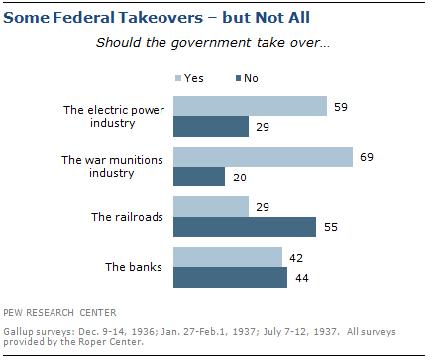
The charts are fascinating. A full 73 percent of Americans polled in 1936 thought government should provide free medical care to the poor. Sixty-four percent thought government should regulate and control war-time profits. In fact, 59 percent thought the government should take over the electric power industry and 69 percent favored nationalizing the wartime munitions industry.


And the people who were polled in these early surveys were overwhelmingly white, male and relatively well off. They were also socially conservative — 60 percent favored the death penalty and 67 percent wanted to deport all immigrants who were on public relief. Allen:


Is there a message in this for today’s America? Two possible lessons: First, it’s worth remembering that the social programs and banking controls that the New Deal era produced stood the nation in good stead over many decades of unprecedented prosperity. Second, Depression-era Americans’ faith in the country and its guiding institutions steeled them against the challenges of a double-dip recession and, years later, World War II. They had it worse, but they also expected it to get better, faster.


Compare that to a 1983 poll taken in the depth of the Reagan Recession, when 65 percent said that government had gone too far in regulating business, 62 percent rarely trusted the government in Washington and 78 percent opposed raising income taxes.


Fifty years, two generations, and the entire attitude of the American public toward government was turned on its head. It’s one of the fundamental dilemmas of American life, and one of the central reasons we’re in this mess.

Appetite: Holiday spirits

0

culture@sfbg.com

Nothing warms on cold and rainy winter nights like a good bottle of liquor — better yet, one given by (and possibly shared with) a good friend. Allow me to recommend some of my top quality favorites, including a few cocktail mixers, many of which can be found at K&L, the Jug Shop, D&M, John Walker & Company, Cask, and other local stores and suppliers.


FOR THE HIP COCKTAILIAN:


GRAHAM’S 10-YEAR TAWNY PORT ($30)

A port is really just fortified (spirits-enhanced) wine: sometimes sweet, sometimes dry, ideal for after-dinner sipping. For those who might tire of another bottle of wine, this gift travels a slightly different path. Graham’s 10-year Tawny Port is one of the more common ports but packs plenty of flavor for the price, making it a fine intro for the uninitiated. It carries floral, sweet currant, and spiced apple notes, with a whisper of creamy chocolate.


BITTER TRUTH TRAVEL PACK ($20)

For the cocktailian on-the-go, what could be better than a retro travel box of five of the best bitters in existence from German wonder duo, Stephan Berg and Alexander Hauck? The Bitter Truth travel box (www.the-bitter-truth.com) includes three mini-bottles of the gents’ Creole, Orange, Chocolate, Old Time Aromatic, and award-winning Celery Bitters. It’s an affordable, quirky gift that (bonus) showcases your savvy and panache.


SMALL HAND FOODS SYRUPS ($10–$12 EACH)

From local bartender Jennifer Colliau, this line of artisan syrups for cocktails eliminates resorting to crappy, generic grenadine — Colliau’s grenadine remains the best I’ve tasted — or attempting your own gum syrup. Small Hand products (www.smallhandfoods.com) are made with organic cane sugar, gum arabic, and fruits. There’s regular, pineapple, or raspberry gum syrups, for everything from pisco punch to tiki drinks, and an orgeat (almond syrup most commonly known as a Mai Tai ingredient) made with California almonds.


BOLS GENEVER DUTCH COURAGE GIFT SET ($38.99)

Go Dutch by giving the gift of Bols Genever, genever being the original Dutch gin. A bottle normally retails for the price of an entire Dutch Courage set, which includes a bottle and two tulip glasses for the traditional Dutch ritual of kopstootje (pronounced kop-stow-che). Translated as “little head butt,” it’s essentially a glass of beer, traditionally a lager, mixed with a shot of genever. Proost!


FOR THE DRINK AFICIONADO:


PARKER’S HERITAGE WHEATED BOURBON ($80)

I adore legendary distiller Parker Beam, whose Parker’s Heritage Collection remains a thrilling pinnacle of what bourbon can be. Though many will never forget his profound Golden Anniversary bourbon, this year’s release is truly unique. Instead of the corn-dominant notes of typical bourbon, this 10-year aged, cask-strength edition combines winter wheat and corn, bottled at 63.9 percent straight from the barrel. Open it up with a splash of water or sip neat. Either way, whiskey fans will marvel at bracing, rich layers of caramel, maple, and, yes, wheat … but also at the incredible smoothness for a spirit of this proof.


CRAFT DISTILLERS’ LOW GAP WHISKEY ($45) AND LOS NAHUALES MEZCALERO ($65)

You won’t go wrong giving any Craft spirits (www.craftdistillers.com) to an aficionado. If she isn’t already a fan of this incredible Ukiah distillery, she’ll fall in love with Craft’s brilliant brandies and grappas or exquisite bottlings like Crispin’s Rose Liqueur. Consider newer releases such as Low Gap Craft-Method Whiskey made with malted Bavarian hard wheat. Where many white whiskeys are harsh and bracing, at 90 proof, it’s intense yet balanced. Or try the recently acquired Los Nahuales Mezcalero (mezcal fans will know it as the former Los Danzantes). As with all Craft products, small production and artisanal techniques are behind this smoky-but-clean, Oaxacan-grown mezcal.


LAPHROAIG 18-YEAR SINGLE MALT ($99)

For the peat monsters among you … or rather, for those who don’t fancy the standard Laphroaig 10-year, which, like many in the line, hits hard with that peat. Extra aging has mellowed this Islay single malt to a robust but roundly balanced pour. Alongside peat smoke, enter honey, vanilla, hay, anise, and toffee nuttiness, minus the medicinal properties some tell me they get on the nose in other Laphroaig expressions. This one changes the game, and, in my opinion, best exemplifies Laphroaig’s possibilities.


TASTING ROOM SAMPLER KITS ($19.99–$29.99)

New to the market is a sampling experience a California wine fan can enjoy from home: Tasting Room (www.tastingroom.com). Discover new favorites or taste a winery line side by side (all samples are also available as full-sized bottles). Choose from six-pack sets of 50 ml bottles in groupings by winery, region, or type (for example, California cabs). Nicely packaged in a slim black box with winemaker’s tasting notes, consider it a home wine tasting for the cost of tasting at the winery itself.

Let’s get budget priorities straight

0

OPINION Who will pay for California’s budget woes? For the last three years, Californians have put up with cuts to programs that are critical to our state’s future and our social safety net. Public education, HIV and AIDS programs, state universities, and CalWORKs have all come under the knife. The elephant in the room, as state and federal governments try to balance budgets on the backs of the working and middle class, is the billions of dollars we are wasting on a misguided war in Afghanistan.

Fresh evidence that the war in Afghanistan is failing rolls in on a daily basis. While the administration justifies the cost in lives and dollars as necessary to fight Al Qaeda, it also acknowledges that there are only 50 to 100 Al Qaeda fighters in Afghanistan. Every soldier in Afghanistan costs U.S. taxpayers $1 million per year. With 100,000 soldiers on the ground, that means we’re spending as much as $2 billion a year on each Al Qaeda fighter.

Would we dream of spending $2 billion on every needy child in California? Or even $1 million? As U.S. and Afghan casualties rise along with the dollar amounts, with little success to show for it, we need to get our priorities in check.

At Governor-elect Jerry Brown’s budget forum this week, we were staring down a $28.1 billion budget deficit over the next 18 months. Compare that to the $46.4 billion Californians have already spent on the war in Afghanistan — $1.2 billion of that right out of San Franciscans’ pockets.

The Obama administration is conducting a strategy review this month that is expected to rubber stamp an approach that keeps soldiers in harm’s way — when doing so is not likely to make Americans or Afghans safer. At the same time, the president’s deficit commission chairs are also passing down recommendations to save money by cutting benefits for our most vulnerable citizens.

I would like to tell the taxpayers in my district who are shelling out these dollars that there’s a light at the end of the tunnel, but the president is now proposing ending the “combat mission” in 2014, which could mean there will be tens of thousands of troops on the ground even after four more years have passed.

I will continue to fight for our real needs in Sacramento. But it’s time for our representatives in Washington to put an end to this disastrous war and bring our troops home as quickly and responsibly as possible. Our tax dollars should be making life in California sustainable and safe for all. We can’t afford any other way.

Assemblymember Tom Ammiano represents the 13th District.

Going to a club — or boarding an airplane?

12

news@sfbg.com

The War on Fun — a term coined by the Guardian in 2006 to describe the crackdowns on nightclubs, special events, and urban culture by police, NIMBY neighbors, and moderate politicians — continues to grind on in San Francisco.

The latest attack was launched by Mayor Gavin Newsom and the San Francisco Police Department, which has proposed a series of measures to monitor and regulate individuals who visit bars or entertainment venues, proposals that the embattled Entertainment Commission will consider at its Dec. 14 meeting.

Perhaps most controversial among the dozens of new conditions that the SFPD would require of nightclubs is an Orwellian proposal to require all clubs with an occupancy of 100 persons or more to electronically scan every patron’s identification card and retain that information for 15 days. Civil libertarians and many club owners call this a blatantly unconstitutional invasion of privacy.

Driving the latest calls for a crackdown is a stated concern over isolated incidents of violence outside a few nightclubs in recent years, something Newsom and police blame on the clubs and that they say warrants greater scrutiny by police and city regulators.

But the proposals also come in the wake of overzealous policing of nightclubs and parties — including improper personal property destruction and seizures, wrongful arrests and violence by police, harassment of disfavored club operators, and even dumping booze down the drain — mostly led by SFPD Officer Larry Bertrand and his former partner, Michelle Ott, an agent with the California Department of Alcoholic Beverage Control.

Those actions were documented in back-to-back cover stories by the Guardian (“The New War on Fun,” March 24) and SF Weekly (“Turning the Tables,” March 17), and they are the subject of multiple ongoing lawsuits by nightclub owners, patrons, and employees, including a racketeering lawsuit alleging that officials are criminally conspiring against lawful activities.

Yet rather than atoning for that enforcement overreach, Newsom and SFPD officials seem to be doubling down on their bets that San Franciscans will tolerate a more heavily policed nightlife scene in the hopes of eliminating the possibility of random violence.

A series of nighttime shootings this year has grabbed headlines and prompted calls to action by the Mayor’s Office and Board of Supervisors President David Chiu, whose District 3 includes North Beach. In February, there were shootings at Blue Macaw in the Mission and Club Suede at Fisherman’s Wharf, followed by a shooting at the Pink Saturday fair in June, one outside Jelly’s in SoMa in July, and the high-profile murder of a German tourist near Union Square in August.

Chiu responded with legislation to give the Entertainment Commission greater authority to close down problem nightclubs and, more recently, with legislation to require party promoters to register with the city so that officials can take actions against those who act irresponsibly.

In September, Newsom asked the SFPD for its recommendations and he received a laundry list of proposals now before the Entertainment Commission. That body held a closed session hearing Nov. 30 to discuss a confidential legal opinion by the City Attorney’s Office on whether the identification scan would pass constitutional muster, an opinion that has so far been denied to the Guardian and the public, although officials say it may be discussed in open session during the Dec. 14 hearing.

“Everything is being considered,” Jocelyn Kane, acting executive director of the Entertainment Commission, told the Guardian. Her office already has looked at the different types of scanners that clubs could use and has discussed the idea with several technology companies.

SFPD Inspector Dave Falzon, the department’s liaison to the nightclubs and ABC, told the Guardian that he believes the data gathered from nightclub patrons would allow police to more easily find witnesses and suspects to solve any crimes committed at or near the nightclubs.

“It’s not intended to be exploited,” Falzon said, stressing that the recommendations are a work in progress and part of an ongoing dialogue with the Entertainment Commission — an agency Newsom, SFPD officials, and some media voices have been highly critical of over the last two years.

Along with the proposal for the ID scanners, SFPD proposed many other measures such as increased security personnel (including requiring clubs to hire more so-called 10-B officers, or SFPD officials on overtime wages), metal detectors at club entrances, surveillance cameras at the entrances and exits, and extra lighting on the exterior of the night clubs.

Though this may sound to many like heading down the dystopian rabbit hole with Big Brother potentially watching your every move, Falzon thinks it’s the opposite. “It isn’t that police department is acting as a militant state,” Falzon said. “All we’re trying to do is to make these clubs safer so they can be more fun.”

Yet critics of the proposals don’t think they sound like much fun at all, and fear that employing such overzealous policing tools will hurt one of San Francisco’s most vital economic sectors while doing little to make anyone safer.

Jamie Zawinski is the owner of the DNA Lounge, which recently celebrated its 25th anniversary. He has been a leading voice in pushing back against the War of Fun, including running a blog that chronicles SFPD excesses. He said the proposed regulations go way too far.

“It’s gang violence happening on the street. The nightclubs are being scapegoated. You don’t solve the problem by increased security in the clubs,” Zawinski told us, adding that the lack of proper policing on the streets should be addressed before putting the financial strain on the entertainment industry.

“It’s ridiculously insulting. I will not do that to my customers. It’s not a way to solve any problems,” Zawinski said. “It sets the tone for the evening when you start demanding papers.”

It’s also a gross violation of people’s rights, says Nicole Ozer, the director of Technology and Civil Liberties Policy for the American Civil Liberties Union of Northern California. She said that recording people’s personal information when they enter a public venue raises troubling legal issues.

“There are some real implications of tracking and monitoring personal data. The details of what you visit reveal things about your sexuality and political views,” Ozer said, adding that the ACLU would also have issues with how that information is used and safeguarded.

In response to police crackdowns on nightlife, club owners and advocates earlier this year formed the California Music and Culture Association (CMAC) to advocate for nightlife and offer advice and legal assistance to members. CMAC officials say they are concerned about the latest proposals.

“The rise in violence has to be looked at from a societal point of view,” said Sean Manchester, president of CMAC and owner of the nightclub Mighty. He noted that most of the violence that has been associated with nightclubs took place in alleys and parking lots away from the bars and involved underage perpetrators. “In many instances [the increased security measures] wouldn’t have done anything to stop it,” he said.

While there are plenty of ideas to combat crime at nightclubs, nightlife advocates say the city is going to have to look beyond club venues to address what can be done to combat crime without infringing on any civil liberties or damaging the vibrant nightlife. Or officials can just listens to the cops, act on their fears, and make the experience of seeing live music in San Francisco more like boarding an airplane.

The Entertainment Commission meets Dec. 14 at 6:30 p.m., Room 400, City Hall.

Rec & Park trashes HANC Recycling Center

At yesterday’s Recreation & Park Commission meeting on Dec. 2, hundreds of San Francisco residents turned out to urge commissioners not to replace the Haight Ashbury Neighborhood Council (HANC) Recycling Center with a community garden. Their pleas fell on deaf ears.

It didn’t matter that a sunnier spot for a community garden had already been identified in the same area, with funding approved by the commission more than a year ago. It didn’t matter that thousands of people use the recycling center every month, and that the nonprofit bolsters community gardens throughout the city with donations and funding. It didn’t matter that we’re in a recession and there were jobs on the line. It didn’t matter that HANC pays rent to a city department facing a $12.5 million deficit, but the community garden would cost $250,000.

All that mattered in the end was that Rec & Park, and Mayor Gavin Newsom, wanted the HANC recycling center out. They thought removing it might discourage homeless people from sleeping in the park and hanging around the neighborhood. After nearly four hours of listening to residents urge them not to do it, the commissioners yawned and pushed the eject button. They unanimously voted in favor of the community garden. A 90-day eviction notice is expected to go out to HANC today.

The fight over HANC’s eviction has been described as a political battle between progressives and moderates, a showdown between heroes who stand up for public safety versus intimidating thugs and the lefties who enable them, and even a sequel to the sit /lie controversy. I think there’s an 800-pound gorilla sitting in the middle of this fight that no one wants to talk about: Class.

Community gardens are wonderfully empowering. I used to volunteer at one at a public housing complex in North Carolina. It was especially important for people who lived in that low-income community, since they benefited from nutritious produce that also lowered their grocery bills. Under the city’s plan for this new, gated community garden, 30 of the 40 garden plots will go to area residents. Given the affluence of that neighborhood, the garden beds will likely go to people who can afford organic groceries at Whole Foods without breaking into a sweat. For well-to-do San Franciscans, growing produce is not a means of survival — it’s about feeling good, and being green. By itself, there’s nothing wrong with that.

The problem is that it will be installed at the expense of a long-standing community resource that employs 10 people and lightens the load for hundreds of others during a recession, when people are truly struggling to get by. The Rec & Park Commission has essentially decided that this parcel of public space should be taken from a nonprofit that benefits people of all classes, and given to a small number of residents who’ve voiced complaints about “quality-of-life issues.”

In its current function, the HANC Recycling Center is empowering to many different kinds of people. Most aren’t homeless. Tough-as-nails Asian grandmas show up with bags full of cans that they can exchange for some extra spending money. Urban gardeners purchase native plants in hopes of pleasing native insects and birds. People on fixed incomes get a small financial boost by turning in recyclables.

A small number of the HANC Recycling Center patrons do sleep outside. In order to earn small amounts of cash for things like food, many of them have to go digging around in garbage cans, which is gross and humiliating. Why would someone paw through the garbage for hours, battling bees and germs, and then haul smelly bottles uphill in a shopping cart just to make a few bucks? My guess is that it’s to ward off desperation. They make their own work, and they get to eat.

“Some of them may use drugs,” one of the speakers acknowledged last night. “But,” he paused for dramatic effect. “Some of us use drugs, too.”

When sit / lie was under debate, critics wondered where the homeless were supposed to go, if they couldn’t sit on the sidewalks. Often, the reply was that they could go to the parks. But this latest attack on the homeless shows that they aren’t welcome there, either.

This is an opinion piece.

WikiLeaks: demystifying diplomacy

0

OPINION Compared to the kind of secret cables that WikiLeaks just shared with the world, everyday public statements from government officials are exercises in make-believe.

In a democracy, people have a right to know what their government is actually doing. In a pseudo-democracy, a bunch of fairy tales from high places will do the trick.

Diplomatic facades routinely masquerade as realities. But sometimes the mask slips — for all the world to see — and that’s what just happened with the humongous leak of State Department cables.

“Every government is run by liars,” independent journalist I.F. Stone observed, “and nothing they say should be believed.” The extent and gravity of the lying varies from one government to another — but no pronouncements from world capitals should be taken on faith.

By its own account, the U.S. government has been at war for more than nine years now and there’s no end in sight. Like the Pentagon, the State Department is serving the overall priorities of the warfare state. The nation’s military and diplomacy are moving parts of the same vast war machinery.

Such a contraption requires a muscular bodyguard of partial truths, deceptions, and outright lies. With the nation’s ongoing war efforts at full throttle, the contradictions between public rationales and hidden goals — or between lofty rhetoric and grisly human consequences — cannot stand the light of day.

Details of Washington’s transactional alliances with murderous dictators, corrupt tyrants, warlords, and drug traffickers are among its most closely guarded quasi-secrets. Most media accounts can be blown off by officialdom, but smoking-gun diplomatic cables are harder to ignore.

With its massive and unending reliance on military force — with a result of more and more carnage, leaving behind immense grief and rage in Afghanistan, Pakistan, and elsewhere — the U.S. government has colossal gaps to bridge between its public relations storylines and its war-making realities.

The same government that devotes tremendous resources to inflicting military violence abroad must tout its humane bona fides and laudable priorities to the folks back home. But that essential public relations task becomes more difficult when official documents to the contrary keep leaking.

No government wants to face documentation of actual policies, goals, and priorities that directly contradict its public claims of virtue. In societies with democratic freedoms, the governments that have the most to fear from such disclosures are the ones that have been doing the most lying to their own people.

The recent mega-leaks are especially jarring because of the extreme contrasts between the U.S. government’s public pretenses and real-life actions. But the standard official response is to blame the leaking messengers.

What kind of “national security” can be built on duplicity from a government that is discredited and refuted by its own documents?

Norman Solomon is co-chair of the Healthcare Not Warfare campaign, launched by Progressive Democrats of America.


The biggest fish

6

rebeccab@sfbg.com

Shortly after Larry Ellison, the billionaire CEO of Oracle Corp. and owner of the BMW Oracle Racing Team, won the 33rd America’s Cup off the coast of Valencia, Spain, in February 2010, a reception was held in his honor in the rotunda at San Francisco City Hall.

The event drew members of Ellison’s sailing crew, business and political heavyweights such as former Secretary of State George Schultz, and other VIPs. Attendees posed for photographs with the tall, glittering silver trophy at the base of the grand staircase.

As part of the celebration, Ellison helped Mayor Gavin Newsom into an official BMW Oracle Racing Team jacket, and Newsom granted Ellison a key to the city, a symbolic honor usually reserved for heads of state and the San Francisco Giants after they won the World Series. Shortly after, the mayor and the guest of honor, whom Forbes magazine ranked as the sixth-richest person in the world, sat down for a face-to-face.

That meeting marked the beginning of the city’s bid to host the 34th America’s Cup in San Francisco in 2013. Since securing the Cup, Ellison has made no secret of his desire to stage the 159-year-old sailing match against the iconic backdrop of the San Francisco Bay, a natural amphitheater that could be ringed with spectators gathered ashore while media images of the stunningly expensive yachts are broadcast internationally.

Newsom and other elected officials have feverishly championed the idea, touting it as an opportunity for a boost to the region’s anemic economy. The city’s Budget & Legislative Analyst projects roughly $1.2 billion in economic activity associated with the event — the real prize, as far as business interests are concerned. It would also create the equivalent of 8,840 jobs, mostly in the form of overtime for city workers and short-term gigs for the private sector.

While the idea has won preliminary support from most members of the Board of Supervisors, serious questions are beginning to arise as the finer details of the agreement emerge and the date for a final decision draws near.

Ellison and the race organizers would be granted control of 35 acres of prime waterfront property in exchange for selecting San Francisco as the venue for the Cup and investing $150 million into Port of San Francisco infrastructure. But the event would result in a negative net impact to city coffers.

Hosting the event and meeting Ellison’s demands for property would cost the city about $128 million, according the Budget & Legislative Analyst, just as city leaders grapple with closing a projected $712 million deficit in the budget cycle spanning 2011 and 2012.

Part of the impact is an estimated $86 million in lost revenue associated with rent-free leases the city would enter into with Ellison’s LLC, the America’s Cup Event Authority (ACEA). In exchange for selecting San Francisco as a venue and investing in port infrastructure, ACEA would win long-term control of Piers 30-32, Pier 50, and Seawall Lot 330 — waterfront real estate owned by the Port of San Francisco, with development rights included. Seawall Lot 330, a 2.5-acre triangular parcel bordered by the Embarcadero at the base of Bryant Street, would either be leased long-term or transferred outright to ACEA.

The most vociferous opponent of the America’s Cup plan is Sup. Chris Daly, who has voiced scathing criticism of the notion that the city would subsidize a billionaire’s yacht race at a time of fiscal instability. “The question is whether or not the package that San Francisco’s putting together is good or bad for the city,” Daly told the Guardian, “and whether or not it’s the best deal the city can get.”


THE CREW

According to a Forbes calculation from September 2010, Ellison’s net worth is $27 billion, making him several times wealthier than the City and County of San Francisco, which has a total annual budget of about $6 billion. Ellison reportedly spent $100 million and a decade pursuing the Cup.

As soon as Ellison expressed interest in bringing the Cup to San Francisco, Newsom began charting a course. Park Merced architect and Newsom campaign contributor Craig Hartman of the firm Skidmore, Owings & Merrill was tapped to reimagine the piers south of the Bay Bridge as the central hub for the event, and soon Hartman’s vision for a viewing area beneath a whimsical sail-like canopy was forwarded to the media.

The mayor also issued letters of invitation to form the America’s Cup Organizing Committee (ACOC), a group that would be tasked with soliciting corporate funding for the event. ACOC was convened as a nonprofit corporation, and it’s a powerhouse of wealthy, politically connected, and influential members.

Hollywood mogul Steve Bing, who’s donated millions to the Democratic Party and funded former President Bill Clinton’s 2009 trip to North Korea to rescue two imprisoned American journalists, is on the committee. So is Tom Perkins, a Silicon Valley venture capitalist, billionaire, and former mega-yacht owner who was once dubbed “the Captain of Capitalism” by 60 Minutes. George Schultz and his wife, Charlotte, are members. Thomas J. Coates, a powerful San Francisco real estate investor who dumped $1 million into a 2008 California ballot initiative to eliminate rent control, also has a seat. Coates resurfaced in the November 2010 election when he poured $200,000 into local anti-progressive ballot measures and the campaigns of economically conservative supervisorial candidates.

Billionaire Warren Hellman, San Francisco socialite Dede Wilsey, and former Newsom press secretary Peter Ragone are also on ACOC. There are representatives from Wells Fargo, AT&T, and United Airlines. One ACOC member directs a real estate firm that generated $2.5 billion in revenue in 2009. Another is Martin Koffel, CEO of URS Corp., an energy industry heavyweight that made $9.2 billion in revenue in 2009. There’s Richard Kramlich, a cofounder of a Menlo Park venture capital firm that controls $11 billion in “committed capital.” And then there’s Mike Latham, CEO of iShares, which traffics in pooled investment funds worth about $509 billion, according to a BusinessWeek article.

There’s also an honorary branch of ACOC composed of elected officials including House Minority Leader Nancy Pelosi, Gov. Arnold Schwarzenegger, Sen. Dianne Feinstein, and others. Their role is to help the Cup interface with various governmental agencies to control air space, secure areas of the bay exclusively for the event, set up international broadcasts, and bring foreign crew members and fancy sailboats into the United States without a hassle from immigration authorities.

ACOC is expected to raise $270 million in corporate sponsorships for the America’s Cup. That money will be funneled into the budget for ACEA. It’s unclear whether the $150 million ACEA is required to invest in city piers will be derived from ACOC’s fund drive.

The city also anticipates that ACOC would raise $32 million to help defray municipal costs. “However,” the Budget & Legislative Analyst report cautions, “there is no guarantee that any of the anticipated $32 million in private contributions will be raised.”

A seven-member board, chaired by sports management executive Richard Worth, will direct the ACEA, according to Newsom’s economic advisors, but the other six seats have yet to be filled. ACEA’s newly minted CEO is Craig Thompson, a native Californian who previously worked with a governing body for the Olympics and has helped coordinate major sporting events internationally. In an interview with sports blog Valencia Sailing, Thompson provided some insight on why major corporations might be inspired to donate to the cause. Basically, the Cup is the holy grail of networking events.

“It’s a very difficult economic situation we are going through, and it’s not the best time to be looking for sponsors for a major event,” Thompson acknowledged. “On the other hand, the America’s Cup is one of the very few activities … that offer access to really top-level individuals in terms of education or economic situation. The America’s Cup is a unique platform for a lot of companies that want access to those individuals that are very difficult to reach under normal circumstances. I can tell you for example that Oracle is very pleased with the marketing opportunity the America’s Cup has presented to them. They invite their best customers and are very successful in turning the America’s Cup into a platform for generating business. The same thing can be true for a lot of different companies that need access to wealthy individuals.”

But should San Francisco taxpayers really be subsidizing a networking event for the some of the business world’s richest and most powerful players?


TRANSFORMING THE WATERFRONT

Over the past four months, Newsom’s Office of Economic and Workforce Development (OEWD) has been negotiating with race organizers to hash out a Host City Agreement outlining the terms of bringing the America’s Cup to San Francisco.

The proposal will go before the Board of Supervisor’s Budget & Finance Committee on Dec. 8, and to the full board Dec. 14. A final decision on whether San Francisco will host the race is expected by Dec. 31. ACEA and ACOC will each sign onto the agreement with the City and County of San Francisco.

From the beginning, the event was envisioned as “the twin transformation,” according to OEWD — the America’s Cup would be transformed by attracting greater crowds and heightened commercial interest while San Francisco’s crumbling piers would be revitalized through ACEA’s $150 million investment in port infrastructure.

The plan paints downtown San Francisco as the “America’s Cup Village” during the sailing events, and a study produced by Beacon Economics estimates that the financial boost would come primarily from hordes of visitors flocking to the event — more than 500,000 are expected to attend. The city expects a minimum of 45 race days, including one pre regatta in 2011 and one in 2012 (or two in 2012 if the one in 2011 doesn’t happen), a challenger series in 2013, and a final match in 2013.

The transformation of the city’s waterfront would be dramatic. In addition to the rent-free leases for Piers 30-32, 50, and Seawall Lot 330, ACEA would be granted exclusive use of much of the central waterfront, water, and piers around Mission Bay, and water and land near Islais Creek during the course of the event. Under the Host City Agreement, race organizers would have use of water space spanning Piers 14 to 22 ½; Piers 28, 38, 40, 48, and 54, a portion of Seawall Lot 337, and Pier 80, where a temporary heliport would be sited.

Seawall Lot 330, a 2.5-acre parcel valued by the Port at $33 million, lies at the base of Bryant Street along the Embarcadero and has a nice unimpeded view of the bay. Piers 30-32 span 12.5 acres, and Pier 50 is 20 acres.

The Budget & Legislative Analyst’s study predicts that the ACEA could opt to build a 250-unit condo high-rise on Seawall Lot 330, deemed the most lucrative use. Under the Host City Agreement, the city would be obligated to remove Tidelands Trust provisions from Seawall Lot 330, which guarantee under state law that waterfront property is used for maritime functions or public benefit. Tweaking the law for a single deal would require approval from the State Lands Commission, but Newsom, in his new capacity as lieutenant governor, would cast one of the three votes on that body.

The combination of construction, demolition, lost rent revenue, police and transit, environmental analysis, and other event costs would hit the city with a bill totaling around $64 million, according to the Budget & Legislative Analyst study. Since city government would recoup around $22 million in revenue from hosting the Cup, the net impact would be around $42 million. That doesn’t include the potential $32 million assistance from ACOC.

At the same time, the city would stand to lose another $86.2 million by granting long-term development rights to 35 acres of Port property for 66 to 75 years without charging rent, bringing the total cost to $128 million. OEWD representatives played down that loss in potential revenue, saying past attempts to redevelop piers hadn’t been successful because none could handle the upfront investment to revitalize the crumbling piers.

The Host City Agreement has raised skepticism among Port staff and the Budget Analyst that tempered initial enthusiasm for the event. “The terms of the Host City Agreement will require significant city capital investment and will result in substantial lost revenue to the Port,” a Port study determined. Faith in that plan seems to be eroding and it may be scrapped for an alternative plan that’s cheaper for the city.

The Northern Waterfront alternative substitutes Piers 19-29 as the primary location for the event and eliminates the Mission Bay piers from the equation. Under this scenario, ACEA would invest an estimated $55 million, instead of $150 million. In exchange, it would receive long-term development rights to Piers 30-32 and Seawall 330 on “commercially reasonable terms,” according to a Port staff report.

Board of Supervisors President David Chiu requested that the Port explore that second option more fully, and the Port report notes that it would reduce the strain on Port revenue. The Northern Waterfront plan would cost the Port a total of $15.8 million, instead of $43 million, the report notes. Port staff recommended in its report that both the original agreement and the alternative be forwarded to the full board for consideration.


PHANTOM BIDS?

Under the competition’s official protocol, Ellison, as defender of the Cup, has unilateral power to decide where the next regatta will be held. Race organizers have said it’s a toss-up between San Francisco and an unnamed port in Italy — though it’s anyone’s guess how seriously a European site is being considered by a team headquartered at the Golden Gate Yacht Club, a stone’s throw from the Golden Gate Bridge.

According to a San Francisco Chronicle article published in early September, Newsom issued a memo stating that San Francisco was competing against Spain and Italy to become the chosen venue. Valencia was said to be offering a “generous financial bid,” and a group in Rome was rumored to have offered some $645 million to bring the Cup to Italian shores, the memo noted. It was a call for the city to present Ellison with the most attractive deal possible to compel him to pick San Francisco.

Speaking at an Oct. 4 Land Use Committee hearing, OEWD director Jennifer Matz told supervisors: “San Francisco was designated the only city under consideration back in July. Now we are competing against the prime minister of Italy and the king of Spain.”

However, the veracity of those claims came into question in mid-November. Daly, incensed that the Mayor’s Office never communicated with him about the Cup despite wanting to hold it in his sixth supervisorial district, launched his own personal investigation. He fired off an e-mail to Team Alinghi, a prior America’s Cup winner, and began communicating with other European contacts until he got in touch with someone in Valencia’s municipal government.

“I got a call back from a representative who basically said I should know something,” Daly recounted. Valencia, his source said, never submitted a bid to host the Cup. At a Nov. 13 press conference, Valencia’s mayor Rita Barbera confirmed this claim, according to a Spanish press report, expressing disappointment that the city had been eliminated from consideration as a host venue. “There was no formal bidding process,” she charged. She also denied reports that any money had been offered.

Meanwhile, the Budget Analyst was unable to find any concrete evidence that other host city bids had been submitted. “We have nothing to confirm that other offers have been made,” Fred Brousseau of the Budget Analyst’s office told the Guardian.

In response to Guardian queries about whether the Mayor’s Office had evidence that Italy had indeed submitted a bid, Project Manager Kyri McClellan of the OEWD forwarded a one-page resolution from the Italian prime minister assuring race organizers that there would be tax breaks, accelerated approvals, and other perks guaranteed if the Cup came to Italy. However, an Italian journalist who looked over the resolution told the Guardian that the document didn’t appear to be a formal bid, merely a response to a query from race organizers.

Daly has his doubts that either Valencia or the Italian port were ever seriously considered. “I think they were phantom bids,” he said, “created by either Larry Ellison or the Newsom administration … to place pressure on the Board of Supervisors.”

A representative from OEWD told the Guardian that officials have no reason to doubt that the European bids, and accompanying offers of money, were real. However, the city wasn’t privy to race organizer’s discussions about possible European venues. A final decision is expected before the end of the year.

Daly hasn’t held back in voicing opposition to the America’s Cup and blasted it at an Oct. 5 Board meeting. “This tacking around Sup. Daly will not get you in calmer waters,” Daly said. “I told myself I was not going to make a yachting reference. But I will bring a white squall onto this race and onto this Cup, and I will do everything in my power starting on Jan. 8 to make sure these boats never see that water.”


WIND IN WHOSE SAILS?

The America’s Cup would undoubtedly bring economic benefit to the area and create work at a time when jobs are scarce. Police officers would get overtime. Restaurant servers would be scrambling to keep up with demand. Construction workers seeking temporary employment would get gigs. Hotels would rake it in. Pier 39 would be booming. However, the Budget Analyst report cautioned: “It is unlikely that any labor benefits would remain in the years after the America’s Cup event is completed.”

Certain small businesses would catch a windfall. John Caine, owner the Hi Dive bar at Pier 28, didn’t hesitate when asked about his opinion on the city hosting the Cup. “Please come fix our piers. It’s a shout-out to Larry Ellison,” he said. Caine said he supports the America’s Cup bid 100 percent, and is excited about the boost it could give his business. The Hi Dive would not be required to relocate under the proposal, he added.

At the same time, other small business would be negatively affected, particularly those among the 87 Port tenants who would be forced to relocate to make way for the America’s Cup. The Budget Analyst’s report also notes that retail businesses in the area whose services had no appeal to race-goers might suffer from reduced access to their stores, since crowding and street closures would shut out their customers.

The sailing community has rallied in support of the Cup, and Newsom has received hundreds of e-mails from yachting enthusiasts from as far away as Hawaii and Florida promising to travel to San Francisco with all their sailing friends to watch the world-famous vessels compete.

Ariane Paul, commodore of a classic wooden boat club called the Master Mariners Benevolent Association, told the Guardian that she was excited about the opportunity for the America’s Cup to showcase sailing on the bay. “In the long term, it’s a win-win,” Paul said. “It would be great to have that boost.” As for the financial terms of the deal, she remained confident, saying, “I don’t think that the city is going to let Larry Ellison walk all over them.”

Sup. Ross Mirkarimi is often politically aligned with Daly, but not when it comes to the issue of the America’s Cup. As a kid growing up on the island of Jamestown, a tiny blue-collar community located off the coast of Rhode Island, Mirkarimi learned to sail and occasionally spent summers working as a deckhand. Every few years, the America’s Cup would come to nearby Newport, transforming the area into a bustling hub and bringing the locals into contact with famous sailors. It left an everlasting impression. When the BMW Oracle Racing Team secured the 33rd Cup off the coast of Valencia, Mirkarimi did a double-take when he saw a photograph of the winning team — his childhood friend from Rhode Island was on the crew.

Mirkarimi told the Guardian he supports bringing the Cup to San Francisco because of the economic boost the area will receive — if the Cup continues to return to San Francisco as it did for 53 years in Newport, he said, the city could look forward to a free gift in improved revenue associated with the event, and that could help quiet the tired annual debates over painful budget cuts.

At the same time, he acknowledged that the Budget Analyst report had prompted what he called healthy skepticism. “I think the onus is on the city and Cup organizers to make sure the benefits far, far outweigh the investment,” Mirkarimi said. “This effort is not just about making one of the wealthiest men in the United States that much more wealthy … That can’t be the case,” he said. “It has to be about what will the Cup do in order to be a win-win for the people of San Francisco.” Mirkarimi said he expected scrutiny of the details of the agreement at the Dec. 8 Budget and Finance Committee hearing: “Naturally, in this time of economic downturn … people want to know, what’s the outlay of cost, and what are we going to get in return?” 

Emergency forum Tues. / 30 on HANC recycling center eviction

8

An emergency community forum will be held tonight, Nov. 30, about the Recreation and Parks Department’s plan to evict the Haight Ashbury Neighborhood Council (HANC) Recycling Center from a parking lot in Golden Gate Park. If Mayor Gavin Newsom and his former chief of staff, Rec & Park General Manager Phil Ginsburg, succeed in their plan to evict the 36-year old recycling center, they’ll kill 10 green jobs, eliminate a rare source of income for poor people, and put an end to a community resource that costs San Francisco taxpayers nothing.

HANC believes the recycling center is being targeted by Newsom’s administration as a form of political payback, since the progressive organization opposed Proposition L, the sit / lie ordinance, which Newsom supported.

Ginsburg wants to evict the recycling center, which pays rent to the city, and replace it with a community gardening center that would cost $250,000. The shaded lot doesn’t seem like an ideal site for growing produce.

A memo issued Nov. 29 from Ginsburg to Rec & Park Commissioners notes that it is legal for the department to move forward with the eviction without commission approval. Apparently, Newsom’s administration intends to send 10 people to the unemployment line and kick a 36-year-old green resource to the curb without any public input, despite receiving 400 postcards from San Francisco residents opposing the eviction. The Rec & Park Commission will take up the issue of the new community garden center at its Thurs., Dec. 2 meeting.

Tonight’s emergency forum, organized by Keep Arboretum Free, is an attempt to open up a space for public dialogue.

A stakeholder meeting took place this afternoon with Ginsburg, District 5 Sup. Ross Mirkarimi, Department of the Environment Director Melanie Nutter, representatives from the San Francisco Police Department, represenatives from the offices of Assembly Member Tom Ammiano and City Attorney Dennis Herrera, HANC, and area residents.

Jim Rhoads of the HANC Recycling Center told the Guardian just after the meeting, “They’re going to evict us by the end of December. That’s their goal. The mayor has it in for us and he wants to get us out before he leaves.”

The recycling center, located at Frederick and Arguello streets, operates a buyback program for recyclable materials as well as a San Francisco native plant nursery. Residents from the Inner Sunset Park Neighbors have voiced complaints about “quality-of-life issues” that they link with some of the center’s patrons. During buyback hours, held from 10 a.m. to 3 p.m., people arrive with shopping carts filled of cans and bottles to exchange for small amounts of cash. Some of them are homeless.

Representatives from HANC, Rec & Park, and the Inner Sunset Park Neighbors have been invited to speak at tonight’s forum. “There are strongly felt opinions on both sides,” a flier for the event notes. “In the interest of a broad discussion, a number of long time local residents organized this forum for a full public airing of the issues prior to the Dec. 2 Commission meeting.”

The forum will be held tonight, Tuesday, Nov. 30, from 7 to 9 p.m. at St. John of God, 5th Avenue at Irving St.

To voice your opinion about Rec & Park’s plan to evict HANC, call Phil Ginsburg at 415-831-2701 or email him at Philip.Ginsburg@sfgov.org.

Radical diplomacy: an interview with Guillermo Gómez-Peña

3

“It welcomes hipsters, but advocates for a more intelligent hipsterism.”

Performance artist Guillermo Gómez-Peña is sitting in his unexpectedly luxurious Outer Mission live-work space, surrounded by walls of fake masonry, stacks of props for his work, and velvet paintings of lucha libre wrestlers, police officers, and John Wayne that have accumulated in the 16 years that Gómez-Peña has rent-controlled the place. In anticipation of his upcoming performance at Galeria de la Raza‘s 40th anniversary gala (Sun/21), we’re trying to figure out a few minor details about life in 21st century America.

On the table is our two shot glasses of cachacha (he’s recently returned from a performance in Brazil) immigration politics, the fate of artistic San Francisco, the role of current events in art – just the sort of small talk one always embarks upon when meeting a stranger best known to you for crucifying himself on Ocean Beach and spending time in traditional indigenous Amerindian garb, trapped in a cage stationed in the lobbies of fine art museums’. Gómez-Peña is letting me hold his chihuahua Babalú while he (Gómez-Peña, that is) chain smokes, wearing a black cowboy shirt, bolo tie, and traces of kohl smudged along his lower eyelids.

His hipster comment is about la Galeria. Gómez-Peña has been involved there for 26 years, ever since moving up from Mexico City via Los Angeles. He had heard San Francisco was good for artists, and in Galeria de la Raza, he found spiritual resonance.

“It is one of the most original Chicano-American spaces in the country,” he tells me. Gómez-Peña, whose wife, Carolina Ponce de León, is now the executive director of the gallery, says that he feels a “sentimental connection” with the place. Ever since 1984, when then-director Rene Yañez invited his Border Arts Workshop to stage their first performance in the gallery, he has made a point to bring some version of each of his projects at la Galeria. 

“The Chicano Vampire” shreds border politics, Sun/21

It’s the space’s anti-nationalist viewpoint that draws him. Gómez-Peña, a native of Mexico City, is a man who has made his life on the border, examining the border, erasing the border. In the mid ’90s, the fake masonry that now dominates his ruby-red living room formed a part of “Temple of Confessions,” for which the artist, attired in tribal splendor, and a man dressed as a cholo gang member, sat ensconsed in Plexi-glass – end of the century saints incarnate. They encouraged visitors to approach their “confessionals” and divulge their secret thoughts about Mexico, Mexicans, race, nation.  

I ask him what secrets they told him, how he thinks those secrets would be different now, in the age of SB 1040 and yet another peak of anti-immigrant hysteria. “At that time,” he begins, drawing on his Marlboro, “the pop culture views about Mexico were much more varied. Nowadays the dominant opinion is one of a country of ingovernability, a potential trampoline for drug smugglers and terrorists. There are no longer any redeeming mythologies.”

Gómez-Peña tells me that he thinks that in the age of strife in the Middle East and grave problems within both their interiors, the United States and Mexico are no longer looking at each other. “There is a lot of silence, indifference at the border,” says the man who has staged elaborate stunts at the nations’ fracture point, including a “border wedding” in which the bride and groom stood on either sides of the wall separating us from our neighbors to the south. He says people can’t – or don’t – tell the difference between narco traficantes and migrant workers.

It’s this miasma which makes the art done at Galeria de la Raza all the more important. The space has always been a place where cultures mixed, and where Latinos found ways to enter the psyche of the American zeitgeist. Gómez-Peña says the Chicano spoken word movement got its start there on the corner of 24th Street and Bryant, as did Frida Kahlo-mania. 

But things have been changing, even for this stalwart of the San Francisco neighborhood art scene. For one thing, it’s not so neighborhood anymore. The Mission has transformed into what Gómez-Peña calls, in his typically luminous style, “a bohemian theme park.” Many of the young Chicano artists that “inform the Galeria’s aesthetics” have hightailed it out of here for the easel space and relatively easy rent checks of the East Bay and beyond. 

Obama has disappointed Gómez-Peña. In the wake of a campaign that everyone believed in, wanted to believe in, the arts funding promised hasn’t been delivered. Nowadays, the artist sees fellow creatives having to work two times as hard for their paycheck, even a brain drain of people leaving for the more affordably fertile soils of Buenos Aires and Lisbon. It’s one of the subjects of his performance piece on Sunday, which he calls Strange Democracy. The program will also honor Yañez, House on Mango Street author Sandra Cisneros, and Tomas Ybarra-Frausto, the acclaimed Chicano Studies professor.

But through the slings and arrows of political misfortune, Gómez-Peña has found ways to be proactive. His Pocha Nostra group is one way, a program that hosts artists in both Tempe, Arizona and Oaxaca in forming multi-cultural, politically striking performance pieces – and, as he riffs, contributes to the “trafficking of artists across the border – we’re intellectual coyotes!” 

And on Sunday, he can contribute his unique style to that of Galeria — a place where he says there is “radical cultural diplomacy, a place for different cultures to meet in a time in which the whole country is becoming divided ideologically and when Latinos are being demonized.” A place where we can all meet and talk in the kingdom of confessions, cachaca, and Babalú.


“40 Years Adelante!”: Galeria de la Raza benefit performance and awards ceremony

Sun/21 4-9 p.m., $40-65

Brava Theatre Center

2781 24th St., SF

(415) 826-8009

www.galeriadelaraza.org


How to fight the GOP

0

OPINION Now what?

Now we need to build a grassroots progressive movement — wide, deep, and strong enough to fight the right and challenge the corporate center of the Democratic Party.

The stakes are too high and crises too extreme to accept “moderate” accommodation to unending war, regressive taxation, massive unemployment, routine foreclosures, and environmental destruction.

A common formula to avoid is what the Rev. Martin Luther King Jr. called “the paralysis of analysis.” Profuse theory + scant practice = immobilization.

It’s not enough to denounce what’s wrong or to share visionary blueprints. Day in and out, we’ve got to organize for effective and drastic social change, in all walks of life and with a vast array of activism.

Yes, electioneering is just one kind of vital political activity. But government power is extremely important. By now we should have learned too much to succumb to the despairing claim that elections aren’t worth the bother.

Such a claim is false. For instance, consider the many hundreds of on-the-ground volunteers who rejected the paralysis of analysis by walking precincts and making phone calls to help reelect progressive Rep. Raul Grijalva (D-Arizona). Grijalva won a tight race in the state’s southwestern district and will return to Congress next year — much to the disappointment of the corporate flacks and xenophobes who tried to defeat him because of his strong stance against the state’s new racial-profiling immigration law.

The mass-media echo chamber now insists that Republicans have triumphed because President Obama was guilty of overreach. But since its first days, the administration has undermined itself — and the country — with tragic under-reach.

It’s all about priorities. The Obama presidency has given low priority to reducing unemployment, stopping home foreclosures, or following through with lofty pledges to make sure that Main Street recovers along with Wall Street.

Far from constraining the power of the Republican Party, the administration’s approach has fundamentally empowered it. The ostensibly shrewd political strategists in the White House have provided explosive fuel for right-wing “populism” while doing their best to tamp down progressive populism. Tweaks aside, the Obama presidency has aligned itself with the status quo — a formula for further social disintegration and political catastrophe.

The election of 2010 is now grim history. It’s time for progressives to go back to the grassroots and organize with renewed, deepened commitment to changing the direction of this country. If we believe that state power is crucial — and if we believe in government of, by, and for the people — it’s not too soon to begin planning and working for change that can make progressive victories possible in future elections. 

Norman Solomon is co-chair of the Healthcare Not Warfare campaign, launched by Progressive Democrats of America. His books include War Made Easy: How Presidents and Pundits Keep Spinning Us To Death.

Slough Feg’s Mike Scalzi talks metal, philosophy

6

(For a review of Slough Feg’s latest, The Animal Spirits, go here. Read on for an interview with the band’s guitarist-singer, Mike Scalzi.)

San Francisco Bay Guardian: I noticed a clear theological theme running through the album. Was that – the Reformation – an area of historical interest to you? I’m interested in that choice, of a less exciting historical topic than maybe a more violent event…

Mike Scalzi: It’s not as metal, certainly. But in another way, Martin Luther was very metal, in that he was dedicated. Though he was Christian, in his dedication and his rebellion, he was metal. I was reading about all that stuff in an anthology of Western cultures. It was very general – I had to teach it. I’m a teacher. I started teaching Philosophy of Religion a year ago for the first time, and I’m not really that into teaching it, because its not my area of expertise, but I kinda had to.

[Writing music] helps me, actually. If I can write a song about it, it becomes more ingrained in my everyday thought. It becomes more second nature to say “oh, the 95 Theses!” It’s not just as a teaching aid, though. When it comes to Renaissance Christian theologians, he’s the most metal one. He’s out in the world. He’s out doing stuff, being a revolutionary. And a lot of his views are funny, a lot of the things he said were really funny and really extreme.

SFBG: Less metal for being ultimately successful, though. A lot of those so-called heretics were metal in the sense that they died for their principles, or were burnt at the stake or what have you.

MS: But he was the most badass one! Obviously, I don’t agree with him – he was a fundamentalist and all that, and he brought on fundamentalism in a way, I guess. But at least he said that trying to believe that the Bible is literal fact by reason alone is preposterous. That’s why he thought you had to exercise faith – because it’s preposterous. Everything in the Old Testament is preposterous, but you have to believe in it, purely to test your faith.

After seven records, you have to think of new things. I don’t want to repeat myself.

SFBG: What was the rubric for the lyrics that were included in the liner notes?

MS: Oh, those are the lyrics to “Trick the Vicar”

SFBG: Oh, so it’s just the one song?

MS: That was my decision. I’m sick of like…I’ve done that on every record and…

SFBG: People parse your lyrics?

MS: Oh, I don’t care about that. They come up with all sorts of weird interpretations, as if I really care that much. “Oh this means this and that means that. This is the deep meaning in this.” There’s no deep meaning in this shit! At least not that I know about! But at this point, trying to find things to say is a challenge.

With “Trick the Vicar,” I thought the lyrics to that would be important because it’s all one big pun. There’s obviously no deeper meaning, other than just being entertaining. It’s like something from a Benny Hill skit or something. So on the inside of the CD, I had all the puns – I came up with all those puns in the same month. They’re really silly, obviously.

SFBG: Well I did mean to confirm whether or not “boister” was a word.

MS: Good, good! No, its not. But when I say “There’s a boister that goes on in the cloister”…

SFBG: …from context it’s pretty clear.

MS: Yeah. It’s just a bunch of silliness, but it works for the song. I like silliness, and that’s one of the things that’s missing from a lot of metal: a good sense of humor. Metal used to have a sense of humor, in the 70s and 80s.

SFBG: That’s something that I was meaning to ask you about, if there’s a way to account for that sudden lack of humor. You have this form of music that has this potential to be taken seriously, but also the potential to be looked at with a sense of humor, or with an understanding of its many tongue-in-cheek aspects. It seems like a lot of its biggest fans, a lot of the people with the kind of familiarity with it that would enable them to see the humor, are the people least able to see it.

MS: Well, there are a lot of stupid people. You go to a metal show and you run into a lot of morons. Around here, you don’t have as many.

SFBG: I think it’s sort of like a dumbbell shaped-graph. On the one end, it attracts a lot of stupid people, but on the other end, it attracts a lot of people who are discerning and smart.

MS: I think, basically, they’re going to laugh at you one way or another. Being a metal guy, especially when you’re old, or older, or from the last generation of metal, they’re going to laugh at you. You make the choice of whether they’re going to laugh at you or with you. And I choose to laugh with them!

Also, metal, or indeed all rock and roll, is inherently funny. It is! People used to know that!

SFBG: Or inherently fun. That’s what a lot of people seem to lose sight of.

MS: Metal is inherently funny. No matter what! It’s funny. That’s one of the best things about it! It’s ridiculous, and it’s great because it’s ridiculous. People realized that way back. Black Sabbath, maybe not Led Zeppelin — they never had much of a sense of humor – Deep Purple, Judas Priest. The New Wave of British Heavy Metal. Early glam metal – Twisted Sister, Quiet Riot – they all had a sense of humor. Van Halen! Give me a break…that band was all humor until Sammy Hagar came, and it lost its sense of humor, and it started to suck.

The way that these things incorporated humor resembled vaudeville. That was David Lee Roth’s whole thing. Humor is part of entertainment. The most serious, heavy band, Black Sabbath, was also the most funny, because they realized – they were a British band with a British sense of humor.

SFBG: It’s interesting that you mention that. Do you think the trans-Atlantic shift had anything to do with that loss of humor?

MS: No, because Van Halen is the funniest. Maybe they’re not metal. Manowar! I don’t know if you want to open that can of worms. There’s a lot of evidence that they started out as a joke. They started out tongue-in-cheek and got serious as they went along. They know they’re funny; they may not want to acknowledge it, but they are.

SFBG: And the humor is bound up in the fact that everyone knows there is a joke, but no one will actually admit it. You can listen to it and pretend that you’re taking it seriously.

MS: It’s true of hardcore too. It used to be funny, now its all [imitates hardcore singing]. It’s lost its humor – some of it hasn’t, but most of it has. That’s one of my problems with a lot of the metal in this country, or in Germany too – people take it too seriously.

It’s the same thing with entertainment. I’m accused of being too traditionalist and narrow, but I’m bored by anything else. The way that entertainment used to be, in my opinion, was better. Period. It just used to be better. And now, it lacks.

I guess the question you’re asking is “why?” I don’t know why. I think it’s something about the world and the way people see entertainment. It has a much wider scope than it used to. People are much more involved in it as fans, and take it seriously as a statement, which is great, but maybe some of the actual enjoyment of it – from the performance standpoint and the artists’ standpoint – has been diminished by the fact that people hold it too close to their heart. The fragility of their egos and their identity are wrapped up in it in a way that causes problems.

SFBG: Like many discussions about the evolution and history of metal, I blame Nirvana. They taught people, or people took away from them this idea that if a band was trying to entertain you, that was somehow false.

MS: Well, that happened way before Nirvana, but that’s when it hit mainstream.

SFBG: There’s that line in Smells Like Teen Spirit: “Here we are now/Entertain us.”

MS: I don’t know if I have much to say about that. At the time, I didn’t like it. I heard their first album, before they were really popular, and I didn’t like it then. I was playing shows in San Francisco at the time, and I knew that I was not down with what was happening as a result of them. “Don’t try.” “Don’t give a shit.” “Nevermind.” “Be a loser.” I mean, sure, I thought that when I was a teenager. That’s the 14-year-old mentality: “everything sucks, so fuck it, man.” By the time you’re in your twenties you’ve grown out of that, you try to do something, unless you end up like Kurt Cobain, and you just fade off into negative, negative, everything sucks, and then die. [Sarcastically.] That’s great! That’s my hero! [Chuckles ruefully.] What the fuck is that?

SFBG: So, part and parcel of the conversation we’ve been having is the fact that you’re a very opinionated guy…

MS: So you’ve read my blog posts. There’s a new one today! I was just reading the comments.

SFBG: I did read them. I can only imagine what kind of comments you’re going to get on the most recent one. I was wondering if there’s something you can identify about metal that helps it attract opinionated people. Or, to reverse the chicken and the egg, if there’s something about being into metal that makes people opinionated?

MS: Well, I don’t think people get into metal for some other reason, and then get opinionated once they’re into metal. Unless you want to get into the fact that most metal is so bad now that you can get into it and say “oh god I’m so opinionated because there’s so much garbage out there. That’s true of a lot of kinds of music though.

It attracts opinionated people because it is extreme music. It attracts people who are into a certain kind of mentality. It happens from such an early age! I can’t analyze it. I got into metal, like a lot of people, when I was pretty young, and that was a long time ago! I don’t remember exactly. I don’t have immediate access to that feeling first being attracted to it. To me, its something that happened so far back that its like…

SFBG: …it’s like asking “why do you like mac ‘n’ cheese?”

MS: Exactly. And I have more access to what’s happened since then. But I don’t feel like I’m actively opinionated. People take things in, and they call them like they hear them. To me, things assault my sense, not the other way around. Nobody remembers being born into the world of music or food or anything and going “Hmm, I’m going to investigate this thing!” It’s more you hear something and you’re passed into this impression that you have. And some things, you get an impression and you go “Argh, that sucks! That really bothers me!” So my opinions, like those of most people who are opinionated, come from being stimulated by something in a positive or negative way. I would say I call it like I hear it.

I never thought of myself as opinionated until I moved here. People said that if I moved to San Francisco there would be all this great music. They said, “People out there are very enlightened.” And then I got here – 20 years ago – and I thought, “Everybody here’s not really that enlightened. There’s a lot of stupid bullshit going on out here.”

SFBG: Switching tacks completely, I’m curious about your master’s degree in philosophy. I read a little bit in another interview about what you teach, but I’m curious about what you focused on in your studies.

MS: I ended up studying Descartes for my thesis. I was interested in Descartes as a graduate student because his method was very simple and intuitive, and the whole point of it was a do-it-yourself type thing, rather than getting involved in this long academic tradition. Obviously, like anyone else, he comes from an academic tradition, but his point in Meditations [on First Philosophy] was to say “let’s erase everything that happened beforehand in philosophy and science and start on your own, with what you can know by yourself.”

I just found Descartes pretty easy to understand. I was able to maneuver in that ontology. I started taking seminars on Descartes, and I subsequently got interested in German idealism, like Kant and Schopenhauer, and like every metalhead, I was interested in Nietzsche.

In a master’s degree, you end up focusing on major guys because they have these comprehensive exams that test your knowledge of Plato, Descartes, Hume, etc. I stuck to a lot of that, because I knew I would have to take an exam on it.

SFBG: That Kantian or Cartesian originalist thinking – wiping the slate clean, starting with the Categorical Imperative, or something like that…

MS: …well, Kant is much more in the tradition, he’s not trying to wipe the slate clean. He’s just trying to be revolutionary.

SFBG: I’ll admit I’m only tenuously familiar with Kant, but I remember his ethics being founded on a sort “first principle” that ignores cultural baggage and so forth.

MS: Well, that’s what people say, but his point is to come up with something that is not dependent on circumstance in any way at all. Something that’s not empirical, that’s totally dependent on reason. Just like Descartes’ “I think, therefore I am,” in a way.

It’s something that you try to universalize by saying “what if everybody did this?” [Motions toward cookie on the table.] What if I were to steal this cookie? What if everybody did that? If it produces a contradiction – if its unreasonable for everybody to do something – you have to decide if it would be possible. Not if it would be right or wrong.

In order to establish a standard of right and wrong, you have to decide if it’s reasonable – could everyone do it. Suppose I don’t keep a promise – I say I’m going to show up here at 11, and I don’t. If I don’t do that, and I don’t keep my promise, what happens? It undermines the principle of the promise in the first place. If I don’t keep a promise, whatever, no big deal. What if nobody keeps promises. Could everybody do what I did? If no one keeps promises, there wouldn’t be promises in the first place.

SFBG: There’d be no point.

MS: You couldn’t make promises, because there’d be no such thing.

SFBG: Like if everyone stole, there would be no point in having property.

MS: If there were no property, you couldn’t steal. If there were no taking anybody’s word for anything, you couldn’t make a promise. It undermines its own possibility. It’s a contradiction that makes the act itself impossible. If its irrational to that extent, to the point where it makes the act itself a contradiction, then, according to Kant, its not morally permissible. That’s a little bit of a long answer.

SFBG: I’m going to attempt a sort of interviewer Triple Lutz here. Is Descartes’ idea of discarding what has come before, or Kant’s idea of ignoring circumstance to come up with principle…

MS: …Rational principle…

SFBG: …purely rational principle. Can that be applied to your creative process? In the sense that…

MS: No. [Laughs.] I wish I could say that it could. That’d be a brilliant piece of journalism. But as much as I’d love to be able to say that there’s some heavy metal calculus that I use in order to write by sheer principles of reason…no. At least, not for me. It’d be cool if there was some guy, some alchemist songwriter guy who was trying to find the principle of guitar or whatever.

SFBG: You could sort of take a stab at the categorical imperative of metal though, being like Maiden, Priest, and Sabbath, and not being affected by sort of the whims of circumstance.

MS: That’s the problem I’m encountering though. I don’t want to say that everything’s all based on the past. I don’t want to be a heavy metal anachronism. That’s what I’m getting in a lot of these responses to my Invisible Oranges articles. Again, to be philosophical about it, I get this confusion of cause and consequence. A lot of people say to me: “you don’t like death metal because you haven’t explored it.”

I try to keep the analysis somewhat objective, about why I don’t like the cookie monster vocals, the guitar sounds that are very brittle, and the drums that are triggered – clickety, clackety, clickety doesn’t sound “brutal.” It sounds like some bullshit to me.

People say, “You haven’t explored it enough. You haven’t heard the good stuff. You haven’t gone to the lengths that it takes to appreciate it.”

SFBG: If it’s good, it shouldn’t take any “lengths.”

MS: It’s confusing the cause with the consequence. It’s not that I don’t like extreme metal because I haven’t listened to enough of it. I haven’t listened to enough of it because I don’t like it. People think that I’ve come up with some sort of rigid heavy metal calculus and say “I like Priest, I like Maiden, I like Sabbath, Saint Vitus, whatever, some underground stuff too. These are the criteria of what I will listen to.”

It’s not like that! I grew up with the evolution of the whole thing, listening to it happen, and I heard things, and I said “I don’t like that! That’s crap! That sounds like someone who doesn’t care about what they’re doing.” It just sounds like shit to me, for whatever reason. And I heard more and more of it, and I chose not to investigate it.

SFBG: Getting back to philosophy just briefly, I saw in another interview that you described your music as having a Machiavellian aspect. I understand a Nietzschian aspect, but how does Machiavelli come into it?

MS: I was probably joking! I’m not sure. I was just being macho, talking about taking over the world. It’s a very vague characterization of Machiavelli, who I don’t really know shit about anyway.

SFBG: I was struck by the William Blake references in one of your old songs, “Tiger! Tiger!” Blake has always struck me as very metal.

MS: The reason that I put that stuff in there is not because of William Blake. It’s because of Alfred Bester, who quoted him.

SFBG: I noticed that you mentioned that author a lot in other interviews.

MS: A lot of sci-fi fans haven’t read him! This is insane to me. When people read The Stars My Destination – the original title of which was Tiger! Tiger! – they say “that’s the greatest fiction book I’ve ever read.” I was not a sci-fi or fantasy reader until I was 26, and someone got me that book. It was completely a fluke. I got it and I was like, “Ehh, I don’t really like science fiction books,” and then I finished it and said, “This is the best book I’ve ever read in my life.” Only on the basis of that did I get into science fiction.

SFBG: It’s tempting to ask you questions about Slough Feg’s distinctive sound, but seeing where my fellow interviewers have gone before, I was wary. It seems like we journalists want to get you to say “Oh, I choose to write songs with major chords because of this reason which is easy to print,” and your response is to say, “Look, this just my creative process; it’s how it sounds good to me.”

MS: Well, something that sounds good to me vocally sounds good because it’s catchy. If I remember it. I don’t always tape everything that I do. So, why do I remember it? That’s a whole question. Maybe I remember it because it sounds a little bit unique, maybe for some other reason.

SFBG: I think the music stands out to people, whether on record or live, because it makes melodic choices that almost seem like a deliberate subversion of the conventions of metal, like all those major chords. But I’m assuming that wasn’t a choice to subvert. That there wasn’t a point at which you were like, “Heavy metal is in minor keys – I’m going to do it a different way.”

MS: Well maybe there was! Again, it wasn’t a conscious choice. I don’t write Slough Feg songs according to music theory. I don’t say, “Now we’re going to do a song like this; now we’re going to do a song with these chords, or with this type of vocals.” If you do that, it ends up sounding overly stiff and deliberate.

But having said that, that’s not to say that there isn’t some kind of overall approach. When I do write stuff, what do I edit out? What do I keep? Stuff that reaches a certain criteria after the fact. Not when I come up with riffs, or vocals – that just happens. But what do I choose to keep? I don’t think about it consciously – it’s second nature to me now, so its hard to say – but basically, at one point, I wanted to write things that imitated Maiden, Sabbath, Thin Lizzy, Alice Cooper, Saint Vitus, Black Flag, and all that.

It became second nature to say “I want to pick up where Maiden left off,” but not to use major chords. The first “Irish-sounding” song I ever did was called “The Red Branch,” and I was sitting around in my living room, in a place I lived in years and years ago, I was sitting in my living room with an acoustic guitar, just joking around, singing to somebody as a joke, and I thought, “That’s a cool chord change!”

I keep a lot of things that other people would throw away, that they’d be scared to put on a record because it’s too silly-sounding. I say to myself “this is actually something that someone else wouldn’t do, and have the nerve to take seriously.” I think a lot of people are embarrassed to play Slough Feg-type songs. They were 20 years ago, at least. And now we’ve developed the sound to the point that it’s sort of obnoxious. People are like “what the hell man! This guy is willing to do this?!”

That’s what happened in San Francisco in the mid-nineties, playing this music. People would be like “God, you’re willing to get up onstage and play that? That sounds like nursery-rhyme music with metal instruments. It’s major. You’re singing like you’re in a 50s musical!”

Those are the kind of influences that I incorporate, maybe because it was something people weren’t willing to do, and so it sounded fresh to people.

SFBG: That sort of discomfort you describe is interesting, because you have this whole other offshoot of metal that’s built on discomfort. Black metal is based around saying “which chords can I play that will make people uncomfortable, that are the most dissonant.” You’ve come up with an incredibly unique way to do the same thing. You challenge people’s expectations, you make them uncomfortable, you take them out of their comfort zone, but instead of being really really heavy, or really fast, or really dissonant, or really down-tuned, you just have your own personal approach: to write chord changes that are, you know, silly.

MS: Or just really, really, traditional. Not that I intended that. But this is good, I think we hit the nail on the head in sense. When I started developing the sound, in the early nineties, a lot of it was a reaction. I didn’t write these looney tunes in 1989. I wrote them when I got here, and I started playing some shows, and I noticed that all the bands were drab, and all the bands played sort of one-dimensional speed metal. And I was totally nonplussed by it.

What I was writing was a reaction. I was saying “what can be done at this point?” Punk rock and speed metal and grindcore are just an extension of the same dirge – being obnoxious by being a dirge.

SFBG: And it’s an arms race, right? You can only go so fast. And then the next band that comes along has to go faster than that.

MS: And also it’s the attitude that’s so passe after a while. Spitting blood and whatever. I wanted touch on what people inevitably heard – kid’s music, or what your parents were playing – and pose the question: “are you willing to admit that this is enjoyable to you?” Slough Feg songs that do sound like they’re from a 50’s musical. Are you able to admit that this is catchy to you? That’s the punk rock maneuver, that I was able to think of it in those terms. And that’s what set us apart. But in a totally different way, in a way that goes back to like, “This is inherently enjoyable. Are you willing to partake in it, or are you too cool for it?”

SFBG: And it’s diametrically opposed to black metal. Black metal is “I will alienate you by doing something that is not enjoyable.” Your approach is “I will alienate you by doing something that is too enjoyable.”

MS: After the fact, that’s how we can analyze it. I think that’s a proper way to look at it. My songs do assault the listener, and people say “I can’t get it out of my head!” Because it’s written in very simple way – they’re really not that hard to write, but it’s a kind of songwriting that people aren’t willing to do.

Someone said to me in the 80’s, when I liked Venom a lot – they’re a very silly, vaudevillian form of Satanic metal – “Why do you like this? Anybody can do that. Anybody can play Venom songs.” And I said “yeah, that’s true. But nobody is willing to. That’s what makes it special.”

www.sloughfeg.com

Film Listings

0

Film listings are edited by Cheryl Eddy. Reviewers are Kimberly Chun, Michelle Devereaux, Peter Galvin, Max Goldberg, Dennis Harvey, Johnny Ray Huston, Louis Peitzman, Lynn Rapoport, Ben Richardson, and Matt Sussman. The film intern is Ryan Prendiville. For rep house showtimes, see Rep Clock. For first-run showtimes, see Movie Guide at www.sfbg.com. For complete film listings, see www.sfbg.com.

OPENING

The Blue Tower Smita Bhide’s debut film, The Blue Tower, part of the 3rd I South Asian International Film Fest, begins with Mohan (Abhin Galeya) in the sort of loveless marriage that has become a standard cliché. It’s unnecessary to give any reason why the relationship is failing; as a viewer I accept it just as easily as I realize that with the introduction of Judy (Alice O’Connell), a young white nurse working for Mohan’s overbearing Auntie, Mohan will have an affair. However, this predictable fare, like a straight version of My Beautiful Laundrette (1985), takes a dark turn about halfway through, as every character and plot point emerges as more nefarious and twisted than originally imagined, and Mohan finds himself in a situation full of Lynchian perversion and Kafkaesque disorientation. The boldness and speed at which developments occur shifts the deadpan, suburban drama into a black-humored, grotesque ride — the sort you half want to stop, and you half want to see where it’s going. (1:25) Castro. (Prendiville)

*Brutal Beauty: Tales of the Rose City Rollers Focusing on Portland-based league Rose City Rollers, Chip Mabry’s Brutal Beauty offers some insights into the recent roller derby revival. The documentary follows the league travel team’s attempt to make it to Nationals over the course of the 2009 season. Ultimately though, the narrative really isn’t all that exciting (spoiler alert: they don’t make it very far). The real heart of the movie lies in the backgrounds and interviews of the tatted-up, foul-mouthed, dyed-haired derby girls from teams like the Break Neck Betties and Guns ‘N’ Rollers. Their personalities and stories of how derby helped shatter their ideas of self-expression and traditional gender norms helps keep the majority of the film’s 80-minute running time interesting, even when the action is not. (1:20) Red Vic. (Landon Moblad)

Butte, America: The Saga of a Hard Rock Mining Town This documentary follows the life and death of a great American mining town, following Butte, Montana’s rise as a mining town through to its inevitable environmental collapse. Once home to one of the world’s largest (and most dangerous) copper mines, Butte saw an influx of immigrants drawn to “the richest hill on earth.” Its story is definitely rich in terms of subject matter, particularly with the town’s role in the labor struggle; it could easily be the background for great early 20th century stories (as is the case with Atlantic City in HBO’s current Boardwalk Empire). But Butte, America is decidedly not cinematic, despite the voice-over narration by Gabriel Byrne, and is better suited to PBS than the big screen. (1:06) Victoria. (Prendiville)

Carlos Carlos, Olivier Assayas’s biopic of Ilich Ramírez Sánchez, a.k.a. Carlos the Jackal, begins with a warning, that while the film is the subject of historical and journalistic research, “relations with other characters have been fictionalized.” In other words: there be contradictions ahead. But I suppose that’s the least you can expect when you’re watching a 330 minute theatrical miniseries that gives the rock ‘n’ roll biopic treatment to a terrorist who, under an alias, professes “the pleasure of doing one’s duty in silence.” Much of this is intentional, questioning the convictions of extremists. One particularly well-shot scene involves Carlos (Édgar Ramírez) sexually dominating a cell member, only moments after she admits to being a German feminist. After about four hours, though, the intellectual irony begins to feel more like a filmmaker attempting to cover his bases. Carlos is an idealist, but also a sellout. An egalitarian revolutionary, but also a sexist bigot. (And so vain.) Still, the film, full of actors speaking a bevy of languages and propelled by a international punk rock soundtrack, manages to be engaging. Keep in mind, though, that the miniseries was originally aired in three parts, and viewing Carlos in one sitting should be left to the cinemasochists. (5:30) Sundance Kabuki. (Prendiville)

Due Date Robert Downey Jr. and Zach Galifianakis star in this Todd Phillips-directed road trip movie. (1:35) Four Star, Presidio, Shattuck, Sundance Kabuki.

*Fair Game Doug Liman’s film effectively dramatizes yet another disgraceful chapter from the last Presidential administration: how CIA agent Valerie Plame (Naomi Watts), who’d headed the Joint Task Force on Iraq investigating whether Saddam Hussein had WMDs, was identified by name in the Washington Post as a covert agent — thus ending her intelligence career and placing many of her subordinates and sources around the world in danger. This info was leaked to the press, it turned out, by highest-level White House officials as “punishment” for the New York Times editorial former ambassador Joe Wilson (Sean Penn) — Plame’s husband — wrote condemning their insistence on those WMDs to justify the Iraq invasion by then already well in progress. (The CIA task force had also found zero evidence of mass-destruction weapons, but Bush and co. chose to come up with their own bogus “facts” to sway US public opinion.) Purportedly, Karl Rove clucked to CNN’s Chris Matthews that Wilson’s awkwardly-timed dose of sobering truth rendered his spouse “fair game” for exposure. Unfortunately opening here several days after it might theoretically have done some election-day good — not that many Republican voters would likely be queuing up — Fair Game may be a familiar story to many. But its gist and details remain quite enough to make the blood boil. While the political aspects are expertly handled in thriller terms, the personal ones are a tad less successful. That’s partly because we never quite glimpse what brought these two very busy, business-first people together; but largely, alas, because so many of Wilson’s diatribes come off all too much as things that might be said by Sean Penn, Rabble-Rouser and Humanitarian. This is perhaps a case of casting so perfect it becomes a distracting fault. (1:46) Embarcadero, Sundance Kabuki. (Harvey)

For Colored Girls Sprinkling many tears and Janet Jackson’s blue steel throughout his high-camp, muy melodramatic adaptation of Ntzoke Shange’s For Colored Girls Who Have Considered Suicide When the Rainbow Is Enuf, Tyler Perry deserves at least an E for effort in attempting to bring Shange’s choreopoem masterpiece to the screen. The result is a free-floating, somewhat tortured contemporary collection of vignettes centered on a clutch of African American women residing in an Harlem apartment building — a structure that remotely evokes an early Wong Kar-Wai omnibus like Days of Being Wild (1991), sans the narrative ambiguity and sublime cinematography — with its “colored girls,” each representing a hue in Shange’s rainbow, occasionally pouring out the poet’s original verse. Crystal (Kimberly Elise) appears to have it the hardest, burdened with an abusive baby daddy (Michael Ealy), a veteran dealing with Post Traumatic Stress Disorder. Dance teacher Yasmine (Anika Noni Rose) is the beacon of positivity who finds her trust horribly betrayed. Tangie (Thandie Newton) is the saucy slut, baby sister Nyla (Tessa Thompson) is the good girl with a secret, and their mother Alice (Whoopi Goldberg) is the building’s extremely annoying holy roller. Overseeing all is the apartments’ de facto matriarch Gilda (Phylicia Rashad), safe sex activist Juanita (Loretta Devine), and social worker Kelly (Kerry Washington). Oh, yes, and there’s Miss Jackson, who plays the leather-tough, magazine-editing devil wearing Prada, and spends most of her time looking wrecked about possibly ruining her makeup with an actual facial expression. Yes, they will survive, hey, hey, and though Perry may not have been the best moviemaker to adapt Shange’s groundbreaking work, a few of his players, particularly Newton and Elise, rise above the rainbow with wrenching, scene-stealing performances. (2:00) (Chun)

Honest Man: The Life of R. Budd Dwyer Everyone of a certain age or with morbid curiosities has heard of R. Budd Dwyer, thanks to the very public way he died — by committing suicide at a televised-live press conference. The 1987 footage, of a portly middle-aged man with anguish in his eyes and a finger on the trigger, has been recycled in a number of contexts; thanks to the internet, it’s now freely viewable for shock value more than anything else (the incident created a controversy as to how much should be shown during news replays — when Dwyer takes out the gun? When he sticks it in his mouth?) Along the way, who Dwyer was, and why he shot himself, have kind of been lost by the general public. However, as director James Dirschberger discovers, the Pennsylvania politician’s widow, children, colleagues, and even the man whose testimony lead to a conviction in Dwyer’s corruption trial have never forgotten him. Honest Man suggests that Dwyer was actually innocent, but decided in despair to end his life before he’d been removed from office, thus allowing his family to collect full benefits. The full story will probably never be known, but Honest Man‘s attempts to show the man behind the gruesome film clip are sincere, if couched in the understanding that he’ll always be first associated with his infamous, well-documented death. (1:16) Red Vic. (Eddy)

*Megamind Be careful what you wish for, especially if you’re a blue meanie with a Conehead noggin and a knack for mispronunciation and mayhem. Holding up hilariously against such animated efforts as The Incredibles (2004) and Monsters, Inc. (2001), Megamind uses that nugget of wisdom as its narrative springboard and takes off where most superhero-vs.-supervillain yarns end: the feud between baddie Megamind (voiced by Will Farrell) and goody-two-shoes Metro Man (Brad Pitt) goes waaay back, to the ankle-biter years. They’ve battled so often over intrepid girl reporter Roxanne Ritchi (Tina Fay) that she’s beyond bored by every nefarious torture device and disco crocodile the Blue Man throws at her. When Mega finally, unexpectedly vanquishes his foe, he finds himself with a bad case of the blues. With the help of his loyal Minion (David Cross), he decides to change the game and create his own worthy opponent, who just happens to be Roxanne’s schlubby cameraman (Jonah Hill). Chortles ensue, thanks to the sarcastic sass emanating from the Will and Tina show, although the 3-D effects seem beside the point. The resemblance to this year’s Despicable Me is more than a little passing, from the bad guy on the moral turnaround to the adorable underlings, but Megamind‘s smart satire of comic hero conventions, its voice actor’s right-on riffs, and the rock and pop licks on the soundtrack make it the nice and nasty winner. (1:36) Presidio, Sundance Kabuki. (Chun)

*Monsters After a NASA space pod bearing samples of extraterrestrial life crashes in northern Mexico, a large swath of the now massively walled-off U.S. border area becomes an “Infected Zone,” with frequent unpleasant contact between humans and giant octopus-like creatures. Photographer Andrew (Scoot McNairy) is reluctantly charged with delivering his publisher’s daughter Sam (Whitney Able) to safety. Unfortunately, things do not go as planned. The duo find themselves making a dangerous journey northward straight through the Zone, right at the start of an annual “migration season” that always makes the critters especially ornery. Just as 2009’s District 9 commented obliquely on Apartheid, Gareth Edwards’ feature similarly riffs on our own illegal-alien debate. But there’s no need to look for deep meanings here. Taken as a slow build (sometimes a little too slow) toward the inevitable perils, Monsters is a successfully low-key, lower-budget spin on aspects of The War of the Worlds, Cloverfield (2008), The Mist (2007), etc. Those looking for lots of graphic horror-fantasy content may be frustrated, but on its own terms the film is creepy and credible enough. (1:33) California, Lumiere. (Harvey)

*36 Quai des Orfèvres It’s taken six years for this major French policier to get a proper U.S. release, which is a little strange considering its genre appeal and lack of conflict with an English-language remake (Martin Campbell, director of 2006’s Casino Royal, might make one within the next couple years). Leaving for another post, Paris’ Chief of Police (Andre Dussolier) wants to wrap things up tidily before he goes, and that means nailing the violent gang that’s been robbing armored trucks and killing their guards. Though he’d prefer his post be inherited by the honorable Leo Vrinks (Daniel Auteil) rather than the latter’s ex-friend, shamelessly ambitious and underhanded Denis Klein (Gerard Depardieu), internal politics necessitate he give it to whichever man and his team end this crime spree. When a con (Roschdy Zem) gives Vrinks a tip — albeit under seriously compromising, blackmail-ready circumstances — it seems the murderous gang will be caught under his supervision. Drunk and raging with envy, Klein pulls a stunt that has catastrophic consequences. Yet a chance windfall allows him to turn things to his advantage, and greatly against Vrinks. To a point the story is very loosely inspired by events that actually occurred in the mid-1980s, when director-writer Olivier Marchal was a Parisian cop. His script (penned in collaboration with three others) is intricate and dramatic, with some startling twists of fate; the casting, which includes a number of other leading French actors, is impeccable. 36 has been called a Gallic Heat — though it lacks the visually and thematically epic, larger-than-life qualities Michael Mann provided that film. Which leaves it a very good story competently executed, but not the great movie it could have been. (1:51) Roxie. (Harvey)

Tibet in Song It’s often a bad sign when directors are subjects in their own documentaries. With Tibet in Song, Ngawang Choephel has good cause to disprove this theory. In 1995, he returned to Tibet for the first time since fleeing with his mother as a child. An ethnomusicologist and Fulbright scholar, he wanted to record traditional Tibetan music. Instead he was arrested, lost half his footage, and charged with spying, eventually serving six years in jail. Tibet in Song is the completion of his original project, and although the director does give due attention to the circumstances of his own story, it’s always within the larger context of the music, as a culture is being held captive by Chinese pop and propaganda. As Choephel argues that the traditional Tibetan music has been manipulated to change the country’s identity generation by generation, we don’t just hear the music, but understand what it means. (1:26) Lumiere, Shattuck. (Prendiville)

ONGOING

Cairo Time (1:29) Opera Plaza.

Conviction (1:47) Empire, Piedmont, SF Center.

*Easy A (1:30) Shattuck.

Enter the Void (2:17) Lumiere.

*The Girl Who Kicked the Hornet’s Nest If you enjoyed the first two films in the Millennium trilogy — 2009’sThe Girl With the Dragon Tattoo and The Girl Who Played With Fire — there’s a good chance you’ll also like The Girl Who Kicked the Hornet’s Nest. Based on the final book in Stieg Larsson’s series, the film begins shortly after the violent events at the conclusion of the second movie. There are brief flashes of what happened — the cinematic equivalent of TV’s “previously on&ldots;” — but it’s likely an indecipherable jumble to Girl first-timers. Hornet’s Nest presents the trial of Lisbeth Salander (Noomi Rapace), the much-abused, much-misunderstood, entirely kick-ass protagonist of the series. With the help of journalist Mikael Blomkvist (Michael Nyqvist) and his sister Annika (Annika Hallin) as her lawyer, Lisbeth finally gets her day in court. The conspiracy that drives the story is somewhat convoluted, and while it all comes together in the end, Hornet’s Nest isn’t an easy film to digest. Still, it’s a well-made and satisfying conclusion to the trilogy — as long as you caught the beginning and middle, too. (2:28) Bridge, Embarcadero, Piedmont, Shattuck, Smith Rafael. (Peitzman)

Hereafter (2:09) Empire, Marina, 1000 Van Ness, SF Center, Shattuck, Sundance Kabuki.

Inside Job (2:00) Embarcadero, Shattuck, Sundance Kabuki.

It’s Kind of a Funny Story (1:51) 1000 Van Ness, Shattuck.

*Jackass 3D (1:30) 1000 Van Ness.

*The Kids Are All Right (1:47) Red Vic.

*Leaving Few beauties — French, English, French-English, or otherwise — have managed the transformation Kristin Scott Thomas has, in using her considerable beauty to convey unfathomable hunger. In this romantic thriller with a touch of Madame Bovary and more than a dab of noir, Scott Thomas is Suzanne, the efficient if somewhat taken-for-granted wife of a doctor (Yvan Attal, director of 2001’s My Wife Is an Actress and Charlotte Gainsbourg’s partner), whose marriage resembles a business arrangement more than a love match. The couple enlist Catalan ex-con Ivan (Sergi Lopez) to build an office for her budding physical therapy practice, and after a minor car accident, Ivan falls into Suzanne’s care, and as she grows to care more deeply about him, an affair begins. Director Catherine Corsini’s tough-eyed look at what follows — concerning the economics of marriage and the price of one woman’s individuation and passionate choices — calls to mind women’s melodramas of the ’40s and ’50s, though Corsini renders her oft-told tale of awakening with considerably less heavy-handedness and minimal condescension. That approach and Scott Thomas’ performance — the movie almost turns on the motionless, slowly evolving look in Suzanne’s eyes when she realizes what she must do — makes Leaving a departure from your average coming-of-liberation romance. (1:30) Albany, Clay. (Chun)

Let Me In (1:55) Four Star.

Life as We Know It (1:52) 1000 Van Ness.

*Mademoiselle Chambon (1:41) Opera Plaza.

My Dog Tulip (1:22) Smith Rafael.

Never Let Me Go (1:43) Four Star, Lumiere.

*Nowhere Boy (1:37) Opera Plaza, Shattuck.

Paranormal Activity 2 (1:45) California, 1000 Van Ness.

Red (1:51) 1000 Van Ness, SF Center, Sundance Kabuki.

Saw 3D (1:31) 1000 Van Ness.

*Secretariat (1:56) 1000 Van Ness, SF Center.

*The Social Network (2:00) Empire, Marina, 1000 Van Ness, Sundance Kabuki.

Stone (1:45) Opera Plaza.

The Town (2:10) 1000 Van Ness, Presidio, SF Center, Shattuck.

*Waiting for “Superman” (1:51) Piedmont, SF Center, Shattuck.

Wall Street: Money Never Sleeps (2:13) Presidio.

You Will Meet a Tall Dark Stranger (1:38) Albany, Opera Plaza, Presidio.

Pork in a storm

0

le.chicken.farmer@gmail.com

CHEAP EATS Kayday came here from Seattle. She tenor guitars my band and, being the opposite of a Luddite, helps me think about the future in terms of publishing, recording, and having things. Her car isn’t just red. It’s a Honda Fit. What else: she looks cute in a raincoat, which is important if you come from Seattle.

It was raining so hard in the Mission, we decided to go to the Outer Sunset to eat. A “double down,” she called it. I call it fighting water with water.

In spite of her rain gear couture, Kayday does not like precipitation. Every time it rains two days in a row, I get nervous she’s going to move to Baja and I’m going to have to find a new tenor guitar player with a red Fit.

“How you holding out?” I asked her in the car, on our way to food.

“I think I reached my lifetime rain quota while I was in Seattle,” she said. “But I don’t know what to do. I don’t want to move to Arizona.”

“Nor am I suggesting that you should,” I said. “It’s just that Tucson is not, in my opinion, all that half-bad of a city.”

She told me about the botched Biosphere 2 experiment conducted near there in the early 1990s, and I started to cry because I thought about how the people living in that bubble for two years were not likely to have had access to really good dim sum, let alone Dim Sum.

Then again, a lot of people, including most of my very own relatives, live in Ohio and, as such, don’t even know what dim sum is.

Anyway, the place we were aiming for was somewhere Kayday had heard and heard about, and had tried several times to go there, but: closed. So this time she called first and they said, “Open! Until 2:30!”

We arrived at 1:30, many hours late for brunch, on a rainy rainy Sunday, and they were closed — not closed because they were closed, but closed because the wait for a table was longer than an hour.

At least I got to sneak a look at their food, which did look pretty good and fluffy, and the atmosphere, which was so nice and wooden and cozy, I almost passed out. Does anyone know the name of this place? I can’t remember, and anyway it wasn’t where we ate.

We decided to cross the park to go to Shanghai Dumpling Something on Balboa Street, but then, 1/32 of the way there, I realized that Kingdom of Dumpling was on the Sunset side of the park, and therefore closer.

Did I mention how hungry I was? Pretty damn.

I still keep chicken farmerly hours, see, whereas Kayday is of course a rock ‘n’ roller, so her brunch is my late lunch.

And wouldn’t you know it, there was a line out the door of Kingdom of, too. We stood in it for a little too long, because there was only one group ahead of us, and the smells and warmth coming out the doorway were just too good to leave.

Then I poked my head inside, realized it was a tiny, tiny place, that four of the dozen or so tables had just gotten their menus, and that no one else looked even close to finished, and still — it looked and smelled so good, and the warmth in there was so warm compared to the rain and wind on the sidewalk — we waited a couple minutes longer before Kayday pulled me away to T-28 down on the corner.

We ordered mackerel fried rice, chicken steak noodle soup, green onion pancakes, and (my favorite name ever for a thing) Pork Chop Porky Bun.

What a rip! It was just a regular old bun, only with a pork chop in it. Like a Vietnamese sandwich only without all the fun stuff, and even the pork chop was thin and dry.

There are 10 of these Macau-style “porky buns” listed, including peanut butter, Spam, and spicy sardine. Not for me.

The soup was boring. I never thought I’d see the day when a Chinese meal was saved by fried rice and green onion pancakes. Well, this was that day.

T-28 BAKER & CAFE

Daily: 7:30 a.m.–midnight

1753-1757 Taraval, SF

(415) 682-8200

Cash only

No alcohol

Train tangle

1

The California High-Speed Rail Authority Board of Directors is scheduled to meet Nov. 4 in Sacramento to approve criteria for selecting which of four sections of track will be built first — but the federal government appeared to predetermine that outcome Oct. 28 by awarding the project $715 million in economic stimulus funds that can only be used in the Central Valley.

A classic north-south political battle has been brewing for months as advocates for the San Francisco-to-San Jose section and those for the Anaheim-to-Los Angeles section each sought to get their project going first. But with both sections mired in political and design problems, the feds decided that only the Merced-to-Fresno or Fresno-to-Bakersfield sections could break ground quickly enough to qualify for the funds.

However, San Francisco will still see $16 million of that money, which was allocated to the current Caltrain Station at Fourth and King streets, a station that will also serve the high-speed rail project and the proposed Transbay Terminal downtown.

CHSRA board member Quentin Kopp, who helped create the project as a San Francisco-based state legislator back in the 1990s, had been engaged in a behind-the-scenes conflict with current chairman Curt Pringle, the outgoing mayor of Anaheim, whose dual roles seem to violate state conflict-of-interest rules. But Attorney General Jerry Brown has been dragging his feet on issuing an opinion in the matter while running for governor.

The southern California section is more expensive that the Bay Area one, and there are significant right-of-way issues in Los Angeles County, as well as problems with choosing a site for the station in Anaheim. By contrast, the Bay Area line would use the existing right-of-way for Caltrain, which has been pursuing electrification of its track to improve service and mesh with high-speed rail.

“This is the only section in which the right-of-way is owned by a public entity,” Kopp told the Guardian, although he was careful not to state a preference to avoid improperly predetermining his vote.

But the Bay Area section is also the target of a lawsuit by the cities of Palo Alto, Atherton, Brisbane, Menlo Park, and other jurisdictions that have complained about the fast-moving trains and challenged the project’s environmental impact report. There are also looming issues in San Francisco, where the impending release of this section’s EIR is also raising controversial design issues.

For example, city officials have complained about plans that call for the intersection of 16th and Seventh streets and other streets along the current Caltrain corridor to be grade-separated from the rail line, essentially lowering the streets into sunken culverts. “It seems like that issue is going to come to a head at some point,” Joshua Switzky, a city planner who has worked on it, told the Guardian.

CHSRA spokesperson Rachel Wall called the Central Valley earmark “a game changer. They have predetermined that it could only be used in the Central Valley.” But she also said the allocation was just the beginning of the $17–$19 billion the project hopes to get in federal funding.

“That’s what the private investors are looking for — is the federal government committed?” Wall said, noting that California voters stepped up last year by approving a $10 billion bond measure that will go toward the $40 billion project.

Plans call for the entire Anaheim to San Francisco project to be completed by 2020, with trains traveling at up to 220 mph and making the SF-to-L.A. trip in two hours and 40 minutes.

Kopp said he wasn’t too disappointed that the feds restricted the initial funds to the Central Valley. “It wouldn’t offend me if that is our ultimate decision,” Kopp said. “The Central Valley loves high-speed rail.”

The attack on Latinos

0

OPINION The San Francisco-based Ninth Circuit Court of Appeals heard oral arguments on Monday for United States v. State of Arizona. Latinos in California were watching closely.

The case addresses the constitutionality of Arizona’s SB1070 law. SB1070 is one of the broadest and strictest immigration enforcement measures ever enacted by any state in the nation. The court’s decision will send a strong signal not just to Arizona, but to the 13 other states considering similar laws. As an immigration lawyer and a first-generation Mexican American from Orange County, laws like SB1070 remind me of how much history repeats itself.

Every day I see families face deportation due to minor encounters with the law. When a broken tail light is used as a reason to stop, overcharge, and deport an individual, then something is seriously wrong with our law enforcement priorities, our laws, and even our morals.

After the Great Depression, Operation Wetback, a strategy enforced by the INS, expedited the deportation of 80,000 “Mexican-looking” Americans, including many Mexicans and Latinos born in the United States — and some Native Americans.

The movement by states to enact immigration laws and scapegoat Latinos started in California with Proposition 187. Passed in November 1994, Prop. 187 sought, among other things, to require police, health care professionals, and teachers to verify and report the immigration status of all individuals, including children. Well-funded anti-immigrant groups like FAIR created a blueprint for states and cities to become immigration law enforcement agents. In light of the discrimination that ensued — even though Prop. 187 was ultimately found unconstitutional — many view this period as one of the worst moments for Latinos in recent California history.

In the wake of SB1070, other states are attempting to pass similar or more extreme laws at an alarming rate. Republican state legislator Randy Terrill, who coauthored Oklahoma’s strict 2007 immigration bill (HB1804), has promised to pursue an even stricter second-generation version of the bill that he has called an “Arizona-plus” law. He is undeterred by the fact that key provisions of HB1804 were ruled unconstitutional by the U.S. Tenth Circuit Court of Appeals.

Arizona’s Republican state Sen. Russell Pearce recently announced that state legislators will propose a bill to deny U.S. citizenship to children born of undocumented immigrants. Even though many, if not all, of these bills will be struck down as unconstitutional, they testify to the current anti-immigrant — and anti-Latino — climate.

There is little political will for immigration reform. Both the Democratic and Republican parties see Latinos largely as a source of votes, but show scant interest in ensuring that the law treats our community fairly. Even President Obama, who during his race for the presidency promised to bring change we can believe in and co-opted the United Farm Workers’ slogan “Yes We Can!,” has turned his back on us. Obama has earned the label “deportation czar.” Under his watch, more immigrants have been deported than at any time since Operation Wetback.

As long as the nation lacks comprehensive immigration reform, laws similar to SB1070 will continue to be introduced in states across the country. Right now it is up to our judicial branch to uphold the Constitution. We, Latinos who are able to vote, must vote for those candidates whose track records show a commitment to fairness for our community — regardless of party affiliation.

Laura Sanchez is staff attorney for the Central American Resource Center (CARECEN) in San Francisco.

California’s secret death drug

0

news@sfbg.com

California was forced to postpone the execution of convicted murderer Albert Greenwood Brown in September because the state had run out of sodium thiopental, part of the death drug cocktail used in lethal injections.

The last batch of the drug expired Oct. 1 and the manufacturer won’t have more until 2011. So as of early October, all executions had been postponed until next year.

But on Oct. 6 the state Department of Corrections and Rehabilitation announced in a court filing that it had obtained 12 grams of sodium thiopental, also known as sodium pentothal, with an expiration date of 2014. That could mean some swifter executions.

But it also raises a critical legal question: where did the drug come from, and did the state violate federal or international laws obtaining it?

CDCR isn’t talking. Terry Thornton, deputy press secretary, refused to identify the source of the newly acquired drug. But it clearly didn’t come from the manufacturer Hospira. The company, the only U.S. manufacturer of sodium pentothol, says it has none available and is in no rush to sell it to the CDCR. In a statement released by Hospira, company spokesperson Daniel Rosenberg announced that “the drug is not indicated for capital punishment and Hospira does not support its use in this procedure.”

Natasha Minsker, death penalty policy director for the ACLU of Northern California, said it would be tricky for the state to buy the drug from anyone else. “Hospira is the only approved manufacturer in the U.S.,” she said.

But there’s a hint of where California’s supply might have come from. Arizona also recently obtained some of the death drug — Arizona Attorney General Terry Goddard told the Arizona Republic that it was delivered from an unidentified source in Britain.

But the British press has raised questions about the deal. No European country has the death penalty and both British and European Union laws bar exporting for profit materials used for executions.

Both the Arizona and California batches have the same expiration date.

Ty Alper, associate director of the Death Penalty Clinic at Boalt Hall School of Law, explained that to his knowledge, “California got [the sodium thiopental] from a foreign source,” He raised questions about the possible risks of obtaining the drug from an unknown outfit.

“If the drug is not FDA approved, could it have contaminants in it? Could it perform differently?” Alper asked. “If that drug doesn’t work right then, everybody knows the execution will be horribly painful and torturous.”

So far, the U.S. Supreme Court hasn’t bought that argument. Oct. 25 the court voted 5-4 to clear the way for Arizona to execute Jeffrey Landrigan, a convicted murderer. “There is no evidence in the record to suggest that the drug obtained from a foreign source is unsafe … There was no showing that the drug was unlawfully obtained, nor was there an offer of proof to that effect,” the unsigned opinion stated.

Landrigan was executed Oct 27.

However, we can’t find any evidence that California obtained the drug legally. There are no FDA-approved importers, and federal law strictly limits the ability of anyone to bring powerful drugs directly into the country. Title 21 United States Code of the Controlled Substances Act, Section(b) states: “It shall be unlawful to import into the customs territory of the United States from any place outside thereof (but within the United States), or to import into the United States from any place outside thereof, any nonnarcotic controlled substance in Schedule III, IV, or V, unless such nonnarcotic controlled substance … (1) imported for medical, scientific, or other legitimate uses”

Sodium pentothal is a Schedule III drug.

Executing a human being clearly doesn’t count as a “medical or scientific” use — no doctor is involved in administering the lethal drugs. Of course, there might be an opinion from the state attorney general concluding that killing a condemned prisoner is an “other legitimate use” but the office won’t produce one. When we asked if obtaining the drug from a foreign supplier was legal, Christine Gasparac, a spokesperson for Attorney General Jerry Brown, stated in an e-mail that “You’ll have to contact the California Department of Corrections and Rehabilitation for a response to your questions” and that “this office was not involved in the procurement of the drug.”

CDCR hasn’t presented any import license, purchase order, chain of custody documents, or anything else to show where the deadly stuff originated. We’ve filed a written request under the California Public Records Act for the data, but have not received a reply.

That bothers state Sen. Mark Leno (D-SF), who chairs the Public Safety Committee. “I am concerned that a state agency, using taxpayer money, is buying something and refusing to disclose where the money went,” he told us.

Procuring sodium thiopental may become even harder in the future — it has only limited use in medicine.

Dr. Philip Lumb, chair of department of anesthesiology at the University of Southern California medical school, said that over the past few years the drug Propofol has replaced sodium thiopental in the majority of surgical cases. (Propofol is the same drug Michael Jackson overdosed on.)

“It is still available — we still have it,” Lumb said. “It is used sometimes for brain procedures.”

But if Hospira isn’t making much and doesn’t want to sell it to prisons for executions, and European companies can get in trouble for exporting it, California may find that a drug it relies on to kill people isn’t available from any legitimate source. Which means the custodians of our prison system could, in effect, be buying lethal drugs on the black market.

They put other people in prison for that.

The Sit Lie Posse can “liberate” a billboard in 10 minutes

A press release went out yesterday announcing that a group called the Sit Lie Posse had “liberated” six billboards and 60 bus shelters with original artwork in opposition to Proposition L, San Francisco’s proposed sit / lie ordinance. The posters bear three different images, including one featuring a “Gascon-topus,” illustrated with the face of San Francisco Police Chief George Gascon and the body of a gigantic octopus. Gascon is a strong advocate for the ordinance, which would ban sitting and lying down on San Francisco sidewalks.

While members of the posse did not provide a phone number or reveal their true identities, the Guardian did manage to get in touch via email with a spokesperson of the posse, who goes by the name Jim Rawley.

Rawley says he chose his name in honor of the character from John Steinbeck’s The Grapes of Wrath, who manages the utopian Weedpatch camp and treats the impoverished Joad family with dignity and respect. Rawley also reveals the technique the Sit Lie Posse uses to liberate bus-shelter ads, and tells us how long it takes for the crew to put up displays of their artwork throughout the city. A few of our questions and answers appear below.

San Francisco Bay Guardian: Does the Sit Lie Posse have a budget? If so, how much?
Jim Rawley: The Sit Lie Posse is a volunteer group unaffiliated with any electoral campaign. We made our guerrilla ads by hand and paid for our materials out of pocket. It cost us $150 to liberate six billboards and 60 bus shelter ads.

 
SFBG: How long does it take to liberate a billboard? How about a bus shelter ad? Does the posse use wheat-paste?
JR: Our billboards took about 10 minutes and the bus shelters took 2-3 minutes. We accessed the bus shelters using a master key and attached our work with Velcro, the industry standard for bus shelters because of quick, easy insertion. We attached our billboards with wheat-paste. Despite the efforts of Clear Channel and a heavy rainstorm, our bus shelters and billboards are still up.


SFBG: The Sit / Lie Posse has created quite a stir. C.W. Nevius writes in this morning’s column: “Opponents are attempting to make a comparison with the civil rights movement in the South in the ’50s and ’60s. Apparently their view is that an unkempt panhandler camping on the sidewalk equates to the Freedom Riders opposing racial discrimination. Weird.” What would you say to Nevius in response?

 JR: We expected that the Chronicle would try to ridicule, belittle and smear our work, especially since C.W. Nevius and his advocacy columns instigated Prop L. In the 1950s and 60s civil rights workers were maligned by the mainstream press, harassed by the police and subject to physical violence. It takes time for social movements to gain legitimacy in the eyes of the state and the corporate media. In their own words, Chronicle columnist C.W. Nevius and Police Chief George Gascon have said that Prop L enforcement would exclude tourists and center on the homeless. Regardless of your opinion on homelessness, it’s clearly discrimination when the law is based upon a person’s appearance and applies only to certain groups – the poor and people of color. Even more so when the stated intent of the enforcement is to drive certain people out of a neighborhood. This is San Francisco’s kindler, gentler version of Jim Crow segregation.


SFBG: What was the inspiration behind the Gascon-topus?

JR: We came up with the Gascon-topus as a reference to sci-fi movie posters. Prop L will give unchecked power to the police to conduct unconstitutional searches and arrests. In the face of such a monstrous attack on civil liberties, we wanted to respond with wit, humor and satire.


SFBG: Why do you think it’s important to fight against expanded policing in public space?

JR: It’s important to fight additional policing in pubic space to preserve our civil liberties and to save the character of San Francisco. Most San Franciscans don’t want to sacrifice the city’s diversity and rebellious creativity in order to recreate San Francisco as one massive, sanitized shopping mall with all action controlled by the police. Most San Franciscans don’t want undocumented immigrants and day laborers to be deported after a bogus bust for sitting. Most people don’t want to see the poor disqualified from government housing because they committed the crime of sitting. Most people don’t want to be subjected to unconstitutional drug searches after being detained for sitting, nor do people want to see parolees sent back to prison for the crime of sitting. Public space and civil liberties are vital to a healthy democracy. Public space is the only area beyond private property and the marketplace where San Franciscans can come together to exercise civil rights and collectively shape the future of the city. We need to defend that space and extend it against threats from wealthy business interests and their allies in government.

Steve Moss: the big duck

68

WORKING DOGGEDLY TO PIN DOWN THE EDITOR OF THE POTRERO VIEW WHO IS ALSO A CANDIDATE FOR SUPERVISOR FROM DISTRICT 10

We’ve been trying to pin Steve Moss down on some key questions.  Over the weekend, I sent him some questions by email.  He responded, but ducked or ignored the real points and never gave us any straight answers.

Here’s our exchange, my questions and his answers — unedited,  followed by some comments from me as we doggedly try to make sense of where Steve Moss really stands on key issues in the district.


Dear Steve,

In your October, pre-election issue of the Potrero View, your signed column
compares the Guardian with Fox News and states that we are both  “advocacy groups disguised as news purveyors” who “whip mostly anonymous commentators on their websites to call political candidates ‘weasle, lying, doucebags’ and worse.” You also state that “these same outlets barely take the time to edit–much less fact check–their stories.”

As you know, our reporter Sarah Phelan has done factual reporting on you and your campaign (http://www.sfbg.com/2010/09/14/five-things-you-should-know-about-steve-moss) and she and I have both checked with you to respond to our points before publication.  We will continue our policy by submitting these email questions to you in advance of publication. Our deadline is 5 p.m. on Monday

l. What specific facts do you find inaccurate in our previous reporting on you and your campaign? (You mixed up a comment on a blog with Phelan’s actual story and reporting. Was this intentional?)

2. How much money have you and your various profit and nonprofit enterprises accepted from PG&E during this past year?

How much money have you accepted in total from PG&E during your many years of operating  your profit and nonprofit enterprises? Why did you change the pro-public power View of Ruth Passen to a PG&E-friendly View under your ownership?  (For example, Passen always supported public power but you as the new owner  refused to support the last public power initiative and said it was “too contentious.”)

3. Campaign finance records show that Thomas Coates, a Republican who spent $l million trying to overturn rent control in California in 2008, has just dumped
$45,000 into the so-called Alliance for Jobs and Sustainable Growth in support of your candidacy.  Public records also show that you served a cure or quit notice
to a tenant in your rent-controlled building in District 8. Would you comment on this? And would you state whether you support or oppose rent control?

4.  On the front page of the October View, your lead story reported on the troubles of the Neighborhood House under the headline, “NABE Reeling Under City Budget Cuts.” Your story noted that the Nabe had lost “nearly $400,000 in funding from the Department of Human Services (DHS) and the Department of Children, Youth and Their Families” and that individual donations had dropped by 75 per cent. The result, your story noted, was that the NABE “has been forced to eliminate teen-focused programming, reduce elementary school offerings by 25 per cent, lay-off staff and impose pay cuts.”

Each year, the NABE sponsors the Potrero Hill festival as a benefit to raise much-needed funds. This year the benefit was more critical than ever to reduce its  crippling deficit. Just as the View was going to press earlier this month,  I got a call at the Guardian from a representative of the festival with a startling bit of information. I was told that you, as the owner and editor-publisher of the View, and a candidate for supervisor from our district, were  refusing to run a full page ad for the festival, a key piece of the NABE’s promotion on the hill,if the ad contained the logo of the Guardian as a festival sponsor. 

The representative was concerned that, if you wouldn’t run the NABE ad, that the Guardian as a media sponsor wouldn’t run a NABE ad in the Guardian.
(I told him not to worry, do what he had to do to get the ad in the View, and that the Guardian would run the ad and double up on its promotion for the festival. The Guardian logo did not appear on the Nabe ad in the View but did appear on all other NABE promotions.)

Why did you make this threat to the NABE and its festival benefit? Were you serious?

5. You said in your endorsement interview at the Guardian that, if you were elected supervisor, you would give up the View. Do you still plan to do that, if elected? If so, how would you do that?

 
 Steve Moss responds:

1.  The entire way you’ve covered the District 10 election has been slanted towards the candidate you prefer, and against the candidates you dislike.  From this perspective the Guardian is not serving the role of a newspaper, but rather is acting as an independent expenditure committee on behalf of its chosen candidates and causes.  I’d be happy to select a panel of five independent journalists — you pick two, I’ll pick two, and the four can pick one — to render an opinion about how you’ve run the Guardian during this election cycle, and how I’ve run the View.

2.  In 2010 I believe SF Power has received less than $25,000 in payments related to the small business demand-response program it operates, as sanctioned by the California Public Utility Commission.  I’ve already provided you and your reporter with multiple responses to your requests about SF Power’s successfull advocacy related to CPUC orders requiring PG&E to fund programs focusing on working families and small businesses, all of which, as I’ve repeatedly pointed out, are a matter of public record.

The View has published several articles about community-based energy systems, and effective ways to achieve local control over the power grid, during my tenure as publisher. They are available on our website.

3.  I read about Coats’ contribution in Bay Citizen.  As you know, this donation was made to an independent expenditure committee over which I have no control and almost no knowledge.  I have stated throughout the campaign, and directly to the Tenants Union, that I believe current rent control policy should remain unmolested.

4.  I made no threat to the NABE.  In fact, the festival was featured on the front page of the November issue, with a story inside, and a full page ad.

5.  Yes.  A new editor will be found to run the View if I’m elected to office.


Okay, You aren’t responsive.   Let me try again, point by point:

l. I am not running for office. You are.  Please tell me where we are factually wrong in any of our reporting on you and your campaign.

As you know, we have contacted you in advance of publication for comment. And you have written us twice with generalities but no specifics on inaccurate reporting.

2. You defend your PG&E payments on the basis that it’s actually money from the California Public Utilities Commission that PG&E is required by law to put up for energy efficiency projects. However, Loretta Lynch, former president of the CPUC, told me that PG&E decides who gets the money and that fund recipients that “cross PG&E” are in danger of getting their funds cut off.

In other words, if  you  want to continue to fund your organization with upwards of more than $l million over three years, you must avoid angering the utility.  This may explain why the Potrero View under your ownership has switched from its historic position supporting public power under former owner Ruth Passen to going easy on PG&E and ducking a position on the most recent public power initiative (Proposition H).

The background: Your  non profit collected  $1,290,000 from the CPUC for energy efficiency projects over the past three years, according to SF Power’s annual revenues and estimated budgets from 2008 to 2010 as provided on its website.

The breakdown: $500,000 in 2008, $440,000 in 2009, $350,000 in 2010.

You  also got $150,000 from the San Francisco Public Utilities Commission in 2008 and $125,000 in 2009.  Your  non profit also got $50,000 chunks each year from the Richard and Rhoda Goldman fund, where his wife Debbie Findling works.   The Lisa and Douglas Goldman Fund kicked in $5,000 in 2008 and 2009.  The  Potrero View contributed $5,000 in 2008, $4,500 in 2009, and $5,000 in 2010.  A footnote stated that SF Power “is also informally negotiating with the California Air Resources Board, San Francisco’s Office of the Mayor, Mirant Corporation, and Pacific Gas and Electric Company, among others, for project funding support.”  Did you get any additional money from Mirant, PG&E,  the Mayor, or anybody else? Are you still negotiating? If not, when did you stop?

Lynch explained that “all energy efficiency programs in California are funded by ratepayer dollars that are collected by the utilities as part of each ratepayer’s utility bill.  Thus, California ratepayers, big and small, pay for all energy efficiency programs and each and every program is funded by ratepayers, not utilities.”

She said that the CPUC “sets broad parameters for each utility concerning the amount of overall energy efficiency savings to be achieved and in what customer classes (residential, small business, large business,etc.). But the utilities choose the program providers. The CPUC simply reviews the overall package provided by the utilities to check to see whether the energy efficiency savings targets are met.”

Thus, PG&E each year decides  the amount of money going to SF Community Power. Lynch noted that  some non profit people told her, when she was a commissioner, that “if you crossed PG&E, they would stop the funding.”
 
Lynch mentioned a meeting with you  that showed  PG&E’s influence on you, your non profit and the View. .
She said that, shortly after she was termed out as a CPUC  commissioner in 2009, you  asked her to meet with  him at Farleys coffee shop and asked her to serve on the board of his nonprofit. “I thanked him and said that he should consider my relationship with PG&E before making that offer if he was funded through PG&E, as PG&E and I have a very contentious relationship,  and that they would not be happy if I were on the board. He thanked me for telling him and agreed that I should not serve on the board.”  Lynch lives on Potrero Hill.

3. I followed up my rent control question:  “If state law were amended to allow it, would you support extending rent control to vacant apartments?”  No answer.

4. I got a call from Keith Goldstein, president of the Potrero Hill Association of Merchants and Businesses and co-chair of the festival. He had gotten an email from you  that read: “Please have the festival’s pr agent remove the Guardian’s logo from any complimentary ad the View is providing the festival in this month’s paper.” Why did you make  such an unprofessional move?   Would you have backed out of sponsoring this event if the Guardian logo had remained? Is that how you would behave as a supervisor?

5. If elected, do you plan to sell the View?  Will you continue to operate your non profit and take chunks of money from PG&E? If elected, would your income from PG&E disquality you from voting on PG&E and energy issues? At what point would you sever your relations, if at all,  with your non profit and PG&E?

6. If  you lose, will you (as your wife suggested in an email to friends) move back to your house on Liberty St in Distict 8?

We anxiously  await your response. B3