


Former Sup. Chris Daly has an opinion piece in today’s Guardian on the Twitter controversy; today, Johnny interviews him and gets more details on his argument that giving Twitter a tax break is a bad idea (among other things, he raises the question: what happens if Google buys Twitter and moves most of its operations down the Peninsula anyway?) Listen after the jump.
Opinion
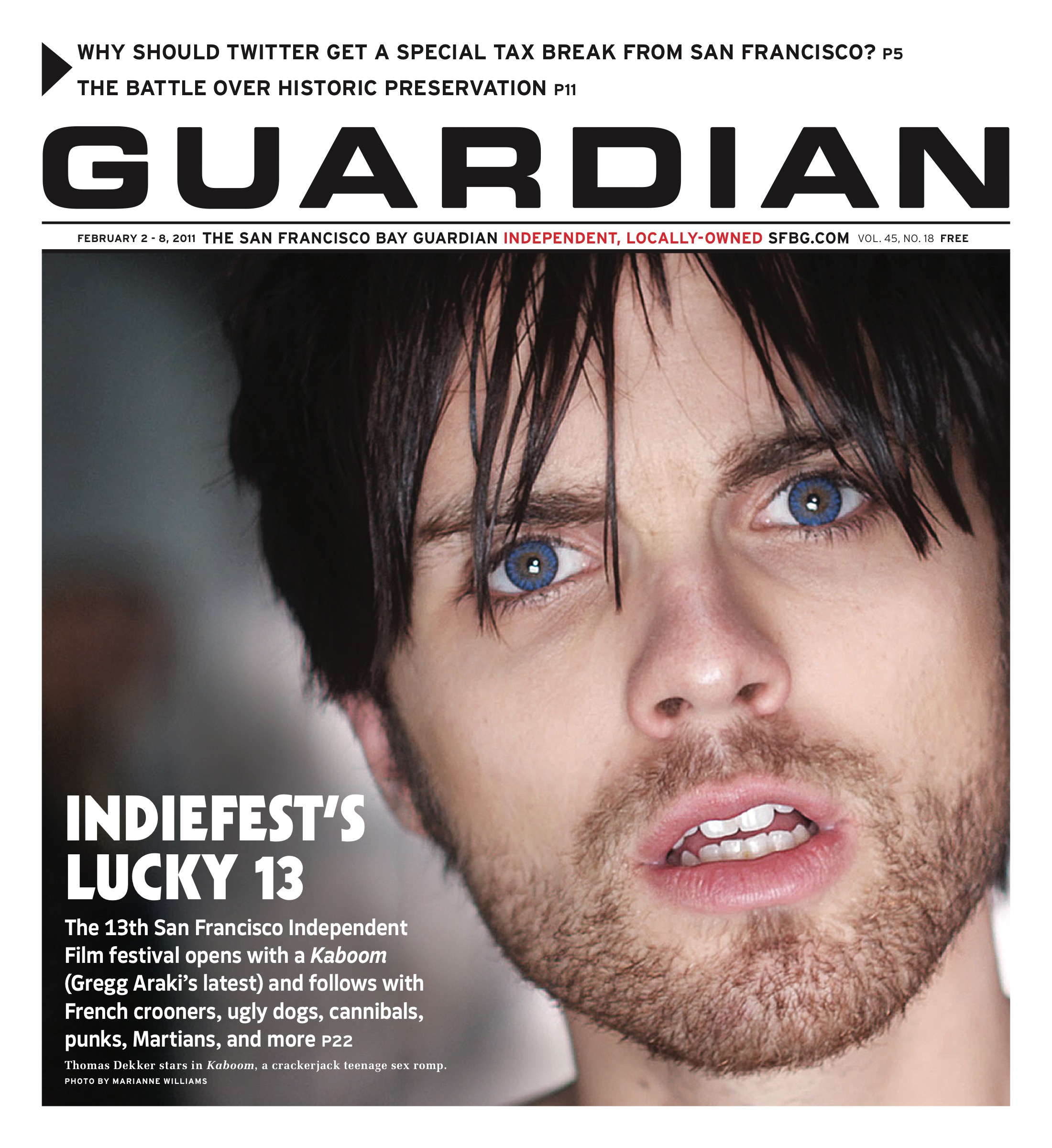
Noise Pop 2011 highlights
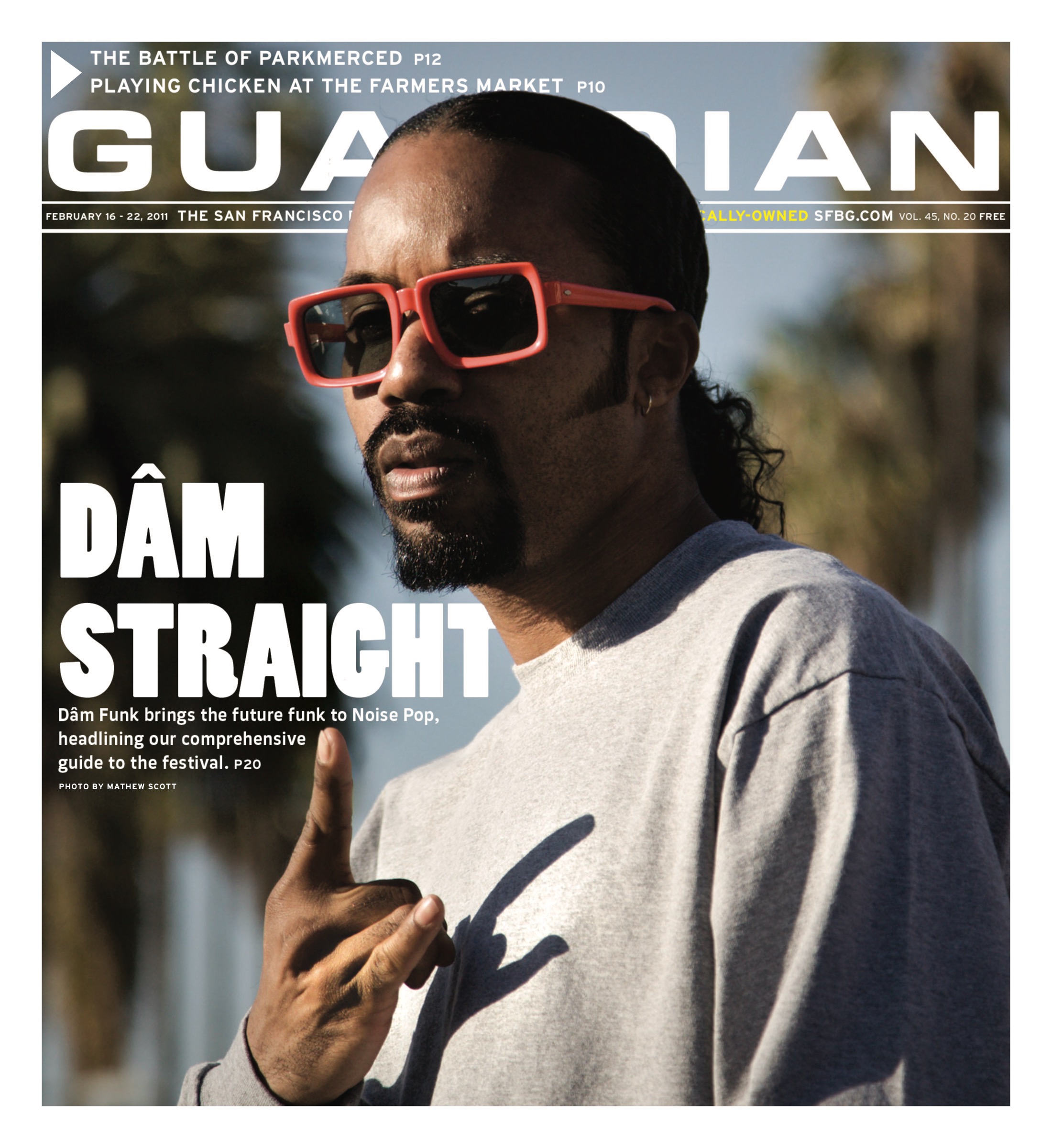
MUSIC The 2011 edition of Noise Pop finds the festival stretching the definition of noise pop ever further outward in order to swallow excellent sounds. Back in 1993, when Noise Pop originated, muted My Bloody Valentine-derivative bands with lowercase names evocative of junior-high lunch were the norm. This year, the fest taps into the recent, more sharp-edged shoegaze revival and the current California garage rock zeitgeist, while also making room for hip-hop, freak folk, and deep funk. It’s safe to say that, unlike the character assassinated in Steely Dan’s “Hey 19,” Noise Pop at 19 knows about the queen of soul. Here’s our guide to some of the event’s best lineups.
>>Read more of our Noise Pop 2011 picks here
PEANUT BUTTER WOLF AND DÂM-FUNK: THE DISCOVERERS
It’s the midnight hour on Valentine’s Day in Portugal when I reach Dâm-Funk, a.k.a. Damon Riddick, on the phone. He’s just outside of Lisbon, his surroundings are “phenomenal,” and he’s ready to wax enthusiastic about his longtime partner in funk Peanut Butter Wolf. “Me and Chris [Manak, a.k.a. Peanut Butter Wolf] connect on that sound because we remember and we revere,” he says, when I ask about their shared love of soul, hip-hop, and funk. “We knew what it was like before cable television and the Internet existed, we remember everything from those early VHS tapes to the way the sun set.”
As the sun is still rising on Valentine’s Day, in L.A., the man Dâm-Funk calls “Wolf” for short shows similar brotherly love. “When Dâm met me, we had a mutual respect,” says Manak. “He saw my record collection and vice-versa. When we discover songs, we’ll say, ‘Check this out.'” In turn, this shared enthusiasm, and the positive response to Dâm-Funk’s albums Toeachizown and Adolescent Funk — both released on Manak’s label, Stones Throw – has recharged funk sounds in Los Angeles and SF, and led to new discoveries of soulful and funky treasures from the recent past.
One such gem is Jeff Phelps’ 1985 Magnetic Eyes, a Tascam Portastudio 244 bedroom recording with sensational vocals by Antoinette Marie Pugh, who stars in a terrific no-budget video for the album’s “Hear My Heart” currently up on YouTube. “That album is something I’ve known about for a long time,” Dâm-Funk says, when I mention Magnetic Eyes and its hand-drawn yet futuristic cover art. “It’s a great project.”
Another great project is Tony Cook’s Back to Reality (Stones Throw), a collection of mid-1980s recordings by a musician who got his start as James Brown’s drummer. Taking on the role of executive producer, Manak has added some extra pop to the already formidable strut of Cook songs such as “Heartbreaker,” even drafting in Dâm-Funk to contribute new vocals to one track, “What’s On Your Mind.” “You’d think they were 24-track recordings, but he [Cook] only worked on an 8-track,” marvels Manak. “He was a good musician and producer – when you’re bouncing tracks, you have to know what you’re doing. In those days it was hard to achieve a full sound like that.”
These days, both Dâm-Funk and Peanut Butter Wolf know what they’re doing — and that’s a damn lot. Reflecting his Gemini nature, Dâm is planning to explore the dark side on an EP with that title before venturing into the light on his next LP. He’s also remixed Nite Jewel and is collaborating with her on a project, Nite Funk. He’s producing music by Steve Arrington for Stones Throw, and he wants to put out another chapter of his archival venture Adolescent Funk, with him choosing the tracks instead of Manak. As for the man Dâm calls “Wolf,” he’s got Stones Throw’s 15th anniversary on his hands, including a 7-inch box set, and a series of live-to-vinyl performances by the label’s artists in L.A. These guys are busy, but — fortunately for Noise Pop, and for SF — that doesn’t mean they don’t have time to throw a 45 party. (Johnny Ray Huston)
PEANUT BUTTER WOLF, DAM-FUNK
With Guillermo (Sweater Funk), Hakobo (Fresco)
Sat./26, 9 p.m., $15 (21+)
Public Works
161 Erie, SF
(415) 932-0955
DOMINANT LEGS: LOST IN LOVE
Whether he’s raging in the streets alongside fellow Giants maniacs or musically lost between the sheets, Dominant Legs’ Ryan Lynch sounds like he’s sweet to the core—and even more. “I didn’t have anything to do with setting the mattress on fire, but I was there,” says the SF musician of SF’s impromptu World Series throw-downs. “But I wasn’t stopping anybody from celebrating.”
Lynch also rolls with the love when it comes to music. “I don’t really listen to much music that would be characterized as aggressive,” he continues, on one of those sunny Bay afternoons that make it easy to float away on blue skies and daydreams. “I listen to pop music and, honestly, mostly KISS FM.” His favorite song on this crisp, creamy day is R. Kelly’s “Lost in Your Love.” “It’s all about him wanting to bring love songs back to the radio,'” Lynch adds. “And that’s sort of what I also aspire to—not that we get any radio play!”
But, oh, a girl — or a boy who once was a Girl (until recently, Lynch was Girls’ touring guitarist) — can dream. And dreams have been coming true for Lynch, a longtime Giants follower who recently contributed “Finally Champions” to a digital-only benefit comp of Giants tribute songs released by True Panther. Meanwhile Dominant Legs continues to pick up steam—and members.
Once the repository of Ryan’s solo singer-songwriter imaginings away from longtime band Magic Bullets, Dominant Legs found favor when the Redwood City-bred musician was laid off from his job as mail clerk-receptionist at a law firm. He didn’t sink his sparse funds into job retraining classes or the like; instead he bought a cheap Casio keyboard and drum machine. “I shouldn’t have been spending any money,” he recalls now. “But the direction of the music really took off after acquiring those pieces of musical equipment.” Friend Hannah Hunt, who had just graduated from college, offered to help out at a 2009 show at Amnesia and ended up sticking around.
“She brought a softness, and delicacy, which made the songs more delicate since her voice is so different from mine,” he observes. “I think her voice is easier on the ear than mine.” For Noise Pop, the two have acquired a few more legs to help them on their way: drummer Rene Solomon, bassist Andrew Connors, and guitarist Garrett Godard, the latter once the drummer for Girls.
They’ll be filling out the already intoxicating pop bounding off Dominant Legs’ 2010 EP, Young at Love and Life (Lefse), which has inspired music bloggers to go wild, tossing out scattershot, albeit flattering allusions to Orange Juice and Belle and Sebastian, Kelley Polar and Arthur Russell—and even Dave Matthews. Feeling lost again? Just listen to the earnestly lovelorn, gently bopping, synth-popping tunes like the title track and “Clawing Out at the Walls,” with its curious admixture of sweetness and self-doubt. Kindred spirits and modern lovers such as Jeremy Jay and Camera Obscura, also given to such exquisitely anxious reveries, would understand. “The only thing I’ve heard is that [the EP] is too heavily influenced by the ’80s,” says Lynch. “But I don’t see that as a problem.” (Kimberly Chun)
DOMINANT LEGS
With How to Dress Well, Shlohmo, Chelsea Wolfe
Sat./26, 8 p.m., $12–$14
Café Du Nord
2170 Market, SF
(415) 861-5016
ADMIRAL RADLEY: LIFE AFTER GRANDADDY
Jason Lytle has never been shy in revealing the frustrations leading up to Grandaddy’s demise. Exhaustion from middling success, a love/hate relationship with his lifelong home of Modesto, and a diminished interest in making music with others resulted in a move to Montana to focus on a solo career in 2006. Enter Admiral Radley, a collaboration with members of indie-pop group Earlimart and Grandaddy drummer Aaron Burtch that has him not only playing in a band again, but touring Japan and singing about his former home on songs such as the sarcastic “I Heart California.” Lytle took some time out from a snowy day of magazine shopping at Borders in his new hometown of Bozeman to talk about the project.
SFBG Rumors of a collaboration between you and Earlimart date back to the Grandaddy days. What led to you guys finally working together?
Jason Lytle It was really an excuse to hang out at [Aaron Espinoza’s] studio and just have people coming in and playing parts. We set aside a week as a fun little project. Maybe somebody else had other plans for it, but at the time, I was convinced it was just gonna be a cool opportunity to make a record and be done with it.
SFBG Were you guys surprised by the amount of excitement surrounding the project?
JL Yeah. Then it turned into, alright, we gotta name this record something, and give the band a name, and pretty soon it was this real entity. The Japan thing started off as a joke, and then became more of, “Let’s give this a go, and if it winds up getting us to Japan, we can call it good” — and the whole thing was worth it.
SFBG And how were the Japan shows?
JL They were really scrappy. The places were just dumps. I kept joking with Aaron, saying, “If we weren’t in Japan right now, and if these weren’t exceptional circumstances, there’s no way I’d be putting up with this.”
SFBG You’d expressed some skepticism about playing in bands again after Grandaddy split. Has this experience changed your opinion?
JL My place in Admiral Radley is totally different from what my situation was with Grandaddy. I’m getting off easy. Aaron is a great organizer and knows that a big appeal for me joining the band was not dealing with a lot of the day-to-day crap I used to deal with. I feel like I’m a piece of a puzzle with this band, which after all these years is something I’ve never really experienced. So it’s been kind of neat.
SFBG Both you and Aaron like being hands-on with production in your work. How was the collaborative process on this album?
JL That part was pretty effortless. Aaron and I share a lot of the same philosophies on production and making albums sound a certain way. I definitely sat in on some of the mixing, but there was a lot of it where I was just able to trust what he was going to do, knowing that it probably wouldn’t be too far off from what I’d do myself.
SFBG Was it strange writing lyrics about California now that you’ve been gone for almost five years?
JL I’ve definitely had a renewed perspective. Every time I visit or I’m there doing some work, I’m thrust right into the shit. Like right into L.A. or SF, rather than adjusting or letting it sink in slowly. So, usually it’s pretty jarring for me just because the pace is a lot more relaxed and different here. Having a bit of that outside perspective now allows me to look at things a bit differently. (Landon Moblad)
ADMIRAL RADLEY
With Typhoon, Social Studies, Fake Your own Death
Wed./23, 8 p.m., $12 (21+)
Bottom of the Hill
1233 17th St., SF
(415) 621-4455
GEOGRAPHER: EARTH PEOPLE
The dress code doesn’t include a finely-pressed lab coat, and the toolbox isn’t filled with fragile beakers, but a geographer is indeed a scientist, one who pours himself into the earth and bleeds across its surfaces to observe and categorize its residents. I haven’t asked the members of the San Francisco synth-pop trio Geographer if this occupation has had any inspiration on its sound, but there’s reason to believe the answer may be a humble yes.
Geographer has discovered new ground in the electronic realm. Its unique ménage a trois of music-making contraptions — drums, synth and cello — produces audible scenery that simultaneously calms and energizes the senses. Luscious forests of synth share habitats with rushing bass and guitar. The cello adds a sneaky-smooth layer that easily melts between or melds the more jagged sounds.
Behind the sweet scenery resides a less than pretty picture. Themes of loss and inevitable change creep through their sun-stained melodies, pulling at the roots of the band’s core. In 2005, Michael Deni fled his home in New Jersey, after the unexpected deaths of two family members. He landed in SF, and his instruments became a source of comfort and release while he wandered the new, unfamiliar territory. After a period of searching and surveying, Deni met and began collaborating with Nathan Blaz and Brian Ostreicher. In 2008, Geographer self-released its debut full-length, Innocent Ghosts, a far more relaxed collection that showcases Deni’s round, patient voice.
The landscapes on 2010’s Animal Shapes (Tricycle) are majestic, but far more celebratory. Things are tighter spun, beats kick harder and there’s a cohesive exploratory factor. Specifically fabulous: “Kites,” a track that strikes gold with a lustrous synth party. Deni’s sincere vocals float high above the mountainous bass vibrations, but mingle ever so courteously with the shrill, twinkling electronic additions. Enter the romantic cello and the song is a straight-up gem.
Now is a good time to button up your favorite white jacket and take some notes on the current environment in which you reside. Whether you’re into earth science or not, Geographer is a swell listen that goes well with salty pretzels and an adventure around your own neighborhood. Animal Shapes on repeat will keep you in step with eyes and ears open. And listen carefully: there’s good word on the street about these Geographer guys in the live form. (Amber Schadewald)
GEOGRAPHER
With Butterly Bones, K Flay, Funeral Party
Wed./23, 8 p.m., $13–$15
The Independent
628 Divisadero, SF
(415) 771-1421
PSYCHIC FRIEND: PIANO POWER
Will Schwartz and the piano go way back, to when he was nine. “I’ve been attracted to the C chord and to A minor since I was a kid,” he says from L.A., where he’s living in Los Feliz. “I learned to play piano by ear, and it was always based on [starting with] a C major and going from there.”
You could say Schwartz played his first gigs on the instrument. “We had this two-story living room in our house in New Jersey with a little balcony, and the piano was up on the balcony,” he says with a laugh. “I would imagine I was playing for people down below. I would put on shows for the living room furniture.”
In his new band Psychic Friend, Schwartz updates California chamber or piano pop for today’s era, with contributions by Hole drummer Patty Schemel and instrumentalist-producer Bo Boddie. The result is a fresh chapter in Schwartz’s musical story, one that has ranged from the guitar-rock of Imperial Teen to the D.I.Y. choreographed pop of Hey Willpower, which involved contributions from videomaker Justin Kelly, DJ Chelsea Starr, and musician Tomo Yasuda.
Crisp and clean, in a way Psychic Friend sounds like the moment Schwartz has found his voice, or unknown heights or depths of it. The pounding “Once a Servant” revives the spirit of Jobriath. “Water Sign” has a Serge Gainsbourg undercurrent. “Shouldn’t Have Tried Again”‘s rendering of the repeat failure of a relationship matches the plaintive sunshine-y yearning of Harry Nilsson’s sublime covers of Randy Newman.
You could say Psychic Friend is new Californian pop. The piano-based melodic immediacy of the group’s sound has a kinship to Carole King’s solo work, or Burt Bacharach and some of his hits for psychic and other friends, yet both the sound and the lyrical content is very contemporary, not retro. It also isn’t Rufus Wainwright showboating — tracks like “We Do Not Belong” allow Schwartz’s voice a freedom and resonance it hasn’t had before, but he doesn’t run away with himself. “The nature of playing a piano and writing melodic songs, it almost brings you back to ’70s songwriting,” Schwartz observes.
“I just found this place in my voice that feels very connected, actually, that comes from playing the piano, and it feels good,” he adds, simply.
Schemel’s powerful drumming and Boddie’s hit-making skills have a role in this shift. “It’s like an Eddie and the Cruisers feeling,” Schwartz says, “where you start to play something, and by the end it sounds like a finished song.” (Huston)
PSYCHIC FRIEND
With The Concretes, Birds and Batteries, Magic Bullets
Fri./25, 8:30 p.m., $13–$15
Rickshaw Stop
155 Fell, SF
(415) 861-2011
SF’s redevelopment miracle

OPINION While many of us (and most of the rest of the state) can tire from time to time when we hear San Francisco “exceptionalism” being touted, especially when Gavin Newsom is doing the touting, there are some cases in which it’s justified. One of the most salient is the way San Franciscans transformed the city’s Redevelopment Agency and used tax-increment financing to build housing and infrastructure that served its residents, not elite developers.
This is an exceptional story that Gov. Brown does not want to hear. He should both listen and learn from San Francisco’s experience.
The San Francisco Redevelopment Agency started out like all others: destroying low income neighborhoods to create what the San Francisco Planning and Renewal Association, a strong agency supporter at the time, called ” ‘clean’ industries [and a] population … closer to ‘standard white Anglo-Saxon Protestant’ characteristics … ” But the big difference was that San Franciscans fought back.
In the 1960s in the Western Addition and SoMa, community organizations were formed that sought legal assistance and stopped the agency in its tracks. In the 1970s, new community coalitions were formed to deny the agency new federal funding. By the 1980s, the agency was broke and its mission of urban renewal so blocked and discredited that SPUR changed the last two words in its name from “Urban Renewal” to “Urban Research.”
In 1988, Mayor Art Agnos brought in the opponents of redevelopment and asked them how to redesign the agency. The product of that collaboration was a new mission statement and an ordinance fully integrating the agency into city government — transforming it into a financing agency, with no operational role.
Since 1990, the agency has become the major funder of affordable housing in San Francisco, pouring more than $500 million into low-cost housing both inside and outside redevelopment areas. More than 10,000 units have been built for working and low-income residents, more than half of those units for families with children. The urban infrastructure needed to transform Mission Bay from a toxic rail yard to a residential and biotech center came from the agency. Since 1990, not one neighborhood has been bulldozed by the agency and two new ones are being created (Mission Bay and Transbay).
Yes, some of the tax increment has been used to do some infrastructure work at ATT Park, and former Mayor Gavin Newsom wanted to entice the 49ers with agency funds for a new stadium at the shipyard. And yes, former Mayor Willie Brown gave Bloomingdale’s some agency money for its Market Street store. But the reality is that 50 percent of all tax increment since 1990 has gone to affordable housing development, and the bulk of the remaining 50 percent has gone for critical needed infrastructural work that has produced new property taxes more than paying for the investments. As the state and federal government turned their backs on central cities it was the only form of financing available.
And now Gov. Brown wants to end tax-increment financing. He points to the excess of other redevelopment agencies in other places. He does not, however, look to us and our experience. He should. San Francisco should be the model for what is required of all redevelopment agencies.
After serving as mayor of Oakland, Brown is probably tired of hearing about how different San Francisco is, how exceptional we are. That’s too bad, because in this case it isn’t hype. It’s real. *
Calvin Welch lives and works in San Francisco.
The price of mental health cuts
By Hetty Beth Eisenberg
OPINION The massacre in Tucson is a tragic wake-up call for the public mental health system of our own county. Among the many pressing angles to the story, it is vital to consider the severe cuts to mental health services in Pima County last year.
Although only a small fraction of the mentally ill commit acts of violence, we must contemplate the larger issue of what happens when a community fails to prioritize mental health. Acute mental health services are such an essential tool for caring for the severely mentally ill that one is staggered by the low priority they’ve been given by our forward-thinking community in San Francisco.
Throughout the nation, the mentally ill are among our most disenfranchised constituents. In San Francisco, a considerable fraction of our severely mentally ill populations are indigent, homeless, and without health insurance. Acute care services for the mentally ill therefore lose money. In these hard financial times, city officials, like those in Pima County, are making painful decisions. Over the past three years, mental health services in San Francisco have been cut to austerity levels.
To see the short-sightedness of these cuts, one must consider not only the most drastic scenarios. For every Jared Loughner, there are thousands of individuals whose profound burdens could be alleviated with the help of these services. Inpatient psychiatry at San Francisco General Hospital provides the highest level of mental health care in our county. Unlike private hospitals, SFGH takes all patients, regardless of their insurance, and regardless of the risk of violence. The inpatient service at SFGH provides the only safety net for those patients who are the most extreme danger to themselves and others.
From 2008 to 2010, the number of acute psychiatry beds at SFGH was cut from 84 to 42. The consequences of the cuts were palpable. They led to the disintegration of the Cultural Focus Program, a nationally-recognized model of ethical inpatient psychiatric care. The most ill patients were crowded onto two remaining acute units. The staff was then put in the position of having to move patients to understaffed units, so-called subacute, before they were clinically ready.
In January, one of two remaining acute psychiatry units at SFGH was cut. This leaves 21 acute beds available to the entire city. It’s now impossible to separate the most violent patients. The unit has become hyperacute, with an increasingly agitated population amplifying itself. Staff feel unsafe and cannot provide adequate care for their patients. As they grapple with understaffing, many cite what happened at Napa State Hospital recently when a psychiatric worker was murdered — an incident attributed to understaffing.
Meanwhile, there is considerable pressure to discharge these patients quickly. A vast number end up on the streets, in jails, overwhelming outpatient programs, or bouncing back to the emergency room — racking up even higher costs.
Due to budgetary pressures, the Department of Public Health insists that our unstable patients should be funneled into outpatient services. While outpatient programs provide vital means for supporting the chronically mentally ill when they are stable, they are also being cut — and are insufficient to protect acute patients.
These budget cuts make it plain that we are dealing with a clumsy model of mental health — one that lacks essential mechanisms. Such a model reflects a poor understanding of mental illness.
Arizona provides a clarion call to California: we must hear the implicit warning. These cuts to acute mental health services in San Francisco, a city with a large mentally ill population, must be reversed. Each day that they persist heightens the very real tragedy for our patients, our healthcare workers, and our entire community. *
Hetty Beth Eisenberg, MD, MPH, is a resident physician in psychiatry at San Francisco General Hospital.
Po’ girl
le.chicken.farmer@gmail.com
CHEAP EATS It was minus two in Boston when I got on the airplane. I was all bundled up in borrowed and stolen clothing, trying to tap what was left of the warmth from our show there. Between 200 and 300 bodies, and, no, I didn’t get laid, but on the other hand I never felt more loved. There may have been one or two dry eyes in the house, but there were not a lot of dry pairs of underpants. Myself, I was completely creamed by the whole thing. I’m still a little shaken.
At the airport, on the weather on the news on TV, they showed a live shot of San Francisco, just before dawn, and said that it was 60 there, that San Franciscans would wake up to a clear, beautiful day.
But that wasn’t where I was going. I was going to New Orleans. New Orleans is where I am, and I intend to have a lot to say about the food scene here. Crawdad de la Cooter, who grew up in this neck of the swamp, thinks I’m not going to want to come home. I think it’s going to take more than red beans and rice and gumbo to change my life at this point.
Now Kayday, she gave us all a scare. After nine months of not finding a job in San Francisco, she found a job in L.A., and on the day before the big move, she got a call from her new employer saying that she’d been, in effect, laid off. Talk about cutting it close! She called me right afterward.
“I have good news,” she said. Then she told me the bad news.
“How are you feeling about this?” I asked.
She was shocked, she said, and also euphoric.
I said, “I’m sorry.” I said, “Congratulations!”
This was, unequivocally, bacon for my own musical future. When I come home now, my new band will be all in one piece and place, which is important for things like bands and chandeliers.
Last night while I was sleeping, a curtain rod did not fall on my head. However, almost the whole rest of my household here was of the opinion that one had. New Orleans is like that. It’s a haunted city. Things go bump in the night, and clang and crack and “Ow! Goddamn it!”
So far I am charmed. My first meal was a fried oyster po’ boy, and the first thing I saw when I left the house this morning was three giraffes — real, live, leafy-toothed giraffes that were not in any way a figment of my imagination, because it turns out there’s a zoo just across the park.
Tell you why I’m here: one of the families whose cute little nine-month-old childern I care for just moved from Berkeley to New Orleans, just for the semester. This childern, both his moms are perfessers, one at State, and one — uh oh — at Tulane. I’m here to help, but also to eat myself silly and have scary adventures to write home to you and/or Earl Butter about.
Since the fried oyster po’ boy I imbibed last night was, as the saying goes, nothing to write home to you and/or Earl Butter about, I will instead regale you with misinformation about a meal I ate with Kayday before I even left San Fran.
On a cold, cold and windy, windy night, the likes of which you haven’t seen and are not likely to see in some time, according to The Weather Channel, Kayday and I ventured our way over to Bernal Heights around dinner time. We were going to squeeze in one last practice at Bambam’s house before Kayday moved to the city of Angels and I to the city of Saints.
It all seemed like Not A Bad Idea at the time. To get something to eat first. So we wound up at Blue Elephant on Cortland Avenue. And we ordered imperial rolls, duck curry, and something else that I have forgotten. But the imperial rolls were not forgettable. They were great. And the duck curry, which is of course a red coconut milk curry with tomato, pineapple, and roasted duck, was fantastic.
Kayday told me she was going to make a blog about living in L.A. called “My Year of Living Los Angelesly,” and I thought that that was a fairly brilliant idea.
I still think so, but now someone else is going to have to do it.
BLUE ELEPHANT
Daily, Lunch: 10:30 a.m.–3 p.m.;
Dinner: 5 p.m.–10 p.m.
803 Cortland, SF
(415) 642-9900
AE/D/MC/V
Beer and wine
Getting free

rebeccab@sfbg.com
Shane Bauer and Josh Fattal have been held captive in Evin Prison in Tehran for more than 540 days, and their friends and supporters in the Bay Area have been mounting an extraordinary campaign pushing for their release.
On July 31, 2009, Bauer and Fattal were hiking with Sarah Shourd, who is Bauer’s fiancée, through green mountains in Iraqi Kurdistan. The three UC Berkeley graduates had traveled from Damascus for a recreational visit. They were wandering nearby Ahmed Awa, a popular tourist destination where hundreds of people had flocked to camp, to visit a waterfall and enjoy the peace and quiet of the mountains.
They say they didn’t realize how close they were to Iran, which has no diplomatic ties to the United States.
Shourd told the Guardian she’s not sure whether they accidentally traversed the Iranian border, because it was unmarked. “We had no intention of being anywhere near Iran,” she said. “And if we were, we’re very sorry.”
Iranian officials surrounded them, speaking in Farsi, which they couldn’t understand. They were arrested on suspicion of spying and taken into custody. Before being taken to prison, one phoned a friend, Shon MeckFessel — who had been traveling with them but opted not to go on the hike because he wasn’t feeling well — to alert him that something had gone wrong. That would be the last communication any of them would have with close friends or family members for months.
Shourd was finally released on bail Sept. 14, 2010 on humanitarian grounds after spending 410 days in solitary confinement. She was reunited with family and friends — but Bauer and Fattal have remained in detainment ever since.
Since returning to the United States, Shourd has thrown her energy into advocating for their release — and she’s not alone. “Everyone in the family has been working tirelessly for all 18 months,” she said, “which is far, far longer than we ever imagined in our worst nightmares.”
FIGHTING FOR FREEDOM
While Shourd was still in prison, her mother, Nora, gave up her home and job to move in with Bauer’s mother, Cindy Hickey, and work for their release full-time. Fattal’s older brother, Alex, suspended his graduate studies at Harvard to dedicate himself to the campaign. His mother, Laura Fattal, stopped working to devote herself to the campaign.
“That’s just family alone,” Shourd noted. “If you start to look to how many people have contributed to our campaign and how many ways, it just blows your mind.” Soon after her release, Shourd put out a call for people to hang banners proclaiming the innocence of Bauer and Fattal and calling for their release. In response, nearly 60 banners were unfurled in 25 different countries.
Shourd has made countless media appearances since her release, and even put out an MP3 of a song she composed while in solitary confinement, which can be downloaded as a way to support the Free the Hikers campaign. Their story has drawn the interest of prominent figures. On Jan. 19, Noam Chomsky released a video offering to testify on their behalf if a trial is held, saying Bauer and Fattal “have dedicated themselves to advocating for social and environmental justice in Africa and elsewhere, and they truly embody the spirit of humanitarianism.”
Others who have publicly defended the trio include President Barack Obama, who issued a statement in July saying none of the hikers ever worked for the U.S. government, addressing Iranian accusations that they were there to commit espionage. United Nations Secretary General Ban Ki-Moon and the Archbishop Desmond Tutu have called for their release. A documentary has been produced about their plight, and a second one is in the works.
In San Francisco, artists and musicians have responded in droves to a call for support. An art auction that will benefit the campaign is planned for Jan. 29, featuring the work of more than 80 artists, plus live musical performances. As a nod toward Bauer’s work in photojournalism, the event will emphasize photography, and notables such as Mimi Chakrova, Taj Forer, Roberto Bear Guerra, Ken Light, the LUCEO Photo Collective, Susan Meiselas, Lianne Milton, Mark Murrmann, Alec Soth, and others have donated work. Among the artists who donated pieces are Marianne Bland, Mark Brecke, Teresa Camozzi, Andreina Davila, Eric Drooker, and former Board of Supervisors President Matt Gonzalez.
In early February, a music benefit will be held at the Bottom of the Hill to benefit the campaign. Titled “They Sing These Songs In Prison,” the event will feature performances of The Nightwatchman — that’s Tom Morello of Rage Against the Machine — plus Jolie Holland, accordionist Jason Webley, and Ryan Harvey & Lia Rose.
“The funding is to support the campaign to free Shane and Josh, and it goes to a wide array of needs that we have, like translation into Farsi, travel for media, and meeting with some various embassies and governments that are involved in advocating for Shane and Josh’s release,” Shourd explained. “Also, some of the money will probably go toward legal fees, and website fees, and materials for the campaign from flyers to business cards to t-shirts.”
WHO ARE THE HIKERS?
The campaign to advocate for their release has been tagged Free the Hikers, but the identities of the three young people (Bauer and Fattal are both 28, Shourd is 32) go much deeper than that. They’re social-justice advocates, antiwar activists, writers, environmentalists, travelers, and creative thinkers with deep ties to the Bay Area.
Shourd, who lives in Oakland, was teaching English to Iraqi refugees when she was in Syria, as well as practicing some journalism. Fattal, who taught at Aprovecho — an education center in Oregon focused on sustainability and permaculture — had been traveling to India, South Africa, and other places through the International Honors Program to lead workshops on health and sustainable technology before visiting his friends in Syria.
“Josh is an environmentalist, he’s a teacher, he’s an incredible, incredible, generous and selfless man,” Shourd said. “As soon as you meet him, you feel what an extraordinary and unique human being he is. I was friends with him for years before he came to visit us in Damascus, and he decided to travel with us to Northern Iraq to Iraqi Kurdistan to learn about Kurdish culture, to see another diverse aspect of the Middle East.”
Bauer wrote for publications such as The Nation, Mother Jones, and the Christian Science Monitor. A photojournalist who has won multiple awards and had his work published internationally, Bauer has documented everything from tenant conditions in San Francisco SROs to conflict-ridden regions in Africa and the Middle East. Bauer also wrote an article for the Guardian about an Oakland residence that is famous among East Bay anarchists (See “Hellarity burns,” May 27, 2008).
“Shane has an incredible passion for pursuing truth and complicating our ideas about other parts of the world, about conflicts around the world and at home,” Shourd noted. She added that many of his stories serve to highlight “some of the very specific ways that the U.S. presence in Iraq has taken a toll on innocent people.”
Before their ill-fated excursion, Shourd said she’d heard from multiple westerners and her Arabic tutor that Iraqi Kurdistan was a safe and enjoyable place to visit. “It’s often referred to as ‘the other Iraq’ because it’s a semiautonomous region designated as a no-fly zone by the U.S. government,” she explained. “It’s actually a part of the Middle East that has a very positive fingerprint from the U.S. government because they helped protect the Kurdish people from Saddam Hussein. So Northern Iraq is not a dangerous place for Americans or westerners to go, and no American has ever been killed in Northern Iraq, which is just phenomenal after a decade of war and occupation.”
She said Bauer, Fattal, and MeckFessel were all enthusiastic about the trip, and after researching it online, the four felt they had enough information to travel there. “We ordered a special Lonely Planet guide of Northern Iraq, and a friend of ours who went a month before we did borrowed it and lost it, so we didn’t have the Lonely Planet guide,” she noted. “But we still felt we had enough information about it to travel there and really believed we had nothing to fear.”
SOLITARY
Shourd credits her fiancé and her friend with helping her through “every minute of prison,” even though she was alone in her cell for 23 hours a day. At first she wasn’t allowed to see them at all, but after some time had passed, guards allowed her to visit with them in an outdoor courtyard for 30 minutes a day. Later, that brief time together was increased to an hour.
“There’s no way I could have maintained hope and maintained my own sanity and the strength that it took to get through every day of isolation and depravity and uncertainty and fear,” she said. “The emotional strength that that took, and the discipline that it took, really Shane and Josh and I all created together in the little time that we had, through the unconditional support and love we had for each other.”
Since they didn’t speak Farsi and the guards spoke very little English, it was difficult to communicate basic needs, and Shourd described the experience as being surrounded by hostility.
“Whenever I just started to slip away mentally, Shane and Josh would bring me back, and the knowledge that they were going to be there for me was the only thing that got me through 410 days of solitary confinement,” she said. The three thought up activities to give themselves something to look forward to, like marking time with small courtyard celebrations and special food they saved to share together or discussing topics in an organized format. “We had almost like a curriculum that we followed of study, and sort of intellectual exploration,” she explained.
They were only allowed to have pens for one month — that was the easiest month, Shourd said. But the rest of the time, even though they weren’t permitted to write things down, they were allowed to read. “Books were our lifeline. We read the same books in concert, we took turns reading books and passed them back and forth when we saw each other in the courtyard. And we would memorize dates and memorize poetry and recite poetry to each other and test each other on dates,” Shourd said.
“Josh would give me math problems to do in my head because he knew I was trying to get better with algebra. We had a dictionary that we passed back and forth, and we would make stories from words in the dictionary and tell each other these really intricate fantastical stories that we came up with. Anything to keep your mind busy.”
Beginning in her second month in prison, Shourd also passed the time by composing songs. A month went by before she was able to share the first one with Bauer and Fattal, but when she did finally sing it for them, they learned the words and sang it with her. “When we were together in the outdoor courtyard, they would just tell me to sing louder,” Shourd said. “I know they’re singing those songs now.”
The intellectual drills, storytelling, math problems, and singing weren’t merely a remedy for boredom. “You have to really keep your mind strong and busy so that you don’t get sort of swallowed up by the abyss of fear and loneliness that encroaches on you day by day in that kind of situation,” she said.
LOOKING AHEAD
Despite the time, energy, and effort spent on the campaign to free all three, no one can say for sure just when Bauer and Fattal will finally be reunited with family and friends. In November, Iranian authorities said that a trial previously scheduled for that month had been postponed, but the Free the Hikers campaign is calling for them to be released without a trial.
“They don’t deserve to be there one minute longer than I was, and they never deserved to be there in the first place,” Shourd said. “They should be shown the same kind of humanitarianism that they have put into action in their lives, through their work.”
Amnesty International is among many of the groups that have called for the Iranian government to release the two young men. “One year after their arrest, the Iranian authorities’ failure to charge them with illegal entry into Iran or more serious charges, such as espionage, has fueled speculation that the Iranian authorities are holding them as a bargaining chip,” notes a statement released July 2010 by Amnesty International, an international human rights organization.
Meanwhile, Shourd has been contemplating what her experience would have been like if the U.S. and Iran actually maintained diplomatic ties, and she published an opinion piece on CNN International calling for greater communication between the governments.
“I think it’s their responsibility to their people to do that, and I think it’s a tragedy that there’s been 30 years of practically no relationship between Iran and the U.S.,” Shourd said. “It’s a tragedy for countless Iranian Americans in this country who have a hard time visiting their relatives in Iran, sending them money, even just getting information about them or visiting their homeland.”
She began her opinion piece by recounting the time that a prison guard brought her freshly picked roses, an uncommon gesture of kindness during her incarceration. “In the worst of circumstances, the most extraordinary acts of human kindness emerge,” she told the Guardian. “They were rare. The vast majority of my experience was empty and desolate. But the times that the guards were kind to me … will stay with me for the rest of my life.” *
ART AUCTION TO FREE ALL THREE
Saturday, Jan. 29, 7 p.m.
SomArts Cultural Center
934 Brannan, SF
Musical performances by The Ferocious Few, Devon McClive and Sons, Grant Hazard and Lorin Station
www.artforssj.tumblr.com/#about
THEY SING THESE SONGS IN PRISON
Featuring The Nighwatchman, Jolie Holland, Jason Webley, Ryan Harvey & Lia Rose
Thursday, Feb. 10, 8:30 p.m., $12–$18
Bottom of the Hill
1233 17 St., SF
To learn more, visit www.freethehikers.org, www.freeourfriends.eu
Why I may run for Congress
OPINION One of the most inspiring political leaders in recent decades, Sen. Paul Wellstone (D-Minn.), famously declared: “I represent the democratic wing of the Democratic Party.” Today we need progressives in Congress who will represent the progressive wing of the Progressive Caucus.
That’s the largest caucus on Capitol Hill — but having 80 members on the roster won’t do much good if many cave under pressure.
For 18 years, the North Bay has been represented in Congress by Rep. Lynn Woolsey. Her strong antiwar voice and very progressive voting record have endeared her to a lot of constituents. Now she’s publicly saying that she may choose to retire instead of seeking reelection.
This week, after decades of working for progressive social change, I’m announcing a federal exploratory committee for Congress (www.NormanSolomonExploratory.com). If Rep. Woolsey doesn’t run in 2012, I will.
Across the country, alarm is rising as corporate power escalates at the intersection of Wall Street and Pennsylvania Avenue. An egregious factor is the deference to such power from some elected officials who rely on a progressive base for votes but shrug off tangible accountability to that base.
Dysfunctional relationships between liberals in Congress and progressive social movements serve as enablers for endless war, massive giveaways to Wall Street, widening gaps between the rich and the rest of us, erosion of civil liberties, outrageous inaction on global warming, and so much more.
Back in congressional districts, the only way to beat corporate Astroturf is with genuine grassroots activism — committed to creating a very different kind of future for the next generations.
At a time when high unemployment is becoming more protracted in tandem with a gargantuan warfare state, we’re in the midst of what Martin Luther King Jr. called “the madness of militarism.”
So-called moderates are adept at fine-tuning rather than challenging a destructive status quo. But there’s nothing moderate about helping to fuel the engines of social inequity, eco-disaster and perpetual war.
Eight decades ago, much of the U.S. press was hostile to a new president named Franklin D. Roosevelt, and many of his political enemies called him a dangerous radical. But there was — and is — nothing unduly radical about supporting economic fairness and social justice.
Before the end of his first term, FDR denounced “the economic royalists.” He said: “They are unanimous in their hate for me — and I welcome their hatred.” He did not say, “They hate me — and I want them to like me.”
Today, big money and mega-media power are dominant; yet progressives who are principled, determined, and methodical can prevail in a big way. That’s what happened last year when activists defeated PG&E’s monopolistic Proposition 16 despite being outspent by more than 400 to 1.
Living in the North Bay for more than a dozen years, I’ve often been moved by the extent of local progressive passions. Antiwar, environmental, and social justice outlooks are widespread — and deserve forthright representation in Congress.
Paul Wellstone was vitally correct when he said: “In the last analysis, politics is not predictions and politics is not observations. Politics is what we do. Politics is what we do, politics is what we create, by what we work for, by what we hope for, and what we dare to imagine.”
Norman Solomon is national co-chair of the Healthcare Not Warfare campaign, launched by Progressive Democrats of America. His books include War Made Easy: How Presidents and Pundits Keep Spinning Us to Death. For more information go to www.NormanSolomonExploratory.com.
Challenging Gascón in the D.A.’s race
Challenging George Gascón in the District Attorney’s race isn’t going to be a cake walk, even though he was Newsom’s former police chief and was registered as Republican until Newsom appointed him D.A. a few weeks ago.
Here’s why:
Gascón has the next ten months to promote himself as San Francisco’s top prosecutor–and he’s already working that angle.
He has an ally in Lt. Governor Gavin Newsom who tapped Gascón as his top cop, then used his support to pass sit/lie and oppose community policing.
And he has another powerful ally in former mayor Willie Brown, who helped former D.A. Kamala Harris rise to the top, and periodically uses his column in the Chronicle to promote his latest pet cause. Take Brown’s Jan. 16 column about how Newsom ended up appointing Gascón as D.A.
The way Brown tells it, Newsom narrowed down potential candidates to retired Judge Harry Low and D.A.’s office insider Paul Henderson, then called in Gascón for advice, who started lobbying for Henderson, until Newsom informed Gascón that he was now a candidate for the job.
“And with that, only two details had to be worked out – assessing the odds of Gascón winning re-election and making sure Henderson was taken care of,” Brown claimed. “Both were done by the next morning when we all sat down.”
But Brown’s version of events doesn’t quite seem to square with reality.
Political consultant Jim Stearns, who is running Paul Henderson’s campaign and has been in almost daily communications with his client in the past weeks, told me that far from “being taken care of,” Henderson appeared to have been left agonizing over his future.
So, maybe Henderson was “taken care of,” but not quite in the way that Brown’s column implies.
Henderson hasn’t been returning calls since Gascón’s appointment, other than to say that Gascón called him with the news and that he is taking time to evaluate his options
But criminal justice reform advocate David Onek clearly still has both feet in the race.
In a Jan. 18 email that was titled “Time to Organize,” Onek reminded his supporters that “our campaign has always been about building the kind of grassroots network that can do more than win a campaign – but can bring tens of thousands of San Franciscans into the movement for a safer city through criminal justice reform.”
Onek, who has already organized 1,100 supporters and raised more than $160,000, told me that he was, “as surprised as everyone else” by Newsom’s decision to appoint Gascón to the D.A. post.
But he refused to speculate about “who is getting in or out of the race.”
“I’m focused on moving forward and building a grassroots campaign,” Onek said.
As part of that effort, Onek’s campaign recently announced a goal of hosting 500 community-based house parties.
“We already had a bunch of house parties early on,” Onek told me. “We feel great with where we are, and the great thing about San Francisco being a really small city is you can go out and meet the voters and build a robust grassroots network.”
Still, Onek, who jumped into the D.A.’s race last summer, suddenly finds himself running against San Francisco’s former police chief. And he didn’t pass up the opportunity to point that out in his Jan. 18 missive to supporters:
“The election ahead will give us the chance to debate a newly appointed incumbent – the city’s former police chief,” Onek wrote. “While I have enormous personal respect for the new DA, we have some significant differences and I am confident that our grassroots campaign will prevail.”
One of those significant differences is the candidates’ views on the death penalty.
“I’m against the death penalty,” Onek said.
As such, Onek finds himself in the same philosophical camp as all the district attorneys elected in San Francisco in the last ten years. And opposed to Gascón, who told reporters that he is “not philosophically opposed to the death penalty,” shortly after Newsom appointed him as D.A.
And then there is Gascon’s history as a longtime Republican who only came out as a Democrat after he was appointed D.A.
Gascón says his parting of the ways with the Republican Party occurred over differences in opinion on immigration, equal rights for gays, and social services. But despite his potential negatives, his position as the current D.A. gives him a stage that’s hard to fight—unless you work in another D.A.’s office.
Take Alameda County Assistant District Attorney Sharmin Bock. She filed papers in the D.A.’s race the day after Newsom named Gascón as interim D.A., allegedly has the support of the Gettys, and her name was all over the media last week when she helped bust a prostitution ring in the East Bay
“Yesterday’s multi-agency operation, stemming from the Hayward Police Department investigation, is a testament to this regional commitment,” stated Bock, who is in charge of Special Operations and Policy Development and head of the Alameda County Human Exploitation and Trafficking (HEAT) Watch Unit.
But lest anyone doubt that Gascón is playing to win, let it be known that he officially filed Jan. 20 in the D.A. Race
And in answer to the Guardian’s questions about possible conflict of interest in cases that he handled as chief, including police misconduct and crime lab issues, Gascón recently released a statement through Assistant District Attorney Seth Steward.
“We are conscious of the possibility of a conflict,” Gascón stated. “ We review everything on a case by case basis. The Attorney General’s Office has agreed to take cases as appropriate.”
So, while a Facebook page has been set up to send Gascón back to Arizona, don’t expect our silver-haired D.A. to heed their advice any time soon.
Net neutrality: “The American Way”
Media Alliance, an Oakland-based organization advocating for press freedom and media access, has teamed up with San Francisco-based Bad Monkey Studios to produce a quirky cartoon about net neutrality called “The Internet You Need.”
The short film follows a December vote by the Federal Communications Commission approving a set of net neutrality rules.
Critics say those regulations fall short of what’s truly needed to maintain an even playing field for all internet users, and Media Alliance is encouraging people to write to their congressional representatives to push for stronger rules.
(There’s a broad array of opinion as to whether the FCC vote resulted in protecting an open internet, or whether it sold consumers short in favor of internet service providers.)
The Media Alliance and Bad Monkey cartoon and website seem like an attempt to make the issue accessible to those of us who aren’t technology wizards. The emphasis on soda pop and BBQ strikes us as a little weird, but sparking dialogue about net neutrality seems like a worthy goal.
Here’s the pitch from Media Alliance: “Net Neutrality really means ‘Internet Freedom.’ The freedom for you to put up what you want when you want to and have it seen equally by everyone in the world. It means what you put up has as much chance of being seen as something created by a major corporation. It’s innovation from the ground up in the truest sense. It’s the American Way.”
Dick Meister: Ronald Reagan’s Law of the Jungle
Dick Meister, formerly labor editor of the SF Chronicle and KQED-TV Newsroom, has covered labor, politics and other matters for a half-century.
The 100th anniversary of Ronald Reagan’ s birth is coming up in February, and before the inevitable gushing over what a wonderful leader he was begins, let me get in a few words about what sort of a leader he really was.
Ronald Reagan was, above all, one of the most viciously anti-labor presidents in American history, one of the worst enemies the country’s working people ever faced.
Republican presidents never have had much regard for unions. But until Reagan, no Republican president had dared challenge labor’s firm legal standing, gained through Democratic President Franklin D. Roosevelt in the mid-1930s.
Reagan’s Republican predecessors treated union leaders much as they treated Democratic members of Congress – as adversaries to be fought with at times, but also as people to be bargained with at other times. Reagan, however, engaged in precious little bargaining. He waged almost continuous war against organized labor and the country’s workers from the time he assumed office in 1980 until leaving the presidency in 1988.
Reagan had little apparent reason to fear labor politically. Opinion polls at the time showed that unions were opposed by nearly half of all Americans, and that nearly half of those who belonged to unions had voted for Reagan in both his presidential campaigns.
Reagan, at any rate, was a true ideologue of the anti-labor political right. Yes, he had been president of the Screen Actors Guild, but he was notoriously pro-management in that position. He led the way to a strike-ending agreement in 1959 that greatly weakened the union and finally resigned as union president under heavy membership pressure before his term ended.
Reagan’s war on labor as U.S. president began in the summer of 1981, when he fired 13,000 striking air traffic controllers and destroyed their union.
As Washington post columnist Harold Meyerson noted, that was “an unambiguous signal that employers need feel little or no obligation to their workers. Employers got that message loud and clear, illegally firing workers who sought to unionize, replacing permanent employees who could collect benefits with temps who could not, and shipping factories and jobs abroad.”
Reagan gave dedicated union foes direct control of the federal agencies that were originally designed to protect and further the rights of workers and their unions. Most important was Reagan’s appointment of three management representatives to the five- member National Labor Relations Board.
The appointees included NLRB Chairman Donald Dotson, who declared that “unionized labor relations have been the major contributors to the decline and failure of once healthy industries” and have caused “destruction of individual freedom.”
A House committee found that under Dotson, the NLRB abandoned its legal obligation to promote collective bargaining, in what amounted to “a betrayal of American workers.”
The NLRB settled only about half as many complaints about employers’ illegal actions as did the board during the previous administration of Democrat Jimmy Carter. Most of the complaints were against employers who responded to organizing drives by illegally firing union supporters. The employers were well aware that, under Reagan, the NLRB was taking an average of three years to rule on complaints, and the board did no more than order that the discharged unionists be reinstated with back pay – which was much cheaper than if the employers had been operating under a union contract.
The board stalled as long before acting on petitions from workers seeking union representation elections, and generally stalled for another year or two after such votes before certifying winning unions as the workers’ bargaining agents. Also under Reagan, employers were allowed to permanently replace workers who dared exercise their legal right to strike.
Reagan’s Labor Department was as one-sided as the NLRB. It became an anti-Labor Department, virtually ignoring, for example, the union-busting consultants that many employers hired to help them fend off unionization.
Very few consultants and very few of those who hired them were asked for the financial disclosure statements that the law demands, Yet all unions were required to file the statements that the law required of them – and that could be used to the advantage of their opponents. Although the department cut its overall budget by more than 10 percent, it increased the budget for such union-busting activities by almost 40 percent.
Among Reagan’s many other outrages, there were his attempts to lower the minimum wage for younger workers, weaken the child labor and anti-sweatshop laws, tax fringe benefits, and cut back programs to train unemployed workers for available jobs. He also tried to replace thousands of federal employees with temporary workers who would not have civil service or union protection.
Reagan all but dismantled programs that required affirmative action and other steps against discrimination by federal contractors. And he seriously undermined job safety programs. He closed one-third of the Occupational Safety and Health Administration’s field offices, trimmed the agency’s staff by more than one-fourth and decreased the number of penalties assessed against offending employers by almost three-fourths.
Rather than enforce the laws, Reagan appointees sought “voluntary compliance” from employers on safety matters – and generally didn’t get or expect it. Reagan had so tilted the safety laws in favor of employers that safety experts declared them virtually useless.
The same could have been said of all other labor laws in the Reagan era. A statement issued at the time by the leaders of several major unions concluded that it would have been more advantageous for those who worked for a living to ignore the laws and return to “the law of the jungle” that prevailed a half-century before.
The suggestion came a little late. Ronald Reagan had already plunged the nation’s labor-management relations deep into the jungle.
Yet Reagan will nevertheless be honored in centennial celebrations throughout the United States, in Europe and elsewhere in coming days. He’s become a much beloved mythical figure, and nothing will change that, certainly not the unheard or unacknowledged facts of his presidency and its disastrous effects on America’s working people, many of whom ironically will be among the celebrants.
Dick Meister, former labor editor of the SF Chronicle and KQED-TV Newsroom, has covered labor and politics for a half-century. Contact him through his website, www.dickmeister.com, which includes more than 250 of his columns.
Not your guru’s asana
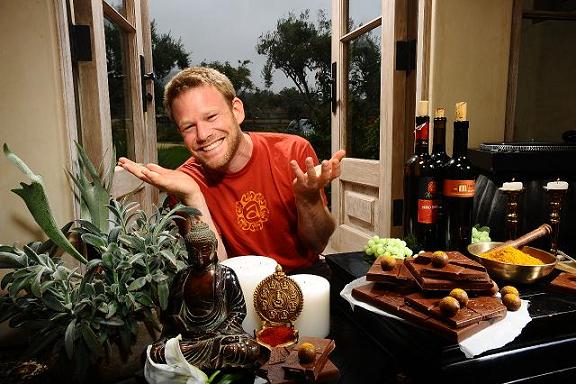
Why put 12 year-old aged balsamic vinegar from Modena, Italy into a chocolate truffle? Well, because it tastes surprisingly great, for one thing. But also, according to Dave Romanelli, one of the presenters at last weekend’s flexibly diverse San Francisco Yoga Journal Conference, because it can heighten your yoga practice. Enlightenment through chocolate? We’ll take it.
New York-based Romanelli taught a class called “Yoga and Chocolate,” and like many of the conference’s fifty presenters, he brought a yogic flavor to the conference influenced as much by his personal path to the mat as ancient teachings. In other words, fundamentalist ayurveda this was not.
Referred to as “Yeah Dave” by his friends (as in, “yeah, Dave, whatever…”), Romanelli has penchant for stoner-esque musings that eventually left him with the radical idea that to flourish in today’s fast-paced society, yoga should be made accessible to a broad audience.
In the ’90s, Romanelli and a partner started At One, a chain of trendy yoga studios in Phoenix that Romanelli says in an interview with SFBG were meant to “bust through the stereotypes” that yoga is pretentious and unconnected to daily life. In 2009 he published a book called Yeah Dave’s Guide to Livin’ in the Moment, an irreverent manual to enjoying life in the here and now. These days, he travels the country leading workshops that seek to initiate people into a yogic lifestyle through careful attention to the senses – which he engages with the help of wine and exotically-flavored chocolate provided by Yoga and Chocolate co-founder and master chocolatier Katrina Markoff.
“Yoga and Chocolate” was one of over a hundred classes, guest lectures, all-day intensive workshops, and special events that filled the San Francisco Hyatt over the MLK Day weekend, ranging from fiery asana practices to contemplative journeys through yogic philosophy. The scads of famous yogis in attendance included teachers like Ana Forrest, creator of the healing-based Forrest Yoga approach, Seane Corn, an internationally celebrated yoga teacher, activist and humanitarian, and San Francisco’s own Baron Baptiste, whose parents opened the city’s first yoga center in 1955 and who has shared his empowering vinyasa yoga with classes around the world.
With so many presenters — and with nearly half of conference attendees yoga teachers in their own right — the expo left the downtown hotel rife with pairs of groovy tie-dyed pants and hundreds of bare feet riding up and down the Hyatt’s escalators. In a city like San Francisco, it’s not surprising that the traditional Indian practice could draw such a huge audience – but the sight of so many modernized classes begged the question: Patanjali compiled the yoga sutras no later than 150 BC, and we’ve been mulling them over ever since. How much is really left to learn?
The answer is “a lot” if this year’s offerings were to be believed. Joining “Yoga and Chocolate” was MC Yogi’s “Ganesh is Fresh,” a hip-hop inspired retelling of the story of the elephant-headed deity Ganesh, remover of obstacles. (Fyi, if you’re a harmonious hip-hop head, it’s also the name of a track on MC Yogi’s 2008 album “Elephant Power.”) Another high-energy choice was “Bollywood Vinyasa,” a cardio-heavy yogic workout set to bright rhythms of bhangra and Bollywood music.
“I never intended to be a yoga teacher,” said Hemalayaa, the class’ teacher and the Canadian-born daughter of Indian parents. “I started practicing as a way to guide myself, be a leader for myself,” she announced to the students before her. The seed of “Bollywood Vinyasa” was planted during darker days in Hemalayaa’s 20s, when she would come home and blast Bollywood music as a way of shaking out her troubles. After having grown to the lively beats, she was able to incorporate them into her study of yoga. “Now I teach as a way to continue my study. Being a leader to others helps me stay true to myself.”
Romanelli agrees on the importance of applying traditional yogic teachings in a way that’s applicable to our own life stories. He has no problem using his own life experiences – like having man-boobs and wearing too much cologne on prom night in pursuit of after-party action – to draw laughs and convince his students that self-reflection can be fun.
His style is a definite departure from traditional yogic teaching (ashtanga yogis advocate pratyahara, withdrawal of the senses from external objects, as a means of attending to the inner self). But, in Yeah Dave’s opinion, sensual experience can be the first step toward getting people to pay attention and eventually journey inward.
“In today’s society, how realistic is closing off the senses?” he asks. “People are afraid to be alone with themselves on a three by six mat.” He admits that people often need help to make the first step. “And if it has to be chocolate, then so be it,” he grins.
For information on next year’s Yoga Journal Conference stretch out to www.yjevents.com/sf
Film Listings
P>Film listings are edited by Cheryl Eddy. Reviewers are Kimberly Chun, Michelle Devereaux, Peter Galvin, Max Goldberg, Dennis Harvey, Johnny Ray Huston, Louis Peitzman, Lynn Rapoport, Ben Richardson, and Matt Sussman. For rep house showtimes, see Rep Clock. For first-run showtimes, see Movie Guide. Due to the Dr. Martin Luther King, Jr. Day holiday, theater information was incomplete at presstime.
OPENING
Barney’s Version The charm of this shambling take on Mordecai Richler’s 1997 novel lies almost completely in the hang-dog peepers of star Paul Giamatti. Where would Barney’s Version be without him and his warts-and-all portrayal of lovable, fallible striver Barney Panofsky — son of a cop (Dustin Hoffman), cheesy TV man, romantic prone to falling in love on his wedding day, curmudgeon given to tying on a few at a bar appropriately named Grumpy’s, and friend and benefactor to the hard-partying and pseudo-talented Boogie (Scott Speedman). So much depends on the many nuances of feeling flickering across Giamatti’s pale, moon-like visage. Otherwise Barney’s Version sprawls, carries on, and stumbles over the many cute characters we don’t give a damn about — from Minnie Driver’s borderline-offensive JAP of a Panofsky second wife to Bruce Greenwood’s romantic rival for Barney’s third wife Miriam (Rosamund Pike). A mini-who’s who of Canadian directors surface in cameos — including Denys Arcand, David Cronenberg, and Atom Egoyan — as a testament to the respect Richler commands. Too bad director Richard J. Lewis didn’t get a few tips on dramatic rigor from Cronenberg or intelligent editing from Egoyan — as hard as it tries, Barney’s Version never rises from a mawkish middle ground. (2:12) (Chun)
*The Company Men Globalization, recession, and the stockholder-driven bottom line are wreaking havoc on business as usual at GTX, a Boston-based veteran manufacturer of shipping containers. CEO James Salinger (Craig T. Nelson) is coolly unconcerned about deep workforce cuts that preserve his fabulous wealth. But co-founder Gene (Tommy Lee Jones), who was not born with the proverbial silver spoon, is appalled by this willingness to sacrifice jobs for high-end investor wealth. (Nonetheless this doesn’t stop Gene from having as his mistress GTX fiscal hatchet-woman Maria Bello, whose part is the script’s weakest element.) His protests do nothing to halt the grim progression of layoffs — which next strike cocky young sales whiz Bobby (Ben Affleck), who’s furiously unable to cope with this blow to his inflated ego despite the levelheaded support of wife Maggie (Rosemarie DeWitt). Even worse equipped for change is 30-year company drone Phil (Chris Cooper), who’s too old to start again in a market where ruthless downsizing allows considerable ageism. With mortgages, college educations, country club memberships (ya gotta network somewhere), and so forth on the line, the protagonists here run the gamut of distressed emotions in coping with their suddenly reduced economic circumstances. TV-famed producer (ER, The West Wing) John Wells’ debut as feature writer director is a white-collar Arthur Miller update, earnest, meaty, and intelligent if unfashionably literal-minded about middle-to-upper-class angst. It’s engrossing for the most part, affording excellent dramatic opportunities to the estimable Jones, Cooper, and yes Ben Affleck — now that the latter is a respected director himself, you are officially granted permission to allow that he can act. If only this solid albeit unremarkable effort didn’t compromise itself with an ending phoned in by the Make A-Wish Foundation after nearly two hours of sober real-world credence. (1:53) (Harvey)
Evangelion 2.0: You Can (Not) Advance For certain anime fans, the stateside release of Hideaki Anno’s 2009 sci-fi action-adventure entry is a landmark event (see: YouTuber “OtakuCraveTV,” who posted a frame-by-frame analysis of an early Evangelion 2.0 trailer: “The next screen shot shows Eva Unit Two having some kind of jet propeller or jet pack … another cool feature that’s not in the original TV series.”) For the average moviegoer, though, the film might as well not have bothered to include English subtitles — there’s limited exposition and if you don’t know anything about the Evangelion phenomenon, you’ll be lost within minutes. In brief: the TV show was called Neon Genesis Evangelion, and it was a huge hit in Japan in the mid-1990s. This is the second film; 2008’s Evangelion 1.0: You Are (Not) Alone, won a Japanese Academy Prize for Best Animation. The plot involves human race-saving efforts by brave young pilots operating giant, armed robots. (Likely I made multiple factual mistakes in the above paragraph; otakus, please don’t keel-haul me.) Interested parties can read an extremely detailed plot description on the film’s Wikipedia entry — or go check out the movie itself when it opens at Japantown’s Viz Cinema. (1:52) Viz Cinema. (Eddy)
*Ne change rien See “Bye Bye Blackbird.” (1:43) Yerba Buena Center for the Arts.
No Strings Attached Natalie Portman and Ashton Kutcher star as fuck buddies in Ivan Reitman’s rom-com. (1:50)
*Nuremberg: Its Lesson For Today “We will show you their films&ldots;” So said Justice Robert Jackson during his opening remarks at Nuremberg, setting the stage not only for the historic prosecution but also for film history. After so much subsequent repackaging, it’s bracing being returned to this initial use of the Nazi archive as hard evidence in Nuremberg: Its Lessons for Today, the documentary produced by Pare Lorentz and the Schulberg brothers for the Office of Strategic Services in 1948. Though it screened widely in postwar Germany, Nuremberg never made it to American screens — one wonders whether the film’s vision of US-USSR cooperation wasn’t as much a stumbling block as its images of atrocities. While Nuremberg won’t soon replace Eichmann in Jerusalem as a probing account of the war tribunals, this crisp restoration remains a fascinating document of the moral condemnation of Nazi Germany in formation. Modern viewers may be surprised, for instance, by how long it takes before the Holocaust (still not called by that name, of course) is invoked. History casts a withering eye on Russian and American prosecutors denouncing military aggressions and needless civilian deaths, but one is nonetheless struck and even moved by what Nuremberg represents — specifically, the need to give a rational account of the terms of the peace, and to begin remembering. As with all the films produced by Lorenz, Nuremberg benefits from great rhetorical economy and fluid pacing. Now one only wishes that John Huston’s 1946 Let There Be Light — a harrowing postwar document of mentally disturbed veterans also produced for (and then suppressed by) the Army — would receive the same treatment. (1:18) (Goldberg)
*Two in the Wave See Picks. (1:33) Roxie.
The Way Back Master director Peter Weir returns to the man-versus-nature-and-each-other canvas of his previous film, 2003’s Master and Commander: The Far Side of the World, for this truth-based tale about a multinational crew of gulag escapees during the early days of World War II. Figuring he’d rather take his chances battling the elements (bitter cold, extreme heat, wolves, bounty-hunting natives, would-be cannibals) than face certain death doing back-breaking work in Siberia, Polish prisoner Janusz (Jim Sturgess from 2007’s Across the Universe) organizes a breakout. Joining him are a ragtag group, most of whom have been incarcerated for minor offenses that nonetheless rankled the ruling Communists. (One exception: Colin Farrell’s heavily tattooed, knife-wielding career criminal.) As the men, including taciturn American Mr. Smith (Ed Harris), slog across treacherous terrain, they lose some of their own numbers, and pick up another fugitive, fragile teenager Irina (Saoirse Ronin). The Way Back is a high-quality production, and certainly one of recent years’ most successful attempts at this kind of survivalist epic. But it throws exactly no curveballs (see: Werner Herzog’s 2006 Rescue Dawn, similar but far less predictable), and like its characters trudges toward a dutifully noble finish. (2:13) (Eddy)
ONGOING
*Animal Kingdom More renowned for its gold rush history and Victorian terrace homes than its criminal communities, Melbourne, Australia gets put on the same gritty map as Martin Scorsese’s ’70s-era New York City and Quentin Tarantino’s ’90s Los Angeles with the advent of director-writer David Michôd’s masterful debut feature. The metropolis’ sun-blasted suburban homes, wood-paneled bedrooms, and bleached-bone streets acquire a chilling, slowly building power, as Michôd follows the life and death of the Cody clan through the eyes of its newest member, an unformed, ungainly teenager nicknamed J (James Frecheville). When J’s mother ODs, he’s tossed into the twisted arms of her family: the Kewpie doll-faced, too-close-for-comfort matriarch Smurf (Jacki Weaver), dead-eyed armed robber Pope (Ben Mendelsohn), Pope’s best friend Baz (Joel Edgerton), volatile younger brother and dealer Craig (Sullivan Stapleton), and baby bro Darren (Luke Ford). Learning to hide his responses to the escalating insanity surrounding the Codys’ war against the police — and the rest of the world — and finding respite with his girlfriend, Nicky (Laura Wheelwright), J becomes the focus of a cop (Guy Pearce) determined to take the Codys down — and discovers he’s going to have use all his cunning to survive in the jungle called home. Stunning performances abound — from Frecheville, who beautifully hides a growing awareness behind his character’s monolithic passivity, to the adorably scarifying Weaver — in this carefully, brilliantly detailed crime-family drama bound to land at the top of aficionados’ favored lineups, right alongside 1972’s The Godfather and 1986’s At Close Range and cult raves 1970’s Bloody Mama and 1974’s Big Bad Mama. (2:02) (Chun)
*Another Year Mike Leigh’s latest represents a particularly affecting entry among his many improv-based, lives-of-everyday-Brits films. More loosely structured than 2008’s Happy-Go-Lucky, which featured a clear lead character with a well-defined storyline, the aptly-titled Another Year follows a year in the life of a group of friends and acquaintances, anchored by married couple Tom (Jim Broadbent) and Gerri (Ruth Sheen). Tom and Gerri are happily settled into middle-class middle age, with a grown son (Oliver Maltman) who adores them. So far, doesn’t really sound like there’ll be much Leigh-style heightened emotion spewing off the screen, traumatizing all in attendance, right? Well, you haven’t met the rest of the ensemble: there’s a sad-sack small-town widower, a sad-sack overweight drunk, a near-suicidal wife and mother (embodied in one perfect, bitter scene by Imelda Staunton), and Gerri’s work colleague Mary, played with a breathtaking lack of vanity by Lesley Manville. At first Mary seems to be a particularly shrill take on the clichéd unlucky-in-love fiftysomething woman — think an unglamorous Sex in the City gal, except with a few more years and far less disposable income. But Manville adds layers of depth to the pitiful, fragile, blundering Mary; she seems real, which makes her hard to watch at times. That said, anyone would be hard-pressed to look away from Manville’s wrenching performance. (2:09) (Eddy)
Bhutto The glamorous leading late force for progressivism in Pakistan lived a high-profile, highly dramatic life that — along with her nation’s never-ending sociopolitical tumult since World War II — is granted a solid overview in Duane Baughman and Johnny O’Hara’s new documentary. Benazir Bhutto was remarkable on so many grounds, as a female Prime Minister in an overwhelmingly male-centric culture (though she was perhaps too careful not to push a “feminist agenda” with regard to improving fellow countrywomen’s rights), a pro-democracy reformist (albeit one with a very mixed success record), a courageous figure of resistance despite imprisonment, death threats and, finally, assassination. Packed with information, interviews, and archival footage, arguably overpackaged with flashy editing and the kind of incessant music supervision that won’t quit when you really wish it would, this celluloid bio is as flawed as it is valuable. The main problem is that it presents itself so strongly as a definitive portrait. But too often Bhutto feels “authorized” to a fault (one of its producers even co-wrote the subject’s posthumously published tome Reconciliation: Islam, Democracy and the West), skimming over points of controversy and potential criticism. Commentators run a narrow gamut from appreciative allies (e.g. Condi Rice) to tearful surviving intimates (like her daughters). Admittedly, even almost two full hours isn’t enough to do this very complex global figure justice. Still, there’s plenty of space here for a more balanced perspective that the film doesn’t even try to attain. (1:51) (Harvey)
*Black Swan “Lose yourself,” ballet company head Thomas (Vincent Cassel) whispers to his leading lady, Nina (Natalie Portman), moments before she takes the stage. But Nina is already consumed with trying to find herself, and rarely has a journey of self-discovery been so unsettling. Set in New York City’s catty, competitive ballet world, Black Swan samples from earlier dance films (notably 1948’s The Red Shoes, but also 1977’s Suspiria, with a smidgen of 1995’s Showgirls), though director Darren Aronofsky is nothing if not his own visionary. Black Swan resembles his 2008 The Wrestler somewhat thematically, with its focus on the anguish of an athlete under ten tons of pressure, but it’s a stylistic 180. Gone is the gritty, stripped-down aesthetic used to depict a sad-sack strongman. Like Dario Argento’s 1977 horror fantasy, the gory, elegantly choreographed Black Swan is set in a hyper-constructed world, with stabbingly obvious color palettes (literally, white = good; black = evil) and dozens of mirrors emphasizing (over and over again) the film’s doppelgänger obsession. As Nina, Portman gives her most dynamic performance to date. In addition to the thespian fireworks required while playing a goin’-batshit character, she also nails the role’s considerable athletic demands. (1:50) (Eddy)
*Blue Valentine Sometimes a performance stands out and grabs attention for embodying a particular personality type or emotional state that’s instantly familiar yet infrequently explored in much depth at the movies. What’s most striking about Derek Cianfrance’s Blue Valentine is the primary focus it lends Michelle Williams’ role as the more disgruntled half of a marriage that’s on its last legs whether the other half knows that or not. Ryan Gosling has the showier part — his Dean is mercurial, childish, more prone to both anger and delight, a babbler who tries to control situations by motor-mouthing or goofing through them. But Williams’ Cindy has reached the point where all his sound and fury can no longer pass as anything but static that must be tuned out as much as possible so that things get done. Things like parenting, going to work, getting the bills paid, and so forth. It’s taken a few years for Cindy to realize that she’s losing ground in her lifelong battle for self-improvement with every exasperating minute she continues to tolerate him. Williams’ bile-swallowing silences and the involuntary recoil that greets Dean’s attempts to touch Cindy are the film’s central emotional color: that state in which the loyalty, obligation, fear, pity, or whatever has kept you tied to a failing relationship is being whittled away by growing revulsion. Gosling’s excellent stab at an underwritten part is at a disadvantage compared to Williams, who just about burns a hole through the screen. (1:53) (Harvey)
Budrus A stirring political documentary that benefits immensely from its you-are-there footage, Budrus details the unarmed protests held by the residents of a tiny Palestinian village that happened to be smack-dab in the middle of a planned stretch of Israel’s Separation Barrier. Like, literally: the placement of the fence would necessitate the uprooting of thousands of olive trees, as well as bisect the local cemetery. As the community — including a soft-spoken organizer and his remarkably poised teenage daughter — unites for the cause, they earn support from other villages and nations, as well as (kind of) respect from the Israeli soldiers who’ve been told to guard the building site. Avoiding heavy-handedness, director Julia Bacha (who co-directed 2006’s Encounter Point) highlights the hopeful aspects of this inspiring tale. (1:21) (Eddy)
Casino Jack An unfortunate curtain call for director George Hickenlooper, who died two months ago, this biopic about infamous Washington lobbyist Jack Abramoff — sprung from federal prison just in time for Xmas ’10 — is no more successful than his prior stab at Edie Sedgwick, 2006’s Factory Girl. He chooses to portray the real-life protagonist’s wild ride through the Bush years — buying politicians (notably Tom DeLay, who’s about to start his own prison term), screwing the “little guys” (like casino-owning Native tribes), furthering the conservative “values” agenda while pocketing a whole lotta $$$ — as a farcical Horatio Alger success story run amuck, not unlike recent The Informant! (2009) or Catch Me If You Can (2002). But neither script or handling are deft enough to pull that off, resulting in an irksomely broad cartoon of recent events that isn’t tough enough on the crimes and corruption at hand. Worse, the film — and in particular star Kevin Spacey (representing a rare occasion on which Hollywood’s substitute is less handsome than the figure portrayed) — at times seem to actually admire Abramoff as a ballsy, spunky, big swingin’-dick example of all-American go-getter-ness. Sure he’s got flaws, but ya gotta love a guy with such brass cojones, right? Wrong. Spacey is very showy here, misjudging his target such that he comes off an egomaniacal jerk playing an egomaniacal jerk. The film’s stylistic gambits (like its perky 60s vocal-ensemble score) are likewise smug ‘n’ snarky in ways more grating than clever. The one standout in a too-hardworking cast is Jon Lovitz as the sleaziest of all Abramoff’s sleazy-operator cronies; he knows how to go way over the top while maintaining precise, hilarious control. You’re better off seeing Alex Gibney’s recent doc Casino Jack and the United States of Money, which far more skillfully weighs this subject with commingled awe, sarcasm, and revulsion. (1:48) (Harvey)
The Chronicles of Narnia: The Voyage of the Dawn Treader It’s no secret that C.S. Lewis’ Narnia saga is a big ol’ Christian allegory. And hey, that doesn’t mean it’s not entertaining. The film adaptations of his novels have been decent, in that they’ve worked to please both mainstream audiences and religious zealots who want to see the Jesus lion die for our sins. But while The Lion, The Witch and the Wardrobe (2005) and Prince Caspian (2008) were essentially passable, The Voyage of the Dawn Treader is an overwhelming failure. It’s lazy, the plotting is uneven, the CGI is cringe-worthy, and the 3D is the kind of sloppy post-production mess that makes the actors’ faces look concave. Add to that the moral message, which is more hamfisted than ever. In his lengthy climactic sermon, Aslan — he’s known by a different name in our world — tells Lucy (Georgie Henley) and Edmund (Skandar Keynes) that all their adventures have been about bringing them closer to him. Suck it, atheists. (1:52) (Peitzman)
Country Strong We meet country superstar Kelly Canter (Gwyneth Paltrow) as she’s being prematurely checked out of yet another rehab stint by her ambitious husband manager James (Tim McGraw), who’s already booked a concert tour she’s not ready for. While there, however, she’s acquired a friend in staffperson Beau (Garrett Hedlund), an aspiring country singer himself who ends up nabbing the tour’s opening slot alongside ex-beauty queen and fellow unknown Chiles (Leighton Meester). Kelly and Beau are maybe sorta in love, Beau and Chiles might be headed in that direction, Kelly and James are kinda falling out of love, and James might or might not be putting the make on Chiles — which makes four relationships we spend nearly two hours here not caring about. The most one can say for Shana Feste’s drama is that it underplays its many clichés. But even that turns out to be a mistake, since her script is so sketchy that the clichés are all it has going for it. Yes, Paltrow, Hedlund, and Meester can sing (oddly, actual country music star McGraw has a non-singing role), but the songs here are unmemorable and dully staged, albeit invariably greeted by wildly cheering on-screen audiences whose enthusiasm isn’t infectious. Acting-wise, nobody disgraces themselves, but Country Strong feels like a movie pushed into production when its screenplay was still in the development stage — it lacks narrative spine, and the usual factors that might compensate (colorful supporting roles, authentic atmosphere, music-industry insight etc.) are MIA. (1:51) (Harvey)
The Dilemma A dilemma: being stuck with two terrible options, say, having to watch a Vince Vaughn movie (that isn’t 1996’s Swingers) or an episode of the King of Queens, starring Kevin James. With Ron Howard’s The Dilemma, you don’t have to choose. Middle American dreams come true by pairing two actors who define undeserving success. The film plays like an extended episode of a CBS sitcom, complete with the timeless trope of average-looking guys coupled with stunning women. However, like James, some things don’t make the transition to the big screen very well, as Howard illustrates perfectly in an intimate scene by contrasting the faces of Vaughn and actress Jennifer Connelly via extreme close-up. The plot? Ronny (Vaughn) catches Geneva (Winona Ryder) cheating on his BFF (James), but can’t tell because they are working on an important project: developing an electric car that’s not “gay.” (Seriously.) Not quite a dilemma, cheap complications prolong the film to the point that you’ll scream for Vaughn to confess and start the credits. (1:58) (Ryan Prendiville)
*Fair Game Doug Liman’s film effectively dramatizes yet another disgraceful chapter from the last Presidential administration: how CIA agent Valerie Plame (Naomi Watts), who’d headed the Joint Task Force on Iraq investigating whether Saddam Hussein had WMDs, was identified by name in the Washington Post as a covert agent — thus ending her intelligence career and placing many of her subordinates and sources around the world in danger. This info was leaked to the press, it turned out, by highest-level White House officials as “punishment” for the New York Times editorial former ambassador Joe Wilson (Sean Penn) — Plame’s husband — wrote condemning their insistence on those WMDs to justify the Iraq invasion by then already well in progress. (The CIA task force had also found zero evidence of mass-destruction weapons, but Bush and co. chose to come up with their own bogus “facts” to sway US public opinion.) Purportedly, Karl Rove clucked to CNN’s Chris Matthews that Wilson’s awkwardly-timed dose of sobering truth rendered his spouse “fair game” for exposure. Unfortunately opening here several days after it might theoretically have done some election-day good — not that many Republican voters would likely be queuing up — Fair Game may be a familiar story to many. But its gist and details remain quite enough to make the blood boil. While the political aspects are expertly handled in thriller terms, the personal ones are a tad less successful. That’s partly because we never quite glimpse what brought these two very busy, business-first people together; but largely, alas, because so many of Wilson’s diatribes come off all too much as things that might be said by Sean Penn, Rabble-Rouser and Humanitarian. This is perhaps a case of casting so perfect it becomes a distracting fault. (1:46) (Harvey)
The Fighter Once enough of a contenda to have fought Sugar Ray Leonard — and won, though there are lingering questions about that verdict’s justice — Dicky (Christian Bale) is now a washed-up, crack-addicted mess whose hopes for a comeback seem just another expression of empty braggadocio. Ergo it has fallen to the younger brother he’s supposedly “training,” Micky (Mark Wahlberg), to endure the “managerial” expertise of their smothering-bullying ma (Melissa Leo) and float their large girl gang family of trigger-tempered sisters. That’s made even worse by the fact that they’ve gotten him nothing but chump fights in which he’s matched someone above his weight and skill class in order to boost the other boxer’s ranking. When Micky meets Charlene (Amy Adams), an ambitious type despite her current job as a bartender, this hardboiled new girlfriend insists the only way he can really get ahead is by ditching bad influences — meaning mom and Dicky, who take this shutout as a declaration of war. The fact-based script and David O. Russell’s direction do a good job lending grit and humor to what’s essentially a 1930s Warner Brothers melodrama — the kind that might have had Pat O’Brien as the “good” brother and James Cagney as the ne’er-do-well one who redeems himself by fadeout. Even if things do get increasingly formulaic (less 1980’s Raging Bull and more 1976’s Rocky), the memorable performances by Bale (going skeletal once again), Wahlberg (a limited actor ideally cast) and Leo (excellent as usual in an atypically brassy role) make this more than worthwhile. As for Adams, she’s just fine — but by now it’s hard to forget the too many cutesy parts she’s been typecast in since 2005’s Junebug. (1:54) (Harvey)
*The Girl Who Kicked the Hornet’s Nest If you enjoyed the first two films in the Millennium trilogy — 2009’sThe Girl With the Dragon Tattoo and The Girl Who Played With Fire — there’s a good chance you’ll also like The Girl Who Kicked the Hornet’s Nest. Based on the final book in Stieg Larsson’s series, the film begins shortly after the violent events at the conclusion of the second movie. There are brief flashes of what happened — the cinematic equivalent of TV’s “previously on&ldots;” — but it’s likely an indecipherable jumble to Girl first-timers. Hornet’s Nest presents the trial of Lisbeth Salander (Noomi Rapace), the much-abused, much-misunderstood, entirely kick-ass protagonist of the series. With the help of journalist Mikael Blomkvist (Michael Nyqvist) and his sister Annika (Annika Hallin) as her lawyer, Lisbeth finally gets her day in court. The conspiracy that drives the story is somewhat convoluted, and while it all comes together in the end, Hornet’s Nest isn’t an easy film to digest. Still, it’s a well-made and satisfying conclusion to the trilogy — as long as you caught the beginning and middle, too. (2:28) (Peitzman)
*The Green Hornet I still don’t understand why this movie had to be in 3D, or what Cameron Diaz’s character has to do with anything, but I liked The Green Hornet in spite of myself. Only in Hollywood could artsy director Michel Gondry hook up with self-satisfied comedian Seth Rogen, who stars in and co-wrote this surprisingly amusing (if knowingly lightweight) superhero entry. After the death of his father (a megarich newspaper owner — how retro!), Rogen’s party boy Britt Reid decides, either out of boredom or misdirected rebellion, to become an anti-crime vigilante only pretending to be a criminal. (And that’s about as complicated as this movie gets.) Helping him, which is to say creating all of the cool cars and gadgets and single-handedly winning all of the fist fights, is Kato (Taiwanese actor Jay Chou, taking over the role Bruce Lee made famous). As himself, Reid is so obnoxious he pisses off newspaper editor Axford (Edward James Olmos); as the Hornet, he’s so obnoxious he pisses off actual crime boss Chudnofsky, played by movie highlight Christoph Waltz — more or less doing a Eurotrash twist on his Oscar-winning Inglourious Basterds (2009) Nazi. (1:29) (Eddy)
*I Love You Phillip Morris Given typically imitation-crazed Hollywood’s failure to built on the success of 2005’s Brokeback Mountain success — or see it as anything more than a fluke — the case of I Love You Phillip Morris is interesting for what it is and isn’t. It is, somewhat by default, the biggest onscreen gay romance (not including foreign and indie productions, which are always ahead of the curve) since that earlier film. What Phillip Morris is not, however, is a Hollywood or even American film, all appearances to the contrary. Its financing was primarily French — presumably because there wasn’t enough willing coin on this side of the Atlantic. We meet Steven Jay Russell as an uber-perky all-American lad — a nascent Jim Carrey. A near-fatal accident, however, induces him to merrily chuck it all and live life to the fullest by moving from Georgia to South Beach and becoming a “big fag.” He soon discovers that “being gay is really expensive,” or at least his chosen A-lister lifestyle is, so he turns to crime as a means of support. During one hoosegow stay, he meets the non-tobacco-related Phillip Morris (McGregor), a sweet Southern sissy. Directors Glenn Ficarra and John Requa approach their fascinating material with brashness and some skill, but without the control to balance its steep tonal shifts. Surprisingly, it’s in the “love” part that they often succeed best. While their comic aspects sometimes tip into shrill, destabilizing caricature — the excess that brilliant but barely-manageable Carrey will always drift toward unless tightly leashed — this movie’s link to Brokeback is that it never makes the love between two men look inherently ridiculous, as nearly all mainstream comedies now do to get a cheap throwaway laugh or three. (1:38) (Harvey)
*The Illusionist Now you see Jacques Tati and now you don’t. With The Illusionist, aficionados yearning for another gem from Tati will get a sweet, satisfying taste of the maestro’s sensibility, inextricably blended with the distinctively hand-drawn animation of Sylvain Chomet (2004’s The Triplets of Belleville). Tati wrote the script between 1956 and 1959 — a loving sendoff from a father to a daughter heading toward selfhood — and after reading it in 2003 Chomet decided to adapt it, bringing the essentially silent film to life with 2D animation that’s as old school as Tati’s ambivalent longing for bygone days. The title character should be familiar to fans of Monsieur Hulot: the illusionist is a bemused artifact of another age, soon to be phased out with the rise of rock ‘n’ rollers. He drags his ornery rabbit and worn bag of tricks from one ragged hall to another, each more far-flung than the last, until he meets a little cleaning girl on a remote Scottish island. Enthralled by his tricks and grateful for his kindness, she follows him to Edinburgh and keeps house while the magician works the local theater and takes on odd jobs in an attempt to keep her in pretty clothes, until she discovers life beyond their small circle of fading vaudevillians. Chomet hews closely to bittersweet tone of Tati’s films — and though some controversy has dogged the production (Tati’s illegitimate, estranged daughter Helga Marie-Jeanne Schiel claimed to be the true inspiration for The Illusionist, rather than daughter and cinematic collaborator Sophie Tatischeff) and Chomet neglects to fully detail a few plot turns, the dialogue-free script does add an intriguing ambiguity to the illusionist and his charge’s relationship — are they playing at being father and daughter or husband and wife? — and an otherwise straightforward, albeit poignant tale. (1:20) Smith Rafael. (Chun)
Inside Job Inside Job is director Charles Ferguson’s second investigative documentary after his 2007 analysis of the Iraq War, No End in Sight, but it feels more like the follow-up to Alex Gibney’s Enron: The Smartest Guys in the Room (2005). Keeping with the law of sequels, more shit blows up the second time around. As with No End in Sight, Ferguson adeptly packages a broad overview of complex events in two hours, respecting the audience’s intelligence while making sure to explain securities exchanges, derivatives, and leveraging laws in clear English (doubly important when so many Wall Street executives hide behind the intricacy of markets). The revolving door between banks, government, and academia is the key to Inside Job‘s account of financial deregulation. At times borrowing heist-film conventions (it is called Inside Job, after all), Ferguson keeps the primary players in view throughout his history so that the eventual meltdown seems anything but an accident. The filmmaker’s relentless focus on the insiders isn’t foolproof; tarring Ben Bernanke, Henry Paulson, and Timothy Geithner as “made” guys, for example, isn’t a substitute for evaluating their varied performances over the last two years. Inside Job makes it seem that the entire crisis was caused by the financial sector’s bad behavior, and this too is reductive. Furthermore, Ferguson does not come to terms with the politicized nature of the economic fallout. In Inside Job, there are only two kinds of people: those who get it and those who refuse to. The political reality is considerably more contentious. (2:00) (Goldberg)
The King’s Speech Films like The King’s Speech have filled a certain notion of “prestige” cinema since the 1910s: historical themes, fully-clothed romance, high dramatics, star turns, a little political intrigue, sumptuous dress, and a vicarious taste of how the fabulously rich, famous, and powerful once lived. At its best, this so-called Masterpiece Theatre moviemaking can transcend formula — at its less-than-best, however, these movies sell complacency, in both style and content. In The King’s Speech, Colin Firth plays King George VI, forced onto the throne his favored older brother Edward abandoned. This was especially traumatic because George’s severe stammer made public address tortuous. Enter matey Australian émigré Lionel Logue (Geoffrey Rush, mercifully controlled), a speech therapist whose unconventional methods include insisting his royal client treat him as an equal. This ultimately frees not only the king’s tongue, but his heart — you see, he’s never had anyone before to confide in that daddy (Michael Gambon as George V) didn’t love him enough. Aww. David Seidler’s conventionally inspirational script and BBC miniseries veteran Tom Hooper’s direction deliver the expected goods — dignity on wry, wee orgasms of aesthetic tastefulness, much stiff-upper-lippage — at a stately promenade pace. Firth, so good in the uneven A Single Man last year, is perfect in this rock-steadier vehicle. Yet he never surprises us; role, actor, and movie are on a leash tight enough to limit airflow. (1:58) (Harvey)
Little Fockers (1:50)
*Made in Dagenham I hesitate to use the word “spunky,” lest I sound condescending, but indeed that’s what we have here: the spunky tale, drawn from real life, of women who worked sewing seats at a British Ford factory in the late 60s — and fought for equal pay, despite the tide of sexism that desperately tried to hold them down. Heading the charge is Rita (Sally Hawkins from 2008’s Happy-Go-Lucky), a married mom who becomes a feminist icon (and a labor hero) without really meaning to; she’s the most developed character in a script that mostly calls forth types (Bob Hoskins as the encouraging union man; Rosamund Pike as the frustrated intellectual-turned-housewife; Rita’s slutty factory co-worker with the enormous beehive; steely-eyed Ford execs). Adding spark is Miranda Richardson as Britain’s no-nonsense Secretary of State Barbara Castle, a legendary Labour party politician. Though it’s packaged a bit too neatly — from frame one, the film’s peppy tone all but guarantees a happy ending — Made in Dagenham‘s message is uplifting and worthy, and a reminder that it wasn’t so long ago that women were fighting for the seemingly most obvious of rights. (1:53) (Eddy)
*On the Bowery The Roxie offers a re-release showcase of On the Bowery, a 1956 piece of early U.S. independent cinema that won major prizes. But many observers at the time wanted it dragged into some dark alley under cover of darkness, then quietly removed, lest polite society sift through the unflattering mess. The 65-minute feature echoed Italian neo-realism’s influence, as it mixed documentary footage with dramatic elements using nonprofessional actors basically playing themselves. It also provided a filmmaking “school” for debuting director Lionel Rogosin. Interviewed just before his turn-of-millenium death for 2009’s The Perfect Team: The Making of On the Bowery, which the Roxie is also showing, Rogosin recalls approaching this endeavor (initially planned as a short) with characteristic immersive fervency. Having decided to focus on New York’s Skid Row district — the onetime flourishing heart of Manhattan whose slow degeneration began when an overground rail built in the 1870s bypassed stopping there — he spent a full six months befriending and bar-crawling with “Bowery bums.” In the saloons and flops he found his cast, and even his crew. On the Bowery won great acclaim in Europe and an eventual Oscar nomination as Best Documentary. Yet Eisenhower America preferred the less seemly aspects of its domestic life be kept hidden from view. The film’s shocking vistas of bruised, broken, passed-out “forgotten men” littering already decrepit city sidewalks at dawn seemed not just an ugly truth but an unallowable one. (1:15) Roxie. (Harvey)
127 Hours After the large-scale, Oscar-draped triumph of 2008’s Slumdog Millionaire, 127 Hours might seem starkly minimalist — if director Danny Boyle weren’t allergic to such terms. Based on Aron Ralston’s memoir Between a Rock and a Hard Place, it’s a tale defined by tight quarters, minimal “action,” and maximum peril: man gets pinned by rock in the middle of nowhere, must somehow free himself or die. More precisely, in 2003 experienced trekker Ralston biked and hiked into Utah’s Blue John Canyon, falling into a crevasse when a boulder gave way under his feet. He landed unharmed … save a right arm pinioned by a rock too securely wedged, solid, and heavy to budge. He’d told no one where he’d gone for the weekend; dehydration death was far more likely than being found. For those few who haven’t heard how he escaped this predicament, suffice it to say the solution was uniquely unpleasant enough to make the national news (and launch a motivational-speaking career). Opinions vary about the book. It’s well written, an undeniably amazing story, but some folks just don’t like him. Still, subject and interpreter match up better than one might expect, mostly because there are lengthy periods when the film simply has to let James Franco, as Ralston, command our full attention. This actor, who has reached the verge of major stardom as a chameleon rather than a personality, has no trouble making Ralston’s plight sympathetic, alarming, poignant, and funny by turns. His protagonist is good-natured, self-deprecating, not tangibly deep but incredibly resourceful. Probably just like the real-life Ralston, only a tad more appealing, less legend-in-his-own-mind — a typical movie cheat to be grateful for here. (1:30) (Harvey)
*Rabbit Hole If Rabbit Hole doesn’t sound like the kind of movie you’d want to watch, I don’t blame you. Following the lives of a married couple dealing with the loss of their young son, the film sounds a lot like the kind of Lifetime movie you accidentally spend a hung over Sunday sniffling through. But Rabbit Hole is a smart, complex addition to the genre, with exceptional performances from leads Nicole Kidman (Becca) and Aaron Eckhart (Howie), and a script by David Lindsay-Abaire, adapting his Pulitzer Prize-winning play. Director John Cameron Mitchell infuses Rabbit Hole with his trademark dark humor, creating a film that understands the serious toll grief takes but isn’t afraid to step back and laugh at life, too. Special attention must also be paid to the supporting cast, including Dianne Wiest as Becca’s mother, and newcomer Miles Teller as Jason. Explaining Jason’s role would be giving away too much — it’s enough to say that his presence is part of what elevates Rabbit Hole from grief porn to one of this year’s best. (1:32) (Peitzman)
Season of the Witch Donovan’s song surely deserves a more worthy cinematic outing as its namesake. In any case the vague miasma of suspicion and paranoia propelling the tune has little to do with the Dominic Sena’s Season of the Witch: the only mystery here is how Nicolas Cage manages to carry off the many ratty mullets he must wear in his fantasy epics — and how Cage and company manage to stomach the quasi-misogynistic supernatural fantasy-horror proceedings. Sure, there’s a certain wan, mouth-breathing Kristen Stewart-like charm to Claire Foy’s performance as the sorcerer accused of bringing the bubonic plague to an undefined set of hapless villagers. And there’s a kind of all-too-contemporary buddy film chemistry between Cage, as contentious-crusader-on-the-run Behmen, and Ron Perlman, as his knightly wingman Felson — you almost expect first pumps, knuckle bumps and cries of “Dude!” as they charge the infidels. But that’s not enough to save the movie — not certain if it’s a horror film, up-with-Catholicism exorcism outing, or weak, remote appeal to the Harry Potter legion — or make the cheers emitting from the audience when onscreen women get hit any more palatable. Amid all the feisty girls in the movie houses these days — from True Grit‘s Mattie Ross to Winter’s Bone‘s Ree Dolly (both films 2010) — the fear of women pervading Season of the Witch feels downright, er, medieval. (1:38) (Chun)
*The Social Network David Fincher’s The Social Network is a gripping and entertaining account of how Facebook came to take over the known social-networking universe. In this version of events — scripted by Aaron Sorkin and based on Ben Mezrich’s book The Accidental Billionaires, in turn based substantially on interviews with FB cofounder Eduardo Saverin, with input from Mark Zuckerberg icily absent — a girlfriend’s dumping of Zuckerberg (Jesse Eisenberg) on a crisp evening in 2003 is the impetus in his headlong quest for a “big idea.” The film is structured around the conference-room depositions for two separate lawsuits, brought against Zuckerberg by Saverin (Andrew Garfield) and by fellow Harvard entrepreneurs Tyler and Cameron Winklevoss (Armie Hammer) and Divya Narendra (Max Minghella) for crimes involving intellectual property and vast scads of retributive money. Unless Zuckerberg decides to post it on Facebook (which he probably shouldn’t, given the nondisclosure vows that capped off the first round of lawsuits), we’ll never know what truly motivated him and how badly he screwed over his friends and fellow students. But Fincher and Sorkin have crafted a compelling, absorbing, and occasionally poignant tale of how it could have happened. (2:00) Castro. (Rapoport)
Somewhere A lonely Ferrari zooms around a deserted track, over and over and over again. The opening scene of Sofia Coppola’s latest, Somewhere, is such an obvious metaphor that at first I thought the director was joking. Actually, she’s not: Somewhere is indeed a repetitous movie about a very boring, very ennui-laden individual, who happens to be a movie star with the marquee-ready name of Johnny Marco (Stephen Dorff). Now that you’ve been smacked over the head with metaphor, feel free to play spot the subtext: Johnny lives at Sunset Boulevard haunt the Chateau Marmont, legendary for its often-behaving-badly celebrity clientele. His life is an endless progression of blah (wake up, smoke, pop a Propecia, eyefuck and fuck random female admirers), broken up by job obligations — the tedium of a press conference here, the drudgery of a visit to the special-effects make-up studio there. Sigh. Would any director not as privileged as Coppola dare to focus on a character whose massive wealth can’t at all assuage his existential crisis? Money may not buy happiness, but it’s kind of hard to feel sorry for a guy whose depression plays out as he floats the day away at a luxury hotel. Fortunately, there is a bright spot in all this: mostly-absentee dad Johnny has a kid, Cleo, a tween sprite played by the charming Elle Fanning. Cleo is the only meaningful thing in Johnny’s life, and the only interesting thing that happens in this glacially-paced, bellybutton-obsessed movie. (1:38) (Eddy)
Tangled In its original form, Rapunzel‘s a pretty brutal fairy tale: barely pubescent girl gets knocked up by a prince — who’s then blinded by her evil witch guardian — leaving Rapunzel to fend for herself as she’s exiled into the desert and bears twins. Relax, that isn’t the story Tangled tells. The new Disney film is a complete revamping of the tale: Rapunzel (Mandy Moore) escapes the clutches of Mother Gothel (Donna Murphy) with the help of ne’er-do-well Flynn Ryder (Zachary Levi). Along the way, there are songs and slapstick moments and, yes, anthropomorphic animals. But unlike the classic feel of last year’s The Princess and the Frog, Tangled comes across as recycled. It’s just not as fresh and sharp as it should be, especially given recent Disney accomplishments like Toy Story 3. Kids will enjoy it and adults won’t be bored, but it’s a step backward for the House of Mouse. And don’t expect to be humming any of the songs after you exit the theater. (1:32) (Peitzman)
The Tourist Ah, all the champagne wishes and caviar dreams and daydreams of bouncing truffles off Angelina Jolie’s pillowy pout couldn’t quite stop The Tourist from going very much astray. How many ways can a movie go wrong? There’s the by-the-numbers yet somehow directionless direction from filmmaker Florian Henckel von Donnersmarck, who made one of the most absorbing film about surveillance to date with The Lives of Others (2006), only to completely miss the mark with this tone-deaf attempt at a Charade-like romantic escapade. The musty, fussy bodice-swelling score by James Newton Howard. A glassy-eyed Jolie somehow mistaking stony inexpressiveness for Garbo-esque mystique? The list goes on — at core, the casting is perhaps the sole compelling reason to see this waxy, museum-piece remake of the French film Anthony Zimmer (2005) — though the chemistry is negligible between the film’ attractive stars, with Jolie in particular waltzing through like a beautiful Euro-zombie, seemingly intent on sleepwalking through Venice and saving her better efforts for a more socially conscious film. Her disdain for the material sucks the air from this entire enterprise. The only bit of un-snuffable charm here lies in Johnny Depp’s naifish delivery and the murky, ironic humor he unobtrusively layers into his bemused performance. But then he’s just a tourist, passing through and providing the only scrap of pleasure in an otherwise dull outing. (1:44) (Chun)
Tron: Legacy A rare sequel among remakes, Tron: Legacy remains true to the 1982 nerd cult classic: it’s essentially a silly movie about being transported into a computer world where everyone dresses in rave couture. Jeff Bridges returns, now in opposing roles. On one side he’s computer genius Kevin Flynn, bearded zen master, and across the uncanny valley he’s CLU, an ageless software lord. Flynn’s been stuck in the Matri…er…Grid for decades, as CLU followed his programming to its logical conclusion: genocide. This is a bit too heavy of a theme for a film where almost every character gets blown to bytes upon introduction (cough, Michael Sheen, cough) but the light cycles and death pong are really cool in 3D. The plot, when it’s not setting up Disney’s inevitable sequels (hello, pointless Cillian Murphy) is Star Wars (1977), except Obi-wan Lebowski is the father. The son is Sam (Garrett Hedlund), whose good looks, penchant for extreme sports, and vacuous personality are the perfect avatar for our geek fantasy, where women strip us bare and are sexy guard dogs (Olivia Wilde.) While not passing the Bechdel Test, the film may be worth admission to hear the Dude’s Jedi utter “It’s biodigital jazz, man!” Look out for a special cameo by Daft Punk, playing hits from its score, which sounds like Kraftwerk mixing Vangelis and Danny Elfman (available in stores now.) They’ll be the ones wearing helmets. No, the other ones. (2:05) (Prendiville)
*True Grit Jeff Bridges fans, resist the urge to see your Dude in computer-trippy 3D and make True Grit your holiday movie of choice. Directors Ethan and Joel Coen revisit (with characteristic oddball touches) the 1968 Charles Portis novel that already spawned a now-classic 1969 film, which earned John Wayne an Oscar for his turn as gruff U.S. Marshall Rooster Cogburn. (The all-star cast also included Dennis Hopper, Glen Campbell, Robert Duvall, and Strother Martin.) Into Wayne’s ten-gallon shoes steps an exceptionally crusty Bridges, whose banter with rival bounty hunter La Boeuf (a spot-on Matt Damon) and relationship with young Mattie Ross (poised newcomer Hailee Steinfeld) — who hires him to find the man who killed her father — likely won’t win the recently Oscar’d actor another statuette, but that doesn’t mean True Grit isn’t thoroughly entertaining. Josh Brolin and a barely-recognizable Barry Pepper round out a cast that’s fully committed to honoring two timeless American genres: Western and Coen. (1:50) (Eddy)
Come to my room

le.chicken.farmer@gmail.com
CHEAP EATS After his thing he went right up to her and whispered in her ear. Here’s what he said: “Are you doing anything tonight?” Here’s what else he said: “Do you want to come to my hotel room?”
“Really?” I said. “You said that?”
“Can you believe it?”
“No,” I said. We were sitting at a picnic table in Dolores Park, in the sun in the cold, eating samwiches (his word for it, although … I would agree). The samwiches were from Bi-Rite Market, and therefore very good. “And did she come to your hotel room?” I said.
“Yes.”
There were also chips involved, and apples — a regular midwinter picnic. I knew my friend was telling the truth, but still couldn’t believe it.
“So, that really happens?” I said.
“Come on,” he said. “All your years in bands, on tour, you never … ?”
“No,” I said. “Never.”
It was so cold. Colder than it’s supposed to be, in my opinion, in San Francisco. He was sitting on the bench, and I was sitting on the table, face to the sun. It helped to be that much closer to it.
“Book tours? Readings?” he said.
I shook my head. My samwich was crunchy with carrots and cilantro, and therefore delightful. Vietnamese pork. I’m not proud of the fact, but it is, in fact, a fact: I never got laid on tour. Not on any kind of tour, ever. Not as a man, not as a woman, Sam-I-Am. Of course, I offered in my defense, the last couple tours were of senior centers and nursing homes, so …
Then I remembered that, during the first couple tours, I was in love with one of my bandmates, so …
Technically, I guess, I was not only getting laid after the show, like a rock star, I was also bagging the lead singer, and in this respect I was a groupie of my own band. Take that, Mr. Walks Right Up To Her.
We finished our samwiches and chips and apples just as the sun dropped behind some trees and that was the end of it, give or take Elton John. He wanted to know if I liked Elton John.
I thought this was a strange thing to want to know, after a samwich. Luckily, I knew the answer right away: “Yes.”
“What’s your favorite album?”
“Goodbye Yellow Brick Road.”
His was Captain Fantastic and the Brown Dirt Cowboy. Did I know it?
“No.”
So of course he invites me to his house to burn me a copy. Who wouldn’t? Mind you: the invitation was not whispered in my ear, so what I took home from this whole samwichy experience was exactly that: Captain Fantastic and the Brown Dirt Cowboy.
Which I’m listening to as I write this.
Come to think of it, I was — until becoming beautiful and confident — almost always in love. Hey, maybe I’m bad at getting laid because I’m good at being in love. I don’t know. It’s a thought.
If it happens to also be true, I damn well better get over it, because, good-at-it or no, love ain’t happenin’.
So.
This Saturday Ed’s Redeeming Qualities is playing a reunion show in Boston. I’m 15 to 20 years older, not to mention a whole different person than I was in that band. And I’m about as single as a piece of cheese. Tell you what I’m going to do, I’m going to step off the stage at the end of this show, and Walk Right Up To … someone.
I wonder who it’s going to be. I know what I’m going to say, I’m going to say, “You’re a butterfly, and butterflies are free to fly.” Like Sweet Freedom, like my friend, I will whisper these words. “Fly away.” Then we will see.
BI-RITE MARKET
Daily 9 a.m.–9 p.m.
3639 18th St., SF
(415) 241-9760
AE/D/MC/V
All kinds of alcohol
Film Listings
Film listings are edited by Cheryl Eddy. Reviewers are Kimberly Chun, Michelle Devereaux, Peter Galvin, Max Goldberg, Dennis Harvey, Johnny Ray Huston, Louis Peitzman, Lynn Rapoport, Ben Richardson, and Matt Sussman. The film intern is Ryan Prendiville. For rep house showtimes, see Rep Clock. For first-run showtimes, see Movie Guide.
OPENING
*Another Year Mike Leigh’s latest represents a particularly affecting entry among his many improv-based, lives-of-everyday-Brits films. More loosely structured than 2008’s Happy-Go-Lucky, which featured a clear lead character with a well-defined storyline, the aptly-titled Another Year follows a year in the life of a group of friends and acquaintances, anchored by married couple Tom (Jim Broadbent) and Gerri (Ruth Sheen). Tom and Gerri are happily settled into middle-class middle age, with a grown son (Oliver Maltman) who adores them. So far, doesn’t really sound like there’ll be much Leigh-style heightened emotion spewing off the screen, traumatizing all in attendance, right? Well, you haven’t met the rest of the ensemble: there’s a sad-sack small-town widower, a sad-sack overweight drunk, a near-suicidal wife and mother (embodied in one perfect, bitter scene by Imelda Staunton), and Gerri’s work colleague Mary, played with a breathtaking lack of vanity by Lesley Manville. At first Mary seems to be a particularly shrill take on the clichéd unlucky-in-love fiftysomething woman — think an unglamorous Sex in the City gal, except with a few more years and far less disposable income. But Manville adds layers of depth to the pitiful, fragile, blundering Mary; she seems real, which makes her hard to watch at times. That said, anyone would be hard-pressed to look away from Manville’s wrenching performance. (2:09) Embarcadero. (Eddy)
Budrus A stirring political documentary that benefits immensely from its you-are-there footage, Budrus details the unarmed protests held by the residents of a tiny Palestinian village that happened to be smack-dab in the middle of a planned stretch of Israel’s Separation Barrier. Like, literally: the placement of the fence would necessitate the uprooting of thousands of olive trees, as well as bisect the local cemetery. As the community — including a soft-spoken organizer and his remarkably poised teenage daughter — unites for the cause, they earn support from other villages and nations, as well as (kind of) respect from the Israeli soldiers who’ve been told to guard the building site. Avoiding heavy-handedness, director Julia Bacha (who co-directed 2006’s Encounter Point) highlights the hopeful aspects of this inspiring tale. (1:21) Lumiere, Shattuck. (Eddy)
The Dilemma Ron Howard directs this comedy about a man (Vince Vaughn) who agonizes about whether to tell his best friend (Kevin James) that his wife (Winona Ryder) is cheatin’. (1:58) Presidio.
The Green Hornet Seth Rogen, superhero? (1:29) Sundance Kabuki.
*The Illusionist Now you see Jacques Tati and now you don’t. With The Illusionist, aficionados yearning for another gem from Tati will get a sweet, satisfying taste of the maestro’s sensibility, inextricably blended with the distinctively hand-drawn animation of Sylvain Chomet (2004’s The Triplets of Belleville). Tati wrote the script between 1956 and 1959 — a loving sendoff from a father to a daughter heading toward selfhood — and after reading it in 2003 Chomet decided to adapt it, bringing the essentially silent film to life with 2D animation that’s as old school as Tati’s ambivalent longing for bygone days. The title character should be familiar to fans of Monsieur Hulot: the illusionist is a bemused artifact of another age, soon to be phased out with the rise of rock ‘n’ rollers. He drags his ornery rabbit and worn bag of tricks from one ragged hall to another, each more far-flung than the last, until he meets a little cleaning girl on a remote Scottish island. Enthralled by his tricks and grateful for his kindness, she follows him to Edinburgh and keeps house while the magician works the local theater and takes on odd jobs in an attempt to keep her in pretty clothes, until she discovers life beyond their small circle of fading vaudevillians. Chomet hews closely to bittersweet tone of Tati’s films — and though some controversy has dogged the production (Tati’s illegitimate, estranged daughter Helga Marie-Jeanne Schiel claimed to be the true inspiration for The Illusionist, rather than daughter and cinematic collaborator Sophie Tatischeff) and Chomet neglects to fully detail a few plot turns, the dialogue-free script does add an intriguing ambiguity to the illusionist and his charge’s relationship — are they playing at being father and daughter or husband and wife? — and an otherwise straightforward, albeit poignant tale. (1:20) Clay. (Chun)
*On the Bowery See Trash. (1:15) Roxie.
ONGOING
*Animal Kingdom More renowned for its gold rush history and Victorian terrace homes than its criminal communities, Melbourne, Australia gets put on the same gritty map as Martin Scorsese’s ’70s-era New York City and Quentin Tarantino’s ’90s Los Angeles with the advent of director-writer David Michôd’s masterful debut feature. The metropolis’ sun-blasted suburban homes, wood-paneled bedrooms, and bleached-bone streets acquire a chilling, slowly building power, as Michôd follows the life and death of the Cody clan through the eyes of its newest member, an unformed, ungainly teenager nicknamed J (James Frecheville). When J’s mother ODs, he’s tossed into the twisted arms of her family: the Kewpie doll-faced, too-close-for-comfort matriarch Smurf (Jacki Weaver), dead-eyed armed robber Pope (Ben Mendelsohn), Pope’s best friend Baz (Joel Edgerton), volatile younger brother and dealer Craig (Sullivan Stapleton), and baby bro Darren (Luke Ford). Learning to hide his responses to the escalating insanity surrounding the Codys’ war against the police — and the rest of the world — and finding respite with his girlfriend, Nicky (Laura Wheelwright), J becomes the focus of a cop (Guy Pearce) determined to take the Codys down — and discovers he’s going to have use all his cunning to survive in the jungle called home. Stunning performances abound — from Frecheville, who beautifully hides a growing awareness behind his character’s monolithic passivity, to the adorably scarifying Weaver — in this carefully, brilliantly detailed crime-family drama bound to land at the top of aficionados’ favored lineups, right alongside 1972’s The Godfather and 1986’s At Close Range and cult raves 1970’s Bloody Mama and 1974’s Big Bad Mama. (2:02) Opera Plaza. (Chun)
Bhutto The glamorous leading late force for progressivism in Pakistan lived a high-profile, highly dramatic life that — along with her nation’s never-ending sociopolitical tumult since World War II — is granted a solid overview in Duane Baughman and Johnny O’Hara’s new documentary. Benazir Bhutto was remarkable on so many grounds, as a female Prime Minister in an overwhelmingly male-centric culture (though she was perhaps too careful not to push a “feminist agenda” with regard to improving fellow countrywomen’s rights), a pro-democracy reformist (albeit one with a very mixed success record), a courageous figure of resistance despite imprisonment, death threats and, finally, assassination. Packed with information, interviews, and archival footage, arguably overpackaged with flashy editing and the kind of incessant music supervision that won’t quit when you really wish it would, this celluloid bio is as flawed as it is valuable. The main problem is that it presents itself so strongly as a definitive portrait. But too often Bhutto feels “authorized” to a fault (one of its producers even co-wrote the subject’s posthumously published tome Reconciliation: Islam, Democracy and the West), skimming over points of controversy and potential criticism. Commentators run a narrow gamut from appreciative allies (e.g. Condi Rice) to tearful surviving intimates (like her daughters). Admittedly, even almost two full hours isn’t enough to do this very complex global figure justice. Still, there’s plenty of space here for a more balanced perspective that the film doesn’t even try to attain. (1:51) Opera Plaza, Shattuck, Smith Rafael. (Harvey)
*Black Swan “Lose yourself,” ballet company head Thomas (Vincent Cassel) whispers to his leading lady, Nina (Natalie Portman), moments before she takes the stage. But Nina is already consumed with trying to find herself, and rarely has a journey of self-discovery been so unsettling. Set in New York City’s catty, competitive ballet world, Black Swan samples from earlier dance films (notably 1948’s The Red Shoes, but also 1977’s Suspiria, with a smidgen of 1995’s Showgirls), though director Darren Aronofsky is nothing if not his own visionary. Black Swan resembles his 2008 The Wrestler somewhat thematically, with its focus on the anguish of an athlete under ten tons of pressure, but it’s a stylistic 180. Gone is the gritty, stripped-down aesthetic used to depict a sad-sack strongman. Like Dario Argento’s 1977 horror fantasy, the gory, elegantly choreographed Black Swan is set in a hyper-constructed world, with stabbingly obvious color palettes (literally, white = good; black = evil) and dozens of mirrors emphasizing (over and over again) the film’s doppelgänger obsession. As Nina, Portman gives her most dynamic performance to date. In addition to the thespian fireworks required while playing a goin’-batshit character, she also nails the role’s considerable athletic demands. (1:50) California, Empire, 1000 Van Ness, Piedmont, Presidio, Sundance Kabuki. (Eddy)
*Blue Valentine Sometimes a performance stands out and grabs attention for embodying a particular personality type or emotional state that’s instantly familiar yet infrequently explored in much depth at the movies. What’s most striking about Derek Cianfrance’s Blue Valentine is the primary focus it lends Michelle Williams’ role as the more disgruntled half of a marriage that’s on its last legs whether the other half knows that or not. Ryan Gosling has the showier part — his Dean is mercurial, childish, more prone to both anger and delight, a babbler who tries to control situations by motor-mouthing or goofing through them. But Williams’ Cindy has reached the point where all his sound and fury can no longer pass as anything but static that must be tuned out as much as possible so that things get done. Things like parenting, going to work, getting the bills paid, and so forth. It’s taken a few years for Cindy to realize that she’s losing ground in her lifelong battle for self-improvement with every exasperating minute she continues to tolerate him. Williams’ bile-swallowing silences and the involuntary recoil that greets Dean’s attempts to touch Cindy are the film’s central emotional color: that state in which the loyalty, obligation, fear, pity, or whatever has kept you tied to a failing relationship is being whittled away by growing revulsion. Gosling’s excellent stab at an underwritten part is at a disadvantage compared to Williams, who just about burns a hole through the screen. (1:53) SF Center, Shattuck, Sundance Kabuki. (Harvey)
Casino Jack An unfortunate curtain call for director George Hickenlooper, who died two months ago, this biopic about infamous Washington lobbyist Jack Abramoff — sprung from federal prison just in time for Xmas ’10 — is no more successful than his prior stab at Edie Sedgwick, 2006’s Factory Girl. He chooses to portray the real-life protagonist’s wild ride through the Bush years — buying politicians (notably Tom DeLay, who’s about to start his own prison term), screwing the “little guys” (like casino-owning Native tribes), furthering the conservative “values” agenda while pocketing a whole lotta $$$ — as a farcical Horatio Alger success story run amuck, not unlike recent The Informant! (2009) or Catch Me If You Can (2002). But neither script or handling are deft enough to pull that off, resulting in an irksomely broad cartoon of recent events that isn’t tough enough on the crimes and corruption at hand. Worse, the film — and in particular star Kevin Spacey (representing a rare occasion on which Hollywood’s substitute is less handsome than the figure portrayed) — at times seem to actually admire Abramoff as a ballsy, spunky, big swingin’-dick example of all-American go-getter-ness. Sure he’s got flaws, but ya gotta love a guy with such brass cojones, right? Wrong. Spacey is very showy here, misjudging his target such that he comes off an egomaniacal jerk playing an egomaniacal jerk. The film’s stylistic gambits (like its perky 60s vocal-ensemble score) are likewise smug ‘n’ snarky in ways more grating than clever. The one standout in a too-hardworking cast is Jon Lovitz as the sleaziest of all Abramoff’s sleazy-operator cronies; he knows how to go way over the top while maintaining precise, hilarious control. You’re better off seeing Alex Gibney’s recent doc Casino Jack and the United States of Money, which far more skillfully weighs this subject with commingled awe, sarcasm, and revulsion. (1:48) Embarcadero, Shattuck. (Harvey)
The Chronicles of Narnia: The Voyage of the Dawn Treader It’s no secret that C.S. Lewis’ Narnia saga is a big ol’ Christian allegory. And hey, that doesn’t mean it’s not entertaining. The film adaptations of his novels have been decent, in that they’ve worked to please both mainstream audiences and religious zealots who want to see the Jesus lion die for our sins. But while The Lion, The Witch and the Wardrobe (2005) and Prince Caspian (2008) were essentially passable, The Voyage of the Dawn Treader is an overwhelming failure. It’s lazy, the plotting is uneven, the CGI is cringe-worthy, and the 3D is the kind of sloppy post-production mess that makes the actors’ faces look concave. Add to that the moral message, which is more hamfisted than ever. In his lengthy climactic sermon, Aslan — he’s known by a different name in our world — tells Lucy (Georgie Henley) and Edmund (Skandar Keynes) that all their adventures have been about bringing them closer to him. Suck it, atheists. (1:52) 1000 Van Ness, SF Center. (Peitzman)
Country Strong We meet country superstar Kelly Canter (Gwyneth Paltrow) as she’s being prematurely checked out of yet another rehab stint by her ambitious husband manager James (Tim McGraw), who’s already booked a concert tour she’s not ready for. While there, however, she’s acquired a friend in staffperson Beau (Garrett Hedlund), an aspiring country singer himself who ends up nabbing the tour’s opening slot alongside ex-beauty queen and fellow unknown Chiles (Leighton Meester). Kelly and Beau are maybe sorta in love, Beau and Chiles might be headed in that direction, Kelly and James are kinda falling out of love, and James might or might not be putting the make on Chiles — which makes four relationships we spend nearly two hours here not caring about. The most one can say for Shana Feste’s drama is that it underplays its many clichés. But even that turns out to be a mistake, since her script is so sketchy that the clichés are all it has going for it. Yes, Paltrow, Hedlund, and Meester can sing (oddly, actual country music star McGraw has a non-singing role), but the songs here are unmemorable and dully staged, albeit invariably greeted by wildly cheering on-screen audiences whose enthusiasm isn’t infectious. Acting-wise, nobody disgraces themselves, but Country Strong feels like a movie pushed into production when its screenplay was still in the development stage — it lacks narrative spine, and the usual factors that might compensate (colorful supporting roles, authentic atmosphere, music-industry insight etc.) are MIA. (1:51) 1000 Van Ness. (Harvey)
*Fair Game Doug Liman’s film effectively dramatizes yet another disgraceful chapter from the last Presidential administration: how CIA agent Valerie Plame (Naomi Watts), who’d headed the Joint Task Force on Iraq investigating whether Saddam Hussein had WMDs, was identified by name in the Washington Post as a covert agent — thus ending her intelligence career and placing many of her subordinates and sources around the world in danger. This info was leaked to the press, it turned out, by highest-level White House officials as “punishment” for the New York Times editorial former ambassador Joe Wilson (Sean Penn) — Plame’s husband — wrote condemning their insistence on those WMDs to justify the Iraq invasion by then already well in progress. (The CIA task force had also found zero evidence of mass-destruction weapons, but Bush and co. chose to come up with their own bogus “facts” to sway US public opinion.) Purportedly, Karl Rove clucked to CNN’s Chris Matthews that Wilson’s awkwardly-timed dose of sobering truth rendered his spouse “fair game” for exposure. Unfortunately opening here several days after it might theoretically have done some election-day good — not that many Republican voters would likely be queuing up — Fair Game may be a familiar story to many. But its gist and details remain quite enough to make the blood boil. While the political aspects are expertly handled in thriller terms, the personal ones are a tad less successful. That’s partly because we never quite glimpse what brought these two very busy, business-first people together; but largely, alas, because so many of Wilson’s diatribes come off all too much as things that might be said by Sean Penn, Rabble-Rouser and Humanitarian. This is perhaps a case of casting so perfect it becomes a distracting fault. (1:46) Opera Plaza. (Harvey)
The Fighter Once enough of a contenda to have fought Sugar Ray Leonard — and won, though there are lingering questions about that verdict’s justice — Dicky (Christian Bale) is now a washed-up, crack-addicted mess whose hopes for a comeback seem just another expression of empty braggadocio. Ergo it has fallen to the younger brother he’s supposedly “training,” Micky (Mark Wahlberg), to endure the “managerial” expertise of their smothering-bullying ma (Melissa Leo) and float their large girl gang family of trigger-tempered sisters. That’s made even worse by the fact that they’ve gotten him nothing but chump fights in which he’s matched someone above his weight and skill class in order to boost the other boxer’s ranking. When Micky meets Charlene (Amy Adams), an ambitious type despite her current job as a bartender, this hardboiled new girlfriend insists the only way he can really get ahead is by ditching bad influences — meaning mom and Dicky, who take this shutout as a declaration of war. The fact-based script and David O. Russell’s direction do a good job lending grit and humor to what’s essentially a 1930s Warner Brothers melodrama — the kind that might have had Pat O’Brien as the “good” brother and James Cagney as the ne’er-do-well one who redeems himself by fadeout. Even if things do get increasingly formulaic (less 1980’s Raging Bull and more 1976’s Rocky), the memorable performances by Bale (going skeletal once again), Wahlberg (a limited actor ideally cast) and Leo (excellent as usual in an atypically brassy role) make this more than worthwhile. As for Adams, she’s just fine — but by now it’s hard to forget the too many cutesy parts she’s been typecast in since 2005’s Junebug. (1:54) Marina, 1000 Van Ness, SF Center, Sundance Kabuki. (Harvey)
*The Girl Who Kicked the Hornet’s Nest If you enjoyed the first two films in the Millennium trilogy — 2009’sThe Girl With the Dragon Tattoo and The Girl Who Played With Fire — there’s a good chance you’ll also like The Girl Who Kicked the Hornet’s Nest. Based on the final book in Stieg Larsson’s series, the film begins shortly after the violent events at the conclusion of the second movie. There are brief flashes of what happened — the cinematic equivalent of TV’s “previously on&ldots;” — but it’s likely an indecipherable jumble to Girl first-timers. Hornet’s Nest presents the trial of Lisbeth Salander (Noomi Rapace), the much-abused, much-misunderstood, entirely kick-ass protagonist of the series. With the help of journalist Mikael Blomkvist (Michael Nyqvist) and his sister Annika (Annika Hallin) as her lawyer, Lisbeth finally gets her day in court. The conspiracy that drives the story is somewhat convoluted, and while it all comes together in the end, Hornet’s Nest isn’t an easy film to digest. Still, it’s a well-made and satisfying conclusion to the trilogy — as long as you caught the beginning and middle, too. (2:28) Four Star, Opera Plaza, Red Vic. (Peitzman)
Gulliver’s Travels Here are some things that happen in Gulliver’s Travels, the modernized 3D adaptation of Jonathan Swift’s classic tale. Lowly mailroom clerk Lemuel Gulliver (Jack Black) plagiarizes a bunch of travel guides and somehow manages to fool his travel editor crush Darcy (Amanda Peet), who immediately gives him a big on-location assignment. Gulliver ends up in the land of Lilliput, where one of the tiny inhabitants soon gets lost in Gulliver’s giant ass-crack. But he can do a lot of good for these people, like when he pees all over a burning building — in glorious yellow detail! — or teaches Princess Mary (Emily Blunt) to say, “boosh!” Of course, it’s not all fun and games! While Gulliver has the Lilliputians reenacting Guitar Hero, his enemy General Edward (Chris O’ Dowd) is building a giant robot to take the beast down. There is war on the horizon, but — spoiler alert — it’s nothing a group sing-a-long can’t solve. Look, if you still want to see Gulliver’s Travels, more power to you, but I assure you this review is no lazier than the film. (1:25) 1000 Van Ness. (Peitzman)
Harry Potter and the Deathly Hallows — Part 1 As enjoyable as the Harry Potter films are for fans, they never really hold their own. And that’s OK. They’re not Oscar bait the way the Lord of the Rings movies were, but they’re competent adaptations of a much beloved book series. While Harry Potter and the Deathly Hallows — Part 1 may not be a perfect film, it’s a solid translation of the source material, sure to appease the loyal readers who still can’t quite cope with the fact that the saga is nearly over. I count myself among them, and I’ll admit that it’s difficult to look at any Harry Potter movie with a critical eye. But even for an outsider, part one of Harry’s final chapter is likely to entertain, with plenty of action and a streamlined pace that helps the film move faster than past entries in the series. For devotees, the effect is greater, and the emotional wallop Deathly Hallows packs should not be underestimated. (2:26) 1000 Van Ness. (Peitzman)
How Do You Know With a title like How Do You Know, it’s amazing James L. Brooks’ latest romcom isn’t a total disaster. Don’t get me wrong, it’s bad — but there are one or two redeeming scenes that might justify a late-night cable viewing. Reese Witherspoon stars as Lisa, a professional softball player who gets cut from the Olympic team and has to figure out how to live life not as an athlete, but as a woman. If that sounds offensive, good: the most perplexing thing about How Do You Know is the way it reduces an otherwise strong female lead to traditional rom-com angst — will she choose cocky baseball star Matty (Owen Wilson) or the doting, hapless George (Paul Rudd)? Even when Lisa admits that she doesn’t think about settling down with a guy or having a baby, the film shoves her in that direction. Adding insult to injury, Jack Nicholson plays George’s dad Charles, padding out a corporate corruption side plot that stretches the movie to a plodding two hours. (1:53) 1000 Van Ness. (Peitzman)
*I Love You Phillip Morris Given typically imitation-crazed Hollywood’s failure to built on the success of 2005’s Brokeback Mountain success — or see it as anything more than a fluke — the case of I Love You Phillip Morris is interesting for what it is and isn’t. It is, somewhat by default, the biggest onscreen gay romance (not including foreign and indie productions, which are always ahead of the curve) since that earlier film. What Phillip Morris is not, however, is a Hollywood or even American film, all appearances to the contrary. Its financing was primarily French — presumably because there wasn’t enough willing coin on this side of the Atlantic. We meet Steven Jay Russell as an uber-perky all-American lad — a nascent Jim Carrey. A near-fatal accident, however, induces him to merrily chuck it all and live life to the fullest by moving from Georgia to South Beach and becoming a “big fag.” He soon discovers that “being gay is really expensive,” or at least his chosen A-lister lifestyle is, so he turns to crime as a means of support. During one hoosegow stay, he meets the non-tobacco-related Phillip Morris (McGregor), a sweet Southern sissy. Directors Glenn Ficarra and John Requa approach their fascinating material with brashness and some skill, but without the control to balance its steep tonal shifts. Surprisingly, it’s in the “love” part that they often succeed best. While their comic aspects sometimes tip into shrill, destabilizing caricature — the excess that brilliant but barely-manageable Carrey will always drift toward unless tightly leashed — this movie’s link to Brokeback is that it never makes the love between two men look inherently ridiculous, as nearly all mainstream comedies now do to get a cheap throwaway laugh or three. (1:38) Lumiere. (Harvey)
Inside Job Inside Job is director Charles Ferguson’s second investigative documentary after his 2007 analysis of the Iraq War, No End in Sight, but it feels more like the follow-up to Alex Gibney’s Enron: The Smartest Guys in the Room (2005). Keeping with the law of sequels, more shit blows up the second time around. As with No End in Sight, Ferguson adeptly packages a broad overview of complex events in two hours, respecting the audience’s intelligence while making sure to explain securities exchanges, derivatives, and leveraging laws in clear English (doubly important when so many Wall Street executives hide behind the intricacy of markets). The revolving door between banks, government, and academia is the key to Inside Job‘s account of financial deregulation. At times borrowing heist-film conventions (it is called Inside Job, after all), Ferguson keeps the primary players in view throughout his history so that the eventual meltdown seems anything but an accident. The filmmaker’s relentless focus on the insiders isn’t foolproof; tarring Ben Bernanke, Henry Paulson, and Timothy Geithner as “made” guys, for example, isn’t a substitute for evaluating their varied performances over the last two years. Inside Job makes it seem that the entire crisis was caused by the financial sector’s bad behavior, and this too is reductive. Furthermore, Ferguson does not come to terms with the politicized nature of the economic fallout. In Inside Job, there are only two kinds of people: those who get it and those who refuse to. The political reality is considerably more contentious. (2:00) Bridge, Shattuck. (Goldberg)
The King’s Speech Films like The King’s Speech have filled a certain notion of “prestige” cinema since the 1910s: historical themes, fully-clothed romance, high dramatics, star turns, a little political intrigue, sumptuous dress, and a vicarious taste of how the fabulously rich, famous, and powerful once lived. At its best, this so-called Masterpiece Theatre moviemaking can transcend formula — at its less-than-best, however, these movies sell complacency, in both style and content. In The King’s Speech, Colin Firth plays King George VI, forced onto the throne his favored older brother Edward abandoned. This was especially traumatic because George’s severe stammer made public address tortuous. Enter matey Australian émigré Lionel Logue (Geoffrey Rush, mercifully controlled), a speech therapist whose unconventional methods include insisting his royal client treat him as an equal. This ultimately frees not only the king’s tongue, but his heart — you see, he’s never had anyone before to confide in that daddy (Michael Gambon as George V) didn’t love him enough. Aww. David Seidler’s conventionally inspirational script and BBC miniseries veteran Tom Hooper’s direction deliver the expected goods — dignity on wry, wee orgasms of aesthetic tastefulness, much stiff-upper-lippage — at a stately promenade pace. Firth, so good in the uneven A Single Man last year, is perfect in this rock-steadier vehicle. Yet he never surprises us; role, actor, and movie are on a leash tight enough to limit airflow. (1:58) Albany, Embarcadero, Empire, 1000 Van Ness, Piedmont, Sundance Kabuki. (Harvey)
Little Fockers (1:50) 1000 Van Ness, Shattuck.
*Made in Dagenham I hesitate to use the word “spunky,” lest I sound condescending, but indeed that’s what we have here: the spunky tale, drawn from real life, of women who worked sewing seats at a British Ford factory in the late 60s — and fought for equal pay, despite the tide of sexism that desperately tried to hold them down. Heading the charge is Rita (Sally Hawkins from 2008’s Happy-Go-Lucky), a married mom who becomes a feminist icon (and a labor hero) without really meaning to; she’s the most developed character in a script that mostly calls forth types (Bob Hoskins as the encouraging union man; Rosamund Pike as the frustrated intellectual-turned-housewife; Rita’s slutty factory co-worker with the enormous beehive; steely-eyed Ford execs). Adding spark is Miranda Richardson as Britain’s no-nonsense Secretary of State Barbara Castle, a legendary Labour party politician. Though it’s packaged a bit too neatly — from frame one, the film’s peppy tone all but guarantees a happy ending — Made in Dagenham‘s message is uplifting and worthy, and a reminder that it wasn’t so long ago that women were fighting for the seemingly most obvious of rights. (1:53) Opera Plaza, Shattuck. (Eddy)
127 Hours After the large-scale, Oscar-draped triumph of 2008’s Slumdog Millionaire, 127 Hours might seem starkly minimalist — if director Danny Boyle weren’t allergic to such terms. Based on Aron Ralston’s memoir Between a Rock and a Hard Place, it’s a tale defined by tight quarters, minimal “action,” and maximum peril: man gets pinned by rock in the middle of nowhere, must somehow free himself or die. More precisely, in 2003 experienced trekker Ralston biked and hiked into Utah’s Blue John Canyon, falling into a crevasse when a boulder gave way under his feet. He landed unharmed … save a right arm pinioned by a rock too securely wedged, solid, and heavy to budge. He’d told no one where he’d gone for the weekend; dehydration death was far more likely than being found. For those few who haven’t heard how he escaped this predicament, suffice it to say the solution was uniquely unpleasant enough to make the national news (and launch a motivational-speaking career). Opinions vary about the book. It’s well written, an undeniably amazing story, but some folks just don’t like him. Still, subject and interpreter match up better than one might expect, mostly because there are lengthy periods when the film simply has to let James Franco, as Ralston, command our full attention. This actor, who has reached the verge of major stardom as a chameleon rather than a personality, has no trouble making Ralston’s plight sympathetic, alarming, poignant, and funny by turns. His protagonist is good-natured, self-deprecating, not tangibly deep but incredibly resourceful. Probably just like the real-life Ralston, only a tad more appealing, less legend-in-his-own-mind — a typical movie cheat to be grateful for here. (1:30) Lumiere. (Harvey)
*Rabbit Hole If Rabbit Hole doesn’t sound like the kind of movie you’d want to watch, I don’t blame you. Following the lives of a married couple dealing with the loss of their young son, the film sounds a lot like the kind of Lifetime movie you accidentally spend a hung over Sunday sniffling through. But Rabbit Hole is a smart, complex addition to the genre, with exceptional performances from leads Nicole Kidman (Becca) and Aaron Eckhart (Howie), and a script by David Lindsay-Abaire, adapting his Pulitzer Prize-winning play. Director John Cameron Mitchell infuses Rabbit Hole with his trademark dark humor, creating a film that understands the serious toll grief takes but isn’t afraid to step back and laugh at life, too. Special attention must also be paid to the supporting cast, including Dianne Wiest as Becca’s mother, and newcomer Miles Teller as Jason. Explaining Jason’s role would be giving away too much — it’s enough to say that his presence is part of what elevates Rabbit Hole from grief porn to one of this year’s best. (1:32) Embarcadero, Shattuck. (Peitzman)
Season of the Witch Donovan’s song surely deserves a more worthy cinematic outing as its namesake. In any case the vague miasma of suspicion and paranoia propelling the tune has little to do with the Dominic Sena’s Season of the Witch: the only mystery here is how Nicolas Cage manages to carry off the many ratty mullets he must wear in his fantasy epics — and how Cage and company manage to stomach the quasi-misogynistic supernatural fantasy-horror proceedings. Sure, there’s a certain wan, mouth-breathing Kristen Stewart-like charm to Claire Foy’s performance as the sorcerer accused of bringing the bubonic plague to an undefined set of hapless villagers. And there’s a kind of all-too-contemporary buddy film chemistry between Cage, as contentious-crusader-on-the-run Behmen, and Ron Perlman, as his knightly wingman Felson — you almost expect first pumps, knuckle bumps and cries of “Dude!” as they charge the infidels. But that’s not enough to save the movie — not certain if it’s a horror film, up-with-Catholicism exorcism outing, or weak, remote appeal to the Harry Potter legion — or make the cheers emitting from the audience when onscreen women get hit any more palatable. Amid all the feisty girls in the movie houses these days — from True Grit‘s Mattie Ross to Winter’s Bone‘s Ree Dolly (both films 2010) — the fear of women pervading Season of the Witch feels downright, er, medieval. (1:38) 1000 Van Ness. (Chun)
*The Social Network David Fincher’s The Social Network is a gripping and entertaining account of how Facebook came to take over the known social-networking universe. In this version of events — scripted by Aaron Sorkin and based on Ben Mezrich’s book The Accidental Billionaires, in turn based substantially on interviews with FB cofounder Eduardo Saverin, with input from Mark Zuckerberg icily absent — a girlfriend’s dumping of Zuckerberg (Jesse Eisenberg) on a crisp evening in 2003 is the impetus in his headlong quest for a “big idea.” The film is structured around the conference-room depositions for two separate lawsuits, brought against Zuckerberg by Saverin (Andrew Garfield) and by fellow Harvard entrepreneurs Tyler and Cameron Winklevoss (Armie Hammer) and Divya Narendra (Max Minghella) for crimes involving intellectual property and vast scads of retributive money. Unless Zuckerberg decides to post it on Facebook (which he probably shouldn’t, given the nondisclosure vows that capped off the first round of lawsuits), we’ll never know what truly motivated him and how badly he screwed over his friends and fellow students. But Fincher and Sorkin have crafted a compelling, absorbing, and occasionally poignant tale of how it could have happened. (2:00) Four Star, Presidio, Shattuck. (Rapoport)
Somewhere A lonely Ferrari zooms around a deserted track, over and over and over again. The opening scene of Sofia Coppola’s latest, Somewhere, is such an obvious metaphor that at first I thought the director was joking. Actually, she’s not: Somewhere is indeed a repetitous movie about a very boring, very ennui-laden individual, who happens to be a movie star with the marquee-ready name of Johnny Marco (Stephen Dorff). Now that you’ve been smacked over the head with metaphor, feel free to play spot the subtext: Johnny lives at Sunset Boulevard haunt the Chateau Marmont, legendary for its often-behaving-badly celebrity clientele. His life is an endless progression of blah (wake up, smoke, pop a Propecia, eyefuck and fuck random female admirers), broken up by job obligations — the tedium of a press conference here, the drudgery of a visit to the special-effects make-up studio there. Sigh. Would any director not as privileged as Coppola dare to focus on a character whose massive wealth can’t at all assuage his existential crisis? Money may not buy happiness, but it’s kind of hard to feel sorry for a guy whose depression plays out as he floats the day away at a luxury hotel. Fortunately, there is a bright spot in all this: mostly-absentee dad Johnny has a kid, Cleo, a tween sprite played by the charming Elle Fanning. Cleo is the only meaningful thing in Johnny’s life, and the only interesting thing that happens in this glacially-paced, bellybutton-obsessed movie. (1:38) California, SF Center. (Eddy)
The Strange Case of Angelica (1:35) Roxie.
Tangled In its original form, Rapunzel‘s a pretty brutal fairy tale: barely pubescent girl gets knocked up by a prince — who’s then blinded by her evil witch guardian — leaving Rapunzel to fend for herself as she’s exiled into the desert and bears twins. Relax, that isn’t the story Tangled tells. The new Disney film is a complete revamping of the tale: Rapunzel (Mandy Moore) escapes the clutches of Mother Gothel (Donna Murphy) with the help of ne’er-do-well Flynn Ryder (Zachary Levi). Along the way, there are songs and slapstick moments and, yes, anthropomorphic animals. But unlike the classic feel of last year’s The Princess and the Frog, Tangled comes across as recycled. It’s just not as fresh and sharp as it should be, especially given recent Disney accomplishments like Toy Story 3. Kids will enjoy it and adults won’t be bored, but it’s a step backward for the House of Mouse. And don’t expect to be humming any of the songs after you exit the theater. (1:32) 1000 Van Ness, SF Center. (Peitzman)
The Tourist Ah, all the champagne wishes and caviar dreams and daydreams of bouncing truffles off Angelina Jolie’s pillowy pout couldn’t quite stop The Tourist from going very much astray. How many ways can a movie go wrong? There’s the by-the-numbers yet somehow directionless direction from filmmaker Florian Henckel von Donnersmarck, who made one of the most absorbing film about surveillance to date with The Lives of Others (2006), only to completely miss the mark with this tone-deaf attempt at a Charade-like romantic escapade. The musty, fussy bodice-swelling score by James Newton Howard. A glassy-eyed Jolie somehow mistaking stony inexpressiveness for Garbo-esque mystique? The list goes on — at core, the casting is perhaps the sole compelling reason to see this waxy, museum-piece remake of the French film Anthony Zimmer (2005) — though the chemistry is negligible between the film’ attractive stars, with Jolie in particular waltzing through like a beautiful Euro-zombie, seemingly intent on sleepwalking through Venice and saving her better efforts for a more socially conscious film. Her disdain for the material sucks the air from this entire enterprise. The only bit of un-snuffable charm here lies in Johnny Depp’s naifish delivery and the murky, ironic humor he unobtrusively layers into his bemused performance. But then he’s just a tourist, passing through and providing the only scrap of pleasure in an otherwise dull outing. (1:44) 1000 Van Ness, Shattuck. (Chun)
Tron: Legacy A rare sequel among remakes, Tron: Legacy remains true to the 1982 nerd cult classic: it’s essentially a silly movie about being transported into a computer world where everyone dresses in rave couture. Jeff Bridges returns, now in opposing roles. On one side he’s computer genius Kevin Flynn, bearded zen master, and across the uncanny valley he’s CLU, an ageless software lord. Flynn’s been stuck in the Matri…er…Grid for decades, as CLU followed his programming to its logical conclusion: genocide. This is a bit too heavy of a theme for a film where almost every character gets blown to bytes upon introduction (cough, Michael Sheen, cough) but the light cycles and death pong are really cool in 3D. The plot, when it’s not setting up Disney’s inevitable sequels (hello, pointless Cillian Murphy) is Star Wars (1977), except Obi-wan Lebowski is the father. The son is Sam (Garrett Hedlund), whose good looks, penchant for extreme sports, and vacuous personality are the perfect avatar for our geek fantasy, where women strip us bare and are sexy guard dogs (Olivia Wilde.) While not passing the Bechdel Test, the film may be worth admission to hear the Dude’s Jedi utter “It’s biodigital jazz, man!” Look out for a special cameo by Daft Punk, playing hits from its score, which sounds like Kraftwerk mixing Vangelis and Danny Elfman (available in stores now.) They’ll be the ones wearing helmets. No, the other ones. (2:05) Castro, 1000 Van Ness. (Prendiville)
*True Grit Jeff Bridges fans, resist the urge to see your Dude in computer-trippy 3D and make True Grit your holiday movie of choice. Directors Ethan and Joel Coen revisit (with characteristic oddball touches) the 1968 Charles Portis novel that already spawned a now-classic 1969 film, which earned John Wayne an Oscar for his turn as gruff U.S. Marshall Rooster Cogburn. (The all-star cast also included Dennis Hopper, Glen Campbell, Robert Duvall, and Strother Martin.) Into Wayne’s ten-gallon shoes steps an exceptionally crusty Bridges, whose banter with rival bounty hunter La Boeuf (a spot-on Matt Damon) and relationship with young Mattie Ross (poised newcomer Hailee Steinfeld) — who hires him to find the man who killed her father — likely won’t win the recently Oscar’d actor another statuette, but that doesn’t mean True Grit isn’t thoroughly entertaining. Josh Brolin and a barely-recognizable Barry Pepper round out a cast that’s fully committed to honoring two timeless American genres: Western and Coen. (1:50) California, Empire, Four Star, 1000 Van Ness, Presidio, SF Center, Sundance Kabuki. (Eddy)
Yogi Bear (1:19) 1000 Van Ness.
Elsbernd defends Lee (but ducks the Tapas)
Well, Sean didn’t stop by for tapas at Que Syrah last night, but he did take the time to send me a long letter answering my questions about why he “mysteriously” nominated CAO Ed Lee for interim mayor in Tuesday’s Board of Supervisors meeting.
I appreciate the letter and it’s to Sean’s credit that this is his modus operandi with the Guardian (and others) in answering questions, even pesky ones.
I am printing his letter in full below and offering him the opportunity to continue this illuminating conversation since his letter raises even more questions about his nomination of Lee.
For example, the Bay Citizen section of today’s New York Times, on the morning of the followup supervisors’ meeting this afternoon, laid out a detailed story by Gerry Shih of how former Mayor Willie Brown, Rose Pak, a powerful Chinatown political operative, and Mayor Newsom orchestrated the Lee nomination to keep the mayor’s office safe for PG&E, the downtown gang, and Willie/Pak’s clients and allies.
The headline: “Behind-the-Scenes Power Politics: The Making of a Mayor,” with pictures of Newsom, Willie, and Pak. The motivation for the orchestration, according to the story, was that on Sunday afternoon “Word had trickled out that the main contenders for the job were Sheriff Michael Hennessey, former Mayor Art Agnos and former board chairman Aaron Peskin” and the three were “deemed too liberal” by Pak, Brown and Newsom.
Then, the story said that over the next 48 hours, Pak, Brown and the Newsom administration “engaged in an extraordinary political power play, forging a consensus” on the board, “outflanking the board’s progressive wing” and persuading Lee at the last moment shortly before he boarded a plane to Taiwan to agree “to become San Francisco’s first Asian-American mayor, even though he had told officials for months that he had no interest in the job.”
The story noted that Pak was “in a boastful mood the next day, several hours before she planned to have celebratory drinks with Brown at the Chinese Hilton,” (Willie, last time I checked, was on an annual PG&E retainer of $200,000 plus.) The story ended with a telling quote from Pak: “Now you know why they say I play politics like a blood sport.”
So the new questions I have for Sean (and other supervisors who voted for Lee) is what did they know and when did they know it? Or were they even informed about the deal and how it came down? Is this the West Portal supervisor’s idea of how to choose a mayor?
P.S. Sean and his fellow Lee supporters may not think it’s important for the Guardian (or other media or citizens) to be able to ask questions of Lee or other candidates before making him mayor.
Well, I think it’s important and I have some basic questions: What is Lee’s position on rent control? On progressive taxation to help solve the crushing budget crisis? On rubberstamping Newsom/Pak/Brown policies as mayor? And on community choice aggregation and public power and kicking PG&E out of the mayor’s office? The last question on PG&E is critical, because this is the key litmus test in political San Francisco. Any politician, elected or appointed or emerging, who supports PG&E and opposes public power/CCA is not to be trusted. Did anybody get to ask Lee any of these questions or any others? Let’s lay out the questions and Lee’s answers before making him the reluctant mayor.
Here’s Elsbernds letter to me:
Bruce,
Good to hear from you. As always, I enjoy the conversation, particularly
with those District 7 constituents who so often and consistently advocate
positions contrary to the vast majority of residents in District 7 (e.g.
the Guardian’s endorsement against Proposition G, which received over 70%
of the vote in District 7), but every now and then, present a fresh
perspective worth analysis.
I believe Ed Lee will make an outstanding Interim Mayor. You asked me the
following questions to justify this. Let me give it my best shot.
Why did I nominate Ed Lee for Interim Mayor when he was out of town? His
presence was immaterial to me. I had the opportunity to discuss his
interest in the position with him prior to the vote, and I have worked with
him for nearly 10 years, and know where he stands on various positions. I
did not need him in the room on Tuesday evening to answer questions as I
had done my homework before showing up to class.
Why did I nominate Ed Lee when he was not publicly “out there” or “in
public discussion” as a candidate or even known by the Supervisors to be a
legitimate candidate? Whether or not Ed Lee’s name was known to you, your
readers, or other Supervisors, is not a fact to which I can speak. After
all, I do not fit any one of those 3 criteria. Ed was always a candidate
to me, and, most importantly, the qualities of an Interim Mayor were “in
public discussion.” These qualities, which I heard from residents in
district 7 and throughout the City, were that the individual be someone not
wanting to run for re-election, someone, who had a demonstrated ability to
appeal to all cross sections of the political spectrum, someone who knows
the City (both how it functions as a government as well as its many
neighborhoods), and, someone with demonstrated experience in a variety of
areas of public policy.
Why did I nominate Ed Lee when he has not publicly stated his views on any
of the major issues coming before the Mayor? Yes, it’s true he has not
filled out a Bay Guardian questionnaire, or been grilled by your editorial
Board. However, an astute observer of Ed’s career can decipher well his
positions. Moreover, Ed was most recently confirmed unanimously to serve
as CAO of the City and County, for the second time. During that
confirmation process, I had the opportunity, as did every other member of
the Board and the public to present issues to Ed for his analysis. The
tough issues facing the Mayor, are the same tough issues facing the CAO,
the Supervisors, and everyone else charged with the duty of serving the
public.
Why did I nominate Ed Lee when he was not available for questioning by the
Board when the discussion and vote came down? Yes, Ed was not present.
However, as I stated earlier, Ed had always been available to talk prior to
his departure. I was able to ask my questions before he left.
Why did I nominate Ed Lee when he is not as qualified for this tough post
in these tough times as the other public candidates? Well, this question
implies a bit of a comparison to the other candidates. I respect the other
candidates too much to say anything negative about them. Simply put, I
believe Ed is the lone candidate with the sufficient breadth, most
relevant, and most timely experience across City government, and the one
who had the greatest ability to bring all sides of the political spectrum
together.
Why did I nominate Ed Lee when he was obviously part of a backroom deal
orchestrated by Mayor Newsom and his downtown allies? I love questions
based on evidence and fact. This question, however, is merely a question
based on your opinion. I disagree with that opinion. Ed Lee was elected
Interim Mayor because he is the most qualified candidate.
Finally, thanks for the invitation to Que Syrah this evening.
Unfortunately, as a working parent, my weeknight evenings do not belong to
me – they belong to my son. I’ll be with him tonight. I hope you’re still
able to enjoy yourself without me.
All the best,
Sean
P.S. It’s the “Village Grill,” not the “Village Inn .” Perhaps you need
to get out on West Portal a bit more and learn the name of the
establishments along the street.
Expert opinion: how best to love your Oregon Ducks
There are sports fans who watch every game, know all the stats, own all the gear, take it upon themselves to achieve championship-level drunk status upon every win and loss their team achieves — and then there are real sports fans. Those are the guys that cobble together high-quality parodic hip-hop videos with their buddies that become their football team’s anthem and Youtube blockbusters, getting them flown around the country to perform — and getting star-struck coeds to swoon at the tailgate.
That’d be Jamie Slade, Brian McAndrew, and Michael Bishop, whose Supwitchugirl team starred in and edited the Eugene, Oregon party anthems “I Love My Ducks” and “I Love My Ducks (Return of the Quack),” as well as a host of other tunes dedicated to frat juicin’ brobots and bathroom water conservation — even at the price of party foul. Lucky us, SFBG had the inside line on these young bucks and got Jamie Slade, the group’s tallest member with its curliest hair, to email with us about ways you can be the ultimate Ducks fan at the team’s championship title run on Mon/10 against Auburn University — or front like you are, at least.
San Francisco Bay Guardian: What’s the most important thing that someone unacquainted with them should know about the Oregon Ducks’ season this year?
Jamie Slade: This is Oregon’s very first run at the national title and last year was the first year since 1995 we went to the Rose Bowl so both this year and last year are monumental years for Duck football history. That’s why Oregon has been getting so much hype lately on TV — that and head coach Chip Kelly has only lost three games in his whole career — which has only been two years, but it’s still very impressive.
SFBG: An all-purpose line to make yourself sound like a real fan?
JS: I LOVE MY DUCKS
SFBG: The season highlight? Lowlight?
JS: The season highlight was beating Tennessee. They’re in the SEC conference, which is known for being the best conference, historically, in college football. Also, beating Oregon State and solidifying our spot in the national championship game. Also the Stanford game, they’re now the best one-loss team in the nation and WE beat them. They just won their bowl game which makes us look GOOD. Lowlight? I guess the Cal game where we only won by two points when we were favored to win by 30-plus.
SFBG: How can you tell who the Ducks fans are?
JS: We have the loudest stadium in college football — literally, the decibels in Autzen Stadium have been recorded as louder than a fighter jet taking off and that isn’t because of how the stadium is engineered and built, it’s because we yell our asses off. Duck fans are loud and will be happy to yell in your face if you’re an opposing fan.
SFBG: Have you met the team? Which player made the biggest impression on you and why?
JS: Yeah we’ve met the team, well most of the players at least. Two players that have been really nice to us has been DJ Davis, our wide receiver and defensive end Kenny Rowe. DJ Davis is just an all-around nice guy with a really sincere personality and Kenny Rowe is a really funny dude. Every time I see him he always says “Man, I wanna be just like you” even though he leads the Pac-10 in sacks and is a menace on the field.
SFBG: How’d Supwitchu Girl get together? What was the first video you guys made?
JS: We met in the dorms. Michael and Brian have been longtime friends and I met them when I was on the Oregon track team my freshmen year. Because of Saturday practices I would stay in the dorms on Friday nights and Michael and Brian coincidentally stayed in as well and our personalities just clicked. Our first video is called “Just Don’t Flush It” and it’s a music video about water conservation. It was an inside joke at first about how Brian would never flush the toilet in our tiny apartment during our senior year.
SFBG: Are you super stars in Eugene at this point?
JS: We’re more sex symbols if anything, Caitlin. Just kidding haha. I wouldn’t say we are super stars at all — we get recognized just because the video is so popular but we don’t get star treatment or anything, we still had to go to school and do everything else every other student has to go through. Sometimes people say “Hey are you that “I Love My Ducks” guy?” and I say yes…but we are so much more than JUST the “I Love My Ducks” guys.
SFBG: Do you have plans to extend your reign of terror to other college towns?
JS: NO. We are die-hard Duck fans. That’s where we find inspiration for these songs…out of true emotion and love for this team.
SFBG: Future video plans? Or are you done with the UO scene now that you’re graduating?
JS: Yep we have a video coming out after the BCS game called “Pogs” and it is about that childhood fad of throwing Pogs and slammers etc. Should be funny. But we all plan on travelling for a few months and reconvening afterwards to figure out what our next step will be.
SFBG: What line from your songs do you hear people repeat the most?
JS: From the first song: “Holy Moly, is that my boy Masoli?” From the second song: “Eatin chips ‘n’ dip with the brain Chip Kelly!”
You can yell your ass off (or get yelled at in your face) with the rest of the Oregon fans at The Independent (628 Divisadero, SF. www.theindependentsf.com), which will be playing the national championship game on their pull-down movie screen.
BCS National College Football Championship Game: University of Oregon vs. Auburn University
Mon/10 5:30 PST, FOX Sports
Film Listings
Film listings are edited by Cheryl Eddy. Reviewers are Kimberly Chun, Michelle Devereaux, Peter Galvin, Max Goldberg, Dennis Harvey, Johnny Ray Huston, Louis Peitzman, Lynn Rapoport, Ben Richardson, and Matt Sussman. The film intern is Ryan Prendiville. For rep house showtimes, see Rep Clock. For first-run showtimes, see Movie Guide.
OPENING
Bhutto The glamorous leading late force for progressivism in Pakistan lived a high-profile, highly dramatic life that — along with her nation’s never-ending sociopolitical tumult since World War II — is granted a solid overview in Duane Baughman and Johnny O’Hara’s new documentary. Benazir Bhutto was remarkable on so many grounds, as a female Prime Minister in an overwhelmingly male-centric culture (though she was perhaps too careful not to push a “feminist agenda” with regard to improving fellow countrywomen’s rights), a pro-democracy reformist (albeit one with a very mixed success record), a courageous figure of resistance despite imprisonment, death threats and, finally, assassination. Packed with information, interviews, and archival footage, arguably overpackaged with flashy editing and the kind of incessant music supervision that won’t quit when you really wish it would, this celluloid bio is as flawed as it is valuable. The main problem is that it presents itself so strongly as a definitive portrait. But too often Bhutto feels “authorized” to a fault (one of its producers even co-wrote the subject’s posthumously published tome Reconciliation: Islam, Democracy and the West), skimming over points of controversy and potential criticism. Commentators run a narrow gamut from appreciative allies (e.g. Condi Rice) to tearful surviving intimates (like her daughters). Admittedly, even almost two full hours isn’t enough to do this very complex global figure justice. Still, there’s plenty of space here for a more balanced perspective that the film doesn’t even try to attain. (1:51) Clay, Shattuck, Smith Rafael. (Harvey)
*Blue Valentine See “Woman on the Verge.” (1:53) Shattuck.
Country Strong Reality check: Gwyneth Paltrow is not now, nor will she ever be, a coal miner’s daughter. (1:51)
Season of the Witch Nicolas Cage rides again. (1:38)
The Strange Case of Angelica A young photographer is haunted by a recent subject — a beautiful, recently deceased bride — in 101-year-old director Manoel de Oliveira’s latest film. (1:35) Roxie.
ONGOING
*Animal Kingdom More renowned for its gold rush history and Victorian terrace homes than its criminal communities, Melbourne, Australia gets put on the same gritty map as Martin Scorsese’s ’70s-era New York City and Quentin Tarantino’s ’90s Los Angeles with the advent of director-writer David Michôd’s masterful debut feature. The metropolis’ sun-blasted suburban homes, wood-paneled bedrooms, and bleached-bone streets acquire a chilling, slowly building power, as Michôd follows the life and death of the Cody clan through the eyes of its newest member, an unformed, ungainly teenager nicknamed J (James Frecheville). When J’s mother ODs, he’s tossed into the twisted arms of her family: the Kewpie doll-faced, too-close-for-comfort matriarch Smurf (Jacki Weaver), dead-eyed armed robber Pope (Ben Mendelsohn), Pope’s best friend Baz (Joel Edgerton), volatile younger brother and dealer Craig (Sullivan Stapleton), and baby bro Darren (Luke Ford). Learning to hide his responses to the escalating insanity surrounding the Codys’ war against the police — and the rest of the world — and finding respite with his girlfriend, Nicky (Laura Wheelwright), J becomes the focus of a cop (Guy Pearce) determined to take the Codys down — and discovers he’s going to have use all his cunning to survive in the jungle called home. Stunning performances abound — from Frecheville, who beautifully hides a growing awareness behind his character’s monolithic passivity, to the adorably scarifying Weaver — in this carefully, brilliantly detailed crime-family drama bound to land at the top of aficionados’ favored lineups, right alongside 1972’s The Godfather and 1986’s At Close Range and cult raves 1970’s Bloody Mama and 1974’s Big Bad Mama. (2:02) Opera Plaza. (Chun)
*Black Swan “Lose yourself,” ballet company head Thomas (Vincent Cassel) whispers to his leading lady, Nina (Natalie Portman), moments before she takes the stage. But Nina is already consumed with trying to find herself, and rarely has a journey of self-discovery been so unsettling. Set in New York City’s catty, competitive ballet world, Black Swan samples from earlier dance films (notably 1948’s The Red Shoes, but also 1977’s Suspiria, with a smidgen of 1995’s Showgirls), though director Darren Aronofsky is nothing if not his own visionary. Black Swan resembles his 2008 The Wrestler somewhat thematically, with its focus on the anguish of an athlete under ten tons of pressure, but it’s a stylistic 180. Gone is the gritty, stripped-down aesthetic used to depict a sad-sack strongman. Like Dario Argento’s 1977 horror fantasy, the gory, elegantly choreographed Black Swan is set in a hyper-constructed world, with stabbingly obvious color palettes (literally, white = good; black = evil) and dozens of mirrors emphasizing (over and over again) the film’s doppelgänger obsession. As Nina, Portman gives her most dynamic performance to date. In addition to the thespian fireworks required while playing a goin’-batshit character, she also nails the role’s considerable athletic demands. (1:50) California, Empire, 1000 Van Ness, Piedmont, Presidio, Sundance Kabuki. (Eddy)
Burlesque Burlesque really wants your love. Much like its heroine Ali, the small-town girl with showbiz dreams (and the not-so-secret pipes to make those dreams a reality), Burlesque knows all the moves by heart and is determined to land a spot in the chorus-line next to Cabaret (1972), Pretty Woman (1990), The Devil Wears Prada (2006), and Gypsy (1962). “Come on,” it implores, firing off Bob Fosse finger-snaps and leg-bearing kicks, “I’ve got Christina Aguilera as the plucky newcomer and Cher as the seasoned stage-vet and owner of the Burlesque Lounge, a kind of music video purgatory in which the Pussycat Dolls never broke up.” [snap snap snap] “I’ve got Stanley Tucci trapped in the makeover montage closet, again, as the sassy gay-in-waiting to both female leads.” [snap snap snap] “I’ve got girls gyrating in a Victoria’s Secret catalog worth of risqué underthings.” [snap snap pant] “I’ve got melisma!” [pant pant pant] “Did I mention Cher’s eleventh-hour power ballad?” Yes, it’s true. Burlesque has all of the above (and can’t you just hear the hunger in its voice?) And yet, it is afflicted by a particularly unfortunate kind of mediocrity. Not terrible enough to be redeemable as camp, Burlesque also lacks what Kay Thompson would call “bazazz” — none of the leads have any chemistry with each other, or the camera for that matter — to make this musical truly sing. In the words of many a casting agent: “Maybe next time, kid.” (1:48) SF Center. (Sussman)
Casino Jack An unfortunate curtain call for director George Hickenlooper, who died two months ago, this biopic about infamous Washington lobbyist Jack Abramoff — sprung from federal prison just in time for Xmas ’10 — is no more successful than his prior stab at Edie Sedgwick, 2006’s Factory Girl. He chooses to portray the real-life protagonist’s wild ride through the Bush years — buying politicians (notably Tom DeLay, who’s about to start his own prison term), screwing the “little guys” (like casino-owning Native tribes), furthering the conservative “values” agenda while pocketing a whole lotta $$$ — as a farcical Horatio Alger success story run amuck, not unlike recent The Informant! (2009) or Catch Me If You Can (2002). But neither script or handling are deft enough to pull that off, resulting in an irksomely broad cartoon of recent events that isn’t tough enough on the crimes and corruption at hand. Worse, the film — and in particular star Kevin Spacey (representing a rare occasion on which Hollywood’s substitute is less handsome than the figure portrayed) — at times seem to actually admire Abramoff as a ballsy, spunky, big swingin’-dick example of all-American go-getter-ness. Sure he’s got flaws, but ya gotta love a guy with such brass cojones, right? Wrong. Spacey is very showy here, misjudging his target such that he comes off an egomaniacal jerk playing an egomaniacal jerk. The film’s stylistic gambits (like its perky 60s vocal-ensemble score) are likewise smug ‘n’ snarky in ways more grating than clever. The one standout in a too-hardworking cast is Jon Lovitz as the sleaziest of all Abramoff’s sleazy-operator cronies; he knows how to go way over the top while maintaining precise, hilarious control. You’re better off seeing Alex Gibney’s recent doc Casino Jack and the United States of Money, which far more skillfully weighs this subject with commingled awe, sarcasm, and revulsion. (1:48) Embarcadero, Shattuck. (Harvey)
The Chronicles of Narnia: The Voyage of the Dawn Treader It’s no secret that C.S. Lewis’ Narnia saga is a big ol’ Christian allegory. And hey, that doesn’t mean it’s not entertaining. The film adaptations of his novels have been decent, in that they’ve worked to please both mainstream audiences and religious zealots who want to see the Jesus lion die for our sins. But while The Lion, The Witch and the Wardrobe (2005) and Prince Caspian (2008) were essentially passable, The Voyage of the Dawn Treader is an overwhelming failure. It’s lazy, the plotting is uneven, the CGI is cringe-worthy, and the 3D is the kind of sloppy post-production mess that makes the actors’ faces look concave. Add to that the moral message, which is more hamfisted than ever. In his lengthy climactic sermon, Aslan — he’s known by a different name in our world — tells Lucy (Georgie Henley) and Edmund (Skandar Keynes) that all their adventures have been about bringing them closer to him. Suck it, atheists. (1:52) 1000 Van Ness, SF Center. (Peitzman)
*Fair Game Doug Liman’s film effectively dramatizes yet another disgraceful chapter from the last Presidential administration: how CIA agent Valerie Plame (Naomi Watts), who’d headed the Joint Task Force on Iraq investigating whether Saddam Hussein had WMDs, was identified by name in the Washington Post as a covert agent — thus ending her intelligence career and placing many of her subordinates and sources around the world in danger. This info was leaked to the press, it turned out, by highest-level White House officials as “punishment” for the New York Times editorial former ambassador Joe Wilson (Sean Penn) — Plame’s husband — wrote condemning their insistence on those WMDs to justify the Iraq invasion by then already well in progress. (The CIA task force had also found zero evidence of mass-destruction weapons, but Bush and co. chose to come up with their own bogus “facts” to sway US public opinion.) Purportedly, Karl Rove clucked to CNN’s Chris Matthews that Wilson’s awkwardly-timed dose of sobering truth rendered his spouse “fair game” for exposure. Unfortunately opening here several days after it might theoretically have done some election-day good — not that many Republican voters would likely be queuing up — Fair Game may be a familiar story to many. But its gist and details remain quite enough to make the blood boil. While the political aspects are expertly handled in thriller terms, the personal ones are a tad less successful. That’s partly because we never quite glimpse what brought these two very busy, business-first people together; but largely, alas, because so many of Wilson’s diatribes come off all too much as things that might be said by Sean Penn, Rabble-Rouser and Humanitarian. This is perhaps a case of casting so perfect it becomes a distracting fault. (1:46) Opera Plaza, Shattuck. (Harvey)
The Fighter Once enough of a contenda to have fought Sugar Ray Leonard — and won, though there are lingering questions about that verdict’s justice — Dicky (Christian Bale) is now a washed-up, crack-addicted mess whose hopes for a comeback seem just another expression of empty braggadocio. Ergo it has fallen to the younger brother he’s supposedly “training,” Micky (Mark Wahlberg), to endure the “managerial” expertise of their smothering-bullying ma (Melissa Leo) and float their large girl gang family of trigger-tempered sisters. That’s made even worse by the fact that they’ve gotten him nothing but chump fights in which he’s matched someone above his weight and skill class in order to boost the other boxer’s ranking. When Micky meets Charlene (Amy Adams), an ambitious type despite her current job as a bartender, this hardboiled new girlfriend insists the only way he can really get ahead is by ditching bad influences — meaning mom and Dicky, who take this shutout as a declaration of war. The fact-based script and David O. Russell’s direction do a good job lending grit and humor to what’s essentially a 1930s Warner Brothers melodrama — the kind that might have had Pat O’Brien as the “good” brother and James Cagney as the ne’er-do-well one who redeems himself by fadeout. Even if things do get increasingly formulaic (less 1980’s Raging Bull and more 1976’s Rocky), the memorable performances by Bale (going skeletal once again), Wahlberg (a limited actor ideally cast) and Leo (excellent as usual in an atypically brassy role) make this more than worthwhile. As for Adams, she’s just fine — but by now it’s hard to forget the too many cutesy parts she’s been typecast in since 2005’s Junebug. (1:54) Marina, 1000 Van Ness, SF Center, Sundance Kabuki. (Harvey)
*The Girl Who Kicked the Hornet’s Nest If you enjoyed the first two films in the Millennium trilogy — 2009’sThe Girl With the Dragon Tattoo and The Girl Who Played With Fire — there’s a good chance you’ll also like The Girl Who Kicked the Hornet’s Nest. Based on the final book in Stieg Larsson’s series, the film begins shortly after the violent events at the conclusion of the second movie. There are brief flashes of what happened — the cinematic equivalent of TV’s “previously on&ldots;” — but it’s likely an indecipherable jumble to Girl first-timers. Hornet’s Nest presents the trial of Lisbeth Salander (Noomi Rapace), the much-abused, much-misunderstood, entirely kick-ass protagonist of the series. With the help of journalist Mikael Blomkvist (Michael Nyqvist) and his sister Annika (Annika Hallin) as her lawyer, Lisbeth finally gets her day in court. The conspiracy that drives the story is somewhat convoluted, and while it all comes together in the end, Hornet’s Nest isn’t an easy film to digest. Still, it’s a well-made and satisfying conclusion to the trilogy — as long as you caught the beginning and middle, too. (2:28) Four Star, Lumiere, Red Vic. (Peitzman)
Gulliver’s Travels Here are some things that happen in Gulliver’s Travels, the modernized 3D adaptation of Jonathan Swift’s classic tale. Lowly mailroom clerk Lemuel Gulliver (Jack Black) plagiarizes a bunch of travel guides and somehow manages to fool his travel editor crush Darcy (Amanda Peet), who immediately gives him a big on-location assignment. Gulliver ends up in the land of Lilliput, where one of the tiny inhabitants soon gets lost in Gulliver’s giant ass-crack. But he can do a lot of good for these people, like when he pees all over a burning building — in glorious yellow detail! — or teaches Princess Mary (Emily Blunt) to say, “boosh!” Of course, it’s not all fun and games! While Gulliver has the Lilliputians reenacting Guitar Hero, his enemy General Edward (Chris O’ Dowd) is building a giant robot to take the beast down. There is war on the horizon, but — spoiler alert — it’s nothing a group sing-a-long can’t solve. Look, if you still want to see Gulliver’s Travels, more power to you, but I assure you this review is no lazier than the film. (1:25) 1000 Van Ness. (Peitzman)
*Hadewijch Celine (Julie Sokolowski) is a novice nun whose superiors see her fervency — which manifests in refusing to eat or wear warm clothing in winter — as “self-love” she must rid herself of before fully committing to the religious life. They order her back into the secular world to test her faith. Back in her parents’ Parisian very upper-class home, she drifts into friendship with Yassine (Yassine Salime), a young Arab living in the projects, while refusing to return his romantic interest. Indeed, she finds more kinship with his elder brother Nassir (Karl Sarafidis), who is as passionately committed to his God of Islam as she is to her Catholic one. Those who’ve worshipped at French writer-director Bruno Dumont’s feet all along won’t need convincing, but for those who found early works like Humanité (1999) and Twentynine Palms (2003) unbearably ponderous and pretentious, Hadewijch is even more of an advance than 2006’s Flanders. It’s a quietly absorbing study of faith, fanaticism, and bottomless spiritual need. Visually handsome and accompanied (albeit sparsely) by J.S. Bach, it leaves the viewer plenty of moral and narrative ambiguities to chew on after the final fade. (1:45) Roxie. (Harvey)
Harry Potter and the Deathly Hallows — Part 1 As enjoyable as the Harry Potter films are for fans, they never really hold their own. And that’s OK. They’re not Oscar bait the way the Lord of the Rings movies were, but they’re competent adaptations of a much beloved book series. While Harry Potter and the Deathly Hallows — Part 1 may not be a perfect film, it’s a solid translation of the source material, sure to appease the loyal readers who still can’t quite cope with the fact that the saga is nearly over. I count myself among them, and I’ll admit that it’s difficult to look at any Harry Potter movie with a critical eye. But even for an outsider, part one of Harry’s final chapter is likely to entertain, with plenty of action and a streamlined pace that helps the film move faster than past entries in the series. For devotees, the effect is greater, and the emotional wallop Deathly Hallows packs should not be underestimated. (2:26) 1000 Van Ness. (Peitzman)
How Do You Know With a title like How Do You Know, it’s amazing James L. Brooks’ latest romcom isn’t a total disaster. Don’t get me wrong, it’s bad — but there are one or two redeeming scenes that might justify a late-night cable viewing. Reese Witherspoon stars as Lisa, a professional softball player who gets cut from the Olympic team and has to figure out how to live life not as an athlete, but as a woman. If that sounds offensive, good: the most perplexing thing about How Do You Know is the way it reduces an otherwise strong female lead to traditional rom-com angst — will she choose cocky baseball star Matty (Owen Wilson) or the doting, hapless George (Paul Rudd)? Even when Lisa admits that she doesn’t think about settling down with a guy or having a baby, the film shoves her in that direction. Adding insult to injury, Jack Nicholson plays George’s dad Charles, padding out a corporate corruption side plot that stretches the movie to a plodding two hours. (1:53) 1000 Van Ness, Presidio. (Peitzman)
*I Love You Phillip Morris Given typically imitation-crazed Hollywood’s failure to built on the success of 2005’s Brokeback Mountain success — or see it as anything more than a fluke — the case of I Love You Phillip Morris is interesting for what it is and isn’t. It is, somewhat by default, the biggest onscreen gay romance (not including foreign and indie productions, which are always ahead of the curve) since that earlier film. What Phillip Morris is not, however, is a Hollywood or even American film, all appearances to the contrary. Its financing was primarily French — presumably because there wasn’t enough willing coin on this side of the Atlantic. We meet Steven Jay Russell as an uber-perky all-American lad — a nascent Jim Carrey. A near-fatal accident, however, induces him to merrily chuck it all and live life to the fullest by moving from Georgia to South Beach and becoming a “big fag.” He soon discovers that “being gay is really expensive,” or at least his chosen A-lister lifestyle is, so he turns to crime as a means of support. During one hoosegow stay, he meets the non-tobacco-related Phillip Morris (McGregor), a sweet Southern sissy. Directors Glenn Ficarra and John Requa approach their fascinating material with brashness and some skill, but without the control to balance its steep tonal shifts. Surprisingly, it’s in the “love” part that they often succeed best. While their comic aspects sometimes tip into shrill, destabilizing caricature — the excess that brilliant but barely-manageable Carrey will always drift toward unless tightly leashed — this movie’s link to Brokeback is that it never makes the love between two men look inherently ridiculous, as nearly all mainstream comedies now do to get a cheap throwaway laugh or three. (1:38) Lumiere, Shattuck. (Harvey)
Inside Job Inside Job is director Charles Ferguson’s second investigative documentary after his 2007 analysis of the Iraq War, No End in Sight, but it feels more like the follow-up to Alex Gibney’s Enron: The Smartest Guys in the Room (2005). Keeping with the law of sequels, more shit blows up the second time around. As with No End in Sight, Ferguson adeptly packages a broad overview of complex events in two hours, respecting the audience’s intelligence while making sure to explain securities exchanges, derivatives, and leveraging laws in clear English (doubly important when so many Wall Street executives hide behind the intricacy of markets). The revolving door between banks, government, and academia is the key to Inside Job‘s account of financial deregulation. At times borrowing heist-film conventions (it is called Inside Job, after all), Ferguson keeps the primary players in view throughout his history so that the eventual meltdown seems anything but an accident. The filmmaker’s relentless focus on the insiders isn’t foolproof; tarring Ben Bernanke, Henry Paulson, and Timothy Geithner as “made” guys, for example, isn’t a substitute for evaluating their varied performances over the last two years. Inside Job makes it seem that the entire crisis was caused by the financial sector’s bad behavior, and this too is reductive. Furthermore, Ferguson does not come to terms with the politicized nature of the economic fallout. In Inside Job, there are only two kinds of people: those who get it and those who refuse to. The political reality is considerably more contentious. (2:00) Bridge, Shattuck. (Goldberg)
The King’s Speech Films like The King’s Speech have filled a certain notion of “prestige” cinema since the 1910s: historical themes, fully-clothed romance, high dramatics, star turns, a little political intrigue, sumptuous dress, and a vicarious taste of how the fabulously rich, famous, and powerful once lived. At its best, this so-called Masterpiece Theatre moviemaking can transcend formula — at its less-than-best, however, these movies sell complacency, in both style and content. In The King’s Speech, Colin Firth plays King George VI, forced onto the throne his favored older brother Edward abandoned. This was especially traumatic because George’s severe stammer made public address tortuous. Enter matey Australian émigré Lionel Logue (Geoffrey Rush, mercifully controlled), a speech therapist whose unconventional methods include insisting his royal client treat him as an equal. This ultimately frees not only the king’s tongue, but his heart — you see, he’s never had anyone before to confide in that daddy (Michael Gambon as George V) didn’t love him enough. Aww. David Seidler’s conventionally inspirational script and BBC miniseries veteran Tom Hooper’s direction deliver the expected goods — dignity on wry, wee orgasms of aesthetic tastefulness, much stiff-upper-lippage — at a stately promenade pace. Firth, so good in the uneven A Single Man last year, is perfect in this rock-steadier vehicle. Yet he never surprises us; role, actor, and movie are on a leash tight enough to limit airflow. (1:58) Albany, Embarcadero, Empire, 1000 Van Ness, Piedmont, Sundance Kabuki. (Harvey)
Little Fockers (1:50) Marina, 1000 Van Ness, Shattuck.
Love and Other Drugs Whatever kind of movie you think Love and Other Drugs is, you’re wrong. To be fair, it’s hard to pin down. This is a romantic comedy about two people who can’t commit, a serious drama about a young women living with Parkinson’s, a dark satirical look at the pharmaceutical industry, and — well, you get the idea. Love and Other Drugs shouldn’t work, really: the story is overstuffed and the script isn’t always cohesive. But leads Jake Gyllenhaal and Anne Hathaway sell the material well. In the end, it almost doesn’t matter that the film isn’t sure what it wants to be. “Almost” is key: there are moments in which Love and Other Drugs slips into Judd Apatow comedy territory, and others when it completely devolves into a sexual farce. It works on several different levels, but all together, it’s admittedly a bit of a mess. No bother. Just focus on the attractive naked people making out and you’ll likely enjoy the movie regardless. (1:53) SF Center. (Peitzman)
*Made in Dagenham I hesitate to use the word “spunky,” lest I sound condescending, but indeed that’s what we have here: the spunky tale, drawn from real life, of women who worked sewing seats at a British Ford factory in the late 60s — and fought for equal pay, despite the tide of sexism that desperately tried to hold them down. Heading the charge is Rita (Sally Hawkins from 2008’s Happy-Go-Lucky), a married mom who becomes a feminist icon (and a labor hero) without really meaning to; she’s the most developed character in a script that mostly calls forth types (Bob Hoskins as the encouraging union man; Rosamund Pike as the frustrated intellectual-turned-housewife; Rita’s slutty factory co-worker with the enormous beehive; steely-eyed Ford execs). Adding spark is Miranda Richardson as Britain’s no-nonsense Secretary of State Barbara Castle, a legendary Labour party politician. Though it’s packaged a bit too neatly — from frame one, the film’s peppy tone all but guarantees a happy ending — Made in Dagenham‘s message is uplifting and worthy, and a reminder that it wasn’t so long ago that women were fighting for the seemingly most obvious of rights. (1:53) Opera Plaza, Shattuck. (Eddy)
127 Hours After the large-scale, Oscar-draped triumph of 2008’s Slumdog Millionaire, 127 Hours might seem starkly minimalist — if director Danny Boyle weren’t allergic to such terms. Based on Aron Ralston’s memoir Between a Rock and a Hard Place, it’s a tale defined by tight quarters, minimal “action,” and maximum peril: man gets pinned by rock in the middle of nowhere, must somehow free himself or die. More precisely, in 2003 experienced trekker Ralston biked and hiked into Utah’s Blue John Canyon, falling into a crevasse when a boulder gave way under his feet. He landed unharmed … save a right arm pinioned by a rock too securely wedged, solid, and heavy to budge. He’d told no one where he’d gone for the weekend; dehydration death was far more likely than being found. For those few who haven’t heard how he escaped this predicament, suffice it to say the solution was uniquely unpleasant enough to make the national news (and launch a motivational-speaking career). Opinions vary about the book. It’s well written, an undeniably amazing story, but some folks just don’t like him. Still, subject and interpreter match up better than one might expect, mostly because there are lengthy periods when the film simply has to let James Franco, as Ralston, command our full attention. This actor, who has reached the verge of major stardom as a chameleon rather than a personality, has no trouble making Ralston’s plight sympathetic, alarming, poignant, and funny by turns. His protagonist is good-natured, self-deprecating, not tangibly deep but incredibly resourceful. Probably just like the real-life Ralston, only a tad more appealing, less legend-in-his-own-mind — a typical movie cheat to be grateful for here. (1:30) Lumiere. (Harvey)
*Rabbit Hole If Rabbit Hole doesn’t sound like the kind of movie you’d want to watch, I don’t blame you. Following the lives of a married couple dealing with the loss of their young son, the film sounds a lot like the kind of Lifetime movie you accidentally spend a hung over Sunday sniffling through. But Rabbit Hole is a smart, complex addition to the genre, with exceptional performances from leads Nicole Kidman (Becca) and Aaron Eckhart (Howie), and a script by David Lindsay-Abaire, adapting his Pulitzer Prize-winning play. Director John Cameron Mitchell infuses Rabbit Hole with his trademark dark humor, creating a film that understands the serious toll grief takes but isn’t afraid to step back and laugh at life, too. Special attention must also be paid to the supporting cast, including Dianne Wiest as Becca’s mother, and newcomer Miles Teller as Jason. Explaining Jason’s role would be giving away too much — it’s enough to say that his presence is part of what elevates Rabbit Hole from grief porn to one of this year’s best. (1:32) Embarcadero. (Peitzman)
Rare Exports: A Christmas Tale High in the Finnish Arctic a scientific excavation unearths something exceedingly peculiar, with results that include several violent adult deaths and the mysterious disappearance of all local children in a depressed community whose flagging major industry is a reindeer slaughterhouse. When the area’s arms-bearing, beer-swilling menfolk prove clueless, it falls to hardboiled eight-year-old Pietari (Onni Tommila) to turn Kick-Ass and precociously marshal a full-on strategic offensive against intruders who reveal a disturbing ancient truth about Santa Claus and his elves. Writer-director Jalmari Helender’s first feature (which expands upon a couple prior shorts’ premise) gets points for being something definitely offbeat in the Yuletide fantasy sweepstakes. That said, its mix of black comedy, near-horror and action adventure doesn’t quite gel, or add up to more than an absurdist joke that feels overtaxed even at a fairly trim 84 minutes. (1:42) Lumiere. (Harvey)
*The Social Network David Fincher’s The Social Network is a gripping and entertaining account of how Facebook came to take over the known social-networking universe. In this version of events — scripted by Aaron Sorkin and based on Ben Mezrich’s book The Accidental Billionaires, in turn based substantially on interviews with FB cofounder Eduardo Saverin, with input from Mark Zuckerberg icily absent — a girlfriend’s dumping of Zuckerberg (Jesse Eisenberg) on a crisp evening in 2003 is the impetus in his headlong quest for a “big idea.” The film is structured around the conference-room depositions for two separate lawsuits, brought against Zuckerberg by Saverin (Andrew Garfield) and by fellow Harvard entrepreneurs Tyler and Cameron Winklevoss (Armie Hammer) and Divya Narendra (Max Minghella) for crimes involving intellectual property and vast scads of retributive money. Unless Zuckerberg decides to post it on Facebook (which he probably shouldn’t, given the nondisclosure vows that capped off the first round of lawsuits), we’ll never know what truly motivated him and how badly he screwed over his friends and fellow students. But Fincher and Sorkin have crafted a compelling, absorbing, and occasionally poignant tale of how it could have happened. (2:00) Four Star, Presidio, Shattuck. (Rapoport)
Somewhere A lonely Ferrari zooms around a deserted track, over and over and over again. The opening scene of Sofia Coppola’s latest, Somewhere, is such an obvious metaphor that at first I thought the director was joking. Actually, she’s not: Somewhere is indeed a repetitous movie about a very boring, very ennui-laden individual, who happens to be a movie star with the marquee-ready name of Johnny Marco (Stephen Dorff). Now that you’ve been smacked over the head with metaphor, feel free to play spot the subtext: Johnny lives at Sunset Boulevard haunt the Chateau Marmont, legendary for its often-behaving-badly celebrity clientele. His life is an endless progression of blah (wake up, smoke, pop a Propecia, eyefuck and fuck random female admirers), broken up by job obligations — the tedium of a press conference here, the drudgery of a visit to the special-effects make-up studio there. Sigh. Would any director not as privileged as Coppola dare to focus on a character whose massive wealth can’t at all assuage his existential crisis? Money may not buy happiness, but it’s kind of hard to feel sorry for a guy whose depression plays out as he floats the day away at a luxury hotel. Fortunately, there is a bright spot in all this: mostly-absentee dad Johnny has a kid, Cleo, a tween sprite played by the charming Elle Fanning. Cleo is the only meaningful thing in Johnny’s life, and the only interesting thing that happens in this glacially-paced, bellybutton-obsessed movie. (1:38) SF Center. (Eddy)
Summer Wars Teenage mega-nerd Kenji is a mathematical genius, already employed as an admin by Oz, a global virtual-reality program that’s kind of what Facebook will probably become in a few years — a place where everyone on the planet maintains an avatar, and carries on all of their necessary and unnecessary business, from city management to mortal combat. Basically, Oz won the internet. You might think Summer Wars, a rather charming animated tale from Japanese director Mamoru Hosoda, would make Oz the villain in this tale, but instead, it’s a rogue AI program that brings the online world to its knees with increasingly dangerous mischief. Kenji’s role in this virtual-reality disaster is complicated by the fact that in the real world, he’s been cajoled into pretending to be his crush’s boyfriend during an extended-family reunion at her great-grandmother’s estate. Fortunately, the expected clichés that come with this subplot are forgivable, since most of Summer Wars is comprised of enjoyable original ideas, with delightful animation to boot. (1:53) Opera Plaza. (Eddy)
Tangled In its original form, Rapunzel‘s a pretty brutal fairy tale: barely pubescent girl gets knocked up by a prince — who’s then blinded by her evil witch guardian — leaving Rapunzel to fend for herself as she’s exiled into the desert and bears twins. Relax, that isn’t the story Tangled tells. The new Disney film is a complete revamping of the tale: Rapunzel (Mandy Moore) escapes the clutches of Mother Gothel (Donna Murphy) with the help of ne’er-do-well Flynn Ryder (Zachary Levi). Along the way, there are songs and slapstick moments and, yes, anthropomorphic animals. But unlike the classic feel of last year’s The Princess and the Frog, Tangled comes across as recycled. It’s just not as fresh and sharp as it should be, especially given recent Disney accomplishments like Toy Story 3. Kids will enjoy it and adults won’t be bored, but it’s a step backward for the House of Mouse. And don’t expect to be humming any of the songs after you exit the theater. (1:32) 1000 Van Ness, SF Center. (Peitzman)
The Tourist Ah, all the champagne wishes and caviar dreams and daydreams of bouncing truffles off Angelina Jolie’s pillowy pout couldn’t quite stop The Tourist from going very much astray. How many ways can a movie go wrong? There’s the by-the-numbers yet somehow directionless direction from filmmaker Florian Henckel von Donnersmarck, who made one of the most absorbing film about surveillance to date with The Lives of Others (2006), only to completely miss the mark with this tone-deaf attempt at a Charade-like romantic escapade. The musty, fussy bodice-swelling score by James Newton Howard. A glassy-eyed Jolie somehow mistaking stony inexpressiveness for Garbo-esque mystique? The list goes on — at core, the casting is perhaps the sole compelling reason to see this waxy, museum-piece remake of the French film Anthony Zimmer (2005) — though the chemistry is negligible between the film’ attractive stars, with Jolie in particular waltzing through like a beautiful Euro-zombie, seemingly intent on sleepwalking through Venice and saving her better efforts for a more socially conscious film. Her disdain for the material sucks the air from this entire enterprise. The only bit of un-snuffable charm here lies in Johnny Depp’s naifish delivery and the murky, ironic humor he unobtrusively layers into his bemused performance. But then he’s just a tourist, passing through and providing the only scrap of pleasure in an otherwise dull outing. (1:44) 1000 Van Ness, Shattuck, Sundance Kabuki. (Chun)
Tron: Legacy A rare sequel among remakes, Tron: Legacy remains true to the 1982 nerd cult classic: it’s essentially a silly movie about being transported into a computer world where everyone dresses in rave couture. Jeff Bridges returns, now in opposing roles. On one side he’s computer genius Kevin Flynn, bearded zen master, and across the uncanny valley he’s CLU, an ageless software lord. Flynn’s been stuck in the Matri…er…Grid for decades, as CLU followed his programming to its logical conclusion: genocide. This is a bit too heavy of a theme for a film where almost every character gets blown to bytes upon introduction (cough, Michael Sheen, cough) but the light cycles and death pong are really cool in 3D. The plot, when it’s not setting up Disney’s inevitable sequels (hello, pointless Cillian Murphy) is Star Wars (1977), except Obi-wan Lebowski is the father. The son is Sam (Garrett Hedlund), whose good looks, penchant for extreme sports, and vacuous personality are the perfect avatar for our geek fantasy, where women strip us bare and are sexy guard dogs (Olivia Wilde.) While not passing the Bechdel Test, the film may be worth admission to hear the Dude’s Jedi utter “It’s biodigital jazz, man!” Look out for a special cameo by Daft Punk, playing hits from its score, which sounds like Kraftwerk mixing Vangelis and Danny Elfman (available in stores now.) They’ll be the ones wearing helmets. No, the other ones. (2:05) Castro, 1000 Van Ness, Sundance Kabuki. (Prendiville)
*True Grit Jeff Bridges fans, resist the urge to see your Dude in computer-trippy 3D and make True Grit your holiday movie of choice. Directors Ethan and Joel Coen revisit (with characteristic oddball touches) the 1968 Charles Portis novel that already spawned a now-classic 1969 film, which earned John Wayne an Oscar for his turn as gruff U.S. Marshall Rooster Cogburn. (The all-star cast also included Dennis Hopper, Glen Campbell, Robert Duvall, and Strother Martin.) Into Wayne’s ten-gallon shoes steps an exceptionally crusty Bridges, whose banter with rival bounty hunter La Boeuf (a spot-on Matt Damon) and relationship with young Mattie Ross (poised newcomer Hailee Steinfeld) — who hires him to find the man who killed her father — likely won’t win the recently Oscar’d actor another statuette, but that doesn’t mean True Grit isn’t thoroughly entertaining. Josh Brolin and a barely-recognizable Barry Pepper round out a cast that’s fully committed to honoring two timeless American genres: Western and Coen. (1:50) California, Empire, 1000 Van Ness, Presidio, SF Center, Sundance Kabuki. (Eddy)
*White Material Claire Denis was raised in colonial Africa, and White Material is her third feature set in its wake (the first two were 1988’s Chocolat and 1999’s breathtaking Beau Travail). This new film is very much about Africa, compositing elements of several different “troubles” (child soldiers, a strong man’s militia, radio broadcasts fomenting violence) into an abstract of conflict. Between the dead-eyed rebels in the bush and the brutally efficient forces in town stands Maria Vial (Isabelle Huppert), a colonial holdout. As the troubles mount, Maria buries the signs of encroaching threats; her refusal to be terrorized is a trait we typically ascribe to male action heroes, though Maria’s resolute blindness is its own kind of privilege in the African context. Unusually for Denis, the film is both a literary adaptation (cowritten with author Marie NDiaye and based on Doris Lessing’s The Grass is Singing) and a star vehicle for Huppert, whose stringy musculature is a nice match for Yves Cape’s lithe camerawork. The idea of Maria’s character already tends toward the parabolic, though, and all these different inputs can result in too much dramatic underlining. But for all White Material‘s novelistic concessions, Denis’ subtle command of composition and rhythm as elements of narration is beyond doubt. Her use of the handheld camera remains preternaturally attuned to her characters’ pleasures and anxieties. (1:42) Opera Plaza. (Goldberg)
Yogi Bear (1:19) 1000 Van Ness.<\!s>2
Smell something rotten?

By Peter Hart
OPINION At the end of every year, Fairness and Accuracy in Reporting rounds up some of the stinkiest examples of corporate media malfeasance for its annual P.U.-litzer prizes. This year brought no shortage of contenders.
PROSECUTE THE MESSENGER AWARD: DIANE SAWYER (ABC NEWS)
On Oct. 22, ABC World News anchor Diane Sawyer introduced a report on WikiLeaks’ exposure of thousands of classified documents from the Iraq War. ABC correspondent Martha Raddatz summarized the contents of the WikiLeaks files: “Deadly U.S. helicopter assaults on insurgents trying to surrender … The Iraqi civilian death toll far higher than the U.S. has acknowledged … Graphic detail about torture of detainees by the Iraqi military.” After Raddatz’s report, Sawyer offered this: “I know there’s a lot of outrage about this again tonight, Martha, but tell me — anything more about prosecuting the WikiLeaks group?”
NEW EXCUSES FOR BOMBING IRAN AWARD: DAVID BRODER (THE WASHINGTON POST)
On Oct. 31, Washington Post columnist David Broder offered one way for Barack Obama to demonstrate leadership after the midterms — a war with Iran. He wrote: “With strong Republican support in Congress for challenging Iran’s ambition to become a nuclear power, he can spend much of 2011 and 2012 orchestrating a showdown with the mullahs. This will help him politically because the opposition party will be urging him on. And as tensions rise and we accelerate preparations for war, the economy will improve.”
Broder insisted he was “not suggesting” inciting a war with Iran. He was merely saying it would bring the country together, fix the economy, and make Obama one of the greatest presidents of all time.
THE $250,000 MIDDLE AWARD: KIRAN CHETRY (CNN)
CNN anchor Kiran Chetry (“American Morning,” 2/1/10) interviewing White House budget director Peter Orszag: “You also talk about letting taxes expire for families that make over $250,000. Some would argue that in some parts of the country, that is middle class.” Back in reality, more than 98 percent of U.S. households make less than $250,000.
DISAPPEARING PALESTINIANS AWARD: THE NEW YORK TIMES
On The New York Times op-ed page (8/27/10), Martin Indyk of the Brookings Institution gave one reason to be hopeful about peace talks between Israel and the Palestinian Authority: “First, violence is down considerably in the region.” What he meant was that Israeli deaths were down. Completely unmentioned were the roughly 1,500 Palestinians who have been killed since the Israeli assault on Gaza in December 2008 — the vast majority minors or noncombatant adults, according to the Israel human rights group B’Tselem.
BALANCING TOLERANCE WITH HATE AWARD: WASHINGTON POST’S ON FAITH BLOG
On National Coming Out Day , Oct. 11, The Washington Post’s On Faith blog decided it would be a good time to hear from raging homophobe Tony Perkins of the Family Research Council. Perkins penned a column attacking “homosexual activist groups” under the headline “Christian Compassion Requires the Truth About Harms of Homosexuality.” The Post explained on Twitter that it was a matter of journalistic balance: “We’re working to cover both sides. Earlier, we hosted Dan Savage of It Gets Better in a live chat.” For the record, “It Gets Better” is Savage’s campaign to combat suicides among queer youth. Who knew that was a point of view that needed balancing?
AM-I-READING-THE-ONION HEADLINE WRITING AWARD: THE WASHINGTON POST
For its April 26 story, “Amid Outrage Over Civilian Deaths in Pakistan, CIA Turns to Smaller Missiles.”
ASK THE BOSSES AWARD: FAREED ZAKARIA (CNN)
Given the dismal state of the U.S. economy, the idea that Fareed Zakaria would present an Oct. 30 primetime CNN special called Restoring the American Dream made perfect sense. But then Zakaria got around to explaining his guestlist: “Many complain we don’t hear enough from businessmen.” And that presumably was Zakaria’s rationale for a discussion of what’s best for U.S. workers — restricted to four CEOs.
Peter Hart is FAIR’s activism director and cohost of the radio show CounterSpin.
Film Listings
Film listings are edited by Cheryl Eddy. Reviewers are Kimberly Chun, Michelle Devereaux, Peter Galvin, Max Goldberg, Dennis Harvey, Johnny Ray Huston, Louis Peitzman, Lynn Rapoport, Ben Richardson, and Matt Sussman. The film intern is Ryan Prendiville. For rep house showtimes, see Rep Clock. For first-run showtimes, see Movie Guide.
OPENING
*Hadewijch Celine (Julie Sokolowski) is a novice nun whose superiors see her fervency — which manifests in refusing to eat or wear warm clothing in winter — as “self-love” she must rid herself of before fully committing to the religious life. They order her back into the secular world to test her faith. Back in her parents’ Parisian very upper-class home, she drifts into friendship with Yassine (Yassine Salime), a young Arab living in the projects, while refusing to return his romantic interest. Indeed, she finds more kinship with his elder brother Nassir (Karl Sarafidis), who is as passionately committed to his God of Islam as she is to her Catholic one. Those who’ve worshipped at French writer-director Bruno Dumont’s feet all along won’t need convincing, but for those who found early works like Humanité (1999) and Twentynine Palms (2003) unbearably ponderous and pretentious, Hadewijch is even more of an advance than 2006’s Flanders. It’s a quietly absorbing study of faith, fanaticism, and bottomless spiritual need. Visually handsome and accompanied (albeit sparsely) by J.S. Bach, it leaves the viewer plenty of moral and narrative ambiguities to chew on after the final fade. (1:45) Roxie. (Harvey)
Red Hill Like many recent westerns, Red Hill walks the line between genres. In fact, it’s more revenge thriller than a classic tale of gunslingers, which in the end is almost just as satisfying. True Blood‘s hunky Ryan Kwanten stars as the aptly named Shane Cooper, a young police officer assigned to a seemingly quiet country town. On his first day, he learns that his fellow officers have perhaps done something not-so-nice — and the victim of their not-so-niceness is seeking retribution. Look, there’s really nothing new here, aside from the nifty Australian accents. If you enjoy bloody vengeance (and who doesn’t?) you’ll likely get a kick out of Red Hill‘s brutal climax. But if you prefer your Westerns with a bit more depth, stick with Oscar contender True Grit. At the very least, Red Hill does a solid job of displaying Kwanten’s talents. Here’s hoping he picks up future roles that will leave a more lasting impression. (1:36) Lumiere. (Peitzman)
ONGOING
All Good Things This first narrative feature by Andrew Jarecki of the 2003 documentary Capturing the Friedmans fictionalizes another actual case of suspected nefarious deeds and high moral ambiguity. David Marks (Ryan Gosling) is the eldest son of a clan that’s among the greatest property-owning forces in NYC. But he rebels against following in the approved (and considerably corrupt) familial footsteps, in part by marrying Katie (Kirsten Dunst), a working-class Brooklynite whom his father (Frank Langella) helpfully notes “will never be one of us.” She’s no gold digger, however, and supports his every decision — even when he caves to pressure and joins the family biz after all, which is guaranteed to make him miserable. But does it make him crazy as well? The real-life model of this names-changed story was eventually accused or linked to three possible murders, though convinced only of one much lesser offense. All Good Things doesn’t feel the need to risk libel suits by pretending to know whether he was truly guilty or not — the record of known events alone over three-decades-plus offers quite enough provocative, sometimes downright bizarre fodder for drama. Very well-acted (particularly by Dunst, who’s been offscreen too long), the results have definite true-crime fascination. It’s too bad, however, that Jarecki evinces no talent for building suspense or momentum. What could have been a great movie just lays there after a certain point, absorbing on a moment-to moment basis yet ending up less than the sum of its parts. (1:41) Lumiere. (Harvey)
*Animal Kingdom More renowned for its gold rush history and Victorian terrace homes than its criminal communities, Melbourne, Australia gets put on the same gritty map as Martin Scorsese’s ’70s-era New York City and Quentin Tarantino’s ’90s Los Angeles with the advent of director-writer David Michôd’s masterful debut feature. The metropolis’ sun-blasted suburban homes, wood-paneled bedrooms, and bleached-bone streets acquire a chilling, slowly building power, as Michôd follows the life and death of the Cody clan through the eyes of its newest member, an unformed, ungainly teenager nicknamed J (James Frecheville). When J’s mother ODs, he’s tossed into the twisted arms of her family: the Kewpie doll-faced, too-close-for-comfort matriarch Smurf (Jacki Weaver), dead-eyed armed robber Pope (Ben Mendelsohn), Pope’s best friend Baz (Joel Edgerton), volatile younger brother and dealer Craig (Sullivan Stapleton), and baby bro Darren (Luke Ford). Learning to hide his responses to the escalating insanity surrounding the Codys’ war against the police — and the rest of the world — and finding respite with his girlfriend, Nicky (Laura Wheelwright), J becomes the focus of a cop (Guy Pearce) determined to take the Codys down — and discovers he’s going to have use all his cunning to survive in the jungle called home. Stunning performances abound — from Frecheville, who beautifully hides a growing awareness behind his character’s monolithic passivity, to the adorably scarifying Weaver — in this carefully, brilliantly detailed crime-family drama bound to land at the top of aficionados’ favored lineups, right alongside 1972’s The Godfather and 1986’s At Close Range and cult raves 1970’s Bloody Mama and 1974’s Big Bad Mama. (2:02) Opera Plaza. (Chun)
*Black Swan “Lose yourself,” ballet company head Thomas (Vincent Cassel) whispers to his leading lady, Nina (Natalie Portman), moments before she takes the stage. But Nina is already consumed with trying to find herself, and rarely has a journey of self-discovery been so unsettling. Set in New York City’s catty, competitive ballet world, Black Swan samples from earlier dance films (notably 1948’s The Red Shoes, but also 1977’s Suspiria, with a smidgen of 1995’s Showgirls), though director Darren Aronofsky is nothing if not his own visionary. Black Swan resembles his 2008 The Wrestler somewhat thematically, with its focus on the anguish of an athlete under ten tons of pressure, but it’s a stylistic 180. Gone is the gritty, stripped-down aesthetic used to depict a sad-sack strongman. Like Dario Argento’s 1977 horror fantasy, the gory, elegantly choreographed Black Swan is set in a hyper-constructed world, with stabbingly obvious color palettes (literally, white = good; black = evil) and dozens of mirrors emphasizing (over and over again) the film’s doppelgänger obsession. As Nina, Portman gives her most dynamic performance to date. In addition to the thespian fireworks required while playing a goin’-batshit character, she also nails the role’s considerable athletic demands. (1:50) California, Empire, 1000 Van Ness, Piedmont, Presidio, Sundance Kabuki. (Eddy)
Burlesque Burlesque really wants your love. Much like its heroine Ali, the small-town girl with showbiz dreams (and the not-so-secret pipes to make those dreams a reality), Burlesque knows all the moves by heart and is determined to land a spot in the chorus-line next to Cabaret (1972), Pretty Woman (1990), The Devil Wears Prada (2006), and Gypsy (1962). “Come on,” it implores, firing off Bob Fosse finger-snaps and leg-bearing kicks, “I’ve got Christina Aguilera as the plucky newcomer and Cher as the seasoned stage-vet and owner of the Burlesque Lounge, a kind of music video purgatory in which the Pussycat Dolls never broke up.” [snap snap snap] “I’ve got Stanley Tucci trapped in the makeover montage closet, again, as the sassy gay-in-waiting to both female leads.” [snap snap snap] “I’ve got girls gyrating in a Victoria’s Secret catalog worth of risqué underthings.” [snap snap pant] “I’ve got melisma!” [pant pant pant] “Did I mention Cher’s eleventh-hour power ballad?” Yes, it’s true. Burlesque has all of the above (and can’t you just hear the hunger in its voice?) And yet, it is afflicted by a particularly unfortunate kind of mediocrity. Not terrible enough to be redeemable as camp, Burlesque also lacks what Kay Thompson would call “bazazz” — none of the leads have any chemistry with each other, or the camera for that matter — to make this musical truly sing. In the words of many a casting agent: “Maybe next time, kid.” (1:48) SF Center, Shattuck. (Sussman)
Casino Jack An unfortunate curtain call for director George Hickenlooper, who died two months ago, this biopic about infamous Washington lobbyist Jack Abramoff — sprung from federal prison just in time for Xmas ’10 — is no more successful than his prior stab at Edie Sedgwick, 2006’s Factory Girl. He chooses to portray the real-life protagonist’s wild ride through the Bush years — buying politicians (notably Tom DeLay, who’s about to start his own prison term), screwing the “little guys” (like casino-owning Native tribes), furthering the conservative “values” agenda while pocketing a whole lotta $$$ — as a farcical Horatio Alger success story run amuck, not unlike recent The Informant! (2009) or Catch Me If You Can (2002). But neither script or handling are deft enough to pull that off, resulting in an irksomely broad cartoon of recent events that isn’t tough enough on the crimes and corruption at hand. Worse, the film — and in particular star Kevin Spacey (representing a rare occasion on which Hollywood’s substitute is less handsome than the figure portrayed) — at times seem to actually admire Abramoff as a ballsy, spunky, big swingin’-dick example of all-American go-getter-ness. Sure he’s got flaws, but ya gotta love a guy with such brass cojones, right? Wrong. Spacey is very showy here, misjudging his target such that he comes off an egomaniacal jerk playing an egomaniacal jerk. The film’s stylistic gambits (like its perky 60s vocal-ensemble score) are likewise smug ‘n’ snarky in ways more grating than clever. The one standout in a too-hardworking cast is Jon Lovitz as the sleaziest of all Abramoff’s sleazy-operator cronies; he knows how to go way over the top while maintaining precise, hilarious control. You’re better off seeing Alex Gibney’s recent doc Casino Jack and the United States of Money, which far more skillfully weighs this subject with commingled awe, sarcasm, and revulsion. (1:48) Embarcadero. (Harvey)
The Chronicles of Narnia: The Voyage of the Dawn Treader It’s no secret that C.S. Lewis’ Narnia saga is a big ol’ Christian allegory. And hey, that doesn’t mean it’s not entertaining. The film adaptations of his novels have been decent, in that they’ve worked to please both mainstream audiences and religious zealots who want to see the Jesus lion die for our sins. But while The Lion, The Witch and the Wardrobe (2005) and Prince Caspian (2008) were essentially passable, The Voyage of the Dawn Treader is an overwhelming failure. It’s lazy, the plotting is uneven, the CGI is cringe-worthy, and the 3D is the kind of sloppy post-production mess that makes the actors’ faces look concave. Add to that the moral message, which is more hamfisted than ever. In his lengthy climactic sermon, Aslan — he’s known by a different name in our world — tells Lucy (Georgie Henley) and Edmund (Skandar Keynes) that all their adventures have been about bringing them closer to him. Suck it, atheists. (1:52) 1000 Van Ness, SF Center. (Peitzman)
*Fair Game Doug Liman’s film effectively dramatizes yet another disgraceful chapter from the last Presidential administration: how CIA agent Valerie Plame (Naomi Watts), who’d headed the Joint Task Force on Iraq investigating whether Saddam Hussein had WMDs, was identified by name in the Washington Post as a covert agent — thus ending her intelligence career and placing many of her subordinates and sources around the world in danger. This info was leaked to the press, it turned out, by highest-level White House officials as “punishment” for the New York Times editorial former ambassador Joe Wilson (Sean Penn) — Plame’s husband — wrote condemning their insistence on those WMDs to justify the Iraq invasion by then already well in progress. (The CIA task force had also found zero evidence of mass-destruction weapons, but Bush and co. chose to come up with their own bogus “facts” to sway US public opinion.) Purportedly, Karl Rove clucked to CNN’s Chris Matthews that Wilson’s awkwardly-timed dose of sobering truth rendered his spouse “fair game” for exposure. Unfortunately opening here several days after it might theoretically have done some election-day good — not that many Republican voters would likely be queuing up — Fair Game may be a familiar story to many. But its gist and details remain quite enough to make the blood boil. While the political aspects are expertly handled in thriller terms, the personal ones are a tad less successful. That’s partly because we never quite glimpse what brought these two very busy, business-first people together; but largely, alas, because so many of Wilson’s diatribes come off all too much as things that might be said by Sean Penn, Rabble-Rouser and Humanitarian. This is perhaps a case of casting so perfect it becomes a distracting fault. (1:46) Opera Plaza, Shattuck. (Harvey)
The Fighter Once enough of a contenda to have fought Sugar Ray Leonard — and won, though there are lingering questions about that verdict’s justice — Dicky (Christian Bale) is now a washed-up, crack-addicted mess whose hopes for a comeback seem just another expression of empty braggadocio. Ergo it has fallen to the younger brother he’s supposedly “training,” Micky (Mark Wahlberg), to endure the “managerial” expertise of their smothering-bullying ma (Melissa Leo) and float their large girl gang family of trigger-tempered sisters. That’s made even worse by the fact that they’ve gotten him nothing but chump fights in which he’s matched someone above his weight and skill class in order to boost the other boxer’s ranking. When Micky meets Charlene (Amy Adams), an ambitious type despite her current job as a bartender, this hardboiled new girlfriend insists the only way he can really get ahead is by ditching bad influences — meaning mom and Dicky, who take this shutout as a declaration of war. The fact-based script and David O. Russell’s direction do a good job lending grit and humor to what’s essentially a 1930s Warner Brothers melodrama — the kind that might have had Pat O’Brien as the “good” brother and James Cagney as the ne’er-do-well one who redeems himself by fadeout. Even if things do get increasingly formulaic (less 1980’s Raging Bull and more 1976’s Rocky), the memorable performances by Bale (going skeletal once again), Wahlberg (a limited actor ideally cast) and Leo (excellent as usual in an atypically brassy role) make this more than worthwhile. As for Adams, she’s just fine — but by now it’s hard to forget the too many cutesy parts she’s been typecast in since 2005’s Junebug. (1:54) Marina, 1000 Van Ness, SF Center, Sundance Kabuki. (Harvey)
*The Girl Who Kicked the Hornet’s Nest If you enjoyed the first two films in the Millennium trilogy — 2009’sThe Girl With the Dragon Tattoo and The Girl Who Played With Fire — there’s a good chance you’ll also like The Girl Who Kicked the Hornet’s Nest. Based on the final book in Stieg Larsson’s series, the film begins shortly after the violent events at the conclusion of the second movie. There are brief flashes of what happened — the cinematic equivalent of TV’s “previously on&ldots;” — but it’s likely an indecipherable jumble to Girl first-timers. Hornet’s Nest presents the trial of Lisbeth Salander (Noomi Rapace), the much-abused, much-misunderstood, entirely kick-ass protagonist of the series. With the help of journalist Mikael Blomkvist (Michael Nyqvist) and his sister Annika (Annika Hallin) as her lawyer, Lisbeth finally gets her day in court. The conspiracy that drives the story is somewhat convoluted, and while it all comes together in the end, Hornet’s Nest isn’t an easy film to digest. Still, it’s a well-made and satisfying conclusion to the trilogy — as long as you caught the beginning and middle, too. (2:28) Lumiere, Shattuck. (Peitzman)
Gulliver’s Travels Here are some things that happen in Gulliver’s Travels, the modernized 3D adaptation of Jonathan Swift’s classic tale. Lowly mailroom clerk Lemuel Gulliver (Jack Black) plagiarizes a bunch of travel guides and somehow manages to fool his travel editor crush Darcy (Amanda Peet), who immediately gives him a big on-location assignment. Gulliver ends up in the land of Lilliput, where one of the tiny inhabitants soon gets lost in Gulliver’s giant ass-crack. But he can do a lot of good for these people, like when he pees all over a burning building — in glorious yellow detail! — or teaches Princess Mary (Emily Blunt) to say, “boosh!” Of course, it’s not all fun and games! While Gulliver has the Lilliputians reenacting Guitar Hero, his enemy General Edward (Chris O’ Dowd) is building a giant robot to take the beast down. There is war on the horizon, but — spoiler alert — it’s nothing a group sing-a-long can’t solve. Look, if you still want to see Gulliver’s Travels, more power to you, but I assure you this review is no lazier than the film. (1:25) 1000 Van Ness. (Peitzman)
Harry Potter and the Deathly Hallows — Part 1 As enjoyable as the Harry Potter films are for fans, they never really hold their own. And that’s OK. They’re not Oscar bait the way the Lord of the Rings movies were, but they’re competent adaptations of a much beloved book series. While Harry Potter and the Deathly Hallows — Part 1 may not be a perfect film, it’s a solid translation of the source material, sure to appease the loyal readers who still can’t quite cope with the fact that the saga is nearly over. I count myself among them, and I’ll admit that it’s difficult to look at any Harry Potter movie with a critical eye. But even for an outsider, part one of Harry’s final chapter is likely to entertain, with plenty of action and a streamlined pace that helps the film move faster than past entries in the series. For devotees, the effect is greater, and the emotional wallop Deathly Hallows packs should not be underestimated. (2:26) 1000 Van Ness. (Peitzman)
How Do You Know With a title like How Do You Know, it’s amazing James L. Brooks’ latest romcom isn’t a total disaster. Don’t get me wrong, it’s bad — but there are one or two redeeming scenes that might justify a late-night cable viewing. Reese Witherspoon stars as Lisa, a professional softball player who gets cut from the Olympic team and has to figure out how to live life not as an athlete, but as a woman. If that sounds offensive, good: the most perplexing thing about How Do You Know is the way it reduces an otherwise strong female lead to traditional rom-com angst — will she choose cocky baseball star Matty (Owen Wilson) or the doting, hapless George (Paul Rudd)? Even when Lisa admits that she doesn’t think about settling down with a guy or having a baby, the film shoves her in that direction. Adding insult to injury, Jack Nicholson plays George’s dad Charles, padding out a corporate corruption side plot that stretches the movie to a plodding two hours. (1:53) 1000 Van Ness, Presidio, Sundance Kabuki. (Peitzman)
*I Love You Phillip Morris Given typically imitation-crazed Hollywood’s failure to built on the success of 2005’s Brokeback Mountain success — or see it as anything more than a fluke — the case of I Love You Phillip Morris is interesting for what it is and isn’t. It is, somewhat by default, the biggest onscreen gay romance (not including foreign and indie productions, which are always ahead of the curve) since that earlier film. What Phillip Morris is not, however, is a Hollywood or even American film, all appearances to the contrary. Its financing was primarily French — presumably because there wasn’t enough willing coin on this side of the Atlantic. We meet Steven Jay Russell as an uber-perky all-American lad — a nascent Jim Carrey. A near-fatal accident, however, induces him to merrily chuck it all and live life to the fullest by moving from Georgia to South Beach and becoming a “big fag.” He soon discovers that “being gay is really expensive,” or at least his chosen A-lister lifestyle is, so he turns to crime as a means of support. During one hoosegow stay, he meets the non-tobacco-related Phillip Morris (McGregor), a sweet Southern sissy. Directors Glenn Ficarra and John Requa approach their fascinating material with brashness and some skill, but without the control to balance its steep tonal shifts. Surprisingly, it’s in the “love” part that they often succeed best. While their comic aspects sometimes tip into shrill, destabilizing caricature — the excess that brilliant but barely-manageable Carrey will always drift toward unless tightly leashed — this movie’s link to Brokeback is that it never makes the love between two men look inherently ridiculous, as nearly all mainstream comedies now do to get a cheap throwaway laugh or three. (1:38) Shattuck. (Harvey)
Inside Job Inside Job is director Charles Ferguson’s second investigative documentary after his 2007 analysis of the Iraq War, No End in Sight, but it feels more like the follow-up to Alex Gibney’s Enron: The Smartest Guys in the Room (2005). Keeping with the law of sequels, more shit blows up the second time around. As with No End in Sight, Ferguson adeptly packages a broad overview of complex events in two hours, respecting the audience’s intelligence while making sure to explain securities exchanges, derivatives, and leveraging laws in clear English (doubly important when so many Wall Street executives hide behind the intricacy of markets). The revolving door between banks, government, and academia is the key to Inside Job‘s account of financial deregulation. At times borrowing heist-film conventions (it is called Inside Job, after all), Ferguson keeps the primary players in view throughout his history so that the eventual meltdown seems anything but an accident. The filmmaker’s relentless focus on the insiders isn’t foolproof; tarring Ben Bernanke, Henry Paulson, and Timothy Geithner as “made” guys, for example, isn’t a substitute for evaluating their varied performances over the last two years. Inside Job makes it seem that the entire crisis was caused by the financial sector’s bad behavior, and this too is reductive. Furthermore, Ferguson does not come to terms with the politicized nature of the economic fallout. In Inside Job, there are only two kinds of people: those who get it and those who refuse to. The political reality is considerably more contentious. (2:00) Clay, Shattuck. (Goldberg)
The King’s Speech Films like The King’s Speech have filled a certain notion of “prestige” cinema since the 1910s: historical themes, fully-clothed romance, high dramatics, star turns, a little political intrigue, sumptuous dress, and a vicarious taste of how the fabulously rich, famous, and powerful once lived. At its best, this so-called Masterpiece Theatre moviemaking can transcend formula — at its less-than-best, however, these movies sell complacency, in both style and content. In The King’s Speech, Colin Firth plays King George VI, forced onto the throne his favored older brother Edward abandoned. This was especially traumatic because George’s severe stammer made public address tortuous. Enter matey Australian émigré Lionel Logue (Geoffrey Rush, mercifully controlled), a speech therapist whose unconventional methods include insisting his royal client treat him as an equal. This ultimately frees not only the king’s tongue, but his heart — you see, he’s never had anyone before to confide in that daddy (Michael Gambon as George V) didn’t love him enough. Aww. David Seidler’s conventionally inspirational script and BBC miniseries veteran Tom Hooper’s direction deliver the expected goods — dignity on wry, wee orgasms of aesthetic tastefulness, much stiff-upper-lippage — at a stately promenade pace. Firth, so good in the uneven A Single Man last year, is perfect in this rock-steadier vehicle. Yet he never surprises us; role, actor, and movie are on a leash tight enough to limit airflow. (1:58) Albany, Embarcadero, Empire, 1000 Van Ness, Piedmont, Sundance Kabuki. (Harvey)
Little Fockers (1:50) Four Star, Marina, 1000 Van Ness, Shattuck.
Love and Other Drugs Whatever kind of movie you think Love and Other Drugs is, you’re wrong. To be fair, it’s hard to pin down. This is a romantic comedy about two people who can’t commit, a serious drama about a young women living with Parkinson’s, a dark satirical look at the pharmaceutical industry, and — well, you get the idea. Love and Other Drugs shouldn’t work, really: the story is overstuffed and the script isn’t always cohesive. But leads Jake Gyllenhaal and Anne Hathaway sell the material well. In the end, it almost doesn’t matter that the film isn’t sure what it wants to be. “Almost” is key: there are moments in which Love and Other Drugs slips into Judd Apatow comedy territory, and others when it completely devolves into a sexual farce. It works on several different levels, but all together, it’s admittedly a bit of a mess. No bother. Just focus on the attractive naked people making out and you’ll likely enjoy the movie regardless. (1:53) Elmwood, SF Center. (Peitzman)
*Made in Dagenham I hesitate to use the word “spunky,” lest I sound condescending, but indeed that’s what we have here: the spunky tale, drawn from real life, of women who worked sewing seats at a British Ford factory in the late 60s — and fought for equal pay, despite the tide of sexism that desperately tried to hold them down. Heading the charge is Rita (Sally Hawkins from 2008’s Happy-Go-Lucky), a married mom who becomes a feminist icon (and a labor hero) without really meaning to; she’s the most developed character in a script that mostly calls forth types (Bob Hoskins as the encouraging union man; Rosamund Pike as the frustrated intellectual-turned-housewife; Rita’s slutty factory co-worker with the enormous beehive; steely-eyed Ford execs). Adding spark is Miranda Richardson as Britain’s no-nonsense Secretary of State Barbara Castle, a legendary Labour party politician. Though it’s packaged a bit too neatly — from frame one, the film’s peppy tone all but guarantees a happy ending — Made in Dagenham‘s message is uplifting and worthy, and a reminder that it wasn’t so long ago that women were fighting for the seemingly most obvious of rights. (1:53) Opera Plaza, Shattuck. (Eddy)
127 Hours After the large-scale, Oscar-draped triumph of 2008’s Slumdog Millionaire, 127 Hours might seem starkly minimalist — if director Danny Boyle weren’t allergic to such terms. Based on Aron Ralston’s memoir Between a Rock and a Hard Place, it’s a tale defined by tight quarters, minimal “action,” and maximum peril: man gets pinned by rock in the middle of nowhere, must somehow free himself or die. More precisely, in 2003 experienced trekker Ralston biked and hiked into Utah’s Blue John Canyon, falling into a crevasse when a boulder gave way under his feet. He landed unharmed … save a right arm pinioned by a rock too securely wedged, solid, and heavy to budge. He’d told no one where he’d gone for the weekend; dehydration death was far more likely than being found. For those few who haven’t heard how he escaped this predicament, suffice it to say the solution was uniquely unpleasant enough to make the national news (and launch a motivational-speaking career). Opinions vary about the book. It’s well written, an undeniably amazing story, but some folks just don’t like him. Still, subject and interpreter match up better than one might expect, mostly because there are lengthy periods when the film simply has to let James Franco, as Ralston, command our full attention. This actor, who has reached the verge of major stardom as a chameleon rather than a personality, has no trouble making Ralston’s plight sympathetic, alarming, poignant, and funny by turns. His protagonist is good-natured, self-deprecating, not tangibly deep but incredibly resourceful. Probably just like the real-life Ralston, only a tad more appealing, less legend-in-his-own-mind — a typical movie cheat to be grateful for here. (1:30) Bridge, Shattuck. (Harvey)
*Rabbit Hole If Rabbit Hole doesn’t sound like the kind of movie you’d want to watch, I don’t blame you. Following the lives of a married couple dealing with the loss of their young son, the film sounds a lot like the kind of Lifetime movie you accidentally spend a hung over Sunday sniffling through. But Rabbit Hole is a smart, complex addition to the genre, with exceptional performances from leads Nicole Kidman (Becca) and Aaron Eckhart (Howie), and a script by David Lindsay-Abaire, adapting his Pulitzer Prize-winning play. Director John Cameron Mitchell infuses Rabbit Hole with his trademark dark humor, creating a film that understands the serious toll grief takes but isn’t afraid to step back and laugh at life, too. Special attention must also be paid to the supporting cast, including Dianne Wiest as Becca’s mother, and newcomer Miles Teller as Jason. Explaining Jason’s role would be giving away too much — it’s enough to say that his presence is part of what elevates Rabbit Hole from grief porn to one of this year’s best. (1:32) Embarcadero. (Peitzman)
Rare Exports: A Christmas Tale High in the Finnish Arctic a scientific excavation unearths something exceedingly peculiar, with results that include several violent adult deaths and the mysterious disappearance of all local children in a depressed community whose flagging major industry is a reindeer slaughterhouse. When the area’s arms-bearing, beer-swilling menfolk prove clueless, it falls to hardboiled eight-year-old Pietari (Onni Tommila) to turn Kick-Ass and precociously marshal a full-on strategic offensive against intruders who reveal a disturbing ancient truth about Santa Claus and his elves. Writer-director Jalmari Helender’s first feature (which expands upon a couple prior shorts’ premise) gets points for being something definitely offbeat in the Yuletide fantasy sweepstakes. That said, its mix of black comedy, near-horror and action adventure doesn’t quite gel, or add up to more than an absurdist joke that feels overtaxed even at a fairly trim 84 minutes. (1:42) Lumiere, Shattuck. (Harvey)
*The Social Network David Fincher’s The Social Network is a gripping and entertaining account of how Facebook came to take over the known social-networking universe. In this version of events — scripted by Aaron Sorkin and based on Ben Mezrich’s book The Accidental Billionaires, in turn based substantially on interviews with FB cofounder Eduardo Saverin, with input from Mark Zuckerberg icily absent — a girlfriend’s dumping of Zuckerberg (Jesse Eisenberg) on a crisp evening in 2003 is the impetus in his headlong quest for a “big idea.” The film is structured around the conference-room depositions for two separate lawsuits, brought against Zuckerberg by Saverin (Andrew Garfield) and by fellow Harvard entrepreneurs Tyler and Cameron Winklevoss (Armie Hammer) and Divya Narendra (Max Minghella) for crimes involving intellectual property and vast scads of retributive money. Unless Zuckerberg decides to post it on Facebook (which he probably shouldn’t, given the nondisclosure vows that capped off the first round of lawsuits), we’ll never know what truly motivated him and how badly he screwed over his friends and fellow students. But Fincher and Sorkin have crafted a compelling, absorbing, and occasionally poignant tale of how it could have happened. (2:00) Shattuck. (Rapoport)
Somewhere A lonely Ferrari zooms around a deserted track, over and over and over again. The opening scene of Sofia Coppola’s latest, Somewhere, is such an obvious metaphor that at first I thought the director was joking. Actually, she’s not: Somewhere is indeed a repetitous movie about a very boring, very ennui-laden individual, who happens to be a movie star with the marquee-ready name of Johnny Marco (Stephen Dorff). Now that you’ve been smacked over the head with metaphor, feel free to play spot the subtext: Johnny lives at Sunset Boulevard haunt the Chateau Marmont, legendary for its often-behaving-badly celebrity clientele. His life is an endless progression of blah (wake up, smoke, pop a Propecia, eyefuck and fuck random female admirers), broken up by job obligations — the tedium of a press conference here, the drudgery of a visit to the special-effects make-up studio there. Sigh. Would any director not as privileged as Coppola dare to focus on a character whose massive wealth can’t at all assuage his existential crisis? Money may not buy happiness, but it’s kind of hard to feel sorry for a guy whose depression plays out as he floats the day away at a luxury hotel. Fortunately, there is a bright spot in all this: mostly-absentee dad Johnny has a kid, Cleo, a tween sprite played by the charming Elle Fanning. Cleo is the only meaningful thing in Johnny’s life, and the only interesting thing that happens in this glacially-paced, bellybutton-obsessed movie. (1:38) SF Center. (Eddy)
Summer Wars Teenage mega-nerd Kenji is a mathematical genius, already employed as an admin by Oz, a global virtual-reality program that’s kind of what Facebook will probably become in a few years — a place where everyone on the planet maintains an avatar, and carries on all of their necessary and unnecessary business, from city management to mortal combat. Basically, Oz won the internet. You might think Summer Wars, a rather charming animated tale from Japanese director Mamoru Hosoda, would make Oz the villain in this tale, but instead, it’s a rogue AI program that brings the online world to its knees with increasingly dangerous mischief. Kenji’s role in this virtual-reality disaster is complicated by the fact that in the real world, he’s been cajoled into pretending to be his crush’s boyfriend during an extended-family reunion at her great-grandmother’s estate. Fortunately, the expected clichés that come with this subplot are forgivable, since most of Summer Wars is comprised of enjoyable original ideas, with delightful animation to boot. (1:53) Opera Plaza. (Eddy)
Tangled In its original form, Rapunzel‘s a pretty brutal fairy tale: barely pubescent girl gets knocked up by a prince — who’s then blinded by her evil witch guardian — leaving Rapunzel to fend for herself as she’s exiled into the desert and bears twins. Relax, that isn’t the story Tangled tells. The new Disney film is a complete revamping of the tale: Rapunzel (Mandy Moore) escapes the clutches of Mother Gothel (Donna Murphy) with the help of ne’er-do-well Flynn Ryder (Zachary Levi). Along the way, there are songs and slapstick moments and, yes, anthropomorphic animals. But unlike the classic feel of last year’s The Princess and the Frog, Tangled comes across as recycled. It’s just not as fresh and sharp as it should be, especially given recent Disney accomplishments like Toy Story 3. Kids will enjoy it and adults won’t be bored, but it’s a step backward for the House of Mouse. And don’t expect to be humming any of the songs after you exit the theater. (1:32) Elmwood, 1000 Van Ness, SF Center. (Peitzman)
*Tiny Furniture Aura (Lena Dunham) has returned home to Manhattan after four undergraduate years cocooning in a Midwestern liberal arts education; either big-city life has gotten harder, or she has gotten very soft. She’s rather reluctantly welcomed back into their blindingly white TriBeCa loft by a successful artist mother (Laurie Simmons) and caustic, ambitious younger sister (Grace Dunham). Neither seemed to miss her much, and both are played by the writer-director-star’s actual family members. “I don’t know what to do with my life” is a very typical state post-graduation, but Aura’s stasis is positively Oblomov-ian — and since she is our protagonist, this movie, too, is all about the comedy of rudderlessness. Recently abandoned by a feminist college boyfriend who needed to “find himself,” she tries glomming on to such dubious romantic prospects as visiting filmmaker Jed (Alex Karpovsky), who gladly accepts free room and board but barely seems to register her as female. “Best friend” Charlotte (Jemima Kirke) is a spectacular wellspring of ideas meant to improve Aura’s lot, though since Aura basically walks around with a “Kick Me” sign on her posterior and Charlotte is sexy, moneyed, endlessly entitled trainwreck, her advice (e.g. “Just take him somewhere and grab his cock”) are bound make things worse. Tiny Furniture is indeed small, as first-feature achievements go. It’s anyone’s guess whether Dunham has it in her to make good movies less baldly autobiographical, as she’ll need to if she wants to have a career. That said, few films — certainly nothing Woody Allen’s done for ages — have been so dryly hilarious about the kind of NYC art-social milieux in which being a nobody really, truly sucks. Because everyone else is already somebody, if only in their own minds. It also has, hands down, the greatest three-minute, single-shot whiny meltdown speech of 2010 or nearly any other year. (1:38) Shattuck. (Harvey)
The Tourist Ah, all the champagne wishes and caviar dreams and daydreams of bouncing truffles off Angelina Jolie’s pillowy pout couldn’t quite stop The Tourist from going very much astray. How many ways can a movie go wrong? There’s the by-the-numbers yet somehow directionless direction from filmmaker Florian Henckel von Donnersmarck, who made one of the most absorbing film about surveillance to date with The Lives of Others (2006), only to completely miss the mark with this tone-deaf attempt at a Charade-like romantic escapade. The musty, fussy bodice-swelling score by James Newton Howard. A glassy-eyed Jolie somehow mistaking stony inexpressiveness for Garbo-esque mystique? The list goes on — at core, the casting is perhaps the sole compelling reason to see this waxy, museum-piece remake of the French film Anthony Zimmer (2005) — though the chemistry is negligible between the film’ attractive stars, with Jolie in particular waltzing through like a beautiful Euro-zombie, seemingly intent on sleepwalking through Venice and saving her better efforts for a more socially conscious film. Her disdain for the material sucks the air from this entire enterprise. The only bit of un-snuffable charm here lies in Johnny Depp’s naifish delivery and the murky, ironic humor he unobtrusively layers into his bemused performance. But then he’s just a tourist, passing through and providing the only scrap of pleasure in an otherwise dull outing. (1:44) 1000 Van Ness, Presidio, Shattuck, Sundance Kabuki. (Chun)
Tron: Legacy A rare sequel among remakes, Tron: Legacy remains true to the 1982 nerd cult classic: it’s essentially a silly movie about being transported into a computer world where everyone dresses in rave couture. Jeff Bridges returns, now in opposing roles. On one side he’s computer genius Kevin Flynn, bearded zen master, and across the uncanny valley he’s CLU, an ageless software lord. Flynn’s been stuck in the Matri…er…Grid for decades, as CLU followed his programming to its logical conclusion: genocide. This is a bit too heavy of a theme for a film where almost every character gets blown to bytes upon introduction (cough, Michael Sheen, cough) but the light cycles and death pong are really cool in 3D. The plot, when it’s not setting up Disney’s inevitable sequels (hello, pointless Cillian Murphy) is Star Wars (1977), except Obi-wan Lebowski is the father. The son is Sam (Garrett Hedlund), whose good looks, penchant for extreme sports, and vacuous personality are the perfect avatar for our geek fantasy, where women strip us bare and are sexy guard dogs (Olivia Wilde.) While not passing the Bechdel Test, the film may be worth admission to hear the Dude’s Jedi utter “It’s biodigital jazz, man!” Look out for a special cameo by Daft Punk, playing hits from its score, which sounds like Kraftwerk mixing Vangelis and Danny Elfman (available in stores now.) They’ll be the ones wearing helmets. No, the other ones. (2:05) 1000 Van Ness, Sundance Kabuki. (Prendiville)
*True Grit Jeff Bridges fans, resist the urge to see your Dude in computer-trippy 3D and make True Grit your holiday movie of choice. Directors Ethan and Joel Coen revisit (with characteristic oddball touches) the 1968 Charles Portis novel that already spawned a now-classic 1969 film, which earned John Wayne an Oscar for his turn as gruff U.S. Marshall Rooster Cogburn. (The all-star cast also included Dennis Hopper, Glen Campbell, Robert Duvall, and Strother Martin.) Into Wayne’s ten-gallon shoes steps an exceptionally crusty Bridges, whose banter with rival bounty hunter La Boeuf (a spot-on Matt Damon) and relationship with young Mattie Ross (poised newcomer Hailee Steinfeld) — who hires him to find the man who killed her father — likely won’t win the recently Oscar’d actor another statuette, but that doesn’t mean True Grit isn’t thoroughly entertaining. Josh Brolin and a barely-recognizable Barry Pepper round out a cast that’s fully committed to honoring two timeless American genres: Western and Coen. (1:50) California, Empire, 1000 Van Ness, Presidio, SF Center, Sundance Kabuki. (Eddy)
*White Material Claire Denis was raised in colonial Africa, and White Material is her third feature set in its wake (the first two were 1988’s Chocolat and 1999’s breathtaking Beau Travail). This new film is very much about Africa, compositing elements of several different “troubles” (child soldiers, a strong man’s militia, radio broadcasts fomenting violence) into an abstract of conflict. Between the dead-eyed rebels in the bush and the brutally efficient forces in town stands Maria Vial (Isabelle Huppert), a colonial holdout. As the troubles mount, Maria buries the signs of encroaching threats; her refusal to be terrorized is a trait we typically ascribe to male action heroes, though Maria’s resolute blindness is its own kind of privilege in the African context. Unusually for Denis, the film is both a literary adaptation (cowritten with author Marie NDiaye and based on Doris Lessing’s The Grass is Singing) and a star vehicle for Huppert, whose stringy musculature is a nice match for Yves Cape’s lithe camerawork. The idea of Maria’s character already tends toward the parabolic, though, and all these different inputs can result in too much dramatic underlining. But for all White Material‘s novelistic concessions, Denis’ subtle command of composition and rhythm as elements of narration is beyond doubt. Her use of the handheld camera remains preternaturally attuned to her characters’ pleasures and anxieties. (1:42) Opera Plaza. (Goldberg)
Yogi Bear (1:19) 1000 Van Ness.
RCV lessons for the SF mayor’s race

OPINION Elections using ranked choice voting (RCV) in both San Francisco and Oakland contain important lessons for the upcoming SF mayoral election. Rather than rely on traditional endorsements and funding advantages, winning candidates need to get out in the community, meet people, and build coalitions.
Jean Quan became the first Asian American woman elected mayor of a major city by coming from behind to beat the favorite, former state Senate president and powerbroker Don Perata. Perata outspent her five to one, but Quan countered by attending far more community meetings, forums, and house parties. She would knock on the door of a voter with an opponent’s yard sign and say, “I know I’m not your first choice, but please make me your second or third choice.”
She also reached out to her progressive opponents, especially Rebecca Kaplan, saying, “In case I don’t win, I think Rebecca should be your second choice.” As a result, Quan received three times more runoff rankings from the supporters of Kaplan, who finished third, than Perata did. That propelled Quan to victory.
Perata, meanwhile, used the traditional front-runner strategy of spending more money. His campaign never figured out that he needed to seek the second and third rankings from the supporters of other candidates by finding common ground.
A similar story also played out in SF’s supervisorial Districts 2 and 10. In those races, victors also won by coming from behind and picking up more second and third rankings from other candidates’ supporters.
In D10, some people seem to think that winner Malia Cohen wasn’t a strong candidate because she wasn’t one of the top-two finishers in first rankings. But this reflects a misunderstanding of this race’s dynamics. In the final results, Cohen finished third in first rankings (not fourth, as the early results showed), yet she was only five votes behind Tony Kelly for second place and only 53 votes behind Lynette Sweet in first place.
So Cohen was as much a front-runner as either Kelly or Sweet in an extremely close race with 22 candidates. She prevailed by picking up more second and third rankings from other candidates’ supporters, resulting in an African American candidate winning this traditionally black district.
Note that if D10 had used San Francisco’s old December runoff, the voter turnout would have plummeted from the high of a November gubernatorial race, and the winner would have won with a handful of votes. The RCV system worked to pick the candidate preferred by the most voters in a single November election.
In D2, fiscal conservative Mark Farrell beat the progressive’s choice, Janet Reilly. But this district is not a progressive one, and that’s supposed to be one of the benefits of district elections (which was a progressive reform), i.e. each district is able to elect its own representative who conforms to the majority of its district instead of what Big Money interests want. Unfortunately, that also means a progressive candidate probably won’t win a nonprogressive district. Farrell built an effort that attracted more second and third rankings from other candidates’ supporters, allowing him to come from a point behind to win a close race.
That’s the way you win with RCV. With no clear frontrunner, the candidate who can draw significant numbers of second and third rankings is most likely to win. In our overly adversarial, winner-take-all society, the incentives of RCV to find common ground and build coalitions with ranked ballots is a relief for most voters. Mayoral candidates should take note.
Steven Hill is author of 10 Steps to Repair American Democracy (www.10Steps.net), Europe’s Promise (www.EuropesPromise.org) and other books, opeds, and articles. Visit his website at www.Steven-Hill.com.
Film Listings
Film listings are edited by Cheryl Eddy. Reviewers are Kimberly Chun, Michelle Devereaux, Peter Galvin, Max Goldberg, Dennis Harvey, Johnny Ray Huston, Louis Peitzman, Lynn Rapoport, Ben Richardson, and Matt Sussman. The film intern is Ryan Prendiville. For rep house showtimes, see Rep Clock.
OPENING
*Boxing Gym See “Fight Club.” (1:30) Roxie.
Casino Jack An unfortunate curtain call for director George Hickenlooper, who died two months ago, this biopic about infamous Washington lobbyist Jack Abramoff — sprung from federal prison just in time for Xmas ’10 — is no more successful than his prior stab at Edie Sedgwick, 2006’s Factory Girl. He chooses to portray the real-life protagonist’s wild ride through the Bush years — buying politicians (notably Tom DeLay, who’s about to start his own prison term), screwing the “little guys” (like casino-owning Native tribes), furthering the conservative “values” agenda while pocketing a whole lotta $$$ — as a farcical Horatio Alger success story run amuck, not unlike recent The Informant! (2009) or Catch Me If You Can (2002). But neither script or handling are deft enough to pull that off, resulting in an irksomely broad cartoon of recent events that isn’t tough enough on the crimes and corruption at hand. Worse, the film — and in particular star Kevin Spacey (representing a rare occasion on which Hollywood’s substitute is less handsome than the figure portrayed) — at times seem to actually admire Abramoff as a ballsy, spunky, big swingin’-dick example of all-American go-getter-ness. Sure he’s got flaws, but ya gotta love a guy with such brass cojones, right? Wrong. Spacey is very showy here, misjudging his target such that he comes off an egomaniacal jerk playing an egomaniacal jerk. The film’s stylistic gambits (like its perky 60s vocal-ensemble score) are likewise smug ‘n’ snarky in ways more grating than clever. The one standout in a too-hardworking cast is Jon Lovitz as the sleaziest of all Abramoff’s sleazy-operator cronies; he knows how to go way over the top while maintaining precise, hilarious control. You’re better off seeing Alex Gibney’s recent doc Casino Jack and the United States of Money, which far more skillfully weighs this subject with commingled awe, sarcasm, and revulsion. (1:48) Embarcadero. (Harvey)
Gulliver’s Travels Jack Black stars in this updated take on the big-dude-in-little-people-land story. (1:25)
Little Fockers Yep, another one. (1:50) Four Star, Marina, Shattuck.
*Rabbit Hole If Rabbit Hole doesn’t sound like the kind of movie you’d want to watch, I don’t blame you. Following the lives of a married couple dealing with the loss of their young son, the film sounds a lot like the kind of Lifetime movie you accidentally spend a hung over Sunday sniffling through. But Rabbit Hole is a smart, complex addition to the genre, with exceptional performances from leads Nicole Kidman (Becca) and Aaron Eckhart (Howie), and a script by David Lindsay-Abaire, adapting his Pulitzer Prize-winning play. Director John Cameron Mitchell infuses Rabbit Hole with his trademark dark humor, creating a film that understands the serious toll grief takes but isn’t afraid to step back and laugh at life, too. Special attention must also be paid to the supporting cast, including Dianne Wiest as Becca’s mother, and newcomer Miles Teller as Jason. Explaining Jason’s role would be giving away too much — it’s enough to say that his presence is part of what elevates Rabbit Hole from grief porn to one of this year’s best. (1:32) Embarcadero. (Peitzman)
Somewhere See “In a Lonely Place.” (1:38)
Summer Wars Teenage mega-nerd Kenji is a mathematical genius, already employed as an admin by Oz, a global virtual-reality program that’s kind of what Facebook will probably become in a few years — a place where everyone on the planet maintains an avatar, and carries on all of their necessary and unnecessary business, from city management to mortal combat. Basically, Oz won the internet. You might think Summer Wars, a rather charming animated tale from Japanese director Mamoru Hosoda, would make Oz the villain in this tale, but instead, it’s a rogue AI program that brings the online world to its knees with increasingly dangerous mischief. Kenji’s role in this virtual-reality disaster is complicated by the fact that in the real world, he’s been cajoled into pretending to be his crush’s boyfriend during an extended-family reunion at her great-grandmother’s estate. Fortunately, the expected clichés that come with this subplot are forgivable, since most of Summer Wars is comprised of enjoyable original ideas, with delightful animation to boot. (1:53) Opera Plaza. (Eddy)
*True Grit Jeff Bridges fans, resist the urge to see your Dude in computer-trippy 3D and make True Grit your holiday movie of choice. Directors Ethan and Joel Coen revisit (with characteristic oddball touches) the 1968 Charles Portis novel that already spawned a now-classic 1969 film, which earned John Wayne an Oscar for his turn as gruff U.S. Marshall Rooster Cogburn. (The all-star cast also included Dennis Hopper, Glen Campbell, Robert Duvall, and Strother Martin.) Into Wayne’s ten-gallon shoes steps an exceptionally crusty Bridges, whose banter with rival bounty hunter La Boeuf (a spot-on Matt Damon) and relationship with young Mattie Ross (poised newcomer Hailee Steinfeld) — who hires him to find the man who killed her father — likely won’t win the recently Oscar’d actor another statuette, but that doesn’t mean True Grit isn’t thoroughly entertaining. Josh Brolin and a barely-recognizable Barry Pepper round out a cast that’s fully committed to honoring two timeless American genres: Western and Coen. (1:50) California, Presidio. (Eddy)
ONGOING
All Good Things This first narrative feature by Andrew Jarecki of the 2003 documentary Capturing the Friedmans fictionalizes another actual case of suspected nefarious deeds and high moral ambiguity. David Marks (Ryan Gosling) is the eldest son of a clan that’s among the greatest property-owning forces in NYC. But he rebels against following in the approved (and considerably corrupt) familial footsteps, in part by marrying Katie (Kirsten Dunst), a working-class Brooklynite whom his father (Frank Langella) helpfully notes “will never be one of us.” She’s no gold digger, however, and supports his every decision — even when he caves to pressure and joins the family biz after all, which is guaranteed to make him miserable. But does it make him crazy as well? The real-life model of this names-changed story was eventually accused or linked to three possible murders, though convinced only of one much lesser offense. All Good Things doesn’t feel the need to risk libel suits by pretending to know whether he was truly guilty or not — the record of known events alone over three-decades-plus offers quite enough provocative, sometimes downright bizarre fodder for drama. Very well-acted (particularly by Dunst, who’s been offscreen too long), the results have definite true-crime fascination. It’s too bad, however, that Jarecki evinces no talent for building suspense or momentum. What could have been a great movie just lays there after a certain point, absorbing on a moment-to moment basis yet ending up less than the sum of its parts. (1:41) Lumiere. (Harvey)
*Animal Kingdom More renowned for its gold rush history and Victorian terrace homes than its criminal communities, Melbourne, Australia gets put on the same gritty map as Martin Scorsese’s ’70s-era New York City and Quentin Tarantino’s ’90s Los Angeles with the advent of director-writer David Michôd’s masterful debut feature. The metropolis’ sun-blasted suburban homes, wood-paneled bedrooms, and bleached-bone streets acquire a chilling, slowly building power, as Michôd follows the life and death of the Cody clan through the eyes of its newest member, an unformed, ungainly teenager nicknamed J (James Frecheville). When J’s mother ODs, he’s tossed into the twisted arms of her family: the Kewpie doll-faced, too-close-for-comfort matriarch Smurf (Jacki Weaver), dead-eyed armed robber Pope (Ben Mendelsohn), Pope’s best friend Baz (Joel Edgerton), volatile younger brother and dealer Craig (Sullivan Stapleton), and baby bro Darren (Luke Ford). Learning to hide his responses to the escalating insanity surrounding the Codys’ war against the police — and the rest of the world — and finding respite with his girlfriend, Nicky (Laura Wheelwright), J becomes the focus of a cop (Guy Pearce) determined to take the Codys down — and discovers he’s going to have use all his cunning to survive in the jungle called home. Stunning performances abound — from Frecheville, who beautifully hides a growing awareness behind his character’s monolithic passivity, to the adorably scarifying Weaver — in this carefully, brilliantly detailed crime-family drama bound to land at the top of aficionados’ favored lineups, right alongside 1972’s The Godfather and 1986’s At Close Range and cult raves 1970’s Bloody Mama and 1974’s Big Bad Mama. (2:02) Opera Plaza. (Chun)
*Black Swan “Lose yourself,” ballet company head Thomas (Vincent Cassel) whispers to his leading lady, Nina (Natalie Portman), moments before she takes the stage. But Nina is already consumed with trying to find herself, and rarely has a journey of self-discovery been so unsettling. Set in New York City’s catty, competitive ballet world, Black Swan samples from earlier dance films (notably 1948’s The Red Shoes, but also 1977’s Suspiria, with a smidgen of 1995’s Showgirls), though director Darren Aronofsky is nothing if not his own visionary. Black Swan resembles his 2008 The Wrestler somewhat thematically, with its focus on the anguish of an athlete under ten tons of pressure, but it’s a stylistic 180. Gone is the gritty, stripped-down aesthetic used to depict a sad-sack strongman. Like Dario Argento’s 1977 horror fantasy, the gory, elegantly choreographed Black Swan is set in a hyper-constructed world, with stabbingly obvious color palettes (literally, white = good; black = evil) and dozens of mirrors emphasizing (over and over again) the film’s doppelgänger obsession. As Nina, Portman gives her most dynamic performance to date. In addition to the thespian fireworks required while playing a goin’-batshit character, she also nails the role’s considerable athletic demands. (1:50) California, Empire, Piedmont, Presidio, Sundance Kabuki. (Eddy)
Burlesque Burlesque really wants your love. Much like its heroine Ali, the small-town girl with showbiz dreams (and the not-so-secret pipes to make those dreams a reality), Burlesque knows all the moves by heart and is determined to land a spot in the chorus-line next to Cabaret (1972), Pretty Woman (1990), The Devil Wears Prada (2006), and Gypsy (1962). “Come on,” it implores, firing off Bob Fosse finger-snaps and leg-bearing kicks, “I’ve got Christina Aguilera as the plucky newcomer and Cher as the seasoned stage-vet and owner of the Burlesque Lounge, a kind of music video purgatory in which the Pussycat Dolls never broke up.” [snap snap snap] “I’ve got Stanley Tucci trapped in the makeover montage closet, again, as the sassy gay-in-waiting to both female leads.” [snap snap snap] “I’ve got girls gyrating in a Victoria’s Secret catalog worth of risqué underthings.” [snap snap pant] “I’ve got melisma!” [pant pant pant] “Did I mention Cher’s eleventh-hour power ballad?” Yes, it’s true. Burlesque has all of the above (and can’t you just hear the hunger in its voice?) And yet, it is afflicted by a particularly unfortunate kind of mediocrity. Not terrible enough to be redeemable as camp, Burlesque also lacks what Kay Thompson would call “bazazz” — none of the leads have any chemistry with each other, or the camera for that matter — to make this musical truly sing. In the words of many a casting agent: “Maybe next time, kid.” (1:48) Empire, 1000 Van Ness, SF Center, Shattuck. (Sussman)
The Chronicles of Narnia: The Voyage of the Dawn Treader It’s no secret that C.S. Lewis’ Narnia saga is a big ol’ Christian allegory. And hey, that doesn’t mean it’s not entertaining. The film adaptations of his novels have been decent, in that they’ve worked to please both mainstream audiences and religious zealots who want to see the Jesus lion die for our sins. But while The Lion, The Witch and the Wardrobe (2005) and Prince Caspian (2008) were essentially passable, The Voyage of the Dawn Treader is an overwhelming failure. It’s lazy, the plotting is uneven, the CGI is cringe-worthy, and the 3D is the kind of sloppy post-production mess that makes the actors’ faces look concave. Add to that the moral message, which is more hamfisted than ever. In his lengthy climactic sermon, Aslan — he’s known by a different name in our world — tells Lucy (Georgie Henley) and Edmund (Skandar Keynes) that all their adventures have been about bringing them closer to him. Suck it, atheists. (1:52) 1000 Van Ness, SF Center. (Peitzman)
*Fair Game Doug Liman’s film effectively dramatizes yet another disgraceful chapter from the last Presidential administration: how CIA agent Valerie Plame (Naomi Watts), who’d headed the Joint Task Force on Iraq investigating whether Saddam Hussein had WMDs, was identified by name in the Washington Post as a covert agent — thus ending her intelligence career and placing many of her subordinates and sources around the world in danger. This info was leaked to the press, it turned out, by highest-level White House officials as “punishment” for the New York Times editorial former ambassador Joe Wilson (Sean Penn) — Plame’s husband — wrote condemning their insistence on those WMDs to justify the Iraq invasion by then already well in progress. (The CIA task force had also found zero evidence of mass-destruction weapons, but Bush and co. chose to come up with their own bogus “facts” to sway US public opinion.) Purportedly, Karl Rove clucked to CNN’s Chris Matthews that Wilson’s awkwardly-timed dose of sobering truth rendered his spouse “fair game” for exposure. Unfortunately opening here several days after it might theoretically have done some election-day good — not that many Republican voters would likely be queuing up — Fair Game may be a familiar story to many. But its gist and details remain quite enough to make the blood boil. While the political aspects are expertly handled in thriller terms, the personal ones are a tad less successful. That’s partly because we never quite glimpse what brought these two very busy, business-first people together; but largely, alas, because so many of Wilson’s diatribes come off all too much as things that might be said by Sean Penn, Rabble-Rouser and Humanitarian. This is perhaps a case of casting so perfect it becomes a distracting fault. (1:46) Opera Plaza, Piedmont, Shattuck. (Harvey)
The Fighter Once enough of a contenda to have fought Sugar Ray Leonard — and won, though there are lingering questions about that verdict’s justice — Dicky (Christian Bale) is now a washed-up, crack-addicted mess whose hopes for a comeback seem just another expression of empty braggadocio. Ergo it has fallen to the younger brother he’s supposedly “training,” Micky (Mark Wahlberg), to endure the “managerial” expertise of their smothering-bullying ma (Melissa Leo) and float their large girl gang family of trigger-tempered sisters. That’s made even worse by the fact that they’ve gotten him nothing but chump fights in which he’s matched someone above his weight and skill class in order to boost the other boxer’s ranking. When Micky meets Charlene (Amy Adams), an ambitious type despite her current job as a bartender, this hardboiled new girlfriend insists the only way he can really get ahead is by ditching bad influences — meaning mom and Dicky, who take this shutout as a declaration of war. The fact-based script and David O. Russell’s direction do a good job lending grit and humor to what’s essentially a 1930s Warner Brothers melodrama — the kind that might have had Pat O’Brien as the “good” brother and James Cagney as the ne’er-do-well one who redeems himself by fadeout. Even if things do get increasingly formulaic (less 1980’s Raging Bull and more 1976’s Rocky), the memorable performances by Bale (going skeletal once again), Wahlberg (a limited actor ideally cast) and Leo (excellent as usual in an atypically brassy role) make this more than worthwhile. As for Adams, she’s just fine — but by now it’s hard to forget the too many cutesy parts she’s been typecast in since 2005’s Junebug. (1:54) 1000 Van Ness, SF Center, Sundance Kabuki. (Harvey)
*The Girl Who Kicked the Hornet’s Nest If you enjoyed the first two films in the Millennium trilogy — 2009’sThe Girl With the Dragon Tattoo and The Girl Who Played With Fire — there’s a good chance you’ll also like The Girl Who Kicked the Hornet’s Nest. Based on the final book in Stieg Larsson’s series, the film begins shortly after the violent events at the conclusion of the second movie. There are brief flashes of what happened — the cinematic equivalent of TV’s “previously on&ldots;” — but it’s likely an indecipherable jumble to Girl first-timers. Hornet’s Nest presents the trial of Lisbeth Salander (Noomi Rapace), the much-abused, much-misunderstood, entirely kick-ass protagonist of the series. With the help of journalist Mikael Blomkvist (Michael Nyqvist) and his sister Annika (Annika Hallin) as her lawyer, Lisbeth finally gets her day in court. The conspiracy that drives the story is somewhat convoluted, and while it all comes together in the end, Hornet’s Nest isn’t an easy film to digest. Still, it’s a well-made and satisfying conclusion to the trilogy — as long as you caught the beginning and middle, too. (2:28) Lumiere, Shattuck. (Peitzman)
Harry Potter and the Deathly Hallows — Part 1 As enjoyable as the Harry Potter films are for fans, they never really hold their own. And that’s OK. They’re not Oscar bait the way the Lord of the Rings movies were, but they’re competent adaptations of a much beloved book series. While Harry Potter and the Deathly Hallows — Part 1 may not be a perfect film, it’s a solid translation of the source material, sure to appease the loyal readers who still can’t quite cope with the fact that the saga is nearly over. I count myself among them, and I’ll admit that it’s difficult to look at any Harry Potter movie with a critical eye. But even for an outsider, part one of Harry’s final chapter is likely to entertain, with plenty of action and a streamlined pace that helps the film move faster than past entries in the series. For devotees, the effect is greater, and the emotional wallop Deathly Hallows packs should not be underestimated. (2:26) Empire, 1000 Van Ness. (Peitzman)
How Do You Know With a title like How Do You Know, it’s amazing James L. Brooks’ latest romcom isn’t a total disaster. Don’t get me wrong, it’s bad — but there are one or two redeeming scenes that might justify a late-night cable viewing. Reese Witherspoon stars as Lisa, a professional softball player who gets cut from the Olympic team and has to figure out how to live life not as an athlete, but as a woman. If that sounds offensive, good: the most perplexing thing about How Do You Know is the way it reduces an otherwise strong female lead to traditional rom-com angst — will she choose cocky baseball star Matty (Owen Wilson) or the doting, hapless George (Paul Rudd)? Even when Lisa admits that she doesn’t think about settling down with a guy or having a baby, the film shoves her in that direction. Adding insult to injury, Jack Nicholson plays George’s dad Charles, padding out a corporate corruption side plot that stretches the movie to a plodding two hours. (1:53) 1000 Van Ness, Presidio, Sundance Kabuki. (Peitzman)
*I Love You Phillip Morris Given typically imitation-crazed Hollywood’s failure to built on the success of 2005’s Brokeback Mountain success — or see it as anything more than a fluke — the case of I Love You Phillip Morris is interesting for what it is and isn’t. It is, somewhat by default, the biggest onscreen gay romance (not including foreign and indie productions, which are always ahead of the curve) since that earlier film. What Phillip Morris is not, however, is a Hollywood or even American film, all appearances to the contrary. Its financing was primarily French — presumably because there wasn’t enough willing coin on this side of the Atlantic. We meet Steven Jay Russell as an uber-perky all-American lad — a nascent Jim Carrey. A near-fatal accident, however, induces him to merrily chuck it all and live life to the fullest by moving from Georgia to South Beach and becoming a “big fag.” He soon discovers that “being gay is really expensive,” or at least his chosen A-lister lifestyle is, so he turns to crime as a means of support. During one hoosegow stay, he meets the non-tobacco-related Phillip Morris (McGregor), a sweet Southern sissy. Directors Glenn Ficarra and John Requa approach their fascinating material with brashness and some skill, but without the control to balance its steep tonal shifts. Surprisingly, it’s in the “love” part that they often succeed best. While their comic aspects sometimes tip into shrill, destabilizing caricature — the excess that brilliant but barely-manageable Carrey will always drift toward unless tightly leashed — this movie’s link to Brokeback is that it never makes the love between two men look inherently ridiculous, as nearly all mainstream comedies now do to get a cheap throwaway laugh or three. (1:38) Shattuck. (Harvey)
Inside Job Inside Job is director Charles Ferguson’s second investigative documentary after his 2007 analysis of the Iraq War, No End in Sight, but it feels more like the follow-up to Alex Gibney’s Enron: The Smartest Guys in the Room (2005). Keeping with the law of sequels, more shit blows up the second time around. As with No End in Sight, Ferguson adeptly packages a broad overview of complex events in two hours, respecting the audience’s intelligence while making sure to explain securities exchanges, derivatives, and leveraging laws in clear English (doubly important when so many Wall Street executives hide behind the intricacy of markets). The revolving door between banks, government, and academia is the key to Inside Job‘s account of financial deregulation. At times borrowing heist-film conventions (it is called Inside Job, after all), Ferguson keeps the primary players in view throughout his history so that the eventual meltdown seems anything but an accident. The filmmaker’s relentless focus on the insiders isn’t foolproof; tarring Ben Bernanke, Henry Paulson, and Timothy Geithner as “made” guys, for example, isn’t a substitute for evaluating their varied performances over the last two years. Inside Job makes it seem that the entire crisis was caused by the financial sector’s bad behavior, and this too is reductive. Furthermore, Ferguson does not come to terms with the politicized nature of the economic fallout. In Inside Job, there are only two kinds of people: those who get it and those who refuse to. The political reality is considerably more contentious. (2:00) Clay, Shattuck. (Goldberg)
The King’s Speech Films like The King’s Speech have filled a certain notion of “prestige” cinema since the 1910s: historical themes, fully-clothed romance, high dramatics, star turns, a little political intrigue, sumptuous dress, and a vicarious taste of how the fabulously rich, famous, and powerful once lived. At its best, this so-called Masterpiece Theatre moviemaking can transcend formula — at its less-than-best, however, these movies sell complacency, in both style and content. In The King’s Speech, Colin Firth plays King George VI, forced onto the throne his favored older brother Edward abandoned. This was especially traumatic because George’s severe stammer made public address tortuous. Enter matey Australian émigré Lionel Logue (Geoffrey Rush, mercifully controlled), a speech therapist whose unconventional methods include insisting his royal client treat him as an equal. This ultimately frees not only the king’s tongue, but his heart — you see, he’s never had anyone before to confide in that daddy (Michael Gambon as George V) didn’t love him enough. Aww. David Seidler’s conventionally inspirational script and BBC miniseries veteran Tom Hooper’s direction deliver the expected goods — dignity on wry, wee orgasms of aesthetic tastefulness, much stiff-upper-lippage — at a stately promenade pace. Firth, so good in the uneven A Single Man last year, is perfect in this rock-steadier vehicle. Yet he never surprises us; role, actor, and movie are on a leash tight enough to limit airflow. (1:58) Albany, Embarcadero, Piedmont, Sundance Kabuki. (Harvey)
Love and Other Drugs Whatever kind of movie you think Love and Other Drugs is, you’re wrong. To be fair, it’s hard to pin down. This is a romantic comedy about two people who can’t commit, a serious drama about a young women living with Parkinson’s, a dark satirical look at the pharmaceutical industry, and — well, you get the idea. Love and Other Drugs shouldn’t work, really: the story is overstuffed and the script isn’t always cohesive. But leads Jake Gyllenhaal and Anne Hathaway sell the material well. In the end, it almost doesn’t matter that the film isn’t sure what it wants to be. “Almost” is key: there are moments in which Love and Other Drugs slips into Judd Apatow comedy territory, and others when it completely devolves into a sexual farce. It works on several different levels, but all together, it’s admittedly a bit of a mess. No bother. Just focus on the attractive naked people making out and you’ll likely enjoy the movie regardless. (1:53) SF Center. (Peitzman)
*Made in Dagenham I hesitate to use the word “spunky,” lest I sound condescending, but indeed that’s what we have here: the spunky tale, drawn from real life, of women who worked sewing seats at a British Ford factory in the late 60s — and fought for equal pay, despite the tide of sexism that desperately tried to hold them down. Heading the charge is Rita (Sally Hawkins from 2008’s Happy-Go-Lucky), a married mom who becomes a feminist icon (and a labor hero) without really meaning to; she’s the most developed character in a script that mostly calls forth types (Bob Hoskins as the encouraging union man; Rosamund Pike as the frustrated intellectual-turned-housewife; Rita’s slutty factory co-worker with the enormous beehive; steely-eyed Ford execs). Adding spark is Miranda Richardson as Britain’s no-nonsense Secretary of State Barbara Castle, a legendary Labour party politician. Though it’s packaged a bit too neatly — from frame one, the film’s peppy tone all but guarantees a happy ending — Made in Dagenham‘s message is uplifting and worthy, and a reminder that it wasn’t so long ago that women were fighting for the seemingly most obvious of rights. (1:53) Opera Plaza, Shattuck. (Eddy)
*Megamind Be careful what you wish for, especially if you’re a blue meanie with a Conehead noggin and a knack for mispronunciation and mayhem. Holding up hilariously against such animated efforts as The Incredibles (2004) and Monsters, Inc. (2001), Megamind uses that nugget of wisdom as its narrative springboard and takes off where most superhero-vs.-supervillain yarns end: the feud between baddie Megamind (voiced by Will Farrell) and goody-two-shoes Metro Man (Brad Pitt) goes waaay back, to the ankle-biter years. They’ve battled so often over intrepid girl reporter Roxanne Ritchi (Tina Fay) that she’s beyond bored by every nefarious torture device and disco crocodile the Blue Man throws at her. When Mega finally, unexpectedly vanquishes his foe, he finds himself with a bad case of the blues. With the help of his loyal Minion (David Cross), he decides to change the game and create his own worthy opponent, who just happens to be Roxanne’s schlubby cameraman (Jonah Hill). Chortles ensue, thanks to the sarcastic sass emanating from the Will and Tina show, although the 3-D effects seem beside the point. The resemblance to this year’s Despicable Me is more than a little passing, from the bad guy on the moral turnaround to the adorable underlings, but Megamind‘s smart satire of comic hero conventions, its voice actor’s right-on riffs, and the rock and pop licks on the soundtrack make it the nice and nasty winner. (1:36) 1000 Van Ness. (Chun)
127 Hours After the large-scale, Oscar-draped triumph of 2008’s Slumdog Millionaire, 127 Hours might seem starkly minimalist — if director Danny Boyle weren’t allergic to such terms. Based on Aron Ralston’s memoir Between a Rock and a Hard Place, it’s a tale defined by tight quarters, minimal “action,” and maximum peril: man gets pinned by rock in the middle of nowhere, must somehow free himself or die. More precisely, in 2003 experienced trekker Ralston biked and hiked into Utah’s Blue John Canyon, falling into a crevasse when a boulder gave way under his feet. He landed unharmed … save a right arm pinioned by a rock too securely wedged, solid, and heavy to budge. He’d told no one where he’d gone for the weekend; dehydration death was far more likely than being found. For those few who haven’t heard how he escaped this predicament, suffice it to say the solution was uniquely unpleasant enough to make the national news (and launch a motivational-speaking career). Opinions vary about the book. It’s well written, an undeniably amazing story, but some folks just don’t like him. Still, subject and interpreter match up better than one might expect, mostly because there are lengthy periods when the film simply has to let James Franco, as Ralston, command our full attention. This actor, who has reached the verge of major stardom as a chameleon rather than a personality, has no trouble making Ralston’s plight sympathetic, alarming, poignant, and funny by turns. His protagonist is good-natured, self-deprecating, not tangibly deep but incredibly resourceful. Probably just like the real-life Ralston, only a tad more appealing, less legend-in-his-own-mind — a typical movie cheat to be grateful for here. (1:30) Bridge, Shattuck. (Harvey)
Rare Exports: A Christmas Tale High in the Finnish Arctic a scientific excavation unearths something exceedingly peculiar, with results that include several violent adult deaths and the mysterious disappearance of all local children in a depressed community whose flagging major industry is a reindeer slaughterhouse. When the area’s arms-bearing, beer-swilling menfolk prove clueless, it falls to hardboiled eight-year-old Pietari (Onni Tommila) to turn Kick-Ass and precociously marshal a full-on strategic offensive against intruders who reveal a disturbing ancient truth about Santa Claus and his elves. Writer-director Jalmari Helender’s first feature (which expands upon a couple prior shorts’ premise) gets points for being something definitely offbeat in the Yuletide fantasy sweepstakes. That said, its mix of black comedy, near-horror and action adventure doesn’t quite gel, or add up to more than an absurdist joke that feels overtaxed even at a fairly trim 84 minutes. (1:42) Embarcadero, Shattuck. (Harvey)
*The Social Network David Fincher’s The Social Network is a gripping and entertaining account of how Facebook came to take over the known social-networking universe. In this version of events — scripted by Aaron Sorkin and based on Ben Mezrich’s book The Accidental Billionaires, in turn based substantially on interviews with FB cofounder Eduardo Saverin, with input from Mark Zuckerberg icily absent — a girlfriend’s dumping of Zuckerberg (Jesse Eisenberg) on a crisp evening in 2003 is the impetus in his headlong quest for a “big idea.” The film is structured around the conference-room depositions for two separate lawsuits, brought against Zuckerberg by Saverin (Andrew Garfield) and by fellow Harvard entrepreneurs Tyler and Cameron Winklevoss (Armie Hammer) and Divya Narendra (Max Minghella) for crimes involving intellectual property and vast scads of retributive money. Unless Zuckerberg decides to post it on Facebook (which he probably shouldn’t, given the nondisclosure vows that capped off the first round of lawsuits), we’ll never know what truly motivated him and how badly he screwed over his friends and fellow students. But Fincher and Sorkin have crafted a compelling, absorbing, and occasionally poignant tale of how it could have happened. (2:00) 1000 Van Ness, Shattuck. (Rapoport)
Tangled In its original form, Rapunzel‘s a pretty brutal fairy tale: barely pubescent girl gets knocked up by a prince — who’s then blinded by her evil witch guardian — leaving Rapunzel to fend for herself as she’s exiled into the desert and bears twins. Relax, that isn’t the story Tangled tells. The new Disney film is a complete revamping of the tale: Rapunzel (Mandy Moore) escapes the clutches of Mother Gothel (Donna Murphy) with the help of ne’er-do-well Flynn Ryder (Zachary Levi). Along the way, there are songs and slapstick moments and, yes, anthropomorphic animals. But unlike the classic feel of last year’s The Princess and the Frog, Tangled comes across as recycled. It’s just not as fresh and sharp as it should be, especially given recent Disney accomplishments like Toy Story 3. Kids will enjoy it and adults won’t be bored, but it’s a step backward for the House of Mouse. And don’t expect to be humming any of the songs after you exit the theater. (1:32) 1000 Van Ness, Presidio, SF Center. (Peitzman)
The Tempest First things first: Julie Taymor’s misguided film adaptation of The Tempest isn’t entirely her fault. Even at his worst, Shakespeare is still — you know — Shakespeare, but The Tempest, his last completed play, has its fair share of flaws. Add to that Taymor, a director often criticized for choosing style over substance, and you have a messy, disorienting film. Helen Mirren is predictably great as Prospera: the gender switch from the original is Taymor’s invention. But despite a solid performance, Mirren can’t overcome the material, a condensed version of the play that jumps all over the place before reaching an unsatisfying conclusion. There are interesting moments, to be sure, particularly the trippy delights of Taymor’s trademark visuals. In the end, however, The Tempest drags. Even the sight of naked Ben Whishaw flittering about as Ariel doesn’t make the enterprise worthwhile. O brave new world that has such crappy movies in it! (1:50) SF Center. (Peitzman)
*Tiny Furniture Aura (Lena Dunham) has returned home to Manhattan after four undergraduate years cocooning in a Midwestern liberal arts education; either big-city life has gotten harder, or she has gotten very soft. She’s rather reluctantly welcomed back into their blindingly white TriBeCa loft by a successful artist mother (Laurie Simmons) and caustic, ambitious younger sister (Grace Dunham). Neither seemed to miss her much, and both are played by the writer-director-star’s actual family members. “I don’t know what to do with my life” is a very typical state post-graduation, but Aura’s stasis is positively Oblomov-ian — and since she is our protagonist, this movie, too, is all about the comedy of rudderlessness. Recently abandoned by a feminist college boyfriend who needed to “find himself,” she tries glomming on to such dubious romantic prospects as visiting filmmaker Jed (Alex Karpovsky), who gladly accepts free room and board but barely seems to register her as female. “Best friend” Charlotte (Jemima Kirke) is a spectacular wellspring of ideas meant to improve Aura’s lot, though since Aura basically walks around with a “Kick Me” sign on her posterior and Charlotte is sexy, moneyed, endlessly entitled trainwreck, her advice (e.g. “Just take him somewhere and grab his cock”) are bound make things worse. Tiny Furniture is indeed small, as first-feature achievements go. It’s anyone’s guess whether Dunham has it in her to make good movies less baldly autobiographical, as she’ll need to if she wants to have a career. That said, few films — certainly nothing Woody Allen’s done for ages — have been so dryly hilarious about the kind of NYC art-social milieux in which being a nobody really, truly sucks. Because everyone else is already somebody, if only in their own minds. It also has, hands down, the greatest three-minute, single-shot whiny meltdown speech of 2010 or nearly any other year. (1:38) Lumiere, Shattuck. (Harvey)
The Tourist Ah, all the champagne wishes and caviar dreams and daydreams of bouncing truffles off Angelina Jolie’s pillowy pout couldn’t quite stop The Tourist from going very much astray. How many ways can a movie go wrong? There’s the by-the-numbers yet somehow directionless direction from filmmaker Florian Henckel von Donnersmarck, who made one of the most absorbing film about surveillance to date with The Lives of Others (2006), only to completely miss the mark with this tone-deaf attempt at a Charade-like romantic escapade. The musty, fussy bodice-swelling score by James Newton Howard. A glassy-eyed Jolie somehow mistaking stony inexpressiveness for Garbo-esque mystique? The list goes on — at core, the casting is perhaps the sole compelling reason to see this waxy, museum-piece remake of the French film Anthony Zimmer (2005) — though the chemistry is negligible between the film’ attractive stars, with Jolie in particular waltzing through like a beautiful Euro-zombie, seemingly intent on sleepwalking through Venice and saving her better efforts for a more socially conscious film. Her disdain for the material sucks the air from this entire enterprise. The only bit of un-snuffable charm here lies in Johnny Depp’s naifish delivery and the murky, ironic humor he unobtrusively layers into his bemused performance. But then he’s just a tourist, passing through and providing the only scrap of pleasure in an otherwise dull outing. (1:44) Four Star, 1000 Van Ness, Presidio, Shattuck, Sundance Kabuki. (Chun)
Tron: Legacy A rare sequel among remakes, Tron: Legacy remains true to the 1982 nerd cult classic: it’s essentially a silly movie about being transported into a computer world where everyone dresses in rave couture. Jeff Bridges returns, now in opposing roles. On one side he’s computer genius Kevin Flynn, bearded zen master, and across the uncanny valley he’s CLU, an ageless software lord. Flynn’s been stuck in the Matri…er…Grid for decades, as CLU followed his programming to its logical conclusion: genocide. This is a bit too heavy of a theme for a film where almost every character gets blown to bytes upon introduction (cough, Michael Sheen, cough) but the light cycles and death pong are really cool in 3D. The plot, when it’s not setting up Disney’s inevitable sequels (hello, pointless Cillian Murphy) is Star Wars (1977), except Obi-wan Lebowski is the father. The son is Sam (Garrett Hedlund), whose good looks, penchant for extreme sports, and vacuous personality are the perfect avatar for our geek fantasy, where women strip us bare and are sexy guard dogs (Olivia Wilde.) While not passing the Bechdel Test, the film may be worth admission to hear the Dude’s Jedi utter “It’s biodigital jazz, man!” Look out for a special cameo by Daft Punk, playing hits from its score, which sounds like Kraftwerk mixing Vangelis and Danny Elfman (available in stores now.) They’ll be the ones wearing helmets. No, the other ones. (2:05) Castro, Marina, 1000 Van Ness, Sundance Kabuki. (Prendiville)
*White Material Claire Denis was raised in colonial Africa, and White Material is her third feature set in its wake (the first two were 1988’s Chocolat and 1999’s breathtaking Beau Travail). This new film is very much about Africa, compositing elements of several different “troubles” (child soldiers, a strong man’s militia, radio broadcasts fomenting violence) into an abstract of conflict. Between the dead-eyed rebels in the bush and the brutally efficient forces in town stands Maria Vial (Isabelle Huppert), a colonial holdout. As the troubles mount, Maria buries the signs of encroaching threats; her refusal to be terrorized is a trait we typically ascribe to male action heroes, though Maria’s resolute blindness is its own kind of privilege in the African context. Unusually for Denis, the film is both a literary adaptation (cowritten with author Marie NDiaye and based on Doris Lessing’s The Grass is Singing) and a star vehicle for Huppert, whose stringy musculature is a nice match for Yves Cape’s lithe camerawork. The idea of Maria’s character already tends toward the parabolic, though, and all these different inputs can result in too much dramatic underlining. But for all White Material‘s novelistic concessions, Denis’ subtle command of composition and rhythm as elements of narration is beyond doubt. Her use of the handheld camera remains preternaturally attuned to her characters’ pleasures and anxieties. (1:42) Opera Plaza. (Goldberg)
Yogi Bear (1:19) 1000 Van Ness.
Homelessness: Newsom’s real legacy

OPINION His voice tinged with modest pride, Gavin Newsom recently announced that he has housed 12,000 people since becoming mayor. This is an absurdly high number, four times larger then any street count of homeless people since he has been in office, but it’s been accepted by the media and public.
Homelessness has been a key issue for Newsom. He first got elected in large part by taking it on, and has been celebrated in some quarters as a champion for homeless people.
But digging behind the veneer, removing bus tickets out of town, permanent housing his predecessor, Willie Brown, created, and temporary stays and duplication, there are 1,395 permanently affordable housing units that Newsom can truly take credit for. More frequently his administration has housed people (fewer then 2,000) by leasing residential hotel rooms from slumlords and charging homeless people unaffordable rents to live there.
Only 14 percent of the units have been for families, although they make up 40 percent of the homeless population.
Newsom put three different initiatives on the ballot that have spurred hatred against homeless people. His signature operation was mixing kindness with punishment. This way, he wooed conservatives who saw through the camouflage, and liberals who did not.
Care Not Cash was the first measure. That campaign focused on accusing homeless welfare recipients of spending all their money on booze and drugs. The proponents claimed they would take public assistance away, in return for housing and treatment. The treatment part never came to fruition, and of course proponents never mentioned they were counting shelter as housing.
Care Not Cash catapulted Newsom into the limelight. His self-deprecating charm conveyed the message: “The status quo simply isn’t working.” In the end, benefits were slashed and perpetual shelter vacancies were created while shelter-seekers were turned away. Food lines exploded.
Newsom could have used his power to raise the money to house people — without stealing it from other destitute people. He chose not to.
The next year Newsom ran for mayor and simultaneously put an anti aggressive panhandling initiative on the ballot. In classic Newsom strategy, the proposition loosely defined the term “aggressive” and bizarrely required, but did not fund, substance abuse treatment for perpetrators.
It was the meanest campaign in three decades. Several violent acts were wrongly attributed to homeless people. The Golden Gate Restaurant Association put out billboards claiming homeless people spread venereal disease. Once implemented, the initiative made no visible impact on the number of panhandlers in San Francisco.
Most recently, Newsom introduced Proposition L, an ordinance that could put people in jail for 30 days on a second offense just for sitting or lying on the sidewalk. It passed, and set the parameters for very nasty dialogue about poor people once again in San Francisco.
All three of these votes took place very strictly along class lines — affluent people supported them and poor people did not.
Homelessness is not a lifestyle choice; it’s a symptom of poverty. Yet Newsom’s legacy of hatred against homeless people has made it difficult to amass the public support needed to create true solutions. Overstating his accomplishments and spreading myths about homeless people sets us back. It gives San Franciscans the impression homeless people have the help they need but simply choose to remain out on the cold hard pavement.
In a city filled with thousands of destitute people, it is now illegal to sleep unsheltered. After Newsom’s plaster media façade crumbles, this will be his lasting legacy. *
Jennifer Freedenbach is executive director of the Coalition on Homelessness.