Opinion

5 Things: August 26, 2011

0

>>WATER WORKS Everyone’s abuzz about Ali Farzat, the Syrian cartoonist whose hands were broken after creating wildly popular illustrated works critiquing the government. The assault on Farzat is a reminder that art has the power to change minds and lives — an idea that US artists with Estria Miyashiro’s Water Writes mural series were fully with when they teamed up with young people to create eight environmental justice-themed murals at water purification sites in eight days in Gaza. The beleaguered city was the project’s fifth stop — including already-completed Phillipines and Hawaii walls, the Water Writes project will go to 10 worldwide cities in total.

>>BABY BANKROLL Back in June, Tim Redmond looked at the reasons for why families stay in San Francisco. His isn’t the only clan that is sticking in the city: Broke Ass Stuart just launched a new column called Mommy No Bucks that’ll be looking at how all us broke asses (with children!!) make it work in the concrete jungle. 

Not til you’re 21, honey. 

>>CHEESE IT! With all the experimental mixologists in San Francisco and our very own grilled cheese food truck, Toasty Melts, you’d think we’d be the first to come up with this: the grilled cheese martini. The Internet has been aglow in gooey praise/disgust the past few days over this concoction, which can be ordered at Bennett’s Pure Food Bistro in Seattle and the Cellar at Beecher’s in New York – both owned by Kurt Beecher Dammeier. It consists of grilled cheese sandwich-infused vodka (“six piping hot sandwiches in 10 gallons of vodka”), fresh tomatoes, basil, and tomato juice. Sounds like vomit central.

>>WINING DOWN We went to check out the public premiere of Wine From Here, a documentary on California’s nascent natural wine culture. Natural wine, we say? Yeah, the definition’s under a fair amount of debate — never more evident than at the filmmaker Q&A after last night’s screening at the Victoria Theatre. The crowd quibbled over things like the use of oak barrels (shouldn’t the fragrant wood be considered an additive since it alters vino’s flavor profile?), labeling moratoriums, and relative price points of wine grown with and without the addition of foreign yeasts, dyes, and government-approved chemicals. Hopefully the differences of opinion were smoothed over at the screening’s after-party at natural wine-friendly Heart, where the profiled vignerons’ bottles were on the menu, including pours from Coturri Winery and Berkeley’s Edmund St. John.

>>BLAST-OFF TO THE WEEKEND When the aliens come for us, we hope they have noodle faces like the claymates in the new Hopie Spitshard and Del the Funky Homosapien video for Hopie’s single “Space Case,” shot outside Beauty Bar and around the Yay. And we hope they transmorgrify our faces with the same fly colorblock eyeshadow as Bay Area MC Hopie’s. And we hope that the ray of light doesn’t come for us today — we wanna catch Spitshard’s show at 111 Minna tonight, part of a fundraiser for Alameda’s Bohol Circle Filipino community center. 


Central Subway gravy train shows how City Hall works

69

Despite its skyrocketing cost, inefficient design, and a growing chorus of criticism – ranging from a Wall Street Journal editorial today to an op-ed in the SF Chronicle last week – the Central Subway project continues to move forward for one simple reason: rich and powerful people want it to happen, whether it makes sense or not, because it benefits them directly.

“The subway is a case study in government incompetence and wasted taxpayer money,” the Wall Street Journal wrote in a “Review & Outlook” piece today (full text below), but it was only partially correct. The Central Subway is actually a case study in how things get done at City Hall, and how connected contractors and their political patrons make off with that taxpayer money.

“San Francisco is embarking on a Big Dig of the West, and unless our local leadership applies the brakes soon, the damage to our transit systems will be all but guaranteed. I urge local and national leaders to recognize what is obvious and stop this train to nowhere,” former San Francisco Transportation Agency Chair Jake McGoldrick wrote in his Aug. 18 op-ed.

But that isn’t likely to happen, given the political dynamics that have taken root at City Hall this year. Remember, this project was the result of a mutually beneficial deal that then-Mayor Willie Brown cut with Chinatown power broker Rose Pak back in 2003 (when the project was estimated at $648 million, before it ballooned to its current price tag of $1.6 billion).

This was the same duo that engineered the appointment of Ed Lee as interim mayor earlier this year and then pushed him to break his word and run to retain control of Room 200, as well as pressuring David Chiu into being the swing vote to give Lee that job and secretly backing Jane Kim’s run for the Board of Supervisors. All are big supporters of the Central Subway project, despite all the experts calling it an wasteful boondoggle that will be the most expensive 1.7-mile piece of track ever built in this country.

But the opinion of fiscal and transportation policy experts matters little in a town that is once again being governed by shameless power brokers. Hell, Brown even uses his weekly column in the Chronicle to confirm his weekly breakfast date (every Monday at the St. Regis Hotel) with his “friend” and client Jack Baylis, a top executive at AECOM, the main contractor for the Central Subway, as well as the America’s Cup, Transbay Terminal, the rebuild of the city’s sewer system, and all the other most lucrative city contracts.

In turn, AECOM kicks down contracts and payouts to a network of political supporters that will ensure that the project gets built, such as Chinatown Community Development Center, which signed an $810,000 contract in December to support the Central Subway in unspecified ways right before CCDC and its director Gordon Chin provided crucial support for getting Lee into the Mayor’s Office, where he can ensure the Central Subway project remains on track.

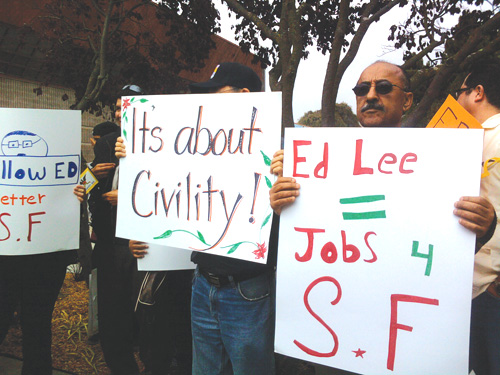
Yes, it’s just that crass and obvious. And it isn’t even about politics. Hell, Baylis is a Republican from Los Angeles, despite his meddling in San Francisco’s political affairs by sponsoring the Alliance for Jobs and Sustainable Growth and other groups that will be doing independent expenditures on behalf of Lee this fall, trying to tell us that “it’s all about civility.”

No, it’s about money and it’s about power, straight up. The Central Subway is really more of a gravy train than a sensible transit project, but that’s just how business is being done at City Hall these days.

One of the people who has long criticized the project – noting how Chinatown would be served far better with surface transit options, at a fraction of the cost – is Tom Radulovich, executive director of Livable City and an elected BART board member. He was heartened to see so many more voices – from the editorials to a recent Civil Grand Jury report to internal audits in the San Francisco Municipal Transportation Agency, which will lose money operating the new system – echoing his concerns.

“There are more people who seem to be sharing my thoughts,” Radulovich said. “It would be good to have a civic debate on this.”

But he’s not confident that will happen, despite the fresh wave of concerns. “There’s a lot of stuff that looks like planning that has gone into justifying this,” he said. “When the political culture of City Hall and the planning culture come together, this is what you get.”


Full text of WSJ article:

Off the San Francisco Rails

Tony Bennett may have left his heart in San Francisco, but the politicians who contrived the city’s Chinatown subway project must have left their brains somewhere else. The subway is a case study in government incompetence and wasted taxpayer money.

P.S. The Obama Administration is all for it.

Former Mayor Willie Brown sold a half-cent sales tax hike to voters in 2003 to pay for the 1.7-mile line on the pretext that the subway would ease congestion on Chinatown’s crowded buses, but he was more interested in obtaining the political support of Chinatown’s power brokers. In 2003, the city estimated the line would cost $647 million, but the latest prediction is $1.6 billion, or nearly $100 million for each tenth of a mile.

Transportation experts say the subway’s design is seriously flawed and that improving the existing bus and light-rail service would make more sense. The subway misses connections with 25 of the 30 light-rail and bus lines that it crosses, and there’s no direct connection to the 104-mile Bay Area Rapid Transit line or to the ferry.

Commuters will have to travel eight stories underground to catch the train and walk nearly a quarter of a mile to connect to the Market Street light-rail lines—after riding the subway for only a half mile. Tom Rubin, the former treasurer-controller of Southern California Rapid Transit District, calculates that taking the bus would be five to 10 minutes faster along every segment.

The city’s metro system, which is already running $150 million operating deficits, isn’t likely to have the money to keep the subway running in any case. Last month the San Francisco Civil Grand Jury, a watchdog group, warned that the subway’s costs “could stretch the existing maintenance environment [of the metro system] to the breaking point” and will defer the purchase of a new communications system.

Alas, San Francisco will likely drag national taxpayer money into the bay too. The city has applied for a multiyear $942 million “full funding grant agreement” from the Federal Transit Administration (FTA) to cover 60% of its capital costs. In 1964 Congress created a back-door earmark program called “New Starts” to subsidize local transportation projects. The FTA rates and recommends projects for grants, and Congress usually rubber-stamps its recommendations.

In January 2010, Transportation Secretary Ray LaHood modified the grant criteria by adding environmental and communal benefits and minimizing cost-effectiveness. The change effectively means that any project can get federal funding as long as its sponsors claim they’re moving cars off the road.

“Measuring only cost and how fast a project can move the most people the greatest distance simply misses the boat,” Mr. LaHood wrote in January 2010 on his Fast Lane blog. “Look, everywhere I go, people tell me they want better transportation in their communities. They want the opportunity to leave their cars behind . . . And to enjoy clean, green neighborhoods. The old way of doing things just doesn’t value what people want.” We’re told Mr. LaHood is smarter than he sounds.

The FTA has given the Chinatown subway one of its highest project ratings, which virtually assures a full funding grant agreement. Once the city receives such an agreement, the feds are obligated to provide whatever funds they promise. The FTA won’t approve the agreements until the fall, so there’s still hope that someone wises up and nixes the project. Oh, and if Congress is looking for discretionary programs to cut, New Starts would be a good start.

Hetch Hetchy: Two visions

1

Editors note: We received two interesting commentaries on our Hetch Hetchy cover story (“Damn the Dam,” 8/10/2011). They appear below, offering very different perspectives on the issue.


OPINION Thank you for writing about our campaign to restore Yosemite’s Hetch Hetchy Valley and return it to the American public. We do not, however, propose “to remove SF’s main water and power source.” Most of San Francisco’s water comes from the Tuolumne River and will continue to do so; SF will simply store it elsewhere. As for power, removal of the O’Shaughnessy Dam will not reduce the power delivered to the city, but will mean less power sold to agribusiness in the Central Valley.

You erred in your conclusion about the impact of the restoration on the city’s Community Choice Aggregation (CCA) program; large hydropower is not considered “renewable” by state standards, so Hetch Hetchy power cannot be included in CCA’s stated goal of 51% renewable energy by 2017.

And please don’t buy in to the notion that America can no longer afford big ideas. The restoration of Hetch Hetchy Valley will be the most significant environmental restoration project in human history. It will strengthen not only the fragile Yosemite ecosystem but also the field of restoration science. It will inspire restoration efforts worldwide.

Mike Marshall is the executive director of Restore Hetch Hetchy


Rebecca Bowe’s recent article regarding efforts by the Restore Hetch Hetchy organization to tear down Hetch Hetchy Reservoir provides a fairly balanced telling of the two sides of the story. However, some key facts were omitted.

First, the case for tearing down Hetch Hetchy is largely based upon a paper written by a masters student at UC Davis in 2003 (see “Re-assembling Hetch Hetchy: Water Supply Implications of Removing O’Shaughnessy Dam”, by Sarah E. Null, December 2003). In her paper, Null bases the feasibility of tearing down Hetch Hetchy on the availability of replacement storage in New Don Pedro Reservoir, which is owned and operated by the Modesto and Turlock Irrigation Districts. Null’s premise is that if San Francisco were to lose Hetch Hetchy it could use storage space in the New Don Pedro reservoir.

This is not possible, as San Francisco has no ownership interest in NDP. Rather, it has the right to pre-deposit water it owes to the districts due to the districts’ senior water rights. Then when the city needs water, it withholds the water upstream at Hetch Hetchy and the districts debit the city’s account in NDP.

The districts have made it clear they do not intend to let the city take over part of their reservoir.

A second key fact is that if the city does not use Hetch Hetchy — and since it can’t use NDP — its water rights will be of little use. While state water rights laws are complex and esoteric, seniority is the general rule. The city’s water rights are junior to those of the districts. If San Francisco can’t exercise its water rights through the Hetch Hetchy system, it would have to take its water from the Delta. The result would be a substantial loss of water and water quality to San Francisco.

As to the loss of hydropower, the article correctly records the permanent loss of 400 megawatts of clean hydropower. The result would be a major new customer for Pacific Gas and Electric Company.

Tom Berliner is a former deputy city attorney who helped negotiate the city’s water and power contracts with the Turlock and Modesto Irrigation Districts.

Editor’s notes

0

tredmond@sfbg.com

Gavin Newsom rode into the Mayor’s Office with a campaign to take welfare money away from homeless people. Jeff Adachi’s campaign for mayor is fueled by his attempt to cut city-employee pension costs. It’s an effective tactic: You put an initiative on the ballot and campaign as its sponsor, with your name attached — and while direct fundraising for mayoral candidates is tightly restricted (contribution limits, no corporate money), ballot-measure campaigns can collect unlimited cash, from almost anyone. Pick a popular issue (and attacking homeless people and city workers seems to have a lot of traction these days) and your chances of getting elected get a nice boost.

So why has no candidate running for citywide office in San Francisco ever made tax reform the center of his or her campaign?

I realize that tax reform is boring. Slogans like “shared progressive values” and words like “together” play much better in the focus groups. But think about it: Nearly every major national poll shows that the voters — by a margin of roughly 2-1 — think that tax increases should be part of the solution to the nation’s budget woes. Since San Francisco is way more liberal than the nation as a whole, the margin in this city is probably about 3-1.

Naturally, the poll numbers depend on how you ask the question, so let me suggest a way to frame it that’s entirely honest and consistent with what I suspect most the voters in this city believe. “Since 400 American families now own more wealth than 50 percent of the entire population put together, should San Francisco’s budget problems be solved in part with higher taxes on very rich residents and businesses?”

You might actually get 90 percent support on that one.

Look: Warren Buffett, one of the richest people in the world, recently wrote an opinion piece in the New York Times saying that his class isn’t paying its fair share. Warren Hellman, one of the richest people in San Francisco, told me the same thing a couple of months ago. (In 2006, in a particularly revealing interview, Buffett told economics writer Ben Stein that “there’s class warfare, all right, but it’s my class, the rich class, that’s making war, and we’re winning.”) This is mainstream stuff now.

And I know some of the candidates, particularly Sup. John Avalos, support new taxes on the wealthy, and Assessor Phil Ting wants to repeal parts of Prop. 13. But nobody has ever made this a signature issue. Nobody’s ever made taxing the rich his or her version of Care Not Cash. I’m thinking maybe it’s time.

BART arrests protesters for speaking out

Faced with yet another protest over BART’s disruption of cell phone service on August 11 to preemptively disrupt a protest, and with lingering anger over the BART police shooting of Charles Hill on the Civic Center station platform on July 3, BART police stifled vocalizations of dissent with immediate arrests during an Aug. 22 protest on the Civic Center Station platform.

“Free speech is the best kind of speech,” said one protester on the Civic Center BART platform as the second protest called by the international hacker group Anonymous in as many weeks challenged the BART system at rush hour.

As a few protesters began to gather, surrounded by dozens of riot police and media, a uniformed BART police officer told a young African American man he would be arrested if he raised his voice. Chanting began in response among the small pack of protesters, and the man was promptly arrested by BART police.

As he was being led off the platform by police, a woman who stood in the center of the platform began verbally engaging a BART officer, saying, “BART police need to be reformed. Make BART Safe. Make BART safe.” She was apparently arrested for nothing more then her words. Deputy BART Police Chief Daniel Hartwig said he could not provide any information about what the arrestees would be charged with.

Video by Shawn Gaynor

Shortly after, BART police declared the small gathering an illegal assembly. Riot police surrounded some 40 protesters for arrest as media was ejected from the station.

Civic Center station and Powell Station were both shuttered, blocking many transit passengers from their evening commute.

What started as a cell phone disruption has apparently escalated into BART arresting anyone expressing an unfavorable opinion of BART.

When asked if the arrested represented a new BART police policy for protests, Hartwig told the Guardian BART’s policy remains the same. “This environment has to remain safe, and if that safety is jeopardized in any way, we will make arrests,” he said. “We have a responsibility to maintain a safe station.”

Protesters said it was appropriate to protest on the Civic Center platform because it is the location of the July 11 shooting of Hill by BART police.

Earlier in the day, the National Lawyer’s Guild issued a statement calling on BART to respect passengers’ and community members’ civil liberties during the Aug. 22 demonstration.

“First and foremost, the BART Police should provide transparency regarding the killing of Charles Hill and should stop shooting people, especially unarmed and incapacitated individuals,” the NLG statement read. “Second, BART should apologize for its disruption of cell service on August 11th and not repeat this unconstitutional action. Finally, BART should recognize passengers’ right to freedom of speech on platforms and in trains.”

Calls to the BART for the names of the arrestees and number of arrests had not yet been returned by press time.

So much for civility

0

rebeccab@sfbg.com

The San Francisco mayor’s race went from a lackluster affair to a dynamic match as the Aug. 12 filing deadline drew near and two prominent city officials who had previously said they wouldn’t run tossed their hats into the ring.

Mayor Ed Lee’s Aug. 8 announcement that he’d seek a full term prompted several of his opponents to use their time onstage at candidate forums to decry his reversal and question his ties to the moneyed, influential backers who openly urged him to run. Several days later, Public Defender Jeff Adachi’s last-minute decision to run for mayor signaled more tension yet to come in the debates.

At this point, eight current city officials are running campaigns for higher office, and the dialogue is beginning to take on a tone that is distinctly more biting than civil. Adachi, who had not yet debated onstage with his opponents by press time, told reporters he was running because he wanted “to make sure there’s a voice in there that’s talking about the fiscal realities of the city.”

Adachi authored a pension reform ballot measure that rivals the package crafted by Lee, labor unions, and business interests (see “Awaiting consensus,” May 31, 2011). At an Aug. 11 candidate forum hosted by the Alice B. Toklas Democratic Club, the San Francisco Young Democrats, and the City Democratic Club, all of the top-tier candidates who were present indicated that they would support Lee’s pension reform measure and not Adachi’s.

“The reforms that I have championed are reforms that are absolutely needed, along with action,” Adachi told reporters moments after making his candidacy official. He added that after watching the mayoral debates, “I became convinced that either the candidates don’t get it, or they don’t want to get it.”

Those fighting words will likely spur heated exchanges in the months to come, but until Adachi’s entrance into the race, it was Lee who took the most lumps from opponents. Even Board President David Chiu, a mayoral candidate whose campaign platform is centered on the idea that he’s helped restore civility to local government, had some harsh words for Lee during an Aug. 11 mayoral debate.

“I do regret my decision to take Ed Lee at his word when he said he would not run,” Chiu said in response to a question about whether he regretted any of his votes. He also said his first interaction with Lee after the mayor had announced his candidacy was “a little like meeting an ex-girlfriend after a breakup.”

Lee, whose pitch on the campaign trail features a remarkably similar narrative about transcending political squabbling in City Hall, became the target of boos, hisses, and noisemaker blasts when a boisterous crowd packed the Castro Theater for an Aug. 8 candidate forum. He received one of the most forceful rebukes from Sen. Leland Yee, an opponent whom Lee supporters are especially focused on defeating.

“Had the mayor said that he would in fact run, he may not have gotten the votes for interim mayor,” Yee said. “Will you resign from your post,” he asked, challenging Lee, “in order to then run for mayor?” Days later, Yee had developed a new mantra about throwing power brokers out of City Hall instead of “wining and dining with them.”

Yet Lee said his decision to enter the race wasn’t because of the push from his backers, but because of how well things have gone during his brief tenure in Room 200. “Things have changed at City Hall, particularly in the last seven months,” he told reporters Aug. 8. “And because of that change, I changed my mind.”

In yet another twist, former Mayor Art Agnos — whom progressives had looked to as a potential appointee to the vacant mayor’s seat back in December, before Lee was voted in to replace former mayor and Lieutenant Governor Gavin Newsom — delivered a surprise endorsement of City Attorney Dennis Herrera shortly after Lee declared. The decision was particularly significant since Agnos first hired Lee to serve in city government, and has a long history of working with him.

“[Herrera] is an independent person who will empower neighborhoods … and won’t be beholden to power brokers,” Agnos said. He also told the Guardian he wasn’t surprised that Lee had opted to run, given the role former Mayor Willie Brown and influential business consultant Rose Pak had played in orchestrating Lee’s appointment.

“Anybody who is an astute political observer saw the signs from the very beginning,” Agnos said. In response to a comment about his unique vantage point as a would-be caretaker mayor, he said, “I would’ve kept my word and not run for reelection.”

Intense focus on Lee’s flip-flop, and on the Progress for All-backed “Run, Ed, Run” effort that was the subject of an Ethics Commission discussion that same week, stemmed at least in part from the threat the incumbent mayor represents to other candidates. A CBS 5-SurveyUSA poll suggested he became an instant front-runner.

Yet questions about “Run, Ed, Run” — some raised by observers unaffiliated with any campaigns — also served to spotlight the candidate’s longstanding ties with backers closely connected to powerful business interests that stand to lose big if their links to city government aren’t preserved.

Retired Judge Quentin Kopp issued an open letter to District Attorney George Gascón Aug. 1 urging him to convene a criminal grand jury to investigate whether illegal and corrupt influencing had occurred when Pak — a close friend of Lee’s and a key driver behind the “Run, Ed, Run” effort — reportedly recruited executives of Recology to gather signatures urging Lee to run.

Recology, which handles the city’s waste, was recently awarded a $112 million city contract, and Lee’s scoring of the company and recommendation to raise rates in his previous capacity as city administrator benefited the company. Brown received substantial campaign donations from Recology in previous bids for mayor. Kopp is the coauthor of a ballot initiative asking San Francisco voters if the company’s monopoly on city garbage contracts should be put out to bid.

“A criminal grand jury is vital in order to put people under oath and interrogate them,” Kopp said. “They would put Willie Brown under oath, put Pak under oath, put [Recology President Mike Sangiacomo] under oath, put [Recology spokesperson Sam Singer] under oath … That’s the course of action that should be pursued by this.”

Although Kopp told the Guardian that he hadn’t yet received a response from Gascón, DA candidates Sharmin Bock, Bill Fazio, and David Onek nevertheless seized the opportunity to publicly and jointly call for Gascón to recuse himself from any investigation into Progress for All. Gascón has a conflict of interest, they argued, since he reportedly sought Pak’s advice when deciding whether to accept Newsom’s offer to switch from his previous post as police chief to his current job as top prosecutor.

The Ethics Commission determined unanimously Aug. 8 that the activities of Progress for All, the committee that was formed to encourage Lee to run, had not run afoul of election laws despite director John St. Croix’s opinion that it had filed improperly as a general purpose committee when it ought to have been a candidate committee, which would have placed caps on contribution limits.

“The Ethics Commission has spoken, and they’ve supported our position,” Progress for All consultant Enrique Pearce of Left Coast Communications told the Guardian.

St. Croix did not return Guardian calls seeking comment, but an Ethics Commission press release included a caveat: “Should facts surface that coordination occurred between Mayor Lee and [Progress for All], such allegations will be investigated under the Commission’s enforcement regulations.”

At a Lee support rally organized by his official campaign team on Aug. 11, volunteers who arrived with “Run, Ed, Run” materials produced by Progress for All were told they could not display those signs and T-shirts; the same people were on a first-name basis with one of Lee’s campaign team members.

Pressed on the question of whether there was any coordination between agents of Progress for All and Lee, Pearce said the Ethics Commission discussion had focused on whether Lee had been a candidate. “Whether or not he’s a candidate has nothing to do with whether or not he has dinner with Rose [Pak],” Pearce noted. He insisted that there had not been coordination, and that the efforts to encourage Lee to run and to support Lee as a candidate were totally separate.

Sup. John Avalos, who is running for mayor on a progressive platform, recalled at an Aug. 8 candidate forum how things unfolded when Lee’s name first came up as an appointee for interim mayor.

Avalos reminded people that he had called for postponing the vote back in December because he hadn’t even had a chance to sit down and meet with Lee, who was in Hong Kong at the time. With behind-the-scenes deals orchestrating his appointment, Avalos said, “We saw City Hall turning into one big back room.”

Obama, Lee, Avalos, and the arc of history

84

People need to hear compelling stories, particularly from those who aspire to lead them, a point that author and psychologist Drew Westen nailed in his incisive think-piece in Sunday’s New York Times, “What Happened to Obama?” His conclusions also apply in San Francisco, where progressives have lost control of the narrative to the tax-cutting centrists, who are telling stories that serve mainly to enfeeble the people and prop up powerful interests.

“The stories our leaders tell us matter, probably almost as much as the stories our parents tell us as children, because they orient us to what is, what could be, and what should be; to the worldviews they hold and to the values they hold sacred. Our brains evolved to ‘expect’ stories with a particular structure, with protagonists and villains, a hill to be climbed or a battle to be fought,” Westen writes.

Contrast that with the guiding narrative in San Francisco politics right now, put forth by Mayor Ed Lee, his supporters, and the crew of mostly bland centrists who aspire to replace him, all of whom cast conflict itself as the villain. Much like Obama, they all style themselves as the administrators-in-chief, conflict-averse protagonists content to compromise away what little wealth and power the average citizen still possesses. Not only does that narrative guarantee that Lee will be elected, but it’s a false and short-sighted narrative that does a profound disservice to this city.

The one candidate in the mayor’s race who understands that class matters, that conflict is a necessary part of politics, and that we’re all getting screwed over by the rich and powerful is John Avalos. But despite some flashes of progressive populism on the stump, he hasn’t really been consistently and boldly telling San Francisco the story of itself that it really needs to hear right now, which is the same story that Obama should be telling the American people.

“I know you’re scared and angry. Many of you have lost your jobs, your homes, your hope. This was a disaster, but it was not a natural disaster. It was made by Wall Street gamblers who speculated with your lives and futures. It was made by conservative extremists who told us that if we just eliminated regulations and rewarded greed and recklessness, it would all work out. But it didn’t work out,” begins the story that Westen said Obama should have told during his inaugural address.

And that’s the story that Avalos should be telling right now, combating the myths that have been put out there by Lee, David Chiu, Bevan Dufty, Dennis Herrera, and the other centrists in the race, that if we just give Twitter, Zynga, Oracle, Sutter Health, Willie Brown’s clients, and every other corporation and developer who promises to create jobs everything they want, then we’ll all be okay.

But on some level, we all know that just isn’t true, and it hasn’t been true for a long time. Only a fool would trust them to take care of us at this point. The greed and self-interest of rich individuals and corporations – which has gone unchecked for far too long, at least partly because of the political corruption they’ve sponsored – is reaching epidemic proportions. It is the villain that needs to be fought, it is the hill that needs to be climbed.

“When faced with the greatest economic crisis, the greatest levels of economic inequality, and the greatest levels of corporate influence on politics since the Depression, Barack Obama stared into the eyes of history and chose to avert his gaze. Instead of indicting the people whose recklessness wrecked the economy, he put them in charge of it. He never explained that decision to the public — a failure in storytelling as extraordinary as the failure in judgment behind it. Had the president chosen to bend the arc of history, he would have told the public the story of the destruction wrought by the dismantling of the New Deal regulations that had protected them for more than half a century. He would have offered them a counternarrative of how to fix the problem other than the politics of appeasement, one that emphasized creating economic demand and consumer confidence by putting consumers back to work. He would have had to stare down those who had wrecked the economy, and he would have had to tolerate their hatred if not welcome it. But the arc of his temperament just didn’t bend that far,” Westen wrote.

He was riffing off Obama’s penchant for quoting the MLK line, “The arc of the moral universe is long, but it bends toward justice,” which he returned to again with his devastating conclusion: “But the arc of history does not bend toward justice through capitulation cast as compromise. It does not bend when 400 people control more of the wealth than 150 million of their fellow Americans. It does not bend when the average middle-class family has seen its income stagnate over the last 30 years while the richest 1 percent has seen its income rise astronomically. It does not bend when we cut the fixed incomes of our parents and grandparents so hedge fund managers can keep their 15 percent tax rates. It does not bend when only one side in negotiations between workers and their bosses is allowed representation. And it does not bend when, as political scientists have shown, it is not public opinion but the opinions of the wealthy that predict the votes of the Senate. The arc of history can bend only so far before it breaks.”

That is the moment we find ourselves in, both as a country and as a city. And it is a story that we’re still waiting for a future leader to tell us with enough power and passion that we all begin to believe it.

View from the middle

4

OPINION Editor’s Note: Between the well-funded, politically connected campaign pushing Ed Lee to run for mayor and the high-profile critics who say he should keep his word and step down, it’s hard to tell how the average city resident feels. So to reflect that perspective, we’re reprinting a letter that was sent to Lee on July 29.

Dear Mayor Lee,

My name is Peter Nasatir; I’m a middle-aged, middle class San Franciscan who works in middle management. I’m not an activist and I have no political ax to grind. In fact, I rarely write letters like this, but felt compelled to do so because I’ve been reading how you are considering a run for mayor this November. For your own integrity, and the good of the city, I urge you not to run.

One of the reasons you have been able to achieve the successes you’ve enjoyed this year is because San Franciscans know your time is finite, thus giving you the ability to avoid the kind of hard slog other mayors have found themselves in. You have been able to stay above the fray and receive near-universal support precisely because you’ve been able to do the amazing job you’re doing without having an eye on the upcoming election.

If you run, you’ll look like another cynical politician, who promises one thing and does another. Plus, with your experience, think how much political capital you’ll have when you return to your old position. And if you decide to run in 2015, you’ll already have on-the-job training no other candidate would have and have proven yourself to be a real leader for taking the high road.

I know Willie Brown and Rose Pak, who are considered influential community leaders, have been at the forefront of your bid to run. However, they also carry a lot of damaging baggage. Just look at the front page of today’s (July 29th) Chronicle. With their names attached to your run for mayor, your image in the eyes of many San Francisco voters is already tainted before you even have a chance to file your papers.

As much as I respect you and the incredible job you are doing, I can say without hesitation that if your name is on the ranked-choice ballot this November, I will not vote for you in any of the three positions.

On behalf of many like-minded San Francisco voters, I urge you to do the right thing and not run for mayor this November.

Thanks you for your consideration of this matter.  

Sincerely, 

Peter Nasatir

Class clowns

0

THEATER Linda Brown is a maid at the end of her tether, and tender, as the much-put-upon employee-slave of an exclusive country club. The signs are there from the moment she steps onto the stage: the circles under the young woman’s eyes, her frightened stare, the desperate swigs from a ready flask, not to mention her shameless histrionic intensity as she addresses the audience about the soul-sucking richies perpetually at her back.

But it will take the full length of playwright-director Jeff Bedillion and Back Alley Theater’s sometimes ambling, generally rowdy new farce, Country Club Catastrophe, before our lower-class heroine manages a proper escape — only it’s unclear even to her if it’s a genuine escape at all, as she stares into the eyes of her replacement with an eerie shock of recognition.

In this uneven but promising production by newcomers Back Alley Theater, performances are at times stilted and pacing might be tightened in places, and perhaps as much as 20 minutes of meandering dialogue productively lost from the second half. But Country Club Catastrophe gets laughs in part because it knows what it is about. Inspired equally by classical French farce — Molière’s five-act structure in particular — and recognizably American figures from the yawning class divide, it aims at a contemporary social crisis churned by the obscene disparities in wealth in post–middle-class America. (All glimpsed at the preview ahead of opening night.)

Thus, long before her existentially fraught exit, both Linda (played by a comically intense yet sympathetic Katharine Otis) and her handsome gold-digging coworker, the doorman Max (a winningly boisterous Joshua Rice), largely retreat from view behind an onslaught of self-absorbed club members (numbering only a handful in fact, and yet a real handful just the same).

First to arrive is Mrs. Montgomery (a sharp, coolly imperious Jennifer Lucas), her teased hair rising to just within the frame of the front door center stage (in A.J. Diggins’ spare, functional set design) and a long leash trailing from her wrist to an unseen standard poodle with an unhealthy appetite for the doorman. (Exit Max for some scenes.)

Separately from Mrs. Montgomery — who in a manipulative confessional gesture lets Linda know her first name is Tabytha, only to insist she still call her Mrs. Montgomery — arrives the rest of her small but attenuated family. There is husband Miles (Len Shaffer, dispensing affable sleaze), a jolly and salacious philanderer; and son Tristan (a humorously shrill Salvadore Mattos), Tabytha’s barely closeted Brown University brat whose constant companion is a houseplant he calls Sister.

Greater than Tristan’s fixation on foliage, however, is his unbounded lust for childhood playmate Edward (Jeremy Bardwell), the egomaniacally cocksure but increasingly put out fortunate son of club members Biff and Muffy Birmingham (played, respectively, by a buoyantly silly John Weber and a hilariously sugary yet menacingly bitchy Meaghan M. Mitchell). Biff and Miles are best friends; Muffy and Tabytha not so much. Muffy prefers the company of club member and shy post-debutante Peggy Dupont (a harried Sabrina De Mio), whom Muffy bosses and harshly abuses with an almost innocent glee.

Last and, in the opinion of the club house anyway, certainly least comes Cynthia Anniston (an amusingly oblivious and high-keyed Gloria Terese McDonald), Brown University first-year and cheerleader desperately chasing one-night-stand Edward, her lax outfit reading alternately “prostitute” and “foreign exchange student” to the club’s members and its equally indignant staff.

For the play finds stark but amusing ways to underscore the primacy of money over every other social divide, be it race or sexual orientation or education. Even the mere appearance of not having money is enough to put one squarely outside the club — or rather, squarely within its steep hierarchies of privilege and worth. As the plot gets increasingly tangled, we’re left to consider the intoxicating stench of money in everyone’s noses as the ultimate obscenity.

And yet, Linda (and the play) asks, can the greed, selfishness, backstabbing, dirty dealing, and rampant mistreatment that runs rife through these perverse excuses for families really continue without some final judgment befalling such a club and such a country?

Intonations of just such a judgment are there already in the title, in a gathering electric storm outside, in the self-consciously heightened language, and in the rumblings of piano keys from musician Mike Miraglia’s offstage upright. But the catastrophe that finally breaks in on this world isn’t exactly The Day of the Locust. It is, instead, an ironic and apt judgment on the misspent lives and deflated hopes of the present day, so semi-cozy and quietly desperate despite the raging storm outside. 2

COUNTRY CLUB CATASTROPHE

Through Aug. 13

Thurs.—Sat., 8 p.m., $20

Exit Theatre

156 Eddy, SF

www.brownpapertickets.com


is Rec-Park really broke?

16

By David Looman

OPINION The senior staffers at the Recreation and Park Department routinely cry that the department is poor and going broke. Is it possible they are lying?

Conspicuously lacking in discussions of Rec-Park funding is any kind of hard data about how well or poorly San Francisco Rec-Park is really funded. Whether it’s the mainstream media, the alternative press, or our elected representatives on the Board of Supervisors, nobody seems to know how our park system compares with other park systems in California or the U.S.

And nobody seems to want to check up on Rec-Park’s sad-sweet story.

This lack of real information is particularly surprising, since the data is readily available. Every year, the Trust for Public Land, a well-respected, San Francisco-based park advocacy organization, conducts a meticulous and comprehensive survey of how well recreation and park systems across the country are being funded. The survey is always available on the Web, at www.tpl.org.

Surprise!

In the TPL’s 2000 book, Inside City Parks, by Peter Harnik, San Francisco was among the three best-funded systems, measured either per acre or per resident. In every annual survey after that, San Francisco continued to rank in the top three, until 2006. In 2006, the TPL found San Francisco to be the best-funded park system in America.

That’s right, the best-funded department in the entire U.S.!

This year’s survey, based on the 2008 figures, has changed its methodology a bit, and expenditures are no longer calculated per acre. With the new methodology, San Francisco has slipped a bit. The city is now only the fourth-best funded park system in the country for cities with populations larger than 500,000, and the sixth best for cities over 250,000.

For operating expenditures (total budget minus capital spending) San Francisco is the fourth best funded among all cities. We don’t have as many capital expenditures as, say, Seattle, whose newer park system is still growing.

The question of where that money goes is another matter. I think I can offer a few suggestions about what happens.

Problem number one is the long and glorious history of absolutely incompetent management, particularly in the last 15 years, under the administrations of mayors Willie Brown and Gavin Newsom. Second is that longstanding Rec-Park Department practice of ignoring and rejecting any public input, including factual input, from people who actually use and know the parks. This has led to a number of costly mistakes.

The department has more ethically dubious faults too—the wages spent organizing so-called “public support” for some of its unpopular projects; more wages spent having employees testify about what a great job the department is doing, etc.

The department presently is trying to privatize everything within reach. Its poor-mouth rational for doing so is false. It’s time we all faced the fact that Rec-Park isn’t giving us the whole truth.

David Looman is a longtime San Francisco political consultant and parks user.

The crucial question: why didn’t Obama invoke the 14th amendment and seize the day?

7

For me, the crucial question for President Obama is why he didn’t take the advice of former President Bill Clinton, Rep. John Garamendi, and others who urged him to invoke  the 14th Amendment and its “validity of the public debt” point and then unilaterally raise the debt ceiling.

The Tea Party Republicans had manufactured a phony crisis with the debt ceiling, linked it to their wrongway issue of tax reduction, and then held the nation hostage to their  maniacal demands for trillions of  cuts to domestic programs.
Armageddon was nigh.

Yet Obama, after caving on single payer health care, the public option,  restoring the Bush tax cuts, on and on, and after negotiating  the debt crisis on Republican turf with many of their arguments and much of their language, refused to take the one crucial  step that could have saved the day for him  and the country that will suffer further under Teapartyism.
 
Sure, Republicans would have screamed bloody murder. Tough.  They  forced Obama to the brink,  and public opinion would have supported him fighting it out for once and  taking this understandable position of executive authority under these draconian circumstances.

The legal experts I read and heard on television said that they didn’t think that Congress could have  been able to subvert this decision.  And consider the campaign issue: Obama took on the Teaparty Republicans and beat them at their own game. Instead, he allowed them to win the battle and allowed Speaker of the House John Boehner to claim that he had gotten 98 per cent of what he wanted.

And what did Obama and the Democrats get?  The prospect of  a Republican tax-cutting disaster moving in agonizing stages that will most likely deepen the recession, stunt job growth even further,  keep unemployment rising, and give the Republicans an armory full of ammunition to knock him out.

Shakespeare has a phrase for this in his sonnet 73:  Obama and his adminstration were  “consumed by that with which it was nourished by.”  B3

P.S. Paul Krugman was right. The MSNBC lineup has done a wonderful job of covering the crisis and laying out the issues with passion and not Beltway “objectivity.”  Cbris Matthews, Ed Schultz, Rachel Maddow, Lawrence O’Donnell and the guy who started it all, Keith Olberman now on Current TV on Channel 170 in San Francisco. Thomm Hartmann and Randi Rhodes did good work on Green 960.

Killed for riding while poor

113

OPINION We sat together: elders, youth, workers, students, and folks. We were on our way to a low-paid job, an overpriced university, a pre-gentrified home and a public school. There was laughter and shouts, murmurs and silence. Then suddenly, there were nine heavily armed police officers and fare inspectors walking through the crowded 14 Mission Muni line. One stopped in front of me and my son.

“I don’t have a transfer, I lost it,” I tentatively answered a cop who asked to see my paperwork as I clutched my son’s stroller and tried to see how close I was to the back door of the bus.

“We will have to write you a citation and you will have to step off the bus — now.” He was yelling at me and was flanked by another officer. I knew I couldn’t make a run for it, but I almost tried.

I thought of this moment when I heard about the 19-year-old man shot by the SFPD while running away from a Muni bus because he didn’t have a transfer in the Bayview July 16.

Shot and killed for not having $2 bus fare.

At a press conference held July 18 at the scene of the shooting, Joanne Abernathy from People Organized to Win Employment Rights made the point: “No one should be shot for not having enough money to ride the bus.”

For the last few years, police presence on Muni has increased — as have attacks on poor people and people of color whose only crime is not having enough money to ride the increasingly expensive so-called public transportation known as Muni. From fare inspectors working for Muni to fully armed officers, they form a terrifying mob waiting menacingly at bus stops in the Mission, Ingleside, Bayview, and Tenderloin, and then enter buses to harass, eject, and cite anyone too poor to ride.

The police said the man pointed a gun. That’s what they consistently claim when rationalizing involved shootings. Several eyewitnesses said otherwise.

But before we get caught up in whether he had a gun or not, let’s stay with the real point: this young man was shot for not having a transfer. He was shot for not having $2. How did we get here?

Even if you are a supporter of the police, you have to see the Les Miserables-esque insanity in this shooting.

Police culture enables, allows, and encourages the use of deadly force — so much so that it seems at times as if killing can happen for any old thing. Throw in institutional racism and classism, and more and more people will not only be incarcerated but killed with impunity.

“Don’t get on the bus again if you don’t have the fare or you might be arrested,” the cop on Muni told me. He ended by giving me a citation and kicking me off the bus. He should have added “killed” to his threat of what would happen to us for riding while poor.

Tiny, also known as Lisa Gray-Garcia, is coeditor of POOR Magazine.


BART service disruptions as protesters call for transit police to be disbanded (video)

Rush hour on the BART system in downtown San Francisco was royally screwed up for several hours July 11, and for protesters who paced along station platforms chanting “No justice, no peace!” and engaging in verbal clashes with transit cops, that was the point. The group, after all, is called No Justice, No BART, and they were there to pressure the agency in the wake of a BART police shooting.

The protesters were there to call attention to the fatal July 3 shooting of Charles Hill, a man who had no permanent address. The BART passenger was gunned down roughly a minute after two transit officers responded to a call from a station agent.

Things started heating up at around 5 p.m., when protesters who had gathered at Civic Center Station, the place where the shooting occurred, moved in a procession up and down the platform, chanting. According to fliers handed out to all the participants, the plan was for groups to board and exit the train cars together.

“None of this is really a question of public opinion — nobody here is in favor of people being shot down,” an organizer said into a megaphone at the beginning of the protest. “The question is, what is it going to take to make it stop?” To cheers and applause, he said, “We’re here today to take action to stop the BART police from killing. We don’t think the BART police should exist. There’s a mobilized angry public that isn’t going to take this shit anymore.”

Here’s what happened when the group tried boarding the first train:

http://www.youtube.com/watch?v=6axP9OO3sCc

The video was captured by Josh Wolf.

BART Deputy Police Chief Daniel Hartwig was in the thick of it all. The chaos prompted police to shut down Civic Center Station and order everyone to leave. Once a dispersal order was issued, protesters and media exited the station, and passed by a line of officers from the San Francisco Police Department that had formed on the street.

The march then proceeded down Market Street to Powell station, and many activists boarded a train there, then exited at the 16th and Mission Street Station. With police and media still trailing behind, they proceeded back downtown on foot.

A second standoff occurred around 7 p.m. at the cable car turnaround, just outside Powell Street Station, much to the bewilderment of shoppers who gathered outside The Gap and Forever 21, clutching their shopping bags. Wearing helmets and holding nightsticks ready, police stood in a line to block off Powell street, facing protesters who were congregating in the plaza.

Tensions ran high as chanting continued and people shouted at police. At one point, a young mother who held her three-year old son started shrieking at police, enraged. She said that an officer had taunted her by saying, “Bang, bang, we’ll come.”

No one was arrested while the crowd remained in the plaza, but after mostly everyone else had left, a man who had joined in the protest was taken into custody and charged with being intoxicated in public.

Earlier in the afternoon, at Civic Center Station, Laura Wolterstorff held a photograph of Hill that she had found online. “This happens often in our city, not only with BART police, but with the SFPD as well,” she said, adding that she works with people who are struggling with homelessness and mental health issues. In the case of transit cops, “Is it necessary to have a police force that carries guns?” she asked.

Another woman who joined the protest at Civic Center, who gave her name as Miriam, said flatly, “I think if he was wearing a suit, he wouldn’t have been killed.”

Details about why transit police fired at Hill three times about a minute after arriving on the scene are sketchy. While the police have justified the shooting by saying he was brandishing a knife, the agency has yet to release a surveillance video of the incident.

Smooth sailing for developers

3

rebeccab@sfbg.com

It’s a mad dash at San Francisco City Hall to put all the pieces together in preparation for the America’s Cup, the prestigious regatta that will culminate in the summer of 2013 along the city’s northern waterfront. But once that spectacle is over, the biggest impact of the event will be a massive, lasting, and quite lucrative transformation of the city’s waterfront by a few powerful players, a deal that has been modified significantly since it was approved by the Board of Supervisors.

As negotiations on the fine terms of the development agreements continue to unfold, the future landscape of a huge section of the San Francisco waterfront is in play. If the America’s Cup Event Authority (ACEA) — the race management team controlled by billionaire Oracle CEO Larry Ellison — aims high in its investments into port-owned infrastructure, it has the potential to lock-in leases and long-term development rights for up to nine piers for 66 years, with properties ranging from as far south as Pier 80 at Islais Creek to as far north as Pier 29, home of the popular dinner theater Teatro ZinZanni.

The possibility of securing long-term leases and development rights to Piers 19, 23, and 29 — provided race organizers sink more money into infrastructure improvements — was added to the deal in the last two weeks of 2010, just before San Francisco won its bid to host the world-famous sailing match. The possibility of obtaining rights to portions of two additional piers, 27 and 80, were also added at the last minute. Race organizers and city officials negotiated the final modifications after the Board of Supervisors signed off on the Host City Agreement on Dec. 14, 2010.

Not all board members knew that three additional city-owned piers were being added as possible extensions of the land deal, and those properties weren’t mentioned in any of the earlier documents that went through a public review process in the months leading up to the approval of the agreement. Yet Board President David Chiu was evidently appraised of how the last-minute negotiations were unfolding and he quietly offered his support.

On Dec. 22, 2010, Chiu sent a letter to Russell Coutts, CEO of Oracle Racing, the team that won the 33rd America’s Cup and is an integral player in laying plans for the 34th. “I understand that Mayor Newsom and the city’s team have been working directly with you since the board’s approval of the Host City Agreement to make the necessary adjustments and clarifications to the agreement to ensure it meets your needs. I am aware of these changes and support them,” Chiu wrote in a letter that was not shared with his fellow supervisors.

Quoting from a section of the agreement that explains that ACEA is ensured long-term development opportunities in exchange for funding improvements and upgrades, Chiu’s letter went on, “This section specifically applies to … Piers 30-32 and Seawall Lot 330, as well as Piers 26 and 28, and if mutually agreeable could apply to Piers 19, 23, and 29. To obtain the community’s support and agreement for future development rights to piers on the northern waterfront, you will need to invest in a strong partnership with the community … I am prepared to help facilitate that relationship.”

Former Board President and Democratic County Central Committee Chair Aaron Peskin, who has closely followed the America’s Cup land deal and has for decades been actively involved in land-use issues along the northern waterfront, interpreted Chiu’s letter to Coutts as a backroom deal.

“There is no question that the president of the board, without the authorization of the majority of the Board of Supervisors, went behind closed doors, out of view of the public, and committed to [long-term development] for three piers,” Peskin said, highlighting the fact that no other supervisors were copied on Chiu’s letter. “That he has done this unilaterally, without the consent of a board’s vote at a board meeting, is not good governance. If there’s one body that’s supposed to do all of its work for the public, it’s the Board of Supervisors.”

Chiu defended the letter by emphasizing the part that asked for a partnership with the community. “This was all within the broader framework of the Host City Agreement that we signed in the middle of December,” he told the Guardian when presented with the letter during an interview and asked to comment. “They had questions about, well, can we develop on these other piers? And what I said was, ‘Well, as I think the language here specifically says if mutually agreed upon … you could possibly do this.’ And we specifically said you’ll need to invest in a strong partnership with the community.”

He added that specific development plans would still have to be approved by the Board of Supervisors. Proposals for each parcel will be made in separate Disposition and Development Agreements, subject to board approval.

On hearing Chiu’s response, Peskin was still critical of the lack of transparency in this deal: “My position is, if it walks like a duck and quacks like a duck, it’s a duck.”

Meanwhile, an analysis prepared by Budget Analyst Harvey Rose in mid-March suggests that the final amendments did reflect new commitments for the city that go well beyond what was discussed publicly. “No city approval of the Event Authority’s selection of Pier 29 for a long-term lease is required in the agreement, as modified by the Mayor’s Office and other city officials,” the Budget Analyst’s report notes. “This entire provision … was not included in the agreement of Dec. 14, 2010 as previously approved by the Board of Supervisors.”

Brad Benson, special projects manager at the Port of San Francisco, explained the Pier 29 provision slightly differently. “The city would have to be acting in its reasonable discretion to say no,” he said, emphasizing that ACEA would have to invest well above the $55 million threshold to obtain rights to Pier 29.

At a time when a new era of civility is being hailed at City Hall, two elements of the city family are essentially agreeing to disagree on the broader question of whether the 11th-hour modifications to the deal resulted in a greater hit to city coffers than supervisors approved. While Rose stated in public hearings that the modifications would deal a greater blow to city revenues, City Attorney Dennis Herrera, a mayoral candidate, has stood with the Office of Economic and Workforce Development in his assessment that the changes did not significantly exceed the scope of what was approved by the board. Fred Brousseau of the Budget & Legislative Analyst chalked it up to “a difference in opinion,” reflecting “the auditor’s standard for materiality versus the city attorney’s.”

Legalese aside, it’s clear that the race organizers stand to gain some highly desirable waterfront property in exchange for investing in the piers and bringing an event to the city that is expected to generate substantial economic activity. If ACEA invests a minimum threshold of $55 million for infrastructure improvements, it can likely secure long-term development rights for Piers 30-32, a 13-acre waterfront parking lot where Red’s Java House is located, plus win the title to Seawall Lot 330, a two-acre triangular parcel along the Embarcadero that has been discussed as the site of a future luxury condo tower that has already cleared city approval for that use.

A high-rise next door to Seawall Lot 330, called the Watermark, currently has condos going for $1.2 million apiece on average, according to a calculation of online listings. Under the America’s Cup deal approved by the board, the port would have received 1 percent of each condo sale plus 15 percent of transfers or subleases made by ACEA. “Such required payments … have been entirely removed from the agreement as modified by the Mayor’s Office and other city officials,” the budget analyst’s report points out.

Waterfront real estate in San Francisco, always expensive, has recently soared to even higher values. According to a June 22 article in the San Francisco Business Times, Farallon Capital Management recently put up for sale a 3.36-acre parcel in Mission Bay zoned for life science and tech office space — and it’s expected to fetch around $90 million. This past April, BRE Properties shelled out $41.4 million for two Mission Bay residential development sites entitled for 360 residential units, and last year, Salesforce.com acquired a 14-acre Mission Bay property for $278 million, or $140 per buildable square foot.

By comparison, the $55 million that ACEA must invest to be granted a two-acre waterfront parcel on the Embarcadero, plus long-term rights to lease and develop an additional 13 acres across the street, sounds like a good deal. “We’re using an appraisal approach. It’s not going to ridiculously undervalue the property,” Benson said. Under changes made to the deal after the board signed off, base rent for Piers 30-32 will be $4 per square foot of building area. Rent for all other possible piers will be $6 per square foot of building area.

The ability to transfer city-owned Seawall Lot 330 outright to the ACEA is predicated on the approval by the State Lands Commission to strip that property of constraints placing it, like all coastal properties, in the public trust. Lt. Gov. Gavin Newsom, who pushed the deal as mayor, is one of the three members of that commission.

Under a provision in the agreement, the ACEA’s $55 million investment will be applied toward rent credits on city-owned parcels — and depending on how much the company puts in, that credit balance can increase by 11 percent every year. Benson described this as a typical arrangement, saying, “It’s not out of the line with other rent-credit deals the port has done.”

Two former mayoral advisors from OEWD, Kyri McClellan and Alexandra Lonne, have since gone to work for the America’s Cup Organizing Committee (ACOC), a nonprofit entity working in tandem with the city and the ACEA to secure financial commitments for hosting the race. Newsom has also been named ambassador at large for the America’s Cup effort.

Meanwhile, an OEWD budget proposal includes $819,000 in staffing costs for four management-level positions relating to America’s Cup planning. A refund is expected in the form of $12 million that the ACOC has committed to fundraise by the end of 2011, with an ultimate target of $32 million by 2013. So far, ACOC has only raised $2 million, but plans to seek higher donations once it gains tax-exempt status. “I think the $2 million is a really good start,” said Mike Martin, who transferred in February from the San Francisco Public Utilities Commission to OEWD to direct the America’s Cup effort. “They’re building a foundation for an effective pitch.”

For now, city departments are scrambling toward completing the environmental review process for the infrastructure improvements, expected to be complete sometime in November. “It’s incredibly compressed,” Martin said. “There’s a lot to be done in a very short time.”

Peskin, for his part, seemed be keeping a watchful eye on the unfolding America’s Cup plans. “What we, the citizens of San Francisco, have to watch out for is that we’re not being taken advantage of,” he said. “We’ve got to be vigilant that we don’t get taken to the cleaners.”

Appetite: Dining with two European winemakers

0

There’s nothing quite like dining with the person who made the wine you’re drinking — intimate and focused, it gives one a special insight into what’s in one’s glass. Earlier this month, I met with three Napa-Sonoma winemakers. Recently, I had the chance to spend time with two Europeans from the unparalleled regions of Bordeaux and Kamptal. Look for these wines in local wine shops — or ask that your shopkeeper stock them, they’re that good.

LAURENZ V., Austria – The Gruner Veltliners and Rieslings of Laurenz V.’s — whose name is pronounced “Laurenz Five” — hail from one of my favorite wine-making countries. I adore these two varietals when they come from skilled hands, and those of Laurenz Maria Moser V certainly qualify. He comes from five generations of winemaking, and his grandfather was the legendary Professor Dr. Lorenz Moser III, inventor of the Lenz Moser Hocherziehung trellising system that caught on across European vineyards.

Lunch with Moser entailed colorful stories and many a laugh — the man is hilarious. It also meant a line-up of gorgeous Gruners from a terraced landscape in the Kamptal region, north of Vienna. His wines are stainless steel-fermented, a technique which yields a crisp, bright Gruner profile.

We tasted through seven Gruners, from a juicy 2009 Laurenz und Sophie Singing to his Charming line (years 2005-2009). I was partial to the 2005, full and balanced with acidity and apple spice, as well as the 2006 with its clean nose and creamy yet mineral taste. We even sampled a honeyed 1980 (!) Gruner to witness the possibilities of a Gruner aging — contrary to popular opinion, they can mature quite prettily. 

We ended with a lively citrus-apple 2009 Prinz Von Hessen ‘H’ riesling and a lush, grapefruit-touched Johannisberger Klaus Riesling Kabinett Trocken. The two reflected the range of beautiful wines that come out of Austria. 


Chateau Palmer, Bordeaux, France – When one is invited to a personal dinner with a winemaker from Bordeaux, France, it’s a requirement to jump at the opportunity. During three plus hours with Bernard de Laage at Berkeley’s Claremont Hotel we tasted twelve Chateau Palmer, de Laage’s blends of equal parts merlot and cabernet sauvignon with just a touch of petit verdot. Comparing vintages side by side, we were able to gain a deeper appreciation of the inflections and strengths brought by each harvest. 

For me, the stand outs were the lush 2000 Palmer, the less aged but still bright 2005 Alter Ego — a robust, young expression of Chateau Palmer — an opulent and exuberant 1999 Palmer, and the musty, full, smoky but acidic 2002 Palmer. I actually couldn’t find a single low point in the 1998-2006 line-up.

The evening, part of Berkeley Wine Festival (check out its site for future dinners), was over the top — spectacular views of the San Francisco Bay from the back room of Claremont Hotel’s Meritage restaurant. Twinkling lights on a warm night made a brilliant partner to rising star chef Josh Thomsen‘s menu. I was duly impressed with all his dishes, and wouldn’t be surprised if we see a lot more from him in coming years. My top dish of the five course dinner was the Maine sea scallops topped with Hudson Valley foie gras. Served over rhubarb-balsamic compote and endive, it was the dining pinnacle of the night. But for sheer satisfaction, I’m giving my points to Thomsen’s succulent Creek Stone beef short rib.

All in all, a happy marriage of wine, food, people, and setting.


— Subscribe to Virgina’s twice monthly newsletter, The Perfect Spot


DREAM Act would reduce deficit, strengthen military…and perhaps save the world

23

Last December, when the DREAM (Development, Relief, and Education for Alien Minors) Act came up five votes short in the Senate, advocates began to worry that this seemingly modest piece of immigration reform, which offers a pathway to citizenship for undocumented youth who do well in college and/or serve in the military would not be able to get the necessary votes, even with Barack Obama as President. Rahm Emanuel, who served as Obama’s Chief of Staff up until last October, was reportedly criticized by some for allegedly not doing enough to support immigration reform. And frustration was high, as the community was forced to petition U.S. Immigration and Customs Enforcement (ICE) each and every time they heard that a well-performing student, with no criminal record, like Steve Li or Mandeep was about to be sent to a country that they barely knew–taking their education and knowledge of the United States with them.

But six months later, the DREAMers (undocumented students who want to serve their adopted country) are refusing to take “no” for an answer. (In December, Steve Li won a reprieve, and last week ICE decided not to deport Mandeep, who was voted in high school as “most likely to save the world.” ) And now Emanuel, who was sworn in as Chicago’s mayor in May, is raising his voice in support of the DREAM Act, which Sen. Dick Durbin (D-IL), who has been fighting for immigration reform for more than a decade, is sponsoring. And they are hoping to turn the tide and get Republicans to vote for legislation they say will reduce the deficit, build up the military and perhaps, by not deporting young U.S. trained geniuses, even save the world.

“The DREAM Act is consistent and reinforces the values of citizenship,” Emanuel said during a June 27 telephone call with reporters on the eve of the U.S. Senate’s first-ever hearing on the DREAM, which Durbin will chair June 28. “Having a DREAM Act pass at the national level will help us reinforce the right type of values,” Emanuel continued, noting that Colin Powell, a retired four-star general who was Secretary of State under President G.W. Bush, and Obama’s retiring Sec. of Defense Robert Gates, both support Durbin’s bill

Rahm was joined by Obama’s Education Secretary Arne Duncan and Margaret Stock, a former professor at the U.S. Military Academy at West Point, in arguing that the DREAM Act will stimulate the economy and benefit themilitary, by allowing thousands of top-performing U.S.-educated youth to give back to their adopted country rather than face deportation to countries they barely remember, where they could fall victim of forces that don’t have America’s interests at heart.

As former head of Chicago Public Schools, Duncan said he met plenty of students who “happened not to be born in America” but had excelled in public schools, only to find the door slammed shut, when it was time to go to college. “We need to summon the courage and political will to do the right thing for our country,” he said.

Duncan pointed to Pulitzer Prize-winning journalist Jose Vargas, whose story about his life as an undocumented immigrant was turned down by the Washington Post, before the New York Times magazine published it this weekend. “How many other Pulitzer Prize winners are there out there?” he asked.

And former West Point professor Margaret Stock explained that many of the DREAMers have great potential as military recruits, but are barred from enlisting, even though some of them try to anyway, under the current system.  “They are patriotic, honorable and want to serve the country,” Stock said.

Some of these potential recruits won’t qualify, because they have asthma or physical impairments, Stock noted. But she predicted that those that do, will do very well, based on a Pentagon study that showed that legal immigrants who enlist outperform U.S. citizens. And that, Stock added, could help fill the recruitment gap that is coming, as the economy recovers, and the U.S.-born population continues to age.

Records show that the military hasn’t had any difficulty meeting its goals since the economy tanked, a few years ago. But Stock predicted that the U.S. Armed Forces will face a difficult recruitment climate, as the recession ends. Unless the DREAM Act, which would dramatically enlarge the number of potential military recruits, passes.  “It would allow us to tap into a pool of homegrown talent that is highly motivated to join,” she said.

Asked what the point of the June 28 hearing is, given that the Republican votes for the DREAM Act still don’t seem to be there, Secretary Duncan, who will testify June 28 on behalf of the DREAM Act with Homeland Security Secretary Janet Napolitano, and Clifford Stanley, the Pentagon Undersecretary for Personnel and Readiness, replied,” to continue to raise awareness and build a groundswell of support.”

“I don’t think anyone has given up hope that we can do the right thing,” Stock added. “What may have changed is the serious talk about reducing the debt. “
.
According to a December 2010 Congressional Budget Office report, enacting the DREAM Act would save an estimated $1.3 billion over the next ten years. Supporters say that in addition to helping the military, the legislation would help fill 3 million job vacancies in the fields of stem cell, science and mathematics.
And as Stock pointed out, it makes no sense to deport large numbers of U.S. educated youth to foreign countries, where they risk being recruited to work for foreign governments against the U.S.’s best interests.

Asked whether new military recruits are really needed, now that Obama has announced a troop draw down in Afghanistan, Stock said that taking troops out of Afghanistan and Iraq doesn’t really reduce the global situation. “We constantly face crises in which we need the intervention of the U.S. military,” Stock said.

“We’re not turning into an era of full peace, and we expect to see a ten percent decline in pool of eligible recruits,” she said, noting that 35 percent of the U.S. citizens who sign up for the military fail medical fitness tests, another 18 percent fail because of drug and alcohol abuse, and 5 percent have criminal conduct problems.

“So, a crisis is coming, even with the draw down,” Stock continued, noting that the population of legal green card holders remains “relatively flat” even as the numbers of those who are legally here but can’t get a green card, and the numbers of those without documents but willing to serve, grows.

Stock noted that when you deport young people to countries they barely know and where they have no social safety net, they are in danger of being recruited by folks who might be at cross purposes with the United States. “The rise of MS-13 is directly related to our deportations to Central America,” Stock said. “The gang became their social network.”

Stock acknowledged that DREAM Act eligible students are “highly educated, high quality Americanized people,” and aren’t likely to become members of a gang. But they could be of interest to foreign militaries and intelligence organizations, she warned.

Asked how many non-citizens who are in the U.S. legally enlist in the military each year, Stock said about 9,000 non-citizens. But she noted that while documented non-citizens can join the military, they are however barred from becoming officers or attending West Point. “Most jobs are not open to them,” she said.  In other words, the DREAM Act doesn’t change the military’s requirements. But it would allow a much bigger number of non-citizens to join the military and eventually become citizens, which, in turn, would open more doors to them in the military, too.

And so ended the press conference ahead of Tuesday’s first-ever Senate hearing on the DREAM Act, which reportedly is being held in a large hearing room to accommodate at least 200 student supporters, including the daughter of a family of Albanian immigrants who was valedictorian of her Michigan high school class and is currently fighting deportation.

“These are young people who have that kind of exciting look in their eyes that they want to be part of the world,” Durbin, whose mother was a Lithuanian immigrant, recently said. “But they can’t make that first move toward the life that they want to live because they are undocumented.”

Predictably, the DREAM Act is being used as a recruiting tool for conservative groups, who argue that the DREAM is tantamount to amnesty for folks whose parents broke the law. These groups are already battling state-level Dream Act legislation in Maryland, which does not provide a pathway to citizenship but provides in-state tuition for qualified undocumented students. But a poll from Opinion Research Corporation in June 2010 found that 70 percent of likely voters support the DREAM, including 60 percent of Republican likely voters.

With the next election already looming, DREAMers aren’t likely to let up the pressure any time soon…so this could be an interesting political ride. Let’s hope it ends well for all the young people who are currently stuck in the middle of this Catch 22-like situation.
 

Yearbook of heartbreak and outrage

0

news@sfbg.com

The giant commemorative AIDS ribbon that was up on Twin Peaks during the first half of June has been taken down, but the 30th anniversary of the epidemic, and how it changed San Francisco, is still reverberating throughout the city.

“It was like paradise,” Mark Ottman said as he guided me through the high-ceiling lobby, quiet as a library, of Union Bank on 400 California St. “For a few years. Then things got really scary.”

Ottman, the vice president of personal trust and estate services at the bank, recalled arriving in the city in 1981 as a 22-year-old Montana transplant. That year, the gay newspaper the Bay Area Reporter published the word AIDS for the very first time.

Although the paper has been at the forefront of reporting gay news for its 40 years — from White Night Riots of the 1970s through the Lavender Sweep of the 1990s, the Bowers vs. Hardwick decision through the “don’t ask, don’t tell” repeal — the way it straightforwardly handled the heartbreak of AIDS and the outrage that followed has become its lasting legacy.

“This was not stuff that was shown on the nightly news,” Ottman continued. “The B.A.R. was three or four months ahead in covering AIDS. In that sense, it was really the leader.”

This month, those with a thirst for history will need to look no further than newsprint. Union Bank’s LGBT Alliance has commissioned a retrospective exhibit highlighting the Bay Area Reporter’s coverage of the gay and lesbian community.

When the B.A.R. started in 1971, founders and friends Paul Bentley and Bob Ross had the intention of making it more than just a gossipy guide to bars and bathhouses. The newspaper focused on serious local news — even recruiting Harvey Milk as a political columnist.

“The founders weren’t journalists,” said Rick Gerharter, the longtime freelance photographer who curated the photo- and front page-filled exhibit at Union Bank. “But as the paper grew, it certainly became more professional.”

In 1981, when AIDS first appeared, the B.A.R. had no choice but to undergo a journalistic coming of age as it struggled to be first and be fair covering the mysterious disease that had begun to mow down gay men.


UNEASY EARLY AIDS COVERAGE

Yet the newspaper was not immune to the confusion and uneasiness that enveloped the community during the early days of the “gay cancer.”

“Me and my boyfriend both laughed — it must be another Anita Bryant plot against homosexuals,” said Robert Julian, recalling his first response to talk of the “gay-related immunodeficiency” or GRID.

“Gay people are united by sexual orientation, not genetics,” said Julian. Initially, the former B.A.R. entertainment editor and author of But the Show Went On: San Francisco 1987-1988 had his suspicions, thinking that a “physical ailment confined solely to gay people was a practical impossibility.”

It didn’t take long before the B.A.R. began reporting on the latest research, medical resources, and information about financial services available to the hundreds of gay men in San Francisco who had contracted the HIV virus.

Once researchers discovered that AIDS was being transmitted sexually, public opinion divided. Then-Mayor Diane Feinstein and Director of Public Health Mervyn Silverman wanted to close the bathhouses, but some members of the gay community considered this a violation of personal rights.

“There was this repression around gay people and sex, this hysteria around bathhouses,” said Gerharter. And the B.A.R. was hesitant to feed into that frenzy at first. “When it was clear what was really happening, how this thing was being spread around, then it clicked — and the paper really jumped to the forefront of covering what had tuned into an epidemic.”


STEAMY BATHHOUSE DEBATE

The paper not only began to cover the AIDS crisis extensively, but did it with an editorial slant that fostered debate in the community. Paul Lorch, then-managing editor, became a prominent voice arguing to keep the bathhouses open. Bathhouses don’t give you AIDS; unprotected sex gives you AIDS, Lorch expressed in strongly-penned editorials. Sometimes he even answered back to Letters to the Editor.

“Lorch and the publishers didn’t believe closing the bathhouses would solve it,” said Wayne Friday, who took over the paper’s political column after Harvey Milk was assassinated and continued it for 27 years. “But no one had an alternative. Diane [Feinstein] would call me at 5 a.m. asking me what we should do about this thing.”

The community was split. Some, including Friday, believed that the bathhouses were a public health hazard while others accused Feinstein of scapegoating. “Those people were being selfish and foolish,” Friday said. “Closing the bathhouses saved lives.”

In 1984 the San Francisco Health Department asked for a court order forbidding renting out private rooms in bathhouses. Without the luxury of privacy, most closed within months. “San Francisco became a blueprint of how to handle AIDS on the city level for the rest of the country,” Friday said.


OBITUARIES KEPT SAD TALLY

During this time, the B.A.R. was also keeping a more morbid type of tally: the obituaries. Each week the paper published two pages — 30 to 50 obituaries — until 1998.

“When you picked it up, it was the first thing you turned to,” Gerharter said. “It was just a name and a face. Maybe you recognized the person. Maybe someone you tricked with.”

In 1989, art director Richard Burt became so overwhelmed by the number of obituaries that had been turned in to the B.A.R. within the first 10 months that he wanted to convey the sinking feeling in the pages of the paper. The Nov. 16 issue included a four-page collage of everyone who had passed away due to AIDS that year. Just a name and a face.

“It was heartbreaking,” Julian said, “to see my friends and lovers pictured there.”

Through the efforts of Tom Burtch and the San Francisco GLBT Historical Society, a massive searchable online database of B.A.R. obituaries since 1979 was launched in 2009 (www.leifkerdesigns.com/olo/index.jsp).

During his tenure at the paper, Julian chose not to cover AIDS, feeling that the point of entertainment news was to distract away “from the soul-crushing presence of the grim reaper stalking our neighborhoods.”

Though AIDS was a heavily political newsbeat, Friday removed himself from covering it for different reasons. “I knew every elected official. I sat in on all the City Hall meetings about the bathhouses,” Friday said. “But I just couldn’t do it every week. It was too damned personal.”

“Thinking about turning the page to those obituaries even now is making me shiver,” Ottman said. “It’s like a high school reunion, except you don’t know which half made it.”


COVERING THE RISE OF ACTIVISM

The B.A.R. was also instrumental in covering the various political and protest actions that accompanied the disease, including the bloody police sweep of ACT-UP protesters the Castro and the Stop AIDS Now or Else blockade of the Golden Gate Bridge, both in 1989.

Gerharter remembers the blockade. “They arranged it for the morning commute. And thank God it was foggy or else the surveillance cameras would have stopped us.”

Gerharter would often be trusted with information about an upcoming demonstration and be the only photographer allowed to tag along. “You can document history better when you become a part of it. You get closer to the people — they’re not posing,” he said. “It was our job to be advocates and watchdogs.”

After consistently seeing the tragedy of AIDS on the front page for almost a decade, the B.A.R. became more active itself, inciting its readers to action. “We’d read the B.A.R. to find out about the rallies were happening so we could skip work and take a road trip to Sacramento,” Ottman said. “The Chronicle would never cover that.”

When the fight against AIDS became a war, the B.A.R.’s writers often felt like they had become war correspondents, complete with all the outsize personality conflict and drama of the classic stereotype.

“[Bob] Ross was a nightmare boss, a pain in the ass, and complete rageaholic,” Julian said of B.A.R.’s often conservative cofounder, who died in 2003. “But he was committed to keeping the paper and us running.”

THE BAY AREA REPORTER 40TH ANNIVERSARY EXHIBIT

Through June 30, 9 a.m.–5 p.m.

Union Bank Main Branch

400 California, SF


The Performant: A pox upon’t

0


The Coen Brothers meet The Bard in Much Ado About Lebrowski

The best parodies are born from admiration for the targeted subject, be they the tortured plot twists of Spaceballs, the foppish mop-tops of The Rutles, or the beleaguered hero’s quest of Monty Python’s The Holy Grail. In a swoop guaranteed to appeal to worshippers of high and low culture alike, the Primitive Screwheads’ remount of last year’s hit mash-up Much Ado About Lebrowski manages to pay homage to one of the most-produced playwrights in the English language (ye olde Billy Shakespeare) and a pair of our most intriguing modern filmmakers (the Coen Brothers) in one borderline-blasphemous production, with enough in jokes and innuendo from both to keep aficionados of either on their toes. 

Lines from plays such as The Taming of the Shrew and Macbeth pepper the tortured syntax of the SoCal-meets-soliloquy text while characters from Raising Arizona and songs from Oh Brother, Where Art Thou mix effortlessly in with the endless “drinks of Russia White” and nihilist antics. 

Admittedly more closely calibrated to the many ludicrous tropes of the Coen Brothers’ film than those of Much Ado About Nothing, the Screwheads’ version begins with the appearance of three minstrels (John Carr, Paul Trask, and Sam Chase) who lead the room in a rousing rendition of “Ring of Fire” before launching into “Tumbling Tumbleweeds”, straight from the movie soundtrack. A fetching chorus line (Tara Navarro, Sarah Leight, Audra Wolfmann, and Suzanne Taylor) briefly set the scene before the Dude, henceforth dubbed “the Knave,” Geoffrey Lebowski (Alfred Muller) is hauled to the stage by two thugs (Karl Schackne and Omeid Far) who dunk his head in the commode — strategically located in the lap of a guy in the front row. From that point, no-one in the oddience is safe, the invasion of “space personal” a tried-and-true Primitive Screwheads tradition. 

Without a budget for much in the way of special effects (or props, or set…) the show very much relies on the merits of its actors, most of whom ably play multiple roles in the confused comedy of errors that transpires. Muller portrays “the Knave” with just the right blend of apathy and outrage, and his bowling buddies Sir Walter and Sir Daniel are hilariously inhabited by Steve Bologna and Omied Far (“Shut the firk up, Daniel!”). 

Inflatable beach balls rolled down the center aisle serving as the makeshift bowling lane, and a gigantic wooden sword as Sir Willaim’s weapon of choice. Dream sequences of giant bowling pins, Viking helmets, and an inexplicable pink unicorn are perhaps less visually psychedelic but no less hilarious than the ones from the movie, and the obvious willingness of the oddience to suspend disbelief and play along, partly assisted by rounds from the inexpensive bar, makes The Big Lebrowski as much a participatory event as spectator sport. And while “a knave by any other name would abide just as well,” you’d be hard-pressed to find any as up to the challenge as those who call the Primitive Screwheads family. Of course that’s just, forsooth, my opinion, man. 


Through June 25

 Fri-Sun 8 p.m., $20-25

Cellspace

2050 Bryant, SF

(415) 648-7562

www.primitivescrewheads.com/2011


Stopping foreclosure secrecy

4

OPINION Thanks to a shadowy corporate mortgage recording system, millions of Californians have no idea who owns their home loans.

As we suffer through this recession triggered by reckless subprime lending and Wall Street speculation, our recovery is being held back in part because people are struggling with foreclosures and underwater home values — exacerbated by a lack of mortgage transparency.

The mess created by Wall Street is causing wrongful foreclosures and wreaking havoc. Real people — often lower-income families and communities of color — are enduring the devastation of foreclosure processes because of the excesses of bankers and investment firms.

In San Francisco, we’ve seen the highest number of foreclosures in the Ingleside-Excelsior, Bayview, Tenderloin, and Mission neighborhoods — many of the places where home values have fallen most. Whether or not you face foreclosure, we all pay for this crisis by losing vital tax revenue that could go to support our schools, protect our neighborhoods, or build our economy.

When Wall Street realized it could make billions by bundling mortgages and selling them to investors, banks and financial institutions needed a way around recording the ownership and assignment of home loans. What the banks and Wall Street came up with is a shadowy, industry-backed reporting system called MERS — mortgage electronic reporting system.

Simply stated, subprime and predatory lending allowed banks to create millions of questionable mortgages, Wall Street bundled these risky mortgages together to sell to investors, and MERS made it quicker and easier to conduct these risky transactions with impunity.

As San Francisco’s assessor-recorder and a financial advocate for low-income communities, we have seen harmful industry practices wreak havoc on families trying to stay in their homes — whether by use of MERS that clouds property titles, wrongful foreclosures, or denied loan modifications.

The state Legislature considered several good foreclosure bills this year. One proposal placed a $20,000 fee on financial institutions attempting a foreclosure. This would have discouraged foreclosure and helped defray costs to communities if the process went ahead.

State Sen. Mark Leno( D-SF) and Senate President pro tem Darrell Steinberg (D-Sacramento) offered legislation stopping banks from proceeding with foreclosures when a homeowner is attempting to modify his or her mortgage.

Assessor-Recorder Ting is sponsoring a bill requiring that all mortgage assignments and transfers be recorded with counties, thus taking this process out of the murky MERS system.

Unfortunately, the banks and their armies of lawyers and lobbyists have been able to stymie these reforms.

We must continue to fight these wealthy, powerful lobbies so that the long road to recovery in our housing markets and communities can begin. We cannot let Sacramento forget it was financial institutions that fueled the housing bubble, crashed the stock market, and sent shockwaves throughout the economy with their reckless practices.

Few states have been ravaged by subprime lending and the meltdown of mortgage-backed securities the way California has, so we must continue reforming the practices of banks and Wall Street that have thrown our economy and communities into turmoil.

Phil Ting is San Francisco assessor-recorder. Kevin Stein works with the California Reinvestment Coalition.

OPINION: The “people’s seat” on the Police Commission

68

Editor’s note: School Board member Kim-Shree Maufas submitted this opinion piece on the upcoming Police Commission appointment.


On Friday, October 11, 2002, what began as an early morning school fight turned into a uniformed police officer-driven melee against students and teachers at Thurgoom Marshall High School. A total of 126 cops (some in SWAT/Riot gear) and sheriff’s deputites (tactical training was nearby) with firefighter and helicopter air support occupied the campus into the late afternoon.


That was so awful — but the real crime and shame for San Francisco was the subsequent behavior of the then Police Commission, which ignored hundreds of requests (delivered in writing and in person at commission meetings) for accountability, transparency, and reform to address ongoing police misconduct and bad practices so that San Francisco and its youth could actually feel safe and secure – not just from the criminals but from the city’s police force. 


I recall that one woman, who lived in Pacific Heights, asking the commission to “deal with what happened at that high school across town because we all want to know what happened.” 


After attending Police Commission meeting after Police Commission meeting with staff from the Ella Baker Center, Coleman Advocates for Youth and their Families and the ACLU of Northern California, the only response that I ever heard from that commission about the incident was: “We handle things in our own time.” 


These painful memories had me in tears as I walked home after attending the recent Board of Supervisor’s Rules Committee meeting on June 2, 2011, where I watched the recommendation for the board’s appointment to the commission go forward.


Back in October 2002, I was the Parent Teacher Student Association president at Marshall, my daughter was a student, and I suddenly thrust forward to a public podium over and over again to demand justice for our families … goodbye fundraising and bake sales.


My social justice journey to the Board of Education is closely tied to the 2003 Proposition H, the police reform measure that gave people a voice for reform and accountability by expanding the  Police Commission from five to seven, three to be selected by the Board of Supervisors and four by the mayor.  San Franciscans slapped the old Police Commission squarely in the face, screaming that the people MUST have a VOICE.


Because of what my family and countless others have been through and died for, I will forever consider the seats appoinnted by the board as “the People’s Seats for the People’s Voice,” meaning that those seats are for people who openly fight on behalf of disenfranchised community members, for people who stand as unashamed/outspoken advocates for common sense police policies and practices — and as seats for those who don’t get mayoral appointments because they’re a part of the in crowd.


On June 14, 2011, the entire Board of Supervisors will vote for the Police Commission appointment — and it doesn’t have to be the recommendation from the Rules Committee. The supervisors can take a different position – they can stand with the people on this one.


With all due serious respect to the other applicants, this opening on the Police Commission belongs to David Waggoner, who represents that “People’s Voice for the People’s Seat” — and I believe all those voters who reformed the commission in 2003 would say so too.


Finally, a prosecutor leaps into D.A.’s race

73

From the moment I walked into Sharman Bock’s District Attorney campaign launch and saw the roomful of “signs proclaiming, “A prosecutor for District Attorney”, I realized that Bock isn’t the type of candidate to hold her punches. And that makes perfect sense, because unlike the other candidates in the D.A.’s race, Bock, 48,  is a seasoned prosecutor.


Bock, as I soon found out, is also a longtime San Francisco resident, who moved here from Iran when she was four and has lived in the city for more than four decades. She went to high school here, returned after graduating cum laude from Georgetown University Law Center, and earned a clerkship with the Hon. D. Lowell Jensen of the Northern District of California, before starting her prosecutorial career in Alameda County, where she has served as an Assistant D.A. since 1989.  And she continues to live in San Francisco, where she is currently raising two kids with her husband in the Richmond District.


Joined by Congressmember Jackie Speier, Lulu Flores, President of the National Women’s Political Caucus, and Shronda Wallace, whose mother was brutally murdered in 1989, Bock made no bones about why she has decided to spring into the race.


“I’m running for San Francisco District Attorney because this is a job that requires a seasoned prosecutor who knows what it takes to put the most violent and dangerous criminals behind bars and keep them there,” Bock said. “I am a professional prosecutor. I want to give voters a real choice. No other candidate in this race has prosecuted even a single criminal case. This is no job for rookies. The stakes are too high and rookies make mistakes.”


When Bock noted that her conviction rate is over 90 percent, and that she has never lost a serious or violent jury trial, I wondered how successful the other main contenders–former SFPD Chief George Gascón, who Mayor Gavin Newsom appointed as D.A. in January, and former San Francisco Police Commissioner David Onek, are going to be when it comes to downplaying the fact that neither, as Bock wasn’t afraid to remind reporters, “has ever prosecuted a criminal case.”


“This is not a managerial, police or career job,” Bock continued, confronting head-on the arguments Gascón and Onek have already tossed out in response to questions about how they can be D.A. given their complete lack of prosecutorial experience.


“It’s certainly not a job for a rookie, and with 22 years of experience, I’m ready,” Bock commented.


“To lead an office of trial lawyers, you’d have to walk a mile in their shoes,” Bock added, noting that currently she is doing just that. “I’m responsible for supervising extremely experienced trial lawyers each day,” she said, referring to her job as Assistant D.A. in Alameda County.


Praising the record of former D.A. Kamala Harris, who was elected Attorney General in November, Bock observed that San Francisco “sets the national standard. Kamala did a good job, and I’d like to keep the momentum going. We can’t lose it.”


Next, Bock outlined some of the highlights of her prosecutorial career.


A national expert on efforts to combat human trafficking, Bock leads the Human Exploitation and Trafficking (HEAT) Unit, which prosecutes complex trafficking cases. In fact, Bock actually prosecuted the first human trafficking case in California.


Based on her expertise with DNA and other forensic evidence, Bock was tapped to lead the Cold Case Unit, which focuses on solving old murder and sexual assault cases.


Bock also oversees other specialized felony units, including Public Integrity, Child Sexual Assault, Sexually Violent Predator and Restitution, which recovered more than $15 million for victims of violent crime last year.


In 2009, Bock received the Fay Stender Award from the California Women’s Lawyers Association for her “ability to affect change and her commitment to representing the underprivileged. And in 2010, the California Legislature recognized Bock as “Woman of the Year” for her groundbreaking work to stop human trafficking.


“American children are being sold for sex in our own backyard,” Bock warned, as she talked about what she has learned from her decades as a prosecutor. She said solving cold cases “provides closure that is priceless for families of victims” and is part of keeping the community safe. She talked about the fact that she is an independent prosecutor, who won’t be conflicted by police misconduct and crime lab scandals, unlike our current D.A. And she wrapped up by voicing her desire to serve—and remain in—San Francisco. “I am committed to giving back and serving the city I love,” Bock said.


Meanwhile, across the city, D.A. Gascón had just a neighborhood prosecution program in the Bayview and Mission districts. According to a Gascón press release, the program, “brings immediacy to the resolution of crimes that diminish the livability of local communities by employing a restorative justice model” and “brings the D.A.’s Office into the community, positioning the office to be more directly and immediately responsive to the needs of community members.”


Gascón promised that the program will engage “residents in the process of determining an appropriate sanction focused on repairing the harm done to the community and setting the offender on the path to long-term productivity. This approach will bring a swifter and more certain resolution to offenses that have repeatedly gone unchecked for too long.”


The idea is that designated Assistant D.A’s will be assigned to  local police station to pre-screen eligible individuals and determine if the offenses they have been cited for by police are suitable to be heard in neighborhood courts. “Under the supervision of the District Attorney’s Office local residents are trained in restorative justice to adjudicate matters, instead of having cases charged and heard in criminal courts,” Gascón stated. “The adjudicators represent a wide swath of the community and include merchants, home owners retirees and students.”


Gascón says a range of non-violent offenses, including drinking in public, vandalism and petty theft, fit the criteria for matters that can be reviewed in the neighborhood court.“Eligible individuals cannot be under the supervision of the criminal justice system,” he stated. “Individuals who volunteer to have their matters heard in the neighborhood courts agree to abide by the prescribed outcomes that focus on restoring both the community and the offender. Individuals who are successful in meeting the terms avoid the blight of a mark on their criminal record. By taking this restorative justice approach, the program seeks to break the cycle of crime. It increases the accountability of the offenders to the community and the community’s stake in the offenders’ rehabilitation.”


Gascón claimed the program saves money by significantly shortening the length of time it takes to resolve offenses. “Typically the offenses being heard in a neighborhood court in one to two weeks from the time a citation is written would take nine months to a year to be heard in a criminal court,” he stated. “The average cost of having these cases charged and heard in a traditional criminal court would be $1500 per misdemeanor compared to $300 in a neighborhood court.”


Gascón concluded by noting that this new neighborhood prosecution program will operate under the direction of the newly-formed Collaborative Courts Division of the D.A.’s Office and is scheduled to spread citywide. “The Bayview and Mission district launches are part of D.A. Gascón’s initiative to increase accountability and integration of the former Community Court programs,” Gascón’s press release stated. “The neighborhood prosecution program model will eventually be adopted and employed city-wide, district by district as a replacement for the former model.”


Bock for her part seemed less than impressed by the fairness of Gascón’s program. “People dealing with quality of life crimes deserve a District Attorney,  a defense attorney and a judge,” she said. “You can’t shortchange justice “


And she wasn’t shy about sharing her thoughts on the conflict of interest Gascón faces when dealing with the ongoing police misconduct and crime lab scandals.“George Gascón is between a rock and a hard place,” Bock said. “He was in charge of the police district during that time period,” she observed. “And it’s important that the police don’t get thrown under the bus in the process.”


And unlike Gascón, Bock is personally opposed to the death penalty.“I will oppose any effort to further that law, and I would support ballot measures to change it,” Bock said. “It hasn’t had a deterrent effect, it doesn’t make the community safer, but it is the law of the state.”


As D.A., Bock would implement the same procedures that former D.A. Kamala Harris had in place—a committee where each case is reviewed in fact and law, and not reflective of a personal opinion. “I would look at each case,” Bock said.


“I want to make this city as safe to live in as I have fought in Oakland to achieve,” Bock continued, noting that when she graduated, she faced a choice of a corporate job or public service. “I chose public service,” she said.


Unlike Gascón, Bock does not think the city’s recently enacted sit-lie legislation has resolved anything. “Sit-lie is a perfect example of why political hot-button measures don’t work,” Bock said. “People should be able to use the sidewalks. But at the same time, there are people with serious mental health issues. Sit-lie hasn’t solved any problem. And the good news about me is that I am not a politician.”


Congressmember Jackie Speier enthusiastically endorsed Bock. “This is a very important race for San Francisco, and it’s not a political race,” Speier said. “It’s a race about safety and prosecution and making sure we have a District Attorney who is going to be here for thecommunity.”


Speier noted that Bock has worked for some of the finest law firms, has dedicated more than 20 years of her life to prosecuting heinous criminals, has deep roots in San Francisco, and is on the board of numerous non-profits.


“She has been successful in over 1,000 cases—tough cases, including murder, torture and sex trafficking,” Speier continued. “She is someone who has the capacity to handle this job like no one I’ve ever seen. Her passion for her work knows no bounds.”


“And she is truly committed to San Francisco,” Speier added. “It’s no secret that the present occupant of the D.A.’s office is interested in being a highly placed person in the F.B.I. I think Gaston will be good in some respects should he seek that.”


“Politics is a funny thing, the process works the way it does, but the people of San Francisco have an opportunity to compare and contrast—and this is a stark contrast,” Speier concluded, pointing to Bock’s “impeccable credentials and proven track record in the prosecution of criminals,” and describing her as “the best and brightest” as she lauded Bock’s leadership skills and talent as a prosecutor.


Lula Flores, who flew in from Washington, D.C. to announce the National Women’s Political Caucus early endorsement of Bock, described Bock as a “progressive forward-thinking candidate.”


“We need more women in leadership safety positions,” Flores said, noting that Bock “represents diversity and is the most qualified and most experienced candidate.”


“She will do the best job,” Flores continued. “San Francisco is home to a myriad of leaders, it is the place that has grown so many of our national leaders.”


And Shronda Wallace recalled how her mother’s 1989 murder had been “all but forgotten, but then Sharman Bock took charge.”
Wallace described how, using DNA from the crime, Bock “re-created the scene, identified the killer, proved he intended to kill my mother, convicted him, and put him in prison without parole for the rest of his life. Through her determined and relentless prosecution of this cold case, not only did Sharman Bock make me feel safer, but she brought me desperately needed closure, and that is something I will never forget.”




Alerts

0

WEDNESDAY 18

Sex and public opinion

Legendary Hustler publisher Larry Flynt — smut peddler or trailblazing hero? You be the judge at this special presentation by the man himself, whose Supreme Court case, Hustler Magazine vs. Jerry Falwell, ended with a landmark ruling protecting satire. Flynt recently teamed up with historian David Eisenbach to coauthor the book One Nation Under Sex: How the Private Lives of Presidents, First Ladies and Their Lovers Changed the Course of American History, which tackles the hypocrisy of our sexual mores and the role of the media in shaping public opinion.

6:30-8 p.m., $25–$45 ($15 for members)

Commonwealth Club

595 Market, SF

www.commonwealthclub.org


SATURDAY 21

NAMIWalk fundraiser

Just in time for National Mental Health Month, you can help raise funds to benefit much-needed free mental health programs just by taking a walk. These 5K and 1.5K walks benefit several National Alliance on Mental Illness (NAMI) affiliates in the San Francisco Bay Area, as well as educating the public and helping to remove the stigma associated with mental illness. Preregistration required.

9 a.m., free

Lindley Meadow

Golden Gate Park, SF

www.namiwalksfbay.org


Community forum on Mexico

Attend this discussion on the crises in Mexico, which include organized crime, border patrols, and labor struggles, and the role of U.S. intervention there. Speakers Elvira Villescas Sanchez, founding member of Las Hormigas; Frank Lara, May Day Coalition and ANSWER Coalition organizer; and David Bacon, renowned journalist and documentarian of the immigrant and labor struggles in Mexico and the U.S., will all be on hand.

7–9 p.m., $5–$10 donation

ANSWER Coalition

2969 Mission, SF

www.balasc.org

www.answersf.org


Walk to end poverty

Show support for those at-risk and living in poverty in Oakland with a walk and rally around Lake Merritt. Demand that the issue of poverty stays on the national agenda and help raise awareness about the conditions of more than 76,000 people in Oakland currently living in poverty. Afterward, attend a community services fair with community heroes and live multicultural entertainment for the whole family. Also, be sure to bring nonperishable food items to donate to the Alameda County Community Food Bank — the first 500 people to do so will receive a free T-shirt.

9 a.m.–1 p.m., free

Lake Merritt Bandstand

666 Bellvue, Oakl.

(510) 326-3553

www2.oaklanndnet.com/Government/o/DHS 

Mail items for Alerts to the Guardian Building, 135 Mississippi St., SF, CA 94107; fax to (415) 437-3658; or e-mail alert@sfbg.com. Please include a contact telephone number. Items must be received at least one week prior to the publication date.

The problem with the yellow pages

5


Editors note: We ran an opinion piece this week opposing Sup. David Chiu’s proposal to limit delivery of yellow pages phone books. It’s gotten a lot of comments. Chiu asked if his supporters could respond.


By Michelle Myers and Janet Pomeroy
 
Tired of getting stacks of yellow pages books delivered to your front steps every year when you didn’t ask for them? Most people are.
 
Phone companies distribute 1.6 million phone book directories in San Francisco every year, which is two for every man, woman and child – producing 3,600 tons of waste annually, and costing residents as much as $1 million dollars a year. There are approximately 350,000 residential units in San Francisco and 80,000 businesses. If we had a single phone book in every home and office we would only need a third of what is currently being produced. That doesn’t even take into account the fact that many individuals no longer use the yellow pages to get information, and non-English language speakers don’t use the English print directory.
 
Does anyone in San Francisco need two five-pound yellow pages phone books delivered every year? No. So why does the industry do this? According to the Green Chamber of Commerce and independent research, the companies do it to pump up ad sales, which are based on inflated circulation numbers.
 
San Francisco’s attempt to restrict the mass over distribution of yellow pages, and to force an honest look at the industry, marks some of the most important environmental legislation of the last several years.
 
Supervisor David Chiu’s Yellow Pages legislation is supported by the Sierra Club, Rain Forest Action Network, The Green Chamber of Commerce, the Product Stewardship
Institute, Californians Against Waste, Senior Action Network, numerous small businesses, the San Francisco Small Business Commission, homeowners, tenants, and landlords.
 
The San Francisco city economist did an independent economic impact analysis of the legislation and found that this pilot program was good for business, good for the environment and would create 111 jobs while pumping $12 million dollars back into the local economy. The legislation is considered a no-brainer by serious economists, climate change experts and environmentalists who have examined it.
 
If you oppose this simple legislation, you are inviting a major corporation to come in, dump garbage on our front steps, and then volunteer to pay for the clean up. The financial loss of cleaning up over produced yellow pages is passed down to the residents and businesses of the city. And since the yellow pages are not produced locally the majority of the economic benefit of this industry accrues elsewhere.
 
The legislation will create a three year pilot program to reduce the waste of unwanted yellow page phone books. Under this legislation, anyone who wants a yellow page book can get one — but those who don’t want one won’t be responsible for the disposal of the books. Because this innovative and historic legislation is being set up as a test pilot for the nation, if San Franciscans see any negative impact we can adjust the program or end it altogether.
 
The paper industry is a massive polluter. It is the single largest consumer of water, has a toxic by-product, destroys trees we need to absorb carbon, and is the fourth largest manufacturing source of carbon dioxide in the United States. If we only distributed half as many yellow pages in San Francisco – to the people who actually need and want them — we would save 6,180 metric tons of carbon dioxide emissions each year.
 
Rather than being a good steward of the environment, the yellow page industry is producing far beyond the demand for their product. The companies do this as a way of inflating the amount they charge to the businesses that advertise with them. Today, this business model is wasteful and unnecessary. It is time to demand that these paper directories are only distributed to the people that want and need them.


Michelle Myers is with the Sierra Club and Janet Pomeroy is with the Green Chamber of Commerce.

Campos urges Lee to implement entire due process law

12

Text by Sarah Phelan. Photographs by Luke Thomas


After the Guardian broke the news that Mayor Ed Lee was planning to only partially implement Sup. David Campos’ due process legislation, we headed to City Hall to witness Lee announce his partial shift during question time. And afterwards, Lee told reporters that he spent the months since he was appointed reviewing the policy and talking with leaders in the city’s juvenile justice departments.


“I looked at the difference between youth with family here and youth who did not,” Lee said, noting that his decision to let youth that have family here to have their day in court is in keeping with his policy of focusing on family reunification and getting families more involved.


Lee stressed that youth with family here will still need to be enrolled in school and not be repeat offenders in order to have their day in court.


“It will be decided upon on a case by case basis,” he said.


Lee said he has had conversations with the federal government and US Immigration and Customs Enforcement (ICE) about the policy shift. “We have discussed this,” Lee said. “And we did get a very strong feeling that the federal government is a bit confused.”


Asked how far he is willing to go to defend this latest policy shift, Lee said, “I’ll take that up as it comes. President Obama is struggling with immigration right now.”


Reminded that his predecessor Mayor Gavin Newsom refused to implement any aspect of Campos’ due process legislation, even though a super-majority of the Board passed the ordinance in 2009, Lee said, “I don’t compare myself with the former mayor.”


Asked what percentage of immigrant youth that end up getting booked are “unaccompanied,” Lee said he did not have those statistics. “Check with Siffermann,” he said, referring to the head of the city’s Juvenile Probation Department.”


Lee’s announcement was met with mixed reviews among immigrant advocates.


Civil rights groups applauded Lee’s decision to immediately begin implementation of Campos’ legislation, which was passed in November 2009, restores due process for immigrant youth in the city’s juvenile justice system and ensures that innocent youth are not torn from their families for deportation.  But they also expressed disappointment that Lee will only be implementing the policy for youth who have immediate family here, and not for unaccompanied youth.  And they all urge him to fully implement what they described as Campos’ “duly-enacting, common-sense law so that all innocent youth receive protections.”


They noted that implementation of Campos’ broadly-supported law, which has been endorsed by over 70 organizations, had been stalled until today due to former Mayor Newsom’s refusal to enact the law. 


Under Newsom’s direction, Juvenile Probation reported over 160 youth to ICE at the point of arrest, prior to the youth receiving due process, based only on a juvenile probation officer’s “reasonable suspicion” that a youth is undocumented. 


Civil rights advocates note that Newsom’s problematic policy was responsible for tearing innocent youth from their families and spreading fear among immigrant residents around coming forward to cooperate with police, either as witnesses or victims of crime.  


And they observe that the policy that Juvenile Probation Department has been enforcing since the summer of 2008, and which involved reporting youth for life-altering deportation at arrest, went well above and beyond any obligations under federal law. 


They noted that, as a cadre of legal scholars, including University of San Francisco Law Professor Bill Ong Hing, have repeatedly made clear, there is no requirement imposed on city officials under federal law to ask about immigration status or to report individuals suspected of being undocumented.”


Ana Perez, executive director of Central American Resource Center, agreed.“While we appreciate Mayor Lee taking action to finally begin implementation, we are concerned that he is only implementing the policy for accompanied youth and not for youth who may be unaccompanied because they are trafficked to this country, are orphans, or are escaping persecution.”


“I’m certain it’s not for all youth,” Pérez continued. “So, it’s a small win. But what about the kids who are victims of human trafficking? The fact is we spent so much time developing a policy that was approved by a majority of the Board. So, this is bitter sweet.”


Asked what became of the criminal grand jury investigation that then US Attorney Joe Russoniello initiated in 2008, when Mayor Gavin Newsom was running for governor, and news first broke that the city was accompanying youth who weren’t here with family back to their home country, Pérez suppressed a snort. “It seems that was a bunch of empty threats to try and get the city to move to a more conservative position,” she said. “It’s been a whole new day with Obama.”


Angela Chan, staff attorney at the Asian Law Caucus said that Juvenile Probation’s prior policy of reporting innocent youth exacerbated the impact of a broken federal immigration system on local immigrant families. “We appreciate that Mayor Lee has taken this long awaited step forward because he values family unity and due process for youth,” Chan said. “However, we ask that the Mayor not exclude unaccompanied youth from receiving due process protections.”


Patricia Lee, managing attorney in the Juvenile Unit at the Public Defender’s Office also supported the demand for complete implementation of Campos’ legislation. “If you want the immigrant community to feel safe enough to cooperate with police and probation, then those agencies should not be viewed as representatives of immigration,” she said. “My clients and their families are scared of probation, they are scared of police. Selective implementation of the due process policy for only accompanied youth and not to unaccompanied youth does not solve this problem.” 


And Charles Washington, the Muni bus driver and longtime San Francisco resident, whose wife and 14 year old son were almost separated from him as a result of the prior Juvenile Probation policy, expressed concern that the policy would only be implemented for some youth. “I’m glad to see Mayor Lee is doing the right thing by implementing the due process policy,” he said. “However, he should not leave any youth, especially those who are most vulnerable, behind.”


Sup. Campos applauded the Mayor for implementing the policy while expressing disappointment that it is only partial implementation. As Campos’ stated during the Board meeting, but after Lee had already left, “This body enacted that law and that law needs to be respected.  It is not up to the executive branch to second guess the legislative branch.” 


Sup. Eric Mar added that he supports full implementation for all youth.


 And Sup. Jane Kim, who asked the Mayor during the Board’s Question Time about his plans for implementation, stated, “My hope is that he will commit to full implementation of this policy.”


But in the end, the burden fell on Campos to explain why partial due process is unjust. “This is a good first step, but it doesn’t go far enough,” Campos explained. “As I understand it, the decision Mayor Lee has taken is, that if you are a minor, and are accused of a felony, you will be given due process if you have family here. But if you are charged with a felony, but don’t have family here, then you will not be given due process. Let me begin by thanking Mayor Lee for at least taking one step in the right direction. That said, we still will not have full compliance with a law that was duly enacted by this body. Full compliance means giving every child that interacts with the juvenile justice system due process. So, {Mayor Lee’s first step] is simply not sufficient.”


Campos noted that when mayors are sworn in, they agree to uphold laws that the Board enacts. “So, the law needs to be respected,” Campos said. “It’s not up to the executive branch to second guess the legislative body. That second guessing can only be done by the courts. Therefore, we, once again, ask the mayor of San Francisco to comply with full implementation.”


Noting that a bedrock of the U.S.’ justice system is the principle that we are innocent until proven guilty, Campos said that if the mayor does not fully implement the law, as approved by the Board, “There’s a very real possibility that children that we are reporting [to ICE for possible deportation] are not guilty of what they have been accused of. So, once again, I ask the mayor to reconsider his opinion.”


Campos also noted that there are already procedures in place, within the existing juvenile justice system, to ensure that “we do not have individuals released who should not be.”


After the meeting, Campos noted that the format for the Board’s question time with the mayor currently leaves something to be desired: an opportunity for the Board to reply.


“It would be better if it would allow for some exchange, though obviously, we don’t want it to be a ‘gotcha’ game. But at this moment, it’s too rigid.”


 Asked who drafted the current Question Time format, Campos replied, “Board President David Chiu.”