Oil

Chevron meets amid angry shareholders, liability, and environmental disasters

3

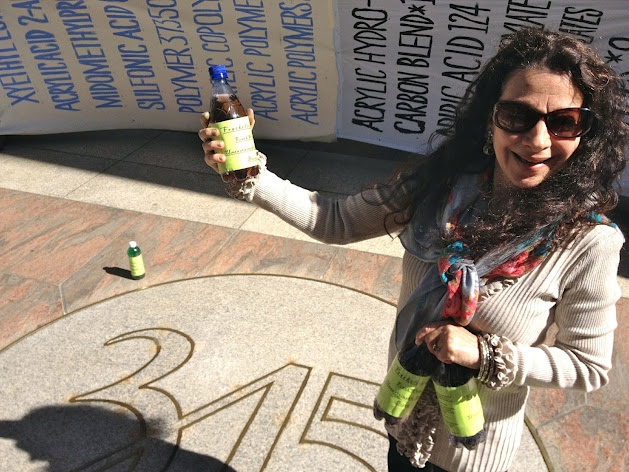
About 40 gathered outside Chevron’s San Francisco offices yesterday to mark its annual shareholder meeting. The demonstration was organized by OccupySF’s environmental justice working group, and used art and street theater to criticize Chevron’s involvement in hydraulic fracturing, a natural gas extraction process that may threaten parts of California’s water supply.

The afternoon protest came after a larger group showed up to Chevron’s world headquarters in San Ramon for the shareholder meeting that morning. According to Ginger Cassady of Rainforest Action Network (RAN), who helped organize the protest, it was a “big, colorful demonstration” with “over 100” in attendance.

Groups like the True Cost of Chevron and RAN’s Change Chevron campaign have been pressuring the company for years on a variety of issues. This year, workers and residents in areas where Chevron operates from Ecuador, Brazil, Angola and Nigeria travelled to San Ramon to voice their concerns. These ranged from oil-contaminated land in the Ecuadorian Amazon to an explosion on an oil rig off the shore of Nigeria in January. In that explosion, two workers were killed and more than 100 local people left the city for fear of contamination and other health risks caused by a fire that burned for months before going out on its own, despite Chevron’s efforts to contain the flames.

About 30 activists from around the world entered the meeting with proxy votes, according to Cassady. None interrupted the meeting, instead waiting their turn to speak. There were no arrests.

Some people with proxy votes, however, were not allowed access to the meeting. João Antonio de Moraes, national coordinator of Brazil’s United Federation of Oil Workers (FUP), was not allowed access, along with two representatives from United Steel Workers. Another worker, at the meeting to present in support of a resolution for worker safety, was initially blocked from entering but allowed access after a dispute, but had his presentation notes confiscated.

At the meeting, Chevron CEO John Watson announced “tremendous performance momentum” for the company, with “earnings of $26.9 billion” in the past year, according to a press release.

“Watson reinforced Chevron’s long-standing culture of safety and environmental stewardship, and resulting industry-leading performance,” the press release states. “He also highlighted Chevron’s commitment to partnerships that address health, education and economic development issues in the communities where the company operates, and Chevron’s global social investments of approximately $1 billion over the past six years.”

But Chevron is also suffering financially due to liability following oil spills, explosions, and contamination, a concern protest organizers say Watson failed to address. Representatives from Chevron did not return calls for comment.

The company recently settled with plaintiffs in Ecuador after an appeals court there ordered that they pay $18 billion in fines for spilling and deliberately dumping a total of 345 million gallons of crude oil in the Amazon rainforest of northeastern Ecuador.

Stockholders in attendance voted on eleven proposals, including seven submitted by shareholders, at the meeting. All of the votes went with the recommendation of the Board of Directors- including a proposal to reform the Board of Directors itself. That proposal asked that the Board of Directors find an independent Chair to head it up, as the current Chair is Chevron’s CEO, John Watson. The Board of Directors has the authority to incentivize and, if necessary, fire CEOs.

“We believe this presents a conflict of interest that can result in excessive management influence on the board of weaken the board’s management oversight,” read the proposal.

The proposal, along with several others, mentioned the Ecuador lawsuit, saying “we believe that independent board leadership is key at Chevron, given the questions raised about the oversight by the board of the CEO’s management and disclosure to shareholders of the financial and operational risks to the company from the $18 billion dollar judgment in the Ecuadorian courts in 2011.”

“With all these major legal liabilities that Chevron is facing a lot of people are concerned,” said Cassady.  “Chevron is profitable at the expense of worker safety, the environment, human rights and our economy.”

Other stockholder proposals dealt with safety, transparency, and the environmental impacts of Chevron’s international operations. A proposal asking Chevron to disclose money spent on lobbying received approximately 23 percent of votes, a proposal asking for a report on what the company has done to reduce the risk of accidents like the Niger Delta explosion received only eight percent of the vote, and a proposal that Chevron nominate a new board member with environmental expertise failed as well with 23 percent of votes cast.

Shareholders also voted on a proposal that Chevron release a report on the financial, environmental, and community impacts of hydraulic fracturing, the focus of the afternoon protest in San Francisco. The proposal received about 27 percent of the vote.

Hydraulic fracturing, or fracking, is the process of extracting natural gas by injecting dense underground rock formations with a pressurized mixture of water, sand and chemicals. It has been hailed as an environmentally friendly alternative to oil drilling, as natural gas burns cleaner than oil.

But protest movements have coalesced around fracking practices in the Appalachian mountains region and above the Marcellus Shale, as residents report toxic chemicals in their water supplies, endangering drinking water as well as water used for raising livestock and growing food.

The 2010 documentary Gasland included now notorious footage of residents near a Pennsylvania fracking operations whose tap water bursts into flames.

Fracking operations in California are less well known. The protest outside of Chevron’s San Francisco offices yesterday drew attention to this issue- and the extensive list of chemicals present in fracking solution.

“It’s happening in California, but it’s not really talked about” said Ellen Osuna. Osuna now lives in San Francisco, but moved from New York, where she says she worried about her water supply since it comes from aquifers near the Marcellus Shale.

The protest featured an 180-foot banner, painted by artist Ruthie Sakheim. The banner listed more than 70 chemicals found in fracking fluid, in alphabetical order.

“It’s not even halfway through the A’s” said Sakheim.

She also handed out bottles of water oil-colored water labeled “Frackelicious Frackwater Unsustainable Energy Drink.” The label listed some of the more toxic chemicals involved in the process under “ingredients” along with “no preservatives, no artificial flavors, 100 percent poison.”
 
According to a report released by the Congressional Committee on Energy and Commerce, fracking fluid contains 750 chemicals, which “ranged from generally harmless and common substances, such as salt and citric acid, to extremely toxic substances, such as benzene and lead” as well as many carcinogens, according to the report.

These chemicals, along with gas itself, can enter water supplies when the casing on wells cracks or when wastewater containers spill.

The Safe Drinking Water Act of 2005 specifically exempts hydraulic fracturing, a lack of regulation known as the Halliburton Loophole.

Fracking currently takes place in nine California counties, including Sacramento, Los Angeles, Santa Barbara and Monterey.  But the extent of hydraulic fracturing in California isn’t well known, and yesterday, the California Senate rejected SB1054, which would have required energy companies to notify landowners before using hydraulic fracturing on or near their land.

In between chants of  “ban fracking now!” Sakheim told me that she spent several months painting the banner, and plans to continue the project of listing the chemicals involved in fracking in artistic form.

“I have three kids,” said Sakheim. “I really worry about what will happen to them with these corporations having so much control to influence government.”

Reduce, re-use, replace

1

yael@sfbg.com

Greg Gaar knows the names, characteristics, and birds and butterflies attracted by every plant in the native plant nursery that he tends. Last week, he proudly toured me through the garden, pointing out plants like Yarrow ("great for bees and butterflies") and the beautiful flowers of the Crimson Columbine, of which Gaar believes there are "only two others left in San Francisco."

Gaar has been working at 780 Frederick St., where he now tends the garden, for decades. His mother went to high school on the same block, the old site of Polytechnic High. Before Gaar became the gardener, he ran the recycling center that Haight Ashbury Neighborhood Council (HANC) operates next to the garden. Now, the pioneering green operation he helped build may shut down.

At the center, people can recycle their bottles, cans, paper products, and even used vegetable oil, and make some cash along the way. Those who use the center say it's a green and dignified way to make some money.

But residents in the surrounding area have complained for years that the center is loud and attracts homeless people. They also say that, due to their proximity to the recycling center, the chance that their trash will get rifled through at night is greater than in other parts of the city.

Citing these concerns, the center's landlord, the San Francisco Recreation and Parks Department (RPD), has spent the past few years trying to evict the HANC recycling center. The center got an eviction notice in December 2010. HANC's lawyer, Robert DeVries, successfully challenged the eviction. RPD sued for eviction again in June 2011, and that matter may finally come to a close June 6 when it will be heard by a three-judge panel in SF Superior Court.

DELIVERING THE GARDEN


RPD officials cite neighbor concerns, claims that the recycling center's services are outdated and obsolete, and the idea of planting a community garden in its place. In fact, the Planning Commission approved a community garden in the place of the recycling center last year.

Since then, HANC staff got to work building its own community garden. In just a year, they erected 50 beds from recycled wood, and according to Gaar, about 100 neighbors have plots that they currently tend.

As the recycling center's director, Ed Dunn, tells it, the infrastructure already in place at the recycling center made building the garden come naturally. HANC was able to fund it with income from the recycling operation, and plant it with seeds from the native plant nursery.

Dunn emphasizes that no city money was used to build the current community garden. The city had laid out a $250,000 budget for the garden after it was approved and designed in 2010.

A bundle of documents containing arguments against HANC, provided by RPD, includes details of the Golden Gate Park Master Plan, surveys indicating a great need for community gardens in San Francisco, and letters and statements from neighbors complaining about the recycling center.

A 2004 survey discussed in the documents found that community gardens are among the top "recreation facilities most important to respondent households." Community gardens came in fifth in importance, after walking and biking trails, pools, fitness facilities, and running and walking tracks. The documents include a detailed map of the "Golden Gate Park community garden preliminary plan," imagined at HANC's current site.

The map was drawn up in November 2010, the same month that a meeting of the Recreation and Parks Commission laid out the reasons that HANC had to go. Minutes from the meeting include the city's need for community gardens as well as some neighbors' disdain for the recycling center in that site. It argues that the needs of recyclers can be well met with other recycling centers in the city.

Seventeen other recycling centers operate in San Francisco. Most are located in neighborhoods on the city's edges, with a few in the Outer Sunset and Excelsior, although most are located in Bayview-Hunters Point.

But the commission doesn't seem concerned with potential nuisance to neighbors in directing more traffic to these other recycling centers, or with the difficulty poor recyclers have in getting out there. "The San Francisco Department of the Environment is confident that recyclers that use the facility will take their material to another existing site for proper handling," according to the meeting's minutes.

The commission is, however, concerned about a nuisance that the recycling center creates for Haight-Ashbury neighbors, according to the minutes. The notes cite "neighborhood noise, truck traffic, litter, and public safety concerns as negative impacts related to continuing operations at the site."

AGAINST THE POOR?


But is this really just another case of resentment against people who are poor and homeless?

HANC's Dunn argues that, in fact, much of the material that those who use the center bring in isn't taken from residential waste bins. Besides, it's not technically "HANC's CRV redemption program" that encourages recycling as a revenue source for the less fortunate. State law requires that consumers be able to redeem bottles and cans for cash.

The meeting minutes argue that the recycling center "enables illegal camping and illicit and unhealthy behavior in Golden Gate Parks' eastern end and in neighborhoods in close proximity to the site."

Supposed evidence for the position cites letters to the editor published in the San Francisco Chronicle, a frequent outlet for anger at the homeless. One concerned resident, Karen Growney, asserts that the center "provides no benefit to people living in Haight/Cole Valley."

HANC disputes this, saying that many neighbors use the center. They have beneficial relationships with many nearby businesses, including New Ganges restaurant just across the street. Its website, kezargardens.com, shows many smiling neighbors who use the center to recycle.

Notable among them is actor/activist Danny Glover, a Haight resident since 1957. In a video on the website, Glover — interviewed while in his car dropping off recycling at the center — says, "I would be dismayed and not happy if we close this wonderful recycling center down…It would be a tragedy, and a great loss to this city and this community."

In her letter, Growney also laments that her family "had to pay a considerable amount to build a wrought-iron, locked gate to keep people out of our trash." Another letter, written by neighborhood resident Curtis Lee, asks that the city "eliminate the Haight Ashbury Recycling Center," saying that, "It is a blight on the neighborhood and an attraction to rodents and homeless carts."

Of course, those carts come with people. HANC takes issue with the assertion that their services "enable" or "encourage" homelessness, as well as the assumption that the recycling center only serves the homeless.

Dunn says that many of the recycling center' clientele are elderly immigrants, often housed, who contribute to their family income with cash from recyclables. He also insists that "most of the people that use the recycling center don't camp in the park."

Homeless people certainly do use the center, but it's not clear whether its presence truly "enables illegal camping and illicit and unhealthy activity." Dunn finds it laughable to say that "the center creates homelessness." It's a lot of work to cart around recyclables all day, he says, and the dedicated recyclers are generally not the same people that ask tourists on Haight Street for spare change.

THE RECYCLERS


There is a great diversity in how homeless San Franciscans spend their days, and recycling is in many ways a specialized, committed way of life. In her 2010 ethnography of homeless San Franciscans, Hobos, Hustlers and Backsliders, Teresa Gowan focuses on the "recyclers," the segment of the homeless population who have made a habit of collecting bottles and cans as a way of getting by.

"The phenomenon that captured my interest was the steady stream of shopping carts loaded high with glass, cans, cardboard, and scrap metal rolling past my door," she wrote.

Some of her interview subjects show disdain for the recyclers, who work hard all day and don't get much cash out of it. Dealing drugs, stealing, or panhandling can be more lucrative and less backbreaking. One subject, a man named Del who, according to Gowan, mostly stayed in the Tenderloin, thought the "20, 25 bucks on a big load" that recyclers usually made was pathetic. "'And that's for heaving around a big old rattling buggy all day,' Del said pityingly. 'I can make 15 bucks inside'a two minutes.'"

But many of her interview subjects prefer to recycle anyway. Gowan describes another subject, Sam, as "a champion recycler, muscular and persistent, who often put in nine, ten hours on the trot." She quotes Sam saying, "Without this, I'd kill myself. Couple a days, I'd do myself in…. You get some guys, seems like they can deal with homelessness. I'm not one of them."

The book argues that "pro recyclers" included a "large core group who had created an intense web of meaning around their work as a kind of blue-collar trade."

PIONEERING HANC


Recycling for cash may not be a respected or taxed job "blue collar" job. But it's certainly green.

Since the center began operating in the 1970s, mainstream attitudes towards environmentalism and sustainability have shifted dramatically. The HANC recycling center was a product of the environmental movement, and helped usher in the widespread support for recycling.

Now, with curbside recycling fully functional in San Francisco, many call the recycling center's work obsolete. But HANC argues that the city needs all the help it can get if it is to reach its goal for zero waste in 2020. It also employs 10 people, and Dunn argues that it would be foolish of the city to eliminate those stable green jobs.

HANC has also helped move along the trend towards community gardens that RPD is now embracing so thoroughly that, ironically, it could lead to the recycling center's demise. HANC helped underwrite the Garden for the Environment project as well as the Victory Garden planted outside City Hall in 2008. Dunn says that the staff enjoyed the challenge of building the garden, and would be interested in helping the city by creating more gardens without city money.

Gaar says he's committed to continuing to work for a healthier planet, regardless of what happens to the center. He and the other HANC staff have come to see the eviction process as symbolic of a direction in which the city's heading, that also includes last year's Sit-Lie Ordinance: decisions designed to shuffle homeless people out of wealthy neighborhoods.
The arguments for the community garden, however, seem to indicate a strong desire for a greener city. It's not easy balancing environmental initiatives with NIMBY woes — especially when your backyard is Golden Gate Park.

Seafaring

0

APPETITE Fish makes me happy. Raw, grilled, seared, any which way. One new restaurant and one established favorite are glorifying the fish, and seafood in general, in many formats.

LOCAL'S CORNER


Local's Corner just opened in March on a mellow corner of the Mission's east side. The sunny space is mostly white, evoking a cozy-chic New England seafood restaurant serving exquisite California fare. Dinner service was just launched mid-April, a delicate array of tastes of the mostly seafaring kind, though the menu simultaneously lists a "land" section.

Prior to opening, I was excited for this new seafood restaurant offering the likes of sardines and smaller, more sustainable fish, and they do deliver. The immediate downside is how quickly dishes add up. Small plates hover in the low teens while no dish tops more than the mid-20s, but as you finish each plate, hunger is not exactly satiated. There is little in terms of heartier fare, which is fine — you don't come here for "hearty." But $100 later (for two with a glass of wine), I left a couple dishes away from satisfied.

Crisp and bright as the equally crisp, bright space, a nice range of rosés and white wines pair ideally with fish offerings and rotating oysters ($2.50-3.50 each). A small plate of uni ($14) is alluringly punctuated by English peas, preserved Meyer lemon, and mint leaves, while Dungeness crab ($13) arrives glistening with snap peas, Cara Cara oranges, and spring onion. Cured halibut ($13) dances with radishes, grapefruit, and dill. Each is delicate, slight, tickling the taste buds.

Two flavorsome bites are cured anchovies and guanciale (Italian bacon made from pig's jowl or cheek) on toasts ($10), or a dollop of smoked trout rillettes and crème fraîche ($12), also with toasts. Both delight, but are so small-portioned, one is just hooked when they're gone. For $22, an entree of black cod on top of leeks, carrots, and watercress is likewise minimal and subdued. I was more satisfied with a "land" offering of beef tartare in a small pot, topped with quail egg ($15). Bread is (again) the filler, while the raw beef is glisteningly fresh.

Brunch is such a pleasant experience in the sunny space, it is tough having few seafood choices (just one currently) and a prix fixe only: now $18 for toast, two courses, and coffee or juice. Weekday lunch offers more seafood, which is primarily what one comes here for, though still few options compared to dinner.

Local's Corner is still in its infancy, exhibiting promising meticulousness and fresh tastes. I realize upping portions of the likes of uni and abalone is a costly thing while maintaining delicacy is crucial with such ingredients. It seems a worthy mission: satisfying appetite alongside artistry.

2500 Bryant, SF. (415) 800-7945, www.localscornersf.com

BAR CRUDO


One place that has long cornered artistry and appetite in my estimation is Bar Crudo, one of my top SF restaurants since its early days in the tiny Bush Street space, where Bouche is located now. Though the cavernous but narrow Divisadero space lacks the quirky charm and warm glow of the original location, service remains such that even as the place is packed nightly and waits are common, staff comes by offering wine, keeping me informed of the wait time.

The crudo, essentially Italian-style sashimi, are small and delicate (a sampler is $13 for 4 pieces, $25 for eight) but so uniquely delightful, they're worth every dollar. A visit here would not be complete without a bite of raw arctic char, lively with horseradish crème fraîche, wasabi tobiko and dill, or creamy butterfish crudo topped with apples, pear vinaigrette, and beet saffron caviar.

One easily fills up here, supplementing ethereal crudo with whole-roasted fish. Recently, I enjoyed a branzino ($26) with two friends. With the large fish, two smaller shared plates and a crudo sampler, we left full. The fish is generously sized, buttery, flaky. We devoured the cheeks, the head, every part, resting in butter beans, Swiss chard, oyster mushrooms, poblano peppers, and orange oil.

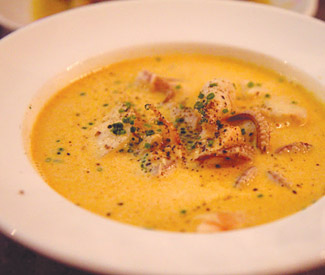
A flavor explosion comes in large head-on Louisiana prawns ($14) swimming in a spicy red brood, vivid and savory with shishito peppers and fresno chilies. I nearly drank it up. To fill up, there's always Bar Crudo's classic seafood chowder ($7/$14), a creamy, rich bowl of fish, mussels, squid, shrimp, potatoes, and applewood smoked bacon that elicits a moan of pleasure at first spoonful.

Coupled with a strong wine list (by glass or bottle) and equally strong craft and Belgian beer list, Bar Crudo remains not only one of San Francisco's seafood treasures. *

655 Divisadero, SF. (415) 409-0679, www.barcrudo.com

Subscribe to Virgina's twice-monthly newsletter, The Perfect Spot, www.theperfectspotsf.com

Battles without honor and humanity: this week’s new movies

0

While all the cool kids are at Cannes, us losers are stuck stateside to contemplate the two big Hollywood movies opening this week: Battleship, which stars Liam Neeson, the guy still smarting from his titular role in the reigning biggest flop of all time, and aliens (and has no chance of being the best movie based on a board game); and The Dictator (review below). Your choice is clear.

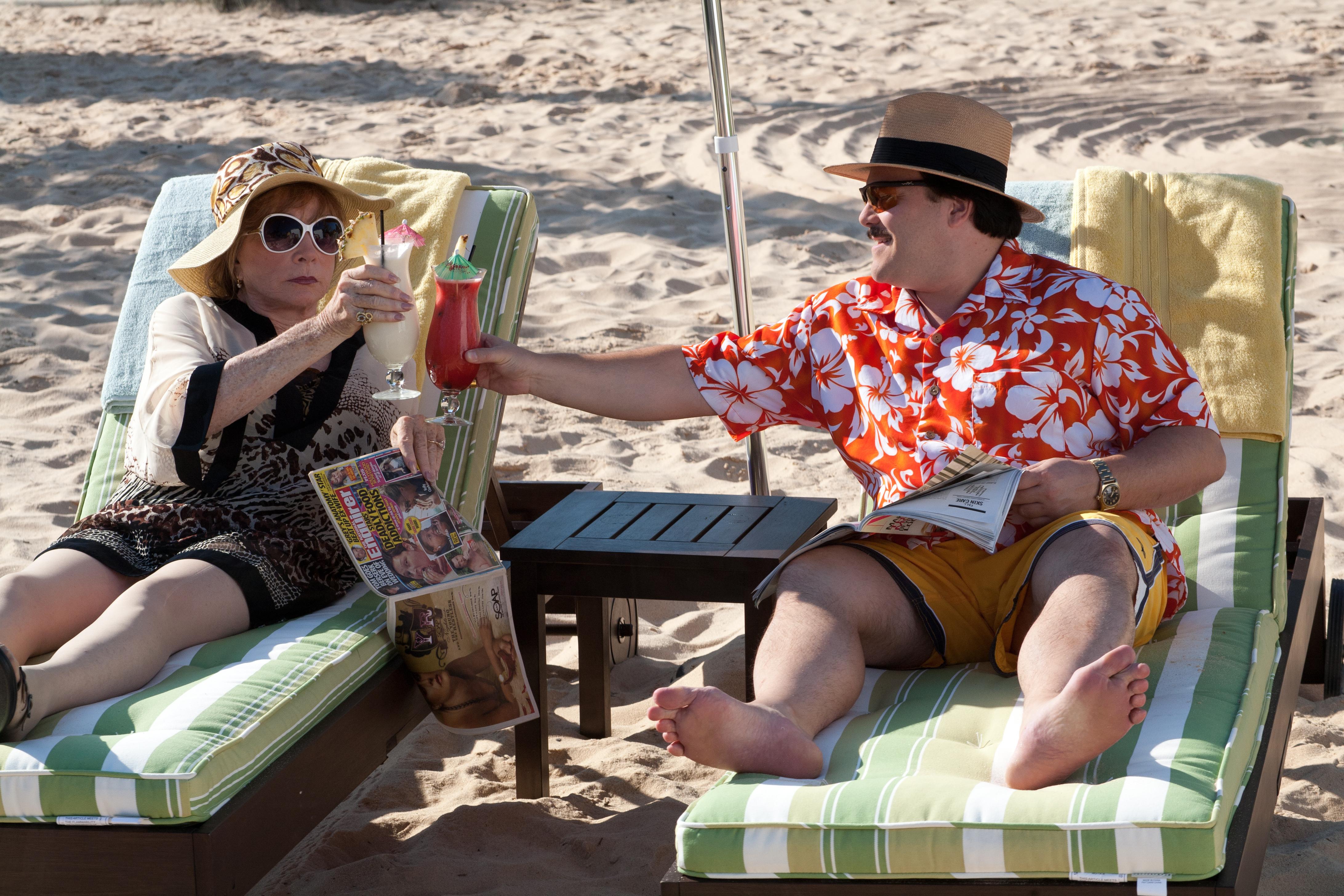
You could also feed your Jack Black obsession (already running red-hot with the new Tenacious D album, natch) with Richard Linklater’s new comedy, Bernie (review here). You could expand your cinematic horizons at the San Francisco Cinematheque’s third annual “Crossroads” festival. Or, while weeping over blogs detailing Cannes flicks you won’t get to see until 2013, you could organize your summer movie plan of attack.

And, of course, feed your Sno-Cap habit with The Dictator and other top picks from the rest of this week’s opening slate:

The Dictator As expected, The Dictator is, yet again, Sacha Baron Cohen doing his bumbling-foreigner shtick. Said character (here, a ruthless, spoiled North African dictator) travels to America and learns a heaping teaspoon of valuable lessons, which are then flung upon the audience — an audience which, by film’s end, has spent 80 minutes squealing at a no-holds-barred mix of disgusting gags, tasteless jokes, and schadenfreude. If you can’t forgive Cohen for carbon-copying his Borat (2006) formula, at least you can muster admiration for his ability to be an equal-opportunity offender (dinged: Arabs, Jews, Asians, African Americans, white Americans, women of all ethnicities, and green activists) — and for that last-act zinger of a speech. If The Dictator doesn’t quite reach Borat‘s hilarious heights, it’s still proudly repulsive, smart in spite of itself, and guaranteed to get a rise out of anyone who watches it. (1:23) Balboa, Presidio. (Cheryl Eddy)

Indie Game: The Movie Much like the film business, the video-game biz is mostly controlled by a few huge companies with thousands of employees, hell-bent on ensnaring as many of the billions of dollars spent on games annually as possible. And then, as James Swirsky and Lisanne Pajot’s documentary explores, there are the little guys, who are “not trying to be professional” or produce glossy content for the masses. Instead, these individuals (or pairs) take advantage of the miracle of digital distribution to follow their own visions and create their own games. The best-case scenarios — illustrated by San Francisco indie developer Jonathan Blow and his hugely successful Braid — can reap enormous creative and financial rewards, but getting there — as the struggles facing the creators of Super Meat Boy and Fez plainly attest — can be a mentally and physically draining process, filled with frustration and self-doubt, exacerbated by the taunts of haters online. A thoughtful, artfully-shot peek at one tiny corner of a behemoth industry, Indie Game also offers a surprisingly tense, raw look at some very bright minds struggling to triumph on their own terms. (1:36) Roxie. (Eddy)

http://www.youtube.com/watch?v=eDDzjcAoiwo

Payback Jumping off Margaret Atwood’s Payback: Debt and the Shadow Side of Wealth, her 2008 meditation on borrowing and lending and the way those acts reverberate through culture, documentarian Jennifer Baichwal finds a thought-provoking, graceful, seemingly free-form way into the writer’s ideas. The film dips into the dynamics between a handful of unlikely debtors and creditors scattered around the globe: two families in Northern Albania tied by a blood feud over disputed land and dishonor; organizing migrant workers and their employers in Florida; and the BP oil spill and an unsuspecting environment. Baichwal, like Atwood, uncovers few easy answers — especially when it comes to handling disasters on the scale of the BP spill — all the while treating her material with elegantly considered imagery and handling her subjects with a cool intelligence. That approach might leave some yearning for an uptick in emotional connection, or simply some connect-the-dots storytelling and, dare we say, drama. Meanwhile fans of the director’s Manufactured Landscapes (2006) will see Payback as its writerly relation, a tone poem about the crimes we’ve manufactured and muddled. (1:26) Lumiere, Shattuck. (Kimberly Chun)

Where Do We Go Now? With very real, deadly sectarian conflict on their doorstep, a group of Lebanese village women are making it up as they go along in this absurdist, ultimately inspiring dramedy with a dash of musical. Once sheltered by its isolation and the cheek-to-jowl intimacy of its denizens, the uneasy peace between Muslims and Christians in this small town threatens to shatter when the outside world begins to filter in, first through town-square TV broadcasts then tit-for-tat jabs that appear ready to escalate into violence. So the village’s women conspire to preserve harmony any way they can, even if that means importing a motley cadre of Ukrainian “exotic” dancers. What results is a post debauchery climax that almost one-ups 2009’s The Hangover — and a film that injects ground-level merriment and humanity into the headlines, thanks to director, co-writer, and star Nadine Labaki (2007’s Caramel), who has a gimlet eye and a generous spirit. (1:40) Embarcadero. (Chun)

Comforts of the flesh

0

virginia@sfbg.com

APPETITE Oxtail three ways, a hammy biscuit, gourmet meatloaf… comfort comes in each of these forms at new spots (or in the case of Presidio Social Club, with a new chef) in meat dishes for breakfast, lunch and dinner.


BREAKFAST: HAM HEAVEN

Prather Ranch is to be commended for raising sustainable, humanely-reared meats with a whole-animal (let no part go to waste) sales model. I’ve long enjoyed sausages and quality meats from the Ferry Building butcher. A few months ago, Prather opened American Eatery, providing meats to go in drool-worthy dishes like Chuck Wagon chili ($6.50), a mixture of pork, pinquito beans, sharp cheddar, scallions and sour cream, or Munich-style white brockwurst sausage ($7) with whole grain mustard sauce and sauerkraut.

American Eatery executive chef Erica Holland-Toll came from the former ACME Chop House and Lark Creek Inn. Long using Prather Ranch meats at her restaurants, she was well-qualified to oversee the Ferry Building menu. Breakfast is playful with unusual offerings like braised pork scrapple ($8), a traditional Pennsylvania Dutch mix of pork trimmings, cornmeal, flour, and spices in a sort of panfried loaf. Burgers tempt, even at breakfast, particularly The Stonebreaker ($12), laden with cheese curds and meat gravy.

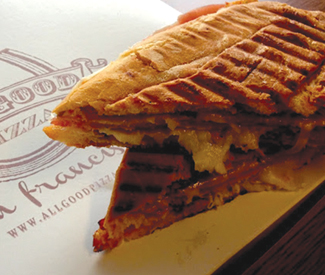
I go for maple-smoked ham. Try it on an Acme Torpedo roll ($10) joined by avocado and Eatwell Farms egg, perfected with basil and cheese curds. I’m particularly smitten with the maple-smoked ham and cheese biscuit ($8). The thick biscuit cushions Prather Ranch’s thinly shaved slabs of ham, San Joaquin Gold cheese, a fried egg and red eye gravy mayo. Biscuit Bender’s flaky buttermilk biscuit is the right choice. A local baker whose biscuits can also be found at Mission Cheese and Hollow, Bender wisely makes larded and non-larded versions. Ah, lard! Kudos for keeping tradition alive. I devour the sandwich with a Blue Bottle cappuccino, then sigh with contentment.

AMERICAN EATERY Ferry Building, SF. 415-391-0420 www.prmeatco.com/american-eatery


LUNCH: OXTAIL THREE WAYS

The Civic Center’s O3 Bistro and Lounge opened in January in the former, transformed California Pizza Kitchen. The sleek, open space in tones of black, silver, and purple exudes an Asian cosmopolitan feel with open windows offering a view of busy Van Ness Ave., not an obvious foodie stretch. While there’s a range of small plates ($7-12), including hoisin-glazed short ribs and ahi tuna crudo, dinner adds on pricier ($18-28) entrees such as seared scallops with lobster garlic noodles.

It’s fall-apart tender braised oxtail that calls out to me. At lunch there’s oxtail hash ($13), a mixture of caramelized onions, roasted red bell pepper, and russet potatoes over kimchi dirty rice, topped with bacon dust and a fried egg. At both lunch and dinner, find it in wonton shell tacos ($8-10) with jicama slaw. Does it get much more comforting? At a recent lunch I indulged in an oxtail grilled cheese sandwich on thick, rustic slabs of bread, sweetly glorified with five spice raisin jam. Braised oxtail any which way? Bring it on.

O3 524 Van Ness Ave., SF. 415-934-9800, www.o3restaurant.com


DINNER: (SORTA) LIKE MOM WOULD MAKE

Possessing one of the more beautiful, unique SF dining rooms, Presidio Social Club is set in a 1903 military barracks like a sunny, white, 1940s clubhouse with hints of red and chrome. Grabbing a bar stool for an Anejo Sour or Aviation from bar manager Tim Stookey and crew is a timeless respite. The rotating barrel-aged menu pleases, particularly the Aged Reasons Rye: rye, Punt e Mes vermouth, Cointreau, orange bitters.

New chef Wes Shaw hails from Texas, working with longtime chef-owner Ray Tang on a new menu that doesn’t neglect PSC classics like a Dungeness crab Louis sandwich ($18) or above-average mac n’ cheese ($10). But he also adds vitality with TX nods, like 8-hour smoked brisket on Tuesdays or marinated calamari, kicked up with butter beans and chiles. Fresh Monterey sardines ($10) come flaky over chickpea puree, shrouded in celery, while cracked Dungeness crab or a platter of oysters (Thursdays are $1 oysters, 4-7pm) remain ideally suited eats in PSC’s crisp space.

Surprisingly, two vegetable sides ($6) are among my favorite menu items, both deftly prepared, as fresh and healthy as they are palate-satisfying. Broccoli di ciccio is tossed in lemon with garlic and chiles, while smashed peas in mint oil are brightly seductive. How about that meat? One of the best dishes on the menu remains classic meatloaf ($17), infused with new life — a seemingly bigger slice than I remember in years past. Like mom would make if mom was a gourmand, the juicy, meaty loaf rests atop a sea of mashed potatoes, crowned with slivered carrots and fried shallots for a pseudo-light finish.

PRESIDIO SOCIAL CLUB 563 Ruger, SF. 415-885-1888, www.presidiosocialclub.com

Subscribe to Virgina’s twice-monthly newsletter, The Perfect Spot, www.theperfectspotsf.com 

Film Listings May 16-22, 2012

0

Film listings are edited by Cheryl Eddy. Reviewers are Kimberly Chun, Max Goldberg, Dennis Harvey, and Lynn Rapoport. For rep house showtimes, see Rep Clock at www.sfbg.com. Complete film listings also posted at www.sfbg.com.

OPENING

Battleship During idle moments before the action revs up, the aliens start menacing, and the deadly razor balls-cum-air mines start rampaging, wrap your noggin around these random brainwaves: can Taylor Kitsch be any better named? Is it possible for Alexander Skarsgård’s glassy eyes to get any deader? Where are all the Hawaiians, Asians, and people of color in this white-bread vision of Hawaii? All matters to puzzle over in this toy franchise hopeful directed by ex-Chicago Hope regular Peter Berg. The 2007 Transformers is the best this gung-ho hybrid of up-with-the-military “Army of One” commercial and alien invasion flick — with plenty of blow-’em-up-real-good explosions and a dab of J-monster movies, but the writing never quite rises to the occasion. Here, an international group of navy folk and their ships are convening in Hawaii for playful wargames, though the exercises turn somewhat more serious when alien vessels splash down in the middle of the fun —and some mild, no-investment family drama: Alex (Kitsch) is the screw-up younger brother of stony-faced naval man Stone (Skarsgård) and courting the daughter (Brooklyn Decker) of the fleet commander (Liam Neesom), who seems to hate his guts. The ultimate battle with space invaders, however, promises to turn that all around, as Alex is forced to sailor up and lead crew mates like Rihanna and work with former opponents like Captain Nagata (Tadanobu Asano). Here, at least, in the shadow of Pearl Harbor, U.S. and Japanese naval dudes can heal the wounds of World War II and bond in battle against the last unimpeachable interstellar villains who couldn’t give a rat’s ass if you say “I sunk your battleship.” But Berg’s muddled direction doesn’t help when it comes to piecing out the chronology and balancing assorted perspectives in this latest effort to equate militarism with the games big and little kids play. (2:11) (Chun)

Bernie See “Small-Town Confidential.” (1:39) Embarcadero, Shattuck, Smith Rafael.

The Dictator As expected, The Dictator is, yet again, Sacha Baron Cohen doing his bumbling-foreigner shtick. Said character (here, a ruthless, spoiled North African dictator) travels to America and learns a heaping teaspoon of valuable lessons, which are then flung upon the audience — an audience which, by film’s end, has spent 80 minutes squealing at a no-holds-barred mix of disgusting gags, tasteless jokes, and schadenfreude. If you can’t forgive Cohen for carbon-copying his Borat (2006) formula, at least you can muster admiration for his ability to be an equal-opportunity offender (dinged: Arabs, Jews, African Americans, white Americans, women of all ethnicities, and green activists) — and for that last-act zinger of a speech. If The Dictator doesn’t quite reach Borat‘s hilarious heights, it’s still proudly repulsive, smart in spite of itself, and guaranteed to get a rise out of anyone who watches it. (1:23) Balboa, Presidio. (Eddy)

Elles Graphic sex scenes distinguish this otherwise fairly unremarkable tale of Anne (Juliette Binoche), a magazine writer whose blah life (sure, she has a luxurious apartment, but it’s populated by a distant husband, a sullen teenager, and a younger son who’d rather interface with technology than humans) becomes even more unbearable when she begins a new assignment: an article on college students who moonlight as call girls. The always-reliable Binoche brings depth to her role as a bored woman who finds herself unexpectedly titillated by her close brush with dirty thrills, but her eventual rebellion is anti-climactic after all that naughty build-up. Elles does plenty to earn its NC-17 rating, but filmmaker Malgoska Szumowska could’ve titled it Ennui instead. (1:36) Bridge, Shattuck. (Eddy)

Indie Game: The Movie Much like the film business, the video-game biz is mostly controlled by a few huge companies with thousands of employees, hell-bent on ensnaring as many of the billions of dollars spent on games annually as possible. And then, as James Swirsky and Lisanne Pajot’s documentary explores,

there are the little guys, who are “not trying to be professional” or produce glossy content for the masses. Instead, these individuals (or pairs) take advantage of the miracle of digital distribution to follow their own visions and create their own games. The best-case scenarios — illustrated by San Francisco indie developer Jonathan Blow and his hugely successful Braid — can reap enormous creative and financial rewards, but getting there — as the struggles facing the creators of Super Meat Boy and Fez plainly attest can be a mentally and physically draining process, filled with frustration and self-doubt, exacerbated by the taunts of haters online. A thoughtful, artfully-shot peek at one tiny corner of a behemoth industry, Indie Game also offers a surprisingly tense, raw look at some very bright minds struggling to triumph on their own terms. (1:36) Roxie. (Eddy)

Mansome This study of contemporary male grooming — from ironic mustaches to competitive “beardbuilding” to the fine art of the hairpiece — is yet another lighthearted entry from prolific doc-factory Morgan Spurlock (the subject matter being particularly appropriate, given his own trademark ‘stache). With interstitials by co-producers Will Arnett and Jason Bateman — getting pedicures and facials while exchanging barbs, like the TV brothers they are — and input from an array of famous faces (Zach Galifianakis, Paul Rudd, the Old Spice Guy, Judd Apatow, ZZ Top), Mansome is actually most interesting when it focuses on less boldfaced names — like the deadly-serious “beardsman” whose flowing red locks have won him international titles, and the old-school toupee expert who matter-of-factly erases baldness for grateful clients. One quibble: though John Waters appears to discuss his own trademark facial hair, and there’s a Freddy Mercury clip, Mansome remains stubbornly focused on straight dudes — though it does dig up the only man in the galaxy still using the term “metrosexual.” (1:24) Lumiere, Shattuck. (Eddy)

Payback Jumping off Margaret Atwood’s Payback: Debt and the Shadow Side of Wealth, her 2008 meditation on borrowing and lending and the way those acts reverberate through culture, documentarian Jennifer Baichwal finds a thought-provoking, graceful, seemingly free-form way into the writer’s ideas. The film dips into the dynamics between a handful of unlikely debtors and creditors scattered around the globe: two families in Northern Albania tied by a blood feud over disputed land and dishonor; organizing migrant workers and their employers in Florida; and the BP oil spill and an unsuspecting environment. Baichwal, like Atwood, uncovers few easy answers — especially when it comes to handling disasters on the scale of the BP spill — all the while treating her material with elegantly considered imagery and handling her subjects with a cool intelligence. That approach might leave some yearning for an uptick in emotional connection, or simply some connect-the-dots storytelling and, dare we say, drama. Meanwhile fans of the director’s Manufactured Landscapes (2006) will see Payback as its writerly relation, a tone poem about the crimes we’ve manufactured and muddled. (1:26) Lumiere, Shattuck. (Chun)

What to Expect When You’re Expecting The mommy guidebook hits the big screen, with an all-star cast including Jennifer Lopez and Cameron Diaz. (1:50) Presidio, Shattuck.

Where Do We Go Now? With very real, deadly sectarian conflict on their doorstep, a group of Lebanese village women are making it up as they go along in this absurdist, ultimately inspiring dramedy with a dash of musical. Once sheltered by its isolation and the cheek-to-jowl intimacy of its denizens, the uneasy peace between Muslims and Christians in this small town threatens to shatter when the outside world begins to filter in, first through town-square TV broadcasts then tit-for-tat jabs that appear ready to escalate into violence. So the village’s women conspire to preserve harmony any way they can, even if that means importing a motley cadre of Ukrainian “exotic” dancers. What results is a post debauchery climax that almost one-ups 2009’s The Hangover — and a film that injects ground-level merriment and humanity into the headlines, thanks to director, co-writer, and star Nadine Labaki (2007’s Caramel), who has a gimlet eye and a generous spirit. (1:40) Embarcadero. (Chun)

ONGOING

The Artist With the charisma-oozing agility of Douglas Fairbanks swashbuckling his way past opponents and the supreme confidence of Rudolph Valentino leaning, mid-swoon, into a maiden, French director-writer Michel Hazanavicius hits a sweet spot, or beauty mark of sorts, with his radiant new film The Artist. In a feat worthy of Fairbanks or Errol Flynn, Hazanavicius juggles a marvelously layered love story between a man and a woman, tensions between the silents and the talkies, and a movie buff’s appreciation of the power of film — embodied in particular by early Hollywood’s union of European artistry and American commerce. Dashing silent film star George Valentin (Jean Dujardin, who channels Fairbanks, Flynn, and William Powell — and won this year’s Cannes best actor prize) is at the height of his career, adorable Jack Russell by his side, until the talkies threaten to relegate him to yesterday’s news. The talent nurtured in the thick of the studio system yearns for real power, telling the newspapers, “I’m not a puppet anymore — I’m an artist,” and finances and directs his own melodrama, while his youthful protégé Peppy Miller (Bérénice Béjo) becomes a yakky flapper age’s new It Girl. Both a crowd-pleasing entertainment and a loving précis on early film history, The Artist never checks its brains at the door, remaining self-aware of its own conceit and its forebears, yet unashamed to touch the audience, without an ounce of cynicism. (1:40) Metreon. (Chun)

The Best Exotic Marigold Hotel (1:42) Albany, SF Center, Sundance Kabuki.

Bully Anyone who’s ever been a kid on the wrong side of a bully — or was sensitive and observant enough not to avert his or her eyes — will be puzzling over the MPAA’s R rating of this doc, for profanity. It’s absurd when the gory violence on network and basic cable TV stops just short of cutting characters’ faces off, as one blurred-out bus bully threatens to do to the sweet, hapless Alex, dubbed “Fish Face” by the kids who ostracize him and make his life hell on the bus. It’s a jungle out there, as we all know — but it’s that real, visceral footage of the verbal (and physical) abuse bullied children deal with daily that brings it all home. Filmmaker Lee Hirsch goes above and beyond in trying to capture all dimensions of his subject: the terrorized bullied, the ineffectual school administrators, the desperate parents. There’s Kelby, the gay girl who was forced off her beloved basketball team after she came out, and Ja’Maya, who took drastic measures to fend off her tormenters — as well as the specters of those who turned to suicide as a way out. Hirsch is clearly more of an activist than a fly on the wall: he steps in at one point to help and obviously makes an uplifting effort to focus on what we can do to battle bullying. Nevertheless, at the risk of coming off like the Iowa assistant principal who’s catching criticism for telling one victim that he was just as bad as the bully that he refused to shake hands with, one feels compelled to note one prominent component that’s missing here: the bullies themselves, their stories, and the reasons why they’re so cruel — admittedly a daunting, possibly libelous task. (1:35) Smith Rafael. (Chun)

The Cabin in the Woods If the name “Joss Whedon” doesn’t provide all the reason you need to bum-rush The Cabin in the Woods (Whedon produced and co-wrote, with director and frequent collaborator Drew Goddard), well, there’s not much more that can be revealed without ruining the entire movie. In a very, very small nutshell, it’s about a group of college kids (including Chris “Thor” Hemsworth) whose weekend jaunt to a rural cabin goes horribly awry, as such weekend jaunts tend to do in horror movies (the Texas Chainsaw and Evil Dead movies are heavily referenced). But this is no ordinary nightmare — its peculiarities are cleverly, carefully revealed, and the movie’s inside-out takedown of scary movies produces some very unexpected (and delightfully blood-gushing) twists and turns. Plus: the always-awesome Richard Jenkins, and in-jokes galore for genre fans. (1:35) Metreon, 1000 Van Ness, Shattuck. (Eddy)

Chimpanzee (2:00) Metreon, 1000 Van Ness.

Dark Shadows Conceptually, there’s nothing wrong with attempting to turn a now semi-obscure supernaturally themed soap opera with a five-year run in the late 1960s and early ’70s into a feature film. Particularly if the film brings together the sweetly creepy triumvirate of Tim Burton, Johnny Depp, and Helena Bonham Carter and emerges during an ongoing moment for vampires, werewolves, and other things that go hump in the night. Depp plays long-enduring vampire Barnabas Collins, the undead scion of a once-powerful 18th-century New England family that by the 1970s — the groovy decade in which the bulk of the story is set — has suffered a shabby deterioration. Barnabas forms a pact with present-day Collins matriarch Elizabeth (Michelle Pfeiffer) to raise the household — currently comprising her disaffected daughter, Carolyn (Chloë Grace Moretz), her derelict brother, Roger (Jonny Lee Miller), his mournful young son, David (Gulliver McGrath), David’s live-in lush of a psychiatrist, Dr. Hoffman (Carter), and the family’s overtaxed manservant, Willie (Jackie Earle Haley) — to its former stature, while taking down a lunatic, love-struck, and rather vindictive witch named Angelique (Eva Green). The latter, a victim of unrequited love, is the cause of all Barnabas’s woes and, by extension, the entire clan’s, but Angelique can only be blamed for so much. Beyond her hocus-pocus jurisdiction is the film’s manic pileup of plot twists, tonal shifts, and campy scenery-chewing by Depp, a startling onslaught that no lava lamp joke, no pallid reaction shot, no room-demolishing act of paranormal carnality set to Barry White, and no cameo by Alice Cooper can temper. (2:00) California, Marina, Metreon, 1000 Van Ness, Sundance Kabuki. (Rapoport)

Darling Companion When the carelessness of self-absorbed surgeon Joseph (Kevin Kline) results in the stray dog adopted by Beth (Diane Keaton) going missing during a forest walk, that event somehow brings all the fissures in their long marriage to a crisis point. Big Chill (1983) director Lawrence Kasdan’s first feature in a decade hews back to the more intimate, character-based focus of his best films. But this dramedy is too often shrilly pitched and overly glossy (it seems to take place in a Utah vacation-themed L.L. Bean catalog), with numerous talented actors — including Richard Jenkins, Dianne Wiest, Mark Duplass, Elisabeth Moss, and Sam Shepard — playing superficially etched characters that merely add to the clutter. Most cringe-inducing among them is Ayelet Zurer’s Carmen, a woman of Roma extraction who apparently has a crystal ball in her psychic head and actually speaks lines like “My people have a saying….” (1:43) Opera Plaza, Shattuck. (Harvey)

First Position Bess Kargman’s documentary follows a handful of exceptional young ballet dancers, ranging in age from 10 to 17, over the course of a year as they prepare for the Youth America Grand Prix, the world’s largest ballet scholarship competition. Those who make it from the semifinals (in which some 5,000 dancers aged 9 to 19 perform in 15 cities around the world) to the finals (which bring some 300 contestants to New York City) compete for scholarships to prestigious ballet schools, dance-company contracts, and general notice by both the judges and the company directors in the audience. The film’s subjects come from varied backgrounds — 16-year-old Joan Sebastian lives and studies in NYC, far from his family in Colombia; 14-year-old Michaela was born in civil war-torn Sierra Leone and adopted from an orphanage by an American couple in Philadelphia; 11-year-old Aran, an American, lives in Italy with his mother while his father serves in Kuwait. The common threads in their stories are the daily sacrifices made by them as well as their families, whose energies and other resources are largely poured into these children’s single-minded pursuit. We get a vague sense of the difficult world they are driving themselves, in nearly every waking hour, to enter. But the film largely keeps its focus on the challenges of preparing for the competition, offering us many magnificent shots of the dancers pushing their bodies to mesmerizing physical extremes both on- and offstage. (1:34) Embarcadero, Piedmont, Shattuck, Smith Rafael. (Rapoport)

The Five-Year Engagement In 2008’s Forgetting Sarah Marshall, viewers were treated to the startling, tragicomic sight of Jason Segel’s naked front side as his character got brutally dumped by the titular perky, put-together heartbreaker. In The Five-Year Engagement, which he reunited with director Nicholas Stoller to co-write, Segel once again sacrifices dignity and the right to privacy, this time in exchange for fake orgasms (his own), ghastly hand-knit sweaters, egregious facial-hair arrangements, and various other exhaustively humiliating psychological lows — all part of an earnest, undying quest to make people giggle uncomfortably. Segel plays Tom, a talented chef with a promising career ahead of him in San Francisco’s culinary scene (naturally, food carts get a cameo in the film). On the one-year anniversary of meeting his girlfriend, Violet (Emily Blunt), a psychology postgrad, he asks her to marry him in a meticulously planned, gloriously botched proposal scene coengineered by Tom’s oafish friend Alex (Chris Pratt), little realizing that this romantic gesture will soon lead to successive frozen winters in the Midwest (Violet gets offered a job at the University of Michigan), loss of professional stature, cabin fever, mead making, bow-hunting accidents, the titular nuptial postponement, and other, more gruesome events. The humor at times descends to some banally low depths as Segel and Stoller explore the terrain of the awkward, the poorly socialized, and the playfully grotesque. But Segel and Blunt present a believable, likable relationship between two warm, funny, flawed people, and, however disgusted, no one should walk out before a scene in which Violet and her sister (Alison Brie) channel Elmo and Cookie Monster to elaborate on the themes of romantic idealism and marital discontent. (2:04) 1000 Van Ness, Presidio, SF Center, Vogue. (Rapoport)

Footnote (1:45) Opera Plaza, Shattuck.

Girl in Progress (1:30) SF Center.

God Bless America Middle-aged office drone Frank (Joel Murray) is not having a good day-week-month-year-life. His ex-wife is about to happily remarry; his only child is a world-class brat who finds father-daughter time “boring;” his neighbors are a young couple who only get more loudly obnoxious when politely asked to keep the noise down. When that and insistent migraines keep Frank awake night after night, the parade of pundit and reality stupidities on TV only turn his insomnia into wide awake fury. Then he’s fired from his job for unjust reasons — on the same day he gets a diagnosis of brain cancer. Mad as hell, not-gonna-take-it-anymore, he impulsively decides to make a “statement” by assassinating a viral-video poster child for “entitlement.” This attracts admiring attention from extremely pushy, snarky teen Roxy (Tara Lynne Barr), who appoints herself Bonnie to his reluctant Clyde. They drive around the country bestowing “big dirt naps” on other exemplars of what’s wrong with America today, including religious hate mongers, rude moviegoers, and the purveyors of American Idol-type idiotainment. Comedian Bobcat Goldthwait’s latest feature as writer-director has its head in the right place, and so many good ideas, that it’s a pity this gonzo satire-rant runs out of steam so quickly. Aiming splattering paintball gun at the broadest possible targets, it covers them with disdainful goo but not as much wit as one would like. Plus, Barr’s hyper precocious smart mouth is yet another annoying Juno (2007) knockoff — never mind that she counts Diablo Cody among her (many) pet peeves. If God Bless winds up closer to Uwe Boll’s Postal (2007) than, say, Network (1976) in scattershot impact, it nonetheless almost makes it on sheer outré audacity and will alone. A movie that hates everything you hate should not be sneezed at; if only it hated them with more parodic snap, thematic depth and narrative structure. (1:44) Lumiere, Shattuck. (Harvey)

Headhunters Despite being the most sought-after corporate headhunter in Oslo, Roger (Aksel Hennie) still doesn’t make enough money to placate his gorgeous wife; his raging Napoleon complex certainly doesn’t help matters. Crime is, as always, the only solution, so Roger’s been supplementing his income by stealthily relieving his rich, status-conscious clients of their most expensive artworks (with help from his slightly unhinged partner, who works for a home-security company). When Roger meets the dashing Clas Greve (Nikolaj Coster-Waldau of Game of Thrones) — a Danish exec with a sinister, mysterious military past, now looking to take over a top job in Norway — he’s more interested in a near-priceless painting rumored to be stashed in Greve’s apartment. The heist is on, but faster than you can say “MacGuffin,” all hell breaks loose (in startlingly gory fashion), and the very charming Roger is using his considerable wits to stay alive. Based on a best-selling “Scandi-noir” novel, Headhunters is just as clever as it is suspenseful. See this version before Hollywood swoops in for the inevitable (rumored) remake. (1:40) Clay, Piedmont, Shattuck. (Eddy)

Here (2:00) SF Film Society Cinema.

The Hunger Games Katniss Everdeen (Jennifer Lawrence) is a teenager living in a totalitarian state whose 12 impoverished districts, as retribution for an earlier uprising, must pay tribute to the so-called Capitol every year, sacrificing one boy and one girl each to the Hunger Games. A battle royal set in a perilous arena and broadcast live to the Capitol as gripping diversion and to the districts as sadistic propaganda, the Hunger Games are, depending on your viewpoint, a “pageant of honor, courage, and sacrifice” or a brutal, pointless bloodbath involving children as young as 12. When her little sister’s name comes up in the annual lottery, Katniss volunteers to take her place and is joined by a boy named Peeta Mellark (Josh Hutcherson), with whom she shares an old, unspoken bond. Tasked with translating to the screen the first installment of Suzanne Collins’s rabidly admired trilogy, writer-director Gary Ross (2003’s Seabiscuit, 1998’s Pleasantville) telescopes the book’s drawn-out, dread-filled tale into a manageable two-plus-hour entertainment, making great (and horrifying) use of the original work’s action, but losing a good deal of the narrative detail and emotional force. Elizabeth Banks is comic and unrecognizable as Effie Trinket, the two tributes’ chaperone; Lenny Kravitz gives a blank, flattened reading as their stylist, Cinna; and Donald Sutherland is sufficiently creepy and bloodless as the country’s leader, President Snow. More exceptionally cast are Woody Harrelson as Katniss and Peeta’s surly, alcoholic mentor, Haymitch Abernathy, and Stanley Tucci as games emcee Caesar Flickerman, flashing a bank of gleaming teeth at each contestant as he probes their dire circumstances with the oily superficiality of a talk show host. (2:22) 1000 Van Ness, SF Center, Sundance Kabuki. (Rapoport)

Jiro Dreams of Sushi Celebrity-chef culture has surely reached some kind of zeitgeist, what with the omnipresence of Top Chef and other cooking-themed shows, and the headlines-making power of people like Paula Deen (diabetes) and Mario Batali (sued for ripping off his wait staff). Unconcerned with the trappings of fame — you’ll never see him driving a Guy Fieri-style garish sports car — is Jiro Ono, 85-year-old proprietor of Sukiyabashi Jiro, a tiny, world-renowned sushi restaurant tucked into Tokyo’s Ginza station. Jiro, a highly-disciplined perfectionist who believes in simple, yet flavorful food, has devoted his entire life to the pursuit of “deliciousness” — to the point of sushi invading his dreams, as the title of David Gelb’s reverential documentary suggests. But Jiro Dreams of Sushi goes deeper than food-prep porn (though, indeed, there’s plenty of that); it also examines the existential conflicts faced by Jiro’s two middle-aged sons. Both were strongly encouraged to enter the family business — and in the intervening years, have had to accept the soul-crushing fact that no matter how good their sushi is, it’ll never be seen as exceeding the creations of their legendary father. (1:21) Embarcadero, Shattuck. (Eddy)

Last Call at the Oasis If you like drinking water, or eating food, or using mass-produced physical objects, and you also enjoy not being poisoned by virulent chemicals such as hexavalent chromium and atrazine, you probably want to see — but most likely won’t much enjoy — Jessica Yu’s latest documentary, about the impending global water crisis. Or rather, the crisis, the film makes clear, that has already arrived in many parts of the world and — in the sense that it’s about a shortage of safe drinking water — in many parts of the United States. The Academy Award–winning Yu, whose previous films include the 2004 Henry Darger documentary In the Realms of the Unreal, invites various experts to lay out the alarming facts for us, as we sit in the theater clutching our bottles of Dasani. Last Call‘s talking heads include UC Irvine professor Jay Famiglietti, the Pacific Institute’s Peter Gleick (who, regardless of February’s firestorm over an ethical lapse, speaks eloquently here), journalist Alex Prud’homme, whose book The Ripple Effect the documentary is based on, and Erin Brockovich. An unexpected appearance by Jack Black in the role of potential future spokesperson for potable recycled water (one name under consideration: Porcelain Springs) adds levity to a film that is short on silver linings, as well as solutions. The title conveys the sort of gallows humor occasionally displayed by Yu’s subjects — one of whom ponders for a moment the situation he’s just described and then offers this succinct summary: “We’re screwed.” (1:45) Opera Plaza. (Rapoport)

The Lucky One Iraq War veteran Logan (Zac Efron) beats PTSD by walking with his German shepherd from Colorado to the Louisiana bayou, in search of a golden-haired angel in cutoff blue jean short shorts (Taylor Schilling). His stated (in soporific voice-over) aim is to meet and thank the angel, who he believes repeatedly saved his life in the combat zone after he plucked her photograph from the rubble of a bombed-out building. The snapshot offers little in the way of biographical information, but luckily, there are only 300 million people in the United States, and he manages to find her after walking around for a bit. The angel, or Beth, as her friends call her, runs a dog kennel with her grandmother (Blythe Danner) while raising her noxiously Hollywood-precocious eight-year-old son (Riley Thomas Stewart) and fending off the regressive advances of her semi-villainous ex-husband (Jay R. Ferguson). Logan’s task seems simple enough, and he’s certainly walked a fair distance to complete it, but rather than expressing his gratitude, he becomes tongue-tied in the face of Beth’s backlit blondness and instead fills out a job application and proceeds to soulfully but manfully burrow his way into her affections and short shorts. Being an adaptation of a Nicholas Sparks novel, The Lucky One requires some forceful yanking on the heartstrings, but director Scott Hicks (1999’s Snow Falling on Cedars, 1996’s Shine) is hobbled in this task by, among other things, Efron’s wooden, uninvolved delivery of queasy speeches about traveling through darkness to find the light and how many times a day a given woman should be kissed. (1:41) SF Center. (Rapoport)

Marley Oscar-winning documentarian Kevin Macdonald (1999’s One Day in September; he also directed Best Actor Forest Whitaker in 2006’s The Last King of Scotland) takes on the iconic Bob Marley, using extensive interviews — both contemporary (with Marley friends and family) and archival (with the musician himself) — and performance and off-the-cuff footage. The end result is a compelling (even if you’re not a fan) portrait of a man who became a global sensation despite being born into extreme poverty, and making music in a style that most people had never heard outside of Jamaica. The film dips into Marley’s Rastafari beliefs (no shocker this movie is being released on 4/20), his personal life (11 children from seven different mothers), his impact on Jamaica’s volatile politics, his struggles with racism, and, most importantly, his remarkable career — achieved via a combination of talent and boldness, and cut short by his untimely death at age 36. (2:25) California, Opera Plaza, Smith Rafael. (Eddy)

Marvel’s The Avengers The conflict — a mystical blue cube containing earth-shattering (literally) powers is stolen, with evil intent — isn’t the reason to see this long-hyped culmination of numerous prequels spotlighting its heroic characters. Nay, the joy here is the whole “getting’ the band back together!” vibe; director and co-writer Joss Whedon knows you’re just dying to see Captain America (Chris Evans) bicker with Iron Man (a scene-stealing Robert Downey Jr.); Thor (Chris Hemsworth) clash with bad-boy brother Loki (Tom Hiddleston); and the Hulk (Mark Ruffalo) get angry as often as possible. (Also part of the crew, but kinda mostly just there to look good in their tight outfits: Jeremy Renner’s Hawkeye and Scarlett Johansson’s Black Widow.) Then, of course, there’s Nick Fury (Samuel L. Jackson) running the whole Marvel-ous show, with one good eye and almost as many wry quips as Downey’s Tony Stark. Basically, The Avengers gives you everything you want (characters delivering trademark lines and traits), everything you expect (shit blowing up, humanity being saved, etc.), and even makes room for a few surprises. It doesn’t transcend the comic-book genre (like 2008’s The Dark Knight did), but honestly, it ain’t trying to. The Avengers wants only to entertain, and entertain it does. (2:23) Balboa, Marina, Metreon, 1000 Van Ness, Presidio, Sundance Kabuki. (Eddy)

Michael Michael follows a few months in the lives of a pedophile (Michael Fulth) and his captive (David Rauchenberger). It is no surprise that Austrian director Markus Schleinzer previously worked for Michael Haneke: the film’s cold, inanimate aesthetic is the means for psychological torture, on the part of both Michael’s prisoner, and the audience. Michael, a sociopath who works in an office by day, keeps the boy, a pensive 10-year-old named Wolfgang, in a basement behind a bolted door. He visits him nightly, and allows the boy to dine with him. As master and slave go about their mundane routine their level of comfort with one another is just as unsettling as the off-screen sex. Equally disturbing is how Michael manages to maintain such a normal life on the surface. After he tries to bring a new victim home and fails, Wolfgang starts to find ways to push his captor’s buttons. In spite of the loud subject, rarely has such formal reticence registered as this horrifying. (1:36) SF Film Society Cinema. (Ryan Lattanzio)

Monsieur Lazhar When their beloved but troubled teacher hangs herself in the classroom — not a thoughtful choice of location, but then we never really discover her motives — traumatized Montreal sixth-graders get Bachir Lazhar (Fellag), a middle-aged Algerian émigré whose contrastingly rather strict, old-fashioned methods prove surprisingly useful at helping them past their trauma. He quickly becomes the crush object of studious Alice (Sophie Nelisse), whose single mother is a pilot too often away, while troublemaker Simon (Emilien Neron) acts out his own domestic and other issues at school. Lazhar has his own secrets as well — for one thing, we see that he’s still petitioning for permanent asylum in Canada, contradicting what he told the principal upon being hired — and while his emotions are more tightly wrapped, circumstances will eventually force all truths out. This very likable drama about adults and children from Quebec writer-director Philippe Falardeau doesn’t quite have the heft and resonance to rate among the truly great narrative films about education (like Laurent Cantet’s recent French The Class). But it comes close enough, gracefully touching on numerous other issues while effectively keeping focus on how a good teacher can shape young lives in ways as incalculable as they are important. (1:34) Opera Plaza, Piedmont, Shattuck, Smith Rafael. (Harvey)

The Perfect Family Having survived years of hardship by dint of her faith, devout Catholic Eileen Cleary (Kathleen Turner) now lets nothing stand between her and the heavy-handed pursuit of grace — including her own family’s perceived imperfections. The past, in which long-sober husband Frank (Michael McGrady) was an abusive alcoholic, is not discussed. The present — in which ne’er-do-well son Frank Jr. (Jason Ritter) is not yet divorced yet already involved with a Protestant manicurist (Kristen Dalton), while otherwise exemplary daughter Shannon (Emily Deschanel) insists on marrying and child-raising with another woman (Angelique Cabral) — is ignored when it can’t be nagged into submission. These modern aberrations from the Pope-embraced allowable lifestyles must be addressed, however, when Eileen’s endless charitable toil gets her nominated as Catholic Woman of the Year. This would be her crowning achievement, but naturally something’s gotta give: either her family’s going to at least pretend it’s “normal,” or she’s got to grow more accepting at the potential loss of her big moment in the spotlight. Directed by Anne Renton, written by Paula Goldberg and Claire V. Riley, The Perfect Family is an ensemble dramedy (also encompassing Richard Chamberlain and Elizabeth Peña) that trundles as effortfully as its stressed-out protagonist from sitcomish humor to tearjerking, leaving no melodramatic contrivance unmilked along the way. Its intentions (primarily gay-positive ones, in line with the scenarists’ prior features) are good. But the execution is like a sermon whose every calculated chuckle and insight you anticipate five minutes before you hear it. To see Turner really excel as a controlling mother, rent 1994’s Serial Mom again. (1:24) Sundance Kabuki. (Harvey)

The Pirates! Band of Misfits Aardman Animations, home studio of the Wallace and Gromit series as well as 2000’s Chicken Run, are masters of tiny details and background jokes. In nearly every scene of this swashbuckling comedy, there’s a sight gag, double entendre, or tossed-off reference (the Elephant Man!?) that suggests The Pirates! creators are far more clever than the movie as a whole would suggest. Oh, it’s a cute, enjoyable story about a kind-hearted Pirate Captain (Hugh Grant) who dreams of winning the coveted Pirate of the Year award (despite the fact that he gets more excited about ham than gold) — and the misadventures he gets into with his amiable crew, a young Charles Darwin, and a comically evil Queen Victoria. But despite its toy-like, 3D-and-CG-enhanced claymation, The Pirates! never matches the depth (or laugh-out-loud hilarity) of other Aardman productions. Yo ho-hum. (1:27) 1000 Van Ness, SF Center. (Eddy)

The Raven How did Edgar Allan Poe, dipsomaniac, lover of 13-year-old child brides, and teller of tales designed to make the flesh creep and crawl, wind up, at age 40, nearly dying in the gutter and spending his last days in a Baltimore hospital, muttering incoherent imprecations about a mysterious fellow named Reynolds? In The Raven, director James McTeigue (2006’s V for Vendetta) makes the case for a crafty, sociopathic serial killer having played a role in the famous yet impoverished writer’s sad, derelict demise. Recently returned to the dark, thickly fog-machined streets of Baltimore, Poe, vehemently embodied by John Cusack, is chagrined to learn from one Detective Fields (Luke Evans) that someone has begun using his macabre stories (“The Pit and the Pendulum” to particularly gory effect) to enact a series of murders. When the killer successfully gains Poe’s full attention by seizing his ladylove, Emily Hamilton (Alice Eve), the pileup of bodies inspires a few last outbursts of genius. The trail of literary clues feels a bit forced, and Cusack’s Poe possesses an admirable quantity of energy, passion, and general zest for life for one so roundly indicted — by everyone from his editor to his barkeep to his sweetheart’s roundly repellent father (Brendan Gleeson) — as a useless, used-up slave to opiates and alcohol. But the script is smart enough and the action absorbing enough to keep us engaged as Poe attempts to rescue Emily and the film attempts to rescue Poe’s reputation through imagined heroics of both the pen and the sword. (1:50) 1000 Van Ness, SF Center. (Rapoport)

Safe The poster would be slightly more on-point if its suave thug of a star, Jason Statham, were hiding behind the scrunched-faced Catherine Chan rather than the other way around — because at times it’s tough to see this alternately enjoyable and credibility-taxing action flick as more than some kind of naked play for the Chinese filmgoer. Jamming the screen with a frantic kineticism, director-writer Boaz Yakin seems to be smoothing over the problems in his vaguely stereotype-flaunting, patchy puzzle of a narrative with a high body count: the cadavers pile like those in an old martial arts flick — made in Asia, it’s implied, where life is cheap and spectacle is paramount. Picking up in the middle, with flashbacks stacked like firewood, Safe opens on young math prodigy Mei (Chan) on the run from the Russian mafia. A pawn and virtual slave of the Chinese mob, she holds a number in her head that all sorts of ruthless crime factions want. To her rescue is mystery man Luke Wright (Statham), who has had his own deadly tussle with the same Russian baddies and is now on the street and on the verge of suicide, believe it or not. It’s tough to wrap your head around the fact that any of Statham’s rock-hard tough guys could possibly crumble — or even have a sense of humor. You’ll need one to accept the ludicrous storyline as well as the notion that a jillion bullets could be fired and never hit his superhuman street-fighting man. (1:35) Metreon, 1000 Van Ness. (Chun)

Salmon Fishing in the Yemen In Lasse Hallström’s latest film, a sheikh named Muhammed (Amr Waked) with a large castle in Scotland, an ardent love of fly-fishing, and unlimited funds envisions turning a dry riverbed in the Yemeni desert into an aquifer-fed salmon-run site and the surrounding lands into an agricultural cornucopia. Tasked with realizing this dream are London marketing consultant Harriet Chetwode-Talbot (Emily Blunt) and government fisheries scientist Alfred Jones (Ewan McGregor), a reluctant participant who refers to the project as “doolally” and signs on under professional duress. Despite numerous feasibility issues (habitat discrepancies, the necessity for a mass exodus of British salmon, two million irate British anglers), Muhammed’s vision is borne forward on a rising swell of cynicism generated within the office of the British prime minister’s press secretary (Kristin Scott Thomas), whose lackeys have been scouring the wires for a shred of U.K.-related good news out of the Middle East. Ecology-minded killjoys may question whether this qualifies. But putting aside, if one can, the possible inadvisability of relocating 10,000 nonnative salmon to a wadi in Yemen — which is to say, putting aside the basic premise — it’s easy and pleasant enough to go with the flow of the film, infected by Jones’s growing enthusiasm for both the project and Ms. Chetwode-Talbot. Adapted from Paul Torday’s novel by Simon Beaufoy (2009’s Slumdog Millionaire), Salmon Fishing is a sweet and funny movie, and while it suffers from the familiar flurried third-act knotting together of loose ends, its storytelling stratagems are entertaining and its characters compellingly textured, and the cast makes the most of the well-polished material. (1:52) Piedmont. (Rapoport)

Think Like a Man (2:02) Metreon, 1000 Van Ness.

Titanic 3D (3:14) Metreon.

21 Jump Street One of the more pleasant surprises on the mainstream comedy landscape has to be this, ugh, “reboot” of the late-’80s TV franchise. I wasn’t a fan of the show — or its dark-eyed, bad-boy star, Johnny Depp — back in the day, but I am of this unexpectedly funny rework overseen by apparent enthusiast, star, co-writer, and co-executive producer Jonah Hill, with a screenplay by Scott Pilgrim vs. the World (2010) co-writer Michael Bacall. There’s more than a smidge of Bacall’s other high school fantasy, Project X, in the buddy comedy premise of nerd (Hill’s Schmidt) meets blowhard (Channing Tatum’s Jenko), but 21 Jump Street thankfully leapfrogs the former with its meta-savvy, irreverent script and har-dee-har cameo turns by actors like Ice Cube as Captain Dickson (as well as a few key uncredited players who shall remain under deep cover). High school continues to haunt former classmates Schmidt and Jenko, who have just graduated from the lowly police bike corps to a high school undercover operation — don’t get it twisted, though, Dickson hollers at them; they got this gig solely because they look young. Still, the whole drug-bust enchilada is put in jeopardy when the once-socially toxic Schmidt finds his brand of geekiness in favor with the cool kids and so-called dumb-jock Jenko discovers the pleasures of the mind with the chem lab set. Fortunately for everyone, this crew doesn’t take themselves, or the source material, too seriously. (1:49) Metreon. (Chun)

Wrath of the Titans Playing fast and loose with Greek myths but not agile enough to kick out a black metal jam during a flaming underworld power-grab, Wrath of Titans is, as expected, a bit of a CGI-crammed mess. Still, the sword-and-sandals franchise has attracted scads of international actorly talent — the cast is enriched this time by Édgar Ramírez (2010’s Carlos), Bill Nighy, and Rosamund Pike — and you do get at least one cool monster and paltry explication (Cerberus, which bolts from earth for no discernible reason except that maybe all hell is breaking loose). Just because action flicks like Cloverfield (2008) have long dispensed with narrative handlebars doesn’t mean that age-old stories like the Greek myths should get completely random with their titanic tale-spinning. Wrath opens on the twilight of the gods: Zeus (Liam Neeson) is practically groveling before Perseus (Sam Worthington) — now determined to go small, raise his son, and work on his fishing skills — and trying to persuade him to step up and help the Olympians hold onto power. Fellow Zeus spawn Ares (Ramírez) is along for the ride, so demigod up, Perseus. In some weird, last-ditch attempt to ream his bro Zeus, the oily, mulleted Hades (Ralph Fiennes) has struck a deal with their entrapped, chaotic, castrating fireball of a dad Cronus to let them keep their immortality, on the condition that Zeus is sapped of his power. Picking up Queen Andromeda (Pike) along the way, Perseus gets the scoop on how to get to Hell from Hephaestus (Nighy playing the demented Vulcan like a ’60s acid casualty, given to chatting with mechanical owl Bubo, a wink to 1981 precursor Clash of the Titans, which set the bar low for the remake). Though there are some distracting action scenes (full of speedy, choppy edits that confuse disorientation for excitement) and a few intriguing monsters (just how did the Minotaur make it to this labyrinth?), there’s no money line like “Release the Kraken!” this time around, and there’s way too much nattering on about fatherly responsibility and forgiveness —making these feel-good divinities sound oddly, mawkishly Christian and softheaded rather than mythically pagan and brattily otherworldly. Wasn’t the appeal of the gods linked to the fact that they always acted more like outta-hand adolescents than holier-than-thou deities? I guess that’s why no one’s praying to them anymore. (1:39) Metreon. (Chun)


 

Appetite: 2 new Bay cheap eats spots

0

In the spirit of my recent “new SF cheap eats” article, here are two noteworthy new cheap eats joints East and South: Berkeley and Palo Alto.

ASIAN BOX

Asian Box is a newer take-out shop (with one narrow communal table inside and a couple tables outside) in a mobbed Palo Alto strip mall. What could be just another casual Asian food joint has two key things going for it. One is two former San Francisco chefs behind it: executive chef Grace Nguyen, of Out The Door’s Bush Street location, and Chad Newton, who many of us followed at Fish and Farm (where he created one incredible burger).

The other is that Asian Box’s affordable food ($6.95-$8.25) is ultra-fresh and satisfying.

It’s an assemble-your-own meal, starting with short or long grain rice, Asian vegetable salad or rice noodles. Choose a protein — I like juicy garlic soy glazed beef or creamy coconut curry tofu, and finish with add-ons like jalapeno, bean sprouts, carrots, peanuts, mint, basil, pickled vegetables, lime – all at no additional charge (except for a .95 caramel egg).

In terms of sauces, creamy peanut sauce with lime and coconut stands out, while there are also Sriracha and a no oil fish sauce. Vietnamese iced coffee and tart lemon lime marmalade ($2.95 – both winners) flow from juice dispensers, while, much as I wanted to try it, house Jungle jerky ($2.75) was sold out on my recent visit.

Though SF residents needn’t trek from the city, if you’re in the area, it’s easily one of the best cheap meals in Palo Alto and would be a lunch hit in SF if they had a Financial District location.

855 El Camino Real, Palo Alto. (650) 391-9305, www.asianboxpaloalto.com

BRASA

In the space were eVe used to be (which I included in the Guardian’s 2010 Best of the Bay), husband-and-wife owners Veronica and Chris Laramie, reopened the place as Brasa, a casual Peruvian eatery with lime green and neutral walls, and idyllic back deck. While they hope to revisit the eVe concept in a bigger space eventually, Veronica tells me the current goal is to open another Brasa.

The menu is simple, heartwarming Peruvian fare, if not solely worth heading across the bridge for, yet worthwhile if in the area. Classic Peruvian favorites like Lomo Saltado here become a sandwich ($8.25) packed with hangar steak, red onion, tomato, soy sauce, and French fries.

The house specialty is rotisserie chicken (quarter to whole chicken with 1-2 sides: $8.75-$21.75), crispy skin dotted with herbs. We have quality rotisserie in SF, but dipping sauces are a plus here, featuring common Peruvian peppers, aji amarillo and rocoto, my favorite being a green hucatay, sometimes referred to as Peruvian black mint, though it is actually an herb related to marigold and tarragon. The sauce is spicy, herbaceous and creamy.

Sip a refreshing chicha morada ($2), a sweet, purple corn Peruvian juice laden with clove and cinnamon, and finish with house alfajores ($3.50), dulce de leche sandwich cookies (though my favorite alfajores are from Sabores del Sur in SF) or Straus soft serve ice cream (cone $3, pint $6) infused with coffee caramel.

1960 University Ave., Berk. (510) 868-0735, www.brasajoint.com

Subscribe to Virgina’s twice-monthly newsletter, The Perfect Spot, www.theperfectspotsf.com

The really bad news about the state budget

24

There’s no way to put a good spin on the new budget figures released by the Guv. No matter what happens in November, people who need help are going to get screwed in this state. Public schools will lose money. Health-care for the poor will be near collapse. Cities and counties will struggle to preserve the local safety nets. It’s just a disaster, and there’s no other way to look at it.

Of course, if we don’t approve Jerry’s tax plan in November, it will all be much, much worse. And he seems to be doing the right thing to promote the idea, making it clear just how deep the cuts will be and where they will hit.

But the tax plan is nowhere near enough, not even enough to keep the state at its current austerity level, much less to repair some of the damage and replace the funding that’s already been eliminated. And while the notion of cutting state workers back to a four-day week, or of mandatory furloughs, may sound better than cutting specific services, think about what it means:

First, all that money that the state workers give up will instantly disappear from the economy. Most of these folks aren’t wealthy, and they spend what they earn. That’s a hit to already-depressed demand. Then there’s the impact on the rest of us. Try getting an appointment at the DMV. (You think it’s bad now? Take away 20 percent of the employees.) Try getting a court date if you’ve been injured. (Oh, but if you’re a landlord, don’t worry — evictions won’t be slowed down at all.) This is going to be awful.

Here’s what I would say to Jerry: Push not only for your tax measure but to elect enough Democrats to pass taxes without going to the ballot. There’s no reason this current measure needs a vote of the public; the Legislature has every legal ability to pass all of those taxes. And if it weren’t for a handful of Republicans who drink the no-tax Kool Aide, it would be happening.

Closing a few corporate loopholes and instituting an oil-severance tax would solve much of the remaining deficit. Reinstating Schwarzenneger’s cuts to the vehicle license fee would solve the rest. And all of that can be done without a ballot fight.

The moderate Democrats in Sacto annoy me as much as the Republicans sometimes, but if Brown and Legistlative leaders make it clear that they’re helping candidates in swing districts, but that they expect them not to be obstructionist on taxes, there could be much better news in the years ahead.


Sushi east and west

0

virginia@sfbg.com

APPETITE Despite the countless lauded sushi restaurants I’ve eaten at in NY and LA, I find San Francisco more than keeps up, whether due to the staggering range of fish (and lovably surly attitude) Roger delivers at Zushi Puzzle (www.zushipuzzle.com) (pencilfish or flying fish, anyone?), the sustainable efforts of Tataki (www.tatakisushibar.com) and Sebo (www.sebosf.com), or the pristine precision of Sausalito stalwart Sushi Ran (www.sushiran.com), which tops overrated Nobu (www.noburestaurants.com) restaurants, in my book.

Here is one new SF spot and one revamped Berkeley restaurant adding more welcome sushi diversity to the Bay Area.


SARU SUSHI BAR

Why couldn’t Saru Sushi Bar have been in Noe Valley all the years I lived right by this 24th Street storefront? The space’s original two sushi incarnations were less than desirable, where I was once subjected to smelly, rubbery fish. The closet-sized restaurant is completely revamped to the unrecognizable point. Still tiny, it feels roomier with large front windows and sleek brown color scheme. Cheery service pleasantly elevates the experience, particularly on a sunny day at lunch.

I’d claim the space has finally arrived. There’s not just the usual hamachi and sake (salmon), but rather playful, unique bites prepared with care. “Spicy cracker” ($7) is a sheet of seaweed fried in tempura, topped with spicy tuna and avocado — a textural bite. Bright halibut tartare is drizzled in lime zest, yuzu juice, and Japanese sea salt. Though I ever appreciate sampling options, some tasting spoons ($7) work better than others. One that worked: young yellowtail (kanpachi) in truffle oil and ponzu sauce, with garlic chips and scallions.

I know I’m good hands if raw spot prawns (amaebi) are on the nigiri menu ($7 two pieces). Bright and firm, they taste as if they were caught fresh that morning. Snappy rolls (maki) are not overwrought. Quality raw scallops are a favorite, so I appreciate Naked Scallop ($12), a roll wrapped in light green soy paper, filled with snow crab, avocado, masago (smelt roe), and, of course, scallop. Not near as junk-food-sushi as it sounds, is the fresh, fun, subtly crispy Popcorn Tuna roll ($10): panko-crusted spicy tuna is topped with masago (smelt roe), scallions, spicy mayo, and a sweet soy glaze.

Noe Valley finally has a destination sushi bar.

3856 24th St., SF. (415) 400-4510, www.akaisarusf.com


JOSHU-YA BRASSERIE

At first glance, Joshu-ya Brasserie could be another hip Berkeley student hang-out: a funky, converted old house with red-gated front patio. But step inside the recently remodeled space and bamboo and dark wood exude an Old World Zen. A fountain out front murmurs soothingly while the sun warms the partially covered patio.

A chalkboard lists fish specials, but also rabbit tacos and Kobe kimchi sliders (the latter cooked too medium-well for me). One immediately realizes this is no typical sushi or even Japanese restaurant. Young executive chef-owner Jason Kwon’s vision is bigger. Yes, he is going for the Bay Area standard of seasonal, sustainable, locally-sourced ingredients — after all, he founded Couteaux Review (www.couteauxreview.com), a culinary organization promoting sustainable agriculture. But French influence and unique twists keep things interesting, with dishes like pan-roasted rib-eye medallions in blackberry balsamic reduction, or duck confit with buckwheat noodles, nori and bonito flakes. In some ways, the vision feels beyond what the restaurant has yet fully grown into, but the intriguing elements hold promise.

The $35 omakase is a steal, particularly when chef Kwon informs you his fish supplier is the same one that French Laundry and Morimoto buy from. After a starter of seared albacore, fresh and bright, if a little too doused in fried onions and ponzu sauce, a giant, artistic sashimi platter hits a number of high notes with actual fresh wasabi (always a good sign), aji tataki (horse mackerel) from Japan, kanpachi (young yellowtail) from Hawaii, hirame (halibut) from Korea, and chu-toro (bluefin tuna) from Spain. Only one fish on the platter arrived too cold and firm. The rest were silky and satisfying.

Being less of a sweet tooth, I’d rather have finished the omakase with another savory dish than tempura red bean ice cream. Generous scoops of fried ice cream and pound cake were a little weighted after such a refreshing meal. Seared salmon in truffle creme sounds like a fine dessert to me.

2441 Dwight Way, Berk. (510) 848-5260, www.joshu-ya.com

Subscribe to Virgina’s twice-monthly newsletter, The Perfect Spot, www.theperfectspotsf.com

20 percent by 2020

52

steve@sfbg.com

There’s no doubt that San Francisco is one of the best cities in the United States for bicyclists, a place where near universal support in City Hall has translated into regular cycling infrastructure improvements and pro-cyclist legislation, as a slew of activists and politicians will attest to on May 10 after dismounting from their Bike to Work Day morning rides.

But even the most bike-friendly U.S. cities — including Portland, Ore., Davis, Chicago, and New York City — are still on training wheels compared to our European counterparts, such as Amsterdam and Copenhagen, where around 30 percent of all vehicle trips are by bike. By comparison, even the best U.S. cities are still in the low single digits. [Correction: Davis, which stands alone among U.S. cities, is actually at about 15 percent bike mode share]

Board President David Chiu and other city officials proposed to aggressively address that gap two years ago after returning from a fact-finding trip to Europe that also included Ed Reiskin, executive director of the San Francisco Municipal Transportation Agency (SFMTA), the agency charged with implementing city policies that favor transit riders, cyclists, and pedestrians over motorists.

Chiu sponsored legislation setting the goal of having 20 percent of all vehicle trips in San Francisco be by bike by the year 2020 and calling for the SFMTA to do a study on how to meet that goal. It was overwhelmingly approved by the Board of Supervisors and signed by Mayor Ed Lee, who has regularly cited it and proclaimed his support for what it now official city policy.

But the city will fail to meet that goal, probably by a significant amount, unless there is a radical change on our roadways.

The latest SFMTA traffic survey, released in February, showed that bikes represent about 3.5 percent of vehicle trips, a 71 percent increase in five years. While the San Francisco Bicycle Coalition (SFBC) lauded that gain as “impressive,” it would mean a 571 percent increase in the next seven years to meet the 2020 goal.

The SFMTA study on how to meet the goal is long overdue, with sources telling us its potentially controversial conclusions have it mired by internal concerns and divisions. SFMTA spokesperson Paul Rose told us in March that it was coming out in April, and now he won’t say when to expect it and he won’t even make its authors available to answer our questions.

“We want to make sure everything is addressed before the plan is finalized,” he told us, acknowledging that it’s been a difficult process. “The challenge of reaching the goal is ambitious.”

Chiu acknowledges that the goal he set probably won’t be met and expressed frustration with the SFMTA. “I’m disappointed that two years after we set that goal, there is still no plan,” he told us, adding that to make major gains “will take leadership at the top” and a greater funding commitment to this cost-effective transportation option: “We’re spending budget dust on something that we say is a priority for the city.”

Reiskin also seemed to acknowledge the difficulty in meeting the goal when we asked him about it and he told us, “To get to 20 percent would be a quantum leap, no question, but the good news is there’s strong momentum in the right direction.”

Yet on Bike to Work Day, it’s worth exploring why we’re failing to meet our goal and how we might achieve it. What would have to happen, and what would it look like, to have 20 percent of traffic be people on bikes?


CLOSING THE GAP

SFBC Executive Director Leah Shahum said that all the group’s studies show safety concerns are by far the biggest barrier to getting more people on bikes. Most people are simply scared to share space with automobiles, so SFBC’s top priority has been creating more bikes lanes, particularly lanes that are physically separated from traffic, known as cycletracks, like those on a portion of Market Street.

“We’ve seen it time and again, when you build, they will come,” Shahum said. “People want to feel safe. They want dedicated space on the roadways.”

SFBC’s Connecting the City proposal calls for the creation of four crosstown colored cycletracks totaling 100 miles. Other bike activists emphasize the importance of projects that close key gaps in the current bike network, such as the dangerous section along Oak and Fell streets that separates the Panhandle from the Wiggle, scary spots that deter people from cycling.

That safety concern — and the possibilities for making cycling a more attractive option to more people — extends to neighborhood streets that don’t have bike lanes, where Shahum said measures to slow down automobile traffic and increase motorist awareness of cyclists would help. “What we’re talking about is a calmer, safer, greener, neighborhood-focused street,” she said.

Bike advocates say the goal is to make cycling a safe and attractive option for those 8 to 80 years old, a goal that will require extensive new bike infrastructure — not just new bike lanes, but also more dedicated bike parking — as well as education programs for all road users.

“What I hope is on the drawing board is infrastructure that will make more people feel safe riding, particularly women,” SFMTA board member Cheryl Brinkman, a regular cyclist, told us.

Shahum also praised the Bay Area Rapid Transit District’s new Bike Plan, which seeks to double the percentage of passengers who bike to stations (from 4 percent now up to 8 percent in 10 years), saying Muni should also take steps to better accommodate cyclists. And she praised the city’s bike-sharing program that will debut in August, making 1,000 bikes available to visitors.

But to realize the really big gains San Francisco would need to hit 20 percent by 2020 would take more than just steadily increasing the mileage of bike lanes, says Jason Henderson, a San Francisco State University geography professor who is writing a book on transportation politics. It would take a systemic, fundamental shift, one either deliberately chosen or forced on the city by dire circumstances.

“If gasoline goes to $10 per gallon, sure, we’ll get to 20 percent just because of austerity,” Henderson said. But unless energy prices experience that kind of sudden shock, which would idle cars and overwhelm public transit, thus forcing people onto bikes, getting to 20 percent would take smart planning and political will. In fact, it will require the city to stop catering to drivers and accommodating cars.

Henderson noted that bicycle mode share is as high as 10 percent in some eastern neighborhoods, such as the Mission District, Lower Haight, and in some neighborhoods near Civic Center. “In this part of the city, Muni is crowded and young people get tired of Muni being such a slow option,” Henderson said. “If you live within a certain radius of downtown, it’s easier to bike.”

To build on that, he said the city needs to limit the number of parking spaces built in residential projects in the city core even more than it does now, as well as adding substantially more affordable units. “The most bikeable parts of the city have massive rent increases,” he said. “We have to make sure affordable housing is wrapped around downtown.”

Henderson said city leaders need to show more courage in converting car lanes and street parking spaces into bike lanes, creating bike corridors that parallel those focused on cars or transit, and exempting most bike projects from the detailed environment review that slow their implementation. At the same time, he said the city needs to drastically expand Muni’s capacity to give people more options and compensate for bike improvements that may make driving slower.

“If you want 20 percent bike mode share, you need 30 percent on transit,” he said, noting that public transit ridership in San Francisco is now about 17 percent, far less than in the great bike cities of Amsterdam and Copenhagen, which made a commitment to reducing reliance on the automobile starting in the 1970s. “It’s like a puzzle.”


BARRIERS AND BACKLASH

The kind of active urban planning that Henderson advocates would be anathema to many San Franciscans, particularly people like Rob Anderson, the blogger and activist who sued San Francisco over the lack of studies supporting its Bike Plan and created a four-year court injunction against bike projects that just ended two years ago.

“The only way you could get to 20 percent is creating gridlock in San Francisco. I don’t think it’s going to happen. City Hall is adopting a slogan as transportation policy,” he told us. “It’s a statement of pro-bike, anti-car principle, but it’s not a realistic transportation policy.”

Anderson considers bicycles to be dangerous toys that will never be used by more than a small minority of city residents, believing the majority will always rely on automobiles and there will be a huge political backlash if the city continues to take space from cars for bikes or open space.

Many city officials and cycling advocates say making big gains means convincing people like Anderson that bicycles are not just a viable transportation option, but an important one to facilitate given global warming, oil wars, public health issues, and traffic congestion that will only worsen as the population increases.

“We need to help all San Franciscans see cycling as a legitimate transportation option,” Chiu said. Or as Shahum put it, “It’s prioritizing space for biking, walking, and transit over driving.”

Shahum said the city’s political leaders seem to get it, but she doesn’t feel the same sense of urgency from the city’s planners.

“I feel like the bureaucracy needs to get on board. We have strong political support and the public support is growing,” Shahum said. “We’ve set ambitious, worthwhile, and I think achievable goals, yet nobody is holding the city accountable….It can’t just be a political platitude, it needs to be an actual plan with measureables and people held accountable.”

She cited studies showing that the most bike-friendly cities in the U.S. are spending between $8 million and $40 million a year on bike infrastructure and education programs, “but San Francisco is spending more like $2-3 million, which is peanuts…San Francisco has got to start putting its money where its mouth is to improve biking numbers.”

It’s cheap and easy to stripe new bike lanes. “It’s one of the best investments we can make in terms of mode share,” Reiskin said. That makes cycling advocates question the city’s true commitment to goals like the 2020 policy. “We will need more investment,” Chiu said, “but compared to other modes of transportation, it is far cheaper per mile.”


POLITICAL WILL

So why then has San Francisco slipped back into a slow pace for doing bike projects following a year of rapid improvements after the bike injunction was lifted? And why does the city set arbitrary goals that it doesn’t know how to meet? The answer seems to lie at the intersection of the political and the practical.

“We need a more detailed and comprehensive strategy that says this is where we need to be in five years and this is how we get there,” Sup. David Campos, who chairs the San Francisco Transportation Authority, told us. “I feel like the commitment is there, but it’s a question of what resources you have to devote to that goal.”

But it’s also a question of how those resources are being used, and whether political leaders are grabbing at low-hanging fruit rather than making the tough choices to complete the city’s bike network and weather criticisms like those offered by Anderson.

It often seems as if SFMTA is still prioritizing political projects or experimenting in ways that waste time and money. For example, the most visible improvement to the bike network in the last year, and the one most often cited by Mayor Lee, is the new cycletracks on JFK Drive in Golden Gate Park. But they do little to make cycling more attractive and they may even exacerbate tensions between cyclists and drivers.

It was one of two major bike projects that Mayor Lee announced on Bike to Work Day last year, and it seemed to have more to do with politicians announcing more bike lane mileage that with actually improving the bike network.

The other project Lee announced, just a few blocks of bike lanes on Fell and Oak streets, really was a significant bike safety advance that SFBC has been seeking for several years. But Lee failed to live up to his pledge to install them by the end of 2011 after neighbors complained about the lost parking spots, and the project was pushed back to next year at the earliest.

“We’re talking about three blocks. It’s relatively small in scope but huge in impacts,” Shahum said of the project. “If the pace of change on these three blocks is replicated through the city, it’ll take hundreds of years to meet the [20 percent] goal.” But Lee Press Secretary Christine Falvey said: “The mayor is very much committed to the aggressive goals set to get to 20 percent by 2020 and the city is moving in the right direction. He has also always supported the Oak Fell project and we’re seeing progress.” Yes, but not the kind of progress the city would need to make to meet its own goal. “Chicago is really the leader right now,” Shahum said, noting Chicago Mayor Rahm Emanuel’s commitment to building 25 miles a year of new cycletracks and the city’s advocacy for getting more federal transportation money devoted to urban cycling improvements. “Where does San Francisco fit in this? Do we want to be at that level or not?”

Our Weekly Picks May 2-8, 2012

0

WEDNESDAY 2

Loom of Ruin reading

Sam McPheeters has a way with language that has translated from lyrics to journalism and now: his first official solo novel, The Loom of Ruin. The former frontperson of a trilogy of punk and experimental acts (Born Against, Men’s Recovery Project, Wrangler Brutes) has long written columns for the likes of Vice, and put out his own fanzines. But his first published output came at age 12 — a local legends book assembled with a pal. Now he comes full circle, back to book publishing, though this time it’s a bit different. He’s rather grown, and writing exquisitely detailed dark Los Angeles fiction about the angriest man in the world. Far from grumpy himself — the facetious gent was once known to recite Patrick Henry’s famous speech — McPheeters brings his words to the Bay this week on a book tour, including a spoken word stop at the Secret Alley tonight at 7pm after Needles+Pens. (Emily Savage)

5-7pm, free

Needles+Pens

3253 16th St., SF

(415) 255-1534

www.needlesandpens.com


Thu/3, 7:30pm, free

1234Go Records

420 40 St., Oakl.

(510) 985-0325

www.1234gorecords.com


Edward Sharpe & the Magnetic Zeros

If Alex Ebert were the best version of himself (a selfless hero akin to Superman or Jesus) he’d be Edward Sharpe. Ebert, Edward Sharpe & the Magnetic Zero’s crazy-haired front man/only guy I’ve seen successfully pull off the shirtless blazer look, dreamt up this alternate identity after getting over a serious drug addiction and shirking his reverence to the punkish concept of rebellion. On stage this ten-piece folky, psychedelic rock tribe looks like a ragtag flurry of ecstasy. There’s a lot going on when these guys perform, but somehow it’s always hard to take your eyes off Jade Castrinos, whose sultry voice and free form movements lull you into a blissful, calming trance. (Mia Sullivan)
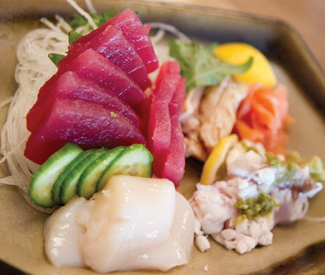
With Aaron Embry

8pm, $32.50

Fox Theater

1807 Telegraph, Oakl.

(510) 302-2250

www.thefoxoakland.com


El Clásico: More Than a Game

Spain may have won the last World Cup, but as a new documentary by Kelly Candaele and students from Chico State University shows, there’s no love lost between passionate fans of the country’s two biggest club teams. When Real Madrid and FC Barcelona clash (in a game so monumental it is referred to as “El Clásico”), they bring to the field some of the world’s greatest players (Messi! Ronaldo!) — and decades of history that go way beyond fútbol and into weighty areas of national identity and politics. Even Barça fans still reeling from certain late-April results will enjoy this 55-minute exploration of one of Europe’s greatest sports rivalries. (Cheryl Eddy)

7pm, $5–$10

Mission Cultural Center

2868 Mission, SF

www.missionculturalcenter.org


THURSDAY 3

Electric Shepherd & OUTLAW

When Bay Area psychedelic rock groups Electric Shepherd & OUTLAW get together, their sound is something like the Doors meeting up with Jimi Hendrix on a tribalistic march and then starting to jam with a death metal version of Phish. If you carry deep-seated nostalgia for the epic rock shows you missed during the ’60s — or listen to the Velvet Underground’s Bootleg series on repeat — you should probably check these guys out. Expect luscious guitar riffs, sexy bass lines, compulsory dancing, and a wonderfully spaced out experience. (Sullivan)

With Blues for Carl Sagan, and Douglas

9pm, $6

Hemlock Tavern

1131 Polk, SF

(415) 923-0923

www.hemlocktavern.com


FRIDAY 4

Predator and The Thing

Though it may be hard to believe for those of us who grew up watching them, two classic sci-fi flicks from the 1980s have come upon major milestones anniversaries. To celebrate, Jesse Hawthorne Ficks’ Midnites For Maniacs series is hosting a night not to be missed, with a 25th anniversary screening of Predator and a 30th anniversary screening of John Carpenter’s The Thing. Featuring some of the best creature designs and special effects of the era thanks to visionaries Stan Winston and Rob Bottin, both films re-defined the genre, and have continued to stand the test of time. A Boy & His Dog (1975) also screens.(Sean McCourt)

7:30pm, $13

Castro Theatre

429 Castro St., SF

(415) 621-6120

www.midnitesformaniacs.com


JackHammer Disco with Tiga, Damian Lazarus, & Light Year

Let’s indulge in some squelchiness, shall we? Montreal-based Tiga and UK-born, Los Angeles resident Damian Lazarus share an affinity for acid-y, electro house. In the early 2000s, Lazarus played a prominent role at the UK label City Rockers, where he oversaw the release of Tiga & Zyntherius’ cover of Corey Hart’s “Sunglasses at Night.” Since gaining fame from that release, Tiga has been a busy producer and remixer, keeping a Euro-glam tone reminiscent of the synth-y works Giorgio Moroder pushed in the ’70s. Recent Lazarus works have a more stripped-down, minimal feel that sometimes wander into leftfield, like in his 2009 album Smoke the Monster Out. (Kevin Lee)

With Light Year 10pm, $15–<\d>$20 Public Works 161 Erie, SF (415) 932-0955 www.publicsf.com


FRIDAY 4

It’s Casual

Here in the Bay Area, we like to complain about public transportation. There are BART horror stories and Muni diaries tossed around like old war stories, used as social currency. But really, when you compare our rapid transit systems with the snarled mess of cars elsewhere in California, we come out on top. That’s why LA-based hardcore group It’s Casual got so much traction with an ode to its own local bus line, “The Red Line.” The song, and sentiment, struck a nerve: “The freeways/are not so nice.” The band itself is growly loud, with classic Southern California punk hooks. Tonight it opens for beloved shit-stirrers Early Man (note: the two bands will release a split seven-inch come May 22). Take the 22 Fillmore to the show and write a song about it. (Savage)

With Early Man, Shock Diamond, Satya Sena

9pm, $8

Thee Parkside

1600 17th St., SF

(415) 252-1330

www.theeparkside.com


SATURDAY 5

CreaturesCon

Seemingly rising from the grave like so many of the monsters and ghouls that it showcased over a 14-year run on local television, the beloved Bay Area show Creature Features is being resurrected once again to satiate fans’ undying thirst for the creepy, kooky, and campy. John Stanley, who hosted the KTVU program from 1979-’84, will be on hand for CreaturesCon One, a day of special screenings, Q&As, and more, along with archivist and documentary filmmaker Tom Wyrsch and Ernie Fosselius of Hardware Wars fame. For all you monster kids out there, this will be a nightmare, er, dream come true. (McCourt)

3-10pm, $10

Historic Bal Theater

14808 East 14th St., San Leandro

www.creaturescon.com


Father John Misty

I always wonder about the drummer. They’re usually the life of the party but, at the same time, are often concealed behind a wall of instruments, and you rarely hear them sing, or say, anything. Ex-Fleet Foxes drummer Joshua Tillman has said that drumming for his former superstar band began to bore him. So he exited, took up the moniker “Father John Misty,” and started creating lush, lyrically based Americana folk ballads laden with lucid imagery and social commentary. He played SXSW this year, made a surprise appearance at Café Du Nord in April, and his debut, Fear Fun, came out Tuesday. (Sullivan)

With Har Mar Superstar, Worth Taking

10pm, $12

Bottom of the Hill

1233 17th St., SF

(415) 621-4455

www.bottomofthehill.com


SUNDAY 6

Omar Sosa Afreecanos Quartet

Talk about versatility. Cuban pianist and composer Omar Sosa splits his time between Oakland and Spain and incorporates musical influences from just about everywhere in between. On last year’s Calma: Solo Piano &… Sosa displayed his introspective and meditative side with floating piano melodies flanked by the occasional electronic accent or sampled sound. Contrast the solo effort on Calma with Sosa’s performance as lead of the Afreecanos Quartet, where technical dynamism becomes the name of the game. At live shows, Sosa becomes a grinning whirlwind, playing classical piano on one hand and electronic piano on another, trading looks and body language with his fellow musicians, and fostering a joyful, collective, improvisational spirit. (Lee)

With Marque Gilmore, Childo Tomas and Peter Apfelbaum

1pm, free

Yerba Buena Gardens

760 Howard, SF

(415) 543-1718

www.ybgfestival.org


MONDAY 7

“La Bamba: Latinos in Vintage Rock, Pop, and Soul”

Local rock music historian and author Richie Unterberger, whose books include White Light/White Heat: The Velvet Underground Day by Day and Music USA: The Rough Guide, will once again share his extensive knowledge with music fans at his presentation “La Bamba: Latinos in Vintage Rock, Pop, and Soul.” Featuring film clips of performers such as Ritchie Valens, Santana, Linda Ronstadt, and Los Lobos, the evening promises to be a unique look at the contributions of Latinos in rock from the earliest days of the 1950s up through the ’80s. (McCourt)

6:30-8:30pm, free

SF Public Library, Mission Branch

300 Bartlett, SF

www.sfpl.org


TUESDAY 8

Steve Coll

Longtime journalist Steve Coll won a Pulitzer Prize and widespread acclaim for his 2004 account on the CIA and the agency’s history in Afghanistan leading up to 9/11. In his latest investigative effort, Private Empire: ExxonMobil and American Power, Coll explores the global influence of the Texas-based oil corporation. According to Coll, big-money donations and a sophisticated DC lobbying machine have allowed ExxonMobil to shift the debate on climate change. At the same time, the oil corporation continues to expand its foothold in developing countries. A two-time Pulitzer Prize winner, Coll currently serves as president of the New American Foundation, a nonprofit, nonpartisan think tank that maintains a significant presence in California. (Lee)

In conversation with Greg Dalton

6pm, $7–$20

Commonwealth Club

595 Market, SF

(415) 597-6700

www.commonwealthclub.org


The Guardian listings deadline is two weeks prior to our Wednesday publication date. To submit an item for consideration, please include the title of the event, a brief description of the event, date and time, venue name, street address (listing cross streets only isn’t sufficient), city, telephone number readers can call for more information, telephone number for media, and admission costs. Send information to Listings, the Guardian Building, 135 Mississippi St., SF, CA 94107; fax to (415) 487-2506; or e-mail (paste press release into e-mail body — no text attachments, please) to listings@sfbg.com. Digital photos may be submitted in jpeg format; the image must be at least 240 dpi and four inches by six inches in size. We regret we cannot accept listings over the phone.

Upper highs, Valley loves

0

virginia@sfbg.com

APPETITE I’m constantly asked what my favorite restaurant is. It’s an impossible question. Inquire about my favorite taqueria, German spot, tea house, French bistro, and I’m ready to talk. There’s a favorite for every style and mood in a metropolitan city such as ours. My current home is on the cusp of Haight-Ashbury and Cole Valley, which, like every neighborhood in our food-rich city, has its treasures. We’ll breeze past the touristy swill and explore its best here. Find more of my picks in this neighborhood, from coffee to cocktails, here.


ALEMBIC

Thank God for The Alembic. The bar has been one of SF’s best since it opened, thanks to bar manager Daniel Hyatt, whose expertise in American whiskeys equals an ahead-of-the-curve selection. Alembic claims many gifted bartenders, like Danny Louie and Janiece Gonzalez, and I’m never disappointed when asking for an off-menu cocktail creation. The food is destination-worthy in its own right — maybe the best in the Haight. Whether at the bar with jerk-spiced duck hearts and a bowl of shishito peppers, or dining on caramelized scallops and sweetbreads over kabocha squash spaetzle, I continue to be satisfied.

1725 Haight, SF. (415) 666-0822, www.alembicbar.com


MAGNOLIA PUB AND BREWERY

Owner and brewmaster Dave McLean opened Magnolia Brewery more than 14 years ago, brewing the best beers in SF (in my humble opinion). Magnolia’s space has Old World, gastropub charm in black leather and wood booths and antique floor tiles. It serves the best brunch in the area — sorry, Zazie and Pork Store — which includes BBQ belly over Anson Mills cheddar grits, or quinoa hash and eggs if you want to cut down the fat quotient. For lunch and dinner, house sausages delight (rabbit currywurst!) as does savory mushroom bread pudding or a near-perfect Magnolia pub burger.

1398 Haight, SF. (415) 864-7468, www.magnoliapub.com


GIOVANNI’S PIZZA AT CLUB DELUXE

Upper Haight’s best hidden gem is Giovanni’s, a pizza kitchen in the back of Club Deluxe (eat in the bar or take-out). Giovanni’s pies aren’t so much Neapolitan perfection as a mix between Italian and East Coast styles, with a classic margherita and spicy Diavola, laden with pepperoncini, salami, Parmigiano, and a Belizean hot sauce. Save room for a West Coast rarity: a fresh cannoli, sweet ricotta stuffing brightened with orange blossom oil. Club Deluxe’s drinks are of the mojito, greyhound kind. Not exactly a cocktailian destination. What makes Deluxe special? Nightly live jazz in a well-loved bar that thankfully hasn’t changed decor for decades, with a 1950s, cozy bar feel. Bands rotate: trios, duos, quartets, even organ acts, providing some of the best jazz in the city, usually free. If only, like New Orleans, our neighborhoods were lined with such clubs.

1511 Haight, SF. (415) 552-6948, www.sfclubdeluxe.com


ICE CREAM BAR AND SODA FOUNTAIN

I wrote much of Ice Cream Bar back in February, so I’ll send you to the review detailing my fascination with this one-of-a-kind, 1930s-era soda fountain. It’s my top pick for dessert.

815 Cole, SF. (415) 742-4932, www.theicecreambarsf.com


PARADA 22

Parada 22 is a vibrant little space with aquamarine walls and vintage South American food products lining the shelves. The casual eatery feels vacation-like, offering Puerto Rican food. My favorite dish here is camarones a la Criolla: sauteed shrimp, tomato and onions in a dreamy-light cream sauce. Sides like plantains and red or white beans in sofrito-based sauces, are fresh and appealing. The restaurant has recently joined forces with sister restaurant Boogaloos (www.boogaloossf.com) in the Mission, serving Boogaloos’ brunch menu every weekend.

1805 Haight, SF. (415) 750-1111, www.parada22.com


THAI DUO: PLOY II AND SIAM LOTUS

Haight-Ashbury has two unexpectedly strong Thai spots serving authentic dishes. Ploy II is upstairs in an old Victorian space, with weathered carpet and decor (elephants, tapestries) straight out of Chang Mai’s Night Bazaar. It does standards well, and I crave the mango panang curry: spicy, creamy with coconut milk and peanut sauce. Siam Lotus also is reliable on Thai classics, though it’s the daily changing chef’s special board that sets it apart. Thankfully on the permanent menu, the Thai tacos are a must. Though the paper thin crepes fall apart at the touch, a filling of ground chicken, shredded coconut, mini-shrimp, and peanuts makes for one of the more fun Thai dishes anywhere.

Ploy II: 1770 Haight, SF. (415) 387-9224, www.ployii.com

Siam Lotus: 1705 Haight, SF. www.siamlotussf.com


HAMA-KO

Hama-Ko husband-and-wife owners Tetsuo and Junko Kashiyama open only when they feel ready and usually treat regulars best, service is slow, and certainly there are no California rolls. But this nearly 30-year-old classic is one of those neighborhood secrets that locals return to and sushi devotees enjoy. It’s straightforward sushi: silky scallops, bright-as-the-sea tai (red snapper), melt-in-your-mouth unagi avocado maki. You won’t find the variety of rare fish found at Zushi Puzzle (www.zushipuzzle.com), but you will find impeccable freshness — Tetsuo sources his fish from the same place The French Laundry and Chez Panisse gets theirs, he proudly tells me — from a couple who cares.

108 Carl, SF. (415) 753-6808

Subscribe to Virgina’s twice-monthly newsletter, The Perfect Spot, www.theperfectspotsf.com 


An absolute must-read on taxes (by Stephen King)

10

A lot of things drive me crazy (people making a left turn on 16th and Bryant at 5 p.m., backing up traffic for an entire block; people who get to park in the midde of the street on Sunday because the cops don’t ticket churchgoers; politicians who say “I’ll take a look at that” as a way to duck a question, dog owners who leave piles of shit in the middle of the sidewalk… don’t get me started). But one of the worst, on top of my list, is the claim that wealthy people who think the rich don’t pay enough taxes should just write the government a check.

George W. Bush loved that one. Every time taxes on the rich came up, he’d say: “If you think your taxes are too low, the IRS takes checks and money orders.” You can pay online, too.

So what’s wrong with that argument? Why doesn’t Warren Buffett just pay the taxes he thinks he ought to, and stop complaining? Because taxes don’t work that way, that’s why. And one of the best essays on this critical point just appeared on the Daily Beast. The author of this gem, called “tax me, for F@%&’s sake” is an author, Steven King, who is also part of the 1 percent, a man whose knack for telling horror stories has made him very wealthy. And he has harsh words for just about everyone who tries to get away with suggesting that high taxes ought to be voluntary:

I’ve known rich people, and why not, since I’m one of them? The majority would rather douse their dicks with lighter fluid, strike a match, and dance around singing “Disco Inferno” than pay one more cent in taxes to Uncle Sugar. It’s true that some rich folks put at least some of their tax savings into charitable contributions. My wife and I give away roughly $4 million a year to libraries, local fire departments that need updated lifesaving equipment (Jaws of Life tools are always a popular request), schools, and a scattering of organizations that underwrite the arts. Warren Buffett does the same; so does Bill Gates; so does Steven Spielberg; so do the Koch brothers; so did the late Steve Jobs. All fine as far as it goes, but it doesn’t go far enough.

What charitable 1 percenters can’t do is assume responsibility—America’s national responsibilities: the care of its sick and its poor, the education of its young, the repair of its failing infrastructure, the repayment of its staggering war debts. Charity from the rich can’t fix global warming or lower the price of gasoline by one single red penny. That kind of salvation does not come from Mark Zuckerberg or Steve Ballmer saying, “OK, I’ll write a $2 million bonus check to the IRS.” That annoying responsibility stuff comes from three words that are anathema to the Tea Partiers: United American citizenry.

More:

Most rich folks paying 28 percent taxes do not give out another 28 percent of their income to charity. Most rich folks like to keep their dough. They don’t strip their bank accounts and investment portfolios. They keep them and then pass them on to their children, their children’s children. And what they do give away is—like the monies my wife and I donate—totally at their own discretion. That’s the rich-guy philosophy in a nutshell: don’t tell us how to use our money; we’ll tell you. The Koch brothers are right-wing creepazoids, but they’re giving right-wing creepazoids. Here’s an example: 68 million fine American dollars to Deerfield Academy. Which is great for Deerfield Academy. But it won’t do squat for cleaning up the oil spill in the Gulf of Mexico, where food fish are now showing up with black lesions. It won’t pay for stronger regulations to keep BP (or some other bunch of dipshit oil drillers) from doing it again. It won’t repair the levees surrounding New Orleans. It won’t improve education in Mississippi or Alabama. But what the hell—them li’l crackers ain’t never going to go to Deerfield Academy anyway. Fuck ’em if they can’t take a joke.

He skewers the idea that giving the rich more money creates jobs (“At the risk of repeating myself, here’s what rich folks do when they get richer: they invest. A lot of those investments are overseas, thanks to the anti-American business policies of the last four administrations.”) He explains why the GOP tries so hard to defend tax cuts (“They simply idolize the rich. Don’t ask me why; I don’t get it either, since most rich people are as boring as old, dead dog shit. The Mitch McConnells and John Boehners and Eric Cantors just can’t seem to help themselves. These guys and their right-wing supporters regard deep pockets like Christy Walton and Sheldon Adelson the way little girls regard Justin Bieber … which is to say, with wide eyes, slack jaws, and the drool of adoration dripping from their chins.”) And he warns that life might not be so pretty for the uber-rich if this trend continues:

Last year during the Occupy movement, the conservatives who oppose tax equality saw the first real ripples of discontent. Their response was either Marie Antoinette (“Let them eat cake”) or Ebenezer Scrooge (“Are there no prisons? Are there no workhouses?”). Short-sighted, gentlemen. Very short-sighted. If this situation isn’t fairly addressed, last year’s protests will just be the beginning. Scrooge changed his tune after the ghosts visited him. Marie Antoinette, on the other hand, lost her head.

Think about it.

Yes, think about it: A society that gets more and more economically unequal is a society that won’t be stable for long.


All together now

0

virgnia@sfbg.com

APPETITE Incredible burgers in a bowling alley, SF’s deaf community gathering over Neapolitan pizzas, brothers serving food from their hometown of Nice in a tiny restaurant, dining around a U-shaped counter off a FiDi alley… each of the restaurants below opened within the last 6 months, providing a unique communal experience (and, most important, fine food to go with) that makes one feel like actually engaging with, rather than ignoring, fellow diners.


MISSION BOWLING CLUB

Mission Bowling Club (MBC) is one badass bowling alley. Squeaky clean hipster all the way: there’s no funky smell or dated dinginess in this brand new space. Open and industrial, it boasts a front patio, separate dining room downstairs and one upstairs overseeing six lanes and a wood-lined bar area. Cheer on bowlers from comfy couches while sipping a cocktail (solid, though not noteworthy drinks) and filling up on French onion casserole.

As soon as I heard chef Anthony Myint, Mission Chinese Food and Mission Street Food wunderkind, would oversee the menu, it was easy to guess MBC was going to boast exceptional food. The beloved Mission Burger ($15, $10 during happy hour) is back. I missed the rich, granulated patty, lathered in caper aioli. An avowed carnivore, I was shocked to find the vegan burger ($10) is almost as exciting. A fried chickpea, kale, shitake fritter is brightened up with sambal (Indian chili sauce), guacamole, and fennel slaw. A juicy sausage corn dog ($7) arrives upright in molecular fashion, standing watch over a dollop of habanero crema. Only a hard, small “everything pretzel” ($5) disappointed. Not bad for a bowling alley.

3176 17th St., SF. (415) 863-2695, www.missionbowlingclub.com


CASTAGNA

Brothers Jerome and Stephane Meloni from Nice infuse their Italian heritage and French upbringing in Italian and Niçoise dishes. I enjoyed Stephane’s cooking at their former Restaurant Cassis, a far roomier Pac Heights space, but their tiny new Castagna lends itself to connection. Stephane cooks within full view, Jerome interacts with diners, and I found myself in conversation with tables next to me. On a good night, it exudes that neighborhood conviviality found in similar-sized restaurants around Europe. Decor isn’t particularly memorable, though red walls always bring a space to life.

Sticking closer to tradition is the best way to navigate Castagna’s menu. Stephane’s classic Niçoise caramelized onion tart ($7.50) is the best dish, silky with caramelized onions in a flaky crust, with (the good stuff) white anchovies on the side, which they explained neighborhood diners weren’t quite ready for — I say place them on top and let diners sort it out. I found the steak in my steak frites ($18) too well done (medium rare, please) despite a lush green peppercorn sauce. I’d opt instead for French-style campagnarde pizza ($15), in the spirit of flammkuchen (Alsatian flatbread), covered in potato sauce, bacon, crème fraîche and raclette.

2015 Chestnut, SF. (415) 440-4290, www.castagnasf.com


MOZZERIA

The communal award could easily go to the Mission’s Mozzeria. Maybe we didn’t need an umpteenth Neapolitan pizza place, but there’s none quite like this, run by a deaf couple and staff. San Francisco’s deaf community gathers en masse at a hangout where speaking with your eyes and hands is as important as speaking verbally. Of course, verbal processors are welcome, too.

The dining bar is my preferred perch, particularly to engage with chef Russell Stein (who co-owns Mozzeria with wife Melody). He’s hilarious and reads lips like a master, joking with diners as he spreads ingredients over wheels of dough before popping them into a wood-burning oven. His heartwarming Neapolitan pizzas ($12-18) are topped with the likes of caramelized onion, pancetta, mozzarella or goat cheese and eggplant. I must admit, my favorite item, Mozzeria bar ($8), isn’t the most gourmet, but hearkens back to my Jersey youth. Let’s call it what it is: a fried mozzerella cheese log doused in pomodoro sauce and basil. Sheer comfort.

3228 16th St., SF. (415) 489-0963, www.mozzeria.com


CLAUDINE

Claudine’s chic cafe charms. Big picture windows and corner space on an alley up a half flight of stairs appeal, while a u-shaped bar creates a convivial dining experience, the bar is so small so you can’t help but exchange good will with neighboring patrons. You can dine at a table, but the bar is far more fun, and works for a casual meal all day.

Much has been made of the meatball, kale, and fregola soup ($7/10), and rightly so. It is an unexpected culinary delight: olive oil-laced broth, laden with Parmesan, onions, carrots. I can be bored by broth soups at times, but this one holds my interest with plump veal-pork-beef meatballs and pleasantly soggy kale. Roasted mussels ($12 and $17) arrive aromatic with fennel sausage in lemon and white wine, while even avocado toast ($12) delights topped with dill gravlax, Spanish black radish, and lemon. Leave room at the end for Claudine favorite s’mores ($7) baked in a glass bowl with layers of marshmallow and chocolate on graham cracker crust. My meals at dinner have been more satisfying than at lunch, but each visit improves my opinion.

8 Claude Lane, SF. (415) 362-1988, www.myclaudine.com *

Subscribe to Virgina’s twice-monthly newsletter, The Perfect Spot, www.theperfectspotsf.com


Stage Listings

0

Stage listings are compiled by Guardian staff. Performance times may change; call venues to confirm. Reviewers are Robert Avila, Rita Felciano, and Nicole Gluckstern. Submit items for the listings at listings@sfbg.com. For further information on how to submit items for the listings, see Picks.

THEATER

OPENING

Killing My Lobster Chops Down the Family Tree TJT, 470 Florida, SF; www.killingmylobster.com. $10-22. Opens Thu/26, 8pm. Runs Thu-Sat, 8pm (May 12, shows at 7 and 10pm); Sun, 7pm. Through May 13. The sketch comedy troupe performs a new show inspired by contemporary families.

Tenderloin Exit on Taylor, 277 Taylor, SF; (415) 525-1205, www.cuttingball.com. $10-50. Previews Fri/27-Sat/28, 8pm; Sun/29, 5pm. Opens May 3, 7:30pm. Runs Thu, 7:30pm; Fri-Sat, 8pm (also Sat, 2pm); Sun, 5pm. Through May 27. Annie Elias and Cutting Ball Theater artists present a world premiere “documentary theater” piece looking at the people and places in the Cutting Ball Theater’s own ‘hood.

BAY AREA

In Paris Berkeley Repertory Theatre, Roda Theatre, 2015 Addison, Berk; (510) 647-2949, www.berkeleyrep.org. $22.50-125. Opens Wed/25, 8pm. Runs Tue and Thu-Sat, 8pm (also Sat, 2pm); Wed, 7pm; Sun, 2pm. Through May 13. Mikhail Baryshnikov stars in Dmitry Krymov’s romantic new play.

Not Getting Any Younger Marsh Berkeley, 2120 Allston, Berk; (415) 282-3055, www.themarsh.org. $15-50. Opens Fri/27, 8pm. Runs Fri, 8pm; Sat, 5pm. Through May 19. Marga Gomez is back at the Marsh, a couple of too-brief decades after inaugurating the theater’s new stage with her first solo show — an apt setting, in other words, for the writer-performer’s latest monologue, a reflection on the inevitable process of aging for a Latina lesbian comedian and artist who still hangs at Starbucks and can’t be trusted with the details of her own Wikipedia entry. If the thought of someone as perennially irreverent, insouciant, and appealingly immature as Gomez makes you depressed, the show is, strangely enough, the best antidote. Note: review from the show’s 2011 run at the Marsh San Francisco. (Avila)

ONGOING

Act One, Scene Two Phoenix Arts Association Theatre, 414 Mason, Ste 601, SF; www.un-scripted.com. $10-20. Thu-Sat, 8pm. Through May 12. Un-Scripted Theater Company performs the beginning of a new, unfinished play by a local author — and creates an ending on the spot once the script runs out.

*The Aliens SF Playhouse, 533 Sutter, SF; (415) 677-9596, www.sfplayhouse.org. $20-70. Tue-Thu, 7pm; Fri-Sat, 8pm; Sun, 3pm. Through May 5. On the heels of Aurora Theatre’s production of Body Awareness, SF Playhouse introduces local audiences to another of contemporary American playwright Annie Baker’s acclaimed plays, in a finely tailored West Coast premiere directed by Lila Neugebauer. The Aliens unfolds in the days just around July 4, at slacker pace, in the backyard of a Vermont café (lovingly realized to palpable perfection by scenic designer Bill English), daily haunt of scruffy, post-Beat dropouts and sometime band mates Jasper (a secretly brooding but determined Peter O’Connor) and KJ (a charmingly ingenuous yet mischievous Haynes Thigpen). New employee and high school student Evan (a winningly eager and reticent Brian Miskell) is at first desperate to get the interlopers out of the “staff only” backyard but is just lonely enough to be seduced into friendship and wary idolatry by the older males. What unfolds is a small, sweet and unexpected tale of connection and influence, amid today’s alienated dream-sucking American landscape — same as it ever was, if you ask Charles Bukowski or Henry Miller, both points of reference to Jasper and KJ, who borrow Bukowski’s poem The Aliens for one of their many band names. An appropriate name for the alienated, sure, but part of the charm of these characters is just how easy they are to recognize, or how much we can recognize ourselves in them. Delusions of grandeur reside in every coffee house across this wistful, restless land. It’s not just Jasper and KJ who may be going nowhere. A final gesture to the young and awkward but clearly capable Evan suggests, a little ambiguously to be sure, that there’s promise out there yet for some. But more than that: the transaction makes clear by then that there are no fuck-ups, really; not among people with generous and open hearts — never mind how fucked up the country at large. (Avila)

Any Given Day Magic Theatre, Fort Mason Center, Marina at Laguna, SF; www.magictheatre.org. $20-60. Extended run: Wed/25-Sat/28, 8pm (also Sat/28, 2:30pm); Sun/29, 2:30 and 7:30pm. Magic Theatre performs Linda McLean’s Glasgow-set play about modern, urban life.

“Bay One Acts Festival” Boxcar Theatre, 505 Natoma, SF; www.bayoneacts.org. $25-45. Wed-Sat, 8pm (also May 5 and 12, 3pm); Sun, 3 and 7pm. Through May 12. Ten bold and adventurous short plays by local playwrights, performed two full programs running in repertory.

Fwd: Life Gone Viral Marsh San Francisco, 1062 Valencia, SF; (415) 282-3055, www.themarsh.org. $20-50. Thu, 8pm (no show Thu/26); Sat, 8:30pm; Sun, 7pm (no show May 6). Through June 10. The internet becomes comic fodder for creator-performers Charlie Varon and Jeri Lynn Cohen, and creator-director David Ford.

*Glengarry Glen Ross Actors Theatre of San Francisco, 855 Bush, SF; (415) 345-1287, www.brownpapertickets.com. $26-40. Wed/25-Sat/28, 8pm. Actors Theatre of San Francisco and director Keith Phillips offer a sharp, spirited production of the 1984 play by David Mamet in which four real estate agents (Mark Bird, Sean Hallinan, John Krause, and Christian Phillips) jockey and scheme for advantage in their Chicago office in a landscape of insecurity and fierce competition symbolized by the selective doling out of the best leads by manager and company man John (Frank Willey). Clients (like the gullible young husband played by Randy Blair), meanwhile, are just witless marks for the machinations of the predatory salesman, no more meaningfully human than the “muppets” targeted by Greg Smith’s Goldman Sachs. If the scenic design is a little shabby, the strong cast makes that hardly an impediment to a story that feels especially timely in its sharply etched, not to say angry portrait of the ruthless and corrosive business mentality to which egos, livelihoods, and lives — not to mention the culture at large — are enthralled. (Avila)

Goodfellas Live Dark Room Theater, 2263 Mission, SF; www.darkroomsf.com. $20. Fri/27-Sat/28, 8pm. The Dark Room offers a comedic take on Scorsese’s gangsters.

*Hot Greeks Hypnodrome Theatre, 575 10th St, SF; www.brownpapertickets.com. $30-35. Thu-Sat, 8pm. Extended through May 19. Cheap thrills don’t come much cheaper or more thrilling than at a Thrillpeddlers musical extravaganza, and their newly remounted run of Hot Greeks affords all the glitter-dusted eye-candy and labyrinthian plot points we’ve come to expect from their gleefully exhibitionist ranks. Structured as loosely as possible on Aristophanes’ Lysistrata, Greeks appropriately enough follows the trials and tribulations of a college sorority tired of “losing” their boyfriends to the big football match every year (Athens U vs. Sparta Tech). Pledging to withhold sex from the men unless they call off the game results in frustration for all, only partially alleviated by the discovery that sexual needs can be satisfied by “playing the other team,” as it were. But like other Cockettes’ revivals presented by the Thrillpeddlers, the momentum of the show is carried forward not by the rather thinly-sketched narrative, but by the group song-and-dance numbers, extravagant costuming (and lack thereof), ribald wordplay, and overt gender-fuckery. In addition to many TP regulars, including a hot trio of Greek columns topped with “capital” headdresses who serve as the obligatory chorus (Steven Satyricon, Ste Fishell, Bobby Singer), exciting new additions to the Hypnodrome stage include a bewigged Rik Lopes as stalwart sister Lysistrata, angelically-voiced Maggie Tenenbaum as the not-so-angelic Sodoma, and multi-faceted cabaret talent Tom Orr as heartthrob hunk Pendulum Pulaski. (Gluckstern)

It Is What It Is and The Watchtower Exit Theater, 156 Eddy, SF; www.myadultland.com. $20. Fri/27-Sat/28, 8pm; Sun/29, 3pm. Short plays by Diane Karagienakos and Christopher Barranti, presented on the same stage with a brief intermission.

It’s All the Rage Studio Theater, Marsh San Francisco, 1062 Valencia, SF; (415) 282-3055, www.themarsh.org. $15-50. Thu, 8pm; Sat, 8:30pm, Sun, 7pm. Extended through May 27. Longtime comedian and radio host Marilyn Pittman’s solo play wrestles with the legacy of her parents’ violent deaths in a 1997 murder-suicide initiated by her father. It’s disturbing material that Pittman, a stout middle-aged woman with a gregarious and bounding personality, approaches indirectly via a good deal of humor — including recounting the first time she did her growing-up-lesbian bit before her mother in a DC comedy club. But the pain and confusion trailing her for 13 years is never far behind, whether in accounts of her own battle with anger (and the broken relationships it has left in its wake) or in ominous memories of her too complacent mother or her charming but domineering father, whose controlling behavior extended to casually announcing murderous dreams while policing the boundaries of his marriage against family interference. A fine mimic, Pittman deploys a Southern lilt in playing each parent, on a stage decorated with a hint of their Southwestern furnishings and a framed set of parental photographs. In not exactly knowing where to lay blame for, or find meaning in, such a horrifying act, the play itself mimics in subtler form the emotional tumult left behind. There’s a too brief but eerie scene in which her veteran father makes reference to a murder among fellow soldiers en route to war, but while PTSD is mentioned (including as an unwanted patrimony), the 60-minute narrative crafted by Pittman and director David Ford wisely eschews any pat explanation. If transitions are occasionally awkward and the pace a bit loose, the play leaves one with an uncomfortable sense of the darker aspects of love, mingled with vague concentric histories of trauma and dislocation in a weird, sad tale of destruction and staying power. Note: review from the show’s 2009 run at the Marsh San Francisco. (Avila)

Thunder Above, Deeps Below Bindlestiff Studio, 185 Sixth St, SF; www.brownpapertickets.com. $20-25. Thu-Sat, 8pm. Through May 5. Bindlestiff presents A. Rey Pamatmat’s dramatic comedy about three homeless young adults.

The Waiting Period MainStage, Marsh San Francisco, 1062 Valencia, SF; (415) 282-3055, www.themarsh.org. $15-50. Fri, 8pm; Sat, 5pm. Extended through May 26. Brian Copeland (comedian, TV and radio personality, and creator-performer of the long-running solo play Not a Genuine Black Man) returns to the Marsh with a new solo, this one based on more recent and messier events in Copeland’s life. The play concerns an episode of severe depression in which he considered suicide, going so far as to purchase a handgun — the title coming from the legally mandatory 10-day period between purchasing and picking up the weapon, which leaves time for reflections and circumstances that ultimately prevent Copeland from pulling the trigger. A grim subject, but Copeland (with co-developer and director David Ford) ensures there’s plenty of humor as well as frank sentiment along the way. The actor peoples the opening scene in the gun store with a comically if somewhat stereotypically rugged representative of the Second Amendment, for instance, as well as an equally familiar “doood” dude at the service counter. Afterward, we follow Copeland, a just barely coping dad, home to the house recently abandoned by his wife, and through the ordinary routines that become unbearable to the clinically depressed. Copeland also recreates interviews he’s made with other survivors of suicidal depression. Telling someone about such things is vital to preventing their worst outcomes, says Copeland, and telling his own story is meant to encourage others. It’s a worthy aim but only a fitfully engaging piece, since as drama it remains thin, standing at perhaps too respectful a distance from the convoluted torment and alienation at its center. (Avila)

BAY AREA

Anatol Aurora Theatre, 2081 Addison, Berk; www.auroratheatre.org. $30-55. Tue and Sun, 7pm (also Sun, 2pm); Wed-Sat, 8pm. Through May 13. Aurora Theatre Company performs a world premiere translation of Arthur Schnitzler’s drama about the love life of an Viennese philanderer.

The Coast of Utopia: Voyage Ashby Stage, 1901 Ashby, Berk; www.shotgunplayers.org. $20-30. Wed/25-Thu/26, 7pm; Fri/27-Sat/28, 8pm; Sun/29, 5pm. Shotgun Players present Tom Stoppard’s riff on pre-revolutionary Russia.

A Hot Day in Ephesus Live Oak Theatre, 1301 Shattuck, Berk; info@aeofberkeley.org. $12-15. Fri-Sat, 8pm; May 13, 2pm. Through May 19. Actors Ensemble performs the world premiere of a musical based on Shakespeare’s Comedy of Errors.

John Brown’s Truth La Peña Cultural Center, 3105 Shattuck, Berk; www.brownpapertickets.com. $10-15. Sun/29, 7:30pm. The story of abolitionist John Brown comes to life via William Crossman’s script-libretto, plus dance, spoken word, and a variety of improvised music styles.

*The Kipling Hotel: True Misadventures of the Electric Pink ’80s New venue: Marsh Berkeley, 2120 Allston, Berk; (415) 282-3055, www.themarsh.org. $20-50. Sat, 8:30pm; Sun, 7pm. Extended through May 6. This new autobiographical solo show by Don Reed, writer-performer of the fine and long-running East 14th, is another slice of the artist’s journey from 1970s Oakland ghetto to comedy-circuit respectability — here via a partial debate-scholarship to UCLA. The titular Los Angeles residency hotel was where Reed lived and worked for a time in the 1980s while attending university. It’s also a rich mine of memory and material for this physically protean and charismatic comic actor, who sails through two acts of often hilarious, sometimes touching vignettes loosely structured around his time on the hotel’s young wait staff, which catered to the needs of elderly patrons who might need conversation as much as breakfast. On opening night, the episodic narrative seemed to pass through several endings before settling on one whose tidy moral was delivered with too heavy a hand, but if the piece runs a little long, it’s only the last 20 minutes that noticeably meanders. And even with some awkward bumps along the way, it’s never a dull thing watching Reed work. (Avila)

Lucky Duck Julia Morgan Theatre, 2640 College, Berk; www.berkeleyplayhouse.org. $17-35. Thu and Sat, 7pm (also Sat, 2pm); Sun, noon and 5pm (additional performance May 11, 7pm). Through May 13. Berkeley Playhouse performs a musical inspired by the “Ugly Duckling” tale.

Of Mice and Men TheatreWorks at Mountain View Center for the Performing Arts, 500 Castro, Mtn View; (650) 463-1960, www.theatreworks.org. $19-69. Wed/25, 7:30pm; Thu/26-Sat/28, 8pm (also Sat/28, 2pm); Sun/29, 2pm. TheatreWorks performs the Steinbeck classic.

Oleanna Berkeley City Club, 2315 Durant, Berk; www.theatrefirst.com. $15-30. Thu-Sat, 8pm; Sun, 5pm. Through May 13. TheatreFIRST performs David Mamet’s tense two-charater drama.

Red Berkeley Repertory Theatre, Thrust Stage, 2025 Addison, Berk; (510) 647-2949, www.berkeleyrep.org. $14.50-83. Tue and Thu-Fri, 8pm (also Thu/26, 2pm; no show Fri/27); Wed, 7pm; Sat-Sun, 2pm (also Sat, 8pm; no 8pm show May 12; Sun, 7pm). Extended through May 12. Mark Rothko (David Chandler) isn’t the only one painting with a broad brush in this labored and ultimately superficial two-hander by John Logan, enjoying a competent but underwhelming production by outgoing Berkeley Rep associate artistic director Les Waters. Set inside the late-1950s New York studio of the legendary abstract expressionist at the height of his fame, the play introduces a blunt and brash young painter named Ken (John Brummer) as Rothko’s new hired hand, less a character than a crude dramatic device, there first as a sounding board for the pompous philosophizing that apparently comprises a good chunk of the artist’s process and finally as a kind of mirror held up to the old iconoclast in challenging proximity to a new generation that must ultimately transcend Rothko’s canvases in turn. The dialogue holds up signs announcing intellectual and aesthetic depths but these remain surface effects, reflecting only platitudes, while the posturing tends to reduce Rothko to caricature. Much of the self-consciously reluctant filial interaction here smacks of biographical sound bites or heavy-handed underscoring of theme, and tends toward the outright hokey when touching on the credulity-bending subject of Ken’s murdered parents — with the attendant shades this adds to Rothko’s and the play’s chosen color palette. (Avila)

The World’s Funniest Bubble Show Marsh Berkeley, TheaterStage, 2120 Allston, Berk; (415) 826-5750, www.themarsh.org. $8-50. Extended run: May 5-27 (Sat-Sun, 11am); June 3-July 15 (Sun, 11am). Louis “The Amazing Bubble Man” Pearl returns with this kid-friendly, bubble-tastic comedy.

PERFORMANCE/DANCE

Bad Unkl Sista Z Space, 450 Florida, SF; www.brownpapertickets.com. Fri/27-Sat/28, 8pm (also Sat/28, 2pm). $35. The company melds Butoh, aerial installations, couture costuming, and more in the world premiere First Breath — Last Breath.

BATS Improv Bayfront Theater, Fort Mason Center, Marina and Laguna, SF; www.improv.org. Fri/27, 8pm: “Theatresports Madness,” $20.

“Comedy SuperPAC: Promoting Good Comedy and Great Causes Since 2012!” Hemlock Tavern, 1131 Polk, SF; www.hemlocktavern.com. Mon, 7pm. Through May 7. $5. Nate Green and W. Kamau Bell present this ongoing comedy showcase; this week’s performers are Chris Garcia, Brendan McGowan, Jeff Kreisler, and Brandie Posey.

Company C Contemporary Ballet Cowell Theater, Fort Mason Center, Marina at Laguna, SF; (415) 392-4400, www.cityboxoffice.com. Fri/27-Sat/28, 8pm; Sun/29, 2pm. $23-45. The company’s spring program includes works by Charles Anderson, Gregory Dawson, and Peter Anastos.

“Dancers’ Group presents 2012 Bay Area Dance Week” Various locations; www.bayareadance.org. Through Sun/29. Free. Over 600 free dance events at locations throughout San Francisco, the East Bay, and beyond.

“Dances From the Heart” Cowell Theater, Fort Mason Center, Marina at Laguna, SF; www.helpisontheway.org. Mon/30, 7:30pm. $30-50. Dancers from Ballet San Jose, Diablo Ballet, ODC, and more perform to raise money for the Richmond/Ermet AIDS Foundation.

“Elect to Laugh” Studio Theater, Marsh San Francisco, 1062 Valencia, SF; (415) 282-3055, www.themarsh.org. Tue, 8pm. Ongoing through Nov 6. $15-50. Will Durst and friends perform in this weekly political humor show that focuses on the upcoming presidential election.

“Mark Foehringer Dance Project SF: Young Choreographer’s Forum” Kunst Stoff Arts, One Market, SF; www.mfdpsf.org. Sat/28, 11:30am-12:30pm. Free. As part of Bay Area Dance Week, dance makers ages 16-24 perform.

“Move to the Now” 111 Minna Gallery, 111 Minna, SF; www.asimagery.org, www.postballet.org. Sat/28, 6-9pm. Free. As part of National Dance Week, Amy Seiwert’s Imagery and Post: Ballet present “one night of extravagant dance” featuring performances by numerous Bay Area companies.

“Poems Under the Dome” City Hall, North Light Court, One Dr. Carlton B. Goodlett Pl, SF; www.poemdome.net. Fri/27, 5:30-8:30pm. Free. Celebrate National Poetry Month with this open mic at City Hall.

Smuin Ballet Yerba Buena Center for the Arts, 701 Mission, SF; www.smuinballet.org. Fri/27-Sat/28 and May 1-5, 8pm (also Sat/28 and May 5, 2pm); Sun/29 and May 6, 2pm. $25-62. Program includes the West Coast premiere of Val Caniparoli’s Swipe and the world premiere of Ma Cong’s Through.

“Youth Speaks Teen Poetry Slam” Masonic Auditorium, 1111 California, SF; www.youthspeaks.org. Fri/27, 7pm. $6-18. Sixteen finalists battle it out in Youth Speaks’ 16th annual slam competition.

David Zambrano Yerba Buena Center for the Arts, 701 Mission, SF; (415) 978-2787, www.ybca.org. Fri/27-Sat/28, 8pm. $20. The renowned choreographer performs Soul Project.

BAY AREA

“April Follies Same Sex Dance Sport Competition” Just Dance Ballroom, 2500 Embarcadero, Oakl; www.aprilfollies.com. Sat/28, 10am-5pm (competition); 6:30-7:30pm (beginning lessons); 8-11pm (showcase of champions). $15-35. Styles include tango, swing, merengue, salsa, something called “American Smooth,” and more.

“CubaCaribe Dance Festival” Laney College Theater, 900 Fallon, Oakl; www.cubacaribe.org. Fri/27-Sat/28, 8pm; Sun/29, 7pm. $10-24. The festival’s final week features Oil and Water, a world premiere by Alayo Dance Company. 


Jeffrey Sachs: A world adrift

0


By Jeffrey D. Sachs


Jeffrey D. Sachs is Professor of Economics and Director of the Earth Institute at Columbia University. He is also Special Adviser to United Nations Secretary-General on the Millennium Development Goals

NEW YORK – The annual spring meetings of the International Monetary Fund and the World Bank have provided a window onto two fundamental trends driving global politics and the world economy. Geopolitics is moving decisively away from a world dominated by Europe and the United States to one with many regional powers but no global leader. And a new era of economic instability is at hand, owing as much to physical limits to growth as to financial turmoil.

Europe’s economic crisis dominated this year’s IMF/World Bank meetings. The Fund is seeking to create an emergency rescue mechanism in case the weak European economies need another financial bailout, and has turned to major emerging economies – Brazil, China, India, the Gulf oil exporters, and others – to help provide the necessary resources. Their answer is clear: yes, but only in exchange for more power and votes at the IMF. As Europe wants an international financial backstop, it will have to agree.  

Of course, the emerging economies’ demand for more power is a well-known story. In 2010, when the IMF last increased its financial resources, the emerging economies agreed to the deal only if their voting share within the IMF was increased by around 6%, with Europe losing around 4%. Now emerging markets are demanding an even greater share of power.

The underlying reason is not difficult to see. According to the IMF’s own data, the European Union’s current members accounted for 31% of the world economy in 1980 (measured by each country’s GDP, adjusted for purchasing power). By 2011, the EU share slid to 20%, and the Fund projects that it will decline further, to 17%, by 2017.

This decline reflects Europe’s slow growth in terms of both population and output per person. On the other side of the ledger, the global GDP share of the Asian developing countries, including China and India, has soared, from around 8% in 1980 to 25% in 2011, and is expected to reach 31% by 2017.

The US, characteristically these days, insists that it will not join any new IMF bailout fund. The US Congress has increasingly embraced isolationist economic policies, especially regarding financial help for others. This, too, reflects the long-term wane of US power. The US share of global GDP, around 25% in 1980, declined to 19% in 2011, and is expected to slip to 18% in 2017, by which point the IMF expects that China will have overtaken the US economy in absolute size (adjusted for purchasing power).

But the shift of global power is more complicated than the decline of the North Atlantic (EU and US) and the rise of the emerging economies, especially the BRICS (Brazil, Russia, India, China, and South Africa). We are also shifting from a unipolar world, led mainly by the US, to a truly multipolar world, in which the US, the EU, the BRICS, and smaller powers (such as Nigeria and Turkey) carry regional weight but are reticent to assume global leadership, especially its financial burdens. The issue is not just that there are five or six major powers now; it is also that all of them want a free ride at the others’ expense.

The shift to such a multipolar world has the advantage that no single country or small bloc can dominate the others. Each region can end up with room for maneuver and some space to find its own path. Yet a multipolar world also carries great risks, notably that major global challenges will go unmet, because no single country or region is able or willing to coordinate a global response, or even to participate in one.

The US has shifted rapidly from global leadership to that kind of free riding, seeming to bypass the stage of global cooperation. Thus, the US currently excuses itself from global cooperation on climate change, IMF financial-bailout packages, global development-assistance targets, and other aspects of international collaboration in the provision of global public goods.

The weaknesses of global policy cooperation are especially worrisome in view of the gravity of the challenges that must be met. Of course, the ongoing global financial turmoil comes to mind immediately, but other challenges are even more significant.

Indeed, the IMF/World Bank meetings also grappled with a second fundamental change in the world economy: high and volatile primary commodity prices are now a major threat to global economic stability and growth.

Since around 2005, the prices of most major commodities have soared. Prices for oil, coal, copper, gold, wheat, maize, iron ore, and many other commodities have doubled, tripled, or risen even more. Fuels, food grains, and minerals have all been affected.  Some have attributed the rise to bubbles in commodities prices, owing to low interest rates and easy access to credit for commodity speculation. Yet the most compelling explanation is almost certainly more fundamental.

Growing world demand for primary commodities, especially in China, is pushing hard against the physical supplies of global resources. Yes, more oil or copper can be produced, but only at much higher marginal production costs.

But the problem goes beyond supply constraints. Global economic growth is also causing a burgeoning environmental crisis. Food prices are high today partly because food-growing regions around the world are experiencing the adverse effects of human-induced climate change (such as more droughts and extreme storms), and of water scarcity caused by excessive use of freshwater from rivers and aquifers.

In short, the global economy is experiencing a sustainability crisis, in which resource constraints and environmental pressures are causing large price shocks and ecological instability. Economic development rapidly needs to become sustainable development, by adopting technologies and lifestyles that reduce the dangerous pressures on the Earth’s ecosystems. This, too, will require a level of global cooperation that remains nowhere to be seen.

The IMF/World Bank meetings remind us of an overarching truth: our highly interconnected and crowded world has become a highly complicated vessel. If we are to move forward, we must start pulling in the same direction, even without a single captain at the helm.

Jeffrey D. Sachs is Professor of Economics and Director of the Earth Institute at Columbia University. He is also Special Adviser to United Nations Secretary-General on the Millennium Development Goals
.

Copyright: Project Syndicate, 2012.
www.project-syndicate.org

Alerts

0


Thursday 19
Vivamos Zapata/Living Zapata Eric Quezada Center, 518 Valencia, SF, (510) 654-9587, 7-9pm, $5-10 suggested donation www.518valencia.org. The Chiapas Support Committee presents a critical look at the war on drugs and its effects in in Mexico and for immigrants.  A panel will include speakers from the National Network for Immigrant and Refugee Rights as well as a delegation from the Chiapas support committee to report back on the situation there.
40 years of radical writing, rabble rousing, and romancing your brain El Rio, 3158 Mission, SF, 6-9pm, $5-15 suggested donation www.mtbs.com. Modern Times has officially moved from its Valencia street location to 24th street- that’s reason enough for a party! Of course, the party will celebrate not just the move but everything Modern Times has stood for since it was founded in 1971 as a collectively owned alternative bookstore. Featuring drink specials, food, prizes, surprises, and local talents: queer poet Daphne Gottlieb, zine editor and musician Erick Lyle, critical mass co-founder Chris Carlsson, and self-proclaimed Old Radical Lesbian Feminist Marge Nelson. 

Saturday 21
Unite and fight racism Redstone Building, 2940 16th st, SF, 6pm, free www.norcalsocialism.org.The International Socialist Organization presents a discussion on what a civil rights movement for black liberation could be today. This event will feature Ahmed Shawki, author of Black Liberation and Socialism, Dionne Smith, who has spoken out about her experiences and thoughts on the justice system since her son James Rivera Jr was killed by police in 2010; Archbishop Franzo King, pastor of the Church of St. John Coltrane African Orthodox Church; and Fly Benzo, MC and college student.

Sunday 22
Love the land: Earth day 2012 Ohlone Park at Sacramento, Berk, 11am, free, lovethelandmarch.blogspot.com. What better way to spend Earth Day than picnicking with your family and friends in the park, listening to live music and learning and sharing skills for free? And then rallying and marching for food sovereignty: “the right of communities to their own healthy, local, and sustainably grown food.” 
World naked bike ride Jane Werner Plaza, Castro and Market, SF, 10am, free, www.tinyurl.com/wnbrearthday . What better way to spend Earth Day than feeling the wind on your skin as you bike naked? Or, as the organizers suggest, topless, bathing suits, body paint—particularly black body paint, as this Earth Day ride commemorates the BP oil spill of April 20, 2010. As such, this is only the second annual Earth Day ride but don’t worry- even if events like these end oil spills forever, there will still be world naked bike rides.

Our Weekly Picks: April 18-24

0

WEDNESDAY 18

Wild Flag

Though it could be called an all-star band based on previous groups and collaborations, which include Sleater-Kinney, Helium, Quasi, and the Minders, the members of Wild Flag have made sure their new project stands firmly on its own solid ground. Last September saw the release of the band’s excellent self-titled debut album on Merge Records, highlighted by the singles “Future Crime” and “Romance,” proving that Carrie Brownstein, Rebecca Cole, Mary Timony, and Janet Weiss have a special chemistry and searing musical bond that comes across on both tape and stage. (Sean McCourt)

8pm, $20

Fillmore

1805 Geary, SF

(415) 346-6000

www.thefillmore.com


THURSDAY 19

Anoushka Shankar

“The daughter of legendary sitar player Ravi Shankar.” It must be a daunting label to perform under, but after training and performing extensively with her father beginning at age nine, Anoushka has carved out her own following. The younger Shankhar recorded a live album in New York’s Carnegie Hall at 19 and has received two nominations for Grammy Awards. She uses classical Indian instruments and techniques to delve into other genres, including jazz and electronica. Her sixth studio release, Traveler, recently released stateside, is an exploration into the relationship between sitar and flamenco that features a variety of Spanish artists and vocalists. (Kevin Lee)

7:30pm, $25-$60

Herbst Theatre

401 Van Ness

(415) 392-4400

www.sfjazz.org


“Tease-O-Rama”

In a celebration of all things sultry, seductive, sexy and saucy, “Tease-O-Rama 2012” promises four days and nights of the best in burlesque, showcasing the brightest modern talents awhile also honoring several legends of the scene. Boasting live shows, workshops, meet and greets, and more, the festival features standouts of today such as Catherine D’Lish and performers from Cirque Du Soleil’s Zumanity, and appearances by icons such as Satan’s Angel, who started her career back in 1961 here in San Francisco. (McCourt)

$12–$45 per event; $150 for a festival pass

Multiple venues, SF

www.teaseorama.com


Madness

British two-tone ska act Madness has enjoyed considerable commercial success in its native UK, charting numerous hit songs over a more than 35 year career, but it seems to be best known here in the states for one hit single, 1982 release “Our House,” which exposed the band to American audiences via radio and MTV’s heavy rotation of the tune’s cheeky video. Local fans will want to make sure to catch the group when it comes to the city tonight between its two slots at Coachella, and hear the full breadth of the band’s varied ace catalog. (McCourt)

With DJ Harry Duncan.

8pm, $35–$42.50

Warfield

982 Market, SF

(415) 567-2060

www.thewarfieldtheater.com


FRIDAY 20

Cuba Caribe Festival

Perhaps we are a little too smug about living in the “second largest” dance community in the country. But then arrives — for the eighth year — another Cuba Caribe Festival. Where else would you see, in one program, companies such as Las Que Son’s jubilant women dancers; storyteller Muriel Johnson; Cunamacué’s Afro-Peruvian music and dance, and Grupo Experimental Nagó’s East-Cuban traditions? On weekend two, at Laney College Theater in Oakland, Ramón Ramos Alayo, who synthesizes tradition with modernism, is premiering “Oil and Water,” his perspective on the despoiling of the oceans. Also workshops, lectures, and film presentations. (Rita Felciano)

Fri/20-Sat/21, 8pm; Sun/22, 3 and 7pm, $10–$24

Dance Mission Theater

3316 24th St., SF

(415) 826-4441

www.cubacaribe.org


School of Seven Bells

The rejiggered School of Seven Bells marches on with vocalists Alejandra Deheza and producer Benjamin Curtis after Alejandra’s twin Claudia left the band a couple of years back for “personal reasons.” Ghostory, the first SVIIB LP since the lineup shift, has more of a free flow and electronic feel than previous releases; think of a Ladytron-like sound rather than the melodious pop heard in the band’s first release, Alpinisms. Alejandra’s ethereal voice takes on a plaintive tone that melds especially well with Curtis’ low-slung shoegaze atmospherics on highlight track “Love Story.” (Lee)

With Exitmusic

9pm, $15

Rickshaw Stop

155 Fell, SF

(415) 861-2011

www.rickshawstop.com


STS9

I’m gonna go out on a limb here and suggest that there may be a general correlation between interest in 2012 phenomena and smoking a righteous amount of pot. If getting supremely baked and attributing significance to arbitrary dates is your thing, then truly the stars align this 4/20 with Sound Tribe Sector 9 performing at the Fox. As if the popular electronic jam band wasn’t reason enough for stoners to organically celebrate, STS9 will be bringing its Great Cycle Spectacles — featuring a glowing LED Mayan pyramid — to the already dazzling venue. End of the world or beginning of the next stage? Either way, smoke up. (Ryan Prendiville)

With Nosaj Thing (4/20), Mimosa (4/21)

8pm, $29.50

Fox Theater

1807 Telegraph, Oakl.

(510) 548-3010

www.thefoxtheater.com


SATURDAY 21

Cesar Chavez Festival

For too many of us, Cesar Chavez Day passes by in a blur of I’m-not-at-work (or dammit-I’m-at-work) chaos. We don’t really stop to celebrate the man, and that’s a shame because as you can tell from the way Rainbow Grocery shuts its door to celebrate him, he was a seminal figure in California history, Chicano history, and labor movement history. Luckily, we all get a hall pass this and every year if we didn’t observe the man on his state-sanctioned holiday. Today, the Mission will be marked by a parade in his honor, leading to a street fair on 24th Street with live music by Carlos Santana’s son Salvador, local hip-hop phenom Bang Data, and the Cuicacalli Youth Ballet Folklorico, among many other acts. (Caitlin Donohue)

11am parade; noon-6pm fair, free

Street fair: 24th St. between Bryant and Treat, SF

(415) 621-2665

www.cesarchavezday.org


MONDAY 23

All Tiny Creatures

There are a lot of voices on Harbor, the debut album from Wisconsin’s All Tiny Creatures, some from the quartet itself — featuring musicians from Collections of Colonies of Bees and Volcano Choir — and then a number of guest collaborators, most notably Bon Iver’s Justin Vernon (who All Tiny Creatures also open for at the Bill Graham) and members of Megafaun. Given the number of vocalists, it’s surprising how restrained they are in the mix, lightly drawing on their instrumental quality instead of normal lyrical structuring. The result — from the driving opener “Holography” to the scattered march of “Aviation Class” — is an immediately catchy album of prog pop that moves along weightlessly. (Prendiville)

With Minor Kingdom, Kill Moi

9pm, $10

Bottom of the Hill

1233 17th St., SF

(415) 621-4455

www.bottomofthehill.com


TUESDAY 24

Real Estate

While listening to the dazed, sun-baked surf rock of Real Estate, the pulse of Southern California comes to mind. But, wait. These guys are describing New Jersey? Yes. Childhood buddies Martin Courtney, Matt Mondanile, and Alex Bleeker started making music a few summers back in their hometown of Ridgewood, N.J. and have cited the state itself as a major influence. Now the band is based in Brooklyn (phew!), but the bliss and nostalgia attached to carefree, suburban teenage summers of partying discretely in parents’ basements and spending long days with a first love permeates its freshman and sophomore albums. Congratulations, New Jersey! You were due for this type of artistic beautification. (Mia Sullivan)

With the Twerps, Melted Toys

8 p.m., $17

Great American Music Hall

859 O’Farrell St.

(415) 885-0750

www.slimspresents.com


Neon Indian

When your debut album features ADHD-affected sampling, retro arpeggios, and tracks like “Should Have Taken Acid With You”, “(AM)”, and “Mind, Drips” it can be hard to sustain that level of weirdness. Despite its title, Era Extraña — the sophomore release from Denton, Texas’s Neon Indian — is a comparatively straightforward record, with Italo influenced, electro dance tracks more attuned to a club performance as a band than the product of fiddling around in a bedroom. But rather than running out of or exhausting its oddball energy, Neon Indian seems to have just redistributed it to the fringe, releasing a freak EP with the Flaming Lips as well as recording a future-vintage VHS manual for its limited release toy synth, the PAL198X. (Prendiville)

With Lemonade

8pm, $25

Fillmore

1850 Geary, SF

(415) 346-6000

www.thefillmore.com


Rusko

Leeds native Christopher Mercer chose to go the retrospective route with new release Songs, bringing dubstep back to its, well, roots. The artist popularly known as Rusko pays homage to the UK two-step garage popular in the ’90s with tracks “Pressure” and “Whistle Crew.” Mercer fills out the album with dub-like tracks that feature a healthy serving of Jamaican vocals and a moderate indulgence in full-on wobbliness. As a whole, Songs is more likely to invoke respectful head-nodding, rather than the injury-inducing cranium-banging that has become the dubstep norm these days. (Lee)

With Sigma

8pm, $33

Warfield

982 Market, SF

(415) 567-2060

www.thewarfieldtheatre.com

The Guardian listings deadline is two weeks prior to our Wednesday publication date. To submit an item for consideration, please include the title of the event, a brief description of the event, date and time, venue name, street address (listing cross streets only isn’t sufficient), city, telephone number readers can call for more information, telephone number for media, and admission costs. Send information to Listings, the Guardian Building, 135 Mississippi St., SF, CA 94107; fax to (415) 487-2506; or e-mail (paste press release into e-mail body — no text attachments, please) to listings@sfbg.com. Digital photos may be submitted in jpeg format; the image must be at least 240 dpi and four inches by six inches in size. We regret we cannot accept listings over the phone.

Gourmet fresh (and cheap)

1

virginia@sfbg.com

APPETITE Trekking around the Bay for what is not at all elusive — excellent food — is ever a pleasure. Finding it on the cheap? Options are endless. Sandwiches stand as one of the easiest ways to fill up for less, making the continued glut of sandwich openings unsurprising. (Check out the Richmond’s new Chomp n’ Swig — hard to top the Bacon Butter Crunch sandwich: white cheddar, tomato, bits of bacon, guacamole. Or in the Mission, the Galley inside Clooney’s Pub at 1401 Valencia serves a meaty French Onion sandwich, yes, like the soup and oh so good.) Beyond mere sandwiches, here are some other affordable delights.


MARKET AND RYE


West Portal is lucky to claim new Market and Rye, from Top Chef alum Ryan Scott. What could be just another sandwich shop is instead an airy, high-ceilinged cafe in yellows and whites under skylights. Salted rye bread is made specifically for the spot by North Beach’s classic Italian French Baking Company (IFBC’s sourdough and wheat bread choices are also available).

Sandwiches ($8.50–9) offer enough playful touches to keep them unique, like Funyuns on roast beef or Cool Ranch Doritos adding crunch to chicken salad layered with avocado spread and pepper jack. I took to the Reuben chicken meatball sandwich on salted rye, its generous contents falling out all over the place, overflowing with 1000 Island dressing, sauerkraut, Swiss cheese, red cabbage caraway slaw, and house chicken meatballs. I almost didn’t miss the corned beef.

Build-your-own-salads offer healthy alternatives, while above average sides ($4 per scoop, $7.50 2 scoops, $10.50 3 scoops) are generous helpings of the likes of roasted zucchini tossed with cherry tomatoes and boccaccini (mini mozzarella balls), enlivened by mint vinaigrette. The side that didn’t work for me was grilled broccoli. It appeared green and verdant, dotted with ricotta and walnuts in red wine dressing, but was so cold, its flavor was stunted.

Housemade root beer float “Twinkies” ($3.50) are a fun finish, though Twinkie-lovers be aware: these are dense, dark cakes filled with a dreamy root beer float cream, neither fluffy nor spongy.

68 West Portal Ave., SF. (415) 564-5950


ALL GOOD PIZZA

A jaunt to Jerrold and Third Street leads to a food truck parked in a Bayview oasis: a parking lot filled with picnic tables, potted cacti, and herbs used for cooking. All Good Pizza — open weekdays only: 10am-2pm — just launched this month from neighborhood locals desiring healthy food and “good, sincere pizza,” with a real commitment to the area (check out the site’s community page).

The lot invites lingering over cracker-thin pizzas (a steal at $7), from a basic Margherita to a spicy pie dotted with peppers, fennel, mozzarella, and Louisiana hot links smoked on site. The trailer houses a 650 degree gas-fired oven. These aren’t game-changing pies but there’s nothing like it in the ‘hood — nor are there many healthy salads, like a kale, radicchio, sweet potato crisps, Parmesan, balsamic reserva combo. There are also panini sandwiches ($7) such as a pig-heavy, super salty Nola Muffaletta: Genoa salami, smoked ham, olive salad, fior di latte mozzarella, and provolone cheese.

Italian sodas ($2.50) are all made on premises, like a candy sweet coconut soda evoking coconut oil, beaches and vacation. All this in a Bayview parking lot.

1605 Jerrold Ave., SF. (415) 846-6960, www.allgoodpizza.com


ANDA PIROSHKI

A close childhood pal is Russian and her mother and grandmother often home-baked us unforgettable treats as kids, from blintzes to piroshkis, those little baked buns stuffed with goodness. I still dream of them — a rarity in this town. Not even in Chicago or NY have I tasted any piroshkis as fresh as those at Anda Piroshki, a stall in the tiny but idyllic 331 Cortland marketplace housing a few take-out food purveyors. I’ve eaten Anda at SF Street Food Fest, but the ideal is to arrive at 331 soon after it opens when piroshkis are pulled from the oven piping hot.

The dough is airy yet dense, ever-so-subtly sweet, like a glorified Hawaiian roll. No skimping on fillings — one piroshki ($3.75–4.50) fills me up. Sustainable meats and local ingredients make them relatively guilt-free. Try a button mushroom piroshki overflowing with fresh spinach, or one of ground beef, rice and Swiss, oozing comfort. My favorite is Atlantic smoked salmon and cream cheese accented by black pepper and dill. It makes a savory, creamy breakfast.

The one downside has been a straight-faced, disinterested server who could not be bothered as I asked a question about Russian sodas (like Kvass, a fermented rye soda — pleasing rye notes if too saccharine) and acted the same when I returned a second time… a stark contrast to the friendliness I encounter at every other 331 business. But momentary coldness is still worth those warm piroshkis.

331 Cortland Ave., SF. (415) 271-9055, www.andapiroshki.com

Subscribe to Virgina’s twice-monthly newsletter, The Perfect Spot, www.theperfectspotsf.com


Oh high!

1

caitlin@sfbg.com

HERBWISE Say “cannabis,” not “weed.” Couch discussion in the language of medicine, not intoxication. There are a lot of rules when it comes to talking about marijuana — and the country’s most beloved cannabis publication breaks most of them.

That’s because at High Times magazine, the general take is that herb should be legal across the board, not just for consumption by the verifiably sick. “Until it’s legal for all adults, medical marijuana patients are going to be regarded as second class citizens,” said Elise McDonough, who besides having worked as a graphic designer with the magazine for 10 years is the author of the brand-new-for-420 Official High Times Cannabis Cookbook (Chronicle Books, 160pp, $18.95).

>>Join the Guardian and a stellar lineup this Friday 4/20 at El Rio for the Stoned Soul Picnic party!

In her Guardian phone interview, McDonough pointed out that eating may be the first way human beings consumed cannabis. She’s certainly done her part to give us options beyond the basic brownie — the book includes recipes for “psychedelic” spanikopita, tamales, cocktails, holiday feasts, and a host of canna-bases, from dosed butter to olive oil. McDonough wrote many, but also gets help from other High Times luminaries, like the dearly departed Chef Ra, who contributed to the rag’s recipe column for 15 years.

Interest, ahem, sparked? The following recipes from the book will make a stellar foundation for next week’s holiday festivities, medicinal or not. 


SIMPLE CANNABUTTER

Makes 1/2 cup

1/2 cup (1 stick) salted butter*

1/4 ounce cannabis buds, finely ground

*To make cannamargarine, simply substitute margarine for butter in this recipe

1. Melt the butter on low heat in a saucepan. Add the ground buds, and simmer on low heat for 45 minutes, stirring frequently.

2. Strain the butter into a glass dish with a tight-fitting lid. Push the back of a spoon against the plant matter and smash it against the strainer to squeeze out every drop of butter available. When you’re done, discard the plant matter.

3. Use your cannabutter immediately, or refrigerate or freeze until it is time to use. You can easily scale this recipe up for larger batches of cannabutter. One pound of butter (4 sticks) can absorb 1 ounce of cannabis, but you may want to simmer for up to 60 minutes.

Drizzle this cannabutter over freshly cooked pasta or popcorn for instant satisfaction. Reserve large batches in the fridge or freezer for use in recipes.


GREEN GANJA GARLIC SMASHED POTATOES

Stones 4

1 1/2 pounds potatoes, unpeeled and cut into chunks (Yukon Gold potatoes are great)

1 pound parsnips, peeled and cut into chunks

1 head garlic, cloves separated and peeled

1 1/2 tablespoons salt, plus more as needed

4 tablespoons Simple Cannabutter

Black pepper

1. Put the potatoes, parsnips, and garlic in a large pot and cover them with water. Bring to a boil over high heat and then add the salt. Reduce the heat to medium-low and simmer for about 15 minutes. The potatoes, parsnips and garlic should be tender and easy to smash. Drain the vegetables and reserve 1/2 cup of the cooking water.

2. In a small saucepan over medium heat, melt the cannabutter.

3. Return the vegetables to the pot or a large serving bowl, and begin to smash them with a potato masher, slowly adding the melted cannabutter a little at a time. Use spoonfuls of the reserved cooking water to thin the mixture if the smashed veggies are too thick. Season with black pepper and more salt and serve.


Playing God?

6

steve@sfbg.com

THE GREEN ISSUE When Richmond was selected as the site for Lawrence Berkeley National Laboratory’s huge second campus in January, city officials and community leaders celebrated the “green” jobs it would create, hundreds of them, diversifying an economy dependent on Chevron and its massive oil refinery. But a new coalition called Synbiowatch (www.synbiowatch.org) is questioning how green those jobs really are and raising fears about the new scientific realm on which they rely.

It’s called synthetic biology, which combines engineering and computer science with the biological sciences to design new microbes that don’t exist in nature — living, self-replicating organisms — taking the field of genetic engineering to another level by allowing scientists to actually write new DNA codes and incubate new life forms.

Proponents tout myriad potential benefits from the approach, from medical treatments (such as developing new anti-malarial drugs or creating new viruses that would attack cancer cells in humans) to the creation of renewable energy sources that might eventually replace fossil fuels, a major focus of the new lab and its main partner, the U.S. Department of Energy’s Joint BioEnergy Institute (JBEI).

“JBEI researchers are engineering new types of microbes using the latest tools in biotechnology,” notes a cartoonish video on its website (www.jbei.org) explaining how these engineered organisms will turn grasses and other abundant biomass matter into powerful fuels — a task that is not yet possible — which can run cleaner burning internal combustion engines.

But the environmentalists, labor organizers, scientists, and community activists who make up Synbiowatch say this technology not only doesn’t live up to its speculative hype, but that it is being developed too rapidly and without adequate oversight given its potential to alter natural ecosystems in unpredictable ways.

“We need a precautionary approach to health and safety,” Jim Thomas — program manager for ETC Group (which stands for Erosion, Technology, and Concentration) and lead author of the 2007 report “Extreme Genetic Engineering: An Introduction to Synthetic Biology” — told journalists during a March 28 briefing at Center for Genetics and Society in Berkeley.

He was joined by UC Berkeley microbial ecologist Ignacio Chapela, a researcher who has publicized environmental impacts of the biotechnology industry; Nnimmo Bassey, executive director of Environmental Rights Action in Nigeria and chair of Friends of the Earth International; molecular biologist Becky McClain, who won a $1.4 million civil lawsuit against her old employer, Pfizer, after blowing the whistle on safety violations in its biotech research; Henry Clark of the West County Toxics Coalition; and Richmond activist Gopal Dayaneni of Movement Generation Justice and Ecology Project. All took part in a conference the next day entitled “Unmasking the Bay Area Bio Lab and Synthetic Biology: Health, Justice, and Communities at Risk.”

Thomas said this coalition formed in recent years to counter the rapid development of what he says is now a $1.6 billion industry that has successfully resisted meaningful government regulation and oversight, despite the fact that the microbes it produces “have no analog in nature, and they will grow and reproduce.”

With no natural predators, the new microbes could reproduce unchecked. “We cannot allow these corporations to play God. They are not God,” said Bassey, who has spent a career combating the false claims and environmental degradation of some of the same big energy corporations (such as Chevron, Shell, and BP) sponsoring this new research. “It’s reckless, it’s out of control, it’s all about money.”

The biggest target of these activists’ ire is Jay Keasling, who directs the JBEI program, helped found the Richmond lab, and has pioneered synthetic biology research for LBNL and UC Berkeley, in addition to starting several companies to take advantage of that research. His latest is Lygos, which he formed in February to develop commercial applications for JBEI’s work on developing new fuels.

Keasling tells us that his critics are wrong and that these new microbes are basically just modifications of substances that scientists have worked with for decades and know how to safely handle. “What we’re trying to do is make the engineering of biology more reliable, so it’s safer and more predictable,” Keasling told us.

He dismissed the idea that these new microbes could threaten ecosystems if they escape from the lab, noting that microbes whose genetic sequencing has been altered in experiments over the last 40 years haven’t proven to be resilient in nature. “When they’re exposed to the environment, they generally don’t survive,” he said. “They get eaten by the other microbes completely.”

But the fear raised by Synbiowatch is that these rapid technological advances could produce a more durable new microbe, and that these scientists are essentially playing God with the basic building blocks of life before they really understand the implications of what they’re creating. Does Keasling think it’s possible that one of his new microbes might be more of a survivor than its predecessors?

“There’s always a possibility, but in 40 years of doing research in this area, that has not been found,” Keasling told us.

That’s not good enough for Synbiowatch and other critics, who say that it’s important to practice the Precautionary Principle — which places the burden of proof on innovators to prove that new technologies won’t be harmful to the environment or human health — before this new lab ramps up its research and development.

The new facility is expected to produce more than 800 jobs. Dayaneni said it’s understandable that Richmond officials embraced the new lab and the prospect of green jobs, but he called the promises of synthetic biology “a wolf in sheep’s clothing, or a wolf genetically engineered to look like a sheep.” He called the new lab “a shell institution for a host of corporate interests” seeking to “synthesize fuel in a petri dish” as much to create an economic bubble as a long-term energy solution.

But he and Bassey said the nascent industry isn’t focused on the many potential downsides of its pursuit, including the degradation of vast tracts of land and consumption of natural resources in order to acquire the sugars needed to fuel the process. “They will need a massive amount of land,” Bassey said. “This is what the progenitors of synthetic biology have failed to acknowledge.”

Keasling does acknowledge that to develop large-scale energy production of the new technology — something he said is still decades away from being viable — will indeed require vast tracts of land growing crops such as jatropha that have been developed for their fuel production potential, something Bassey said will displace poor people around the world.

“Farmers are being tricked to grow crops that are only for industrial uses,” he said. “Farmers that would normally grow crops for food will now be growing it for machines.”

Bassey ridiculed claims that such crops would only utilized marginal lands, but Keasling said the idea is to make use of currently nonproductive vegetation such as switchgrass, using the new microbes to extract sugars from their cellulose. “My hope is the plants will be grown on marginal land and the people who own it will make money from growing it,” Keasling said. “In some ways, it’s giving something back to the farmers.”

Dayaneni compared the new facility and industry to the short-sighted hubris of the nuclear industry before Japan’s Fukushima disaster: “You don’t build a nuclear power plant on the edge of the ring of fire and you don’t build a synthetic biology laboratory on the edge of the ring of fire either.”

Yet Keasling said he and his colleagues are far more aware of these issues and the need for safety and security than activists are giving them credit for. “The synthetic biology community is made up of people who are really concerned about the environment,” Keasling told us.

But McClain said her case shows corporations will often disregard worker safety and environmental consequences in pursuit of profits, often with the complicity of scientists enamored by new discoveries. “There is a lack of integrity and leadership in our scientific leadership,” she said, later adding, “The bottom line is we’re giving the scientific community the right to self-regulate, but that comes with responsibility.”

Keasling said he thinks there is a middle ground possible because “we’re not against regulation, we believe in regulation, it’s important, but it has to be sensible.” He also defended the role that large energy and biotechnology corporations have played in funding this research and licensing the patented new technologies it produces.

“We live in a capitalist system, somebody has to fund this research and science,” Keasling said. “The government doesn’t have the money.”

Sea, here

0

arts@sfbg.com

>>See more astounding images from Beneath Cold Seas here.

THE GREEN ISSUE Most people associate underwater photography with the tropics, but the beautiful shots that appear in Beneath Cold Seas (University of Washington, $45, 160pp) were shot in the Pacific Northwest. What’s most striking about the book is the color and vibrance that photographer David Hall was able to capture. It’s a bit mind-blowing to imagine that the hooded nudibranches and grasping octopi found in the book live in the inky depths abutting our very own rocky shores. The next time you take a dip at Baker or Muir Beach don’t forget that you’re frolicking with some seriously stunning fauna. 

SFBG: Where did you shoot Beneath Cold Seas?

DAVID HALL: I shot Beneath Cold Seas in British Columbia. The water tends to be more clear and there’s less pollution because of the small population density. But the same animals in the book are found in Northern California, they don’t recognize international borders. Technically biologists say the ecosystem extends from Southern Alaska down to Point Conception (north of Santa Barbara). That entire area is referred to as the Pacific Northwest.

SFBG: What environmental issues are facing the Pacific Northwest?

DH: One problem is the introduction of alien species. For instance farm-raised salmon taken from New England genetic stock occasionally escape and interbreed with the five or six Pacific species. So you’re getting a genetic mixture which endangers the original Pacific species. But the environmental issues that most people are worried about are overfishing and pollution, like oil spills. As more Canadian oil is being developed and exported to places like China, it will have to be shipped across these waters. So that becomes a concern, especially after what happened in the Gulf of Mexico last year.

SFBG: When did you start taking photos underwater?

DH: Many years ago I took a trip to the Virgin Islands. I’d never seen a coral reef before and was completely overwhelmed by what I saw while snorkeling. I felt that I had to photograph it because I’m not so good at describing things. I went out and bought the best camera I could afford which was a Kodak Instamatic in a plastic housing with flashbulbs. That was how it all started. In those days the bar was very low, if you got an underwater photograph that was somewhat recognizable you could get it published.

http://www.youtube.com/watch?v=NgDfA61OpFI

SFBG: What would you say inspired this project?

DH: At first I started going because I loved the diving, I enjoyed being there and getting photographs. But after the first half dozen trips I realized that the material I was getting was good enough for a book. I got the idea for the book about five years ago, but all in all it took about 15 years.

SFBG: What was a typical shoot like?

DH: I was living on a small boat for a couple of weeks at a time, doing three dives a day, and then reviewing photos at night. The days would be consumed with getting ready for the dive, getting all the equipment on, waiting until the current was just right, getting into the water, diving for an hour, getting back to the boat, getting warm — which takes another hour or two — and then getting ready to dive again. Altogether I made about 500 dives from 1995 to 2010.

Photographing underwater is much more difficult than photographing in air, and photographing in cold water is that much more difficult than photographing in warm water. No one had ever published a good book on underwater photography from a cold water destination in North America before. There are plenty of field guides, and fish ID books for fisherman, but no one had ever published a photographic book that tried to show the character of the ecosystem in an artistic way.

The book required getting a lot of wide angle shots to include the scenery as well as the animals. Getting good clear, colorful photographs in cold water is difficult because of visibility issues. Also cold water filters out all of the warm colors in the spectrum (red, orange, yellow) so to see the colors you have to add light back. So I dive with a pair of powerful flash units that attach to the camera by way of articulated arms that keep my hands free.

SFBG: So there wasn’t someone handling lighting for you?

DH: If I were a National Geographic contract photographer I’d probably have had a few assistants holding lights for me, but I wasn’t so lucky. I had to do everything myself. And in most cases I was diving completely alone.

SFBG: People don’t associate such colorful and exotic creatures with our coast. It’s really wonderful that your book is changing that perception.

DH: I certainly hope that’s what’s happening. The book has been very well received, largely because nobody was aware of what was down there. I mean marine biologists and divers were, but ordinary people had no idea.

People tend to protect what they know and value. Most Americans and Canadians are familiar with the aquatic species that we eat, but there’s a whole ecosystem there that the great majority of us are completely unfamiliar with. I hope my book will make people aware that these things exist and want to feel more protective toward that whole environment.


Cooking without borders

0

By Cynthia Salaysay

arts@sfbg.com

VISUAL ARTS The aura of old wars was in the room. Sock-footed, sitting on the floor eating bowls of ramen in the old barracks of the Marin Headlands, we were cozy and well-defended from the coastal fog. Once, these barracks were used to keep the Japanese out. But now we were welcoming them in, with every slurp of soup.

This was an art event about food and Japan. OPENrestaurant, an art collective of restaurateurs and cooks from the community around Chez Panisse, has been hosting events like these for the past four years. It’s the Alice Waters ethos applied to social practice art — creating food happenings where participants forge new connections, and a deeper understanding of food can hopefully occur.

This particular night, a foggy one at the Marin Headlands Center for the Arts, was a quiet one — no pigs butchered, or poultry running amok. It was a show-and-tell of the collective’s OPENharvest project of last fall, in which members — such as Jeremy Tooker from Four Barrel, Kayoko Akabori of Umamimart, and Sam White and Jerome Waag (current head chef) of Chez Panisse — met with people from the Tokyo food scene, to cook and eat beside them during rice harvest season.

Scattered throughout the room were mementos of the trip that spoke of the commonalities and the strange differences between the two cultures. eatlip gift: Cook book for Cooking People showed page after page of Saveur-esque snapshots of food — but no text. A stack of Café Sweet magazines sat next to the Four Barrel coffee cart, one of which featured photos from the Four Barrel café on Valencia. A small bottle of extra virgin olive oil was labeled in traditional Japanese brush script.

Ramen was served, the meaty broth spiked with Meyer lemon, and topped with gushy, soft-boiled egg. So were Japanese whiskey highballs, ubiquitous in Tokyo bars.

“There is this parallel community of people out there, who appreciate art and food in the way we do,” said White, a principle organizer of OPENharvest. “In the Bay Area it’s like preaching to the choir, people appreciate foodie-artsy-whatever. But to take it to a different culture, with a different food style, plug in some of our philosophy and have it work — that was super rewarding.”

During their trip, they made collaborative dinners with local chefs. Making bouillabaisse involved fishing in Tokyo Bay and calling farms for produce — an uncommon practice there. Local olive oil and wine was used. Dishes combined Japanese and California influences, for example using chestnuts, and kabocha squash as a stuffing for ravioli. Wild deer was butchered in front of their guests, and served.

“Everything tasted sweeter there,” said Waag.

Jonathan Waters, wine director at Chez Panisse, also took part. “The Japanese approached wine with an open palate. They were not conditioned to attach flavors to a construct — like dry or sweet. They were more open to the ethereal, mysterious qualities in wine.”

The Japanese were just as receptive to learning from OPEN members. “It seemed like it was a good time in the psyche of their country to talk about food,” said White. Sourcing of ingredients take on new meaning in a country dealing with the effects of radiation on agricultural areas.

But, said White, “Our Japanese friends said to us, ‘We don’t want to make this [event] a memorial to Japan.’ They didn’t want it to be just about radiation. That definitely exists, that’s a real thing, but there’s also a whole country with a future, stuff to hope for, and work towards.”

Last fall’s trip continues to have socio-cultural impact. The restaurants they worked with continue to call farmers directly for produce. And Japanese chefs and artists have since come to learn, cook, and do projects here in the Bay Area.

“Part of me feels like it’s not over,” said White. “Because what happened was we opened a door.” 

www.openharvestjapan.com