News

SFPD to answer questions on fatal shooting of Alejandro Nieto

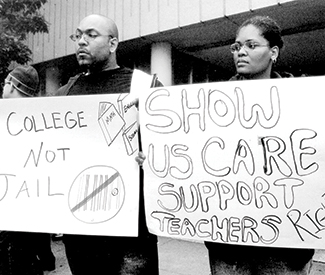
San Francisco Police Chief Greg Suhr will be on hand this evening [Tue/25] for a town hall meeting to discuss last week’s officer-involved shooting in Bernal Heights Park. The shooting victim, 28-year-old Alejandro Nieto, was a City College of San Francisco student, a Latino, and Bernal Heights resident who had hoped to become a youth probation officer.

Just before sunset last night [Mon/24], a group of about 150 friends, family members, and community supporters gathered for a vigil at the spot where he was gunned down by multiple police officers.

The community members lit candles, sang, burned incense, and conducted Buddhist chants in honor of his spiritual practice. Those who knew Nieto, whom they called Alex, described him as caring, ambitious, and committed to nonviolence.

“He was such a bright person,” said Ben Bac Sierra, an author and instructor at City College who knew Nieto through shared ties in the neighborhood. Nieto had been helping Bacsierra organize community events and book readings, he said. They’d rolled down Mission Street together in a classic low-rider for a parade, shouting “si se puede!” while onlookers cheered them on.

Torrance Bynum, former dean at City College’s Evans and Southeast Center campus and a former instructor of Administration of Justice, described himself to the Bay Guardian as Nieto’s mentor. “I would give him rides home from class,” he said. Nieto would stop by to visit him, and “if I was in a meeting, he would wait for me.” Bynum said he’d phoned Nieto on his birthday just a few weeks ago, March 4.

On Monday night, major questions still lingered about the events leading up to Nieto’s death.

A statement issued by the SFPD on March 21, about three hours after the shooting, said officers had arrived at the park in response to “911 calls of a male subject with a gun.” Police “encountered a male subject with a weapon,” the statement went on. “The male subject pointed a weapon at the officers, and multiple officers discharged their firearms.” (In an interview with the San Francisco Chronicle, Deputy Police Chief Lyn Tomioka indicated that he “appeared to draw a weapon.”) He was pronounced dead, the statement noted, “and an additional weapon was found.”

In the days following the shooting, however, friends and family members told reporters that Nieto had a stun gun, not a firearm, because he worked as a security guard at a nightclub. They also said Nieto was peacefully eating a burrito just before the shooting occurred.

According to California Bureau of Security and Investigative Services records, Nieto obtained registration to work as a guard/patrolperson in June of 2007, and obtained a permit to carry a baton in September of 2013. Security guards must complete a 40-hour course of required training before registering with the state.

A report in the San Francisco Chronicle suggested that just before the shooting, Nieto was “acting erratically and threatening passersby,” quoting an unnamed witness who said a man had threatened his dog with a “pistol-type stun gun” and yelled profanities. It also referenced a past incident involving Nieto’s alleged use of a stun gun.

A person who declined to be named told the Bay Guardian that about half an hour before the shooting occurred, two men who were walking down the pedestrian pathway on the north slope of Bernal Heights Park alerted a jogger that there was a man ahead wearing a gun on his hip.

They told the jogger that they had called the police. The jogger, who was about 50 feet from the man and started moving away from him after receiving the warning, was too far away to see whether he had a weapon but noticed that he was “pacing back and forth” and “air boxing.”

When the Bay Guardian phoned the SFPD to ask what sort of weapon had been discovered, Sgt. Danielle Newman said she could not release that information.

“He was never arrested in his life,” Bac Sierra said of Nieto during the vigil. “He wanted to be a good person – and he was.”

Bac Sierra later told the Bay Guardian he’d first heard the news Saturday night, and spoke with members of Nieto’s family the following day. The family was not notified of what happened until 3pm the day after the shooting, he said. The report was that Nieto had been shot 14 times.

Sup. John Avalos, who represents the Excelsior District, said he had worked with Nieto in the past and knew him from Coleman Advocates for Children & Youth. “I was making sure that his life was going in a positive direction, and what we saw in Alejandro was that he had a really big heart,” Avalos said at last night’s vigil. “He gave it to a lot of people, and often probably didn’t give it enough to himself.”

He added, “Blood’s been shed, in this case, by people we’re supposed to trust. But … we have a lot of difficulty trusting our police, because from time to time these things happen.”

Avalos also mentioned that when it comes to dealing with subjects who are mentally ill, SFPD has an established protocol. Under a program that began in 2011, specially trained officers with the department’s Crisis Intervention Team are to be dispatched to the scene when calls involve a mentally ill individual.

At tonight’s meeting, Suhr is expected to answer questions from community members. Friends and supporters of Nieto are still in shock from the news.

“I don’t know what it’s going to take, but I think all of us here should call on the Office of Citizen Complaints, and make sure they do an investigation,” Avalos said. “We need to make sure that the officer who – I really hope, despite all the shots that were fired, are having trouble with their consciences right now. Because taking anybody’s life, or hurting anyone in such a way, is unconscionable. This young man, he deserves that from all of us, to make sure the senseless taking of his life was not done in vain, that it leads to something better.”

Avalos said he was also there on behalf of Mission District Sup. David Campos, who was unable to attend because he was in a hearing.

The SFPD town hall is scheduled for 6pm at Leonard Flynn Elementary School, located at 3125 Cesar Chavez Street.

Bac Sierra urged everyone gathered at the vigil to attend the town hall meeting. “Those cops have to feel this,” he said. “This neighborhood has to feel this.”

Uber’s secret, “proprietary” insurance policy leaked

182

An anonymous leaker emailed Uber’s previously secreted, hidden insurance plans to the Bay Guardian and a number of taxi industry advocates over the weekend, and who is and who is not insured by Uber may give riders cause for worry.

The insurance policy describes exclusions, limits, and explicit descriptions of who is insured, all details that evaded the public, the taxi industry, and some regulatory bodies trying to investigate Uber and its insurance coverage.

Uber confirmed with the Guardian that the leaked policy was legitimate, but did not directly answer our questions about the consequences of it being leaked.

William Rouse, general manager of Los Angeles Yellow Cab and a former president of the Taxicab Association, said the insurance document raised some troubling questions.

The first problem lies in a semantics game the company may use to distance itself from paying out insurance, he said. “Uber is insuring through Rasier LLC, but contractually drivers contract with Uber. They state in the policy that it kicks in only when Raiser is liable. What we have here is a shell game. Who is Rasier?”

Uber is the parent company of Rasier, Andrew Noyes, an Uber spokesperson, told us. But how listing Rasier versus Uber as the main insurance carrier will affect insurance claims down the road remains to be seen. 

Exclusions in the policy are many, such as one for the “movement of property by mechanical device.”

It states: “‘Bodily injury’ or ‘property damage’ resulting from the movement of property by a mechanical device (other than a hand truck) unless the device is attached to the covered ‘auto’” is excluded from coverage. Spokesperson Andrew Noyes said this exclusion deals with unloading and offloading of material from a vehicle via a pallet jack or forklift.

One wonders what exclusion Uber used to argue against insurance payment in an incident last year, when a driver using Uber drove into a fire hydrant, which flew 81 feet down Divisadero and landed on a woman named Claire Fahrbach. The resulting geyser flooded several nearby businesses. Fahrbach is suing Uber for medical coverage, litigation that is still ongoing. 

Many revelations from the document are sure to come, and the Guardian will seek analysis from insurance industry experts on the leaked document.

hydrant

Uber’s insurance practices came under sharp investigation after the New Year’s Eve death of six year old Sofia Liu, who died after a collision with a car driven by a driver who had been using the Uber app.

“We have not made the policy — in its entirety — public,” Noyes wrote to us. But now that Uber’s insurance policy is released, advocates and the public can openly discuss the legitimacy and reach of Uber’s insurance. 

San Francisco. New York. Seattle. Cities and states across the country are grappling to regulate the so called rideshare companies, known legally as Transportation Network Companies, such as Uber, Sidecar and Lyft.

The municipalities grappled with many questions: who pays the medical bills, the fees to repair or replace damaged autos, or pay for the damage to property in an car accidents with Uber vehicles? A number of lawsuits filed against Uber so far show that the company has been unwilling to pick up the tab.

At a state insurance hearing in Sacramento last week, the personal automobile insurance industry blasted Uber for shifting some insurance liability onto its drivers’ personal insurance policies.

“It is well documented and publicized that the business model does attempt to shift the cost and the risk to the drivers personal auto insurance,” said Armand Feliciano, the vice president of the Association of California Insurance Companies. But personal insurance is not for people driving what is essentially a taxi cab, he said.

“The risks are fundamentally different,” Feliciano said to the state insurance commissioner. Rideshare companies need to “step up and be the insurers of their drivers. That’s the right policy decision.”

Uber has repeatedly stated they do not want their insurance policy revealed to the public.

“We have spent a great deal of time and effort acquiring this policy and do not share it publicly for competitive reasons,” Noyes told the Seattle Times earlier this month.

When we repeatedly asked him if it was troubling to Uber that their insurance policy was leaked, despite public affirmations that it remain private, Noyes wrote to us “not sure what you mean.” 

The California Public Utilities Commission directly regulates rideshares, or Transportation Network Companies, is one of the few regulatory bodies to have a copy of the policy, but so far it has declined to distribute it openly.

We contacted the CPUC for clarification as to why they withheld the documents, but they asked for more time to get back to us, and did not reply before press time. 

Now that’s changed. We’re embedding Uber’s insurance policy below. If you have any analysis, tips or concerns, please email us at news@sfbg.com

Leaked Uber Insurance Policy by FitztheReporter


The sordid saga of Airbnb — a $10 billion “outlaw middleman” — continues

103

SF-based Airbnb is making news again this week, from the San Francisco Chronicle following up our stories about how landlords are sending eviction notices to tenants who are breaking their leases and local laws in using the short-term rental services to national outlets trumpeting Airbnb’s estimated $10 billion in valuation, which is more than some of the biggest hotel chains.

But nobody seems to be calling out how those two things are connected, except perhaps in ValleyWag’s passing but spot-on reference to the SF-based company as an “outlaw middleman.” That’s a good label for a scofflaw company that is making buckets of money by openly flouting tenant and tax laws in San Francisco, New York City, and other cities around the world.

Meanwhile, as the City Attorney’s Office continues preparing to take legal action against Airbnb, new companies are popping up to make it even easier for residents to illegally monetize their rent-controlled apartments, such as AirEnvy.com, which encourage people to “profit from your home or apartment by renting out unused space through a full service management marketplace.”

The company charges people 18 percent to manage their Airbnb rentals, checking guests in and out, cleaning up, and whatnot. And most of its testimonials are from San Franciscans, such as Rob, who writes, “I used to spend hours managing my Airbnb, exchanging keys with guests, and cleaning. Now, Airenvy does all that for me.”

Breaking local laws against short-term rentals has never been easier! All this infuriates Janan New of the San Francisco Apartment Association, who tells the Guardian that more than 1,100 rent-control apartments are listed on Airbnb at any time, and she’s been working with landlords to identify and evict such tenants.

Yet she denies that many landlords are using Airbnb to get around rent-control laws — such short-term rentals are also usually illegal, even for owners — and told us, “If people are breaking the law on our side, I want to know who it is.”

And as this highly lucrative clusterfuck continues, Board of Supervisors President David Chiu is still mired in his year-long efforts to create a legislative remedy for all of this. But Airbnb seems to be taking its local political problems seriously, this week hiring David Owen — a well-connected former legislative aide to Chiu’s predecessor, Aaron Peskin — away from Platinum Advisors to work on public policy for the company.

Stay tuned, folks, there’s lots more to come on an issue that the Guardian started covering years ago when few were paying attention to how an illegal business model was being used to create a multi-billion-dollar company.   

Seeking technology and economic/social justice columnists

78

The Bay Guardian is looking for a pair of new freelance writers to do separate monthly columns covering the technology industry and economic/social justice issues. The two new columns would go into a rotation we’re tentatively calling Soul of the City, along with Jason Henderson’s Street Fight column and a new environmental column by News Editor Rebecca Bowe that we’ll debut in our Earth Day issue.

For the technology column, we want someone with a deep understanding of this industry, its economic and personality drivers, and the role it could and should play in the civic life of San Francisco and nearby communities. We aren’t looking for gadget reviews or TechCrunch-style evangelizing or fetishizing of the tech sector, but someone with an illuminating, populist perspective that appeals to a broad base of Guardian readers. 

The other column, on economic and social justice issues, would cover everything from housing rights to labor to police accountability issues, with an eye toward how San Francisco can maintain its diversity and cultural vibrancy. We want someone steeped in Bay Area political activism and advocacy, but with an independent streak and fearless desire to speak truth to power.

We envision the columns running on a monthly rotation at around 1,100-1,400 words each, with the potential to sometimes run longer and to even be featured on our cover when circumstances warrant. Columns can focus on a single issue or multiple items. Pay is 10-15-cents per word depending on the depth of reporting required. We strongly encourage candidates of color, young people, and those representing communities that need a stronger voice in the local political discourse to apply.

If you’re interested, please sent your qualifications and concepts, along with one sample column and ideas for future columns, to Editor-in-Chief Steven T. Jones at steve@sfbg.com. Help us escalate this fight for the soul of the city by adding your voice to the Guardian’s mix.    

On the Rise: Avalon Emerson

1

That delectable boom you hear on dance floors across the city and SoundCloud mixes throughout the cloud-cosmos, overlayed with an earworm diced-diva sample and frenzy-inducing keyboard clang? It’s “Pressure,” the January release from DJ and techno wiz Kahley Avalon Emerson (who goes by her last two names) on local label Icee Hot.

“Pressure’s” a seven-minute beast, and B-side “Quoi” is even deeper, with a smooth acid tune-up mix from the Tuff City Kids. The entire epic shebang has been invading parties like Honey Soundsystem, As You Like It, Icee Hot itself, and Emerson’s own monthly blast, Play It Cool.

And although “Pressure” has been hitting hard in the UK and Australia as well, Emerson is all about transmitting her electronic savvy with a distinctly San Franciscan sensibility. “My next release will drop March 25th on another SF (by way of Paris) label called Spring Theory,” she told us. “It’s called ‘Church of SoMa,’ affectionately named after a big 12-room house in that neighborhood, where I lived and learned to DJ when I first moved here in 2009. It’s more dubby and deep, and it features me singing and playing the Fender Rhodes.”

Emerson came here “to work in tech and get out of Arizona,” but she’s always expressed herself musically. “I’ve been a songwriter since I was a little girl. I was first bit by the studio bug in high school when I bought a few different kinds of microphones, pirated Cool Edit Pro, and recorded my friends’ garage bands. I always liked recording and producing much more than ‘jamming.'”

Heady electronic and house artists like dark-dubby Berliner Shed and Detroit mad scientists Theo Parrish and Carl Craig inspired her to explore more experimental production techniques, and she’s been working with expressionistic, pioneering guitar-software performer Christopher Willits “who has helped me engineer my tracks in his beautiful studio in the East Bay.”

‘Church of SoMa” will help cement Emerson’s emergence on the world techno scene, but she’s got plenty of tunes – and local inspiration — in the vault to keep her momentum going. “For the most part, my music is made to be listened to on a big club sound system — it’s a playful expression of my interests.”

How do you survive here as a musician? What’s the best and worst thing about being a musician in the Bay Area?

SF is not really a place people move to in order to pursue music, and since we’ve been in quite a bit of national news lately, it’s somewhat exotic to be from here. Other than that, it’s so far away from Europe and the East Coast that it’s a little harder to tour. Being a DJ in a 2 o’clock shutdown town with a dwindling selection of alternative music spaces can be a drag, too. But there are venues here like Public Works that have a great sound system and staff, and impressive artists like Matrixxman, Aria Rostam, and Some Ember (who have a killer live show). Also, I love the pho here.

Weirdest thing that’s happened at a show?

Well, last month in Seattle the drugged-out asshat playing after me dropped his Traktor laptop on my record just as I was finishing up my set. I then punished him by playing the entirety of Sinead O’Connor’s “Nothing Compares 2 U,” which is not an easy song or vibe to follow up.

Avalon Emerson on SoundCloud

On the Rise

1

>> MEKLIT HADERO
>> CATHEDRALS
>> USELESS EATERS
>> ANNIE GIRL & THE FLIGHT
>> TONY MOLINA
>> NU DEKADES
>> ASTRONAUTS, ETC.
>> FRICTION QUARTET
>> MAJOR POWERS & THE LO-FI SYMPHONY
>> AVALON EMERSON
>> ROCKY RIVERA

Have you heard the news? Bohemia is dying. All the musicians are leaving San Francisco. Our favorite venues and dingy little clubs are all closing up shop, and being replaced by artisan cocktail bars filled with Google Glasses and reclaimed wood toilet seats.

OK, so some of that is true. The music scene is changing, to be sure; how could it not, with the influx of wealth over the past few years? Yes, we’re sad about Cafe du Nord. Yes, we’re worried about the Elbo Room.

What’s also true: We still have one of the richest musical histories anywhere in the world, and artists aren’t going to stop flocking here anytime soon. One glance at our listings section will tell you there’s live music to be found every single night of the week, and San Francisco’s small size relative to its population — a major factor in the current wave of gentrification and the state of the real estate market — also means that the vast array of genres here, and the communities that exist around different music scenes, all hum along pretty much on top of each other.

In one night, you could take in a jazz jam session in the Haight, a hardcore band in the outer Mission, an Irish folk quartet in North Beach, a synthwave producer in SoMa, a hip-hop show in the Western Addition, and, um, Macaulay Culkin’s pizza-themed Velvet Underground tribute band in the Richmond. (I’ve done all of these recently, and I only regret that last one.) That’s not even touching on the East Bay, which — despite being pronounced almost like an epithet in the city lately, as in “Everyone’s having to move to the East Bay” — is arguably fostering some of the most interesting, nascent micro-scenes in music right now.

With that in mind, we at the Guardian set out to pick 10 artists that we thought deserved our attention in the coming year. We couldn’t narrow it past 11. (Click that first photo up there for a slideshow.) This year’s On the Rise acts come from so many different worlds, have been inspired by so many different artists — Freddie Mercury, MC Lyte, and the 19th century composer Hector Berlioz all make appearances, to give you a taste — and, unsurprisingly, they all make incredibly different kinds of music. Some of these artists are Bay Area natives; some were born on other continents. What they have in common (aside from talent) is a love of this place, its people, its weirdness, and yes, its challenges.

We love them back. And we don’t plan on letting them go anywhere else anytime soon.

Smotherly love

0

FILM

Lots of big-budget English-language movies are made in Romania now, because it has good production facilities, flexibly “period” locations, and most importantly because it’s probably still a lot cheaper to shoot there than wherever your story is actually set (whether 17th-century France or even contemporary suburban America). But that trend started nearly a quarter century ago, when producers of low-rent horror movies (notably Full Moon, with its Subspecies and Puppetmaster series) realized they could film whole movies right where Dracula came from, for less than their LA catering budget.

That sort of thing continues today, and there’s even a Full Moon Festival that is the country’s only annual horror/sci-fi showcase. Yet in terms of actual Romanian movies, made by and (at least theoretically) for Romanians, horror has never gotten much of a foothold. The Romanian New Wave that began making waves internationally about a decade ago is as far from guilty pleasure genre terrain as possible, being heavy on the very long takes, cryptic narratives, and bleak realism of a particular, stratifying form of high art cinema. You could make a case for some being psychological horror stories, like Cristian Mungiu’s 2007 4 Months, 3 Weeks and 2 Days, the cheerful tale of two young women trying to get one illegal abortion amid the pro-life climate of the Ceausescu dictatorship.

At last, however, Romania has come up with its very own, original, terrifying monster movie. Yes, it is only psychological “horror,” replete with more long takes, cryptic narrative aspects, and bleak realism. But nothing has been quite as skin-crawling a filmic experience in a while as watching Luminita Gheorghiu as a Bucharest grande dame practicing her particular form of Machiavellian maternal concern in Child’s Pose. It’s a good thing Mother’s Day is still some weeks away, because here is a movie you will need to shake off before regarding your own “I carried you for nine months” claim-staker with anything but fear and loathing.

Cornelia Keneres (Gheorghiu) is introduced kvetching by phone to a friend about her son’s girlfriend — one who, being insufficiently Brahmin-born (among other things), she does not approve of. But you sense right away she wouldn’t approve of anyone who complicated her successful apron-string strangulation of said only child. She plumbs (and plies with unwanted secondhand-clothing gifts) their discomfited, shared housekeeper for every possible detail about what Barbu (Bogdan Dumitrache) has said and done of late. She clucks over the affairs of other people’s children with similarly well upholstered, upper-class Bucharest matrons you just know steered their families’ good fortunes with iron-butterfly will through the awkward transition from corrupt old Communist regime to brave new capitalist world. One such pal is a none-too-retired veteran opera diva who, while coaching two young singers in front of a small audience, can’t resist butting in on the junior soprano’s part repeatedly.

Cornelia is appreciating this spectacle — selfish, war-painted gorgons must stick together — when she gets an emergency call with some bad news. Her thirtysomething “boy,” driving recklessly on a country road, has hit and killed an actual boy. Swooping down like a mother hawk, she immediately sets about intimidating the local police and trying to revise the statement Barbu has already given them.

This might be a heartrending tale of sacrifice and love under tragic circumstances, if it weren’t for the fact that Cornelia is palpably a horrible, horrible person, and her son — who shows no signs of being much better — hates her guts. The child he killed is an inconvenient abstract for her, and one suspects what Barbu feels is less guilt than an all-consuming self-pity that this should happen to him. Jobless, hapless, and pampered, he’s the kind of terminal manboy who will never be able to make decisions of his own, or stop resenting his parents for making them on his behalf. (Actually dad, played by Florin Zamfirescu, has clearly long since given up on both of them in disgust.) He whines, he chafes in his mother’s presence. But notably, he doesn’t tell her to stop meddling, because he’s too weak to either save his own ass or accept the criminal punishment that would befall most people in his position. The line between love and control may blur between them, but it’s not about to be severed.

This Golden Bear winner by Calin Peter Netzer, who co-wrote it with Razvan Radulescu, is a bit over infatuated with handheld jerky-cam at first, a distracting aesthetic choice that does not heighten the immediacy of its mostly cold, conversational scenes. But Netzer (whose prior features, 2003’s Maria and 2009’s Medal of Honor, were well-received if little seen beyond the festival circuit) settles down after a while, his film’s impact gathering as the camera grows more and more still. There are chillingly well-realized tête-à-têtes between Cornelia and her Barbu’s well-intentioned, overmatched girlfriend (Ilinca Goia); Cornelia and a reptilian accident witness (Vlad Ivanov) she hopes to bribe into changing his testimony; then a blood-freezing standoff between Cornelia and Barbu himself.

Finally, she meets with the parents of the dead child, two “very simple people” whose desire for justice she tries every trick in the book to manipulate. It’s a bravura performance of grief, empathy, and desperation, such that Cornelia might even believe it herself. Like her bleached hair, the emotions she expresses have been inauthentic for so long she can no longer tell the difference. Recalling the mother monster in the Alien movies, she just does what she has to in order to protect offspring who probably won’t even be grateful. And like that ghoul, she has umpteen ways to eviscerate anyone who gets in the way. *


CHILD’S POSE opens Fri/21 in Bay Area theaters.

Cops on campus

0

Historic new protections are now in place for children facing police action in the San Francisco Unified School District.

Reforms include having a parent present when police question a child, tracking police presence in schools, and using a more lenient approach than simply dragging kids off to the police station or juvenile hall. All of these may be strengthened by a new memorandum of understanding (MOU) between the SFUSD and SFPD.

The MOU, passed by the Board of Education at its Feb. 25 meeting, places new restraints on police officers when they come into schools, with specific outlines for when schools should call police, board President Sandra Lee Fewer told the Guardian.

“It’s about changing student behavior, versus punishment,” she said. The agreement dovetails with the district’s new restorative practices initiative aimed to decrease reliance on suspensions to correct behavioral problems (see “Suspending judgment,” 12/3/13).

All sides say the MOU is strong, but one section was weakened shortly before it was voted on. In the final hour before the MOU was brought before the Board of Education, the police revised the language of the agreement.

One important word was changed in a section describing how police are to respond to student crime on school grounds: a “shall” became a “should.” Critics say that change transforms the contract from a legally binding agreement signed in goodwill to a mere suggestion of cooperation from the police.

“To a civilian, those are everyday words. To a police officer, they’re the difference between always and never,” Police Chief Greg Suhr told the Guardian.

At a Jan. 14 Board of Education meeting, members of Coleman Advocates for Children and Youth told the board that this contract was no mere suggestion: It is vital to the safety of children.

Kevine Boggess of Coleman Advocates worked on the agreement for over two years, explaining to the board why “shall” was so important: “We feel like this is something that’s necessary for this document to really stand true, to make sure students are treated with respect and not introduced to the criminal justice system.”

Boggess said cops need stringent rules. But to see why those rules are necessary, we need to revisit a dark day in San Francisco history, when police discretion turned a school brawl into a riot.


MELEE PROMPTS REFORMS

To those who remember, that day in 2002 is known as 10/11. Board of Education member Kim-Shree Maufus remembers that day well.

Maufus was sitting at work when her friend, a teacher, emailed her alarming news: Maufus’ daughter was in danger. She was a sophomore at Thurgood Marshall High School, and the entire school was under attack.

Barriers blockaded the streets around Thurgood Marshall and helicopters swarmed the skies. At least 100 armored officers stormed the school, weapons at the ready.

“They were beating them. When my daughter got on the phone, I couldn’t understand her. It wasn’t English. Later, I understood it was a nervous breakdown,” Maufus told the Guardian.

The book Lockdown High recounted the incident in which Maufus’ daughter and dozens of other students, as well as teacher Anthony Peebles, were batoned by police and injured.

The San Francisco Bay View’s article on the incident quoted a student who saw the violence escalate: “‘We were coming out of the office as the fight was going on, and an officer took his gun out at one of the students and told him, ‘Don’t make me use this,’ said Ely Guolio, a student. ‘I was shocked.'”

The police allege they responded to a riot, and although four students and a teacher were arrested, all charges were later dropped, according to a San Francisco Chronicle report from 2003.

In the incident’s wake, Coleman Advocates and other groups called for change. Proposition H was passed by San Francisco voters in 2003, reforming the Police Commission to provide better civilian oversight of the SFPD.

But negotiations around an MOU between the police and the school district stalled for years. The tensions between the two bodies were high.

“Police would come to schools and arrest students, saying the students were re-igniting incidents from Thurgood Marshall,” Maufus told us. “The Thurgood Marshall melee was absolutely the catalyst to get the conversation started on how to structure police on school property.”

In 2005, an MOU was crafted, but many viewed it as ineffectual. Although this new agreement between the SFPD and SFUSD has many strong new rules, one rule was weakened that pertains to the violence of 10/11.

The section in question reads: “Subject to the exception described below, when SFPD officers make a school based arrest they should (emphasis ours) use the graduated response system outlined below.”

The graduated response system sets rules for police officers when they enter a school to make arrests for low-level offenses. It’s a “three strikes” rule: the first offense warrants admonishment or counseling, the second offense asks for the same or a diversionary program, and the third recommends a juvenile be placed in probation or a community counseling program.

“It’s definitely less binding,” Fewer told the Guardian. “But the police chief would not sign it with more binding language.”

Suhr said he doesn’t want his officers restricted in an emergency. “You can’t take all discretion away from a police officer, and expect that officer to assume liability (for the situation),” Suhr said.

Some said the SFPD of today is easier on students than 12 years ago. Juvenile arrests are down, with just over 600 felony juvenile arrests in 2012 compared to 1,100 in 2003, according to SFUSD data.


COOPERATIVE APPROACH

Implementing a restorative justice model and new standards for police in the schools isn’t just a matter for the SFPD, but for individual school administrators as well, with Fewer noting that the SFUSD sometimes calls the police for routine disciplinary matters.

The Guardian profiled one such student in “Suspending Judgment,” telling the story of a school official who called on the police to discipline a kindergartner throwing a tantrum. Suhr agreed, “You can’t have police officers enforcing school discipline.”

The MOU now seeks to address that problem in a section directing school administrators to only call the police for public safety concerns and crimes. And though the MOU is not as ironclad as advocates may have wished, there are still many wins for reformers.

One of the authors of the agreement, Public Counsel’s Statewide Education Rights Director Laura Faer, said the new mandate for data collection is one of the key sections of this MOU. Now, the SFPD will report how many times officers have entered school grounds to arrest students.

“There will be a regular dialogue with the community about arrests,” she said. “It’s extraordinary.”

The agreement also has mandates for training with the SFPD on school policies. And, as Fewer reminded the Guardian, this is a living document. All parties now have new promises to live up to.

“This is the beginning,” Faer said, “this is not the end.”

Dispatches from SXSW: Day 1

0

[Ed note: George was going to write a recap of the first day’s shows and general SXSW revelry, but with news of last night’s horrendous accident making the rounds, that felt a little inappropriate. Stay tuned for more festival coverage.]

Last night tragedy struck SXSW when a drunk driver rammed into a crowd of people. Two people are confirmed dead, one man from The Netherlands and one local woman. In total, 23 people have been reported injured; eight remain in the hospital. The suspect has been charged and is currently in custody, and his or her identity will be made public later today.

SXSW’s official statement on the matter:

Our thoughts and prayers go out to those affected by the tragic accident that took place last night here in Austin. We appreciate and commend the first responders, as well as the city agencies who so quickly sprung into action. We will be making schedule and venue changes for programming in the surrounding area of last night’s events. All other programming will continue as previously scheduled.

I was fortunate enough to have already been at my friend’s house and asleep when the tragic incident occurred. In fact, I didn’t even find out about it until I woke up this morning to a total of nine emails, texts, and missed calls from my parents. When I reading about the coverage of the incident, one tweet in particular stood out for me: A horrible wake up call for a rapidly growing city with an economy based on alcohol and terrible public transportation, this is awful” — a stark reminder that sometimes horrible things occur not only because of reckless individuals but as a result of our environment.

In that vein, some attendees I talked to expressed how unsurprised they were that this happened, given the continent-sized amount of alcohol drunk by thousands of people here, all stumbling around within a few square miles. From what I’ve seen, the city of Austin, the SXSW organizers, and participating venues have all gone to great lengths to ensure people’s safety. Unfortunately, there are some things you just can’t prepare for.

Shooting straight

0

arts@sfbg.com

FILM The last time Elaine Stritch was in San Francisco was in 2003, at the Curran Theatre, for the Tony Award–winning Elaine Stritch: At Liberty. Then in her mid-70s, the legendary actress and singer appeared on a bare stage in her trademark suggestion of an outfit — black stockings and an oversized dress shirt — for a revealing, song-studded solo confessional about love, ambition, alcoholism, and the jumble of a career in a theatrical golden age. It was an irresistible look back at (and behind) a brilliant and rocky Broadway (as well as film and television) career that began in 1946, and continues.

Stritch advances and expands the conversation started in At Liberty with her latest appearance, onscreen in director and producer Chiemi Karasawa’s 80-minute portrait, Elaine Stritch: Shoot Me. Arguably still more fascinating and frank in her mid-80s, Stritch proves once again an undeniable presence — uncensored, irascible, charming, and witty — but it’s all now balanced with a more pronounced vulnerability, captured in disarmingly honest moments of reflection, struggle, and even crisis.

Made over the course of two years of intimate observation, the film chronicles Stritch as she prepares for a number of returns. One is to the stage, to sing Stephen Sondheim again, the composer with whom she is indelibly identified thanks, in no small part, to her original interpretation of Joanne and “The Ladies Who Lunch” in 1970’s Broadway smash Company. Rehearsing with longtime musical director, accompanist, and friend Rob Bowman (a stalwart presence here), Stritch, then on the cusp of her 87th birthday, becomes a study in perseverance and hard-won skill in the face of an aging body menaced by diabetes.

“It’s hard enough to remember Sondheim’s lyrics when you don’t have diabetes,” notes Stritch. “But everybody’s got a sack of rocks, as my husband [John Bay] used to say.”

En route to a gig in East Hampton, Stritch shows she’s not above playing up the senior citizen at times: When a siren hoots at her limo (illegally parked in the fire zone outside a Starbucks), Stritch, a large blended beverage in her hand, doesn’t miss a beat. “Oh, it’s the cops. I’ll limp,” she decides, successfully deflecting the local fuzz.

But the next morning, Bowman breaks the news that the gig has been canceled owing to the threat of a hurricane off the coast of Long Island. Still in bed and feeling less than 100 percent, the star is elated. A short time later, she spirals into a diabetes-induced breakdown, plagued by mental confusion and fear, eventually losing her capacity to speak coherently as an ambulance arrives to rush her to the hospital. It’s a harrowing scene, but its unabashed honesty is part of what makes the documentary more than the usual star bio.

At the same time, the film records another return for Stritch, as she makes the momentous decision to leave her Upper East Side home to relocate back to Michigan, where she grew up in the 1930s, the youngest of three daughters in a well-to-do Irish-Welsh family of devout Catholics headed by an executive at B.F. Goodrich. It had been some 65 years since the bold but wholly innocent young Stritch, fleeing the safe but stultifying confines of her childhood home, arrived to conquer the Big Apple, cutting her teeth in Erwin Piscator’s Drama Workshop at the New School alongside such classmates as Marlon Brando (Stritch offered up details of the steamy relationship there in At Liberty).

The years spent shooting the life of a living legend, an elderly yet very active one with a well-earned reputation for being difficult, could not have been a walk in the park. Shoot Me (whose playful title might be thought to run in two directions at once) makes a virtue of that at times, no doubt, exasperating bargain. Stritch says she had to think about it before accepting the project.

“I wasn’t crazy about the idea,” she admitted in a recent phone conversation while she was on a promotional swing through New York. “I was a little skeptical, and afraid of being bored. But I wasn’t bored for a minute.”

And the camera, there every step of the way, seems for its part thoroughly mesmerized and intrepid. Stritch, after all, is not above directing the show herself. “I think you should be watching me unpack the muffins,” she insists at one point, turning a desultory scene of domestic routine into a just slightly uncomfortable confrontation with a conciliatory cameraman. At other times, the camera is her confessor, as when, from a hospital bed, she relates her mixed emotions and convictions about meeting the inevitable end of life.

“Your tendency might be, if you didn’t know her, to disregard how vulnerable she is, and how deep her insecurities are,” says Hal Prince, whose storied accomplishments on Broadway include producing and directing Company. One of several impressive interviews of Stritch friends and colleagues, Prince here sounds a note that echoes throughout an untidy but deeply personal, touching but rousing documentary profile: “She’s complicated and she’s an eccentric. But you’ve got to deal with Elaine’s eccentricities because, ultimately, they’re worth it.” *


ELAINE STRITCH: SHOOT ME opens Fri/14 in Bay Area theaters.

SF bans water bottles

27

San Francisco continues to lead the way in the nation’s environmental policy, with the Board of Supervisors on March 4 voting unanimously to bar the city from buying plastic water bottles and to ban distribution of plastic water bottles smaller than 21 ounces on city property starting Oct. 1. The ban excludes city marathons and other sporting events.

"We all know with climate change, and the importance of combating climate change, San Francisco has been leading the way to fight for our environment," Board President David Chiu, who authored the legislation, said at the hearing. "That’s why I ask you to support this ordinance to reduce and discourage single-use, single-serving plastic water bottles in San Francisco."

Chiu held up a water bottle at the board meeting, a quarter of the way full with oil, to illustrate how much oil is used in the production and transport of plastic water bottles. He also reminded San Franciscans that the current fad of buying bottled water only started in the 1990s when the bottled water industry mounted a huge ad campaign that got Americans buying bottled water.

Somehow, Chiu noted, "for centuries, everybody managed to stay hydrated." (Francisco Alvarado)

Mass action against Keystone XL

Nine environmental activists were arrested in San Francisco for marching through the financial district and entering One Spear Tower on March 3, the building that houses local offices of the State Department, to express opposition to the proposed Keystone XL pipeline.

A day earlier, a mass protest against the oil pipeline was staged outside the White House in Washington, D.C. Roughly 200 protesters were arrested after using plastic zip ties to lock themselves to the White House fence.

Meanwhile, thousands more have made a vow — at least in the sense of clicking to add their name to a petition — to engage in peaceful civil disobedience if President Barack Obama grants ultimate approval for the oil infrastructure project, which would transport 830,000 barrels of crude oil from Canada to the Gulf Coast.

Nonprofit Credo Action has created an online petition urging people to get ready to respond with peaceful civil disobedience if the pipeline wins final approval. (Rebecca Bowe)

City weighs lawsuit over Airbnb

The San Francisco City Attorney’s Office is finally preparing to take action against the illegal short-term housing rentals facilitated by Airbnb, something we’ve been hearing that the Examiner also reported on March 6 ("SF landlords could face legal fight over rentals on Airbnb, other services"), an action that would address the company’s apparent stall tactics.

Despite a business model that violates a variety of San Francisco laws — most notably zoning, planning, and tenant regulations — and Airbnb’s flagrant flouting of a two-year-old city ruling that it should be collecting and paying the city’s transient occupancy tax (see "Into thin air," Aug. 6), the City has appeared unwilling or unable to enforce its laws or address these issues.

"We’re aware of multiple housing allegations, including some that community leaders have brought to us," City Attorney’s Office spokesperson Matt Dorsey told the Guardian, confirming that the office is considering taking legal action to enforce local laws governing short-term housing rentals but refusing to provide details.

Board of Supervisors President David Chiu took on the problem over a year ago, working with the company and its critics to develop compromise legislation that would legalize and tax the activities of Airbnb and its hosts, but the multi-layered legal and logistical challenges in doing so have so far proven too much for the otherwise effective legislator.

"My staff has held meetings with Planning staff and its enforcement team to discuss enforcement and related challenges. We’ve also been in touch with the City Attorney’s Office on these issues," Chiu told the Guardian, saying he and his staff have recently been focused on other tenants and secondary unit legislation, but they "plan to refocus on our shareable housing efforts soon." (Steven T. Jones)

Blaming pedestrians

ABC7 News Investigative Team’s new "investigative report" on pedestrian safety stirred controversy last week as street safety advocates called out the video for its insensitivity towards pedestrian deaths and lax attitude towards unsafe drivers.

Streetsblog SF and others in San Francisco said the report engaged in "victim blaming."

ABC7’s pedestrian safety coverage comes on the heels of a number of high-profile traffic collision deaths, including that of 6-year-old Sofia Liu, killed on New Year’s Eve. Since then, the Walk First program to create safer streets has garnered more attention, culminating in Mayor Ed Lee’s announcement today to partially fund safety improvements to the city’s most dangerous intersections, to the tune of $17 million — improvements that languished due to funding gaps since the program was announced in April.

But making all the needed improvements though would cost $240 million, according to city estimates, and that funding has yet to be identified. Suffice to say, the traffic enforcement debate still rages in San Francisco, with emphasis on the word ‘rage.’

"We’ve seen ‘blame the pedestrians’ from police and in the media," Leah Shahum, executive director of the San Francisco Bike Coalition, said at a pedestrian safety hearing in January. Police Chief Greg Suhr that night apologized for his officers’ lax enforcement of drivers, and focus on pedestrians, and pledged to change policies to focus on drivers going forward.

It’s too bad ABC 7’s I-Team didn’t get that memo.

"In San Francisco, simply stepping off the curb can be deadly," ABC reporter Dan Noyes narrates in their video report. The word ‘deadly’ is capped off with a Hollywood-style musical flourish, like a horror movie moments before the big scare.

"Pedestrians are making mistakes over and over again," Noyes narrates. The video cuts to pedestrian after pedestrian looking at cell phones, jaywalking, or otherwise engaging in unsafe behavior. It’s fair to say the piece, headlined "I-Team investigates what’s causing pedestrian deaths," places responsibility of pedestrian safety squarely on the shoulders of pedestrians. (Joe Fitzgerald Rodriguez)

High-speed challenges

The California High Speed rail project has been facing resistance that threatens to derail the project. Not only has public support for the $68 billion project wavered in recent years, now the project faces a legal battle that could delay the project before the first rail is laid.

On March 4, Sacramento County Superior Court Judge Michael Kenny ruled that a lawsuit brought on by King County can go to trial. The lawsuit raises questions about the legality of using 2008’s voter-approved Prop 1A funding, $9.95 billion worth of bonds, to upgrade and electrify Caltrain’s tracks and incorporate them into the high speed system.
Another concern was that the proposed high-speed system would not be able to pull through with its promise of a 2 hour 40 minute nonstop ride from downtown San Francisco to Los Angeles’ Union Station if the high speed system had to share tracks with Caltrain.

The lawsuit also threatens to leave San Francisco’s new $4.5 billion Transbay Terminal without its planned underground high speed rail station, which could be disastrous for that project as well.

None of this seems to faze Rod Diridon, executive director of the Mineta Transportation Institute based out of San Jose State University and former founding board member of the California High-Speed Rail Authority Board. He told the Guardian: "I think that [the project] will happen now. I think that our wonderful governor and our legislative leaders are going make it happen now…. If it was delayed it would only be a matter of time before it came back." (Francisco Alvarado)

Glimmers of sunshine

3

rebecca@sfbg.com

For 29 years, San Francisco Bay Area journalists have gathered in mid-March — around the birthday of founding father and free-press advocate James Madison — to recognize reporters, attorneys, citizens, and others who fight to shake or keep information free.

The act of standing up to defend the principle of freedom of information can be rather unglamorous, sometimes leading to grueling lawsuits. It’s grown even more complicated with the rise of the Internet, the decline of traditional newspapers, and the dawn of an Information Age that delivers instantaneous material that is at once more slippery and abundant than ever.

And yet, the digital realm has opened up a whole new battlefield in the fight for open access to relevant information the public needs to know. This year, the Northern California chapter of the Society of Professional Journalists’ Freedom of Information Committee took the rare step of granting a posthumous Public Service James Madison Award to Internet activist Aaron Swartz.

As a leader in the digital rights movement, Swartz, who died at the age of 26 by taking his own life, was on the forefront of a movement that fought to uphold open access to information in the face of a corporate power grab that threatened to result in online censorship.

The fight against SOPA (the Stop Online Piracy Act) and PIPA (the Protect Intellectual Property Act) in early 2012 marked just one of Swartz’s accomplishments as he fought for free and open access to information. Among his other contributions was RECAP, an online listing of court materials that allowed free access to documents held in the federal, paywall-protected court filing system called PACER.

To commemorate Swartz’s work, the Bay Guardian presents in this issue an illustrated history of his activism. While recipients of James Madison Awards have typically been individuals who took on government bureaucracies to wrest information out of the shadows and into the public eye, Swartz’s battle revolved around freeing information that is locked up by private interests, or protected by copyright.

“We need to take information, wherever it is stored, make our copies and share them with the world,” he wrote in a 2008 essay titled “Guerilla Open Access Manifesto.” “We need to take stuff that’s out of copyright and add it to the archive. We need to buy secret databases and put them on the Web. We need to download scientific journals and upload them to file sharing networks.”

But first, here are a few updates on the fight for open access to information in San Francisco and beyond.


NO SHINING EXAMPLE

In 1999, San Francisco voters enacted a law to strengthen citizens’ access to government records and public meetings. To ensure that the open-access law was properly upheld, it also created a local body called the Sunshine Ordinance Task Force.

At each meeting, San Franciscans frustrated by their inability to get the information they sought from city bureaucracies appear before the board to air their grievances, in the hopes that the decisions to withhold documents will be reversed. Typically, citizens lodge around 100 complaints per year, according to task force clerk Victor Young.

But the Sunshine Ordinance Task Force has not been going at full speed for some time now. There’s a backlog of 62 cases, in part because the body could not legally meet for five months in 2012 because it did not have a member who was physically disabled, in accordance with the law establishing criteria for who can serve. (The previous member to meet the criteria, Bruce Wolfe, was denied reappointment. In an op-ed published in political blog Fog City Journal, task force member Rick Knee links this and the Board of Supervisors’ general foot-dragging on Sunshine with a political skirmish dating back to 2011, when the task force found the Board of Supervisors to be in violation of the Sunshine Ordinance.)

There have been two vacant seats on the task force for around two years, as well as two holdover members whose terms have technically expired. Applicants have sought out those seats, but the Board of Supervisors Rules Committee hasn’t gotten around to appointing new members; the most recent appointment was made in October of 2012, according to Alisa Miller, Rules Committee clerk.

Come April 27, meanwhile, all of the current task force members’ terms will expire. Miller said she expects the Board of Supervisors to revisit nominations before the end of April. There are a grand total of 10 applications for all 11 seats. Given all of this, plus a lawsuit revolving around the city’s refusal disclose how the City Attorney’s Office advises agencies on Sunshine Ordinance interpretations, San Francisco is going through some dark days for open government.


NAVIGATING FOIA

Anyone who’s ever tried to request public documents from government officials under the Freedom of Information Act knows that it feels more like a bureaucratic nightmare than a federal right. But a new project from the Center for Investigative Reporting is hoping to streamline the entire process into a (relatively) painless procedure.

FOIA Machine (foiamachine.org) is a website to request public documents at the federal, state, or local level, and is described by its creators as the “TurboTax for government records.”

“We wanted to make the FOIA experience better for journalists,” said Shane Shifflett, a data reporter at The Huffington Post who helped build the tool. “We built up a prototype and applied for grants. Then we put it on Kickstarter and it went crazy. That gave us a lot of confidence to see it through to the end.”

On Kickstarter, FOIA Machine raised over $53,000 from more than 2,000 backers, more than triple its goal.

FOIA Machine allows registered users to prepare requests, search a database of contacts, track the status of a request, and work with a community of fellow users.

Shifflett considers the community aspect to be the site’s strongest feature. “It’s crowdsourcing, so as people create requests, they can add contacts into the database. Now there will be a history of who worked with who, and it makes the process of figuring out where to send requests so much simpler.”

The site is still in development, and users who try to register promptly receive an email asking them to “stay tuned” for information in the coming weeks and months. Shifflett said that the group hopes for FOIA Machine to be up and running by June.


LEAK US YOUR DOCUMENTS

From time to time, sources have told us at the Bay Guardian that they would love to share sensitive information for news articles, but fear they would be retaliated against or even terminated from employment if they were to do so.

We have found a way around that.

Sources who wish to retain their anonymity while sharing information they believe the public has a right to know now have the option of using an encrypted submission system to anonymously send documents to our news team.

Created by Bay Area technologists in partnership with the San Francisco Bay Guardian, BayLeaks uses the latest cryptography software to protect the identities of our sources. This is a secure, anonymous way for concerned citizens to communicate with journalists to release information.

Our system uses SecureDrop, a whistleblowing platform managed by the Freedom of the Press Foundation, and Tor, an online anonymity network that has gained the trust of Internet users around the world.

To learn more, visit sfbg.com/bayleaks-intro


MONEY IN POLITICS

It’s not really a secret that big money has a colossal influence on politics, but the groups and individuals that write those hefty checks to lawmakers often prefer to stay secret themselves. And while political donations aren’t illegal, most voters would like to know exactly who is funding a piece of legislation or a political campaign, and where that money is coming from.

Fortunately for us in California, we already have a resource to easily find that information.

“There’s a collective influence of money in our political system,” said Pamela Behrsin, spokesperson for MapLight, a nonpartisan research organization based in Berkeley that tracks the influence of money in politics. “Our founders said, ‘Look at all this money, and how this legislator voted on this bill. Do you think the money had any influence on how the legislator voted?'”

Through the website, users can also search by bill or proposition to find, for example, that big companies such as Philip Morris spent nearly $48 million to defeat Prop. 29, a proposed cigarette tax in California, on the June 2012 ballot. Supporters of the tax, such as the American Cancer Society and Lance Armstrong Foundation, could only muster a quarter of that amount.

“There’s a whole breadth of people wanting to understand the problem of money and politics,” Behrsin said. “This is one of the largest issues in our democracy right now. People are starting to stand up and say unless we get money out of our system, it’s going to be that much more difficult to fix.”

They deported my mom

8

Eight months ago, I kissed my mother goodnight and walked down the hall to my bedroom. Eight months ago, I was a few weeks away from attending Seattle University. Eight months ago was the last time I saw my mom.

In the early morning, my sister barged into my room. Phone in hand and tears in her eyes, she said, “They got her again.” Sitting up in my bed, still half-asleep, it took me awhile to process what was going on. “Huh?” I replied. “Mom, she’s getting deported,” my sister sobbed. US Immigration and Customs Enforcement arrested her on the way to work. They had watched us until they knew my mom’s routine.

My sister left and I had a minute to think. From then on, I knew everything had changed. I wasn’t going to Seattle. How was I supposed to pay for it now? And my mom was getting deported. Again.

My mother came to the US in 1992. Her plan was to work for a few years and send money back to Mexico to support her parents. She also wanted to save money so she could return to Mexico and finish nursing school. But she met my father, a law school dropout who came to the US to work and save money for law school. Long story short, I was born and they decided to settle down here in the States. They knew that we had better opportunities in the US.


VULNERABLE TO SCAMS

Later, my parents decided that it was time to “become legal.” They sought the legal services of attorney Walter Pineda. He told my parents, and countless others, that if they had been in the country for longer than 10 years, had no criminal record, and had kids that were born in the US, he’d get them a green card in 12 months. Oh, and he wanted $10,000 per person. My parents couldn’t pay $20,000 at once for the both of them so they decided that my mom should be the first one to get a green card.

The thing is, Pineda wasn’t telling the truth. There was no such law that stated, “If you have been in the country for 10 years or longer, have no criminal record, and have kids who are US born, Uncle Sam will mail you a green card.” But Pineda took the money and filed an asylum claim for my mother. Since my mom wasn’t seeking asylum, the claim was denied. (It also didn’t help that Pineda never actually went to court, leaving that to his assistants). My mother was handed an order of deportation instead of a green card.

Pineda, a native San Franciscan and a graduate from San Francisco State University and the University of San Francisco, was later investigated by the State Bar of California and was accused by the bar of a “despicable and far-reaching pattern of misconduct.” He later resigned from the State Bar when he faced charges of legal malpractice in 41 cases he handled. Records indicate Pineda left the area, and our efforts to reach him for comment were unsuccessful.

After those legal avenues were shut down, our family ran. We moved from house to house. My parents lived in the shadows, like escaped felons. They got nervous each time they signed any paperwork for fear that it would alert ICE. We would gather around the TV every night and watch the news, hoping to hear that immigration reform was on its way. But all we ever saw was members of Congress shaking their heads and saying, “Not this year,” year after year.

I remember learning about what the plaque at the foot of the Statue of Liberty says, “Give me your tired, your huddled masses yearning to be free.” I thought about what a lie that was. My parents, and everyone like them, aren’t welcomed here. They’re “illegal aliens.” Me, and those like me, we’re “anchor babies.”

We moved some more. Years passed. We all forgot about the order of deportation. We bought a car, a dog, and a few years after that, we were thinking about buying a house. The American dream, my mom’s dream, was almost within her reach.


KNOCK ON THE DOOR

I was in the seventh grade; my sister was in third. I kissed my mom goodnight and went to sleep. At 3am, I heard a knock on the door and “police.” I opened it and there were two immigration agents. They were there to inform me that they were taking my mom and then left. 

As it turns out, they had been watching us for at least a few days because they knew that my mother leaves the house at 4:30am to go to her job as a sous-chef at a catering company. They knew my name.

A few months later, my mom was back. Yes, she returned illegally. But when your options are paying a guide $2,000 and walking a few hours or paying a lot more than $2,000 for a lawyer to file papers and then wait years with no guarantee that you’ll be let into the US, the choice for my mom was easy. Cross the border and come back to her kids.

More years passed, we moved some more. We forgot. Once again, ICE had been watching us. It knew where she worked. Her route. The license plate number on her car. Everything. Then, my mom was picked up on her way to her job at a fast food restaurant.

We called lawyers. “There’s nothing I can do,” was all they said. There was no hearing; no judge; no day in court; 24-hours later, my mom called me from a phone booth in Tijuana. That was eight months ago. My mother is still in Tijuana, unable to enter the US, legally or otherwise.

mom1

ILLEGAL PEOPLE

I will not deny that my mother has broken laws. I won’t deny the fact that the 11 million undocumented residents who are currently in the US have also broken laws.

But my mother, and others like her, were victims of predatory system. They were lured by a country that offers opportunities here and pursues policies that shut them down elsewhere. They turn to attorneys who, out of greed or spite, waste the time and money of many immigrants whose only intentions are to become “legal.” They live amid a citizenry that values the products of their cheap labor but denies their basic humanity.

Many others are victims of predatory employers, who have no second thoughts about forcing immigrants to work long hours in hazardous conditions, and even rape some employees, because they know that their worst nightmare is being deported, and separated from their loved one, rather than enduring the indignities of individual predators.

All of them are victims of a broken immigration system.

Many who face deportation, and who have been deported, were and are upstanding members of society. They have families, hopes, and dreams. Many, like my mother, have no criminal record, not even a speeding ticket to their names.

They pay taxes and support the Social Security system, knowing they will never be able to collect those retirement benefits or anything of the sort. Their only crime, my mother’s only crime, was that they, like so many millions before them, crossed an imaginary line to seek a better life.

Watchdogs in action

1

news@sfbg.com

The Society of Professional Journalists, Northern California, will honor the following James Madison Freedom of Information Award winners during a March 20 banquet. Details on their work and the dinner are available at www.spjnorcal.org.


VOICE FOR PRISONERS

Throughout his 29-year journalism career, Peter Sussman, a retired San Francisco Chronicle editor, advocated for greater media access to prisoners and fought to uphold the rights of inmate journalists. In the 1980s, federal prison officials cracked down on inmate Dannie “Red Hog” Martin for writing to Sussman to share what life was like behind bars.

The retaliation spurred an epic battle over free speech within prison walls, and Sussman responded by publishing Martin’s regular writings about prison life, and later co-authoring a book with him titled Committing Journalism: The Prison Writings of Red Hog.

In the mid-’90s, Sussman fought state prison officials’ restrictions on media interviews with prisoners. He also helped write and sponsor statewide legislation to overturn limits restricting media access to prisons. Sussman will receive the Norwin S. Yoffie Award for Career Achievement.


GUIDING ASPIRING JOURNALISTS

Beverly Kees Educator Award winner Rob Gunnison is a former instructor and administrator at UC Berkeley’s Graduate School of Journalism, where he arrived after spending 15 years covering government and politics in Sacramento for the San Francisco Chronicle.

As a longtime instructor of a course called “Reporting and Writing the News,” Gunnison has continued to educate hungry young journalists on how to seek public records and carry out investigative reporting projects.


EXPOSING ATROCITIES

Peter Buxton will be honored with the FOI Whistleblower/Source Award. In 1972, Buxton played a key role in alerting the press to the ongoing operation of the Tuskegee syphilis experiments, where African American sharecroppers were intentionally exposed to the disease, without treatment or their knowledge, so researchers could study its progression.

By the time the story was related to the press, 28 men had died of syphilis, and 100 others had died of related complications. That leak helped spur Congressional hearings on the practice beginning in 1973, ultimately spurring a complete overhaul of federal regulations. A class-action lawsuit was filed, resulting in a $10 million settlement.


EXPOSING BART’S SCHEME

Reporter Tom Vacar of KTVU pushed for records determining whether replacement drivers that BART was training to help break last year’s labor strike were qualified to safely operate the trains, eventually finding that they had been simply rubber-stamped by the California Public Utilities Commission.

Those findings proved gravely significant on Oct. 21 when two workers on the tracks were killed by a BART train operated at the time by an uncertified trainee, an accident still being investigated by the National Transportation Safety Board.


STANDING FOR SUNSHINE

California Sen. Leland Yee is once again being honored by SPJ Norcal for his work on sunshine issues, including last year criticizing Gov. Jerry Brown and other fellow Democrats who had sought to weaken the California Public Records Act, instead seeking to strengthen the ability of the courts to enforce the law.


FIGHTING THE CITY

Freelance journalist Richard Knee’s Distinguished Service Award caps a 12-year fight for open government in a city eager to stash its skeletons securely in closets.

Knee is a longtime member of the San Francisco’s Sunshine Ordinance Task Force, created in 1994 to safeguard the city’s Sunshine Ordinance, and he has fought to maintain its power and relevance.

Over the years, many city agencies have fought against the task force, from the City Attorney’s Office to a group of four supervisors who claimed the task force was wasting public money, a struggle that is still ongoing.


BADGES AND ACCOUNTABILITY

The Lake County News and its co-founders Elizabeth Larson and John Jensen will received a News Media Award for a protracted legal battle with local law enforcement for a simple journalistic right: interview access.

The scrappy local paper detailed allegations that Lake County Sheriff Frank Rivero and his deputies wrongfully detained suspects on trumped up charges, made threats, conducted warrantless home searches, and violated suspects’ civil rights.

Rivero’s office responded by blacklisting the paper from interviews, a fundamental building block of news coverage. The paper sued the Lake County Sheriff’s Department, eventually winning its battle to obtain the right to keep asking the sheriff the tough questions.


PROTECTING THEIR SOURCES

When Saratoga High School student Audrie Potts committed suicide in September 2012, her parents alleged she was pushed over the edge by cyber bullying over photos of Potts at a party. High school journalists Samuel Liu, Sabrina Chen, and Cristina Curcelli of The Saratoga Falcon scooped the sensational national media outlets that descended on the story, but they were subpoenaed by the Potts family to reveal their sources.

They refused, citing California’s shield law in a successful legal defense that strengthened the rights of student journalists. As Liu said, “We are not willing to destroy our journalistic integrity by giving up our confidential sources, we got this information on the condition of anonymity, from people that trusted us.”


BUYING FRIENDS AT CITY HALL

Bay Guardian News Editor Rebecca Bowe and Reporter Joe Fitzgerald Rodriguez are being honored with a Journalist Award for “Friends in the Shadows,” (10/8/13) our investigation of the shady ways that developers and other powerful players buy influence at City Hall.

“Their detailed and thorough account explored a trail of money through myriad city agencies and departments,” the awards committee wrote, noting how the paper “used public records, interviews and independent research to probe how developers, corporations and city contractors use indirect gifts to city agencies to buy influence.”


NEWS FROM INSIDE

For accomplishing “extraordinary journalism under extraordinary circumstances,” The San Quentin News is being honored with a News Media Award. It is California’s only inmate-produced newspaper, and one of the few in existence worldwide.

The San Quentin News publishes about 20 pages monthly, and has a press run of 11,500 for inmates, correctional officers, staff, and community members. It’s distributed to 17 other prisons throughout California.

Under the scrutiny of prison authorities, the inmate journalists and volunteers wound up covering a historic prison hunger strike, the overcrowding of the prison population, and the denial of compassionate release for a dying inmate, an octogenarian with a terminal illness.


EXPOSING TORTURERS

The Western Hemisphere Institute for Security Cooperation (WHINSEC), better known as the name it held prior to 2001, the School of the Americas, is a combat training school for Latin American soldiers and commanders, with many graduates going on to commit human rights atrocities.

School of the Americas Watch founder Judith Litesky, a former nun, and Theresa Cameranesi, filed a lawsuit in federal court in San Francisco seeking the list of those who had gone though courses that include counter insurgency techniques, sniper training, psychological warfare, military intelligence and interrogation tactics.

Last year, the pair won a significant victory when a federal judge in Oakland ruled that the government could not cite national security reasons in withholding the names. Although the case is ongoing, they are being honored with a Citizen Award.


FIGHTING CORPORATE SNOOPS

In 2008, journalists from The New York Times and BusinessWeek looked to Terry Gross of Gross Belsky Alonso for legal counsel in a case against Hewlett-Packard. In a staggering display of corporate snooping, the tech giant had illegally obtained private telephone records of the journalists, in an attempt to gain access to the identities of their sources.

Gross has also defended journalists against police in cases regarding media access for breaking-news events, and he’s helped to expand the rights of online journalists. This year, Gross will receive the FOI Legal Counsel Award.


BAD BRIDGE, GOOD JOURNALIST

Sacramento Bee Senior Investigative Reporter Charles Piller will be honored with a Journalist Award for exposing corrosion problems in the long delayed, cost-plagued eastern span of the San Francisco-Oakland Bay Bridge. His breaking story and subsequent follow-ups revealed Caltrans’ inadequate corrosion testing, as well as inadequate responses to bridge inspectors who for more than two years warned Caltrans of water leaks and corrosion — only to go unheeded.


SUNSHINE COLUMNIST

Editorial and Commentary Award winner Daniel Borenstein, who writes for the Bay Area News Group, issued a strong response to a legislative attack on California’s Public Records Act last year, ultimately helping to defeat proposed changes that would have gutted the law.

“Without the state Public Records Act, we would never know about the Oakley City Manager’s $366,500 taxpayer-funded mortgage scheme, the Washington Township hospital CEO’s $800,000-plus annual compensation or the retired San Ramon Valley fire chief’s $310,000 yearly pension,” Borenstein wrote in one of his columns. “We would be ignorant of broken bolts on the Bay Bridge, the cover-up of Moraga teachers sexually abusing students, a BART train operator who collected salary and benefits totaling $193,407, the former BART general manager who received $420,000 the year after she was fired or the Port of Oakland executives who spent $4,500 one night at a Texas strip club.”

Burning the Man? Well, not exactly, at least not yet

30

Last week’s announcement that Burning Man has become a non-profit organization got lots of uncritical coverage from the San Francisco Chronicle and other local news outlets, but the reality is the old owners are still firmly in control, as the Bay Guardian and the scrappy Burners.Me blog have been reporting.

It is true that The Burning Man Project, a nonprofit organization that founder Larry Harvey announced the creation of three years ago, is up and running and ostensibly in charge of “global cultivation of art and community,” as it put it in a March 3 blog announcement, whatever that really means.

But Black Rock City LLC continues to run the Burning Man event and control its vast revenue stream, even though it’s ostensibly been placed under the auspices and ownership of the new nonprofit, whose Board of Directors is still appointed to one-year terms by the old LLC board, which has permanent seats on the nonprofit board.

And any community accountability in that ownership arrangment is further undermined by the creation in 2010 of the ironically named Decommodification LLC, which owns the commodity that is Burning Man — its trademarks, brands, logos, etc. —  that the old LLC and the new nonprofit pays to license each year. It’s a similar setup to the old Paper Man LLC, a controversial arrangement that triggered internal lawsuits and set Burning Man down the path toward nonprofit control.

Kudos to the work of Burners.Me, which has continued critical coverage of an issue that I started covering while working on my book, The Tribes of Burning Man, but which I frankly lost the stomach to continue this watchdog role after concluding that most burners just don’t care who’s in charge or how much they make as long as the party doesn’t stop.  

Although the authority and community control of the new nonprofit may not be exactly as Harvey made it sound three years ago, his timeline is still holding fairly true: three years later, the LLC is now under the umbrella of a nonprofit, and three years from now, the LLC board members will vote on giving up control over the brands.

But Harvey is still voicing skeptisim about giving up control to the nonprofit, responding to critics of the latest move by writing, “The reason for this 3-year interval is that even we do not invest blind faith in the new non-profit’s workings, and we want to be perfectly sure that it can be relied upon, in the face of temptations that arise within any organization when dealing with power or money, to pursue the policies that we have practiced.”

How have Harvey and those around responded to these same temptations in recent years? Well, we don’t know, because they are refusing to say how much money they transferred to themselves in salaries and lump sum payments (which Harvey had frankly said three years ago they would be taking, and well in excess of the $20,000 cap that was created during an earlier controversy to limit their accumulation of equity in an event created by attendees) before placing the LLC under the nonprofit umbrella.

But Harvey did respond to critics by saying that the LLC’s finances will indeed to be opened up for public inspection for the first time later this year when the new nonprofit files its financial paperwork with the state.

“It has been asked if we intend to reveal the financial records of Black Rock City LLC. The answer is yes; that too will happen at about the same time as the Burning Man Project reveals its information—these two entities will then become a clean well-lighted suite of rooms thrown open for inspection,” Harvey wrote. “But I cannot guaranty [sic] that even this amount of disclosure will satisfy everyone. Even then, I suppose that some will look for skeletons in closets, or search for sliding walls that might conceal a dungeon.”

So I suppose that we’ll all just need to wait-and-see. And in the meantime, I’m still waiting for a call back from Marian Goodell, a Burning Man spokesperson and member of the LLC board, to address our questions, and I’ll update this post if I when I hear back.

UPDATE: Goodell confirmed our basic understanding of this transition, confirming that the transparency in the LLC’s finances and thepayouts its six board members received won’t be disclosed to the public. “There’s no need to go back, everything is going forward from January 2014,” she said in response to our question about fiscal transparency after telling us, “At the end of 2014, the financials for the 501(c)3 are revealed, and any attaching subsidiary finances.”

That means BRC LLC, but not Decommodification LLC, which is not a subsidiary to the nonprofit. Goodell said the decision hasn’t yet been made how much to pay in licensing fees, although the nonprofit has an exclusive licensing arrangement “and can set the amounts for others to use it,” such as the network on regional events that Burning Man has spawned.

As for the general concerns about who controls Burning Man, she said, “There’s never been any intention to give full control to the community.” But she said that she and the other five board members have been responsible stewards of the culture and “I’m personally very invested in the success of it. My duty is to see this into its next iteration when the founders aren’t necessary to be making the big decisions.”


Uber didn’t have the decency to offer personal condolences to Sofia Liu’s family

40

In the wake of a young girl’s death in a traffic collision New Year’s Eve, allegations of improper insurance coverage and safety practices swirled Uber into the center of controversy — but the company has yet to take a step back to offer personal condolences to the family of the girl who died that night. 

Christopher Dolan, the attorney for the family of Sofia Liu, told the Guardian at a City Hall hearing on rideshare companies that Uber has yet to offer condolences directly to the Liu family. 

The hearing on rideshares (known legally in California as Transportation Network Companies) at the Board of Supervisors Neighborhood Services and Safety Committee yesterday [Thu/6] centered on the insurance and business effects of Uber on taxi services. 

Sups. David Campos, Eric Mar, and Norman Yee grilled San Francisco Municipal Transportation Agency Taxi Director Christiane Hayashi and California Public Utilities Commission Director of Policy and Planning Marzia Zafar on questions sparked by Sofia Liu’s death.

Should Uber have provided insurance coverage for the driver, Syed Muzzafar, when he allegedly killed Sofia Liu and injured her family? Is it just an app, or is Uber a transportation provider like any other cab company? 

These are questions courts and regulatory bodies will decide over the course of the next year or so. But there’s one question that only Uber can answer: Why hasn’t it offered personal condolences to the family yet?

We sent Uber an email with a number of questions, and they answered every single one except for our question about offering condolences to the family. Dolan said that’s the same response they’ve given the Liu family — silence.

A video interview with Christopher Dolan, attorney for the Liu family.

“They said, ‘jeez our hearts go out to them but we’re not responsible,’” he told us. We asked him if Uber made a phone call to the Liu family, met with them in person, or offered condolences personally in any way. “Absolutely not. Basically their message is ‘it’s too bad,’ but its not their problem. They’ve done no outreach to the family.”

The family’s suffering was deep. In an interview with ABC7 news reporter Carolyn Tyler, Liu’s mother, Huan Kuang, said “I feel very sorry for her. I cannot save her life. The driver kill her.” 

Kuang and her son Anthony were injured in the collision as well..

Perhaps there are legal reasons preventing Uber from offering its condolences directly to the family, though this sounds unlikely as Uber did post a blog directly after the incident saying, “Our hearts go out to the family and victims of the tragic accident that occurred in downtown San Francisco on New Year’s Eve. We extend our deepest condolences.”

But were these condolences extended to the family, or just the Internet? After the death of your daughter, would a blog post really cut it? We’re not buying it. Uber CEO Travis Kalanick sat down for a video interview with the Wall Street Journal only six days after Sofia Liu’s death to talk about surge pricing. If he can take the time to sit down with the Wall Street Journal , he can take the time to personally offer his condolences to a family who lost its daughter in an accident that it alleges his company caused. It’s been two months since Liu died.

Legality of the whole business aside, it’s the human thing to do. 

ABC 7 videointerview with Sofia Liu’s mother.

Update: Four hours after Uber’s initial email reply to our inquiry for this story, and an hour after the story was posted, Uber spokesperson Andrew Noyes sent us this statement: “We have privately extended our personal condolences to the Liu family.” When asked how and when they were made, in order to verify his claim, he sent an email in reply declining to provide us that information. We again asked Noyes about how and when condolences were given, hoping to use the information to verify with the Liu family through their attorney. Uber again declined to provide information as to the time, date or method of offering their condolences. 

“Are Alt Weeklies Over?” Hell no! We’re needed now more than ever.

31

The New York Times yesterday ran an insightful and widely circulated op-ed from a fellow alt-weekly editor, Baynard Woods of Baltimore City Paper, that emphasized the important role that a staff of full-time alt-weekly journalists play in urban life, a niche that neither big daily papers nor online-only outlets can replicate.

“An alt weekly has a staff of paid reporters and editors whose jobs are not only to know the city, but to love it, to hate it, and to be an integral part of it, cajoling, ridiculing, praising and skewering city officials, artists and entrepreneurs alike, while giving voices to the ‘city folk,’” Woods wrote after ruing the economic forces that have hobbled our profession and given rise to the article’s headline: “Are Alt Weeklies Over?”

As someone who has worked for four alt-weeklies in California after starting my career at daily newspapers, I can attest to the unique and valuable role that they played in each of those cities: San Luis Obispo, Monterey, Sacramento, and San Francisco. Eschewing the tired and unattainable goal of “objective journalism,” the alt-weeklies help provide a bottom-up framing of local issues and serve as a check on the dominant economic and political forces.

When I made the transition from dailies to alt-weeklies in 1995, I felt like a whole new world had been opened up for me, a feeling that I’ve heard expressed by many others in my business. Daily newspaper writers generally hew to the orthodoxy of their local Chamber of Commerce in economic coverage, while political news tends to split the difference between the two major political parties.

But in a dynamic world with major long-term problems that aren’t being addressed in a serious way — from global warming and environmental degradation to extreme wealth disparities and lack of investment in critical public infrastructure — sometimes the Chamber, the Democrats, and the Republicans are all wrong.

Saying so often falls to the alt-weekly writers and editors who can speak with a clear and true voice, and who can back up their perspective with years of diligent reporting to support it. When the Guardian says PG&E corrupts our political system, that’s not a statement of opinion, but a conclusion backed up by dozens of well-reported articles going back decades. In this instantaneous yet forgetful society we’re creating, that kind of institutional knowledge is invaluable.

That’s especially true when it comes to city life and the struggles we cover all day, every day, something that writers who strive for clicks from readers around the world can’t provide. Locally based reporters working local beats with adequate resources is essential to civic accountability.  

For example, it’s easy for us to see how the current displacement crisis will change San Francisco in unacceptable ways, and to see the echoes of previous political moments — the freeway revolts of the ‘60s, the anti-Manhattanization struggles of the ‘70s, resistance to trickle down economics in the ‘80s, warnings about the last dot-com economic cleansing in the ‘90s — in this current political moment. So we amplify the many voices crying out for reform and we’re willing to call our untrustworthy politicians and business leaders on their bullshit. We’re not afraid to call the liars “liars.”

“Alt weeklies can be harsh in their criticism, whether it’s aimed at a blowhard politician or an overrated artist. Some people say we’re too eager to charge people with selling out, with trafficking in an insular cultural elitism. But alt weeklies don’t simply delight in being mean; they are harsh because they care about the city and what goes on in it,” Woods wrote.

We at the Guardian love San Francisco, and we’re going to keep fighting for its soul — and the panopoly of inspired and inspiring people who feed that soul — with everything we’ve got, and neither the people who fund our paychecks nor those who populate our blogs are going to deter us from that mission.   

Hacker pranks San Francisco FBI using Google Maps exploit

11

An ex-Marine turned hacker used his powers for good last week, exploiting a flaw in Google Maps to tap into phone calls from the FBI’s San Francisco field office and the Secret Service. 

The news of hacker Bryan Seely’s exploit was broken by local Seattle broadcast news with a more detailed follow up by tech blog Valleywag, which obtained phone calls to the FBI recorded by Seely. The exploit allowed the former Microsoft employee to modify the phone numbers for businesses listed on Google Maps. He changed the listed phone numbers to fake ones, which would intercept and record the call before being rerouted to the FBI, allowing him to record everything said between the two parties.


Seely told Valleywag:

Who is gonna think twice about what Google publishes on their maps? Everyone trusts Google implicitly and it’s completely unwarranted and it’s completely unsafe. I could make a duplicate of the White House and take every inbound phone call from the White House. I could do it for every Senator, every Congressman, every mayor, every governor—every Democratic, every Republican candidate. Every office.

Seely tried time and again to warn Google, he told Valleywag, but when they didn’t listen he decided to show them just how vulnerable this system was. 

Seely’s recording of an FBI phone call posted on SoundCloud airs the automated message system the San Francisco FBI plays. Afterwards, we’re able to listen in to the caller’s every word.

“Yes ma’am, I need to ask a question about an email I received, it’s concerning that y’all, the Federal Bureau of Investigations, claim I won a lottery through my email through another country,” the caller says to the FBI. He’s asking about a common Internet scam, phishing, and the second call Seely recorded from the Secret Service was just as innocent. 

Listen to the FBI call Seely recorded in the player above.

But not every call to the Secret Service or FBI is so innocuous. After the Secret Service took Seely into custody for his actions, they apparently called him a “hero.” 

The San Francisco FBI bureau’s spokesperson, Peter Lee, told the Guardian that he wasn’t aware of the scam, and could neither confirm or deny it. Sounds like super secret spy stuff to us. We directed him to the link, but he couldn’t confirm or deny that we sent him the link, either.

The national FBI spokesperson wasn’t aware of the issue, or at least, said she wasn’t. But the response from Google seems to be more telling — it contacted Seely to find a way around the exploits. But he didn’t appreciate their “attitude,” he told Valleywag.

In the meantime, Google’s map vulnerabilities apparently are lures for “entrepreneurs” who redirect calls from one small businesses to another, garnering millions in profits for the digital scammers in what amount to extortion fees, a tech consultant told Valleywag. 

While Google works on a fix, if you have to call the San Francisco bureau of the FBI, try looking up the number using the Yellow Pages. 

Read more at Valleywag, here

Google Glass Explorer opens up on bar fight, privacy

Last week, I interviewed a Google Glass “Explorer” for an article about Glass and privacy. It wasn’t Sarah Slocum.

“Explorer” is a Google term for people enrolled in a program to beta-test Glass, a wearable computer that can surf the Internet, livestream, geo-locate, and record through a computerized prism affixed to a set of eyeglasses.

There are at least 10,000 Explorers currently giving the $1,500 prototypes a test run, and more than 27,000 participating in a Google+ community about it. The Silicon Valley tech giant views its Explorers as inhabiting a “living laboratory,” and is actively seeking feedback on the gadgets’ use and functionality.

The Explorer I spoke with is Matt Hunt, and his recent removal from Oakland bar Telegraph for wearing Glass is chronicled in detail in this Medium story by journalist Susie Cagle. The writer discloses that her partner, Billy Agan, told Hunt to remove the Glass before he was kicked out.

Not yet available for retail, Glass has proven to be a lightning rod – particularly in bars, where people are more apt to feel that it is invasive. Some bar owners are concluding that the best approach is to ban Glass altogether, to avoid headaches. 

Unlike most new technology, this particular device has quickly come to be associated with class tension in the Bay Area, a region that is being radically altered by an economic shift fueled by an influx of tech workers. Glass has also caused people to fear surreptitious surveillance in an era when new revelations about secretive government spying programs are surfacing with every passing week. 

There are conflicting accounts of what unfolded when Hunt was booted from Telegraph after his confrontation with Agan. Hunt says he refused to remove the Glass because he didn’t think Agan had the authority to tell him to stop wearing it; bar owner John Mardikian says Hunt responded by defaming the bar on social media, which Hunt refutes (Hunt had previously been helping Mardikian with social media and IT work). Agan wasn’t available for comment. All told, the conflict appears to have produced two major outcomes: hurt feelings all around, and a ban on Glass at Telegraph.

“I don’t want it here, because it’s anti-community,” said Mardikian, who imposed the ban. “I want people to feel comfortable when they are here.”

Other bars have proactively banned glass too.

Conflict aside, Hunt did share a perspective on wearing Glass that might interest anyone who has wondered about it – whether from a standpoint of curiosity or suspicion. Because while some people are viscerally repelled by the gadget and may assume that it is recording (it might be, but you can tell by checking to see if the user’s eye is lit up), there’s also a low level of understanding about what the thing actually does.

Hunt told us he was excited about Glass before it came out, and saved up the $1,500 required to get it. “I’ve always been a techie,” he said. “I’m always about smart everything.” 

To wear Glass is to be an attention a magnet, he said. “There are some people who approach me about it who are very calm, and they are curious, and they ask me about it.”

But as evidenced by the drama that unfolded at Telegraph, wearing Glass can stir up trouble when people feel that their personal boundaries are being violated. “Something I hear all the time is, there’s a camera on your face, and therefore it’s in my face.” But he said that since he rarely ever uses the camera, that fear is unfounded – at least as it pertains to people who are encountering him wearing Glass.

Constant recording and even live streaming through Glass is technically possible. It’s also problematic with the current model, due to battery drain.

“If you were out and about, it would have to be tethered to your phone’s Internet connection,” he explained. “It uses a lot of data.” When content is captured through Glass, it is automatically backed up to the cloud, meaning it’s copied onto a server somewhere. That means people who are photographed can’t control what happens to their image, but it doesn’t mean it will be viewed publically or by anyone at all.

So, if he’s not constantly recording, what is Hunt doing when he’s looking at that little computerized prism?

As with a smartphone, he’ll read the news, and check email. There are other functions. “You can have things translated,” he said, like a menu or sign in a foreign language. “Based on your location, it will tell you what’s around you,” such as attractions. But a lot of times it just sits on his face, not doing anything in particular. “Just because you’re wearing it, doesn’t mean you’re using it.”

People who wear Glass can also take advantage of some bizarre “Glassware” apps, like this one, which can feed users hints on people they are encountering in real time.

Taking a picture with Glass involves either tapping the side of the device, or speaking “take a picture” out loud, Hunt explained. There is also an optional feature of winking to take a snapshot.

That may sound like a smooth spy maneuver, but Hunt said it’s actually rather awkward. “I don’t like it,” he said, “because you have to wink like ten times to make it work. It’s very dramatic winking.” Wearing a computer on your face and winking dramatically? Talk about socially awkward.

As for the privacy issue, Hunt said he thought bar owners had a right to ban Glass but believed it was short-sighted, because he thinks Glass will catch on. “Wearable technology is the technology of the future,” he told us with confidence. “What will you do when everyone is wearing it?”

And ironically given what happened at Telegraph, Hunt insisted during our phone interview that Glass users should not wear the device in places where it causes others to feel uncomfortable.

“I want privacy as much as you do,” he said. “And I feel terrible sometimes that people think the NSA is watching them through my eyes.”

Jason “Shake” Anderson is Oakland’s ‘Candidate X’

116

In our Jan. 1 issue, the Bay Guardian spun the tale of Candidate X, a fictional progressive mayoral candidate aiming to save San Francisco’s wonderfully weird soul using people power. The hope? To inspire a candidate to run in the City’s election in 2015 with strong progressive bona fides, and the values that inspired a nation during the rise of the populist Occupy movement.

Now a real life Candidate X has surfaced, but not in San Francisco — this X is challenging Jean Quan for her seat as Oakland’s mayor, using our Candidate X story to define, elevate, and amplify his candidacy. 

Meet Jason “Shake” Anderson, 38, a former Occupy Oakland spokesperson, veteran, and now Green party candidate for the Oakland mayor’s race. He hopes to take the lessons from Occupy to help reinvigorate the city he calls home. 

“It doesn’t get much news, but Occupy Oakland dropped crime in the city in that moment. It’s because people had places to sleep and places to eat. Those things drop crime,” he told the Guardian. “I’m not saying we camp again, but we need to find ways to do things like that. We have empty buildings, how about we give organizations who feed people on a daily basis a building that wasn’t being used to begin with?”

Anderson is an African American man, and although he feels black Oakland needs representation, he’s about bridging divides: “My attitude is we take care of our people first; not just black or brown people, but people.”

Thinking with people power is Anderson’s modus operandi. He noted that the Port of Oakland was severely disrupted by an Occupy takeover, showing the people have teeth. He doesn’t want to just fight people in power, but work hand in hand with them.

“I believe we can work with and not be separate from the power structure, and even the playing field,” he said. “A lot of people are mad at rich people, but I’m angry at disparate wealth. People are poorer and poorer, and they feel likes there’s no change in their course.”

Jason “Shake” Anderson talks music with “The Black Hour.”

That focus on building bridges and novel ideas to tackle everyday problems is what drew Anderson to our Candidate X feature back in January. He co-opted the imagery and message, distributing “Who is Candidate X?” flyers around San Francisco and Oakland. The front side features art from our Candidate X story, by the talented Sean Morgan, and the back features a brief description of Anderson’s candidacy as well as a QR code that links to a donation using Bitcoin. 


You see, Anderson is a bit of a tech head, with a belief that eventually Bitcoin will be one way to free people’s money from banks that don’t look out for the interest of people. And much like our fictional Candidate X, he thinks the tech movement and activist movements have much in common.

“Candidate X comes from the concept of the 99 percent, the leaderless movement of Occupy,” Anderson said. “This is not about me, I’m just a guy. But I’m supposed to represent you.”

candidatex4

Norman Solomon: The problem with Obama denouncing a breach of international law in Ukraine

5

International law is suddenly very popular in Washington. President Obama responded to Russian military intervention in the Crimea by accusing Russia of a “breach of international law.” Secretary of State John Kerry followed up by declaring that Russia is “in direct, overt violation of international law.”

Unfortunately, during the last five years, no world leader has done more to undermine international law than Barack Obama. He treats it with rhetorical adulation and behavioral contempt, helping to further normalize a might-makes-right approach to global affairs that is the antithesis of international law.

Fifty years ago, another former law professor, Senator Wayne Morse, condemned such arrogance of power. “I don’t know why we think, just because we’re mighty, that we have the right to try to substitute might for right,” Morse said on national TV in 1964. “And that’s the American policy in Southeast Asia — just as unsound when we do it as when Russia does it.”

Today, Uncle Sam continues to preen as the globe’s big sheriff on the side of international law even while functioning as the world’s biggest outlaw.

Rather than striving for an evenhanded assessment of how “international law” has become so much coin of the hypocrisy realm, mainline U.S. media are now transfixed with Kremlin villainy.

On Sunday night, the top of the New York Times home page reported: “Russian President Vladimir V. Putin has pursued his strategy with subterfuge, propaganda and brazen military threat, taking aim as much at the United States and Europe as Ukraine itself.” That was news coverage.

Following close behind, a Times editorial appeared in print Monday morning, headlined “Russia’s Aggression,” condemning “Putin’s cynical and outrageous exploitation of the Ukrainian crisis to seize control of Crimea.” The liberal newspaper’s editorial board said that the United States and the European Union “must make clear to him that he has stepped far outside the bounds of civilized behavior.”

Such demands are righteous — but lack integrity and credibility when the same standards are not applied to President Obama, whose continuation of the Bush “war on terror” under revamped rhetoric has bypassed international law as well as “civilized behavior.”

In these circumstances, major U.S. media coverage rarely extends to delving into deviational irony or spotlighting White House hypocrisy. Yet it’s not as if large media outlets have entirely excluded key information and tough criticism.

For instance, last October the McClatchy news service reported that “the Obama administration violated international law with top-secret targeted-killing operations that claimed dozens of civilian lives in Yemen and Pakistan,” according to reports released by Amnesty International and Human Rights Watch.

Last week, just before Obama leapt to high dudgeon with condemnation of Putin for his “breach of international law,” the Los Angeles Times published an op-ed piecethat provided illuminating context for such presidential righteousness.

“Despite the president’s insistence on placing limits on war, and on the defense budget, his brand of warfare has helped lay the basis for a permanent state of global warfare via ‘low footprint’ drone campaigns and special forces operations aimed at an ever-morphing enemy usually identified as some form of Al Qaeda,” wrote Karen J. Greenberg, director of the Center on National Security at Fordham University’s law school.

Greenberg went on to indicate the scope of the U.S. government’s ongoing contempt for international law: “According to Senator Lindsey Graham (R-S.C.), the Obama administration has killed 4,700 individuals in numerous countries, including Pakistan, Yemen and Somalia. Obama has successfully embedded the process of drone killings into the executive branch in such a way that any future president will inherit it, along with the White House ‘kill list’ and its ‘terror Tuesday’ meetings. Unbounded global war is now part of what it means to be president.”

But especially in times of crisis, as with the current Ukraine situation, such inconvenient contradictions go out the mass-media window. What remains is an Orwellian baseline, melding conformist ideology and nationalism into red-white-and-blue doublethink.

Norman Solomon is co-founder of RootsAction.org and founding director of the Institute for Public Accuracy. His books include “War Made Easy: How Presidents and Pundits Keep Spinning Us to Death.” Information about the documentary based on the book is at www.WarMadeEasyTheMovie.org

(The Bruce blog is written and edited by Bruce B. Brugnann, editor at large of the Bay Guardian.  He is the former editor and co-founder and co-publisher of the Bay Guardian with his wife Jean Dibble, 1966-2012. B3) 

I always believed that the right song at the right moment could change history.  Pete Seeger, folksinger, 1919-2014

Yesterday, today, and Tomorrow

5

cheryl@sfbg.com

VISUAL ART Tom Tomorrow’s real name is Dan Perkins. This is important information if you ever happen to call him up, because you will have to squelch the urge to blurt out “Hi, Tom!” when he answers the phone.

“It happens! That’s what I get for coming up with a pen name,” the editorial cartoonist laughs from his home in Connecticut. “When I was starting out, I was in San Francisco running in a little anti-corporate ‘zine called Processed World. A lot of the contributors used pen names, because there was always a sense that you might get blacklisted or boycotted or something if you were associated with it. So I started using this pen name, which was a misremembered version of an old cartoon character. I didn’t quite realize that I was going to have this 25-year career, and would be stuck with this thing!”

He chuckles before adding, “I would also say, even more than the anonymity in the early days, I thought it would be a mnemonic [device]. The cartoon was called This Modern World. It wasn’t about politics so much in those days, it was riffing on technology and consumerism, and ‘Tom Tomorrow’ seemed appropriate to this kind of retro-futurist thing I was doing.”

Longtime Guardian readers need no introduction to Perkins’ work. This Modern World — which satirizes current events with wry humor and laser-sharp intelligence — has appeared weekly in these pages for nearly 20 years; it’s also syndicated in other papers across America. In addition, he’s authored a children’s book and several cartoon anthologies, including 2012’s The World of Tomorrow, which features an introduction by rocker Eddie Vedder (Perkins drew the album art for Pearl Jam’s 2009 Backspacer, which elevated him to a level of fame he never expected: “There are people who have tattooed [my art] on their flesh!”) Last year, he added the prestigious Herblock Prize to his list of cartooning and journalistic accolades. Though he’s East Coast-based these days, he’ll be heading to California next week for events at the Cartoon Art Museum in San Francisco and the Charles M. Schulz Museum in Santa Rosa.

Long before he made his name with This Modern World, Perkins says he was “always drawing little comics and cartoons, as far back as I can remember. I’ve been putting together a new PowerPoint show for this Cartoon Art Museum event, and I’ve actually dug up some of these old cartoons. I have this political cartoon that I drew at the age of 14! It’s terrible [laughs], but it’s kind of funny to show it. It’s about Jimmy Carter! Because when I was 14, Jimmy Carter had just given an interview to Playboy magazine, and was being widely mocked for saying that he had lusted after women in his heart. So here I am at 14, drawing a cartoon about that, which is very funny to me in retrospect.”

As he got older (“like every young cartoonist in the 1980s, I went through a phase of trying to do a Gary Larson rip-off, because The Far Side was at the height of its popularity”), he began combining collage with cartooning “in order to riff on advertising culture and technology and so on,” before circling back to politics.

“I’m just doing this one cartoon — it’s not a comprehensive news source — so each week has to be some mixture of something I’m really interested in; something that maybe, hopefully has a news hook; and something that I have something interesting to say about,” he says. “Something that I can be funny about. It may not always show, but I really don’t want to waste the reader’s time.”

Though he admits George W. Bush was an easier politician to make fun of, the Obama administration has also supplied him with plenty of material. “I have a recurring character named ‘Droney’ — the friendly surveillance drone. I do a lot of stuff on the NSA, and the fact that Guantanamo has not been closed, and so on.”

A veteran of the alt-weekly publishing world, Perkins has a unique perspective on how the industry has changed over the years. “I think the short answer is, alt-weekly cartoonists — and there’s maybe a dozen of us working right now — are truly an endangered species. We came into a certain ecosystem and set our own rhythms around that ecosystem,” he says. “Obviously, between the financial crash in 2008, and the ongoing influence of the Internet, that’s been a more tenuous ground. I’m profoundly grateful to the papers that still run cartoons like mine, but it’s an era of entropy. We’re all kind of just hanging on. I’m not the only content creator ever to point out the fact that it’s tricky to figure out how to make a living online. It’s ironic, because [thanks to the Internet], my reach as a cartoonist has never been greater.” (His semi-joking advice to young cartoonists: “Marry someone with tenure.”)

For his Cartoon Art Museum gig, he’ll be sharing the spotlight with a special guest: one of San Francisco’s famed Doggie Diner heads. “To me, the Doggie Diner heads represent my San Francisco. They represent the San Francisco of artists and pranksters. I have a real affection for them. Sometimes, when I have a dream sequence and I need to convey something strange and surreal, I’ll have a Doggie Diner head say a few words, floating in the background.” *

THE WORLD OF TOMORROW: AN EVENING WITH TOM TOMORROW

Tue/11, 7-9pm, $5

Cartoon Art Museum

655 Mission, SF

www.cartoonart.org

March 15, 2pm, free with admission ($5-$10)

Charles M. Schulz Museum

2301 Hardies, Santa Rosa

www.schulzmuseum.org

www.thismodernworld.com