News

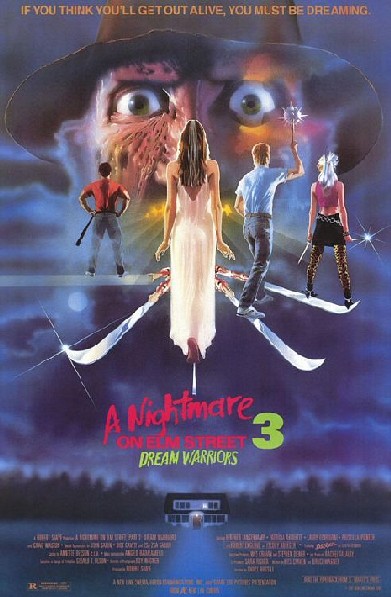
Welcome to Elm Street: Part Three

0

In honor(?) of the new A Nightmare on Elm Street, we’re recapping all of the Elms so far. Find more on the Pixel Vision blog.

“Live together, die alone.” I stole that line from Lost, but it sums up A Nightmare on Elm Street 3: Dream Warriors (1987) all too well. The remaining Elm Street kids — you know, the ones whose parents enacted mob justice on Fred Krueger — find themselves locked in a psych ward. They’re not really crazy: they’re just having bad dreams. But these teens are (mostly) smarter than their predecessors, and they refuse to go down without a fight. The “dream warriors” pick up on two important facts: there’s safety in numbers, and you can do awesome shit when you’re dreaming. I believe The Simpsons’ Ralph Wiggum said it best: “Sleep! That’s where I’m a Viking.”
No Vikings in this bunch, sadly, but these kids do have pretty nifty powers and thus a fighting chance against Freddy. In case you’re planning on assembling your own team of dream warriors — and honestly, it’s not a bad idea — I thought I’d break down the pros and cons of part three’s heroes. Yes, most of them end up dead and those that don’t (spoiler alert) are offed in part four. But hey, it’s good to know what skills to look for and what faults to avoid when you’re trying to save your ass.

Presenting the dream warriors, in the order in which they bite it.

Phillip (Bradley Gregg)
Pros: Bitchin’ ‘80s hair.
Cons: Sleepwalker. First to die, with the most disturbing death scene by far. He really doesn’t have a lot going for him.

Jennifer (Penelope Sudrow)
Pros: Has a (somewhat painful) system for staying awake. Burning oneself with cigarettes shows serious motivation.
Cons: Smoker. Thinks she’s going to be an actress — yeah, she’s one of those. And, of course, the second to die. “Welcome to prime time, bitch.”

Taryn (Jennifer Rubin)
Pros: Stands her ground. That means not putting out for skeezy orderlies. Gets the best line of the movie: “In my dreams, I’m beautiful. And bad.” Switchblades.
Cons: Attitude. Really needs to comb that hair. Pesky heroin addiction, which Freddy exploits with terrifying fingerneedles.

Will (Ira Heiden)
Pros: Nerdy charm. In his dreams, he can walk — not to mention be the Wizard Master. That’s right, he can blow up evil wheelchairs with green lightning (in the name of Lowrek, Prince of Elves).
Cons: Even as a wizard master, he’s still just a dweeb. And eventually, a dead one.

Nancy Thompson (Heather Langenkamp)
Pros: She’s been here before. Check out that grey streak: it screams “survivor.” Prescription for Hypnocil. Won’t take getting killed lying down.
Cons: Lots of baggage. Dead friends, dead boyfriend, dead mom — rewatch the first Nightmare on Elm Street if you need a refresher. Kind of naïve, inevitably. You really thought ghost dad was legit?

Kristen (Patricia Arquette)
Pros: Good at art. Marvel at her popsicle stick recreation of Nancy’s house! Does flips. Can bring people into her dreams.
Cons: Can bring people into her dreams. Hey, that’s a bad thing when you’re trying to avoid getting murdered. Poor common sense. All the Freddy fan-art is asking for it, don’t you think?

Kincaid (Ken Sagoes)
Pros: Tells it like it is, which means more great lines: “Let’s go kick the motherfucker’s ass all over dream land!” “Yo, Freddy! Where you hidin’ at, you burnt-face pussy?” Also, dreams give him super strength!
Cons: Gets thrown in the quiet room a lot, so you know he’s bad news. Nasty habit of antagonizing Freddy Krueger.

Joey (Rodney Eastman)
Pros: Knows to wake up his friends when necessary. Dream scream can break mirrors and banish the boogeyman.
Cons: But mostly quiet. Too quiet. Ball of teenage hormones, which inspires him to follow the hot nurse from hell and get himself comatose.

Dr. Neil Gordon (Craig Wasson)
Pros: The only doctor who actually believes that his patients are being killed by Freddy Krueger. Master hypnotist. Sees dead people — or dead nuns, at least.
Cons: Not a teenager. Might we say he’s getting too old for this shit? Can’t even fight a skeleton.

So there you have it. Now you can — I’m so sorry for this — pick your own dream team. And if you’d like to recruit me as a dream warrior, you should know that I’ve seen countless horror movies and know how to survive relatively unscathed. On the other hand, I’m pee-my-pants frightened of Freddy, so let’s call it a draw.

The Daily Blurgh: Terrorists get Triscuits, fascists get beans, gingers get MIA

0

Curiosities, quirks, oddites, and items from around the Bay and beyond.

Today in refried beans: from ingredient of burrito indulgence, to bane of the greenhouse, to weapon of protest. Even Dennis Herrera is (rightfully) pissed. Arizona goddam!

*****

In “Calfornia lawmakers with no grip on reality” news: this again? When will you learn, Maude Flanders of Sacramento? Whatever kids won’t be able to glean from Left 4 Dead 2 because of your “good intentions,” they can easily pick up in any one of the Saw films (or the evening news). What you gonna do when the zombies come, anyway?

*****

Debate: If a street artist who has already sold out (but is hip to that fact, so “selling out” becomes a meta-commentary on selling out), goes shopping for pricey, “heritage” jeans spun from the souls of kodama on looms built from the remnants of the true cross, is he still a sell out?

*****

It doesn’t matter what your favorite crackers or cookies are. They are not more important than the hegemonic wars the West is fighting against Islam.”

*****

“Walter Benjamin, or rather, the now-beloved figure of Benjamin — shuffling, myopic, mustachioed, fat, unhealthy, small round glasses glinting like flashlights — was largely unattractive in his own lifetime.” I smell an Oscar-in-waiting for Richard Dreyfuss.

*****

98 years ago: man in drunk-tank saved from fiery death by boozy ways, Providence.

*****

Yes, but what, exactly, is she getting political about? (Besides swiping that riff from Suicide — sampling kills!) NSFW, unless W is Xe.

Herrera to San Francisco: boycott Arizona

25

I almost visited Arizona once.
I was in Nevada, visiting the Hoover Dam which crosses the border between Nevada and Arizona and took a photo next to the Arizona state sign.

But I didn’t cross the line. I already suspected that Arizona was groundzero for wingnuts, thanks to the decision of Arizona U.S. senator, Republican John McCain, to choose then Alaska governor Sarah Palin as his running mate in the 2008 presidential election.


At least, Democrat Janet Napolitano was still governor of Arizona at the time, and so was able to veto similar attempts to pass racist immigration laws in the state of


But now Republican Jan Brewer, a former Maricopa County supervisor, is governor of Arizona and has signed Arizona’s SB  1070, I think I’ll follow San Francisco city Attorney Dennis Herrera’s advice and implement a sweeping boycott of all things Arizona.


Citing San Francisco’s “moral leadership against such past injustices as South African apartheid, the exploitation of migrant farm workers, the economic oppression of Catholics in Northern Ireland, and discrimination against the LGBT community,” Herrera offered the services of his office’s contracts, government litigation and investigations teams to work closely with city departments and commissions to identify applicable contracts and to aggressively pursue termination wherever legally tenable.


“Arizona’s controversial new law makes it a state-level crime for someone to be in the country illegally, and even criminalizes the failure to carry immigration documents at all times by lawful foreign residents,” Herrera’s April 26 press release observed. “It additionally imposes a requirement for police officers to question those they suspect may be in the United States illegally. Civil libertarians have sharply criticized the law for being an open invitation for harassment and discrimination against all Latinos, regardless of their citizenship. It has also been rebuked by the nation’s law enforcement community, with the president of the Major Cities Chiefs Association, San Jose Police Chief Robert Davis, reiterating his organization’s 2006 policy statement that requiring local police to enforce immigration laws “would likely negatively effect and undermine the level of trust and cooperation between local police and immigrant communities.”


“Arizona has charted an ominous legal course that puts extremist politics before public safety, and betrays our most deeply-held American values,” said Herrera, who is the son of an immigrant from Latin America. “Just as it did two decades ago when it refused to observe Martin Luther King Jr. Day, Arizona has again chosen to isolate itself from the rest of the nation. Our most appropriate response is to assure that their isolation is tangible rather than merely symbolic. San Francisco should lead the way in adopting and aggressively pursuing a sweeping boycott of Arizona and Arizona-based businesses until this unjust law is repealed or invalidated. My office is fully committed to work with San Francisco city departments and commissions to identify all applicable contracts, and to pursue termination wherever possible.  And my office stands ready to assist in any legal challenges in whatever way it can.”


Meanwhile, Napolitano, who is serving as Obama’s Department of Homeland Security Secretary, joined Obama in calling Arizona’s new immigration law “misguided.”


Appearing on ABC News, Napolitano said of the bill: “That one is a misguided law. It’s not a good law enforcement law. It’s not a good law in any number of reasons.”
She also warned that Arizona’s law could get other states trying to pass similar legislation, which could create a patchwork of immigration rules, instead of an an overall federal immigration system.


“This affects everybody, and I actually view it now as a security issue,” Napolitano said. “We need to know who’s in the country. And we need to know, for those who are in the country illegally, there needs to be a period under which they are given the opportunity to register so we get their biometrics, we get their criminal history and we know who they are. They pay a fine. They learn English. They get right with the law.”


Here on the streets of San Francisco, immigrant advocates are asking folks to march on May Day in solidarity with the immigrant communities of Arizona.


“In 2006, the immigrant community took to the streets in huge numbers,” a press release from the May 1st coalition stated. “Millions of undocumented working people and their families sought a pathway to legalization and to a life without fear of work-place raids or middle-of-the night deportations that tear families apart. In 2010, conditions have only worsened as hate crimes have increased exponentially; intolerance has been legitimized by the rhetoric of the Tea Party; and governments (like Arizona) have instituted harsh policing and employment practices that terrorize our communities. The federal government has failed to solve the crisis of undocumented workers in this country. In San Francisco, thousands of workers face losing their jobs because of a flawed employment verification process. Our children are deported without due process and now we must fear the codification of racial bigotry in Arizona.  State and federal governments have ineffectively solved the budget crisis on the backs of the lowest paid workers.  We march in solidarity with Arizona’s immigrants; immigrants everywhere; and the hard-working people of San Francisco who’ve unfairly endured the burden of this economic crisis.


The May 1st Coalition invites the community to join them for an April 28 poster-making party at 10 a.m, City College Mission Campus at 1125 Valencia Street in preparation for a May Day march at which Olga Miranda, President of SEIU Local 87, Jane Kim, SFUSD school board president, and Pablo Rodriguez, city college faculty, will speak.


My favorite comment on this unfunny situation comes from Daily Kos contributing editor and Las Vegas resident Jed Lewison.


“What do you call a bunch of people who not only don’t see anything wrong with Arizona’s new hate law, but blame federal inaction on immigration reform for “forcing” Arizona to enact the law while simultaneously trying to block federal immigration reform legislation?” Lewison asks. “You call them conservatives.”


PBS’s Frontline edits out single payer

1

Documentary misrepresented advocates as supporters of a public option
4/23/10

Silencing supporters of single-payer, or Medicare for All, is a media staple, but PBS’s Frontline found a new way to do that on the April 13 special Obama’s Deal–by selectively editing an interview with a single-payer advocate and footage of single-payer protesters to make them appear to be activists for a public option instead.

The public option proposal would have offered a government-run health insurance program to some individuals as an alternative to mandatory private health insurance. Not only is this not the same thing as Medicare for All, it’s an idea many single-payer advocates actually opposed, arguing that it would leave the insurance industry intact as dominant players in the healthcare business (PNHP.org, 7/20/09).

In the report, Frontline explained that insurance industry lobbyists pushed a bill in the Senate Finance Committee chaired by Sen. Max Baucus (D.-Montana) “that would include the mandate to buy insurance and kill the public option.” That “didn’t sit well with the president’s liberal supporters,” the Frontline narrator told viewers. After a clip from public-option supporter Howard Dean, a full minute and a half focused on protests: “The left counterattacked in May…. Liberal outrage arrived in Baucus’ own hearing room as healthcare activists, one after another, shouted him down.” Several of these protesters are seen in action, with a clip of an interview with Margaret Flowers of Physicians for a National Health Program (PNHP) saying that these were members of her group shut out of the hearings.

Now, Flowers and PNHP are leading single-payer advocates–but you’d never learn that from watching the Frontline program, which never mentions the single-payer concept. Instead, viewers were left to assume that Flowers and the protesters were public-option proponents, since that was the only progressive proposal that had been discussed. As Flowers explained (Consortium News, 4/15/10):

When the host, Mr. [Michael] Kirk, interviewed me for Obama’s Deal, we spoke extensively of the single-payer movement and my arrest with other single-payer advocates in the Senate Finance Committee last May. However, our action in Senate Finance was then misidentified as “those on the left” who led a “counterattack” because of “liberal outrage” at being excluded.

Viewers saw more footage of protesters being handcuffed and led away, with an unidentified voiceover from Amy Goodman of Democracy Now! describing the arrests, and finally a voice was heard saying: “This option cannot be part of the discussion at a Senate hearing? Now, I think that’s wrong.”

The audience could only conclude that “this option” referred to the public option, but this conclusion would be incorrect; this voice was actually MSNBC host Ed Schultz, a single-payer supporter, and a fuller version of his quote (5/7/09) would have made it clear that he was complaining about single-payer being excluded from the hearing:

Now, let me explain single-payer for just a minute. The money comes from one source, the government. Now, you and I pay taxes, OK. The government pays the bill. It’s that simple. Patients are not caught in the middle between doctors and insurance companies, no game-playing here. There’s no middleman. You know? There’s no decision-makers between you and your doctor. It’s a clean deal.

So what Chairman Baucus has decided, this option cannot be part of the discussion at a Senate hearing? Now, I think that’s wrong. I don’t think it’s fair.

Frontline’s editors responded to Flowers’ complaints, saying that they “understand the frustration of Dr. Flowers and others in what she calls the ‘single-payer movement,'” but that “it’s the work of journalism to report widely on a topic, then find the sharpest focus for the reporting, unfortunately leaving out much strong material along the way to shaping the clearest communication possible in the time or space allowed.”

The statement also argued that

the section that included Dr. Flowers was focused on the power of the insurance lobby and showed how activists like Dr. Flowers were excluded from the debate over the bill. The protesters themselves said they were protesting the fact that they had been excluded from the debate, so we believe we presented the protests in the proper context.

But in Frontline’s presentation, “activists like Dr. Flowers”–that is, single-payer advocates–didn’t even exist. Having itself excluded their perspective from the debate–and even misrepresented them as supporters of a position that many of them actually oppose–there’s some irony in Frontline claiming to have put this exclusion in the “proper context.”

This is not the first time that Frontline has decided that a conversation about healthcare reform should exclude single-payer (FAIR Action Alert, 4/7/09). The March 31, 2009, Frontline special Sick Around America avoided discussions of national healthcare plans. This omission led Frontline correspondent T.R. Reid–who had hosted a previous Frontline special (4/15/08) that examined various public healthcare models–to withdraw from the project.
When Frontline pushed single-payer out of the debate last year, PBS ombud Michael Getler (4/10/09) weighed in on the side of critics, calling it a “missed opportunity.” Getler today (4/23/10) published a column about the latest Frontline omissions, once again finding that ignoring a popular policy like single-payer is problematic:

It seems to me that to ignore something that was out there and popular with millions of people and thousands of healthcare professionals, but not really on the table, was a mistake. Although obviously tight on time, the producers should have found 30 seconds to take this into account, because many Americans support it, yet the deal makers never mention it, nor is the politics of discarding it addressed.

We’re thankful that Getler has once again taken this view and encouraged a more inclusive discussion of healthcare on PBS. However, his criticism misses the critical journalistic fact that single-payer advocates were not only marginalized by Frontline–they were misrepresented.

ACTION:
Tell Frontline that their recent program Obama’s Deal should have accurately explained the views of single-payer advocates.

CONTACT:
Frontline
frontline@pbs.org

You may also want to write to PBS ombud Michael Getler (ombudsman@pbs.org).

    
TAKE ACTION!

ACTION:

Tell Frontline that their recent program Obama’s Deal should have accurately explained the views of single-payer advocates.

CONTACT:
Frontline
frontline@pbs.org

Godzilla versus Mothra: the LBAM sequel

2

It seems like only the other day that the Guardian broke the news that the California Department of Food and Agriculture was threatening to spray San Francisco with moth pheromones, based on controversial estimates of a tiny invasive moth’s economic and environmental impacts.

That program was stopped, but not before residents of Santa Cruz and Monterey were subjected to repeated spraying by low-flying crop dusters, and questions were raised about the economic and political motivations behind the push to spray.

And now, on the 4oth anniversary of Earth Day, City Attorney Dennis Herrera has announced that San Francisco is joining a coalition of cities and health, environmental and mothers’ groups in a lawsuit that challenges the state’s current light brown apple moth (LBAM) eradication program. 

Filed in Alameda County Superior Court today, the civil lawsuit charges that the final programmatic Environmental Impact Report for the program is not based on sound science, and is invalidated because the program’s objective was changed from eradicating to merely controlling the moth, after the EIR was finished.

“The California Department of Food and Agriculture (CDFA) has produced an environmental impact report that raises many more questions than it answers,” Herrera said in a press release. “After combing through this document, it is literally impossible to say with certainty what CDFA plans to do, or when and where it plans to do it. To confuse matters further, the eradication program under review was subsequently morphed into a ‘control, contain and suppress’ program-whatever that means.”

Copies of case documents are available at the City Attorney’s website.


Green cards in hand, Washingtons want Newsom to discuss immigrant youth policy. In person.

0

Tracey Washington and her 13-year old son heard today that their green card applications have been approved. This means that they will not be deported to Australia, and their personal immigration nightmare is over.
But even as the family rejoices, Tracey’s husband, Charles Washington, a Muni bus driver and long-term San Francisco resident, has written to Mayor Gavin Newsom, voicing disappointment over Newsom’s failure to reach out to his family during their time of need and over Newsom’s continuing refusal to implement the immigrant youth due process policy that a veto-proof majority of the Board approved, in November 2009.

“Our family’s luck n this case was unique, but Mr. Newsom, the pain we felt when our family was facing deportation as a result of your policy is not unique at all,” Washington wrote in his April 21 letter. “We share the pain felt by the many other families whose children were taken into ICE custody and ordered deported, as a result of your policy.” (The full text of the letter that Charles Washington sent to Newsom today is included at the end of this blog post.)
 
The Washingtons’ nightmare began in January, when their 13-year-old boy was reported by juvenile probation to ICE for a minor bullying incident, during which he took 46 cents from another youth, then gave it back and apologized. That’s when the family first discovered that, thanks to a new juvenile immigrant policy that Newsom implemented in July 2008, their teen was going to reported to ICE immediately after his arrest – and before his case was heard in juvenile court. 

And even though the family was eligible for green cards thanks to Tracey’s April 2009 marriage to U.S. citizen Charles Washington, ICE handed Tracey and her son their deportation orders on Feb. 5, 2010–the same day they picked the boy up from juvenile detention and used the boy as bait to get his mother to agree to wear an electronic monitoring anklet.

That anklet was finally taken off today, meaning that Tracey Washington was forced to wear this uncomfortable and humiliating device for two and a half months, even though she did not commit a crime–and even though her son was not found guilty as charged, when his case was finally adjudicated by a juvenile justice.

Following the bullying incident, local law enforcement officers charged the boy with three felony counts, triggering an immediate referral to ICE, under Newsom’s immigrant youth policy.  But a juvenile justice recently gave the boy informal probation, recognizing that the youth is a first-time offender who committed a low level offense and is a good candidate for rehabilitation.

But seven weeks ago (March 1), when Tracey and her son had exhausted their legal options and were facing imminent deportation, the five-member blended Washington family held a press conference as a last resort. Two days later, following a media firestorm, ICE granted the Washingtons a two-month reprive, so that U.S. Citizenship and Immigration Services could review and approve their green card applications.

“We really appreciate that U.S. Citizenship and Immigration Services was willing to look at our individual circumstances and approve our residency application, so that our family can stay together,” Tracey Washington said today. “ At the same time, my heart goes out to the many other families who were harmed by the Mayor’s policy.” 

Angela Chan, the staff attorney at the Asian Law Caucus, who handled the family’s case, noted that while the Washington’s nightmare ended happily, many other families continue to be broken up by harsh immigration laws, lack of access to affordable legal services, and Mayor Newsom’s local policy towards immigrant youth.

“Newsom’s policy exacerbates the impact of a broken federal immigration system on San Francisco families,” Chan said. “We need humane reform at the federal level, but in the meantime, Mayor Newsom needs to take a stand today for due process and family unity by ending San Francisco’s draconian policy. If the Washingtons’ son had not been reported to ICE, as required by Newsom’s policy, he would not have been sent to ICE, and he and his family would not have had to endure this nightmare.”
 
Letter to Mayor Newsom from Washington Family–
 
April        21, 2010
 
Mayor Gavin Newsom
City Hall, Room 200
1 Dr. Carlton B. Goodlett Place
San Francisco, CA 94102
 
RE: Unjust Policy Regarding Undocumented Youth in San Francisco

Dear Mayor Newsom,

My name is Charles Washington. I was born and raised in San Francisco, and am a long-time resident of this great city. I also am a city employee. I love the city of San Francisco and my family has developed strong roots here. Unfortunately, last month, we went through a horrible ordeal when my wife and step-son were ordered deported as a result of your policy, which requires reporting of youth to Immigration and Customs Enforcement (ICE) right after arrest, before the youth even has a chance to have a hearing in juvenile court regarding the charges.

As you may have read in the news, my 13-year-old son was arrested and reported to ICE for deportation over 46 cents in a minor, first-time bullying case. In accordance with your policy, San Francisco juvenile probation officers reported my son to ICE before the allegations could even be adjudicated by a juvenile court judge. To my shock, my wife also was ordered deported by ICE as a result of the reporting of my son by juvenile probation in keeping with your policy.

With the imminent deportation hanging over my wife and son’s heads, we were utterly terrified that our family would be torn apart. Since we had no other legal remedies when our request for a stay of deportation was denied, we desperately reached out to the media to seek help in a last ditch effort. Fortunately, a reporter contacted the White House, which then resulted in an extension of the deadline for the deportation. However, I must tell you that during this time, we were really disappointed that we did not receive a single call or any type of outreach from your office to offer my family support, especially when my son’s referral to ICE was a direct consequence of your policy.

I also would like to express my deep disappointment in the statements your office issued after my family was granted the reprieve through no help from your office. Your office made statements to the press suggesting that our situation proves your policy leads to just outcomes. I completely disagree with this assertion and firmly believe that our being granted the reprieve has proven even more so that your policy hurts families and tears children away from their parents for minor, first-time offenses. The White House seems to understand the importance of keeping families together in granting the reprieve. Unfortunately, your office appears to have missed this completely. It is extremely hurtful to our family that you would try to claim credit for the positive turn in events that my family and the community supporting us worked hard to obtain in order to combat the injustice brought upon us by the policy you implemented in the first place.

Let me also say that my family was lucky, but there are many other families who have not been as fortunate.There was no handbook to tell us what to do to obtain a reprieve when we were in this crisis. It just so happened that we were able to obtain legal assistance, but what if we had been unable to find legal services or if the press had not covered our story? My wife and son would have been torn from me and there is nothing I could have done to stop it from happening. Families in San Francisco should not have to struggle or rely on luck to stay together. In fact, there have been over a hundred families in this city who have not been as fortunate as my family since your harsh and inhumane policy was implemented in 2008.  Our family’s luck in this case was unique, but Mr. Newsom, the pain we felt when our family was facing deportation as a result of your policy is not unique at all.We share the pain felt by the many other families whose children were taken into ICE custody and ordered deported as a result of your policy.

Mr. Newsom, I know that you are a new father yourself and will teach your own daughter many lessons in her lifetime. I respectfully ask you to reexamine your policy from the eyes of a father, the way that I am looking at my son today. While I must say that I am greatly disappointed in the actions you have taken to support a flawed policy that has endangered the children of this city, I do hope that you will take this opportunity to do the right thing and support implementation of Supervisor Campos’ due process amendment, which is now city law.  Families like mine, who are hard-working and rooted in San Francisco, are depending on you to do what is right and to follow the law the community passed in November 2009.

I respectfully request a meeting with you, in which my lawyer, Angela Chan from the Asian Law Caucus, and my family can speak with you about this policy and how it has affected us and continues to impact families in San Francisco.
Sincerely,

Charles Washington

The Daily Blurgh: Leaf us alone

0

Curiosities, quirks, oddites, and items from around the Bay and beyond

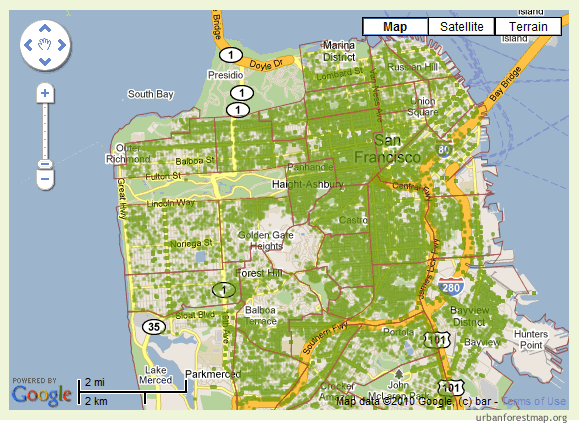
If a tree falls in San Francisco will anyone hear it? Probably. But more importantly, concerned citizens will be able to track the felled arbor online thanks to the Urban Forest Map.

*****

Get out your Legos: Berkeley Art Museum/PFA is looking for new architectural proposals.

*****

“If I could give back those last five beers, I would do it in a heartbeat. I don’t know why I let that girl look at it. That was a total disregard of our phones before hos mantra.” McSweeney’s imagines Gray Powell’s mea culpa to his Apple coworkers.

******

Rent a Cable Car or an F-Market street car for your next drunken spectacle/flashmob. It’s cheaper than you think.

*****

First, the bad news: Gonorrhea, like Nickelback fandom, becoming more incurable, sayeth Science.

*****

Now, the good news: it’s hump day!

oh!

John Ross: Time travelling down the Mississippi

1

 Editors note: John Ross is wandering the country on a book tour, sharing his observations of Obamalandia, 2010. You can read his previous dispatches here and here  

I. Role models


When I finally made Chicago, they were all waiting for me down there two blocks south of the end of the Blue Line, through the wrought-iron gates of Forest Home Cemetery, past the ostentatious mausoleums of fabulous gypsies and clustered around the heroic monument to the Haymarket Martyrs: Red Emma, looking a little dingy these days; Elizabeth Gurley Flynn, the Rebel Girl; William Z. Foster, the CPUSA’s most rigid ideologue and the leaders of its black sector Henry Winston and William Patterson; the anarchist femme fatal Voltairine de Cleyres; hobo-ologist Ben Reitman; and, of course my personal role model, Lucy Parsons, who outlived her Albert (hung by the State for the Haymarket frame-up) by 50 years, traveling this poisoned landscape from sea to stinking sea speechifying to the masses and hawking her incendiary pamphlets to make ends meet. A single wilted rose adorned the soft granite pillow that bears her name and dates.


Scattered amidst the tombstones of the 70-plus anarchists and communists, radicals and rabble-rousers that Irving Abrams and the Pioneer Aid Society planted here are the DNAs of Joe Hill and Big Bill Haywood and Eddie Balchowsky, the one-winged barrelhouse piano player who gave up his arm to Franco’s fascists in the Spanish Civil War. Irving himself has a box seat at the foot of the Haymarket marker, now a National Historical Landmark managed by the government that these brave souls in residence once sought to overthrow.

Emma Goldman and her condescending epitaph (“a people must rise up to liberty”) was unquestionably Irving’s greatest steal, having won the bidding war for her cadaver after she croaked up in Toronto, to bring her home to the country from which she had been deported decades before for counseling young men not to sign up for the First Imperialist War. But despite the old-time luminaries in repose, I had journeyed down to Forest Home to visit with a recent implant, Franklin Rosemont, the anarchist writer and majordomo of Charles Kerr, the oldest radical publishing house in the U.S., now being sustained by his widow Penelope.  

“Surrealism Forever!” reads Franklin’s slab, in keeping with the celebratory tone of this section of the old boneyard. Franklin, who passed abruptly last year, is buried within the arc of the Haymarket monument.  The Cottons, Clara and Warren (not known to be subversives), keep him company.    

I doubt that our current president, whose adopted city Chicago is, has ever communed with these noble spirits, but it would be an educational experience if ever he should make his way down to Forest Home. Enveloped by deal-making devotees of Chicago’s backroom Democratic Party politics like Rahm Emmanuel, Valerie Jarrett, and Education Secretary Arne Duncan (now neck-deep in a hometown scandal for A-listing the scions of the influential in Chicago’s elite public schools), the examples set by Lucy Parsons and Emma Goldman might have stiffened Obama’s shaky backbone and taught him to stand up for the principles he has abandoned as the CEO of the planet’s longest-running criminal conspiracy.

Michael James rules the venerable Heartland Café in Rogers Park in the extreme northwest of this windy metropolis, a schmooze and booze venue for the left side of the local Democratic Party machine for the past three decades.  Both Obama and Bill Ayers have crossed its threshold occasionally at the same time, and Michael, the facilitator of “Rising Up Angry,” a militant Uptown youth group at the tail end of the turbulent ’60s, is now the chairperson of the local Demo ward committee. Although he will never concede that Baracko has squandered the faith that millions invested in him, I sense growing disappointment with Hope Man’s wishy-washy performance 15 months into his tainted term in office.  

As always, I bunked with the James Gang — Paige, the kids, and the estimable Che, a Labrador with a most dignified demeanor — and plunged into Chicago’s stimulating cultural mix. Also in residence: the foot-stomping Irish fiddler Paddy Jones, just in from Tralee — three years ago, Mike dragged Paddy and I off to the Korean baths where the local political class conspires. We sat buck naked in the sauna and Paddy insisted I regale him with the cautionary tale of El Che (the revolutionary martyr not the mutt).  

This time around, Michael escorted me to the late Nelson Algren’s birthday party in a church close by this quintessential Chicago scribbler’s beloved Division Street neighborhood, during which mash notes from his lover Simone de Beuvoir were read, lending credence to Frankie Lyman’s pointed inquiry “Why Do Fools Fall In Love?”

Yet another highpoint of my weeklong pilgrimage to the Hog Butcher of the World were a pair of meetings in Pilsen, an industrial enclave where the U.S. Communist Party first convened hard by Blue Island Avenue back in 1919 and now the most pertinent barrio in Mexico’s second U.S. city. More than a hundred Latino activists showed up to hear me rant and rave about the prospects for a new Mexican revolution and plot this year’s May 1st march in a city where immigrant workers first took to the streets 124 years ago to demand redress for crimes inflicted upon the working class by the bosses of industry and commerce. Four years ago, a half million immigrant workers marched here to demand recognition of their rights and despite the broken promises encapsulated in the Schumer-Graham proposed Immigration “Reform” bill, Chicago’s Mexican community is warming up for another red-hot May Day.  

II.  Resurrection

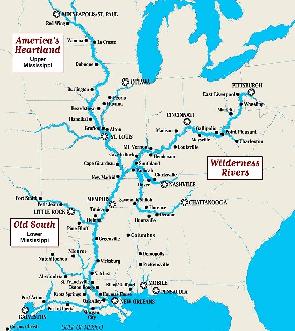
I followed the contours of the mighty Mississippi from Chicago to St. Louis through rich bottomland that is now the domain of Archer Daniels Midland. St. Louis is an urban hub that features wide, well-kept lawns and bushels of dirty money — Monsanto, Boeing, Peabody Energy, and Talx, which counsels greedy congloms on unemployment compensation, are all headquartered here.  

Yet, despite the capitalist connivance, the city has its own sui generis radical history. The 1877 railroad strike spread from the east to St. Louis and set the style for labor strife in the west, and the anarchist Flores Magon brothers published “Regeneracion,” the bible of the 100 year-old Mexican revolution, here before they were run out of town in the teens of the past century.

My days in St. Louis were well spent. I preached an Easter Sunday sermon at the Mid Rivers Ethical Society, sharing my vision of resurrection and insurrection in the aforementioned Forest Home boneyard, and offered up my palaver at a Black Green Party forum in a soul food parlor off Delmar, spreading the news of the Mexican government’s execrable persecution of  electrical workers pushed out of their workplaces last October at bayonet point by the military and police in a scheme to privatize electricity generation south of the border.  

I walked the St Louis Walk of Fame, stepping over the stars of the likes of William Burroughs, Chuck Berry, Walker Evans, and Fontella Bass, all of whom had to leave town to achieve a modicum of notoriety. I even encountered my very first St. Louie Cardinal, a crimson-hued bird perched in a sapling, spring zephyrs ruffling its crest, from which the Anheuser Busch dynasty drew the logo for the local nine in this beisbol-intoxicated town (they were previously dubbed the “Perfectos” after a popular cigar.)

III. Black & Brown

Further down river, the scrublands of Mississippi spread into the horizon beneath the cramped commuter flight in from Memphis. I had not touched down in the state since Freedom Summer 1964, when I arrived on the very day that the bodies of three civil rights workers (Michael Schwerner, Andrew Goodman, and James Chaney) were unearthed beneath a dam in Philadelphia, Miss.  

Although Black and White speak more cordially to each other these days and there are few black bodies swinging from the poplar trees, Mississippi God Damn (dixit Nina Simone) is still moldering down below. I could feel the heat at my hotel just off the Millsaps College campus in Jackson, where a statewide PTA meeting was in progress. In the conference rooms, black parents squared off against white school administrators over curriculums and the unequal quality of education. This is a commemoration year for black activism, the 40th anniversary of the killings at Jackson (and Kent) State and the 50th for SNCC — and old grievances burn long and deep.

The old civil rights movement achieved only token parity in this the poorest state in the union. Now a new civil rights movement is focusing on the flood of Mexican and Latino workers who poured into Mississippi in the wake of Katrina, and brown people are today’s niggers down at the bottom of the food chain.

Only 34,000 “Hispanics” were officially counted in the 2000 state census but Bill Chandler, a veteran of the Texas farm workers union and spokes for the Mississippi Immigrant Rights Alliance (MIRA), thinks that three times as many undocumented workers, lured to the state by casino construction, were overlooked back then. In 2010, Chandler calculates that the immigrant numbers have swelled to 200,000, nearly 10% of the state population, and taken together with close to a 40% Afro-American share, Mississippi now verges on becoming a majority People of Color entity. A similar equation is at work throughout the Deep South with Alabama and South Carolina and Georgia also hanging in the balance. Such changing demographics help to explain the vitriol the Teabaggers and White Citizen Council types shower upon the newcomers.

Back in August 2008, Immigration Control and Enforcement broke its own despicable workplace raid record by imprisoning (in Jena La., the site of other racist outrages) and deporting 595 Mexican and Latino workers who had been employed by Howard Industries down in Laurel. Chandler thinks the pogram was accomplished with the complicity of the company which was intent on cheating workers out of their wages. MIRA eventually won checks for most of those detained and deported.

An even more outrageous incidence of lingering Mississippi bigotry was the treatment of Cirila Balthazar Cruz, a mono-lingual Chatino indigena from Oaxaca who was picked up by police as she stumbled along the highway shoulder trying to get to a local hospital to give birth. Her baby daughter Ruby was subsequently stolen from her by child welfare authorities who deemed her an unfit mother because she couldn’t speak English and given to a well-appointed childless white couple. As might be anticipated, such blatant racism struck a tender nerve south of the border and a year later, Ruby was returned to her birth mother.  

Justice in Mississippi, as in much of Obamalandia, remains elusive but every once in a while the push of the people from down below captures such small prizes.

On their East Coast swing, John Ross & “El Monstruo” will visit Washington/Baltimore (Red Emma’s April 19th/ University of Maryland – Baltimore on the 20th/ Institute for Policy Studies the 21st); New York (NYU the 22nd/ Sixth Street Community Center the 23rd/Bluestockings the 25th); and Boston (Harvard Coop the 27th/David Rockefeller Center for Latin American Studies the 28th/Mass Global Action the 29th/IPS-Jamaica Plains the 30th/ topped of by a May 1st rally on the Boston Commons between Noon & Two.) All events are all free.


Throwing down with the Tablehopper

0

The incredibly everywhere Marcia Gagliardi, a.k.a. the Tablehopper (www.tablehopper.com), has somehow canvassed, in-depth, every eatery, drinkery, and food-cartery in our fair city — while still maintaining her voracious appetite, sassy aplomb, and appealing figure. Her new book, The Tablehopper’s Guide to Dining and Drinking in San Francisco (Ten Speed Press) is one of those must-have recommendation books that truly opens your eyes and mouth to culinary nooks and crannies. Divided into a multitude of sections like “Shituations” (places for dumping someone), “Morning After Breakfasts,” “Picky Eaters,” “Dude Food,” and “Ethnic Group Dinners,” it’s a fantastic thing to have on hand for every occasion, real or imagined. Marcia took a minute to answer some of our more “Guardian” questions about Bay dining and drinking. (Marke B.)

SFBG I’m pansexual and bursting with spring fever. What bars or restaurants can I go to where the boys and girls and everything-in-between are hot and open to everything?

MARCIA GAGLIARDI I’ve always thought the Lush Lounge (1221 Polk, SF. 415-771-2022, www.lushloungesf.com) has a good mixed vibe, and it seems Blackbird (2124 Market, SF. 415-503-0630, www.blackbirdbar.com) draws a mixed crowd as well. Orbit Room (1900 Market, SF. 415-252-9525) too. Or just go to Beretta (1199 Valencia, SF. 415- 695-1199, www.berettasf.com) late at night, sprinkle some Ecstasy on everyone’s crispy thin-crust pizza, and see what happens.

SFBG I have $5 for dinner. Where should I go?

MG I’d go to Balompie Café (3349 18th St., SF. 415-648-9199) or El Zocalo (3230 Mission, SF. 415-282-2572) and get a couple of extremely filling pupusas, which come with chips and salsa. Yep, you can get some hot pupusa action for less than $5. Hott!

SFBG Oh dear, I’ve doublebooked on date night. But then I get to thinking — why not take ’em both on at once? They might get into each other as well, and three’s certainly company! What’s a good place to have them both meet me and, once the initial confusion subsides, gently introduce the idea of a potentially delicious ménage à trois?

MG Well, hello, Ms. Popular. This is the kind of night that calls for some sexy atmosphere, and whaddya know, booze. The cozy downstairs booths at Oola (860 Folsom, SF. 415-995-2061, www.oola-sf.com) might fit the bill, and you can take turns licking the sauce from the yummy, sticky, baby back ribs off each other’s fingers.

SFBG My parents are on their way to take me out to dinner, but I just got really stoned. Where will my goofy demeanor blend right in?

MG Florio (1915 Fillmore, SF. 415-775-4300, www.floriosf.com) would work because its dandy-yet-friendly atmosphere is parental-unit approved, the lights are dim, the hearty food will jive with your munchies, and there’s usually enough going on in there that your parents won’t be watching your every move. There’s also a little alley around the corner where you can spark up if you need another puff before dessert.

SFBG Best place to announce my impending gender reassignment surgery to someone close to me who may be surprised?

MG Absinthe (398 Hayes, SF. 415-551-1590, www.absinthe.com). You can request a quieter table so not everyone hears your answers to all of your friend’s burning questions, and the spirited cocktails — a coquettishly tangy Ginger Rogers or bourbon-spiked Scarlett O’Hara, perhaps? — will help them digest the good news.

SFBG Someone took me out on a date to a really expensive restaurant and insisted on paying. Now it’s my turn to take them out, but I’m like, down to my last $20. Where can I take them so they feel I’ve treated them to something classier than my budget suggests?

MG Ah yes, the old smoke and mirrors. I’d go to Great Eastern in Chinatown (649 Jackson, SF. 415-986-2500), which has some bountiful deals on set menus, and the room is spiffy. Or you could take them to dim sum at one of my favorite places, S&T Hong Kong Seafood (2578 Noriega, SF. 415-665-8338) in the Outer Susnset, and you will feast fo’ cheap.

SFBG What wine bars have the best pours? I mean top-of-the-glass for $6. I’m a-thirsty, girl!

MG Well, the folks working the bar at Castro’s 2223 (2223 Market, SF. 415-431-0692, www.2223restaurant.com) know their clientele well and do pretty big pours. Same with Laszlo (2526 Mission, SF. 415-401-0810, www.laszlobar.com). I also noted a fuller glass the last time I was at the Hidden Vine (620 Post, SF. 415-674-3567, www.thehiddenvine.com). And based on the number of loaded folks at the Wine Jar (1870 Fillmore, SF. 415-931-2924, www.winejar-sf.com), I’d say the generous pours are to blame.

SFBG What would you say are the most “interesting” things you’ve ever eaten in the city?

MG Some of the dishes at Spices! (294 Eighth Ave., SF. 415-752-8884) have definitely pushed the envelope for me. (Stinky tofu, intestine stew — and I don’t care to have either dish ever again). The tendon pho at Pho Tan Hoa (431 Jones, SF. 415-673-3163) definitely rates on the funky meter — and I’m talking big hunks of tendon.

The good, the bad, and the fence-sitters

1

news@sfbg.com

The Guardian has been periodically producing the Board of Supervisors’ Good Vote Guide for many years, tracking where our elected representatives come down on important issues. And unlike a similar poll recently put out by the San Francisco Chamber of Commerce, which chose 10 votes designed to promote deregulating and subsidizing big businesses, we chose items important to the broad public interest.

The 20 votes we selected this time reflect our concerns for protecting tenants, funding vital public services, safeguarding civil liberties, promoting small businesses and nonprofits, appointing qualified people to commissions, and valuing the environment more than “green” press releases and corporate profits.

To view our guide (PDF), please click here

Top pic picks

0

The White Meadows (Mohammad Rasoulof, Iran, 2009) This latest by the recently jailed Iranian director of Iron Island (2005) is a stark, visually striking allegory whose natural settings (the salt formations of Lake Urmia) could hardly be more surreal. Aging Rahmat (Hasan Pourshirazi) rows his little boat from one tiny island community to another, collecting tears from variably aggrieved locals so they can be absolved of their sins — just how, neither they or we know. During his latest travels he gains a teenaged stowaway, then a blind-struck painter as passengers; witnesses a couple of village rituals that prove fatal for their main participants; and experiences other curious events that scarcely prompt a raised eyebrow from him. As with so much modern Iranian cinema, Mohammad Rasoulof’s film carefully renders its political symbolism so abstract you can dig endlessly for hidden meanings, or simply lose yourself in the hypnotic black-and-white-in-color imagery of black-clad people on bleached landscapes. Fri/23, 6:30 p.m., Kabuki; Sat/24, 9:30 p.m., Kabuki; Sun/25, 8 p.m., PFA. (Dennis Harvey)

Nymph (Pen-ek Ratanaruang, Thailand, 2009) Boy meets girl. Boy and girl fall in love. Girl cheats on boy with boss. Boy falls in love with tree. So are the broad strokes of Thai director Pen-ek Ratanaruang’s jungle-horror, Nymph, a city-to-country romance that deftly weaves strands of urban anomie, sexual dysfunction, and rural mythos into a dreamy, arboreal fantasia. One might be tempted to reference Lars von Trier’s Antichrist (2009) and fellow Thai helmer Apichatpong Weerasethakul’s 2004 breakout, Tropical Malady, as obvious points of reference, but that would derogate the potency and intensity of Ratanaruang’s singular, artistic design. The director of Last Life in the Universe (2003) and Ploy (2007) creates a tropical mise-en-scène that is less cinematic than immersive, developed largely by his use of tight, suspenseful close-ups, fluid camera work (including a 10-minute opening sequence that is practically gymnastic), and a transfixing ambient score. But unlike Tropical Malady, which leveraged much of its second-half’s novelty from overwrought, homoerotic tropes and a condescending nativism, Nymph‘s descent into the jungle is only the beginning of this powerful love story. Fri/23, 9 p.m., Kabuki; Sat/24, 4:30 p.m., Kabuki; April 28, 4:45 p.m., Kabuki. (Erik Morse)

Around a Small Mountain (Jacques Rivette, France/Italy, 2009) Around a Small Mountain (or 36 vues du Pic Saint Loup) is New Wave doyen Jacques Rivette’s return to the whimsy of 1984’s Love on the Ground, another exploration of theater staring eternal demoiselle Jane Birkin. In Mountain, Birkin plays Kate, a prodigal daughter who has returned to her deceased father’s circus after an unspecified trauma forced her into a 15 year absence. En route she encounters Vittorio (Sergio Castellitto), a peripatetic who instantly discovers in Kate a fellow improviser for his acrobatic feats of conversation. In hopes of learning her secret past, Vittorio follows Kate and her shabby troupe from performance to performance through the tiny towns of the Cevennes. Along the way, Rivette treats his audience to a mish-mash of sideshow sketches, enchanting dialogues and haunting soliloquies, all beneath the magical totem of the big top. The film is spellbinding ode to the theatre of everyday life and the actors who prance in and out of its cirque. Fri/23, 9:30 p.m., Kabuki; Sat/24, 4:15 p.m., Kabuki; April 28, 6:30 p.m., PFA. (Morse)

Way of Nature (Nina Hedenius, Sweden, 2008) Save for when Werner Herzog is doing the talking, documentaries about the natural world often benefit from a lack of voiceover narration. Nature’s seasons, cycles, and rhythms provide their own narrative structure, and simply, silently observing what happens can make for fascinating viewing. Nina Hedenius understands this. Her engrossing year-in-the-life portrait of Lisselbäcka Farm in northern Sweden is cut around creatures great and small — horses, cows, goats, chickens, dogs — and their routines. Although humans are part of the bucolic scene Hedenius so meticulously orchestrates (the sound editing is such that the film would be no less immersive if you watched it blindfolded), they are merely supporting actors. After watching, for the fourth time, another gangly offspring leap to its feet, minutes after being born, you start to realize the ways in which our species is quite helpless. If their keepers suddenly passed away, the animals of Lisselbäcka — domesticated though they may be — would probably manage to carry on. The way of nature is instinct, not mastery. Sat/24, 2 p.m., PFA; Sun/25, 3:45 p.m., Kabuki; Mon/26, 1 p.m., Kabuki; April 28, 6:30 p.m., Kabuki. (Matt Sussman)

Between Two Worlds (Vimukthi Jayasundara, Sri Lanka, 2009) Part vision quest, part historical allegory, Vimukthi Jayasundara’s lush and beguiling head-scratcher unfolds like the mutable folktale told between two fishermen in one of the film’s asides. A synopsis would go something like this: an unnamed South Asian man falls from the sky into an unspecified South Asian country (although the Sinhala the actors speak places us in Sri Lanka) under siege by revolutionaries intent on destroying all means of communication and killing any remaining young men. Fleeing a riot-ravaged city he winds up in the countryside where he reconnects with his sister-in-law, and undergoes several mysterious and mystical experiences at a nearby lake. “It’s possible that one can see today what has happened in the past,” cautions an old man to our protagonist, and Jayasundara — with an eye for arresting mise-en-scene, gorgeously photographed by Channa Deshapriya — attempts to offer a way to re-see the traumas of the civil war that ravaged Sri Lanka for over three decades. Like a freshly remembered dream, Between Two Worlds is as stubbornly oblique as it is hard to shake. Sat/24, 6:15 p.m., Kabuki; Sun/25, 9 p.m., Kabuki; Mon/26, 9:15, Kabuki. (Sussman)

Transcending Lynch (Marcos Andrade, Brazil, 2010) Picture it: everyone’s favorite psycho-thriller filmmaker and coffee retailer waxing beatific about peace, love, and “infinite bliss,” his American Spirit–stained teeth frozen in a perma-grin as he extols the virtues of the “unified field” of consciousness. At certain moments in Transcending Lynch, an exploration of infamous auteur David Lynch and his 35-year devotion to transcendental meditation, the director comes across as flakier than the celebrated piecrust at Twin Peaks‘ Double R diner. (At one point he even utters the phrase “Holy jumping George!”) For the irony-soaked, all the TM talk may be a little TMI, but for Lynch the practice is nothing short of the very source of his creative wellspring. Marcos Andrade’s documentary, which follows Lynch on a 2008 Brazilian book tour, won’t offer the mad-genius Eagle Scout’s more rabid followers much new insight. While the movie strives to be meditative, it’s more of an amalgam of trippy travelogue and pitch meeting. Even more frustrating, we get only teasing glimpses of how TM has directly informed and impacted the artist’s work. Lynch may be on the path to universal enlightenment, but when it comes to the man himself, the rest of us ignoramuses are still mostly in the dark. Sat/24, 6:30pm, Kabuki; Mon/26, 9pm, Kabuki; Tues/27, 12:30pm, Kabuki. (Michelle Devereaux)

14-18: The Noise and the Fury (Jean-Françoise Delassus, France/Belgium, 2009) Made for French TV, Jean-Françoise Delassus’ unclassifiable film would be arresting simply for cobbling together seldom-seen archival footage reflecting all aspects of the First World War, from its leaders to its trenches. But he and co-scenarist Isabelle Rabineau have shaped that footage into a narrative driven by the writings of a (fictional) French everyman soldier who somehow manages to survive and serve in most of its major conflicts. The result melds exquisite color tinting, first-person narration, clips from commercial films about the war (by D.W. Griffith and Chaplin as well as European directors), and ambient sound to create a brilliant kind of living history lesson that makes the events of nearly a century ago seem as immediate as yesterday’s. Mon/26, 4:30 p.m., Kabuki; May 1, 2 p.m., Kabuki; May 3, 9 p.m., Kabuki. (Harvey)

The Peddler (Eduardo de la Serna, Lucas Marcheggiano, and Adriana Yurkovich, Argentina, 2009) Daniel Burmeister is a traveling filmmaker. He drives his infirm jalopy from one small Argentine town to the next, hoping to set up camp for a month and make a movie with the locals. He’ll need food, a place to stay, and a camera. Whatever camera they can find. Usually the mayors are easy to convince, because Burmeister is essentially a regional attraction, a one-man circus they know about from the neighboring towns. It’s this strange repurposing of the filmmaking experience that makes the documentary so distinctive and special. And just watching the old man hustle from shot to shot with his bashful actors, working efficiently from one of the handful of scripts he’s been cycling through for years, is an absolute pleasure. Directors Eduardo de la Serna, Lucas Marcheggiano, and Adriana Yurcovich capture the jury-rigged process with unobtrusive admiration and an absence of condescension. As I watched it I kept thinking it was like the soul that was missing from Michel Gondry’s 2008 warmed-over DIY manifesto Be Kind Rewind. Mon/26, 6:30 p.m., PFA; May 1, 12:30 p.m., Kabuki; May 4, 6:30 p.m., Kabuki. (Jason Shamai)

Russian Lessons (Olga Konskaya and Andrei Nekrasov, Russia/Norway/Georgia, 2010) I remember watching the news two summers ago and feeling confused by the details of the Russia-Georgia War, the culmination of a dispute over the territory of South Ossetia. There seemed to be a haziness about who started what. Russian Lessons offers Olga Konskaya and Andrei Nekrasov’s version of what happened that summer and indicts Russian and mainstream international news organizations for exactly that failure to present a satisfactory chronology. Konskaya, a theater director and documentary producer, filmed events as they unfolded on the Northern end of the conflict while Nekrasov, a veteran documentarian, filmed in the South. The result is a collection of interviews with residents of recently bombed Georgian towns, confrontations with Russian soldiers, and investigations of still-smoldering battle sites. The filmmakers spend an equal amount of time scrutinizing source footage from the war and its antecedents, exposing how it was used to mislead the international community. It’s a disturbing and persuasive rebuttal to the Putin administration’s official side of the story. April 28, 3:15 p.m., Kabuki; April 29, 12:30 p.m., Kabuki; May 1, 6:15 p.m., Kabuki. (Shamai)

Restrepo (Tim Hetherington and Sabastian Junger, USA, 2010) Starting mid-’07, journalists-filmmakers Tim Hetherington and Sebastian Junger spent some 15 months off and on embedded with a U.S. Army platoon in Afghanistan’s Korengal Valley, a Taliban stronghold with steep, mountainous terrain that could hardly be more advantageous for snipers. Particularly once a second, even more isolated outpost is built, the soldiers’ days are fraught with tension, whether they’re ordered out into the open on a mission or staying put under frequent fire. Strictly vérité, with no political commentary overt or otherwise, the documentary could be (and has been) faulted for not having enough of a “narrative arc” — as if life often does, particularly under such extreme circumstances. But it’s harrowingly immediate (the filmmakers themselves often have to dive for cover) and revelatory as a glimpse not just of active warfare, but of the near-impossible challenges particular to foreign armed forces trying to make any kind of “progress” in Afghanistan. April 30, 3:45 p.m., Kabuki; May 2, 4:15 p.m., PFA; May 4, 9:30 p.m., Kabuki. (Harvey)

Animal Heart (Séverine Cornamusaz, France/Switzerland, 2009) This first feature by Séverine Cornamusaz has a story that would have fit just as well into the cinema of 1920 — or the literature of Thomas Hardy or George Eliot 50 years earlier. Paul (Olivier Rabourdin) is the gruff owner of family lands in the Swiss Alps, raising livestock whom he treats better than wife Rosine (Camille Japy). When he’s forced to hire a seasonal hired hand in the form of Eusebio (Antonio Bull), the easygoing Spaniard’s concern for ailing Rosine incites not Paul’s compassion but his brute jealousy. This elemental triangle set amid the severe elements of its spectacularly shot setting has a suitably blunt (but not crude) power; it leads not where you might expect but to a hard-won fadeout of audacious intimacy. April 30, 4 p.m., Clay; May 2, 9:15 p.m., Clay; May 3, 6 p.m., Kabuki. (Harvey)

Henri-Georges Clouzot’s Inferno (Serge Bromberg and Ruxandra Medrea, France, 2009) A painstaking craftsman who left nothing to chance, French suspense master Clouzot (1955’s Diabolique, 1953’s The Wages of Fear) decided to push his own envelope a little in 1964. He cast Serge Reggiani as a resort innkeeper who becomes pathologically, paranoically possessive of his gorgeous wife (Romy Schneider). Convincing himself she’s having an affair, he gradually snaps tether — and the film itself would reflect that downward spiral by increasingly illustrating his mental stage in distortive image and sound. Unfortunately, the project also drove Clouzot mad in a way, as his grapplings at a new filmic language ran counter to the kind of creative discipline that normally storyboarded everything within an inch of its life. Shooting endless footage, spending endless money, he finally admitted defeat and abandoned ship. Never completed, the film’s surviving pieces were restored for this absorbing unmaking-of documentary — even if the original clips, daring then but now looking like psychedelic kitsch, suggest Inferno would likely have been no masterpiece but a fascinating, instantly-dated failure. May 2, 1:45 p.m., Kabuki; May 5, 6:15 p.m., Kabuki. (Harvey)

Presumed Guilty (Roberto Hernández and Geoffrey Smith, Mexico, 2009) A fan of true crime TV programming, I all but take for granted that little coda at the end of each episode reminding viewers that the suspects shown are innocent until proven guilty. I sometimes forget that such rights are not the case in all countries, such as in Mexico where the criminal justice system employs a reverse practice requiring the accused to prove themselves innocent. In Presumed Guilty, filmmakers, lawyers, and UC Berkeley students Roberto Hernández and Layda Negrete use rarely-seen, up-close footage of the Mexican trial process in their effort to exonerate a young Mexico City street vendor who is falsely accused of murder in 2005. The proceedings, which require the defendant to stand for hours on end and are performed sans jury, is riveting stuff for fans of those A&E true crime shows and is sure to ruffle the feathers of a few sympathetic humanitarians. May 2, 3:30 p.m., Kabuki; May 3, 6:30 p.m., PFA; May 6, 3:15 p.m., Kabuki. (Peter Galvin)

Lebanon (Samuel Maoz, Israel, 2009) “Das Boot in a tank” has been the thumbnail summary of writer-director Samuel Maoz’s film in its festival travels to date, during which it’s picked up various prizes including a Venice Golden Lion. On the first day of Israel’s 1982 invasion (which Maoz fought in), an Israeli army tank with a crew of three fairly green 20-somethings — soon joined by a fourth with even less battle experience — crosses the border, enters a city already halfway reduced to rubble, and promptly gets its inhabitants in the worst possible fix, stranded without backup. Highly visceral and, needless to say, claustrophobic (there are almost no exterior shots), Lebanon may for some echo The Hurt Locker (2009) in its intense focus on physical peril. It also echoes that film’s lack of equally gripping character development. But taken on its own willfully narrow terms, this is a potent exercise in squirmy combat you-are-thereness. May 2, 9 p.m., Kabuki; May 5, 9:30 p.m., Kabuki. (Harvey)

The Day God Walked Away (Philippe van Leeuw, France/Belgium, 2009) Director Philippe Van Leeuw states in the press materials that he made The Day God Walked Away in an attempt to understand how the assassins of the 1994 Rwandan genocide could do what they did and how others could stand by and watch. I walked away from Day with a better understanding of what might draw a person to choose defeatism over an unlikely survival. The film opens as a Tutsi housekeeper (Ruth Nirere) finds herself trapped in her Belgian employers’ house, fearing for her children and surrounded by gun-toting murderers. Light on scripted dialogue and featuring local actors, van Leeuw’s nonintrusive filming lends the film an authentic atmosphere that can be slow but is never boring. In lensing the film’s horrific scenes in a simple and matter-of-fact fashion, he eerily replicates the emotional separation that survivors of the massacre were forced to adopt in order to live. May 3, 6:45 p.m., Clay; May 4, 4 p.m., Kabuki; May 5, 4:15 p.m., Kabuki. (Galvin)

The Practice of the Wild (John J. Healey, USA, 2009) “The way I want to use ‘nature’ is to refer to the whole of the physical universe,” explains the poet Gary Snyder in John J. Healy’s succinct but penetrating documentary on the octogenarian poet, essayist, and environmental activist. Snyder’s expansive definition conjoins the two areas to which he has devoted his life and creative practice to better being at peace with: the terrestrial and the existential. Healey provides the back story — covering Snyder’s farmstead childhood, his discovery of his love for the outdoors, his association with the Beats and later immersion in Zen Buddhism, and his two marriages — told in part through the obligatory scan-and-pan photography and contextual talking heads. The film’s highpoints, however, are the many lively conversations Snyder engages in with his friend and fellow writer Jim Harrison, whose grizzled countenance and chirpy demeanor make him a character in his own right. May 3, 6:45 p.m., Kabuki; May 5, 1:30 p.m., Kabuki. (Sussman)

Joan Rivers: A Piece of Work (Ricki Stern and Annie Sundberg, USA, 2010) Whether you’re a fan of its subject or not, Ricki Stern and Annie Sundberg’s documentary is an absorbing look at the business of entertainment, a demanding treadmill that fame doesn’t really make any easier. At 75, comedian Rivers has four decades in the spotlight behind her. Yet despite a high Q rating she finds it difficult to get the top-ranked gigs, no matter that as a workaholic who’ll take anything she could scarcely be more available. Funny onstage (and a lot ruder than on TV), she’s very, very focused off-, dismissive of being called a “trailblazer” when she’s still actively competing with those whose women comics trail she blazed for today’s hot TV guest spot or whatever. Anyone seeking a thorough career overview will have to look elsewhere; this vérité year-in-the-life portrait is, like the lady herself, entertainingly and quite fiercely focused on the here-and-now. May 6, 7 p.m., Castro. (Harvey)

THE 53RD SAN FRANCISCO INTERNATIONAL FILM FESTIVAL runs April 22–May 6 at Sundance Kabuki Cinemas, 1881 Post, SF; Clay Theatre, 2261 Fillmore, SF; Castro Theatre, 429 Castro, SF; and the Pacific Film Archive, 2575 Bancroft, SF. Tickets (most shows $12.50) are available by calling (925) 866-9559 or by visiting www.sffs.org>.


The inside angle

0

rebeccab@sfbg.com

Josh Wolf’s second spell in the hot seat — and other penalties brought down against independent journalists documenting California’s defiant student movement — raise some important questions about the freedom of the press at civil disobedience protests.

Wolf, a student at UC Berkeley’s Graduate School of Journalism, faces a possible academic suspension for violating the student conduct code during a Nov. 20 student occupation of a campus lecture hall. But Wolf says he was there to document the moment as a reporter.

Brandon Jourdan, an independent journalist who was also inside the hall with Wolf, now faces his own set of misdemeanor charges after capturing footage of a March 4 student protest that broke onto a West Oakland freeway. And David Morse, a journalist and Indybay collective member who reported on a raucous Dec. 11 protest at the UC Berkeley chancellor’s residence, is now fighting the seizure of his camera and a search warrant issued by UC police for his unpublished photographs — something the First Amendment Project maintains is in violation of state law.

The footage that Wolf and Jourdan took on Nov. 20 and March 4 captured police use of physical force against protesters and documented the widely publicized actions from unique perspectives. The reports were broadcast on Democracy Now!, a popular independent news program that airs nationally on satellite television stations, public access channels, and online.

The gutsy camerapersons aren’t the first to face criminal charges. After nine reporters followed several hundred protesters seeking to block construction of the Black Fox Nuclear Power Plant onto private property in June 1979 and were arrested, an Oklahoma court of appeals ruled the First Amendment guaranteed them no immunity from prosecution for trespassing.

“That makes the position of a journalist very difficult, in areas where demonstrators are essentially exercising civil disobedience to make a point,” notes Terry Francke, executive director of Californians Aware, a watchdog organization focused on First Amendment issues. “There’s no free pass for journalists in the crowd recording what’s going on. Their principled position would presumably be yes, like [protesters] risk arrest and consequences for the greater good, they’d risk the same for the sake of giving the public … a close-up picture of what it’s like to be in those circumstances.”

Without that journalistic witness, “When you hear stories about what went on in the middle of a police and demonstrators’ confrontation … you’ll have two irreconcilable versions, from only directly interested parties,” Francke points out.

There’s been no shortage recently of civil disobedience on California college campuses, where operations have been ravaged by budget cuts. The Nov. 20 occupation was staged early in the morning at Wheeler Hall, when students barricaded themselves inside to protest a 32 percent fee hike imposed by the UC Board of Regents. While most reporters gathered outside the building or flew over in helicopters, Wolf was inside, and he’s the only student to claim being there in a journalistic capacity. He says he wore a police-issued press badge.

Wolf, a video journalist, enjoys a sort of celebrity status because he spent 226 days in jail after resisting a subpoena to testify before a federal grand jury. It started when he shot a film of a 2005 protest in San Francisco, which police tried to obtain because they believed it could help them pinpoint demonstrators who vandalized a police car and injured an officer. Since the case was pursued at the federal level, he was unable to invoke California’s shield law protecting journalists from being compelled to reveal unpublished material.

Democracy Now! aired a lengthy report of the Nov. 20 occupation featuring footage that the two embedded reporters had captured from the interior of Wheeler, coproduced by David Martinez. Show host Amy Goodman specifically named Wolf as a co-contributor when the report aired.

Now Wolf is facing a possible seven-month suspension by the campus Center for Student Conduct, which charges him with violating the student conduct code on multiple counts. “Their perspective is that I am a student and that I am a journalist,” Wolf explained. “My responsibility is no different from anyone else’s in there, and therein, my punishment should be reflective of that of everyone else.” Wolf said he had the backing of the journalism school, which confirmed to the Guardian that the dean wrote a letter of support for Wolf.

David Morse, 42, is a journalist who has covered hundreds of Bay Area protests on Indybay, an online news site that spotlights grassroots movements and protests. In a motion filed against UCPD, the First Amendment Project charges that Morse was arrested and had his camera seized Dec. 11 despite repeating six times that he was a journalist and displaying a press pass. “They told me, ‘You have a camera, we want your camera,'<0x2009>” Morse recounted. The next morning, as reports of angry, torch-wielding students storming the chancellor’s home and smashing windows made headlines, Morse was still sitting in jail in Santa Rita. “My voice as an eyewitness was completely silenced,” he said. His charges were dropped, but now he is challenging the search warrant to get his memory discs back.

When the police department sought a search warrant for Morse’s unpublished photos, they didn’t mention that he had identified as a journalist, the FAP charges. The legal nonprofit filed a motion to quash the warrant on grounds that it violates a provision in the penal code barring search warrants for journalistic work products, invoking the state shield law.

Jourdan, meanwhile, faces five misdemeanor charges after filming the March 4 freeway protest and subsequent police response, which many have characterized as excessive. (In one clip, an officer can be seen striking an individual who doesn’t appear to be resisting with a baton.) He was arrested along with two other videographers who also face criminal infractions. Footage Jourdan and Martinez captured from March 4 aired on Democracy Now!, and Jourdan’s report was also featured as a lead story on the Huffington Post. Jourdan says he wore press credentials.

“It’s unfair for them to file charges against me when they’ve dropped charges against others,” Jourdan said. The Oakland Police Department confirmed to the Guardian that Jourdan had been charged with crimes such as unlawful assembly and obstruction of a thoroughfare, but did not respond to a message asking what set him apart from other reporters.

Jourdan, who has also contributed to Reuters, The New York Times, and other outlets, has managed to capture a variety of similar events on film, including Amy Goodman’s arrest during protests outside the Republican National Convention in 2009. “Barely a month goes by that some lawyer isn’t calling me up trying to get footage of some one getting beat up,” he said. But he maintains that documenting these intense moments is crucial, not for resolving disputes, but to document these moments in history.

Reporters from mainstream television news programs toting bulky cameras were also filming on the freeway, but were allowed to leave. Guardian news intern Jobert Poblete and multimedia producer Cameron Burns with UC Berkeley’s Daily Californian were arrested on the freeway too, but their charges were later dropped after state Sen. Leland Yee intervened. “Journalists are generally provided greater access to cover news stories than other members of the public,” Yee wrote in a letter to the Alameda County District Attorney’s Office. “Unfortunately, law enforcement did not provide such leeway in this case.”

Adam Keigwin, Yee’s chief of staff, said the senator’s office got involved on behalf of the Guardian and the Daily Cal because he knew those publications. “We just need to know more about this,” Keigwin said. “Once credentialed media is present, it’s the senator’s perspective that journalists should have the right to cover these things and should not be charged.”

But when asked if there is a deficiency in state law since that right doesn’t technically exist, Keigwin responded, “This may be something we should consider.”

Crime Bomb

1

Editors note: This story was originally published May 31,  2001.


They found Virginia Lowery lying in the garage of her Excelsior home, an electrical cord around her throat, an ice pick jammed through her skull — in one ear and out the other. For the next 11 years San Francisco homicide detectives made no progress on the case. Promising leads turned into dead ends. Theories collapsed. The cops assigned to the case retired. It looked like Lowery’s 1987 slaying would never be solved.


Then in April 1998, by pure chance, police found Robert C. Nawi. Or rather, they found his fingertips.


When Nawi, a 57-year-old carpenter, got in a shouting match in a North Beach watering hole, he was picked up by the cops on misdemeanor charges and shuttled to county jail, where he was fingerprinted and booked. The computer spat out some interesting news: Nawi’s digits, according to the database, resembled a fingerprint found at the scene of Lowery’s slaying.


Soon thereafter, police evidence analyst Wendy Chong made a positive print match, and the new suspect found himself facing murder charges and life in a cage.


Nawi’s fate, to be decided at trial next year, rests largely on police readings of his fingerprints, as well as some DNA gathered by the coroner. Which raises some questions: How, exactly, did the cops and their computers analyze the evidence? Did they get it right? Is anybody checking their work?


Making a match between the distinguishing ridges and whorls, often microscopic, of two fresh fingerprints is a relatively simple task for a print expert. However, cases like Nawi’s aren’t so clear-cut: the print collected in Lowery’s garage is faint, smudged, and missing in patches.


Michael Burt, the resident forensicscience guru at the San Francisco Public Defender’s Office, shows me an 8-by-10-inch enlargement of the print discovered at the murder scene; it’s blurry, grainy, and only about 60 percent complete. To my layperson’s eye, it bears little resemblance to the clear, fresh mark left by Nawi at his booking. “The one print is so washed out you can’t see anything,” says Burt, who is representing Nawi. “This is not science at all; it’s subjective and shouldn’t be allowed.”


Burt, a 22-year veteran defense lawyer known around the Hall of Justice for his trademark cart full of documents, has plenty of cause to doubt the cops’ evidence. Despite what you may have seen on Law and Order, fingerprint examiners can — and often do — get it wrong. Last year 141 of America’s top forensic labs were tested to see if they could accurately match two fingerprints: 39 percent failed; 11 labs made false IDs. San Francisco analysts are rarely, if ever, graded for accuracy.


Jim Norris, head of the San Francisco Police Department’s forensics division, argues that new computer imaging tools are making it possible to match even sketchy, partial prints. “When somebody shows a print that was originally collected at the crime scene, and it looks very difficult to deal with, what they’re not looking at is the image that has been [digitally] enhanced,” Norris explains. “It’s a lot easier to deal with.” Norris admits that the department has seldom tested its print examiners for accuracy, but he says their work is constantly checked by superiors.


According to Burt, in this particular instance analysts didn’t turn to computers but simply enlarged the prints before making the call. The district attorney’s DNA evidence against Nawi is equally flawed, he says. When coroner Boyd Stephens autopsied the corpse, he — per routine — snipped the woman’s fingernails with a household nail clipper and stuck them in an envelope. Unrefrigerated, the clippings slowly rotted for more than a decade, until, in the wake of Nawi’s arrest, prosecutor John Farrell had them tested for DNA.


When the crime lab got the evidence, in 1998, DNA analyst Alan Keel scraped all 10 nails with a single cotton swab, combined the scrapings into one tiny pile, and dropped them into a genetic-typing device. According to standard forensic procedure, each nail should’ve been swabbed and tested separately.


Now, Burt contends, the sample has deteriorated because of a lack of refrigeration and has been contaminated with the DNA of more than one person. “[Keel] says there are three, possibly four different individuals underneath her fingernails,” the lawyer says. “He’s trying to grab my client out of that mixture. There’s no scientific way to do that.”


Norris disagrees: “There are ways to deal with [DNA] mixtures; it’s not a common problem luckily, but it’s something that comes up — for example, in rape cases where there are multiple assailants. There are ways to deal with it.”


I run down the scenario for Dr. Simon Ford, a Ph.D. biochemist and DNA expert who heads up San Francisco–based Lexigen Science and Law Consultants. “That’s not good,” Ford tells me. “You should deal with each hand separately, at least, and probably each nail separately. I don’t think combining all the nails together is a good idea.”


The dispassionate examination of crime scene evidence — narcotics, fingerprints, hair and fibers, genetic material, firearms, and everything else — is a cornerstone of the American justice system. The work, which can mean the difference between life and death for a suspect, is carried out by more than 500 labs nationwide, most of them run by law enforcement agencies.


In the public imagination — as shaped by endless cops-and-lawyers TV shows — forensic science is a perfectly impartial arbiter of justice. Eyewitnesses get confused. Police may be corrupt. Lawyers can corkscrew facts. Juries, not always composed of the brightest lights, can be swayed by mob dynamics. But science doesn’t lie. If the analyst says the bullet came from the suspect’s gun, then it must have.


It’s a comforting thought.


There’s just one problem: All forensic science is performed by humans, and all people make blunders. They mislabel samples. They use malfunctioning equipment. They inadvertently drop a flake of skin in a vial of blood, thus adding their own DNA to the sample.


Subjectivity, too, plays a starring role in forensic science, much of which depends on human-made comparisons. In one case heard last year by San Francisco Superior Court Judge Robert Dondero, two DNA experts couldn’t agree on the meaning of a genetic sample.


In addition to honest mistakes born of incompetence and overwork, there are continuously uncovered examples of fraud: the lab analyst, believing that the verdict justifies the means, willing to lie on the stand or fake test results. While the scientific question of DNA accuracy has been hashed out extensively in court rooms and the media, the issue of police crime lab accuracy has gone ignored, both by press and government regulators.


Each year California cops make 1.5 million arrests. Each of the state’s 19 local crime labs — run by sheriffs, prosecutors, and cops — performs thousands of analyses annually. Each of those tests, if faulty, could put an innocent person behind bars, or set a guilty soul free.


And in the wild world of forensics there are precious few safeguards against human bias and error: Crime labs are almost entirely unregulated. There are virtually no federal laws governing their operation; no law that says, “Bullet comparisons must be done using the best, most accurate techniques”; no law that says, “DNA examiners must meet these basic educational criteria”; no requirement that crime labs be audited and inspected. In California only DUI-<\h>testing procedures are regulated by state law.


“There’s more regulation in whether some clinical lab can give a test for strep throat than there is on whether you can use a test to put somebody in the gas chamber,” public defender Burt says. “That to me seems backwards. The stakes are the highest in the criminal justice system. These people are deciding who lives or dies.”


The ramifications spread beyond individual cases. While billions of dollars have been poured into police departments and prisons over the past two decades, pols and badge wearers have shown little interest in adequately funding or regulating crime labs. California’s facilities need hundreds of millions of dollars in repairs and equipment upgrades. The idea of public oversight is off the radar entirely.


The nonprofit American Society of Crime Laboratory Directors (ASCLD) is the closest thing forensics has to a regulatory agency. Created in the early 1970s to “improve the quality of laboratory services provided to the criminal justice system,” the group runs a voluntary accreditation program for forensic facilities. To get the society’s stamp of approval, a facility must pass a 149-point inspection. (Sample question: “Are the procedures used generally accepted in the field or supported by data gathered in a scientific manner?”) To maintain the certification, a lab must be tested annually and be reinspected every five years.


Of the approximately 500 labs in the United States, a mere 187 are accredited by the ASCLD. Only 11 of California’s 19 local crime labs have the group’s seal of approval. The San Francisco police facility isn’t one of them. Neither is the Contra Costa sheriff’s lab. Nor the San Mateo sheriff’s forensic unit.


“Got dope?” asks the white-coated woman who opens the locked door to the SFPD crime lab. She’s expecting cops bearing drug-filled baggies, to be weighed and tested and filed away until the courtroom beckons. Crime lab chief Martha “Marty” Blake steps out of her windowless office to greet me.


A few months back, Blake and her 18-person team traded overstuffed quarters in the city’s central cop shop at Eighth Street and Bryant for expansive new $1.5 million digs out in the asphalt wastes of the Hunters Point shipyard. “I’m getting ready to apply for accreditation, hopefully by next spring,” she says, pointing to a file cabinet emblazoned with the ASCLD seal. “We couldn’t get accredited in that facility when we were downtown at the Hall of Justice. It was too cramped. There was no way we could guarantee there would never be any chance for any contamination of the evidence when we had four people crammed into a little room trying to look at clothing, for example.”


Blake’s operation has taken its lumps over the years. In 1994 analyst Allison Lancaster was canned after she was videotaped faking drug tests. Last year Superior Court Judge Dondero slammed the lab’s lead DNA expert for “engaging in shortcuts,” “performing missteps,” and harboring a questionable “degree of bias” against defendants. Defense lawyers like Burt continue to hammer the lab for its lack of credentials.


With her eyeglasses and graying hair Blake looks more like a schoolteacher than a cop. She pulls a xeroxed sheet of paper out of a drawer and eagerly places it in front of me. “We just switched to a new case review process. This is the sort of thing we have to implement for accreditation. Every case we produce has to go through a review by a supervisor,” she explains. “This wasn’t happening before; a review happened before, but you’d just glance over [the work] and say, ‘Hmm, looks good to me,’ and initial it. It was sort of lightweight.” Bolstered by an increased budget and a growing staff, the lab’s procedures are improving across the board, according to Blake.


Why should forensic labs, which can land someone on death row, go without government oversight? “I’d like to think we can do this ourselves,” Blake replies, noting that the state’s management of the DUI testing program has been less than stellar. “I’m a little nervous about other agencies getting involved in regulation,” she says, because they don’t “really know the science.”


Nationally, the accountability vacuum is producing a steady stream of scandals, raising unsettling questions about the way we administer justice in this locked-down nation. A small sampling:
• Let’s start with the trial of the century, wherein O.J.’s defense team put the forensic bunglings of the Los Angeles Police Department on display for “unacceptable sloppiness,” pointing out a dozen major instances of possible evidence contamination. After losing the Simpson trial, the lab promptly began a thorough overhaul.
• In 1993 the West Virginia Supreme Court found a police blood expert guilty of fabricating or misrepresenting evidence in a staggering 134 cases. The man, one Fred Zain — employed by the state cops during the 1980s — was put on trial for perjury, while the state freed several unjustly imprisoned death row inmates and paid out millions to people who had been wrongfully convicted. Bexar County, Texas, where Zain worked in the early ’90s, also prosecuted him for perjury.
• A few years later, in 1997, the reputation of the Federal Bureau of Investigation crime lab — at the time widely regarded as the pinnacle of forensic science — was shredded by the allegations of a whistle-blowing scientist. The bureau’s lab practiced shoddy science and regularly presented inaccurate, pro-prosecution testimony, charged Dr. Frederic Whitehurst, one of the agency’s top explosives experts. The FBI denied the allegations and tried to discredit Whitehurst, but a scathing 517-page report by the Justice Department’s inspector general corroborated many of the scientist’s major claims and recommended disciplinary action against five agents.


• An April 1997 front-page story in the Wall Street Journal brought more unflattering publicity to the FBI lab, scrutinizing the track record of agent Michael Malone, a hair and fiber analyst. The paper quoted three well-known forensic scientists who challenged Malone’s analyses (one labeled him a “fraud”), illustrated numerous cases where the agent seemed to be fudging the evidence — and noted that courts were busy overturning convictions obtained with his testimony. “The guy’s a total liar,” one defense lawyer told the Wall Street Journal.
• In 1998 San Diego jurors convicted a top county police DNA expert of embezzling $8,100 in cash seized as evidence in murder cases. That same year the San Diego Police Department embarked on a 10-month internal investigation into charges of sloppy work and missing evidence at its crime lab, and it admitted that it had lost crucial evidence in an unsolved homicide case.
• Last year a crime lab chemist in Prince George’s County, Md., claimed that the police department was using improperly calibrated drug analysis equipment. Defense lawyers promptly challenged some 100 pending drug cases.


California is one of the few states that has actually scoped the inner workings of its local crime labs. The results of that onetime review, performed in 1998 by the state auditor’s office, are disturbing. Quality control was lacking at most of the facilities. Many of the labs were using “outdated and improperly working equipment.” As in San Francisco, many didn’t make their scientists undergo regular proficiency testing.


Without quality assurance measures — minimal at 13 of the 19 labs — the potential for error shoots through the roof. California auditor Elaine Howel says the study raised serious questions. “There are several issues,” she says. “Is the evidence being handled appropriately so there’s no potential for contamination?” Labs, according to Howel, should “make sure they are consistently applying the methodology so one forensic examiner isn’t using one technique and someone is using a different technique to conduct the same type of testing. That ties back to the credibility of the results.”


Ten of the outfits were relying on “outmoded” technology that needed replacement. At the Huntington Beach Police Department lab, staffers worked up a Rube Goldberg–<\d>esque scheme to revive a broken arson analysis gadget. Sort of. “Because the laboratory does not have the funds to replace this equipment, staff found a creative way to cool the [machine] using hoses rigged to a faucet,” auditors found. But, they noted, “this method could negatively affect the analysis of the evidence processed by this instrument.”


Then there was the question of whether the analysts themselves were up to par. “We think forensic examiners need to be tested every year to make sure they’re maintaining competence in their ability to perform the forensic examinations they’re doing,” Howel tells me. Eight of the labs had no proficiency testing for their staffers.


“It helped us put our operation in perspective to the rest of the state,” says S.F. lab chief Blake, who thinks the audit was fair. “We did look like we were swamped. It helped us get our additional staff.”


Whitehurst, the former top explosives expert at the FBI, doesn’t like the term ‘whistle-blower.’ “We’re simply scientists, and we disagree with the type of science that’s being practiced — because it’s not science,” he told me. “Our forensic labs are dictating truth; they’re not discovering it.” Whitehurst says he constantly hears from irate crime lab scientists claiming their operations are riddled with improprieties.


The Ph.D. chemist spent eight years at the bureau combing the rubble of bomb blasts for clues. And complaining. During his tenure with the bureau, he made 237 written complaints concerning what he saw as a pattern of bunk science and bogus testimony on the part of his colleagues. The charges spurred an 18-month probe by the Justice Department, the phone-book-size results of which were made public in 1997, undoubtedly marking one of the FBI’s worst public embarrassments.


The special-inspection team, an international panel of renowned forensic scientists, had few kind words for the lab, finding “significant instances of testimonial errors, substandard analytical work, and deficient practices” in numerous investigations, including the Unabomber, Oklahoma City, and World Trade Center bombings. Among the skeletons in the bureau’s closet: “scientifically flawed reports”; examiners devoid of the “requisite scientific qualifications”; and five agents who couldn’t be trusted.


Whitehurst’s experiences have led him to believe that crime labs should be overseen by federal or state authorities, rather than by ASCLD and its voluntary certification program. “It’s a foregone conclusion; there’s no question in my mind in five years forensic labs will be regulated, and they will be audited,” said Whitehurst, who now lives in Bethel, N.C., and acts as an expert witness in criminal trials. “There’s too much discovery happening.”


Lab directors argue that their work is constantly reviewed by the courts — juries don’t have to believe a forensic expert; judges can overturn verdicts based on forensic evidence — making their profession among the most scrutinized.
Whitehurst disagrees, saying juries, defense lawyers, and judges are often baffled by the science presented to them. “Listen to this phrase: pyrolisis-gas chromatography/mass spectrometry,” he says. “Do you know what that is? Let’s try this one: fourier transform infrared spectrometry. I’ve got a doctorate in chemistry and a jurisdoctorate also. What I’m saying to you are completely foreign concepts. When I try to explain how a ultraviolet spectraphatometer works, or how a micro spectraphatometer works, just saying the words begins the glass-over of the eyes.”


The Alameda County Sheriff’s crime lab is housed in a two-story building in the foothills just off 150th Avenue in San Leandro. On the second floor, in a series of linoleum-tiled rooms connected by a cluttered hallway, the lab’s technicians scope the physical remnants of crime, putting bullets beneath microscopes, lifting latent fingerprints from knife handles, culling DNA strands from splattered blood.


Each year the operation, which analyzes evidence for most of the county’s police forces, handles some 200 “major” investigations, most of them murders and rapes. But drug cases (1,800 to 2,000) and DUIs (more than 4,700) make up the bulk of the work. There are only eight lab technicians to handle the massive load.


“Every analytical report has to be right on the mark,” said lab director Tony Sprague, who has worked at the facility for 30 years. “We have a huge responsibility to make sure all the results are accurate.”


Sprague guides me through the building, showing me a single lead particle, as magnified 10,000 times by a monstrous, $270,000 scanning electron microscope. Next door a white-<\h>coated technician sits glued to a conventional microscope, studying a handgun cartridge. Across the hall are the analysts’ personal workstations: on one of the wide-topped tables sit the innards of an auto; on another lie sheets of paper covered with boot prints.


Sprague is an amiable gearhead and explains in detail how each of the machines works. The gas chromatograph/mass spectrometer, an ovenlike slab of a machine, can detect the presence of gasoline or kerosene in air samples collected at the scene of a suspected arson fire. Another device uses infrared light to determine the chemical composition of a given substance — a bag of white powder for instance.


The lab’s ASCLD accreditation in June 1999 was a huge undertaking, according to Sprague. “It took us about two years [to get certified],” he says. “It was costly from the standpoint that you have to take dedicated staff time away from analytical work to get the paperwork done for the accreditation process. In our case we really didn’t change our ways of doing forensic science to meet accreditation standards. There was really no issue about doing things differently — the thing we had to do, we had to document all the policies, the procedures, all of our quality assurance records had to be brought up to a little bit higher level.”


Voluntary reviews by the nonprofit ASCLD are enough regulation for Sprague, who views government oversight as a losing proposition. “Some mandated federal program? I don’t know that that’s really the answer,” he says. “That would involve a huge bureaucracy. It would be a very difficult situation.”


Ralph Keaton, executive director of ASCLD’s accrediting board, agrees. “I think crime laboratories should have some kind of program to review the quality of the work being produced by the laboratory — and that’s the reason we came into existence,” he tells me via telephone from the organization’s headquarters in Garner, N.C. “It’s my opinion that no one can evaluate the type of work being done better than the actual practitioners of that discipline. Just like the oversight of the medical profession is best done by the doctors themselves.”


Speaking to me in his office library, Sprague tells me he is proud of the work his team does, proud to be acknowledged by his peers. But he admits to a certain frustration, saying that his lab is seriously short-staffed: “We’re about one-third the strength we should be at for what we’re doing.”


Crime Bomb

0

Editors note: This story was originally published in 2001.


They found Virginia Lowery lying in the garage of her Excelsior home, an electrical cord around her throat, an ice pick jammed through her skull — in one ear and out the other. For the next 11 years San Francisco homicide detectives made no progress on the case. Promising leads turned into dead ends. Theories collapsed. The cops assigned to the case retired. It looked like Lowery’s 1987 slaying would never be solved.
Then in April 1998, by pure chance, police found Robert C. Nawi. Or rather, they found his fingertips.
When Nawi, a 57-year-old carpenter, got in a shouting match in a North Beach watering hole, he was picked up by the cops on misdemeanor charges and shuttled to county jail, where he was fingerprinted and booked. The computer spat out some interesting news: Nawi’s digits, according to the database, resembled a fingerprint found at the scene of Lowery’s slaying.
Soon thereafter, police evidence analyst Wendy Chong made a positive print match, and the new suspect found himself facing murder charges and life in a cage.
Nawi’s fate, to be decided at trial next year, rests largely on police readings of his fingerprints, as well as some DNA gathered by the coroner. Which raises some questions: How, exactly, did the cops and their computers analyze the evidence? Did they get it right? Is anybody checking their work?


Making a match between the distinguishing ridges and whorls, often microscopic, of two fresh fingerprints is a relatively simple task for a print expert. However, cases like Nawi’s aren’t so clear-cut: the print collected in Lowery’s garage is faint, smudged, and missing in patches.
Michael Burt, the resident forensic-<\h>science guru at the San Francisco Public Defender’s Office, shows me an 8-by-10-inch enlargement of the print discovered at the murder scene; it’s blurry, grainy, and only about 60 percent complete. To my layperson’s eye, it bears little resemblance to the clear, fresh mark left by Nawi at his booking. “The one print is so washed out you can’t see anything,” says Burt, who is representing Nawi. “This is not science at all; it’s subjective and shouldn’t be allowed.”
Burt, a 22-year veteran defense lawyer known around the Hall of Justice for his trademark cart full of documents, has plenty of cause to doubt the cops’ evidence. Despite what you may have seen on Law and Order, fingerprint examiners can — and often do — get it wrong. Last year 141 of America’s top forensic labs were tested to see if they could accurately match two fingerprints: 39 percent failed; 11 labs made false IDs. San Francisco analysts are rarely, if ever, graded for accuracy.
Jim Norris, head of the San Francisco Police Department’s forensics division, argues that new computer imaging tools are making it possible to match even sketchy, partial prints. “When somebody shows a print that was originally collected at the crime scene, and it looks very difficult to deal with, what they’re not looking at is the image that has been [digitally] enhanced,” Norris explains. “It’s a lot easier to deal with.” Norris admits that the department has seldom tested its print examiners for accuracy, but he says their work is constantly checked by superiors.
According to Burt, in this particular instance analysts didn’t turn to computers but simply enlarged the prints before making the call. The district attorney’s DNA evidence against Nawi is equally flawed, he says. When coroner Boyd Stephens autopsied the corpse, he — per routine — snipped the woman’s fingernails with a household nail clipper and stuck them in an envelope. Unrefrigerated, the clippings slowly rotted for more than a decade, until, in the wake of Nawi’s arrest, prosecutor John Farrell had them tested for DNA.
When the crime lab got the evidence, in 1998, DNA analyst Alan Keel scraped all 10 nails with a single cotton swab, combined the scrapings into one tiny pile, and dropped them into a genetic-<\h>typing device. According to standard forensic procedure, each nail should’ve been swabbed and tested separately.
Now, Burt contends, the sample has deteriorated because of a lack of refrigeration and has been contaminated with the DNA of more than one person. “[Keel] says there are three, possibly four different individuals underneath her fingernails,” the lawyer says. “He’s trying to grab my client out of that mixture. There’s no scientific way to do that.”
Norris disagrees: “There are ways to deal with [DNA] mixtures; it’s not a common problem luckily, but it’s something that comes up — for example, in rape cases where there are multiple assailants. There are ways to deal with it.”
I run down the scenario for Dr. Simon Ford, a Ph.D. biochemist and DNA expert who heads up San Francisco–<\d>based Lexigen Science and Law Consultants. “That’s not good,” Ford tells me. “You should deal with each hand separately, at least, and probably each nail separately. I don’t think combining all the nails together is a good idea.”
Blinding them with science
The dispassionate examination of crime scene evidence — narcotics, fingerprints, hair and fibers, genetic material, firearms, and everything else — is a cornerstone of the American justice system. The work, which can mean the difference between life and death for a suspect, is carried out by more than 500 labs nationwide, most of them run by law enforcement agencies.
In the public imagination — as shaped by endless cops-and-<\h>lawyers TV shows — forensic science is a perfectly impartial arbiter of justice. Eyewitnesses get confused. Police may be corrupt. Lawyers can corkscrew facts. Juries, not always composed of the brightest lights, can be swayed by mob dynamics. But science doesn’t lie. If the analyst says the bullet came from the suspect’s gun, then it must have.
It’s a comforting thought.
There’s just one problem: All forensic science is performed by humans, and all people make blunders. They mislabel samples. They use malfunctioning equipment. They inadvertently drop a flake of skin in a vial of blood, thus adding their own DNA to the sample.
Subjectivity, too, plays a starring role in forensic science, much of which depends on human-<\h>made comparisons. In one case heard last year by San Francisco Superior Court Judge Robert Dondero, two DNA experts couldn’t agree on the meaning of a genetic sample.
In addition to honest mistakes born of incompetence and overwork, there are continuously uncovered examples of fraud: the lab analyst, believing that the verdict justifies the means, willing to lie on the stand or fake test results.
While the scientific question of DNA accuracy has been hashed out extensively in court rooms and the media, the issue of police crime lab accuracy has gone ignored, both by press and government regulators.
Each year California cops make 1.5 million arrests. Each of the state’s 19 local crime labs — run by sheriffs, prosecutors, and cops — performs thousands of analyses annually. Each of those tests, if faulty, could put an innocent person behind bars, or set a guilty soul free.
And in the wild world of forensics there are precious few safeguards against human bias and error: Crime labs are almost entirely unregulated. There are virtually no federal laws governing their operation; no law that says, “Bullet comparisons must be done using the best, most accurate techniques”; no law that says, “DNA examiners must meet these basic educational criteria”; no requirement that crime labs be audited and inspected. In California only DUI-<\h>testing procedures are regulated by state law.
“There’s more regulation in whether some clinical lab can give a test for strep throat than there is on whether you can use a test to put somebody in the gas chamber,” public defender Burt says. “That to me seems backwards. The stakes are the highest in the criminal justice system. These people are deciding who lives or dies.”
The ramifications spread beyond individual cases. While billions of dollars have been poured into police departments and prisons over the past two decades, pols and badge wearers have shown little interest in adequately funding or regulating crime labs. California’s facilities need hundreds of millions of dollars in repairs and equipment upgrades. The idea of public oversight is off the radar entirely.
The nonprofit American Society of Crime Laboratory Directors (ASCLD) is the closest thing forensics has to a regulatory agency. Created in the early 1970s to “improve the quality of laboratory services provided to the criminal justice system,” the group runs a voluntary accreditation program for forensic facilities. To get the society’s stamp of approval, a facility must pass a 149-point inspection. (Sample question: “Are the procedures used generally accepted in the field or supported by data gathered in a scientific manner?”) To maintain the certification, a lab must be tested annually and be reinspected every five years.
Of the approximately 500 labs in the United States, a mere 187 are accredited by the ASCLD. Only 11 of California’s 19 local crime labs have the group’s seal of approval. The San Francisco police facility isn’t one of them. Neither is the Contra Costa sheriff’s lab. Nor the San Mateo sheriff’s forensic unit.
Renewing the review process
“Got dope?” asks the white-<\h>coated woman who opens the locked door to the SFPD crime lab. She’s expecting cops bearing drug-filled baggies, to be weighed and tested and filed away until the courtroom beckons. Crime lab chief Martha “Marty” Blake steps out of her windowless office to greet me.
A few months back, Blake and her 18-person team traded overstuffed quarters in the city’s central cop shop at Eighth Street and Bryant for expansive new $1.5 million digs out in the asphalt wastes of the Hunters Point shipyard. “I’m getting ready to apply for accreditation, hopefully by next spring,” she says, pointing to a file cabinet emblazoned with the ASCLD seal. “We couldn’t get accredited in that facility when we were downtown at the Hall of Justice. It was too cramped. There was no way we could guarantee there would never be any chance for any contamination of the evidence when we had four people crammed into a little room trying to look at clothing, for example.”
Blake’s operation has taken its lumps over the years. In 1994 analyst Allison Lancaster was canned after she was videotaped faking drug tests. Last year Superior Court Judge Dondero slammed the lab’s lead DNA expert for “engaging in shortcuts,” “performing missteps,” and harboring a questionable “degree of bias” against defendants. Defense lawyers like Burt continue to hammer the lab for its lack of credentials.
With her eyeglasses and graying hair Blake looks more like a schoolteacher than a cop. She pulls a xeroxed sheet of paper out of a drawer and eagerly places it in front of me. “We just switched to a new case review process. This is the sort of thing we have to implement for accreditation. Every case we produce has to go through a review by a supervisor,” she explains. “This wasn’t happening before; a review happened before, but you’d just glance over [the work] and say, ‘Hmm, looks good to me,’ and initial it. It was sort of lightweight.” Bolstered by an increased budget and a growing staff, the lab’s procedures are improving across the board, according to Blake.
Why should forensic labs, which can land someone on death row, go without government oversight? “I’d like to think we can do this ourselves,” Blake replies, noting that the state’s management of the DUI testing program has been less than stellar. “I’m a little nervous about other agencies getting involved in regulation,” she says, because they don’t “really know the science.”
Beyond O.J.
Nationally, the accountability vacuum is producing a steady stream of scandals, raising unsettling questions about the way we administer justice in this locked-down nation. A small sampling:
• Let’s start with the trial of the century, wherein O.J.’s defense team put the forensic bunglings of the Los Angeles Police Department on display for “unacceptable sloppiness,” pointing out a dozen major instances of possible evidence contamination. After losing the Simpson trial, the lab promptly began a thorough overhaul.
• In 1993 the West Virginia Supreme Court found a police blood expert guilty of fabricating or misrepresenting evidence in a staggering 134 cases. The man, one Fred Zain — employed by the state cops during the 1980s — was put on trial for perjury, while the state freed several unjustly imprisoned death row inmates and paid out millions to people who had been wrongfully convicted. Bexar County, Texas, where Zain worked in the early ’90s, also prosecuted him for perjury.
• A few years later, in 1997, the reputation of the Federal Bureau of Investigation crime lab — at the time widely regarded as the pinnacle of forensic science — was shredded by the allegations of a whistle-<\h>blowing scientist. The bureau’s lab practiced shoddy science and regularly presented inaccurate, pro-<\h>prosecution testimony, charged Dr. Frederic Whitehurst, one of the agency’s top explosives experts. The FBI denied the allegations and tried to discredit Whitehurst, but a scathing 517-page report by the Justice Department’s inspector general corroborated many of the scientist’s major claims and recommended disciplinary action against five agents.
• An April 1997 front-page story in the Wall Street Journal brought more unflattering publicity to the FBI lab, scrutinizing the track record of agent Michael Malone, a hair and fiber analyst. The paper quoted three well-known forensic scientists who challenged Malone’s analyses (one labeled him a “fraud”), illustrated numerous cases where the agent seemed to be fudging the evidence — and noted that courts were busy overturning convictions obtained with his testimony. “The guy’s a total liar,” one defense lawyer told the Wall Street Journal.
• In 1998 San Diego jurors convicted a top county police DNA expert of embezzling $8,100 in cash seized as evidence in murder cases. That same year the San Diego Police Department embarked on a 10-month internal investigation into charges of sloppy work and missing evidence at its crime lab, and it admitted that it had lost crucial evidence in an unsolved homicide case.
• Last year a crime lab chemist in Prince George’s County, Md., claimed that the police department was using improperly calibrated drug analysis equipment. Defense lawyers promptly challenged some 100 pending drug cases.
Under the microscope
California is one of the few states that has actually scoped the inner workings of its local crime labs. The results of that onetime review, performed in 1998 by the state auditor’s office, are disturbing. Quality control was lacking at most of the facilities. Many of the labs were using “outdated and improperly working equipment.” As in San Francisco, many didn’t make their scientists undergo regular proficiency testing.
Without quality assurance measures — minimal at 13 of the 19 labs — the potential for error shoots through the roof. California auditor Elaine Howel says the study raised serious questions. “There are several issues,” she says. “Is the evidence being handled appropriately so there’s no potential for contamination?” Labs, according to Howel, should “make sure they are consistently applying the methodology so one forensic examiner isn’t using one technique and someone is using a different technique to conduct the same type of testing. That ties back to the credibility of the results.”
Ten of the outfits were relying on “outmoded” technology that needed replacement. At the Huntington Beach Police Department lab, staffers worked up a Rube Goldberg–<\d>esque scheme to revive a broken arson analysis gadget. Sort of. “Because the laboratory does not have the funds to replace this equipment, staff found a creative way to cool the [machine] using hoses rigged to a faucet,” auditors found. But, they noted, “this method could negatively affect the analysis of the evidence processed by this instrument.”
Then there was the question of whether the analysts themselves were up to par. “We think forensic examiners need to be tested every year to make sure they’re maintaining competence in their ability to perform the forensic examinations they’re doing,” Howel tells me. Eight of the labs had no proficiency testing for their staffers.
“It helped us put our operation in perspective to the rest of the state,” says S.F. lab chief Blake, who thinks the audit was fair. “We did look like we were swamped. It helped us get our additional staff.”
Busting the FBI
Whitehurst, the former top explosives expert at the FBI, doesn’t like the term ‘whistle-blower.’ “We’re simply scientists, and we disagree with the type of science that’s being practiced — because it’s not science,” he told me. “Our forensic labs are dictating truth; they’re not discovering it.” Whitehurst says he constantly hears from irate crime lab scientists claiming their operations are riddled with improprieties.
The Ph.D. chemist spent eight years at the bureau combing the rubble of bomb blasts for clues. And complaining. During his tenure with the bureau, he made 237 written complaints concerning what he saw as a pattern of bunk science and bogus testimony on the part of his colleagues. The charges spurred an 18-month probe by the Justice Department, the phone-book-<\h>size results of which were made public in 1997, undoubtedly marking one of the FBI’s worst public embarrassments.
The special-inspection team, an international panel of renowned forensic scientists, had few kind words for the lab, finding “significant instances of testimonial errors, substandard analytical work, and deficient practices” in numerous investigations, including the Unabomber, Oklahoma City, and World Trade Center bombings. Among the skeletons in the bureau’s closet: “scientifically flawed reports”; examiners devoid of the “requisite scientific qualifications”; and five agents who couldn’t be trusted.
Whitehurst’s experiences have led him to believe that crime labs should be overseen by federal or state authorities, rather than by ASCLD and its voluntary certification program. “It’s a foregone conclusion; there’s no question in my mind in five years forensic labs will be regulated, and they will be audited,” said Whitehurst, who now lives in Bethel, N.C., and acts as an expert witness in criminal trials. “There’s too much discovery happening.”
Lab directors argue that their work is constantly reviewed by the courts — juries don’t have to believe a forensic expert; judges can overturn verdicts based on forensic evidence — making their profession among the most scrutinized.
Whitehurst disagrees, saying juries, defense lawyers, and judges are often baffled by the science presented to them. “Listen to this phrase: pyrolisis-gas chromatography/mass spectrometry,” he says. “Do you know what that is? Let’s try this one: fourier transform infrared spectrometry. I’ve got a doctorate in chemistry and a jurisdoctorate also. What I’m saying to you are completely foreign concepts. When I try to explain how a ultraviolet spectraphatometer works, or how a micro spectraphatometer works, just saying the words begins the glass-over of the eyes.”
Understaffed in Alameda
The Alameda County Sheriff’s crime lab is housed in a two-<\h>story building in the foothills just off 150th Avenue in San Leandro. On the second floor, in a series of linoleum-<\h>tiled rooms connected by a cluttered hallway, the lab’s technicians scope the physical remnants of crime, putting bullets beneath microscopes, lifting latent fingerprints from knife handles, culling DNA strands from splattered blood.
Each year the operation, which analyzes evidence for most of the county’s police forces, handles some 200 “major” investigations, most of them murders and rapes. But drug cases (1,800 to 2,000) and DUIs (more than 4,700) make up the bulk of the work. There are only eight lab technicians to handle the massive load.
“Every analytical report has to be right on the mark,” said lab director Tony Sprague, who has worked at the facility for 30 years. “We have a huge responsibility to make sure all the results are accurate.”
Sprague guides me through the building, showing me a single lead particle, as magnified 10,000 times by a monstrous, $270,000 scanning electron microscope. Next door a white-<\h>coated technician sits glued to a conventional microscope, studying a handgun cartridge. Across the hall are the analysts’ personal workstations: on one of the wide-<\h>topped tables sit the innards of an auto; on another lie sheets of paper covered with boot prints.
Sprague is an amiable gearhead and explains in detail how each of the machines works. The gas chromatograph/mass spectrometer, an ovenlike slab of a machine, can detect the presence of gasoline or kerosene in air samples collected at the scene of a suspected arson fire. Another device uses infrared light to determine the chemical composition of a given substance — a bag of white powder for instance.
The lab’s ASCLD accreditation in June 1999 was a huge undertaking, according to Sprague. “It took us about two years [to get certified],” he says. “It was costly from the standpoint that you have to take dedicated staff time away from analytical work to get the paperwork done for the accreditation process. In our case we really didn’t change our ways of doing forensic science to meet accreditation standards. There was really no issue about doing things differently — the thing we had to do, we had to document all the policies, the procedures, all of our quality assurance records had to be brought up to a little bit higher level.”
Voluntary reviews by the nonprofit ASCLD are enough regulation for Sprague, who views government oversight as a losing proposition. “Some mandated federal program? I don’t know that that’s really the answer,” he says. “That would involve a huge bureaucracy. It would be a very difficult situation.”
Ralph Keaton, executive director of ASCLD’s accrediting board, agrees. “I think crime laboratories should have some kind of program to review the quality of the work being produced by the laboratory — and that’s the reason we came into existence,” he tells me via telephone from the organization’s headquarters in Garner, N.C. “It’s my opinion that no one can evaluate the type of work being done better than the actual practitioners of that discipline. Just like the oversight of the medical profession is best done by the doctors themselves.”
Speaking to me in his office library, Sprague tells me he is proud of the work his team does, proud to be acknowledged by his peers. But he admits to a certain frustration, saying that his lab is seriously short-staffed: “We’re about one-third the strength we should be at for what we’re doing.”<\!s>v

Nevius’ argument doesn’t fly

Here’s a line from the San Francisco Chronicle’s latest “hard-hitting” science news, penned by columnist C.W. Nevius:

“Birds have been flying around similar buildings for years, but apparently would suddenly lose their bearings and crash into this one.”

The building Nevius refers to, of course, is the proposed 555 Washington tower, the subject of mighty controversy which will go before the Board of Supervisors today, April 20.

The luxury condo tower would be erected beside the Transamerica Pyramid, and it’s drawn no shortage of criticism due to a variety of issues including, yes, the threat it poses to birds.

Nevius seems to be implying that anyone who would worry about the welfare of birds when there’s a recession going on is just plain silly. But is a luxury condo tower that most people can’t afford to live in really going to benefit the average San Franciscan who’s reeling from the recession?

And what about the birds, anyway? While the danger to birds is just one issue critics have pointed to — think increased traffic congestion, public parks darkened by shadows, spot-zoning that doubles the allowable height limit, etc. — Nevius dismisses it as ridiculous without, apparently, so much as glancing at the facts.

So in case anyone cares, here’s is a deeper explanation of the bird issue, derived from information (readily available via Google search) on the Golden Gate Audubon Society Web site. Since birds migrate at night, they can be thrown off course by tall, lighted structures. Scientists aren’t really sure why lit-up skyscrapers are so confusing to the delicate winged creatures, but they think it may have something to do with the fact that they use the stars as navigational cues.

“Once in among the lights, birds seem reluctant to fly out,” the Audubon Society informs us. “Sometimes they strike buildings or rooftop structures outright. Sometimes they continue flying in circles around the lighted buildings until they drop to the rooftop or the ground from exhaustion.”

So, the notion that birds have been flying around similar buildings for years without any problem is pretty much a myth. And the idea that they would lose their bearings seems to be backed by science — not (gasp!) some wild tale crafted by hysterical anti-development lefties who hate progress.

Some of the roughly 250 different kinds of birds that migrate through the Bay Area are threatened species.

The Golden Gate Audubon Society sponsors a voluntary program called Lights Out for Birds (an apt or unfortunate title, depending on how you look at it), in which building owners, managers, and tenants work together to turn off unnecessary lighting between key migration dates.

Now, this isn’t to say that 555 Washington ought to be halted purely because some endangered birds might meet their demise slamming against the fancy new addition to downtown San Francisco (though this prospect doesn’t exactly jive with they city’s green image, does it?). Whether or not the building moves forward is the subject of a rigorous public debate that we can surely look forward to very soon. But we just wanted to set the record straight on the bird bit, lest you feel disoriented and confused by Nevius’ reporting.

P.S. We emailed Nevius a little while ago for a comment. If he responds, we’ll post it as an update.

Jerry Brown rambles about Prop. 13

9

Jerry Brown’s speech at the state Democratic convention was apparently well received, and his gimmicky call for a three-way debate got him a lot of good press. But if you want to see Brown’s essential problem — his inability to articulate a real vision for the future of the state, and his utter cluelessness on tax issues — check out this somewhat alarming video that Sweet Melissa captured at a NARAL event April 11. His answer to a Prop. 13 question was rambling, incoherent, and completely off point. Not good news.


I mean, Meg Whitman has already poured $60 million of her own money into the race, and now she’s getting ready to put in more. Why? Because despite spending more cash than the gross national product of some small countries, all she’s been able to do is pull even with Brown at about 42 percent. Nobody in California who has any access to media can have missed Whitman’s blitz; she’s got her name recognition up, and everyone knows what her message is. But so far, a majority of the state isn’t buying it.


So Brown has a chance here. He can tag Whtman as a friend of Goldman Sachs, as an example of everything that’s wrong with American politics and finance, as another Schwarzenegger (whose ratings are in the toilet) and as someone who doesn’t offer any credible solutions to the state’s problems.


But first Brown needs to offer some credible solutions himself. And he’s not doing it. 

Newsom didn’t win in Los Angeles

5

I usually go to the California state Democratic Conventions, but I missed this one, so I’ve had to rely on news coverage to find out what happened — and it’s been pretty slim pickins. To read the Chron’s politics blog, you’d think the whole thing was silliness and parties, although Carla Marinucci got a fun comment from party Chair John Burton, who thinks the only thing that will drive the youth vote in November is pot.


But the news for people following the fate Gavin Newsom is that our mayor didn’t get the party’s endorsement for lieutenant governor. Matier and Ross spin it as a sorta, kinda victory:


Mayor Gavin Newsom didn’t get the state Democratic Party endorsement in his race for lieutenant governor, but he got the next best thing: keeping rival L.A. City Councilwoman Janice Hahn from getting it.


And technically, that’s true — Hahn ran hard for the endorsement, and really needed a boost, since she’s far behind in name recognition and money. But it was hardly a resounding win for the front-runner.


Newsom got 52 percent of the vote, short of the 60 percent needed for an endorsement. His campaign says, correctly, that he whupped Hahn, who got 42 percent.


But what’s remarkable is that Newsom had the support of all the party bigwigs — Nancy Pelosi, Dianne Feinstein, Burton — the folks who can usually pull strings and make sure that their candidate gets the nod. The truth is, Hahn never had a chance here; there was absolutely no way the L.A. council member was going to get enough votes to win the endorsement. Her only real play was to block Newsom — and she pulled it off.


So I wouldn’t call this a win for Newsom; I’d say it’s a sign that the grassroots Democrats are not entirely sold on the San Francisco mayor.

On Tax Day, are Americans getting our money’s worth?

0

Editor’s Note: While the teabaggers try to claim Tax Day as a national day of protest against government and taxes, San Francisco author and activist Steven Hill (the father of the city’s ranked choice voting system) offers a different perspective, noting that it isn’t taxes and government that we should be so angry about today, but how little we get for them, thanks largely to right-wing opposition to expanding public services

By Steven Hill
Most Americans seem to regard April 15 — the day income tax returns are due to the Internal Revenue Service — as a recurring tragedy akin to a Biblical plague.  Particularly this year, with US government deficits soaring, everyone from the teabaggers to Fox News and Senate Republicans are sounding the alarm about a return to “big government.” Recently former New York mayor Rudy Giuliani even stated that President Obama was moving us towards — gasp — European socialism.
Europe frequently plays the punching bag role during these moments because there is a perception that the poor Europeans are overtaxed serfs.  But a closer look reveals that this is a myth that prevents Americans from understanding the vast shortcomings of our own system.

A few years ago, an American acquaintance of mine who lives in Sweden told me that, quite by chance, he and his Swedish wife were in New York City and ended up sharing a limousine to the theater district with a southern U.S. Senator and his wife. This senator, a conservative, anti-tax Democrat, asked my acquaintance about Sweden and swaggeringly commented about “all
those taxes the Swedes pay.” To which this American replied, “The problem with Americans and their taxes is that we get nothing for them.” He then went on to tell the senator about the comprehensive level of services and benefits that Swedes receive.

“If Americans knew what Swedes receive for their taxes, we would probably riot,” he told the senator. The rest of the ride to the theater district was unsurprisingly quiet.

The fact is, in return for their taxes, Europeans are receiving a generous support system for families and individuals for which Americans must pay exorbitantly, out-of-pocket, if we are to receive it at all. That includes quality health care for every single person, the average cost of which is about half of what Americans pay, even as various studies show that Europeans achieve healthier results.  

But that’s not all.  In return for their taxes, Europeans also are receiving affordable childcare, a decent retirement pension, free or inexpensive university education, job retraining, paid sick leave, paid parental leave, ample vacations, affordable housing, senior care, efficient mass transportation and more. In order to receive the same level of benefits as Europeans, most Americans fork out a ton of money in out-of-pocket payments, in addition to our taxes.

For example, while 47 million Americans don’t have any health insurance at all, many who do are paying escalating premiums and deductibles.  Indeed, Anthem Blue Cross announced that its premiums will increase by up to 40%. But all Europeans receive health care in return for a modest amount deducted from their paychecks.

Friends have told me they are saving nearly a hundred thousand dollars for their children’s college education, and most young Americans graduate with tens of thousands of dollars in debt.  But European children attend for free or nearly so (depending on the country).

Childcare in the U.S. costs over $12,000 annually for a family with two children, but in Europe it cost about one-sixth that amount, and the quality is far superior. Millions of Americans are stuffing as much as possible into their IRAs and 401(k)s because Social Security provides only about half the retirement income needed. But the more generous European retirement system provides about 75-85 percent (depending on the country) of retirement income. Either way, you pay.

Americans’ private spending on old-age care is nearly three times higher per capita than in Europe because Americans must self-finance a significant share of their own senior care. Americans also tend to pay more in local and state taxes, as well as in property taxes.  Americans also pay hidden taxes, such as $300 billion annually in federal tax breaks to businesses that provide health benefits to their employees.

When you sum up the total balance sheet, it turns out that Americans pay out just as much as Europeans — but we receive a lot less for our money.  

Unfortunately these sorts of complexities are not calculated into simplistic analyses like Forbes’ annual Tax Misery Index, a “study” which shows European nations as the most miserable and the low-tax United States as happy as a clam — right next to Indonesia, Malaysia and the Philippines.

In this economically competitive age, increasingly these kinds of services are necessary to ensure healthy, happy and productive families and workers. Europeans have these supports, but most Americans do not unless you pay a ton out-of-pocket. Or unless you are a member of Congress, which of course provide European-level support for its members and their families.

That’s something to keep in mind on April 15.  Happy Tax Day.

[Steven Hill is the author of the recently published “Europe’s Promise: Why the European Way is the Best Hope in an Insecure Age” (www.EuropesPromise.org) and director of the Political Reform Program for the New America Foundation].

Josh Wolf in the eye of the storm (again)

Josh Wolf has landed in hot water again — this time in connection with his reporting from inside the student occupation at Wheeler Hall on the University of California Berkeley campus to protest budget cuts.

The blogger and videographer was jailed in 2006 after resisting a subpoena to testify before a Federal grand jury because he had taken footage at a 2005 San Francisco protest against the G8 summit. His case was widely reported on, in part because he set a record for jail time served — 226 days — for refusing to give up newsgathering materials. Police believed Wolf possessed footage that could be used to press charges for vandalism of a police car and an assault on an officer. He didn’t.

Now the 27-year-old filmmaker, a student at the Graduate School of Journalism at UC Berkeley, faces a possible seven-month suspension in the wake of a student occupation of Wheeler Hall last November 20. Wolf was one of two reporters whose footage from inside Wheeler Hall was included in a Democracy Now! broadcast about the occupation — but he was the only UC Berkeley student who has said he was there documenting the event as a member of the press.

Wolf says he wore a police-issued press badge around his neck during the Wheeler Hall occupation. Press passes can serve to flag journalists as being in a separate category from civilians in situations involving law enforcement, but displaying one does not always provide a reporter immunity from arrest. The video he shot was integrated into a report produced with independent journalist Brandon Jourdan, who was also inside the building. Wolf and Jourdan were both arrested — but their footage was widely viewed on Democracy Now!, a national alternative news outlet.

In an “informal resolution” issued April 9, UC Berkeley’s Center for Student Conduct found that Wolf “participated in a disturbance of the peace,” charging him with multiple violations of the student conduct code. Wolf’s role as a journalist is not discussed in the list of charges, making it seem as if he’s being lumped in with the student protesters, despite being there as a reporter.

But the fact that he wears another hat as a journalist clearly hasn’t escaped the campus enforcers of the student conduct code. As part of the disciplinary measure, Wolf was also directed to write a 10-page essay reflecting on a list of questions, including: “How do you consider and reconcile the roles of being a student and being a journalist? At what points does either role become more important to you and why? What are your limits as a journalist? Where and how do you draw lines for yourself in terms of things you will or will not do to pursue professional goals?”

Wolf is being given the option of writing the paper and taking the seven-month suspension (a plea bargain of sorts), or moving on to a formal adjudication process that would entail going before a five-member hearing panel, like a court trial. His plan is to try and get an extension for the informal resolution process as a means of getting the charges dropped altogether.

Berkeley Associate Dean of Students Christina Gonzales, whose office oversees the Center of Student Conduct, was unable to discuss Wolf’s particular case because of a federal law prohibiting public disclosure on such matters. Nonetheless, she offered some general comments. “In the big picture, whenever you’re dealing with conduct, you do take into consideration circumstances,” Gonzales said. “If some one reported, ‘I have special credentials’ or whatever, then [the Center for Student Conduct] will go back as part of their research on any of the cases and try to find out as much information they can to determine if that was a known fact, whatever it is that the student’s telling us.” She stressed that the informal resolution was only a first step in the disciplinary process, and that no formal decision has been made at this point in time.

 “There’s always information that comes from others that’s taken into consideration with the whole picture,” Gonzales added.

Wolf says that when he asked Laura Bennett, Assistant Director at the Center for Student Conduct, whether it would impact the outcome of his case if he submitted a letter from Jourdan confirming that he was there as a reporter, he didn’t get a straightforward response. “Her response was, well, that kind of a letter would simply lead me to have more questions, such as, ‘how did you get into the building, who did what, what happened inside the building,’ a whole bunch of stuff that I’m not inclined to help with for any number of reasons,” Wolf said. “Some of this was given on a privileged basis. … And admittedly it’s like, wait, I went down this rabbit hole before, with the grand jury, and I’m not about to deviate from that path.”

Jourdan, who has contributed to the Huffington Post, Reuters, and the New York Times, among other outlets, told the Guardian that he wrote a letter supporting Wolf in this case. “To the best of his ability, he was there to capture a moment in history,” Jourdan said. Wolf is holding off on submitting the letter for now.

“I think what’s happening in the UC system is there’s a sort of crackdown,” added Jourdan, who faces his own charges after reporting on a March 4 demonstration against budget cuts to education that broke onto a West Oakland freeway. “When journalists are charged with criminal offenses … it’s impeding the work. The information is not free flowing. It’s imperative that journalists be given access to cover something … that in time will be seen as an historic movement.”

Pick up next week’s issue or visit us online for a more detailed report.

Can’t stay away

0

arts@sfbg.com

MUSIC “What can you do at the age of 44 that’s relevant?” a philosophical Too Short asks over brunch at the Buttercup in Oakland. “It can’t be good; it’s gotta be critic-proof.”

Seldom can you trace an entire artistic milieu back to one person, yet with Bay Area rap, you can. And his name is Too Short, a.k.a. Todd Shaw. In 1980, when the 14-year-old Short moved from L.A. to Oakland, rap was still considered a New York City phenomenon, but this didn’t stop him from making tapes to sell on the bus and the block. Between 1983 and 1986, he cut three discs on local label 75 Girls before forming his own Dangerous Music, whose first album, Short’s Born to Mack (1987), was soon re-released by Jive Records.

But after 14 albums on Jive — three gold, five platinum, one double platinum — Short Dog has gone independent. His label, once named Short Records, then Up All Nite, has been rechristened Dangerous Music, which released his Internet-only pre-album, Still Blowin’, on April 7. The most exciting news is that he’s returned from Atlanta to make music in the Bay, as well as his native L.A.

“What brought me back West was just the love, period,” he says. “People love me other places, but the West Coast love is unconditional. Not only in the Bay. It’s the same in L.A.

“Even in Atlanta,” he continues, “a lot of what I wrote was Oakland music. Oakland gives me the inspiration to write songs.”

Beyond the Bay, Too Short is as seminal a figure as Ice-T, bringing two major innovations to rap: profanity and pimpin’. These days, when half an MC’s verse gets muted on the radio due to graphic content, it’s hard to imagine rap without dirty lyrics, but it was a teenage Short who opened this Pandora’s box, with hardcore classics like “Blow Job Betty.”

“It’s not about pimps so much as having game,” Too Short says, yet the dirty rhymes inevitably meshed with Oakland’s cult of the pimp, whose ur-text is the locally-shot blaxploitation film, The Mack (1973). His much-imitated signature word, “biatch,” once caused controversy, though America fell in love with it after Dave Chappelle’s Rick James skit. As Short raps on the hit title track of his 16th album, Blow the Whistle (Jive 2006), “He got it from me.” Having discovered and recorded with Lil Jon even makes Short a pivotal figure in crunk.


JIVE JIVE

Unlike Ice-T or other contemporaries, Short remains a viable hitmaker. Blow the Whistle reached No. 14 on Billboard (No. 7 on the rap chart) and spawned a second hit, “Keep Bouncin’,” featuring Snoop Dogg and will.i.am, who produced it. Yet Jive refused to promote it, or even make a video, despite Snoop and will’s offer to work on it for free — one symptom of a deteriorating relationship between artist and label, which changed focus in the late 1990s to concentrate on teen pop like Britney Spears. Despite its lack of support, Short says that Jive “wouldn’t bow out gracefully,” instead holding him up for months with talk of a major retrospective with four new tracks that never materialized.

“When it’s near the end of the contract,” he says. “No matter how much they made off you, they don’t want to settle it in a humane way. It was clear their only intent was, ‘You must leave here not famous.'<0x2009>”

“I’m a realist,” he says about Jive pursuing more lucrative pop while abandoning a flagship artist who made the label millions. “It leaves a bad taste in your mouth. But there are no regrets. There wouldn’t be the legendary rapper Too Short if I didn’t get in my early years at Jive.” Eventually Short turned in a new album, Get Off the Stage (2007) — which, without promotion by Short or Jive, still hit No. 21 on the rap chart — in exchange for freedom.


INDEPENDENCE DAY

Unlike E-40, who left Jive for Reprise, Short Dog opted to go independent. “I could have got a major label deal two weeks after I left Jive,” Short says. “But I’m not going to get 100,000 first-week scans, and that’d be it.”

Both statements are probably true; he’s high-profile and relevant enough to get signed. Yet given the state of the industry and the youth-bias of major label rap, he’s unlikely to go platinum. But platinum’s a scarce commodity nowadays. And much like the nearly 40-year-old Snoop, Short still reliably makes hits and sells records. And he doesn’t intend to stop.

“I was smart enough to realize when the support wasn’t there, I could support myself,” he states matter-of-factly, without a trace of bravado.

Still Blowin’, Short says, “is just an appetizer for the upcoming menu,” his full-blown 2011 disc whose title is “so fly” he won’t unveil it yet. “I can’t just throw another album out there in this market. I need to warm it up, and this Internet album’s to feel out which direction I want to go in.” One direction is mixing in songs with a little more food for thought, even flirting with the idea of falling in love on the standout “Playa Card.”

“This is all premeditated,” he says. “I’m talking lots of shit, but I pick subjects where I can give a little more depth.”

“My last and final goal in hip-hop is to shatter that age-limit myth,” he continues. “It’s totally against everything this hip-hop industry is about. I’ll be 45 in 2011, and I guarantee you, I’ll drop an album and it’ll be the shit.

“I see it like I’m a jazz or a blues musician,” he continues. “I should be a rapper when I can’t even get off the stool, just sit there, nod my head, and do the show. I should be in a Vegas show with showgirls and shit. I’m going to rap till the words don’t come out.”

An inconvenient war

4

By Christopher D. Cook

news@sfbg.com

For two weeks, in the marble-walled modernist grandeur of the Ninth Circuit U.S. District court in San Francisco, I watched nearly a dozen well-dressed lawyers for the Service Employees International Union — long my favorite union and one I’ve written about and marched with over the years — sue the bejeezus out of two-dozen former SEIU comrades-in-arms, some of labor’s most committed soldiers.

Judge William Alsup’s courtroom was packed and tense every day for two weeks, patrolled watchfully by U.S. marshals as former coworkers shot glares across the aisle and rushed by each other in the hallway outside. “This is like a bad family reunion,” one told me. Indeed, there’s a painful, often quite personal fight inside the family of labor — a fight one can only hope will lead to strong, deep democratic unionism down the road.

In the latest chapter of a saga that’s simmered to a boil over four years, SEIU sued 24 former staffers of its powerful 150,000-member Bay Area local, United Healthcare Workers West (UHW), alleging they used the union’s money and resources to create a rival organization. Since SEIU took over the old local in a bitter trusteeship fight in January 2009, the National Union of Healthcare Workers (NUHW), led by former UHW president Sal Rosselli, has been organizing workers in droves, challenging SEIU’s hold on health care workers in California.

In the end, following grueling testimonies and cross-examinations, it came to this: on April 9, the jury hit NUHW and 16 of its leaders with a $1.5 million penalty (which might be reduced to $737,850 depending on Alsup’s interpretation of the jury’s intent). It’s a lot of money, but far less than SEIU’s original claim seeking $25 million, and the appeals are likely to drag on into next year.

After dozens of interviews and whispered conversations in the hallways outside Alsup’s courtroom, I was left wondering: how could this be happening? At a time of historic lows in union membership (7.2 percent in the private sector last year) and a recession that may never end for workers, how could SEIU, once the darling of the progressive labor movement, be embroiled in a brutal war with one of its flagship former locals? How could these two unions be tearing each other apart, exchanging ugly accusations that threaten to further tarnish labor’s tenuous reputation? All at a time when California unemployment sits stubbornly at 12.5 percent and more than 90 percent of workers remain unorganized. Hospital executives who are accustomed to tangling with a unified labor front must be thanking their lucky stars.

But this isn’t some union corruption story or simply a scuffle for personal power. Beyond the name-calling lie crucial questions about how unions function, about whose voices are heard both in union offices and on the shop floor. How much voice will workers have in union decisions, not just about break rooms and arguments with the boss, but in the shape and direction of the labor movement?

Ultimately this fight won’t be decided by any jury or judge: despite the verdict, NUHW and its volunteer organizers are pressing on with SEIU for the right to represent California’s health care workers, 400,000 of whom currently pay dues to SEIU. Over the past year, more than 80,000 of those dues-payers have signed petitions to join NUHW, which has won seven of nine elections of health care workers called so far. With more big elections coming soon, most notably among 47,000 Kaiser Permanente workers this June, the stakes are only getting higher.

In a nutshell, the two sides argue thus: SEIU contends that Rosselli and company flouted the will of President Andy Stern, and ultimately its members, by refusing to abide by Stern’s decisions on a union consolidation. That led to a trusteeship of Rosselli’s local, with its leaders allegedly using SEIU resources to form their own union. Rosselli and NUHW insist they were boxed into an untenable corner by Stern’s centralization of power in Washington, D.C., at the expense of locals and workers and that they tried many times to resolve disputes internally, and only broke away to form a new union after they were forced out by Stern.

To convince a jury of its claims, SEIU amassed a formidable legal team drawing from four firms at a cost of roughly $5 million, according to SEIU spokesman Steve Trossman. (An expert witness hired by SEIU testified the union paid him roughly $300,000 just to prepare testimony for the case; defendants say the trial cost SEIU closer to $10 million.) Whatever the number, it’s an awful lot of time and money that could be spent organizing new workers and winning strong contracts instead.

Asked if he thinks the trial is worth the expense, Trossman said, “I think members of the union, when this is over, are going to get the truth of what happened — that they directly used union resources … to hold onto personal power.”

Dan Siegel, NUHW’s chief attorney, casts it differently: “This case is about punishing the defendants and sending a message” to other union dissidents across the country.


A LONG-TERM BATTLE

The rift that ended up in federal court has its roots in a 2006 move by Stern to consolidate California’s long-term health care workers, such as home care and nursing home employees, into a single statewide local — a move that would peel away 65,000 long-term care workers from Rosselli’s union.

The most likely beneficiary of the consolidation was the Los Angeles-based Long-Term Care Workers Union, local 6434, headed by Tyrone Freeman, who had been fending off corruption charges (allegedly stealing more than $1 million in union funds for personal gain) since 2002, according to the Los Angeles Times.

“Nowhere else but in California did SEIU attempt splitting long-term care and acute care workers into different unions,” said John Marshall, an SEIU strategic researcher who resigned in protest of UHW’s trusteeship, but who remains active in the labor movement. “But it’s worse than that — here SEIU proposed forcing long-term care workers into a local that was widely known to be corrupt, that had contracts with substandard wages and benefits. And on top of it all Stern and SEIU refused to allow those workers to vote on whether or not the transfer should occur.”

When Freeman’s alleged corruption became front-page news in the Times in 2008, and even after SEIU put the L.A. local in trusteeship later that year, Stern continued to push the consolidation. Rosselli resisted, arguing the shift would weaken workers’ voice and standards; wages for workers in Local 6434 were often far lower than those for their counterparts up north, and the mounting corruption charges didn’t bode well for union bargaining power or democracy.

SEIU’s Trossman insists union leaders were not aware of the Freeman allegations until they appeared in the L.A. Times, though one of those stories quotes an unnamed inside source saying Trossman knew of the charges as early as 2002. But Trossman said the issue was not Freeman. “The proposal was to create a new long-term care local in California, and by the time that decision was made in January 2009, Tyrone Freeman was already long out of the picture,” he told us, insisting the long-term care decision was made after hearings and an “advisory member vote.”

Yet 15 months after the takeover of UHW, the consolidation of long-term care workers remains on hold.

Friction between Stern and Rosselli — over the merger, leadership, and labor movement strategy — heated up throughout 2007 and 2008; Rosselli was unanimously booted off of Stern’s “kitchen cabinet” of labor leaders, and removed from his post as president of SEIU’s California State Council.

Then on Jan. 22, 2009, an SEIU-commissioned report by former Labor Secretary Ray Marshall recommended trusteeship — if Rosselli’s union didn’t abide by the transfer of its long-term care workers. A few days later Rosselli and the UHW executive board sent Stern a letter saying they would abide by the merger — if the UHW rank and file could vote on it first. No deal: on Jan. 27, UHW was put into trusteeship: its buildings were locked up, security guards patrolled the perimeters, and many of the deposed union staff camped out on the floors of their old offices.

On the afternoon of the 27th, Rosselli, who had been reelected UHW president earlier that month, spoke to cheering supporters: “[It’s] your right to determine what union you want to be in!”

NUHW members insist it’s never been about Rosselli or the other defendants. “We are not just a bunch of lemmings — we do what we believe,” said Tonya Britton, a Fremont convalescent home worker. “They couldn’t make it this far if there weren’t all of us members … When I heard about the trusteeship, I wanted a union that was for members, not top-down. We were making gains. Now it seems we’re doing nothing but fighting.”


Christopher D. Cook is a former Bay Guardian city editor. He has written on labor for Mother Jones, Harper’s, The Economist and others. This story was funded in part by spot.us.

In the company of bees

0

Sarah@sfbg.com

GREEN ISSUE On a rainy afternoon in April, I’m standing on an abandoned military base on Alameda Island counting bees on a wild rosemary bush. In the three minutes I’ve been standing here, I’ve spotted five large, furry bumblebees, flitting from flower to flower, performing the function that keeps the whole ecosystem buzzing.

But the honeybees I often see here are absent. I’m not surprised. As I learned from Bernd Heinrich’s Bumblebee Economics (Harvard University Press, 1979) bumblebees are tundra-adapted insects that are better able to forage at low temperatures than sun-loving Italian honeybees.

I’ve been obsessed with bees for years. My sister says it began when I got stung on the bum as a toddler. My daughter says it started the day we rescued a swarm of half-drowned honeybees that had gotten stranded in high winds on a beach in Santa Cruz. All I know is that my bee obsession really bloomed when we lived on a lavender farm on the north coast of California and I found bumblebees asleep on the lavender, at night.

A beekeeper on the farm explained that, unlike honeybees, bumblebees don’t form permanent colonies. Instead, they nest in empty mouse holes and form small social groups that die out each fall. The bees sleeping on the flowers were probably male, he added; they tend to be lazier, while the females do most of the work.

He told me that only the young pregnant bumblebee queens hibernate in the fall, emerging alone the next spring to start new colonies. There are more than 4,000 species of native bees in North America. Some are the size of ants; others are territorial and drive other bees off the flowers they guard. Most are solitary, nonaggressive loners, and some aren’t that busy at all.

Curious, I bought a book about beekeeping from a clerk who told me his father once kept bees in Oakland. “Urban honey is the best,” he said, explaining that urban gardens often contain unusual and diverse collections of plants. “City bees have far more exotic choices of nectar.”

Fast-forward to the present and it seems that the general public also has taken a much more active interest in bees, particularly since 2006 when colony collapse disorder decimated honeybee populations, triggering warnings of a coming agricultural crisis and potential devastation to the ecosystem.

Scientists estimate that bees pollinate nearly three-fourths of the world’s flowering plants. These plants provide food and shelter for many species of animals. A 2008 survey by the U.S. Department of Agriculture shows that 36 percent of the 2.4 million hives in the U.S. have been lost to colony collapse disorder, which translates into billions of honeybees.

Some species of bumblebees also are vanishing. Robbin Thorp, professor emeritus of entomology at UC Davis, blames their disappearance on commercially reared bumblebees that are imported to pollinate hothouse tomatoes and then escape into the wild, where they leave pathogens on flowers (see “Buzz Kill,” 01/27/10).

But amid such big news, I’m still keeping a diary of notes on bees and focusing on my own backyard on Alameda Island, wondering how I can attract more bees. Xerces Society for Invertebrate Conservation heeded Thorp’s thesis and petitioned to stop the cross-country movement of bumblebees, but the Portland, Ore.,-based group has also produced handy pocket guides to help people like me identify bumblebees in the field.

So far I haven’t spotted the missing Western bumblebee, Bombus occidentalis. But I did see a bumblebee queen spiraling through a Potrero Hill garden on a mild day in early January. Reached by phone, Heinrich, professor emeritus of the biology department of the University of Vermont, told me that the queen would retreat into her underground hole when the weather got cold and wet again, which it soon did.

When he was writing Bumblebee Economics, which explores biological energy costs and payoffs using bumblebees as the model, Heinrich studied Bombus terricola, the yellow-banded bumble bee that was plentiful around Maine bogs in the 1970s.

“I could see dozens all at once. But since then, for years I didn’t see any at all, and since then I’ve only seen a few,” Heinrich said “Nobody figured out what happened.”

Gordon Frankie, professor and research entomologist at UC Berkeley, told me he’s happy to see the increased interest in urban bees. “People have begun to recognize that bees have a major role to play in agriculture,” Frankie said, as he and Rollin Coville, who has a doctorate in entomology from UC Berkeley and a passion for photographing insects, showed me around the experimental urban bee garden they created in 2003 at the edge of a field in downtown Berkeley.

“Bees love blues, purples, pinks, and yellows,” Frankie said, explaining that bees can see ultraviolet hues but not red flowers as we observe bees busily foraging on a blue lilac bush.

He also said bees love hanging out in open meadows where the sun shines and where they can see the flowers. “In the forest is no damn good if you’re a bee,” he said.

In July 2009, Frankie, Coville, and Thorp published an article in California Agriculture that outlined the results of bee surveys in gardens in Berkeley, La Canada Flintridge, Sacramento, San Luis Obispo, Santa Barbara, Santa Cruz, and Ukiah.

“Evidence is mounting that pollinators of crop and wild land plants are declining worldwide,” they wrote. “Results indicate that many types of residential gardens provide floral and nesting resources for the reproduction and survival of bees, especially a diversity of native bees. Habitat gardening for bees — using targeted ornamental plants — can predictably increase bee diversity and abundance and provide clear pollinator benefits.”

Frankie and Coville also helped produce a 2010 native bee calendar that features Coville’s photographs of bumble, squash, mason, carpenter, leafcutter, mining, wool carder, cuckoo, and ultragreen sweat bees, plus tips on how to attract these pin-ups by planting a variety of bee-friendly plants, avoiding pesticides, and refraining from over-mulching.

Researchers have observed almost 50 species of native bees at UC Berkeley’s bee garden, out of 85 species recorded citywide. UC Berkeley’s urban bee gardens’ Web site, (www.nature.Berkeley.edu/urbanbeegardens) notes that bees have preferences for gardens as well as flowers.

“Gardens with 10 or more species of attractive plants attracted the largest number of bees,” the Web site states, cautioning people against hanging around plants too long. “If an observer spends too long in one place hovering over the same patch of flowers, the bees will gradually begin to move on to other flowers where they won’t be bothered. To facilitate counts, it is sometimes a good idea to create little paths through the garden so that all patches are accessible to the observer.”

Here in California, high real estate prices have led to the increased paving over of bee habitat. And bees have come under additional stress in the wake of a 2006 E. coli outbreak that sickened more than 200 individuals and resulted in at least three deaths on the Central Coast. Growers have since been pressured to eliminate hedgerows, wetlands, habitat, and wildlife around farms.

But as a February 2010 Nature Conservancy report on food safety and ecological health notes, “certain on-farm food safety requirements may do little to protect human health and might in fact damage the natural resources on which agriculture and all life depend.”

These concerns have a direct, if hidden, impact on Bay Area residents, whose food supply comes almost exclusively from outside urban limits. Take San Francisco, where crop production consists of $1 million worth of orchids, flower cuttings, and sprouts on two acres of land, according to a 2008 Department of Public Health report.

Missing from that equation is the honey that local bees produced. As San Francisco beekeeper Robert MacKimmie recently noted, mites hit his hives hard in 2009. “And the summer and fall were pretty brutal since we were in the third year of drought,” MacKimmie said.

He hopes El Nino-related rains will be good for this year’s bees: more water means more flowers for bees, which rely on nectar and pollen to sustain themselves and their developing brood.

MacKimmie doesn’t have a garden and uses other people’s yards to keep his bees. “The honey serves as rent,” he said, noting that he only places two hives in each yard to disperse the bees in more equitably and sustainably. He points to the work of Gretchen LeBuhn, a San Francisco State University professor who started the Great Sunflower Project in 2008, as a fairly easy way to gather information about bee populations.

Reached by e-mail, LeBuhn said her project has more than 80,000 people signed up to plant sunflowers this year. “Participants create habitat by planting sunflowers and then contribute data to our project by taking 15 minutes to count the number of bees visiting their sunflower,” she wrote.

“The Great Sunflower Project empowers people from preschoolers to scientists to do something about this global crisis by identifying at risk pollinator communities,” LeBuhn said. “By volunteering to collect data as a group, these citizen scientists provided huge leverage on a minimal investment in science and created the first detailed international survey of pollinator health and its implications for food production.

“Getting this kind of critical scientific data at thousands of locations using traditional scientific methods would cost so much money that it is untenable,” she added.

LeBuhn encourages people to submit their bee count data at www.greatsunflower.org, which recommends growing bee balm, cosmos, rosemary, tickseed, purple coneflowers, and sunflowers. Unfortunately her data shows that “at least 20 percent of the gardens are getting very poor pollinator service.”

The public is encouraged to visit the UC Berkeley bee garden in May when public tours begin. But you might want to brush up on your Latin, the language experts speak when they hang out with the bees.

Coville saw a mason bee land on a lavender-flowered sage and said, “I think I just saw an Osmia on a Salvia mellifera!”

Frankie smiled at me and said, “It’s bee talk.”

The dawn of Earth Day

2

tredmond@sfbg.com

GREEN ISSUE The heavens welcomed Earth Day to America. All over the country, April 22, 1970 dawned clear and sunny; mild weather made it even easier to bring people into the streets. The Capitol Mall was packed, and so many members of Congress were making speeches and appearing at events that both houses adjourned for the day.

Mayors, governors, aldermen, village trustees, elementary school kids, Boy Scout troops, labor unions, college radicals, and even business groups participated. In fact, the only organization in the nation that actively opposed Earth Day was the Daughters of the American Revolution, which warned ominously that "subversive elements plan to make American children live in an environment that is good for them."

By nightfall, more than 20 million people had participated in the First National Environmental Teach-In, as the event was formally known. It established the environmental movement in the United States and helped spur the passage of numerous laws and the creation of hundreds of activist groups.

It was, by almost all accounts, a phenomenal success, an event that dwarfed the largest single-day civil rights and antiwar demonstrations of the era — and the person who ran it, 25-year-old Denis Hayes, wasn’t happy.

His concern with the nascent movement back then says a lot about where environmentalism is 40 years later.

Gaylord Nelson, a mild-mannered U.S. senator from Wisconsin, came up with the idea of Earth Day on a flight from Santa Barbara to Oakland. Nelson was the kind of guy who doesn’t get elected to the Senate these days — a polite, friendly small-town guy who was anything but a firebrand.

A balding, 52-year-old World War II veteran who survived Okinawa, Nelson was a Democrat and generally a liberal vote, but he got along fine with the die-hard conservatives. He kept a fairly low profile, and did a lot of his work behind the scenes.

But long before it was popular, Nelson was an ardent environmentalist — and he was always looking for ways to bring the future of the planet into the popular consciousness.

In August 1969, Nelson was on a West Coast speaking tour — and one of his mandatory stops was the small coastal city that seven months earlier had become ground zero for the environmental movement. Indeed, a lot of historians say that Earth Day 1970 was the coming out party for modern environmentalism — but the spark that made it possible, the event that turned observers into activists, took place Jan. 28, 1969 in Santa Barbara.

About 3:30 on a Tuesday afternoon, a photographer from the Santa Barbara News Press got the word that something had gone wrong on one of the Union Oil drilling platforms in the channel just offshore. The platforms were fairly new — the federal government had sold drilling rights in the area in February 1968 for $603 million, and Union was in the process of drilling its fourth offshore well. The company had convinced the U.S. Geological Survey to relax the safety rules for underwater rigs, saying there was no threat of a spill.

But shortly after the drill bit struck oil 3,478 feet beneath the surface, the rig hit a snag — and when the workers got the equipment free, oil began exploding out. Within two weeks, more than 3 million gallons of California crude was on the surface of the Pacific Ocean, and a lot of it had washed ashore, fouling the pristine beaches of Santa Barbara and fueling an angry popular backlash nationwide.

Nelson received an overwhelming reception at his Santa Barbara talk — and horrified as he was by the spill, he was glad that an environmental concern was suddenly big news. But, as he told me in an interview years ago, he still wasn’t sure what the next steps ought to be — until, bored on an hour-long flight to his next speech in Berkeley, he picked up a copy of Ramparts magazine.

The radical left publication, once described as having "a bomb in every issue," wasn’t Nelson’s typical reading material. But this particular issue was devoted to a new trend on college campuses — day-long "teach-ins" on the Vietnam War.

Huh, Nelson thought. A teach-in. That’s an intriguing idea.

Hayes was a student in the prestigious joint program in law and public policy at Harvard. He’d been something of a campus activist, protesting against the war, but hadn’t paid much attention to environmental issues. He needed a public-interest job of some sort for a class project, though, so when he read a newspaper article about the senator who was planning a national environmental teach-in, he called and offered to organize the effort in Boston. Nelson invited him to Washington, was impressed by his Harvard education and enthusiasm, and hired him to run the whole show.

The senator was very clear from the start: the National Environmental Teach-In would not be a radical Vietnam-style protest. The event would be nonpartisan, polite, and entirely legal. Hayes and his staffers chafed a bit at the rules (and the two Senate staffers Nelson placed in the Earth Day office to keep an eye on things), and they ultimately set up a separate nonprofit called the Environmental Action Foundation to take more aggressive stands on issues.

Meanwhile, Hayes did the job he was hired to do — and did it well. Everywhere he turned, from small towns to big corporations, people wanted to plug in, to be a part of the first Earth Day. Many wanted to do nice, noncontroversial projects: In Knoxville, Tenn., students decided to scour rivers and streams for trash to see if they could each clean up the five pounds of garbage the average American threw away each day. In dozens of communities, people organized tree-plantings. In New York, Mayor John Lindsay led a parade down Fifth Avenue.

A few of the actions were more dramatic. A few protesters smashed a car to bits, and in Boston, 200 people carried coffins into Logan International Airport in a symbolic "die-in" against airport expansion. In Omaha, Neb., so many college students walked around in gas masks that the stores ran out. But it was, Hayes realized, an awful lot of talk and not a lot of action. The participants were also overwhelmingly white and middle-class.

Hayes wasn’t the only one feeling that way. In New York, author Kurt Vonnegut, speaking from a platform decorated with a giant paper sunflower, added a note of cynicism.

"Here we are again, the peaceful demonstrators," he said, "mostly young and mostly white. Good luck to us, for I don’t know what sporting event the president [Richard Nixon] may be watching at the moment. He should help us make a fit place for human beings to live. Will he do it? No. So the war will go on. Meanwhile, we go up and down Fifth Avenue, picking up trash."

Hayes finally broke with the politics of his mentor early on Earth Day morning when it was too late to fire him. The next day, the National Environmental Teach-In office would close and the organization would shut down. From that moment on, he could say what he liked and not worry who he offended.

"I suspect," he told a crowd gathered at the Capitol Mall, "that the politicians and businessmen who are jumping on the environmental bandwagon don’t have the slightest idea what they are getting into. They are talking about filters on smokestacks while we are challenging corporate irresponsibility. They are bursting with pride about plans for totally inadequate municipal sewage plants. We are challenging the ethics of a society that, with only 6 percent of the world’s population, accounts for more than half the world’s annual consumption of raw materials.

"We are building a movement," he continued, "a movement with a broad base, a movement that transcends traditional political boundaries. It is a movement that values people more than technology and political ideologies, people more than profit.

"It will be a difficult fight. Earth Day is the beginning."

I first met Hayes in 1990, near the office in Palo Alto where he was planning the 20th anniversary of Earth Day. He’d continued his environmental work inside and outside government, at one point running the National Energy Laboratory under President Jimmy Carter. Earth Day 20 was shaping up as a gigantic event, one that would ultimately involve 200 million people around the globe. Earth Day was becoming the largest secular holiday on the planet.

Hayes was excited about the event, which he was running this time without the moderating influence of a U.S. senator. And he was aiming for a much more activist message — in fact, at that point, he was pretty clear that the U.S. environmental movement was running out of time.

"Twenty years ago, Earth Day was a protest movement," he told a crowd of more than 300,000 in Washington, D.C. "We no longer have time to protest. The most important problems facing our generation will be won or lost in the next 10 years. We cannot protest our losses. We have to win."

And now another 20 years have passed — and by many accounts, we are not winning. Climate change continues, and even accelerates; an attempt at a global accord just failed; and Congress can’t even pass a mild, watered-down bill to limit carbon emissions.

And Hayes, now president of the Bullitt Foundation, a sustainability organization in Seattle, thinks the movement has a serious problem. "Earth Day has succeeded in being the ultimate big tent," he told me by phone recently. "To some rather great extent, is had some measure of success."

But he noted that "in American politics these days, it’s not the breadth of support, it’s the intensity that matters. Environmentalists tend to be broadly progressive people who care about war and the economy and health care. They aren’t single-issue voters. And somehow, the political intensity is missing."

Hayes isn’t advocating that environmentalists forget about everything else and ignore all the other issues — or that the movement lose its broad-based appeal — but he said it’s time to bring political leaders and policies under much, much sharper scrutiny and to "stop accepting a voting record of 80 percent."

It’s hard today to be bipartisan, and compromise is unacceptable, Hayes told me. "I was probably right [in 1990]," he said. "If what you’re aspiring to do is stop the greenhouse gases before they do significant damage to the environment, it’s too late." At this point, he said, it’s all about keeping the damage from turning into a widespread ecological disaster.

"I would like to see Earth Day 50 be a celebration," he said. "I would like to see by then a real price on carbon, nuclear power not proliferating, and a profound, stable investment in cost-effective, distributed renewable energy." But for that to happen, "we need to have a very intense core of environmental voters who realize that these threats to life on the planet are more important than a lot of other things."

Tim Redmond is the author, with Marc Mowrey, of Not In Our Back Yard: The People and Events that Shaped America’s Modern Environmental Movement (William Morrow, 1993) which can still be found in the remainder bins of a few used book stores.

Editor’s Notes

0

tredmond@sfbg.com

We’ve been talking to people who want to be judges, seven of them. One is already a judge and wants to keep his job; two are challenging him; and four are competing for an open seat. They all talk about their impressive legal backgrounds, life experience, desire to be fair and impartial, and to make the system of justice work for all.

The two who emerge as the winners will take their seats on the bench, and the presiding judge of the San Francisco Superior Court will decide what happens to them next — whether they handle felony murder trials, or juvenile hearings, or family court, or complex civil litigation, or small claims court. The P. J. oversees the court budget and things like the indigent defendant fund. So I asked them all: how does the presiding judge get chosen, anyway?

And all of them, including the sitting judge, said: Dunno.

Now, how can it be that six of the top attorneys in the city and one incumbent jurist don’t know how the person who runs the local courts gets that job? Well, maybe nobody cares — or maybe the whole process is so secretive nobody gets to learn about it.

See, the courts aren’t covered by the Brown Act, which mandates public meetings. So when the judges get together and meet (bimonthly in San Francisco), there’s no meeting notice and no press or public allowed.

I’m told by reliable sources that the P.J. is typically elected by acclamation when there’s only one candidate, and by secret written ballot when there’s competition. The ballots are tallied by the outgoing P.J., then discarded. Nobody knows who voted for whom.

Years ago, when the state Legislature (led by SF senators John Burton and Quentin Kopp) was updating the Brown Act, Ralph Grace, the publisher of a Los Angeles legal paper the Metropolitan News, went to Sacramento to argue that the courts, like any public agency, should operate openly. He got nowhere. "When you’re talking about running a public institution, you should do it in public," Grace told me this week.

There’s no law saying the P.J. has to be elected privately. The California Rules of Court say that local courts can set their own policies and procedures. So it appears that the San Francisco Superior Court could — if the judges wanted — open the doors.
They could. If they wanted to.