Music

Film Listings

0

Film listings are edited by Cheryl Eddy. Reviewers are Kimberly Chun, Max Goldberg, Dennis Harvey, Lynn Rapoport, and Matt Sussman. For rep house showtimes, see Rep Clock.

OPENING

*Crazy Horse Does the documentary genre need an injection of sex appeal? Leave it to ground-breaking documentarian Frederick Wiseman to do just that, with this hilarious, keenly-observed look into Paris’s rightfully legendary Crazy Horse Paris cabaret. For 10 weeks, the filmmaker immersed himself in all aspects of preparation going into a new show, Désirs, by choreographer Philippe Decouflé, and uncovers the guts, discipline, organizational entanglements, and genuine artistry that ensues backstage to produce the at-times laugh-out-loud OTT (e.g., the many routines in which the perky, planet-like posterior is highlighted), at-times truly remarkable numbers (the girl-on-girl spaceship fantasia; the subtle, surreal number that bounces peek-a-boo body parts off a mirrored surface) onstage — moments that should inspire burlesque performers and dance aficionados alike with the sheer imaginative possibilities of dancing in the buff, with a side of brain-teasing titillation, of course. Always silently commenting on the action, Wiseman pokes quiet fun (at the dancer vigorously brushing the horse-hair tail attached to her rear, the obsessed art director, and the sound guy who’s a ringer for Philip Seymour Hoffman’s Boogie Nights nebbish) while patiently paying respect to the mechanics behind the magic (Decouflé, among others, arguing with management for more time to improve the show, despite the beyond-rigorous seven-days-a-week, twice- to thrice-daily schedule). Crazy Horse provides marvelous proof that the battle of seduction begins with the brain. (2:08) Embarcadero, Shattuck, Smith Rafael. (Chun)
Dr. Seuss’ The Lorax Dr. Seuss’ environmental fable comes to (3D, CG-animated) life, with Danny DeVito voicing the iconic title creature. (1:26) Balboa, Presidio, Shattuck.

Project X Nope, not a remake of the 1987 Matthew-Broderick-befriends-a-chimp flick. This one’s a comedy about a chaotic high school party. (1:28) California.

*Tim and Eric’s Billion Dollar Movie See Trash. (1:32) Lumiere, Shattuck.

Undefeated Daniel Lindsay and T.J. Martin, who previously teamed up on a 2008 doc about beer pong, have a more serious subject for their latest tale: the unlikely heroics of an inner-city Memphis, Tenn. high school football team. The title refers more to the collective spirit rather than the (still pretty damn good) record of the Manassas Tigers, a team comprised of youths challenged by less-than-ideal home lives and anti-authority attitude problems that stem from troubles running deeper than typical teenage rebellion. Into an environment seemingly tailored to assure the kids’ failure steps coach Bill Courtney. He’s white, they’re all African American; he’s fairly well-off, while most of them live below the poverty line. Still, he’s able to instill confidence in them, both on and off the field, with focus on three players in particular: the athletically-gifted, academically-challenged O.C., who gets a Blind Side-style boost from one of Courtney’s assistant coaches; sensitive brain Money, sidelined by a devastating injury; and hot-tempered wild card Chavis, who eventually learns the importance of teamwork. With the heavy-hitting endorsement of celebrity exec producer Sean Combs, Undefeated is a high-quality entry into the "inspiring sports doc" genre: it offers an undeniably uplifting story and sleek production values. But it’s a little too familiar to be called the best documentary of the year, despite its recent anointing at the Oscars. If it was gonna be a sports flick, why not the superior, far more complex (yet not even nominated) Senna? (1:53) SF Center. (Eddy)

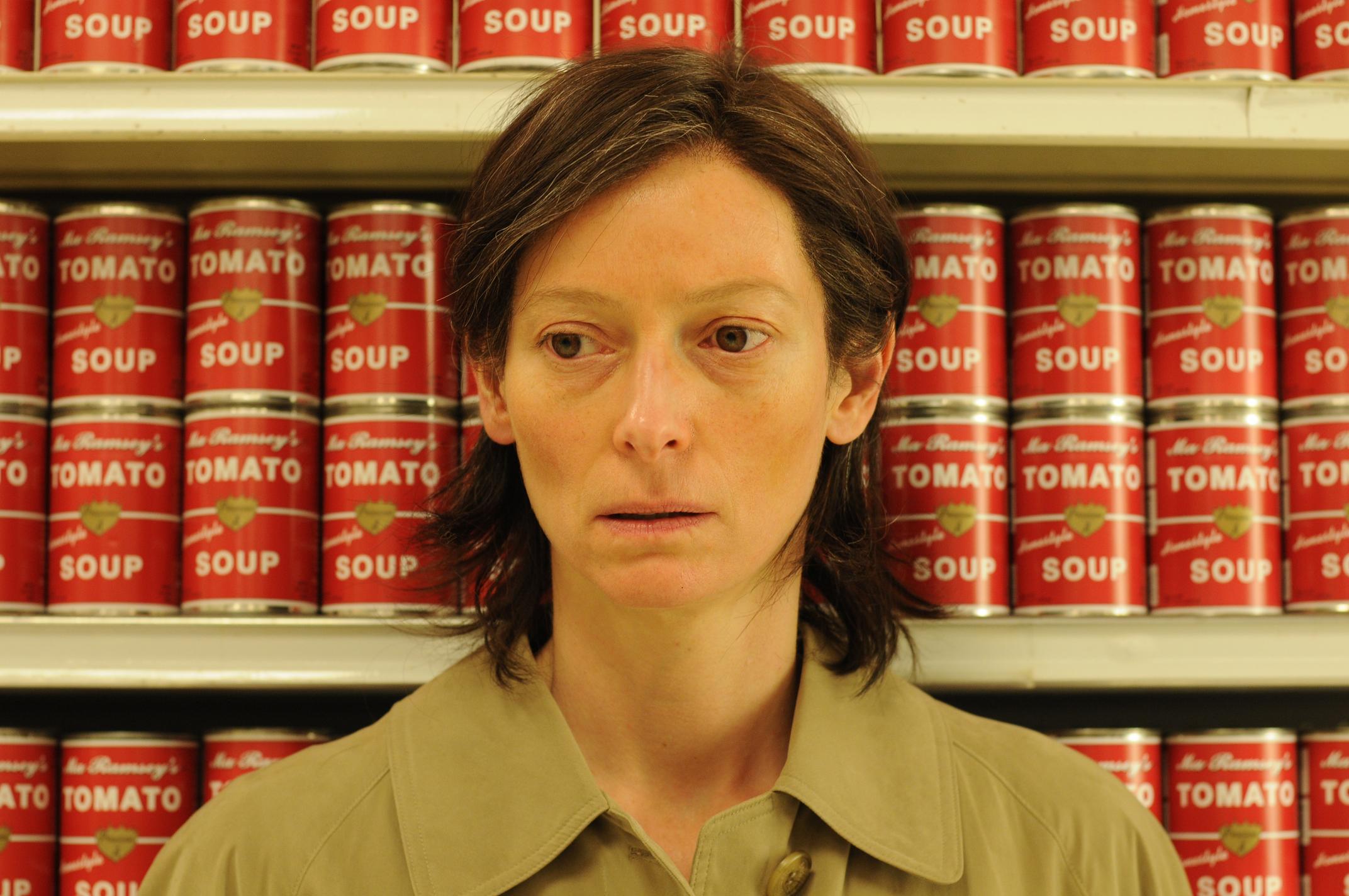
*We Need to Talk About Kevin It’s inevitable — whenever a seemingly preventable tragedy occurs, there’s public outcry to the tune of "How could this happen?" But after the school shooting in We Need to Talk About Kevin, the more apt question is "How could this not happen?" Lynne Ramsay (2002’s Morvern Callar) — directing from the script she co-adapted from Lionel Shriver’s novel — uses near-subliminal techniques to stir up atmospheric unease from the very start, with layered sound design and a significant, symbolic use of the color red. While other Columbine-inspired films, including Elephant and Zero Day (both 2003), have focused on their adolescent characters, Kevin revolves almost entirely around Eva Khatchadourian (a potent Tilda Swinton) — grief-stricken, guilt-riddled mother of a very bad seed. The film slides back and forth in time, allowing the tension to build even though we know how the story will end, since it’s where the movie starts: with Eva, alone in a crappy little house, working a crappy little job, moving through life with the knowledge that just about everyone in the world hates her guts. Kevin is very nearly a full-blown horror movie, and the demon-seed stuff does get a bit excessive. But it’s hard to determine if those scenes are "real life" or simply the way Eva remembers them, since Kevin is so tightly aligned with Eva’s point of view. Though she’s miserable in the flashbacks, the post-tragedy scenes are even thicker with terror; the film’s most unsettling sequence unfolds on Halloween, horror’s favorite holiday; Eva drives past a mob of costumed trick-or-treaters as Buddy Holly’s "Everyday" (one of several inspired music choices) chimes on the soundtrack. Masked faces are turn to stare — accusingly? Coincidentally? Do they even know she’s Kevin’s mother? — with nightmarish intensity heightened by slow motion. And indeed, "Everyday" Eva deals with accepting her fate; the film is sympathetic to her even while suggesting that she may actually be responsible. For a longer review of this film, and an interview with director Ramsay, visit www.sfbg.com/pixel_vision. (1:52) (Eddy)

ONGOING

Act of Valor (1:45) 1000 Van Ness, Sundance Kabuki.

Albert Nobbs The titular character in Rodrigo Garcia’s film is a butler of ideal bone-stiff propriety and subservience in a Dublin hotel whose well-to-do clients expect no less from the hired help. Even his fellow workers know almost nothing about middle aged Albert, and he’s so dully harmless they don’t even notice that lack. Yet Albert has a big secret: he is a she, played by Glenn Close, having decided this cross dressing disguise was the only way out of a Victorian pauper’s life many years ago. Chance crosses Albert’s path with housepainter Hubert (Janet McTeer), who turns out to be harboring precisely the same secret, albeit more merrily — "he" has even found happy domesticity with an understanding wife. Albert dreams of finding the same with a comely young housemaid (Mia Wasikowska), though she’s already lost her silly head over a loutish but handsome handyman (Aaron Johnson) much closer to her age. This period piece is more interesting in concept rather than in execution, as the characters stay all too true to mostly one-dimensional types, and the story of minor intrigues and muffled tragedies springs very few surprises. It’s an honorable but not especially rewarding affair that clearly exists mostly as a setting for Close’s impeccable performance — and she knows it, having written the screenplay and produced; she’s also played this part on stage before. Yet even that accomplishment has an airless feel; you never forget you’re watching an actor "transform," and for all his luckless pathos, Albert is actually a pretty tedious fellow. (1:53) Opera Plaza, Presidio. (Harvey)

*The Artist With the charisma-oozing agility of Douglas Fairbanks swashbuckling his way past opponents and the supreme confidence of Rudolph Valentino leaning, mid-swoon, into a maiden, French director-writer Michel Hazanavicius hits a sweet spot, or beauty mark of sorts, with his radiant new film The Artist. In a feat worthy of Fairbanks or Errol Flynn, Hazanavicius juggles a marvelously layered love story between a man and a woman, tensions between the silents and the talkies, and a movie buff’s appreciation of the power of film — embodied in particular by early Hollywood’s union of European artistry and American commerce. Dashing silent film star George Valentin (Jean Dujardin, who channels Fairbanks, Flynn, and William Powell — and won this year’s Cannes best actor prize) is at the height of his career, adorable Jack Russell by his side, until the talkies threaten to relegate him to yesterday’s news. The talent nurtured in the thick of the studio system yearns for real power, telling the newspapers, "I’m not a puppet anymore — I’m an artist," and finances and directs his own melodrama, while his youthful protégé Peppy Miller (Bérénice Béjo) becomes a yakky flapper age’s new It Girl. Both a crowd-pleasing entertainment and a loving précis on early film history, The Artist never checks its brains at the door, remaining self-aware of its own conceit and its forebears, yet unashamed to touch the audience, without an ounce of cynicism. (1:40) Balboa, California, Embarcadero, Marina, 1000 Van Ness, Piedmont, Sundance Kabuki. (Chun)

*Chico and Rita This Spain-U.K. production is at heart a very old-fashioned musical romance lent novelty by its packaging as a feature cartoon. Chico (voiced by Eman Xor Oña) is a struggling pianist-composer in pre-Castro Havana who’s instantly smitten by the sight and sound of Rita (Limara Meneses, with Idania Valdés providing vocals), a chanteuse similarly ripe for a big break. Their stormy relationship eventually sprawls, along with their careers, to Manhattan, Hollywood, Paris, Las Vegas, and Havana again, spanning decades as well as a few large bodies of water. This perpetually hot, cold, hot, cold love story isn’t very complicated or interesting — it’s pretty much "Boy meets girl, generic complications ensue" — nor is the film’s simple graphics style (reminiscent of 1970s Ralph Bakshi, minus the sleaze) all that arresting, despite the established visual expertise of Fernando Trueba’s two co directors Javier Mariscal and Tono Errando. When a dream sequence briefly pays specific homage to the modernist animation of the ’50s-early ’60s, Chico and Rita delights the eye as it should throughout. Still, it’s pleasant enough to the eye, and considerably more than that to the ear — there’s new music in a retro mode from Bebo Valdes, and plenty of the genuine period article from Monk, Mingus, Dizzy Gillespie, Chano Pozo and more. If you’ve ever jones’d for a jazzbo’s adult Hanna Barbera feature (complete with full-frontal cartoon nudity — female only, of course), your dream has come true. (1:34) Opera Plaza, Smith Rafael. (Harvey)

*Chronicle A misfit (Dane DeHaan) with an abusive father and an ever-present video camera, his affable cousin (Matt Garretty), and a popular jock (Michael B. Jordan) discover a strange, glowing object in the woods; before long, the boys realize they are newly telekinetic. At first, it’s all a lark, pulling pranks and — in the movie’s most exhilarating scene — learning to fly, but the fun ends when the one with the anger problem (guess which) starts abusing the ol’ with-great-power-comes-great-responsibilities creed. Chronicle is a pleasant surprise in a time when it’s better not to expect much from films aimed at teens; it grounds the superhero story in a (mostly) believable high-school setting, gently intellectualizes the boys’ dilemma ("hubris" is discussed), and also understands how satisfying it is to see superpowers used in the service of pure silliness — like, say, pretending you just happen to be really, really, really, good at magic tricks. First-time feature director Josh Trank and screenwriter Max "son of John" Landis also find creative ways, some more successful than others, to work with the film’s "self-shot" structure. The technique (curse you, Blair Witch) is long past feeling innovative, but Chronicle amply justifies its use in telling its story. (1:23) 1000 Van Ness. (Eddy)

*Coriolanus For his film directing debut, Ralph Fiennes has chosen some pretty strong material: a military drama that is among Shakespeare’s least popular works, not that adapting the Bard to the screen has ever been easy. (Look how many times Kenneth Branagh, an even more fabled Shakespearean Brit on stage than Ralph, has managed to fumble that task.) The titular war hero, raised to glory in battle and little else, is undone by political backstabbers and his own contempt for the "common people" when appointed to a governmental role requiring some diplomatic finesse. This turn of events puts him right back in the role he was born for: that of ruthless, furious avenger, no matter that now he aims to conquer the Rome he’d hitherto pledged to defend. The setting of a modern city in crisis (threadbare protesting masses vs. oppressive police state) works just fine, Elizabethan language and all, as does Fiennes’ choice of a gritty contemporary action feel (using cinematographer Barry Ackroyd of 2006’s United 93 and 2008’s The Hurt Locker). He’s got a strong supporting cast — particularly Vanessa Redgrave as Coriolanus’ hawkish mother Volumnia — and an excellent lead in one Ralph Fiennes, who here becomes so warped by bloodthirst he seems to mutate into Lord Voldemort before our eyes, without need of any prosthetics. His crazy eyes under a razored bald pate are a special effect quite alarmingly inhuman enough. (2:03) Bridge. (Harvey)

*The Descendants Like all of Alexander Payne’s films save 1996 debut Citizen Ruth, The Descendants is an adaptation, this time from Kaui Hart Hemmings’ excellent 2007 novel. Matt King (George Clooney) is a Honolulu lawyer burdened by various things, mostly a) being a haole (i.e. white) person nonetheless descended from Hawaiian royalty, rich in real estate most natives figure his kind stole from them; and b) being father to two children by a wife who’s been in a coma since a boating accident three weeks ago. Already having a hard time transitioning from workaholic to hands-on dad, Matt soon finds out this new role is permanent, like it or not — spouse Elizabeth (Patricia Hastie, just briefly seen animate) will not wake up. The Descendants covers the few days in which Matt has to share this news with Elizabeth’s loved ones, mostly notably Shailene Woodley and Amara Miller as disparately rebellious teen and 10-year-old daughters. Plus there’s the unpleasant discovery that the glam, sporty, demanding wife he’d increasingly seemed "not enough" for had indeed been looking elsewhere. When has George Clooney suggested insecurity enough to play a man afraid he’s too small in character for a larger-than-life spouse? But dressed here in oversized shorts and Hawaiian shirts, the usually suave performer looks shrunken and paunchy; his hooded eyes convey the stung joke’s-on-me viewpoint of someone who figures acknowledging depression would be an undeserved indulgence. Payne’s film can’t translate all the book’s rueful hilarity, fit in much marital backstory, or quite get across the evolving weirdness of Miller’s Scottie — though the young actors are all fine — but the film’s reined-in observations of odd yet relatable adult and family lives are all the more satisfying for lack of grandiose ambition. (1:55) Four Star, Piedmont, Presidio, SF Center, Shattuck, Sundance Kabuki. (Harvey)

Ghost Rider: Spirit of Vengeance (1:36) 1000 Van Ness, SF Center.

*The Girl With the Dragon Tattoo The meeting of Stieg Larsson’s first "Millennium" book and David Fincher promised fireworks, as he’s a director who can be equally vivid and exacting with just the elements key to the series: procedural detail, obsession, violence, tweaked genre conventions, mind games, haunted protagonists, and expansive story arcs. But perhaps because this possible franchise launch had to be rushed into production to ride the Larsson wave, what should have been a terrific matchup turns out to be just a good one — superior in some stylistic departments (notably Trent Reznor and Atticus Ross’ pulsing score), but overall neither an improvement nor a disappointment in comparison to the uninspired but effective 2009 Swedish film version. Daniel Craig plays Mikael Blomkvist, the muckraking Stockholm journalist whose public disgrace after a failed expose of a suspect corporate tycoon makes him the perfect candidate for an unexpected assignment: staying sequestered in the wealthy, warring Vanger clan’s island home to secretly investigate a teenage girl’s disappearance and presumed murder 40 years ago. His testy helpmate is the singular Lisbeth Salander (Rooney Mara), antisocial hacker, researcher, and ex-mental patient par excellence. Nearly three hours long, the compressed, slightly altered (get over it) storyline nonetheless feels rushed at times; Fincher manages the rare feat of making mostly internet research exciting in filmic terms, yet oddly the book’s more shocking episodes of sex and/or mayhem don’t have the memorable impact one might expect from him. The leads are fine, as is the big support cast of recognizable faces (Christopher Plummer, Stellan Skarsgård, Robin Wright, etc.) But the knockout suspense, atmosphere, and urgency one hoped for isn’t present in this intelligent, not entirely satisfying treatment. On the other hand, maybe those who’ve already read the books and seen the prior films have already had so much exposure to this material that a revelatory experience is no longer possible. (2:38) Castro. (Harvey)

Gone Still-shaky if now highly self-defensive Jill (Amanda Seyfried) was abducted from her bed a year ago, thrown into a deep hole in a forest outside Portland, Ore., and escaped death only by overcoming her barely-glimpsed captor. Or so she insists — the police never found any corroborating evidence, and given Jill’s history of mental instability, wrote off her whole purported adventure as delusional. When sister Molly (Emily Wickersham) goes inexplicably missing the morning of an important exam, however, Jill is convinced the serial kidnapper-killer has struck again, going off on a frantic manhunt of her own with no help from the authorities. There is nothing spectacularly wrong with Gone, but nothing right, either — to justify the ponying up of cash money at a theater these days you have to offer something a little more than the routine execution of a derivative, uninspired script with little suspense but plenty of plot holes. That sort of thing is best experienced at a sleepless 2 a.m. on cable, for free. (1:34) 1000 Van Ness, SF Center. (Harvey)

Hugo Hugo turns on an obviously genius conceit: Martin Scorsese, working with 3D, CGI, and a host of other gimmicky effects, creates a children’s fable that ultimately concerns one of early film’s pioneering special-effects fantasists. That enthusiasm for moviemaking magic, transferred across more than a century of film history, was catching, judging from Scorsese’s fizzy, exhilarating, almost-nauseating vault through an oh-so-faux Parisian train station and his carefully layered vortex of picture planes as Hugo Cabret (Asa Butterfield), an intrepid engineering genius of an urchin, scrambles across catwalk above a buzzing station and a hotheaded station inspector (Sacha Baron Cohen). Despite the special effects fireworks going off all around him, Hugo has it rough: after the passing of his beloved father (Jude Law), he has been stuck with an nasty drunk of a caretaker uncle (Ray Winstone), who leaves his duties of clock upkeep at a Paris train station to his charge. Hugo must steal croissants to survive and mechanical toy parts to work on the elaborate, enigmatic automaton he was repairing with his father, until he’s caught by the fierce toy seller (Ben Kingsley) with a mysterious lousy mood and a cute, bright ward, Isabelle (Chloe Grace Moretz). Although the surprisingly dark-ish Hugo gives Scorsese a chance to dabble a new technological toolbox — and the chance to wax pedantically, if passionately, about the importance of film archival studies — the effort never quite despite transcends its self-conscious dazzle, lagging pacing, diffuse narrative, and simplistic screenplay by John Logan, based on Brian Selznick’s book. Even the actorly heavy lifting provided by assets like Kingsley and Moretz and the backloaded love for the fantastic proponents at the dawn of filmmaking fail to help matters. Scorsese attempts to steal a little of the latters’ zeal, but one can only imagine what those wizards would do with motion-capture animation or a blockbuster-sized server farm. (2:07) Four Star, Presidio, Shattuck, Sundance Kabuki. (Chun)

*In Darkness Agnieszka Holland is that kind of filmmaker who can become a well known, respectable veteran without anyone being quite sure what those decades have added up to. Her mentor was Andrzej Wadja, the last half-century’s leading Polish director (among those who never left). He helped shape a penchant for heavy historical drama and a sometimes clunky style not far from his own. She commenced her international career with 1985’s Angry Harvest, about the amorous relationship between a Polish man and the Austrian, a Jewish woman, he hides during Nazi occupation. Her one indispensable feature is 1990’s Europa, Europa, an ideal vehicle for her favored mix of the grotesque, sober, and factual — following a Jewish boy who passed as Aryan German. The new In Darkness is her best since then, and it can’t be chance that this too dramatizes a notably bizarre case of real-life peril and survival under the Nazis. Its protagonist is Leopold Socha (Robert Wieckiewicz), an ordinary family man in Lvov (Poland then, Ukraine now) who’s not above exploiting the disarray of occupation and war to make ends meet. A sewer inspector, he uses his knowledge of underground tunnels to hide Jews who can pay enough when even the fenced-off ghetto is no longer safe. For such a long, oppressive, and literally dark film, this one passes quickly, maintaining tension as well as a palpable physical discomfort that doubtlessly suggests just a fraction what the refugees actually suffered. In Darkness isn’t quite a great movie, but it’s a powerful experience. At the end it’s impossible to be unmoved, not least because the director’s resistance toward Spielbergian exaltation insists on the banal and everyday, even in human triumph. (2:25) Embarcadero. (Harvey)

The Iron Lady Curiously like Clint Eastwood’s 2011 J. Edgar, this biopic from director Phyllida Lloyd and scenarist Abi Morgan takes on a political life of length, breadth and controversy — yet it mostly skims over the politics in favor of a generally admiring take on a famous narrow-minded megalomaniac’s "gumption" as an underdog who drove herself to the top. Looking back on her career from a senile old age spent in the illusory company of dead spouse Denis (Jim Broadbent), Meryl Streep’s ex-British Prime Minister Margaret Thatcher steamrolls past hurdles of class and gender while ironically re-enforcing the fustiest Tory values. She’s essentially a spluttering Lord in skirts, absolutist in her belief that money and power rule because they ought to, and any protesting rabble don’t represent the "real England." That’s a mindset that might well have been explored more fruitfully via less flatly literal-minded portraiture, though Lloyd does make a few late, lame efforts at sub-Ken Russell hallucinatory style. Likely to satisfy no one — anywhere on the ideological scale — seriously interested in the motivations and consequences of a major political life, this skin-deep Lady will mostly appeal to those who just want to see another bravura impersonation added to La Streep’s gallery. Yes, it’s a technically impressive performance, but unlikely to be remembered as one of her more depthed ones, let alone among her better vehicles. (1:45) Albany, Marina, Vogue. (Harvey)

My Week With Marilyn Statuette-clutching odds are high for Michelle Williams, as her impersonation of a famous dead celebrity is "well-rounded" in the sense that we get to see her drunk, disorderly, depressed, and so forth. Her Marilyn Monroe is a conscientious performance. But when the movie isn’t rolling in the expected pathos, it’s having other characters point out how instinctive and "magical" Monroe is onscreen — and Williams doesn’t have that in her. Who could? Williams is remarkable playing figures so ordinary you might look right through them on the street, in Wendy and Lucy (2008), Blue Valentine (2010), etc. But as Monroe, all she can do is play the little-lost girl behind the sizzle. Without the sizzle. Which is, admittedly, exactly what My Week — based on a dubious true story — asks of her. It is true that in 1956 the Hollywood icon traveled to England to co-star with director Sir Laurence Olivier (Kenneth Branagh) in a fluff romance, The Prince and the Showgirl; and that she drove him crazy with her tardiness, mood swings, and crises. It’s debatable whether she really got so chummy with young production gofer Colin Clark, our wistful guide down memory lane. He’s played with simpering wide-eyed adoration by Eddie Redmayne, and his suitably same-aged secondary romantic interest (Emma Watson) is even duller. This conceit could have made for a sly semi-factual comedy of egos, neurosis, and miscommunication. But in a rare big-screen foray, U.K. TV staples director Simon Curtis and scenarist Adrian Hodges play it all with formulaic earnestness — Marilyn is the wounded angel who turns a starstruck boy into a brokenhearted but wiser man as the inevitable atrocious score orders our eyes to mist over. (1:36) Clay, Four Star, Shattuck. (Harvey)

Norwegian Wood Haruki Murakami’s global best-seller — a melancholic, late-1960s love story — hits the big screen thanks to Tran Anh Hung (1993’s The Scent of the Green Papaya). Kenichi Matsuyama (2011’s Gantz, 2005’s Linda Linda Linda) and Rinko Kikuchi (2006’s Babel) play Watanabe and Naoko, a young couple who reconnect in Tokyo after the suicide of his best friend, who was also her childhood sweetheart. There’s love between them, but Naoko is mentally fragile; she flees town suddenly after they sleep together for the first time. Meanwhile, Watanabe meets the vivacious Midori (Kiko Mizuhara) — who is also already involved, though not quite so deeply as he — and they spark, though he’s devoted to Naoko, and visits her at the rural hospital where she’s (sort of) working through her emotional issues. Tran is an elegant filmmaker, and Radiohead’s Jonny Greenwood contributes an appropriately moody score. But amid all the breathless encounters, the uber-emo Norwegian Wood drags a bit at over two hours, and the film never quite crystallizes what it was about Murakami’s book that inspired such international rapture. (2:13) Four Star. (Eddy)

*Pina Watching Pina Bausch’s choreography on film should not have been as absorbing and deeply affecting of an experience as it was. Dance on film tends to disappoint — the camera flattens the body and distorts perspective, and you either see too many or not enough details. However, improved 3D technology gave Wim Wenders (1999’s Buena Vista Social Club; 1987’s Wings of Desire) the additional tools he needed to accomplish what he and fellow German Bausch had talked about for 20 years: collaborating on a documentary about her work. Instead of making a film about the rebel dance maker, Wenders made it for Bausch, who died in June 2009, two days before the start of filming. Pina is an eloquent tribute to a tiny, soft-spoken, mousy-looking artist who turned the conventions of theatrical dance upside down. She was a great artist and true innovator. Wenders’ biggest accomplishment in this beautifully paced and edited document is its ability to elucidate Bausch’s work in a way that words probably cannot. While it’s good to see dance’s physicality and its multi dimensionality on screen, it’s even better that the camera goes inside the dances to touch tiny details and essential qualities in the performers’ every gesture. No proscenium theater can offer that kind of intimacy. Appropriately, intimacy (the eternal desire for it) and loneliness (an existential state of being) were the two contradictory forces that Bausch kept exploring over and over. And by taking fragments of the dances into the environment — both natural and artificial — of Wuppertal, Germany, Wenders places them inside the emotional lives of ordinary people, subjects of all of Bausch’s work. (1:43) Shattuck, Sundance Kabuki. (Rita Felciano)

Rampart Fans of Dexter and a certain dark knight will empathize with this final holdout for rogue law enforcement, LAPD-style, in the waning days of the last century. And Woody Harrelson makes it easy for everyone else to summon a little sympathy for this devil in a blue uniform: he slips so completely behind the sun- and booze-burnt face of David "Date Rape" Brown, an LAPD cop who ridicules young female cops with the same scary, bullying certainty that he applies to interrogations with bad guys. The picture is complicated, however, by the constellation of women that Date Rape has sheltered himself with. Always cruising for other lonely hearts like lawyer Linda (Robin Wright), he still lives with the two sisters he once married (Cynthia Nixon, Anne Heche) and their daughters, including the rebellious Helen (Brie Larson), who seems to see her father for who he is — a flawed, flailing anti-hero suffering from severe testosterone poisoning and given to acting out. Harrelson does an Oscar-worthy job of humanizing that everyday monster, as director Oren Moverman (2009’s The Messenger), who cowrote the screenplay with James Ellroy, takes his time to blur out any residual judgement with bokeh-ish points of light while Brown — a flip, legit side of Travis Bickle — just keeps driving, unable to see his way out of the darkness. (1:48) Embarcadero. (Chun)

*Roadie Michael Cuesta’s first film as both director and writer (again co-authoring with brother Gerald) since 2001’s startling debut feature L.I.E. is also his best work since then. After nearly a quarter-centurty spent schlepping equipment for Blue Oyster Cult — the arty metal band ("Don’t Fear the Reaper," i.e. "more cowbell!") that was already sliding from the spotlight when he signed on — Jimmy Testergross (Ron Eldard) is fired, the reasons unknown to us. With nowhere else to go, he lands on the doorstep of his childhood home in Queens, where he hasn’t been seen in at least 20 years. Mom (Lois Smith) is going senile, though somehow her disapproval comes through with perfect clarity (and hasn’t changed in all that time). Seeking a liquid solace at a bar, our hero instead runs into Randy (Bobby Cannavale), who bullied him mercilessly way back when — and is now married to "Jimmy Testicle’s" still-hot former girlfriend Nikki (Jill Hennessey), who has rock-star aspirations of her own. Taking place over less than 24 hours’ span, Roadie is a very small character study, but a well-observed one. "Developmentally stunted by rock ‘n’ roll," as one character puts it (when it emerges 40-something Jimmy has never learned to make coffee for himself), its protagonist is the kind of likable boy-man loser usually found in Fountains of Wayne songs, an aging lifelong air guitarist pining over good old days that probably weren’t even that good. His nostalgia is as touchingly hapless as his dubious future. (1:35) SF Film Society Cinema. (Harvey)

Safe House Frankly, Denzel Washington watchers are starved for another movie in which he’s playing the smartest guy in the room. Despite being hampered by a determinedly murky opening, Safe House should mostly satisfy. Washington’s Tobin Frost is well-used to dwelling into a grayed-out borderland of black ops and flipped alliances — a onetime CIA star, he now trades secrets while perpetually on the run. Fleeing from killers of indeterminate origin, Tobin collides headlong with eager young agent Matt (Ryan Reynolds), who’s stuck maintaining a safe house in Cape Town, South Africa. Tasked with holding onto Tobin’s high-level player by his boss (Brendan Gleeson) and his boss’s boss (Sam Shepard), Matt is determined to prove himself, retain and by extension protect Tobin (even when the ex-superspy is throttling him from behind amid a full-speed car chase), and resist the magnetic pull of those many hazardous gray zones. Surrounded by an array of actorly heavies, including Vera Farmiga, who collectively ratchet up and invest this possibly not-very-interesting narrative — "Bourne" there; done that — with heart-pumping intensity, Washington is magnetic and utterly convincing as the jaded mouse-then-cat-then-mouse toying with and playing off Reynolds go-getter innocent. Safe House‘s narrative doesn’t quite fill in the gaps in Tobin Frost’s whys and wherefores, and the occasional ludicrous breakthroughs aren’t always convincing, but the film’s overall, familiar effect should fly, even when it’s playing it safe (or overly upstanding, especially when it comes to one crucial, climactic scrap of dialogue from "bad guy" Washington, which rings extremely politically incorrect and tone-deaf). (2:00) 1000 Van Ness, SF Center, Sundance Kabuki. (Chun)

*A Separation Iran’s first movie to win Berlin’s Golden Bear (as well as all its acting awards), this domestic drama reflecting a larger socio-political backdrop is subtly well-crafted on all levels, but most of all demonstrates the unbeatable virtue of having an intricately balanced, reality-grounded screenplay — director Asghar Farhadi’s own — as bedrock. A sort of confrontational impartiality is introduced immediately, as our protagonists Nader (Peyman Moadi) and Simin (Leila Hatami) face the camera — or rather the court magistrate — to plead their separate cases in her filing for divorce, which he opposes. We gradually learn that their 14-year wedlock isn’t really irreparable, the feelings between them not entirely hostile. The roadblock is that Simin has finally gotten permission to move abroad, a chance she thinks she must seize for the sake of their daughter, Termeh (Sarina Farhadi). But Nader doesn’t want to leave the country, and is not about to let his only child go without him. Farhadi worked in theater before moving into films a decade ago. His close attention to character and performance (developed over several weeks’ pre-production rehearsal) has the acuity sported by contemporary playwrights like Kenneth Lonergan and Theresa Rebeck, fitted to a distinctly cinematic urgency of pace and image. There are moments that risk pushing plot mechanizations too far, by A Separation pulls off something very intricate with deceptive simplicity, offering a sort of integrated Rashomon (1950) in which every participant’s viewpoint as the wronged party is right — yet in conflict with every other. (2:03) Albany, Embarcadero. (Harvey)

*The Secret World of Arrietty It’s been far too long between 2008’s Ponyo, the last offering from Studio Ghibli, and this feature-length adaptation of Mary Norton’s children’s classic, The Borrowers, but the sheer beauty of the studio’s hand-drawn animation and the effortless wonder of its tale more than make up for the wait. This U.S. release, under the very apropos auspices of Walt Disney Pictures, comes with an American voice cast (in contrast with the U.K. version), and the transition appears to be seamless — though, of course, the background is subtly emblazoned with kanji, there are details like the dinnertime chopsticks, and the characters’ speech rhythms, down to the "sou ka" affirmative that peppers all Japanese dialogue. Here in this down-low, hybridized realm, the fearless, four-inches-tall Arrietty (voiced by Bridgit Mendler) has grown up imaginative yet lonely, believing her petite family is the last of their kind: they’re Borrowers, a race of tiny people who live beneath the floorboards of full-sized human’s dwellings and take what they need to survive. Despite the worries of her mother Homily (Amy Poehler), Arrietty begins to embark on borrowing expeditions with her father Pod (Will Arnett) — there are crimps in her plans, however: their house’s new resident, a sickly boy named Shawn (David Henrie), catches a glimpse of Arrietty in the garden, and caretaker Hara (Carol Burnett) has a bit of an ulterior motive when it comes to rooting out the wee folk. Arrietty might not be for everyone — some kids might churn in their seats with ADD-style impatience at this graceful, gentle throwback to a pre-digital animation age — but in the care of first-time director Hiromasa Yonebayashi and Ghibli mastermind Hayao Miyazaki, who wrote co-wrote the screenplay, Arrietty will transfix other youngsters (and animation fans of all ages) with the glorious detail of its natural world, all beautifully amplified and suffused with everyday magic when viewed through the eyes of a pocket-sized adventurer. (1:35) California, 1000 Van Ness, Sundance Kabuki. (Chun)

*Shame It’s been a big 2011 for Michael Fassbender, with Jane Eyre, X-Men: First Class, Shame, and A Dangerous Method raising his profile from art-house standout to legit movie star (of the "movie stars who can also act" variety). Shame may only reach one-zillionth of X-Men‘s audience due to its NC-17 rating, but this re-teaming with Hunger (2008) director Steve McQueen is Fassbender’s highest achievement to date. He plays Brandon, a New Yorker whose life is tightly calibrated to enable a raging sex addiction within an otherwise sterile existence, including an undefined corporate job and a spartan (yet expensive-looking) apartment. When brash, needy, messy younger sister Cissy (Carey Mulligan, speaking of actors having banner years) shows up, yakking her life all over his, chaos results. Shame is a movie that unfolds in subtle details and oversized actions, with artful direction despite its oft-salacious content. If scattered moments seem forced (loopy Cissy’s sudden transformation, for one scene, into a classy jazz singer), the emotions — particularly the titular one — never feel less than real and raw. (1:39) Lumiere. (Eddy)

Star Wars: Episode 1: The Phantom Menace 3D (2:16) SF Center, Sundance Kabuki.

*Straight Outta Hunters Point 2 In 2001, filmmaker Kevin Epps turned a camera on his own neighborhood: Bayview-Hunters Point, the southeastern San Francisco community best-known by outsiders for Candlestick Park, toxic pollution, and gang violence. Straight Outta Hunters Point was an eye-opener not just locally but internationally, as its runaway success opened doors for Epps to travel with the film and establish his career. These days, Epps is no longer an emerging talent — he’s a full-time independent filmmaker with multiple credits (including The Black Rock, a documentary about Alcatraz’s African American inmates, and hip-hop film Rap Dreams), collaborations (with Current TV and others), and an artist fellowship at the de Young Museum under his belt. For his newest project, he returns to the scene of his first work. He no longer resides in Bayview-Hunters Point, but he still lives close by, and he’s never lost touch with the community that inspired the first film and encouraged him to make its follow-up. Described by Epps as a "continuation of the conversation" launched by the first film, SOHP 2 investigates the community as it stands today, with both external (redevelopment) and internal (violence) pressures shaping the lives of those who live there. It’s a raw, real story that unspools with urgency and the unvarnished perspective of an embedded eyewitness. (1:20) Roxie. (Eddy)

*Tinker Tailor Soldier Spy Tomas Alfredson (2008’s Let the Right One In) directs from Bridget O’Connor and Peter Straughan’s sterling adaptation of John le Carré’s classic spy vs. spy tale, with Gary Oldman making the role of George Smiley (famously embodied by Alec Guinness in the 1979 miniseries) completely his own. Your complete attention is demanded, and deserved, by this tale of a Cold War-era, recently retired MI6 agent (Oldman) pressed back into service at "the Circus" to ferret out a Soviet mole. Building off Oldman’s masterful, understated performance, Alfredson layers intrigue and an attention to weird details (a fly buzzing around a car, the sound of toast being scraped with butter) that heighten the film’s deceptively beige 1970s palette. With espionage-movie trappings galore (safe houses, code machines), a returned-to flashback to a surreal office Christmas party, and bang-on supporting performances by John Hurt, Mark Strong, Colin Firth, Toby Jones, and the suddenly ubiquitous Benedict Cumberbatch, Tinker Tailor epitomizes rule one of filmmaking: show me, don’t tell me. A movie that assumes its audience isn’t completely brain-dead is cause for celebration and multiple viewings — not to mention a place among the year’s best. (2:07) Piedmont, Shattuck, Sundance Kabuki. (Eddy)

Tyler Perry’s Good Deeds (1:51) 1000 Van Ness, Shattuck.

"2011 Oscar-Nominated Short Films, Live Action and Animated" Lumiere, Opera Plaza, Shattuck, Smith Rafael.

The Vow A rear-ender on a snowy Chicago night tests the nuptial declarations of a recently and blissfully married couple, recording studio owner Leo (Channing Tatum) and accomplished sculptor Paige (Rachel McAdams). When the latter wakes up from a medically induced coma, she has no memory of her husband, their friends, their life together, or anything else from the important developmental stage in which she dropped out of law school, became estranged from her regressively WASP-y family, stopped frosting her hair and wearing sweater sets, and broke off her engagement to preppy power-douchebag Jeremy (Scott Speedman). Watching Paige malign her own wardrobe and "weird" hair and rediscover the healing powers of a high-end shopping spree is disturbing; she reenters her old life nearly seamlessly, and the warm spark of her attraction to Leo, which we witness in a series of gooey flashbacks, feels utterly extinguished. And, despite the slurry monotone of Tatum’s line delivery, one can empathize with a sense of loss that’s not mortal but feels like a kind of death — as when Paige gazes at Leo with an expression blending perplexity, anxiety, irritation, and noninvestment. But The Vow wants to pluck on our heartstrings and inspire a glowing, love-story-for-the-ages sort of mood, and the film struggles to make good on the latter promise. Its vague evocations of romantic destiny mostly spark a sense of inevitability, and Leo’s endeavors to walk his wife through retakes of scenes from their courtship are a little more creepy and a little less Notebook-y than you might imagine. (1:44) 1000 Van Ness, SF Center. (Rapoport)

*Wanderlust When committed Manhattanites George (Paul Rudd) and Linda (Jennifer Aniston) find themselves in over their heads after George loses his job, the two set off to regroup in Atlanta, with the reluctantly accepted help of George’s repellent brother Rick (Ken Marino). Along the way, they stumble upon Elysium, a patchouli-clouded commune out in the Georgia backcountry whose members include original communard Carvin (Alan Alda), a nudist novelist-winemaker named Wayne (Joe Lo Truglio), a glowingly pregnant hippie chick named Almond (Lauren Ambrose), and smarmy, sanctimonious, charismatic leader Seth (Justin Theroux). After a short, violent struggle to adapt to life under Rick’s roof, the couple find themselves returning to Elysium to give life in an intentional community a shot, a decision that George starts rethinking when Seth makes a play for his wife. Blissed-out alfresco yoga practice, revelatory ayahuasca tea-induced hallucinations, and lectures about the liberating effects of polyamory notwithstanding, the road to enlightenment proves to be paved with sexual jealousy, alienation, placenta-soup-eating rituals, and group bowel movements. Writer-director David Wain (2001’s Wet Hot American Summer, 2008’s Role Models) — who shares writing credits with Marino — embraces the hybrid genre of horror comedy in which audience laughter is laced with agonized embarrassment, and his cast gamely partake in the group hug, particularly Theroux and Rudd, who tackles a terrifyingly lengthy scene of personal debasement with admirable gusto. (1:38) 1000 Van Ness, SF Center, Shattuck. (Rapoport)

W.E. Madonna’s first directorial feature, 2008’s Filth and Wisdom, was so atrocious, and the early word on this second effort so vitriolic, that there’s a temptation to give W.E. too much credit simply for not being a disgrace. Co-written by Madge and Alek Keshishian, it’s about two women in gilded cages. One is Wallis Simpson (the impressive Andrea Riseborough), a married American socialite who scandalized the world by divorcing her husband and running about with Edward, Prince of Wales (James D’Arcy), who had to abdicate the English throne in order to marry her in 1936. The other is fictive Wally Winthrop (Abbie Cornish), a childless Manhattan socialite in the late 1990s who’s neglected by her probably-unfaithful husband (Richard Coyle). Over-eagerly intertwined despite their trite-at-best overlaps (the main one being Wally’s obsession with Wallis), these two strands hold attention for a while. But eventually they grow turgid. We’re presumably meant to be carried away by their True Love, but the film doesn’t succeed in making Wallis and Edward seem more than two petulant, shallow snobs who were fortunate to find each other, but didn’t necessarily make one another better or more interesting people. (It also alternately denies and glosses over the couple’s fascist-friendly politics, which became an embarrassment as England fought Germany in World War II.) Meanwhile, Wally is a mopey blank too easily belittled by her spouse, and too handily rescued by a Prince Charming, or rather "Russian intellectual slumming as a security guard" (Oscar Isaac) working at Sotheby’s during an auction of the late royal couple’s estate. As is so often the case with Madonna, she seems to be saying something here, but precisely what is murky and probably not worth sussing
out. Likewise, the attention to showy surface aesthetics — in particular Arianne Phillips’ justifiably Oscar-nominated costumes — is fastidious, revealing, and to an extent satisfying in itself. Somewhat ambitious and in several ways quite well crafted, the handsomely appointed W.E. isn’t bad (surely it wouldn’t have attracted such hostility if directed by anyone else), but the flaws that finally suffocate it reach right down to its conceptual gist. There is, however, one lovely moment toward the end: Riseborough’s Wallis, a well-preserved septuagenarian, dancing an incongruous yet supremely self-assured twist on request for her bedridden husband. (1:59) Opera Plaza. (Harvey)

The Woman in Black Daniel Radcliffe (a.k.a. Harry Potter) plays a grieving young widower in an old-fashioned ghost story, set in the era of spirit hands and other visitations from beyond the veil. But while Victorian séances were generally aimed at the dearly departed, the titular visitant (Liz White), who haunts the isolated estate of Eel Marsh House and its environs, is a vindictive, mean-spirited creature, avenging the long-ago loss of her child by wreaking havoc and heartbreak among the families of the nearby village, among them a local landowner (Ciarán Hinds) and his wife (Janet McTeer). Radcliffe’s character, a lawyer named Arthur Kipps, has been tasked with settling the affairs of the mansion’s recently deceased owner, an assignment that requires sifting through mounds of dusty, crumpled ephemera in one of the creakiest, squeakiest buildings ever constructed. Set at the end of a narrow spit of land that disappears into the surrounding wetlands when the tide is high, Eel Marsh House is a charming place to be marooned after dark. But no amount of horrified screams from the audience will keep Kipps from his duties, though it’s hard to make much headway amid the unrelenting creepiness. Nearly every moment brings a fresh inexplicable thumping noise from an upper floor; a new room full of dead-eyed dolls that Kipps has no business wandering into; another freakishly screaming face next to his as he gazes out the window. The house is a richly textured set piece; the horror is of the sort that makes you jump and then laugh, both at the filmmakers, for springing the same tricks on you over and over, and at yourself, for falling prey to them every time. (1:36) 1000 Van Ness. (Rapoport)

On the Cheap Listings

0

On the Cheap listings are compiled by Soojin Chang. Submit items for the listings at listings@sfbg.com. For further information on how to submit items for the listings, see Picks.

WEDNESDAY 29

Nutrition class for cyclists Sport Basement, 1881 Ygnacio Valley, Walnut Creek. (925) 941-6100, www.sportbasement.com. 7 p.m.-8 p.m., free with RSVP. It is the worst when you’re still 20 minutes away from your destination and your energy decides to crash on you. In this nutrition class, experts give perspectives on quality food choices, review specific bars and powders, and provide simple and delicious recipes for on and off the bike.

Radical Directing lecture series with Terry Zwigoff San Francisco Art Institute, 800 Chestnut, SF. (415) 771-7020, www.sfai.edu. 7:30 p.m., free. Long-time San Franciscan Terry Zwigoff makes feature films out of underground comic strips and turns down corporate project offers in favor of ‘tooning for smaller outfits. Join Zwigoff as he discusses his experience writing screenplays and making documentaries.

THURSDAY 1

“After Dark: Vinyl” interactive presentation Exploratorium, 3601 Lyon, SF. (415) 561-0360, www.exploratorium.edu. 6 p.m.-10 p.m., free with museum admission. In the heyday of vinyl, records were made of fragile materials such as wax and shellac. Experimental physicist Carl Haber recovers the sweet tunes that we once believed were gone forever.

The End of Money: Counterfeiters, Preachers, Techies, Dreamers—and the Coming Cashless Society author discussion The Booksmith, 1644 Haight, SF. (415) 863-8688, www.booksmith.com. 7:30 p.m., free. These days, you can get far without the greenbacks — as long as you’ve got dough on your plastic. In his newest book, David Wolman embarks on a paper cash-less journey around the world, encountering people and technologies whose alternatively embrace and fear the end of tangible money.

“So You Think You Can Paint?” SoMa art party Club Six, 60 Sixth St., SF. (415) 863-1221, www.clubsix1.com. 7 p.m.-11 p.m., free. Your task is to complete as many eight-foot art pieces as you possibly can. If you have any doubts to your skills or just want to learn more, there will be a free art class from 6 p.m. to 7 p.m. Huge walls, paint, brushes, and tunes will be provided.

Nightlife’s Darkroom photography event California Academy of Sciences, 55 Music Concourse, SF. (415) 379-8000, www.calacademy.org/nightlife. 6 p.m.-10 p.m., $12. Come meet the folks from Instagram for a night dedicated to the recent transmutations of photography. Enjoy live music and images of beautiful coral reef while checking out the innovations of Lytro’s light field camera, artist Genevieve Quick’s hand-made cameras, Lomography’s analog cameras, and aerial photographer Michael Layesfsky’s balloon camera.

FRIDAY 2

True Stories Lounge story telling performance The Make-out Room, 3225 22nd St., SF. (415) 647-2888, www.makeoutroom.com. 7:30 p.m., $10. Telling a good story is a particularly difficult art to master. Join seven professional storytellers who’ll be keeping this oral tradition alive by divulging their memoirs, essays, reportages, and narrative column writings.

SATURDAY 3

Origami club San Francisco Public Library, 500 Cortland, SF. (415) 355-2810, www.sfpl.org. 2 p.m.-4 p.m., free. Ah, the progressive addiction of origami. First you’re making a crane, and then you’re drinking out of an ornate paper teacup. Not surprising at all that there is a local club devoted to the art — now where’s the 12-step program?

“Zeke Greenwald, Potential Roommate” comedy show 222 Hyde, SF. (415) 345-8222, www.222hyde.com. 8 p.m.-10 p.m., free. Anyone who has ever searched Craigslist for housing in San Francisco know of the comedic horror that lies within each potential roommate. Five local comedians stand up to share their stories.

Dr. Seuss’s birthday celebration Playland-Not-at-the-Beach, 10979 San Pablo, El Cerrito. (510) 592-3002, www.playland-not-at-the-beach.org. Through Sunday. 10 a.m.-5 p.m., $10 children; $15 general admission. Celebrate the birthday of the guy who reminded us all that crazy is awesome and the imagination is limitless. There will be penny arcades, haunted houses, interactive exhibits, and magic sideshows. High-fives for everyone who dresses up.

Sperm Whale Soiree art and science reception Randall Museum, 199 Museum, SF. (415) 561-6622, www.randallmuseum.org. 7 p.m.-10 p.m., $15 advance tickets. Moby Dick gave sperm whales a bad rep. But the truth is they’re extremely interesting animals that nowadays, are sadly endangered (no thanks to you, Captain Ahab). Learn about their amazing diving skills and their even more intriguing sex lives.

SUNDAY 4

Actual Jazz Series with the John Schott Trio and special guests Actual Cafe, 6334 San Pablo, Oakl. (510) 653-8386, www.actualcafe.com. 5 p.m., free. Actual Cafe’s new house band plays twice a month on first and third Sundays. Its set list includes everything from standard jazz to obscure Ukrainian songs. First Sundays feature younger jazz musicians from the Bay Area, guest singers, and spoken word collaborators.

MONDAY 5

Mental Aerobics San Francisco Public Library, 100 Larkin, SF. (415) 355-2822, www.sfpl.org. 1 p.m.-3:30 p.m., free. Feeling a little brain-dead lately? You can do something about that, y’know. Come work out your cerebral organs and spark your cognitive vitality in this class designed to get your synapses firing.

TUESDAY 6

Andy Warhol: Polaroids/Matrix 240 Berkeley Art Museum, 2626 Bancroft, Berk. (510) 642-0808, bampfa.berkeley.edu. Through May 20. Gallery hours Wed.-Sun. 11 a.m.-5 p.m., $7–$10. Long before Instagram, there was Polaroid. The Prince of Pop Andy Warhol took thousands of snapshots that were never shown to the public until now. Come check out photos of O.J. Simpson, Daryl Lillie, Diane von Furstenberg, and of course, bananas.

Nightlife: Fun plus jobs

8

By Supervisor Scott Weiner

OPINION We all know the cultural benefits of nightlife. It’s fun. We get to meet people — friends, lovers, and all the rest. We build community. We hear great music. We dance. We spend time outside on our streets. For LGBT people, we meet other LGBTs and keep our community strong. The list goes on: Without a strong entertainment scene, including bars, clubs, live music venues, arts venues, night-time restaurants, and street fairs, our city would be a less interesting and less diverse place.

But the undisputed cultural importance of nightlife isn’t the whole story. Nightlife is a significant economic contributor to San Francisco. It creates jobs, particularly for working-class and young people. It generates tax revenue that helps fund Muni, health clinics, and parks. It allows creative entrepreneurs to start businesses. It generates tourism. It draws foot traffic into neighborhoods to the benefit of other neighborhood businesses.

This is all pretty intuitive. Yet, as a city, we’ve never actually measured the economic impact of our nightlife scene. One of my first acts a member of the Board of Supervisors was to request the city economist to conduct an economic impact study doing just that.

The study is almost done, and we already have a few preliminary results. Nightlife in San Francisco generates $4.2 billion a year in spending, with $1 billion of that amount coming from bars, clubs, performance venues, and art spaces. Some 48,000 people are employed in nightlife businesses, and these businesses contribute $55 million a year in local taxes. On March 5, we’ll announce the full results of the study at a hearing of the Land Use and Economic Development Committee.

This data will help us make smart public policy around nightlife. In the past, those decisions frequently have been driven by anecdote and over-reaction to isolated events. Trouble near a small number of nightclubs? The city responds by making it difficult for all nightclubs to operate, even those with excellent safety records and despite the dramatic improvement in the Entertainment Commission’s oversight. Or, the city goes even further and proposes requiring all clubs, even small ones, to scan ID cards of everyone who enters. (That proposal, thankfully, was roundly rejected.)

When we make these decisions, we should do so with a full understanding not just of the downsides of nightlife but of the positives, including cultural and economic benefits.

Entertainment is under pressure in San Francisco. There are neighborhoods with significant friction between housing and nightlife. Some of that friction results from a small number of problem venues. Other times, a good venue is jeopardized for simply conducting its business within the limits of San Francisco law — for example, a single neighbor got Slim’s shut down for a few weeks for noise, despite the club’s compliance with our noise ordinance.

We also continue to have bizarre Planning Code restrictions that undermine entertainment, such as the Mission Alcohol Special Use District, which makes it difficult or impossible to start creative new businesses in the Mission if alcohol is involved. This provision almost prevented a new bowling alley from locating at 17th and South Van Ness. Similarly, some are concerned that the Western SoMa Plan, as currently written, will undermine nightlife on 11th Street by surrounding clubs with new housing and by reducing the number of venues.

A thriving nightlife scene is key to our city’s cultural identity and economic future. Now that we have the data on its benefits, we can take a more balanced and thoughtful approach.

Supervisor Scott Wiener represents District 8 on the Board of Supervisors. The March 5 hearing will start with a noon rally on the steps of City Hall followed by the hearing at 1 p.m. in City Hall Room 263.


Son burn: “We Need to Talk About Kevin” review

1

It’s inevitable — whenever a seemingly preventable tragedy occurs, there’s public outcry to the tune of “How could this happen?” (Exhibit A: recent events in Ohio.) But after the school shooting in We Need to Talk About Kevin, the more apt question is “How could this not happen?”

Lynne Ramsay (2002’s Morvern Callar) — directing from the script she co-adapted from Lionel Shriver’s novel — uses near-subliminal techniques to stir up atmospheric unease from the very start, with layered sound design and a significant, symbolic use of the color red. While other Columbine-inspired films, including Elephant and Zero Day (both 2003), have focused on their adolescent characters, Kevin revolves almost entirely around Eva Khatchadourian (a potent Tilda Swinton) — grief-stricken, guilt-riddled mother of a very bad seed (played as a teen by Ezra Miller, at age seven-ish by Jasper Newell, and as a baby by Rocky Duer).

The film slides back and forth in time, allowing the tension to build even though we know how the story will end, since it’s where the movie starts: with Eva, alone in a crappy little house, working a crappy little job, moving through life with the knowledge that just about everyone in the world hates her guts.

Motive was a hot topic post-Columbine. Both of the Colorado killers kept rage-filled diaries, but their home life has remained largely enigmatic. Dylan Klebold’s mother penned an essay for O magazine in 2009, titled “I Will Never Know Why.” It describes her shock upon realizing that her beloved son was involved in the massacre, and her enduring regret at not doing more to prevent it. She also touches on her experiences after the event: “I was widely viewed as a perpetrator or at least an accomplice since I was the person who had raised a ‘monster.'”

Eva shares these feelings of shock and guilt, and experiences, as Susan Klebold describes, constant public shame. She can’t leave her house without experiencing humiliation, thanks to the vandals who’ve splashed her porch and car with crimson paint. (The grim, practiced way she takes a sander to her sullied front door suggests it’s not an infrequent occurrence.) Forget about blending in when everybody knows your face — or your last name is as memorable as “Khatchadourian.”

But Eva’s guilt runs even deeper. Kevin‘s flashback scenes are stuffed with rock-solid evidence that her kid was born a complete psycho, and that Eva is fully aware of it.

What’s worse, she suspects it’s her own fault. She didn’t even want a baby in the first place, really; husband Franklin (played with gee-whiz oblivion by John C. Reilly) passive-aggresses her into domesticity. “Stop resisting,” the doctor urges as she’s giving birth, but it seems resisting would’ve saved her a lot of anguish. The baby screams all day (Eva’s only relief: parking the stroller at a construction site, where the sounds of a jackhammer drown out his cries); later, when the family moves to the ‘burbs, he grows into a scowling child who spends every waking minute terrorizing his mother. Even worse, he adopts a fake-sweet personality whenever Franklin is around.

Frustrated, Eva takes him to the doctor, who concludes, “There’s nothing wrong with him.” So, is Eva what’s wrong with him? Later, when she’s scouring high school-aged Kevin’s room, she finds no Columbine-style diaries, only a CD-ROM marked “I Love You.” It’s the only time love and Kevin are presented as part of the same thought — and, naturally, the “I Love You” disc actually contains a crippling computer virus.

Kevin is very nearly a full-blown horror movie, and the demon-seed stuff does get a bit excessive. But it’s hard to determine if those scenes are “real life” or simply the way Eva remembers them, since Kevin is so tightly aligned with Eva’s point of view. Though she’s miserable in the flashbacks, the post-tragedy scenes are even thicker with terror. The film’s most unsettling sequence unfolds on Halloween, horror’s favorite holiday; Eva drives past a mob of costumed trick-or-treaters as Buddy Holly’s “Everyday” (one of several inspired music choices) chimes on the soundtrack. Masked faces are turn to stare — accusingly? Coincidentally? Do they even know she’s Kevin’s mother? — with nightmarish intensity heightened by slow motion.

And indeed, “Everyday” Eva deals with accepting her fate; the film is sympathetic to her even while suggesting that she may actually be responsible. When a woman walks up to her on the street and punches her in the face, screaming “I hope you rot in hell!”, Eva brushes off help from a stunned bystander: “It’s OK. It was my fault.” Whether or not Eva will forgive her son is uncertain. Clearly she’ll never forgive herself.

We Need to Talk About Kevin opens Fri/2 in Bay Area theaters.

Talking with “We Need to Talk About Kevin” director Lynne Ramsay

0

As I sat in a hallway at the 2011 Toronto International Film Festival, waiting for director Lynne Ramsay to finish a photo shoot with We Need to Talk About Kevin star Tilda Swinton, I realized that Kirsten Dunst was stepping over me. I quickly stood up, apologetically, just in time to let a sunglasses-wearing Kiefer Sutherland pass by. They were both doing interviews for Lars Von Trier’s Melancholia.

But there was no time for stargazing: I was about to chat with one of cinema’s most important filmmakers, the creator of Ratcatcher (1999) and Morvern Callar (2002). As Swinton, Ramsay, and I headed down the hallway, passing paparazzi, I reached out for Ramsay’s coat and said, “Don’t lose me!” Ramsay grabbed my arm, pulled me into the crowd and said, “We’re sticking together.”

San Francisco Bay Guardian: There’s so many people that wanna talk to you!

Lynne Ramsay: You’re all working me!

Tilda Swinton: But remember, it’s a very, very good thing.

LR: It is, right?

TS: It is! It’s a very, very good thing! I remember last year — no, wait, two years ago — being taken over to some interview with some television guy and when we arrived, the people were like, “What film are you with?” We said, “It’s Italian: I Am Love.” And they said, “We don’t know anything about it! We’re not gonna write about that.” And we had to walk back across Toronto.

LR: Oh no!

TS: They had no interest in talking to us!

LR: (Shrieking) Really?

SFBG: So this is a good thing!

TS: This is a great thing!

(Swinton bids us farewell)

SFBG: So, as soon as your film ended last night, the Toronto folk sitting around me immediately began questioning Tilda’s character and her parenting skills. (Ramsay laughs hysterically.) They were all like, “I would never have let him — .” Or “He would have gotten a smack across the — .”

LR: (Laughing) Totally! Totally!

SFBG: And this immediately made me realize since I don’t have kids, how just the plot alone will provoke audiences to have extremely different perspectives towards your film. It really is a film that could be watched multiple times, which is exactly what I wanted to do as soon as it was over. The structure, the editing, the sound, it all made me want to be smarter.

LR: I’m not really that “smart” myself. (Laughs) I mean everyone who worked on the film is gorgeous, but the script was completely edited. We had no money; we had absolutely no time. I had to be so precise about the images. [Editor Joe] Bini is a musician and so is [my husband, Rory Kinnear], who was a co-writer on the film. So I think that helps as well. [Bini] also edited [Werner] Herzog’s new film Into the Abyss! He’s so sweet and such a great editor.

I’m also a big fan of music and I think we constructed a lot musically, added to that the soundtrack by Johnny [Greenwood, of Radiohead], and the amazing sound editor Paul Davies, who has done all my movies starting with my short films.

SFBG: Gasman (1998) and Ratcatcher (1999)?

LR: Yes, he did both. You know, I wanted to be a mixer in another life! It’s so much fun. Cinema is an atmosphere and …

SFBG: Well, your cinema is.

LR: [We Need to Talk About Kevin] was really constructed in the script. The sound design is even in there. It was pretty arduous trying to get — I mean it was 87 pages so there wasn’t a bit of fat on it. I was still asked to cut stuff because they were like “There’s no fucking way you’re gonna make this!” And in 30 days! Are you kiddin’? We didn’t believe it.

SFBG: 30 days?

LR: I don’t believe it myself, you know! Fuckin’ producers, bastards. We were gonna do it but we were broke as well, me and my husband and it had to all be prepared, it’s a high maintenance movie.

SFBG: Were you eating?

LR: (Laughs) Not really. We had smokes. But Seamus [McGarvey] was very generous with his time; he’s the DP [and an Oscar nominee, for 2007’s Atonement]. The gaffer, Jim McCullagh, had worked on The Godfather III and he really got behind us. The script supervisor Eva Cabrera had done a Malick film [The New World] and [production designer] Judy Becker had done Brokeback Mountain. They were all working for nothing because they loved the script.

SFBG: And maybe they loved you?

LR: (Laughs) Well, actually, they loved Seamus.

SFBG: Ratcatcher and Morvern Callar are such amazing films. I’m curious how Morvern was received in the UK, because it felt like at the time the film sort of went under radar in the states.

LR: It’s never been totally embraced. But I think it was a little bit ahead of its time because people seem to be finding it now. But at the time people were like “How dare you make this movie?”

SFBG: So let’s talk about the music. Johnny Greenwood’s score is so haunting but I’m curious about your choices of songs in both Kevin and Morvern.

LR: It was actually Rory who chose a lot of the tracks. This is a guy who I love, he’s an artist and he’d never done music in a film before. So we made mix tapes before we started and I love that because sound is such an integral part. Morvern is my little lush child and I love Samantha [Morton]. I want to work with both Tilda and Samantha again! They’re my kind of actors.

SFBG: You know, they are a very similar type of actor. In fact, [Kevin star] John C. Reilly falls into their category as well. They all know how to be the most interesting character on the screen in pretty much every movie they’re in. Yet you’ve taken them and put them in lead roles.

LR: I love the couple in Don’t Look Now (1973) because it’s Julie bloody Christie and Donald Sutherland, who isn’t the best looking guy but it all felt real, they weren’t this carbon copy couple. And in the book John C. Reilly’s character is more 2D, an all-American guy: “Golly gee, buddy.” And I thought that would make things way too flat if you cast a typically good-looking blonde guy.

SFBG: Tilda and John are so sweet together onscreen.

LR: They loved each other on set too, hanging out together. John came to my house and I would make him dinner! It was really cool shit! He bought me this beautiful guitar; it’s like a 1956 Gibson.

SFBG: Are you kidding?

LR: No! I know, right?

SFBG: Why?

LR: Well, we went to this guitar shop together and I was looking at this guitar and me and my husband were kinda too broke at the time but we were hoping that after the film was made, well maybe … if things went well … well, John just went and bought it. It was such a lovely gesture! He also recorded a song for my niece who came to the film set as my little assistant.

SFBG: I wanna hear that song.

LR: It’s so sweet. Her name is Shawn and he made the song called “Wee-Shawn,” and it’s so beautiful.

SFBG: Reilly, in my opinion, is one of the funniest men in Hollywood. How did you get him? Why would you think of him as the husband?

LR: Well, in fact, he contacted me! He had made a list of five directors he wanted to work with. He knew I was working on something and I was like, “I only have a minor part, and I’d love to give you a main part but this is a minor part,” and he was like “Dude, I’ll do it, yeah!” And he totally “got it.” You know?

SFBG: I do! I “got it” from him. His character is such a sweet ninny. Like a very sweet male who’s placed himself with a very commanding female.

LR: Totally, totally. A ninny who brings a certain kind of love, sort of an unconditional love because he doesn’t want you to see the bad side. And of course Ezra [Miller]’s Kevin responds quite well to him, but John brought so much depth to the character especially since it’s not the biggest part. He’s just amazing. Even Tilda brought her kids on set and John loved hanging out with them!

At Cannes, he hung out with my Mom and my sisters. He was in love with them. He’s a real part of the family now. Anytime I go to L.A. I just wanna hang out with John. We come from a very similar background you know, he’s a blue-collar guy and half-Irish.

SFBG: Kevin is so different from Ratcatcher and Morvern Callar yet you havn’t lost your voice. I am so excited for this film to hit the rest of the world.

LR: It was hard to make a movie in the U.S., an alien country for me. It was terrifying, in terms of the union and the money which doesn’t go the same way in America. Just getting a jackhammer seemed to be Kafka-esque! It was like, there’s a union who does do this and a union who does do that and I was laughing and going insane and I just wanted a meeting so I could say “get a fucking jackhammer! It’s an important scene and I need it!”

SFBG: So you were basically like Tilda’s character in the movie.

LR: Yes! But once we were up and running, the crew in New York was fantastic. They really get behind us.

SFBG: I love that there is no narration in this movie. In fact all of your films stress the image over dialogue. Does your brain look like these films?

LR: Are you calling me a weirdo? (Laughs) I’ve always thought very visually. When I was a kid, you could put me in the corner with some paper and some pencils and I’d be happy for the entire day. My mum thought it was great because my younger sister was super-clingy and I was the easy one. I didn’t even need TV. I’d just go into my own world. But again, even though my family was blue collar, there were lots of jazz drummers and saxophonists. Even my godfather was a painter.

SFBG: That’s this movie! This movie is jazz cinema!

LR: It’s crazy you’re saying that. We were just talking about that a couple of days ago!

SFBG: I said earlier I wanted to watch it again as soon as it ended, mainly because toward the end of the film, I swore I heard specific sounds that you had used in the beginning! Your films are so layered. They sincerely remind me of Orson Welles’ movies. They really are made for repeat viewings.

LR: I never went to school. So really, it’s just all street smarts. My mum was a cleaner and she’d go to work at six o’clock in the morning, she’d get us ready for school, I’d go out and then I’d come back when she was away, climb through the window, go back in and I’d be so much happier! I just wasn’t learning that much at school. There were too many people in the class, all these zombies, you know? People throwin’ things, half of the class was just destruction, you know? So what was the point?

(Ramsay pauses and smiles) You know, my dad was smart in my eyes. He just died; well, not totally recently but … and he loved crossword puzzles. And you know, that’s what I think it all is. You just need to put together the right puzzle pieces.

http://www.youtube.com/watch?v=bV7Y5cylhNc&feature=related

We Need to Talk About Kevin opens Fri/2 in Bay Area theaters.

Jesse Hawthorne Ficks teaches at the Academy of Art University as the Film History Coordinator and programs the film series Midnites for Maniacs.

Localized Appreesh: The Shants

0

Localized Appreesh is our weekly thank-you column to the musicians that make the Bay. To be considered, contact emilysavage@sfbg.com.

The Shants have done something curiously rare these days: created an authentically Southern and categorically enjoyable stompy blues and folk record in the heart of garage punk and hip-hop obsessed Oakland. That authenticity come from real roots, as these sorts of things often do – the new record, Beautiful was the Night, is said to be a “haunted love letter” to singer Skip Allum’s youth in the South Louisiana delta pines.

The resulting record is a lively mix of Americana, twanged vocals, bluesy riffs, bits of piano and violin, and steel guitar, with guest appearances by the likes of multi-instrumentalist/horn player Ralph Carney, Blue Bone Express, and vocalist Quinn DeVeaux. I think singer Brianna Lea Pruett, who also guests on the record, describes the music best when she says in the short documentary on the making of the album, “Even in the dark parts, there’s a sweet treatment to it.”

With the long-awaited release of its debut full-length record finally here, the quartet will play Cafe Du Nord this Thursday.

You can watch the making of the new album here:
http://www.youtube.com/watch?v=WaPdF3T8UZs

Year and location of origin: Oakland, 2009

Band name origin: Its a reference to the Gaelic word, shiant, meaning blessed or charmed… and the Shiant Isles of Scotland. Skip came across it while doing some research on his Scottish family origins, which can be traced to those islands. That’s the short version, anyway.

Band motto: “Is the pedal steel too loud? How ’bout now?”

Description of sound in 10 words or less: A dusty, slow blend of Southern folk, and country blues.

Instrumentation: 1954 Harmony archtop guitar, Emmons double-neck pedal steel guitar, 1970s Peavey bass guitar, drums. May soon have a new fella on many other instruments. Stay tuned!

Most recent release: Beautiful Was The Night, our first full-length! Available now at live shows, our website, iTunes, Bandcamp, Spotify, etc. and all Rasputin Records locations. It was recorded with all analog gear over at the Rec Center (formerly Bakesale Betty’s storage space) and at Tones on Tail Studios in Oakland, with Mr. Eliot Curtis.

Best part about life as a Bay Area band: The diverse musical community is pretty inspiring. We may not sound like a lot of other bands coming out of Oakland and the city… but we are all very DIY-focused & often looking to expand our sound with new textures.

Worst part about life as a Bay Area band: Tolls and parking tickets are a bitch, man. After shelling out this much money, we should get board seats with Caltrans and Alameda County.

First album ever purchased:
Skip: Matthew Sweet – Girlfriend
Carver: Nirvana – Nevermind
Adam: The Police – Synchronicity
Sam: Son Volt – Trace

Most recent album purchased/downloaded:
Skip: Samantha Crain – You (Understood)
Carver: Etta James – Etta James Rocks the House
Adam: Keith Jarret – Shostakovich 24 Preludes and Fugues
Sam: Calexico – Feast of Wire

Favorite local eatery and dish:

Skip: Aslam’s Rosoi on Valencia. I love their lamb Madras.
Adam: Lo Coco’s on Piedmont Ave in Oakland. Their Maria and Suzanne pizzas so good.
Carver: Brown Sugar Cafe in Emeryville. Get the chicken & waffles.
Sam: Bakesale Betty’s in Oakland. Fried chicken sandwich, of course.

The Shants
With Chadwick Stokes
Thurs/1, 8 p.m., $17
Cafe Du Nord
2170 Market, SF
(415) 861-5016
www.cafedunord.com

Chucho Valdés and the Afro-Cuban Messengers score a standing ovation at Herbst Theatre

0

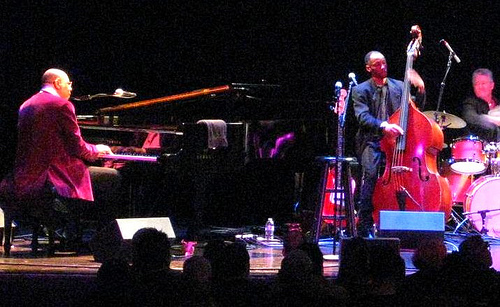
Last week, Cuban pianist Chucho Valdés demonstrated a shared skill set with San Francisco 49er tight end Vernon Davis. Both are impressively big men whose physical presence belies a breathtaking agility. 

Performing in front of a packed Herbst Theatre last Monday evening, the 70-year-old Valdés spent the majority of the 90-minute concert alternating between Latin and jazz, delegating and allowing his Afro-Cuban Messengers to shine. Many of the tracks were off Valdés’ recent album Chucho’s Steps (Four Quarters Records), with the constant shifts of “Zawinul’s Mambo” and the cool, breezy “New Orleans” serving as highlights. Valdés, resplendent in a violet velvet sportcoat and purple tones, spoke little, allowing a gesture here and a glance there to guide his team.


With time running out, the Cuban superstar took over with a game-winning score. Accompanied by bassist Lázaro Rivero Alarcón  and drummer Juan Carlos Rojas Castro, Valdés moseyed into a blues ditty before embarking on a solo run. His fingers leapt into a stunning series of trills, dancing from one side of the piano to the other with an absurd combination of power and grace. Here was a man using all of his beguiling dexterity to build the Herbst crowd into a frenzy, on a blues track no less. After performing the piano equivalent of bulldozing five defenders, Valdés, the good teammate that he is, brought Alarcón and Castro in for the finish. The crowd gave a well-deserved standing ovation.

One of Valdés teammate got a bit enthusiastic with the touchdown celebration. During the deserved encore, bata drummer and vocalist drummer Dreiser Bambolé bounded offstage, somersaulted into the aisle, leapt back onstage and snaked his way around Valdés and the band. A nearby usher, entranced by the enthusiastic percussionist, busted out some salsa moves while waving his hands and imploring the crowd to dance. Few of the crowd obliged; they were still basking in the greatness from the previous performance.

Snap Sounds: Void

2

VOID
SESSIONS 81-83

(DISCHORD)

Void was hardcore in a blender. It was loud, frantic, messy, and fast as hell. A brief yet seminal (there’s that word again) punk act, formed in 1979 D.C., Void was known equally for its early mix of hardcore and thrash, as its frenzied live shows, which often turned violent. And for such a memorable act, we future listeners were left with little to actually, well, listen to. It was all buried in seven-inches, splits, and hard-to-find comps.

Nearing the end of 2011, Dischord announced it would release a comprehensive catalogue of the long-gone band’s songs, and it delivered. Sessions 81-83 essentially spans the life of Void in 34 songs, and includes 20 unreleased tracks, live performances, standouts like “Dehumanized,” and thrashy covers (Black Flag’s “Wasted”). Fittingly, the disc ends with a live “My Rules,” recorded in ’83, which simply cuts out, like someone unplugged the amps and walked away. 

“Dehumanized” audio track:
http://www.youtube.com/watch?v=ukqm91gz7hs

With moving pictures, Void is even better:
http://www.youtube.com/watch?v=2JXLM8fS2jU

Noise Pop Roundup 2: Cursive, Budos Band, Emily Jane White, DRMS, Atlas Sound

0

My personal strategy for Noise Pop 2012 was to pack in as diverse a personal schedule as possible, taking into account old obsessions (Cursive, Bradford Cox) and favored newer acts (Allah-Las, DRMS), national and local bands and musicians, weird and precious live indie music.

I also wanted to spread my time over multiple venues, so this time around I hit up the Independent, Bimbo’s, Great American Music Hall, Swedish American, and Mezzanine. I walked the length of the city, racked up some high bus and cab bills, likely imbibed too frequently and caught some stellar live music. My head, feet, and note-scribbling hand are sore, but it was worth it.

WEDNESDAY: Cursive at Great American Music Hall

It was mid-song (“The Martyr,” 2000’s Domestica), mid-set (Noise Pop), of Cursive’s likely sold-out performance at Great American Music Hall. I opened my eyes, scanned the room, and saw we were all singing along breathlessly. Plaid-shirted forearms thrust towards stage, fringed heads bobbing, and everyone within earshot hollering towards the center. There in the middle stood grizzled singer-guitarist Tim Kasher, leader of the Omaha-bred longtime Saddle Creek Records fixture Cursive, as well as the Good Life. Parsing his words carefully, Kasher spoke for nearly the first time after a quick-fire opening shot of beloved Domestica and Ugly Organ tracks, interspersed with brand newer, understandably less-clapped-for I Am Gemini cuts. “Let’s get candid,” he understated. Full review here.

THURSDAY: Allah-Las and Budos Band at Independent

If you could handpick its most redeeming qualities and inhabitants from any time period in the past half century, Los Angeles could actually be a rather magical place. Pluck the psychedelic guitar strains reverberating through Laurel Canyon, scoop a fistful of bronzed sun-kissed surfers and sparkling waves from the coast, add two shakes of downtown weirdness, and you’d likely come up with something along the lines of Allah-Las, the quartet that opened for Budos Band during the Noise Pop lineup at the Independent Thursday. Full review here.

FRIDAY: Emily Jane White and DRMS at Swedish American Music Hall

The first time I saw dark folk songstress Emily Jane White live was at an ornate church on a hill (RIP EpiscoDisco) so this Noise Pop stop at the Swedish American Music Hall last Friday brought back some particular memories. Memories of an elegant, otherworldly setting and the singer-guitarist who encapsulates the venue’s charms.

With nary a smile, the black cloth-and-lace-swaddled White beautifully finger-picked and sang original tracks off 2009’s Victorian American and 2010’s Ode to Sentience, backed by a seated guitarist, a fellow on bass clarinet, and later, a violinist, who added even more depth to haunting closing song, “Victorian America” – a piece that showcases the bold yet breathy strength of White’s voice. Seated in folding chairs at the Swedish American, surrounded by dark wood trim, the audience clapped politely then grabbed between-act beers from guest bartender John Vanderslice.

Upon my return from Vanderslicing, I saw that DRMS (formerly known as Dreams) had splayed across the relatively small church-like stage, a clump of seven musicians with an interesting mixture of instruments and styles. Behind the retro 1920s blues vocals, the Afro-folk band incorporated more traditional instruments along with melodica, vibraphone, and some sort of bag of shimmering noise, all rainstick-like. Live, the intimate set felt like it could be happening anywhere in the world, a group of friends playing jumbly music with hints at a grab-bag variety of genres and cultures. This could work anywhere, yet still the venue felt the ideal setting.

SATURDAY: Atlas Sound at Bimbo’s

Three of the four acts Saturday night at Bimbo’s were solo dudes on guitar making sounds far beyond the basic limitations of the instrument. These were experiments in experimenting, Carnivores, Frankie Broyles, and of course, the man who likely influenced the others in some form or another, Atlas Sound (aka Bradford Cox, also of Deerhunter).

With a courteous “hello,” Cox picked up one of his magic vintage guitars – one attached to so many pedals and looping mechanisms that one pictures a jumble of chords slithering snake-like up his thigh – and opened up to a captive Bimbo’s crowd with his hypnotic near-soundscapes.

Not knowing quite what to expect live, I was, for whatever reason, somewhat surprised to see only Cox on stage at Bimbo’s (another grand San Francisco venue, for those keeping track of the prettiest music spots to visit) playing music so full it sounded like a full band. Perhaps a ghost band sat behind him, guiding the chord snakes.

Though it’s his solo project, it’s still mystifying to me that he can create such a beautiful noise alone. Cox’s swirling, pulsating loops of guitar and drum sounds picked up speed at times, revving up those in the audience as well, particularly during “Shelia” off 2009’s Logos and more so tracks off most recently released record Parallax: “Te Amo”  and “Terra Incognita.”

The front row of the ballroom was packed with youthful obsession (the excited youngsters sat up front on the dancefloor ground from the time the doors opened at 7 p.m. ’till Atlas Sound’s set at 11). Those kids provided fodder for Cox’s eccentric on-stage musings later in the evening, when he brought a boy on stage and said he looked like a younger version of him. I also heard later that young fans swarmed Cox after the set to gush and thank him for saving their lives, with his music.

Promising newish acts at Noise Pop 2012: Surf Club and FIDLAR

0

He asked if there were drink tickets. The bartender nodded, saying that the band could have wine now, and then beers on stage. Neither of those options would work for Stockton’s Surf Club, whose members were all sporting big black X’s — the mark of the underaged — at their Café Du Nord Noise Pop appearance.

When Surf Club played, melancholic Stratocaster led pop, that youthful innocence was obvious in its music. Well, let’s not say innocence, maybe timidity? The lead singer was a big guy with a small voice, like Frank Black (or Kim Deal? someone from the Pixies) in quieter moments.

The softness fit with the lyrics, mostly teen angst songs void of irony with small goals and wants: just to be friends, just to get out of bed. Surf Club seems to be off to a good start, keeping it simple, strumming along to a speedy drum beat. We’ll see what happens when the shyness wears off.

The following band, LA’s FIDLAR (which, if you’re keeping score at home was 75% over legal drinking age) had absolutely no issues with confidence. Hell, with a name like Fuck It Dog Life’s A Risk, you know the band’s got to be somewhat carefree, if not downright cocky.

“This song is called ‘Stoked and Broke,’” the band’s most talkative, spastic member introduced the first song, explaining, “because we’re stoked and broke.” What followed was a frenetic set of punk fueled, stripped down rock. With a rollicking tightness that reminded me of Thee Oh Sees, FIDLAR shot along, keeping the energy up by alternating singers.

Simple can be a conscious choice, and for FIDLAR that meant shouting through a song entirely consisting of the words “I drink cheap beer. So what? Fuck You!” with just enough attitude to make it work. Recently signing to Mom+Pop and with a full slate at this year’s SXSW, FIDLAR was definitely one of the better surprises at Noise Pop so far.

From California to Ethiopia with Allah-Las and the Budos Band

0

If you could handpick its most redeeming qualities and inhabitants from any time period in the past half century, Los Angeles could actually be a rather magical place. Pluck the psychedelic guitar strains reverberating through Laurel Canyon, scoop a fistful of bronzed sun-kissed surfers and sparkling waves from the coast, add two shakes of downtown weirdness, and you’d likely come up with something along the lines of Allah-Las, the quartet that opened for Budos Band during the Noise Pop lineup at the Independent Thursday.

Sporting a bolo tie and an acoustic guitar, lead singer Miles Michaud ran the band through a tight set of exhaustively pleasant, twist-worthy folk-adelia – with the kind of echoing vocals that shoot you back to a simpler time of black-and-white TV rock’n’roll. Perhaps behind those smiling, hair shaking acts of Ed Sullivan yore, a secret hallucinatory tab or barbiturate ran through the blood streams; if you could somehow bring those mysteries pumping through warm veins to the surface, you could get the Allah-Las set. Likewise, it could have replaced Strawberry Alarm Clock in Beyond the Valley of the Dolls, had any of its members been alive at the time.

Maybe most of the 20/30-something, casually hippie crowd was not there for these openers (or the other opening acts), because they seemed mostly stoic – and this sound pleaded for shaking, at least a few hip-swivels. Something. 

And from this vintage California boardwalk postcard of a band, we were flown around the world to Ethiopian jazz-via-Staten-Island. The instrumental Budos Band headlined the night and crushed its set – after an abnormally boiling, sticky half-hour wait that left a nearby fan audibly exasperated, and a trail of cool sweat down my back.

The 10-13-piece – counted nine on stage last night – Afro-funk band sauntered out with brassy swagger, clasping large horns (sax, trumpet), traditional vestiges of rock’n’roll (guitar, bass), and plenty of African percussion, amidst a hovering cloud of herbal smoke. Never have I seen such a charismatic baritone saxophonist as Jared Tankel, taking control of the stage with his impressive horn and skill, a maestro of groove, eliciting excitement from the audience by pumping one arm up when freed from the keys.

(The below video was not shot at the Indy, but in Washington a few days earlier) http://www.youtube.com/watch?v=GjPhtjIKjpc

With an instrumental set, the mind naturally wanders, and with this one, it brought me to Bill Murray. Specifically, the downtrodden, graying Murray driving around listening to Ethiopian jazz artist Mulatu Astatke in Broken Flowers. Though I see Budos Band too as perfect driving music, the audience moved far more for during this round, hooting and hollering, shifting and swaying to the consistent beat, laid down by bongos, congas, tambourine, clave, and West African shekere.

The walls were dripping with sweat by the end of it all, and though it was not the transnational journey I’d conjured, the few hour brain-vacation boded well.


All photos by Chris Stevens.

Dick Meister: The IWW Legacy

0

By Dick Meister

Dick Meister, former labor editor of the SF Chronicle and KQED-TV Newsroom, has covered labor and politics for more than a half-century. Contact him through his website, www.dickmeister.com, which includes more than 350 of his columns.

The Occupy Wall Street Movement and the other anti-capitalist forces of today could find no greater inspiration than the Industrial Workers of the World – the IWW, one of the most influential organizations in U.S. history, that was founded in Chicago in 1905 by a band of fiercely dedicated idealists.

The Wobblies, as they were called, battled against overwhelming odds. Their only real weapon was an utter refusal to compromise in a single-minded march toward a Utopia that pitted them against the combined forces of government and business.

Their weapon, their goals, the power of their opponents, the imperfect world about them made it inevitable that they would lose. But this is not to say the Wobblies failed because they didn’t reach their goal of creating “One Big Union” to wage a general strike that would put all means of production in the hands of workers and transform the country into a “Cooperative Commonwealth of Workers.”

To say the Wobbles failed would be to misinterpret the history of the Wobbly battle that left the world, as few battles leave it, a little less imperfect.

You need not believe in the simple Marxism and direct action techniques of the Wobblies to appreciate their great contribution to democracy, to union theory and practice, to folk music and literature, to the American idiom.

The IWW was founded by a group of socialists and dissident union organizers as an alternative to the American Federation of Labor, which they saw as an elitist and racist handmaiden of the capitalist class that controlled the economy. They denounced the AFL for ignoring the racially and ethnically mixed mass of unskilled workers in favor of the far fewer skilled and semi-skilled white craftsmen who were organized into separate unions according to their crafts.

The Wobblies would bring all workers, all of them members of the working class, into the “One Big Union” regardless of their race, nationality, craft or work skills.

Wobbly organizers crisscrossed the country on freight trains to spread their message. They mounted street corner soapboxes in many cities, often battling police and vigilantes who tried to silence them. They organized lumberjacks, mine workers, farm workers, factory and mill hands. They led strikes.

The speeches, the written statements and the songs of the Wobblies were powerful, simple, direct and moving. So were the cartoons, posters and other material that filled the IWW’s tremendous outpouring of publications, among them a dozen foreign-language newspapers that were distributed among the many unskilled immigrants from European nations where unions had goals similar to those of the IWW.

Much of what was said and sung and written is still with us, a century later. Probably most important are the brilliant insights of the IWW’s chief leaders, Bill Haywood and Elizabeth Gurley Flynn, and the songs of famed IWW martyr Joe Hill, those simple satirical rhymes set to familiar melodies that focused workers on a common body of ideals.

You’ve probably heard at least one of Hill’s songs. Remember? “You will eat, bye and bye/ In that glorious land above the sky/ Work and pray, live on hay/You’ll get pie in the sky when you die.”

The IWW legacy goes far beyond words and song. There’s still much of value that we can draw from its history, sadly including what the IWW’s ultimate fate tells us about how excessively undemocratic our government can be if left unchecked.

The Wobblies’ refusal to support U.S. entry into World War I and their refusal to abandon strikes and other organizational activities during the war were used as an excuse by officials at all levels of government to side with employers. They called out troops and police to attack non-violent IWW strikers and raid IWW offices. They encouraged vigilantism and lynchings and generally raised public hysteria against “IWW terror” that allegedly hampered the war effort.

After the war ended in 1918, officials seized on the IWW’s open support for the Bolshevik revolutionaries in Russia as an excuse to crush Wobbly strikes and organizing efforts by mass arrests and imprisonment of strikers and IWW leaders for engaging in “Bolshevik conspiracies.”

The IWW was all but destroyed. Membership shrank steeply and steadily, to the point that today the organization has only a relative handful of members, most of them employed at coffee shops, bookstores and other small businesses, their message spread primarily via websites.

Make no mistake, though. Employers did make some concessions in response to the IWW, and the very example of the Wobblies, their spirit of protest, their tactics, their history, and their courage continue to inspire labor and political activists worldwide.

As author Joyce Kornbluh notes in her magnificent IWW anthology, “Rebel Voices,” the Wobblies made “an indelible mark on the American labor movement and American society” – laying the groundwork for later mass unionization, inspiring the formation of groups to protect the civil liberties of dissidents, prompting prison and farm labor reforms and leaving behind “a genuine heritage … industrial democracy.”

Dick Meister, former labor editor of the SF Chronicle and KQED-TV Newsroom, has covered labor and politics for more than a half-century. Contact him through his website, www.dickmeister.com, which includes more than 350 of his columns.


Bounce to this: Rusty Lazer does Mardi Gras

1

Due to health problems, Big Freedia had to cancel her and Rusty Lazer’s Noise Pop gig at Public Works Sat/25. The event been transmutated into a big gay dance party with Double Duchess, DJ Bus Station John, and more. You should still read this interview, though.

With all its technicolor thrift flair, Mardi Gras costumes in state of midway-preparedness, and sleepy passels of breakfast-cooking houseguests, Jay Pennington’s New Orleans clapboard house is pretty hallucinatory on the Saturday afternoon of Carnaval weekend. Staring out the window waiting for the bounce DJ to call me up for our interview, I was to be excused for imagining that the shed in the side lot was producing actual chords while the New Orleans monsoon that raged outside hit it.

When I come across him in his bedroom, Pennington – who is also known as Rusty Lazer, and is the now-famous transgender NOLA bounce artist Big Freedia’s DJ and informal manager – is threading colored paper onto a string. He was going to be Hanuman the monkey god at the Mardi Gras parades on Sunday, his day off from work over Mardi Gras weekend. Around him, the city has ballooned with tourists and locals chucking beads at targets, high-stepping through brass numbers, eating frosted king cake, and peeing in inappropriate places.

I braved the rain that afternoon to talk about bounce music and Mardi Gras with Pennington, so it was kind of a surprise when our conversation swerved into the intricacies of 501(c)3 registration. It shouldn’t have been. He is a lot like New Orleans itself, a town that counts as a centuries-old melting pot, where the frat boys hang at the same bars as the career jazz musicians hang at the same bars as the pretty queer kids who sometimes party at dark gay leather bars (I was privy to this last comingling within six hours of landing in the Big Easy, at Daddy Aki’s Peacock party at the Phoenix Eagle Leather Bar where Pennington and his new managee Nicky Da B spun). [Correction: An earlier version of this article identified Peacock as Jay Pennington’s party. It is actually organized by Daddy Aki. Our bad.]

If you are a NOLA entertainer, Mardi Gras weekend counts among the most hectic of the year. Pennington had evenly informed me that my suggested meet-up time of noon was at least two hours too early considering the aftermath of the night shift on the decks he’d pulled before and that he would surely pull again that evening. But it’s two thirty now and for the moment, he’s able to focus on Hanuman, and attempt to tell me what’s so special about his city.

Hands-on Hanuman: Rusty Lazer in mid-Mardi Gras repose. Guardian photo by Caitlin Donohue

Though the DJ is playing less and less a role in Big Freedia’s career as she blows up and sells out shows around the country, Pennington continues to be a driving force in bounce’s dispersal outside NOLA. He signed his first official managerial contract with Nicky Da B, an adorable local whose track with Diplo hit Soundcloud last week. Bounce is indigenous to New Orleans — like Chicago’s juke and Detroit’s jit — a Caribbean-inflected dance music that is well known for the way its dancers pop their hips at machine gun rates.

Pennington is also is the co-founder along with Delaney Martin of New Orleans Air Lift, an international program he made to support local artists post-Katrina. This loosely-incorporated organization (it’s not 501(c)3 and relies instead on private donations, like the sales of the work of Swoon, one of the few females in the upper echelons of the street art world – her intricate, delicate wheatpastes blanket the fence next to Pennington’s house.) The Airlift Project has sponsored trips by New Orleanian artists to Berlin, even the import of Siberian breakdancer Ivan Stepanov to New Orleans.

This last story illustrates one of Pennington’s biggest turn-ons — fostering the artistic combustion that happens when a bunch of different energies get together. As illustration, he shows me a high fashion video shoot made by Lady Gaga’s stylist Nick Knight featuring the 19-year-old local bounce dancer Quack. 

After seeing a video of the improbably Barbie-bodied dancer, Knight contacted Pennington to ask if she’d care to do the same dance wearing Alexander McQueen for a fashion film series. Quack didn’t have a passport, but she went and got one with Pennington. The next day they went to London, found themselves “sitting in a room with nothing but Amazonian models.” Quack danced for eight hours to make the video, which turned out to be a testament to not just the extreme sexuality of bounce music, but also its athleticism, and emotional panacea. 

“This is the music that makes people forget that they’re hungry,” Pennington tells me, excitedly clicking through videos of schoolkids bouncing in rec centers, and endless YouTube clips of home bounce practice, done against a wall, ass to the camera. “It’s finally tuned to helping you forget your problems.” He wants to “take a New Orleans plane full of people all over the world,” to teach bounce to the masses. “In case anybody around here has forgotten how to have fun.”

The music lends itself to teaching — singers often give specific commands in songs, a popular request being for everbody to bend over and keep their ass popping. “Bounce is all instructions,” Pennington says.

The ability to move among social groups is one of the reasons why Pennington fell in love with New Orleans. 

“Here, you’re part of a community, not just part of a scene,” he reflects. “The difference is that the communities include all the people in your community. I don’t feel that in Portland or Austin.” He says the young arrivals in other artsy, liberal towns “hang out in mirrored social groups. I don’t know if that means anything, but it makes sense to me.” Pennington considers the neighborhood connections he’s made through participating in NOLA’s famous informal second line parades as, if not more, crucial than the ones he’s made with fellow travelers who have alit upon New Orleans as a haven for weirdos and music freaks. “New Orleans black community is nothing if not family-oriented,” he says.

Those mirrored social groups are a concept that should make sense to those beyond DJ Rusty Lazer. Part of what makes gentrification such a bummer is that when young bohos move into low-rent, family-oriented neighborhoods, they don’t form connections with the existing culture, imposing their own wacky adventures on top of the landscape as though they’re the first to really enjoy it. 

This missed connection leads newcomers away from frequenting established neighborhood businesses, and doesn’t provide for enough interconnectedness to get any kind of organizing come when rents start to rise and the condos come in. So good for New Orleans, and especially the rapidly changing Bywater neighborhood if they can avoid the typical storyline of minority community attracting broke artists attracting yuppies who can pay first, last, second, and third months’ rent in cash. 

Not the town doesn’t have other defense mechanisms. “The heat, the bugs, that lack of industry, the violence — that keeps it from growing out of control,” says Pennington. “It keeps the excessively ambitious away. When this place piles it on, it really piles it on. You can’t just casually live in New Orleans.” Wise words to the San Franciscan exodus that will surely come in the next months after tech boom 2.0

And for the record, I wasn’t hallucinating the house making music. The Ninth Ward’s musician mad scientist Quintron installed a rain organ into the Music Box, a small village of structures built in Pennington’s sideyard by 70 people to be played like a symphony, complete with Quintron playing conductor and a capacity crowd crammed into bleacher seating and crouching amid the structures themselves. At recent performances during last fall, 750 people showed up to watch the show. There was space for 250 in the sidelot. 

Live Shots: Grimes, Born Gold, oOoOO, and Yalls at Rickshaw Stop

0

Cecil Frena described the lineup at Rickshaw Stop last night simply as “weird music.” He should know. Performing with his synth-fueled electronic dance trio, Born Gold (formerly Gobble Gobble,) Frena stood in front of a camera-slash-iPad pulpit, singing and conducting a third of the group’s sound via a motion-captured, clearly homemade, Janet Jackson Rhythm Nation era-esque military jacket.

Definitely the strangest thing I’d seen all night, until Born Gold started its second song, at which point one of the other members strapped on a pair of stilts and began marching through the audience, playing a custom instrument consisting of a Roland SP-404 affixed to a snow shovel blade. The lighting for the theatrical set was either pitch black or blazing multicolored strobes, including a pair of handhelds that Born Gold used to blind part of the audience after covering them with a black tarp.

In more subdued moments Born Gold did synchronized dances with folding fans or put on helmets and beat each over the head with drum sticks.

As much as I noticed the music with all that going on, I’d say Born Gold was a decent fit with the first opener, Yalls. Yalls’s Dan Casey also played largely vocal driven electronic, although typically at a slower tempo and with a quirkier, less sexy lyrical sense. (Did Yalls just say something about living off the pennies in his moustache?) The clipped female R&B samples that made up a sizable portion of one of his beats recalled the time that Ben Gibbard dug up J Dilla’s grave to form the Ghostal Service and cut a chillwave album.

It was clear that most people in the sold out crowd were there to see the very buzzed about Grimes, particularly the wave of hardcore photographers who emerged and cut to the front just before the night’s second to last act, oOoOO (pronounced, by Frena as “Oh, upper case and lower case.”) With a heavy, grim quality that thematically might have fit with Grimes, in terms of the night’s lineup oOoOO was just slotted wrong, as the set was an experiment in how slow one can go. The answer? Really fucking slow. Put a cassette of dirty hip hop — with lots of syncopated hi hats and claps — into a boombox, wait for the batteries to die, record the last ten seconds, loop it, and you’ll get the idea. It’s perfect music to use when training your sloth Barbara to give a lap dance.

Still, it was fairly amazing watching the pros go to great lengths to get the perfect shot of oOoOO’s parka, although the one next to me spent most of the set texting and updating her blog, which was maybe less insulting to the musician than when she was playing Words with Friends while Release to the Sunbird opened for the Flaming Lips the night before. Hopefully as a joke, oOoOO ended his set by throwing the bouquet of flowers from the cover of Power, Lies & Corruption into the audience.

Grimes was on after. She performs with the same sort of spread arm, ambidextrous style as the keyboardist from Battles, and met expectations. She had support from Born Gold, as well as a sinister, largely vestigial dancer, whose main move consisted of adjusting her hood. Weird.

Snap Sounds: Islands

0

ISLANDS
A SLEEP & A FORGETTING

(ANT-)

Nick Thorburn started constructing A Sleep & A Forgetting alone, on a piano, while processing a painful breakup. His soul-exposing lyrics carry questions and incredulity. Although there aren’t many uplifting spots in here — literally every song is sad — his voice oscillates between sunny and depressive, heartfelt and sardonic. Quite a conceptual turn from Islands’ last album, Vapours, which featured upbeat, carefree love songs.

In a daring act of honesty Thorburn, who says he’s “always hidden behind devices and humor” in his music, directly places himself in “This is Not a Song” through a third-person reference (“Nick, if you ever learn, it never shows”). The final, and perhaps most impactful, track — “Same Thing” — simulates a hanging sense of hopelessness and craze-inducing monotony via robot-like drum machine. A resigned melancholy permeates this album and leaves you meditating on love’s foreboding nature.


Please enjoy these dancing skeletons:


Buy local: yoga edition

1

YOGA Walking into Bay Area yoga studios can sometimes feel like being subsumed into a cult of Lululemon, Yogitoes, and Gaiam. Yoga means big bucks these days, and most everyone seems to be sporting the same few brands while getting their warrior on. Yogic ideology espouses non-materialism and self-acceptance, yet it’s hard not want to fit in. Fortunately, there are lots of options that can get you out of big brand conformity and into stylie yoga gear that supports local vendors and designers. Follow these tips and in no time flat your yoga-related footprint won’t extend much farther than the four corners of your mat!


BLUE CANOE

Inspired by a homemade canoe that once sat on the shores of Humboldt County’s Benbow Lake, Blue Canoe’s name highlights its dedication to homegrown, yet stylish organic clothing. All its clothes are made in San Francisco and most use organic cotton in comfy blends. The company has been in business for more that 16 years and is known for its decidedly “un-granola” pieces that make as much sense in a yoga class as they do on Valencia Street.  

Hot item: boot cut pant

www.bluecanoe.com


LEOM DESIGNS

Born of designer Margaret Leom’s own need for good yoga and dance wear, Leom Designs has been operating out of Santa Cruz for six years. The clothes have a uniquely organic feel to them, taking inspiration from the environment and employing a deliberative creative process. Though initially Leom just made clothes for herself, she was always asked where she got her outfits. So she jumped at the chance to create designs in her vision and hasn’t looked back.  

Hot item: elfarrow men’s yoga top

www.leomdesigns.com


SWIRL SPACE

Since 2000 Swirl Space has been producing movement friendly, hemp-based clothes in San Francisco. As a business that’s committed to fair local labor, sustainable business practices, and educating the public about the benefits of Hemp, Swirl Space’s lofty ideals are an integral part of its goods.

Hot item: hemp hottie short

www.swirlspace.com


ZOBHA

Headquartered in Mill Valley, Zobha produces dreamy, high-end yoga wear that rivals Lululemon in fit and durability — yet the two companies’ trajectories couldn’t be more different. While Vancouver-based Lululemon seems to court controversy at every turn, Zobha directly supports Bay Area community initiatives like Headstand, which teaches yoga to at-risk youth. Bottom line, Zobha makes your butt look good while hitting the sweet spot between transcendent and trendy.

Hot item: Paige tank

www.zobha.com


KLEAN KANTEEN

Hydration is key while practicing yoga, but not every water bottle is created equal. It goes without saying that conscious yogis should eschew disposable plastic bottles in favor of refillables, and since 2004 Chico-based Klean Kanteen has been preaching the benefits of BPA-free, stainless steel bottles.  

Hot item: Klean Kanteen Reflect

www.kleankanteen.com


YOGA PROPS

Operating out of a warehouse in the Mission District, Yoga Props has been in business for 32 years. It sells a very wide range of items including blocks fashioned in the Props woodshop and locally made bolsters. In addition to online orders, Yoga Props welcomes walk-in customers who call ahead to its Mission HQ.  

Hot item: cylindrical bolster

www.yogaprops.net


YOGA MATS

Yoga Mats is another SF-based prop purveyor that’s been in town for decades, nearly three to be exact. While it participates in occasional Dogpatch neighborhood trunk sales, the bulk of Yoga Mats’ business is done online.

Hot item: kapok-filled zafu crescent

www.yogamats.com


TADASANA FESTIVAL

No need to fly to remote spots like Tulum or Bali to get your OM on en masse. Taking place on the beach in Santa Monica, the Tadasana Festival will pair classes by master teachers like Seane Corne and Elena Brower with performances by global music luminaries like Karsh Kale, Cheb i Sabbah, and Vieux Farka Touré. No passport necessary, just gather your yogi posse and carpool to LaLa Land come late-April.  

Can’t miss: Mandala vinyasa with Shiva Rea and the Touré-Raichel Collective

www.tadasanafestival.com 


Cursive gets candid during Noise Pop

0

Tears, booze, sex, pain, martyrdom, regret. Against my better judgment, I was singing along with the band. I was singing carefully, with my eyes closed and likely a smile creeping up in the corners of my mouth. I couldn’t help it, it came from within, as much as that particular act generally annoys me in packed settings. The swell of angular guitar and thundering drums pulled back mostly leaving higher octave vocals from a scale that slides to and fro: “Your tears are only alibis/To prove you still feel/You only feel sorry for yourself/Well get on that cross/That’s all you’re good for.”

It was mid-song (“The Martyr,” 2000’s Domestica), mid-set (Noise Pop), of Cursive’s likely sold-out performance at Great American Music Hall. I opened my eyes, scanned the room, and saw we were all singing along breathlessly. Plaid-shirted forearms thrust towards stage, fringed heads bobbing, and everyone within earshot hollering towards the center. There in the middle stood grizzled singer-guitarist Tim Kasher, leader of the Omaha-bred longtime Saddle Creek Records fixture Cursive, as well as the Good Life. Parsing his words carefully, Kasher spoke for nearly the first time after a quick-fire opening shot of beloved Domestica and Ugly Organ tracks, interspersed with brand newer, understandably less-clapped-for I Am Gemini cuts. “Let’s get candid,” he understated.

As with the folly of any continuous lovers, there was ecstasy and there was heartbreak. Dashing Kasher, the classic storyteller, the frog-croaking boozehound, inspires great emotion in his followers, only those who’ve been with him for quite some time – say, more than a decade – may question the direction of sound. Cello out, trumpet in. Perhaps it was projection, but it appeared the crowd and Kasher were mutually orgasmic during early career, well-worn classics, and likewise, faking it to get through the newer ones.

Ending the official set with “Art is Hard” (later explaining he’d be back for an encore, after taking a shot), Kasher reminded us why we were there, because making art is indeed hard and trying, and thrilling and sometimes, routine. “Fall in love to fail – to boost your CD sales.” It’s pulling all those creative types like taffy, up to fame, sideways to monotony, and sometimes, down with it, but if you don’t have a soundtrack to the downward spiral of inventive misery, well, all else is lost too: “You gotta’ sink to swim.”


All photos by Chris Stevens.

Whither indie?

4

MUSIC How does one trace the warp and woof of Bay Area indie rock’s silky, sick, multihued tapestry — with ticket stubs to long-ago shows, holey concert T’s, or grainy snapshots of sweat-swathed guitar players, red eyes gleaming in a haze of smoke machine emissions? Perhaps one way is to chart SF indie’s course from the first Noise Pop to the latest 20th anniversary edition, teasing out the tenuous connections between the first fest’s headliner Overwhelming Colorfast, reunited this year, and newish local poobah Young Prisms.

The pinging, ringing unifier might be found in the cascades of distortion, the buzzsaw guitars, used to drastically different ends. Fighting it out, too, beneath Overwhelming Colorfast’s fleet-footed crunch and Young Prisms’ smoggy overhang of echo-chamber shoegaze are clearly discernible, sensitive hearts, pulsing through the dulcet vocal lines and delivered with perfectly imperfect, threadbare falsettos. You can hear the ties that bind the two bands in the tide of romanticism and even sentimentality running under OC’s onslaught, YP’s haze.

Back in their 1991 to ’96 day, I confess I lost track of Overwhelming Colorfast: I don’t think I even saw them during their brief lifetime, although the music-snob friends respectfully granted that OC were kind of OK. So it feels thoroughly weird to play catch up with the most praised recording, Moonlight and Castanets (Headhunter/Cargo, 1996), by Antioch’s finest. Just as Overwhelming Colorfast was breaking up (only to reassemble, in time, as Oranger), Moonlight came along. Sprawling and ambitious with a bit of everything, it evokes the exploding mind of a particularly imaginative punk/rock fan, stuck in the suburbs and succored on chicken-fried ’70s and ’80s FM rock and moshpit-ready Amerindie hardcore bands that could be your life.

http://www.youtube.com/watch?v=C7xH5axRHM4

Of course, much like Young Prisms, accusations of derivativeness dogged Overwhelming Colorfast, whose inspiration and albatross was Hüsker Dü. Founding vocalist-guitarist Bob Reed couldn’t help it — he had clearly ingested far too much SST, with a very special emphasis on 1984’s Zen Arcade and Double Nickels on a Dime and 1985’s I Don’t Want to Grow Up. But listening to Moonlight now —particularly its forward-thrust first side — those snap dismissals and facile comparisons seem unfair.

The side starts “Starcrunch” with its heavy-outta-the-gate guitars that match Bob Mould and J. Mascis lick for lick, moves through “Mickey’s Lament,” which goes Weezer one better with its smart-kid, enjambed vocal delivery, rhythm guitar chug, and Stooges-y impaired piano drone, and closes the tender, breathy “Last Song” with a back-and-forth guitar line that captures the indecision as Reed sings, “Got a stupid note here / It’s from me to you. It’s all I could do / Thought I might just toss it / But it took so long. Tell me if it’s wrong.” Eventually a way-too-exuberant fusillade of guitars busts in, attempting to obliterate uncertainty: it’s as if Reed peered into the overwhelming darkness— wondering whether he should hold this awkward note and whether Colorfast could last—then decided, “Fuck it.”

The precarious, ground-shifting nature of SF indie — so often fielding copy-cat accusations, so far from the so-called music industry centers — also touches Young Prisms, also reared in SF’s bedroom communities yet looking to influences further afield, across the Atlantic, in the form of My Bloody Valentine and the Jesus and Mary Chain. Like Colorfast, the outfit has also coped with its share of membership switcheroos: the title of debut Friends For Now might have foretold the departure of guitarist Jason Hendardy and the arrival of vocalist-guitarist Ashley Thomas, whose vocals along with vocalist-keyboardist Stephanie Hodapp’s, pushes Prisms further toward the vaguely feminized, sonically diffuse space of the Cocteau Twins.

Songs like “Gone,” off YP’s upcoming second LP, In Between (Kanine), hinge on nursery rhyme-like vocal lines and a fluid wall of rhythm guitars against which a singular New Order-like guitar line dances. Guitars are used as pretty, pointillistic devices, seamlessly incorporated with washes of synth. People come and go, but here, sonic elements coexist in a more generalized, less personalized harmony, where lyrics are obscured and vocals are used as effects, rejecting the jolts — and listen-to-me force — of Reed’s more intimate, ungainly urgency. Do the Prisms reflect a kind of indie progressiveness — an evolution from the punky and individualistic to the ambient and collective? For answers, revisit In Between in 15 years.


YOUNG PRISMS

With Melted Toys, Tambo Rays, Preteen

Weds/22, 7 p.m., $14

Cafe Du Nord

2170 Market, SF

(415) 861-5016

2012.noisepop.com

OVERWHELMING COLORFAST

With Oranger, Slouching Stars, Peppercorn

Sat/25, 8 p.m., $12

Bottom of the Hill

1233 17th St., SF

(415) 621-4455

2012.noisepop.com

Spanning time with the Flaming Lips

0

I ran into a temporal anomaly while driving. My first warning sign was the police cruiser with one headlight flashing its sirens behind me. Wrong place at the wrong time? Well, I was getting pulled over in Sebastopol on the way to Richmond from SF, but when the cop told me I was doing 78 in a 55, it suggested one thing —speeding.

And speeding isn’t spatial — location is irrelevant — you are precisely where you should be, just too fucking soon. The cop seemed hopeful that he could help me, but as he took my papers and ran back to his car I knew he had abandoned me to the crush of an impending temporal singularity, as time began to move in slow motion.

Slow motion. Some refer to it as time dilation. The sensation that a certain duration lasts longer than it should. The Flaming Lips have a song about it, called, obviously, “Slow Motion.” It goes like this:

Hey, come on over.

You know the day is going slower.

It takes a year, to make a day.

And I’m feeling like a float in the Macy’s Day parade.

Or like a boat, out on the ocean. 
I’m drifting round in slow motion.

LSD and other narcotics aside, time generally doesn’t work that way. Compared to your life so far, each additional day is a smaller proportion. Time telescopes, you speed up, it goes faster. Slowing down is the opposite, unnatural. Sitting in a car waiting for the cop to come back (Is he going to search me?) or laying on a couch with friends trying not to cry — whenever time slows down — it’s unnerving.

You only know this much about “Slow Motion” — an alternate track from The Soft Bulletin not released in the US — because you saw the Flaming Lips play it once. But which time? Not at that fair in Santa Rosa. That one had a rave after. Not at the Fox Theater. That was the one where you slow danced with your girlfriend (at the time) until the staff asked you to leave. At Sasquatch, there in the Gorge? They did play The Soft Bulletin then, but it was rushed. That guy stood behind you — when Wayne Coyne was recounting Steven Drozd almost losing his hand and Michael Ivins being in a car crash — screaming “Play-a-song!” No, there just hadn’t been time.

And time, for the Flaming Lips, is important. Because as a band — one that has been through all sorts of well documented shit — the Flaming Lips know the value of time (particularly borrowed) and have made it their work to not just create music but get into the complete manufacture of moments. Which is a tricky business, because moments are bastards. Take all the pictures you want of the blinding lights, the beautiful costumed kids, the confetti cannons or all the other individual weapons that the Flaming Lips use to wage musical psychedelic war on time, and the moment still might not fit in a shutter, no matter how you slice a second.

It was at Bimbo’s. Not the time they played Noise Pop a few years back, but more recently. They were playing The Soft Bulletin, and taking their time. Hitting every single track from every single version of the album. Not quite slow motion, but close. When was that?

It was the night after the couch. When you were watching Blade Runner on TV, just the end part. Where the maniac with white hair is running around, trying to knock some sense into the other idiot character, who hardly even realizes he’s alive most of the time. And it starts getting heavy. Meaningless inevitability; the crushing force of time. Fucking tears in the rain. Before you know it, you’re happy it’s basic cable, because sometimes a commercial interruption is all that’s keeping you from crying.

It was the night after that. The Lips were going slower for sure, but still way too fast. The moments going by before you’re ready. Before you know it, they are on to other songs, and “Slow Motion” is somewhere in the past, back there with your best friends on the couch, never to return.

The band is getting ready to play something else, Steven readying both miraculous hands on another instrument while Michael stands ready, as ever, on the bass. You want to reach into your bag to take the camera out again, but you resist the urge. It won’t capture the cold press of the air canisters at your back anyway. Or, for that matter, the hookah scented air from the smoke machines. And anyway, if you’re taking pictures during “Feeling Yourself Disintegrate,” you’re probably irretrievably lost.

And suddenly, everything has changed. The cop comes back to the car. Tells me my record is clear, that he just marked 65 on the ticket, because I was didn’t know where I was. He gives me some directions, regarding the roads. I don’t really listen (but do thank him and let him know about his broken headlight.) I drive forward, knowing exactly where I am. I was at a Flaming Lips show, and now I’m driving home.  

Krushin’ on

0

SUPER EGO I’ve only a wee bit of space this week before I rush off back into the Mardi Gras of my mind, but I’ve got to three times diagonal-snap for local fashion designer Jeanette Au (jeanetteau.carbonmade.com) who tore it up for SF on the NY Fashion Week runways last week with her debut collection of 3-D knit fantasias. Ruling!


RED BARAAT

The Non Stop Bhangra (www.nonstopbhangra.com) monthly party’s return two weeks ago was beautiful-insane — if you missed it, or must fulfill your yearning for incredible Indian-inspired dance music sounds before the next installment, check out this live act featuring irrepressible bandleader Sunny Jain on the dhol drum, backed by a high-stepping nine-piece brass band. Bollywood meets Mardi Gras is the shorthand, but the ringing grooves transcend categorization.

Thu/23, 7:30 p.m., $12–$15, all ages. Slim’s, 333 11th St., www.slimspresents.com


ROLLER DISCO

Oh man, David Miles Jr., our patron saint of skate — “The Godfather of Skate,” actually, who founded the essential Black Rock Roller Disco and keeps peeps rollin’ from the Embarcadero to Golden Gate Park — lost everything in a tragic fire. He and his family are OK, but here’s a great event to help get them back on their (wheeled) feet. Skate rental available: Lots of good DJs.

Thu/23, 9 p.m., donations at the door. Mighty, 119 Utah, SF. www.mighty119.com


CUTE FANGS 4EVER!

It’s no secret that hyper-productive tech-breaks player and Cute Fang label owner Forest Green is one of my favorite people. It’s hard not to leave her parties with a smile plastered on your face — partly from the room-wobbling beats, partly from her pure positivity transmission. This is her two-room blowout birthday party, with a slew of bonkers local guests like DJ Denise, Dragn’fly, Raydeus, Tek 9, and Base Hed. And it will be cute!

Fri/24, 9 p.m.-4 a.m., $5 before 10 p.m., $10 after. Icon, 1192 Folsom, SF. www.forestgreen.org


SITUATION

Part of the reason door fees have risen so much in San Francisco is our insistence on relying on foreign or guest DJs to bring something interesting to the table. Flights are expensive, cover rises. Well here comes Situation, a free party deliberately designed to showcase local talent and some snappy grooves: “the new disco sound of New York, bangin’ house joints, 12-inch dance versions, and more than a few non-sequitors to keep things interesting,” quoth host DJ (along with Eug and Ash Williams) Derek Opperman, my nightlife critic counterpart at the Weekly, who’s basically an adorable human Shazam. Move out, yazoo.

Fri/24, 10 p.m., free. 222 Hyde, SF. www.222hyde.com


DJ KRUSH

Let’s just admit that future bass was the trip-hop revival, OK? And while Flying Lotus et al. took the sound to unfathomable new highs/lows (and old hands like Amon Tobin sizzled retinae with his ISAM stage-show comeback), there’s sometimes no beating the originals. After 20 years, Tokyoite chill-wizard DJ Krush can still gently ride those intelli-stoned waves into the stratosphere: a three-hour set should do you quite solid.

Sat/25, 9 p.m., $17.50 advance. Mezzanine, 444 Jessie, SF. www.blasthaus.com

Occupy 4 Prisoners hits San Quentin

5

About 800 protesters marched to San Quentin’s East Gate in a day to protest what they called inhumane conditions in prison Feb. 20

Protesters called for an end to the practice of trying children as adults, three strikes laws, life sentences, life without the possibility of parole, and the death penalty.They did not call for the dismantling of the prison system or an end to the practice of incarceration, as Chip Johnson implies here.

In San Quentin– and in prisons across the country—inmates are subjected to solitary confinement, sometimes for decades. Kids as young as 13 are tried as adults and sometimes sentenced to life without the possibility of parole. In three-strikes states, people are sentenced to decades in prison for non-violent crimes that sometimes amount to less than a couple hundred dollars in damages. And in death penalty states, state-sponsored execution means that lives, sometimes innocent, are thrown away.

Twenty-four US states do not have three strikes laws, many countries cap prison sentences at 15 years regardless of the severity of the crime, and only one European country- Belarus- continues to impose the death penalty. The United States incarcerates its citizens at a rate that far surpasses any other country in the world; second on the list in Rwanda.

Conditions and laws like these have spurred decades of prison reform and prison abolition activism, both from inmates and supporters on the outside. Feb. 20, this movement joined with Occupy Oakland to protest outside San Quentin prison and demand that these issues be addressed.

As protesters arrived, organizers blasted music, hoping to reach the ears of prisoners. Dozens of prison guards and representatives from the Marin County sheriff’s department were stationed in front of the prison gate, and well as on hills looking down on the protest group.

The loud music continued with a performance from the Brass Liberation Orchestra, and subsequently a drumming ritual.

“As First Nations people, we’re no strangers to occupation. We’re also no strangers to prison. The first prisons were the reservation and the slave plantation,” said George Galvis, Executive Director of Communities United for Restorative Youth Justice.

“We have post-colonial stress disorder in our communities,” added Galvis.

Author, film producer (Redemption: The Stan Tookie Williams Story) and 2006 California gubernatorial candidate Barbara Becnel helped facilitate the event.

In her opening statements, Becnel praised the crowd, packed with Occupy activists, family members of incarcerated people, formerly incarcerated people, and others.

“We should really be proud of ourselves today. Because today, we are history makers. We have merged the prison rights movement with the Occupy movement,” said Becnel to an eruption of applause.

Throughout the program, speakers read solidarity statements addressed to Occupy Oakland from prisoners across the country, including Mumia Abu Jamal, Leanard Peltier, Kevin Cooper, and group statements from Pelican Bay human rights organizers, and those involved in state-wide prison strikes in Georgia.

A movement has coalesced around the claim that Cooper, a death row inmate at San Quentin since 1985, is innocent. Cooper was denied an appeal in 2009 in a ninth-circuit court case in which five judges dissented, declaring that, “the state of California may be about to execute an innocent man.” Their 103-page dissent statement includes descriptions of evidence tampering leading to Cooper’s conviction.

Cooper helped call for the Occupy 4 Prisoners day of action.

Speakers at the rally called for Cooper’s freedom, and for the end of death row entirely.

Becnel related a story about some prisoners, charged with life without the possibility of parole, that she had met while campaigning against the death sentence for Stan “Tookie” Williams.

The men, Becnel said, told her: “We only leave here in a casket also. We are also dead men walking.”

Speakers also decried the use of solitary confinement as a punishment in prisons.

Sarah Shourd, known for her imprisonment in Iran after accidentally crossing the border during a hike, spoke along with fellow imprisoned hikers Josh Fattal and Shane Bauer.

Shourd, who was held in solitary confinement for 14 months, related her experiences.

“After just two months my mind began to slip. I would spend large portions of my day crouched down by a small slot in my door, listening for any sounds from the outside that might distract me from the sheer terror of my isolation.”

A statement from a Texas prisoner, read by an Occupy Wall Street organizer, also addressed solitary confinement.

“We tend to think of man as a collection of individuals, each complete in himself, who just happen to come together to satisfy certain needs. Actually, however, there is nothing distinctly human that can be exhibited by an individual in isolation,” said the philosophical letter.

The Pelican Bay Hunger Strike last year highlighted solitary confinement, and prisoners demanded an end to the practice, in which inmates are held in isolated rooms with no sunlight for 23 hours a day, often for years on end. Some inmates at Pelican Bay have been held in these conditions for over 30 years.

Organizers of the hunger strike called it off when the California Department of Corrections promised to investigate the issue, but started to strike again several months later when no changes had been made to any of the conditions that they were protesting.

Kelly Turner, 42, who was sentenced to 25 years to life for writing a bad check for $146.16 in 1997, was also placed in solitary confinement for one year. However, she focused her speech at the rally on California’s three strikes law, the legislation that turned what would have been a three-year sentence for forgery into a possible life sentence for Turner. Turner said she was lucky that good pro bono lawyers defended her, and would likely still be in prison had they not; she now owns her own business.

Turner, who advocates for Families to Amend California Three Strikes (FACTS), urged the crowd to vote for an initiative to amend the law that is slated to appear on the California ballot this November. 

In her speech, Turner described meeting women in the Central California Women’s Facility is Chowchilla that were also serving decades-long sentences after having been charged with a third strike.

“I am here today for the woman that was on my dorm that had 27 years to life for drinking a 99 cent lemon line soda out of a store. Or the woman who stole a jar of Vaseline, a bottle of vitamins, two pairs of boxers,” said Turner.

Tatiana, a young prisoners rights advocate who spent time in juvenile hall, read a statement from incarcerated youth Veronica Hernandez.

Hernandez, 20, has been imprisoned since age 16.

She was tried as an adult, an outcome that she attributes to a public defender who did not do his best to fight for her.

“There are no law libraries or legal services at juvenile hall, so a juvenile, for better or for worse, is entirely dependent on his or her court-appointed attorney, and must trust that he or she will lead them in the right direction. Unfortunately for me, that direction was to adult court. I now face a life sentence should I be convicted,” said Hernandez in her statement.

No speaker argued for the dismantling of the prison system, instead focusing on what they saw as unjust sentencing and inhumane treatment in prisons.

In a statement calling for Occupy 4 Prisoners, Kevin Cooper connected a call to end the death penalty with struggle for correct racial and economic justice and an end police brutality:

“America has a deep-seeded philosophy in which it only allows for the execution of its poorest people. These seeds have taken root and have grown in such a way that no person who this system sees as a ‘have-not’ is safe from the death machine. Whether they are within (San Quentin) or on a BART platform.”

Bauer also expressed the importance of tying prison rights to the Occupy movement, saying, “This Occupy movement needs to permeate the prisons. God forbid one day some people here will be on the other side of this fence. But when movements get strong, people start getting locked up. We should know this. This happens in every country. Prisons are places where movements are killed. But at the same time, when movements successfully permeate prisons, a space built to break people down, the movement is at its strongest. This is true all over the world.”

Occupy Oakland organizers have already been hit with bizarre and seemingly invalid charges, such as “lyching,” “bike,” “boat,” and umbrella. In one of the most extreme cases, Khali, an Occupy Oakland protester, may face life in prison after being arrested for a allegedly taking a blanket out of a garbage can. Advocates for Khali say that he was denied prescription medications in jail for ten days before allegedly assaulting a police officer; his third strike.

Well-known prison rights advocate and former Black Panther Elaine Brown ended the program. After remarking that “there aren’t enough songs in this movement,” she sang Oh, Freedom as the crowd peacefully exited the site, as several volunteers picked up any trash that was left behind.

“Before I’ll be a slave, I’ll be buried in my grave, and go home to my comrades and be free,” sang Brown.

Snap Sounds: Young Magic

0

YOUNG MAGIC
MELT

(CARPARK)

Hearing a band being described as “tribal electronic” gives me a headache, but Young Magic actually pulls it off on its debut full-length, Melt. This New York-via-Australia trio works irregular drum machine beats, swirling synths, and haunting vocals into dark, psychedelic pop songs. The sluggish, heavily reverbed “Night In The Ocean” is sensual and explosive. With its fluttering synths and repeated “I found love with you” vocals, “Jam Karet” is catchy and almost chant-like. “The Dancer” opens with a few creepy music box notes, and features what sounds like a shrieking tropical bird.

There are a lot of playful juxtapositions of ambient nature sounds and electronic elements on Melt, creating a feeling of these tracks being played on a MPC in some distant, secluded cave. Supposedly, the album was recorded all over the world, in Germany, Iceland, and Australia. These songs sound vaguely exotic and, as the band’s name suggests, snugly rooted in the occult. 


The video for “Night in the Ocean” is equally sexy: