


Today Johnny offers a special observation: After hearing a friend in the Army denounce “socialism,” he concludes that the military, particularly the Marine Corps, operates a lot like a communist organization. You know — relatively level pay, “from each according to his ability, to each according to his need,” free food and medical care, putting the needs of the whole over the needs of the individual …. commie stuff. (No — this is not Johnny channelling McCarthy and holding up names of Communist Marines. Trust me) Listen up after the jump.
MarinesAreCommies by endorsements2010Military
Bright on

culture@sfbg.com
QUEER Heady, hilarious, heartbreaking: Big Sex Little Death explores legendary sex writer, educator, and instigator Susie Bright’s coming of age from the 1960s to the present. Bright’s memoir focuses on her involvement with The Red Tide, a radical high school newspaper in Los Angeles in the 1970s, and her subsequent membership in a socialist sect that sends her halfway across the country. Her union organizing stint lasts until the Party leadership expels her for “joining or leading a cult of personality.” Personality is certainly one of Bright’s strong points, so perhaps we should be grateful for this particular falling out. It eventually leads to Bright’s role in founding the first lesbian porn magazine, On Our Backs, in San Francisco in 1981, as well as her pioneering work as a fiery spokesperson for free speech and sexual liberation. I spoke with her over the phone about sex and memory and writing.
SFBG You do such a great job of talking about your sexual coming of age as a teenager: describing your sluttiness without shame, your curiosity about bodies and pleasure and the intricacies of sexual positioning.
Susie Bright I think it’s because I wrote my memoir like a storyteller, like a poet — not a polemicist. I wasn’t ashamed; it never occurred to me. Margaret Mead would have found my little teenage tribe to be quite poignant.
SFBG There’s a tendency for many sex-positive spokespeople to glamorize even the most annoying, mundane, or gross sexual experiences as somehow — well — positive. Sometimes this sex-positive rhetoric ends up making those of us who don’t always succeed at having a wonderful sex life feel like failures …
SB I think bad sex — obnoxious, absurd, BIG FAIL sex — is funny, nostalgic, and more endearing as you grow older. It also goes hand in hand with adventurous, rapturous, mind-blowing sex. You actually know the difference. You’ve spanned the spectrum, you’ve lived. The big bummer with American sex right now is the unrelenting banality and flat-out scarcity.
SFBG The most striking part of Big Sex Little Death for me is the way you describe betrayal in the social and political realms you choose to inhabit — places that initially give you so much hope. Like when you helped to start On Our Backs, the first lesbian porn magazine, in the early ’80s. Feminist bookstores refused to carry it, claiming that you were aiding the patriarchy.
SB It was more than that. The whole mainstream feminist movement was calling for our heads. Or, as Barbara Grier of Naiad Press put it, “Everyone I know thinks y’all should be assassinated.”
It’s been a part of every civil rights and social justice movement that I’ve been a part of. We know it — we talk about how the powers that be would prefer to let the weak fight among themselves. We see how divide-and-conquer tactics are so effective, but it’s very hard to resist.
What kills me is the blindness, even years after the fact. Sometimes it’s comical. I got a letter from an ambitious writer the other day who told me that in the ’80s she fought the sex-positive On Our Backs types tooth and nail, no tactic too dirty. “We” were pimping the patriarchy and she was on point to take us down. She asked me if I found it amusing that she’s now in a submissive relationship with a man — no! Then she asked me if I would blurb her new book.
Someone asked me on this tour if I ever got an apology, and I was startled. No, not for the bombings or the death threats or the bannings or the locked doors or the bizarre libels and slanders. No way.
SFBG When the feminist movement refused to support you, you found several surprising allies. Among them were John Preston, at the time the editor of the gay leather magazine Drummer; cult filmmaker Russ Meyer of Faster Pussycat fame; and even the Mitchell brothers of that legendary exploitative straight strip club on O’Farrell Street.
SB Well, those were strange bedfellows, eh? They were all mavericks, iconoclasts, outlaws, film buffs, and we shared that in common. Aside from public librarians and ACLU lead attorneys, these guys were probably the most eloquent defenders of the First Amendment you ever met.
SFBG On Our Backs was started by two strippers who worked at various clubs in the Tenderloin and North Beach. One of the most heartbreaking chapters in Big Sex Little Death is where you show us how so many strippers worked to support their lovers financially, male and female, and then ended up strung out on drugs, homeless, or dead after their lovers used and abused them.
SB “Legalize it,” as Peter Tosh said. That is why these tragedies happen — because sex work is criminalized.
SFBG In your preface, you say, “I’m more preoccupied with people dying than with people coming.” And so of course you want to prevent these unnecessary deaths. Toward the end of the book, you also mention the deaths of friends, lovers, and confidantes to AIDS — but only briefly. It’s as if it’s still too painful to talk about.
SB The main deaths I talk about are my parents’, where I could fit more of the puzzle together; then John Preston, as a small example of what went on in early ’80s plague life; and the dykes I first knew at On Our Backs, some of who died too young. I am angry and too ragged to write about it all yet — I don’t have the distance from it. The last memorial I attended this past fall was [for] one of my greatest inspirations, a total ball-of-fire who ate a Fentanyl patch, choked to death on her vomit, and left a suicide note.
It was the exact one-year anniversary of the death of her father, a Southern fundamentalist preacher who beat and raped her as a child. She left him at 15 to come to California and made her way as one of the first generation of out dyke strippers and punk rockers. My redheaded friend was a leader of a local NA chapter by the time she was 20. What happened to her, all these years later, breaks the heart of everyone who knew her. She was a wonderful, wonderful, caring, radical feminist creative dyke who wanted to be a superhero who would vanquish all the abusers. It’s not fair.
SFBG Fairness is one of the central issues of the book — who lives and who dies, which cultures disappear and which remain. At the end of the book, you talk about deciding to give birth to a child, Aretha, and raising her. I’ll admit I got a bit worried that you would suddenly talk about this trajectory in a way that erased your sexual and political history, the histories of people like the friend you just mentioned.
SB My daughter has a trajectory of her own, now!
SFBG But somehow you’re able to talk about your love for Aretha while making it clear that child rearing certainly isn’t for everyone, and still articulating an anti-assimilationist queer world view focused on sexual liberation and radical politics.
SB I’m just drawn that way.
SFBG Why do you think gay assimilationists emphasize marriage, military inclusion, and child-rearing as the only choices for respectable queers, narrowing the options for everyone and rejecting sexual liberation as something dangerous from the past?
SB They’re squares — what can I say? They’ve always been around. Square used to be a synonym for straight. We’re constantly caught in the middle on this, the boho bunch. Of course we want civil rights for all, duh. I defend anyone’s right to let the state be their pimp, to fight the wars, be the cannon fodder, acquire family assets like a stamp-collecting hobby. Bully for you. But as Peggy Lee said, “Is that all there is?” Christ, I hope not.
Mattilda Bernstein Sycamore (mattildabernsteinsycamore.com) is most recently the author of So Many Ways to Sleep Badly.
No equality without economic equality
San Francisco’s queer movement isn’t what it used to be.
Even the Castro District — once the center of perpetual protests and street organizing, not to mention the Tom Ammiano write-in campaign — bears little resemblance to the neighborhood that used to be considered the gayest in the country. A recent Advocate survey didn’t even mention San Francisco in its list of 15 gayest cities.
These days, the Castro has a lot of empty storefronts — 27, according to activist/blogger Michael Petrelis, who counted them last month — and a conservative merchants group that calls the shots on such things as lowering the giant rainbow flag at Castro and Market streets: “yes” to the death of a gay cop, “no” to a slain black gay activist in Uganda (until pressure from activists forced them to fly it half-staff for an hour or so).
Continued gentrification of the Castro by the ever richer, combined with an economic recession whose burdens are shouldered by those with dwindling resources, has taken its toll. With outrageously high rents, the neighborhood is no longer a haven for queers from all over the country seeking refuge from homophobic environments. The new upscale — and more often straight than gay — resident of the ‘hood doesn’t have a clue that those refugees replenished the ranks of activists who, since the early 1970s, made the Castro the “gay mecca” and forged a radical politics that dominated the movement for a long time.
Queer politics these days is a constant tug-of-war between gay moderates who’ve gained a lot of power (not to mention high-paying jobs) in City Hall and progressives who want to change an agenda that pours millions into gay marriage but nothing into finding housing for the 40 percent of homeless youth who are queer, or jobs for the scores of transgender people who are without work or inadequately employed.
The heavily gay moderate group Plan C is pushing for upping the annual condo limit to allow more tenancies in common (TICs) to convert and thereby increase substantially in value. At the same time, queer progressives fight to retain 49 below-market-rate units at the proposed 55 Laguna Street development; keep Parkmerced from tearing down more than 1,500 rent-controlled units; and prevent the city from giving tax breaks to Twitter and other dot-com companies to encourage them to move into a downtown area the city considers blighted without any substantial proof that their free ride will benefit the city. It may well just push out more needy people.
While the conservative merchants group in the Castro endorses a measure that outlaws sitting or lying on sidewalks, progressives work with Dolores Street Community Services and the city’s Human Services Agency to set up an LGBT-friendly shelter for queers who experience homophobia in the city’s shelter system.
Even the city’s two leading queer Democratic clubs reflect the schizophrenic nature of queer politics: the Alice B. Toklas club backs moderate candidates and takes a more conservative stance on everything from tenants’ rights to affordable housing, while the Harvey Milk club supports a progressive agenda.
Meanwhile, the disparity between the haves and have-nots continues to grow. While the Castro may be dying as a gay mecca, the Tenderloin is still home sweet home to countless queers and transgender people who are left out of every bit of progress the community makes. Except for the elimination of don’t ask, don’t tell, which now gives poor and working-class queers the opportunity to better their lives by being fodder for the military’s latest wars for oil.
Universal healthcare or a living wage job would have been a better fit. There’s no equality like economic equality.
Tommi Avicolli Mecca is a 40-year veteran of the queer movement and a tenant advocate at Housing Rights Committee. He is editor of Smash the Church, Smash the State: The Early Years of Gay Liberation (City Lights).
Film Listings
Film listings are edited by Cheryl Eddy. Reviewers are Kimberly Chun, Michelle Devereaux, Peter Galvin, Max Goldberg, Dennis Harvey, Johnny Ray Huston, Louis Peitzman, Lynn Rapoport, Ben Richardson, and Matt Sussman. For rep house showtimes, see Rep Clock. For first-run showtimes, see Movie Guide.
FRAMELINE
The 35th San Francisco International LGBT Film Festival runs through Sun/26 at the Castro, 429 Castro, SF; Rialto Cinemas Elmwood, 2966 College, Berk; Roxie, 3117 16th St., SF; and Victoria, 2961 16th St., SF. For tickets (most films $9-$15) and complete schedule, visit www.frameline.org.
OPENING
Bad Teacher Cameron Diaz don’t need no education. (1:29) Shattuck.
Buck This documentary paints a portrait of horse trainer Buck Brannaman as a sort of modern-day sage, a sentimental cowboy who helps “horses with people problems.” Brannaman has transcended a background of hardship and abuse to become a happy family man who makes a difference for horses and their owners all over the country with his unconventional, humane colt-starting clinics. Though he doesn’t actually whisper to horses, he served as an advisor and inspiration for Robert Redford’s The Horse Whisperer (1998). Director Cindy Meehl focuses generously on her saintly subject’s bits of wisdom in and out of a horse-training setting — e.g. “Everything you do with a horse is a dance” — as well as heartfelt commentary from friends and colleagues. In the harrowing final act of the film, Brannaman deals with a particularly unruly horse and his troubled owner, highlighting the dire and disturbing consequences of improper horse rearing. (1:28) Embarcadero, Shattuck, Smith Rafael. (Sam Stander)
Cars 2 Owen Wilson, Larry the Cable Guy, Michael Caine, and others give voice to the autos in this spy-themed Pixar sequel. (1:52) Balboa, Shattuck.
Conan O’Brien Can’t Stop Conan O’Brien Can’t Stop seems less of a movie title and more like a hushed comment shared between one of the many hangers-on during the filming of the “Legally Prohibited From Being Funny On Television Tour.” Throughout 23 cities’ worth of footage, O’Brien seethes, paces, sweats, yells and beats dead jokes so hard that they spring back to life, as he is wont to do.
At this point, the Leno/Coco drama is a bit stale — at least in internet time — but the documentary is a fascinating comedian character study nonetheless. It may be hard to sympathize with a man nursing a bruised ego as he cashes a $45 million dollar check, but it’s easy to see that he’s one of the best late night hosts (temporarily off) the air. Split primarily between clips of O’Brien performing songs on stage with a myriad of celebrity guests and bemoaning how exhausted and frustrated he is, Can’t Stop derives most of its hilarity from the off-the-cuff comments that pepper Conan’s everyday conversations. (1:29) Lumiere, Shattuck. (David Getman)
Oki’s Movie See review at www.sfbg.com. (1:20) Yerba Buena Center for the Arts.
*Viva Riva! Gritty, riveting, and even heartbreaking, Viva Riva!, the first Congolese feature film to get distribution in the states, is much like its small-time crook of an anti-hero, Riva (Patsha Bay Mukuna) — in love with life and prepared to laugh in the face of death when it comes knocking. Director Djo Tunda Wa Munga’s African Movie Academy Award winner tumbles with the grimy details of its Kinshasa, Congo, backdrop, and rarely stumbles. A mere foot soldier in a sprawling crime world, Riva has seized his chance at breaking into the big time, with a score of stolen gasoline, and has returned home. His eyes are on an unlikely prize, Nora (Marie Malone), the well-guarded moll of a Kinshasa gangster. As Riva stalks his lithe prey, he’s tailed by the ruthless Angolan crime boss he’s crossed (Hoji Fortuna) and a local military commander under the thug’s thumb (Marlene Longage). As sexy and violent as a contemporary noir, and as familiar as a folk tale unraveled round a campfire, Viva Riva! holds your attention with all the bruised bravado of its Stagger Lee-like protagonist, catching you in with the way the gorgeous Nora undulates at an outdoor gathering at one moment, then squats in the dirt to take a piss at the next. (1:36) Lumiere, Shattuck. (Chun)
ONGOING
*L’Amour Fou Pierre Thoretton’s documentary L’amour fou opens with two clips of men bidding farewell. The first, from 2002, is of the French-Algerian couturier Yves Saint Laurent announcing his retirement in a moving and emotional speech worthy of his favorite writer Marcel Proust. The second is of Pierre Bergé, Saint Laurent’s longtime business partner and former lover, eulogizing his departed friend at the designer’s memorial service six years later. Thoretton’s film is suffused with goodbyes, many tender and candid, some portentous and rehearsed. To be sure, L’amour fou is a touching portrait of the powerful and tempestuous bond between Saint Laurent and Bergé, a bond that lasted close to five decades and resulted in one of the great empires of 20th century fashion. But it is also, alongside David Teboud’s two 2002 YSL documentaries, another entry in the hagiography of Saint Laurent, one cannily steered by Bergé as much as by Thoretton. Well-spoken and charming, Bergé still comes off as the punchy entrepreneurial foil to Saint Laurent’s dazzling but fragile genius. He can be both hyperbolic (praising Saint Laurent’s gifts) but also forthcoming (discussing the designer’s demons). Former muses Loulou de la Falaise and Betty Catroux are also interviewed, but this is clearly Bergé’s show. (1:43) Opera Plaza. (Sussman)
The Art of Getting By The Art of Getting By is all about those confusing, mixed-up and apparently sexually frustrating months before high school graduation. George (Freddie Highmore) is a trench coat-wearing misanthrope — an old soul, as they say — whose parents and teachers are always trying to put him inside a box and tell him how to think. He finds a kindred sprit in Sally (Emma Roberts) who smokes and watches Louis Malle films. Hot. Heavily scored by the now-ancient songs of early ’00s blog bands, it may all sound like indie bullshit but this one has charm and wit despite its post-trend package. Like a sad little crayon, Highmore is a competent Michael Cera surrogate du jour. Writer-director Gavin Wiesen embraces hell of clichés, but he suitably sums up a generational angst along the way. The film may not always feel real, but it does have real feeling. Look out for great performances from Blair Underwood and Alicia Silverstone. (1:24) 1000 Van Ness, Sundance Kabuki. (Ryan Lattanzio)
*Beautiful Boy Save the children, but pity the parents. Director-cowriter Shawn Ku’s Beautiful Boy is one of two recent films concerning parents of kids who go on school killing sprees, and it’ll get potentially shortchanged due to the forthcoming We Need to Talk About Kevin‘s head-turning cast and its Hitchcockian literary source material. Still, Beautiful Boy shines in its own humble way, by dint of its quiet sense of integrity and refusal to pander. The bone-deep unhappiness suffusing the family concerned was present long before 18-year-old college student Sammy (Kyle Gallner) picked up a gun, killed more than a dozen people, then took his own life. Surviving parents Kate (Maria Bello) and Bill (Michael Sheen) already kept separate bedrooms under the same roof and led separate lives, with Bill pasting an unsettling grin on for work and Maria relentlessly pushing to make everything all right, neither noticing the barely perceptible warning signs that their only son was succumbing to despair. Belying its title, Beautiful Boy is less focused on the desperate youngster than on the adults attempting to cope with the horror he’s wrought — not necessarily cleaning up after him or picking up the pieces, but somehow finding their way through their own explosive responses. Bolstered by fine performances by Bello and Sheen, it’s yet another installment in the post-9/11 cinema of trauma — this time, attempting to imagine the unimaginable and to comprehend a kind of healing. (1:40) SF Center. (Chun)
*Beginners There is nothing conventional about Beginners, a film that starts off with the funeral arrangements for one of its central characters. That man is Hal (Christopher Plummer), who came out to his son Oliver (Ewan McGregor) at the ripe age of 75. Through flashbacks, we see the relationship play out — Oliver’s inability to commit tempered by his father’s tremendous late-stage passion for life. Hal himself is a rare character: an elderly gay man, secure in his sexuality and, by his own admission, horny. He even has a much younger boyfriend, played by the handsome Goran Visnjic. While the father-son bond is the heart of Beginners, we also see the charming development of a relationship between Oliver and French actor Anna (Mélanie Laurent). It all comes together beautifully in a film that is bittersweet but ultimately satisfying. Beginners deserves praise not only for telling a story too often left untold, but for doing so with grace and a refreshing sense of whimsy. (1:44) Embarcadero, Piedmont, Sundance Kabuki. (Peitzman)
*Bill Cunningham New York To say that Bill Cunningham, the 82-year old New York Times photographer, has made documenting how New Yorkers dress his life’s work would be an understatement. To be sure, Cunningham’s two decades-old Sunday Times columns — “On the Street,” which tracks street-fashion, and “Evening Hours,” which covers the charity gala circuit — are about the clothes. And, my, what clothes they are. But Cunningham is a sartorial anthropologist, and his pictures always tell the bigger story behind the changing hemlines, which socialite wore what designer, or the latest trend in footwear. Whether tracking the near-infinite variations of a particular hue, a sudden bumper-crop of cropped blazers, or the fanciful leaps of well-heeled pedestrians dodging February slush puddles, Cunningham’s talent lies in his ability to recognize fleeting moments of beauty, creativity, humor, and joy. That last quality courses through Bill Cunningham New York, Richard Press’ captivating and moving portrait of a man whose reticence and personal asceticism are proportional to his total devotion to documenting what Harold Koda, chief curator at the Costume Institute at the Metropolitan Museum of Art, describes in the film as “ordinary people going about their lives, dressed in fascinating ways.” (1:24) Opera Plaza. (Sussman)
Bride Flight Who doesn’t love a sweeping Dutch period piece? Ben Sombogaart’s Bride Flight is pure melodrama soup, enough to give even the most devout arthouse-goer the bloats. Emigrating from post-World War II Holland to New Zealand with two gal pals, the sweetly staid Ada (Karina Smulders) falls for smarm-ball Frank (Waldemar Torenstra, the Dutchman’s James Franco) and kind of joins the mile high club to the behest of her conscience. The women arrive with emotional baggage and carry-ons of the uterine kind. As the harem adjusts to the country mores of the Highlands, Frank tries a poke at all of them in a series of sex scenes more moldy than smoldery. This Flight, set to a plodding score and stuffy mise-en-scene, never quite leaves the runway. Not to mention the whole picture, pale as a corpse, resembles one of those old-timey photographs of your great grandma’s wedding. These kinds of pastoral romances ought to be put out to, well, pasture. (2:10) Opera Plaza. (Lattanzio)
*Bridesmaids For anyone burned out on bad romantic comedies, Bridesmaids can teach you how to love again. This film is an answer to those who have lamented the lack of strong female roles in comedy, of good vehicles for Saturday Night Live cast members, of an appropriate showcase for Melissa McCarthy. The hilarious but grounded Kristen Wiig stars as Annie, whose best friend Lillian (Maya Rudolph) is getting hitched. Financially and romantically unstable, Annie tries to throw herself into her maid of honor duties — all while competing with the far more refined Helen (Rose Byrne). Bridesmaids is one of the best comedies in recent memory, treating its relatable female characters with sympathy. It’s also damn funny from start to finish, which is more than can be said for most of the comedies Hollywood continues to churn out. Here’s your choice: let Bridesmaids work its charm on you, or never allow yourself to complain about an Adam Sandler flick again. (2:04) Empire, 1000 Van Ness, Shattuck, Sundance Kabuki. (Peitzman)
*Cave of Forgotten Dreams The latest documentary from Werner Herzog once again goes where no filmmaker — or many human beings, for that matter — has gone before: the Chauvet-Pont-d’Arc Cave, a heavily-guarded cavern in Southern France containing the oldest prehistoric artwork on record. Access is highly restricted, but Herzog’s 3D study is surely the next best thing to an in-person visit. The eerie beauty of the works leads to a typically Herzog-ian quest to learn more about the primitive culture that produced the paintings; as usual, Herzog’s experts have their own quirks (like a circus performer-turned-scientist), and the director’s own wry narration is peppered with random pop culture references and existential ponderings. It’s all interwoven with footage of crude yet beautiful renderings of horses and rhinos, calcified cave-bear skulls, and other time-capsule peeks at life tens of thousands of years ago. The end result is awe-inspiring. (1:35) SF Center, Shattuck. (Eddy)
*The Double Hour Slovenian hotel maid Sonia (Ksenia Rappoport) and security guard Guido (Filippo Timi) are two lonely people in the Italian city of Turin. They find one another (via a speed-dating service) and things are seriously looking up for the fledgling couple when calamity strikes. This first feature by music video director Giuseppe Capotondi takes a spare, somber approach to a screenplay (by Alessandro Fabbri, Ludovica Rampoldi, and Stefano Sardo) that strikingly keeps raising, then resisting genre categorization. Suffice it to say their story goes from lonely-hearts romance to violent thriller, ghost story, criminal intrigue, and yet more. It doesn’t all work seamlessly, but such narrative unpredictability is so rare at the movies these days that The Double Hour is worth seeing simply for the satisfying feeling of never being sure where it’s headed. (1:35) Opera Plaza. (Harvey)
Green Lantern This latest DC Comics-to-film adaptation fails to recognize the line between awesome fantasy-action and cheeseball absurdity, often resembling the worst excesses of the Christopher Reeve Superman movies. A surprisingly palatable Ryan Reynolds stars as Hal Jordan, the cocky test pilot who is chosen to wield a power ring as a member of an intergalactic police force called the Green Lantern Corps. He must face down Parallax, an alien embodiment of fear, who appears here as a chuckle-inducing floating head surrounded by tentacles. Peter Sarsgaard is effectively nauseating as Hector Hammond, who becomes Parallax’s crony after he is transformed by a transfusion of fear energy. The acting is all over the map, with Blake Lively’s blank-faced love interest caricature as the weakest link, and the effects are hit-or-miss, but scenes featuring alien Green Lanterns should please fans, and you could probably do worse if you’re looking for an entertaining popcorn flick. (1:45) 1000 Van Ness, Sundance Kabuki. (Stander)
The Hangover Part II What do you do with a problematic mess like Hangover Part II? I was a fan of The Hangover (2009), as well as director-cowriter Todd Phillips’ 1994 GG Allin doc, Hated, so I was rooting for II, this time set in the East’s Sin City of Bangkok, while simultaneously dreading the inevitable Asian/”ching-chang-chong” jokes. Would this would-be hit sequel be funnier if they packed in more of those? Doubtful. The problem is that most of II‘s so-called humor, Asian or no, falls completely flat — and any gross-out yuks regarding wicked, wicked Bangkok are fairly old hat at this point, long after Shocking Asia (1976) and innumerable episodes of No Reservations and other extreme travel offerings. This Hangover around, mild-ish dentist Stu (Ed Helms) is heading to the altar with Lauren (The Real World: San Diego‘s Jamie Chung), with buds Phil (Bradley Cooper) and Doug (Justin Bartha) in tow. Alan (Zach Galifianakis) has completely broken with reality — he’s the pity invite who somehow ropes in the gangster wild-card Mr. Chow (Ken Jeong). Blackouts, natch, and not-very-funny high jinks ensue, with Jeong, surprisingly, pulling small sections of II out of the crapper. Phillips obviously specializes in men-behaving-badly, but II‘s most recent character tweaks, turning Phil into an arrogant, delusional creep and Alan into an arrogant, delusional kook, seem beside the point. Because almost none of the jokes work, and that includes the tired jabs at tranny strippers because we all know how supposedly straight white guys get hella grossed out by brown chicks with dicks. Lame. (1:42) 1000 Van Ness, SF Center, Shattuck, Sundance Kabuki. (Chun)
Judy Moody and the Not Bummer Summer Try not trying so hard, Judy Moody. The tween paperback fave gets an OTT makeover for the cineplex, as director John Schultz and company throw as many bells, whistles, silly new slang, kooky gruesome colors, CGI twinkles, sing-along subtitles, and zany hijinks into the mix as possible, in vain hope of keeping kiddie eyeballs from drifting. Bright-eyed redhead Judy Moody (Jordana Beatty) — think Pippi Longstocking, only way more annoying — is stuck at home for the season, sans most of her pals and parentals, scuttling her plans for a Not Bummer Summer filled with weirdly competitive thrill points (her very own invention) and pointless faux adventures (ditto). Her cute, arty, wack-eee Aunt Opal (Heather Graham) offers some diverting solace, but the summer seems to find its groove only after Judy slimily co-opts younger bro Stink’s (Parris Mosteller) obsession with Bigfoot. Lovers of visceral kid stuff will appreciate Judy and mob’s affection for pee and puke references — too bad the entire enterprise just reeks of very bummer desperation. (1:31) 1000 Van Ness. (Chun)
Kung Fu Panda 2 The affable affirmations of 2008’s Kung Fu Panda take a back seat to relentlessly elaborate, gag-filled action sequences in this DreamWorks Animation sequel, which ought to satisfy kids but not entertain their parents as much as its predecessor. Po (voiced by Jack Black), the overeating panda and ordained Dragon Warrior of the title, joins forces with a cavalcade of other sparring wildlife to battle Lord Shen (Gary Oldman), a petulant peacock whose arsenal of cannons threatens to overwhelm kung fu. But Shen is also part of Po’s hazy past, so the panda’s quest to save China is also a quest for self-fulfillment and “inner peace.” There’s less character development in this installment, though the growing friendship between Po and the “hardcore” Tigress (Angelina Jolie) is occasionally touching. The 3-D visuals are rarely more than a gimmick, save for a series of eye-catching flashbacks in the style of cel-shaded animation. (1:30) 1000 Van Ness, SF Center. (Stander)
*Making the Boys In 1968 The Boys in the Band revolutionized Broadway and opened a lot of minds by being a hit play (and film) about NYC homosexuals. Yet on the cusp of “Gay Liberation” and for many years thereafter, much of the actual gay community hugely objected to author Mart Crowley’s fictive portrait of its ‘mos as insular, shallow, classist, bitchy, and guilt-ridden. It was (as interviewee Edward Albee notes here) a picture ideally suited to straight Broadway audiences who lined up to see queers rendered pitiful if still identifiably human. Crayton Robey’s absorbing documentary chronicles the bumpy road of Boys and its creators — Crowley never had another hit, floundering until he moved into TV series scripting. The cast of the 1970 movie version, directed by William Friedkin (one year before The French Connection, followed by The Exorcist), saw their big break turn into a virtual industry blacklisting. Exceptions were unimpeachably heterosexual thespians Laurence Luckinbill and Cliff Gorman, who only “played” gay. This engrossing document recalls a work that trailblazed, was rejected as politically correct, then re embraced as an important touchstone in gay visibility and self-empowerment. (1:33) Roxie. (Harvey)
Midnight in Paris Owen Wilson plays Gil, a self-confessed “Hollywood hack” visiting the City of Light with his conservative future in-laws and crassly materialistic fiancée Inez (Rachel McAdams). A romantic obviously at odds with their selfish pragmatism (somehow he hasn’t realized that yet), he’s in love with Paris and particularly its fabled artistic past. Walking back to his hotel alone one night, he’s beckoned into an antique vehicle and finds himself transported to the 1920s, at every turn meeting the Fitzgeralds, Gertrude Stein (Kathy Bates), Dali (Adrien Brody), etc. He also meets Adriana (Marion Cotillard), a woman alluring enough to be fought over by Hemingway (Corey Stoll) and Picasso (Marcial di Fonzo Bo) — though she fancies aspiring literary novelist Gil. Woody Allen’s latest is a pleasant trifle, no more, no less. Its toying with a form of magical escapism from the dreary present recalls The Purple Rose of Cairo (1985), albeit without that film’s greater structural ingeniousness and considerable heart. None of the actors are at their best, though Cotillard is indeed beguiling and Wilson dithers charmingly as usual. Still — it’s pleasant. (1:34) Albany, Balboa, Embarcadero, 1000 Van Ness, Piedmont, Sundance Kabuki. (Harvey)
Mr. Popper’s Penguins (1:35) 1000 Van Ness.
*My Perestroika Robin Hessman’s very engaging documentary takes one very relatable look at how changes since glasnost have affected some average Russians. The subjects here are five thirtysomethings who, growing up in Moscow in the 70s and 80s, were the last generation to experience full-on Communist Party indoctrination. But just as they reached adulthood, the whole system dissolved, confusing long-held beliefs and variably impacting their futures. Andrei has ridden the capitalist choo-choo to considerable enrichment as the proprietor of luxury Western menswear shops. But single mother Olga, unlucky in love, just scrapes by, while married schoolteachers Lyuba and Boris are lucky to have inherited an apartment (cramped as it is) they could otherwise ill afford. Meanwhile Ruslan, once member of a famous punk band (which he abandoned on principal because it was getting “too commercial”), both disdains and resents the new order just as he did the old one. Home movies and old footage of pageantry celebrating Soviet socialist glory make a whole ‘nother era come to life in this intimate, unexpectedly charming portrait of its long-term aftermath. (1:27) Balboa. (Harvey)
Submarine (1:37) Opera Plaza, SF Center.
*Super 8 The latest from J.J. Abrams is very conspicuously produced by Steven Spielberg; it evokes 1982’s E.T.: The Extra-Terrestrial as well as 1985’s The Goonies and 1982’s Poltergeist (so Spielbergian in nature you’d be forgiven for assuming he directed, rather than simply produced, the pair). But having Grandpa Stevie blessing your flick is surely a good thing, especially when you’re already as capable as Abrams. Super 8 is set in 1979, high time for its titular medium, used by a group of horror movie-loving kids to film their backyard zombie epic; later in the film, old-school celluloid reveals the mystery behind exactly what escaped following a spectacular train wreck on the edge of their small Ohio town. The PG-13 Super 8 aims to frighten, albeit gently; there’s a lot of nostalgia afoot, and things do veer into sappiness at the end (that, plus the band of kids at its center, evoke the trademarks of another Grandpa Stevie: Stephen King). But the kid actors (especially the much-vaunted Elle Fanning) are great, and there’s palpable imagination and atmosphere afoot, rare qualities in blockbusters today. Super 8 tries, and mostly succeeds, in progressing the fears and themes addressed by E.T. (divorce, loneliness, growing up) into century 21, making the unknowns darker and the consequences more dire. (1:52) California, Empire, 1000 Van Ness. (Eddy)
*13 Assassins 13 Assassins is clearly destined to be prolific director Takashi Miike’s greatest success outside Japan yet. It’s another departure for the multi-genre-conquering Miike, doubtless one of the most conventional movies he’s made in theme and execution. That’s key to its appeal — rigorously traditional, taking its sweet time getting to samurai action that is pointedly not heightened by wire work or CGI, it arrives at the kind of slam-dunk prolonged battle climax that only a measured buildup can let you properly appreciate. In the 1840s, samurai are in decline but feudalism is still hale. It’s a time of peace, though not for the unfortunates who live under regional tyrant Lord Naritsugu (Goro Inagaki), a li’l Nippon Caligula who taxes and oppresses his people to the point of starvation. Alas, the current Shogun is his sibling, and plans to make little bro his chief adviser — so a concerned Shogun official secretly hires veteran samurai Shinzaemon (Koji Yakusho) to assassinate the Lord. Fully an hour is spent on our hero doing “assembling the team” stuff, recruiting other unemployed, retired, or wannabe samurai. When the protagonists finally commence their mission, their target is already aware he’s being pursued, and he’s surrounded by some 200 soldiers by the time Miike arrives at the film’s sustained, spectacular climax: a small village which Shinzaemon and co. have turned into a giant boobytrap so that 13 men can divide and destroy an ogre-guarding army. A major reason why mainstream Hollywood fantasy and straight action movies have gotten so depressingly interchangeable is that digital FX and stunt work can (and does) visualize any stupid idea — heroes who get thrown 200 feet into walls by monsters then getting up to fight some more, etc. 13 Assassins is thrilling because its action, while sporting against-the-odds ingeniousness and sheer luck by our heroes as in any trad genre film, is still vividly, bloodily, credibly physical. (2:06) Bridge, Shattuck. (Harvey)
The Tree of Life Mainstream American films are so rarely adventuresome that overreactive gratitude frequently greets those rare, self-conscious, usually Oscar-baiting stabs at profundity. Terrence Malick has made those gestures so sparingly over four decades that his scarcity is widely taken for genius. Now there’s The Tree of Life, at once astonishingly ambitious — insofar as general addressing the origin/meaning of life goes — and a small domestic narrative artificially inflated to a maximally pretentious pressure-point. The thesis here is a conflict between “nature” (the way of striving, dissatisfied, angry humanity) and “grace” (the way of love, femininity, and God). After a while Tree settles into a fairly conventional narrative groove, dissecting — albeit in meandering fashion — the travails of a middle-class Texas household whose patriarch (a solid Brad Pitt) is sternly demanding of his three young sons. As a modern-day survivor of that household, Malick’s career-reviving ally Sean Penn has little to do but look angst-ridden while wandering about various alien landscapes. Set in Waco but also shot in Rome, at Versailles, and in Saturn’s orbit (trust me), The Tree of Life is so astonishingly self-important while so undernourished on some basic levels that it would be easy to dismiss as lofty bullshit. Its Cannes premiere audience booed and cheered — both factions right, to an extent. (2:18) California, Embarcadero, Smith Rafael, Sundance Kabuki. (Harvey)
*The Trip Eclectic British director Michael Winterbottom rebounds from sexually humiliating Jessica Alba in last year’s flop The Killer Inside Me to humiliating Steve Coogan in all number of ways (this time to positive effect) in this largely improvised comic romp through England’s Lake District. Well, romp might be the wrong descriptive — dubbed a “foodie Sideways” but more plaintive and less formulaic than that sun-dappled California affair, this TV-to-film adaptation displays a characteristic English glumness to surprisingly keen emotional effect. Playing himself, Coogan displays all the carefree joie de vivre of a colonoscopy patient with hemorrhoids as he sloshes through the gray northern landscape trying to get cell reception when not dining on haute cuisine or being wracked with self-doubt over his stalled movie career and love life. Throw in a happily married, happy-go-lucky frenemy (comic actor Rob Brydon) and Coogan (TV’s I’m Alan Partridge), can’t help but seem like a pathetic middle-aged prick in a puffy coat. Somehow, though, his confused narcissism is a perverse panacea. Come for the dueling Michael Caine impressions and snot martinis, stay for the scallops and Brydon’s “small man in a box” routine. (1:52) Albany, Clay, Smith Rafael. (Devereaux)
*Trollhunter Yes, The Troll Hunter riffs off The Blair Witch Project (1999) with both whimsy and, um, rabidity. Yes, you may gawk at its humongoid, anatomically correct, three-headed trolls, never to be mistaken for grotesquely cute rubber dolls, Orcs, or garden gnomes again. Yes, you may not believe, but you will find this lampoon of reality TV-style journalism, and an affectionate jab at Norway’s favorite mythical creature, very entertaining. Told that a series of strange attacks could be chalked up to marauding bears, three college students (Glenn Erland Tosterud, Tomas Alf Larsen, and Johanna Morck) strap on their gumshoes and choose instead to pursue a mysterious poacher Hans (Otto Jespersen) who repeatedly rebuffs their interview attempts. Little did the young folk realize that their late-night excursions following the hunter into the woods would lead at least one of them to rue his or her christening day. Ornamenting his yarn with beauty shots of majestic mountains, fjords, and waterfalls, Norwegian director-writer André Ovredal takes the viewer beyond horror-fantasy — handheld camera at the ready — and into a semi-goofy wilderness of dark comedy, populated by rock-eating, fart-blowing trolls and overshadowed by a Scandinavian government cover-up sorta-worthy of The Girl with the Dragon Tattoo (2009). (1:30) Lumiere. (Chun)
*X-Men: First Class Cynics might see this prequel as pandering to a more tweeny demographic, and certainly there are so many ways it could have gone terribly wrong, in an infantile, way-too-cute X-Babies kinda way. But despite some overly choppy edits that shortchange brief moments of narrative clarity, X-Men: First Class gets high marks for its fairly first-class, compelling acting — specifically from Michael Fassbender as the enraged, angst-ridden Magneto and James McAvoy as the idealistic, humanist Charles Xavier. Of course, the celebrated X-Men tale itself plays a major part: the origin story of Magneto, a.k.a. Erik Lehnsherr, a Holocaust survivor, is given added heft with a few tweaks: here, in an echo of Fassbender’s turn in Inglourious Basterds (2009), his master of metal draws on his bottomless rage to ruthlessly destroy the Nazis who used him as a lab rat in experiments to build a master race. The last on his list is the energy-wrangling Sebastian Shaw (Kevin Bacon), who’s set up a sweet Bond-like scenario, protected by super-serious bikini-vixen Emma Frost (January Jones). The complications are that Erik doesn’t ultimately differ from his Frankensteins — he pushes mutant power to the detriment of those puny, bigoted humans — and his unexpected collaborator and friend is Xavier, the privileged, highly psychic scion who hopes to broker an understanding between mutants and human and use mutant talent to peaceful ends. Together, they can move mountains—or at least satellite dishes and submarines. Jennifer Lawrence as Raven/Mystique and Nicholas Hoult as Hank McCoy/Beast fill out the cast, voicing those eternal X-Men dualities — preserving difference vs. conformity, intoxicating power vs. reasoned discipline. All core superhero concerns, as well as teen identity issues — given a fresh charge. (2:20) Empire, 1000 Van Ness, Sundance Kabuki. (Chun)
Will another DREAMer be deported, despite ICE’s S-Comm reforms?

Last week, ICE announced reforms to its controversial Secure Communities program. Civil rights advocates denounced these changes as window dressing, and the Guardian broke the news about S-Comm’s importance to the FBI’s Next Generation Identification (NGI) initiative, which appears to be using S-Comm on undocumented folks to secure support for a fingerprint dragnet to cover a much broader segment of the population than undocumented immigrants. But now, even before folks have had a chance to fully process the potential civil liberties impacts of the FBI’s NGI’s initiative, comes word that Mandeep, a DREAM Act honors pre-med student at UC Davis, who was once voted “most likely to save the world” by her peers at Los Altos High in Mountain View, could be deported to India on Wednesday.
Mandeep is pursuing a degree in Neurology, Physiology, and Behavior at UC Davis. But she is undocumented, and thanks to Congress’ failure to pass the DREAM Act last year, she now faces deportation to a country she barely knows. Immigrant rights advocates note that it was only a month ago that President Obama spoke about the importance of providing a path to citizenship for students like Mandeep.
“We should stop punishing innocent young people for the actions of their parents,” Obama said. “We should stop denying them the chance to earn an education or serve in the military.”
They note that Obama has authority to grant administrative relief, which would make qualified DREAM Act youth safe from deportation, but that he has said he can’t use his executive authority in that way. So they’ve been sounding the alarm about Mandeep’s plight by faxing government officials about her situation.
But weren’t ICE’s newly announced S-Comm reforms supposed to provide relief for students like Mandeep?
Immigrant rights advocates say they are concerned that the reforms may not have much real impact on Mandeep because they rely on advocates and attorneys to get attention on individual cases. They note that Mandeep and her mother turned themselves into ICE this morning because they are scheduled to be deported tonight at 1am. And that ICE released them. But it is not clear what will happen next….
Meanwhile, ICE today announced the results of a seven-day targeted “Cross Check” enforcement operation that led to the arrest of more than “2,400 convicted criminal aliens and immigration fugitives” in May, as part of its promise to focus S-Comm resources on undocumented residents who have also broken criminal laws.
“The results of this operation underscore ICE’s ongoing focus on arresting those convicted criminal aliens who prey upon our communities, and tracking down fugitives who game our nation’s immigration system,” ICE Director John Morton said. “This targeted enforcement operation is a direct result of excellent teamwork among law enforcement agencies who share a commitment to protect public safety.”
ICE notes that everyone taken into custody as part of this latest sweep had prior convictions for crimes such as armed robbery, drug trafficking, child abuse, sexual crimes against minors, aggravated assault, theft, forgery and DUI. ICE also noted that 22 percent of the individuals were immigration fugitives-convicted criminal aliens with outstanding orders of deportation who failed to leave the country.
ICE says it conducted its first successful Cross Check operation in December 2009, and has since conducted similar operations in 37 states, but that this seven-day operation, was the largest of its kind, and involved the collaboration of more than 500 ICE agents and officers, and coordination with the U.S. Marshals Service, the U.S. Diplomatic Security Service, U.S. Customs and Border Protection, the U.S. Postal Inspection Service, and ICE’s state and local law enforcement partners throughout the United States.
Arrestees included a 32-year-old man residing in Amesbury, Mass., from the Dominican Republic, who is a registered sex offender convicted of assault, battery on a household member, indecent assault, battery on a child, and leaving the scene/person injured; a 51-year-old man residing in Denver, Colo. from Libya convicted of first degree sexual assault against a child and assault domestic violence; a 38-year-old man residing in Orlando, Fla. from the Philippines convicted of battery on a law enforcement officer, resisting officer with violence, reckless driving and refusal to submit to blood/urine test; andaA 37-year-old residing in North Hills, Calif. from Mexico convicted of aggravated felony sex crime and rape of an unconscious victim. He was also identified as re-entering the United States after deportation. He will be removed following prosecution for illegal re-entry after deportation; and a 47-year-old man residing in Magnolia, Texas from Mexico convicted of injury to a child with intent to cause bodily injury, burglary, marijuana possession, driving while license suspended and indecency with a child by sexual contact.
“ICE is focused on smart, effective immigration enforcement that prioritizes efforts first on removing those serious criminal aliens who present the greatest risk to the security of our communities, such as those charged with or convicted of homicide, rape, robbery, kidnapping, major drug offenses and threats to national security. ICE also prioritizes the arrest and removal of those who game the immigration system including immigration fugitives or those criminal aliens who have been previously deported and illegally re-entered the country, “ ICE stated.
Hmm. It sure sounds like Mandeep doesn’t fit ICE’s criminal alien profile or priorities any more…
Feinstein gets box of toy soldiers, as Obama prepares to announce troop draw down
As Obama prepares to announce a troop drawdown this week, Peace Action West’s political director Rebecca Griffin delivered a box of thousands of toy soldiers, each attached to a petition for a swift withdrawal of U.S troops from Afghanistan, to Sen. Dianne Feinstein’s San Francisco office on Monday afternoon. Unlike many Democratic senators, Feinstein has not publicly demanded a rapid drawdown.
Griffin said the goal of collecting the messages, attaching them to toy soldiers and delivering them to Feinstein was to draw attention to the organizing that is happening to end the war, which reportedly is costing $2 billion a week. Many of the messages attached to the soldiers came from folks with family in the military.
A representative from Feinstein’s office accepted the delivery in the foyer of the Post Street building where Feinstein’s office is located. But Feinstein continues to support deferring draw down timetables to Gen. David Petraeus, based on comments she made on MSNBC that her press secretary Tom Mentzer referred the Guardian to on Monday, when we asked if Feinstein supports a rapid withdrawal from Afghanistan.
Asked by MSNBC’s Andrea Mitchell, what Obama should do, perhaps this week, when he makes a decision as to how quickly to draw down, Feinstein said Monday that she had had a brief discussion with Petraeus. [Obama nominated Petraeus last June to succeed General Stanley McChrystal, after McChrystal was fired for comments he made to Rolling Stone magazine, which included dismissing the counter terrorism strategy that Vice President Joe Biden was advocating as “shortsighted,” saying it would lead to a state of “Chaos-istan” and showing a lack of respect for civilian leadership. Petraeus intends to retire in September, and Obama plans to nominate him as the next CIA director.]
“What General Petraeus said is, ‘Look, I will give him several options. I may make a recommendation. And then the President will decide,’” Feinstein told MSNBC. “My own view is that this right now is a primarily—should be a military decision.”
Feinstein noted that she is bothered by Afghan President Hamid Karzai’s reaction. [Presumably, Feinstein was referring to comments Karzai made on the weekend, when he stated that the Nato-led coalition forces are “here for their own purposes, for their own goals, and they’re using our soil for that.” Last month, Karzai threatened to denounce the coalition as occupiers if they did not stop attacks on Afghan homes, after an airstrike killed civilians, many of them children.]
“I’m really very bothered by President Karzai’s reaction to it,” Feinstein told MSNBC. “That is negative to our troops over there. You know, our people have died essentially so that his country might be secure. I think this is a real problem: to have a President of a country that you are trying to help to stabilize, to get rid of al Qaeda, to see the Taliban doesn’t take over the country, and to receive a comment like that from the President of the country. But I think the President will make a decision—we can all guess, but none of us really know—to begin removing the troops. How big, I can’t say.”
Feinstein’s comments came shortly after Obama’s Sec of Defense Robert Gates acknowledged that the U.S is negotiating with the Taliban—an acknowledgement that only came after President Karzai publicly said that the US is in talks with the Taliban.
Asked if she’d like to see a more rapid withdrawal than the 5,000 troops originally suggested, and if she thought with Osama bin Laden’s recent death, and with al Qaeda diminished in Afghanistan, there’s a justification to begin drawing down more rapidly, Feinstein said, “There is a justification,” but she left viewers with a question.
“I don’t want to see what has been a turnaround, in the words of Petraeus, ‘still fragile’ destroyed,” Feinstein said. “I think there have been major inroads made in Afghanistan. Particularly in the south and now the plan is to go east. So that to me is the crux of the decision. How do you begin a significant rollback of troops without destroying the forward momentum that has been made by the surge?”
It’s been 18 months since Obama first ordered a surge of 30,000 troops into Afghanistan. And even if he withdraws the surge, there would still be about 70,000 American troops on the ground. And according to the Department of Defense’s website, there are currently 1.425 million active service members in the U.S. military.
Those statistics brings us back to Peace Action West’s Rebecca Grifffin, who noted during Monday’s action that because there is no draft, there is more of a disconnect from and less of an outcry about the wars in Afghanistan and Iraq, then there was about Vietnam. “Because there is no longer a draft, the public is not as touched, as they were by Vietnam,” she said.
As of Dec. 2010, there were 103,700 coalition soldiers in Afghanistan, according to DoD numbers. This means Obama has sent an additional 72,300 soldiers to Afghanistan since Dec. 2008, when Bush left office. Obama has significantly reduced troop levels in Iraq—drawing down their numbers from 178,300 in Dec. 2008 to 85,600 in Dec. 2010—but though there is a large military presence still in place, folks are fretting about the safety of those remaining troops as they try to pack up and leave Iraq in the coming years.
So far, there have been 4,408 military deaths in Operation Iraqi Freedom, which began March 19, 2003, 36 military deaths in Iraq’s Operation New Dawn, which began Sept. 1, 2010, and 1,590 deaths in Afghanistan’s Operation Enduring Freedom, which began Oct. 7, 2001.
That’s 6.034 deaths in total–a huge loss in terms of the families and communities that have been impacted by these soldiers’ deaths.
And then there are the 11,722 soldiers who were wounded in Afghanistan, the 31, 928, wounded in Operation Iraqi Freedom and the 172 wounded in Iraq’s Operation New Dawn, And that’s not factoring in the impact and cost of dealing—and not dealing–with post-traumatic stress disorder. According to the Department of Veterans Affairs, 50,000 veterans of the Iraq and Afghanistan wars received a new PTSD diagnosis between 2002 and 2008, but fewer than 10-30 percent, particularly under 25-year-old males, completed a course of treatment sessions.
So, members of Congress are increasingly hearing from their constituents about the impacts of soldiers who were killed, maimed and/or are suffering from PTSD, especially as the recession threatens to translates into cuts to benefits and programs for veterans. And following the May 1 U.S. raid that led to Osama bin Laden being killed in Pakistan, there has been a big uptick in congressional support for a withdrawal, according to Griffin who spends a fair amount of time in Washington, D.C.
“A lot of people are using the raid as their starting point,’ Griffin said, pointing to the House of Representatives May 26 vote, where a measure which would have required Obama to develop an exit strategy for the war in Afghanistan with a clear end date and report back to Congress, only narrowly failed, winning 42 more votes than a similar amendment last year, and with a score of Republicans siding with the Democrats.
And in mid- June 16, a bipartisan group of senators wrote Obama, urging him to use his self-imposed July troop draw down deadline as an opportunity to begin a “sizable and sustained” draw down of troops that puts the U.S. on a path toward removing all regular combat troops from the country. But while a third of the Senate spoke out in that letter, and its signatories included Dem leaders Chuck Schumer, Dick Durbin, and Barbara Boxer, and a host of moderate Democrats and Republicans, it did not include Feinstein.
U.S. military officials have voiced concern that a rapid withdrawal of troops could undercut gains in southern Afghanistan, a traditional Taliban stronghold. And Feinstein certainly seems to share those worries. “It took 10 years and for the first time we now have a turnaround,” Feinstein, who is the Chair of the Senate’s Intelligence Committee, told reporters earlier this month. “I would like to not telescope what we are going to do; wait and see a little bit more about what happens. I think it’s important candidly to keep all our options open.”
In face of comments like this, Griffin and Peace Action West’s field organizers have spent the last two months collecting toy soldiers and messages to attach to them, with the help of an online outreach effort that they launched in May.“Part of it is to create a physical reminder of the public’s opposition to war. People talk about wanting their family members to come home, Griffin said, pointing to the handwritten messages that are attached to each toy soldiers. “Some politicians are saying, ‘Give them a little more time.’ But the casualties are going up each month, and last month was the deadliest for Afghan civilians on record. So, while Defense Secretary Gates, who is very invested in his counter insurgent strategy, is doing his farewell tour, the troops are asking, do we get to come home sooner because Osama bin Laden is dead?”
Griffin observed that DoD statistics show that double and triple amputations due to IEDs (improvised explosive devices) have increased, and that PTSD levels continue to rise as veterans return, yet it’s not clear that at-risk veterans are getting the help they need.
“There’s been a perception shift about Afghanistan,” Griffin continued, noting that it’s been going on for almost a decade, and that pressure from the public and Congress will make it more difficult for Obama to not follow suit.
But while Griffin is clearly against the war in Afghanistan, she believes there are alternative ways for the U.S. to be productively engaged. These include playing a role in regional diplomacy with Iran, Russia and Iraq, helping facilitate political negotiations with Afghan, and partnering with the Afghan people on development projects that help.
“But that does not include giving money to the military to build stuff because then it becomes a Taliban target,” Griffin explained.
Noting that Sen. Boxer has suggested drawing down the troops by 30,000 and Congressmember Barbara Lee has advocated reducing the troops by 50,000, Griffin believes that Obama’s July decision is very important in terms of setting the debate about when we are going to get out of Afghanistan entirely.
‘Will it be 2014, or much longer?” Griffin asked.
She believes the coming election season will help tip the balance, especially since recent polls show the American public supports a troop withdrawal, especially in the wake of the Osama raid. “But if there aren’t strong actions, it will fester and will risk getting bogged down,” she said, warning folks that they also focus on making sure that reduced military budgets don’t translate into cuts to veterans benefits and pay. “
A lot of people who are uncomfortable with what’s going on, don’t know what to do,” Griffin said, explaining that she is looking for people who want to end the war, and is urging them to visit Peace Action West’s website to learn about things that they can do,that they feel comfortable with. “We want people to know that even though it might seem hopeless, there’s a lot they can do.”
And with that Griffin shared with me a list of some of the reasons Californians gave when asked why they want to end the war:
“My nephew wants to come home.”
“I want my friend to be able to raise his son.”
“My ex-boyfriend never came back alive from Iraq. He was even against the war. And America is generally unhappy (to be mild) about our ‘fight’ still going on.”
“I want my legs back.”
“I have a good friend who is just back from Afghanistan and is suffering from PTSD. He is 22 years old. Stop doing this to young people.”
“If we can’t afford Medicare, then we can’t afford bombs.”
“Because my brother has been deployed several times and he has a family at home.”
“Stop because my son is in there for six years.”
“My brother has been to Iraq three times. The first time he was in the army for six months. We train football players longer than that.”
“My 21-year-old grandson was just sent with his army unit to the front lines in Afghanistan. Every day we wonder if he will come home alive and uninjured. And for what? Why does the U.S. have to police the entire world?”
All good questions and reasons as Obama prepares to tell the nation how many soldiers he plans to withdraw in July–and when the rest of them and their families can expect to see them come home….
Tribes author burrows into the Big Apple
Thanks to the help of burners from at least five different tribes that I’ve covered or camped with at Burning Man, my New York City book tour was a successful adventure in art and community, from the Figment festival on scenic Governors Island to exotic eating and drinking in the East Village and Queens to a great underground party at an old Catholic school in Brooklyn to getting canonized by Rev. Billy and his 25-person choir into the Church of Earthalujah along with SF-based performance artist Guillermo Gómez-Peña.
The June 7-13 trip was in support of The Tribes of Burning Man: How an Experimental City in the Desert is Shaping the New American Counterculture, my book chronicling how an event born in San Francisco has spawned a vast, well-developed culture and ethos that is affecting life in cities around the world, even seemingly impervious megalopolises like the Big Apple.
I arrived on the red eye Wednesday morning just as a heat wave was peaking in New York, showing up mid-morning at the Upper East Side apartment of Jax, a recent transplant from SF who I worked with on last year’s Temple of Flux project. Her air conditioner hadn’t arrived yet, so I sweated through a needed nap before surrendering myself to exploring the city.
That night was my Tribes launch party in a great spot called Casa Mezcal on Orchard Street on the Lower East Side. Fellow Shadyvil campmate Wylie Stecklow had not only arranged the venue, which is owned by one of his law clients, but he moved the weekly Big Apple Burners happy hour and the final planning meeting for Figment (an event he co-founded four years ago) to the venue, giving me a built-in audience of interested burners who seemed to really appreciate my reading and discussion.
Also joining the party were two NYC figures who appear in my book: Not That Dave, Burning Man’s NYC regional contact and a Figment director, and Billy Talen, the former San Francisco performance artist who transformed himself into NYC’s Reverend Billy, pastor of the Church of Stop Shopping, which evolved into the Church of Life After Shopping before becoming the Church of Earthalujah to reflect a mission that expanded from economic justice and anti-consumerism to environmentalism and a holistic way of looking at the perils of our economic system.
As I’ve been doing at some of my Bay Area book events, I read chapters that introduced them and then let them speak, and they each had lively, weird, heart-warming things to say. Several other New Yorkers who I know through Burning Man showed up at the event to join the discussion, wish me well, and buy books. The most surprising guest was Mike Farrah, former Mayor Gavin Newsom’s old right-hand man who did more to facilitate the temporary placement of burner artworks in SF than anyone in City Hall. He now lives in NYC and showed up late, so after talking SF politics and BRC art over beers, we wandered past some of the oldest tenement buildings in the city together as we headed toward the subway.
The city was sweltering the next day (although Jax’s air conditioner had blessedly arrived), so I spent over three hours in the Metropolitan Museum of Art, which makes SF’s museums seem like mere gallery spaces. I walked through Central Park between the reservoir and the Great Lawn, which was being set up for that evening’s Black Eyed Peas concert, all the way to the Upper East Side and my reading at the Columbia University Bookstore (which nobody showed up for, a combination of school being out, the heat, and a freak thunderstorm that was just rolling in as my event began – my first flop after more than a dozen bookstore events).
But New York is a city for nightowls, as I was just beginning to appreciate, particularly after I made my way down to the East Village that night to meet a Garage Mahal campmate who I’ve known for years simply as Manhattan. He’s been living in his apartment for 15 years and the city for 25, developing a detailed knowledge of the best places to eat, drink, and otherwise indulge.
Manhattan won’t go to the Upper East Side, preferring to remain in “civilization,” as he calls the East Village, which earned its storied reputation as the center of the nightlife universe. We ate Japanese curry at Curry Ya, drank hard-to-find German Kolsch beer at Wechsler’s Currywurst, danced with saucy Armenian women on Avenue C, drank cold sake underground at Decibel, indulged in the most decadent fried pork sandwiches at Porchetta, mingled with beautiful young people in the Penny Farthing, and then drank cocktails on his stoop until dawn, the streets never going to sleep in this lively neighborhood.
On Friday in the early afternoon, I met Wylie at The Cube, a public art piece near the 8th Street subway stop, and we hopped a train down to the southern tip of Manhattan to catch the free ferry to Governors Island for the opening day of Figment, an art festival started there by burners in 2007 that has since expanded to Detroit, Boston, and Jackson.
Mayor Michael Bloomberg and other city officials have embraced and facilitated the popular three-day event, which now includes art projects such as a treehouse built of old doors, massive steel sculptures, and an elaborate miniature golf course that will remain on the island through the summer. Most of the projects featured the interactivity that is the hallmark of burner art, such as a sound project in an enclosed courtyard in which passerby had to figure out how they were controlling the sounds they heard.
Wylie and I pedaled on borrowed rental bikes to cover all the projects on a large island that is a decommissioned military base with gorgeous views of the Manhattan and New Jersey skylines. Out on the Picnic Point lawn, with the Statue of Liberty looking on from the bay, the venerable NYC-based Burning Man sound camp Disorient hosted a rocking set of DJs under a massive wooden sculpture that they built for Figment and the playa this year.
Unfortunately, Figment is permitted only as a daytime event that ends at 6 pm, because the energy of the 100-plus organizers and volunteers could have driven this party well into the wee hours. Instead, they all gathered after the event at the 340-year-old White Horse Tavern to discuss the day, celebrate, and share endless ideas for new art projects and ways of measuring and directing all the creative energy that flows through their event and city.
After partying until dawn again, Manhattan and I climbed into his car (yes, a car, in Manhattan, the better to cover more ground, he says) Saturday mid-afternoon, picked up a friend near Wall Street, and crossed the Brooklyn Bridge headed toward Astoria, Queens. There, we drank pitchers of rich Czech beer at the 100-year-old Bohemian Hall and Beer Garden, run by the nonprofit Bohemian Citizens’ Benevolent Society, a fraternal order open only to those with Czech blood. With an outdoor capacity of almost 1,000 people, this place was like my beloved Zeitgeist on steroids.
On the way back to the East Village that night, Manhattan did a sudden U-turn and parked in a bus zone in front of a crowded outdoor eatery called Tavern Kyclades, muttering something about needing octopus and telling us he’d just be a minute. The wait for tables at this amazing Greek seafood spot was 90 minutes, but after less than 10 he was back with a to-go container with three long octopus legs, grilled, tender, and just insanely good.
That night, the plan was to hit an underground party in Brooklyn, thrown in a former Catholic school by Rubulad, a venerable party crew. It was after 1 am when we finally left Manhattan’s apartment for the party, catching the subway at Union Square and arriving to find the party in full swing, with more than a dozen rooms with different offerings: DJ dance parties, avante garde films, a piano bar, live music from a trio that had the beautiful crowd dancing hard and smiling. As the party wound down, I headed to Queens with a new friend and we watched a new day dawn on the Empire State building standing tall in the distance.
Sunday might be a day of rest for some, but not for me, not with the kind of roll I was on. So I caught the last ferry to Governors Island at 3 pm and spent the afternoon at Figment with some other burner friends, Shanthi and Patty, who came back to the East Village with me afterward for my third and final Tribes event: being canonized by Reverend Billy during the Church of Earthalujah’s regular Sunday evening performance at Theatre 80 on St. Marks Place.
I’ve been covering Billy and his crew for years, from their performances in San Francisco’s Castro Theater and other local venues to their film “What Would Jesus Buy?” to their work at Burning Man, including their touching sendoff of burner work crews to the Gulf Coast in 2005 to do cleanup and rebuilding work after Hurricane Katrina, an effort that became Burners Without Borders.
As I write in my book, Billy and his choir of several dozen were transformed by Burning Man, and they have returned that embrace of a culture that magnifies and perpetuates their values. And after being called from the audience and walking toward the stage during a rousing rendition of the “When the Saints Go Marching In,” I was warmly embraced by the entire 25-member chorus – actually, it was probably closer to a group grope – and I became Saint Scribe.
And after that, it’s all a bit of a blur, and a vibrant, decadent, Big Apple blur. Thanks, everyone, for a truly memorable trip.
Alameda all at once

caitlin@sfbg.com
BAR CRAWLER Rumored to have given birth to the snow cone, the Popsicle, and the Kewpie doll back in its amusement park days, Alameda still gives off a summery island vibe. (With Playland at the Beach, Oakland’s Idora Park, and Alameda’s Neptune Beach, the primary mode of transportation in the Bay used to be a Big Dipper. Picture rush hour.) The golden sun, rad flea market, and laid-back neighborhoods — well, the place screams “stay a while.” So you may as well get drunk. FYI, the flatlands crawl works best on a bike, but if you soldier up and walk it, you don’t risk getting tipsy and bloody — to each her own. (Caitlin Donohue)
ALAMEDA FERRY
No, you’re not driving out there. Hop the ferry, ’cause guess what? It’s the first stop on the crawl. Take advantage of the bracing winds to order a beer, or better yet, a bay-ready cocktail. Affable bartenders will recommend a bloody or one of the Campari concoctions that sometimes make the specials board. Take your sweet-ass time and ascend to the top deck with your glass — you have 30 to 45 minutes to kill coming from San Francisco. Once you disembark, you’ll be flush with the possibility of a new island lifestyle. Steady on captain, much boozing lies ahead.
Departs from SF Ferry Building, Pier 41, and Jack London Square. www.eastbayferry.com
ST. GEORGE SPIRITS
Surprise! Not only is Alameda a great bar town, it’s also home to a burgeoning alcohol-making district. The island’s northwestern blocks — once the Naval Air Station and still fetchingly speckled at the edges with behemoth military boats — went through an era of tumbleweed rule but are now being reinvigorated by pioneer businesses that enjoy the commercial, wide-open spaces that only airplane hangers can provide. St. George Spirits moved here in 2004 and now produces pleasant, not-too-cloying Hangar One-flavored vodkas (mandarin blossom and chipotle versions are amazing), absinthe, superlative Firelit coffee liqueur, and more. Check out the $15 tasting menu in the jovial tasting room and toast to Alameda with every tiny, long-stemmed glass the good saint presents you with.
2601 Monarch, Alameda. (510) 769-1601, www.stgeorgespirits.com

(Click here for larger Google map.)
ROCK WALL WINES
Don’t worry if your St. George tasting ended with a disorienting absinthe-root beer closer — you don’t have far to bike to the next stop on the crawl. A few hangars over, step into the sleek tasting room of Rock Wall Wines, where you can order flights of swishes from Rock Wall’s father-daughter team plus nine other small wineries that share production space next door in the massive urban vintner hangar-hangout. Feel good about supporting the little guys along with another chance to sample an array of finely-crafted local booze.
2301 Monarch, Suite No. 300, Alameda. (510) 522-5700, www.rockwallwineco.com
BLADIUM BAR AND GRILL
So you’re a few drinks deep — time to check out the actual Alameda haunts. Bar! Well, a gym bar. Once you arrive at the Bladium (you’ll pedal past an impressive lineup of battleships on the way), smile sousedly at the front desk of the Bladium athletic center and weave your way through in-line hockey and indoor lacrosse arenas to the comfortable second-floor sports bar, where you can knock a pint back and take in some of the heated amateur action going on among the athletic types below. Don’t let all the secondhand endorphins make you feel lazy — the kind of drinking you’re doing takes endurance.
800 West Tower, Building 40, Alameda. (510) 814-4999, www.bladium.com
FORBIDDEN ISLAND TIKI LOUNGE
Enough crawling with the generalists — let’s get dark ‘n’ sugary the way only a quality tiki bar can encourage. Find the flavor at the low-lit Forbidden Island, where there will be a luau in progress, if you play your cards right, and sufficient vats of rum and juice even if you didn’t schedule your crawl around roast pig. Hoist a Neptune’s Garden (it’s blue and has fruit garnishes!) to discovering more about the Forbidden Island’s watering holes and continue on your way.
1304 Lincoln, Alameda. (510) 749-0332, www.forbiddenislandalameda.com
LOST WEEKEND LOUNGE
See how we planned this out? We started with sober sea legs on the ferry, pinky-up tastings while you can still bullshit about noses and mouthfeels, then the limber tiki limbo — enter now the dives. Lost Weekend is a good one, and it’s smack in the center of Alameda’s fun downtown, which is worth a saunter about if you’re feeling a little shaky after Forbidden Island. Otherwise, belly up the bar, gaze at the TVs and myriad ephemera on the walls from hazy sports meccas — Philly? Texas? — and discover that here in the Island City, the jock and black-clad hipster crowds can oftentimes merge into one.
2320 Santa Clara, Alameda. (510) 523-4700, www.lostweekendlounge.com
LUCKY 13
Turn the corner onto Park Street and you, my friend, have come to the end of your bar crawl — lucky for SF residents, it’s on familiar turf. The Lucky 13’s East Bay branch is just as good a rockabilly dive into a heavy, microbrew-tinged blackout as its Castro counterpart. Same wooden tables to back-slap and talk trash over without blazing TVs to distract your train of thought, same walled patio for fresh air and lighting of the cancer stick (yeah, alright, you’re wasted). Two big points for the Alameda Lucky: you can bring in take-out stromboli and french fries from Scolari’s next door — and the Fruitvale BART Station is only a happy downhill ride away when you’re ready for the mainland. Lean your bike against the wall and find a comfy seat for yourself, brave crawler — you’ve earned it.
1301 Park, Alameda. (510) 523-2118, www.lucky13alameda.com
Shaking the city

arts@sfbg.com
LIT Activist, writer, and fast-talking leftist public intellectual Chris Carlsson, cofounder of the monthly bike happening Critical Mass, spearheads the online local history repository Shaping San Francisco. I recently spoke with Carlsson about Shaping SF and his associated projects, including three collections of cultural and political essays published by City Lights Books, the most recent of which, Ten Years that Shook the City: San Francisco 1968-1978, will be released June 15.
Carlsson began work on Shaping SF — a multimedia digital history project — in 1994 with co-conspirators from his often hilarious dissident magazine Processed World.
Reclaiming San Francisco: History , Politics, Culture, edited by James Brook, Carlsson, and Nancy Peters, was published in conjunction with the first CD and kiosk release of Shaping SF in early 1998. The collection of essays sets the tone for what would become, in Carlsson’s words, “an ongoing series of contrarian history anthologies about San Francisco.”
The second book in the series, The Political Edge (2004), examines cultural and political dynamics behind the popular mobilization to elect Green Party candidate Matt Gonzalez, a surprisingly close mayoral race that Gavin Newsom won in part with massive support from the San Francisco Chronicle and the national Democratic Party.
Carlsson says Ten Years that Shook the City continues his work “to counter our amnesiac culture.” More specifically, the book takes on the argument that the 1960s were filled with experiments that didn’t work out. Carlsson told me that evidence to the contrary “has systematically been flushed down the toilet” by mainstream commentators.
The book begins with a remembrance of the 1968 San Francisco State College strike, but in his introduction Carlsson writes: “From today’s organic food and community gardening movements to environmental justice, gay rights, and other social identity movements, neighborhood anti-gentrification efforts, and much more, the 1970s are the years when transformative social values burrowed deeply into society.”
In more than 30 years of activism, he also has crossed paths with many who became contributors to the series. Carlsson recalls when he attended an anti-nuclear rally in 1979 and was handed a flyer from a group called the “Union of Concerned Commies.” The leaflet featured a drawing of the White House with nuclear cooling towers on either wing, done by veteran underground cartoonist Jay Kinney. Kinney contributed one of the most entertaining pieces in Ten Years, a short history of underground comix (in a move below mainstream radar, “comics” became “comix”).
Former Guardian staffer Rachel Brahinsky contributed a heart-wrenching look at the (ongoing) African American exodus from the City by the Bay in the wake of the neighborhood-destroying process officially called “urban renewal.” In the chapter that follows Brahinsky’s, veteran organizer Calvin Welch describes further tenant victories in the creation of what he refers to as “the community housing movement.”
Carlsson’s chapter, “Ecology Emerges,” parallels a series of green history talks of the same name held this year at Counterpulse, Shaping SF’s home base at 1310 Mission St. Carlsson links the 1990s emergence of the environmental justice movement to David Brower, especially the more radical work Brower began when he left the Sierra Club and cofounded Friends of the Earth in 1969. Brower felt Greens should be antiwar, and was keen on making connections between movements. The ecologically-minded individuals and groupings Carlsson highlights also shared a disinterest in becoming a permanent cheering section for Democrats, working instead to keep pressure building from below.
I asked Carlsson for his take on the Obama administration’s announced plans to allow the mining of millions, possibly billions, of tons of coal on public lands.
“Obama was supported from the beginning by Big Finance an Big Coal,” Carlsson responded. He has never shown any indication he is anything but their front man. His lack of imagination on the energy crisis, the economic crisis, the military-empire crisis, and the social crisis is nothing less than remarkable.”
CHRIS CARLSSON
Thurs/2, 7 p.m., free
City Lights Bookstore
261 Columbus, SF
(415) 362-8193
A mother’s touch
arts@sfbg.com
FILM The Rome of Pier Paolo Pasolini’s spirited second feature is that of the outer rings, the transitional borgata where ugly high-rise apartments interrupt wild grass and occasional industry. Pasolini, who lived for many years in such an outskirt with his mother, pointedly blurs development and ruin in his fluid camera observations of this liminal zone, much as he blurs the figure of mother and lover in Anna Magnani’s titular heroine. Like Mildred Pierce, Mamma Roma wishes prosperity for her child at any cost. She moves him from what she deems a rural backwater to the borgata for a shot at a “decent life,” which for her means selling vegetables rather than sex. Their new home is cruel in many ways, however. Ettore (Ettore Garofolo) slides toward delinquency, and soon an ex-lover presses Mamma Roma back into prostitution.
The basis of this mustachioed man’s hold on the proud woman is unclear, but it’s enough that we grasp the indentured terms of their relationship. The gaps in time and exposition feed the film’s tonal volatility. Poignant coming-of-age scenes in the grass slide into Magnani’s loud declamations, sociological analysis intermingles with passionate iconoclasm, all too brief glimpses of joy give way to degradation, and startling cuts between scenes set the whole thing aquiver. The basic dilemma is between critical detachment and confessional intimacy (the poet’s taste in men ran to young street kids like Ettore, and he had a worshipful relationship with his own mother, going so far as to cast her as Mary in his 1964 film, The Gospel According to St. Matthew). Mamma Roma is a study of the Italian postwar landscape, to be sure, but one which extends to the realms of desire and emotion.
Much of this comes down to the casting of Magnani, then entering the twilight of her career after a successful stint in Hollywood (where she nabbed the 1955 Oscar for her role in The Rose Tattoo, written expressly for her by a smitten Tennessee Williams). Jean-Luc Godard also made a film about a prostitute with an actress named Anna in 1962 (Vivre Sa Vie), but whereas he needed to make an imaginative leap to place Mlle. Karina in film history (her character goes to see fellow Dane Falconetti in The Passion of Joan of Arc), Magnani requires no such transference: her singular career thread the relative truths of neorealism and the Method. As Pasolini’s chosen symbol of self-sacrifice and Rome itself, perhaps the signal reference is her death scene in Roberto Rossellini’s Rome, Open City (1945).
Pasolini documents an economic occupation rather than a military one, and the spiritual malaise that hangs over the picture is more diffuse than in Rossellini’s picture. Nothing illustrates the director’s bending neorealism so well as a pair of recessive tracking shots of Mamma Roma walking the night. The shots are underexposed so that the street lights appears abstracted and the men who emerge from darkness as ghosts — or is she the ghost, persisting in her monologues no matter who’s listening? Done with a poverty of means, these sequences nonetheless conjure a kind of spiritual possession in the grip of material disgrace.
There are glimmers of Pasolini’s later films in Mamma Roma (a stray mention of Dante’s Circle of Shit flashing forward to his notorious 1975 movie, Salò, or the 120 Days of Sodom), but its most significant innovation may lie in its yoking melodrama to a caustic modernist sensibility, thereby preparing a whole vein of art cinema later epitomized by R.W. Fassbinder. Mamma Roma‘s lessons may well have been absorbed, but it still looks tender and dire as ever. *
MAMMA ROMA
Thurs/2 and Sat/4, 7:30 p.m;
Sun/5, 2 p.m.; $6–$8
Yerba Buena Center for the Arts
701 Mission, SF
(415) 978-2787
The importance of being self-important
arts@sfbg.com
FILM Mainstream American films are so rarely adventuresome that overreactive gratitude frequently greets those rare, self-conscious, usually Oscar-baiting stabs at profundity. Terrence Malick has made those gestures so sparingly over four decades that his scarcity is widely taken for genius. Badlands (1973) was the kind of idiosyncratic, near-brilliant commercial nonentity that period’s commercial flailing allowed executives to fund; 1978’s Days of Heaven was pictorially stunning, but dramatically freeze dried, its 19th-century prairie triangle a melodrama sublimated by a director who worshipped landscapes. People? Not so much.
Yet those films’ cool status as commercial failures and artistic treasures fostered a Malick cult, amplified by his elusiveness in subsequent decades. He became the holy grail — one prodigy who checked out before he could disappoint (unlike, say, Michael Cimino), heightening all expectations by staying nearly as inaccessible an artist and celebrity as Thomas Pynchon.
Were those two in cahoots? Because around the same time Pynchon launched his shockingly unexpected literary return, Malick returned with 1998’s The Thin Red Line, a James Jones novel (à la From Here to Eternity) turned metaphysical spectacular, with half the male stars in Hollywood drafted to prove their artistic cred by working for the master. It was a pretentious, uneven, distractingly starry movie — but also frequently transcendent, the horror of World War II military life and death spun into a frequently rapturous lyric meditation on nature, God, and existence. It provided the hitherto unknown, subsequently not-much-less-so Jim Caviezel with a better Jesus part than The Passion of the Christ (2004). It was a film whose tremendous poetry and heart barely triumphed over self-indulgence. Still, it did.
By contrast, 2005’s The New World was a mess no amount of pretty pictures could sculpt into viable shape. It offered the worst of latter-day Malick — New Age coffee-table-book photography, the endless banal stream-of-consciousness voiceovers in search of a screenplay — with scant narrative or thematic spine.
Now there’s The Tree of Life. Famously delayed over and over again from predicted festival debuts while Malick tinkered, it’s at once astonishingly ambitious — insofar as general addressing the origin/meaning of life goes — and a small domestic narrative artificially inflated to a maximally pretentious pressure-point.
Tree starts (after a quote from Job 38) with a 1950s all-American family getting some very bad news — never specified — about one of its sons. Soon we get a lot of gauzy psychedelia, cosmos views, and miscellaneous FX one gradually perceives are meant to be the mind of God, the big bang, and subsequent evolutionary development of earthly life. Malick does not disappoint with the staggering imagery. Some is gorgeous if predictable in his now-familiar staring-through-trees-at-glinting-sunlight fashion, some space-odyssey fantastical (2001: A Space Odyssey‘s VFX wizard Douglas Trumbell is listed as a consultant).
What’s simplistic is the larger meaning — despite the now-usual Malick excess of affected voice-overs ("Father … always you wrestle inside me, always you will" a child intones) — the gender roles (Jessica Chastain’s ’50s wife is part Donna Reed, part angel of mercy) and aesthetic cliches of his prayerful search for significance beyond the underserved norms of narrative and character development.
The thesis here is a conflict between "nature" (the way of striving, dissatisfied, angry humanity) and "grace" (the way of love, femininity, and God). After a while Tree settles into a fairly conventional narrative groove, dissecting — albeit in meandering, often forcedly "lyrical" fashion — the travails of a middle-class Texas household whose patriarch is sternly demanding of his three young sons. Eldest Jack (Hunter McCracken) eventually comes to hate this alternately affectionate and cruel father.
As the father, a solid Brad Pitt gets the best-defined part here, playing a man who invents arbitrary rules simply to punish petty transgressions. Yet he’s no monster but a conflicted, resentful aspirant toward the American dream taking those frustrations out on his loved ones. The specificity of everyday tyranny, most often practiced at family meal times — the movie’s aesthetically simplest, most emotionally potent scenes — suggest Malick is working through autobiographical demons here.
The Tree of Life is thus like The Great Santini or This Boy’s Life meets Tarkovsky (or, worse, Tarsem); something relatably intimate housed in the most ornately overblown package imaginable. It’s like those James Michener novels in which a simple soap opera is backgrounded by 300 pages of historical errata practically going back to the amoeba from which our protagonists descended. Only Malick, bless him, actually depicts the amoeba.
As a modern-day survivor of that household, Malick’s career-reviving ally Sean Penn has little to do but look angst-ridden while wandering about various alien landscapes. The child actors are excellent. But Chastain, in an expansion of the Eternal Woman roles played by Miranda Otto in The Thin Red Line and Q’orianka Kilcher in The New World, plays not a character but an abstract of ethereal, endlessly giving maternity, forever swanning about in gauzy sundresses, at one point so full of grace she literally floats in midair. I doubt Malick realizes he’s put her on a traditional sexist pedestal that reduces while it exalts. She’s a simple creature — all love! — while the menfolk get to be thorny and complicated.
Set in Waco but also shot in Rome, at Versailles, and in Saturn’s orbit (trust me), The Tree of Life is so astonishingly self-important while so undernourished on some basic levels that it would be easy to dismiss as lofty bullshit. (Malick’s soundtrack of Mahler, Smetana, Holst, Górecki, Berlioz, etc. only heightens his grandiosity.) Its Cannes premiere audience booed and cheered — both factions right, to an extent.
Speaking for the middle ground, I’d say this is a cheeringly daft enterprise by turns extraordinary, masturbatory, and banal. Encouraging slightly loony poets to work on a grand scale is always a good thing, even if the results are this mixed. Malick goes way out on a limb, his attempted philosophical weight often nearly crashing the movie to the ground. But by a hair’s breadth he stays on that branch, wobbling and flapping wings — while most major studio-bankrolled American directors never think of climbing the tree in the first place.
THE TREE OF LIFE opens Fri/3 in San Francisco.
Last train to Fuck Town
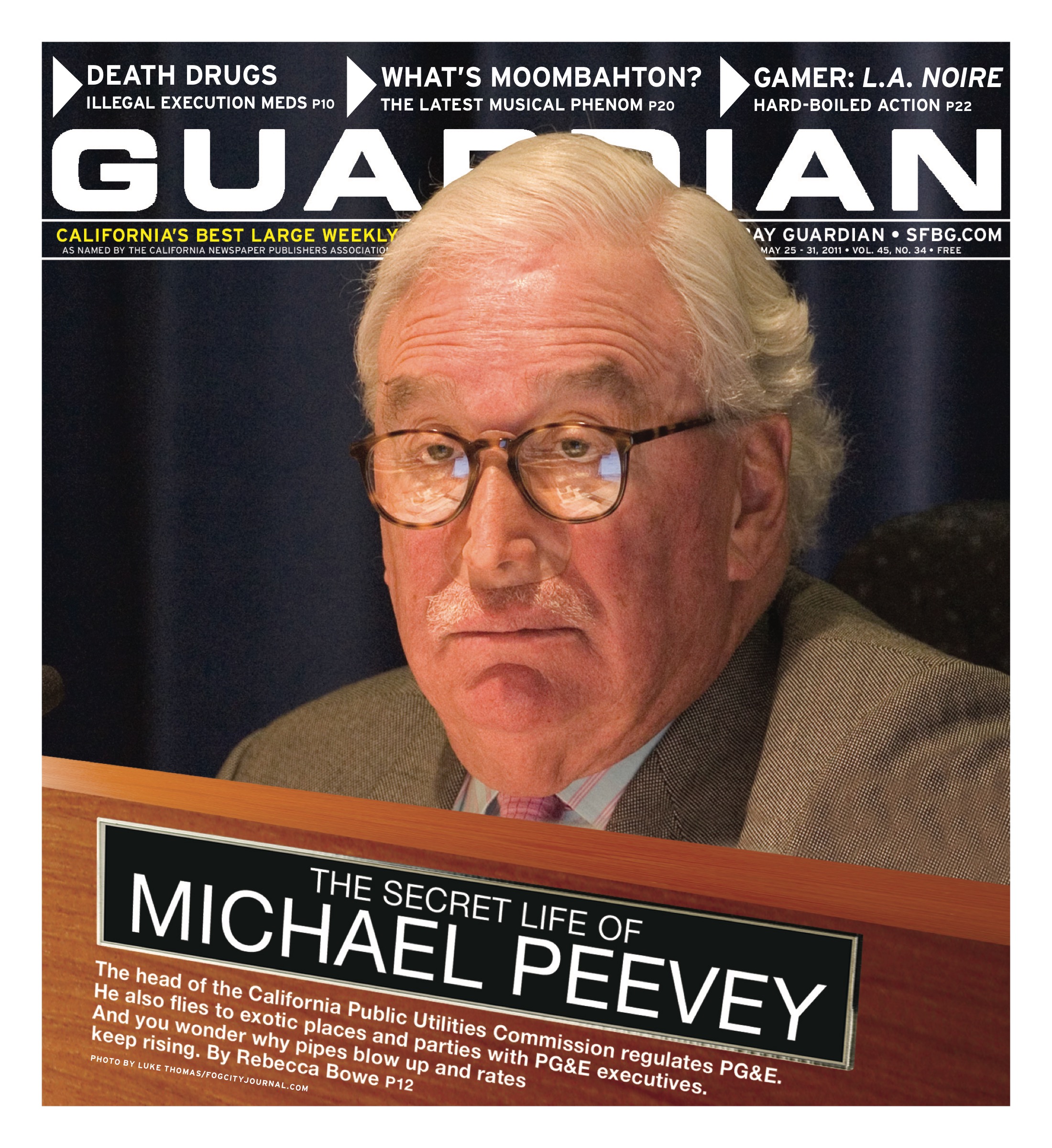
arts@sfbg.com
The course of an acting career can vividly illustrate the randomness of fate. Rutger Hauer spent some years in Dutch experimental theater of the 1960s — after pulling off that best way to terminate one’s military service, faking mental illness — then became a local heartthrob as a medieval knight in a hit TV series at that decade’s end.
He spent the 1970s primarily starring in Dutch movies, notably the striking early films of Paul Verhoeven — well before Showgirls (1995), Starship Troopers (1997), or even 1987’s RoboCop (the director wanted Hauer for the lead, but was overruled by the studio). In the 1980s, Hauer played the memorable villains of Blade Runner (1982), The Hitcher (1986), and 1981’s Nighthawks (inducing tough investigative cop Sylvester Stallone to don drag at the end to catch him), between runs at being an action hero and theoretically loftier assignments around the globe.
Then he settled into a multilingual journeyman’s potluck of low-budget genre features, TV projects, small parts in mainstream films (2005’s Sin City and Batman Begins), Guinness commercials, and a Kylie Minogue video. Apparently 67-year-old Dutch actors in Los Angeles can’t be choosy.
Then again, sometimes better opportunities might choose them. At Sundance this January, Hauer played lead roles in two diametrically opposed movies. One was as the 16th-century Flemish artist Pieter Bruegel the Elder in Polish director Lech Majewski’s extraordinary The Mill and the Cross (recently at the San Francisco International Film Festival), which brings one of that painter’s most epic canvases to cinematic life and will hopefully open on U.S. art house screens later this year. The other was Hobo With a Shotgun. Guess which one is opening theatrically here already.
Hobo began as a $150 faux-trailer short that got considerable exposure online and off. The resulting long-form debut for director Jason Eisener and scenarist John Davies is doubtless the zenith in Halifax, Nova Scotia-shot retro ‘ploitation splatter comedies to date. Which tells you nothing, of course. But it is pretty good — not great — insofar as spoofy gross-out nods to yesteryear’s exploitation cinema go. Better than Machete (2010), a whole lot better than the likes of Zombie Strippers! (2008) or 95 percent of what Troma puts out.
Grizzled Hauer stars as the titular character who rides rails into an equally nameless berg nicknamed “Fuck Town” because it’s so plagued by drugs ‘n’ thugz. The hoodlums are led by crime kingpin “The Drake” (Brian Downey) and goon sons (Gregory Smith, Nick Bateman) whose violent perversities are Caligula-licious. With corrupt police force in pocket, they’re free to terrorize the populace via acts of degradation and violence pushed over the bad-taste top and then some.
When Hauer’s hobo rescues a prostitute (Molly Dunsworth) from this clan’s clutches, he trips his own mental wire from peaceably detached transient to pawnshop-armed streetsweeper of scum, à la 1980s vintage vigilante cheese like 1982’s Class of 1984 (Perry King vs. evil high school “punks”), 1985’s Death Wish 3 (Charles Bronson vs. evil gang “punks”), and 1984’s Savage Streets (Linda Blair versus … figure it out).
Hobo With a Shotgun faithfully apes exploitation conventions, from its lurid widescreen Technicolor hues to a score combining overproduced 1970s funky soundtrack kitsch with ’80s direct-to-video synth pulsing. (Complete with a closing-credits rock song that channels Pat Benatar.) Its ludicrously over-the-top violence is kinda funny, but also nastier than need be.
Throughout, Hauer maintains a straight face. Maybe a tad more so than necessary — this movie could have used the wilder streak crazy-coot comedic streak shown by Jeff Bridges in last year’s True Grit or Kurt Russell in 2007’s Grindhouse.
Game Rutger Hauer retains his blue-eyed charisma and clearly relishes playing the gentle (when not lethal) giant in this artificially baroque scenario. He’s also an actor long on the world stage still seeking a role in a worthy film (or play) that may define him for posterity. He’s obviously got the talent — but at this point, would he take it? Would it even be offered? Did he take Hobo With a Shotgun because it seemed funny, or because it was the best he could get?
HOBO WITH A SHOTGUN opens Fri/27 in Bay Area theaters.
Last train to Fuck Town: Rutger Hauer rides again in “Hobo With a Shotgun”
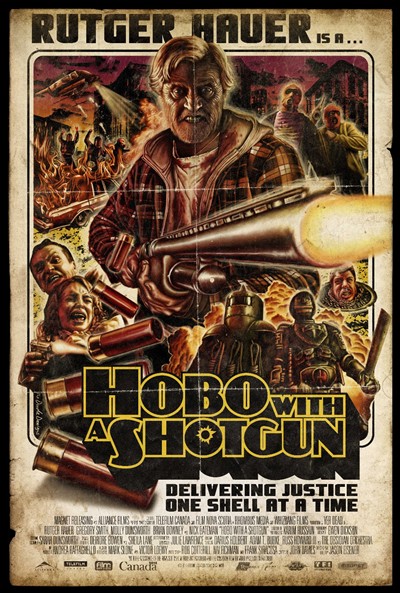
The course of an acting career can vividly illustrate the randomness of fate. Rutger Hauer spent some years in Dutch experimental theater of the 1960s — after pulling off that best way to terminate one’s military service, faking mental illness — then became a local heartthrob as a medieval knight in a hit TV series at that decade’s end.
He spent the 1970s primarily starring in Dutch movies, notably the striking early films of Paul Verhoeven — well before Showgirls (1995), Starship Troopers (1997), or even 1987’s RoboCop (the director wanted Hauer for the lead, but was overruled by the studio). In the 1980s, Hauer played the memorable villains of Blade Runner (1982), The Hitcher (1986), and 1981’s Nighthawks (inducing tough investigative cop Sylvester Stallone to don drag at the end to catch him), between runs at being an action hero and theoretically loftier assignments around the globe.
Then he settled into a multilingual journeyman’s potluck of low-budget genre features, TV projects, small parts in mainstream films (2005’s Sin City and Batman Begins), Guinness commercials, and a Kylie Minogue video. Apparently 67-year-old Dutch actors in Los Angeles can’t be choosy.
Then again, sometimes better opportunities might choose them. At Sundance this January, Hauer played lead roles in two diametrically opposed movies. One was as the 16th-century Flemish artist Pieter Bruegel the Elder in Polish director Lech Majewski’s extraordinary The Mill and the Cross (recently at the San Francisco International Film Festival), which brings one of that painter’s most epic canvases to cinematic life and will hopefully open on U.S. art house screens later this year. The other was Hobo With a Shotgun. Guess which one is opening theatrically here already.
Hobo began as a $150 faux-trailer short that got considerable exposure online and off. The resulting long-form debut for director Jason Eisener and scenarist John Davies is doubtless the zenith in Halifax, Nova Scotia-shot retro ’ploitation splatter comedies to date. Which tells you nothing, of course. But it is pretty good — not great — insofar as spoofy gross-out nods to yesteryear’s exploitation cinema go. Better than Machete (2010), a whole lot better than the likes of Zombie Strippers! (2008) or 95 percent of what Troma puts out.
Grizzled Hauer stars as the titular character who rides rails into an equally nameless berg nicknamed “Fuck Town” because it’s so plagued by drugs ’n’ thugz. The hoodlums are led by crime kingpin “The Drake” (Brian Downey) and goon sons (Gregory Smith, Nick Bateman) whose violent perversities are Caligula-licious. With corrupt police force in pocket, they’re free to terrorize the populace via acts of degradation and violence pushed over the bad-taste top and then some.
When Hauer’s hobo rescues a prostitute (Molly Dunsworth) from this clan’s clutches, he trips his own mental wire from peaceably detached transient to pawnshop-armed streetsweeper of scum, à la 1980s vintage vigilante cheese like 1982’s Class of 1984 (Perry King vs. evil high school “punks”), 1985’s Death Wish 3 (Charles Bronson vs. evil gang “punks”), and 1984’s Savage Streets (Linda Blair versus … figure it out).
Hobo With a Shotgun faithfully apes exploitation conventions, from its lurid widescreen Technicolor hues to a score combining overproduced 1970s funky soundtrack kitsch with ’80s direct-to-video synth pulsing. (Complete with a closing-credits rock song that channels Pat Benatar.) Its ludicrously over-the-top violence is kinda funny, but also nastier than need be. Throughout, Hauer maintains a straight face. Maybe a tad more so than necessary — this movie could have used the wilder streak crazy-coot comedic streak shown by Jeff Bridges in last year’s True Grit or Kurt Russell in 2007’s Grindhouse.
Game Hauer retains his blue-eyed charisma and clearly relishes playing the gentle (when not lethal) giant in this artificially baroque scenario. He’s also an actor long on the world stage still seeking a role in a worthy film (or play) that may define him for posterity. He’s obviously got the talent — but at this point, would he take it? Would it even be offered? Did he take Hobo With a Shotgun because it seemed funny, or because it was the best he could get?
HOBO WITH A SHOTGUN opens Fri/27 in Bay Area theaters.
Editor’s notes
tredmond@sfbg.com
When Cornel West blasted President Obama May 16 in an interview with the website Truthdig, it set off a pretty wild debate on the left. For the most part, it’s been more heat than light (imagine that happening on the left!), but it raises a crucial question about the role progressives play in the Democratic Party — particularly in the 2012 election season.
The best analysis so far comes from Robert Cruikshank, who writes for the blog Calitics. In a May 23 piece, he noted that the right keeps winning battles because the conservatives know how to play coalition politics:
“Conservative communication discipline is enabled only by the fact that everyone in the coalition knows they will get something for their participation…. Everyone knows they will get their turn. Why would someone who is primarily motivated by a desire to outlaw abortion support an oil company that wants to drill offshore? Because the anti-choicers know that in a few weeks, the rest of the coalition will unite to defund Planned Parenthood. And a few weeks after that, everyone will come together to appease Wall Street and the billionaires by fighting Elizabeth Warren. And then they’ll all appease the U.S. Chamber by fighting to break a union.”
Not so with the Democratic Party under Obama. The Wall Street Democrats (the neoliberals, the DLC types, and the power-at-any-price folks) get their way all the time. And those us of who consider ourselves part of the economic left (also known as progressives) not only get thrown under the bus — we see our existing gains rolled back, in exchange for nothing.
Sure, we all agree on a lot of social issues. The neolibs and the progressives support abortion rights and gays in the military and, for the most part, same-sex marriage. We agree that evolution is science and creation is religion.
But on basic economic issues — who pays the taxes, who gets the money, military spending vs. education spending, radical inequality, concentration of wealth, corporate power — we might as well be on different political planets. And while we’re the most active, hard-working members of the Democratic coalition, we get completely ignored on national policy.
Obama ought to be worried — not just by West’s criticism (any president ought to expect some allies to be pissed off) but by the fact that he has created an unsustainable coalition. And some of the San Francisco politicians who call themselves progressives ought to be paying attention too: When your political partners get nothing, they eventually walk.
Film Listings
Film listings are edited by Cheryl Eddy. Reviewers are Kimberly Chun, Michelle Devereaux, Peter Galvin, Max Goldberg, Dennis Harvey, Johnny Ray Huston, Louis Peitzman, Lynn Rapoport, Ben Richardson, and Matt Sussman. For rep house showtimes, see Rep Clock. For first-run showtimes, see Movie Guide.
OPENING
The Hangover Part II What could possibly go wrong this time? (1:42) Four Star, Marina, Presidio, Shattuck.
Hobo With a Shotgun See “Last Train to Fuck Town.” (1:26) Lumiere.
*Into Eternity Danish artist Michael Madsen (no, not that Michael Madsen) sneaks into Werner Herzog territory with this rather existential documentary about nuclear waste storage. Though he lacks Herzog’s distinctive, delightful style (his narration is way too corny, and his interview subjects lack any discernable quirks), Madsen is onto something here. Ostensibly, his film is an exploration of Finland’s Onkalo, an enormous underground facility built to store highly dangerous waste until it is no longer radioactive. Ho-hum, until you realize the facility must remain intact and functional for 100,000 years. How, Into Eternity asks, can we plan that far in the future? We can anticipate most natural-disaster scenarios, but what about human intrusion? How can we prevent future civilizations from drilling into the deadly cache, either accidentally or deliberately? How do we warn them? Should we warn them? Will humans even be around that far in the future? All we are is dust in the wind? Needless to say, this quiet, stylistically unassuming doc goes way, way deeper than 500 meters below Finland’s ancient bedrock. (1:15) Roxie. (Eddy)
Kung Fu Panda 2 Po (Jack Black) and company return for 3D martial-arts misadventures. (1:30) Cerrito, Four Star, Presidio.
Midnight in Paris Owen Wilson plays Gil, a self-confessed “Hollywood hack” visiting the City of Light with his conservative future in-laws and crassly materialistic fiancée Inez (Rachel McAdams). A romantic obviously at odds with their selfish pragmatism (somehow he hasn’t realized that yet), he’s in love with Paris and particularly its fabled artistic past. Walking back to his hotel alone one night, he’s beckoned into an antique vehicle and finds himself transported to the 1920s, at every turn meeting the Fitzgeralds, Gertrude Stein (Kathy Bates), Dali (Adrien Brody), etc. He also meets Adriana (Marion Cotillard), a woman alluring enough to be fought over by Hemingway (Corey Stoll) and Picasso (Marcial di Fonzo Bo) — though she fancies aspiring literary novelist Gil. Woody Allen’s latest is a pleasant trifle, no more, no less. Its toying with a form of magical escapism from the dreary present recalls The Purple Rose of Cairo (1985), albeit without that film’s greater structural ingeniousness and considerable heart. None of the actors are at their best, though Cotillard is indeed beguiling and Wilson dithers charmingly as usual. Still — it’s pleasant. (1:34) Embarcadero. (Harvey)
ONGOING
American: The Bill Hicks Story (1:41) Sundance Kabuki.
*L’Amour Fou Pierre Thoretton’s documentary L’amour fou opens with two clips of men bidding farewell. The first, from 2002, is of the French-Algerian couturier Yves Saint Laurent announcing his retirement in a moving and emotional speech worthy of his favorite writer Marcel Proust. The second is of Pierre Bergé, Saint Laurent’s longtime business partner and former lover, eulogizing his departed friend at the designer’s memorial service six years later. Thoretton’s film is suffused with goodbyes, many tender and candid, some portentous and rehearsed. To be sure, L’amour fou is a touching portrait of the powerful and tempestuous bond between Saint Laurent and Bergé, a bond that lasted close to five decades and resulted in one of the great empires of 20th century fashion. But it is also, alongside David Teboud’s two 2002 YSL documentaries, another entry in the hagiography of Saint Laurent, one cannily steered by Bergé as much as by Thoretton. Well-spoken and charming, Bergé still comes off as the punchy entrepreneurial foil to Saint Laurent’s dazzling but fragile genius. He can be both hyperbolic (praising Saint Laurent’s gifts) but also forthcoming (discussing the designer’s demons). Former muses Loulou de la Falaise and Betty Catroux are also interviewed, but this is clearly Bergé’s show. (1:43) Albany, Embarcadero. (Sussman)
The Beaver It’s been more than 15 years since Jodie Foster sat in the director’s chair; she’s back with The Beaver, which tells the unique story of Walter Black (Mel Gibson), a clinically depressed man who struggles through his suicidal desires with the help of a beaver puppet. Walter uses the puppet — which he also voices — as a way of connecting with his family and the outside world. The film examines both the comedic aspects and the devastating reality of mental illness, and the script walks the line between dark and light — it’s the first feature from Kyle Killen, who created the critically adored but short-lived TV series Lone Star. The Beaver gets points for ambition, but it’s ultimately too all over the place to come together in the end. The moments of humanity are undercut by scenes of Walter and his wife Meredith (Foster) having sex with the puppet in the bed — intentionally funny, but jarring nonetheless. Still, Foster’s direction is solid and, for all its faults, The Beaver is a great reminder of Gibson’s legitimate talent. (1:31) Elmwood, SF Center, Shattuck, Sundance Kabuki. (Peitzman)
*Bill Cunningham New York To say that Bill Cunningham, the 82-year old New York Times photographer, has made documenting how New Yorkers dress his life’s work would be an understatement. To be sure, Cunningham’s two decades-old Sunday Times columns — “On the Street,” which tracks street-fashion, and “Evening Hours,” which covers the charity gala circuit — are about the clothes. And, my, what clothes they are. But Cunningham is a sartorial anthropologist, and his pictures always tell the bigger story behind the changing hemlines, which socialite wore what designer, or the latest trend in footwear. Whether tracking the near-infinite variations of a particular hue, a sudden bumper-crop of cropped blazers, or the fanciful leaps of well-heeled pedestrians dodging February slush puddles, Cunningham’s talent lies in his ability to recognize fleeting moments of beauty, creativity, humor, and joy. That last quality courses through Bill Cunningham New York, Richard Press’ captivating and moving portrait of a man whose reticence and personal asceticism are proportional to his total devotion to documenting what Harold Koda, chief curator at the Costume Institute at the Metropolitan Museum of Art, describes in the film as “ordinary people going about their lives, dressed in fascinating ways.” (1:24) Bridge, Elmwood. (Sussman)
*Bridesmaids For anyone burned out on bad romantic comedies, Bridesmaids can teach you how to love again. This film is an answer to those who have lamented the lack of strong female roles in comedy, of good vehicles for Saturday Night Live cast members, of an appropriate showcase for Melissa McCarthy. The hilarious but grounded Kristen Wiig stars as Annie, whose best friend Lillian (Maya Rudolph) is getting hitched. Financially and romantically unstable, Annie tries to throw herself into her maid of honor duties — all while competing with the far more refined Helen (Rose Byrne). Bridesmaids is one of the best comedies in recent memory, treating its relatable female characters with sympathy. It’s also damn funny from start to finish, which is more than can be said for most of the comedies Hollywood continues to churn out. Here’s your choice: let Bridesmaids work its charm on you, or never allow yourself to complain about an Adam Sandler flick again. (2:04) Balboa, Empire, Marina, 1000 Van Ness, Shattuck, Sundance Kabuki. (Peitzman)
*Cave of Forgotten Dreams The latest documentary from Werner Herzog once again goes where no filmmaker — or many human beings, for that matter — has gone before: the Chauvet-Pont-d’Arc Cave, a heavily-guarded cavern in Southern France containing the oldest prehistoric artwork on record. Access is highly restricted, but Herzog’s 3D study is surely the next best thing to an in-person visit. The eerie beauty of the works leads to a typically Herzog-ian quest to learn more about the primitive culture that produced the paintings; as usual, Herzog’s experts have their own quirks (like a circus performer-turned-scientist), and the director’s own wry narration is peppered with random pop culture references and existential ponderings. It’s all interwoven with footage of crude yet beautiful renderings of horses and rhinos, calcified cave-bear skulls, and other time-capsule peeks at life tens of thousands of years ago. The end result is awe-inspiring. (1:35) SF Center, Shattuck, Sundance Kabuki. (Eddy)
The Conspirator It may not be your standard legal drama, but The Conspirator is a lot more enjoyable when you think of it as an extended episode of Law & Order. The film chronicles the trial of Mary Surratt (Robin Wright), the lone woman charged in the conspiracy to assassinate Abraham Lincoln. It’s a fascinating story, especially for those who don’t know much of the history past John Wilkes Booth. But while the subject matter is compelling, the execution is hit-or-miss. Wright is sympathetic as Surratt, but the usually great James McAvoy is somewhat forgettable in the pivotal role of Frederick Aiken, Surratt’s conflicted lawyer. It’s hard to say what it is that’s missing from The Conspirator: the cast — which also includes Evan Rachel Wood and Tom Wilkinson — is great, and this is a story that’s long overdue to be told. Still, something is lacking. Could it be the presence of everyone’s favorite detective, the late Lennie Briscoe? (2:02) Opera Plaza. (Peitzman)
*The Double Hour Slovenian hotel maid Sonia (Ksenia Rappoport) and security guard Guido (Filippo Timi) are two lonely people in the Italian city of Turin. They find one another (via a speed-dating service) and things are seriously looking up for the fledgling couple when calamity strikes. This first feature by music video director Giuseppe Capotondi takes a spare, somber approach to a screenplay (by Alessandro Fabbri, Ludovica Rampoldi, and Stefano Sardo) that strikingly keeps raising, then resisting genre categorization. Suffice it to say their story goes from lonely-hearts romance to violent thriller, ghost story, criminal intrigue, and yet more. It doesn’t all work seamlessly, but such narrative unpredictability is so rare at the movies these days that The Double Hour is worth seeing simply for the satisfying feeling of never being sure where it’s headed. (1:35) Albany, Clay, Piedmont, Smith Rafael. (Harvey)
*Everything Must Go Just skirting the edge of sentimentality and banality, Everything Must Go aims to do justice by its source material: Raymond Carver’s rueful, characteristically spare short story, “Why Don’t You Dance?,” from the 1988 collection Where I’m Calling From. And it mostly succeeds with some restraint from its director-writer Dan Rush, who mainly helmed commercials in the past. Everything Must Go gropes toward a cinematic search for meaning for the Willy Lomans on both sides of the camera — it’s been a while since Will Ferrell attempted to stretch beyond selling a joke, albeit often extended ones about masculinity, and go further as an actor than 2006’s Stranger Than Fiction. The focus here turns to the despairing, voyeuristic whiskey drinker of Carver’s highly-charged short story, fills in the blanks that the writer always carefully threaded into his work, and essentially pushes him down a crevasse into the worst day of his life: Ferrell’s Nick has been fired and his wife has left him, changing the locks, putting a hold on all his bank accounts, and depositing his worldly possessions on the lawn of their house. Nick’s car has been reclaimed, his neighbors are miffed that he’s sleeping on his lawn, the cops are doing drive-bys, and he’s fallen off the wagon. His only reprieve, says his sponsor Frank (Michael Pena), is to pretend to hold a yard sale; his only help, a neighborhood boy Kenny who’s searching for a father figure (Christopher Jordan Wallace, who played his dad Notorious B.I.G. as a child in 2009’s Notorious) and the new neighbor across the street (Rebecca Hall). Though Rush expands the characters way beyond the narrow, brilliant scope of Carver’s original narrative, the urge to stay with those fallible people — as well as the details of their life and the way suburban detritus defines them, even as those possessions are forcibly stripped away — remains. It makes for an interesting animal of a dramedy, though in Everything Must Go‘s search for bright spots and moments of hope, it’s nowhere near as raw, uncompromising, and tautly loaded as Carver’s work can be. (1:36) Piedmont, Sundance Kabuki. (Chun)
Fast Five There are plenty of laugh-out-loud moments in Fast Five, in addition to a much demolition derby-style crunch — instances that stretch credulity and simultaneously trigger a chuckle at the OTT fantasy of the entire enterprise. Two unarmed men chained to the ceiling kick their way out of a torture cell, jump favela rooftops to freedom with nary a bullet wound in sight, and, in the movie’s smash-’em-up tour de force, use a bank vault as a hulking pair of not-so-fuzzy dice to pulverize an unsuspecting Rio de Janeiro. Not for nothing is rapper Ludacris attached to this franchise — his name says it all (why not go further than his simple closing track, director Justin Lin, now designated the keeper of Fast flame, and have him providing the rap-eratic score/running commentary throughout?) In this installment, shady hero Dominic (Vin Diesel) needs busting out of jail — check, thanks to undercover-cop-turned-pal Brian (Paul Walker) and Dominic’s sis Mia (Jordana Brewster). Time to go on the lam in Brazil and to bring bossa nova culture down to level of thieving L.A. gearheads, as the gearhead threesome assemble their dream team of thieves to undertake a last big heist that will set ’em up for life. Still, despite the predictable pseudo-twists — can’t we all see the bromance-bonding between testosteroni boys Diesel and Dwayne Johnson coming from miles of blacktop away? — there’s enough genre fun, stunt driving marvels, and action choreography here (Lin, who made his name in ambitious indies like 2002’s Better Luck Tomorrow, has developed a knack for harnessing/shooting the seeming chaos) — to please fans looking for a bigger, louder kick. (1:41) 1000 Van Ness. (Chun)
The First Grader After a government announcement offering free elementary school educations to all Kenyans, an elderly man, Maruge (Oliver Litondo), shuffles to the nearest rural classroom in search of reading lessons. Though school officials (and parents, miffed that the man would take a child’s place in the already overcrowded system) protest, open-minded head teacher Jane (Naomie Harris) allows him to stay and study. Maruge’s freedom-fighter past, which cost him his family at the brutal hands of the British, is an important part of this true story, which otherwise would’ve felt a bit too heavy on the heartwarming tip. (His classmates, actual students at the school used for filming, are pretty unavoidably adorable.) As directed by Justin Chadwick (2008’s The Other Boleyn Girl ), Harris and Litondo turn in passionate performances, but the film unfolds like a heavy-handed TV movie. The facts of this story are inspiring enough — the film shouldn’t have to try so hard. (1:43) Opera Plaza, Smith Rafael. (Eddy)
Forks Over Knives Lee Fulkerson steps up as the latest filmmaker-turned-guinea-pig to appear in his own documentary about nutrition. As he makes progress on his 12-week plan to adopt a “whole foods, plant-based diet” (and curb his Red Bull addiction), he meets with other former junk food junkies, as well as health professionals who’ve made it their mission to prevent or even reverse diseases strictly through dietary changes. Along the way, Forks Over Knives dishes out scientific factoids both enlightening and alarming about the way people (mostly us fatty Americans, though the film investigates a groundbreaking cancer study in China) have steadily gotten unhealthier as a direct result of what they are (or in some cases, are not) eating. Fulkerson isn’t as entertaining as Morgan Spurlock (and it’s unlikely his movie will have the mainstream appeal of 2004’s Super Size Me), but the staunchly pro-vegan Forks Over Knives certainly offers some interesting, ahem, food for thought. (1:36) Opera Plaza. (Eddy)
*Hanna The title character of Hanna falls perfectly into the lately very popular Hit-Girl mold. Add a dash of The Boys from Brazil-style genetic engineering — Hanna has the unfair advantage, you see, when it comes to squashing other kids on the soccer field or maiming thugs with her bare hands — and you have an ethereal killing/survival machine, played with impassive confidence by Atonement (2007) shit-starter Saoirse Ronan. She’s been fine-tuned by her father, Erik (Eric Bana), a spy who went out into the cold and off the grid, disappearing into the wilds of Scandinavia where he home-schooled his charge with an encyclopedia and brutal self-defense and hunting tests. Atonement director Joe Wright plays with a snowy palette associated with innocence, purity, and death — this could be any time or place, though far from the touch of modern childhood stresses: that other Hannah (Montana), consumerism, suburban blight, and academic competition. The 16-year-old Hanna, however, isn’t immune from that desire to succeed. Her game mission: go from a feral, lonely existence into the modern world, run for her life, and avenge the death of her mother by killing Erik’s CIA handler, Marissa (Cate Blanchett). The nagging doubt: was she born free, or Bourne to be a killer? Much like the illustrated Brothers Grimm storybook that she studies, Hanna is caught in an evil death trap of fairytale allegories. One wonders if the super-soldier apple didn’t fall far from the tree, since evil stepmonster Marissa oversaw the program that produced Hanna — the older woman and the young girl have the same cold-blooded talent for destruction and the same steely determination. Yet there’s hope for the young ‘un. After learning that even her beloved father hid some basic truths from her, this natural-born killer seems less likely to go along with the predetermined ending, happy or no, further along in her storybook life. (1:51) SF Center. (Chun)
*Hesher Young teen TJ (Devin Brochu) has lost his mom, and her shockingly sudden passing has sent his entire family into a tailspin. His father (Rainn Wilson) can barely rouse himself from his heavily medicated stupor, while his lonely grandmother (Piper Laurie) is left to care for the wrecked men folk as best she can. All TJ can do is to try to desperately hang onto the smashed car that has been sold to the used car salesman and then the junkyard. So it almost seems like a dream when he catches the attention of an aloof, threatening metalhead named Hesher (a typecast-squashing, perfectly on-point Joseph Gordon-Levitt), squatting in an empty suburban model home. Hesher threatens to kill him, then moves in, becoming his so-called “friend” and brand-new, unwanted shadow. What’s a grieving family lost in its own tragic inertia supposed to do with a home invasion staged by an angry, malevolent spirit? Coming to terms with Hesher’s presence becomes a lot like going through Kubler-Ross’s five stages of grief: there’s the denial that he’s taken over the living-room TV and rejiggered the cable to get a free porn channel, the anger that he’s set fire to your enemy’s hot rod and left you at the scene of the crime, and lastly the acceptance that there’s no good, right, or unmessy way to say goodbye. Director Spencer Susser (with co-writer David Michod of 2010’s Animal Kingdom) modeled the character of Hesher after late Metallica bassist Cliff Burton, and that fact, along with the film’s independent-minded spirit, is probably one of the reasons why Metallica allowed more than one of their songs to be used in the film. Hesher itself also likely had something to do with it: if the intrigue with heavy-metal-parking-lot culture doesn’t do donuts in your cul-de-sac, then the sobering story might. (1:45) California, Lumiere. (Chun)
*Incendies When tightly wound émigré Nawal (Luba Azabal) dies, she leaves behind adult twins Jeanne (Mélissa Désormeaux-Poulin) and Simon (Maxim Gaudette) — and leaves them documents that only compound their feelings of grief and anger, suggesting that what little they thought they knew about their background might have been a lie. While resentful Simon at first stays home in Montreal, Jeanne travels to fictive “Fuad” (a stand-in for source-material playwright Wajdi Mouawad’s native Lebanon), playing detective to piece together decades later the truth of why their mother fled her homeland at the height of its long, brutal civil war. Alternating between present-day and flashback sequences, this latest by Canadian director Denis Villeneuve (2000’s Maelstrom) achieves an urgent sweep punctuated by moments of shocking violence. Resembling The Kite Runner in some respects as a portrait of the civilian victimization excused by war, it also resembles that work in arguably piling on more traumatic incidences and revelations than one story can bear — though so much here has great impact that a sense of over-contrivance toward the very end only slightly mars the whole. (2:10) Opera Plaza, Shattuck. (Harvey)
Jumping the Broom (1:48) SF Center.
*Meek’s Cutoff After three broke down road movies (1994’s River of Grass, 2006’s Old Joy, 2008’s Wendy and Lucy), Kelly Reichardt’s new frontier story tilts decisively towards socially-minded existentialism. It’s 1845 on the choked plains of Oregon, miles from the fertile valley where a wagon train of three families is headed. They’ve hired the rogue guide Meek to show them the way, but he’s got them lost and low on water. When the group captures a Cayeuse Indian, Solomon proposes they keep him on as a compass; Meek thinks it better to hang him and be done with it. The periodic shots of the men deliberating are filmed from a distance — the earshot range of the three women (Michelle Williams, Zoe Kazan, and Shirley Henderson) who set up camp each night. It’s through subtle moves like these that Meek’s Cutoff gives a vivid taste of being subject to fate and, worse still, the likes of Meek. Reichardt winnows away the close-ups, small talk, and music that provided the simple gifts of her earlier work, and the overall effect is suitably austere. (1:44) Roxie, Shattuck. (Goldberg)
*My Perestroika Robin Hessman’s very engaging documentary takes one very relatable look at how changes since glasnost have affected some average Russians. The subjects here are five thirtysomethings who, growing up in Moscow in the 70s and 80s, were the last generation to experience full-on Communist Party indoctrination. But just as they reached adulthood, the whole system dissolved, confusing long-held beliefs and variably impacting their futures. Andrei has ridden the capitalist choo-choo to considerable enrichment as the proprietor of luxury Western menswear shops. But single mother Olga, unlucky in love, just scrapes by, while married schoolteachers Lyuba and Boris are lucky to have inherited an apartment (cramped as it is) they could otherwise ill afford. Meanwhile Ruslan, once member of a famous punk band (which he abandoned on principal because it was getting “too commercial”), both disdains and resents the new order just as he did the old one. Home movies and old footage of pageantry celebrating Soviet socialist glory make a whole ‘nother era come to life in this intimate, unexpectedly charming portrait of its long-term aftermath. (1:27) Balboa. (Harvey)
*Nostalgia for the Light Chile’s Atacama Desert, the setting for Patricio Guzmán’s lyrically haunting and meditative documentary, is supposedly the driest place on earth. As a result, it’s also the most ideal place to study the stars. Here, in this most Mars-like of earthly landscapes, astronomers look to the heavens in an attempt to decode the origins of the universe. Guzmán superimposes images from the world’s most powerful telescopes — effluent, gaseous nebulas, clusters of constellations rendered in 3-D brilliance — over the night sky of Atacama for an even more otherworldly effect, but it’s the film’s terrestrial preoccupations that resonate most. For decades, a small, ever dwindling group of women have scoured the cracked clay of Atacama searching for loved ones who disappeared early in Augusto Pinochet’s regime. They take their tiny, toy-like spades and sift through the dirt, finding a partial jawbone here, an entire mummified corpse there. Guzmán’s attempt through voice-over to make these “architects of memory,” both astronomers and excavators alike, a metaphor for Chile’s reluctance to deal with its past atrocities is only marginally successful. Here, it’s the images that do all the talking — if “memory has a gravitational force,” their emotional weight is as inescapable as a black hole. (1:30) Lumiere, Smith Rafael. (Devereaux)
Pirates of the Caribbean: On Stranger Tides The last time we saw rascally Captain Jack Sparrow (Johnny Depp), he was fighting his most formidable enemy yet: the potentially franchise-ending Pirates of the Caribbean: At World’s End (2007). The first Pirates movie (2003) was a surprise critical success, earning Depp his first-ever Oscar nomination; subsequent entries, though no less moneymaking, suffered from a detectable case of sequel-itis. Overseeing this reboot of sorts is director Rob Marshall (2002’s Chicago), who keeps the World’s End notion of sending Jack to find the Fountain of Youth, but adds in a raft of new faces, including Deadwood‘s Ian McShane (as Blackbeard) and lady pirate Penélope Cruz. The story is predictably over-the-top, with the expected supernatural elements mingling with sparring both sword-driven and verbal — as well as an underlying theme about faith that’s nowhere near as fun as the film’s lesser motifs (revenge, for one). It’s basically a big swirl of silly swashbuckling, nothing more or less. And speaking of Depp, the fact that the oft-ridiculous Sparrow is still an amusing character can only be chalked up to the actor’s own brand of untouchable cool. If it was anyone else, Sparrow’d be in Austin Powers territory by now. (2:05) Balboa, Castro, Cerrito, Empire, 1000 Van Ness, Presidio, Sundance Kabuki. (Eddy)
Priest (1:27) 1000 Van Ness, SF Center.
*The Princess of Montpensier Marie (Mélanie Thierry), the titular figure in French director Bertrand Tavernier’s latest, is a young 16th century noblewoman married off to a Prince (Grégoire Leprince-Ringuet) of great wealth and property. But they’ve barely met when he’s called off to war — leaving her alone on his enormous estate, vulnerable to myriad suitors who seem to be forever throwing themselves at her nubile, neglected body. Lambert Wilson (2010’s Of Gods and Men) is touching as the older soldier appointed her protector; he comes to love her, yet is the one man upstanding enough to resist compromising her. If you’ve been jonesing for the kind of lush arthouse period epic that feels like a big fat classic novel, this engrossing saga from a 70-year-old Gallic cinema veteran in top form will scratch that itch for nearly two and a half satisfyingly tragic-romantic hours. (2:19) Smith Rafael. (Harvey)
Potiche When we first meet Catherine Deneuve’s Suzanne — the titular trophy wife (or potiche) of Francois Ozon’s new airspun comedy — she is on her morning jog, barely breaking a sweat as she huffs and puffs in her maroon Adidas tracksuit, her hair still in curlers. It’s 1977 and Suzanne’s life as a bourgeois homemaker in a small provincial French town has played out as smoothly as one of her many poly-blend skirt suits: a devoted mother to two grown children and loving wife who turns a blind eye to the philandering of husband Robert (Fabrice Luchini), Suzanne is on the fast track to comfortable irrelevance. All that changes when the workers at Robert’s umbrella factory strike and take him hostage. Suzanne, with the help of union leader and old flame Babin (Gerard Depardieu, as big as a house), negotiates a peace, and soon turns around the company’s fortunes with her new-found confidence and business savvy. But when Robert wrests back control with the help of a duped Babin, Suzanne does an Elle Woods and takes them both on in a surprise run for political office. True to the film’s light théâtre de boulevard source material, Ozon keeps things brisk and cheeky (Suzanne sings with as much ease as she spouts off Women’s Lib boilerplate) to the point where his cast’s hammy performances start blending into the cheery production design. Satire needs an edge that Potiche, for all its charm, never provides. (1:43) Elmwood, Opera Plaza. (Sussman)
Queen to Play From first-time feature director Caroline Bottaro comes this drama about … chess. Wait! Before your eyes glaze over, here are a few more fast facts: it’s set in idyllic Corsica and features, as an American expat, Kevin Kline in his first French-speaking role. (Side note: is there a Kline comeback afoot? First No Strings Attached, then The Conspirator, and now Queen to Play. All within a few short months.) Lovely French superstar Sandrine Bonnaire plays Héléne, a hotel maid who has more or less accepted her unremarkable life — until she happens to catch a couple (one half of which is played by Jennifer Beals, cast because Bottaro is a longtime fan of 1983’s Flashdance!) playing chess. An unlikely obsession soon follows, and she asks Kline’s character, a reclusive doctor who’s on her freelance house-cleaning route, to help her up her game. None too pleased with this new friendship are Héléne’s husband and nosy neighbors, who are both suspicious of the doctor and unsure of how to treat the formerly complacent Héléne’s newfound, chess-inspired confidence. Queen to Play can get a little corny (we’re reminded over and over that the queen is “the most powerful piece”), and chess is by nature not very cinematic (slightly more fascinating than watching someone type, say). But Bonnaire’s quietly powerful performance is worth sticking around for, even when the novelty of whiskery, cardigan-wearing, French-spouting Kline wears off. (1:36) Shattuck, Smith Rafael. (Eddy)
Rio (1:32) Elmwood, 1000 Van Ness, SF Center.
Something Borrowed (1:53) 1000 Van Ness, Presidio.
*Source Code A post-9/11 Groundhog Day (1993) with explosions, Inception (2010) with a heart, or Avatar (2009) taken down a notch or dozen in Chicago —whatever you choose to call it, Source Code manages to stand up on its own wobbly Philip K. Dick-inspired legs, damn the science, and take off on the wings of wish fulfillment. ‘Cause who hasn’t yearned for a do-over — and then a do-over of that do-over, etc. We could all be as lucky — or as cursed — as soldier Colter Stevens (Jake Gyllenhaal), who gets to tumble down that time-space rabbit hole again and again, his consciousness hitching a ride in another man’s body, while in search of the bomber of a Chicago commuter train. On the upside, he gets to meet the girl of his dreams (Michelle Monaghan) — and see her getting blown to smithereens again and again, all in the service of his country, his commander-cum-link to the outside world (Vera Farmiga), and the scientist masterminding this secret military project (Jeffrey Wright). On the downside, well, he gets to do it over and over again, like a good little test bunny in pinball purgatory. Fortunately, director Duncan Jones (2009’s Moon) makes compelling work out of the potentially ludicrous material, while his cast lends the tale a glossed yet likable humanity, the kind that was all too absent in 2010’s Inception. (1:33) 1000 Van Ness. (Chun)
*13 Assassins 13 Assassins is clearly destined to be prolific director Takashi Miike’s greatest success outside Japan yet. It’s another departure for the multi-genre-conquering Miike, doubtless one of the most conventional movies he’s made in theme and execution. That’s key to its appeal — rigorously traditional, taking its sweet time getting to samurai action that is pointedly not heightened by wire work or CGI, it arrives at the kind of slam-dunk prolonged battle climax that only a measured buildup can let you properly appreciate. In the 1840s, samurai are in decline but feudalism is still hale. It’s a time of peace, though not for the unfortunates who live under regional tyrant Lord Naritsugu (Goro Inagaki), a li’l Nippon Caligula who taxes and oppresses his people to the point of starvation. Alas, the current Shogun is his sibling, and plans to make little bro his chief adviser — so a concerned Shogun official secretly hires veteran samurai Shinzaemon (Koji Yakusho) to assassinate the Lord. Fully an hour is spent on our hero doing “assembling the team” stuff, recruiting other unemployed, retired, or wannabe samurai. When the protagonists finally commence their mission, their target is already aware he’s being pursued, and he’s surrounded by some 200 soldiers by the time Miike arrives at the film’s sustained, spectacular climax: a small village which Shinzaemon and co. have turned into a giant boobytrap so that 13 men can divide and destroy an ogre-guarding army. A major reason why mainstream Hollywood fantasy and straight action movies have gotten so depressingly interchangeable is that digital FX and stunt work can (and does) visualize any stupid idea — heroes who get thrown 200 feet into walls by monsters then getting up to fight some more, etc. 13 Assassins is thrilling because its action, while sporting against-the-odds ingeniousness and sheer luck by our heroes as in any trad genre film, is still vividly, bloodily, credibly physical. (2:06) California, Embarcadero, Smith Rafael. (Harvey)
*Thor When it comes to superhero movies, I’m not easily impressed. Couple that with my complete disinterest in the character of Thor, and I didn’t go into his big-screen debut with any level of excitement. Turns out Kenneth Branagh’s Thor is a genre standout — the best I’ve seen since 2008’s Iron Man. For those who don’t know the mythology, the film follows Thor (Chris Hemsworth) as he’s exiled from the realm of Asgard to Earth. Once there, he must reclaim his mighty hammer — along with his powers — in order to save the world and win the heart of astrophysicist Jane Foster (Natalie Portman). Hemsworth is perfectly cast as the titular hero: he’s adept at bringing charm to a larger-than-life god. The script is a huge help, striking the ideal balance between action, drama, and humor. That’s right, Thor is seriously funny. On top of that, the effects are sensational. Sure, the 3D is once again unnecessary, but it’s admittedly kind of fun when you’re zooming through space. (2:03) Empire, 1000 Van Ness, Sundance Kabuki. (Peitzman)
The Topp Twins: Untouchable Girls It’s hard to name an American equivalent of New Zealand’s Topp Twins — a folk-singing, comedy-slinging, cross-dressing duo who’re the biggest Kiwi stars you’ve never heard of (but may be just as beloved as, say, Peter Jackson in their homeland). Recent inductees in the New Zealand Music Hall of Fame, the fiftysomething Jools and Lynda, both lesbians, sing country-tinged tunes that slide easily from broad and goofy (with an array of costumed personas) to extremely political, sounding off on LGBT and Maori rights, among other topics. Even if you’re not a fan of their musical style, it’s undeniable that their identical voices make for some stirring harmonies, and their optimism, even when a serious illness strikes, is inspiring. This doc — which combines interviews, home movies, and performance footage — will surely earn them scores of new stateside fans. (1:24) Shattuck. (Eddy)
Water for Elephants A young man named Jacob Jankowski (Robert Pattinson) turns his back on catastrophe and runs off to join the circus. It sounds like a fantasy, but this was never Jacob’s dream, and the circus world of Water for Elephants isn’t all death-defying feats and pretty women on horses. Or rather, the pretty woman also rides an elephant named Rosie and the casualties tend to occur outside the big top, after the rubes have gone home. Stumbling onto a train and into this world by chance, Jacob manages to charm the sadistic sociopath who runs the show, August (Christophe Waltz), and is charmed in turn by August’s wife, Marlena (Reese Witherspoon), a star performer and the object of August’s abusive, obsessive affections. Director Francis Lawrence’s film, an adaptation of Sarah Gruen’s 2006 novel, depicts a harsh Depression-era landscape in which troupes founder in small towns across America, waiting to be scavenged for parts — performers and animals — by other circuses passing through. Waltz’s August is a frightening man who defines a layoff as throwing workers off a moving train, and the anxiety of anticipating his moods and moves supplies most of the movie’s dramatic tension; Jacob and Marlena’s pallid love story feeds off it rather than adding its own. The film also suffers from a frame tale that feels awkward and forced, though Hal Holbrook makes heroic efforts as the elderly Jacob, surfacing on the grounds of — what else? — a modern-day circus to recount his tale of tragedy and romance. (2:00) 1000 Van Ness, SF Center, Sundance Kabuki. (Rapoport)
*Win Win Is Tom McCarthy the most versatile guy in Hollywood? He’s a successful character actor (in big-budget movies like 2009’s 2012; smaller-scale pictures like 2005’s Good Night, and Good Luck; and the final season of The Wire). He’s an Oscar-nominated screenwriter (2009’s Up). And he’s the writer-director of two highly acclaimed indie dramas, The Station Agent (2003) and The Visitor (2007). Clearly, McCarthy must not sleep much. His latest, Win Win, is a comedy set in his hometown of New Providence, N.J. Paul Giamatti stars as Mike Flaherty, a lawyer who’s feeling the economic pinch. Betraying his own basic good-guy-ness, he takes advantage of a senile client, Leo (Burt Young), when he spots the opportunity to pull in some badly-needed extra cash. Matters complicate with the appearance of Leo’s grandson, Kyle (newcomer Alex Shaffer), a runaway from Ohio. Though Mike’s wife, Jackie (Amy Ryan), is suspicious of the taciturn teen, she allows Kyle to crash with the Flaherty family. As luck would have it, Kyle is a superstar wrestler — and Mike happens to coach the local high school team. Things are going well until Kyle’s greedy mother (Melanie Lynskey) turns up and starts sniffing around her father’s finances. Lessons are learned, sure, and there are no big plot twists beyond typical indie-comedy turf. But the script delivers more genuine laughs than you’d expect from a movie that’s essentially about the recession. (1:46) California, Piedmont. (Eddy)
Your summer guide to art escapes
Living in San Francisco means having the richness of art in a major city, and the natural beauty of California all in one fell swoop. Here’s your guide to enjoying urban escapes and art and live performance – at the same time! – this summer. Also, check out our guides to the season’s falls and festivals, movies, music, and best adventures you can go on without a car.
WITHIN THE CITY
Yerba Buena Gardens Festival
With three stages of free performances, this festival is perfect for a dose of culture and fresh air during your lunch hour with music, dance, theater, and readings. There’s weekend concerts too: the SF Mime Troupe performs Aug. 21, SF’s local songbird Meklit Hadero on Aug. 27, and SF’s pluckiest free ring wraiths, Circus Bella return to the lawn for the weekend of July 1-2.
May through September, free. www.ybgf.org
Stern Grove Festival
Stern Grove’s eucalyptus tree surroundings create a pretty magical summer stage for free performances. The experience gets even better when you pack a tasty picnic spread to enjoy — but leave your umbrellas and high-back chairs at home to keep the peace with those who didn’t snag the primo front row spots. In addition to the annual appearances of the San Francisco Ballet, Opera and Symphony, the concert lineup features Sharon Jones and The Dap-Kings, the Jazz Mafia Symphony, Neko Case, Afrocubism, The English Beat, Aaron Neville, and Javier Limon and Buika.
Sundays, June 19-August 21, free. www.sterngrove.org
San Francisco Mime Troupe at Dolores Park
Enjoy palm trees and revolutionary spirit with your Tecate: with this historic troupe of not-mimes – forget the pantomime, this is socially relevant theater in the park.
July 2, 3, 4, free. www.sfmt.org
San Francisco Symphony in the Park
This year’s concert, which will be performed in Sharon Meadow, features conductor Michael Francis and pianist Valentina Lisitsa on a program of Mussorgsky’s A Night on Bald Mountain, Rachmaninoff’s Piano Concerto No. 2, and Beethoven’s Symphony No. 5.
July 10, 2 p.m., free. www.sfsymphony.org
Shakespeare in the Park, The Presidio
Bring the whole family for this year’s performance of Cymbeline at the Presidio’s Main Post Parade Ground Lawn.
September 3, 4, 5, 10, 11, 17, 18, 24, 25, free. Sharon Meadow, Golden Gate Park, SF. www.sfshakes.org
Opera in the Park
This year’s annual concert, also in Sharon Meadow, features a special musical program commemorating the tenth anniversary of September 11, 2001.
September 11, 1:30 p.m., free. Sharon Meadow, Golden Gate Park, SF. www.sfopera.com
AND BEYOND…
Oliver Ranch
Seventy miles north of San Francisco in Sonoma County, Oliver Ranch boasts scenic acres and 18 site-specific installations by artists such as Bruce Nauman and Richard Serra, as well as Ann Hamilton’s distinct tower where commissioned dance, poetry, theater, and music performances unfold. The tower structure – defined by two staircases built in a double helix form that accommodate the audience on one staircase and the performers on the other — suits a range of sensory projects and performances hosting artists like Meredith Monk and the Kronos Quartet. Limited capacity allows for only 100 visitors, making this ticket a splurge — but it’s all good, each concert in the tower benefits a non-profit organization. June appearances include Pauline Oliveros and Terry and Jo Harvey Allen. Should you be lucky enough to get tickets, be sure to bring some water and sunscreen and make a day of it visiting all the nearby wineries.
Various dates in June, prices vary. 22205 River, Geyserville. (510) 412-9090, www.oliverranchfoundation.org
Headlands Center for the Arts open house
Just across the bridge in the rugged Golden Gate National Recreation Area, the Headlands Center for the Arts synthesizes natural and urban environments in a cluster of historic, 1900s military buildings at Fort Barry among hills, cliffs, coves, and beaches. At the center’s summer open house, artists open their studios to the public to show their works-in-progress and talk with visitors about their creative process in a variety of disciplines. Catch one of the many performances and readings scheduled throughout the day and then head to the mess hall, which is transformed into a café serving delicious homemade snacks at down-home prices for the event. While you’re there, a hike through the windy Headland hills is a must-do.
July 24, 12-5 p.m., free. 944 Fort Barry, Sausalito. (415) 331-2787, www.headlands.org
Robert Mondavi Winery Summer Music Festival
One of the first wineries in the Napa Valley, the Robert Mondavi Winery offers much more than sipping, swilling, and spitting. A concert series scheduled for Saturday nights in July features music in an open-air setting and this summer’s lineup includes Gavin DeGraw, Colbie Caillat, David Foster, Chris Isaak, K.D. Lang, and the Siss Boom Bang. Mondavi’s grounds also include an art gallery open daily from 10 a.m. to 4 p.m., with artifacts and paintings as well as a sculpture collection focused on the work of San Francisco artist, Beniamino Bufano, displayed in the main courtyard surrounded by rows of vines. Head here for a fancy summer night of outdoor music and wind down after an afternoon of tastings.
Saturdays in July, $75-$105. 7801 St. Helena Hwy., Oakville. (888) 766-6328, www.robertmondavi.com
Film Listings
Film listings are edited by Cheryl Eddy. Reviewers are Kimberly Chun, Michelle Devereaux, Peter Galvin, Max Goldberg, Dennis Harvey, Johnny Ray Huston, Louis Peitzman, Lynn Rapoport, Ben Richardson, and Matt Sussman. For rep house showtimes, see Rep Clock. For first-run showtimes, see Movie Guide.
OPENING
American: The Bill Hicks Story The late comedian gets his due in this documentary about his life and career. (1:41) Sundance Kabuki.
*L’Amour Fou See “The Long Goodbye.” (1:43) Embarcadero.
The First Grader After a government announcement offering free elementary school educations to all Kenyans, an elderly man, Maruge (Oliver Litondo), shuffles to the nearest rural classroom in search of reading lessons. Though school officials (and parents, miffed that the man would take a child’s place in the already overcrowded system) protest, open-minded head teacher Jane (Naomie Harris) allows him to stay and study. Maruge’s freedom-fighter past, which cost him his family at the brutal hands of the British, is an important part of this true story, which otherwise would’ve felt a bit too heavy on the heartwarming tip. (His classmates, actual students at the school used for filming, are pretty unavoidably adorable.) As directed by Justin Chadwick (2008’s The Other Boleyn Girl ), Harris and Litondo turn in passionate performances, but the film unfolds like a heavy-handed TV movie. The facts of this story are inspiring enough — the film shouldn’t have to try so hard. (1:43) Embarcadero. (Eddy)
Pirates of the Caribbean: On Stranger Tides Jack’s back. (2:05) Balboa, Presidio.
*13 Assassins See “Bastard Samurai.” (2:06) Embarcadero.
The Topp Twins: Untouchable Girls It’s hard to name an American equivalent of New Zealand’s Topp Twins — a folk-singing, comedy-slinging, cross-dressing duo who’re the biggest Kiwi stars you’ve never heard of (but may be just as beloved as, say, Peter Jackson in their homeland). Recent inductees in the New Zealand Music Hall of Fame, the fiftysomething Jools and Lynda, both lesbians, sing country-tinged tunes that slide easily from broad and goofy (with an array of costumed personas) to extremely political, sounding off on LGBT and Maori rights, among other topics. Even if you’re not a fan of their musical style, it’s undeniable that their identical voices make for some stirring harmonies, and their optimism, even when a serious illness strikes, is inspiring. This doc — which combines interviews, home movies, and performance footage — will surely earn them scores of new stateside fans. (1:24) Lumiere. (Eddy)
ONGOING
The Beaver It’s been more than 15 years since Jodie Foster sat in the director’s chair; she’s back with The Beaver, which tells the unique story of Walter Black (Mel Gibson), a clinically depressed man who struggles through his suicidal desires with the help of a beaver puppet. Walter uses the puppet — which he also voices — as a way of connecting with his family and the outside world. The film examines both the comedic aspects and the devastating reality of mental illness, and the script walks the line between dark and light — it’s the first feature from Kyle Killen, who created the critically adored but short-lived TV series Lone Star. The Beaver gets points for ambition, but it’s ultimately too all over the place to come together in the end. The moments of humanity are undercut by scenes of Walter and his wife Meredith (Foster) having sex with the puppet in the bed — intentionally funny, but jarring nonetheless. Still, Foster’s direction is solid and, for all its faults, The Beaver is a great reminder of Gibson’s legitimate talent. (1:31) SF Center, Sundance Kabuki. (Peitzman)
*Bill Cunningham New York To say that Bill Cunningham, the 82-year old New York Times photographer, has made documenting how New Yorkers dress his life’s work would be an understatement. To be sure, Cunningham’s two decades-old Sunday Times columns — “On the Street,” which tracks street-fashion, and “Evening Hours,” which covers the charity gala circuit — are about the clothes. And, my, what clothes they are. But Cunningham is a sartorial anthropologist, and his pictures always tell the bigger story behind the changing hemlines, which socialite wore what designer, or the latest trend in footwear. Whether tracking the near-infinite variations of a particular hue, a sudden bumper-crop of cropped blazers, or the fanciful leaps of well-heeled pedestrians dodging February slush puddles, Cunningham’s talent lies in his ability to recognize fleeting moments of beauty, creativity, humor, and joy. That last quality courses through Bill Cunningham New York, Richard Press’ captivating and moving portrait of a man whose reticence and personal asceticism are proportional to his total devotion to documenting what Harold Koda, chief curator at the Costume Institute at the Metropolitan Museum of Art, describes in the film as “ordinary people going about their lives, dressed in fascinating ways.” (1:24) Embarcadero. (Sussman)
*Bridesmaids For anyone burned out on bad romantic comedies, Bridesmaids can teach you how to love again. This film is an answer to those who have lamented the lack of strong female roles in comedy, of good vehicles for Saturday Night Live cast members, of an appropriate showcase for Melissa McCarthy. The hilarious but grounded Kristen Wiig stars as Annie, whose best friend Lillian (Maya Rudolph) is getting hitched. Financially and romantically unstable, Annie tries to throw herself into her maid of honor duties — all while competing with the far more refined Helen (Rose Byrne). Bridesmaids is one of the best comedies in recent memory, treating its relatable female characters with sympathy. It’s also damn funny from start to finish, which is more than can be said for most of the comedies Hollywood continues to churn out. Here’s your choice: let Bridesmaids work its charm on you, or never allow yourself to complain about an Adam Sandler flick again. (2:04) Balboa, Empire, Four Star, 1000 Van Ness, Sundance Kabuki. (Peitzman)
*Cave of Forgotten Dreams The latest documentary from Werner Herzog once again goes where no filmmaker — or many human beings, for that matter — has gone before: the Chauvet-Pont-d’Arc Cave, a heavily-guarded cavern in Southern France containing the oldest prehistoric artwork on record. Access is highly restricted, but Herzog’s 3D study is surely the next best thing to an in-person visit. The eerie beauty of the works leads to a typically Herzog-ian quest to learn more about the primitive culture that produced the paintings; as usual, Herzog’s experts have their own quirks (like a circus performer-turned-scientist), and the director’s own wry narration is peppered with random pop culture references and existential ponderings. It’s all interwoven with footage of crude yet beautiful renderings of horses and rhinos, calcified cave-bear skulls, and other time-capsule peeks at life tens of thousands of years ago. The end result is awe-inspiring. (1:35) SF Center, Sundance Kabuki. (Eddy)
The Conspirator It may not be your standard legal drama, but The Conspirator is a lot more enjoyable when you think of it as an extended episode of Law & Order. The film chronicles the trial of Mary Surratt (Robin Wright), the lone woman charged in the conspiracy to assassinate Abraham Lincoln. It’s a fascinating story, especially for those who don’t know much of the history past John Wilkes Booth. But while the subject matter is compelling, the execution is hit-or-miss. Wright is sympathetic as Surratt, but the usually great James McAvoy is somewhat forgettable in the pivotal role of Frederick Aiken, Surratt’s conflicted lawyer. It’s hard to say what it is that’s missing from The Conspirator: the cast — which also includes Evan Rachel Wood and Tom Wilkinson — is great, and this is a story that’s long overdue to be told. Still, something is lacking. Could it be the presence of everyone’s favorite detective, the late Lennie Briscoe? (2:02) Four Star, Opera Plaza. (Peitzman)
*The Double Hour Slovenian hotel maid Sonia (Ksenia Rappoport) and security guard Guido (Filippo Timi) are two lonely people in the Italian city of Turin. They find one another (via a speed-dating service) and things are seriously looking up for the fledgling couple when calamity strikes. This first feature by music video director Giuseppe Capotondi takes a spare, somber approach to a screenplay (by Alessandro Fabbri, Ludovica Rampoldi, and Stefano Sardo) that strikingly keeps raising, then resisting genre categorization. Suffice it to say their story goes from lonely-hearts romance to violent thriller, ghost story, criminal intrigue, and yet more. It doesn’t all work seamlessly, but such narrative unpredictability is so rare at the movies these days that The Double Hour is worth seeing simply for the satisfying feeling of never being sure where it’s headed. (1:35) Clay, Smith Rafael. (Harvey)
*Everything Must Go Just skirting the edge of sentimentality and banality, Everything Must Go aims to do justice by its source material: Raymond Carver’s rueful, characteristically spare short story, “Why Don’t You Dance?,” from the 1988 collection Where I’m Calling From. And it mostly succeeds with some restraint from its director-writer Dan Rush, who mainly helmed commercials in the past. Everything Must Go gropes toward a cinematic search for meaning for the Willy Lomans on both sides of the camera — it’s been a while since Will Ferrell attempted to stretch beyond selling a joke, albeit often extended ones about masculinity, and go further as an actor than 2006’s Stranger Than Fiction. The focus here turns to the despairing, voyeuristic whiskey drinker of Carver’s highly-charged short story, fills in the blanks that the writer always carefully threaded into his work, and essentially pushes him down a crevasse into the worst day of his life: Ferrell’s Nick has been fired and his wife has left him, changing the locks, putting a hold on all his bank accounts, and depositing his worldly possessions on the lawn of their house. Nick’s car has been reclaimed, his neighbors are miffed that he’s sleeping on his lawn, the cops are doing drive-bys, and he’s fallen off the wagon. His only reprieve, says his sponsor Frank (Michael Pena), is to pretend to hold a yard sale; his only help, a neighborhood boy Kenny who’s searching for a father figure (Christopher Jordan Wallace, who played his dad Notorious B.I.G. as a child in 2009’s Notorious) and the new neighbor across the street (Rebecca Hall). Though Rush expands the characters way beyond the narrow, brilliant scope of Carver’s original narrative, the urge to stay with those fallible people — as well as the details of their life and the way suburban detritus defines them, even as those possessions are forcibly stripped away — remains. It makes for an interesting animal of a dramedy, though in Everything Must Go‘s search for bright spots and moments of hope, it’s nowhere near as raw, uncompromising, and tautly loaded as Carver’s work can be. (1:36) Sundance Kabuki. (Chun)
Fast Five There are plenty of laugh-out-loud moments in Fast Five, in addition to a much demolition derby-style crunch — instances that stretch credulity and simultaneously trigger a chuckle at the OTT fantasy of the entire enterprise. Two unarmed men chained to the ceiling kick their way out of a torture cell, jump favela rooftops to freedom with nary a bullet wound in sight, and, in the movie’s smash-’em-up tour de force, use a bank vault as a hulking pair of not-so-fuzzy dice to pulverize an unsuspecting Rio de Janeiro. Not for nothing is rapper Ludacris attached to this franchise — his name says it all (why not go further than his simple closing track, director Justin Lin, now designated the keeper of Fast flame, and have him providing the rap-eratic score/running commentary throughout?) In this installment, shady hero Dominic (Vin Diesel) needs busting out of jail — check, thanks to undercover-cop-turned-pal Brian (Paul Walker) and Dominic’s sis Mia (Jordana Brewster). Time to go on the lam in Brazil and to bring bossa nova culture down to level of thieving L.A. gearheads, as the gearhead threesome assemble their dream team of thieves to undertake a last big heist that will set ’em up for life. Still, despite the predictable pseudo-twists — can’t we all see the bromance-bonding between testosteroni boys Diesel and Dwayne Johnson coming from miles of blacktop away? — there’s enough genre fun, stunt driving marvels, and action choreography here (Lin, who made his name in ambitious indies like 2002’s Better Luck Tomorrow, has developed a knack for harnessing/shooting the seeming chaos) — to please fans looking for a bigger, louder kick. (1:41) 1000 Van Ness. (Chun)
Forks Over Knives Lee Fulkerson steps up as the latest filmmaker-turned-guinea-pig to appear in his own documentary about nutrition. As he makes progress on his 12-week plan to adopt a “whole foods, plant-based diet” (and curb his Red Bull addiction), he meets with other former junk food junkies, as well as health professionals who’ve made it their mission to prevent or even reverse diseases strictly through dietary changes. Along the way, Forks Over Knives dishes out scientific factoids both enlightening and alarming about the way people (mostly us fatty Americans, though the film investigates a groundbreaking cancer study in China) have steadily gotten unhealthier as a direct result of what they are (or in some cases, are not) eating. Fulkerson isn’t as entertaining as Morgan Spurlock (and it’s unlikely his movie will have the mainstream appeal of 2004’s Super Size Me), but the staunchly pro-vegan Forks Over Knives certainly offers some interesting, ahem, food for thought. (1:36) Bridge. (Eddy)
*Hanna The title character of Hanna falls perfectly into the lately very popular Hit-Girl mold. Add a dash of The Boys from Brazil-style genetic engineering — Hanna has the unfair advantage, you see, when it comes to squashing other kids on the soccer field or maiming thugs with her bare hands — and you have an ethereal killing/survival machine, played with impassive confidence by Atonement (2007) shit-starter Saoirse Ronan. She’s been fine-tuned by her father, Erik (Eric Bana), a spy who went out into the cold and off the grid, disappearing into the wilds of Scandinavia where he home-schooled his charge with an encyclopedia and brutal self-defense and hunting tests. Atonement director Joe Wright plays with a snowy palette associated with innocence, purity, and death — this could be any time or place, though far from the touch of modern childhood stresses: that other Hannah (Montana), consumerism, suburban blight, and academic competition. The 16-year-old Hanna, however, isn’t immune from that desire to succeed. Her game mission: go from a feral, lonely existence into the modern world, run for her life, and avenge the death of her mother by killing Erik’s CIA handler, Marissa (Cate Blanchett). The nagging doubt: was she born free, or Bourne to be a killer? Much like the illustrated Brothers Grimm storybook that she studies, Hanna is caught in an evil death trap of fairytale allegories. One wonders if the super-soldier apple didn’t fall far from the tree, since evil stepmonster Marissa oversaw the program that produced Hanna — the older woman and the young girl have the same cold-blooded talent for destruction and the same steely determination. Yet there’s hope for the young ‘un. After learning that even her beloved father hid some basic truths from her, this natural-born killer seems less likely to go along with the predetermined ending, happy or no, further along in her storybook life. (1:51) 1000 Van Ness, SF Center. (Chun)
*Hesher Young teen TJ (Devin Brochu) has lost his mom, and her shockingly sudden passing has sent his entire family into a tailspin. His father (Rainn Wilson) can barely rouse himself from his heavily medicated stupor, while his lonely grandmother (Piper Laurie) is left to care for the wrecked men folk as best she can. All TJ can do is to try to desperately hang onto the smashed car that has been sold to the used car salesman and then the junkyard. So it almost seems like a dream when he catches the attention of an aloof, threatening metalhead named Hesher (a typecast-squashing, perfectly on-point Joseph Gordon-Levitt), squatting in an empty suburban model home. Hesher threatens to kill him, then moves in, becoming his so-called “friend” and brand-new, unwanted shadow. What’s a grieving family lost in its own tragic inertia supposed to do with a home invasion staged by an angry, malevolent spirit? Coming to terms with Hesher’s presence becomes a lot like going through Kubler-Ross’s five stages of grief: there’s the denial that he’s taken over the living-room TV and rejiggered the cable to get a free porn channel, the anger that he’s set fire to your enemy’s hot rod and left you at the scene of the crime, and lastly the acceptance that there’s no good, right, or unmessy way to say goodbye. Director Spencer Susser (with co-writer David Michod of 2010’s Animal Kingdom) modeled the character of Hesher after late Metallica bassist Cliff Burton, and that fact, along with the film’s independent-minded spirit, is probably one of the reasons why Metallica allowed more than one of their songs to be used in the film. Hesher itself also likely had something to do with it: if the intrigue with heavy-metal-parking-lot culture doesn’t do donuts in your cul-de-sac, then the sobering story might. (1:45) Embarcadero. (Chun)
*Incendies When tightly wound émigré Nawal (Luba Azabal) dies, she leaves behind adult twins Jeanne (Mélissa Désormeaux-Poulin) and Simon (Maxim Gaudette) — and leaves them documents that only compound their feelings of grief and anger, suggesting that what little they thought they knew about their background might have been a lie. While resentful Simon at first stays home in Montreal, Jeanne travels to fictive “Fuad” (a stand-in for source-material playwright Wajdi Mouawad’s native Lebanon), playing detective to piece together decades later the truth of why their mother fled her homeland at the height of its long, brutal civil war. Alternating between present-day and flashback sequences, this latest by Canadian director Denis Villeneuve (2000’s Maelstrom) achieves an urgent sweep punctuated by moments of shocking violence. Resembling The Kite Runner in some respects as a portrait of the civilian victimization excused by war, it also resembles that work in arguably piling on more traumatic incidences and revelations than one story can bear — though so much here has great impact that a sense of over-contrivance toward the very end only slightly mars the whole. (2:10) Lumiere. (Harvey)
Jumping the Broom (1:48) 1000 Van Ness.
Last Night Married for three years and together “since college,” New York City yuppies Michael (Sam Worthington) and Joanna (Keira Knightley) have a comfortable, loving relationship, though it’s unclear how much passion remains. Still, it doesn’t take much for Joanna to bristle jealously when she meets Michael’s co-worker and frequent business-trip companion, Laura (Eva Mendes). As Michael and Laura flirt their way to an overnight meeting in Philly, Joanna runs into an old flame (Guillaume Canet); before long, it becomes a cross-cutting race to see who’ll cheat first. Writer-director Massy Tadjedin isn’t spinning a new story here — and though the film offers a sleek look at contemporary marriage, Last Night takes itself a tad too seriously, purporting to showcase realistic problems and emotions amid a cast beamed directly from Planet Gorgeous Movie Star. Beautiful people: they’re just like us? (1:30) Sundance Kabuki. (Eddy)
*Limitless An open letter to the makers of Limitless: please fire your marketing team because they are making your movie look terrible. The story of a deadbeat writer (Bradley Cooper) who acquires an unregulated drug that allows him to take advantage of 100 percent of his previously under-utilized brain, Limitless is silly, improbable and features a number of distracting comic-book-esque stylistic tics. But consumed with the comic book in mind, Limitless is also unpredictable, thrilling, and darkly funny. The aforementioned style, which includes many instances of the infinite regression effect that you get when you point two mirrors at each other, and a heavy blur to distort depth-of-field, only solidifies the film’s cartoonish intentions. Cooper learns foreign languages in hours, impresses women with his keen attention to detail, and sets his sights on Wall Street, a move that gets him noticed by businessman Carl Van Loon (Robert DeNiro in a glorified cameo) as well as some rather nasty drug dealers and hired guns looking to cash in on the drug. Limitless is regrettably titled and masquerades in TV spots as a Wall Street series spin-off, but in truth it sports the speedy pacing and tongue-in-cheek humor required of a good popcorn flick. (1:37) 1000 Van Ness. (Galvin)
*My Perestroika Robin Hessman’s very engaging documentary takes one very relatable look at how changes since glasnost have affected some average Russians. The subjects here are five thirtysomethings who, growing up in Moscow in the 70s and 80s, were the last generation to experience full-on Communist Party indoctrination. But just as they reached adulthood, the whole system dissolved, confusing long-held beliefs and variably impacting their futures. Andrei has ridden the capitalist choo-choo to considerable enrichment as the proprietor of luxury Western menswear shops. But single mother Olga, unlucky in love, just scrapes by, while married schoolteachers Lyuba and Boris are lucky to have inherited an apartment (cramped as it is) they could otherwise ill afford. Meanwhile Ruslan, once member of a famous punk band (which he abandoned on principal because it was getting “too commercial”), both disdains and resents the new order just as he did the old one. Home movies and old footage of pageantry celebrating Soviet socialist glory make a whole ‘nother era come to life in this intimate, unexpectedly charming portrait of its long-term aftermath. (1:27) Balboa. (Harvey)
*Nostalgia for the Light Chile’s Atacama Desert, the setting for Patricio Guzmán’s lyrically haunting and meditative documentary, is supposedly the driest place on earth. As a result, it’s also the most ideal place to study the stars. Here, in this most Mars-like of earthly landscapes, astronomers look to the heavens in an attempt to decode the origins of the universe. Guzmán superimposes images from the world’s most powerful telescopes — effluent, gaseous nebulas, clusters of constellations rendered in 3-D brilliance — over the night sky of Atacama for an even more otherworldly effect, but it’s the film’s terrestrial preoccupations that resonate most. For decades, a small, ever dwindling group of women have scoured the cracked clay of Atacama searching for loved ones who disappeared early in Augusto Pinochet’s regime. They take their tiny, toy-like spades and sift through the dirt, finding a partial jawbone here, an entire mummified corpse there. Guzmán’s attempt through voice-over to make these “architects of memory,” both astronomers and excavators alike, a metaphor for Chile’s reluctance to deal with its past atrocities is only marginally successful. Here, it’s the images that do all the talking — if “memory has a gravitational force,” their emotional weight is as inescapable as a black hole. (1:30) Lumiere. (Devereaux)
Priest (1:27) 1000 Van Ness, SF Center.
*The Princess of Montpensier Marie (Mélanie Thierry), the titular figure in French director Bertrand Tavernier’s latest, is a young 16th century noblewoman married off to a Prince (Grégoire Leprince-Ringuet) of great wealth and property. But they’ve barely met when he’s called off to war — leaving her alone on his enormous estate, vulnerable to myriad suitors who seem to be forever throwing themselves at her nubile, neglected body. Lambert Wilson (2010’s Of Gods and Men) is touching as the older soldier appointed her protector; he comes to love her, yet is the one man upstanding enough to resist compromising her. If you’ve been jonesing for the kind of lush arthouse period epic that feels like a big fat classic novel, this engrossing saga from a 70-year-old Gallic cinema veteran in top form will scratch that itch for nearly two and a half satisfyingly tragic-romantic hours. (2:19) Smith Rafael. (Harvey)
Potiche When we first meet Catherine Deneuve’s Suzanne — the titular trophy wife (or potiche) of Francois Ozon’s new airspun comedy — she is on her morning jog, barely breaking a sweat as she huffs and puffs in her maroon Adidas tracksuit, her hair still in curlers. It’s 1977 and Suzanne’s life as a bourgeois homemaker in a small provincial French town has played out as smoothly as one of her many poly-blend skirt suits: a devoted mother to two grown children and loving wife who turns a blind eye to the philandering of husband Robert (Fabrice Luchini), Suzanne is on the fast track to comfortable irrelevance. All that changes when the workers at Robert’s umbrella factory strike and take him hostage. Suzanne, with the help of union leader and old flame Babin (Gerard Depardieu, as big as a house), negotiates a peace, and soon turns around the company’s fortunes with her new-found confidence and business savvy. But when Robert wrests back control with the help of a duped Babin, Suzanne does an Elle Woods and takes them both on in a surprise run for political office. True to the film’s light théâtre de boulevard source material, Ozon keeps things brisk and cheeky (Suzanne sings with as much ease as she spouts off Women’s Lib boilerplate) to the point where his cast’s hammy performances start blending into the cheery production design. Satire needs an edge that Potiche, for all its charm, never provides. (1:43) Opera Plaza, Smith Rafael. (Sussman)
Queen to Play From first-time feature director Caroline Bottaro comes this drama about … chess. Wait! Before your eyes glaze over, here are a few more fast facts: it’s set in idyllic Corsica and features, as an American expat, Kevin Kline in his first French-speaking role. (Side note: is there a Kline comeback afoot? First No Strings Attached, then The Conspirator, and now Queen to Play. All within a few short months.) Lovely French superstar Sandrine Bonnaire plays Héléne, a hotel maid who has more or less accepted her unremarkable life — until she happens to catch a couple (one half of which is played by Jennifer Beals, cast because Bottaro is a longtime fan of 1983’s Flashdance!) playing chess. An unlikely obsession soon follows, and she asks Kline’s character, a reclusive doctor who’s on her freelance house-cleaning route, to help her up her game. None too pleased with this new friendship are Héléne’s husband and nosy neighbors, who are both suspicious of the doctor and unsure of how to treat the formerly complacent Héléne’s newfound, chess-inspired confidence. Queen to Play can get a little corny (we’re reminded over and over that the queen is “the most powerful piece”), and chess is by nature not very cinematic (slightly more fascinating than watching someone type, say). But Bonnaire’s quietly powerful performance is worth sticking around for, even when the novelty of whiskery, cardigan-wearing, French-spouting Kline wears off. (1:36) Smith Rafael. (Eddy)
Rio (1:32) 1000 Van Ness, SF Center.
Something Borrowed (1:53) 1000 Van Ness, Presidio.
*Source Code A post-9/11 Groundhog Day (1993) with explosions, Inception (2010) with a heart, or Avatar (2009) taken down a notch or dozen in Chicago —whatever you choose to call it, Source Code manages to stand up on its own wobbly Philip K. Dick-inspired legs, damn the science, and take off on the wings of wish fulfillment. ‘Cause who hasn’t yearned for a do-over — and then a do-over of that do-over, etc. We could all be as lucky — or as cursed — as soldier Colter Stevens (Jake Gyllenhaal), who gets to tumble down that time-space rabbit hole again and again, his consciousness hitching a ride in another man’s body, while in search of the bomber of a Chicago commuter train. On the upside, he gets to meet the girl of his dreams (Michelle Monaghan) — and see her getting blown to smithereens again and again, all in the service of his country, his commander-cum-link to the outside world (Vera Farmiga), and the scientist masterminding this secret military project (Jeffrey Wright). On the downside, well, he gets to do it over and over again, like a good little test bunny in pinball purgatory. Fortunately, director Duncan Jones (2009’s Moon) makes compelling work out of the potentially ludicrous material, while his cast lends the tale a glossed yet likable humanity, the kind that was all too absent in 2010’s Inception. (1:33) 1000 Van Ness. (Chun)
There Be Dragons (2:00) SF Center.
These Amazing Shadows If you love movies, it’ll be hard to resist These Amazing Shadows (subtitled “A story about the National Film Registry and the power of the movies”) — it’s chock full o’ clips from films that’ve been deemed worthy of inclusion in the National Film Registry’s elite ranks. This includes, of course, the likes of 1942’s Casablanca and 1939’s Gone With the Wind, but also more recent cultural touchstones like 1985’s Back to the Future and a number of experimental, short, and silent works, and even a few cult films too. Along the way film scholars and makers (including locals Barry Jenkins, Rick Prelinger, and Mick LaSalle) chime in on their favorite films and stress why preserving film is important. There’s a healthy dose of film history, as well, with mentions of groundbreaking director Lois Weber (one of early cinema’s most prolific artists, despite her gender) and a discussion of why racially questionable films like 1915’s The Birth of a Nation — a film that Boyz n the Hood (1991) director John Singleton recommended for Registry inclusion — are historically important despite their content. Dedicated film buffs won’t discover any surprises, and there’s not much discussion of queer film (unless John Waters talking about 1939’s The Wizard of Oz counts?), nor any mention of the current shift from film to digital formats (of course preserving old films is important, but will the Registry also start considering digital-only films for inclusion?) But perhaps these are topics for another film, not this nostalgia-heavy warm fuzzy that’ll affect anyone who remembers the magic of seeing a personally significant film — join the mob if it’s 1977’s Star Wars — for the first time. (1:28) Sundance Kabuki. (Eddy)
*Thor When it comes to superhero movies, I’m not easily impressed. Couple that with my complete disinterest in the character of Thor, and I didn’t go into his big-screen debut with any level of excitement. Turns out Kenneth Branagh’s Thor is a genre standout — the best I’ve seen since 2008’s Iron Man. For those who don’t know the mythology, the film follows Thor (Chris Hemsworth) as he’s exiled from the realm of Asgard to Earth. Once there, he must reclaim his mighty hammer — along with his powers — in order to save the world and win the heart of astrophysicist Jane Foster (Natalie Portman). Hemsworth is perfectly cast as the titular hero: he’s adept at bringing charm to a larger-than-life god. The script is a huge help, striking the ideal balance between action, drama, and humor. That’s right, Thor is seriously funny. On top of that, the effects are sensational. Sure, the 3D is once again unnecessary, but it’s admittedly kind of fun when you’re zooming through space. (2:03) Empire, Four Star, 1000 Van Ness, Presidio, Sundance Kabuki. (Peitzman)
True Legend Just because True Legend is as canned and derivative as a Five Venom Fist sucker punch or a lousy Kung Fu episode, doesn’t mean there are moments of enjoyment to be culled from the spectacle in this, the first Chinese martial arts flick on 3-D. In fact, it’s easy to read True Legend as Matrix series action choreographer Yuen Woo Ping ripping himself off by returning to the tipsy territory of one of his early films (the influential 1978 Jackie Chan comedy Drunken Master), calling in favors, and updating it with the international crowd-pleasing elements pulled from the many movies he’s worked on, from Iron Monkey (1993) to Crouching Tiger, Hidden Dragon (2000) to the Kill Bill flicks (2003 and 2004). Our hero, Su Can (Vincent Zhao/Man Cheuk Chiu), is the good-hearted Qing dynasty general who just wants to settle down humbly and peacefully with wife Ying (Xuan Zhou of 2000’s Suzhou River) and open his own wushu school. He hands off a power position to his foster brother (and his wife’s blood sibling), Yuan (Andy On), and retreats to the country. Alas, bro comes calling with vengeance on his mind and destroys Su Can’s happy family, sending Ying into the winemaking biz and transforming the injured Su Can into a long-haired madman (picture a more innocuous Chinese Charles Manson intent on bashing the gods of wushu). This sets us up for some majestic Crouching Tiger-like nature scenes, a climactic bout with foreign fighters in line with nationalistic sentiments of recent Chinese martial arts offerings a la 2010’s Ip Man 2, and and some rather poorly explicated yet humorous scenes of a dreadlocked, now alcoholic and homeless Su Can discovering a new martial art — Zui Quan (the Drunken Fist) — while resembling a shaggy, ragged, breakdancing B-boy. The latter just might inspire the sooty-faced crust punk in each of us to take up MMA. While kicking considerable old-school cred — along with brief guest turns by Michelle Yeoh, Jay Chou, Gordon Liu, and David Carradine — True Legend is about as messy, shambolic, and up for entertaining action as a urine-soaked panhandler with a soiled yet solid iron fist. (1:56) Opera Plaza. (Chun)
Water for Elephants A young man named Jacob Jankowski (Robert Pattinson) turns his back on catastrophe and runs off to join the circus. It sounds like a fantasy, but this was never Jacob’s dream, and the circus world of Water for Elephants isn’t all death-defying feats and pretty women on horses. Or rather, the pretty woman also rides an elephant named Rosie and the casualties tend to occur outside the big top, after the rubes have gone home. Stumbling onto a train and into this world by chance, Jacob manages to charm the sadistic sociopath who runs the show, August (Christophe Waltz), and is charmed in turn by August’s wife, Marlena (Reese Witherspoon), a star performer and the object of August’s abusive, obsessive affections. Director Francis Lawrence’s film, an adaptation of Sarah Gruen’s 2006 novel, depicts a harsh Depression-era landscape in which troupes founder in small towns across America, waiting to be scavenged for parts — performers and animals — by other circuses passing through. Waltz’s August is a frightening man who defines a layoff as throwing workers off a moving train, and the anxiety of anticipating his moods and moves supplies most of the movie’s dramatic tension; Jacob and Marlena’s pallid love story feeds off it rather than adding its own. The film also suffers from a frame tale that feels awkward and forced, though Hal Holbrook makes heroic efforts as the elderly Jacob, surfacing on the grounds of — what else? — a modern-day circus to recount his tale of tragedy and romance. (2:00) Empire, Marina, 1000 Van Ness, SF Center, Sundance Kabuki. (Rapoport)
*Win Win Is Tom McCarthy the most versatile guy in Hollywood? He’s a successful character actor (in big-budget movies like 2009’s 2012; smaller-scale pictures like 2005’s Good Night, and Good Luck; and the final season of The Wire). He’s an Oscar-nominated screenwriter (2009’s Up). And he’s the writer-director of two highly acclaimed indie dramas, The Station Agent (2003) and The Visitor (2007). Clearly, McCarthy must not sleep much. His latest, Win Win, is a comedy set in his hometown of New Providence, N.J. Paul Giamatti stars as Mike Flaherty, a lawyer who’s feeling the economic pinch. Betraying his own basic good-guy-ness, he takes advantage of a senile client, Leo (Burt Young), when he spots the opportunity to pull in some badly-needed extra cash. Matters complicate with the appearance of Leo’s grandson, Kyle (newcomer Alex Shaffer), a runaway from Ohio. Though Mike’s wife, Jackie (Amy Ryan), is suspicious of the taciturn teen, she allows Kyle to crash with the Flaherty family. As luck would have it, Kyle is a superstar wrestler — and Mike happens to coach the local high school team. Things are going well until Kyle’s greedy mother (Melanie Lynskey) turns up and starts sniffing around her father’s finances. Lessons are learned, sure, and there are no big plot twists beyond typical indie-comedy turf. But the script delivers more genuine laughs than you’d expect from a movie that’s essentially about the recession. (1:46) Four Star, Opera Plaza, Presidio. (Eddy)
Stage Listings
Stage listings are compiled by Guardian staff. Performance times may change; call venues to confirm. Reviewers are Robert Avila, Rita Felciano, and Nicole Gluckstern. Submit items for the listings at listings@sfbg.com. For further information on how to submit items for the listings, see Picks.
THEATER
OPENING
Candide of California 1620 Gough; www.custommade.org. $10-28. Previews Fri/13-Sat/14, 8pm. Opens Tues/17, 8pm. Runs Thurs-Sat, 8pm. Through June 4. Custom Made Theatre presents this modernized version of the Voltaire tale, which was a hit at the SF Fringe Festival.
Risk is This…The Cutting Ball New Experimental Plays Festival EXIT on Taylor, 227 Taylor; (800) 838-3006, www.cuttingball.com. $20-50. Opens Fri/13, 8pm. Runs Fri-Sat, 8pm. Through June 25. Cutting Ball Theater closes its 11th season with a festival of experimental plays, including works by Eugenie Chan, Rob Melrose, and Annie Elias.
BAY AREA
A Connecticut Yankee in King Arthur’s Court Pear Avenue Theatre, 1220 Pear Avenue, Mtn View; (650) 254-1148, www.thepear.org. $15-30. Previews Fri/13, 8pm. Opens Sat/14, 8pm. Runs Thurs-Sat, 8pm; Sun, 2pm. Through May 20. Pear Avenue Theatre presents an adaptation of Mark Twain’s novella.
OPEN. Central Stage, 5221 Central, Richmond; (800) 838-3006, www.raggedwing.org. $15-35. Previews Thurs/12, 8pm. Opens Fri/13, 8pm. Runs Thurs-Sat, 8pm. Through June 11. Ragged Wing Ensemble presents a new Bluebeard-inspired play written and directed by Amy Sass.
ONGOING
Absolutely San Francisco Alcove Theater, 414 Mason; 992-8168, www.absolutelysanfrancisco.com. $32-50. Check for dates and times. Open-ended. Not Quite Opera Productions presents a musical.
*Caliente Pier 29, The Embarcadero; 438-2668, www.love.zinzanni.org. $117-145. Wed-Sat, 6pm; Sun, 5pm. Open-ended. Ricardo Salinas, cofounder of famed Mission-born radical Latino comedy trio Culture Clash, penetrates the velvet enclave of Teatro ZinZanni, taking the helm for its latest Euro-style dinner-cirque cabaret show. Under Salinas’ inspired direction, the evening plays as a revolt by brown-hued kitchen and wait staff against a ruthless takeover by, what else, a Chinese conglomerate. Multiculti clashes ensue, with the underdogs led by a brother-sister team played charmingly by ZinZanni regulars Christine Deaver and Robert Lopez, and with much expert repartee and physical humor neatly enveloping characteristically stunning feats of acrobatics and circus arts that leave forkfuls of grub hovering before slack-jawed mouths. I don’t know how many actual kitchen staffers out there can afford the ticket price (though it does come with a tasty five-course meal in addition to a first-class show), but the blend of Salinas and company’s shrewd if subdued social commentary and big-heated Latin-fueled humor—not to mention the exquisite musical numbers featuring guest star Rebekah Del Rio—lead to something altogether harmonious. (Avila)
Cancer Cells The Garage, 975 Howard; 518-1517, www.975howard.com. $15. Fri-Sat, 8pm; Sun, 2pm. Through May 22. Performers Under Stress and directors Geoff Bangs and Scott Baker offer this well-conceived program of late Pinter works, a total of nine plays and poems intelligently arranged and unevenly but in some cases vibrantly performed (especially in the case of One for the Road) in a fleet 90-minute evening. With the titular poem, written as the esteemed playwright was undergoing chemo (and recited here with somewhat unnecessary emotion by Valerie Fachman), a telling definition of cancer cells arises: “They have forgotten how to die/ And so extend their killing life.” Given the unbridled political nature of the work that follows—including the devastatingly stark (yet ever articulate to the point of being unexpected) dramatic vocabulary of Mountain Language, a compact depiction and rumination on state-sponsored genocide—those cancer cells grow out of their literal referent into a literary metaphor for the warping, perverting, and devastating consequences of supreme, unchecked power and its Olympian delusions. Pinter’s late works, written with a pronounced urgency in the face of ever-widening war and genocide, advance his shrewd and potent ability for exposing the obscenity beneath the shell games of language as deployed by power in pursuit of its imperial and totalitarian aims. (Avila)
Devil/Fish 2781 24th St; www.cirquenoveau.com. $26. Fri-Sat, 7pm; Sun, 6pm. Through May 22. Cirque Noveau presents a story involving aerial performance, acrobatics, and more.
Eleanor EXIT Theatre, 156 Eddy; (800) 838-3006, www.brownpapertickets.com. $10-25. Thurs-Sat, 8pm; Sun, 3pm. Through May 28. Though it seems fitting that a two-and-a-half-hour long epic about historical diva and queen Eleanor of Aquitane should debut at EXIT Theatre’s DIVAfest, Dark Porch Theatre’s production of Eleanor lacks the charisma of its muse. A confused tangle of unnecessary subplots and under-developed characters, Eleanor tries to fit in an 800-year-old grudge match, a thwarted celestial ascension, political chicanery, assassination, adultery, an existential chess game, a crusade, medieval grrrl power, and the quest for the holy grail into a single show, with decidedly mixed results. On the one hand, Alice Moore as the titular queen is a delicious blend of regal and calculating, and Nathan Tucker as her equally conniving consort, Henry II, makes a surprisingly vital and robust king. The design elements are strong, and Dark Porch Theatre’s trademark live music and physical-movement interludes are cleverly arranged. But on the downside, Eleanor also displays what is gradually becoming another one of DPT’s trademarks, an overly convoluted script in need of major tightening in focus. Playwright/director Margery Fairchild needs to sacrifice a good chunk of bit-player intrigue, and rely more on the strength of her iconic queen, to move the action to an endgame more rewarding than this version’s anti-climactic exile to eternal oblivion. (Gluckstern)
*Geezer Marsh, 1062 Valencia; (800) 838-3006, www.themarsh.org. $20-50. Thurs, 8pm; Sat, 5pm; Sun, 3pm. Through July 10. The Marsh presents a new solo show about aging and mortality by Geoff Hoyle.
Hugh Jackman, in Performance at the Curran Theatre Curran Theatre, 445 Geary; (888) 746-1799, www.shnsf.com. $40-150. Tues-Fri, 8pm; Sat, 2 and 8pm; Sun, 2pm. Through May 15.The shout that went up the moment he came onstage was enough to let you know this entertainer could do no wrong with this audience. But perhaps just to be on the safe side, Hugh Jackman immediately began courting the 1700 people packed into the Curran from the front rows to the balcony, speaking to many individually, embracing one or two, bringing some onstage, or just flashing them his leading-man smile. Jackman’s limited and exclusive San Francisco engagement, courtesy of producer Carole Shorenstein Hays, wasn’t my cup of tea, or whatever they drink Down Under, but devotees of the Aussie star from Hollywood (X-Men) and Broadway (The Boy from Oz) got the love-fest they wanted. And the multifaceted actor is all pro, likeable and impressive even amid the cheesier aspects of a throwback form: a song-and-dance varietal in an old-school showbiz vein, featuring much personal and professional reminiscing, joking around (including tussles with his personal trainer [Steve Lord] over a dancing prohibition in the buff-up period before his next Wolverine pic), musical routines, and somewhat incongruous medleys backed by an 18-piece band (under direction of Patrick Vaccariello) and flanked by Broadway talents Merle Dandridge (Rent, Spamalot, Aida) and Angel Reda (Wicked). (Avila)
Loveland The Marsh, Studio Theater, 1062 Valencia; (800) 838-3006, www.themarsh.org. $20-50. Fri, 8pm; Sat, 8:30pm. Through June 4. Ann Randolph’s popular one-woman show about a misfit returning to Ohio from L.A. extends its run.
*Lucky Girl EXIT Studio, 156 Eddy; (800) 838-3006, www.brownpapertickets.com. $10-25. Thurs-Sat, 8pm; Sun, 3pm. Through May 28. Honey (Cheryl Smith) talks about “the shoes” first, the shoes repeatedly, against even her analyst’s power to retain a common interest in the footwear of her attacker. Why should she so concern herself with this detail of the man who assaulted her, wounding her in ways too subtle and deep to measure—unless through the wayward precision of the poetical imagination some measure might actually be taken. That is the force and beauty of Lucky Girl, a notable new stage adaptation by Tom Juarez of poet Frances Driscoll’s 1997 collection, The Rape Poems, which premieres as part of Exit Theatre’s DIVAfest 2011. Juarez crafts an engagingly dynamic and delicate narrative arc from Driscoll’s thematically joined but otherwise disparate poems, gorgeously formulated verses that delve into a devastating subject with an unexpected range of humor, insight, and compassion. This supple range is acutely grasped and exquisitely interpreted by Smith, whose gripping performance (keenly directed by Kathryn Wood) eschews anything remotely sentimental for a complex and moving portrait of the enduring aftermath of terror. (Avila)
A Most Notorious Woman EXIT Stage Left, 156 Eddy; (800) 838-3006, www.brownpapertickets.com. $10-25. Thurs-Sat, 8pm. Through May 28. The axiom “well-behaved women seldom make history” comes to mind when watching a reenactment of the strange but true tale of the meeting between renegade pirate “queen” Grace O’Malley and Queen Elizabeth I. Both exceptionally powerful women in their day, they must surely have found some novel comfort in the presence of the other. Christina Augello plays both divas for DIVAfest with swashbuckling verve in Maggie Cronin’s historical drama, A Most Notorious Woman. Also inhabiting several bit characters along the way, Augello infuses Grace with a matter-of-fact, workaday groundedness, while her Elizabeth is all fuss and neuroses, chattering away to “Leicester” on a thoroughly modern cell-phone while plotting political intrigues. Watching Augello shift between the two strong-willed characters is the production’s greatest pleasure, along with some clever set and costuming flourishes courtesy of John Mayne and Laura Hazlett. There are some awkwardly-paced attempts at shadowplay which interrupt the overall flow, and the presence of an omniscient narrator, a sea-queen wrapped in kelp, is a puzzling distraction, but as staged history lessons of ill-behaved women go, Notorious is both informative and entertaining. (Gluckstern)
Party of 2 — The New Mating Musical Shelton Theater, 533 Sutter; (800) 838-3006, www.partyof2themusical.com. $27-29. Fri, 9pm. Open-ended. A musical about relationships by Shopping! The Musical author Morris Bobrow.
The Real Americans The Marsh MainStage, 1062 Valencia; 282-3055, www.themarsh.org. $25-50. Fri, 8pm; Sat, 8:30pm (also July 10, 17, and 24, 2pm). Through July 24. Dan Hoyle’s popular show about city and small-town life, directed by Charlie Varon, continues its run.
Secret Identity Crisis SF Playhouse, Stage 2, 533 Sutter; 869-5384, www.un-scripted.com. $10-20. Thurs-Sat, 8pm. Through Sat/14. Un-Scripted Theater Company presents a story about unmasked heroes.
Shopping! The Musical Shelton Theater, 533 Sutter; (800) 838-3006, www.shoppingthemusical.com. $27-29. Sat, 8pm. Open-ended. A musical comedy revue about shopping by Morris Bobrow.
Silk Stockings Eureka Theatre, 215 Jackson; 255-8207, www.42ndstmoon.org. $24-44. Wed, 7pm; Thurs-Fri, 8pm; Sat, 6pm; Sun, 3pm. Through May 22. 42nd Street Moon presents a Cole Porter production.
A Streetcar Named Desire Actors Theatre, 855 Bush; 345-1287, www.actorstheatresf.org. $26-38. Wed-Sat, 8pm. Through June 4. Actors Theatre of San Francisco presents the Tennessee Williams tale.
Talking With Angels Royce Gallery, 2901 Mariposa; (800) 838-3006, www.brownpapertickets.com. $21-35. Thurs-Sat, 8pm. Through May 21. A play by Shelley Mitchell set in Nazi-occupied Hungary.
*Vice Palace: The Last Cockettes Musical Thrillpeddlers’ Hypnodrome, 575 10th St; (800) 838-3006, www.brownpapertickets.com. $30-35. Fri-Sat, 8pm; Sun, 7pm. Through July 31. Hot on the high heels of a 22-month run of Pearls Over Shanghai, the Thrillpeddlers are continuing their Theatre of the Ridiculous revival with a tits-up, balls-out production of The Cockettes’ last musical, Vice Palace. Loosely based on the terrifyingly grim “Masque of the Red Death” by Edgar Allan Poe, part of the thrill of Palace is the way that it weds the campy drag-glamour of Pearls Over Shanghai with the Thrillpeddlers’ signature Grand Guignol aesthetic. From an opening number set on a plague-stricken street (“There’s Blood on Your Face”) to a charming little cabaret about Caligula, staged with live assassinations, an undercurrent of darkness runs like blood beneath the shameless slapstick of the thinly-plotted revue. As plague-obsessed hostess Divina (Leigh Crow) and her right-hand “gal” Bella (Eric Tyson Wertz) try to distract a group of stir-crazy socialites from the dangers outside the villa walls, the entertainments range from silly to salacious: a suggestively-sung song about camel’s humps, the wistful ballad “Just a Lonely Little Turd,” a truly unexpected Rite of Spring-style dance number entitled “Flesh Ballet.” Sumptuously costumed by Kara Emry, cleverly lit by Nicholas Torre, accompanied by songwriter/lyricist (and original Cockette) Scrumbly Koldewyn, and anchored by a core of Thrillpeddler regulars, Palace is one nice vice. (Gluckstern)
BAY AREA
Cripple of Inishmaan Zellerbach Playhouse, UC Berkeley Campus, Berk; (510) 642-9988, www.calperformances.org. $68. Wed/11-Fri/13, 8pm; Sat/14, 2 and 8pm. The Irish theater company Druid presents a send-up of rural Irish life, written by Martin McDonagh.
Disassembly La Val’s Subterranean, 1834 Euclid, Berk; www.impacttheatre.com. $10-20. Thurs-Sat, 8pm (through June 11). Impact Theatre presents the world premiere of a dark comedy by Steve Yockey.
East 14th – True Tales of a Reluctant Player The Marsh Berkeley, 2120 Allston, Berk; (800) 838-3006, www.themarsh.org. Sat, 8:30pm; Sun, 7pm (except Sat/14, 8pm). Through June 18. Don Reed’s one-man solo show extends its run.
Lady With All the Answers Center REPertory Company, Lesher Center for the Arts, Knight Stage 3 Theatre, 1601 Civic Center, Walnut Creek; (925) 943-SHOW, www.centerrep.org. $45. Thurs-Sat, 8:15pm; Sun, 2:15pm. Through Sun/15. Center REPpresents Kerri Shawn’s one-woman play about Ann Landers.
Not a Genuine Black Man The Marsh Berkeley, TheaterStage, 2120 Allston, Berk; (800) 838-3006, www.themarsh.org. $20-50. Thurs, 7:30pm. Through June 16. Brian Copeland’s solo show about Bay Area history continues its successful run.
Passion Play Live Oak Theatre, 1301 Shattuck, Berk; (510) 649-5999, www.aeofberkeley.org. $10-15. Fri-Sat, 7pm (also Sun/15, 2pm). Through May 21. Actors Ensemble of Berkeley presents the West Coast premiere of a time-travel play by Sarah Ruhl.
Three Sisters Berkeley Repertory Theatre, Thrust Stage, 2025 Addison, Berk; (510) 647-2949, www.berkeleyrep.org. $29-73. Check for dates and times. Through May 22. Berkeley Rep presents a new version of Chekhov’s 1901 play by Sarah Ruhl (In the Next Room, Eurydice), directed by Les Waters. The language sounds generally and pleasingly modern in the mouths of the titular Prozorov sisters—Olga (Wendy Rich Stetson), Masha (Natalia Payne), and Irina (Heather Wood)—although the production is rather traditional in staging (period set by Annie Smart, and corresponding costumes by Ilona Somogyi). We follow the restless siblings and their flock of soldier-admirers through a handful of years in their provincial town, where their late father was an elite military officer. In this period, the dashing officer Vershinin (Bruce McKenzie) brings a spark of new life—especially to the unhappily married Masha—and stokes the sisters’ ultimately unanswered desire to return to their beloved Moscow. The production breathes a good deal of life into the play, whose half-foolish and heartbreakingly funny characters so palpably exude a complex set of longings and misplaced desires, but it labors under an initial stiffness and a somewhat jagged set of performances. (Payne’s twitchy Masha, for instance, whose features maintain throughout a look of unwelcome surprise, feels incongruent at times). Some of the more moving turns concentrate here in the supporting characters, including James Carpenter as Chebutykin, the fawning old doctor who has forgotten all he used to know; Thomas Jay Ryan as Tuzenbach, the self-conscious Russian of German descent desperately smitten with Irina; and Alex Moggridge as the sisters’ much put-upon, feckless, alternately gentle and petulant brother, Andrei. (Avila)
The World’s Funniest Bubble Show The Marsh Berkeley, Cabaret, 2120 Allston Way, Berk; (800) 838-3006, www.themarsh.org. $8-50. Through July 10. The Amazing Bubble Man performs.
PERFORMANCE
Bay Area Black Comedy Competition Paramount Theatre, 2025 Broadway, Oakl; www.blackcomedycompetition.com. Sat/14, 8pm. $25-45. Don “D.C.” Curry hosts the finals of the competition
Boars Head Cafe Royale, 800 Post; 641-6033. Mon/16, 7:30pm. Free. SF Theater Pub revisits Shakespeare’s Henry IV plays.
Cabaret Lunatique Pier 29 on the Embarcadero; 438-2668, www.love.zinzanni.org. Sat/14, 11:15pm. $25-25. Teatro ZinZanni’s cabaret presents “Celebrate the Mission,” the third of nine performances focusing on specific neighborhoods.
The Devil-Ettes Present…Go Go Mania! Rickshaw Stop, 155 Fell; 861-2011, www.devilettes.com. Fri/13, 9pm. $10. A night of burlesque and rock.
DIVAfest EXIT Theatre, 156 Eddy; 673-3847, www.theexit.org. Through May 28. Check for times and prices. Plays and performances by women artists, including Maggie Cronin, Christina Augello, Margery Fairchild, and Diane DiPrima.
Gods of San Francisco Shotwell Studios, 3252 19th St; Fri-Sat, 8pm (through May 21). $15-20. Ko Labs presents a one-act musical about a mother and daughter in the aftermath of the 1906 earthquake.
Gustafer Yellowgold’s Infinity Sock Show Park Library,1950 Page; 355-5656, www.sfpl.org. Thurs/12, 11am. (Also Bernal Heights Library, 500 Cortland; 355-5663, www.sfpl.org. Thurs/12, 3:30pm.) Free. A free performance that is part of a two-week residency.
Katya Takes You Home Jewish Theatre, 470 Florida; www.russianoperadiva.com. Thurs-Sat, 8pm (also Tues/17, 8pm; Sun/22, 4pm). Through May 22. $20-30. Katya Smirnoff-Skyy presents an original cabaret.
SF Merionettes Synchronized Swimming Show Balboa Pool, 51 Havelock; (206) 240-0488, www.sf-merionettes.org. Sun/15, 5pm. $10 (suggested donation). The team of swimmers from eight to 17 holds an exhibition of 2011 routines.
Theatresports and Improvised Noir Bayfront Theater, Fort Mason Center; 474-6776, www.improv.org. Fri-Sat, 8pm (through May 28). $17-20. BATS Improv Theatre presents competition and noir performances.
Lilias White Fairmont Hotel, Venetian Room, 950 Mason; 392-4400, www.bayareacabaret.org. $45. The singer pays tribute to Cy Coleman with “My Guy Cy.”
Words and Voices: Litquake Tribute to Gertrude Stein Yerba Buena Gardens, Mission and 3rd; 543-1718, www.ybca.org. Tues/17, 12:30pm. Free. One of 90 events at this year’s Yerba Buena Gardens Festival.
Yale Glee Club Marines’ Memorial Theatre, 609 Sutter; 771-6900, www.marinesmemorialtheatre.com. Sat/14, 8pm. $75-125. The club is joined by Darren Criss and the SFGC Alumnae Chorus for a performance benefiting No Bully and YouthAware.
BAY AREA
Alameda Children’s Musical Theatre Altarena Playhouse, 1409 High, Alameda; (510) 521-6965, www.acmtkids.org. Fri/13, 7:30pm; Sat/14, 2 and 7:30pm. $7-13. A production of Shakespeare’s A Midsummer Night’s Dream, directed by Sara Kraft.
DANCE
CubaCaribe Festival Dance Mission, 3316 24th; 273-4633, www.brownpapertickets.com. Fri/13-Sat/14, 8pm; Sun/15, 7pm. $10-24. A program including performances by Colette Eloi’s El Wah Movement and Danys Pérez’s Oyu Oro.
Copious Dance Theater Z Space, 450 Florida; www.copiousdance.org. Fri/13-Sat/14, 8pm; Sun/15, 5pm. $18. The company brings four works to the stage, including Portals of Grace, Little Voices, and Secret’s Lament.
Luminous Connections Palace of Fine Arts, 3301 Lyon; 695-5720, www.sfsota.org. Fri/13-Sat/14, 8pm. $14-24. San Francisco School of the Arts Pre-Professional Dance Program presents a dance concert, under the direction of Elvia Marta.
Moveable Feast The Garage SF, 975 Howard; (800) 838-3006, www.brownpapertickets.com. Wed/11, 8pm. $10-20. Tanya Bello’s Project. B. presents a full-evening show.
Smuin Ballet Yerba Buena Center for the Arts, 701 Mission; 978-2787, www.ybca.org. Wed/11-Fri/13, 8pm; Sat/14, 2 and 8pm; Sun/15, 2pm. $20-62. Smuin Ballet presents a spring program, including choreography by Choo-San Goh, Amy Seiwert, and Michael Smuin.
BAY AREA
Company C Contemporary Ballet Lesher Center for the Arts, 1601 Civic Drive, Walnut Creek; (925) 943-SHOW, www.lesherartscenter.org. Fri/13, 8pm; Sat/14, 2 and 8pm. $15-40. The company presents three world premieres.
Savage Jazz Dance and Napoles Malonga Casquelourd Center for the Arts Theatre, 1428 Alice, Oakl; (800) 838-3006, www.brownpapertickets.com. Thurs/12-Sat/14, 8pm. $5-25. The companies present “Gonzo,” which includes three world premieres by Savage Jazz Dance Company.
Film Listings
Film listings are edited by Cheryl Eddy. Reviewers are Kimberly Chun, Michelle Devereaux, Peter Galvin, Max Goldberg, Dennis Harvey, Johnny Ray Huston, Louis Peitzman, Lynn Rapoport, Ben Richardson, and Matt Sussman. For rep house showtimes, see Rep Clock. For first-run showtimes, see Movie Guide.
OPENING
*Bridesmaids For anyone burned out on bad romantic comedies, Bridesmaids can teach you how to love again. This film is an answer to those who have lamented the lack of strong female roles in comedy, of good vehicles for Saturday Night Live cast members, of an appropriate showcase for Melissa McCarthy. The hilarious but grounded Kristen Wiig stars as Annie, whose best friend Lillian (Maya Rudolph) is getting hitched. Financially and romantically unstable, Annie tries to throw herself into her maid of honor duties — all while competing with the far more refined Helen (Rose Byrne). Bridesmaids is one of the best comedies in recent memory, treating its relatable female characters with sympathy. It’s also damn funny from start to finish, which is more than can be said for most of the comedies Hollywood continues to churn out. Here’s your choice: let Bridesmaids work its charm on you, or never allow yourself to complain about an Adam Sandler flick again. (2:04) Balboa. (Peitzman)
*The Double Hour Slovenian hotel maid Sonia (Ksenia Rappoport) and security guard Guido (Filippo Timi) are two lonely people in the Italian city of Turin. They find one another (via a speed-dating service) and things are seriously looking up for the fledgling couple when calamity strikes. This first feature by music video director Giuseppe Capotondi takes a spare, somber approach to a screenplay (by Alessandro Fabbri, Ludovica Rampoldi, and Stefano Sardo) that strikingly keeps raising, then resisting genre categorization. Suffice it to say their story goes from lonely-hearts romance to violent thriller, ghost story, criminal intrigue, and yet more. It doesn’t all work seamlessly, but such narrative unpredictability is so rare at the movies these days that The Double Hour is worth seeing simply for the satisfying feeling of never being sure where it’s headed. (1:35) Clay, Smith Rafael. (Harvey)
*Everything Must Go Just skirting the edge of sentimentality and banality, Everything Must Go aims to do justice by its source material: Raymond Carver’s rueful, characteristically spare short story, “Why Don’t You Dance?,” from the 1988 collection Where I’m Calling From. And it mostly succeeds with some restraint from its director-writer Dan Rush, who mainly helmed commercials in the past. Everything Must Go gropes toward a cinematic search for meaning for the Willy Lomans on both sides of the camera — it’s been a while since Will Ferrell attempted to stretch beyond selling a joke, albeit often extended ones about masculinity, and go further as an actor than 2006’s Stranger Than Fiction. The focus here turns to the despairing, voyeuristic whiskey drinker of Carver’s highly-charged short story, fills in the blanks that the writer always carefully threaded into his work, and essentially pushes him down a crevasse into the worst day of his life: Ferrell’s Nick has been fired and his wife has left him, changing the locks, putting a hold on all his bank accounts, and depositing his worldly possessions on the lawn of their house. Nick’s car has been reclaimed, his neighbors are miffed that he’s sleeping on his lawn, the cops are doing drive-bys, and he’s fallen off the wagon. His only reprieve, says his sponsor Frank (Michael Pena), is to pretend to hold a yard sale; his only help, a neighborhood boy Kenny who’s searching for a father figure (Christopher Jordan Wallace, who played his dad Notorious B.I.G. as a child in 2009’s Notorious) and the new neighbor across the street (Rebecca Hall). Though Rush expands the characters way beyond the narrow, brilliant scope of Carver’s original narrative, the urge to stay with those fallible people — as well as the details of their life and the way suburban detritus defines them, even as those possessions are forcibly stripped away — remains. It makes for an interesting animal of a dramedy, though in Everything Must Go‘s search for bright spots and moments of hope, it’s nowhere near as raw, uncompromising, and tautly loaded as Carver’s work can be. (1:36) (Chun)
Forks Over Knives Lee Fulkerson steps up as the latest filmmaker-turned-guinea-pig to appear in his own documentary about nutrition. As he makes progress on his 12-week plan to adopt a “whole foods, plant-based diet” (and curb his Red Bull addiction), he meets with other former junk food junkies, as well as health professionals who’ve made it their mission to prevent or even reverse diseases strictly through dietary changes. Along the way, Forks Over Knives dishes out scientific factoids both enlightening and alarming about the way people (mostly us fatty Americans, though the film investigates a groundbreaking cancer study in China) have steadily gotten unhealthier as a direct result of what they are (or in some cases, are not) eating. Fulkerson isn’t as entertaining as Morgan Spurlock (and it’s unlikely his movie will have the mainstream appeal of 2004’s Super Size Me), but the staunchly pro-vegan Forks Over Knives certainly offers some interesting, ahem, food for thought. (1:36) Bridge. (Eddy)
*Hesher See “Ride the Lightning.” (1:45) Embarcadero.
*Nostalgia for the Light Chile’s Atacama Desert, the setting for Patricio Guzmán’s lyrically haunting and meditative documentary, is supposedly the driest place on earth. As a result, it’s also the most ideal place to study the stars. Here, in this most Mars-like of earthly landscapes, astronomers look to the heavens in an attempt to decode the origins of the universe. Guzmán superimposes images from the world’s most powerful telescopes — effluent, gaseous nebulas, clusters of constellations rendered in 3-D brilliance — over the night sky of Atacama for an even more otherworldly effect, but it’s the film’s terrestrial preoccupations that resonate most. For decades, a small, ever dwindling group of women have scoured the cracked clay of Atacama searching for loved ones who disappeared early in Augusto Pinochet’s regime. They take their tiny, toy-like spades and sift through the dirt, finding a partial jawbone here, an entire mummified corpse there. Guzmán’s attempt through voice-over to make these “architects of memory,” both astronomers and excavators alike, a metaphor for Chile’s reluctance to deal with its past atrocities is only marginally successful. Here, it’s the images that do all the talking — if “memory has a gravitational force,” their emotional weight is as inescapable as a black hole. (1:30) Lumiere. (Devereaux)
Priest Paul Bettany stars as the titular vampire-fighter in this graphic novel adaptation. (1:27)
True Legend “Directed by Yuen Woo Ping” = high-flying martial arts galore. (1:56) Lumiere.
ONGOING
The Beaver It’s been more than 15 years since Jodie Foster sat in the director’s chair; she’s back with The Beaver, which tells the unique story of Walter Black (Mel Gibson), a clinically depressed man who struggles through his suicidal desires with the help of a beaver puppet. Walter uses the puppet — which he also voices — as a way of connecting with his family and the outside world. The film examines both the comedic aspects and the devastating reality of mental illness, and the script walks the line between dark and light — it’s the first feature from Kyle Killen, who created the critically adored but short-lived TV series Lone Star. The Beaver gets points for ambition, but it’s ultimately too all over the place to come together in the end. The moments of humanity are undercut by scenes of Walter and his wife Meredith (Foster) having sex with the puppet in the bed — intentionally funny, but jarring nonetheless. Still, Foster’s direction is solid and, for all its faults, The Beaver is a great reminder of Gibson’s legitimate talent. (1:31) SF Center, Sundance Kabuki. (Peitzman)
*Bill Cunningham New York To say that Bill Cunningham, the 82-year old New York Times photographer, has made documenting how New Yorkers dress his life’s work would be an understatement. To be sure, Cunningham’s two decades-old Sunday Times columns — “On the Street,” which tracks street-fashion, and “Evening Hours,” which covers the charity gala circuit — are about the clothes. And, my, what clothes they are. But Cunningham is a sartorial anthropologist, and his pictures always tell the bigger story behind the changing hemlines, which socialite wore what designer, or the latest trend in footwear. Whether tracking the near-infinite variations of a particular hue, a sudden bumper-crop of cropped blazers, or the fanciful leaps of well-heeled pedestrians dodging February slush puddles, Cunningham’s talent lies in his ability to recognize fleeting moments of beauty, creativity, humor, and joy. That last quality courses through Bill Cunningham New York, Richard Press’ captivating and moving portrait of a man whose reticence and personal asceticism are proportional to his total devotion to documenting what Harold Koda, chief curator at the Costume Institute at the Metropolitan Museum of Art, describes in the film as “ordinary people going about their lives, dressed in fascinating ways.” (1:24) Embarcadero. (Sussman)
*Cave of Forgotten Dreams The latest documentary from Werner Herzog once again goes where no filmmaker — or many human beings, for that matter — has gone before: the Chauvet-Pont-d’Arc Cave, a heavily-guarded cavern in Southern France containing the oldest prehistoric artwork on record. Access is highly restricted, but Herzog’s 3D study is surely the next best thing to an in-person visit. The eerie beauty of the works leads to a typically Herzog-ian quest to learn more about the primitive culture that produced the paintings; as usual, Herzog’s experts have their own quirks (like a circus performer-turned-scientist), and the director’s own wry narration is peppered with random pop culture references and existential ponderings. It’s all interwoven with footage of crude yet beautiful renderings of horses and rhinos, calcified cave-bear skulls, and other time-capsule peeks at life tens of thousands of years ago. The end result is awe-inspiring. (1:35) SF Center, Sundance Kabuki. (Eddy)
The Conspirator It may not be your standard legal drama, but The Conspirator is a lot more enjoyable when you think of it as an extended episode of Law & Order. The film chronicles the trial of Mary Surratt (Robin Wright), the lone woman charged in the conspiracy to assassinate Abraham Lincoln. It’s a fascinating story, especially for those who don’t know much of the history past John Wilkes Booth. But while the subject matter is compelling, the execution is hit-or-miss. Wright is sympathetic as Surratt, but the usually great James McAvoy is somewhat forgettable in the pivotal role of Frederick Aiken, Surratt’s conflicted lawyer. It’s hard to say what it is that’s missing from The Conspirator: the cast — which also includes Evan Rachel Wood and Tom Wilkinson — is great, and this is a story that’s long overdue to be told. Still, something is lacking. Could it be the presence of everyone’s favorite detective, the late Lennie Briscoe? (2:02) Embarcadero. (Peitzman)
Fast Five There are plenty of laugh-out-loud moments in Fast Five, in addition to a much demolition derby-style crunch — instances that stretch credulity and simultaneously trigger a chuckle at the OTT fantasy of the entire enterprise. Two unarmed men chained to the ceiling kick their way out of a torture cell, jump favela rooftops to freedom with nary a bullet wound in sight, and, in the movie’s smash-’em-up tour de force, use a bank vault as a hulking pair of not-so-fuzzy dice to pulverize an unsuspecting Rio de Janeiro. Not for nothing is rapper Ludacris attached to this franchise — his name says it all (why not go further than his simple closing track, director Justin Lin, now designated the keeper of Fast flame, and have him providing the rap-eratic score/running commentary throughout?) In this installment, shady hero Dominic (Vin Diesel) needs busting out of jail — check, thanks to undercover-cop-turned-pal Brian (Paul Walker) and Dominic’s sis Mia (Jordana Brewster). Time to go on the lam in Brazil and to bring bossa nova culture down to level of thieving L.A. gearheads, as the gearhead threesome assemble their dream team of thieves to undertake a last big heist that will set ’em up for life. Still, despite the predictable pseudo-twists — can’t we all see the bromance-bonding between testosteroni boys Diesel and Dwayne Johnson coming from miles of blacktop away? — there’s enough genre fun, stunt driving marvels, and action choreography here (Lin, who made his name in ambitious indies like 2002’s Better Luck Tomorrow, has developed a knack for harnessing/shooting the seeming chaos) — to please fans looking for a bigger, louder kick. (1:41) Empire, 1000 Van Ness. (Chun)
*Hanna The title character of Hanna falls perfectly into the lately very popular Hit-Girl mold. Add a dash of The Boys from Brazil-style genetic engineering — Hanna has the unfair advantage, you see, when it comes to squashing other kids on the soccer field or maiming thugs with her bare hands — and you have an ethereal killing/survival machine, played with impassive confidence by Atonement (2007) shit-starter Saoirse Ronan. She’s been fine-tuned by her father, Erik (Eric Bana), a spy who went out into the cold and off the grid, disappearing into the wilds of Scandinavia where he home-schooled his charge with an encyclopedia and brutal self-defense and hunting tests. Atonement director Joe Wright plays with a snowy palette associated with innocence, purity, and death — this could be any time or place, though far from the touch of modern childhood stresses: that other Hannah (Montana), consumerism, suburban blight, and academic competition. The 16-year-old Hanna, however, isn’t immune from that desire to succeed. Her game mission: go from a feral, lonely existence into the modern world, run for her life, and avenge the death of her mother by killing Erik’s CIA handler, Marissa (Cate Blanchett). The nagging doubt: was she born free, or Bourne to be a killer? Much like the illustrated Brothers Grimm storybook that she studies, Hanna is caught in an evil death trap of fairytale allegories. One wonders if the super-soldier apple didn’t fall far from the tree, since evil stepmonster Marissa oversaw the program that produced Hanna — the older woman and the young girl have the same cold-blooded talent for destruction and the same steely determination. Yet there’s hope for the young ‘un. After learning that even her beloved father hid some basic truths from her, this natural-born killer seems less likely to go along with the predetermined ending, happy or no, further along in her storybook life. (1:51) 1000 Van Ness, SF Center. (Chun)
Hoodwinked Too! Hood vs. Evil (1:25) 1000 Van Ness.
*Incendies When tightly wound émigré Nawal (Luba Azabal) dies, she leaves behind adult twins Jeanne (Mélissa Désormeaux-Poulin) and Simon (Maxim Gaudette) — and leaves them documents that only compound their feelings of grief and anger, suggesting that what little they thought they knew about their background might have been a lie. While resentful Simon at first stays home in Montreal, Jeanne travels to fictive “Fuad” (a stand-in for source-material playwright Wajdi Mouawad’s native Lebanon), playing detective to piece together decades later the truth of why their mother fled her homeland at the height of its long, brutal civil war. Alternating between present-day and flashback sequences, this latest by Canadian director Denis Villeneuve (2000’s Maelstrom) achieves an urgent sweep punctuated by moments of shocking violence. Resembling The Kite Runner in some respects as a portrait of the civilian victimization excused by war, it also resembles that work in arguably piling on more traumatic incidences and revelations than one story can bear — though so much here has great impact that a sense of over-contrivance toward the very end only slightly mars the whole. (2:10) Embarcadero. (Harvey)
*Jane Eyre Do we really need another adaptation of Jane Eyre? As long as they’re all as good as Cary Fukunaga’s stirring take on the gothic romance, keep ’em coming. Mia Wasikowska stars in the titular role, with the dreamy Michael Fassbender stepping into the high pants of Edward Rochester. The cast is rounded out by familiar faces like Judi Dench, Jamie Bell, and Sally Hawkins — all of whom breathe new life into the material. It helps that Fukunaga’s sensibilities are perfectly suited to the story: he stays true to the novel while maintaining an aesthetic certain to appeal to a modern audience. Even if you know Jane Eyre’s story — Mr. Rochester’s dark secret, the fate of their romance, etc. — there are still surprises to be had. Everyone tells the classics differently, and this adaptation is a thoroughly unique experience. And here’s hoping it pushes the engaging Wasikowska further in her ascent to stardom. (2:00) Opera Plaza. (Peitzman)
Jumping the Broom (1:48) 1000 Van Ness, Shattuck.
Last Night Married for three years and together “since college,” New York City yuppies Michael (Sam Worthington) and Joanna (Keira Knightley) have a comfortable, loving relationship, though it’s unclear how much passion remains. Still, it doesn’t take much for Joanna to bristle jealously when she meets Michael’s co-worker and frequent business-trip companion, Laura (Eva Mendes). As Michael and Laura flirt their way to an overnight meeting in Philly, Joanna runs into an old flame (Guillaume Canet); before long, it becomes a cross-cutting race to see who’ll cheat first. Writer-director Massy Tadjedin isn’t spinning a new story here — and though the film offers a sleek look at contemporary marriage, Last Night takes itself a tad too seriously, purporting to showcase realistic problems and emotions amid a cast beamed directly from Planet Gorgeous Movie Star. Beautiful people: they’re just like us? (1:30) Sundance Kabuki. (Eddy)
*Limitless An open letter to the makers of Limitless: please fire your marketing team because they are making your movie look terrible. The story of a deadbeat writer (Bradley Cooper) who acquires an unregulated drug that allows him to take advantage of 100 percent of his previously under-utilized brain, Limitless is silly, improbable and features a number of distracting comic-book-esque stylistic tics. But consumed with the comic book in mind, Limitless is also unpredictable, thrilling, and darkly funny. The aforementioned style, which includes many instances of the infinite regression effect that you get when you point two mirrors at each other, and a heavy blur to distort depth-of-field, only solidifies the film’s cartoonish intentions. Cooper learns foreign languages in hours, impresses women with his keen attention to detail, and sets his sights on Wall Street, a move that gets him noticed by businessman Carl Van Loon (Robert DeNiro in a glorified cameo) as well as some rather nasty drug dealers and hired guns looking to cash in on the drug. Limitless is regrettably titled and masquerades in TV spots as a Wall Street series spin-off, but in truth it sports the speedy pacing and tongue-in-cheek humor required of a good popcorn flick. (1:37) 1000 Van Ness. (Galvin)
*Meek’s Cutoff After three broke down road movies (1994’s River of Grass, 2006’s Old Joy, 2008’s Wendy and Lucy), Kelly Reichardt’s new frontier story tilts decisively towards socially-minded existentialism. It’s 1845 on the choked plains of Oregon, miles from the fertile valley where a wagon train of three families is headed. They’ve hired the rogue guide Meek to show them the way, but he’s got them lost and low on water. When the group captures a Cayeuse Indian, Solomon proposes they keep him on as a compass; Meek thinks it better to hang him and be done with it. The periodic shots of the men deliberating are filmed from a distance — the earshot range of the three women (Michelle Williams, Zoe Kazan, and Shirley Henderson) who set up camp each night. It’s through subtle moves like these that Meek’s Cutoff gives a vivid taste of being subject to fate and, worse still, the likes of Meek. Reichardt winnows away the close-ups, small talk, and music that provided the simple gifts of her earlier work, and the overall effect is suitably austere. (1:44) Opera Plaza. (Goldberg)
*My Perestroika Robin Hessman’s very engaging documentary takes one very relatable look at how changes since glasnost have affected some average Russians. The subjects here are five thirtysomethings who, growing up in Moscow in the 70s and 80s, were the last generation to experience full-on Communist Party indoctrination. But just as they reached adulthood, the whole system dissolved, confusing long-held beliefs and variably impacting their futures. Andrei has ridden the capitalist choo-choo to considerable enrichment as the proprietor of luxury Western menswear shops. But single mother Olga, unlucky in love, just scrapes by, while married schoolteachers Lyuba and Boris are lucky to have inherited an apartment (cramped as it is) they could otherwise ill afford. Meanwhile Ruslan, once member of a famous punk band (which he abandoned on principal because it was getting “too commercial”), both disdains and resents the new order just as he did the old one. Home movies and old footage of pageantry celebrating Soviet socialist glory make a whole ‘nother era come to life in this intimate, unexpectedly charming portrait of its long-term aftermath. (1:27) Balboa. (Harvey)
*The Princess of Montpensier Marie (Mélanie Thierry), the titular figure in French director Bertrand Tavernier’s latest, is a young 16th century noblewoman married off to a Prince (Grégoire Leprince-Ringuet) of great wealth and property. But they’ve barely met when he’s called off to war — leaving her alone on his enormous estate, vulnerable to myriad suitors who seem to be forever throwing themselves at her nubile, neglected body. Lambert Wilson (2010’s Of Gods and Men) is touching as the older soldier appointed her protector; he comes to love her, yet is the one man upstanding enough to resist compromising her. If you’ve been jonesing for the kind of lush arthouse period epic that feels like a big fat classic novel, this engrossing saga from a 70-year-old Gallic cinema veteran in top form will scratch that itch for nearly two and a half satisfyingly tragic-romantic hours. (2:19) Opera Plaza, Smith Rafael. (Harvey)
Potiche When we first meet Catherine Deneuve’s Suzanne — the titular trophy wife (or potiche) of Francois Ozon’s new airspun comedy — she is on her morning jog, barely breaking a sweat as she huffs and puffs in her maroon Adidas tracksuit, her hair still in curlers. It’s 1977 and Suzanne’s life as a bourgeois homemaker in a small provincial French town has played out as smoothly as one of her many poly-blend skirt suits: a devoted mother to two grown children and loving wife who turns a blind eye to the philandering of husband Robert (Fabrice Luchini), Suzanne is on the fast track to comfortable irrelevance. All that changes when the workers at Robert’s umbrella factory strike and take him hostage. Suzanne, with the help of union leader and old flame Babin (Gerard Depardieu, as big as a house), negotiates a peace, and soon turns around the company’s fortunes with her new-found confidence and business savvy. But when Robert wrests back control with the help of a duped Babin, Suzanne does an Elle Woods and takes them both on in a surprise run for political office. True to the film’s light théâtre de boulevard source material, Ozon keeps things brisk and cheeky (Suzanne sings with as much ease as she spouts off Women’s Lib boilerplate) to the point where his cast’s hammy performances start blending into the cheery production design. Satire needs an edge that Potiche, for all its charm, never provides. (1:43) Embarcadero, Smith Rafael. (Sussman)
Prom (1:44) 1000 Van Ness.
Queen to Play From first-time feature director Caroline Bottaro comes this drama about … chess. Wait! Before your eyes glaze over, here are a few more fast facts: it’s set in idyllic Corsica and features, as an American expat, Kevin Kline in his first French-speaking role. (Side note: is there a Kline comeback afoot? First No Strings Attached, then The Conspirator, and now Queen to Play. All within a few short months.) Lovely French superstar Sandrine Bonnaire plays Héléne, a hotel maid who has more or less accepted her unremarkable life — until she happens to catch a couple (one half of which is played by Jennifer Beals, cast because Bottaro is a longtime fan of 1983’s Flashdance!) playing chess. An unlikely obsession soon follows, and she asks Kline’s character, a reclusive doctor who’s on her freelance house-cleaning route, to help her up her game. None too pleased with this new friendship are Héléne’s husband and nosy neighbors, who are both suspicious of the doctor and unsure of how to treat the formerly complacent Héléne’s newfound, chess-inspired confidence. Queen to Play can get a little corny (we’re reminded over and over that the queen is “the most powerful piece”), and chess is by nature not very cinematic (slightly more fascinating than watching someone type, say). But Bonnaire’s quietly powerful performance is worth sticking around for, even when the novelty of whiskery, cardigan-wearing, French-spouting Kline wears off. (1:36) Opera Plaza, Smith Rafael. (Eddy)
Rio (1:32) 1000 Van Ness, SF Center.
Scre4m Back in 1996, Wes Craven’s Scream revitalized the slasher genre with a script (by Kevin Williamson) that poked fun at horror clichés while still delivering genuine scares. The sequels offered diminishing returns on this once-clever formula; Scream 4 arrives 11 years past Scream 3, presumably hoping to work that old self-referential yet gory magic on a new crop of filmgoers. But Craven and Williamson’s hall-of-mirrors creation (more self-satisfied than self-referential, scrambling to anticipate a cynical audience member’s every second-guess) is barely more than than a continuation of something that was already tired in 2000, albeit with iPhone and web cam gags pasted in for currency’s sake. Eternal Ghostface target Sidney Prescott (Neve Campbell) returns to her hometown to promote what’s apparently a woo-woo self-help book (Mad Men‘s Alison Brie, as Sidney’s bitchy-perky publicist, steals every scene she’s in); still haunting Woodsboro are Dewey (David Arquette), now the sheriff, and Gale (Courteney Cox), a crime author with writer’s block. When the Munch-faced one starts offing high school kids, local movie nerds (Rory Culkin, Hayden Panettiere) and nubile types (Emma Roberts, Hayden Panettiere) react by screening all seven Stab films, inspired by the “real-life” Woodsboro murders, and spouting off about the rules, or lack thereof in the 21st century, of horror sequels. If that sounds mega-meta exhausting, it is. And, truth be told, not very scary. (1:51) 1000 Van Ness. (Eddy)
Something Borrowed (1:53) 1000 Van Ness.
*Source Code A post-9/11 Groundhog Day (1993) with explosions, Inception (2010) with a heart, or Avatar (2009) taken down a notch or dozen in Chicago —whatever you choose to call it, Source Code manages to stand up on its own wobbly Philip K. Dick-inspired legs, damn the science, and take off on the wings of wish fulfillment. ‘Cause who hasn’t yearned for a do-over — and then a do-over of that do-over, etc. We could all be as lucky — or as cursed — as soldier Colter Stevens (Jake Gyllenhaal), who gets to tumble down that time-space rabbit hole again and again, his consciousness hitching a ride in another man’s body, while in search of the bomber of a Chicago commuter train. On the upside, he gets to meet the girl of his dreams (Michelle Monaghan) — and see her getting blown to smithereens again and again, all in the service of his country, his commander-cum-link to the outside world (Vera Farmiga), and the scientist masterminding this secret military project (Jeffrey Wright). On the downside, well, he gets to do it over and over again, like a good little test bunny in pinball purgatory. Fortunately, director Duncan Jones (2009’s Moon) makes compelling work out of the potentially ludicrous material, while his cast lends the tale a glossed yet likable humanity, the kind that was all too absent in 2010’s Inception. (1:33) 1000 Van Ness, Sundance Kabuki. (Chun)
Stake Land Not gonna lie — the reason I wanted to review this one was because of the film still in the San Francisco International Film Festival catalogue. Rotten-faced vampire with a stake through its neck? Yes, please! But while Jim Mickle’s apocalyptic road movie does offer plenty of gore, it’s more introspective than one might expect, following an orphaned teenage boy, Martin (Connor Paolo, Serena’s little bro on Gossip Girl), and his gruff mentor, Mister (Snake Plissken-ish Nick Damici), on their travels through a ravaged America. As books, films, and comics have taught us, whenever a big chunk of the human race is wiped out (thanks to zombies, vampires, an unknown cataclysm, etc.), the remaining population will either be good (heroic, like Mister and Martin, or helpless, like the stragglers they rescue, including a nun played by Kelly McGillis), or evil — cannibals, rapists, religious nuts, militant survivalists, etc. Stake Land doesn’t throw many curveballs into its end-times narrative, but it’s beautifully shot and doesn’t hold back on the brutality. Larry Fessenden (director of 2006’s The Last Winter) produced and has a brief cameo as a helpful bartender. (1:38) Roxie. (Eddy)
There Be Dragons (2:00) SF Center, Sundance Kabuki.
These Amazing Shadows If you love movies, it’ll be hard to resist These Amazing Shadows (subtitled “A story about the National Film Registry and the power of the movies”) — it’s chock full o’ clips from films that’ve been deemed worthy of inclusion in the National Film Registry’s elite ranks. This includes, of course, the likes of 1942’s Casablanca and 1939’s Gone With the Wind, but also more recent cultural touchstones like 1985’s Back to the Future and a number of experimental, short, and silent works, and even a few cult films too. Along the way film scholars and makers (including locals Barry Jenkins, Rick Prelinger, and Mick LaSalle) chime in on their favorite films and stress why preserving film is important. There’s a healthy dose of film history, as well, with mentions of groundbreaking director Lois Weber (one of early cinema’s most prolific artists, despite her gender) and a discussion of why racially questionable films like 1915’s The Birth of a Nation — a film that Boyz n the Hood (1991) director John Singleton recommended for Registry inclusion — are historically important despite their content. Dedicated film buffs won’t discover any surprises, and there’s not much discussion of queer film (unless John Waters talking about 1939’s The Wizard of Oz counts?), nor any mention of the current shift from film to digital formats (of course preserving old films is important, but will the Registry also start considering digital-only films for inclusion?) But perhaps these are topics for another film, not this nostalgia-heavy warm fuzzy that’ll affect anyone who remembers the magic of seeing a personally significant film — join the mob if it’s 1977’s Star Wars — for the first time. (1:28) Sundance Kabuki. (Eddy)
*Thor When it comes to superhero movies, I’m not easily impressed. Couple that with my complete disinterest in the character of Thor, and I didn’t go into his big-screen debut with any level of excitement. Turns out Kenneth Branagh’s Thor is a genre standout — the best I’ve seen since 2008’s Iron Man. For those who don’t know the mythology, the film follows Thor (Chris Hemsworth) as he’s exiled from the realm of Asgard to Earth. Once there, he must reclaim his mighty hammer — along with his powers — in order to save the world and win the heart of astrophysicist Jane Foster (Natalie Portman). Hemsworth is perfectly cast as the titular hero: he’s adept at bringing charm to a larger-than-life god. The script is a huge help, striking the ideal balance between action, drama, and humor. That’s right, Thor is seriously funny. On top of that, the effects are sensational. Sure, the 3D is once again unnecessary, but it’s admittedly kind of fun when you’re zooming through space. (2:03) Empire, 1000 Van Ness, Sundance Kabuki. (Peitzman)
Tyler Perry’s Madea’s Big Happy Family (2:00) 1000 Van Ness.
Water for Elephants A young man named Jacob Jankowski (Robert Pattinson) turns his back on catastrophe and runs off to join the circus. It sounds like a fantasy, but this was never Jacob’s dream, and the circus world of Water for Elephants isn’t all death-defying feats and pretty women on horses. Or rather, the pretty woman also rides an elephant named Rosie and the casualties tend to occur outside the big top, after the rubes have gone home. Stumbling onto a train and into this world by chance, Jacob manages to charm the sadistic sociopath who runs the show, August (Christophe Waltz), and is charmed in turn by August’s wife, Marlena (Reese Witherspoon), a star performer and the object of August’s abusive, obsessive affections. Director Francis Lawrence’s film, an adaptation of Sarah Gruen’s 2006 novel, depicts a harsh Depression-era landscape in which troupes founder in small towns across America, waiting to be scavenged for parts — performers and animals — by other circuses passing through. Waltz’s August is a frightening man who defines a layoff as throwing workers off a moving train, and the anxiety of anticipating his moods and moves supplies most of the movie’s dramatic tension; Jacob and Marlena’s pallid love story feeds off it rather than adding its own. The film also suffers from a frame tale that feels awkward and forced, though Hal Holbrook makes heroic efforts as the elderly Jacob, surfacing on the grounds of — what else? — a modern-day circus to recount his tale of tragedy and romance. (2:00) Empire, 1000 Van Ness, SF Center. (Rapoport)
*Win Win Is Tom McCarthy the most versatile guy in Hollywood? He’s a successful character actor (in big-budget movies like 2009’s 2012; smaller-scale pictures like 2005’s Good Night, and Good Luck; and the final season of The Wire). He’s an Oscar-nominated screenwriter (2009’s Up). And he’s the writer-director of two highly acclaimed indie dramas, The Station Agent (2003) and The Visitor (2007). Clearly, McCarthy must not sleep much. His latest, Win Win, is a comedy set in his hometown of New Providence, N.J. Paul Giamatti stars as Mike Flaherty, a lawyer who’s feeling the economic pinch. Betraying his own basic good-guy-ness, he takes advantage of a senile client, Leo (Burt Young), when he spots the opportunity to pull in some badly-needed extra cash. Matters complicate with the appearance of Leo’s grandson, Kyle (newcomer Alex Shaffer), a runaway from Ohio. Though Mike’s wife, Jackie (Amy Ryan), is suspicious of the taciturn teen, she allows Kyle to crash with the Flaherty family. As luck would have it, Kyle is a superstar wrestler — and Mike happens to coach the local high school team. Things are going well until Kyle’s greedy mother (Melanie Lynskey) turns up and starts sniffing around her father’s finances. Lessons are learned, sure, and there are no big plot twists beyond typical indie-comedy turf. But the script delivers more genuine laughs than you’d expect from a movie that’s essentially about the recession. (1:46) Lumiere. (Eddy)
SFBG Radio: Bin Laden, Pakistan and the ongoing wars

In today’s episode, we continue the discussion of Bin Laden and Pakistan: Now that it’s clear that OBL wasn’t in Afghanistan or Iraq, can we please leave? Did Bush let OBL live to keep the threat alive and justify his military adventures? Check it out after the jump.
sfbgradio5/4/2011 by endorsements2010Editor’s notes

tredmond@sfbg.com
I heard a retired Army officer, a veteran of Iraq and Afghanistan, on the radio May 2 talking about the death of Osama bin Laden. Great news, he said, with all sincerity; now we can end the wars in Iraq and Afghanistan, stop wasting all this money, and bring the troops home.
That would nice, wouldn’t it?
But don’t start counting on an end to the wars, an end to the deaths of U.S. troops, or an end to an $881 billion defense budget (up from $300 billion in 1980 and $311 billion in 2000) or a significant change in our national priorities.
The truth is, Osama bin Laden wasn’t a factor in the invasion of Iraq. He wasn’t there; Saddam Hussein didn’t like him anyway. He was probably in Afghanistan for a while, but by the time we got mired in that quagmire, he’d moved on to Pakistan, which is supposedly our ally in the war on terror. That’s where he was running his operations, and that’s where he died.
The invasion of Iraq had nothing to do with terrorism. The war in Afghanistan might at some point have been related, but it’s not any more. The U.S. did the exact worst thing you can do in a military adventure: sent in troops with no way out.
Maybe Obama will now find the courage to say what he should have said the day he took office: we no longer have any strategic or national security interest in occupying Iraq and Afghanistan. Time to cut our losses, bring the troops home, put some of that money into the civilian economy, and deal with the real threat to American democracy — the horribly uneven distribution of wealth and power in this country.
Maybe the Democrats in Washington will show some backbone and start cutting the defense budget. Let the Republicans justify a continued war that their guy, Bush the Younger, insisted was about al Qaeda. Let them explain why we have to keep troops on the ground now that the head of al Qaeda’s gone. Let them explain why that’s more important than Medicare and Social Security.
But I’m not placing any bets.
I was a strong supporter of Obama. But when I saw hundreds of people partying and dancing in the middle of Valencia Street on election night, I had a bad feeling that this was going to end with an ugly hangover.
So I’m not dancing in the streets about the death of Osama bin Laden. I’ll save that for the day when the last American soldiers leave Iraq and Afghanistan and the military budget comes back to earth.
Stage Listings
Stage listings are compiled by Guardian staff. Performance times may change; call venues to confirm. Reviewers are Robert Avila, Rita Felciano, and Nicole Gluckstern. Submit items for the listings at listings@sfbg.com. For further information on how to submit items for the listings, see Picks. For complete listings, see www.sfbg.com.
THEATER
OPENING
Silk Stockings Eureka Theatre, 215 Jackson; 255-8207, www.42ndstmoon.org. $24-44. Previews Wed/4, 7pm; Thurs/5-Fri/6, 8pm. Opens Sat/7, 6pm. Runs Wed, 7pm; Thurs-Fri, 8pm; Sat, 6pm; Sun, 3pm. Through May 22. 42nd Street Moon presents a Cole Porter production.
ONGOING
Absolutely San Francisco Alcove Theater, 414 Mason; 992-8168, www.absolutelysanfrancisco.com. $32-50. Check for dates and times. Open-ended. Not Quite Opera Productions presents a musical.
*Caliente Pier 29, The Embarcadero; 438-2668, www.love.zinzanni.org. $117-145. Wed-Sat, 6pm; Sun, 5pm. Open-ended. Ricardo Salinas, cofounder of famed Mission-born radical Latino comedy trio Culture Clash, penetrates the velvet enclave of Teatro ZinZanni, taking the helm for its latest Euro-style dinner-cirque cabaret show. Under Salinas’ inspired direction, the evening plays as a revolt by brown-hued kitchen and wait staff against a ruthless takeover by, what else, a Chinese conglomerate. Multiculti clashes ensue, with the underdogs led by a brother-sister team played charmingly by ZinZanni regulars Christine Deaver and Robert Lopez, and with much expert repartee and physical humor neatly enveloping characteristically stunning feats of acrobatics and circus arts that leave forkfuls of grub hovering before slack-jawed mouths. I don’t know how many actual kitchen staffers out there can afford the ticket price (though it does come with a tasty five-course meal in addition to a first-class show), but the blend of Salinas and company’s shrewd if subdued social commentary and big-heated Latin-fueled humor—not to mention the exquisite musical numbers featuring guest star Rebekah Del Rio—lead to something altogether harmonious. (Avila)
Cancer Cells The Garage, 975 Howard; 518-1517, www.975howard.com. $15. Fri-Sat, 8pm; Sun, 2pm. Through May 22. Performers Under Stress and directors Geoff Bangs and Scott Baker offer this well-conceived program of late Pinter works, a total of nine plays and poems intelligently arranged and unevenly but in some cases vibrantly performed (especially in the case of One for the Road) in a fleet 90-minute evening. With the titular poem, written as the esteemed playwright was undergoing chemo (and recited here with somewhat unnecessary emotion by Valerie Fachman), a telling definition of cancer cells arises: “They have forgotten how to die/ And so extend their killing life.” Given the unbridled political nature of the work that follows—including the devastatingly stark (yet ever articulate to the point of being unexpected) dramatic vocabulary of Mountain Language, a compact depiction and rumination on state-sponsored genocide—those cancer cells grow out of their literal referent into a literary metaphor for the warping, perverting, and devastating consequences of supreme, unchecked power and its Olympian delusions. Pinter’s late works, written with a pronounced urgency in the face of ever-widening war and genocide, advance his shrewd and potent ability for exposing the obscenity beneath the shell games of language as deployed by power in pursuit of its imperial and totalitarian aims. (Avila)
Collected Stories Stage Werx, 533 Sutter; Z(800) 838-3006, www.brownpapertickets.com. $20-25. Fri-Sat, 8pm. Through Sat/ 7. Stage Werx presents David Margulies’ drama about art, ethics, and betrayal.
Cordelia NOHspace, 2840 Mariposa; (800) 838-3006, www.brownpapertickets.com. $18-20. Wed-Thurs, 7pm; Fri-Sat, 8pm. Through Sat/7. Theatre of Yugen presents world premiere of an abstraction of Shakespeare’s King Lear.
Devil/Fish 2781 24th St; www.cirquenoveau.com. $26. Fri-Sat, 7pm; Sun, 6pm. Through May 22. Cirque Noveau presents a story involving aerial performance, acrobatics, and more.
*Geezer Marsh, 1062 Valencia; (800) 838-3006, www.themarsh.org. $20-50. Thurs, 8pm; Sat, 5pm; Sun, 3pm. Through July 10. The Marsh presents a new solo show about aging and mortality by Geoff Hoyle.
*Killer Queen: The Story of Paco the Pink Pounder Michael the Boxer Gym and Barbershop, 96 Lafayette; (800) 838-3006, www.brownpapertickets.com. $20. Thurs-Sat, 8pm; Sun, 7pm. Through Sun/8. The boxing ring is no metaphor in Killer Queen, a vital and walloping new solo play by Peter Griggs set in a small, real-life boxing gym in SoMa (before moving to another in Los Angeles later in the run). And yet the ring—around which a privileged audience is excitingly pressed—encompasses so much of the queer American experience since the 1970s and ’80s that every punch, literary or otherwise, reverberates with wider significance and poetical precision. Griggs, as a gay youth of color who grows up to be the first openly gay title holder in his class, occupies that ring and that life with a rare and utterly persuasive intensity as he alternately cajoles, flirts with, dismisses, and even menaces his audience between a captivating narrative and highly credible boxing choreography (including a tense training scene with the gym’s Michael Onello). An effeminate boy growing up in a violently homophobic society, “Paco” (as he’s nicknamed despite not being Latino) discovers boxing—and Queen—in time to save his life, thanks to two crucial surrogate fathers. Set to the music of the seminal rock band (sometimes using original recordings, sometimes interpretations by nearby piano accompanist Stephen Mello), the music is, like the ring, anything but arbitrary, and beautifully deployed overall. There are some rough or abrupt transitions and some muddiness in the underscoring of dialogue, but these are minor and passing and hardly take away from a unique, enthralling work directed with incisive attention to emotional as well as social truths by Wolfgang Wachalovsky (cofounder of queer performance incubator THEOFFCENTER, which co-produced with Burning Monk Collective). Indeed, it’s the very rawness around the edges of this studiously developed piece—including a passionate digression concerning the current “It Gets Better” campaign pitched at queer youth—that gives it an immediate and politically-charged quality above and beyond the electricity of the setting and the pulsating athletic movement it foregrounds. Beyond the stage-ring, moreover, the play remains as serious as its site-specific setting: its development has led to the founding in LA of an Empowerment Center for disadvantaged queer youth as well as the first Gay Boxing League. (Avila)
Loveland The Marsh, 1062 Valencia; (800) 838-3006, www.themarsh.org. $20-35. Fri, 8pm; Sat, 8:30pm (also Sun/8, 7pm). Through Sun/8. Ann Rudolph’s one-woman show continues its successful run.
Party of 2 — The New Mating Musical Shelton Theater, 533 Sutter; 1-800-838-3006, www.partyof2themusical.com. $27-29. Fri, 9pm. Open-ended. A musical about relationships by Shopping! The Musical author Morris Bobrow.
Secret Identity Crisis SF Playhouse, Stage 2, 533 Sutter; 869-5384, www.un-scripted.com. $10-20. Thurs-Sat, 8pm (no show Sat/7). Through May 14. Un-Scripted Theater Company presents a story about unmasked heroes.
Shopping! The Musical Shelton Theater, 533 Sutter; (800) 838-3006, www.shoppingthemusical.com. $27-29. Sat, 8pm. Open-ended. A musical comedy revue about shopping by Morris Bobrow.
A Streetcar Named Desire Actors Theatre, 855 Bush; 345-1287, www.actorstheatresf.org. $26-38. Wed-Sat, 8pm. Through June 4. Actors Theatre of San Francisco presents the Tennessee Williams tale.
Talking With Angels Royce Gallery, 2901 Mariposa; (800) 838-3006, www.brownpapertickets.com. $21-35. Thurs-Sat, 8pm. Through May 21. A play by Shelley Mitchell set in Nazi-occupied Hungary.
Vice Palace: The Last Cockettes Musical Thrillpeddlers’ Hypnodrome, 575 10th St; (800) 838-3006, www.brownpapertickets.com. $30-35. Fri-Sat, 8pm; Sun, 7pm. Through July 31. Thrillpeddlers presents composer Scrumbly Koldewyn’s revival of the 1972 musical revue.
BAY AREA
East 14th – True Tale of a Reluctant Player The Marsh Berkeley, 2120 Allston Way, Berk; (800) 838-3006, www.themarsh.org. $20-50. Sat, 8pm; Sun, 7pm. Through Sun/8. Don Reed’s one-man show continues.
*Eccentricities of a Nightingale Aurora Theatre, 2081 Addison; (510) 843-4822, www.auroratheatre.org. $10-55. Tues, 7pm; Wed-Sat, 8pm; Sun, 2 and 7pm. Through Sun/8. Bracketed literally from beginning to end by fireworks, Aurora Theatre’s production of Tennessee Williams’ The Eccentricities of a Nightingale offers some serious bang. On the surface, a tragic-comic tale of unrequited love in small-town Mississippi, Eccentricities plunges into deeper waters, exploring the ever-waged war between societal norms and its misfits — and the struggle to remain true to oneself — with a subtly layered approach. Protagonist Alma (Beth Wilmurt), the titular Nightingale, isolated by her complicated family circumstances and her own mild eccentricities, carries a long-burning torch for the boy-next-door, a rather callow young doctor (Thomas Gorrebeeck) with a terrifyingly overprotective mother (Marcia Pizzo). But Alma’s yearning, as much habit as attraction, has less to do with a dream of settling down with a nice doctor husband, but rather of freeing herself from the conventions that threaten to crush her spirit. Alma’s nervous artistic temperament hides a solidly pragmatic core, and when she has her young doctor alone in a hotel room at last, her plea for him to “give me an hour and I’ll make a lifetime of it,” rings not of desperation but of the adventure she craves. Director Tom Ross deftly brings out the gentle humor and bittersweet victory in the text via a strong cast and stellar design team. (Gluckstern)
Lady With All the Answers Center REPertory Company, Lesher Center for the Arts, Knight Stage 3 Theatre, 1601 Civic Center, Walnut Creek; (925) 943-SHOW, www.centerrep.org. $45. Thurs-Sat, 8:15pm; Sun, 2:15pm. Through May 15. Center REPpresents Kerri Shawn’s one-woman play about Ann Landers.
Not a Genuine Black Man The Marsh Berkeley, TheaterStage, 2120 Allston Way, Berk; (800) 838-3006, www.themarsh.org. $20-50. Thurs, 7:30pm. Through Thurs/5. Brian Copeland’s one-man show continues.
Out of Sight The Marsh Berkeley, Theaterstage, 2120 Allston Way, Berk; (800) 838-3006, www.themarsh.org. $20-50. Sat, 5pm (no show Sat/9); Sun, 3pm. Through May 8. Sara Felder’s one-woman show returns.
Passion Play Live Oak Theatre, 1301 Shattuck, Berk; (510) 649-5999, www.aeofberkeley.org. $10-15. Fri-Sat, 7pm (also Sun/8, and may 15, 2pm). Through May 21. Actors Ensemble of Berkeley presents the West Coast premiere of a time-travel play by Sarah Ruhl.
Three Sisters Berkeley Repertory Theatre, Thrust Stage, 2025 Addison, Berk; (510) 647-2949, www.berkeleyrep.org. $29-73. Dates and times vary. Through May 22. Berkeley Rep presents a new version of Chekhov’s 1901 play by Sarah Ruhl (In the Next Room, Eurydice), directed by Les Waters. The language sounds generally and pleasingly modern in the mouths of the titular Prozorov sisters—Olga (Wendy Rich Stetson), Masha (Natalia Payne), and Irina (Heather Wood)—although the production is rather traditional in staging (period set by Annie Smart, and corresponding costumes by Ilona Somogyi). We follow the restless siblings and their flock of soldier-admirers through a handful of years in their provincial town, where their late father was an elite military officer. In this period, the dashing officer Vershinin (Bruce McKenzie) brings a spark of new life—especially to the unhappily married Masha—and stokes the sisters’ ultimately unanswered desire to return to their beloved Moscow. The production breathes a good deal of life into the play, whose half-foolish and heartbreakingly funny characters so palpably exude a complex set of longings and misplaced desires, but it labors under an initial stiffness and a somewhat jagged set of performances. (Payne’s twitchy Masha, for instance, whose features maintain throughout a look of unwelcome surprise, feels incongruent at times). Some of the more moving turns concentrate here in the supporting characters, including James Carpenter as Chebutykin, the fawning old doctor who has forgotten all he used to know; Thomas Jay Ryan as Tuzenbach, the self-conscious Russian of German descent desperately smitten with Irina; and Alex Moggridge as the sisters’ much put-upon, feckless, alternately gentle and petulant brother, Andrei. (Avila)
The World’s Funniest Bubble Show The Marsh Berkeley, Cabaret, 2120 Allston Way, Berk; (800) 838-3006, www.themarsh.org. $8-50. Through July 10. The Amazing Bubble Man performs.
PERFORMANCE
DIVAfest EXIT Theatre, 156 Eddy; 673-3847, www.theexit.org. Check for times and prices. Through May 28. Plays and performances by women artists, including Maggie Cronin, Christina Augello, Margery Fairchild, Cheryl Smith, and Diane di Prima.
Film Listings
Film listings are edited by Cheryl Eddy. Reviewers are Kimberly Chun, Michelle Devereaux, Peter Galvin, Max Goldberg, Dennis Harvey, Johnny Ray Huston, Louis Peitzman, Lynn Rapoport, Ben Richardson, and Matt Sussman. For rep house showtimes, see Rep Clock. For first-run showtimes, see Movie Guide.
SAN FRANCISCO INTERNATIONAL FILM FESTIVAL
The 54th annual San Francisco International Film Festival runs through Thurs/5. Venues are the Sundance Kabuki, 1881 Post, SF; Castro, 429 Castro, SF; New People, 1746 Post, SF; San Francisco Museum of Modern Art, 151 Third, SF; and Pacific Film Archive, 2575 Bancroft, SF. For tickets (most shows $13) and complete schedule visit www.sffs.org.
OPENING
The Beaver See “The Darkness Underneath.” (1:31)
*Cave of Forgotten Dreams The latest documentary from Werner Herzog once again goes where no filmmaker — or many human beings, for that matter — has gone before: the Chauvet-Pont-d’Arc Cave, a heavily-guarded cavern in Southern France containing the oldest prehistoric artwork on record. Access is highly restricted, but Herzog’s 3D study is surely the next best thing to an in-person visit. The eerie beauty of the works leads to a typically Herzog-ian quest to learn more about the primitive culture that produced the paintings; as usual, Herzog’s experts have their own quirks (like a circus performer-turned-scientist), and the director’s own wry narration is peppered with random pop culture references and existential ponderings. It’s all interwoven with footage of crude yet beautiful renderings of horses and rhinos, calcified cave-bear skulls, and other time-capsule peeks at life tens of thousands of years ago. The end result is awe-inspiring. (1:35) (Eddy)
*Incendies When tightly wound émigré Nawal (Luba Azabal) dies, she leaves behind adult twins Jeanne (Mélissa Désormeaux-Poulin) and Simon (Maxim Gaudette) — and leaves them documents that only compound their feelings of grief and anger, suggesting that what little they thought they knew about their background might have been a lie. While resentful Simon at first stays home in Montreal, Jeanne travels to fictive “Fuad” (a stand-in for source-material playwright Wajdi Mouawad’s native Lebanon), playing detective to piece together decades later the truth of why their mother fled her homeland at the height of its long, brutal civil war. Alternating between present-day and flashback sequences, this latest by Canadian director Denis Villeneuve (2000’s Maelstrom) achieves an urgent sweep punctuated by moments of shocking violence. Resembling The Kite Runner in some respects as a portrait of the civilian victimization excused by war, it also resembles that work in arguably piling on more traumatic incidences and revelations than one story can bear — though so much here has great impact that a sense of over-contrivance toward the very end only slightly mars the whole. (2:10) Embarcadero. (Harvey)
Jumping the Broom It’s wedding (movie) season! Angela Bassett and Paula Patton star in this one. (1:48) Shattuck.
Last Night Married for three years and together “since college,” New York City yuppies Michael (Sam Worthington) and Joanna (Keira Knightley) have a comfortable, loving relationship, though it’s unclear how much passion remains. Still, it doesn’t take much for Joanna to bristle jealously when she meets Michael’s co-worker and frequent business-trip companion, Laura (Eva Mendes). As Michael and Laura flirt their way to an overnight meeting in Philly, Joanna runs into an old flame (Guillaume Canet); before long, it becomes a cross-cutting race to see who’ll cheat first. Writer-director Massy Tadjedin isn’t spinning a new story here — and though the film offers a sleek look at contemporary marriage, Last Night takes itself a tad too seriously, purporting to showcase realistic problems and emotions amid a cast beamed directly from Planet Gorgeous Movie Star. Beautiful people: they’re just like us? (1:30) (Eddy)
*Meek’s Cutoff See “Nothing Was Delivered.” (1:44) Albany, Embarcadero.
Queen to Play From first-time feature director Caroline Bottaro comes this drama about … chess. Wait! Before your eyes glaze over, here are a few more fast facts: it’s set in idyllic Corsica and features, as an American expat, Kevin Kline in his first French-speaking role. (Side note: is there a Kline comeback afoot? First No Strings Attached, then The Conspirator, and now Queen to Play. All within a few short months.) Lovely French superstar Sandrine Bonnaire plays Héléne, a hotel maid who has more or less accepted her unremarkable life — until she happens to catch a couple (one half of which is played by Jennifer Beals, cast because Bottaro is a longtime fan of 1983’s Flashdance!) playing chess. An unlikely obsession soon follows, and she asks Kline’s character, a reclusive doctor who’s on her freelance house-cleaning route, to help her up her game. None too pleased with this new friendship are Héléne’s husband and nosy neighbors, who are both suspicious of the doctor and unsure of how to treat the formerly complacent Héléne’s newfound, chess-inspired confidence. Queen to Play can get a little corny (we’re reminded over and over that the queen is “the most powerful piece”), and chess is by nature not very cinematic (slightly more fascinating than watching someone type, say). But Bonnaire’s quietly powerful performance is worth sticking around for, even when the novelty of whiskery, cardigan-wearing, French-spouting Kline wears off. (1:36) Embarcadero, Shattuck, Smith Rafael. (Eddy)
Something Borrowed Kate Hudson and Ginnifer Goodwin play frenemies of the highest order in this rom-com adapted from the best-selling novel. (1:53) Shattuck.
There Be Dragons Dougray Scott and Wes Bentley star in this drama set against the backdrop of the Spanish Civil War. (2:00)
*These Amazing Shadows If you love movies, it’ll be hard to resist These Amazing Shadows (subtitled “A story about the National Film Registry and the power of the movies”) — it’s chock full o’ clips from films that’ve been deemed worthy of inclusion in the National Film Registry’s elite ranks. This includes, of course, the likes of 1942’s Casablanca and 1939’s Gone With the Wind, but also more recent cultural touchstones like 1985’s Back to the Future and a number of experimental, short, and silent works, and even a few cult films too. Along the way film scholars and makers (including locals Barry Jenkins, Rick Prelinger, and Mick LaSalle) chime in on their favorite films and stress why preserving film is important. There’s a healthy dose of film history, as well, with mentions of groundbreaking director Lois Weber (one of early cinema’s most prolific artists, despite her gender) and a discussion of why racially questionable films like 1915’s The Birth of a Nation — a film that Boyz n the Hood (1991) director John Singleton recommended for Registry inclusion — are historically important despite their content. Dedicated film buffs won’t discover any surprises, and there’s not much discussion of queer film (unless John Waters talking about 1939’s The Wizard of Oz counts?), nor any mention of the current shift from film to digital formats (of course preserving old films is important, but will the Registry also start considering digital-only films for inclusion?) But perhaps these are topics for another film, not this nostalgia-heavy warm fuzzy that’ll affect anyone who remembers the magic of seeing a personally significant film — join the mob if it’s 1977’s Star Wars — for the first time. (1:28) Sundance Kabuki. (Eddy)
*Thor When it comes to superhero movies, I’m not easily impressed. Couple that with my complete disinterest in the character of Thor, and I didn’t go into his big-screen debut with any level of excitement. Turns out Kenneth Branagh’s Thor is a genre standout — the best I’ve seen since 2008’s Iron Man. For those who don’t know the mythology, the film follows Thor (Chris Hemsworth) as he’s exiled from the realm of Asgard to Earth. Once there, he must reclaim his mighty hammer — along with his powers — in order to save the world and win the heart of astrophysicist Jane Foster (Natalie Portman). Hemsworth is perfectly cast as the titular hero: he’s adept at bringing charm to a larger-than-life god. The script is a huge help, striking the ideal balance between action, drama, and humor. That’s right, Thor is seriously funny. On top of that, the effects are sensational. Sure, the 3D is once again unnecessary, but it’s admittedly kind of fun when you’re zooming through space. (2:03) (Peitzman)
ONGOING
The Adjustment Bureau As far as sci-fi romantic thrillers go, The Adjustment Bureau is pretty standard. But since that’s not an altogether common genre mash-up, I guess the film deserves some points for creativity. Based on a short story by Philip K. Dick, The Adjustment Bureau takes place in a world where all of our fates are predetermined. Political hotshot David Norris (Matt Damon) is destined for greatness — but not if he lets a romantic dalliance with dancer Elise (Emily Blunt) take precedence. And in order to make sure he stays on track, the titular Adjustment Bureau (including Anthony Mackie and Mad Men‘s John Slattery) are there to push him in the right direction. While the film’s concept is intriguing, the execution is sloppy. The Adjustment Bureau suffers from flaws in internal logic, allowing the story to skip over crucial plot points with heavy exposition and a deus ex machina you’ve got to see to believe. Couldn’t the screenwriter have planned ahead? (1:39) Shattuck. (Peitzman)
African Cats (1:40) 1000 Van Ness, Shattuck.
*Bill Cunningham New York To say that Bill Cunningham, the 82-year old New York Times photographer, has made documenting how New Yorkers dress his life’s work would be an understatement. To be sure, Cunningham’s two decades-old Sunday Times columns — “On the Street,” which tracks street-fashion, and “Evening Hours,” which covers the charity gala circuit — are about the clothes. And, my, what clothes they are. But Cunningham is a sartorial anthropologist, and his pictures always tell the bigger story behind the changing hemlines, which socialite wore what designer, or the latest trend in footwear. Whether tracking the near-infinite variations of a particular hue, a sudden bumper-crop of cropped blazers, or the fanciful leaps of well-heeled pedestrians dodging February slush puddles, Cunningham’s talent lies in his ability to recognize fleeting moments of beauty, creativity, humor, and joy. That last quality courses through Bill Cunningham New York, Richard Press’ captivating and moving portrait of a man whose reticence and personal asceticism are proportional to his total devotion to documenting what Harold Koda, chief curator at the Costume Institute at the Metropolitan Museum of Art, describes in the film as “ordinary people going about their lives, dressed in fascinating ways.” (1:24) Embarcadero, Shattuck. (Sussman)
Certified Copy Abbas Kiarostami’s beguiling new feature signals “relationship movie” with every cobblestone step, but it’s manifestly a film of ideas — one in which disillusionment is as much a formal concern as a dramatic one. Typical of Kiarostami’s dialogic narratives, Certified Copy is both the name of the film and an entity within the film: a book written against the ideal of originality in art by James Miller (William Shimell), an English pedant fond of dissembling. After a lecture in Tuscany, he meets an apparent admirer (Juliette Binoche) in her antique shop. We watch them talk for several minutes in an unbroken two-shot. They gauge each other’s values using her sister as a test case — a woman who, according to the Binoche character, is the living embodiment of James’ book. Do their relative opinions of this off-screen cipher constitute characterization? Or are they themselves ciphers of the film’s recursive structure? Kiarostami makes us wonder. They begin to act as if they were married midway through the film, though the switch is not so out of the blue: Kiarostami’s narrative has already turned a few figure-eights. Several critics have already deemed Certified Copy derivative of many other elliptical romances; the strongest case for an “original” comes of Roberto Rossellini’s Voyage to Italy (1954). The real difference is that while Rossellini’s masterpiece realizes first-person feelings in a third-person approach, Kiarostami stays in the shadow of doubt to the end. (1:46) Opera Plaza, Smith Rafael. (Goldberg)
The Conspirator It may not be your standard legal drama, but The Conspirator is a lot more enjoyable when you think of it as an extended episode of Law & Order. The film chronicles the trial of Mary Surratt (Robin Wright), the lone woman charged in the conspiracy to assassinate Abraham Lincoln. It’s a fascinating story, especially for those who don’t know much of the history past John Wilkes Booth. But while the subject matter is compelling, the execution is hit-or-miss. Wright is sympathetic as Surratt, but the usually great James McAvoy is somewhat forgettable in the pivotal role of Frederick Aiken, Surratt’s conflicted lawyer. It’s hard to say what it is that’s missing from The Conspirator: the cast — which also includes Evan Rachel Wood and Tom Wilkinson — is great, and this is a story that’s long overdue to be told. Still, something is lacking. Could it be the presence of everyone’s favorite detective, the late Lennie Briscoe? (2:02) Embarcadero, Empire, 1000 Van Ness, Piedmont. (Peitzman)
Dylan Dog: Dead of Night (1:47) SF Center.
Fast Five There are plenty of laugh-out-loud moments in Fast Five, in addition to a much demolition derby-style crunch — instances that stretch credulity and simultaneously trigger a chuckle at the OTT fantasy of the entire enterprise. Two unarmed men chained to the ceiling kick their way out of a torture cell, jump favela rooftops to freedom with nary a bullet wound in sight, and, in the movie’s smash-’em-up tour de force, use a bank vault as a hulking pair of not-so-fuzzy dice to pulverize an unsuspecting Rio de Janeiro. Not for nothing is rapper Ludacris attached to this franchise — his name says it all (why not go further than his simple closing track, director Justin Lin, now designated the keeper of Fast flame, and have him providing the rap-eratic score/running commentary throughout?) In this installment, shady hero Dominic (Vin Diesel) needs busting out of jail — check, thanks to undercover-cop-turned-pal Brian (Paul Walker) and Dominic’s sis Mia (Jordana Brewster). Time to go on the lam in Brazil and to bring bossa nova culture down to level of thieving L.A. gearheads, as the gearhead threesome assemble their dream team of thieves to undertake a last big heist that will set ’em up for life. Still, despite the predictable pseudo-twists — can’t we all see the bromance-bonding between testosteroni boys Diesel and Dwayne Johnson coming from miles of blacktop away? — there’s enough genre fun, stunt driving marvels, and action choreography here (Lin, who made his name in ambitious indies like 2002’s Better Luck Tomorrow, has developed a knack for harnessing/shooting the seeming chaos) — to please fans looking for a bigger, louder kick. (1:41) Empire, 1000 Van Ness. (Chun)
*Hanna The title character of Hanna falls perfectly into the lately very popular Hit-Girl mold. Add a dash of The Boys from Brazil-style genetic engineering — Hanna has the unfair advantage, you see, when it comes to squashing other kids on the soccer field or maiming thugs with her bare hands — and you have an ethereal killing/survival machine, played with impassive confidence by Atonement (2007) shit-starter Saoirse Ronan. She’s been fine-tuned by her father, Erik (Eric Bana), a spy who went out into the cold and off the grid, disappearing into the wilds of Scandinavia where he home-schooled his charge with an encyclopedia and brutal self-defense and hunting tests. Atonement director Joe Wright plays with a snowy palette associated with innocence, purity, and death — this could be any time or place, though far from the touch of modern childhood stresses: that other Hannah (Montana), consumerism, suburban blight, and academic competition. The 16-year-old Hanna, however, isn’t immune from that desire to succeed. Her game mission: go from a feral, lonely existence into the modern world, run for her life, and avenge the death of her mother by killing Erik’s CIA handler, Marissa (Cate Blanchett). The nagging doubt: was she born free, or Bourne to be a killer? Much like the illustrated Brothers Grimm storybook that she studies, Hanna is caught in an evil death trap of fairytale allegories. One wonders if the super-soldier apple didn’t fall far from the tree, since evil stepmonster Marissa oversaw the program that produced Hanna — the older woman and the young girl have the same cold-blooded talent for destruction and the same steely determination. Yet there’s hope for the young ‘un. After learning that even her beloved father hid some basic truths from her, this natural-born killer seems less likely to go along with the predetermined ending, happy or no, further along in her storybook life. (1:51) 1000 Van Ness, SF Center. (Chun)
Hoodwinked Too! Hood vs. Evil (1:25) 1000 Van Ness.
*In a Better World Winner of this year’s Best Foreign Language Film Oscar, this latest from Danish director Susanne Bier (2004’s Brothers, 2006’s After the Wedding) and her usual co-scenarist Anders Thomas Jensen (2005’s Adam’s Apples, 2003’s The Green Butchers) is a typically engrossing, complex drama that deals with the kind of rage for “personal justice” that can lead to school and workplace shootings, among other things (like terrorism). Shy, nervous ten-year-old Elias (Markus Rygaard) needs a confidence boost, but things are worrying both at home and elsewhere. His parents are estranged, and his doting father (Mikael Persbrandt) is mostly away as a field hospital in Kenya tending victims of local militias. At school, he’s an easy mark for bullies, a fact which gets the attention of charismatic, self-assured new kid Christian (William Jøhnk Nielsen), who appoints himself Elias’ new (and only) friend — then when his slightly awed pal is picked on again, intervenes with such alarming intensity that the police are called. Christian appears a little too prone to violence and harsh judgment in teaching “lessons” to those he considers in the wrong; his own domestic situation is another source of anger, as he simplistically blames his earnest, distracted executive father (Ulrich Thomsen) for his mother’s recent cancer death. Is Christian a budding little psychopath, or just a kid haplessly channeling his profound loss? Regardless, when an adult bully (Kim Bodnia as a loutish mechanic) humiliates Elias’ father in front of the two boys, Christian pulls his reluctant friend into a pursuit of vengeance that surely isn’t going to end well. With their nuanced yet head-on treatment of hot button social and ethical issues, Bier and Jensen’s work can sometimes border on overly-schematic melodrama, meting out its own secular-humanist justice a bit too handily, like 21st-century cinematic Dickenses. But like Dickens, they also have a true mastery of the creating striking characters and intricately propulsive plotlines that illustrate the points at hand in riveting, hugely satisfying fashion. This isn’t their best. But it’s still pretty excellent, and one of those universally accessible movies you can safely recommend even to people who think they don’t like foreign or art house films. (1:53) Lumiere. (Harvey)
Insidious (1:42) California.
*Jane Eyre Do we really need another adaptation of Jane Eyre? As long as they’re all as good as Cary Fukunaga’s stirring take on the gothic romance, keep ’em coming. Mia Wasikowska stars in the titular role, with the dreamy Michael Fassbender stepping into the high pants of Edward Rochester. The cast is rounded out by familiar faces like Judi Dench, Jamie Bell, and Sally Hawkins — all of whom breathe new life into the material. It helps that Fukunaga’s sensibilities are perfectly suited to the story: he stays true to the novel while maintaining an aesthetic certain to appeal to a modern audience. Even if you know Jane Eyre’s story — Mr. Rochester’s dark secret, the fate of their romance, etc. — there are still surprises to be had. Everyone tells the classics differently, and this adaptation is a thoroughly unique experience. And here’s hoping it pushes the engaging Wasikowska further in her ascent to stardom. (2:00) Albany, Lumiere, Piedmont. (Peitzman)
Kill the Irishman If you enjoy 1970s-set Mafia movies featuring characters with luxurious facial hair zooming around in Cadillacs, flossing leather blazers, and outwitting cops and each other — you could do a lot worse than Kill the Irishman, which busts no genre boundaries but delivers enjoyable retro-gangsta cool nonetheless. Adapted from the acclaimed true crime book by a former Cleveland police lieutenant, the film details the rise and fall of Danny Greene, a colorful and notorious Irish-American mobster who both served and ran afoul of the big bosses in his Ohio hometown. During one particularly conflict-ridden period, the city weathered nearly 40 bombings — buildings, mailboxes, and mostly cars, to the point where the number of automobiles going sky-high is almost comical (you’d think these guys would’ve considered taking the bus). The director of the 2004 Punisher, Jonathan Hensleigh, teams up with the star of 2008’s Punisher: War Zone, Ray Stevenson, who turns in a magnetic performance as Greene; it’s easy to see how his combination of book- and street smarts (with a healthy dash of ruthlessness) buoyed him nearly to the top of the underworld. The rest of the cast is equally impressive, with Vincent D’Onofrio, Val Kilmer, Christopher Walken, and Linda Cardellini turning in supporting roles, plus a host of dudes who look freshly defrosted from post-Sopranos storage. (1:46) Opera Plaza. (Eddy)
Legend of the Fist: The Return of Chen Zhen (1:46) Four Star.
*Limitless An open letter to the makers of Limitless: please fire your marketing team because they are making your movie look terrible. The story of a deadbeat writer (Bradley Cooper) who acquires an unregulated drug that allows him to take advantage of 100 percent of his previously under-utilized brain, Limitless is silly, improbable and features a number of distracting comic-book-esque stylistic tics. But consumed with the comic book in mind, Limitless is also unpredictable, thrilling, and darkly funny. The aforementioned style, which includes many instances of the infinite regression effect that you get when you point two mirrors at each other, and a heavy blur to distort depth-of-field, only solidifies the film’s cartoonish intentions. Cooper learns foreign languages in hours, impresses women with his keen attention to detail, and sets his sights on Wall Street, a move that gets him noticed by businessman Carl Van Loon (Robert DeNiro in a glorified cameo) as well as some rather nasty drug dealers and hired guns looking to cash in on the drug. Limitless is regrettably titled and masquerades in TV spots as a Wall Street series spin-off, but in truth it sports the speedy pacing and tongue-in-cheek humor required of a good popcorn flick. (1:37) 1000 Van Ness, SF Center. (Galvin)
*The Lincoln Lawyer Outfitted with gym’d-tanned-and-laundered manly blonde bombshells like Matthew McConaughey, Josh Lucas, and Ryan Phillippe, this adaptation of Michael Connelly’s LA crime novel almost cries out for an appearance by the Limitless Bradley Cooper — only then will our cabal of flaxen-haired bros-from-other-‘hos be complete. That said, Lincoln Lawyer‘s blast of morally challenged golden boys nearly detracts from the pleasingly gritty mise-en-scène and the snappy, almost-screwball dialogue that makes this movie a genre pleasure akin to a solid Elmore Leonard read. McConaughey’s criminal defense attorney Mickey Haller is accustomed to working all the angles — hence the title, a reference to a client who’s working off his debt by chauffeuring Haller around in his de-facto office: a Lincoln Town Car. Haller’s playa gets truly played when he becomes entangled with Louis Roulet (Phillippe), a pretty-boy old-money realtor accused of brutally attacking a call girl. Loved ones such as Haller’s ex Maggie (Marisa Tomei) and his investigator Frank (William H. Macy) are in jeopardy — and in danger of turning in some delightfully textured cameos — in this enjoyable walk on the sleazy side of the law, the contemporary courtroom counterpart to quick-witted potboilers like Sweet Smell of Success (1957). (1:59) 1000 Van Ness. (Chun)
*My Perestroika Robin Hessman’s very engaging documentary takes one very relatable look at how changes since glasnost have affected some average Russians. The subjects here are five thirtysomethings who, growing up in Moscow in the 70s and 80s, were the last generation to experience full-on Communist Party indoctrination. But just as they reached adulthood, the whole system dissolved, confusing long-held beliefs and variably impacting their futures. Andrei has ridden the capitalist choo-choo to considerable enrichment as the proprietor of luxury Western menswear shops. But single mother Olga, unlucky in love, just scrapes by, while married schoolteachers Lyuba and Boris are lucky to have inherited an apartment (cramped as it is) they could otherwise ill afford. Meanwhile Ruslan, once member of a famous punk band (which he abandoned on principal because it was getting “too commercial”), both disdains and resents the new order just as he did the old one. Home movies and old footage of pageantry celebrating Soviet socialist glory make a whole ‘nother era come to life in this intimate, unexpectedly charming portrait of its long-term aftermath. (1:27) Balboa. (Harvey)
*The Princess of Montpensier Marie (Mélanie Thierry), the titular figure in French director Bertrand Tavernier’s latest, is a young 16th century noblewoman married off to a Prince (Grégoire Leprince-Ringuet) of great wealth and property. But they’ve barely met when he’s called off to war — leaving her alone on his enormous estate, vulnerable to myriad suitors who seem to be forever throwing themselves at her nubile, neglected body. Lambert Wilson (2010’s Of Gods and Men) is touching as the older soldier appointed her protector; he comes to love her, yet is the one man upstanding enough to resist compromising her. If you’ve been jonesing for the kind of lush arthouse period epic that feels like a big fat classic novel, this engrossing saga from a 70-year-old Gallic cinema veteran in top form will scratch that itch for nearly two and a half satisfyingly tragic-romantic hours. (2:19) Opera Plaza, Smith Rafael. (Harvey)
*Of Gods and Men It’s the mid-1990s, and we’re in Tibhirine, a small Algerian village based around a Trappist monastery. There, eight French-born monks pray and work alongside their Muslim neighbors, tending to the sick and tilling the land. An emboldened Islamist rebel movement threatens this delicate peace, and the monks must decide whether to risk the danger of becoming pawns in the Algerian Civil War. On paper, Of Gods and Men sounds like the sort of high-minded exploitation picture the Academy swoons over: based on a true story, with high marks for timeliness and authenticity. What a pleasant surprise then that Xavier Beauvois’s Cannes Grand Prix winner turns out to be such a tightly focused moral drama. Significantly, the film is more concerned with the power vacuum left by colonialism than a “clash of civilizations.” When Brother Christian (Lambert Wilson) turns away an Islamist commander by appealing to their overlapping scriptures, it’s at the cost of the Algerian army’s suspicion. Etienne Comar’s perceptive script does not rush to assign meaning to the monks’ decision to stay in Tibhirine, but rather works to imagine the foundation and struggle for their eventual consensus. Beauvois occasionally lapses into telegraphing the monks’ grave dilemma — there are far too many shots of Christian looking up to the heavens — but at other points he’s brilliant in staging the living complexity of Tibrihine’s collective structure of responsibility. The actors do a fine job too: it’s primarily thanks to them that by the end of the film each of the monks seems a sharply defined conscience. (2:00) California, Opera Plaza. (Goldberg)
*Poetry Sixtysomething Mija (legendary South Korean actor Yun Jung-hee) impulsively crashes a poetry class, a welcome shake-up in a life shaped by unfulfilling routines. In order to write compelling verse, her instructor says, it is important to open up and really see the world. But Mija’s world holds little beauty beyond her cheerful outfits and beloved flowers; most pressingly, her teenage grandson, a mouth-breathing lump who lives with her, is completely remorseless about his participation in a hideous crime. In addition, she’s just been disgnosed with the early stages of Alzheimer’s, and the elderly stroke victim she housekeeps for has started making inappropriate advances. Somehow writer-director Lee Chang-dong (2007’s Secret Sunshine) manages not to deliver a totally depressing film with all this loaded material; it’s worth noting Poetry won the Best Screenplay Award at the 2010 Cannes Film Festival. Yun is unforgettable as a woman trying to find herself after a lifetime of obeying the wishes of everyone around her. Though Poetry is completely different in tone than 2009’s Mother, it shares certain elements — including the impression that South Korean filmmakers have recognized the considerable rewards of showcasing aging (yet still formidable) female performers. (2:19) Smith Rafael. (Eddy)
Pom Wonderful Presents: The Greatest Movie Ever Sold Don’t even think about shortening the title: Morgan Spurlock’s new documentary POM Wonderful Presents: The Greatest Story Ever Sold is ingenious, bitingly funny, and made possible by corporate sponsorship. POM paid good money to earn a spot about the title, so damned if I’m going to leave them out. Instead of keeping product placement subliminal — or at least trying — Spurlock shows exactly what goes into the popular marketing practice. His film isn’t so much critical as it is honest: he doesn’t fight product placement, but rather embraces it to his own advantage. It’s win-win. Spurlock gets to make his movie without losing any cash, and the audience gets a hilarious insider look into a mostly hidden facet of advertising. As he says, it’s about transparency, and no one can claim Spurlock is trying to go behind our backs. And what of the advertising that pops up throughout the film? I can only speak to my own experience, but yes, I’m drinking POM as I write this. (1:26) SF Center, Shattuck. (Peitzman)
Potiche When we first meet Catherine Deneuve’s Suzanne — the titular trophy wife (or potiche) of Francois Ozon’s new airspun comedy — she is on her morning jog, barely breaking a sweat as she huffs and puffs in her maroon Adidas tracksuit, her hair still in curlers. It’s 1977 and Suzanne’s life as a bourgeois homemaker in a small provincial French town has played out as smoothly as one of her many poly-blend skirt suits: a devoted mother to two grown children and loving wife who turns a blind eye to the philandering of husband Robert (Fabrice Luchini), Suzanne is on the fast track to comfortable irrelevance. All that changes when the workers at Robert’s umbrella factory strike and take him hostage. Suzanne, with the help of union leader and old flame Babin (Gerard Depardieu, as big as a house), negotiates a peace, and soon turns around the company’s fortunes with her new-found confidence and business savvy. But when Robert wrests back control with the help of a duped Babin, Suzanne does an Elle Woods and takes them both on in a surprise run for political office. True to the film’s light théâtre de boulevard source material, Ozon keeps things brisk and cheeky (Suzanne sings with as much ease as she spouts off Women’s Lib boilerplate) to the point where his cast’s hammy performances start blending into the cheery production design. Satire needs an edge that Potiche, for all its charm, never provides. (1:43) Clay, Shattuck, Smith Rafael. (Sussman)
Prom (1:44) 1000 Van Ness.
Rio (1:32) 1000 Van Ness, SF Center.
The Robber (1:37) Lumiere, Shattuck.
Scre4m Back in 1996, Wes Craven’s Scream revitalized the slasher genre with a script (by Kevin Williamson) that poked fun at horror clichés while still delivering genuine scares. The sequels offered diminishing returns on this once-clever formula; Scream 4 arrives 11 years past Scream 3, presumably hoping to work that old self-referential yet gory magic on a new crop of filmgoers. But Craven and Williamson’s hall-of-mirrors creation (more self-satisfied than self-referential, scrambling to anticipate a cynical audience member’s every second-guess) is barely more than than a continuation of something that was already tired in 2000, albeit with iPhone and web cam gags pasted in for currency’s sake. Eternal Ghostface target Sidney Prescott (Neve Campbell) returns to her hometown to promote what’s apparently a woo-woo self-help book (Mad Men‘s Alison Brie, as Sidney’s bitchy-perky publicist, steals every scene she’s in); still haunting Woodsboro are Dewey (David Arquette), now the sheriff, and Gale (Courteney Cox), a crime author with writer’s block. When the Munch-faced one starts offing high school kids, local movie nerds (Rory Culkin, Hayden Panettiere) and nubile types (Emma Roberts, Hayden Panettiere) react by screening all seven Stab films, inspired by the “real-life” Woodsboro murders, and spouting off about the rules, or lack thereof in the 21st century, of horror sequels. If that sounds mega-meta exhausting, it is. And, truth be told, not very scary. (1:51) 1000 Van Ness. (Eddy)
I Am File in the dusty back drawer of An Inconvenient Truth (2006) wannabes. The cringe-inducing, pretentious title is a giveaway — though the good intentions are in full effect — in this documentary by and about director Tom Shadyac’s search for answers to life’s big questions. After a catastrophic bike accident, the filmmaker finds his lavish lifestyle as a successful Hollywood director of such opuses as Bruce Almighty (2003) somewhat wanting. Thinkers and spiritual leaders such as Desmond Tutu, Howard Zinn, UC Berkeley psychology professor Dacher Keltner, and scientist David Suzuki provide some thought-provoking answers, although Shadyac’s thinking behind seeking out this specific collection of academics, writers, and activists remains somewhat unclear. I Am‘s shambling structure and perpetual return to its true subject — Shadyac, who resembles a wide-eyed Weird Al Yankovic — doesn’t help matters, leaving a viewer with mixed feelings, less about whether one man can work out his quest for meaning on film, than whether Shadyac complements his subjects and their ideas by framing them in such a random, if well-meaning, manner. And sorry, this film doesn’t make up for Ace Ventura: Pet Detective (1994). (1:16) Shattuck. (Chun)
*Source Code A post-9/11 Groundhog Day (1993) with explosions, Inception (2010) with a heart, or Avatar (2009) taken down a notch or dozen in Chicago —whatever you choose to call it, Source Code manages to stand up on its own wobbly Philip K. Dick-inspired legs, damn the science, and take off on the wings of wish fulfillment. ‘Cause who hasn’t yearned for a do-over — and then a do-over of that do-over, etc. We could all be as lucky — or as cursed — as soldier Colter Stevens (Jake Gyllenhaal), who gets to tumble down that time-space rabbit hole again and again, his consciousness hitching a ride in another man’s body, while in search of the bomber of a Chicago commuter train. On the upside, he gets to meet the girl of his dreams (Michelle Monaghan) — and see her getting blown to smithereens again and again, all in the service of his country, his commander-cum-link to the outside world (Vera Farmiga), and the scientist masterminding this secret military project (Jeffrey Wright). On the downside, well, he gets to do it over and over again, like a good little test bunny in pinball purgatory. Fortunately, director Duncan Jones (2009’s Moon) makes compelling work out of the potentially ludicrous material, while his cast lends the tale a glossed yet likable humanity, the kind that was all too absent in Inception. (1:33) 1000 Van Ness. (Chun)
Stake Land Not gonna lie — the reason I wanted to review this one was because of the film still in the San Francisco International Film Festival catalogue. Rotten-faced vampire with a stake through its neck? Yes, please! But while Jim Mickle’s apocalyptic road movie does offer plenty of gore, it’s more introspective than one might expect, following an orphaned teenage boy, Martin (Connor Paolo, Serena’s little bro on Gossip Girl), and his gruff mentor, Mister (Snake Plissken-ish Nick Damici), on their travels through a ravaged America. As books, films, and comics have taught us, whenever a big chunk of the human race is wiped out (thanks to zombies, vampires, an unknown cataclysm, etc.), the remaining population will either be good (heroic, like Mister and Martin, or helpless, like the stragglers they rescue, including a nun played by Kelly McGillis), or evil — cannibals, rapists, religious nuts, militant survivalists, etc. Stake Land doesn’t throw many curveballs into its end-times narrative, but it’s beautifully shot and doesn’t hold back on the brutality. Larry Fessenden (director of 2006’s The Last Winter) produced and has a brief cameo as a helpful bartender. (1:38) Roxie. (Eddy)
Tyler Perry’s Madea’s Big Happy Family (2:00) 1000 Van Ness, Shattuck.
Water for Elephants A young man named Jacob Jankowski (Robert Pattinson) turns his back on catastrophe and runs off to join the circus. It sounds like a fantasy, but this was never Jacob’s dream, and the circus world of Water for Elephants isn’t all death-defying feats and pretty women on horses. Or rather, the pretty woman also rides an elephant named Rosie and the casualties tend to occur outside the big top, after the rubes have gone home. Stumbling onto a train and into this world by chance, Jacob manages to charm the sadistic sociopath who runs the show, August (Christophe Waltz), and is charmed in turn by August’s wife, Marlena (Reese Witherspoon), a star performer and the object of August’s abusive, obsessive affections. Director Francis Lawrence’s film, an adaptation of Sarah Gruen’s 2006 novel, depicts a harsh Depression-era landscape in which troupes founder in small towns across America, waiting to be scavenged for parts — performers and animals — by other circuses passing through. Waltz’s August is a frightening man who defines a layoff as throwing workers off a moving train, and the anxiety of anticipating his moods and moves supplies most of the movie’s dramatic tension; Jacob and Marlena’s pallid love story feeds off it rather than adding its own. The film also suffers from a frame tale that feels awkward and forced, though Hal Holbrook makes heroic efforts as the elderly Jacob, surfacing on the grounds of — what else? — a modern-day circus to recount his tale of tragedy and romance. (2:00) Empire, 1000 Van Ness, SF Center. (Rapoport)
*Win Win Is Tom McCarthy the most versatile guy in Hollywood? He’s a successful character actor (in big-budget movies like 2009’s 2012; smaller-scale pictures like 2005’s Good Night, and Good Luck; and the final season of The Wire). He’s an Oscar-nominated screenwriter (2009’s Up). And he’s the writer-director of two highly acclaimed indie dramas, The Station Agent (2003) and The Visitor (2007). Clearly, McCarthy must not sleep much. His latest, Win Win, is a comedy set in his hometown of New Providence, N.J. Paul Giamatti stars as Mike Flaherty, a lawyer who’s feeling the economic pinch. Betraying his own basic good-guy-ness, he takes advantage of a senile client, Leo (Burt Young), when he spots the opportunity to pull in some badly-needed extra cash. Matters complicate with the appearance of Leo’s grandson, Kyle (newcomer Alex Shaffer), a runaway from Ohio. Though Mike’s wife, Jackie (Amy Ryan), is suspicious of the taciturn teen, she allows Kyle to crash with the Flaherty family. As luck would have it, Kyle is a superstar wrestler — and Mike happens to coach the local high school team. Things are going well until Kyle’s greedy mother (Melanie Lynskey) turns up and starts sniffing around her father’s finances. Lessons are learned, sure, and there are no big plot twists beyond typical indie-comedy turf. But the script delivers more genuine laughs than you’d expect from a movie that’s essentially about the recession. (1:46) Bridge, California, Piedmont. (Eddy)
REP PICKS
*A Place in the Sun A poor relation to wealthy manufacturers, George Eastman (31-year-old Montgomery Clift) accepts his uncle’s offer of a job, starting at the bottom but proving a quick study. As he rises up the ladder, he acquires an altatross — an atypically demure Shelley Winters as factory girl Alice — that becomes a serious liability as his stature rises enough to attract socialite goddess Angela (17 year-old Elizabeth Taylor). This kickoff to the Mechanics Institute’s month-long Taylor tribute was a sensation in 1951. Taylor had been a juvenile star (1944’s National Velvet), then a teenage ingenue, but this film established her as the most beautiful movie star of her generation — matched with dreamily vague Clift, a newcomer who’d created a sensation himself in 1948’s Red River and 1949s The Heiress. George Stevens — smack amidst his journey from being a lively iconoclast (Astaire and Rogers, Tracy and Hepburn, 1939’s Gunga Din) to the decreasingly prolific maker of solemn Oscar-bait epics — filmed the two of them in swooning, gigantic close ups that were the most star-makingly heated since Garbo met John Gilbert. In 1951, nobody read Clift’s aching sensitivity as gay; women wanted to clutch his bony, Brylcreemed body to their bosoms. Despite the actor’s tragic history — guarantee of his continued mythologizing — he’s a remote screen presence, as opposed to Taylor’s superficial ease. (She became an interesting actress later, when permitted to play harpies and hysterics.) But he’s very poignant in a monologue where George confesses all — well, nearly all — his vulnerable points to a potential future father-in-law. This adaptation of Theodore Dreiser’s 1925 An American Tragedy — an actual Great American Novel, published the same year as yea greater The Great Gatsby — is fairly frank for its era about unwedded pregnancies, the inaccessibility of abortion, and unbridgeable class divides. But it’s also aged unevenly, with awkward use of back-projection and a crucial softening of the novel’s most intense narrative turning point. The climatic courtroom drama is graceless; later progress more Christian-inspirational than Dreiser envisioned; nor does the fabled romance chemistry register as it once did. Still, this is a moment in film history: not one of Elizabeth Taylor’s best performances, but the one that secured her status as upmarket bombshell for a generation. Plus it won six Oscars, including Best Director. (2:02) Mechanics’ Institute. (Harvey)