Military

Celebrating Bin Laden’s death

102

I fear I’m going way, way out on a limb here. So let me be clear: I understand why so many people are so happy that Osama Bin Laden’s dead. I’m never happy about anyone’s death, but I get the point. I oppose the death penalty, even for international terrorism, but I don’t see how the U.S., once the CIA knew where he was, could have done much else. Capturing him alive would have been nearly impossible; even if the Navy SEALS could have done that, taking him back and trying him (and them imprisoning him — where? Guantanamo?) would have been a nightmare, and probably caused far far more deaths. This was a direct military operation (way better than the drone missiles we fire all over Pakistan, killing civilians); I doubt anyone inside that compound could seriously claim to be a noncombatant. And while we’ll never know the truth, it’s entirely likely that Bin Laden fought back.


That said: Does anyone else think it was a little unseemly for all of those folks to be out in the streets celebrating someone’s death?


Remember: We’re not celebrating the end of a war (I wish we were; I’d be in the streets, too). The wars in Afghanistan and Iraq will continue for quite a while. There will be more terrorist attacks, perhaps in retaliation. What we’re really celebrating here is the death of a bad guy, at the hands of American armed forces. And even hard-core death-penalty fans don’t tend to go out and wave flags and shout in triumph when the state kills someone (no matter how awful the person was).


I’m not going to join the crazies who want to blame the U.S. for killing OBL; he wasn’t a head of state. He was a war criminal, an enemy combatant, and he was killed in a firefight. Even the human rights folks at the European Commission are good with this.


I have no doubt that the SEALs were instructed not to take him alive; I’m not even going to argue that point. Let’s just stipulate for a moment that this was entirely justifiable. (Even if Robert Fisk says OBL had long since become irrelevant.)


Still: Should we be running around with flags saying “go America, we killed a murderer?”


I don’t know. A little more quiet dignity might have made a better impression on the world.

The return of ROTC

10

The almost-certain end to the military’s discrimination against lesbians and gay men is causing all kinds of educational institutions to take another look at ROTC programs, the latest being Stanford, which scrapped the on-campus military training regime during the waning days of the Vietnam War.


I’m not going to get into an anti-military rant here (tho I could), but in a sense, the “don’t ask, don’t tell” bullshit has given us on the left an easy way out: As long as the military discriminates — and by definition it does — then it doesn’t belong in our schools. I’m okay with that, but I also think we need to go a bit deeper here, and ask:


At what age, and under what circumstances, is it okay for military recruiters and recruitment programs to go after young people?


It’s all the more imperative today, since college is becoming unaffordable for so many — and military programs like ROTC, with their ample scholarships, have to be tempting.


I’d start with a basic premise: No recruiters should have access to kids under 18, anywhere, any time. That means no JROTC programs in high schools. Kids that young are too easily swayed by uniforms and bravado; they need to learn to think before they decide they might want to die.


The law says you can enlist at 18, so I guess it’s arguable that college kids can enlist while they study. But it seems to contracy to what college ought to be about. In fact, if it were up to me, I’d say nobody could join the military until he or she reaches 21. Old enough to drink, old enough to fight. We have decided as a society that college-age kids aren’t mature enough to handle alcohol; it would seem like a no-brainer to conclude that they aren’t old enough to make a fateful life decision.


ROTC in college? It still bothers me. Even after don’t ask, don’t tell is gone.

This place

0

arts@sfbg.com

LIT Begun in part as a series of maps accompanying public lectures, Rebecca Solnit’s Infinite City: A San Francisco Atlas (University of California Press, 167 pages, $24.95) is a remarkable act of gathering, one that presents myriad versions and visions of San Francisco and its surrounding areas that can inform a reader’s experience.

Infinite City was recently selected by the Northern California Independent Booksellers as one of its 2011 winners. Duality is a fundamental aspect of the book’s breadth and depth and sense of sharply critical appreciation — structurally, Solnit pairs distinct maps with corresponding chapter-length essays. In keeping with that characteristic, and also with the book’s group spirit (though admittedly on a much smaller and less intensive scale), I asked different Guardian contributors to share appraisals of one, or in most cases two, of the 22 sections. The result provides just a hint of what can be found within Infinite City. (Johnny Ray Huston)

MAP 3. “Cinema City: Muybridge Inventing Movies, Hitchcock Making Vertigo

The map for this chapter tracks the San Francisco life of Eadweard (sic) Muybridge, alongside landmarks from Alfred Hitchcock’s Bay Area masterpiece Vertigo. In “The Eyes of the Gods,” Solnit, who won the National Book Critics Circle award for her 2003 Muybridge bio River of Shadows, writes of the 19th century artist’s breakthrough high-speed photography, “It was as though the ice of frozen photographic time had broken free into a river of images.”

Many such rivers flowed all over this fair city when Vertigo premiered at the Stage Door Theatre at 420 Mason St. on May 9, 1958. Alas, only 10 of the more than 60 single-screen venues extant that year, all demarcated on Shizue Seigel’s fine map, are still functioning. Solnit rightly describes the shift to watching films on various digital delivery mechanisms as leaving contemporary culture with a “curious imagistic poverty.” As she concisely describes watching Milk and Once Upon a Time in the West on the Castro Theatre’s giant screen, we’re reminded that there is no comparison between enjoying cinema in such a grand setting and staring at a laptop. The great 20th century memoirist and observer Quentin Crisp wrote, “We ought to visit a cinema as we would go to a church. Those of us who wait for films to be made available for television are as deeply suspicious as lost souls who claim to be religious but who boast that they never go to church.”

That applies to you too, Netflix subscribers! The Roxie, Castro, Red Vic, Clay, and a small number of other houses of worship are still in business, so what are you waiting for? (Ben Terrall)

MAP 4. “Right Wing of the Dove: The Bay Area as Conservative/Military Brain Trust”

In “The Sinews of War are Boundless Money and the Brains of War Are in the Bay Area,” Solnit argues that antiwar, green, and left Bay Area hotspots are well known and don’t need to be charted again — unlike military contractors and assorted other forces of reaction in the region.

Solnit notes that many military bases that used to operate in the Bay Area are closed, “but the research, development, and profiteering continue as a dense tangle of civilian and military work, technological innovation, economic muscle, and political maneuvering for both economic and ideological purposes.”

Among the hard-right compounds providing counterevidence for that demonstration chestnut “the people united will never be defeated”: Lawrence Livermore National Labs (birthplace of Star Wars — the Reagan era money pit, not the George Lucas movie); Lockheed Martin, world’s largest “defense” contractor; the Hoover Institution, Stanford’s reactionary think tank; and Northrop Grumman, missile component designer. It’s useful to have so many of them in one place, if queasy-making.

On the lower left of the map sits Sandow Birk’s beautifully warped code of arms, which features the Cicero quote (Nervi belli pecunia infinita) that Solnit cites in her chapter title, under a half eagle/half dove, a rifle-toting soldier, and a scythe-clutching skeleton. It should be on the door of every U.S. military recruiting center. (Terrall)

MAP 6. “Monarchs and Queens: Butterfly Habits and Queer Public Spaces”

“How thoroughly the lexical landscape of gay history is invested with [a] paradigm of emergence,” notes poet Aaron Shurin in “Full Spectrum,” the chapter accompanying Infinite City‘s sixth map. Like one of the dazzlingly-named butterfly species rendered by Mona Caron on the map, Shurin flits gracefully between memoir and historiography as he tracks San Francisco’s ongoing evolution as a locus for queer emergence.

From North Beach to Polk Gulch, from Folsom to Castro, LGBT folk — be they American painted ladies, Satyr angel wings, or Mission blues — have continually migrated to and within the city to shed their cocoons and show their true colors. Local faux-queen Fauxnique traced this metamorphosis at the 2003 Miss Trannyshack Pageant when she climatically emerged as a regal butterfly to Elton John’s “Someone Saved My Life Tonight” (apropos to Shurin’s royalty motif, she won the crown). So too did the late Age of Aquarius painter Chuck Arnett, who often nestled butterfly imagery into his portraits of SoMa’s leather demimonde, and whose murals once adorned some of the many now-extinct bars also denoted by Ben Pease’s cartography. Only more than half a dozen of these “wildlife sanctuaries,” in Shurin’s parlance, have survived, with the Eagle Tavern’s announced closure marking another loss of habitat. Queers, though, are if anything adaptive, and my hope is that the future fluttering tribes of San Francisco will keep alighting on new ground to unfurl their wings. (Matt Sussman)

MAP 7. “Poison/Palate: The Bay Area in Your Body”

“Food is part of the Bay Area you hear about nowadays, exquisite upscale food at famous restaurants and gourmet markets. But it’s so boring we couldn’t stay focused on it in this map.” These refreshing, if rarely uttered words come two-thirds of the way through the chapter that accompanies the “Poison/Palate” map, Rebecca Solnit’s “What Doesn’t Kill You Makes You Gourmet.”

The phony Tuscany of Napa and the once-orchard-filled, now-EPA-Superfund-site-speckled Silicon Valley are wisely singled out for derision, a convenient duality in both geography and culture and the perfect framework on which to hang a critique of the local culinary community’s smug, myopic self-indulgence, by raising the not-so-elite-specters in Bay Area food history (the It’s It, the Popsicle, the Hangtown Fry, the Rice-a-Roni), and reintroducing the politics of food into the conversation, in the form of the chemical tonnage used to produce wine grapes, food giveaways at community gardens, Diet for a Small Planet, and Black Panther breakfast programs for school-kids. The sprawling topic is almost given too short a shrift, threatening to leap its mutant-mermaid-bedecked map.

Better is the 18th chapter, “How to Get From Ethiopia to Ocean Beach.” Solnit begins by loosely charting the ingredients that go into your cuppa joe: the water from Hetch Hetchy, the milk from West Marin, the coffee that courses through the port of Oakland, and, impishly, the leavings that flow toward the Southeast Water Pollution Control Plant. All that’s missing from the equation is the sugar that I need to make the darkest, brandy-and-cherry-tinged brew palatable. SF’s cafe culture is also deservedly lionized — though some might want to hurl china due to the exclusions on the accompanying map: why, for instance, call out Blue Danube Coffee House and not the grungier, more Chinese-populated Java Source? (Kimberly Chun)

MAP 8. “Shipyards and Sounds: The Black Bay Area since World War II”

Though author Joshua Jelly-Schapiro opens this chapter, subtitled “High Tide, Low Ebb,” with an eloquent invocation of Otis Redding’s “(Sittin’ on) The Dock of the Bay” — penned in Sausalito, by the way — it was the slight mention of Lowell Fulson’s “San Francisco Blues” that most resonated with me. “Ohh, San Francisco,” the lyric goes, “Please make room for me.” The facts presented in “Shipyards and Sounds” record The City’s answer as a genteel and progressive “No nigger.”

Beginning at the start of WWII, when Southern blacks migrated to the Bay Area to build ships in Hunters Point, Jelly-Schapiro points out that the main areas of wartime shipbuilding (Richmond, Hunters Point, Marin City) are “places that today remain centers of black population and of black poverty.” Indicating, to me, that little has changed since the 1940s in some significant ways. Don’t get mad at me, I didn’t say it. Jelly-Schapiro did.

Jelly-Schapiro also shows how terms like “redevelopment” displaced black Fillmore District residents to housing projects they’d been banned from during the war and land-grab euphemisms like “urban renewal” decimated black neighborhoods such as West Oakland. Electoral laws mandating that the SF Board of Supervisors be elected by citywide contests and not by district allowed a city that desegregated its schools and transit system in the 1860s to remain progressive and very, very white.

Jelly-Schapiro’s conclusion contains a critique of Bay Area celebrations when “Negro president” Barack Obama was elected in 2008. What he won’t say is covered in Shizue Seigel’s map. A sidebar shows the dwindling soul of a city, while the headers cover the founding of the Black Panthers and Sylvester’s solo debut at Bimbo’s. (D. Scot Miller)

MAP 9. “Fillmore: Promenading the Boulevard of Gone”

After the damned disheartening facts presented in the previous chapter, it’s both merciful and hopeful that “Little Pieces of Many Wars” — though just as rage-inducing — establishes some kind of equilibrium.

Gent Sturgeon’s incredible Rorschach-inspired artwork opens a thoroughly-researched piece on Fillmore Street and its many incarnations. Mary Ellen Pleasant’s abolitionist work and her eucalyptus trees — which still stand on the corners of Bush and Octavia streets — are a starting point for a leisurely stroll with Solnit, who runs the voodoo down, “The war between the states left its traces here,” she says, “as did the Second World War, and the war on poverty, the war on drugs, the stale and ancient war of racism, and the various forms of freelance violence.”

She remembers San Francisco as an abolitionist headquarters, and Fillmore Street as the first place Allen Ginsberg read “Howl.” Recalling the Fillmore’s rich heritage of jazz, poetry, and art, Solnit takes it even further, adding, “The wealthy sometimes claim to bring civilization to rough neighborhoods, but the Upper Fillmore neighborhood that was so culturally rich when it was the property of poor people in the 1950s is smoothed over in significance now.”

The tragedy of Japanese internment, and the cross-cultural exchange that was demolished by it and redevelopment loom like white sheets over the city to this day. But Solnit closes with an optimistic sense of resurgence, even though Nickie’s has gone Irish.

Ben Pease’s cartography shows the cross-currents of culture of yesterday’s Fillmore Street, but not much else. That’s not a complaint, really. (Miller)

 MAP 13. “The Mission: North of Home, South of Safe”

Two 2009 shootings on 24th Street pop out, in blood red, on the map accompanying Adriana Camarena’s “The Geography of the Unseen,” in much the same way that the spate of shooting deaths the previous year marked my brief time spent living in the Mission. In ’08, I lived in a Victorian flat at Treat and 23rd, distinguished by the fact that it was a favorite hang for the teenaged homies — its steps were slightly tucked back off the street, ideal when it came to hiding out, smoking dope, and snacking out — until my landlords installed a fence, ostensibly to keep the steps free of spit.

We were on the same block as an appliance-loaded junkyard; the last stop of an ancient Mission industrial railroad; and the Parque Niños Unidos, with its swampy, grassy corner, so often cordoned off to keep the tots from wading in the mud, its circling ice cream carts and its de facto refreshment stand, El Gallo Giro taco truck; and the community garden, where the feral kittens tumbled and hid and fresh produce was given away free every Sunday afternoon.

The Parque likely was the last thing 18-year-old poet Jorge Hurtado saw when he was shot and killed on our corner at 1 a.m. that year. I remember waking up that night to what sounded like a cannon boom, only the first of a slew that sweltering, ominous summer — Mark Guardado, president of the SF chapter of the Hells Angels, was killed a little over a week later, down Treat, in front of Dirty Thieves. The tension was thick and gooey in the air — who was next? The beauty of Shizue Seigel’s Mission map lies in how intimate it is, how it’s threaded around the shaggy-dog snatches of yarns Camarena catches among the day laborers waiting at Cesar Chavez and Bayshore, from the long litany of splintered families, time spent in the refuge of gangs at 24th and Shotwell, and then, in Frank Pena’s case, lives cut sadly short farther up 24th at Potrero. The included stories, rarely straying beyond the tellers’ voices and the facts they choose to reveal, stay with you — even if her sources’ internal lives remain, as the chapter’s subtitle goes, “the Geography of the Unseen.” (Chun)


NORTHERN CALIFORNIA INDEPENDENT BOOKSELLERS 2011 BOOK OF THE YEAR AWARDS


FICTION


Gold Boy, Emerald Girl, stories, Yiyun Li (Random House, 240 pages, $25)

Nonfiction

Packing for Mars: The Curious Science of Life in the Void, Mary Roach (W.W. Norton and Company, 336 pages, $15.95)

Honorable Mention: Autobiography of Mark Twain, Vol. 1, (University of California, 760 pages, $34.95)


POETRY

Come On All You Ghosts, Matthew Zapruder (Copper Canyon, 96 pages, $16)

Food Writing

My Calabria: Rustic Family Cooking from Italy’s Undiscovered South, Rosetta Costantino, Janet Fletcher, and Shelley Lindgren (W.W. Norton and Company, 416 pages, $35)

Children’s Picture Book

The Quiet Book, Deborah Underwood and Renata Liwska (Houghton Mifflin Books for Children, 32 pages, $12.95)

Honorable mention: Zero, Kathryn Otoshi (KO Kids, 32 pages, $17.95)


TEEN LIT

The Sky is Everywhere, Jandy Nelson (Dial, 288 pages, $17.99)

Honorable mention: The Mockingbirds, Daisy Whitney (Little, Brown Books for Young Readers, 352 pages, $16.99)


REGIONAL TITLE

Infinite City: A San Francisco Atlas, Rebecca Solnit (University of California, 167 pages, $24.95)

Honorable mention: A State of Change: Forgotten Landscapes of California, Laura Cunningham (Heyday, 352 pages, $50)


It’s 6 a.m. somewhere

1

ruggy@yelp.com

RUGGY’S YELP On my 21st birthday, I wanted to suck every single ounce of inebriated enjoyment out of the milestone occasion and tipped back my first airplane bottle of 99 Bananas schnapps at 5:45 a.m. outside one of San Diego’s premiere 20-hour bars, the Silver Fox. Before arriving, I was convinced I’d be the only patron crazy enough to enter when its doors opened at 6 a.m., but I found myself among 10 to 15 others queued up, awaiting an 80-proof wake-me-up with trembling hands.

It was an eclectic bunch I was rubbing elbows with: one gentleman wore military fatigues and downed a quick pint before reporting for duty at 0700 hours. Two others were just getting off the graveyard shift — at a local graveyard. Another middle-aged man with hints of gray at the temples, who sported a midnight blue three-piece wool suit, was there to whet his whistle before entering court to act as a fiduciary in a public defense case.

As a wide-eyed and bushy-tailed souse-in-training, this heterogeneous bunch was exactly the cluster of oddballs I’d been hoping to share my first alcoholic beverage with as an adult. Now, many years later with weakened internal organs, I still occasionally find myself atop a bar stool before the crack of daylight. For you, I’ve highlighted a few early morning standouts on the front lines of cock’s crow intoxication.


VESUVIO CAFE

Consider a pre-work stop at Vesuvio as less of a giant leap toward self-diagnosed alcoholism, and more of an “only in San Francisco” moment. As you probably know, the great Jack Kerouac spent many a day and night throwing back hooch at this notorious North Beach watering hole. Things turned out pretty well for him — they even named the street outside after the guy! Maybe that won’t happen in your case, but the connection between boozing at Vesuvio and success is duly noted. Staff know how to pour fantastically stiff drinks, there’s a robust array of beers on tap, and the deep-red, second-story mezzanine interior is just the thing to offset the lights of Broadway’s sinful adult institutions staring you in the face as night turns to day, or vice versa.

Opens at 6 a.m. 255 Columbus, SF. (415) 362-3370, www.vesuvio.com


SUTTER STATION

Judging from the denizens entering through this bar’s rear door, there’s a reason regulars refer to that particular point of entry as the “Sutter gutter.” However, we’re talking FiDi here — it’s not uncommon to observe dedicated drunks doing 12-ounce curls alongside well-groomed day traders en route to the office. Cocktails aren’t much to write home about, but the daring can pair their glass of firewater with a bowl of Orville Redenbacher’s from the popcorn machine that rests idly near the north end of the bar. There’s no telling when that popcorn was made, but it’s there for you if you’re hankering for a complimentary continental breakfast.

Opens at 7 a.m. 554 Market, SF. (415) 434-4768


GOLD DUST LOUNGE

Sadly, Gold Dust’s camp-tastic cover crew Johnny Z and the Camaros aren’t firing away on the encumbered bandstand at this aboriginal hour — even the hardest working men in local showbiz deserve some distance from the oldest bar in Union Square from time to time. Irish coffees are the name of the game at this mature rathskeller, and they’ll only set you back $3.50. You’d drop more cash on a venti caramel macchiato (extra whip!) at the Starbucks across the street, but until the ‘Bucks starts subbing the sugar for plastic bottle bourbon, guess where I’d rather spend my hard-earned dollars.

Opens at 7 a.m. 247 Powell, SF. (415) 397-1695


Film Listings

0

Film listings are edited by Cheryl Eddy. Reviewers are Kimberly Chun, Michelle Devereaux, Peter Galvin, Max Goldberg, Dennis Harvey, Johnny Ray Huston, Louis Peitzman, Lynn Rapoport, Ben Richardson, and Matt Sussman. For rep house showtimes, see Rep Clock. For first-run showtimes, see Movie Guide.

SAN FRANCISCO INTERNATIONAL FILM FESTIVAL

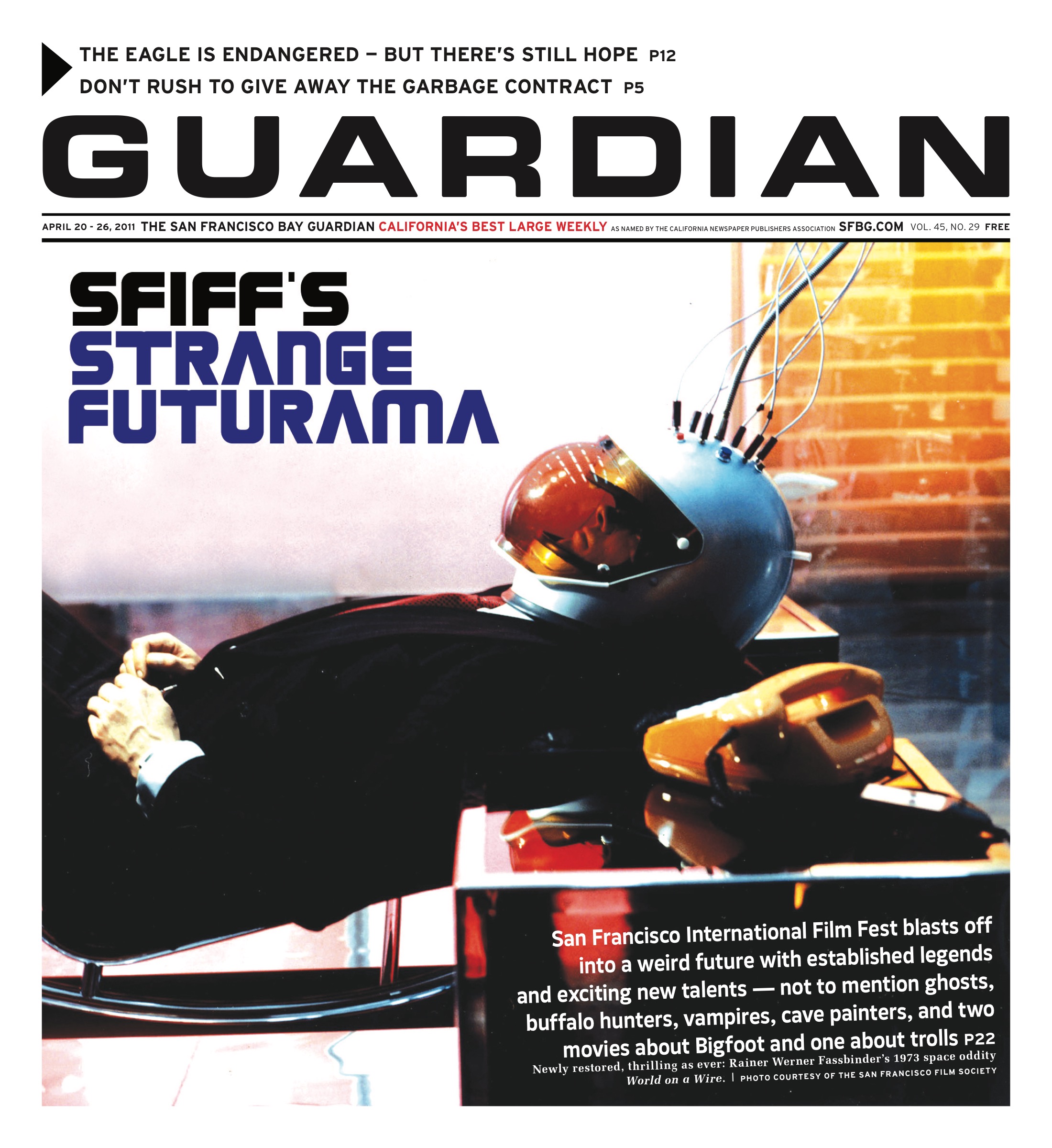
The 54th annual San Francisco International Film Festival runs through May 5. Venues are the Sundance Kabuki, 1881 Post, SF; Castro, 429 Castro, SF; New People, 1746 Post, SF; San Francisco Museum of Modern Art, 151 Third, SF; and Pacific Film Archive, 2575 Bancroft, SF. For tickets (most shows $13) and complete schedule visit www.sffs.org.

OPENING

*…But Film is My Mistress and Images from the Playground Swedish critic Stig Bjorkman will visit the Rafael with two recent documentaries he’s made about

his country’s–and one of the last century’s–greatest filmmakers, Ingmar Bergman. The feature-length Mistress adds commentary from admiring colleagues Olivier Assayas, John Sayles, Arnaud Desplechin, Bertolucci, Scorcese, Lars von Trier and Woody Allen to a scrutiny of Bergman’s working methods, as glimpsed in eight features from 1966’s Persona to 2003’s Saraband. It’s fascinating to watch Liv Ullmann and Ingrid Bergman endlessly questioning their scenes on 1978’s Autumn Sonata, charming to watch the director walk arm-in-arm down a street with his invaluable cinematographer Sven Nykvist. Bjorkman’s half-hour Images from the Playground is comprised of home movies and behind-the-scenes footage mostly shot by Bergman himself from the early 1950s onward, accompanied by audio reflections from him and major collaborators. In contrast to the filmmaker’s rep for doom and gloom, these clips show everybody having a pretty good time on the job, goofing for the camera, while his unbridled enthusiasm for his actresses suggests something was swinging in Sweden well before the Sixties. Dennis (1:35) Smith Rafael. (Harvey)

Dylan Dog: Dead of Night Brandon Routh stars as the titular supernatural investigator in this adaptation of the Italian comic-book series. (1:47)

Fast Five Vin Diesel and Paul Walker: still furious after all these years. (1:41)

Hoodwinked Too! Hood vs. Evil Hayden Panettiere, Glenn Close, and Joan Cusack lend their voices to this 3D animated sequel. (run time not available) Legend of the Fist: The Return of Chen Zhen Donnie Yen stars in Andrew Lau’s period martial arts actioner. (1:46) Four Star.

*My Perestroika Robin Hessman’s very engaging documentary takes one very relatable look at how changes since glasnost have affected some average Russians. The subjects here are five thirtysomethings who, growing up in Moscow in the 70s and 80s, were the last generation to experience full-on Communist Party indoctrination. But just as they reached adulthood, the whole system dissolved, confusing long-held beliefs and variably impacting their futures. Andrei has ridden the capitalist choo-choo to considerable enrichment as the proprietor of luxury Western menswear shops. But single mother Olga, unlucky in love, just scrapes by, while married schoolteachers Lyuba and Boris are lucky to have inherited an apartment (cramped as it is) they could otherwise ill afford. Meanwhile Ruslan, once member of a famous punk band (which he abandoned on principal because it was getting “too commercial”), both disdains and resents the new order just as he did the old one. Home movies and old footage of pageantry celebrating Soviet socialist glory make a whole ‘nother era come to life in this intimate, unexpectedly charming portrait of its long-term aftermath. (1:27) Balboa. (Harvey)

*The Princess of Montpensier Marie (Mélanie Thierry), the titular figure in French director Bertrand Tavernier’s latest, is a young 16th century noblewoman married off to a Prince (Grégoire Leprince-Ringuet) of great wealth and property. But they’ve barely met when he’s called off to war — leaving her alone on his enormous estate, vulnerable to myriad suitors who seem to be forever throwing themselves at her nubile, neglected body. Lambert Wilson (2010’s Of Gods and Men) is touching as the older soldier appointed her protector; he comes to love her, yet is the one man upstanding enough to resist compromising her. If you’ve been jonesing for the kind of lush arthouse period epic that feels like a big fat classic novel, this engrossing saga from a 70-year-old Gallic cinema veteran in top form will scratch that itch for nearly two and a half satisfyingly tragic-romantic hours. (2:19) Smith Rafael. (Harvey)

Prom Every teen movie has a prom scene; this ensemble movie’s just cutting to the chase is all. (1:44)

The Robber A bank robber uses his marathoning skills to escape crime scenes in this Austrian thriller based on a true story. (1:37)

Stake Land See “Land of the Undead.” (1:38) Roxie.

Too Perfect Five 14-year-old boys come of age in this Bay Area-made film. (1:15) Orinda.

ONGOING

The Adjustment Bureau As far as sci-fi romantic thrillers go, The Adjustment Bureau is pretty standard. But since that’s not an altogether common genre mash-up, I guess the film deserves some points for creativity. Based on a short story by Philip K. Dick, The Adjustment Bureau takes place in a world where all of our fates are predetermined. Political hotshot David Norris (Matt Damon) is destined for greatness — but not if he lets a romantic dalliance with dancer Elise (Emily Blunt) take precedence. And in order to make sure he stays on track, the titular Adjustment Bureau (including Anthony Mackie and Mad Men‘s John Slattery) are there to push him in the right direction. While the film’s concept is intriguing, the execution is sloppy. The Adjustment Bureau suffers from flaws in internal logic, allowing the story to skip over crucial plot points with heavy exposition and a deus ex machina you’ve got to see to believe. Couldn’t the screenwriter have planned ahead? (1:39) (Peitzman)

African Cats (1:40)

Arthur (1:45)

Atlas Shrugged (1:57)

*Bill Cunningham New York To say that Bill Cunningham, the 82-year old New York Times photographer, has made documenting how New Yorkers dress his life’s work would be an understatement. To be sure, Cunningham’s two decades-old Sunday Times columns — “On the Street,” which tracks street-fashion, and “Evening Hours,” which covers the charity gala circuit — are about the clothes. And, my, what clothes they are. But Cunningham is a sartorial anthropologist, and his pictures always tell the bigger story behind the changing hemlines, which socialite wore what designer, or the latest trend in footwear. Whether tracking the near-infinite variations of a particular hue, a sudden bumper-crop of cropped blazers, or the fanciful leaps of well-heeled pedestrians dodging February slush puddles, Cunningham’s talent lies in his ability to recognize fleeting moments of beauty, creativity, humor, and joy. That last quality courses through Bill Cunningham New York, Richard Press’ captivating and moving portrait of a man whose reticence and personal asceticism are proportional to his total devotion to documenting what Harold Koda, chief curator at the Costume Institute at the Metropolitan Museum of Art, describes in the film as “ordinary people going about their lives, dressed in fascinating ways.” (1:24) (Sussman)

Ceremony It’s easy to dismiss Ceremony as derivative. The plot isn’t exactly original. But recycled material aside, it’s an entertaining indie diversion and a promising feature-length debut from writer-director Max Winkler. The underrated Michael Angarano stars as Sam Davis, a pretentious shit who owes a lot to Holden Caulfield by way of Rushmore‘s Max Fischer. Sam tricks his best friend Marshall (Reece Thompson) into accompanying him on a weekend getaway, with the real objective of winning back his lost love Zoe (Uma Thurman). But Zoe is all set to marry blowhard Whit Coutell (Lee Pace) and is not too keen on blowing off her wedding. None of the characters are all that likable — a quirky indie comedy must — and there are few surprises. But Winkler’s script is cute, and his cast is charming enough to carry the material along. The scenes between Angarano and Thompson are the film’s best. Here’s hoping they stand out enough to earn these young actors the recognition they deserve. (1:40) (Peitzman)

Certified Copy Abbas Kiarostami’s beguiling new feature signals “relationship movie” with every cobblestone step, but it’s manifestly a film of ideas — one in which disillusionment is as much a formal concern as a dramatic one. Typical of Kiarostami’s dialogic narratives, Certified Copy is both the name of the film and an entity within the film: a book written against the ideal of originality in art by James Miller (William Shimell), an English pedant fond of dissembling. After a lecture in Tuscany, he meets an apparent admirer (Juliette Binoche) in her antique shop. We watch them talk for several minutes in an unbroken two-shot. They gauge each other’s values using her sister as a test case — a woman who, according to the Binoche character, is the living embodiment of James’ book. Do their relative opinions of this off-screen cipher constitute characterization? Or are they themselves ciphers of the film’s recursive structure? Kiarostami makes us wonder. They begin to act as if they were married midway through the film, though the switch is not so out of the blue: Kiarostami’s narrative has already turned a few figure-eights. Several critics have already deemed Certified Copy derivative of many other elliptical romances; the strongest case for an “original” comes of Roberto Rossellini’s Voyage to Italy (1954). The real difference is that while Rossellini’s masterpiece realizes first-person feelings in a third-person approach, Kiarostami stays in the shadow of doubt to the end. (1:46) Smith Rafael. (Goldberg)

*Circo The old notion of “running away with the circus” seldom seemed appealing — conjuring images of following an elephant around with a shovel — and it grows even less so after watching Aaron Schock’s warm, touching documentary. The kids here might one day run away from the circus. They’re born into Grand Circo Mexico, one of four circuses run by the Ponce family, which has been in this business for generations; if they’re old enough to walk, they’re old enough to perform, and help with the endless setup and breakdown chores. (Presumably child labor laws are an innovation still waiting to happen here.) Touring Mexico’s small towns in trucks with a variety of exotic animals, it’s a life of labor, with on-the-job training in place of school — arguably not much of a life for child, as current company leader Tino’s wife Ivonne (who really did run away with the circus, or rather him, at age 15) increasingly insists. Other family members have split for a normal life, and Tino is caught between loyalty to his parents’ ever-struggling business and not wanting to lose the family he’s raised himself. This beautifully shot document, scored by Calexico and edited by Mark Becker (of 2005’s marvelous Romantico), is a disarming look at a lifestyle that feels almost 19th century, and is barely hobbling into the 21st one. (1:15) (Harvey)

The Conspirator It may not be your standard legal drama, but The Conspirator is a lot more enjoyable when you think of it as an extended episode of Law & Order. The film chronicles the trial of Mary Surratt (Robin Wright), the lone woman charged in the conspiracy to assassinate Abraham Lincoln. It’s a fascinating story, especially for those who don’t know much of the history past John Wilkes Booth. But while the subject matter is compelling, the execution is hit-or-miss. Wright is sympathetic as Surratt, but the usually great James McAvoy is somewhat forgettable in the pivotal role of Frederick Aiken, Surratt’s conflicted lawyer. It’s hard to say what it is that’s missing from The Conspirator: the cast — which also includes Evan Rachel Wood and Tom Wilkinson — is great, and this is a story that’s long overdue to be told. Still, something is lacking. Could it be the presence of everyone’s favorite detective, the late Lennie Briscoe? (2:02) (Peitzman)

*Hanna The title character of Hanna falls perfectly into the lately very popular Hit-Girl mold. Add a dash of The Boys from Brazil-style genetic engineering — Hanna has the unfair advantage, you see, when it comes to squashing other kids on the soccer field or maiming thugs with her bare hands — and you have an ethereal killing/survival machine, played with impassive confidence by Atonement (2007) shit-starter Saoirse Ronan. She’s been fine-tuned by her father, Erik (Eric Bana), a spy who went out into the cold and off the grid, disappearing into the wilds of Scandinavia where he home-schooled his charge with an encyclopedia and brutal self-defense and hunting tests. Atonement director Joe Wright plays with a snowy palette associated with innocence, purity, and death — this could be any time or place, though far from the touch of modern childhood stresses: that other Hannah (Montana), consumerism, suburban blight, and academic competition. The 16-year-old Hanna, however, isn’t immune from that desire to succeed. Her game mission: go from a feral, lonely existence into the modern world, run for her life, and avenge the death of her mother by killing Erik’s CIA handler, Marissa (Cate Blanchett). The nagging doubt: was she born free, or Bourne to be a killer? Much like the illustrated Brothers Grimm storybook that she studies, Hanna is caught in an evil death trap of fairytale allegories. One wonders if the super-soldier apple didn’t fall far from the tree, since evil stepmonster Marissa oversaw the program that produced Hanna — the older woman and the young girl have the same cold-blooded talent for destruction and the same steely determination. Yet there’s hope for the young ‘un. After learning that even her beloved father hid some basic truths from her, this natural-born killer seems less likely to go along with the predetermined ending, happy or no, further along in her storybook life. (1:51) (Chun)

Henry’s Crime Keanu Reeves is one of those actors who’s spectacularly franchise-wealthy — due to those Matrix movies wherein his usual baffled solemnity was ideal — yet whom the public otherwise feels scant evident loyalty toward, and producers don’t know what to do with. Now that he’s aging out of his looks, can he transform into a character actor? Maybe. Reeves played charming suitors in Something’s Gotta Give (2003) and The Private Lives of Pippa Lee (2009), both very much supporting roles. He seems increasingly interested in indie films, which he surely doesn’t need to pay the rent, and he’s certainly the best reason to see Henry’s Crime, a pleasant, middling, retro crime caper costarring frequently better actors at dimmer wattage than usual. The film is an old hat out of the Damon Runyon trunk, in which lovable crooks mix it up with hoity theatrical types and nobody gets hurt except (barely) the really bad guys. James Caan — who starred in similar enterprises during their post-The Sting heyday plays the veteran convict-conman who schools Reeves’ hapless Buffalo, N.Y., toll-taker Henry after our hero is slammer-thrown for an armed robbery he didn’t know he was embroiled in until it was over. Upon release, Henry discovers the targeted bank and nearby theater had a Prohibition-era secret tunnel between them. Having already done the time, he figures he might as well do the crime by finishing the aborted bank job for real. He enlists local stage diva Julie (Vera Farmiga) as well as Caan’s parole-coaxed Max. Resulting wacky hijinks render Max a theater “volunteer” and Henry as Julie’s Cherry Orchard costar, all so they can access the walled-up passageway to the bank vault. Much of this is ridiculous, of course, and not intentionally so. The climax is classic movies-getting-how-theater-works-wrong. But its contrivance functions to some extent because the lead actor convinces us it should. (1:48) (Harvey)

Hop (1:30)

*In a Better World Winner of this year’s Best Foreign Language Film Oscar, this latest from Danish director Susanne Bier (2004’s Brothers, 2006’s After the Wedding) and her usual co-scenarist Anders Thomas Jensen (2005’s Adam’s Apples, 2003’s The Green Butchers) is a typically engrossing, complex drama that deals with the kind of rage for “personal justice” that can lead to school and workplace shootings, among other things (like terrorism). Shy, nervous ten-year-old Elias (Markus Rygaard) needs a confidence boost, but things are worrying both at home and elsewhere. His parents are estranged, and his doting father (Mikael Persbrandt) is mostly away as a field hospital in Kenya tending victims of local militias. At school, he’s an easy mark for bullies, a fact which gets the attention of charismatic, self-assured new kid Christian (William Jøhnk Nielsen), who appoints himself Elias’ new (and only) friend — then when his slightly awed pal is picked on again, intervenes with such alarming intensity that the police are called. Christian appears a little too prone to violence and harsh judgment in teaching “lessons” to those he considers in the wrong; his own domestic situation is another source of anger, as he simplistically blames his earnest, distracted executive father (Ulrich Thomsen) for his mother’s recent cancer death. Is Christian a budding little psychopath, or just a kid haplessly channeling his profound loss? Regardless, when an adult bully (Kim Bodnia as a loutish mechanic) humiliates Elias’ father in front of the two boys, Christian pulls his reluctant friend into a pursuit of vengeance that surely isn’t going to end well. With their nuanced yet head-on treatment of hot button social and ethical issues, Bier and Jensen’s work can sometimes border on overly-schematic melodrama, meting out its own secular-humanist justice a bit too handily, like 21st-century cinematic Dickenses. But like Dickens, they also have a true mastery of the creating striking characters and intricately propulsive plotlines that illustrate the points at hand in riveting, hugely satisfying fashion. This isn’t their best. But it’s still pretty excellent, and one of those universally accessible movies you can safely recommend even to people who think they don’t like foreign or art house films. (1:53) (Harvey)

*Jane Eyre Do we really need another adaptation of Jane Eyre? As long as they’re all as good as Cary Fukunaga’s stirring take on the gothic romance, keep ’em coming. Mia Wasikowska stars in the titular role, with the dreamy Michael Fassbender stepping into the high pants of Edward Rochester. The cast is rounded out by familiar faces like Judi Dench, Jamie Bell, and Sally Hawkins — all of whom breathe new life into the material. It helps that Fukunaga’s sensibilities are perfectly suited to the story: he stays true to the novel while maintaining an aesthetic certain to appeal to a modern audience. Even if you know Jane Eyre’s story — Mr. Rochester’s dark secret, the fate of their romance, etc. — there are still surprises to be had. Everyone tells the classics differently, and this adaptation is a thoroughly unique experience. And here’s hoping it pushes the engaging Wasikowska further in her ascent to stardom. (2:00) (Peitzman)

Kill the Irishman If you enjoy 1970s-set Mafia movies featuring characters with luxurious facial hair zooming around in Cadillacs, flossing leather blazers, and outwitting cops and each other — you could do a lot worse than Kill the Irishman, which busts no genre boundaries but delivers enjoyable retro-gangsta cool nonetheless. Adapted from the acclaimed true crime book by a former Cleveland police lieutenant, the film details the rise and fall of Danny Greene, a colorful and notorious Irish-American mobster who both served and ran afoul of the big bosses in his Ohio hometown. During one particularly conflict-ridden period, the city weathered nearly 40 bombings — buildings, mailboxes, and mostly cars, to the point where the number of automobiles going sky-high is almost comical (you’d think these guys would’ve considered taking the bus). The director of the 2004 Punisher, Jonathan Hensleigh, teams up with the star of 2008’s Punisher: War Zone, Ray Stevenson, who turns in a magnetic performance as Greene; it’s easy to see how his combination of book- and street smarts (with a healthy dash of ruthlessness) buoyed him nearly to the top of the underworld. The rest of the cast is equally impressive, with Vincent D’Onofrio, Val Kilmer, Christopher Walken, and Linda Cardellini turning in supporting roles, plus a host of dudes who look freshly defrosted from post-Sopranos storage. (1:46) (Eddy)

The King’s Speech Films like The King’s Speech have filled a certain notion of “prestige” cinema since the 1910s: historical themes, fully-clothed romance, high dramatics, star turns, a little political intrigue, sumptuous dress, and a vicarious taste of how the fabulously rich, famous, and powerful once lived. At its best, this so-called Masterpiece Theatre moviemaking can transcend formula — at its less-than-best, however, these movies sell complacency, in both style and content. In The King’s Speech, Colin Firth plays King George VI, forced onto the throne his favored older brother Edward abandoned. This was especially traumatic because George’s severe stammer made public address tortuous. Enter matey Australian émigré Lionel Logue (Geoffrey Rush, mercifully controlled), a speech therapist whose unconventional methods include insisting his royal client treat him as an equal. This ultimately frees not only the king’s tongue, but his heart — you see, he’s never had anyone before to confide in that daddy (Michael Gambon as George V) didn’t love him enough. Aww. David Seidler’s conventionally inspirational script and BBC miniseries veteran Tom Hooper’s direction deliver the expected goods — dignity on wry, wee orgasms of aesthetic tastefulness, much stiff-upper-lippage — at a stately promenade pace. Firth, so good in the uneven A Single Man last year, is perfect in this rock-steadier vehicle. Yet he never surprises us; role, actor, and movie are on a leash tight enough to limit airflow. (1:58) Castro. (Harvey)

*Limitless An open letter to the makers of Limitless: please fire your marketing team because they are making your movie look terrible. The story of a deadbeat writer (Bradley Cooper) who acquires an unregulated drug that allows him to take advantage of 100 percent of his previously under-utilized brain, Limitless is silly, improbable and features a number of distracting comic-book-esque stylistic tics. But consumed with the comic book in mind, Limitless is also unpredictable, thrilling, and darkly funny. The aforementioned style, which includes many instances of the infinite regression effect that you get when you point two mirrors at each other, and a heavy blur to distort depth-of-field, only solidifies the film’s cartoonish intentions. Cooper learns foreign languages in hours, impresses women with his keen attention to detail, and sets his sights on Wall Street, a move that gets him noticed by businessman Carl Van Loon (Robert DeNiro in a glorified cameo) as well as some rather nasty drug dealers and hired guns looking to cash in on the drug. Limitless is regrettably titled and masquerades in TV spots as a Wall Street series spin-off, but in truth it sports the speedy pacing and tongue-in-cheek humor required of a good popcorn flick. (1:37) (Galvin)

*The Lincoln Lawyer Outfitted with gym’d-tanned-and-laundered manly blonde bombshells like Matthew McConaughey, Josh Lucas, and Ryan Phillippe, this adaptation of Michael Connelly’s LA crime novel almost cries out for an appearance by the Limitless Bradley Cooper — only then will our cabal of flaxen-haired bros-from-other-‘hos be complete. That said, Lincoln Lawyer‘s blast of morally challenged golden boys nearly detracts from the pleasingly gritty mise-en-scène and the snappy, almost-screwball dialogue that makes this movie a genre pleasure akin to a solid Elmore Leonard read. McConaughey’s criminal defense attorney Mickey Haller is accustomed to working all the angles — hence the title, a reference to a client who’s working off his debt by chauffeuring Haller around in his de-facto office: a Lincoln Town Car. Haller’s playa gets truly played when he becomes entangled with Louis Roulet (Phillippe), a pretty-boy old-money realtor accused of brutally attacking a call girl. Loved ones such as Haller’s ex Maggie (Marisa Tomei) and his investigator Frank (William H. Macy) are in jeopardy — and in danger of turning in some delightfully textured cameos — in this enjoyable walk on the sleazy side of the law, the contemporary courtroom counterpart to quick-witted potboilers like Sweet Smell of Success (1957). (1:59) (Chun)

Miral (1:42)

*Of Gods and Men It’s the mid-1990s, and we’re in Tibhirine, a small Algerian village based around a Trappist monastery. There, eight French-born monks pray and work alongside their Muslim neighbors, tending to the sick and tilling the land. An emboldened Islamist rebel movement threatens this delicate peace, and the monks must decide whether to risk the danger of becoming pawns in the Algerian Civil War. On paper, Of Gods and Men sounds like the sort of high-minded exploitation picture the Academy swoons over: based on a true story, with high marks for timeliness and authenticity. What a pleasant surprise then that Xavier Beauvois’s Cannes Grand Prix winner turns out to be such a tightly focused moral drama. Significantly, the film is more concerned with the power vacuum left by colonialism than a “clash of civilizations.” When Brother Christian (Lambert Wilson) turns away an Islamist commander by appealing to their overlapping scriptures, it’s at the cost of the Algerian army’s suspicion. Etienne Comar’s perceptive script does not rush to assign meaning to the monks’ decision to stay in Tibhirine, but rather works to imagine the foundation and struggle for their eventual consensus. Beauvois occasionally lapses into telegraphing the monks’ grave dilemma — there are far too many shots of Christian looking up to the heavens — but at other points he’s brilliant in staging the living complexity of Tibrihine’s collective structure of responsibility. The actors do a fine job too: it’s primarily thanks to them that by the end of the film each of the monks seems a sharply defined conscience. (2:00) (Goldberg)

*Poetry Sixtysomething Mija (legendary South Korean actor Yun Jung-hee) impulsively crashes a poetry class, a welcome shake-up in a life shaped by unfulfilling routines. In order to write compelling verse, her instructor says, it is important to open up and really see the world. But Mija’s world holds little beauty beyond her cheerful outfits and beloved flowers; most pressingly, her teenage grandson, a mouth-breathing lump who lives with her, is completely remorseless about his participation in a hideous crime. In addition, she’s just been disgnosed with the early stages of Alzheimer’s, and the elderly stroke victim she housekeeps for has started making inappropriate advances. Somehow writer-director Lee Chang-dong (2007’s Secret Sunshine) manages not to deliver a totally depressing film with all this loaded material; it’s worth noting Poetry won the Best Screenplay Award at the 2010 Cannes Film Festival. Yun is unforgettable as a woman trying to find herself after a lifetime of obeying the wishes of everyone around her. Though Poetry is completely different in tone than 2009’s Mother, it shares certain elements — including the impression that South Korean filmmakers have recognized the considerable rewards of showcasing aging (yet still formidable) female performers. (2:19) Smith Rafael. (Eddy)

Pom Wonderful Presents: The Greatest Movie Ever Sold Don’t even think about shortening the title: Morgan Spurlock’s new documentary POM Wonderful Presents: The Greatest Story Ever Sold is ingenious, bitingly funny, and made possible by corporate sponsorship. POM paid good money to earn a spot about the title, so damned if I’m going to leave them out. Instead of keeping product placement subliminal — or at least trying — Spurlock shows exactly what goes into the popular marketing practice. His film isn’t so much critical as it is honest: he doesn’t fight product placement, but rather embraces it to his own advantage. It’s win-win. Spurlock gets to make his movie without losing any cash, and the audience gets a hilarious insider look into a mostly hidden facet of advertising. As he says, it’s about transparency, and no one can claim Spurlock is trying to go behind our backs. And what of the advertising that pops up throughout the film? I can only speak to my own experience, but yes, I’m drinking POM as I write this. (1:26) (Peitzman)

Potiche When we first meet Catherine Deneuve’s Suzanne — the titular trophy wife (or potiche) of Francois Ozon’s new airspun comedy — she is on her morning jog, barely breaking a sweat as she huffs and puffs in her maroon Adidas tracksuit, her hair still in curlers. It’s 1977 and Suzanne’s life as a bourgeois homemaker in a small provincial French town has played out as smoothly as one of her many poly-blend skirt suits: a devoted mother to two grown children and loving wife who turns a blind eye to the philandering of husband Robert (Fabrice Luchini), Suzanne is on the fast track to comfortable irrelevance. All that changes when the workers at Robert’s umbrella factory strike and take him hostage. Suzanne, with the help of union leader and old flame Babin (Gerard Depardieu, as big as a house), negotiates a peace, and soon turns around the company’s fortunes with her new-found confidence and business savvy. But when Robert wrests back control with the help of a duped Babin, Suzanne does an Elle Woods and takes them both on in a surprise run for political office. True to the film’s light théâtre de boulevard source material, Ozon keeps things brisk and cheeky (Suzanne sings with as much ease as she spouts off Women’s Lib boilerplate) to the point where his cast’s hammy performances start blending into the cheery production design. Satire needs an edge that Potiche, for all its charm, never provides. (1:43) Smith Rafael. (Sussman)

Red, White and Blue (1:42) Roxie.

Rio (1:32)

Scre4m Back in 1996, Wes Craven’s Scream revitalized the slasher genre with a script (by Kevin Williamson) that poked fun at horror clichés while still delivering genuine scares. The sequels offered diminishing returns on this once-clever formula; Scream 4 arrives 11 years past Scream 3, presumably hoping to work that old self-referential yet gory magic on a new crop of filmgoers. But Craven and Williamson’s hall-of-mirrors creation (more self-satisfied than self-referential, scrambling to anticipate a cynical audience member’s every second-guess) is barely more than than a continuation of something that was already tired in 2000, albeit with iPhone and web cam gags pasted in for currency’s sake. Eternal Ghostface target Sidney Prescott (Neve Campbell) returns to her hometown to promote what’s apparently a woo-woo self-help book (Mad Men‘s Alison Brie, as Sidney’s bitchy-perky publicist, steals every scene she’s in); still haunting Woodsboro are Dewey (David Arquette), now the sheriff, and Gale (Courteney Cox), a crime author with writer’s block. When the Munch-faced one starts offing high school kids, local movie nerds (Rory Culkin, Hayden Panettiere) and nubile types (Emma Roberts, Hayden Panettiere) react by screening all seven Stab films, inspired by the “real-life” Woodsboro murders, and spouting off about the rules, or lack thereof in the 21st century, of horror sequels. If that sounds mega-meta exhausting, it is. And, truth be told, not very scary. (1:51) (Eddy)

Soul Surfer (1:46)

*Source Code A post-9/11 Groundhog Day (1993) with explosions, Inception (2010) with a heart, or Avatar (2009) taken down a notch or dozen in Chicago —whatever you choose to call it, Source Code manages to stand up on its own wobbly Philip K. Dick-inspired legs, damn the science, and take off on the wings of wish fulfillment. ‘Cause who hasn’t yearned for a do-over — and then a do-over of that do-over, etc. We could all be as lucky — or as cursed — as soldier Colter Stevens (Jake Gyllenhaal), who gets to tumble down that time-space rabbit hole again and again, his consciousness hitching a ride in another man’s body, while in search of the bomber of a Chicago commuter train. On the upside, he gets to meet the girl of his dreams (Michelle Monaghan) — and see her getting blown to smithereens again and again, all in the service of his country, his commander-cum-link to the outside world (Vera Farmiga), and the scientist masterminding this secret military project (Jeffrey Wright). On the downside, well, he gets to do it over and over again, like a good little test bunny in pinball purgatory. Fortunately, director Duncan Jones (2009’s Moon) makes compelling work out of the potentially ludicrous material, while his cast lends the tale a glossed yet likable humanity, the kind that was all too absent in Inception. (1:33) (Chun)

Trust Outta-hand sexting and predatory online pedophilia gets Schwimmerized with Trust, which creeps into the theaters with all the sudden stealth of a—surprise!—predatory online pedophile. Nevertheless, like any relevant drama torn from the headlines, Trust starts off with promise, as director David Schwimmer attempts to replicate the budding chat-room romance of Annie (Liana Liberato) and her supposed male tween counterpart with playful onscreen text. The constant, increasingly intimate chatting takes a sexy turn while the crush confesses that he’s actually in college, then older still, and finally instigates a meet-up. Few can accuse Annie’s ad-man father Will (Clive Owen) and quirky mom Lynn (Catherine Keener) of being uncaring—but the consequences of Annie’s relationship quickly upend the family in ways that have the frustrated, guilt-ridden Owen rampaging with the barely capped rage that he does so well (a skill that threatens to typecast him). Liberato, who flips from fresh-faced hope to utter desperation, and Keener, who can make drinking a glass of water compelling, do much better, though Trust never truly grabs even the most wired social networker. Must be all that annoying texting. (1:55) (Chun)

Tyler Perry’s Madea’s Big Happy Family (2:00)

Water for Elephants A young man named Jacob Jankowski (Robert Pattinson) turns his back on catastrophe and runs off to join the circus. It sounds like a fantasy, but this was never Jacob’s dream, and the circus world of Water for Elephants isn’t all death-defying feats and pretty women on horses. Or rather, the pretty woman also rides an elephant named Rosie and the casualties tend to occur outside the big top, after the rubes have gone home. Stumbling onto a train and into this world by chance, Jacob manages to charm the sadistic sociopath who runs the show, August (Christophe Waltz), and is charmed in turn by August’s wife, Marlena (Reese Witherspoon), a star performer and the object of August’s abusive, obsessive affections. Director Francis Lawrence’s film, an adaptation of Sarah Gruen’s 2006 novel, depicts a harsh Depression-era landscape in which troupes founder in small towns across America, waiting to be scavenged for parts — performers and animals — by other circuses passing through. Waltz’s August is a frightening man who defines a layoff as throwing workers off a moving train, and the anxiety of anticipating his moods and moves supplies most of the movie’s dramatic tension; Jacob and Marlena’s pallid love story feeds off it rather than adding its own. The film also suffers from a frame tale that feels awkward and forced, though Hal Holbrook makes heroic efforts as the elderly Jacob, surfacing on the grounds of – what else? – a modern-day circus to recount his tale of tragedy and romance. (2:00) (Rapoport)

White Irish Drinkers What is 20-year TV veteran John Gray (of series The Ghost Whisperer) doing writing-directing yet another indie Mean Streets (1973) knockoff? That’s fresh-outta-film-school business. Why is anyone doing one of those so long after the expiration date for that second (or by now third) generation shit? This trip down some very familiar roads — 1997’s Good Will Hunting and 1977’s Saturday Night Fever being others — stars SF native Nick Thurston as a 1975 Brooklyn youth with a violent alcoholic father (Stephen Lang), long-suffering mother (Karen Allen), and an older brother drifting into criminality (Geoffrey Wigdor). As outside influences this talented closet artist has the requisite upscaling girl (Leslie Murphy) urging him to dream big, and a wistfully downtrodden employer (Peter Riegert) providing the plot gimmick as a failing movie-palace owner who hopes to turn around his fortunes with a one-night-stand by the Rolling Stones. Everything about White Irish Drinkers feels recycled from other movies. Though the performers work hard and the progress is entertaining enough, there’s way too much déjà vu here for one film to bear and still stand on its own punch-drunk legs. (1:49) (Harvey)

*Win Win Is Tom McCarthy the most versatile guy in Hollywood? He’s a successful character actor (in big-budget movies like 2009’s 2012; smaller-scale pictures like 2005’s Good Night, and Good Luck; and the final season of The Wire). He’s an Oscar-nominated screenwriter (2009’s Up). And he’s the writer-director of two highly acclaimed indie dramas, The Station Agent (2003) and The Visitor (2007). Clearly, McCarthy must not sleep much. His latest, Win Win, is a comedy set in his hometown of New Providence, N.J. Paul Giamatti stars as Mike Flaherty, a lawyer who’s feeling the economic pinch. Betraying his own basic good-guy-ness, he takes advantage of a senile client, Leo (Burt Young), when he spots the opportunity to pull in some badly-needed extra cash. Matters complicate with the appearance of Leo’s grandson, Kyle (newcomer Alex Shaffer), a runaway from Ohio. Though Mike’s wife, Jackie (Amy Ryan), is suspicious of the taciturn teen, she allows Kyle to crash with the Flaherty family. As luck would have it, Kyle is a superstar wrestler — and Mike happens to coach the local high school team. Things are going well until Kyle’s greedy mother (Melanie Lynskey) turns up and starts sniffing around her father’s finances. Lessons are learned, sure, and there are no big plot twists beyond typical indie-comedy turf. But the script delivers more genuine laughs than you’d expect from a movie that’s essentially about the recession. (1:46) (Eddy)

Your Highness One of the dangers of reviewing a film like Your Highness is that stoner comedies have a very specific intended audience. A particular altered state is recommended to maximize one’s enjoyment. I tend not to show up for professional gigs with Mary Jane as my plus-one, so I had to view the latest from Pineapple Express (2008) director David Gordon Green through un-bloodshot eyes. While Express was more explicitly ganja-themed, Your Highness is instead a comedy that approximates the experience of getting as high as possible, then going directly to Medieval Times. Never gut-bustingly funny, Your Highness still reaps chuckles from its hard-R dialogue and plenty of CG-assisted sight gags involving genetalia. James Franco and Danny McBride star as princes, one heroic and one ne’er-do-well, who quest to save a maiden kidnapped by an evil wizard (Justin Theroux). Natalie Portman turns up as a thong-wearing warrior, just ’cause it’s that kind of movie. Forget the box office; only time and the tastes of late-night movie watchers will dictate whether Your Highness is a success or a bust. Case in point: nobody thought much of Half Baked (1998) when it was released, but in certain circles, it’s become a bona fide classic. Say it with me now: “Fuck you, fuck you, fuck you, you’re cool, and fuck you. I’m out!” (1:42) (Eddy)


We who are not as others

0

arts@sfbg.com

SAN FRANCISCO INTERNATIONAL FILM FESTIVAL By coincidence there were two Bigfoot movies at the Sundance Film Festival this year, and both are also playing this year’s SFIFF. One was long and serious: Christopher Munch’s Letters from the Big Man, a fantasy drama eco-parable in which a Forest Service water analyst scouting remote parklands acquires a very hairy stalker — though he means well. The other was only five minutes and not remotely serious: Sasquatch Birth Journal 2 (it’s unclear whether there was ever a first), which provided hidden-camera proof of the species’ existence, caught in a state of universal discomfort.

That was the latest dose of absurdism from Zellner Bros., who weren’t strangers to Sundance (they’ve had other shorts and the 2008 feature Goliath premiere there), but remain little-known to all but a small coterie of fans outside their home base of Austin, Texas. That situation will be somewhat rectified with “From A to Zellner,” which brings the brothers to SF for a program of short works.

Considering that they’ve been making films for at least 15 years (and home movies before that), Nathan and David Zellner are something of a mystery pair. Their website bio reveals that “they were born in Greely, Colorado” — and nothing else. (It does, however, provide photographic evidence of them wearing matching, flared-pant crimson jumpsuits somewhere around third grade, and a video where they sing the theme to 1984’s The Neverending Story with tone-deaf bravado.)

Elsewhere David has said he “typically tackles more of the writing-directing, and Nathan more of the editing and producing. That said, it all overlaps.” They’ve occasionally acted in friends’ movies, including ones by mumblecore biggies Andrew Bujalski and the Duplass brothers, plus 2000’s epically great, virtually unknown underground Road WarriorSmokey and the Bandit collision Radio Free Steve. That aside, far be it from us to further spoil the enigma by requesting an interview.

At their best, the Zellners are like Beckett meets Upright Citizens Brigade, or something like that. Existential rudderlessness almost invariably slaps already hapless protagonists in the face like a wet trout, amid distressed circumstances of deadpan ridiculousness.

Sometimes the humor is overly juvenile or the joke just doesn’t stretch far enough. But their commitment to strange ideas — abetted by considerable flexibility as comic actors inhabiting different characters, accents, mustaches — is more often refreshing, distinctive, and delightful.

Shorts that might show up Sunday, April 24 include Redemptitude (2006), a Australian priest-vs.-angry-wheelchair-bound paintballer confrontation that upends sagas of inspirational forgiveness; the next year’s Aftermath on Meadowlark Lane, a hilariously inappropriate debate (just after a possibly fatal car crash) on the circumcision question; 2004’s The Virile Man, in which husband and father Gary (David) literally calls from the closet to whisper sexual-identity fears to an astrology hotline. Then there’s 2005’s Foxy and the Weight of the World, in which David’s Irish ne’er-do-well Hamish, poisoned by a “vengeful rival,” pours out bitterly self-pitying wisdoms to a beloved pet that would clearly rather be anywhere else than clutched in his dying arms.

The Zellners have made three features to date, all relatively obscure but fairly easy to find on Amazon and such. The aforementioned Goliath is about a rather pathetic recent divorcee (David) distraught when his beloved cat vanishes — something he irrationally blames on the way more pathetic local registered sex offender (Nathan). The brothers are excellent but their material just doesn’t have the weight to float its darker tonal shifts.

Better sustained is 2001’s Frontier, based on an alleged surrealist novel (by “Mulnar Typeschtat”), in which military personnel from civil war-torn Bubovia (David with Wiley Wiggins) canoe to a remote island where they try to enslave the locals (Nathan) and fit in with the Sasquatch-y creature populace. The entire script is spoken in subtitled “Bubovian,” delivered with surprising naturalism.

But the Zellners’ best feature might still be their first. Plastic Utopia (1997) — dust off your old VCR if you want to see it — is an uneven but sometimes deliriously inspired alternative-universe purgatory as viewed by failed mime James (David), whose whining at unappreciative spectators has him in trouble with the Mime Union. His utter inability to succeed (a would-be romance with a novice nun being another obvious dead-end) contrasts with the rebel yell of housemate Frank (Nathan), who drinks, drugs, fucks, lies, steals, and even murders sans consequence. Subsidiary characters like Corduroy Boy, Golden White Boy (both highly memorable), Buster Tuffstuff, and Jogger Joe (Wiggins again) add to the surreal hilarity.

Someday the Zellners are going to hit (fairly) big. But for now it’s obvious they enjoy hitting small, for their own amusement as well as any outsiders who’ve peeked into the tent. It’s indulgently weekend-camping musky in there, but private-joke-funny, too.

FROM A TO ZELLNER

Sun/24, 9:45 p.m., $13

Sundance Kabuki

1881 Post, SF

www.sffs.org


Film Listings

0

Film listings are edited by Cheryl Eddy. Reviewers are Kimberly Chun, Michelle Devereaux, Peter Galvin, Max Goldberg, Dennis Harvey, Johnny Ray Huston, Louis Peitzman, Lynn Rapoport, Ben Richardson, and Matt Sussman. For rep house showtimes, see Rep Clock. For first-run showtimes, see Movie Guide.

SAN FRANCISCO INTERNATIONAL FILM FESTIVAL

The 54th annual San Francisco International Film Festival runs April 21–May 5. Venues are the Sundance Kabuki, 1881 Post, SF; Castro, 429 Castro, SF; New People, 1746 Post, SF; San Francisco Museum of Modern Art, 151 Third, SF; and Pacific Film Archive, 2575 Bancroft, SF. For tickets (most shows $13) and complete schedule visit www.sffs.org.

THURS/21

Castro Beginners 7.

FRI/22

Kabuki The Place In Between 2. “Irresistable Impulses” (shorts program) 3:15. The Good Life 3:45. Miss Representation 6. Hahaha 6:15. I’m Glad My Mother is Alive 6:45. Attenberg 7. Walking Too Fast 8:45. Meek’s Cutoff 9. Microphone 9:15. The City Below 9:30. Stake Land 11:30.

New People Hot Coffee 6:30. Nainsukh 9:15.

PFA Silent Souls 7. Jean Gentil 8:40.

SAT/23

Kabuki “Youth Media Mash-Up” noon. Mysteries of Lisbon 12:15. The Autobiography of Nicolae Ceausescu 12:45. The Colors of the Mountain 1. Year Without a Summer 3. Life, Above All 4. “Mind the Gap” (shorts program) 4:45. Better This World 6. The Future 6:15. Le Quattro Volte 6:45. The Light Thief 7:15. World on a Wire 8:45. Living On Love Alone 9:30. “Get With the Program” (shorts program) 9:45. The Troll Hunter 11:30.

New People Pink Saris 1. The Last Buffalo Hunt 3:20. The Pipe 6. Hospitalité 9.

SFMOMA The Mill and the Cross 12:30. !Women Art Revolution 3.

PFA Foreign Parts 2:15. The Green Wave 4. Autumn 6:15. The High Life 8:40.

SUN/24

Kabuki “Irresistable Impulses” (shorts program) noon. A Cat in Paris 12:30. Jean Gentil 1. Nainsukh 2:30. The Green Wave 2:45. Walking Too Fast 3. “Cupid With Fangs” (shorts program) 3:15. Silent Souls 4:45. Crime After Crime 6. At Ellen’s Age 6:15. The Colors of the Mountain 6:30. “The Deep End” (shorts program) 7. Asleep in the Sun 8:45. “State of Cinema: Christine Vachon” 9. The Stool Pigeon 9:15. “From A to Zellner” (shorts program) 9:45.

New People A Useful Life noon. Microphone 2. The Autobiography of Nicolae Ceausescu 5:15. The Future 9:15.

PFA Something Ventured 2. Children of the Princess of Cleves 4:15. Chantrapas 6:15. The Arbor 8:45.

MON/25

Kabuki Children of the Princess of Cleves 2. The City Below 4. Meek’s Cutoff 4:30. Hot Coffee 6:30. Autumn 6:45. Cave of Forgotten Dreams 7. She Monkeys 7:15. Salon: The Social Justice Documentary 8:30. Hahaha 9. The Light Thief 9:15. I’m Glad My Mother is Alive 9:30. Stake Land 9:45.

New People The Troll Hunter 6:15. Year Without a Summer 9:15.

PFA A Useful Life 7. !Women Art Revolution 8:40.

TUES/26

Kabuki Hot Coffee 2. Hahaha 3:30. Ulysses 4. Chantrapas 6. Jean Gentil 6. The Sleeping Beauty 6:15. Nostalgia for the Light 6:30. She Monkeys 8:45. New Skin For the Old Ceremony 9. The Whistleblower 9:15. Cave of Forgotten Dreams 9:30.

New People The Last Buffalo Hunt 6:30. “Cupid With Fangs” (shorts program) 9.

PFA Better This World 6:30. Position Among the Stars 8:50.

OPENING

African Cats This Earth Day release, narrated by Samuel L. Jackson, follows cheetah and lions on the African savanna. (1:40) Shattuck.

Ceremony It’s easy to dismiss Ceremony as derivative. The plot isn’t exactly original. But recycled material aside, it’s an entertaining indie diversion and a promising feature-length debut from writer-director Max Winkler. The underrated Michael Angarano stars as Sam Davis, a pretentious shit who owes a lot to Holden Caulfield by way of Rushmore‘s Max Fischer. Sam tricks his best friend Marshall (Reece Thompson) into accompanying him on a weekend getaway, with the real objective of winning back his lost love Zoe (Uma Thurman). But Zoe is all set to marry blowhard Whit Coutell (Lee Pace) and is not too keen on blowing off her wedding. None of the characters are all that likable — a quirky indie comedy must — and there are few surprises. But Winkler’s script is cute, and his cast is charming enough to carry the material along. The scenes between Angarano and Thompson are the film’s best. Here’s hoping they stand out enough to earn these young actors the recognition they deserve. (1:40) Lumiere. (Peitzman)

Pom Wonderful Presents: The Greatest Movie Ever Sold Don’t even think about shortening the title: Morgan Spurlock’s new documentary POM Wonderful Presents: The Greatest Story Ever Sold is ingenious, bitingly funny, and made possible by corporate sponsorship. POM paid good money to earn a spot about the title, so damned if I’m going to leave them out. Instead of keeping product placement subliminal — or at least trying — Spurlock shows exactly what goes into the popular marketing practice. His film isn’t so much critical as it is honest: he doesn’t fight product placement, but rather embraces it to his own advantage. It’s win-win. Spurlock gets to make his movie without losing any cash, and the audience gets a hilarious insider look into a mostly hidden facet of advertising. As he says, it’s about transparency, and no one can claim Spurlock is trying to go behind our backs. And what of the advertising that pops up throughout the film? I can only speak to my own experience, but yes, I’m drinking POM as I write this. (1:26) SF Center. (Peitzman)

Red, White and Blue Noah Taylor stars in this mystery punctuated by shocking twists. (1:42) Roxie.

Trust A teenager is victimized by an internet predator in this drama. Clive Owen and Catherine Keener play her horrified parents. (1:55) Opera Plaza.

Tyler Perry’s Madea’s Big Happy Family She’s baaack. (2:00) Shattuck.

Water for Elephants A young man (Robert Pattinson) joins a circus (populated by the likes of Reese Witherspoon and Christoph Waltz) in this drama based on the best-selling novel. (2:00) Balboa, Marina.

White Irish Drinkers What is 20-year TV veteran John Gray (of series The Ghost Whisperer) doing writing-directing yet another indie Mean Streets (1973) knockoff? That’s fresh-outta-film-school business. Why is anyone doing one of those so long after the expiration date for that second (or by now third) generation shit? This trip down some very familiar roads — 1997’s Good Will Hunting and 1977’s Saturday Night Fever being others — stars SF native Nick Thurston as a 1975 Brooklyn youth with a violent alcoholic father (Stephen Lang), long-suffering mother (Karen Allen), and an older brother drifting into criminality (Geoffrey Wigdor). As outside influences this talented closet artist has the requisite upscaling girl (Leslie Murphy) urging him to dream big, and a wistfully downtrodden employer (Peter Riegert) providing the plot gimmick as a failing movie-palace owner who hopes to turn around his fortunes with a one-night-stand by the Rolling Stones. Everything about White Irish Drinkers feels recycled from other movies. Though the performers work hard and the progress is entertaining enough, there’s way too much déjà vu here for one film to bear and still stand on its own punch-drunk legs. (1:49) Lumiere, Shattuck. (Harvey)

ONGOING

The Adjustment Bureau As far as sci-fi romantic thrillers go, The Adjustment Bureau is pretty standard. But since that’s not an altogether common genre mash-up, I guess the film deserves some points for creativity. Based on a short story by Philip K. Dick, The Adjustment Bureau takes place in a world where all of our fates are predetermined. Political hotshot David Norris (Matt Damon) is destined for greatness — but not if he lets a romantic dalliance with dancer Elise (Emily Blunt) take precedence. And in order to make sure he stays on track, the titular Adjustment Bureau (including Anthony Mackie and Mad Men‘s John Slattery) are there to push him in the right direction. While the film’s concept is intriguing, the execution is sloppy. The Adjustment Bureau suffers from flaws in internal logic, allowing the story to skip over crucial plot points with heavy exposition and a deus ex machina you’ve got to see to believe. Couldn’t the screenwriter have planned ahead? (1:39) Balboa, Shattuck. (Peitzman)

Arthur (1:45) Empire, 1000 Van Ness, SF Center.

Atlas Shrugged (1:57) Shattuck, SF Center.

*Bill Cunningham New York To say that Bill Cunningham, the 82-year old New York Times photographer, has made documenting how New Yorkers dress his life’s work would be an understatement. To be sure, Cunningham’s two decades-old Sunday Times columns — “On the Street,” which tracks street-fashion, and “Evening Hours,” which covers the charity gala circuit — are about the clothes. And, my, what clothes they are. But Cunningham is a sartorial anthropologist, and his pictures always tell the bigger story behind the changing hemlines, which socialite wore what designer, or the latest trend in footwear. Whether tracking the near-infinite variations of a particular hue, a sudden bumper-crop of cropped blazers, or the fanciful leaps of well-heeled pedestrians dodging February slush puddles, Cunningham’s talent lies in his ability to recognize fleeting moments of beauty, creativity, humor, and joy. That last quality courses through Bill Cunningham New York, Richard Press’ captivating and moving portrait of a man whose reticence and personal asceticism are proportional to his total devotion to documenting what Harold Koda, chief curator at the Costume Institute at the Metropolitan Museum of Art, describes in the film as “ordinary people going about their lives, dressed in fascinating ways.” (1:24) Embarcadero, Shattuck. (Sussman)

Certified Copy Abbas Kiarostami’s beguiling new feature signals “relationship movie” with every cobblestone step, but it’s manifestly a film of ideas — one in which disillusionment is as much a formal concern as a dramatic one. Typical of Kiarostami’s dialogic narratives, Certified Copy is both the name of the film and an entity within the film: a book written against the ideal of originality in art by James Miller (William Shimell), an English pedant fond of dissembling. After a lecture in Tuscany, he meets an apparent admirer (Juliette Binoche) in her antique shop. We watch them talk for several minutes in an unbroken two-shot. They gauge each other’s values using her sister as a test case — a woman who, according to the Binoche character, is the living embodiment of James’ book. Do their relative opinions of this off-screen cipher constitute characterization? Or are they themselves ciphers of the film’s recursive structure? Kiarostami makes us wonder. They begin to act as if they were married midway through the film, though the switch is not so out of the blue: Kiarostami’s narrative has already turned a few figure-eights. Several critics have already deemed Certified Copy derivative of many other elliptical romances; the strongest case for an “original” comes of Roberto Rossellini’s Voyage to Italy (1954). The real difference is that while Rossellini’s masterpiece realizes first-person feelings in a third-person approach, Kiarostami stays in the shadow of doubt to the end. (1:46) Opera Plaza, Smith Rafael. (Goldberg)

*Circo The old notion of “running away with the circus” seldom seemed appealing — conjuring images of following an elephant around with a shovel — and it grows even less so after watching Aaron Schock’s warm, touching documentary. The kids here might one day run away from the circus. They’re born into Grand Circo Mexico, one of four circuses run by the Ponce family, which has been in this business for generations; if they’re old enough to walk, they’re old enough to perform, and help with the endless setup and breakdown chores. (Presumably child labor laws are an innovation still waiting to happen here.) Touring Mexico’s small towns in trucks with a variety of exotic animals, it’s a life of labor, with on-the-job training in place of school — arguably not much of a life for child, as current company leader Tino’s wife Ivonne (who really did run away with the circus, or rather him, at age 15) increasingly insists. Other family members have split for a normal life, and Tino is caught between loyalty to his parents’ ever-struggling business and not wanting to lose the family he’s raised himself. This beautifully shot document, scored by Calexico and edited by Mark Becker (of 2005’s marvelous Romantico), is a disarming look at a lifestyle that feels almost 19th century, and is barely hobbling into the 21st one. (1:15) Lumiere, Shattuck. (Harvey)

The Conspirator It may not be your standard legal drama, but The Conspirator is a lot more enjoyable when you think of it as an extended episode of Law & Order. The film chronicles the trial of Mary Surratt (Robin Wright), the lone woman charged in the conspiracy to assassinate Abraham Lincoln. It’s a fascinating story, especially for those who don’t know much of the history past John Wilkes Booth. But while the subject matter is compelling, the execution is hit-or-miss. Wright is sympathetic as Surratt, but the usually great James McAvoy is somewhat forgettable in the pivotal role of Frederick Aiken, Surratt’s conflicted lawyer. It’s hard to say what it is that’s missing from The Conspirator: the cast — which also includes Evan Rachel Wood and Tom Wilkinson — is great, and this is a story that’s long overdue to be told. Still, something is lacking. Could it be the presence of everyone’s favorite detective, the late Lennie Briscoe? (2:02) Embarcadero, Empire, 1000 Van Ness, Piedmont, Presidio. (Peitzman)

*Hanna The title character of Hanna falls perfectly into the lately very popular Hit-Girl mold. Add a dash of The Boys from Brazil-style genetic engineering — Hanna has the unfair advantage, you see, when it comes to squashing other kids on the soccer field or maiming thugs with her bare hands — and you have an ethereal killing/survival machine, played with impassive confidence by Atonement (2007) shit-starter Saoirse Ronan. She’s been fine-tuned by her father, Erik (Eric Bana), a spy who went out into the cold and off the grid, disappearing into the wilds of Scandinavia where he home-schooled his charge with an encyclopedia and brutal self-defense and hunting tests. Atonement director Joe Wright plays with a snowy palette associated with innocence, purity, and death — this could be any time or place, though far from the touch of modern childhood stresses: that other Hannah (Montana), consumerism, suburban blight, and academic competition. The 16-year-old Hanna, however, isn’t immune from that desire to succeed. Her game mission: go from a feral, lonely existence into the modern world, run for her life, and avenge the death of her mother by killing Erik’s CIA handler, Marissa (Cate Blanchett). The nagging doubt: was she born free, or Bourne to be a killer? Much like the illustrated Brothers Grimm storybook that she studies, Hanna is caught in an evil death trap of fairytale allegories. One wonders if the super-soldier apple didn’t fall far from the tree, since evil stepmonster Marissa oversaw the program that produced Hanna — the older woman and the young girl have the same cold-blooded talent for destruction and the same steely determination. Yet there’s hope for the young ‘un. After learning that even her beloved father hid some basic truths from her, this natural-born killer seems less likely to go along with the predetermined ending, happy or no, further along in her storybook life. (1:51) Empire, Four Star, 1000 Van Ness, SF Center. (Chun)

Henry’s Crime Keanu Reeves is one of those actors who’s spectacularly franchise-wealthy — due to those Matrix movies wherein his usual baffled solemnity was ideal — yet whom the public otherwise feels scant evident loyalty toward, and producers don’t know what to do with. Now that he’s aging out of his looks, can he transform into a character actor? Maybe. Reeves played charming suitors in Something’s Gotta Give (2003) and The Private Lives of Pippa Lee (2009), both very much supporting roles. He seems increasingly interested in indie films, which he surely doesn’t need to pay the rent, and he’s certainly the best reason to see Henry’s Crime, a pleasant, middling, retro crime caper costarring frequently better actors at dimmer wattage than usual. The film is an old hat out of the Damon Runyon trunk, in which lovable crooks mix it up with hoity theatrical types and nobody gets hurt except (barely) the really bad guys. James Caan — who starred in similar enterprises during their post-The Sting heyday plays the veteran convict-conman who schools Reeves’ hapless Buffalo, N.Y., toll-taker Henry after our hero is slammer-thrown for an armed robbery he didn’t know he was embroiled in until it was over. Upon release, Henry discovers the targeted bank and nearby theater had a Prohibition-era secret tunnel between them. Having already done the time, he figures he might as well do the crime by finishing the aborted bank job for real. He enlists local stage diva Julie (Vera Farmiga) as well as Caan’s parole-coaxed Max. Resulting wacky hijinks render Max a theater “volunteer” and Henry as Julie’s Cherry Orchard costar, all so they can access the walled-up passageway to the bank vault. Much of this is ridiculous, of course, and not intentionally so. The climax is classic movies-getting-how-theater-works-wrong. But its contrivance functions to some extent because the lead actor convinces us it should. (1:48) Embarcadero. (Harvey)

Hop (1:30) 1000 Van Ness, Shattuck.

*In a Better World Winner of this year’s Best Foreign Language Film Oscar, this latest from Danish director Susanne Bier (2004’s Brothers, 2006’s After the Wedding) and her usual co-scenarist Anders Thomas Jensen (2005’s Adam’s Apples, 2003’s The Green Butchers) is a typically engrossing, complex drama that deals with the kind of rage for “personal justice” that can lead to school and workplace shootings, among other things (like terrorism). Shy, nervous ten-year-old Elias (Markus Rygaard) needs a confidence boost, but things are worrying both at home and elsewhere. His parents are estranged, and his doting father (Mikael Persbrandt) is mostly away as a field hospital in Kenya tending victims of local militias. At school, he’s an easy mark for bullies, a fact which gets the attention of charismatic, self-assured new kid Christian (William Jøhnk Nielsen), who appoints himself Elias’ new (and only) friend — then when his slightly awed pal is picked on again, intervenes with such alarming intensity that the police are called. Christian appears a little too prone to violence and harsh judgment in teaching “lessons” to those he considers in the wrong; his own domestic situation is another source of anger, as he simplistically blames his earnest, distracted executive father (Ulrich Thomsen) for his mother’s recent cancer death. Is Christian a budding little psychopath, or just a kid haplessly channeling his profound loss? Regardless, when an adult bully (Kim Bodnia as a loutish mechanic) humiliates Elias’ father in front of the two boys, Christian pulls his reluctant friend into a pursuit of vengeance that surely isn’t going to end well. With their nuanced yet head-on treatment of hot button social and ethical issues, Bier and Jensen’s work can sometimes border on overly-schematic melodrama, meting out its own secular-humanist justice a bit too handily, like 21st-century cinematic Dickenses. But like Dickens, they also have a true mastery of the creating striking characters and intricately propulsive plotlines that illustrate the points at hand in riveting, hugely satisfying fashion. This isn’t their best. But it’s still pretty excellent, and one of those universally accessible movies you can safely recommend even to people who think they don’t like foreign or art house films. (1:53) Embarcadero, Shattuck. (Harvey)

Insidious (1:42) 1000 Van Ness.

*Jane Eyre Do we really need another adaptation of Jane Eyre? As long as they’re all as good as Cary Fukunaga’s stirring take on the gothic romance, keep ’em coming. Mia Wasikowska stars in the titular role, with the dreamy Michael Fassbender stepping into the high pants of Edward Rochester. The cast is rounded out by familiar faces like Judi Dench, Jamie Bell, and Sally Hawkins — all of whom breathe new life into the material. It helps that Fukunaga’s sensibilities are perfectly suited to the story: he stays true to the novel while maintaining an aesthetic certain to appeal to a modern audience. Even if you know Jane Eyre’s story — Mr. Rochester’s dark secret, the fate of their romance, etc. — there are still surprises to be had. Everyone tells the classics differently, and this adaptation is a thoroughly unique experience. And here’s hoping it pushes the engaging Wasikowska further in her ascent to stardom. (2:00) Albany, Embarcadero, Piedmont, Presidio. (Peitzman)

Kill the Irishman If you enjoy 1970s-set Mafia movies featuring characters with luxurious facial hair zooming around in Cadillacs, flossing leather blazers, and outwitting cops and each other — you could do a lot worse than Kill the Irishman, which busts no genre boundaries but delivers enjoyable retro-gangsta cool nonetheless. Adapted from the acclaimed true crime book by a former Cleveland police lieutenant, the film details the rise and fall of Danny Greene, a colorful and notorious Irish-American mobster who both served and ran afoul of the big bosses in his Ohio hometown. During one particularly conflict-ridden period, the city weathered nearly 40 bombings — buildings, mailboxes, and mostly cars, to the point where the number of automobiles going sky-high is almost comical (you’d think these guys would’ve considered taking the bus). The director of the 2004 Punisher, Jonathan Hensleigh, teams up with the star of 2008’s Punisher: War Zone, Ray Stevenson, who turns in a magnetic performance as Greene; it’s easy to see how his combination of book- and street smarts (with a healthy dash of ruthlessness) buoyed him nearly to the top of the underworld. The rest of the cast is equally impressive, with Vincent D’Onofrio, Val Kilmer, Christopher Walken, and Linda Cardellini turning in supporting roles, plus a host of dudes who look freshly defrosted from post-Sopranos storage. (1:46) Opera Plaza. (Eddy)

The King’s Speech Films like The King’s Speech have filled a certain notion of “prestige” cinema since the 1910s: historical themes, fully-clothed romance, high dramatics, star turns, a little political intrigue, sumptuous dress, and a vicarious taste of how the fabulously rich, famous, and powerful once lived. At its best, this so-called Masterpiece Theatre moviemaking can transcend formula — at its less-than-best, however, these movies sell complacency, in both style and content. In The King’s Speech, Colin Firth plays King George VI, forced onto the throne his favored older brother Edward abandoned. This was especially traumatic because George’s severe stammer made public address tortuous. Enter matey Australian émigré Lionel Logue (Geoffrey Rush, mercifully controlled), a speech therapist whose unconventional methods include insisting his royal client treat him as an equal. This ultimately frees not only the king’s tongue, but his heart — you see, he’s never had anyone before to confide in that daddy (Michael Gambon as George V) didn’t love him enough. Aww. David Seidler’s conventionally inspirational script and BBC miniseries veteran Tom Hooper’s direction deliver the expected goods — dignity on wry, wee orgasms of aesthetic tastefulness, much stiff-upper-lippage — at a stately promenade pace. Firth, so good in the uneven A Single Man last year, is perfect in this rock-steadier vehicle. Yet he never surprises us; role, actor, and movie are on a leash tight enough to limit airflow. (1:58) Shattuck. (Harvey)

*Limitless An open letter to the makers of Limitless: please fire your marketing team because they are making your movie look terrible. The story of a deadbeat writer (Bradley Cooper) who acquires an unregulated drug that allows him to take advantage of 100 percent of his previously under-utilized brain, Limitless is silly, improbable and features a number of distracting comic-book-esque stylistic tics. But consumed with the comic book in mind, Limitless is also unpredictable, thrilling, and darkly funny. The aforementioned style, which includes many instances of the infinite regression effect that you get when you point two mirrors at each other, and a heavy blur to distort depth-of-field, only solidifies the film’s cartoonish intentions. Cooper learns foreign languages in hours, impresses women with his keen attention to detail, and sets his sights on Wall Street, a move that gets him noticed by businessman Carl Van Loon (Robert DeNiro in a glorified cameo) as well as some rather nasty drug dealers and hired guns looking to cash in on the drug. Limitless is regrettably titled and masquerades in TV spots as a Wall Street series spin-off, but in truth it sports the speedy pacing and tongue-in-cheek humor required of a good popcorn flick. (1:37) California, Four Star, 1000 Van Ness, SF Center. (Galvin)

*The Lincoln Lawyer Outfitted with gym’d-tanned-and-laundered manly blonde bombshells like Matthew McConaughey, Josh Lucas, and Ryan Phillippe, this adaptation of Michael Connelly’s LA crime novel almost cries out for an appearance by the Limitless Bradley Cooper — only then will our cabal of flaxen-haired bros-from-other-‘hos be complete. That said, Lincoln Lawyer‘s blast of morally challenged golden boys nearly detracts from the pleasingly gritty mise-en-scène and the snappy, almost-screwball dialogue that makes this movie a genre pleasure akin to a solid Elmore Leonard read. McConaughey’s criminal defense attorney Mickey Haller is accustomed to working all the angles — hence the title, a reference to a client who’s working off his debt by chauffeuring Haller around in his de-facto office: a Lincoln Town Car. Haller’s playa gets truly played when he becomes entangled with Louis Roulet (Phillippe), a pretty-boy old-money realtor accused of brutally attacking a call girl. Loved ones such as Haller’s ex Maggie (Marisa Tomei) and his investigator Frank (William H. Macy) are in jeopardy — and in danger of turning in some delightfully textured cameos — in this enjoyable walk on the sleazy side of the law, the contemporary courtroom counterpart to quick-witted potboilers like Sweet Smell of Success (1957). (1:59) Four Star, 1000 Van Ness. (Chun)

Miral (1:42) California.

*Of Gods and Men It’s the mid-1990s, and we’re in Tibhirine, a small Algerian village based around a Trappist monastery. There, eight French-born monks pray and work alongside their Muslim neighbors, tending to the sick and tilling the land. An emboldened Islamist rebel movement threatens this delicate peace, and the monks must decide whether to risk the danger of becoming pawns in the Algerian Civil War. On paper, Of Gods and Men sounds like the sort of high-minded exploitation picture the Academy swoons over: based on a true story, with high marks for timeliness and authenticity. What a pleasant surprise then that Xavier Beauvois’s Cannes Grand Prix winner turns out to be such a tightly focused moral drama. Significantly, the film is more concerned with the power vacuum left by colonialism than a “clash of civilizations.” When Brother Christian (Lambert Wilson) turns away an Islamist commander by appealing to their overlapping scriptures, it’s at the cost of the Algerian army’s suspicion. Etienne Comar’s perceptive script does not rush to assign meaning to the monks’ decision to stay in Tibhirine, but rather works to imagine the foundation and struggle for their eventual consensus. Beauvois occasionally lapses into telegraphing the monks’ grave dilemma — there are far too many shots of Christian looking up to the heavens — but at other points he’s brilliant in staging the living complexity of Tibrihine’s collective structure of responsibility. The actors do a fine job too: it’s primarily thanks to them that by the end of the film each of the monks seems a sharply defined conscience. (2:00) Albany, Opera Plaza. (Goldberg)

*Poetry Sixtysomething Mija (legendary South Korean actor Yun Jung-hee) impulsively crashes a poetry class, a welcome shake-up in a life shaped by unfulfilling routines. In order to write compelling verse, her instructor says, it is important to open up and really see the world. But Mija’s world holds little beauty beyond her cheerful outfits and beloved flowers; most pressingly, her teenage grandson, a mouth-breathing lump who lives with her, is completely remorseless about his participation in a hideous crime. In addition, she’s just been disgnosed with the early stages of Alzheimer’s, and the elderly stroke victim she housekeeps for has started making inappropriate advances. Somehow writer-director Lee Chang-dong (2007’s Secret Sunshine) manages not to deliver a totally depressing film with all this loaded material; it’s worth noting Poetry won the Best Screenplay Award at the 2010 Cannes Film Festival. Yun is unforgettable as a woman trying to find herself after a lifetime of obeying the wishes of everyone around her. Though Poetry is completely different in tone than 2009’s Mother, it shares certain elements — including the impression that South Korean filmmakers have recognized the considerable rewards of showcasing aging (yet still formidable) female performers. (2:19) Shattuck, Smith Rafael. (Eddy)

Potiche When we first meet Catherine Deneuve’s Suzanne — the titular trophy wife (or potiche) of Francois Ozon’s new airspun comedy — she is on her morning jog, barely breaking a sweat as she huffs and puffs in her maroon Adidas tracksuit, her hair still in curlers. It’s 1977 and Suzanne’s life as a bourgeois homemaker in a small provincial French town has played out as smoothly as one of her many poly-blend skirt suits: a devoted mother to two grown children and loving wife who turns a blind eye to the philandering of husband Robert (Fabrice Luchini), Suzanne is on the fast track to comfortable irrelevance. All that changes when the workers at Robert’s umbrella factory strike and take him hostage. Suzanne, with the help of union leader and old flame Babin (Gerard Depardieu, as big as a house), negotiates a peace, and soon turns around the company’s fortunes with her new-found confidence and business savvy. But when Robert wrests back control with the help of a duped Babin, Suzanne does an Elle Woods and takes them both on in a surprise run for political office. True to the film’s light théâtre de boulevard source material, Ozon keeps things brisk and cheeky (Suzanne sings with as much ease as she spouts off Women’s Lib boilerplate) to the point where his cast’s hammy performances start blending into the cheery production design. Satire needs an edge that Potiche, for all its charm, never provides. (1:43) Clay, Shattuck, Smith Rafael. (Sussman)

Rio (1:32) 1000 Van Ness, Presidio, SF Center.

Scre4m Back in 1996, Wes Craven’s Scream revitalized the slasher genre with a script (by Kevin Williamson) that poked fun at horror clichés while still delivering genuine scares. The sequels offered diminishing returns on this once-clever formula; Scream 4 arrives 11 years past Scream 3, presumably hoping to work that old self-referential yet gory magic on a new crop of filmgoers. But Craven and Williamson’s hall-of-mirrors creation (more self-satisfied than self-referential, scrambling to anticipate a cynical audience member’s every second-guess) is barely more than than a continuation of something that was already tired in 2000, albeit with iPhone and web cam gags pasted in for currency’s sake. Eternal Ghostface target Sidney Prescott (Neve Campbell) returns to her hometown to promote what’s apparently a woo-woo self-help book (Mad Men‘s Alison Brie, as Sidney’s bitchy-perky publicist, steals every scene she’s in); still haunting Woodsboro are Dewey (David Arquette), now the sheriff, and Gale (Courteney Cox), a crime author with writer’s block. When the Munch-faced one starts offing high school kids, local movie nerds (Rory Culkin, Hayden Panettiere) and nubile types (Emma Roberts, Hayden Panettiere) react by screening all seven Stab films, inspired by the “real-life” Woodsboro murders, and spouting off about the rules, or lack thereof in the 21st century, of horror sequels. If that sounds mega-meta exhausting, it is. And, truth be told, not very scary. (1:51) 1000 Van Ness. (Eddy)

Some Days Are Better Than Others First-time director Matt McCormick doesn’t break any new stylistic or thematic ground with his ensemble drama, but Some Days Are Better Than Others does boast an interesting bit of stunt casting. Indie rock fans will recognize the Shins’ James Mercer as mopey Eli, who drifts between temp jobs trying to earn enough money to go back to school because he hates working so much; fellow musician Carrie Brownstein appears as Katrina, a recently-dumped, reality TV-obsessed dog-shelter worker; her character is the kind of emo thrift-shopper that Portlandia would had no trouble poking fun at. Other points on this sad-sack square are a lonely woman ((Renee Roman Nose) who finds an erstwhile cremation urn, and an elderly man (David Wodehouse) obsessed with the kaleidoscope-like patterns he captures while filming soap bubbles. Moments of wry humor (Katrina checks messages at “mumblemail.net”) and some Ghost World-ish jabs at mainstream go-getters (including a moving-company douchebag who hires Eli to help clean out a recently-deceased woman’s house) keep Some Days from being a total downer, but be warned: this is one melancholy movie. Shins fans will enjoy the scene where Eli, alone in his room, rehearses for a yearned-for karaoke date with a Bonnie Tyler classic. (1:33) Roxie. (Eddy)

Soul Surfer (1:46) 1000 Van Ness, SF Center.

*Source Code A post-9/11 Groundhog Day (1993) with explosions, Inception (2010) with a heart, or Avatar (2009) taken down a notch or dozen in Chicago —whatever you choose to call it, Source Code manages to stand up on its own wobbly Philip K. Dick-inspired legs, damn the science, and take off on the wings of wish fulfillment. ‘Cause who hasn’t yearned for a do-over — and then a do-over of that do-over, etc. We could all be as lucky — or as cursed — as soldier Colter Stevens (Jake Gyllenhaal), who gets to tumble down that time-space rabbit hole again and again, his consciousness hitching a ride in another man’s body, while in search of the bomber of a Chicago commuter train. On the upside, he gets to meet the girl of his dreams (Michelle Monaghan) — and see her getting blown to smithereens again and again, all in the service of his country, his commander-cum-link to the outside world (Vera Farmiga), and the scientist masterminding this secret military project (Jeffrey Wright). On the downside, well, he gets to do it over and over again, like a good little test bunny in pinball purgatory. Fortunately, director Duncan Jones (2009’s Moon) makes compelling work out of the potentially ludicrous material, while his cast lends the tale a glossed yet likable humanity, the kind that was all too absent in Inception. (1:33) Balboa, Marina, 1000 Van Ness. (Chun)

*Win Win Is Tom McCarthy the most versatile guy in Hollywood? He’s a successful character actor (in big-budget movies like 2009’s 2012; smaller-scale pictures like 2005’s Good Night, and Good Luck; and the final season of The Wire). He’s an Oscar-nominated screenwriter (2009’s Up). And he’s the writer-director of two highly acclaimed indie dramas, The Station Agent (2003) and The Visitor (2007). Clearly, McCarthy must not sleep much. His latest, Win Win, is a comedy set in his hometown of New Providence, N.J. Paul Giamatti stars as Mike Flaherty, a lawyer who’s feeling the economic pinch. Betraying his own basic good-guy-ness, he takes advantage of a senile client, Leo (Burt Young), when he spots the opportunity to pull in some badly-needed extra cash. Matters complicate with the appearance of Leo’s grandson, Kyle (newcomer Alex Shaffer), a runaway from Ohio. Though Mike’s wife, Jackie (Amy Ryan), is suspicious of the taciturn teen, she allows Kyle to crash with the Flaherty family. As luck would have it, Kyle is a superstar wrestler — and Mike happens to coach the local high school team. Things are going well until Kyle’s greedy mother (Melanie Lynskey) turns up and starts sniffing around her father’s finances. Lessons are learned, sure, and there are no big plot twists beyond typical indie-comedy turf. But the script delivers more genuine laughs than you’d expect from a movie that’s essentially about the recession. (1:46) Bridge, California, Piedmont. (Eddy)

Your Highness One of the dangers of reviewing a film like Your Highness is that stoner comedies have a very specific intended audience. A particular altered state is recommended to maximize one’s enjoyment. I tend not to show up for professional gigs with Mary Jane as my plus-one, so I had to view the latest from Pineapple Express (2008) director David Gordon Green through un-bloodshot eyes. While Express was more explicitly ganja-themed, Your Highness is instead a comedy that approximates the experience of getting as high as possible, then going directly to Medieval Times. Never gut-bustingly funny, Your Highness still reaps chuckles from its hard-R dialogue and plenty of CG-assisted sight gags involving genetalia. James Franco and Danny McBride star as princes, one heroic and one ne’er-do-well, who quest to save a maiden kidnapped by an evil wizard (Justin Theroux). Natalie Portman turns up as a thong-wearing warrior, just ’cause it’s that kind of movie. Forget the box office; only time and the tastes of late-night movie watchers will dictate whether Your Highness is a success or a bust. Case in point: nobody thought much of Half Baked (1998) when it was released, but in certain circles, it’s become a bona fide classic. Say it with me now: “Fuck you, fuck you, fuck you, you’re cool, and fuck you. I’m out!” (1:42) 1000 Van Ness, SF Center. (Eddy) 


The tale of two trials

1

news@sfbg.com

Since March 21, reporters representing the cream of American journalism have been camped out in the Bay Area covering two high-profile trials.

In an Oakland courtroom, two men are accused of being involved in three murders, including that of Chauncey Bailey, a journalist who was writing a story about Your Black Muslim Bakery. In San Francisco, baseball home run king Barry Bonds is accused of telling a federal grand jury that he never knowingly took steroids.

Apart from the fact that both trials are taking place simultaneously and all the defendants are African American, there is a disparity in how these cases are being treated by the media, both local and national.

The Bailey trial is being covered by fewer than a dozen reporters from mostly local media: the Oakland Tribune, the San Francisco Chronicle, KTVU, American Urban Radio Networks, CBS Radio, NPR, the Guardian, the Associated Press, ABC 7 News, several websites, and bloggers. Some are there every day, others are not. To be fair, there was more media coverage for the first few days of the trial.

According to KCBS reporter Doug Sovern, who is covering the Bonds trial, the press list includes “KCBS, KGO Radio (some of the time), KQED (occasionally), Westwood One, Channels 2 (KTVU), 4, 5, 7, 11, Comcast Sports Net, ESPN, CNN, Bloomberg, the Associated Press, Agency France Presse, the Chronicle (a reporter and a columnist every day; sometimes two columnists,) the New York Times, the Wall Street Journal, the Bay Area News Group (including the San Jose Mercury News), Reuters, the Los Angeles Times, Sports Illustrated, a few other bloggers, stringers, and people I don’t recognize,” writes Sovern in an e-mail. “I would say that adds up to about 30, plus still photographers. Probably close to 40 in all, plus THREE sketch artists!”

Media experts say the Bailey trial is far more significant when you look at how both cases affect society.

“Obviously Barry Bonds is one of the greatest baseball players of all time,” said Louis Freedberg, senior reporter for California Watch, one of the units at the Center for Investigative Reporting in Berkeley. “You add to that the celebrity factor in a society that is completely obsessed with celebrities, regardless if they do good or bad, I can see how it’s easy to define this (Bailey) as a local story and shunt it aside.”

But the problem is that society depends on journalists to provide truth and information and to hold those in power accountable. There are many countries where journalists are arrested and/or killed for writing stories that someone doesn’t like.

An independent press was a top priority for America’s founding fathers, right behind establishing the military.

“Establishing a free press was viewed as fundamental,” said Freedberg. “I don’t think they talked about baseball players at that time, so when you have a journalist being assassinated, that strikes at the core of what this society stands for — or should stand for.”

That belief was so strong after Bailey was killed that journalists, including the author, came together to form the Chauncey Bailey Project to finish Bailey’s work and make sure that everyone who was involved in the assassination was brought to justice.

“Some media are covering this deeply — the ones that covered it here — so I don’t want to make a blanket condemnation. But, yeah, I think the Bailey trial has much broader symbolism and importance to the United States than the trial of Barry Bonds,” said Robert Rosenthal, executive director of the Center for Investigative Reporting and executive editor of the Chauncey Bailey Project.

Another issue that has caused concern in the African American community is how boys and men of color are portrayed in the news media. “Usually when you see this demographic in the press, they are accused of crime, victims of crime, or playing sports,” said Dori Maynard, president of the Maynard Institute for Journalism Education.

In the Bonds case, the media are hitting two out of three — a great average for baseball, but a Bonds conviction will have virtually no impact on American democracy.

The media should cover the Bonds trial, but it should not forget about the Bailey trial, which will still be going when the Bonds trial ends.

If those who are on trial for killing Bailey are indeed guilty but are allowed to go free, it will send a message that journalists — the people who keep society informed and hold those in power accountable — are fair game. (Bob Butler)

This story first appeared at www.maynardije.org, the website of the Maynard Institute, a member of the Chauncey Bailey Project, of which the Guardian is also a member.

LATEST TRIAL NEWS: JUDGE DENIES DEFENSE MOTION AFTER REPORTER RECEIVES DEATH THREAT

On April 11, a defense attorney in the Chauncey Bailey murder trial asked the judge to ban jurors from reading newspapers or using the Internet for the duration of the trial after the Bay Area News Group and the Chauncey Bailey Project reported that a journalist had received a death threat while reporting a story related to the now defunct Your Black Muslim Bakery.

Gary Sirbu, who is representing codefendant Antoine Mackey, made the request as the trial resumed Monday, April 11. Articles about the threat were published Saturday, April 9 on the front page of Bay Area News Group publications, including the Oakland Tribune.

Judge Thomas Reardon asked jurors if they had read any news stories over the weekend about the telephone threat made to reporter Josh Richman. By a show of hands, jurors indicated they had not read the articles.

Reardon denied Sirbu’s request, saying he did not want to make such an order. But the judge again cautioned jurors to avoid any news coverage about the case or anything related to Your Black Muslim Bakery. (Thomas Peele)


Film Listings

0

Film listings are edited by Cheryl Eddy. Reviewers are Kimberly Chun, Michelle Devereaux, Peter Galvin, Max Goldberg, Dennis Harvey, Johnny Ray Huston, Louis Peitzman, Lynn Rapoport, Ben Richardson, and Matt Sussman. For rep house showtimes, see Rep Clock. For first-run showtimes, see Movie Guide.

OPENING

An Affirmative Act A lesbian couple fights for their right to stay married in this narrative courtroom drama. (1:33) Four Star.

*Circo The old notion of “running away with the circus” seldom seemed appealing — conjuring images of following an elephant around with a shovel — and it grows even less so after watching Aaron Schock’s warm, touching documentary. The kids here might one day run away from the circus. They’re born into Grand Circo Mexico, one of four circuses run by the Ponce family, which has been in this business for generations; if they’re old enough to walk, they’re old enough to perform, and help with the endless setup and breakdown chores. (Presumably child labor laws are an innovation still waiting to happen here.) Touring Mexico’s small towns in trucks with a variety of exotic animals, it’s a life of labor, with on-the-job training in place of school — arguably not much of a life for child, as current company leader Tino’s wife Ivonne (who really did run away with the circus, or rather him, at age 15) increasingly insists. Other family members have split for a normal life, and Tino is caught between loyalty to his parents’ ever-struggling business and not wanting to lose the family he’s raised himself. This beautifully shot document, scored by Calexico and edited by Mark Becker (of 2005’s marvelous Romantico), is a disarming look at a lifestyle that feels almost 19th century, and is barely hobbling into the 21st one. (1:15) Lumiere, Shattuck. (Harvey)

The Conspirator It may not be your standard legal drama, but The Conspirator is a lot more enjoyable when you think of it as an extended episode of Law & Order. The film chronicles the trial of Mary Surratt (Robin Wright), the lone woman charged in the conspiracy to assassinate Abraham Lincoln. It’s a fascinating story, especially for those who don’t know much of the history past John Wilkes Booth. But while the subject matter is compelling, the execution is hit-or-miss. Wright is sympathetic as Surratt, but the usually great James McAvoy is somewhat forgettable in the pivotal role of Frederick Aiken, Surratt’s conflicted lawyer. It’s hard to say what it is that’s missing from The Conspirator: the cast — which also includes Evan Rachel Wood and Tom Wilkinson — is great, and this is a story that’s long overdue to be told. Still, something is lacking. Could it be the presence of everyone’s favorite detective, the late Lennie Briscoe? (2:02) Embarcadero, Piedmont. (Peitzman)

Henry’s Crime See “Breaking Point.” (1:48) California, Embarcadero.

Meet Monica Velour Kim Cattrall stars as an aging porn star in this comedy. (1:37)

Rio Jesse Eisenberg and Anne Hathaway lend their voices to this animated bird adventure. (1:32) Presidio.

Scre4m It’s kinda fun to just look at the cast list and wonder which demi-star will suffer the most hideous death at the hands of ol’ Ghostface: Emma Roberts? Adam Brody? Shanae Grimes? (run time not available)

Some Days Are Better Than Others First-time director Matt McCormick doesn’t break any new stylistic or thematic ground with his ensemble drama, but Some Days Are Better Than Others does boast an interesting bit of stunt casting. Indie rock fans will recognize the Shins’ James Mercer as mopey Eli, who drifts between temp jobs trying to earn enough money to go back to school because he hates working so much; fellow musician Carrie Brownstein appears as Katrina, a recently-dumped, reality TV-obsessed dog-shelter worker; her character is the kind of emo thrift-shopper that Portlandia would had no trouble poking fun at. Other points on this sad-sack square are a lonely woman ((Renee Roman Nose) who finds an erstwhile cremation urn, and an elderly man (David Wodehouse) obsessed with the kaleidoscope-like patterns he captures while filming soap bubbles. Moments of wry humor (Katrina checks messages at “mumblemail.net”) and some Ghost World-ish jabs at mainstream go-getters (including a moving-company douchebag who hires Eli to help clean out a recently-deceased woman’s house) keep Some Days from being a total downer, but be warned: this is one melancholy movie. Shins fans will enjoy the scene where Eli, alone in his room, rehearses for a yearned-for karaoke date with a Bonnie Tyler classic. (1:33) Roxie. (Eddy)

ONGOING

The Adjustment Bureau As far as sci-fi romantic thrillers go, The Adjustment Bureau is pretty standard. But since that’s not an altogether common genre mash-up, I guess the film deserves some points for creativity. Based on a short story by Philip K. Dick, The Adjustment Bureau takes place in a world where all of our fates are predetermined. Political hotshot David Norris (Matt Damon) is destined for greatness — but not if he lets a romantic dalliance with dancer Elise (Emily Blunt) take precedence. And in order to make sure he stays on track, the titular Adjustment Bureau (including Anthony Mackie and Mad Men‘s John Slattery) are there to push him in the right direction. While the film’s concept is intriguing, the execution is sloppy. The Adjustment Bureau suffers from flaws in internal logic, allowing the story to skip over crucial plot points with heavy exposition and a deus ex machina you’ve got to see to believe. Couldn’t the screenwriter have planned ahead? (1:39) 1000 Van Ness, Shattuck, Sundance Kabuki. (Peitzman)

Arthur (1:45) Empire, Four Star, Marina, 1000 Van Ness, SF Center, Sundance Kabuki.

*Battle: Los Angeles Michael Bay is likely writhing with envy over Battle: Los Angeles; his Transformers flicks take a more, erm, nuanced view of alien-on-human violence. But they’re not all such bad guys after all; these days, as District 9 (2009) demonstrated, alien invasions are more hazardous to the brothers and sisters from another planet than those trigger-happy humanoids ready to defend terra firma. So Battle arrives like an anomaly — a war-is-good action movie aimed at faceless space invaders who resemble the Alien (1979) mother more than the wide-eyed lost souls of District 9. Still reeling from his last tour of duty, Staff Sergeant Nantz (Aaron Eckhart) is ready to retire, until he’s pulled back in by a world invasion, staged by thirsty aliens. In approximating D-Day off the beach of Santa Monica, director Jonathan Liebesman manages to combine the visceral force of Saving Private Ryan (1998) with the what-the-fuck hand-held verite rush of Cloverfield (2008) while crafting tiny portraits of all his Marines, including Michelle Rodriguez, Ne-Yo, and True Blood‘s Jim Parrack. A few moments of requisite flag-waving are your only distractions from the almost nonstop white-knuckle tension fueling Battle: Los Angeles. (1:57) 1000 Van Ness. (Chun)

*Bill Cunningham New York To say that Bill Cunningham, the 82-year old New York Times photographer, has made documenting how New Yorkers dress his life’s work would be an understatement. To be sure, Cunningham’s two decades-old Sunday Times columns — “On the Street,” which tracks street-fashion, and “Evening Hours,” which covers the charity gala circuit — are about the clothes. And, my, what clothes they are. But Cunningham is a sartorial anthropologist, and his pictures always tell the bigger story behind the changing hemlines, which socialite wore what designer, or the latest trend in footwear. Whether tracking the near-infinite variations of a particular hue, a sudden bumper-crop of cropped blazers, or the fanciful leaps of well-heeled pedestrians dodging February slush puddles, Cunningham’s talent lies in his ability to recognize fleeting moments of beauty, creativity, humor, and joy. That last quality courses through Bill Cunningham New York, Richard Press’ captivating and moving portrait of a man whose reticence and personal asceticism are proportional to his total devotion to documenting what Harold Koda, chief curator at the Costume Institute at the Metropolitan Museum of Art, describes in the film as “ordinary people going about their lives, dressed in fascinating ways.” (1:24) Embarcadero, Shattuck. (Sussman)

*Cedar Rapids What if The 40 Year Old Virgin (2005) got so Parks and Rec‘d at The Office party that he ended up with a killer Hangover (2009)? Just maybe the morning-after baby would be Cedar Rapids. Director Miguel Arteta (2009’s Youth in Revolt) wrings sweet-natured chuckles from his banal, intensely beige wall-to-wall convention center biosphere, spurring such ponderings as, should John C. Reilly snatch comedy’s real-guy MVP tiara away from Seth Rogen? Consider Tim Lippe (Ed Helms of The Hangover), the polar opposite of George Clooney’s ultracompetent, complacent ax-wielder in Up in the Air (2009). He’s the naive manchild-cum-corporate wannabe who never quite graduated from Timmyville into adulthood. But it’s up to Lippe to hold onto his firm’s coveted two-star rating at an annual convention in Cedar Rapids. Life conspires against him, however, and despite his heartfelt belief in insurance as a heroic profession, Lippe immediately gets sucked into the oh-so-distracting drama, stirred up by the dangerously subversive “Deanzie” Ziegler (John C. Reilly), whom our naif is warned against as a no-good poacher. Temptations lie around every PowerPoint and potato skin; as Deanzie warns Lippe’s Candide, “I’ve got tiger scratches all over my back. If you want to survive in this business, you gotta daaance with the tiger.” How do you do that? Cue lewd, boozy undulations — a potbelly lightly bouncing in the air-conditioned breeze. “You’ve got to show him a little teat.” Fortunately Arteta shows us plenty of that, equipped with a script by Wisconsin native Phil Johnston, written for Helms — and the latter does not disappoint. (1:26) Shattuck. (Chun)

Certified Copy Abbas Kiarostami’s beguiling new feature signals “relationship movie” with every cobblestone step, but it’s manifestly a film of ideas — one in which disillusionment is as much a formal concern as a dramatic one. Typical of Kiarostami’s dialogic narratives, Certified Copy is both the name of the film and an entity within the film: a book written against the ideal of originality in art by James Miller (William Shimell), an English pedant fond of dissembling. After a lecture in Tuscany, he meets an apparent admirer (Juliette Binoche) in her antique shop. We watch them talk for several minutes in an unbroken two-shot. They gauge each other’s values using her sister as a test case — a woman who, according to the Binoche character, is the living embodiment of James’ book. Do their relative opinions of this off-screen cipher constitute characterization? Or are they themselves ciphers of the film’s recursive structure? Kiarostami makes us wonder. They begin to act as if they were married midway through the film, though the switch is not so out of the blue: Kiarostami’s narrative has already turned a few figure-eights. Several critics have already deemed Certified Copy derivative of many other elliptical romances; the strongest case for an “original” comes of Roberto Rossellini’s Voyage to Italy (1954). The real difference is that while Rossellini’s masterpiece realizes first-person feelings in a third-person approach, Kiarostami stays in the shadow of doubt to the end. (1:46) Opera Plaza, Shattuck, Smith Rafael. (Goldberg)

*Hanna The title character of Hanna falls perfectly into the lately very popular Hit-Girl mold. Add a dash of The Boys from Brazil-style genetic engineering — Hanna has the unfair advantage, you see, when it comes to squashing other kids on the soccer field or maiming thugs with her bare hands — and you have an ethereal killing/survival machine, played with impassive confidence by Atonement (2007) shit-starter Saoirse Ronan. She’s been fine-tuned by her father, Erik (Eric Bana), a spy who went out into the cold and off the grid, disappearing into the wilds of Scandinavia where he home-schooled his charge with an encyclopedia and brutal self-defense and hunting tests. Atonement director Joe Wright plays with a snowy palette associated with innocence, purity, and death — this could be any time or place, though far from the touch of modern childhood stresses: that other Hannah (Montana), consumerism, suburban blight, and academic competition. The 16-year-old Hanna, however, isn’t immune from that desire to succeed. Her game mission: go from a feral, lonely existence into the modern world, run for her life, and avenge the death of her mother by killing Erik’s CIA handler, Marissa (Cate Blanchett). The nagging doubt: was she born free, or Bourne to be a killer? Much like the illustrated Brothers Grimm storybook that she studies, Hanna is caught in an evil death trap of fairytale allegories. One wonders if the super-soldier apple didn’t fall far from the tree, since evil stepmonster Marissa oversaw the program that produced Hanna — the older woman and the young girl have the same cold-blooded talent for destruction and the same steely determination. Yet there’s hope for the young ‘un. After learning that even her beloved father hid some basic truths from her, this natural-born killer seems less likely to go along with the predetermined ending, happy or no, further along in her storybook life. (1:51) Empire, 1000 Van Ness, Presidio, SF Center, Sundance Kabuki. (Chun)

Hop (1:30) 1000 Van Ness, Presidio, Shattuck.

I Am File in the dusty back drawer of An Inconvenient Truth (2006) wannabes. The cringe-inducing, pretentious title is a giveaway — though the good intentions are in full effect — in this documentary by and about director Tom Shadyac’s search for answers to life’s big questions. After a catastrophic bike accident, the filmmaker finds his lavish lifestyle as a successful Hollywood director of such opuses as Bruce Almighty (2003) somewhat wanting. Thinkers and spiritual leaders such as Desmond Tutu, Howard Zinn, UC Berkeley psychology professor Dacher Keltner, and scientist David Suzuki provide some thought-provoking answers, although Shadyac’s thinking behind seeking out this specific collection of academics, writers, and activists remains somewhat unclear. I Am‘s shambling structure and perpetual return to its true subject — Shadyac, who resembles a wide-eyed Weird Al Yankovic — doesn’t help matters, leaving a viewer with mixed feelings, less about whether one man can work out his quest for meaning on film, than whether Shadyac complements his subjects and their ideas by framing them in such a random, if well-meaning, manner. And sorry, this film doesn’t make up for Ace Ventura: Pet Detective (1994). (1:16) Shattuck. (Chun)

*In a Better World Winner of this year’s Best Foreign Language Film Oscar, this latest from Danish director Susanne Bier (2004’s Brothers, 2006’s After the Wedding) and her usual co-scenarist Anders Thomas Jensen (2005’s Adam’s Apples, 2003’s The Green Butchers) is a typically engrossing, complex drama that deals with the kind of rage for “personal justice” that can lead to school and workplace shootings, among other things (like terrorism). Shy, nervous ten-year-old Elias (Markus Rygaard) needs a confidence boost, but things are worrying both at home and elsewhere. His parents are estranged, and his doting father (Mikael Persbrandt) is mostly away as a field hospital in Kenya tending victims of local militias. At school, he’s an easy mark for bullies, a fact which gets the attention of charismatic, self-assured new kid Christian (William Jøhnk Nielsen), who appoints himself Elias’ new (and only) friend — then when his slightly awed pal is picked on again, intervenes with such alarming intensity that the police are called. Christian appears a little too prone to violence and harsh judgment in teaching “lessons” to those he considers in the wrong; his own domestic situation is another source of anger, as he simplistically blames his earnest, distracted executive father (Ulrich Thomsen) for his mother’s recent cancer death. Is Christian a budding little psychopath, or just a kid haplessly channeling his profound loss? Regardless, when an adult bully (Kim Bodnia as a loutish mechanic) humiliates Elias’ father in front of the two boys, Christian pulls his reluctant friend into a pursuit of vengeance that surely isn’t going to end well. With their nuanced yet head-on treatment of hot button social and ethical issues, Bier and Jensen’s work can sometimes border on overly-schematic melodrama, meting out its own secular-humanist justice a bit too handily, like 21st-century cinematic Dickenses. But like Dickens, they also have a true mastery of the creating striking characters and intricately propulsive plotlines that illustrate the points at hand in riveting, hugely satisfying fashion. This isn’t their best. But it’s still pretty excellent, and one of those universally accessible movies you can safely recommend even to people who think they don’t like foreign or art house films. (1:53) Embarcadero, Shattuck. (Harvey)

Insidious (1:42) 1000 Van Ness.

*Jane Eyre Do we really need another adaptation of Jane Eyre? As long as they’re all as good as Cary Fukunaga’s stirring take on the gothic romance, keep ’em coming. Mia Wasikowska stars in the titular role, with the dreamy Michael Fassbender stepping into the high pants of Edward Rochester. The cast is rounded out by familiar faces like Judi Dench, Jamie Bell, and Sally Hawkins — all of whom breathe new life into the material. It helps that Fukunaga’s sensibilities are perfectly suited to the story: he stays true to the novel while maintaining an aesthetic certain to appeal to a modern audience. Even if you know Jane Eyre’s story — Mr. Rochester’s dark secret, the fate of their romance, etc. — there are still surprises to be had. Everyone tells the classics differently, and this adaptation is a thoroughly unique experience. And here’s hoping it pushes the engaging Wasikowska further in her ascent to stardom. (2:00) Albany, Embarcadero, Piedmont, Sundance Kabuki. (Peitzman)

Kill the Irishman If you enjoy 1970s-set Mafia movies featuring characters with luxurious facial hair zooming around in Cadillacs, flossing leather blazers, and outwitting cops and each other — you could do a lot worse than Kill the Irishman, which busts no genre boundaries but delivers enjoyable retro-gangsta cool nonetheless. Adapted from the acclaimed true crime book by a former Cleveland police lieutenant, the film details the rise and fall of Danny Greene, a colorful and notorious Irish-American mobster who both served and ran afoul of the big bosses in his Ohio hometown. During one particularly conflict-ridden period, the city weathered nearly 40 bombings — buildings, mailboxes, and mostly cars, to the point where the number of automobiles going sky-high is almost comical (you’d think these guys would’ve considered taking the bus). The director of the 2004 Punisher, Jonathan Hensleigh, teams up with the star of 2008’s Punisher: War Zone, Ray Stevenson, who turns in a magnetic performance as Greene; it’s easy to see how his combination of book- and street smarts (with a healthy dash of ruthlessness) buoyed him nearly to the top of the underworld. The rest of the cast is equally impressive, with Vincent D’Onofrio, Val Kilmer, Christopher Walken, and Linda Cardellini turning in supporting roles, plus a host of dudes who look freshly defrosted from post-Sopranos storage. (1:46) Lumiere. (Eddy)

The King’s Speech Films like The King’s Speech have filled a certain notion of “prestige” cinema since the 1910s: historical themes, fully-clothed romance, high dramatics, star turns, a little political intrigue, sumptuous dress, and a vicarious taste of how the fabulously rich, famous, and powerful once lived. At its best, this so-called Masterpiece Theatre moviemaking can transcend formula — at its less-than-best, however, these movies sell complacency, in both style and content. In The King’s Speech, Colin Firth plays King George VI, forced onto the throne his favored older brother Edward abandoned. This was especially traumatic because George’s severe stammer made public address tortuous. Enter matey Australian émigré Lionel Logue (Geoffrey Rush, mercifully controlled), a speech therapist whose unconventional methods include insisting his royal client treat him as an equal. This ultimately frees not only the king’s tongue, but his heart — you see, he’s never had anyone before to confide in that daddy (Michael Gambon as George V) didn’t love him enough. Aww. David Seidler’s conventionally inspirational script and BBC miniseries veteran Tom Hooper’s direction deliver the expected goods — dignity on wry, wee orgasms of aesthetic tastefulness, much stiff-upper-lippage — at a stately promenade pace. Firth, so good in the uneven A Single Man last year, is perfect in this rock-steadier vehicle. Yet he never surprises us; role, actor, and movie are on a leash tight enough to limit airflow. (1:58) Empire, Red Vic, Shattuck. (Harvey)

*Limitless An open letter to the makers of Limitless: please fire your marketing team because they are making your movie look terrible. The story of a deadbeat writer (Bradley Cooper) who acquires an unregulated drug that allows him to take advantage of 100 percent of his previously under-utilized brain, Limitless is silly, improbable and features a number of distracting comic-book-esque stylistic tics. But consumed with the comic book in mind, Limitless is also unpredictable, thrilling, and darkly funny. The aforementioned style, which includes many instances of the infinite regression effect that you get when you point two mirrors at each other, and a heavy blur to distort depth-of-field, only solidifies the film’s cartoonish intentions. Cooper learns foreign languages in hours, impresses women with his keen attention to detail, and sets his sights on Wall Street, a move that gets him noticed by businessman Carl Van Loon (Robert DeNiro in a glorified cameo) as well as some rather nasty drug dealers and hired guns looking to cash in on the drug. Limitless is regrettably titled and masquerades in TV spots as a Wall Street series spin-off, but in truth it sports the speedy pacing and tongue-in-cheek humor required of a good popcorn flick. (1:37) California, 1000 Van Ness, SF Center, Sundance Kabuki. (Galvin)

*The Lincoln Lawyer Outfitted with gym’d-tanned-and-laundered manly blonde bombshells like Matthew McConaughey, Josh Lucas, and Ryan Phillippe, this adaptation of Michael Connelly’s LA crime novel almost cries out for an appearance by the Limitless Bradley Cooper — only then will our cabal of flaxen-haired bros-from-other-‘hos be complete. That said, Lincoln Lawyer‘s blast of morally challenged golden boys nearly detracts from the pleasingly gritty mise-en-scène and the snappy, almost-screwball dialogue that makes this movie a genre pleasure akin to a solid Elmore Leonard read. McConaughey’s criminal defense attorney Mickey Haller is accustomed to working all the angles — hence the title, a reference to a client who’s working off his debt by chauffeuring Haller around in his de-facto office: a Lincoln Town Car. Haller’s playa gets truly played when he becomes entangled with Louis Roulet (Phillippe), a pretty-boy old-money realtor accused of brutally attacking a call girl. Loved ones such as Haller’s ex Maggie (Marisa Tomei) and his investigator Frank (William H. Macy) are in jeopardy — and in danger of turning in some delightfully textured cameos — in this enjoyable walk on the sleazy side of the law, the contemporary courtroom counterpart to quick-witted potboilers like Sweet Smell of Success (1957). (1:59) Four Star, 1000 Van Ness, SF Center, Sundance Kabuki. (Chun)

Max Manus One of Norway’s most expensive films to date, Max Manus follows the rise to infamy of the title character, a charismatic World War II resistance fighter whose specialty was blowing up German ships docked in occupied Oslo harbor. Again, I emphasize: this is a World War II movie about Norway made by Norwegians — though the Brits play a role, there’s nary a mention of the United States. That fact is the single most refreshing part of a movie that’s nonetheless clearly been inspired by stateside war epics, with traumatic flashbacks, male bonding, sadistic Nazis, rousing if familiar-sounding dialogue (“Being a commando takes more than courage!”), etc. Star Aksel Hennie anchors a film that’s painted in pretty broad strokes with a nuanced performance befitting the real-life Manus’ legacy as an everyman who became a hero. (1:58) Balboa. (Eddy)

Miral (1:42) Opera Plaza.

*Of Gods and Men It’s the mid-1990s, and we’re in Tibhirine, a small Algerian village based around a Trappist monastery. There, eight French-born monks pray and work alongside their Muslim neighbors, tending to the sick and tilling the land. An emboldened Islamist rebel movement threatens this delicate peace, and the monks must decide whether to risk the danger of becoming pawns in the Algerian Civil War. On paper, Of Gods and Men sounds like the sort of high-minded exploitation picture the Academy swoons over: based on a true story, with high marks for timeliness and authenticity. What a pleasant surprise then that Xavier Beauvois’s Cannes Grand Prix winner turns out to be such a tightly focused moral drama. Significantly, the film is more concerned with the power vacuum left by colonialism than a “clash of civilizations.” When Brother Christian (Lambert Wilson) turns away an Islamist commander by appealing to their overlapping scriptures, it’s at the cost of the Algerian army’s suspicion. Etienne Comar’s perceptive script does not rush to assign meaning to the monks’ decision to stay in Tibhirine, but rather works to imagine the foundation and struggle for their eventual consensus. Beauvois occasionally lapses into telegraphing the monks’ grave dilemma — there are far too many shots of Christian looking up to the heavens — but at other points he’s brilliant in staging the living complexity of Tibrihine’s collective structure of responsibility. The actors do a fine job too: it’s primarily thanks to them that by the end of the film each of the monks seems a sharply defined conscience. (2:00) Albany, Opera Plaza. (Goldberg)

Paul Across the aisle from the alien-shoot-em-up Battle: Los Angeles is its amiable, nerdy opposite: Paul, with its sweet geeks Graeme (Simon Pegg) and Clive (Nick Frost), off on a post-Comic-Con pilgrimage to all the US sites of alien visitation. Naturally the buddies get a close encounter of their very own, with a very down-to-earth every-dude of a schwa named Paul (voiced by Seth Rogen), given to scratching his balls, spreading galactic wisdom, utilizing Christ-like healing powers, and cracking wise when the situation calls for it (as when fear of anal probes escalates). Despite a Pegg-and-Frost-penned script riddled with allusions to Hollywood’s biggest extraterrestrial flicks and much 12-year-old-level humor concerning testicles and farts, the humor onslaught usually attached to the two lead actors — considered Lewis and Martin for pop-smart Anglophiles — seems to have lost some of its steam, and teeth, with the absence of former director and co-writer Edgar Wright (who took last year’s Scott Pilgrim vs. the World to the next level instead). Call it a “soft R” for language and an alien sans pants. (1:44) 1000 Van Ness. (Chun)

*Poetry Sixtysomething Mija (legendary South Korean actor Yun Jung-hee) impulsively crashes a poetry class, a welcome shake-up in a life shaped by unfulfilling routines. In order to write compelling verse, her instructor says, it is important to open up and really see the world. But Mija’s world holds little beauty beyond her cheerful outfits and beloved flowers; most pressingly, her teenage grandson, a mouth-breathing lump who lives with her, is completely remorseless about his participation in a hideous crime. In addition, she’s just been disgnosed with the early stages of Alzheimer’s, and the elderly stroke victim she housekeeps for has started making inappropriate advances. Somehow writer-director Lee Chang-dong (2007’s Secret Sunshine) manages not to deliver a totally depressing film with all this loaded material; it’s worth noting Poetry won the Best Screenplay Award at the 2010 Cannes Film Festival. Yun is unforgettable as a woman trying to find herself after a lifetime of obeying the wishes of everyone around her. Though Poetry is completely different in tone than 2009’s Mother, it shares certain elements — including the impression that South Korean filmmakers have recognized the considerable rewards of showcasing aging (yet still formidable) female performers. (2:19) Balboa, Opera Plaza, Shattuck, Smith Rafael. (Eddy)

Potiche When we first meet Catherine Deneuve’s Suzanne — the titular trophy wife (or potiche) of Francois Ozon’s new airspun comedy — she is on her morning jog, barely breaking a sweat as she huffs and puffs in her maroon Adidas tracksuit, her hair still in curlers. It’s 1977 and Suzanne’s life as a bourgeois homemaker in a small provincial French town has played out as smoothly as one of her many poly-blend skirt suits: a devoted mother to two grown children and loving wife who turns a blind eye to the philandering of husband Robert (Fabrice Luchini), Suzanne is on the fast track to comfortable irrelevance. All that changes when the workers at Robert’s umbrella factory strike and take him hostage. Suzanne, with the help of union leader and old flame Babin (Gerard Depardieu, as big as a house), negotiates a peace, and soon turns around the company’s fortunes with her new-found confidence and business savvy. But when Robert wrests back control with the help of a duped Babin, Suzanne does an Elle Woods and takes them both on in a surprise run for political office. True to the film’s light théâtre de boulevard source material, Ozon keeps things brisk and cheeky (Suzanne sings with as much ease as she spouts off Women’s Lib boilerplate) to the point where his cast’s hammy performances start blending into the cheery production design. Satire needs an edge that Potiche, for all its charm, never provides. (1:43) Clay, Shattuck, Smith Rafael. (Sussman)

*Rubber This starts out just on the right side of self-conscious prank, introducing a droll fourth-wall-breaking framework to a serenely surreal central conceit: An old car tire abandoned in the desert miraculously animates itself to commit widespread mayhem. Credit writer-director-editor-cinematographer-composer Quentin Dupieux for an original concept and terrific execution, as our initially wobby antihero wends its way toward civilization, discovering en route it can explode (or just crush) other entities with its “mind.” Which this rumbling black ring of discontent very much enjoys doing, to the misfortune of various hapless humans and a few small animals. Rubber is an extended Dadaist joke that has adventurous fun with filmic and genre language. Beautifully executed as it is, the concept tires (ahem) after a while, reality-illusion games and comedic flair flagging by degrees. Still, it’s so polished and resourceful a treatment of an utterly peculiar idea that no self-respecting cult film fan will want to say they didn’t see this during its initial theatrical run. (1:25) Lumiere. (Harvey)

Soul Surfer (1:46) 1000 Van Ness, SF Center.

*Source Code A post-9/11 Groundhog Day (1993) with explosions, Inception (2010) with a heart, or Avatar (2009) taken down a notch or dozen in Chicago —whatever you choose to call it, Source Code manages to stand up on its own wobbly Philip K. Dick-inspired legs, damn the science, and take off on the wings of wish fulfillment. ‘Cause who hasn’t yearned for a do-over — and then a do-over of that do-over, etc. We could all be as lucky — or as cursed — as soldier Colter Stevens (Jake Gyllenhaal), who gets to tumble down that time-space rabbit hole again and again, his consciousness hitching a ride in another man’s body, while in search of the bomber of a Chicago commuter train. On the upside, he gets to meet the girl of his dreams (Michelle Monaghan) — and see her getting blown to smithereens again and again, all in the service of his country, his commander-cum-link to the outside world (Vera Farmiga), and the scientist masterminding this secret military project (Jeffrey Wright). On the downside, well, he gets to do it over and over again, like a good little test bunny in pinball purgatory. Fortunately, director Duncan Jones (2009’s Moon) makes compelling work out of the potentially ludicrous material, while his cast lends the tale a glossed yet likable humanity, the kind that was all too absent in Inception. (1:33) Marina, 1000 Van Ness, Sundance Kabuki. (Chun)

Sucker Punch If steampunk and Call of Duty had a baby, would it be called Baby Doll? That seems to be the question posed by director-cowriter Zack Snyder with his latest edge-skating, CGI-laden opus. Neither as saccharine and built-for-kids as last year’s Legend of the Guardians, nor as doomed and gore-besotted as 2006’s 300, Sucker Punch instead reads as a grimy Grimm’s fairy tale built for girls succored on otaku, Wii, and suburban pole dancing lessons. Already caught in a thicket of storybook tropes, complete with a wicked stepfather and vulnerable younger sister, Baby Doll (Emily Browning) is tossed into an asylum for wayward girls, signed up for a lobotomy that’s certain to put her in la-la land for good. Fortunately she has a great imagination — and a flair for disassociating herself from the horrors around her —and the scene suddenly shifts to a bordello-strip club populated by such bad-girls-with-hearts-of-gold as Sweet Pea (Abbie Cornish) and sister Rocket (Jena Malone). There Baby Doll discovers yet another layer in the gameplay: like a prospective hoofer in Dancing with the Stars, she must dance her way to the next level or next prize — while deep in her imagination, she sees herself battling giant samurai, robot-zombie Nazis, dragons, and such, assisted by the David Carradine-like, cliché-spouting wise man (Scott Glenn) and accompanied by an inspiring score that includes Björk’s “Army of Me” and covers of the Pixies and Stooges. Things take a turn for the girl gang-y when she recruits Sweet Pea, Rocket, and other random stripper-‘hos (Vanessa Hudgens and Real World starlet Jamie Chung) in her scheme to escape. Why bother, one wonders, since Baby Doll seems to be a genuine escape artist of the mind? The ever-fatalistic Snyder obviously has affection for his charges: when the shadows inevitably close in, he delicately refrains from the arterial spray as the little girls bite the dust in what might be the closest thing to a feature-length anime classic that Baz Luhrmann would give his velvet frock coat to make. (2:00) 1000 Van Ness. (Chun)

Super Naive, vaguely Christian, and highly suggestible everyman Frank (Rainn Wilson) snaps when his wife (Liv Tyler) is seduced away by sleazy drug dealer Jacques (Kevin Bacon). With a little tutoring from the cute girl at the comic store, Libby (Ellen Page), he throws together a pathetically makeshift superhero costume and equally makeshift persona as the Crimson Bolt. Time to dress up and beat down local dealers, child molesters, and people who cut in line with cracks like, “Shut up, crime!” Frank’s taking stumbling, fumbling baby steps toward rescuing his lady love, but it becomes more than simply his mission when Libby discovers his secret and tries to horn in on his act as his kid sidekick Boltie. Alas, what begins as a charming, intriguing indie about dingy reality meeting up with violent vigilantism goes full-tilt Commando (1985), with all the attendant gore and shocks. In the process director James Gunn (2006’s Slither) completely squanders his chance to peer more deeply into the dark heart of the superhero phenom, topping off this vaguely Old Testament reading of good and evil with an absolutely incoherent ending. (1:36) Lumiere. (Chun)

*Win Win Is Tom McCarthy the most versatile guy in Hollywood? He’s a successful character actor (in big-budget movies like 2009’s 2012; smaller-scale pictures like 2005’s Good Night, and Good Luck; and the final season of The Wire). He’s an Oscar-nominated screenwriter (2009’s Up). And he’s the writer-director of two highly acclaimed indie dramas, The Station Agent (2003) and The Visitor (2007). Clearly, McCarthy must not sleep much. His latest, Win Win, is a comedy set in his hometown of New Providence, N.J. Paul Giamatti stars as Mike Flaherty, a lawyer who’s feeling the economic pinch. Betraying his own basic good-guy-ness, he takes advantage of a senile client, Leo (Burt Young), when he spots the opportunity to pull in some badly-needed extra cash. Matters complicate with the appearance of Leo’s grandson, Kyle (newcomer Alex Shaffer), a runaway from Ohio. Though Mike’s wife, Jackie (Amy Ryan), is suspicious of the taciturn teen, she allows Kyle to crash with the Flaherty family. As luck would have it, Kyle is a superstar wrestler — and Mike happens to coach the local high school team. Things are going well until Kyle’s greedy mother (Melanie Lynskey) turns up and starts sniffing around her father’s finances. Lessons are learned, sure, and there are no big plot twists beyond typical indie-comedy turf. But the script delivers more genuine laughs than you’d expect from a movie that’s essentially about the recession. (1:46) Bridge, California, Piedmont, SF Center. (Eddy)

Winter in Wartime (1:43) Smith Rafael.

Your Highness One of the dangers of reviewing a film like Your Highness is that stoner comedies have a very specific intended audience. A particular altered state is recommended to maximize one’s enjoyment. I tend not to show up for professional gigs with Mary Jane as my plus-one, so I had to view the latest from Pineapple Express (2008) director David Gordon Green through un-bloodshot eyes. While Express was more explicitly ganja-themed, Your Highness is instead a comedy that approximates the experience of getting as high as possible, then going directly to Medieval Times. Never gut-bustingly funny, Your Highness still reaps chuckles from its hard-R dialogue and plenty of CG-assisted sight gags involving genetalia. James Franco and Danny McBride star as princes, one heroic and one ne’er-do-well, who quest to save a maiden kidnapped by an evil wizard (Justin Theroux). Natalie Portman turns up as a thong-wearing warrior, just ’cause it’s that kind of movie. Forget the box office; only time and the tastes of late-night movie watchers will dictate whether Your Highness is a success or a bust. Case in point: nobody thought much of Half Baked (1998) when it was released, but in certain circles, it’s become a bona fide classic. Say it with me now: “Fuck you, fuck you, fuck you, you’re cool, and fuck you. I’m out!” (1:42) 1000 Van Ness, Presidio, SF Center, Sundance Kabuki. (Eddy) 


Film Listings

0

Film listings are edited by Cheryl Eddy. Reviewers are Kimberly Chun, Michelle Devereaux, Peter Galvin, Max Goldberg, Dennis Harvey, Johnny Ray Huston, Louis Peitzman, Lynn Rapoport, Ben Richardson, and Matt Sussman. For rep house showtimes, see Rep Clock. For first-run showtimes, see Movie Guide.

OPENING

Arthur For those keeping score at home, this is 456th remake of 2011. And it’s only April! (1:45) Four Star, Marina.

*Bill Cunningham New York See “The Joy of Life.” (1:24) Embarcadero, Shattuck.

Born to Be Wild Morgan Freeman narrates this IMAX nature doc. (:40)

*Hanna See “Hanna and Her Sisters.” (1:51) Presidio.

*In a Better World Winner of this year’s Best Foreign Language Film Oscar, this latest from Danish director Susanne Bier (2004’s Brothers, 2006’s After the Wedding) and her usual co-scenarist Anders Thomas Jensen (2005’s Adam’s Apples, 2003’s The Green Butchers) is a typically engrossing, complex drama that deals with the kind of rage for “personal justice” that can lead to school and workplace shootings, among other things (like terrorism). Shy, nervous ten-year-old Elias (Markus Rygaard) needs a confidence boost, but things are worrying both at home and elsewhere. His parents are estranged, and his doting father (Mikael Persbrandt) is mostly away as a field hospital in Kenya tending victims of local militias. At school, he’s an easy mark for bullies, a fact which gets the attention of charismatic, self-assured new kid Christian (William Jøhnk Nielsen), who appoints himself Elias’ new (and only) friend — then when his slightly awed pal is picked on again, intervenes with such alarming intensity that the police are called. Christian appears a little too prone to violence and harsh judgment in teaching “lessons” to those he considers in the wrong; his own domestic situation is another source of anger, as he simplistically blames his earnest, distracted executive father (Ulrich Thomsen) for his mother’s recent cancer death. Is Christian a budding little psychopath, or just a kid haplessly channeling his profound loss? Regardless, when an adult bully (Kim Bodnia as a loutish mechanic) humiliates Elias’ father in front of the two boys, Christian pulls his reluctant friend into a pursuit of vengeance that surely isn’t going to end well. With their nuanced yet head-on treatment of hot button social and ethical issues, Bier and Jensen’s work can sometimes border on overly-schematic melodrama, meting out its own secular-humanist justice a bit too handily, like 21st-century cinematic Dickenses. But like Dickens, they also have a true mastery of the creating striking characters and intricately propulsive plotlines that illustrate the points at hand in riveting, hugely satisfying fashion. This isn’t their best. But it’s still pretty excellent, and one of those universally accessible movies you can safely recommend even to people who think they don’t like foreign or art house films. (1:53) Embarcadero. (Harvey)

Max Manus One of Norway’s most expensive films to date, Max Manus follows the rise to infamy of the title character, a charismatic World War II resistance fighter whose specialty was blowing up German ships docked in occupied Oslo harbor. Again, I emphasize: this is a World War II movie about Norway made by Norwegians — though the Brits play a role, there’s nary a mention of the United States. That fact is the single most refreshing part of a movie that’s nonetheless clearly been inspired by stateside war epics, with traumatic flashbacks, male bonding, sadistic Nazis, rousing if familiar-sounding dialogue (“Being a commando takes more than courage!”), etc. Star Aksel Hennie anchors a film that’s painted in pretty broad strokes with a nuanced performance befitting the real-life Manus’ legacy as an everyman who became a hero. (1:58) Balboa. (Eddy)

*Poetry Sixtysomething Mija (legendary South Korean actor Yun Jung-hee) impulsively crashes a poetry class, a welcome shake-up in a life shaped by unfulfilling routines. In order to write compelling verse, her instructor says, it is important to open up and really see the world. But Mija’s world holds little beauty beyond her cheerful outfits and beloved flowers; most pressingly, her teenage grandson, a mouth-breathing lump who lives with her, is completely remorseless about his participation in a hideous crime. In addition, she’s just been diagnosed with the early stages of Alzheimer’s, and the elderly stroke victim she housekeeps for has started making inappropriate advances. Somehow writer-director Lee Chang-dong (2007’s Secret Sunshine) manages not to deliver a totally depressing film with all this loaded material; it’s worth noting Poetry won the Best Screenplay Award at the 2010 Cannes Film Festival. Yun is unforgettable as a woman trying to find herself after a lifetime of obeying the wishes of everyone around her. Though Poetry is completely different in tone than 2009’s Mother, it shares certain elements — including the impression that South Korean filmmakers have recognized the considerable rewards of showcasing aging (yet still formidable) female performers. (2:19) Opera Plaza, Shattuck, Smith Rafael. (Eddy)

Soul Surfer Biopic about teen surfer and shark-attack survivor Bethany Hamilton. (1:46)

Your Highness Failed Oscar host James Franco goes back to his day job in his anachronistic medieval comedy from David Gordon Green (2008’s Pineapple Express). (1:42) Presidio.

ONGOING

The Adjustment Bureau As far as sci-fi romantic thrillers go, The Adjustment Bureau is pretty standard. But since that’s not an altogether common genre mash-up, I guess the film deserves some points for creativity. Based on a short story by Philip K. Dick, The Adjustment Bureau takes place in a world where all of our fates are predetermined. Political hotshot David Norris (Matt Damon) is destined for greatness — but not if he lets a romantic dalliance with dancer Elise (Emily Blunt) take precedence. And in order to make sure he stays on track, the titular Adjustment Bureau (including Anthony Mackie and Mad Men‘s John Slattery) are there to push him in the right direction. While the film’s concept is intriguing, the execution is sloppy. The Adjustment Bureau suffers from flaws in internal logic, allowing the story to skip over crucial plot points with heavy exposition and a deus ex machina you’ve got to see to believe. Couldn’t the screenwriter have planned ahead? (1:39) Four Star, 1000 Van Ness, Piedmont, SF Center, Shattuck, Sundance Kabuki. (Peitzman)

*Battle: Los Angeles Michael Bay is likely writhing with envy over Battle: Los Angeles; his Transformers flicks take a more, erm, nuanced view of alien-on-human violence. But they’re not all such bad guys after all; these days, as District 9 (2009) demonstrated, alien invasions are more hazardous to the brothers and sisters from another planet than those trigger-happy humanoids ready to defend terra firma. So Battle arrives like an anomaly — a war-is-good action movie aimed at faceless space invaders who resemble the Alien (1979) mother more than the wide-eyed lost souls of District 9. Still reeling from his last tour of duty, Staff Sergeant Nantz (Aaron Eckhart) is ready to retire, until he’s pulled back in by a world invasion, staged by thirsty aliens. In approximating D-Day off the beach of Santa Monica, director Jonathan Liebesman manages to combine the visceral force of Saving Private Ryan (1998) with the what-the-fuck hand-held verite rush of Cloverfield (2008) while crafting tiny portraits of all his Marines, including Michelle Rodriguez, Ne-Yo, and True Blood‘s Jim Parrack. A few moments of requisite flag-waving are your only distractions from the almost nonstop white-knuckle tension fueling Battle: Los Angeles. (1:57) 1000 Van Ness, Shattuck. (Chun)

*Carancho What Psycho (1960) did for showers this equally masterful, if far more bloody, neo-noir is bound to do for crossing the street at night. Argentine director Pablo Trapero has spun his country’s grim traffic statistics (the film’s opening text informs us that more than 8,000 people die every year in road accidents at a daily average of 22) into a Jim Thompson-worthy drama of human ugliness and squandered chances. Sosa (Ricardo Darín of 2009’s The Secret in Their Eyes) is the titular “carancho,” or buzzard, a disbarred lawyer-turned-ambulance chaser who swoops down on those injured in road accidents on behalf of a shady foundation that fixes personal injury lawsuits. It’s only a matter of time before he crosses paths with and falls for Lujan (a wonderful Martina Gusman, also of Trapero’s 2008 Lion’s Den), a young ambulance medic battling her own demons and a grueling work schedule. A May-December affair begins to percolate until Sosa botches a job and incurs the wrath of the foundation, kicking off a chain reaction that only leads to further tragedy for him and his newfound love. Trapero keeps a steady hand at the wheel throughout, deftly guiding his film through intimate scenes that lay bare Lujan’s quiet desperation and Sosa’s moral ambivalence as well as genuinely shocking moments of violence. The Academy passed over Carancho as one of this year’s nominees for Best Foreign Language Film, but Hollywood would do well to learn from talent like Trapero’s. (1:47) Lumiere. (Sussman)

*Cedar Rapids What if The 40 Year Old Virgin (2005) got so Parks and Rec‘d at The Office party that he ended up with a killer Hangover (2009)? Just maybe the morning-after baby would be Cedar Rapids. Director Miguel Arteta (2009’s Youth in Revolt) wrings sweet-natured chuckles from his banal, intensely beige wall-to-wall convention center biosphere, spurring such ponderings as, should John C. Reilly snatch comedy’s real-guy MVP tiara away from Seth Rogen? Consider Tim Lippe (Ed Helms of The Hangover), the polar opposite of George Clooney’s ultracompetent, complacent ax-wielder in Up in the Air (2009). He’s the naive manchild-cum-corporate wannabe who never quite graduated from Timmyville into adulthood. But it’s up to Lippe to hold onto his firm’s coveted two-star rating at an annual convention in Cedar Rapids. Life conspires against him, however, and despite his heartfelt belief in insurance as a heroic profession, Lippe immediately gets sucked into the oh-so-distracting drama, stirred up by the dangerously subversive “Deanzie” Ziegler (John C. Reilly), whom our naif is warned against as a no-good poacher. Temptations lie around every PowerPoint and potato skin; as Deanzie warns Lippe’s Candide, “I’ve got tiger scratches all over my back. If you want to survive in this business, you gotta daaance with the tiger.” How do you do that? Cue lewd, boozy undulations — a potbelly lightly bouncing in the air-conditioned breeze. “You’ve got to show him a little teat.” Fortunately Arteta shows us plenty of that, equipped with a script by Wisconsin native Phil Johnston, written for Helms — and the latter does not disappoint. (1:26) California, Four Star. (Chun)

Certified Copy Abbas Kiarostami’s beguiling new feature signals “relationship movie” with every cobblestone step, but it’s manifestly a film of ideas — one in which disillusionment is as much a formal concern as a dramatic one. Typical of Kiarostami’s dialogic narratives, Certified Copy is both the name of the film and an entity within the film: a book written against the ideal of originality in art by James Miller (William Shimell), an English pedant fond of dissembling. After a lecture in Tuscany, he meets an apparent admirer (Juliette Binoche) in her antique shop. We watch them talk for several minutes in an unbroken two-shot. They gauge each other’s values using her sister as a test case — a woman who, according to the Binoche character, is the living embodiment of James’ book. Do their relative opinions of this off-screen cipher constitute characterization? Or are they themselves ciphers of the film’s recursive structure? Kiarostami makes us wonder. They begin to act as if they were married midway through the film, though the switch is not so out of the blue: Kiarostami’s narrative has already turned a few figure-eights. Several critics have already deemed Certified Copy derivative of many other elliptical romances; the strongest case for an “original” comes of Roberto Rossellini’s Voyage to Italy (1954). The real difference is that while Rossellini’s masterpiece realizes first-person feelings in a third-person approach, Kiarostami stays in the shadow of doubt to the end. (1:46) Embarcadero, Shattuck, Smith Rafael. (Goldberg)

Diary of a Wimpy Kid: Rodrick Rules (1:36) 1000 Van Ness.

Even the Rain It feels wrong to criticize an “issues movie” — particularly when the issues addressed are long overdue for discussion. Even the Rain takes on the privatization of water in Bolivia, but it does so in such an obvious, artless way that the ultimate message is muddled. The film follows a crew shooting an on-location movie about Christopher Columbus. The film-within-a-film is a less-than-flattering portrait of the explorer: if you’ve guessed that the exploitation of the native people will play a role in both narratives, you’d be right. The problem here is that Even the Rain rests on our collective outrage, doing little to explain the situation or even develop the characters. Case in point: Sebastian (Gael García Bernal), who shifts allegiances at will throughout the film. There’s an interesting link to be made between the time of Columbus and current injustice, but it’s not properly drawn here, and in the end, the few poignant moments get lost in the shuffle. (1:44) Opera Plaza. (Peitzman)

Hop (1:30) 1000 Van Ness, Presidio, Shattuck.

I Am File in the dusty back drawer of An Inconvenient Truth (2006) wannabes. The cringe-inducing, pretentious title is a giveaway — though the good intentions are in full effect — in this documentary by and about director Tom Shadyac’s search for answers to life’s big questions. After a catastrophic bike accident, the filmmaker finds his lavish lifestyle as a successful Hollywood director of such opuses as Bruce Almighty (2003) somewhat wanting. Thinkers and spiritual leaders such as Desmond Tutu, Howard Zinn, UC Berkeley psychology professor Dacher Keltner, and scientist David Suzuki provide some thought-provoking answers, although Shadyac’s thinking behind seeking out this specific collection of academics, writers, and activists remains somewhat unclear. I Am‘s shambling structure and perpetual return to its true subject — Shadyac, who resembles a wide-eyed Weird Al Yankovic — doesn’t help matters, leaving a viewer with mixed feelings, less about whether one man can work out his quest for meaning on film, than whether Shadyac complements his subjects and their ideas by framing them in such a random, if well-meaning, manner. And sorry, this film doesn’t make up for Ace Ventura: Pet Detective (1994). (1:16) Shattuck. (Chun)

*The Illusionist Now you see Jacques Tati and now you don’t. With The Illusionist, aficionados yearning for another gem from Tati will get a sweet, satisfying taste of the maestro’s sensibility, inextricably blended with the distinctively hand-drawn animation of Sylvain Chomet (2004’s The Triplets of Belleville). Tati wrote the script between 1956 and 1959 — a loving sendoff from a father to a daughter heading toward selfhood — and after reading it in 2003 Chomet decided to adapt it, bringing the essentially silent film to life with 2D animation that’s as old school as Tati’s ambivalent longing for bygone days. The title character should be familiar to fans of Monsieur Hulot: the illusionist is a bemused artifact of another age, soon to be phased out with the rise of rock ‘n’ rollers. He drags his ornery rabbit and worn bag of tricks from one ragged hall to another, each more far-flung than the last, until he meets a little cleaning girl on a remote Scottish island. Enthralled by his tricks and grateful for his kindness, she follows him to Edinburgh and keeps house while the magician works the local theater and takes on odd jobs in an attempt to keep her in pretty clothes, until she discovers life beyond their small circle of fading vaudevillians. Chomet hews closely to bittersweet tone of Tati’s films — and though some controversy has dogged the production (Tati’s illegitimate, estranged daughter Helga Marie-Jeanne Schiel claimed to be the true inspiration for The Illusionist, rather than daughter and cinematic collaborator Sophie Tatischeff) and Chomet neglects to fully detail a few plot turns, the dialogue-free script does add an intriguing ambiguity to the illusionist and his charge’s relationship — are they playing at being father and daughter or husband and wife? — and an otherwise straightforward, albeit poignant tale. (1:20) Opera Plaza. (Chun)

Inside Job Inside Job is director Charles Ferguson’s second investigative documentary after his 2007 analysis of the Iraq War, No End in Sight, but it feels more like the follow-up to Alex Gibney’s Enron: The Smartest Guys in the Room (2005). Keeping with the law of sequels, more shit blows up the second time around. As with No End in Sight, Ferguson adeptly packages a broad overview of complex events in two hours, respecting the audience’s intelligence while making sure to explain securities exchanges, derivatives, and leveraging laws in clear English (doubly important when so many Wall Street executives hide behind the intricacy of markets). The revolving door between banks, government, and academia is the key to Inside Job‘s account of financial deregulation. At times borrowing heist-film conventions (it is called Inside Job, after all), Ferguson keeps the primary players in view throughout his history so that the eventual meltdown seems anything but an accident. The filmmaker’s relentless focus on the insiders isn’t foolproof; tarring Ben Bernanke, Henry Paulson, and Timothy Geithner as “made” guys, for example, isn’t a substitute for evaluating their varied performances over the last two years. Inside Job makes it seem that the entire crisis was caused by the financial sector’s bad behavior, and this too is reductive. Furthermore, Ferguson does not come to terms with the politicized nature of the economic fallout. In Inside Job, there are only two kinds of people: those who get it and those who refuse to. The political reality is considerably more contentious. (2:00) Opera Plaza. (Goldberg)

Insidious (1:42) 1000 Van Ness.

*Jane Eyre Do we really need another adaptation of Jane Eyre? As long as they’re all as good as Cary Fukunaga’s stirring take on the gothic romance, keep ’em coming. Mia Wasikowska stars in the titular role, with the dreamy Michael Fassbender stepping into the high pants of Edward Rochester. The cast is rounded out by familiar faces like Judi Dench, Jamie Bell, and Sally Hawkins — all of whom breathe new life into the material. It helps that Fukunaga’s sensibilities are perfectly suited to the story: he stays true to the novel while maintaining an aesthetic certain to appeal to a modern audience. Even if you know Jane Eyre’s story — Mr. Rochester’s dark secret, the fate of their romance, etc. — there are still surprises to be had. Everyone tells the classics differently, and this adaptation is a thoroughly unique experience. And here’s hoping it pushes the engaging Wasikowska further in her ascent to stardom. (2:00) Albany, Embarcadero, Piedmont, Sundance Kabuki. (Peitzman)

Kill the Irishman If you enjoy 1970s-set Mafia movies featuring characters with luxurious facial hair zooming around in Cadillacs, flossing leather blazers, and outwitting cops and each other — you could do a lot worse than Kill the Irishman, which busts no genre boundaries but delivers enjoyable retro-gangsta cool nonetheless. Adapted from the acclaimed true crime book by a former Cleveland police lieutenant, the film details the rise and fall of Danny Greene, a colorful and notorious Irish-American mobster who both served and ran afoul of the big bosses in his Ohio hometown. During one particularly conflict-ridden period, the city weathered nearly 40 bombings — buildings, mailboxes, and mostly cars, to the point where the number of automobiles going sky-high is almost comical (you’d think these guys would’ve considered taking the bus). The director of the 2004 Punisher, Jonathan Hensleigh, teams up with the star of 2008’s Punisher: War Zone, Ray Stevenson, who turns in a magnetic performance as Greene; it’s easy to see how his combination of book- and street smarts (with a healthy dash of ruthlessness) buoyed him nearly to the top of the underworld. The rest of the cast is equally impressive, with Vincent D’Onofrio, Val Kilmer, Christopher Walken, and Linda Cardellini turning in supporting roles, plus a host of dudes who look freshly defrosted from post-Sopranos storage. (1:46) SF Center. (Eddy)

The King’s Speech Films like The King’s Speech have filled a certain notion of “prestige” cinema since the 1910s: historical themes, fully-clothed romance, high dramatics, star turns, a little political intrigue, sumptuous dress, and a vicarious taste of how the fabulously rich, famous, and powerful once lived. At its best, this so-called Masterpiece Theatre moviemaking can transcend formula — at its less-than-best, however, these movies sell complacency, in both style and content. In The King’s Speech, Colin Firth plays King George VI, forced onto the throne his favored older brother Edward abandoned. This was especially traumatic because George’s severe stammer made public address tortuous. Enter matey Australian émigré Lionel Logue (Geoffrey Rush, mercifully controlled), a speech therapist whose unconventional methods include insisting his royal client treat him as an equal. This ultimately frees not only the king’s tongue, but his heart — you see, he’s never had anyone before to confide in that daddy (Michael Gambon as George V) didn’t love him enough. Aww. David Seidler’s conventionally inspirational script and BBC miniseries veteran Tom Hooper’s direction deliver the expected goods — dignity on wry, wee orgasms of aesthetic tastefulness, much stiff-upper-lippage — at a stately promenade pace. Firth, so good in the uneven A Single Man last year, is perfect in this rock-steadier vehicle. Yet he never surprises us; role, actor, and movie are on a leash tight enough to limit airflow. (1:58) Empire, 1000 Van Ness, Piedmont, Shattuck, Smith Rafael, Sundance Kabuki. (Harvey)

*Last Lions It’s hard being a single mom. Particularly when you are a lioness in the Botswana wetlands, your territory invaded and mate killed by an invading pride forced out of their own by encroaching humanity. Add buffalo herds (tasty yes, but with sharp horns they’re not afraid to use) and crocodiles (no upside there), and our heroine is hard-pressed to keep herself alive, let alone her three small cubs. Derek Joubert’s spectacular nature documentary, narrated by Jeremy Irons (in plummiest Lion King vocal form) manages a mind-boggling intimacy observing all these predators. Shot over several years, while seeming to depict just a few weeks or months’ events, it no doubt fudges facts a bit to achieve a stronger narrative, but you’ll be too gripped to care. Warning: those kitties sure are cute, but this sometimes harsh depiction of life (and death) in the wild is not suitable for younger children. (1:28) Opera Plaza. (Harvey)

*Limitless An open letter to the makers of Limitless: please fire your marketing team because they are making your movie look terrible. The story of a deadbeat writer (Bradley Cooper) who acquires an unregulated drug that allows him to take advantage of 100 percent of his previously under-utilized brain, Limitless is silly, improbable and features a number of distracting comic-book-esque stylistic tics. But consumed with the comic book in mind, Limitless is also unpredictable, thrilling, and darkly funny. The aforementioned style, which includes many instances of the infinite regression effect that you get when you point two mirrors at each other, and a heavy blur to distort depth-of-field, only solidifies the film’s cartoonish intentions. Cooper learns foreign languages in hours, impresses women with his keen attention to detail, and sets his sights on Wall Street, a move that gets him noticed by businessman Carl Van Loon (Robert DeNiro in a glorified cameo) as well as some rather nasty drug dealers and hired guns looking to cash in on the drug. Limitless is regrettably titled and masquerades in TV spots as a Wall Street series spin-off, but in truth it sports the speedy pacing and tongue-in-cheek humor required of a good popcorn flick. (1:37) 1000 Van Ness, SF Center, Sundance Kabuki. (Galvin)

*The Lincoln Lawyer Outfitted with gym’d-tanned-and-laundered manly blonde bombshells like Matthew McConaughey, Josh Lucas, and Ryan Phillippe, this adaptation of Michael Connelly’s LA crime novel almost cries out for an appearance by the Limitless Bradley Cooper — only then will our cabal of flaxen-haired bros-from-other-‘hos be complete. That said, Lincoln Lawyer‘s blast of morally challenged golden boys nearly detracts from the pleasingly gritty mise-en-scène and the snappy, almost-screwball dialogue that makes this movie a genre pleasure akin to a solid Elmore Leonard read. McConaughey’s criminal defense attorney Mickey Haller is accustomed to working all the angles — hence the title, a reference to a client who’s working off his debt by chauffeuring Haller around in his de-facto office: a Lincoln Town Car. Haller’s playa gets truly played when he becomes entangled with Louis Roulet (Phillippe), a pretty-boy old-money realtor accused of brutally attacking a call girl. Loved ones such as Haller’s ex Maggie (Marisa Tomei) and his investigator Frank (William H. Macy) are in jeopardy — and in danger of turning in some delightfully textured cameos — in this enjoyable walk on the sleazy side of the law, the contemporary courtroom counterpart to quick-witted potboilers like Sweet Smell of Success (1957). (1:59) 1000 Van Ness, Presidio, SF Center, Sundance Kabuki. (Chun)

Miral (1:42) Embarcadero.

*Of Gods and Men It’s the mid-1990s, and we’re in Tibhirine, a small Algerian village based around a Trappist monastery. There, eight French-born monks pray and work alongside their Muslim neighbors, tending to the sick and tilling the land. An emboldened Islamist rebel movement threatens this delicate peace, and the monks must decide whether to risk the danger of becoming pawns in the Algerian Civil War. On paper, Of Gods and Men sounds like the sort of high-minded exploitation picture the Academy swoons over: based on a true story, with high marks for timeliness and authenticity. What a pleasant surprise then that Xavier Beauvois’s Cannes Grand Prix winner turns out to be such a tightly focused moral drama. Significantly, the film is more concerned with the power vacuum left by colonialism than a “clash of civilizations.” When Brother Christian (Lambert Wilson) turns away an Islamist commander by appealing to their overlapping scriptures, it’s at the cost of the Algerian army’s suspicion. Etienne Comar’s perceptive script does not rush to assign meaning to the monks’ decision to stay in Tibhirine, but rather works to imagine the foundation and struggle for their eventual consensus. Beauvois occasionally lapses into telegraphing the monks’ grave dilemma — there are far too many shots of Christian looking up to the heavens — but at other points he’s brilliant in staging the living complexity of Tibrihine’s collective structure of responsibility. The actors do a fine job too: it’s primarily thanks to them that by the end of the film each of the monks seems a sharply defined conscience. (2:00) Albany, Lumiere. (Goldberg)

*Orgasm, Inc. Liz Canner’s doc begins as she’s hired to do some editing work for a drug company in need of a loop of erotic videos to excite the women who’re testing its latest invention: a cream targeting so-called “Female Sexual Dysfunction.” As it turns out, basically everyone with a lab is frantically trying to develop a female Viagra; potential profits could rake in billions. Canner’s intrigued enough to leave the porn-editing bay and further investigate the race to scientifically calculate exactly what women need to achieve orgasm. Of course, it’s not as simple as what men need — though that doesn’t stop pharmaceutical giants from pushing potentially harmful drugs, inventors from convincing women to get invasive operations to test something called the “Orgasmatron” (note: Woody Allen not included), surgeons from pimping scary “genital reconstruction surgery,” or TV doctors from defining what a “normal” woman’s sex life should be. San Francisco’s own Dr. Carol Queen is among the inspiring experts interviewed to help cut through all the big-money bullshit. (1:19) Roxie. (Eddy)

Paul Across the aisle from the alien-shoot-em-up Battle: Los Angeles is its amiable, nerdy opposite: Paul, with its sweet geeks Graeme (Simon Pegg) and Clive (Nick Frost), off on a post-Comic-Con pilgrimage to all the US sites of alien visitation. Naturally the buddies get a close encounter of their very own, with a very down-to-earth every-dude of a schwa named Paul (voiced by Seth Rogen), given to scratching his balls, spreading galactic wisdom, utilizing Christ-like healing powers, and cracking wise when the situation calls for it (as when fear of anal probes escalates). Despite a Pegg-and-Frost-penned script riddled with allusions to Hollywood’s biggest extraterrestrial flicks and much 12-year-old-level humor concerning testicles and farts, the humor onslaught usually attached to the two lead actors — considered Lewis and Martin for pop-smart Anglophiles — seems to have lost some of its steam, and teeth, with the absence of former director and co-writer Edgar Wright (who took last year’s Scott Pilgrim vs. the World to the next level instead). Call it a “soft R” for language and an alien sans pants. (1:44) 1000 Van Ness. (Chun)

Potiche When we first meet Catherine Deneuve’s Suzanne — the titular trophy wife (or potiche) of Francois Ozon’s new airspun comedy — she is on her morning jog, barely breaking a sweat as she huffs and puffs in her maroon Adidas tracksuit, her hair still in curlers. It’s 1977 and Suzanne’s life as a bourgeois homemaker in a small provincial French town has played out as smoothly as one of her many poly-blend skirt suits: a devoted mother to two grown children and loving wife who turns a blind eye to the philandering of husband Robert (Fabrice Luchini), Suzanne is on the fast track to comfortable irrelevance. All that changes when the workers at Robert’s umbrella factory strike and take him hostage. Suzanne, with the help of union leader and old flame Babin (Gerard Depardieu, as big as a house), negotiates a peace, and soon turns around the company’s fortunes with her new-found confidence and business savvy. But when Robert wrests back control with the help of a duped Babin, Suzanne does an Elle Woods and takes them both on in a surprise run for political office. True to the film’s light théâtre de boulevard source material, Ozon keeps things brisk and cheeky (Suzanne sings with as much ease as she spouts off Women’s Lib boilerplate) to the point where his cast’s hammy performances start blending into the cheery production design. Satire needs an edge that Potiche, for all its charm, never provides. (1:43) Clay, Shattuck, Smith Rafael. (Sussman)

Rango (1:47) Empire, 1000 Van Ness, Sundance Kabuki.

Red Riding Hood In order to appreciate a movie like Red Riding Hood, you have to be familiar with the teen supernatural romance genre. Catherine Hardwicke’s sexy reinterpretation of the fairy tale is not high art: the script is often laughable, the acting flat, and the werewolf CGI embarrassing. But there’s something undeniably enjoyable about Red Riding Hood, especially in the wake of the duller, more sexually repressed Twilight series. Amanda Seyfried stars as Valerie, a young woman living in a village of werewolf cannon fodder. She’s torn between love and duty — or, more accurately, Peter (Shiloh Fernandez) and Henry (Max Irons). Meanwhile, a vicious werewolf hunter (Gary Oldman) has arrived to overact his way into killing the beast. It’s a silly story with plenty of hamfisted references to the original fairy tale, but if you can embrace the camp factor and the striking visuals, Red Riding Hood is actually quite fun. Though, to be fair, it might help if you suffer through Beastly first. (1:38) SF Center. (Peitzman)

*Rubber This starts out just on the right side of self-conscious prank, introducing a droll fourth-wall-breaking framework to a serenely surreal central conceit: An old car tire abandoned in the desert miraculously animates itself to commit widespread mayhem. Credit writer-director-editor-cinematographer-composer Quentin Dupieux for an original concept and terrific execution, as our initially wobby antihero wends its way toward civilization, discovering en route it can explode (or just crush) other entities with its “mind.” Which this rumbling black ring of discontent very much enjoys doing, to the misfortune of various hapless humans and a few small animals. Rubber is an extended Dadaist joke that has adventurous fun with filmic and genre language. Beautifully executed as it is, the concept tires (ahem) after a while, reality-illusion games and comedic flair flagging by degrees. Still, it’s so polished and resourceful a treatment of an utterly peculiar idea that no self-respecting cult film fan will want to say they didn’t see this during its initial theatrical run. (1:25) Lumiere. (Harvey)

*Source Code A post-9/11 Groundhog Day (1993) with explosions, Inception (2010) with a heart, or Avatar (2009) taken down a notch or dozen in Chicago —whatever you choose to call it, Source Code manages to stand up on its own wobbly Philip K. Dick-inspired legs, damn the science, and take off on the wings of wish fulfillment. ‘Cause who hasn’t yearned for a do-over — and then a do-over of that do-over, etc. We could all be as lucky — or as cursed — as soldier Colter Stevens (Jake Gyllenhaal), who gets to tumble down that time-space rabbit hole again and again, his consciousness hitching a ride in another man’s body, while in search of the bomber of a Chicago commuter train. On the upside, he gets to meet the girl of his dreams (Michelle Monaghan) — and see her getting blown to smithereens again and again, all in the service of his country, his commander-cum-link to the outside world (Vera Farmiga), and the scientist masterminding this secret military project (Jeffrey Wright). On the downside, well, he gets to do it over and over again, like a good little test bunny in pinball purgatory. Fortunately, director Duncan Jones (2009’s Moon) makes compelling work out of the potentially ludicrous material, while his cast lends the tale a glossed yet likable humanity, the kind that was all too absent in Inception. (1:33) Marina, 1000 Van Ness, Sundance Kabuki. (Chun)

Sucker Punch If steampunk and Call of Duty had a baby, would it be called Baby Doll? That seems to be the question posed by director-cowriter Zack Snyder with his latest edge-skating, CGI-laden opus. Neither as saccharine and built-for-kids as last year’s Legend of the Guardians, nor as doomed and gore-besotted as 2006’s 300, Sucker Punch instead reads as a grimy Grimm’s fairy tale built for girls succored on otaku, Wii, and suburban pole dancing lessons. Already caught in a thicket of storybook tropes, complete with a wicked stepfather and vulnerable younger sister, Baby Doll (Emily Browning) is tossed into an asylum for wayward girls, signed up for a lobotomy that’s certain to put her in la-la land for good. Fortunately she has a great imagination — and a flair for disassociating herself from the horrors around her —and the scene suddenly shifts to a bordello-strip club populated by such bad-girls-with-hearts-of-gold as Sweet Pea (Abbie Cornish) and sister Rocket (Jena Malone). There Baby Doll discovers yet another layer in the gameplay: like a prospective hoofer in Dancing with the Stars, she must dance her way to the next level or next prize — while deep in her imagination, she sees herself battling giant samurai, robot-zombie Nazis, dragons, and such, assisted by the David Carradine-like, cliché-spouting wise man (Scott Glenn) and accompanied by an inspiring score that includes Björk’s “Army of Me” and covers of the Pixies and Stooges. Things take a turn for the girl gang-y when she recruits Sweet Pea, Rocket, and other random stripper-‘hos (Vanessa Hudgens and Real World starlet Jamie Chung) in her scheme to escape. Why bother, one wonders, since Baby Doll seems to be a genuine escape artist of the mind? The ever-fatalistic Snyder obviously has affection for his charges: when the shadows inevitably close in, he delicately refrains from the arterial spray as the little girls bite the dust in what might be the closest thing to a feature-length anime classic that Baz Luhrmann would give his velvet frock coat to make. (2:00) Empire, 1000 Van Ness. (Chun)

Super Naive, vaguely Christian, and highly suggestible everyman Frank (Rainn Wilson) snaps when his wife (Liv Tyler) is seduced away by sleazy drug dealer Jacques (Kevin Bacon). With a little tutoring from the cute girl at the comic store, Libby (Ellen Page), he throws together a pathetically makeshift superhero costume and equally makeshift persona as the Crimson Bolt. Time to dress up and beat down local dealers, child molesters, and people who cut in line with cracks like, “Shut up, crime!” Frank’s taking stumbling, fumbling baby steps toward rescuing his lady love, but it becomes more than simply his mission when Libby discovers his secret and tries to horn in on his act as his kid sidekick Boltie. Alas, what begins as a charming, intriguing indie about dingy reality meeting up with violent vigilantism goes full-tilt Commando (1985), with all the attendant gore and shocks. In the process director James Gunn (2006’s Slither) completely squanders his chance to peer more deeply into the dark heart of the superhero phenom, topping off this vaguely Old Testament reading of good and evil with an absolutely incoherent ending. (1:36) Embarcadero, California. (Chun)

*Win Win Is Tom McCarthy the most versatile guy in Hollywood? He’s a successful character actor (in big-budget movies like 2009’s 2012; smaller-scale pictures like 2005’s Good Night, and Good Luck; and the final season of The Wire). He’s an Oscar-nominated screenwriter (2009’s Up). And he’s the writer-director of two highly acclaimed indie dramas, The Station Agent (2003) and The Visitor (2007). Clearly, McCarthy must not sleep much. His latest, Win Win, is a comedy set in his hometown of New Providence, N.J. Paul Giamatti stars as Mike Flaherty, a lawyer who’s feeling the economic pinch. Betraying his own basic good-guy-ness, he takes advantage of a senile client, Leo (Burt Young), when he spots the opportunity to pull in some badly-needed extra cash. Matters complicate with the appearance of Leo’s grandson, Kyle (newcomer Alex Shaffer), a runaway from Ohio. Though Mike’s wife, Jackie (Amy Ryan), is suspicious of the taciturn teen, she allows Kyle to crash with the Flaherty family. As luck would have it, Kyle is a superstar wrestler — and Mike happens to coach the local high school team. Things are going well until Kyle’s greedy mother (Melanie Lynskey) turns up and starts sniffing around her father’s finances. Lessons are learned, sure, and there are no big plot twists beyond typical indie-comedy turf. But the script delivers more genuine laughs than you’d expect from a movie that’s essentially about the recession. (1:46) Bridge, California, Piedmont, SF Center. (Eddy)

Winter in Wartime (1:43) Embarcadero, Shattuck, Smith Rafael.


Remembering Peter L. Petrakis, the pioneering Guardian investigative reporter who exposed the biggest urban scandal in U.S. history

2

Peter L. “Pete” Petrakis was the Guardian investigative reporter who developed the stories in the mid-1970s that became known to Guardian readers as the PG&E/Raker Act scandal.

Pete died Feb. 28 in Everett, Washington.

In story after story, Pete laid out the scandal that the local media had buried for generations: how PG&E had in effect stolen San Francisco’s electrical power supply from the Hetch Hetchy dam in violation of the public power mandates of the federal Raker Act of 1913. The act allowed the city an unprecedented concession, to build a dam in a national park (Yosemite), on condition that the city have a public water and public power system. Pete detailed how PG&E used its corporate and political muscle to keep the cheap, green, hydro power from city residents and businesses and instead forced them to buy PG&E’s expensive private power, at a cost through the years of billions of dollars.

Pete learned of the scandal in the mid-1960s as a student of Prof. J. B. Neilands, a biochemistry professor and citizen activist at the University of California-Berkeley.

Joe Neilands had in the late 1950s started the campaign in his living room in the Berkeley Hills that ended up stopping PG&E from building a nuclear power plant upwind of San Francisco at Bodega Bay.

This was a truly historic victory of citizens fighting the local private utility, as recent events have demonstrated with the nuclear disaster in Japan.

In the process of researching the Bodega Bay story, Joe came upon an even bigger scandal: the PG&E/Raker Act scandal. After winning at Bodega Bay, Joe did the research into the scandal and then brought it to me shortly after the Guardian began publication in 1966.

This was a huge story and I remember saying, “Joe, why are you bringing a big story like this to me?” He replied, “Nobody else will print it, because of PG&E. You’re my only hope. If you don’t print the story, nobody will.”

I was happy to publish Joe’s story and it appeared in our March 27, 1969 edition, pretty much as Joe wrote it. The story was solid, and created ripples, but it was only a start because PG&E had successfully managed to bury the scandal over the years, and had used its political muscle to keep San Francisco’s City Hall  as a virtual PG&E subsidiary. The story needed much more research and development on several levels.

A few weeks after Joe’s story appeared, Pete came to me at the Guardian with the big new angle. He had figured out that the city’s charter revision committee was about to gut quietly the provision in the 1932 charter that updated the Raker Act and mandated the city to “gradually acquire” and “ultimately own” its own power system.  Pete swung into action with a three page story on Sept. 30, 1969,  that detailed the capitulation to PG@E  under the headline: “The Charter Board–afraid to enforce the Raker Act and bring cheap public power to San Francisco.”

He added a timeline: “How to Hetch Hetchy the city charter.” And he explained that “to Hetch Hetchy” meant to “confuse and confound the public by adroit acts and deceptive words in order to turn to private corporate profit a trust set up for the people” This was a quote used by U.S. Interior Secretary Harold Ickes in a speech to the Commonwealth Club in 1941 in support of a bond issue to buy out PG&E. PG&E Hetch Hetchyed the bond campaign to death and it lost.

In short, Pete dug into the scandal  with gusto and research skill and wicked wit. He  produced several major stories over a five year period  with shocking new information on how  PG&E was systematically screwing the city by stealing its Hetch Hetchy power. Each year, we would turn Pete’s  stories over to the civil grand jury, with his documentation, and formally ask  the grand jury to investigate the Hetch Hetchy scandal and make a report and recommendation.

Finally, in 1974, the grand jury to our great surprise came out with a report that corroborated Pete’s reporting. As our editorial put it in our Jan. 17, 1974 edition, “In short, the grand jury has corroborated almost everything the Guardian has been saying about the Hetch Hetchy scandal for the past five years…
What the grand jury did was to independently review the history of the Raker Act and the performance of the city in fulfilling its conditions. The jury retraced our steps, read documentation we have read and some we haven’t, never once quoted us or cited us and still came to the same conclusion–that San Francisco is forbidden to transfer Hetch Hetchy power to private utilities.but is nonetheless doing so, and that PG&E must be replaced in San Francisco by a municipal power and light department.”

As it had for years, City Hall and the local media promptly buried the story. And PG&E quietly put its surrogates into succeeding grand juries to bury the report and see that it would never again see the light of day.

As Pete noted wryly, “Are San Franciscans too dumb to run their own electricity system? As the grand jury pointed out in the relevant point of comparison, our water bills are lower today than they were 40 years ago before the city acquired the Spring Valley Water Company. How high are our utility bills after seven PG&E rate increases just this last year?”

Pete was an editor’s dream, using his science training to be thorough, accurate, fair, and on point.  Not once did a story “bounce” and never did anyone catch him in a factual mistake. He put legs and muscle on the the PG&E/Raker Act story that helped inspire three public power campaigns and a  strong public power movement in the city with a passion to enforce the Raker Act, kick PG&E out of City Hall, and bring our own Hetch Hetchy power to our citizens and businesses in San Francisco.

Pete was born on July 9, 1928, in Sioux Falls, South Dakota, the second son of first generation Greek immigrants. Pete served in the U.S. Air Force during the Korean War at the military hospital in Rantoul, Illinois. He received a Bachelor of Science degree in Zoology from the University of South Dakota, a Master of Science in Biochemistry from the University of Oklahoma, a PHD in Biochemistry from the University of California, San Francisco Medical Center, and an MPH from the UC Berkeley School of Public Health. He taught biochemistry at San Francisco State University.

Pete married Lorraine (Mardie) Tecklenberg in 1953. They moved to San Francisco in l959 where they raised two daughters.

Pete left the Guardian in the mid-1970s and went to Washington, D.C. to use his new journalistic skills to start a new career as a technical writer and editor.

He worked first as the editor of AMINCO (American Instrument Company) News and later as a writer-editor for many U.S. government agencies. He was an award-winning science writer for the National Institutes of Health. Pete met and married his second wife, Julia, in 1982, and the couple lived in Annapolis, Maryland, before relocating to Camano, Island, Washington where they lived for 20 years. Using online technology, Pete continued the editorial work of his one-man company, Life Sciences Editorial Services. Earlier, Pete had purchased one of the first home computers a VectoGraphic, taught himself programming and in the 1990s wrote and distributed commercially a DOS software program, TimeSet.

Pete was something of a renaissance man. His formal education was in the sciences, but he was an enthusiastic self-learner and student of American culture, politics, and history. Most recently, he was researching climate change. He enjoyed taking his family traveling and camping throughout the U.S., working to ensure his daughters had outdoor survival skills and and an appreciation of national parks. He loved jazz and bluegrass music. With no formal musical training, he taught himself to play banjo, guitar, fiddle and mandolin, and he designed and hand-crafted 5-string banjos.

He was also an avid astronomer and built several reflecting telescopes and enjoyed participating in neighborhood “star” parties. In 1973, he took his family to Africa to witness and record on film one of the longest total solar eclipses of modern times.

Pete is survived by his wife Julia of Camano Island; daughters Sonya Lee Petrakis and her husband Bruce Couch of Lake Oswego, Oregon; Tina Petrakis and her son, Lorenzo of Pacifica; brother Nicholas and his wife Patricia of San Francisco; step-daughter, Elizabeth Stam, her husband, Randy Kinnunen, and their two daughters, Julia and Caitlin, all of Camano Island; step-son, Allan Stam, his wife Eileen, and their three sons of Saline, Michigan.

At Pete’s request, a Celebration of Life service was held privately at the family home on March 13. Pete requested memorial contributions be made to the American Red Cross. Condolences can be sent to Julia Petrakis at petrakisjw@yahoo.com.

So long, Pete, you left the Guardian and San Francisco with one helluva story. B3


Early Peter Petrakis articles, from 1969 to 1973

The Charter Board–afraid to enforce the Raker Act and bring cheap public power to San Francisco

Sept. 30, 1969

SF power — in the great tradition of Abe Ruef and Candlestick

Feb. 28, 1970

PG&E keeps public power out of UC-Berkeley

April 17, 1970

PG&E, staunch defender of private enterprise, is the biggest welfare recipient

Oct. 26, 1970

The great 1965 James K. Carr public power disaster

Dec. 23, 1970

PG&E steals $40 million a year from San Francisco

June 7, 1971

If they ration our gas and our heat, why not ration PG&E and Standar Oil Profits?

Nov. 28, 1973


Take back the knit

0

caitlin@sfbg.com

STREETWISE The dinosaur outside my library makes my day. Someone knit a little green bike rack cozy with floppy yellow spikes, right next to the rack that now has a custom-sized, rainbow-colored, beaded sweater. Indeed, the whole neighborhood has been knit-tagged — the stretch of Divisadero between Post and California streets has nary a rack that hasn’t been dressed against the spring chills.

The woman who answered the phone at Atelier Yarns, the knitting store down the block on Divisadero, didn’t know who had done the pieces, which is not to say they’d gone unnoticed. “They’re really good,” she said. “I wish I knew who had done them.”

Digging further, I fell into the deep abyss of Internet craft blogs and found that the Western Addition isn’t the only place where knit is joining the textures of the concrete jungle. Across the world, “yarn bombing” groups have sprung up. Last year, a group altered the Oakland-Berkeley border’s controversial “Here There” statues, knitting a colorful cozy over the T in “There” that renders the words equal, symbolically erasing the hierarchical positioning of the two bergs. There have been knitted seat covers on Philly’s Blue line subway and a knitted tank cover in shades of Pepto-Bismol pink in Copenhagen — not to mention jauntily decorated stop signs, trees, and railings the world over.

Magda Sayeg, a.k.a. PolyCotn, is generally regarded as the mother of this peaceful barrage. So I called her to find out why she — and now the rest of the world — yarn bombs.

It all started seven years ago with a knit cover for the doorknob of her Houston art studio. “It was about me making my door-handle pretty,” she remembers. Then she knitted a cover for a stop sign, which attracted lots of attention. “People would get out of the car, take pictures, scratch their head.”

She did more pieces. She formed a yarn bomb collective called “Knitta Please.” Since then, Sayeg has knitted everything from a riotously rainbow cover on a Mexico City bus to a powder pink coat for a single stone on the Wall of China.

Sayeg’s work makes knitting, once a private activity, part of the public domain. “You’re taking something so traditional and homey and placing it in an environment — graffiti art, it’s so male-dominated.”

Which is not to say that she doesn’t locate yarn bombing inside the tradition of street art. “I identify with the street artists more than the knitters,” Sayeg says, remembering the first time she saw the moaning cartoon faces of a gallery show by seminal SF street artist Barry McGee. “That really rocked my perception of what street art was. You could say [the yarn bombing] story started there.”

Like “traditional” street artists, Sayeg uses her creations to make her mark on her physical surroundings. She loves tagging the redundant bits of the urban landscape, like street posts whose signs have been removed and rendered useless. “It’s a visual pollution that we just accept. There’s no reason why we shouldn’t cover up something that’s not needed.” She pointed to the 3-D video game sprites of Space Invader and moss graffiti artists like Edina Tokodi as others who “are putting the can down” in the street art world.

But Sayeg also likes how yarn bombing questions the assumptions of what knitting is, which brings us to the question of the genre’s feminist interpretation. Though there are certainly male yarn bombers, you can’t deny that this kind of functional art, and craft in general, has historically been thought of as “women’s work” — and has had its worth denigrated and minimized as such. With yarn bombing, “there’s something there that might make people uncomfortable. An edge to something that never seems edgy. Like we’re supposed to be making sweaters and socks,” Sayeg says.

That stereotype has been turned on its head by craft activism, a form of protest that has its modern day roots in the 1980s and ’90s peace demonstrations at Greenham Common Royal Air Force base in England, where the U.S. military installed cruise missiles in 1981. Women gathered around the cyclone fencing at the base, stuffing its grid with knitted objects and hoisting handmade signs that read “Women’s Struggle Won The Vote, Now Let’s Use It For Disarmament.”

More recently, as Kirsty Robertson recounts in an essay in Extra/Ordinary (Duke University Press, 306 p., $24.95), the Revolutionary Knitting Circle held a “knit-in” at the 2002 G-8 summit in Alberta, Canada. Betsy Greer — who has a day job as an anti-sweatshop activist and also wrote an essay in Extra/Ordinary — coined the term “craftivism” to describe efforts similar to her own antiwar cross-stitch art. In Greer’s words, craftivism is “about using what you can to express your feelings outward in a visual manner without yelling or placard-waving. It was about channeling that anger in a productive and even loving way.”

Which is not to say that all urban crafters — as I’ve come to think of the men and women reclaiming textile and other forms of craft in a modern setting — are explicitly political. I was reminded of Sayeg’s desire to subvert the masculine face of street art when I visited the SoMa studio of Amy Ahlstrom, a San Francisco textile artist who is taking images from the walls of cities and translating them into painstakingly crafted quilts.

Ahlstrom, who has made her own clothes since her Molly Ringwald childhood, started quilting as an art student in 1991. She had a successful career in comic art and returned to stitching in 2005. “To me, this is a very natural thing,” she says, surrounded by her eye-popping creations hanging on stark white walls. “This was the most unique way I could speak to the world.”

Living in the Mission, Ahlstrom found the neighborhood’s murals, street signs, and tags an integral part of her city life. She began photographing them and was struck by an urge to alter their context. “I saw this tag and thought, ‘Wouldn’t that be funny in gingham?’ “

Like a textile DJ, she cut and sewed patterns made from the digital images she had captured into textured Dupioni silk. Now she’s working on a series of pieces dedicated to the visual cues of specific neighborhoods. Her SoMa quilt contains depictions of furniture leaping from public art installation “Defenestration”‘s decrepit Sixth Street building, Jeremy Novy’s ubiquitous stenciled koi, and the neon signs of Holy Cow and Brainwash. She’s not the only artist to harness the power of the quilt — Ben Venom is another SF quilter who creates heavy metal motifs from old band shirts (his “Listen to Heavy Metal While You Sleep!” skull-cross design is a Guardian staff favorite).

Ahlstrom brings the street to textile and the yarn bombers bring their textiles to the street, but they all work to the same end. Though Ahlstrom’s pieces will sell for hundreds of dollars and hang like the gallery pieces that they are, she creates them with the intention of breaking down the art world stipulation that craft cannot be art.

She cites the Gee’s Bend quilts as one inspiration for her work. Gee’s Bend is a small Alabama River community whose women inhabitants came together to have their quilts exhibited by the Houston Museum of Fine Arts in 2002, to great critical acclaim. In contrast to previous exhibitions, the quilts were not divorced from their functional use — museum literature placed the stories of Gee’s Bend quilters front and center in an attempt to highlight how the beauty of their geometric patterns was accentuated, not diminished, by their status as household objects.

So what did the gentle crafter of my beloved dinosaur have in mind when she or he looped that clover green around the bike rack? You’d have to ask the knitter — but at the very least, they’ve made their presence known.

Film Listings

0

Film listings are edited by Cheryl Eddy. Reviewers are Kimberly Chun, Michelle Devereaux, Peter Galvin, Max Goldberg, Dennis Harvey, Johnny Ray Huston, Louis Peitzman, Lynn Rapoport, Ben Richardson, and Matt Sussman. For rep house showtimes, see Rep Clock. For first-run showtimes, see Movie Guide.

OPENING

*The Elephant in the Living Room Or, the mountain lion in the kitchen. The gaboon viper in the garage. Americans are crazy enough without needing to keep dangerously exotic pets, but keep them they do, as director Michael Webber discovers in this surprisingly emotional documentary. The film focuses on a pair of Ohio men: the fearless, big-hearted Tim Harrison, a cop and firefighter who’s also the point person when a cast-off or escaped pet’s in a jam; and Terry Brumfield, weakened by depression and the effects of a lingering truck accident, who keeps a pair of fully-grown lions in a dilapidated cage in his junk-strewn yard. As Tim tends to his real-life superhero duties (including going incognito to an exotic pet show and purchasing the deadliest snake on offer, then taking it to a venom lab where it’s put to work saving lives), Terry worries over the continued care of his prized pets, who he sees as family members. The two men inevitably meet, and their relationship is the heart of Webber’s film, which touches on the more sensational aspects of wild-animal ownership via news reports (remember that chimpanzee who ate that woman’s face off?) while never making Terry out to be a villain. On a more selfish note, here’s hoping any puff adder habitats in my neighborhood remain securely latched. (1:43) Four Star. (Eddy)

Hop Comedy about a live-action guy tangling with an animated Easter bunny, from the same director who made Alvin and the Chipmunks (2007) and Garfield: A Tail of Two Kitties (2006). (1:30) Presidio, Shattuck.

Insidious Saw (2004) and Paranormal Activity (2007) creators join forces for this PG-13 horror movie about a family whose young son is menaced by evil spirits. (1:42)

Miral Slumdog Millionaire (2008) beauty Freida Pinto stars in Julian Schnabel’s drama about an orphan girl growing up amid Israel-Palestine unrest. (1:42) Embarcadero.

*Orgasm, Inc. Liz Canner’s doc begins as she’s hired to do some editing work for a drug company in need of a loop of erotic videos to excite the women who’re testing its latest invention: a cream targeting so-called “Female Sexual Dysfunction.” As it turns out, basically everyone with a lab is frantically trying to develop a female Viagra; potential profits could rake in billions. Canner’s intrigued enough to leave the porn-editing bay and further investigate the race to scientifically calculate exactly what women need to achieve orgasm. Of course, it’s not as simple as what men need — though that doesn’t stop pharmaceutical giants from pushing potentially harmful drugs, inventors from convincing women to get invasive operations to test something called the “Orgasmatron” (note: Woody Allen not included), surgeons from pimping scary “genital reconstruction surgery,” or TV doctors from defining what a “normal” woman’s sex life should be. San Francisco’s own Dr. Carol Queen is among the inspiring experts interviewed to help cut through all the big-money bullshit; she’ll be part of a panel discussion after the film’s Monday, April 4, 6:45 p.m. show. Director Canner will appear Saturday, April 2, from 8:30-9:30 p.m. at Good Vibrations (www.goodvibes.com) on Valencia Street. (1:19) Roxie. (Eddy)

Potiche When we first meet Catherine Deneuve’s Suzanne — the titular trophy wife (or potiche) of Francois Ozon’s new airspun comedy — she is on her morning jog, barely breaking a sweat as she huffs and puffs in her maroon Adidas tracksuit, her hair still in curlers. It’s 1977 and Suzanne’s life as a bourgeois homemaker in a small provincial French town has played out as smoothly as one of her many poly-blend skirt suits: a devoted mother to two grown children and loving wife who turns a blind eye to the philandering of husband Robert (Fabrice Luchini), Suzanne is on the fast track to comfortable irrelevance. All that changes when the workers at Robert’s umbrella factory strike and take him hostage. Suzanne, with the help of union leader and old flame Babin (Gerard Depardieu, as big as a house), negotiates a peace, and soon turns around the company’s fortunes with her new-found confidence and business savvy. But when Robert wrests back control with the help of a duped Babin, Suzanne does an Elle Woods and takes them both on in a surprise run for political office. True to the film’s light théâtre de boulevard source material, Ozon keeps things brisk and cheeky (Suzanne sings with as much ease as she spouts off Women’s Lib boilerplate) to the point where his cast’s hammy performances start blending into the cheery production design. Satire needs an edge that Potiche, for all its charm, never provides. (1:43) Clay, Shattuck, Smith Rafael. (Sussman)

*Rubber This starts out just on the right side of self-conscious prank, introducing a droll fourth-wall-breaking framework to a serenely surreal central conceit: An old car tire abandoned in the desert miraculously animates itself to commit widespread mayhem. Credit writer-director-editor-cinematographer-composer Quentin Dupieux for an original concept and terrific execution, as our initially wobby antihero wends its way toward civilization, discovering en route it can explode (or just crush) other entities with its “mind.” Which this rumbling black ring of discontent very much enjoys doing, to the misfortune of various hapless humans and a few small animals. Rubber is an extended Dadaist joke that has adventurous fun with filmic and genre language. Beautifully executed as it is, the concept tires (ahem) after a while, reality-illusion games and comedic flair flagging by degrees. Still, it’s so polished and resourceful a treatment of an utterly peculiar idea that no self-respecting cult film fan will want to say they didn’t see this during its initial theatrical run. (1:25) Lumiere. (Harvey)

*Source Code A post-9/11 Groundhog Day (1993) with explosions, Inception (2010) with a heart, or Avatar (2009) taken down a notch or dozen in Chicago —whatever you choose to call it, Source Code manages to stand up on its own wobbly Philip K. Dick-inspired legs, damn the science, and take off on the wings of wish fulfillment. ‘Cause who hasn’t yearned for a do-over — and then a do-over of that do-over, etc. We could all be as lucky — or as cursed — as soldier Colter Stevens (Jake Gyllenhaal), who gets to tumble down that time-space rabbit hole again and again, his consciousness hitching a ride in another man’s body, while in search of the bomber of a Chicago commuter train. On the upside, he gets to meet the girl of his dreams (Michelle Monaghan) — and see her getting blown to smithereens again and again, all in the service of his country, his commander-cum-link to the outside world (Vera Farmiga), and the scientist masterminding this secret military project (Jeffrey Wright). On the downside, well, he gets to do it over and over again, like a good little test bunny in pinball purgatory. Fortunately, director Duncan Jones (2009’s Moon) makes compelling work out of the potentially ludicrous material, while his cast lends the tale a glossed yet likable humanity, the kind that was all too absent in Inception. (1:33) Marina. (Chun)

Super Naive, vaguely Christian, and highly suggestible everyman Frank (Rainn Wilson) snaps when his wife (Liv Tyler) is seduced away by sleazy drug dealer Jacques (Kevin Bacon). With a little tutoring from the cute girl at the comic store, Libby (Ellen Page), he throws together a pathetically makeshift superhero costume and equally makeshift persona as the Crimson Bolt. Time to dress up and beat down local dealers, child molesters, and people who cut in line with cracks like, “Shut up, crime!” Frank’s taking stumbling, fumbling baby steps toward rescuing his lady love, but it becomes more than simply his mission when Libby discovers his secret and tries to horn in on his act as his kid sidekick Boltie. Alas, what begins as a charming, intriguing indie about dingy reality meeting up with violent vigilantism goes full-tilt Commando (1985), with all the attendant gore and shocks. In the process director James Gunn (2006’s Slither) completely squanders his chance to peer more deeply into the dark heart of the superhero phenom, topping off this vaguely Old Testament reading of good and evil with an absolutely incoherent ending. (1:36) Embarcadero, California. (Chun)

ONGOING

The Adjustment Bureau As far as sci-fi romantic thrillers go, The Adjustment Bureau is pretty standard. But since that’s not an altogether common genre mash-up, I guess the film deserves some points for creativity. Based on a short story by Philip K. Dick, The Adjustment Bureau takes place in a world where all of our fates are predetermined. Political hotshot David Norris (Matt Damon) is destined for greatness — but not if he lets a romantic dalliance with dancer Elise (Emily Blunt) take precedence. And in order to make sure he stays on track, the titular Adjustment Bureau (including Anthony Mackie and Mad Men‘s John Slattery) are there to push him in the right direction. While the film’s concept is intriguing, the execution is sloppy. The Adjustment Bureau suffers from flaws in internal logic, allowing the story to skip over crucial plot points with heavy exposition and a deus ex machina you’ve got to see to believe. Couldn’t the screenwriter have planned ahead? (1:39) Four Star, 1000 Van Ness, Piedmont, Presidio, SF Center, Shattuck, Sundance Kabuki. (Peitzman)

*Battle: Los Angeles Michael Bay is likely writhing with envy over Battle: Los Angeles; his Transformers flicks take a more, erm, nuanced view of alien-on-human violence. But they’re not all such bad guys after all; these days, as District 9 (2009) demonstrated, alien invasions are more hazardous to the brothers and sisters from another planet than those trigger-happy humanoids ready to defend terra firma. So Battle arrives like an anomaly — a war-is-good action movie aimed at faceless space invaders who resemble the Alien (1979) mother more than the wide-eyed lost souls of District 9. Still reeling from his last tour of duty, Staff Sergeant Nantz (Aaron Eckhart) is ready to retire, until he’s pulled back in by a world invasion, staged by thirsty aliens. In approximating D-Day off the beach of Santa Monica, director Jonathan Liebesman manages to combine the visceral force of Saving Private Ryan (1998) with the what-the-fuck hand-held verite rush of Cloverfield (2008) while crafting tiny portraits of all his Marines, including Michelle Rodriguez, Ne-Yo, and True Blood‘s Jim Parrack. A few moments of requisite flag-waving are your only distractions from the almost nonstop white-knuckle tension fueling Battle: Los Angeles. (1:57) 1000 Van Ness, Shattuck. (Chun)

*Black Swan “Lose yourself,” ballet company head Thomas (Vincent Cassel) whispers to his leading lady, Nina (Natalie Portman), moments before she takes the stage. But Nina is already consumed with trying to find herself, and rarely has a journey of self-discovery been so unsettling. Set in New York City’s catty, competitive ballet world, Black Swan samples from earlier dance films (notably 1948’s The Red Shoes, but also 1977’s Suspiria, with a smidgen of 1995’s Showgirls), though director Darren Aronofsky is nothing if not his own visionary. Black Swan resembles his 2008 The Wrestler somewhat thematically, with its focus on the anguish of an athlete under ten tons of pressure, but it’s a stylistic 180. Gone is the gritty, stripped-down aesthetic used to depict a sad-sack strongman. Like Dario Argento’s 1977 horror fantasy, the gory, elegantly choreographed Black Swan is set in a hyper-constructed world, with stabbingly obvious color palettes (literally, white = good; black = evil) and dozens of mirrors emphasizing (over and over again) the film’s doppelgänger obsession. As Nina, Portman gives her most dynamic performance to date. In addition to the thespian fireworks required while playing a goin’-batshit character, she also nails the role’s considerable athletic demands. (1:50) Red Vic. (Eddy)

*Carancho What Psycho (1960) did for showers this equally masterful, if far more bloody, neo-noir is bound to do for crossing the street at night. Argentine director Pablo Trapero has spun his country’s grim traffic statistics (the film’s opening text informs us that more than 8,000 people die every year in road accidents at a daily average of 22) into a Jim Thompson-worthy drama of human ugliness and squandered chances. Sosa (Ricardo Darín of 2009’s The Secret in Their Eyes) is the titular “carancho,” or buzzard, a disbarred lawyer-turned-ambulance chaser who swoops down on those injured in road accidents on behalf of a shady foundation that fixes personal injury lawsuits. It’s only a matter of time before he crosses paths with and falls for Lujan (a wonderful Martina Gusman, also of Trapero’s 2008 Lion’s Den), a young ambulance medic battling her own demons and a grueling work schedule. A May-December affair begins to percolate until Sosa botches a job and incurs the wrath of the foundation, kicking off a chain reaction that only leads to further tragedy for him and his newfound love. Trapero keeps a steady hand at the wheel throughout, deftly guiding his film through intimate scenes that lay bare Lujan’s quiet desperation and Sosa’s moral ambivalence as well as genuinely shocking moments of violence. The Academy passed over Carancho as one of this year’s nominees for Best Foreign Language Film, but Hollywood would do well to learn from talent like Trapero’s. (1:47) Lumiere, Shattuck. (Sussman)

*Cedar Rapids What if The 40 Year Old Virgin (2005) got so Parks and Rec‘d at The Office party that he ended up with a killer Hangover (2009)? Just maybe the morning-after baby would be Cedar Rapids. Director Miguel Arteta (2009’s Youth in Revolt) wrings sweet-natured chuckles from his banal, intensely beige wall-to-wall convention center biosphere, spurring such ponderings as, should John C. Reilly snatch comedy’s real-guy MVP tiara away from Seth Rogen? Consider Tim Lippe (Ed Helms of The Hangover), the polar opposite of George Clooney’s ultracompetent, complacent ax-wielder in Up in the Air (2009). He’s the naive manchild-cum-corporate wannabe who never quite graduated from Timmyville into adulthood. But it’s up to Lippe to hold onto his firm’s coveted two-star rating at an annual convention in Cedar Rapids. Life conspires against him, however, and despite his heartfelt belief in insurance as a heroic profession, Lippe immediately gets sucked into the oh-so-distracting drama, stirred up by the dangerously subversive “Deanzie” Ziegler (John C. Reilly), whom our naif is warned against as a no-good poacher. Temptations lie around every PowerPoint and potato skin; as Deanzie warns Lippe’s Candide, “I’ve got tiger scratches all over my back. If you want to survive in this business, you gotta daaance with the tiger.” How do you do that? Cue lewd, boozy undulations — a potbelly lightly bouncing in the air-conditioned breeze. “You’ve got to show him a little teat.” Fortunately Arteta shows us plenty of that, equipped with a script by Wisconsin native Phil Johnston, written for Helms — and the latter does not disappoint. (1:26) California, Four Star, Sundance Kabuki. (Chun)

Certified Copy Abbas Kiarostami’s beguiling new feature signals “relationship movie” with every cobblestone step, but it’s manifestly a film of ideas — one in which disillusionment is as much a formal concern as a dramatic one. Typical of Kiarostami’s dialogic narratives, Certified Copy is both the name of the film and an entity within the film: a book written against the ideal of originality in art by James Miller (William Shimell), an English pedant fond of dissembling. After a lecture in Tuscany, he meets an apparent admirer (Juliette Binoche) in her antique shop. We watch them talk for several minutes in an unbroken two-shot. They gauge each other’s values using her sister as a test case — a woman who, according to the Binoche character, is the living embodiment of James’ book. Do their relative opinions of this off-screen cipher constitute characterization? Or are they themselves ciphers of the film’s recursive structure? Kiarostami makes us wonder. They begin to act as if they were married midway through the film, though the switch is not so out of the blue: Kiarostami’s narrative has already turned a few figure-eights. Several critics have already deemed Certified Copy derivative of many other elliptical romances; the strongest case for an “original” comes of Roberto Rossellini’s Voyage to Italy (1954). The real difference is that while Rossellini’s masterpiece realizes first-person feelings in a third-person approach, Kiarostami stays in the shadow of doubt to the end. (1:46) Embarcadero, Shattuck, Smith Rafael. (Goldberg)

Desert Flower Based on the best-selling “model memoir,” Desert Flower spins the remarkable tale of Waris Dirie, who fled across the Somalian desert as a young teen to escape an arranged marriage. The marriage was not the most cruel tradition to be imposed on the girl, however — as a toddler, she’d been circumcised, and the crude operation (designed to keep her “pure” until marriage) caused her pain for years after. Waris (played as an adult by Ethiopian supermodel Liya Kebede) eventually makes her way to London, where she’s discovered by a top photographer (Timothy Spall) while mopping floors at a fast-food restaurant. Part culture-clash drama, part girl-power success story (Waris befriends a spunky Topshop clerk, played by Sally Hawkins), Desert Flower is directed (by Sherry Hormann) with the heavy-handedness of a TV movie. But the film does a powerful job drawing attention to a subject not often discussed — despite the efforts of activists like the real-life Dirie, female circumcision still affects some 6,000 girls a day — and for that it cannot be faulted. (2:00) Sundance Kabuki. (Eddy)

Diary of a Wimpy Kid: Rodrick Rules (1:36) 1000 Van Ness.

Even the Rain It feels wrong to criticize an “issues movie” — particularly when the issues addressed are long overdue for discussion. Even the Rain takes on the privatization of water in Bolivia, but it does so in such an obvious, artless way that the ultimate message is muddled. The film follows a crew shooting an on-location movie about Christopher Columbus. The film-within-a-film is a less-than-flattering portrait of the explorer: if you’ve guessed that the exploitation of the native people will play a role in both narratives, you’d be right. The problem here is that Even the Rain rests on our collective outrage, doing little to explain the situation or even develop the characters. Case in point: Sebastian (Gael García Bernal), who shifts allegiances at will throughout the film. There’s an interesting link to be made between the time of Columbus and current injustice, but it’s not properly drawn here, and in the end, the few poignant moments get lost in the shuffle. (1:44) Balboa, Opera Plaza. (Peitzman)

I Am File in the dusty back drawer of An Inconvenient Truth (2006) wannabes. The cringe-inducing, pretentious title is a giveaway — though the good intentions are in full effect — in this documentary by and about director Tom Shadyac’s search for answers to life’s big questions. After a catastrophic bike accident, the filmmaker finds his lavish lifestyle as a successful Hollywood director of such opuses as Bruce Almighty (2003) somewhat wanting. Thinkers and spiritual leaders such as Desmond Tutu, Howard Zinn, UC Berkeley psychology professor Dacher Keltner, and scientist David Suzuki provide some thought-provoking answers, although Shadyac’s thinking behind seeking out this specific collection of academics, writers, and activists remains somewhat unclear. I Am‘s shambling structure and perpetual return to its true subject — Shadyac, who resembles a wide-eyed Weird Al Yankovic — doesn’t help matters, leaving a viewer with mixed feelings, less about whether one man can work out his quest for meaning on film, than whether Shadyac complements his subjects and their ideas by framing them in such a random, if well-meaning, manner. And sorry, this film doesn’t make up for Ace Ventura: Pet Detective (1994). (1:16) Shattuck. (Chun)

*The Illusionist Now you see Jacques Tati and now you don’t. With The Illusionist, aficionados yearning for another gem from Tati will get a sweet, satisfying taste of the maestro’s sensibility, inextricably blended with the distinctively hand-drawn animation of Sylvain Chomet (2004’s The Triplets of Belleville). Tati wrote the script between 1956 and 1959 — a loving sendoff from a father to a daughter heading toward selfhood — and after reading it in 2003 Chomet decided to adapt it, bringing the essentially silent film to life with 2D animation that’s as old school as Tati’s ambivalent longing for bygone days. The title character should be familiar to fans of Monsieur Hulot: the illusionist is a bemused artifact of another age, soon to be phased out with the rise of rock ‘n’ rollers. He drags his ornery rabbit and worn bag of tricks from one ragged hall to another, each more far-flung than the last, until he meets a little cleaning girl on a remote Scottish island. Enthralled by his tricks and grateful for his kindness, she follows him to Edinburgh and keeps house while the magician works the local theater and takes on odd jobs in an attempt to keep her in pretty clothes, until she discovers life beyond their small circle of fading vaudevillians. Chomet hews closely to bittersweet tone of Tati’s films — and though some controversy has dogged the production (Tati’s illegitimate, estranged daughter Helga Marie-Jeanne Schiel claimed to be the true inspiration for The Illusionist, rather than daughter and cinematic collaborator Sophie Tatischeff) and Chomet neglects to fully detail a few plot turns, the dialogue-free script does add an intriguing ambiguity to the illusionist and his charge’s relationship — are they playing at being father and daughter or husband and wife? — and an otherwise straightforward, albeit poignant tale. (1:20) Four Star, Opera Plaza. (Chun)

Inside Job Inside Job is director Charles Ferguson’s second investigative documentary after his 2007 analysis of the Iraq War, No End in Sight, but it feels more like the follow-up to Alex Gibney’s Enron: The Smartest Guys in the Room (2005). Keeping with the law of sequels, more shit blows up the second time around. As with No End in Sight, Ferguson adeptly packages a broad overview of complex events in two hours, respecting the audience’s intelligence while making sure to explain securities exchanges, derivatives, and leveraging laws in clear English (doubly important when so many Wall Street executives hide behind the intricacy of markets). The revolving door between banks, government, and academia is the key to Inside Job‘s account of financial deregulation. At times borrowing heist-film conventions (it is called Inside Job, after all), Ferguson keeps the primary players in view throughout his history so that the eventual meltdown seems anything but an accident. The filmmaker’s relentless focus on the insiders isn’t foolproof; tarring Ben Bernanke, Henry Paulson, and Timothy Geithner as “made” guys, for example, isn’t a substitute for evaluating their varied performances over the last two years. Inside Job makes it seem that the entire crisis was caused by the financial sector’s bad behavior, and this too is reductive. Furthermore, Ferguson does not come to terms with the politicized nature of the economic fallout. In Inside Job, there are only two kinds of people: those who get it and those who refuse to. The political reality is considerably more contentious. (2:00) Opera Plaza. (Goldberg)

*Jane Eyre Do we really need another adaptation of Jane Eyre? As long as they’re all as good as Cary Fukunaga’s stirring take on the gothic romance, keep ’em coming. Mia Wasikowska stars in the titular role, with the dreamy Michael Fassbender stepping into the high pants of Edward Rochester. The cast is rounded out by familiar faces like Judi Dench, Jamie Bell, and Sally Hawkins — all of whom breathe new life into the material. It helps that Fukunaga’s sensibilities are perfectly suited to the story: he stays true to the novel while maintaining an aesthetic certain to appeal to a modern audience. Even if you know Jane Eyre’s story — Mr. Rochester’s dark secret, the fate of their romance, etc. — there are still surprises to be had. Everyone tells the classics differently, and this adaptation is a thoroughly unique experience. And here’s hoping it pushes the engaging Wasikowska further in her ascent to stardom. (2:00) Albany, Embarcadero, Piedmont, Sundance Kabuki. (Peitzman)

Kill the Irishman If you enjoy 1970s-set Mafia movies featuring characters with luxurious facial hair zooming around in Cadillacs, flossing leather blazers, and outwitting cops and each other — you could do a lot worse than Kill the Irishman, which busts no genre boundaries but delivers enjoyable retro-gangsta cool nonetheless. Adapted from the acclaimed true crime book by a former Cleveland police lieutenant, the film details the rise and fall of Danny Greene, a colorful and notorious Irish-American mobster who both served and ran afoul of the big bosses in his Ohio hometown. During one particularly conflict-ridden period, the city weathered nearly 40 bombings — buildings, mailboxes, and mostly cars, to the point where the number of automobiles going sky-high is almost comical (you’d think these guys would’ve considered taking the bus). The director of the 2004 Punisher, Jonathan Hensleigh, teams up with the star of 2008’s Punisher: War Zone, Ray Stevenson, who turns in a magnetic performance as Greene; it’s easy to see how his combination of book- and street smarts (with a healthy dash of ruthlessness) buoyed him nearly to the top of the underworld. The rest of the cast is equally impressive, with Vincent D’Onofrio, Val Kilmer, Christopher Walken, and Linda Cardellini turning in supporting roles, plus a host of dudes who look freshly defrosted from post-Sopranos storage. (1:46) SF Center. (Eddy)

The King’s Speech Films like The King’s Speech have filled a certain notion of “prestige” cinema since the 1910s: historical themes, fully-clothed romance, high dramatics, star turns, a little political intrigue, sumptuous dress, and a vicarious taste of how the fabulously rich, famous, and powerful once lived. At its best, this so-called Masterpiece Theatre moviemaking can transcend formula — at its less-than-best, however, these movies sell complacency, in both style and content. In The King’s Speech, Colin Firth plays King George VI, forced onto the throne his favored older brother Edward abandoned. This was especially traumatic because George’s severe stammer made public address tortuous. Enter matey Australian émigré Lionel Logue (Geoffrey Rush, mercifully controlled), a speech therapist whose unconventional methods include insisting his royal client treat him as an equal. This ultimately frees not only the king’s tongue, but his heart — you see, he’s never had anyone before to confide in that daddy (Michael Gambon as George V) didn’t love him enough. Aww. David Seidler’s conventionally inspirational script and BBC miniseries veteran Tom Hooper’s direction deliver the expected goods — dignity on wry, wee orgasms of aesthetic tastefulness, much stiff-upper-lippage — at a stately promenade pace. Firth, so good in the uneven A Single Man last year, is perfect in this rock-steadier vehicle. Yet he never surprises us; role, actor, and movie are on a leash tight enough to limit airflow. (1:58) Empire, 1000 Van Ness, Piedmont, Shattuck, Sundance Kabuki. (Harvey)

*Last Lions It’s hard being a single mom. Particularly when you are a lioness in the Botswana wetlands, your territory invaded and mate killed by an invading pride forced out of their own by encroaching humanity. Add buffalo herds (tasty yes, but with sharp horns they’re not afraid to use) and crocodiles (no upside there), and our heroine is hard-pressed to keep herself alive, let alone her three small cubs. Derek Joubert’s spectacular nature documentary, narrated by Jeremy Irons (in plummiest Lion King vocal form) manages a mind-boggling intimacy observing all these predators. Shot over several years, while seeming to depict just a few weeks or months’ events, it no doubt fudges facts a bit to achieve a stronger narrative, but you’ll be too gripped to care. Warning: those kitties sure are cute, but this sometimes harsh depiction of life (and death) in the wild is not suitable for younger children. (1:28) Opera Plaza. (Harvey)

*Limitless An open letter to the makers of Limitless: please fire your marketing team because they are making your movie look terrible. The story of a deadbeat writer (Bradley Cooper) who acquires an unregulated drug that allows him to take advantage of 100 percent of his previously under-utilized brain, Limitless is silly, improbable and features a number of distracting comic-book-esque stylistic tics. But consumed with the comic book in mind, Limitless is also unpredictable, thrilling, and darkly funny. The aforementioned style, which includes many instances of the infinite regression effect that you get when you point two mirrors at each other, and a heavy blur to distort depth-of-field, only solidifies the film’s cartoonish intentions. Cooper learns foreign languages in hours, impresses women with his keen attention to detail, and sets his sights on Wall Street, a move that gets him noticed by businessman Carl Van Loon (Robert DeNiro in a glorified cameo) as well as some rather nasty drug dealers and hired guns looking to cash in on the drug. Limitless is regrettably titled and masquerades in TV spots as a Wall Street series spin-off, but in truth it sports the speedy pacing and tongue-in-cheek humor required of a good popcorn flick. (1:37) 1000 Van Ness, Presidio, SF Center. (Galvin)

*The Lincoln Lawyer Outfitted with gym’d-tanned-and-laundered manly blonde bombshells like Matthew McConaughey, Josh Lucas, and Ryan Phillippe, this adaptation of Michael Connelly’s LA crime novel almost cries out for an appearance by the Limitless Bradley Cooper — only then will our cabal of flaxen-haired bros-from-other-‘hos be complete. That said, Lincoln Lawyer‘s blast of morally challenged golden boys nearly detracts from the pleasingly gritty mise-en-scène and the snappy, almost-screwball dialogue that makes this movie a genre pleasure akin to a solid Elmore Leonard read. McConaughey’s criminal defense attorney Mickey Haller is accustomed to working all the angles — hence the title, a reference to a client who’s working off his debt by chauffeuring Haller around in his de-facto office: a Lincoln Town Car. Haller’s playa gets truly played when he becomes entangled with Louis Roulet (Phillippe), a pretty-boy old-money realtor accused of brutally attacking a call girl. Loved ones such as Haller’s ex Maggie (Marisa Tomei) and his investigator Frank (William H. Macy) are in jeopardy — and in danger of turning in some delightfully textured cameos — in this enjoyable walk on the sleazy side of the law, the contemporary courtroom counterpart to quick-witted potboilers like Sweet Smell of Success (1957). (1:59) Balboa, Marina, 1000 Van Ness, SF Center, Sundance Kabuki. (Chun)

Mars Needs Moms (1:28) 1000 Van Ness.

The Music Never Stopped Based on a Dr. Oliver Sacks case history, this neurological wild-ride focuses on the generation gap in extremis: after a ’60s teenage son rebels against his parents, staying incommunicado in the interim, he resurfaces over two decades later as a disoriented, possibly homeless patient they’re called to identify at a hospital. He’s had a benign brain tumor removed — yet it had grown so large before surgery that it damaged gray-matter areas including those handling recent memory. As a result, Gabriel (Lou Taylor Pucci) relates to Mr. (J.K. Simmons) and Mrs. Sawyer (a terrific but underutilized Cara Seymour) as if they were still his upstate NY domestic keepers. A radiant Julia Ormond plays the music therapist who convinces them Gabe might respond to music, which had helped serially glue and sever the father-son bond decades earlier. This is an inherently fascinating psychological study. But director Jim Kohlberg and his scenarists render it placidly inspirational, with too little character nuance, scant period atmosphere (somewhat due to budgetary limitations), and weak homage to the Grateful Dead (ditto) rendering an unusual narrative oddly formulaic. (1:45) Shattuck, Sundance Kabuki. (Harvey)

*Of Gods and Men It’s the mid-1990s, and we’re in Tibhirine, a small Algerian village based around a Trappist monastery. There, eight French-born monks pray and work alongside their Muslim neighbors, tending to the sick and tilling the land. An emboldened Islamist rebel movement threatens this delicate peace, and the monks must decide whether to risk the danger of becoming pawns in the Algerian Civil War. On paper, Of Gods and Men sounds like the sort of high-minded exploitation picture the Academy swoons over: based on a true story, with high marks for timeliness and authenticity. What a pleasant surprise then that Xavier Beauvois’s Cannes Grand Prix winner turns out to be such a tightly focused moral drama. Significantly, the film is more concerned with the power vacuum left by colonialism than a “clash of civilizations.” When Brother Christian (Lambert Wilson) turns away an Islamist commander by appealing to their overlapping scriptures, it’s at the cost of the Algerian army’s suspicion. Etienne Comar’s perceptive script does not rush to assign meaning to the monks’ decision to stay in Tibhirine, but rather works to imagine the foundation and struggle for their eventual consensus. Beauvois occasionally lapses into telegraphing the monks’ grave dilemma — there are far too many shots of Christian looking up to the heavens — but at other points he’s brilliant in staging the living complexity of Tibrihine’s collective structure of responsibility. The actors do a fine job too: it’s primarily thanks to them that by the end of the film each of the monks seems a sharply defined conscience. (2:00) Albany, Lumiere. (Goldberg)

Paul Across the aisle from the alien-shoot-em-up Battle: Los Angeles is its amiable, nerdy opposite: Paul, with its sweet geeks Graeme (Simon Pegg) and Clive (Nick Frost), off on a post-Comic-Con pilgrimage to all the US sites of alien visitation. Naturally the buddies get a close encounter of their very own, with a very down-to-earth every-dude of a schwa named Paul (voiced by Seth Rogen), given to scratching his balls, spreading galactic wisdom, utilizing Christ-like healing powers, and cracking wise when the situation calls for it (as when fear of anal probes escalates). Despite a Pegg-and-Frost-penned script riddled with allusions to Hollywood’s biggest extraterrestrial flicks and much 12-year-old-level humor concerning testicles and farts, the humor onslaught usually attached to the two lead actors — considered Lewis and Martin for pop-smart Anglophiles — seems to have lost some of its steam, and teeth, with the absence of former director and co-writer Edgar Wright (who took last year’s Scott Pilgrim vs. the World to the next level instead). Call it a “soft R” for language and an alien sans pants. (1:44) 1000 Van Ness. (Chun)

*Phil Ochs: There But For Fortune When Phil Ochs was at his peak, he was one of the finest polemical folksingers to come out of the ’60s, and when he tumbled from those heights, the fall was terrible: he lost more than friends and fame — he appeared to completely lose himself, to substance abuse and mental illness. Director Kenneth Bowser does the singer-songwriter justice with this documentary, threading to-the-ramparts tunes like “Hazard, Kentucky,” questioning numbers a la “Love Me, I’m a Liberal,” and achingly beautiful songs such as “Jim Dean of Indiana” throughout political events of the day, scenes from a protest movement that were inextricably entangled with Ochs’ oeuvre. Along with the many clips of Ochs in performance are interviews with the artist’s many friends, cohorts, and fans including Van Dyke Parks (who is becoming a Thurston Moore-like go-to for a generation’s damaged voices), brother (and music archivist) Michael Ochs, Joan Baez, Tom Hayden, Peter Yarrow, Billy Bragg, daughter Meegan Ochs, and Ed Sanders. Expect an education in Ochs’ art, but also, perhaps more importantly (to the singer-songwriter), a glimpse into a time and place that both fed, fueled and bestowed meaning on his songs. Bowser succeeds in paints the portrait of a performer that was both idealistic and careerist, driven to fight injustice yet also propelled to explore new creative avenues (like recording with local musicians in Africa). Did Ochs fall — by way of drink, drugs, and mental illness — or was he pushed, as the artist claimed when he accused CIA thugs of destroying his vocal chords? The filmmaker steps back respectfully, allowing us to draw our own conclusion about this life lived fully. (1:38) Balboa, Smith Rafael. (Chun)

*Queen of the Sun: What Are the Bees Telling Us? There are plenty of docs out there detailing the slow decline of the human race — self-inflicted decline, that is, thanks to our disregard for long-term environmental damage caused by our greedy, polluting ways. But unlike the recent Carbon Nation (2010), for example, which took a broad look at renewable energy, Queen of the Sun studies a far more specific issue. A tiny one, in fact: the size of a honeybee. Of course, as the movie points out, this honeybee-sized disaster is actually a global disaster in the making. The latest from Taggart Siegel, director of 2005’s The Real Dirt on Farmer John, investigates the global bee crisis, talking to numerous beekeepers and scientists to discover why bees are disappearing, how their mass-vanishing act affects the food chain, and what (if anything) can be done before it’s too late. Creative animation and quite a few characters (including a shirtless French guy who tickles his hive with his graying mustache) keep Queen of the Bees from feeling too much like a lecture; in fact, it’s quite an eye-opener. You’ll think twice before ever swatting another bee. (1:23) Roxie. (Eddy)

Rango (1:47) Empire, Presidio, 1000 Van Ness, Sundance Kabuki.

Red Riding Hood In order to appreciate a movie like Red Riding Hood, you have to be familiar with the teen supernatural romance genre. Catherine Hardwicke’s sexy reinterpretation of the fairy tale is not high art: the script is often laughable, the acting flat, and the werewolf CGI embarrassing. But there’s something undeniably enjoyable about Red Riding Hood, especially in the wake of the duller, more sexually repressed Twilight series. Amanda Seyfried stars as Valerie, a young woman living in a village of werewolf cannon fodder. She’s torn between love and duty — or, more accurately, Peter (Shiloh Fernandez) and Henry (Max Irons). Meanwhile, a vicious werewolf hunter (Gary Oldman) has arrived to overact his way into killing the beast. It’s a silly story with plenty of hamfisted references to the original fairy tale, but if you can embrace the camp factor and the striking visuals, Red Riding Hood is actually quite fun. Though, to be fair, it might help if you suffer through Beastly first. (1:38) 1000 Van Ness, SF Center. (Peitzman)

Sucker Punch If steampunk and Call of Duty had a baby, would it be called Baby Doll? That seems to be the question posed by director-cowriter Zack Snyder with his latest edge-skating, CGI-laden opus. Neither as saccharine and built-for-kids as last year’s Legend of the Guardians, nor as doomed and gore-besotted as 2006’s 300, Sucker Punch instead reads as a grimy Grimm’s fairy tale built for girls succored on otaku, Wii, and suburban pole dancing lessons. Already caught in a thicket of storybook tropes, complete with a wicked stepfather and vulnerable younger sister, Baby Doll (Emily Browning) is tossed into an asylum for wayward girls, signed up for a lobotomy that’s certain to put her in la-la land for good. Fortunately she has a great imagination — and a flair for disassociating herself from the horrors around her —and the scene suddenly shifts to a bordello-strip club populated by such bad-girls-with-hearts-of-gold as Sweet Pea (Abbie Cornish) and sister Rocket (Jena Malone). There Baby Doll discovers yet another layer in the gameplay: like a prospective hoofer in Dancing with the Stars, she must dance her way to the next level or next prize — while deep in her imagination, she sees herself battling giant samurai, robot-zombie Nazis, dragons, and such, assisted by the David Carradine-like, cliché-spouting wise man (Scott Glenn) and accompanied by an inspiring score that includes Björk’s “Army of Me” and covers of the Pixies and Stooges. Things take a turn for the girl gang-y when she recruits Sweet Pea, Rocket, and other random stripper-‘hos (Vanessa Hudgens and Real World starlet Jamie Chung) in her scheme to escape. Why bother, one wonders, since Baby Doll seems to be a genuine escape artist of the mind? The ever-fatalistic Snyder obviously has affection for his charges: when the shadows inevitably close in, he delicately refrains from the arterial spray as the little girls bite the dust in what might be the closest thing to a feature-length anime classic that Baz Luhrmann would give his velvet frock coat to make. (2:00) Empire, 1000 Van Ness, Presidio. (Chun)

*Win Win Is Tom McCarthy the most versatile guy in Hollywood? He’s a successful character actor (in big-budget movies like 2009’s 2012; smaller-scale pictures like 2005’s Good Night, and Good Luck; and the final season of The Wire). He’s an Oscar-nominated screenwriter (2009’s Up). And he’s the writer-director of two highly acclaimed indie dramas, The Station Agent (2003) and The Visitor (2007). Clearly, McCarthy must not sleep much. His latest, Win Win, is a comedy set in his hometown of New Providence, N.J. Paul Giamatti stars as Mike Flaherty, a lawyer who’s feeling the economic pinch. Betraying his own basic good-guy-ness, he takes advantage of a senile client, Leo (Burt Young), when he spots the opportunity to pull in some badly-needed extra cash. Matters complicate with the appearance of Leo’s grandson, Kyle (newcomer Alex Shaffer), a runaway from Ohio. Though Mike’s wife, Jackie (Amy Ryan), is suspicious of the taciturn teen, she allows Kyle to crash with the Flaherty family. As luck would have it, Kyle is a superstar wrestler — and Mike happens to coach the local high school team. Things are going well until Kyle’s greedy mother (Melanie Lynskey) turns up and starts sniffing around her father’s finances. Lessons are learned, sure, and there are no big plot twists beyond typical indie-comedy turf. But the script delivers more genuine laughs than you’d expect from a movie that’s essentially about the recession. (1:46) Bridge, California, SF Center. (Eddy)

Winter in Wartime (1:43) Embarcadero, Shattuck, Smith Rafael.

REP PICKS

Fat, Sick & Nearly Dead Joe Cross appears in person for a special screening of his weight-loss documentary; visit www.balboamovies.com for details and advance tickets. (1:40) Balboa.

*Some Girls Do, The President’s Analyst This last double bill in the Vortex Room’s March of vintage espionage offers something silly and something sublime. The former is journeyman U.K. director Ralph Thomas’ 1969 feature, a slick 007 knockoff with Richard Johnson — a homelier Sean Connery lookalike — being pursued far and wide by foes of “the world’s first supersonic airliner.” Plus a lot of sexy girls, natch, including Ohio-born starlet Synde Rome — whose stunning filmography would include roles opposite Marty Feldman, David Bowie, and The Pumaman (1960), not to mention a Polanski movie — as miniskirted twit “Flicky,” and Israeli bombshell Daliah Lavi. The semi-spoof no doubt taxed the finances of Rank Organization, that British studio remembered for its muscleman-striking-gong logo, which had missed out on the Bond bonanza. It’s enjoyably dated disposable entertainment. By contrast, 1967’s The President’s Analyst by writer-director Theodore J. Flicker, whose non-promotion to the status of Woody Allen or Mel Brooks deprived us of unimaginable comic gold, is possibly the greatest of all 1960s movie satires. A marvelous James Coburn plays the title figure, whose privileged access to the Oval Office results in tracking by assassins worried he “knows too much,” to the free world’s peril. Parodying everything from spy flicks to emergent hippie culture, it’s an undervalued classic you’ll remain unacquainted with at your peril. Vortex Room. (Harvey)


 

Black tassels for Eddie

0

culture@sfbg.com

BURLY Q A pink bunny suit. The forbidding mustache of a Latin American militarist. A skulking spy, a washed-up punk rocker, a burly lumberjack. This was SF’s burgeoning neo-burlesque scene, but Eddie Dane’s outfits stayed firmly in place on stage. Shouldn’t the women shuffling off their lacy purple push-ups — not this giant carnival barker! — be the ones in grabbing the spotlight with their tongue-in-cheek costumes?

But it was always apparent that Dane, cofounder of SF’s notorious troupe Hubba Hubba Revue who died March 10 of heart problems and kidney failure, knew burlesque was about more than just the boobies.

“He offered burlesque in its true form: a variety show. With Dane’s Dames it wasn’t just about the strippers — we had skits, comedy, we had Gorilla X!” Nicollete Daly, a.k.a. Desire d’Amour, says it was Dane who inspired her burlesque career — indeed, his original group’s show at Bruno’s in the late 1990s was the first time her eyes were opened to that curvy road to glory that the art form offered.

Dane started the “bevy of beguiling ecdysiasts” (so-called by that aforementioned Hubba Hubba perennial, Gorilla X, a.k.a. performer Mig Ponce) dubbed Dane’s Dames in 1999, a mix of skin-baring sexiness and the baggy pants comedy of 1940s and ’50s. The group performed at the 2001 Tease-O-Rama convention in New Orleans that many credit with providing the meeting space-crucible that tipped the old vaudeville form into its current renaissance. Nowadays, your neighborhood dive bar gives Burly Q classes and the Pussycat Dolls have made a marabou-sequin-satin splash all over the faces of MTV and Cher — but back then it was up to the performers and troupe leaders to dictate the sentiment of the new movement.

“Eddie showed everyone that a male troupe leader could be respectful of the women and not just trying to make a buck off a woman’s body. He used to be like a mother hen, making sure we were all ready and set for the stage,” Daly says.

“Eddie was always looking for new and different acts to evolve the genre rather than give continual homage to what it was at its inception,” chimes in Fritz Striker, Dane’s closest compadre for 15 years who shared a flat with him for the last three before his untimely death. That hunt for the new and unusual led to the Hubba Hubba Revue, which Dane started with friend and dedicated heckler Jim “Kingfish” Sweeney in 2005. The two managed one of the city’s best burlesque teams and provided comedic relief while dresses and bra tops were swept off the stage.

“We were doing a show a couple years ago where I was dressed as a dictator of a tiny country and he was my military strongman,” recalls Sweeney. “We’re both in these fake mustaches. As we’re barreling along through the dialogue, Eddie’s mustache comes off little by little, until one whole side of it is flapping around every time he talks. We’re starting to laugh and forget our lines. Eddie stops in the middle of the scene in front of 500 people and says, in character, ‘I think my mustache is making a break for it!’ I laughed nonstop for about a minute.”

The community will be out in force April 14 for Hubba Hubba’s planned memorial show for Dane at the DNA Lounge. Just don’t expect it to be a stoic affair, especially considering what those close to him say Dane will be remembered for. Says Sweeney: “Mostly he’ll be remembered for the fact that nobody — absolutely nobody — loved a gross joke more than Eddie.”

Preaching Tikkun

93

Michael Lerner recently endured death threats, attacks on his house, and a cyber attack that shut down the website of his beloved magazine Tikkun. But it’s nothing new for an outspoken outsider whom infamous former FBI director J. Edgar Hoover once dubbed “one of the most dangerous criminals in America.”

The 68-year-old rabbi jokes that his middle name is chutzpah (Yiddish for audacity, good or bad) and says he has been a magnet for controversy his entire life. But that doesn’t make the recent threats from Zionists and other strong advocates for Israel any less scary.

The latest controversy comes on the heels of Tikkun’s silver anniversary celebration, held March 14, when the progressive Jewish publication honored human rights advocate Judge Richard Goldstone, whose report condemning Israeli war crimes in Gaza was strongly criticized by Jewish leaders. The day after the Tikkun event, vandals plastered posters outside Lerner’s Berkeley home depicting him as a Nazi cooperating with an Islamic extremist to destroy Israel. Previously vandals broke into his home, wreaking havoc inside and leaving graffiti to communicate their message.

After all these years, Lerner bears the threats and accusations with eternal optimism and resilience, preaching the still-radical message of “peace, justice, nonviolence, generosity, caring, love, and compassion.” The message has been at center of the Berkeley-based magazine’s mission for 25 years.

Aside from being a vibrant spiritual community based on traditional Jewish and other humanistic values, Tikkun has deeply influenced the discourse in the wider Jewish community. It has challenged the Jewish community’s automatic support for Israel and Zionism and started a spirited debate, triggering an angry backlash in the process.

As its readership has diversified across religions, so has its mission, leading Lerner to found the Network of Spiritual Progressives in 2005. Dismayed by how conservatives use the notion of family values, Lerner has sought to create a progressive framework to address the human need for spiritual meaning.

“Tikkun is the major thing I did with my life,” Lerner tells us.

The recent celebration included an award ceremony for those Lerner’s team deems most “Tikkunish.” The title of the magazine comes from the old Hebrew phrase tikkun olam, a principle of shared responsibility to “heal, repair, and transform the world.” Previous winners include poet Allen Ginsberg and historian Howard Zinn.

Goldstone is known for helping to dismantle apartheid in South Africa and prosecuting war crimes in the former Yugoslavia and Rwanda. Most recently, Goldstone headed a U.N.-sponsored investigation into Israel’s attack on Gaza two years ago. The investigation concluded that indiscriminate bombing in densely populated areas by Israeli forces amounts to war crimes.

Israel and many Jewish leaders have harshly criticized Goldstone’s report on the Gaza attack for its purported biases, saying it unjustly jeopardizes Israel’s international standing and reputation. But at Tikkun’s award ceremony, Goldstone reaffirmed the findings of his investigation and said that he was compelled to act because he believes in the “right of civilians to be protected even in war.”

Lerner sees Goldstone’s actions as important and deeply Jewish, calling him “a person who takes seriously a central command of Torah: ‘Justice, justice shalt thou pursue.'” The two men have had a relationship since Lerner reached out to Goldstone a year ago. At the time, Goldstone was facing so much backlash that some members of South Africa’s Jewish community sought to bar him from attending his son’s bar mitzvah. That was when the first attack to Lerner’s home occurred.

Berkeley Police Department spokesperson Sgt. Mary Kusmiss said the police have “no leads or identified suspects.” She went on to say that the latest incident may be classified as a hate crime.

“When people start coming to attack your house, you don’t feel safe,” Lerner said. “You don’t know what these crazy people will do next.” But he insists he does not want to make a big deal out of the threats, saying extremists have never altered his actions or politics.

Lerner has always tried to challenge the American Jewish establishment, a term for organizations with an array of religious, cultural, and political concerns but a common hawkish stance on Israel and American foreign policy.

“Israel has been turned into God,” he explains. “You can walk into any synagogue in America and you can tell them ‘I don’t believe in God, I don’t like the Torah, and I’m not following the Ten Commandments’ and be welcomed. But if you go into that same synagogue and say, ‘I don’t support Israel,’ you are kicked out. People are worshiping Israel and God has been abandoned.”

But Lerner notes shifting public opinion, especially among younger Jews. Many are experiencing ethical dissonance between the righteous and heroic Israel commonly portrayed in the Jewish community and the increasingly visible reality of Israel’s military occupation of Palestinian lands, human rights abuses, and violations of international law.

While criticism of Israel coming from non-Jews is often dismissed as anti-Semitism, Jews who express dissent often get called “self-hating.” But Lerner said the illogical conclusion that Israel is the same thing as the Jewish people, and that if you criticize Israel you hate yourself has become less effective in silencing dissent. “It simply isn’t true that people are angry at Israel because of some internal psychological deformation,” Lerner said. “[Increasingly] people are saying ‘If being ethical is the same as being a self-hating Jew, then I choose to be ethical.’ “

But Lerner comes under fierce criticism from Jewish hardliners for his views. Attorney Alan Dershowitz, an outspoken supporter of Israel’s government, famously wrote a 2006 commentary in j., the Jewish news weekly of Northern California detailing Lerner’s “offense against decency and the Jewish people,” concluding that Lerner is a “rabbi for Hamas.” According to Dershowitz, “Tikkun is quickly becoming the most virulently anti-Israel screed ever published under Jewish auspices.”

But Lerner isn’t really on the radical edge in criticizing Israel. Although Tikkun courted controversy in 1988 by denouncing Israel’s occupation of Palestinian territories, the magazine today doesn’t support the movement that is pushing a policy of boycott, divestment, and sanctions of Israel initiated by Palestinian activists in 2005 as a nonviolent tactic to pressure Israel to change its policies. But Lerner still seeks to foster debate on the topic, as he did in the July/August 2010 issue, which featured Rebecca Vilkomerson of Jewish Voice for Peace arguing for at least a partial support of the tactic.

Lerner’s ire has always been directed at powerful institutions, from the military to the white Southern power structure. As a college student, Lerner directly engaged in the nonviolent protests of the 1960s. While working toward his first PhD (philosophy) at UC Berkeley, Lerner was president of Students for a Democratic Society. Later, while working on his second PhD (psychology) in Seattle, Lerner was arrested and found guilty of instigating a riot during a protest against the Vietnam War. The conviction was later overturned, but his reputation as a dangerous radical was solidified in the minds of Hoover and other establishment figures.

Lerner never abandoned his belief in the validity and power of protest. “I would like to see young Jews confront the Jewish institutions,” he said. “I want to see sit-ins and demonstrations to challenge those who are willing to give support to the right-wing governments of Israel.”

Yet he has also grown skeptical of many leftist groups. “As spiritual progressives, we are critical of progressives,” Lerner explains. Although he agrees that a major redistribution of political and economic power is necessary, he argues that something is missing on the left, with its focus on secular ideas and neglect of real spiritual needs.

Lerner says the left’s shortcoming has allowed the right to tap into popular discontent and win support by championing church and family.

While working toward his PhD in psychology, Lerner was part of a team that interviewed thousands of working Americans. “What we discovered was there was a spiritual crisis in peoples lives. There was a deep hunger for a framework of meaning and purpose to life that would transcend the individualism, selfishness, and materialism that people are working all day long in the workplaces,” he said. “People don’t like the message of the work world that the bottom line is to maximize money and power, and to do that you must look out for No. 1 and not care about others.”

His response was to found Tikkun, whose message can attract even agnostics. Alana Price does not describe herself as religious, but she has recently been promoted to be the co-managing editor of the magazine. “I knew Tikkun built a bridge between the religious left and the secular left, so I was excited about that,” Price said. “What drew me was the deeply humane quality of Tikkun.”

Sacramento needs a foreign policy

0

OPINION “The country is rich, but not so rich as we have been led to believe. The choice to do one thing may preclude another. In short, we are entering an era of limits.”

Presidential candidate Jerry Brown said that in 1976. Thirty five years later, second-time-around Gov. Jerry Brown has a profound opportunity to finish the thought — by pointing out that we can no longer afford follies like the Afghanistan war.

Any reluctance Brown might feel about discussing foreign policy — an area of responsibility clearly not assigned to the states by the founding fathers, or anyone else’s fathers — must be weighed against his understanding that when it comes to budget matters, the buck stops at the California statehouse — and the other 49 state houses. The feds can print money, but the states can’t.

California famously faces an immediate budget deficit in the $25 billion range. This, while the federal government burns through taxpayers’ money on a war that even Secretary of Defense Robert Gates acknowledges as insane. He recently told an audience of West Point cadets: “In my opinion, any future defense secretary who advises the president to again send a big American land army into Asia or into the Middle East or Africa should ‘have his head examined,’ as General MacArthur so delicately put it.”

The National Priorities Project puts the current cumulative cost of the war to California taxpayers at $48.5 billion. The $110 billion Washington plans on spending in the upcoming year pencils out to another $14 billion from California taxpayers, while they deal with what the California Legislative Analyst’s Office estimates will be an annual $20 billion state budget shortfall through 2015-16.

Brown, then, has everything to gain from a serious domestic redirection of funds now squandered in this war, yet runs little risk in going out front for a national movement in that direction. After all, it’s not just Robert Gates having second thoughts: A CNN poll found the U.S. population opposing the war by a 63 percent to 35 percent margin last December. Last month, 24 of the 53 members of the California congressional delegation voted in favor of a budget amendment to cut all but $10 billion of the war’s funding, with the remaining money to be used to withdraw troops.(Jackie Speier voted for; Nancy Pelosi against.) The California Democratic Party called for “a timetable for withdrawal of our military personnel” well over a year ago, and last month the Democratic National Committee told the president to get a move on in ending this war.

When Brown first became governor, best-selling author Alvin Toffler’s Future Shock had posed the question of whether the country was suffering from too much change, too fast — a type of thinking the new governor appeared very much in tune with. In the interim, Naomi Klein has written a less known but probably more important book called The Shock Doctrine. New York Times columnist Paul Krugman describes the “shock doctrine” as an ongoing effort to exploit “crises to push through an agenda that has nothing to do with resolving those crises, and everything to do with imposing” a “vision of a harsher, more unequal, less democratic society.”

As the governor of the largest state in the union, with the nation’s biggest deficit, Jerry Brown is in a unique position to influence the national debate by simply pointing out the elephant in the room: A healthy portion of the nation’s economic crisis will melt away if we will just do today what the secretary of defense says we should do tomorrow — get out of Afghanistan. 2

Former Massachusetts state legislator Tom Gallagher is a San Francisco writer and activist.

US EPA, SF Health Department and Lennar accused of asbestos collusion

0

The  SLAM Coalition of Bayview Hunters Point Community Organizations and the New Orleans-based Advocates for Environmental Human Rights held a press conference outside US EPA Region 9’s San Francisco office today to protest the contents of a string of emails they obtained through a Freedom of Information Act request that they claim “show conspiracy by the US Environmental Protection Agency Region 9 and the San Francisco Health Department officials to cover-up dangers of the Lennar Corp.’s development project at the Hunters Point Shipyard.”

“Since 2006 when heavy grading and excavation began by the Lennar Corporation at the Hunters Point Naval Shipyard, residents of the Bayview Hunters Point Community, a majority African-American, Samoan and Latino low-income community, suffered from health problems including nose bleeds, rashes and headaches that they believed were caused by asbestos and heavy metals being unearthed from these actions,” the SLAM/E.H.R.’s press release states. “However, little did residents know that officials in the Environmental Protection Agency Region 9 and the San Francisco Department of Public Health were conspiring with the Lennar Corporation to conceal the health threats of asbestos laden dust.”

E.H.R’s Wilma Subra said she first saw the emails Thursday March 17.
“As I started to go through them, I could clearly see where EPA and DPH are wrestling with how to downgrade, or make less important, the information on asbestos on Parcel A of the shipyard,” Subra said,

Parcel A is the plot of shipyard land where military housing used to stand before the land was transferred to the city in 2004. Lennar began grading and excavating operations on the site in 2006, which led to health complaints and a $500 million fine by the Bay Area Air Quality Management District  when it turned out that Lennar’s asbestos dust monitors had not been properly functioning and that regular dust mitigation measures had not been enforced.

“So, the community has been asking tough questions, because people have been sick,” Subra continued. “And this clearly shows that the agencies are trying to figure out how to message to the community and downplay the impact, and that Lennar was at the table.”

SLAM member and Bayview Organizing Project Organizer Jaron Browne concurred with Subra’s assessment of the email string.

‘This establishes a consistent pattern of communication right from the beginning,” Browne said. “It shows pressure in the agency to communicate in ways that are less negative.”

“The ones we have included are just examples of many, many more, “ Subra added, noting that the community-based agencies did not receive any attachments in their FOIA request, nor did they get copies of responses from Lennar to US EPA’s emails.

“You see this type of collusion fairly frequently but it’s usually limited to a person or two,” Subra continued. She notes that these emails relate to Parcel A, but two more shipyard parcels are scheduled for early release, and that the city’s Redevelopment Agency and Lennar would then take the parcels over.

“If this is how it’s going to go, but public health is being impacted, then it’s totally unacceptable,” Subra said.

Browne predicts that US EPA will issue a statement standing by its original statements around asbestos exposure at the site. “But we’ve asked a number of agencies and will be ccing our findings to US senators,” Browne said.

The emails obtained through SLAM and E.H.S.’s  email request number in the thousands and can be viewed here, which is also the site where POWER has posted its concerns with the city’s environmental draft environmental impact report for Lennar’s shipyard development –concerns that led POWER to file a suit that will be heard in San Francisco’s Superior Court at 400 McAllister Street at 10 a.m. on Thursday March 24.

“The emails are a separate issue from the lawsuit, but what unites then is that the Bayview community is really organizing,” Browne said. “The EPA recognizes that the Bayview is an environmental justice community, and what cuts across all these issues, whether they are at Parcel A or over the EIR [for Lennar’s massive shipyard-Candlestick development] is that we see the same pattern of behavior in which they dismiss the community’s concerns.”

Browne says POWER’s issue with the EIR was that it did not address toxic contamination at the shipyard.
‘The city says that’s the Navy’s concern, but CEQA [the California Environmental Quality Act] requires you to explain what’s there and, if there’s a negative impact on health, how to address it. But the Navy can’t answer that question yet, and therefore it’s premature to approve the EIR.”

Calls to US EPA were not returned today, but we’ll be sure to post their reply here, so stay tuned…

The song of Ghetto Girl

0

OPINION Editor’s note: POOR Magazine, one of my favorite publications, holds an annual benefit on Valentine’s Day featuring a “Battle of ALL the Sexes” poetry slam. This year’s event, hosted by Alexandra Byerly, had a mixed-martial arts theme and was held in an eight-foot cage built by artist Will Steel in the Submission Gallery in the Mission District. Judges were La Mesha Irizarry, Devorah Major and Laure McElroy. I agreed to publish the first- place winner, which follows. Find the second and third place winners on sfbg.com on the Politics blog. (Tim Redmond)

By Jewnbug

(this Battle came from the battle: Educated Ghetto Gurl vs. The Society)

Educated ghetto gurrl

born in a place

conditioned for death

raised on government cheese

parents targeted to be dope feens

houseless n hungry

society wants me to be ignorant

but ain’t no dummy

got wize to tha mizeducation

of yo surveillance

projects

public skools

prizions

U.S. military enlistings

never assimilating or listening

stay thug life

resisting

rising to tha top

singing ghetto supastar!

Consciousness

cultivated underground

can’t afford yo brand name labels

making my fashion talk of tha town

rebel with a cause

speaking out against

yo policies, protocalls, laws

prohibited my native tongue

pigeon

slang

Ebonics

U ain’t my god

n I ain’t yo son

speaking too loud too fast

causing lyrical whiplash

I smash on u

U thinking u more dignified

cuz I rock a shoelace fo a belt on sum jeans

please!

U put me down

then capitalize on my swagger

like, “that’s hella ghetto”

I don’t play tho

no diplomatic tactful rage

straight up in yo face

u label me

trouble maker

that’s code for

truth teller

fo real for real

no faker

I know tru essence of success

despite the mess

of yo civilized vest

my interest to do more then survive

manifest

came when I held my head high

with no shame

yea I’m from the ghetto

n I’m doing big thangs

educated ghetto gurrl

she was kung fu fighting

she was always writing

educated ghetto gurrl

puttin’ whole society on trial

n bringing them to their knees

Rep Clock

0

Schedules are for Wed/16–Tues/22 except where noted. Director and year are given when available. Double and triple features are marked with a •. All times are p.m. unless otherwise specified.

ARTISTS’ TELEVISION ACCESS 992 Valencia, SF; www.atasite.org. $6. “OpenScreening,” Thurs, 8. for participation info, contact ataopenscreening@atasite.org. To Dream of Falling Upwards (Alli, 2011), Fri, 8. “Other Cinema,” films about the military-industrial complex by Andrew Wilson, Javier Arbona, and more, Sat, 8:30.

BERKELEY FELLOWSHIP OF UNITARIAN UNIVERSALISTS 1924 Cedar, Berk; www.bfuu.org. $5-10. COINTELPRO 101, Tues, 7. With a discussion led by Claude Marks of the Freedom Archives.

CASTRO 429 Castro, SF; (415) 621-6120, www.castrotheatre.com. $7.50-10. All About Eve (Mankiewicz, 1950), Wed, 2:30, 5:10, 8. •The Seventh Seal (Bergman, 1957), Thurs, 3:15, 7, and Beauty and the Beast (Cocteau, 1946), Thurs, 5:05, 8:55. Battleship Potemkin (Eisenstein, 1925), Fri-Sun, 7:30, 9:30 (also Sat-Sun, 2, 4, 5:45).

CHRISTOPHER B. SMITH RAFAEL FILM CENTER 1118 Fourth St, San Rafael; (415) 454-1222, www.cafilm.org. $6.50-15. Garbo the Spy (Roch, 2010), call for dates and times. Certified Copy (Kiarostami, 2010), March 18-24, call for times. Phil Ochs: There But For Fortune (Bowser, 2010) March 18-24, call for times.

DAVID BROWER CENTER 2150 Allston, Berk; www.browercenter.org. $10. “EarthDance Short Attention Span Environmental Film Festival,” short films about nature, culture, and the environment, Thurs, 7 and 9.

HUMANIST HALL 390 27th St, Oakl; www.humanisthall.org. $5. A Crude Awakening: The Oil Crush (Gelpe and McCormack, 2006), Wed, 7:30.

MECHANICS’ INSTITUTE 57 Post, SF; (415) 393-0100, rsvp@milibrary.org. $10. “CinemaLit Film Series: Heros and Misfits: The Films of Stephen Frears:” The Snapper (1993), Fri, 6.

PACIFIC FILM ARCHIVE 2575 Bancroft, Berk; (510) 642-5249, www.bampfa.berkeley.edu. $5.50-9.50. “Film 50: History of Cinema:” Ugetsu (Mizoguchi, 1953), Wed, 3:10. “San Francisco International Asian American Film Festival,” Wed-Sat. See Film Listings for complete schedule and ticket information. “Under the Skin: The Films of Claire Denis:” No Fear, No Die (1990), Sun, 3. “Radical Light: Alternative Film and Video in the San Francisco Bay Area:” “Experimental Animation,” Sun, 5.

RED VIC 1727 Haight, SF; (415) 668-3994; www.redvicmoviehouse.com. $6-10. Dazed and Confused (Linklater, 1993), Wed, 2, 7:15, 9:25. “2011 Academy Award-Nominated Short Films, Live-Action and Animated,” Thurs-Sat, 9:30 (also Sat, 4:15). The Illusionist (Chomet, 2010), Sun-Mon, 7:15, 9:15 (also Sun, 2). “The Ski Channel Presents:” The Story, Sun, 5. Rushmore (Anderson, 1998), March 22-23, 7:15, 9:15 (also March 23, 2).

ROXIE 3117 and 3125 16th St, SF; (415) 863-1087, www.roxie.com. $10. William S. Burroughs: A Man Within (Leyser, 2010), Wed-Thurs, 7, 9:10. You Won’t Miss Me (Russo-Young, 2009), March 18-24, 7, 8:50 (also Sat-Sun, 3:15, 5:10).

VORTEX ROOM 1082 Howard, SF; www.myspace.com/thevortexroom. $5 donation. “Thursday Film Cult:” •The Ambushers (1967), Thurs, 9, and Salt and Pepper (1968), Thurs, 11.

WOMEN’S BUILDING Audre Lord Room, 3543 18th St, SF; sheviros@gmail.com (RSVP requested). Free. My Mom the General (Rosenfield), Thurs, 8:30. YERBA BUENA CENTER FOR THE ARTS 701 Mission, SF; (415) 978-2787, www.ybca.org. $6-8. “Volume 14: Middle East,” nine videos focusing on the Middle East compiled by ASPECT: The Chronicle of New Media Art, Jan 13-March 27 (gallery hours Thurs-Sat, noon-8; Sun, noon-6). “Human Rights Watch Film Festival:” Enemies of the People (Lemkin and Sambath, 2009), Thurs, 7:30. “Iran Beyond Censorship:” Offside (Panahi, 2008) with “The Accordion” (Panahi, 2010), Sun, 2.

The madness of nuclear power

0

By Norman Solomon

Norman Solomon is president of the Institute for Public Accuracy and a senior fellow at RootsAction. His books include “Killing Our Own: The Disaster of America’s Experience with Atomic Radiation” (1982), co-authored with Harvey Wasserman.

Like every other president since the 1940s, Barack Obama has promoted nuclear power. Now, with reactors melting down in Japan, the official stance is more disconnected from reality than ever.

Political elites are still clinging to the oxymoron of “safe nuclear power.” It’s up to us — people around the world — to peacefully and insistently shut those plants down.

There is no more techno-advanced country in the world than Japan. Nuclear power is not safe there, and it is not safe anywhere.
As the New York Times reported on Monday, “most of the nuclear plants in the United States share some or all of the risk factors that played a role at Fukushima Daiichi: locations on tsunami-prone coastlines or near earthquake faults, aging plants and backup electrical systems that rely on diesel generators and batteries that could fail in extreme circumstances.”

Nuclear power — from uranium mining to fuel fabrication to reactor operations to nuclear waste that will remain deadly for hundreds of thousands of years — is, in fact, a moral crime against future generations.

But syrupy rhetoric has always marinated the nuclear age. From the outset — even as radioactive ashes were still hot in Hiroshima and Nagasaki — top officials in Washington touted atomic energy as redemptive. The split atom, we were to believe, could be an elevating marvel.

President Dwight Eisenhower pledged “to help solve the fearful atomic dilemma” by showing that “the miraculous inventiveness of man shall not be dedicated to his death, but consecrated to his life.”

Even after the Three Mile Island accident in 1979 and the Chernobyl disaster in 1986 — and now this catastrophe in Japan — the corporate theologians of nuclear faith have continued to bless their own divine projects.

Thirty years ago, when I coordinated the National Citizens Hearings for Radiation Victims on the edge of Capitol Hill, we heard grim testimony from nuclear scientists, workers, downwinders and many others whose lives had been forever ravaged by the split atom. Routine in the process was tag-team deception from government agencies and nuclear-invested companies.

By 1980, generations had already suffered a vast array of terrible consequences — including cancer, leukemia and genetic injuries — from a nuclear fuel cycle shared by the “peaceful” and military atom. Today, we know a lot more about the abrupt and slow-moving horrors of the nuclear industry.

And we keep learning, by the minute, as nuclear catastrophe goes exponential in Japan. But government leaders don’t seem to be learning much of anything.

On Sunday, even while nuclear-power reactors were melting down, the White House issued this statement: “The president believes that meeting our energy needs means relying on a diverse set of energy sources that includes renewables like wind and solar, natural gas, clean coal and nuclear power. Information is still coming in about the events unfolding in Japan, but the administration is committed to learning from them and ensuring that nuclear energy is produced safely and responsibly here in the U.S.”

Yet another reflexive nuclear salute.

When this year’s State of the Union address proclaimed a goal of “clean energy sources” for 80 percent of U.S. electricity by 2035, Obama added: “Some folks want wind and solar. Others want nuclear, clean coal and natural gas. To meet this goal, we will need them all — and I urge Democrats and Republicans to work together to make it happen.”

Bipartisan for nuclear power? You betcha. On Sunday morning TV shows, Republican Sen. Mitch McConnell voiced support for nuclear power, while Democratic Sen. Chuck Schumer offered this convoluted ode to atomic flackery: “We are going to have to see what happens here — obviously still things are happening — but the bottom line is we do have to free ourselves of independence from foreign oil in the other half of the globe. Libya showed that. Prices are up, our economy is being hurt by it, or could be hurt by it. So I’m still willing to look at nuclear. As I’ve always said it has to be done safely and carefully.”

Such behavior might just seem absurd or pathetic — if the consequences weren’t so grave.

Nuclear power madness is so entrenched that mainline pundits and top elected officials rarely murmur dissent. Acquiescence is equated with prudent sagacity.

In early 2010, President Obama announced federal loan guarantees — totaling more than $8 billion — to revive the construction of nuclear power plants in this country, where 110 nuclear-power reactors are already in operation.

“Investing in nuclear energy remains a necessary step,” he said. “What I hope is that, with this announcement, we’re underscoring both our seriousness in meeting the energy challenge and our willingness to look at this challenge, not as a partisan issue, but as a matter that’s far more important than politics because the choices we make will affect not just the next generation but many generations to come.”

Promising to push for bigger loan guarantees to build more nuclear power plants, the president said: “This is only the beginning.”

_______________________________________

Norman Solomon is president of the Institute for Public Accuracy and a senior fellow at RootsAction. His books include “Killing Our Own: The Disaster of America’s Experience with Atomic Radiation” (1982), co-authored with Harvey Wasserman.