Media

Our Weekly Picks

0

WEDNESDAY 12

MUSIC

Fishtank Ensemble

It takes more than a swift set of strings or a Balkan backbeat to be able to stake a claim on the Gypsy music bandwagon, but the Bay Area’s Fishtank Ensemble slides smartly into what basically amounts to an ephemeral category by embracing its wider implications. From sinuous, sepia-toned swing to muscular gitano Flamenco to Serbian drinking standards, Fishtank Ensemble’s new CD Woman in Sin highlights their flexible musicality. Its tightly-knit collaborative compositions evoke both the roving influences of the Roma, and their far-flung connectivity. Skillfully balancing the talents of an operatic saw-playing chanteuse, Romani-trained violinist, slap-happy Serbian bassist, and Andalusian-inspired ax man, their endless variety leads to sublime cohesion. (Nicole Gluckstern)

8 p.m., $18.50–$19.50

Freight and Salvage Coffeehouse

2020 Addison, Berk.

(510) 548-1761

www.thefreight.org

THURSDAY 13

EVENT

A Fundraiser for the Haight-Ashbury Street Fair

Bands will battle, cars will crash, people will rage — tonight is not for the faint of heart. Join five Bay Area bands as they duke it out on stage to win the headlining slot at the 33rd annual Haight-Ashbury Street Fair. The contestants are the Jugtown Pirates, the Tell-Tale Heartbreakers, Project Pimento, Franco Nero, and the Swamees. All proceeds benefit the street fair, a cultural celebration for San Francisco that spotlights emerging and established bands and artists. The night concludes with a crash-up derby contest. (Lilan Kane)

9 p.m. (doors at 8 p.m.), $7

Paradise Lounge

1501 Folsom, SF

(415) 252-5017

www.paradisesf.com

FRIDAY 14

FILM

The Big Surf Weekend

Despite the fact that the ocean in these parts scares the shit out of me, I harbor a dreamy fondness for surfing. Tan boys with nice upper backs, VW vans — oh, and the zen of riding the waves, obviously. Viz Cinema’s surfing film festival provides an excellent reason to paddle out to Japantown — they’ll be showing a double header of the first two Endless Summers, and a unique triple feature of Japanese shorts. It includes the daredevil beach bums of Monster Wave in Cape Ashizuri, and Glacier Diary, which is not about surfing, but as the Viz Cinema website assures us, employs “similar filming techniques used to capture waves.” Pretty sure they mean the film crew pulled a wake and bake, and used “brah” as endearment while filming. (Caitlin Donohue)

Various show times (through Sat/15), $10

Viz Cinema @ New People

1746 Post, SF

(415) 525-8000

www.newpeopleworld.com

SATURDAY 15

EVENT

Tejiendo Justicia en Chiapas

Chiapas, Mexico is home to some of the most badass populist activists the world has ever seen. Merely witness the Zapatistas 1994 takeover of San Cristobol de las Casas City Hall when NAFTA took effect (you can, too — the Zapatistas’ skilled use of media marked them as early freedom fighters of the information age). But resistance takes less combative forms in the state, also. This free bilingual presentation highlights the efforts of Tzotzil and Tseltal indigenous women who have formed an artisan co-operative in their villages to autonomously improve their economic circumstances, preserve artistic heritage, and remain independent from domestic servitude and forced matrimony. Co-founder Celia Santiz-Ruiz is ready to teach. ¡Viva la lucha! (Donohue)

2 p.m. and 4 p.m., free

Mission Cultural Center for Latino Arts

2868 Mission, SF

(415) 821-1155

www.missionculturalcenter.org

PERFORMANCE

Kevin Simmonds’ MASS (Making All St. Sebastian)

Next to a crucified Christ, the most prolific image of Christian martyrdom is St. Sebastian. Sebastian was led by soldiers to a stake in a field, whereupon they “shot at [him] till he was as full of arrows as an urchin.” For artist Kevin Simmonds, Sebastian’s arrow-laden body — which healed completely, hence the saintliness — is a sex symbol and a reason for “celebrating and recasting male sexuality.” Simmonds has gathered over 25 men and had them pose as the hapless holy and hole-y figure in MASS (Making All St. Sebastian), a multimedia work that updates the martyr and culminates with a quasi Catholic mass. That’s good blasphemy right there. (Miller)

7–8:30 p.m., free

Good Vibrations

1620 Polk, SF

(415) 345-0500

www.goodvibes.com

LIT

Naked Girls Reading: The Wild Party

The Wild Party by Joseph M. March is a narrative poem that has to be read to be believed. Banned in 1928, the story captured the decadent age of prohibition and has called forth the wild and wicked natures of readers for nearly 100 years. William Burroughs claimed it as “the book that made me want to be a writer.” Could there be anything more alluring than an all-female cast reading this smoky, gin-soaked homage to lust, kink, and betrayal? How about if they’re naked? Founded one year ago in Chicago by burlesque queen Michelle L’Amour, Naked Girls Reading has inspired franchises all over the world, including this inaugural event in San Francisco organized by “Queen of the Fire Tassels,” Lady Monster. The regular readers on board tonight are Dottie Lux, Isis Starr, Kimberlee Cline, Lady Monster, Ruby Vixen and special guest Carol Queen. See you there. (Paula Connelly and D. Scot Miller)

7 p.m., $15 ($20 for the front row)

Center for Sex and Culture

1519 Mission, SF

www.nakedgirlsreading.net

EVENT

SF Vintage Paper Fair

Encompassing a vast array of what was at one time considered disposable paper products — now beloved as archival gems by those in the know — the ever-growing ephemera market places great value on artifacts. Revealing a sizable portion of our culture’s history, a treasure trove of these goods will be available at this weekend’s annual Vintage Paper Fair, be they original pin-up calendars by artists such as Alberto Vargas, historic post cards of places long gone, timetables of discontinued railways, or posters for classic films. Discerning collectors and amateur hobbyists alike are bound to find a priceless paper gem. (Sean McCourt)

10–6 p.m. (also Sun./16), free

Hall of Flowers, SF County Fair Building

Ninth Ave. and Lincoln, SF

(415) 668-1636

www.vintagepaperfair.com

DANCE/EVENT

Hip-Hop 4 Hope Dance Competition

If you like America’s Next Best Dance Crew, then tune in to this event. The Asian American Donor Program (AADP) is presenting the first Hip-Hop 4 Hope Dance Competition, a showcase for Bay Area dance crews with special guest judges. The crews include Soulidified Project, For the Cause, FUSION, FMC, VIP Vallejo, Alliance Streetdance, Eight Count, and Hydef. They’ll compete for a chance to win a $1,000 grand prize, while the rest of the proceeds will benefit AADP. You can purchase combo tickets for the after party at Suite 181 online. (Lilan Kane)

7 p.m., $15

Palace of Fine Arts

3301 Lyon , SF

(415) 567-6642

www.palaceoffinearts.org

FOOD/EVENT

SF Oysterfest

Oysters have long been associated with stout — when the dark beer was first emerging in the 1700s, the tasty bivalves were common food in pubs. Presented by O’Reilly’s, one of the city’s favorite Irish pubs, the 11th annual Oysterfest brings great food — there are plenty of other options besides the briny treats of the sea — and voluminous drink together, once again. Along for the ride is this year’s impressive live music lineup, including Cake and the Raveonettes. There will be cooking demos. (McCourt)

11 a.m., $30 (14 and under free)

Great Meadow at Fort Mason Center

Laguna and Bay, SF

www.oreillysoysterfestival.com

SUNDAY 16

EVENT

Forbidden Island’s Luau

If you can’t make it to Hawaii this year, you can still get leied by a native on the exotic island of Alameda, during Forbidden Island’s third annual Luau. Tiki lovers have suffered some setbacks lately with the closing of the San Francisco Trader Vic’s, and the rumored closing of the Tonga Room in the Fairmont Hotel to make way for some (gag) condos. But local tiki culture is far from dead: there’s a hot new tiki bar in Hayes Valley called Smuggler’s Cove, and Forbidden Island continues to celebrate the tiki spirit, with a straw thatched interior, giant statues, and a long cocktail menu of scorpion bowls, flaming drinks, and other rum-based, fresh-squeezed fruity surprises. So don your best Hawaiian shirt and haole smile and head to the, um, island for some live hula and fire dancing, Hawaiian BBQ, and live surf music by the Faux Hawaiians and Drifting Sand. (Connelly)

2 p.m.–10 p.m., free

Forbidden Island Tiki Lounge

1304 Lincoln, Alameda

(510) 749-0332

www.forbiddenislandalameda.com

FOOD/EVENT

SF Food Wars: Amuse Brunch (Brunch in a Bite)

Food culture in San Francisco is always changing. Whether it involves downing tasty treats from the Crème Brulée Cart, eating $50 truffle hamburgers, or spending $11 on a cocktail from Bourbon and Branch, foodies are on the scene. So whenever SF Food Wars has a new event around the corner, tickets sell out — fast. With past installments revolving around mini cupcakes, gourmet macaron and cheese, and chocolate cookies, the savory food competition has built a reputation. This time, competitors are crafting up unique brunch dishes capable of bringing your grandma’s frittata recipe to its knees. Warning: this event is not for tiny appetites. (Elise-Marie Brown)

12 p.m., $15

Thirsty Bear Brewery

661 Howard

(415) 974-0905

www.sffoodwars.com

EVENT

Bay to Breakers 2010

It’s been a long time since 1912, the year the first Bay to Breakers took place, raising the city’s morale after the big quake in 1906. Ninety-eight years later, the tradition lives on, as drunken debauchery specialists, nudists, and people in eccentric costumes all strive forward with one goal in mind — making it from one end of the peninsula to the other without passing out. So pull up that gorilla suit, pump the keg, and lace up those Asics, because running outside with your San Francisco brothers

and sisters beats a boring day inside watching reruns of Entourage. (Brown)

8:00 a.m., $39–$50

Steuart and Howard, SF

(415) 359-2800

www.ingbaytobreakers.com

TUESDAY 18

MUSIC

Shout Out Louds

In 2005, the world was introduced to Stockholm quintet the Shout Out Louds, thanks to their upbeat debut album Howl Howl Gaff Gaff. After worldwide success, tours and two successful records, these indie darlings decided to hide away and record their third album Work in a barn on the outskirts of Seattle. The results, as ever, are melodious and danceable and worthy of praise. (Brown)

8 p.m., $17

Great American Music Hall

859 O’Farrell, SF

(415) 885-0750

www.gamh.com

The Guardian listings deadline is two weeks prior to our Wednesday publication date. To submit an item for consideration, please include the title of the event, a brief description of the event, date and time, venue name, street address (listing cross streets only isn’t sufficient), city, telephone number readers can call for more information, telephone number for media, and admission costs. Send information to Listings, the Guardian Building, 135 Mississippi St., SF, CA 94107; fax to (415) 487-2506; or e-mail (paste press release into e-mail body — no text attachments, please) to listings@sfbg.com. We cannot guarantee the return of photos, but enclosing an SASE helps. Digital photos may be submitted in jpeg format; the image must be at least 240 dpi and four inches by six inches in size. We regret we cannot accept listings over the phone.


Luis Echegoyen’s old school Mission cool

3

Back when he was a television star in El Salvador, Luis Echegoyen could have little guessed that fifty year later he’d be performing in his own poetry reading in San Francisco of classic Spanish authors (Sat/8, Mission Cultural Center for Latino Arts). But it’s not the least probable feat that legendary Spanish language Bay area news anchor Echegoyen has accomplished — after all, poetry is his retirement project.

Echegoyen was famous in El Salvador when he made his first trip to the United States. A television and stage star, he had joined a troupe of artists who were performing in high schools and colleges across the country in a sort of cultural education tour for North American students. But when he arrived in San Francisco in November of 1962, he stayed. His sister lived here, and he heard that San Francisco State had a top-shelf drama program, where he planned on continuing the five years of formal stage education he had received back home.

But “I didn’t have the English,” Echegoyen tells me. He’s now a stately older gent in a turned-out suit, reminiscent of his days as a storied San Franciscan Spanish language news anchor. He shares his memories with me in a room at the Mission Cultural Center, and they’re fascinating, scenes set in the familiar streets of the Mission, but with reality set at a different angle from historical currencies.

With the education system unassailable, he turned to what he knew best; Spanish language show biz. His first major project was a radio show called Escala de Fama, which was being recorded in front of a live audience at the Victoria Theater. Echegoyen was a rookie at KOFY, which broadcasted Escala, but he could tell the hosts of the variety show needed help.

“The audience was very rowdy,” he recalls. “The announcers were afraid of the audience, they would hide behind the curtains!” He grabbed the mic, and drew on his years of experience during El Salvador‘s golden age of show business, cracking jokes and walking through the aisles of the Victoria. The spotlights followed him, and he hosted Escala for the next 13 years. Luis had arrived in San Francisco.

It’s fascinating to hear someone talk, as Luis does, about the way the Mission neighborhood was generations ago. It doesn’t sound so very different — sure, less fixed gear bikes — but the immigrant families packed into subdivided Victorians were already there, without many of the resources they needed to thrive. This was back before the advent of the social organizations that today call the Mission home. “Kids didn’t have anywhere to go; no parks, no gyms, no after school programs. I said, ‘okay, we need a park, we need a gym,’” says Luis.

Avance Luis! The man in magazine covers

And if talking with the man taught me one thing, it was this; what Echegoyen decides to do, Echegoyen does. To fix the issues he saw, he got in deep with a whole laundry list of community organizations; Bay Area Neighborhood Development, Mission Coalition Organization, and the Economic Opportunity Council, to name a few. He started working on seniors’ issues, delinquency issues, economic issues. Most importantly, he parlayed his growing radio and television celebrity into making change.

At one point, the Parks & Recreation department responded to his entreaties to build a park almost sarcastically, saying that if he wanted a park for his adopted neighborhood, they’d build it — if he could find an empty lot in the well-populated Mission neighborhood. On his way to shoot a news story with his camera crew, Echegoyen saw one, a dump site in the outer Mission/Bernal Hieghts.

He broadcasted from the site, sitting amidst the rubble. “I said ‘this is an empty lot, and we can use it to build a park. Let’s go to City Hall, and ask for a park to be built in this place.” Which of course, he did himself, only to find that Parks & Rec themselves were the property’s owners. Today, the park is there, testament to Echegoyen’s ability to use his broadcast skills and community position to effect change.

“You have to use the media to benefit the community. I went out on the streets, I found problems. Some of the problems were solved, some not,” he says, looking back at his activist career.

Today Echegoyen is retired, the first Latino inductee in the silver and gold circles of the National Academy of Television Arts and Sciences, a winner of a Lifetime Achievement Special Emmy.

“Luis has always been a leader in the community,” says Cynthia Harris, anchor of Univision KDTV’s En la Bahia, a local Spanish language news show of which Echegoyen was producer and host for many years. During his tenure, Luis brought in neighborhood leaders, as well as  local and international Latino artists. Harris says it was projects like these that reflect Echegoyen’s startling impact on San Francisco. “It was an opportunity for the Latino community to have a say — something that previously that hasn’t existed.”

Clearly, this is a man who’s earned his retirement. Although Echegoyen is active in senior education through AARP, two scholarship organizations for low income students, and is currently toying with the idea of organizing an artists’ flea market in the Mission, his pet project of the moment takes the stage at Mission Cultural Center for Latino Arts this weekend.

He’ll be reading poetry, the Spanish language masters. He’s a connoisseur of the art form, having recently recorded four volumes of poetic anthologies he‘s releasing one at a time on CD. “Poetry is so ample,” he tells me, proudly handing over a copy of volume one. “It’s really painful to be choosing which to include on the CDs.”

Sat/8 7 p.m., $15
Mission Cultural Center for Latino Arts
2868 Mission, SF
(415) 643-5001
www.missionculturalcenter.org

All the young Turks

1

arts@sfbg.com

HAIRY EYEBALL Welcome to Hairy Eyeball, a bimonthly rundown of visual art. We don’t aim to be comprehensive, just opinionated. First Thursday is tomorrow, so enough with the introductions. On with the shows.

CCA is unleashing a new batch of Fine Arts MFA students into the wild Thursday night. With 66 artists total, this year’s MFA show (which runs at the San Francisco campus through May 15) is one of the largest in recent memory. The cream from CCA tends to rise to the top pretty quickly, so here are some names worth looking out for in white cubes, near and far, in the future.

Llewelynn Fletcher’s interactive sculptures aren’t aiming to take a particular pulse, but will probably slow yours down. For Please Lie Down, she has created several enclosures of lead, ceramic, wood, and felt that completely cover the head, forcing you, per the piece’s title, to lie down on the floor (thankfully, she’s also constructed camping-style palettes for comfort). The mini-meditation huts, evocative of beehives as well as certain medieval torture implements, have the additional effect of transforming the wearer into something of a sculpture.

Maggie Haas’ mixed-media pieces could easily be mistaken for installations-in-progress. But her arrangements and treatment of construction site detritus — sawhorses, wooden slats — cannily gut minimalism, This Old House-style, by preferring to hang out in the workshop with Donald Judd et al., turning the means of production into the piece itself. Endless Escape in particular performs a neat rope trick that yokes Robert Smithson and Yayoi Kusama with the ease of an Eagle Scout.

Hilary Wiedemann’s installations, which frequently combine sculptures and projection, are far more elusive — and unsettling. In Untitled, a plaster cast of what looks to be a bullet hole-riddled surface (glass, perhaps?) leans against the wall; on the floor, laminated sheet glass has been contorted to resemble discarded tissue. Both components record the violence of the transformational processes that have brought them to their current states. It’s not comfortable viewing — as if you’ve stumbled on a crime scene before the police tape has gone up.

Someone put Doron Fishman in touch with a textiles manufacturer, stat. His gorgeous ink-on-paper works, all black tendrils of liquid smoke, let it bleed. They’re begging to be transferred to chiffon. The witchy Mulleavy sisters, of Rodarte fame, would be smart to look him up.

Well worth the trek to the other side of Potrero Hill is Ping Pong Gallery, which is currently showing Gwenael Rattke’s dark, hypnogogic collages (through May 14). The collection’s title, “Oktogon,” refers to a street intersection in Budapest and also to the Ottoman-style “Kiraly” baths built during the Turkish occupation in the 16th century. These layers of history, architecture, exposed flesh, and power are not wholly self-evident in the psychedelic grandeur of Rattke’s straight-razor wizardry — which recalls, among many associations, the graphic punch of Tadanori Yokoo and Keiichi Tanami’s 1960s poster designs, the homo-plagiarism of Jess’ massive Narkissos (1978/91), and the profondo rosso beloved by Dario Argento. Rather, they form the deep structures to these mandala-like works in which Op-Art geometrics collide with Art Nouveau scrollwork and leather daddies are refracted into Busby Berkeley chorines. The corner in which 14 of these pieces have been hung draws you in, like some black hole. Proceed with caution, and awe.

Also closing toward the end of the month (May 22 to be exact) is Beverly Rayner’s “Accretion” at Braunstein/Quay, an elongated housecoat covered in the day-to-day paper ephemera — greeting cards, bills, receipts, inspirational quotes, correspondences — that one accumulates over the course of a lifetime. “Go paperless” is one takeaway. That such a load is too much to bear — psychically as much as environmentally — is another. *

CCA GRADUATE THESIS EVENTS

Through May 14, free

California College of the Arts

1111 Eighth St., SF

(415) 703-9500

www,cca.edu

GWENAEL RATTKE: OKTOGON

Through May 14, free

Ping Pong Gallery

1240 22nd St., SF

(415) 550-7483

www.pingponggallery.com

BEVERLY RAYNER: ACCRETION

Through May 22, free

Braunstein/Quay Gallery

430 Clementina, SF

(415) 278-9850

www.bquayartgallery.com

Celebrating Queen’s Day with some bitchin’ SF Royalty

0

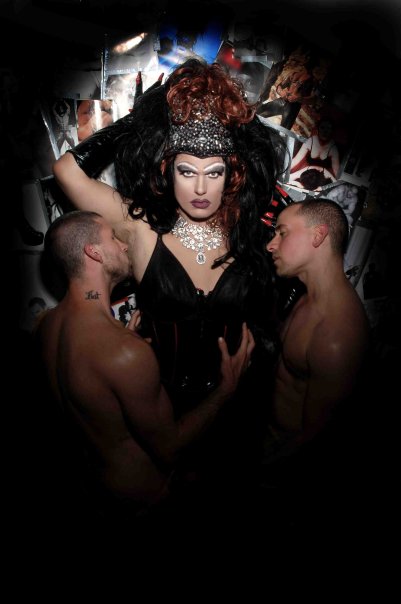
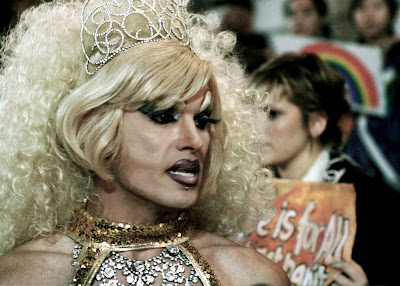
Today is Queen’s Day in the Netherlands, meaning millions of people all across that cute little country are partying in the streets, wearing orange, and getting trashed in the name of Royalty. America at large has yet to pick up on the awesomeness of this Dutch holiday, but thank the gay gods San Francisco cherishes her Queens year-round. So while Amsterdam is going wild for Queen Beatrix, now is a good time to honor some of our city’s own brand of prime royalty. It’s time to bow to the Queen…

Pollo Del Mar

Pollo Del Mar,  a.k.a. “The Notorious P.D.M.” or Glamazon, doesn’t just rock the ‘hot drag queen’ title alone; she’s a performer, personality, emcee, magazine cover girl, journalist and even reigned as the 2007 Miss Trannyshack

SFBG: What are you the Queen of?
PDM: A little over a year ago, the San Francisco Bay Guardian declared me “The Queen of San Francisco Media.” It’s a title I hold proudly. I know that bitch Perez Hilton calls herself the “queen of all media,” but maybe my next goal should be to become the “DRAG Queen of All Media”?! LOL!!

SFBG: If you ruled as Queen, what would be your first order?
PDM: I’d like to order a two piece and a biscuit, please, as long as it’s Tuesday. That’s the 99-cent special at both Popeye’s AND KFC. Seriously, in this economy, that’s just smart meal planning, honey. Oh, yeah, and be good to yourself and others. If you don’t respect yourself, why should anybody else?

SFBG: Who is your ideal King?
PDM: To be honest, Barrack Obama isn’t too far from my ideal King. He’s sexy, powerful, socially conscientious and has a bangin’ body under those business suits. That Michelle is one lucky woman!

queen pollo

SFBG: What song would be your court’s anthem?
PDM: For the past several year’s, I’ve been closely associated with Nelly Furtado’s “Maneater” for obvious reasons. It just seems appropriate to keep that tradition alive. :::giggles:::

SFBG: Of what Queen would your reign most resemble? Elizabeth? The Queen of Hearts? Would you rule naughty or nice?
PDM: Honey, I’m definitely no ‘Virgin Queen,’ so that’s out! I say be beautiful, respectful and conscientious in public and be as nasty as you want to be once those bedroom doors are closed. And anyone who kisses and tells…Off with their heads!

SFBG: Our majesty, what are your most prized possessions?
PDM: To be possibly too serious for a moment, I kicked a daily drug habit six years ago, and the peace of mind, serenity and faith that comes with sobriety is the thing in my life I cherish most — well, that and my little Jack Russell Terrier, Piggy Del Mar! He’s the love of my life and, unlike any other man I’ve met in my life, annoyingly loyal!

SFBG: And your most adored, cherished wardrobe pieces?
PDM: Several years ago, I was given an amazing necklace and earring set as a gift from a friend. It’s something I could never have afforded on my own, and it’s so gorgeous that I feel elegant every time I wear it. For sentimental reasons, I also have a pair of faux fur boot covers I wore the night I won the Miss Trannyshack Pageant in 2007. They get raves every time I put them on — and remind me of a kick-ass night, too.


Her Royal Highness, Queen Cookie Dough.

Cookie Dough is a scorpio and one wild woman who isn’t afraid to wow audiences with her vivacious character. She’s an attention whore with a passion for film, leading her to star in films, documentaries, cabaret shows and all kinds of ridiculously wild acts that push boundries way beyond with her own CookieVision.

SFBG: What are you the Queen of?
Cookie: The Monster Show – The Longest Running Drag Show In The Castro

SFBG: If you ruled as Queen, what would be your first order?
Cookie: Rock And Roll All Night, and Party Everyday

SFBG: Who is your ideal King?
Cookie: My husband, DJ MC2

cookie!

SFBG: What song would be your court’s anthem?
Cookie: Let Me Entertain You – by Queen

SFBG: Of what Queen would your reign most resemble? Elizabeth? The Queen of Hearts? Would you rule naughty or nice?
Cookie: The Red Queen – Off with their heads

SFBG: Our majesty, what are your most prized possessions?
Cookie: My Husband, & Kitties – Lulu Fishpaw & Wolfgang

SFBG: And your most adored, cherished wardrobe pieces?
Cookie: My Shoes – 8 inch heels with a 4 inch platform


If you’re in the mood to celebrate, hit up one of these San Francisco equivilants– just make sure to wear orange and treat your date like the Queen she/he is…


Queen’s Day at SupperClub

Fri/30, 6:30pm Happy Hour, 7:30pm First Course, 9:30pm Party, $55-$65

SupperClub

657 Harrison, SF

www.SupperClub.com


DJ Marcus’ Queen’s Day w/ Eurocircle, NLBorrels and The Dutch Consulate General

Fri/30, 8 p.m., $10/$20.

Apartment 24, 440 Broadway, SF.

www.mjdjevents.com


The residue

0

arts@sfbg.com

MUSIC “Drug boys steady shooting. The streets don’t give a damn. They’re filled with such pollution,” sings B.o.B on “Kids,” an interpolation of the coda from Vampire Weekend’s self-titled indie-pop gem. “The kids don’t stand a chance.”

But does B.o.B stand a chance? The Adventures of Bobby Ray (Atlantic) is pop, pop and more pop, embracing the current electro-pop-with-a-hip-hop-attitude zeitgeist with a smothering squeeze. If Kid Cudi took notes from Kanye’s 808 and Heartbreak on his intermittently fascinating Man on the Moon: End of Day; then B.o.B seems to channel Lupe Fiasco’s The Cool, with a dollop of Gym Class Heroes and Fall Out Boy thrown in.

B.o.B’s hip-pop excursion flies right into a raging debate over presence in hip-hop music, and whether there’s any left. The mainstream vanguard belongs to those willing to embrace rock and R&B clichés, whether it’s Lil Wayne fake-strumming a guitar on “Prom Queen” or, more nobly, Phonte Coleman crooning on Foreign Exchange’s “Daykeeper.” The hardcore underground belongs to growlers who can spit “16 hot bars” for days over “hit” beats lifted like Just Blaze’s “Exhibit C.” (For the uninitiated: a “bar” is a stanza in a verse.) Each camp seems to disappear into its chosen musical backdrop, driving the beat with narratives and themes, yet rarely emerging with an MC’s distinctly authoritative voice.

The recent death of Keith “Guru” Elam, who passed away April 20 after years spent battling cancer-related illnesses, underscores the stakes. On his work with Gang Starr, Guru not only excelled at storytelling, but at delivering classic lines that burned in your memory. Everyone knows “DWYCK” and “Lemonade is a popular drink and it still is/ I get more props and stunts than Bruce Willis.” Or how about this one (my personal favorite) from “The ? Remains”: “As the world revolves, wack crews lick my balls.”

Peace to one of the best to ever do it. And to be fair, Lil Wayne, DOOM, Mos Def, and a handful of others still deliver those prized “hip-hop quotables.” As for B.o.B? This may seem like a heavy burden for a 21 year-old kid who just released his first official album after years spent hyping himself with mixtapes like The Future and Hi! My Name is B.o.B. Once a hip-hop artist makes a best-seller, he becomes fodder for cruelly dismissive rap addicts clogging up chat boards, snarky rock critics penning capsule reviews for magazine slicks, and old-head journalists who slum down the media mountain to judge the latest craze against their idealized B-boy childhood. Each side will argue noisily and violently whether The Adventures of Bobby Ray spells the death or rebirth of hip-hop.

The turning point is “Nothin’ on You,” a shaggy-dog ballad that reached the summit of the Billboard singles chart. B.o.B leaves the hook to cowriter Bruno Mars, whose production crew the Smeezingtons (Flo Rida’s “Right Round,” K’naan’s “Wavin’ Flag”) aims to be the new-school version of the Neptunes. “Beautiful girls, all over the world/ I could be chasin’ but my time would be wasted/ They got nothin’ on you, baby,” sings Mars in a creamily soft voice.

In conversation, B.o.B is a likeable guy who doesn’t have much to say about the artistic process. Some musicians are erudite Questloves who can philosophize on any and every studio session, while others are Ghostface Killahs who just do it and let the historians sort out the details. B.o.B acknowledges that The Adventures of Bobby Ray is a sharp departure from his early mixtape material.

“I treated the early mixtapes like albums, but I was always holding back. I was holding back the alternative side,” he says, adding that rock bands like Coldplay are an influence. “I don’t want to be in one genre because doing that would be limiting me as an artist, if I was only being exposed to the pop crowd, or just to the urban crowd.”

Growing up Bobby Ray Simmons in Decatur, Ga., he was first discovered at 16 while performing at Club Crucial, a nightclub in Atlanta’s rough Bankhead neighborhood. As he subsequently signed deals with producer Jim Jonsin (Cypress Hill’s “Armada Latina”) and his Rebel Rock imprint, and then T.I.’s Grand Hustle camp, B.o.B toyed with idioms. His breakthrough single, the regional hit “Haterz Everywhere,” matched ATL bravado with a memorable hook. On The Future, he playfully riffed over a loop of Sam Cooke’s “Only Sixteen.” During appearances on the 2008 Rock the Bells tour, he interrupted his brief sets by bringing out a guitar and strumming an acoustic version of his marijuana ode, “Cloud 9.”

By B.o.B vs. Bobby Ray, he graduated to writing full-fledged pop songs, though none were as good as those found on The Adventures of Bobby Ray. Throughout his mixtapes, which were kind of a woodshedding process, B.o.B presented himself as an alien, a prodigal kid who doesn’t quite fit in with the teacher’s pets or the playground thugs. He frequently noted skipping high school to smoke weed and hang out on the streets. On “My Story,” he rapped, “Rebellion is just a side effect. Homicidal? Maybe. Suicidal? Yes.”

Today, B.o.B says, “It’s not as dark as it was. There’s still the residue there; the residue is on all my memories. It makes me who I am. It’s the strikes and blows that carve me as a person.” Finding success with a passion he nurtured since the third grade has undoubtedly helped. And career demands keep him out of trouble. “As I become more successful, it requires me to work more. I’ve got to be on my p’s and q’s. I gotta go to bed earlier. I can’t stay up as late as I used to. Sometimes I do party, but I’m like, alright, I gotta wake up in the morning.”

B.o.B may have grown out of his depression, but the ADD-manic energy remains. On The Adventures of Bobby Ray, the mixtape hiss and “down South” hood raps have been buffed away, leaving charismatic emotion and arena-ready entreaties like “Ghost in the Machine,” “Fame,” and “Airplanes.” A chorus line of high-profile guests, from Rivers Cuomo of Weezer and Hayley Williams of Paramore to Eminem and Lupe Fiasco, appear to ease the transition.

“Everyone listens to everything. Whatever’s going on in the hip-hop community, the pop people can see, and vice versa,” B.o.B says. When everything’s mixed up and genre lines blur, he adds, “Change is inevitable.” *

B.O.B

with Lupe Fiasco

Tues/4, 8 p.m. $34.50

Warfield

982 Market, SF

(415) 345-0900

www.ticketmaster.com

Regime genie

0

arts@sfbg.com

FILM While his unauthorized appearance in Team America: World Police (2004) was surely disillusioning, Kim Jong-il is known to be a foreign film fanatic as well as someone with a keen interest in his own country’s popular media. Popular meaning propagandic, and vice versa — distinctions being useless in North Korea’s case. Inappropriate TV and radio signals are jammed; Internet access is scant; lively arts expressions are strictly “official.” Worldwide, only Eritrea rates lower for freedom of the press.

But why complain when a government-supervised communications realm allows the flourishing of such refined entertainment as Let’s Trim Our Hair In Accordance With the Socialist Lifestyle? Thanks to which broadcast series we know that shorter hair is not only more stylish, patriotic, and hygienic, but improves intelligence — because long locks drain the brain of needed nutrients. (Thus explaining the intellectual reputations of hippies and metalheads.)

The “Dear Leader” has also overseen numerous big-screen productions with alluring titles like A Faithful Servant, A Single Mind, Brigade’s Political Commissar and Let’s Go to Mt. Kumgang. In a 50-page pamphlet titled “Great Man and Cinema: Anecdotes,” he spills all about this fabulous showbiz sideline. Well, perhaps not all: one doubts, for instance, that he comes clean about the 1978 kidnapping of leading South Korean director Shin Sang-ok, who after an attitude-improving prison stint was compelled to make 1985’s nationalistic Godzilla-slash-Golem monster saga Pulgasari.

Other Cinema’s “Mayday Parade(e)” program offers a full dose of propagandic kitsch from the Democratic People’s Republic and beyond. Its centerpiece is The Juche Idea, an hour-long exploration of today’s united-front wonderland. There are excerpts from colossal choreographed Pyongyang patriotic displays, lugubrious dramas, poems (“O bureaucratic capitalism!/ Wet slug to be suffocated in eggshells and beer”) and other materials illustrating the regime’s titular essential ideology. Offering outside perspective is the lengthy interview with a South Korean film student who’s expatriated to an artists’ agricultural collective here after unimpressed stopovers in the U.S. and Japan.

You can stop dialing that local Tea Party hotline right now. The Juche Idea is not quite what it appears to be — though so nearly so it’s ingenious. The final section in an ultra deadpan mockumentary trilogy by plain old American Jim Finn, it mixes actual archival and faked footage to satirize revolutionary snowblindness so subtly you might well be fooled. Following his prior efforts’ send-ups of Peruvian Shining Path militants and a nonexistent East German space program, he again shoots and scores.

The most hilariously ersatz segments are those providing lessons in English as both a Socialist and Capitalist language. Speaking their dialogue with genius stiltedness is Oleg Mavromatti as a Russian visitor no doubt impressed to learn that as far as agricultural and other advancements are concerned, “The manure we’re spreading is just the beginning.”

Moving farther eastward, the ATA program offers fun from another People’s Republic. Great Advancement of Chairman Mao Tse-tung’s Thought (1966), better known hereabouts as Mao’s Little Red Video, is a half-hour newsreel/pep rally focusing mostly on China’s first atomic and nuclear bomb tests. These are triumphant, natch; but more important is the fact that the people themselves are “a spiritual atomic bomb” who will inevitably blow decadent capitalist aggressors to smithereens by their sheer purity of rhetoric.

Early arrivals will be greeted by the turntablings of DJ Onanism and partial screening of Situationist prankster René Viénet’s 1977 Peking Duck Soup, or One More Effort, Chinamen, If You Want to Be Revolutionaries! This cheeky collage uses official imagery in service of an illustrated lecture enumerating all the lies, backstabbings, and massacres throughout Mao’s “visionary” rule. Any regime without humor is bound to generate a lot of the unintentional kind, but Viénet can’t help adding his own particular brand of aesthetic snark. Particularly felicitous are the uses of Serge Gainsbourg’s “Je t’aime … moi non plus” and the Singing Dogs’ “Jingle Bells.”

OTHER CINEMA

Sat/1, 8:30 p.m., $6

Artists’ Television Access

992 Valencia, SF

www.othercinema.com

PBS’s Frontline edits out single payer

1

Documentary misrepresented advocates as supporters of a public option
4/23/10

Silencing supporters of single-payer, or Medicare for All, is a media staple, but PBS’s Frontline found a new way to do that on the April 13 special Obama’s Deal–by selectively editing an interview with a single-payer advocate and footage of single-payer protesters to make them appear to be activists for a public option instead.

The public option proposal would have offered a government-run health insurance program to some individuals as an alternative to mandatory private health insurance. Not only is this not the same thing as Medicare for All, it’s an idea many single-payer advocates actually opposed, arguing that it would leave the insurance industry intact as dominant players in the healthcare business (PNHP.org, 7/20/09).

In the report, Frontline explained that insurance industry lobbyists pushed a bill in the Senate Finance Committee chaired by Sen. Max Baucus (D.-Montana) “that would include the mandate to buy insurance and kill the public option.” That “didn’t sit well with the president’s liberal supporters,” the Frontline narrator told viewers. After a clip from public-option supporter Howard Dean, a full minute and a half focused on protests: “The left counterattacked in May…. Liberal outrage arrived in Baucus’ own hearing room as healthcare activists, one after another, shouted him down.” Several of these protesters are seen in action, with a clip of an interview with Margaret Flowers of Physicians for a National Health Program (PNHP) saying that these were members of her group shut out of the hearings.

Now, Flowers and PNHP are leading single-payer advocates–but you’d never learn that from watching the Frontline program, which never mentions the single-payer concept. Instead, viewers were left to assume that Flowers and the protesters were public-option proponents, since that was the only progressive proposal that had been discussed. As Flowers explained (Consortium News, 4/15/10):

When the host, Mr. [Michael] Kirk, interviewed me for Obama’s Deal, we spoke extensively of the single-payer movement and my arrest with other single-payer advocates in the Senate Finance Committee last May. However, our action in Senate Finance was then misidentified as “those on the left” who led a “counterattack” because of “liberal outrage” at being excluded.

Viewers saw more footage of protesters being handcuffed and led away, with an unidentified voiceover from Amy Goodman of Democracy Now! describing the arrests, and finally a voice was heard saying: “This option cannot be part of the discussion at a Senate hearing? Now, I think that’s wrong.”

The audience could only conclude that “this option” referred to the public option, but this conclusion would be incorrect; this voice was actually MSNBC host Ed Schultz, a single-payer supporter, and a fuller version of his quote (5/7/09) would have made it clear that he was complaining about single-payer being excluded from the hearing:

Now, let me explain single-payer for just a minute. The money comes from one source, the government. Now, you and I pay taxes, OK. The government pays the bill. It’s that simple. Patients are not caught in the middle between doctors and insurance companies, no game-playing here. There’s no middleman. You know? There’s no decision-makers between you and your doctor. It’s a clean deal.

So what Chairman Baucus has decided, this option cannot be part of the discussion at a Senate hearing? Now, I think that’s wrong. I don’t think it’s fair.

Frontline’s editors responded to Flowers’ complaints, saying that they “understand the frustration of Dr. Flowers and others in what she calls the ‘single-payer movement,'” but that “it’s the work of journalism to report widely on a topic, then find the sharpest focus for the reporting, unfortunately leaving out much strong material along the way to shaping the clearest communication possible in the time or space allowed.”

The statement also argued that

the section that included Dr. Flowers was focused on the power of the insurance lobby and showed how activists like Dr. Flowers were excluded from the debate over the bill. The protesters themselves said they were protesting the fact that they had been excluded from the debate, so we believe we presented the protests in the proper context.

But in Frontline’s presentation, “activists like Dr. Flowers”–that is, single-payer advocates–didn’t even exist. Having itself excluded their perspective from the debate–and even misrepresented them as supporters of a position that many of them actually oppose–there’s some irony in Frontline claiming to have put this exclusion in the “proper context.”

This is not the first time that Frontline has decided that a conversation about healthcare reform should exclude single-payer (FAIR Action Alert, 4/7/09). The March 31, 2009, Frontline special Sick Around America avoided discussions of national healthcare plans. This omission led Frontline correspondent T.R. Reid–who had hosted a previous Frontline special (4/15/08) that examined various public healthcare models–to withdraw from the project.
When Frontline pushed single-payer out of the debate last year, PBS ombud Michael Getler (4/10/09) weighed in on the side of critics, calling it a “missed opportunity.” Getler today (4/23/10) published a column about the latest Frontline omissions, once again finding that ignoring a popular policy like single-payer is problematic:

It seems to me that to ignore something that was out there and popular with millions of people and thousands of healthcare professionals, but not really on the table, was a mistake. Although obviously tight on time, the producers should have found 30 seconds to take this into account, because many Americans support it, yet the deal makers never mention it, nor is the politics of discarding it addressed.

We’re thankful that Getler has once again taken this view and encouraged a more inclusive discussion of healthcare on PBS. However, his criticism misses the critical journalistic fact that single-payer advocates were not only marginalized by Frontline–they were misrepresented.

ACTION:
Tell Frontline that their recent program Obama’s Deal should have accurately explained the views of single-payer advocates.

CONTACT:
Frontline
frontline@pbs.org

You may also want to write to PBS ombud Michael Getler (ombudsman@pbs.org).

    
TAKE ACTION!

ACTION:

Tell Frontline that their recent program Obama’s Deal should have accurately explained the views of single-payer advocates.

CONTACT:
Frontline
frontline@pbs.org

Green cards in hand, Washingtons want Newsom to discuss immigrant youth policy. In person.

0

Tracey Washington and her 13-year old son heard today that their green card applications have been approved. This means that they will not be deported to Australia, and their personal immigration nightmare is over.
But even as the family rejoices, Tracey’s husband, Charles Washington, a Muni bus driver and long-term San Francisco resident, has written to Mayor Gavin Newsom, voicing disappointment over Newsom’s failure to reach out to his family during their time of need and over Newsom’s continuing refusal to implement the immigrant youth due process policy that a veto-proof majority of the Board approved, in November 2009.

“Our family’s luck n this case was unique, but Mr. Newsom, the pain we felt when our family was facing deportation as a result of your policy is not unique at all,” Washington wrote in his April 21 letter. “We share the pain felt by the many other families whose children were taken into ICE custody and ordered deported, as a result of your policy.” (The full text of the letter that Charles Washington sent to Newsom today is included at the end of this blog post.)
 
The Washingtons’ nightmare began in January, when their 13-year-old boy was reported by juvenile probation to ICE for a minor bullying incident, during which he took 46 cents from another youth, then gave it back and apologized. That’s when the family first discovered that, thanks to a new juvenile immigrant policy that Newsom implemented in July 2008, their teen was going to reported to ICE immediately after his arrest – and before his case was heard in juvenile court. 

And even though the family was eligible for green cards thanks to Tracey’s April 2009 marriage to U.S. citizen Charles Washington, ICE handed Tracey and her son their deportation orders on Feb. 5, 2010–the same day they picked the boy up from juvenile detention and used the boy as bait to get his mother to agree to wear an electronic monitoring anklet.

That anklet was finally taken off today, meaning that Tracey Washington was forced to wear this uncomfortable and humiliating device for two and a half months, even though she did not commit a crime–and even though her son was not found guilty as charged, when his case was finally adjudicated by a juvenile justice.

Following the bullying incident, local law enforcement officers charged the boy with three felony counts, triggering an immediate referral to ICE, under Newsom’s immigrant youth policy.  But a juvenile justice recently gave the boy informal probation, recognizing that the youth is a first-time offender who committed a low level offense and is a good candidate for rehabilitation.

But seven weeks ago (March 1), when Tracey and her son had exhausted their legal options and were facing imminent deportation, the five-member blended Washington family held a press conference as a last resort. Two days later, following a media firestorm, ICE granted the Washingtons a two-month reprive, so that U.S. Citizenship and Immigration Services could review and approve their green card applications.

“We really appreciate that U.S. Citizenship and Immigration Services was willing to look at our individual circumstances and approve our residency application, so that our family can stay together,” Tracey Washington said today. “ At the same time, my heart goes out to the many other families who were harmed by the Mayor’s policy.” 

Angela Chan, the staff attorney at the Asian Law Caucus, who handled the family’s case, noted that while the Washington’s nightmare ended happily, many other families continue to be broken up by harsh immigration laws, lack of access to affordable legal services, and Mayor Newsom’s local policy towards immigrant youth.

“Newsom’s policy exacerbates the impact of a broken federal immigration system on San Francisco families,” Chan said. “We need humane reform at the federal level, but in the meantime, Mayor Newsom needs to take a stand today for due process and family unity by ending San Francisco’s draconian policy. If the Washingtons’ son had not been reported to ICE, as required by Newsom’s policy, he would not have been sent to ICE, and he and his family would not have had to endure this nightmare.”
 
Letter to Mayor Newsom from Washington Family–
 
April        21, 2010
 
Mayor Gavin Newsom
City Hall, Room 200
1 Dr. Carlton B. Goodlett Place
San Francisco, CA 94102
 
RE: Unjust Policy Regarding Undocumented Youth in San Francisco

Dear Mayor Newsom,

My name is Charles Washington. I was born and raised in San Francisco, and am a long-time resident of this great city. I also am a city employee. I love the city of San Francisco and my family has developed strong roots here. Unfortunately, last month, we went through a horrible ordeal when my wife and step-son were ordered deported as a result of your policy, which requires reporting of youth to Immigration and Customs Enforcement (ICE) right after arrest, before the youth even has a chance to have a hearing in juvenile court regarding the charges.

As you may have read in the news, my 13-year-old son was arrested and reported to ICE for deportation over 46 cents in a minor, first-time bullying case. In accordance with your policy, San Francisco juvenile probation officers reported my son to ICE before the allegations could even be adjudicated by a juvenile court judge. To my shock, my wife also was ordered deported by ICE as a result of the reporting of my son by juvenile probation in keeping with your policy.

With the imminent deportation hanging over my wife and son’s heads, we were utterly terrified that our family would be torn apart. Since we had no other legal remedies when our request for a stay of deportation was denied, we desperately reached out to the media to seek help in a last ditch effort. Fortunately, a reporter contacted the White House, which then resulted in an extension of the deadline for the deportation. However, I must tell you that during this time, we were really disappointed that we did not receive a single call or any type of outreach from your office to offer my family support, especially when my son’s referral to ICE was a direct consequence of your policy.

I also would like to express my deep disappointment in the statements your office issued after my family was granted the reprieve through no help from your office. Your office made statements to the press suggesting that our situation proves your policy leads to just outcomes. I completely disagree with this assertion and firmly believe that our being granted the reprieve has proven even more so that your policy hurts families and tears children away from their parents for minor, first-time offenses. The White House seems to understand the importance of keeping families together in granting the reprieve. Unfortunately, your office appears to have missed this completely. It is extremely hurtful to our family that you would try to claim credit for the positive turn in events that my family and the community supporting us worked hard to obtain in order to combat the injustice brought upon us by the policy you implemented in the first place.

Let me also say that my family was lucky, but there are many other families who have not been as fortunate.There was no handbook to tell us what to do to obtain a reprieve when we were in this crisis. It just so happened that we were able to obtain legal assistance, but what if we had been unable to find legal services or if the press had not covered our story? My wife and son would have been torn from me and there is nothing I could have done to stop it from happening. Families in San Francisco should not have to struggle or rely on luck to stay together. In fact, there have been over a hundred families in this city who have not been as fortunate as my family since your harsh and inhumane policy was implemented in 2008.  Our family’s luck in this case was unique, but Mr. Newsom, the pain we felt when our family was facing deportation as a result of your policy is not unique at all.We share the pain felt by the many other families whose children were taken into ICE custody and ordered deported as a result of your policy.

Mr. Newsom, I know that you are a new father yourself and will teach your own daughter many lessons in her lifetime. I respectfully ask you to reexamine your policy from the eyes of a father, the way that I am looking at my son today. While I must say that I am greatly disappointed in the actions you have taken to support a flawed policy that has endangered the children of this city, I do hope that you will take this opportunity to do the right thing and support implementation of Supervisor Campos’ due process amendment, which is now city law.  Families like mine, who are hard-working and rooted in San Francisco, are depending on you to do what is right and to follow the law the community passed in November 2009.

I respectfully request a meeting with you, in which my lawyer, Angela Chan from the Asian Law Caucus, and my family can speak with you about this policy and how it has affected us and continues to impact families in San Francisco.
Sincerely,

Charles Washington

The inside angle

0

rebeccab@sfbg.com

Josh Wolf’s second spell in the hot seat — and other penalties brought down against independent journalists documenting California’s defiant student movement — raise some important questions about the freedom of the press at civil disobedience protests.

Wolf, a student at UC Berkeley’s Graduate School of Journalism, faces a possible academic suspension for violating the student conduct code during a Nov. 20 student occupation of a campus lecture hall. But Wolf says he was there to document the moment as a reporter.

Brandon Jourdan, an independent journalist who was also inside the hall with Wolf, now faces his own set of misdemeanor charges after capturing footage of a March 4 student protest that broke onto a West Oakland freeway. And David Morse, a journalist and Indybay collective member who reported on a raucous Dec. 11 protest at the UC Berkeley chancellor’s residence, is now fighting the seizure of his camera and a search warrant issued by UC police for his unpublished photographs — something the First Amendment Project maintains is in violation of state law.

The footage that Wolf and Jourdan took on Nov. 20 and March 4 captured police use of physical force against protesters and documented the widely publicized actions from unique perspectives. The reports were broadcast on Democracy Now!, a popular independent news program that airs nationally on satellite television stations, public access channels, and online.

The gutsy camerapersons aren’t the first to face criminal charges. After nine reporters followed several hundred protesters seeking to block construction of the Black Fox Nuclear Power Plant onto private property in June 1979 and were arrested, an Oklahoma court of appeals ruled the First Amendment guaranteed them no immunity from prosecution for trespassing.

“That makes the position of a journalist very difficult, in areas where demonstrators are essentially exercising civil disobedience to make a point,” notes Terry Francke, executive director of Californians Aware, a watchdog organization focused on First Amendment issues. “There’s no free pass for journalists in the crowd recording what’s going on. Their principled position would presumably be yes, like [protesters] risk arrest and consequences for the greater good, they’d risk the same for the sake of giving the public … a close-up picture of what it’s like to be in those circumstances.”

Without that journalistic witness, “When you hear stories about what went on in the middle of a police and demonstrators’ confrontation … you’ll have two irreconcilable versions, from only directly interested parties,” Francke points out.

There’s been no shortage recently of civil disobedience on California college campuses, where operations have been ravaged by budget cuts. The Nov. 20 occupation was staged early in the morning at Wheeler Hall, when students barricaded themselves inside to protest a 32 percent fee hike imposed by the UC Board of Regents. While most reporters gathered outside the building or flew over in helicopters, Wolf was inside, and he’s the only student to claim being there in a journalistic capacity. He says he wore a police-issued press badge.

Wolf, a video journalist, enjoys a sort of celebrity status because he spent 226 days in jail after resisting a subpoena to testify before a federal grand jury. It started when he shot a film of a 2005 protest in San Francisco, which police tried to obtain because they believed it could help them pinpoint demonstrators who vandalized a police car and injured an officer. Since the case was pursued at the federal level, he was unable to invoke California’s shield law protecting journalists from being compelled to reveal unpublished material.

Democracy Now! aired a lengthy report of the Nov. 20 occupation featuring footage that the two embedded reporters had captured from the interior of Wheeler, coproduced by David Martinez. Show host Amy Goodman specifically named Wolf as a co-contributor when the report aired.

Now Wolf is facing a possible seven-month suspension by the campus Center for Student Conduct, which charges him with violating the student conduct code on multiple counts. “Their perspective is that I am a student and that I am a journalist,” Wolf explained. “My responsibility is no different from anyone else’s in there, and therein, my punishment should be reflective of that of everyone else.” Wolf said he had the backing of the journalism school, which confirmed to the Guardian that the dean wrote a letter of support for Wolf.

David Morse, 42, is a journalist who has covered hundreds of Bay Area protests on Indybay, an online news site that spotlights grassroots movements and protests. In a motion filed against UCPD, the First Amendment Project charges that Morse was arrested and had his camera seized Dec. 11 despite repeating six times that he was a journalist and displaying a press pass. “They told me, ‘You have a camera, we want your camera,'<0x2009>” Morse recounted. The next morning, as reports of angry, torch-wielding students storming the chancellor’s home and smashing windows made headlines, Morse was still sitting in jail in Santa Rita. “My voice as an eyewitness was completely silenced,” he said. His charges were dropped, but now he is challenging the search warrant to get his memory discs back.

When the police department sought a search warrant for Morse’s unpublished photos, they didn’t mention that he had identified as a journalist, the FAP charges. The legal nonprofit filed a motion to quash the warrant on grounds that it violates a provision in the penal code barring search warrants for journalistic work products, invoking the state shield law.

Jourdan, meanwhile, faces five misdemeanor charges after filming the March 4 freeway protest and subsequent police response, which many have characterized as excessive. (In one clip, an officer can be seen striking an individual who doesn’t appear to be resisting with a baton.) He was arrested along with two other videographers who also face criminal infractions. Footage Jourdan and Martinez captured from March 4 aired on Democracy Now!, and Jourdan’s report was also featured as a lead story on the Huffington Post. Jourdan says he wore press credentials.

“It’s unfair for them to file charges against me when they’ve dropped charges against others,” Jourdan said. The Oakland Police Department confirmed to the Guardian that Jourdan had been charged with crimes such as unlawful assembly and obstruction of a thoroughfare, but did not respond to a message asking what set him apart from other reporters.

Jourdan, who has also contributed to Reuters, The New York Times, and other outlets, has managed to capture a variety of similar events on film, including Amy Goodman’s arrest during protests outside the Republican National Convention in 2009. “Barely a month goes by that some lawyer isn’t calling me up trying to get footage of some one getting beat up,” he said. But he maintains that documenting these intense moments is crucial, not for resolving disputes, but to document these moments in history.

Reporters from mainstream television news programs toting bulky cameras were also filming on the freeway, but were allowed to leave. Guardian news intern Jobert Poblete and multimedia producer Cameron Burns with UC Berkeley’s Daily Californian were arrested on the freeway too, but their charges were later dropped after state Sen. Leland Yee intervened. “Journalists are generally provided greater access to cover news stories than other members of the public,” Yee wrote in a letter to the Alameda County District Attorney’s Office. “Unfortunately, law enforcement did not provide such leeway in this case.”

Adam Keigwin, Yee’s chief of staff, said the senator’s office got involved on behalf of the Guardian and the Daily Cal because he knew those publications. “We just need to know more about this,” Keigwin said. “Once credentialed media is present, it’s the senator’s perspective that journalists should have the right to cover these things and should not be charged.”

But when asked if there is a deficiency in state law since that right doesn’t technically exist, Keigwin responded, “This may be something we should consider.”

Our Weekly Picks

0

WEDNESDAY 21

EVENT/LIT

Yann Martel: Beatrice and Virgil

Yann Martel brought us The Life of Pi, an award-winning story about an Indian boy trapped on a life raft with a Bengal tiger in the middle of the Pacific Ocean. At www.whatisstephenharperreading.ca, Martel chronicles his vow to send a book every two weeks to Canadian Prime Minister Stephen Harper to promote government arts funding. And now, Martel is back with Beatrice and Virgil, another folkloric tale. It’s about a writer working on a novel about the Holocaust, and it’s also the story of a donkey named Beatrice and a howler monkey named Virgil whose epic journey begins only after fate places them in a taxidermy shop run by an intriguing man. (Paula Connelly)

In conversation with Laura Fraser

7:30 p.m., $15 (21 and over)

Sundance Kabuki Theater

1181 Post, SF

www.booksmith.com

THURSDAY 22

MUSIC

Blank Dogs

It’s impossible to keep up with what Blank Dogs frontman Mike Sniper is up to at any given moment. In addition to being a tad shy — as evidenced by his wearing a mask or blanket to performances and publicity photo shoots — the Brooklyn native is also so prolific that he probably has another limited distribution EP or 7-inch scheduled for release by the end of this sentence. His brand of lo-fi new-wave is noisy and discordant, but ever familiar, like New Order or OMD heard through a tunnel with a blender running in the background. Sniper is emerging from his East Coast bedroom for a show at Eagle Tavern, and though his persona might not be the mystery it once was, his unique perversion of post-punk is always promisingly puzzling. (Peter Galvin)

With Bare Wires, Fresh and Onlys, Cosmetics

9 p.m., call for price

Eagle Tavern

398 12th St. , SF

(415) 626-0880

www.sfeagle.com

DINE

Wine Enthusiast’s Talk of the Town 2010

More than 500 varieties of wine and spirits — along with food from 30 great Bay Area restaurants — are on the menu for sampling at Wine Enthusiast’s Toast of the Town 2010, a classy affair taking place in the historic environs of the beautiful War Memorial Opera House. Live jazz provides the soundtrack for the evening’s indulgences, which benefit the San Francisco Food Bank, the venerable organization that needs a little help of its own right now to help people in our community. Raise a glass (or several) and know that this night of fun will also help to make someone’s day tomorrow when they sit down for a much-needed meal. (Sean McCourt)

7 p.m., $89 ($169 for 5 p.m. VIP tasting)

War Memorial Opera House

301 Van Ness, SF.

www.wineenthusiast.com

1-800-847-5949

MUSIC

Jrod Indigo

Jrod Indigo inspires comparisons to Michael Jackson, Robin Thicke, and Prince. Born in Chicago, raised in Atlanta, having spent some time in Seattle and now in the Bay Area, Jrod possesses musical versatility. He’s a polished songwriter who prefers to play with a live band. Layered harmonies, vintage synths, funky guitar riffs, and deeply-rooted soul incorporate different elements from the music of the cities where he has lived. He’s performed with Amel Larrieux, Martin Luther, Crown City Rockers, and others. Tonight he’s the headliner. (Lilan Kane)

With the Whooligan, Femi

9:30pm, $7

Coda Lounge

1710 Mission, SF

(415) 551-2632

www.codalive.com

MUSIC

Chicha Libre

Drink enough mugs of chicha, and you’ll get lifted like the ancients. The fermented corn drink has been imbibed since before the conquistadors launched their grand tour of bummer, and still plays a central role in the lives of indigenous Peruvians. Gets you all drunk and stuff. This age-old psychedelia inspires the chaps of Chicha Libre, a South American surf band that adds classic pop sounds from 1970s AM radio, sun-drenched Beach Boys guitar melodies, and a little cumbia shake to the Amazonian rhythms of their ancestors. Raise a glass. (Caitlin Donohue)

With the Cuban Cowboys, DJ Juan Data

8 p.m., $9.99

Rickshaw Stop

155 Fell, SF

(425) 861-2011

www.rickshawstop.com

FRIDAY 23

SPORTS

Harlem Globetrotters

They’re the only professional basketball team to play an entire game on ice skates (and ice, in Central Park) or go for an 8,000-game win streak: If you haven’t seen the Harlem Globetrotters do their thing, you’re missing out on the greatest American sports kitsch. From the get they’ve been showboaters — they actually got their start as a traveling team in Chicago, but dubbed themselves Harlem because it sounded more exotic. We forgive them because they can make half-court shots, have the most kick ass of theme songs, dribble like the devil, and clown on David Duchovny when he sits courtside. (Donohue)

7 p.m., $21–$109

Cow Palace

2600 Geneva, Daly City

(415) 404-4111

www.harlemglobetrotters.com

MUSIC

Around Amoeba in 180 Minutes with DJ Bearzbub

Amoeba is a colossal beast of a record store. With rows upon rows of vinyl, CDs, posters, and listening stations, it’s hard not to look for a specific record and leave with 10 other things. The infinite sound in the place can suck you in for hours. Today, however, DJ Bearzbub is your guide. He’ll show you what the store has to offer within a three-hour timespan. (Elise-Marie Brown)

6 p.m., free

Amoeba Music

1855 Haight, SF

(415) 831-1200

www.amoeba.com

DANCE

National Dance Week

National Dance Week is a kind of spring madness of lessons, mini-performances, workshop showings and rehearsal watching in SF, the North, South and East Bay. All of it is free. You won’t be able to take in all of the four hundred-plus offerings, but you can enjoy it today. Noon is kick-off time at Union Square with over a dozen showcases and — new this year — the first annual “One Dance” flash-mob event. Look out for solo dancer Fawole and musicians popping up throughout the city, and mini shows from a new generation of dancers at the Richmond District YMCA in the late afternoon. You can see Robert Moses at work. Or, in the evening, you can take a class in Afro-Cuban, Hula Hoop, Tango, Go Go Style, World Fusion or West Coast Swing. For details, go online or pick up a brochure at dance studios and selected coffee shops. (Felciano)


Noon (through May 2), free

Union Square, SF

(415)920-9181

www.bayareandw.org

MUSIC

J Rocc

In 1992, Stones Throw mainstay DH J Rocc founded the World Famous Beat Junkies with Melo-D and Rhettmatic. Since then, he’s been a dominating force in turntablism, releasing several mixtapes and producing different Stones Throw releases. He’s been a reliable force within Madlib’s live shows, and worked with Madlib again on Beat Konducta Vol. 5-6: A Tribute to J Dilla. He’s currently putting together a solo album, and this show should offer a taste. (Kane)

With DJ Apollo

10 p.m., $8–$10

Mighty

119 Utah

(415) 626-7001

www.mighty119.com

MUSIC

Bonobo

Since the success of his third album, 2006’s Days to Come, Bonoboa.k.a. Simon Green — has refined his impressive sound. The evidence is on his latest effort, Black Sands. The combination of live instrumental arrangements and complex digital sounds in his work can be extraordinary. (A tip: if you want a taste of Bonobo’s live set but don’t have the $22 to get into Mezzanine, trek to the Haight and catch an earful at Amoeba Music at 5 p.m.) (Brown)

With Yppah and Mofnono

Mezzanine

444 Jessie, SF

(415) 625-8880

www.mezzaninesf.com

SATURDAY 24

THEATER

Tartuffe

Seems like lately, everything old is new again on the Bay Area theater scene. Current or recent local productions have updated The Diary of Anne Frank, Lysistrata, and The Seagull. San Francisco’s up-and-coming Generation Theatre isn’t aiming to alter to content of Molière’s classic comedy Tartuffe, as other productions have before (there’ve been versions that cast the main character as a televangelist, reset the action in India or during the Harlem Renaissance, and paid homage to the TV show Dallas.) Instead, Generation’s new translation by director Roland David Valayre arranges the play’s lines in alexandrine verse — which is to say, the 12-syllable format in which it was originally written. “Twelve-foot long laughter” is promised. (Cheryl Eddy)

8 p.m. (through May 16), $20–$25

Studio 205 at Off-Market Theater

965 Mission, SF

(415) 377-5882

www.generationtheatre.com

SUNDAY 25

COMEDY

Aqua Teen Hunger Force Live

Two of the more bizarrely brilliant and hilarious shows that appear on Cartoon Network’s Adult Swim, Aqua Teen Hunger Force and Squidbillies, come to life tonight. As part of a national tour, ATHF cocreator Dave Willis (voice actor for characters including Meatwad and Carl) is joined by Dana Snyder, who voices Master Shake and Granny Cuyler. Expect zany script readings, screenings of clips, music, and more at an event that should be more exciting than drinking pine cone liquor and selling a house that oozes blood to Glenn Danzig. (McCourt)

8 p.m., $25

Regency Ballroom

1290 Sutter, SF

(800) 745-3000

www.theregencyballroom.com

www.aquateenlive.com

MONDAY 26

MUSIC

Audra MacDonald with the SF Symphony

After you win four Tony awards, you can pretty much do what you want when it comes to musical theater. Audra McDonald neatly illustrates the point. One of only three actresses to accomplish the triple Tony feat, the soprano has graduated from roles in Broadway productions like A Raisin in the Sun, Carousel, and Ragtime to solo performances backed by some of the greatest musical ensembles in the country. In this SF Symphony performance, McDonald takes on her favorite show tunes, as well as a few ditties written especially for her. When you’re this good — did we mention she has two Grammies stashed away? — people will compose music in the hopes you’ll sing it. (Donohue)

8 p.m., $15–$105

Davies Symphony Hall

201 Van Ness, SF

(415) 864-6000

www.sfsymphony.org

TUESDAY 27

EVENT

A Fresh Look: Observations on Artistic and Social Practices in Urban Farming

Mmmmm. If there’s any benefit of living in San Francisco, it’s the array of delicious food sold at the multiple farmers’markets throughout the city. But selling pesticide-free produce isn’t the only way to encourage sustainable farming. The San Francisco Art Institute is working to address the proper social practices of urban farming by launching a new underground market. Along with live music and a panel discussion, delicious treats will be sold: think homemade cookies, raw chocolate, quiche, marmalades and kombucha. (Brown)

4 p.m., free

San Francisco Art Institute

800 Chestnut, SF

(415) 771-7020

www.sfai.com

MUSIC

Liars

Liars has spent the better part of a decade refining a terrifyingly bestial art-metal, and its fifth album Sisterworld is the culmination of years spent concocting an unusual formula of chant-like vocals, ambient noise and sudden outbursts of sound. Whether anyone’s listening or not, the group is immensely proud of its weirdness — they reinforce high-concept songs about murder and witchcraft with just the right amount of traditional songwriting to draw in the unsuspecting. After all, if there wasn’t a good deal of brilliance behind that eerie atmosphere and brutal bluster, it’d just be another Tuesday night goth show. (Galvin)

With Fol Chen

8:30 p.m., $15

Slim’s

333 11th St., SF

(415) 255 0333

www.slims-sf.com


The Guardian listings deadline is two weeks prior to our Wednesday publication date. To submit an item for consideration, please include the title of the event, a brief description of the event, date and time, venue name, street address (listing cross streets only isn’t sufficient), city, telephone number readers can call for more information, telephone number for media, and admission costs. Send information to Listings, the Guardian Building, 135 Mississippi St., SF, CA 94107; fax to (415) 487-2506; or e-mail (paste press release into e-mail body — no text attachments, please) to listings@sfbg.com. We cannot guarantee the return of photos, but enclosing an SASE helps. Digital photos may be submitted in jpeg format; the image must be at least 240 dpi and four inches by six inches in size. We regret we cannot accept listings over the phone.

The Daily Blurgh: Gaga pops, unsavory whiskers

0

Curiosities, quirks, oddites, and items from around the Bay and beyond

Oaktown Art (via Eye on Blogs) takes us on a tour of “one of the largest rooftop gardens in the world” paid for with insurance premiums (we’re only kidding with that last bit).

******
“Talk about defining deviancy down. What beige days we live in, when mentioning Rilke, Warhol, and David Bowie are proof positive of edgy intelligence. Rilke isn’t exactly obscure, and Warhol and Bowie are two of the best-known brands in pop history. Gaga isn’t all that weird, despite her revisionist accounts of growing up feeling “like a freak,” as she told Barbara Walters.” Thank you, Mark Dery, for articulating (albeit, rather longwindedly) my 99 problems with Lady GaGa.

******
 William T Vollmann as a lady. ‘Nuff said.

******

Never trust anyone over-beardy? (h/t The Slog)

******

“Performance journalism” isn’t Anderson Cooper flexing his biceps in a hurricane. In fact, it happened just this last weekend here in SF when Pop-Up Magazine presented its third, live “issue” at the Herbst Theater for a sold-out audience. Boing Boing’s Elisabeth Soep attended, and took away “five things Pop-Up does better than print.” Now, I’m all for Pop-Up’s attempts to invigorate journalism by thinking beyond the written word by reconfiguring the “publication” as an actual salon. And Soep has a point. Print media has often had difficulty putting across the qualities she admired about the event – its ephemerally, spontaneity, draftiness (a slightly awkward word choice which describes how some presenters shared works in progress or pieces that had been rejected by other publications, not the temperature in the Herbst), and its seamless, thematic segue into the after-party – relying on online content, blogs (heeeey!), coordinated parties or tie-in events, and a whole bunch of other Web 2.0 tricks to offset the time lag inherent to old school publishing. However, I would counter that the flipside to Pop-Up’s in-the-moment uniqueness is its lack of accessibility. Not everyone who is interested in “reading” Pop-Up is able to. Would recording the proceedings and putting them up on online really ruin the moment? I don’t think that the “unexpected shift from media to live” Soep recounts as being a highlight of one the presentations would lose all of its unexpectedness if I were able to watch it at a remove. Besides, most people know that watching a concert on Youtube isn’t the same as being there. But more to the point: I want to hear the stories that are being told at Pop-Up. Would I love to hear Aimee Mullins speak in person? Of course. But I’m grateful that TED made what she had to say at their fancy thinking fest available to the public. Also, regarding “draftiness,” all I will say is that sometimes all one wants for dinner is a delicious stir fry, and that, at other times, only a slow-roasted pork shoulder will do.

******

And speaking of local journalism: Quis custodiet ipsos custodes?

******

Happy day:

http://www.youtube.com/watch?v=JB6rHRpuWz4

Crime Bomb

1

Editors note: This story was originally published May 31,  2001.


They found Virginia Lowery lying in the garage of her Excelsior home, an electrical cord around her throat, an ice pick jammed through her skull — in one ear and out the other. For the next 11 years San Francisco homicide detectives made no progress on the case. Promising leads turned into dead ends. Theories collapsed. The cops assigned to the case retired. It looked like Lowery’s 1987 slaying would never be solved.


Then in April 1998, by pure chance, police found Robert C. Nawi. Or rather, they found his fingertips.


When Nawi, a 57-year-old carpenter, got in a shouting match in a North Beach watering hole, he was picked up by the cops on misdemeanor charges and shuttled to county jail, where he was fingerprinted and booked. The computer spat out some interesting news: Nawi’s digits, according to the database, resembled a fingerprint found at the scene of Lowery’s slaying.


Soon thereafter, police evidence analyst Wendy Chong made a positive print match, and the new suspect found himself facing murder charges and life in a cage.


Nawi’s fate, to be decided at trial next year, rests largely on police readings of his fingerprints, as well as some DNA gathered by the coroner. Which raises some questions: How, exactly, did the cops and their computers analyze the evidence? Did they get it right? Is anybody checking their work?


Making a match between the distinguishing ridges and whorls, often microscopic, of two fresh fingerprints is a relatively simple task for a print expert. However, cases like Nawi’s aren’t so clear-cut: the print collected in Lowery’s garage is faint, smudged, and missing in patches.


Michael Burt, the resident forensicscience guru at the San Francisco Public Defender’s Office, shows me an 8-by-10-inch enlargement of the print discovered at the murder scene; it’s blurry, grainy, and only about 60 percent complete. To my layperson’s eye, it bears little resemblance to the clear, fresh mark left by Nawi at his booking. “The one print is so washed out you can’t see anything,” says Burt, who is representing Nawi. “This is not science at all; it’s subjective and shouldn’t be allowed.”


Burt, a 22-year veteran defense lawyer known around the Hall of Justice for his trademark cart full of documents, has plenty of cause to doubt the cops’ evidence. Despite what you may have seen on Law and Order, fingerprint examiners can — and often do — get it wrong. Last year 141 of America’s top forensic labs were tested to see if they could accurately match two fingerprints: 39 percent failed; 11 labs made false IDs. San Francisco analysts are rarely, if ever, graded for accuracy.


Jim Norris, head of the San Francisco Police Department’s forensics division, argues that new computer imaging tools are making it possible to match even sketchy, partial prints. “When somebody shows a print that was originally collected at the crime scene, and it looks very difficult to deal with, what they’re not looking at is the image that has been [digitally] enhanced,” Norris explains. “It’s a lot easier to deal with.” Norris admits that the department has seldom tested its print examiners for accuracy, but he says their work is constantly checked by superiors.


According to Burt, in this particular instance analysts didn’t turn to computers but simply enlarged the prints before making the call. The district attorney’s DNA evidence against Nawi is equally flawed, he says. When coroner Boyd Stephens autopsied the corpse, he — per routine — snipped the woman’s fingernails with a household nail clipper and stuck them in an envelope. Unrefrigerated, the clippings slowly rotted for more than a decade, until, in the wake of Nawi’s arrest, prosecutor John Farrell had them tested for DNA.


When the crime lab got the evidence, in 1998, DNA analyst Alan Keel scraped all 10 nails with a single cotton swab, combined the scrapings into one tiny pile, and dropped them into a genetic-typing device. According to standard forensic procedure, each nail should’ve been swabbed and tested separately.


Now, Burt contends, the sample has deteriorated because of a lack of refrigeration and has been contaminated with the DNA of more than one person. “[Keel] says there are three, possibly four different individuals underneath her fingernails,” the lawyer says. “He’s trying to grab my client out of that mixture. There’s no scientific way to do that.”


Norris disagrees: “There are ways to deal with [DNA] mixtures; it’s not a common problem luckily, but it’s something that comes up — for example, in rape cases where there are multiple assailants. There are ways to deal with it.”


I run down the scenario for Dr. Simon Ford, a Ph.D. biochemist and DNA expert who heads up San Francisco–based Lexigen Science and Law Consultants. “That’s not good,” Ford tells me. “You should deal with each hand separately, at least, and probably each nail separately. I don’t think combining all the nails together is a good idea.”


The dispassionate examination of crime scene evidence — narcotics, fingerprints, hair and fibers, genetic material, firearms, and everything else — is a cornerstone of the American justice system. The work, which can mean the difference between life and death for a suspect, is carried out by more than 500 labs nationwide, most of them run by law enforcement agencies.


In the public imagination — as shaped by endless cops-and-lawyers TV shows — forensic science is a perfectly impartial arbiter of justice. Eyewitnesses get confused. Police may be corrupt. Lawyers can corkscrew facts. Juries, not always composed of the brightest lights, can be swayed by mob dynamics. But science doesn’t lie. If the analyst says the bullet came from the suspect’s gun, then it must have.


It’s a comforting thought.


There’s just one problem: All forensic science is performed by humans, and all people make blunders. They mislabel samples. They use malfunctioning equipment. They inadvertently drop a flake of skin in a vial of blood, thus adding their own DNA to the sample.


Subjectivity, too, plays a starring role in forensic science, much of which depends on human-made comparisons. In one case heard last year by San Francisco Superior Court Judge Robert Dondero, two DNA experts couldn’t agree on the meaning of a genetic sample.


In addition to honest mistakes born of incompetence and overwork, there are continuously uncovered examples of fraud: the lab analyst, believing that the verdict justifies the means, willing to lie on the stand or fake test results. While the scientific question of DNA accuracy has been hashed out extensively in court rooms and the media, the issue of police crime lab accuracy has gone ignored, both by press and government regulators.


Each year California cops make 1.5 million arrests. Each of the state’s 19 local crime labs — run by sheriffs, prosecutors, and cops — performs thousands of analyses annually. Each of those tests, if faulty, could put an innocent person behind bars, or set a guilty soul free.


And in the wild world of forensics there are precious few safeguards against human bias and error: Crime labs are almost entirely unregulated. There are virtually no federal laws governing their operation; no law that says, “Bullet comparisons must be done using the best, most accurate techniques”; no law that says, “DNA examiners must meet these basic educational criteria”; no requirement that crime labs be audited and inspected. In California only DUI-<\h>testing procedures are regulated by state law.


“There’s more regulation in whether some clinical lab can give a test for strep throat than there is on whether you can use a test to put somebody in the gas chamber,” public defender Burt says. “That to me seems backwards. The stakes are the highest in the criminal justice system. These people are deciding who lives or dies.”


The ramifications spread beyond individual cases. While billions of dollars have been poured into police departments and prisons over the past two decades, pols and badge wearers have shown little interest in adequately funding or regulating crime labs. California’s facilities need hundreds of millions of dollars in repairs and equipment upgrades. The idea of public oversight is off the radar entirely.


The nonprofit American Society of Crime Laboratory Directors (ASCLD) is the closest thing forensics has to a regulatory agency. Created in the early 1970s to “improve the quality of laboratory services provided to the criminal justice system,” the group runs a voluntary accreditation program for forensic facilities. To get the society’s stamp of approval, a facility must pass a 149-point inspection. (Sample question: “Are the procedures used generally accepted in the field or supported by data gathered in a scientific manner?”) To maintain the certification, a lab must be tested annually and be reinspected every five years.


Of the approximately 500 labs in the United States, a mere 187 are accredited by the ASCLD. Only 11 of California’s 19 local crime labs have the group’s seal of approval. The San Francisco police facility isn’t one of them. Neither is the Contra Costa sheriff’s lab. Nor the San Mateo sheriff’s forensic unit.


“Got dope?” asks the white-coated woman who opens the locked door to the SFPD crime lab. She’s expecting cops bearing drug-filled baggies, to be weighed and tested and filed away until the courtroom beckons. Crime lab chief Martha “Marty” Blake steps out of her windowless office to greet me.


A few months back, Blake and her 18-person team traded overstuffed quarters in the city’s central cop shop at Eighth Street and Bryant for expansive new $1.5 million digs out in the asphalt wastes of the Hunters Point shipyard. “I’m getting ready to apply for accreditation, hopefully by next spring,” she says, pointing to a file cabinet emblazoned with the ASCLD seal. “We couldn’t get accredited in that facility when we were downtown at the Hall of Justice. It was too cramped. There was no way we could guarantee there would never be any chance for any contamination of the evidence when we had four people crammed into a little room trying to look at clothing, for example.”


Blake’s operation has taken its lumps over the years. In 1994 analyst Allison Lancaster was canned after she was videotaped faking drug tests. Last year Superior Court Judge Dondero slammed the lab’s lead DNA expert for “engaging in shortcuts,” “performing missteps,” and harboring a questionable “degree of bias” against defendants. Defense lawyers like Burt continue to hammer the lab for its lack of credentials.


With her eyeglasses and graying hair Blake looks more like a schoolteacher than a cop. She pulls a xeroxed sheet of paper out of a drawer and eagerly places it in front of me. “We just switched to a new case review process. This is the sort of thing we have to implement for accreditation. Every case we produce has to go through a review by a supervisor,” she explains. “This wasn’t happening before; a review happened before, but you’d just glance over [the work] and say, ‘Hmm, looks good to me,’ and initial it. It was sort of lightweight.” Bolstered by an increased budget and a growing staff, the lab’s procedures are improving across the board, according to Blake.


Why should forensic labs, which can land someone on death row, go without government oversight? “I’d like to think we can do this ourselves,” Blake replies, noting that the state’s management of the DUI testing program has been less than stellar. “I’m a little nervous about other agencies getting involved in regulation,” she says, because they don’t “really know the science.”


Nationally, the accountability vacuum is producing a steady stream of scandals, raising unsettling questions about the way we administer justice in this locked-down nation. A small sampling:
• Let’s start with the trial of the century, wherein O.J.’s defense team put the forensic bunglings of the Los Angeles Police Department on display for “unacceptable sloppiness,” pointing out a dozen major instances of possible evidence contamination. After losing the Simpson trial, the lab promptly began a thorough overhaul.
• In 1993 the West Virginia Supreme Court found a police blood expert guilty of fabricating or misrepresenting evidence in a staggering 134 cases. The man, one Fred Zain — employed by the state cops during the 1980s — was put on trial for perjury, while the state freed several unjustly imprisoned death row inmates and paid out millions to people who had been wrongfully convicted. Bexar County, Texas, where Zain worked in the early ’90s, also prosecuted him for perjury.
• A few years later, in 1997, the reputation of the Federal Bureau of Investigation crime lab — at the time widely regarded as the pinnacle of forensic science — was shredded by the allegations of a whistle-blowing scientist. The bureau’s lab practiced shoddy science and regularly presented inaccurate, pro-prosecution testimony, charged Dr. Frederic Whitehurst, one of the agency’s top explosives experts. The FBI denied the allegations and tried to discredit Whitehurst, but a scathing 517-page report by the Justice Department’s inspector general corroborated many of the scientist’s major claims and recommended disciplinary action against five agents.


• An April 1997 front-page story in the Wall Street Journal brought more unflattering publicity to the FBI lab, scrutinizing the track record of agent Michael Malone, a hair and fiber analyst. The paper quoted three well-known forensic scientists who challenged Malone’s analyses (one labeled him a “fraud”), illustrated numerous cases where the agent seemed to be fudging the evidence — and noted that courts were busy overturning convictions obtained with his testimony. “The guy’s a total liar,” one defense lawyer told the Wall Street Journal.
• In 1998 San Diego jurors convicted a top county police DNA expert of embezzling $8,100 in cash seized as evidence in murder cases. That same year the San Diego Police Department embarked on a 10-month internal investigation into charges of sloppy work and missing evidence at its crime lab, and it admitted that it had lost crucial evidence in an unsolved homicide case.
• Last year a crime lab chemist in Prince George’s County, Md., claimed that the police department was using improperly calibrated drug analysis equipment. Defense lawyers promptly challenged some 100 pending drug cases.


California is one of the few states that has actually scoped the inner workings of its local crime labs. The results of that onetime review, performed in 1998 by the state auditor’s office, are disturbing. Quality control was lacking at most of the facilities. Many of the labs were using “outdated and improperly working equipment.” As in San Francisco, many didn’t make their scientists undergo regular proficiency testing.


Without quality assurance measures — minimal at 13 of the 19 labs — the potential for error shoots through the roof. California auditor Elaine Howel says the study raised serious questions. “There are several issues,” she says. “Is the evidence being handled appropriately so there’s no potential for contamination?” Labs, according to Howel, should “make sure they are consistently applying the methodology so one forensic examiner isn’t using one technique and someone is using a different technique to conduct the same type of testing. That ties back to the credibility of the results.”


Ten of the outfits were relying on “outmoded” technology that needed replacement. At the Huntington Beach Police Department lab, staffers worked up a Rube Goldberg–<\d>esque scheme to revive a broken arson analysis gadget. Sort of. “Because the laboratory does not have the funds to replace this equipment, staff found a creative way to cool the [machine] using hoses rigged to a faucet,” auditors found. But, they noted, “this method could negatively affect the analysis of the evidence processed by this instrument.”


Then there was the question of whether the analysts themselves were up to par. “We think forensic examiners need to be tested every year to make sure they’re maintaining competence in their ability to perform the forensic examinations they’re doing,” Howel tells me. Eight of the labs had no proficiency testing for their staffers.


“It helped us put our operation in perspective to the rest of the state,” says S.F. lab chief Blake, who thinks the audit was fair. “We did look like we were swamped. It helped us get our additional staff.”


Whitehurst, the former top explosives expert at the FBI, doesn’t like the term ‘whistle-blower.’ “We’re simply scientists, and we disagree with the type of science that’s being practiced — because it’s not science,” he told me. “Our forensic labs are dictating truth; they’re not discovering it.” Whitehurst says he constantly hears from irate crime lab scientists claiming their operations are riddled with improprieties.


The Ph.D. chemist spent eight years at the bureau combing the rubble of bomb blasts for clues. And complaining. During his tenure with the bureau, he made 237 written complaints concerning what he saw as a pattern of bunk science and bogus testimony on the part of his colleagues. The charges spurred an 18-month probe by the Justice Department, the phone-book-size results of which were made public in 1997, undoubtedly marking one of the FBI’s worst public embarrassments.


The special-inspection team, an international panel of renowned forensic scientists, had few kind words for the lab, finding “significant instances of testimonial errors, substandard analytical work, and deficient practices” in numerous investigations, including the Unabomber, Oklahoma City, and World Trade Center bombings. Among the skeletons in the bureau’s closet: “scientifically flawed reports”; examiners devoid of the “requisite scientific qualifications”; and five agents who couldn’t be trusted.


Whitehurst’s experiences have led him to believe that crime labs should be overseen by federal or state authorities, rather than by ASCLD and its voluntary certification program. “It’s a foregone conclusion; there’s no question in my mind in five years forensic labs will be regulated, and they will be audited,” said Whitehurst, who now lives in Bethel, N.C., and acts as an expert witness in criminal trials. “There’s too much discovery happening.”


Lab directors argue that their work is constantly reviewed by the courts — juries don’t have to believe a forensic expert; judges can overturn verdicts based on forensic evidence — making their profession among the most scrutinized.
Whitehurst disagrees, saying juries, defense lawyers, and judges are often baffled by the science presented to them. “Listen to this phrase: pyrolisis-gas chromatography/mass spectrometry,” he says. “Do you know what that is? Let’s try this one: fourier transform infrared spectrometry. I’ve got a doctorate in chemistry and a jurisdoctorate also. What I’m saying to you are completely foreign concepts. When I try to explain how a ultraviolet spectraphatometer works, or how a micro spectraphatometer works, just saying the words begins the glass-over of the eyes.”


The Alameda County Sheriff’s crime lab is housed in a two-story building in the foothills just off 150th Avenue in San Leandro. On the second floor, in a series of linoleum-tiled rooms connected by a cluttered hallway, the lab’s technicians scope the physical remnants of crime, putting bullets beneath microscopes, lifting latent fingerprints from knife handles, culling DNA strands from splattered blood.


Each year the operation, which analyzes evidence for most of the county’s police forces, handles some 200 “major” investigations, most of them murders and rapes. But drug cases (1,800 to 2,000) and DUIs (more than 4,700) make up the bulk of the work. There are only eight lab technicians to handle the massive load.


“Every analytical report has to be right on the mark,” said lab director Tony Sprague, who has worked at the facility for 30 years. “We have a huge responsibility to make sure all the results are accurate.”


Sprague guides me through the building, showing me a single lead particle, as magnified 10,000 times by a monstrous, $270,000 scanning electron microscope. Next door a white-<\h>coated technician sits glued to a conventional microscope, studying a handgun cartridge. Across the hall are the analysts’ personal workstations: on one of the wide-topped tables sit the innards of an auto; on another lie sheets of paper covered with boot prints.


Sprague is an amiable gearhead and explains in detail how each of the machines works. The gas chromatograph/mass spectrometer, an ovenlike slab of a machine, can detect the presence of gasoline or kerosene in air samples collected at the scene of a suspected arson fire. Another device uses infrared light to determine the chemical composition of a given substance — a bag of white powder for instance.


The lab’s ASCLD accreditation in June 1999 was a huge undertaking, according to Sprague. “It took us about two years [to get certified],” he says. “It was costly from the standpoint that you have to take dedicated staff time away from analytical work to get the paperwork done for the accreditation process. In our case we really didn’t change our ways of doing forensic science to meet accreditation standards. There was really no issue about doing things differently — the thing we had to do, we had to document all the policies, the procedures, all of our quality assurance records had to be brought up to a little bit higher level.”


Voluntary reviews by the nonprofit ASCLD are enough regulation for Sprague, who views government oversight as a losing proposition. “Some mandated federal program? I don’t know that that’s really the answer,” he says. “That would involve a huge bureaucracy. It would be a very difficult situation.”


Ralph Keaton, executive director of ASCLD’s accrediting board, agrees. “I think crime laboratories should have some kind of program to review the quality of the work being produced by the laboratory — and that’s the reason we came into existence,” he tells me via telephone from the organization’s headquarters in Garner, N.C. “It’s my opinion that no one can evaluate the type of work being done better than the actual practitioners of that discipline. Just like the oversight of the medical profession is best done by the doctors themselves.”


Speaking to me in his office library, Sprague tells me he is proud of the work his team does, proud to be acknowledged by his peers. But he admits to a certain frustration, saying that his lab is seriously short-staffed: “We’re about one-third the strength we should be at for what we’re doing.”


Crime Bomb

0

Editors note: This story was originally published in 2001.


They found Virginia Lowery lying in the garage of her Excelsior home, an electrical cord around her throat, an ice pick jammed through her skull — in one ear and out the other. For the next 11 years San Francisco homicide detectives made no progress on the case. Promising leads turned into dead ends. Theories collapsed. The cops assigned to the case retired. It looked like Lowery’s 1987 slaying would never be solved.
Then in April 1998, by pure chance, police found Robert C. Nawi. Or rather, they found his fingertips.
When Nawi, a 57-year-old carpenter, got in a shouting match in a North Beach watering hole, he was picked up by the cops on misdemeanor charges and shuttled to county jail, where he was fingerprinted and booked. The computer spat out some interesting news: Nawi’s digits, according to the database, resembled a fingerprint found at the scene of Lowery’s slaying.
Soon thereafter, police evidence analyst Wendy Chong made a positive print match, and the new suspect found himself facing murder charges and life in a cage.
Nawi’s fate, to be decided at trial next year, rests largely on police readings of his fingerprints, as well as some DNA gathered by the coroner. Which raises some questions: How, exactly, did the cops and their computers analyze the evidence? Did they get it right? Is anybody checking their work?


Making a match between the distinguishing ridges and whorls, often microscopic, of two fresh fingerprints is a relatively simple task for a print expert. However, cases like Nawi’s aren’t so clear-cut: the print collected in Lowery’s garage is faint, smudged, and missing in patches.
Michael Burt, the resident forensic-<\h>science guru at the San Francisco Public Defender’s Office, shows me an 8-by-10-inch enlargement of the print discovered at the murder scene; it’s blurry, grainy, and only about 60 percent complete. To my layperson’s eye, it bears little resemblance to the clear, fresh mark left by Nawi at his booking. “The one print is so washed out you can’t see anything,” says Burt, who is representing Nawi. “This is not science at all; it’s subjective and shouldn’t be allowed.”
Burt, a 22-year veteran defense lawyer known around the Hall of Justice for his trademark cart full of documents, has plenty of cause to doubt the cops’ evidence. Despite what you may have seen on Law and Order, fingerprint examiners can — and often do — get it wrong. Last year 141 of America’s top forensic labs were tested to see if they could accurately match two fingerprints: 39 percent failed; 11 labs made false IDs. San Francisco analysts are rarely, if ever, graded for accuracy.
Jim Norris, head of the San Francisco Police Department’s forensics division, argues that new computer imaging tools are making it possible to match even sketchy, partial prints. “When somebody shows a print that was originally collected at the crime scene, and it looks very difficult to deal with, what they’re not looking at is the image that has been [digitally] enhanced,” Norris explains. “It’s a lot easier to deal with.” Norris admits that the department has seldom tested its print examiners for accuracy, but he says their work is constantly checked by superiors.
According to Burt, in this particular instance analysts didn’t turn to computers but simply enlarged the prints before making the call. The district attorney’s DNA evidence against Nawi is equally flawed, he says. When coroner Boyd Stephens autopsied the corpse, he — per routine — snipped the woman’s fingernails with a household nail clipper and stuck them in an envelope. Unrefrigerated, the clippings slowly rotted for more than a decade, until, in the wake of Nawi’s arrest, prosecutor John Farrell had them tested for DNA.
When the crime lab got the evidence, in 1998, DNA analyst Alan Keel scraped all 10 nails with a single cotton swab, combined the scrapings into one tiny pile, and dropped them into a genetic-<\h>typing device. According to standard forensic procedure, each nail should’ve been swabbed and tested separately.
Now, Burt contends, the sample has deteriorated because of a lack of refrigeration and has been contaminated with the DNA of more than one person. “[Keel] says there are three, possibly four different individuals underneath her fingernails,” the lawyer says. “He’s trying to grab my client out of that mixture. There’s no scientific way to do that.”
Norris disagrees: “There are ways to deal with [DNA] mixtures; it’s not a common problem luckily, but it’s something that comes up — for example, in rape cases where there are multiple assailants. There are ways to deal with it.”
I run down the scenario for Dr. Simon Ford, a Ph.D. biochemist and DNA expert who heads up San Francisco–<\d>based Lexigen Science and Law Consultants. “That’s not good,” Ford tells me. “You should deal with each hand separately, at least, and probably each nail separately. I don’t think combining all the nails together is a good idea.”
Blinding them with science
The dispassionate examination of crime scene evidence — narcotics, fingerprints, hair and fibers, genetic material, firearms, and everything else — is a cornerstone of the American justice system. The work, which can mean the difference between life and death for a suspect, is carried out by more than 500 labs nationwide, most of them run by law enforcement agencies.
In the public imagination — as shaped by endless cops-and-<\h>lawyers TV shows — forensic science is a perfectly impartial arbiter of justice. Eyewitnesses get confused. Police may be corrupt. Lawyers can corkscrew facts. Juries, not always composed of the brightest lights, can be swayed by mob dynamics. But science doesn’t lie. If the analyst says the bullet came from the suspect’s gun, then it must have.
It’s a comforting thought.
There’s just one problem: All forensic science is performed by humans, and all people make blunders. They mislabel samples. They use malfunctioning equipment. They inadvertently drop a flake of skin in a vial of blood, thus adding their own DNA to the sample.
Subjectivity, too, plays a starring role in forensic science, much of which depends on human-<\h>made comparisons. In one case heard last year by San Francisco Superior Court Judge Robert Dondero, two DNA experts couldn’t agree on the meaning of a genetic sample.
In addition to honest mistakes born of incompetence and overwork, there are continuously uncovered examples of fraud: the lab analyst, believing that the verdict justifies the means, willing to lie on the stand or fake test results.
While the scientific question of DNA accuracy has been hashed out extensively in court rooms and the media, the issue of police crime lab accuracy has gone ignored, both by press and government regulators.
Each year California cops make 1.5 million arrests. Each of the state’s 19 local crime labs — run by sheriffs, prosecutors, and cops — performs thousands of analyses annually. Each of those tests, if faulty, could put an innocent person behind bars, or set a guilty soul free.
And in the wild world of forensics there are precious few safeguards against human bias and error: Crime labs are almost entirely unregulated. There are virtually no federal laws governing their operation; no law that says, “Bullet comparisons must be done using the best, most accurate techniques”; no law that says, “DNA examiners must meet these basic educational criteria”; no requirement that crime labs be audited and inspected. In California only DUI-<\h>testing procedures are regulated by state law.
“There’s more regulation in whether some clinical lab can give a test for strep throat than there is on whether you can use a test to put somebody in the gas chamber,” public defender Burt says. “That to me seems backwards. The stakes are the highest in the criminal justice system. These people are deciding who lives or dies.”
The ramifications spread beyond individual cases. While billions of dollars have been poured into police departments and prisons over the past two decades, pols and badge wearers have shown little interest in adequately funding or regulating crime labs. California’s facilities need hundreds of millions of dollars in repairs and equipment upgrades. The idea of public oversight is off the radar entirely.
The nonprofit American Society of Crime Laboratory Directors (ASCLD) is the closest thing forensics has to a regulatory agency. Created in the early 1970s to “improve the quality of laboratory services provided to the criminal justice system,” the group runs a voluntary accreditation program for forensic facilities. To get the society’s stamp of approval, a facility must pass a 149-point inspection. (Sample question: “Are the procedures used generally accepted in the field or supported by data gathered in a scientific manner?”) To maintain the certification, a lab must be tested annually and be reinspected every five years.
Of the approximately 500 labs in the United States, a mere 187 are accredited by the ASCLD. Only 11 of California’s 19 local crime labs have the group’s seal of approval. The San Francisco police facility isn’t one of them. Neither is the Contra Costa sheriff’s lab. Nor the San Mateo sheriff’s forensic unit.
Renewing the review process
“Got dope?” asks the white-<\h>coated woman who opens the locked door to the SFPD crime lab. She’s expecting cops bearing drug-filled baggies, to be weighed and tested and filed away until the courtroom beckons. Crime lab chief Martha “Marty” Blake steps out of her windowless office to greet me.
A few months back, Blake and her 18-person team traded overstuffed quarters in the city’s central cop shop at Eighth Street and Bryant for expansive new $1.5 million digs out in the asphalt wastes of the Hunters Point shipyard. “I’m getting ready to apply for accreditation, hopefully by next spring,” she says, pointing to a file cabinet emblazoned with the ASCLD seal. “We couldn’t get accredited in that facility when we were downtown at the Hall of Justice. It was too cramped. There was no way we could guarantee there would never be any chance for any contamination of the evidence when we had four people crammed into a little room trying to look at clothing, for example.”
Blake’s operation has taken its lumps over the years. In 1994 analyst Allison Lancaster was canned after she was videotaped faking drug tests. Last year Superior Court Judge Dondero slammed the lab’s lead DNA expert for “engaging in shortcuts,” “performing missteps,” and harboring a questionable “degree of bias” against defendants. Defense lawyers like Burt continue to hammer the lab for its lack of credentials.
With her eyeglasses and graying hair Blake looks more like a schoolteacher than a cop. She pulls a xeroxed sheet of paper out of a drawer and eagerly places it in front of me. “We just switched to a new case review process. This is the sort of thing we have to implement for accreditation. Every case we produce has to go through a review by a supervisor,” she explains. “This wasn’t happening before; a review happened before, but you’d just glance over [the work] and say, ‘Hmm, looks good to me,’ and initial it. It was sort of lightweight.” Bolstered by an increased budget and a growing staff, the lab’s procedures are improving across the board, according to Blake.
Why should forensic labs, which can land someone on death row, go without government oversight? “I’d like to think we can do this ourselves,” Blake replies, noting that the state’s management of the DUI testing program has been less than stellar. “I’m a little nervous about other agencies getting involved in regulation,” she says, because they don’t “really know the science.”
Beyond O.J.
Nationally, the accountability vacuum is producing a steady stream of scandals, raising unsettling questions about the way we administer justice in this locked-down nation. A small sampling:
• Let’s start with the trial of the century, wherein O.J.’s defense team put the forensic bunglings of the Los Angeles Police Department on display for “unacceptable sloppiness,” pointing out a dozen major instances of possible evidence contamination. After losing the Simpson trial, the lab promptly began a thorough overhaul.
• In 1993 the West Virginia Supreme Court found a police blood expert guilty of fabricating or misrepresenting evidence in a staggering 134 cases. The man, one Fred Zain — employed by the state cops during the 1980s — was put on trial for perjury, while the state freed several unjustly imprisoned death row inmates and paid out millions to people who had been wrongfully convicted. Bexar County, Texas, where Zain worked in the early ’90s, also prosecuted him for perjury.
• A few years later, in 1997, the reputation of the Federal Bureau of Investigation crime lab — at the time widely regarded as the pinnacle of forensic science — was shredded by the allegations of a whistle-<\h>blowing scientist. The bureau’s lab practiced shoddy science and regularly presented inaccurate, pro-<\h>prosecution testimony, charged Dr. Frederic Whitehurst, one of the agency’s top explosives experts. The FBI denied the allegations and tried to discredit Whitehurst, but a scathing 517-page report by the Justice Department’s inspector general corroborated many of the scientist’s major claims and recommended disciplinary action against five agents.
• An April 1997 front-page story in the Wall Street Journal brought more unflattering publicity to the FBI lab, scrutinizing the track record of agent Michael Malone, a hair and fiber analyst. The paper quoted three well-known forensic scientists who challenged Malone’s analyses (one labeled him a “fraud”), illustrated numerous cases where the agent seemed to be fudging the evidence — and noted that courts were busy overturning convictions obtained with his testimony. “The guy’s a total liar,” one defense lawyer told the Wall Street Journal.
• In 1998 San Diego jurors convicted a top county police DNA expert of embezzling $8,100 in cash seized as evidence in murder cases. That same year the San Diego Police Department embarked on a 10-month internal investigation into charges of sloppy work and missing evidence at its crime lab, and it admitted that it had lost crucial evidence in an unsolved homicide case.
• Last year a crime lab chemist in Prince George’s County, Md., claimed that the police department was using improperly calibrated drug analysis equipment. Defense lawyers promptly challenged some 100 pending drug cases.
Under the microscope
California is one of the few states that has actually scoped the inner workings of its local crime labs. The results of that onetime review, performed in 1998 by the state auditor’s office, are disturbing. Quality control was lacking at most of the facilities. Many of the labs were using “outdated and improperly working equipment.” As in San Francisco, many didn’t make their scientists undergo regular proficiency testing.
Without quality assurance measures — minimal at 13 of the 19 labs — the potential for error shoots through the roof. California auditor Elaine Howel says the study raised serious questions. “There are several issues,” she says. “Is the evidence being handled appropriately so there’s no potential for contamination?” Labs, according to Howel, should “make sure they are consistently applying the methodology so one forensic examiner isn’t using one technique and someone is using a different technique to conduct the same type of testing. That ties back to the credibility of the results.”
Ten of the outfits were relying on “outmoded” technology that needed replacement. At the Huntington Beach Police Department lab, staffers worked up a Rube Goldberg–<\d>esque scheme to revive a broken arson analysis gadget. Sort of. “Because the laboratory does not have the funds to replace this equipment, staff found a creative way to cool the [machine] using hoses rigged to a faucet,” auditors found. But, they noted, “this method could negatively affect the analysis of the evidence processed by this instrument.”
Then there was the question of whether the analysts themselves were up to par. “We think forensic examiners need to be tested every year to make sure they’re maintaining competence in their ability to perform the forensic examinations they’re doing,” Howel tells me. Eight of the labs had no proficiency testing for their staffers.
“It helped us put our operation in perspective to the rest of the state,” says S.F. lab chief Blake, who thinks the audit was fair. “We did look like we were swamped. It helped us get our additional staff.”
Busting the FBI
Whitehurst, the former top explosives expert at the FBI, doesn’t like the term ‘whistle-blower.’ “We’re simply scientists, and we disagree with the type of science that’s being practiced — because it’s not science,” he told me. “Our forensic labs are dictating truth; they’re not discovering it.” Whitehurst says he constantly hears from irate crime lab scientists claiming their operations are riddled with improprieties.
The Ph.D. chemist spent eight years at the bureau combing the rubble of bomb blasts for clues. And complaining. During his tenure with the bureau, he made 237 written complaints concerning what he saw as a pattern of bunk science and bogus testimony on the part of his colleagues. The charges spurred an 18-month probe by the Justice Department, the phone-book-<\h>size results of which were made public in 1997, undoubtedly marking one of the FBI’s worst public embarrassments.
The special-inspection team, an international panel of renowned forensic scientists, had few kind words for the lab, finding “significant instances of testimonial errors, substandard analytical work, and deficient practices” in numerous investigations, including the Unabomber, Oklahoma City, and World Trade Center bombings. Among the skeletons in the bureau’s closet: “scientifically flawed reports”; examiners devoid of the “requisite scientific qualifications”; and five agents who couldn’t be trusted.
Whitehurst’s experiences have led him to believe that crime labs should be overseen by federal or state authorities, rather than by ASCLD and its voluntary certification program. “It’s a foregone conclusion; there’s no question in my mind in five years forensic labs will be regulated, and they will be audited,” said Whitehurst, who now lives in Bethel, N.C., and acts as an expert witness in criminal trials. “There’s too much discovery happening.”
Lab directors argue that their work is constantly reviewed by the courts — juries don’t have to believe a forensic expert; judges can overturn verdicts based on forensic evidence — making their profession among the most scrutinized.
Whitehurst disagrees, saying juries, defense lawyers, and judges are often baffled by the science presented to them. “Listen to this phrase: pyrolisis-gas chromatography/mass spectrometry,” he says. “Do you know what that is? Let’s try this one: fourier transform infrared spectrometry. I’ve got a doctorate in chemistry and a jurisdoctorate also. What I’m saying to you are completely foreign concepts. When I try to explain how a ultraviolet spectraphatometer works, or how a micro spectraphatometer works, just saying the words begins the glass-over of the eyes.”
Understaffed in Alameda
The Alameda County Sheriff’s crime lab is housed in a two-<\h>story building in the foothills just off 150th Avenue in San Leandro. On the second floor, in a series of linoleum-<\h>tiled rooms connected by a cluttered hallway, the lab’s technicians scope the physical remnants of crime, putting bullets beneath microscopes, lifting latent fingerprints from knife handles, culling DNA strands from splattered blood.
Each year the operation, which analyzes evidence for most of the county’s police forces, handles some 200 “major” investigations, most of them murders and rapes. But drug cases (1,800 to 2,000) and DUIs (more than 4,700) make up the bulk of the work. There are only eight lab technicians to handle the massive load.
“Every analytical report has to be right on the mark,” said lab director Tony Sprague, who has worked at the facility for 30 years. “We have a huge responsibility to make sure all the results are accurate.”
Sprague guides me through the building, showing me a single lead particle, as magnified 10,000 times by a monstrous, $270,000 scanning electron microscope. Next door a white-<\h>coated technician sits glued to a conventional microscope, studying a handgun cartridge. Across the hall are the analysts’ personal workstations: on one of the wide-<\h>topped tables sit the innards of an auto; on another lie sheets of paper covered with boot prints.
Sprague is an amiable gearhead and explains in detail how each of the machines works. The gas chromatograph/mass spectrometer, an ovenlike slab of a machine, can detect the presence of gasoline or kerosene in air samples collected at the scene of a suspected arson fire. Another device uses infrared light to determine the chemical composition of a given substance — a bag of white powder for instance.
The lab’s ASCLD accreditation in June 1999 was a huge undertaking, according to Sprague. “It took us about two years [to get certified],” he says. “It was costly from the standpoint that you have to take dedicated staff time away from analytical work to get the paperwork done for the accreditation process. In our case we really didn’t change our ways of doing forensic science to meet accreditation standards. There was really no issue about doing things differently — the thing we had to do, we had to document all the policies, the procedures, all of our quality assurance records had to be brought up to a little bit higher level.”
Voluntary reviews by the nonprofit ASCLD are enough regulation for Sprague, who views government oversight as a losing proposition. “Some mandated federal program? I don’t know that that’s really the answer,” he says. “That would involve a huge bureaucracy. It would be a very difficult situation.”
Ralph Keaton, executive director of ASCLD’s accrediting board, agrees. “I think crime laboratories should have some kind of program to review the quality of the work being produced by the laboratory — and that’s the reason we came into existence,” he tells me via telephone from the organization’s headquarters in Garner, N.C. “It’s my opinion that no one can evaluate the type of work being done better than the actual practitioners of that discipline. Just like the oversight of the medical profession is best done by the doctors themselves.”
Speaking to me in his office library, Sprague tells me he is proud of the work his team does, proud to be acknowledged by his peers. But he admits to a certain frustration, saying that his lab is seriously short-staffed: “We’re about one-third the strength we should be at for what we’re doing.”<\!s>v

Jerry Brown rambles about Prop. 13

9

Jerry Brown’s speech at the state Democratic convention was apparently well received, and his gimmicky call for a three-way debate got him a lot of good press. But if you want to see Brown’s essential problem — his inability to articulate a real vision for the future of the state, and his utter cluelessness on tax issues — check out this somewhat alarming video that Sweet Melissa captured at a NARAL event April 11. His answer to a Prop. 13 question was rambling, incoherent, and completely off point. Not good news.


I mean, Meg Whitman has already poured $60 million of her own money into the race, and now she’s getting ready to put in more. Why? Because despite spending more cash than the gross national product of some small countries, all she’s been able to do is pull even with Brown at about 42 percent. Nobody in California who has any access to media can have missed Whitman’s blitz; she’s got her name recognition up, and everyone knows what her message is. But so far, a majority of the state isn’t buying it.


So Brown has a chance here. He can tag Whtman as a friend of Goldman Sachs, as an example of everything that’s wrong with American politics and finance, as another Schwarzenegger (whose ratings are in the toilet) and as someone who doesn’t offer any credible solutions to the state’s problems.


But first Brown needs to offer some credible solutions himself. And he’s not doing it. 

Quick Lit: April 14-April 20

0

Literary readings, book tours, and talks this week — including Alice Walker, Men and Dogs, Marin Poetry Festival, “Adapting to Climate Change,” and more

Wednesday, April 14

Louann Brizendine

Hear Neuropsychiatrist, author, and media commentator Dr. Louann Brizendine discuss her theories on the relationship dynamics that result from the neurobiology of the male and female brains, as outlined by her bestselling books, The Male Brain, and The Female Brain.

8 p.m., $20

Herbst Theater

401 Van Ness, SF

www.cityboxoffice.com


“Let Our Words Be Heard”

Attend this queer writing workshop and open mic that will take on the empowering, interactive process of discovering the use of words for healing, sharing histories, and celebrating community. Part of CUAV’s Safetyfest.

6 p.m., free

Modern Times Bookstore

888 Valencia, SF

www.mtbs.com


The Long Man

Best known for his work on DC Comics’ Detective Comics series in the 1970’s that produced many memorable Batman stories, Steve Englehart discusses his writing career and his new novel, The Long Man, a follow up to his first novel, The Point Man.

7 p.m., $5 suggested donation

Cartoon Art Museum

655 Mission, SF

(415) CAR-TOON


Men and Dogs

Hear San Francisco resident and author Katie Crouch discuss her new book about a girl who’s father went missing on a fishing trip in Charleston and how the mystery of his disappearance tests the whole family’s concept of loyalty and faith years later.

7:30 p.m., free

The Booksmith

1644 Haight, SF

(415) 863-8688


The Montefeltro Conspiracy

Join a humanities forum to discuss Marcello Simonetta’s The Montefeltro Conspiracy, a Renaissance mystery uncovering a nefarious plot, a murder, and a coded letter. In conjuction with the upcoming Humanities West 25th anniversary program, The Florence of the Medici: Commerce, Power, and Art in Renaissance Italy, starting April 30.

5:30 p.m., free

Commonwealth Club

595 Market, 2nd floor, SF

www.humanitieswest.org  


Thursday, April 15

If You Can Read This: The philosophy of bumper stickers

At this reading of his new book, Jack Bowen explores the philosophical ideals reflected in the most popular bumper stickers and claims that every bumper sticker holds at least a kernel of truth.

7:30 p.m., free

The Booksmith

1644 Haight, SF

(415) 863-8688


Noe Valley Celebrates the Book

Celebrate the 25th anniversary of Phoenix Books, an independent bookstore in Noe Valley, at this reading by local authors Allison Hoover Bartlett, Tony DuShane, Clare Willis, Lisa Gluskin Stonestreet and with music by Ted Savarese.

6 p.m., free

Phoenix Books

3957 24th St., SF

(415) 821-3477


Friday, April 16

Offbeat Bride

Hear Ariel Meadow Stallings discuss her new book, Offbeat Bride: Creative Alternatives for Independent Brides, where she offers inspiration, encouragement, and advice for brides on a budget.

7:30 p.m., free

The Booksmith

1644 Haight, SF

(415) 863-8688


Saturday, April 17

Adapting to Climate Change”

Attend this daylong “BioForum” about the challenges of climate change and prospective actions California could take to make a difference. Experts from UC Davis, NOAA, PG&E, and the California Academy of Sciences will be on hand to talk about impacts on local agriculture, fisheries, and energy policies. You might want to ask the PG&E representative why their company is trying to kill progressive, local Community Choice Aggregation efforts for the sake of preserving profits. 

9 a.m.; $25, lunch and coffee included

Pacific Energy Center

851 Howard, SF

1-800-794-7576


Melissa Broder

Hear Broder read from her first collection of poems, When You Say One Thing But Mean Your Mother.

6 p.m., free

Elbo Room

647 Valencia, SF

(415) 552-7788


Poetry at Pegasus

Celebrate National Poetry Month at this reading with poets Stephen Ratcliffe, Erica Lewis, and Benjamin Perez.

7:30 p.m., free

Pegasus Books Downtown

2349 Shattuck, Berk.

(510) 649-1320


“The Revolution Starts at Home”

Attend this workshop on practicing community accountability in real life with Leah Lakshmi Piepzna-Samarasinha discussing partner abuse within queer, politicized communities. Part of CUAV’s Safetyfest.

2 p.m., free

Modern Times Bookstore

888 Valencia, SF

www.mtbs.com


2048: Humanity’s Agreement to Live Together

Hear about author Kirk Boyd’s plant to draft an enforceable international agreement that could allow the people of the world to create a social order based on human rights.

7:30 p.m., free

The Booksmith

1644 Haight, SF

(415) 863-8688


Sunday, April 18

Marin Poetry Festival

Enjoy a free afternoon of poetry and music featuring Avotcja and Pedro Rosales, Dancing Bear, C.J. Sage, Adam David Miller, Michelle Baynes, and more.

2 p.m., free

Old Mill Park Amphitheater

300 Throckmorton, Mill Valley

Later in the evening, attend readings featuring San Francisco Poet Laureate Diane di Prima, winner of the 2006 National Book Award in poetry Nathaniel Mackey, and award winning poet Branda Hillman.

7 p.m., $20

Dominican University Campus

Angelico Hall

50 Acacia, San Rafael

marinpoetryfestival.com


“Writing and Publishing the Novel”

Attend this adult writers’ seminar lead by author Jason Roberts with panelists Vendela Vida, Daniel Alarcón, Rabih Alameddine, Andrew Foster Altschul, and Danielle Svetcov discussing the writing process, and issues relating to publishing, agents, and publishing houses.

6:30 p.m., $75

826 Valencia, SF

www.826valencia.org


Monday, April 19

Get Lit!

Bring your own literary contributions or those of your favorite authors to share at this candle lit, wine bar literary salon.

7 p.m., free

1550 Hyde Café and Wine Bar

1550 Hyde, SF

(415) 775-1550


Poetry at Pegasus

Celebrate National Poetry Month at this reading with poets Cheryl Dumesnil, Judy Halebsky, and Tiffany Higgins.

7:30 p.m., free

Pegasus Books Downtown

2349 Shattuck, Berk.

(510) 649-1320


Tuesday, April 20

Diane di Prima

Hear San Francisco Poet Laureate Diane di Prima discuss her career as an activist in the 1960’s, a writer of the Beat movement, author of 43 books of poetry and prose, and many more accomplishments in conversation with Alan Kaufman.

6 p.m., $12

Mechanics Institute

57 Post, SF

(415) 393-0100


For you Mom, Finally

In her latest book, food magazine editor, restaurant critic, and memoirist Ruth Reichl examines her mother’s life, giving voice to the painful truth that many women of our mothers’ generation had to sacrifice their dreams.

11 a.m., $10-18

Jewish Community Center of San Francisco

Kanbar Hall

3200 California, SF

(415) 292-1233


Alice Walker

Essayist, poet, fiction writer, and ardent social activist Alice Walker will discuss her upcoming book, Overcoming Speechlessness: A Poet Encounters “the horror” in Rwanda, Eastern Congo, and Palestine/Israel, about her travels to each of those three regions, charting the aftermath of violent conflict and political upheaval. In conversation with Michael Krasny.

8 p.m., $20

Herbst Theater

401 Van Ness, SF

www.cityboxoffice.com


New media sources win Pulitzers

2

American journalism’s biggest awards, the Pulitzer Prizes, were awarded today and among the honorees was a nonprofit newsroom, Pro Publica, which was recognized for groundbreaking work that it did on the aftermath of Hurricane Katrina.

Pro Publica reporter Sheri Fink was honored for “The Deadly Choices at Memorial,” which chronicled ethically questionable decisions made by medical staff about what to do with critically ill patients awaiting a delayed evacuation. The nonprofit operation partners with other newsrooms, and Fink’s story also ran in New York Times Magazine.

Although he was not part of the Pulitzer Prize, former Guardian writer A.C. Thompson has been part of the Pro Publica team covering the aftermath of Katrina, doing amazing work on troubling actions (and inaction) by the New Orleans Police Department in the wake of Katrina, partnering with The Nation, Frontline, and The Times-Picayune on his stories.

Closer to home, SFGate cartoonist Mark Fiore won the Pulitzer for editorial cartooning, the first time that prize went to an online-only cartoonist.    

Force is the weapon of the weak: decrying the right’s violent rhetoric

16

American political discourse is being poisoned by some truly scary rhetoric from the right-wing, which is increasingly resorting to threats and condoning of violence, a trend that has played out in recent weeks right here on the Guardian’s Politics blog. Now is the time to recognize and stop it, just as a new coalition is calling for

San Francisco resident Greg Lee Giusti was arraigned in federal court this morning for making threatening phone calls to House Speaker Nancy Pelosi, one day after the arrest of Charles Alan Wilson for threatening to kill Sen. Patty Murray (D-Wash.). In both cases, the subject was the recent health care reform bill, the anger of the suspects stoked by misinformation and inflammatory rhetoric from top conservative politicians and media figures, as well as the Tea Party movement.

But these cases – along with the recent domestic terrorism plot by Christian fundamentalists and other incidents of overt and implied threats of violence – aren’t isolated examples; they are closer to the norm of rhetoric emanating from the right-wing these days, a trend not seen in this country since the months that led up to the bombing of the Oklahoma City federal building by right-wing radical Timothy McVeigh, the biggest act of domestic terrorism before 9/11.

Consider Giusti, who also wrote a scary letter to me and the Guardian in the midst of his threats against Pelosi, taking issue with our recent cover story that was critical of police crackdowns on SF nightlife. In additional to praising police violence and encouraging cops to “crack a few skulls open,” just like his NYPD cop uncle, who “knows how to inflect [sic] excruciating Paine [sic] on someone without leaving any signs of what happened.”

But Giusti was far from alone in promoting violence over the issues we’ve raised. SFPD Southern Station Capt. Daniel McDonough praised the sometimes-violent tactics of the two undercover cops who bust parties and nightclubs, strongly implying those tactics were justified to counter the unspecified threats of violence that nightclubs represent. “Because of their diligence and professionalism the amount of violence and disorder has been reduced,” McDonough wrote, echoing a troubling strain of right-wing political thought that condones violence to prevent even speculative threats of violence, a perspective that led us to invade Iraq.

And when I wrote about McDonough’s response yesterday, a commenter wrote that aggressive police tactics are justified because, “The unprecedented ascendancy of nightclubs and violation of the Constitutional rights of residents to peaceful use of their property calls for drastic measures.”

In a similar vein, our blog post this week on a newly released video of American soldiers in a helicopter opening fire on a crowd in Baghdad that included journalists and children while making disturbing comments that seemed to relish the opportunity to kill people also provoked some equally disturbing comments.

“So a couple of journalists embedded with terrorists killing Americans got wiped out…congrats to the shooters! A couple of terrorists in training got shot up in a terrorist rescue attempt…congrats to the shooters! Everyone on scene who died got what was coming to them,” one wrote, while another warned, “Raise a weapon against America or Americans and prepare to experience the worst day in the rest of your life. Hoowa!”

Even though the helicopter was miles away and the video showed no credible threats toward it or anyone else, supporters of the war seemed to think that quickly resorting to violence is acceptable. “This is the price we pay for are [sic] freedom. put yourself in that chopper and then put yourself on the ground they all no [sic] what can and will happen. It will happen at home again 911 just give it time. We will do are [sic] best to defend are [sic] country. GOD BLESS USA.”

And I will do my best to defend this country from right-wing extremists. That effort starts with challenging Sarah Palin’s winking exhortation for her followers to “lock and load,” and with letting commentators like Glenn Beck and Bill O’Reilly, on a nightly basis, cast liberals as enemies of the state to their well-armed listeners.

This is simply not OK, a point that’s being made by the prosecutors of Giusti and Wilson, as well as the new Stop Domestic Terrorism campaign by a coalition of organization concerns about the increasing violent rhetoric of the rights. 

“Law abiding Americans do not advocate violence against fellow Americans,” campaign spokesperson Brad Friedman said in a public statement. “As Americans, we all need to engage in a vigorous debate of the issues based on facts and reason rather than fear and prejudice.”

But even in San Francisco, it’s common for conservatives and so-called “moderates” to condone violence against the homeless, drug users, petty criminals, ravers, Critical Mass bicyclists, “illegal immigrants,” or others that they dismiss as “getting what’s coming to them” for daring to violate laws or social mores. I’ve personally had violence wished on me more times than I can count, in letters, phone messages, and to my face. 

As a full-time newspaper journalist for almost 20 years, I’ve dealt with right-wing crazies for a long time, but there are times when you can sense their indignation getting ratcheted up to dangerous levels. In 1994, I wrote stories for the Auburn Journal and Sacramento News & Review about right-wing “patriots” and “constitutionalists” that were part of the militia movement in Placer County.

They warned me that then-President Bill Clinton was an agent of the “New World Order” who was plotting a socialist takeover of the “real Americans,” and that violent resistance was necessary. They spun elaborate fantasies about the impending civil war, which they said the federal government had already started with their raids in Ruby Ridge and Waco. 

“You won’t be able to write an article like this anymore because the government will come and kick in your door and murder you and your children,” one militia member told me after my first article came out.

On April 19 of the next year, while I was working for the Santa Maria Times, I remember vividly when the federal building in Oklahoma City was bombed, killing 168 people. For the first 24 hours, most media outlets speculated that it was an attack by terrorists from the Middle East, but as soon as I heard it was the anniversary of the Waco incident, I knew exactly who was really responsible: the dangerous right wing extremism that pushed militia member Timothy McVeigh to attack his own country.

And now, it’s happening again. Overheated rhetoric on the right is casting Pelosi and fellow Democrats not just as political opponents, but as dangerous enemies of the “real Americans” that Palin claims to champion. They have, like Wilson said of Murray, “ a target on her back.”

When Sen. Leland Yee tried to find out how much Palin was being paid to speak at California State University-Stanislaus, he was aggressively attacked by her acolytes for trying to “take away her constitutional right to free speech,” according to an anonymous message left on his answering message yesterday, which his office shared with the Guardian. “Maybe we ought to have a homosexual with a long enough dick so he can stick it up his ass and fuck himself while he’s on stage giving a speech.”

Such crass, semi-literate, weirdly homophobic comments might be funny if they weren’t part of a larger, more dangerous trend in this country. Once again, a Democratic president is being actively accused of treasonous hostility to “real Americans” by major conservative figures with huge audiences, and once again, the lunatic fringe is being worked up into a frenzy.

The recently uncovered plot by Michigan militia members to murder police officers in the hopes of starting a holy war with the enemies of Christianity is just one indication for what this kind of rhetoric is leading to in isolated pockets around the country. Now is the time to put a stop to condoning violence in any of its forms, whether it’s cops cracking the skulls of clubbers or street denizens, soldiers firing on crowds of people, or citizens threatening our elected representatives.

“Force is the weapon of the weak,” said the radical pacifist-anarchist Ammon Hennacy, a quote that was often repeated by folk singer and progressive writer Utah Phillips, who I had the honor of covering at the same time I was covering the militia movement. It’s true, and at this difficult moment in our country’s history, let’s all try to stay strong.  

Inside the squat

1

By Evan DuCharme

news@sfbg.com

Homes Not Jails (HNJ) has fought diligently for two decades to shed light on the economic disparity that exists in San Francisco, where the number of homeless people would fit almost perfectly into the supply of vacant homes.

So on a cold Saturday night, April 3, as I sit shivering in the back of a van waiting for my group’s turn to covertly enter a vacant house, I’m surprised at the calmness on some of the members’ faces. This group of eight is planning to enter and occupy apartments at 572 and 572A San Jose Avenue. And while only a few have been through this before, the rest make up for their lack of experience with a passion for the cause.

Around 2 a.m., the group somehow manages to enter the building without being caught, but it’s not easy. Between the drunken couple arguing on the street, the cops breaking up a bar fight nearby, and a neighboring couple who keep shining flashlights at the units, the group should never have made it in. But it does, and at the moment there’s no time to dwell on luck because there’s food and water to unpack, entrances to secure, and rooms to search, all while remaining perfectly silent and unseen.

Typically HNJ, a project of the San Francisco Tenants Union, conducts weekly searches it calls “urban exploring” in the hopes of finding useable vacant property to set up as a “squat” for people looking for a place to live rent-free. Every so often, its activism goes mainstream in the form of public occupations like this one, when the media is notified.

The immediate goal is to simply enter, secure, and occupy the apartment until noon the next day when a rally starting at 24th and Mission streets will march right in front of the building. Once there, they are supposed to let fly a couple HNJ banners while the rally outside features speeches, chants, and music by the Brass Liberation Orchestra.

But the catch is that the squatters cannot be seen before the rally arrives outside, otherwise their cover will be blown, they could be arrested, and the goal of shedding light on this waste of vacant housing will be ruined.

After attending HNJ meetings and events for a few weeks, I was allowed to follow the group into the apartment and report on their occupation from the inside as long as I protected the anonymity of those who wanted it. With that in mind, the group included Tim, one of the most experienced HNJ members; SFSU grad-student Aaron Buchbinder; Elihu Hernandez, a candidate for the District 6 seat on the Board of Supervisors; Matt, another experienced HNJ member; and local activists Carling, Scott, and a seventh member who asked to remain anonymous.

The building they targeted had strong symbolic value; it was where an elderly man was forced out by the landlord using the Ellis Act, which for the past decade has been the root cause of a large number of what the group sees as unjust and immoral evictions.

The Ellis Act was adopted in 1985 to give landlords the right to clear their rent-controlled buildings of tenants and get out of the rental business, expanding their previous rights to evict tenants through Owner Move-In (OMI) evictions, which allowed landlords and their immediate family members to oust renters.

Once a landlord invokes the Ellis Act, tenants in the building are given 120 days to move out, although seniors and those with disabilities must be given a year’s notice. Tenants are entitled to almost $5,000 each in relocation costs, or a maximum of almost $15,000 per unit. Seniors and those with disabilities get an extra $3,300 each.

After the building is vacated, it is usually taken off of the rental market for at least five years. During that time, the former tenants retain the right to reoccupy their old units at their original rent for 10 years. If the building is re-rented within five years, the landlord can only charge what the previous tenants were paying. These restrictions are attached to the deed and apply to subsequent property owners as well.

Although the restrictions were meant to discourage the eviction of tenants from rent-controlled units, they also have encouraged some property owners to keep buildings vacant while they wait for property values to increase or to re-rent their units at higher prices. If the landlord wants to convert, remodel, or add any additions to the property, they still must seek the city’s approval.

This landlord power is the primary reason HNJ chose to occupy 572 and 572A San Jose Avenue. A few years ago, the property was purchased by Ara Tehlirian, who sought to remodel it and live there himself, evicting 82-year-old Jose Morales in the process. Morales had been legally renting the property since 1965 and challenged his eviction in court.

Morales won when the judge ruled that it was illegal to evict him for the sole purpose of renovating the building for the new landlord. But Morales’ success was short-lived. Tehlirian invoked the Ellis Act, so Morales was no longer legally able to live in his home. When Tehlirian subsequently asked for permission to renovate his house as he had initially planned, the judge denied the request citing that landlords cannot invoke the Ellis Act for an OMI eviction.

One reason the Ellis Act is used so frequently traces back to the passage of Proposition G in 1998, which prevented the type of eviction initially tried on Morales. Prop. G requires landlords invoking an OMI eviction to move into the evicted tenant’s unit within three months of the eviction and to stay for a minimum of three years.

Furthermore, it limited such evictions to one person per building and banned them if a comparable unit was open in the building. Finally, and the reason cited in Morale’s case, it made permanent an existing law that was set to expire in June of that year that prohibited any OMI eviction of senior, disabled, or catastrophically ill tenants.

Tehlirian, like many others before him, decided to use the Ellis Act to bypass these OMI restrictions. Ted Gullicksen, director of the Tenants Union, said Prop. G had the unintended effect of encouraging property owners to clear their buildings of tenants, a requirement of Ellis Act.

“A vacant building is generally worth 20 to 30 percent more than a building occupied with tenants because the landlord can do whatever he wants with the units, including selling them or renting at market rate,” he told us.

So Morales was forced out of what remains a vacant building. This is why HNJ illegally occupied the property, arguing that trying to effect change through legal avenues is at times just as difficult as Morales’ individual struggle against the Ellis Act. It highlighted the human cost of property rights.

“People who keep vacant buildings for profit tend to be the same ones who donate money to political campaigns,” Tim said. Which is why he is resorting to a form of civil disobedience that is very likely to end with him in handcuffs.

Around 1 p.m. Sunday, April 4, the rally met in front of the property and the occupiers frantically rushed to hang banners and secure any entrance the San Francisco police might find. As the first drops of rain fell, the Brass Liberation Orchestra played, speakers including Gullicksen and Morales said a few words, and the Food Not Bombs organization supplied free food to occupiers and members of the rally.

After a few hours, the rally dispersed with much appreciation from those inside the apartment and what started as a group of seven SFPD squad cars dwindled to two. Tim, Elihu, Scott, Aaron, and Matt decided to remain in the building while the rest of us said goodbye and climbed out an open window.

The remaining members spent their second night in the building, but this time they didn’t have to be quiet. Supporters brought the group pizzas and a neighbor offered to supply water to the group as long as they didn’t mind if it came from her tap. They huddled in the same room playing cards and joking until Tehlirian and the SFPD made it through the front door, ending the occupation.

Each member was cited and released on the premises at 1:35 p.m. April 5 under penal code 602m for trespassing. Tehlirian stood by and observed while his lawyer, Zach Andrews, unsuccessfully pressed him to charge the group with breaking and entering. When the group dispersed, Tehlirian and a few members of the SFPD broke through a second door to gain access to the bottom level of the property.

When Tehlirian came out for a break, I tried to speak with him but he refused to answer my questions. Shortly afterward, I met up with the HNJ group at the Tenants Union and asked Tim if he thought they were successful in accomplishing their goals. “Not completely,” he said. “But we made the most with what we had.”

Tenants may not have the law on their side in many cases, but in a city that is two-thirds renters, they have each other. And for a few days, they had one more home. The group’s feelings seemed to be summed up by this quote on a HNJ pamphlet: “We are too valuable to live huddled in the rain, in the parks, in dangerous unhealthy shelters. Freezing, dying so that others can realize profits.”

Quick Lit: April 7-April 13

0

Literary readings, book tours, and talks this week

Wednesday, April 7

How to Defeat Your Own Clone
Hear authors Terry Johnson and Kyle Kurpinsky deliver educational and entertaining advice on how to survive the not too distant bioengineered future at this reading of their recent book, How to Defeat Your Own Clone And Other Tips for Surviving the Biotech Revolution.
7:30 p.m., free
Booksmith
1644 Haight, SF
(415) 863-8688


The Racial Discourses of Life Philosophy: Négritude, Vitalism, and Modernity
Attend this reading and discussion on this new book by author Donna V. Jones, where she revisits narratives on life produced in the early twentieth century and shows how Bergson, Nietzsche, and the poets Léopold Senghor and Aimé Césaire fashioned the concept of life into a central aesthetic and metaphysical category while also implicating it in discourses on race and nation.
5:30 p.m., free
University Press Books
2430 Bancroft, Berk.
(510) 548-0585

Spiritual Life of Bay Area Tribes
Attend this lecture on the spiritual life of Bay Area native tribes by Richie Richards of Lakota descent, who is a Native American specialist dedicated to bringing Native American studies to elementary schools.
7:30 p.m., free
Northbrae Community Church
941 The Alameda, Berk.
(510) 526-3805

Thursday, April 8

Manwha For Girls
Join authors Trina Robbins, Mike Madrid, and curator Andrew Farago as they discuss the role of girls and women in comics and female comics artists in conjunction with the current exhibit, “Korean Comics: A society through small frames,” in the Jewett Gallery open through June 13.
6 p.m., free
San Francisco Main Library
Lower level, Latino/Hispanic community meeting room
100 Larkin, SF
(415) 557-4400

 
Mystery Panel
Check out this mystery panel featuring Shirley Tallman, author of Scandal on Rincon Hill, and Ronald Tierney, author of Death in Pacific Heights.
7 p.m., free
Books Inc. Laurel Village
3515 California, SF
(415) 221-3666


“Why there are words”

Hear a diverse group of award winning authors read selections from their work that fall under the theme “crazy.” Featured writers to include Ethan Watters, Tom Barbash, Wendy Tokunaga, Allison Landa, Ryan Sloan, and Aggie Zivaljevic.
7 p.m., $5
Studio 333
333A Caledonia, Sausalito
(415) 331-8272

Saturday, April 10

Amy Goodman
Investigative journalist Amy Goodman says, “The role of reporters is to go where the silence is and say something,” and she does exactly that. Goodman is known for her dedication to looking beyond mainstream media news to expose human rights violations and political injustice. Hear her discuss her views and recent book, Breaking the Sound Barrier.
5:30 p.m., $20
Commonwealth Club
595 Market, 2nd floor, SF
(415) 597-6700

Diet for a Hot Planet
Author Anna Lappe believes that if we are serious about addressing climate change, we have to talk about food. Hear more about this theory at a reading of her new book, Diet for a Hot Planet: the climate crisis at the end of your fork and what you can do about it. Sponsored by the Center for Urban Education about Sustainable Agriculture (CUSA).
11 a.m.; $10, proceeds to benefit the Small Planet Fund
Port Commission Hearing Room
Ferry Building
101 Embarcadero, SF
(415) 291-3276 ext. 106

Kings of Poetry
Attend this spoken word poetry event featuring African American poets from throughout the Bay Area. Open mic to follow.
2 p.m., free
San Francisco Main Library
3rd floor, African American Center
100 Larkin, SF
(415) 557-4400

Pearl of China
Hear Anchee Min discuss her latest novel about Nobel Prize winning author Pearl S. Buck, a writer that Min was forced to denounce during the Cultural Revolution in China. Part of the Asian Art Museum’s current exhibit celebrating Shanghai, through Sept. 5.
2:30 p.m., free
Chinatown Branch Library
1135 Powell, SF
(415) 355-2888

Sunday, April 11

Phillip Schultz
Hear Pulitzer Prize winning poet Philip Schultz read and discuss selections from his recent book of poetry, The God of Loneliness, at this celebration of the third anniversary of Writers Studio Workshops in San Francisco.
3 p.m., free
Space Gallery
1141 Polk, SF
(415) 377-3325

Judith Tannenbaum
Hear Judith Tannenbaum discuss her new book of poetry, By Heart: Poetry, prison, and two lives, about her relationship with poet Spoon Jackson, an inmate in the California prison system serving life without parole, as she examines injustices in our prison system.
4 p.m., free
Booksmith
1644 Haight, SF
(415) 863-8688

Monday, April 12

Mark Danner
Hear journalist and author Mark Danner discuss his new book, Stripping Bare the Body, written from and about the world’s war zones, with New York Times Op-Ed columnist Frank Rich.
8 p.m., $20
(415) 392-4400
www.cityboxoffice.com

Get Lit!
Bring your own literary contributions or those of your favorite authors to share at this candle lit, wine bar literary salon.
7 p.m., free
1550 Hyde Café and Wine Bar
1550 Hyde, SF
(415) 775-1550

Legend of a Suicide
Hear author David Vann discuss his new collection of five short stories and one novella that center around the story of an Alaskan father’s suicide.
7 p.m., free
Books Inc. Berkeley
1760 4th St., Berk.
(510) 525-7777

No Rich, No Poor!
Join Charles Andrews in this discussion based on his new book about whether capitalism can be repaired or if it needs to be replaced and what a potential new “program of common prosperity” could look like.
7 p.m., free
Modern Times Bookstore
888 Valencia, SF
(415) 282-9246
www.mtbs.com

Wordcatcher
Take a tour into the obscure territory of word origins in Phil Cousineau’s new book, Wordcatcher: An odyssey into the world of weird and wonderful words.
7:30 p.m., free
Booksmith
1644 Haight, SF
(415) 863-8688

Tuesday, April 13

The Collected Poetry of Dahlia Ravikovitch
Hear translators Chana Bloch and Chana Kronfeld discuss the poetry of Israel’s leading female poet Dahlia Ravikovitch and the newly released collection of her verse, Hovering at a Low Altitude: The collected poetry of Dahlia Ravikovitch. Ravikovitch’s innovative and political poetry provides an inspiring window into the writer’s tortured life as an activist in Israel.
12:30 p.m., free
111 Minna Gallery
111 Minna, SF
(415) 974-1719

“Andy Warhol: Good for the Jews?”
Hear author and performer Josh Kornbluth discuss his process in creating his one-man show, Andy Warhol: Good for the Jews?, in response to Warhol’s 1980 series of paintings of prominent Jewish historical figures.
7:30 p.m., free
Jewish Community Library
1835 Ellis, SF
(415) 567-3327, ext. 704

Chilling footage of journalists getting shot in Iraq

77

By Nima Maghame and Rebecca Bowe

On July 12th, 2007 two apache helicopters attacked the small suburb of Al-Amin, Iraq. More than two dozen people were killed, including two Reuters journalists, driver assistant Saeed Chmagh and war photographer Namir Noor-Eldeen.

And the entire incident was recorded on video — from the helicopters.

Reuters demanded an investigation in the summer of 2007, and asked for copies of the video the choppers took. The government refused. But after three years, a copy of the video has finally been released — through Wikileaks. The chilling footage shows the helicopters firing on seemingly unsuspecting Iraqi civilians — and includes the helicopter crews’s comment, which are even more chilling.

It’s as if the gunners were playing a video game, as if they didn’t consider the people on the ground to be living human beings. “Oh, look at those dead bastards,” one crewman says. At another point, the gunners — who aren’t allowed to fire at unarmed targets — practically beg a wounded man to pick up a weapon so they can finish him off. And when the man gets into a van that arrives to help him, they ask for permission to open fire: “Come on, let us shoot!”

The U.S. Military released a memo explaining that the actions taken by the soldiers were in accordance with its own Rules of Engagement.


The 17-minute video was posted online at Wikileaks.org, an investigative Web site that publicizes sensitive documents and
information leaked by anonymous sources in order to expose corruption and wrongdoing. Wikileaks obtained the footage “from a number of military whistleblowers,” according to a description accompanying the footage on the Web site CollateralMurder.com. Wikileaks editors had to decode the encrypted version of the leaked video in order to view its contents and air it.

In the video, when shooters inside the helicopter start to zero in on the pedestrians below, they can be heard identifying the objects they are carrying as an AK-47 and an RPG. But according to an Associated Press article quoting an unnamed U.S. military official, “a military investigation later concluded that what was thought to be an RPG was really a long-range photography lens; likewise, the camera looked like an AK-47.”

Reuters stopped short — way, way short — of making a big issue of the killings. “The deaths of Namir Noor-Eldeen and Saeed Chmagh three years ago were tragic and emblematic of the extreme dangers that exist in covering war zones,” said David Schlesinger, editor-in-chief of Reuters news We continue to work for journalist safety and call on all involved parties to recognise the important work that journalists do and the extreme danger that photographers and video journalists face in particular.”

David Finkle wrote about the incident in his 2009 book The Good Soldiers. Finkle, who was following military personnel in charge of training Iraqi national forces, had only been a few streets away when the attack took place. The author had also been friends with Noor-Eldeen and Chmang.

Finkle wrote that both Reuters staff were working independently — that is, they weren’t officially embedded with the U.S. forces — and he claims that’s is why the military didn’t know of their existence. “There had been reports of sniper rifle, rooftop chases, and rocket-propelled grenades being fired at Bravo Company, and as the fighting continued, it attracted the attention of Namir Noor-Eldeen, a 22-year-old photographer for Reuters news agency who lived in Baghdad, and Saeed Chmangh, 40, his driver and assistant,” wrote Finkle, who was close to where the Apaches attacked but not an eyewitness.

“There was a one-second pause and then came the fourth burst. In the cloud, NE could be seen trying to stand, and then he simply seemed to explode,” wrote Finkle. Chmang tried to stand up and run away before falling down again. The video’s audio picked up two of the drivers urging Chmang to arm himself so they can kill him.

“Come on, buddy” says one driver. “All you gotta do is pick up a weapon,” says the other driver.

A Kia passenger van stopped by Chmang and attempted to rescue him. The helicopters radioed for permission to fire on the van and received confirmation just as Chmang was being helped into the van. The soldiers blasted the van just as it started to roll away.

Two children were wounded in the attack as well, and were evacuated by US. Military personnel.

One question for Tiger Woods

1

So Tiger Woods is finally talking to the press. I don’t get invited to the press conferences at Augusta National (imagine that), but if I were there, I’d have tried to ask exactly one question:


Mr Woods: Can you explain why your personal life is any business of anyone in this room — and if you can’t, then why don’t you stop answering questions about it?


Seriously: I’m tired of it. The guy has sex with people to whom he wasn’t married. His wife got pissed about it. Is that not the story of millions of couples all over the world? Just shut up and ask him about his practice rounds, or his new swing, or why Augusta still doesn’t have any women members.


The cover story in the American Journalism Review this month is called “Lost in the Woods: Sinking standards, the Media and Tiger Woods.” It’s by Washington Post reporter Paul Farhi. AJR is pretty stodgy for my taste most of the time, but Farhi has it right:


For all its lurid aspects, the Woods scandal may have constituted a watershed in American journalism: A major news story in which many “respectable” news outlets ditched traditional newsgathering methods and standards of fair play and piggybacked on aggressive but not always accurate tabloid reporting. The distinction between “mainstream” and “tabloid” may never have been so blurred as it was in the whirlwind of reporting on Woods.


I don’t fucking care who Tiger fucked. As John Madden might say, just let the guy play the game.