Mayor

The deal is done

1

Mayor Gavin Newsom was quick to frame the Board of Supervisors’ 10-1 vote for Lennar Corp.’s massive redevelopment proposal for Candlestick Point-Hunters Point Shipyard on July 27 as a sign that plans to revitalize the Bayview are about to begin.

“Now we can truly begin the work of transforming an environmental blight into a new center of thousands of permanent and construction jobs, green technology investment, affordable housing, and parks for our city,” Newsom claimed in a prepared statement after the board (with Sup. Chris Daly as the lone dissenter) approved Lennar’s 700-acre project.

The proposal calls for 10,500 residential units; 320 acres of parks, retail and entertainment facilities, green-tech office space; and a San Francisco 49ers stadium if the team decides not to move to Santa Clara.

But Kofi Bonner, who worked for Mayor Willie Brown before becoming Lennar’s top Bay Area executive in 2006, said the vote means he can start shopping the plan around. “Now we have to find some money to move forward with the project,” Bonner told the San Francisco Chronicle.

Given the stubbornness of the recession, Bonner’s revelation that Lennar has yet to find all the necessary investors means local workers and public housing residents could be waiting a long time for jobs and housing in Bayview. If and when the project finally breaks ground, it will involve building condos in the Bayview’s only major park.

These realities undermine the claims of Lennar, which used the mantra of “jobs, housing, and parks” in 2008 to sell Proposition G but made no mention of a bridge over environmentally sensitive Yosemite Slough or selling state parkland for condos.

Also disturbing, says Sierra Club local representative Arthur Feinstein, is the lack of any economic analysis to support Lennar’s claims that the bridge is needed.

Indeed, the only thing clear to longtime observers of the plan is that the much vaunted jobs won’t happen soon, most of the housing will be unaffordable to current Bayview residents, and Candlestick Point State Recreation Area, the only major open space in the Bayview, will be carved up so Lennar can build luxury condos on waterfront land.

These concerns have led the Sierra Club to threaten a lawsuit over issues on which Board President David Chiu was the swing vote in favor of the Lennar and Redevelopment Agency plan. Yet Chiu told the Guardian that the process got him thinking that it might be time to reform the redevelopment process.

“Now might be a good time to address concerns about the potential for inconsistency between Redevelopment and the city when it comes to land use and planning visions,” Chiu said. “And I have concerns about the tax increment financing process.” Tax increment financing allows the Redevelopment Agency to keep all property tax increases from the project, up to $4 billion, to use in redevelopment projects rather than into city coffers.

Chiu says the amendment he offered July 12, which narrows Lennar’s proposed bridge over Yosemite Slough by half, was based “on the belief that having a connection between jobs and housing is important. And I had understood that it would cost the developer an additional $100 million if the bridge was removed.”

But Feinstein counters that it’s hard to imagine that building a bridge over an environmentally sensitive slough will attract investors that support green technology. He is concerned that the development is expected to attract 24,465 new residents but that the Lennar plan fails to mitigate for transit-related impacts on air quality. “The Bayview already has the highest rates of asthma and cancer in the city,” Feinstein said.

Chiu says the supervisors can introduce separate legislation to address this concern. “It’s my understanding that an air quality analysis could be implemented by the board,” he said.

Although the board’s July 27 vote was a relief for termed-out Sup. Sophie Maxwell, its failure to support the no-bridge alternative, increased affordability standards, and an air quality analysis could result in expensive and time-consuming litigation, Feinstein warns.

And although Sups. Chris Daly, Ross Mirkarimi, David Campos, John Avalos, and Eric Mar supported all three of these amendments, they were ultimately thwarted by a redevelopment law that limits the city’s control of such projects.

During the meeting, Daly acknowledged that it would be impossible for Lennar to meet his 50 percent affordability amendment. But he noted that if the project becomes too expensive “there’s going to be a pretty new neighborhood with lots of white folks living in the Bayview.”

But after Michael Cohen, Newsom’s top economic advisor, said the project would not be financially viable with 50 percent affordability, Sups. Chiu, Maxwell, Bevan Dufty, Michela Alioto-Pier, Carmen Chu, and Sean Elsbernd voted against Daly’s amendment.

These same six supervisors voted against Mirkarimi’s proposal to eliminate plans for a bridge across Yosemite Slough, even though Cohen was unable to point to any economic analysis to support Lennar’s claims that the bridge is necessary.

Arc Ecology owner Saul Bloom, whose nonprofit did studies indicating that an alternative route wrapping around the slough is feasible, says Lennar’s plan illustrates the problem that San Francisco has with development. “Elected officials couldn’t do anything,” he said, except give the nod to a plan he describes as “developed by a mayoral administration and approved by that mayor’s political appointees [on the Redevelopment Agency board],” Bloom said.

“The message that the environmental community takes away from all this is that it doesn’t pay to play well,” Bloom continued. “No matter how much you spend to try and ensure that litigation is not the only way to obtain the desired outcome, ultimately the message that comes back from the city and the developer is ‘sue us!’ That brings out the worst political conduct, not the most appropriate.”

Feinstein wouldn’t confirm that a Sierra Club lawsuit is imminent, but predicted that if the coalition — which includes Golden Gate Audubon, the California Native Plant Society, and SF Tomorrow — goes to court, it’s likely to win. “If we do litigate, we’ll probably do it on a wide range of issues,” Feinstein said. “They approved a fatally flawed document, and they could provide no documented evidence of the need for a bridge — and admitted that publicly.”

Feinstein contends that Lennar’s plan has been a runaway project from the get-go. “The idea was to march it through before the mayor is gone with little regard for process. And despite all the much vaunted public meetings, little in the plan has changed,” he said.

Feinstein added that he was disappointed in Chiu’s stance on the bridge. “There were five supervisors in the Newsom camp, but as board President, Chiu had a responsibility to be more vigilant,” he said. “We told him what’s wrong with the bridge plan, but he didn’t share our view.”

“This is a rare opportunity,” Maxwell said before the board’s final vote. “It focuses public and private investment into an area that has lacked it in the past. It’s unmatched by any development project in San Francisco. This project is large and complicated, no doubt. But let us not be fearful of this project because of its scale, because how else can we transform a neglected landscape?”

But project opponents say everyone should fear a deal that required the board to ask Lennar’s approval to amend a plan that was pitched by the Newsom administration and approved by a bunch of mayoral appointees on the Redevelopment Commission with little chance for elected officials to make changes.

Mirkarimi said the problem with a process in which redevelopment law trumps municipal law is that it creates a shadow government in those few municipalities in California where the Board of Supervisors or City Council is not the same entity as the Redevelopment Commission.

“This is not the first time Redevelopment’s plans have trumped the concerns of local residents,” Mirkarimi said, referring to the agency’s botched handling of the Fillmore District in the 1960s, which led to massive displacement of African and Japanese Americans.

“I’ve been told, ‘Don’t worry, Ross, this is not going to happen, we’re not going to use eminent domain.’ Well, jeez, that’s a consolation, because even when we’ve exercised our legislative influence and given our blessing, [Redevelopment] unilaterally changed the plan after it left the board,” Mirkarimi said, referring to Lennar’s decision to replace rental units with for-sale condos when it first began work on the shipyard in 2006. “That suggests a condescending role in which the developer is able to go to the Redevelopment Commission and make a unilateral change.”

Mirkarimi’s concerns seemed justified after Cohen, Bonner, and Redevelopment Director Fred Blackwell huddled in a corner of City Hall during the board’s July 27 meeting to decide which of the supervisors’ slew of amendments they would accept. When Cohen returned with the amendments organized into three categories (acceptable as written, to be modified, and completely unacceptable), Mirkarimi’s no-bridge amendment had been sorted into the “unacceptable” pile.

“With regard to your insistence on the economic reasons [for the bridge], please point to which document says that,” Mirkarimi said, leafing in vain through the project materials.

Cohen mentioned “a lessening of attractiveness,” “a lower-density product,” and a reduction of revenue available through tax increment financing to pay for the bridge.

“Yes, but I’m still trying to look for the information and all I’m hearing is this pitch,” Mirkarimi said. “The economic study is absent. There are no supporting documents here. This is why I feel it’s justified for us to have a review of this.”

Cohen rambled on about “rigorous public discussion over a number of years” and claimed that a “huge amount of studies had been done.”

“But there is no economic study,” Mirkarimi repeated.

The board then voted 6-5 against Mirkarimi’s amendment after deputy City Attorney Charles Sullivan said that the only way to remove the bridge — since the project’s environmental impact report had rejected that option — would be to reject the entire plan. “I wish we had been able to eliminate the bridge,” Campos told the Guardian after the vote. “Part of the challenge we have is to reexamine how Redevelopment works and explore the potential for taking it over.”

Daly believes the bridge has nothing to do with connecting the neighborhood to the city. “The idea is to allow white people to get the fuck out of the neighborhood,” he said. “And it connects a different class of people to a new job without having to go through a low-income community of color. That’s why the bridge is needed.”

Mirkarimi said he was satisfied that he had dissected the arguments against the no-bridge alternative but fears that institutional memory is lacking on the current board. “A lot of my colleagues have not been involved in the debacle,” he said, referring to decades of problems with redevelopment in San Francisco. But Maxwell was all smiles. “I did my homework a long time ago — that’s why they couldn’t touch the core of the project,” she said. “They just added to and augmented it.”

The politics of unity and division

7

steve@sfbg.com

These are strange days for the San Francisco Democratic Party, which is seeking to overcome bitter divisions on the local level and come together around candidates for statewide office that include Mayor Gavin Newsom, whose fiscal conservatism and petulant political style are the main sources of that local division.

The tension has played out recently around the Board of Supervisors deliberations on the new city budget and November ballot measures and in dramas surrounding the newly elected Democratic County Central Committee, where the battles during its July 28 inaugural meeting previewed a more significant fight over local endorsements coming up Aug. 11.

Almost every elected official in San Francisco is a Democrat. Newsom, the Democratic nominee for lieutenant governor, has been the main obstacle to new taxes that progressives and labor leaders say are desperately needed to preserve public services, deal with massive projected deficits in the next two years, and quit balancing budgets on the backs of workers.

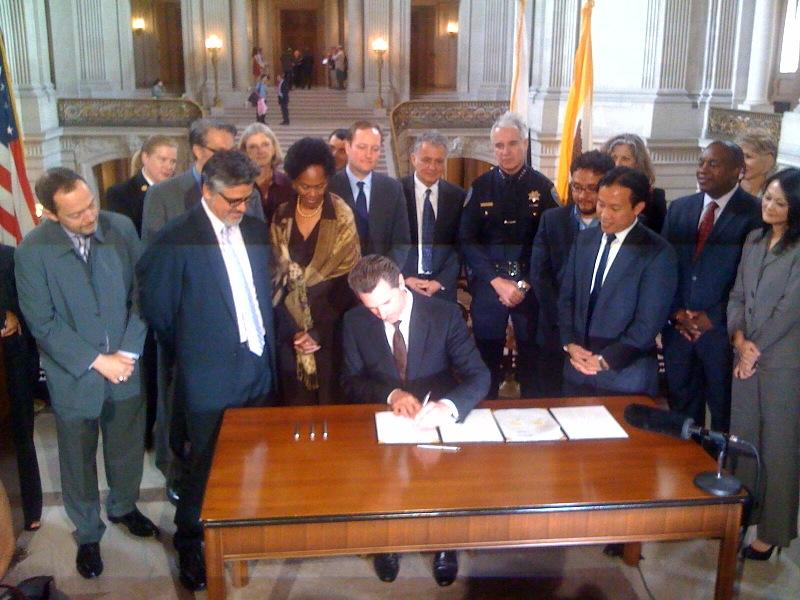
“We balanced the budget without raising taxes. I don’t believe in raising taxes. We don’t need to raise taxes,” Newsom said proudly at his July 29 budget signing ceremony, during which he also effusively praised the labor unions whose support he needs this fall: “Labor has been under attack in this state and country. They’ve become a convenient excuse for our lack of leadership in Sacramento and around the country.”

That hypocritical brand of politics has been frustrating to his fellow Democrats, particularly progressive supervisors and DCCC members. At the July 27 board meeting, Sup. Ross Mirkarimi and Board President David Chiu reluctantly dropped their pair of revenue measures that would have raised $50 million, bowing to opposition by Newsom and the business community.

The San Francisco Chamber of Commerce has become such a vehicle for antitax and antigovernment vitriol that the DCCC on July 29 approved a resolution calling for the organization — which hosted a speech by Republican National Chair Michael Steele in June — to renounce the platform of the Republican National Committee.

“The Chamber is not a knee-jerk right-wing organization,” Chamber President Steve Falk felt compelled to clarify in a July 28 letter to DCCC Chair Aaron Peskin, closing with, “Anything you can do to avoid painting the Chamber as a pawn of the GOP would be greatly appreciated — because it just isn’t true.”

Yet Rafael Mandelman, who sponsored the resolution and is a progressive supervisorial candidate in District 8, told us the Chamber’s fiscal policies are indistinguishable from those pushed by Republicans. “They’re the leading force pushing the Republican agenda in San Francisco,” Mandelman said, calling the stance short-sighted. “It’s not in the long-term interests of the business community for our public sector to fall apart.”

Chiu’s business tax reform measure is a good example of how conservative ideology seems to be trumping progressive policy, even among Democrats. Only 10 percent of businesses in the city pay any local business tax, and the measure would increase taxes on large corporations, lower them on small businesses, create private sector jobs, bring $25 million per year into the city, and expand the tax burden to 25 percent of businesses, including the large banks, insurance companies, and financial institutions that are now exempt. But even the Small Business Commission refused to support the plan, prompting Chiu to drop the proposal and tell his colleagues, “There is still not consensus about whether this should move forward.”

Sup. Chris Daly, the lone vote against the budget compromise with Newsom and the removal of revenue measures from the November ballot, noted at the July 27 board meeting how the business community has sabotaged city finances, citing its 2002 lawsuit challenging the gross receipt taxes, which the board settled on a controversial 8-3 vote. “This is a large part of our structural budget deficit,” Daly said.

But antitax sentiment has only gotten worse with the current recession and political dysfunction, causing Democrats like Newsom to parrot Republicans’ no-new-taxes mantra, much to the chagrin of progressives.

“A lot of this is being driven by statewide politics. [Newsom] needs to not have taxes go up but he also needs the support of the labor unions, so we get weird stuff happening in San Francisco,” Mandelman said.

The situation has also fed Newsom’s animus toward progressives, who have enjoyed more local electoral success than the mayor. Newsom responded in June to the progressive slate winning a majority on the DCCC by placing a measure on the November ballot that would ban local elected officeholders from serving on that body, which includes four progressive supervisors and three supervisorial candidates.

Nonetheless, Newsom then unexpectedly sought a seat on the DCCC, arguing that his lieutenant governor nomination entitled him to an ex officio seat (those held by state and federal elected Democrats) even though the DCCC’s legal counsel disagreed. While noting the hypocrisy of the request, Party Chair Aaron Peskin took the high road and proposed to change the bylaws to seat Newsom.

Some progressives privately groused about giving a seat to someone who, as DCCC member Carole Migden said at the meeting, was “picking a fight” with progressives by pushing a measure she called “disrespectful and unconstitutional.” But in practice, the episode seems to have hurt Newsom’s relations with progressives without really strengthening his political hand.

Newsom ally Scott Wiener — a DCCC member and District 8 supervisorial candidate (who told us he opposes the mayor’s DCCC ballot measure) — proposed to amend Peskin’s motion to change the bylaws in order to seat Newsom with language that would allow Newsom to continue serving even if he loses his race in November.

That amendment was defeated on a 17-13 vote that illustrated a clear dividing line between the progressive majority and the minority faction of moderates and ex officio members. Even with Newsom and District Attorney Kamala Harris (who was seated as the Democratic nominee for attorney general) being seated — and counting the one absent vote, Sen. Leland Yee, who is expected to sometimes vote with progressives and sometimes with moderates — progressives still hold the majority going into the process of endorsing local candidates and allocating party resources for the fall campaign.

“Presuming that 17 people of that 33-member body all agree on something, then the presence of Mayor Newsom doesn’t change anything,” Peskin said. He also noted that even if Newsom’s measure passed and the progressive supervisors were removed, “the irony is that the chair of the party [Peskin] would appoint their successors.”

Also ironic is the political reality that it is Newsom who most needs his party’s support right now, while it is progressives who are adopting the most conciliatory tone.

“We should all be working to turn out the vote and help Democrats win,” Peskin told us. “I implore our mayor and lieutenant gubernatorial candidate to work with us and get that done.”

Yet after Newsom gave a budget-signing speech that included the line, “At the end of the day, it comes down to leadership, stewardship, collaboration, partnership,” he told the Guardian that he has no intention of removing or explaining his DCCC ballot measure, saying only, “If the voters support it, then it would be the right thing to do.”

Chiu responded to the news by telling us, “I hope the mayor can move beyond the politics of personality and build a party vehicle that is about unity.”

A new community congress

0

EDITORIAL The first time a group of activists from across San Francisco met in a Community Congress, it was 1975 and the city was in trouble. Runaway downtown development was creating massive displacement and threatening the quality of life. Rents were rising and tenants were facing eviction. An energy crisis had left residents and businesses with soaring power bills. The manifesto of the Congress laid out the problem:

"Every poor and working class community in San Francisco has learned the hard way that its interests are at the bottom of the list as far as City Hall is concerned. At the top of the list are the banks, real estate interests, and large corporations, who view San Francisco not as a place for people to live and work and raise families, but as a corporate headquarters city and playground for corporate executives. By using their vast financial resources, they have been able to persuade local government officials that office buildings, hotels, and luxury apartments are more important than blue-collar industry, low-cost housing and decent public services and facilities."

The Community Congress hammered out a platform — a 40-page document that pretty much defined what progressive San Francisco believed in and wanted for the city. It included district elections of supervisors, rent control, public power, a requirement that developers build affordable housing, and a sunshine ordinance — in fact, much of what the left has accomplished in this town in the past 35 years was first outlined in that document.

Beyond the details, what the platform said was profound: it suggested that the people of San Francisco could reimagine their city, that local government could become a force for social and economic change on the local level, even when politics in Washington and Sacramento were lagging behind. It called for a new relationship between San Franciscans and their city government and looked not just at what was wrong, but what was possible.

That’s something that too often gets lost in political debate today. With urban finances in total collapse, the progressives are on defense much of the time, trying to save the basic safety net and preserve essential programs and services. It seems as if there’s little opportunity to talk about a comprehensive alternative vision for San Francisco.

But bad times are great times to try new ideas — and when the second Community Congress convenes Aug. 14 and 15 at the University of San Francisco, that’s exactly what they’ll be trying to do. It’s not going to be easy — the left in San Francisco has always been fractious, and there’s no consensus on a lot of central issues. But if the Community Congress attracts a broad enough constituency and develops a coherent platform that can guide future political organizing efforts, it will have made a huge contribution to the city.

The event also offers the potential for the creation of a permanent progressive organization that can serve as a forum for discussion, debate, and action on a wide range of issues. That’s something the San Francisco left has never had. Sup. Chris Daly tried to create that sort of organization but it never really worked out. The city’s full of activist groups — the Tenants Union, the Harvey Milk LGBT Club, the Sierra Club, and many others — that work on important issues and generally agree on things, but there’s no umbrella group that can knit all those causes together. It may be an impossible dream, but it’s worth discussing.

The organizers of the Community Congress discuss some of their agenda in the accompanying piece on this page. It should be based on a vision of what a city like San Francisco can be. Think about it:

This can be a city where economic development is about encouraging small businesses and start-ups, where public money goes to finance neighborhood enterprises instead of subsidizing massive projects.

This can be a city where planning is driven by what the people who live here want for their community, not by what big developers can make a profit doing.

This can be a city where housing is a right, not a privilege, where new residential construction is designed to be affordable for the people who work here.

This can be a city where renewable energy powers nearly all the needs of residents and businesses and where the public controls the electricity grid.

This can be a city where the wealthy pay the same level of taxes that rich people paid in this country before the Reagan era, where the individuals and corporations that have gotten filthy rich off Republican tax cuts give back a little bit to a city that is proud of its liberal Democratic values.

This can be a city where it’s safe to walk and bike on the streets and where clean, reliable buses and trains have priority over cars.

This can be a city where all kids get a good education in public schools.

Despite all the economic woes, this is one of the richest cities in one of the richest countries in the history of human civilization. There are no economic or physical or scientific or structural constraints to reimagining the city. The only obstacles are political.

In the next two years, control of City Hall will change dramatically. Five seats on the Board of Supervisors are up in November, and the mayor’s office is open the year after that. The progressives have made great progress in the past few years — but downtown is gearing up to try to reverse those advances. The community congress needs to address not just the battle ahead, but describe the outcome and explain why San Francisco’s future is worth fighting for.

A new community congress

2

Bad times are great times to try new ideas – the second Community Congress convenes Aug. 14 and 15 at the University of San Francisco

EDITORIAL The first time a group of activists from across San Francisco met in a Community Congress, it was 1975 and the city was in trouble. Runaway downtown development was creating massive displacement and threatening the quality of life. Rents were rising and tenants were facing eviction. An energy crisis had left residents and businesses with soaring power bills. The manifesto of the Congress laid out the problem:

“Every poor and working class community in San Francisco has learned the hard way that its interests are at the bottom of the list as far as City Hall is concerned. At the top of the list are the banks, real estate interests, and large corporations, who view San Francisco not as a place for people to live and work and raise families, but as a corporate headquarters city and playground for corporate executives. By using their vast financial resources, they have been able to persuade local government officials that office buildings, hotels, and luxury apartments are more important than blue-collar industry, low-cost housing and decent public services and facilities.”

The Community Congress hammered out a platform — a 40-page document that pretty much defined what progressive San Francisco believed in and wanted for the city. It included district elections of supervisors, rent control, public power, a requirement that developers build affordable housing, and a sunshine ordinance — in fact, much of what the left has accomplished in this town in the past 35 years was first outlined in that document.

Beyond the details, what the platform said was profound: it suggested that the people of San Francisco could reimagine their city, that local government could become a force for social and economic change on the local level, even when politics in Washington and Sacramento were lagging behind. It called for a new relationship between San Franciscans and their city government and looked not just at what was wrong, but what was possible.

That’s something that too often gets lost in political debate today. With urban finances in total collapse, the progressives are on defense much of the time, trying to save the basic safety net and preserve essential programs and services. It seems as if there’s little opportunity to talk about a comprehensive alternative vision for San Francisco.

But bad times are great times to try new ideas — and when the second Community Congress convenes Aug. 14 and 15 at the University of San Francisco, that’s exactly what they’ll be trying to do. It’s not going to be easy — the left in San Francisco has always been fractious, and there’s no consensus on a lot of central issues. But if the Community Congress attracts a broad enough constituency and develops a coherent platform that can guide future political organizing efforts, it will have made a huge contribution to the city.

The event also offers the potential for the creation of a permanent progressive organization that can serve as a forum for discussion, debate, and action on a wide range of issues. That’s something the San Francisco left has never had. Sup. Chris Daly tried to create that sort of organization but it never really worked out. The city’s full of activist groups — the Tenants Union, the Harvey Milk LGBT Club, the Sierra Club, and many others — that work on important issues and generally agree on things, but there’s no umbrella group that can knit all those causes together. It may be an impossible dream, but it’s worth discussing.

The organizers of the Community Congress discuss some of their agenda in the accompanying piece on this page. It should be based on a vision of what a city like San Francisco can be. Think about it:

This can be a city where economic development is about encouraging small businesses and start-ups, where public money goes to finance neighborhood enterprises instead of subsidizing massive projects.

This can be a city where planning is driven by what the people who live here want for their community, not by what big developers can make a profit doing.

This can be a city where housing is a right, not a privilege, where new residential construction is designed to be affordable for the people who work here.

This can be a city where renewable energy powers nearly all the needs of residents and businesses and where the public controls the electricity grid.

This can be a city where the wealthy pay the same level of taxes that rich people paid in this country before the Reagan era, where the individuals and corporations that have gotten filthy rich off Republican tax cuts give back a little bit to a city that is proud of its liberal Democratic values.

This can be a city where it’s safe to walk and bike on the streets and where clean, reliable buses and trains have priority over cars.

This can be a city where all kids get a good education in public schools.

Despite all the economic woes, this is one of the richest cities in one of the richest countries in the history of human civilization. There are no economic or physical or scientific or structural constraints to reimagining the city. The only obstacles are political.

In the next two years, control of City Hall will change dramatically. Five seats on the Board of Supervisors are up in November, and the mayor’s office is open the year after that. The progressives have made great progress in the past few years — but downtown is gearing up to try to reverse those advances. The community congress needs to address not just the battle ahead, but describe the outcome and explain why San Francisco’s future is worth fighting for.

Alerts

0

alert@sfbg.com

THURSDAY, AUG. 5

Power on


Gather with the public power supporters and advocates who brought us the No on 16 campaign, which blocked PG&E’s attempt to solidify its monopoly. Attend a workshop that will analyze the campaign and election victory, discuss current challenges to public power, and find common ground for the future push for true power to the people. The workshop is followed by a festive buffet, awards ceremony, music, and more.

1 p.m. workshop, 5:30 p.m. party; free

The Merchants Exchange Building

465 California, SF

www.celebrateno16.org

Zero waste lunches


Learn about the impact that your daily lunches have on the environment and become more informed about the amount of waste created by takeout food and prepackaged lunches. Find out how you can change your habits, including what to buy at farmers markets and how to pack your food to create zero- waste lunches.

Noon, free

Green Zebra Environmental Action Center

Suite 9, 50 Post, SF

www.thegreenzebra.org

FRIDAY, AUG. 6

Worker Cooperative Conference


The public is invited to attend this national conference on the increasingly celebrated concept of worker cooperatives (think Cheeseboard and Arizmendi). Workshops and speakers will look at worker cooperatives as a remedy for larger social and economic problems such as job loss and environmental damage and will present innovative approaches to common challenges cooperative businesses face in accountability and management, financing, governance, vision, and growth.

Fri. 9 a.m.–midnight, Sat. 9 a.m.–11 p.m.;

Sun. 9 a.m.–5 p.m.; $90–$300

Clark Kerr Conference Center

UC Berkeley

2601 Warring, Berk.

www.usworker.coop

SATURDAY, AUG. 7

"Choking on Oil"


Get together with others who are frustrated by the BP oil spill catastrophe and learn about the surrounding issues at this networking performance featuring poets, artists, special guest speakers, and a silent auction to help raise funds for charities. Hosted by Out of Our poetry magazine.

7 p.m., free

Viracocha

998 Valencia, SF

www.outofour.com

Lantern ceremony


Commemorate the 65th anniversary of the atomic bombing of Hiroshima at this Japanese-style peace event. Participants are invited to decorate candlelight peace lanterns that will be floated at sunset during a ceremony that includes reading a message sent by the mayor of Hiroshima and Japanese bamboo flute music. Materials provided.

6:30 p.m., free

Berkeley Aquatic Park

Addison at Bolivar, Berk.

(510) 595-4626

TUESDAY, AUG. 10

Chew on this

Examine the journey our food takes before it reaches our plates, in what ways the supply chains are broken, and what we can do to fix it. Hear about food justice best practices from local professionals, experts, and activists using a labor perspective. Presented by Pursue: Action for a Just World.

6:30 p.m., $10

Local Mission Eatery

3111 24th St., SF

www.fruitsofourlabor.eventbrite.com

Mail items for Alerts to the Guardian Building, 135 Mississippi St., SF, CA 94107; fax to (415) 437-3658; or e-mail alert@sfbg.com. Please include a contact telephone number. Items must be received at least one week prior to the publication date.

Newsom’s budget and DCCC hypocrisy

9

Hypocrisy hung thickly in the air at City Hall today as Mayor Gavin Newsom refused to responsively address glaring contradictions on a pair of high-profile policy stances, pursuing naked self interest while cloaking himself in deceptive but high-minded rhetoric. Newsom used the city budget-signing ceremony to effusively praise the labor unions that he publicly shamed into giving back $250 million over two years to balance the budget without tax increases, a budget that cut services and increased various fees and fines.

“Labor has been under attack in this state and country. They’ve become a convenient excuse for our lack of leadership in Sacramento and around the country,” Newsom said without blushing, defending unions against pension reform measures such as Public Defender Jeff Adachi’s SF Smart Reform, which he opposes while continuing to support the need for pension reform.

But Newsom seemed unaware that the layoffs, forced furloughs, and voluntary pay cuts accepted by the unions that he publicly demonized just a couple months ago and now praises – whose support he needs for his current run for lieutenant governor – is connected to his steadfast opposition to new taxes, which he reiterated today: “We balanced the budget without raising taxes. I don’t believe in raising taxes, we don’t need to raise taxes.”

Despite the fact that just 10 percent of San Francisco businesses pay any business taxes to the city, Newsom opposed and this week helped kill a measure by Board President David Chiu to reform the business tax system in a way that would increase taxes on large corporations, lower them on small businesses, create private sector jobs, bring $25 million per year into the city, and expand the tax burden to 25 percent of businesses, including the large banks, insurance companies, and financial institutions that are now exempt. Instead, labor took a deep hit and the city still faces projected $500 million budget deficits each of the next two fiscal years.

But Newsom’s hypocrisy isn’t confined fiscal issues. After the ceremony, he told reporters that he was sticking by his November ballot measure to ban local elected officials from serving on the Democratic County Central Committee, even after last night insisting that body give him a seat, which they had to change the bylaws to accommodate.

At last night’s DCCC meeting, members of an elected committee that includes four progressive supervisors and three current supervisorial candidates called for Newsom or his proxy John Shanley to explain why he is pushing a policy to ban locally elected officials from serving on the DCCC, a body in which elected state and federal officials automatically get seats.

“This mayor is on record as saying local officials should not serve on the committee,” Sup. David Campos said at the meeting, calling for Newsom to clarify this policy contradiction and offer his reasoning for the policy: “We don’t want to do anything that is inconsistent with what the mayor has said so far.”

Chair Aaron Peskin translated Campos’s comments as indicating “some level of irony or hypocrisy,” but Campos objected, insisting “it’s not a personal attack” but a genuine desire to know why Newsom sought to ban local elected officials after progressives won a majority of the DCCC seats in June.

Both Shanley last night and Newsom today gave the same legalistic answers, noting that he’s not serving in his capacity as the mayor, but as an ex officio member who automatically gets a seat for being the Democratic nominee for a statewide office (although the DCCC legal counsel said Newsom wasn’t entitled to a seat because the bylaws only award a seat when the current holder of the office being sought is a Democrat).

But DCCC member Carole Migden objected to Shanley’s answer, saying of Newsom’s effort to unseat duly elected members, “That’s picking a fight, if we want to be clear…That effects my vote, I have to say. It’s disrespectful and unconstitutional.”

DCCC member David Chiu noted that Newsom’s ballot measure would explicitly ban supervisors and the mayor from serving on the DCCC and said that the mayor still had a few days before the deadline for him to withdraw the measure, which he single-handedly placed on the ballot using his authority as mayor.

But today, when asked by the Guardian, Newsom said he had no intention of either withdrawing the measure or explaining it to the DCCC. When we asked about the contradiction in his positions, Newsom said only, “If the voters support it then it would be the right thing to do.”

He was similarly dismissive when other reporters continued to ask about the controversy, gesturing toward me with a dismissive wave of his hand as he said, “Certain people with certain newspapers major in the minor.”

After being told that Newsom is sticking by his DCCC ballot measure, Chiu told us, “I hope the mayor can move beyond the politics of personality and build a party vehicle that is about unity.”


New debate surrounds New Mission Theater

The New Mission Theater, a dilapidated landmark that sits on the 2500 block of Mission Street, has been vacant for years, but controversy surrounding its fate is alive as ever and will be discussed at this afternoon’s July 29 City College of San Francisco Board of Trustees meeting.

In 2004, the city designated the theater as historically significant for its ties to the Mission’s early 20th century “vaudeville and movie house district.” Once upon a time, patrons regularly circulated through its palacial interior, which features Art Deco-syle ornamental metalwork at the ballustrades, plaster moldings imprinted with Greek key motifs, etched Art Deco glass panel doors, ceiling ornaments with floral motifs, and a balcony adorned with a frieze of garlands and urns, according to a landmark designation file.

Plans to restore and reopen the theater have been in the works for several years, and a 100-percent affordable housing development adjacent to the theater could move forward if everything falls into place. That’s turning out to be a big ‘if.’

In 2005, CCSF sold the theater, along with an adjacent shuttered Giant Value store, to Gus Murad — Medjool restaurant owner and a former small business commissioner appointed by Mayor Gavin Newsom — for $4.35 million, according to CCSF counsel Greg Stubbs. Now, CCSF is considering initiating foreclosure proceedings against Murad due to nonpayment. He owes more than $2 million on the property, according to notice of default issued June 21. During open and closed sessions at the July 29 Board of Trustees meeting, trustees will decide whether to proceed with taking back the property from Murad or grant him a 120-day extension. Murad is expected to offer his pitch for an extension at the meeting.

CCSF board member John Rizzo told the Guardian he was fed up with the missed payments. “Gus Murad keeps assuring us, oh yes, it’s going to happen, we’re on the verge,” Rizzo said. “But the affordable housing is not being built,” he said. If CCSF took the property back, “we wouldn’t sell it for market-rate housing,” he added. “We would want to see affordable housing.”

P.J. Johnston, a spokesperson for Gus Murad, declined to answer questions about possible foreclosure but told the Guardian that the central goal is to create 85 to 100 affordable units in the heart of the Mission. “We’ve been working with Mission Housing and hopefully are very close to a reaching an agreement with Mission Housing and the Mayor’s Office of Housing, which would obviously be a chief funder of the project,” he said.

Securing financing and reaching a deal with Mission Housing and the Mayor’s Office of Housing would allow Murad to square things away with CCSF, get the ball rolling on the development, and get something out of his investment.

Murad initially planned to develop market-rate housing on the lot curently occupied by the Giant Value storefront, but switched to an affordable housing project 1.5 years ago, Johnston said. Plans have always included rehabbing the theater. Negotiations with Bernal Housing came close to a deal, but ultimately fell through, he said. Now, Murad is hopeful that CCSF will grant a 120-day extension and a deal with Mission Housing can be secured in time.

“It has been a challenging time for the economy as it relates to land use,” Johnston said. “And it’s been a very difficult couple of years for restaurants.”

Mayor’s Office on Housing Director Doug Shoemaker declined to comment for this story.

Chris Jackson, a trustee, said he worried that if CCSF were to move ahead with foreclosure, “it’ll probably scuttle the affordable housing project. I’d rather wait an extra four months to bring affordable housing than just put the screws to the guy,” Jackson said. “If it was a market-rate project, I’d be like no, give us the money.” Jackson said under state law, any funds generated by a sale of the property — which was originally purchased with bond money — would have to go back into the capital project fund, and couldn’t go into college’s operations budget. “It won’t go to save one class at City College,” he explained. “It just goes into capital project reserves.”

Rizzo noted that certain “political forces” aligned with Newsom had been contacting board members in advance of the meeting to try and persuade trustees to grant an extension for Murad, who will clearly benefit if he is allowed to hold onto the property. Murad has hosted campaign fundraisers for Newsom in the past and has contributed to campaigns of the mayor’s political allies. It isn’t the first time the New Mission Theater development has generated political buzz.

When an earlier incarnation of Murad’s plans for the New Mission Theater and adjacent lot came before the Board of Supervisors in Feburary of 2009, it generated some controversy. Murad had won approval from planning staff for a 20-foot height extension that would have brought his housing project to 85 feet, but that was rejected by the Board of Supervisors. In an odd twist, a typo kept the 85-foot limit intact, so the Board was required to vote again to bring it down to the 65 feet they approved. When Mayor Newsom vetoed the board’s second vote, Sup. Chris Daly lambasted Newsom for engaging in “pay-to-play politics.”

Immigrant advocates protest AZ law and Jerry Brown’s SecureComm support

0

SF Pride’s Gabriel Haaland reports that the California Highway Patrol made them take down their “No One is Illegal” drop banner at 9.a.m.
 
The SF Pride action came on the heels of yesterday’s protest in which over a hundred people gathered in front of the federal building to rally for comprehensive immigration reform, oppose AZ’s SB 1070 law and to oppose the fingerprinting program that was imposed on SF known as S-Comm (i.e., Secure Communities), effectively undermining the city’s sanctuary ordinance. Nineteen people were arrested for engaging in civil disobediance and blocking Seventh Street.

Today, several more immigrant rights rallies are taking place, including one outside the San Francisco office of gubernatorial candidate and Attorney General Jerry Brown. The protest, which was organized by the SF Day Labor Program and the Women’s Collective, targets Brown for not supporting San Francisco Sheriff Mike Hennessey’s request to opt San Francisco out of the  S-Comm program. 

Meanwhile, over at City Hall, San Francisco Mayor Gavin Newsom said he doesn’t see any problem with the SecureComm program.
“There is no reason to opt out,”Newsom told reporters at a budget signing press conference.

Board had to ask for Lennar’s approval…

0

Images by Luke Thomas

The Board of Supervisors found itself in the humiliating position July 27 of having to ask for the approval of Lennar and the city’s Redevelopment Agency before it could amend Lennar’s massive redevelopment plan for Candlestick Point-Hunters Point Shipyard.

If that’s not an argument for reforming how this city approaches redevelopment, I don’t know what is. Especially since the Board’s meeting illustrated only too well how thoroughly Lennar’s local executives, who used to work for the city under Mayor Willie Brown,  understand this game and how to outfoxed any resistance to their ongoing effort to eat San Francisco whole.

“This is a rare opportunity,” Sup. Sophie Maxwell said ahead of the Board’s 10-1 vote (Sup. Chris Daly was the lone dissenting voice) to approve Lennar’s entire plan. “It focuses public and private investment into an area that has lacked it in the past,”continued Maxwell, who represents the district that encompasses the shipyard and Candlestick Point. ” It’s unmatched by any development project in San Francisco. This project is large and complicated, no doubt. But let us not be fearful of this project because of its scale, because how else can we transform a neglected landscape?”

But who wouldn’t be afraid of a deal that found Maxwell, Board President Chiu and Sups. Michela Alioto-Pier, Carmen Chu, Bevan Dufty and Sean Elsbernd joining forces to vote against Sup. Ross Mirkarimi’s proposal that Lennar be required to include a non-bridge alternative?

And who wouldn’t be doubly afraid, given that these six supervisors took that vote after Michael Cohen, Mayor Gavin Newsom’s top economic advisor, was unable to point to a single document to support his claims that Lennar’s $100 million bridge over an environmentally sensitive slough is actually needed?

Talk about scary.

To his credit, Mirkarimi did a good job of illustrating what’s wrong with a process that allows a private developer like Lennar to pitch plans and get mayoral appointees to approve them, but doesn’t allow San Francisco’s elected officials to make any amendments unless the developer and Redevelopment agree.

At the root of this travesty is the fact that redevelopment law trumps municipal law, a power imbalance that creates a shadow government in those few municipalities in California where the city council or board of supervisors is not the same entity as the Redevelopment Commission.

San Francisco is one such municipality, and, as Mirkarimi explained, this is not the first time that Redevelopment’s plans have trumped the concerns of local residents.

“I’m the supervisor for the Fillmore, the first urban renewal laboratory took place in my district, and I vowed to never let it happen again, ”Mirkarimi said, referring to the massive displacement of African Americans and Japanese Americans that took place when Redevelopment decided to makeover the Fillmore in the 1960s.

“I’ve been told, “Don’t worry, Ross, this is not going to happen. We’re not going to use eminent domain,’” Mirkarimi continued. “Well, Jeez, that’s a consolation! Because even when we’ve exercised our legislative influence and given our blessing, [Redevelopment] unilaterally changed the plan after it left the Board. That suggests a condescending role in which the developer is able to go to the Redevelopment Commission and have a unilateral change.”

Mirkarimi was referring to how proposed rental units on Parcel A, the first parcel of shipyard land released for redevelopment, became for-sale condos at Lennar’s request, without the Board having any recourse, even though the area surrounding the redevelopment is ground zero for the city’s last remaining African American community and home to other low-income communities of color.

Deputy City Attorney Charles Sullivan explained that the s supervisors would require the approval of the developer and Redevelopment to amend Lennar’s latest plan, under Redevelopment law. Failing that, their only recourse would be to reject Lennar’s plan in its entirety–a nuclear option that only Daly seemed prepared to carry through.

Sup. David Campos noted that the city’s legal advice had been “somewhat of a moving target.” His comment suggested the Board had  been misled in the critical weeks before this final vote, including ahead of the Board’s July 14 vote to accept certification of the project’s final environmental impact report.

“When a number of us raised questions about the EIR, we were told we couldn’t, but that we would probably be able to make changes to the substantive plan,” Campos recalled. “But now we are getting a more complicated answer.”

Deputy City Attorney Sullivan said the situation was complicated, because some of the proposed amendments “don’t involve a simple stroke of the pen.”

But Campos pointed to the fact that Board President Chiu had introduced an amendment that only allows for a 41 ft. bridge across Yosemite Slough, thereby halving the width of the 82 ft. bridge that Lennar is proposing to build.

That amendment, which Chiu introduced July 12,  leaves the door open for the 82 ft. version of the bridge, if the 49ers indicate interest in a new stadium on Hunters Point Shipyard, a possibility the city claims is still alive, even though Santa Clara voters approved a new stadium for the 49ers this June.

“So, why can you amend the plan to include a scaled-down version of the bridge but not eliminate it altogether?” Campos asked.

“You can make that motion by voting not to approve the project,” Sullivan said.

“So, the change has to point to something already embedded in the project?” Campos asked.

“Or not be a rejection of everything that’s already been brought forward,” Sullivan replied.

After Mirkarimi proposed his no-bridge alternative, along with a slew of other amendments that Daly, Campos, and Sups. Eric Mar and John Avalos had been working on to strengthen the proposed development, Cohen, Mayor Gavin Newsom’s top economic advisor, huddled somewhere in City Hall along with Kofi Bonner,  Lennar’s top local executive and Fred Blackwell, the head of SF’s Redevelopment Agency to decide which of the Board’s amendments they would accept.

Cohen returned with the amendments organized into three categories: acceptable as written, modified, and completely unacceptable.

And predictably enough (to anyone  tracking Lennar’s insistence on a bridge) Mirkarimi’s no-bridge amendment had been tossed into the “unacceptable” pile.

“With regards to your insistence on the economic reasons for the bridge, please point to which document says that,” Mirkarimi said, leafing through the project materials that were piled on his desk.

Cohen mentioned a number of factors, including an alleged “lessening of attractiveness,” “a lower density product” and a reduction of property tax revenue that would be available through tax increment financing to pay for Lennar’s proposed bridge.

“Yes, but I’m still trying to look for the information, and all I’m hearing is this pitch,” Mirkarimi replied. “The economic study is absent. There are no supporting documents here. This is why I feel it’s justified for use to have a review of this.”

Cohen talked some more about “rigorous public discussion over a number of years.”

“But there is no economic study,” Mirkarimi repeated. At which point a deafening silence pervaded the Board’s venerable chambers, much as if the emperor had shown up without his proverbial clothes.

Deputy City Attorney Sullivan broke the silence by indicating that the only way for the Board to move a no-bridge alternative forward would be to stop all project approvals and send the plan back to Redevelopment.

And Mirkarimi reminded the supervisors that at the Board’s July 13 hearing, Cohen had said that there was no conclusive evidence around the need for the bridge.

But then the Board voted 6-5 against Mirkarimi’s proposal, a move insiders said was more about not pissing off Labor, which hopes to create jobs for iron workers, and not pissing off Lennar, whose control runs deep and wide, and less about being convinced of the actual need to build over the last unbridged waterway in the city’s southeast sector.

And a couple of amendments later, the Board gave its blessing and it was all kisses and hugs and applause in the Board Chambers, even though the folks from Dwayne Jones Communities of Opportunities (COO) program, who usually show up to support the plan, strangely weren’t in attendance, rumoredly because their program has been cut off at the knees in the last few weeks, following Jones resignation as COO’s director.

“I wish we had been able to eliminate the bridge,” Campos told me after the Board’s final vote. “I think part of the challenge we have is to reexamine how Redevelopment works and explore the potential for taking it over.”

Mirkarimi was satisfied that he had dissected the arguments against the no-bridge alternative, but feared that institutional memory is lacking on the Board, and that without fundamental Redevelopment reform, the city is in danger of seeing this kind of travesty repeated, over and over.

“A lot of my colleagues have not been involved in the debacle,” Mirkarimo said, referring to how Redevelopment’s infamous role dates back five decades, and how Lennar has been working the local political scene for longer than most of the Board’s current members.

But Maxwell was all smiles.
“I did my homework a long time ago, that’s why they couldn’t touch the core of the project,” she said. “They just added to and augmented it.”

With Maxwell’s days on the Board drawing to a close, I asked what she’s contemplating doing next.

“Sophie is looking into water policies and conservation,” Maxwell said. “Without blue there is no green.

It was about then that Mayor Gavin Newsom released a press statement that blabbed on in vaguely frothing terms about what would happen next.

“Now we can truly begin the work of transforming an environmental blight into a new center of thousands of permanent and construction jobs, green technology investment, affordable housing and parks for our City,” Newsom said

His words came shortly before Bonner said that Lennar would now start looking for investors, and shortly after Cohen admitted that it could be years before anything in Lennar’s plan actually gets built. But none of them mentioned that the Sierra Club and other environmental groups are planning to sue the City over the bridge, an outcome that could have been averted, Sierra Club officials warned, if the No-bridge alternative had been  included in the final redevelopment plan.

Stay tuned….


DCCC seats are fine for Newsom, just not supervisors

3

Mayor Gavin Newsom is seeking to be seated on the San Francisco Democratic County Central Committee when it swears in newly elected members tonight, even though the body’s legal counsel says he’s not entitled to a seat and Newsom has put a measure of the November ballot that would prohibit local officials from serving on that body.

Newsom and his supporters, most prominently DCCC member and District 8 supervisorial candidate Scott Wiener – who fears the progressive-dominated body will endorse and support his more progressive opponent, Rafael Mandelman – argue that being the Democratic nominee for lieutenant governor should give him a seat on the DCCC.

But the longtime legal counsel for DCCC, Lance Olson, doesn’t agree, citing bylaws that indicate that only nominees for statewide offices currently held by Democrats get seats on the body. So District Attorney Kamala Harris, the Democratic nominee to succeed Attorney General Jerry Brown, gets an ex officio seat (those held by state and federal elected officials and regional party leaders) but Newsom doesn’t because he’s running against incumbent Lieutenant Governor Abel Maldonado, a Republican.

DCCC chair Aaron Peskin, a political opponent of Newsom, told us the rules are the rules and that if Newsom thinks that it’s in the interests of the Democratic Party for him to have a seat, “He’s going to need to make an argument why we should amend the rules.” Peskin even offered to introduce a rule change for discussion if Newsom does so.

While Wiener wrote (in a letter quoted by the Chronicle) that seating Newsom would be about party unity, Peskin notes that Newsom has actually been a practitioner of the “politics of spite and division,” particularly after he responded to the success of the progressive DCCC slate in the June election by trying to ban local officeholders from the body (several progressive members of the Board of Supervisors successfully ran for the DCCC), claiming the body should be like a farm team for building the party.

“It really begs the question: why is he seeking to do himself what he doesn’t want others to do?” Peskin asked.

Newsom’s office didn’t respond to our inquires about the matter. BTW, in his letter to Peskin, Newsom proposed that attorney John Shanley be his proxy and journalist and political gadfly Warren Hinckle be his alternate. The meeting begins at 7 p.m. in the state building at 455 Golden Gate.

Herrera’s right to appeal the Alioto-Pier decision

5

I’m not exactly sure what Ken Garcia was trying to say here — his argument is rambling and makes no sense — but Dennis Herrera really had no choice: He had to appeal the Alioto-Pier decision.


The Superior Court ruling in the case screws up the city’s term-limits law. It’s not clear now, for example, when Sup. Carmen Chu will be termed out. It’s not clear whether the mayor can appoint someone midway into a vacant term and essentially give that person an extra two years on the board. And one ruling from one Superior Court judge doesn’t clarify the law (which the judge acknowledged was at the very least ambiguous) or set a binding precedent.


When the voters approved district elections, they also approved term limits; everyone gets two four-year terms. But under Judge Peter Busch’s decision, that’s no longer true.


Suppose, for example (and this is a wild scenario, but such things happen in local politics) that Gavin Newsom gets elected lieutenant governor (entirely possible) and in January, the newly elected supervisors choose the next mayor. Here’s what happens: The board president becomes interim mayor until somebody lines up six votes.


So let’s say (and this just happened with David Chiu) that one of the newly-elected, first-time supervisors — Debra Walker, or Rafael Mandelman, or Scott Weiner, or Jane Kim, or someone else — lines up six votes and becomes board president, and thus mayor. Then he or she immediately appoints a successor as supervisor. That person gets a free four-year term that doesn’t count against term limits at all.


So the city needs clarity, and the only way to get it is to ask the Appeals Court to weigh in. And if it turns out that the current law does, indeed, set a double standard, and that appointed supervisors get special treatment, then the board needs to be a Charter amendment on the ballot fixing the problem.


If Sup. Alioto-Pier wants to claim this is just politics, let’s remember: She’s already run for Congress, for secretary of state, and was planning to run for insurance commissioner until she fell ill this spring. Now that nothing else has worked out, she wants another term on the board. She has every right to challenge Herrera’s opinion, but asking him to apologize is wrong; he’s just doing his job.

Best of the Bay 2010: Local Heroes

0

2010 LOCAL HERO

SHAREN HEWITT


“The thing I love most in life is being a grandmother for social change.”

“If you mess up, you fess up — and then you fix it up.” That’s one of the motivational philosophies Sharen Hewitt, founder and executive director of the Community Leadership Academy and Emergency Response Project (CLAER) passes on to the people she works with. Her organization provides peer-to-peer empowerment and civic engagement programs as well as immediate crisis stabilization for victims of violence, helping them get the support they need. CLAER is based in Bayview, “but we serve the whole city, which unfortunately needs us more than ever,” she says.

A community leader and organizer for decades, Hewitt has been a critical and unyielding voice on housing, voter registration, education, employment, and political access issues. Her current focus has been on easing recent tensions between the African American and Asian American communities, weeding through the crowded field of candidates running for District 10 supervisor, and “insuring continuing dialogue about the development of sound public policy in the face of diminishing resources.”

“We celebrate diversity, and we try to raise the bar every day,” she says of CLAER. “San Francisco is the richest city in the richest state in the richest country in the world. It should be unlimited in its capacity to serve.” 


2010 LOCAL HERO

ISO RABINS

“My favorite thing about the Bay Area is the coast along Route 1. It consistently amazes me.”

Food revolutionary Iso Rabins has organized the most intriguing — and fun — food events of the last year, expanding his health code-defying Underground Market far beyond its original berth in a Mission District home. But his keystone contribution to the Bay Area is his ability to communicate his vision of feeding communities without the agro-industrial machine — by recognizing the soil-generated bounty available to all of us if we know where to look.

“The way our society is structured right now didn’t seem like it paid attention to our local community. I think food is a great way to break through that,” Rabins says. His brainchild is forageSF, an organization that promotes hunting and gathering through wild food walks, eight-course foraged meals, and retail opportunities for foragers who spend days picking through the woods, fields, and coastlines. In the locavore-freegan vein, Rabins calls attention to a world beyond shrink-wrap and leaden government regulations. And his message is being eaten up by change-hungry SF. “I really think you can do business and help people at the same time,” he says.


2010 LOCAL HERO

KATHERINE PRIORE

“Something I love about San Francisco is being able to take yoga classes with the best teachers from here to Timbuktu.”

Eleven years ago Katherine Priore was an English teacher in Cincinnati’s public school system. After a particularly stressful day in the classroom, she finally took a close friend’s advice by attending said friend’s yoga class. Priore was instantly hooked. “I had never experienced such profound internal stillness. My stress was alleviated and the stream of anxious, teaching-related thoughts vanished in those 90 minutes.” It was this eureka moment that set Priore on the path to creating Headstand, an organization providing youth in economically disadvantaged areas with access to yoga.

The organization’s ultimate goal is to create a shift in the education system whereby the physical, emotional, and psychological health of students has the same importance as the academic skills they’re building. Headstand aims to do its part by integrating yoga into the curriculum, not just as an elective but as a requirement. Over the past two years, the organization has offered 1,400 yoga classes to 660 youths in the East Bay and San Francisco, and this fall it plans to bring Headstand to San Jose and Houston. With a slew of evidence that Headstand is positively affecting the lives of its students, all signs point to the early success of the program and to the potential it may just be starting to fulfill.


2010 LOCAL HERO

ERICA MCMATH SHEPPARD

“I love the Youth Speaks office. It doesn’t matter what I’m wearing or what I look like there.”

Odds were against Erica McMath Sheppard to be onstage at the Warfield this past March receiving thunderous applause from a sold-out crowd. But as McMath Sheppard’s powerful championship Youth Speaks Teen Poetry Slam spoken word performance put it, “I been helping myself my whole damn life .” Two things were clear under those bright lights: this woman has a story to tell, and the world’s going to hear it — no matter a difficult childhood, a disastrous trek through the foster care system, and eventual emancipation from her guardians at age 16.

In addition to her poetry laurels and longtime involvement with the Youth Speaks arts program, the Class of ’10 Leadership High graduate was senior class president, involved in the Black Student Union, and active in a slew of other extracurriculars — a record that earned her admission to Dillard University in New Orleans this fall. Does she consider herself a role model? “I’m not trying to be the voice for foster girls around the world,” she says. “But this is my dream.”


2010 LOCAL HERO

DONNA SACHET


“It’s not always easy to live in San Francisco — but it sure is a hell of a lot of fun.”

A constant presence on the queer and charitable scenes for years, Donna Sachet will go to any lengths to call attention to worthy causes — including rappelling down 38 stories of the Grand Hyatt San Francisco to raise money for the Special Olympics.

As a performer and sparkling personality, Sachet MCs the popular Sunday’s a Drag weekly brunch spectacular at Harry Denton’s Starlight Room, hosts the live coverage of the Pride parade on television, writes a society column for The Bay Area Reporter, and attends pretty much every charitable event worth attending. (You can always spot her by her impeccably tailored red outfits — she is, after all, Scarlet Empress XXX of San Francisco’s Imperial Court.) Her annual holiday Songs of the Season event and Pride Brunch fundraiser, along with her involvement with the Bare Chest Calendar benefiting the AIDS Emergency Fund, have raised thousands of needed dollars.

“You just have to do it,” she tells us of her unflagging energy. “I love my community. But even if it’s not particularly about your own community, we’re all in this together.”


2010 LOCAL HERO

VERNON DAVIS

“When I paint, I focus completely on what I’m doing and everything else fades.”

Freshly minted Pro Bowl superstar Vernon Davis has shown immense prowess on the football field since being drafted by the San Francisco 49ers in 2006. His career is on the upswing, and last season he tied the NFL all-time record for most touchdowns as a tight end. Davis’ success is the product of natural talent combined with drive and vision. He grew up in inner-city Washington, D.C., where a wise grandmother helped him dodge the environment’s potential pitfalls.

That same talent, drive, and vision extend beyond the goal posts into more esoteric realms. He’s an avid painter and seeks to be a role model for kids who might be afraid to explore their creativity. Earlier this year he launched the Vernon Davis Scholarship Fund, which will benefit a deserving Bay Area art student who would otherwise not be able to afford college. “I want to keep encouraging kids, especially in the inner city, to stay on track and pursue their dreams.”


2010 LOCAL HERO

JANE MARTIN


“I love being around a really vibrant queer and progressive community.”

On March 8, labor activist Jane Martin helped organize a flash mob in the crowded lobby of San Francisco’s Westin St. Francis Hotel. The purpose was to spread the word about a worker-called boycott of the hotel and urge tourists coming in for Pride to stay elsewhere. For five raucous and entertaining minutes, members of Pride at Work/HAVOQ, One Struggle One Fight, and the Brass Liberation Orchestra burst through the doors to sing, play, and dance to Lady Gaga’s hit “Bad Romance,” warning bewildered patrons not to “get caught in a bad hotel.”

The result: A collaborative effort of young and innovative labor leaders like Martin became a viral YouTube sensation, reaching hundreds of thousands of viewers. Martin has been joining with hotel workers in picket lines and organizing around queer economic justice issues in the Bay Area since 2001. She led picket lines at the Omni Hotel to decry the company’s move of locking out thousands of workers. “To ultimately win was really exciting,” she said. “When the hotels backed off, that was really inspiring.”

She recently joined 1,000 in staging a protest at the home of GOP gubernatorial candidate Meg Whitman as part of her organizing work with the California Nurses Association. And, as always with Martin, there’s more in the works.


2010 LOCAL HERO

DAVID CAMPOS


“The Bay Area embodies the American spirit more than anyplace else in the country. You can be who you are without any fear.”

San Francisco is a city of immigrants, a place where generations of people have come — from all over the country and all over the world — for a fresh start in a welcoming environment. But Mayor Gavin Newsom put that tradition at risk this year when he directed law enforcement agents to start referring juveniles charged with crimes to federal immigration authorities. It’s been a disaster — in one case, a 13-year-old charged with stealing 46 cents was turned over to the feds, and he and his mom, who is married to a U.S. citizen, both faced deportation, breaking up a family.

San Francisco Sup. David Campos has led the battle to protect the city’s sanctuary policy — and has taken on the larger issue of immigration reform. An immigrant who arrived in the United States from Guatemala at 14 (and who couldn’t get federal financial aid to go to college because of his status), Campos isn’t afraid to challenge the growing nativist movement: “What’s made this country great,” he told us, “is taking talent from all over the world and integrating it into society. Now the current climate precludes that.” 


PHOTO OF VERNON DAVIS BY PETER BOHLER. ALL OTHER PHOTOS BY KEENEY + LAW.

City Hall standoff

0

steve@sfbg.com

Backroom politics, vote-trading, threats, and tricky legislative maneuvering marked — some would say marred — the approval of the city’s 2010-11 budget and a package of fall ballot measures.

For weeks, Mayor Gavin Newsom had been threatening to simply not spend the roughly $42 million in budgetary add-backs the supervisors had approved July 1, mostly for public health and social services, unless they agreed to withdraw unrelated November ballot measures that Newsom opposes (see "Bad faith," July 14).

The board’s July 20 meeting included a flurry of last-minute maneuvers interrupted by an hours-long recess during which Newsom, Board President David Chiu, and their representatives negotiated a deal that was bristled at by progressive supervisors and fiscal conservative Sup. Sean Elsbernd.

Ideological opposites Elsbernd and Sup. Chris Daly voted against motions to delay consideration of several measures — including splitting appointments to the Rent, Recreation and Park, and Municipal Transportation Authority boards; revenue measures; and requiring police foot patrols — until after approval of the city budget.

"What is the connection between [seismic retrofit] bonds and the budget?" Elsbernd asked as Budget Committee chair John Avalos made the motion to delay consideration of the $46 million general obligation bond Newsom proposed for the November ballot.

Avalos made an oblique reference to "other meetings" that were happening down the hall. Daly then criticized the maneuver, noting that "vote trading is illegal," later citing a 2006 City Attorney’s Office memo stating that supervisors may not condition their votes on unrelated items.

But that didn’t stop supervisors from engaging in a complex, private dance with the Mayor’s Office and other constituencies that day. In the end, the board approved the budget on a 10-1 vote, with Daly in dissent. Then Chiu provided the swing vote to kill the progressive proposal to split with the mayor appointments to the Recreation and Park Commission, with Sups. Daly, Avalos, Ross Mirkarimi, David Campos, and Eric Mar on the losing end of a 5-6 vote to place the measure on the fall ballot.

A measure to split appointments to the Rent Board was defeated on a 10-1 vote, with Daly dissenting, although that seems to be tactical concession by progressives. Campos, who sponsored the measure, said landlord groups were threatening an aggressive campaign against the measure that would also seek to tarnish progressive supervisorial candidates.

Removal of an MTA reform measure from the ballot, another mayoral demand, was also likely at the July 27 meeting (held after Guardian press time). Chiu told his colleagues July 20 that he was still negotiating with the mayor on implementing some of its provisions without going to the ballot this year.

Chiu rejected the notion that he cut an inappropriate budget deal, saying he was concerned the split appointment measures would be portrayed as a board power grab, noting that community groups need the funding that Newsom was threatening to withhold, and saying the board’s threats not to fund Newsom’s Project Homeless Connect facility and Kids2College Savings program were also factors in the deal.

"We were engaged with a number of conversations, they all took time, and we didn’t finish until very late," Chiu told us.

Even Daly acknowledged supervisors had few options to counter Newsom’s threats, but told us, "It’s just not the way we should be doing things."

The decision on three revenue measures (a parking tax increase, property transfer tax, and business tax reform) was set for July 27, with sources telling the Guardian that only one or perhaps two would make it onto the ballot. Newsom opposes all of them. Also hanging in the balance was Mirkarimi’s ballot measure requiring police to do more foot patrols, as well as another version in which Chiu added a provision that would invalidate the Newsom-backed ordinance banning sitting or lying on sidewalks, a retaliation for Newsom inserting a similar poison pill in his hotel tax loophole measure that would invalidate the hotel tax increase that labor put on the ballot if it gets more votes.

But most of the action was on July 20. The Transportation Authority (comprised of all 11 supervisors) voted 8-3 (with Chiu, Avalos, and Mar opposed) to place a $10 local vehicle license fee surcharge on the ballot, which would raise about $5 million a year for Muni. A Daly-proposed ballot measure to create an affordable housing fund and plan failed on 4-7 vote, with only Campos, Mar, and Chiu joining Daly.

There were some progressive victories as well. A charter amendment by Mirkarimi to allow voters to register on election day was approved 9-2, with Elsbernd and Alioto-Pier in dissent. A Chiu-proposed measure to allow non-citizens to vote in school board elections was approved 9-2, with Elsbernd and Carmen Chu voting no. And a Daly-proposed charter amendment to require the mayor to engage in public policy discussions with the board once a month was approved 6-5, opposed by Dufty, Alioto-Pier, Elsbernd, Maxwell, and Chu.

But the busy day left some progressives feeling unsettled. "How do you do this and not be trading votes?" Campos told us. "In the end, we’re saving programs, but what does it say about the institution of the board?"

Newsom spokesperson Tony Winnicker denied that the mayor made inappropriate threats, but confirmed that a deal was cut and told us, "Yes, the Mayor made his concerns about the budget clear. Yes, the mayor made his concerns about the charter amendments clear."

The mayor’s horrible deal

0

EDITORIAL Mayor Gavin Newsom put the supervisors in a terrible position — and showed the worst kind of political arrogance — when he held $43 million worth of critical services hostage to his desire to continue packing commissions with political hacks. The deal he presented to the board was shameful, and the supervisors should have rejected it. And now they should pass legislation to make this sort of logrolling illegal.

The mayor’s original budget plan included sharp cuts to a wide range of services. The supervisors’ Budget Committee found a way to add back more than $40 million in funding for things like psychiatric beds at SF General Hospital, violence-prevention programs, and public financing for the next mayor’s race.

But under the City Charter, the mayor can simply refuse to spend that money — and that’s what Newsom said he would do. That is, unless the board would agree to reject two proposed charter amendments to reform the Municipal Transportation Agency and the Recreation and Park Commission.

Let’s remember: the MTA and Rec-Park measures have nothing to do with the budget. The board wanted to overhaul those departments (and give the board some appointments) because they’re a mess; the Rec-Park Commission, appointed entirely by the mayor, is a rubber-stamp agency that votes with nearly 100 percent unanimity on every issue. The MTA has served as a slush fund for the police department at a time when bus lines are cut and fares keep going up.

Newsom told board members that he could, indeed, restore the funding they wanted; the money was there. But he wouldn’t. In other words, he would allow desperately ill people to be turned away from SF General for lack of a bed — if the board didn’t stand down on its reforms. And by a 6-5 margin, with Board President David Chiu providing the critical vote for the mayor’s agenda, the board went along with the deal.

Even worse: Chiu and his colleagues gave up their charter amendments. But the mayor didn’t give up his: a Newsom measure that would prevent elected officials (like Chiu) from serving on the Democratic County Central Committee is still on the ballot.

Five of the progressives on the board hung tough, and Sups. John Avalos, David Campos, Chris Daly, Eric Mar, and Ross Mirkarimi deserve credit for refusing to accept a bad, embarrassing deal.

But in the end, the board got rolled. The mayor played tough and a majority of the supervisors folded. If a supervisor proposes trading one piece of legislation for another, it would violate state law. That doesn’t apply to the mayor — but it should. The board should immediately pass legislation outlawing vote trading for all local elected officials, including the chief executive. Let’s see if Newsom wants to veto that.

The mayor’s horrible deal

0

The Supervisors should pass legislation outlawing vote trading for all local elected officials, including Newsom

EDITORIAL Mayor Gavin Newsom put the supervisors in a terrible position — and showed the worst kind of political arrogance — when he held $43 million worth of critical services hostage to his desire to continue packing commissions with political hacks. The deal he presented to the board was shameful, and the supervisors should have rejected it. And now they should pass legislation to make this sort of logrolling illegal.

The mayor’s original budget plan included sharp cuts to a wide range of services. The supervisors’ Budget Committee found a way to add back more than $40 million in funding for things like psychiatric beds at SF General Hospital, violence-prevention programs, and public financing for the next mayor’s race.

But under the City Charter, the mayor can simply refuse to spend that money — and that’s what Newsom said he would do. That is, unless the board would agree to reject two proposed charter amendments to reform the Municipal Transportation Agency and the Recreation and Park Commission.

Let’s remember: the MTA and Rec-Park measures have nothing to do with the budget. The board wanted to overhaul those departments (and give the board some appointments) because they’re a mess; the Rec-Park Commission, appointed entirely by the mayor, is a rubber-stamp agency that votes with nearly 100 percent unanimity on every issue. The MTA has served as a slush fund for the police department at a time when bus lines are cut and fares keep going up.

Newsom told board members that he could, indeed, restore the funding they wanted; the money was there. But he wouldn’t. In other words, he would allow desperately ill people to be turned away from SF General for lack of a bed — if the board didn’t stand down on its reforms. And by a 6-5 margin, with Board President David Chiu providing the critical vote for the mayor’s agenda, the board went along with the deal.

Even worse: Chiu and his colleagues gave up their charter amendments. But the mayor didn’t give up his: a Newsom measure that would prevent elected officials (like Chiu) from serving on the Democratic County Central Committee is still on the ballot.

Five of the progressives on the board hung tough, and Sups. John Avalos, David Campos, Chris Daly, Eric Mar, and Ross Mirkarimi deserve credit for refusing to accept a bad, embarrassing deal.

But in the end, the board got rolled. The mayor played tough and a majority of the supervisors folded. If a supervisor proposes trading one piece of legislation for another, it would violate state law. That doesn’t apply to the mayor — but it should. The board should immediately pass legislation outlawing vote trading for all local elected officials, including the chief executive. Let’s see if Newsom wants to veto that.

Lennar’s plan illustrates San Francisco’s redevelopment problem

9

Today, the Board of Supervisors confirmed that though they are elected officials, they have been told that they can’t do anything except second a massive redevelopment plan for the Bayview that was developed, first by Mayor Willie Brown and then by Mayor Gavin Newsom’s administrations. in cohoots with Lennar, an out-of-state private developer, and approved by a bunch of Brown and Newsom’s political appointees.


“At this point, a deal has been done and the Board has been neutralized,” Arc Ecology’s Saul Bloom said today. “It says a great deal about the process.”


Bloom spent today visiting the supervisors to explain the problems with the current Lennar plan, including a bridge that is proposed to be built across the environmentally sensitive Yosemite Slough.


“Sup. Ross Mirkarimi said the bridge plan reminds him of the exact same through way that was argued for during the Fillmore plan,” Bloom said.”That would never happen now, at least not overtly,


Bloom added that shopping the no-bridge alternative around to the Board today wasn’t exactly uplifting.
“The sense we got was that we were dragging a dead body around.”


So far, Board President David Chiu has taken major heat by deciding to suggest a narrower bridge rather than no bridge.


But at least he took a stand. That is more than can be said for those colleagues of his on the Board that sat silently through the July 13/14 proceedings, presumably making sure they can be reelected with the help of deep-pocketed developers.


Here’s hoping that this latest redevelopment charade convinces the progressives on the Board to reform the Redevelopment Agency, so that private developers and political appointees can no longer trump the legitimate concerns of the residents of San Francisco and their duly elected supervisors


And no matter what people in the Bayview have been led to believe, the sad truth if that the promised jobs and housing aren’t likely to happen any time soon.


“The developer is not going to be running hog wild out there,” Bloom observed. “Part of the sad trick is that the only rush was for them to have control over the property.”


Bloom predicts that the plan will ultimately be headed to court.
“They will have lawsuits and elections to contend with,” he said. “The message that the environmental community takes away from all this is that it doesn’t pay to play well. No matter how much you spend to try and ensure that litigation is not the only way to obtain the desired outcome, ultimately the message that comes back from the city and the developer is, ‘Sue us!’ That brings out the worst political conduct not the most appropriate.”


The good news? Lennar’s Treasure Island’s EIR is on the street, and environmental justice advocates should be fully versed in reading such hefty tomes and figuring out where the body is buried. The bad news? Redevelopment and the Mayor’s Office still control the process.

The bridge isn’t the only problem with Lennar’s plan

0

I’m glad to see the New York Times circle back to the Candlestick-Shipyard development with an article that was a tad more critical than their previous piece.

But while I enjoyed NYT’s joke about how the proposed bridge over the Yosemite Slough “has become a 950-foot-long chicken bone that keeps getting stuck in San Francisco politicians’ throats,”  I’m afraid the Board is in greater danger of choking on the bones of red herrings that they have been fed about this project,  along with last week’s bombshell that the Board won’t be able to amend Lennar’s plan, after all, when it votes July 27 on this massive proposal..

D. 10 candidate Tony Kelly says if that bombshell turns out to be true, it’ll be another example of what he calls, “The bait and switch and switch,” on the deal.

“I’m worried that the Board is getting advice that is less about a case of not being able to vote, and more a case of, if you vote, you could open up the city to liability,” Kelly said.

“Back in 2008, folks were told, just vote for Prop. G because it’s just a concept and we’ll have a robust conversation about the plan itself, but they’ve been running away from that promise ever since,” Kelly explained. “And during the EIR hearings, we were told that folks were simply approving the environmental impact report, not the plan itself.”

Kelly’s critiques of Lennar’s plan and the process by which it has been winning final approvals helped him win former Board President Matt Gonzalez’s endorsement last week in the pivotal race to replace termed-out D. 10 Sup. Sophie Maxwell.

But Kelly worries about the fallout that the next D. 10 supervisor will be left to mop up, if the Board goes ahead and approves Lennar’s plan, as is.
 
“What I’d dread to see happen is that this plan get bullied through on an up and down vote, and then a fifth, or even a tenth of people’s concerns prove to be true, and the next D. 10 supervisor spends the next 4-8 years apologizing to the people of the Bayview, because they won’t be able to do anything else for the area, and this plan keeps lumbering along and doesn’t even work,” Kelly explained.

He says he wants to know who can amend the plan, if it’s not the Board and when.

“ My concern is that after the July 27 vote, the city and Lennar will never have to come before the Board again,” Kelly said, pointing to the uncritical endorsement of the project EIR that the Planning and Redevelopment Commissions, the lead agencies on the plan, made June 3, and who would likely be tasked with any additional studies and findings.

Sup. Ross Mirkarimi confirmed today that the Board has been told that it has limited reach because of Redevelopment law, which supercedes municipal law.”
“But, nonetheless, I’m going to try to make some amendments,” Mirkarimi said.

He noted that the five amendments that Board President David Chiu introduced July 12 during a Land Use Committee hearing were “very benign.”

‘They mostly restated what was already in the project agreement or project EIR,” Mirkarimi said. “So, they don’t amend much, because they are statements of what has already been evaluated or pre-agreed to by Lennar and the city. And they are very benign because they do not require any changes to the plan.”

Mirkarimi observes that the current process by which the city is trying to push this deal through is designed to lock the Board out.

“There are larger questions in play here about our relationship with the Redevelopment Agency and redevelopment law,” Mirkarimi continued. He notes that San Francisco is one of only a few counties in California where the Board is not the same entity as the Redevelopment Agency.

“It’s long overdue that we return to the idea of having the Board have authority over the Redevelopment Agency, it’s been a problem for 40 years,” Mirkarimi said,  referring to Redevelopment’s disastrous handling of the Fillmore, which resulted in the massive and mostly permanent displacement of the Western Addition’s African American community—a negative consequence that many fear will be repeated by the plan for Candlestick-Hunters Point.

“There is a real capitalization on a starving population which is desirous of and at times desperate for positive changes and for jobs and housing, which is understandable,” Mirkarimi continued. “But absent of any alternative, it’s logical that this plan would move forward.”

In an effort to improve the plan, Mirkarimi says he will try to introduce a range of amendments at the Board’s July 27 meeting.

‘These include an attempt to make sure that whatever changes the Board makes are indeed enforceable,” he said. “And I am not satisfied with the discussion on the bridge, and how the gate has been left open on a bridge of any kind.”

Mirkarimi notes that there has been a lot of fanfare surrounding a community benefits agreement that various community-based organizations, labor and the project proponents entered into, in spring 2008.

“But I think they can do better, especially in reaching out to a community that has a high ex-offender population, and connecting to other disadvantaged communities throughout the city,” Mirkarimi said.

He also wants to ensure that if public power is not implemented, or fails, then Community Choice Aggregation program would automaticcally take over.

Mirkarimi is further concerned that there is nothing in the current plan that defines the percentages of housing units offered for rental and for home ownership.

“We are proposing to build 10,500 units but we have no idea what percentage is rental,” he said, noting that he also has concerns about air quality, air monitoring and parcels of land that have not yet been cleaned up to residential standards.

“Parcel E-2 is the most famous, but it’s not the only one,” he said. “The bridge and Parcel  E-2 have become major distractions in that they have sucked the oxygen out of other areas of these gargantuan project.”

So, is it true that elected officials on the Board can’t amend a plan sent to them by the Redevelopment Agency, whose commissioners are all political appointees of the mayor?

“It’s a yes or no vote, if you will,” a deputy City Attorney told the Guardian, on background, noting that the Board could tell Redevelopment that it doesn’t like the plan and wants the Agency to make some changes and bring it some amendments.

“Ultimately, the Board has the final say, but it has to have gone through the Redevelopment process and its PAC (project area committee) and have seen a plan that has been referred to it by the Planning Commission,” the deputy city attorney continued.“So, they could communicate their dissatisfaction and the agency would have to take their view into account. It’s not that the Board has no authority, but it can’t decide unilaterally.”

The City Attorney’s Office also confirmed that under Redevelopment Law, local jurisdictions can decide how to implement redevelopment plans.

“In a number of jurisdictions, the city council has made itself a Redevelopment entity, just as our Board is also the Transportation Authority in San Francisco,” the deputy said.“And if the same body proposes the plan, it probably will be satisfied.”

The City Attorney’s office noted that if agencies that regulate permits to fill the Bay, as is  required to build a bridge over Yosemite Slough, deny the city those permits, then the city would require amendments to its planning documents, but no further environmental impact review would be required, if the bridge was gone.

With the Board’s July 27 vote around the corner, D. 10 candidate Tony Kelly says he has a bunch of concerns that include, but are not limited to the bridge, starting with the projects financing mechanisms.

Kelly points to the fact that city staff recommended and the Board approved July 13 that “significant blight in the project area cannot be eliminated without the increase in the amount of bonded indebtedness from $221 million to $900 million and the increase in the limitation on the number of dollars to be allocated to the Agency from $881 million to $4.2 billion.”
 

Kelly wants the city to explain to the Board how much tax increment financing money will be left for the Bayview, now that the area’s debt ceiling has been tripled.

“Does this mean that all BVHP property tax revenues for the next 30 years will go towards paying down this debt and nothing else?” Kelly asked. “And what will that mean for the rest of BVHP in terms of service and programs it won’t be able to afford?

Kelly would also like to see the Board request an audit of Lennar’s record on Parcel A. As Kelly points out, the Navy conveyed Parcel to the city in 2004, and the city gave Lennar the green light to develop 1,600 mostly luxury condos on that parcel, in 2006.

“But no one has ever done an audit of Parcel A,” Kelly said. “Given the scrutiny that the Board usually brings to five figure numbers, the supervisors should be demanding this information, since we are dealing with a ten-figure number ($4,220,000,000) in future.”

It would be helpful if the City would also brief the Board as to who it believes will be investing in the project,  including the investment companies’ names,  their board of directors, and whether these companies are based in the US. Rumors are swirling that some project proponents have entered into side-deals that involve limited liability companies that are selling Lennar’s proposed condos to folks in China, and that a $1 million investment in a condo could translate into a work permit for the condo owner or occupant.

Kelly worries that the city and Lennar’s joint redevelopment plan is being allowed to squeak past the Board’s financial review simply on the basis of vague estimates.
“They rely once again on promises that won’t show up,” Kelly said, pointing to a recent report that emerged from the Controller’s Office.

Arc Ecology’s Saul Bloom notes that the Controller used averaged figures in that report, an approach that neatly obscures the fact that many of the project’s alleged and benefits– will not be created or felt for years. Bloom for his part is hoping the Board can introduce a maritime uses amendment. This would allow relatively unskilled jobs to be created at the shipyard in short order, compared to vague promises of  building a green tech office park there, some day.

Last week, Mayor Gavin Newsom’s top economic advisor Michael Cohen suggested that plan amendments would delay project construction.

But Cohen was quick to add that, “702 acres of waterfront land in San Francisco is an irreplaceable asset. It’s not a question of if—but when—it gets developed.”

Others are less sure that Cohen’s much promoted vision will ever translate into reality.

So, here’s hoping the Board will grill Cohen and city staff over the financial details, including the internal rate of return (IRR) that Lennar is demanding, and what will happen to promised community benefits, if the IRR doesn’t pencil out. D. 10 candidates DeWitt Lacy, Chris Jackson and Tony Kelly have suggested that some form of liquidated damages  are needed, but if the City believes these are unnecessary, it should explain why.

And then there are questions about the impact on air quality of the traffic related to an additional 24,500 residents and 10,000 workers into the city’s southeast.

Personally, I was fascinated by an April 2010 report from the Redevelopment Agency in which the agency discussed the challenges of driving piles through contaminated soil, which is what could happen if a bridge is built over the Yosemite Slough. In the past, the city made the argument that the NFL and the 49ers were requiring this bridge.

But last week, in the wake of Santa Clara’s vote in favor of a new stadium for the 49ers near Great America, the city began arguing that the bridge would make the project more attractive to financers, because employers want to get their employees quickly in and out.

This was the first time I ever heard city staff make that particular argument and they made it when it’s still not clear who these employers even are.

 So, let’s flesh out the list of potential employers, so the Board can determine if design decisions are being made in the interest of the local community or out-of-state businesses.

And then there’s the fact that it appears that this proposed $100 million bridge would only save commuters a few minutes, while permanently filling the San Francisco Bay.

Today, the Sierra Club, the Golden Gate Audobon Society, the California Native Plant Society and San Francisco Tomorrow released a report that asserts that the Candlestick Point-Hunters Point Shipyard EIR “misrepresents the need for a bridge.”

“A statistical review demonstrates that a route around Yosemite Slough could be as efficient as a bridge route while being better for the environment,” stated a letter that the Sierra Club-led environmental coalition released today. “It’s time for the Board of Supervisors to reject the bridge alternative and insist that the feasible upland route around Yosemite Slough be seriously considered.”

The letter argues that a regression model result found in the Transportation Study Appendix F of the Candlestick Point-Hunters Point Phase 11 EIR provides “no statistically significant evidence to support the claim that a 5 minute increase in transit travel time would lead to a 15 percent decrease in transit ridership, or, indeed, to any decrease in ridership.”

“Therefore, routing the BRT around Yosemite Slough is as consistent with a transit-first redevelopment goal as a bridge alternative, but without the environmental damage wrought by the bridge,” the Sierra Club-led report states in summary. “The results of the regression analysis used in the EIR and relied upon to support the bridge alternative have been misinterpreted in such a way that even if they were statistically significant they are off by a factor of ten: the decrease in transit ridership associated with 5 extra minutes of transit time would be predicted to be approximately 1.5 percent, not 15 percent,” it concludes.

“When the analysis [presented in the Sierra Club’s letter] is combined with previous analyses by LSA Associates (which estimate the increase in travel time would be approximately 2 minutes, rather than the 5 minutes in the final EIR) and other available information, one must reach the conclusion that the FEIR misrepresents the effect on travel time and ridership that would result from a route around Yosemite Slough. Overall, it poses further questions about the need for a bridge over San Francisco’s largest wetland restoration project.”

The Sierra Club-led report lands two weeks after Board President David Chiu introduced his July 12 package of amendments which seeks to narrow the bridge, not eliminate it, and require the Board to hold hearings before the Navy transfers Parcel E-2 to the city.

It’s a good idea for the Board to require hearings before E-2 is transferred to the city. But does this mean the Board will be able to direct the Navy, when it’s time to decide whether to cap or excavate the contamination in that parcel? The answer appears to be no. All the Board can do is to reject the Navy’s proposed solution.

But how would this work? What would happen then? And Parcel E-2 isn’t the only parcel on the shipyard where seriously nasty stuff has been found and is still be cleaned up.

The good news is that at this point, the project still doesn’t belong to the Board.

The bad news is that, as of tomorrow, it could belong to them, if the supervisors opt to approve Lennar’s plan with a simple up-down vote. And given the rush and the political pressure that the process has been subjected to since 2006, it’s almost certain that some scandal will engulf the project, some time in the future. And this Board of Supervisors’ names will be on it. Even if nothing ever gets built at the shipyard.

“How can the city say nothing will be built for years, because we have promised so much, when they say out of the other side of their mouth, that the only way that we can make these promises to the community, is if the community supports the plan?” Kelly asks. “On what planet do we think this makes sense? I think we are moving out of the solar system with every passing week.”

There’s no crime in members of the Board admitting tomorrow that they have not read the entire plan and don’t understand all the details. As the folks in Alameda humbly admitted last week, when they kicked out developer SunCal, it took them years to understand what was being proposed—including the fact that the project might leave their city in the hole, financially.

But it would be a crime for the San Francisco Board of Supervisors to vote yes on this massive proposal without first having done that homework. Yes, I’ve heard supervisors say in the past they are deferring to Sup. Maxwell, since the project lies in her district. But Maxwell is termed out, and the project will impact all of the city, especially in terms of its ethnic and economic diversity, in future. So, as we’ve said, buyer beware!


Rumors fly that Board can’t amend Lennar deal, after all

14

For the past month, fireworks and deals have been going on at City Hall as the Board prepares to vote on Lennar’s massive redevelopment plan for Candlestick Point-Hunters Point Shipyard. And recently, the Board vowed to make a slew of amendments to the plan, even as they approved the project’s environmental impact report.

But now it’s beginning to look like the only winners could be the developer—and perhaps those folks at city hall who are staking their political careers on jamming this deal over the finish line, come hell or high water, before the November election comes around and they go into the private sector as real estate developers.

I say this because two weeks ago, the progressives on the Board were saying that they had been told that they couldn’t amend the EIR July 14, but that they could amend the actual redevelopment plan when it comes before them on July 27. It was for this reason, they said, that they decided to vote to accept the EIR in an 8-3 vote, with only Sups. John Avalos, Chris Daly and Eric Mar, voting to reject the project’s key environmental document.

But today, with less than two working days before the Board’s July 27 meeting, I’m hearing rumors that the Board will only be able to take an up and down vote, when they consider Lennar’s actual redevelopment plan.

In other words, the only way the Board would be able to change anything would be to reject the plan in its entirety.But everyone knows that this is a pigs-may-fly scenario, given the massive pressure the Mayor’s Office, labor and Lennar have been exerting on the Board.

So, if these “up-and-down-vote only” rumors turn out to be true, folks who care about environmental and economic justice better start sounding the alarm. Because there is a plethora of unresolved issues that Sups. John Avalos, David Campos, Chris Daly, Eric Mar, and Ross Mirkarimi identified July 13 as needing shoring up, before the actual redevelopment plan would ever pass their sniff test.

These concerns included fears that the project’s financing plan amounts to daylight bank robbery, that the proposed bridge across the Yosemite Slough is unnecessary, and that the amount of projected air pollution related to the development is unacceptable.

And then there’s the fact that the Controller’s “economic benefits” report only used averaged figures, and therefore did not give any details about how many jobs and benefits the project would create in this economically depressed community in the next few years.

And did I mention the part about liquidated damages and watershed concerns? Or the fact that there are no maritime uses in the current plan, even though these uses could translate directly into relatively unskilled jobs, if old ships were broken up at the shipyard.

But despite the hours of discussion on July 13 that the Board sat through last week, I do not recall anyone from the Mayor’s or City Attorney’s Office advising the supervisors that they would not be able to amend the actual plan when it comes before them July 27.

Right now, a lot of confusion is swirling as folks point to the fact that Board President David Chiu introduced five amendments at a July 12 Land Use Committee hearing that eight supervisors subsequently voted to accept. This move led the rest of the Board to believe that they too could make amendments to the final plan.

But a review of Chiu’s amendments and the project’s EIR suggests that these changes are in fact repackaged pieces of the EIR, and that the move misled other supervisors into believing that that they would have a chance to amend the actual redevelopment plan.

So far, no one from the Mayor’s Office has returned my calls seeking clarification on this process. But if it turns out that the only way the Board can have input is to kick the plan to the curb, or ask the Planning Commission to make new findings, then democracy in San Francisco has been replaced with an empty charade.

“The Board can make changes along the line that David made in the Land Use Committee, “ Chiu’s legislative aide Judson True told me today. But he wasn’t clear on the process next week, and suggested that I call Cohen’s office, which I did (only to find myself shunted to Cohen’s voice mail.)

So, what gives? And why would the Board allow an out-of-town developer in partnership with the Mayor’s Office to sidestep its responsibility in this way?

“We were told we could not make amendments to the EIR, but could make amendments to the plan that we will be voting on this Tuesday,” Campos told me today, noting that he and Mirkarimi were prepared to make changes July 13, but were then told they could not do that.

“The biggest fear I have with this project, and any project this size in this economy, is that a lot is promised, but will anything get developed, or will we be stuck holding the bag,” Campos added.

Similar questions led the Alameda city council to kick developer SunCal to the curb last week. Ironically, the move could open the door to a developer like Lennar to try and swoop in and pick up the pieces in the island city across the Bay from San Francisco.

But folks in Alameda are pointing to San Francisco as an example of how difficult it is to nail down developers, noting that Michael Cohen, Mayor Gavin Newsom’s top financial advisor, recently admitted that investment money is scarce, even though the city’s EIR for the project has been approved.

Actually, Cohen went a step further by intimating that all the benefits that the community wants out of the plan would deter investors even more—comments that were perhaps just a precursor to this potential bombshell that the Board won’t actually be able to amend the deal, after all? Stay tuned.

Unions say grand juror unethically helped Adachi measure

57

San Francisco’s police and fire unions are taking a lead role in opposing Public Defender Jeff Adachi’s November initiative to make city employees pay more of their pension and health care costs, despite the fact that both unions have recently renegotiated their contracts to exempt their members from paying those increased costs until 2013.

The unions and Bob Muscat from the San Francisco Labor Council recently formed the group Stand Up for Working Families to run the opposition campaign to Adachi’s SF Smart Reform, yesterday holding a press conference at City Hall to highlight the allegedly unethical role that a grand juror has played in pushing the Adachi measure.

Civil Grand Jury member Craig Weber led the committee that in June released a report on the city’s pension system called “Pension Tsunami: The Billion Dollar Bubble,” warning that employee pension costs to the city would more than double in the next five years and “fundamental adjustments must be made to the City’s employee pension program.”

Yet by the time that report came out (following a similar grand jury report from a year earlier), Weber was already working as treasurer for the Adachi’s signature-gathering campaign, which City Attorney Dennis Herrera called an inappropriate conflict of interest and which Muscat says that raises questions about data manipulation and access to secret grand jury proceedings.

“I have serious concerns in this particular instance that Mr. Weber’s dual roles create a conflict of interest, or at least the appearance of conflict of interest, which would undermine the integrity of any Civil Grand Jury investigation into these issues,” Herrera wrote in a June 14 letter to Presiding Judge James McBride, relating how Weber had sought advice from Herrera’s office on the matter in March and that both Weber and the Grand Jury chair refused to heed his advice that Weber recuse himself from working on the report.

“We believe he used his position on the Civil Grand Jury to manipulate the civil grand jury report,” attorney Peter Saltzman, who represents opponents of the measure, said at the press conference.

But Adachi called the charges “just smoke and mirrors,” telling the Guardian that his initiative was based on data from the Controller’s Office and that the measure was written and publicly available before the latest grand jury report was released. “We received zero information from the grand jury,” Adachi told us. “We relied on public information that we received from the Controller’s Office.”

He has claimed the measure will save the city about $167 million per year by making city employees pay more into their pensions and health care costs for their dependents, although that figure will be lower for the next two years because of exemptions that were written into five police and fire memorandums of understanding that the Board of Supervisors approved last week, agreements negotiated by the Mayor’s Office and opposed by Sups. David Campos and Chris Daly (Sup. Ross Mirkarimi also voted against the MOU for Fire Department executives) because of the exemption.

Police union head Gary Delagnes, who was at the press conference, told the Guardian that the special consideration for those two unions – both of which are key supporters of Mayor Gavin Newsom — was simply a function of negotiating their MOUs later than the other unions. “By the time we and the firefighters were in there, this thing [Adachi’s campaign] had really picked up steam,” he told us.

During the press conference, Muscat highlighted how billionaire Michael Moritz, managing partner of Sequoia Capital, put almost a quarter-million-dollars into qualifying the Adachi measure for the ballot and said, “This is a measure not in the interests of anyone in San Francisco and it represents the interests of people outside of San Francisco” who are attacking public employee unions for political reasons.

Board reverses mayor’s mental health cuts

9

San Francisco’s $6.5 billion budget, which the Board of Supervisors approved late Tuesday nigth, included a complete restoration of outpatient mental health services funded through the city’s Department of Public Health. The board is expected to finalize the same budget after a second reading scheduled for July 27.

The board reversed a more than $4.1 million cut to community behavioral health services proposed by Mayor Gavin Newsom in early June, which would have affected a dozen agencies and approximately 1,000 patients. As the Guardian reported on June 8, Newsom’s massive cut to the DPH would have resulted in a much greater loss to community nonprofits that leverage federal dollars from city funding to treat San Francisco’s most severely mentally ill homeless and poor.

Sup. Bevan Dufty told the Guardian he was very impressed by Citywide Case Management and Community Focus after walking rounds with one of the nonprofit’s caseworkers. Citywide is one of the San Francisco’s best performing mental health nonprofits, according to DPH reviews, and it would also have been the hardest hit under Newsom’s plan.

“It’s clear to me that this is a program that we ought to be doubling rather than cutting,” Dufty told us. “The more that people saw what they were doing, the more people would get behind what they were doing. Other cities are building models based on what Citywide Case management is doing now.”

Citywide Director Dr. David Fariello wrote the Guardian this letter about restoration of funding to his program to the Guardian: “We have good news for the supporters of Citywide Case Management and Community Focus mental health services. As you remember we were facing the prospect of 38 percent budget lose and cutting services to 240 of the severely mentally ill clients that we treat. On July 20, the Board of Supervisors voted for a full restoration of outpatient mental health services. This means that we will not need to cut services to the clients we serve.
“Your article, as well as phone calls, emails, and letters from supporters made clear to the Mayor’s Office and to the Board of Supervisors how critical our services are. Citywide/Community Focus supporters generated more input than any other budget cut issue. The Mayor restored 40 percent of our cuts, even after submitting his budget to the Board of Supervisors. Ours was the only cut to be so restored. The Board restored the remainder along with other outpatient mental health programs.
“Thank you for your support. In return, we are rededicating ourselves to providing comprehensive, cutting-edge, quality treatment to those San Franciscans at highest risk because of their mental illness.”

Laura’s Law’s reactionary backers demonize progressives

23

San Francisco Chronicle columnist C.W. Nevius often gets things wrong in his columns, sometimes painfully so. Nobody’s perfect and we all make mistakes. But what’s less excusable is the fact that Chuck’s erroneous reporting, prominently presented by his newspaper, almost always serves a conservative political agenda. Even worse is that he won’t admit when he gets something wrong, even when directly confronted with accurate information – a cardinal sin for anyone who considers himself a journalist.

I experienced Chuck’s incurious intransigence at Tuesday’s Board of Supervisors meeting, the same day his column on Laura’s Law – which Sup. Michela Alioto-Pier is proposing to implement in San Francisco — appeared in the paper. Laura’s Law is a controversial measure that would allow counties to force medication and other psychiatric treatments on individuals who show signs of schizophrenia and other serious mental health issues, but who haven’t committed any crimes.

As with a Chronicle editorial the day before, Nevius took an overheated whack at progressives for not wholeheartedly supporting the measure: “Laura’s Law, which provides court-ordered mental health treatment for those individuals, is the kind of bold, breakthrough idea the city was once known to promote. But today, when it is considered by the Board of Supervisors, it will face an uphill battle. This is San Francisco at its worst, protecting small constituencies, worrying about legal consequences and letting lobbyists carry the agenda. It is an embarrassment for the city that used to know how to take a courageous stand.”

But none of that was true. The reality is that forcing treatment on mental health patients is an issue that divides that community and raises civil liberties concerns. This is an issue on which reasonable people can disagree, but Nevius’s column never aired that perspective, and it didn’t even mention that forced medication was an aspect of this law, so I asked him why and whether he understood that.

Nevius vehemently denied that forced medication was part of Laura’s Law, even though Dr. James Dillard from SF General Hospital had just testified that “medication is the single most important aspect of this care,” given that the patients involved are often exhibiting psychotic behavior, testimony on which Nevius took no notes and seemed to be playing with his phone during.

So I pulled out my own Iphone and quickly pulled up this recent article by the Chronicle’s Kevin Fagan, where the opening sentence defines the purpose of the law as “to compel the mentally ill to take medications.” Still, Nevius didn’t believe it, illogicaly quibbling over the definition of “compel,” and we stepped out into the hall to argue for a moment. There, representatives for the California Network of Mental Health Clients were gathered to oppose implementation of the law, distributing literature calling it, “an outdated, coercive, unproven, and divisive law that codifies involuntary outpatient commitment.” I left them to educate Nevius and went back inside, but after a few minutes he pulled me out to listen to one guy say that the law didn’t have strong enough teeth, thinking this supported his point. But when I asked point blank whether the law was about involuntary treatment, he agreed it was – and still Nevius wouldn’t relent.

Now, this is a complex issue, and Laura’s Law may actually be a good idea on balance. But rather than relying solely on horrific anecdotes of mentally ill people who commit crimes, as both Nevius and Alioto-Pier are doing, a smart and thorough legislative process will take into account a broad array of issues, including civil liberties concerns.

That’s what the progressive supervisors who Nevius tried to demonize did during the hearing, asking many questions for which Alioto-Pier didn’t have good answers. Dr. Mitch Katz, who runs the city’s Department of Public Health, the agency that would implement the law, opposes Laura’s Law but neither Alioto-Pier or Nevius could explain why in a way that made sense, and Katz was out of town during the hearing.

So rather than be pressured by these hyperventilating reactionaries, the board did the right thing and – over Alioto-Pier’s objections — delayed consideration of the item by two weeks, expressing support for the notion of improved pubic safety and mental health treatment, noting that the budget proposed by Mayor Gavin Newsom would have slashed mental health treatment services in the city, and asking for more information to reach a well-considered decision.

Nevius loves to paint progressives as wild-eyed ideologues who won’t listen to reason, but once again, this episode seems to show that it is this city’s so-called “moderates” that are most prone to going off on half-cocked ideological crusades using the most reactionary arguments.

Sunset for Suncal in Alameda

0

Alameda Island resident and community organizer Gretchen Lipow says the effort to oust developer SunCal, which threatened to sue the city last night when it was clear the jig was up, began two years ago.

“We divided the city into grids and went out and walked the streets, starting when SunCal brought their initiative out,” Lipow recalled, referring to Measure B.

SunCal, which was Alameda chose in 2007, after other developers including Lennar pulled out of the competition to be the island’s next master developer, succeeded in alienating many city residents, when it introduced Measure B, which included multiunit housing, a provision that violated a 1973 law banning anything larger than a duplex on the island.

And SunCal then succeeded in alienating city staff over its failure to provide promised transit plans and financing details, as the Measure B vote approached. In the end, Alameda Mayor Beverly Johnson and Councilmember Frank Matarrese both withdrew their support for SunCal’s measure, which bombed in February, losing by 85 percent.

Meanwhile, Lipow and other community members began working on an alternate plan, in recognition that it’s hard to fight a plan if you don’t have a counter plan in its place.

“I won’t call it a vision because that word has become horribly abused in this process, but we have been working on an alternate idea that we felt was much more compatible with the nature and land out there, in what is a somewhat isolated area,” Lipow said.

She recalls how at the time the community first got together to fight SunCal, the developer had not yet put what she calls “their anti-slow growth measure” on the ballot, but that when they did, the move only helped to crystallize all that was wrong with the developer’s approach.

“They tried to take the political decision-making out of the hands of the city,” Lipow said. “Talk about a land grab.”

Lipow says the community she represents did not agree with the developer’s “vision” for the former Alameda Naval Air Station.
“We do not see it as a condo village,” Lipow said. “That makes no sense. It’s a Superfund site that is still being cleaned up.”

Lipow said that along the way, folks on Alameda Island began to ask who was going to pay for SunCal’s proposed redevelopment plan—and realized that payment for a plan they didn’t want was going to end up coming out of their own pocket, and yet, there was little certainty if anything would ever end up being built.

“It’s all based on redevelopment bonds and speculation,” Lipow said. “And we see what’s going on in San Francisco, where the city is now saying they can’t get anyone to invest in the [Candlestick Point-Shipyard] deal.”

Lipow recalls how the community investigated SunCal.

“We found that its financial background is abhorrent,” Lipow said. “Since 2008, SunCal has filed about 30 bankruptcies and there are a hundred lawsuits against them. They collapsed with Lehman Brothers.”

Lipow points to a disturbing lack of information about SunCal’s financial partner, D. E. Shaw, who allegedly runs an underground hedge fund.

“No one knows this guy,” Lipow said. “There has never been on a single piece of correspondence between Shaw and the city.”

Asked if Alameda’s ouster of SunCal opens the door to other and perhaps equally spurious developers, Lipow said, “The community is now organized enough to have meetings, and we understand we need to come up with something.”

Redevelopment requires “duty of loyalty” from Arc Ecology

0

As a longtime member of the Mayor’s Hunters Point Shipyard Citizens Advisory Committee (CAC), Scott Madison took exception to a “duty of loyalty” clause in Arc Ecology’s most recent contract with the Redevelopment Agency.

This new requirement in Arc’s contract came up for discussion during the CAC’s July 12 meeting, Madison said.The rest of CAC did not rise up in support of his concerns, Madison adds. But he is convinced the requirement will harm the community that surrounds the 770-acre area that the city and Lennar want to develop with their massive Candlestick-Shipyard redevelopment plan.

The Board of Supervisors will consider that plan at their July 27 meeting, along with suggestions that Arc and the Sierra Club have been making for years. These suggestions include strengthening the terms governing the transfer of Parcel E-2, the most polluted shipyard site, and removing what Arc and the Sierra Club believe is an unnecessary bridge over the environmentally sensitive Yosemite Slough.

Arc has been monitoring the environmental impacts of the shipyard since 1984, and has provided neighborhood groups with information and technical support related to cleanup and redevelopment since 1986. And more recently, Arc Ecology opened a “community window on the shipyard cleanup” on Third Street, which is also accessible online, to provide information and resources for more meaningful community involvement in the cleanup.

Arc hosts environmental education discussions and community workshops and submits written comments to the Navy about the cleanup and to appropriate agencies on related shipyard redevelopment and reuse plans.

“We are working with the BVHP community to ensure that the transfer, redevelopment, and reuse are to the maximum benefit of the neighboring community,” Arc’s website states.

But in the past few years, as Lennar’s political Candlestick-Shipyard juggernaut has been gathering speed, Arc has ruffled feathers in the Mayor’s Office by developing Alternatives For Study, a document that explores detailed alternativesto the current Candlestick-Shipyard plan.

None of ARC’s alternatives are opposed to the development, but they all suggest ways to improve it, including an option that would not involve building a bridge over the slough, or a stadium on the shipyard, and would prevent the taking of 23 acres of state park land which Lennar wants so it can build luxury waterfront condos in the middle of the current Candlestick Point State Recreation Area, a plan that would be unthinkable if it was proposed for Crissy Field.

But the city, and in particular Michael Cohen, Mayor Gavin Newsom’s top economic advisor, view these alternatives, as signs of disloyalty, as they seek to rush Lennar’s massive 770-acre redevelopment plan over the finishing line, while arguing that any further amendments will make the plan more difficult for Lennar to shop around to investors, especially in light of the depressed economy.

The growing coziness between the city and the developer was put on full public display last week, when Sup. David Campos asked the project’s proponents to step forward at the Board’s July 13 hearing on the project’s EIR.

As Lennar Urban’s Kofi Bonner began to rise from his seat in the public seating area, Cohen, who had just finished answering Campos’ questions about the bridge and the project’s financing liabilities from the city’s bullpen in the Board’s chambers, raced over to the podium before Bonner had a chance to speak.

This uneasy closeness between city and developer, along with Arc’s extensive background in shipyard related matters, are why Madison believes the city’s residents are best served when Arc can express its opinions freely, even if that involves critiquing plans that the city seems to have grown increasingly defensive about, ever since it entered into a partnership with the Florida-based Lennar.

“Yes, it’s true that the city is paying for this contract with Arc, but it seems to me that this particular contractor’s responsibility should be primarily to the Citizen’s Advisory Committee, and not the city,” Madison said. “What if Arc reaches a conclusion that is odd with the developer, city agencies and other consultants? Would Arc be prohibited from making it public?”

Madison says the city has claimed that Arc would not be prohibited from such activities, and that the contract contains standard language. But he also adds that certain parties who are boosters for the city’s redevelopment plan object to what Arc and Bloom are doing in terms of raising valid science-based concerns.

“At the meeting, Al Norman said he hopes the Redevelopment Agency handcuffs Saul, not just by the hands but by the ankles,” Madison claimed.

And Bloom said that after his group made a video of him walking around wearing a “Can I buy your park?” billboard to illustrate what Lennar’s plan will do to the only state park in San Francisco, he was told that if Willie Brown was still mayor, Arc would have lost its contract, and all department heads who had been supportive of awarding it to Arc, would have been fired, too

Bloom notes that under Mayor Brown, he was awarded several contracts and helped author Prop. P, the measure that voters approved in 2000, which called upon the Navy to clean up the shipyard to the highest levels practical.

“Even Willie understood the need for balance,” Bloom said.
 
Bloom protested the city’s “duty of loyalty” requirement at the CAC’s July 12 meeting, but has apparently decided that the clause isn’t an insurmountable obstacle, because he has apparently since signed the contract. UPDATE: I just spoke to Bloom who told me that he has not yet signed the contract and is still working to get Redevelopment to see the problem with this requirement.

“At the CAC meeting, the committee endorsed the proposal to give us the contract,” Bloom explained. “But it’s up to the Redevelopment Commission to approve the contract, something they are set to consider at their September 7 meeting. We are making the argument that they need to think about the contract in broader terms.”

And Madison notes that it’s common sense that if you want a truly independent voice advising Redevelopment on the shipyard cleanup plan, then that voice should be allowed to be genuinely independent.

“The fact that the city is paying the bill for the contract shouldn’t require an organization to sign an extraordinary Duty of Loyalty, which conflicts with its true loyalty to the surrounding community,” Madison said.

The Guardian’s recent immediate disclosure request to Redevelopment should reveal the exact terms of Arc’s Duty of Loyalty requirement. And Matt Dorsey, spokesperson for the City Attorney’s Office says such clauses are rare.

“We are unaware of any confidentiality requirements being made, except in very rare circumstances, such as contracts related to the airport where there may be terrorist concerns,” Dorsey said. Stay tuned.