Mayor

The super-wealthy want our waterfront

13

We are at the Guardian have been raising questions about the deal that the city cut to bring the America’s Cup here – which involves turning prime waterfront property over to wealthy developers with long-term leases – since it was first proposed. But our valid concerns have been largely drowned out by economic development boosterism and the view that we need to simply accept whatever billionaire CEO/sailor Larry Ellison and his partners say they want.

So we were as cheered as we were dismayed to read writer John King’s article in this week’s San Francisco Chronicle about how race organizers are trying to build a harbor for the super-rich to park their yachts so they can watch the races right in the middle of the Embarcadero’s longest stretch of open water and unobstructed bay views, a harbor that would likely be permanent.

King supports the race and its economic benefits. “But we also need to remember that it never hurts to look a gift horse in the mouth. And the open water along Rincon Park is not a cavity that needs to be filled,” he writes. This proposal is so appalling that even Chronicle readers and blog commenters – usually a conservative and curmudgeonly lot that bristles at the idea of asking anything of capital – have overwhelmingly criticized the idea, filling most of today’s Letters the Editor section.

Hopefully, that’s a sign that this idea – which the EIR on the America’s Cup incomprehensibly concluded was not a “significant impact” – is dead in the water. But given how far city leaders like Mayor Ed Lee and Board President David Chiu have been willing to bend over backward to give race organizers what they want, I wouldn’t be so sure.

At its best, the America’s Cup could be a great opportunity to showcase San Francisco and bring in much-needed tax revenues. But if journalists, citizens, and city leaders don’t remain vigilant and skeptical, this race might be remembered most as the ruse that the greedy rich used to sully and exploit one of San Francisco’s most valuable public resources.

Tonight: the last of five Guardian forums on the issues for the next mayor

0

Join us tonight for the fifth and final installment of the Guardian Forum: a series of panel discussions and participatory debates framing the progressive issues for the mayor’s race and beyond:
 
Forum Five: Environment, Energy and Climate Change
Tonight, August 25 at 5:30PM
Koret Auditorium, San Francisco Main Library, 100 Larkin St., SF
(Civic Center BART and MUNI 5, 19, 47, 49, or F Train)

Featuring:
Tim Redmond, San Francisco Bay Guardian
Antonio Diaz, People Organizing to Demand Environmental and Economic Rights
Alicia Garza, People Organized to Win Employment Rights
Aaron Peskin, former San Francisco supervisor
Saul Bloom, Arc Ecology
 
Cosponsors: Harvey Milk LGBT Democratic Club, San Francisco Tenants Union, SEIU Local 1021, San Francisco Rising, San Francisco Human Services Network, Council of Community Housing Organizations, Community Congress 2010, Center for Political Education, Jobs with Justice
 
All events are free. Sessions will include substantial time for audience participation and discussion. Please join us!
 
Save the Date
On September 21st, we’ll present our platform to the mayoral candidates and see which ones are willing to sign on.

Parking on the park

13

news@sfbg.com

In a steering committee meeting for the Dolores Park Rehabilitation Project on August 4, San Francisco Recreation and Park Department (RPD) officials stunned the committee with a proposal to bring in more food trucks. The move came just two days after a ballot measure that would have banned more such leases in city parks was removed from the fall ballot.

The proposal included putting in a “cement pad,” with electrical and water hookups, where food trucks would park and sell their fare. It was just the latest in a series of controversial attempts to monetize park resources to raise funds for RPD (see “Parks Inc.,” July 12). But the steering committee reeled at the idea, worried it would permanently harm the image of Dolores Park.

“It was a surprise. It really hadn’t come up before,” said Rachel Herbert of Dolores Park Café, a steering committee member. Many of the neighbors don’t like the idea of commercializing the park because there’s no infrastructure to support it, she said.

“It personally made me question if the steering committee meetings are really just a way for Rec & Park to say, ‘We reached out to the community,'” said Herbert. The rehabilitation project is in its early stages of design and development, with a predicted completion date of April 2014.

There’s already one semi-permanent food truck in the park — the La Cocina-incubated, generator-powered Chaac-Mool truck — which is parked in the main park entrance. “We felt it would be irresponsible to ignore discussing a place for more food trucks in the new design,” said Jake Gilchrist, the park rehabilitation project manager.

“There were a lot of members in the room that didn’t want this to happen,” said steering committee member Robert Brust of the nonprofit Dolores Park Works. Brust said the argument over the proposal lasted all of five minutes before landscape architect Steve Cancian, employed by RPD to facilitate the meetings, “took it off the table.”

But it doesn’t look like they’re willing to give it up, said Brust. “The fight over the ‘commercialization’ of the park is at a stalemate right now,” he said. “Rec & Park has always sold stuff—they’re just trying to capitalize on it a little more now.”

Despite the steering committee’s obvious and immediate discontent with the idea to create a cemented, permanent space for food trucks, RPD officials say they are continuing to include the idea in community discussions. But they say they are open to suggestions.

“At the end of the day, it’s the community’s park,” RPD spokesperson Connie Chan told us. “We understand that whatever vision that we have, it needs to be with the community.”

The meeting came just two days after members of the Board of Supervisors killed a previously approved ballot measure that had been written by the group Take Back Our Parks, which had been severely criticized by RPD, Mayor Ed Lee, and supporters of the department’s privatization efforts. John Rizzo, a member of that group, expects RPD to move ahead with the proposal for Dolores Park.

“They never change something because of public opposition,” Rizzo said. “It’s the same stamp they use all over the city. They come up with these plans to make money and then they unveil the plans to the public.”

Rizzo suggested that the public contact San Francisco supervisors and the mayor to be heard regarding the privatization of parks, because “the [Recreation and Park] Commission is deaf ears.” Either way, Herbert said, significant changes are in store for Dolores Park, including the possibility of putting in a 14-foot paved road for vehicles. “I just really was kind of sad when I left that meeting. I don’t know if anyone’s really going to be able to make a difference. It seems like we’re in danger of it being built,” she said. “It’s not gonna be our sweet little Dolores Park anymore.”

Central Subway gravy train shows how City Hall works

69

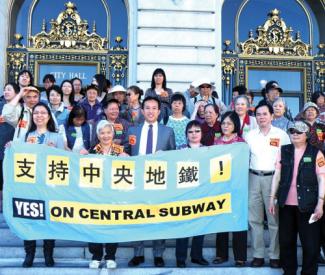
Despite its skyrocketing cost, inefficient design, and a growing chorus of criticism – ranging from a Wall Street Journal editorial today to an op-ed in the SF Chronicle last week – the Central Subway project continues to move forward for one simple reason: rich and powerful people want it to happen, whether it makes sense or not, because it benefits them directly.

“The subway is a case study in government incompetence and wasted taxpayer money,” the Wall Street Journal wrote in a “Review & Outlook” piece today (full text below), but it was only partially correct. The Central Subway is actually a case study in how things get done at City Hall, and how connected contractors and their political patrons make off with that taxpayer money.

“San Francisco is embarking on a Big Dig of the West, and unless our local leadership applies the brakes soon, the damage to our transit systems will be all but guaranteed. I urge local and national leaders to recognize what is obvious and stop this train to nowhere,” former San Francisco Transportation Agency Chair Jake McGoldrick wrote in his Aug. 18 op-ed.

But that isn’t likely to happen, given the political dynamics that have taken root at City Hall this year. Remember, this project was the result of a mutually beneficial deal that then-Mayor Willie Brown cut with Chinatown power broker Rose Pak back in 2003 (when the project was estimated at $648 million, before it ballooned to its current price tag of $1.6 billion).

This was the same duo that engineered the appointment of Ed Lee as interim mayor earlier this year and then pushed him to break his word and run to retain control of Room 200, as well as pressuring David Chiu into being the swing vote to give Lee that job and secretly backing Jane Kim’s run for the Board of Supervisors. All are big supporters of the Central Subway project, despite all the experts calling it an wasteful boondoggle that will be the most expensive 1.7-mile piece of track ever built in this country.

But the opinion of fiscal and transportation policy experts matters little in a town that is once again being governed by shameless power brokers. Hell, Brown even uses his weekly column in the Chronicle to confirm his weekly breakfast date (every Monday at the St. Regis Hotel) with his “friend” and client Jack Baylis, a top executive at AECOM, the main contractor for the Central Subway, as well as the America’s Cup, Transbay Terminal, the rebuild of the city’s sewer system, and all the other most lucrative city contracts.

In turn, AECOM kicks down contracts and payouts to a network of political supporters that will ensure that the project gets built, such as Chinatown Community Development Center, which signed an $810,000 contract in December to support the Central Subway in unspecified ways right before CCDC and its director Gordon Chin provided crucial support for getting Lee into the Mayor’s Office, where he can ensure the Central Subway project remains on track.

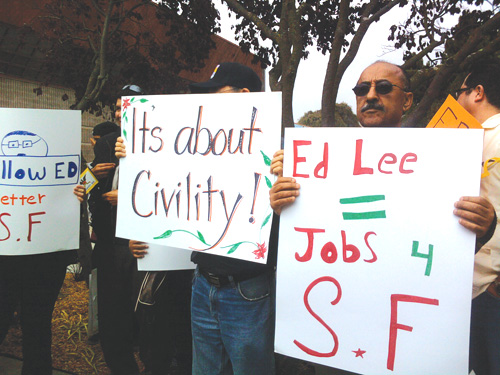
Yes, it’s just that crass and obvious. And it isn’t even about politics. Hell, Baylis is a Republican from Los Angeles, despite his meddling in San Francisco’s political affairs by sponsoring the Alliance for Jobs and Sustainable Growth and other groups that will be doing independent expenditures on behalf of Lee this fall, trying to tell us that “it’s all about civility.”

No, it’s about money and it’s about power, straight up. The Central Subway is really more of a gravy train than a sensible transit project, but that’s just how business is being done at City Hall these days.

One of the people who has long criticized the project – noting how Chinatown would be served far better with surface transit options, at a fraction of the cost – is Tom Radulovich, executive director of Livable City and an elected BART board member. He was heartened to see so many more voices – from the editorials to a recent Civil Grand Jury report to internal audits in the San Francisco Municipal Transportation Agency, which will lose money operating the new system – echoing his concerns.

“There are more people who seem to be sharing my thoughts,” Radulovich said. “It would be good to have a civic debate on this.”

But he’s not confident that will happen, despite the fresh wave of concerns. “There’s a lot of stuff that looks like planning that has gone into justifying this,” he said. “When the political culture of City Hall and the planning culture come together, this is what you get.”


Full text of WSJ article:

Off the San Francisco Rails

Tony Bennett may have left his heart in San Francisco, but the politicians who contrived the city’s Chinatown subway project must have left their brains somewhere else. The subway is a case study in government incompetence and wasted taxpayer money.

P.S. The Obama Administration is all for it.

Former Mayor Willie Brown sold a half-cent sales tax hike to voters in 2003 to pay for the 1.7-mile line on the pretext that the subway would ease congestion on Chinatown’s crowded buses, but he was more interested in obtaining the political support of Chinatown’s power brokers. In 2003, the city estimated the line would cost $647 million, but the latest prediction is $1.6 billion, or nearly $100 million for each tenth of a mile.

Transportation experts say the subway’s design is seriously flawed and that improving the existing bus and light-rail service would make more sense. The subway misses connections with 25 of the 30 light-rail and bus lines that it crosses, and there’s no direct connection to the 104-mile Bay Area Rapid Transit line or to the ferry.

Commuters will have to travel eight stories underground to catch the train and walk nearly a quarter of a mile to connect to the Market Street light-rail lines—after riding the subway for only a half mile. Tom Rubin, the former treasurer-controller of Southern California Rapid Transit District, calculates that taking the bus would be five to 10 minutes faster along every segment.

The city’s metro system, which is already running $150 million operating deficits, isn’t likely to have the money to keep the subway running in any case. Last month the San Francisco Civil Grand Jury, a watchdog group, warned that the subway’s costs “could stretch the existing maintenance environment [of the metro system] to the breaking point” and will defer the purchase of a new communications system.

Alas, San Francisco will likely drag national taxpayer money into the bay too. The city has applied for a multiyear $942 million “full funding grant agreement” from the Federal Transit Administration (FTA) to cover 60% of its capital costs. In 1964 Congress created a back-door earmark program called “New Starts” to subsidize local transportation projects. The FTA rates and recommends projects for grants, and Congress usually rubber-stamps its recommendations.

In January 2010, Transportation Secretary Ray LaHood modified the grant criteria by adding environmental and communal benefits and minimizing cost-effectiveness. The change effectively means that any project can get federal funding as long as its sponsors claim they’re moving cars off the road.

“Measuring only cost and how fast a project can move the most people the greatest distance simply misses the boat,” Mr. LaHood wrote in January 2010 on his Fast Lane blog. “Look, everywhere I go, people tell me they want better transportation in their communities. They want the opportunity to leave their cars behind . . . And to enjoy clean, green neighborhoods. The old way of doing things just doesn’t value what people want.” We’re told Mr. LaHood is smarter than he sounds.

The FTA has given the Chinatown subway one of its highest project ratings, which virtually assures a full funding grant agreement. Once the city receives such an agreement, the feds are obligated to provide whatever funds they promise. The FTA won’t approve the agreements until the fall, so there’s still hope that someone wises up and nixes the project. Oh, and if Congress is looking for discretionary programs to cut, New Starts would be a good start.

Editor’s notes

0

tredmond@sfbg.com

Gavin Newsom rode into the Mayor’s Office with a campaign to take welfare money away from homeless people. Jeff Adachi’s campaign for mayor is fueled by his attempt to cut city-employee pension costs. It’s an effective tactic: You put an initiative on the ballot and campaign as its sponsor, with your name attached — and while direct fundraising for mayoral candidates is tightly restricted (contribution limits, no corporate money), ballot-measure campaigns can collect unlimited cash, from almost anyone. Pick a popular issue (and attacking homeless people and city workers seems to have a lot of traction these days) and your chances of getting elected get a nice boost.

So why has no candidate running for citywide office in San Francisco ever made tax reform the center of his or her campaign?

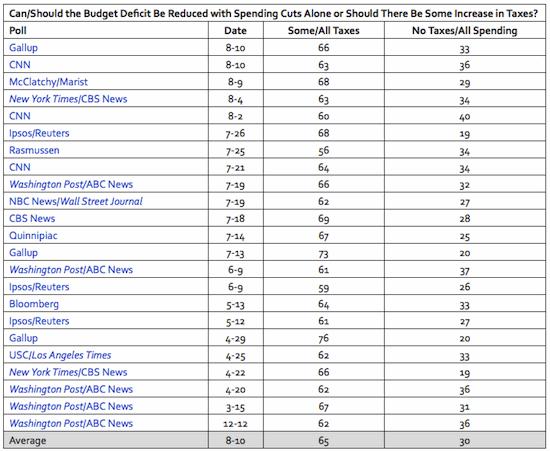
I realize that tax reform is boring. Slogans like “shared progressive values” and words like “together” play much better in the focus groups. But think about it: Nearly every major national poll shows that the voters — by a margin of roughly 2-1 — think that tax increases should be part of the solution to the nation’s budget woes. Since San Francisco is way more liberal than the nation as a whole, the margin in this city is probably about 3-1.

Naturally, the poll numbers depend on how you ask the question, so let me suggest a way to frame it that’s entirely honest and consistent with what I suspect most the voters in this city believe. “Since 400 American families now own more wealth than 50 percent of the entire population put together, should San Francisco’s budget problems be solved in part with higher taxes on very rich residents and businesses?”

You might actually get 90 percent support on that one.

Look: Warren Buffett, one of the richest people in the world, recently wrote an opinion piece in the New York Times saying that his class isn’t paying its fair share. Warren Hellman, one of the richest people in San Francisco, told me the same thing a couple of months ago. (In 2006, in a particularly revealing interview, Buffett told economics writer Ben Stein that “there’s class warfare, all right, but it’s my class, the rich class, that’s making war, and we’re winning.”) This is mainstream stuff now.

And I know some of the candidates, particularly Sup. John Avalos, support new taxes on the wealthy, and Assessor Phil Ting wants to repeal parts of Prop. 13. But nobody has ever made this a signature issue. Nobody’s ever made taxing the rich his or her version of Care Not Cash. I’m thinking maybe it’s time.

Alerts

0

alerts@sfbg.com


THURSDAY 25

The Guardian Forum

This summer, the Bay Guardian — along with cosponsors that include SEIU 1021, the San Francisco Tenants Union, and the Harvey Milk LGBT Democratic Club — has held a series of public forums framing progressive issues for the mayor’s race and beyond. This fifth and final forum focuses on the Environment, Energy, and Climate Change and the panel is Guardian Executive Editor Tim Redmond, Antonio Diaz with People Organizing to Demand Environmental and Economic Rights, Alicia Garza with People Organized to Win Employment Right, former Supervisor Aaron Peskin, and Arc Ecology’s Saul Bloom.

5:30 p.m., free

Koret Auditorium, SF Main Library

100 Larkin, SF


FRIDAY 26

Torture and Yoo

The California Young Republican Federation hosts John Yoo as welcoming speaker for its first state convention. Yoo has had international complaints filed against him for his complicity in torture and other crimes against humanity at Abu Ghraib and Guantánamo Bay after writing legal memos justifying harsh interrogation techniques for the Bush White House. Yoo is a professor at UC Berkeley’s Boalt Hall School of Law. Anti-war protestors will gather at the doors to “welcome” convention attendees and protest Yoo.

6:30-8:00 p.m., free

Marine Memorial Club & Hotel

609 Sutter Street, SF

www.cyrf2011.com/


SATURDAY 27

Green Tea Party

The Tea Party Express national bus tour is kicking off in Napa, of all places. To counter the event, the Napa County Green Party is throwing a Green Tea Party with prominent progressive speakers, vegetarian cuisine, fun info booths, and iced green tea. The event will end with a march to the Napa Valley Expo Fairgrounds, where presidential candidates are expected to be speaking to Tea Party supporters. Participants are encouraged to wear green.

10:30 a.m., free

Veterans Memorial Park

Corner of Main and Third, Napa

napa@cagreens.org

(707) 257-7435


SUNDAY 28

Preserving the Harvest

The Ecology Center of San Francisco (ECOSF) is hosting a community workshop entitled “Preserving the Harvest: Canning and Drying,” along with a potluck and solar oven pizza making. Spend time with neighbors and friends while learning how to can fruits and tomatoes in the most energy efficient way. ECOSF’s mission is to promote cooperation, community, and respect for the environment, so bring a dish made from your garden to share.

11:00 a.m. – 5:00 p.m.

Near School of Arts athletic field

555 Portola, SF

www.eco-sf.org


Mail items for Alerts to the Guardian Building, 135 Mississippi St., SF, CA 94107; fax to (415) 437-3658; or e-mail alert@sfbg.com. Please include a contact telephone number. Items must be received at least one week prior to the publication date.

Workin’ at the car wash

Worker advocates with La Raza Centro Legal and the San Francisco Day Labor Program are partnering with city officials for a creative approach to addressing the pervasive issue of wage theft: A worker-owned car wash.

On Aug. 17, attorneys from La Raza joined with City Attorney Dennis Herrera to announce that a lawsuit had been filed against the owners of Tower Car Wash for longstanding labor law violations that resulted in workers earning less than minimum wage. The complaint, filed jointly with the city and La Raza, seeks to recover up to $3 million in compensation, penalties, and interest for the cheated workers.

The Tower Car Wash lawsuit, along with other high-profile complaints alleging wage theft that the city has filed against the owners of Dick Lee Pastry and Danny Ho, who allegedly cheated day laborers out of the money they were owed, would never have come to fruition if low-wage workers hadn’t come forward. Individuals like Tower Car Wash employee Rosa Ochoa, who’s involved with La Raza’s Colectiva de Mujeres, have publicly challenged their employers for labor violations, a tough stand in a state with exceptionally high unemployment in the midst of a recession.

“What we feel like is really important about this lawsuit is that for us, it’s about worker empowerment,” says Workers’ Rights Coordinating Attorney Kate Hegé of La Raza. “It wouldn’t be possible without these workers being able to come forward.”

The idea for a worker-owned car wash emerged out of a desire to advance the goal of worker empowerment, Hegé notes. With help from Sup. David Campos, interim Mayor Ed Lee, and pro bono assistance from the law firm Orrick, Herrington & Sutcliffe, La Raza and the San Francisco Day Labor Program hope to establish a regular car wash on weekdays in the city-owned lot on Bayshore and Alemany boulevards, the location of the Alemany Farmer’s Market and the Alemany Flea Market on Saturdays and Sundays.

“We’ve been working with the city for the past several months to start a green, worker-owned car wash cooperative where workers of the San Francisco Day Labor Program would not only administer it, but work and gain benefits,” Renee Saucedo, Community Empowerment Coordinator at La Raza, told the Guardian. “The main thing about this day labor car wash is that it’s going to be run by the workers themselves.”

The project comes on the heels of a broader local effort to improve protections for low-wage workers. Earlier this month, the Board of Supervisors approved the Wage Theft Prevention Ordinance, crafted in partnership with the Progressive Workers Alliance to strengthen the the city’s Office of Labor Standards & Enforcement.

Project Dog brings out the purebred in rescue dogs

0

“I once split my pants photographing a Finnish spitz on the cliffs above Sutro Baths,” the lovely, energetic Kira Stackhouse laughed over drinks at Blackbird Bar in the Castro last week. She was recounting some very interesting stories about her ambitious Project Dog — an attempt to meticulously photograph woofy representatives of all 170 official American Kennel Club registered breeds next to purebred counterparts from dog rescue agencies.

“A big part of my mission is to photograph as many of these dogs as I can in iconic San Francisco and Bay Area settings, sometimes I’m trying to shoot five or six dogs a day. It’s not like I travel around with a change of clothes –but apparently there’s no lengths I won’t go to! So I just tried to hold my legs together until I got the shot.”

Stackhouse, who left a high profile job in marketing to expand her Nuena Pets photography business, launched a Kickstarter campaign earlier this month to help fund a full-color coffeetable book that will come out of Project Dog. (The campaign wraps up in three more days.) I asked her to explain the motivations behind the project — which has become a viral hit in the Bay Area and beyond, and has garnered several local accolades —  and what she hoped to accomplish. 

“It was weird how the idea came about. I love pets, but I always thought of myself as more into cats — until I got a dog of my own a couple years ago and fell completely in love. The dog was a purebred from a breeder, a Boston terrier. And when I would take him out, people would give me such shit about not going to an animal rescue place.

“So I thought, ‘You know, most people don’t know that rescued animals can be purebred — or that almost all official breed groups contain rescue organizations.’ It dawned on me that one way to get this message out would be to start a project that gets these dogs side by side in a format that would be instantly recognizable and appealing to people.

A sample layout from the forthcoming Project Dog book, featuring Basenjis — one from a breeder and one from an animal rescue organization.

“On top of that, I wanted this to be a community effort — so I asked people to submit their purebreds for picture consideration and tell stories about them on the Project Dog site. People really got into that — some of the stories are so funny, and we attracted entries from people like the mayor of Carmel! Then I could see what was out there and choose which dogs to photograph.

“But another community function I wanted to fulfill was building a platform to host the debate about purebred rescue dogs. People feel passionately — some owners are afraid rescue purebreds will diminish the ‘brand’ of the dogs, and some rescue dog fans are really vocal about their opposition to breed fetishization. This is somewhere they can all go at it.

And of course, I get to photograph some really beautiful dogs — and get really creative in a way I feel can benefit the community.”

It’s true, she does — some of the photos and test layouts for the book are stunning. But Project Dog, which is partnered with the SPCA, is also helping to enlarge perceptions of rescue dogs, usually knee-jerked as mangy mutts (not that those aren’t cute!), when in fact any kind of dog can find itself in need of a loving home. The Project Dog motto is, “Every dog is a work of art,” and Stackhouse’s dedication is proving that true. 

Preorder the Project Dog book for three more days on the Project Dog Kickstarter.

Polls suggest anti-Lee mudslinging is coming

10

One of the advantages of ranked-choice voting is that candidates have a disincentive for nasty attacks — after all, you want second-place votes from the other candidates, so you don’t want to piss off their supporters.


But when you have a dominant front-runner, as we appear to have in the San Francisco mayor’s race, all bets are apparently off.


I get this from the reports I’m hearing on recent polls. Sue Hestor, the land-use lawyer, tells me she got two calls from pollsters in the past few days — one apparently from the Michela Alioto-Pier campaign, the other most likely commissioned by Dennis Herrera. Both included plenty of questions about Ed Lee. Hestor’s impression: Both campaigns are digging in to the Ed Lee negative stuff to develop their attack lines. They asked about Mohammed Nuru, about Willie Brown and Rose Pak, and about Lee’s promise not to run. The Alioto-Pier poll also had some negative stuff on Herrera and on Jeff Adachi.


Alioto-Pier’s pollster asked a lot of questions about the schools — should the superintendent be elected? Should the board members be elected by district? Should school selection be based on neighborhoods? And there were questions about Alioto-Pier’s support for increased condo conversion. Oddly, there was a public-power question that made it sound as if Alioto-Pier would be the only candidate opposing public power.


The Herrera poll was more subtle, with a lot of questions about how the voters view him.


But the key element is that both candidates are apparently poll-testing how attacks on Lee would play and what might work. And I’m sure many of the others are doing the same thing. So we may be heading for a gang-up, where candidates from the back of the pack converge on the leader. That could get ugly, fast.  

Who doesn’t support Ed Lee?

37

One of the more interesting things about the Democratic County Central Committee’s mayoral endorsements was the lack of support for Mayor Ed Lee among the eight state and federal office holders who sit on the panel.


Under the party charter, any Democrat who lives in the city and represents San Francisco in Sacramento or Washington gets to vote at the DCCC. So U.S. Senator Dianne Feinstein, U.S. Reps. Nancy Pelosi and Jackie Speier, state Senators Mark Leno and Leland Yee, State Assembly Members Tom Ammiano and Fiona Ma and Attorney General Kamala Harris all had a say in who the party would support for mayor. None of those people ever show up at the meetings, but they’re allowed to appoint an alternate to represent their views.


And only Feinstein voted to endorse Lee.


Pelosi’s alternate didn’t show up for the endorsement meeting. Speier abstained. Yee voted for himself. Leno voted No Endorsement. Ammiano suported Avalos. Harris abstained. Fiona Ma voted for Bevan Dufty.


Not a rousing show of support for the incumbent.


(It would have been interesting if Lt. Governor Gavin Newsom were still on the DCCC, but Gav has moved to Marin, and he will now have the distinct honor of serving on that county’s committee.)


Meanwhile: I almost want to ignore Randy Shaw’s attempt to portray the DCCC (and some white progressives in general) as racist for not supporting any of the Asian candidates, since I think it’s too easy to throw that word around in this city, and journalists ought to be pretty careful when they do it. White people (like me and Randy Shaw) need to be particularly sensitive to race issues in the media — and I do think there are real tensions between some old-line progressives and emerging Asian political leaders who don’t always agree with progressives on issues. But that sensitivity should include not sensationalizing race or using race to score political points.


That said, it’s worth noting that of the four Asians on the Board of Supervisors, the DCCC endorsed three (Eric Mar, David Chiu, and Carmen Chu). The only one who didn’t get the DCCC nod for supervisor was Shaw’s candidate in District 6, Jane Kim.


Oh, and the Number 1 candidate endorsed by the Democratic Party is Latino. And the two fastest-growing non-white political populations in the city are Asians and Latinos.


You can fight forever about the politics of the DCCC endorsement and why the panel only chose two candidates. The Guardian will almost certainly support three, since that’s how RCV works. Why Yee, who has the support of both SEIU Local 1021 and the Sierra Club, got only two votes at the DCCC is a fair question. Why Chiu, who is a member of the DCCC, didn’t win the third slot is also an interesting political question. But I honestly don’t think race was a factor. Maybe I’m wrong.    


And as for the whole flap about Aaron Peskin, Rose Pak and the People’s Republic of China (based, by the way, on Peskin’s comments in a Falun Gong newspaper): I met with Rose Pak a few weeks ago, and in the course of talking about Leland Yee (who I will be profiling in the Aug. 31 Guardian) she told me that some progressives were accusing her of being a Communist — a reference to comments by Peskin and Chris Daly linking her to the PRC. She called it “red baiting.”


Just for the record: I’d by happy if Pak WAS a communist — maybe she’d be more interested in income redistribution, progressive taxation and land reform in San Francisco. I like communists. I even got me a picture of ol’ Leon Trostky hangin’ in my office (along with a picture of John Ross, another noted pinko). And years ago, when I had a garage, I really did have a commie flag tacked up on the wall. A friend bought it for me in the Soviet Union back in the day, and one of the reasons I loved it was that it was so poorly made that it started to unravel the minute I stuck the tacks in it, and the colors weren’t quite right, and the silkscreened hammer and sickle was way off center. Go team.


Seriously, I think the era when the label “Communist” was a serious smear is long over. Nobody cares any more. Besides, China isn’t really a Communist country these days, is it? I’m not an expert on the Chinese economy, but it seems much more hyper-capitalist to me. And it’s safe to say that there’s no Cuba-style forced economic equality in China, a country that has a handful of billionaires and a lot of very poor people and may have even worse income distribution than the United States.


Maybe we could talk about the issues?

San Franciscans want higher taxes

94

At least, I assume they do. That would seem to be the what the evidence shows. Because in 23 polls taken over the past nine months, Americans say they support higher taxes  as a part of the budget solution — by an average margin of 65-30. And by almost every measure, San Franciscans are more liberal than Americans as a whole. So it’s likely that if those polls collected data just from this city, we’d see closer to 75 percent of the voters saying they support higher taxes, particularly on the rich and big corporations.


And since San Francisco is so far out on the cutting edge on so many other issues, I have to wonder: Why is everyone at City Hall so afraid of taxes? Why is progressive taxation (and not pension reform) the central issue in the mayor’s race?


Gavin Newsom build his political career on a plan to cut welfare payments for homeless people. Jeff Adachi is trying to get elected mayor by campaigning to cut city employee pensions. Dennis Herrera is talking about his efforts to legalize same-sex marriage. But there’s not a single politician in town who has made fair taxation the centerpiece of a citywide campaign. Although it’s likely that three-quarters of city residents would support at least the concept of higher local taxes on the local rich, this isn’t a signature issue for anyone running for anything. 


Doesn’t that seem a little odd?

Inside the V.I.P. cocktail party with Willie Brown

The Alliance for Jobs and Sustainable Growth hosted a V.I.P. reception just before a mayoral candidate forum held at UCSF Aug. 16, and former Mayor Willie Brown appeared to be the guest of honor. Although the theme of the event was technically “honoring San Francisco’s mayors” — former Mayor Frank Jordan was there, someone indicated that former Mayor Art Agnos was in the room, former Mayor Gavin Newsom was invited but didn’t show, and Mayor Ed Lee was of course in attendence — Brown seemed to be given more prominent recognition than any of the others.

The moment he strolled in, Sup. Mark Farrell, who was doing introductions for the the affair, scrambled onstage to announce Brown’s presence and deliver a warm welcome, and everyone applauded. Within minutes, the former mayor was seen chatting with a crowd that included Mayor Lee and several others. Soon after, Brown and former Mayor Frank Jordan were summoned to the stage to say a few words.

Once in the limelight, Brown cracked a few jokes. He said he felt for the 36 mayoral candidates, who are forced to campaign in an era when the Internet threatens to reveal videos and photos of them at any time to thousands of online viewers. “I’m glad they didn’t have that kind of communication system when I was running,” he said. “I can’t imagine the photographs you’d have of me floating around doing things I shouldn’t have been doing.”

As for his own time in Room 200, “I enjoyed every single solitary minute of it, and if I really thought I had great skills, I would be number 37,” he said, drawing more applause.

Then again, common wisdom says it isn’t necessary for Brown to bother campaigning in order to gain access to Room 200 these days. Later that same evening, during his own turn in the spotlight at the mayoral debate, Mayor Lee came under fire from Board President David Chiu, who revealed that Lee had privately confided to him about a week before he announced his candidacy that he was having a difficult time saying no to Brown and influential Chinatown business consultant Rose Pak when it came to launching a campaign for a full term.

Chiu’s pointed question for the mayor was what had changed in his mind since that conversation, but Lee referenced neither Brown nor Pak in his answer. Instead, he said he’d changed his mind after witnessing his success in changing the tone of government and getting things done in City Hall.

Back at the V.I.P. reception, Brown and Jordan were invited onstage again, this time to receive awards presented by the Alliance for Jobs and Sustainable Growth. But first Steve Falk, president and CEO of the San Francisco Chamber of Commerce, reminded the crowd that there was still time to buy a drink before the debate got underway. He said, “Debates are much more interesting after three drinks.”

Before Falk presented Brown with a commemorative plaque, he said, “It’s tough to put in a few sentences the life and times of Willie Brown,” and proceeded to note that, with his term in the California Assembly and time serving as mayor of San Francisco behind him, Brown “has now followed his friend Herb Caen into an honest line of work as a columnist for the San Francisco Chronicle.”

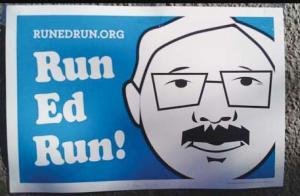
Being a newspaper columnist doesn’t mean Brown is always kind to members of the local media. While mixing through the crowd minutes after receiving his award, he fired some harsh words at a well-known City Hall reporter who had recently published some unflattering articles about the “Run, Ed, Run” effort to encourage Lee to seek a full term.

In recent months, Brown’s columns have provided the public at large with a rare glimpse into Mayor Lee’s dining experiences in San Francisco. In February, Brown wrote in one of his columns that he went out to North Beach Restaurant at sat at the window table with Lee, Brown’s “friend” Sonya Molodetskaya, and Jack Baylis, who serves as the US Group Executive of Strategic Development for AECOM, one of the city’s largest contractors and a sponsor of the Alliance for Jobs and Sustainable Growth Event. (Baylis was on the invite list for the V.I.P reception, too.)

Apparently, AECOM had something to celebrate that same day — according to an Aug. 16 press release, an AECOM joint venture was just awarded a $150 million contract for program management services for the San Francisco Public Utilities Commission’s wastewater improvement program.

The V.I.P. reception had representation from many key players in the downtown business community, with sponsorship from AT&T, AECOM, Pacific Gas & Electric Co., Wells Fargo, Motorola, California Pacific Medical Center, the San Francsico Chamber of Commerce, the Building Owners and Managers Association, the San Francisco Police Officer’s Association, Shorenstein Properties, and others. Several labor unions, including the United Association of Plumbers & Pipefitters Union Local 38, United Brotherhood of Carpenters and Joiners of America Local Union No. 22, and United Food and Commercial Workers Union Local 5 were also listed as sponsors. Guests included district supervisors, developers, lobbyists, business owners, mayoral candidates, media spokespeople, executives from the health care industry, and other political insiders.

Clearly, there were many people in the room who wanted to get on Brown’s good side.

Will progressives prevail at DCCC? — UPDATED

57

UPDATE: The DCCC endorsed Ross Mirkarimi for sheriff; John Avalos in first place for mayor and Dennis Herrera in second place; and David Onek in first place for DA and Sharmin Bock in second place.

There’s been a flurry of negotiations, backroom deal-making, and wild conspiracy theories leading up to tonight’s (Wed/17) San Francisco Democratic County Central Committee meeting, where the big item on the agenda is endorsements for this fall’s citywide elections, endorsements that are among the most influential in this one-party town.

Depending on one’s definition of the label, progressives still hold a majority of seats on the 32-member elected body, so solidly progressive candidates Ross Mirkarimi, who is running for sheriff, and John Avalos, who is running for mayor, have a decided advantage going into the vote.

Nothing is certain given the crowded fields in both races, although we’re hearing Mirkarimi getting the first place – and probably the only – endorsement in that race is the only prediction those involved are willing to make. Everything else is up in the air.

“How it goes down, only tonight will tell,” DCCC Chair Aaron Peskin told us. “Anything can happen. It is real democracy, with a lowercase D.”

We’ve spoken to other current and former DCCC members on background and gotten a sense of how things are shaping up, although new plays have been popping up all the time. Avalos seems to be close to the 17 votes that he needs to get the endorsement, with the second largest block of votes being supporters of Dennis Herrera, including savvy and influential players such as Carole Migden who will try to leverage at least a second place endorsement for him.

Mayor Ed Lee also has some support on the DCCC, probably not enough to get on the slate without some serious deal-cutting, but maybe enough to gum up the works and threaten to prevent a mayoral endorsement and neutralize the DCCC. Leland Yee also has some support, but it would still be a surprise if he or Lee ends up on the slate, even in third place.

In the District Attorney’s race, it seems to be coming down to a contest between David Onek and Sharmin Bock, who has gained significant ground on the committee in the last couple months to pull almost even with Onek, although neither appears to have the 17 votes they need (or 16 is someone abstains). While the very few George Gascon and Bill Fazio supporters on the DCCC may try to make mischief and deny anyone the DA’s endorsement, a more likely scenario is the Onek and Bock camps will cut a deal to give them the endorsements, probably with Onek first and Bock second.

DCCC rules don’t allow for dual endorsements – they must be ranked – it’s also possible that in either the DA or mayor’s races that there will be a movement to postpone the vote and change that rule to allow a dual endorsement. But again, things are still in such flux that anything can happen, so stop by the 6 pm meeting in the basement of the state building at 455 Golden Gate Avenue, if you’re into that sort of thing.

So much for civility

0

rebeccab@sfbg.com

The San Francisco mayor’s race went from a lackluster affair to a dynamic match as the Aug. 12 filing deadline drew near and two prominent city officials who had previously said they wouldn’t run tossed their hats into the ring.

Mayor Ed Lee’s Aug. 8 announcement that he’d seek a full term prompted several of his opponents to use their time onstage at candidate forums to decry his reversal and question his ties to the moneyed, influential backers who openly urged him to run. Several days later, Public Defender Jeff Adachi’s last-minute decision to run for mayor signaled more tension yet to come in the debates.

At this point, eight current city officials are running campaigns for higher office, and the dialogue is beginning to take on a tone that is distinctly more biting than civil. Adachi, who had not yet debated onstage with his opponents by press time, told reporters he was running because he wanted “to make sure there’s a voice in there that’s talking about the fiscal realities of the city.”

Adachi authored a pension reform ballot measure that rivals the package crafted by Lee, labor unions, and business interests (see “Awaiting consensus,” May 31, 2011). At an Aug. 11 candidate forum hosted by the Alice B. Toklas Democratic Club, the San Francisco Young Democrats, and the City Democratic Club, all of the top-tier candidates who were present indicated that they would support Lee’s pension reform measure and not Adachi’s.

“The reforms that I have championed are reforms that are absolutely needed, along with action,” Adachi told reporters moments after making his candidacy official. He added that after watching the mayoral debates, “I became convinced that either the candidates don’t get it, or they don’t want to get it.”

Those fighting words will likely spur heated exchanges in the months to come, but until Adachi’s entrance into the race, it was Lee who took the most lumps from opponents. Even Board President David Chiu, a mayoral candidate whose campaign platform is centered on the idea that he’s helped restore civility to local government, had some harsh words for Lee during an Aug. 11 mayoral debate.

“I do regret my decision to take Ed Lee at his word when he said he would not run,” Chiu said in response to a question about whether he regretted any of his votes. He also said his first interaction with Lee after the mayor had announced his candidacy was “a little like meeting an ex-girlfriend after a breakup.”

Lee, whose pitch on the campaign trail features a remarkably similar narrative about transcending political squabbling in City Hall, became the target of boos, hisses, and noisemaker blasts when a boisterous crowd packed the Castro Theater for an Aug. 8 candidate forum. He received one of the most forceful rebukes from Sen. Leland Yee, an opponent whom Lee supporters are especially focused on defeating.

“Had the mayor said that he would in fact run, he may not have gotten the votes for interim mayor,” Yee said. “Will you resign from your post,” he asked, challenging Lee, “in order to then run for mayor?” Days later, Yee had developed a new mantra about throwing power brokers out of City Hall instead of “wining and dining with them.”

Yet Lee said his decision to enter the race wasn’t because of the push from his backers, but because of how well things have gone during his brief tenure in Room 200. “Things have changed at City Hall, particularly in the last seven months,” he told reporters Aug. 8. “And because of that change, I changed my mind.”

In yet another twist, former Mayor Art Agnos — whom progressives had looked to as a potential appointee to the vacant mayor’s seat back in December, before Lee was voted in to replace former mayor and Lieutenant Governor Gavin Newsom — delivered a surprise endorsement of City Attorney Dennis Herrera shortly after Lee declared. The decision was particularly significant since Agnos first hired Lee to serve in city government, and has a long history of working with him.

“[Herrera] is an independent person who will empower neighborhoods … and won’t be beholden to power brokers,” Agnos said. He also told the Guardian he wasn’t surprised that Lee had opted to run, given the role former Mayor Willie Brown and influential business consultant Rose Pak had played in orchestrating Lee’s appointment.

“Anybody who is an astute political observer saw the signs from the very beginning,” Agnos said. In response to a comment about his unique vantage point as a would-be caretaker mayor, he said, “I would’ve kept my word and not run for reelection.”

Intense focus on Lee’s flip-flop, and on the Progress for All-backed “Run, Ed, Run” effort that was the subject of an Ethics Commission discussion that same week, stemmed at least in part from the threat the incumbent mayor represents to other candidates. A CBS 5-SurveyUSA poll suggested he became an instant front-runner.

Yet questions about “Run, Ed, Run” — some raised by observers unaffiliated with any campaigns — also served to spotlight the candidate’s longstanding ties with backers closely connected to powerful business interests that stand to lose big if their links to city government aren’t preserved.

Retired Judge Quentin Kopp issued an open letter to District Attorney George Gascón Aug. 1 urging him to convene a criminal grand jury to investigate whether illegal and corrupt influencing had occurred when Pak — a close friend of Lee’s and a key driver behind the “Run, Ed, Run” effort — reportedly recruited executives of Recology to gather signatures urging Lee to run.

Recology, which handles the city’s waste, was recently awarded a $112 million city contract, and Lee’s scoring of the company and recommendation to raise rates in his previous capacity as city administrator benefited the company. Brown received substantial campaign donations from Recology in previous bids for mayor. Kopp is the coauthor of a ballot initiative asking San Francisco voters if the company’s monopoly on city garbage contracts should be put out to bid.

“A criminal grand jury is vital in order to put people under oath and interrogate them,” Kopp said. “They would put Willie Brown under oath, put Pak under oath, put [Recology President Mike Sangiacomo] under oath, put [Recology spokesperson Sam Singer] under oath … That’s the course of action that should be pursued by this.”

Although Kopp told the Guardian that he hadn’t yet received a response from Gascón, DA candidates Sharmin Bock, Bill Fazio, and David Onek nevertheless seized the opportunity to publicly and jointly call for Gascón to recuse himself from any investigation into Progress for All. Gascón has a conflict of interest, they argued, since he reportedly sought Pak’s advice when deciding whether to accept Newsom’s offer to switch from his previous post as police chief to his current job as top prosecutor.

The Ethics Commission determined unanimously Aug. 8 that the activities of Progress for All, the committee that was formed to encourage Lee to run, had not run afoul of election laws despite director John St. Croix’s opinion that it had filed improperly as a general purpose committee when it ought to have been a candidate committee, which would have placed caps on contribution limits.

“The Ethics Commission has spoken, and they’ve supported our position,” Progress for All consultant Enrique Pearce of Left Coast Communications told the Guardian.

St. Croix did not return Guardian calls seeking comment, but an Ethics Commission press release included a caveat: “Should facts surface that coordination occurred between Mayor Lee and [Progress for All], such allegations will be investigated under the Commission’s enforcement regulations.”

At a Lee support rally organized by his official campaign team on Aug. 11, volunteers who arrived with “Run, Ed, Run” materials produced by Progress for All were told they could not display those signs and T-shirts; the same people were on a first-name basis with one of Lee’s campaign team members.

Pressed on the question of whether there was any coordination between agents of Progress for All and Lee, Pearce said the Ethics Commission discussion had focused on whether Lee had been a candidate. “Whether or not he’s a candidate has nothing to do with whether or not he has dinner with Rose [Pak],” Pearce noted. He insisted that there had not been coordination, and that the efforts to encourage Lee to run and to support Lee as a candidate were totally separate.

Sup. John Avalos, who is running for mayor on a progressive platform, recalled at an Aug. 8 candidate forum how things unfolded when Lee’s name first came up as an appointee for interim mayor.

Avalos reminded people that he had called for postponing the vote back in December because he hadn’t even had a chance to sit down and meet with Lee, who was in Hong Kong at the time. With behind-the-scenes deals orchestrating his appointment, Avalos said, “We saw City Hall turning into one big back room.”


Stop cell phone censorship

13

EDITORIAL The bizarre move by BART officials Aug. 11 to shut down cell phone service in the underground train stations made headlines around the world — and for good reason. It was, Wired Magazine reported Aug 15, apparently the first time in United States history that a public agency sought to block electronic communications as a way to prevent a political protest.

It came at a time when oppressive governments around the world have been disabling cell phone and internet services to frustrate protest organizers. And it followed months of abysmally bad behavior by the transit agency, which is trying to respond to yet another dubious BART police shooting. Civil liberties activists have issued statements of condemnation and outrage; state Sen. Leland Yee, who is also running for mayor, has called on the BART board to adopt policies preventing future shutoffs.

But the BART board has proven itself unable to properly monitor and oversee its law-enforcement operations. At this point, the state Legislature needs to step in.

It’s not surprising that protesters have been swarming around BART stations this summer. The agency has a history of failing to control its police force, and when an officer shot and killed an apparently drunk man in the Civic Center station July 3, activists were fed up. BART responded badly, refusing to turn over video of the incident — and the more facts that came out, the worse the agency looked.

We understand the frustration that commuters felt when angry activists disrupted service for a brief period during the afternoon rush hour. And we understand BART’s concern that further actions inside the stations could be difficult to control.

But let’s remember: The BART board has never been particularly open to public input and most of its members show little interest in accountability. Over the past two decades, hundreds of people have appeared to speak at board meetings to demand a serious response to police shootings — and nothing ever happened. It took a particularly horrendous incident — a point-blank shooting of an unarmed man that was recorded on video — for the board to create even a modest police oversight program.

BART officials are trying to argue that cell phone service in the underground stations is a new service, something offered at the agency’s discretion — as if BART were some sort of private café that gives its customers free wifi. But that ignores the fact that the Bay Area Rapid Transit District is a government agency, one that has no more business shutting down cell phone service than the White House does blocking a newspaper from publishing embarrassing secrets.

As a practical matter, the decision was foolish: The protesters may have been inconvenienced, but so were hundreds of others who may have been trying to make business calls or connect to family members. In political terms, it was inexcusable. Think about it: A public agency was intentionally disabling communications to prevent a political protest. That’s about as bad as it gets.

We agree with Yee that the BART board ought to set a clear policy against any future attempts to control cell phone service for political purposes. But that’s not likely to happen — and it won’t be enough. The state Legislature needs to pass a measure specifically banning any public agency in California from disabling or interfering with any public communications system for political purposes. We can’t wait to see BART lobbyists show up and try to oppose that one.

Editor’s Notes

14

tredmond@sfbg.com

August is a bad time to split town. When I left for vacation a couple of weeks ago, Ed Lee was just starting to act like a candidate in a slow-developing mayor’s race. Nobody except my lunatic pal h. brown had any inkling that Public Defender Jeff Adachi would jump into the Room 200 sweepstakes at the last minute. And the Giants were three games up.

Now Lee is the clear front-runner, Adachi — a guy who defends criminals for a living — is the darling of a some anti-government conservatives, there are Avalos signs all over the Mission, and nobody knows exactly how to figure this all out.

Oh, and Arizona — which I hate (yeah, I hate the entire state, including the governor, the baseball team and the newspaper chain that’s based there) — is leading the National League West.

Welcome home, I guess.

The first thing I want to say about the mayor’s race is that none of this would be possible without ranked-choice voting and public financing. Think about it: Five serious Asian candidates, two of them leading in the polls and at least three of them real contenders — and nobody’s complaining that Adachi or Lee will “split” the Asian vote. If anything, several strong Asian candidates help each other; the supporters of Ed Lee and Leland Yee may be trashing the opposition day and night, but in the end, a lot of Chinese voters will probably still rank the incumbent mayor and the man who’s been elected citywide four times as two of their three choices.

And without public financing, the race would be dominated by one or two contenders — the ones who could privately raise $1 million or more to stay in the game. Instead, we have at least four and perhaps as many as five or six candidates who have a real chance of finishing on top. Already, the Chron and the Ex are complaining about the cost of public financing; the cost of closed elections where only those with big-business connections could win was much, much higher.

The other factor that will make this fascinating is that Lee’s job just got much, much harder. He’s not the amiable technocrat who comes to work early and gets the job done anymore; now he’s an ambitious pol who has never had to stand up to the heat of a tough campaign. He’s going to have to be a candidate, and campaign, and answer some hard questions about some of his political allies and supporters. That’s not the gig he wanted in February. And I don’t know how well he’s going to handle it.

You can’t trust Ethics

2

By Larry Bush

OPINION Proposition F, a measure on the November ballot, is supposed to clean up some provisions of the law that requires political consultants to register and make disclosures about their clients and their work. It was approved by all 11 supervisors.

But Prop. F has some serious problems. For starters, it grants authority to the Ethics Commission to make any other changes it wants in the law.

As the Voter Handbook says:

“A yes vote means: You also want to allow the City to change any of the campaign consultant ordinance’s requirements without further voter approval.”

Why should you oppose that? Because the Ethics Commission can’t be trusted.

The reason San Francisco has a law forcing political consultants to register and make disclosures is because the voters demanded one. City Hall fought against it every step of the way.

Former Supervisor Tom Ammiano introduced the measure in 1996, and it won board approval. Then-Mayor Willie Brown vetoed it. Ammiano rewrote the measure 1997 to meet Mayor Brown’s objections. Brown vetoed it again. And the supervisors who had voted for the law refused to vote for it again and overturn the veto.

So Ammiano and several other supervisors put the measure on the ballot. The political consultants raised a war chest to defeat it and spent more than $100,000 in direct mail, billboards and other voter contacts.

It passed with 61 percent of the vote.

What kind of clean up does Ethics plan now on the political consultant law? You can bet it won’t come down on the side of greater disclosure.

In 2009, two years ago, the Ethics Commission decided to write a clean up of the city lobbyist law. Just like they want to do with the political consultant law now.

And what happened with that law?

It changed one little aspect that didn’t get any real attention. It changed what is defined as a lobbyist — a person or entity who seeks to influence administrative or legislative decisions.

And what is the result?

Now the San Francisco Chamber of Commerce no longer has to file and disclose its lobbying. Neither does Lennar. Neither does the America’s Cup or Larry Ellison.

All those groups had to file under the old rules.

The bottom line is that a sleeping watchdog that can’t be trusted wants the right to change the laws governing political consultants — without any further oversight or public vote.

The former Ethics Commissioners who also are opposing this measure are Paul Melbostad, who served on the commission when the political consultants act was passed; Bob Dockendorff; Joe Julian; Bob Planthold; and Eileen Hansen, who just completed her term and was the only commissioner who voted against the pay-to-play rewrite.

I urge you to join them in opposing this measure.

Larry Bush is the publisher of Citireport.com, a City Hall watchdog.

Editorial: Stop cell phone censorship

43

The bizarre move by BART officials Aug. 11 to shut down cell phone service in the underground train stations made headlines around the world and for good reason. It was, Wired Magazine reported Aug 15, apparently the first time in United States history that a public agency sought to block electronic communications as a way to prevent a political protest.

It came at a time when oppressive governments around the world have been disabling cell phone and internet services to frustrate protest organizers. And it followed months of abysmally bad behavior by the transit agency, which is trying to respond to yet another dubious BART police shooting. Civil liberties activists have issued statements of condemnation and outrage; state Sen. Leland Yee, who is also running for mayor, has called on the BART Board to adopt policies preventing future shutoffs.

But The BART Board has proven itself unable to properly monitor and oversee its law-enforcement operations. At this point, the state Legislature needs to step in.

It’s not surprising that protesters have been swarming around BART stations this summer. The agency has a history of failing to control its police force, and when an officer shot and killed an apparently drunk man in the Civic Center station July 3, activists were fed up. BART responded badly, refusing to turn over video of the incident and the more facts that came out, the worse the agency looked.

We understand the frustration that commuters felt when angry activists disrupted service for a brief period during the afternoon rush hour. And we understand BART’s concern that further actions inside the stations could be difficult to control.

But let’s remember: The BART Board has never been particularly open to public input and most of its members show little interest in accountability. Over the past two decades, hundreds of people have appeared to speak at board meetings to demand a serious response to police shootings and nothing ever happened. It took a particularly horrendous incident a point-blank shooting of an unarmed man that was recorded on video for the board to create even a modest police oversight program.

BART officials are trying to argue that cell phone service in the underground stations is a new service, something offered at the agency’s discretion as if BART were some sort of private café that gives its customers free wifi. But that ignores the fact that the Bay Area Rapid Transit District is a government agency, one that has no more business shutting down cell phone service than the White House does blocking a newspaper from publishing embarrassing secrets.

As a practical matter, the decision was foolish: The protesters may have been inconvenienced, but so were hundreds of others who may have been trying to make business calls or connect to family members. In political terms, it was inexcusable. Think about it: A public agency was intentionally disabling communications to prevent a political protest. That’s about as bad as it gets.

We agree with Yee that the BART Board ought to set a clear policy against any future attempts to control cell phone service for political purposes. But that’s not likely to happen and it won’t be enough. The state Legislature needs to pass a measure specifically banning any public agency in California from disabling or interfering with any public communications system for political purposes. We can’t wait to see BART lobbyists show up and try to oppose that one.


Advocates aim to change youth sentencing of life without parole

Christian Bracamontes was 16 years old and had never been in trouble with the law when he made a decision that landed him in a California prison, serving out a sentence of life without parole.

He was part of a tagging crew, and he and a friend had gone down to a wash to hang out and do graffiti. When his friend showed him that he had a gun in his bag, he was surprised. A group of kids came down to the wash and offered to sell them weed, but they refused. Then his friend got an idea. 

“He said to me, do you want to rob them? I said, ‘I don’t care,'” Bracamontes told an interviewer with Human Rights Watch years later. He trailed behind his friend as he approached the kid who’d offered to sell them drugs, but things did not go as planned: The victim threatened to kill them. Bracamontes figured the bluff had been called, and he turned to get his bike so they could leave. But then his friend fired the gun.

Bracamontes was found guilty of first degree murder and sentenced to life without parole. The prosecutor offered a lower sentence of 16-to-life if he accepted a plea deal, but he refused, since he could not fathom how he could possibly be found guilty when he wasn’t the one who pulled the trigger.

His story was one of many profiles included in a Human Rights Watch report titled, “When I Die, They’ll Send Me Home,” an in-depth analysis of California youth serving life sentences without parole. According to that 2008 study, an estimated 45 percent of youth offenders serving that sentence were convicted of murder, but didn’t physically pull the trigger. The convictions reflect a California law that holds youth responsible for a murder that occurs when they were part of a felony, even if they didn’t plan for it to happen. In nearly 70 percent of the cases surveyed by Human Rights Watch, youth didn’t act alone in their crimes, and at least one codefendant was an adult.

A broad statewide coalition of youth advocates and human rights organizations is now pushing for legislation that they hope will give youth in these circumstances a second chance to turn their lives around. Senate Bill 9, dubbed California Fair Sentencing for Youth, would make it possible for youth serving life without parole to petition for a court to review their case and determine whether to impose a lower sentence.

The legislation would permit up to three hearings after 15, 20, and 25 years of incarceration, and the minimum time that someone would have to serve before they could be granted parole is 25 years. Only inmates who exhibit signs of rehabilitation and remorse would be able to submit a petition for a case review. If resentenced, the offenders would still have to go before a parole board to prove that they deserve to be placed on parole.

According to Human Rights Watch, international human rights law prohibits life without parole for youth — and the United States is the only country that imposes this sentence in practice, though other countries have laws on the books permitting it.
 
“All of the organizations and literally thousands of individuals come to this with the idea that this extreme sentence is not a sentence we should be imposing on people who are under the age of 18,” Elizabeth Calvin of Human Rights Watch told the Guardian. Since Human Rights Watch released its national and statewide studies of the issue in 2005 and 2008, she said, “There’s more awareness nationally that our juvenile justice policies of lock them up and throw away the key are failing. It really is worthwhile to give young people a second chance.” Dozens of human rights, civil liberties, and faith-based organizations have pushed to pass the bill, with efforts beginning several years ago.

In California, roughly 300 people who were sentenced when they were minors are serving sentences of life without parole, representing around 12 percent of the estimated 2,500 incarerated individuals in the nation who serving out the same sentence.

Calvin described the bill as legislation that “balances the needs and interests of victim family members who believe that there are some cases that deserve life without parole.” She noted that the bill faced strong opposition from law enforcement and groups of victim family members, though certain individuals in those same communities have voiced support for SB 9. “We’re hopeful, but it’s definitely an uphill battle,” she said.

The Assembly Appropriations Committee will vote on SB 9 on Aug. 17, and if it clears that hurdle, it will go onto the full Assembly. The bill was authored by Sen. Leland Yee, with principal coauthors Darrell Steinberg (D-Sacramento) and Juan Vargas (D-Chula Vista), and co-authors Assemblymembers Felipe Fuentes (D-Arleta) and Bonnie Lowenthal (D-Long Beach).

“SB 9 is not a get-out-of-jail-free card; it is an incredibly modest proposal that respects victims, international law, and the fact that children have a greater capacity for rehabilitation than adults,” said Yee, who is also a child psychologist and a candidate for mayor. Research has shown that brain maturation continues throughout adolescence, so young people’s abilities to plan, make decisions, and think critically are not yet fully developed.

“It’s a pretty modest bill,” says Sue Burrell, a staff attorney with the San Francisco-based Youth Law Center. “It’s a pretty intense process even to get a hearing, and to be in a position where you could be released.”

She added that her organization has been engaged in similar work for years. “We’ve been very concerned about the adultification of kids,” she said. “You can’t decide when someone’s so young that … they could never move beyond this phase of their lives.” Many of the cases that land youth in prison without parole are similar, Burell said. “The classic scenario is, they’ll go out and do some low-level thing … but then it turns out that one of the buddies has a knife or a gun. And the rest is history.”

Lee appointment of Nuru darkens the ethical cloud over Room 200

10

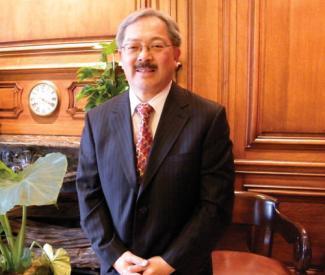
City Attorney Dennis Herrera deserves credit for being the one mayoral candidate willing to bring a full-throated denunciation of the sleazy and corrupt politics now flowing from Mayor Ed Lee, who yesterday appointed discredited political fixer Mohammed Nuru to head the Department of Public Works, compounding a series of ethically questionable actions by Lee and his supporters.

While it was inexplicably buried by editors at the bottom of Section C, the Chronicle’s City Insider today had a pair of good stories on Lee’s mounting political problems. The first was about how the U.S. Attorney’s Office has reportedly launched a probe of Progress for All and its “Run, Ed, Run” campaign, for which Lee ally Rose Pak illegally sought support from executives at Recology, the garbage company that had just been awarded a huge city contract, largely because then-City Administrator Lee had given the company far higher ratings than the other two supposedly impartial bid judges.

The second story was about Herrera slamming Lee’s choice of Nuru. On his campaign website, Herrera reminded voters about the scandals that have surrounded Nuru – like Lee, someone who has always taken his cues from former Mayor Willie Brown – who illegally diverted city funds and workers into campaigning for Brown in 1999 and Gavin Newsom in 2003. Brown now writes for the Chronicle and is even allowed to comment on the mayor’s race.

The scandal – first broken by the Chronicle in 2004, furthered by reporting in the Guardian, and then investigated by Herrera’s office – involved Nuru steering city funds to his nonprofit San Francisco League of Urban Gardeners and then requiring its employees to illegally do campaign work during work hours. Nuru then went to work for Lee at the DPW while continuing to illegally use SLUG’s funds and employees for political purposes.

Herrera said the appointment smacks of “cronyism, politics, and poor judgment.” Previously, Herrera had the best line about Lee as he jumped into race, telling a mayoral forum: “To my mind, Ed Lee’s biggest problem isn’t that he’s a dishonest man – it’s that he’s not his own man,” Herrera said. “The fact is, if Ed Lee is elected mayor, powerful people will continue to insist on things.”

Topping that list of the powerful people who have clearly been pulling Lee’s strings throughout his career are Pak and Brown, both of whom are consultants who regularly get paid by corporations that do big business with the city and need support from the Mayor’s Office. And their actions are often blatant and shameless, just like Nuru’s history, and even exposure of the misdeeds doesn’t correct the problem.

For example, as I reported last week, Brown’s administration helped Pak buy a Rincon Hill condo for half-price through a city affordable housing program in 2002, even though her disclosure forms showed she had $73,414 in her checking account, some of which probably included the $12,000 consulting fee she reported on her tax return from Emerald Fund – the politically connected developer of the project, employees of which are barred from buying such below-market rate units – and $10,000 from Chiang CM Construction, which helped fund Progress for All.

Most of this information was prominently reported in 2003 by the Examiner, but nothing was ever done. Pak got to keep her taxpayer-subsidized condo. Same thing with Nuru, who remained at DPW even after the City Attorney’s Office and Controller’s Office concluded his actions were corrupt. And Lee was appointed interim mayor even after being tied to several corrupt Brown scams, including overriding city workers to give contracts to fraudulent companies at Brown’s behest.

And now, Lee has placed Nuru in charge of a city department with a $129 million city budget and 1,200 employees, despite Nuru’s proven history of directing his subordinates to illegally campaign for his mayoral benefactors. You couldn’t even make this stuff up, and even Examiner columnist Melissa Griffin flatly calls the move “stupid.”

But I think it’s more than just stupid. And the appointment of Nuru is more than just a setback from DPW that good government activists had been fearing for a long-dysfunctional department that had gotten much better in recent years. It looks like flat-out corruption of the sort that ought to knock Lee out of the frontrunner position and hopefully land him in front of a grand jury at some point.

City workers union backs Yee — and Avalos

18

The press release I got from Leland Yee’s campaign made it sound as if Yee had won a major victory over progressive supervisor John Avalos:


SAN FRANCISCO – Senator Leland Yee has landed the first choice endorsement of the largest organization of city workers – Service Employees International Union (SEIU 1021) – in his campaign for San Francisco Mayor. The move by the 54,000 member union is a complete rejection of the city’s top official, interim Mayor Ed Lee.


The endorsement comes after Yee has landed virtually every major labor endorsement in the race, including the California Nurses Association, California School Employees Association, International Brotherhood of Electrical Workers, San Francisco Building and Construction Trades Council, Laborers International Union, United Brotherhood of Carpenters, Communication Workers of America, and the American Federation of State, County, and Municipal Employees, among others.


Yee has also been endorsed by the major environmental groups, including the Sierra Club and San Francisco Tomorrow.


“I am proud to be the labor candidate in this race and honored to receive the endorsement from SEIU 1021 and our city’s workforce, who run our city and provide us essential services,” said Yee. “SEIU 1021 represents some of our lowest paid and hardest working employees, including healthcare workers, nurses, and janitors. Together, we have fought to ensure greater transparency and accountability at City Hall and within state government. I look forward to working with SEIU as we move San Francisco forward.”


Local 1021 is among the most progressive unions in the city — and when it comes to local politics, one of the most effective. Candidates backed by 1021 get the union’s volunteer work and wealth of political organizing skill, and it can make a huge difference.


Avalos, the leading progressive in the race, would seem a natural for the SEIU nod, and at first glance, it appeared that one of labor’s best friends at City Hall had been stiffed. You don’t learn until the end of the Yee release what really happened:


SEIU 1021 also endorsed John Avalos as a first or second choice and Bevan Dufty as a third choice.


Yep — Yee didn’t win the endorsement outright. Local 1021 was split between Yee supporters and Avalos supporters, and wound up doing a dual endorsement. Here’s what the official 1021 statement says:


The delegates were in support of both Supervisor John Avalos and State Senator Leland Yee, both progressives with strong labor credentials and records, both having been in SEIU at one time, and both friends. The delegates reasoned that with so many candidates in the race, neither could win without the others second votes, so they made a dual endorsement of them, asking members and supporters to vote their choice of first or second between them.


Dufty came in third in part because he did (and does) really well in these kinds of interviews. Watch the candidates on the trail — Dufty is funny, relaxed, personable … the kind of guy you want to go have a beer with. The others often come off as stiff and scripted. That doesn’t mean I’m necessarily voting for Dufty, who has been on the wrong side of too many issues. But in a crowded field, his personality stands out.


What does this mean? It means that SEIU members can and will work for both Yee and Avalos, which is good news for Avalos and probably better news for Yee. The senator has been working hard to get as many Avalos/Yee dual endorsements or 1-2 endorsements as he can, since any apparent connection between the two helps Yee with the progressive vote. And while I understand and appreciate the rights of candidates to promote themselves and hype every endorsement they get in the best terms possible, this one was a bit misleading. 

It’s official: Adachi’s in the race (VIDEO)

Public Defender Jeff Adachi filed to run for mayor of San Francisco on Aug. 12, the last possible day to enter the race.  Adachi said he’d decided to run in order to “make sure there’s a voice in there that’s talking about the fiscal realities of our city.”

At a mayoral candidate forum Aug. 11, every single contender — Mayor Ed Lee, Sup. John Avalos, venture capitalist Joanna Rees, Assessor Recorder Phil Ting, Board President David Chiu, City Attorney Dennis Herrera, former Sup. Michela Alioto-Pier, former Sup. Bevan Dufty, and Sen. Leland Yee — said they would support the pension reform package that was placed on the ballot after discussion with labor unions, the mayor’s office, and business interests, and not the pension reform measure authored by Adachi.

Here’s a video of Adachi explaining his decision to members of the press moments after filling out the paperwork.

Video by Rebecca Bowe

Adachi jumps in and the slugfest begins

94

With the Examiner reporting that Public Defender Jeff Adachi this morning unexpectedly pulled papers to run for mayor, the wide-open race – now with 11 top-tier candidates who are either office-holders or strong fundraisers – just got a bit more interesting and will probably get a lot more nasty.

While Mayor Ed Lee has the advantage of incumbency and support from powerful players like former Mayor Willie Brown and Chinatown fixer Rose Pak, he also has the biggest target on his back and decades of patronage politics dirt to be dug up on him, a process that has already begun and will get far worse in the coming months.

Previously, Leland Yee and his history as a political weather vane had been the biggest target for op-shop research and popular derision, but Adachi might now displace him as the second-biggest target of political ire after his back-to-back campaigns of pushing pension reform proposals that didn’t have buy-in from labor.

The only certain thing about this year’s mayor’s race, which has so far been marked by downright boring levels of civility, is that it is likely to turn into slugfest, ranked-choice voting be damned. Sure, Lee’s camp will labor mightily to sell its unofficial “it’s all about civility” motto, but perhaps they should have thought about that before naming Gavin Newsom’s prickly and belittling former press secretary, Tony Winnicker, as its spokesperson.

So buckle up, everyone, with today’s deadline for filing to run passing by, it’s game on!