Mayor

More than a memorial

16

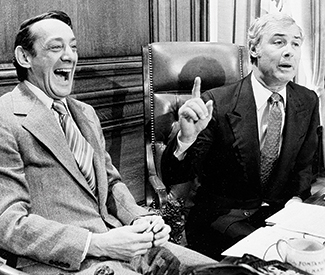
When Mayor George Moscone and Sup. Harvey Milk were assassinated in their City Hall offices on Nov. 27, 1978, San Francisco changed in innumerable ways. Among those ways is the city lost two of the leading progressive advocates for renters and affordable housing ever elected here.

Today, as San Franciscans mark this tragedy with their annual memorial march, organizers and activists have broadened and elevated the event by enlisting the support of 20 community organizations now doing work to combat the eviction, gentrification, and affordable housing crises that are gripping the city.

“We wanted to make this even more than just a candlelight vigil,” David Waggoner, one of the organizers of the event, told the Guardian. “We want to use this time to remember Harvey and George’s legacy in really fighting for the underdog.”

He noted that attendance at the march has waxed and waned from year to year, but the coalition putting this one together promises to have a strong turnout this year because of the surging progressive activism around housing issues and the need to organize the community to save the soul of the city.

“There is very little to stop what’s happening with the rapid gentrification,” Waggoner said, but he also noted, “By building coalitions, the same way Harvey and George did, we can fight.”

“We’re not only honoring the history of Harvey Milk and George Moscone, but we’re honoring their legacy by making them relevant today,” Brian Basinger, head of the AIDS Housing Alliance/SF, told us. “The Milk March is going to be very exciting. We have over 20 community groups invited and helping us put it together.”

Basinger said the progressive activism will continue through the 25th annual World AIDS Day on Dec. 1, and that participants in both events will be asked to present their demands to the city for dealing with the AIDS and housing crises. That list will be presented at City Hall during a noon rally on Dec. 2.

He said that affordable housing issues are LGBT issues given that nearly 30 percent of the city’s homeless population identifies as LGBT, while that identification makes up just 15 percent of the overall city population.

“Those of us who are lucky enough to talk to the folks who knew Harvey remind us that it’s about coalition-building,” Basinger said, noting that many of Milk’s contemporaries are now being forced to leave the city by evictions or economic displacement.

One voice from that era who is still around and active is gay activist Cleve Jones, who was an intern in Milk’s office at the time of the assassination and wrote a poignant guest editorial in the Nov. 21 issue of the Bay Area Reporter about what Milk and Moscone advocated.

“They fought for renters, honored labor, and built coalitions to connect, not divide, us from each other,” Jones wrote. “They would, I’m sure, be pleased by the progress that has been achieved on some of the issues they cared about. But they would be alarmed by the growing chasm between rich and poor, they would be angered by the evictions of the elderly, disabled, and people with AIDS. They would be fighting to keep City College open and they would be outraged by the violence and despair experienced by so many in our city’s neighborhoods.”

Organizers of the event say they think this is just the kind of memorial that Milk and Moscone would have wanted.

“We want the housing crisis to be front and center,” Waggoner said. “We want this to be a time for people to connect with the legacy of Milk and Moscone in a very direct way.”

The march begins at 7pm in Milk Plaza, Castro and Market streets, and continues with a rally outside City Hall.


Activists organize, and some journalists chronicle, a progressive resurgence in SF

131

While Mayor Ed Lee jets around the world, still too focused on fueling the economic fire that is gentrifying San Francisco and displacing its diverse population — and as the San Francisco Chronicle and other downtown boosters niggle on the margins of the city’s biggest issue — local activists and some media outlets are paying attention and pushing back.

The New York Times ran an excellent Sunday piece about the growing populist backlash here against Mayor Lee’s economic policies and his friends and benefactors in the tech industry, a story that the Santa Rosa Press Democrat also put on its front page, but which the Chronicle only briefly mentioned today on its business page in a short story wrapping all the high-end housing now coming online. Instead, on Sunday the Chron ran this pro-landlord garbage

Meanwhile, as we report in tomorrow’s edition of the Guardian, more than 20 local organizations have combined forces this year to organize and promote tomorrow’s (Wed/27) annual memorial march marking the 1978 assassinations of Mayor George Moscone and Sup. Harvey Milk in City Hall, which will this year focus on their legacy of advocating for renters and keeping this city affordable by and welcoming of the working class and outsiders of all types.

We’ve said it before and we’ll say it again: this is a struggle for the very soul of San Francisco, and it’s a struggle that we at the Guardian renew our commitment to with every issue we print. See you all on the streets tomorrow night starting at 7pm in Milk Plaza and Castro and Market.    

Obama speech interrupted by Bay Area immigration activists

21

Ju Hong just wants to see his family for Thanksgiving, and that may be why he shouted down the president of the United States.  

Hong interrupted President Barack Obama’s nationally televised speech in Chinatown today, shouting for justice at the tail end of the president’s call for immigration reform. 

San Franciscans and politicos gathered in the Betty Ong Recreation Center to hear the president call on congress to pass new laws regulating immigration, something sorely needed, as Obama is widely known for deporting record numbers of immigrants. The Pew Research Center shows he’s deported more per year than George Bush ever did, with over 392,000 deported in 2011 alone, 80,000 more than Bush’s highest year. 

Obama called for a greater focus on the plight of Asian immigrants, as most of the country’s discussion around deportations focuses on the southern border. 

“It’s fitting we’re here in Chinatown just a few miles away from Angel Island,” Obama said. “In the early `1900’s about 300,000 people, maybe some of your ancestors, passed through on their way to a new life in America. For many it represented the end of a long and arduous journey.”

“Maybe I started out washing dishes, but my son can become mayor of San Francisco,” Obama said, to laughter. “If we stay true to this history, if we can cross that finish line, and go ahead and do what needs to be done, were going to grow that economy,” Obama said, and then was interrupted by Hong, shouting across the room. 

“My family is separated for Thanksgiving. Our families are separated,” Hong shouted. “I need your help. There are thousands of deported immigrants. Mr. President please use your executive order to halt deportations for all 11.5 undocumented immigrants in this country right now. When you have the power to stop deportations for all.”  

Obama turned around and replied, “Actually I don’t.”

“Stop deportations!” Hong and his friends started to chant. 

Likely to the Secret Service, Obama said “No no, don’t worry about it guys. These guys don’t need to go.” Then he spoke to Hong. “Let me finish. You can stay there. It won’t be as easy as just shouting, it requires lobbying and getting it done,” he said.

Outside the rec center, Hong said he felt that Obama’s speech had lots of flash but no substance. 

juhong

Ju Hong interviewed by reporters outside of the Betty Ong Recreation Center.

“Families are still being torn apart,” he said. “I’m not satisfied at all. He said he didn’t want to violate the law, but he has the power to stop deportations.” 

Hong, 24, is an Alameda resident from Korea who came to the United States when he was 11 years old. When his grandfather died back home, he was unable to pay his final respects. Now he wants to fly back to South Korea to see his family, but can’t risk not being able to return.

The fear of deportation has touched him in many ways. In 2010 his home was burglarized, he said, but his mother said not to call the police. She feared they would discover they were undocumented.

“I was a strong support of Obama in 2008,” he said. But now, he’s lost hope. 

Hong was one of the students protesting Janet Napolitano’s appointment to head the University of California system, which we covered a few weeks ago (Undocumented and Unafraid, 11/12). 

SF General reduces psychiatric care

A 22-bed psychiatric unit at San Francisco General Hospital will be taken out of service, and re-opened only if the facility experiences a high caseload of patients exhibiting the worst signs of psychiatric crisis, the Bay Guardian has learned.

As of Nov. 19, five patients were receiving care in that unit, 7B, according to spokesperson Rachael Kagan. None had symptoms that rose to the level of requiring acute care. Instead, they were classified as sub-acute patients, a distinction that essentially means they didn’t present an immediate threat to themselves or others.

But under a new policy that will take effect after they have been released, all 22 beds in 7B will be closed – unless they are needed for acute patients who do reach that critical threshold. The unit will be staffed only if patients can’t be accommodated in the hospital’s other acute psych unit, which has 21 beds.

The decision was made in response to a changing financial picture under federal health care reform, Kagan explained.

“There is a big push … to ensure hospitals are only providing acute care,” Kagan said, and this trend is driving efforts to reduce sub-acute patients. “It fiscally makes more sense,” she added, because insurers pay higher rates for acute care than for lower levels of treatment.

Yet some hospital staff members are nervous about the implications of this shift, because it means fewer patients will be able to access psychiatric care at SF General until they represent a danger to themselves and/or the general public – at a time when demand for these services is on the rise.

“To us, it’s a matter of priority for the city,” said Brenda Barros, an employee at SF General who is active with hospital union SEIU 1021. “Do you want to take care of these people, or don’t you?” 

Some staff members are doubtful that 7B will reopen. An internal SF General memo issued Nov. 18 informed 7B staff: “Our census will be gradually reduced until we won’t have any more patients. Then 7B will be closed.” The memo added, “this came from [SF General CEO] Sue Currin due to budgetary constraints.”

However, a second internal memo went out the following day, to “clarify” the first one. In that message, Nursing Director Kathy Ballou wrote: “We are not closing psych beds or any beds.” Instead, beds in 7B would be closed unless “we get acute patients needing that level of care,” she wrote. “As in other hospitals, we are accountable to our operating budget.”

Further complicating matters, said Barros, is that patients can fluctuate rapidly between needing acute care and a lower level of attention. “They absolutely can swing back and forth.” She added that patients initially requiring a lower level of care could experience worsening conditions if they’re unable to secure an appointment in time to get help, and delays are very common.

Kagan emphasized that the unit wasn’t being closed down, but did confirm that sub-acute patients would no longer be able to receive treatment in 7B. Instead, those patients will be placed with various service providers throughout the city, she said. “The goal is to move the patients to their appropriate placement.”

Meanwhile, this shift coincides with an overall rise in citywide demand for psychiatric services. According to a report delivered to the Police Commission earlier this year, SF General had 6,293 patient admissions for psychiatric holds in 2012, a sharp increase from 5,837 in 2009.

While there were deep cuts to the city’s Department of Public Health during the economic downturn, Mayor Ed Lee has recently trumpeted a boost to city coffers thanks to growing economic activity. But if the city’s financial health has improved, it seems odd that its flagship safety-net hospital would be put into the position of reducing psych care due to budgetary pressures when that kind of care is sorely needed.

For Barros, it’s a matter of whether or not city officials will decide to allocate more funding for mental health services. “If they don’t have enough money in Public Health,” she said, “then they need to put more into Public Health.”

Parents under pressure

1

 In recent weeks, the San Francisco Unified School District held a series of community forums to ask parents what they think kids need in order to thrive in school. The meetings were held as part of a policymaking process leading up to next year’s renewal of two important funds — the Children’s Fund and the Public Education Enrichment Fund, which account for some $100 million in funding combined.

There were huge turnouts — a Chinatown forum, where Mayor Ed Lee was reportedly in attendance, attracted more than 180 participants, while a Nov. 14 meeting at Cesar Chavez Elementary in the Mission District drew a crowd of between 80 and 90.

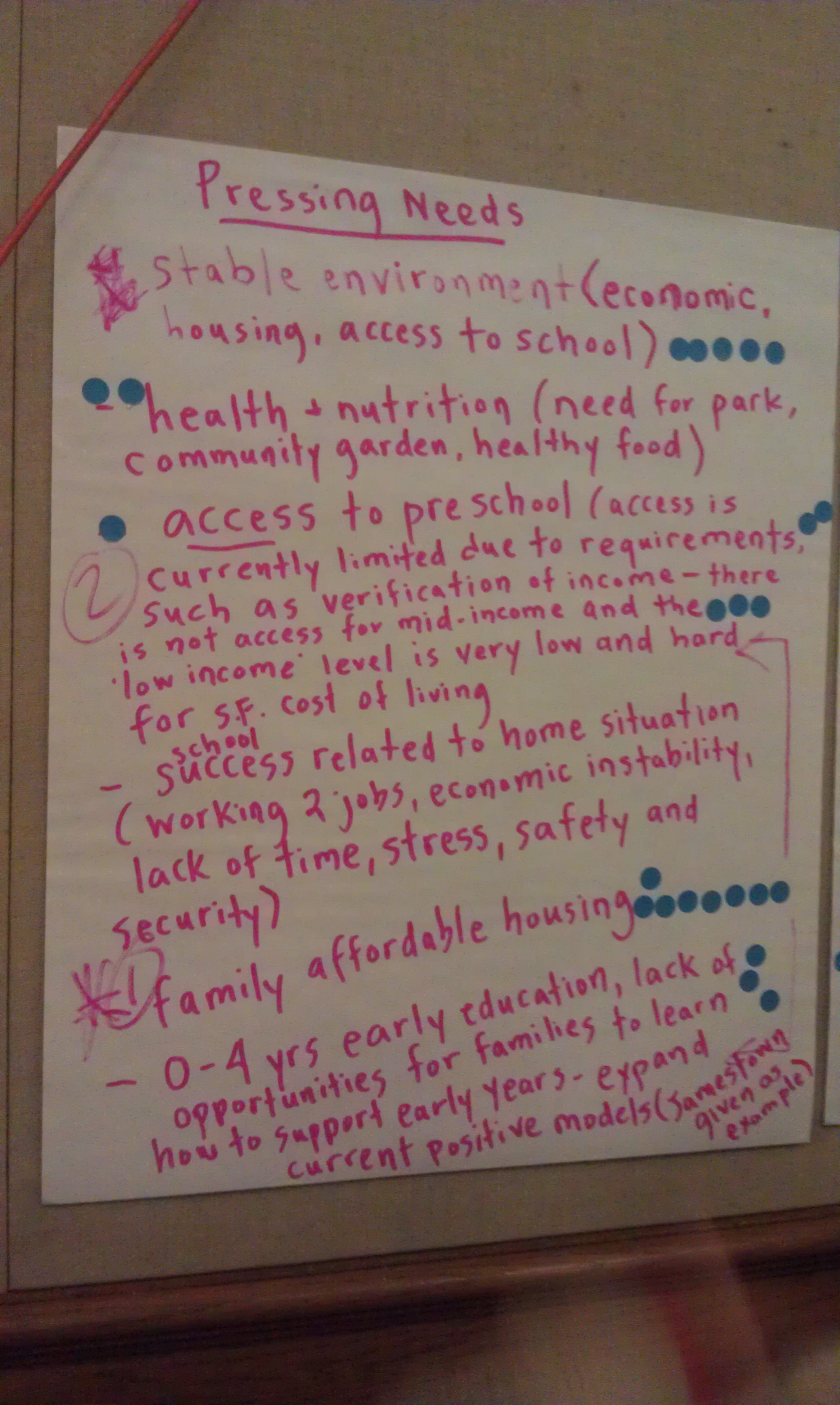
The parents weren’t exactly asking for more museum field trips for their kids. During breakout sessions where facilitators wrote group members’ concerns on flip pads, a few recurring themes emerged. “Job security for parents,” one read. “Affordable housing,” another stated. “It’s a shame to have to talk about lack of funds given wealth and corporations in SF,” more parent feedback stated.

Maria Su, director of the San Francisco Department of Children, Youth and their Families, thanked parents for coming and told them, “We know how hard it is and how challenging it is to survive in the city. But that doesn’t mean we should give up.”

The whole exercise provided a glimpse into just how tough it is for families to get by in a city where a hefty cost of living amounts to serious pressure. “The sacrifices they make is, their children will have access to resources you can’t get anywhere else,” said Mario Paz with the Good Samaritan Family Resource Center, who works with a lot of Latino immigrant families.

A report digesting the findings of stakeholder focus groups boiled it down. “Many participants commented on … the extraordinarily high cost of living in San Francisco,” it noted, which “contributes to both financial and emotional strain on the part of our many working class and lower income residents.” 


Eviction epidemic spurs legislative solutions

3

Tenants, organizers and residents impacted by Ellis Act evictions packed the Board of Supervisors Chambers at San Francisco City Hall Nov. 14 for a hearing on eviction and displacement in San Francisco. As more and more residents face ousters only to be priced out, lawmakers and advocates are floating legislative fixes to try and reverse the trend before it reaches the soaring levels of the displacement epidemic that impacted the city during the first dot-com boom.

“It seems to me that we have a tale of two cities,” Sup. David Campos, who requested the hearing, said at the start of the discussion, held at the Board of Supervisors’ Neighborhood Services and Safety Committee. “We must act urgently to address this crisis, which I believe is a crisis,” he added. “We are fighting, I think, for the soul of San Francisco.”

Fred Brousseau of the San Francisco Budget and Legislative Analyst’s office shared his recent analysis on eviction and displacement trends across the city.

Overall evictions in San Francisco rose from 1,242 to 1,716 over the past three years, he said, reflecting an increase of 38.2 percent. Ellis Act evictions rose by 169.8 percent in that same time frame.

Almost 42 percent of individuals impacted by eviction had some form of disability, Brousseau noted, while 49 percent had incomes at or below the federal poverty level. On the whole, a total of nearly 43 percent of San Francisco households are “rent-burdened,” a term that officially means devoting more than 30 percent of household income toward rent, the study found.

Ted Gullicksen of the San Francisco Tenants Union emphasized that tenant buyouts, frequently offered in lieu of an eviction, are also driving displacement, although those transactions aren’t reflected in city records. “There are about three of them for every Ellis Act eviction,” he said. “When you consider them in combination with Ellis, the numbers are very dramatic.”

Throughout the afternoon, tenants shared their stories and fears about getting frozen out of San Francisco by eviction. “I’m looking at shopping carts, and I’m terrified,” one woman told supervisors during public comment. “You have to do something. It might not be enough for me right now, but you can’t do this to any more people.”

Campos is working with Assembly Member Tom Ammiano on a proposal to grant San Francisco the authority to place a moratorium on Ellis Act evictions. He’s also pursuing legislation that would create a mechanism at the San Francisco Rent Board to allow tenants to register formal complaints about landlord harassment and other kinds of pressure.

“I am eager to introduce a bill in January,” Ammiano noted. “One option might be a law that will allow the local jurisdictions, like San Francisco, to suspend the Ellis Act or establish a moratorium, because of the emergency housing situation. Another possibility is working to make sure that landlords are not skirting Ellis eviction requirements by improperly pressuring tenants to leave. We must do something, but we have to work together to make it successful.”

Meanwhile, Mayor Ed Lee recently announced that he is working with Sen. Mark Leno on legislation to curb Ellis Act evictions by requiring additional permits or hearings before they proceed. They’re also contemplating floating more stringent regulations on the sale and resale of properties where tenants have been evicted under Ellis.

At the end of the day, it’s clear that housing advocates are gaining momentum as the spike in tenant ousters continues in pricey San Francisco, where rents are the highest in the nation.


Parents under pressure

In recent weeks, the San Francisco Unified School District has held a series of community forums to ask parents what they think kids need in order to thrive in school. The meetings were held as part of a policymaking process leading up to next year’s renewal of two important funds – the Children’s Fund and the Public Education Enrichment Fund, which account for some $100 million in funding combined.

There were huge turnouts – a Chinatown forum, where Mayor Ed Lee was reportedly in attendance, attracted more than 180 participants, while a Nov. 14 meeting at Cesar Chavez Elementary in the Mission District drew a crowd of between 80 and 90.

The parents weren’t exactly asking for more museum field trips for their kids. During breakout sessions where facilitators wrote group members’ concerns on flip pads, a few recurring themes emerged. “Job security for parents,” one read. “Affordable housing,” another stated. “It’s a shame to have to talk about lack of funds given wealth and corporations in SF,” more parent feedback stated.

Maria Su, director of the San Francisco Department of Children, Youth and their Families, thanked parents for coming and told them, “We know how hard it is and how challenging it is to survive in the city. But that doesn’t mean we should give up.”

The event provided a glimpse into just how tough it is for families to get by in a city where a hefty cost of living amounts to serious pressure. “The sacrifices they make is, their children will have access to resources you can’t get anywhere else,” said Mario Paz with the Good Samaritan Family Resource Center, who works with a lot of Latino immigrant families.

A report digesting the findings of stakeholder focus groups distilled the pressures facing families. “Many participants commented on … the extraordinarily high cost of living in San Francisco,” it noted, which “contributes to both financial and emotional strain on the part of our many working class and lower income residents.”

Hundreds attend hearing to call for action on evictions

Tenants, organizers and residents impacted by Ellis Act evictions packed the Board of Supervisors Chambers at San Francisco City Hall today, Thu/14, for a hearing called by Sup. David Campos on eviction and displacement in San Francisco.

“It seems to me that we have a tale of two cities,” Campos said at the outset of the hearing, which was held by the Board of Supervisors Neighborhood Services and Safety Committee. “The vast majority of individuals are struggling to stay in San Francisco. We must act urgently to address this crisis, which I believe is a crisis.” He added, “We are fighting, I think, for the soul of San Francisco.”

Tony Robles of Senior and Disability Action, who showed up at the hearing wearing a black hooded sweatshirt with pobre (the Spanish word for “poor”) printed across the front, expressed his frustration with the surge of evictions taking place in the booming economic climate. “We have been overlooked – the workers, communities of color … it’s almost as if we are an afterthought,” he said.

Fred Brousseau of the San Francisco Budget and Legislative Analyst’s office delivered a report on his recent analysis of eviction and displacement trends across the city.

Overall evictions in San Francisco rose from 1,242 in 2010 to 1,716 in 2013, reflecting an increase of 38.2 percent, according to San Francisco Rent Board Data highlighted in Brousseau’s report. 

Ellis Act evictions in particular increased by 169.8 percent in that same time frame, he said, with the most recent data showing a total of 162 Ellis Act evictions over the twelve months ending in September 2013. That number reflects units evicted, not how many tenants were impacted.

Ted Gullicksen of the San Francisco Tenants Union emphasized that tenant buyouts, frequently offered in lieu of an eviction, are also driving displacement even though these transactions aren’t reflected in city records.

“We need to get in control of these buyouts,” he said. “There are about three of them for every Ellis Act eviction. When you consider them in combination with Ellis, the numbers are very dramatic.”

Brousseau also showed a slide profiling the people who’ve been impacted by evictions citywide. Almost 42 percent had some form of disability, the data revealed, while 49 percent had incomes at or below the federal poverty level.

On the whole, Brousseau said, a total of nearly 43 percent of San Francisco households are “rent-burdened,” a term that officially means devoting more than 30 percent of household income to monthly rental payments.

Throughout the afternoon, tenants shared their stories and fears about getting frozen out of San Francisco by eviction. “I’m looking at shopping carts, and I’m terrified,” one woman told supervisors during public comment. “You have to do something. It might not be enough for me right now, but you can’t do this to any more people.”

Hene Kelly noted that elderly tenants are being disproportionately impacted by Ellis Act evictions. “They don’t have the reserves, they don’t have the jobs, and they don’t have the money to be able to move if they are evicted,” she said. Referencing landlords and speculators who are driving displacement, she added, “It makes me think of cabaret. Money, money, money, money, money makes the world go round.”

Campos noted that he is working with Assembly Member Tom Ammiano on a proposal to grant San Francisco the authority to place a moratorium on Ellis Act evictions.

He’s also working toward legislation that would create a mechanism at the San Francisco Rent Board allowing tenants to register complaints of harassment or other forms of pressure from landlords seeking to drive them out.

His proposal also envisions doubling the amount of relocation assistance that landlords would have to provide to tenants, in the case of no-fault evictions. He also mentioned the possibility of regulating buyouts, by requiring landlords to record these transactions with the rent board, and possibly prohibiting property owners from charging market-rate rent directly after completing a tenant buyout.

Meanwhile, Mayor Ed Lee recently announced that he is working with Sen. Mark Leno on legislation that is meant to reduce Ellis Act evictions. That proposal would require additional permits or hearings before an Ellis Act eviction could go forward, and place more stringent regulations on the sale and resale of properties where tenants have been evicted under the state law.

Just a couple weeks ago, a coalition of housing advocates proposed a sweeping package to turn the tide on evictions.

At the end of the day, it’s clear that housing advocates are gaining momentum as the spike in tenant ousters continues in pricey San Francisco, where rents are the highest in the nation.

“We’ve never been late on our rent,” noted Beverly Upton, executive director of the San Francisco Domestic Violence Consortium, who is battling an Ellis Act eviction. “We’ve paid for every improvement ever done in 25 years. And now we have to leave.” She appealed for legislators to take action for the sake of the city’s future, asking, “Once the advocates and the organizers and the people who care are gone, who will be left in our city?”

Tale of two parties: Voters reject 8 Washington project

21

From the Election Night victory party for opponents of the 8 Washington waterfront luxury condo project, the overwhelming defeat of developer-backed Propositions B and C seemed to go beyond just this project. It sounded and felt like a blow against Mayor Ed Lee’s economic policies, the gentrification of the city, and the dominion that developers and power brokers have at City Hall.

“What started as a referendum on height limits on the waterfront has become a referendum on the mayor and City Hall,” former Board of Supervisors President Aaron Peskin told the large and buoyant crowd, a message repeated again and again at the Nov. 5 gathering.

Former Mayor Art Agnos also cast the victory over 8 Washington as the people standing up against narrow economic and political interests that want to dictate what gets built on public land on the waterfront, driven by larger concerns about who controls San Francisco and who gets to live here.

“This is not the end, this is the beginning and it feels like a movement,” Agnos told the crowd. “We’ll have to tell the mayor that his legacy,” a term Lee has used to describe the Warriors Arena he wants to build on Piers 30-32,” is not going to be on our waterfront.”

Campaign Manager Jon Golinger also described the victory in terms of a political awakening and turning point: “We are San Francisco and you just heard us roar!”

Campaign consultant Jim Stearns told the Guardian that he thought the measures would be defeated, but everyone was surprised by the wide margin — the initiative B lost by 25 percentage points, the referendum C was 33 points down — which he attributed to the “perfect storm” of opposition.

Stearns cited three factors that triggered the overwhelming defeat: recent populist outrage over the city’s affordability crisis, concerns about waterfront height crossing ideological lines, and “a tone deaf City Hall that didn’t want to hear there were any problems with the project.”

Among the key project opponents who have sometimes stood in opposition to the city’s progressives was former City Attorney Louise Renne, who blasted City Hall and called the Planning Department “utterly disgraceful,” telling the crowd, “Get your rest, more to come, San Francisco.”

Both progressive and political moderates often share a distrust of the close connections between powerful developers and the Mayor’s Office, and that seemed to play out in this campaign and at the polls.

“San Francisco, this victory is for you,” Renne said. “And to all those developers out there: Do not mess with our waterfront. We’re not going to stand for it.”

Meanwhile, it was a very different scene over at the Yes on B and C party.

Developer Simon Snellgrove, whose 8 Washington project was soundly rejected despite his spending almost $2 million on the campaign, was in no mood to comment. “I’m having a little private party tonight,” he told us, “and I don’t want to talk to the press.”

Rose Pak, a consultant for the San Francisco Chinese Chamber of Commerce who is well-known for her ties to powerful interests in the city, had a small circle of guests around her throughout the night and spent some time catching up with Snellgrove. Asked to comment, Pak said, “I don’t know the Bay Guardian,” and stopped making eye contact. At previous events, Pak has lectured Guardian reporters about what she sees as the paper’s shortcomings.

“I think this project got caught up in a lot of other things,” Jim Lazarus, the vice president for public policy at the San Francisco Chamber of Commerce, told us. “There was a lot of I think mistaken concern about the impact.”

He criticized the focus on building heights and the idea that it was about something more than just a waterfront development project. But this was the outcome, he said, because “an unholy alliance of people got together to oppose the project.”

Perhaps “unholy alliance” is in the eyes of the beholder, but the voters of San Francisco seemed to prefer the alliance that opposed 8 Washington and all that it has come to represent in San Francisco. 


Alerts: November 13 – 19, 2013

0

Thursday 14

Forum: Our children, our city Cesar Chavez Elementary School, 825 Shotwell, SF. ourchildren-ourcity.wikispaces.com. 6-9pm, free. Mayor Ed Lee and San Francisco Unified School District Superintendent Richard Carranza will join with other city leaders for this forum on public education in the city. The Children’s Fund and the Public Education Enrichment Fund, which together provide more than $100 million for young people in the public education system, will soon expire. Are there smarter and more effective ways for parents, educators and city officials to work together? Show up to share your opinions and ideas. Mayor Ed Lee, San Francisco Unified, and senior leaders from the City and SFUSD invite you to share your opinions and ideas.

Watch a film about climate change aboard a famous ship Pier 15, 698 Embarcadero, SF. tinyurl.com/PostcardsofClimateChange. 6-7:30pm or 8-9:30 p.m., free. RSVP required. Join Greenpeace on the deck of their intrepid environmental crusading vessel, the Rainbow Warrior, which is temporarily berthed in the San Francisco Bay. “Postcards from Climate Change,” was inspired by the unprecedented destruction wrought by Hurricane Sandy. Greenpeace began collating climate change stories from the affected region and expanded its reach to the rest of the country.

Friday 15

Social Impact Film Festival The New Parkway Theater, 474 24th St., Oakl. Events.compathos.com. 6-11pm Friday, 5pm-12am Sat/16. Sponsored by the Compathos Foundation, the Relevate! Social Impact Film Forum will bring together community leaders to deepen an understanding of issues relevant to the Bay Area. With the theme New Worlds are Possible, it will include screenings of award-winning documentaries and nonfictional shorts by filmmakers and young, Oakland-based media artists tackling issues such as human rights, immigration, crime and violence, environmental and related heath issues and social injustice. Tickets can be purchased online in advance. Ticket proceeds benefit Compathos’ Youth Media Travel Abroad Program, which facilitates youth media and social justice. Cosponsored by KPFA.

Tuesday 19

Forum on a new county jail First Unitarian Universalist Center, 1187 Franklin, SF. 1-3pm. A debate is underway about a proposal to build a long-term jail, to replace seismically unsound county jails at San Francisco’s Hall of Justice. The planned facility would be smaller than the current jail and incorporate more space for programming and family visitation. But some prison justice advocates question the idea of building a new jail at all. At this forum, representatives from the San Francisco Sheriff’s Department and Californians United for a Responsible Budget, which seeks to reverse mass incarceration, will debate the best way forward for prison and restorative justice.

How San Francisco should really be helping the Philippines

49

There were a couple good stories in today’s San Francisco Chronicle related to concerns the Guardian and its readers have sounded in recent months: Mayoral appointees blocking CleanPowerSF against the will of the elected Board of Supervisors, and the massive scale of the proposed Warriors Arena, which is now getting slightly downsized.

It was getting a little lonely beating the drum over the anti-democratic actions of the Mayor Ed Lee and his minions to undermine the only plan San Francisco has to substantially decrease its greenhouse gas emissions and meet its own ambitious goals for addressing climate change. Glad to see the Chronicle turn up the heat, at least in its news section (unlike the neocon neanderthals that write the paper’s editorials).

While the mainstream media sometimes does good work, it usually fails to connect the dots, which is an important journalistic function. So if I would find fault with the otherwise solid and long overdue story by reporters Marisa Lagos and David R. Baker, it would be with its failure to note that CleanPowerSF is really the only plan for seriously addressing climate change, which is one of the biggest and most impactful challenges we face.

This morning on KQED’s Forum, while discussing the devastating typhoon that struck the Philippines — one of the strongest ever recorded — they did connect the dots between the severity of that storm and the warming oceans of the world, albeit in fairly detached and non-urgent way.

So please allow me to connect another dot.

“Our hearts go out to all of those who have suffered in the Philippines from possibly the world’s strongest storm. The people of the Philippines are in our thoughts and prayers today, and we will continue to support them in the days and months ahead as we learn the true impact caused by Typhoon Haiyan,” Mayor Lee said Friday in a prepared statement sent to the media. “San Francisco stands ready to aid in the rebuilding and recovery efforts. The work of rebuilding communities begins immediately, and San Francisco understands how important a sustained, vigorous recovery effort is. Our City stands ready with the Bay Area Filipino-American community to assist today and into the future to help in the rebuilding efforts in the Philippines.”

What he didn’t mention was climate change. While it’s great that San Franciscans stand ready to address the effects of this and other natural disasters — which all the global warming models show will become stronger and more frequent — why aren’t we willing to show more leadership in addressing the root cause of this problem?

Instead of collaborating with developers on ever more ambitious schemes to build expensive buildings on a waterfront that will already be challenged by rising seas, the Mayor’s Office should be channeling its energies into making San Francisco a role model for other 21st century cities to follow.

The real challenges that we and other cities around the world face now are how to address poverty, the energy and transportation needs of a growing population, and a planet in peril; instead, this Mayor’s Office is focused on poaching Oakland’s basketball team and building more housing for the 1 percent.

If Mayor Lee is serious about the sympathies he’s expressing for vulnerable populations in the developing world, then he and allies should do more than send care packages when they are devastated by the byproducts of the wasteful and overly consumptive economic policies that they are promoting.  

Filipino group snubs mayor over evictions

4

The board members of a local Filipino heritage organization, with ties to a high-profile eviction defense battle at San Francisco’s International Hotel in the late 1970s, have declined to an accept an award that San Francisco Mayor Ed Lee had planned to extend to them as part of a Filipino American History celebration because they are angry about a growing trend of senior evictions.

In a written statement sent to the media by board member Tony Robles, the Manilatown Heritage Foundation explained that it couldn’t accept the award as long as “elders are being preyed upon, evicted and given a de facto death sentence thereof.”

The Manilatown Heritage Foundation board members were informed by Board of Supervisors President David Chiu that Lee had planned to recognize the I-Hotel as part of an annual cultural history celebration at City Hall, the statement noted.

“Part of the occasion was to honor the I-Hotel and its many tenants and activists for its contribution to Filipino American history,” board members explained.

In 1976, the I-Hotel was targeted for demolition, prompting a historic eviction defense battle led by housing activists who rallied to the defense of the impacted tenants. As a young attorney who worked with the Asian Law Caucus, Ed Lee was involved in that fight — as an activist defending tenants’ rights to stay. He frequently referred to this chapter of his personal history while running for mayor in 2011, to demonstrate his sensitivity to concerns about affordable housing.

But now that Lee is well into his mayoral term, a surge of evictions of low-income seniors is worsening on his watch. Tenant defense organizations such as Eviction Free San Francisco are showing up outside landlords’ homes and offices to protest eviction notices that threaten to push low-income seniors with few options out of the city.

“The I-Hotel fight was for dignity and it lived by the premise that housing is a human right,” the group’s statement explained. “The fight for the I-Hotel galvanized the community around the fight for affordable housing, particularly for seniors who sacrificed much and on whose shoulders we stand. The fight included tenants, elders, activists, artists and students who recognized that the real estate developers and financial interests were out of control—power unchecked.” 

The next election

15

EDITORIAL This week’s dismal election in San Francisco is a symptom of deeper problems in our political system, both here and across the country. It isn’t voter apathy that caused what is expected to be record low turnout at the polls. It was an understandable loss of faith in an electoral system dominated by money and insider political games. And that’s what we need to address before the next election.

Three of the four officeholders on the Nov. 5 had no opposition, while Dist. 4 Sup. Katy Tang had only token opposition from someone new to town with no relevant experience. Why would these important, coveted, well-paying jobs have no applicants? Because the cost of admission is just too high, and it looks to many observers like the fix is in.

Tang and Assessor-Recorder Carmen Chu were each appointed to their posts by Mayor Ed Lee, and it is because of that connection that they were able to raise nearly $200,000 each, the most in this field of experienced office-holders. They also unfairly benefited from the power of incumbency, which can be formidable (as Lee knows, given that he was appointed mayor on the condition that he wouldn’t run for office, breaking that pledge and spending millions of dollars to win the 2011 mayor’s race).

We need a better system, one that the power brokers who put Lee into office can’t game as easily as they do. Maybe we should hold special elections for each vacancy, with shorter campaigns requiring less fundraising and thus opening up the field. Alternatively, we could make all appointees temporary caretakers and prohibit them from immediately running for a full term.

We should also limit how much developers can spend on political campaigns pushing their projects. The $2 million that Pacific Waterfront Partners just spent selling the 8 Washington luxury condo project to voters — particularly the deceptions and limits on reviews by the Planning Department in Prop. B — was obscene and unfair. But it was a smart investment on seeking profits of more than 50 times that figure.

In the post-Citizens United world, where money equals speech, there are legal barriers to doing what needs to be done. But we need to be creative and aggressive at pushing for political reform, from public financing, spending caps, and greater disclosure on campaigns to reforming the City Charter to end our strong mayor form of government, from his appointments to commissions and elective offices to the unchecked power that he has to control the spending of public money.

If we want to woo voters back to the polls, we need to give them something to vote for, and a package of political reforms would be a good place to start.

UPDATE: This editorial was corrected to fix a misspelling of Katy Tang’s last name. 


Mayor Ed Lee’s committee gives $10,000 that it doesn’t have to the 8 Washington project UPDATED

186

Mayor Ed Lee presents himself as a model of fiscal responsibility, but the Mayor Ed Lee for San Francisco Committee that he controls has recently been spending big money that it doesn’t have, including more than $10,000 that it has recently given to the Yes on Propositions B&C campaign, according to campaign finance filings.

The Mayor Ed Lee for San Francisco Committee, a general purpose committee that Lee and its Treasurer Kevin Heneghan are jointly responsible for, made late contributions of $8,666.66 on Oct. 29 and $1,667 on Oct. 30 to San Franciscans for Parks, Jobs and Housing, Yes on Props. B&C, which supports the 8 Washington project. Lee’s committee also made a $4,333.34 contribution to the Yes on A campaign on Oct. 29.

The Lee committee’s contributions are actually small potatoes for the Yes on B&C campaign, which is spending more than $2 million to have voters green-light the project, most of it coming from the developer, Pacific Waterfront Partners, which kicked in late contributions of $450,000 on Oct. 28 and $250,000 on Oct. 24, bringing its total to about $1.8 million.

But what’s interesting about the Lee committee’s donations is that the final pre-election statement that it filed on Oct. 24 showed that it had just $1,208 in the bank and $26,886 in outstanding debts — most of that to Oakland-based EMC Research for polling it conducted during the Sept. 22-Oct. 19 period.

Neither Heneghan nor Lee responded to our calls for comment, and Lee doesn’t have any public events scheduled between now and election day on Tuesday, so details on this intriguing bit of deficit spending and what kind of polling work the mayor’s committee was doing remain a mystery. [UPDATE 11/5: Lee’s office deferred to Heneghan, who just emailed us this response: “As you know, political committee report filings are a snapshot in time. The Mayor Ed Lee for San Francisco ballot measure committee has received additional contributions since the most recent report that will be appropriately reported. All activity through the committee in support of ballot measures endorsed by Mayor Lee will continue to be appropriately reported as well.” We asked Heneghan whether he would disclose the donors, and we’re waiting to hear back.]

The Mayor Ed Lee for San Francisco Committee hasn’t reported raising any money this year, unlike last year when it raised about $400,000 from some of the city’s biggest establishment players, including Lennar Homes ($35,000), Committee on Jobs ($30,000), San Francisco Alliance for Jobs and Sustainable Growth ($25,000 in basically a pass-through from venture capitalist Ron Conway), San Francisco Association of Realtors ($20,000), and the city’s police and firefighters’ unions ($10,000 each).

But how exactly could the Mayor Ed Lee for San Francisco Committee give $10,000 to the Yes on Props. B&C campaign if it didn’t actually have the money to cover the checks?

When we asked a source at San Francisco Ethics Commission about it, at first he was puzzled, and then he told us that while the committee is required to report late expenditures that it makes before the election, it isn’t required to report late contributions that it receives. That we won’t find out until its Form 460s are due Jan. 31, 2014.

So who really paid for Lee’s contributions to the Yes on B&C campaign, as well as more than $20,000 in polling work that Lee’s committee paid for? And what will our mayor do in return for the people who are digging his committee out of its debts?  


Angered by senior evictions, Filipino American activists decline award

The board members of a local Filipino heritage organization, with ties to a high-profile eviction defense battle at San Francisco’s International Hotel in the late 1970s, have declined to an accept an award that San Francisco Mayor Ed Lee had planned to extend to them as part of a Filipino American History celebration because they are angry about a growing trend of senior evictions.

In a written statement sent to media by board member Tony Robles, the Manilatown Heritage Foundation explained that it couldn’t accept the award as long as “elders are being preyed upon, evicted and given a de facto death sentence thereof.”

The Manilatown Heritage Foundation board members were informed by Board of Supervisors President David Chiu that Lee had planned to recognize the I-Hotel as part of an annual cultural history celebration at City Hall, the statement noted. “Part of the occasion was to honor the I-Hotel and its many tenants and activists for its contribution to Filipino American history,” board members explained.

In 1976, the I-Hotel was targeted for demolition, prompting an historic eviction defense battle led by housing activists who rallied to the defense of the impacted tenants. A significant fixture in what was once a predominantly Filipino neighborhood known as Manilatown, the I-Hotel housed 196 tenants, predominantly low-income Filipino immigrants. 

“The I-Hotel fight was for dignity and it lived by the premise that housing is a human right,” Manilatown Heritage Foundation members explained in the written statement. “The fight for the I-Hotel galvanized the community around the fight for affordable housing, particularly for seniors—who sacrificed much and on whose shoulders we stand. The fight included tenants, elders, activists, artists and students who recognized that the real estate developers and financial interests were out of control—power unchecked.” 

The fight dragged on, at one point more than two thousand people surrounded the building to blockade the doors in an effort to prevent an eviction from going forward. The battle over the I-Hotel also brought on a famous San Francisco episode in which then-Sheriff Richard Hongisto served five days in his own jail for refusing to carry out the eviction order. In the end, the tenants were finally ousted. But the epic battle ultimately helped to produce a different outcome, many years later: The property became the site of low-cost senior housing, complete with a commemorative display in the interior documenting the dramatic I-Hotel fight.

As a young attorney who worked with the Asian Law Caucus, San Francisco Mayor Ed Lee was involved in that fight – as an activist defending tenants’ rights to stay. He frequently referred to this chapter of his personal history while running for mayor in 2011, to demonstrate his sensitivity to concerns about affordable housing.

But now that Lee is well into his mayoral term, a surge of evictions of low-income seniors is worsening on his watch. Tenant defense organizations such as Eviction Free San Francisco are showing up outside landlords’ homes and offices to protest eviction notices that threaten to push low-income seniors with few options out of the city. Some evictions have caught the attention of mainstream media, such as the ouster of elderly Chinatown couple Gum Gee Lee and Poor Heung Lee and their disabled daughter, Shiuman Lee.

Some advocates have proposed legislative solutions; meanwhile, the situation has evidently become so criticial that even city’s Human Services Agency is seeking outside assistance to provide eviction prevention services for elderly and disabled tenants facing Ellis Act evictions.

And today, the board of the Manilatown Heritage Foundation drew a line in the sand to send Lee a clear message by refusing to accept the honor of recognition in the current housing climate. So far, mayoral spokesperson Christine Falvey has not responded to the Bay Guardian’s request for comment in response to the Manilatown Heritage Foundation’s statement.

“Given the current state of San Francisco housing by forces out to make a killing by killing our communities, we as the torch bearers of the I-Hotel struggle and in the memory of its displaced elders and advocates Al Robles, Bill Sorro, Felix Ayson, Wahat Tampao and others, cannot, in good consciousness, accept any honor or award while elders are being preyed upon, evicted and given a de facto death sentence thereof. And it doesn’t matter if the honor is bestowed by Mayor Lee, President Obama or the pope. We have to say no.”

Here’s the full statement from the Manilatown Heritage Foundation. Here’s an historical essay about the I-Hotel from Shaping San Francisco’s digital archive at FoundSF.org.