Mayor Ed Lee

Qualifying Mirakarimi’s jury

5

The San Francisco Board of Supervisors formally received the official misconduct case against suspended Sheriff Ross Mirkarimi Sept. 18, starting the clock on the 30-day deadline that the City Charter provides for the board to take action. Board President David Chiu announced a special meeting to consider the case on Oct. 9 at 2pm. The schedule the board had previous agreed to: a 10-minute presentation by the Ethics Commission, 20 minutes by representatives of Mayor Ed Lee (who brought the case), 20 minutes by Mirkarimi’s side, a five-minute rebuttal by Lee, public comment (which could last for hours), and then deliberation by supervisors.

The drama-before-the-drama will involve what in court would be called jury selection — Mirkarimi’s lawyers want to see if any supervisors should be disqualified from voting.

It’s a critical point: It would take at least nine of the 11 supervisors to remove the sheriff, and that number doesn’t’ change if some are ineligible to vote. So every recusal is, in effect, a vote to save Mirkarimi’s job.

And it’s an open question whether some supervisors should recuse themselves. They’re supposed to be unbiased jurors, and if any of them have discussed the case with the mayor in advance, they might be forced to sit this one out.

Mayor Ed Lee was asked on the witness stand whether he spoke with any supervisors about removing Mirkarimi, and he denied it. But Building Inspection Commissioner Debra Walker said her longtime friend and political ally Sup. Christina Olague told her Lee had sought her input on the decision. Confronted by journalists, Olague denied the charge but said, “I may have to recuse myself from voting on this.”

Another possible recusal from the vote would be Sup. Eric Mar, who just happened to be called as a juror in Mirkarimi’s criminal case — and thus could have been exposed to prejudicial evidence — before those charges were settled with a plea bargain. There have also been rumors that Board President David Chiu spoke with Lee about Mirkarimi at some point.

Last month, Mirkarimi lawyer David Waggoner told the board that he wanted each supervisor to declare whether he or she has spoken with anyone about Mirkarimi, but the legal team is proceeding cautiously, wary of offending the supervisors who will now decide the fate of their former colleague.

“We’re going to respectfully ask each member of the board to state under oath who they’ve talked to about the case,” Waggoner told us.

Normally, jurors would be extensively questioned during the voir dire process, and those who had served on an elected body with a defendant for years would almost certainly be removed from the jury pool, which seems to have been the case with Mar’s disqualification on the criminal case. But that’s just one more example of how this unprecedented process is anything but normal, with city officials basically making up the rules as they go along.

Feinstein screws Breed

0

Candidates in the District 5 supervisorial race, where one recent poll showed almost half of voters undecided about a field of imperfect candidates to represent the city’s most progressive district, have been sharpening their attacks on one another — and learning lessons about hardball politics.

Christina Olague, the incumbent appointed by Mayor Ed Lee earlier this year, has been taking flak in recent debates from competitors who are highlighting the schism between her progressive history and her more conservative recent votes and alliances. That gulf was what caused Matt Gonzalez to pull his endorsement of Olague this summer and give it to Julian Davis.

London Breed has now suffered a similar setback: US Senator Dianne Feinstein revoked her endorsement of Breed following colorful comments the candidate made to Fog City Journal, which were repeated in the San Francisco Chronicle, blasting her one-time patron Willie Brown.

Breed, whose politics have been to the right of the district, seemed to be trying to assert her independence and may he gone a bit overboard is proclaiming that she didn’t “give a fuck about Willie Brown.”

Sources say Brown has been in payback mode ever since, urging Feinstein and others to stop supporting Breed. Neither Brown nor Feinstein returned our calls, but Breed confirmed that she was told the senator was “concerned” about that published comment. And we know that Feinstein never called her to discuss the article, her comments or the fact that, perhaps at the behest of Brown, she was yanking her support.

On the record, Breed was contrite when we spoke with her and reluctant to say anything bad about Brown or Feinstein, except to offer us the vague, “There are a lot of people who respect and like me, and they don’t like what they see happening.”

The case for reinstating Mirkarimi

113

EDITORIAL We know for a fact that on New Year’s Eve, 2011, Ross Mirkarimi, the elected but unsworn sheriff of San Francisco, had a physical altercation with his wife that left her with a bruised arm. We know she later complained about that bruise on a video lasting less than a minute. Beyond that, nobody except Mirkarimi and Eliana Lopez knows exactly what happened; there were no witnesses except the couple’s three-year-old son, no video taken during the fight, no audio recordings — nothing.

We know that Mirkarimi agreed to plead guilty to misdemeanor false imprisonment — although we also know there was never any evidence that he actually imprisoned anyone.

That’s all we really know about the incident that has set off an expensive, drawn-out, political and legal battle that could change the city’s politics for years to come. If the whole thing seems a little overblown, that’s because it is.

There is nothing in the record that justifies Mayor Ed Lee’s move to suspend Mirkarimi, and nothing that would justify the supervisors voting to remove him from office. In fact, a removal vote would set a dangerous precedent for future mayors in a city that already gives its chief executive far too much power.

Let us examine the three main reasons why the board needs to vote to restore the elected sheriff.

1. If you believe Eliana Lopez, there’s no case.

The only person other than Mirkarimi who can honestly and accurately testify about the events of New Year’s eve is Lopez — and she has been clear, consistent, and convincing in her account.

Lopez acknowledges that she and her husband have had marital issues, that Mirkarimi wasn’t as supportive or her and their young son as he should have been, that he was away from home and working when she should have been sharing domestic duties. She was considering divorce — but was worried that Mirkarimi might gain custody of their boy.

She testified under oath before the Ethics Commission that Mirkarimi was never someone who “beats his wife” (to use Lee’s utterly inappropriate terminology). He had no history of domestic violence with her.

What he did was grab her arm during an argument, leaving a bruise. Inexcusable, but hardly a sign of serious assault. In fact, Lopez testified that she bruises so easily that just playing around with three-year-old Theo can leave marks on her.

Lopez testified that she made the video to use as a tool — a bargaining chip, so to speak — if Mirkarimi ever sought to gain custody of their son. She said she believed that her neighbor, Ivory Madison, who made the video, was a lawyer and that the video would be protected by attorney-client confidentiality. She said she never wanted to go to the police and never felt physically threatened by her husband.

The mayor charged Mirkarimi with attempting to dissuade witnesses and interfere with a police investigation, but those charges were based almost entirely on the testimony of Madison, whose rambling 22-page statement was so full of hearsay that the Ethics Commission tossed almost all of it. There was absolutely no evidence of witness tampering, and those claims were dismissed.

In fact, the only reason the commission recommended removal is the fact that Mirkarimi bruised his wife and pled to a misdemeanor — one that everyone knows he didn’t really commit. Remember: It’s legal, and common, in misdemeanor cases to plead to something you never did to avoid facing trial on more serious charges.

There’s no principled way to accept as credible the testimony of Lopez and still vote to remove the sheriff. If she’s telling the truth — and we believe her — the case should end right there.

2. Mirkarimi was chosen by the voters, and the voters can freely remove him.

Ross Mirkarimi was elected in November, 2011, with a clear majority in a contested race. The state Constitution provides an excellent remedy for replacing an elected official who has lost the confidence of the voting public; it’s called the recall. With a fraction of the effort that’s been spent on this case, people who feel Mirkarimi should no longer serve as sheriff could have collected signatures and forced an election.

The City Charter gives the mayor extraordinary authority — we would say too much authority — to unilaterally suspend an elected official and seek removal. That’s a power that should be wielded only in the most extreme cases, with great deference to the will of the voters.

Lee did no investigation before filing official misconduct charges. He based those charges on unsubstantiated claims, most of which were proven false. There’s a dangerous precedent here: If Mayor Ed Lee can suspend without pay Sheriff Ross Mirkarimi on such limited evidence, the ability of future mayors to misuse this power could be alarming. And remember: There is nothing in the Charter that allows anyone to suspend or seek removal of the mayor.

3. This case mangles “official misconduct.”

There’s another dangerous element to this case, and it’s not just a legal technicality. The New Year’s Eve incident occurred before Mirkarimi took the oath of office; on that day, he wasn’t the sheriff of San Francisco. He was a supervisor.

It’s hard to claim he was guilty of “official misconduct” on a day when he had no official duties. A fascinating, but unsigned analysis by somebody who clearly has a strong legal background is posted on the web (rjemirkarimi.blogspot.com). It notes:

“If the Supervisors approve what the Ethics Commission did on August 16, they will be handing a powerful new political weapon to all mayors, present and future. Good mayors may never misuse it, but other mayors might. No longer will such a mayor be limited to examining an opponent’s conduct while in office. He will have carte blanche and a strong motive to look farther back in time for personal misconduct that occurred before his opponent took office, and to use what he finds to suspend his opponent without pay and remove him from office — all while claiming (as undoubtedly he will) to be engaged in a noble pursuit of truth and justice.”

Let’s be serious: There have been San Francisco mayors with a long record of vindictive politics, or seeking any method possible to punish their enemies. There may well be again. Do we really want to have this case — this weak case driven more by politics than reason and evidence — set the precedent for the grave step of overriding the voters and removing an elected official?

Any of these three reasons ought to be grounds to vote against the mayor’s charges. Together, they make a sound enough case that it’s hard to imagine how the supervisors, sitting as a fair and impartial jury, could come to any conclusion other than returning Mirkarimi to office. We recognize that there are political implications, that Mirkarimi’s foes will target anyone who votes to support him. And just as it’s hard for some politicians to appear “soft on crime,” it’s nearly impossible to survive in San Francisco if you’re considered “soft on domestic violence.” But anyone who doesn’t want tough choices shouldn’t run for public office. It will take courage to do the right thing here — and in the end, that’s what should matter.

The gloves are coming off in competitive D5

52

Candidates in the District 5 supervisorial race – where one recent poll showed almost half of voters undecided about a field of imperfect candidates seeking to represent the city’s most progressive district – have been sharpening their attacks on one another, learning lessons about hardball politics, and fighting over key endorsements.

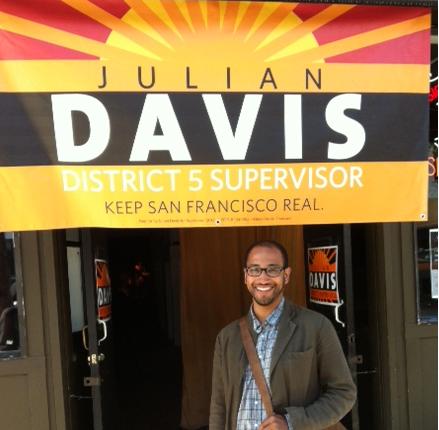
Christina Olague, the incumbent appointed by Mayor Ed Lee earlier this year, has been taking flak in recent debates from competitors who are highlighting the schism between her progressive history and her more conservative recent votes and alliances. That gulf was what caused Matt Gonzalez to pull his endorsement of Olague this summer and give it to Julian Davis.

London Breed has now suffered a similar setback when US Sen. Dianne Feinstein revoked her endorsement following colorful comments Breed made to the Fog City Journal, which were repeated in the San Francisco Chronicle, blasting her one-time political patron Willie Brown. Breed, whose politics have been to the right of the district, seemed to be trying to assert her independence and win over progressive voters who have different worldviews than her more conservative endorsers.

But she may have gone a bit too far when she told Fog City Journal’s Luke Thomas: “You think I give a fuck about a Willie Brown at the end of the day when it comes to my community and the shit that people like Rose Pak and Willie Brown continue to do and try to control things. They don’t fucking control me – you go ask them why wouldn’t you support London because she don’t do what the hell I tell her to do. I don’t do what no motherfucking body tells me to do.”

Shortly thereafter, Breed said she got a call from Feinstein’s people withdrawing the endorsement. “There were just some concerns about the kind of language I used in the article,” Breed told us.

Sources say Brown has been in payback mode ever since, urging Feinstein and others to stop supporting Breed and switch to Olague. Neither Brown nor Feinstein returned our calls. On the record, Breed was contrite when we spoke with her and reluctant to say anything bad about Brown or Feinstein, except to offer us the vague, “There are a lot of people who respect and like me, and they don’t like what they see happening.”

Breed went after Olague hard during a Sept. 18 debate sponsored by the Haight-Ashbury Neighborhood Council and other groups, blasting Olague for her ties to Brown, Lee, and Chinatown power broker Rose Pak, claiming Olague is too beholden to that crew and D5 needs a more independent supervisor.

Asked to respond to the attack during the debate, Olague said, “I won’t dignify that with a response.” But it seems clear to anyone watching the race that Olague has been getting lots of support from Lee, Pak, and Brown and the political consultants who do their bidding, David Ho and Enrique Pearce, which is one reason many progressives have been withholding their support.

The Breed campaign this week trumpeted its endorsement by three prominent progressive activists: Debra Walker, Roma Guy, and Alix Rosenthal. But it has been Davis that has captured the endorsements of the most progressive individuals and organizations, including a big one this week: the Harvey Milk LGBT Democratic Club, which gave Davis is sole endorsement even though he’s straight and Olague is from the LGBT community.

Davis also snagged the number one endorsement of the San Francisco Tenants Union, a big one for D5, as well as the sole endorsements of Gonzalez, former Democratic Party Chair Aaron Peskin, and Sup. John Avalos. Assembly member Tom Ammiano also endorsed the Davis campaign, adding that to Ammiano’s earlier endorsement of John Rizzo, the other solid progressive in the race. Rizzo also got the Sierra Club and the number one ranking by San Francisco Tomorrow.

But Olague is enjoying quite a bit of union support, including snagging the sole endorsement of the San Francisco Labor Council, whose members in the trades like her controversial vote on the 8 Washington project more than progressives or her competitors, who all opposed the deal. Olague was also endorsed by the United Educators of San Francisco and California Nurses Association.

The biggest union of city workers, SEIU Local 1021, gave its unranked endorsements to Davis, Olague, and Rizzo, as did Sup. David Campos. Sup. Jane Kim – who has also occasionally parted ways with progressives after Ho and Pearce ran her campaign against Walker – gave Olague an early endorsement, but late this week also extended an endorsement to Davis.

“As someone who has championed rank-choice voting, it is important for me that progressives are thoughtful about how we strategize for victory.  I have known Julian Davis a long time, and I believe that he would be a strong leader that fights for progressive values that District 5 cares about, including sustainable streets and livable neighborhoods,” Kim said in a statement given to the Davis campaign.

Another important endorsement in D5 is that of the San Francisco Bicycle Coalition, which carried a faint whiff of controversy this year. The group gave Olague its number one endorsement and Davis its number two, but some SFBC members have secretly complained to us that the fix was in and that Davis actually got more votes from SFBC members, which most people thought was how its endorsements are decided.

SFBC Executive Director Leah Shahum told us she wouldn’t reveal who got the most member votes, but she did say that the SFBC Board of Directors actually decides the endorsements based on several factors. “The member vote is one of the factors the board took into consideration,” she said, listing a candidate’s record, relationship with SFBC, personal history, and other factors. “Nothing special was done in that vote, by any means.”

SFBC has been playing nice with Mayor Lee in the last couple years, despite his broken promise of getting the critical yet controversial Fell/Oak separated bike lanes approved by the SFMTA, which he first said would be done by the end of 2011, then by the end of 2012, but which lately seemed to be dragging into 2013.

At SFBC’s urging, Olague recently wrote a pair of letters to the SFMTA urging quicker action on the project, and it seems to have worked: Shahum said a vote on that project has now been scheduled for Oct. 16, and she’s hopeful that it might now be underway by the end of the year after all. As she said, “We’re thrilled.”

BTW, in case you’re curious, the Guardian’s endorsements come out on Oct. 3.

Supervisors set Oct. 9 to decide Mirkarimi’s fate

139

The San Francisco Board of Supervisors officially received the official misconduct case against suspended Sheriff Ross Mirkarimi yesterday, starting the clock on the 30-day deadline that the City Charter provides for that body to take action. Board President David Chiu announced a special meeting to consider the case on Oct. 9 at 2pm.

“The last day the Board of Supervisors can act on this is Oct. 17,” Chiu told his colleagues yesterday, reiterating the schedule the board had previous agreed to: a 10-minute presentation by the Ethics Commission, 20 minutes by representatives of Mayor Ed Lee (who brought the case), 20 minutes by Mirkarimi’s side, a five-minute rebuttal by Lee, public comment (which could last for hours), and then deliberation by supervisors.

In addition, attorneys for both sides have until Sept. 25 to submit any legal briefs they want the supervisors to consider, and Mirkarimi’s attorneys are expected to raise objections to an Ethics Commission summary they considered “one-sided,” as well as getting into the issue of whether Lee committed perjury during his sworn testimony in June.

It takes at least nine of the 11 supervisors to remove Mirkarimi, and there is an open question about whether some supervisors should recuse themselves from voting because of conflicts-of-interest, which would essentially count the same as a vote in Mirkarimi’s favor.

Lee was asked on the witness stand whether he spoke with any supervisors about removing Mirkarimi, which he denied. But Building Inspection Commissioner Debra Walker said her longtime friend and political ally Sup. Christina Olague told her Lee had sought her input on the decision. Confronted by journalists, Olague denied the charge but said, “I may have to recuse myself from voting on this.”

Lee was also asked whether he tried to get Mirkarimi a city job in exchange for his resignation, which Lee denied, but former Sup. Aaron Peskin has said that permit expediter and Lee ally Walter Wong (who has refused to answer questions from the media) extended that offer through him, which Mirkarimi didn’t accept. The Ethics Commission refused to consider the perjury allegations, calling them beyond its purview, but Mirkarimi attorney David Waggoner said he plans to submit sworn declarations by Peskin and Walker to the supervisors.

Another possible recusal from the vote would be Sup. Eric Mar, who just happened to be called as a juror in Mirkarimi’s criminal case before it was settled with a plea bargain. There have also been rumors that Board President David Chiu spoke with Lee about Mirkarimi at some point. Last month, Waggoner told the board that he wanted each supervisor to declare whether they have spoken with anyone about Mirkarimi, but their team is proceeding cautiously and wary of offending the supervisors who will now decide the fate of their former colleague.

“We’re going to respectfully ask each member of the board to state under oath who they’ve talked to about the case,” Waggoner told us.

Normally, jurors would be extensively questioned during the voir dire process, and those who had served on an elected body with a defendant for years would almost certainly be removed from the jury pool, which seems to have been the case with Mar’s disqualification on the criminal case. But that’s just one more example of how this unprecedented process is anything but normal, with city officials basically making up the rules as they go along.

Mirkarimi’s wife and alleged victim, Eliana Lopez, has consistently maintained that she was never abused, except by city officials who have sabotaged and humiliated her family and taken away its livelihood. She told the Guardian that the thin charges in this case shouldn’t warrant the removal of an elected official: “You can have different opinions about Ross’s behavior, and people can have different opinions about that, but the people of San Francisco should decide who represents them.”

Lopez said she’s been dismissed and mistreated by Lee, the Ethics Commission, and domestic violence advocates: “These self-appointed white women that are part of the Domestic Violence Consortium are doing everything they can to attack me and insult me while claiming to help me, and never once reaching out to me.”

But she said that she’s hopeful the supervisors will resist political pressure during an emotionally charged election season and do the right thing: “What we need from the supervisors is brave and honest supervisors. The people of San Francisco need that.”

Historic, veto-proof vote launches CleanPowerSF

24

The San Francisco Board of Supervisors today cast an historic vote that was more than a decade in the making, approving the CleanPowerSF program – which challenges PG&E’s monopoly by offering 100 percent renewable energy directly to city residents – on an 8-3 vote that would be enough to override an implied veto threat by Mayor Ed Lee.

The outcome was far from certain throughout the two-hour hearing as conservative Sups. Mark Farrell and Carmen Chu led efforts to undermine the program, which was the final work product of retiring San Francisco Public Utilities Commission Executive Director Ed Harrington, who previously served as the city’s controller for 17 years.

The pair of supervisors offered a series of amendments challenging the state requirement that city residents must proactively opt-out of such community choice aggregation (CCA) programs if they want to remain with PG&E, offering convoluted language that would have required people to opt-in to the program before its launch, and requiring that the $13 million in reserve funds from the SFPUC be covered entirely by CleanPowerSF customers, which could increase its rates.

“It looks like the amendments would be harmful to the success of the program,” Sup. Eric Mar observed, prompting Farrell and Chu to flash broad conspiratorial smiles at one another.

Sup. Scott Wiener, who was undecided and considered a key swing vote in reaching a veto-proof majority, said he also had concerns about the opt-out requirement and wanted to better understand how the amendments would work and whether they were legal. “For me, I’m not interested in putting any poison pills in here,” he said.

Wiener posed questions about the amendments to Farrell and to Harrington, who said it was possible for the SFPUC to have CleanPowerSF customers repay the initial allocation of reserve funds over time but that he wasn’t sure how the opt-in change would work without sabotaging the program.

“It harms the ability to have an intelligent conversation with people,” Harrington said, noting that rates are based on the number of customers in the program, so it would be nearly impossible to survey everyone’s potential interest without being able to tell them how their bills would be affected.

As it is, the SFPUC has already done extensive surveys of which neighborhoods and demographics are likely to be interested in taking part in CleanPowerSF, initially paying about $10 more per month for 100 percent renewable energy (PG&E’s portfolio includes less than 30 percent renewable). “We’ve done extensive surveys already,” Harrington said. Based on that research, the city is initially rolling out the program to less than a third of city residents, who will be repeatedly notified about how to opt-out, anticipating about 90,000 customers remain in the initial program. 

The program has been repeatedly tweaked over the last eight years that it’s been in development, during which time Marin County launched a successful version of the CCA concept that was developed in San Francisco by legislators Tom Ammiano, Carole Migden, and Mark Leno.

“I feel pretty comfortable trusting Ed Harrington on whether the numbers add up,” said the measure’s chief sponsor, Sup. David Campos, arguing against the Farrell/Chu amendments, later adding, “With Ed Harrington leading this charge, this is as good as it gets. If you don’t like CCA under Ed Harrington, you’re not going to like CCA.”

Farrell claimed to support CCA in concept, but he strenuously objected to the opt-out requirements that Migden included in the enabling state legislation, which she had argued was the only way to make CCAs viable against PG&E’s proven willingness to spend tens of millions of dollars to sabotage would-be competitors.

“It’s the wrong way to legislate, the opt-out. It smells of coercion,” Farrell said. Campos countered that, “The best thing we can give the consumers in San Francisco is a choice, a meaningful choice.”

Wiener ultimately made a motion to delay the item by a week, something Mayor Lee yesterday told the Chronicle he wanted, in order to further study the opt-out issue, telling Farrell that his amendment “feels a little seat of the pants to me.”

Campos and other progressive supervisors who were supporting CleanPowerSF argued against the continuance, noting that it has been years in development and sitting in board committees since January, while the Farrell/Chu amendments weren’t offered until this meeting had already begun.    

“This is not going to change because we wait a week to make a decision,” Campos said. “The terms of this deal are not going to change.”

The motion for a continuance failed on a 4-7 vote, with Wiener joined by Farrell, Chu, and Sup. Sean Elsbernd (who offered no comments throughout the hearing).

Then, as the vote on the Farrell/Chu opt-in amendment came up for vote, Wiener said, “I don’t feel comfortable voting for amendments that I don’t know what they’ll do,” and it failed on a 3-8 vote.

Sup. Malia Cohen had earlier indicated a willingness to support the other Farrell/Chu amendment: saddling CleanPowerSF customers with paying the SFPUC back for reserve fund costs – which Harrington indicated could be dragged out over many years to minimize the impact on rates, and which might not be necessary at all if the initial program exceeds expectations.

That amendment was then approved on an 8-3 vote, with Sups. Jane Kim, Christina Olague, and John Avalos opposed. Another set of amendments that would keep low-income city residents out of the initial rollout and take other steps to reduce their rates if they opted in – which was developed by Kim, Cohen, and Sup. Eric Mar – was unanimously approved by the board.

Then it was time for the big vote on creating the CleanPowerSF program, approving the contract with Shell Energy Northern California to administer it, and authorizing the initial $19.5 million expenditure. Would there be eight votes to override a veto by Mayor Lee, who has been under pressure by PG&E and their downtown allies to kill the program?

“To be perfectly candid, I struggled mightily with this contract,” Wiener said, reiterating his concern about its opt-in requirement, noting that the measure wasn’t perfect, even though it was significantly improved from earlier versions. It sounded as if he were about to vote against it.

“What we have the opportunity to do is move forward with clean power,” Wiener said, noting that even Marin County supervisors who initially opposed its CCA have come around to supporting it. “This is something I believe we should try.”

And with that, the board voted 8-3 to launch the program in mid-2013, with Chu, Farrell, and Elsbernd opposed.

Campos said he was “pleasantly surprised” by the vote, while key supporters say they are cautiously hopeful it will stand up during next week’s final supervisorial approval on second reading and in a veto override vote, if that becomes necessary. Campos said he was thankful for the work of Harrington, who got a standing ovation after the vote as the board recognized him for his long service to the city.

Earlier in the meeting, Harrington told supervisors that while the program isn’t perfect, and it contains some risks that he considers reasonable, there is no other way the city has identified to meet ambitious greenhouse gas reduction goals it has set for itself over the last decade. It is city policy to reduce emissions by 25 percent below 1990 levels by 2017 and 80 percent below those levels by 2050.

“This program before you has the only chance of reaching those goals. There’s nothing else,” Harrington said. He also said “it’s an incredibly efficient way to spend money,” noting that the city has spent $90 million on solar and other renewable energy projects that power fewer than 7,000 homes, whereas this $19.5 million will power 90,000 households, possibly without ever tapping into that $13 million reserve fund set aside to cover any losses by Shell, which will buy renewable energy, a role the city hopes to eliminate as it develops its own projects.

Harrington said the ultimate goal of CleanPowerSF is to develop a large enough customer base that the city could use revenue bonds to finance a wide variety of renewable energy projects – many using solar arrays along city-owned property connected to its water system stretching all the way to Hetch Hetchy Valley – that would pay for themselves.

“The real issue is can you build a facility that will have this rate structure support it?” Harrington said.

That’s the real power and potential of CleanPowerSF – finally taking action to address global warming, which will have a huge impact on San Francisco and future generations – as supporters noted in a rally outside City Hall before the meeting. Sen. Mark Leno said that he doesn’t usually weigh in on proposals before the board, but that, “This is an exceptional time and this is an exceptional vote. This is the time that we need to address our inconvenient truth.”

Beyond the video

124

steve@sfbg.com

The Board of Supervisors received the official misconduct case against suspended Sheriff Ross Mirkarimi this week, with a majority of Ethics Commission members urging supervisors to give more weight to the 45-second video that started this sordid saga than the voluminous record they have compiled at great expense over five months of hearings.

Yet Chair Benedict Hur, the commission’s sole vote against finding that Mirkarimi committed official misconduct, last month argued that supervisors shouldn’t take such a narrow view of this decision, expressing concern about the “dangerous precedent” of removing an elected official for conduct unrelated to his job.

Ironically, Hur will be the one presenting the commission’s case to the board later this month, a decision his colleagues made because the other options weren’t good and because they said he has been so knowledgeable and fair-minded through the process. While Hur is likely to play it straight, the supervisors will have an opportunity to elicit his true perspective — raising questions that will be central to the sheriff’s future.

Will supervisors see their decision as a matter of showing zero tolerance for even minor acts of domestic violence, as Mayor Ed Lee and some women’s groups are urging? Or will they see this as governmental overkill in pursuing a punishment that doesn’t fit the crime, overturning an election and giving mayors too much power to go after their political rivals?

Is this just about Mirkarimi and his actions, or are there larger, more important principles involved in this unprecedented decision?

In the video, Mirkarimi’s wife, former Venezuelan soap opera star Eliana Lopez, displays a small bruise on her right bicep and tearfully tells the neighbor who filmed it, Ivory Madison, that Mirkarimi caused it the previous day, Dec. 31, and “this is the second time this is happening.” She also said that she wants to work on the marriage, but that, “I’m going to use this just in case he wants to take [her son] Theo away from me.”

Lopez last month spent more than three hours on the witness stand being grilled by Deputy City Attorney Peter Keith and Ethics commissioners, explaining why she made the video and how she believed Madison was an attorney and their conversations were confidential. She repeatedly insisted that she was not a victim of domestic violence and criticizing city officials and prosecutors for persecuting her family and taking away her husband’s livelihood.

There was nothing in the testimony that obviously impeached Lopez or hurt her credibility. To many observers -– particularly Mirkarimi supporters, who made up the vast majority of those giving public comments to the commission -– her testimony marked the moment when the city’s case began to unravel. Indeed, on Aug. 16 the commissioners voted unanimously to reject most of the charges that Lee filed, including witness dissuasion, abuse of authority, and impeding the police investigation.

In the end, there was just that video, and commissioners on Sept. 11 added a final statement into the record that they believed it more than anything Lopez has said since then. Even Hur said that he found it compelling, and that more may have happened on Dec. 31 than Lopez and Mirkarimi have admitted.

But there really isn’t much evidence to support that belief, and Hur said in August that it shouldn’t matter anyway. If the city’s vague and untested official misconduct language can apply to low-level misdemeanors unrelated to an official’s duties, he said, “we are opening this provision up to abuse down the road.”


Locking down reforms

0

steve@sfbg.com

Realignment, California’s year-old program of diverting more inmates and parolees from state prison to county jails and probation offices, was borne of necessity: The state faced a severe budget crisis and had been ordered by the federal courts to reduce the population in its overcrowded prisons. But Realignment is proving to be a real opportunity to address inmates’ needs and reduce recidivism, particularly in San Francisco, where progressive notions of rehabilitation and redemption have deep roots.

“Realignment is the most significant criminal justice reform in decades,” says Assembly member Tom Ammiano, the San Francisco Democrat who chairs the Assembly Public Safety Committee and has helped oversee the process. “The motivation of many of us came from things that were thwarted, like sentencing and parole reform, in Sacramento for many years.”

San Francisco was uniquely positioned to thrive under the new system and to be a model for other counties that seek to improve on the 70 percent recidivism rate among state prison inmates, and the myriad problems and costs that spawns. Former Sheriff Michael Hennessey brought a variety of innovative educational and support services into the jail during his 32-year reign that ended last year (see “The unlikely sheriff,” 12/20/11).

“It’s more than an opportunity. It’s in line with the Michael Hennessey doctrine of enhancing public safety while elevating the idea of redemption, and I subscribe to that,” said suspended Sheriff Ross Mirkarimi, who successfully ran as Hennessey’s endorsed heir before Mayor Ed Lee ousted him over domestic violence allegations. “Michael Hennessey made famous the rehabilitation programs inside the jail and outside the jail.”

San Francisco was also in a good position as both a manageably sized city and county, and one that had room for the influx of inmates. It was ordered by the courts in the 1980s to reduce its crowded jail population – the peak jail population of 2,300 is now down to about 1,550 – and gained even more capacity last year when the SFPD’s crime lab scandal resulted in hundreds of drug cases being thrown out by the courts.

“It’s something that makes sense for San Francisco,” Acting Sheriff Vicky Hennessy told us. “We’re doing better than most other counties because we had the bed space and we had community programs. Michael Hennessey is a visionary…and he got these community programs out there.”

Undersheriff Ellen Brin, who oversees the jail, said the main difference among inmates that San Francisco is dealing with under Realignment – a total of 2,258 in the jail over the last year, staying an average of 60 days each, and another 306 convicts under post-release supervision – is that they’re in local custody longer than before.

“It’s sort of the same population we’ve always dealt with, but maybe we’re dealing with them on a longer term,” she said.

That creates some challenges – Brin said there are more inmates who are a little more hardened and “more sophisticated” – but it also gives local programs more of a chance to help the inmates. That was one of the arguments for Assembly Bill 109, the main legislation that created Realignment, along with five other related bills.

“That was the whole plan about AB 109 is the counties do it better,” Brin said. “For us, we’ve been doing these programs for so long, with reentry and other community programs, so it’s easy for us to manage this population because they’re here longer.”

Realignment has also prompted more collaboration among the affected local agencies – particularly the Sheriff’s Department, Adult Probation Services, and the District Attorney’s Office – and their counterparts on the state level.

“We haven’t had an overarching initiative that we’ve all been required to sit around a table and work on. This has kind of brought us together, and we’ve discovered other areas where we need to work together as well,” Hennessy said.

That has sparked new programs. For example, San Francisco just started to bring those about to be paroled from state prison into the local jail before their release in order to integrate them into the San Francisco rehabilitation system. “We’re creating a reentry cycle for them so they aren’t just getting off the bus and landing here and going directly to Probation for an interview,” Hennessy said. “Now, we’re going to try to bring them here 60 days early and provide them with wrap-around services, so that we can get them established, get them housing, give them the best opportunity we can for a successful reentry.”

With counties now responsible for the people local judges send to jail, there’s more interest in reforming sentencing laws and exploring more progressive and community-based alternatives to incarceration, which is the focus of the new San Francisco Sentencing Commission that held its first meeting last month.

“District Attorney [George] Gascon is very supportive of Realignment, DA’s Office spokesperson Stephanie Ong Stillman told us. “He has said it could have the greatest impact on justice reform in decades. San Francisco is on its way to being a model for the state.”

But the flip-side of San Francisco’s advantages has been a growing backlash against Realignment in conservative counties with disproportionately high incarceration rates and a lack of capacity in their jails – which is often a byproduct of combining tough-on-crimes policies with anti-tax attitudes, something Ammiano is now dealing with in Sacramento.

“There is a lot of push-back from the Republican Party and alarmism over Realignment,” Ammiano said, noting that he’s just waiting to be hit with anecdotal stories about a transferred inmate committing some horrific crime, even though Realignment only involves low-level convicts who committed non-violent and non-sexual crimes.

Ammiano will work with a newly constituted Board of State and Community Corrections that will distribute funds to counties that need to beef up each their jail capacities or their treatment programs. That mix hasn’t been set yet, but Ammiano said he won’t support counties that simply seek more state resources to maintain high incarceration rates.

“In one way, it’s perturbing and the other way, it’s exciting,” Ammiano said. “For me, the more the county has programs, the more sympathetic I’ll be.”

Yet in this era of chronically underfunded government entities, even San Francisco is strained. Hennessy and Brin say Realignment has brought more inmates with serious mental health issues into the jails for longer periods of time — and that has stretched their resources.

“That’s where we lack, even before AB 109, and I’d like to get more people in there who are experts in the mental health field,” Brin said.

Hennessy agreed, but added, “The mental health program we have is extremely good, it’s just overtaxed because we’re seeing many more people, and this is across the state.” Mental health isn’t the only issue. “The other thing that is a concern is housing for people,” Hennessy said, explaining that the city needs both supervised housing and regular low-income housing for former inmates returning to the community. Maintaining the Sheriff’s Department progressive legacy in the face of new challenges is one reason why Mirkarimi sees danger in Lee’s decision to overturn that election and consolidate more power in the Mayor’s Office. “It’s important that the independence of the Sheriff’s Department be preserved,” Mirkarimi said. “Programs can easily be changed by successive mayoral administration if there isn’t that check on power.” But for now, Brin said San Francisco’s various law enforcement officials have been working well to realize the potential of Realignment: “The collaboration between the criminal justice partners has just been really, really great. Everybody is working together to try to accomplish the same thing.”

Ending the mayor’s commission monopoly

2

EDITORIAL Ten years ago, San Francisco voters took a huge step toward decentralizing control of city planning, approving a measure that splits the appointments to the powerful Planning Commission between the mayor and the Board of Supervisors. A year later, a similar change gave the supervisors a role in appointing Police Commission members.

By any rational account, it’s been a complete success. The commissions better reflect the diversity of opinion in the city, function well and are no longer complete rubber stamps for the mayor and his planning director and police chief.

The mayor still controls the majority on both panels; his ability to set the direction of city policy hasn’t been harmed. But there’s a least a chance for a dissenting voice or two.

Compare that to, say, the Recreation and Parks Commission.

Rec-Park is a disaster. The seven members are all appointed by the mayor. Some have little or no past experience in anything related to recreation or parks. One actually works as Mayor Ed Lee’s scheduler. Commission votes are nearly always unanimous and the panel supports the director more than 90 percent of the time.

The mayoral appointees have overseen the rampant privatization of public space and a change in direction that undermines the entire concept of urban parks. Rec-Park staff have been directed to find increased ways to turn the parks into cash machines, prioritizing revenue over public access.

The result: So many people are angry at the department that it’s possible San Francisco voters will reject a bond act in November aimed at providing badly needed money to fix up ailing parks and facilities.

The discontent with Rec-Park stems in significant part from the perception that the commission is inaccessible and uninterested in public input. Since all of the members typically line up in lockstep on every decision, there’s little discussion and less chance for opposing opinions to get heard.

There’s a pretty easy fix — the supervisors could put a charter amendment on the ballot giving the board three of the seven appointments. But that would leave a long list of other key commissions unchanged — and there’s no reason to address the problem piecemeal. It’s time for the supervisors to push a comprehensive reform package that redefines how every policy commission in the city is structured.

The reason district elections of supervisors has been such an unqualified success (and remains incredibly popular) is that it guarantees not only neighborhood input on issues but a diverse board. Fiscal conservatives have a voice; so do left-progressives. You won’t find that on most mayoral commissions; it’s very, very rare for a mayor to appoint someone who doesn’t share his or her policy perspectives.

The mayor of San Francisco — who needs to raise huge gobs of money to get elected, leaving him or her deeply in debt to powerful and wealthy individuals and interests — has too much power. That’s a basic problem in the City Charter. The supervisors should start holding hearings now on alternative approaches to a more equally shared governance. Splitting appointments to all commissions would be a great start.


The historic PG&E/clean energy vote today

35

And so, after a Guardian campaign that started in 1969 to kick PG&E out of City Hall and bring the city’s own Hetch Hetchy public power to San Francisco residents and businesses, the San Francisco Chronicle reported  in Monday’s edition ( 9/17/2012)  that San Francisco “is on the threshold of taking a major step into the public power realm.”

The lead story by John Cote, under a big front page head “Clean power plan would skirt PG&E,”  nicely laid out the CleanPowerSF program and even said that the plan “would effectively break Pacific Gas and Electric Company’s decades-old monopoly on the consumer power market in its headquarters city.”

He quoted Sup. David Campos, sponsor of the legislation, as saying that “This is about giving consumers a choice. And for the choice to be meaningful, it can’t be dependent on one company deciding the energy future of this city.”  The plan goes before the board on Tuesday (9/18/2012) and public power advocates say they have the votes for passage, despite PG&E’s furious lobbying inside and outside City Hall.

What Cote didn’t say, and what the Chronicle has been blacking out for decades, is the crucial point that this clean energy/ public power plan is no ordinary vote on an ordinary issue.  It is an extraordinary vote that would  start the process to enforce the federal Raker Act of 1913 that mandates that San Francisco have a public power system because the city dammed Hetch Hetchy Valley in Yosemite National Park for its cheap public water and cheap public power.  The city got the cheap Hetch Hetchy water, but it never got the cheap Hetch Hetchy power because PG&E stole it and forced the city to buy PG&E’s expensive private power all these years. The cost: billions of dollars for decades to the taxpayers and enduring structural corruption at City Hall. The Guardian has called this PG&E/Raker Act scandal the biggest urban scandal in U.S. history. It still is.

It’s quite a story and I urge you to check out the hundreds of investigations, stories, editorials, cartoons, and graphics the Guardian has used for years to illuminate the scandal and fight to enforce  the Raker Ac t and bring our own Hetch Hetchy power to our own people in San Francisco.

Buried in the Cote story is a key political point: Mayor Ed Lee, the man who became interim mayor on a phony premise and then lied his way into a full term as mayor, reiterated his “concerns” through a spokesperson that he is, gosh, golly, gee, “concerned about the opt-out provisions, the risks associated with the contract and the cost to residents.”

Marvelous. Simply marvelous. Lee is once again enunciating the PG&E line that mayors before him, notably Willie Brown and Gavin Newsom, have used to keep City Hall safe for PG&E and undercut the threat of public power coming to San Francisco and disturbing PG&E’s questionably legal monopoly. Brown, let me emphasize, was under PG&E’s thumb before, during, and after his mayoral tenure and now operates as an unregistered, $200,000-a -year PG&E lobbyist, Chronicle columnist, and key Lee confidant  and ally.

The current public power proposal isn’t as strong as the three public power initiatives that PG&E spent tens of millions of dollars to defeat.  PG&E would still own the lines and network, handle maintenance, and send out the bills.

But the proposal would provide l00 per cent renewable power to residents who want to pay a bit more for it, build a customer base and revenue stream for city-owned renewable power generation, advance the city’s greenhouse-gas reduction goals, and set aside $2 million to study public power options.  Most important, it would be a helluva good first step toward enforcing the public power provisions of the Raker Act and kicking PG&E out of City Hall.

The supervisors and Lee should approve the legislation and move it forward vigorously and without delay.

This is a historic moment and a historic vote in San Francisco history.  The question is, who is going to be on the right side of history and who is going to be on the wrong side of history with a PG&E vote that will live in infamy?  B3

P.S. A tip of the clean energy hat to Ed Harrington, who successfully wrestled  the proposal through the sea of crocodiles and hippos at City Hall.  He delayed his retirement as general manager of the San Francisco Public Utilities Commission to finish up the proposal.  “This is the single biggest program that is even on the  horizon within the city and county of San Francisco to make any difference toward any of the goals that you have set as board members in terms of having a change in greenhouse gas emissions and climate change in San Francisco,” he told the supervisors’ budget committee last week as reported by Cote.  “This program can make a dramatic change.”  

And a tip of the clean energy hat to Sup. Campos, who put the proposal forward up against  fortress PG&E,  More: a tip of the clean energy hat and a  bow to all the many public power advocates who have fought for years to bring clean energy and public power out of the wilderness and to this position. Furthermore, I salute  Sheriff Ross Mirkarimi, who led the first  two public power initiative campaigns as the unpaid manager and then took on the herculean job of orchestrating the clean energy/cca proposal inside City Hall .when he became a supervisor. Mirkarimi is now paying the price for, among other things, successfully taking on PG&E and the PG&E establishment. His was an enormously courageous and important public service.  On guard,   B3


Ethics Commission rejects Mirkarimi delay request

143

The Ethics Commission – in a decision made by Chair Benedict Hur, to whom the commission had given the authority to make procedural decisions – today rejected a request by attorneys for suspended Sheriff Ross Mirkarimi to delay transfer of his official misconduct case to the Board of Supervisors until after the Nov. 6 election.

Mirkarimi’s attorneys argued that the decision has been overly politicized during the election season, with supervisorial challengers turning the decision into a litmus test and interest groups polling voters on whether they would be more likely to reject supervisors who voted for reinstating Mirkarimi. The City Charter requires the board to act within 30 days of receiving the official record from Ethics, which will probably happen early next week.

“The fate of the sheriff has been made a key political issue in the election by the media, candidates, consultants, mayoral appointees to commissions, and others. Sending the record to the Board immediately prior to an election deprives the Sheriff of a neutral decision-maker, as guaranteed by the Due Process clauses of the 5th and 14th Amendments,” attorney David Waggoner wrote to the commission on Sept. 10, attaching eight articles and campaign pieces linking the Mirkarimi decision to the supervisorial races.

But Hur disagreed. “There is no evidence suggesting that any member of the Board of Supervisors will disregard the facts and the law and instead vote to sustain the charges based upon perceived political pressure,” he wrote. Actually, he argued that “granting the Sheriff’s request would cause the Commission to engage in the type of political maneuvering that it seeks to avoid. The commission will not manipulate the timing of the Board’s decision in a misguided attempt to predict the nadir of public pressure on the Supervisors.”

Mirkarimi told the Guardian that he was disappointed by the decision, noting that it was Mayor Ed Lee’s piling on of excessive charges that the commission found no evidence to support that have delayed the board’s deliberations until the height of the election season. “This is so vividly and transparently political.”

Committee approves CleanPowerSF over downtown opposition

51

The question of whether San Francisco creates a renewable energy program that offers an alternative to Pacific Gas & Electric got its first major hearing at City Hall today, with the business community claiming it’s too expensive and supporters arguing that the time has come for the city to address climate change and the long-term energy needs of city residents and businesses.

The Board of Supervisors Budget & Finance Committee voted 2-1 in favor creating CleanPowerSF, entering into a contract with Shell Energy Northern California to administer the program, and devoting $19.5 million from the San Francisco Public Utility Commission’s water fund to help launch it and buy clean power for city residents.

Sups. John Avalos and Jane Kim supported the project, while Sup. Carmen Chu was opposed. It now goes to the full Board of Supervisors next week, where it is expected to have progressive support and be opposed by the fiscal conservatives.

“I do think we will have the necessary majority to get this through,” the measure’s sponsor, Sup. David Campos, told us. But one open question is whether Mayor Ed Lee will veto a measure that his SFPUC appointees developed but his downtown allies are trying to kill, and if so, whether there are eight supervisors willing to override a veto.

But Campos noted that SFPUC officials testified today that CleanPowerSF is the only way they’ve identified to meet the city’s ambitious official goals for reducing greenhouse gas emissions, which call for a reduction of 20 percent below 1990 levels by the end of this year and an 80 percent reduction by 2050.

Supporters who testified today included environmentalists, progressive groups, and young people who cast addressing climate change as the defining struggle of their generation. “This, not to go overboard, is the most important vote you’ll ever do,” said the Sierra Club’s Arthur Feinstein.

Those who spoke against the program included the usual array of downtown groups that have traditionally defended PG&E’s interests – including the Committee on Jobs, Golden Gate Restaurant Association, and Plan C – and they were joined by an unusually large number of elderly Asian individuals wearing stickers opposing the project.

“It’s a bad program that doesn’t meet even the basic elements of its original promise,” said Chris Wright, executive director of the Committee on Jobs, which PG&E has helped fund since its inception. Like most CleanPowerSF opponents, they have long opposed even the concept of community choice aggregation (CCA), the state law that allowed the city to create CleanPowerSF.

PG&E’s longtime support by local politicians has eroded in recent years because of its overkill campaigns against public power initiatives and supporters and its negligence in the deadly San Bruno pipeline explosion.

Even GGRA Executive Director Rob Black told the committee, “PG&E, a local company, candidly has its problems.” But he and other project opponents – and even a few supporters of the project – centered much of their opposition on the involvement of Shell, which has a bad reputation and environmental record, like almost every other multinational energy company.

“I have the same qualms about Shell that everyone else does,” said Katherine Roberts, who said that she nonetheless supports the project, calling it the only way for most San Franciscans to directly support the development of renewable energy sources. Shell was the sole bidder on a project that requires enormous financial wherewithal.

Campos calls the focus on Shell a diversionary tactic: “PG&E already buys energy from Shell. To the extent people don’t want Shell in the picture, Shell is already in the picture.”

Both the supervisors and the mayor will be under intense pressure to derail CleanPowerSF, with that campaign led by downtown groups and IBEW Local 1245, the union that represents PG&E workers. Sup. Scott Wiener, who says he’s still undecided, told us that his office was flooded with phone calls today, mostly in opposition to the project.

Words and deeds

4

steve@sfbg.com

When Mayor Ed Lee appointed engineer and pro-development activist Rodrigo Santos to fill a vacant seat on the City College of San Francisco Board of Trustees, both men talked about the urgent need to save this troubled but vitally important institution.

“Our economic future is directly tied to the success of City College,” Lee said at a press conference, touting the school’s critical job-training role.

But when you cut through all the politics and hyperbole, the school’s biggest single problem is a lack of money — and the mayor and his new trustee aren’t doing much to help.

Neither Lee nor Santos have yet endorsed or publicly supported Proposition A, the $79-per-parcel tax that would stave off deep cuts to a district whose accreditation has been threatened over its anemic cash reserves and reluctance to scale back its course offerings (see “City College fights back,” July 17).

Nor have they appealed for support from their deep-pocketed allies in the business community, which City College supporters say should be doing more to support the district.

And while some say Lee is finally getting ready to endorse Prop. A, he’s done nothing to help the campaign.

“It’s a shame because [the mayor] has pledged to support City College,” John Rizzo, president of the Board of Trustees and a supervisorial candidate from District 5.

Lee also refused a request the trustees made last year to ease the more than $2.5 million in rent and fees that the district pays annually to the city. That’s a stark contrast to the city’s generous support of the San Francisco Unified School District, which gets an annual subsidy from the city of around $25 million, thanks to a ballot measure pushed by city officials of various ideological stripes.

“K-12 is important, but when we try to get help from the city, it falls on deaf ears and I don’t know why. Maybe little kids are cuter,” Rizzo told us.

Sup. Eric Mar said that dichotomy is a real problem, particularly given City College’s current challenges and the important role it plays in providing low-cost training to local workers. Mar has called for a hearing this month before the Joint City and School District Select Committee, which oversees SFUSD’s relationship with the city.

“I support stronger city support for City College,” Mar told us.

Asked about Lee’s unwillingness to help with City College’s fiscal situation, mayoral Press Secretary Christine Falvey said Lee has offered logistical support from city officials to help City College overcome the threats to its accreditation and has been carefully monitoring the situation, but she didn’t directly address why he has withheld financial support or endorsed Prop. A.

“The mayor has not taken a position on the parcel tax and is focusing his efforts on supporting the college’s need for serious fiscal and management changes and protecting its accreditation,” she told us by email Sept. 7. “The mayor knows it is more important than ever that the City support City College to make sure they get back on their feet for the sake of current and future City College students and for all San Francisco residents.”

But City College officials aren’t buying it. “Talk and nice words don’t mean anything anymore,” Rizzo said.

Other Prop. A supporters agree.

“The mayor needs to step up and support this,” Trustee Chris Jackson told the Guardian, arguing that most of the district’s problems stem from steadily declining financial support from the state. “We have a revenue problem.”

“It is the workforce training vehicle for the city,” said Rafael Mandelman, a candidate for trustee who has been actively supporting Prop. A. “Maybe now is the time when the city shouldn’t say no to that.”

Falvey responded by saying, “The City supports all of our public education institutions in some capacity. Each public education institution also pays the city for some of the required services it is provided.”

Other Prop. A supporters say they are hopeful that Lee may still come around. Alisa Messer, president of American Federation of Teachers Local 2121, which represents City College faculty, told us, “The mayor says he supports City College and we’re hoping he will support the measure soon.”

Gabriel Haaland, who has been working on the measure for SEIU Local 1021, also told us as we were going to press on Sept. 10, that Lee seems to be coming around: “From what I understand, the mayor is about to endorse it.”


PROMISE OF SUPPORT

When Lee appointed Santos — who has raised an unprecedented amount of money for his race, $113,153 as for July 1, mostly from the real estate and development interests he represents as president of Coalition for Responsible Growth — some argued that it would bring needed financial support for the district and the Prop. A campaign.

“He is expected to bring his allies in these fields into the fight to save City College, which faces a critical 2/3 vote on a parcel tax this November,” Tenderloin Housing Clinic Director Randy Shaw wrote on his Beyond Chron blog on Aug. 22, a day after telling the Guardian how the parcel tax was essential to City College’s future and Santos was uniquely positioned to support it.

But Santos, whose campaign didn’t return Guardian calls on the issue, hasn’t appeared at any Yes on A campaign events or offered any discernible support for the measure, whose supporters had only raised a little over $20,000 as of July 1. While there is little organized opposition to Prop. A, the fact that it needs approval by two-thirds of voters is a challenge that requires strong support.

Rizzo said Shaw’s argument doesn’t hold up. “It’s a nice theory,” he said, “but I haven’t seen evidence of that, and I haven’t seen Rodrigo at any Prop. A events.”

Santos hadn’t been involved with City College or educational issues before deciding to run for trustee, and he’s widely perceived as an ambitious politico setting himself up to run for the Board of Supervisors. At his press conference, Santos pledged to aggressively fight for City College.

“I join an institution that must be saved, and I’m absolutely committed to that goal,” Santos said.

Lee assembled a variety of representatives from “the city family” at his press conference, including trustees Natalie Berg and Anita Grier, Interim Chancellor Pamila Fisher, representatives from the Controller’s Office, Board of Education, Department of Children Youth and their Families, and the Mayor’s Budget Office.

“They, after all, need our help, need our support and they will not be able to accomplish it all by themselves,” said Lee, who pointedly didn’t say anything about the parcel tax at the event, even though he sang the praises of the district. “It empowers those economic sectors that we consider most valuable to our future, especially in the area of health care, hospitality, biotech, and now technology in general. We have become dependent on City College for their ability to prepare future workforces.”

Lee also sounded a tough love theme, saying “any improvement means a change from the status quo” and praising Santos as “someone who shares my vision of reform and will support the tough decisions ahead.”

Indeed, the board members face a number of tough decisions in the coming weeks, from whether to abdicate some of their authority to a special trustee empowered to make unilateral decisions about what programs to cut or campuses to close. The college is responding to a threat from the Accrediting Commission for Community and Junior Colleges to live within its means or lose its accreditation.

Santos didn’t mention Prop. A during the press conference that followed his swearing in, instead offering vague platitudes and promises that he’s willing to work hard and make tough decisions, while also making some puzzling statements about the district’s current situation.

“We must support the interim chancellor, Pamila Fisher,” he said. “Our primary duty is to ensure she enjoys the support and tools needed to implement difficult reforms. At the same time, we will hold her accountable, we will help her, we will challenge her.”

He appeared unaware that Fisher’s tenure ends in just a few weeks, well before any reforms could possibly be approved or implemented.

Some Prop. A supporters are hoping Santos will also challenge his allies in the business community to open their wallets and support both Prop. A and ongoing operations at City College.

“It would be great for the businesses to step up in a big way because they are really benefiting from our workforce training programs,” Messer said. “It’s clear to me the business community understands how important City College is to this city.”

Now, City College’s biggest supporters say it’s time for the city and the business community to put their money where their mouths are.

“City College certainly gives back to the people of San Francisco,” Rizzo said, “and it’s time for the city to give back to City College.”

Commissioners sharpen Mirkarimi case and select unlikely rep

165

 The Ethics Commission wrapped up nearly six months worth of proceedings on the official misconduct charges against suspended Sheriff Ross Mirkarimi today, finalizing its findings of fact and choosing Chair Benedict Hur to make its presentation to the Board of Supervisors even though he was the sole dissenting vote against removing Mirkarimi from office. 

After making the key decisions during a marathon meeting on Aug. 16, today’s hearing was mostly about mopping up, and it was the most sparsely attended of the hearings so far. But there were still a couple of tough issues to hash out, and the commissioners who voted against Mirkarimi tried to strengthen their case at the last minute.
The City Charter mandates removal of an official if at least nine supervisors find he committed official misconduct. The commission had earlier discussed how they viewed that finding and the punishment as separate issues, but decided against recommending a punishment after discussing that charter language. 
Commissioner Beverly Hayon today sought to remove any doubt about where she stood, adding a personal statement into the record that she thought the sustained charges — its 4-1 finding that Mirkarimi’s grabbed his wife’s arm during a Dec. 31 argument and subsequently pleaded guilty to false imprisonment — warranted Mirkarimi’s removal.
In a sign that the commissioners are paying attention to the political climate that has formed up around their deliberations, she made a reference to a discussion and vote last month by the Commission on the Status of Women and sought to clarify any “confusion” about where she stood.
Commissioner Paul Renne also sought to sharpen the findings of fact by adding language indicating the commission found the testimony of Mirkarimi and his wife, Eliana Lopez, to be a less credible and compelling description of what happened on Dec. 31 than the tearful 45-second video that neighbor Ivory Madison helped her make days after the incident displaying the bruise on her arm and saying she wanted to document the incident in case they divorced and there was a custody battle over their three-year-old son. 
That language was inserted in the document without objection, a decision that drew a sharp rebuke from Lopez’s attorney, Paula Canny, during the public comment portion of the hearing. “My client wants you to know that you’re flat out wrong,” Canny said, criticizing the commission’s hostile treatment of both Lopez and Linnette Peralta-Haynes, Lopez’s confidante on the day Madison unexpectedly called the police. 
“It has to be Eliana is not credible to justify your finding,” Canny said, accusing commissioners of selecting facts to fit impressions they formed when watching the emotional video. “The only reason Eliana made that video is to be used in a custody dispute.”
Mirkarimi attorney David Waggoner tried unsuccessfully to make changes to a commission summary document that he called “very one-sided,” including trying to add language indicating that the commission had unanimously rejected most of the charges that Mayor Ed Lee brought against Mirkarimi, such as witness dissuasion, abuse of power, and interfering with a police investigation. 
Waggoner also objected to Hur’s suggestion that attorney Scott Emblidge, who is doing pro bono legal work on the proceedings for both the commission and the Board of Supervisors, calling it a conflict of interest given that the commission’s role is akin to that of prosecutor. And on that point, he found support from Renne, who was unaware that Emblidge will also be advising the supervisors, a dual role he found troubling. “I’m a little surprised and I don’t know why the board doesn’t have independent counsel,” Renne said.
Emblidge promised a “dry recitation” of the commission’s findings, but Waggoner recommended the commission’s executive director, John St Croix, when pressed by Hur for an alternative, a choice Hur rejected because St. Croix hasn’t been present at all the hearings. Finally, Renne suggested that Hur do the presentation, saying that he has been fair and represented all arguments well during the proceedings so far, something that Hayon and Commissioner Dorothy Liu enthusiastically agreed with. 
It was an unconventional decision given that Hur made strong arguments on Aug. 16 about the troubling precedent that he thinks the commission’s decision represents, saying it gives the mayor too much power and opens the door to political manipulation if the official misconduct provisions are construed so broadly.
But he accepted the duty, telling the commissioners: “I’m willing to do it. It is awkward given that I was in the dissenting view, but I’ll do my best.”The case is expected to be sent to the board by Sept. 18 and it will have 30 days to act, meaning the decision will be just a few weeks before an election in which five supervisors are running to keep their jobs.Mirkarimi’s team has sought to delay the transfer of the case until after the election, noting many political interest groups and supervisorial candidates have been publicly putting pressure on the supervisors to remove Mirkarimi.

Reinstate Ross! Reinstate Ross!

117

More than l00 women supporters of suspended Sheriff Ross Mirkarimi gathered on the City Hall steps Sunday  to stand with Ross in a show of support and  a photo shoot.

The women held signs reading “Stand with Eliana and Ross, Reinstate our Sheriff” and “I believe Eliana” in English and Spanish.

Ross told the women that Mayor Ed Lee was seeking his ouster as sheriff as a way to knock out the top elected progressives in the city and to consolidate power against the progressive community.

But, he said, “as a community we stand our ground and we maintain the principles of what is just and fair.”

He said that Lee was orchestrating the supervisorial vote on his ouster to come before the November election and thus put maximum pressure on the supervisors.  He called on the community to fight back, contact the supervisors and the media and let them know that the public wants Ross to be reinstated as sheriff.

His outreach information, distributed at the event, stated: “Let the Board of Supervisors and media hear from you on behalf of Ross Mirkarimi.  He is a good man who has dedicated himself for years to serve the citizens of San Francisco.  Ironically, although his career is in Justice, he has experienced the lack of Justice at the hands of City Hall.”

And: “We elected Ross and should be the only ones to determine who is our sheriff.  Not the mayor, not the Ethics Commission, but the voters.”

The statement noted that Ross got more votes in November than did Lee for mayor and that the voters have been disenfranchised by Lee.  It also noted that “there is no precedent for suspending an official without pay.  What a terrible, unjust thing to do to a man.”

Good propaganda ain’t cheap. Sorry, no rebates for errors.

27

UPDATED AND CORRECTED BELOW It wasn’t surprising to read Randy Shaw’s misleading praise of Mayor Ed Lee for appointing Rodrigo Santos to the City College board. Much of Shaw’s salary comes from the city contracts that his Tenderloin Housing Clinic administers, so he has turned his Beyond Chron mouthpiece into the equivalent of Pravda in touting the party line of Lee and his supervisorial apparatchiks.

For that blind loyalty, Shaw has been handsomely rewarded. On July 31, the Board of Supervisors even approved a Lee-proposed balloon payout of $91 million to THC for its contract administering the Mayfair Hotel that was retroactive all the way back to 2009. Can anyone imagine another nonprofit that could dig so deeply into city coffers, for work that has supposedly already been done, who wasn’t giving a little something back to these ambitious politicians who sponsored it?

But apparently Shaw – who used to have some progressive credibility before so blatantly selling the movement out a couple years ago – doesn’t need to even get the facts right in his propaganda posts. When I asked him at yesterday’s Lee/Santos press conference whether and why he supported Santos – a villain in most progressive circles – he argued Santos was needed to help win support for Prop. A, the parcel tax for City College.

Shaw said the measure needed a two-thirds vote to be approved, a claim he also made in today’s piece. That didn’t sound right to me, and the Elections Department confirms that it isn’t: Prop. A needs only a simple majority to pass. [[8/23 UPDATE AND CORRECTION: Ernestine at the Department of Elections told me yesterday Prop. A needed only a simple majority, but she called back today to say she was mistaken and that it does indeed require a two-thirds vote.]] Shaw also claimed a couple weeks ago that the Board of Supervisors would delay the Mirkarimi decision until after the election, which also wasn’t true: the Charter requires the board to act within 30 days of receiving the Ethics Commission recommendations.

I sent Shaw a message asking about whether his erroneous beliefs affected his analysis, and to explain the basis for THC’s $91 million kickback, and he hasn’t responded to the questions, as usual. But when you’re a poverty pimp feeding off of political patronage, you’re probably golden as long as you get the politician praise right. Cha-ching!


Full circle

52

steve@sfbg.com

When Mayor Ed Lee suspended Sheriff Ross Mirkarimi in March, he publicly took the position that it was an act of official misconduct when Mirkarimi grabbed his wife’s arm during a Dec. 31 argument, subsequently pleaded guilty to false imprisonment, and was placed on probation for three years.

Lee and his allies said that under those conditions, Mirkarimi could no longer effectively function as the city’s top elected law enforcement officer and that his actions clearly violated the City Charter’s ban on "conduct that falls below the standard of decency, good faith and right action impliedly required of all public officers."

The City Attorney’s Office, through deputies Peter Keith and Sherri Kaiser, has maintained that position throughout the investigation and Ethics Commission proceedings over the last five months. On August 16, on a 4-1 vote, the commission agreed and recommend the Board of Supervisors find its former colleague guilty of official misconduct, which would almost certainly result in his removal from office.

But that simple set of facts and interpretations belies the ugly spectacle that Lee and the City Attorney’s Office actually decided to create — at great cost to taxpayers, Mirkarimi’s reputation, and the public’s faith in the proceedings — over the last five months.

Instead of sticking by their initial position, Lee and his attorneys decided to pile on a long list of other official misconduct charges: dissuading witnesses to his crime, impeding a police investigation, abusing his authority in several ways, engaging in a pattern of abuse of women, refusing to cooperate with a city investigation, lying to officers in a scheme to keep a gun, and other charges.

Almost all of those accusations were included in the original written charges that Lee filed on March 21 — before the city had actually begun its investigation to learn whether there was any evidence to support them. Keith and Kaiser continued to make all those accusations right up until the end.

When the Ethics Commission finally deliberated on August 16, going through each of the main factual allegations against Mirkarimi, one by one, it unanimously agreed that there wasn’t enough evidence to support any of those other charges, even using the "preponderance of evidence" standard that is lower than the "beyond reasonable doubt" standard used in criminal cases.

So in the end, the case against Mirkarimi ended at the same place where it began: with the question of whether pleading guilty to a misdemeanor act of domestic violence warrants the removal of an elected official. But the implications and repercussions of what has transpired over these last five months could be felt for many years, in ways that it’s impossible to predict today.

WHAT IS OFFICIAL MISCONDUCT?


With very few legal precedents to guide them, the commissioners spent most of the nine-hour hearing on Aug. 16 wrestling with how to interpret the city’s untested new official misconduct language, how directly the wrongful behavior must relate to the office, and whether broadly interpreting those two issues gives too much power to the mayor.

Underlying that discussion is the question of whether the statute and the city’s interpretation of it will eventually be struck down as unconstitutionally vague by the courts, which Mirkarimi will likely turn to if the board removes him from office. But the commission pointedly refused to enter that debate, with Commissioner Jamienne Studley saying, "I don’t think determining constitutionality is what I signed on for as a commissioner."

Chair Benedict Hur, the sole dissenter in recommending a finding of official misconduct, expressed far more concern about the precedent they were setting than with the fate of Mirkarimi, whose actions he strongly condemned as "clearly wrongful and unlawful."

"There has to be a direct relationship of the behavior to the office held," Hur said. "If we don’t find a nexus, we are opening this provision up to abuse down the road."

Commissioner Paul Renne led the charge in interpreting misconduct in the broadest possible way, arguing it didn’t even have to be related to his official duties. "There’s nothing in that clause that says the misconduct has to relate to the office," Renne said.

But Hur called that a "dangerous precedent," saying he has "grave concerns" about how such a broad interpretation could be applied in the future. "I have a lot of concerns about where you draw the line if you don’t relate it to official duties," he said.

For example, could members of the Board of Supervisors be removed after getting arrested at demonstrations — as has happened many times before in connections with labor and other disputes — or even for using colorful language with constituents or colleagues that might violate a future mayor’s "standard of decency?"

Mirkarimi attorney Shepherd Kopp said there’s a good reason why recall is the preferred means of removing an elected officials accused of wrongdoing, calling the charter "an imperfect document" that can’t cover all circumstances — indeed, it doesn’t allow for the removal of mayors, even those who commit serious crimes — noting that "this is a rarely brought proceeding and it can have the effect of contravening the will of the electorate."

"These proceedings," Kopp said, "are far too susceptible to the vagaries of politics."

THE PILE-ON


Lee’s decision to overcharge Mirkarimi could be a costly one. The City Attorney’s Office won’t release expenses associated with ongoing legal actions like this one, but most indications are that it will run into the millions of dollars, perhaps many millions depending on how Mirkarimi fares in the courts if he is removed and challenges the city’s actions.

According to the City Attorney’s Office, the official misconduct proceedings against former Sup. Ed Jew in 2007 cost the city $381,505 in legal fees, but that was a relatively short and simple proceeding, with just one Ethics Commission hearing and couple of state court appearances before the case was settled.

By contrast, the case against Mirkarimi has already entailed five months of detailed exchanges between the two sides’ attorneys, covering a wide array of legal issues, and months-long investigations of matters only tangentially related to the core charge. The city has paid out money for expert witness. Mayor Lee cast a wide net to catch the fish that he had already hooked before setting out to sea.

Even if the Jew case had played out to completion, it would likely have cost just a fraction of what Mirkarimi’s will, for a simple reason: Mayor Lee acted quickly and brought a broad array of charges before investigating them. Then-Mayor Gavin Newsom investigated whether Jew really lived in the city and then brought just that narrow charge.

The simple residency question was enough to warrant Jew’s removal, and Newsom didn’t even need to get into the far more serious corruption charges related to Jew being caught with $80,000 in marked bills as part of an FBI extortion sting, for which Jew is still serving a five-year term in federal prison.

Lee has refused to justify his decision to pile on the charges and introduce defamatory declarations unsupported by direct evidence, such as the long declaration of key witness Ivory Madison, most of which was stricken from the record after Commissioner Paul Renne called it "clearly hearsay, clearly having the intention of poisoning the well" and said "a first-year lawyer should know that much of it is inadmissible and it should not have been given to us."

Even though Keith apologized to Renne and the commission, Lee and his lawyers continued to defend much of that declaration and use it as the basis for many of their most incredible accusations.

"You received a great deal of evidence, most of it from the mayor and most of it unchallenged," Keith said in his closing statement, glossing over the multitude of challenges and the fact that most evidence doesn’t support the city’s charges.

Mayoral Press Secretary Christine Falvey wouldn’t address a list of Guardian questions about overcharging the case and continuing to rely on discredited evidence. Instead, the Mayor’s Office stands by this Aug. 16 prepared statement: "I am pleased that the members of the Ethics Commission, following a careful review of the evidence, and in the face of a sustained campaign to distract and misdirect them from the facts, agreed with me that Ross Mirkarimi’s actions constitute official misconduct and fall below the ethical conduct we expect of the sheriff."

City Attorney’s Office spokesperson Matt Dorsey said his office also stands by the process: "We respect Ethics Commissioners’ differing opinions about the remaining counts. But nothing about the commission’s conclusions would cause us to pursue these charges of official misconduct differently if we had to do it over again."

But Mirkarimi’s team says it is Lee who has repeatedly sought to distract and misdirect the public, whether through unsubstantiated claims in his charging documents or Lee’s public statements that Mirkarimi "beats his wife" and other comments that blow a single arm-grab out of proportion.

"What the commission has effectively done is agreed with us that’s the only issue," Mirkarimi attorney David Waggoner told reporters after the hearing, noting that he had offered to stipulate to those facts from the beginning and avoid a prosecution that his closing brief deemed "a dog and pony show." Mirkarimi also told reporters that "the piling on of these charges has weighted us down" and complicated his defense. He added, "I leave this process concerned that the will of the voters is being undermined."

THE PRICE OF OVERKILL


Perhaps it was understandable for the city to use over-the-top tactics on Mirkarimi, who has certainly been weakened by proceedings that generated reams of fodder to be used against him in future elections if he survives the board’s removal vote. But the tactic also seems to have hardened the stance of Mirkarimi’s supporters and fed their conviction that this was a politically motivated prosecution and misuse of public resources.

During more than three hours of public testimony on Aug. 16, with each speaker strictly limited to less than two minutes each, speakers overwhelmingly favored Mirkarimi and condemned the city case as overkill.

"Some of the things done in this case, and the levels this has gone to, is outrageous," said Brenda Barros, who works in the city’s public health clinic and said these resources could be better applied to help the "seriously abused women" she works with. Barros called the city’s case "a political witch hunt."

"I think Mayor Lee has overstepped his boundaries and I think you should find that as well," said Pedro Fernandez, a private investigator and former San Francisco Police officer.

David Elliott Lewis, a member of the city’s Mental Health Board, noted that the Sheriff’s Department has no civilian oversight, making the role of an elected sheriff who is progressive and independent of the city’s good-old-boy police culture all the more important. "Those who claim otherwise are really politically motivated," he said.

One issue left unresolved by the Ethics Commission is whether Mirkarimi should be removed even though the case against him was substantially whittled down. In fact, several commissioners indicated during the hearing that they thought the findings and punishment were separate issues.

"Do you agree that it is a two-step process we have to deal with?" Renne asked Keith, referring to the official misconduct finding and whether Lee abused his discretion by removing Mirkarimi.

"There is a determination of, are the consequences appropriate to the wrongful action," Keith replied.

But later, when attorney Scott Emblidge — who is volunteering his legal services to both the Ethics Commission and Board of Supervisors on this case — offered his interpretation that the charter language requires removal of officials found to have committed official misconduct, the commission accepted that and opted not to consider recommending a lesser punishment to the Board of Supervisors.

Mirkarimi’s team objected to the commission’s rewriting of new charges based on its evidentiary findings, and things got so confusing by the end that the commission decided to meet one more time in early September to finalize its recommendation.

So the case probably won’t get to the board until mid-September. Nine votes are required to remove Mirkarimi and the charter requires the board act within 30 days, meaning that final vote will be just a few weeks before the Nov. 6 election, timing that will only increase perceptions that politics will largely determine its outcome.


Lee appoints Santos, a staunch development advocate, to CCSF board

22

Rodrigo Santos, a structural engineer who heads the pro-development advocacy group San Francisco Coalition for Responsible Growth, had already raised an unheard of amount of money in his race for the City College of San Francisco Board of Trustees, $113,153 in just six months, mostly from real estate and development interests.

Today, he got another big boost when Mayor Ed Lee appointed Santos to fill the vacancy on that board created by the recent death of Milton Marks, giving the ambitious Santos a big advantage in the fall contest and perhaps signaling Lee’s support for making deep program cuts to satisfy the accrediting commission’s demand that CCSF cut expenditures and beef up its reserves.

“Tough decisions and reform are what City College needs at this time,” Lee said at a press conference this afternoon, calling Santos “someone who shares my vision of reform and will support the tough decisions ahead.”

Although Lee said Santos “is committed and passionate about education,” Santos hasn’t been active on education issues before running for this office. His passions seem to lie mostly with advocating for developers and opposing government regulations in front of the Planning Commission and other bodies, where he regularly testifies, and in helping fellow conservatives gain power on city boards and commissions.

The appointment continues Lee’s pattern of appointing and relying on controversial conservatives in key areas, from his chief fundraiser and economic adviser, venture capitalist Ron Conway, to his recent reappointment to the Planning Commission of Republican Michael Antonini, who gave Santos the maximum $500 contribution in his CCSF race.

“I join an institution that must be saved. I am absolutely committed to that goal,” Santos told a press conference in the Mayor’s Office. He said that he will work to “achieve consensus” around solutions to the troubled institution’s problems, while also declaring, “We must support the interim chancellor, Pamila Fisher.”

But rather than someone who seeks political compromise, Santos’ reputation is as more of polarizing and ideologically conservative firebrand who regularly criticizes government and progressives as part of the downtown alliance that includes Plan C, Committee on Jobs, Building Owners and Managers Association, the SF Chamber of Commerce, and the Board of Realtors PAC

“I actually find him to be pretty divisive in trying to work on issues at [the Department of Building Inspection],” Debra Walker, who served with Santos on the Building Inspection Commission. “He always seems to come into a situation attacking and I hope he doesn’t bring that to this board.”

Walker, a longtime progressive activist and former supervisorial candidate, said that she and her political allies have long endured nasty attacks from Santos and his CRG bretheren.

“They spend all of their time attacking progressives and he gets pretty intense about attacking rather than working with people,” she said. “CRG is about getting people elected who are conservative, that’s their whole reason for existence, perpetuating the real estate industry’s impact of city policies, which has had a negative impact on the middle class.”

Asked about that reputation by the Guardian, both Lee and Santos denied it and refused to answer follow-up questions. Santos said CRG has a “diverse membership” and told us, “I don’t know why you would cast that as polarizing.”

Yet its board is made up almost exclusively of real estate and development interests who have shown themselves to be politically ambitious, winning key mayoral appointments to the Building Inspection and Small Business commissions and working with mayoral staffers to hold onto key leadership positions, edging out supervisorial appointees in the process.

Sup. John Avalos, who was targeted by a CRG independent expenditure campaign in 2008, said that he researched Santos’ background on education issues and was a little surprised not to find anything. “More than anything, the appointment says more about Lee’s pro business leanings,” Avalos told us.

It was also telling that Lee included two of the most conservative CCSF trustees in his press conference, Natalie Berg and Anita Grier, but that more liberal trustees Chris Jackson and John Rizzo were neither consulted nor notified directly about the appointment. “I’m sorry the mayor didn’t involve us more or let us know,” Rizzo told us.

While Rizzo didn’t endorse Santos – instead backing Jackson, Steve Ngo, and Rafael Mandelman (who Rizzo said “really does have the best interests of the district at heart”) – he didn’t want to offer an opinion on Santos, saying that he wants to work constructively with him to solve the district’s problems: “I welcome him to the board and hope he will welcome the work we’ve been doing.”

Santos told reporters that he starts every work day with an “open house” at his office from 5:20-8am, discussing various issues with anyone who wants to stop by, before getting into his engineering and administrative work for his firm, Santos & Urrutia. “I will bring that same commitment to City College,” he pledged.

Eliana steals the show at Thursday’s dueling City Hall rallies

48

Eliana Lopez once again stole the show as the Ethics Commission Thursday debated the “ethical fate” of her husband Sheriff Ross Mirkarimi inside City Hall while the Stand With Ross forces and their opponents staged back to back rallies on the City Hall steps.

Eliana sat with and supported her husband during the morning at the hearing on the misconduct case and then made an early afternoon dramatic entrance to the Mirkarimi rally. (The commission later Thursday unanimously rejected most of Mayor Ed Lee’s official misconduct charges against the suspended sheriff but voted 4-l to recommend the Board of Supervisors find him guilty of official misconduct for grabbing his wife’s arm on Dec. 31 and pleading guilty to the resulting misdemeanor charge of false imprisonment.  See Steve Jones Guardian blog.)

Eliana was greeted with cheers as the tv cameras and reporters crowded in on her.  

She spoke with ease and authority, greeted many friends, spoke in Spanish to several Spanish language radio and television reporters, and walked easily through the crowd shaking hands and talking with supporters in two languages.

“We don’t want any more hate,” she said. “We want love.” She said the case was
“about democracy” and she said that the community stands behind her husband.

I asked her about her plans.  She said she had finished her movie in Venezuela and was back living with Ross in their home with their young son Theo.   “I have good feelings,” she said.

The two groups worked out an informal modus vivendi.  The Remove Ross group had a permit for using the steps so they went first with their press conference rally with banners saying “We stand with survivors” and “The facts do matter.” Their group was largely from the three organizations leading the charge against Ross, La Casa de las Madres, Domestic Violence Consortium and Futures Without Violence.

The Mirkarimi group initially gathered across Polk Street, waved signs and chanted “Stand With Ross.” The group then got a permit to use the City Hall steps and held its rally after the first rally ended.  Sharon Hewitt, executive director of the Community Leadership project, said that the city owed an “act of apology for the violence” that it had caused to Ross and his family.

The police officer on duty estimated to me that there were 40 or so in the domestic violence group. My count was about 50 or so.  The Stand With Ross group had more people and they were more spirited in their chants and marching.   

Commission narrows Mirkarimi charges to one but recommends removal

238

The Ethics Commission today unanimously rejected most of Mayor Ed Lee’s official misconduct charges against suspended Sheriff Ross Mirkarimi – including abuse of power, impeding a police investigation, and dissuading witnesses – but voted 4-1 to recommend the Board of Supervisors find him guilty of official misconduct for grabbing his wife’s arm on Dec. 31 and pleading guilty to the resulting misdemeanor charge of false imprisonment.

The sole dissenting vote, Chair Benedict Hur, said he had “grave concerns” that such as a broad interpretation of what behaviors constitute official misconduct would give mayors a “strong tool” to inappropriately remove their political adversaries (or at least invite charges that they were), as Mirkarimi supporters allege is happening now.

But the rest of the commission adopted a broad interpretation of what city officials and voters intended in 1995 when they overhauled the City Charter and added a new official misconduct clause banning “conduct that falls below the standard of decency, good faith and right action impliedly required of all public officers.”

“I have a lot of concerns about where you draw the line if you don’t relate it to official duties,” Hur said, appealing to his colleagues that, “I think this charter provision was meant to be narrow.”

Commissioner Paul Renne – who in earlier hearings had taken a strong role in excluding prejudicial evidence against Mirkarimi and was thought to be a possible vote in his favor – today led the charge in interpreting misconduct in the broadest possible way, arguing it didn’t even have to be related to his official duties, while the three other votes against Mirkarimi made the case that his conduct and conviction were related to a sheriff’s role overseeing the jail and its domestic violence programs.

“I think the voters would be shocked if we were to say a public official who pleaded guilty to domestic violence has not committed an act of official misconduct,” Renne said.

But Mirkarimi’s attorneys and supporters – who outnumbered those urging his removal (mostly domestic violence advocates) by more than 4-to-1 during the three hours of public testimony taken today – say the shocking thing is for a just-elected official to be unilaterally removed from office by a political adversary for reasons that today’s proceedings showed were tenuous.

“No case has ever been upheld in court to remove an elected official for a low-level misdemeanor,” said Paula Canny, the attorney for Mirkarimi’s wife, Eliana Lopez, who sat next to and supported his husband throughout today’s nine-hour proceedings.

Indeed, the city is wading into uncharted waters and the commission had few court precedents to draw from in making its findings. It’s also possible that the charter provision is unconstitutionally vague, as Mirkarimi’s attorneys have alleged, both here and in court, with an earlier judge opting to wait until after the city’s process plays out before ruling on the question.

But first, it will be up to the Board of Supervisors, where nine votes on the 11-member body are required to remove Mirkarimi. Today’s hearing got complicated at the end – as commissioners wrestled with what it means to essentially throw out the mayor’s charges and adopt their own more narrow accusation, and how to present everything to the board – that it decided to hold one more meeting in early September to adopt a summary and send everything to the board, which will then have 30 days to act.  

“I leave this process concerned that the will of the voters is being undermined,” Mirkarimi told reporters after the hearing. Holding his hand, Lopez said, “I’m shocked to see what happened today, but we are fighters.”


For complete coverage and analysis of what happened today, what it means, and what’s next, read next week’s Bay Guardian.

Davis snags a trio of top progressive endorsements

36

District 5 supervisorial candidate Julian Davis is emerging as the progressive standard-bearer in that competitive race after today receiving the endorsements of a trio of top progressive politicians: Sups. John Avalos and David Campos and attorney Matt Gonzalez, the former board president, mayoral candidate, and D5 supervisor.

Gonzalez had endorsed appointed incumbent Sup. Christina Olague – who he appointed to the Planning Commission in 2004 – but he withdrew that endorsement last month after being frustrated by a series of actions in which she sided with Mayor Ed Lee, moderates, and developers over her longtime progressive colleagues and constituents.

Avalos and Gonzalez are endorsing just Davis, at least for now, while Campos added to his early endorsement of Olague by today endorsing Davis and John Rizzo, who had earlier snagged the other prized progressive endorsement by winning the support of Assembly member Tom Ammiano.

Davis, who was already endorsed by former supervisor and local Democratic Party chair Aaron Peskin, said he’s thrilled with today’s triple endorsement. While some have questioned his anemic fundraising so far, raising less than $10,000 as of June 30, Davis notes that he had been in the race for less than a month before that deadline and that he expects to have more than $150,000 to get his message out.

“What these endorsements signal is a confidence from San Francisco’s progressive leaders, not only in the vision of this campaign, but in our capacity to win,” Davis told us.

Avalos said that he has confidence in Davis’ values, experience, and his ability to run a strong race that will help to reinvigorate the progressive movement.

“Julian is a solid candidate who has been around for years on a number of progressive causes. Running for mayor, I was impressed with his connection to neighborhood issues ranging from small business development to urban cycling and youth and worker rights. His campaign has a good buzz about it, one that I expect will resonate with District 5 residents,” Avalos told us.

Olague faces her challengers during first D5 debate

58

Tonight’s inaugural District 5 supervisorial debate will be a key test for Sup. Christina Olague – who has fallen from favor with many progressives after a series of bad votes and prickly or evasive interactions with one-time allies – and a test for the rival candidates who are seeking to become the main progressive champion in one of the city’s most leftist districts.

The elected incumbents on the Board of Supervisors have ended up with surprisingly easy paths to reelection [8/9 UPDATE: with the exception of Eric Mar in D1], leaving D5 – as well as conservative District 7, where FX Crowley, Norman Yee, and Michael Garcia are part of a competitive field seeking to replace termed out Sup. Sean Elsbernd – as the race to watch this year.

Olague has been trying to execute a tough balancing act between the progressive community that she’s long identified with and the moderates she began courting last year with her early support for Mayor Ed Lee, who returned the favor and appointed her to serve the final year of Ross Mirkarimi’s D5 term. But by most accounts, she hasn’t executed the feat well, usually siding with Lee on key votes, but doing so in a waffling way that has frustrated both sides.

Progressive candidates such as Julian Davis and John Rizzo will have plenty of fodder with which to attack Olague as a turncoat, including her votes on the 8 Washington project and Michael Antonini, her strange antics on repealing ranked-choice voting, and her close ties to power brokers such as Rose Pak, who hosted a fundraiser that provided more than half of the $81,333 Olague has raised this year, much of it from developers and other interests outside of D5.

Matt Gonzalez – the former D5 supervisor, board president (from where he appointed Olague to the Planning Commission), and mayoral candidate – was so frustrated with Olague that he withdrew his endorsement of her last month, a decision that her other progressive endorsers are also said to be mulling.

With Mirkarimi tarnished by his ongoing official misconduct probe, the endorsement of Gonzalez could be the most significant in this race, and he told us that he plans to make a decision by Friday, the deadline for submission of ballot statements and a point at which we may hear about other changed or dual endorsements from prominent progressives. Other key nods in the race so far have been Aaron Peskin endorsing Davis and Tom Ammiano endorsing Rizzo, two candidates each vying to become the favorite of the left, with Thea Selby, Hope Johnson, and Andrew Resignato also courting support from the left.

Yet so far, the strongest challenge of Olague seems to be coming from her right, with moderate London Breed leading the fundraising battle with $85,461 as of late June 30, including the maximum $500 donation from venture capitalist Ron Conway – the main fundraiser behind Lee’s election last year – which may be a sign that Olague’s support among moderates is also soft.

Olague may be trying to get back in good with the progressives, last week introducing pro-tenant legislation sought by the San Francisco Tenants Union. But impressions have formed and the pressure is now on, and so far Olague – who didn’t answer our calls seeking comment, another troubling trend – hasn’t performed well in public appearances, mangling organizations’ names and generally not winning over her audiences.

Will Olague step up now that the campaign in entering its public phase? Will another candidate catch fire with progressives? Find out tonight from 6-7:30pm at the Park Branch Library, 1833 Page Street. It’s sponsored by the District 5 Democratic Club, the D5 Neighborhood Action Committee and the Wigg Party.

Or if you miss it, catch the next one on Tuesday, sponsored by the Harvey Milk Democratic Club, starting at 7pm in the Eric Quezada Center, 518 Valencia Street.

Alerts

0

WEDNESDAY 8

Speak up: stop and frisk Southeast Community Complex, 1800 Oakdale, SF; Stop and frisk — the controversial, pretty much definitely Fourth Amendment-violating policy that police in New York cling to despite protest and that Mayor Ed Lee recently proposed implementing in San Francisco — just won’t go away, despite opposition from pretty much everyone. This panel discussion and opportunity to debate issues relating to the proposed stop and frisk policy. The event is presented by the Osiris Coalition and filmmaker Kevin Epps.

First District 5 debate of the season Park Branch Library, 1833 Page, SF; District 5 is in the center of San Francisco, and much of the excitement of November’s city elections will center on its race for supervisor. A wide range of candidates will vie for the coveted spot that Ross Mirkarimi left to become sheriff. All of the candidates have promised to show up to this first debate in the hotly contested race. The debate is presented by District 5 Democratic Club, the District 5 Neighborhood Action Committee, and the Wigg Party.

THURSDAY 9

Occupy the Bay Berkeley Fellowship of Unitarian Universalists’ Hall, 1924 Cedar, Berk; www.bfuu.org. 7pm, $5-10 suggested donation. Filmmakers Name Name and Namey Namey have been documenting Occupy in the Bay Area since the fall. Come reminisce, learn, and be inspired by their film at its premier. You made this history happen, celebrate it, baby!

SATURDAY 11

Black Riders Liberation Party La Peña Cultural Center, 10pm, $5-10. The Black Riders Liberation Party considers itself the new generation of the Black Panther Party, organizing similar programs to stop police violence and gang violence and feed communities. This Saturday, the Party parties. Come celebrate the Black Riders and meet organizers, bring a canned food donation for a discount.

Pistahan Yerba Buena Gardens, Mission and Third St., SF; www.pistahan.net. 11am, free. This giant annual Filipino celebration goes all weekend. Start off the weekend with a parade from Beale and Market streets to Yerba Buena Gardens, where the festival of music, food, performance and education begins.

Foreclosure victory block party 376 Bradford, SF; www.occupybernal.org. 10am, free. Shortly after we named Ross Rhodes a Local Hero (Best of the Bay 2012) for his work protecting his home and those of his Bernal Heights neighbors from unjust foreclosure, he received a loan modification agreement. Come celebrate with Ross and others from Occupy Bernal with a block party at his house. There will be educational presentations about banks’ predatory role in the foreclosure crisis and efforts to fight back in the morning, followed by general partying.

SUNDAY 12

Lessons from Vermont Eric Quezada Center, 518 Valenica, SF; www.collectiveliberation.org. 3-5pm, free. Yes, we have the Affordable Care Act, but it leaves much to be desired, unless you’re in Vermont. There, Governor Peter Shumlin signed universal healthcare into law in May 2011. But of course, Shumlin didn’t do this alone. Come hear a presentation from some of the organizers who won this victory, all the way from the Vermont Workers’ Center.

MONDAY 13

Undocumented and unafraid Asian Law Caucus, 55 Columbus, SF; www.asianlawcaucus.org. 12-1:30pm, free. The Asian Pacific Islander undocumented student group ASPIRE will lead this talk on the immigration rights struggle. The last talk in the Asian Law Caucus-led summer brown bag series is especially timely as undocumented youth work on figuring out if and how they might benefit from President Obama’s policy directive giving limited amnesty to undocumented college students, and what it means for family and friends, especially those already in ICE custody. This talk on the issues youth without legal status face and how to keep building towards the DREAM Act, which would offer broader protections that Obama’s policy.

TUESDAY 14

Milk Club District 5 debate Eric Quezada Center, 518 Valencia, SF; www.milkclub.org. 7-8:30 p.m., free. A District 5 supervisors race debate hosted by the Harvey Milk Democratic Club. Milk Club President Glendon Hyde, aka Anna Conda, says candidates will cover drug policy, public space, sex worker rights, the housing crisis, queer seniors’ issues, and much more. As an extra special bonus, the debate will be hosted by transgender performer Ben McCoy and the Guardian Managing Editor Marke Bieschke.