Local

Alerts

0

THURSDAY 6

Resisting gentrification in San Francisco The Green Arcade bookstore, 1680 Market, SF. www.thegreenarcade.com. 7-8:30pm, free. San Francisco author and political economist Karl Beitel will discuss his new book, Local Protest, Global Movements: Capital, Community, and State in San Francisco, which chronicles the history of anti-gentrification and housing rights activism in the city. The book focuses on the broader historical, political and global context of urban movements. Book talk followed by discussion.

Patent pending: The rise of GM humans Brower Center’s Goldman Theater, 2150 Allston, Berk. www.browercenter.org. 7:30pm, free. In 1997, New York Medical College cell biologist Stuart Newman applied for a patent on a “humanzee” — part human, part chimp — to call attention to the ethical hazards of biotech patenting. Last year, researchers in the UK and US sought approval for creating and implanting genetically modified (GM) human embryos. What is the state of human genetic modification? What is at stake for the species? Join Stuart Newman, PhD, in conversation with Milton Reynolds of Facing History and Ourselves for this talk, part of an East Bay Conversations series on the Promises and Perils of Biotechnology.

SATURDAY 8

Tenth anniversary World Naked Bike Ride Justin Herman Plaza, 1 Market, SF. 10:30am-4:30pm. Organizers of San Francisco’s Tenth Anniversary World Naked Bike Ride are hoping for the largest turnout yet. Meet on the northeast side of Vaillancourt Fountain at 10:30 AM to spend half an hour primping with body and face paint, then get ready to ride as bare as you dare. Route will pass through Fisherman’s Wharf, the Marina, Lombard, North Beach, the Embarcadero, the Civic Center, the Haight, past Golden Gate Park, and finally to Ocean Beach. The WNBR is part of a global against oil dependency.

TUESDAY 11

Our vanishing civil liberties St. John’s Presbyterian Church, 2727 College Avenue, Berk. 7:30-9:30pm, free. This panel talk on the erosion of civil liberties will feature Birgitta Jonsdottir, a member of Icelandic Parliament, Wikileaks and Bradley Manning supporter, and poet; Daniel Ellsberg of Pentagon Papers fame; and Nadia Kayyali of the Bill of Rights Defense Committee. Panelists will hit on concerns such as indefinite detention, the National Defense Authorization Act (NDAA), police militarization, and the prosecution of whistleblowers.

Heads Up: 8 must-see concerts this week

1

When does cute become cloying? Because this newly viral video of a baby playing along to the Beatles with his dad is seriously tickling me pink — it’s pretty damn adorable — but after watching it a dozen or so times, it’s left me longing for something noisy and gross, just to wash off the darlingness of it all.

And the best shows this week are something of demonstrative polar opposites as well. There’s sugary Australian pop act Lenka, and fellow Aussie post-punks Total Control, then global dream popsters Trails and Ways, and metal battlecruiser Slough Feg, Americana punks Parquet Courts, and the Sunset Island fest, known as the “electronic music picnic.” They are all in the mix.

Here are your must-see Bay Area concerts this week/end:

Lenka
Here’s a sweet little slice of pop for your foggy SF summer. Lenka’s newest album Shadows, on her own Skipalong Records, is about as breezy as it gets, with the songwriter’s child-like whisper whipped into pleasant melodies rising over fiddle-de-dee beats and bells; they’re songs that have been described as modern lullabies for adults. But don’t let the lilting pop fool you, the Australian singer-songwriter (and wife of visual artist James Gulliver Hancock, who does much of her album artwork and stage design) has major creative chops, having worked as an actress by age 13 in her homeland, and in collaboration with Australian electronic group Decoder Ring on the soundtrack to ’04’ film Somersault.
With Satellite
Wed/5, 9:30pm, $15
Café Du Nord
2170 Market, SF
www.cafedunord.com
http://www.youtube.com/watch?v=DW8rg6XeP3U

Slough Feg
“Once a constant presence on local stages, metal battlecruiser Slough Feg has been hiding in a nebula of late, awaiting the moment to strike. The time is now ripe; the band returns this week to the Eagle Tavern, also recently on hiatus. But though the historic SOMA leather bar has undergone a few renovations, expect no such changes from Slough Feg when it returns to the Eagle’s long-running Thursday Night Live series. The band’s inimitable sound continues to mix galloping classic metal with infectious melody; vocals by singer-guitarist Mike Scalzi veer from Sci-Fi to show tunes to philosophy and sometimes encompass all three at once. When he ducks offstage to change costumes, brace yourself for incoming fire.” — Ben Richardson
With Owl, Wounded Giant
Thu/6, 9:30pm, $10
Eagle Tavern
398 12th St., SF
www.sf-eagle.com
http://www.youtube.com/watch?v=vDgAAQBlANs

Permanent Ruin
Here’s another show at beloved taqueria, Casa Sanchez — is this becoming a thing now? That’s great — chips, salsa, and live punk bands. And Maximum Rocknroll is presenting this one, headlined by Permanent Ruin, a grinding Bay Area hardcore band that blasted out seven-inch Más Allá de la Muerte on Warthog Speak, earlier this spring, and has in the past opened for bands like Gehenna and Tragedy.
With True Mutants, Dead Pressure
Thu/6, 7pm, $5
Casa Sanchez
2778 24 St., SF
Facebook
http://www.youtube.com/watch?v=7ZT789KUPWE

Trails and Ways
The melodic Oakland quartet, which was named one of the Guardian’s Bands on the Rise earlier this year, will play its biggest headlining show yet this week. It’s part of its first full US (and Canadian) tour. All of this is in celebration of a record that’s been buzzed about since the first hints were dropped a year or so ago: the Trilingual EP is here.
With Social Studies, Astronauts Etc.
Fri/7, 9pm, $12,
Independent
628 Divisadero, SF
www.theindependentsf.com
http://www.youtube.com/watch?v=EbX0NaoAo8U

Parquet Courts
“The genre “Americana punk” doesn’t describe the music of Parquet Courts as much as it describes their story. The Texans relocated to Brooklyn a few years ago, and now that they’re in a jungle of a city, they’re going to do what they want. With songs off of Light Up Gold (2012) such as “Yr No Stoner,” “No Ideas,” and “Stoned and Starving,” the band projects the attitude of people whose greatest care is deciding between Swedish Fish or licorice. Any laziness in subject, though, is undermined by music that captures and emits real energy. Parquet Courts may be punkish, but they understand where they came from. And considering their weird and exciting breed of rock, we can’t wait to see where they’re going next.” — Laura Kerry
With Cocktails, Pang
Fri/7, 9pm, $12
Rickshaw Stop
155 Fell, SF
(415) 861-2011
www.rickshawstop.com
http://www.youtube.com/watch?v=iWAdh4YIpd8

Total Control
If you somehow missed killer 2012 LP Henge Beat, Total Control is an Australian punk supergroup of sorts, featuring members of Eddy Current Suppression Ring, UV Race, and more. The band, which recently put out a split with Thee Oh Sees, sounds like a mix of Suicide and Joy Division, with lyrics aimed at sci-fi curiosities and paranoid guitar lines doused in just the right amount of doom and gloom.
With Thee Oh Sees, Fuzz
Sat/8, 9pm, $15
Eagle Tavern
398 12th St., SF
www.sf-eagle.com

With Grass Widow, Neon Piss, Synthetic ID
Sun/9, 8pm, $10
Uptown, 1928 Telegraph, Oakl
www.uptownnightclub.com
http://www.youtube.com/watch?v=PaBhBbG8PFM

Lumerians
It’s been awhile since we’ve seen the Lumerians out and about in San Francisco, as the five-piece spacey, psychedelic wanderers (also recently described as a “Oakland stoner quintet”) reminded fans on social media this week. They also claim to have some secrets in store for the crowd at this show, which opens with fellow locals Wax Idols, at SF’s newest music venue, the Chapel.
Sat/8, 9pm, $15
Chapel, 777 Valencia, SF
www.thechapelsf.com
http://www.youtube.com/watch?v=9WTIHwUjg68

Sunset Island
“From boat parties in the bay (and Croatia!?) to a campout in Belden Town, Sunset Sound System is putting on bigger, bolder events than ever in 2013. But still, the one I look forward to the most is this “Electronic Music Picnic” on Treasure Island, which recalls both the crew’s name and its origins, dancing as the sun went down on the Berkeley Marina in 1994. The key word in this year’s lineup is “live,” featuring sets from the all hardware Detroit duo Octave One and vintage toned Chicago house veteran Tevo Howard, as well as the deep sounds of Midwestern DJ DVS1.” — Ryan Prendiville
With Galen, Solar, J-Bird
Sun/9, Noon-9pm, $10–$20
Great Lawn, Treasure Island
www.sunsetmusicelectric.com

Some wins, some losses in Sacto

9

The state Assembly and Senate passed the usual flurry of bills on May 31, the last day for initial-house approval, with some unusual drama that temporarily sidelined a medical-marijuana bill by Assemblymember Tom Ammiano.

By the time it was all over, several other Ammiano bills passed, a measure by Assemblymember Phil Ting to ease the way for a Warriors arena on the waterfront won approval, and state Sen. Mark Leno got most of his major legislation through.

The pot bill, AB 473, would have established a state regulatory framework for medical cannabis, something that most advocates and providers support. Still, because the subject is marijuana, it was no easy sell and at first, a lot of members, both Republicans and Democrats, expressed concern that the measure might restrict the ability of local government to ban or limit dispensaries.

Ammiano, in presenting the bill, made it clear that it had no impact on local control, and that was enough to get 38 votes. Typically, when a bill is that close to passage, the chair asks the sponsor if he or she wants to “hold the call” that is, freeze the vote for a few minutes so supporters can make sure all of their allies are actually on the floor and voting and to try, if necessary, to round up a couple of wobblers.

In this case, though, Speaker Pro Tem Nora Campos, of San Jose, simply gaveled the vote to a close while Ammiano was scrambling to get her to hold it. “That’s very unusual, not good behavior,” one Sacramento insider told me.

Ammiano was more respectful toward Campos, simply calling it a “procedural mistake.” He told us he would be looking for other ways to move the bill. “The door is never fully closed up here,” he said.

However that turns out, the veteran Assemblymember, now in his final term, won a resounding victory with the passage of his Domestic Workers Bill of Rights, AB 241. The bill would give domestic workers some of the same labor rights as other employees, including the right to overtime pay and breaks. “These workers, who are mostly women, keep our households running smoothly, care for our children, and enable people with disabilities to live at home and remain engaged in our communities,” Ammiano said. “Why shouldn’t they have overtime protections like the average barista or gas station attendant?”

An Ammiano bill restricting the ability of prosecutors to use condom possession as evidence in prostitution cases also cleared, as did a bill tightening safety rules on firearms.

Ting’s bill, AB 1273, would allow the state Legislature, not the Bay Conservation and Development Commission, to make a key finding on whether the new area is appropriate for the shoreline. Mayor Ed Lee and the Warriors strongly backed the measure, clearly believing it would make the path to development easier. Ammiano voted against it showing that the San Francisco delegation is by no means unanimous on this issue.

Leno had a string of significant victories. A bill called the Disclose Act, which would mandate that all campaign ads reveal, in large, readable type, who is actually paying for them, cleared with the precise two-thirds majority needed and it was a straight party-line vote. Every single Republican was in opposition. “They know that if their ads say “paid for by Chevron and PG&E, the won’t work as well,” Leno told us.

He also won approval for a bill that would ease the way for people wrongfully imprisoned for crimes they didn’t commit to receive the modest $100 a day payment the state theoretically owes them. There are 132 people cleared of crimes and released from prison, but the process of applying for the payment is currently so onerous that only 11 have actually gotten a penny. “We victimized these people, and we shouldn’t make them prove their innocence twice,” Leno said.

Bills to better monitor price manipulation by oil companies and to expand the trauma recovery program pioneered by San Francisco General Hospital also cleared the Senate floor.

But Leno had a disappointing loss, too: A bill that would have helped tenants collect on security deposits that landlords wrongfully withheld died with only 12 vote a sign of how powerful the real-estate industry remains in Sacramento.


Week Two

63

Week two of blogging here in the books.

To paraphrase your most famous musical export, what a short strange trip its been so far.

I have to admit that it’s taken me aback, the bizarre level of rancor aimed at a website by the same people that can’t seem to live without it. And the even more incredible fixation on the inner workings of a modest media institution that doesn’t pay your bills. It reminds me of the ladies at the local lavanderia completely absorbed in the telenovelas Mexicanas. They seem blissfully content to insert themselves into the lives of their onscreen heroes–here, it isn’t bliss but irate irrationality.

And over what and whom? Tim Redmond? I’ve known Tim 19 years (and he isn’t gonna like this, but fuck it): He isn’t that interesting–in fact, he’s kind of drab. A soccer dad that can’t sing that once tried to convince me of the athletic prowess and brilliance of Alex Smith–you get worked up over THAT? 

The fixation over me, who cares? 

The source of the fury strikes me as plain and simple—people love having sunshine blown up their asses and neither of us care to fill that role. Let’s face it–America, having no royalty or aristocracy invented one, our landed gentry. They play the part of kings and queens and when taken to task for arranging bailouts of their failures or creating sweetheart deals for themselves or having a symbiotic relationship with the people’s stewards, the government, their admirers scream bloody murder. “Class warfare“. Redmond thinks it’s the nonsensical paradigm of “one day I too will be rich and I want to be able to keep all my money”, I don’t. I think it’s more like people don’t want to be reminded of who they really are and can’t blame their paragons for their plight, so it’s either people below them or the messengers (HELLO!) that remind them of their actual and not imagined place.

This is a nation where the top 1% made 121% of the gains in the anemic recovery. And you didn’t and still identify with them. And don’t seem to grasp that Atlas Shrugged was fiction.

I love this gig.

See ya tomorrow!


Short cuts

2

Lots of stuff in news worth looking at today.

We bag on Texas and their generally idiotic governor a lot but recently, he and they did the right thing–under pressure from Texas’ parents, the state is going to slash the number of “No Child Left Behind” tests imposed on school children. NCLB is one of the worst educational ideas ever implemented. Teaching to the test teaches nothing and when its been shown in considerably poorer and smaller nations that drilling and rote are worthless, America should take stock. Good for Rick. That he sort of reversed Bush’s policy (whose actual aim was to enrich a family member, of course) showed some stones.

John McCain snuck over Syria’s border recently to meet with anti-Assad rebels. As the embargo on sending said rebels military aid is ending anyway, it’s hard to say what the purpose of the trip was. As usual, the military’s “worst pilot in history” was advocating more arms, more involvement and naturally, more bloodshed. One would think that after the particularly disasterous embrace of arming an enemy’s opposition in the 80’s and 90’s, the US would have learned, but as Senator McCain has never met a conflict he didn’t like (or that didn’t enrich his friends). no surprise.

Newsweek is for sale again. Its purchase in the first place, says money heavyweight Barry Diller “was a mistake”. It is operating at a loss, even online. Fact is, online content in a “general news” format is very hard to monetize. It’s even hard to monetize in specialty and local forms, but easier. This magazine’s day is over. C’est la vie.

More later!


Guardian event on Plan Bay Area

65

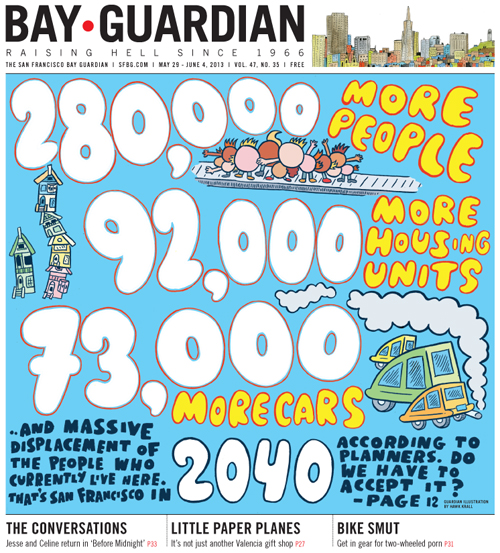
There’s going to be profound change in San Francisco over the next 25 years. If regional planners have their way, we’re talking 280,000 more people — and massive displacement of existing populations. Is that ok? What should we do about it? Is there any alternative, a better way to plan for growth?

I have no problem with increased density and population in San Francisco — but only if we can first protect vulnerable communities. How does that happen? What tools does the city have, and how can they be used?

These aren’t easy questions. Come help us talk about them and look for answers. The Guardian, along with the Council of Community Housing Organizations and Urban IDEA are holding a forum on Plan Bay Area June 12 at 6pm at the LGBT Center. It’s free and open to all.

Among the panelists:

·        Tim Redmond, San Francisco Bay Guardian

·        Mike Casey, Unite HERE Local 2

·        Cindy Wu, San Francisco Planning Commissioner

·        Maria Zamudio, Causa Justa: Just Cause

·        Antonio Diaz, People Organizing to Defend our Economic Rights (PODER)

·        Bob Allen, Urban Habitat

·        Gen Fujioka, Chinatown Community Development Center

·        Peter Cohen, Council of Community Housing Organizations

·        Rachel Brahinsky, University of San Francisco

More information here.

See you there.

Riding out

1

caitlin@sfbg.com

SEX Perhaps, if you are reading this column, you are already aware of the Bike Smut Film Festival (www.bikesmut.com). If so, please note that an adult production starring the DIY fest’s founders Poppy Cox and Rev “Gasper Johnson” Phil is being screened at the Center for Sex and Culture Sat/1. It is made by local queer pornographer Courtney Trouble, will also be available in DVD form at the screening, and it is unlikely, if you enjoy genuine expressions of human carnality, that you will not enjoy it.

“Porn for someone who likes cinema is hard to come by,” Cox told me candidly at a dark table in the back of bar last week, and I tend to agree with the pink-haired bombshell. Not everyone demands Trouble-level cinematography flourishes of their pornography, but Come Find Me, with its darling-dark plotline and focus on female orgasm (not to mention use of tire tubes as BDSM tool) will certainly fan the flames for lovers of hot feminist porno. Cox giggles a lot through the sex scenes, I’m just saying.

Poppy Cox’s calves make shapely plot points in Come Find Me

Though “bikesexualism” continues to be a rather niche orientation in the porn world, no one would accuse Cox and Phil of not getting around with their dirty movies. Since debuting the Bike Smut Festival in the mid-2000s at Portland’s Pedalpalooza, the duo have taken the show on the road to 21 countries, by Cox’s count. Content is crowdsourced and ranges from silly shorts to heavy-breathing features with pro-level stars. There’s no press screeners or DVD sales — the only way to check out the smut is to sit in a room with a bunch of other riders and get bikesexual about it. Trouble and Bianca Stone have starred in front of the cam for their own Bike Smut submission, and though much of Bike Smut is straight-focused, the last full festival program “Turning TriXXX” was mainly comprised of Sapphic scenes.

Look to Cox and Trouble to continue testing the juncture between body-positive, ethical, queer, and “non-heteronormative straight porn,” as Cox puts it, half-drank pint glass of beer in front of her. “We’re getting away from that one type of person that fucks in one kind of way — that looks like they don’t even want to touch each other. What doesn’t come across in mainstream porn is that all of your skin can be a sexual organ and that you should touch all of it.”

Especially calves. Bikers and their calves… 

Come Find Me release party and screening Center for Sex and Culture, 1349 Mission, SF. www.sexandculture.org. Sat/1, 8pm, $6-26

THIS WEEK’S SEX EVENTS

Sex Geek Speakeasy Mission Control, SF. www.missioncontrolsf.org.Thu/30, 8pm, free if you do free membership registration, $20 non-members. “Burlesque, bondage, and cupcakes,” at this sensual birthday party. No sex play, but pleasure activism panel discussions and hot demos.

“Corporate Dominatrix Training” Center for Sex and Culture, 1349 Mission, SF. www.sexandculture.org. Sun/1, 2-4pm, $5 for Society of Janus members, $20 non-members. Climb the career ladder of your choosing with Beatrice Stonebanks’ domme communication skills seminar.

Selector: May 29-June 4, 2013

0

WEDNESDAY 29

John Hodgman

John Hodgman has parlayed his starring role as the awkward PC in Apple Computer commercials into a multifaceted comedy career. The humorist typically portrays the authoritative know-it-all, dispensing faux expertise on Comedy Central’s The Daily Show with Jon Stewart and through his trilogy of satirical almanacs titled Complete World Knowledge. Unsatisfied with conveying pseudo-information to the masses, quasi-legal expert (fake) Judge John Hodgman also adjudicates over everyday silly disputes on a weekly Internet podcast. His thoughtful, goofy, non-legally binding rulings are a regular feature in the New York Times Magazine. Adam Savage of Mythbusters‘ fame provides a clever and fitting foil. (Kevin Lee)

In conversation with Adam Savage

7:30pm, $27

Nourse Theatre

275 Hayes, SF

(415) 392-4400

www.cityarts.net


“Drinking/Songs: A Night of Beer and the Music That Goes With It”

I feel a beer coming on! Dogfish Head Craft Brewery and public radio’s VoiceBox have joined forces for an “inter-active beer-tasting and live music event,” i.e., a night of singing and musical revelry the way nature intended — with frothy steins of that beloved thirst quencher known to barstool Pavarottis everywhere as a brewski. With musical entertainment from the Fill A Steins a cappella vocal music ensemble and a live discussion on the cultural history of this love affair between pipes and pints with cicerone Sayre Piotrkowski, the Fill A Steins, and VoiceBox‘s Chloe Veltman, there’s even an added touch of class with your glass. (Robert Avila)

8pm, $20

50 Mason Social House, SF

(415) 608-0133

drinkingsongs2.eventbrite.com


THURSDAY 30

Skull and Bones NightLife

Like Halloween in springtime, the Cal Academy’s popular Thursday evening nightlife event this time explores the creepier side of life — animal insides. At Skull and Bones, you can play like Indiana Jones — or at least, an amateur archaeologist — and watch volunteers assemble the bones of a skeleton, those of a juvenile offshore orca whale. Plus, Lee Post and Academy field associate/bone collector Ray “Bones” Bander will be on hand to answer the thorny questions, Icee Hot DJs Rollie Fingers and Ghosts on Tape will be spinning spooky tracks, and Paxton’s Gate will have a station of treasures; if you’ve ever visited the Mission curiosities-flora-and-fauna shop, you know they’ll have some good stuff on hand. This time, they’ll show Jason Borders’ skull art, and conduct a hands-on owl pellet dissection. SCRAP will have crafts at the ready, EndGames Improv will tickle your funny bone (ha! laughing already), and the planetarium will have a presentation on the “bones’ of the Milky Way. It’ll be a great way to bone up on the galaxy (sorry). (Emily Savage)

6pm, $10–<\d>$12

California Academy of Sciences

55 Music Concourse Dr., SF

(415) 379.8000

www.calacademy.org


San Francisco Green Film Festival

The third San Francisco Green Film Festival opens tonight with a tale of true Bay Area environmental heroes. Nancy Kelly’s doc Rebels With a Cause — first seen locally at the 2012 Mill Valley Film Festival and opening at the Roxie Fri/31 — offers an inspiring look at the Marin County activists who fought to preserve the NorCal coastline at a time when “conservation” was a dirty word. The rest of the Green fest’s over 50 films include Bidder 70, about climate activist Tim DeChristopher; Jon Bowermaster’s “fracktivist” tale Dear Governor Cuomo; and Kalyanee Mam’s Cambodia-set doc A River Changes Course, which just picked up a much-deserved Golden Gate Award for Best Documentary at the San Francisco International Film Festival. (Cheryl Eddy)

Through June 5, $12 per film (passes, $100–<\d>$200)

Various venues, SF and Berk.

www.sfgreenfilmfest.org


Cheap Girls

Call them loud, reckless, naïve — but don’t call them cheap. Though cranking out a big garage rock is something Cheap Girls could do in their sleep — and well — they’ve been known to slow it down on the few tracks that showcase their pop side and tight vocals. Like on earworm “Her and Cigarettes,” for example, it’s hard to believe this self-ascribed power pop rock group from Lansing, Mich. is not a small acoustic trio. “I love her and cigarettes/we took the long way, so we could have another,” whimpers vocalist Ian Graham in the song, embodying the wayward insecurities and heightened drama of adolescence itself. The group doesn’t present its songs; it relives every single one right there on stage. (Hillary Smith)

With Make Do and Mend, Diamond Youth

9pm, $12

Bottom of the Hill

1233 17th St., SF

(415) 626-4455

www.bottomofthehill.com


FRIDAY 31

Walking Distance Dance Festival

Building on last year’s Walking Distance Dance Festival, featuring local dance, ODC Theater Director Christy Bolingbroke has changed the formula. With a sure touch for vision leavened with reality, she has assembled a line-up that, with the exception of opening night, pairs locals with visitors. First up, however, will be Rachael Lincoln and Leslie Seiters, and Kate Weare and Company — once they were local, now they are visitors. Other fab choices are Nicole Klaymoon’s House of Matter and ODC/Dance’s Cut-Out Guy. New in town will be Brian Brooks (NY), and casebolt and smith (LA). You see each program in Studio B at ODC Commons and the B’way Theater across the Street. Amazing how much fun last year the simple act of walking from one venue to the other was. (Rita Felciano)

Fri/31, 7pm; Sat/1, 4pm, $20

ODC/Commons and B’way/ODC Theater, SF.

(415) 863-9834

www.odcdance.org/walkingdistance


Hi Ho Silver Oh

The LA-based band Hi Ho Silver Oh converts even the toughest of listeners with its harmonies. Frontperson Casey Trela’s vocals communicate a yearning I’m not sure I’ve felt before. The group’s humor will lure you in almost as much as its sometimes giddy, occasionally melancholic sound. The band’s affinity for good times shines through while performing great tracks, which makes for a set worth checking out. The video for the band’s “My Confessor” displays just this. It profiles a spelling bee gone wrong, starring a washed out principal, juxtaposed with clean vocals, attractive guitar rhythms, and evocative lyrics — it’s an encompassing reflection of the group. Hi Ho Silver Oh opens tonight for Mice Parade. (Smith)

9pm, $12

Brick and Mortar

1710 Mission, SF

(415) 800-8782

www.brickandmortarmusic.com


Jazzanova’s Jurgen von Knoblauch

“This is one of Jazzanova’s major talents: to combine pieces from very different musical genres. And the linchpin holding them together is generally soul.” That’s how Jurgen von Knoblauch describes his German supergroup Jazzanova, now approaching two decades of producing and performing a blend of jazz, boss nova, soul, Latin, deep house, and electronica. The collective’s versatility means it can shift from individual DJs like founding member von Knoblauch spinning at nightclubs across Europe to a nine-person live performance band performing around the world. Von Knoblauch also maintains a music show on German radio with two of his fellow Jazzanova DJs and helps select new talent for the group’s record label Sonar Kollektiv. (Lee)

With Fred Everything, Joey Alaniz

9pm, $10–<\d>$15

Monarch

101 Sixth St, SF

(415) 284-9774

www.monarchsf.com


SATURDAY 1

Ludovico Einaudi

Ludovico Einaudi avoids describing his music any one way; he likely wouldn’t call it classical or modernist, because he feels a plethora of influences inform his pieces. It’s likely if you attend one of his performances you too will have a tough time describing it in one phrase anyway. He offers viewers a cathartic experience — one that is felt on many levels — and takes them through the big emotions of ecstasy and doom, the same emotions Rothko was interested in conveying in his paintings. Like the famous painter, Einaudi’s work is presented on a grand scale. He plays with a raw emotion seldom seen in similar pianists. The intrinsically deep, emotional tones presented in his performances are emphasized by his 11-piece band that includes a string section.(Smith)

7:30 p.m., $40–<\d>$85

Warfield

982 Market, SF

(415) 345-0900

www.thewarfieldtheatre.com


No Regular Play

If you haven’t heard of ‘Play,’ a monthly party put on by Listed Productions and the End Up, all you really know is that it’s described as “recess for adults.” Which is perfect if you, like me, have the Peter Pan syndrome that’s particular to the Bay Area, holding down jobs but still holding onto acting like a kid the rest of the time. When I’ve been hula-hooping recently — on breaks, in the handicapped bathroom stall at work — I’ve been listening to Endangered Species by Wolf + Lamb compatriots No Regular Play, whose playful shows mix funky house with live vocals and fresh trumpet blasts. (Ryan Prendiville)

With Butane (Crosstown Rebels), Bells & Whistles (AYLI), Alex Blackstock (Less is More)

10pm-6am, $15 advance

End Up

401 Sixth St., SF

(415) 357-0827

www.theendup.com


SUNDAY 2

“The Globalization Trilogy”

For the last 12 years, local filmmaker Micha X. Peled’s documentaries have exposed the human toll of corporate greed around the world.

The Rafael is showing the completed trilogy over the next week, with the filmmaker present at each screening. 2001’s Store Wars: When Wal-Mart Comes to Town chronicles the decimating impact America’s favorite retailer (and arguably worst employer) has on local businesses. 2005’s China Blue provides a rare, clandestine peek inside a Chinese garment sweatshop-factory. His latest Bitter Seeds ponders the epidemic of small-farmer suicides in India — over a quarter-million in 16 years — due to the impoverishing effect of genetically modified seeds from US agri-giant/villain Monsanto. (Dennis Harvey)

Through June 9, $6.50-10.75

Rafael Film Center

1118 Fourth St., San Rafael


www.cafilm.org 2 The Guardian listings deadline is two weeks prior to our Wednesday publication date. To submit an item for consideration, please include the title of the event, a brief description of the event, date and time, venue name, street address (listing cross streets only isn’t sufficient), city, telephone number readers can call for more information, telephone number for media, and admission costs. Send information to Listings, the Guardian, 225 Bush, 17th Flr., SF, CA 94105; or e-mail (paste press release into e-mail body — no attachments, please) to listings@sfbg.com. Digital photos may be submitted in jpeg format; the image must be at least 240 dpi and four inches by six inches in size. We regret we cannot accept listings over the phone.

Rep Clock

0

Schedules are for Wed/29-Tue/4 except where noted. Director and year are given when available. Double and triple features marked with a •. All times pm unless otherwise specified.

CASTRO 429 Castro, SF; (415) 621-6120, www.castrotheatre.com. $8.50-13. •Spring Breakers (Korine, 2012), Wed, 7, and Enter the Void (Noé, 2009), Wed, 8:45. "Inforum Presents: A #Nofilter Conversation with the Founders of Instagram," Thu, 7. This event, $15-65; advance tickets at instagraminforum.eventbrite.com. "Agents of Chaos," "unauthorized" book release event for Tales of the San Francisco Cacophony Society, Fri, 7:30. This event, $20-50; advance tickets at agentsofchaos.eventbrite.com. Grease (Kleiser, 1978), presented sing-along style, Sun-Mon, 2:30, 8. This event, $10-15; advance tickets at www.ticketweb.com.

CHRISTOPHER B. SMITH RAFAEL FILM CENTER 1118 Fourth St, San Rafael; (415) 454-1222, www.cafilm.org. $6.75-$10.25. Frances Ha (Baumbach, 2012), call for dates and times. In the House (Ozon, 2012), call for dates and times. Midnight’s Children (Mehta, 2012), call for dates and times. Renoir (Bourdos, 2012), call for dates and times. Stories We Tell (Polley, 2012), call for dates and times. Elemental (Roshan and Vaughan-Lee, 2012), May 31-June 6, call for times. Bitter Seeds (Peled, 2011), Sun and June 9, 7.

DELANCEY STREET SCREENING ROOM 600 Embarcadero, SF; www.everydaygandhis.org. Free (reserve a ticket by emailing amy@everydaygandhis.org). The Fight to Forgive: From Child Soldiers to Peacebuilders (Travis, 2013), Fri, 9. With film subject and former child soldier Lassana Kanneh in person.

GOFORALOOP GALLERY AND STUDIOS 1458 San Bruno, SF; www.goforaloop.com. Donations welcome. "The Long and the Short of It:" Hard Eight (Anderson, 1996), plus shorts by local filmmakers, Thu, 7:30.

MECHANICS’ INSTITUTE 57 Post, SF; (415) 393-0100, milibrary.org/events. $10 (reservations required as seating is limited). "CinemaLit Film Series: Paddy Chayefsky: Scenes from American Lives:" The Hospital (Hiller, 1971), Fri, 6.

NEW PARKWAY 474 24th St, Oakl; www.thenewparkway.com. $6-10. "New Parkway Classics:" Pink Flamingos (Waters, 1972), Thu, 9. "Thrillville:" The Sadist (Landis, 1963), Sun, 6.

NEW VALENCIA HALL 747 Polk, SF; (415) 864-1278. $5-10 (dinner at 6:30pm, $8 donation). GOFORALOOP GALLERY AND STUDIOS 1458 San Bruno, SF; www.goforaloop.com. Donations welcome. "The Long and the Short of It:" The Sugarland Express (Spielberg, 1974), plus shorts by local filmmakers, Thu, 7:30. Harvest of Empire: The Untold Story of Latinos in America (González, 2012), Sat, 7:30.

PACIFIC FILM ARCHIVE 2575 Bancroft, Berk; (510) 642-5249, bampfa.berkeley.edu. $5.50-9.50. PFA closed through June 5.

ROXIE 3117 and 3125 16th St, SF; (415) 863-1087, www.roxie.com. $6.50-11. In the House (Ozon, 2012), Wed-Thu, 9:15. Something in the Air (Assayas, 2012), Wed-Thu, 6:45. Trance (Boyle, 2013), Wed-Thu, 7. Upstream Color (Carruth, 2013), Wed-Thu, 9. Rebels With a Cause (Kelly, 2012), May 31-June 6, call for times.

"SAN FRANCISCO GREEN FILM FESTIVAL" Various venues, SF and Berk; www.sfgreenfilmfest.org. $12 per film (passes, $100-200). Over 20 international, environmentally-focused feature films, May 30-June 5.

YERBA BUENA CENTER FOR THE ARTS 701 Mission, SF; www.ybca.org. $8-10. Post Tenebras Lux (Reygadas, 2012), Thu-Sat, 7:30; Sun, 2 and 4:30.

Film listings

0

Film listings are edited by Cheryl Eddy. Reviewers are Kimberly Chun, Dennis Harvey, Lynn Rapoport, and Sara Maria Vizcarrondo. For rep house showtimes, see Rep Clock. Due to the Memorial Day holiday, theater information was incomplete at presstime.

OPENING

After Earth M. Night Shyamalan directs father-son team Will and Jaden Smith as a father-son team stranded on post-apocalyptic Earth. (1:40)

Before Midnight See “The Conversations.” (1:48)

Now You See Me Magicians rob banks in this ensemble caper starring Jesse Eisenberg, Mark Ruffalo, Morgan Freeman, and Woody Harrelson. (1:56)

Rebels with a Cause The huge string of parklands that have made Marin County a jewel of preserved California coastline might easily have become wall-to-wall development — just like the Peninsula — if not for the stubborn conservationists whose efforts are profiled in Nancy Kelly’s documentary. From Congressman Clem Miller — who died in a plane crash just after his Point Reyes National Seashore bill became a reality — to housewife Amy Meyer, who began championing the Golden Gate National Recreation Area because she “needed a project” to keep busy once her kids entered school, they’re testaments to the ability of citizen activism to arrest the seemingly unstoppable forces of money, power and political influence. Theirs is a hidden history of the Bay Area, and of what didn’t come to pass — numerous marinas, subdivisions, and other developments that would have made San Francisco and its surrounds into another Los Angeles. (1:12) Roxie. (Harvey)

Sightseers See “Tourist Trappers.” (1:28)

Venus and Serena How do you compress the remarkable life and stunning career of one Williams sister into a doc that’s a shade over 90 minutes, much less fit both of their stories in there? Venus and Serena can’t do much more than offer an overview of the sports phenoms, shadowing both during what proved to be an unfortunately injury-plagued 2011 season. It also flashes back to chart the sisters’ rise from Compton-raised prodigies to Grand Slam-dominating forces of nature, and features glamorously-lit interviews with the women, a handful of their relatives, and famous admirers (with Anna Wintour stopping by to purr that they are “fashion gladiators and tennis gladiators”). Though directors Maiken Baird and Michelle Major don’t leave out the more controversial bits — the sisters’ feelings about their domineering father (their former coach); their on-court tantrums; their frank talk about religion, race, dealing with stress, etc. — the straightforward Venus and Serena lacks any stylistic flair, a shame considering how important style is to the sisters. It does offer a few unexpected off-the-cuff moments, however, as when a karaoke-obsessed Serena launches into “Hole Hearted,” by 1990s hair rockers Extreme, after a disappointing day at Wimbledon. (1:39) (Eddy)

We Steal Secrets: The Story of Wikileaks Call it the unenviable yet altogether fascinating task of the smartest moviemaker in the room: capturing the evasive, mercurial and fallible free-speech crusader Julian Assange and his younger church-going, trans-curious cohort Bradley Manning, all sans interviews with the paranoid former who’s in hiding and the guileless latter who was incarcerated without charges for a year by the military. Enron: The Smartest Guys in the Room (2005) documentary maker Alex Gibney seems to be just the guy to take on this project, pulling back the curtain on the transparency-first site, navigating the labyrinthine contradictions of a classic Internet-age antihero, and telling the previously untold story of the young man who tied himself to WikiLeaks’s, and Assange’s, fortunes. It starts out innocently (or not) enough, with Assange and his minuscule band of volunteers uploading and unleashing the still-shocking video footage of a Reuters news crew and their rescuers, mistaken for insurgents, being mowed down in a hailstorm of friendly fire by US forces in Iraq. Assange’s notoriety and undoing comes with the arrival of a mass of easily shared government intelligence uploaded then passed along to him by computer wiz Private Manning in the biggest leak of state secrets in US history; the lonely analyst’s unexpected friendship with hacker Adrian Lamo, who ultimately turns him in; and the rape charges that finally ensnare Assange in a web of lies, ironically, of his own making. Seemingly on the side of Assange, Net anarchists, and the free flow of information at the start of the saga, Gibney uses extensive interviews with (Bush-era) intelligence experts, Lamo, an Assange sexual-assault accuser, WikiLeaks supporters, and reporters; animation; and footage culled from journalists and likely anyone with a cell phone camera in shooting distance of Assange to tell this riveting story of good intentions and ego run amok, sidestepping the WikiLeaks poobah’s approval in a comprehensive, impassioned warts-and-all way that he even might appreciate. (2:10) (Chun)

ONGOING

At Any Price Growing up in rural Iowa very much in the shadow of his older brother, Dean Whipple (Zac Efron) cultivated a chip on his shoulder while dominating the figure 8 races at the local dirt track. When papa Henry (Dennis Quaid) — a keeping-up-appearances type, with secrets a-plenty lurking behind his good ol’ boy grin — realizes Dean is his best hope for keeping the family farm afloat, he launches a hail-mary attempt to salvage their relationship. This latest drama from acclaimed indie director Ramin Bahrani (2008’s Goodbye Solo) is his most ambitious to date, enfolding small-town family drama and stock-car scenes into a pointed commentary on modern agribusiness (Henry deals in GMO corn, and must grapple with the sinister corporate practices that go along with it). But the film never gels, particularly after an extreme, third-act plot twist is deployed to, um, hammer home the title — which refers to prices both monetary and spiritual. A solid supporting cast (Kim Dickens, Heather Graham, Clancy Brown, Red West, newcomer Maika Monroe) helps give the film some much-needed added weight as it veers toward melodrama. (1:45) (Eddy)

The Big Wedding The wedding film has impacted our concepts of matrimony, fashion, and marital happiness more than all the textbooks in the world have affected our national testing average; but it’s with that margin of mediocrity I report from the theater trenches of The Big Wedding. With this, the wedding movie again peters to a crawl. Susan Sarandon (an actress I love with a loyalty beyond sense) is Bebe, the stepmother/caterer swept under the rug by the selfishness of her live in lover Don (De Niro), his ex-wife/baby momma Elle (Diane Keaton) and their racist wackjob future in-laws. When Don and Elle faced the end of their marriage, they tried to rekindle with a Columbian orphan. Cue Ben Barnes in brownface. Alejandro is set to wed Amanda Seyfried and when his mother ascends from Columbia for the wedding, he decides Don and Elle have to act like their marriage never ended &ldots; which makes Bebe a mistress. Surprise! A decade of caring selflessly for your lover’s kids has won you a super shitty wedding you still have to cater! To give you a sense of the conflict management on display, Bebe — the film’s graceful savior —drops a drink on Don before fleeing the scene in her Alfa Romeo; she’s the one character not determined to act out her more selfish urges in the style of an MTV reality show. Despite some less imaginative conflicts and degrading “solutions,” this blended family still speaks some truth about the endearing embarrassment of the happy family. (1:29) (Vizcarrondo)

Elemental Even those suffering from environmental-doc fatigue (a very real condition, particularly in the eco-obsessed Bay Area) will find much to praise about Elemental, co-directed by Gayatri Roshan and NorCal native Emmanuel Vaughan-Lee (who also co-composed the film’s score). This elegantly shot and edited film approaches the issues via three “eco-warriors,” who despite working on different causes on various corners of the planet encounter similar roadblocks, and display like-minded determination, along the way: Rajendra Singh, on a mission to heal India’s heavily polluted Ganges River; Jay Harman, whose ingenious inventions are based on “nature’s blueprints”; and Eriel Deranger, who fights for her indigenous Canadian community in the face of Big Oil. Deranger cuts a particularly inspiring figure: a young, tattooed mother who juggles protests, her moody tween (while prepping for a new baby), and the more bureaucratic aspects of being a professional activist — from defending her grassroots methods when questioned by her skeptical employer, to deflecting a drunk, patronizing Robert F. Kennedy Jr. at a big-ticket fundraiser — with a calm, steely sense of purpose. (1:33) Smith Rafael. (Eddy)

Epic (1:42)

Fast and Furious 6 Forget the fast (that’s understood by now, anyway) — part six in this popcorny series is heavy on the “furious,” with constant near-death stunts that zoom past irrational and slam into batshit crazy. Agent Hobbs (Dwayne Johnson) lures the gang out of sunny retirement to bust a fast driver with a knack for strategy and an eye on world domination. Sure, Ludacris jokes their London locale doesn’t mean they’re in a Bond movie, but give cold-blooded Luke Evans some time and he’ll work his way up to antagonizing 007. Shaw (Evans) is smaller than our hero Toretto (Vin Diesel), but he’s convincing, throwing his King’s English at a man whose murky dialect is always delivered with a devilish baritone. If Shaw’s code is all business, Toretto’s is all family: that’s what holds together this cast, cobbled from five Fast and Furious installments shot all over the world. Hottie Gal Gadot (playing Sung Kang’s love interest) reassures Han (Kang) mid-crisis: “This is what we are.” It’s not for nothing the gang’s main weapon is a harpoon gun that, once shot, leaves an umbilicus from the shooter to whatever’s in the crosshairs. That’s Torreto for you. Meanwhile, the villain’s weapon is a car with a spatula-like front end, that flips cars like pancakes. The climactic battle on a cargo plane has to give a face time to every member of the eight-person team, so naturally they shot it on the world’s longest runway. Of course the parade features less car porn than previous editions but it’s got a wider reach now — it’s officially international intrigue, not just fun for gearheads. For my money, it’s some of the best action in theaters today. Stick around for the inevitable sequel-suggesting coda during the credits. (2:10) (Vizcarrondo)

42 Broad and morally cautious, 42 is nonetheless an honorable addition to the small cannon of films about the late, great baseball player Jackie Robinson. When Dodgers owner Branch Rickey (Harrison Ford) declares that he wants a black player in the white major leagues because “The only real color is green!”, it’s a cynical explanation that most people buy, and hate him for. It also starts the ball curving for a PR shitstorm. But money is an equal-opportunity leveling device: when Robinson (Chadwick Boseman) tries to use the bathroom at a small-town gas station, he’s denied and tells his manager they should “buy their 99 gallons of gas another place.” Naturally the gas attendant concedes, and as 42 progresses, even those who reject Robinson at first turn into men who find out how good they are when they’re tested. Ford, swashbuckling well past his sell-by date, is a fantastic old coot here; his “been there, lived that” prowess makes you proud he once fled the path of a rolling bolder. His power moves here are even greater, but it’s ultimately Robinson’s show, and 42 finds a lot of ways to deliver on facts and still print the legend. (2:08) (Vizcarrondo)

Frances Ha Noah Baumbach isn’t exactly known for romance and bright-eyed optimism. Co-writing 2009’s Fantastic Mr. Fox with director Wes Anderson is maybe the closest to “whimsy” as he’s ever come; his own features (2010’s Greenberg, 2007’s Margot at the Wedding, 2005’s The Squid and the Whale, 1997’s Mr. Jealousy, and 1995’s Kicking and Screaming) tend to veer into grumpier, more intellectual realms. You might say his films are an acquired taste. But haters beware. Frances Ha — the black-and-white tale of a New York City hipster (Baumbach’s real-life squeeze, Greta Gerwig, who co-write the script with him) blundering her way into adulthood — is probably the least Baumbach-ian Baumbach movie ever. Owing stylistic debts to both vintage Woody Allen and the French New Wave, Frances Ha relies heavily on Gerwig’s adorable-disaster title character to propel its plot, which is little more than a timeline of Frances’ neverending micro-adventures: pursuing her nascent modern-dance career, bouncing from address to address, taking an impromptu trip to Paris, visiting her parents (portrayed by the Sacramento-raised Gerwig’s real-life parents), “breaking up” with her best friend. It’s so charming, poignant, and quotable (“Don’t treat me like a three-hour brunch friend!”) that even those who claim to be allergic to Baumbach just might find themselves succumbing to it. (1:26) Smith Rafael. (Eddy)

The Great Gatsby Every bit as flashy and in-your-face as you’d expect the combo of “Baz Luhrmann,” “Jazz Age,” and “3D” to be, this misguided interpretation of F. Scott Fitzgerald’s classic tale is, at least, overstuffed with visual delights. For that reason only, all the fashion-mag fawning over leading lady Carey Mulligan’s gowns and diamonds, and the opulent production design that surrounds them, seems warranted. And in scenes where spectacle is appropriate — Gatsby’s legendary parties; Tom Buchanan’s wild New York romp with his mistress — Luhrmann delivers in spades. The trade-off is that the subtler aspects of Fitzgerald’s novel are either pushed to the side or shouted from the rooftops. Leonardo DiCaprio, last seen cutting loose in last year’s Django Unchained, makes for a stiff, fumbling Gatsby, laying on the “Old Sports” as thickly as his pancake make-up. There’s nothing here so startlingly memorable as the actor and director’s 1996 prior collaboration, Romeo + Juliet — a more successful (if still lavish and self-consciously audacious) take on an oft-adapted, much-beloved literary work. (2:22) (Eddy)

The Hangover Part III Even the friendliest little blackout bacchanal can get tiresome the third time around. The poster depicting Bradley Cooper, Ed Helms, and Zach Galifianakis — stern in suits and ties — says it all: it’s grim men’s business, the care and maintenance of this Hangover franchise, this orgy of good times gone bad. Once a bad-taste love letter to male-bonding, Hangover Part III is ready for a chance, primed to sever some of those misbegotten ties. This time around, the unlikely troika — with the always dispensable normal-dude figurehead Doug (Justin Bartha) in tow — are captured by random sketchy figure Marshall (John Goodman, whose every utterance of the offensive “Chinaman” should bring back Big Lebowski warm-and-fuzzies). He holds Doug hostage in exchange for the amoral, cockfighting, coke-wallowing, whore-hiring, leather-wearing Leslie Chow (Ken Jeong), who stole his gold, and it turns out Alan (Galifianakis) might be his only chum. Jeong, who continues to bring the hammy glee, is still the best thing here, even as the conscience-free instigator; he’s the dark counterpart to tweaked man-child Alan, who meets cute with mean-ass pawn-star soulmate Cassie (Melissa McCarthy). Meanwhile, Cooper and Helms look on, puzzled, no doubt pondering the prestige projects on their plate and wondering what they’re still doing here. (1:40) (Chun)

The Iceman Methody-y changeling Michael Shannon is pretty much the whole show in The Iceman, about a real-life hitman who purportedly killed over 100 people during his career. Despite some scarily violent moments, however, Ariel Vromen’s film doesn’t show much of that body count — he’s more interested in the double life Richard Kuklinski (Shannon) leads as a cold-blooded killer whose profession remains entirely unknown for years to his wife, daughters, and friends. The waitress he marries, Deborah (Winona Ryder), isn’t exactly a brainiac. But surely there’s some willful denial in the way she accepts his every excuse and fake profession, starting with “dubbing Disney movies” when he actually dupes prints of pornos. It’s in that capacity that he first meets Roy Demeo (Ray Liotta), a volatile Newark mobster who, impressed by Kuklinski’s blasé demeanor at gunpoint, correctly surmises this guy would make a fine contract killer. When he has a falling out with Demeo, Kuklinski “freelances” his skill to collaborate with fellow hitman Mr. Freezy (Chris Evans), so named because he drives an ice-cream truck — and puts his victims on ice for easier disposal. For the sake of a basic contrast defined by its ad line — “Loving husband. Devoted father. Ruthless killer.” — The Iceman simplifies Kuklinski’s saga, making him less of a monster. The movie only briefly suggests Kuklinski’s abused childhood, and it omits entirely other intriguing aspects of the real-life story. But Shannon creates a convincing whole character whose contradictions don’t seem so to him — or to us. (1:46) (Harvey)

In the House In François Ozon’s first feature since the whimsical 2010 Potiche, he returns somewhat to the playful suspense intrigue of 2003’s Swimming Pool, albeit with a very different tone and context. Fabrice Luchini plays a high school French literature teacher disillusioned by his students’ ever-shrinking articulacy. But he is intrigued by one boy’s surprisingly rich description of his stealth invasion into a classmate’s envied “perfect” family — with lusty interest directed at the “middle class curves” of the mother (Emmanuelle Seigner). As the boy Claude’s writings continue in their possibly fictive, possibly stalker-ish provocations, his teacher grows increasingly unsure whether he’s dealing with a precocious bourgeoisie satirist or a literate budding sociopath — and ambivalent about his (and spouse Kristin Scott Thomas’ stressed gallery-curator’s) growing addiction to these artfully lurid possible exposé s of people he knows. And it escalates from there. Ozon is an expert filmmaker in nimble if not absolute peak form here, no doubt considerably helped by Juan Mayorga’s source play. It’s a smart mainstream entertainment that, had it been Hollywood feature, would doubtless be proclaimed brilliant for its clever tricks and turns. (1:45) Roxie, Smith Rafael. (Harvey)

Iron Man 3 Neither a sinister terrorist dubbed “the Mandarin” (Ben Kingsley) nor a spray-tanned mad scientist (Guy Pearce) are as formidable an enemy to Tony Stark (Robert Downey, Jr.) as Tony Stark himself, the mega-rich playboy last seen in 2012’s Avengers donning his Iron Man suit and thwarting alien destruction. It’s been rough since his big New York minute; he’s been suffering panic attacks and burying himself in his workshop, shutting out his live-in love (Gwyneth Paltrow) in favor of tinkering on an ever-expanding array of manned and un-manned supersuits. But duty, and personal growth, beckon when the above-mentioned villains start behaving very badly. With some help (but not much) from Don Cheadle’s War Machine — now known as “Iron Patriot” thanks to a much-mocked PR campaign — Stark does his saving-the-world routine again. If the plot fails to hit many fresh beats (a few delicious twists aside), the 3D special effects are suitably dazzling, the direction (by series newcomer Shane Black) is appropriately snappy, and Downey, Jr. again makes Stark one of the most charismatic superheros to ever grace the big screen. For now, at least, the continuing Avengers spin-off extravaganza seems justified. (2:06) (Eddy)

Jurassic Park 3D “Life finds a way,” Jeff Goldblum’s leather-clad mathematician remarks, crystallizing the theme of this 1993 Spielberg classic, which at its core is more about human relationships than genetically manufactured terrors. Of course, it’s got plenty of those, and Jurassic Park doesn’t really need its (admittedly spiffy) 3D upgrade to remain a thoroughly entertaining thriller. The dinosaur effects — particularly the creepy Velociraptors and fan-fave T. rex — still dazzle. Only some early-90s computer references and Laura Dern’s mom jeans mark the film as dated. But a big-screen viewing of what’s become a cable TV staple allows for fresh appreciation of its less-iconic (but no less enjoyable) moments and performances: a pre-megafame Samuel L. Jackson as a weary systems tech; Bob Peck as the park’s skeptical, prodigiously thigh-muscled game warden. Try and forget the tepid sequels — including, dear gawd, 2014’s in-the-works fourth installment. This is all the Jurassic you will ever need. (2:07) (Eddy)

Kon-Tiki In 1947 Norwegian explorer and anthropologist Thor Heyderdahl arranged an expedition on a homemade raft across the Pacific, recreating what he believed was a route by which South Americans traveled to Polynesia in pre-Columbian times. (Although this theory is now disputed.) The six-man crew (plus parrot) survived numerous perils to complete their 101-day, 4300-mile journey intact — winning enormous global attention, particularly through Heyderdahl’s subsequent book and documentary feature. Co-directors Joachim Roenning and Espen Sandberg’s dramatization is a big, impressive physical adventure most arresting for its handsome use of numerous far-flung locations. Where it’s less successful is in stirring much emotional involvement, with the character dynamics underwhelming despite a decent cast led by Pal Sverr Hagen as Thor (who, incredibly, was pretty much a non-swimmer). Nonetheless, this new Kon-Tiki offers all the pleasures of armchair travel, letting you vicariously experience a high-risk voyage few could ever hope (or want) to make in real life. (1:58) (Harvey)

Love is All You Need Copenhagen hairdresser Ida (Trine Dyrholm) has just finished her cancer treatments — with their success still undetermined — when she arrives home to find her longtime husband Leif (Kim Bodnia) boning a coworker on their couch. “I thought you were in chemo” is the closest he comes to an apology before walking out. Ida is determined to maintain a cheerful front when attending the Italian wedding of their daughter Astrid (Molly Blixt Egelind) — even after emotionally deaf Leif shows up with his new girlfriend in tow. Meanwhile brusque businessman and widower Philip (Pierce Brosnan), the groom’s father, is experiencing the discomfort of returning to the villa he once shared with his beloved late wife. This latest from Danish director Susanne Bier and writing partner Anders Thomas Jensen (2006’s After the Wedding, 2004’s Brothers, 2010’s In a Better World) is more conventionally escapist than their norm, with a general romantic-seriocomedy air reinforced by travel-poster-worthy views of the picturesque Italian coastline. They do try to insert greater depth and a more expansive story arc than you’d get in a Hollywood rom com. But all the relationships here are so prickly — between middle-aged leads we never quite believe would attract each other, between the clearly ill-matched aspiring newlyweds, between Paprika Steen’s overbearing sister in-law and everyone — that there’s very little to root for. It’s a romantic movie (as numerous soundtracked variations on “That’s Amore” constantly remind us) in which romance feels like the most contrived element. (1:50) (Harvey)

Midnight’s Children Deepa Mehta (2005’s Water) directs and co-adapts with Salman Rushdie the author’s Booker Prize-winning 1981 novel, which mixes history (India’s 1947 independence, and the subsequent division of India and Pakistan) with magical elements — suggested from its fairy-tale-esque first lines: “I was born in the city of Bombay, once upon a time.” This droll voice-over (read by Rushdie) comes courtesy of Saleem Sinai, born to a poor street musician and his wife (who dies in childbirth; dad is actually an advantage-taking Brit played by Charles “Tywin Lannister” Dance) but switched (for vaguely revolutionary reasons) with Shiva, born at the same moment to rich parents who unknowingly raise the wrong son. Rich or poor, it seems all children born at the instant of India’s independence have shared psychic powers; over the years, they gather for “meetings” whenever Saleem summons them. And that’s just the 45 minutes or so of story. Though gorgeously shot, Midnight’s Children suffers from page-to-screen-itis; the source material is complex in both plot and theme, and it’s doubtful any film — even one as long as this — could translate its nuances and more fanciful elements (“I can smell feelings!,” Saleem insists) into a consistently compelling narrative. Last-act sentimentality doesn’t help, though it’s consistent with the fairy-tale vibe, I suppose. (2:20) Smith Rafael. (Eddy)

Mud (2:15)

Oblivion Spoiler alert: the great alien invasion of 2017 does absolutely zilch to eliminate, or at least ameliorate, the problem of sci-fi movie plot holes. However, puny humans willing to shut down the logic-demanding portions of their brains just might enjoy Oblivion, which is set 60 years after that fateful date and imagines that Earth has been rendered uninhabitable by said invasion. Tom Cruise plays Jack, a repairman who zips down from his sterile housing pod (shared with comely companion Andrea Riseborough) to keep a fleet of drones — dispatched to guard the planet’s remaining resources from alien squatters — in working order. But Something is Not Quite Right; Jack’s been having nostalgia-drenched memories of a bustling, pre-war New York City, and the déjà vu gets worse when a beautiful astronaut (Olga Kurylenko) literally crash-lands into his life. After an inaugural gig helming 2010’s stinky Tron: Legacy, director Joseph Kosinski shows promise, if not perfection, bringing his original tale to the screen. (He does, however, borrow heavily from 1968’s 2001: A Space Odyssey, 1996’s Independence Day, and 2008’s Wall-E, among others.) Still, Oblivion boasts sleek production design, a certain creative flair, and some surprisingly effective plot twists — though also, alas, an overlong running time. (2:05) (Eddy)

Pain & Gain In mid-1995 members of what became known as the “Sun Gym Gang” — played here by Mark Wahlberg, Dwayne Johnson, and Anthony Mackie — were arrested for a series of crimes including kidnapping, extortion, and murder. Simply wanting to live large, they’d abducted one well-off man (Tony Shalhoub) months earlier, tortured him into signing over all his assets, and left him for dead — yet incredibly the Miami police thought the victim’s story was a tall tale, leaving the perps free until they’d burned through their moolah and sought other victims. Michael Bay’s cartoonish take on a pretty horrific saga repeatedly reminds us that it’s a true story, though the script plays fast and loose with many real-life details. (And strangely it downplays the role steroid abuse presumably played in a lot of very crazy behavior.) In a way, his bombastic style is well-suited to a grotesquely comic thriller about bungling bodybuilder criminals redundantly described here as “dumb stupid fucks.” There have been worse Bay movies, even if that’s like saying “This gas isn’t as toxic as the last one.” But despite the flirtations with satire of fitness culture, motivational gurus and so forth, his sense of humor stays on a loutish plane, complete with fag-bashing, a dwarf gag, and representation of Miami as basically one big siliconed titty bar. Nor can he pull off a turn toward black comedy that needs the superior intelligence of someone like the Coen Brothers or Soderbergh. As usual everything is overamped, the action sequences overblown, the whole thing overlong, and good actors made to overact. You’ve got to give cranky old Ed Harris credit: playing a private detective, he alone here refuses to be bullied into hamming it up. (2:00) (Harvey)

The Painting Veteran animator Jean-François Laguionie’s French-Belgian feature is a charming and imaginative fable whose characters live in the worlds of an elusive artist’s canvases. It begins in one particular picture, a fanciful landscape in which society is strictly stratified in terms of how “finished” the figures in it are. At the top of the heap are the Alldunns, elitist castle-dwelling snobs who look down on the semi-completed Halfies. Everybody shuns the Sketchies, pencil preliminaries come to life. When members of each group get chased into the Forbidden Forest, they discover they can actually exit the frame entirely and visit other paintings in the artist’s studio. As a parable of prejudice and tolerance it’s not exactly sophisticated, and the story doesn’t quite sustain its early momentum. But it’s a visual treat throughout, nodding to various early 20th-century modern art styles and incorporating some different animation techniques (plus, briefly, live action). Note: the last screenings of each day will be in the film’s original French language, with English subtitles; all others offer the English-dubbed version. (1:18) (Harvey)

The Place Beyond the Pines Powerful indie drama Blue Valentine (2010) marked director Derek Cianfrance as one worthy of attention, so it’s with no small amount of fanfare that this follow-up arrives. The Place Beyond the Pines‘ high profile is further enhanced by the presence of Bradley Cooper (currently enjoying a career ascension from Sexiest Man Alive to Oscar-nominated Serious Actor), cast opposite Valentine star Ryan Gosling, though they share just one scene. An overlong, occasionally contrived tale of three generations of fathers, father figures, and sons, Pines‘ initial focus is Gosling’s stunt-motorcycle rider, a character that would feel more exciting if it wasn’t so reminiscent of Gosling’s turn in Drive (2011), albeit with a blonde dye job and tattoos that look like they were applied by the same guy who inked James Franco in Spring Breakers. Robbing banks seems a reasonable way to raise cash for his infant son, as well as a way for Pines to draw in another whole set of characters, in the form of a cop (Cooper) who’s also a new father, and who — as the story shifts ahead 15 years — builds a political career off the case. Of course, fate and the convenience of movie scripts dictate that the mens’ sons will meet, the past will haunt the present and fuck up the future, etc. etc. Ultimately, Pines is an ambitious film that suffers from both its sprawl and some predictable choices (did Ray Liotta really need to play yet another dirty cop?) Halfway through the movie I couldn’t help thinking what might’ve happened if Cianfrance had dared to swap the casting of the main roles; Gosling could’ve been a great ambitious cop-turned-powerful prick, and Cooper could’ve done interesting things with the Evel Knievel-goes-Point Break part. Just sayin’. (2:20) (Eddy)

Renoir The gorgeous, sun-dappled French Riviera setting is the high point of this otherwise low-key drama about the temperamental women (Christa Theret) who was the final muse to elderly painter Auguste Renoir (Michel Bouquet), and who encouraged the filmmaking urges in his son, future cinema great Jean (Vincent Rottiers). Cinematographer Mark Ping Bin Lee (who’s worked with Hou Hsiao-hsein and Wong Kar Wai) lenses Renoir’s leafy, ramshackle estate to maximize its resemblance to the paintings it helped inspire; though her character, Dédée, could kindly be described as “conniving,” Theret could not have been better physically cast, with tumbling red curls and pale skin she’s none too shy about showing off. Though the specter of World War I looms in the background, the biggest conflicts in Gilles Bourdos’ film are contained within the household, as Jean frets about his future, Dédée faces the reality of her precarious position in the household (which is staffed by aging models-turned-maids), and Auguste battles ill health by continuing to paint, though he’s in a wheelchair and must have his brushes taped to his hands. Though not much really happens, Renoir is a pleasant, easy-on-the-eyes experience. (1:51) Smith Rafael. (Eddy)

Scatter My Ashes at Bergdorf’s This glossy love letter to posh New York City department store Bergdorf Goodman — a place so expensive that shopping there is “an aspirational dream” for the grubby masses, according to one interviewee — would offend with its slobbering take on consumerism if it wasn’t so damn entertaining. The doc’s narrative of sorts is propelled by the small army assembled to create the store’s famed holiday windows; we watch as lavish scenes of upholstered polar bears and sea creatures covered in glittering mosaics (flanking, natch, couture gowns) take shape over the months leading up to the Christmas rush. Along the way, a cavalcade of top designers (Michael Kors, Vera Wang, Giorgio Armani, Jason Wu, Karl Lagerfeld) reminisce on how the store has impacted their respective careers, and longtime employees share anecdotes, the best of which is probably the tale of how John Lennon and Yoko Ono saved the season by buying over 70 fur coats one magical Christmas Eve. Though lip service is paid to the current economic downturn (the Madoff scandal precipitated a startling dropoff in personal-shopper clients), Scatter My Ashes is mostly just superficial fun. What do you expect from a store whose best-selling shoe is sparkly, teeteringly tall, and costs $6,000? (1:33) (Eddy)

Star Trek Into Darkness Do you remember 1982? There are more than a few echoes of Star Trek II: The Wrath of Khan in J. J. Abrams’ second film retooling the classic sci-fi property’s characters and adventures. Darkness retains the 2009 cast, including standouts Zachary Quinto as Spock and Simon Pegg as comic-relief Scotty, and brings in Benedict “Sherlock” Cumberbatch to play the villain (I think you can guess which one). The plot mostly pinballs between revenge and preventing/circumventing the destruction of the USS Enterprise, with added post-9/11, post-Dark Knight (2008) terrorism connotations that are de rigueur for all superhero or fantasy-type blockbusters these days. But Darkness isn’t totally, uh, dark: there’s quite a bit of fan service at work here (speak Klingon? You’re in luck). Abrams knows what audiences want, and he’s more than happy to give it to ’em, sometimes opening up massive plot holes in the process — but never veering from his own Prime Directive: providing an enjoyable ride. (2:07) (Eddy)

Stories We Tell Actor and director Sarah Polley (2011’s Take This Waltz) turns the camera on herself and her family for this poignant, moving, inventive, and expectation-upending blend of documentary and narrative. Her father, actor Michael Polley, provides the narration; our first hint that this film will take an unconventional form comes when we see Sarah directing Michael’s performance in a recording-studio booth, asking him to repeat certain phrases for emphasis. On one level, Stories We Tell is about Sarah’s own history, as she sets out to explore longstanding family rumors that Michael is not her biological father. The missing piece: her mother, actress Diane Polley (who died of cancer just days after Sarah’s 11th birthday), a vivacious character remembered by Sarah’s siblings and those who knew and loved her. Stories We Tell‘s deeper meaning emerges as the film becomes ever more meta, retooling the audience’s understanding of what they’re seeing via convincingly doc-like reenactments. To say more would lessen the power of Stories We Tell‘s multi-layered revelations. Just know that this is an impressively unique film — about family, memories, love, and (obviously) storytelling — and offers further proof of Polley’s tremendous talent. (1:48) Smith Rafael. (Eddy)

Upstream Color A woman, a man, a pig, a worm, Walden — what? If you enter into Shane Carruth’s Upstream Color expecting things like a linear plot, exposition, and character development, you will exit baffled and distressed. Best to understand in advance that these elements are not part of Carruth’s master plan. In fact, based on my own experiences watching the film twice, I’m fairly certain that not really understanding what’s going on in Upstream Color is part of its loopy allure. Remember Carruth’s 2004 Primer? Did you try to puzzle out that film’s array of overlapping and jigsawed timelines, only to give up and concede that the mystery (and sheer bravado) of that film was part of its, uh, loopy allure? Yeah. Same idea, except writ a few dimensions larger, with more locations, zero tech-speak dialogue, and — yes! — a compelling female lead, played by Amy Seimetz, an indie producer and director in her own right. Enjoying (or even making it all the way through) Upstream Color requires patience and a willingness to forgive some of Carruth’s more pretentious noodlings; in the tradition of experimental filmmaking, it’s a work that’s more concerned with evoking emotions than hitting some kind of three-act structure. Most importantly, it manages to be both maddening and moving at the same time. (1:35) Roxie. (Eddy)

A Wedding Invitation (1:45)

What Maisie Knew In Scott McGehee and David Siegel’s adaptation of the 1897 Henry James novel, the story of a little girl caught between warring, self-involved parents is transported forward to modern-day New York City, with Julianne Moore and Steve Coogan as the ill-suited pair responsible, in theory, for the care and upbringing of the title character, played by Onata Aprile. Moore’s Susanna is a rock singer making a slow, halting descent from some apex of stardom, as we gather from the snide comments of her partner in dysfunctionality, Beale (Coogan). As their relationship implodes and they move on to custody battle tactics, each takes on a new, inappropriate companion — Beale marrying in haste Maisie’s pretty young nanny, Margo (Joanna Vanderham), and Susanna just as precipitously latching on to a handsome bartender named Lincoln (True Blood‘s Alexander Skarsgård). The film mostly tracks the chaotic action — Susanna’s strung-out tantrums, both parents’ impulsive entrances and exits, Margo and Lincoln’s ambivalent acceptance of responsibility — from Maisie’s silent vantage, as details large and small convey, at least to us, the deficits of her caretakers, who shield her from none of the emotional shrapnel flying through the air and rarely bother to present an appropriate, comprehensible explanation. Yet Maisie understands plenty — though longtime writing-and-directing team McGehee and Siegel (2001’s The Deep End, 2005’s Bee Season, 2008’s Uncertainty) have taken pains in their script and their casting to present Maisie as a lovely, watchful child, not the precocious creep often favored in the picture shows. So we watch too, with a grinding anxiety, as she’s passed from hand to hand, forced to draw her own unvoiced conclusions. (1:38) (Rapoport)

Who saves the world?

0

caitlin@sfbg.com

LIT Even humankind’s saviors need a little help from their friends to max out on destiny. In local writerperson Michelle Tea’s world, that support has been culled from the closely-knit community of queers, feminists, and outspoken loud mouths that make up the extended family of the Sister Spit and Radar reading series that she assembled in the open mic wilderness of early 1990s and 2000s San Francisco.

All good young Bay Area writers know what followed: Tea went onto write a series of smashing, lyrical novels and memoirs detailing her journey from daughter of the beleaguered town of Chelsea, Mass., to sex worker, and finally into the lit star firmament with Valencia, a cult classic about the Mission’s slutty turn-of-century Lexington Club set.

Bully for her, but we can’t all chart such exceptional trajectories. Thanks goddess, then, that in Tea’s second young adult novel Mermaid in Chelsea Creek, help comes to 13-year-old Sophie Swankowski from a more likely cast of characters: a flock of well-spoken activist pigeons, a spell-weaving corner store zhakharka, her grandmother’s hot genderqueer garbage dump assistant, and an absolutely filthy mermaid who assures Swankowksi that despite the six-pack plastic rings stuck in her hair, she is big in Poland.

“It’s sort of a bad world,” the put-upon Swankowski is told by Syrena the mermaid. “I come here to help you fix it.” The declaration arrives while Sophie is playing the “pass-out game” (you KNOW) with her obsessive, set-upon-by-hormones best friend Ella at the polluted creek near their depressing homes. The scene takes place at the start of summertime in Chelsea, where “there isn’t any right side of the tracks,” as our protagonist puts it.

What follows is not the story of Swankowski’s world rescue, but a different struggle entirely: the young woman’s realization that she need not hold to the boundaries erected around her by family and childhood friends. She is, as Angel the dump worker-curandera’s daughter puts it, one of the “girls who knew things and had powers and a certain destiny.”

I refuse to consider this a spoiler because the excellent Mermaid of Chelsea Creek, the first book published under McSweeney’s new young adult imprint McMullens, is but the first in an upcoming trilogy involving Sophie and her motley crew. Believe me, there is a lot in the book you’ll have to read to discover (psst dog-grandfathers and the effect superpowers have on dealing with rude neighborhood boys.)

Tea, it would appear, has had a penchant for the epic recently — the hotly-anticipated movie version of Valencia has been crafted by no less than 21 filmmakers, each in charge of their own story chapter and distinct cast. (Cop your tickets to its June 21 and 27 Frameline world premiere, on sale starting Fri/31, at www.frameline.org.) One of Tea’s next projects is said to be a novel imagining the world in the wake of a 1990s apocalypse.

But enough of this future-mongering, because Mermaid of Chelsea Creek is a triumph in its own right, a stand-alone treat that I could not eat without chortling about to my own social circle at every possible juncture. I hope it makes its way into schools across the country, and trickles across the radar of those too young yet to attend Radar. Young adult literature, thank Harriet the Spy, is not without its strong young heroines, but Swankowski’s working-class journey goes beyond pluck. You never saw Ramona Quimby plump for a cereal dinner in solidarity with a hot-mess single working mom, nor decide, ultimately, that gender ambiguity is fine when it comes to a budding friendship-crush.

Ultimately, the book becomes what all Tea projects tend to be: assertions that survival is possible, if not inevitable — and that through achieving survival, we make the world a better place. Not all pigeons talk, but everyone deserves the freaky, feathered friends they need to get them through the summer. 

MICHELLE TEA

Booksmith Pride bookswap

W/ Ali Liebegott

June 7, 6:30-9:30pm, $25 for dinner and open bar

Booksmith

1644 Haight, SF

www.booksmith.com

June 18, 7pm, free

Moe’s Books

2476 Telegraph, Berk.

www.moesbooks.com

On the Cheap listings

0

For guidelines on how to submit your event for listings consideration, please see our Selector calendar section.

THURSDAY 30

Oakland Indie Awards Kaiser Rooftop Garden, 300 Lakeside, Oakl. www.oaklandindieawards.com. 6:30-10:30pm, $10-15. Sip wine and chow on chocolate while Oakland’s independent businesses are honored at this rooftop awards ceremony.

Bacon, Babes, and Bingo Café Du Nord, 2170 Market, SF. www.baconbabesandbingo.com. 7-11pm, $5-20. Surely the title of this party is enough to convince you an appearance is in order, but just in case: bingo numbers will alternate with curve-shaking burlesque numbers, and pig meat prizes abound.

“Reverse Reversals” closing reception Southern Exposure, 3030 20th St., SF. www.soex.org. 7-10pm, free. Six visual artists and seven writers interpreted each other’s work multiple times to create this exhibit, which examines turning the storytelling process, inside-out.

FRIDAY 31

OMCA’s Gallery of California Natural Sciences reopening Oakland Museum of California, 1000 Oak, Oakl. www.museumca.org. 5pm-midnight, $6. Wear your favorite cat suit, get your face painted as a mountain lion, and you just may take home the top costume contest prize today. Win or lose, you’ll still be able to enjoy the museum’s brand new look at our fair state, Off the Grid food trucks, and booze after-hours.

World Goth Day Cat Club, 1190 Folsom, SF. www.sfcatclub.com; www.worldgothday.com. 9:30pm-2:30am, $3 before 10pm, $7 after. Batcave, death rock, darkwave, synth-pop — this party in honor of the international day of goth culture features tarot readings and jewelry sales in addition to beats by DJs Xander, Tomas Diablo, Sage, and Death Boy.

Mugsy and Gratta pop-up wine tasting El Rio, 3158 Mission, SF. www.elriosf.com. 5:30-8:30pm, $7-8 glasses of wine. Berkeley’s Gratta Wines just won a vaunted prize for its Sonoma Cabernet, so queer-owned Mugsy is bringing them through for a guest turn at their cozy regular wine tastings. There may be salumi available as well, say rumors.

SATURDAY 1

Maddie’s Pet Adoption Days SF SPCA, 243 Alabama, SF. adopt.maddiesfund.org. Also Sun/2. Free adoptions offered all day at the animal shelter, a pet-owner match-making attempt funded by philanthropists Dave and Cheryl Duffield.

Latino Comic Expo Cartoon Art Museum, 655 Mission, SF. www.latinocomicsexpo.com. 11am-5pm, free with $7 museum admission. In its third year, the popular convergence of Latino panel-makers is dedicated to the memory of underground scribbler Spain Rodriguez.

Chocolate and Chalk Art Festival 1400-1800 Shattuck, Berk. www.anotherbullwinkelshow.com/chocolate-chalk-art. 10am-5pm, free entry, 20 chocolate tickets $20. Picante habanero chocolate chunks gelato? Chocolate ricotta pizza? Discover the possibilities of gourmet cacao and create a sidewalk chalk masterpiece at this fest, which also features live tunes.

Union Street Festival Union between Gough and Steiner, SF. www.unionstreetfestival.com. Also Sun/2. 10am-6pm, free. Union Street pops with its 37th annual street fair. Browse craft vendors, cruise your neighbors, and snack to the tunes of live jazz from local bands.

Moana Nui teach-in Martin Luther King Jr. Middle School, 1781 Rose, Berk. www.mnaa-ca.org. Also Sun/2. Sat/1, 10am-10pm; Sun/2, 10am-6pm, one-day pass $10-15, two-day $20. Climate change, the US’ economic policy — the cards are stacked against the Pacific Islands these days, which makes teach-ins like this that revolve around issues that affect the region and include time for learning, for rallying, and for celebrating all the more important.

Babylon Salon Cantina, 580 Sutter, SF. www.babylonsalon.com. 7pm, free. Occupy and Other Love Stories author Dan Cohnear and bestselling scribe Glen David Gold of Carter Meets the Dead and Sunnyside are among the talent at this edition of the Babylon Salon reading series.

SUNDAY 2

“Mary Magdalene in Text and History” Gresham Hall, Grace Cathedral, 1100 California, SF. www.gracecathedral.org. 9:30-10:30am, free. University of Manchester ancient history professor and BBC contributor Kate Cooper researches women’s lives in early Christianity. Today, she joins other female religious scholars in discussing the Bibical sex worker’s place in the world that came before.

Planetary Dance Santos Meadow, Mt. Tamalpais State Park, 2799 Muir Woods, Mill Valley. www.planetarydance.org. 11am, free. Hundreds run in co centric circles to commemorate the deaths of six woman hikers on Mt. Tam in a healing ceremony that has grown to encompass global concerns like climate change.

“Bukowski Reads” Bender’s Bar, 806 South Van Ness, SF. www.bendersbar.com. 4pm, free. Lisa Mendelson is an artist who prints vintage slips with the prose of Charles Bukowski. Tonight, Pam Benjamin MCs this line-up of special guests and bar regulars, each of whom will read a passage from the work of the prolific American poet and writer.

“Poetry Unbound” Art House Gallery, 2905 Shattuck, Berk. berkeleyarthouse.wordpress.com. 5pm sign-up, 5:30pm event, $5 donation suggested. This Shattuck gallery begins its new first Sunday series, which unites readings by seasoned writers with a brief open mic — meant to strengthen the writing community.

TUESDAY 4

“The Promise of Stem Cells: Hope or Hype?” SoMa StrEat Food Park, 428 11th St., SF. www.askascientistsf.com. 7pm, free with purchase of food or drink encouraged. Uta Grieshammer and Kevin Whittlesey of the California Institute of Regenerative Medicine discusses what’s just around the corner in the innovative field of stem cell research.


Keep the focus on real estate

70

OPINION Let’s stop blaming the hipsters. The Google bus, that annoying icon of yuppie invasion and transit privatization, is not the lead driver of gentrification’s reckless stampede reshaping our city (though it does play a role). The upscale restaurants dominating commercial strips may be economically and aesthetically offensive to many, but they are the natural byproducts of gentrification’s much-ignored elephant in the room: the real estate industry.

While headlines, comment threads, and café chatter fixate on the tech industry and yuppies with fistfuls of dollars, it’s the profit-gobbling real estate companies and speculators who are jacking up rents and evicting so many small businesses and renters—and they are surely happy to stay out of the spotlight.

Gentrification is a many-layered beast nurtured by cultural and economic trends, regional and local labor and housing factors, and public policies (or lack thereof). Beneath the surface-level aesthetics, it is about displacement of people who don’t fit the dominant economic growth plan—radical market-driven upheavals of communities often abetted by government policies and inaction.

The stats are familiar but bear repeating as they are so destructive: average apartment rentals exceeding $2,700 a month, requiring someone making $70,000 a year to pay half of his or her salary in rent. Literally thousands of no-fault evictions in the past decade, according to the Rent Board.

Despite rampant displacement of thousands of San Franciscans, there has been little response from City Hall: no hearings, no proactive legislation, not even bully-pulpit style leadership. We must demand more.

Where is the leadership demanding the city do everything in its albeit limited power to halt further displacement of residents and small businesses? The toxic combo of tenant evictions and home foreclosures by the thousands — driven principally by major banks and real estate companies — is destroying lives and communities.

Some of this is beyond City Hall’s jurisdiction: state laws like the Ellis Act and Costa-Hawkins enable no-fault evictions and prevent vitally needed commercial rent control. Still, beyond their valiant opposition to the Wiener-Farrell condo conversion threat, city leaders have been largely silent about this latest wave of gentrification that’s eviscerating communities, driving out small businesses, and squeezing renters to the bone.

What can we do? We won’t defeat gentrification with city hearings or loud protests or online screeds and petitions — but we need all those things, along with serious public education, to shine a bright hot spotlight on the companies and individuals defining who lives and votes here.

We need a new era of citywide awareness, unity, and action to literally save San Francisco — a bold unapologetic vision that puts affordability and diversity at the forefront of what our city is about. We can’t have diversity without affordability; it’s that simple.

Renters are gearing up to fight back. An ‘Eviction Free Summer’ is being planned — an innovative campaign to counter the rash of evictions that are generating both displacement and skyrocketing rent prices. The idea of ‘Eviction Free Summer’ is to put evictions and evictors in the spotlight, to put would-be evictors on notice and capture the attention of city officials who have so far done little to stem their tide.

We must demand accountability and action by City Hall and state legislators to rein in the real estate industry and put the brakes on evictions and other displacement. People’s lives, neighborhoods and communities, and the very fabric and identity of our city are at stake.

To those who cheer “change” as if its victims were not real, or who wearily concede the fight, we must ask: are we really going to allow the profit-hungry market and wealth-seeking executives and speculators decide who lives and votes here? Are we going to let the market destroy what’s left of our city’s economic, cultural, racial and ethnic diversity — the very things that make San Francisco what it is?

Christopher D. Cook is an award-winning journalist and author, and former Bay Guardian city editor. Contact him at www.christopherdcook.com

Planning for displacement

70

tredmond@sfbg.com

The intersection of Cesar Chavez and Evans Avenue is a good enough place to start. Face south.

Behind you is Potrero Hill, once a working-class neighborhood (and still home to a public housing project) where homes now sell for way more than a million dollars and rents are out of control. In front, down the hill, is one of the last remaining industrial areas in San Francisco.

Go straight along Evans and you find printing plants, an auto-wrecking yard, and light manufacturing, including a shop that makes flagpoles. Take a right instead on Toland, past the Bonanza restaurant, and you wander through auto-glass repair, lumber yards, plumbing suppliers, warehouses, the city’s produce market — places that the city Planning Department refers to at Production, Distribution, and Repair facilities. Places that still offer blue-collar employment. There aren’t many left anywhere in San Francisco, and it’s amazing that this district has survived.

Cruise around for a while and you’ll see a neighborhood with high home-ownership rates — and high levels of foreclosures. Bayview Hunters Point is home to much of the city’s dwindling African American population, a growing number of Asians, and much higher unemployment rates than the rest of the city.

Now pull up the website of the Association of Bay Area Governments, a well-funded regional planning agency that is working on a state-mandated blueprint for future growth. There’s a map on the site that identifies “priority development area” — in planning lingo, PDAs — places that ABAG, and many believers in so-called smart growth, see as the center of a much-more dense San Francisco, filled with nearly 100,000 more homes and 190,000 new jobs.

Guess what? You’re right in the middle of it.

The southeastern part of the city — along with many of the eastern neighborhoods — is ground zero for massive, radical changes. And it’s not just Bayview Hunters Point; in fact, there’s a great swath of the city, from Chinatown/North Beach to Candlestick Park, where regional planners say there’s space for new apartments and condos, new offices, new communities.

It’s a bold vision, laid out in an airy document called the Plan Bay Area — and it’s about to clash with the facts on the ground. Namely, that there are already people living and working in the path of the new development.

And there’s a high risk that many of them will be displaced; collateral damage in the latest transformation of San Francisco.

CLIMATE CHANGE AND “SMART GROWTH”

The threat of global climate change hasn’t convinced the governor or the state Legislature to raise gas taxes, impose an oil-severance tax, or redirect money from highways to transit. But it’s driven Sacramento to mandate that regional planners find ways to reduce greenhouse gas emissions in California cities.

The bill that lays this out, SB375, mandates that ABAG, and its equivalents in the Los Angeles Basin, the Central Coast, the Central Valley and other areas, set up “Sustainable Communities Strategies” — land-use plans for now through 2040 intended to reduce greenhouse gas emissions by 15 percent.

The main path to that goal: Make sure that most of the 1.1 million people projected to live in the Bay Area by 2040 be housed in already developed areas, near transit and jobs, to avoid the suburban sprawl that leads to long commutes and vast amounts of car exhaust.

The notion of smart growth — also referred to as urban infill — has been around for years, embraced by a certain type of environmentalist, particularly those concerned with protecting open space. But now, it has the force of law.

And while ABAG is not a secret government with black helicopters that can force cities to do its will — land-use planning is still under local jurisdiction in this state — the agency is partnering with the Metropolitan Transportation Commission, which controls hundreds of millions of dollars in state and federal transportation money. And together, they can offer strong incentives for cities to get in line.

Over in Contra Costa and Marin counties, at hearings on the plan, Tea Party types (yes, they appear to exist in Marin) railed against the notion of elite bureaucrats forcing the wealthy enclaves of single-family homes to accept more density (and, gasp, possibly some affordable housing). In San Francisco, it’s the progressives, the transit activists, and the affordable housing people who are starting to get worried. Because there’s been almost zero media attention to the plan, and what it prescribes for San Francisco is alarming — and strangely nonsensical.

Under the ABAG plan, San Francisco would approve 92,400 more housing units for 280,000 more people. The city would host 190,000 more jobs, many of them in what’s called the “knowledge economy,” which mostly means high tech. Second and third on the list: Health and education, and tourism.

The city currently allows around eight cars for every 10 housing units; as few as five in a few neighborhoods, at least 10 in many others. And there’s nothing in any city or regional plan right now that seeks to change that level of car dependency. In fact, the regional planners think that single-occupancy car travel will be the mode of choice for 48 percent of all trips by 2040 — almost the same as it is today.

And since most of the new housing will be aimed at wealthier people, who are more likely to own cars and avoid catching buses, San Francisco could be looking for ways to fit 73,000 more cars onto streets that are already, in many cases, maxed out. There will be, quite literally, no place to park. And congestion in the region, the planners agree, will get a whole lot worse.

That seems to undermine the main intent of the plan: Transit-oriented development only works if you discourage cars. In a sense, the car-use projections are an admission of failure, undermining the intent of the entire project.

The vast majority of the housing that will be built will be too expensive for much of the existing (and even future) workforce and will do little to relieve the pressure on lower income people. But there is nothing whatsoever in the plan to ensure that there’s money available to build housing that meets the needs of most San Franciscans.

Instead, the planners acknowledge that 36 percent of existing low-income people will be at risk for displacement. That would be a profound change in the demographics of San Francisco.

Of course, adding all those people and jobs will put immense pressure on city services, from Muni to police, fire, and schools — not to mention the sewer system, which already floods and dumps untreated waste into the Bay when there’s heavy rain. Everyone involved acknowledged those costs, which could run into the billions of dollars. There is nothing anywhere in any of the planning documents addressing the question of who will pay for it.

THE NUMBERS GAME

Projecting the future of a region isn’t easy. Job and population growth isn’t a straight line, at best — and when you’re looking at a 25-year window in a boom-and-bust area with everything from earthquakes to sea-level rise factoring in, it’s easy to say that anyone who claims to know what’s going to happen in 2040 is guessing.

But as economist Stephen Levy, who did the regional projections for ABAG, pointed out to us, “You have to be able to plan.” And you can’t plan if you don’t at least think about what you’re planning for.

Levy runs the Center for the Continuing Study of the California Economy, and he’s been watching trends in this state for years. He agrees that some of his science is, by nature, dismal: “Nobody projects deep recessions,” much less natural disasters. But overall, he told me, it’s possible to get a grip on what planners need to prepare for as they write the next chapter of the Bay Area’s future.

And what they have to plan for is a lot more people.

Levy said he started with the federal government’s projections for population growth in the United States, which include births and deaths, immigration, and out-migration, using historic trends to allocate some of that growth to the Bay Area. There’s what appears at first to be circular logic involved: The feds (and most economists) project that job growth nationally will be driven by population — that is, the more people live in the US, the more jobs there will be.

Population growth in a specific region, on the other hand, is driven by jobs — that is, the more jobs you have in the Bay Area, the more people will move here.

“Jobs in the US depend on how many people are in the labor force,” he said. “Jobs in the Bay Area depend on our share of US jobs and population depends on relative job growth.”

Make sense? No matter — over the years it’s generally worked. And once you project the number of people and jobs expected in the Bay Area, you can start looking at how much housing it’s going to take to keep them all under a roof.

Levy projects that the Bay Area’s share of jobs will be higher than most of the rest of the country. “This is the home of the knowledge industry,” he told me. So he’s concluded that population in the Bay Area will grow from 7.1 million to 9.2 million — an additional 2.14 million people. They’ll be chasing some 1.1 million new jobs, and will need 660,000 new housing units.

Levy stopped there, and left it to the planners at ABAG to allocate that growth to individual cities — and that’s where smart growth comes in.

For decades in the Bay Area, particularly in San Francisco, activists have waged wars against developers, trying to slow down the growth of office buildings, and later, luxury housing units. At the same time, environmentalists argued that spreading the growth around creates serious problems, including sprawl and the destruction of farmland and open space.

Smart growth is supposed to be an alternative: the idea is to direct new growth to already-established urban areas, not by bulldozing over communities (as redevelopment agencies once did) but by the use of “infill” — directing development to areas where there’s usable space, or by building up and not out.

ABAG “focused housing and jobs growth around transit areas, particularly within locally identified Priority Development Areas,” the draft environmental impact report on the plan notes.

The draft EIR is more than 1,300 pages long, and it looks at the ABAG plan and several alternatives. One alternative, proposed by business groups, would lead to more development and higher population gains. Another, proposed by community activist groups including Public Advocates, Urban Habitat, and TransForm, is aimed at reducing displacement and creating affordable housing; that one, it turns out, is the “environmentally preferred alternative.” (See sidebar).

But no matter which alternative you look at, two things leap out: There is nothing effective that ABAG has put forward to prevent large-scale displacement of vulnerable communities. And despite directing growth to transit corridors, the DEIR still envisions a disaster of traffic congestion, parking problems, and car-driven environmental wreckage.

THE DISPLACEMENT PROBLEM

ABAG has gone to some lengths to identify what it calls “communities of concern.” Those are areas, like Bayview Hunters Point, Chinatown, and the Mission, where existing low-income residents and small businesses face potential displacement. In San Francisco, those communities are, to a great extent, the same geographic areas that have been identified as PDAs.

And, the DEIR, notes, some degree of displacement is a significant impact that cannot be mitigated. In other words, the gentrification of San Francisco is just part of the plan.

In fact, the study notes, 36 percent of the communities of concern in high-growth areas will face displacement pressure because of the cost of housing. And that’s region wide; the number in San Francisco will almost certainly be much, much higher.

Miriam Chion, ABAG’s planning and research director, told me that displacement “is the core issue in this whole process.” The agency, she said, is working with other stakeholders to try to address the concern that new development will drive out longtime residents. But she also agreed that there are limited tools available to local government.

The DEIR notes that ABAG and the MTC will seek to “bolster the plan’s investment in the Transit Oriented Affordable Housing Fund and will seek to do a study of displacement. It also states: “In addition, this displacement risk could be mitigated in cities such as San Francisco with rent control and other tenant protections in place.”

There isn’t a tenant activist in this town who can read that sentence with a straight face.

The problem, as affordable housing advocate Peter Cohen puts it, is that “the state has mandated all this growth, but has taken away the tools we could use to mitigate it.”

That’s exactly what’s happened in the past few decades. The state Legislature has outlawed the only effective anti-displacement laws local governments can enact — rent controls on vacant apartments, commercial rent control, and eviction protections that prevent landlords from taking rental units off the market to sell as condos. Oh, and the governor has also shut down redevelopment agencies, which were the only reliable source of affordable housing money in many cities.

Chion told me that the ABAG planners were discussing a list of anti-displacement options, and that changes in state legislation could be on that list. Given the power of the real-estate lobby in the state Capitol, ABAG will have to do more than suggest; there’s no way this plan can work without changing state law.

Otherwise, eastern San Francisco is going to be devastated — particularly since the vast majority of all housing that gets built in the city, and that’s likely to get built in the city, is too expensive for almost anyone in the communities of concern.

“This plan doesn’t require affordable housing,” Cindy Wu, vice-chair of the San Francisco Planning Commission, told me. “It’s left to the private market, which doesn’t build affordable housing or middle-class housing.”

In fact, while there’s plenty of discussion in the plan about where money can come from for transit projects, there’s virtually no discussion of the billions and billions that will be needed to produce the level of affordable housing that everyone agrees will be needed.

Does anyone seriously think that developers can cram 90,000 new units — at least 85 percent of them, under current rules, high-cost apartments and condos that are well beyond the range of most current San Franciscans — into eastern neighborhoods without a real-estate boom that will displace thousands of existing residents?

Let’s remember: Building more housing, even a lot more housing, won’t necessarily bring down prices. The report makes clear that the job growth, and population boom that accompanies it, will fuel plenty of demand for all those new units.

Steve Woo, senior planner with the Chinatown Community Development Center, sees the problem. In a letter to ABAG, he notes: “Plan Bay Area and its DEIR has analyzed the displacement of low-income people and explicitly acknowledges that it will occur. This is unacceptable for San Francisco and for Chinatown, where the pressures of displacement have been a constant over the past 20 years.”

Adds the Council of Community Housing Organizations: “It would be irresponsible for the regional agencies to advance a plan that purports to ‘improve’ the region’s communities as population grows while the plan simultaneously presents great risk and uncertainty for many vulnerable communities.”

Jobs are at stake, too — not tech jobs or office jobs, which ABAG projects will expand, but the kind of industrial jobs that currently exist in the priority development areas.

Calvin Welch, who has been watching urban planning and displacement issues in San Francisco for more than 40 years, puts it bluntly: “It is axiomatic that market-rate housing drives out blue-collar jobs,” he said.

Of course, there’s another potential problem: Nobody really knows where jobs will come from in the next 25 years, whether tech will continue to be the driver or whether the city’s headed for a second dot-com bust. San Francisco doesn’t have a good record of building for projected jobs: In the mid-1980s, for example, the entire South of Market area (then home to printing, light manufacturing, and other blue-collar jobs) was rezoned for open-floor office space because city officials projected a huge need for “back-office” functions like customer service.

“Where are all those jobs today?” Welch asked. “They’re in India.”

TOO MANY CARS

For a plan that’s designed to reduce greenhouse gas emissions by moving residential development closer to work areas, Plan Bay Area is awfully pessimistic about transportation.

According to the projections, there will be more cars on the roads in 2040, with more — and much worse — traffic. The DEIR predicts that a full 48 percent of all trips in 2040 will be made by single-occupant vehicles — just slightly down from current rates. The percentage of trips on transit will only be a little bit higher — and there’s no significant increase in projected bicycle trips.

That alone is pretty crazy, since the number of people commuting to work by bike in San Francisco has risen dramatically in the past 10 years, and the city’s official goal is that 20 percent of all vehicle trips will be by bike in the next decade.

Part of the problem is structural. Not everyone in San Francisco 2040 is going to be a high-paid tech worker. In fact, the most stable areas of employment are health services and government — and hospital workers and Muni drivers can’t possibly afford the housing that’s being built. So those people will — the DEIR acknowledges — be displaced from San Francisco and forced to live elsewhere in the region (if that’s even possible). Which means, of course, they’ll be commuting further to work. Meanwhile, if current trends continue, many of the people moving into the city will work in Silicon Valley.

Chion and Levy both told me that the transit mode projections were based on historical trends for car use, and that it’s really hard to get people to give up their cars. Even higher gas prices and abominable traffic delays won’t drive people off the roads, they said.

If that’s the case — if auto culture, which is a top source of global climate change, doesn’t shift at all — it would seem that all this planning is pointless: the seas will rise dramatically, and San Franciscans ought to be buying boats.

“The projections don’t take into account social change,” Jason Henderson, a geography professor at San Francisco State University and a local transportation expert, told me. “And social change does happen.”

Brad Paul, a longtime housing activist who now works for ABAG, said these projections are just a start, and that the plan will be updated every four years. “I think we’re finding that the number of people who want to drive cars will go down,” he said.

Henderson argues that the land-use policy is flawed. He suggests that it would make more sense to increase density in the Bay Area suburbs along the BART lines. “Elegant development in those areas would work better,” he said. You don’t need expensive high-rises: “Four and five stories is the sweet spot,” he explained.

Most of the transportation projects in the plan are already in the pipeline; there’s no suggestion of any major new public transit programs. There is, however, a suggestion that San Francisco adopt a congestion management fee for downtown driving — something that city officials say is the only way to avoid utter gridlock in the future.

SIDELINING CEQA

ABAG and the MTC have a fair amount of leverage to implement their plans. MTC controls hundreds of millions of dollars in transit money; ABAG will be handing out millions in grants to communities that adopt its plan. And under state law, cities that allow development in PDAs near transit corridors can gain an exemption from the California Environmental Quality Act.

CEQA is a powerful tool to slow or halt development, and developers (and some public officials) drool at the prospect of getting a fast-track pass to avoid some of the more cumbersome parts of the environmental review process.

Under SB 375 and Plan Bay Area, CEQA exemptions are available to projects that meet the Sustainable Community Strategy standards and are close to transit corridors. And when you look at the map of those areas, it’s pretty striking: All of San Francisco, pretty much every square inch, qualifies.

That means that almost any project almost anywhere in town can make a case that it doesn’t need to accept full CEQA review.

The most profound missing element in this entire discussion is the cost of all this growth.

You can’t cram 210,000 more residents into San Francisco without new schools, parks, and child-care centers. You can’t protect those residents without more police officers and firefighters. You can’t take care of their water and sewer needs without substantial infrastructure upgrades. And even if there’s state and federal money available for new buses and trains, you can’t operate those systems without paying drivers, mechanics, and support workers.

There’s no question that the new development will bring in more tax money. But the type of infrastructure improvements that will be needed to add 25 percent more residents to the city are really expensive — and every study that’s ever been done in San Francisco shows that the tax benefits of new development don’t cover the costs of public services it requires.

When World War II and the post-war boom in the Bay Area brought huge growth to the region, property taxes and federal and state money were adequate to build things like BART, the freeways, and hundreds of new schools, and to staff the public services that the emerging communities needed. But that all changed in 1978, with the passage of Prop. 13, and two years later, with the election of Ronald Reagan as president.

Now, federal money for cities is down to a trickle. Local government has an almost impossible time raising taxes. And instead of hiking fees for new residential and commercial projects, many communities (including San Francisco) are offering tax breaks to encourage job growth.

Put all that in the mix and you have a recipe for overcrowded buses, inadequate schools, overstressed open space (imagine 10,000 new Mission residents heading for Dolores Park on a nice day), and a very unattractive urban experience.

That flies directly in the face of what Plan Bay Area is supposed to be about. If the goal is to cut down on commutes by bringing new residents into developed urban areas, those cities have to be decent places to live. What would it cost to accommodate this level of new development? Five billion dollars? Ten billion? Nobody knows — because nobody has run those numbers. But they’re going to be big.

Because just as tax dollars have been vanishing, the costs of infrastructure keep going up. It costs a billion dollars a mile to build BART track. It’s costing more than a billion to build a short subway to Chinatown. Just upgrading the sewer system to handle current demands is a $4 billion project.

And if the developers and property owners who stand to make vast sums of money off all of this growth aren’t going to pay, who’s left?

The ABAG planners point out, correctly, that there’s a price for doing nothing. If there’s no regional plan, no proposal for smart growth, the population will still increase, and displacement will still happen — but the greenhouse gas emissions will be even worse, the development more haphazard.

But if the region is going to spend all this money and all this time on a plan to make the Bay Area more sustainable, more livable, and more affordable in 25 years, we might as well push all the limits and get it right.

Instead of looking at displacement as inevitable, and traffic as a price of growth, the planners could tell the state Legislature and the governor that it’s not possible to comply with SB375 — not until somebody identifies the big sums of money, multiples of billions of dollars, needed to build affordable housing; not until there are transit options, taxes, and restrictions on driving.

Because continued car use and massive displacement — the package that’s now facing us — just isn’t an acceptable option.


The Blob eats Quebec

0

culture@sfbg.com

THE BLOB If you thought the first thing you’d see when you landed in Quebec City, Canada, was a mime in a black mock turtleneck playing “My Heart Will Go On” on an accordion, you’d be almost right. Almost, because the Blob promptly devoured him — chewy! — and went on to enjoy a brief culinary tour of one of the most charming, clean, and friendly cities she’s visited.

Also surprisingly diverse: waves of Canadian immigration have gently streaked “traditional” Canadian cuisine (yes there is such a thing, from the “meat pie” pork tortierre of the Blob’s maternal grandmother to Canadian bacon, berry jams, sweet pickles, and caribou steaks) with global flavors. Quebec being heavily French, there’s also an attention to detail and service that boosts its current restaurant boom to another level — without stinting on any creamy richness.

Chefs here have dived into experimenting with local St. Lawrence Seaway ingredients like meaty Îles de la Madeleine sea scallops, tender green saltwort, smoked Kamouraska eel, late spring fiddleheads and asparagus (all experienced at the superior L’Échaudé in the stonewalled Vieux-Port area, www.echaude.com). Blackberry cassis and cider, made in the bright, tin-roofed farmhouses on Île d’Orléans across the river, boutique chocolate galore, and ubiquitous maple delights from Quebec’s interior sweeten the pot.

“Smoked meat,” a.k.a. molasses-cured pastrami, piled on a plate with a pickle (Joe Smoked Meat, www.joesmokedmeat.com) or tucked deliciously beneath cheese and a layer of butter spread on a pizza (Pizzeria TM in nearby Thetford Mines) fattens up, as does that ubiquitous Quebecois staple, poutine, in a panoply of forms. Let’s eat.


RABBIT PIE AT LE LAPIN SAUTÉ

Holy leaping quaintness. This cozy joint in the Lower Town, tucked amid shops selling Inuit art and hip-mom scarves, is a true Quebec experience. Pretty waitstaff offer the house specialty, rabbit, in a dazzling variety of formats: juicy in white bean cassoulet, dipped in honey-rosemary sauce, roasted with “two mustards,” even plated with a hefty side of duck. Simplicity is best, the Blob may have learned from some Beatrix Potter book. So a slice of rabbit pie ($21.95) it was, savory-sweet, with currants and potatoes, atop a splash of balsamic sauce. Paired perfectly with a local Boréale Rousse beer? Mais oui!

52, rue du Petit-Champlain, www.lapinsaute.com


NEIGE RECOLTÉ D’HIVER FROM LA FACE CACHÉE DE LA POMME

Ice cider, who knew? The Blob has been put off by ice wines before — too sweet, too supermarket-y — but this premier line of Quebecois ciders ($47 per 375 ml, less expensive versions available), distilled from frosted apples, has changed her life. Wonderful after a spicy meal, the chilled-syrup, full-bodied sweetness lingers in your mouth like a very good port, but without the sting.

www.lafacecachee.com


DUCK POUTINE AT LE COCHON DINGUE

Le Cochon Dingue is a Denny’s-like restaurant chain (but better), and poutine — fries smothered in gravy and cheese curds — is a French Canadian staple that’s become popular in the US. Poutine is available everywhere, from fast food versions to ones with foie gras or hunks of venison. The measure to which all poutine is held? The squeakiness of its curds. And this affordable version ($10) with shredded duck in a sweet gravy has incredibly squeaky curds. It’s squeaky curdlicious.

www.cochondingue.com  


BOUDIN NOIR AT CLOCHER PENCHE

This is the place: a former bank on a corner in the neat Saint-Roch district, transformed into a magnet for foodies (there are some gentrification issues here, yes). The innovative menu doesn’t show its hand too much — you’re getting deeply thought-through, hyperlocal fare, but that fact’s not treated like a showy gimmick, plastered everywhere. One stand-out: blood pudding sausage ($23.95), melting with rich, dark pork and accompanied by pineapple (OK, not so local always) chutney and hearty fresh vegetables. Desserts are a must — tiny chocolate squares as dense as black holes dot caramelized bananas in rum sauce with sticky popcorn; érable (maple) flavor erupts in a warm fritter crusted with sweet pecans.  

203, rue Saint-Joseph Est, www.clocherpenche.ca

San Francisco Green Film Festival

0

The San Francisco Green Film Festival returns for a week-long event May 30 through June 5, with 50 new films from around the globe on environmental topics including clean energy, food, water, housing and art in the environment.

It opens with Rebels with a Cause, the new award-winning documentary from local filmmakers Nancy Kelly and Kenji Yamamoto, celebrating the compelling and epic story of those who fought to save the Marin County coast.

Other Festival highlights include the SF Premiere of Mark Decena’s Watershed with special guest Jamie Redford in attendance and La Source, which follows the story of a Haitian Princeton janitor who returns home after the 2010 earthquake to bring clean water to his village. Filmmaker Patrick Shen will be in attendance for Q&A after the show.

In the USA premiere of Because I Live Longer than You, we meet 9-year-old Felix Finkbeiner, who inspired youth to plant one million trees in each country.

Also, in Big Boys are Bananas!, filmmaker and muckraker Fredrik Gertten takes on the Dole Food Company in 2009 and has since experienced the PR and legal battles that inevitably followed. A discussion on media censorship follows the screening.

Tickets are $12 per screening, $100 for a weekend pass, and $200 for a full pass to the festival. Or, buy a six-pack and get six regularly priced tickets for the price of 5!

For more information please visit sfgreenfilmfest.org.


What we do is secret

2

emilysavage@sfbg.com

TOFU AND WHISKEY Bay Area garage pop quintet the Mantles will release Love Enough to Leave on Slumberland Records next month (June 18) and play the Rickshaw Stop a few short days before that (June 14). The breezy group formed in 2007, but sounds like it could just have easily been hanging out at Vesuvio in Jack Kerouac Alley or across the street at Specs Bar in 1968, grasping stiff drinks and talking politics and fashion with local drunks.

Although, singer-guitarist Michael Olivares, wife and drummer Virginia Weatherby, and their new dog Jumbo moved to Oakland’s Temescal neighborhood last year thanks to rising rents in Bernal Heights, where they formerly lived. So that old-time SF scenario isn’t quite as picturesque as conjured. But the band still bleeds Bay Area. Olivares and Weatherby frequent nearby 1-2-3-4 Go! Records for vinyl, and the Night Light, the Hemlock, the Knockout, and El Rio for live shows. The band recorded its new album with local legend Kelley Stoltz, and the other three band members — keyboardist Carly Putnam, bassist Matt Roberts and, newish lead guitarist Justin Loney — live scattered throughout SF, in the Tenderloin and the Mission.

Plus, it’s really more the sound that evokes those vintage tastes, those early Nuggets-esque psych-pop ideals. Olivares gets the comparisons and appeal, though hopes his band does not come off as just a carbon copies of the past (it doesn’t). “We definitely like all of that music and other things from that era, that culture,” he says. “We’re aware enough though that I hope to not become just a blatant revivalist band that’s trying to wear tie-dye shirts and bell-bottoms or something.”

But still, the favorable comparison is applicable, “Most of the music I listen to is from that era, the ’60s and ’70s, so I’d say we’re pretty heavily influenced by it.”

This may come as no surprise to listeners still besotted with the Mantles’ self-titled 2010 debut (Siltbreeze), with its nimbly Byrds-like appeal. Yes, three years later (and EP Pink on Mexican Summer in between) the mood remains upbeat, but like the musicians who created it, there’s an older wisdom to the approach.

There’s a seen-it-all-before strength from tracks off Love Enough to Leave such as “Brown Balloon” and only slightly more solemn album closer “Shadow of Your Step.” It’s like the group time-warped and took those free-wheeling early folk popsters back to the garage with them, plugged in and showed them proto-punk, then had a serious conversation about what would happen to the Bay Area in 2013: housing prices will rise again, there will be this thing called the web that changes everything.

When asked what’s changed since he first moved to SF a decade ago, Olivares says it seems like bands have gone poppier (including his own), but also notes there’s been a shift in the sheer number of house shows in SF proper.

He says their migration to the East Bay loosely influenced title track, “Long Enough to Leave,” and “Don’t Cross Town.”

Conversely, there are some more character-based tracks inspired by books and films like Mike Leigh’s comedic camping ode Nuts in May (1976), including jangly opener “Marbled Birds” and the illusory single “Hello,” which initially seems like a pleasant conversation. Cheery to begin with, it feels like candy and turquoise rotary telephones in teenage bedrooms (a ruse, the band members are all actually in their early 30s). But then, it gets to the line, “Hello/Maybe you can help me get out of here.” Ah, the hook, and out comes the reverb. Olivares told me it was actually about a time when his friend in France was sending postcards and he kept forgetting to respond.

While the Mantles may evoke vintage San Francisco, there’s something moving in this week that’s entirely new to the area and musical landscape. The America’s Cup Concert Series at the America’s Cup Pavilion (between Piers 27/29), stricken by neighborhood complaints, finally soldiers forward (but now down to 30 concerts from 40). It’ll be SF’s largest venue — holding up to 9,000 classic rock fans in an outdoor concert bulb connected to the equally maligned America’s Cup. Teamed up with Live Nation, the Pavilion will host a barrage of top 40 acts including Imagine Dragons this weekend, Fri/31, (already sold out).

Then there’ll be Sting, the Steve Miller Band, Counting Crows with the Wallflowers, 311, Train, Sammy Hagar, and it goes on. It’s a rather stale line-up, perhaps best suited for those legitimately excited for the boat races. The youngest group is the Jonas Brothers, after that Fall Out Boy and Panic! At the Disco (all well into their 30s). Perhaps the only really interesting additions are Weezer and the symphony. Here’s hoping the neighbors don’t keep complaining.


BAY FEVER

And now, a little spring-cleaning for Tofu and Whiskey. Some Bay Area bands are killing it in late May and June. Dreams in the Rat House (Hardly Art), the explosive new full-length from Oakland trio Shannon and the Clams dropped last week. As noted when the single “Rip Van Winkle” was released, the kings and queen of surfy doo-wop have kept up their hip-shaking guitar lines and voracious vocals with a joyfully trashy edge. There’s also now a mini doc on the band, OutofFocus TV’s “American Music Episode 6: featuring Shannon and the Clams,” which you can check on Youtube and Vimeo.

In it, Shannon Shaw, Cody Blanchard, and drummer Ian Amberson (who quit sometime during filming apparently) struggle to describe their band, which leads to a great video edit that includes snippets of each saying words such as “fantastical, ballads, cozy, weirdo, Muppet, punk, oldies.” shannonandtheclams.com. Song to check: “Rip Van Winkle”

After what seems like an eternity (three years and a brief hiatus) Rogue Wave will release new record Nightingale Floors Tue/4 on Vagrant Records. It’s the band’s fifth studio album, and newest since 2010’s Permalight. On Nightingale Floors, bandleader Zach Rogue and longtime drummer Pat Spurgeon battle out demons (death, personal tragedies) and come out the other end with trusted jangly guitars, Rogue’s delicate vocals that still sound like an old friend telling stories, and Spurgeon’s expert off-time drumming — a sharp new release produced by John Congleton (who also produced Rogue’s solo effort, Release the Sunbird). In addition to Rogue and Spurgeon, Nightingale Floors includes contributions by bassist Masanori Mark Christianson, guitarist Peter Pisano, vocalist Jules Baenziner (Sea of Bees) and Mwahaha’s Ross Peacock on synths.

The record seems to take listeners on a narrated life trip, through “College” and “Figured It Out” to the “Siren’s Song,” finally settling on the inevitable with twinkly “When Sunday Morning Comes” and unhurried “Everyone Want to Be You.” Rogue Waves plays the Independent July 13. roguewavemusic.com. Song to check: “No Magnatone”

And then there’s Oakland’s Mortar and Pestle. On its self-titled new full-length, the band projects a vibe akin to a trippier Little Dragon. There are bouncy keyboard lines and scattered found-sound touches boosted by the lush, dreamy vocals of lead singer Janaysa Lambert. On first single “U.V” there’s even the familiar ping-ping-ping of a classic pinball game, forcing you to picture the full Mortar and Pestle set-up placed neatly between games in a 1980s arcade. The synth-pop trio is also one of the first acts to see release on Metal Mother’s new label-collective, Post Primal, so you know it has her stamp of approval. www.mortarandpestlemusic.com Song to check: “Pristine Dream.”

Justice For Trayvon — maybe?

38

Summer’s here and the time is right for neither dancing nor fighting in the streets down in Florida. George Zimmerman–accused of second degree murder in the killing of Trayvon Martin--is about to go on trial for same.

For the 7 people in America that don’t know the story, On February 26th, 2012, Martin, an African American teenager, left his dad’s house to go to the store to buy an iced tea and a bag of Skittles. Zimmerman, a self proclaimed but not actual member of the local Neighborhood Watch, started following Martin by car and then foot–for reasons not ever fully explained anywhere. What happened next is the crux of the trial, but what is known is that a police dispatcher suggested to Zimmerman not to follow Martin, Martin did phone a girlfriend to tell her he was being followed and Zimmerman did shoot Martin dead.

That Martin was unarmed and did not approach an armed man that shot him first would tend to indicate that this is an open and shut case. But because Florida has a “stand your ground” law, that will be Zimmerman’s defense, even though he has waived the right to a hearing before a judge on whether or not that statute applies–Zimmerman’s attorneys feel that the “stand your ground” defense is better argued in front of a jury than a judge and so off to trial they go.

Zimmerman’s defense got some rather bad news right from the git-go. Judge Debra Nelson has ruled that Zimmerman’s attorneys won’t be able to mention Trayvon Martin’s drug use, suspension from school and past fighting during opening statements (as Zimmerman himself knew none of this as he was following Martin and Martin isn’t on trial, Zimmerman is). This is an enormous blow to Zimmerman’s defense.

Why would something as utterly irrelevant as Martin’s pot smoking (pot makes whom more violent, exactly?) suspensions from school (not at the time) and fighting (common among teens) be an issue when Martin had no criminal record? Jeez, Louise, I wonder what on earth they would use such information for?

Let’s cut the shit once and for all here–Zimmerman’s defense begins and ends on the idea that Trayvon Martin was the stereotypical caraicature of an African American teenaged male. A dangerous, hip hop lovin’, chronic-huffin’, pants on the ground gang bangin’ thug. Which means that any “clear thinking person” would be terrified of same and have the right to ventilate same by firearm.

In short—1)George Zimmerman, like any sane person, would be scared of this kid and 2) Being scared really sucks and makes you feel awful, so 3) Of course it’s OK to shoot the kid. In the minds of the terrified reactionary, “being frightened” justifies “standing your ground”, even when you are chasing someone, not standing anywhere.

Fact is, Trayvon could have been 7” tall and weighed 400 pounds and out on parole and Zimmerman still wouldn’t have a case. But because he and his attorneys are banking on at least a few people in the jury being scared ninnies, that’s the defense. And as Zimmerman found out when he raised a ton of money for his “defense”, this kind of thinking is endemic to people that react to information as opposed to absorbing it.

That America’s “conservatives” lined up behind Zimmerman in near lockstep speaks volumes about the tie that binds them. 

Armed man shoots unarmed man that he was clealry stalking. Can’t get more cut and dried than that. But when the victim is part of a population segment that has another population segment pooping its Depends, it is not. This is gonna be an interesting, if possibly revolting summer in the USA. 

Memorial Day: Remembering the good old days in Rock Rapids, Iowa, circa 1940s to 1950s

2

 Bruce B. Brugmann

(Reprinted and updated by popular demand)

When I was growing up in my hometown of Rock Rapids, Iowa, a farming community of 2,800 in the northwest corner of the state, Memorial Day was the official start of summer.

We headed off to YMCA camp at Camp Foster on West Okiboji Lake and Boy Scout camp at Lake Shetek in southwestern Minnesota. The less fortunate were trundled off to Bible School at the Methodist Church.

As I remember it, Memorial Day always seemed to be a glorious sunny day and full of action for Rock Rapids. The high school band in black and white uniform would march down Main Street under the baton of the local high school band teacher (in my day, Jim White.) A parade would feature floats carrying our town’s veterans of the First and Second World wars, young men I knew who suddenly were wearing their old uniforms. And there was for many years a veteran of the Spanish American War named Jess Callahan prominently displayed in a convertible. Lots of flags would be flying and the Rex Strait American Legion Post and Veterans of Foreign Wars would be out in force. We never really knew who Rex Strait was, except that he was said to be the first Rock Rapids boy to die in World War I and the post was named after him.

After the parade, we would make our way to our picture post card cemetery, atop a knoll just south of town overlooking the lush green of the trees and the fields along the lazy Rock River.A local dignitary would give a blazing patriotic speech. A color guard of veterans would move the flags into position and then at the command fire their rifles off toward the river. I remember this was the first time I ever saw a color guard in action, with a sergeant who moved his men with rifles into position with strange “hut, hut, hut” commands.

After the ceremony, everyone would go to the graves of their family and friends and people they knew and look at the flowers that would be sitting in bouquets and little pots by the headstones. The cemetery was and is a beautiful spot and many of us who are natives have parents, friends, and relatives buried here. It is one of the wonderful things that connects us to the town, no matter where we end up.

And so this year I got my annual telephone call from Dorothy Bosch, at the Flower Village florist in Rock Rapids, reminding me about the flowers I always place on Memorial Day  on the graves of my relatives in the Brugmann plot. I always get a kick out of doing business with Flower Village because it once was in the Brugmann Drugstore building on Main Street that had housed our family drug store. (“C.C. Brugmann and Son, where drugs and gold are fairly sold, since 1902.”)  Flower Village  later moved across the street to the building that once housed the Bernstein Department store and is now known as Home-ology.  Dorothy always fills me in on the latest Rock Rapids news, which is particularly important this year because I will be back in Rock Rapids on June 14th for my 60th high school class  reunion of the dream class of 1953.

I always ask Dorothy to get the most colorful flowers of the season and she then sees that they are displayed near the headstones in the Brugmann plot a couple of days ahead of Memorial Day. This year, I called Pauline Knobloch to pick up the flowers and put them in her garden.  Pauline and I go back to 1947, when she was a young clerk, just in from Lester, in the store.  I started clerking at age 12  that year, selling stamps and peanuts in the front of the store.  Pauline and I worked together all my school years and she continued on until my dad sold the store in the late 1970s. Pauline is still going strong, as they say in Rock Rapids.

Ours is an unusual plot, because it holds the graves of my four grandparents, my parents, my aunt and uncle and someday my wife and I. My grandfather C.C.Brugmann and my father C.B.Brugmann spent their entire working lives in Brugmann’s drugstore, which my grandfather started in l902. My father (and my mother Bonnie) came into the store shortly after the depression.
My grandfather A. R. Rice (and his wife Allie) was an eloquent Congregational minister who had parishes throughout Iowa in Waverly, Eldora, Parkersburg,  and Rowan. He retired in Clarion. My aunt Mary was my father’s sister and her husband was her Rock Rapids high school classmate, Clarence Schmidt. He was a veterinarian and a reserve army officer who was called up immediately after Pearl Harbor and ordered to report to Camp Dodge in Des Moines within 48 hours. He did and served in Calcutta, India, as an inspector of meat that was flown over the hump to supply the Chinese forces under Generalissimo Chiang Kai-Shek.

Through the years, Elmer “Shinny” Sheneberger, the police chief when I was in school, would say to me, “Well, Bruce, you and I have to get along. We’ll be spending lots of time together someday.” I never knew what he meant until one day, visiting the Brugmann plot, I noticed that the Sheneberger family plot was next to the Brugmann plot. Every Memorial Day, Shinny took pictures in color of the flowers on the Brugmann and Sheneberger family graves and would send them to me in San Francisco.  I would them on to my sister Brenda in Sun City, Arizona, and the families of the three Schmidt boys John in Cedar Falls, Iowa, and Conrad and Robert in Worthington, Minnesota. Well, Shinny died two years ago and alas I no longer get his annual batch of pictures. But he was right. We will be together for a long, long time.

Every year the rep from our American Legion Post puts a small American flag on the grave of every person buried in the cemetery who served in the Armed Forces. Chip Berg, who was three years ahead of me in school, performed this chore every year. My uncle gets one. And, Chip assured me, I will get one someday. I earned it, I am happy to report, as an unhappy ROTC soldier for two years at the University of Nebraska at Lincoln (1953-55), as a cold war veteran (1958-60), as an advanced infantryman at Ft. Carson, Colorado, as a survivor of two weeks of miserable winter bivouac in the foothills of the Rockies, and as bureau chief of the Korea Bureau of Stars and Stripes (carrying my favorite byline: SP5 Bruce B. Brugmann,  S and S Korea bureau, Yongdongpo, Korea.) I am proud of the flag already. B3, who never forgets how lucky he is to come from the best small town in the country.

P.S. As the years went by, I became more curious about how my uncle Schmitty, as he was known, could leave his three young boys and his veterinary practice in nearby Worthington, Minnesota,  and get to Camp  Dodge so fast and serve throughout the entire war. I asked him lots of questions. How, for example, did he handle his veterinary practice? Simple, he said, “my partner just said let’s split our salaries. You give me half of what you make in the Army and I’ll give you half of what I make in veterinary practice.” And that’s what they did and that’s how the veterinary practice kept going throughout the war. Schmitty returned to a healthy practice, retired in the 1960s, and turned it over to his second son Conrad.

P.S. 1: Confession: I was not drafted. I enlisted in the federal reserve in the summer of 1958, which amounted to the same thing. Two years of active duty, two years of active reserve, and two years of inactive reserve. I did this maneuver so that I could formally say that I beat Elmer Wohlers. Elmer was the local draft board chief who had spent a little time in World War I, “the big one,” as he would say. The word around town was that he never got out of Camp Dodge in Des Moinesm but you would never know it by his rhetoric. He had a bit of black humor about his job and we had a running skirmish for years.

Whenever he would see me on the street in Rock Rapids, he would say, ” Bruce, I’m going to get you, I’m going to get you.” And I would reply, “No, no, Elmer, you’ll never get me.”  I think he was particularly annoyed when I escaped his grasp and went off for a year to graduate school at the Columbia University Graduate School of Journalism in New York City. I would send him cards through the years, from an ATO  fraternity party at the University of Nebraska, or from my hangout bar in New York City (the West End Bar, across from the Columbia Journalism building.) I would write in effect, but with elegant variations, “Elmer, having a wonderful time. Keep up the good work. Wish you were here.” When I was in town and we would spar on the street,  I would invite Elmer over to the Sportsmen’s Club for a martini, but he always refused, most testily. 

And so I joined the federal reserve and ended up with the initials FR instead of  US on my dog tags that hung around my neck for two years. I was officially FR17507818 and rose from lowly  recruit in the 60th infantry at Ft Carson, Colorado, to the lofty position of  E-5 and bureau chief of the Korea edition of Stars and Stripes bureau. But my big accomplishment was that Elmer didn’t get me. I still feel good about beating Elmer at his own game.

P.S. 2: Here’s how things work in Rock Rapids.  One year, in sending my annual Memorial Day drill in an email note to Rock Rapids alumni of my era,  I recounted the Shinny anecdote and placed the Brugmann and Sheneberger plots in the southeastern corner of the cemetery. I promptly got an email note back from Joanne Schubert Vogel (class of ’49). She wrote that she had sent my note to her brother Dale Schubert in Rock Rapids (class of ’55, who was a halfback when I was a quarterback on the celebrated Rock Rapids Lions football team. Dale called her and said that I had made an error and that the Brugmann and Sheneberger plots were in the southwestern corner of the cemetery, not in the southeast corner. Amazing. He was right and I was wrong. Joanne softened the blow by saying she was sure that this was the first error I had ever made.


(Bruce B. Brugmann, or B3 as he signs his emails and blogs, writes and edits the Bruce Blog on the Guardian website at SFBG.com   He is the editor at large of the San Francisco Bay Guardian and the editor and co-founder and co-publisher of the Bay Guardian with his wife Jean Dibble, 1966-2012, now retired. He can be contacted at Bruce@sfbg.com.)

Talk Radio’s Funny Secret

39

Most folks do one thing for a living and are happy that way. I’m not. I need a lot of challenges that change all the time. I have a lot of different occupations, acting, playing music, writing and talk radio host on an LA station.Of the latter, I knew nothing about the genre at all when I got into it 10 1/2 years ago. Never listened to it and still don’t. News stations occasionally, but generally, the sound in the car is music.I found that there are a lot of people that just love talk radio and in all walks of life. Most remarkably, lots of fellow musicians. They’re addicted to it, the raving and the story-telling, the “painting a picture with words”. And many talk show hosts are “lifers” that dread being “on the beach“. It’s a massive rush to keep spieling, as Mike Watt would say and it is a rare skill. As I have never had a problem freely offering an opinion (asked for or not) or at a loss for words, it was a natural fit.Thing is, talk radio is really not at all what it appears to be. On the surface, it is the voice of outrage, the sound of angry people, villagers rising up with pitchforks to the sound of their leader’s voice, pure populism. And that’s what many successful hosts do. They represent for the little person–or so it seems.

In reality, no. If one listens closely to what 95% of talk hosts actually say, it’s fairly clear that they are not challenging the audience’s ideas, but bolstering them for the most part. Picking a common enemy and railing on same for hours–the voices inside the heads of the listener are congruent with what the show host is saying–he or she isn’t even articulating it half the time but spitting out time worn cliches.Ask yourself–when was the last time you heard a talk show host take a completely unexpected turn? As almost all news/talk is rightist, when was the last time you heard a private entity (not owned by a liberal) railed on? The government is fair game, but as right-wing Americans have been trained since diapers to hate the government (while mooching off same), who cares? Or suggested that nationalism (ours and the Muslims) is the root cause of terrorism. Or that the NRA are conmen. Or…….Also, the hatred of the government seems to abate on the airwaves five minutes after a Republican is elected. Which makes sense as a lot of talk shows hosts see themselves as indispensable parts of the GOP’s machine.This isn’t news to anyone, really. But the idea that the talk show host is the valiant bearer of the torch of freedom is pure fantasy. When was the last time a talk host was hauled off the air by the government for saying anything? Yes, profanity brings high fines. But all action against talk hosts comes from the public, generally in the form of embargoes or from stations afraid of a backlash fomented by the same public.

That the genre is getting beaten up on badly of late has a few proximate causes. An aging base of fans is one reason. Another is the sheer tedium of predictability–a road trip from Portland Me to Portland OR would be about 4 days long and there is almost no chance you’d ever hear anything on AM that’s different one city from another. That means dullness and laziness and copycatting, 

The irony is that when AM talk stations–supposedly moribund–go back to their roots and go local and social and personal, they thrive. In California, KMJ in Fresno and KFI in Los Angeles are the prime examples. Limited national babble and lots of local means the hosts can’t lean on talking points or be completely predictable (as the audience is right there in the center of the topics, not distant from DC). It helps that in the latter station’s case, their morning and afternoon shows have hosts whose politics are wildly unpredictable. KFI is the nation’s #1 talk station and since KMJ became privately owned, its ratings have soared. What does that tell you?

Yes, saying shit on the air to piss people off on purpose sounds like it would work, but it never does. Conversely, kissing the audience’s ass for three hours at a time is just as bad. If talk really were the voice of the people, it would be impossible to suss what it would do, just as it’s impossible to figure out what people (us) do. Simple, huh?

Phobic Phatheads

26

No issue in America has had as abrupt a public opinion turn as gay rights. Once a third rail that could never be touched by politicians lest the juggernaut of America’s homophobes land on them, gay rights are now on their way to be accepted for what they actually are–basic human rights. Same sex marriage polls favorably by almost 3-2, ten years go, that figure was reversed. It’s easy to see why–as more gays and lesbians come out, more friends, neighbors, coworkers and family realize the plainly obvious–put a human face on an abstraction and the abstraction disappears. When it’s your kid or workmate, you get mighty angry when they’re attacked.

Nothing ever changes completely that fast, though. The two major stories of today–18 year old Floridian Kaitlyn Hunt’s refusal of a plea bargain in exchange for charges of sexual abuse of a minor (a 15 year old female) and the Boy Scouts of America’s decision to let openly gay kids join–are examples of the residue of obstinate, fundamentalist lunacy when it comes to the issue of same sex relationships, especially those of teens.

In the former’s case, Ms Hunt has been in an ongoing relationship with a younger girl for over a year, which began when both of them were minors. According to Hunt’s attorney, the younger girl’s parents were indeed aware of this at the time and seem to have waited until Hunt achieved majority before pressing charges which are two felony counts of “lewd and lascivious battery on a child 12 to 16” .

The local DA offered a plea deal of house arrest for a few years, which doesn’t sound too extreme–but part of the deal means Hunt becomes a registed sex offender, which affects the rest of her life. Hunt (no fool she) refused this. 

That the relationship has been ongoing and that the “victim’s” parents picked the date they did to press charges indicates that they are vindictive and clueless. Their anger is really aimed at their own daughter because as fundamentalists, a lesbian child is a clear rebuke to their beliefs. The narrative of “older girl as seducer” is comforting, but ultimately absurd. This was and is a consensual relationship between peers and one set of parents cannot accept it and are willing to ruin another person’s life. It never occurs to them that in doing this, they may well ruin their own daughter’s faith and trust in them. But when you have been thinking inside the box your whole life, this never arises.

The case of the BSA is simple. Pressure from the rest of the world circa 2013 plus some really ugly moments for them has dragged them into the modern world. Naturally, the yammering toads on America’s right flank are going predictably bonkers. One, because many of them do believe their own bullshit, two, because this is lucrative (“only we can protect you, send us money and we’ll show you how”) and three because when one major article of faith is obliterated, all of them are vulnerable. If gay marriage, open gay relationships between teens and openly gay Scouts are acceptable, what else falls? People may wonder why these liars should be heeded at all and there goes the scam!

The saddest part of this is that lots of people get hurt badly to keep this backward-thinking idiocy afloat. Make no mistake, this is idiotic–the idea that accepting gay people is going to lead to sodomy-filled orgies in the streets is identical to the fear baiting of the 1960’s where “the blacks are going to marry your daughter”. Which rarely happened. One KKK becomes another–the Ku Klux Klan of the bygone era becomes the Krazy Klown Kult of today. Except that the latter has a formal title–the Republican Party.

Therefore, for this madness to end, the Republicans have got to tell the fundies to stow it. Not only is this nonsense ugly, it could very well doom them to extinction. As today’s birthday boy once sang in the 60’s, the times are a changing. And in reality, Kaitlyn Hunt should be a hero to the GOP for doing what they believe is the greatest thing any American can do. Stand up to government tyranny. Unless it’s theirs, of course. 


Democrats reject 8 Washington

51

The San Francisco Democratic Party has voted to oppose the 8 Washington project and to endorse the ballot measure that would halt it.

By a 15-4 margin, the Democratic County Central Commitee, which makes policy for the local party, endorsed a No vote on the fall referendum that would negate the height limit increase developer Simon Snellgrove says he needs to build the ultra-luxury condos. The units would be the most expensive in San Francisco history.

The supervisors approved the height limit last fall. The referendum puts the issue directly before the voters, and foes of the project need a “no” vote to reject it.

“This was a huge victory,” Jon Golinger, who is running the campaign against the condos, told me. “The Democratic Party is a huge endorsement in San Francisco.”

That’s particularly true in a low-turnout election — and since there aren’t any high-profile races on this November’s ballot, I would guess only the most serious voters will make it to the polls.

The Sierra Club — another group that carries a lot of clout — has already come out against the project.

Snellgrove’s forces first tried to delay the vote until late summer, arguing that the committee needed more time to get all the facts. But Sup. David Chiu, a DCCC member, noted that this project has been discussed and analyzed and fought over for so long already that there’s nothing new anyone could possibly learn by delaying.

The motion to delay failed. Only Bevan Dufty, Sup. Scott Wiener, Sup. Malia Cohen and Kat Anderson voted in favor of the project. Voting against were Bill Fazio, Trevor McNeil, Kelly Dwyer, Leah Pimentel, Hene Kelly, Alix Rosenthal, Carole Migden, Rafael Mandelman, Matt Dorsey, Petra DeJesus, Assemblymember Tom Ammiano, State Senator Leland Yee, Chiu, Sup. David Campos, and Sup. John Avalos.