Local

Inside the occupation

20

Follow the Guardian’s complete Occupy SF coverage here.

Thursday morning, in gray seven o’clock fog, about 100 people asleep in front of the Federal Reserve building began to blink their eyes open. The bustling camp that had been there the day before — a small village of tents, tarps and easy-ups, shelves brimming with books, art supplies, and a display of hundreds of signs — was gone. The kitchen and all their food were missing, too.

“Wake up, everyone’s gotta wake up. Remember, sit/lie kicks in at seven,” urged a few protesters gently, winding their way through the maze of sleeping bags and blankets. No one was in the mood for legal trouble. All the people there, and a few hundred more who had gone home at two and three in the morning, had been a part of OccupySF’s first clash with the police. Someone pushed a cart full of fruit and granola bars. Breakfast. It was the camp’s first food donation since the incident, which had ended only four hours before. In the calm morning air, it was clear: the police could confiscate gear, but they could not stop the protest. It was only the beginning.

To say that OccupySF has grown in the past three weeks does not begin to describe it.

On Wednesday, Oct. 5, the camp was busy, clean, and what organizer Amy O proudly described as “jubilant.” Hundreds exchanged ideas, played music, and made signs and art. Two abundant snack tables providing free food to any and all were only the tip of the iceberg; the kitchen was piled so high that organizers had begun turning away food donations.

This scene contrasted starkly to the demonstration’s first night. Occupy SF started on Sept. 17, the same day as Occupy Wall Street, as one of the solidarity actions now reportedly numbering over 1,000. About 150 people gathered for the protest that first day and only a handful stayed the night. A week later, there was a devoted group of 10 campers. By Oct. 1, a good 40 people were camping and the kitchen and communications sections were set up. When the police showed up late Wednesday night, camp was 200 strong.


AS LONG AS IT TAKES

Spending time at the camp is addictive. Since my first night, I feel something constantly pulling me back. That night, Oct. 1, the camp was lively and half a block long. A big, hot pot of soup sat on the kitchen stove. Next door, the communications area was populated with organizers busily typing on laptops. The medical tent was next, kept pristine but as of yet untouched—its necessity, nonetheless, was evident after that week’s incident in New York when police pepper sprayed a group of young women.

At that point, the San Francisco Police Department had been courteous with OccupySF. They provided escorts on marches and didn’t bother the camp. Soon after arriving, Russell, a friendly 23-year-old from San Diego who has been camping since the first day, greeted me. He told me that there was a Gardening Committee meeting in a few minutes, and I planned to check it out. Next I saw Lesley Moore, 48, an Oakland resident with unrelenting energy and a knack for mediating misunderstandings at meetings.

She carried a clipboard and was compiling a massive list of food, supplies, and every imaginable resource the group might want. I learned that a flood of supporters, eager to donate, had requested info about what the camp needed. She planned to post the list on occupysf.com later that night.

Fifteen people climbed into a tent for the Gardening Committee meeting, keen to begin growing food for the camp. The donations were rolling in, and if there was a project we wanted to do, well, we probably could. We discussed what could grow in the winter and planting more in the spring. The mood was giddy with possibility but a bit uneasy— could we imagine we’d still be here then?

Many participants are determined to stay put. Jreds, a protester who had come from Chico, looked me in the eye and promised, “I’m staying as long as it takes.”

When asked his occupation, Jreds replied, “This is our occupation.”

After years of foreclosures and unemployment, no wonder so many people are motivated and available to work and sleep at a place like this. Wall Street’s unmitigated power has failed to trickle down into economic opportunities for the rest of us, and in this economy, “why don’t you just get a job” is starting to sound like “let them eat cake.”

As John Reimann, 65, a retired carpenter from Oakland, put it, “I’ve been waiting 10 years for something like this.” He helped start Occupy Oakland last week.

Protester Chris L, who says the community at the camp is the best part about it, also plans to stay indefinitely. Billy Gene Hobbs, a promoter from LA who can often be seen jumping and shouting to keep protest crowds pumped, came to visit San Francisco two weeks ago, found the camp, and hasn’t left. Since the police came through, almost 100 more people have joined.

The camp’s population is a source of ongoing discussion. Complaints of “too many hippies” usually die quickly when someone actually comes to camp, where the people they’re referring to are not the only ones and, moreover, are active and responsible organizers.

Others object that the protest is populated mostly with young people, especially white and male. There is active discussion on how to accommodate people with children as well as people with disabilities.

It seems everyone — including the many people of color, folks of all ages, and disabled people who have been organizers and participants in the movement — shares the view that oppressive institutions work hand in hand with the corporate corruption and power that the movement strives to end.


THE PEOPLE’S MIC

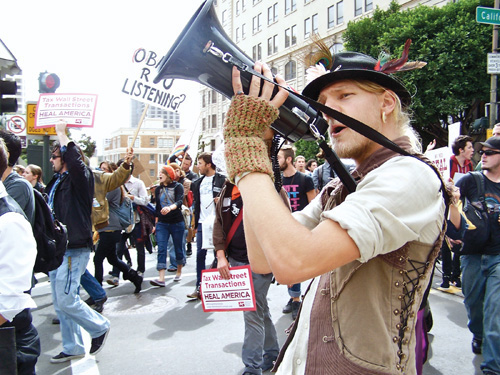
Camp life is dotted with calls for the People’s Mic, a tool developed at Occupy Wall Street, where using bullhorn or speakers is illegal. When someone yells “Mic check!” the crowd echoes in response. The person speaks his piece, sentence by sentence, as the crowd repeats. If a few people nearby can hear him, everyone can. For better or for worse, it tends not to amplify ideas people don’t have much taste for; at a recent meeting, when someone insisted that people who had been foreclosed on were greedy and foolish, the People’s Mic’s volume faded fast.

The People’s Mic requires no electricity, discourages rambling, a brilliant improvisation. But the central feature of Occupations throughout the country is the General Assembly. OccupySF has been holding General Assemblies every day at camp at 6 p.m. and on Saturdays at noon in Union Square. In the past week they have consistently boasted a couple hundred participants daily, but continue to practice consensus-based decision-making and participatory democracy. They’re long and often frustrating, but for many, as a standard rallying cry insists, “This is what democracy looks like!”

Many have stepped up at meetings to say that too many men, too many white people, or simply too many of the same voices are being heard. Solidarity efforts like Occupy the Hood, which declares the vital need that people of color make decisions and organize in and along with the occupations, have surfaced nationally.

On Oct. 5, after about 700 people marched on the Financial District with OccupySF, the General Assembly was particularly well attended. It was peppered with invitations and expressions of solidarity, conveyed by representatives of groups from throughout the Bay Area.

The week’s schedule slowly filled: Thursday’s anti-war march, the next day’s teach-in with activist Miguel Robles, a 7 am “Wake Up Action” with Unite-HERE Local 2 on Oct. 10, and plans to coordinate with the LGBT rights group Get Equal for a National Coming Out Day action the next day.

Carolyn DeRoo, a brightly charismatic BART station agent, reveled in the whoops and cheers when she announced that Amalgamated Transit Union Local 1555, the union that represents BART workers, had just voted to endorse Occupy SF. “I got an hour off work today so I could be in the march,” said DeRoo.

She expressed concern over the lack of coherent messaging, hoping it wouldn’t hurt the movement. “I was about to get on a plane to New York because of how badly I wanted to be a part of it,” she said. “I’m so glad it has started in SF.”


THE COPS ARRIVE

But on that fateful night, Oct. 5, meeting ideals were strained. High-tension and often angry debate filled the hours between being warned of police action and its onset, making consensus difficult. Some wanted to take down the camp, unable to risk arrest. There were campers from all walks of life present, including some homeless folks and travelers who would risk losing all or most of their possessions if the police confiscated them. Others didn’t want to see the camp’s growth stunted due to police intimidation.

Dierdre Anglin, 40, an Oakland resident who works in the nonprofit sector, was particularly calm amongst the chaos. “I think the energy got a little high,” she said, as protesters ran around taking down tents and preparing for the imminent police confrontation. “But we have decided to take the stance and to stay here.”

She added, “I personally feel that they are not going to do anything because it would make the police look quite bad. There’s a lot of support for us.” Anglin’s prediction about the cops’ actions, if not their public relations consequences, was mistaken. Police marched in around 1 am, and Department of Public Works employees began to fill their trucks with camp materials.

Billy Gene, ever energetic, raced to lie down on the street in front of trucks and was dragged away, yelling “Don’t be mean!” at police. Many sat and stood in front of trucks. Others could be seen shaking their heads at colleagues’ verbal attacks and murmuring, “that isn’t nonviolent.”

There was no property damage or physical violence on the part of the protesters, although one man was arrested for allegedly punching an officer in the face, which both sides cast as an aberration that didn’t reflect the tenor of the standoff.

At 3 am, protesters surveyed the damage. An organizer addressed the group: “We’re still here, and it’s time to rebuild.” The camp received a donation of blankets and sleeping bags at four o’clock that morning. At five, a small jam session and dance party broke out.

Police have since provided information on how to retrieve confiscated materials, and Police Chief Greg Suhr told us they’ve been actively trying to facilitate getting people their stuff back and allowing the occupation to continue (see accompanying article for more from Suhr).

In the days since, the mood has again turned jubilant. On Thursday afternoon, Oct. 6, about 120 people were gathered at the camp. Signs ranged from “student loan debt is slavery” to “grannies against war.” The next night, the mass of people had increased, and with it the group’s creativity. Protesters could be seen pedaling a stationary bike connected to a battery, powering laptops.

As the sun set Friday, 300 people at camp looked west. They erupted in cheers as a 500-person anti-war demonstration marched onto the site. Market between Main and Embarcadero was shut down as protesters rallied and then held General Assembly. A dozen police lined up near the sidewalk; one told me they were separating OccupySF from the march. The next second, the “march” erupted in chants of “We are the 99 percent,” the Occupy movement’s signature rallying cry. Attempts to divide were futile.

That the movement has no “one message” has in many ways worked to their advantage. It seems hundreds of thousands of people with varying issues and concerns can all agree that an elite class, embodied by Wall Street, has far too much power and money, and that the people must unite against the sorry state of this system. As I looked in the officers’ eyes, I wondered how long even their disconnect from the protesters will last. Most are, after all, the 99 percent too.

After the General Assembly held the street for an hour, police requested that they please move to the sidewalk. A consensus vote decided to oblige. An assembly member proclaimed, words booming with the roar of the People’s Mic, “Let us remember that we took this street, and we could have held it if we wanted to.”

This is the kind of power many haven’t felt in a long time. And I get the feeling that no one intends to relinquish it any time soon.

Feds crack down

8

steve@sfbg.com

HERBWISE Reversing its previous pledge to abide people’s rights to legally obtain medical marijuana in California and the 14 other states that have legalized it, the Obama Administration has launched a crackdown on the industry using several different federal agencies.

During an Oct. 7 press conference in Sacramento, California’s four U.S. attorneys announced their intention to go after the industry with raids on large-scale growing operations and big dispensaries and civil lawsuits targeting the assets of people involved in the cannabis business.

“We want to put to rest the notion that large marijuana businesses can shelter themselves under state law,” Melinda Haag, the U.S. attorney for Northern California, based here in San Francisco, said at the press conference.

That pronouncement is just the latest in a series of federal actions against those involved with the production and distribution of California’s top cash crop, an industry that the California Board of Equalization estimates to be worth about $1.3 billion in tax revenue annually. Sources in the medical marijuana business say the crackdown began quietly this summer.

Hundreds of dispensaries and other medical marijuana operations had their bank accounts shut down after the Treasury Department contacted their banks and warned them of sanctions for doing business with an industry that remains illegal under federal law. The Internal Revenue Service last month also notified many large dispensaries — including Harborside Health Center in Oakland, the largest in Northern California — that they cannot write off normal business expenses and must pay a 35 percent levy on those claims going back for three years.

Harborside’s Steve DeAngelo told us that would put Harborside — or any company with high overhead costs — out of business. “This is not an effort to tax us, it’s an effort to tax us out of existence,” he said, noting that Harborside paid the city of Oakland $1.1 million in taxes this year. In addition, the Department of Justice recently began sending 45-day cease-and-desist letters to hundreds of dispensaries around the state, including at least two in San Francisco, warning the clubs and their landlords that the operations violate federal law and could be subject to federal laws on the seizure of assets from the drug trade.

“It’s a multi-agency federal attack on patients’ access to this medication,” DeAngelo said. “It’s going to drive sick and dying patients back out onto the street to get their medicine.”

Haag claimed the state’s medical marijuana laws, which California voters approved back in 1996, have been “hijacked by profiteers.” Yet both local officials and people in the industry say that characterization is ridiculous, and that the federal government’s new stance will destroy an important industry — one that is very professional and well-regulated in San Francisco — and send legitimate patients back into the black market.

“I think it’s a step in the wrong direction and counter-intuitive to the Obama Administration’s contention that he would respect state’s rights,” said Sup. Ross Mirkarimi, who authored groundbreaking legislation regulating San Francisco’s two dozen dispensaries, a system that he said “is working well…But now the federal government is pulling the rug out from under us.”

Shortly after taking office in 2009, the Obama Administration released the “Ogden memo,” written by Deputy Attorney General David Ogden, stating the federal government would respect the rights of states to legalize and regulate medical marijuana. It was seen by cannabis activists as a sign that Obama was de-escalating the war on drugs, at least as it applied to marijuana.

But in June of this year, the DOJ release the “Cole memo,” by Deputy Attorney General James Cole, which it said “clarifies” the Ogden memo. In fact, it reversed the position, stating unequivocally that federal marijuana prohibition prevails and “state laws or local ordinances are not a defense to civil or criminal enforcement of federal law with respect to such conduct.”

“They’re bringing the hammer down,” said David Goldman, who works for Americans for Safe Access and sits on San Francisco’s medical marijuana task force. “This is not U.S. attorneys doing this on their own, this is coming from the top levels of the DOJ.”

Actually, Goldman and others suspect it goes even higher than that, right to Obama and his political team, who appear to be making a calculation that cracking down on medical marijuana is a good move before an uncertain reelection campaign.

“It’s political. It’s all about Obama appealing to the middle to win reelection,” Goldman said.

“I don’t think there’s any rational basis for what’s going on. It was clearly a political calculation,” DeAngelo said. “Why do they think it’s better for patients to buy their medicine from the black market?”

He said the crackdown will bolster the Mexican drug cartels, destroy a thriving industry that provides jobs and pays taxes, hinder efforts at better quality control and growing conditions (see “Green buds,” Aug. 16), and waste law enforcement resources to seize and destroy a valuable commodity.

“It’s a policy with all downsides and no upsides,” DeAngelo said.

Mirkarimi said that this crackdown could finally force cannabis activists to take on the federal prohibition of marijuana directly: “Bottom line, marijuana is the United States needs to be reformed so it’s not a Schedule 1 drug,” referring the federal government’s conclusion that marijuana is a dangerous drug with no medical applications.

But for now, DeAngelo said the industry will fight back: “We will fight it in the legal system, we will fight it in the court of public opinion, and we will appeal to Congress.”

The Occupy Wall Street platform

6

EDITORIAL In New York City, the protesters who started the Occupy Wall Street movement remain camped out in Zuccotti Park. In Washington, DC, President Obama said at an Oct. 6 press conference that he understands the sentiment driving the activists. Yet in San Francisco, Mayor Ed Lee has approved a police crackdown and the confiscation of camping supplies in an effort to debilitate the occupation in front of the Federal Reserve Bank.

The move comes at a time when Lee is doing nothing to crack down on foreclosures that cost the city money, nothing to force the big banks that have the city’s deposits to lend more in the community, and nothing to promote local taxes on the wealthy.

While Lee says he supports the First Amendment rights of the protesters, he sent the cops in at 10:30 at night to confiscate their belongings — using, in part, the sit-lie law (which is only in effect until 11 p.m.)

His approach is just wrong. This city ought to be embracing and supporting the demonstrations. San Francisco makes room for all kinds of public events; this one should be no different. The people at City Hall should be working with the people in the streets to make San Francisco a central part of this growing national movement.

Make no mistake about it: What started as a small-scale, leaderless, somewhat ragtag group in lower Manhattan now has the potential to become a potent political force in this country. Occupy Wall Street has tapped into a deep feeling of frustration that’s shared by people in blue states and red states, in cities and towns and rural communities. The feeble economy impacts almost everyone — and this movement has managed to point the finger at the people who caused the problem, who are preventing solutions and who are making big money off the suffering of others.

We realize that at this point, there’s no specific focus for Occupy Wall Street. The civil rights movement and the anti-war movements of the 1960s and the antinuclear movement of the 1970s, the demonstrations against free trade agreements in the 1990s and the marches against the Iraq War in the past decade included people with hundreds of ideological agendas, but they had a pretty clear message — and, generally speaking, specific actions that government officials could take to address the issues.

Occupy Wall Street hasn’t called for any bills, regulations or policies. It’s still a group that is simply calling attention to a basic truth — the very wealthy in general, and the financial sector in particular, are enjoying economic gains at the expense of the rest of us. But that alone is a profound and potent message — if the demonstrators don’t have all the solutions, at least they’ve identified the problem. And that’s more than Obama, Congress, or the mainstream news media have done.

There’s been plenty of talk of a formal platform — one Occupy Wall Street activist posted a proposed list of 13 demands on the group’s website. It’s not a bad list (a guaranteed living wage, single-payer health care, free college education, debt forgiveness, a racial and gender equal rights amendment) with a few somewhat random elements (outlaw all credit agencies). Fox News has picked up the list, although the organization, such as it is, has made it clear that there is no consensus on any platform and agenda. And the labor unions that are joining the protests — with the proper respect for the folks who started things — have legislation in mind (a financial transaction tax, for example).

There’s a danger that the message becomes so diffuse, and imbued with every possible issue that anyone on the left cares about, that it loses the potential to have an impact on the 2012 elections. Occupy Wall Street could go a long way to providing a populist progressive message to counter the Tea Party (which is funded by and largely organized by billionaires but tries to claim grassroots legitimacy).

And there’s no need for a laundry list of agenda items. The focus is right where it ought to be: The richest Americans — and the big financial institutions — have been sucking all the money and energy out of the economy. The remaining 99 percent are suffering. Tax the top 1 percent and create a robust jobs program to put the rest of the country back to work; that’s a winning platform for 2012

Editorial: The Occupy Wall Street platform

6

In New York City, the protesters who started the Occupy Wall Street movement remain camped out in Zuccotti Park. In Washington, DC, President Obama said at an Oct. 6 press conference that he understands the sentiment driving the activists. Yet in San Francisco, Mayor Ed Lee has approved a police crackdown and the confiscation of camping supplies in an effort to debilitate the occupation in front of the Federal Reserve Bank.

The move comes at a time when Lee is doing nothing to crack down on foreclosures that cost the city money, nothing to force the big banks that have the city’s deposits to lend more in the community, and nothing to promote local taxes on the wealthy.

While Lee says he supports the First Amendment rights of the protesters, he sent the cops in at 10:30 at night to confiscate their belongings — using, in part, the sit-lie law (which is only in effect until 11 p.m.)

His approach is just wrong. This city ought to be embracing and supporting the demonstrations. San Francisco makes room for all kinds of public events; this one should be no different. The people at City Hall should be working with the people in the streets to make San Francisco a central part of this growing national movement.

Make no mistake about it: What started as a small-scale, leaderless, somewhat ragtag group in lower Manhattan now has the potential to become a potent political force in this country. Occupy Wall Street has tapped into a deep feeling of frustration that’s shared by people in blue states and red states, in cities and towns and rural communities. The feeble economy impacts almost everyone — and this movement has managed to point the finger at the people who caused the problem, who are preventing solutions and who are making big money off the suffering of others.

We realize that at this point, there’s no specific focus for Occupy Wall Street. The civil rights movement and the anti-war movements of the 1960s and the antinuclear movement of the 1970s, the demonstrations against free trade agreements in the 1990s and the marches against the Iraq War in the past decade included people with hundreds of ideological agendas, but they had a pretty clear message — and, generally speaking, specific actions that government officials could take to address the issues.

Occupy Wall Street hasn’t called for any bills, regulations or policies. It’s still a group that is simply calling attention to a basic truth — the very wealthy in general, and the financial sector in particular, are enjoying economic gains at the expense of the rest of us. But that alone is a profound and potent message — if the demonstrators don’t have all the solutions, at least they’ve identified the problem. And that’s more than Obama, Congress, or the mainstream news media have done.

There’s been plenty of talk of a formal platform — one Occupy Wall Street activist posted a proposed list of 13 demands on the group’s website. It’s not a bad list (a guaranteed living wage, single-payer health care, free college education, debt forgiveness, a racial and gender equal rights amendment) with a few somewhat random elements (outlaw all credit agencies). Fox news has picked up the list, although the organization, such as it is, has made it clear that there is no consensus on any platform and agenda. And the labor unions that are joining the protests — with the proper respect for the folks who started things — have legislation in mind (a financial transaction tax, for example).

There’s a danger that the message becomes so diffuse, and imbued with every possible issue that anyone on the left cares about, that it loses the potential to have an impact on the 2012 elections. Occupy Wall Street could go a long way to providing a populist progressive message to counter the Tea Party (which is funded by and largely organized by billionaires but tries to claim grassroots legitimacy).

And there’s no need for a laundry list of agenda items. The focus is right where it ought to be: The richest Americans — and the big financial institutions — have been sucking all the money and energy out of the economy. The remaining 99 percent are suffering. Tax the top 1 percent and create a robust jobs program to put the rest of the country back to work; that’s a winning platform for 2012.

Brown vetoes bicycle buffer zone

92

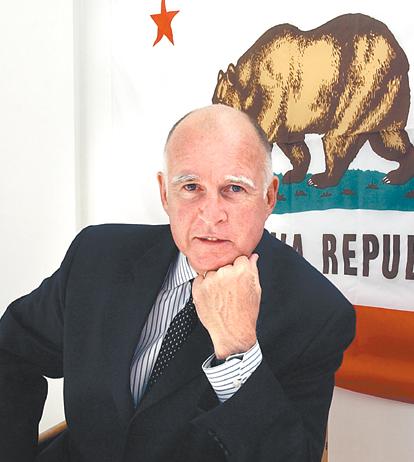
Anyone who has ever ridden a bicycle knows how scary and dangerous it is when cars pass too closely at high speed. So the California Bicycle Coalition made its top legislative priority for the year a bill, SB 910, to require drivers to give bicyclists a three-foot buffer or slow down to 15 mph. And even though the Legislature overwhelmingly approved this reasonable traffic safety measure, Gov. Jerry Brown vetoed it on Friday.

“His veto made no sense. We honestly can’t figure out why he vetoed the bill,” said CBC executive director Dave Snyder, a San Francisco resident who used to run the San Francisco Bicycle Coalition and who founded Transportation for a Livable City (now known as Livable City). “It’s not based on logic or public policy, but just based on politics.”

The California Highway Patrol and California Department of Transportation opposed the measure on the grounds that it could impede the flow of automobile traffic, and Brown cited their stand in his veto message. Indeed, keeping cars moving at high speed has long been the central goal of these agencies, even when it has high economic, environmental, or public safety costs.

But Snyder is right that Brown’s veto message is confusing and contradictory. He expresses support for the three-foot buffer, but expresses concern about slowing traffic to 15 mph, seemingly confused about the meaning of the word “or,” meaning drivers can provide the buffer or slow down to a safe passing speed if they’re unable to give bicyclists that much room.

People who don’t ride bikes tend to forget that automobiles are deadly weapons, and that a bicyclist’s brief swerve to avoid a pothole, broken glass, or other hazard can have disastrous consequences if a car is passing too closely. This veto follows another illogical one – Brown’s rejection of Sen. Mark Leno’s local vehicle license fee bill, which would have pumped $75 million into SF’s coffers and was almost universally supported by this year’s mayoral field – that gave undue deference to automobile owners.

Meanwhile, the San Francisco Police Department recently launched a crackdown on bicyclists in the city, issuing dozens of tickets on Market Street for running stop lights and on Townsend for briefly riding on the sidewalk en route to the Caltrain station – and ignoring the nearby cars parked in bike lanes and running those same red lights.

Now, before we get to the commenters’ tirade about scofflaws on bicycles – which come every time we write about bikes – let me note that people break the law on every form of transportation, everyday. Motorists speed, run stop signs and lights, and illegally edge past pedestrians (who themselves jaywalk with great regularity). And every Muni bus has several riders who haven’t paid. None of us are angels, so try not to get too worked up into a sanctimonious rage.

But if you want to truly understand why bicyclists can often be so flagrant in our disregard for the law, consider that we’re using a transportation system and abiding traffic laws that weren’t designed for us. Seriously, just ride a bike and you’ll quickly understand. We don’t need to stop at every stop sign or signal light to have a safe, smooth-flowing transportation system that doesn’t steal the right-of-way from drivers, who we can usually see and hear coming with plenty of time to stop. Idaho and other jurisdictions actually treat bikes differently than cars in this realm, with laws that don’t require cyclists to lose momentum by repeatedly coming to complete stops, and it works well.

The fact is, the bike buffer bill is the very minimum that we need to encourage cycling as a safe and appealing transportation option to more people, which would only help our environment, public health, and dependence on fossil fuels. And the fact that it was vetoed for petty, illogical reasons is incredibly frustrating.

Yet there may be a silver lining to this. Snyder said the CBC, which is just beginning to increase its reach and influence and to prepare a more ambitious agenda on behalf of California cyclists, will use this defeat as a launching pad for future efforts.

“The main benefit of the three-foot bill was the community organizing that we did to get is passed. So now we can leverage that for our next steps,” Snyder said. “California needs a lot more than a three-foot buffer to give people more safe transportation choices.”

The Performant: They Might be Giants

0

Stagewerx and SF Olympians Festival go big

It’s been a turbulent year for independent theatre and its venues. In truth, every year is. But there have been some notable successes too. Boxcar Theatre’s addition of a new studio space on Hyde Street. Bindlestiff Theatre’s move into a new permanent space. Pianofight’s acquisition of the old Original Joe’s in order to create a hybrid performance space-kitchen-bar right on the cutting edge of the downtown theatre district. 

And just in case you’d missed it, this is the month that Stagewerx, which has been occupying the literal theatrical underground in the basement of 533 Sutter since 2007, has opened the doors of its community-supported digs at 446 Valencia — the old Intersection for the Arts space. 

Following a big-ticket Kickstarter campaign* and months of hard labor, rebuilding one venue from scratch while running another, the Stagewerx crew’s labor of love has finally put down its expansive roots in the Mission District.

It was a low-key but convivial christening, a bevy of Stagewerx supporters and performers (and supporter-performers) poking around the nooks and crannies of the strangely familiar, yet revitalized space. The evening’s emcee, Mikl-em, presided over a variety show of musicians and comedians (and musician-comedians), including a special guest appearance from Carol Channing, as well as one by Sean Owens, who mysteriously often appears on the same bill as Channing. (It’s rumored they share a booking agent.) 

Other acts included Circus Finelli, Tom Sway from Undergroud Sound, Joe Klocek from Previously Secret Information, Tom Jonesing, Don Seaver, and Gerri Lawlor. No sooner was the party over, Stagewerx hit the ground running with a Monday performance of the Picklewater Clown Cabaret and a four-weekend whirlwind of sketch comedy dubbed PanderFest 2011, co-starring Pianofight’s Mission CTRL and Crisis Hopkins. 

Meanwhile downtown, another theatre festival of quietly epic proportions. The SF Olympians Festival, opened with staged readings of new full-length plays by Thunderbird Theatre Company and Megan Cohen and a veritable constellation of shorts, kicking off a four-weekend run of its own on the EXIT Theatre mainstage. 

In its second year, the SF Olympians Festival uniquely fuses ancient Greek mythology with modern-day theatre-making, with each play featuring a different mythological figure—from Andromeda to Zephyrus—and a different local playwright (there are 29 represented in this festival of 32 plays). 

On Friday, a three-play bill of two shorts and one full-length work debuted, thematically clustered around Orion, one of the most recognizable of all constellations. Claire Rice’s very short, “Dog Day”, starred Benji Cooper as Canis, who morphed into the narrator of stage directions for Megan Cohen’s full-length “Hunter and Hunted,” which turned the Orion myth into an updated crime noir. 

Starring Matt Gunnison as the beleaguered “Joe Ryan,” an old-school detective on the trail of the Scorpio gang, Cohen’s often humorous play turned the otherwise familiar streets of San Francisco, from North Beach to the Panhandle, into a giant playground for the infamous Scorpio gang. 

Rounding out the evening with a case of constellation envy was “Scorpio,” a short penned by Seanan Palermo, starring an exasperated John Lennon Harrison as the titular character, fruitlessly pursuing Orion across the deserts of Arizona. There’re still three weekends left of the festival, each night more ambitious than the last, and at just ten bucks a pop, repeat visits are not only possible, but recommended.   

*Full disclosure, the author of this piece made a kickstarter donation to the Stagewerx campaign.


PanderFest 2011

Through Oct. 29

Various times, $20

Stagewerx

446 Valencia, SF

www.stagewerx.org/446.html

www.panderexpress.com


SF Olympians Festival

Through Oct. 29

 Various times, $10

Exit Theatre

156 Eddy, SF

www.sffringe.org

www.sfolympians.com


Lee’s talking points sound familiar

Interim Mayor Ed Lee released a 17-point jobs plan last week as part of his bid for mayor, prompting City Attorney Dennis Herrera to accuse the interim mayor of “plagiarism” since Herrera, also a contender for mayor, issued a 17-point jobs plan himself earlier this year.

Herrera’s campaign also criticized Lee for ending his plan with Herrera’s signature slogan, “a city that works.”

But Herrera isn’t the only mayoral candidate for whom Lee’s campaign rhetoric rings a bell. Board President David Chiu, who attracted a great deal of attention earlier this year for his statement that supervisors are elected not to take positions but to “get things done,” seems to have served as a muse to the campaign consultants who thought up Lee’s campaign slogan: “Ed Lee Gets it Done.”

(Which — is it just me? — or does having that phrase plastered everywhere bring to mind something more like this?):

http://www.youtube.com/watch?v=OnDO5VTge6w

Lee’s “new era of civility in City Hall,” meanwhile, closely echoes language Chiu has used on the campaign trail. At a campaign stop in June, Chiu told a room of supporters that before civility was restored this year, “City government was frankly pretty dysfunctional.” Politicians from different political factions bickered with one another, he said, and “they literally couldn’t even sit in the same room.”

At an Aug. 11 rally, Lee told supporters, “We have changed the tone in which we run government,” and added, “I still have in my mind the screaming and the yelling” that the city family used to engage in. 

A few more striking similarities, taken from the candidates’ respective campaign websites:

*  David Chiu says he’ll “Prioritize hiring of local residents.”
*  Ed Lee says he’ll “Hire San Franciscans.”

*  David Chiu says he’ll “Invest in community institutions and infrastructure.”
*  Ed Lee says he’ll “Invest in infrastructure jobs.”

*  David Chiu says he’ll “Support the continued growth of the technology sector.”
*  Ed Lee says he’ll “Attract & grow the jobs of the future.”

*  David Chiu says he’ll “[Expand] the impact of SFMade.”
*  Ed Lee says he’ll “Revive local manufacturing – ‘Made in San Francisco.’”

*  David Chiu says he’ll “Fill vacant storefronts.”
*  Ed Lee says he’ll “Improve blighted areas.”

*  David Chiu says he’ll “Reform our broken business tax. San Francisco is the only city in California that levies a tax on businesses exclusively on payroll.”
*  Ed Lee says he’ll “Reform the Payroll tax  … Mayor Lee knows that San Francisco’s current business tax structure punishes job creation when it should reward it.”

Asked to comment on the remarkable similarities in campaign materials, Lee spokesperson Tony Winnicker told the Guardian, “It’s just another baseless attack from Dennis Herrera’s campaign, only this one sounds like he’s in the third grade.

“Mayor Lee has been giving small business loans and recruiting new jobs to San Francisco from his first days as Mayor,” Winnicker continued. “His economic plan builds on the good work and projects underway and includes many genuinely new ideas to create even more jobs for the future.”

Winnicker added, “As for President Chiu, it’s no surprise that he and Mayor Lee would share many views on how to create jobs for our City as they’ve worked together closely on many issues throughout the year. He thinks President Chiu has many good ideas in addition to Mayor Lee’s own new proposals in our 17-point economic plan. Mayor Lee looks forward to continuing to work with Board President Chiu to create jobs for every neighborhood of our City.”

Localized Appreesh: Waterstrider

0

Localized Appreesh is our weekly thank-you column to the musicians that make the Bay. Each week a band/music-maker with a show, album release, or general good news is highlighted and spotlit. To be considered, contact emilysavage@sfbg.com.

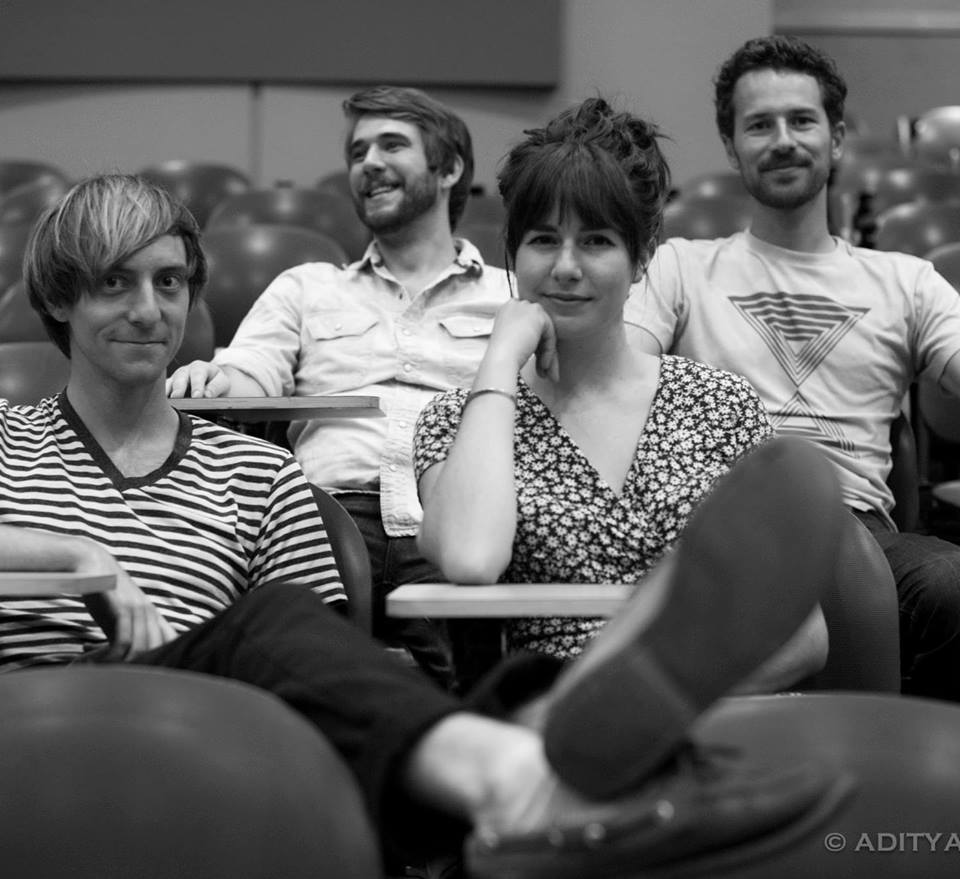
They seem a plucky bunch: Nate Salman, Alex Siegel, Clayton Ernst, Sean Suess, Brijean Murphy, and Walker Johnson – a.k.a Berkeley’s Waterstrider. The group, which somewhat formed in 2010 (but really got together this year), blends Afro-pop and synthesizers – and yet manages to sound authentic. Perhaps the intimacy of the Berkeley co-ops helped shape the sound; this is a six-person collective that is in-tune with itself, though the current lineup has only been together about a month. What they’ve accomplished in such a short amount of time is the main reason they’re here in Localized Appreesh.

Check out “Midnight Moon” off Waterstrider’s recently released EP, Constellation. There are so many audio-treats: delicate shaker, hand-drumming, floating synths, Fools Gold-reminiscent guitar, and lovely vocals, yet it feels inclusive, tight – when it spreads across cultural landscapes, it always spins around back to the core. You have a chance to hear it all live this Thursday, Oct. 13 at Bottom of the Hill – the band opens for pals Gardens & Villa. (If you need more convincing: Gardens & Villa bassist  Shane McKillop described Waterstrider as “Afro-beat meets Fleet Foxes.”)

Nate Salman (lead vocalist fellow):
Year and location of origin: 
Fall 2010 in Berkeley, but we went through a lot of evolution (and had a lot of changes in instrumentation and members). It really started taking shape around March or April of 2011. Almost all of us met in the co-ops and attended UC Berkeley. Walker, our drummer, is a friend of my older brother and a Cal graduate as well. The current lineup is only about a month old though.
Band name origin:
 It was a nickname and/or spirit animal that a friend from Santa Barbara started calling me.
Band motto:
 All we ever need is energy…
Description of sound in 10 words or less: 
Heavily rhythmic ethereal melodies steeped in surreal, romantic imagery.
Instrumentation: 
Nate Salman on Lead Vocals, Acoustic Guitar, Ukulele. Alex Siegel on Harmony Vocals, Electric Guitar. Clayton Ernst on Bass. Sean Suess on Harmony Vocals, Synth, Flute, Sax. Brijean Murphy on Congas, Percussion. Walker Johnson on Drums.
Most recent release: 
Constellation on August 1, 2011
Best part about life as a Bay Area band:
The people are wonderful! We make some really fantastic friends wherever we play.
Worst part about life as a Bay Area band:
We’re pretty optimistic people, so hopefully we will never have much of a problem with the music scene here.
First record/cassette tape/or CD ever purchased:
Ray J Everything You Want — It was probably when I was nine-years-old or so. I think I got that cassette after watching Ray J performing a couple songs on an old Nickelodeon show. However, I just looked it up after completely forgetting what it sounded like… some of the production on that album is pretty sweet! Surprisingly funky.
Most recent record/cassette tape/CD/or Mp3 purchased/borrowed from the Web: 
Little Dragon Ritual Union.Their grooves are fantastically beautiful and Yukimi Nagano’s voice melts my soul.
Favorite local eatery and dish: We frequent Taqueria La Familia. It is the best Mexican food in Berkeley. Their veggie burritos or chile rellenos do the trick for me.

Waterstrider
With Gardens & Villa and Young Man
Thurs/13, 9 p.m., $10
Bottom of the Hill
1233 17th St., SF
www.bottomofthehill.com

Really living at the Life is Living Festival (and now there’s a stage show too!)

0

Every once in awhile, an festival comes along that seems so seamless, so positive, and so needed that it’s like it sprang from the Bay Area gods. Such an event is the Life is Living Festival, which took over West Oakland’s De Fremery Park last Sat/8 in big, happy puppy pile of art and kids and music. “We began this, but as you can see, it’s expanded so that it’s kind of everyone’s thing now,” says Marc Bamuthi Joseph, the founder of the Life is Living organization which has overseen the event’s growth into yearly happenings in Harlem, Houston, and Harlem. Bamuthi, who helped start the Bay’s pioneering spoken word nonprofit Youth Speaks, seemed as gleeful to be out in the Oakland sunshine as the kids flipping head over heels at the padded beginner’s parkour course set up in one side of the park.

In another corner, a spoken word stage pedal-powered by the velo-minded geniuses of Rock the Bike. In another, a simple floor set up on the grass where drummers pounded away for an all-are-welcome dance show-and-tell. A woman in her forties gyrated joyously in precisely free African patterns. A kid that didn’t go up to my waist breakdanced to thunderous applause, finally sitting down in a folding chair just offstage, rubbing the spot on the back of his head that had just been supporting his entire body in an upside-down spin. 

In between stellar sets by Panamanian-cum-Oaklanders Los Rakas and Questlove, a man took the stage to vocalize what it seemed like many in the crowd were already feeling — that this day, with its serenity and family-friendly vibes, was a big deal for West Oakland. He talked about how we were all standing on a corridor of public land. Across the street was a senior citizen’s center. It was a Saturday and its doors were locked. Was this, the man asked the crowd, acceptable? He encouraged us all to utilize public land as something that could nurture community, not to let it lie fallow. 

Such was the overall message of Life is Living — doing stuff with what we have, while we strengthen our voices to ask for more. What we had wasn’t too shabby — a food justice information area, a health and wellness zone that offered free HIV testing, shows from local hip-hop duo the Coup and Haitian dance troupe Ra Ra Loumen. 

Not to mention another of the festival’s major draws: the Estria Invitational Graffiti Battle. Around the country, Bay Area graff legend Estria Miyashiro has been organizing themed graffiiti contests. Competitors hear the word of the day’s showdown (Saturday’s was “proud”) and create vivid works of aerosol cleverness in an alloted time. When the panel of expert street artist-judges had tallied up their impressions Los Angeles artist Vyal received the day’s top honors for the second year in a row. 

The feel-good event of the year, I’m calling it. And community organizers are in luck: Life is Living directors and artists have come together to produce a performance piece about the festival that will combine its environmental agency, a call to arms for members of underserved communities across the country, and the festival’s graffiti art for visual punch. It starts on Thursday at the Yerba Buena Center for the Arts. Especially if you missed the message on Saturday, it’s a production that demands attention. 


“Red Black and Green: A Blues”

Thu/13-Sat/15 and Thu/20-Sat/22 7:30 p.m., $25 ($5 on Thursdays)

Yerba Buena Center for the Arts

701 Mission, SF

(415) 978-ARTS

www.ybca.org


Louise Renne’s confused history

6

Wow, the Chron found a way to take a swipe at Dennis Herrera for getting involved in politics — and guess who the expert source is? Former City Attorney Louise Renne — who politicized her office so dramatically that the voters approved a measure barring city attorneys from endorsing candidates.

The Chron piece goes back and forth on whether Ed Lee properly disclosed city contracts. Then it quotes Tony Winnicker from Lee’s campaign:

They must get exhausted over there at that campaign throwing stones out of their glass house all day long,” Winnicker said. ”What’s really too bad is we can’t actually look to our legal counsel to get guidance on this. .. because the mayor’s only legal counsel is too busy attacking him.

Which apparently disturbed Renne:

“I think the city attorney has to be particularly careful  in what he or she says and in what he or she does,” Renne said. “I don’t know if that line has been crossed here. I’m trying to stay out of the mayor’s race. I’m extremely troubled that these questions are even being raised.”

Please, Louise.

First, Renne ran for mayor herself while she was city attorney, in 1987, against Art Agnos and John Molinari (who, as a supervisor, was her client). She didn’t get far. Over the next few years, she regularly supported candidates and took stands on propositions, even when her office was involved in evaluating those measures or giving advice to elected officials. In 1995, she endorsed Willie Brown for mayor — even though he was running against her client, incumbent Mayor Frank Jordan.

It was exactly that sort of conflict that led to the city law that now prevents the elected city attorney from making endorsements in local elections. And now she’s worried about Dennis Herrera?

The Hangover: Oct. 7-9

0

Jounce with us, if you will, through the Guardian staff’s frenzied weekend. Here’s our live reviews, hot raging, random sightings.

***Blow Up is reputed to be the best party in the city. I’ll say it’s almost certainly the best regular event for the 18+ crowd. But rule number one of going to a 18+ club event: don’t wear your nice shoes, even if the code does say “dress to impress.” It was only thanks to sheer luck and repeat viewings of The Matrix that I managed to avoid a geyser of projectile vomit in The Factory’s overcrowded men’s room Saturday night at Blow Up Forever II. “You go here.” I said, guiding the poor kid to the urinal I was about to use. “I’ll wait for the stall.” Click here for full story. (Ryan Prendiville) 

***Stationary bikes snuggled into the corners of Public Works’ sweaty cavern of a first floor, but the realness of the Bikes and Beats party on Friday was onstage. The event was billed as J Boogie’s album release party and the DJ spent the night doing what he does best: orchestrating sick collaborations. At one point he had Jazz Mafia (including emcee Aima the Dreamer) and Duece Eclipse sharing the stage with him simultaneously. That’s a lot of local live luminaries to look at. (Caitlin Donohue)

***Overt-sweetness ran emboldened through Twin Sister’s set opening for Pains of Being Pure at Heart on Friday at Slim’s, leaving a trail of cotton candy kisses in its wake. Lead singer Andrea Estella, hugging herself tightly, laid out tender and girlish vocals over the band’s funked out disco’d-Cardigans tone. The Long Island band, spread across stage in a perfect line at the front, pulled through decorated versions of “Bad Street” and other tunes off its highly enjoyable, recently released album, In Heaven. The only misstep, in my mind, is the oddly nasally pop tune “Saturday Sunday.” It’s too cutesy, the call and response of weekend days is at times cloying. By contrast, Pains of Being Pure at Heart kept it moody, with songs like “Heart in Your Heartbreak” recalling the darkened club scenes from Nic Cage classic, Valley Girl, when the Plimsouls’ thrust into “A Million Miles Away.” Quick tip: Slim’s has a pretty decent hummus plate. (Emily Savage)

***Completely inappropriate for a blog feature called the Hangover, but nonetheless we must give props to the Life Is Living Festival on Saturday in West Oakland’s De Femery Park for being the Bay’s feel-good event of the year. Was it the way the breakdancing children spun blithely on their heads? Maybe the youth parkour obstacle course, spoken word stage, or arts and crafts tables? Probs an amalgamation of it all. Plus, Los Rakas and ?uestlove made for a slammin’ live block party soundtrack. Click here for full story. (Donohue)

***(See accompanying photo) Someone had to make a statement at this weekend’s West Coast Cannabis and Music Festival — the medical marijuana industry is in absolute turmoil after last week’s forboding ruling by the IRS about Harborside Health Center’s tax status. Speaker Senator John Vasconsellos spoke to a multitudinous crowd at one stage (perhaps the free joints that promoters promised to anyone willing to take a seat upped number a little), and outside in the sunshine Rock the Bike bravely endeavored to keep the music stage pedal-powered, despite a location off the festival’s beaten track and corresponding dearth of volunteers.  

***Emotions ran high for the second consecutive sold-out Girls show at the Great American Music Hall last night. Chris Owens, JR White, and their talented ensemble were perfectly in sync as they treated us to a lengthy set highlighted by a trio of charismatic female vocalists. A powerful solo from one of the ladies made for an especially moving rendition of “Vomit.” Girls played nearly every song from Father Son Holy Ghost as well as old favorites like “Heartbreaker,” “Hellhole Ratrace,” and “Lust For Life.” The high point for me was the tender encore of “Jamie Marie,” which began with just Owens and his guitar on the flower ornamented stage before the rest of the band stepped out to resounding applause. The rapport between band members was palpable and I couldn’t help feeling a little bummed to be witnessing the closing chapter of their national tour. (Frances Capell)

***”This is the only mayoral candidate that’s doing drag events!” The woman at the door was, of course, wrong — just last week Lil Miss Hot Mess coupled with Queers for John Avalos to through the high school-themed Homo Homecoming at the Verdi Club. But last night’s Bevan Dufty’s “Politics is a Drag” campaign fundraiser was staged by the mayoral race’s only gay candidate, which was good enough reason to attract a Florence and the Machine-themed number from La Monistat and a return to the Sarah Palin costume that Anna Conda donned for a Work More! event — a reprise of a number she choreographed with the help of Guardian Managing Editor Marke B. (Caitlin Donohue)

***The Stevie Nicks show at The Fillmore on Sunday night was like a time warp to an early 1980s high school. Although most of the women in the audience were in their 40s and 50s, they were competing for “Best Dressed” like girls more than half their age. They paid tribute to their Queen Stevie in dark velvet, shimmering shawls, and long skirts. If I didn’t know better, I would say they’d kept those clothes in their closets for 20 years just for this occasion. But shopping with my mom has taught me that they sell it all at Chico’s. Click here for full story. (Ann Edwards) 

City Lights celebrates a vital, veteran publisher

1

The avant-garde publisher New Directions was founded in 1936, but the idea was borne two years earlier when Ezra Pound gave some fairly harsh advice to James Laughlin, a 22-year-old aspiring poet and Harvard undergrad. In 1934, Laughlin was ambitious enough to travel to Rapallo, Italy, to meet and study under Pound, who was by that time a fascist and outspoken anti-Semite, but still respected by young writers as the force behind Eliot, Joyce, and Hemingway, as well as Imagism, the movement he helped shape. After two months, though, Pound didn’t think Laughlin possessed enough talent, and told him to return to the states and “do something useful.”
 
Three quarters of a century later, “useful” hardly describes New Directions (which will be celebrated Tues/11 at City Lights Books) and its dedication to publishing eccentric and groundbreaking work, beginning with the likes of Dylan Thomas, Denise Levertov, Tennessee Williams, and Marianne Moore, and continuing today with contemporaries like László Krasznahorkai and Javier Marías.

Birds, Beasts, and Seas: Nature Poems from New Directions (New Directions Publishing, 191 pages, $14.95) testifies to that dedication. Published to commemorate its 75th anniversary this year, and edited by the poetry editor, Jeffrey Yang, the anthology draws from the New Directions’ exhaustive archive, piling together over 140 poets of every nationality, period, and style into a handsome little book. Arranged chronologically by date of birth, and spanning from antiquity to the present, the anthology explores the vastly different ways poets have responded to nature: worshipping it, vilifying it, and bemoaning its loss. As luck would have it, four contributors to the anthology will read at City Lights to commemorate New Directions’ anniversary: Michael Palmer, Michael McClure, Lawrence Ferlinghetti, and Nathaniel Tarn.
 
As conventional or even dry as an anthology of nature poems may sound, Birds, Beasts, and Seas is impressive simply because New Directions’ specialty has always been renegades, rejects, and intransigents. It’s an anthology of nature poems, of course, but the poems are by no means characteristic of the genre. They are, however, characteristic of New Directions. Several of the poets here are rarely anthologized at all, and stumbling onto them is like bumping into old friends suddenly back from oblivion. William Bronk, for instance, whose poem “Aspects of the World Like Coral Reefs” dismantles science and asserts “It is absurd to describe the world in sensible terms;” or French poet Saint John Perse, Chilean poet Vincente Huidobro, and some of the very poets reading at City Lights on Tuesday, like Nathaniel Tarn whose brooding poem from “The Fire Season” wouldn’t appear in your typical nature anthology:
 
Our pines continue to die and continue to die—
funeral carpets of needles around their base.
You could sleep there, you could suffocate
soundly and be in harmony with all of nature.
 
Editor Yang writes in the preface that nature poems could change our way of thinking about the environment, and while Yang’s faith in the poem is admirable (however naive), the most anyone can really expect from Birds, Beasts, and Seas is an anthology that, at its finest moments, is new and invigorating.

New Directions Publishing 75th Anniversary
Tues/11, 7 p.m., free
City Lights
261 Columbus, SF
www.citylights.com

Low-income tenants face possible eviction at Parkmerced

At least nine eviction proceedings have started at the Parkmerced housing complex, the site of a controversial new housing development, in response to an effort by the property management company to collect back payments on rent and utility bills, the Guardian has learned.

In recent months, nearly 200 residents received official notices warning that they would face eviction if they did not take steps to bring their accounts current within three days, according to Sara Shortt, executive director of the Housing Rights Committee of San Francisco. About 80 three-day notices were issued to tenants who are on Section 8, a federal low-income housing assistance program that subsidizes rental payments using public funds provided by the local housing authority.

“They’re extremely low-income renters, and they’re suddenly being asked to pay large balances,” Shortt explained. “It’s blood from a turnip.” Most of the amounts owed ranged between $600 and $800, she added.

Shortt said that while some tenants were being allowed to set up payment plans, this measure wasn’t guaranteed for every tenant attempting to address the problem within the three-day timeframe. And she was skeptical that the payment-plan arrangements being presented by management were realistic in every case.

“I don’t know if Parkmerced is doing anything illegal,” Shortt said, acknowledging that she was receiving conflicting accounts of the situation. “But they’re executing something about legitimate recovery of money in an unfair manner. To allow people to slide for years and suddenly come at them for back bills is a one-way ticket for eviction.”

The Guardian was unable to reach Stellar Management, the real-estate management company at Parkmerced, but Shortt said she had spoken with Stellar representatives on behalf of tenants who were contacting the Housing Rights Committee in a panic.

Stellar representative Bryce Boddie explained the situation to her by saying a previous property management company had left billing records in disarray, and the company was finally getting around to straightening out its books by demanding payments that had long since been owed. “Their contention was that they basically decided it was time to clean house and recoup payments,” she said. Shortt said she’d also been told that Stellar had come under pressure from Fortress Investment Group, a firm that took ownership of the property last year, to get payments in order.

But P.J. Johnston, a public relations representative for Parkmerced, rejected that account, saying, “We absolutely follow up with residents who are not paying their bills.” Johnston said the number of three-day notices served this year were in keeping with last year, indicating that there had been no drastic changes in policy since the approval of the new housing project. He did not know how many Section 8 tenants received the warning notices in 2010. “Whether someone is a Section 8 certificate holder or just a regular resident, everybody’s got to pay their rent,” he said.

Johnston bristled at the criticism that renters were being asked to fork over unrealistically high sums on the spot for payments that had lapsed for long periods, saying, “If we had moved swiftly to evict residents sooner, we’d be hearing that we didn’t give them a chance.”

The issue comes on the heels of Board of Supervisors approval for a controversial housing development project at Parkmerced that tenant groups opposed because they felt it didn’t go far enough to protect renters. A development agreement negotiated between Parkmerced Investors and the city guarantees that rent-controlled tenants will be able to move into brand-new units at the same rent-controlled rate once the old units are demolished. Some residents are suspicious that management’s decision to issue three-day notices and take steps to evict tenants who cannot pay is a strategy for skirting these requirements.

Shortt said she couldn’t be sure that this was the case, but worried nevertheless that low-income tenants could wind up being tossed out of Parkmerced, which is just the scenario that tenant advocates had feared. “The end result really is in clear conflict with the spirit of negotiations and tenant protections,” she said.

“Victorian Visions” at Vesuvio Cafe

0

Somewhere between a dollhouse and a photo portrait are the works of Brent Johnson and Jo Cyrus. Now on display (through Oct. 15) at North Beach’s Vesuvio Café, the artists create 3-D renderings of the facades of San Francisco’s trademark Victorian homes.


With meticulous attention to detail (as anyone who lives around here knows, no two Victorians are alike, with unique paint jobs, doorways, windows, ornamental additions, and architectural florishes), the pieces are made using reclaimed wood sourced from remodeling and restoration projects on actual, life-sized local Victorians. Swing by legendary beat haunt Vesuvio to check out the exhibit for a latte bowl-sized dose of San Francisco history, in miniature.


“Victorian Visions of San Francisco by Brent Johnson and Jo Cyrus”
Through Oct. 15
Vesuvio Café
255 Columbus, SF
www.vesuvio.com

Endorsement interviews: Bevan Dufty

1

Bevan Dufty’s been running for mayor for about two years now. He’s often the star of the debates — if only because he has an engaging personality and is willing to laugh at himself, a rare trait in a politicians. And although he way typcially aligned with the fiscal conservatives on the Board of Supervisors, he has the support of the progressive SEIU Local 1021 — in large part because he’s talking about working with city employees instead of demonizing them. He also told us that the next mayor of San Franciisco needs to have a black agenda — to address the alarming outmigration of African Americans and the economic damage that’s been done to that community. You can listen to the full interview and watch video after the jump.


Dufty by endorsements2011


http://www.youtube.com/watch?v=GPohsxUCQao

BREAKING: SFPD threatening to break up Occupy S.F. encampment

San Francisco city government is cracking down on the Occupy S.F. movement, with public officials waiting until around 11 p.m. on Oct. 5 to move in and try to clear out the camp.

Police appeared on the scene in front of the Federal Reserve at the foot of Market Street in downtown San Francisco where roughly 200 protesters were camped out as part of the Occupy SF movement, and threatened to make arrests if protesters did not clear out completely within 30 minutes. The protest was a peaceful affair and the encampment had been in place since Sept. 29. The protest was called to mirror the growing Occupy Wall Street movement to oppose corporate greed and highlight the role of financial institutions in an economic decline resulting in a rising wave of foreclosures, unemployment, and cuts to public services.

Yael Chanoff, who was at the encampment on behalf of the San Francisco Bay Guardian, phoned in to report that police officers had issued notices telling people that they had to clear out because they were in violation of local city ordinances such as public nuisance laws, rules requiring permits for temporary structures, and the newly adopted sit/lie ordinance. Officers were taking photographs of the camp, presumably for evidence. Trucks from the city’s Department of Public Works had lined up on the street, she said.

Roughly 50 police officers in standard uniform were there, carrying “stacks of zip ties,” she added. Alexandra List, a protester, said that a commanding officer on the scene had told her no one would be arrested if the structures were removed completely within 30 minutes. Chanoff estimated that there were about 20 structures.

Chanoff said protesters were meeting to try and find out how to proceed, but some had decided to begin taking down the tents.

UPDATE: The Guardian spoke with SFPD public information officer Albie Esparza, who told us, “the sidewalks are being cleared of debris,” and mentioned that protesters had been in violation of certain codes, such as a fire code prohibiting open flames that applied to outdoor cooking setups. “They have the right to protest as individuals, obviously,” he said. Asked why it was so urgent that these codes be enforced at 11 p.m. when the streets are virtually empty, Esparza said, “I don’t know what the reason was for the timing.”


Yael Chanoff contributed to this report.


Occupy SF marches on the banks again

5

Occupy San Francisco — the local manifestation of the Occupy Wall Street movement that is spreading across the country — took to the streets today with a rally numbering in the hundreds. Marching up Market Street and through the heart of the Financial District, protesters met supportive car horns as often as tight-lipped disapproval. Today’s protest followed a similar one last week when six activists were arrested, with no arrests reported this time.

“We are the 99 percent!” was the most resounding chant, one that prompted several onlookers to join in. “We are 99 cents,” replied one man, walking through the crowd as they strode through the Tenderloin. Signs ranged from the plain – “Stop this” – to the hard-hitting: “Greedy Bastards!”

“I saw them on my way to get her immunization record,” related one woman, gesturing at a sleeping toddler in a stroller. “And I had to join in.” Visibly swelling in size throughout the two-hour march and stretching as far as six blocks at a time, the rally stopped in front of Wells Fargo, Chase Bank, and City Hall before ending back at the Federal Reserve Building where it began and where protesters have been camped out.

“Whose streets?” yelled a megaphone-toting activist. “Our streets!” the crowd bellowed back, spilling off the sidewalks and into the roadway. As rain threatened the Financial District, the protesters’ chants and shouts were not dampened.

Photos by Lucy Schiller

Jerry Brown has lost his mind

8

He’s all for “realignment” — giving counties more responsibility for public services. He’s all for environmental initiatives that decrease the state’s reliance on fossil fuels. But when a measure comes along that does both — at no harm to anyone in Sacramento, and has the support of just about everyone in San Francisco from the Chamber of Commerce to the Labor Council — he vetoes it.

Brown just announced that he won’t sign Sen. Mark Leno’s SB 223, which would have allowed San Francisco to bring in as much as $75 million a year in new revenue by raising license fees on cars.

Let’s look at this for a moment. New revenue to handle increased state mandates — without Brown having to raise anyone’s taxes. Local control (San Franciscans would have to vote to tax themselves on car use.) A rejection of his Republican predecessor’s unliateral decimation of the state budget. And someting that discourages car use in the process.

A winner on every account. A perfect piece of Jerry Brown legislation that fits in precisely with everything he’s been talking about as governor.

And yet, he vetoes the bil, issuing a ridculous statement calling Leno’s bill “piecemeal” and asking for “a broader revenue solution to the state’s fiscal crisis” — something he knows the Republicans won’t allow and thus will not happen any time soon.

I dunno. Looks to me like Jerry’s gone off the deep end.

Do North

0

FILM You could drive (or if you have the time, public transport) to the 34th annual Mill Valley Film Festival solely for movies like period drama Albert Nobbs, which is already generating Oscar buzz for Glenn Close. Hot tip, though: anything with the words “Oscar buzz” attached to it, or “critically acclaimed” (including believe-the-hype entries Martha Marcy May Marlene and Like Crazy), will likely arrive in San Francisco over the next few months.

However, Mill Valley also offers a huge schedule of films you haven’t heard of yet, like Bill Couturié’s Thumbs, a zippy doc about swift-fingered teens battling to win the 2010 US National Texting Championships. Before you shake your head in disbelief, Grandpa, note that the top finishers rake in major skrilla (first place: $50,000). Thumbs, which owes much to earlier competition docs like 2002’s Spellbound, has already taken aim at its target demographic by airing on MTV, but it holds up beyond the small screen. Kids will dig the wholesome protagonists: the punky small-town girl who argues with her mother via text; the soft-spoken swim-team standout. But anyone who doesn’t hang with the class of 2014 will find Thumbs an eye-opening (and surprisingly positive) peek at high-school society in the digital age.

Using technology in a completely different way is Granito: How to Nail a Dictator, acclaimed documentarian Pamela Yates’ follow-up to her 1983 doc about the Guatemalan civil war, When the Mountains Tremble. “How does each of us weave our responsibilities into the fabric of history?” Yates wonders in her introspective voice-over. When a human-rights lawyer working to charge Guatemalan military leaders with genocide asks Yates for her Mountains outtakes, the filmmaker scours her archives, digging for evidence and eventually becoming deeply involved in the case. Granito is a legal thriller, but it’s also a personal journey, for Yates and, most potently, survivors still traumatized by Guatemala’s years of repression and violence.

On the lighter side is Smokin’ Fish, a low-key profile of wry businessman Cory Mann (who also co-directs). Born in Juneau, raised in San Diego, the half-white, half-Native American (“For a long time, I thought I was Mexican!”) puts his mail-order company on hold for a few months every year to catch and smoke salmon using traditional methods in rural Alaska. More than a character study, Smokin’ Fish is also a portrait of what it means to be an “authentic Indian” in the 21st century, in a world where you can spend one day tangling with the IRS and the next trading fish for fresh moose meat.

A far less gratifying tradition is the subject of The Forgiveness of Blood, the sophomore effort from Maria Full of Grace (2004) director Joshua Marston. The Los Angeles-born, internationally-minded Marston travels to Albania for this fictional drama about the decades-old conflict between two rival families — and the devastating impact the eye-for-an-eye feud has on the younger generation. Already tapped as Albania’s entry for Best Foreign Language Film at next year’s Oscars, Forgiveness is definitely gonna be one of those MVFF films you’ll be able to see theatrically. Make sure you don’t miss it.

Got no transition here, just another recommendation. Guru: Bhagwan, His Secretary and His Bodyguard, a Swiss documentary about the late Bhagwan Shree Rajneesh — and two of his most devoted followers, bodyguard Hugh Milne and secretary-spokesperson Sheela Birnstiel. “When did it begin to go wrong?” asks Milne early in the film, which utilizes a bounty of archival footage to chart a movement that started in the 1970s, when a charismatic guru first enthralled thousands of spiritual, sexually adventurous hippies. Milne (mournful) and Birnstiel (incredibly, still a believer) reconstruct the confusing, emotionally exhausting years that followed; the subsequent web of culty weirdness culminated with the hostile takeover of a rural Oregon community, and, most famously, an unholy collection of Rolls-Royces.

Mill Valley’s shorts programs are always strong, from the “5@5” selections to the films paired with longer features throughout the fest. Of local interest, the UC Berkeley Graduate School of Journalism presentation Pot Country (part of the “5@5: Circle of Life” program) travels 200 miles north of San Francisco to hang with marijuana farmers. The film interviews both the world’s smarmiest pot lobbyist and a veteran grower prone to poetic, philosophical musings (“We didn’t move here to grow marijuana. It came to us as a gift”). Directors Kate McLean and Mario Furloni are particularly interested in divisive Prop 19 (which would have legalized weed for personal use, but had the potential to squeeze out small farmers), and the fact that, like, everyone grows pot these days. “We came [to Northern California] to be away from the mainstream culture,” remarks the grower. “Now, we’re in it.”

Screening alongside two other shorts in a program dubbed “The Barber, The Brush, and the Baton” is Paige Bierma’s A Brush With the Tenderloin, which follows muralist Mona Caron as she creates her landmark piece at Jones and Golden Gate Streets in San Francisco. Despite the neighborhood’s bad rep, its residents — no matter how intimidating they may look — rally around Caron’s efforts with positivity and pride.

The art theme continues with Library of Dust, screening before William Kurelek’s The Maze. Directed by Ondi Timoner and Robert James, Library draws inspiration from David Maisel’s photography collection of the same name. His subject? Abandoned canisters of human ashes discovered at the Oregon State Hospital. Library recounts how the canisters were found and how Maisel’s haunting artwork came about; it also delves into the troubled history of mental health care. Despite the tragedy of the forgotten ashes — very few have been claimed to date, though the “reunions” captured on camera are poignant — the resulting media storm was enough to convince voters that Oregon was long overdue for new mental health facility. Powerful stuff, all vividly explored in the span of 16 minutes. 

MILL VALLEY FILM FESTIVAL

Oct. 6-16, most shows $13.50

Various North Bay venues

www.mvff.com


Uncorking Jameson

0

virginia@sfbg.com

APPETITE Ireland is a green land of rolling hills, sheep, and craggy coastline, to be sure. The people enchanted even more: a generous, welcoming, hilarious lot. One of my favorite people in recent Ireland travels was Liam O’Leary, distillery operations manager at New Midleton Distillery in County Cork, near the southern coast of Ireland.

The name New Midleton may not mean a lot to some, but if you follow Irish whiskey, you know there are merely three distilleries producing publicly sold spirits in all of Ireland and this one’s the mother. Most famously, it’s the home to Jameson (founded in 1780 by John Jameson and originally produced in Dublin at the Old Jameson Distillery, which I also visited). New Midleton also produces numerous Irish whiskies including Midleton, Powers Gold Label, Tullamore Dew, Paddy, and smaller pot still brands like my longtime favorite Irish whiskey, Redbreast, and new love Green Spot. (Oh, that it would become available in the States).

Liam hosted the Renaissance Man and I on a private tour of the grounds. Spending pleasurable hours talking of whiskey and his 40-year history at Jameson (long before it was the huge company it is now), we soon delved into a subject dear to my heart, and, it seems, to every local I spoke to: music. We watched mass distilling in action, and finished with a hearty Irish lunch in the distillery restaurant.

The New Midleton facility is to date the most colossal, high production I’ve yet seen: towering stills, control panels, endless storage buildings stacked with barrels, and the world’s largest pot still (able to hold up to 125,000 liters, or roughly 33,000 gallons), which is no longer in use but is viewable in the Old Midleton museum. Numerous copper pot stills operate simultaneously, holding a massive 75,000 liters each. The facility whirs and buzzes continuously, recalling Ireland’s past, creating its future.

Exploring New Midleton, it was only fitting we talk Jameson. Possibly the highlight of my trip to Ireland — and there were many — was tasting Jameson 20-year whiskey straight from bourbon barrels (of which the majority of Jameson is aged in), and alongside it, 10-year whiskey in sherry barrels, both of which are blended into higher-end final product.

Both were superb, the purest forms of Irish whiskey I’ve tasted, particularly the golden, 20-year in bourbon barrels. Its layers kept unfolding: warm, honeyed and bright, spicy, fresh with grain and fruit. Already perfection, this stuff should be bottled at cask strength on its own. The sherry cask whiskey adds round, dark notes, giving it fullness and sensual depth.

As I taste through the Jameson line here at home, notes from those unforgettable barrels come back to me. I pick up various strains from the bourbon and sherry oak, all with that ever-present smoothness Irish whiskey is known for as it is generally triple-distilled. As the biggest selling Irish whiskey in the world, Jameson has done much to advance the category. Here are my tasting notes:

Jameson Rarest Reserve, $279: Rarest Reserve is the granddaddy of the line. Winning numerous awards (including this year’s Double Gold at the SF World Spirits Competition), it’s an expensive but truly special imbibement. After one explores the full-bodied aromas of ripe plum and spice, the taste impresses with toasted wood, dusty peach, dark chocolate, a hint of slate, leather, and earth. Here I find encompassed the approachable yet elevated possibilities inherent in Irish whiskey.

Jameson 18-year Limited Reserve, $86.99: The 18-year is another big award-winner, hitting my taste buds with an intense amount of peach. For me it evokes a golden summer freshness. Though I prefer it neat, it’s also lovely on the rocks. A couple drops of water allow other tastes to unfold, including orange marmalade, gentle spice, nuttiness, and biscuit. It’s soft yet bright, and could convert the non-whiskey drinker.

Jameson Gold Reserve, $60.99: Gold Reserve is a richer whiskey than the 12-year or Jameson Irish Whiskey. I get creamy apple on the nose, a gentle honey texture, and a peppery finish.

Jameson 12-year Special Reserve, $39.99: The 12-year won Gold this year at the SF World Spirits Competition. It’s sweet and spicy with sherry, wood notes. Oddly enough, I find its astringency is softened and rounded out with food.

Jameson Irish Whiskey, $24.99: The original Jameson has never been my Irish whiskey go-to. I find it a bit hot and thin, despite sweet fruit, vanilla and nuts. But this is the great global seller in Irish whiskey, often the first introduction many have to the category.

Subscribe to Virgina’s twice monthly newsletter, The Perfect Spot, www.theperfectspotsf.com


Guerrilla jazz

2

arts@sfbg.com

MUSIC When John Steven Morgan and John “Thatcher” Boomer III — who make up the John Brothers Piano Company — finished their last set at the 54th Annual Monterey Jazz Festival last month, my eyes weren’t watering alone. It wasn’t the barbecue smoke from the nearby food tents, or the too-bright afternoon fairgrounds sun. The John Brothers shake their listeners to the soul, because these piano-playing souls are shaking too. And MJF was their formal music venue debut.

Most other days, the John Brothers work together electrifying SF street corner audiences with skillful, joyous frenzies on one of their Craigslist-freebie upright Wurlitzer pianos. And they hope to soon bring their music to new cities. Over the course of the last year, they’ve compelled perhaps hundreds of local passersby to stop and watch. That’s gold for Morgan and Boomer, who say they want to give the listener the most visceral possible reaction. “I’d like to trigger a miscarriage,” Boomer deadpans.

The John Brothers put their own bodies into their art, hefting their piano to locations on a custom dolly, in and out of “the Contender,” a crumbling 1991 Jeep Cherokee. It’s not clear how much longer they’ll be hulking piano for a living. While their plan is to save up for a giant cargo van and tour around the U.S. just the two of them, by the end of the MJF they were in talks with a potential manager. “It’s just too much stress,” says Boomer of managing themselves, alluding to the CDs they forgot in Oakland on the trip to Monterey.

The CDs, which they sell out of a top hat, are filled with just one example of their repertoire. Morgan and Boomer’s original compositions are often mistaken for ragtime, but Morgan explains, “It’s not ragtime. Our influence comes mainly from the ’20s and the ’30s: Fats Waller, James B. Johnson, Art Tatum.” The two self-taught musicians have distinct styles, producing together a wild, organic, often playful mashup of classical, Morgan’s “gypsy stride,” Boomer’s blues, and a little jazz. Their ever-morphing reinterpretations oscillate from tender to eviscerating, raunchy to prim, mad to whimsical.

Local filmmaker Dan Reed of NextBooth.com, who accompanied the band to document their MJF appearance, met the John Brothers on the street, and asked immediately if he could use their music in his short films. “Other [musicians’] songs capture moments — their songs are full narratives,” he says. Reed used the John Brothers’ track “Computer Duster” as the soundtrack to his short Curious Chris, about an innocent man who gets bamboozled. The duo’s music both enlivens and takes new meaning from the film, as Morgan carries the listener from an expansive, melancholic opening, an unpopulated landscape with the delicate curiosity of a child, which blends into apprehension mixed with determination, building seamlessly to a swaggering, gypsy caravan staccato finale. Morgan says he’s eager to score future Reed films.

As the opening number for their first set at the jazz festival, Morgan, his broad shoulders bending over the keys, tore “Computer Duster” apart to create a novel Frankenstein of madness, thick shoulder-length hair swinging in his face, dissolving into chaos and in a moment resolving to the melody, the crowd simultaneously alienated and mesmerized; they were cheering by the end.

The John Brothers Piano Company perform regularly in San Francisco’s Union Square on Friday afternoons and evenings. 

THE JOHN BROTHERS PIANO COMPANY Fri/7, 5-8 p.m., free

Union Square, O’Farrell and Geary, SF

www.thejohnbrothers.com