Local

Jury finds Recology cheated in waste diversion bonus program

A jury has determined that Recology, San Francisco’s garbage collection contractor, was not honest with the city when it collected a bonus payment of $1.36 million for successfully diverting waste from the landfill.

Brought by a former employee, the lawsuit claims that Recology misrepresented the amount of diverted waste in order to qualify for the bonus money. This is especially significant because San Francisco is recognized nationwide as a leader in its quest to send zero waste to the landfill as an environmental goal.

Jurors deliberated for more than a week before issuing their determination, and ultimately found on June 17 that the waste management company had made a false claim and therefore must pay the city $1.36 million to compensate for the amount it improperly received.

The False Claims Act, the California law under which the suit was filed, provides that violators can be made to pay three times the amount collected under false pretenses, with interest tacked on to boot. That means Recology could ultimately wind up paying out an amount closer to $5.5 million.

Under an incentive program set up by the city, Recology may reap additional bonus profits above what it normally earns from the business of collecting and processing San Francisco customers’ trash if it effectively meets targets for keeping the trash out of the landfill, the most environmentally harmful waste disposal method. Under the program structure, Recology may withdraw this extra money from an account it maintains, containing funds derived from rates paid by garbage customers, if it meets the city’s established waste diversion targets.

The lawsuit, filed in 2010, claims Recology used several schemes to manipulate waste diversion records when it submitted records the San Francisco Department of the Environment in 2008, in order to be granted permission to withdraw the bonus money. The suit claimed this happened in three other years, too, but the jury only ruled against Recology for this one year.

The primary way this occurred, according to attorney David Anton, involved misclassifying demolition and construction waste. Under state law, ground up raw construction material that is labeled as “fines” can legally be used to cover up the top of a landfill – in order to prevent pests, fires, and odors, for example. When construction waste is ground up and used this way, it counts as “alternative daily cover” – like a layer of frosting on a giant cake of garbage – and strangely enough, the state allows waste disposal companies to count that frosting as “diverted waste” even though it’s actually part of the landfill.

The lawsuit claimed that Recology tried to count a great many tons of its construction and demolition waste as “fines” when in reality it should have been labeled just plain garbage, because the tons of stuff that they were shipping to the Solano County landfill wasn’t being processed to a fine enough grade to comply with state requirements for what constitutes “fines.”

The difference between “fines” and regular old construction and demolition waste is that for the latter, the company would have had to pay a fee to dispose of it – and would have had to count it as waste sent to the landfill, rather than waste diverted from the landfill. Had it been counted as plain old garbage, Recology would have missed its diversion targets in 2008, thus losing out on the $1.36 million bonus payment.

“The construction material that they were sending – they were telling SF was qualified to be used for this beneficial purpose at the landfill,” said Anton, “when in fact, the county and the state had said it was not qualified for it, it can’t be used that way, and it can’t be accounted that way.” He added, “Recology kept this completely secret from San Francisco.”

Recology spokesperson Eric Potashner told us the company plans to appeal this finding, because the violation Recology received in regard to the “fines” was only the start of a lengthy process. “The local enforcement agency in Solano County had questions about that material,” he said, noting that Recology went through a formal process of challenging an inspector’s assessment of the material. He said that at the end of the day Recology was never issued a cease-and-desist, nor was it made to revise company records to count it as anything other than “alternative daily cover.”

Another problem uncovered in the trial, Anton said, had to do with Recology misrepresenting tons of garbage generated in San Francisco as having originated in a different county, so that it could be counted outside the parameters of the waste diversion program. Potashner called that “an oversight” that had since been corrected, and added that it would not amount to enough to “move the needle” on hitting the diversion goals.

Finally, Anton noted, it came out in the course of the trial that somewhere between 10 and 20 percent of what residential customers chuck into their green compost bins actually winds up in the landfill at the end of the day.

Where happens to the stuff that goes in the green bin? “What we found out in this trial,” Anton said, “is that it’s sent to a place where they can compost it, but this place doesn’t necessarily make it into compost. Recology owns the composting place. And the composting place happens to be at a landfill. And it happens to be the law that a landfill has to cover the garbage that it gets every day. It’s got to cover it with dirt – six inches of dirt. Every day. A lot of landfills buy dirt to cover it – but the state allows you to … take mulch or green waste, if it’s chopped up fine, and cover a landfill with it. Well, Recology decided that they made more money and did better if they took a bunch of your green bin material, and put it on their landfill, rather than buying dirt.” As a result, he said, some of that green-bin waste “gets put in a landfill every night.”

Which really isn’t what most people would expect would happen after they’ve chucked some yard clippings into a compost bin.

When San Francisco set up the green-bin composting program, Anton said, a specific policy was created against this sort of practice. Nevertheless, “San Francisco knew that the company was doing that,” he said, and permitted it despite the formal policy because “they wanted to help out the company.”

Potashner said it is perfectly legitimate under state law for green waste to be used as alternative daily cover. “The Department of the Environment watches this, and knows we’re doing this,” Potashner said.

All of which underscores a point that Anton said he found to be somewhat confusing, or perhaps telling: “It was a very strange thing,” he said, “to be pursuing this lawsuit, trying to get money to the city, and the city’s representatives are saying, ‘we don’t want it.’”

He said he found it odd that a representitive from the San Francisco Department of the Environment, which oversees the city’s Zero Waste program, even made a statement in the course of the trial suggesting that he hoped the suit wasn’t successful.

Anton guessed that the city remained on the sidelines of this case because its “relationships with Recology are so close and tight.”

The Department of the Environment did not return the Bay Guardian’s request for comment.

Amour Vert brings its eco-friendly designs to Hayes Valley

0

“Paris Chic, Cali Cool.” That’s the tagline behind the eco-friendly clothing brand Amour Vert. Usually, the people who refer to California as “Cali” are non-natives. The term implies a certain unfamiliarity with the golden state and a desire to be more ~CaLiFoRnIaN~. Yet, the slogan is fitting. Founded out of a need for clothing that doesn’t sacrifice style for sustainability, Amour Vert’s garments are created by a French designer and made within a 20 mile radius.

Until now, the Palo Alto-based brand was only available in department stores and small boutiques but Amour Vert opens its first retail store today. Nestled in the heart of Hayes Valley, at 437 Hayes, the boutique neighbors the french confectioner Chantal Guillon Macarons and clothing store Steven Alan.

Across the street is Alternative Apparel, a company with a similar commitment to sustainable fashion. But owner Linda Balti maintains that Amour Vert is very different from its neighbor. In an equally sustainable way, Alternative Apparel outsources its garments to socially-responsible factories in Peru, Vietnam, Indonesia, China and other countries around the world. Amour Vert keeps everything local, from its design studio in the Dogpatch, to the exceptional garment factories in the Bay Area, to its beautiful living wall in the Hayes Valley store.

French-German couple Balti and Christoph Frehsee conceptualized Amour Vert after reading a Newsweek article a couple years ago that named the fashion industry as the second polluter in the world.

“I was in the middle of writing a paper for my master’s,” Frehsee said at the store’s opening reception last night. (He studied environmental resources at Stanford.) Balti began researching sustainable alternatives but found that they were either unflattering (think hippie hemp dresses) or expensive, such as John Patrick and Stella McCartney. 

The Parisian designer wanted simple and elegant options to fill her wardrobe at an affordable cost, she says. At the opening reception, Balti wore an Amour Vert sleeveless green palm leaf printed jumpsuit and crisp white hightop sneakers, the epitome of French elegance. With ruffled straps and a cinched waist, the Crystal Jumpsuit is a highlight of the summer collection. This easy and feminine silhouette made of washable silk is indicative of the brand’s casual luxury. Using the finest materials available in the Bay, each garment is handmade from bamboo, silk, organic cotton, recycled polyester, linen, or wood pulp.

Amour Vert’s “Plant a T(r)ee” collection is probably its most impressive. Continuing their dedication to a cleaner environment, Balti and Frehsee have created a small line of garments made from wood pulp, where with each T-shirt purchase (ranging from $75-$135), American Forests will plant a tree in the United States. “It’s our way of directly giving back to the environment what we take from it,” said Balti. So far, they’ve planted 15,000 trees.

In the store, vibrant green and coral pieces with palm tree prints line the walls. Simple, neutral basics are also available. The “Plant a T(r)ee” is mostly comprised of marinières—the quintessentially French navy and white striped boating shirts. With muses such as Charlotte Gainsbourg and Clémence Poésy, the brand maintains a prominently French style. But the Cali vibe is not lost. A lace crop top hangs in the corner embracing the West Coast flair.

The focal point of the store however is a heart-shaped living wall — a nod to Amour Vert’s French name, which translates to “green love.” Designed by SF native, model, and philanthropist Lily Kwong, the installation is composed of small potted plants (for sale for $20) that create a big green heart in the back of the store. The local support continues with two “Made in California” chairs produced by Russell Pritchard, owner of the interior design store Zonal down the street, and board member of the Hayes Valley Neighborhood Association.

“Everyone has been very welcoming,” Frehsee said. At last night’s reception, Kwong made an appearance, and delicious snacks by Chantal Guillon Macarons and the Melt food truck were on hand for hungry partygoers. There was also Amour Vert’s signature photo booth, where a tree will be planted for every photo taken. 

The decision to open a store in Hayes Valley was very natural, Balti said. After several pop-ups in the area, the couple decided to open a permanent location in the neighborhood. The store is a lab project to them, says Frehsee — the couple got their beginnings in science, they met at a defense trade show in Abu Dhabi.

“The store is our opportunity to interact with our customers on a personal level and hear what they love most about Amour Vert,” Frehsee said. “We’re looking forward to having that direct dialogue with them.”

Frameline is underway! Plus: crooners, ping-pong champs, and more, in new movies

0

Frameline 38, the San Francisco International LGBT Film Festival, kicked off last night and runs through June 29; check out our big list o’ blurbs right here. Elsewhere, Clint Eastwood directs a musical, Guy Pearce prowls the outback, a very good suburban noir emerges from the Netherlands, a documentary takes on the cost of higher education, and more! Read on for the goods (and bads). 

https://www.youtube.com/watch?v=j-VBgShBKlY

 Borgman Popping out from his underground hidey hole, narrowly escaping organized armed vigilantes — indicating an ongoing, possibly global secret battle this movie is content to leave entirely unexplained — the titular figure (Jan Bijvoet) shambles to a nearby home and demands comfort. Refused, he persists, and housewife Marina (Hadewych Minis) acquiesces — at first on the sly, as husband Richard (Jeroen Perceval) has already beaten their paunchy, disheveled, weird would-be guest. But soon Borgman is insinuating himself with the well-off suburban couple’s three children, gradually warping the family dynamic until he has everyone under his power. You’ve seen this kind of “Enigmatic stranger invades complacent bourgeoisie home, wreaks liberating and/or terrifying havoc” thing before, both in thrillers and in artier parables from Teorema (1968) to The King (2005). There is nothing wildly original about Dutch filmmaker Alex van Warmerdam’s seductive, macabre black comedy in outline, not its satire of oblivious upper-middle-class entitlement or even (perhaps especially) when the too-generous hosts and any unlucky interlopers start getting killed off one by one. You can debate Borgman’s precise point, or whether it has one at all. But there’s a tart, bracing quality to this cruel absurdist joke that is as perversely delightful as the film is utterly misanthropic. (1:53) (Dennis Harvey)

A Coffee in Berlin How do you say “mumblecore” in German? Jan Ole Gerster’s debut feature has certain arty pretensions — it’s shot in black-and-white, and scored with peppy jazz — but it’s more or less a rambling day in the life of law school dropout Niko (Tom Schilling). It happens to be the very day Niko’s golf-loving father decides to stop funding his shiftless son’s slacker lifestyle, though that crisis (which, you know, Lena Dunham built an entire HBO comedy around) receives nearly equal heft as a cutesy ongoing gimmick that sees Niko incapable of getting a cup of coffee anywhere in Berlin. Hipster ennui can be compelling if it has some underlying energy and purpose (see: 2013’s Frances Ha, to which this film has been compared), but A Coffee in Berlin comes up short on both. That said, it does offer an intriguing portrayal of Berlin — a city whose modern-chic façade barely contains the history that haunts it — and some of its supporting characters, particularly Friederike Kempter as a former schoolmate of Niko’s who has outgrown him emotionally by about one thousand percent, provide pleasant enough distractions. (1:28) (Cheryl Eddy)

Fateful Findings Oh my. With the technical sophistication of Birdemic (2008), Doris Wishman-worthy attention to superfluous detail, and the obliviousness of The Room (2008) toward any semblance of narrative or character continuity, this supernatural drama — or, uh, something like that — is making a bid to be the latest so-bad-it’s-surreal midnight movie hit. Writer-director-producer-editor-star Neil Breen, a man of many hats if no apparent talents, plays Dylan, a writer. As a child, he and friend Leah had found a mushroom that turned into a jewelry box (““Look what I found! A treasure! It’s a magical day!”), and which will come to effect their lives in ways that never make any sense whatsoever. They reunite as re-infatuated adults (Jennifer Autry now playing Leah), which is bad news for the pill-popping wife (Klara Landrat) Dylan is kinda over anyway. Meanwhile, their friends Jim (David Silva) and Amy (Victoria Valene) fight a lot, because he drinks to compensate for their nonexistent sex life, and she’s just incredibly bitchy. Eventually we realize that Dylan is working on a new book that will shockingly expose the rampant global corporate and political corruption that apparently no one has ever noticed before. The climax, which must be seen to be believed, has him triumphantly announcing these (extremely vague) revelations to the cheers of invisible thousands, while disgraced officials are seen committing suicide en masse rather than, you know, retiring to the Canary Islands. There’s a fine line between the hilarious and tortuous that is exactly where Fateful Findings lives. With its flatlined pacing, not-from-this-planet dialogue (Dylan straight facedly tells a dead body “I can’t help you outta this one”), gratuitous nudity, and curious insistence that its characters express emotions by throwing things (laptops, pieces of meat, etc.), this inscrutable vanity project is indeed unique. What it lacks to get you through the (many) boring parts is the compelling personality of a Tommy Wiseau — Breen is (like everyone here) awful, but he’s just a zero onscreen, not a fascinating weirdo. You will want to be drunk for this movie. (1:40) Clay. (Dennis Harvey)

Ivory Tower The latest “issue doc” to come down the pipeline is this very timely and incisive look at the cost of higher education from director Andrew Rossi (2011’s Page One: Inside the New York Times). Rossi is a Yale and Harvard Law grad, and he begins his film in the hallowed halls of the latter to frame the question: In the era of skyrocketing tuition, and with the student loan debt hovering at a trillion bucks, is college still worth it? The answer is left open-ended, though with the very strong suggestion that nontraditional education (including community colleges, online learning, and the Silicon Valley-spawned “uncollege” movement) is certainly something worth exploring, particularly for the non-wealthy. Along the way, we do see some positive tales (a kid from the mean streets of Cleveland gets a full-ride scholarship to Harvard; students at rural Deep Springs College follow philosophy discussions with farm work; African American women at Spelman College thrive in an empowering environment), but there’s a fair amount of cynicism here, too, with a hard look at how certain state schools are wooing deep-pocketed out-of-staters with fancy athletic stadiums, luxurious amenities, and a willingness to embrace, however unofficially, their hard-partying reputations. Segments following a student protest at New York’s Cooper Union, a formerly free school forced to consider collecting tuition after a string of financial troubles, echo Frederick Wiseman’s epic At Berkeley (2013), a thematically similar if stylistically very different work. (1:37) (Cheryl Eddy)

Jersey Boys The musical that turned the back story of Frankie Valli and the Four Seasons — the 1960s hit making machines behind upbeat doo-wop ditties like “Sherry,” “Big Girls Don’t Cry,” “Walk Like a Man,” and a zillion more; you will recognize all of them — into Broadway gold ascends to the big screen thanks to director Clint Eastwood, a seemingly odd choice until you consider Eastwood’s own well-documented love of music. Jersey Boys weaves a predictable tale of show biz dreams realized and then nearly dashed, with a gangster element that allows for some Goodfellas-lite action (a pre-fame Joe Pesci is a character here; he was actually from the same ‘hood, and was instrumental in the group’s formation). With songs recorded live on-set, à la 2012’s Les Misérables, there’s some spark to the musical numbers, but Eastwood’s direction is more solid than spontaneous, with zero surprises (even the big finale, clearly an attempt at a fizzy, feel-good farewell, seems familiar). Still, the cast — including Tony winner John Lloyd Young as Valli, and Christopher Walken as a sympathetic mobster — is likable, with Young in particular turning in a textured performance that speaks to his years of experience with the role. Interview with cast members Young, Michael Lomenda (who plays original Four Season Nick Massi), and Erich Bergen (as Bob Gaudio, the member who wrote most of the group’s hits), right here. (2:14) (Cheryl Eddy)

Ping Pong Summer Eighties teen flicks of the My Bodyguard (1980), smart-dweebs-beat-the-bullies ilk are paid homage in Michael Tully’s deadpan satire, which is closer in spirit to the Comedy of Lameness school whose patron saint is Napoleon Dynamite. Radley (Marcello Conte) is an average teen so excited to be spending the summer of 1985 in Ocean City, Md. with his family that he renames himself “Rad Miracle.” He acquires a new best friend in Teddy (Myles Massey), who as the whitest black kid imaginable might make even Rad look cool by comparison. However, they are both dismayed to discover the local center for video gaming and everything else they like is ruled by bigger, older, cuter, and snottier douchebag Lyle Ace (Joseph McCaughtry) and his sidekick. Only kicking Lyle’s ass at ping pong — with some help from a local weirdo (a miscast Susan Sarandon, apparently here because she’s an off screen ping pong enthusiast) — can save Rad’s wounded dignity, and the summer in general. A big step up from Tully’s odd but pointless prior Septien (2011), this has all the right stuff (including a soundtrack packed with the likes of the Fat Boys, Mary Jane Girls, New Edition, Whodini, and Night Ranger) to hilariously parody the era’s inanities. But it’s just mildly amusing — a droll attitude with lots of period detail but not much bite. (1:32) Roxie. (Dennis Harvey)

The Rover Future days have never seemed quite so bleak as they are depicted in the wild, wild Aussie west of The Rover — rendered by Animal Kingdom (2010) director David Michod, who co-wrote The Rover with Joel Edgerton. Let’s just say we’re probably not going to see any primo Burner ensembles inspired by this post-apocalyptic yarn: Michod ventures to a plausible future only a decade out, after a global economic collapse, and breaks down the brooding road trip to its hard-boiled bones, setting it in a beauteous, lawless, and unceasingly violent outback. A heist gone wrong leads a small gang of robbers to steal the car belonging to monosyllabic, ruthless mystery man Eric (Guy Pearce). The latter wants his boxy little sedan back, badly, and, in the cat and mouse game that ensues, seems willing to die for the trouble. Meanwhile, one of the gang of thieves — the slow, dreamy Rey (Robert Pattinson), who has been left to die of a gunshot wound in the dirt — turns out to be more of a survivor than anyone imagined when he tracks down the tracker hunting for his brother and cohorts. Michod seems most interested in examining and turning over the ties that bind, in a mean time, an eminently absurdist moment, when everything else has fallen away in the face of sheer survival. Cineastes, however, will appreciate the elemental, existential pleasures of this dog-eat-dog Down Under out-Western, not the least of which include the performances. Pearce’s rework of the Man With No Name exudes intention in the very forward thrust of his stance, and Pattinson breaks his cool — and the confines of typecasting — as a blubbering, babbling, thin-skinned man-child. Clad in the mystic expanses of the South Australia desert, which tip a hat to John Ford Westerns as well as scorched-earth-of-the-mind movies such as El Topo (1970) and Paris, Texas (1984), The Rover is taken to the level of tone poem by the shuddering, moaning cellos of Antony Partos’s impressive, atonal electroacoustic score. (1:42) (Kimberly Chun)

Think Like a Man Too Kevin Hart and company head to Vegas in this sequel to the 2012 hit comedy based on Steve Harvey’s best-selling relationship tome. (2:02)

Boom asks “What’s the matter with San Francisco?” and offers insightful answers

68

“What’s the matter with San Francisco?” asks the Summer 2014 issue of the Boom: A Journal of California, a quarterly magazine produced by the University of California Press, tapping an amazing array of writers to explore the struggle for the soul of San Francisco that has captured such widespread media attention in the last year.

The question on its cover, which all of the articles in this beautifully produced 114-page magazine explore from varying perspectives, is a nod to Thomas Frank’s insightful 2004 book, What’s the matter with Kansas? And the answer in both cases, argue writers Eve Bachrach and Jon Christensen in their cover story article, is the people.

“Specifically, the people who act time and again against their own interests, people who adhere to a narrow political line, whether it’s antipopulist in the nineteenth century or antiprogressive in the twentieth. By focusing on one set of values, this analysis asserts, the people don’t notice what they’re really losing until it’s too late — and San Francisco is no different,” they write.

At this important moment in time, San Francisco is fighting to retain the last significant remnants of the cultural and economic diversity that have made this such a world-class city, with today’s hyper-gentrification building off of previous waves of displacement to change the city in fundamental ways.

Sure, this struggle between capital and community has been part of San Francisco since its founding, a dynamic that animates our civic life and feeds important political movements that trickle out across the country. And local writer/historian Chris Carlsson has a great article documenting those movements, from the Freeway Revolt of the 1960s to the pro-tenant and anti-displacement activism around the last dot.com boom.

“Read one way, this short history demonstrates the relentless power of money in defining who is a San Franciscan and who can stay and who must go. But read another way, this history shows that there is historic precedent for optimism that the worst consequences of today’s creative destruction of the city can be averted if we know and use our history,” Carlsson wrote.  

But in a Q&A interview with author Rebecca Solnit, both celebrates that dynamic and explains why things are different this time: “You can image San Francisco as full of dynamic struggle that’s been pretty evenly matched between the opposing sides since the Gold Rush. There have always been idealists and populists and people who believe in mutual aid in the City of San Francisco. And there have also been ruthless businessmen and greedy people: the ‘come in and get everything and be accountable to nobody and hoard your pile of glittering stuff’ mentality has been here since the city was founded. But it has not been so powerful that it has rubbed out the other side.

“Now, however, it feel like Silicon Valley is turning San Francisco into its bedroom community. There’s so much money and so much power and so little ability to resist that it is pushing out huge numbers of people directly, but it is also re-creating San Francisco as a place that is so damn expensive that nobody but people who make huge amounts of money will be able to live here.”

After building off of previous gains, the capitalists of today, those who refuse to even acknowledge the political landscape and dynamics that have been developed over generations, seem to be moving in for the kill, armed with more powerful weapons of accumulation and displacement than their predecessors had or were willing to deploy.

“So what’s the matter with San Francisco? It’s becoming a bedroom community for Silicon Valley, while Silicon Valley becomes a global power center for information control run by a bunch of crazy libertarian megalomaniacs. And a lot of what’s made San Francisco really generative for the environmental movement and a lot of other movements gets squeezed out. And it feels like the place is being killed in some way,” Solnit said.

Yet the issue pointedly avoids falling into us-vs.-them traps or trite demonization of techies, ultimately seeking to provide a more nuanced look at the city’s current cultural and economic clashes than the various East Coast publications have brought to the task. And the best of it is “The Death of the City? Reports of San Francisco’s demise have been greatly exaggerated.”

Written by Rachel Brahinsky, a former Bay Guardian staff writer who is now a professor at the University of San Francisco, the article echoes other concerns about the threats and challenges facing San Francisco, but she finds a potential “seed of the solution” in the city’s current zeitgeist.

For one thing, she challenges the convenient blaming of “techies” for the problems facing San Francisco, noting that some of the city’s best progressive organizing has been done by those with skills and/or jobs in the technology sector, often by people who despise the corporate managers and investors who run the industry as much as outsiders do.

“The problem isn’t tech, but corporate tech,” she writes.

Brahinsky also urges readers to broaden their lenses to consider San Francisco as part of the broader Bay Area, which now much confront the growing challenges of rising economic inequality and gentrification as a region, using the clashes here as a catalyst to finally pursue what she calls “ethical urbanism.”

“What is to be done? There is no lone policy shift that will salve these corporate tech wounds. There are many good solutions under debate now; with continued pressure they may become law in the same way that rent control moved from impossible to mainstream in 1978,” she writes.

The prescription she then offers includes fostering greater community engagement, developing regional policies that promote “community development without displacement,” not blaming techies for the sins of landlords, finding ways to increase the density of development without displacing or sapping vital public services, using open source tech tools to increase awareness and broaden the progressive movement, and “you need to fight like hell for the kind of city you want.”

Finally, in closing, she writes, “The San Francisco region’s most potent dreams are made of the kinds of struggles that refuse the sweeping change brought by the economistic forces of urbanism. What we witnessed in the winter of 2014 was a reawakening of this side of ‘San Francisco,’ a part of the city as mythic and real as the Gold Rush. The ongoing cacophony of protests, corporate tech-activist happy hours, housing lectures and forums, and the ballast of anti-eviction committees brought together by two months of tenants conventions are all signs of this legacy regathering steam. What happens next?” 

Enter if you dare! Spirited local actors highlight Jefferson Street’s ghoulish new attraction

3

A new attraction is coming to Fisherman’s Wharf June 26, and it’s pretty surreal. The San Francisco Dungeon, the eighth in a series by Merlin Entertainments and the first stateside (most of the other dungeons focus on medieval history and are scattered throughout Western Europe), is a subterranean labyrinth where actors lead patrons on a hodgepodge tour of creepy SF-inspired historical haunts. 

There’s obviously a lot to be skeptical of here. For one, Merlin, which is centered in the UK, is a gargantuan enterprise second only to Disney in the themed tourist trap world — other assets include Madame Tussauds, Legoland, and a bevy of contrived wildlife safaris. San Franciscans already talk a ton of smack about the half-assed efforts by huge corporate attractions on Jefferson St. to appear “local” — the one or two scattered Californian sports figures or cultural icons in Tussauds, for example, don’t conceal the sterility of the whole operation. 

My visit to the Dungeon didn’t run entirely contrary to these concerns.

The stories that the actors tell occasionally slip into generalities that have little to do with the city, some of the rooms are similarly vague, and the exclusion of the 1906 Earthquake (despite the Dungeon’s focus on 1857-1907), while explained away by artistic director Kieron Smith as too large-scale of an event to cover, feels wrong. There’s also a random water ride that, while impressive from an engineering perspective in that a boat and mini-canal was placed in a very contained space, distracts from any legitimate exchange of history or theatrics. We didn’t get to ride it though, so I’m really in no place to judge. 

Despite its adherence to certain stereotypes, the Dungeon transcends a lot of the more toxic elements that drag down other Jeffersonian locales. Smith, an extremely charming Brit who wrote the entire script for the 50-odd minute tour and has done so at all other Dungeon locations, seems genuinely passionate about the city’s more macabre lore and clearly did his research. Most of the actors’ ghoulish tales of drunken Barbary Coasters and mining ghosts are subtle and relatively specific. I can imagine the full show being nominally educational. 

The preview we received included a scary 1850s Alcatraz ghost tale that packed a legitimate punch. The barred Alcatraz Room, one of nine themed areas, provided a chilling backdrop for a crazed young woman’s recounting of her military prisoner father’s murder and subsequent haunting of the Rock. When the lights flickered and the dead father appeared, complete with gory makeup, the entire room shrieked deliriously. 

Another room, a facsimile of the headquarters of the San Francisco Hounds, a sinister crime organization that flourished in the city after the Gold Rush, was less compelling. An actor playing real-life Hounds leader Sam Roberts mimicked torture tools (including a gag penis-cutter that elicited a few half-hearted laughs) and nervously beckoned the group out of the room when the sounds of a police raid interrupted his demonstration. 

Despite the inconsistency in humor and scares, the actors themselves were all enthusiastic and believable. Since beginning rehearsal a month ago, they have learned to play every part in the tour and will alternate roles when the Dungeon opens. Many of the performers have real chops, and while they likely don’t see two-minute frenetic monologues to scared tourists as their career zeniths, the Dungeon, unlike many of the other less interactive wharf traps, is employing burgeoning artists. 

In addition to hiring local actors, the Dungeon has also worked with several area businesses. Wee Scotty, the prolific costumers headed by Lynne Gallagher, provide all of the period clothes, which look authentic and have an effectively drab and dusty aesthetic. Daniel’s Wood Land scavenged wood from the ruins of a Japanese internment camp in Arizona to panel the walls of many of the rooms — the fact that the rooms looked like they feasibly could have been from over 100 years ago as opposed to cheap plastic imitations makes the experience feel slightly more real. 

The Dungeon isn’t revolutionary — it still belongs in the gimmicky world of Fisherman’s Wharf. The artistic enthusiasm and local involvement, however, lends the entertainment a realness and grittiness that elevates it above most other overpriced diversions. 


Opens June 26, $19-$26

San Francisco Dungeon 

145 Jefferson, SF

http://sanfrancisco.thedungeons.com

Speakeasy Ales & Lagers is Turning 17!

0

Win a pair of VIP tickets to the official party Saturday, June 28 and celebrate seventeen years of brewing great beer in San Francisco. There will be unlimited beer tasting including flagship brews as well as rare and experimental offerings! You can also enjoy local food and live music. Email rsvp@sfmediaco.com with your first and last name and “Speakeasy 17” in the subject line. Tickets and more information are available at goodbeer.com/speakeasys-17th-anniversary.

This Week’s Picks: June 18 – 24, 2014

0

raucous as it is tender

WEDNESDAY 18


Zara McFarlane

You’ve got to be plenty ballsy to venture a cover of “Police and Thieves,” the immortal 1976 reggae track by Junior Murvin (produced by Lee “Scratch” Perry, no less) and transformed into a rock classic by the Clash on their debut 1977 album. But this fascinating Jamaican-British singer’s version, a hypnotic cabaret-jazz version floated by a voice clear as a bell, earns the praise heaped upon it. Included on McFarlane’s new album, If You Knew Her, “a tribute to women, from the alpha female to the housewife,” puts a feminist spin on the spooky lyrics that decry “scaring the nation with their guns and ammunition, from Genesis to Revelation.” With her classic poise and lucid style (Roberta Flack springs to mind), it’s easy to see why global soul guru Gilles Peterson snagged McFarlane quick for his Brownswood label. (marke B.)

8pm, $18 advance

Yoshi’s SF

1330 Fillmore, SF

(415) 655-5600

www.yoshis.com


THURSDAY 19


Mugwumpin 10

Mugwumpin, San Francisco’s ensemble-driven experimental theater company, celebrates its 10th anniversary season this month with a host of performances by itself and others (including A Host of People, from Detroit) as well as a series of symposia, workshops, and “occurrences.” It’s a big deal for a small company devoted exclusively to devised work and should be full of good things, including two revivals and a work-in-progress production of the company’s latest, Blockbuster Season — a duet of disaster featuring co-founders Joe Estlack and Christopher W. White. Beginning this week, you can whet your appetites and explore them too, as Mugwumpin remounts its 2010 hit, This Is All I Need. (Robert Avila)

‘This Is All I Need’

8pm, $25, $40 Two-show pass

June 19-22, July 2-3, 5-6

ACT Costume Shop Theater

1117 Market, SF

www.mugwumpin.org


mewithoutYou

Ten years ago Philadelphia’s experimental post-hardcore outfit mewithoutYou released their sophomore album, Catch For Us the Foxes. Now, a decade and three albums later, Foxes is still a beloved fan favorite and the defining album of mewithoutYou’s lyrically rich and musically unique career. The album, which borrows its name directly from the Song of Songs, tackles the band’s usual themes of spirituality, nature, and literature in their trademarked spoken (well, shouted)-word vocals over beautifully melancholy, churning instrumentals. In honor of the record’s 10th birthday, mewithoutYou will be playing the entire record start to finish, followed by a set taken from the rest of their catalog. (Haley Zaremba)

With The World is a Beautiful Place & I Am No Longer Afraid to Die, Dark Rooms

8pm, $16

Slim’s

333 11th St, SF

(415) 255-0333

www.slimspresents.com


Fresh Meat Festival

There are probably other LGBT festivals in the county. But — call me a chauvinist if you must — there is none like the gay-friendly Fresh Meat Festival, which focuses on transgender-based performance, the way this homegrown three-day event does. Now in its 13th incarnation, it is as raucous as it is tender, and as political as it is personal. Above all, its artists are impressively professional, with the know-how to present one heck of a show, whether they perform ballroom, hip-hop, Taiko, voguing, disco, circus, or music. Whatever their chosen discipline, they make quality work about who they are — comfortably, honestly, joyously. For many of them, and their audiences, it is a gathering of the tribes. Sean Dorsey, the brain and heart behind the festival, is showing excerpts of his yet to-be-born next piece. (Rita Felciano)

Through Sat/21, 8pm, $15-25

Z Space

450 Florida, SF

www.freshmeatproductions.org


FRIDAY 20


Animate Your Night: Choose Your Own Adventureland

For more than 50 years now, a collection of fine, feathered friends have been greeting and entertaining visitors at Disneyland’s Enchanted Tiki Room, singing up a storm of tropical-themed tunes in a show that was the very first to showcase audio-animatronics. Fans can pretend they’re at the theme park tonight at the Animate Your Night: Choose Your Own Adventureland party, and celebrate the arrival of a “barker bird” addition to the The Walt Disney Family Museum’s collection with a tiki-themed party to welcome it, complete with live music and dancing, cocktails from Smuggler’s Cove, presentations, and a host of other activities. (Sean McCourt)

7-10pm, $12-$30

The Walt Disney Family Museum

104 Montgomery, SF

(415) 345-6800

www.waltdisney.org


Dean Wareham

While his sharp tenor has gotten a bit lower and his hair is noticeably grayer than it was during his days fronting Galaxie 500, Dean Wareham has remained astonishingly consistent since his burst onto the burgeoning indie rock scene almost 30 years ago. His eclectic and minimalist guitar work and profoundly detached lyrics are on display once again on his eponymous first solo album, which came out in March. To celebrate the occasion, Wareham has embarked on a tour of intimate venues along with his stellar four-piece band. Wareham’s wife and frequent collaborator Britta Phillips, who was an instrumental creative force in Wareham’s post-Galaxie 500 group Luna and on several duet albums since, will also perform with the group. The Chapel, with a capacity of a few hundred, provides the perfect venue to examine Wareham’s instrumental and emotional subtlety, a set that he has promised will include tracks from throughout his career. (David Kurlander)

9pm, $20

The Chapel

777 Valencia, SF

(415) 551-5157

www.thechapelsf.com


SATURDAY 21


Nightmares on Wax

With a career that now spans two and a half decades, producer George Evelyn (aka DJ E.A.S.E., aka Nightmares on Wax) is credited with being among the first to merge early New York hip-hop

With the British B-boy and graffiti scenes of the ’80s, forming what would come to be known as trip-hop. Work with greats like De La Soul followed, but Evelyn has evolved with the times — he’s still considered a go-to inspiration and dream collaborator for today’s up-and-coming hip-hop, dub, and funk hopefuls. He also just released a two-disc “best of,” N.O.W. Is the Time, so this show should be a good time to time-travel a bit — while dancing your ass off, of course. (Emma Silvers)

With Ren the Vinyl Archaeologist

9pm, $22-$25

Regency Ballroom

1300 Van Ness, SF

www.theregencyballroom.com


Summer Solstice Celebration in the Redwoods

What better way to mark the longest day of the year than by savoring the fruits of summer while strolling among 100-year-old redwoods? And by fruit we mean wine, of course, which is complimentary at this annual celebration thrown by the SF Botanical Garden. Local cheeses will also be available for tasting as you stop to savor natural beauty, exploring the trails of lush wilderness that are at our fingertips right here in the city, in what’s likely to be the prettiest twilight you’ll see all year. No togas or complicated flower headdresses required. (Silvers)

6-8pm, $20-$30

San Francisco Botanical Garden

1199 Ninth Ave, SF

www.sfbotanicalgardensociety.org


SUNDAY 22


North Beach Bacchanalia

The local record label Name Drop Swamp Records is hosting an all-day music and poetry festival at the Emerald Tablet gallery, a self-described “creativity salon.” Bands include electric chamber folk-rock group Muralismo, the ambient and existential Devotionals, and several more groups with remarkably alluring names — Edwin Valero, named after the legendary Venezuelan boxer who killed his wife and himself in 2010, is sure to be compelling. Poets include Collaborate Arts Insurgency co-founder Charlie Getter and prolific writer and labor activist Paul Corman-Roberts. The Lagunitas Brewing Company sponsorship suggests that the ale will be flowing, while the Beat Museum support ensures snaps aplenty. (Kurlander)

12pm, free

Emerald Tablet

80 Fresno, SF

(415) 500-2323

www.emtab.org


Waka Flocka Flame

Born in Queens and raised in Atlanta in a musical family, Waka Flocka Flame has been surrounded by hip-hop his entire life. But he never wanted to be an MC. It wasn’t until he was 18 and his mother started managing rapper Gucci Mane (with whom he has been infamously feuding since 2013) that Waka Flocka began experimenting with the mic himself. Now, with three albums, 18 mix tapes, and 111 guest appearances under his belt, Waka Flocka is going hard in da motherfuckin paint and has made a huge mark on the southern trap scene. Aggressive, crisp, and catchy, Waka Flocka’s distinctive beats and rhymes will make for a high-energy show not to be missed. (Haley Zaremba)

With Chanel West Coast, DJ Sean G

9pm, $35

Mezzanine

444 Jessie, SF

(415) 625-8880

www.mezzaninesf.com


TUESDAY 24


Withered Hand

Jack Kirby aside, I wouldn’t expect to like anything titled New Gods, but the latest album by that name by Slumberland artist Dan Wilson, aka Withered Hand, seems to have a purely grounded worldview. Beauty on the album is of the here-in-the-moment variety; if an afterlife did exist, Wilson seems to wryly propose on the album opener “Horseshoe,” “we could kill our friends, we could sing a song that never ends.” And on “King of Hollywood” there’s a searing bit of self-righteous egotism in the lyric “Some of you guys should get with my God / He hates about everything / Well everything except me / I’m the anomaly.” Now that’s theology anyone can get behind. (Ryan Prendiville)

Opening for Owl John

9pm, $15

The Chapel

777 Valencia, SF

(415) 551-5157

www.thechapelsf.com

The Guardian listings deadline is two weeks prior to our Wednesday publication date. To submit an item for consideration, please include the title of the event, a brief description of the event, date and time, venue name, street address (listing cross streets only isn’t sufficient), city, telephone number readers can call for more information, telephone number for media, and admission costs. Send information to Listings, the Guardian, 225 Bush, 17th Flr., SF, CA 94105; or e-mail (paste press release into e-mail body — no attachments, please) to listings@sfbg.com. Digital photos may be submitted in jpeg format; the image must be at least 240 dpi and four inches by six inches in size. We regret we cannot accept listings over the phone.

Reel pride

0

The Case Against 8 (Ben Cotner and Ryan White, US) This documentary follows the successful fight to have Proposition 8 overturned as unconstitutional and restore legality to gay marriage in California. There’s way too much time spent on the couples chosen as plaintiffs, a Berkeley lesbian pair and two Los Angeles male partners — we get it, they’re nice people — and the decisions to disallow broadcast of the eventual court proceedings means we get laborious recitations of what people have already said on record. Frameline has shown so many documentaries about gay marriage already that festival regulars may find this one covers too much familiar ground at excessive length. (It also doesn’t bother giving much screentime to the anti-gay forces, which might have livened things up a bit.) Still, it’s a duly inspirational tale, with real entertainment value whenever the focus turns to the case’s very unlikely chief lawyers: mild-mannered Ted Olson and boisterous David Boies, the latter a longtime leading conservative attorney who’d argued the other side against Olson in the Bush v. Gore presidential election decision. Nonetheless, he’s all for marriage equality, and these otherwise widely separated figures are great fun to watch as they work, taking considerable pleasure in each other’s company. Thu/19, 7pm, Castro. (Dennis Harvey)

Bad Hair (Mariana Rondón, Venezuela, US) Living in a Caracas tenement, Marta (Samantha Castillo) has no husband, no romance in her life, and now no job after she’s fired from a security company. She turns her frustrations on the older of her two fatherless children, 10-year-old Junior (Samuel Lange Zambrano), whose insistence on straightening his hair like the people he sees on TV strikes her as incipiently gay — and that is something she is not willing to tolerate. Mariana Rondón’s prize-winning feature is a small, subtle drama about the poisoning effects of economic pressure and homophobia within the family unit. It’s also quietly devastating about something you don’t often see in movies: The real-world truth that, sometimes, deep down, parents really don’t love their children. Sat/21, 1:30pm, Roxie. (Harvey)

Floating Skyscrapers (Tomasz Wasilewski, Poland, 2013) Competitive swimmer Kuba (Mateusz Banasiuk) has moved girlfriend Sylwia (Marta Nieradkiewicz) into the Warsaw apartment he shares with his possessive divorced mother (Katarzyna Herman), but the two women don’t get along and Kuba doesn’t seem very committed to the relationship anyway. So Sylwia immediately worries her days are numbered when Kuba — who already indulges in the occasional furtive public gay sex — shows unusual interest in out Michal (Bartosz Gelner). As the two young men grow closer, it becomes clear that this is something neither of the women in Kuba’s life will stand for. Tomasz Wasilewski’s Polish drama has a crisp widescreen look and a minimalist air, with little dialogue articulating emotions the characters are wrestling with. Though its protagonist isn’t particularly likable, the film’s simultaneous confidence and ambivalence lends its eventually depressing progress real punch. Sat/21, 9:30pm, Victoria; June 26, 9:30pm, Roxie. (Harvey)

I Am Happiness On Earth (Julián Hernández, Mexico, 2013) When young dancer Octavio is picked up by well-known filmmaker Emiliano, he’s instantly smitten — not realizing yet that the latter is the kind of serial seducer allergic to fidelity. Rich, famous, and gorgeous, he can have anyone he wants, and he does. That’s about it for story in Julián Hernández’s latest, which features some of his characteristically lush camerawork and poetical romanticism. But it’s one of his weaker efforts, basically turning into one sex scene after another with even less attention to character and plot development than usual. This sexy, aesthetically sensual eye candy sports the odd enchanting moment, as when two men after a quickie are suddenly transfixed by the TV and begin singing a pop ballad along with it, to each other. But Hernández (2006’s Broken Sky, 2003’s A Thousand Peace Clouds Encircle the Sky) is a highly talented filmmaker who here seems to be running out of ideas. Sat/21, 9:30pm, Castro. (Harvey)

The Foxy Merkins (Madeleine Olnek, US, 2013) Writer-director Madeleine Olnek of Codependent Lesbian Space Alien Seeks Same (2011) hits a bit of a sophomore slump with this similarly loopy but less inspired absurdist comedy. Lisa Haas returns as Margaret, a sad-sack new arrival to Manhattan who — apparently like most holders of Women’s Studies degrees — ends up homeless and prostituting herself to a large available client base of better bankrolled lesbians. She gets schooled in the ways of the street and kink-for-pay by veteran Jo (Jackie Monahan), who’s a good business partner if also a somewhat unreliable ally. After a hilarious first half hour or so, the movie runs out of steam but keeps plodding on to diminishing returns, despite scattered moments when Olnek and cast hit the comedic bull’s-eye. She’s got a unique sensibility, at once deadpan and utterly nonsensical, but it’s fragile enough to need a stronger narrative structure to sustain than it gets here to sustain feature length. Sun/22, 9:15pm, Castro. (Harvey)

Winter Journey (Sergei Taramaev and Luba Lvova, Russia, 2013) This stylish Russian drama depicts the paths-crossing and eventual unlikely friendship of two extremely different young men in Moscow. Keanu-looking Eric (Aleksey Frandetti) is a bratty, lieder-singing voice student who escapes pressures at home and school by getting drunk and hanging out with a circle of older gay artistic types. Lyokha (Evgeniy Tkachuk) is homeless and unstable, inclined toward picking fights and stealing stuff. Their not-quite-romance — a bit like a below-zero My Own Private Idaho (1991) with lots of Schubert — isn’t particularly credible, but it’s directed with confident panache by Sergei Taramaev and Luba Lvova, to ultimately quite poignant effect. Mon/23, 9:15pm, Victoria. (Harvey)

Violette (Martin Provost, France, 2013) Taking on another “difficult” woman artist after the excellent 2008 Séraphine (about the folk-art painter), Martin Provost here portrays the unhappy life of Violette Leduc (Emmanuelle Devos), whose fiction and autobiographical writings eventually made her a significant figure in postwar French literature. We first meet her waiting out the war with gay author Maurice Sachs (Olivier Py), one of many unrequited loves, then surviving via the black market trade before she’s “discovered” by such groundbreaking, already-established talents as Jean Genet (Jacques Bonnaffé) and Simone de Beauvoir (Sandrine Kiberlain). It is the latter, a loyal supporter who nonetheless retains a chilly emotional distance, who becomes bisexual Violette’s principal obsession over the coming 20 years or so. Devos does her best to portray “a neurotic crazy washed-up old bag” with an “ugly mug” — hardly! — who is perpetually broke, depressed, and awkward, thanks no doubt in part to her mean witch of a mother (Catherine Hiegel). “Screaming and sobbing won’t get you anywhere,” Simone at one point tells her, and indeed Leduc is a bit of a pill. For the most part lacking the visual splendors of Séraphine (this character’s environs weren’t so pastoral), Violette is finely acted and crafted but, like its heroine, hard to love. Note: Frameline is also showing Violette Leduc: In Pursuit of Love, a documentary on the same subject. Mon/23, 9:15pm, Castro. (Harvey)

To Be Takei (Jennifer Kroot, US) The erstwhile and forever Mr. Sulu’s surprisingly high public profile these days no doubt sparked this documentary portrait by SF’s own Jennifer Kroot (2009’s It Came From Kuchar). But she gives it dramatic heft by highlighting the subject’s formative years in World War II Japanese-American internment camps, and finds plenty of verite humor in the everyday byplay between fairly recently “out” gay celebrity George and his longtime life and business partner Brad Altman — the detail-oriented, pessimistic worrywart to his eternally upbeat (if sometimes tactlessly critical) star personality. We get glimpses of them in the fan nerdsphere, on The Howard Stern Show, at Takei’s frequent speaking engagements (on internment and gay rights), and in his latter-day acting career both as perpetual TV guest and a performer in a hopefully Broadway-bound new musical (about internment). Then of course there’s the Star Trek universe, with all surviving major participants heard from, including ebullient Nichelle Nichols, sad-sack Walter Koenig, thoughtfully distanced Leonard Nimoy, and natch, the Shat (who acts like a total asshat, dismissing Takei as somebody he sorta kinda knew professionally 50 years ago.) We also hear from younger Asian American actors who view the subject as a role model, even if some of his actual roles weren’t so trailblazing (like a couple “funny Chinaman” parts in Jerry Lewis movies, and in John Wayne’s 1968 pro-Vietnam War film The Green Berets). Even if you’ve tired of Takei’s ubiquity online and onscreen, this campy but fond tribute is great fun. Tue/24, 6:30pm, Castro. (Harvey)

Back on Board: Greg Louganis (Cheryl Furjanic, US) For most Americans, the words “famous diver” conjure up only one name: Greg Louganis, the charismatic, record-breaking Olympian who dominated the sport in the 1980s. But as Cheryl Furjanic’s doc reveals, athletic perfection did not spell easy livin’ for Louganis. Though he hid the fact that he was gay (and HIV positive) from the public for years, his sexuality was an open secret in the diving world, and likely cost him lucrative endorsement deals. Louganis’ tale is not being shared for the first time (see also: the best-selling autobiography, which became a made-for-TV biopic), but Furjanic goes in deep, revealing Louganis’ considerable financial woes even as he finally finds personal happiness — and recharges his sports career when he’s asked to mentor 2012 Olympians. He’s clearly a good-hearted guy, and it’s hard not to root for him, particularly when we’re treated to so much footage of “the consummate diver” in his prime. He made it look easy, when clearly (in so many ways) it was not. June 25, 4pm, Castro. (Cheryl Eddy)

Regarding Susan Sontag (Nancy Kates, US) This excellent documentary by Nancy D. Kates (2003’s Brother Outsider: The Life of Bayard Rustin) places more emphasis on the subject’s life — particularly her lesbian relationships — than on the ideas expressed in her work as a novelist, essayist, filmmaker, and cultural theorist. But it’s still a fine overview of a fascinating, often divisive figure. Extremely precocious (she began college at 15), she abandoned an early marriage for freedom in late 1950s Paris, then became a charismatic cultural theorist at the center of all 60s avant-gardisms. Her lovers included playwright Maria Irene Fornes, painter Jasper Johns, choreographer Lucinda Childs, and finally photographer Annie Liebovitz. A terrific diversity of archival footage and contemporary interviewees contribute to this portrait of a very complicated, difficult (both personally and as an artist/intellect) woman perpetually “interested in everything.” June 25, 7pm, Victoria; June 26, 7pm, Elmwood. (Harvey)

Lady Valor: The Kristin Beck Story (Sandrine Orabona and Mark Herzog, US) “I don’t do anything halfway,” admits Kristin Beck, a 20-year, highly-decorated veteran of the Navy SEALs. During her time in the military, she was known as Christopher — and she admits now, as a trans woman “trying to be the real person that I always knew I was, and always wished I could be,” that her willingness to embrace danger was a coping mechanism as she struggled to realize her true identity. In this moving, well-crafted doc, we follow along as Kristin travels to visit with family (some more accepting than others, and some, like her aging dad, making a heartfelt effort even as they stumble over pronouns and still call her “Chris”) and former Navy colleagues and fellow veterans, many of whom have put aside their initial confusion and embrace Kristin as she is. And who is she? A badass who survived multiple tours of Iraq and Afghanistan, with a wry sense of humor and an easygoing, thoughtful personality, Beck is also an inspiration — an American hero on multiple levels. June 27, 1:30pm, Castro. (Eddy)

Appropriate Behavior (Desiree Akhavan, US) First seen packing her belongings under the malevolent eye of her newly ex–girlfriend, then walking unabashedly down the street with a harness and dildo in hand, Brooklyn-dwelling twentysomething Shirin (played by writer-director Desiree Akhavan) doesn’t seem like a person who has trouble owning her sexuality. And indeed, in the parts of her life that don’t require interacting with her close-knit Iranian American family, Shirin is an out, and outspoken, bisexual. Brash, witty, self-involved, and professionally unmoored, she has a streak of poor impulse control that leads her into situations variously hilarious, awkward, painful, and disastrous. Through a series of flashbacks, Akhavan walks us back through the medium highs and major lows of Shirin’s defunct relationship, while tracking her floundering present-day attempts to wobble back to standing. Akhavan’s first feature, Appropriate Behavior has a comic looseness that occasionally verges on shapelessness, but the stray bits are entertaining too. June 27, 7pm, Castro. (Lynn Rapoport)

Of Girls and Horses (Monika Treut, Germany) A semi-delinquent teenager named Alex (Ceci Chuh) is sent away to work on a horse farm as a sort of last-ditch effort to shift her onto a more salutary path. Under the care of thirtysomething Nina (Vanida Karun), who is taking time apart from urban life in Hamburg, where her girlfriend lives, Alex comes to fall under the quiet spell of the horses, and when another young girl, Kathy (Alissa Wilms), shows up to vacation at the farm with her horse, Alex falls for her as well. Director Monika Treut (1999’s Gendernauts) favors long, lyrical shots of horses grazing or gazing soulfully into the lens, of Nina and Kathy cantering over flat green expanses of countryside, and of Alex forking hay into the stalls. A few small dramas take place, but Of Girls and Horses is more of a sketch than a story, and whether it holds your interest may depend on how many Marguerite Henry horse stories you consumed in your youth. June 27, 9:15pm, Roxie. (Rapoport)

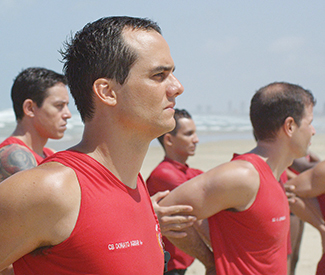
Futuro Beach (Karim Ainouz, Brazil) When two German men globe-trotting on their motorcycles go for a dip off the Brazilian coast, they’re pulled under by the current — only Konrad (Clemens Schick) is saved by local lifeguard Donato (Wagner Moura), his companion lost. The two men console one another with sex. Then in the first of several disorienting jumps forward in time here, suddenly Donato has moved to Europe in order to continue their relationship, leaving his old life (including a dependent mother and younger brother) behind. There are further narrative leaps ahead — director Karim Ainouz (2002’s Madame Satã) is all about bold gestures here, but his visual and sonic assertiveness don’t necessarily fill the blanks in narrative and character development. The resulting exercise in style will leave you either dazzled or emotionally untouched. June 27, 9:30pm, Castro. (Harvey)

Cupcakes (Eytan Fox, Israel, 2013) After a run of politically tinged features, Eytan Fox (2002’s Yossi & Jagger, 2004’s Walk on Water) goes the Almodóvar-lite route with this flyweight comedy about a Eurovision-style song contest. Gay Ofer (Ofer Shechter) and various girlfriends who all live in the same Tel Aviv apartment building decide to enter the Universong competition, becoming Israel’s official entry with improbable ease despite never having performed publicly before. Their mild travails (fighting the creative inference of professional handlers, Ofer’s attempts to drag his boyfriend out of the closet) fill time pleasantly enough before the inevitable triumphant telecast climax. This candy-colored fluff, its mainstreamed camp sensibility predictably reflected in corny vintage hits (“Love Will Keep Us Together,” “You Light Up My Life”), is aptly named — it’s as colorful, easily digested, and about as nutritious as a tray of cupcakes. June 28, 8:30pm, Castro. (Harvey)

I Feel Like Disco (Axel Ranisch, Germany, 2013) When housewife Monika (Christina Grobe) suffers a stroke and falls into a coma she may never come out of, her chubby teenage son Flori (Frithjof Gawenda) and junior high swim coach husband Hanno (Heiko Pinkowski) are forced to depend on each other without mom as a buffer. Things tentatively look up when Flori develops an unlikely friendship — and possibly something more — with dad’s star diver, Romanian émigré Radu (Robert Alexander Baer). Axel Ranisch’s gentle seriocomedy doesn’t make much of an impression for a while, springing few surprises (despite occasional deadpan fantasy sequences) along its moderately amusing path. But as father and son struggle to rise to the occasion of their shared crisis, we grow to like them more — and likewise this ultimately quite disarming feature. June 29, 7pm, Castro. (Harvey) *

Frameline 38, the San Francisco International LGBT Film Festival, runs June 19-29 at the Castro Theatre, 429 Castro, SF; Roxie Theater, 3117 16th St, SF; Victoria Theatre, 2961 16th St, SF; and Rialto Cinemas Elmwood, 2966 College, Berk. For tickets (most shows $10-15) and schedule, visit www.frameline.org. For even more Frameline 38 short takes, visit www.sfbg.com.

Tenants can fight evictions and win

4


By Tyler Macmillan


OPINION Every year, around 3,500 formal eviction lawsuits are filed against residential tenants in San Francisco Superior Court. Contrary to popular belief, the eviction lawsuit — known as an “unlawful detainer” — is one of the fastest moving cases in the entire civil system. While we’ve all heard anecdotes about how it can take years to remove San Francisco tenants from their homes, tenants sued for eviction experience civil litigation at warp speed.

More than a third of those sued for eviction miss the five-day window the law provides to file a response with the court. In 2013, 1,294 of the tenant households that were sued for eviction in the city missed that deadline to respond. The strong tenant protections found in San Francisco’s Rent Ordinance and California law don’t mean much to those who miss their five-day deadline: Sheriff’s deputies clear the property just a few weeks after the case is filed if you don’t respond. So much for due process.

Securing tenants due process rights in San Francisco has been our job at the Eviction Defense Collaborative (EDC) since 1996. At our drop-in legal clinic, our team of attorneys and volunteers assist over 94 percent of all tenants who respond to their eviction lawsuit in San Francisco each year. Although our office is open Monday through Friday to help tenants respond to the lawsuit on time, nine out of 10 tenants sued for eviction represent themselves for the duration of their case. Over 90 percent of landlords can afford to hire expert, aggressive attorneys to evict their tenants — very few tenants can afford to hire a private attorney to defend their homes.

Unsurprisingly, tenants agree to move out in most eviction lawsuits — around four out of five tenants sued for eviction will settle the case with an agreement to leave their homes. And who could blame them? The choice of conducting a jury trial against a licensed attorney is not an appealing — or realistic — choice for a self-represented tenant. Without an attorney to stand up and fight for your rights at trial, those rights remain the empty, meaningless promises of the pay-to-play American legal system.

Of course, tenants who get represented by attorneys can win eviction cases — exactly the reason we started our Trial Project at EDC last year. Since the Trial Project launched, EDC staff attorneys have represented a small percentage of tenants facing the prospect of a jury trial on their own. Through the hard work of EDC staff attorneys (who on average earn less than $50,000 a year), the Trial Project enjoyed another jury trial victory in May. While very few eviction cases reach a verdict, this was EDC’s third trial victory in the past year.

This particular jury verdict saved the home of a Spanish-speaking couple who has lived in the Mission District for the past 19 years. They have young children who attend the local public schools and attend church in the neighborhood. This family has limited income and would certainly have had to leave of San Francisco if it was evicted, uprooting the children and leaving behind its community.

The landlord had accused the family of not paying the rent — even though the family had repeatedly tried to pay. The jury agreed with the tenant, finding that the conditions on the property were so bad that the landlord wasn’t entitled to the rent being demanded. The jury actually followed the law, and reduced the tenants’ rent.

The heroes in this case are the tenants — their courage in standing up for their home and their civil rights is inspiring, and should be a lesson to tenants across the city. We need tenants in San Francisco to push back against this current wave of displacement and we’re here to help.

Tyler Macmillan is a tenants’ rights attorney and the executive director of the Eviction Defense Collaborative, a nonprofit legal services clinic in the Tenderloin. Any tenant sued for eviction can drop into EDC at 995 Market St., #1200 (at Sixth Street) Mon-Fri, 9:30-11:30am and 1-3pm.

Justice delayed is justice denied

1

EDITORIAL Members of the San Francisco Board of Supervisors who try to identify with both the progressive movement and business-oriented Mayor Ed Lee — most notably, Sups. David Chiu and Jane Kim — engaged in a strange bit of self-congratulations during their June 10 meeting, patting themselves on the back for a trio of “progressive” reforms.

Yet in each case, the measures are weaker than they should be and too long overdue — and they have their full implementation delayed for years, while the needs of the people they aim to serve are immediate. What Kim and Chiu presented as a demonstration of political effectiveness on behalf of needy constituents is actually just the opposite. It is political cowardice and not political courage.

The best of the trio of approvals was a measure by Sup. David Campos that finally closes the loophole that allows employers to satisfy their employee healthcare mandate by creating healthcare savings accounts, which they make difficult to use and then pocket the money that remains.

This should have been enacted three years ago when Campos first won approval for it, only to see Lee veto it and Chiu sponsor a watered-down alternative that didn’t address the problem. Even now, in order to win over Sups. Mark Farrell and London Breed to attain a veto-proof majority, Campos had to delay full implementation until 2017.

“I also want to commend Sup. Campos for finding compromise,” Chiu said before joining the inevitable majority, a snide dig at his Assembly race opponent that only served to reinforce Campos’ campaign trail points that Chiu’s compromises are often just sellouts to downtown interests. This watered-down version, albeit better than the last watered-down version, also won unanimous approval.

Another kumbaya moment came with the introduction of a consensus ballot measure for increasing the minimum wage in San Francisco, with the Mayor’s Office and business community finally agreeing with the campaign by labor and progressive groups to increase the minimum wage to $15 — but delaying that implementation to 2018. How much displacement and economic hardship will San Franciscans experience between now than then?

Chiu and Kim also sang the praises of Lee for finally agreeing to finally keep his word and support a local increase in the vehicle license fee to fund safer and smoother streets and more money for Muni. But rather than this year as promised, that measure will be on the November 2016 ballot, pushing it back from prosperous to uncertain times.

At the June 12 Guardian community forum, Sup. Scott Wiener said he may still move forward with his proposed charter amendment to give Muni more general fund money until the local VLF is approved, and we strongly urge him to so do.

“Justice delayed is justice denied” is a legal maxim that this board full of lawyers is certainly familiar with. Their delays of crucial reforms are disgraceful and damaging to the city, and for them to congratulate themselves for doing so is insulting.

Breaking the chains

96

steve@sfbg.com

San Franciscans have always been wary of chain stores, more so than residents of any other major US city, none of which have taken on the ever-expanding national corporations and their homogenizing impact on local communities as strongly as San Francisco.

In the decade since San Francisco first adopted trail-blazing controls on what it calls “formula retail” businesses, those restrictions have only gotten tighter for various commercial districts around the city as elected supervisors seek to prevent big companies from taking over key storefronts from local shopkeepers.

But now, as the Planning Department and Mayor’s Office push a new set of formula retail regulations that they say standardizes and expands the analysis and controls for chain stores throughout the city, neighborhood groups and small business advocates are decrying aspects of the proposal that actually weaken those controls.

Most controversial is the proposal to almost double the number of outlets that a company can have before it is considered a formula retail business, going from up to 11 stores now up to 20 under the proposal, which was approved by the Small Business Commission last week and heads to the Planning Commission next month.

Opposition is particularly strong in North Beach, one of two neighborhood commercial districts that have an outright ban on formula retail business (Hayes Valley is the other) and where residents are organizing to fight the proposal at the Board of Supervisors and at the ballot if necessary.

“The Planning Department proposal to redefine what a chain store is flies in the face of the voters’ will and 10 years of successful chain store policy,” Aaron Peskin, the former Board of Supervisors president from North Beach who sponsored the ordinance banning chains there, told the Guardian.

The citywide voters he refers to are those who approved Prop. G by a wide margin in 2006, defining formula retail business as having 11 or more outlets with common branding and merchandise and requiring that they obtain a conditional use permit before opening in most neighborhood commercial districts, thus giving local residents a vehicle to stop those projects.

Although Prop. G allows the city to update its standards and definitions regarding formula retail, Peskin and others said throwing out the negotiated number of 11 outlets undercuts “the fundamental underpinning of the formula retail controls.”

The Planning Department proposal also does nothing to prevent big national chains from creating spin-offs to circumvent the controls, a growing trend that raised controversy in the last few years, including when Gap subsidiary Athleta opened a store on Fillmore Street and when Liz Claiborne owner Fifth & Pacific Companies tried to open a Jack Spade store in the Mission District.

Those two controversial provisions in the Planning Department proposal aren’t in rival legislation by Sup. Eric Mar, who has long been a champion of expanding controls on chain stores. Both the Mar and Planning Department legislation will go before the Planning Commission on July 17, and they could be either merged or move forward as rival proposals.

“We’re hoping this legislation moves forward as quickly as we can,” Mar told us. “We’re losing neighborhood character in many areas.”


WEAK LINKS

For all the indignant opposition to the Planning Department proposal expressed at the June 9 Small Business Commission meeting, where mayoral appointees led that body’s 4-2 vote approving the measure, the planners who developed it say they’re actually trying to expand the controls on chain stores.

Senior Policy Advisor AnMarie Rodgers and Project Manager Kanishka Burns sat down with the Guardian to go through details of the proposal and a May study it was based on, “San Francisco Formula Retail Economic Analysis,” by Strategic Economics, as well as an earlier study by the Controller’s Office.

“Our department is super committed to encouraging the diversity of neighborhood commercial districts,” Rodgers told us, acknowledging that small businesses often need protection from deep-pocketed corporations that can pay higher rents and enjoy other competitive advantages over mom-and-pop stores.

Rodgers cited studies showing that local small businesses circulate more of their revenues in the city than big chains, boosting the local economy. That’s one reason why the Planning Department proposal expands formula retail controls to include the categories business and professional services (including Kinko’s and H&R Block), limited financial services (including street front ATMs and small banking outlets), and fringe financial (such as check-cashing and payday loan outlets).

The new controls would also count a company’s outlets in other countries and locations that have been leased but not yet opened, it would expand some of the neighborhoods subject to formula retail controls, and it would require formula retail businesses to minimize their signage on the street, improve their pedestrian access, and fund more detailed analysis on their impacts on the local economy. Big box stores, in particular, would be required to submit to even more detailed economic impact studies.

Many of these same provisions are included in the Mar legislation, which also goes further in including gyms, gas stations, smoke shops, strip clubs, massage establishments, and various automotive businesses under the formula retail controls. Like the Planning Department measure, Mar’s also requires more data for formula retail applicants.

“We want to make chains fund economic impact statements before they go into the neighborhoods,” Mar said, noting how those studies will allow city officials to make better decisions about whether to approve formula retail applications.

Stacy Mitchell is the senior researcher for the Institute for Local Self-Reliance, an organization that has been working with San Francisco on its formula retail controls since their inception. She applauds the city’s current efforts to create more comprehensive guidelines and to require more economic analysis.

“San Francisco doesn’t have a good mechanism for fully evaluating the economic impact of these proposals,” Mitchell told us, calling the Planning Department and Mar efforts “a really good place to start the conversation.”

But Mitchell said that she doesn’t want to weigh in on what specific number of outlets may be right, saying city officials just need to decide, “What is the right balance and mix and how do we want to handle it?”

Rodgers told us the Planning Department legislation will expand the number of businesses that fall under formula retail controls, even as the threshold is raised to 20 outlets, although she couldn’t quantify exactly how much.

But critics are focusing on aspects of the proposal that loosen current restrictions, noting how that cuts against the trend in recent years of supervisors seeking to tighten restrictions in their districts, creating a hodgepodge of legislation that the Planning Department was trying to overcome with comprehensive new legislation.


WHAT’S A CHAIN?

The Planning Department’s new threshold and the arguments being made to support it rely heavily on making the case that three specific homegrown companies should be excluded from formula retail protections: Philz Coffee (with 14 stores), Lee’s Deli (13 outlets), and San Francisco Soup Company (16 locations).

“Right now, we would treat Philz the same way we treat Starbucks,” Burns said, noting that Starbucks has more than 20,000 outlets.

“Can’t you cut a break to the businesses that started here?” was a question that Rodgers says helped shape development on the regulations. The Strategic study found that about 5 percent of the retail establishments in the city had 11 to 20 outlets, while another 4 percent had 21-50 outlets. “We’re just trying to find the sweet spot.”

Yet Peskin said the change doesn’t make sense, and it’s just a way to give special treatment to a handful of local companies with political connections, and which have more resources to go through the conditional use process than a true small business.

“They’re basically finding another way to satisfy San Francisco Soup Company, a stalwart member of the Chamber of Commerce,” Peskin said.

Asked how she can seemingly circumvent the will of the voters, Rodgers told us, “It was a voter initiative, but it says the Planning Commission will establish further details.” In fact, Prop. G simply relies on the formula retail definitions that had already been adopted by ordinance started with a measure by then-President Matt Gonzalez in 2004.

But Peskin said the proposal to increase the threshold to 20 is an affront to popular local controls on chain stores, one that has little chance of becoming law.

“I don’t think the Board of Supervisors is crazy enough to go and undo one of the most successful pieces of legislation from the early part of this century. And if they do, then the voters won’t stand for it,” Peskin said, pledging to personally work on the campaign to protect existing formula retail controls.

Mar also said he will defend the current threshold. “The 11 that was written into the legislation was the result of a compromise,” Mar said, noting that Gonzalez initially placed the threshold at four stores and compromised with the business community on 11. “We’re going to do our best to work with our coalition to hold it to 11.”


CORPORATE CONTROL

Mar was also critical of the Planning Department proposal for not looking at corporate ownership of subsidiaries, something that his legislation does, stating that companies with a 50 percent or more ownership stake in an outlet get included in the formula retail designation.

“Our proposal has been attacked by people who think we’re over-regulating and those who think we’re under-regulating,” Rodgers told us.

Yet as the June 9 Small Business Commission hearing made clear, supporters of the proposal predictably came from the same business groups that have opposed formula retail controls from the very beginning: San Francisco Chamber of Commerce, San Francisco Association of Realtors, and San Francisco Building Owners and Managers Association.

Representatives from each of those three groups were the only people who spoke in favor of the proposal, each of them declaring it a “balanced” and “data-driven” compromise that they support, even as they argued for loosening the restrictions even more. But the vast majority of speakers were neighborhood activists critical of the proposal.

“Going from 11 to 20 makes no sense at all. Who picked out this number?” Susan Landry, owner of Animal Connection in the Marina District, told the commission. “Please have a conscience and vote for independent businesses.”

But Small Business Commissioner Kathleen Dooley said the vote was just the latest example of a commission stacked with mayoral appointees (including two bankers) doing the bidding of downtown rather than advocating for small business interests.

“Nine supervisors have tightened up the restrictions in their districts, but the Planning Department has gone the opposite way,” Dooley told us. “The irony was it all started with the protests [of chain applicants skirting local controls], but the Planning Department turned it on its head to loosen the restrictions.”

Yet the planners involved on the proposal call that a simplistic view that discounts the comprehensive nature of the new policy, which they say could serve as a model for other cities.

“I think they’ll all catch up to us,” Rodgers said of the other big US cities that have become to explore formula retail controls as local small businesses struggle against competition from chain stores. “We are a national leader on this and we want to get it right.”

Mitchell agreed: “There are lots of conversations going on around the country about how to meet this challenge, and people are watching what San Francisco does.”

Your Treasure Island Music Festival lineup: Outkast, Massive Attack, and more

3

Thanks to a glitch in Ticketmaster’s system (or a human who works for Ticketmaster who is now having a very bad day), we got the lineup for this year’s Treasure Island Music Festival (Oct. 18 and 19) a little earlier than promoters Another Planet Entertainment were planning on announcing it. [Update as of noon-ish: The lineup’s now on the festival’s official website, too.] Here we go:

Outkast
Massive Attack
Zedd
alt-J
TV On the Radio
Janelle Monae
Santigold
The New Pornographers
Washed Out
Jungle
Banks
St. Lucia
White Denim

POLICA
The Growlers
Classixx
Chet Faker
Ryan Hemsworth
Ana Tijoux
Asgeir
Xxyyxx
Ratking
Tobacco
Bleached
Painted Palms
Waters

With the exception of Painted Palms and Waters (good on ya, boys), it’s a pretty non-local crowd — but otherwise a pleasant mix of electronic and indie/garagey kids, which is of course in line with the crowd the festival usually draws. And if you missed Outkast at Coachella and BottleRock (where they were somewhat disappointing and excellent, respectively), well, here’s your next chance. At this point, honestly, we just hope it’s warmer than last year, because the chilled-to-the-bone memory of chugging overpriced wine and wondering if our hands would ever regain feeling again while waiting for Beck to come on is still alarmingly fresh.

Tickets go on sale this Thursday at 10am. Other thoughts on the lineup, folks?

Picture of SF’s extreme income equality worth thousands of words

53

Sometimes visuals paint a picture in a visceral way that mere numbers can’t, and that was the case when the Anti-Eviction Mapping Project recently released a graph highlighting the magnitude of San Francisco’s high rate of income inequality growth and how it compares to other major cities around the country. San Francisco’s purple bubble is floating way up, all alone, above Atlanta, Georgia’s orange bubble and everyone else closely grouped together. 

The graph’s findings reveal the sad but well-known fact that San Francisco is widely unequal, and it comes as little surprise that from 2007 to 2012, SF saw its income gap grow faster than any other major city in the United States.

The visualization cited a Brookings Institute report on income inequality released in February, which found the income of San Francisco’s low-earning residents (more specifically, those in the 20th percentile of yearly income) dropped by an average of $4,000 during that timespan, while the highest-earning residents (the 95th percentile) saw their income jump by an average of $28,000 over the same period. The latter figure was the largest gain in any American city, and it affirms what’s already clear to city residents: The rich are getting richer while the poor continue to get poorer.

That message might seem like old news to those familiar with San Francisco’s income inequality issues, but the truly alarming part of the study is the rate at which the trend is occurring. Though it provides further confirmation of an unpleasant fact that has plagued San Francisco residents for years, the unprecedented speed of the income gap’s increase is especially startling given the efforts to rectify the issue. As the mapping project pointed out, “trickle-down economics does not appear to be working” in San Francisco.

The gap has become so pronounced that the city’s 2012 GINI Coefficient (which measures income distribution) of .523 would make it the 14th-most economically unequal country in the world if San Francisco were its own nation. That’s right in line with countries that are widely known for their income inequality, like Paraguay and Chile, and more than twice as unequal as top-ranked Sweden.

Perhaps the best indication of this growing division has been the drastic increase in evictions throughout the city. The Anti-Eviction Mapping Project has worked to shed light on the issue, releasing time lapses showing the evictions while making it clear that seniors and disabled people aren’t immune to the trend either.

The Anti-Eviction Mapping Project is probably best known for protesting the Google tech buses, whose effects on local communities they’ve researched extensively. The organizations’ maps showlinks between the location of bus stops and a large number of evictions in the same areas.

Developing nations with income gaps akin to San Francisco’s don’t have tech buses driving around their streets, so it’s no surprise that the buses’ unpaid use of public bus stops hasn’t left residents of lower income areas particularly thrilled, especially with the tech sector pushing up the price of housing in those areas while contributing heavily to the results of the Brookings Institute report.

Extra! Extra! Sunshine advocates beat the Anti-Sunshine Gang in City Hall

27

 By Bruce B. Brugmann

And so the  Anti-Sunshine Gang in City Hall, which for two years has been conducting a nasty vendetta against the Sunshine Ordinance Task Force,  capitulated quietly at Tuesday’s Board of Supervisors meeting without a fight or even a whimper.

The capitulation came in a two line phrase  buried in item 28 in the middle of the board’s agenda.  It was a report from the rules committee recommending  the Board of Supervisors approve a motion for  unnamed nominees to the Sunshine Ordinance Task Force. “Question:  Shall this Motion be approved.”

Board Chair David Chiu asked for approval in his usual board meeting monotone. And the approval came unanimously, with no dissent and no roll call vote and not a word spoken by anybody.  He banged the gavel and that was that. And only a few veteran board watchers knew that this was the astonishing  end to a crucial battle that pitted the powerfuf Anti-Sunshine Gangs against the sunshine forces and the citizens of San Francisco. It was a battle that would decide whether the task force would remain an independent people’s court that would hear and rule on public access complaints.  Sunshine won.

It was ironic and fitting that Chiu presided over the capitulation. For it was Chiu as board president who orchestrated  the deal to demolish Park Merced and then orchestrated the  infamous 6-5 board vote  in September 2010 approving  a monstrous redevelopment  project that would evict lots of tenants, and destroy most of the affordable housing. This was a big deal because the housing crisis was heating up and Park Merced was the largest affordable community in the city and one of the largest In the nation. This is where tens of thousands of young people, young married couples, students and faculty at nearby San Francisco State, older people, and middle class people had come for generations with their families to live in affordable housing in an  “urban park,” as Park Merced promo once put it.

And it was Chiu as board president who was charged by the Sunshine Task Force, along with Supervisors Scott Wiener, Malia Cohen, and Eric Mar with violating the Sunshine Ordinance and the state’s open meeting law (Brown Act) when they approved the project with blazing speed.. 

Wiener, Cohen, and Mar were on the board’s Land Use and Economic Development Committee when they voted on the contract. Literally minutes before the committee vote, Chiu introduced 14 pages of amendments to the contract. The deputy city attorney at the meeting blessed the amendments by saying, gosh, golly, gee, no problem, the amendments do  not substantially alter the contract and therefore the description of the item on the agenda was still apt and the committee could act on it. Bombs away! The full board approved the contract the same day by one vote.

This sleight of hand and pellmell approval process meant that Park Merced was going,going, gone and in its place would be a project that “has no hindsight, no insight, or foresight,” as Planning Commissioner Kathryn Moore was quoted as saying in a scathing Westside Observer column by landscape architect Glenn Rogers. “It is not a project of the 21st century.  It is the agenda of a self-serving developer.”

 The Observer, to its immense credit, was the only media in town to blast away at the project. (Read its coverage and weep, starting with a June piece by Pastor Lynn Gavin who wrote that the Park Merced owners did not disclose to her or her family that they “were going to demolish the garden apartment that was our home.”)  Gavin and her neighbors took the formal complaint to the Sunshine Ordinance Task Force and got a unanimous 8-0  ruling condemning Chiu, Wiener, Cohen, and Mar for open government violations.

It was a historic ruling by the task force and demonstrated once again in 96 point tempo bold the irreplaceable value of the people’s court.  The ruling also had impact because it amounted to a stinging  expose of how government often works in San Francisco with big money and big development and how one vote can add gallons of high octane petrol to the housing crisis. It angered the hell out of the six supervisors who voted for the project.

 And in effect, it gave rise to what I call the Anti-Sunshine Gang in City Hall whose response to the ruling was, not to apologize and change their illegal ways, but to start a vicious vendetta against the task force for doing the right thing at the right time.  The six votes were David Chiu, Scott Wiener, Malia Cohen, Mark Farrell, Sean Elsbernd, and Carmen Chu. Elsbernd has gone on to Sen. Diane Feinstein’s office in San Francisco and Chu to becoming assessor. But the gang picked up other allies along the way, notably the city attorney’s office.

Two years ago, when the task force members came to the board for reappointment, the Anti-Sunshine Gang retaliated and swung into action by “launching a smear campaign aimed at purging the eight task force members who had unanimously voted to find the violations,” according to Richard Knee, a 12 year veteran of the task force, in a June column in the Observer.  Knee, who represents the local chapter of the Society of Professonal Journalists, also wrote that “the mayor and the Board of Supervisors…made sure that the panel gets minimal funding, staffing and resources, and the board has refused to fill two long standing vacancies, making It difficult at times to muster a quorum since task force members are volunteers with outside responsibilities such as family and work.

“Two year ago, the board’s failure to appoint a physically disabled member forced the task force to take a five month hiatus, exacerbating a backlog of complaints filed by members of the public.This year, Knee wrote,  the start of the appointment process was “farcical and ominous.”  He explained that, at the May 15 meeting of the board’s rules committee, which vets applicants for city bodies, the two supervisors present chair Norman Yee and Katy Tang (David Campos had an excused absence) “complained that there weren’t enough racial/ethnic diversity among the 13 candidates. “That didn’t deter them from recommending the reappointments of Todd David, Louise Fischer, and David Pilpel, all Anglos.”

Before the full board five days later, Yee complained again, “this time that lack of a regular schedule and frequent switching of meeting dates were making attendance difficult for task force members. Either Yee had no clue of the facts or he was lying.” Knee explained that the task force normally meets the first Wednesday of each month and its subcommittees usually meet during the third week of the month.

“Meeting postponements and cancellations are the result, not the cause, of difficulties in mustering a quorum, due to the vacancies—which now number three.

“In gushing over David, Fischer, and Pilpel, at the board’s May 20 meeting, Wiener offered no evidence or detail of their alleged accomplishments and ignored the fact that David has missed six task force meetings since March 2013, including those of last February and April. Until the board fills the other seats, the five remaining incumbents—Chris Hyland, Bruce Oka, David Sims, Allyson Washburn, and yours truly—stay on as ‘holdover’ members.”

Meanwhile, by the next session of the Rules Committee on June 5, the sunshine advocates had rallied and put together an impressive mass of sunshine power. Testifying at the hearing were representatives from SPJ and the journalism community, the League of Women Voters, the ACLU, the sunshine posse, the Library Users Association, the Bay Area News Group, the Inter-American Press Asociation, the Center for Investigative Reporting, the UC-Berkeley Graduate School of Journalism, the First Amendment Coalition, the  Electronic Frontier Foundation, the Observer and neighborhood activists, and other sunshine allies and FOI groupies. It was quite a show of force. 

SPJ placed a pointed, timely op ed in the Chronicle (“SF Supervisors block Sunshine Ordinance Task Force,” good of the Chron/Hearst to run it but better if the paper didn’t black out local sunshine issues.) Members of the posse peppered the gang with public record requests aimed at tracking skullduggery and they found it. Reps from the groups lobbied the supervisors by email, phone, and personal office visits. And the word that the Anti-Sunshine Gang was back and on the gallop shot through the neighborhoods and around town and into election campaigns and among constituents of the gang.

SPJ and its vigorous Freedom of Information Committee under co-chairs Journalist Thomas Peele, of Chauncey Bailey fame, and Attorney Geoff King  were particularly effective. Peele is an investigative reporter with the Bay Area Newspaper Group, a lecturer on public records at the UC-Berkeley Graduate School of Journalism, and author of a respected book on Chauncey Bailey, a black journalist murdered on his way to work.

The word got around that the supervisors were blocking strong pro-sunshine candidates for the task force and that their first three nominees were the weakest of the lot. Campos, a stellar sunshine advocate, was back at the committee meeting, making the right calls and shepherding the strong nominees along through the committee and the Board of Supervisors.  Great job.

The cumulative weight and force  of the presentations of the nominees and the sunshine advocates made the proper political point:  any supervisor who voted with the Anti-Sunshine Gang was going to face their constituents and voters with the brand of being anti-sunshine and anti- government accountability.  More: they would have to answer some embarrassing questions: Who lost Park Merced? Who voted to turbo charge evictions and middle class flight from the city for years to come? Who tried to cover up the outrage and who did it? And who led the retaliatory vendetta against the Sunshine Ordinance Task Force for doing the right thing on behalf of sunshine in San Francisco?

And so the Board of Supervisors was dragged kicking and screaming into the sunshine of June 2014 and beyond. The supervisors ended up nominating what looks to be one of the strongest pro-sunshine task forces: Attorney  Mark Rumold and journalist Ali Winston from SPJ, Allyson Washburn from the League of Women Voters, Attorney Lee Hepner, Journalist Josh Wolf, and holdover Chris Hyland. Plus Bruce Oka who looks to be a late holdover in the disabled seat. Congratulations for hanging in and winning, hurray for the power of sunshine, on guard,  B3

P.S. l: PG&E institutionalizes City Hall secrecy and corruption:  The pernicious influence of the Anti-Sunshine gang hung heavy over the rules committee.  Tang tried to force every candidate to take a pledge of allegiance to the city attorney. Tang is the kind of neighborhood supervisor (Sunset) who has a 100 per cent Chamber of Commerce voting record. Her city attorney pledge demand was laughable on its face, given the fact that the city attorney refuses to move on the PG&E/Raker Act scandal and thus has helped institutionalize secrecy and corruption in City Hall on a multi-million dollar scale for decades. Which is reason enough for the city to always maintain a strong, enduring Sunshine Ordinance Task Force, to help keep tabs on how PG&E keeps City Hall safe for PG&E and its allies. (See Guardian stories and editorials since 1969.)  

Tang and Yee continued the gang’s hammering on Bruce Wolfe, a worthy candidate for the disabled seat whose main sin was that he was one of the Honorable Eight who voted condemnation.  The gang knocked out Wolfe as a holdover candidate the first time around and they were at it again at the committee meeting. Oka says he wants to resign from the task force but only when the board finds a good replacement. Wolfe, who was an effective and knowledgeable sunshine task force member, is the obvious replacement but he is still on the purge list.  Stay tuned on this one. . 

There are three things that no one can do to the entire satisfaction of anyone else: make love, poke the fire, and run a newspaper. William Allen White, 1917, line atop the editorial page of the Durango Herald, Durango, Colorado. 

If you even have time to make it to the movies between World Cup matches…

0

…read on for our takes on the new flicks of the week. Pssst: lots of good stuff still to come at DocFest, too!

Alone Yet Not Alone Remember that Christian historical drama that was Oscar-nominated for Best Song but then got kicked out of the running because of the songwriter’s sketchy campaign tactics? No? Well, here ’tis. (1:43)

https://www.youtube.com/watch?v=INW6i6K1NmQ&feature=kp

Gore Vidal: The United States of Amnesia Nicholas Wrathall’s highly entertaining documentary pays tribute to one of the 20th century’s most brilliant, original, and cranky thinkers, with extensive input from the man himself before his death in 2012 at age 86. The emphasis here is less on Vidal’s life as a literary lion and often glittering celebrity social life than on his parallel career as a harsh scold of US social injustices and political corruption. (Needless to say, recent history only sharpened his tongue in that department, with George W. Bush dismissed as “a goddam fool,” and earlier statements such as “This is a country of the rich, for the rich and by the rich” seeming more apt than ever.) He’s a wellspring of wisdoms both blunt and witty, sometimes surprising, as in his hindsight doubts about the virtues of JFK (a personal friend) as a president. We get plenty of colorful archival clips in which he’s seen verbally jousting with such famous foes as William F. Buckley and Norman Mailer, invariablyreducing them to stammering fury while remaining exasperatingly unruffled. His “out” homosexuality and outré views on sexuality in general (at odds with an increasingly assimilationist gay community) kept him controversial even among many liberals, while conservatives were further irked by his rock-solid family connections to the ruling elite. In our era of scripted political rhetoric and pandering anti-intellectualism, it’s a joy merely to spend an hour and half in the company of someone so brilliantly articulate on seemingly any topic — but particularly on the perpetually self-mythologizing, money-worshipping state of our Union. (1:29) (Dennis Harvey)

How to Train Your Dragon 2 Sequel to the 2010 animated hit about Vikings and their dragon buddies, with voices by Jay Baruchel, Cate Blanchett, Gerard Butler, Djimon Honsou, America Ferrera, Kit Harington, Jonah Hill, and others. (1:42) 

Obvious Child We first encounter the protagonist of writer-director Gillian Robespierre’s funny, original film — a Brooklyn-dwelling twentysomething named Donna (Jenny Slate), who works at a lefty secondhand bookstore and makes regular (if unpaid) appearances at a local comedy night — onstage mining such underdiscussed topics as the effects of vaginal discharge on your garden-variety pair of underwear. This proves a natural segue to other hefty nuggets of embarrassment gold concerning her love life, to the dismay of boyfriend Ryan (Paul Briganti), auditing from the back of the club. He pretty much deserves it, however, for what he’s about to do, which is break up with her in a nasty, well-populated unisex bathroom, taking time to repeatedly glance at the texts coming through on his phone from Donna’s good friend, with whom he’s sleeping. So when Donna, mid-drowning of sorrows, meets a nice-looking fellow named Max (Jake Lacy) at the bar, his post-fraternity-presidency aesthetic seems unlikely to deter her from a one-night stand. The ensuing trashed make-out dance-off in Max’s apartment to the Paul Simon song of the title is both comic and adorable. The fractured recap of the evening’s condom-free horizontal events that occurs inside Donna’s brain three weeks later, as she hunkers down with her best friend, Nellie (Gaby Hoffmann), in the bookstore’s bathroom after peeing on a stick, is equally hilarious — and unwanted-pregnancy jokes aren’t that easy to pull off. Robespierre’s treatment of this extended windup and of Donna’s decision to have an abortion is a witty, warmhearted retort to 2007’s Knocked Up, a couple generations’ worth of Hollywood rom-com writers, and an entertainment industry that continues to perform its sweaty contortions of storytelling in the gutless cause of avoiding the A-word. (1:15) (Lynn Rapoport)

The Signal Sharing its title with a 2007 film — also a thriller about a mysterious transmission that wreaks havoc in the lives of its protagonists — this offbeat feature from co-writer and director William Eubank belies its creator’s deep affection for, and knowledge of, the sci-fi genre. Number one thing The Signal is not is predictable, but its twists feel organic even as the story takes one hairpin turn after another. MIT buddies Nic (Brenton Thwaites) and Jonah (Beau Knapp) are driving Nic’s girlfriend, Haley (Olivia Cooke), cross-country to California. Complicating the drama of the young couple’s imminent separation is Nic’s deteriorating physical condition (it’s never explained, but the former runner apparently has MS or some other neurological disease). The road trip turns dark when the trio (who also happen to be hackers) realize an Internet troll they’ve tangled with in the past is stalking them. After a brief detour into found-footage horror — fooled ya, Eubank seems to be saying; this ain’t that kind of movie at all! — the kids find themselves embroiled in ever-more-terrifying realities. To give away more would ruin the fun of being shocked for yourself, but think Twilight Zone meets Area 51 meets a certain futuristic trilogy starring Laurence Fishburne, who turns up here to play a very important role in Nic and company’s waking nightmare. (1:37) (Cheryl Eddy)

Supermensch: The Legend of Shep Gordon See “Puff Piece.” (1:24) 

https://www.youtube.com/watch?v=qm8UaNdq24c&feature=kp

22 Jump Street In this TV-inspired sequel, “Previously on 21 Jump Street…” is all the backstory we get. 22 wastes no time sending Officers Schmidt (Jonah Hill) and Jenko (Channing Tatum) back to school to solve another case. A few details have changed (they’re in college now, where the drug of choice is “Why Phy”), but the situation is self-consciously boilerplate, which lets the filmmakers cast (ironic) judgment on sequels — and imply the TV show was redundant. College proves hilarious, from the rundown of dorm room essentials to Schmidt’s walk of shame, and the touchstones are sharp and embarrassing. An extended fight between Schmidt and a girl (Jillian Bell, fabulous) twists gender issues and sexual assault into gloriously absurd politics. Best of all is a fairly understated joke in front of the Benjamin Hill School of Film Studies. I laughed as much at 22 as I did at 21, but 22 spends so much time calling out its number-two status that it almost becomes performance art. (1:45) (Sara Maria Vizcarrondo)

City College’s accreditors bow to pressure, amend rules to save CCSF

18

Keep City College of San Francisco open, or else.

That’s the message local and federal officials have drilled into City College’s accreditors in recent weeks. Representatives Nancy Pelosi and Jackie Speier; Assemblymembers Tom Ammiano and Phil Ting; and the state’s community college government have all publicly pressured the Accrediting Commission for Community and Junior Colleges to give City College an extension to prove its worth.

Finally bowing to pressure, the ACCJC may soon chang their own rules to save City College.

Today the ACCJC announced changes in its policy exclusively for colleges with terminated accreditation, granting a chance for such colleges to request a new “accreditation restoration status.”

“This is new for the ACCJC, but I don’t know if its new for other institutions,” Dave Hyams, a spokesperson for the ACCJC told us. But this new policy may offer new hope for City College.

In 2012 the ACCJC told City College its accreditation would be terminated, putting the school in the fight of its life. A loss of accreditation would mean its degrees are worthless, and the school would lose government funding. Notably, the school has not lost its accreditation yet.

The ACCJC’s policy change is not yet final, as the agency is allowing two weeks for the public to weigh in. The changes will be finalized on June 25, the commission said.

If the policy is adopted though, it means City College would be able to apply for a lifeline.

“If this policy is adopted as expected,” the ACCJC wrote in their statement to the press, “CCSF would have the opportunity to take steps to be designated as being in restoration status.”

Hyams denied the decision has anything to do with the very recent, and very public, emails from Nancy Pelosi and other politicians to demanding the ACCJC give City College more time.

“The ACCJC was looking for a way to balance the impact of termination on students,” he said, “with the needs for the college to meet basic standards.”

The college would need to file its application for restoration status by July 2014, City College’s originally announced accreditation termination date. This may all be moot, however, as City Attorney Dennis Herrera filed for an injunction to stall the college’s closure until the conclusion of the city’s lawsuit against the ACCJC. Legal proceedings are expected to begin in October.

Sara Eisenberg, the deputy city attorney leading the case against the ACCJC, told us this doesn’t affect the case at all.

Our lawsuit is about the ACCJC’s bad acts, which go to the heart of the fairness and accuracy of the accreditation evaluation process,” she told the Guardian. “These violations of law, policy and fundamental fairness require that the ACCJC’s past decisions concerning City College be vacated and that City College be reevaluated on a clean slate using a fair process.”

Interestingly, the announcement of restoration status by the ACCJC contains a caveat: they will not extend CCSF’s appeal unless the US Department of Education gives them the go-ahead. Hyams said the ACCJC developed this plan while consulting the USDOE, so it may be a slam dunk.

Need some context on the City College fight? Check out the video above for a basic overview.

“The commission and the department had very recent meetings that have been constructive and productive, they’re fully aware of this proposal,” he told us.

One of those meetings was not so peaceful, however, as over 200 City College supporters rallied outside the ACCJC’s semi-annual meeting in Sacramento, demanding the organization rescind its decision to revoke the college’s accreditation. The protest was led by the California Federation of Teachers, the local AFT 2121 and attended by teachers and students alike.

Tim Killikelly, the president of the AFT 2121 had questions about the new policy.

“I’m not sure how this restoration status is different than what appeals already existed,” he said. “The students need to be sure about their academic future, and this doesn’t do that. The students need to breathe a sigh of relief.”

He’s referring to the college’s recent drop in enrollment. At its height City College had over 100,000 students enrolled. But, due in part to its accreditation struggles and (some have said) the economy’s mild upswing, the enrollment has recently dropped to under 80,000 students. 

Killikelly laid much of the blame for that enrollment drop at the feet of the ACCJC. “They should’ve sent a team to verify we’re in compliance,” he said. Instead of this middling compromise, if the ACCJC had instead granted full accreditation Killikelly thinks confidence in the college could be restored.

City College Trustee Rafael Mandelman was also cautious about the decision.

“Its good news,”  he said, but, “the powers that be have rallied and persuaded the ACCJC that they cannot shut City College down now. The ACCJC are not pulling their claws out of the college. We will continue this terrible dance unless the City Attorney wins his lawsuit.”

The college may already have bounced back. California Community College Chancellor Brice Harris and City College Chancellor Arthur Tyler have publicly stated the school is 95 percent done addressing all of the concerns the ACCJC wanted to see fixed.

Mandelman contends the ACCJC’s move to terminate City College’s accreditation did more harm than good. “This whole process has been incredibly and unnecessarily disruptive on City College,” he said. “It’s a horrendous way to reform an institution.”

It should be noted that City College is still open, and remains accredited. For a look at the new policy from the ACCJC, click here.

Shrimp Boy denied bail

Raymond “Shrimp Boy” Chow, who has a criminal history in Chinese gangs and was indicted along with Sen. Leland Yee and a slew of others in a high-profile FBI operation, was denied bail June 11.

U.S. Magistrate Nathanael Cousins struck down his defense attorneys’ motion for pretrial release on the grounds that Chow might pose a danger to the community due to his position as leader of the Chee Kung Tong (CKT), characterized as a Chinese crime syndicate by the FBI. Chow’s charges include seven counts of money laundering, one count of conspiracy to sell stolen cigarettes, and two counts of conspiracy to sell stolen liquor.

“The government’s advancing this conspiracy theory that my client is in charge of this organized crime syndicate. On that basis the judge is deciding to hold him,” said defense attorney Curtis Briggs. “It’s the Chinese Freemasons, it’s not a crime syndicate,” Briggs added. “It’s a fraternal organization. They’re going to be muddied up and dirtied up because the govermnent is pursing a racketeering case against them.”

Another wrinkle: “Now the government’s issued a deportation warrant againt him,” Briggs noted. “Even if we got him out, he’d be in immigration custody.”

A 23-page motion for release on bail for Chow, filed by Briggs and attorneys Gregory Bentley and Tony Serra, paints a very different picture of the targeted Chinatown figure than the all-powerful gangster portrayed by federal authorities.

The FBI complaint, unveiled in March, paints Chow as an international crime boss holding “supreme authority” as Dragonhead of the CKT.

In this role, the FBI charged, Chow was “the supervisor” of criminal relationships between Yee, political consultant Keith Jackson, and Chow’s associates, who had knowledge of and approved all criminal operations of the CKT and received payment for the various criminal dealings he facilitated. The complaint even noted that Chow had once told an undercover FBI agent that he served as a judge within the CKT; “if one member kills another member, Chow decides if the killing was justified.”

The mob boss who had returned yet again to a life of crime, all while swearing he’d given it all up, couldn’t be more different from the humble ex-convict described in his defense attorneys’ motion for release. Yee and Jackson, who faced charges on firearms trafficking, among other counts, were released on bail totaling $500,000 and $250,000, respectively. Prior to being taken into custody, Chow had already been wearing an ankle monitoring bracelet due to his pending case with immigration authorities.

In letters of support written on his behalf referenced in the motion, Chow was described as a community leader whose actions in recent years stemmed from nothing less than “a spiritual commitment … to make the San Francisco community a better place for all people even if it came at a great personal sacrifice to him.” A letter of support was even written by Wendy MacNaughton, an illustrator, journalist and author of Meanwhile in San Francisco.

Chow had apparently been working on his autobiography prior to being taken down by the FBI.

The motion recounts how Chow, born into “devastating financial conditions” in China, was taken in by the Chinese Triad at the age of seven “and for the next ten years scraped by and supported himself and his family through Triad related activities.” At 16, he was arrested and beaten by Chinese police in custody. Soon after, his family fled to the United States for a better life.

“Chow was recruited by local Chinatown so-called ‘gangs,’” the motion states. “As with many immigrant children with no resources, Chow was exploited by these groups for his desperate need for protection, acceptance, and recognition.” He served multiple prison sentences for various gang-related criminal activities.

But in 2003, when he was serving out a ten-year prison term, Chow became thoroughly disenchanted with the criminal lifestyle,” his defense attorneys wrote. “His revelation occurred when the façade of the gangster life disintegrated as each and every one of his criminal associates, people who he thought of as ‘brothers,’ turned their back on him and participated in activities which blatantly harmed the community.”

Chow’s girlfriend, Alicia Lo, had volunteered to act as a third-party custodian and post property bonds on her two San Francisco properties in order to facilitate his pretrial release.

In written testimony, she described him as caring and generous, saying she would buy him “second-hand clothes so he looked sharp in public,” only to later discover that he “would at times give these clothes away to addicts on the street so they could look presentable at job interviews.”

Yet in making his determination, the federal magistrate noted that there is “more than clear and convincing evidence that Mr. Chow would pose a danger to the community” if released.