Literature

Haunting the lens: Ralph Eugene Meatyard at the de Young

0

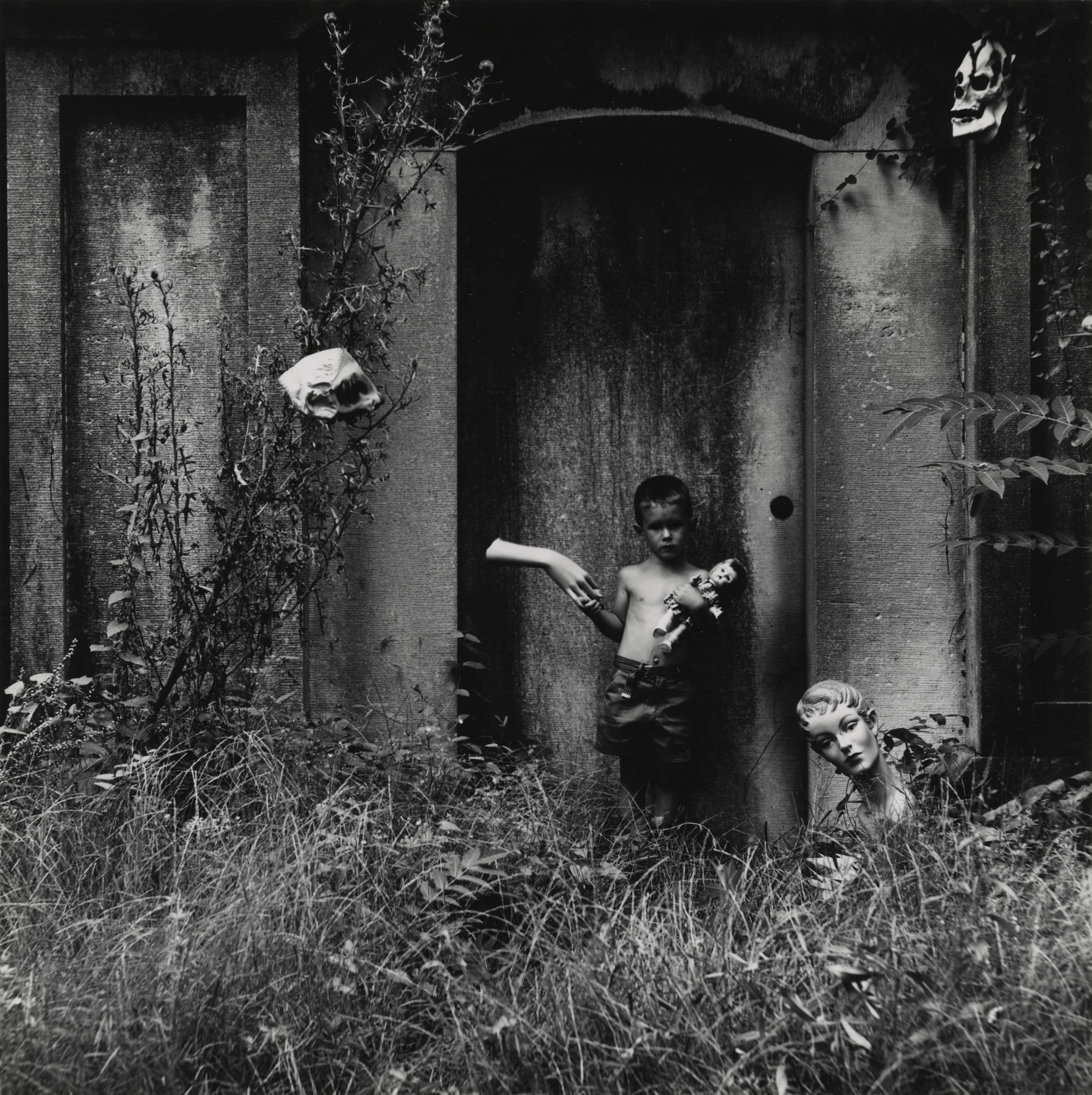
Photographer Ralph Eugene Meatyard (1925-1972) is an anomaly. There’s little consensus about the nature of his work beyond its unusualness. Throughout the late 1950s and 60s, Meatyard drove his wife and kids to dilapidated farm houses outside Lexington, Kent., where he used them as models for his photographs. He adorned them with cheap masks and accessorized the settings with broken mannequins, mutilated dolls, and other props that he would obtain from thrift shops and junkyards. He ultimately created a series of heavily shadowed, black and white photos that are chilling (but sentimental), surreal (but in an everyday sort of way), and at times, plain weird (I guess?)

Needless to say, the series is not an obvious one. “Ralph Eugene Meatyard: Dolls and Masks,” now showing at the de Young through February, collects 60 of the photos from that period — all of them not much larger than a CD case. But even the museum is ambivalent about explaining the work to visitors. They refer to quotes from Meatyard and have them by certain photos hoping they might shed some light. They mention, for instance, how Meatyard cited Zen Buddhism as an influence, and that he turned the idea of the family photo on it’s head. In truth, though, Meatyard was notoriously silent about how his work should be viewed. Guy Davenport, a close friend of Meatyard’s, said in the nine years he knew Meatyard, his friend  said relatively little about his work: “He never instructed one how to see, or how to interpret the pictures, or what he might have intended.” Virtually all of the photographs in “Dolls and Masks” are untitled, too, which certainly makes the tour guide’s job difficult. “I will try my best to answer your questions,” I heard one guide say, overcome.

However, one influence that’s often mentioned and that does seem to ring true about Meatyard’s work is literature. Meatyard was a devoted reader (he even read while driving), had an immense library, and walked in the same circles as writers and poets; it seems, to a certain extent, the reason why it’s difficult to narrow down what the photos in “Dolls and Masks” are doing is because they aren’t necessarily exploring a theme, an idea, posing a question, or trying to evoke a particular sensation or response. Rather, Meatyard imagined an entire world with these photos as though he’d written a story, in the same way Lewis Carroll imagined a world in Alice in Wonderland and Franz Kafka evoked one in The Trial or The Castle. In Meatyard’s so-called world, it’s normal for people to be wearing hideous masks and wandering outside abandoned buildings with mutilated dolls; so that, in fact, the masks and props are secondary to understanding the work.

This makes the series as rich and elaborate as a novel, and it’s why it can be all the aforementioned things at once: chilling, surreal, sentimental, commonplace … etc. Collectively, they are like illustrations for an unwritten story, perhaps a children’s story. Occasion for Diriment, for instance, one of the few titled photos within “Dolls and Masks” that combines the words “Dire” and “Merriment” (something, of course, Carroll was known to do), shows two kids in the dark, one wearing a cartoonish mask, jumping up in the air and pounding their chests. The photo is not haunting, but instead, speaks to the spirit of childhood, like a scene out of Peter Pan. The same could be said of one of Meatyard’s more famous untitled photos, which shows a shirtless boy standing in a doorway and holding a mannaquin’s hand. It recalls the lost boys.

“I remember thinking that here was a photographer who might illustrate the ghost stories of Henry James,” Davenport wrote. Meatyard’s work suggests he could have illustrated James and more: Edgar Allen Poe, for instance, or even some poems by Samuel Coleridge (I’d appreciate an illustration of “The Devil’s Thoughts”). But Meatyard died of cancer in 1972 at the age of 46, shortly after the photos in “Dolls and Masks” were taken. And, as has always been the case with his photography, in life and posthumously, Meatyard will hold a relatively quiet and humble place in the museum.

“Ralph Eugene Meatyard: Dolls and Masks”

Through Feb. 26, 2012

de Young Museum

50 Hagiwara Tea Garden Dr., Golden Gate Park, SF

deyoung.famsf.org

Awake and singing

1

arts@sfbg.com

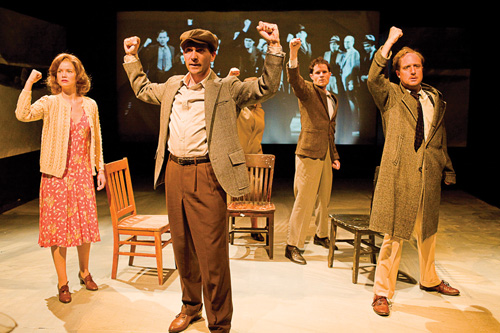
THEATER The company members onstage had started out just a couple of hours ago in literal harmony, joined in song. Now everyone appears spent, heated, and confused. They wonder what has happened to them. They wonder if they’ve lost their way; if their extraordinary effort and success over recent years has been worth anything. It’s a moment of truth, fraught with personal and collective drama, overshadowed by desperate and tumultuous times. The Group Theatre, arguably the most influential theater in American history, is about to disband.

At this point Harold Clurman, played by actor Michael Navarra, steps forward. In 1930, Clurman (with his Group co-founders Cheryl Crawford and Lee Strasberg) had led a year’s worth of Friday-night talks in which he laid out, in passionate ramblings, a vision for an American theater that didn’t yet exist. A decade later, much as the venture began, it ends with a Clurman speech. The few succinct lines shaped by Navarra seem to cradle for a moment the strife and disorder onstage, ringing out an eloquent justification of theater as a deep and enduring social enterprise.

Soon after this scene, the first run-through of In the Maze of Our Own Lives concludes on a rehearsal day in late September, but not without a subtle sense of histories converging. If playwright and director Corey Fischer drew on Clurman’s own language in fashioning this bit of rousing dialogue, its spirit no doubt draws too from three fervent decades with the Jewish Theatre (formerly A Traveling Jewish Theatre), his own well-known ensemble company founded with Naomi Newman and Albert Greenberg in 1978. In a chance conflation of theatrical destinies, the premiere of this ambitious, intelligent, soulful new play opens what TJT has announced will be its final season.

Sitting in roughly the middle of the house at the Jewish Theatre’s Florida Street home, Fischer thanks his cast and asks the production’s stage manager for the run time. After already massive cutting and reshaping, it seems the play could probably still stand to lose a few minutes from each act. But Fischer seems pleased with the results so far. The cast’s eight actors, meanwhile, are quietly taking in their own sense of the play as a whole, now that it’s fully up on its feet. Naomi Newman (who will debut a new play of her own about Grace Paley later in the season) has been getting her first glimpse of Maze from a seat in the third row. Not far away, outgoing artistic director Aaron Davidman has sheets of fresh notes to deliver to Fischer. It was Davidman who, five years ago, first discussed and developed with Fischer the idea of a play about the Group Theatre, after both had read John Lahr’s profile of Clifford Odets (the Group’s famous actor-turned-playwright) in the New Yorker.

It struck them both immediately, reading about Odets, that the Group was a natural, necessary subject for TJT to explore. “I don’t think the Group Theatre was ever self-consciously trying to do anything Jewish,” explains Fischer. “It just happened that a lot of them — Strasberg, Clurman, Odets, Stella Adler — they were coming directly from the only tradition of Jewish theater that ever existed: [the Yiddish theater]. It was more that in their focus on their America, that had to include the immigrant experience. That’s what they knew.

Of course, the breakthrough for Odets was writing about the people he knew. That’s what opened it up for a generation of writers, and not just theater writers. Morris Dickstein talks about Odets influencing Bernard Malamud and Grace Paley — which was fascinating because they happen to be the two non-theater writers whose work we have done the most through our Word for Word collaborations.”

A subject as grand and complex as the Group Theatre — which spawned many famous productions, plays, and artistic careers for stage and screen, influencing theater and filmmaking, theater training, and American literature at large — would present any playwright with a supreme challenge. This first run-through was proof Fischer and his colleagues had captured a coherent narrative with several key, interlocking strands in two well-shaped acts together totaling not much more than two hours. Although Fischer would eventually cut another 25 pages from the script before rehearsals were over, the play and the staging — which uses an appealing mix of media, original music, and ensemble movement to create a delicate dialogue between one company and its historical subject — was coming across persuasively.

In five years of researching the history of the Group, Fischer says he grew to appreciate a connection to these forebears he had not recognized at all when he, Newman, and Greenberg founded their company in Los Angeles (TJT relocated to the Bay Area in 1982). Fischer relates to the commitment, social and artistic, that drew the members of the Group together.

“Cheryl [Crawford] has this line, ‘We never used to fight like this when we were starving.’ Of course it’s not the whole story but, in other words, they came together because they needed each other to simply do the work they were called to do. They were a remarkable group, whatever their individual failings,” he continues. “What they had in common was they didn’t want to do commercial mainstream theater as it existed then. Clurman says of Chekhov’s characters: ‘I like them, they’re full of life, they’re not depressed, but they have no outlets in their society, so nothing means anything.’ Clurman gave Friday night talks for a year so people could just come and listen to this guy, this crazy rant, but that was the impulse.

I can’t remember who was just saying this about the current situation — I don’t know if it was about Wall Street, but this whole notion of talking crazy until enough people are listening — these world-changing movements start with one person and then grow to a few people in a small room. That’s how it starts.”

IN THE MAZE OF OUR OWN LIVES

Through Nov. 13

Previews Wed/19, 8 p.m.; opens Thurs/20, 8 p.m.; runs Thurs.-Sat., 8 p.m.; Sun., 2 p.m. (also Oct. 30, Nov. 6, and 13, 7 p.m.), $15-$35

The Jewish Theatre

470 Florida, SF

1-800-838-3006

www.tjt-sf.org


Not just for Halloween: bone tome “Empire of Death”

1

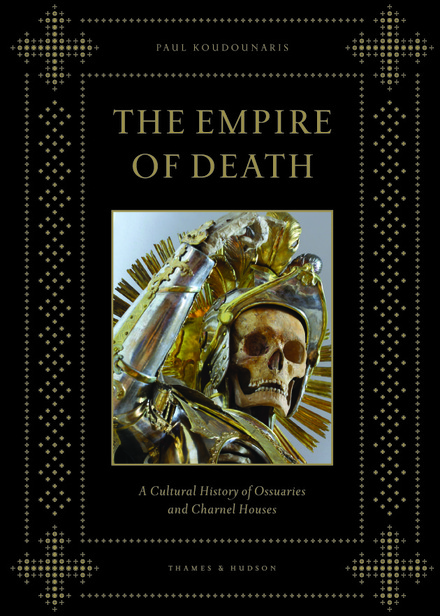
Sometimes, you can judge a book by its cover. Case in point: Dr. Paul Koudounaris’ The Empire of Death: A Cultural History of Ossuaries and Charnel Houses (Thames and Hudson, 224 pgs., $50), a hefty black tome emblazoned with shiny gold letters and a photo of a skeleton posed with its arm raised, clad in a helmet and suit of armor.

Sold! So, uh, what’s this book about, now? Koudounaris, whose credentials include a PhD in Art History from UCLA and an innate curiosity about things he terms “bizarre and suspicious,” spent five years traveling the globe learning more about the ancient (and primarily Catholic) practice of massing bones in charnel houses, often with eerily artistic results. He’ll be in town for a series of Empire of Death-related events starting Thurs/20.

To gather the book’s 260 photos (plus dozens of illustrations), the author traveled across multiple continents to 70 different locations, many of which are off-limits to the public. Lest you think he’s some kind of ghoulish Ed Gein type, Koudounaris explains his motivation on his website (a companion source for the book): “The Empire of Death [contains] hundreds of photographs and a text which not only recovers their history, but the history of the religious movement which gave birth to them. This is not a book about the macabre or death. It is a book about beauty and salvation. If you understand that when looking at these photos, then I hope you will choose to read the book.”

And the photos are beautifully presented, with accompanying text to contextualize, and share the significance of, exactly what you’re looking at: a wall of skulls arranged behind a “plague crucifix” in Switzerland; mummified monks posed beneath the memento mori symbol of an hourglass with wings (“time flies”) in Rome; painted skulls and a spectacularly bejeweled skeleton in Germany; and that fellow from Empire of Death‘s cover, martyr St. Pancratius, articulated using a “fine mesh fabric” and dressed in gleaming armor, forever on guard at the Church of St. Nikolaus in Wil, Switzerland.

Koudounaris’ author bio reveals that while he was working on the book, “he managed to become cursed, exorcized, arrested, and manacled by a deranged Italian monk,” so expect some hair-raising storytelling during his Bay Area appearances. Also on tap: slide shows, book signings, and a chance to check out prints of original photos from the book.

Thurs/20, 6:30 p.m., free
Paxton Gate
824 Valencia, SF
www.paxtongate.com

Thurs/20, 9 p.m., $20 (part of a larger event)
Trickster Salon, SF
For location information, RSVP here)

Fri/21, 7 p.m., free
Dark Carnival Imaginative Fiction Bookstore and Escapist Comic Bookstore
3086 and 3090 Claremont, Berk.
www.darkcarnival.com

Sun/23, 8 p.m., free
Dog Eared Books
900 Valencia, SF
www.dogearedbooks.com

Oakland is hella occupied

The Occupy Oakland encampment at Frank Ogawa Plaza is about 150 strong at any given time, and with a march, rally, and live musical performances on Oct. 15, the protest zone in the heart of Oakland was buzzing with energy.

Oakland is home to hundreds of seasoned activists who’ve made headlines in the past for organizing mass demonstrations against police violence, pushing back against cuts to public education, and moving to save Oakland public libraries from closing their doors in the face of budget cuts. Now, in solidarity with Occupy Wall Street and the Occupy movements that have sprouted up across the country in recent weeks, they’ve staked out a tent city in front of Oakland City Hall to join the national chorus condemning income inequality, corporate influence in government, and the role of major banks in unleashing a tide of unemployment and foreclosure that has swept working-class and middle-class Americans.

In just a week’s time, the occupiers have managed to create a community space governed by consensus that has the feeling of being an established space. Wooden pallets create walkways that criss-cross through the tents, which are staked close together. A kitchen area has been set up, with industrial-sized pots and pans piled high, and regular meals served to more than 100 people. There are portable toilets, portable outdoor sinks, a library supplied with zines and radical literature, an arts and crafts area, a kids’ area, a first-aid tent, and a makeshift stage in the plaza near the entrance of the 12th Street BART station.

The space is continually evolving, several activists told me when I chatted with various people at the camp. A few small arguments have broken out here and there, but on the whole things have been extraordinarily peaceful despite the close quarters and wide-open vibe. This past weekend, a tall structure with a pointed rooftop materialized overnight, adorned with colorful fabric and curtains. Tables and chairs had been brought in so people could play cards, hay bales served as structural dividers between encampment spaces, and the plaza was adorned with posters bearing statements like “The First American Revolution Since the First American Revolution.”

What sets the Oakland occupation apart in some ways is the diversity of people who’ve been drawn to participate. From black youth born and raised in Oakland, to Muslim women donning traditional headscarves, to white anarchists, to parents of young kids, to college students, to people in wheelchairs, to aging hippies, to transgender people, Occupy Oakland reflects the diversity of the city — and it’s bringing together a group of people who might not necessarily share the same space at the same time on a regular basis.

Boots Riley of The Coup performed at Occupy Oakland on Oct. 13, and other musicians have treated occupiers to live music as well. Shane Bauer, Sarah Shourd, and Josh Fattal — the three activists who were imprisoned in Iran and are now back on the West Coast — were scheduled to speak on Oct. 17. At one point just before dark on Oct. 15, a group of bikers blew past the camp in what seemed to be a show of support, performing tricks while everyone applauded.

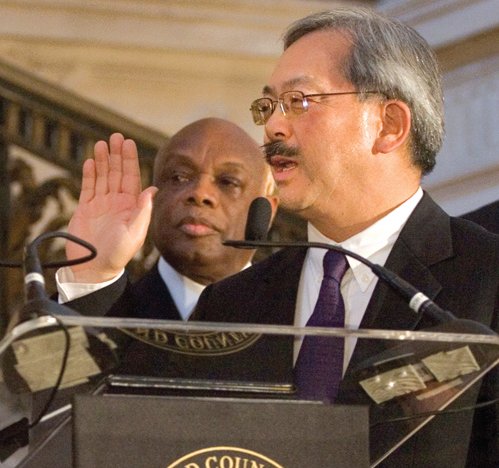
On Oct. 15, Move On staged a Jobs Not Cuts rally at Occupy Oakland, but because activists decided by consensus beforehand that they did not want any politicians speaking at their encampment, several elected officials whom the group had invited to speak were struck from the roster. (However, a representative from the office of Congressional Representative Barbara Lee did deliver a prepared statement, which some occupiers characterized as going back on their agreement with Move On.)

Danny Glover delivered a passionate speech at the rally, telling the crowd, “We are here because it’s the right time to be here.” He spoke about transforming and reinventing the system so that it could work for the people and the planet, asking, “What does it mean to be a human being in the 21st Century?” He urged the activists to hold their ground, and then said, “What it’s going to look like, I don’t know.” But he asked people to believe that a new system could come out of this grassroots movement, “based on our faith in humanity.”

All photos by Rebecca Bowe

Period Piece: A Carnegie library reopens in the Marina

0

Period Piece is Lucy Schiller’s recurring feature on the hidden histories of San Francisco. Give her a shout at culture@sfbg.com if you know of some hot dirt on olden times in the city

About a hundred years ago, Andrew Carnegie was giving away most of the money he had amassed from a gargantuan steel empire. Eight libraries in San Francisco directly resulted from Carnegie’s efforts, including the Marina’s Golden Gate Valley branch – the recipient of a much needed facelift that concluded last week.

The library was the eighth branch to open in San Francisco. It was born in 1918 to a city less than thrilled about accepting money from a man with a terrible labor rights record. Various arguments at City Hall had already played out over whether to accept the dirty money or refuse it, dedicate most of the funds to a main library or allocate more to several branches, elect trustees or keep the wealthy, elite ones around. 

After years of stalling, it was decided. Half of Carnegie’s grant went to the Main Library, the other half to seven branches. Last week, the Golden Gate Valley branch reopened after an extensive renovation thanks to B.L.I.P. (the inauspicious acronym for the Branch Library Improvement Project).

You can sense the money that went into this place’s initial construction. Shaped like a big wedge of cake, the Golden Gate Valley branch nestles into the corner of Octavia and Green and is decked out with stately columns, heavy copper doors, and high ceilings. 

Libraries have come a long way from their original intended purpose of providing literature to the masses. There are books here, of course — lots and lots of them. But the Golden Gate Valley branch also holds features for kids who can’t even read yet, digital signage in the teens’ area, a program room for community events, and of course, rows of computers for what is perhaps the library’s most salient role in today’s society: free Internet access. 

“Part of the mission of the library is to be a family destination,” says Mindy Linetzky, bond program administrator for BLIP. “We really want teens to come, for example.” With the library’s plans to hold occasional Wii gaming days, you can be sure they will, in droves.

B.L.I.P. has seen marked increase in community engagement since the start of the renovations. According to Michelle Jeffers, public relations officer at SFPL, the Visitation Valley branch’s recent renovation was met with a 406 percent increase in library card registration. 

BLIP’s job is almost done now with twenty-two refurbished libraries under its belt and only two more on the docket. Safer (with seismic bracing), greener (with solar panels), and more accessible (with elevators), our new libraries hold a lot of their former glory but also some fancy new swag.

Golden Gate Valley Public Library
 1801 Green, SF
(415) 355-5666


Get lit! A handy guide to Saturday night’s LitCrawl

0

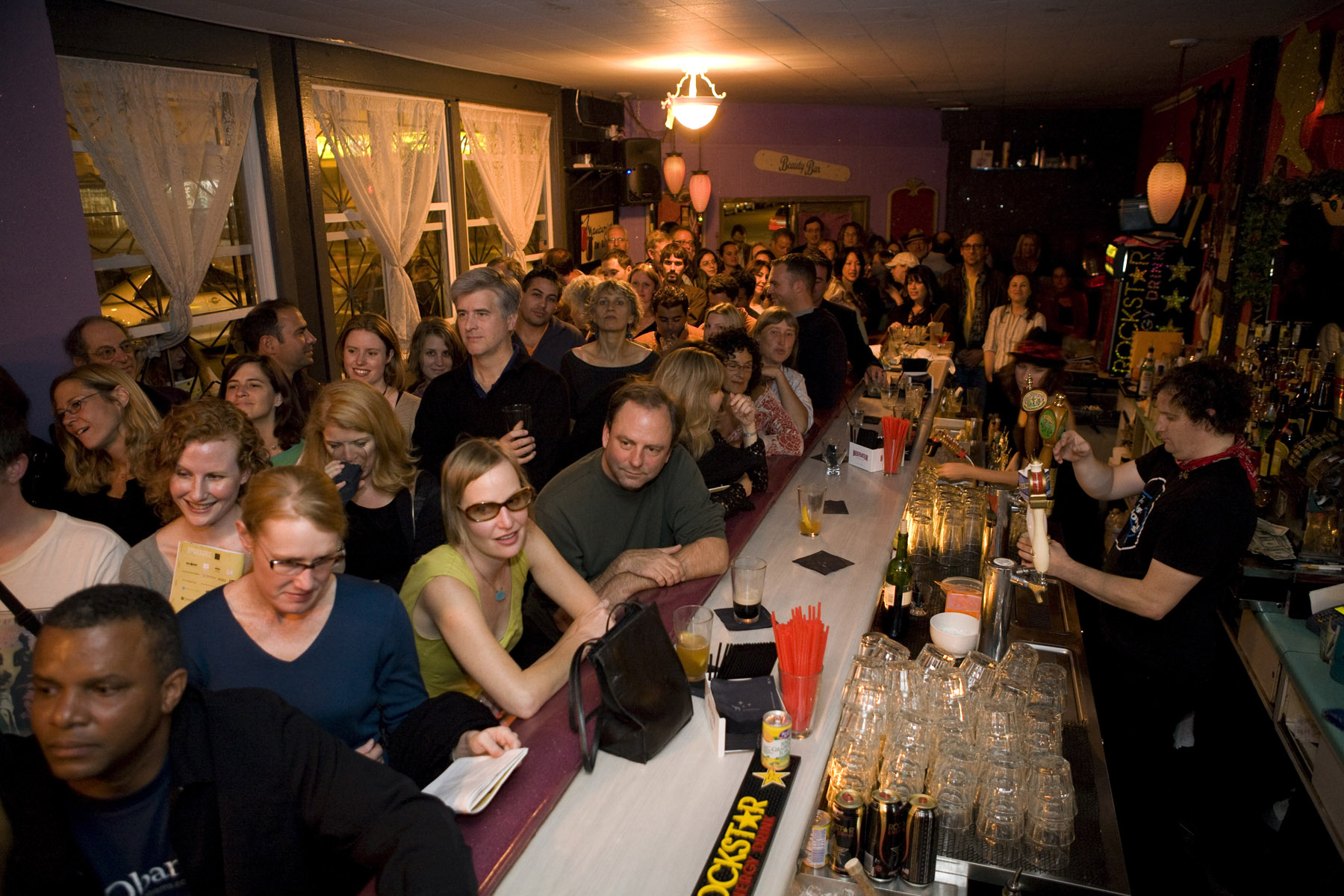
LitQuake has been rough. You’ve been dashing out of work, shoving people away from their cabs to make it to the Chuck Klosterman event and sprinting after buses to catch Karen Russell; you’ve had to make the hard decision between “Kafkaesque” and “Rock Out with your Book Out;” and all the while, you keep thinking Jeffrey Eugenides has just passed you on the street. With LitCrawl coming up Sat/15, things become even more overwhelming and terrific. In the Mission, bars, cafes, and bookstores together host 450 readers in 79 readings, all free and open to the public. One way to navigate the event might be to pick your favorite bar or cafe, find a chair, order a drink and wait for something to happen. Or, you can check these readings out:
 
I Live Here: SF. How We Got Here, Why We Stay
Not a lot of us can say we were born and raised in San Francisco. Most of us fled here from elsewhere for one reason or another: failed relationships, parents kicked you out, a nervous breakdown, a mid-life crisis, you formed an indie-rock band. Maybe you came for LoveFest and simply forgot whom you were. There are a thousand reasons for arriving and a thousand more for staying. In Clarion Alley, writers and non-writers alike including Mark Bittner and M.C. Mars talk about what brought them here and why they haven’t budged. 6 p.m., Clarion Alley, between Mission and Valencia, and 17th and 18th Sts, SF

BARTab’s Blame it on the a a a a a Alcohol: Tall Tales of Inebriated Adventures
Alcohol and writers have always had a vital, if tumultuous relationship. Hemingway said that when you worked in your head day after grueling day, the only viable remedy was whiskey; that “The only time it isn’t good for you is when you write or when you fight. You have to do that cold.” Luckily, a drunken night can become a source of inspiration, if not the next morning, sometime when you’re “cold.” At this reading, writers like Daphne Gottlieb, Jon Ginoli, Brenda Knight, and the editor of BARtab, Joe Provenzano, read about nights of drunken debauchery. 6 p.m., Martuni’s, 4 Valencia, SF
 
Come Cheer the Reaper: Readings from the San Francisco Writers’ Grotto
The San Francisco Writers’ Grotto was founded because, dammit, this writing business can be agonizing, but it’s more manageable when others surround you with whom you can collectively suffer. Convening at the Elbo Room for a night of readings tied around death, you might think that collectively suffering wasn’t working out so well for the Grotto. However, tonight is not a night for morbidity and gloom. Nine writers, including Janis Cooke Newman, Marianna Cherry, Gerard Jones, and Chris Colin read work that looks at death with humor and lightheartedness. 7:15 p.m., Elbo Room, 647 Valencia, SF
 
The Three-Penny Review Presents…
The Three-Penny Review, based out of Berkeley, would naturally host a night of premium writers at LitCrawl. The journal has been hosting the best authors, poets, and critics in its pages since 1980, and it publishes reviews and essays about everything under the sun (their recent issue features 3 great essays about live music). A good way to gauge the journal’s breath is looking at tonight’s lineup at the Summit. Kay Ryan is, of course, the former Poet Laureate of the U.S. and the Pulitzer Prize winner for The Best of It: New and Selected Poems; Walter Murch is a three-time Oscar-winning film and sound editor famous for his work on Apocalypse Now and The English Patient; Louis B. Jones is an author whose most recent novel is Radiance. Others tonight are poet Victoria Chang and the playwright and screenwriter Erik Tarloff. 7:15 p.m., Summit, 760 Valencia, SF
 
Zyzzyva Presents…
If you’ve taken a look at the West Coast writers and artists magazine Zyzzyva lately, you probably noticed some substantial changes: a new design, a full color art spread, an additional 40 pages of content. The changes are credited to the magazine’s first new editor since its founding in 1985, Laura Cogan. At 29, Cogan has breathed new life into the magazine and given it more presence in the community by doing, among other things, events like this one. Contributors to the fall issue of the magazine W.S. Di Piero and Troy Jollimore are joined by Heather Altfeld, and Malena Watrous. 7:15 p.m., Blue Macaw, 2565 Mission, SF
 
From Buddha to Batman
If you’re a fan of comic superheroes and also have a costume you’re dying to wear before Halloween, this event is most certainly for you. Gotham Chopra, co-founder of Liquid Comics and co-author of the comic Bullet Proof Monk, discusses our persistent fascination with muscles, spandex, super powers, and sidekicks. If you’re one of the first 20 to arrive to the event in a superhero costume, you get a free drink, while the best three costumes win signed books. 8:30 p.m., Laszlo Bar, 2526 Mission, SF

McSweeny’s and The Believer Present…
McSweeny’s and The Believer need no introduction. They are of what they are, and everyone knows that, together, the publisher and magazine support the very best writing. This event features a handful of those talent writers and personalities: poets Matthew Zapruder and Tess Taylor, columnist Daniel Handler (known by some as Lemony Snicket), and Anthony Myint and Karen Leibowitz, founders of Mission Street Food, and authors of the book Mission Street Food: Recipes and Ideas from an Improbable Restaurant. 8:30 p.m., Latin American Club, 3286 22nd St., SF

The World Cries Out for Revolution
Some, like the protestors defiantly camping outside the Federal Reserve Building for OccupySF, get their voices heard by taking to the streets. Others, like us at the San Francisco Bay Guardian, stir things up with the written word. You can see this every week in the articles written by our own Steven T. Jones (check out his article on the pot club crackdowns in this week’s issue). At Cafe La Boheme, Jones reads in the spirit of dissent with former Black Panther Richard Brown, as well as Larry Everest, the author of Oil Power & Empire: Iraq and the U.S. Global Agenda.
8:30 p.m., Cafe La Boheme, 3318 24th St., SF

City Lights celebrates a vital, veteran publisher

1

The avant-garde publisher New Directions was founded in 1936, but the idea was borne two years earlier when Ezra Pound gave some fairly harsh advice to James Laughlin, a 22-year-old aspiring poet and Harvard undergrad. In 1934, Laughlin was ambitious enough to travel to Rapallo, Italy, to meet and study under Pound, who was by that time a fascist and outspoken anti-Semite, but still respected by young writers as the force behind Eliot, Joyce, and Hemingway, as well as Imagism, the movement he helped shape. After two months, though, Pound didn’t think Laughlin possessed enough talent, and told him to return to the states and “do something useful.”
 
Three quarters of a century later, “useful” hardly describes New Directions (which will be celebrated Tues/11 at City Lights Books) and its dedication to publishing eccentric and groundbreaking work, beginning with the likes of Dylan Thomas, Denise Levertov, Tennessee Williams, and Marianne Moore, and continuing today with contemporaries like László Krasznahorkai and Javier Marías.

Birds, Beasts, and Seas: Nature Poems from New Directions (New Directions Publishing, 191 pages, $14.95) testifies to that dedication. Published to commemorate its 75th anniversary this year, and edited by the poetry editor, Jeffrey Yang, the anthology draws from the New Directions’ exhaustive archive, piling together over 140 poets of every nationality, period, and style into a handsome little book. Arranged chronologically by date of birth, and spanning from antiquity to the present, the anthology explores the vastly different ways poets have responded to nature: worshipping it, vilifying it, and bemoaning its loss. As luck would have it, four contributors to the anthology will read at City Lights to commemorate New Directions’ anniversary: Michael Palmer, Michael McClure, Lawrence Ferlinghetti, and Nathaniel Tarn.
 
As conventional or even dry as an anthology of nature poems may sound, Birds, Beasts, and Seas is impressive simply because New Directions’ specialty has always been renegades, rejects, and intransigents. It’s an anthology of nature poems, of course, but the poems are by no means characteristic of the genre. They are, however, characteristic of New Directions. Several of the poets here are rarely anthologized at all, and stumbling onto them is like bumping into old friends suddenly back from oblivion. William Bronk, for instance, whose poem “Aspects of the World Like Coral Reefs” dismantles science and asserts “It is absurd to describe the world in sensible terms;” or French poet Saint John Perse, Chilean poet Vincente Huidobro, and some of the very poets reading at City Lights on Tuesday, like Nathaniel Tarn whose brooding poem from “The Fire Season” wouldn’t appear in your typical nature anthology:
 
Our pines continue to die and continue to die—
funeral carpets of needles around their base.
You could sleep there, you could suffocate
soundly and be in harmony with all of nature.
 
Editor Yang writes in the preface that nature poems could change our way of thinking about the environment, and while Yang’s faith in the poem is admirable (however naive), the most anyone can really expect from Birds, Beasts, and Seas is an anthology that, at its finest moments, is new and invigorating.

New Directions Publishing 75th Anniversary
Tues/11, 7 p.m., free
City Lights
261 Columbus, SF
www.citylights.com

Shakin’ spines

0

marke@sfbg.com

LIT Once again, the raucous, two-week Litquake festival is set to liquidate our shores with the mighty crack and crash of living language. Dazed authors and reeling poets will grace our lesser known alleyways; literary agents and bookstore owners will awaken satisfied on the curbs of our better sex clubs. Kindles will be hijacked, asses will be signed. Some actual writing may get done.

And yet, while the larger events justly command the spotlight (opening party “The Devil’s Lexicon” on Fri/7, New Directions 75th anniversary party on Tue/11, infamously drunken unofficial closing blowout Litcrawl on Sun/15), there are a host of smaller and satellites events that tap into the true flavor of contemporary literature. Below are some attractive-looking ones. (Unless noted, more info can be found on these functions at www.litquake.org.)


OFF THE RICHTER SCALE

This two-part event is the quavering blood and guts of Litquake: an unabashed free showcase of some of the most cutting-edge talent on offer. Rhyming or Not: Bay Area Poetry (Sat/8, 1 p.m., free) shores up the verse side of things, while Golden Gate and Beyond (Sun/9, noon, free) props up the prose. This year’s theme is, “to explore writing in extreme circumstances and from deep within the mind—defined in terms spiritual, physical, or cybernetic.” I’m bringing popcorn.

Sat/8 and Sun/9, Variety Room, 582 Market, SF.


CHRISTINE BEATTY

OK, this isn’t officially a part of Litquake — but the ‘quake also spawns a slew of satellite events, so let’s just shake things up. Christine Beatty is tearing up the transsexual literature circuit with her memoir, “Not Your Average American Girl,” which tells her fascinating story from growing up hippie, serving in the military, hooking in the Tenderloin, engineering software, and much more. It’s a great slice of Northern Californiana.

Sat/8, 8 p.m., free. Center for Sex and Culture, 1349 Mission, SF. www.sexandculture.org


THAT’S MY F*CKING STOOL! WRITERS AT THE BAR

I know next to nothing about this night except that it takes place at one of my favorite bars, Vesuvio, and involves some very interesting writer-personalities, like Jack Boulware, Beth Lisick, Missy Roback, and Frances Stroh. I hope it’s Jell-O wresting, but I’ll be happy with a good ol’ round of slams and shots.

Sun/9, 4 p.m., free. Vesuvio, 255 Columbus, SF.


THE SECRET LIFE OF METAPHOR

Am I terrified of an expert on metaphors who is also a juggler, and who illustrates his points by “juggling balls as well as words”? I am kind of terrified of this person! And yet, I find the promise of respected writer James Geary’s lecture almost too tantalizing to resist. Should I let my prejudices keep me away, or should I let the wild carnival of knowledge commence? Right now, it’s a toss-up.

Sun/9, 4 p.m., $5–$7. Z Space, 450 Florida, SF.


TEENQUAKE: NOT YOUR MOTHER’S BOOK CLUB

You either have come to accept that teenagers are rightfully taking over this world, or you need to look up this little thing called the Internet. Of course, teens have maliciously kept most of the best recent fiction writing to themselves, via “young adult” books. (If I’m addicted to Hunger Games does that mean I’m young forever?) Popular teen fiction writers Simone Elkeles, Becca Fitzpatrick, Michelle Hodkin, and Moira Young come together to dish their secrets.

Mon/19, 7 p.m., free. Books Inc. Opera Plaza, 601 Van Ness, SF.


ORIGINAL SHORTS: FAILURE TO COMMIT

Will the six authors — including Ladipo Manyiko and Shawna Yang Ryan — who were asked to “look deep into the heart of the flaky soul and emerge with original short stories on the theme of failing to commit” even show up? Now that would be some performative literature right there. If you’re stood-up, you’ll at least have the Lone Palm’s excellent cocktails for succor.

Mon/10, 7 p.m., free. Lone Palm, 3394 22nd St., SF.


BARBERSHOP READING: A LITTLE OFF THE TOP AND OVER THE TOP

The gays do love to fuss about their tops! This party-slash-gathering of LGBT writers in the fab Joe’s Barbershop has already become a Litquake fixture for lit queens and their chasers, and proof that our community’s writing talent hasn’t been sucked into Grindr chats and Dinah missed connections.

Tue/11, 9 p.m., free ($5–$10 suggested donation). Joe’s Barbershop, 2150 Market, SF.


FIGURE FOUR CAPS LOCK: PRO WRESTLING MEMOIRS FROM CLASSY FREDDIE BLASSIE TO THE FABULOUS MOOLAH

Boxing, schmoxing — the real money melon for sports book fans of the last two decades have been professional reminiscences of flamboyant flings in the ring. I mean, c’mon, Rowdy Roddy Piper, people: what more titillation do you need (besides a kick in the rear from the Iron Sheik’s pointy-toed shoes?) Writers Alia Volz, Rick Luxury, Alan Black and many more cactus clothesline this important body of work with tributes and testimonials.

Fri/14, 7 p.m., $10. Hemlock Tavern, 1131 Polk, SF.


INVISIBLE CITY AUDIO TOURS: EVERYWHERE MAN

“Alternative self-guided walking audio tour” purveyors Invisible City combine music, words, sonic landscapes, and historical information to create realtime experiences that map the ethereal onto SF streets. Latest work “Everywhere Man” is a mystery that whose clues are divulged while participants ride cable cars throughout the city. This sounds too, too cool, especially for first-time visitors.

Sat/15, 2 p.m., pre-order accompanying map and podcast at www.invisiblecityaudiotours.org for $15. Meet at the cable car turnaround, Market and Powell, SF.


WORDS ON WAVES

The North Bay literary scene gets some incredible shine at this event, which takes place on the houseboats of Sausalito. Move from one houseboat to the next and experience samplings of such topics as “Rum, Sodomy, and the Lash: Tall Tales from the Boat Dwellers” on Boat #134, SMITH Magazine’s “Water, Fire, Rocks: Life in Six Words” on Boat #42, and “Vanda Marlow, Poetry Faerie” on Boat #12 (actually a restored World War II landing craft.) Get saucy, Sausalito. Literally.

Sat/15, 1 p.m., $25 advance. Private houseboat pier (for exact location email wotw@litquake.org), Sausalito.

Film Listings

0

OPENING

Dream House Newlyweds Daniel Craig and Rachel Weisz, plus third wheel Naomi Watts, star in this psychological thriller. (1:33)

50/50 This is nothing but a mainstream rom-com-dramedy wrapped in indie sheep’s clothes. When Adam (Joseph Gordon-Levitt) learns he has cancer, he undergoes the requisite denial, anger, bargaining, depression, and acceptance like a formality. Aided by his bird-brained but lovable best friend Kyle (Seth Rogan), lovable klutz of a counselor Katherine (Anna Kendrick), and panicky mother (Anjelica Huston), Adam gets a new lease on life. This comes in the form of one-night-stands, furious revelations in parked cars, and a prescribed dose of wacky tobaccy. If 50/50 all sounds like the setup for a pseudo-insightful, kooky feel-goodery, it is. The film doesn’t have the brains or spleen to get down to the bone of cancer. Instead, director Jonathan Levine (2008’s The Wackness) and screenwriter Will Reiser favor highfalutin’ monologues, wooden characters, and a Hollywood ending (with just the right amount of ambiguity). Still, Gordon-Levitt is the most gorgeous cancer patient you will ever see, bald head and all. (1:40) Presidio. (Ryan Lattanzio)

Machine Gun Preacher The title sounds like a sequel to Hobo with a Shotgun — but there’s nary a speck of tongue-in-cheek, kitschy-koo-koo irony in this passionate rendering of the life of Sam Childers. Childers (Gerard Butler) was a former dealing, thieving biker who found God, built a refuge for Sudanese orphans and former child soldiers, and became their fiercest fight-fire-with-fire defender. As Machine Gun Preacher opens, Childers has just emerged from the pen — he’s still the mean motherfucker he always was, shooting up within hours of release and hooking up with chum Donnie (Michael Shannon) to rob dealers. But a semi-mystical run-in forces him to face the worst and sends him to church, to join wife Lynn (Michelle Monaghan), a former stripper and addict. Childers’ fiery love of the Lord, and his spontaneous visions, lead him to construct his own church for sketched-out recovered sinners like himself and then on to war-torn Sudan, where he discovers even more to fix — and likely more than he ever can. To his credit, director Marc Forster (2001’s Monster’s Ball, 2008’s Quantum of Solace) doesn’t shy away from the visceral violence nor the enraged holy-rolling that’s a clear part of Childers’ life, although the most memorable part of Machine Gun Preacher must be Butler, who gets his righteous wrath on in his meatiest part since 2006’s 300. (2:03) (Chun)

The Mill and the Cross One of the clichés often told about art is that it is supposed to speak to us. Polish director Lech Majewski’s gorgeous experiment in bringing Flemish Renaissance painter Peter Bruegel’s sprawling 1564 canvas The Procession to Calvary to life attempts to do just that. Majeswki both re-stages Bruegel’s painting –which draws parallels between its depiction of Christ en route to his crucifixion and the persecution of Flemish citizens by the Spanish inquisition’s militia — in stunning tableaux vivant that combine bluescreen technology and stage backdrops, and gives back stories to a dozen or so of its 500 figures. Periodically, Bruegel himself (Rutger Hauer) addresses the camera mid-sketch to dolefully explain the allegorical nature of his work, but these pedantic asides speak less forcefully than Majeswki’s beautifully lit vignettes of the small joys and many hardships that comprised everyday life in the 16th century. Beguiling yet wholly absorbing. (1:37) Embarcadero, Shattuck. (Sussman) *Mysteries of Lisbon Though produced for Portuguese television, Raúl Ruiz’s Mysteries of Lisbon won awards and raves on the festival circuit. Suddenly, the aging Ruiz seemed more assured his rightful status as a master. Mysteries of Lisbon has arrived for a rather miraculous theatrical run — but Ruiz is gone. He died in August 2011, having directed many more films than his 70 years. His movies have typically been the province of hardcore cinephiles, but this splendid epic holds wider appeal. It’s difficult to think of another movie that so satisfyingly captures the intricacies and volatilities of the 19th century novel — anyone enthralled by the teeming creations of Balzac and Dickens will find that Mysteries of Lisbon‘s four-and-a-half hours stream by. Ruiz was no stranger to the 19th century — his recent films included Klimt (2006) and the Proustian Time Regained (1999) — but the ornately plotted trio of novellas by Portuguese author Camilo Castelo Branco which supply these mysteries seem specially tailored to the director’s affinity for involved narrations. The story sweeps across dozens of characters and several generations of doomed love, revenge plots, disguised identities, uncertain parentages, and religious vows. We even glimpse the Napoleonic Wars. Ruiz’s narrations are commonly likened to labyrinths, but for Mysteries of Lisbon‘s vigorous expansion I reach for the cosmos: one luminous sphere rotates another which in turn rotates a larger system, the whole of it spreading outwards in all directions at once. (4:26) Embarcadero, Shattuck. (Goldberg)

Passione John Turturro’s lush tribute to the music of Naples, Italy is beamed directly from a strange alternate universe completely devoid of snark — a place where grand emotions and sweeping melodrama are presented at face value. In other words, anyone who can’t stomach a heaping helping of cheese will miss the point of Passione. (If you can stomach a small helping of cheese, the film will suck you in after a few minutes.) Passione is more free-form than docs like Buena Vista Social Club (1999), but it’s in a similar vein: a celebration of the musical traditions and artists from a specific place, and an exploration of what it is about that specific place that inspires such creativity. In Naples, there are centuries-old folk ballads, comedic ditties about the mafia, histrionic romantic duets, slinky laments, opera, and more. Actor-turned-director Turturro — the Brooklyn-born son of Italian immigrant parents — doesn’t really provide a structure so much as simply let the performances, most of which are staged in organic settings, flow. Fans of Italian popular music might recognize some of the singers, but most will be unfamiliar to stateside viewers. The majority of the songs offer subtitles, but even the ones that don’t are so over-the-top that their meanings (usually having to do with anguish, love, or the anguish of love) are easy to decipher. Turturro is scheduled to appear in person at the film’s Mon/3 evening screenings; check www.sffs.org for updates. (1:31) SFFS New People Cinema. (Eddy)

*Tucker and Dale vs. Evil See “Twang On.” (1:28) California, Lumiere.

What’s Your Number? Unlucky-in-love Anna Faris checks back in with all her former conquests in this romantic comedy. (1:46) Presidio.

ONGOING

Abduction (1:46) 1000 Van Ness.

*The Black Power Mixtape 1967-1975 Cinematic crate-diggers have plenty to celebrate, checking the results of The Black Power Mixtape 1967-1975. Swedish documentarian Göran Hugo Olsson had heard whispers for years that Swedish television archives possessed more archival footage of the Black Panthers than anyone in the states — while poring through film for a doc on Philly soul, he discovered the rumors were dead-on. With this lyrical film, coproduced by the Bay Area’s Danny Glover, Olsson has assembled an elegant snapshot of black activists and urban life in America, relying on the vivid, startlingly crisp images of figures such as Stokely Carmichael and Huey P. Newton at their peak, while staying true to the wide-open, refreshingly nonjudgmental lens of the Swedish camera crews. Questlove of the Roots and Om’Mas Keith provide the haunting score for the film, beautifully historicized with shots of Oakland in the 1960s and Harlem in the ’70s. It’s made indelible thanks to footage of proto-Panther school kids singing songs about grabbing their guns, and an unforgettable interview with a fiery Angela Davis talking about the uses of violence, from behind bars and from the place of personally knowing the girls who died in the infamous Birmingham, Ala., church bombing of 1963. (1:36) Embarcadero, Piedmont, Shattuck. (Chun)

Circumstance Thirteen (2003) goes to Tehran? The world of sex, drugs, and underground nightclubs in Iran provides the backdrop for writer-director Maryam Keshavarz’s lusty, dreamy take on the passionate teenagers behind the hijabs. Risking jail and worse are the sassy, privileged Atafeh (Nikohl Boosheri) and the beautiful, orphaned Shireen (Sarah Kazemy), who, much like young women anywhere, just want to be free — to swim, sing, dance, test boundaries, lose, and then find themselves. The difference here is that they’re under constant, unnerving surveillance, in a country where more than 70 percent of the population is less than 30 years old. Nevertheless, within their mansion walls and without, beneath graffitied walls and undulating at intoxicating house parties, the two girls begin to fall in love with each other, as Atafeh’s handsome, albeit creepy older brother Mehran (Palo Alto-bred Reza Sixo Safai) gazes on. The onetime musical talent’s back from rehab, has returned to the mosque with all the zeal of the prodigal, and has hooked up with the Morality Police that enforces the nation’s cultural laws. Filmed underground in Beirut, with layers that permit both pleasure and protest (wait for the hilarious moment when 2008’s Milk is dubbed in Farsi), Circumstance viscerally transmits the realities and fantasies of Iranian young women on the verge. (1:45) Opera Plaza, Shattuck. (Chun)

City of Life and Death There have been a number of recent works about the “rape of Nanking,” but perhaps none tackles the brutal nature of Nanjing’s fall with as much beauty as City of Life and Death. Shot in striking black and white, the film depicts the invasion of China’s capital by Japanese forces from a number of points of view, including that of a Japanese soldier. It can be difficult at times to become emotionally attached to characters within such a restless narrative, but the structure goes a long way toward keeping the proceedings balanced. The stunningly elaborate sets and cinematography alone are worth the price of admission, and it’s amazing that such detail was achieved with a budget of less than $12 million. But it is the unflinching catalog of the some 300,000 murders and rapes that took place between 1937 and 1938 in Nanjing that will remain with you long after watching. (2:13) Four Star. (Peter Galvin)

*Contagion Tasked with such panic-inducing material, one has to appreciate director Steven Soderbergh’s cool head and hand with Contagion. Some might even dub this epic thriller (of sorts) cold, clinical, and completely lacking in bedside manner. Still, for those who’d rather be in the hands of a doctor who refuses to talk down to the patient, Contagion comes on like a refreshingly smart, somewhat melodrama-free clean room, a clear-eyed response to a messy, terrifying subject. A deadly virus is spreading swiftly — sans cure, vaccine, or sense — starting with a few unlikely suspects: globe-trotting corporate exec Beth (Gwyneth Paltrow), a waiter, a European tourist, and a Japanese businessman. The chase is on to track the disease’s genesis and find a way to combat it, from the halls of the San Francisco Chronicle and blog posts of citizen activist-journalist Alan (Jude Law), to the emergency hospital in the Midwest set up by intrepid Dr. Mears (Kate Winslet), to a tiny village in China with a World Health investigator (Marion Cotillard). Soderbergh’s brisk, businesslike storytelling approach nicely counterpoints the hysteria going off on the ground, as looting and anarchy breaks out around Beth’s immune widower Mitch (Matt Damon), and draws you in — though the tact of making this disease’s Typhoid Mary a sexually profligate woman is unsettling and borderline offensive, as is the predictable blame-it-on-the-Chinese origin coda. (1:42) California, 1000 Van Ness, Sundance Kabuki. (Chun)

Crazy, Stupid, Love Keep the poster’s allusion to 1967’s The Graduate to one side: there aren’t many revelations about midlife crises in this cleverly penned yet strangely flat ensemble rom-com, awkwardly pitched at almost every demographic at the cineplex. There’s the middle-aged romance that’s withered at the vine: nice but boring family man Cal (Steve Carell) finds himself at a hopeless loss when wife and onetime teenage sweetheart Emily (Julianne Moore) tells him she wants a divorce and she’s slept with a coworker (Kevin Bacon). He ends up waxing pathetic at a slick nightclub where he catches the eye of the well-dressed, spray-tanned smoothie Jacob (Ryan Gosling), who appears to have taken his ladies man stance from the Clooney playbook. It’s manly makeover time: GQ meets Pretty Woman (1990)! Cut to Cal and Emily’s babysitter Jessica (Analeigh Tipton), who is crushing out on Cal, while the separated couple’s tween Robbie (Jonah Bobo) hankers for Jessica. Somehow Josh Groban worms his way into the mix as the dullard suitor of Hannah (Emma Stone) in a hanging chad of a storyline that must somehow be resolved in this mad, mad, mad, mad — actually, the problem with Crazy, Stupid, Love is that it isn’t really that crazy. It tries far too hard to please everybody in the theater to its detriment, reminding the viewer of a tidy, episodic TV series (albeit a quality effort) like Modern Family more than an actual film. Likewise I yearned for a way to fast-forward through the too-cute Jessica-Robbie scenes in order to get back to the sleazy-smart, punchy complexity of Gosling, playing adeptly off both Carrell and Stone. (1:58) SF Center, Shattuck. (Chun)

The Debt On paper, The Debt has a lot going for it: captivating history-based plot, “it” actor Jessica Chastain, Helen Mirren vs. Nazis. And while the latest from John Madden (1998’s Shakespeare in Love) is fairly entertaining, the film is ultimately forgettable. Chastain plays Rachel, a member of an Israeli team tasked with capturing a Nazi war criminal and bringing him to justice. Mirren is the older Rachel, who is haunted by the long-withheld true story of the mission. Although The Debt traffics in spy secrets, it’s actually rather predictable: the big reveal is shrug-worthy, and the shocking conclusion is expected. So while the entire cast — which also includes Tom Wilkinson, Sam Worthington, and Ciaran Hinds — turn in admirable performances, the script is lacking what it needs to make The Debt an effective drama or thriller. Like 2008’s overrated The Reader, the film tries to hide its inadequacies under heavy themes and the dread with which we remember the Holocaust. (1:54) Four Star, 1000 Van Ness, Presidio, Sundance Kabuki. (Peitzman)

Detective Dee and the Mystery of the Phantom Flame (2:02) Embarcadero, Four Star, Shattuck, Sundance Kabuki.

Dolphin Tale (1:53) 1000 Van Ness, Presidio, SF Center.

*Drive Such a lovely way to Drive, drunk on the sensual depths of a lush, saturated jewel tone palette and a dreamlike, almost luxurious pacing that gives off the steamy hothouse pop romanticism of ’80s-era Michael Mann and David Lynch — with the bracing, impactful flecks of threat and ultraviolence that might accompany a car chase, a moody noir, or both, as filtered through a first-wave music video. Drive comes dressed in the klassic komforts — from the Steve McQueen-esque stances and perfectly cut jackets of Ryan Gosling as the Driver Who Shall Remain Nameless to the foreboding lingering in the shadows and the wittily static, statuesque strippers that decorate the background. Gosling’s Driver is in line with Mann’s other upstanding working men who hew to an old-school moral code and are excellent at what they do, regardless of what side of the law they’re working: he likes to keep it clear and simple — his services as a wheelman boil down to five minutes, in and out — but matters get messy when he falls for sweet-faced neighbor Irene (Carey Mulligan), who lives down the hall with her small son, and her ex-con husband (Oscar Isaac) is dragged back into the game. Populated by pungent side players like Albert Brooks, Bryan Cranston, Ron Perlman, and Christina Hendricks, and scattered with readily embeddable moments like a life-changing elevator kiss that goes bloodily wrong-right, Drive turns into a real coming-out affair for both Danish director Nicolas Winding Refn (2008’s Bronson), who rises above any crisis of influence or confluence of genre to pick up the po-mo baton that Lynch left behind, and 2011’s MVP Ryan Gosling, who gets to flex his leading-man muscles in a truly cinematic role, an anti-hero and under-the-hood psychopath looking for the real hero within. (1:40) Marina, 1000 Van Ness, SF Center, Sundance Kabuki. (Chun)

Farmageddon First-time director Kristin Canty embarked on this documentary after discovering the healing power of raw milk in helping her child’s allergies. And it shows. Farmaggedon really should have been titled A Raw Deal for Raw Milk, considering its primary focus on several small family-operated dairies and the souring treatment they have received from government bureaucrats, spurring Canty’s activist act of making this movie. Larry and Linda Failace of Three Shephard’s Cheese in Vermont (the latter wrote her own book, 2007’s Mad Sheep: The True Story Behind the USDA’s War on a Family Farm) seem to have suffered the most, driven out of business when the sheep they brought over legally, with all the required quarantines, were seized and destroyed by the government agents on the pretext that the animals might spread “mad cow” disease. The sight of Linda Failace breaking into tears reading her daughter’s words about how the sheep were like her brothers and sisters is heart-breaking. Undermining such powerful, outrageous material are Canty’s textbook missteps: the director has major problems organizing her seemingly scattershot, lopsided material into a coherent and, er, organic whole, and lets her many sources drone on without a strong narrative through-line. All of this makes Farmaggedon a bit of a struggle to watch, although the dirt Canty digs up is likely to justifiably raise the hackles of progressive foodies. (1:30) Roxie, Smith Rafael. (Chun)

*The Future Dreams and drawings, cats and fantasies, ambition and aimlessness, and the mild-mannered yet mortifying games people play, all wind their way into Miranda July’s The Future. The future’s a scary place, as many of us fully realize, even if you hide from it well into your 30s, losing yourself in the everyday. But you can’t duck July’s collection of moments, objects, and small gestures transformed into something strangely slanted and enchanted, both weird and terrifying, when viewed through July’s looking glass. Care and commitment — to oneself and others — are two vivid threads running through The Future. Cute couple Sophie (July) and Jason (Hamish Linklater) — unsettling look-alikes with their curly crops — appear at first to be sailing contently, aimlessly toward an undemanding unknown: Jason works from home as a customer-service operator, and Sophie attempts to herd kiddies as a children’s dance instructor. But enormous, frightening demands beckon — namely the oncoming adoption of a special-needs feline named Paw-Paw (voiced by July as if it’s a traumatized, innocent child). Lickety-splitsville, they must be all they can be before Paw-Paw’s arrival. The weirdness of the familiar, and the kindness of strangers, become ways into fantasy and escape when the couple bumps up against the limits of their imagination. This ultra-low-key horror movie of the banal is obviously remote territory for July (2005’s Me and You and Everyone We Know). The Future is her best film to date and finds her tumbling into a kind of magical realism or plastic fantastic, embodied by a talking cat that becomes the conscience of the movie. (1:31) Roxie. (Chun)

The Guard Irish police sergeant Gerry Boyle (Brendan Gleeson) is used to running his small town on his own terms — not in a completely Bad Lieutenant (1992) kind of way, though he’s not afraid to sample drugs and hang with hookers. More like, he’s been running the show for years, and would prefer that big-city cops stay the hell out of his village. Alas, a gang of drug smugglers is doing business in the area, so an officious group of investigators from Dublin (horrors!) and America (in the form of an FBI agent played by Don Cheadle) soon descend. His mother’s dying, his brand-new partner’s missing, and between all the interlopers on both sides of the law, Boyle’s having a hard time having a pint in peace. Good thing he’s not as simple-minded as all who surround him think he is. Writer-director John Michael McDonagh (brother of playwright Martin, who directed 2008’s In Bruges — also starring Gleeson) puts an affable Irish spin on what’s essentially a pretty typical indie comedy, with some pretty typical crime-drama elements layered atop. Boyle’s character is memorably clever, but the film that contains him never quite elevates to his level. (1:36) Lumiere, Shattuck, Sundance Kabuki. (Eddy)

*The Hedgehog You needn’t possess the rough, everyday refinement of the characters of The Hedgehog to appreciate this debut feature by director-screenwriter Mona Achache — just an appreciation for a delicate touch and a tender heart. Eleven-year-old Paloma (the wonderful Garance Le Guillermic) is too smart for her own good, bored, neglected by her parents, and left to fend for herself with only her considerable imagination and a camcorder. She drifts around her fishbowl of privilege, a deluxe art nouveau-style apartment building in Paris, leveling her all-too-wise gaze on its denizens and plotting certain suicide on her 12th birthday — that is until a new resident appears in her viewfinder: a kindly Japanese gentleman Kakuro Ozu (Togo Igawa). He has as much of a connoisseur’s eye as Paloma — the proof is in his unlikely focus of attention, the building’s concierge Renée Michel (Josiane Balasko, resembling a burly Gertrude Stein), who hides her cultured and bookish inclinations behind a gruff, drab exterior. They recognize in each other a reverence for an almost monkish life of the mind, the austere elegance of wabi-sabi, and the transient beauty of rough-hewn imperfection, even in the sleek, well-heeled heart of the City of Light. To the credit of Achache, working with Muriel Barbery’s novel, these unlikely fragile friendships between outsiders take hold in a way that sidesteps preciousness and stays with you long after its pages have turned. (1:40) Smith Rafael. (Chun)

The Help It’s tough to stitch ‘n’ bitch ‘n’ moan in the face of such heart-felt female bonding, even after you brush away the tears away and wonder why the so-called help’s stories needed to be cobbled with those of the creamy-skinned daughters of privilege that employed them. The Help purports to be the tale of the 1960s African American maids hired by a bourgie segment of Southern womanhood — resourceful hard-workers like Aibileen (Viola Davis) and Minny (Octavia Spencer) raise their employers’ daughters, filling them with pride and strength if they do their job well, while missing out on their own kids’ childhood. Then those daughters turn around and hurt their caretakers, often treating them little better than the slaves their families once owned. Hinging on a self-hatred that devalues the nurturing, housekeeping skills that were considered women’s birthright, this unending ugly, heartbreaking story of the everyday injustices spells separate-and-unequal bathrooms for the family and their help when it comes to certain sniping queen bees like Hilly (Bryce Dallas Howard). But the times they are a-changing, and the help get an assist from ugly duckling of a writer Skeeter (Emma Stone, playing against type, sort of, with fizzy hair), who risks social ostracism to get the housekeepers’ experiences down on paper, amid the Junior League gossip girls and the seismic shifts coming in the civil rights-era South. Based on the best-seller by Kathryn Stockett, The Help hitches the fortunes of two forces together — the African American women who are trying to survive and find respect, and the white women who have to define themselves as more than dependent breeders — under the banner of a feel-good weepie, though not without its guilty shadings, from the way the pale-faced ladies already have a jump, in so many ways, on their African American sisters to the Keane-eyed meekness of Davis’ Aibileen to The Help‘s most memorable performances, which are also tellingly throwback (Howard’s stinging hornet of a Southern belle and Jessica Chastain’s white-trash bimbo-with-a-heart-of-gold). (2:17) California, 1000 Van Ness, SF Center, Sundance Kabuki. (Chun)

I Don’t Know How She Does It I don’t know how a likable comedian like Sarah Jessica Parker does it — meaning, such mediocre material as this mom-com. Parker may have parlayed her Sex and the City fame into a fashion, fragrance, and spin-off franchises, but she still hasn’t quite found her stride away from Carrie Bradshaw, though her Lucille Ball-esque physical comedy here — pulling down her skirt in mid-mommy-frazzle in front of her high-powered client — can be cute. Kate (Parker) just might be the busiest mom in the world: she’s juggling two kids, a hubby whose own career is on the rise (Greg Kinnear), and a major fund idea, which she has to sell to an attractive banking bigwig (Pierce Brosnan). Poor, poor privileged mom — in the trenches of the still-unadorable field of banking, with her obviously sizable salary, enviable Boston duplex, flaky-nice nanny, and bubbly single-mom friend (Christina Hendricks)! The biggest assist comes from her careerist aide, played by Olivia Munn, who grabs the biggest laughs with her deadpan delivery. (1:35) 1000 Van Ness. (Chun)

*Killer Elite Jason Statham has a lot going on, in addition to devastatingly attractive male-pattern balding: along with fellow Brit Daniel Craig, he’s one of the most believable action heroes in the cineplex today. This continent-hopping, Bourne-ish exercise, kitted out with piercingly loud sound design, comes chock-full of promise in the form of Statham, Robert De Niro, and Clive Owen, wielding endless firearms and finding new deadly uses for bathroom tile — you don’t want to be caught solo in anger management class with these specialists in cinematic rageaholism. Mercenary assassin Danny (Statham) wants out of the game after a traumatic killing involving way too much eye contact with a small child. Killer coworker Hunter (De Niro) pulled him out of that tight spot, so when the aging gunman is held hostage, Danny must emerge from hiding in rural Australia and take on a seemingly impossible case: avenge the deaths of a dying sheik’s sons, who were gunned down by assorted highly trained British military hotshots, get them to confess, and make it all look like an accident. Oh, yes, and try to make sure his own loved ones aren’t killed in the process. Dancing backwards as fast as he can is those retired Brits’ guardian angel-of-sorts, Spike (Owen), another intense, dangerous fellow with too much time on his hands. Throw in my favorite Oz evil-doer Adewale Akinnuoye-Agbaje as Danny and Hunter’s boss, some welcome been-there twinkle from De Niro, as well as a host of riveting fight scenes (and that ’00s cliché: sudden death by bus/truck/semi), and you have diverting popcorn killer. (1:40) 1000 Van Ness, Presidio. (Chun)

The Lion King 3D (1:29) SF Center, Shattuck, Sundance Kabuki.

*Love Crime Early this year came the announcement that Brian De Palma was hot to do an English remake of Alain Corneau’s Love Crime. The results, should they come to fruition, may well prove a landmark in the annals of lurid guilty-pleasure trash. But with the original Love Crime finally making it to local theaters, it’s an opportune moment to be appalled in advance about what sleazy things could potentially be done to this neat, dry, fully clothed model of a modern Hitchcockian thriller. No doubt in France Love Crime looks pretty mainstream. But here its soon-to be-despoiled virtues of narrative intricacy and restraint are upscale pleasures. Ludivine Sagnier plays assistant to high-powered corporate executive Christine (Kristin Scott Thomas). The boss enjoys molding protégée Isabelle to her own image, making them a double team of carefully planned guile unafraid to use sex appeal as a business strategy. But Isabelle is expected to know her place — even when that place robs her of credit for her own ideas — and when she stages a small rebellion, Christine’s revenge is cruelly out of scale, a high-heeled boot brought down to squash an ant. Halfway through an act of vengeance occurs that is shocking and satisfying, even if it leaves the remainder of Corneau and Nathalie Carter’s clever screenplay deprived of the very thing that had made it such a sardonic delight so far. Though it’s no masterpiece, Love Crime closes the book on his Corneau’s career Corneau (he died at age 67 last August) not with a bang but with a crisp, satisfying snap. (1:46) Albany, Clay, Smith Rafael. (Harvey)

Mary Lou A musical fable for fans of Glee, Hedwig and the Angry Inch (2001), The Adventures of Priscilla, Queen of the Desert (1994), and Bollywood, the latest from Eytan Fox (2002’s Yossi and Jagger) is a drag-flavored dramedy (Israel’s first?) Originally a hit miniseries in its home country, Mary Lou screens at the Castro in one big chunk jammed with singing, dancing, and a dreamy cast. Pouty Ido Rosenberg stars as Meir, a gay boy obsessed with finding the mother who left him when he was 10. After a disastrous graduation party, Meir flees his homophobic high school for the worldly environs of Tel Aviv, where he soon becomes a drag star named Mary Lou, after his mother’s favorite song. Love, loss, friendship, tragedy, joy, coming-of-age, and quite a few elaborate musical numbers soon transpire — the plot is not without clichés, to be sure, but it’s hard to hate on anything possessed of such sparkly energy. Not familiar with Svika Pick, the Israeli legend whose music provides much of the soundtrack? It matters not, especially if you’re a fan of deliriously corny pop tunes. (2:30) Castro. (Eddy)

Midnight in Paris Owen Wilson plays Gil, a self-confessed “Hollywood hack” visiting the City of Light with his conservative future in-laws and crassly materialistic fiancée Inez (Rachel McAdams). A romantic obviously at odds with their selfish pragmatism (somehow he hasn’t realized that yet), he’s in love with Paris and particularly its fabled artistic past. Walking back to his hotel alone one night, he’s beckoned into an antique vehicle and finds himself transported to the 1920s, at every turn meeting the Fitzgeralds, Gertrude Stein (Kathy Bates), Dali (Adrien Brody), etc. He also meets Adriana (Marion Cotillard), a woman alluring enough to be fought over by Hemingway (Corey Stoll) and Picasso (Marcial di Fonzo Bo) — though she fancies aspiring literary novelist Gil. Woody Allen’s latest is a pleasant trifle, no more, no less. Its toying with a form of magical escapism from the dreary present recalls The Purple Rose of Cairo (1985), albeit without that film’s greater structural ingeniousness and considerable heart. None of the actors are at their best, though Cotillard is indeed beguiling and Wilson dithers charmingly as usual. Still — it’s pleasant. (1:34) Albany, Embarcadero, Four Star, Piedmont. (Harvey)

Moneyball As fun as it is to watch Brad Pitt listen to the radio, work out, hang out with his cute kid, and drive down I-80 over and over again, it doesn’t quite translate into compelling cinema for the casual baseball fan. A wholesale buy-in to the cult of personality — be it A’s manager Billy Beane or the actor who plays him — is at the center of Moneyball‘s issues. Beane (Pitt) is facing the sad, inevitable fate of having to replace his star players, Jason Giambi and Johnny Damon, once they command the cash from the more-moneyed teams. He’s gotta think outside of the corporate box, and he finds a few key answers in Peter Brand (a.k.a. Paul DePodesta, played by Jonah Hill), who’s working with the sabermetric ideas of Bill James: scout the undervalued players that get on base to work against better-funded big-hitters. Similarly, against popular thought, Moneyball works best when director Bennett Miller (2005’s Capote) strays from the slightly flattening sunniness of its lead actor and plunges into the number crunching — attempting to visualize the abstract and tapping into the David Fincher network, as it were (in a related note, Aaron Sorkin co-wrote Moneyball‘s screenplay) — though the funny anti-chemistry between Pitt and Hill is at times capable of pulling Moneyball out of its slump. (2:13) Marina, 1000 Van Ness. (Chun)

Mozart’s Sister Pity the talented sister of a world-shaking prodigy. Maria Anna “Nannerl” Mozart, who may have had just as much promise as a composer as her younger brother, according to Rene Féret’s Mozart’s Sister. A scant five years older, enlisted in the traveling family band led by father-teacher Leopold (Marc Barbe), yet forced to hide her music, being female and forbidden to play violin and compose, Nannerl (Marie Féret, the filmmaker’s daughter) tours the courts of Europe and is acclaimed as a keyboardist and vocalist but is expected to share little of her brother’s brilliant future. Following a chance carriage breakdown near a French monastery, Nannerl befriends one of its precious inhabitants, a daughter of Louis XV (Lisa Féret, another offspring), which leads her to Versailles, into a cross-dressing guise of a boy, and puts her into the sights of the Dauphin (Clovis Fouin, who could easily find a spot in the Cullen vampire clan). He’s seduced by her music and likewise charms Nannerl with his power and feline good looks — what’s a humble court minstrel to do? The conceit of casting one’s daughters in a narrative hinging on unjustly neglected female progeny — shades of Sofia Coppola in The Godfather: Part III (1990)! — almost capsizes this otherwise thoughtful re-imagination of Maria Anna’s thwarted life; despite the fact Féret has inserted his children in his films in the past, both girls offer little emotional depth to their roles. Nevertheless, as a feminist rediscovery pic akin to Camille Claudel (1988), Mozart’s Sister instructs on yet another tragically quashed woman artist and might inspire some righteous indignation. (2:00) Bridge, Shattuck, Smith Rafael. (Chun)

*My Afternoons with Margueritte There’s just one moment in this tender French dramedy that touches on star Gerard Depardieu’s real life: his quasi-literate salt-of-the-earth character, Germain, rushes to save his depressed friend from possible suicide only to have his pretentious pal pee on the ground in front of him. Perhaps Depardieu’s recent urinary run-in, on the floor of an airline cabin, was an inspired reference to this moment. In any case, My Afternoons With Margueritte offers a hope of the most humanist sort, for all those bumblers and sad cases that are usually shuttled to the side in the desperate ’00s, as Depardieu demonstrates that he’s fully capable of carrying a film with sheer life force, rotund gut and straw-mop ‘do and all. In fact he’s almost daring you to hate on his aging, bumptious current incarnation: Germain is the 50-something who never quite grew up or left home. The vegetable farmer is treated poorly by his doddering tramp of a mother and is widely considered the village idiot, the butt of all the jokes down at the cafe, though contrary to most assumptions, he manages to score a beautiful, bus-driving girlfriend (Sophie Guillemin). However the true love of his life might be the empathetic, intelligent older woman, Margueritte (Gisele Casadesus), that he meets in the park while counting pigeons. There’s a wee bit of Maude to Germain’s Harold, though Jean Becker’s chaste love story is content to remain within the wholesome confines of small-town life — not a bad thing when it comes to looking for grace in a rough world. (1:22) Embarcadero, Shattuck. (Chun)

*Point Blank Not for nothing did Hollywood remake French filmmaker Fred Cavaye’s last film, Anything for Her (2008) as The Next Three Days (2010) — Cavaye’s latest, tauter-than-taut thriller almost screams out for a similar rework, with its Bourne-like handheld camera work, high-impact immediacy, and noirish narrative economy. Point Blank — not to be confused with the 1967 Lee Marvin vehicle —kicks off with a literal slam: a mystery man (Roschdy Zem) crashing into a metal barrier, on the run from two menacing figures until he is cornered and then taken out of the action by fate. His mind mainly on the welfare of his very pregnant wife Nadia (Elena Anaya), nursing assistant Samuel (Gilles Lellouche) has the bad luck to stumble on a faux doctor attempting to make sure that the injured man never rises from his hospital bed. As police wrangle over whose case this exactly is — the murder of an industrialist seems to have expanded the powers of the stony-faced, monolithic Commandant Werner (Gerard Lanvin) — Samuel gets sucked into the mystery man’s lot, a conspiracy that allows them to trust no one, and seemingly impossibly odds against getting out of the mess alive. Cavaye never quite stops applying the pressure in this clever, unrelenting cat-and-mouse and mouse-and-his-spouse game, topping it with a nerve-jangling search through a messily chaotic police station. (1:24) Opera Plaza. (Chun)

*Rise of the Planet of the Apes “You gotta love a movie where the animals beat up on the humans,” declared my Rise of the Planet of the Apes companion. Indeed, ape must not kill ape, and this Planet of the Apes prequel-cum-remake of Conquest of the Planet of the Apes (1972) takes the long view, back to the days when ape-human relations were still high-minded enough to forbid smart apes from killing those well-armed, not-so-bright humanoids. I was a fan of the original series, but honestly, I approached Rise with trepidation: I dreaded the inevitable scenes of human cruelty meted out to exploited primates — the current wave of chimp-driven films seems focused on holding a scary, shaming mirror up to the two-legged mammalian violence toward their closest living genetic relatives. It’s a contrast to the original series, which provided prisms with which to peer at race relations and generational conflict. But I needn’t have feared this PG-13 “reboot.” There’s little CGI-driven gore, apart from the visceral opening and the showdown, though the heartbreak remains. Scientist Will (James Franco, brow perpetually furrowed with worry) is working to find a medicine designed to supercharge the brain in the wake of Alzheimer’s — a disease that has struck down his father (John Lithgow). When the experimental chimp that responds to his serum becomes violently aggressive, the project is shut down, although the primate leaves behind a surprise: a baby chimp that Will and his father name Caesar and raise like a beloved child in their idyllic Bay Area Victorian. Growing in intelligence as he matures, Caesar finds himself torn by an existential dilemma: is he a pet or a mammal with rights that must be respected? Rise becomes Caesar’s story, rendered in heart-wrenching, exhilarating ways — to director Rupert Wyatt and his team’s credit you don’t miss the performance finesse of Roddy McDowell and Kim Hunter in groundbreaking prosthetic ape face in the original movies — while resolving at least one question about why humans gave up the globe to the primates. One can only imagine the next edition will take care of the lingering question about how even the cleverest of apes will feed themselves in Muir Woods. (1:50) 1000 Van Ness, SF Center. (Chun)

Sarah’s Key (1:42) Opera Plaza.

*Senna When Ayrton Senna died in 1994 at the age of 34, he had already secured his legacy as one of the greatest and most beloved Formula One racers of all time. The three-time world champion was a hero in his native Brazil and a respected and feared opponent on the track. This eponymous documentary by director Asif Kapadia is nearly as dynamic as the man himself, with more than enough revving engines and last minute passes to satisfy your lust for speed and a decent helping Ayrton’s famous personality as well. Senna was a champion, driven to win even as the sometimes-backhanded politics of the racing world stood in his way. A tragic figure, maybe, but a legend nonetheless. You don’t have to be an F1 fan to appreciate this film, but you may wind up one by the time the credits roll. (1:44) Opera Plaza, Smith Rafael. (Cooper Berkmoyer)

*Shaolin There’s a lot to like about Shaolin, from Andy Lau, as a warlord turned passionate monk, to the return of Jackie Chan, as a stir-frying Shaolin, to its overall Buddhistic message (by way of heaps of chopsocky, blood-spitting violence), to its many action scenes, complete with mucho ax-throwing and horsing around with out-of-control carriages. We’re at the dawn of China’s republic, and the warlords are squabbling over the country’s spoils. General Hou Jie (Lau) appears to be the most ruthless of them all, following his second in command Cao Man (Nicholas Tse) into the Shaolin Temple to pursue an enemy with a golden secret and arrogantly leaving his mark on the sanctuary signage. But tragedy turns Hou around and sends him in the temple once more, where he finds real brotherhood with the good-hearted monks. Lau has reteamed here with director Benny Chan, and the results effectively recast the star, sometimes too easily pictured as a villain with his hawkish looks, as a hero once again, all while foregrounding Buddhism and giving it to the white devils at the end — an anti-imperialism message that has become rote in recent years, little wonder considering China’s growing might and the hardening of positions on the front lines of the global economy. (2:11) SFFS New People Cinema. (Chun)

Straw Dogs Never could I have predicted there would be a day when the violent finale of Straw Dogs would be met with raucous cheers. The original 1971 film was produced within a morally ambiguous social climate and remains one of director Sam Peckinpah’s most controversial efforts; contemporary audiences trained to applaud a payoff of blood and gore are likely in the wrong headspace for a film like this. The remake, which sends a good-natured screenwriter (James Marsden) on a retreat in his wife’s (Kate Bosworth) sweaty Southern hometown where they find themselves at odds with a group of good ol’ boys, remains powerful and just as uncomfortable and mean as Peckinpah’s version, but it’s in service of a moral outcome that’s more in line with its commercial placement: ultimately it takes the road of “man becomes protector” over “man becomes monster.” If you have no interest in the original, you will find a fair bit of talent in this remake, but without the cynical attitude it can be hard to separate Straw Dogs from any other horror-movie-of-the-week. (1:50) 1000 Van Ness, SF Center. (Galvin)

*3 The press literature for 3, Tom Tykwer’s latest, throws around references to classic Hollywood screwball comedies, but this romantic drama is far too self-conscious, serious, and almost pretentious to ever completely ape the mercury lightness of that genre. Apart from one slightly jarring fantasy sequence or two, this polyamorous love story is all about contemporary Berlin bohemia, from hero Hanna’s (Sophie Rois) immersion in the worlds of science and art, to her increasingly plastic relationship with partner Simon (Sebastian Schipper). On the edge of their 20th anniversary, the smart, stylish 40-ish bohos are still in love, though a younger, perpetually amused-looking doctor Adam (Devid Striesow) threatens to turn their two-decade itch into something much more involved. Tykwer kicks off his high-minded romp with a pas de trois, sprinkling split-screen interludes into the program as he goes, but such devices fall away — sucking the viewer into its heady, seductive undertow — beneath the sheer eroticism of these sexual empiricists’ couplings, particularly in the humid, Cat People-like scenes set in a Badeschiff pool, which comes to resemble a carnally charged hothouse as envisioned by Olafur Eliasson. (1:59) Sundance Kabuki. (Chun)

The Tree of Life Mainstream American films are so rarely adventuresome that overreactive gratitude frequently greets those rare, self-conscious, usually Oscar-baiting stabs at profundity. Terrence Malick has made those gestures so sparingly over four decades that his scarcity is widely taken for genius. Now there’s The Tree of Life, at once astonishingly ambitious — insofar as general addressing the origin/meaning of life goes — and a small domestic narrative artificially inflated to a maximally pretentious pressure-point. The thesis here is a conflict between “nature” (the way of striving, dissatisfied, angry humanity) and “grace” (the way of love, femininity, and God). After a while Tree settles into a fairly conventional narrative groove, dissecting — albeit in meandering fashion — the travails of a middle-class Texas household whose patriarch (a solid Brad Pitt) is sternly demanding of his three young sons. As a modern-day survivor of that household, Malick’s career-reviving ally Sean Penn has little to do but look angst-ridden while wandering about various alien landscapes. Set in Waco but also shot in Rome, at Versailles, and in Saturn’s orbit (trust me), The Tree of Life is so astonishingly self-important while so undernourished on some basic levels that it would be easy to dismiss as lofty bullshit. Its Cannes premiere audience booed and cheered — both factions right, to an extent. (2:18) Lumiere. (Harvey)

*Warrior Those wondering why the mixed martial arts scene has captured the imagination of so many can finally understand what the fuss is all about, now that it comes filtered through a melodramatic narrative akin to The Fighter (2010). Warrior‘s mis-en-scene is immediately recognizable: a prodigal returns, in the form of Tom Conlon (Tom Hardy). Once a talented teenage wrestler, the now-battered man is the damaged youngest son of alcoholic ex-boxer Paddy Conlon (Nick Nolte). Tom wants his father to train him for a major mixed martial arts tournament with a multimillion-dollar purse, though the two obviously still have a deadly hold on each other — the repentant Paddy is on the wagon and the emotionally bruised Tom harbors secrets he won’t reveal — and battle with cutting comments rather than fists. Tom isn’t the only prodigal in the house: Paddy has lost the trust of Tom’s bro, Brendan (Joel Edgerton), a former fighter and present-day physics high school teacher who’s struggling to make ends meet with an underwater mortgage. Though Warrior is no Raging Bull (1980), it almost outdukes The Fighter in terms of its brutal bouts, conveying the swift, no-holds-barred action of MMA in the ring, while giving actors plenty of drama to wrap their jowls ’round — particularly in Nolte’s case. His tore-up turn as an all-excuses patriarch is as heartbreaking as a solid kick to the jaw. (2:19) SF Center. (Chun)

*We Were Here Reagan isn’t mentioned in David Weissman’s important and moving new documentary about San Francisco’s early response to the AIDS epidemic, We Were Here — although his communications director Pat Buchanan and Moral Majority leader Jerry Falwell get split-second references. We Were Here isn’t a political polemic about the lack of governmental support that greeted the onset of the disease. Nor is it a kind of cinematic And the Band Played On that exhaustively lays out all the historical and medical minutiae of HIV’s dawn. (See PBS Frontline’s engrossing 2006 The Age of AIDS for that.) And you’ll find virtually nothing about the infected world outside the United States. A satisfying 90-minute documentary couldn’t possibly cover all the aspects of AIDS, of course, even the local ones. Instead, Weissman’s film, codirected with Bill Weber, concentrates mostly on AIDS in the 1980s and tells a more personal and, in its way, more controversial story. What happened in San Francisco when gay people started mysteriously wasting away? And how did the epidemic change the people who lived through it? The tales are well told and expertly woven together, as in Weissman’s earlier doc The Cockettes. But where We Were Here really hits home is in its foregrounding of many unspoken or buried truths about AIDS. The film will affect viewers on a deep level, perhaps allowing many to weep openly about what happened for the first time. But it’s a testimony as well to the absolute craziness of life, and the strange places it can take you — if you survive it. (1:30) Castro. (Marke B.)


Film listings are edited by Cheryl Eddy. Reviewers are Kimberly Chun, Michelle Devereaux, Max Goldberg, Dennis Harvey, Louis Peitzman, Lynn Rapoport, Ben Richardson, and Matt Sussman. For rep house showtimes, see Rep Clock. For complete film listings, see www.sfbg.com.


On the Cheap Listings

0

THURSDAY 29

Lesbian werewolf party El Rio, 3158 Mission, SF. (415) 282-3325, www.elriosf.com. 9 p.m.-close, free. Allison Moon didn’t sit around waiting for a big publishing house to bring her tale of werewolf hunter-werewolf love to the masses. She up and published it herself, which explains why Moon has been showing up in the most unexpected spots to promote her supernatural story. Not that El Rio should be considered unexpected. Where else would this party happen but at that Outer Mission be-patioed dive?

Litquake Epicenter California Institute of Integral Studies, 1453 Mission, SF. www.litquake.org. 7 p.m., free. An expert panel – including a freelance artists, poets, editors, and curators – examines the trends in inter-disciplinary arts. Talk will travel from social media to technology and cross-media storytelling. Get your teeth sharpened for Litquake’s onslaught of bookish happenings with this appetizer course.

FRIDAY 30

“Lessons from the Battle of Benton Harbor: Confronting Police Brutality, Courtroom Abuse, and Corporate Dictatorship” ArtInternationale, 963 Pacific, SF. 7 p.m., free. Listen to tales from Reverend Edward Pinkney and Dorothy Pinkney, who’ve been crusading against the corporate-government takeover of Benton Harbor, Mich. Their stories will blend with those of ex-San Francisco poet laureate devorah major and community activist and ex-president of the Board of Supervisors Matt Gonzalez, who will also bring their stories of police violence and racist government policies.

SATURDAY 1

Open Studios: Mission, Bernal Heights, Castro, Eureka Valley, Excelsior See map of participating SF galleries. www.artspan.org. Also Sun/2. 11 a.m.-6 p.m., free. If you start drinking coffee really early and wear really comfortable shoes and your art enthusiast’s hat… well you still probably won’t see all the galleries whose doors are being thrown open today. But you can try. Featured artists include All Over Coffee’s Paul Madonna, installation artist Cynthia Toms, the Metal Arts Guild, and queer creative activist Doyle Johnson.

Arab Cultural Festival Union Square, SF. www.arabculturalcenter.org. Noon-6 p.m., $6. In typical festival fashion, this event bills itself as the largest – in this case, the largest fete of Arab art and culture in Northern Cali. Regardless of its ranking, the program will bring a Palestinian folkloric dance company, an NY-based band inspired by the Sudanese pentatonic scale, a Jordanian-American virtuoso, and Syrian-American hip-hop. Did we mention that traditional food will be served?

Filipino International Book Festival San Francisco Main Library, 100 Larkin, SF. www.sfpl.org. 11 a.m.-5 p.m., free. Also Sun/2, noon-5 p.m. Wander amidst the stacks – today and tomorrow this literary event will focus on the works of Filipino and Filipino-American artists. Food will be on offer, come celebrate a culture with great significance in the Bay Area.

SUNDAY 2

Oakland Centennial Suffrage Parade Starts at Edoff Memorial Bandstand, 666 Bellevue, Oakl. www.waterfrontaction.org/parade. 11:30 a.m., free. In 1908, 300 Oakland women marched these selfsame city streets to the Republican Convention to ask the party to prioritize their right to vote in their country’s elections. It wasn’t until three years later that their civil rights were made law, but let’s continue to honor their legacy. This parade – with speeches by Oakland mayor Jean Quan and others, is a great way to give thanks to our ancestors.

Modern Times 40th anniversary party Modern Times Bookstore, 2919 24th St., SF. (415) 282-9246, www.moderntimesbookstore.com. 1 p.m., free. This recent move to 24th isn’t the first time that the Mission’s iconic bookstore has had to pack up its volumes – it’s actually the third, which might explain the uninterrupted focusing on bringing literature to the people. Today, the shop is hosting the 90th birthday of Jean Pauline, who has been working at the store’s shifting locations since 1971. It coincides with Modern Times’ 40 year marker, a fact which its new neighbor La Victoria Bakery and Kitchen will be commemorating with a custom-made cake.

MONDAY 3

First Monday Movies: High Sierra Excelsior Branch Library, 4400 Mission, SF. www.sfpl.org. 6:30-8:30 p.m., free. Settle into the Excelsior’s book palace for a screening of this 1941 Humphrey Bogart movie. Bogey plays Roy “Mad Dog” Earle, an ex-con who is compelled by a mobster to rob a resort for lots of loot. Sadly, Earle loses his stomach for the heist when his sweetie dumps him after fixing her deformed foot. The ensuing chase with the police takes him all the way up to the peak of Mt. Whitney.

“Don’t Shoot: One Man, a Street Fellowship, and the End of Violence in Inner-City America” First Unitarian Church of Oakland, 685 14th St., Oakl. www.brownpapertickets.com. 7 p.m., free. How’s this for a solution the drug wars on American inner-city streets? Huge interventions with drug offenders, in which they sit with their families and policies to hear about how their actions affect their community. If it sounds Pollyanna-esque, you should attend this lecture. David Kennedy has helped to coordinate these happenings in over 50 cities, and has seen decent results throughout.


Submit items for the listings at listings@sfbg.com. For further information on how to submit items for the listings, see Picks.

Film Listings

0

OPENING

Abduction A teenager (Taylor Lautner) sets out to find his true identity (duh, dude, everyone knows you’re a werewolf) in John Singleton’s action thriller. (1:46)

*The Black Power Mixtape 1967-1975 Cinematic crate-diggers have plenty to celebrate, checking the results of The Black Power Mixtape 1967-1975. Swedish documentarian Göran Hugo Olsson had heard whispers for years that Swedish television archives possessed more archival footage of the Black Panthers than anyone in the states — while poring through film for a doc on Philly soul, he discovered the rumors were dead-on. With this lyrical film, coproduced by the Bay Area’s Danny Glover, Olsson has assembled an elegant snapshot of black activists and urban life in America, relying on the vivid, startlingly crisp images of figures such as Stokely Carmichael and Huey P. Newton at their peak, while staying true to the wide-open, refreshingly nonjudgmental lens of the Swedish camera crews. Questlove of the Roots and Om’Mas Keith provide the haunting score for the film, beautifully historicized with shots of Oakland in the 1960s and Harlem in the ’70s. It’s made indelible thanks to footage of proto-Panther school kids singing songs about grabbing their guns, and an unforgettable interview with a fiery Angela Davis talking about the uses of violence, from behind bars and from the place of personally knowing the girls who died in the infamous Birmingham, Ala., church bombing of 1963. (1:36) Embarcadero, Piedmont, Shattuck. (Chun)

City of Life and Death There have been a number of recent works about the “rape of Nanking,” but perhaps none tackles the brutal nature of Nanjing’s fall with as much beauty as City of Life and Death. Shot in striking black and white, the film depicts the invasion of China’s capital by Japanese forces from a number of points of view, including that of a Japanese soldier. It can be difficult at times to become emotionally attached to characters within such a restless narrative, but the structure goes a long way toward keeping the proceedings balanced. The stunningly elaborate sets and cinematography alone are worth the price of admission, and it’s amazing that such detail was achieved with a budge of less than $12 million. But it is the unflinching catalog of the some 300,000 murders and rapes that took place between 1937 and 1938 in Nanjing that will remain with you long after watching. (2:13) Opera Plaza. (Peter Galvin)

Dolphin Tale A wayward dolphin with an injured tail is rescued by marine biologists, befriends a little boy and his single mother (Ashley Judd), and somehow Kris Kristofferson and Morgan Freeman are involved. Admit it, you’re weeping already. (1:53) Presidio.

Farmageddon First-time director Kristin Canty embarked on this documentary after discovering the healing power of raw milk in helping her child’s allergies. And it shows. Farmaggedon really should have been titled A Raw Deal for Raw Milk, considering its primary focus on several small family-operated dairies and the souring treatment they have received from government bureaucrats, spurring Canty’s activist act of making this movie. Larry and Linda Failace of Three Shephard’s Cheese in Vermont (the latter wrote her own book, 2007’s Mad Sheep: The True Story Behind the USDA’s War on a Family Farm) seem to have suffered the most, driven out of business when the sheep they brought over legally, with all the required quarantines, were seized and destroyed by the government agents on the pretext that the animals might spread “mad cow” disease. The sight of Linda Failace breaking into tears reading her daughter’s words about how the sheep were like her brothers and sisters is heart-breaking. Undermining such powerful, outrageous material are Canty’s textbook missteps: the director has major problems organizing her seemingly scattershot, lopsided material into a coherent and, er, organic whole, and lets her many sources drone on without a strong narrative through-line. All of this makes Farmaggedon a bit of a struggle to watch, although the dirt Canty digs up is likely to justifiably raise the hackles of progressive foodies. (1:30) Roxie, Smith Rafael. (Chun)

*Killer Elite Jason Statham has a lot going on, in addition to devastatingly attractive male-pattern balding: along with fellow Brit Daniel Craig, he’s one of the most believable action heroes in the cineplex today. This continent-hopping, Bourne-ish exercise, kitted out with piercingly loud sound design, comes chock-full of promise in the form of Statham, Robert De Niro, and Clive Owen, wielding endless firearms and finding new deadly uses for bathroom tile — you don’t want to be caught solo in anger management class with these specialists in cinematic rageaholism. Mercenary assassin Danny (Statham) wants out of the game after a traumatic killing involving way too much eye contact with a small child. Killer coworker Hunter (De Niro) pulled him out of that tight spot, so when the aging gunman is held hostage, Danny must emerge from hiding in rural Australia and take on a seemingly impossible case: avenge the deaths of a dying sheik’s sons, who were gunned down by assorted highly trained British military hotshots, get them to confess, and make it all look like an accident. Oh, yes, and try to make sure his own loved ones aren’t killed in the process. Dancing backwards as fast as he can is those retired Brits’ guardian angel-of-sorts, Spike (Owen), another intense, dangerous fellow with too much time on his hands. Throw in my favorite Oz evil-doer Adewale Akinnuoye-Agbaje as Danny and Hunter’s boss, some welcome been-there twinkle from De Niro, as well as a host of riveting fight scenes (and that ’00s cliché: sudden death by bus/truck/semi), and you have diverting popcorn killer. (1:40) Presidio. (Chun)

Moneyball As fun as it is to watch Brad Pitt listen to the radio, work out, hang out with his cute kid, and drive down I-80 over and over again, it doesn’t quite translate into compelling cinema for the casual baseball fan. A wholesale buy-in to the cult of personality — be it A’s manager Billy Beane or the actor who plays him — is at the center of Moneyball‘s issues. Beane (Pitt) is facing the sad, inevitable fate of having to replace his star players, Jason Giambi and Johnny Damon, once they command the cash from the more-moneyed teams. He’s gotta think outside of the corporate box, and he finds a few key answers in Peter Brand (a.k.a. Paul DePodesta, played by Jonah Hill), who’s working with the sabermetric ideas of Bill James: scout the undervalued players that get on base to work against better-funded big-hitters. Similarly, against popular thought, Moneyball works best when director Bennett Miller (2005’s Capote) strays from the slightly flattening sunniness of its lead actor and plunges into the number crunching — attempting to visualize the abstract and tapping into the David Fincher network, as it were (in a related note, Aaron Sorkin co-wrote Moneyball‘s screenplay) — though the funny anti-chemistry between Pitt and Hill is at times capable of pulling Moneyball out of its slump. (2:13) Marina. (Chun)

*My Afternoons with Margueritte There’s just one moment in this tender French dramedy that touches on star Gerard Depardieu’s real life: his quasi-literate salt-of-the-earth character, Germain, rushes to save his depressed friend from possible suicide only to have his pretentious pal pee on the ground in front of him. Perhaps Depardieu’s recent urinary run-in, on the floor of an airline cabin, was an inspired reference to this moment. In any case, My Afternoons With Margueritte offers a hope of the most humanist sort, for all those bumblers and sad cases that are usually shuttled to the side in the desperate ’00s, as Depardieu demonstrates that he’s fully capable of carrying a film with sheer life force, rotund gut and straw-mop ‘do and all. In fact he’s almost daring you to hate on his aging, bumptious current incarnation: Germain is the 50-something who never quite grew up or left home. The vegetable farmer is treated poorly by his doddering tramp of a mother and is widely considered the village idiot, the butt of all the jokes down at the cafe, though contrary to most assumptions, he manages to score a beautiful, bus-driving girlfriend (Sophie Guillemin). However the true love of his life might be the empathetic, intelligent older woman, Margueritte (Gisele Casadesus), that he meets in the park while counting pigeons. There’s a wee bit of Maude to Germain’s Harold, though Jean Becker’s chaste love story is content to remain within the wholesome confines of small-town life — not a bad thing when it comes to looking for grace in a rough world. (1:22) Embarcadero, Shattuck. (Chun)

Restless See “Twee of Life.” (1:35) Lumiere, Shattuck.

*3 The press literature for 3, Tom Tykwer’s latest, throws around references to classic Hollywood screwball comedies, but this romantic drama is far too self-conscious, serious, and almost pretentious to ever completely ape the mercury lightness of that genre. Apart from one slightly jarring fantasy sequence or two, this polyamorous love story is all about contemporary Berlin bohemia, from hero Hanna’s (Sophie Rois) immersion in the worlds of science and art, to her increasingly plastic relationship with partner Simon (Sebastian Schipper). On the edge of their 20th anniversary, the smart, stylish 40-ish bohos are still in love, though a younger, perpetually amused-looking doctor Adam (Devid Striesow) threatens to turn their two-decade itch into something much more involved. Tykwer kicks off his high-minded romp with a pas de trois, sprinkling split-screen interludes into the program as he goes, but such devices fall away — sucking the viewer into its heady, seductive undertow — beneath the sheer eroticism of these sexual empiricists’ couplings, particularly in the humid, Cat People-like scenes set in a Badeschiff pool, which comes to resemble a carnally charged hothouse as envisioned by Olafur Eliasson. (1:59) Sundance Kabuki. (Chun)

ONGOING

Bucky Larson: Born to Be a Star (1:36) 1000 Van Ness.

Circumstance Thirteen (2003) goes to Tehran? The world of sex, drugs, and underground nightclubs in Iran provides the backdrop for writer-director Maryam Keshavarz’s lusty, dreamy take on the passionate teenagers behind the hijabs. Risking jail and worse are the sassy, privileged Atafeh (Nikohl Boosheri) and the beautiful, orphaned Shireen (Sarah Kazemy), who, much like young women anywhere, just want to be free — to swim, sing, dance, test boundaries, lose, and then find themselves. The difference here is that they’re under constant, unnerving surveillance, in a country where more than 70 percent of the population is less than 30 years old. Nevertheless, within their mansion walls and without, beneath graffitied walls and undulating at intoxicating house parties, the two girls begin to fall in love with each other, as Atafeh’s handsome, albeit creepy older brother Mehran (Palo Alto-bred Reza Sixo Safai) gazes on. The onetime musical talent’s back from rehab, has returned to the mosque with all the zeal of the prodigal, and has hooked up with the Morality Police that enforces the nation’s cultural laws. Filmed underground in Beirut, with layers that permit both pleasure and protest (wait for the hilarious moment when 2008’s Milk is dubbed in Farsi), Circumstance viscerally transmits the realities and fantasies of Iranian young women on the verge. (1:45) Embarcadero, Shattuck. (Chun)

*Cold Fish Did you love (or find yourself baffled by) Sion Sono’s Love Exposure during its Roxie run? Sono’s Cold Fish is similarly occupied with indoctrination, masochism, and extreme behavior. However, it’s also somewhat better able to sustain a tone of hysteria escalating toward dementia. An unhappy family (father Mitsuru Fukikoshi, daughter Hikari Kajiwara, stepmother Megumi Kagurazaka) is yanked into the orbit of a tropical-fish tycoon (Denden) who at first seems a boisterous benefactor providing shock therapy to their depressed lives out of simple altruism. But he and his bombshell wife (Asuka Kurosawa) soon reveal sides not just sinister but psychopathic, ensnaring all three in diabolical doings that encompass murder, rape, grisly corpse disposals, and more. Structured like Love Exposure as one long countdown to a transformative moment, Cold Fish pushes black comedy way beyond the bounds of taste with an oddly neutralizing good cheer. It’s a manic Grand Guignol set to the soothing kitsch strains of retro Hawaiian-flavored lounge music. (2:24) Roxie. (Harvey)

Colombiana (1:47) 1000 Van Ness.

*Connected: An Autoblogography About Love, Death, and Technology Local filmmaker Tiffany Shlain (founder of the Webby Awards) takes a look at 21st century connections, both technological and personal, in this documentary. And the film gets very personal at times; constructed mostly as a video collage (using animation, stock footage, etc.), its few original clips come from Shlain family movies, which become more poignant when it’s revealed that the filmmaker’s beloved father, an author and brain surgeon, is dying of brain cancer. Shlain’s film draws some of its themes from her father’s 1999 book The Alphabet Versus the Goddess, a study of literacy’s effect on male-female dynamics over history, and the film is dedicated to him. But though the Shlain family’s struggles with loss and life (the filmmaker was pregnant when her father died) form Connected‘s thru line, the film’s probing, lively exploration of links (on- and offline) is universally relatable, and ultimately quite thought-provoking. (1:20) Embarcadero, Shattuck. (Eddy)

*Contagion Tasked with such panic-inducing material, one has to appreciate director Steven Soderbergh’s cool head and hand with Contagion. Some might even dub this epic thriller (of sorts) cold, clinical, and completely lacking in bedside manner. Still, for those who’d rather be in the hands of a doctor who refuses to talk down to the patient, Contagion comes on like a refreshingly smart, somewhat melodrama-free clean room, a clear-eyed response to a messy, terrifying subject. A deadly virus is spreading swiftly — sans cure, vaccine, or sense — starting with a few unlikely suspects: globe-trotting corporate exec Beth (Gwyneth Paltrow), a waiter, a European tourist, and a Japanese businessman. The chase is on to track the disease’s genesis and find a way to combat it, from the halls of the San Francisco Chronicle and blog posts of citizen activist-journalist Alan (Jude Law), to the emergency hospital in the Midwest set up by intrepid Dr. Mears (Kate Winslet), to a tiny village in China with a World Health investigator (Marion Cotillard). Soderbergh’s brisk, businesslike storytelling approach nicely counterpoints the hysteria going off on the ground, as looting and anarchy breaks out around Beth’s immune widower Mitch (Matt Damon), and draws you in — though the tact of making this disease’s Typhoid Mary a sexually profligate woman is unsettling and borderline offensive, as is the predictable blame-it-on-the-Chinese origin coda. (1:42) California, Empire, Marina, 1000 Van Ness, Sundance Kabuki. (Chun)

Crazy, Stupid, Love Keep the poster’s allusion to 1967’s The Graduate to one side: there aren’t many revelations about midlife crises in this cleverly penned yet strangely flat ensemble rom-com, awkwardly pitched at almost every demographic at the cineplex. There’s the middle-aged romance that’s withered at the vine: nice but boring family man Cal (Steve Carell) finds himself at a hopeless loss when wife and onetime teenage sweetheart Emily (Julianne Moore) tells him she wants a divorce and she’s slept with a coworker (Kevin Bacon). He ends up waxing pathetic at a slick nightclub where he catches the eye of the well-dressed, spray-tanned smoothie Jacob (Ryan Gosling), who appears to have taken his ladies man stance from the Clooney playbook. It’s manly makeover time: GQ meets Pretty Woman (1990)! Cut to Cal and Emily’s babysitter Jessica (Analeigh Tipton), who is crushing out on Cal, while the separated couple’s tween Robbie (Jonah Bobo) hankers for Jessica. Somehow Josh Groban worms his way into the mix as the dullard suitor of Hannah (Emma Stone) in a hanging chad of a storyline that must somehow be resolved in this mad, mad, mad, mad — actually, the problem with Crazy, Stupid, Love is that it isn’t really that crazy. It tries far too hard to please everybody in the theater to its detriment, reminding the viewer of a tidy, episodic TV series (albeit a quality effort) like Modern Family more than an actual film. Likewise I yearned for a way to fast-forward through the too-cute Jessica-Robbie scenes in order to get back to the sleazy-smart, punchy complexity of Gosling, playing adeptly off both Carrell and Stone. (1:58) SF Center, Shattuck, Sundance Kabuki. (Chun)

The Debt On paper, The Debt has a lot going for it: captivating history-based plot, “it” actor Jessica Chastain, Helen Mirren vs. Nazis. And while the latest from John Madden (1998’s Shakespeare in Love) is fairly entertaining, the film is ultimately forgettable. Chastain plays Rachel, a member of an Israeli team tasked with capturing a Nazi war criminal and bringing him to justice. Mirren is the older Rachel, who is haunted by the long-withheld true story of the mission. Although The Debt traffics in spy secrets, it’s actually rather predictable: the big reveal is shrug-worthy, and the shocking conclusion is expected. So while the entire cast — which also includes Tom Wilkinson, Sam Worthington, and Ciaran Hinds — turn in admirable performances, the script is lacking what it needs to make The Debt an effective drama or thriller. Like 2008’s overrated The Reader, the film tries to hide its inadequacies under heavy themes and the dread with which we remember the Holocaust. (1:54) Four Star, 1000 Van Ness, Sundance Kabuki. (Peitzman)

Detective Dee and the Mystery of the Phantom Flame (2:02) Embarcadero, Shattuck, Sundance Kabuki.

*Drive Such a lovely way to Drive, drunk on the sensual depths of a lush, saturated jewel tone palette and a dreamlike, almost luxurious pacing that gives off the steamy hothouse pop romanticism of ’80s-era Michael Mann and David Lynch — with the bracing, impactful flecks of threat and ultraviolence that might accompany a car chase, a moody noir, or both, as filtered through a first-wave music video. Drive comes dressed in the klassic komforts — from the Steve McQueen-esque stances and perfectly cut jackets of Ryan Gosling as the Driver Who Shall Remain Nameless to the foreboding lingering in the shadows and the wittily static, statuesque strippers that decorate the background. Gosling’s Driver is in line with Mann’s other upstanding working men who hew to an old-school moral code and are excellent at what they do, regardless of what side of the law they’re working: he likes to keep it clear and simple — his services as a wheelman boil down to five minutes, in and out — but matters get messy when he falls for sweet-faced neighbor Irene (Carey Mulligan), who lives down the hall with her small son, and her ex-con husband (Oscar Isaac) is dragged back into the game. Populated by pungent side players like Albert Brooks, Bryan Cranston, Ron Perlman, and Christina Hendricks, and scattered with readily embeddable moments like a life-changing elevator kiss that goes bloodily wrong-right, Drive turns into a real coming-out affair for both Danish director Nicolas Winding Refn (2008’s Bronson), who rises above any crisis of influence or confluence of genre to pick up the po-mo baton that Lynch left behind, and 2011’s MVP Ryan Gosling, who gets to flex his leading-man muscles in a truly cinematic role, an anti-hero and under-the-hood psychopath looking for the real hero within. (1:40) Empire, 1000 Van Ness, Presidio, SF Center, Sundance Kabuki. (Chun)

*The Future Dreams and drawings, cats and fantasies, ambition and aimlessness, and the mild-mannered yet mortifying games people play, all wind their way into Miranda July’s The Future. The future’s a scary place, as many of us fully realize, even if you hide from it well into your 30s, losing yourself in the everyday. But you can’t duck July’s collection of moments, objects, and small gestures transformed into something strangely slanted and enchanted, both weird and terrifying, when viewed through July’s looking glass. Care and commitment — to oneself and others — are two vivid threads running through The Future. Cute couple Sophie (July) and Jason (Hamish Linklater) — unsettling look-alikes with their curly crops — appear at first to be sailing contently, aimlessly toward an undemanding unknown: Jason works from home as a customer-service operator, and Sophie attempts to herd kiddies as a children’s dance instructor. But enormous, frightening demands beckon — namely the oncoming adoption of a special-needs feline named Paw-Paw (voiced by July as if it’s a traumatized, innocent child). Lickety-splitsville, they must be all they can be before Paw-Paw’s arrival. The weirdness of the familiar, and the kindness of strangers, become ways into fantasy and escape when the couple bumps up against the limits of their imagination. This ultra-low-key horror movie of the banal is obviously remote territory for July (2005’s Me and You and Everyone We Know). The Future is her best film to date and finds her tumbling into a kind of magical realism or plastic fantastic, embodied by a talking cat that becomes the conscience of the movie. (1:31) Roxie. (Chun)

The Guard Irish police sergeant Gerry Boyle (Brendan Gleeson) is used to running his small town on his own terms — not in a completely Bad Lieutenant (1992) kind of way, though he’s not afraid to sample drugs and hang with hookers. More like, he’s been running the show for years, and would prefer that big-city cops stay the hell out of his village. Alas, a gang of drug smugglers is doing business in the area, so an officious group of investigators from Dublin (horrors!) and America (in the form of an FBI agent played by Don Cheadle) soon descend. His mother’s dying, his brand-new partner’s missing, and between all the interlopers on both sides of the law, Boyle’s having a hard time having a pint in peace. Good thing he’s not as simple-minded as all who surround him think he is. Writer-director John Michael McDonagh (brother of playwright Martin, who directed 2008’s In Bruges — also starring Gleeson) puts an affable Irish spin on what’s essentially a pretty typical indie comedy, with some pretty typical crime-drama elements layered atop. Boyle’s character is memorably clever, but the film that contains him never quite elevates to his level. (1:36) Lumiere, Shattuck, Sundance Kabuki. (Eddy)

*The Hedgehog You needn’t possess the rough, everyday refinement of the characters of The Hedgehog to appreciate this debut feature by director-screenwriter Mona Achache — just an appreciation for a delicate touch and a tender heart. Eleven-year-old Paloma (the wonderful Garance Le Guillermic) is too smart for her own good, bored, neglected by her parents, and left to fend for herself with only her considerable imagination and a camcorder. She drifts around her fishbowl of privilege, a deluxe art nouveau-style apartment building in Paris, leveling her all-too-wise gaze on its denizens and plotting certain suicide on her 12th birthday — that is until a new resident appears in her viewfinder: a kindly Japanese gentleman Kakuro Ozu (Togo Igawa). He has as much of a connoisseur’s eye as Paloma — the proof is in his unlikely focus of attention, the building’s concierge Renée Michel (Josiane Balasko, resembling a burly Gertrude Stein), who hides her cultured and bookish inclinations behind a gruff, drab exterior. They recognize in each other a reverence for an almost monkish life of the mind, the austere elegance of wabi-sabi, and the transient beauty of rough-hewn imperfection, even in the sleek, well-heeled heart of the City of Light. To the credit of Achache, working with Muriel Barbery’s novel, these unlikely fragile friendships between outsiders take hold in a way that sidesteps preciousness and stays with you long after its pages have turned. (1:40) Smith Rafael. (Chun)

The Help It’s tough to stitch ‘n’ bitch ‘n’ moan in the face of such heart-felt female bonding, even after you brush away the tears away and wonder why the so-called help’s stories needed to be cobbled with those of the creamy-skinned daughters of privilege that employed them. The Help purports to be the tale of the 1960s African American maids hired by a bourgie segment of Southern womanhood — resourceful hard-workers like Aibileen (Viola Davis) and Minny (Octavia Spencer) raise their employers’ daughters, filling them with pride and strength if they do their job well, while missing out on their own kids’ childhood. Then those daughters turn around and hurt their caretakers, often treating them little better than the slaves their families once owned. Hinging on a self-hatred that devalues the nurturing, housekeeping skills that were considered women’s birthright, this unending ugly, heartbreaking story of the everyday injustices spells separate-and-unequal bathrooms for the family and their help when it comes to certain sniping queen bees like Hilly (Bryce Dallas Howard). But the times they are a-changing, and the help get an assist from ugly duckling of a writer Skeeter (Emma Stone, playing against type, sort of, with fizzy hair), who risks social ostracism to get the housekeepers’ experiences down on paper, amid the Junior League gossip girls and the seismic shifts coming in the civil rights-era South. Based on the best-seller by Kathryn Stockett, The Help hitches the fortunes of two forces together — the African American women who are trying to survive and find respect, and the white women who have to define themselves as more than dependent breeders — under the banner of a feel-good weepie, though not without its guilty shadings, from the way the pale-faced ladies already have a jump, in so many ways, on their African American sisters to the Keane-eyed meekness of Davis’ Aibileen to The Help‘s most memorable performances, which are also tellingly throwback (Howard’s stinging hornet of a Southern belle and Jessica Chastain’s white-trash bimbo-with-a-heart-of-gold). (2:17) California, Empire, 1000 Van Ness, Presidio, SF Center, Sundance Kabuki. (Chun)

I Don’t Know How She Does It I don’t know how a likable comedian like Sarah Jessica Parker does it — meaning, such mediocre material as this mom-com. Parker may have parlayed her Sex and the City fame into a fashion, fragrance, and spin-off franchises, but she still hasn’t quite found her stride away from Carrie Bradshaw, though her Lucille Ball-esque physical comedy here — pulling down her skirt in mid-mommy-frazzle in front of her high-powered client — can be cute. Kate (Parker) just might be the busiest mom in the world: she’s juggling two kids, a hubby whose own career is on the rise (Greg Kinnear), and a major fund idea, which she has to sell to an attractive banking bigwig (Pierce Brosnan). Poor, poor privileged mom — in the trenches of the still-unadorable field of banking, with her obviously sizable salary, enviable Boston duplex, flaky-nice nanny, and bubbly single-mom friend (Christina Hendricks)! The biggest assist comes from her careerist aide, played by Olivia Munn, who grabs the biggest laughs with her deadpan delivery. (1:35) 1000 Van Ness. (Chun)

The Lion King 3D (1:29) 1000 Van Ness, SF Center, Shattuck, Sundance Kabuki.

*Love Crime Early this year came the announcement that Brian De Palma was hot to do an English remake of Alain Corneau’s Love Crime. The results, should they come to fruition, may well prove a landmark in the annals of lurid guilty-pleasure trash. But with the original Love Crime finally making it to local theaters, it’s an opportune moment to be appalled in advance about what sleazy things could potentially be done to this neat, dry, fully clothed model of a modern Hitchcockian thriller. No doubt in France Love Crime looks pretty mainstream. But here its soon-to be-despoiled virtues of narrative intricacy and restraint are upscale pleasures. Ludivine Sagnier plays assistant to high-powered corporate executive Christine (Kristin Scott Thomas). The boss enjoys molding protégée Isabelle to her own image, making them a double team of carefully planned guile unafraid to use sex appeal as a business strategy. But Isabelle is expected to know her place — even when that place robs her of credit for her own ideas — and when she stages a small rebellion, Christine’s revenge is cruelly out of scale, a high-heeled boot brought down to squash an ant. Halfway through an act of vengeance occurs that is shocking and satisfying, even if it leaves the remainder of Corneau and Nathalie Carter’s clever screenplay deprived of the very thing that had made it such a sardonic delight so far. Though it’s no masterpiece, Love Crime closes the book on his Corneau’s career Corneau (he died at age 67 last August) not with a bang but with a crisp, satisfying snap. (1:46) Albany, Clay, Smith Rafael. (Harvey)

Mary Lou A musical fable for fans of Glee, Hedwig and the Angry Inch (2001), The Adventures of Priscilla, Queen of the Desert (1994), and Bollywood, the latest from Eytan Fox (2002’s Yossi and Jagger) is a drag-flavored dramedy (Israel’s first?) Originally a hit miniseries in its home country, Mary Lou screens at the Castro in one big chunk jammed with singing, dancing, and a dreamy cast. Pouty Ido Rosenberg stars as Meir, a gay boy obsessed with finding the mother who left him when he was 10. After a disastrous graduation party, Meir flees his homophobic high school for the worldly environs of Tel Aviv, where he soon becomes a drag star named Mary Lou, after his mother’s favorite song. Love, loss, friendship, tragedy, joy, coming-of-age, and quite a few elaborate musical numbers soon transpire — the plot is not without clichés, to be sure, but it’s hard to hate on anything possessed of such sparkly energy. Not familiar with Svika Pick, the Israeli legend whose music provides much of the soundtrack? It matters not, especially if you’re a fan of deliriously corny pop tunes. (2:30) Castro. (Eddy)

Midnight in Paris Owen Wilson plays Gil, a self-confessed “Hollywood hack” visiting the City of Light with his conservative future in-laws and crassly materialistic fiancée Inez (Rachel McAdams). A romantic obviously at odds with their selfish pragmatism (somehow he hasn’t realized that yet), he’s in love with Paris and particularly its fabled artistic past. Walking back to his hotel alone one night, he’s beckoned into an antique vehicle and finds himself transported to the 1920s, at every turn meeting the Fitzgeralds, Gertrude Stein (Kathy Bates), Dali (Adrien Brody), etc. He also meets Adriana (Marion Cotillard), a woman alluring enough to be fought over by Hemingway (Corey Stoll) and Picasso (Marcial di Fonzo Bo) — though she fancies aspiring literary novelist Gil. Woody Allen’s latest is a pleasant trifle, no more, no less. Its toying with a form of magical escapism from the dreary present recalls The Purple Rose of Cairo (1985), albeit without that film’s greater structural ingeniousness and considerable heart. None of the actors are at their best, though Cotillard is indeed beguiling and Wilson dithers charmingly as usual. Still — it’s pleasant. (1:34) Albany, Embarcadero, Piedmont. (Harvey)

Mozart’s Sister Pity the talented sister of a world-shaking prodigy. Maria Anna “Nannerl” Mozart, who may have had just as much promise as a composer as her younger brother, according to Rene Féret’s Mozart’s Sister. A scant five years older, enlisted in the traveling family band led by father-teacher Leopold (Marc Barbe), yet forced to hide her music, being female and forbidden to play violin and compose, Nannerl (Marie Féret, the filmmaker’s daughter) tours the courts of Europe and is acclaimed as a keyboardist and vocalist but is expected to share little of her brother’s brilliant future. Following a chance carriage breakdown near a French monastery, Nannerl befriends one of its precious inhabitants, a daughter of Louis XV (Lisa Féret, another offspring), which leads her to Versailles, into a cross-dressing guise of a boy, and puts her into the sights of the Dauphin (Clovis Fouin, who could easily find a spot in the Cullen vampire clan). He’s seduced by her music and likewise charms Nannerl with his power and feline good looks — what’s a humble court minstrel to do? The conceit of casting one’s daughters in a narrative hinging on unjustly neglected female progeny — shades of Sofia Coppola in The Godfather: Part III (1990)! — almost capsizes this otherwise thoughtful re-imagination of Maria Anna’s thwarted life; despite the fact Féret has inserted his children in his films in the past, both girls offer little emotional depth to their roles. Nevertheless, as a feminist rediscovery pic akin to Camille Claudel (1988), Mozart’s Sister instructs on yet another tragically quashed woman artist and might inspire some righteous indignation. (2:00) Bridge, Shattuck, Smith Rafael. (Chun)

*One Day Why do romantic comedies get such a bad rap? Blame it on the lame set-up, the contrived hurdles artificially buttressed by the obligatory chorus of BFFs, the superficial something-for-every-demographic-with-ADD multinarrative, and the implausible resolutions topped by something as simple as a kiss or as conventional as marriage, but often no deeper, more crafted, or heartfelt than an application of lip gloss. Yet the lite-as-froyo pleasures of the genre don’t daunt Danish director Lone Scherfig, best known for her deft touch with a woman’s story that cuts closer to the bone, with 2009’s An Education. Her new film, One Day, based on the best-selling novel by David Nicholls, flirts with the rom-com form — from the kitsch associations with Same Time, Next Year (1978) to the trailer that hangs its love story on a crush — but musters emotional heft through its accumulation of period details, a latticework of flashbacks, and collection of encounters between its charming protagonists: upper-crusty TV presenter Dexter (Jim Sturgess) and working-class aspiring writer Emma (Anne Hathaway). Their quickie university friendship slowly unfolds, as they meet every St. Swithin’s Day, July 15, over a span of years, into the most important relationship of their lives. Despite the blue-collar female lead and UK backdrop that it shares with An Education, One Day feels like a departure for Scherfig, who first found international attention for her award-winning Dogme 95-affiliated Italian for Beginners (2000). (1:48) 1000 Van Ness, Piedmont. (Chun)

*Our Idiot Brother If you thought 1998’s The Big Lebowski had eked all the humor that it could from the Dude, well, screenwriter (and Vanity Fair contributor) Evgenia Peretz, her not-so-idiotic brother (director Jesse Peretz), and star Paul Rudd would differ. They correctly guessed that there are still laughs to be wrung from a shaggy stoner in floral jams, only this time with less fuuuck-s and more benevolent, idiot-savant good vibrations. Dazed and confused broheim 2.0 (Rudd) is glimpsed through the jaded, harried prism of his three dysfunctional, supposedly normal sisters: frumpadelic mom Liz (Emily Mortimer), queen-bitch Vanity Fair writer Miranda (Elizabeth Banks), and slatternly would-be comedian Natalie (Zooey Deschanel). A good-hearted naïf who’s easily entrapped by a uniformed police officer claiming to need some pity doobage, Ned has just emerged from the joint and is now couch-surfing among his sibs, exposing the hypocrisies of bourgie-hipster Brooklyn, as well as the infidelities and vanities of family, friends, and partners (Steve Coogan, Rashida Jones, Adam Scott, and Hugh Dancy) as he goes, in his own good-natured, aw-shucks way. As innocuous (and desexualized) as Andy Griffith beneath the hippie trappings, this dude-with-a-little-d knows where his real family is — with his dog, Willie Nelson, who loves him just as unconditionally. Beastie besties have never seemed so innocent as they are in this proudly feel-good comedy, and despite a cringe-y, saccharine soundtrack and lackadaisical pacing, Rudd’s charismatic sunny slacker and some pointed jabs at the follies of the cooler-than-thou save this indie-that-could. (1:36) 1000 Van Ness, Sundance Kabuki. (Chun)

*Point Blank Not for nothing did Hollywood remake French filmmaker Fred Cavaye’s last film, Anything for Her (2008) as The Next Three Days (2010) — Cavaye’s latest, tauter-than-taut thriller almost screams out for a similar rework, with its Bourne-like handheld camera work, high-impact immediacy, and noirish narrative economy. Point Blank — not to be confused with the 1967 Lee Marvin vehicle —kicks off with a literal slam: a mystery man (Roschdy Zem) crashing into a metal barrier, on the run from two menacing figures until he is cornered and then taken out of the action by fate. His mind mainly on the welfare of his very pregnant wife Nadia (Elena Anaya), nursing assistant Samuel (Gilles Lellouche) has the bad luck to stumble on a faux doctor attempting to make sure that the injured man never rises from his hospital bed. As police wrangle over whose case this exactly is — the murder of an industrialist seems to have expanded the powers of the stony-faced, monolithic Commandant Werner (Gerard Lanvin) — Samuel gets sucked into the mystery man’s lot, a conspiracy that allows them to trust no one, and seemingly impossibly odds against getting out of the mess alive. Cavaye never quite stops applying the pressure in this clever, unrelenting cat-and-mouse and mouse-and-his-spouse game, topping it with a nerve-jangling search through a messily chaotic police station. (1:24) Opera Plaza. (Chun)

*Rise of the Planet of the Apes “You gotta love a movie where the animals beat up on the humans,” declared my Rise of the Planet of the Apes companion. Indeed, ape must not kill ape, and this Planet of the Apes prequel-cum-remake of Conquest of the Planet of the Apes (1972) takes the long view, back to the days when ape-human relations were still high-minded enough to forbid smart apes from killing those well-armed, not-so-bright humanoids. I was a fan of the original series, but honestly, I approached Rise with trepidation: I dreaded the inevitable scenes of human cruelty meted out to exploited primates — the current wave of chimp-driven films seems focused on holding a scary, shaming mirror up to the two-legged mammalian violence toward their closest living genetic relatives. It’s a contrast to the original series, which provided prisms with which to peer at race relations and generational conflict. But I needn’t have feared this PG-13 “reboot.” There’s little CGI-driven gore, apart from the visceral opening and the showdown, though the heartbreak remains. Scientist Will (James Franco, brow perpetually furrowed with worry) is working to find a medicine designed to supercharge the brain in the wake of Alzheimer’s — a disease that has struck down his father (John Lithgow). When the experimental chimp that responds to his serum becomes violently aggressive, the project is shut down, although the primate leaves behind a surprise: a baby chimp that Will and his father name Caesar and raise like a beloved child in their idyllic Bay Area Victorian. Growing in intelligence as he matures, Caesar finds himself torn by an existential dilemma: is he a pet or a mammal with rights that must be respected? Rise becomes Caesar’s story, rendered in heart-wrenching, exhilarating ways — to director Rupert Wyatt and his team’s credit you don’t miss the performance finesse of Roddy McDowell and Kim Hunter in groundbreaking prosthetic ape face in the original movies — while resolving at least one question about why humans gave up the globe to the primates. One can only imagine the next edition will take care of the lingering question about how even the cleverest of apes will feed themselves in Muir Woods. (1:50) 1000 Van Ness, SF Center. (Chun)

Sarah’s Key (1:42) Four Star, Opera Plaza.

*Senna When Ayrton Senna died in 1994 at the age of 34, he had already secured his legacy as one of the greatest and most beloved Formula One racers of all time. The three-time world champion was a hero in his native Brazil and a respected and feared opponent on the track. This eponymous documentary by director Asif Kapadia is nearly as dynamic as the man himself, with more than enough revving engines and last minute passes to satisfy your lust for speed and a decent helping Ayrton’s famous personality as well. Senna was a champion, driven to win even as the sometimes-backhanded politics of the racing world stood in his way. A tragic figure, maybe, but a legend nonetheless. You don’t have to be an F1 fan to appreciate this film, but you may wind up one by the time the credits roll. (1:44) Opera Plaza, Smith Rafael. (Cooper Berkmoyer)

Straw Dogs Never could I have predicted there would be a day when the violent finale of Straw Dogs would be met with raucous cheers. The original 1971 film was produced within a morally ambiguous social climate and remains one of director Sam Peckinpah’s most controversial efforts; contemporary audiences trained to applaud a payoff of blood and gore are likely in the wrong headspace for a film like this. The remake, which sends a good-natured screenwriter (James Marsden) on a retreat in his wife’s (Kate Bosworth) sweaty Southern hometown where they find themselves at odds with a group of good ol’ boys, remains powerful and just as uncomfortable and mean as Peckinpah’s version, but it’s in service of a moral outcome that’s more in line with its commercial placement: ultimately it takes the road of “man becomes protector” over “man becomes monster.” If you have no interest in the original, you will find a fair bit of talent in this remake, but without the cynical attitude it can be hard to separate Straw Dogs from any other horror-movie-of-the-week. (1:50) 1000 Van Ness, SF Center, Shattuck. (Galvin)

The Tree of Life Mainstream American films are so rarely adventuresome that overreactive gratitude frequently greets those rare, self-conscious, usually Oscar-baiting stabs at profundity. Terrence Malick has made those gestures so sparingly over four decades that his scarcity is widely taken for genius. Now there’s The Tree of Life, at once astonishingly ambitious — insofar as general addressing the origin/meaning of life goes — and a small domestic narrative artificially inflated to a maximally pretentious pressure-point. The thesis here is a conflict between “nature” (the way of striving, dissatisfied, angry humanity) and “grace” (the way of love, femininity, and God). After a while Tree settles into a fairly conventional narrative groove, dissecting — albeit in meandering fashion — the travails of a middle-class Texas household whose patriarch (a solid Brad Pitt) is sternly demanding of his three young sons. As a modern-day survivor of that household, Malick’s career-reviving ally Sean Penn has little to do but look angst-ridden while wandering about various alien landscapes. Set in Waco but also shot in Rome, at Versailles, and in Saturn’s orbit (trust me), The Tree of Life is so astonishingly self-important while so undernourished on some basic levels that it would be easy to dismiss as lofty bullshit. Its Cannes premiere audience booed and cheered — both factions right, to an extent. (2:18) California, Lumiere. (Harvey)

*Warrior Those wondering why the mixed martial arts scene has captured the imagination of so many can finally understand what the fuss is all about, now that it comes filtered through a melodramatic narrative akin to The Fighter (2010). Warrior‘s mis-en-scene is immediately recognizable: a prodigal returns, in the form of Tom Conlon (Tom Hardy). Once a talented teenage wrestler, the now-battered man is the damaged youngest son of alcoholic ex-boxer Paddy Conlon (Nick Nolte). Tom wants his father to train him for a major mixed martial arts tournament with a multimillion-dollar purse, though the two obviously still have a deadly hold on each other — the repentant Paddy is on the wagon and the emotionally bruised Tom harbors secrets he won’t reveal — and battle with cutting comments rather than fists. Tom isn’t the only prodigal in the house: Paddy has lost the trust of Tom’s bro, Brendan (Joel Edgerton), a former fighter and present-day physics high school teacher who’s struggling to make ends meet with an underwater mortgage. Though Warrior is no Raging Bull (1980), it almost outdukes The Fighter in terms of its brutal bouts, conveying the swift, no-holds-barred action of MMA in the ring, while giving actors plenty of drama to wrap their jowls ’round — particularly in Nolte’s case. His tore-up turn as an all-excuses patriarch is as heartbreaking as a solid kick to the jaw. (2:19) California, 1000 Van Ness, SF Center. (Chun)


Film listings are edited by Cheryl Eddy. Reviewers are Kimberly Chun, Michelle Devereaux, Max Goldberg, Dennis Harvey, Louis Peitzman, Lynn Rapoport, Ben Richardson, and Matt Sussman. For rep house showtimes, see Rep Clock.

Film Listings

0

OPENING

Abduction A teenager (Taylor Lautner) sets out to find his true identity (duh, dude, everyone knows you’re a werewolf) in John Singleton’s action thriller. (1:46)

*The Black Power Mixtape 1967-1975 Cinematic crate-diggers have plenty to celebrate, checking the results of The Black Power Mixtape 1967-1975. Swedish documentarian Göran Hugo Olsson had heard whispers for years that Swedish television archives possessed more archival footage of the Black Panthers than anyone in the states — while poring through film for a doc on Philly soul, he discovered the rumors were dead-on. With this lyrical film, coproduced by the Bay Area’s Danny Glover, Olsson has assembled an elegant snapshot of black activists and urban life in America, relying on the vivid, startlingly crisp images of figures such as Stokely Carmichael and Huey P. Newton at their peak, while staying true to the wide-open, refreshingly nonjudgmental lens of the Swedish camera crews. Questlove of the Roots and Om’Mas Keith provide the haunting score for the film, beautifully historicized with shots of Oakland in the 1960s and Harlem in the ’70s. It’s made indelible thanks to footage of proto-Panther school kids singing songs about grabbing their guns, and an unforgettable interview with a fiery Angela Davis talking about the uses of violence, from behind bars and from the place of personally knowing the girls who died in the infamous Birmingham, Ala., church bombing of 1963. (1:36) Embarcadero, Piedmont, Shattuck. (Chun)

City of Life and Death There have been a number of recent works about the “rape of Nanking,” but perhaps none tackles the brutal nature of Nanjing’s fall with as much beauty as City of Life and Death. Shot in striking black and white, the film depicts the invasion of China’s capital by Japanese forces from a number of points of view, including that of a Japanese soldier. It can be difficult at times to become emotionally attached to characters within such a restless narrative, but the structure goes a long way toward keeping the proceedings balanced. The stunningly elaborate sets and cinematography alone are worth the price of admission, and it’s amazing that such detail was achieved with a budge of less than $12 million. But it is the unflinching catalog of the some 300,000 murders and rapes that took place between 1937 and 1938 in Nanjing that will remain with you long after watching. (2:13) Opera Plaza. (Peter Galvin)

Dolphin Tale A wayward dolphin with an injured tail is rescued by marine biologists, befriends a little boy and his single mother (Ashley Judd), and somehow Kris Kristofferson and Morgan Freeman are involved. Admit it, you’re weeping already. (1:53) Presidio.

Farmageddon First-time director Kristin Canty embarked on this documentary after discovering the healing power of raw milk in helping her child’s allergies. And it shows. Farmaggedon really should have been titled A Raw Deal for Raw Milk, considering its primary focus on several small family-operated dairies and the souring treatment they have received from government bureaucrats, spurring Canty’s activist act of making this movie. Larry and Linda Failace of Three Shephard’s Cheese in Vermont (the latter wrote her own book, 2007’s Mad Sheep: The True Story Behind the USDA’s War on a Family Farm) seem to have suffered the most, driven out of business when the sheep they brought over legally, with all the required quarantines, were seized and destroyed by the government agents on the pretext that the animals might spread “mad cow” disease. The sight of Linda Failace breaking into tears reading her daughter’s words about how the sheep were like her brothers and sisters is heart-breaking. Undermining such powerful, outrageous material are Canty’s textbook missteps: the director has major problems organizing her seemingly scattershot, lopsided material into a coherent and, er, organic whole, and lets her many sources drone on without a strong narrative through-line. All of this makes Farmaggedon a bit of a struggle to watch, although the dirt Canty digs up is likely to justifiably raise the hackles of progressive foodies. (1:30) Roxie, Smith Rafael. (Chun)

*Killer Elite Jason Statham has a lot going on, in addition to devastatingly attractive male-pattern balding: along with fellow Brit Daniel Craig, he’s one of the most believable action heroes in the cineplex today. This continent-hopping, Bourne-ish exercise, kitted out with piercingly loud sound design, comes chock-full of promise in the form of Statham, Robert De Niro, and Clive Owen, wielding endless firearms and finding new deadly uses for bathroom tile — you don’t want to be caught solo in anger management class with these specialists in cinematic rageaholism. Mercenary assassin Danny (Statham) wants out of the game after a traumatic killing involving way too much eye contact with a small child. Killer coworker Hunter (De Niro) pulled him out of that tight spot, so when the aging gunman is held hostage, Danny must emerge from hiding in rural Australia and take on a seemingly impossible case: avenge the deaths of a dying sheik’s sons, who were gunned down by assorted highly trained British military hotshots, get them to confess, and make it all look like an accident. Oh, yes, and try to make sure his own loved ones aren’t killed in the process. Dancing backwards as fast as he can is those retired Brits’ guardian angel-of-sorts, Spike (Owen), another intense, dangerous fellow with too much time on his hands. Throw in my favorite Oz evil-doer Adewale Akinnuoye-Agbaje as Danny and Hunter’s boss, some welcome been-there twinkle from De Niro, as well as a host of riveting fight scenes (and that ’00s cliché: sudden death by bus/truck/semi), and you have diverting popcorn killer. (1:40) Presidio. (Chun)

Moneyball As fun as it is to watch Brad Pitt listen to the radio, work out, hang out with his cute kid, and drive down I-80 over and over again, it doesn’t quite translate into compelling cinema for the casual baseball fan. A wholesale buy-in to the cult of personality — be it A’s manager Billy Beane or the actor who plays him — is at the center of Moneyball‘s issues. Beane (Pitt) is facing the sad, inevitable fate of having to replace his star players, Jason Giambi and Johnny Damon, once they command the cash from the more-moneyed teams. He’s gotta think outside of the corporate box, and he finds a few key answers in Peter Brand (a.k.a. Paul DePodesta, played by Jonah Hill), who’s working with the sabermetric ideas of Bill James: scout the undervalued players that get on base to work against better-funded big-hitters. Similarly, against popular thought, Moneyball works best when director Bennett Miller (2005’s Capote) strays from the slightly flattening sunniness of its lead actor and plunges into the number crunching — attempting to visualize the abstract and tapping into the David Fincher network, as it were (in a related note, Aaron Sorkin co-wrote Moneyball‘s screenplay) — though the funny anti-chemistry between Pitt and Hill is at times capable of pulling Moneyball out of its slump. (2:13) Marina. (Chun)

*My Afternoons with Margueritte There’s just one moment in this tender French dramedy that touches on star Gerard Depardieu’s real life: his quasi-literate salt-of-the-earth character, Germain, rushes to save his depressed friend from possible suicide only to have his pretentious pal pee on the ground in front of him. Perhaps Depardieu’s recent urinary run-in, on the floor of an airline cabin, was an inspired reference to this moment. In any case, My Afternoons With Margueritte offers a hope of the most humanist sort, for all those bumblers and sad cases that are usually shuttled to the side in the desperate ’00s, as Depardieu demonstrates that he’s fully capable of carrying a film with sheer life force, rotund gut and straw-mop ‘do and all. In fact he’s almost daring you to hate on his aging, bumptious current incarnation: Germain is the 50-something who never quite grew up or left home. The vegetable farmer is treated poorly by his doddering tramp of a mother and is widely considered the village idiot, the butt of all the jokes down at the cafe, though contrary to most assumptions, he manages to score a beautiful, bus-driving girlfriend (Sophie Guillemin). However the true love of his life might be the empathetic, intelligent older woman, Margueritte (Gisele Casadesus), that he meets in the park while counting pigeons. There’s a wee bit of Maude to Germain’s Harold, though Jean Becker’s chaste love story is content to remain within the wholesome confines of small-town life — not a bad thing when it comes to looking for grace in a rough world. (1:22) Embarcadero, Shattuck. (Chun)

Restless See “Twee of Life.” (1:35) Lumiere, Shattuck.

*3 The press literature for 3, Tom Tykwer’s latest, throws around references to classic Hollywood screwball comedies, but this romantic drama is far too self-conscious, serious, and almost pretentious to ever completely ape the mercury lightness of that genre. Apart from one slightly jarring fantasy sequence or two, this polyamorous love story is all about contemporary Berlin bohemia, from hero Hanna’s (Sophie Rois) immersion in the worlds of science and art, to her increasingly plastic relationship with partner Simon (Sebastian Schipper). On the edge of their 20th anniversary, the smart, stylish 40-ish bohos are still in love, though a younger, perpetually amused-looking doctor Adam (Devid Striesow) threatens to turn their two-decade itch into something much more involved. Tykwer kicks off his high-minded romp with a pas de trois, sprinkling split-screen interludes into the program as he goes, but such devices fall away — sucking the viewer into its heady, seductive undertow — beneath the sheer eroticism of these sexual empiricists’ couplings, particularly in the humid, Cat People-like scenes set in a Badeschiff pool, which comes to resemble a carnally charged hothouse as envisioned by Olafur Eliasson. (1:59) Sundance Kabuki. (Chun)

ONGOING

Bucky Larson: Born to Be a Star (1:36) 1000 Van Ness.

Circumstance (1:45) Embarcadero, Shattuck.

*Cold Fish (2:24) Roxie.

Colombiana (1:47) 1000 Van Ness.

*Connected: An Autoblogography About Love, Death, and Technology Local filmmaker Tiffany Shlain (founder of the Webby Awards) takes a look at 21st century connections, both technological and personal, in this documentary. And the film gets very personal at times; constructed mostly as a video collage (using animation, stock footage, etc.), its few original clips come from Shlain family movies, which become more poignant when it’s revealed that the filmmaker’s beloved father, an author and brain surgeon, is dying of brain cancer. Shlain’s film draws some of its themes from her father’s 1999 book The Alphabet Versus the Goddess, a study of literacy’s effect on male-female dynamics over history, and the film is dedicated to him. But though the Shlain family’s struggles with loss and life (the filmmaker was pregnant when her father died) form Connected‘s thru line, the film’s probing, lively exploration of links (on- and offline) is universally relatable, and ultimately quite thought-provoking. (1:20) Embarcadero, Shattuck. (Eddy)

*Contagion (1:42) California, Empire, Marina, 1000 Van Ness, Sundance Kabuki.

Crazy, Stupid, Love (1:58) SF Center, Shattuck, Sundance Kabuki.

The Debt (1:54) Four Star, 1000 Van Ness, Sundance Kabuki.

Detective Dee and the Mystery of the Phantom Flame (2:02) Embarcadero, Shattuck, Sundance Kabuki.

*Drive Such a lovely way to Drive, drunk on the sensual depths of a lush, saturated jewel tone palette and a dreamlike, almost luxurious pacing that gives off the steamy hothouse pop romanticism of ’80s-era Michael Mann and David Lynch — with the bracing, impactful flecks of threat and ultraviolence that might accompany a car chase, a moody noir, or both, as filtered through a first-wave music video. Drive comes dressed in the klassic komforts — from the Steve McQueen-esque stances and perfectly cut jackets of Ryan Gosling as the Driver Who Shall Remain Nameless to the foreboding lingering in the shadows and the wittily static, statuesque strippers that decorate the background. Gosling’s Driver is in line with Mann’s other upstanding working men who hew to an old-school moral code and are excellent at what they do, regardless of what side of the law they’re working: he likes to keep it clear and simple — his services as a wheelman boil down to five minutes, in and out — but matters get messy when he falls for sweet-faced neighbor Irene (Carey Mulligan), who lives down the hall with her small son, and her ex-con husband (Oscar Isaac) is dragged back into the game. Populated by pungent side players like Albert Brooks, Bryan Cranston, Ron Perlman, and Christina Hendricks, and scattered with readily embeddable moments like a life-changing elevator kiss that goes bloodily wrong-right, Drive turns into a real coming-out affair for both Danish director Nicolas Winding Refn (2008’s Bronson), who rises above any crisis of influence or confluence of genre to pick up the po-mo baton that Lynch left behind, and 2011’s MVP Ryan Gosling, who gets to flex his leading-man muscles in a truly cinematic role, an anti-hero and under-the-hood psychopath looking for the real hero within. (1:40) Empire, 1000 Van Ness, Presidio, SF Center, Sundance Kabuki. (Chun)

*The Future (1:31) Roxie.

The Guard (1:36) Lumiere, Shattuck, Sundance Kabuki.

*The Hedgehog (1:40) Smith Rafael.

The Help (2:17) California, Empire, 1000 Van Ness, Presidio, SF Center, Sundance Kabuki.

I Don’t Know How She Does It I don’t know how a likable comedian like Sarah Jessica Parker does it — meaning, such mediocre material as this mom-com. Parker may have parlayed her Sex and the City fame into a fashion, fragrance, and spin-off franchises, but she still hasn’t quite found her stride away from Carrie Bradshaw, though her Lucille Ball-esque physical comedy here — pulling down her skirt in mid-mommy-frazzle in front of her high-powered client — can be cute. Kate (Parker) just might be the busiest mom in the world: she’s juggling two kids, a hubby whose own career is on the rise (Greg Kinnear), and a major fund idea, which she has to sell to an attractive banking bigwig (Pierce Brosnan). Poor, poor privileged mom — in the trenches of the still-unadorable field of banking, with her obviously sizable salary, enviable Boston duplex, flaky-nice nanny, and bubbly single-mom friend (Christina Hendricks)! The biggest assist comes from her careerist aide, played by Olivia Munn, who grabs the biggest laughs with her deadpan delivery. (1:35) 1000 Van Ness. (Chun)

The Lion King 3D (1:29) 1000 Van Ness, SF Center, Shattuck, Sundance Kabuki.

*Love Crime (1:46) Albany, Clay, Smith Rafael.

Mary Lou A musical fable for fans of Glee, Hedwig and the Angry Inch (2001), The Adventures of Priscilla, Queen of the Desert (1994), and Bollywood, the latest from Eytan Fox (2002’s Yossi and Jagger) is a drag-flavored dramedy (Israel’s first?) Originally a hit miniseries in its home country, Mary Lou screens at the Castro in one big chunk jammed with singing, dancing, and a dreamy cast. Pouty Ido Rosenberg stars as Meir, a gay boy obsessed with finding the mother who left him when he was 10. After a disastrous graduation party, Meir flees his homophobic high school for the worldly environs of Tel Aviv, where he soon becomes a drag star named Mary Lou, after his mother’s favorite song. Love, loss, friendship, tragedy, joy, coming-of-age, and quite a few elaborate musical numbers soon transpire — the plot is not without clichés, to be sure, but it’s hard to hate on anything possessed of such sparkly energy. Not familiar with Svika Pick, the Israeli legend whose music provides much of the soundtrack? It matters not, especially if you’re a fan of deliriously corny pop tunes. (2:30) Castro. (Eddy)

Midnight in Paris (1:34) Albany, Embarcadero, Piedmont.

Mozart’s Sister (2:00) Bridge, Shattuck, Smith Rafael.

*One Day (1:48) 1000 Van Ness, Piedmont.

*Our Idiot Brother (1:36) 1000 Van Ness, Sundance Kabuki.

*Point Blank (1:24) Opera Plaza.

*Rise of the Planet of the Apes (1:50) 1000 Van Ness, SF Center.

Sarah’s Key (1:42) Four Star, Opera Plaza.

*Senna (1:44) Opera Plaza, Smith Rafael.

Straw Dogs Never could I have predicted there would be a day when the violent finale of Straw Dogs would be met with raucous cheers. The original 1971 film was produced within a morally ambiguous social climate and remains one of director Sam Peckinpah’s most controversial efforts; contemporary audiences trained to applaud a payoff of blood and gore are likely in the wrong headspace for a film like this. The remake, which sends a good-natured screenwriter (James Marsden) on a retreat in his wife’s (Kate Bosworth) sweaty Southern hometown where they find themselves at odds with a group of good ol’ boys, remains powerful and just as uncomfortable and mean as Peckinpah’s version, but it’s in service of a moral outcome that’s more in line with its commercial placement: ultimately it takes the road of “man becomes protector” over “man becomes monster.” If you have no interest in the original, you will find a fair bit of talent in this remake, but without the cynical attitude it can be hard to separate Straw Dogs from any other horror-movie-of-the-week. (1:50) 1000 Van Ness, SF Center, Shattuck. (Galvin)

The Tree of Life (2:18) California, Lumiere.

*Warrior (2:19) California, 1000 Van Ness, SF Center.


Film listings are edited by Cheryl Eddy. Reviewers are Kimberly Chun, Michelle Devereaux, Max Goldberg, Dennis Harvey, Louis Peitzman, Lynn Rapoport, Ben Richardson, and Matt Sussman. For rep house showtimes, see Rep Clock.

Check yo’ head: “The Book of Skulls”

0

Sure, it’s still only September, but in my mind (and at Walgreens, have you noticed?) it’s totally Halloween season. What better time to get your bony hands on The Book of Skulls (due in October from Laurence King Publishing, 160 pages, $14.95), Faye Dowling’s new compilation of all things Memento mori? The table of contents page is illustrated by San Francisco’s own Matt Furie, people. Get on this!

The strikingly-designed (dig the nifty “skeleton binding”) Book of Skulls packs a lot into its petite pages. Dowling, a “freelance editor, curator, and art buyer,” draws together a huge array of representations of skulls (in fine art, street art, fashion, rock n’ roll, etc.), all of them visually stirring but with different levels of spookiness.

Page through and you’ll find a Noel McLaughlin photograph of Paris’ catacombs; examples from Noah Scalin’s popular “Skull-A-Day” blog; Boo Davis of Quiltsrÿche‘s “evil quilts,” works by Shepard Fairy and Damien Hirst; plus giant skull skull-ptures, teeny skull minatures, Day of the Dead art, skull murals and graffiti, crystal skulls, jewel-encrusted skulls, skateboard skulls, skull tattoos, biker skulls, Grateful Dead skulls, the Misfits fiend, Skullphone (you know it), and Alexander McQueen and Vivienne Westwood jewelry. (Blessedly, there’s no Ed Hardy.) The Book of Skulls isn’t your typical hefty art book — obviously, it’s aimed at a wider audience, and is potentially something you’d pick up and flip through while in line at Urban Outfitters. So what? It’s a thoughtfully-curated, great-looking book. Read it while eating your way though that bag of Creepy Peepers.  

Lit love at Ourshelves, the Mission’s new lending library

1

Perched on a wooden bench built into the salvaged redwood walls of the back room of Viracocha, surrounded by the Ourshelves lending library she’s created in the nook, the soft-spoken Kristina Kearns reads “literary heroine.” For Pete’s sake, she’s making literature that you can’t find at the library available to the masses in the heart of the Mission. 

But also this: Kearns once worked in a small bookshop on the island of Santorini, Greece. She lived in the store, in fact, tending it while the owner was away during the off season. “That was when Greece started to fall apart,” she says. Political unrest made her stay untenable, so she flew back to the United States — with very little funds to nurture her bibliophilic nature.

Our heroine is a fan of hard-to-find European authors. She points me towards a slim volume by Hungarian author László Krasnahorkai entitled Animalinside and speaks reverently of Scottish poet W.S. Graham. “He’s not even in print here,” she tells me disbelievingly. 

To go from literally living amongst her favorite tomes to not being able to afford to read them at all must have been fairly heartbreaking. 

“It’s hard to find international books in the library,” says Kearns, who recently scratched a cornea and couldn’t see print for six days. During that time she “realized I don’t love reading. I need reading.” She invokes Vonnegut’s theory of reading as occidental meditation, saying “It makes me a happier person.”

Even sadder than Kearns’ empty wallet was the general sense of doom she discovered in the publishing world.

“It was difficult to come back to the States and hear from authors that publishing is dead. It’s not! The history of books is long. What if we just try? What if we don’t complain and just try? Jonathan let me try, and I think that’s awesome.”

She had this thought: “one of the things we can do is flex our idea of what a bookshop is. Why do people go to bookshops in the first place?” Many people, she thought, have to be led to a good book — and to be led, people have to trust their curator. 

“Jonathan” is Johnathan Siegel, owner of Viracocha. Siegel and Kearns met and wound up talking about her dream to create a space dedicated to books, one that wasn’t a library or commercial bookstore. Kearns says she didn’t think much of the conversation, but one month later Siegel called to offer her a room at the back of his antiques and art store that was at the time being used, Kearns says, “for haircuts and storage.” 

She had been working five part-time jobs to assemble the library necessary for the space, and had been contacting publishing houses and authors, asking anyone who would listen if they would donate books towards her nascent lending library. The San Francisco Public Library now donates five copies each time there is a new volume being read in the city’s “One City, One Book” book club. Michael Chabon offered up his home library. “We just kind of roamed through and took what we wanted,” says Kearns. 

But there was still the matter of the space itself. 

“I was naïve in the beginning — I thought I would magically start on June 1, like the shelves would magically appear,” Kearns says, remembering that it took three to four tries for her to properly install each shelf, made from wood and metal pipes. Others contributed elbow grease and artistic aptitudes and soon enough Kearns was hosting an opening party with a surprising crowd of 100 attendees. 

Ourshelves as a physical space is somewhat transcendent. Kearns carefully arranges the books on the shelves, and the antique volumes of Alice and Wonderland and other classics on the table. There is a painted tree made of books that grows out from the bench seating in the back corner, and a whiskey bottle placed just so on an antique desk. She now has shelves “curated” by local authors, among them, Stephen Elliott, Tamin Ansary, and one-time editor of The Believer Andrew Leland. It’s hush is perfect for running a hand across the spines of the new and used novels and poetry volumes — and once one is selected it, reading it in view of its brothers and sisters. 

Tucked away at the back of Viracocha, Kearns puts much truck in the experience of stumbling across Ourshelves. On the day I visited, a man had done just that and after speaking with Kearns for a comfortable spell, he donated money to the library without even checking out a book.

There are 62 members now, each paying $10 each month to check out as many books as they’d like. Their fees go towards rent, and towards the 20 to 40 titles a month that Kearns aims to bring in at members’ requests. 

“Learn about the world, dammit!” Siegel interrupts a discussion Kearns and I are having about superlative fiction writers. He is, she tells me, going to be the space’s non-fiction curator.

“You can in fiction!” she retorts. 

Certainly, Kearns has found a way to manifest her version of a better world through books with Ourshelves. The small room has become a place to honor the written world, a place where quiet conversations between strangers can start — and a place to discover that perhaps publishing is not so dead, after all. 

“For people who love books,” Kearns smiles. “Being surrounded by books is nice feeling.”


Our weekly picks: Aug. 3-11, 2011

0

WEDNESDAY 3

FILM

“John Musker on the Art of Animation”

For the latest in its “Behind the Scenes: The Art and Craft of Cinema” series, the Pacific Film Archive turns to Disney animator John Musker, part of the writing-directing team for several of the studio’s new-revival hits, including 1989’s The Little Mermaid, 1992’s Aladdin, and 2009’s The Princess and the Frog. Musker’s three-day event kicks off with a clip show and discussion, sure to be jam-packed with insidery info (like, how much was Robin Williams’ Aladdin genie scripted, anyway? And how do animators deal with actors who like to improvise?). Next, he’ll introduce the most recent entry into Disney’s fairy tale arsenal, The Princess and the Frog, and Sunday brings a screening of 1940 classic Pinocchio — still magical, even without the benefit of newfangled 3D or CGI. (Cheryl Eddy)

Wed/3-Thurs/4, 6:30 p.m.; Sun/7, 3 p.m., $5.50–$9.50 Pacific Film Archive, 757 Bancroft, Berk. www.bampfa.berkeley.edu


THURSDAY 4

MUSIC

Exhumed

Exhumed could most assuredly provide the soundtrack if we were ever faced with a zombie apocalypse. As the still living population struggled in vain to escape dismemberment and ran screaming through the blood-soaked streets, blast beats and frenzied shredding would seal their doom. The goregrind pioneer from San Jose, Calif. has more than enough lyrical content to describe the ensuing mayhem and its ferocious riffs speak volumes on their own. Long dormant, Exhumed has returned with a new album and new line-up but retained its dependable brutality. Supporting Exhumed is the equally dependable Cephalic Carnage to unleash a further grind beat-down and aurally describe a world in which intestines pave the roads. (Cooper Berkmoyer)

With Macabre, Cephalic Carnage, and Withered

8 p.m., $16 Slim’s 333 11th St., SF. www.slims-sf.com


MUSIC

Shit Robot

When I last saw Shit Robot, the DJ was in a tin foil rocket ship in the 200s section of Madison Square Garden, performing during LCD Soundsystem’s “final” show. While thousands of people can say they were there for the end, Shit Robot a.k.a. Irish musician Marcus Lambkin is one of two who were there at the beginning, having reportedly swapped records with and introduced James Murphy to good dance music. Murphy would later return the favor, lending production and vocals to Shit Robot’s 2010 LP From the Cradle to the Rave. Featuring vocals from LCD’s Nancy Whang and Hot Chip’s Alexis Taylor, it was a long-awaited debut and distillation of electro, house, and (another result of that trade) rock. (Ryan Prendiville)

With Hands, and Popscene DJs 9 p.m., $10–$13 Rickshaw Stop 155 Fell, SF. www.rickshawstop.com


FRIDAY 5

MUSIC

Bastard Noise

Earlier this summer in East LA, Bastard Noise celebrated the 84th birthday of Grandpa, a longtime presence in the punk underground. Now they’re helping Amy Lawless, a DJ at Radio Valencia and ceaseless DIY supporter of local hardcore and metal, pummel into her 45th (her thrash heavy band, Voetsek, is playing too). Twenty years ago, Bastard Noise spawned from the legendary Man is the Bastard, which pioneered the aesthetics of powerviolence: fast, political, hectically tempo changing, dual basses yet no guitar, custom-crafted electronics. Perhaps their newest vocalist, Aimee Artz, and Landmine Marathon’s Grace Perry will team up for a growling version of “Happy Birthday.” “And many [deep breath]: Mmmooooorrrrre!” (Kat Renz)

With Landmine Marathon, Voetsek, Hosebeast 8 p.m., $10 Sub/Mission 2183 Mission, SF.  www.sf-submission.com


MUSIC

KMFDM

If ever there were a band synonymous with industrial music, KMFDM would be it. Buzzing guitars and a mechanical assault of synthesizers and drum machines have for over 20 years laid the groundwork for KMFDM’s unique sound. Add to that political overtones, German accents, and the ever-evolving vision of Sascha Konietzko, KMFMD’s founding member and front man, and you’d be hard pressed to find better music to lace up combat boots to. The live show is part Head Bangers Ball and part rave: a confluence of industrial beats, driving riffs, and performance art; the latter of which has diminished in recent years but continues to influence KMFDM’s endlessly mimicked aesthetic. (Berkmoyer)

With Army of the Universe, 16volt, and Human Factors Lab. 9 p.m., $14 Regency Ballroom 1300 Van Ness, SF (415) 673-5716 www.theregencyballroom.com


MUSIC

Low End Theory

Top billing for this stellar monthly has gone to Syd, one of OFWGKTA’s ancillary producers and (apparently) only female member. While that acronym brings out a contingent of hyped up little bros shouting “Swag!” until raw, tha Kyd has shown potential for a less posturing, honestly sexy sound on solo tracks. Next on this stacked deck are locals Secret Sidewalk, crafting beats live in a way reminiscent of the Glitch Mob. Also, Virtual Boy should be making a triumphant return (having killed at Public Works in the fall) and if you haven’t caught a set by regular the Gaslamp Killer (who DJs like a psychedelic Muppet come alive) you really should. (Ryan Prendiville)

With Mux Mool, Daddy Kev, DJ Nobody, D-Styles, and MC Nocando 10 p.m., $15 103 Harriet St., SF. www.1015.com


MUSIC

Think and Die Thinking Festival

Is San Jose finally . . . cool? The Bay Area’s largest city is held by many to also be its most boring: a suburban sprawl without the thriving radical-youth culture of it’s metropolitan neighbors. A close-knit community of D.I.Y. enthusiasts, however, is waging a battle to save their city’s soul and the Think and Die Thinking festival is as promising an opening sortie as any. The three-day festival will feature Grass Widow, Broken Water, Sourpatch, Brilliant Colors, and more as well as local arts, crafts, literature, and resources like the Billy DeFrank Center (which will receive some of the proceeds from the festival). Maybe one day soon, you’ll even want to live in San Jose. With an average daily temperature of 73 degrees and festivals like this one, who wouldn’t? (Berkmoyer)

With Grass Widow, Broken Water, Brilliant Colors, Sourpatch, and more Fri/5 — Sun/7, $7 — $10 Various locations, San Jose thinkanddiethinking.tumblr.com


SATURDAY 6

MUSIC

San Frandelic Summer Fest

Whatever you may find lacking in San Francisco, garage rock definitely isn’t going to be on that list. It makes sense that the city that gave the world the Mummies would be responsible for more lo-fi stripped down rocking than almost any other, although Oakland is fast overtaking SF in terms of the sheer volume of leather jackets and frayed jeans. San Frandelic Summer Fest is an opportunity for long hairs from both sides of the bay to join forces in bestowing fuzz, with acts such as Bare Wires and Nectarine Pie representing the East Bay, and Poor Sons and Outlaw, the west. The Groggs are coming all the way from Santa Cruz, and over ten bands is total will take part in the all day event. (Berkmoyer)

With Bare Wires, the Groggs, Nectarine Pie, Poor Sons, and more. 8 p.m., $10 Thee Parkside 1600 17th St., SF. www.theparkside.com


MUSIC

Kill Moi

San Francisco’s Kill Moi sets itself apart from other indie rock bands in the local and national scene with a mature mix of beautiful melodies, hypnotic rhythms, and a healthy sprinkling of trombone and trumpet accents. Led by Ryan Lambert, whose long musical journey not only includes a stint with local favorites Elephone, but reaches back all the way to his childhood, when he was a cast member on the ’80s TV show Kids Incorporated, Kill Moi celebrates the release of its brand new, debut full length album Hold Me, Motherfucker at tonight’s show. (Sean McCourt)

With Sioux City Kid and Tiny Television 10 p.m., $10 Bottom of the Hill 1833 17th St., SF. www.bottomofthehill.com


MUSIC

Big Business

There’s no mistaking the distinctive tones of Big Business. Drummer Coady Willis’ kit sounds like a shopping cart full of kitchenware careening down a stairwell. Singer-bassist Jared Warren sports an outraged yowl, like an otherwise mild-mannered man getting a mustard stain on his favorite t-shirt. Though Big Business added a guitarist, Toshi Kasai, in 2008, and then another, Scott Martin, in 2010, the six-string effect on the band is minimal. New EP Quadruple Single is still powered by bass, drums and vocals, although it may well be named in honor of the band’s new four-person line-up, which is referred to, hilariously, as a “power quartet.” No quibbling there — this band is powerful. (Ben Richardson)

With Torche, Thrones 9 p.m., $15 Slim’s 333 11th St., SF. www.slims-sf.com


MONDAY 8

COMEDY

Comedy Returns to El Rio!”

You can’t beat a night out at El Rio: cheap drinks, a huge patio, douchebag-free crowds, and a huge range of affordable entertainment, from metal bands to queer DJ nights to burlesque performers. Tonight, hit up the Mission District venue for five comedians, including local favorites Joe Klocek, Nick Leonard, and host Lisa “Kung Pao Kosher” Geduldig, a prolific event producer who got her start telling jokes on El Rio’s stage over 20 years ago. Also in the mix are SF native Carla Clayy and new local Karinda Dobbins, whose bio explains she’s “fluent in three languages: English, Lesbian Lingo, and Corporate-Speak.” (Eddy)

8 p.m., $7–$20 El Rio 3158 Mission, SF. www.koshercomedy.com


TUESDAY 9

MUSIC

Imelda May

Although many of her American fans may have gotten their first live stateside glimpse at Irish chanteuse Imelda May on The Tonight Show last month, the dervish from Dublin has been rocking stages for well over a decade in the UK. Taking the sounds of traditional rockabilly and giving them an injection of her own infectious energy and style, May’s sultry and sumptuous voice can make listeners swoon at a ballad or jump to attention on the searing rockers that pepper her set. May comes to the city tonight in support of her latest album Mayhem — catch the rising star in an intimate setting while you still can. (McCourt)

With Dustin Chance and the Allnighters 8 p.m., $10 Independent 628 Divisadero, SF. www.independentsf.com


The Guardian listings deadline is two weeks prior to our Wednesday publication date. To submit an item for consideration, please include the title of the event, a brief description of the event, date and time, venue name, street address (listing cross streets only isn’t sufficient), city, telephone number readers can call for more information, telephone number for media, and admission costs. Send information to Listings, the Guardian Building, 135 Mississippi St., SF, CA 94107; fax to (415) 487-2506; or e-mail (paste press release into e-mail body — no text attachments, please) to listings@sfbg.com. Digital photos may be submitted in jpeg format; the image must be at least 240 dpi and four inches by six inches in size. We regret we cannot accept listings over the phone.

Best of the Bay 2011: BEST HOMEBOY SCRIBE

0

Awash as it is in traffic-stopping murals and radical neighborhood galleries, the Mission hasn’t produced a lot of novels recently from its native sons and daughters. So when born-and-bred Missionite and City College literature professor Benjamin Bac Sierra‘s debut effort Barrio Bushido turned out to be a magical realistic, drug-and-violence-driven, sophisticated lyrical achievement, the ‘hood rejoiced in its son. Bac Sierra’s readings at Mission Cultural Center for Latino Arts turned out a capacity crowd, and a retinue of candy-painted, hydraulic-powered low-riders lined the curb outside. With Bac Sierra as a role model, maybe the barrio won’t have to wait long for another of its own to follow suit and publish something great.

todobododown.wordpress.com

Best of the Bay 2011: BEST CHEAP PLACE TO SCORE A CUP AND A CONRAD

0

Literature and coffee: such sweet, sweet dependencies. Enable both on the cheap at Reader’s Café . Inconspicuous to those on a casual Fort Mason stroll, this used book treasure trove on the bay is infinite and grand once found. With $20, it’s possible to take home a few written works (some only $1!) and still have change for indulging in a custom-brewed cup of Blue Bottle. Reader’s is a production of the San Francisco Friends of the Library, so not only does each purchase soothe the DTs, it’s for a good cause.

Building C, Room 165, Fort Mason Center, SF. (415) 771-1076, www.readerscafe.org

Best of the Bay 2011: BEST PLACE FOR KIDS TO BE — OR NOT TO BE

0

Five-year-olds double, double, toil, and trouble. People too young to read Elizabethan English belt out the poetic lines of The Comedy of Errors. And generations of Bay Area kids get exposed to Shakespeare, literature, and performance in a way that makes even the most shy and inexperienced player feel comfortable. These are the San Francisco Shakespeare Festival’s summer camps. Their teachers are professional actors with extensive instructing experience, unafraid to split up lead roles so that more kids can get a shot at stardom — ages 4 to 18, all are encouraged to discover the Bard in their own unique, 2011 San Francisco way.

Various Bay Area locations. (415) 558-0888, www.sfshakes.org/camp

Best of the Bay 2011 Editors Picks: Shopping

0

Best of the Bay 2011 Editors Picks

Shopping


BEST VINYL FLIPPERS

Tweekin Records in the Lower Haight was one of the centers of Bay Area dance music culture for the better part of two decades. But besides the basic insanity of operating a specialty record store in these e-times, the Tweekin brand had gotten a bit ragged over the years. So it was a charge for vinyl lovers when Manny Alferez and crew stepped up for a reinvigoration, unveiling Black Pancake Records. Pretty much the same concept reigns: great funk, soul, house, techno, jazz, and even (gasp!) rock records, plus a friendly staff with some primo recommendations. Perhaps best of all, there are a couple of those rarest of beasts — listening stations. Yep, you can put the actual circular whatsit on the doohickey that spins around and hear it make the music, little Johnny. All without clickety-clicking on the wee mouse-thingy.

593 Haight, SF. (415) 626-6995, www.blackpancakerecords.com


BEST EVERYDAY KAN DO

Peruse the labels of say, a kitty-shaped exfoliating washcloth or exquisitely lacquered bento box at Ichiban Kan, and you’re likely to see a Good Housekeeping seal of approval-style label trumpeting that the item won a design award in Japan. At times it seems like everything wins a design award in Japan, then the realization sets in that no other country seems to have dedicated itself so fervently to assuring that the everyday things of life — from paper clips to cooking utensils — be attractive, eminently functional, durable, and well-designed. When we want to load up on the best of the quotidian (we’re particular fans of the rolls of plastic wrap for $1), we come here.

Various locations, www.ichibankanusa.com


BEST GEEKDOM: THE GATHERING

It’s a constant nerd alert — not that that’s a bad thing — at Cards and Comics Central, a Richmond District shop where employees know the difference between vine whips and seed bombs and can explain why destroy effects don’t harm a cattank. Kids into Yu-Gi-Oh, Pokémon, or Magic will be overwhelmed by the shop’s vast selection. Parents will be overwhelmed at the price tag — you can spend more than $100 on a single card, though assorted decks (available for under $10) might keep the average young collector sated. Check out the back room for the real action — pale adults playing Magic with an intensity you won’t find at most Vegas poker tables.

5424 Geary, SF. (415) 668-3544, www.candccentral.com


BEST REFILL, NOT LANDFILL

What does it take to win a gazillion green business awards? It certainly starts with a great concept, a seriously vetted supply chain, and a commitment to spreading the eco-word. It also helps to have a pleasing storefront in Noe Valley, cute and eager staff, luscious products, and bulk-store prices without the forklifts and doublewide shopping carts. Green 11, launched by married couple Marco Pietschmann and Bettina Limaco and inspired by a Rachel Carson observation (“For the first time in history, every human being is being subjected to contact with dangerous chemicals, from the moment of conception to death.”), offers soaps, cleaning supplies, pet food, shampoo, conditioners, and lotions, all ready for your refillable, affordable use. Bring your own containers or put for up a starter container at the store.

3980 24th St., SF. (415) 425-5195. www.shopgreen11.com


BEST FAIR FEATHERS

You think your head hurts from the plumage parade that alit on Dolo Park this year? Think of the feather-farm roosters and other avian amigos that have lost their lives to appease the current mania for quill jewelry and hair extensions. Happily, two gentle crafters have taken the torture out of the trend: Erykah Prentice and Martha Hudson started their accessories label Divine Dandelions for peace, not plucking. The two create their cascading earrings and fanciful headdresses from foraged feathers, selling them from a sweet little gazebo at festivals up and down the West Coast. If you find yourself Bay-bound during next month’s Gaia Festival (up in the hills of Laytonville), you can always check out their Kahlil Gibran-quoting website for custom-made creations.

www.divinedandelions.com


BEST MEMORY TRANSFERENCE

Are your childhood camcorder memories gathering worrisome mildew by the minute? Entrust your VHS-ed precious moments to the Mission’s Video Transfer Center run by Jennifer Miko, a 2008 graduate of the L. Jeffrey Selznick School of Film Preservation and a collaborator with the Image Permanence Institute. Miko, along with husband Buck Bito, boasts some of the best equipment in the biz — including a fancy-pants transfer system for 8mm and Super-8 that the center says is California’s first and only. For a small fee, the team will inspect, repair, and transfer your film memories to a digital format that will last forever … or at least until we figure out brain-to-brain info-beaming.

395 South Van Ness, SF. (415) 558-8815, www.videotransfercenter.com


BEST BUGS BUNNY B-BOY FLASHBACKS

Mission vintage stores tend to cater to your typical high-waisted jean-clad, chain-smoking-in-front-of-Four-Barrel kind of girl. (We love her!) But New Jack City is a breath of fresh hype air. This “throwback goods” outpost at 15th and Guerrero streets specializes in sports gear and B-boy stylings straight from your favorite scene in Houseparty 2. Vintage Giants jackets, old school stripes, Bugs Bunny tees of various ages, priceless Afro-centric relics, and breezy caps repping teams or just plain reppin’ … . Actual 1980s and ’90s B-boys (and newer admirers) will feel they never left their Cold Crush Brothers and KRS-One cassettes in their cousin’s janky hoopty’s deck once they step inside.

299 Guerrero, SF. (415) 624-3751, newjackcitysf.blogspot.com


BEST REASON TO NOT GET OUT OF BED

You know those girls who flounce down 24th Street, vintage pastel print sundresses fluttering over their kicky cork wedge sandals, carrying a perfect sexy grandma purse? We know their style secret. Oakland’s Field Day Wearables’ bedding dresses are handmade by a crunchy-awesome label that wants to take the disposable out of fashion. They’ve got pockets and detachable straps that double as a matchy-match headband, and you can find them in patterns from striped to pansied to Batman (yes, they’re made from actual sheets). Score ’em at myriad brick-and-mortar distributing boutiques — or even better, by trying them on over your jeans at one of the craft fairs and street walks where FDW sets up a pretty post.

Available at various Bay Area locations. www.fielddaywearables.com


BEST SMALL WORLDS AFTER ALL

Apparently all the people who came of age in the late 1960s and early ’70s are either dead or too busy filling out Social Security forms to notice that at least one of their cherished craft projects is making a comeback. (No, not candle-splattered Mateus wine bottles or macramé hanging plant slings.) We’re talking about terrariums, the terrestrial equivalent of a ship in a bottle. So what if many G4-era terrarium enthusiasts call them “terraniums”? Their variation on vivarium nomenclature does nothing to diminish the charm of these glassed-in mini-worlds. And particularly high on the charm assessment scale are the creations of the good women of Studio Choo, part of Prairie Collective, whose arrangements of tiny ferns, succulents, and other floral inspire full minutes of unbroken, smart phone-free contemplation.

Available at Prairie Collective 262 Divisadero. (415) 701-8701, www.studiochoo.com, www.prairiecollective.com


BEST BET FOR BAROQUE BEAUTY

You’ve redecorated your living room, but still something is missing. Could it be? Yes it is — a fuchsia-toned chaise lounge. Do not despair, for we have your marching orders: SF Antiques and Design Mall. The 13-year-old Bayview behemoth is something akin to an indoor flea market, and is home to 200 experts in the art of antique, all of whom have booths filled to the brim with fanciful paperweights, glittering heaps of costume jewelry, and ever-so-whimsical seating options. Seriously, if your interior design is hankering for a touch of the over-embellished, a whiff of kitsch, or perhaps a splash of hanging basket chair, you will find it here.

701 Bayshore, SF. (415) 656-3530, www.sfantique.com


BEST FASHION SHRINE

Natural wooden tables, colorful blankets spread here and there, a goat’s head staring placidly down on wonder-covered shelves — Hayes Valley’s Reliquary could be a gaucho explorer’s treasure room. And — minus the gaucho part — that’s pretty much what boutique owner Leah Bershad has created it to be. Bershad stocks the year-old space with crafts and vintage finds from all around the country, plus Europe and — in the case of some elaborate bead-and-quilt satchels stacked near the counter — Afghanistan. The store’s racks of secondhand embroidered dresses and its smattering of designer wear like high-waisted Court denim mean that, as far as fashion church goes, Reliquary lives up to its name: a container for sacred relics.

537 Octavia, SF. (415) 431-4000, reliquarysf.tumblr.com


BEST PLACE TO BUY 300 PAIRS OF PANTS, 250 TELEPHONES, OR 7,651 RUBBER GASKETS

If you’ve ever spent an afternoon wistfully clicking your way through the Craigslist “free” section — pondering all you could do with an extra this or that — you’ve sampled a certain seductive sweet taste. Beware: the California Materials Exchange is crack to Craigslist’s cocaine. It’s eBay on steroids, Urban Ore for colossi. A state-sponsored recycling program, CalMAX facilitates the transfer of bulk, odd, and industrially useful products for wholesale and discount rates, and sometimes for free. So, looking for extra cubicles? How ’bout a free 1000-gallon asphalt-emulsion tank? Or 7,500 pounds of apparel, including 300 women’s black twill pants missing only the waist button? That’ll cost you a paltry 10 grand, but for someone with a plan — and a lot of storage — it could be just the thing.

www.calrecycle.ca.gov/CalMAX


BEST SHOP FOR THE SOCIALLY CONSCIOUS STITCH

A sobering fact: your clothes were probably made in a sweatshop (sorry). Most of our industrially produced togs — you are probably aware — are made by people making far from decent wages, working with toxic, health-shattering dyes. Small wonder then that local fiber movements are beginning to stitch. Visit Oakland yarn shop A Verb For Keeping Warm to be indoctrinated. Owner Kristine Vejar sells an in-house line of local fibers and natural dyes, and stocks other brands as well. Plus she gives classes on the skills you need to clothe yourself sustainably and hosts free sewing nights to develop community among people who purl — responsibly.

6328 San Pablo, Oakl. (510) 595-8372, www.averbforkeepingwarm.com


BEST WAY TO SIGN UP

Beautify the street and bolster your curb appeal in classic style with some legit hand-lettering from New Bohemia Signs. Using traditional enamels and gold leaf, New Bohemia practices its old-school art with pride — snazzing up placards with over-the-top fonts, providing elegant window signage for boutiques and restaurants, crafting appetizing menu boards, even revamping your Victorian with a gilded transom. Founder Damon Styer and crew have also branched out into the gallery scene: a recent art show at Guerrero Gallery featured work by present and past New Bohemia staff. The vintage feel, handmade aesthetic, and design-addict cache — New Bohemia’s products have even been salivated over in The New York Times — seem a perfect sign of our local, small-batch, skill-appreciative times.

281 Ninth St., SF. (415) 864-7057, www.newbohemiasigns.com


BEST PROTOTYPES (PRIMATE OR OTHERWISE)

The website of the Foam Monkeys concept modeling studio has an “awards” section that admits, “While we can’t honestly recall Foam Monkeys ever actually being mentioned for an award, the company has certainly been a part of many award-winning product development teams.” But we’re giving the company itself a real, bona fide Best of the Bay to boast about. Why? Because! Here you can not only construct a polyurethane primate, but also all sorts of useful stuff — like prototypes for everything from MacBooks to microchips. Sure, the company is geared toward creating serious conceptual models for industrial design and product development, but that doesn’t make the idea of an accessible foam-based 3-D modeling studio any less awesome.

32 Shotwell, SF. (415) 552-5577, www.foammonkeys.com


BEST SONIC SAFARI

Deep in the thick of the taquerias, bodegas, butcher shops , and joyerias of 24th Street dwells this exotic little shopping outpost for fearless cultural adventurers. Explorist International captain Chris Dixon (known on assorted music bills as Phengren Oswald) lets his collector come out to play here, sharing new and used recordings of global party riddims, heady jazz, weird old folk and country blues, and various unclassifiables — as well as art books, micro-run zines, and McSweeney’s volumes. The record bins are where the real action is, though: Moondog vinyl canoodles with Sperm Walls rarities, and Charlie Nothing crashes with the Indonesian prog and funk of Those Shocking, Shaking Days. Would we like to snag that vinyl copy of Luk Thung: Classic and Obscure 78s from the Thai Countryside? Yes, Dr. Livingstone, we would indeed.

3174 24th St., SF. (415) 400-5850, www.exploristinternational.com


BEST CHEAP PLACE TO SCORE A CUP AND A CONRAD

Literature and coffee: such sweet, sweet dependencies. Enable both on the cheap at Reader’s Café . Inconspicuous to those on a casual Fort Mason stroll, this used book treasure trove on the bay is infinite and grand once found. With $20, it’s possible to take home a few written works (some only $1!) and still have change for indulging in a custom-brewed cup of Blue Bottle. Reader’s is a production of the San Francisco Friends of the Library, so not only does each purchase soothe the DTs, it’s for a good cause.

Building C, Room 165, Fort Mason Center, SF. (415) 771-1076, www.readerscafe.org


BEST PARTNER IN PREUSED PURCHASE

In a perfect world, each visit to the Apartment would be a leisurely half-day treasure hunt. The Mission District store is packed with vintage furnishings, boxes of old family photos and 1960s magazines, even a $1 tray for affordable finds. No plywood or cheap IKEA stuff here — everything on offer is well maintained and crafted. Of course, that quality comes with some heft, but if you’ve fallen in love with a cedar armoire when you were supposed to be on the hunt for a throw rug, the Apartment will pay for its delivery: $65 plus $10 for every flight of stairs it must ascend to your door. So accommodating!

3469 18th St., SF. (415) 255-1100


BEST ANTI-GOLIATH GAME FACE

After a five-year effort by chain-wary neighborhood activists to keep it off the grand hippie boulevard, megachain Whole Foods opened at Haight and Stanyan streets early this year. It furthered the neighborhood’s fitful transmogrification into Fancy Town (or Ashbury Valley, the ‘hood’s new NoPa-like real estate agency-created moniker), but Haight Street Market is rising to this market-share challenge. With shifts starting before the crack of dawn, the 30-year-old family-owned shop has stepped it up, adding a high-quality butcher counter, a deli, the least pricey and most diverse beer selection in the Upper Haight, and a buffed-up coffee selection. If only all small businesses could up their game in the face of corporate claims.

1530 Haight, SF. (415) 255-0644, www.haightstreetmarket.com


BEST LEATHER-SCENTED TIME WARP

Stepping into cobbler Suzanne George’s shop is like entering a hide-covered time warp. George crafts her clodhoppers in much the same way that shoes were made several hundred years ago. She works the leather by hand, stitching the pieces with thread and hammering it all together with actual nails. Not only are the shoes custom-made to fit every tootsie they encase, they are also unique pieces of art, nearly too lovely to take tramping on the dirty pavement. George shares her high-quality, low-technology workshop with Peter, a shoemaker originally from Italy who used to make sandals for Mother Teresa. Together they make some damn fine throwback sling-backs.

1787 Church, SF. (415) 775-1775, www.suzannegeorgeshoes.com


BEST COUCH-BOUND — BUT COMMUNITY-MINDED — STONER’S DREAM COME TRUE

While a marijuana home delivery business may sound like nothing more than a couch-bound stoner’s dream come true, the Green Cross actually offers a valuable service to many of the city’s neediest residents who are less mobile as a result of illness, disability, or age. And this is no slapdash selection, either. Brick-and-mortar dispensaries can’t beat its impressive array of hard-to-find THC-infused specialty items like olive oil and agave nectar. Plus it boasts vegan, gluten-free, and nut-free goodies, all made in-house. So toke it all in — a portion of the proceeds are reinvested in the community, supporting social service agencies like the SF AIDS Foundation and the YMCA.

(415) 648-4420, www.thegreencross.org


BEST GOAL-GETTERS

Toby and Libby Rappolt hardly leave the balls behind when they exit their 20-year business, Sunset Soccer Supply, for the day. The Rappolts are players, coaches, and fans too. If they’re not holding up the counter at their shop, chatting with regulars about the most recent match or the best way to teach a kid to dribble or selling a team-sized box of scrimmage vests, there’s a good chance they’re out supporting the SF soccer community. The business is especially into rooting for women’s teams: it was present at the Civic Center showing of the World Cup final, it sponsors tournaments, and it has even invited players to in-store signings.

3401 Irving, SF. (415) 753-2666, www.sunsetsoccer.com


BEST PLACE TO PUT A CORD ON IT

Where to trundle if you want to wear that pretty pierced stone you found on your first anniversary hike up Mount Diablo? The Bead Store has a vast assortment of necklace-ready cords, and the Castro shop’s friendly staff can point you toward a nice clasp, or even tie a slip-knot for you if you’re not fancy. It’s the city’s smallest and oldest bead store — it has been in the same spot since 1964 — and stocks centuries-old beads and rare stones you won’t find anywhere else, as well as the standard tools you need to take your diamonds from the rough.

417 Castro, SF. (415) 861-7332, www.thebeadstoresf.com


BEST RING OF SUCCESS

Jewelry — it can be scary! We don’t mean the fun ornamental kind of jewelry, like Celtic nipple rings or jade idol earrings or purple pentagram pendants (although those can be scary too). No, we’re referring to real jewelry — like the fancy traditional kind you’d better get right or Bridezilla/o is gonna ‘splode and slap you silly with a rolled-up copy of Country Weddings magazine. How will you know how to score the perfect engagement ring, or wedding band, or anniversary bracelet, or birthday watch? Don’t fret. The enormously helpful and nice folks of Just Bands will help you with everything, from sizing and color to design and polish. Their showroom in the labyrinthine San Francisco Gift Center sparkles not just with diamonds and silver, but with the smiles of satisfied lovers whose romance wasn’t tarnished by stressful transactions.

888 Brannan, Suite 151, SF. (415) 626-2318


BEST THROUGH THE RABBIT HOLE

The N-Judah thunders by it dozens of times a day, but because it’s tucked well back in a garden courtyard, you’d never know this spirited, magickal little “multitraditional world mysticism” shop existed. Unless you capital-K Know. Look into your third eye: do you Know? Randy, the genial owner of the Sword and the Rose — a man who is part Keith Richards, part Baba Yaga — definitely Knows. And he’ll graciously tell you, spinning tales of about gods and goddesses from esoteric cultures past and present, or reading your tarot cards in a cozy nook warmed by an amber fire, or selling you his house-produced incense, or offering lessons in spellcraft, all while bestowing friendly (if a bit confusing to the uninitiated) guidance to more transcendent realms. First stop: Cole and Carl streets. Next stop: the Divine.

85 Carl, SF. (415) 681-5434


BEST BARREL FULL OF MONKEY SUITS

Let’s face it, if you’re a happenin’ gentleman or a trouser-trusting lady in this fancy-pants city, you’re going to need to bust out the occasional tuxedo. But who wants to spend a few hundred bucks on a new tux? Screw that noise, get over to Held Over, and check out the selection of $20 used tux shirts and wide variety of full monkey suits — from the 1970s-style mariachi look to something a bit more classic. Hell, why don’t you mix-and-match it up? They’ve already got you in a suit, so you might as well have some fun with it.

1542 Haight, SF. (415) 864-0818


BEST GRAND POOBAH OF THE PAST

A visit to the cavernous Potrero Hill digs of Big Daddy’s Antiques ushers you into a wondrous, uncannily postmodern version of the past. There’s definitely a little vintage-meets-steampunk aesthetic going on — Big Daddy grand poobah Shane Brown and his magic elves have collected enough old-school film lights, globes, wooden angel wings, horse-drawn buggies, large animal heads, giant pillars, and studio cameras with bellows to kit out the dreams of antique queens and cyber-fanboys alike. (Tech guys, please get your decor here.) And the large collection of Depression-era Americana like shoe shop signs and flag bunting adds to the pleasantly discombobulating Twilight Zone feel. Don’t worry though; the amiable Big Daddy’s staff will guide you though it all.

1550 17th St., SF. (415) 621-6800, www.bdantiques.com


BEST SHOT OF PANACHE

We just have one question for you, Revolver: can we move in? We would fit so well in your charming, roomy, homey, comfy store-and-gallery. On warm summer days, we could don one of your light summer frocks and Illesteva sunglasses, like contemporary post-ironic preppies but not that heavy; seal in our dewy look with one of your delicious moisturizers; and have coffee while pondering the art on display in your back room. Evenings, we could venture out in a pair of Tretorn rubber boots or suede Volta high tops and Creep khaki chinos, then settle in for the night on one of your durable cotton Japanese Workers pillow covers. In short, Revolver, we like everything about your small, beautifully curated store. Just one more thing: Is that a pistol in your pocket, or are you glad to see us?

136 Fillmore, SF. (415) 578-3363, www.revolversf.com


BEST HOLGA ROLLS

You know what’s tired? Using your iPhone to take a picture of yourself in the mirror for your Google+ profile. You know what’s not tired? Using a low-fi medium format 120 film Chinese toy camera from the 1980s to snap that same pic. Sure, you could just download Hipstamatic, but the hardcore among us prefer to use the delightful original mechanism — an actual Holga camera — which, thanks to a mini-craze in the past few years, has become readily available in the U.S. But you’ll need the right roll of film, and the awesome Photoworks is here to provide. Photoworks stocks hard-to-find film from all over the world, offers excellent print production services, and will even stretch your Holga hotness on a canvas to hang in your hallway.

2077-A Market, SF. (415) 626-6800, www.photoworkssf.com


BEST NATURE NOOKIE NAPSACKS

Backpacks, tents, and BPA-free utensils designed with an eye for classic retro outdoors-y accouterments (think 1980s L.L. Bean and 1970s RV campers), Mission District-based camping company Alite Designs‘ gear is innovative, body conscious, and oh-so-considerate of our decadent ways. Take for example its Sexy Hotness sleeping bag — at first glance, just a pretty sack for camp-crashing, but unzip the center fastener and it becomes a thermo-Snuggie with built-in feet, its center zipper freeing your nether regions for trips to the john or even a little nature nookie. Plus, the bags connect endlessly, so if you roll deep ‘n’ dirty, your camp orgies will be well served.

2505 Mariposa, SF. (415) 626-1526, www.alitedesigns.com

Fri/22 at the Elbo Room: Pres Records live revue!

0

Ahh the good old days. Scientific literature on nostalgia couldn’t even fill a Pee Chee folder, but psycho-sages don’t need to tell us that positive memories act as a natural anti-depressant, and that music — surprise! — is a strong trigger of nostalgia. No wonder we get that warm vacuum tube glow when we hear the vintage sounds of the past. 

It should be pretty apparent by now that classic soul and R&B has made a big comeback in the Bay Area thanks to a few DJs with awesome record collections, like Lucky, Primo, and the Hard French-ers — not to mention the still thriving record shops like Dick Vivian’s Rooky Ricardo’s Records. And let’s face it — soul music is fun as hell to get down and dirty to.

Luckily for us, music producer and songwriter Nick Waterhouse and his Pres Records label mates the Allah-las embody that hard, gritty, and raw spirit of the 1960s — whether it be a rough and tumble garage sound or the kind of soul music that makes you double over and hurt so good. The result is simply damn good music that is just as relevant today as ever, maybe because what was reflective of the turbulent and chaotic times of that decade ring true in the effed-up present. Looks like the grass is just as green — or brown? — over here.

http://www.youtube.com/watch?v=zwKbYN6ru1E

Nick Waterhouse and the Tarots featuring the Naturelles
With the Allah-las and DJ Lucky
10 p.m., $10
Elbo Room
647 Valencia, SF